Tensor-Based Angle Estimation Approach for Strictly Noncircular Sources with Unknown Mutual Coupling in Bistatic MIMO Radar

Abstract
1. Introduction
2. Tensor Basic Concepts and Tensor-Based Signal Model
2.1. Tensor Basic Concepts
2.2. Tensor-Based Signal Model
3. Tensor-Based Angle Estimation Method with Unknown Mutual Coupling
3.1. Mutual Coupling Elimination
3.2. Tensor Augmentation and Signal Subspace Estimation
3.3. Joint DOD and DOA Estimation
4. Remarks and Algorithm Analysis
4.1. Related Remarks
4.2. Computation Complexity
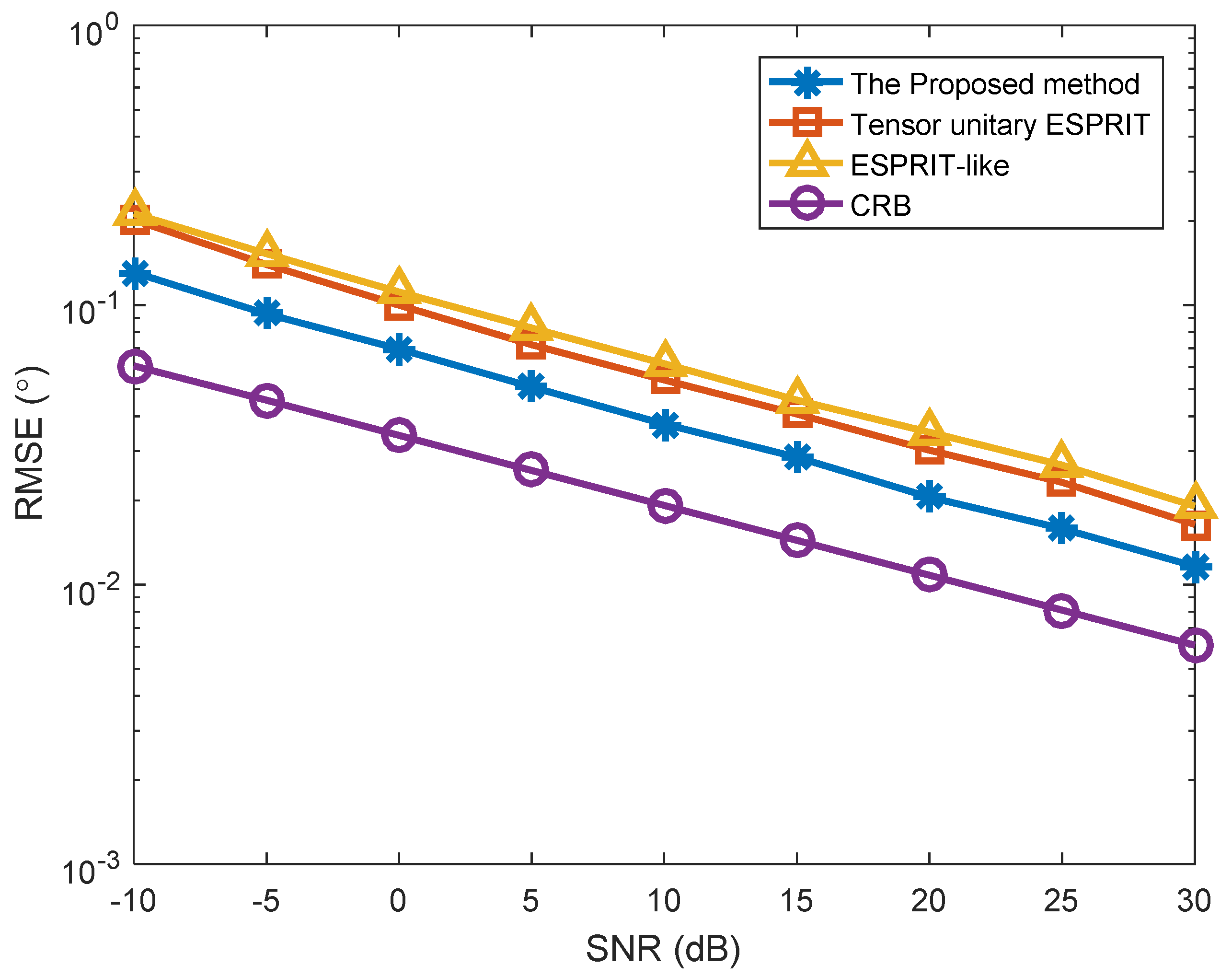
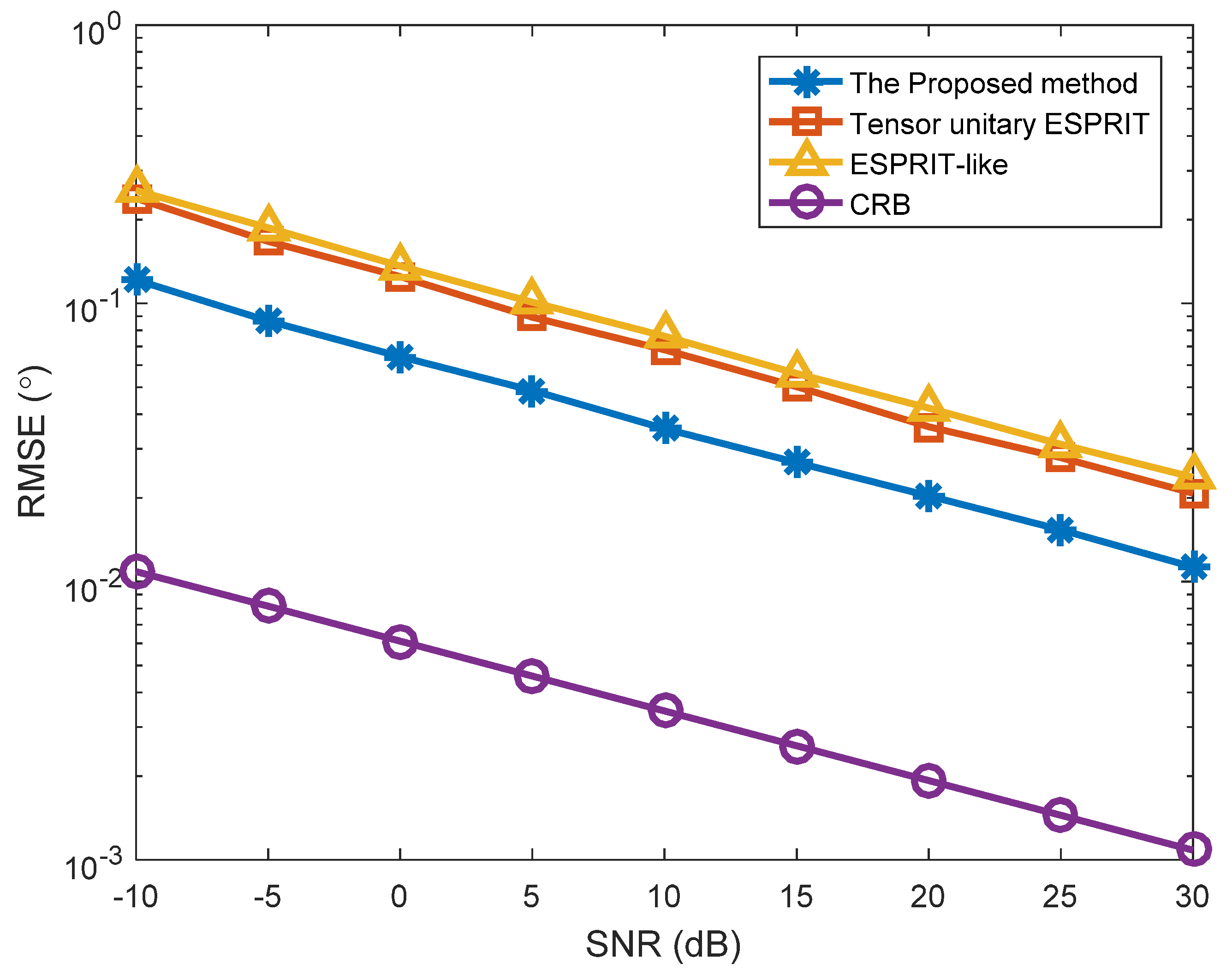
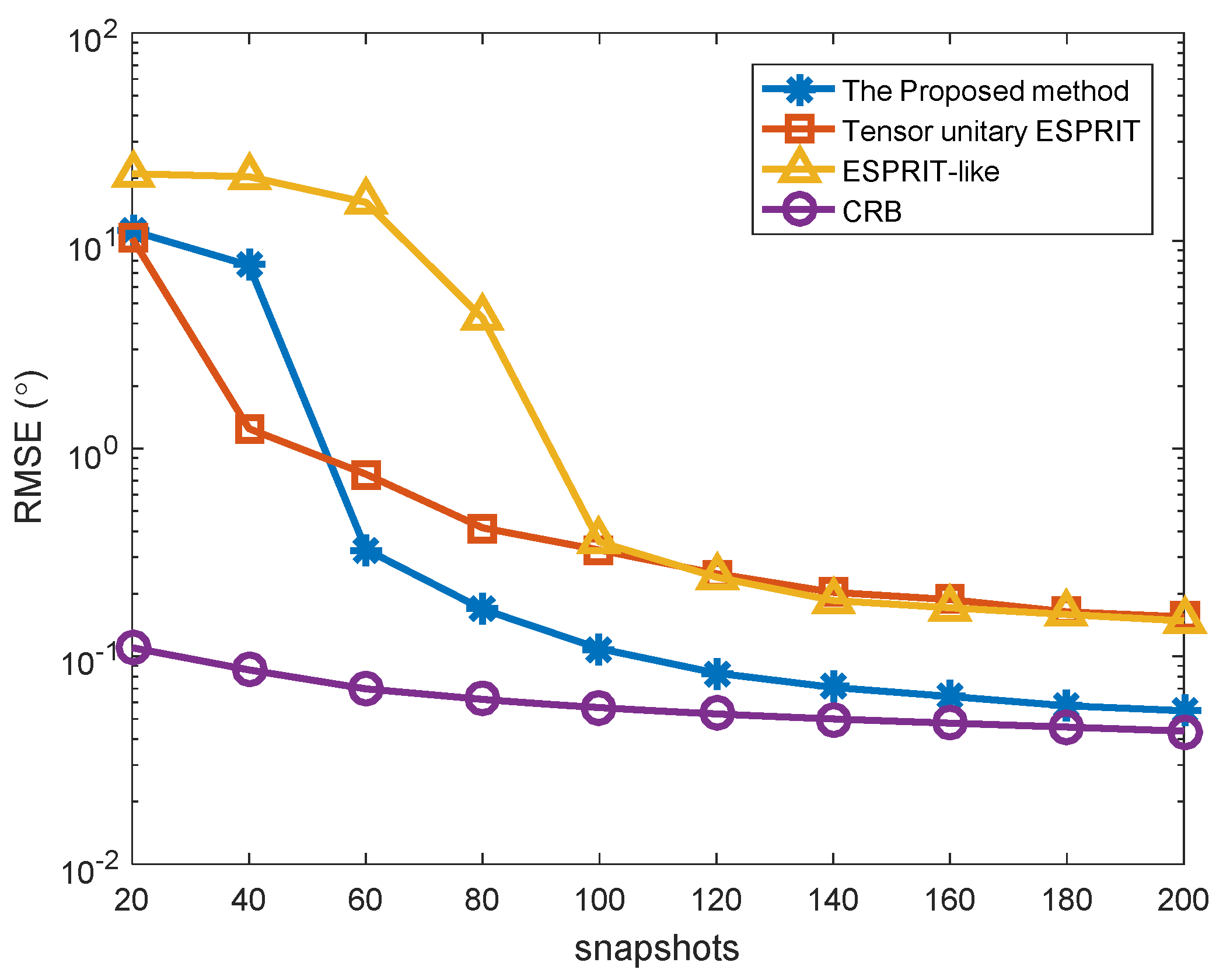
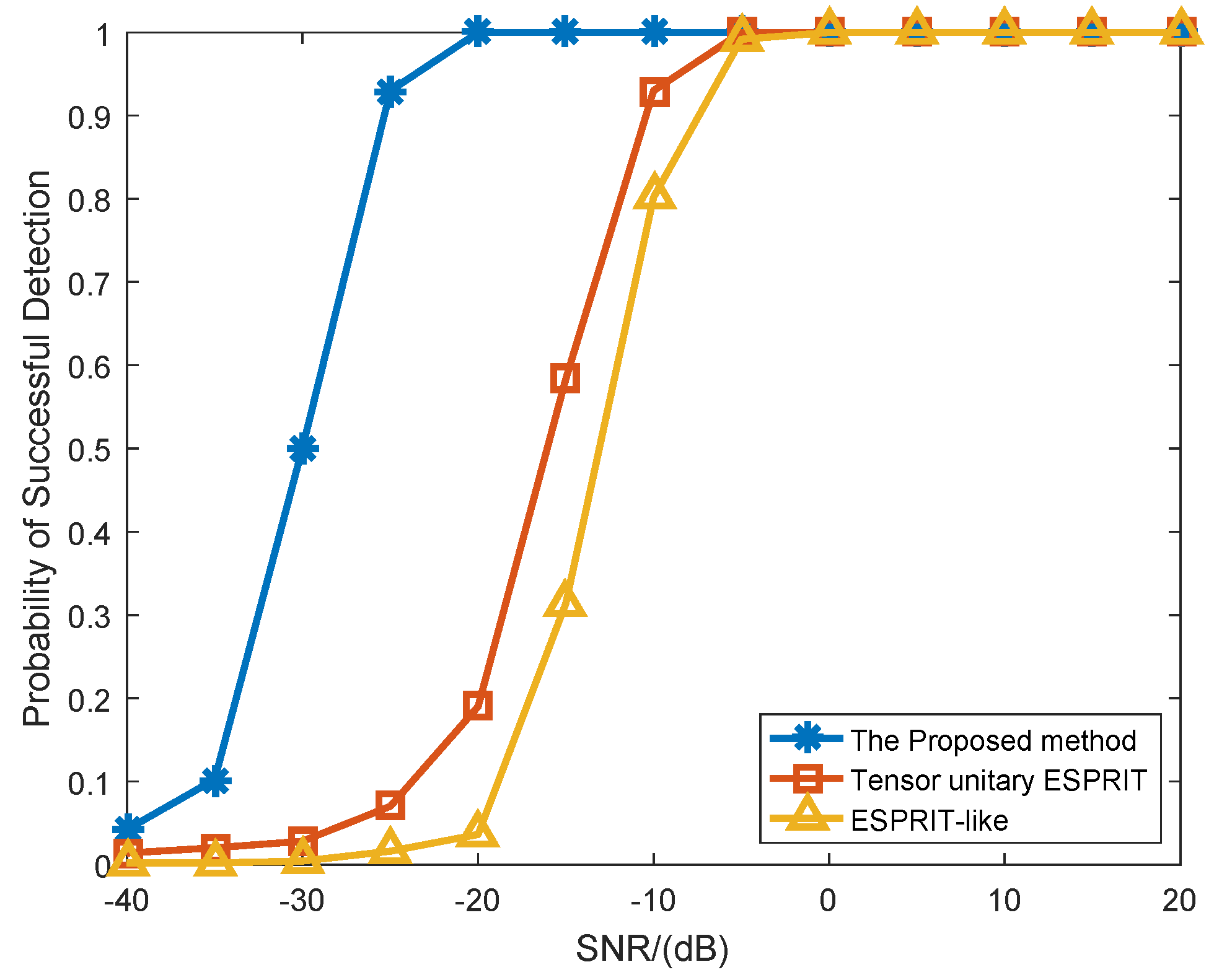
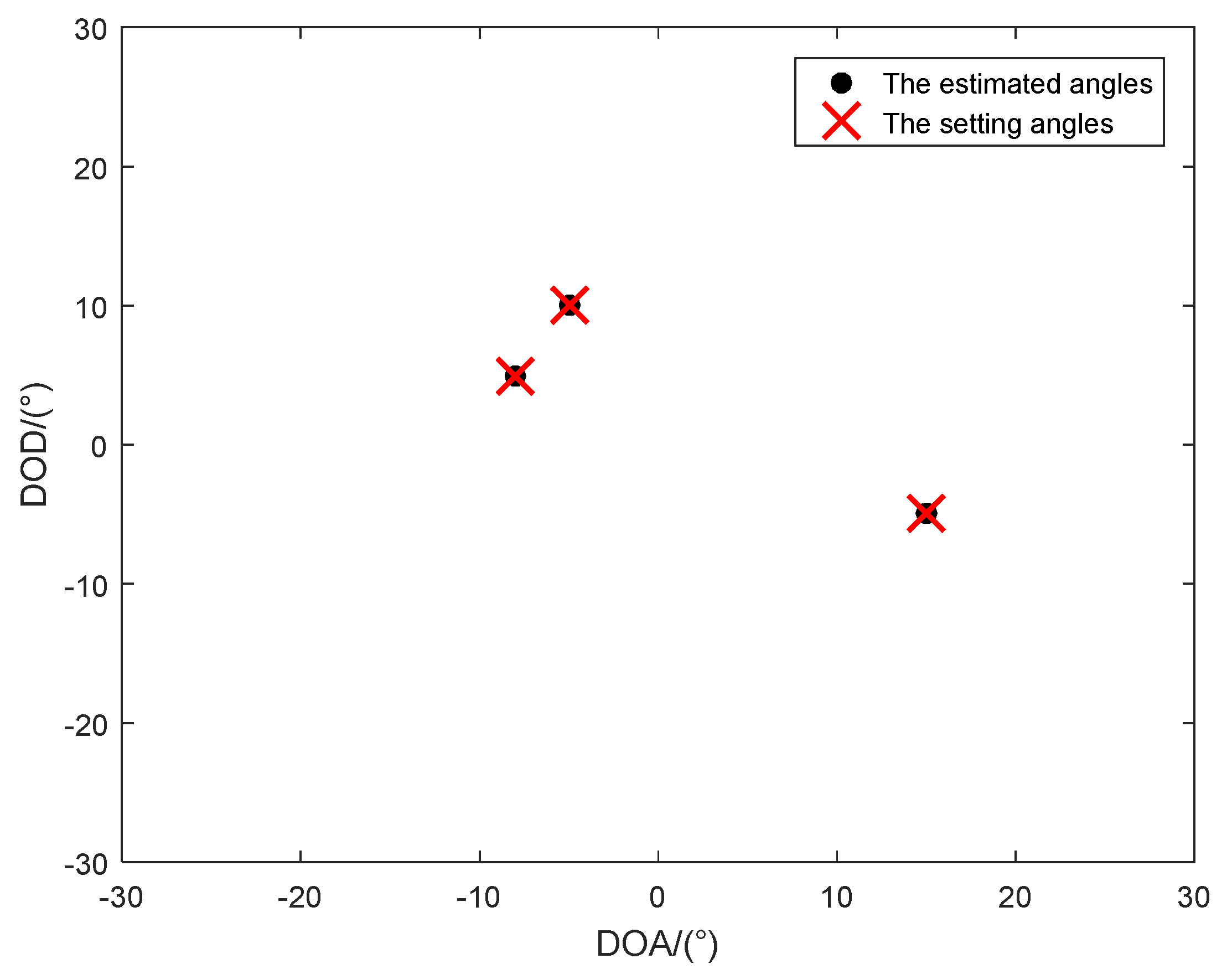
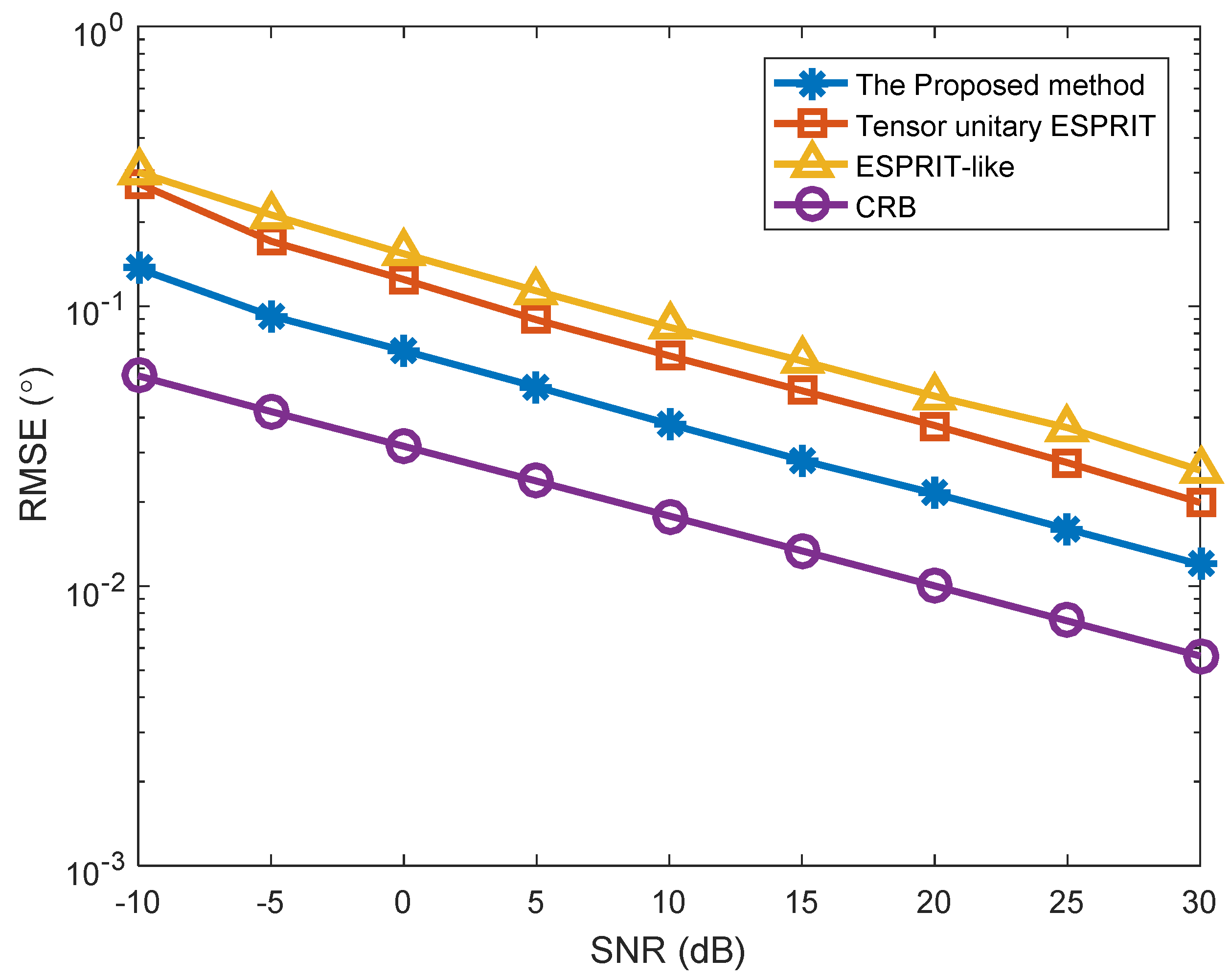
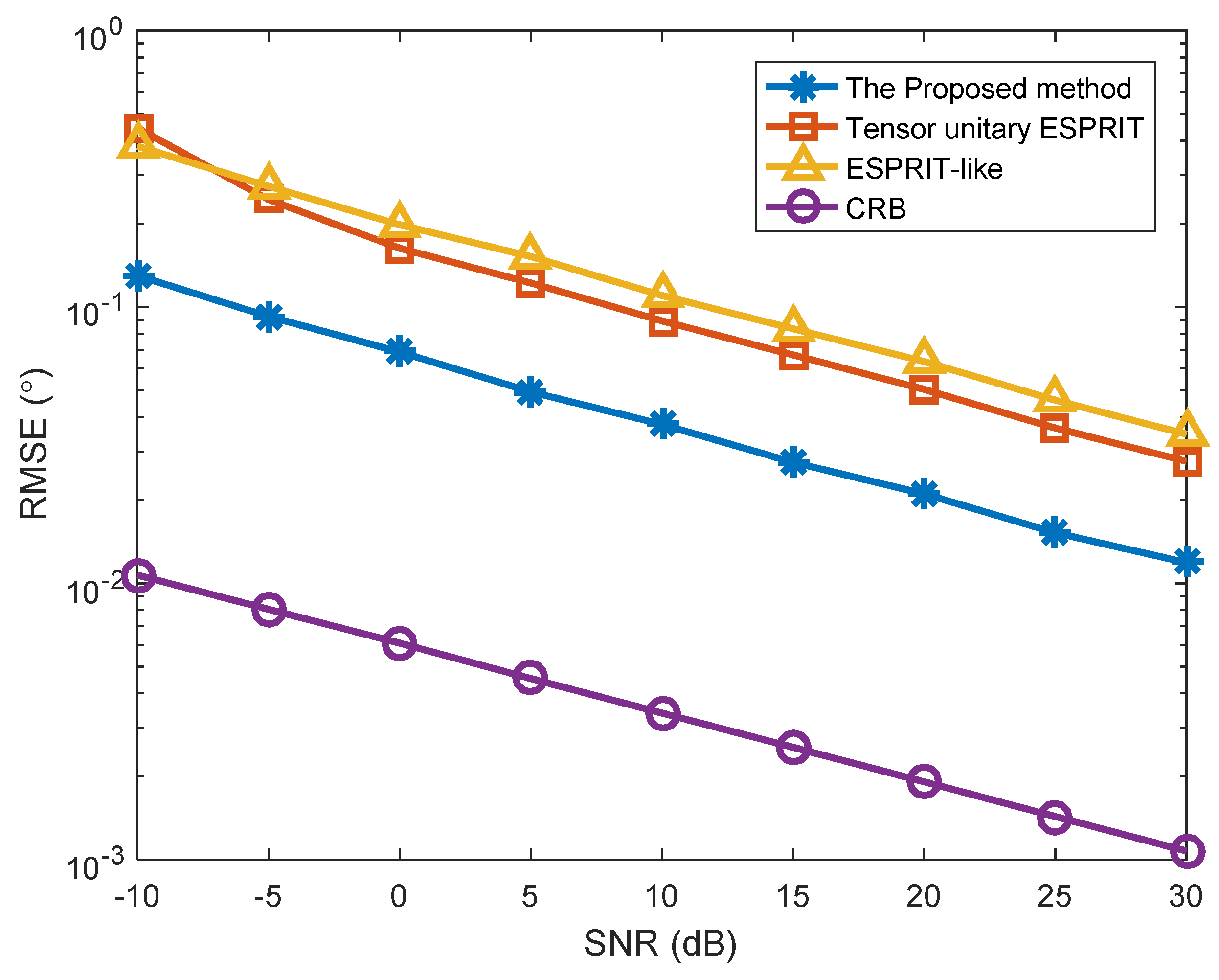
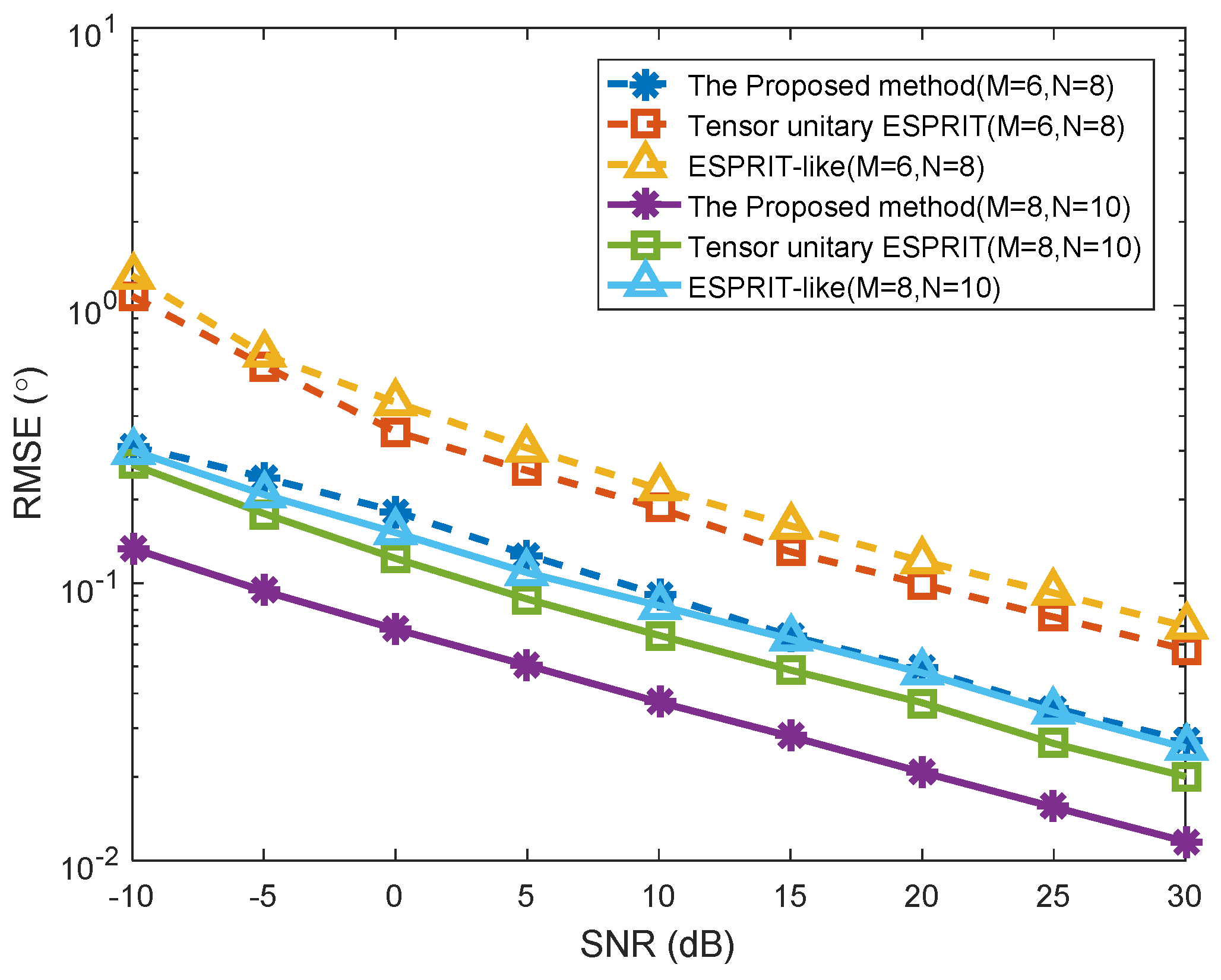
5. Simulation Results
6. Conclusions
Author Contributions
Funding
Conflicts of Interest
References
- Fishler, E.; Haimovich, A.; Blum, R.; Chizhik, D.; Cimini, L.; Valenzuela, R. MIMO radar: An idea whose time has come. In Proceedings of the IEEE Radar Conference, Philadelphia, PA, USA, 26–29 April 2004; pp. 71–78. [Google Scholar]
- Krim, H.; Viberg, M. Two decades of array signal processing research: The parametric approach. IEEE Signal Process. 1996, 13, 67–94. [Google Scholar] [CrossRef]
- Liao, B. Fast angle estimation for MIMO radar with nonorthogonal waveforms. IEEE Trans. Aerosp. Electron. Syst. 2018. [Google Scholar] [CrossRef]
- Fishler, E.; Haimovich, A.; Blum, R. Performance of MIMO radar systems: Advantages of angular diversity. In Proceedings of the 38th Asilomar Conference on Signals, Systems and Computers (ASILOMAR 2004), Pacific Grove, CA, USA, 7–10 November 2004; pp. 305–309. [Google Scholar]
- Fishler, E.; Haimovich, A.; Blum, R. Spatial diversity in radars-Models and detection performance. IEEE Trans. Signal Process. 2006, 54, 823–838. [Google Scholar] [CrossRef]
- Haimovich, A.M.; Blum, R.; Cimini, L. MIMO radar with widely separated antennas. IEEE Signal Process. Mag. 2008, 25, 116–129. [Google Scholar] [CrossRef]
- Li, J.; Stoica, P. MIMO radar with colocated antennas. IEEE Signal Process. Mag. 2007, 24, 106–114. [Google Scholar] [CrossRef]
- Yan, H.; Li, J.; Liao, G. Multitarget identification and localization using bistatic MIMO radar systems. EURASIP J. Adv. Signal Process. 2008, 2008, 48. [Google Scholar] [CrossRef]
- Gao, X.; Zhang, X.; Feng, G.; Wang, Z.; Xu, D. On the MUSIC derived approaches of angle estimation for bistatic MIMO radar. In Proceedings of the International Conference on Wireless Networks and Information Systems (WINSYS 2009), Shanghai, China, 28–29 December 2009; pp. 343–346. [Google Scholar]
- Chen, D.; Chen, B.; Qin, G. Angle estimation using ESPRIT in MIMO radar. Electron. Lett. 2008, 44, 770–771. [Google Scholar]
- Chen, J.; Gu, H.; Su, W. Angle estimation using ESPRIT without pairing in MIMO radar. Electron. Lett. 2008, 44, 1422–1423. [Google Scholar]
- Zheng, H.; Chen, B.; Yang, M. Unitary ESPRIT algorithm for bistatic MIMO radar. Electron. Lett. 2012, 48, 179–181. [Google Scholar] [CrossRef]
- Boudaher, E.; Ahmad, F.; Amin, M.G.; Hoorfar, A. Mutual coupling effect and compensation in non-uniform arrays for direction-of-arrival estimation. Digit. Signal Process. 2017, 61, 3–14. [Google Scholar] [CrossRef]
- Zheng, Z.; Zhang, J.; Zhang, J. Joint DOD and DOA estimation of bistatic MIMO radar in the presence of unknown mutual coupling. Signal Process. 2012, 92, 3039–3048. [Google Scholar] [CrossRef]
- Liu, X.; Liao, G. Direction finding and mutual coupling estimation for bistatic MIMO radar. Signal Process. 2012, 92, 522–527. [Google Scholar] [CrossRef]
- Abeida, H.; Delmas, J.P. MUSIC-like estimation of direction of arrival for noncircular sources. IEEE Trans. Signal Process. 2006, 54, 2678–2690. [Google Scholar] [CrossRef]
- Barbaresco, F.; Chevalier, P. Noncircularity exploitation in signal processing overview and application to radar. In Proceedings of the IET Waveform Diversity & Digital Radar Conference 2008. Day 1: Waveform Diversity & Design, London, UK, 8–9 December 2008. [Google Scholar]
- Cao, S.; Xu, D.; Xu, X. DOA estimation for noncircular signals in the presence of mutual coupling. Signal Process. 2014, 105, 12–16. [Google Scholar] [CrossRef]
- Wang, W.; Wang, X.; Ma, Y.; Li, X. Conjugate unitary ESPRIT algorithm for bistatic MIMO radar. IEICE Trans. Electron. 2013, 96, 124–126. [Google Scholar] [CrossRef]
- Yang, M.L.; Chen, B.X.; Yang, X.Y. Conjugate ESPRIT algorithm for bistatic MIMO radar. Electron. Lett. 2011, 46, 1692–1694. [Google Scholar] [CrossRef]
- Cheng, Y.; Yu, R.; Gu, H.; Su, W. Multi-SVD based subspace estimation to improve angle estimation accuracy in bistatic MIMO radar. Signal Process. 2013, 93, 2003–2009. [Google Scholar] [CrossRef]
- Nion, D.; Sidiropoulos, N.D. Tensor algebra and multidimensional harmonic retrieval in signal processing for MIMO radar. IEEE Trans. Signal Process. 2010, 58, 5693–5705. [Google Scholar] [CrossRef]
- Wang, X.; Wang, W.; Liu, J. Tensor-based real-valued subspace approach for angle estimation in bistatic MIMO radar with unknown mutual coupling. Signal Process. 2015, 116, 152–158. [Google Scholar] [CrossRef]
- Wen, F.; Xiong, X.; Zhang, Z. Angle and mutual coupling estimation in bistatic MIMO radar based on PARAFAC decomposition. Digit. Signal Process. 2017, 65, 1–10. [Google Scholar] [CrossRef]
- Wang, J.; Wang, X.; Xu, D. Robust angle estimation for MIMO radar with the coexistence of mutual coupling and colored noise. Sensors 2018, 18, 832. [Google Scholar] [CrossRef] [PubMed]
- Lathauwer, L.D.; Moor, B.D.; Vandewalle, J. A multilinear singular value decomposition. SIAM J. Matrix Anal. 2000, 21, 1253–1278. [Google Scholar] [CrossRef]
- Kolda, T.G.; Bader, B.W. Tensor decomposition sand applications. SIAM Rev. 2009, 51, 455–500. [Google Scholar] [CrossRef]
- Golub, G.H.; Van Loan, C.F. Matrix Computations; Johns Hopkins University Press: Baltimore, MD, USA, 1996. [Google Scholar]




© 2018 by the authors. Licensee MDPI, Basel, Switzerland. This article is an open access article distributed under the terms and conditions of the Creative Commons Attribution (CC BY) license (http://creativecommons.org/licenses/by/4.0/).
Share and Cite
Guo, Y.; Wang, X.; Wang, W.; Huang, M.; Shen, C.; Cao, C.; Bi, G. Tensor-Based Angle Estimation Approach for Strictly Noncircular Sources with Unknown Mutual Coupling in Bistatic MIMO Radar. Sensors 2018, 18, 2788. https://doi.org/10.3390/s18092788
Guo Y, Wang X, Wang W, Huang M, Shen C, Cao C, Bi G. Tensor-Based Angle Estimation Approach for Strictly Noncircular Sources with Unknown Mutual Coupling in Bistatic MIMO Radar. Sensors. 2018; 18(9):2788. https://doi.org/10.3390/s18092788
Chicago/Turabian StyleGuo, Yuehao, Xianpeng Wang, Wensi Wang, Mengxing Huang, Chong Shen, Chunjie Cao, and Guoan Bi. 2018. "Tensor-Based Angle Estimation Approach for Strictly Noncircular Sources with Unknown Mutual Coupling in Bistatic MIMO Radar" Sensors 18, no. 9: 2788. https://doi.org/10.3390/s18092788
APA StyleGuo, Y., Wang, X., Wang, W., Huang, M., Shen, C., Cao, C., & Bi, G. (2018). Tensor-Based Angle Estimation Approach for Strictly Noncircular Sources with Unknown Mutual Coupling in Bistatic MIMO Radar. Sensors, 18(9), 2788. https://doi.org/10.3390/s18092788