Article

Validation of the Accuracy and Convergence Time of Real Time Kinematic Results Using a Single Galileo Navigation System

Department of Geodesy, University of Agriculture in Krakow, Al. Mickiewicza 21, 31-120 Krakow, Poland
Sensors 2018, 18(8), 2412; https://doi.org/10.3390/s18082412
Submission received: 30 May 2018 / Revised: 1 July 2018 / Accepted: 20 July 2018 / Published: 25 July 2018
(This article belongs to the Section Physical Sensors)

Abstract

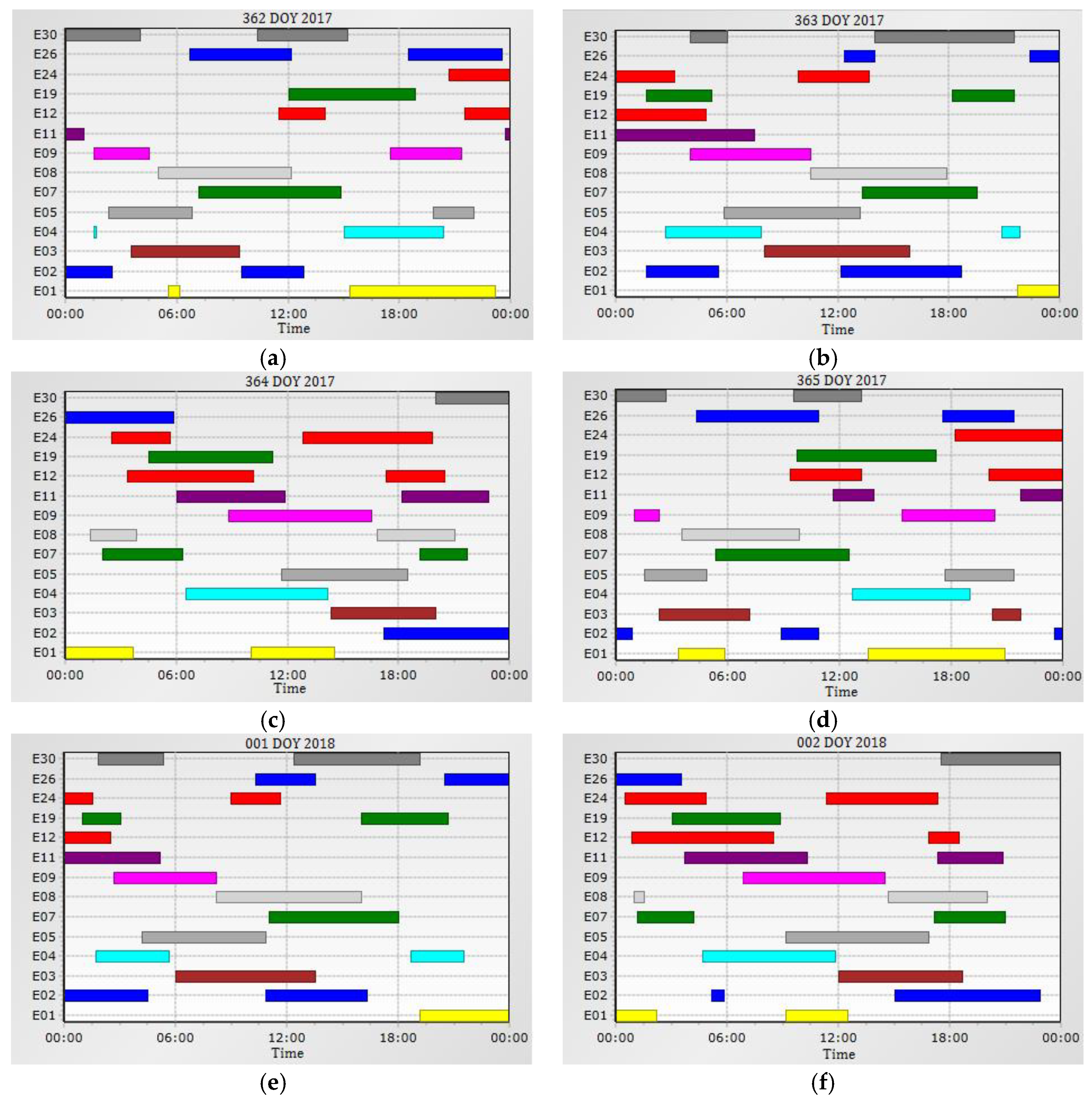
For the last two decades, the American GPS and Russian GLONASS were the basic systems used in global positioning and navigation. In recent years, there has been significant progress in the development of positioning systems. New regional systems have been created, i.e., the Japanese Quasi-Zenith Satellite System (QZSS) and Indian Regional Navigational Satellite System (IRNSS). A plan to build its own regional navigation system named Korean Positioning System (KPS) was announced South Korea on 5 February 2018. Currently, two new global navigation systems are under development: the European Galileo and the Chinese BeiDou. The full operability of both systems by 2020 is planned. The paper deals with a possibility of determination of the user’s position from individual and independent global navigation satellite system (GNSS). The article is a broader concept aimed at independent determination of precise position from individual GPS, GLONASS, BeiDou and Galileo systems. It presents real time positioning results (Real Time Kinematic-RTK) using signals from Galileo satellites only. During the test, 14 Galileo satellites were used and the number of simultaneously observed Galileo satellites varied from five to seven. Real-time measurements were only possible in certain 24-h observation windows. However, their number was completed within 6 days at the end of 2017 and beginning of 2018, so there was possible to infer about the current availability, continuity, convergence time and accuracy of the RTK measurements. In addition, the systematic errors were demonstrated for the Galileo system.
Keywords: GPS; Galileo; Multi-GNSS precise positioning; convergence time GPS; Galileo; Multi-GNSS precise positioning; convergence time