A Study on the Impact of Poly(3-hexylthiophene) Chain Length and Other Applied Side-Chains on the NO2 Sensing Properties of Conducting Graft Copolymers



Abstract
1. Introduction
2. Materials and Methods
3. Results and Discussion
3.1. Materials Characterization
3.2. Gas Sensing Mesurements
4. Conclusions
Acknowledgments
Author Contributions
Conflicts of Interest
Appendix A


References
- Kampa, M.; Castanas, E. Human health effects of air pollution. Environ. Pollut. 2008, 151, 362–367. [Google Scholar] [CrossRef] [Scilit] [PubMed]
- Yoo, J.-M.; Jeong, M.-J.; Kim, D.; Stockwell, W.R.; Yang, J.-H.; Shin, H.-W.; Lee, M.-I.; Song, C.-K.; Lee, S.-D. Spatiotemporal variations of air pollutants (O3, NO2, SO2, CO, PM10 and VOCs) with land-use types. Atmos. Chem. Phys. Discuss. 2015, 15, 16985–17050. [Google Scholar] [CrossRef] [Scilit]
- Halfaya, Y.; Bishop, C.; Soltani, A.; Sundaram, S.; Aubry, V.; Voss, P.L.; Salvestrini, J.P.; Ougazzaden, A. Investigation of the performance of HEMT-based NO, NO2 and NH3 exhaust gas sensors for automotive antipollution systems. Sensors 2016, 16, 273. [Google Scholar] [CrossRef] [Scilit] [PubMed]
- Kim, B.-J.; Song, I.-G.; Kim, J.-S. In2O3-based micro gas sensor for detecting NOx gases. Electron. Mater. Lett. 2014, 10, 509–513. [Google Scholar] [CrossRef] [Scilit]
- Procek, M.; Stolarczyk, A.; Pustelny, T.; Maciak, E. A Study of a QCM Sensor Based on TiO2 Nanostructures for the Detection of NO2 and Explosives Vapours in Air. Sensors 2015, 15, 9563–9581. [Google Scholar] [CrossRef] [Scilit] [PubMed]
- Bielecki, Z.; Janucki, J.; Kawalec, A.; Mikolajczyk, J.; Palka, N.; Pasternak, M.; Pustelny, T.; Stacewicz, T.; Wojtas, J. Sensors and systems for the detection of explosive devices—An overview. Metrol. Meas. Syst. 2012, 19, 3–28. [Google Scholar] [CrossRef] [Scilit]
- Blue, R.; Uttamchandani, D.; Thomson, N.; Skabara, P. Novel polymer materials for low-cost nitro vapor detection sensors. In Proceedings of the 2015 IEEE Sensors, Busan, Korea, 1–4 November 2015; pp. 1–4. [Google Scholar]
- Yunusa, Z.; Hamidon, M.N.; Kaiser, A.; Awang, Z. Gas sensors: A review. Sens. Transducers 2014, 168, 61–75. [Google Scholar]
- Liu, X.; Cheng, S.; Liu, H.; Hu, S.; Zhang, D.; Ning, H. A Survey on Gas Sensing Technology. Sensors 2012, 12, 9635–9665. [Google Scholar] [CrossRef] [Scilit] [PubMed]
- Neri, G. First Fifty Years of Chemoresistive Gas Sensors. Chemosensors 2015, 3, 1–20. [Google Scholar] [CrossRef] [Scilit]
- Procek, M.; Stolarczyk, A.; Pustelny, T. Impact of Temperature and UV Irradiation on Dynamics of NO2 Sensors Based on ZnO Nanostructures. Nanomaterials 2017, 7, 312. [Google Scholar] [CrossRef] [Scilit] [PubMed]
- Ponzoni, A.; Baratto, C.; Cattabiani, N.; Falasconi, M.; Galstyan, V.; Nunez-Carmona, E.; Rigoni, F.; Sberveglieri, V.; Zambotti, G.; Zappa, D. Metal Oxide Gas Sensors, a Survey of Selectivity Issues Addressed at the SENSOR Lab, Brescia (Italy). Sensors 2017, 17, 714. [Google Scholar] [CrossRef] [Scilit] [PubMed]
- Gardon, M.; Guilemany, J.M. A review on fabrication, sensing mechanisms and performance of metal oxide gas sensors. J. Mater. Sci. Mater. Electron. 2013, 24, 1410–1421. [Google Scholar] [CrossRef] [Scilit]
- Bai, H.; Shi, G. Gas Sensors Based on Conducting Polymers. Sensors 2007, 7, 267–307. [Google Scholar] [CrossRef] [Scilit]
- Miasik, J.J.; Hooper, A.; Tofield, B.C. Conducting polymer gas sensors. J. Chem. Soc. Faraday Trans. 1 Phys. Chem. Condens. Phases 1986, 82, 1117. [Google Scholar] [CrossRef] [Scilit]
- Fratoddi, I.; Venditti, I.; Cametti, C.; Russo, M.V. Chemiresistive polyaniline-based gas sensors: A mini review. Sens. Actuators B Chem. 2015, 220, 534–548. [Google Scholar] [CrossRef] [Scilit]
- Kumar, V.; Kim, K.-H.; Kumar, P.; Jeon, B.-H.; Kim, J.-C. Functional hybrid nanostructure materials: Advanced strategies for sensing applications toward volatile organic compounds. Coord. Chem. Rev. 2017, 342, 80–105. [Google Scholar] [CrossRef] [Scilit]
- Maciak, E.; Procek, M.; Kepska, K.; Stolarczyk, A. Study of optical and electrical properties of thin films of the conducting comb-like graft copolymer of polymethylsiloxane with poly(3-hexyltiophene) and poly(ethylene) glycol side chains for low temperature NO2 sensing. Thin Solid Films 2016, 618, 277–285. [Google Scholar] [CrossRef] [Scilit]
- Öztürk, S.; Kösemen, A.; Şen, Z.; Kılınç, N.; Harbeck, M. Poly(3-Methylthiophene) Thin Films Deposited Electrochemically on QCMs for the Sensing of Volatile Organic Compounds. Sensors 2016, 16, 423. [Google Scholar] [CrossRef] [Scilit] [PubMed]
- Stahl, U.; Voigt, A.; Dirschka, M.; Barié, N.; Richter, C.; Waldbaur, A.; Gruhl, F.; Rapp, B.; Rapp, M.; Länge, K. Long-Term Stability of Polymer-Coated Surface Transverse Wave Sensors for the Detection of Organic Solvent Vapors. Sensors 2017, 17, 2529. [Google Scholar] [CrossRef] [Scilit] [PubMed]
- Inzelt, G.; Pineri, M.; Schultze, J.; Vorotyntsev, M. Electron and proton conducting polymers: Recent developments and prospects. Electrochim. Acta 2000, 45, 2403–2421. [Google Scholar] [CrossRef] [Scilit]
- Lange, U.; Roznyatovskaya, N.V.; Mirsky, V.M. Conducting polymers in chemical sensors and arrays. Anal. Chim. Acta 2008, 614, 1–26. [Google Scholar] [CrossRef] [Scilit] [PubMed]
- Park, S.; Park, C.; Yoon, H. Chemo-Electrical Gas Sensors Based on Conducting Polymer Hybrids. Polymers 2017, 9, 155. [Google Scholar] [CrossRef] [Scilit]
- Kepska, K.; Jarosz, T.; Januszkiewicz-Kaleniak, A.; Domagala, W.; Lapkowski, M.; Stolarczyk, A. Spectroelectrochemistry of poly(3-hexylthiophenes) in solution. Chem. Pap. 2018, 72, 251–259. [Google Scholar] [CrossRef] [Scilit] [PubMed]
- Han, S.; Zhuang, X.; Shi, W.; Yang, X.; Li, L.; Yu, J. Poly(3-hexylthiophene)/polystyrene (P3HT/PS) blends based organic field-effect transistor ammonia gas sensor. Sens. Actuators B Chem. 2016, 225, 10–15. [Google Scholar] [CrossRef] [Scilit]
- Li, H.; Dailey, J.; Kale, T.; Besar, K.; Koehler, K.; Katz, H.E. Sensitive and Selective NO2 Sensing Based on Alkyl- and Alkylthio-Thiophene Polymer Conductance and Conductance Ratio Changes from Differential Chemical Doping. ACS Appl. Mater. Interfaces 2017, 9, 20501–20507. [Google Scholar] [CrossRef] [Scilit] [PubMed]
- Maciak, E.; Stolarczyk, A.; Procek, M. Surface plasmon resonance study of comb copolymers containing regioregular poly-3-hexylothiophene. In Optical Fibers and Their Applications 2015; Romaniuk, R.S., Wojcik, W., Smolarz, A., Eds.; SPIE—International Society for Optical Engineering: Bellingham, WA, USA, 2015. [Google Scholar]
- Procek, M.; Stolarczyk, A.; Maciak, E. Study of the impact of UV radiation on NO2 sensing properties of graft comb copolymers of poly(3-hexylthiophene) at room temperature. Proc. SPIE Int. Soc. Opt. Eng. 2017, 10455, 104550N. [Google Scholar]
- Jeffries-El, M.; Geneviève, S.; McCullough, R.D. Facile Synthesis of End-Functionalized Regioregular Poly(3-alkylthiophene)s via Modified Grignard Metathesis Reaction. Macromolecules 2005, 38, 10346–10352. [Google Scholar] [CrossRef] [Scilit]
- Stolarczyk, A.; Turczyn, R.; Januszkiewicz-Kaleniak, A.; Kępska, K. The macromolecule comb-graft polymer of polydimethylsiloxane graft-conjugated polyether and a method for its preparation. Pol. Pat. Appl. 2014, 407784, RR10. [Google Scholar]
- Li, D.; Shi, P.; Wang, J.; Li, J.; Su, R. High-efficiency absorption of high NOx concentration in water or PEG using capillary pneumatic nebulizer packed with an expanded graphite filter. Chem. Eng. J. 2014, 237, 8–15. [Google Scholar] [CrossRef] [Scilit]
- Cerıon Solis, J.; De la Rosa, E.; Pena Cabrera, E. Absorption and refractive index changes of poly (3-octylthiophene) under NO2 gas exposure. Opt. Mater. 2006, 29, 167–172. [Google Scholar] [CrossRef] [Scilit]
- Xie, T.; Xie, G.; Du, H.; Zhou, Y.; Xie, F.; Jiang, Y.; Tai, H. The Fabrication and Optimization of Thin-Film Transistors Based on Poly(3-Hexylthiophene) Films for Nitrogen Dioxide Detection. IEEE Sens. J. 2016, 16, 1865–1871. [Google Scholar] [CrossRef] [Scilit]
- Potje-Kamloth, K. Semiconductor junction gas sensors. Chem. Rev. 2008, 108, 367–399. [Google Scholar] [CrossRef] [Scilit] [PubMed]
- Kroon, R.; Mengistie, D.A.; Kiefer, D.; Hynynen, J.; Ryan, J.D.; Yu, L.; Müller, C. Thermoelectric plastics: From design to synthesis, processing and structure–property relationships. Chem. Soc. Rev. 2016, 45, 6147–6164. [Google Scholar] [CrossRef] [Scilit] [PubMed]
- Monteiro, F.F.; Ribeiro Junior, L.A.; de Almeida Fonseca, A.L.; e Silva, G.M.; da Cunha, W.F. Electron–phonon coupling effects on intrachain polaron recombination in conjugated polymers. J. Mol. Model. 2017, 23, 1299–1308. [Google Scholar] [CrossRef] [Scilit] [PubMed]
- Wu, M.-C.; Liao, H.-C.; Lo, H.-H.; Chen, S.; Lin, Y.-Y.; Yen, W.-C.; Zeng, T.-W.; Chen, C.-W.; Chen, Y.-F.; Su, W.-F. Nanostructured polymer blends (P3HT/PMMA): Inorganic titania hybrid photovoltaic devices. Sol. Energy Mater. Sol. Cells 2009, 93, 961–965. [Google Scholar] [CrossRef] [Scilit]
- Lu, F.; Cai, W.; Zhang, Y. ZnO Hierarchical Micro/Nanoarchitectures: Solvothermal Synthesis and Structurally Enhanced Photocatalytic Performance. Adv. Funct. Mater. 2008, 18, 1047–1056. [Google Scholar] [CrossRef] [Scilit]
- Xie, T.; Xie, G.; Zhou, Y.; Huang, J.; Wu, M.; Jiang, Y.; Tai, H. Thin film transistors gas sensors based on reduced graphene oxide poly(3-hexylthiophene) bilayer film for nitrogen dioxide detection. Chem. Phys. Lett. 2014, 614, 275–281. [Google Scholar] [CrossRef] [Scilit]
- Xie, T.; Xie, G.; Du, H.; Su, Y.; Ye, Z.; Chen, Y.; Jiang, Y. Two novel methods for evaluating the performance of OTFT gas sensors. Sens. Actuators B Chem. 2016, 230, 176–183. [Google Scholar] [CrossRef] [Scilit]
- Zhao, T.; Fu, X.; Cui, X.; Lian, G.; Liu, Y.; Song, S.; Wang, Q.; Wang, K.; Cui, D. An in-situ surface modification route for realizing the synergetic effect in P3HT-SnO2 composite sensor and strikingly improving its sensing performance. Sens. Actuators B Chem. 2017, 241, 1210–1217. [Google Scholar] [CrossRef] [Scilit]
- Saxena, V.; Aswal, D.K.; Kaur, M.; Koiry, S.P.; Gupta, S.K.; Yakhmi, J.V.; Kshirsagar, R.J.; Deshpande, S.K. Enhanced NO2 selectivity of hybrid poly(3-hexylthiophene): ZnO-nanowire thin films. Appl. Phys. Lett. 2007, 90, 2005–2008. [Google Scholar] [CrossRef] [Scilit]



| Sample | 1H-NMR δ (ppm) |
|---|---|
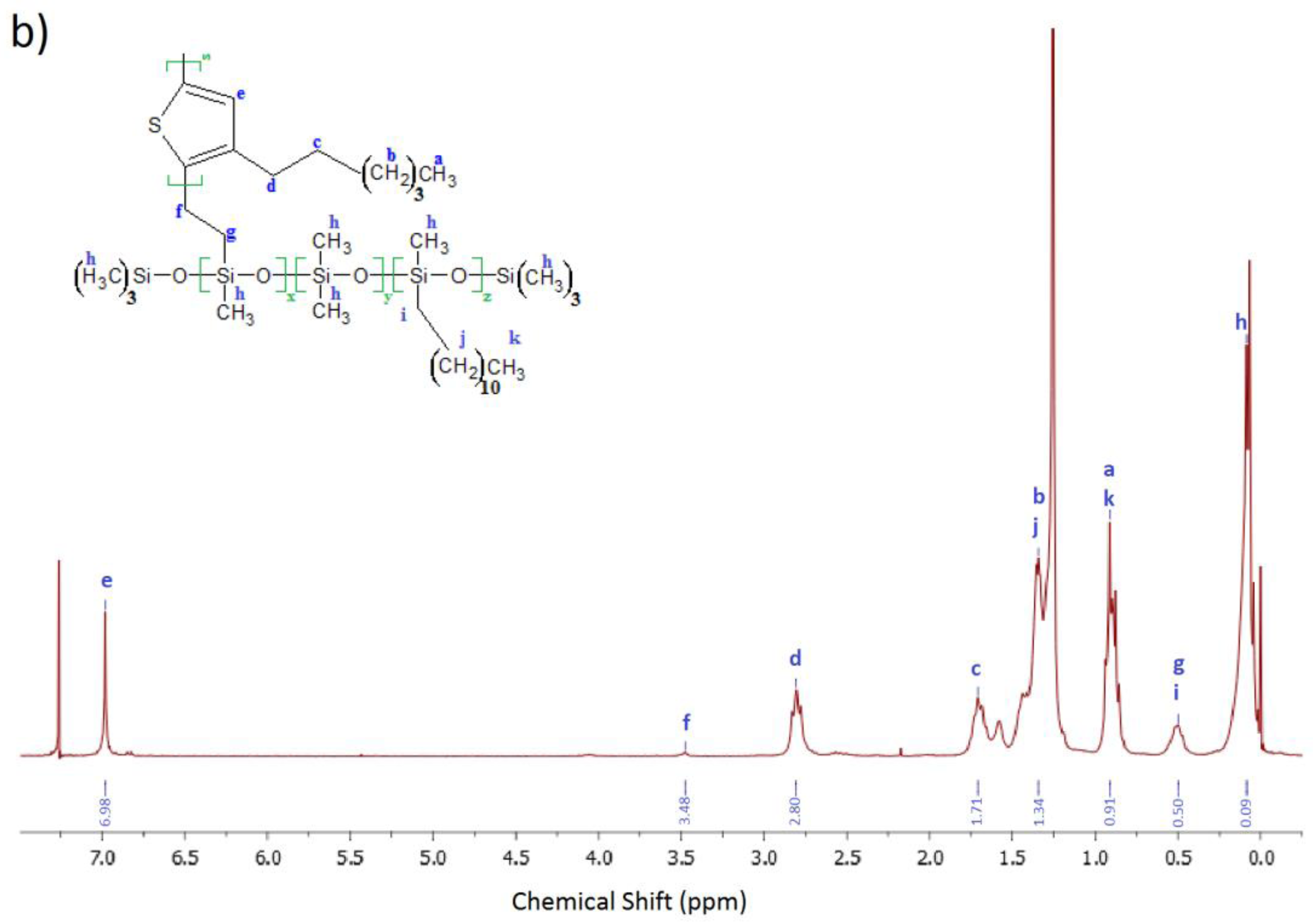
| DodecSil CH | h: 0,09 (CH3-Si-O-); g, i: 0,50 (−CH2-Si-O-) a, k: 0,91 (−CH2-CH3); b, j: 1,34 (−(CH2)3-); c: 1,71 (−CH2-CH2-CAr); d: 2,80 (−CH2-CAr); f: 3,48 (−Si-CH2-CH2-CAr); e: 6,98 (H-CAr) |
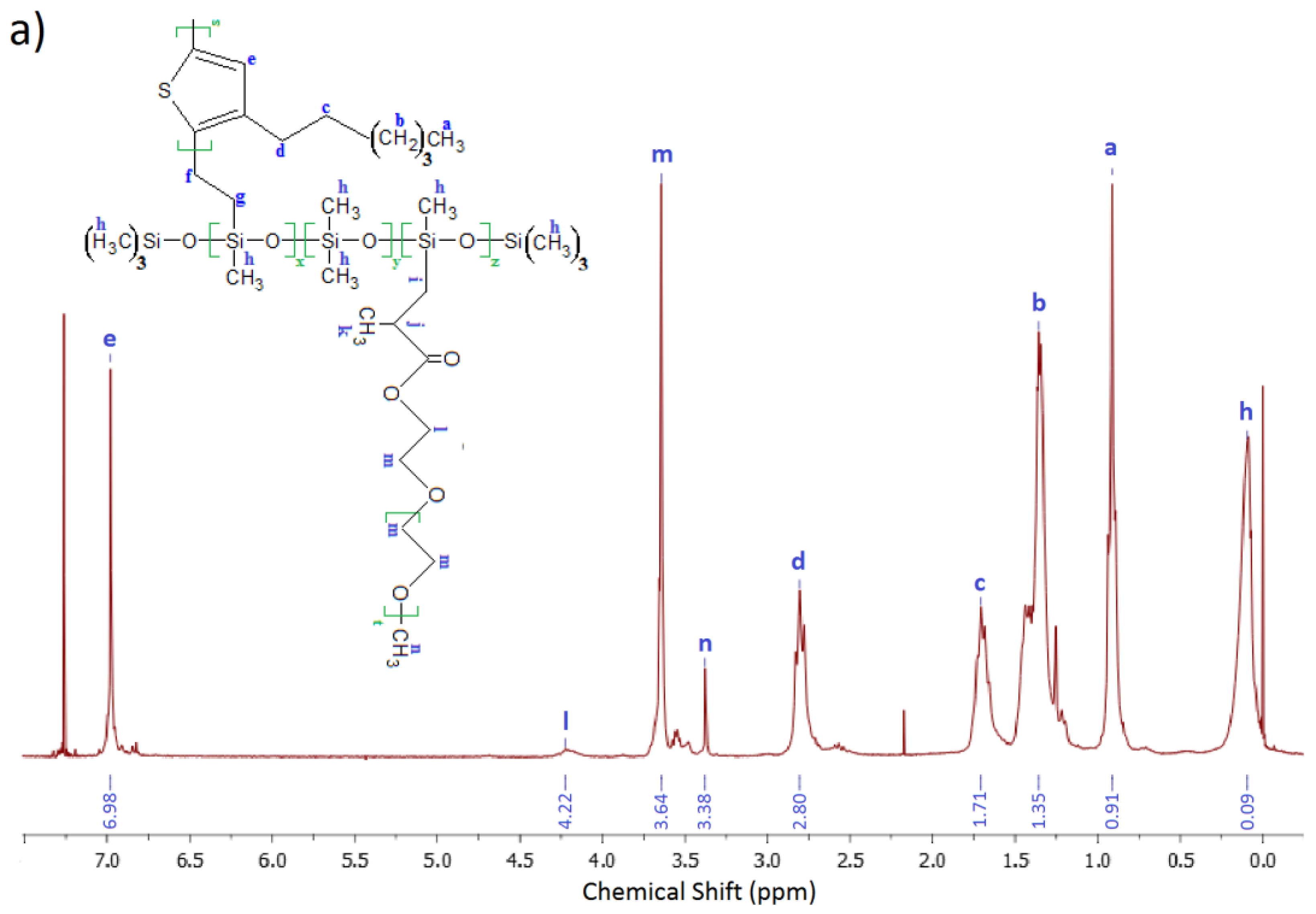
| PEGSil CH | h: 0,09 (CH3-Si-O-); a: 0,91 (−CH2-CH3); b: 1,36 (−(CH2)3-); c: 1,71 (−CH2-CH2-CAr); d: 2,80 (−CH2-CAr); n: 3,38 (CH3-O-); m: 3,64 (−CH2-O-); l: 4,22 (CH2-CH2-C(=O)-); e: 6,98 (H-CAr) |
| Sample | ν (cm−1) Assignment |
|---|---|
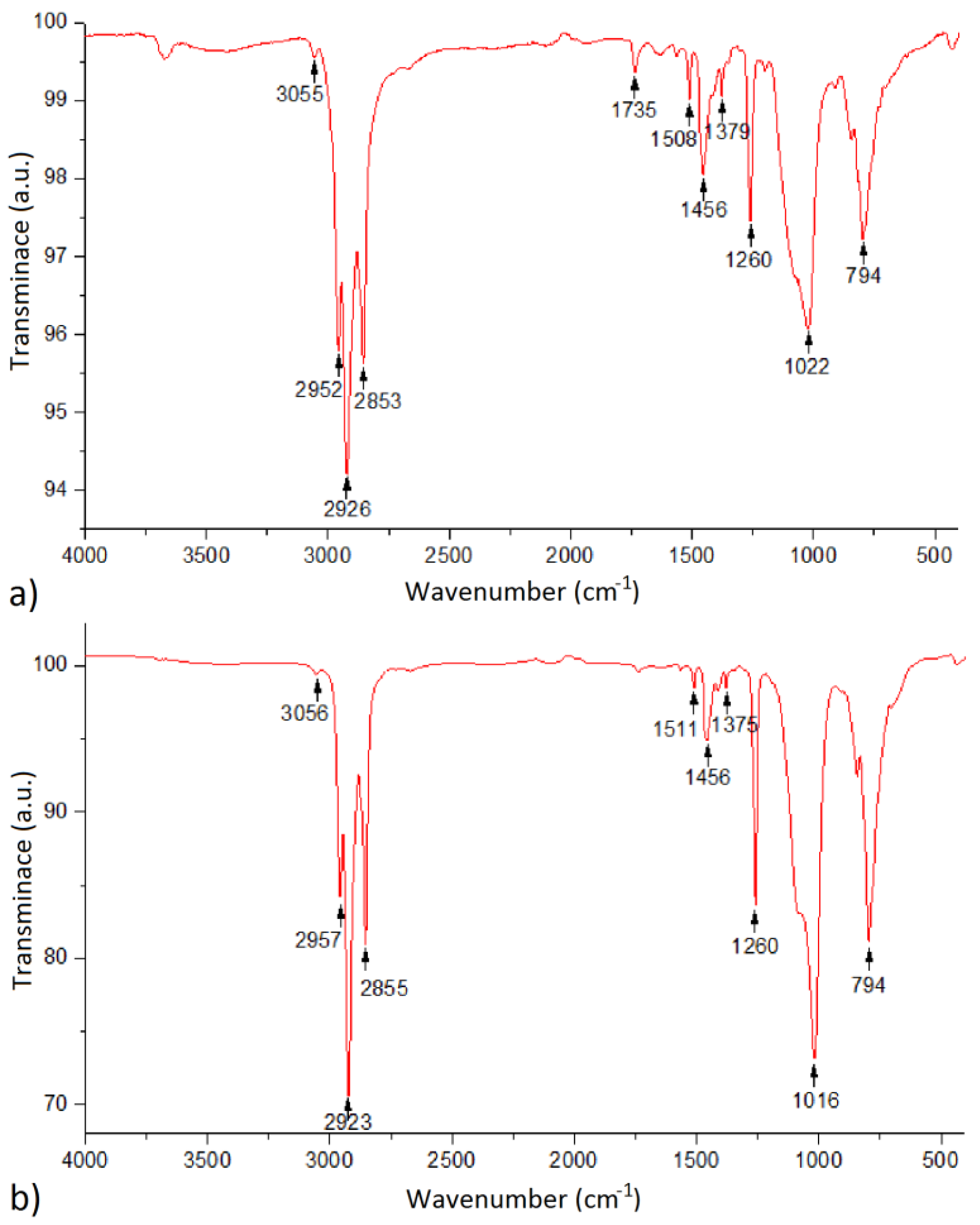
| DodecSil CH | 794 [δ1(Si-(CH3)2), s2]; 1016 [νasym.(Si-O-Si), vs]; 1260 [δasym.(Si-CH3), s]; 1375 [δsym.(-CH2-), w]; 1456 [νasym(CAr = CAr), m]; 1511 [νsym(CAr = CAr), w]; 2855 [νsym.(C-H), s]; 2923 [νasym.(C-H), vs]; 2957 [νsym.(C-H), s]; 3056 [ν(CAr-H), w] |
| PEGSil CH | 795 [δ(Si-(CH3)2), s]; 1022 [νasym.(Si-O-Si), vs]; 1260 [δasym.(Si-CH3), s]; 1379 [δsym.(-CH2-), w]; 1456 [νasym(CAr = CAr), m]; 1508 [νsym(CAr = CAr), w]; 1735 [ν(C = O), w]; 2853 [νsym.(C-H), s]; 2926 [νasym.(C-H), vs]; 2952 [νsym.(C-H), s]; 3055 [ν(CAr-H), w] |
| Sample | PEGSil H | PEGSil CH | DodecSil H | DodecSil CH |
|---|---|---|---|---|
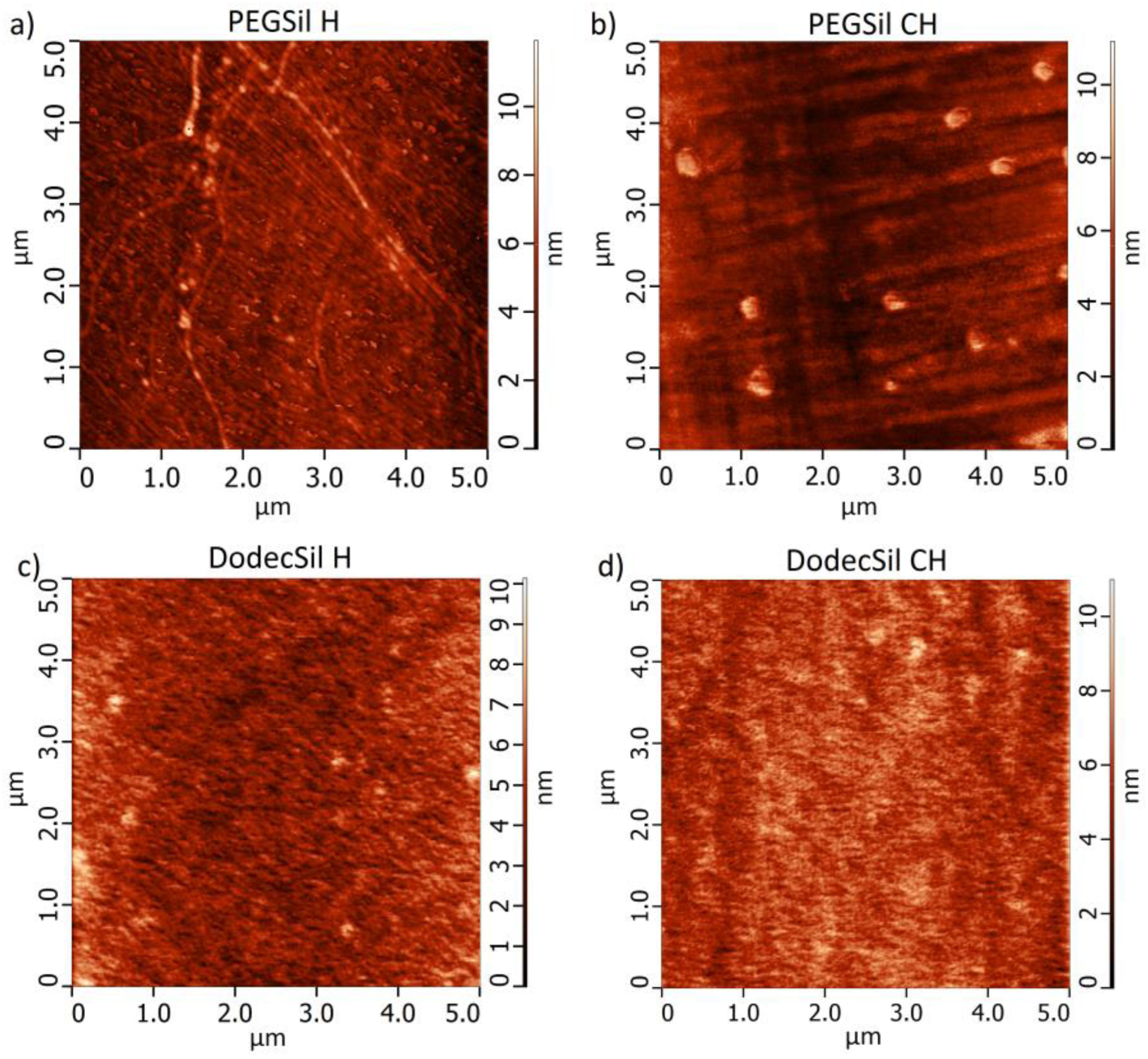
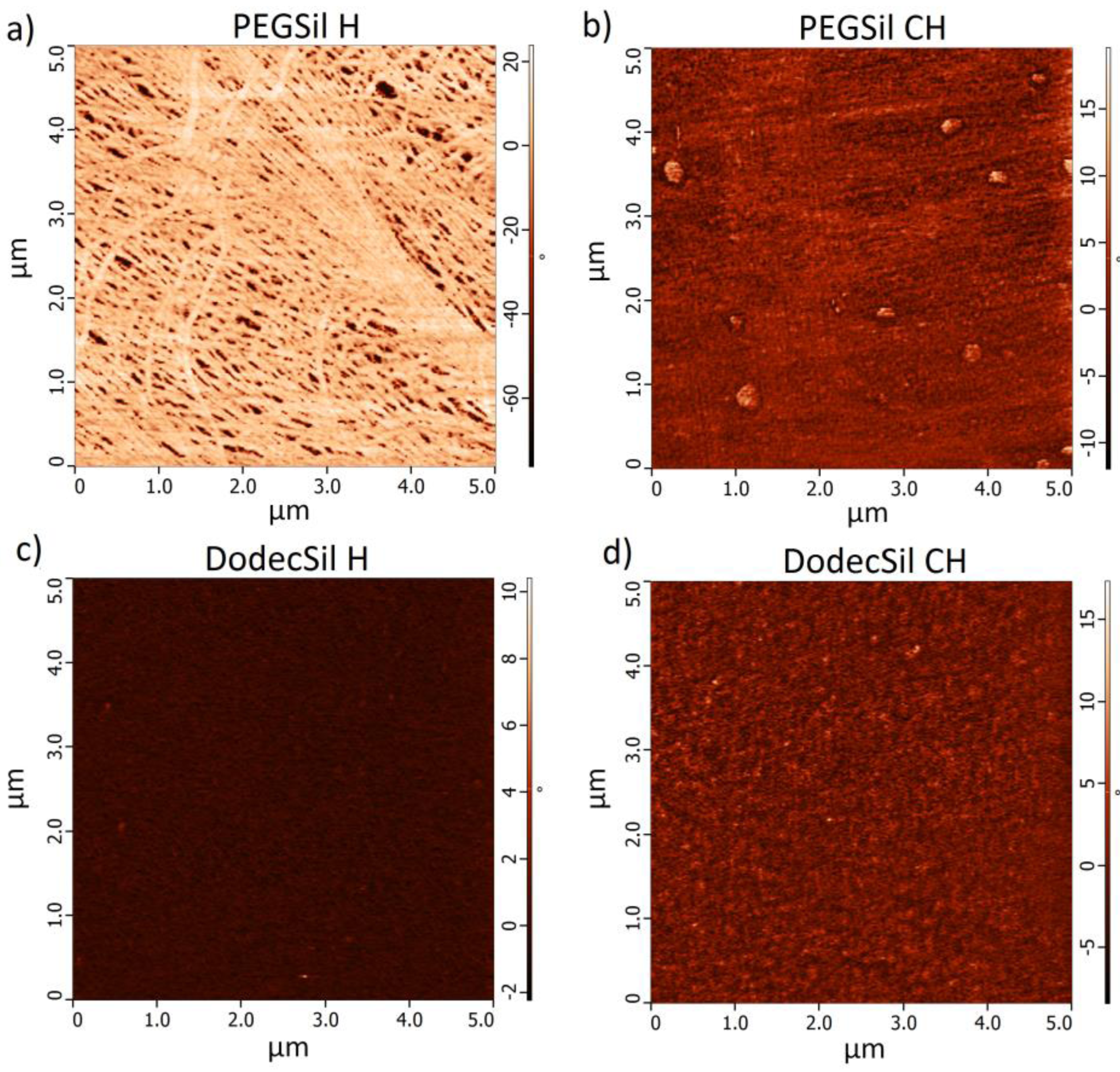
| RMS (5 × 5 μm), nm | 1.24 ± 0.20 | 1.21 ± 0.20 | 1.05 ± 0.10 | 1.06 ± 0.10 |
| Base Resistance, kΩ | 1087.5 ± 1.0 | 128.7 ± 1.0 | 18496.4 ± 1.0 | 113.3 ± 1.0 |
| Material | NO2 Concentration | Response | Operating Temperature | Reference |
|---|---|---|---|---|
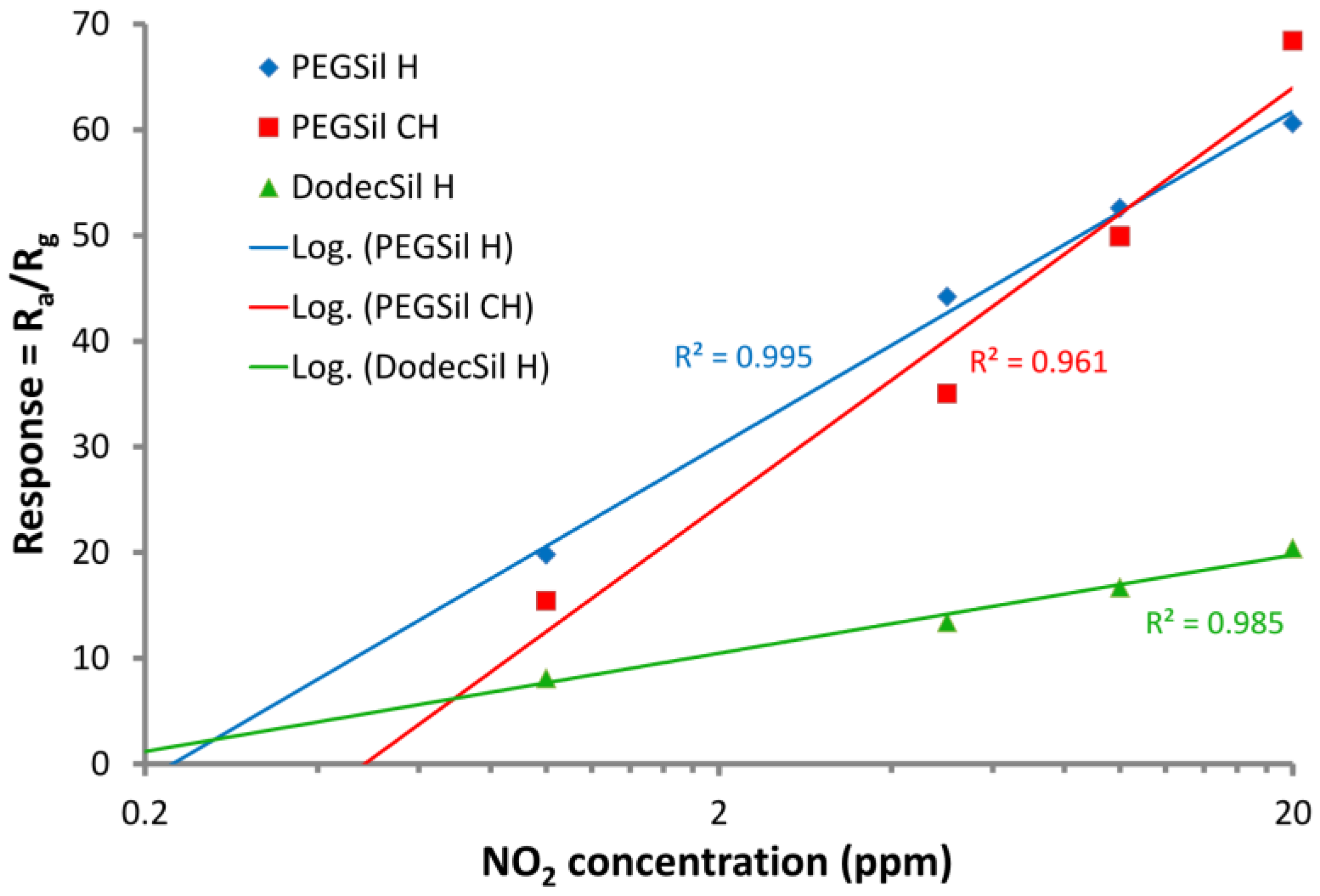
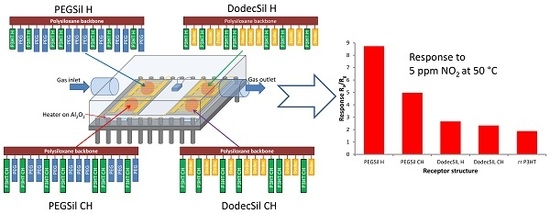
| PEGSil H | 1 ppm | 1330% 605% 1980% | RT 50 °C 100 °C | Current work |
| rrP3HT | 5 ppm | 188% | 50 °C | [18] |
| P3HT | 5 ppm | 11% * | RT | [33] |
| Poly(methylsiloxane)-graft-poly(3-hexylthiophe)-graft-poly(ethylene glycol) | 5 ppm | 2300% | 50 °C | [18] |
| (P3HT) ZnO@GO hybrid | 5 ppm | 210% | 50 °C | [37] |
| P3HT/ZnO NS-NR composite | 4 ppm | 60% * | RT | [38] |
| RGO-P3HT composite | 4 ppm | 40% * | RT | [39] |
| P3HT:ZnO (ratio6:2) hybrid | 5 ppm | 20% * | RT | [40] |
| P3HT-SnO2composite | 5 ppm | 500% | 100 °C | [41] |
| Poly-(bisdodecylquaterthiophene) | 5 ppm | 300% * | RT | [26] |
| poly-(bisdodecylthioquaterthiophene) | 5 ppm | 450% * | RT | [26] |
| P3HT:ZnO-nanowire composite | 4 ppm | 30% * | RT | [42] |
© 2018 by the authors. Licensee MDPI, Basel, Switzerland. This article is an open access article distributed under the terms and conditions of the Creative Commons Attribution (CC BY) license (http://creativecommons.org/licenses/by/4.0/).
Share and Cite
Procek, M.; Kepska, K.; Stolarczyk, A. A Study on the Impact of Poly(3-hexylthiophene) Chain Length and Other Applied Side-Chains on the NO2 Sensing Properties of Conducting Graft Copolymers. Sensors 2018, 18, 928. https://doi.org/10.3390/s18030928
Procek M, Kepska K, Stolarczyk A. A Study on the Impact of Poly(3-hexylthiophene) Chain Length and Other Applied Side-Chains on the NO2 Sensing Properties of Conducting Graft Copolymers. Sensors. 2018; 18(3):928. https://doi.org/10.3390/s18030928
Chicago/Turabian StyleProcek, Marcin, Kinga Kepska, and Agnieszka Stolarczyk. 2018. "A Study on the Impact of Poly(3-hexylthiophene) Chain Length and Other Applied Side-Chains on the NO2 Sensing Properties of Conducting Graft Copolymers" Sensors 18, no. 3: 928. https://doi.org/10.3390/s18030928
APA StyleProcek, M., Kepska, K., & Stolarczyk, A. (2018). A Study on the Impact of Poly(3-hexylthiophene) Chain Length and Other Applied Side-Chains on the NO2 Sensing Properties of Conducting Graft Copolymers. Sensors, 18(3), 928. https://doi.org/10.3390/s18030928