
Bryophyte Use in Bird Nests Varies with Nesting Location in a Tropical Montane Forest


Abstract
1. Introduction
2. Materials and Methods
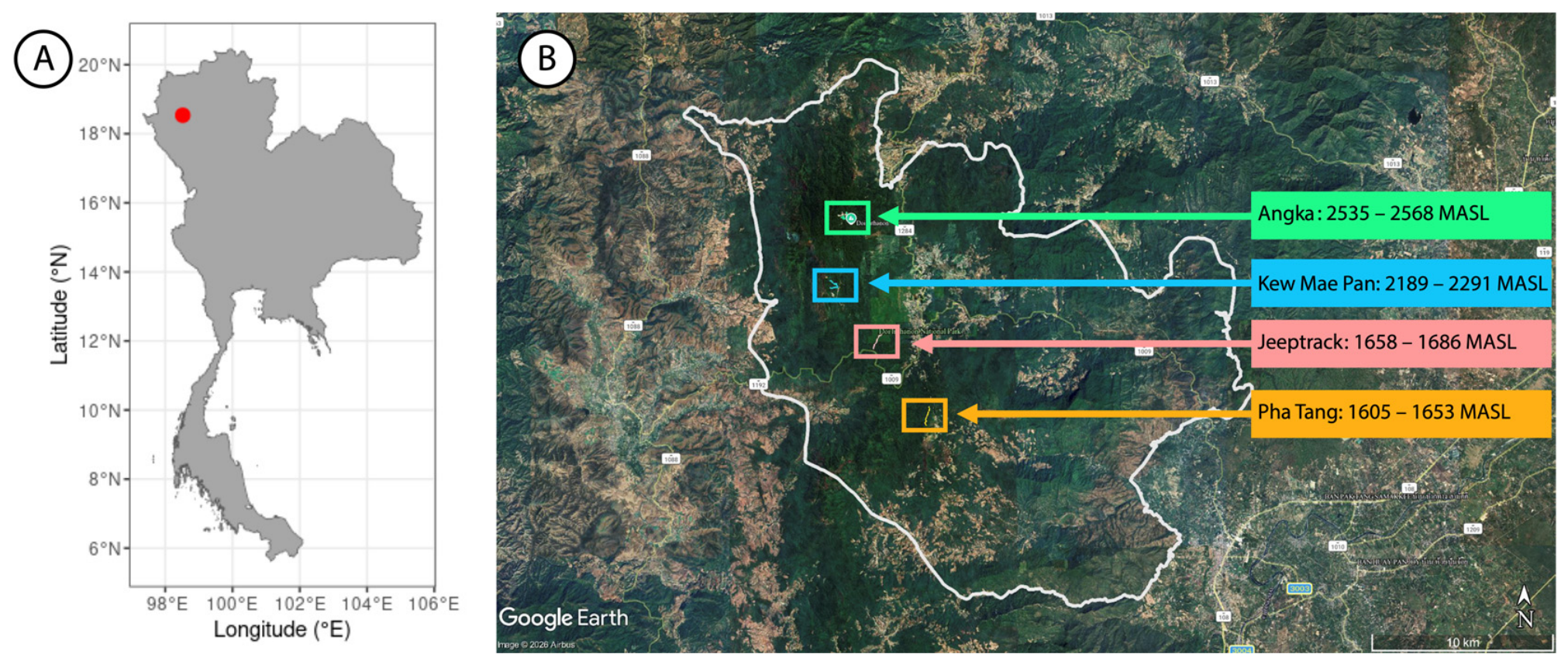
2.1. Study Area
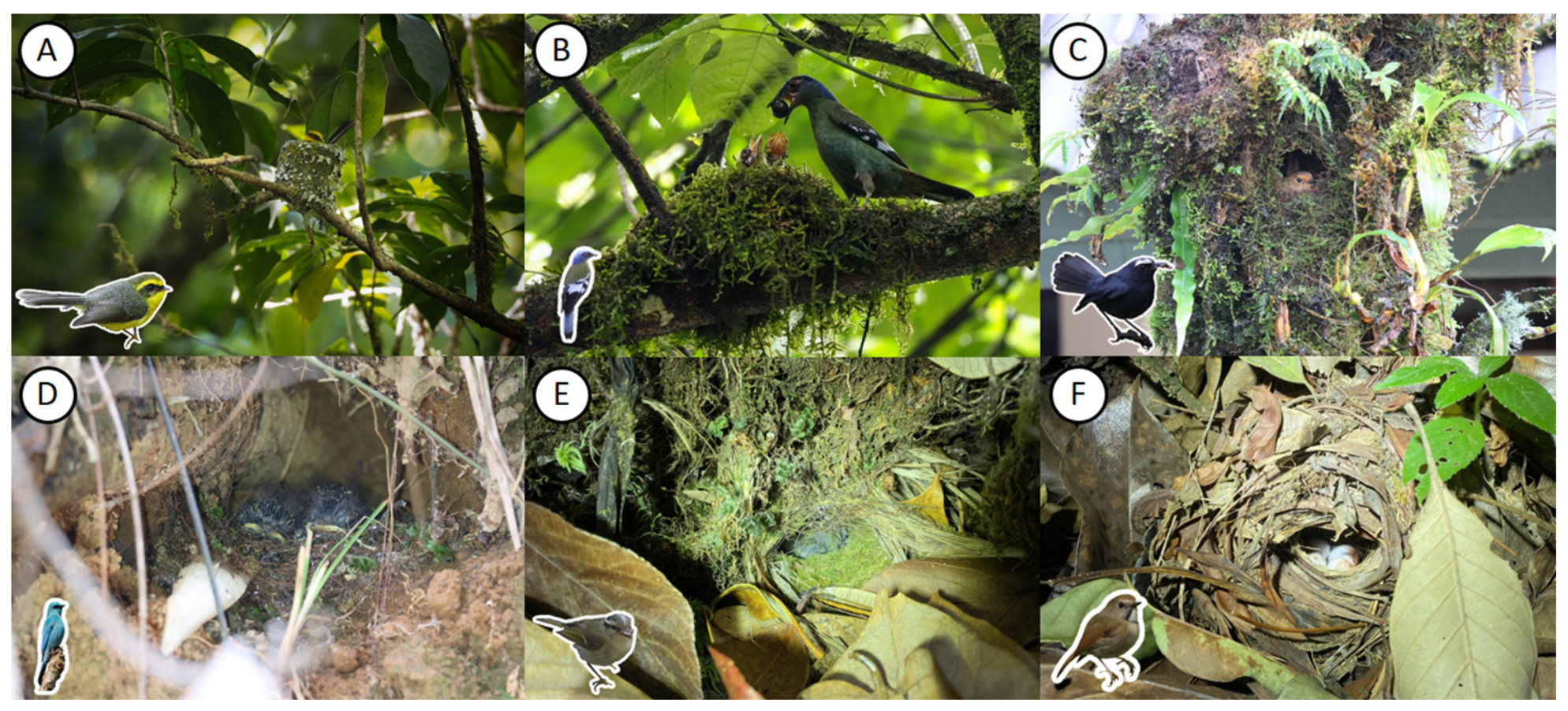
2.2. Collection and Handling of Bird Nests
2.3. Identification of Bryophytes in the Nests
2.4. Analysis of Data
3. Results
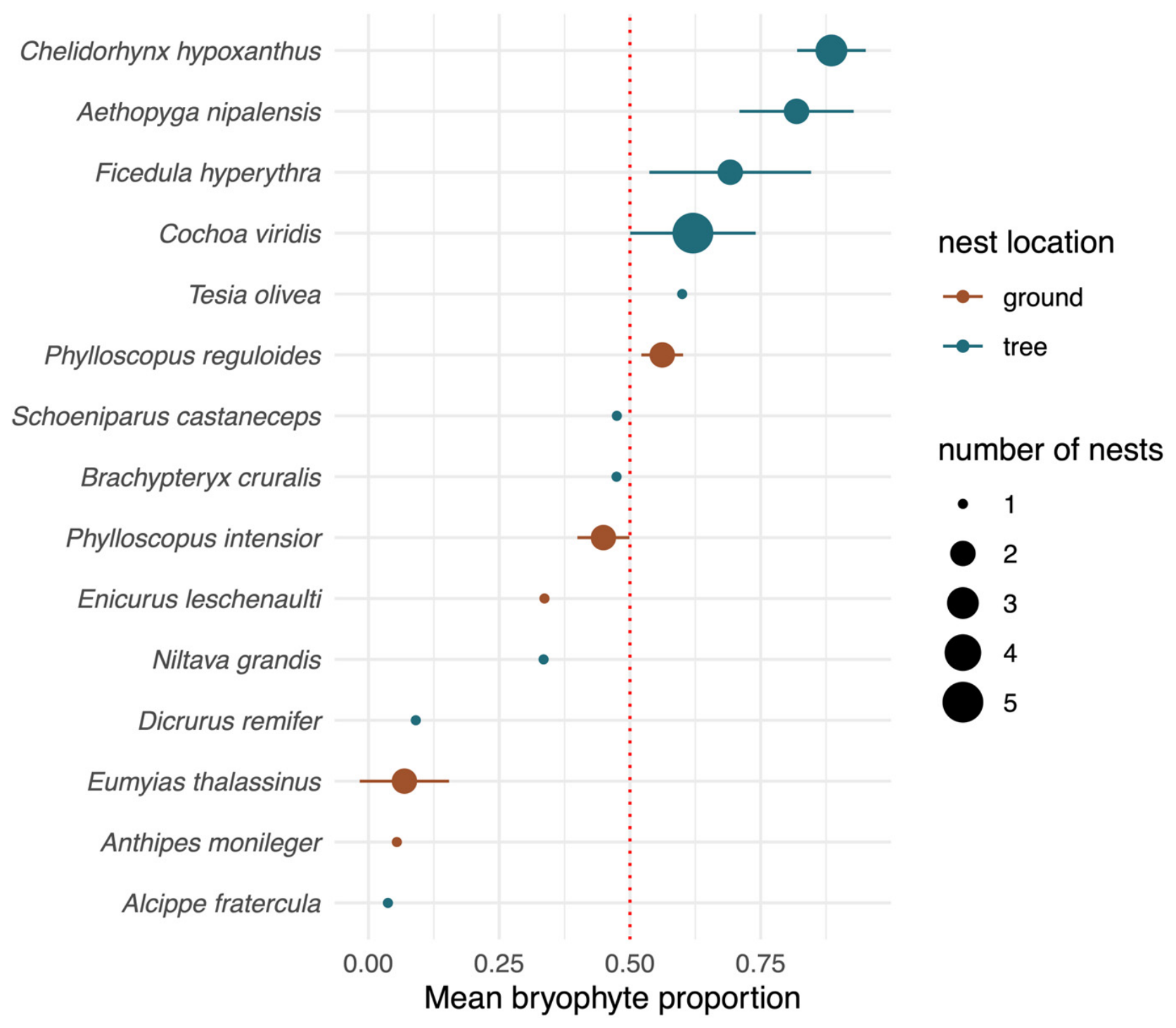
3.1. Bird Preference of Bryophytes as Nest Material
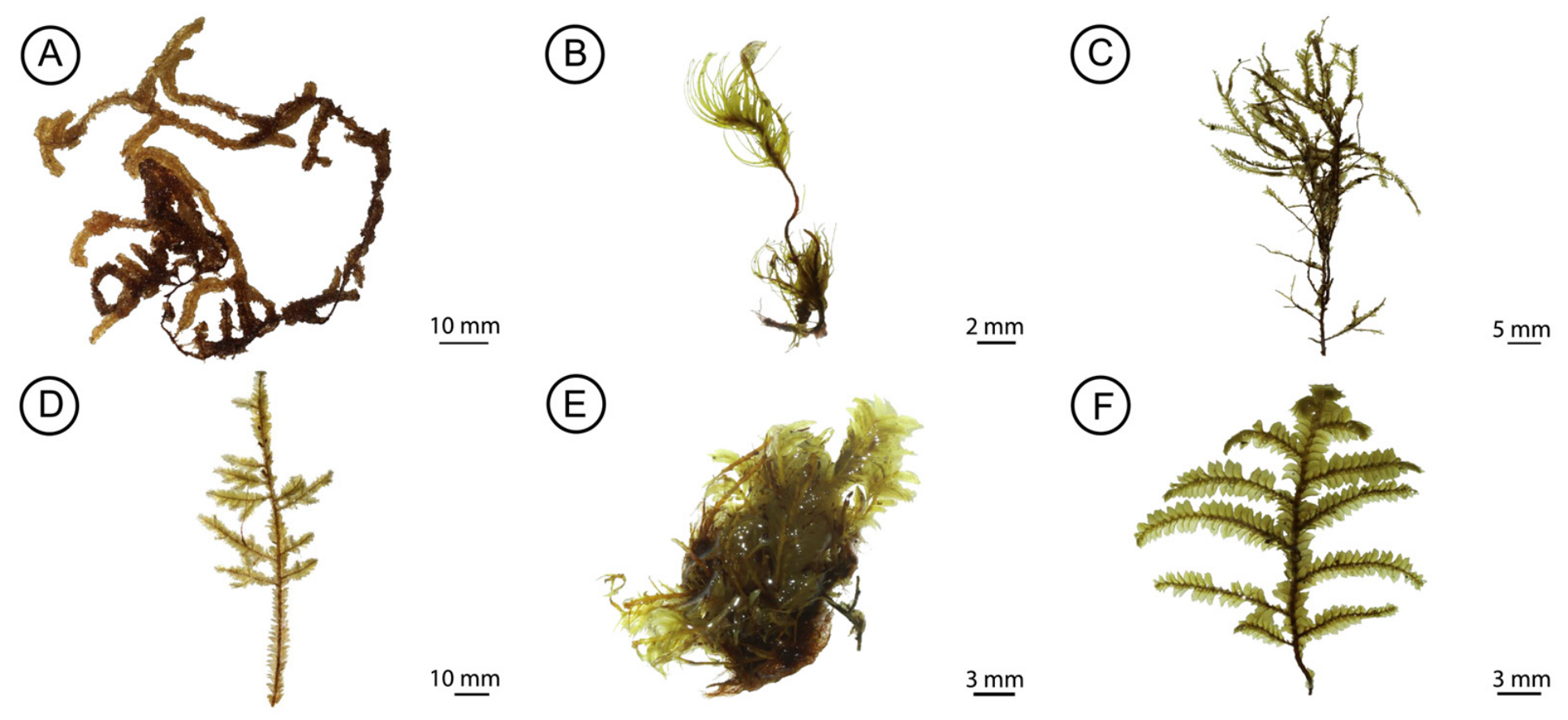
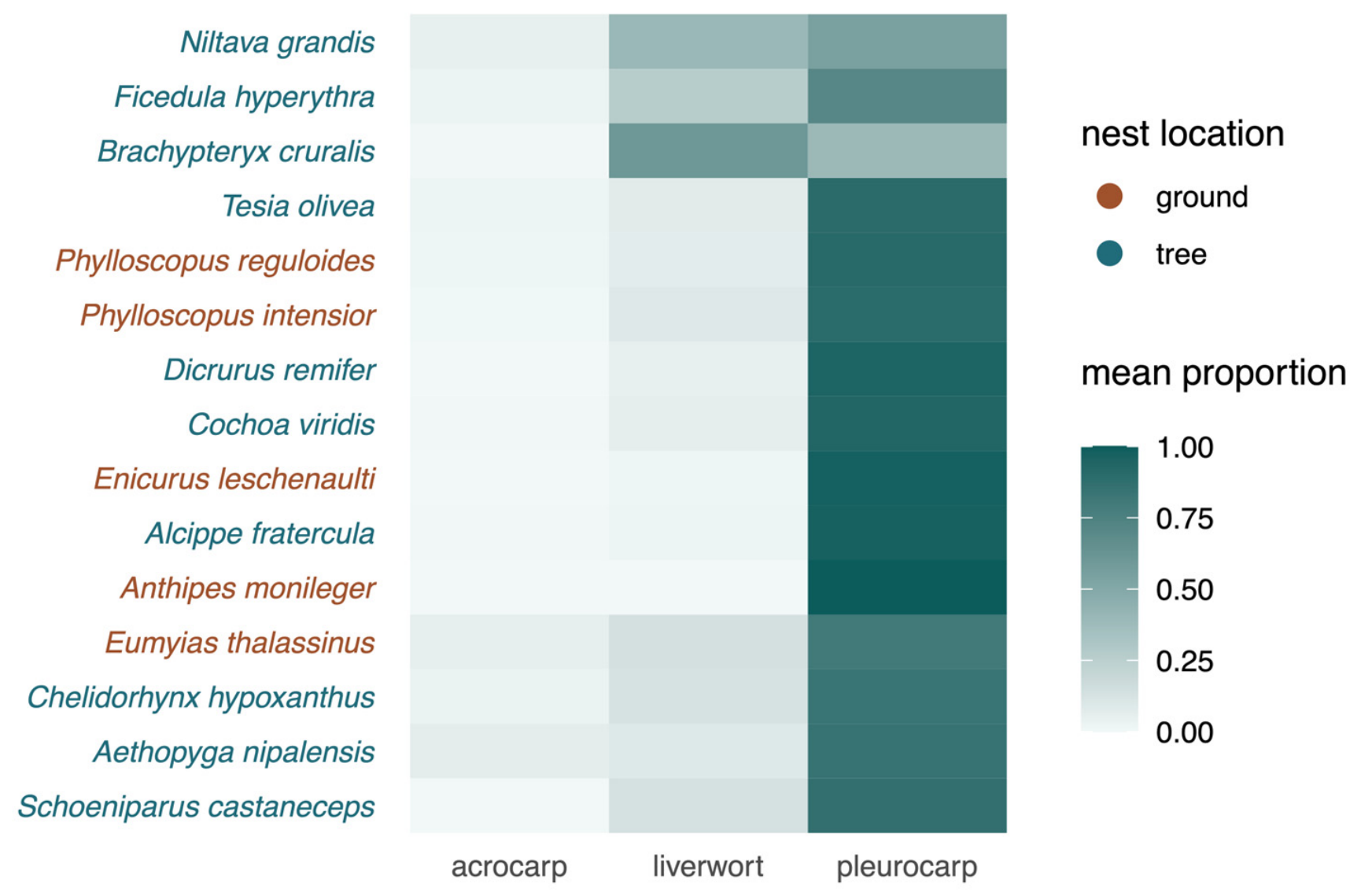
3.2. Preference for a Bryophyte Group
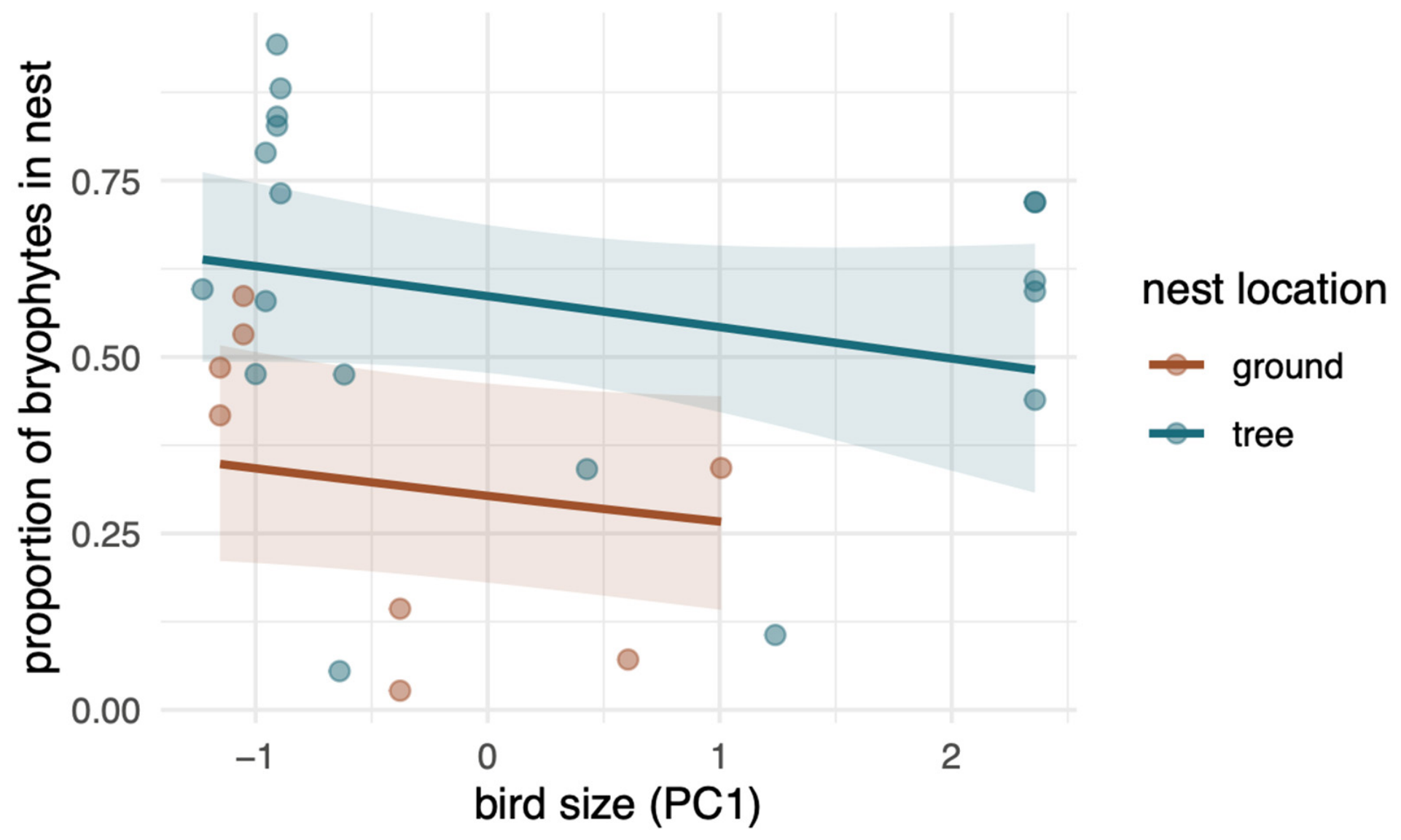
3.3. Factors Associated with Variation in Bryophyte Proportion
4. Discussion
4.1. Preference of Bryophytes as Nest Material
4.2. Pleurocarpous Mosses as a Preferred Material
4.3. Effects of Nest Location and Bird Size
4.4. Limitations and Future Directions
5. Conclusions
Supplementary Materials
Author Contributions
Funding
Institutional Review Board Statement
Data Availability Statement
Acknowledgments
Conflicts of Interest
Abbreviations
| AIC | Akaike Information Criterion |
| AICc | Corrected Akaike Information Criterion |
| ΔAICc | Delta AICc |
| GPS | Global Positioning System |
| MASL | Meters above sea level |
| PCA | Principal Component Analysis |
| PC1 | First principal component |
| SD | Standard Deviation |
References
- Biddle, L.E.; Broughton, R.E.; Goodman, A.M.; Deeming, D.C. Composition of bird nests is a species-specific characteristic. Avian Biol. Res. 2018, 11, 132–153. [Google Scholar] [CrossRef] [Scilit]
- Deeming, D.C. A Review of the Roles Materials Play in Determining Functional Properties of Bird Nests. Acta Ornithol. 2023, 58, 1–28. [Google Scholar] [CrossRef] [Scilit]
- Briggs, K.B.; Biddle, L.E.; Deeming, D.C. Geographical location affects size and materials used in the construction of European Pied Flycatcher (Ficedula hypoleuca) nests. Avian Res. 2019, 10, 17. [Google Scholar] [CrossRef] [Scilit]
- Bailey, I.E.; Muth, F.; Morgan, K.; Meddle, S.L.; Healy, S.D. Birds build camouflaged nests. Auk 2015, 132, 11–15. [Google Scholar] [CrossRef] [Scilit]
- Fontúrbel, F.E.; Osorio, F.; Riffo, V.; Nuñez, M.; Bastias, R.; Carvallo, G.O. Mamma knows best: Why a generalist hummingbird selects the less abundant moss for nest building. Ecology 2020, 101, e03045. [Google Scholar] [CrossRef] [Scilit] [PubMed]
- Glime, J.M. Bryophyte Ecology; Michigan Technological University: Houghton, MI, USA, 2021. [Google Scholar]
- Biddle, L.E.; Dickinson, A.M.; Broughton, R.E.; Gray, L.A.; Bennett, S.L.; Goodman, A.M.; Deeming, D.C. Construction materials affect the hydrological properties of bird nests. J. Zool. 2019, 309, 161–171. [Google Scholar] [CrossRef] [Scilit]
- Breil, D.A.; Moyle, S.M. Bryophytes used in construction of bird nests. Bryologist 1976, 79, 95–98. [Google Scholar] [CrossRef] [Scilit]
- Wolf, A.L. Bird Use of Epiphyte Resources in an Old-Growth Coniferous Forest in the Pacific Northwest; Evergreen State College: Olympia, WA, USA, 2009. [Google Scholar]
- álvarez, E.; Belda, E.J.; Verdejo, J.; Barba, E. Variation in Great Tit Nest Mass and Composition and Its Breeding Consequences: A Comparative Study in four Mediterranean Habitats. Avian Biol. Res. 2013, 6, 39–46. [Google Scholar] [CrossRef] [Scilit]
- Wesołowski, T.; Wierzcholska, S. Tits as bryologists: Patterns of bryophyte use in nests of three species cohabiting a primeval forest. J. Ornithol. 2018, 159, 733–745. [Google Scholar] [CrossRef] [Scilit]
- Glądalski, M.; Wolski, G.J.; Bańbura, M.; Kaliński, A.; Markowski, M.; Skwarska, J.; Wawrzyniak, J.; Bańbura, J. Differences in use of bryophyte species in tit nests between two contrasting habitats: An urban park and a forest. Eur. Zool. J. 2021, 88, 807–815. [Google Scholar] [CrossRef] [Scilit]
- Dickinson, A.M.; Locke, E.; Gray, L.A.; Bennett, S.L.; Biddle, L.E.; Goodman, A.M.; Deeming, D.C. Composition of nests constructed by species in the Motacillidae, Sylviidae and Prunellidae. Avian Biol. Res. 2022, 15, 21–33. [Google Scholar]
- Rydgren, K.; Indreeide, B.; Slagsvold, T.; Lampe, H.M. Nest building in titmice Paridae: Selectivity in bryophyte use. Ecol. Evol. 2023, 13, e9852. [Google Scholar] [CrossRef] [Scilit]
- Andreas, B.K. Use of Bryophytes by Carolina Chickadees (Poecile carolinensis) in Nest Construction. Evansia 2010, 27, 23–29. [Google Scholar] [CrossRef] [Scilit]
- De Almeida Amélio, L.; Do Carmo, D.M.; Soares de Lima, J.; Fernandes Peralta, D. Bryophytes as a material to build birds’ nests in Brazil. Bol. Soc. Argent. Botán. 2017, 52, 199–208. [Google Scholar] [CrossRef] [Scilit]
- Benítez, Á.; Jaramillo, E.; Yangua-Solano, E.; Greeney, H.F. Bryophytes Present in the Nests of Birds in Yanayacu Biological Station, Ecuador. Diversity 2023, 15, 1123. [Google Scholar] [CrossRef] [Scilit]
- Torres-Dowdall, J.; Osorio Zúñiga, F.; Suarez, G. Materiales utilizados por el Picaflor Rubí (Sephanoides sephaniodes) para la construccion de nidos en la selva Valdiviana, Chile. Ornithol. Neotrop. 2007, 18, 433–437. [Google Scholar]
- Sripen, S.; Khobkhet, O.; Masuthon, S.; Supanuchai, S. Growth Period of Aquatic Plants for Birds Nesting at Bung Borapet, Nakhon Sawan. Agric. Nat. Resour. 2000, 34, 17–24. [Google Scholar] [CrossRef] [Scilit]
- Liengpornpan, S. Benefits of Fresh Plants in Bird Nests. Thai Sci. Technol. J. 2020, 29, 508–515. [Google Scholar] [CrossRef] [Scilit]
- Khamcha, D.; Gale, G.A. Nest-site selection, nesting success, and the value of older pine plantations for the globally Endangered Giant Nuthatch Sitta magna in northern Thailand. Bird Conserv. Int. 2026, 36, e17. [Google Scholar] [CrossRef] [Scilit]
- Sukkharak, P.; Chantanaorrapint, S. Bryophyte Studies in Thailand: Past, Present, and Future. Cryptogam. Bryol. 2014, 35, 5–17. [Google Scholar] [CrossRef] [Scilit]
- He, S. An Annotated Checklist and Atlas of the Mosses of Thailand. Available online: https://www.mobot.org/mobot/moss/thailand/thailand.htm (accessed on 1 December 2022).
- Bird Conservation Society of Thailand. Checklist_ThaiBirds_2022 (Ver. July 2022); Bird Conservation Society of Thailand: Bangkok, Thailand, 2022. [Google Scholar]
- Nathi, Y. Mosses Diversity in Kew Mae Pan and Ang Ka Areas, Doi Inthanon National Park, Chaing Mai Province. Master’s Thesis, Chulalongkorn University, Bangkok, Thailand, 2009. [Google Scholar]
- Akiyama, H.; Furuki, T.; Sri-ngernyuang, K.; Kanzaki, M. Alphabetical list of bryophytes occurring in a 15ha long-term monitoring plot at Doi Inthanon, Northern Thailand. Bryol. Res. 2011, 10, 153–164. [Google Scholar] [CrossRef] [PubMed]
- eBird. eBird: An Online Database of Bird Distribution and Abundance [Web Application]. eBird, Cornell Lab of Ornithology: Ithaca, NY, USA, 2022. Available online: http://www.ebird.org (accessed on 1 February 2022).
- Academic Sector, Doi Inthanon National Park. Doi Inthanon National Park Climate Report: 2017–2023; Doi Inthanon National Park: Chiang Mai, Thailand, 2024. [Google Scholar]
- Department of National Parks Wildlife and Plant Conservation. Doi Inthanon National Park. Available online: http://portal.dnp.go.th/Content/nationalpark?contentId=915 (accessed on 1 December 2023).
- Round, P.D. Notes on breeding birds in north-west Thailand. Nat. Hist. Bull. Siam Soc. 1982, 30, 1–14. [Google Scholar]
- Round, P.D. Some recent bird records from northern Thailand. Nat. Hist. Bull. Siam Soc. 1983, 31, 123–138. [Google Scholar]
- Gradstein, S.R.; Churchill, S.P.; Salazar-Allen, N. Guide to the Bryophytes of Tropical America; New York Botanical Garden Press: Bronx, NY, USA, 2001. [Google Scholar]
- R Core Team. R: A Language and Environment for Statistical Computing; R Foundation for Statistical Computing: Vienna, Austria, 2026. [Google Scholar]
- Smithson, M.; Verkuilen, J. A better lemon squeezer? Maximum-likelihood regression with beta-distributed dependent variables. Psychol. Methods 2006, 11, 54–71. [Google Scholar] [CrossRef] [Scilit] [PubMed]
- Cribari-Neto, F.; Zeileis, A. Beta Regression in R. J. Stat. Softw. 2010, 34, 1–24. [Google Scholar] [CrossRef] [Scilit]
- Billerman, S.M.; Keeney, B.K.; Kirwan, G.M.; Medrano, F.; Sly, N.D.; Smith, M.G. (Eds.) Birds of the World; Cornell Laboratory of Ornithology: Ithaca, NY, USA, 2026. [Google Scholar] [CrossRef] [Scilit]
- Bartoń, K. MuMIn: Multi-Model Inference. R Package, version 1.48.19; R Foundation for Statistical Computing: Vienna, Austria, 2026.
- Martin, T.E. Nest Predation and Nest Sites. BioScience 1993, 43, 523–532. [Google Scholar] [CrossRef] [Scilit]
- Hansell, M.H. The function of lichen flakes and white spider cocoons on the outer surface of birds’ nests. J. Nat. Hist. 1996, 30, 303–311. [Google Scholar] [CrossRef] [Scilit]
- Akresh, M.E.; Mandell, D.; Grima, P.P.; King, D.I.; Lauer, K. Differential use of nest materials and niche space among avian species within a single ecological community. Ecol. Evol. 2024, 14, e70142. [Google Scholar] [CrossRef] [Scilit] [PubMed]
- Troscianko, J.; Wilson-Aggarwal, J.; Stevens, M.; Spottiswoode, C.N. Camouflage predicts survival in ground-nesting birds. Sci. Rep. 2016, 6, 19966. [Google Scholar] [CrossRef] [Scilit] [PubMed]
- Calvelo, S.; Trejo, A.; Ojeda, V. Botanical composition and structure of hummingbird nests in different habitats from northwestern Patagonia (Argentina). J. Nat. Hist. 2006, 40, 589–603. [Google Scholar] [CrossRef] [Scilit]
- Heenan, C.B.; Goodman, B.A.; White, C.R. The influence of climate on avian nest construction across large geographical gradients. Glob. Ecol. Biogeogr. 2015, 24, 1203–1211. [Google Scholar] [CrossRef] [Scilit]
- Perez, D.M.; Gardner, J.L.; Medina, I. Climate as an Evolutionary Driver of Nest Morphology in Birds: A Review. Front. Ecol. Evol. 2020, 8, 566018. [Google Scholar] [CrossRef] [Scilit]
- Bates, J.W. Is ‘Life-Form’ a Useful Concept in Bryophyte Ecology? Oikos 1998, 82, 223–237. [Google Scholar] [CrossRef] [Scilit]
- Sporn, S.G.; Bos, M.M.; Kessler, M.; Gradstein, S.R. Vertical distribution of epiphytic bryophytes in an Indonesian rainforest. Biodivers. Conserv. 2010, 19, 745–760. [Google Scholar] [CrossRef] [Scilit]
- Huttunen, S.; Bell, N.; Hedenäs, L. The evolutionary diversity of mosses–taxonomic heterogeneity and its ecological drivers. Crit. Rev. Plant Sci. 2018, 37, 128–174. [Google Scholar] [CrossRef] [Scilit]
- Sheard, C.; Street, S.E.; Evans, C.; Lala, K.N.; Healy, S.D.; Sugasawa, S. Beak shape and nest material use in birds. Philos. Trans. R. Soc. Lond. B Biol. Sci. 2023, 378, 20220147. [Google Scholar] [CrossRef] [Scilit] [PubMed]
- eBird. Verditer Flycatcher (Eumyias thalassinus). eBird, Cornell Lab of Ornithology: Ithaca, NY, USA, 2026. Available online: https://ebird.org/species/verfly4 (accessed on 1 June 2020).



| Species | Common Names | Nest Location | Foraging Stratum | Nest Shape | Number of Nests |
|---|---|---|---|---|---|
| Aethopyga nipalensis | Green-tailed Sunbird | tree | midstory | pendulous cup | 2 |
| Alcippe fratercula | Yunnan Fulvetta | tree | understory | pensile cup | 1 |
| Anthipes monileger | White-gorgeted Flycatcher | ground | understory | domed nest | 1 |
| Brachypteryx cruralis | Himalayan Shortwing | tree | understory | globular nest | 1 |
| Chelidorhynx hypoxanthus | Yellow-bellied Fantail | tree | canopy | statant cup | 3 |
| Cochoa viridis | Green Cochoa | tree | midstory | statant cup | 5 |
| Dicrurus remifer | Lesser Racket-tailed Drongo | tree | midstory | pensile cup | 1 |
| Enicurus leschenaulti | White-crowned Forktail | ground | understory | adherent cup | 1 |
| Eumyias thalassinus | Verditer Flycatcher | ground | canopy | cavity adopters | 2 |
| Ficedula hyperythra | Snowy-browed Flycatcher | tree | understory | globular nest | 2 |
| Niltava grandis | Large Niltava | tree | midstory | cavity adopters | 1 |
| Phylloscopus intensior | Davison’s Leaf Warbler | ground | midstory | domed nest | 2 |
| Phylloscopus reguloides | Blyth’s Leaf Warbler | ground | midstory | domed nest | 2 |
| Schoeniparus castaneceps | Chestnut-crowned Warbler | tree | midstory | globular nest | 1 |
| Tesia olivea | Slaty-bellied Tesia | tree | understory | pendulous cup | 1 |
| Model 1 | Number of Parameter 2 | AICc | ΔAICc | Bird Group with More Bryophytes in Their Nest 3 |
|---|---|---|---|---|
| ~location | 3 | −0.06 | 0.00 | tree-nesting * |
| ~location + size | 4 | 1.23 | 1.29 | small, tree-nesting * |
| ~1 (null model) | 2 | 3.46 | 3.52 | none |
| ~location + stratum + size | 6 | 4.40 | 4.46 | small, tree-nesting *, canopy-foraging |
| ~size | 3 | 5.72 | 5.78 | none |
| ~stratum | 4 | 7.50 | 7.56 | canopy-foraging |
| ~stratum + size | 5 | 9.85 | 9.91 | small, canopy-foraging |
Disclaimer/Publisher’s Note: The statements, opinions and data contained in all publications are solely those of the individual author(s) and contributor(s) and not of MDPI and/or the editor(s). MDPI and/or the editor(s) disclaim responsibility for any injury to people or property resulting from any ideas, methods, instructions or products referred to in the content. |
© 2026 by the authors. Licensee MDPI, Basel, Switzerland. This article is an open access article distributed under the terms and conditions of the Creative Commons Attribution (CC BY) license.
Share and Cite
Buranaanun, A.; Sutummawong, N.; Kraichak, E. Bryophyte Use in Bird Nests Varies with Nesting Location in a Tropical Montane Forest. Diversity 2026, 18, 463. https://doi.org/10.3390/d18080463
Buranaanun A, Sutummawong N, Kraichak E. Bryophyte Use in Bird Nests Varies with Nesting Location in a Tropical Montane Forest. Diversity. 2026; 18(8):463. https://doi.org/10.3390/d18080463
Chicago/Turabian StyleBuranaanun, Akekachoke, Nantida Sutummawong, and Ekaphan Kraichak. 2026. "Bryophyte Use in Bird Nests Varies with Nesting Location in a Tropical Montane Forest" Diversity 18, no. 8: 463. https://doi.org/10.3390/d18080463
APA StyleBuranaanun, A., Sutummawong, N., & Kraichak, E. (2026). Bryophyte Use in Bird Nests Varies with Nesting Location in a Tropical Montane Forest. Diversity, 18(8), 463. https://doi.org/10.3390/d18080463