
Benthic Foraminiferal-Based Ecological Indices to Monitor Coastal Habitat Health of Jobos Bay, Puerto Rico




Abstract
1. Introduction
1.1. Modern Benthic Foraminifera as Bioindicators
1.2. Study Area and Research Objectives
2. Materials and Methods
2.1. Sample Collection and Analyses
2.2. Foraminiferal-Based Ecological Indices
- Morphotype A* (PA*): taxa with encrusting morphologies, mostly flat and permanently attached to a surface by an organic layer; their life spans can be as much as one year.
- Morphotype SB (PSB): taxa are motile, symbiont-bearing taxa, also with a life span of up to a year.
- Morphotype B (PB): taxa are temporarily motile, they use their pseudopodial network for locomotion and their life spans are ~2–5 months.
- Morphotype C (PC): taxa are motile, and they possess multiple apertures through which they can extend their pseudopodia for locomotion and suspension from phytal substrata; their life spans are ~3–4 months.
- Morphotype D* (PD*): taxa are permanently motile, characterized by having a single aperture from which the pseudopodial network extends; they tend to have relatively short life spans.
2.3. Statistical Analyses
3. Results
3.1. Distributions of Foraminiferal Genera
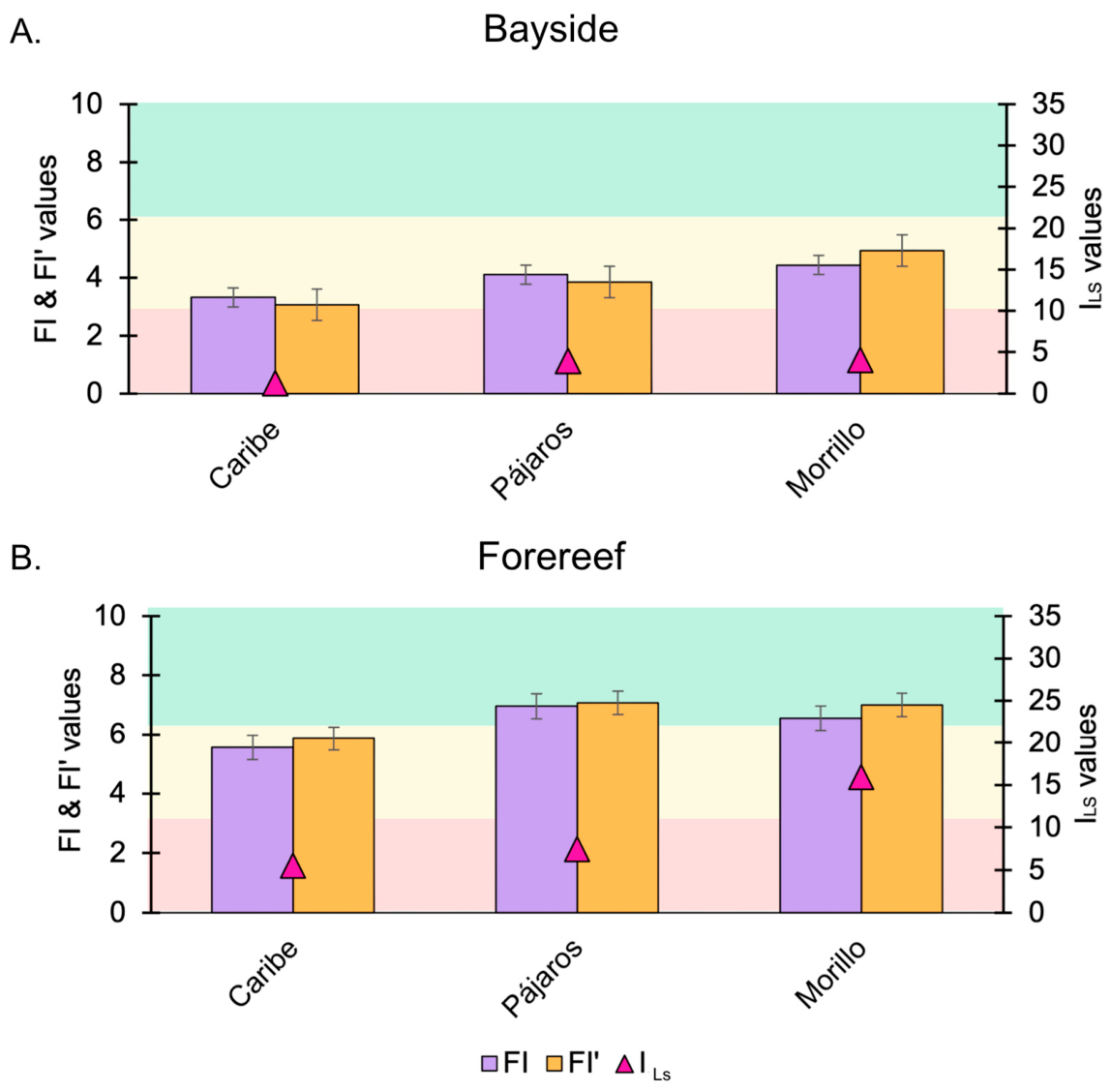
3.2. Foraminiferal Categories and Indices
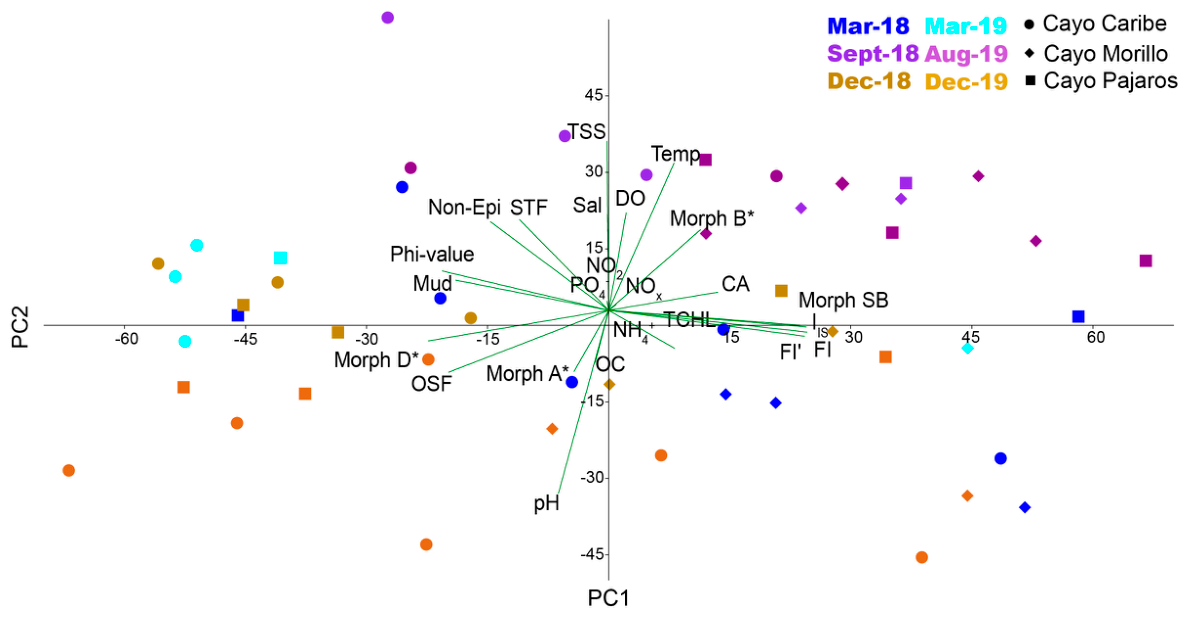
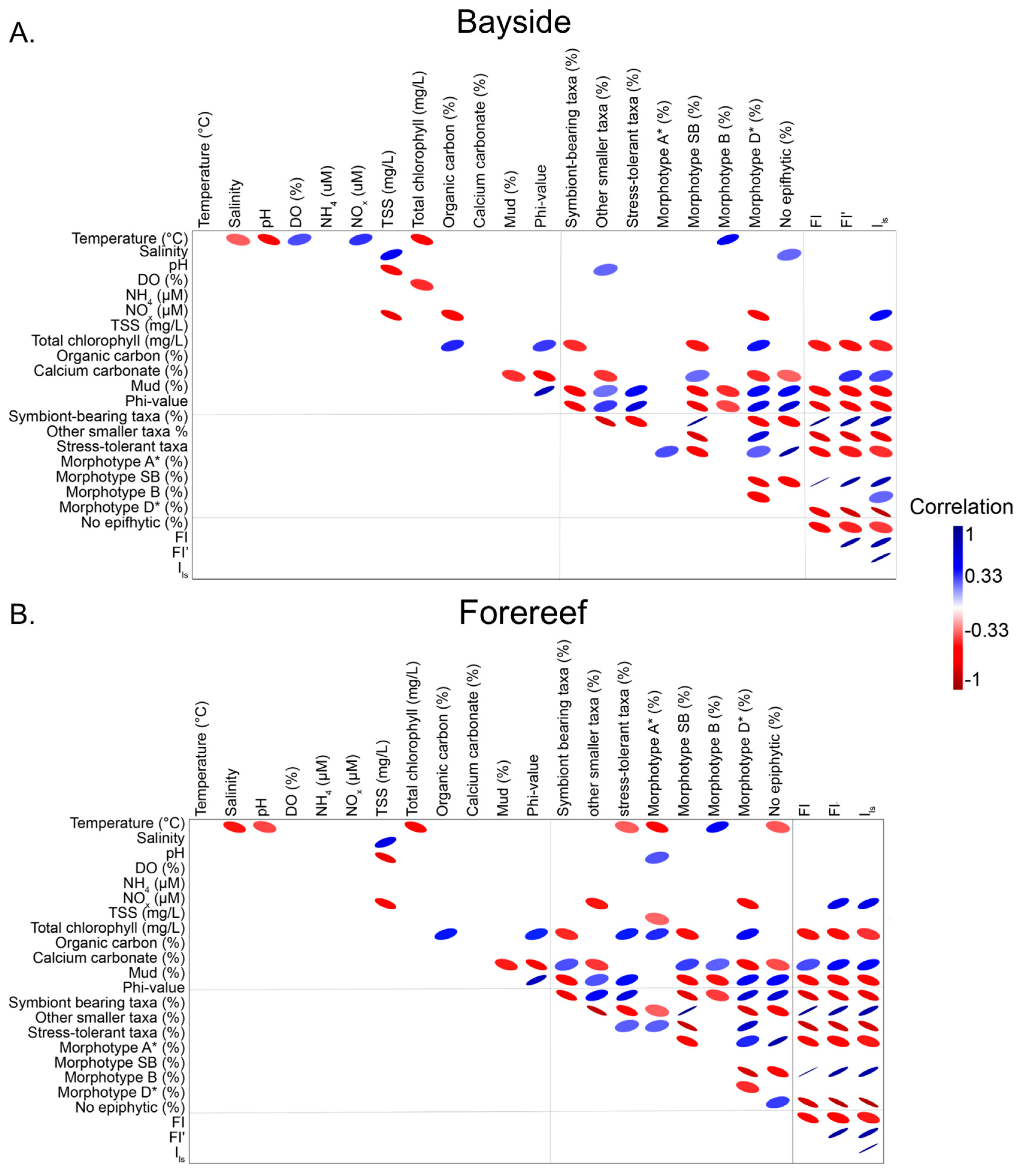
3.3. Relationships Among Environmental Parameters, Foraminiferal Categories, and Indices
4. Discussion
4.1. Taxonomic Patterns and Community Structure
4.2. Ecological Indices
4.3. Environmental Parameters, Foraminiferal Categories and Indices
5. Conclusions
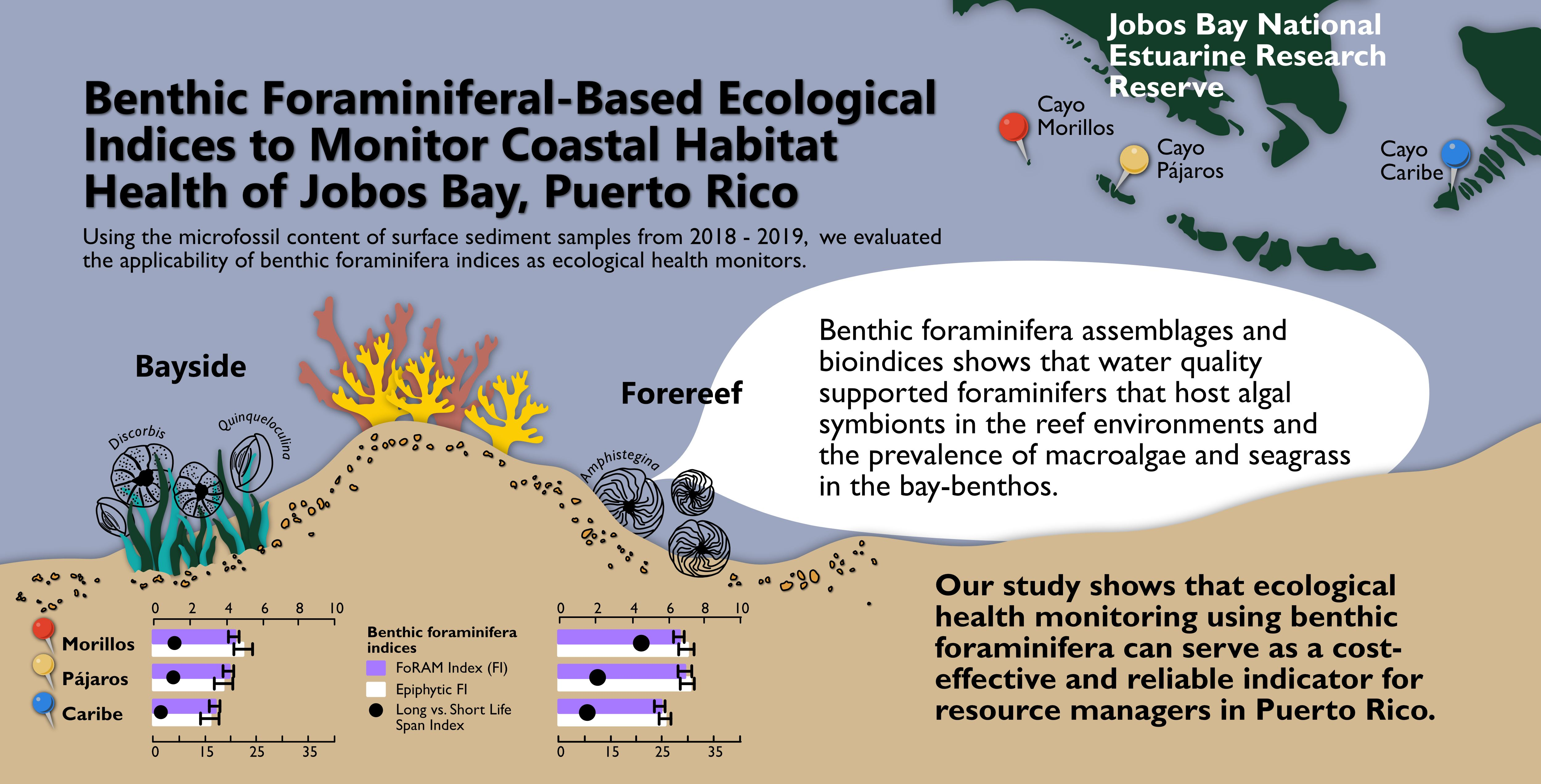
- Both the FoRAM Index (FI) and the Epiphytic FoRAM Index (FI′), when applied to foraminiferal assemblages in the open Jobos Bay near the cays and on the reef sides of the cays, indicate that water quality is suitable to support both algal symbiont-bearing genera and epiphytic genera.
- The abundance of porcelaneous taxa, especially Quinqueloculina, indicates that waters in the study area are consistently of normal marine salinity.
- The sites sampled in this study are outside the areas of the bay shown in previous studies to be moderately to heavily polluted.
- This is the first study that applies the FI’ and ILS in Caribbean waters.
- This study supports the usefulness of foraminiferal-based indices as management tools in Jobos Bay National Estuarine Research Reserve.
- Future studies to understand how foraminiferal taxa respond to differences in the composition and lability of organic matter could further enhance interpretations of foraminiferal assemblages in Jobos Bay and worldwide.
Author Contributions
Funding
Data Availability Statement
Acknowledgments
Conflicts of Interest
Appendix A

| Reef | Stations | Depth (m) | Latitude | Longitude |
|---|---|---|---|---|
| Cayo Morrillo | M1/2 | 4–6 | 17.9254167 | −66.273222 |
| M4 | 4–6 | 17.9248333 | −66.273528 | |
| M5/6 | 4–6 | 17.9304722 | −66.270972 | |
| M7 | 4–6 | 17.9307778 | −66.271083 | |
| * M8 | >9 | 17.9315000 | −66.270806 | |
| Cayo Pájaros | P1/2 | 4–6 | 17.9226111 | −66.263472 |
| * P4 | >9 | 17.9216389 | −66.263333 | |
| P5/6 | 4–6 | 17.9246944 | −66.260944 | |
| P7 | 4–6 | 17.9259722 | −66.260056 | |
| * P8 | >9 | 17.9273889 | −66.25675 | |
| Cayo Caribe | C1/2 | 2 | 17.9160556 | −66.216667 |
| C4 | 8 | 17.9123889 | −66.216472 | |
| C5/6 | 4–6 | 17.932472 | −66.195222 | |
| C9 | 4–6 | 17.9196667 | −66.218167 | |
| * C10 | >9 | 17.9197222 | −66.223972 | |
| C11 | 2 | 17.9280278 | −66.215361 | |
| C12 | 4–6 | 17.9333889 | −66.220889 |
| FI Category | Genus-Level Taxa |
|---|---|
| Stress-tolerant (STF) | Ammonia Bolivina Elphidium Nonion Textularia |
| Symbiont-bearing (SBF) | Amphistegina Archaias Borelis Heterostegina Laevipeneroplis Peneroplis Sorites |
| Other smaller taxa OSF | Affinetrina Articulina Cornuspira Dentostomina Discorbis Hauerina Hoeglundina Miliammina Planorbulina Pseudohauerina Pyrgo Quinqueloculina Reussella Rosalina Rotorbinella Schlumbergerina Sigmoihauerina Siphonina Spirolocammina Spiroloculina Triloculina Wiesnerella |
| FI′ Category | Genus-Level Taxa |
|---|---|
| Morphotype A* | Planorbulina |
| Morphotype SB | Amphistegina Archaias Borelis Heterostegina Laevipeneroplis Peneroplis Sorites |
| Morphotype B* | Cornuspira Discorbis Reussella Rotorbinella Rosalina |
| Morphotype C | Bolivina Nonion Textularia |
| Morphotype D* | Affinetrina Articulina Dentostomina Hauerina Hoeglundina Miliammina Miliolinella Pseudohauerina Pyrgo Schlumbergerina Sigmoihauerina Siphonina Spirolocammina Spiroloculina Triloculina Wiesnerella |
| Non-epiphytic | Ammonia Elphidium |
| Principal Components | Eigenvalue | % Variance |
|---|---|---|
| PC1 | 1498.0 | 66 |
| PC2 | 469.8 | 21 |
| PC3 | 168.1 | 7 |
| PC4 | 47.3 | 2 |
| PC5 | 43.7 | 2 |
| PC6 | 11.9 | 1 |
| PC7 | 5.7 | 0 |
| PC8 | 3.5 | 0 |
| PC9 | 2.5 | 0 |
| PC10 | 1.1 | 0 |
| PC11 | 0.7 | 0 |
| PC12 | 0.4 | 0 |
| PC13 | 0.1 | 0 |
| PC14 | 0.0 | 0 |
Appendix B

References
- Messer, J.J.; Linthurst, R.A.; Overton, W.S. An EPA program for monitoring ecological status and trends. Environ. Monit. Assess. 1991, 17, 67–78. [Google Scholar] [CrossRef] [Scilit]
- Alve, E. Benthic foraminiferal responses to estuarine pollution: A review. J. Foramin. Res. 1995, 25, 190–203. [Google Scholar] [CrossRef] [Scilit]
- Jackson, L.E.; Kurtz, J.C.; Fisher, W.S. Evaluation Guidelines for Ecological Indicators; U.S. Environmental Protection Agency, Office of Research and Development: Research Triangle Park, NC, USA, 2000; 107p.
- Borja, A.; Muxika, I. Guidelines for the use of AMBI (AZTI’s Marine Biotic Index) in the assessment of the benthic ecological quality. Mar. Pollut. Bull. 2005, 50, 787–789. [Google Scholar] [CrossRef] [Scilit] [PubMed]
- Hallock, P.; Lidz, B.; Cockey-Burkhard, E.M.; Donnelly, K. Foraminifera as bioindicators in coral-reef assessment and monitoring: The FORAM Index. Environ. Monit. Assess. 2003, 81, 221–238. [Google Scholar] [CrossRef] [Scilit]
- Schönfeld, J.; Alve, E.; Geslin, E.; Jorissen, F.; Korsun, S.; Spezzaferri, S. The FOBIMO (FOraminiferal BIo-MOnitoring) initiative: Towards a standardized protocol for soft-bottom benthic foraminiferal monitoring studies. Mar. Micropaleontol. 2012, 94–95, 1–13. [Google Scholar] [CrossRef] [Scilit]
- Oliver, L.M.; Fisher, W.S.; Dittmar, J.; Hallock, P.; Campbell, J.; Quarles, R.L.; Harris, P.; LoBue, C. Contrasting responses of coral reef fauna and foraminiferal assemblages to human influence in La Parguera, Puerto Rico. Mar. Environ. Res. 2014, 99, 95–105. [Google Scholar] [CrossRef] [Scilit] [PubMed]
- Resig, J.M. Foraminiferal ecology around ocean outfalls off southern California. In Waste Disposal in the Marine Environment; Pearson, E.A., Ed.; Pergamon: London, UK, 1960; pp. 104–121. [Google Scholar]
- Seiglie, G.A. A preliminary note on the relationships between foraminifers and pollution in two Puerto Rican bays. Caribb. J. Sci. 1971, 11, 93–98. [Google Scholar]
- Seiglie, G.A. Foraminifers of Guayanilla Bay and their use as environmental indicators. Rev. Esp. Micropaleontol. 1975, 7, 453–487. [Google Scholar]
- Alve, E.; Korsun, S.; Schönfeld, J.; Dijkstra, N.; Golikova, E.; Hess, S.; Husum, K.; Panieri, G. Foram-AMBI: A sensitivity index based on benthic foraminiferal faunas from North-East Atlantic and Arctic fjords, continental shelves and slopes. Mar. Micropaleontol. 2016, 122, 1–12. [Google Scholar] [CrossRef] [Scilit]
- Dimiza, M.; Triantaphyllou, M.; Koukousioura, O.; Hallock, P.; Simboura, N.; Karageorgis, A.P.; Papathanasiou, E. The Foram Stress Index: A new tool for environmental assessment of soft-bottom environments using benthic foraminifera. A case study from the Saronikos Gulf, Greece, Eastern Mediterranean. Ecol. Indic. 2016, 60, 611–621. [Google Scholar] [CrossRef] [Scilit]
- Barbosa, C.F.; Prazeres, M.D.; Ferreira, B.P.; Seoane, J.C.S. Foraminiferal assemblage and reef check census in coral reef health monitoring of East Brazilian margin. Mar. Micropaleontol. 2009, 73, 62–69. [Google Scholar] [CrossRef] [Scilit]
- Kelmo, F.; Hallock, P. Responses of foraminiferal assemblages to ENSO climate patterns on bank reefs of northern Bahia, Brazil: A 17-year record. Ecol. Indic. 2013, 30, 148–157. [Google Scholar] [CrossRef] [Scilit]
- Oliver, L.M.; Fisher, W.S.; Fore, L.; Smith, A.; Bradley, P. Assessing land use, sedimentation, and water quality stressors as predictors of coral reef condition in St. Thomas, US Virgin Islands. Environ. Monit. Assess. 2018, 190, 213. [Google Scholar] [CrossRef] [Scilit] [PubMed]
- Velasquez, J.; Lopez-Angarita, J.; Sanchez, J.A. Evaluation of the FORAM index in a case of conservation: Benthic foraminifera as indicators of ecosystem resilience in protected and non-protected coral reefs of the southern Caribbean. Biodivers. Conserv. 2011, 20, 3591–3603. [Google Scholar] [CrossRef] [Scilit]
- Emrich, K.; Martínez-Colon, M.; Alegría, H. Is untreated sewage impacting coral reefs in Caye Caulker, Belize? J. Foraminifer. Res. 2017, 47, 20–33. [Google Scholar] [CrossRef] [Scilit]
- Sanchez, J.A.; Gomez-Corrales, M.; Gutierrez-Cala, L.; Vergara, D.C.; Roa, P.; Gonzalez-Zapata, F.L.; Gnecco, M.; Puerto, N.; Neira, L.; Sarmiento, A. Steady decline of corals and other benthic organisms in the SeaFlower Biosphere Reserve (Southwestern Caribbean). Front. Mar. Sci. 2009, 6, 73. [Google Scholar] [CrossRef] [Scilit]
- Patarroyo, G.D.; Torres, G.A.; Gómez, D.F. Foraminiferal assemblages as bioindicators in the western Caribbean: Albuquerque Cay (Colombia). J. Foraminifer. Res. 2024, 54, 36–48. [Google Scholar] [CrossRef] [Scilit]
- Patarroyo, G.D.; Torres, G.A.; Torres, J.M.; Gómez, D.F.; Bortolin, R.C. Benthic foraminifers as bioindicators in two Colombian reef settings: Old Providence Island and Cartagena Bay. Rev. Acad. Columbiana Cienc. Exastas Fis. Nat. 2025, 49, 193. [Google Scholar] [CrossRef] [Scilit]
- Carnahan, E.A.; Hoare, A.M.; Hallock, P.; Lidz, B.H.; Reich, C. Foraminiferal assemblages in Biscayne Bay, Florida, USA: Responses to urban and agricultural influence in a subtropical estuary. Mar. Pollut. Bull. 2009, 59, 221–233. [Google Scholar] [CrossRef] [Scilit] [PubMed]
- Koukousioura, O.; Dimiza, M.D.; Triantaphyllou, M.V.; Hallock, P. Living benthic foraminifera as an environmental proxy in coastal ecosystems: A case study from the Aegean Sea (Greece, NE Mediterranean). J. Mar. Syst. 2011, 88, 489–501. [Google Scholar] [CrossRef] [Scilit]
- Langer, M.R. Epiphytic foraminifera. Mar. Micropaleont. 1993, 20, 235–265. [Google Scholar] [CrossRef] [Scilit]
- Mateu-Vicens, G.; Khokhlova, A.; Sebastian-Pastor, T. Epiphytic foraminiferal indices as bioindicators in Mediterranean seagrass meadows. J. Foraminifer. Res. 2014, 44, 325–339. [Google Scholar] [CrossRef] [Scilit]
- Khokhlova, A.; Mateu-Vicens, G. Using epiphytic foraminifera to assess anthropogenic impact on Poisidonia oceanica meadows in Mallorca Island (Balearic Islands, Spain): A 60-year retrospective analysis. J. Foraminifer. Res. 2025, 55, 413–429. [Google Scholar] [CrossRef] [Scilit]
- Martínez-Colón, M.; Hallock, P.; Green-Ruíz, C.R.; Smoak, J.M. Benthic foraminifera as bioindicators of potentially toxic element (PTE) pollution: Torrecillas lagoon (San Juan Bay Estuary), Puerto Rico. Ecol. Indic. 2018, 89, 516–527. [Google Scholar] [CrossRef] [Scilit]
- Martínez-Colón, M.; Hallock, P.; Green-Ruíz, C.R.; Smoak, J.M. Temporal variability in potentially toxic elements (PTEs) and benthic Foraminifera in an estuarine environment in Puerto Rico. Micropaleontology 2018, 63, 357–381. [Google Scholar] [CrossRef] [Scilit]
- Rosa Marín, A.; Hallock, P.; Martínez-Colón, M. Benthic foraminiferal dynamics in reef-associated sediments of Jobos Bay, Puerto Rico: 2018–2019. J. Foraminifer. Res. 2024, 54, 95–106. [Google Scholar] [CrossRef] [Scilit]
- Shirey, B.G.; Martínez-Colón, M.; Jagoe, C.; Fajemila, O.T.; Dieppa, A.; Mwashote, B. Estuarine foraminifera as an effective measure of benthic ecological quality status in Jobos Bay, Puerto Rico. Micropaleontology 2025, 71, 167–181. [Google Scholar] [CrossRef] [Scilit]
- Zitello, A.G.; Whitall, D.R.; Dieppa, A.; Christensen, J.D.; Monaco, M.E.; Rohmann, S.O. Characterizing Jobos Bay, Puerto Rico: A Watershed Modeling Analysis and Monitoring Plan (Technical Memorandum NOS NCOOS 76, 2008). National Oceanic and Atmospheric Administration. URI. Available online: http://hdl.handle.net/1834/30800 (accessed on 17 July 2026).
- Alegria, H.; Martinez-Colon, M.; Birgul, A.; Brooks, G.; Hanson, L.; Kurt-Karakus, P. Historical sediment record and levels of PCBs in sediments and mangroves of Jobos Bay, Puerto Rico. Sci. Total Environ. 2016, 573, 1003–1009. [Google Scholar] [CrossRef] [Scilit] [PubMed]
- Martínez-Colón, M.; Alegría, H.; Huber, A.; Kubra-Gul, H.; Kurt-Karakus, P. Bioaccumulation and biomagnification of potential toxic elements (PTEs): An Avicennia germinans–Uca rapax trophic transfer story from Jobos Bay, Puerto Rico. Ecol. Indic. 2021, 121, 107038. [Google Scholar] [CrossRef] [Scilit]
- Tiong, E.J.; Culligan, N.; Liu, K.-B.; Martínez-Colón, M.; Bianchette, T.A. A 3700-year paleoenvironmental record from Jobos Bay, Puerto Rico: Applying multiple proxies to reconstruct late Holocene extreme events. Palaeogeogr. Palaeocl. 2025, 667, 112872. [Google Scholar] [CrossRef] [Scilit]
- Prazeres, M.; Martines-Colon, M.; Hallock, P. Foraminifera as bioindicators of water quality: The FoRAM Index revisited. Environ. Pollut. 2020, 257, 113612. [Google Scholar] [CrossRef] [Scilit] [PubMed]
- Khokhlova, A.; Gudnitz, M.N.; Ferriol, P.; Tejada, S.; Sureda, A.; Pinya, S.; Mateu-Vicens, G. Epiphytic foraminifers as indicators of heavy-metal pollution in Posidonia oceanica seagrass meadows. Ecol. Indic. 2022, 140, 109006. [Google Scholar] [CrossRef] [Scilit]
- Hammer, O.; Harper, D.A.T.; Ryan, P.D. PAST: Paleontological Statistics Software Package for Education and Data Analysis. 9. Palaeontologia Electronica 2010. Available online: http://palaeo-electronica.org (accessed on 17 July 2026).
- Yanko-Hombach, V.; Kondariuk, T.; Montnenko, I. Benthic foraminifera indicate environmental stress from river discharge to marine ecosystems: Example from the Black Sea. J. Foraminifer. Res. 2017, 47, 70–92. [Google Scholar] [CrossRef] [Scilit]
- Goldstein, S.T. Gametogenesis and the antiquity of reproductive pattern in the Foraminiferida. J. Foraminifer. Res. 1997, 27, 319–328. [Google Scholar] [CrossRef] [Scilit]
- Alve, E.; Goldstein, S.T. Resting stage in benthic foraminiferal propagules: A key feature for dispersal? Evidence from two shallow-water species. J. Micropaleontol. 2002, 21, 95–96. [Google Scholar] [CrossRef] [Scilit]
- Alve, E.; Goldstein, S.T. Propagule transport as a key method of dispersal in benthic foraminifera (Protista). Limnol. Oceanogr. 2003, 48, 2163–2170. [Google Scholar] [CrossRef] [Scilit]
- Alve, E.; Goldstein, S.T. Dispersal, survival and delayed growth of benthic foraminiferal propagules. J. Sea. Res. 2010, 63, 36–51. [Google Scholar] [CrossRef] [Scilit]
- Goldstein, S.T.; Alve, E. Experimental assembly of foraminiferal communities from coastal propagule banks. Mar. Ecol. Prog. Ser. 2011, 437, 1–11. [Google Scholar] [CrossRef] [Scilit]
- Weinmann, A.E.; Goldstein, S.T. Landward-directed dispersal of benthic foraminiferal propagules at two shallow-water sites in the Doboy Sound area (Georgia, USA). J. Foraminifer. Res. 2017, 47, 325–336. [Google Scholar] [CrossRef] [Scilit]
- Li, T.; Li, B.; Lin, Z.; Xie, W.; Yang, C. Drift drives foraminiferal community assembly on a carbonate platform. Ecol. Evol. 2025, 15, e71604. [Google Scholar] [CrossRef] [Scilit] [PubMed]
- Buosi, C.; Tecchiato, S.; Ibba, A.; Cherchi, A.; Bachis, M.; De Muro, S. Foraminiferal biotopes in a shallow continental shelf environment: Esperance Bay (southwestern Australia). J. Sea Res. 2020, 158, 101859. [Google Scholar] [CrossRef] [Scilit]
- Ross, B.; Hallock, P. Dormancy in the Foraminifera: A review. J. Foraminifer. Res. 2016, 46, 358–368. [Google Scholar] [CrossRef] [Scilit]
- Ruiz, H.; Ballantine, D.; Sabater, J. Continued spread of the seagrass Halophila stipulacea in the Caribbean: Documentation in Puerto Rico and the British Virgin Islands. Gulf Caribb. Res. 2017, 28, SC5–SC7. [Google Scholar] [CrossRef] [Scilit]
- Kaldy, J.E.; Sullivan, C.; Dieppa, A.; Cosme, I.C.; Lugo, M.O.; Schiebout, M. First record of phytomyxid infection of the non-native seagrass Halophila stipulacea in Puerto Rico. Bot. Mar. 2023, 66, 93–97. [Google Scholar] [CrossRef] [Scilit] [PubMed]
- Winters, G.; Beer, S.; Willette, D.A.; Viana, I.G.; Chiquillo, K.L.; Beca-Carretero, P.; Villamayor, B.; Azcárate-García, T.; Shem-Tov, R.; Mwabvu, B.; et al. The tropical seagrass Halophila stipulacea: Reviewing what we know from its native and invasive habitats, alongside identifying knowledge gaps. Front. Mar. Sci. 2020, 7, 300. [Google Scholar] [CrossRef] [Scilit]


| Habitat | Index | Category | Motility | Life Span | Examples |
|---|---|---|---|---|---|
| Reef | FoRAM Index [5,21] | Stress-tolerant | Motile | 3–4 months | Ammonia |
| Symbiont-bearing | Sessile, intermittently motile | 6–12 months | Amphistegina | ||
| Other smaller taxa | Permanently motile | 2–5 months | Quinqueloculina | ||
| Seagrasses, macrophytes | Epiphytic FoRAM Index [24] | Morphotype A* | Encrusting | 1 year | Planorbulina |
| Morphotype SB | Sessile, intermittently motile | 1–2 years | Archaias | ||
| Morphotype B | Temporarily motile | 2–5 months | Rotorbinella | ||
| Morphotype C | Motile | 3–4 months | Elphidium | ||
| Morphotype D* | Permanently motile | 2–5 months | Triloculina |
| Index | Values | Ecological Interpretation |
|---|---|---|
| FoRAM Index [5,21] | FI > 6 FI 4–6 | Water quality conducive to reef growth. Possible decline in water quality. |
| FI = 2–4 | Water quality marginal for coral reefs. | |
| FI < 2 | Water quality unfavorable for coral reefs. | |
| Epiphytic FoRAM Index [24] | FI′ > 6 | Seagrass meadows: favorable environment. |
| FI′ = 3–6 | Moderate environmental state. | |
| FI′ < 2 | High environmental stress. | |
| Long vs. Short Life-Span Index [24] | ILS > 25 | Relatively stable ecological conditions. Assemblage dominated by sensitive and long-lived taxa. |
| ILS < 10 | Stressed ecological conditions. Assemblage dominated by shorter-lived stress-tolerant and opportunistic taxa |
Disclaimer/Publisher’s Note: The statements, opinions and data contained in all publications are solely those of the individual author(s) and contributor(s) and not of MDPI and/or the editor(s). MDPI and/or the editor(s) disclaim responsibility for any injury to people or property resulting from any ideas, methods, instructions or products referred to in the content. |
© 2026 by the authors. Licensee MDPI, Basel, Switzerland. This article is an open access article distributed under the terms and conditions of the Creative Commons Attribution (CC BY) license.
Share and Cite
Rosa Marín, A.; Hallock, P.; Martínez-Colón, M. Benthic Foraminiferal-Based Ecological Indices to Monitor Coastal Habitat Health of Jobos Bay, Puerto Rico. Diversity 2026, 18, 462. https://doi.org/10.3390/d18080462
Rosa Marín A, Hallock P, Martínez-Colón M. Benthic Foraminiferal-Based Ecological Indices to Monitor Coastal Habitat Health of Jobos Bay, Puerto Rico. Diversity. 2026; 18(8):462. https://doi.org/10.3390/d18080462
Chicago/Turabian StyleRosa Marín, Angelique, Pamela Hallock, and Michael Martínez-Colón. 2026. "Benthic Foraminiferal-Based Ecological Indices to Monitor Coastal Habitat Health of Jobos Bay, Puerto Rico" Diversity 18, no. 8: 462. https://doi.org/10.3390/d18080462
APA StyleRosa Marín, A., Hallock, P., & Martínez-Colón, M. (2026). Benthic Foraminiferal-Based Ecological Indices to Monitor Coastal Habitat Health of Jobos Bay, Puerto Rico. Diversity, 18(8), 462. https://doi.org/10.3390/d18080462