Article

Long-Term Variability in Zoobenthic Communities in Lake Balkhash (Kazakhstan): Community Composition, Taxonomic Richness, and Potential Drivers

1
Laboratory of Hydrobiology, Fisheries Research and Production Center, Almaty 050016, Kazakhstan
2
Laboratory of Aquaculture, Fisheries Research and Production Center, Almaty 050016, Kazakhstan
3
Department of Zoology, Histology and Cytology, Farabi University, Almaty 050040, Kazakhstan
*
Author to whom correspondence should be addressed.
Diversity 2026, 18(7), 409; https://doi.org/10.3390/d18070409
Submission received: 2 May 2026 / Revised: 30 June 2026 / Accepted: 30 June 2026 / Published: 3 July 2026

Abstract

This study investigated long-term changes in zoobenthos in Lake Balkhash using data from 1975 to 2024. Lake Balkhash provides a suitable system for this analysis. Its hydrological regime is subject to fluctuations due to the combined use of its water for hydropower and irrigation. A total of 66 zoobenthic taxa were recorded. Boxplot analysis revealed substantial temporal variability in taxonomic richness over the study period. CONISS clustering identified temporal differences in zoobenthic taxonomic composition and distinguished different community states over time. However, the results should be interpreted with caution due to changes in sampling effort and improvements in taxonomic resolution over time, which may have influenced observed patterns in taxonomic richness. Water-level data for Lake Balkhash (1975–2022), representing the longest complete hydrological record available, were analyzed to assess relationships between water-level dynamics and zoobenthic taxonomic richness across two hydrological periods (≤1999 and ≥2000). Spearman correlation revealed a positive relationship between water level and taxonomic richness, which was slightly stronger with a one-year lag. However, the low explained variance suggests that additional environmental factors also influenced taxonomic richness.

1. Introduction

Large inland lakes are particularly vulnerable to human activity. Human activities such as hydroelectric dam construction, river flow regulation, and intensive irrigation can reduce water levels, alter salinity, and disrupt ecosystems in river-fed lake systems [1,2,3]. These impacts often cause long-term ecological stress and threaten biodiversity and ecosystem services [4].
Lake Balkhash is one of the largest inland lakes in Central Asia and represents a unique semi-saline ecosystem with strong spatial heterogeneity, where the western part is mainly freshwater and the eastern part is more saline. This contrast is caused by uneven river inflow and limited water exchange between the two basins [5]. About 80% of the inflow comes from the Ili River, which since the 1970s has been regulated by the Kapchagay Reservoir, contributing to fluctuations in water levels and increased spatial differentiation within the ecosystem [6]. Between 1880 and 2010, lake water levels fluctuated by 50–350 cm, and these changes in river inflow and water levels also affect salinity by altering the balance between dilution and evaporation, making salinity an important intermediate variable linking hydrological variation and ecological responses [5].
In recent decades, the Balkhash–Alakol Basin has undergone significant environmental changes driven by human activities and climate change [5], with increased irrigation water use being one of the most important factors. Between 2010 and 2018, irrigation water consumption ranged from 3002 to 3346 million m3 per year [7]. At the same time, regional climate warming has affected hydrological conditions, with temperature increasing by 0.19–0.35 °C per decade and precipitation patterns becoming more variable [8,9,10]. These changes make Lake Balkhash an important system for studying long-term environmental impacts and have led to increasing attention from the scientific community.
Previous research has primarily addressed hydrological processes, hydrochemistry, and ecological components of Lake Balkhash [5,6,7,8,9,10]. Hydrochemical studies have shown clear spatial differences in salinity between the western and eastern basins, linked to reduced river inflow and evaporation [6,11]. Ecological studies have reported long-term changes in fish communities associated with habitat degradation and environmental stress [12]. However, these studies have largely been conducted independently, limiting an integrated understanding of interactions among hydrological, chemical, and biological components.
This highlights a key gap in understanding interactions among hydrological, chemical, and biological components in Lake Balkhash. Zoobenthos provides valuable information for addressing this gap because benthic invertebrates are sensitive to variations in water level, salinity, temperature, and dissolved oxygen, making them reliable indicators of environmental change [13,14]. Zoobenthos also has ecological significance as both a sensitive indicator and a key functional component of aquatic food webs, serving as an important food source for benthivorous fish, including carp, roach, bream, and crucian carp [12]. Changes in benthic communities may therefore affect fish productivity and overall ecosystem functioning.
Analysis of long-term zoobenthic dynamics represents a first step toward understanding links between biological changes and environmental variability in Lake Balkhash.
The present study aims to assess long-term changes in zoobenthos in Lake Balkhash and addresses the following questions: (1) How has zoobenthic community composition changed over the past 50 years? (2) How has taxonomic richness varied over time? (3) What are the potential drivers of these changes?

2. Materials and Methods

2.1. Description of Study Area

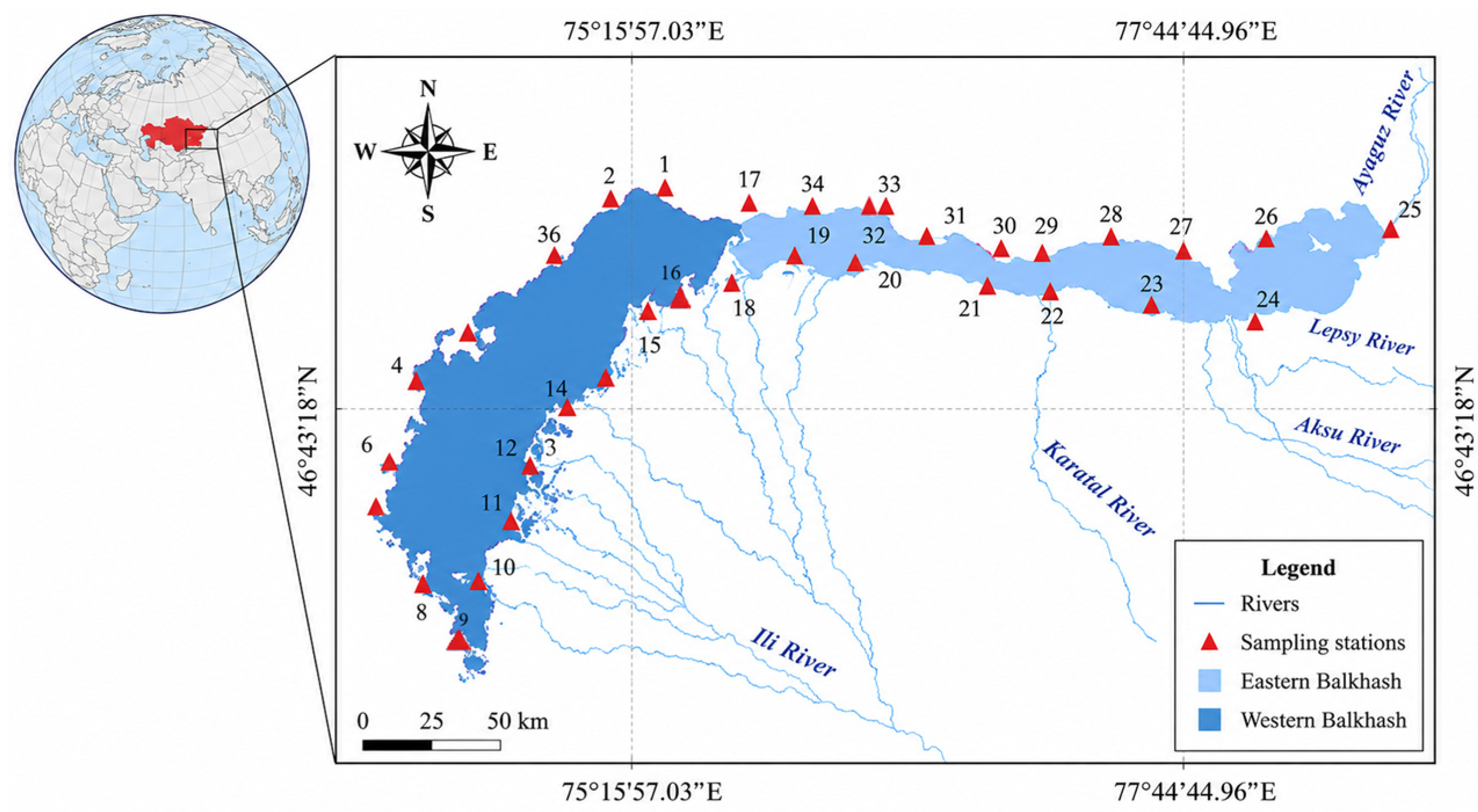
Lake Balkhash is one of the largest endorheic water bodies in the Republic of Kazakhstan, with a length of 605 km, a maximum width of 67.6 km, and a minimum width of 4.2 km (Figure 1). The lake has a current surface area of about 18,500 km2 and is located in an arid zone. It receives most of its inflow from five southern rivers, with the Ili River being the main water source, contributing up to 80% of the total annual runoff. The river flows into the western part of Lake Balkhash and reaches the Saryesik Peninsula, creating a separation between the western and eastern parts of the lake [15].
In the western basin, the average salinity is 1727.00 ± 120.00 mg/L, whereas in the eastern basin it is much higher, reaching 4068.00 ± 137.00 mg/L [12].
In the middle reaches of the Ili River, the Kapchagay Reservoir was constructed in 1970 [16]. During its filling, river water was used to supply the reservoir, resulting in a redistribution of river flow [7]. This allowed regulation of the water regime and supported regional economic needs; however, it also affected the natural hydrological balance [8,17]. As a result, Lake Balkhash became one of the most sensitive systems to these changes, with pronounced water level fluctuations and ecological impacts due to reduced inflow [18]. The remaining four rivers—Karatal, Aksu, Lepsy, and Ayagoz—flow into the eastern part of the lake and together account for about 20% of the total surface runoff [19,20].

2.2. Field Sampling and Laboratory Processing

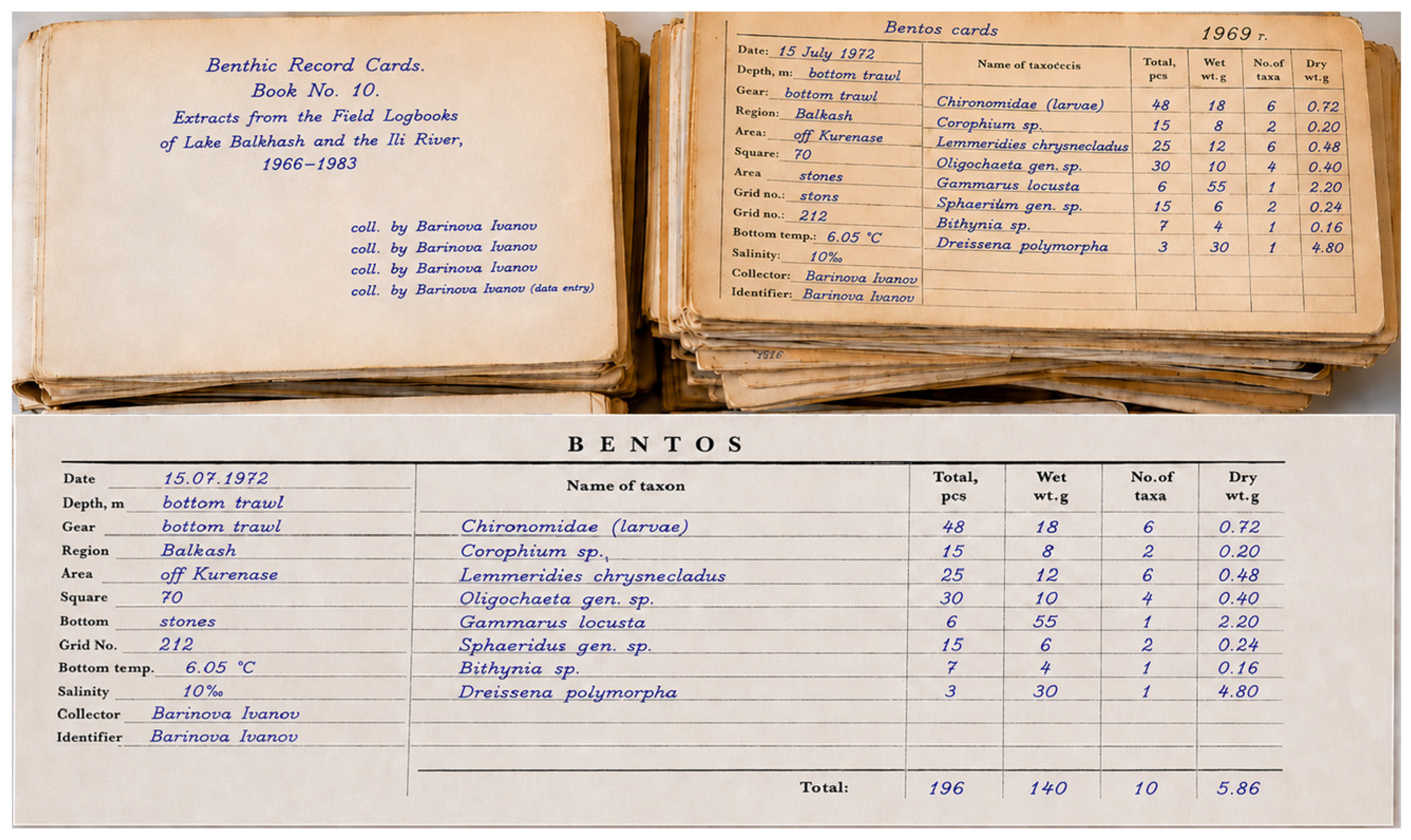
We analyzed the dynamics of zoobenthic taxonomic composition in Lake Balkhash over the period 1975–2024 using archival and contemporary monitoring data collected by the Limited Liability Partnership “Fisheries Research and Production Center” (Appendix A, Figure A1). Sampling was conducted during the summer as part of long-term monitoring of major inland lakes in Kazakhstan.
Water level data for Lake Balkhash were obtained from hydrometric stations operated by Kazhydromet [21].
Sampling protocols varied slightly over the study period. Before 1983, sampling and taxonomic identification followed the methods of Zhadin (1956, 1960) [22,23], whereas from 1985 onward Abakumov’s methodology was applied [24]. During the early monitoring period, approximately 300 benthic samples were collected each season across the lake, whereas recent monitoring has included 36 samples per season (Table 1). To ensure methodological consistency, only 36 historical samples corresponding to the current monitoring stations were included in the analyses.
Throughout the study period, all samples were collected using a Petersen grab (0.025 m2). Sediments were washed through a 0.35 mm mesh sieve, benthic organisms were manually sorted, and specimens were preserved in 4% formaldehyde [22,23,24].
Laboratory procedures also evolved during the study period. Earlier analyses used an MBS-1 stereomicroscope together with a monocular light microscope, whereas from 2002 onward MBS-10 stereomicroscopes and Micromed microscopes were used. Since 2020, samples have been examined using MBS-10M (Biomed, St. Petersburg, Russia) stereomicroscopes and SOPTOP EX30 (SOPTOP Technologies Co., Ltd., Ningbo, China) microscopes with magnifications of up to 100×. Specimens were identified to the lowest possible taxonomic level (usually species or genus) using standard taxonomic keys [25,26,27,28,29,30,31,32,33,34,35,36,37,38,39,40,41]. Taxonomic nomenclature was subsequently standardized according to the current classifications of GBIF [42] and WoRMS [43], and historical species names were reconciled with accepted nomenclature before statistical analyses. Although differences in sampling intensity, laboratory equipment, taxonomic references, and identification practices may have influenced taxonomic resolution, restricting the analyses to consistent sampling stations and harmonizing taxonomy improved comparability across the study period. Nevertheless, these methodological differences should be considered when interpreting long-term trends in zoobenthic taxonomic richness.

2.3. Statistical Analysis

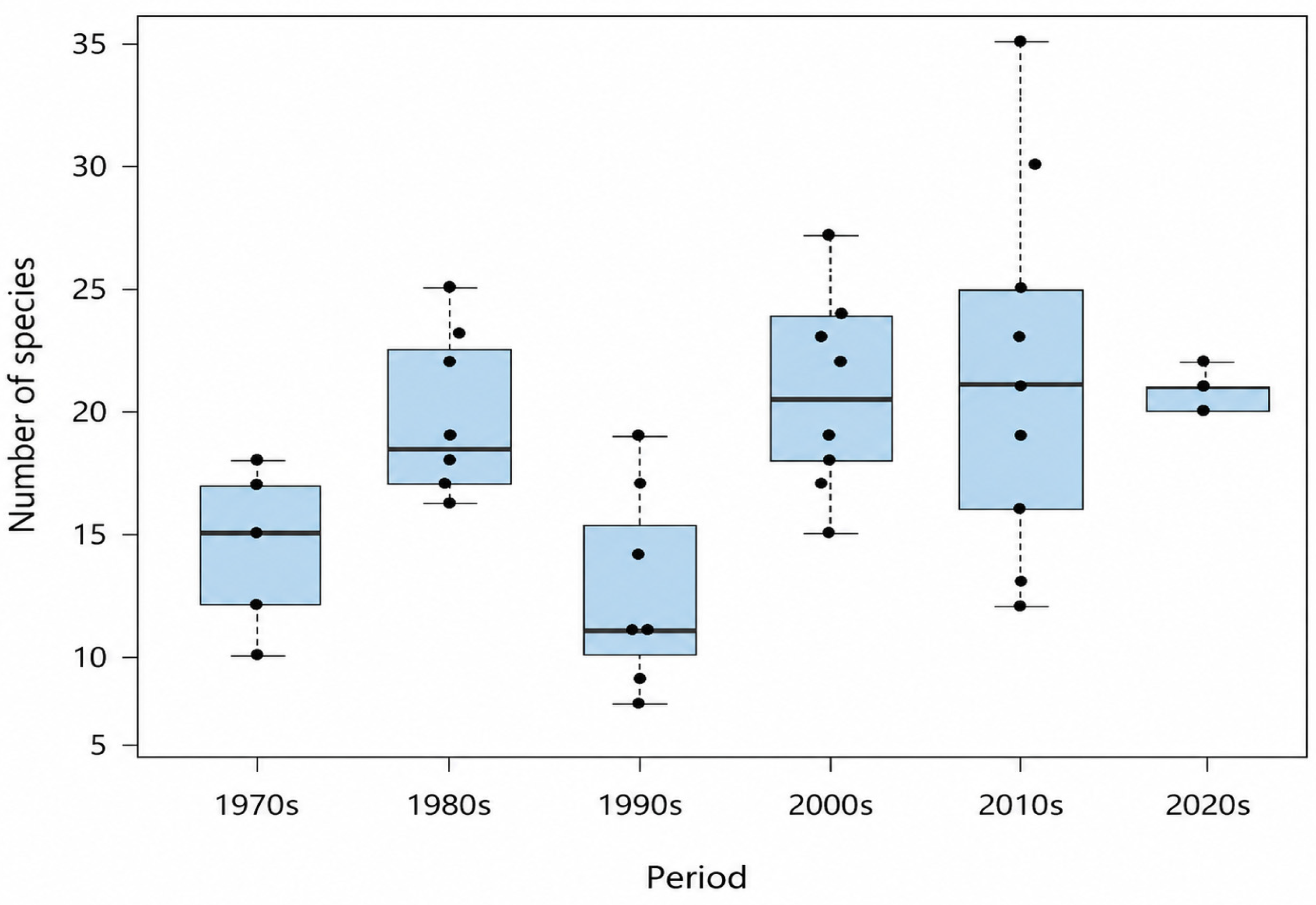
To ensure comparability between historical and recent datasets, strict standardization was applied. Boxplot analysis was performed to assess temporal variability in taxonomic richness. Data were structured by year and sampling station. For long-term comparisons, annual data were aggregated into decade-level groups. Decadal classes were generated in R using floor (year/10) × 10, allowing each record to be assigned to its corresponding decade for subsequent analyses. Zoobenthic taxonomic richness was used as the primary response variable in all statistical analyses. The Kruskal–Wallis test was applied to assess differences in zoobenthic taxonomic richness among multiple decades (1974–2024) (Figure 2). The latter two analyses were conducted using R software (version 4.3.2, R Core Team, Vienna, Austria) [44]. CONISS clustering was performed in R using the rioja package. The Jaccard similarity index was used to identify temporal changes in zoobenthic community composition.
Water-level data for Lake Balkhash (1975–2022) were analyzed to assess relationships between water-level dynamics and zoobenthic taxonomic richness and to evaluate differences between study periods. Hydrological analyses were limited to the period 1975–2022, corresponding to the longest complete and internally consistent water-level record available for the study. This constraint has been explicitly acknowledged in the revised manuscript. In contrast, biological observations from 2023–2024 were included to characterize the most recent state of the zoobenthic community and its taxonomic diversity. Both Pearson’s parametric correlation and Spearman’s nonparametric rank correlation were applied to test relationships between water level and zoobenthic taxonomic richness. The significance threshold was set at p ≤ 0.01.
Time-series visualization was performed using IBM SPSS Statistics (Version 22, IBM Corp., Armonk, NY, USA) [45]. The Create Time Series function was used. This allowed visualization of the temporal dynamics of both variables. A one-year time lag was included in the analysis. Time-series analysis was used to evaluate delayed responses of zoobenthic diversity to hydrological changes.
A preliminary lag analysis was conducted. Lag intervals of 1 to 5 years were tested. Non-significant correlations (p > 0.01) were excluded. A one-year lag was identified as the most appropriate temporal offset. It was used in all subsequent lag-based analyses. The one-year lag is consistent with the concept of delayed ecological response. The one-year lag was considered the most ecologically relevant time interval because hydrological conditions of the previous year directly affect recruitment, survival, and habitat availability for most macrozoobenthic taxa. Given that the life cycles of many dominant benthic invertebrates are completed within one to two years, changes in flow conditions are expected to be reflected in community diversity during the subsequent year [46,47].
Initial comparisons of zoobenthic taxonomic richness were performed using Student’s independent-samples t-test. Levene’s test was used to assess homogeneity of variances [48]. Two temporal groups were defined: ≤1999 (“before 2000”) and ≥2000 (“after 2000”). This classification was based on differences in the hydrological regime. The post-2000 period was generally characterized by higher water levels. Statistical significance was set at α = 0.05.
Linear regression analysis was performed to assess the effect of water level. The regression analyses were based only on years with complete hydrological and biological data. Water-level records were unavailable for 1989, 1990, and 1999, while biological observations from 2023–2024 were excluded because no corresponding hydrological data were available for those years. As a result, the effective sample sizes were 43 and 42 observations, depending on the model. Two models were compared. The first model used no temporal lag. The second model included a one-year lag. In all models, zoobenthic taxonomic richness was the dependent variable. Lake water level was the predictor variable. Model performance was evaluated using R, R2, adjusted R2, β, F-statistic, and significance levels. The Durbin–Watson statistic was used to test residual independence. This ensured that linear regression was suitable for time-series data. Comparison of models allowed assessment of current and lagged hydrological effects. It also identified the best-fitting model for interannual variability. The lagged model assumes delayed ecological responses in benthic communities. These delays are caused by life-history traits, recolonization processes, and ecosystem restructuring following water-level changes.

3. Results

3.1. Zoobenthos Taxa Recorded in Lake Balkhash (1975–2024)

According to archived historical data, the zoobenthos of Lake Balkhash comprised 66 taxa during the period 1975–2024. Interannual variation in taxonomic composition and richness was observed. The full list of recorded taxa is presented in Appendix A (Table A1).
Across the integrated 1975–2024 dataset, the zoobenthic assemblage was mainly represented by Crustacea (9 taxa), Mollusca (12 taxa), and Diptera (31 taxa). These groups constituted the main components of the taxonomic composition. Although these groups were consistently represented throughout the study period, their taxonomic composition and occurrence patterns varied across different time intervals.
During 1975–1982, these taxa occurred continuously (100%). This included Chironomus (Chironomus) plumosus (Linnaeus, 1758), Chelicorophium curvispinum (G.O. Sars, 1895) (https://marinespecies.org/aphia.php?p=taxdetails&id=148582; accessed on 22 June 2026), Monodacna colorata (Eichwald, 1829) https://marinespecies.org/aphia.php?p=taxdetails&id=148582; (accessed on 22 June 2026), and Oligochaeta Tubifex tubifex (Müller, 1774) https://marinespecies.org/aphia.php?p=taxdetails&id=148582; (accessed on 22 June 2026), Potamothrix hammoniensis (Michaelsen, 1901) https://www.gbif.org (accessed on 22 June 2026).
In 1984–1992, the number of recorded Chironomidae taxa increased. These included Cryptochironomus sp., Polypedilum sp., and Glyptotendipes sp. Mysids (Paramysis (Paramysis) baeri Czerniavsky, 1882; P. (Mesomysis) intermedia (Czerniavsky, 1882) https://www.gbif.org (accessed on 22 June 2026) were also recorded. Occasional occurrences of certain crustacean and molluscan taxa were observed.
During 1995–2005, a relative stabilization in community composition was observed. This period was characterized by the regular occurrence (80–100%) of Chironomus plumosus, Chelicorophium curvispinum, Paramysis (Serrapalpisis) lacustris (Czerniavsky, 1882) https://www.gbif.org (accessed on 22 June 2026), and several oligochaete taxa.
During 2006–2014, the abundance of certain Chironomidae and Amphipoda taxa fluctuated annually. However, the characteristic species assemblage, including Monodacna colorata and Chironomus (Chironomus) plumosus, remained present.
The main components of the zoobenthic community were consistently recorded throughout the 2015–2024 study period. Several rare taxa occurred sporadically. These included representatives of Chironomidae and Gastropoda.

3.2. Temporal Patterns of Zoobenthic Taxonomic Richness

The boxplot shows zoobenthos taxonomic richness across decades in Lake Balkhash. Each box represents the interquartile range (middle 50% of the data), the horizontal line indicates the median, and the whiskers show the full range of variation.
Taxonomic richness varied among decades, with minimum values of about 7 taxa recorded in 1990 and a maximum of 35 taxa observed in 2020 (Figure 2). During 2000–2024, taxonomic richness showed greater variation, ranging from 8 to 35 taxa.
In the 1970s, the median was approximately 15 with an interquartile range of 12–17. In the 1980s, the median increased to 18–19, with an interquartile range of 17–22. In the 1990s, the median decreased to about 11, with an interquartile range of 9–15.
In the 2000s, taxonomic richness increased again, with a median of approximately 20 and an interquartile range of 18–24. In the 2010s, values were slightly higher and relatively stable, with a median of about 21 and an interquartile range of 16–25. In the 2020s, the median remained about 21, with an interquartile range of 20–21.
The Kruskal–Wallis test indicated significant differences among periods (χ2 = 16.01, df = 5, p = 0.0068).
The horizontal axis represents sampling time, whereas the vertical axis represents taxonomic richness.
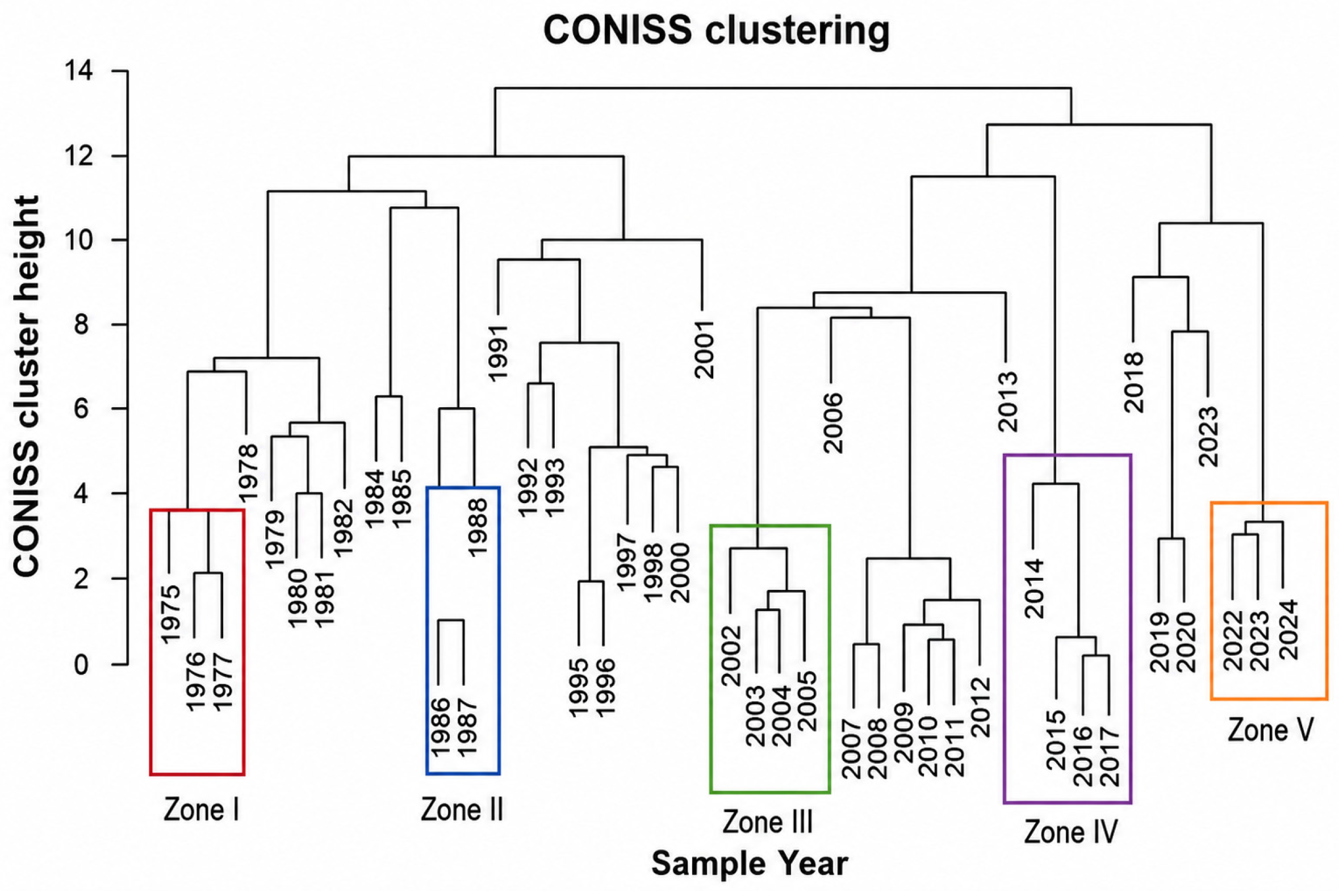
CONISS cluster analysis identified five clusters corresponding to distinct time intervals (Figure 3). Zone I covers 1975–1977 (red rectangle), Zone II includes 1986–1988 (blue rectangle), Zone III consists of 2002–2005 (green rectangle), Zone IV covers 2014–2017 (purple rectangle), and Zone V encompasses 2022–2024 (orange rectangle).
The delimitation of these zones was based on similarities in zoobenthic assemblage composition identified through hierarchical clustering; therefore, the zones represent statistically defined groupings rather than continuous chronological intervals.
Taxonomic richness differed significantly among clusters, with the Kruskal–Wallis test indicating significant differences among zones (χ2 = 11.535, df = 4, p = 0.003).
Temporal changes in zoobenthic community structure in Lake Balkhash were analyzed by comparing two time periods (≤1999 and ≥2000). This subdivision was based on differences in the lake’s hydrological regime and water-level dynamics. The difference between the two periods was statistically significant (t = −8.39, p < 0.001).
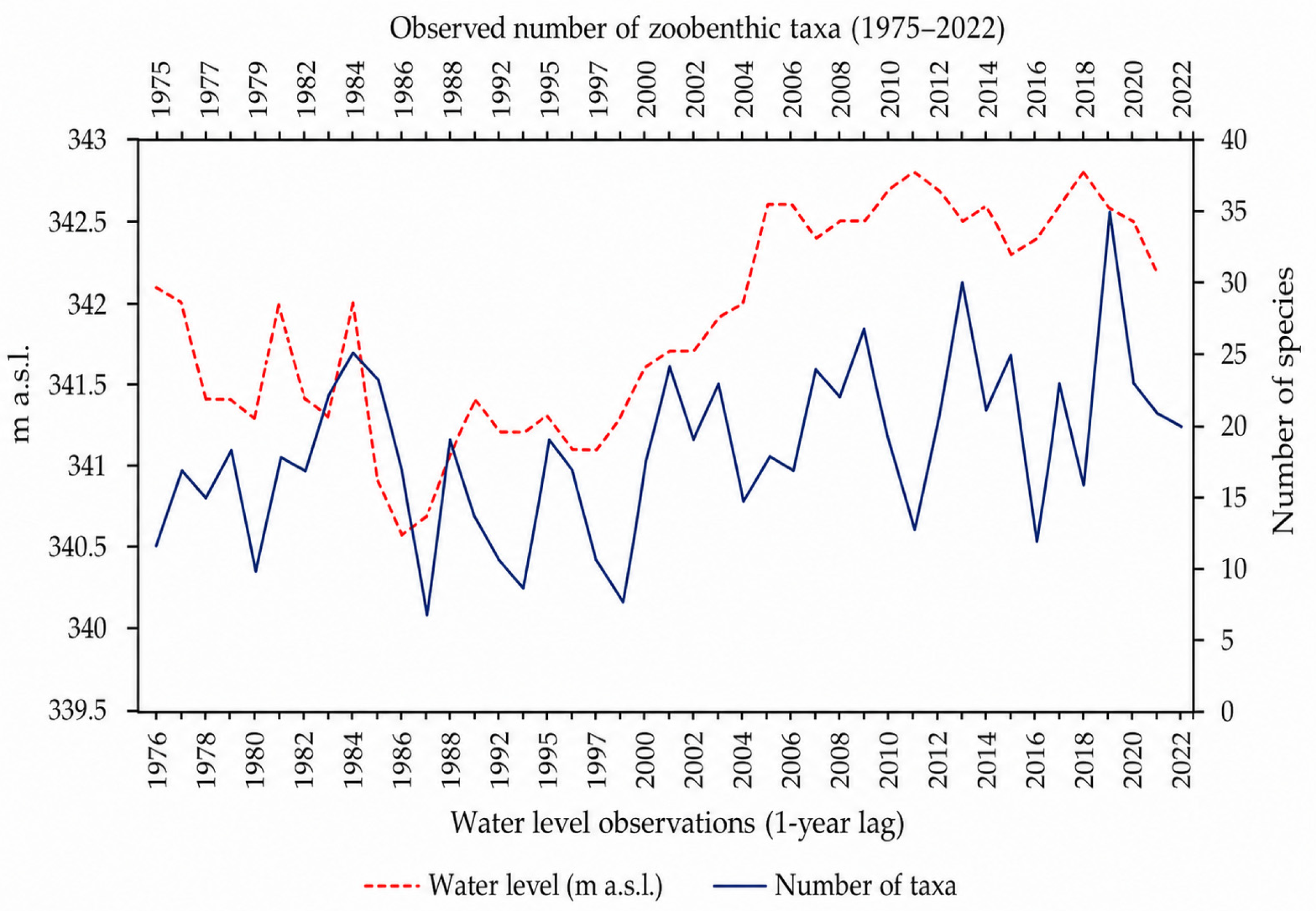
The period after 2000 was characterized by a pronounced increase in water level (342.35 ± 0.37 m a.s.l.). The period prior to 1999 showed less intensive fluctuations and a weaker rise in water level (341.34 ± 0.41 m a.s.l.) (Figure 4).
Differences in the number of taxa between the two groups were tested using Student’s t-test. Levene’s test was applied to assess the equality of variances (Table 2).
The mean number of zoobenthic taxa in the first group (≤1999) was 15.4 ± 5.08 taxa. In the second group (≥2000), it was 21 ± 5.04 taxa. The equality of variances between groups was not violated. This was confirmed by the Levene test (p ≥ 0.05).
Comparison using Student’s t-test revealed statistically significant differences in the number of zoobenthic taxa between the two periods. The test result was t = −3.70 (p ≤ 0.001).
To further examine this relationship, a correlation analysis was performed. Pearson’s and Spearman’s correlation analyses were applied. The analyses covered the number of taxa for 1975–2022 and water-level fluctuations for 1976–2022.
The results revealed a statistically significant positive relationship between taxonomic richness and water-level dynamics at a time lag of one year (1976–2022). For Pearson’s correlation, r = 0.52 (95% CI: 0.24–0.71, p ≤ 0.01). For Spearman’s correlation, r = 0.48 (95% CI: 0.16–0.71, p ≤ 0.01) (Table 3).
In contrast, the Spearman correlation analysis did not confirm a significant association at a two-year time lag (p > 0.01). Likewise, no statistically significant correlations were detected at a three-year time lag (p > 0.01). These findings suggest that the strongest effect of water-level fluctuations on the taxonomic diversity of zoobenthos is expressed within a one-year interval.
The increase in zoobenthic taxa generally coincided with rising water levels in Lake Balkhash (Figure 4). The highest number of taxa (35) was recorded in 2020. This value corresponded to a high water level observed in 2019 (342.8 m a.s.l.), accounting for the one-year time lag.
Conversely, the minimum number of taxa was recorded in 1987 (7 taxa). This corresponded to one of the lowest water levels observed in 1986 (340.6 m a.s.l.).
Linear regression analysis revealed a statistically significant positive relationship between water level and zoobenthic taxonomic richness.
For the model without a temporal lag, the multiple correlation coefficient was R = 0.454. The coefficient of determination was R2 = 0.206 (adjusted R2 = 0.186). The regression model was statistically significant (F = 10.618, p = 0.002). The standardized regression coefficient was β = 0.454 (t = 3.259, p = 0.002), indicating a positive effect of water level on zoobenthic taxonomic richness.
Overall, water level explained approximately 20.6% of the variation in the number of taxa. The results of the regression analyses for both models are presented in Table 4.
This indicates moderate explanatory power. However, a substantial proportion of variation remains unexplained.
To assess the presence of a delayed effect, a linear regression model was constructed. This model incorporated the previous year’s water level (one-year lag).
In this model, the strength of the relationship increased. The correlation coefficient reached R = 0.529. The coefficient of determination increased to R2 = 0.280 (adjusted R2 = 0.262).
The model remained statistically significant (F = 15.528, p < 0.001). The standardized regression coefficient increased to β = 0.529 (t = 3.941, p < 0.001). Water level in the preceding year explained 28.0% of the variation in zoobenthic taxonomic richness. Comparison of the two regression models showed an increase in explanatory power with the inclusion of the lagged variable. The coefficient of determination increased from 0.206 to 0.280. This corresponds to an increase of 7.4%. These results may indicate a possible relationship between zoobenthic taxonomic richness and hydrological conditions of the preceding year. No comparable relationship is observed for the current year.
The Durbin–Watson statistics were 1.893 and 2.104 for the non-lagged and lagged models, respectively. Both values were close to 2. This indicates no significant autocorrelation in the residuals. It also supports the validity of the linear regression models.
The obtained results do not imply a direct causal relationship between water-level fluctuations and zoobenthic diversity. However, the observed temporal patterns suggest a possible link between water-level dynamics and zoobenthic community structure in Lake Balkhash.

4. Discussion

The interpretation of long-term zoobenthic patterns in Lake Balkhash should consider both ecological variability and methodological constraints. Five assemblage groupings were identified by CONISS analysis. These correspond to the periods 1975–1977, 1986–1988, 2002–2005, 2014–2017, and 2022–2024 (Figure 3).
A comparison of pre-2000 and post-2000 periods shows higher taxonomic richness in the latter. These results are based on pooled data from both the western and eastern basins. Although Lake Balkhash exhibits a pronounced west–east salinity gradient, the present analysis focuses on system-level temporal dynamics rather than basin-specific spatial variability. The pooling of Western and Eastern Basin data was applied to ensure consistent spatial coverage across all sampling periods and to maintain temporal comparability of the dataset.
Temporal comparisons are also influenced by changes in sampling design and analytical methods across the study period. Sampling effort varied substantially over time, with approximately 300 samples per season during the early monitoring period and 36 samples per season in later years. To ensure spatial comparability, only 36 samples corresponding to the same sampling stations were retained for analysis across both periods.
Laboratory equipment also changed over time, and improvements in microscopy and taxonomic resolution likely increased the probability of detecting rare taxa in recent years. The increased contribution of Chironomidae may partly reflect improved taxonomic resolution.
The interpretation of long-term ecological patterns is further constrained by the limited availability of environmental data. Concurrent measurements of key environmental variables, including dissolved oxygen, nutrient concentrations, and sediment characteristics, were not available throughout the study period. Nevertheless, potential ecological explanations based on species-specific biological traits may be considered in the interpretation of the observed patterns.
The increased number of taxa in the late period, particularly due to Chironomidae, may be related to species-specific biological traits. They are characterized by high tolerance to environmental stress, including extreme moisture limitation. Experimental evidence shows high mortality (~90%) only under severe moisture stress, occurring at a water content of approximately 0.3% [49]. This indicates strong ecological resilience, which may partly explain their substantial contribution to the taxonomic composition of the lake’s zoobenthos.
Beyond moisture-related effects, salinity is a major driver of zoobenthic distribution. Lake Balkhash exhibits a pronounced west–east salinity gradient, with total dissolved solids ranging from 1727.00 ± 120.00 mg/L in the western basin to 4068.00 ± 137.00 mg/L in the eastern basin [12]. Mollusks represent the second most taxonomically diverse group and include taxa with broad salinity tolerance (e.g., Monodacna sp., Planorbarius sp., Radix sp.), with tolerance ranges of approximately 300–6000 mg/L [50,51], supporting their persistence across heterogeneous habitats. Crustaceans similarly exhibit broad salinity tolerance [49], which is consistent with their distribution along the lake’s salinity gradient.
Hydrological variability, including water-level fluctuations, was considered in the present analysis of zoobenthic patterns. Correlation analysis indicated a positive relationship between water level and zoobenthic richness, with a one-year time lag. Water-level fluctuations likely reflect broader hydrological variability and may serve as an integrated proxy for changes in shoreline exposure, habitat connectivity, and littoral zone structure. Such mechanisms have been reported in large Eurasian lake systems [52,53,54,55], although in the present study they should be interpreted as plausible explanatory hypotheses rather than directly tested processes. The regression models showed that variation in water level accounted for only 20–28% of the observed variation in zoobenthic taxonomic richness, indicating that additional environmental factors not included in this study likely contribute to the remaining variability.
It should be noted that the structure and species diversity of macrozoobenthic communities may be influenced by water temperature, nutrient availability, dissolved oxygen concentration, salinity, sediment characteristics, macrophyte development, and a range of other abiotic and biotic factors [51]. Because comparable long-term datasets for these variables were not available, their relative contributions could not be quantitatively assessed. Therefore, the positive relationship identified between water level and zoobenthic taxonomic richness should be interpreted as a statistical association rather than evidence of a direct causal relationship.
Despite these limitations, previous studies in other regions have described potential links between hydrological conditions and benthic habitat structure in lake ecosystems [6,52,56,57,58]. Water-level increases may expand littoral zones, potentially enhancing sediment heterogeneity and promoting macrophyte-associated habitats [51]. Increased hydrological connectivity may also reduce near-bottom oxygen stress and facilitate dispersal and recolonization processes, although these mechanisms remain hypothetical in the present study. Collectively, these processes are consistent with higher habitat availability and reduced environmental constraints during high-water periods, which may contribute to increased zoobenthic richness. Similar patterns have been reported in Lake Sevan [59], where water-level regulation was associated with substantial shifts in benthic community structure, including a marked decline in macroinvertebrate richness (from 25 to 3 taxa) [59]. In shallow lake systems, macroinvertebrate assemblages are primarily governed by habitat availability and littoral complexity [6,56,57].
Overall, zoobenthic community composition in Lake Balkhash shows pronounced temporal variability. The higher taxonomic richness observed in the recent period may partly reflect methodological improvements and differences across the monitoring period, including changes in sampling effort and taxonomic resolution. These methodological constraints represent an important source of uncertainty in long-term comparisons and have been considered in the interpretation of temporal patterns. In addition, the absence of consistent long-term environmental datasets limits a more detailed ecological attribution of the observed patterns.

5. Conclusions

Long-term data (1975–2024) from Lake Balkhash reveal substantial variability in zoobenthic community composition. The analyses are based on pooled data from the western and eastern basins, which may obscure spatially explicit differences associated with the pronounced salinity gradient. Methodological approaches also varied over the study period.
Sampling effort varied markedly over time, with approximately 300 samples per season during the early monitoring period and 36 per season in later years. For comparability, only 36 samples corresponding to the same sampling stations as in the previous period were used for analysis. Taxonomic identification resolution also varied due to improvements in laboratory equipment.
A total of 66 taxa were recorded. Despite temporal variability, common and tolerant taxa remained consistently present. Taxonomic richness exhibited clear decadal variation, with lower values in earlier periods and higher values in recent decades. This increase in taxonomic richness should be interpreted with caution, as it may partly reflect methodological differences over time. A weak relationship was observed between water level and zoobenthic richness, indicating a limited contribution to the observed variability.
Overall, zoobenthic community dynamics in Lake Balkhash appear to be influenced by methodological differences between historical and contemporary studies. This study provides a first step towards a more systematic understanding of long-term zoobenthic community dynamics in Lake Balkhash. Future research should build on this framework.
Despite these limitations, the findings provide ecological insight relevant for conservation and water level management. Both littoral and open-water habitats should be considered integral components of zoobenthic diversity and ecosystem functioning. Water level regulation should aim to minimize rapid, extreme fluctuations to maintain habitat stability and ensure consistency in key environmental parameters.

Author Contributions

Conceptualization, M.A., S.A. and A.S.; methodology, M.A., A.S. and R.B.; software, M.A. and A.A.; validation, M.A., S.A., A.S. and G.A.; formal analysis, M.A.; investigation, M.A., R.B., A.A., A.U., D.I. and G.M.; resources, T.B. and S.A.; data curation, M.A. and D.I.; writing—original draft preparation, M.A.; writing—review and editing, G.A., S.A. and A.S.; visualization, M.A., G.M. and A.A.; supervision, G.A.; project administration, G.A. and T.B.; funding acquisition, S.A. All authors have read and agreed to the published version of the manuscript.

Funding

The research was carried out within the framework of funding provided by the Ministry of Agriculture of the Republic of Kazakhstan (Grant No. BR23591095).

Data Availability Statement

Data are contained within the article.

Conflicts of Interest

The authors declare no conflicts of interest.

Appendix A

Figure A1. Archived laboratory protocols representing historical data on zoobenthos sample processing from Lake Balkhash (1977) [58].
Diversity 18 00409 g0a1
Table A1. Taxonomic composition of zoobenthos in Lake Balkhash based on archived data (1975–2024).
TaxaPresence
Oligochaeta
Potamothrix hammoniensis (Michaelsen, 1901)+
Paranais simplex (Hrabě, 1936)+
Psammoryctides barbatus (Grube, 1860)+
Stylaria lacustris (Linnaeus, 1758)+
Tubifex tubifex (Müller, 1774)+
Oligochaeta gen. sp.+
Total Oligochaeta taxa6
Polychaeta
Hypania invalida (Grube, 1860)+
Hypaniola kowalewskii (Grimm, 1877)+
Total Polychaeta taxa2
Mollusca
Anisus spirorbis (Linnaeus, 1758)+
Borysthenia naticina (Menke, 1845)+
Ampullaceana balthica (Linnaeus, 1758)+
Peregriana peregra (O. F. Müller, 1774)+
Galba truncatula (O. F. Müller, 1774)+
Ampullaceana lagotis (Schrank, 1803)+
Monodacna colorata (Eichwald, 1829)+
Planorbarius corneus (Linnaeus, 1758)+
Valvata piscinalis (O. F. Müller, 1774)+
Valvata antiqua (J. Morris, 1838)+
Valvata depressa (C. Pfeiffer, 1821)+
Valvata cristata (O. F. Müller, 1774+
Total number of Mollusca taxa12
Crustacea
Chelicorophium curvispinum (G.O. Sars, 1895) +
Gammarus lacustris (G.O. Sars, 1863)+
Macrobrachium superbum (Heller, 1862)+
Paramysis (Paramysis) baeri (Czerniavsky, 1882) +
Paramysis (Serrapalpisis) incerta (G.O. Sars, 1895)+
Paramysis (Mesomysis) intermedia (Czerniavsky, 1882) +
Paramysis (Serrapalpisis) lacustris (Czerniavsky, 1882)+
Paramysis (Metamysis) ullskyi (Czerniavsky, 1882)+
Pontogammarus robustoides (Sars, 1894)+
Total Crustacea taxa9
Ephemeroptera
Caenis macrura Stephens, 1836+
Total Ephemeroptera taxa1
Odonata
Erythromma najas (Hansemann, 1823)+
Total Odonata taxa1
Coleoptera
Donacia sp.+
Total Coleoptera taxa 1
Trichoptera
Cyrnus flavidus (McLachlan, 1864)+
Ecnomus tenellus (Rambur, 1842)+
Trichoptera sp.+
Total Trichoptera taxa3
Diptera
Chironomidae sp.+
Chironomus (Lobochironomus) dorsalis (Meigen, 1818)+
Chironomus (Chironomus) plumosus (Linnaeus, 1758)+
Chironomus (Chironomus) salinarius (Kieffer, 1915)+
Chrysops sp.+
Cladotanytarsus mancus (Walker, 1856)+
Cricotopus algarum (Kieffer, 1911)+
Cricotopus (Isocladius) sylvestris (Fabricius, 1794)+
Cryptochironomus conjungens (Kieffer, 1918)+
Cryptochironomus anomalus (Kieffer, 1918)+
Cryptochironomus defectus (Kieffer, 1913)+
Cryptochironomus viridulus (Fabricius, 1805)+
Paracladopelma camptolabis (Kieffer, 1913)+
Curculionidae sp.+
Dicrotendipes nervosus (Staeger, 1839)+
Diptera sp.+
Endochironomus albipennis (Meigen, 1830)+
Glyptotendipes gripekoveni (Kieffer, 1913)+
Harnischia burganadzae (Chernovsky, 1949)+
Harnischia fuscimana (Kieffer, 1921)+
Ceratopogonidae sp.+
Micropsectra praecox (Wiedemann, 1818)+
Pentapedilum exectum (Kieffer, 1915)+
Polypedilum breviantennatum (Chernovsky, 1949)+
Polypedilum (Polypedilum) nubeculosum (Meigen, 1804)+
Procladius (Holotanypus) ferrugineus (Kieffer, 1918)+
Procladius sp.+
Sergentia (Sergentia) coracina (Zetterstedt, 1850)+
Tanypus (Tanypus) punctipennis (Meigen, 1818)+
Tanytarsus gregarius (Kieffer, 1909)+
Telmatoscopus sp.+
Total Diptera taxa31
Total number of recorded taxa66
Note. “+” indicates the presence of taxa.

References

  1. Zarfl, C.; Berlekamp, J.; He, F.; Jähnig, S.C.; Darwall, W.; Tockner, K. Future large hydropower dams impact global freshwater megafauna. Sci. Rep. 2019, 9, 18531. [Google Scholar] [CrossRef] [PubMed]
  2. Kulebayev, K.M.; Alimkulov, S.K.; Tursunova, A.A.; Makhmudova, L.K.; Talipova, E.K.; Saparova, A.A.; Rodrigo-Clavero, M.-E.; Rodrigo-Ilarri, J. Assessing the Vulnerability of Lakes in Western Kazakhstan to Climate Change and Anthropogenic Stressors. Water 2024, 16, 3709. [Google Scholar] [CrossRef]
  3. Fergus, C.E.; Brooks, J.R.; Kaufmann, P.R.; Pollard, A.I.; Herlihy, A.T.; Paulsen, S.G.; Weber, M.H. National framework for ranking lakes by potential for anthropogenic hydro-alteration. Ecol. Indic. 2021, 122, 107241. [Google Scholar] [CrossRef] [PubMed]
  4. Han, Y.; Zhang, K.; Lin, Q.; Huang, S.; Yang, X. Assessing lake ecosystem health from disturbed anthropogenic landscapes: Spatial patterns and driving mechanisms. Ecol. Indic. 2023, 147, 110007. [Google Scholar] [CrossRef]
  5. Mischke, S.; Zhang, C.; Plessen, B. Lake Balkhash (Kazakhstan): Recent human impact and natural variability in the last 2900 years. J. Gt. Lakes Res. 2020, 46, 267–276. [Google Scholar] [CrossRef]
  6. Duan, W.; Zou, S.; Chen, Y.; Nover, D.; Fang, G.; Wang, Y. Sustainable water management for cross-border resources: The Balkhash Lake Basin of Central Asia, 1931–2015. J. Clean. Prod. 2020, 263, 121614. [Google Scholar] [CrossRef]
  7. Narbayeva, K.T.; Burlibayeva, D.M.; Akhmetova, R.E.; Ismailova, G.K.; Zhenisova, N.E. Assessment of the use of river flow of the Ili River in the territory of Kazakhstan under conditions of natural and anthropogenic changes. Hydrometeorol. Ecol. 2024, 3, 20–30. [Google Scholar] [CrossRef]
  8. Burlibayev, M.Z.; Volchek, A.A.; Parfomuk, S.I.; Burlibayeva, D.M. Modeling of water level fluctuations of Lake Balkhash. Hydrometeorol. Ecol. 2017, 4, 63–74. [Google Scholar]
  9. Kurmanova, M.S.; Madibekov, A.S. Change in precipitation in the Balkash-Alakol Basin. Hydrometeorol. Ecol. 2020, 1, 36–42. [Google Scholar]
  10. Burlibayev, M.Z.; Volchek, A.A.; Burlibayeva, D.M. Flowing of the water level of Lake Balkhash in the conditions of a changing climate. Hydrometeorol. Ecol. 2017, 2, 46–65. [Google Scholar]
  11. Shen, B.; Wu, J.; Zhan, S.; Jin, M.; Saparov, A.S.; Abuduwaili, J. Spatial variations and controls on the hydrochemistry of surface waters across the Ili-Balkhash Basin, arid Central Asia. J. Hydrol. 2021, 600, 126565. [Google Scholar] [CrossRef]
  12. Satbek, A.; Mazhibayeva, Z.; Barakov, R.; Assylbekova, S.; Isbekov, K.; Aubakirova, M.; Krainyuk, V.; Altaeva, F.; Suyubaev, A. Diet Composition and Trophic Niches of the Fish Community in Lake Balkhash. Diversity 2026, 18, 201. [Google Scholar] [CrossRef]
  13. Tampo, L.; Kaboré, I.; Alhassan, E.H.; Ouéda, A.; Bawa, L.M.; Djaneye-Boundjou, G. Benthic Macroinvertebrates as Ecological Indicators: Their Sensitivity to the Water Quality and Human Disturbances in a Tropical River. Front. Water 2021, 3, 662765. [Google Scholar] [CrossRef]
  14. Nguyen, H.H.; Welti, E.A.R.; Haubrock, P.J.; Haase, P. Long-term trends in stream benthic macroinvertebrate communities are driven by chemicals. Environ. Sci. Eur. 2023, 35, 108. [Google Scholar] [CrossRef]
  15. Burlibayev, M.Z. (Ed.) Volume 3: Basins of the Shu and Talas Rivers. In Problems of Pollution of Major Transboundary Rivers of Kazakhstan; Kaganat Publishing House: Almaty, Kazakhstan, 2018; 511p. [Google Scholar]
  16. Samakova, A.B. Problems of Hydroecological Stability in the Basin of Lake Balkhash; Kaganat Publishing House: Almaty, Kazakhstan, 2003; 584p. [Google Scholar]
  17. Ivkina, N.I. Water Level Variations on the Balkash Lake in the Modern Period. Hydrometeorol. Ecol. 2022, 106, 6–13. [Google Scholar] [CrossRef]
  18. Sala, R.; Deom, J.M.; Aladin, N.V.; Plotnikov, I.S.; Nurtazin, S. Geological History and Present Conditions of Lake Balkhash. In Large Asian Lakes in a Changing World; Mischke, S., Ed.; Springer: Cham, Switzerland, 2020; pp. 89–118. [Google Scholar] [CrossRef]
  19. Asylbekova, S.Z. Acclimatization of Fish and Aquatic Invertebrates in Water Bodies of Kazakhstan: Results and Prospects. Doctoral Dissertation, Astrakhan State Technical University, Astrakhan, Russia, 2017; p. 42. [Google Scholar]
  20. Lyozin, V.A. Lake Balkhash (Comprehensive Characteristics of Hydrological and Geological Natural Lakes). In Surface Water Resources of the USSR; Gidrometeoizdat: Leningrad, Russia, 1970; Volume 13, 101p. [Google Scholar]
  21. Kazhydromet. National Hydrometeorological Service of Kazakhstan. Available online: https://www.kazhydromet.kz (accessed on 24 April 2024).
  22. Zhadin, V.I. Life of Freshwaters of the USSR; Publishing House of the USSR Academy of Sciences: Moscow, Russia; Leningrad, Russia, 1956; Volume IV, Part I; 470p. [Google Scholar]
  23. Zhadin, V.I. Methods of Hydrobiological Investigation; Higher School Publishing House: Moscow, Russia, 1960. [Google Scholar]
  24. Abakumov, V.A. (Ed.) Guide on Methods for Hydrobiological Analysis of Surface Waters and Bottom Sediments; Gidrometeoizdat: Leningrad, Russia, 1983. [Google Scholar]
  25. Pankratova, V.Y. Larvae and Pupae of the Mosquitoes of the Subfamily Orthocladinae; Fauna SSSR (Diptera, Chironomidae); Zoological Institute of the USSR Academy of Sciences: Leningrad, Russia, 1970; 343p. [Google Scholar]
  26. Pankratova, V.Y. Larvae and Pupae of the Mosquitoes of the Subfamilies Podonominae and Tanypodinae; Fauna SSSR (Diptera, Chironomidae); Zoological Institute of the USSR Academy of Sciences: Leningrad, Russia, 1977; 152p. [Google Scholar]
  27. Pankratova, V.Y. Larvae and Pupae of the Mosquitoes of the Subfamily Chironominae; Fauna SSSR (Diptera, Chironomidae); Zoological Institute of the USSR Academy of Sciences: Leningrad, Russia, 1983; 295p. [Google Scholar]
  28. Kutikova, L.A.; Starobogatov, Y.I. (Eds.) Keys to Freshwater Invertebrates of the European Part of the USSR (Plankton and Benthos); Gidrometeoizdat: Leningrad, Russia, 1977; 511p. [Google Scholar]
  29. Tsalolikhin, S.Y. (Ed.) Keys to Freshwater Invertebrates of Russia and Adjacent Territories: Lower Invertebrates; Zoological Institute of the Russian Academy of Sciences (ZIN RAS): St. Petersburg, Russia, 1994; Volume 1, 395p. [Google Scholar]
  30. Tsalolikhin, S.Y. (Ed.) Keys to Freshwater Invertebrates of Russia and Adjacent Territories: Crustaceans; Zoological Institute of the Russian Academy of Sciences (ZIN RAS): St. Petersburg, Russia, 1995; Volume 2, 632p. [Google Scholar]
  31. Tsalolikhin, S.Y. (Ed.) Keys to Freshwater Invertebrates of Russia and Adjacent Territories: Arachnids; Zoological Institute of the Russian Academy of Sciences (ZIN RAS): St. Petersburg, Russia, 1997; Volume 3, 395p. [Google Scholar]
  32. Tsalolikhin, S.Y. (Ed.) Keys to Freshwater Invertebrates of Russia and Adjacent Territories: Insects (Diptera); Zoological Institute of the Russian Academy of Sciences (ZIN RAS): St. Petersburg, Russia, 1999; Volume 4, Parts 1–2; 998p. [Google Scholar]
  33. Tsalolikhin, S.Y. (Ed.) Keys to Freshwater Invertebrates of Russia and Adjacent Territories: Higher Insects; Zoological Institute of the Russian Academy of Sciences (ZIN RAS): St. Petersburg, Russia, 2001; Volume 5, 836p. [Google Scholar]
  34. Tsalolikhin, S.Y. (Ed.) Keys to Freshwater Invertebrates of Russia and Adjacent Territories: Mollusks, Polychaetes, Nemertines; Zoological Institute of the Russian Academy of Sciences (ZIN RAS): St. Petersburg, Russia, 2004; Volume 6, 395p. [Google Scholar]
  35. Mamaev, B.M. Insect Identification by Larvae: Teacher’s Manual; Prosveshchenie: Moscow, Russia, 1972. [Google Scholar]
  36. Kutikova, L.A.; Starobogatov, Y.I. (Eds.) Keys to Freshwater Invertebrates of the European Part of Russia: Vol. 2. Zoobenthos; KMK Scientific Press: Moscow, Russia; St. Petersburg, Russia, 2016; 457p. [Google Scholar]
  37. Bogutskaya, N.G.; Kiyashko, P.V.; Naseka, A.M.; Orlova, M.I. Keys to Fishes and Invertebrates of the Caspian Sea. Vol. 1: Fishes and Mollusks; KMK Scientific Press: St. Petersburg, Russia; Moscow, Russia, 2013; 543p. [Google Scholar]
  38. Stepanyants, S.D.; Khlebovich, V.V.; Alekseev, V.R.; Danelia, M.E.; Petryashev, V.V. Keys to Fishes and Invertebrates of the Caspian Sea. Vol. 2: Cnidarians, Ctenophores, Polychaetes, Copepods and Mysids; KMK Scientific Press: St. Petersburg–Moscow, Russia, 2015; 244p. [Google Scholar]
  39. Mordukhai-Boltovsky, F.D.; Kondakov, N.N.; Markova, E.L.; Romanova, N.N.; Yablonskaya, E.A. Atlas of Invertebrates of the Aral Sea; Pishchevaya Promyshlennost: Moscow, Russia, 1974; 272p. [Google Scholar]
  40. Birstein, Y.A.; Vinogradov, L.G.; Kondakova, N.N.; Kun, M.S.; Astakhova, T.V.; Romanova, N.N. (Eds.) Atlas of Invertebrates of the Caspian Sea; Pischepromizdat: Moscow, Russia, 1968; 416p. [Google Scholar]
  41. Chernovsky, A.A. Identification of Larvae of Mosquitoes of the Family Tendipedidae; Publishing House of the USSR Academy of Sciences: Moscow, Russia, 1949; 186p. [Google Scholar]
  42. GBIF Secretariat. GBIF Backbone Taxonomy. Available online: https://www.gbif.org (accessed on 22 June 2026).
  43. WoRMS Editorial Board. World Register of Marine Species. Available online: https://www.marinespecies.org (accessed on 22 June 2026).
  44. Kabacoff, R. R in Action; Manning Publications Co.: New York, NY, USA, 2011; 771p. [Google Scholar]
  45. IBM Corp. IBM SPSS Statistics: Advanced Statistics; IBM Corp.: Armonk, NY, USA, 2013; Available online: https://pdf4pro.com/view/ibm-spss-advanced-statistics-22-university-of-sussex-4718e9.html (accessed on 27 February 2024).
  46. Poff, N.L.; Allan, J.D.; Bain, M.B.; Karr, J.R.; Prestegaard, K.L.; Richter, B.D.; Sparks, R.E.; Stromberg, J.C. The Natural Flow Regime: A Paradigm for River Conservation and Restoration. Bioscience 1997, 47, 769–784. [Google Scholar] [CrossRef]
  47. Bunn, S.E.; Arthington, A.H. Basic Principles and Ecological Consequences of Altered Flow Regimes for Aquatic Biodiversity. Environ. Manag. 2002, 30, 492–507. [Google Scholar] [CrossRef] [PubMed]
  48. Levene, H. Robust tests for equality of variances. In Contributions to Probability and Statistics: Essays in Honor of Harold Hotelling; Olkin, I., Ed.; Stanford University Press: Stanford, CA, USA, 1960; pp. 278–292. [Google Scholar]
  49. Poznańska, M.; Werner, D.; Jabłońska-Barna, I.; Kakareko, T.; Ung Duong, K.; Dzierżyńska-Białończyk, A.; Kobak, J. The survival and behavioural responses of a near-shore chironomid and oligochaete to declining water levels and sandy substratum drying. Hydrobiologia 2017, 788, 231–244. [Google Scholar] [CrossRef]
  50. Piscart, C.; Moreteau, J.-C.; Beisel, J.-N. Monitoring changes in freshwater macroinvertebrate communities along a salinity gradient using artificial substrates. Environ. Monit. Assess. 2006, 116, 529–542. [Google Scholar] [CrossRef] [PubMed]
  51. Berezina, N.A. Tolerance of freshwater invertebrates to changes in water salinity. Russ. J. Ecol. 2003, 34, 261–266. [Google Scholar] [CrossRef]
  52. Matishov, G.G.; Shokhin, I.V.; Nabozhenko, M.V.; Pol’shin, V.V. Long-Term Changes in the Benthic Communities of the Sea of Azov Related to the Sedimentation and Hydrological Regime. Oceanology 2008, 48, 390–400. [Google Scholar] [CrossRef]
  53. Jeppesen, E.; Søndergaard, M.; Jensen, J.P.; Havens, K.E.; Anneville, O.; Carvalho, L.; Coveney, M.F.; Deneke, R.; Dokulil, M.T.; Foy, B.; et al. Lake responses to reduced nutrient loading—An analysis of contemporary long-term data from 35 case studies. Freshw. Biol. 2005, 50, 1747–1771. [Google Scholar] [CrossRef]
  54. Torres-Ramírez, P.; Bustos-Espinoza, L.; Figueroa, S.; León-Muñoz, J.; Jerez, R.; Galán, A. Influence of the Hydrological Variability on Water Quality and Benthic Macroinvertebrates in a Chilean Estuary During a Megadrought. Estuaries Coasts 2024, 47, 724–742. [Google Scholar] [CrossRef]
  55. Kalinkina, N.M.; Sidorova, A.I.; Galibina, N.A.; Nikerova, K.M. The toxicity of Lake Onego sediments in connection with the natural and anthropogenic factors influence. In Environment. Technology. Resources. Proceedings of the 10th International Scientific and Practical Conference; Rezekne Higher Education Institution, Faculty of Engineering: Rezekne, Latvia, 2015; Volume II, pp. 124–127. [Google Scholar] [CrossRef]
  56. Furey, P.C.; Nordin, R.N.; Mazumder, A. Littoral benthic macroinvertebrates under contrasting drawdown in a reservoir and a natural lake. J. N. Am. Benthol. Soc. 2006, 25, 19–31. [Google Scholar] [CrossRef]
  57. Aroviita, J.; Hämäläinen, H. The impact of water-level regulation on littoral macroinvertebrate assemblages in boreal lakes. In Ecological Effects of Water-Level Fluctuations in Lakes; Wantzen, K.M., Rothhaupt, K.O., Mörtl, M., Cantonati, M., L.-Tóth, G., Fischer, P., Eds.; Springer: Dordrecht, The Netherlands, 2008; Volume 204, pp. 103–116. [Google Scholar] [CrossRef]
  58. Fisheries Research and Production Center. Archival Benthos Materials: Taxonomic Determinations of Benthos Samples Collected by Staff During Summer Periods 1975–2024; Fisheries Research and Production Center: Almaty, Kazahstan, 2024. [Google Scholar]
  59. Jenderedjian, K.; Hakobyan, S.; Stapanian, M.A. Trends in benthic macroinvertebrate community biomass and energy budgets in Lake Sevan, 1928–2004. Environ. Monit. Assess. 2012, 184, 6647–6671. [Google Scholar] [CrossRef] [PubMed]
Figure 1. Map of the location of the monitoring station of the Balkhash Lake.
Diversity 18 00409 g001
Figure 2. Boxplot of zoobenthos taxonomic richness across decades in Lake Balkhash.
Diversity 18 00409 g002
Figure 3. CONISS-based temporal clustering of zoobenthic community in Lake Balkhash. Note. The CONISS (Constrained Incremental Sum of Squares) dendrogram plots samples along the horizontal axis by sampling time, while the vertical axis represents Jaccard-based dissimilarity (CONISS cluster height) in taxa composition; higher values indicate greater differences in community composition. The identified zones are indicated by the red triangle.
Diversity 18 00409 g003
Figure 4. Changes in the number of zoobenthic taxa (upper axis: 1975–2022) in relation to water-level dynamics with a one-year time lag (lower axis: 1976–2022).
Diversity 18 00409 g004
Table 1. The station coordinates.
StationWestern BalkashStationEastern Balkhash
146°48′46″ N74°57′09″ E1846°31′02″ N75°24′41″ E
246°45′57″ N74°38′29″ E1946°34′50″ N75°47′29″ E
346°17′43″ N73°57′21″ E2046°33′50″ N76°10′22″ E
446°05′48″ N73°39′04″ E2146°28′40″ N76°52′59″ E
545°59′18″ N73°39′59″ E2246°28′49″ N77°12′06″ E
645°47′42″ N73°30′08″ E2346°24′54″ N77°44′43″ E
745°40′36″ N73°26′42″ E2446°18′19″ N78°24′48″ E
845°21′20″ N73°44′00″ E2546°39′34″ N79°13′45″ E
945°12′11″ N74°01′29″ E2646°37′02″ N78°21′57″ E
1045°20′22″ N74°03′10″ E2746°36′01″ N78°05′47″ E
1145°35′11″ N74°12′22″ E2846°39′45″ N77°35′54″ E
1245°46′59″ N74°16′52″ E2946°36′48″ N77°16′39″ E
1345°47′53″ N74°17′48″ E3046°35′07″ N77°03′17″ E
1446°00′35″ N74°31′12″ E3146°38′46″ N76°31′45″ E
1546°06′12″ N74°45′42″ E3246°38′38″ N76°25′45″ E
1646°23′04″ N75°00′31″ E3346°49′19″ N75°54′22″ E
1746°48′58″ N75°04′44″ E3446°47′00″ N75°41′59″ E
3546°40′3.44″ C75°16′17.83″ B3646°34′2.23″ C74°28′35.57″ B
Table 2. Comparison of variables between two groups using Student’s t-test and Levene’s test for the assessment of equality of variances.
GroupsNNumber of Taxa by GroupsStudent’s t-TestLevene’s Test
M ± SD±SEtp-ValueFp-Value
≤1999
(before 2000)
2015.4 ± 5.081.13−3.700.0010.390.53
≥2000
(after 2000)
2521 ± 5.041.00
Note: Statistical significance was assessed using Levene’s test (α ≤ 0.05).
Table 3. Pearson and Spearman correlation coefficients according to the time lag of the level regime of Lake Balkhash for 1 year (1976–2022).
VariableM ± SDPearson rp-ValueSpearman rp-Value
Number of taxa for the period 1975–202218.4 ± 5.860.52p < 0.010.48p < 0.01
Level regime of Lake Balkhash (m a.s.l.) for the period 1976–2022 (lag of 1 year)341.88 ± 0.64
Level regime of Lake Balkhash (m a.s.l.) for the period 1977–2022 (lag of 2 years)341.87 ± 0.650.49p < 0.010.46p < 0.01
Level regime of Lake Balkhash (m a.s.l.) for the period 1978–2022 (lag of 3 years)341.86 ± 0.660.410.080.440.04
Level regime of Lake Balkhash (m a.s.l.) for the period 1979–2022 (lag of 4 years)341.89 ± 0.660.330.490.350.05
Level regime of Lake Balkhash (m a.s.l.) for the period 1980–2022 (lag of 5 years)341.91 ± 0.660.410.140.340.04
Note: Water level is expressed in meters relative to the Baltic height system (m a.s.l., Baltic System). Statistically significant correlations are indicated at p ≤ 0.01.
Table 4. Results of the linear regression analysis of the effect of water level on zoobenthic taxonomic richness.
VariableActual Water Level (1975–2022)One-Year Lagged Water Level (1976–2022)
Number of observations (N)4342
Coefficient of determination (R2)0.2060.280
Adjusted R20.1860.262
Standard error of the estimate5.2905.024
F-statistic10.61815.528
Standardized regression coefficient (β)0.4540.529
Durbin–Watson statistic1.8932.104
Model significance (p)0.002<0.001
Note: Effective sample sizes were N = 43 (Model 1) and N = 42 (Model 2). Water-level data for 1989, 1990, and 1999 were unavailable; biological observations from 2023–2024 were excluded because corresponding hydrological data were unavailable, and Model 2 included a one-year lag.
Disclaimer/Publisher’s Note: The statements, opinions and data contained in all publications are solely those of the individual author(s) and contributor(s) and not of MDPI and/or the editor(s). MDPI and/or the editor(s) disclaim responsibility for any injury to people or property resulting from any ideas, methods, instructions or products referred to in the content.