Article

Can Microhabitats Modify Macroecological Patterns? Evidence in the Hermit Crab Clibanarius sclopetarius (Herbst, 1796)

by
Maria D. C. Martins
1,*,
Fúlvio A. M. Freire
1,
Valéria F. Vale
1 and
Carlos E. R. D. Alencar
2
1
Laboratory of Crustacean Biology, Ecology and Evolution (LABEEC), Department of Botany and Zoology, Federal University of Rio Grande do Norte, Natal Campus, Natal 59078-900, RN, Brazil
2
Semi-Arid Crustacean Laboratory (LACRUSE), Department of Biological Sciences, Regional University of Cariri (URCA), Pimenta Campus, Crato 63105-000, CE, Brazil
*
Author to whom correspondence should be addressed.
Diversity 2026, 18(7), 410; https://doi.org/10.3390/d18070410 (registering DOI)
Submission received: 2 June 2026 / Revised: 24 June 2026 / Accepted: 25 June 2026 / Published: 4 July 2026
(This article belongs to the Special Issue Diversity and Ecology of Decapoda)

Abstract

The rules of Bergmann and Rensch are among the macroecological patterns most frequently used to explain body size and sexual dimorphism variations throughout geographic gradients. While Bergmann’s rule predicts an increase in size in higher latitudes and cold regions, Rensch’s rule describes allometric patterns in the expression of sexual dimorphism between males and females. Widely distributed organisms whose growth relies on external resources, such as the hermit crabs that utilize gastropod shells, constitute particularly adequate systems to investigate these patterns. In this study, we evaluate the occurrences of these rules in populations of the hermit crab Clibanarius sclopetarius distributed along the Brazilian shore. The morphologic variation was analyzed through traditional and geometric morphometry, integrating information regarding shape and size as well as comparing males and females from different populations. Regression models and multivariate analyses were employed in order to test associations between morphologic variables, latitude, and microhabitat. Although morphologic variations between populations and sexes have been detected, the patterns observed did not consistently follow the macroecological rules when considering latitude alone. By contrast, differences between analyzed microhabitats, mangrove forests, and rocky shores have been associated with distinct ecological contexts, which influence the expression of body size and sexual dimorphism.

1. Introduction

Ecogeographic rules seek to quantify and comprehend the spatial distribution of individuals’ biological characteristics, such as body size, and are relevant to both biogeographical and macroecological research [1,2,3]. Body size is a fundamental property of animals, as it is intimately correlated with almost all of their life cycle characteristics [4,5,6,7]. In addition, body size is a highly variable characteristic, affected by age, sex, phylogeny, and environment, and it influences countless ecological and evolutionary processes [3].
Several ecogeographical rules describe patterns of body variation that might interfere in the expression of sexual dimorphism. Bergmann (1847) [8] proposed that, in endothermic taxa, larger sizes are to be associated with higher latitudes and lower temperatures, while smaller individuals tend to be found in lower latitudes and higher temperatures. Bergmann’s rule assumes that body size is related to thermoregulation due to surface/volume ratios [9]. Although widely tested in endothermic and ectothermic animals [10,11], its association with sexual dimorphism has been historically underexplored, especially in marine and coastal organisms.
Sexual dimorphism manifests in numerous ways, traditionally grouped in five main categories [12]: size, body shape, the size and shape of the appendages, integumentary characteristics, and coloring. Among these categories, sexual size dimorphism (SSD) has been the object of many studies that sought to clarify its evolutionary and ecological mechanisms [13,14,15,16,17,18]. SSDs may be biased towards males (male-biased sexual size dimorphism, MBSSD) or females (female-biased sexual size dimorphism, FBSSD), reflecting different selective pressures associated with intraspecific competition, fecundity, and sexual selection [19].
In this regard, Rensch’s rule represents one of the main theoretical frameworks necessary to the understanding of SSD’s macroevolutionary patterns. Originally proposed by Rensch [14,15], this rule predicts that, in clades with SSD biased towards males, the degree of dimorphism increases with the increase in the species’ average body size, while the opposite pattern is to be expected in clades with SSD biased towards females. Rensch’s rule has been widely corroborated in vertebrates, especially birds and mammals, being frequently associated with the intensification of sexual selection on larger males [17,20]. However, its applicability to invertebrates remains controversial, with variable empirical evidence and, in many cases, inverse or absent patterns [3,21].
In crustaceans, Rensch’s rule tests have revealed inconsistent results, frequently associated with the complexity of their reproductive systems, their phenotypic plasticity, and the constraints imposed by their exoskeleton [12,22]. Because growth occurs discontinuously through successive molts, body size is limited by intermolt growth increments and influenced by energetic trade-offs between somatic growth and reproduction, particularly after sexual maturity. Studies with decapods indicate that distinct selective pressures might influence males and females in different environmental contexts, modulating the somatic growth as well as the reproductive investment [23,24,25]. Therefore, Rensch’s rule evaluations in coastal crustaceans, especially alongside latitudinal gradients and contrasting microhabitats, represent a relevant opportunity to test the generality of this macroecological pattern in ectothermic marine animals.
Besides SSD, sexual shape dimorphism (SShD) has garnered attention as a fundamental component of the differentiation between sexes. Differently from body size, the shape reflects subtle variations in the geometry of body structures, frequently associated with biomechanical, behavioral and reproductive functions [12,26]. SShD might emerge as a response to sexual selection, to the division of niches between sexes, or to specific functional demands such as defense, locomotion, and reproduction [27,28].
In decapod crustaceans, SShD has been documented mainly in structures such as the carapace, chelipeds, and pleon, frequently associated with agonistic behaviors, copulation, and egg incubation [29,30]. Studies based on geometric morphometrics demonstrate that males and females might present consistent form differences even in the absence of pronounced SSD, indicating that size and shape may respond independently to selective pressures [31,32]. Thus, the incorporation of SShD substantially amplifies the comprehension of the mechanisms that shape sexual dimorphism in organisms with rigid exoskeletons.
In species with a wide spatial distribution, it is common to encounter variations in environmental and ecological factors, such as availability of resources, competition, and defensive strategies, which may result in morphological differences between populations [33,34,35,36,37]. An efficient approach for investigating these patterns involves evaluating morphological differences or similarities between geographically distinct populations [38,39]. Therefore, morphometric studies have proven themselves to be valuable tools in identifying variations in crustaceans, allowing for inferences about selective processes and phenotypic responses to environmental gradients [31,40].
Geometric morphometrics constitutes a robust approach to visualizing and quantifying shape and size variations through coordinates of homologous anatomical landmarks [26,41,42]. In crustaceans, this technique enables the identification of subtle morphological differences that are not detectable through traditional morphometry, being particularly efficient due to the calcified exoskeleton’s hardness and to the abundance of well-defined anatomical structures in the carapace [30,43,44,45,46].
Hermit crabs (Paguroidea Latreille, 1802) constitute particularly interesting models for macroecological and evolutionary studies. Besides the ectothermy, these organisms present biological peculiarities, such as an asymmetrical and weakly calcified pleon, which makes them dependent on shells already available in their environment for protection, a limited resource that is subject to spatial and temporal variations [47]. This dependency directly influences their growth, survival and reproductive success, in addition to interacting with the pressures of sexual selection and intraspecific competition, shaping the expression of sexual dimorphism [48]. Therefore, hermit crabs offer a privileged natural system to investigate how environmental gradients and availability of resources affect body variation patterns, SSD, and SShD.
Among the Paguroidea species, the Clibanarius sclopetarius (Herbst, 1796) stands out as an adequate model for this type of investigation. Widely distributed in the Western Atlantic, from Florida and the Caribbean to the Brazilian coast, the species occupies estuaries, sandy shores and mangrove forests, exhibiting high ecological plasticity [49]. Several aspects of their biology have already been addressed, including growth, fecundity, shell selection, interspecific competition, and reproductive behavior [50,51,52,53,54,55]. This knowledge base, combined with their wide latitudinal distribution, makes the C. sclopetarius an ideal organism to test the applicability of Bergmann’s rule as well as to evaluate their conformity to Rensch’s rule and their SSD and SShD patterns in relation to shell availability.
In this study, we investigate how macroecological rules are expressed based on population dynamics of C. sclopetarius throughout different latitudinal gradients. Our main hypothesis is that the species follows an inverse pattern to Bergmann’s rule (Bergmann’s converse), displaying larger body sizes in lower latitudes. This hypothesis is based on the expectation that, in tropical environments, warmer temperatures and reduced seasonal constraints may promote longer periods of activity and growth, potentially allowing individuals to attain larger body sizes than populations inhabiting higher latitudes. As to Rensch’s rule, we expect to find SSD biased towards males, reflecting a higher investment in growth and a competitive advantage in accessing shells. Considering their dependency upon this resource, we postulate that the occupation of suboptimal shells in tropical regions might restrict the maximum size of the individuals, influencing both the SSD as well as the SShD. Therefore, by integrating macroecological and morphometric approaches, this paper aims to elucidate how environmental factors, resource availability, and sexual selection interact to shape the morphological variation in a key species of hermit crabs.

2. Materials and Methods

2.1. Organism Collection, Identification, and Biometrics

For the present study, the data were obtained following the criteria described by Alencar et al. (2022) [56] and Martins et al. (2025) [57], divided into primary data (through in situ collection, data analyzed in laboratory, and scientific collections whose materials have not been published in the specialized literature) and secondary data (data from a systematic review of the specialized literature), referring to the mean body size values (carapace length, distance between the anterior and posterior margins of the carapace) of hermit crab populations from the Clibanarius sclopetarius species (Herbst, 1796). The mean annual sea surface temperature (SST) for each sampling locality was obtained from the NASA database [58].
The primary data obtained through the analysis of materials found in collections originated from the following laboratories: Laboratory of Biology, Ecology and Crustacean Evolution of the Federal University of Rio Grande do Norte (LABEEC/UFRN) and Crustacean Collection of the Zoology and Animal Parasitology Laboratory at the State University of Southwestern Bahia (LZPA/UESB).
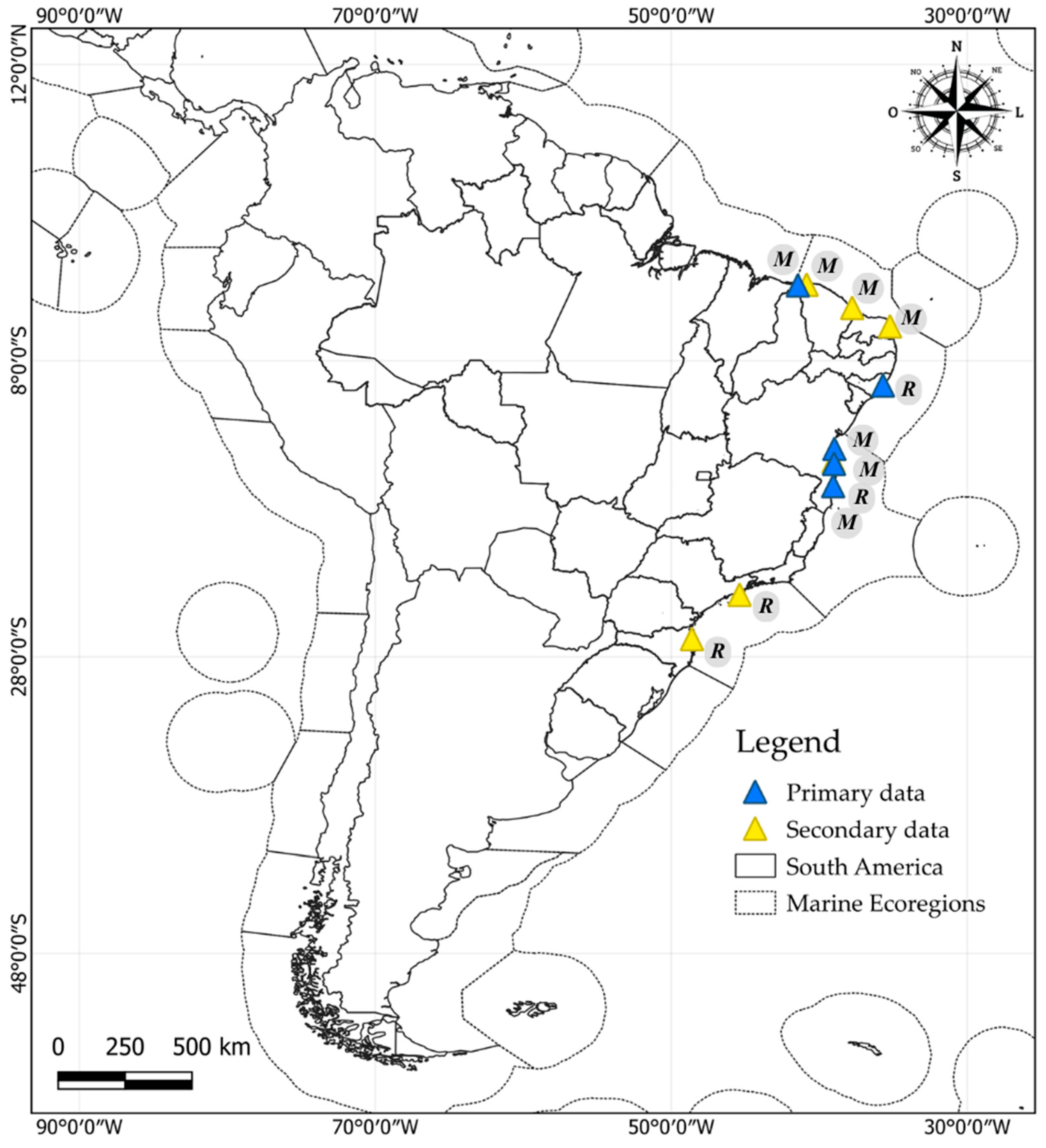
A total of 1264 adult specimens of C. sclopetarius were collected (625 males, 550 females, and 89 ovigerous females) during the years 2011–2025, in 11 locations distributed alongside the 2° to 26° degrees variation range: Piauí (PI, 2°54′ S; 21.2 °C), Ceará (CE, 2°51′ S and 4°25′ S; 22.4 °C), Rio Grande do Norte (RN, 5°40′ S; 20.7 °C), Alagoas (AL, 9°40′ S and 9°44′ S; 20.6 °C), Bahia (BA, 13°56′ S, 14°48′ S, 14°57′ S, 16°27′ S; 20.2 °C), and Santa Catarina (SC, 26°47′ S; 17.4 °C) (Figure 1).
The sampling was carried out through an active search randomly conducted by two collectors, each for 30 min, during low tides [59]. Sampling during low tide maximized access to the intertidal habitats occupied by Clibanarius sclopetarius, allowing a standardized sampling effort among localities. After that, the organisms were cryoanesthetized, packaged in 70% alcohol, and transported to the Zoology and Animal Parasitology Laboratory at the State University of Southwestern Bahia (LZPA/UESB) for further analyses.
In the laboratory, the hermit crabs were removed from their shells, which were broken through with a lathe when necessary, with the goal of enabling taxonomic identification, sexing, and the gathering of biometric measurements. The identification followed the keys proposed by Melo (1999) [60] and Nucci & Melo (2015) [49], while the sex identification was based on the positions of the gonopods, located on the third pair of the pereiopods in females and on the fifth pair in males, according to McLaughlin (2003) [61]. The identification of gastropods with hermit crab-occupied shells followed specialized taxonomic keys [62,63,64].
The hermit crabs were measured in terms of carapace length (CEC), and the shells were measured in terms of: shell aperture, shell width (SW), shell aperture length (SAL), and shell aperture width (SAW). All of the linear biometric procedures were carried out with the use of a 0.01 mm precision caliper (Mitutoyo, Tokyo, Japan®).
The secondary data related to the mean length of the carapace (CEC) were obtained through a systematic review of scientific documents published in the following repositories: Google Scholar, JSTOR, ScienceDirect, Scopus, and Web of Science. Searches were performed in three languages (Portuguese, Spanish, and English) to maximize literature coverage and reduce potential linguistic bias. Keywords were combined using the Boolean operators OR and AND to retrieve records containing, respectively, any of the alternative terms or the co-occurrence of specific terms. The full search strategies employed are detailed in Appendix A, Table A1.
Records with inaccurate taxonomy, invalid geographic coordinates, or incomplete collection information were excluded from the analyses [56,57]. Information originating from monographs, dissertations, theses, course completion papers, NGOs, and private reports, as well as abstracts presented in conferences, symposia, and other academic events, were not considered valid for the study [56,57].

2.2. Data Analysis

The analyses were conducted considering (i) all of the populations collectively and (ii) separately, according to the microhabitat type, including populations from rocky shores and mangrove forests.

2.2.1. Bergmann’s Rule

To verify whether or not the species follow Bergmann’s rule, the data referring to the mean carapace length (CEC) and latitude were utilized. The data were tested in relation to the normality of data distribution and homoscedasticity and were logarithmized (log10) [65,66].
The relationship between body size and latitude was evaluated using Standardized Major Axis (SMA) regression (type II regression), fitted between log10-transformed mean carapace length (Poplog) and latitude (Latlog). Type II regression accounts for measurement error and biological variation in both variables, unlike ordinary least squares regression, which assumes that the predictor variable is measured without error [67,68,69]. SMA analyses were performed using the smatr package in R [69]. Regression parameters, including slope estimates and their corresponding 95% confidence intervals, were obtained, and departures from isometry (b = 1) were assessed using the appropriate SMA hypothesis tests [68].
To formally evaluate whether the relationship between latitude and body size differed among microhabitats, an analysis of covariance (ANCOVA) was additionally performed, including latitude, microhabitat, and their interaction (latitude × microhabitat) as fixed effects. A significant interaction term was interpreted as evidence that the effect of latitude on body size varied among microhabitats.

2.2.2. Rensch’s Rule and Size Sexual Dimorphism (SSD)

To verify whether or not the species follows Rensch’s rule, and to investigate the degree of size sexual dimorphism (SSD), the values of the carapace length (CEC) were tested for the normality of data distribution and homoscedasticity and converted into a 10-base logarithm [65,66]. The ratio proposed by Rensch’s rule was examined through a type II regression [67,68,69], adjusted between the values of Flog (CEClog of the females) vs. Mlog (CEClog of the males).
The SSD rate was calculated based on the mean size difference between males and females (M − F), considering that the value of F was obtained through the average size of both ovigerous (OF) and non-ovigerous females (OF + F/2). Positive values indicate biased dimorphism towards males, while negative values indicate size bias towards females. Eventually, the relation between SSD and female body size was also adjusted by a type II regression [68,69], in the form SSDlog vs. Flog.
The hypothesis of null sexual isometry (b = 1) for Rensch’s rule was evaluated based on the 95% confidence intervals of the slope of the line [70,71]. Thus, inclinations higher than 1 (b > 1) were interpreted as supportive of Rensch’s rule, while inclinations lower than 1 (b < 1) indicate an SSD evolution in opposition to Rensch’s rule (Inverse Rensch’s Rule).

2.2.3. Bergmann’s Rule vs. Rensch’s Rule

To investigate whether or not latitude influences a species’ SSD, a type II regression adjusted between the mean values of size dimorphism, the CEC of males, and the CEC of females was utilized: SSDlog vs. latitude, Mlog vs. latitude and Flog vs. latitude [48,71]. The null slope hypothesis (b = 0) was evaluated through 95% confidence intervals [68].
Furthermore, statistically significant specific sexual correlations (p < 0.05) would indicate compliance with Bergmann’s rule (larger males and/or females in higher latitudes) while negative inclinations would indicate Bergmann’s converse (larger males and/or females in lower latitudes) [67,71].

2.2.4. Shell Adequacy: SAI and KSAI Rates

The adequacy of hermit crab-occupied shells was evaluated considering the shell’s physical attributes in relation to the hermit crab’s body size, in accordance with the rates proposed by Vance (1972) [72] and Kellogg (1976) [73]. The rates were utilized to compare the shell adequacy in relation to the hermit crab’s size and the relation of the shell’s adequacy to the occupied shell’s size.
The Shell Adequacy Index (SAI) [72] is based on the logarithmic regression between the hermit crab’s body weight (y) and shell size (x):
y = A · log x + B .
Four measurements of the shell size were utilized: shell length, shell width, shell aperture length, and shell aperture width. The linear dimensions of the shell were measured with a 0.01 mm precision digital caliper. The biometric data were logarithmized and later analyzed using linear regression. Six separate linear regression equations were calculated to establish relations between the carapace length (dependent variable) and each of the four size measurements of the shell (the independent variables) [73].
Given the strong correlation between the shell width and the size of the hermit crab (r2 = 0.8054), the former was used as the predictor variable. Based on this equation, the expected weight of the crab (ŷ) was obtained, which was compared with the observed weight ( y 0 ) by the ratio [72]
SAI = ŷ / y 0 .
An SAI = 1 value indicates adequacy between the expected and the observed values (optimal); SAI < 1 indicates that the occupied shell is undersized in relation to the size of the crab (suboptimal); and SAI > 1 reflects the use of oversized shells (superoptimal) [72].
Kellogg [73] reformulated the index by inverting the predictive relationship to estimate the expected size of the shell based on the size of the crab. Kellogg’s Shell Adequacy Index (KSAI) is, therefore, defined as
KSAI = X 0 /   x ^ ,
in which X 0 corresponds to the observed size of the shell and x ^ to the expected size in relation to the crab. Just as in the SAI, figures equal to 1 indicate adequacy, figures inferior to 1 indicate shells smaller than expected, and figures superior to 1 correspond to shells larger than expected [73].
To evaluate whether shell resource availability was associated with population-level morphological patterns, Pearson’s product-moment correlation analyses were performed between shell adequacy indices (MSAI and MKSAI) and population mean body size (Poplog) as well as sexual size dimorphism (SSD). Correlation coefficients (r) and associated p-values were used to assess the strength and direction of the relationships. Statistical significance was considered at α = 0.05.

2.2.5. Geometric Morphometrics, Analysis of the Body Shape, and SShD

Geometric morphometric (GM) analyses were used to identify sexual shape dimorphism (SShD) based on the configuration of anatomical landmarks, reducing the effects inherent to size [74,75]. Sixty adult Clibanarius sclopetarius specimens, without any damages or specific abnormalities, of each sex (30 M, 30 F) and from each population were used in the MG analyses (total number: 600 specimens). Only individuals in good preservation condition were selected, excluding specimens with any visible damage or deformation that could compromise landmark accuracy, particularly in key morphological structures used for shape analysis.
The areas and structures of the body selected for shape variation analysis were the face dorsal of the carapace (CEC) and the left and right exopodites on the uropod (EXOe and EXOd, respectively). These structures were analyzed based on different concepts of symmetry; the CEC was treated according to the concept of symmetrical object, since it refers to a bilaterally symmetrical structure that presents a shared central layout, allowing for the identification of homologous anatomical landmarks in both sides and alongside the axis of symmetry [76,77]. On the other hand, the exopodites on the left and right uropods were analyzed based on the concept of matching symmetry, since they consist of bilaterally symmetrical structures that are physically separated, not sharing a common axis in the deployed viewing [76,77,78].
The body planes were obtained through images captured by a Canon Powershot sx70 digital camera (Canon Inc., Ota City, Tokyo, Japan), attached and positioned on a stand, using a standardized camera distance and body plane position. All images of the body plane structure were positioned at the center (vertically and horizontally) of the image frame and scaled in millimeters for future size information acquisition.
Preliminary standardization measures were also taken in relation to distance, zoom, and illumination of the structures, so that any image distortion effect was eliminated [32]. Furthermore, measurement error tests were performed to gauge the accuracy of the image capture and the landmarks’ positioning (additional details are provided in Appendix A, Table A2) [32,79].
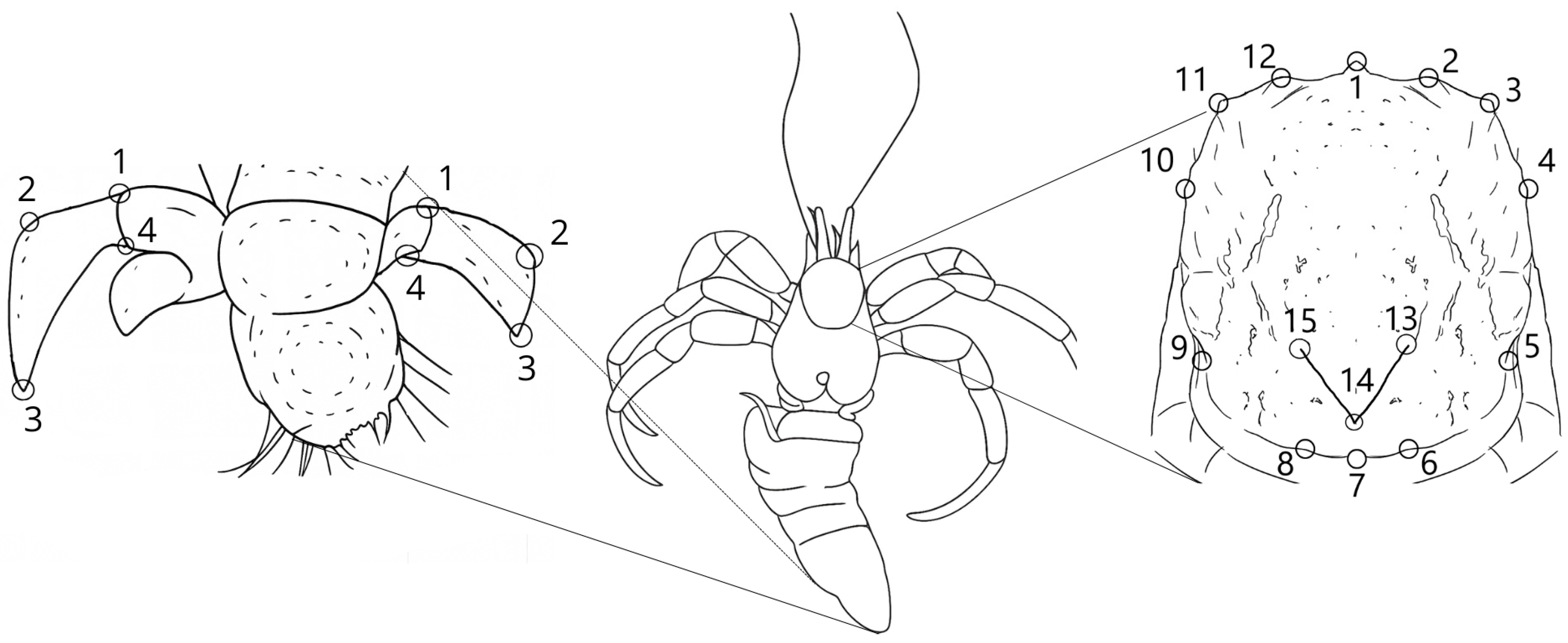
The images of the specimens’ body planes were gathered in a single TPS file through the tpsUtil software version 1.83 [80]. In the CEC, 15 landmarks were applied (3 in the central layout and 12 symmetrical ones), while on the exopod of the uropod, 4 landmarks were established for the EXOe and another 4 for the EXOd. The digitalization of anatomical landmarks was carried out in the TPSdig v2.16 software [80]. The definition and description of the anatomical landmarks followed the criteria defined by Fraaije et al. (2012) [81] and Fraaije (2014) [82], based on Harvey (1998) [83], with some modifications (Figure 2, Table 1). Landmarks were selected based on homologous anatomical points corresponding to biologically meaningful structures such as articulation points, carapace edges, and muscle attachment regions, ensuring repeatability and biological interpretability across specimens [77,78].
For each body plane, the coordinates of the anatomical landmarks were subjected to a Generalized Procrustes Analysis (GPA) [84], a procedure performed in the MorphoJ software version1.08.02, which corrects variations unrelated to shape and attributable to the position, size and rotation of the specimens’ photos [77]. Based on this analysis, the values of the centroid size (Size) and the Procrustes coordinates (Form) were obtained. To control the static and ontogenetic allometry, the residuals of a multivariate regression of the Procrustes coordinates as a function of centroid size were calculated [45,76,77,85].
The variables analyzed in this study were the centroid logarithm (Size), the residuals of the shape vs. size multivariate regression (Shape), and the scores of the primary component (Form). The definition of Size represents the overall dimension and scale of the object [78]; Shape corresponds to the two-dimensional information of the structure after removing size, position, and rotation [77]; and Form simultaneously integrates information from Shape and Size [78].
A discriminant function analysis (DFA) was applied with the purpose of identifying which morphometric components allow for the differentiation of males and females [45]. The analysis considered values of Size, Shape, and Form, evaluating each population individually showing signs of sexual shape dimorphism (SShD) and sexual size dimorphism (SSD). Additionally, the Procrustes distances derived from the comparisons performed by the DFA were also analyzed. The analysis considered solely the Procrustes distance, which reflects the absolute variation in the form [86].
To investigate the latitudinal effect on SSD and SShD, a type II regression was conducted using the Procrustes distance (log10) relative to the latitude (log10) in decimal degrees. The significance of the regression slope was verified through 95% confidence intervals, assuming the null hypothesis of slope = 1 [48,71].
The GPA, DFA and allometric multivariate regression analyses were conducted in the MorphoJ® program [87], and statistical analyses were developed in the R software version 4.5.2 (R core Team, 2012) with a smatr package.

3. Results

Twelve populations distributed along a latitudinal gradient that varied from 2° S to 26° S were evaluated. The individuals from the Ilheus mangrove forest, Bahia (14°48′21.23″ S), exhibited the highest CEC averages, both in terms of the total population (PopCEC = 10.55 cm) and in the specific male (MCEC = 12.02 cm) and female (FCEC = 9.12 cm) analyses. In contrast, the population from the Sirihyba Beach rocky shore, Bahia (14°57′35.6″ S), presented the lowest mean CEC values in all analyzed categories (PopCEC = 3.90 cm; MCEC = 4.05 cm and FCEC = 3.57 cm) (Table 2).
The smallest SSD value was recorded in the population of Ponta Verde, Alagoas (9°40′09.0″ S), (SSDlog = 0.0001). On the other hand, the biggest discrepancy was observed in the population of Marau Beach, Bahia (13°56′56.5″ S), where SSD reached its maximum value within the analyzed gradient (SSDlog = 0.180). All SSD values analyzed were positive, indicating an SSD bias towards males (Table 2).

3.1. Latitude–Size Complex: Bergmann’s Rule

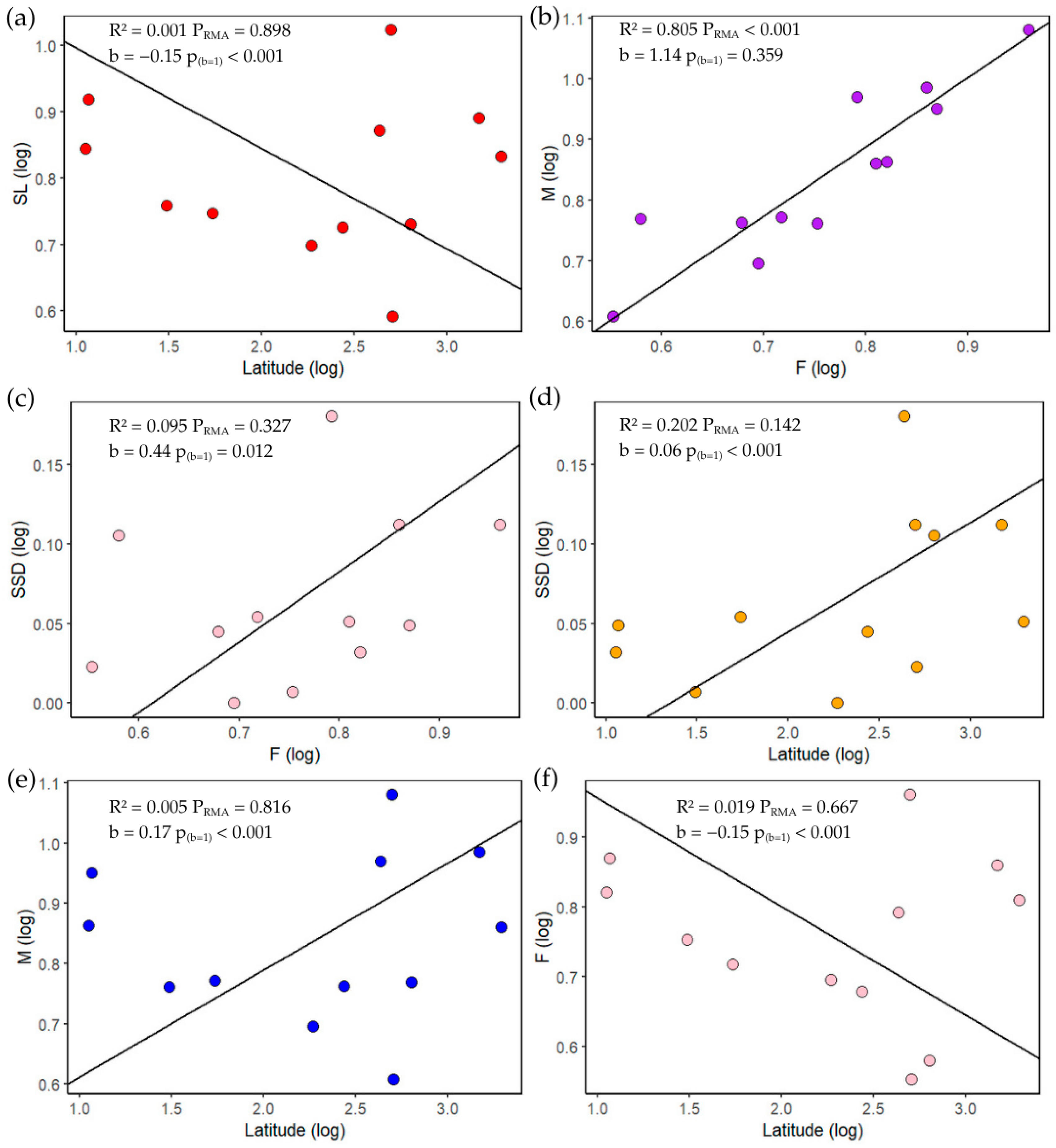
Overall, and when analyzed separately by habitat, the regressions did not present any statistical significance (PRMA > 0.05) (Table 3, Figure 3a). These results suggest that, in C. sclopetarius, body size does not show any trend consistent with or contrary to that predicted by Bergmann’s rule.
However, the ANCOVA revealed significant effects of latitude (F = 5.29, p < 0.05) and microhabitat (F = 185.17, p < 0.05), as well as a significant latitude × microhabitat interaction (F = 7.03, p < 0.05) (Table 4). This interaction suggests that the relationship between latitude and body size differs between mangrove and rocky shore populations, supporting the hypothesis that microhabitat modulates the effect of latitude on body size despite the absence of an overall Bergmannian pattern.

3.2. Sex–Size Complex: Rensch’s Rule and Sexual Size Dimorphism (SSD)

The correlation between the size of females and males did not significantly differ from 1 (b > 1.00; p ( b = 1 ) > 0.05), indicating that the body size of one sex is proportionally related to the other, both in the general investigation and when separated by microhabitats (Table 3, Figure 3b).
The SSD degree in C. sclopetarius was negative (b < 1; p ( b = 1 ) = 0.01), indicating an inverse pattern to Rensch’s rule, which points to less divergence of SSD in relation to the increase in the mean size of females. When evaluated separately by microhabitat, only individuals from rocky shore populations presented a significant correlation, exhibiting a scenario opposite to the general one, following Rensch’s rule, where an increase in SSD occurs with a decrease in the mean size of females (SSDratio b > 1; ( p ( b = 1 ) < 0.05) (Table 3, Figure 3c).

3.3. Latitude–Size vs. Sex Complex: Bergmann and Rensch

The regressions between SSD and latitude showed no significant correlation in the general data (PRMA > 0.05), highlighting the absence of association between SSD and the latitudinal gradient (Table 3, Figure 3d) regardless of microhabitat. Similarly, the specific analyses by sex did not show a significant correlation between latitude and body size for both males and females (PRMA > 0.05) (Figure 3e,f).
However, when considering microhabitats independently, the results differed. Only in mangrove forest populations was a statistically significant negative correlation with latitude observed in the analysis for SSDratio (PRMA < 0.05). In contrast, no significant correlations were detected between latitude and the mean body sizes of males or females separately (PRMA > 0.05).
On rocky shores, none of the evaluated relationships showed a significant correlation, either between latitude and SSD/SSDratio (PRMA > 0.05) or between latitude and the body sizes of males or females separately (PRMA > 0.05) (Table 3).

3.4. Sexual Shape Dimorphism (SShD)

Procrustes ANOVA assessed the measurement error associated with landmark digitization (Appendix A, Table A2). Because the mean square (MS) of the measurement error was lower than the mean square among individuals, we considered the digitization error negligible and excluded it as a source of variation in the geometric morphometric analyses.
Multivariate Procrustes regressions indicated that static allometry significantly influenced shape variation in the three structures analyzed but explained a small proportion of variation (Table 5). In the carapace (CEC), the size explained 14.4% of the shape variation (p < 0.001), while in the exopodite EXOe the influence was slightly higher, accounting for 16.0% of the variation (p < 0.001). In contrast, allometric dependence in EXOd was minimal, with only 1.8% of the variation explained by size despite statistical significance (p < 0.001), indicating a weak association between size and shape in this structure.
The Procrustes and Mahalanobis distance values obtained in intrapopulation comparisons between sexes showed only slight shape distinctions between males and females of C. sclopetarius (in situ) in each population (Appendix A, Table A3).
The results of discriminant function analysis (DFA) indicated that the Procrustes distance values obtained in intrapopulation comparisons between sexes showed only slight shape distinctions between males and females of C. sclopetarius in each population (Appendix A, Table A3).
When the structures were analyzed separately by sex, the Procrustes distances (Appendix A, Table 2) indicated low shape variation between males and females for the carapace (CEC: 0.0061; p = 0.01), left exopodite (EXOe: 0.0217; p < 0.001) and right exopodite (EXOd: 0.0295; p < 0.001), highlighting high morphological similarity between sexes.
Investigating the variation in body plans by microhabitat, the Procrustes distance indicated low shape variation for the carapace (CEC: 0.0276; p < 0.001), left exopodite (EXOe: 0.0153; p = 0.0130) and right exopodite (EXOd: 0.0204; p = 0.0035), indicating high morphological similarity between mangrove forest and rocky shore populations (Appendix A, Table A4).
In the analysis of the structural variations of intersexual shapes between habitats (Appendix A, Table A4), the Procrustes distance indicated low shape variation between mangrove forest females and shore females for the carapace (CEC: 0.0185; p < 0.001), left exopodite (EXOe: 0.0182; p = 0.0094) and right exopodite (EXOd: 0.0255; p = 0.0004). Similarly, the comparison between mangrove forest males and shore males showed little distinction between CEC (0.0373; p < 0.001), EXOe (0.0278; p < 0.001) and EXOd (0.0266; p = 0.0004), showing high morphological similarity between individuals of the same sex and different habitats.

3.5. SShD and Macroecological Rules

3.5.1. Variation in the Shape of the Cephalothoracic Shield (CEC)

For the evaluation of Bergmann’s rule, the information of the size (centroid) did not show correlation with latitude in the general analyses or even when analyzed separately by microhabitat (PRMA > 0.05). For the Rensch’s rule test, the correlation between the sizes of females and males was significant in general analysis and for rocky shores (b > 1; p ( b = 1 ) < 0.05), indicating allometry with a higher size increase in males in relation to the females, supporting a consistent pattern with Rensch’s rule for this structure (Appendix A, Table A5). However, this same correlation in the mangrove forest environment was not significant (b = 1.39; p ( b = 1 ) = 0.17), indicating isometry between sexes and maintenance of proportionality in the body size in this microhabitat (Appendix A, Table A5).
For the evaluation of SSD, size SSD showed positive allometry related to female size for the general analysis and in all microhabitats analyzed (b > 1.00, p ( b = 1 )   < 0.001), which supports Rensch’s rule pattern pointing to greater SSD divergence in relation to the increase in mean female size. The Shape (SShd) and Form analysis revealed opposite patterns for Rensch’s rule when microhabitats were considered: on rocky shores, a pattern consistent with Rensch’s rule was presented (b > 1.00, p ( b = 1 ) < 0.001), but in the general analysis and for mangrove forests, the inverse of the rule was presented (b < −0.01, p ( b = 1 ) < 0.001) (Appendix A, Table A5).
In the evaluation of sex-specific divergence and latitude, size SSD, as well as the size of males and females analyzed separately, showed no statistically significant correlation with latitude in the general analysis or in microhabitats (PRMA > 0.05). However, although Shape and Form SSDs also did not show a significant association along the latitudinal gradient in the general analysis in mangrove forests, Form for rocky shore showed a significant negative correlation with latitude (PRMA < 0.05) (Appendix A, Table A5), i.e., Bergmann’s converse.

3.5.2. Variation in the Shape of the Left Uropod Exopodite (EXOe)

The evaluation of Bergmann’s rule did not show correlation between size (centroid) and latitude in general analysis or when separately analyzed by microhabitat (PRMA > 0.05). For Rensch rule’s test, when male and female sizes were analyzed, only in rocky shore populations was there a significant correlation, with positive allometry, indicating support for Rensch’s rule in this environment (b = 1.07; p ( b = 1 ) = 0.02). For general analysis and in mangrove forest populations there was no statistical support ( p ( b = 1 ) > 0.05) (Appendix A, Table A5).
For the evaluation of SSD, size SSD showed negative allometry related to female size for the general analyses (b < 1.00; p < 0.05), indicating a pattern inverse to Rensch’s rule. In contrast, in the analyses separated by microhabitat, both mangrove forest and rocky shore populations did not show statistical support for this analysis (p > 0.05). Shape SSD (SShD) showed significant negative allometry for both general and microhabitat analyses (b < 0.01; p < 0.005), characterizing an inverse pattern to Rensch’s rule, with reduction in intersexual shape variation in the left exopodite as female size increases (Appendix A, Table A5).
In the evaluation of sexual divergence in relation to latitude, only in the mangrove forest microhabitat did female size show a significant negative correlation with latitude (PRMA < 0.05; b = −0.09), suggesting that, in this environment, females follow a Bergmann’s converse pattern for EXOe. The remaining analyses involving Size and Shape, for both males and females, in the general and microhabitat analyses, did not statistically corroborate this analysis (PRMA > 0.05) (Appendix A, Table A5).

3.5.3. Variation in the Form of the Right Uropod Exopodite (EXOd)

The evaluation of Bergmann’s rule indicated an absence of statistically significant correlation between size (centroid) and latitude (PRMA > 0.05), not sustaining Bergmann’s rule for this structure in any of the analyses (Appendix A, Table A5). For the Rensch’s rule test, the relation between male and female sizes revealed isometry, considering that the inclination did not significantly differ in all analyses ( p ( b = 1 ) > 0.05) (Appendix A, Table A5).
In the evaluation of sexual dimorphism, only for the general analyses did Size SSD show evidence of positive allometry in relation to female size (b = 2.10, p ( b = 1 ) < 0.05), indicating support for Rensch’s rule. In contrast, Shape sexual dimorphism (SShD) showed significant negative allometry for all analyses (b < 1.00, p ( b = 1 ) < 0.001), indicating a decrease in intersexual shape variation in EXOd as female size increases, characterizing a pattern inverse to Rensch’s rule in all microhabitats analyzed (Appendix A, Table A5).
In the evaluation of sexual divergence in relation to latitude, Size SSD, as well as the size of males and females separately analyzed, did not show statistically significant correlation to latitude in any of the analyses conducted. In contrast, in the mangrove forest environment, SSD and Shape (SShD) showed significant and negative correlation to latitude (PRMA < 0.05; b < 1). For the rocky shore environment, SSD also showed a significant negative correlation (PRMA < 0.05; b < 1), indicating a smaller intersexual shape variation in EXOd along the latitudinal gradient (Appendix A, Table A5).

3.6. Shell Adequacy (SAI and KSAI Indices)

The MSAI values were high (MSAI > 1) in all locations, ranging between 2.35 (Marau − BA) and 3.36 (Ponta Verde − AL) (Table 6); that is, on average, individuals of C. sclopetarius occupied relatively larger shells than expected for their body size.
The MKSAI values revealed greater variation between mangrove forest and rocky shore habitats. The highest values were recorded for mangrove populations, while the lowest values were attributed to rocky shore populations, indicating the use of considerably smaller shells than the ideal (Table 6).
At the population level, Pearson correlation analyses revealed variable associations between shell adequacy indices and morphological traits (Table 7). MKSAI showed a significant positive correlation with Poplog (r = 0.680, p = 0.021), indicating that populations with higher shell adequacy indices tended to exhibit larger mean body size. In contrast, MSAI was negatively correlated with Poplog (r = −0.476), although this relationship was not statistically significant (p = 0.139). Likewise, neither shell adequacy index showed a significant association with SSD, despite a moderate positive correlation between MKSAI and SSD (r = 0.543, p = 0.084) and a moderate negative correlation between MSAI and SSD (r = −0.466, p = 0.149).

4. Discussion

The results obtained for Clibanarius sclopetarius along a wide latitudinal gradient reveal a complex scenario that appears to be strongly modulated by local abiotic conditions (e.g., hydrodynamic regime and temperature) and biotic factors (e.g., shell adequacy and intraspecific competition), as well as by the morphological structure analyzed and the dimension considered in the evaluation of sexual dimorphism (size vs. shape). The diversity of responses reinforces the proposition that macroecological patterns in coastal decapod crustaceans emerge from the interaction between local environmental factors, life history, and specific ecological pressures, and not as direct and linear responses to broad climatic gradients.
Species with wide geographic distribution along latitudinal gradients, such as C. sclopetarius, constitute interesting models for investigating intraspecific clinal variations in body size and shape. The simultaneous exposure to different thermal regimes, productivity patterns, seasonality, resource availability, and biotic pressures creates an environmental mosaic in which multiple gradients can act synergistically or antagonistically on the phenotype [88,89,90]. In this context, body variation patterns rarely reflect responses to a single environmental factor, emerging instead from the interaction between climate, local ecology and life history. These factors may influence crustacean body size through their effects on metabolic constraints, growth rates, energy allocation, reproductive investment, and the availability of essential resources such as gastropod shells, ultimately shaping clinal phenotypic variation.
Classic macroecological rules, such as Bergmann’s rule and Rensch’s rule, were originally formulated under the premise that broaden environmental variations, such as temperature and latitude, act directly on the physiology, metabolism and energy allocation of organisms, resulting in predictable patterns of body size variation and sexual dimorphism [8,14,91]. However, empirical evidence indicates that such patterns emerge consistently only when climatic effects are not strongly modulated by local ecological constraints, such as intense competition, severe resource limitation, or habitat structural heterogeneity [92,93,94].
Bergmann’s rule, originally proposed for endotherms, describes the tendency for organisms to have larger body sizes in colder regions due to advantages associated with heat conservation [8]. Although there is broad support for this pattern in mammals and birds [76,95,96], its application to ectotherms has produced highly variable results, including the absence of clines, weak relationships, or even inversions of the classic pattern [97,98].
This heterogeneity suggests that, in ectotherms, the mechanisms underlying clinal variation in body size differ substantially from those proposed for endotherms. In crustaceans, body size patterns along environmental gradients are influenced by a combination of factors, including indeterminate growth, temperature-dependent metabolic constraints, and, importantly, energy allocation strategies after sexual maturity. Once maturity is reached, a significant portion of energy is redirected toward reproduction rather than somatic growth, which can decouple body size from broad climatic gradients. In addition, local ecological conditions, such as resource availability, population density, and habitat structure, may further modulate growth trajectories, limiting the expression of exclusively temperature-driven clines [99,100,101].
Competition for essential resources can act as an ecological buffer, dampening physiological responses that, in less restrictive environments, would directly reflect climatic variations [102,103,104]. When the resource is obligatory and irreplaceable, as in the case of shells for hermit crabs, strategic plasticity is drastically reduced, and body growth becomes conditioned mainly by the availability and adequacy of the limiting resource [98,105,106].
Studies with species of Clibanarius and other diogenids corroborate this framework, demonstrating that the scarcity of viable shells imposes direct limitations on body growth, regardless of regional climatic conditions [48,50,107]. Thus, the results obtained for C. sclopetarius corroborate the absence of support for Bergmann’s rule. This pattern was consistent in both traditional and geometric morphometrics, regardless of the structure evaluated, indicating that the latitudinal gradient alone does not act as a primary determinant of size variation in this species.
This interpretation is further supported by the fact that the only significant correlation with latitude was detected for SSD in mangrove populations, indicating that, within this microhabitat, the degree of sexual size dimorphism decreases as latitude increases. The variation observed between mangrove forest and rocky shore populations, even at reduced spatial scales, suggests the role of microhabitats as an eco-evolutionary filter. The data show that the mangrove forests inhabited by C. sclopetarius in the South Atlantic present greater shell availability and adequacy (high adequacy index values) when compared with the rocky shores inhabited by the species (suboptimal adequacy indices).
Rocky shores are continuously exposed to wave action and stronger water currents, resulting in greater physical disturbance and increased transport or removal of empty gastropod shells from the intertidal zone. In contrast, mangrove forests are characterized by sheltered hydrodynamic conditions, where the complex root system reduces water flow, promotes sediment retention, and favors the accumulation and persistence of empty shells. Consequently, shell availability tends to be higher and more stable in mangrove habitats than on rocky shores [50,107,108,109]. On rocky shores, C. sclopetarius occurs in sympatry mainly with Clibanarius antillensis Stimpson, 1859, Clibanarius symmetricus (Randall, 1840), and Calcinus tibicen (Herbst, 1791), species that compete directly for similar resources, including shells. In contrast, in mangrove environments, the species was recorded only in association with C. symmetricus, indicating a distinct competitive context.
Furthermore, the mangroves inhabited by C. sclopetarius in the South Atlantic presented greater shell adequacy, characterized by greater internal space, as indicated by the high values of the adequacy indices and larger mean cephalothoracic shield length (CEC), particularly in the Ilheus mangrove population. On the other hand, on rocky shores, shells with smaller internal volume and lower adequacy predominate, associated with conditions of greater hydrodynamism, which reduces the retention of these resources in the environment. Under these conditions, latitudinal variations may emerge in habitats with less ecological buffer, in the case of C. sclopetarius the mangrove forest, while remaining suppressed (greater ecological buffer) in more restrictive environments such as rocky shores.
Rensch’s rule describes an allometric relationship between sexual size dimorphism (SSD) and mean body size, predicting an increase in dimorphism when males increase their mean body size and a reduction when females increase their mean body size [14,15,20]. In C. sclopetarius, the body size results revealed positive SSD values, indicating a consistent male bias for Rensch’s rule, a pattern widely documented in hermit crabs and associated with competitive advantage for shells and for partners [109,110,111]. This male-biased size dimorphism facilitates pre-copulatory and copulatory behaviors such as male–male competition for receptive females, physical displacement of rivals, and mate guarding, in which larger males are more successful in maintaining prolonged pairing with females prior to and during copulation. Larger body size may also enhance a male’s ability to secure and defend both high-quality shells and mating opportunities, increasing reproductive success within dominance-based mating systems [112,113,114].
The incorporation of the microhabitat factor and the morphological structure analyzed revealed specific eco-evolutionary contexts in which sexual size dimorphism expresses the inverse of the pattern predicted by Rensch’s rule. This inverse pattern, particularly evident in the rocky shore microhabitat, suggests that the increase in mean female body size results in a decrease in sexual dimorphism. In strongly resource-limited environments, the ecological costs associated with increased size seem to restrict the amplification of dimorphism, even in the presence of sexual selection favoring male bias [18,115]. In these environments, the lowest shell adequacy values were recorded, characterized by smaller internal volume in relation to hermit crab size. Thus, in strongly resource-limited environments, viability selection may act more intensely, favoring intermediate body sizes and restricting the amplification of sexual dimorphism.
Sexual dimorphism is not expressed uniformly throughout the body, often being the result of the combined action of sexual and natural selection pressures acting differentially on specific structures [116,117]. Body shape, in turn, constitutes a central attribute of functional biology and ecology, reflecting adaptations to different hydrodynamic regimes, substrate types and local environmental conditions [117,118].
Differences in body shape and size are expected when different populations of the same species inhabit different habitats, from flowing waters of mountain streams to lowland rivers and lakes or coastal bodies of variable salinity with different components and soils [119,120]. Such differences between individuals of the same species should be adaptations to different habitat pressures [119,121]. Schmitt (1942) [122] states that these differences are evolutionary responses to populational fragmentation facilitated by the possible plasticity of species. Body shape investigation techniques using geometric morphometrics evaluate these dissimilarities [32,38] by analyzing the relationships between two or more separated populations [123].
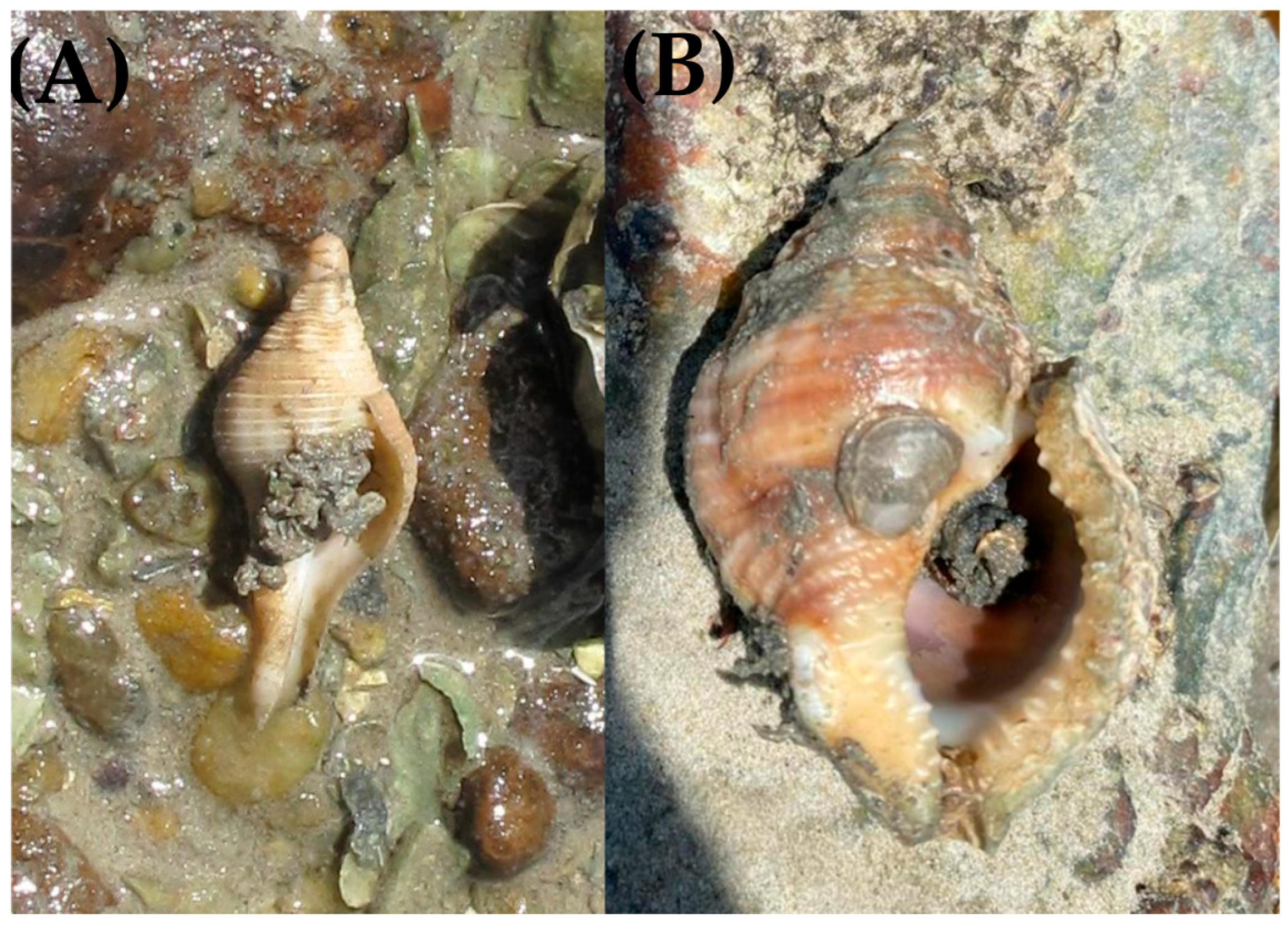
Geometric morphometric analyses of the carapace (CEC) did not provide support for Bergmann’s rule, corroborating evidence that ectotherms often do not exhibit the classic latitudinal pattern described for endotherms. In crustaceans, body size tends to mainly reflect growth rates, energy availability and local life history characteristics rather than processes linked to thermoregulation [124,125]. Additionally, field observations indicated the presence of behaviors potentially associated with thermal regulation in C. sclopetarius, not yet described in the literature for the species, in which individuals used “little balls” of wet clay to partially seal the openings of occupied shells (Figure 4). During low tide periods coinciding with peak daily temperatures, individuals were observed with small aggregates of wet clay partially blocking the apertures of occupied shells. When experimentally disturbed using forceps, individuals retracted the clay material further into the shell, whereas after disturbance ceased, the clay was gradually repositioned toward the shell aperture or partially expelled. This behavioral adjustment suggests an active manipulation of the clay aggregates in response to disturbance, potentially related to microclimatic regulation and/or protection against desiccation under high-temperature conditions (Figure 4).
This behavior may be associated with the reduction in heat and water loss as well as the maintenance of more stable microenvironmental conditions inside the shell. These behaviors may act as compensatory mechanisms, reducing exposure to thermal variations and attenuating the effects of environmental temperature on body growth. Thus, such behavioral strategies may function as a buffering factor for size variation along the latitudinal gradient, contributing to the absence of a consistent pattern in relation to Bergmann’s rule.
The CEC showed consistent support for Rensch’s rule in the general analyses and, more evidently, in the rocky shore environment, indicating that this structure particularly clearly concentrates the expression of sexual dimorphism in C. sclopetarius. This result is aligned with the central premise of Rensch’s rule, according to which species or populations with larger males tend to show an increase in SSD with increasing mean body size, generally associated with sexual selection and intraspecific competition [14,15,21].
The relevance of CEC as an axis for the expression of sexual dimorphism can be explained by its functional roles in resource competition, defense, and mating interactions. In hermit crabs, the cephalothoracic shield provides structural support for muscle attachment, enhancing overall body robustness and mechanical strength. This structure is particularly important during agonistic interactions, where individuals engage in physical displacement of opponents, shell rapping, and direct pushing behaviors in disputes for shells and mates. Thus, larger and more robust shields may confer an advantage by improving resistance during contests and increasing success in securing and defending resources [103,109,126]. In this way, environments such as rocky shores, characterized by greater hydrodynamism and spatial competition, may intensify selective pressures that favor the amplification of sexual dimorphism in structures central to locomotor and behavioral performance.
However, when the shape components of the CEC are considered, more complex patterns emerge that are strongly dependent on environmental context. The analysis of shape sexual dimorphism (SShD) and Form (Format) of the CEC followed Rensch’s rule in the rocky shore environment but exhibited the inverse of this pattern in the general analyses and in mangrove forests. This contrast suggests that the expression of shape sexual dimorphism does not respond only to general allometric processes, but is modulated by the interaction between microhabitat, resource availability and intensity of competitive pressures.
In mangrove environments, the greater availability and viability of shells, reflected by the high SAI and KSAI values, tends to reduce the intensity of intra- and interspecific competition for this obligatory resource. In this scenario, males and females no longer compete intensely for adequate shells, which may relax ecological constraints on body growth and morphology. Consequently, sexual dimorphism may be expressed in a more diffuse manner, affecting not only size, but also subtle components of shape and morphological integration (Form and Format), resulting in inverse or attenuated patterns in relation to the classic predictions of Rensch’s rule. This effect may indicate that, in structurally complex habitats with lower competitive pressure, morphological variation tends to reflect plastic and contextual responses, strongly associated with local ecological characteristics.
The uropod exopodites exhibited patterns dependent on the structure analyzed, reflecting functional constraints imposed by abdominal asymmetry and the obligatory occupation of gastropod shells [53,61]. In hermit crabs, the asymmetrical and coiled abdomen is permanently adapted to fit the spiral geometry of the shell, which restricts body extension and imposes directional constraints on movement, flexion, and spatial positioning inside the refuge. This condition results in a mechanically constrained system in which the uropods play distinct stabilizing roles on each side of the body [53,61]. In the left exopodite (EXOe), support for Rensch’s rule was restricted to the rocky shore environment, while shape sexual dimorphism (SShD) consistently showed the inverse of the rule in all analyses. Furthermore, EXOe did not show support for Bergmann’s rule, reinforcing the idea that this structure responds less to broad thermal gradients and more to local functional pressures and biomechanical limitations [18,125,126].
In the right exopodite (EXOd), the almost total absence of support for classic geographical rules, combined with positive support for Rensch’s rule for SSD in the general analysis and on rocky shores but the inverse pattern for SShD in all analyses and microhabitats, suggests that sexual dimorphism in this structure is deeply conditioned by functional asymmetries. In hermit crabs, the EXOd is closely associated with body stabilization inside the shell and postural control, which imposes strong constraints on the degree of possible morphological variation, especially with regard to shape [53,61]. The recurrence of the inverse of Rensch’s rule in this structure may suggest that females may experience distinct selective pressures, possibly related to reproduction, pleon protection and efficiency in shell use, as already proposed for other anomurans [127,128].
Under these conditions, shell selection may favor sexual adjustments in relative size compatible with reproductive and behavioral demands while restricting freer variations in shape, resulting in a dissociation between SSD and SShD patterns. This decoupling reinforces evidence that functionally highly integrated structures tend to show limited or non-linear responses to classic allometric predictions, especially in organisms with morphology strongly modified by the use of external shelters such as gastropod shells [18].
Together, these results demonstrate that, in Clibanarius sclopetarius, classic macroecological rules emerge in a fragmented manner and strongly dependent on the microhabitat and structure analyzed. While overall body size remains largely dampened by logical ecological constraints, specific shape components prove to be more sensitive to environmental variations, particularly when modulated by microhabitat and the function of the structure analyzed. These findings highlight the importance of multistructural and multivariate approaches to understanding macroecological patterns in coastal ectothermic crustaceans.


5. Conclusions

The integrated evaluation of macroecological rules, sexual dimorphism, and morphological variation in Clibanarius sclopetarius shows that the expression of classic macroecological patterns alone is insufficient to explain the diversity of responses observed in organisms whose growth depends on external resources, such as gastropod shells. Instead, the results point to the strong influence of local environmental conditions on the organization of these patterns.
The expression of sexual dimorphism, both in size and shape, must be understood as the product of the interaction between local ecological pressures, functional constraints, and sexual selection, and not as a direct and universal response to geographic gradients. In this context, contrasting microhabitats emerge as fundamental analytical units capable of modulating morphological trajectories independently of latitude, reinforcing the importance of ecological scale in the interpretation of macroevolutionary patterns. Furthermore, the incorporation of shape sexual dimorphism broadens the understanding of differentiation between sexes by revealing that subtle changes in body geometry can occur even in the absence of expressive changes in size. This partial dissociation between size and shape highlights the role of biomechanical and functional constraints, particularly relevant in organisms with a rigid exoskeleton and highly specialized lifestyles.
In general, this work reinforces the need for integrative approaches to the study of ecogeographical rules in marine invertebrates, combining macroecological perspectives, morphometric analyses and local ecological information. By highlighting the limits of generalization of classic rules and emphasizing the importance of environmental and functional context, the study contributes to a more refined understanding of the mechanisms that structure morphological variation and sexual dimorphism in widely distributed coastal crustaceans.

Author Contributions

Conceptualization, M.D.C.M. and C.E.R.D.A.; Methodology, M.D.C.M. and C.E.R.D.A.; Validation, V.F.V. and F.A.M.F.; Formal analysis, M.D.C.M., V.F.V. and C.E.R.D.A.; Investigation, M.D.C.M., V.F.V. and C.E.R.D.A.; Resources, M.D.C.M.; C.E.R.D.A. and F.A.M.F.; Data curation, M.D.C.M., and C.E.R.D.A.; Writing—original draft preparation, M.D.C.M.; Writing—review and editing, C.E.R.D.A., V.F.V. and F.A.M.F.; Visualization, M.D.C.M., V.F.V. and C.E.R.D.A.; Supervision, C.E.R.D.A. and V.F.V.; Project administration, C.E.R.D.A.; Funding acquisition, C.E.R.D.A. All authors have read and agreed to the published version of the manuscript.

Funding

This research was funded by the Brazilian Federal Agency for Support and Evaluation of Graduate Education (CAPES; grant no. 88887.958407/2024-00) and by the Institutional Program for Research Infrastructure and Technological Innovation Support of the State University of Southwest Bahia (AuxPQinfra-UESB-2024-01).

Institutional Review Board Statement

Not applicable.

Data Availability Statement

The original contributions presented in this study are included in the article. Further inquiries can be directed to the corresponding author.

Acknowledgments

The authors thank the Brazilian Federal Agency for Support and Evaluation of Graduate Education (CAPES; grant no. 88887.958407/2024-00) for financial support and the Institutional Program for Research Infrastructure and Technological Innovation Support of the State University of Southwest Bahia (AuxPQinfra-UESB-2024-01) for the essential support that enabled the development of this study. We also thank the Laboratory of Crustacean Ecology and Evolution of the Federal University of Rio Grande do Norte (LABEEC/UFRN), the Laboratory of Carcinology and Aquatic Biodiversity of the Federal University of Southern Bahia (LCBA/UFSB), and the Semi-Arid Crustacean Laboratory of the Regional University of Cariri (LACRUSE/URCA) for providing biological material and access to facilities during the execution of this study.

Conflicts of Interest

The authors declare no conflicts of interest.

Abbreviations

The following abbreviations are used in this manuscript:
AFPSApaga Fogo Beach
BARMMangue Bar
BARRIRiver Bar
CECCephalothoracic Shield Length
DFADiscriminant function analysis
EXOdRight uropod exopodite
EXOeLeft uropod exopodite
FFemale
GPAGeneralized Procrustes analysis
LCTDMMarau Peninsula
LNTPCCamocim Beach
LSPCPenha Beach
LSPMSMangue Seco Beach
LSPPVPonta Verde Beach
LSPSISirihyba Beach
MMale
MKSAIMean Kellog’s Shell Adequacy Index
MSAIMean Shell Adequacy Index
SDFormBody form analysis
SSDSexual size dimorphism
SShDSexual shape dimorphism

Appendix A

Table A1. Search strings (search queries) used for the literature search in (1) Portuguese, (2) Spanish, and (3) English. OR = Boolean operator used to retrieve records containing any of the specified keywords. AND = Boolean operator used to retrieve records containing all specified keywords.
Search Strings
Clibanarius sclopetarius” OR “Caranguejo-ermitão-listrado” AND “Regra de Bergmann” OR “Regra de Bergmann Inversa”
Clibanarius sclopetarius” OR “Striped hermit crab” AND “Bergmann rule” OR “Inverse Bergmann rule”
Clibanarius sclopetarius” OR “Cangrejo ermitaño rayado” AND “Regla de Bergmann” OR “Regla de Bergmann Inversa”
Clibanarius sclopetarius” OR “Caranguejo-ermitão-listrado” AND “Regra de Rensch” OR “Regra de Rensch Inversa”
Clibanarius sclopetarius” OR “Striped hermit crab” AND “Rensch rule” OR “Reverse Rensch rule”
Clibanarius sclopetarius” OR “Cangrejo ermitaño rayado” AND “Regla de Rensch” OR “Regla de Rensch Inversa”
Clibanarius sclopetarius” OR “Caranguejo-ermitão-listrado” AND “Dimorfismo Sexual de Tamanho (SSD)” OR “Influência Latitudinal” OR “Alometria”
Clibanarius sclopetarius” OR “Striped hermit crab” AND “Sexual Size Dimorphism (SSD)” OR “Latitudinal Influence” OR “Allometry”
Clibanarius sclopetarius” OR “Cangrejo ermitaño rayado” AND “Dimorfismo de tamaño sexual (SSD)” OR “Influencia latitudinal” OR “Alometría”
Clibanarius sclopetarius” OR “Caranguejo-ermitão-listrado” AND “Diversidade” AND “Ecologia Populacional” OR “Assembleia”
Clibanarius sclopetarius” OR “Striped hermit crab” AND “Diversity” AND “Population Ecology” OR “Assembly”
Clibanarius sclopetarius” OR “Cangrejo ermitaño rayado” AND “Diversidad” AND “Ecología de la población” OR “Asamblea”
Table A2. Procrustes ANOVA for measurement error in digitization. SS: sum of squares, MS: mean square, df: degrees of freedom, F: F-distribution, p: p-value.
EffectSSMSdfFp
Individual2.441338730.0003033850804715.74<0.0001
Side0.040511600.003116276813161.67<0.0001
Individual × Side0.155110440.000019275680470.331.0000
Error0.932707390.000057860316,120
Table A3. Mahalanobis and Procrustes intersex distances for each population using DFA for the dorsal cephalothoracic shield (CEC) and for the uropod (EXO). Diagonal: Mahalanobis distance; above the diagonal: Procrustes distances. p-value < 0.05 in bold. BARM = Barra do Mangue, BARRI = Barra do Rio, LSPC = Praia da Penha, LCTDM = Península de Marau, AFPS = Praia de Apaga Fogo, LSPSI = Praia de Sirihyba, LNTPC = Praia de Camocim, LSPMS = Praia do Mangue Seco, LSPPV = Praia de Ponta Verde. Diagonal: Mahalanobis distance; above the diagonal: Procrustes distances. p-value < 0.05 in bold.
CEC
GroupLSPPVAFPSBARMBARRILNTPCLCTDMMILHEULSPMSLSPCLSPSI
LSPPV0.020878700.006010770.014716760.018507910.008782700.010937090.014151320.028039530.007386230.01562912
1.6489
AFPS 1.0114
BARM 1.4765
BARRI 1.9615
LNTPC 1.0439
LCTDM 2.0498
MILHEU 1.8201
LSPMS 1.4734
LSPC 1.3510
LSPSI 1.5670
EXOe
GroupLSPPVAFPSBARMBARRILNTPCLCTDMMILHEULSPMSLSPCLSPSI
LSPPV0.044023880.032807310.020869600.052393550.018517280.037877620.018227250.052537070.028415780.03470994
1.5669
AFPS 0.9741
BARM 0.8080
BARRI 1.8520
LNTPC 0.5056
LCTDM 1.0887
MILHEU 0.4372
LSPMS 1.6986
LSPC 0.8155
LSPSI 0.8094
EXOd
GrupoLSPPVAFPSBARMBARRILNTPCLCTDMMILHEULSPMSLSPCLSPSI
LSPPV0.048865110.049856050.038092870.076841310.055044740.088418330.028452410.037007220.027855870.05282918
1.1009
AFPS 0.9675
BARM 1.0663
BARRI 1.4170
LNTPC 0.8544
LCTDM 1.1960
MILHEU 0.4787
LSPMS 1.0527
LSPC 0.7127
LSPSI 1.0015
Table A4. Results of discriminant analysis (DFA) based on Procrustes and Mahalanobis distances, comparing the variation in cephalothoracic shield (CEC) shape, left exopod (EXOe), and right exopod (EXOd) between sexes, microhabitats (mangrove and rocky shore), and their interactions. %AC: Percentual assimilation correction of cross-validation matrix.
Analyses Parameters
Males vs. Females
DFAProcrustes distanceMahalanobis distanceT2p-value%AC
CEC0.006073350.662067.9287<0.000162.26
EXOe0.021730310.501438.9675<0.000158.90
EXOd0.029539440.453431.8661<0.000156.94
Microhabitat (Mangrove vs. Rocky shore)
DFAProcrustes distanceMahalanobis distanceT2p-value%AC
CEC0.027597471.5250302.8153<0.000178.39
EXOe0.015282940.442725.5144<0.000158.39
EXOd0.020393990.543638.4809<0.000160.32
Habitat × Sex (F Mangrove vs. F Rocky shore)
DFAProcrustes distanceMahalanobis distanceT2p-value%AC
CEC0.018537771.4186131.0019<0.000176.45
EXOe0.018194150.460713.81560.009456.45
EXOd0.025471240.569021.07560.000460.32
Habitat × Sex (M Mangrove vs. M Rocky shore)
DFAProcrustes distanceMahalanobis distanceT2p-value%AC
CEC0.037292482.0043261.5306<0.000183.54
EXOe0.027754070.864048.5982<0.000167.74
EXOd0.026618180.573221.39260.000457.10
Habitat Intersex (F Mangrove X M Mangrove)
DFAProcrustes distanceMahalanobis distanceT2p-value%AC
CEC0.010999920.879283.8692<0.000167.51
EXOe0.023934670.569035.1290<0.000161.98
EXOd0.038478990.552633.1341<0.000158.99
Habitat Intersex (F Rocky shore X M Rocky shore)
DFAProcrustes distanceMahalanobis distanceT2p-value%AC
CEC0.011671130.773327.80480.023353.76
EXOe0.033543690.857734.2105<0.000168.28
EXOd0.013764510.29023.91620.429150.54
Table A5. Results of RMA regressions of the dorsal cephalothoracic shield (CEC) and exopodite of the uropod (EXO). R2: correlation coefficient; PRMA: p-value (p ≤ 0.05) of the correlation; b: slope of the regression; (95% CI range): confidence interval of the slope; p(b = 1): p-value (p ≤ 0.05) of the slope against the H0 of b = 1. DS: overall size (centroids) of each structure; M: male; F: female; SShD: sexual dimorphism of form; SDForm: body form analysis.
RegressionR2PRMAb (95% CI Range) p ( b = 1 )
General Data
CEC
Size(DS) vs. Latitude0.054716850.48876−0.17 (−0.35–−0.089)<0.001
Size(DS(M)) vs. Size(DS(F))0.9246904<0.0011.30 (1.06–1.60)0.01612
SSD(DS) vs. F0.29436980.0846253.41 (1.88–6.21)<0.001
SShD(DS) vs. F0.03263820.59501−0.006 (−0.01–−0.003)<0.001
SDForm(DS) vs. F0.062005620.46029−0.01 (−0.02–−0.009)<0.001
SSD(DS) vs. Latitude0.0015914260.907290.55 (0.27–1.10)0.08939
Size(DS(M)) vs. Latitude0.046476870.52436−0.20 (−0.40–−0.10)<0.001
Size(DS(F)) vs. Latitude0.12791890.28019−0.15 (−0.30–−0.08)<0.001
SShD(DS) vs. Latitude0.01428470.72632−0.001 (−0.002–−0.0005)<0.001
SDForm(DS) vs. Latitude0.0039993150.85345−0.002 (−0.005–−0.001)<0.001
PD vs. Latitude0.18560390.18589−0.27 (−0.52–−0.14)0.001
EXOe
Size(DS) vs. Latitude0.021223630.66908−0.13 (−0.26–−0.06)<0.001
Size(DS(M)) vs. Size(DS(F))0.7213374<0.0011.41 (0.96–2.09)0.073621
SSD(DS) vs. F0.05726090.47853−2.59 (−5.12–−1.31)0.007
SShD(DS) vs. F0.066906420.44247−0.01 (−0.03–−0.007)<0.001
SSD(DS) vs. Latitude0.0071751670.804430.41 (0.20–0.83)0.015632
Size(DS(M)) vs. Latitude0.0052938750.83164−0.15 (−0.31–−0.07)<0.001
Size(DS(F)) vs. Latitude0.084711730.38521−0.11 (−0.21–−0.05)<0.001
SShD(DS) vs. Latitude0.001982340.89658−0.002 (−0.005–−0.001)<0.001
PD vs. Latitude0.0016812320.9682−0.22 (−0.45–−0.11)<0.001
EXOd
Size(DS) vs. Latitude0.05142860.50249−0.10 (−0.21–−0.05)<0.001
Size(DS(M)) vs. Size(DS(F))0.81662670.000135911.22 (0.89–1.68)0.18819
SSD(DS) vs. F0.22535250.14012.10 (1.12–3.92)0.021397
SShD(DS) vs. F0.0010085470.92615−0.01 (−0.03–−0.009)<0.001
SSD(DS) vs. Latitude0.04019770.554450.33 (0.17–0.67)0.003
Size(DS(M)) vs. Latitude0.01545830.71569−0.12 (−0.24–−0.06)<0.001
Size(DS(F)) vs. Latitude0.137870.26089−0.09 (−0.18–−0.05)<0.001
SShD(DS) vs. Latitude0.052712340.497060.003 (0.001–0.006)<0.001
PD vs. Latitude0.024694050.64448−0.20 (−0.41–−0.10)<0.001
Mangrove
CEC
Size(DS) vs. Latitude0.0013199580.938360.12 (0.04–0.34)<0.001
Size(DS(M)) vs. Size(DS(F))0.77636280.00877081.39 (0.82–2.34)0.17135
SSD(DS) vs. F0.10127230.486693.48 (1.35–8.94)0.013062
SShD(DS) vs. F0.33840620.17067−0.007 (−0.016–−0.003)<0.001
SDForm(DS) vs. F0.44530090.10149−0.019 (−0.042–−0.009)<0.001
SSD(DS) vs. Latitude0.20241590.311110.54 (0.21–1.33)0.16241
Size(DS(M)) vs. Latitude0.025718420.731240.14 (0.05–0.37)<0.001
Size(DS(F)) vs. Latitude0.060546290.5948−0.10 (−0.26–−0.03)<0.001
SShD(DS) vs. Latitude0.14989370.39087−0.001 (−0.002–−0.0004)<0.001
SDForm(DS) vs. Latitude0.13204720.42301−0.003 (−0.007–−0.001)<0.001
EXOe
Size(DS) vs. Latitude0.15524530.38179−0.11 (−0.28–−0.04)<0.001
Size(DS(M)) vs. Size(DS(F))0.53296840.0624881.40 (0.68–2.88)0.311
SSD(DS) vs. F0.1501330.39046−2.38 (−6.00–−0.94)0.06282
SShD(DS) vs. F0.20703940.30496−0.01 (−0.04–−0.006)<0.001
SSD(DS) vs. Latitude0.087086730.520540.37 (0.14–0.95)0.041563
Size(DS(M)) vs. Latitude0.0033629140.69389−0.13 (−0.35–−0.05)<0.001
Size(DS(F)) vs. Latitude0.60168480.040394−0.09 (−0.18–− 0.04)<0.001
SShD(DS) vs. Latitude0.040457890.66540.002 (0.0009–0.006)<0.001
EXOd
Size(DS) vs. Latitude0.003121420.90530.07 (0.02–0.19)<0.001
Size(DS(M)) vs. Size(DS(F))0.61581760.0366311.07 (0.55–2.09)0.79795
SSD(DS) vs. F0.020935020.756931.65 (0.62–4.39)0.28726
SShD(DS) vs. F0.057591160.60422−0.01 (−0.03–−0.005)<0.001
SSD(DS) vs. Latitude0.64925870.0286760.25 (0.13–0.48)0.001
Size(DS(M)) vs. Latitude0.094307620.502890.08 (0.03–0.20)<0.001
Size(DS(F)) vs. Latitude0.087633470.51917−0.07 (−0.19–−0.02)<0.001
SShD(DS) vs. Latitude0.83068230.00427460.002 (0.001–0.003)<0.001
Rocky shore
CEC
Size(DS) vs. Latitude0.57969970.238620.22 (0.05–0.94)0.044523
Size(DS(M)) vs. Size(DS(F))0.999711<0.0011.07 (1.02–1.13)0.026694
SSD(DS) vs. F0.97287250.0136571.64 (1.01–2.66)0.047009
SShD(DS) vs. F0.9503920.0251190.001 (0.00009–0.003)<0.001
SDForm(DS) vs. F0.41867820.352950.02 (0.004–0.104)<0.001
SSD(DS) vs. Latitude0.39670040.370160.38 (0.07–1.90)0.18267
Size(DS(M)) vs. Latitude0.50701690.287950.23 (0.05–1.06)0.0568
Size(DS(F)) vs. Latitude0.5236030.27640.22 (0.04–0.97)0.047477
SShD(DS) vs. Latitude0.41683990.354370.007 (0.001–0.037)<0.001
SDForm(DS) vs. Latitude0.9497930.0254270.005 (0.002–0.009)<0.001
EXOe
Size(DS) vs. Latitude0.2998820.452390.28 (0.05–1.52)0.11598
Size(DS(M)) vs. Size(DS(F))0.98360340.00823221.38 (0.94–2.03)0.066286
SSD(DS) vs. F0.31539380.4384−3.39 (−17.72–− 0.64)0.11808
SShD(DS) vs. F0.0016312490.959610.01 (0.002–0.116)<0.001
SSD(DS) vs. Latitude0.17409880.582750.79 (0.13–4.54)0.7549
Size(DS(M)) vs. Latitude0.27120820.479220.33 (0.06–1.79)0.15809
Size(DS(F)) vs. Latitude0.38946710.375930.24 (0.04–1.19)0.071064
SShD(DS) vs. Latitude0.68555530.17202−0.004 (−0.016–−0.001)<0.001
EXOd
Size(DS) vs. Latitude0.1634850.595670.17 (0.03–1.02)0.052269
Size(DS(M)) vs. Size(DS(F))0.91735950.0422111.07 (0.48–2.36)0.76455
SSD(DS) vs. F0.3752250.387441.95 (0.39–9.80)0.32505
SShD(DS) vs. F0.043010220.792610.03 (0.005–0.206)<0.001
SSD(DS) vs. Latitude0.96229760.0190320.45 (0.26–0.80)0.024656
Size(DS(M)) vs. Latitude0.26849330.481840.18 (0.03–1.00)0.050126
Size(DS(F)) vs. Latitude0.064668470.74570.17 (0.02–1.04)0.054838
SShD(DS) vs. Latitude0.52631860.27452−0.007 (−0.034–0.001)<0.001

References

  1. Ashton, K.G. Do amphibians follow Bergmann’s rule? Can. J. Zool. 2002, 80, 708–716. [Google Scholar] [CrossRef]
  2. Gaston, K.J.; Blackburn, T.M. Pattern and Process in Macroecology; John Wiley & Sons: Hoboken, NJ, USA, 2008. [Google Scholar]
  3. Bidau, C.J.; Martí, D.A.; Baldo, D. Inter- and intraspecific geographic variation of body size in South American redbelly toads of the genus Melanophryniscus Gallardo, 1961 (Anura: Bufonidae). J. Herpetol. 2011, 45, 66–74. [Google Scholar] [CrossRef]
  4. Blueweiss, L.; Fox, H.; Kudzuma, V.; Nakashima, D.; Peters, R.; Sams, S. Relationships between body size and some life history parameters. Oecologia 1978, 37, 257–272. [Google Scholar] [CrossRef] [PubMed]
  5. Roff, D.A. Predicting body size with life history models. BioScience 1986, 36, 316–323. [Google Scholar] [CrossRef]
  6. LaBarbera, M. Analyzing body size as a factor in ecology and evolution. Annu. Rev. Ecol. Syst. 1989, 20, 97–117. [Google Scholar] [CrossRef]
  7. Calder, W.A., III. Size, Function and Life History; Dover Publications: Garden City, NY, USA, 1996. [Google Scholar]
  8. Bergmann, C. Über die Verhältnisse der Wärmeökonomie der Thiere zu ihrer Grösse; Vandenhoeck und Ruprecht: Göttingen, Germany, 1847. [Google Scholar]
  9. James, F.C. Geographic size variation in birds and its relationship to climate. Ecology 1970, 51, 365–390. [Google Scholar] [CrossRef]
  10. Shelomi, M. Where are we now? Bergmann’s rule sensu lato in insects. Am. Nat. 2012, 180, 511–519. [Google Scholar] [CrossRef] [PubMed]
  11. Gohli, J.; Voje, K.L. An interspecific assessment of Bergmann’s rule in 22 mammalian families. BMC Evol. Biol. 2016, 16, 222. [Google Scholar] [CrossRef] [PubMed]
  12. Fairbairn, D.J. Odd Couples: Extraordinary Differences Between the Sexes in the Animal Kingdom; Princeton University Press: Princeton, NJ, USA, 2013. [Google Scholar]
  13. Darwin, C. The Descent of Man and Selection in Relation to Sex; John Murray: London, UK, 1871. [Google Scholar]
  14. Rensch, B. Die Abhängigkeit der relativen Sexualdifferenz von der Körpergrösse. Bonn. Zool. Beiträge 1950, 1, 58–69. [Google Scholar]
  15. Rensch, B. Evolution above the Species Level; Columbia University Press: New York, NY, USA, 1960. [Google Scholar]
  16. Andersson, M.; Simmons, L.W. Sexual selection and mate choice. Trends Ecol. Evol. 2006, 21, 296–302. [Google Scholar] [CrossRef] [PubMed]
  17. Fairbairn, D.J. Allometry for sexual size dimorphism: Pattern and process in the coevolution of body size in males and females. Annu. Rev. Ecol. Syst. 1997, 28, 659–687. [Google Scholar] [CrossRef]
  18. Fairbairn, D.J.; Fairbairn, D.J.; Blanckenhorn, W.U.; Székely, T. (Eds.) Introduction: The enigma of sexual size dimorphism. In Sex, Size and Gender Roles; Oxford University Press: Oxford, UK, 2007; pp. 1–12. [Google Scholar]
  19. Martínez, P.A.; Amado, T.F.; Bidau, C.J. A phylogenetic approach to the study of sexual size dimorphism in Felidae and an assessment of Rensch’s rule. Ecosistemas 2014, 23, 27–36. [Google Scholar]
  20. Abouheif, E.; Fairbairn, D.J. A comparative analysis of allometry for sexual size dimorphism: Assessing Rensch’s rule. Am. Nat. 1997, 149, 540–562. [Google Scholar] [CrossRef]
  21. Blanckenhorn, W.U.; Dixon, A.F.; Fairbairn, D.J.; Foellmer, M.W.; Gibert, P.; van der Linde, K.; Signorelli, M. Proximate causes of Rensch’s rule. Am. Nat. 2007, 169, 245–257. [Google Scholar] [CrossRef] [PubMed]
  22. Hartnoll, R.G. Growth. In The Biology of Crustacea; Bliss, D.E., Ed.; Academic Press: Cambridge, MA, USA, 1982; pp. 11–196. [Google Scholar]
  23. Hartnoll, R.G. Reproductive investment in Brachyura. Hydrobiologia 2006, 557, 31–40. [Google Scholar] [CrossRef]
  24. Pinheiro, M.A.A.; Fransozo, A. Reproductive behavior of the swimming crab Arenaeus cribrarius. Bull. Mar. Sci. 1999, 64, 243–253. [Google Scholar]
  25. Castilho, A.L.; Gavio, M.A.; Costa, R.C.; Boschi, E.E.; Bauer, R.T.; Fransozo, A. Latitudinal variation in population structure and reproductive pattern of Artemesia longinaris. J. Crustac. Biol. 2007, 27, 548–552. [Google Scholar] [CrossRef]
  26. Zelditch, M.L.; Swiderski, D.L.; Sheets, H.D.; Fink, W.L. Geometric Morphometrics for Biologists; Elsevier: Amsterdam, The Netherlands, 2004. [Google Scholar]
  27. Shine, R. Ecological causes for the evolution of sexual dimorphism. Q. Rev. Biol. 1989, 64, 419–461. [Google Scholar] [CrossRef] [PubMed]
  28. Butler, M.A.; Losos, J.B. Multivariate sexual dimorphism in Anolis lizards. Ecol. Monogr. 2002, 72, 541–559. [Google Scholar] [CrossRef]
  29. Mariappan, P.; Balasundaram, C.; Schmitz, B. Decapod crustacean chelipeds: An overview. J. Biosci. 2000, 25, 301–313. [Google Scholar] [CrossRef] [PubMed]
  30. Spani, F.; Scalici, M.; Crandall, K.A.; Piras, P. Claw asymmetry in crabs. Biol. J. Linn. Soc. 2020, 129, 162–176. [Google Scholar]
  31. Kaliontzopoulou, A.; Carretero, M.A.; Llorente, G.A. Sexual dimorphism in locomotion traits. Biol. J. Linn. Soc. 2010, 99, 530–543. [Google Scholar] [CrossRef]
  32. Moraes, S.A.; Alencar, C.E.; Lima, S.M.; Freire, F.A. Shape variation of Macrobrachium jelskii. Mar. Freshw. Res. 2020, 72, 84–98. [Google Scholar] [CrossRef]
  33. Walker, I. Benthic litter-dwelling macrofauna of an Amazonian forest stream. Hydrobiologia 1994, 291, 75–92. [Google Scholar] [CrossRef]
  34. Carter, J.L.; Fend, S.V.; Kennelly, S.S. Habitat scales and stream benthic invertebrate community structure. Freshw. Biol. 1996, 35, 109–124. [Google Scholar] [CrossRef]
  35. Bolker, B.; Holyoak, M.; Křivan, V.; Rowe, L.; Schmitz, O. Trait-mediated interactions. Ecology 2003, 84, 1101–1114. [Google Scholar] [CrossRef]
  36. Bolnick, D.I.; Svanbäck, R.; Fordyce, J.A.; Yang, L.H.; Davis, J.M.; Hulsey, C.D.; Forister, M.L. The ecology of individuals. Am. Nat. 2003, 161, 1–28. [Google Scholar] [CrossRef] [PubMed]
  37. Werner, E.E.; Peacor, S.D. Trait-mediated indirect interactions. Ecology 2003, 84, 1083–1100. [Google Scholar] [CrossRef]
  38. Torres, M.V.; Collins, P.A.; Giri, F. Morphological variation of freshwater crabs. ZooKeys 2014, 457, 171–186. [Google Scholar] [CrossRef]
  39. Torres, M.V.; Giri, F.; Collins, P.A. Geometric morphometrics of Macrobrachium borellii. Ecol. Res. 2014, 29, 959–968. [Google Scholar] [CrossRef]
  40. Anastasiadou, C.; Liasko, R.; Leonardos, I.D. Biometric analysis of Palaemonetes antennarius. Limnologica 2009, 39, 244–254. [Google Scholar] [CrossRef]
  41. Bookstein, F.L. Morphometric Tools for Landmark Data; Cambridge University Press: Cambridge, UK, 1991. [Google Scholar]
  42. Adams, D.C.; Rohlf, F.J.; Slice, D. Geometric morphometrics in the 21st century. Hystrix 2013, 24, 7–14. [Google Scholar] [CrossRef]
  43. Rohlf, F.J.; Marcus, L.F. A revolution in morphometrics. Trends Ecol. Evol. 1993, 8, 129–132. [Google Scholar] [CrossRef]
  44. Trevisan, A.; Marochi, M.Z.; Costa, M.; Santos, S.; Masunari, S. Sexual dimorphism in Aegla marginata. Nauplius 2012, 20, 75–86. [Google Scholar] [CrossRef]
  45. Alencar, C.E.R.D.; Lima-Filho, P.A.; Molina, W.F.; Freire, F.A.M. Sexual shape dimorphism of Ucides cordatus. Sci. World J. 2014, 2014, 206168. [Google Scholar] [CrossRef]
  46. Marochi, M.Z.; Trevisan, A.; Gomes, F.B.; Masunari, S. Dimorfismo sexual em Hepatus pudibundus. Iheringia Sér. Zool. 2016, 106, 1–6. [Google Scholar] [CrossRef]
  47. Reese, E.S. Behavioral adaptations of intertidal hermit crabs. Am. Zool. 1969, 9, 343–355. [Google Scholar] [CrossRef]
  48. Vale, V.F.; Freire, F.A.; Alencar, C.E.R.D. Bergmann–Rensch continuum under shell. Evol. Biol. 2024, 51, 217–234. [Google Scholar] [CrossRef]
  49. Nucci, P.R.; Melo, G.A.S. Hermit crabs from Brazil: Diogenidae. Zootaxa 2015, 3947, 327–346. [Google Scholar] [CrossRef] [PubMed]
  50. Turra, A.; Leite, F.P.P. Population biology of intertidal hermit crabs. J. Mar. Biol. Assoc. UK 2000, 80, 1061–1069. [Google Scholar] [CrossRef]
  51. Turra, A.; Leite, F.P.P. Fecundity of three sympatric populations of hermit crabs (Decapoda, Anomura, Diogenidae). Crustaceana 2001, 74, 1019–1027. [Google Scholar] [CrossRef]
  52. Turra, A. Shell condition and adequacy of three sympatric intertidal hermit crab populations. J. Nat. Hist. 2003, 37, 1781–1795. [Google Scholar] [CrossRef]
  53. Turra, A. Intersexuality in hermit crabs: Reproductive role and fate of gonopores in intersex individuals. J. Mar. Biol. Assoc. UK 2004, 84, 757–759. [Google Scholar] [CrossRef]
  54. Turra, A. Reproductive behavior of intertidal hermit crabs (Decapoda, Anomura) in southeastern Brazil. Rev. Bras. Zool. 2005, 22, 313–319. [Google Scholar] [CrossRef]
  55. Santos, N.M.; Mantelatto, F.L. Reproductive system of the male hermit crab Clibanarius sclopetarius. Aquat. Biol. 2011, 12, 271–280. [Google Scholar] [CrossRef]
  56. Alencar, C.E.R.D.; Gomes, F.J.D.S.; Alves, I.C.F.; Machado, R.J.P. New records and updated geographic distribution of Dimares elegans. Rev. Bras. Entomol. 2022, 66, e20220085. [Google Scholar] [CrossRef]
  57. Martins, M.D.C.; Santos, E.S.; Alencar, C.E.R.D. New South American records for Corydalus diasi. Rev. Chil. Entomol. 2025, 51, 423–437. [Google Scholar] [CrossRef]
  58. NASA, Ocean Biology (OB.DAAC). Mean annual sea surface temperature for the period 2009–2013 (composite dataset created by UNEP-WCMC). In Moderate Resolution Imaging Spectroradiometer (MODIS) Aqua Ocean Colour; NASA Ocean Biology Distributed Active Archive Center (OB.DAAC): Greenbelt, MD, USA, 2014. Available online: https://www.earthdata.nasa.gov/topics/ocean/sea-surface-temperature/data-access-tools (accessed on 22 June 2026).
  59. Santos, M.P.; Rodrigues, G.F.B.; Negreiros-Fransozo, M.L.; Fransozo, V. Resource partitioning and adequacy in a hermit crab–gastropod shell network. Aquat. Ecol. 2021, 55, 253–264. [Google Scholar] [CrossRef]
  60. Melo, G.A.S. Manual de Identificação dos Crustacea Decapoda do Litoral Brasileiro; Plêiade/FAPESP: São Paulo, Brazil, 1999. [Google Scholar]
  61. McLaughlin, P.A. Illustrated keys to families and genera of Paguroidea. Mem. Mus. Vic. 2003, 60, 111–144. [Google Scholar] [CrossRef]
  62. Rios, E.C. Compendium of Brazilian Sea Shells; Evangraf: Porto Alegre, Brazil, 2009. [Google Scholar]
  63. Petuch, E.J. Biogeography and Biodiversity of Western Atlantic Mollusks; CRC Press: Boca Raton, FL, USA, 2013. [Google Scholar]
  64. Absher, T.M. Conchas de Moluscos Marinhos do Paraná; Museu de Ciências Naturais: Barcelona, Spain, 2015. [Google Scholar]
  65. Shapiro, S.S.; Wilk, M.B. An analysis of variance test for normality. Biometrika 1965, 52, 591–611. [Google Scholar] [CrossRef]
  66. Levene, H. Robust tests for equality of variances. In Contributions to Probability and Statistics; Olkin, I., Ed.; Stanford University Press: Redwood City, CA, USA, 1960; pp. 278–292. [Google Scholar]
  67. Sokal, R.R.; Rohlf, F.J. Biometry; W.H. Freeman: New York, NY, USA, 1985. [Google Scholar]
  68. Warton, D.I.; Wright, I.J.; Falster, D.S.; Westoby, M. Bivariate line-fitting methods for allometry. Biol. Rev. 2006, 81, 259–291. [Google Scholar] [CrossRef] [PubMed]
  69. Warton, D.I.; Duursma, R.A.; Falster, D.S.; Taskinen, S. smatr 3—An R package for allometry. Methods Ecol. Evol. 2012, 3, 257–259. [Google Scholar] [CrossRef]
  70. Zar, J.H. Biostatistical Analysis; Pearson Prentice-Hall: Hoboken, NJ, USA, 2010. [Google Scholar]
  71. Lima-Filho, P.A.; Bidau, C.J.; Alencar, C.E.R.D.; Molina, W.F. Latitudinal influence on sexual dimorphism of Bathygobius soporator. Evol. Biol. 2017, 44, 374–385. [Google Scholar] [CrossRef]
  72. Vance, R.R. Competition and coexistence in three sympatric intertidal hermit crabs. Ecology 1972, 53, 1062–1074. [Google Scholar] [CrossRef]
  73. Kellogg, C.W. Gastropod shells as a limiting resource for hermit crabs. J. Exp. Mar. Biol. Ecol. 1976, 22, 101–111. [Google Scholar] [CrossRef]
  74. Monteiro, L.R.; Diniz-Filho, A.F.; Reis, S.F.; Araújo, E.D. Geometric estimates of heritability in biological shape. Evolution 2002, 56, 563–572. [Google Scholar] [CrossRef] [PubMed]
  75. Parsons, K.J.; Beren, W.R.; Hrbek, T. Traditional vs. geometric morphometrics in cichlids. Environ. Biol. Fishes 2003, 67, 417–431. [Google Scholar] [CrossRef]
  76. Lane-Medeiros, L.; Moraes, A.S.; Alencar, C.E.; Rocha, M.A.; Freire, F.A. Body shape variation in Callinectes. Zool. Anz. 2021, 295, 89–98. [Google Scholar] [CrossRef]
  77. Klingenberg, C.P. Size, shape, and form in geometric morphometrics. Dev. Genes. Evol. 2016, 226, 113–137. [Google Scholar] [CrossRef] [PubMed]
  78. Klingenberg, C.P.; Marugán-Lobón, J. Evolutionary covariation in morphometrics. Syst. Biol. 2013, 62, 591–610. [Google Scholar] [CrossRef] [PubMed]
  79. Cardini, A.; Elton, S. Sample size and error in geometric morphometrics. Zoomorphology 2007, 126, 121–134. [Google Scholar] [CrossRef]
  80. Rohlf, F.J. tpsDig, Version 2.10; SUNY Stony Brook: Stony Brook, NY, USA, 2006. [Google Scholar]
  81. Fraaije, R.H.; Krzemiński, W.; van Bakel, B.W.; Krzemińska, E.; Jagt, J.W. Late Jurassic symmetrical hermit crabs. Acta Palaeontol. Pol. 2012, 59, 681–689. [Google Scholar]
  82. Fraaije, R.H. Late Jurassic anomuran assemblages and paguroid evolution. Neues Jahrb. Für Geol. Und Paläontologie Abh. 2014, 273, 121–145. [Google Scholar] [CrossRef]
  83. Harvey, A.W. Genes for asymmetry easily overruled. Nature 1998, 392, 345. [Google Scholar] [CrossRef]
  84. Dryden, I.L.; Mardia, K.V. Statistical Shape Analysis; Wiley: Hoboken, NJ, USA, 1998. [Google Scholar]
  85. Sidlauskas, B.L.; Mol, J.H.; Vari, R.P. Allometry in linear and geometric morphometrics. Zool. J. Linn. Soc. 2011, 162, 103–130. [Google Scholar] [CrossRef]
  86. Klingenberg, C.P.; Monteiro, L.R. Distances and directions in shape spaces. Syst. Biol. 2005, 54, 678–688. [Google Scholar] [CrossRef] [PubMed]
  87. Klingenberg, C.P. MorphoJ: An integrated software package. Mol. Ecol. Resour. 2011, 11, 353–357. [Google Scholar] [PubMed]
  88. Ashton, K.G.; Tracy, M.C.; de Queiroz, A. Is Bergmann’s rule valid for mammals? Am. Nat. 2000, 156, 390–415. [Google Scholar] [PubMed]
  89. Meiri, S.; Dayan, T. On the validity of Bergmann’s rule. J. Biogeogr. 2003, 30, 331–351. [Google Scholar] [CrossRef]
  90. Bidau, C.J.; Martí, D.A. Clinal body size variation in Dichroplus pratensis. Ann. Entomol. Soc. Am. 2007, 100, 850–860. [Google Scholar] [CrossRef]
  91. Mayr, E. Animal Species and Evolution; Harvard University Press: Cambridge, MA, USA, 1963. [Google Scholar]
  92. Blackburn, T.M.; Gaston, K.J.; Loder, N. Geographic gradients in body size. Divers. Distrib. 1999, 5, 165–174. [Google Scholar] [CrossRef]
  93. Blanckenhorn, W.U.; Demont, M. Bergmann and converse Bergmann clines in arthropods. Integr. Comp. Biol. 2004, 44, 413–424. [Google Scholar] [CrossRef] [PubMed]
  94. Horne, C.R.; Hirst, A.G.; Atkinson, D. Selection for increased male size. Proc. R. Soc. B 2020, 287, 20192640. [Google Scholar] [CrossRef] [PubMed]
  95. McNab, B.K. On the ecological significance of Bergmann’s rule. Ecology 1971, 52, 845–854. [Google Scholar] [CrossRef]
  96. Peters, R.H. The Ecological Implications of Body Size; Cambridge University Press: Cambridge, UK, 1986. [Google Scholar]
  97. Mousseau, T.A. Ectotherms follow the converse to Bergmann’s rule. Evolution 1997, 51, 630–632. [Google Scholar] [CrossRef] [PubMed]
  98. Blanckenhorn, W.U. The evolution of body size. Q. Rev. Biol. 2000, 75, 385–407. [Google Scholar] [CrossRef] [PubMed]
  99. Waddy, S.L.; Aiken, D.E. Egg production in Homarus americanus. In Crustacean Egg Production; Wenner, A., Kuris, A., Eds.; Balkema: Leiden, The Netherlands, 1990; pp. 267–288. [Google Scholar]
  100. Landers, D.F., Jr.; Keser, M.; Saila, S.B. Changes in female lobster size at maturity. Mar. Freshw. Res. 2001, 52, 1283–1290. [Google Scholar]
  101. Groner, M.L.; Shields, J.D.; Landers, D.F., Jr.; Swenarton, J.; Hoenig, J.M. Rising temperatures and shell disease in lobster. Am. Nat. 2018, 192, E163–E177. [Google Scholar] [CrossRef] [PubMed]
  102. Tilman, D. Resource Competition and Community Structure; Princeton University Press: Princeton, NJ, USA, 1982. [Google Scholar]
  103. Abrams, P.A. Life history and the relationship between food availability and foraging effort. Ecology 1991, 72, 1242–1252. [Google Scholar] [CrossRef]
  104. Chase, J.M.; Leibold, M.A. Ecological Niches: Linking Classical and Contemporary Approaches; University Chicago Press: Chicago, IL, USA, 2009. [Google Scholar]
  105. Persson, L. Asymmetrical competition: Are larger animals competitively superior? Am. Nat. 1985, 126, 261–266. [Google Scholar] [CrossRef]
  106. Stearns, S.C. The Evolution of Life Histories; Oxford University Press: Oxford, UK, 1998. [Google Scholar]
  107. Vale, V.F.; Moraes, S.A.; Brito, V.L.; Alencar, C.E.; Freire, F.A. Shell use by sympatric hermit crab species in a coastal lagoon. Mar. Ecol. 2017, 38, e12451. [Google Scholar] [CrossRef]
  108. Briffa, M.; Austin, M. Effects of predation threat on vacancy chains in Pagurus bernhardus. Ethology 2009, 115, 1029–1035. [Google Scholar] [CrossRef]
  109. Hazlett, B.A. The behavioral ecology of hermit crabs. Annu. Rev. Ecol. Syst. 1981, 12, 1–22. [Google Scholar] [CrossRef]
  110. Gherardi, F. Competition and coexistence in two Mediterranean hermit crabs. J. Exp. Mar. Biol. Ecol. 1990, 143, 221–238. [Google Scholar] [CrossRef]
  111. Briffa, M.; Elwood, R.W. Use of energy reserves in fighting hermit crabs. Proc. R. Soc. Lond. Ser. B 2004, 271, 373–379. [Google Scholar] [CrossRef]
  112. Bauer, R.T. Chemical communication in decapod shrimps. In Chemical Communication in Crustaceans; Springer: Berlin/Heidelberg, Germany, 2010; pp. 277–296. [Google Scholar]
  113. Blanckenhorn, W.U.; Stillwell, R.C.; Young, K.A.; Fox, C.W.; Ashton, K.G. When Rensch meets Bergmann. Evolution 2006, 60, 2004–2011. [Google Scholar] [CrossRef] [PubMed]
  114. Duffy, J.E.; Thiel, M. (Eds.) Evolutionary Ecology of Social and Sexual Systems; Oxford University Press: Oxford, UK, 2007. [Google Scholar]
  115. Lengkeek, W.; Didderen, K.; Côté, I.M.; van der Zee, E.M.; Snoek, R.C.; Reynolds, J.D. Plasticity in sexual size dimorphism in blennies. Can. J. Zool. 2008, 86, 1173–1178. [Google Scholar] [CrossRef]
  116. Endler, J.A. Natural and sexual selection on color patterns in poeciliid fishes. Environ. Biol. Fishes 1983, 9, 173–190. [Google Scholar] [CrossRef]
  117. Kitano, J.; Mori, S.; Peichel, C.L. Sexual dimorphism in threespine stickleback morphology. Copeia 2007, 2007, 336–349. [Google Scholar] [CrossRef]
  118. Hart, R.C.; Bychek, E.A. Body size in freshwater planktonic crustaceans. Hydrobiologia 2011, 668, 61–108. [Google Scholar]
  119. Rosenfield, J.A. Geographic ranges of freshwater fishes. Glob. Ecol. Biogeogr. 2002, 11, 323–332. [Google Scholar] [CrossRef]
  120. García-Guerrero, M.; Martínez-Salazar, N.; Ramírez-Ponce, A.; Santos-Romero, R.D.L. Cephalothorax shape variation in Macrobrachium tenellum. Lat. Am. J. Aquat. Res. 2023, 51, 471–482. [Google Scholar] [CrossRef]
  121. Smith, K.F.; Brown, J.H. Body size and depth gradients in pelagic fishes. Glob. Ecol. Biogeogr. 2002, 11, 313–322. [Google Scholar] [CrossRef]
  122. Schmitt, W.L. The species of Aegla. Proc. US Natl. Mus. 1942, 91, 431–520. [Google Scholar] [CrossRef]
  123. Konan, K.M.; Adépo-Gourène, A.B.; Ouattara, A.; Nyingy, W.D.; Gourène, G. Morphometric variation in Macrobrachium vollenhovenii. Fish. Res. 2010, 103, 1–8. [Google Scholar] [CrossRef]
  124. Atkinson, D. Temperature and organism size in ectotherms. Adv. Ecol. Res. 1994, 25, 1–58. [Google Scholar] [CrossRef]
  125. Angilletta, M.J., Jr.; Steury, T.D.; Sears, M.W. Temperature, growth rate, and body size in ectotherms. Integr. Comp. Biol. 2004, 44, 498–509. [Google Scholar] [CrossRef] [PubMed]
  126. Bertness, M.D. Pattern and plasticity in tropical hermit crab growth. Am. Nat. 1981, 117, 754–773. [Google Scholar] [CrossRef]
  127. Markham, J.C. Growth patterns and shell utilization in Pagurus bernhardus. Ophelia 1968, 5, 189–205. [Google Scholar] [CrossRef]
  128. Asakura, A. Sexual differences in life history and resource use by hermit crabs. Ecology 1995, 76, 2295–2313. [Google Scholar] [CrossRef]
Figure 1. Geographic distribution of the sampling localities of Clibanarius sclopetarius (Herbst, 1796) included in this study. Blue triangles indicate primary data, and yellow triangles indicate secondary data. The letters associated with each locality represent the predominant microhabitat type: M = mangrove habitat and R = rocky shore habitat. Marine ecoregions follow Spalding et al. (2007).
Diversity 18 00410 g001
Figure 2. Proposed configuration of landmarks along the uropod (EXO) and along the cephalothoracic shield (CEC) (Table 1).
Diversity 18 00410 g002
Figure 3. Macroecological analyses for Clibanarius sclopetarius. (a) Bergmann’s rule; (b) Rensch’s rule; (c) degree of SSD; (d) relationship between SSD and latitude; (e) latitude size vs. gender complex for males; (f) latitude size vs. gender complex for females.
Diversity 18 00410 g003
Figure 4. Behavior associated with thermoregulation in individuals of Clibanarius sclopetarius (Herbst, 1796); individuals were recorded using small “balls” of moist clay to partially seal the openings of the occupied shells. (A) Individual positioning a moist clay ball outside the shell aperture; (B) individual positioning the moist clay ball inside the shell aperture.
Diversity 18 00410 g004
Table 1. Anatomical location and description of the landmarks used in the geometric morphometric analysis of the cephalothoracic shield (CEC) and the left and right exopodites on the uropod (EXOe and EXOd) of Clibanarius sclopetarius (Herbst, 1796).
LandmarkDescription
CEC
1 Rostrum
2 Right postorbital projection
3 Right postantennal projection
4 Right posterior massetic region
5 Anterior projection of the right transverse line
6 Right transverse line
7 Cervical groove
8 Left transverse line
9 Anterior projection of the left transverse line
10 Left posterior massetic region
11 Left postantennal projection
12 Left postorbital projection
13 Right Y-shaped cervical groove
14 Median Y-shaped cervical groove
15 Left Y-shaped cervical groove
EXOe
1 Proximal anterior margin of the left exopodite
2 Proximal posterior margin of the left exopodite
3 Distal posterior margin of the left exopodite
4 Distal anterior margin of the left exopodite
EXOd
1 Proximal anterior margin of the right exopodite
2 Proximal posterior margin of the right exopodite
3 Distal posterior margin of the right exopodite
4 Distal anterior margin of the right exopodite
Table 2. Descriptive statistics of the mean population body size (mm) of males (M), females (F), and ovigerous females (FO) of the species Clibanarius sclopetarius (Herbst, 1796) Western Atlantic, primary and secondary data.
LocalityLatitudeNPop
CEC ± SD
M
CEC ± SD
F
CEC ± SD
FO
CEC ± SD
SSDlogShellAuthor
Camocim (CE)2°51′43.9″ S2156.99 ± 1.857.30 ± 2.076.62 ± 1.526.93 ± 1.700.03211Present study
Mangue Seco (PI)2°54′21.2″ S1148.30 ± 2.888.94 ± 3.457.41 ± 1.938.57 ± 2.520.04911Present study
Barra do Mangue (CE)4°25′39.29″ S1265.74 ± 2.085.77 ± 2.295.67 ± 1.856.60 ± 0.610.00710Vale et al. (2024) [48]
Barra do Rio (RN)5°40′38.84″ S2155.58 ± 3.955.91 ± 4.325.22 ± 3.48NA0.05410Vale et al. (2024) [48]
Ponta Verde (AL)9°40′09.0″ S1084.99 ± 0.894.97 ± 0.894.95 ± 0.83NA0.000117Present study
Praia do Saco (AL)9°44′24.4″ S475.31 ± 1.645.79 ± 1.764.78 ± 1.445.70 ± 1.260.04517Present study
Praia de Marau (BA)13°56′56.5″ S2937.44 ± 2.299.33 ± 2.346.20 ± 1.226.13 ± 0.930.18015Present study
Manguezal de Ilheus (BA)14°48′21.23″ S6210.55 ± 2.4112.02 ± 2.269.12 ± 1.719.44 ± 0.660.1124Vale et al. (2024) [48]
Praia de Sirihyba (BA)14°57′35.6″ S823.90 ± 0.944.05 ± 1.143.57 ± 0.464.14± 0.350.0235Present study
Praia de Apaga Fogo (BA)16°27′57.8″ S855.37 ± 2.845.87 ± 3.193.80 ± 0.905.58± 2.100.10510Present study
Praia do Araçá (SP)23°49′ S3917.77 ± 1.349.66 ± 1.197.24 ± 1.097.69 ± 0.740.1124Turra & Leite (2000) [50]
Praia da Penha (SC)26°47′17.41″ S706.81 ± 1.847.26 ± 2.236.45 ± 1.38NA0.051NAVale et al. (2024) [48]
N = total number of specimens collected, Pop = population, M = males, F = females, FO = ovigerous females, CEC = mean of the standard measurement (cephalothoracic shield length), SD = standard deviation, SSDlog = logarithmized size sexual dimorphism value, Shell = richness of shells occupied by hermit crabs, NA = data not available.
Table 3. Results of RMA II regressions for Clibanarius sclopetarius (Herbst, 1796).
RegressionR2PRMAb (95% CI Range) p ( b = 1 )
General data
Poplog vs. Latitude0.001696940.89885−0.15 (−0.292–−0.078)<0.0001
M vs. F0.8052226<0.00011.14 (0.841–1.552)0.35996
SSD vs. F0.095880340.327370.44 (0.235–0.827)0.012645
M vs. Latitude0.0056297840.81673 0.17 (0.092–0.342)<0.0001
F vs. Latitude0.01919474 0.66763−0.15 (−0.29–−0.08)<0.0001
SSD vs. Latitude0.20218020.142490.068 (0.037–0.1243)<0.0001
SSDratio vs. F0.02758840.60591−7.05 (−13.486–−3.687)<0.0001
SSDratio vs. Latitude0.00076052930.93221.09 (0.569–2.114)0.7757
Mangrove
Poplog vs. Latitude0.067011560.53587−0.12 (−0.303–−0.054)<0.0001
M vs. F0.75027460.0054051.08 (0.67–0.758)0.69457
SSD vs. F0.024695670.710160.47 (0.200–1.147)0.093722
M vs. Latitude0.0056297840.816730.17 (0.092–0.342)<0.0001
F vs. Latitude0.019194740.66763−0.15 (−0.29–−0.08)<0.0001
SSD vs. Latitude0.36477940.112810.068 (0.033–0.142)<0.0001
SSDratio vs. F0.037816560.6447−0.56 (−1.349–−0.238)0.18561
SSDratio vs. Latitude0.59883950.0242340.07 (0.042–0.140)<0.0001
Rocky shore
Poplog vs. Latitude0.18232960.5730.32 (0.05–1.871)0.16871
M vs. F0.94875780.0259581.29 (0.678–2.456)0.24804
SSD vs. F0.78668470.113050.35 (0.113–1.108)0.063373
M vs. Latitude0.17809410.577990.37 (0.065–2.131)0.21526
F vs. Latitude0.21600950.535230.29 (0.052–1.615)0.12783
SSD vs. Latitude0.14356250.62110.102 (0.017–0.596)0.017969
SSDratio vs. F0.004478280.9330813.97 (2.242–87.096)0.010142
SSDratio vs. Latitude0.37357820.38879−3.28 (−12.461–−0.654)0.11702
R2: correlation coefficient; PRMA p-value (p ≤ 0.05) of the correlation; b: slope of the regression; (95% CI range): confidence interval of the slope; p((b = 1)): p-value (p ≤ 0.05) of the slope against the H0 of b = 1; M: male; F: female; SSD: sexual size dimorphism.
Table 4. Analysis of covariance (ANCOVA) testing the effects of latitude, microhabitat, and their interaction on cephalothoracic shield length (CEC).
SourceDfSum SqMean SqF-Valuep-Value
Latitude134.2034.215.290.022
Microhabitat11198.601198.55185.17<0.001
Latitude × Microhabitat145.5045.537.030.008
Residuals11687560.206.47
Df: degrees of freedom; Sum Sq: sum of squares; Mean Sq: mean square; F-value: F-statistic; p-value: probability value associated with the F-test.
Table 5. Results of Procrustes regression for Clibanarius sclopetarius (Herbst, 1796).
Procrustes
Regression
Total SSPredicted SSResidual SS% Predictedp-Value
CEC1.220669360.175990841.04467875314.4176%<0.0001
EXOe5.297848630.848376734.4494719016.0136%<0.0001
EXOd5.219626540.094388275.125238271.8083%<0.0001
CEC = cephalothoracic shield length, EXOe = left uropod exopodite, EXOd = right uropod exopodite.
Table 6. Results of the adequacy index of SAI and KSAI for Clibanarius sclopetarius (Herbst, 1796).
LocalitiesLatitudeMicrohabitatMKSAIMSAI
Camocim (CE)2°51′43.9″ SRocky shore0.9094772.668757
Mangue Seco (PI)2°54′21.2″ SMangrove0.8582152.448317
Barra do Mangue (CE)4°25′39.29″ SMangrove0.8416432.673462
Barra do Rio (RN)5°40′38.84″ SMangrove0.9946112.616039
Ponta Verde (AL)9°40′09.0″ SRocky shore0.5727713.364528
Praia de Marau (BA)9°44′24.4″ SMangrove0.9770792.352969
Manguezal de Ilheus (BA)13°56′56.5″ SMangrove1.1154492.590653
Praia de Sirihyba (BA)14°48′21.23″ SRocky shore0.6910882.726805
Praia de Apaga Fogo (BA)14°57′35.6″ SRocky shore0.7772952.975314
Praia da Penha (SC)16°27′57.8″ SRocky shore0.7136613.19541
MSAI = Mean Shell Adequacy Index, MKSAI = Mean Kellog’s Shell Adequacy Index.
Table 7. Pearson’s correlations between shell adequacy indices and population-level morphological traits. Values in bold indicate statistically significant p-values (p < 0.05).
Variablesr95% CIp
MSAI × Poplog−0.476−0.837 to 0.1730.139
MKSAI × Poplog0.6800.136 to 0.9090.021
MKSAI × SSD0.543−0.084 to 0.8620.084
MSAI × SSD−0.466−0.833 to 0.1860.149
Disclaimer/Publisher’s Note: The statements, opinions and data contained in all publications are solely those of the individual author(s) and contributor(s) and not of MDPI and/or the editor(s). MDPI and/or the editor(s) disclaim responsibility for any injury to people or property resulting from any ideas, methods, instructions or products referred to in the content.