Article

Seasonal Hydrography and ENSO Variability Shape Ichthyoplankton Assemblage Structure in the Central Mexican Pacific


by
Carmen Franco-Gordo
* and
Enrique Godínez-Domínguez
*
Departamento de Estudios para el Desarrollo Sustentable de Zonas Costeras, Universidad de Guadalajara, V. Gómez Farías 82, San Patricio-Melaque 48980, Jalisco, Mexico
*
Authors to whom correspondence should be addressed.
Diversity 2026, 18(6), 366; https://doi.org/10.3390/d18060366 (registering DOI)
Submission received: 28 May 2026 / Revised: 12 June 2026 / Accepted: 12 June 2026 / Published: 16 June 2026
(This article belongs to the Special Issue Biodiversity of Coastal and Insular Marine Ecosystems)

Abstract

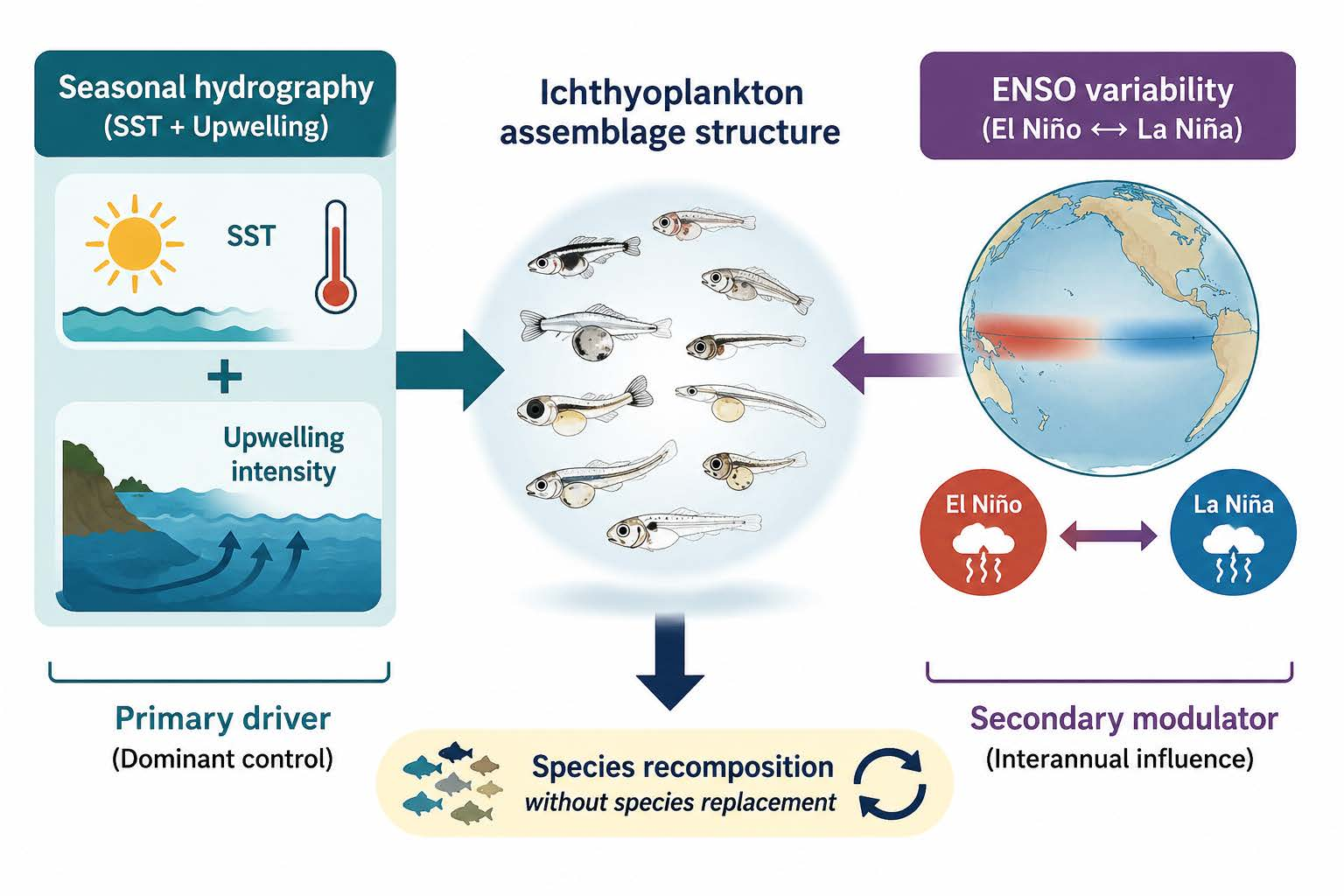
Long-term ichthyoplankton time series provide an effective framework for understanding how marine communities respond to environmental variability across temporal scales. We analyzed larval fish assemblage dynamics in the central Mexican Pacific under contrasting seasonal hydrographic conditions and ENSO phases using multivariate analyses, indicator species analysis, clustering, and generalized additive models. Environmental variability exhibited a hierarchical structure, with recurrent seasonal changes in sea surface temperature (SST) and coastal upwelling intensity (CUI), whereas the Oceanic Niño Index (ONI) varied mainly at the interannual scale. Significant differences in assemblage composition were detected among ENSO–seasonality regimes. Distance-based redundancy analysis showed that the primary compositional gradient was associated with seasonal hydrography, while secondary variation reflected ENSO-related interannual shifts. Species responses were expressed primarily through shifts in relative dominance rather than wholesale species replacement, indicating that assemblage reorganization was largely driven by changes in the relative contribution of recurrent taxa. This pattern highlights the role of seasonal hydrography as the primary environmental filter structuring the assemblage, whereas ENSO variability acts mainly as a secondary modulator of species dominance and community trajectories. Consequently, interannual climate anomalies influenced the relative importance of species without substantially redefining the underlying species pool. These findings improve the understanding of plankton community responses to climate variability in the tropical eastern Pacific.

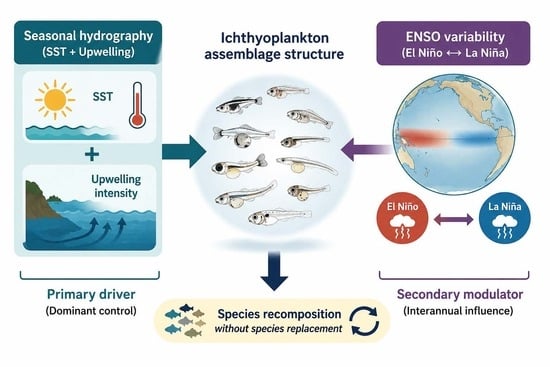
Graphical Abstract

1. Introduction

Long-term ichthyoplankton time series are indispensable for characterizing the structure, variability, and stability of marine fish assemblages. Fish larvae integrate processes across trophic levels and respond rapidly to environmental fluctuations, making them sensitive indicators of ecosystem state [1,2]. Temporal datasets enable the detection of shifts in species composition, diversity, and synchrony, providing critical insights into community resilience and the capacity of marine ecosystems to reorganize under changing conditions [1]. Because larval assemblages reflect reproductive output, survival processes, and recruitment variability, they constitute a fundamental link between environmental forcing and fish population dynamics [3].
Beyond community-level patterns, ichthyoplankton time series provide a robust framework for evaluating environmental forcing across multiple temporal scales. Larval fish assemblages are structured by drivers ranging from local hydrographic conditions to basin-scale climate modes, such as the El Niño–Southern Oscillation (ENSO) and the Pacific Decadal Oscillation (PDO), which can generate coherent or region-specific community responses [2,4]. Temperature, stratification, and productivity regulate larval distribution and abundance, whereas interannual climate anomalies may trigger abrupt shifts in assemblage structure [5,6]. Long-term analyses are therefore essential for identifying dominant environmental drivers and quantifying the relative contributions of seasonal and interannual processes to marine community dynamics.
The central Mexican Pacific is a highly dynamic transition region influenced by seasonal upwelling, tropical-subtropical water mass interactions, and interannual climate variability associated with ENSO. Previous studies in this region have documented marked seasonal changes in zooplankton biomass, ichthyoplankton composition, and larval fish diversity linked to hydrographic variability and productivity cycles [7,8,9,10,11]. Earlier analyses further demonstrated that ENSO events modify assemblage structure primarily through shifts in species dominance and relative abundance rather than complete species replacement [10,12]. Despite these advances, long-term evaluations integrating seasonal hydrographic forcing and ENSO-related interannual variability remain scarce for the central Mexican Pacific.
Planktonic community structure emerges from the interaction between deterministic (niche-based) and stochastic (neutral) processes operating across multiple temporal scales. Environmental filtering associated with seasonal hydrographic variability, including stratification and coastal upwelling, is expected to structure species composition, whereas interannual climatic variability may modulate community organization through changes in abundance, dispersal, and dominance patterns [13,14,15]. In marine pelagic systems, ichthyoplankton assemblages are therefore expected to reflect predictable seasonal forcing as the primary ecological gradient, while ENSO-related variability acts as a secondary driver of assemblage reorganization [16,17,18]. Long-term time series provide a valuable framework for evaluating how these processes interact across temporal scales and influence community reorganization [19,20].
Based on niche theory and scale-dependent environmental forcing, we hypothesized that seasonal hydrographic variability, characterized by recurrent changes in sea surface temperature, stratification, and coastal upwelling, acts as the primary environmental filter structuring ichthyoplankton assemblages in the central Mexican Pacific. In contrast, ENSO-related interannual variability was expected to operate as a secondary modulator of community trajectories, altering species dominance and relative abundances without substantially redefining the underlying species pool. Accordingly, mixed-season assemblages were predicted to be associated with coastal and neritic taxa favored by enhanced upwelling and productivity, whereas stratified assemblages were expected to be dominated by warm-affinity species adapted to oligotrophic conditions. ENSO phases were expected to modify these recurrent seasonal patterns through shifts in indicator species associations and assemblage dispersion while preserving the underlying seasonal gradient.

2. Materials and Methods

2.1. Study Area and Sampling Design

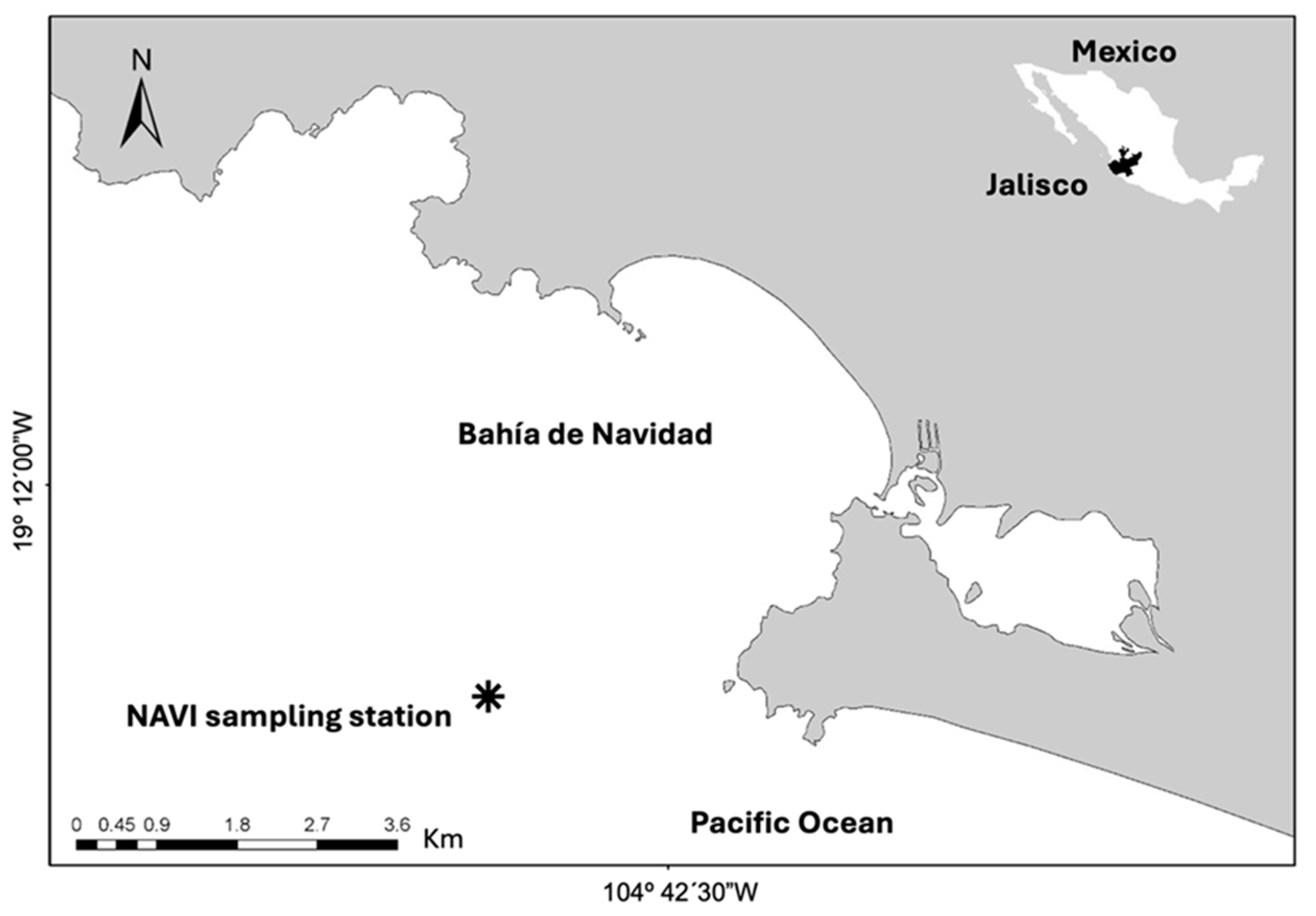
Zooplankton samples were collected monthly from January 2011 to December 2019 at a coastal oceanographic station in Bahía de Navidad, central Mexican Pacific (NAVI station; 150 m depth; 19°09′03″ N, 104°44′50″ W; Figure 1). The zooplankton samples were obtained at approximately 04:30 h using a conical plankton net (1 m mouth diameter, 250 µm mesh size, 3 m length). Oblique tows were conducted from ~40 m depth to the surface at ~4 km h−1 for 10 min. The volume of filtered seawater was estimated using a calibrated digital flowmeter (General Oceanics 2030R) mounted at the net mouth. Fish larvae were sorted and identified to the lowest possible taxonomic level following the taxonomic criteria and identification procedures described in previous studies conducted in the central Mexican Pacific, where the diagnostic characters and reference literature employed for species identification are described in detail [21]. Larval fish abundance was standardized to individuals per 10 m2 following Smith and Richardson [22].

2.2. Hydroclimatic Classification and Environmental Variables

Hydrological conditions were classified a priori into two seasonal regimes characteristic of the central Mexican Pacific: (1) a mixed season (January–June), associated with lower temperatures, higher salinity, shallow mixed layers, and enhanced coastal upwelling; and (2) a stratified season (July–December), characterized by warmer stratified waters, lower salinity associated with the rainy season, deeper mixed layers, and reduced productivity [23].
Interannual variability was quantified using the Oceanic Niño Index (ONI), where El Niño (La Niña) events corresponded to sustained SST anomalies ≥ +0.5 °C (≤−0.5 °C), whereas neutral conditions ranged between −0.5 °C and +0.5 °C. Sea surface temperature (SST) was obtained from NOAA Coral Reef Watch [24]. Monthly values of the Bakun coastal upwelling index (CUI) at 21° N were used as a proxy for seasonal upwelling intensity. Although the study area is located near 20° N, this is the southernmost standard location available for the eastern Pacific upwelling index series and has been widely used to characterize hydrographic seasonality in the central Mexican Pacific, where it closely tracks the onset of the cold season and seasonal increases in primary and secondary production [10,11,12].

2.3. Community Data Structure and Classification

The biological dataset consisted of a species-by-sample abundance matrix spanning 2011–2019. Monthly abundance data were organized into a species-by-sample matrix, where rows corresponded to monthly samples and columns to species abundances. Samples were classified a priori according to two sources of environmental variability: (1) hydrographic seasonality, comprising mixed (January–June) and stratified (July–December) periods, and (2) ENSO phase, classified as La Niña, Neutral, or El Niño based on the Oceanic Niño Index (ONI). Combining these two classifications yielded six ENSO–seasonality categories (La Niña-mixed, La Niña-stratified, Neutral-mixed, Neutral-stratified, El Niño-mixed, and El Niño-stratified), which were subsequently used as grouping factors in multivariate analyses.

2.4. Multivariate Community Analyses

Community dissimilarities were calculated using the Bray–Curtis index [25]. Differences in assemblage composition among ENSO–seasonality groups were tested using permutational multivariate analysis of variance PERMANOVA [26] with 999 permutations. Homogeneity of multivariate dispersion was assessed using PERMDISP [27] to verify that significant differences were not driven by unequal within-group variability.
Distance-based redundancy analysis (dbRDA) was performed using Bray–Curtis dissimilarities and the ENSO–seasonality category as the constraining factor. Statistical procedures followed Legendre and Anderson [28]. Species scores from the constrained ordination were used to identify taxa contributing to major compositional gradients. Analyses were conducted in R [29] using the vegan package [30]. Indicator species optima were calculated in the dbRDA ordination space as abundance-weighted average CAP1 and CAP2 coordinates using the sample scores where each species occurred. These optima were used only for graphical interpretation of species–centroid affinities. For visualization, axis limits were fixed manually to improve label separation and readability; no vegan scaling transformation was applied to the species coordinates.

2.5. Indicator Species Analysis

Indicator Species Analysis (ISA) was performed following Dufrêne and Legendre [31] to identify taxa associated with ENSO–seasonality assemblages. Indicator values (IndVal) were calculated based on species specificity and fidelity to each assemblage type.
To further identify taxa contributing to differences among assemblages, pairwise ISA was conducted across all group combinations. Statistical significance (p < 0.05) was assessed using 999 permutations. Analyses were implemented using the function multipatt() in the indicspecies package [32] using the IndVal.g statistic and restricting species associations to single group combinations (duleg = TRUE).
To explore the patterns of association among species and environmental contrasts, the resulting species × pairwise IndVal matrix was analyzed using hierarchical clustering. Bray–Curtis dissimilarities were calculated using vegdist(), and clustering was performed using Ward’s minimum variance method ward.D2 [33]. The results were visualized as heatmaps using the pheatmap package [34].

2.6. Linking Community Structure to Environmental Drivers

Generalized additive models (GAMs) were used to relate dbRDA axes (CAP1 and CAP2) to environmental variables (ONI, SST, and CUI). Models were fitted with a Gaussian error distribution and thin plate regression splines using the mgcv package [35,36] with smoothing parameters estimated via restricted maximum likelihood (REML). Model performance was evaluated based on explained deviance, adjusted R2, and Akaike Information Criterion (AIC), and compared against equivalent linear models.

3. Results

3.1. Environmental Variability

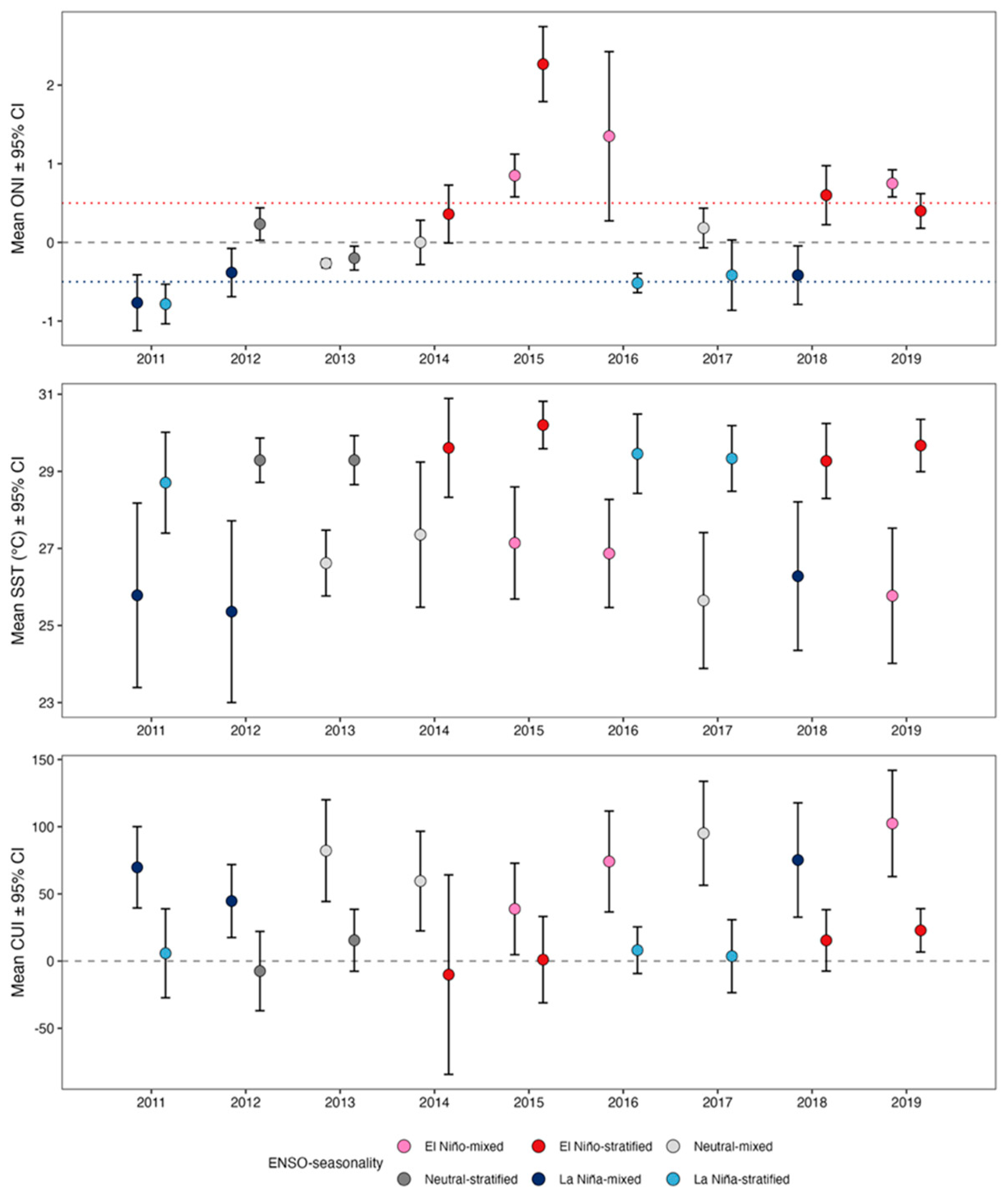
ONI exhibited marked interannual fluctuations, most notably during the 2015–2016 El Niño and the 2011 La Niña events (Figure 2). In contrast, SST and CUI displayed consistent seasonal cycles, with elevated SST during stratified conditions and intensified upwelling during mixed periods. These recurrent hydrographic patterns persisted across years despite ENSO variability, indicating that seasonal forcing represents the primary environmental template of the system, whereas ENSO acts mainly as a secondary modulator of interannual variability rather than disrupting the underlying seasonal cycle.

3.2. Multivariate Structure of the Ichthyoplankton Assemblage

Ichthyoplankton assemblage composition differed significantly among ENSO–seasonality regimes (PERMANOVA, pseudo-F = 2.35, p = 0.001), with the factor accounting for 10.5% of the total multivariate variation (R2 = 0.105).
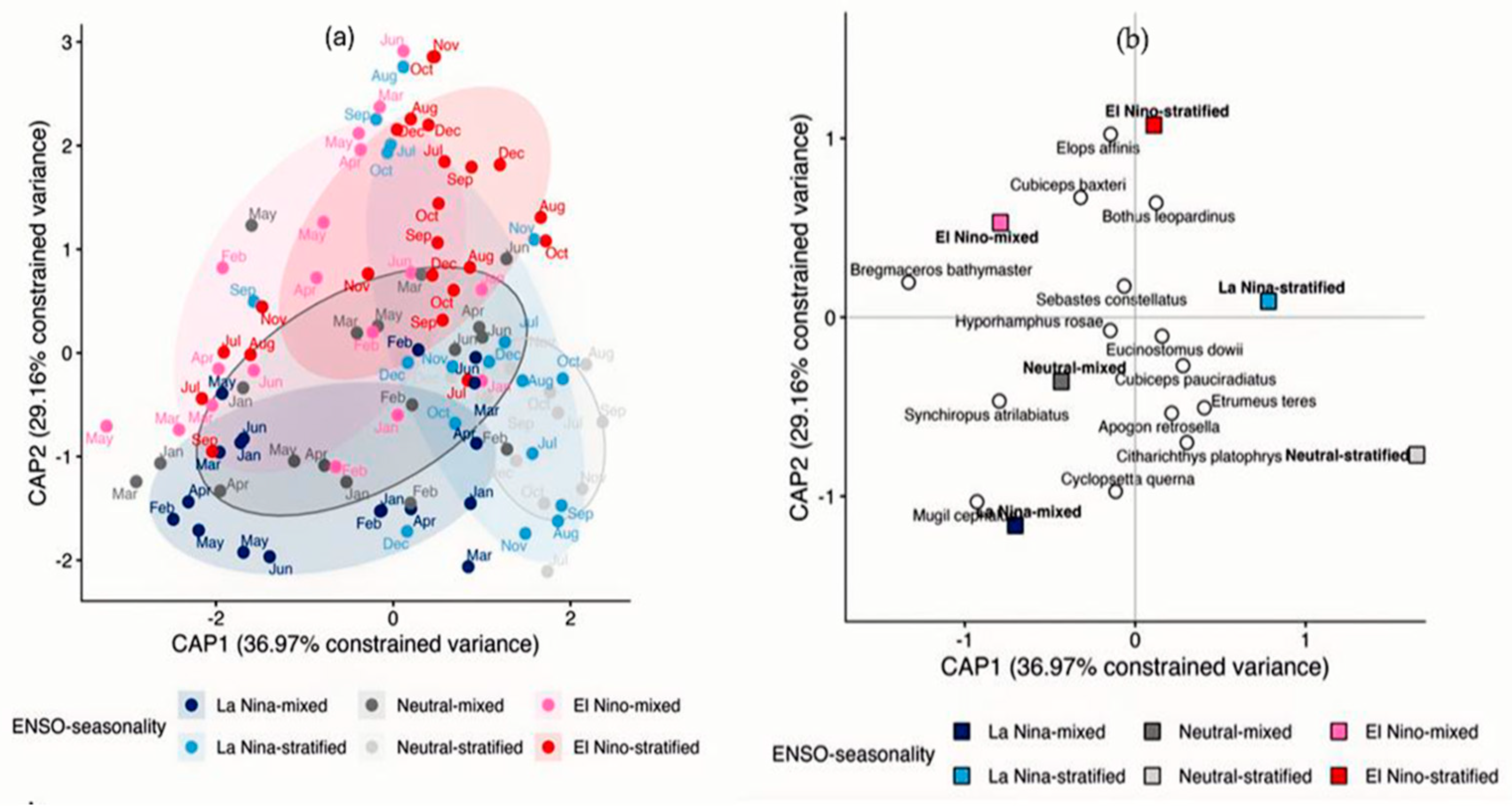
dbRDA showed a clear separation of samples among hydroclimatic regimes (Table 1, Figure 3). The global model was significant (F = 2.23, p = 0.001), with constrained axes explaining 10.0% of the total variation. CAP1 and CAP2 were both significant (p = 0.001) and together accounted for approximately 66% of the constrained variation.
In the ordination space (Figure 3a), La Niña and El Niño samples occupied opposite regions of the diagram, whereas neutral conditions occurred mainly in intermediate positions. CAP1 separated mixed and stratified hydrographic conditions, while CAP2 was associated with interannual variability related to the ENSO phase.
The species–group biplot (Figure 3b) showed associations between several taxa and specific ENSO–seasonality regimes. Species located near group centroids exhibited affinities with particular ENSO–seasonality regimes.
Tests for homogeneity of multivariate dispersion revealed significant differences among ENSO–seasonality groups (PERMDISP, p = 0.036), indicating unequal within-group variability. Therefore, the significant PERMANOVA results should be interpreted as reflecting both differences in group centroids and differences in multivariate dispersion.

3.3. Indicator Species Analysis (ISA)

Indicator Species Analysis (ISA) identified multiple taxa significantly associated with specific ENSO–seasonality regimes (p < 0.05), revealing distinct species assemblages among hydrographic conditions (Table 2). Assemblages associated with La Niña–mixed conditions were typified by several coastal and neritic species, including Citharichthys sp., Mugil cephalus Linnaeus, 1758, and Cyclopsetta querna (Jordan & Bollman, 1890), whereas La Niña–stratified conditions were associated with Paralichthys sp., Stellifer sp., and Hyporhamphus rosae (Jordan & Gilbert, 1880). Neutral–mixed conditions included several coastal and reef-associated taxa, including Sebastes constellatus (Jordan & Gilbert, 1880), Bothus leopardinus (Lacepède, 1802), and Thalassoma sp., while Neutral–stratified conditions were primarily associated with Etrumeus teres and Citharichthys platophrys Gilbert, 1891. El Niño–mixed conditions were strongly associated with Bregmaceros bathymaster Jordan & Bollman, 1890, which exhibited the highest indicator value among all taxa.

3.4. Indicator Species Clustering

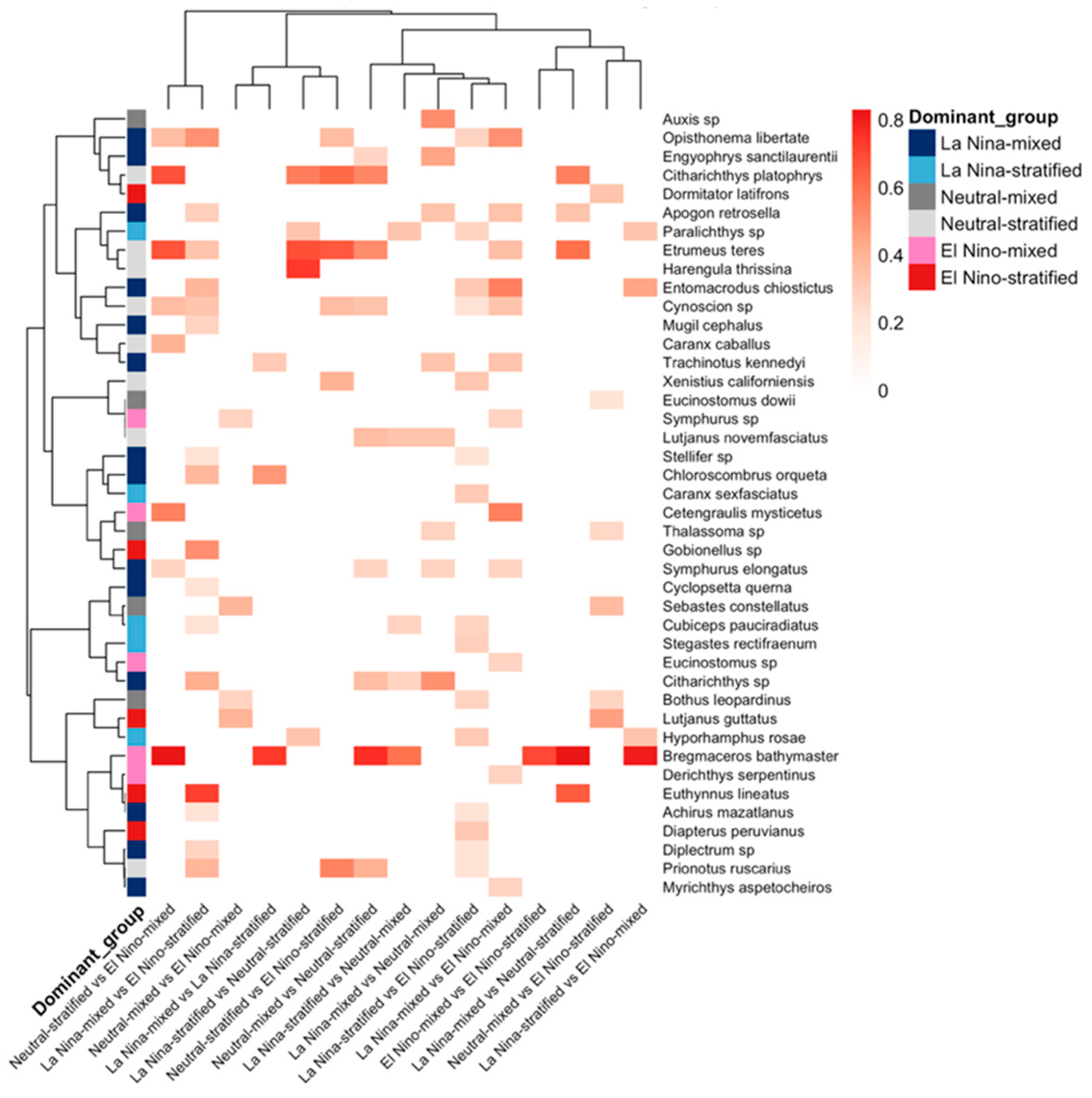
Hierarchical clustering of IndVal profiles showed consistent grouping patterns among ENSO–seasonality regimes (Figure 4). Contrasts involving mixed and stratified conditions clustered together across ENSO phases, highlighting the strong seasonal organization of the assemblage. Species are also clustered according to their association with seasonal and ENSO conditions. Coastal and neritic taxa such as Citharichthys sp., Mugil cephalus, and Opisthonema libertate were associated mainly with mixed conditions, whereas Paralichthys sp. and Stellifer sp. were more closely related to stratified regimes. Taxa associated with neutral conditions occupied intermediate cluster positions, whereas a smaller subset showed stronger associations with specific ENSO regimes. Bregmaceros bathymaster showed a strong association with El Niño–mixed conditions. Overall, clustering analyses reinforced the dominant role of seasonal hydrographic forcing in organizing species associations.

3.5. GAMs and Environmental Drivers of Assemblage Structure

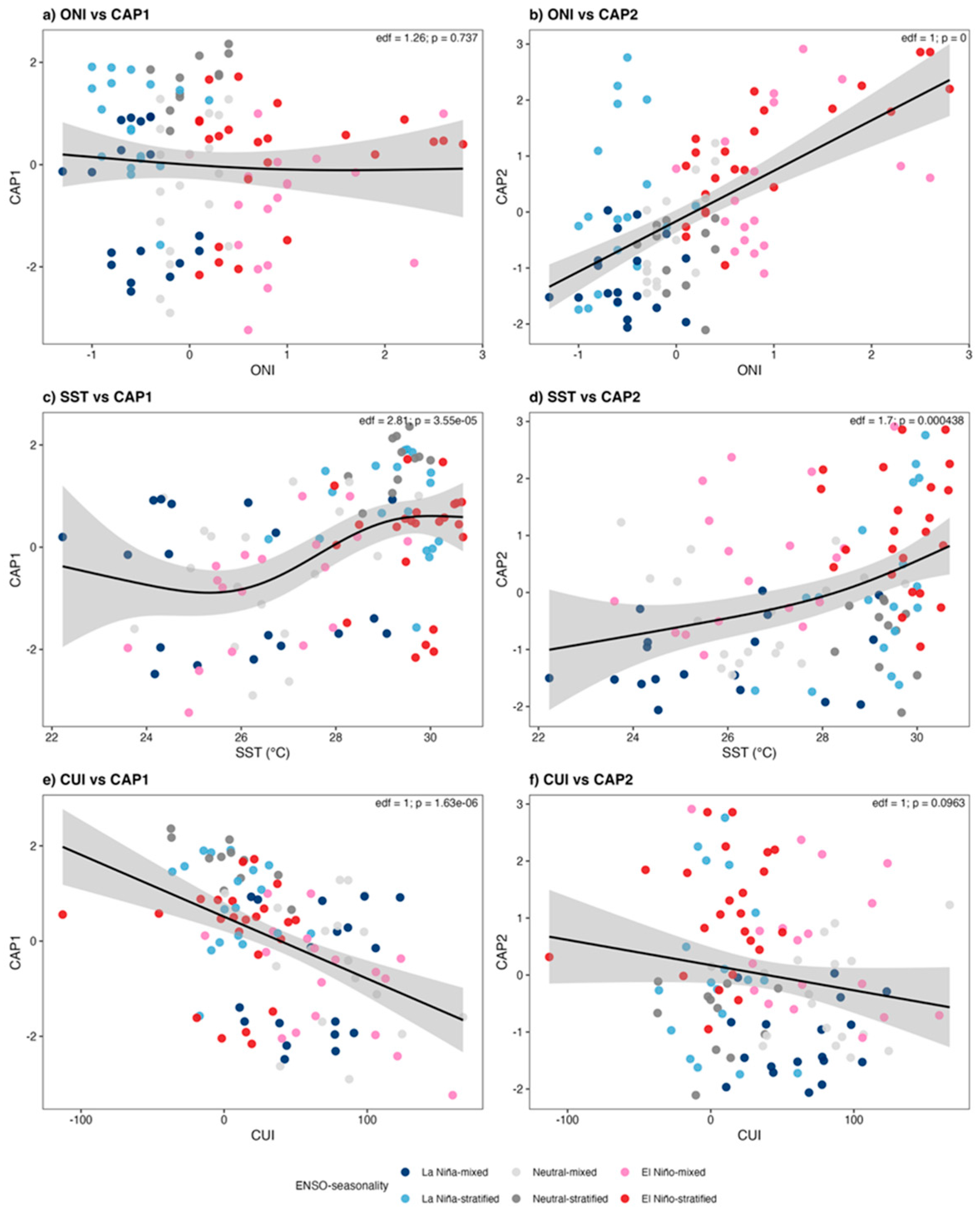
Generalized additive models (GAMs) showed contrasting relationships between environmental variables and the two main dbRDA axes (Table 3, Figure 5). ONI showed contrasting relationships with CAP1 and CAP2. No significant relationship was detected between ONI and CAP1 (edf = 1.26, p = 0.737), suggesting limited influence of interannual variability on the primary compositional gradient. In contrast, CAP2 showed a strong positive and nearly linear relationship with ONI (edf ≈ 1.0, p < 0.001), explaining a substantial proportion of the variance (Figure 5a,b).
SST and CUI showed their strongest relationships with CAP1. SST showed a significant nonlinear relationship with CAP1 (edf = 2.81, p < 0.001), reflecting variation in assemblage composition along the seasonal temperature gradient (Figure 5c,d). CUI also showed a significant negative and nearly linear relationship with CAP1 (edf ≈ 1.0, p < 0.001), consistent with the influence of upwelling intensity on seasonal assemblage structure (Figure 5e,f).
SST was also significantly related to CAP2 (edf = 1.70, p < 0.001), although its explanatory power was lower than that of ONI, whereas CUI showed no significant relationship with CAP2 (p = 0.096). Overall, GAM responses were consistent with the multivariate patterns identified by dbRDA, linking CAP1 mainly to seasonal hydrographic variability and CAP2 to interannual ENSO-related variation.

4. Discussion

Taken together, these results demonstrate that seasonality constitutes the primary ecological filter structuring ichthyoplankton assemblages in the central Mexican Pacific, whereas ENSO acts mainly as a secondary source of interannual variability. Despite the occurrence of both weak and strong El Niño and La Niña events during 2011–2019, the fundamental mixed–stratified seasonal configuration remained persistent through time, with assemblages consistently organized along CAP1 according to seasonal hydrographic conditions. ENSO variability, in turn, primarily displaced community states along CAP2, modulating rather than overriding the dominant seasonal template.
The distribution of ENSO–seasonality groups in ordination space further supports this interpretation. Mixed and stratified samples retained a coherent seasonal structure, while extreme ENSO conditions produced directional shifts within this framework, particularly along CAP2. These patterns suggest that interannual climate variability amplifies or attenuates seasonal transitions instead of independently restructuring assemblage composition, consistent with a system in which environmental filtering associated with seasonality represents the dominant organizing process.

4.1. Environmental Forcing and Hierarchical Control of Community Reorganization

The temporal dynamics of ichthyoplankton assemblages in the central Mexican Pacific revealed a hierarchical organization driven primarily by seasonal hydroclimatic forcing and secondarily modulated by interannual ENSO variability. The persistence of coherent trajectories in CAP1–CAP2 space associated with mixed and stratified conditions indicates that environmental filtering constitutes the dominant mechanism regulating community reorganization. This pattern agrees with previous studies conducted in the region, which have documented strong seasonal variability in zooplankton biomass, ichthyoplankton abundance, and larval fish assemblages associated with recurrent upwelling–stratification dynamics [7,8,10,12]. In the central Mexican Pacific, the interaction between sea surface temperature, coastal upwelling intensity, and biological productivity generates recurrent hydrographic states that constrain larval fish distributions and promote relatively predictable seasonal assemblages across years.
Despite the persistence of this seasonal framework, interannual climatic variability associated with ENSO introduced important deviations in assemblage structure, particularly during the intense 2011 La Niña and the strong 2015–2016 El Niño event. However, rather than completely reorganizing assemblage composition, ENSO primarily modified the magnitude, dispersion, and trajectory of community change within the pre-existing seasonal configuration. Similar responses have previously been observed in the region, where ENSO events altered abundance patterns and species dominance without eliminating the underlying seasonal signal [12]. These results indicate that variation in assemblage composition was primarily associated with seasonal hydrographic conditions, whereas interannual climatic variability associated with ENSO explained a secondary component of assemblage variation. This hierarchical pattern was consistently supported by the dbRDA, indicator species analysis, and GAM results.

4.2. Species-Specific Responses to ENSO–Seasonal Forcing

Species-level responses indicate that community reorganization was governed primarily by shifts in the relative dominance of environmentally sensitive taxa with contrasting ENSO–seasonal affinities, rather than by complete species replacement. Consistent with previous studies in the central Mexican Pacific [10,12], assemblage structure was dominated by a core group of recurrent taxa whose relative contributions varied according to hydrographic conditions.
Several coastal and neritic taxa, including Mugil cephalus, Cyclopsetta querna, Opisthonema libertate, and Paralichthys sp., were more strongly associated with mixed and upwelling-influenced conditions, particularly during La Niña and neutral phases. These species are commonly linked to productive coastal environments and increased secondary production associated with intensified vertical mixing and nutrient input. In contrast, taxa associated with stratified and warmer conditions, including Bregmaceros bathymaster, Etrumeus teres, and several mesopelagic components of the assemblage, increased during El Niño and stratified periods, reflecting the expansion of warm-affinity oceanic conditions.
The strong association of Bregmaceros bathymaster with El Niño–mixed conditions was particularly notable, suggesting a rapid response of opportunistic or warm-affinity taxa to anomalous hydrographic states. Similar increases in tropical and mesopelagic larval assemblages during warm anomalies have been documented in other regions of the eastern tropical Pacific and California Current system [5,6,37]. However, despite these interannual shifts, the dominant seasonal organization of the assemblage remained persistent through time.
The clustering of indicator species further demonstrated that taxa responded coherently to recurring hydrographic states, with mixed and stratified conditions producing relatively consistent species associations across ENSO phases. These results reinforce the idea that environmental variability in the central Mexican Pacific primarily alters the relative contribution of taxa already present within the regional species pool, rather than generating abrupt assemblage replacement. Consequently, community reorganization appears to emerge from gradual shifts in dominance patterns linked to hydrographic variability and productivity gradients.

4.3. Mechanistic and Scale-Dependent Drivers of Assemblage Organization

The observed patterns of assemblage reorganization are mechanistically consistent with environmental filtering and bottom–up regulation associated with seasonal hydrographic variability. In the central Mexican Pacific, upwelling-driven nutrient enrichment enhances phytoplankton biomass and zooplankton production [11], generating favorable feeding conditions for larval fish survival and recruitment. Conversely, stratified conditions are associated with warmer, oligotrophic waters and shifts toward warm-affinity assemblages [38,39]. These recurrent hydrographic states likely constrain species distributions and promote the persistence of relatively predictable seasonal assemblages across years.
Temperature and coastal upwelling emerged as the principal environmental gradients associated with assemblage structure, supporting previous studies linking ichthyoplankton variability to SST, productivity, and hydrographic forcing in the eastern tropical Pacific [6,10]. The persistence of dominant taxa across contrasting environmental conditions further suggests that community reorganization occurs mainly through changes in relative abundance and species dominance rather than through abrupt replacement of the regional species pool.
Although deterministic environmental filtering explained most of the observed assemblage organization, variability in group dispersion and trajectory geometry indicates that stochastic processes also contribute to community dynamics. Processes such as larval transport, dispersal variability, recruitment fluctuations, and mesoscale circulation features, including eddies and fronts, may introduce additional variability independent of the dominant hydrographic gradient [17,37]. These results are consistent with ecological frameworks proposing that marine planktonic assemblages emerge from the interaction between deterministic niche-based processes and stochastic dynamics operating across multiple temporal and spatial scales [15,40].
The hierarchical organization observed in this study further highlights the importance of scale-dependent forcing in marine ecosystems. Seasonal hydrography acts primarily at local to regional scales, establishing the dominant ecological template of the system, whereas ENSO operates at basin scales, modulating environmental conditions and amplifying interannual variability. At finer spatial scales, mesoscale circulation processes likely influence larval retention, transport, and patchiness, contributing to short-term variability in assemblage trajectories. Together, these results support the view that community reorganization in pelagic ecosystems emerges from cross-scale interactions between recurrent environmental forcing and stochastic oceanographic variability.

4.4. Ecological Predictability Under Climate Variability

The coexistence of strong seasonal organization and interannual climatic modulation has important implications for understanding ecological predictability in marine planktonic systems. The persistence of recurrent seasonal assemblages suggests that hydrographic seasonality provides a relatively stable and predictable ecological framework. However, strong ENSO events can modify the intensity, direction, and dispersion of community trajectories, increasing interannual variability and potentially generating nonlinear ecological responses.
Future changes in ocean warming, stratification intensity, and upwelling dynamics are expected to alter both environmental filtering and dispersal processes, with potential consequences for larval fish survival, species coexistence, and assemblage stability [20]. Under increasing climate variability, community dynamics in the central Mexican Pacific may therefore become less predictable, particularly if extreme climatic anomalies intensify or modify the balance between deterministic and stochastic processes.
This scale-dependent framework is consistent with contemporary ecological theory, which recognizes that community assembly emerges from the interplay of deterministic and stochastic processes whose relative importance varies across spatial and temporal scales [15,40,41]. In this context, community reorganization should be interpreted as an emergent property of multiscale interactions, where environmental filtering defines the baseline structure, while trophic interactions, larval transport, and stochastic processes introduce variability around this baseline [19,42,43]. Rather than causing complete community reorganization, climate variability may primarily alter the relative dominance of taxa and the magnitude of assemblage fluctuations within an otherwise persistent seasonal framework. Long-term ichthyoplankton monitoring therefore provides a valuable approach for detecting shifts in ecological organization and evaluating the resilience of pelagic ecosystems under ongoing environmental change.

5. Conclusions

Ichthyoplankton community dynamics in the central Mexican Pacific are governed by a hierarchical and scale-dependent interplay between deterministic environmental filtering and stochastic processes. Seasonal hydroclimatic forcing defines the primary structure of community reorganization, while ENSO variability and stochastic dynamics modulate interannual deviations. These findings provide a mechanistic framework for understanding and predicting shifts in species dominance under changing environmental conditions. This framework enables the prediction of shifts in species dominance under changing environmental conditions.

Author Contributions

C.F.-G. and E.G.-D.: conceived the idea of the study, implementing the 2011–2019 zooplankton time series at the NAVI station. C.F.-G.: funding acquisition, investigation, data curation, writing—original draft, supervision, and project administration. E.G.-D.: methodology, formal statistical analysis, data interpretation, and writing—original draft and figure edition. All authors have read and agreed to the published version of the manuscript.

Funding

This research received no external funding. This research was supported by internal annual research projects from the Universidad de Guadalajara. No external funding was received.

Institutional Review Board Statement

Ethical review and approval were waived for this study because the research involved plankton sampling and analysis of fish larvae collected under official Mexican fishing/research permits and did not involve experimental procedures on live vertebrate animals or human subjects.

Data Availability Statement

Raw data are available from the corresponding authors upon request.

Acknowledgments

The authors thank Armando Arvisar for his valuable support during field sampling and boat operations. We also thank Viridiana Plascencia, Jorge Santoyo, and Rafael Gutiérrez for their assistance in the sorting and separation of fish larvae samples.

Conflicts of Interest

The authors declare no conflicts of interest.

References

  1. Marshall, K.N.; Duffy-Anderson, J.T.; Ward, E.J.; Anderson, S.C.; Hunsicker, M.E.; Williams, B.C. Long-term trends in ichthyoplankton assemblage structure, biodiversity, and synchrony in the Gulf of Alaska and their relationships to climate. Prog. Oceanogr. 2019, 170, 134–145. [Google Scholar] [CrossRef]
  2. Nielsen, J.M.; Rogers, L.A.; Brodeur, R.D.; Thompson, A.R.; Auth, T.D.; Deary, A.L.; Duffy-Anderson, J.T.; Galbraith, M.; Koslow, J.A.; Perry, R.I. Responses of ichthyoplankton assemblages to marine heatwaves and climate variability in the Northeast Pacific. Glob. Change Biol. 2021, 27, 506–520. [Google Scholar] [CrossRef]
  3. Somarakis, S.; Tsoukali, S.; Giannoulaki, M.; Schismenou, E.; Nikolioudakis, N. Spawning stock, egg production and larval survival in relation to small pelagic fish recruitment. Mar. Ecol. Prog. Ser. 2019, 617, 113–136. [Google Scholar] [CrossRef]
  4. Koslow, J.A.; Goericke, R.; Watson, W. Fish assemblages in the Southern California Current: Relationships with climate. Fish. Oceanogr. 2013, 22, 207–219. [Google Scholar] [CrossRef]
  5. Aceves-Medina, G.; Jiménez-Rosenberg, S.P.A.; Durazo, R. Fish larvae as indicator species of interannual environmental variability in a subtropical transition area off the Baja California peninsula. Deep-Sea Res. Part II 2019, 169–170, 104631. [Google Scholar] [CrossRef]
  6. Vilchis, L.I.; Ballance, L.T.; Watson, W. Temporal variability of ichthyoplankton assemblages of the eastern Pacific warm pool. Deep-Sea Res. Part I 2009, 56, 125–140. [Google Scholar] [CrossRef]
  7. Franco-Gordo, C.; Godínez-Domínguez, E.; Suárez, E. Zooplankton biomass variability in the Mexican Eastern Tropical Pacific. Pac. Sci. 2001, 55, 191–202. [Google Scholar] [CrossRef]
  8. Franco-Gordo, C.; Suárez-Morales, E.; Godínez-Domínguez, E.; Flores-Vargas, R. A seasonal survey of the fish larvae community of the central Pacific coast of Mexico. Bull. Mar. Sci. 2001, 68, 383–396. [Google Scholar]
  9. Franco-Gordo, C.; Godínez-Domínguez, E.; Suárez-Morales, E. Larval fish assemblages in waters off the central Pacific coast of Mexico. J. Plankton Res. 2002, 24, 775–784. [Google Scholar] [CrossRef]
  10. Franco-Gordo, C.; Godínez-Domínguez, E.; Filonov, A.E.; Tereshchenko, I.E.; Freire, J. Plankton biomass and larval fish abundance prior to and during the El Niño period of 1997–1998 along the central Pacific coast of México. Prog. Oceanogr. 2004, 63, 99–123. [Google Scholar] [CrossRef]
  11. Ambriz-Arreola, I.; Gómez-Gutiérrez, J.; Franco-Gordo, M.C.; Lavaniegos, B.E.; Godínez-Domínguez, E. Influence of coastal upwelling–downwelling variability on tropical euphausiid abundance and community structure in the inshore Mexican central Pacific. Mar. Ecol. Prog. Ser. 2012, 451, 119–136. [Google Scholar] [CrossRef]
  12. Franco-Gordo, C.; Godínez-Domínguez, E.; Suárez-Morales, E.; Freire, J. Interannual and seasonal variability of the diversity and structure of ichthyoplankton assemblages in the central Mexican Pacific. Fish. Oceanogr. 2008, 17, 178–190. [Google Scholar] [CrossRef]
  13. Hubbell, S.P. The Unified Neutral Theory of Biodiversity and Biogeography; Princeton University Press: Princeton, NJ, USA, 2001. [Google Scholar]
  14. Chesson, P. Mechanisms of maintenance of species diversity. Annu. Rev. Ecol. Syst. 2000, 31, 343–366. [Google Scholar] [CrossRef]
  15. Vellend, M. Conceptual synthesis in community ecology. Q. Rev. Biol. 2010, 85, 183–206. [Google Scholar] [CrossRef]
  16. Chase, J.M.; Leibold, M.A. Ecological Niches: Linking Classical and Contemporary Approaches; University of Chicago Press: Chicago, IL, USA, 2003. [Google Scholar]
  17. Logerwell, E.A.; Smith, P.E. Mesoscale eddies and survival of late stage Pacific sardine (Sardinops sagax) larvae. Fish. Oceanogr. 2001, 10, 13–25. [Google Scholar] [CrossRef]
  18. Checkley, D.M.; Asch, R.G.; Rykaczewski, R.R. Patterns and processes in the California Current System. Prog. Oceanogr. 2009, 83, 49–64. [Google Scholar] [CrossRef]
  19. Hsieh, C.H.; Reiss, C.S.; Hunter, J.R.; Beddington, J.R.; May, R.M.; Sugihara, G. Fishing elevates variability in the abundance of exploited species. Nature 2008, 443, 859–862. [Google Scholar] [CrossRef]
  20. Beaugrand, G.; Edwards, M.; Raybaud, V.; Goberville, E.; Kirby, R.R. Plankton effects on marine ecosystems. Annu. Rev. Mar. Sci. 2014, 6, 361–384. [Google Scholar] [CrossRef]
  21. Franco-Gordo, C.; Flores-Vargas, R.; Navarro-Rodríguez, C.; Funes-Rodríguez, R.; Saldierna-Martínez, R. Ichthyoplankton from the Coasts of Jalisco and Colima, Mexico (December 1995 to December 1996). Cienc. Mar. 1999, 25, 107–111. [Google Scholar] [CrossRef]
  22. Smith, P.E.; Richardson, S.L. Standard Techniques for Pelagic Fish Egg and Larva Surveys; FAO Fisheries Technical Paper No. 175; Food and Agriculture Organization: Rome, Italy, 1977; 100p. [Google Scholar]
  23. Franco-Gordo, M.C.; Plascencia-Palomera, V.; Godínez-Domínguez, E.; Lozano-Cobo, H.; Gómez-Gutiérrez, J.; Ambriz-Arreola, I.; Suárez-Morales, E. Chaetognath community structure in the coastal Central Mexican Pacific: Persistent seasonal signals amid ENSO variability (2010–2016). Discov. Ocean. 2026, 3, 8. [Google Scholar] [CrossRef]
  24. Liu, G.; Heron, S.F.; Eakin, C.M.; De La Cour, J.L.; Geiger, E.F.; Tirak, K.V.; Skirving, W.J.; Strong, A.E. NOAA Coral Reef Watch (CRW) Daily Global 5-km (0.05 Degree) Satellite Coral Bleaching Heat Stress Monitoring Product Suite; NOAA National Centers for Environmental Information: Asheville, NC, USA, 2018. [Google Scholar] [CrossRef]
  25. Bray, J.R.; Curtis, J.T. An ordination of the upland forest communities of southern Wisconsin. Ecol. Monogr. 1957, 27, 325–349. [Google Scholar] [CrossRef]
  26. Anderson, M.J. A new method for non-parametric multivariate analysis of variance. Austral Ecol. 2001, 26, 32–46. [Google Scholar] [CrossRef]
  27. Anderson, M.J. Distance-based tests for homogeneity of multivariate dispersions. Biometrics 2006, 62, 245–253. [Google Scholar] [CrossRef]
  28. Legendre, P.; Anderson, M.J. Distance-based redundancy analysis: Testing multispecies responses in multifactorial ecological experiments. Ecol. Monogr. 1999, 69, 1–24. [Google Scholar] [CrossRef]
  29. R Core Team. R: A Language and Environment for Statistical Computing; R Foundation for Statistical Computing: Vienna, Austria, 2024. [Google Scholar]
  30. Oksanen, J.; Blanchet, F.G.; Friendly, M.; Kindt, R.; Legendre, P.; Minchin, P.R.; O’Hara, R.B.; Solymos, P.; Stevens, M.H.H.; Szoecs, E.; et al. Vegan: Community Ecology Package. R Package Version 2.6-4. 2022. Available online: https://CRAN.R-project.org/package=vegan (accessed on 27 May 2026).
  31. Dufrêne, M.; Legendre, P. Species assemblages and indicator species: The need for a flexible asymmetrical approach. Ecol. Monogr. 1997, 67, 345–366. [Google Scholar] [CrossRef]
  32. De Cáceres, M.; Legendre, P. Associations between species and groups of sites: Indices and statistical inference. Ecology 2009, 90, 3566–3574. [Google Scholar] [CrossRef]
  33. Murtagh, F.; Legendre, P. Ward’s hierarchical agglomerative clustering method: Which algorithms implement Ward’s criterion? J. Classif. 2014, 31, 274–295. [Google Scholar] [CrossRef]
  34. Kolde, R. Pheatmap: Pretty Heatmaps. R Package Version 1.0.12. 2019. Available online: https://CRAN.R-project.org/package=pheatmap (accessed on 27 May 2026).
  35. Wood, S.N. Fast stable restricted maximum likelihood and marginal likelihood estimation of semiparametric generalized linear models. J. R. Stat. Soc. Ser. B 2011, 73, 3–36. [Google Scholar] [CrossRef]
  36. Wood, S.N. Generalized Additive Models: An Introduction with R, 2nd ed.; CRC Press: Boca Raton, FL, USA, 2017. [Google Scholar] [CrossRef]
  37. Avendaño-Ibarra, R.; Godínez-Domínguez, E.; Aceves-Medina, G.; González-Rodríguez, E.; Trasviña, A. Fish larvae response to biophysical changes in the Gulf of California, Mexico (winter–summer). J. Mar. Sci. 2013, 2013, 176760. [Google Scholar] [CrossRef]
  38. Bakun, A. Linking climate to population variability in marine ecosystems characterized by non-simple dynamics: Conceptual templates and schematic constructs. J. Mar. Syst. 2010, 79, 361–373. [Google Scholar] [CrossRef]
  39. Kozak, E.R.; Franco-Gordo, C.; Godínez-Domínguez, E.; Suárez-Morales, E.; Ambriz-Arreola, I. Seasonal variability of stable isotope values and niche size in tropical calanoid copepods and zooplankton size fractions. Mar. Biol. 2020, 167, 37. [Google Scholar] [CrossRef]
  40. Gravel, D.; Canham, C.D.; Beaudet, M.; Messier, C. Reconciling niche and neutrality: The continuum hypothesis. Ecol. Lett. 2006, 9, 399–409. [Google Scholar] [CrossRef]
  41. Levin, S.A. The Problem of Pattern and Scale in Ecology: The Robert H. MacArthur Award Lecture. Ecology 1992, 73, 1943–1967. [Google Scholar] [CrossRef]
  42. Cushing, D.H. Plankton production and year-class strength in fish populations: An update of the match/mismatch hypothesis. Adv. Mar. Biol. 1990, 26, 249–293. [Google Scholar] [CrossRef]
  43. Cowen, R.K.; Sponaugle, S. Larval dispersal and marine population connectivity. Ann. Rev. Mar. Sci. 2009, 1, 443–466. [Google Scholar] [CrossRef]
Figure 1. Location of the NAVI station in Bahía de Navidad (BN), Jalisco, Mexico. The asterisk indicates the fixed sampling station used throughout the long-term monitoring period.
Diversity 18 00366 g001
Figure 2. Interannual and seasonal variability of environmental conditions from 2011 to 2019 across ENSO–seasonality regimes. Panels show mean (±95% CI) Oceanic Niño Index (ONI), sea surface temperature (SST), and coastal upwelling index (CUI) during mixed and stratified periods. Colors denote ENSO–seasonality categories. Seasonal hydrographic patterns in SST and CUI remained remarkably consistent among years, whereas ONI exhibited pronounced interannual fluctuations, indicating that recurrent seasonal forcing provides the primary environmental template upon which ENSO variability is superimposed.
Diversity 18 00366 g002
Figure 3. Distance-based redundancy analysis (dbRDA) of ichthyoplankton assemblages across ENSO–seasonality regimes. (a) Monthly samples projected in Bray–Curtis space, grouped into six ENSO–seasonality categories. Ellipses represent 68% confidence regions. CAP1 primarily reflects recurrent seasonal hydrographic forcing separating mixed and stratified conditions, whereas CAP2 captures interannual modulation associated with ENSO variability. (b) Species-group biplot showing taxa (white circles) with the strongest affinities to each ENSO–seasonality regime (centroids). Species positions correspond to weighted-average coordinates in the constrained ordination space and were multiplied by a constant factor solely to improve graphical readability and reduce overlap among labels.
Diversity 18 00366 g003
Figure 4. Hierarchical clustering of Indicator Value (IndVal) profiles across pairwise ENSO–seasonality contrasts. Species and environmental regimes clustered according to similarities in indicator responses, revealing that seasonal hydrographic conditions constitute the main axis of assemblage differentiation, whereas ENSO variability primarily modulates species associations within these seasonal states. Color intensity indicates the relative strength of indicator species associations.
Diversity 18 00366 g004
Figure 5. Generalized additive models (GAMs) relating environmental variability to the two main dbRDA axes. Panels show responses of CAP1 and CAP2 to ONI, SST, and CUI. CAP1 was strongly associated with SST and coastal upwelling, reflecting the dominant influence of seasonal hydrographic forcing on assemblage structure. In contrast, CAP2 was primarily related to ONI, indicating that ENSO acts as a secondary source of interannual modulation. Points are colored according to ENSO–seasonality categories, and lines represent fitted smooth functions (±95% CI).
Diversity 18 00366 g005
Table 1. Results of the distance-based redundancy analysis (dbRDA) based on Bray–Curtis dissimilarities examining the influence of ENSO–seasonality regimes on ichthyoplankton community composition. Significance was assessed using permutation tests (999 permutations), and significance levels: *** p < 0.001.
ComponentdfSum of SquaresEigenvalue% Constrained VarianceFp
Global model54.31110.02.2270.001 ***
Residual10038.72390.0
Constrained axes
CAP111.5941.59436.974.120.001 ***
CAP211.2571.25729.163.250.001 ***
CAP310.6230.62314.461.610.240
Table 2. Species showing significant associations with the six ENSO–seasonality groups based on Indicator Species Analysis. Values correspond to the indicator value (IndVal) only for each species–group significant association (p < 0.05). Blank cells indicate no significant association.
ENSO–Seasonality RegimeSpeciesIndVal
La Niña–mixedCitharichthys sp.0.516
La Niña–mixedMugil cephalus0.483
La Niña–mixedApogon retrosella0.443
La Niña–mixedOpisthonema libertate0.409
La Niña–mixedSynchiropus atrilabiatus0.392
La Niña–mixedCyclopsetta querna0.383
La Niña–stratifiedParalichthys sp.0.461
La Niña–stratifiedStellifer sp.0.442
La Niña–stratifiedCubiceps pauciradiatus0.438
La Niña–stratifiedHyporhamphus rosae0.418
Neutral–mixedSebastes constellatus0.560
Neutral–mixedBothus leopardinus0.515
Neutral–mixedThalassoma sp.0.478
Neutral–mixedElops affinis0.391
Neutral–mixedEucinostomus dowii0.376
Neutral–mixedCubiceps baxteri0.363
Neutral–stratifiedEtrumeus teres0.627
Neutral–stratifiedCitharichthys platophrys0.572
El Niño–mixedBregmaceros bathymaster0.711
Table 3. Results of generalized additive models (GAMs) relating environmental predictors (ONI, SST, and CUI) to the first two dbRDA axes (CAP1 and CAP2). Effective degrees of freedom (edf) indicate the degree of nonlinearity of the fitted smooth terms. Deviance explained (%) provides measures of model fit.
PredictorResponseedfF-Valuep-ValueDeviance Explained (%)
ONICAP11.260.130.7370.8
ONICAP2156.78<0.00135.3
SSTCAP12.818.08<0.00122.6
SSTCAP21.78.26<0.00114.9
CUICAP1126.07<0.00120
CUICAP212.820.0962.6
Disclaimer/Publisher’s Note: The statements, opinions and data contained in all publications are solely those of the individual author(s) and contributor(s) and not of MDPI and/or the editor(s). MDPI and/or the editor(s) disclaim responsibility for any injury to people or property resulting from any ideas, methods, instructions or products referred to in the content.