Article

The Complete Mitochondrial Genome of Geniotrigona thoracica (Apidae: Meliponini): Phylogenomic Implications and Mitochondrial Gene Rearrangement Patterns


by
Pisit Poolprasert
1,
Srihunsa Malichan
2 and
Atsalek Rattanawannee
1,3,*
1
Department of Entomology, Faculty of Agriculture, Kasetsart University, 50 Ngam Wong Wan Road, Lat Yao, Chatuchak, Bangkok 10900, Thailand
2
Department of Plant Pathology, Faculty of Agriculture, Kasetsart University, Bangkok 10900, Thailand
3
Research and Lifelong Learning Center for Urban and Environmental Entomology, Kasetsart University Institute for Advanced Studies, Kasetsart University, Bangkok 10900, Thailand
*
Author to whom correspondence should be addressed.
Diversity 2026, 18(6), 365; https://doi.org/10.3390/d18060365
Submission received: 27 April 2026 / Revised: 9 June 2026 / Accepted: 10 June 2026 / Published: 15 June 2026
(This article belongs to the Section Animal Diversity)

Abstract

The stingless bee Geniotrigona thoracica is an ecologically and economically important pollinator in Southeast Asia, yet comprehensive genomic resources for this species remain limited. In this study, we sequenced, assembled, and annotated the complete mitochondrial genome (mitogenome) of G. thoracica to investigate its genomic architecture and phylogenetic position. The circular mitogenome is 16,061 bp in length and comprises the typical set of 37 genes, including 13 protein-coding genes (PCGs), 22 transfer RNA genes, and two ribosomal RNA genes. The genome exhibits a strong A + T bias, consistent with other hymenopteran mitogenomes, and codon usage patterns reflect this nucleotide composition. Most tRNAs display the canonical cloverleaf secondary structure, although minor structural variations were observed. Comparative analyses revealed several gene rearrangements, including transposition and inversion events, suggesting lineage-specific rearrangements, including transposition of the cox1–trnL–cox2–trnD–atp8–atp6–cox3 block and transposition with inversion of the trnF–nad5–nad4–nad4l–trnP block, relative to the ancestral hymenopteran gene order. Phylogenomic analyses based on concatenated mitochondrial genes strongly supported the monophyly of Meliponini and placed G. thoracica within a well-supported Indo-Malayan clade, closely related to Tetragonula, Heterotrigona, and Lepidotrigona. Furthermore, stingless bees were recovered as more closely related to bumblebees than to honeybees, consistent with previous studies. Overall, this study provides a complete, annotated mitogenomic resource for G. thoracica and contributes to a better understanding of mitochondrial genome evolution, phylogenetic relationships, and biogeographic patterns in stingless bees.

1. Introduction

Stingless bees (Apinae: Meliponini) constitute one of the most diverse radiations of eusocial insects and represent a major structural component of tropical pollination systems. With approximately 600 described species distributed across the Neotropical, Afrotropical, and Indo-Malay/Australasian regions, the tribe exhibits extensive ecological breadth and evolutionary antiquity [1,2,3,4]. Although their biomass is typically lower than that of Apis species in managed landscapes, meliponines frequently dominate plant–pollinator networks in tropical habitats through high visitation rates, generalist foraging behavior, and effective pollen transfer [5,6,7]. Beyond ecological relevance, stingless bees underpin a rapidly expanding meliponiculture sector in Southeast Asia and Latin America, where colonies are propagated for honey, cerumen, and propolis with recognized nutritional and pharmacological properties [3,8,9,10]. Despite this ecological and economic importance, the systematic framework of Meliponini remains incompletely resolved, and species boundaries are frequently obscured by morphological conservatism and phenotypic overlap among closely related taxa [4,7]. The persistence of cryptic diversity complicates biodiversity assessments, conservation planning, and colony management, particularly in regions where anthropogenic translocation and artificial colony division may disrupt historical patterns of gene flow [10,11]. These challenges underscore the need for genome-scale data capable of disentangling recent divergence, introgression, and lineage-specific evolutionary trajectories within the tribe.
Within Southeast Asia, G. thoracica occupies a prominent role in both natural ecosystems and managed meliponiculture [3,10,12]. This species is widely cultivated in Thailand and Malaysia because of its relatively robust colonies and favorable honey production, often alongside Heterotrigona itama [10,11,12,13,14]. Nevertheless, as in many meliponine genera, morphological similarity among sympatric species has historically hindered accurate taxonomic identification. Molecular studies based on short mitochondrial markers, particularly the cytochrome c oxidase subunit I (cox1) gene, have provided preliminary insights but frequently insufficient phylogenetic signal to resolve relationships among closely related stingless bee taxa [4,15]. Single-locus approaches are especially limited in groups characterized by recent divergence, incomplete lineage sorting, or introgressive hybridization. While extensive genomic resources are available for the genus Apis, comparable datasets for stingless bees remain scarce, particularly for Southeast Asian taxa [7]. The limited availability of complete mitochondrial genomes within Meliponini restricts comparative phylogenomics and hinders the development of robust and reproducible systematic hypotheses.
The insect mitochondrial genome has long served as a principal marker for evolutionary inference owing to its compact organization, maternal inheritance, relatively rapid substitution rate, and general absence of recombination [16,17,18,19]. In Hymenoptera, the typical mitogenome is a circular molecule of approximately 15–18 kb comprising 13 protein-coding genes (PCGs), 22 transfer RNAs (tRNAs), two ribosomal RNAs (rRNAs), and a non-coding control region [4,6,15,20]. Complete mitogenomes provide substantially greater phylogenetic resolution than individual gene fragments by integrating information across coding and structural components. However, recent studies demonstrate that meliponine mitogenomes are far from structurally conservative. Comparative analyses of Meliplebeia beccarii and T. iridipennis reveal extensive gene rearrangements, tRNA translocations, and lineage-specific gene losses, including the absence of trnI, trnK, and trnA in M. beccarii and a high rearrangement score in T. iridipennis [4,7]. Such deviations from the ancestral gene order suggest that stingless bee mitogenomes are characterized by elevated architectural plasticity relative to other corbiculate bees. Proposed mechanisms include tandem duplication followed by random loss (TDRL), replication slippage, and recombination-like processes associated with secondary structure motifs [4]. The accumulation of rearrangements in certain meliponine lineages implies that mitogenomic structure itself may carry a phylogenetic signal, yet it may also introduce analytical complexity when gene-order heterogeneity is not explicitly accommodated [7,21,22,23,24].
Despite the ecological prominence of G. thoracica, comprehensive mitogenomic resources for this species remain unavailable. The absence of a well-annotated reference mitochondrial genome limits comparative analyses across Meliponini and prevents detailed evaluation of lineage-specific rearrangements, nucleotide composition patterns, and substitution dynamics. These gaps are particularly significant given the growing anthropogenic pressures on stingless bee populations, including commercial colony propagation, habitat modification, and inter-regional colony exchange associated with meliponiculture. Generating complete and accurately annotated mitochondrial genomes for key meliponine species is therefore essential for strengthening phylogenetic inference, improving taxonomic resolution, and supporting evidence-based conservation strategies.
In the present study, we sequenced and annotated the complete mitochondrial genome of G. thoracica and conducted a comprehensive analysis of its genomic architecture. Specifically, we examined gene content, gene order, nucleotide composition, codon usage patterns, and tRNA secondary structures. We further investigated structural characteristics, including potential gene rearrangements and compositional biases, to identify lineage-specific features within the mitochondrial genome. Finally, phylogenetic relationships were reconstructed using concatenated mitochondrial protein-coding genes within the bee superfamily Apoidea, with particular emphasis on members of the family Apidae. Together, these results provide a valuable mitogenomic resource for future comparative studies and contribute to a more robust understanding of mitochondrial evolution, systematics, and conservation of stingless bees.

2. Materials and Methods

2.1. Sample Collection

Adult worker specimens of G. thoracica were collected from a single managed colony maintained at a commercial meliponary located in Pattani (06°38′10″ N; 101°35′33″ E) province in southern Thailand. Five workers were sampled directly from the nest entrance. Collected specimens were preserved in absolute ethanol and stored at −20 °C until further processing. The samples were deposited in the insect specimen collection of the Department of Entomology, Faculty of Agriculture, Kasetsart University (ENTO–AGR–KU), Thailand. Voucher specimens were archived under accession number ENTOKU Voucher GT45. Species identification was initially conducted using the diagnostic characters and taxonomic keys described by Samsudin et al. [25] and Trianto et al. [26].

2.2. Ethics Statement

Written informed consent was obtained from the stingless bee farmer prior to sample collection, and the participating beekeeper granted access to their colonies for research purposes. Farm owners also assisted in preparing the colonies during the sampling process. No special collection permits were required because the study did not involve endangered or protected species. Only a small number of individuals were collected to minimize potential impacts on the colonies. All procedures were conducted in accordance with ethical standards for animal research and complied with the guidelines of the Animal Experiment Committee of Kasetsart University (approval no. ACKU68-AGR-005).

2.3. DNA Extraction

The thorax of a single worker was used for DNA extraction using a DNeasy Blood & Tissue Kit (QIAGEN, Germantown, MD, USA). The quality of extracted genomic DNA was quantified using 1.0% agarose gel electrophoresis. The quantity of the DNA was determined using a NanoDrop ND-1000 Spectrophotometer (Thermo Fisher Scientific, Zurich, Switzerland). Then, a REPLI-g Mitochondrial DNA kit (Qiagen, Hilden, Germany) was used to isolate mitochondrial DNA from the genomic DNA according to the manufacturer’s protocol. The use of the REPLI-g Mitochondrial DNA Kit prior to sequencing served to enrich mitochondrial DNA relative to total genomic DNA, thereby substantially reducing the risk of co-amplifying nuclear mitochondrial DNA segments (NUMTs). This kit employs phi29 polymerase-based rolling-circle amplification, which preferentially amplifies circular mitochondrial molecules and does not efficiently amplify linear nuclear DNA; this selectivity has been shown to minimize NUMT representation in downstream sequencing libraries [27]. All genomic and mitochondrial DNA used for library preparation and sequencing was derived exclusively from this single individual; no pooling of DNA from multiple workers or colonies was performed.

2.4. Sequencing, Assembly, Annotation, and Analysis

The mitochondrial genome library of G. thoracica was sequenced using the Illumina NextSeq 500 platform (Illumina, San Diego, CA, USA). Raw sequencing reads were generated in FASTQ format. The sequencing output was evaluated based on the total number of bases, read counts, and the proportion of bases with a quality score ≥ Q30. Adapter sequences, low-quality reads, and ambiguous bases were removed using fastp software (version 0.12.4) [21] to obtain high-quality clean data. The filtered reads were subsequently aligned to reference sequences using BWA software (version 0.7.17) [28]. Consensus sequences were then generated, and mitochondrial genes, including protein-coding genes (PCGs), transfer RNA genes (tRNAs), and ribosomal RNA genes (rRNAs), were identified using SAMtools (http://samtools.sourceforge.net) [29]. Gene prediction for the invertebrate mitochondrial genome was further conducted using MITOS (http://mitos.bioinf.uni-leipzig.de/index.py (accessed on 13 July 2025)) [30].
To assemble longer DNA fragments, de novo assembly based on a de Bruijn graph algorithm was performed using short-read sequencing data. The resulting contigs were used for subsequent mitogenome annotation. Genome assembly was carried out with the MEGAHIT assembler implemented in the MitoZ package version 3.6 [31]. The quality of the assembled genome was evaluated using QUAST version 5.3.0 [32]. QUAST assembly evaluation confirmed that the final assembly consisted of 1 contig(s), with an N50 of 16,061 bp and a total assembled length of 16,061 bp, consistent with the expected mitogenome size for Meliponini. The complete mitochondrial genome of G. thoracica was annotated and compared with four published mitogenomes retrieved from the National Center for Biotechnology Information GenBank database, including T. iridipennis (OQ139639), T. pagdeni (OK336459.1), L. flavibasis (MN747147), and H. itama (PQ759010). The secondary structures of tRNA genes were also predicted using MITOS. Transfer RNA genes and their secondary structures were initially predicted using MITOS and subsequently cross-checked using tRNAscan-SE. Predicted tRNA structures were also manually inspected to verify anticodon identity, stem-pairing patterns, and structural deviations from the canonical cloverleaf model. Visualization of the mitochondrial genome map, GC content, and GC skew was performed using CGView version 2.0.3 [33].
The relative synonymous codon usage (RSCU), codon usage patterns, and nucleotide composition bias (A + T content) of the 13 PCGs were analyzed using MEGA 12.1 [34]. AT and GC skews were calculated following the method described by Perna and Kocher [35]. Intergenic spacer regions and gene overlaps within the mitochondrial genome were manually determined. The complete mitochondrial genome sequence of G. thoracica generated in this study has been deposited in the GenBank database under accession number PZ148125. The total sequencing output comprised 29.67 Gb of raw data, with 197.8 million paired-end reads generated. After quality filtering with fastp, 192.4 million clean reads (Q30 ≥ 97.75%) were retained. Mapping of clean reads to the assembled mitogenome using BWA achieved a mean sequencing depth of 9489 X (range: 1–76,028 X) across the complete 16,061 bp sequence, ensuring high-confidence base calls throughout.

2.5. Phylogenomic Reconstruction

The taxonomic and phylogenetic relationships of G. thoracica with other corbiculate bees (Meliponini, Apini, and Bombini) were examined using 32 candidate mitochondrial genome sequences representing each tribe, retrieved from GenBank. To determine the optimal partitioning scheme and substitution model for phylogenetic reconstruction, Partition Finder 2 [36] was employed using a greedy search algorithm with the corrected Akaike Information Criterion (AICc) as the model selection criterion. Each of the 13 PCGs was initially defined as a separate partition and further subdivided by codon position (1st + 2nd vs. 3rd positions), yielding a total of 26 initial partitions. The best-fit partitioning scheme identified 3 final partitions, with the GTR + I model selected as the optimal substitution model for the concatenated alignment.
Phylogenomic reconstruction was conducted using 32 complete mitochondrial genome sequences, comprising 29 ingroup corbiculate bee taxa representing Meliponini, Apini, and Bombini, and three outgroup taxa, Colletes gigas (KM978210), Euaspis polynesia (MT909816), and Megachile sculpturalis (KT223644). For each taxon, the nucleotide sequences of the 13 mitochondrial protein-coding genes (PCGs) were extracted, aligned individually, and concatenated into a single 13-PCG dataset for Maximum Likelihood and Bayesian phylogenetic analyses.
Protein-coding gene sequences were aligned individually at the codon level using the MUSCLE algorithm implemented in MEGA 12.1 [34] to preserve reading-frame integrity. Ambiguously or poorly aligned regions were inspected and excluded prior to concatenation. Substitution saturation of the third codon positions was evaluated before phylogenetic reconstruction, and no substantial saturation was detected. Therefore, all codon positions were retained in the final concatenated 13-PCG nucleotide dataset used for Maximum Likelihood and Bayesian Inference analyses.
Phylogenetic relationships were inferred using both Maximum Likelihood (ML) and Bayesian Inference (BI) approaches implemented through the CIPRES Science Gateway [37]. The ML analysis was conducted using IQ-TREE version 2.2.2.7 [38] with 10,000 ultrafast bootstrap replicates to evaluate nodal support of the inferred topology. Bayesian phylogenetic inference was performed using MrBayes version 3.2.7 [36], utilizing four Markov Chain Monte Carlo (MCMC) chains run for 5,000,000 generations, with sampling occurring every 1000 generations. The first 25% of sampled trees (1250 trees) were discarded as burn-in, leaving 3750 trees for posterior probability estimation. All estimated parameters demonstrated effective sample sizes (ESS) exceeding 200. The resulting phylogenetic trees from both BI and ML analyses were visualized and edited using FigTree v.1.4.4 (https://tree.bio.ed.ac.uk/software/figtree/ (accessed on 2 April 2026)). Nodes in the resulting phylogenetic trees were considered strongly supported when ultrafast bootstrap values reached ≥90% and Bayesian posterior probabilities were ≥0.90 [39,40].

2.6. Gene Rearrangement Assessment

The complete mitochondrial genome of G. thoracica, together with those of related bee species retrieved from GenBank, was examined to assess gene order and potential mitochondrial gene rearrangements. The conserved mitochondrial gene arrangement observed in corbiculate bee lineages with relatively stable mitogenomes, particularly Apis and Bombus, was used as the reference gene order because it closely represents the putative ancestral hymenopteran mitochondrial arrangement. Gene organization analyses were conducted using PhyloSuite version 1.2.3 (http://phylosuite.jushengwu.com/) [41], and gene-order patterns were visualized using the Interactive Tree Of Life (iTOL) web server (https://itol.embl.de (accessed on 2 April 2026)) [42]. To quantitatively evaluate mitochondrial gene rearrangements, rearrangement score (RS) and rearrangement frequency (RF) values were calculated using the qMGR software package [43]. The RS value was interpreted as the degree of deviation of a mitogenome from the reference gene order, with higher values indicating more extensive rearrangement. The RF value was interpreted as the frequency with which individual genes or gene blocks were involved in rearrangement events across the analyzed taxa, with higher values indicating more commonly rearranged genes.

3. Results

3.1. Mitogenome Organization and General Features

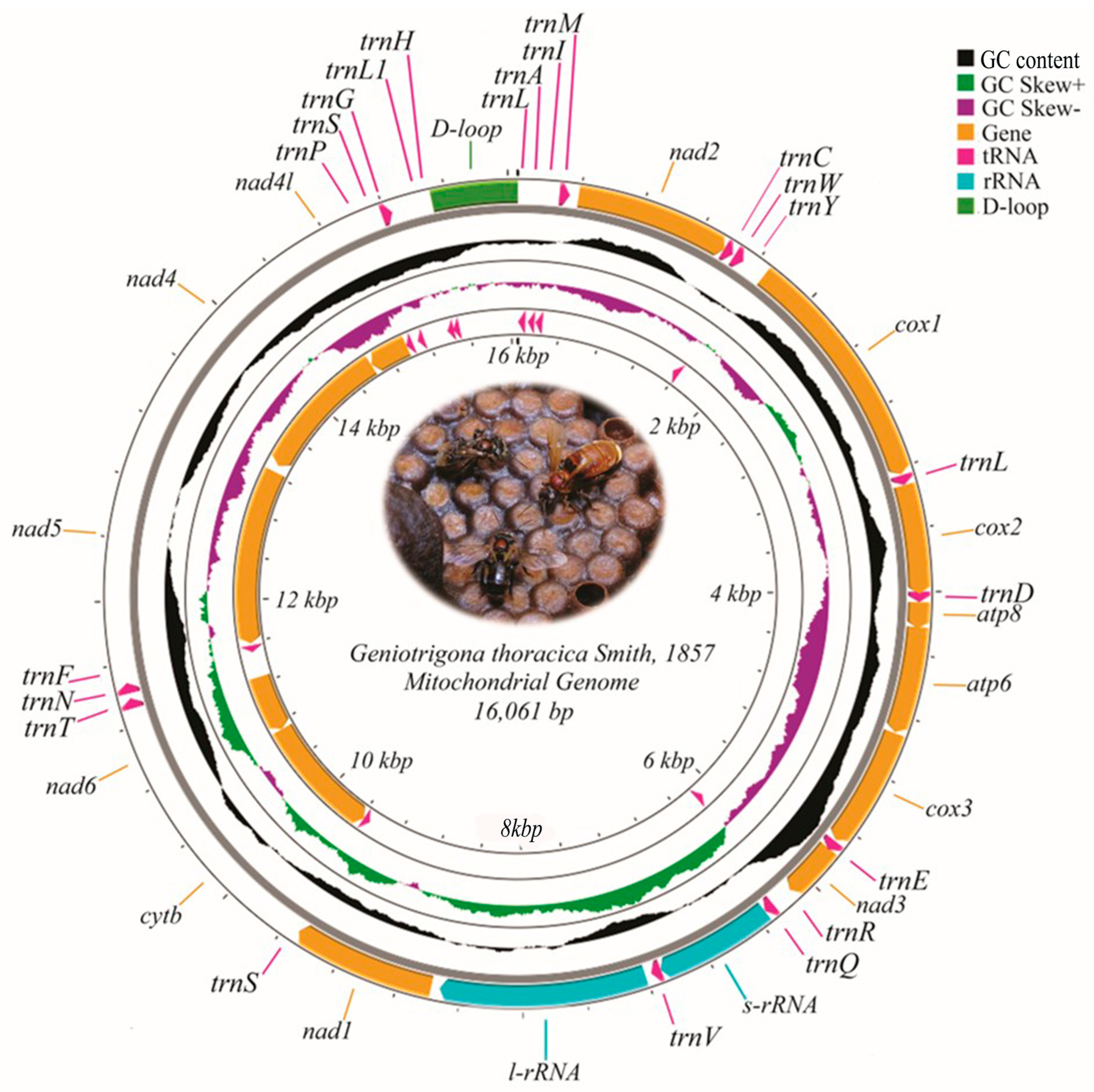
The complete circular mitochondrial genome of the stingless bee G. thoracica from Thailand was 16,061 bp in length (Figure 1). The genome comprised the typical set of 37 mitochondrial genes found in most insects, including 13 protein-coding genes (PCGs), 22 transfer RNA genes (tRNAs), and two ribosomal RNA genes (rRNAs) (Table 1; Figure 1). Analysis of strand distribution showed that 21 genes were encoded on the heavy strand (H-strand, +), whereas the remaining 16 genes were located on the light strand (L-strand, −) (Table 1). Among the annotated genes, the longest protein-coding gene was nad5 (1653 bp), while the shortest was tRNA-Leu1, which measured 55 bp in length. Most tRNA genes exhibited the typical cloverleaf secondary structure characteristic of insect mitochondrial genomes.
The nucleotide composition of the mitogenome showed a pronounced A + T bias, a common feature of insect mitochondrial DNA. This compositional bias was also reflected in the codon usage patterns of the protein-coding genes and in the distribution of AT and GC skews across the genome. Detailed information on nucleotide composition, gene boundaries, and strand orientation is provided in Table 1 and Table 2.

3.2. PCGs and Codon Usage Bias

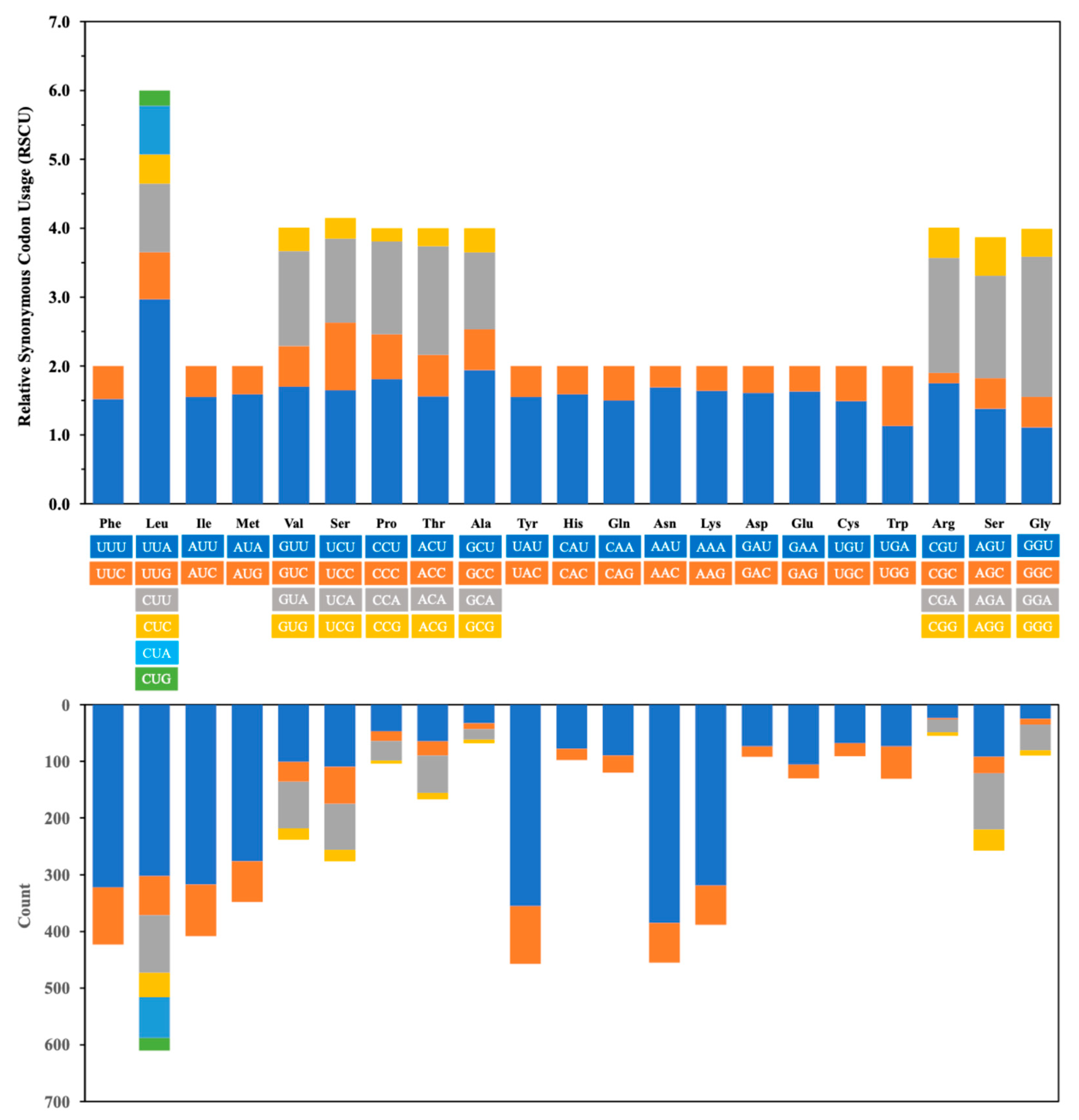
Of the 16,061 bp constituting the complete mitochondrial genome of G. thoracica, 13 protein-coding genes (PCGs) were identified, accounting for 11,190 bp (69.67%) of the genome. The lengths of the PCGs ranged from 168 bp (atp8) to 1653 bp (nad5). Five genes (cytb, nad6, nad5, nad4, and nad4l) were encoded on the light strand (L-strand, −), whereas the remaining eight PCGs were located on the heavy strand (H-strand, +). Four types of start codons (ATC, ATT, ATG, and ATA) were observed among the PCGs. The gene nad2 initiated with ATC, whereas ATT served as the start codon for cox1 and atp8. ATG was the most frequently used initiation codon and was detected in nine genes (cox2, cox3, atp6, cytb, nad1, nad3, nad4, nad5, and nad6), while nad4l began with ATA. Regarding termination codons, ten PCGs (cox2, atp8, cytb, nad1, nad2, nad3, nad4, nad4l, nad5, and nad6) ended with TAA, whereas the remaining three genes used TAG as the stop codon. The relative synonymous codon usage (RSCU) and amino acid composition of the PCGs are summarized in Table 3. Among the encoded amino acids, leucine (Leu) was the most abundant, while arginine (Arg) was the least represented (Figure 2). Codon usage analysis indicated that AAU, UAU, UUU, and AAA were the most frequently utilized codons in the mitochondrial genome of G. thoracica (Table 3).

3.3. Transfer RNAs and Ribosomal RNAs

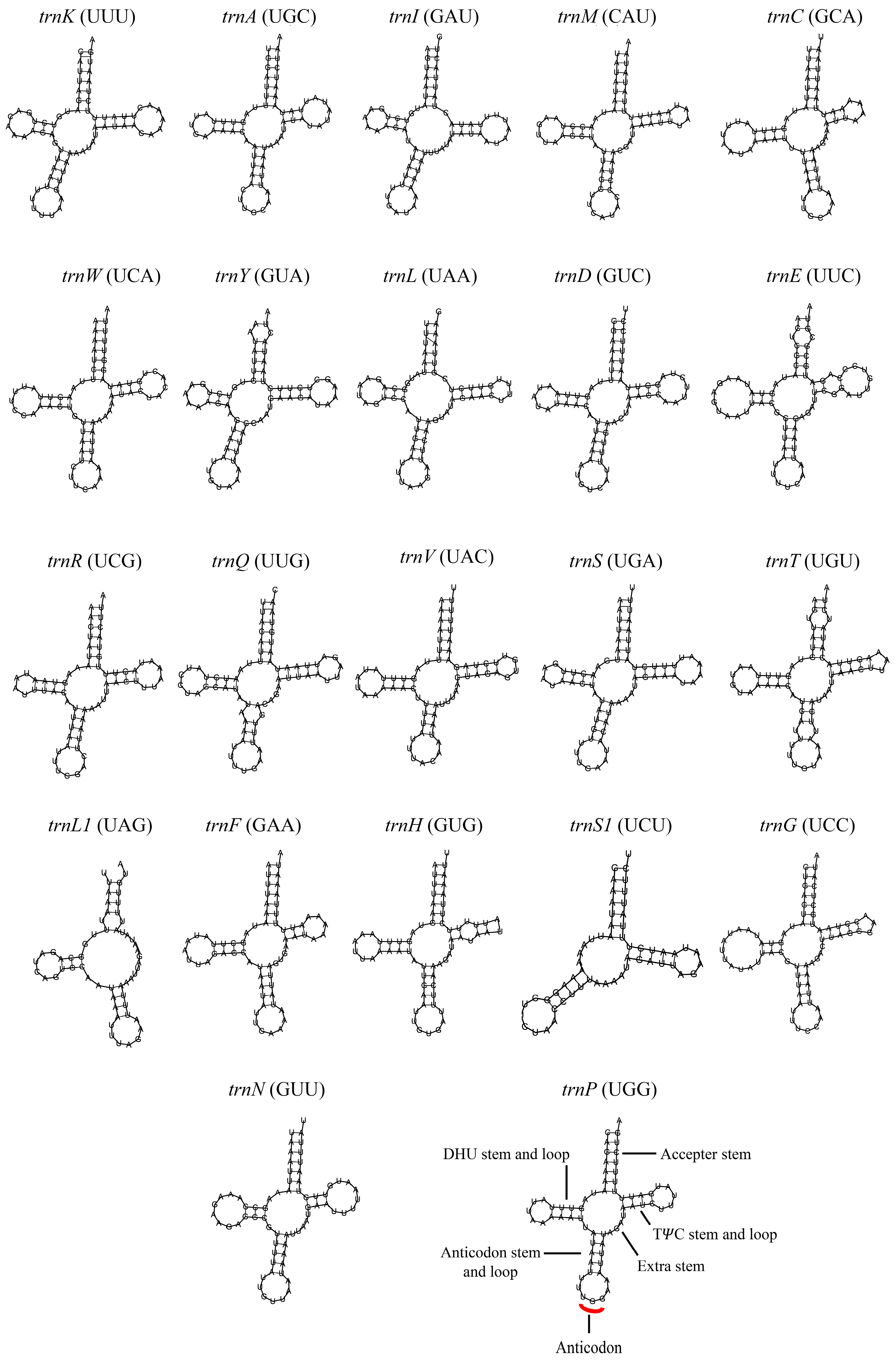
A total of 22 transfer RNA (tRNA) genes were identified in the mitochondrial genome of G. thoracica, with lengths ranging from 55 bp (trnL1) to 70 bp (trnE). Of these, 12 tRNAs were encoded on the heavy strand (H-strand, +), whereas the remaining 10 were located on the light strand (L-strand, −) (Table 1; Figure 1). Collectively, the tRNA genes spanned 1445 bp, representing 8.99% of the total mitogenome length (Table 1). Most tRNAs could be folded into the typical cloverleaf secondary structure; however, trnL1 (UAG) lacked the canonical TΨC arm and loop (Figure 3). This structural feature was consistently recovered by MITOS and tRNAscan-SE predictions and was further confirmed by manual inspection of the predicted secondary structure.
The two ribosomal RNA genes (s-rRNA and l-rRNA) were both located on the H-strand (+). Together, they accounted for 2093 bp, comprising 13.03% of the complete mitogenome (Table 1). The small ribosomal subunit gene (s-rRNA) was 765 bp in length, positioned between trnQ and trnV, and exhibited an A + T content of 75.82%. The large ribosomal subunit gene (l-rRNA), measuring 1328 bp with an A + T content of 77.52%, was located between trnV and nad1 (Figure 1).

3.4. Intergenic Spacer and Overlapping Region

A total of 11 gene overlaps were identified in the mitochondrial genome of G. thoracica, comprising 52 bp in total length (Table 1). The size of these overlapping regions ranged from 1 to 14 bp. Such short overlaps are commonly observed in insect mitogenomes and are thought to contribute to genome compactness.
Intergenic spacer regions were more prevalent, with 23 spacers distributed throughout the mitogenome. These spacers varied in length from 1 to 145 bp and collectively accounted for 830 bp (Table 1). The three longest intergenic spacers were located between trnG and trnL1 (145 bp), trnY and cox1 (65 bp), and nad5 and nad4 (64 bp), respectively. These spacer regions were distinct from the putative control region, which was identified as the A + T-rich D-loop region. Therefore, they were not interpreted as part of the primary mitochondrial control/regulatory region. However, their positions adjacent to genes or gene blocks involved in rearrangement patterns, particularly around trnL1 and the nad5–nad4–nad4l region, suggest that these spacers may correspond to local rearrangement-associated breakpoint regions or remnants of past duplication-and-random-loss events. Nevertheless, because no functional assays were conducted, their regulatory significance remains uncertain and should be investigated in future comparative mitogenomic studies. The presence and distribution of intergenic spacers in G. thoracica are broadly consistent with patterns reported in other hymenopteran mitogenomes, including those of stingless bees, although spacer length and position commonly vary among species.

3.5. Phylogenomic Relationship

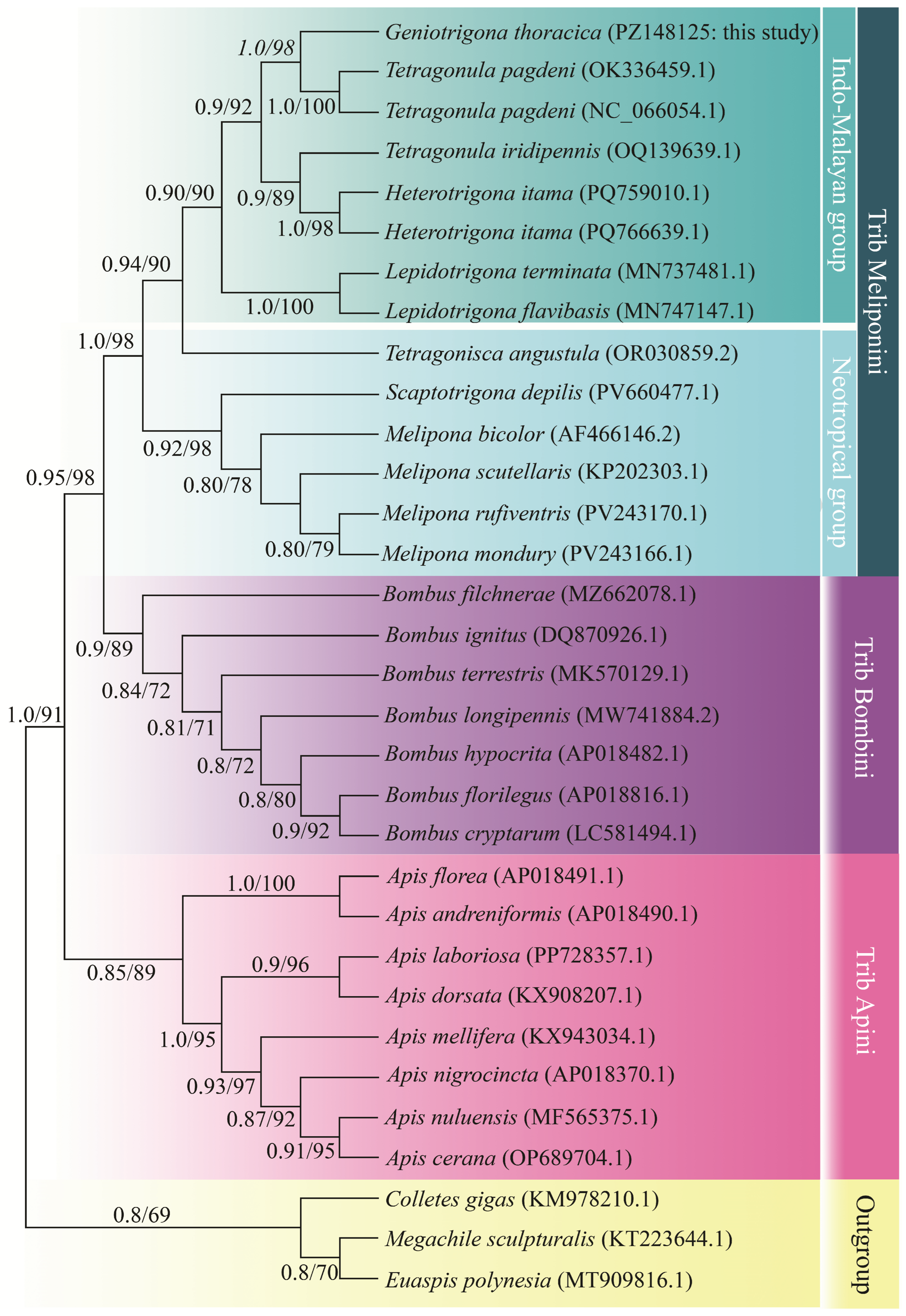
To investigate genome-scale evolutionary relationships in G. thoracica, phylogenomic analyses were conducted using concatenated nucleotide sequences of mitochondrial protein-coding genes from 32 representative hymenopteran species with complete mitogenomes available in GenBank. The phylogenetic analysis recovered three well-supported clades corresponding to the tribes Meliponini, Bombini, and Apini, with Colletes gigas (KM978210), Euaspis polynesia (MT909816), and Megachile sculpturalis (KT223644) designated as outgroups. All meliponine taxa (n = 14) formed a strongly supported monophyletic lineage [ML bootstrap = 98 and BI posterior probability = 1.0] (Figure 4), consistent with their shared evolutionary origin and the conserved structure of stingless bee mitogenomes. Within Meliponini, G. thoracica from southern Thailand clustered with Indo-Malayan stingless bees, including Tetragonula (T. pagdeni: OK336459.1, NC_066054.1; T. iridipennis: OQ139639), H. itama (PQ759010.1, PQ766639.1), and Lepidotrigona (L. terminata: MN737481.1; L. flavibasis: MN747147), forming a well-supported Indo-Malayan clade (ML bootstrap = 90; BI posterior probability = 0.9). In contrast, the remaining meliponine taxa formed a separate Neotropical lineage, including Tetragonisca angustula (OR030859), Scaptotrigona depilis (PV660477.1), and Melipona species (M. bicolor: AF466146; M. scutellaris: KP202303; M. fusciculata: MH680930; M. mondury: PV243166.1). This topology indicates geographic structuring among the sampled stingless bee lineages and is consistent with previously proposed separation between Indo-Malayan and Neotropical Meliponini. However, because the present analysis was based exclusively on mitochondrial genome data and did not include formal biogeographic reconstruction, divergence time estimation, or ecological niche analysis, the historical processes underlying this pattern cannot be resolved here. Therefore, explanations involving vicariance, long-term geographic isolation, dispersal limitation, or ecological specialization should be regarded as hypotheses requiring further testing with broader taxon sampling, nuclear genomic data, and fossil-calibrated biogeographic analyses.

3.6. Gene Rearrangement

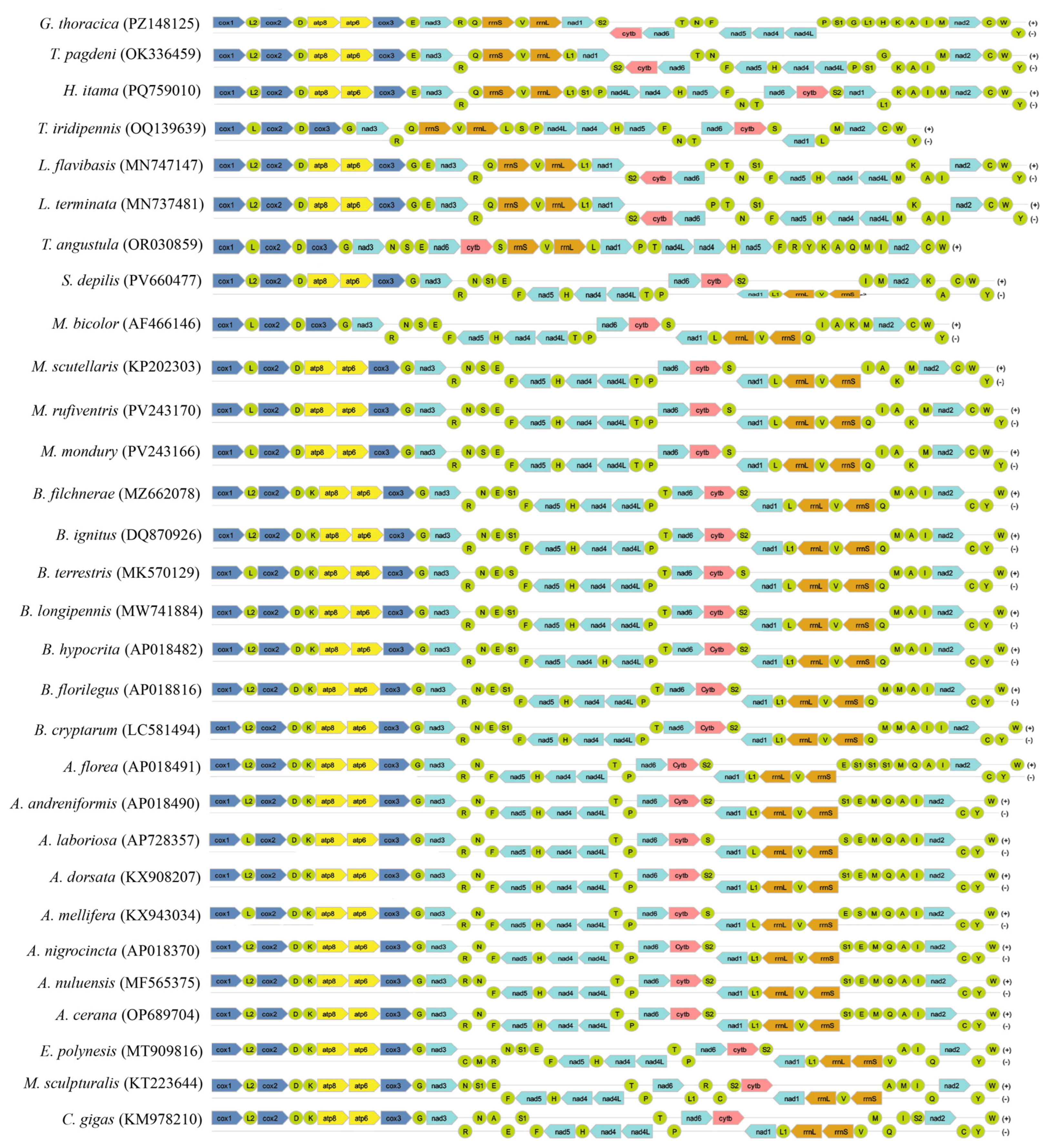
The mitochondrial gene arrangement of G. thoracica shows strong similarity to that of Indo-Malayan stingless bee taxa, yet it differs markedly from the conserved reference arrangement represented by Apis and Bombus (Figure 5; Table 4). Direct comparison with this reference gene order showed that several gene blocks in the G. thoracica mitogenome differ in position and/or orientation. In particular, the trnK–trnA–trnI–trnM–nad2 region in G. thoracica differs from the putative ancestral hymenopteran arrangement around the nad2 region. In addition, the trnF–nad5–nad4–nad4l–trnP block is positioned in an inverted orientation relative to the conserved arrangement observed in Apis and Bombus. These gene-order differences were therefore interpreted as rearrangements directly observed in G. thoracica relative to the reference arrangement.
Comparative analysis with other meliponine mitogenomes further showed that some rearrangement patterns are shared among Indo-Malayan stingless bees, whereas others appear to be lineage-specific. In G. thoracica, as well as in Heterotrigona and Tetragonula, the gene cluster around nad2 is organized as trnK–trnA–trnI–trnM–nad2. In contrast, Lepidotrigona exhibits an alternative arrangement, trnM–trnK–trnAc–trnI–nad2, whereas Melipona shows a more extensive modification, with the cluster reordered as trnQ–trnI–trnA–trnK–trnM–nad2 (Figure 5). Similarly, the canonical cox1–trnL–cox2–trnD–atp8–atp6–cox3 gene block, which is conserved in Apini and Bombini, appears to have undergone transposition in G. thoracica and other stingless bees (Figure 5). These results indicate that the G. thoracica mitogenome contains directly observed rearranged gene blocks relative to the Apis/Bombus reference arrangement, while broader conclusions regarding shared or lineage-specific rearrangements are based on comparative analysis across meliponine lineages.

4. Discussion

The insect mitochondrial genome, including hymenopterans, is typically organized as a circular, double-stranded DNA molecule ranging from approximately 15 to 19 kb in length [17,44,45]. It generally comprises a conserved set of 37 genes, including 13 protein-coding genes (PCGs), two ribosomal RNA (rRNA) genes, and 22 transfer RNA (tRNA) genes [18,46].
In the present study, the complete mitochondrial genome of G. thoracica was determined to be 16,061 bp in length. This genome size is consistent with those reported for other Indo-Malayan stingless bees, including H. itama (15,318 bp), T. iridipennis (15,045 bp), T. pagdeni (16,061 bp), L. flavibasis (15,408 bp), and L. terminata (15,431 bp). It also falls within the range observed in Neotropical Meliponini, such as M. rufiventris (15,289 bp), M. mondury (15,373 bp), and M. bicolor (15,001 bp). Furthermore, the mitogenome size of G. thoracica is comparable to those of Asian honeybees, including A. cerana (15,895 bp), A. nigrocincta (15,855 bp), A. nuluensis (15,843 bp), A. florea (15,993 bp), A. andreniformis (16,694 bp), A. laboriosa (15,235 bp), and A. dorsata (15,892 bp). In contrast, the mitochondrial genome of G. thoracica is notably smaller than those reported for bumblebees (genus Bombus), such as B. terrestris (17,232 bp), B. canariensis (17,300 bp), B. longipennis (18,458 bp), and B. filchnerae (18,553 bp). Overall, these comparisons indicate that the mitogenome size of G. thoracica is well conserved within Meliponini and broadly consistent with other members of Apis, while remaining smaller than those of Bombus species. The notable size discrepancy between Bombus and the Meliponini/Apis group is primarily attributable to differences in the length of intergenic non-coding regions and repeat-rich elements rather than variations in gene content, which remains invariant at 37 genes across corbiculate bees [17,44]. The compact mitogenome architecture shared by stingless bees and honeybees may therefore reflect a common selective pressure toward genomic streamlining in taxa with high colony-level metabolic demands [45].
A pronounced bias toward adenine and thymine (A + T) was observed in the mitochondrial genome of G. thoracica. Among the four nucleotides, thymine (T) was the most abundant, whereas guanine (G) was the least represented across the entire mitogenome. This pattern is consistent with previous reports indicating that stingless bee mitochondrial genomes are characterized by elevated A + T content [1,18,23,47]. The calculated nucleotide skewness values further support this compositional bias. The negative AT skew (−0.031) observed in G. thoracica is consistent with the strand-asymmetric replication model [48], in which the heavy strand spends prolonged periods in single-stranded form during replication, rendering it vulnerable to cytosine deamination (C → T) and adenine oxidation (A → G). These directional mutational pressures predictably produce an excess of T over A and C over G on the heavy strand—precisely the pattern observed here—and explain why AT skew is a conserved feature across corbiculate bee mitogenomes rather than a species-specific peculiarity. Overall, the observed nucleotide composition and skewness in G. thoracica are consistent with patterns reported for other corbiculate bee mitochondrial genomes, reinforcing the conserved nature of this genomic characteristic [4,7,15,24,49].
The predominantly maternal inheritance of mtDNA and the mitochondrial genetic bottleneck during oogenesis are expected to promote homoplasmy [50,51,52,53], supporting the interpretation of the assembled G. thoracica mitogenome as representing a single functional haplotype and underpinning the reliability of mitochondrial markers in phylogenetic studies [54].
The interpretation of the assembled sequence as genuine mitochondrial DNA, rather than a nuclear mitochondrial DNA segment (NUMTs), is supported by several converging lines of evidence. NUMTs are mitochondrial-derived sequences that have been integrated into the nuclear genome and are known to occur in Hymenoptera, including stingless bees; Cristiano et al. (2012) [27] demonstrated their presence in Melipona species, where NUMT copies of cox1 contained insertions, deletions, and internal stop codons that distinguished them from functional mitochondrial sequences. In the present study, three criteria collectively support the authenticity of the G. thoracica assembly. First, mitochondrial DNA was selectively enriched before sequencing using the REPLI-g Mitochondrial DNA Kit, which preferentially amplifies circular mitochondrial molecules via rolling-circle amplification and thereby reduces the representation of NUMTs in the library. Second, the final assembly produced a single complete circular contig of 16,061 bp supported by both reference-guided mapping and de novo assembly, a structural property inconsistent with nuclear chromosomal integration. Third, all 13 protein-coding genes harbor intact open reading frames, with no unexpected internal stop codons, frameshifts, or insertion–deletion variants of the type that characterize NUMT pseudogenes (Cristiano et al., 2012) [27]. Taken together, these observations make the incorporation of NUMTs into the final assembly unlikely. We nonetheless acknowledge that, in the absence of a high-quality nuclear genome for direct NUMTs screening, their complete exclusion cannot be formally guaranteed, and future long-read sequencing combined with nuclear genome assembly would allow definitive characterization of NUMTs in G. thoracica.
In the present study, the A + T content of the G. thoracica mitogenome was 80.4%, which is consistent with the typically high A + T bias observed in corbiculate bees. However, this value is lower than those reported for stingless bees of the genus Melipona, such as M. bicolor (86.7%) and M. scutellaris (86.8%) [55].
As observed in other meliponine bees, such as L. terminata [6], L. flavibasis [23], T. pagdeni [1], T. iridipennis [4], and H. itama [15], all 13 PCGs [three cytochrome oxidases (cox1, cox2, and cox3), seven NADH dehydrogenases (nad1, nad2, nad3, nad4, nad4l, nad5, and nad6), one cytochrome b gene (cytb), and two ATPases (atp6 and atp8)] were allocated throughout the mitogenome of G. thoracica, with slight variations in size and position. No anomalous initiation codons were observed in any of the 13 PCGs of the G. thoracica mitogenome, as found in L. flavibasis (GTG start codon for nad2) [23] and A. cerana (GTG start codon for nad2) [56]. In G. thoracica, degenerate codon positions preferentially use A and T over G and C, a pattern also observed in T. pagdeni [1] and T. iridipennis [4]. This bias is best explained as a consequence of directional mutational pressure driven by the strand-asymmetric replication mechanism, in which the heavy strand is disproportionately exposed to cytosine deamination and adenine oxidation during replication [48,57]. Importantly, the uniformity of this codon bias across Indo-Malayan stingless bee mitogenomes implies that it reflects a shared replication-associated mutational process operating across the lineage rather than translational selection toward a particular tRNA pool. Most PCGs terminated with the standard stop codons TAA and TAG, and no incomplete stop codons were detected, in contrast to H. itama [15], where an incomplete stop codon has been reported in nad4. The universal use of standard ATN initiation codons across all 13 PCGs of G. thoracica, unlike the GTG start codon found in L. flavibasis and A. cerana [23,56], suggests that G. thoracica retains the ancestral translational initiation strategy of corbiculate bees, and that alternative initiation codons represent lineage-specific derived states rather than a conserved feature of the group. The preferential use of A- and T-ending synonymous codons in G. thoracica reflects genome-wide mutational pressure rather than translational optimization, consistent with the broader pattern of AT bias driven by strand-asymmetric replication [57]. The universal use of standard ATN initiation codons across all 13 PCGs of G. thoracica, in contrast to the GTG start codon documented in L. flavibasis and A. cerana, suggests that G. thoracica retains a more ancestral translational initiation strategy and has not experienced the alternative initiation events observed in those lineages.
The predicted secondary structures of tRNAs in G. thoracica are largely consistent with those described for other stingless bees, including T. pagdeni [1], L. flavibasis [23], and H. itama [15]. However, minor structural variations were observed, particularly in the TΨC arm and loop regions [58]. Notably, trnL1 (Leu, UAG) lacks the canonical TΨC arm and loop (Figure 3), resulting in a simplified loop structure rather than the typical cloverleaf configuration. Similar structural deviations have been reported in the mitochondrial genomes of several stingless bee species [4,15,23,58]. The anticodon sequences are conserved across stingless bees, as documented in previous studies [4,6,15,23]. The recurrent loss of the TΨC arm in trnL1 across multiple Meliponini species is evolutionarily significant because this arm normally mediates ribosomal interaction during translation elongation [58]. Its absence implies that trnL1 relies on alternative tertiary contacts or compensatory structural elements to remain functional—an accommodation that appears to have been fixed early in the stingless bee lineage, reflecting the relaxed structural constraint on mitochondrial tRNAs relative to their cytoplasmic homologs.
Consistent with the findings of Silvestre et al. [58], the anticodon loops of 19 tRNAs in G. thoracica comprise seven nucleotides, with corresponding stems containing five base pairs. Exceptions were observed in trnS2 and trnV, which possess only four base pairs in the anticodon stem, a feature which has also been reported for A. mellifera trnV [59]. In addition, the acceptor stem of G. thoracica is conserved at 7 bp in length, a characteristic commonly observed among Meliponini stingless bees [58]. Furthermore, in agreement with the typical organization of insect mitochondrial genomes, a single copy each of the small (s-rRNA, 12S) and large (l-rRNA, 16S) ribosomal RNA genes was identified in G. thoracica (Table 1). Consistent with the typical organization of animal mitogenomes, a total of 22 tRNA genes were identified in G. thoracica in the present study. Mismatched base pairs within tRNA stems were observed, a feature that has been widely reported in hymenopteran mitogenomes, including those of T. pagdeni [1], L. flavibasis [23], M. bicolor [58], A. cerana [60], and Bombus ignitus [46]. Such mismatches are a common characteristic of mitochondrial tRNAs in bees and are generally corrected through post-transcriptional RNA editing mechanisms [45,58,60]. In the present study, four mismatched base pairs were identified within the acceptor stems of tRNAs in the G. thoracica mitogenome. Specifically, trnL and trnT each exhibited a single T–T mismatch, whereas trnW and trnE contained A–C and T–C mismatches, respectively, within the same region (Figure 3).
The relative positions of the two ribosomal RNA genes in the G. thoracica mitogenome are conserved and consistent with those observed in Indo-Malayan stingless bees, including T. iridipennis [4], T. pagdeni [1], H. itama [15], and L. flavibasis [23]. In contrast, this arrangement differs from that reported in Neotropical stingless bees, such as species of the genus Melipona [58], which likely contributes to their separation into distinct clades in phylogenetic analyses (Figure 4). This differential rRNA positioning between Indo-Malayan and Neotropical Meliponini likely represents a derived genomic state and may constitute a mitogenomic synapomorphy corroborating the deep divergence between these two geographic lineages. Verification across a broader taxon sample would confirm whether this rearrangement can serve as a phylogenetically informative character complementary to sequence-based markers.
Phylogenetic analyses based on complete mitochondrial genome sequences can provide greater resolution than single-gene approaches by integrating phylogenetic signals across all 13 PCGs simultaneously [4,23]; however, the mitochondrial genome remains a single linked locus and its phylogenetic signal may be compromised by incomplete lineage sorting, mitochondrial introgression, or selection, particularly in recently diverged lineages. In this study, the complete mitochondrial genome of G. thoracica, together with those of 29 representative hymenopteran species (32 candidate sequences) retrieved from GenBank, was used to infer phylogenetic relationships. The resulting topology strongly supports a close relationship between G. thoracica and other stingless bee species (Figure 4). Phylogenetic reconstruction further revealed that G. thoracica clusters within the Indo-Malayan clade alongside T. iridipennis, T. pagdeni, H. itama, L. terminata, and L. flavibasis, with high support values. This clade is clearly distinct from the Neotropical stingless bee lineage, including genera such as Tetragonista, Scaptotrigona, and Melipona. These findings are consistent with established taxonomic classifications based on both morphological characteristics and molecular evidence. Three well-supported major clades were recovered within the family Apidae, corresponding to Apini, Bombini, and Meliponini. This topology is consistent across all analytical approaches employed. In agreement with previous studies (e.g., Zhao et al. [49]; Wang et al. [6]; Karuppaiah et al. [4]; Duangphakdee et al. [15]), our results indicate that stingless bees (Meliponini) share a closer evolutionary relationship with bumblebees (Bombini) than with honeybees (Apini). Overall, the phylogenetic framework obtained in this study provides strong mitogenomic support for the major evolutionary relationships among hymenopteran lineages within Apidae, consistent with prior morphological and molecular evidence. Nevertheless, the exclusively mitochondrial nature of the dataset means that the inferred relationships, particularly those pertaining to biogeographic structuring and divergence between Indo-Malayan and Neotropical Meliponini, should be regarded as well-supported hypotheses rather than definitive conclusions, pending verification with independent nuclear markers. We note, however, that the present phylogenomic framework relies exclusively on mitochondrial genome sequences, which represent a single non-recombining locus and may not fully reflect the underlying nuclear gene history due to incomplete lineage sorting, introgression, or selection on mitochondrial genes. The topological conclusions presented here should therefore be regarded as hypotheses to be tested with independent nuclear markers and fossil-calibrated divergence time analyses.
The consistent recovery of Meliponini and Bombini as sisters to Apini across both ML and BI frameworks strengthens confidence that this topology reflects genuine evolutionary history rather than analytical artifacts such as long-branch attraction or compositional bias. The clear geographic structuring within Meliponini, with Indo-Malayan and Neotropical clades strongly separated, is broadly consistent with a Gondwanan vicariance hypothesis for Meliponini diversification [61], though we acknowledge that this biogeographic interpretation remains provisional given that the present analysis relies exclusively on mitochondrial data. A definitive biogeographic scenario will require corroboration from multi-locus nuclear phylogenies combined with fossil-calibrated divergence time estimation.
In the present study, the trnK gene was identified in close proximity to the control region of the G. thoracica mitochondrial genome. This arrangement conforms to the gene order observed in other Indo-Malayan stingless bees, characterized by the cluster trnK–trnA–trnI–trnM–nad2 (Table 1; Figure 5). In contrast, alternative configurations, such as trnM–trnK–trnA–trnI–nad2, have been reported in the genus Lepidotrigona [23] and in the Neotropical genus Melipona [24]. Based on these comparative patterns, the putative ancestral gene arrangement is inferred to be trnI–trnA–trnK–trnM–nad2 [62], a configuration broadly conserved across hymenopteran mitogenomes [4,49,63].
Mitochondrial gene rearrangements in insects may arise through several mechanisms, including TDRL, transposition, inverse transposition, and gene inversion [18,21]. Across Hymenoptera, the rate and extent of rearrangement vary substantially among lineages: the ancestral gene order is largely conserved in Apis and Bombus [1,60], whereas parasitoid wasps such as Trichogramma exhibit some of the most extensively rearranged hymenopteran mitogenomes documented to date [21]. Stingless bees occupy an intermediate position in this spectrum, more rearranged than corbiculate outgroups yet less scrambled than certain parasitoids, suggesting that Meliponini mitogenomes are subject to elevated but not extreme genomic instability. Within this context, the shared absence of the conserved trnD–trnL gene cluster across G. thoracica and all examined Indo-Malayan stingless bees indicates that the repositioning of trnL occurred early in the diversification of the stingless bee lineage, predating the Indo-Malayan/Neotropical split [4,15]. Under the TDRL model [64], the trnK–trnA–trnI–trnM–nad2 configuration shared among Indo-Malayan stingless bees likely arose from a single duplication-and-loss event in their common ancestor, constituting a potential mitogenomic synapomorphy for Meliponini relative to Apini and Bombini and strengthening its utility as a phylogenetic marker independent of sequence data [1,15,60].
Our analysis further identified a major gene rearrangement involving the block nad3trnRtrnQs-rRNAl-rRNA in the G. thoracica mitogenome. In the putative ancestral hymenopteran arrangement, these genes are distributed across two separate conserved clusters: nad3 is located adjacent to trnA and trnN, while the ribosomal RNA genes are embedded within the nad1trnLl-rRNAtrnVs-rRNA region [4,18,63] (Figure 5). In G. thoracica, this ancestral organization is disrupted: nad3 occurs in tandem with trnR and trnQ, while s-rRNA and l-rRNA are repositioned within this same rearranged block. Importantly, this rearrangement is not unique to G. thoracica but is shared with related Indo-Malayan stingless bee taxa, suggesting that it likely arose in their common ancestor and may represent a shared mitogenomic feature of this lineage. The most parsimonious explanation for this rearrangement is the TDRL model [64]: an ancestral duplication of the nad3–rRNA region followed by non-random loss of one copy produced the derived gene order observed in G. thoracica. Importantly, this rearrangement is not unique to G. thoracica but is shared with other Indo-Malayan stingless bee species [4,15], suggesting it arose in their common ancestor and may represent a synapomorphic genomic signature for this clade.
A recent study by Yong et al. [62] also reported the complete mitochondrial genome of G. thoracica from a specimen collected in Bidor, Perak, Peninsular Malaysia. Although both studies focus on the same species, the present work differs in geographic sampling, methodology, and analytical scope. Our specimens were collected from Pattani Province, southern Thailand, representing a geographically distinct population within the broad distribution range of G. thoracica. Methodologically, we used the REPLI-g Mitochondrial DNA Kit to enrich mitochondrial DNA prior to sequencing, reducing the potential co-amplification of NUMTs and enabling the recovery of a single, high-confidence 16,061 bp mitogenome. In contrast, Yong et al. [62] reported heteroplasmy in the Malaysian isolate, including a 16,045 bp canonical mitogenome and a 32,092 bp duplicated–rearranged mitogenome with whole-genome duplication, duplicated trnK and trnM genes, and long inverted repeats. These contrasting findings may reflect population-level variation in mitochondrial genome architecture, methodological differences in detecting heteroplasmic variants, or both. In addition, the present study extends previous work by providing detailed NUMTs authentication, comparative gene-order analysis, reconstruction of rearrangement patterns under the TDRL model, and broader phylogenomic comparisons among corbiculate bees. Thus, our study provides a geographically independent and complementary mitogenomic resource for G. thoracica and contributes additional evidence for dynamic mitochondrial genome evolution in Indo-Malayan stingless bees.
In tropical and subtropical regions, both agricultural crops and natural plant communities rely extensively on insect-mediated cross-pollination. Within this group, honeybees, stingless bees, and bumblebees, members of the family Apidae, serve as some of the most effective and ecologically significant pollinators. The characterization of the G. thoracica mitochondrial genome expands the current understanding of mitochondrial genome organization in Hymenoptera and provides a valuable set of molecular markers for future studies in population genetics, systematics, phylogenomics, and the biogeography of stingless bees.

5. Conclusions

This study presents a complete mitochondrial genome characterization of G. thoracica, revealing a 37-gene mitogenome with pronounced A + T bias, conserved codon usage, and predominantly standard tRNA structures. Although the overall gene arrangement is consistent with other Indo-Malayan stingless bees, several lineage-specific rearrangements are evident, including transposition and inversion of gene clusters. Phylogenomic reconstruction robustly resolved three well-supported clades within Apidae (Meliponini, Bombini, Apini), placing G. thoracica within the Indo-Malayan lineage alongside Tetragonula, Heterotrigona, and Lepidotrigona, and confirming a closer evolutionary affinity of stingless bees with bumblebees than with honeybees. The mitogenome of G. thoracica provides a useful reference for future comparative studies in population genetics, systematics, and phylogenomics.

Author Contributions

A.R.: Conceptualization, data curation, formal analysis, funding acquisition, project administration, software, validation, writing—original draft preparation, review, and editing. S.M.: Data curation, methodology, formal analysis, software, validation, writing—original draft preparation. P.P.: Data curation, writing—original draft preparation. All authors have read and agreed to the published version of the manuscript.

Funding

This study was supported by the Kasetsart University Research and Development Institute (KURDI) (grant number FF(KU) 52.69).

Institutional Review Board Statement

The animal study protocol was approved by the Animal Experiment Committee of Kasetsart University (protocol code ACKU68-AGR-005, approved on 24 January 2025).

Data Availability Statement

The original contributions presented in this study are included in the article. Further inquiries can be directed to the corresponding author.

Acknowledgments

We are grateful to the Department of Entomology, Faculty of Agriculture, and the Research and Lifelong Learning Center for Urban and Environmental Entomology, Kasetsart University, Bangkok, Thailand, for the laboratory support.

Conflicts of Interest

The authors declare that the research was conducted in the absence of any commercial or financial relationships that could be construed as potential conflicts of interest.

References

  1. Wang, C.Y.; Yang, P.L.; Zhao, M.; Xu, H.L.; Liu, L.N.; Feng, Y.; Wang, S.J. Unusual mitochondrial tRNA rearrangements in stingless bee Tetragonula pagdeni and phylogenetic analysis. Entomol. Sci. 2022, 25, e12526. [Google Scholar] [CrossRef] [Scilit]
  2. Quezada-Euán, J.J.G. Stingless Bees of Mexico: The Biology, Management and Conservation of an Ancient Heritage; Springer: New York, NY, USA, 2018. [Google Scholar]
  3. Rattanawannee, A.; Duangphakdee, O. Southeast Asian meliponiculture for sustainable livelihood. In Modern Beekeeping; Ranz, R.E.R., Ed.; IntechOpen: London, UK, 2019. [Google Scholar]
  4. Karuppaiah, V.; Gadge, A.S.; Shirsat, D.V.; Soumia, P.S.; Mainkar, P.; Kumar, S.; Jaiswa, D.K.; Mahajan, V. The complete mitochondrial genome of the Indian dammer bee, Tetragonula iridipennis, and the phylogenomics of Meliponini. Front. Ecol. Evol. 2023, 11, 1171242. [Google Scholar] [CrossRef] [Scilit]
  5. Rattanawannee, A.; Jeratthitikul, E.; Duangphakdee, O.; Oldroyd, B.P. Mitochondrial sequencing and geometric morphometrics suggest two clades in the Tetragonilla collina (Apidae: Meliponini) population of Thailand. Apidologie 2017, 48, 719–731. [Google Scholar] [CrossRef] [Scilit]
  6. Wang, C.Y.; Zhao, M.; Xu, H.L.; Zhang, F.L.; Zhong, Y.H.; Fengaan, Y.; Wang, S.J. Complete mitochondrial genome of the stingless bee Lepidotrigona terminate (Hymenoptera: Meliponinae) and phylogenetic analysis. Mitochondrial DNA Part B 2020, 5, 752–753. [Google Scholar] [CrossRef] [Scilit]
  7. Wang, S.J.; Wu, J.; Wubie, A.J.; Wang, C.Y. The complete mitochondrial genome of the stingless bee Meliplebeia beccarii (Hymenoptera: Apidae: Meliponini) and insights into unusual gene rearrangement. Int. J. Mol. Sci. 2025, 26, 10588. [Google Scholar] [CrossRef] [Scilit] [PubMed]
  8. Adler, M.; Escóbar-Márquez, L.; Solis-Soto, M.T.; Pinto, C.F. Stingless bees: Uses and management by meliponiculturist women in the Chaco region of Bolivia. J. Ethnobiol. Ethnomed. 2023, 19, 5. [Google Scholar] [CrossRef] [Scilit]
  9. Wongsa, K.; Meemongkolkiat, T.; Duangphakdee, O.; Prasongsuk, S.; Rattanawannee, A. Physicochemical properties, phenolic, flavonoid contents and antioxidant potential of stingless bee (Heterotrigona itama) honey from Thailand. Curr. Res. Nutr. Food Sci. 2023, 11, 246–257. [Google Scholar] [CrossRef] [Scilit]
  10. Duangphakdee, O.; Jeratthitikul, E.; Poolprasert, P.; Pongkitsittiporn, R.; Inson, C.; Rattanawannee, A. Human-mediated dispersal of Geniotrigona thoracica (Apidae: Meliponini) colonies promotes high genetic diversity and reduces population structuring in managed populations. PeerJ 2025, 13, e20460. [Google Scholar] [CrossRef] [Scilit]
  11. Wongsa, K.; Jeratthitikul, E.; Poolprasert, P.; Duangphakdee, O.; Rattanawannee, A. Genetic structure of the commercial stingless bee Heterotrigona itama (Apidae: Meliponini) in Thailand. PLoS ONE 2024, 19, e0312386. [Google Scholar] [CrossRef] [Scilit]
  12. Mohd Saufi, N.F.; Thevan, K. Characterization of nest structure and foraging activity of stingless bee, Geniotrigona thoracica Smith (Hymenoptera: Apidae; Meliponini). J. Teknol. 2015, 77, 69–74. [Google Scholar] [CrossRef] [Scilit]
  13. Ivorra, T.; Hauser, M.; Low, V.L.; Tomberlin, J.K.; Nur Aliah, N.A.; Cammack, J.A.; Heo, C.C. Hermetia illucens and Hermetia fenestrata (Diptera: Stratiomyidae) colonization of “Spoiled” stingless bee Geniotrigona thoracica (Hymenoptera: Apidae) hives in Malaysia. Insects 2020, 11, 737. [Google Scholar] [CrossRef] [Scilit]
  14. Wongsa, K.; Duangphakdee, O.; Poolprasert, P.; Rattanawannee, A. External morphometric and microscopic analysis of the reproductive system in in-vitro reared stingless bee queens, Heterotrigona itama, and their mating frequency. PLoS ONE 2024, 19, e0306085. [Google Scholar] [CrossRef] [Scilit]
  15. Duangphakdee, O.; Poolprasert, P.; Rattanawannee, A. Complete mitochondrial genome characterization and phylogenomics of the stingless bee, Heterotrigona itama (Apidae: Meliponini). Insects 2025, 16, 535. [Google Scholar] [CrossRef] [Scilit]
  16. Al-Hatamleh, M.A.; Boer, J.C.; Wilson, K.L.; Plebanski, M.; Mohamud, R.; Mustafa, M.Z. Antioxidant-based medicinal properties of stingless bee products: Recent progress and future directions. Biomolecules 2020, 10, 923. [Google Scholar] [CrossRef] [Scilit]
  17. Boore, J.L. Animal mitochondrial genomes. Nucleic Acids Res. 1999, 27, 1767–1780. [Google Scholar] [CrossRef] [Scilit]
  18. Cameron, S.L. Insect mitochondrial genomics: Implications for evolution and phylogeny. Annu. Rev. Entomol. 2014, 59, 95–117. [Google Scholar] [CrossRef] [Scilit] [PubMed]
  19. Clary, D.O.; Wolstenholme, D.R. The mitochondrial DNA molecule of Drosophila yakuba: Nucleotide sequence, gene organization, and genetic code. J. Mol. Evol. 1985, 22, 252–271. [Google Scholar] [CrossRef] [Scilit]
  20. Shao, R.; Dowton, M.; Murrell, A.; Barker, S.C. Rates of gene rearrangement and nucleotide substitution are correlated in the mitochondrial genomes of insects. Mol. Biol. Evol. 2003, 20, 1612–1619. [Google Scholar] [CrossRef] [Scilit] [PubMed]
  21. Chen, L.; Chen, P.Y.; Xue, X.F.; Hua, H.Q.; Li, Y.X.; Zhang, F.; Wei, S.J. Extensive gene rearrangements in the mitochondrial genomes of two egg parasitoids, Trichogramma japonicum and Trichogramma ostriniae (Hymenoptera: Chalcidoidea: Trichogrammatidae). Sci. Rep. 2018, 8, 7034. [Google Scholar] [CrossRef] [Scilit]
  22. Li, Y.; Zhang, H.; Wu, X.; Li, D.; Yan, P.; Wu, X. The complete mitochondrial genome of Rhacophorus dennysi (Anura: Rhacophoridae) with novel gene arrangements and its phylogenetic implications. Pak. J. Zool. 2021, 53, 2013–2019. [Google Scholar] [CrossRef] [Scilit]
  23. Wang, C.Y.; Zhao, M.; Wang, S.J.; Xu, H.L.; Yang, Y.-M.; Liu, L.-N.; Feng, Y. The complete mitochondrial genome of Lepidotrigona flavibasis (Hymenoptera: Meliponini) and high gene rearrangement in Lepidotrigona mitogenomes. J. Insect Sci. 2021, 21, 10. [Google Scholar] [CrossRef] [Scilit]
  24. Li, Y.R.; Wang, Z.W.; Corlett, R.T.; Yu, W.B. Comparative analyses of mitogenomes in the social bees with insights into evolution of long inverted repeats in the Meliponini. Zool. Res. 2024, 45, 160–175. [Google Scholar] [CrossRef] [Scilit]
  25. Samsudin, S.F.; Mamat, M.R.; Hazmi, I.R. Taxonomic study on selected species of stingless bee (Hymenoptera: Apidae: Meliponini) in Peninsular Malaysia. Serangga 2018, 23, 203–258. [Google Scholar]
  26. Trianto, M.; Arisuryanti, T.; Purwanto, H.; Ubaidillah, R. Updated species check-list of the indonesian stingless bees (Hymenoptera, Apidae, Apinae, Meliponini). J. Trop. Biodivers. Biotechnol. 2023, 8, jtbb77160. [Google Scholar] [CrossRef] [Scilit]
  27. Cristiano, M.P.; Fernandes-Salomão, T.M.; Yotoko, K.S.C. Nuclear mitochondrial DNA: An Achilles’ heel of molecular systematics, phylogenetics, and phylogeographic studies of stingless bees. Apidologie 2012, 43, 527–538. [Google Scholar] [CrossRef] [Scilit]
  28. Li, H.; Durbin, R. Fast and accurate short read alignment with burrows wheeler transform. Bioinformatics 2009, 25, 1754–1760. [Google Scholar] [CrossRef] [Scilit] [PubMed]
  29. Li, H.; Handsaker, B.; Wysoker, A.; Fennell, T.; Ruan, J.; Homer, N.; Marth, G.; Abecasis, G.; Durbin, R.; Subgroup, G.P.D.P. The sequence alignment/map format and SAMtools. Bioinformatics 2009, 25, 2078–2079. [Google Scholar] [CrossRef] [Scilit]
  30. Bernt, M.; Donath, A.; Jühling, F.; Externbrink, F.; Florentz, C.; Fritzsch, G.; Pütz, J.; Middendorf, M.; Stadler, P.F. MITOS: Improved de novo metazoan mitochondrial genome annotation. Mol. Phylogenet. Evol. 2013, 69, 313–319. [Google Scholar] [CrossRef] [Scilit]
  31. Meng, G.; Li, Y.; Yang, C.; Liu, S. MitoZ: A toolkit for animal mitochondrial genome assembly, annotation and visualization. Nucleic Acids Res. 2019, 47, e63. [Google Scholar] [CrossRef] [Scilit] [PubMed]
  32. Gurevich, A.; Saveliev, V.; Vyahhi, N.; Tesler, G. QUAST: Quality assessment tool for genome assemblies. Bioinformatics 2013, 29, 1072–1075. [Google Scholar] [CrossRef] [Scilit]
  33. Grant, J.R.; Stothard, P. The CGView server: A comparative genomics tool for circular genomes. Nucleic Acids Res. 2008, 36, 181–184. [Google Scholar] [CrossRef] [Scilit] [PubMed]
  34. Stecher, G.; Suleski, M.; Tao, Q.; Tamura, K.; Kumar, S. MEGA 12.1: Coss-platform release for macOS and Linux operating systems. J. Mol. Evol. 2026, 94, 14–18. [Google Scholar] [CrossRef] [Scilit] [PubMed]
  35. Perna, N.T.; Kocher, T.D. Patterns of nucleotide composition at fourfold degenerate sites of animal mitochondrial genomes. J. Mol. Evol. 1995, 41, 353–358. [Google Scholar] [CrossRef] [Scilit]
  36. Ronquist, F.; Teslenko, M.; van der Mark, P.; Ayres, D.L.; Darling, A.; Höhna, S.; Larget, B.; Liu, L.; Suchard, M.A.; Huelsenbeck, J.P. MrBayes 3.2: Efficient Bayesian phylogenetic inference and model choice across a large model space. Syst. Biol. 2012, 61, 539–542. [Google Scholar] [CrossRef] [Scilit]
  37. Miller, M.A.; Pfeiffer, W.; Schwartz, T. Creating the CIPRES Science Gateway for inference of large phylogenetic trees. In Proceedings of the 2010 Gateway Computing Environments Workshop (GCE), New Orleans, LA, USA, 14 November 2010; pp. 1–8. [Google Scholar] [CrossRef] [Scilit]
  38. Minh, B.Q.; Schmidt, H.A.; Chernomor, O.; Schrempf, D.; Woodhams, M.D.; von Haeseler, A.; Lanfear, R. IQ-TREE 2: New models and efficient methods for phylogenetic inference in the genomic era. Mol. Biol. Evol. 2020, 37, 1530–1534. [Google Scholar] [CrossRef] [Scilit] [PubMed]
  39. Hoang, D.T.; Chernomor, O.; von Haeseler, A.; Minh, B.Q.; Vinh, L.S. UFBoot2: Improving the ultrafast bootstrap approximation. Mol. Biol. Evol. 2018, 35, 518–522. [Google Scholar] [CrossRef] [Scilit]
  40. San Mauro, D.; Agorreta, A. Molecular systematics: A synthesis of the common methods and the state of knowledge. BMC Cell. Mol. Biol. Lett. 2010, 15, 311–341. [Google Scholar] [CrossRef] [Scilit]
  41. Zhang, D.; Gao, F.; Jakovlic, I.; Zou, H.; Zhang, J.; Li, W.X.; Wang, G.T. PhyloSuite: An integrated and scalable desktop platform for streamlined molecular sequence data management and evolutionary phylogenetics studies. Mol. Ecol. Resour. 2020, 20, 348–355. [Google Scholar] [CrossRef] [Scilit]
  42. Letunic, I.; Bork, P. Interactive tree of life (iTOL) v3: An online tool for the display and annotation of phylogenetic and other trees. Nucleic Acids Res. 2016, 44, W242–W245. [Google Scholar] [CrossRef] [Scilit]
  43. Zhang, J.; Kan, X.; Miao, G.; Hu, S.; Sun, Q.; Tian, W. qMGR: A new approach for quantifying mitochondrial genome rearrangement. Mitochondrion 2020, 52, 20–23. [Google Scholar] [CrossRef] [Scilit]
  44. De Mandal, S.; Chhakchhuak, L.; Gurusubramanian, G.; Kumar, N.S. Mitochondrial markers for identification and phylogenetic studies in insects—A review. DNA Barcodes 2014, 2, 1–9. [Google Scholar] [CrossRef] [Scilit]
  45. Zhang, D.X.; Hewitt, G.M. Insect mitochondrial control region: A review of its structure, evolution and usefulness in evolutionary studies. Biochem. Syst. Ecol. 1997, 25, 99–120. [Google Scholar] [CrossRef] [Scilit]
  46. Cha, S.Y.; Yoon, H.J.; Lee, E.M.; Yoon, M.H.; Hwang, J.S.; Jin, B.R.; Han, Y.S.; Kim, I. The complete nucleotide sequence and gene organization of the mitochondrial genome of the bumblebee, Bombus ignites (Hymenoptera: Apidae). Gene 2007, 392, 206–220. [Google Scholar] [CrossRef] [Scilit]
  47. Crozier, R.H.; Crozier, Y.C. The mitochondrial genome of the honeybee Apis mellifera: Complete sequence and genome organization. Genetics 1993, 133, 97–117. [Google Scholar] [CrossRef] [Scilit]
  48. Faith, J.J.; Pollock, D.D. Likelihood analysis of asymmetrical mutation bias gradients in vertebrate mitochondrial genomes. Genetics 2003, 165, 735–745. [Google Scholar] [CrossRef] [Scilit] [PubMed]
  49. Zhao, X.; Wu, Z.; Huang, J.; Liang, C.; An, J.; Sun, C. Complete mitochondrial genome of Bombus breviceps (Hymenoptera: Apidae). Mitochondrial DNA Part B 2017, 2, 604–606. [Google Scholar] [CrossRef] [Scilit]
  50. Vollmer, N.L.; Viricel, A.; Wilcox, L.; Moore, M.K.; Rosel, P.E. The occurrence of mtDNA heteroplasmy in multiple cetacean species. Curr. Genet. 2011, 57, 115–131. [Google Scholar] [CrossRef] [Scilit]
  51. Wolstenholme, D.R. Animal mitochondrial DNA: Structure and evolution. In Mitochondrial Genomes; Wolstenholme, D.R., Jeon, K.W., Eds.; Academic Press: San Diego, CA, USA, 1992; pp. 173–216. [Google Scholar]
  52. Zardoya, R. Recent advances in understanding mitochondrial genome diversity. F1000 Res. 2020, 9, 270. [Google Scholar] [CrossRef] [Scilit] [PubMed]
  53. Bendall, K.E.; Sykes, B.C. Length heteroplasmy in the first hypervariable segment of the human mtDNA control region. Am. J. Hum. Genet. 1995, 57, 248–256. [Google Scholar] [PubMed Central]
  54. Beheregaray, L.B. Twenty years of phylogeography: The state of the field and the challenges for the Southern Hemisphere. Mol. Ecol. 2008, 17, 3754–3774. [Google Scholar] [CrossRef] [Scilit]
  55. Françoso, E.; Zuntini, A.R.; Ricardo, P.C.; Santos, P.K.F.F.; Araujo, N.S.; Silva, J.P.N.; Gonçalves, L.T.; Brito, R.; Gloag, R.; Taylor, B.A.; et al. Rapid evolution, rearrangements and whole mitogenome duplication in the Australian stingless bees Tetragonula (Hymenoptera: Apidae): A steppingstone towards understanding mitochondrial function and evolution. Int. J. Biol. Macromol. 2023, 242, 124568. [Google Scholar] [CrossRef] [Scilit]
  56. Ding, X.; Yu, X.; Chen, J.; Su, R.; Li, J. The complete mitochondrial genome of Apis cerana-southern China (Hymenoptera: Apidae) and insights into the phylogenetics. Front. Genet. 2026, 16, 1737945. [Google Scholar] [CrossRef] [Scilit] [PubMed]
  57. Ballard, J.W.O.; Whitlock, M.C. The incomplete natural history of mitochondria. Mol. Ecol. 2004, 13, 729–744. [Google Scholar] [CrossRef] [Scilit]
  58. Silvestre, D.; Dowton, M.; Arias, M.C. The mitochondrial genome of the stingless bee melipona bicolor (Hymenoptera, Apidae, Meliponini): Sequence, gene organization and a unique tRNA translocation event conserved across the tribe meliponini. Genet. Mol. Biol. 2008, 31, 451–460. [Google Scholar] [CrossRef] [Scilit]
  59. Boardman, L.; Eimanifar, A.; Kimball, R.T.; Braun, E.L.; Fuchs, S.; Grünewald, B.; Ellis, J.D. The complete mitochondrial genome of Apis mellifera jemenitica (Insecta: Hymenoptera: Apidae), the Arabian honey bee. Mitochondrial DNA B Resour. 2020, 5, 875–876. [Google Scholar] [CrossRef] [Scilit]
  60. Tan, H.W.; Liu, G.H.; Dong, X.; Lin, R.Q.; Song, H.Q.; Huang, S.Y.; Yuan, Z.G.; Zhao, G.H.; Zhu, X.Q. The complete mitochondrial genome of the Asiatic cavity-nesting honeybee Apis cerana (Hymenoptera: Apidae). PLoS ONE 2011, 6, e23008. [Google Scholar] [CrossRef] [Scilit]
  61. Michener, C.D. The Bees of the World; The Johns Hopkins University Press: Baltimore, MD, USA, 2007. [Google Scholar]
  62. Yong, H.S.; Song, S.L.; Chua, K.O.; Liew, Y.J.M.; Chan, K.G.; Lim, P.E.; Eamsobhana, P. Complete mitochondrial genome of the stingless bee Geniotrigona thoracica (Hymenoptera, Apidae, Meliponini): Presence of genome duplication, heteroplasmy and inverted repeats. Mol. Biol. Rep. 2026, 53, 453. [Google Scholar] [CrossRef] [Scilit] [PubMed]
  63. Ramírez, S.R.; Nieh, J.C.; Quental, T.B.; Roubik, D.W.; Imperatriz-Fonseca, V.L.; Pierce, N.E. A molecular phylogeny of the stingless bee genus Melipona (Hymenoptera: Apidae). Mol. Phylogenet. Evol. 2010, 56, 519–525. [Google Scholar] [CrossRef] [Scilit] [PubMed]
  64. Boore, J.L. The duplication/random loss model for gene rearrangement exemplified by mitochondrial genomes of deuterostome animals. In Comparative Genomics: Empirical and Analytical Approaches to Gene Order Dynamics, Map Alignment and the Evolution of Gene Families; Sankoff, D., Nadeau, J.H., Eds.; Kluwer Academic Publishers: Alphen aan den Rijn, The Netherlands, 2000; pp. 133–147. [Google Scholar]
Figure 1. Circular map of the complete mitochondrial genome of Geniotrigona thoracica. The map shows the organization of 37 mitochondrial genes, including 13 protein-coding genes, 22 tRNA genes, and two rRNA genes. Genes encoded on the heavy strand (H-strand) and light strand (L-strand) are shown in opposite orientations. The inner rings indicate GC content and GC skew across the mitochondrial genome.
Diversity 18 00365 g001
Figure 2. Relative synonymous codon usage (RSCU) patterns of the mitochondrial genome of Geniotrigona thoracica. The bar chart illustrates the frequency of synonymous codons used in the 13 protein-coding genes. Different colors indicate codon families corresponding to the amino acids shown below the chart, with identical colors representing codons belonging to the same amino acid family.
Diversity 18 00365 g002
Figure 3. Predicted secondary structures of the 22 mitochondrial tRNA genes identified in the Geniotrigona thoracica mitogenome. Gene names are shown using standardized mitochondrial tRNA notation. Most tRNAs exhibit the typical cloverleaf secondary structure, whereas trnL1 (UAG) lacks the canonical TΨC arm and loop.
Diversity 18 00365 g003
Figure 4. Phylogenetic relationships of Geniotrigona thoracica and related bee taxa inferred from concatenated nucleotide sequences of 13 mitochondrial protein-coding genes (PCGs). The dataset included 32 taxa in total, comprising 29 ingroup corbiculate bee taxa representing Meliponini, Apini, and Bombini, and three outgroup taxa: Colletes gigas (KM978210), Euaspis polynesia (MT909816), and Megachile sculpturalis (KT223644). Phylogenetic reconstruction was performed using Maximum Likelihood (ML) and Bayesian Inference (BI) approaches. Numbers at nodes indicate ML ultrafast bootstrap values and Bayesian posterior probabilities, respectively. GenBank accession numbers are shown alongside species names.
Diversity 18 00365 g004
Figure 5. Comparative organization of mitochondrial gene arrangements among Geniotrigona thoracica and other analyzed bee mitogenomes. Homologous genes are indicated by identical colors, and their relative positions and orientations are shown to illustrate conserved gene blocks, transpositions, inversions, and lineage-specific rearrangement patterns. Gene abbreviations follow standardized mitochondrial notation.
Diversity 18 00365 g005
Table 1. Gene annotation and structural characteristics of the mitochondrial genome of Geniotrigona thoracica. Gene positions, lengths, strand orientation, start and stop codons, and intergenic regions are indicated.
LocusFull Name and FunctionPosition Length (bp)StrandIntergenic SpacerCodon Anti-
Codon
StartEndStartStop
tRNA-Lys (trnK)Transfer RNA for Lysine16969L22 TTT
tRNA-Ala (trnA)Transfer RNA for Alanine9215665L8 TGC
tRNA-Ile (trnI)Transfer RNA for Isoleucine16523167L35 GAT
tRNA-Met (trnM)Transfer RNA for Methionine26733367H55 CAT
nad2NADH dehydrogenase subunit 23891380990H–4ATCTAA
tRNA-Cys (trnC)Transfer RNA for Cysteine1381144565H12 GCA
tRNA-Trp (trnW)Transfer RNA for Tryptophan1458152568H28 TCA
tRNA-Tyr (trnY)Transfer RNA for Tyrosine1554161966L65 GTA
cox1cytochrome c oxidase subunit I168532441560H6ATTTAG
tRNA-Leu (trnL)Transfer RNA for Leucine3251331565H0 TAA
cox2cytochrome c oxidase subunit II33164000684H–14ATGTAA
tRNA-Asp (trnD)Transfer RNA for Aspartic acid4001406767H0 GTC
atp8ATP synthase F0 subunit 840684235168H–10ATTTAA
atp6ATP synthase F0 subunit 642264912687H5ATGTAG
cox3cytochrome c oxidase subunit III49185697780H8ATGTAG
tRNA-Glu (trnE)Transfer RNA for Glutamic acid5706577570H–9 TTC
nad3NADH dehydrogenase subunit 357766127351H–3ATGTAA
tRNA-Arg (trnR)Transfer RNA for Arginine6127619165L78 TCG
tRNA-Gln (trnQ)Transfer RNA for Glutamine6270633768H1 TTG
s-rRNA12S ribosomal RNA63397103765H–2
tRNA-Val (trnV)Transfer RNA for Valine7102716766H39 TAC
l-rRNA16S ribosomal RNA720785341328H55
nad1NADH dehydrogenase subunit 185819507926H–1ATGTAA
tRNA-Ser (trnS)Transfer RNA for Serine9507957367L–1 TCT
cytbcytochrome b957310,7211149L–1ATGTAA
nad6NADH dehydrogenase subunit 610,72111,257537L54ATGTAA
tRNA-Thr (trnT)Transfer RNA for Threonine11,31211,37766H32 TGT
tRNA-Asn (trnN)Transfer RNA for Asparagine11,41011,47768H20 GTT
tRNA-Phe (trnF)Transfer RNA for Phenylalanine11,49811,56265L18 GAA
nad5NADH dehydrogenase subunit 511,58113,2331653L64ATGTAA
nad4NADH dehydrogenase subunit 413,29814,6021305L2ATGTAA
nad4lNADH dehydrogenase subunit 4L14,60514,877273L–1ATATAA
tRNA-Pro (trnP)Transfer RNA for Proline14,97915,04365L54 TGG
tRNA-Ser (trnS1)Transfer RNA for Serine15,09815,15457L24 TCT
tRNA-Gly (trnG)Transfer RNA for Glycine15,17915,24769H145 TCC
tRNA-Leu1 (trnL1)Transfer RNA for Leucine15,39315,44955L–6 TAG
tRNA-His (trnH)Transfer RNA for Histidine15,44415,50865L0 GTG
D-loopA + T-rich control region15,50916,061552H
Table 2. Nucleotide composition and strand asymmetry (AT and GC skews) of the 13 protein-coding genes (PCGs) and two rRNAs in the Geniotrigona thoracica mitogenome.
GeneLengthT%C%A%G%AT%GC%GC SkewAT Skew
nad299040.916.130.412.671.328.7−0.12−0.15
cox1156041.414.929.414.370.829.2−0.02−0.17
cox268439.016.429.814.868.831.2−0.05−0.13
atp816839.916.735.18.375.025.0−0.34−0.06
atp668741.320.227.910.669.230.8−0.31−0.19
cox378038.119.628.813.566.933.1−0.18−0.14
nad335139.521.922.216.561.738.4−0.14−0.28
nad192646.28.335.110.481.318.70.11−0.14
cytb114944.512.331.711.576.223.8−0.03−0.17
nad653747.98.438.45.486.313.8−0.22−0.11
nad5165343.37.739.69.482.917.10.10−0.04
nad4130547.18.135.29.682.317.70.08−0.14
nad4l27349.85.534.410.384.215.80.30−0.18
s-rRNA76536.38.240.914.677.222.80.280.06
l-rRNA132838.19.240.412.378.821.50.140.03
Overall Mitogenome16,06139.411.737.911.077.322.7−0.031−0.019
Table 3. Codon usage and RSCU values of the 13 protein-coding genes in the Geniotrigona thoracica mitogenome.
AaCodonNRSCUAaCodonNRSCUAaCodonNRSCUAaCodonNRSCU
PheUUU(F)3221.52SerUCU(S)1101.65TyrUAU(Y)3551.55CysUGU(C)681.49
UUC(F)1010.48 UCC(S)650.98 UAC(Y)1020.45 UGC(C)230.51
LeuUUA(L)3022.97 UCA(S)811.22EndUAA (*)2871.65TrpUGA(W)741.13
UUG(L)690.68 UCG(S)200.3 UAG (*)600.35 UGG(W)570.87
CUU(L)1021ProCCU(P)471.81HisCAU(H)781.59ArgCGU(R)241.75
CUC(L)430.42 CCC(P)170.65 CAC(H)200.41 CGC(R)20.15
CUA(L)720.71 CCA(P)351.35GlnCAA(Q)901.5 CGA(R)231.67
CUG(L)220.22 CCG(P)50.19 CAG(Q)300.5 CGG(R)60.44
IleAUU(I)3171.55ThrACU(T)651.56AsnAAU(N)3851.69SerAGU(S)921.38
AUC(I)910.45 ACC(T)250.6 AAC(N)700.31 AGC(S)290.44
MetAUA(M)2761.59 ACA(T)661.58LysAAA(K)3191.64 AGA(S)991.49
AUG(M)720.41 ACG(T)110.26 AAG(K)690.36 AGG(S)370.56
ValGUU(V)1011.7AlaGCU(A)331.94AspGAU(D)741.61GlyGGU(G)251.11
GUC(V)350.59 GCC(A)100.59 GAC(D)180.39 GGC(G)100.44
GUA(V)821.38 GCA(A)191.12GluGAA(E)1061.63 GGA(G)462.04
GUG(V)200.34 GCG(A)60.35 GAG(E)240.37 GGG(G)90.4
Aa = Amino acid; N = Number of each codon; RSCU = relative synonymous codon usage. Asterisks (*) indicate termination codon.
Table 4. Comparison of selected mitochondrial gene blocks between the reference corbiculate bee arrangement and Geniotrigona thoracica.
Gene BlockReference Arrangement
Represented by Apis/Bombus
Arrangement in
G. thoracica
Interpretation
nad2 regiontrnI–trnQ–trnM–nad2 or conserved ancestral arrangement near nad2trnKtrnA–trnI–trnM–nad2Rearranged tRNA block relative to reference
cox1–cox3 regioncox1trnLcox2trnDatp8atp6cox3Same local order retained in G. thoracica but position
differs relative to reference
Conserved local block with inferred
transposition
nad5–nad4 regiontrnFnad5nad4nad4ltrnPtrnF–nad5–nad4–nad4l–trnP, located in opposite orientation relative to
reference
Inverted gene block
rRNA regionReference arrangement with rRNAs associated with the conserved
nad1–trnL–l-rRNA–trnV–s-rRNA
region
trnQ–s-rRNA–trnV–l-rRNA–nad1 region in G. thoracicaRearranged rRNA-
associated region
Disclaimer/Publisher’s Note: The statements, opinions and data contained in all publications are solely those of the individual author(s) and contributor(s) and not of MDPI and/or the editor(s). MDPI and/or the editor(s) disclaim responsibility for any injury to people or property resulting from any ideas, methods, instructions or products referred to in the content.