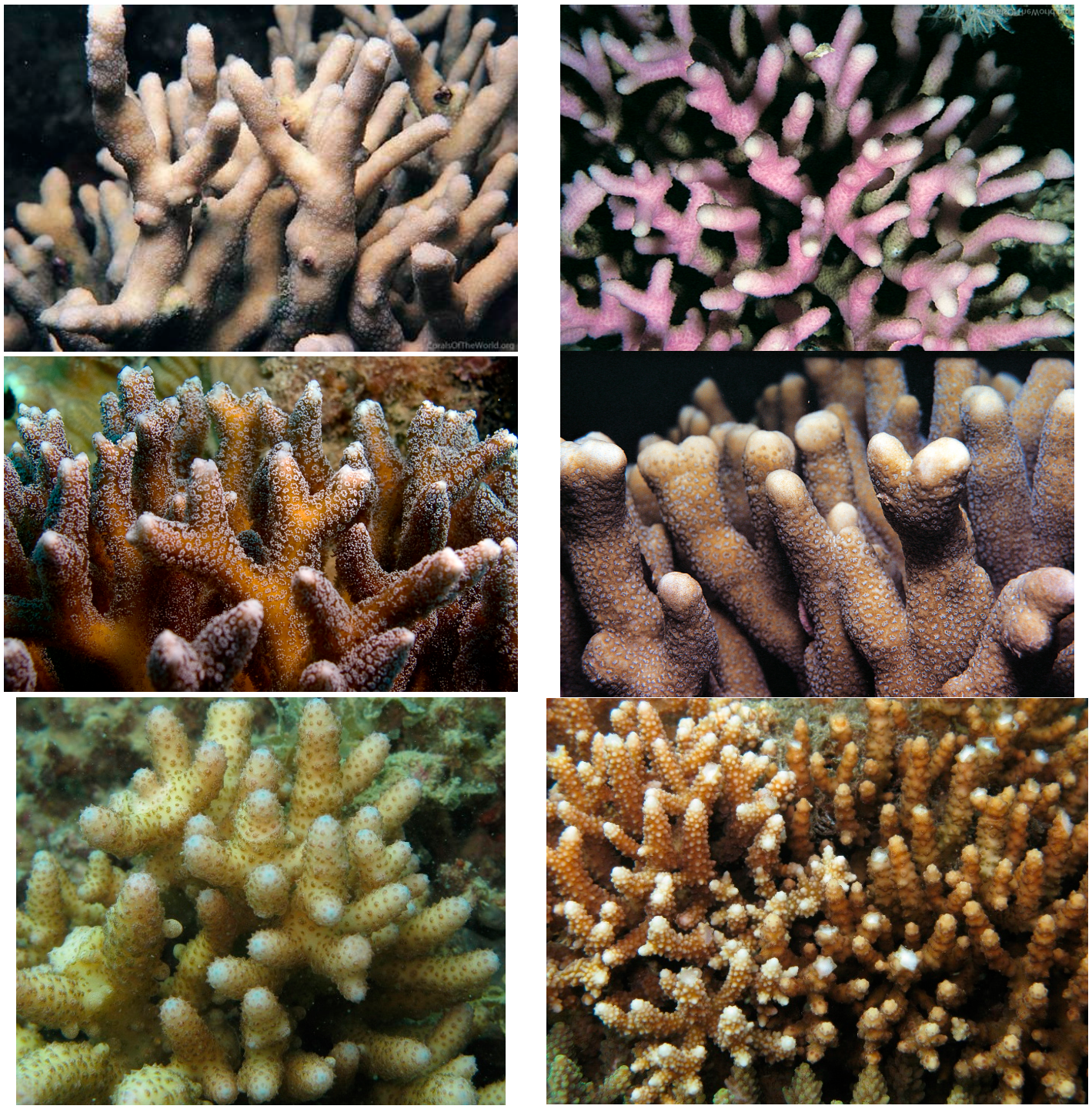
Modern Coral Taxonomy Requires Biologically Relevant Evidence. Reply to Cowman et al. Comments on “Veron et al. Review of Coral Taxonomy, Evolution and Diversity. Diversity 2025, 17, 823”


Abstract
1. Introduction
“… molecular studies have provided much greater insight into the phylogeny of species, resulting in name changes at all levels. Corals are at the forefront of marine invertebrate taxonomy, with molecular studies providing insights into the relationships within and between species. As a result, there have been many changes to phylogenetic positions and a greater understanding of species relationships using population genomics.”
2. Central Methodological and Conceptual Issues
2.1. “Biological Entities” and Alleged Non-Reproducibility
“Primary species hypotheses (PSHs) were identified as distinct molecular lineages … This allowed us to designate species names to particular lineages when the type material was available. However, it is important to note that this process does not necessarily capture the intraspecific variation required to delineate species boundaries in the field. Although the capacity to identify species in the field based on morphology is important for many research questions, it is beyond the scope of this study and will require numerous detailed studies focusing on a manageable number of species at a local scale.”(our bolding)
2.2. Integrative Taxonomy and Alleged Resistance to Genomics
2.3. Reproducibility and Alleged Double Standard
2.4. ICZN, Alleged Abandonment of Typification, and Taxonomic Stability
2.5. Sampling Scope, Type Specimen Context, and Genus and Species-Level Inference
2.6. Reticulate Evolution and Model Testing
2.7. Interpretation of Morphological Characters and Phylogenetic Signal
“Although this section deals with discrepancies, we note that we have accepted some of the recent shuffles of species across genera (see CoralsOfTheWorld.org (2026 in prep.) [236]) where these are warranted from both molecular and morphological viewpoints. We also note, however, that overt conflicts between morphology and molecular results require careful review.”
“We use the unified species concept (de Queiroz 2007), which defines a species simply as an ‘independently evolving metapopulation lineage’, and therefore allows the delineation of distinct evolutionary lineages without requiring species to be distinguishable morphologically or to exhibit intrinsic reproductive isolation.”(our bolding)
2.8. Convergence and the Interpretation of Morphological Concordance
2.9. Higher-Level Phylogeny Versus Species-Level Entities
2.10. Interpreting Phylogenomic Structure Under Gene-Tree Conflict and Incomplete Biological Sampling
2.11. Overview of Case Studies Discussed by Cowman et al.
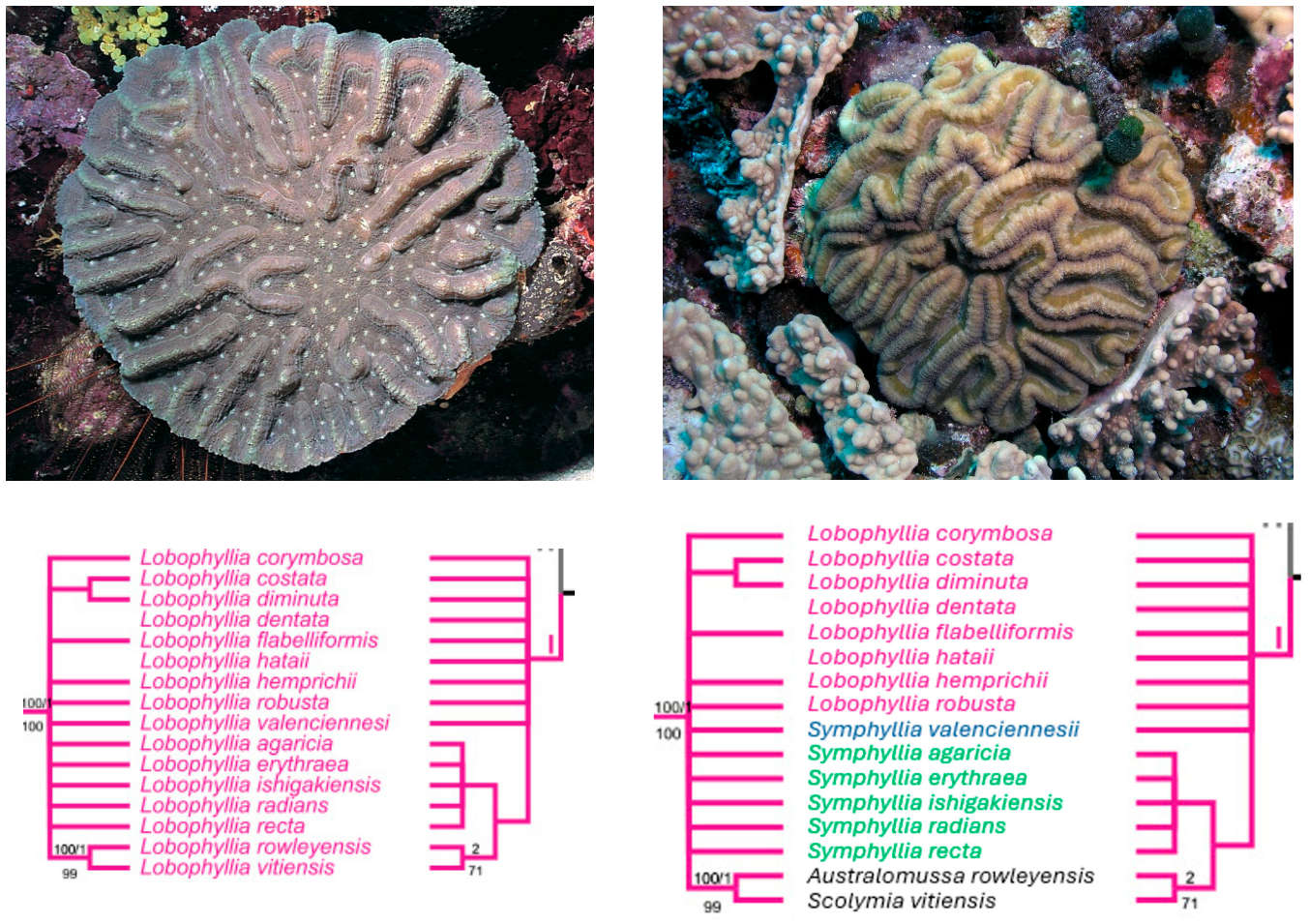
2.11.1. Symphyllia and Lobophyllia
- Developmental differences in colony form from juveniles to adults is common for species of both genera. However, adult colonies of Lobophyllia hataii (and all other Lobophyllia) are clearly differentiated from the massive meandroid Symphyllia valenciennesii, as indeed are all other Lobophyllia from Symphyllia.
- Juvenile and small colonies of Symphyllia valenciennesii and Lobophyllia hataii can share morphological similarity. Each develops along a growth trajectory leading to distinct mature morphologies, the former becoming distinctly massive and meandroid (like all other Symphyllia) and the latter flabello-meandroid to sub-phaceloid with deeply divided walls (like all other Lobophyllia).
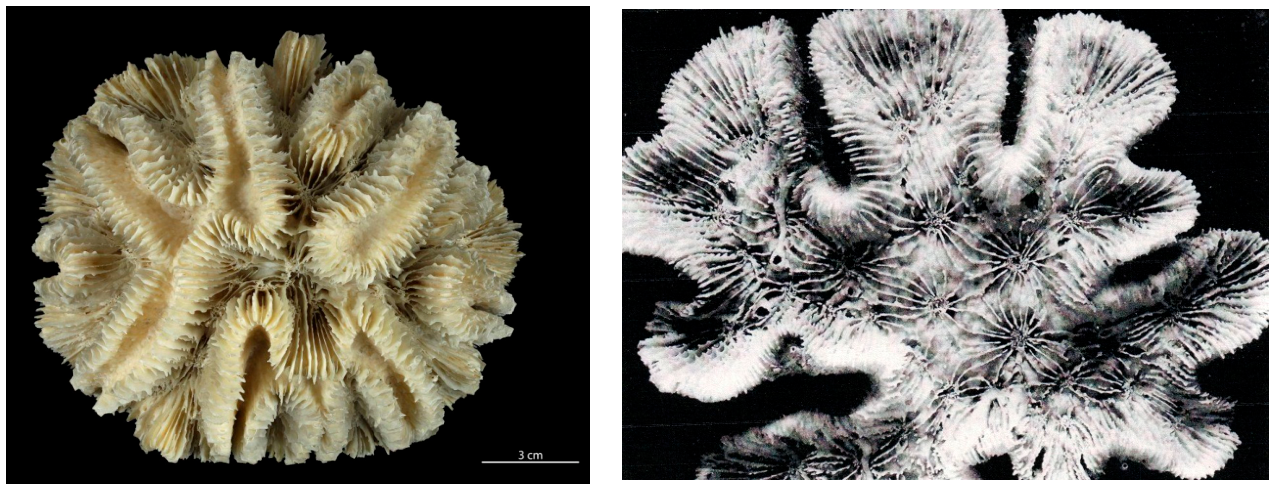
- The syntypes of Symphyllia valenciennesii Milne Edwards and Haime, 1849 are mid-growth stage specimens (e.g., Figure 3 left).
- The holotype of Lobophyllia hataii Yabe, Sugiyama and Eguchi, 1936 is a juvenile colony (e.g., Figure 3 right).
- In their morphometric analysis Huang et al. (2016) [92] coded all Symphyllia valenciennesii specimens as phaceloid, although this species does not develop a phaceloid form at any stage of its growth. Rather, it may exhibit intercalicular grooves, which are typically minor but can appear relatively broad in mid-growth stages.
- Miscoding most plausibly reflects misinterpretation of intercalicular grooves as phaceloid wall separation, particularly since syntypes are not yet mature and exhibit a distinct intercalicular groove.
- Misclassification of this fundamental architectural character may have accounted for the anomalous placement of Symphyllia valenciennesii in the morphological topology (Figure 2).
- Confusions caused by similarity of these two species in their developmental stages may also have contributed to morphological and molecular discordance in the dataset.
- Huang et al. (2016) [92] did not recover strong internal resolution within the relevant Lobophyllia clade. Although the broader clade was recovered, most species-level relationships within subclade I—including taxa then assigned to Lobophyllia and Symphyllia—were unresolved. The implications are discussed further in Supplementary Section S1e.
- Further targeted molecular sampling across habitats and geographic ranges will be required to resolve these relationships robustly.
- Without substantial field experience, juveniles of many, if not most, Lobophyllia and Symphyllia species, and indeed many other corals, can be difficult to identify in early stages of their development. Accordingly, unless studies are explicitly designed to address ontogenetic variation, we recommend that molecular sampling in these genera should specifically target fully developed, mature colonies.
2.11.2. Acropora tenuis and Acropora hyacinthus
- In several cases the available evidence presented suggests a strong reliance on type specimens without adequate contextualisation:
- ○
- Certain lectotypes and holotypes have been interpreted with very limited documented consideration of their broader context and representativeness, including whether they represent whole or fragmentary colonies, their ontogenetic state, the morphological expression and associated habitat they may represent, and their overall position within the documented variability of the species (see Section 2.5);
- ○
- Historical descriptions have in some instances been treated, in their published interpretations, as if they characterise species-level variability, rather than the individual specimens to which they relate (see Section 2.5);
- ○
- This overall limited interpretation of types and original descriptions has led to variability described in the literature not being incorporated into the resulting interpretations (Supplementary Appendices SA1–SA4);
- ○
- Such interpretations also raise the possibility that similarly restricted search images may have been applied to locate and identify the species at type localities and elsewhere.
- No explicit characterisation of taxon variability at the type localities is presented that demonstrates how the type specimen or selected topotype fits within the species’ broader variability (see Section 2.5).
- No habitat-stratified sampling regime is described or evidenced in the sampling design presented that would allow assessment of potential habitat or depth related lineage structure (see Section 2.5).
- No explicit comparative framework is documented or evidenced in the analyses presented showing that similar species or potentially confusable morphologies were comprehensively sampled and evaluated at the type localities (see Section 2.5).
- Specifically in the case of the Acropora hyacinthus complex, despite published evidence consistent with reticulation, hybridisation and/or introgression involving Acropora cytherea (e.g., refs. [6,40,69]), that species was not sampled or analysed in the study (see Section 2.6).
- Sampling for molecular study is not demonstrated, on the basis of the information presented, to be sufficiently replicated or biologically representative for species-level revisions or distributional modifications (see Section 2.5).
- Recovered topologies were reported to have low gene concordance values (generally <10% in Bridge et al., 2023 [3] and <11% in Rassmussen et al., 2025 [7]) complicating species-level interpretation (see Section 2.10).
- Evidence of incomplete lineage sorting, admixture, hybridisation, and introgression is reported by one or both studies and may affect interpretation of the recovered topologies (see Section 2.10).
- Despite these analytical issues, neither study appears, based on the analyses presented, to have explicitly modelled such alternative evolutionary processes before proceeding to species delineation (Section 2.10).
- The lack of biologically representative sampling, together with these molecular uncertainties, does not, on the basis of the evidence presented, provide a sufficient foundation for conversion of lineages to species-level taxa.
- Morphometric and descriptive assessments were based on limited samples and remain strongly dependent on type specimens that are not fully characterised within the variability of the species and/or which were known by the authors, or documented by others, to be juveniles or otherwise atypical (Section 2.5 and Section 2.7).
- Some morphological characters were evaluated as diagnostic. For some of these characters, habitat-related variability is well established, yet this variability is not explicitly characterised in the relevant datasets presented (Section 2.7)
- According to the methods of the published studies, the morphologically diagnostic characters used to separate lineages were sought after lineages had been recovered, which introduces a potential risk of circular interpretation and confirmation bias in such topology-first workflows, particularly where the recovered topologies were not fully stable (e.g., refs. [80,81]).
- Some synonyms were taken out of synonymy to link to a recovered lineage based on comparison of a type specimen with a small number of specimens without corresponding analysis of variability in the proposed ‘diagnostic’ characters.
- Other synonyms were taken out of synonymy without molecular support on the basis of type comparison, morphology, and/or geography alone, and without demonstration of a distinct, consistently identifiable field entity (see Section 2.5, Section 2.6 and Section 2.7). This includes cases such as Acropora flabelliformis, which was reinstated by Rassmussen et al. (2025) [7] on the basis of a single type specimen, without field study or molecular support.
3. On Mischaracterisations and Errors of Fact by Cowman et al.
3.1. Alleged Rejection of Molecular Approaches
3.2. “Static” Criticisms and Alleged Lack of Engagement
“Molecular techniques present a powerful array of tests of morphological taxonomy and, in the long-term, may displace morphology as the primary basis for separating species. Hillis (1987) provides a general review of the subject, concluding that disagreements among morphological and molecular systematists over ‘species’ definitions usually represent a disagreement of concept without due reference to biological realities. This is likely to increasingly be the case with corals.”
3.3. Reticulate Evolution as an “Untestable Axiom”
3.4. Alleged Decoupling of Names from Specimens
3.5. Specific Examples of Mischaracterisation
Cowman et al.: “The recent review by Veron et al. (2025) posits that quantitative genomic evidence used to understand coral evolution should be secondary to species hypotheses derived from expert opinion based on field experience.”
Cowman et al.: “The authors argue that morphological “biological entities” should take precedence over molecular evidence when conflicts arise.”
Cowman et al.: “If the morphology of two ‘species’ overlaps (due to plasticity or convergence), or if the identity of the name-bearing type specimen is ambiguous and lacking in diagnostic morphological characters, then the species is rejected as a “variant” rather than being evaluated as a potentially distinct evolutionary lineage.”
Cowman et al.: “Contrary to the assertions of Veron et al., most of the studies cited above explicitly incorporate morphological evidence in their analyses and identify synapomorphies that delineate families, genera and species morphologically where they exist.”
“A number of new species descriptions have been published since 2010 based primarily on molecular divergence among samples but also including macro- and micromorphological comparisons of specimens.”
Cowman et al.: “The authors invoke the Code to preserve familiar names while rejecting the fundamental tenet of typification when the type material does not suit their ‘biological entities’.”
Cowman et al.: “There are obvious practical consequences for maintaining an artificially stable taxonomy as proposed by Veron et al.”
Cowman et al.: [Veron et al. prioritise] “…convenience over precision and the concomitant risk of obscuring biodiversity and accelerating extinction”.
Cowman et al.: [we] “discard typification because it is inconvenient” and [we argue that] “because the physical type specimen is ambiguous, the evolutionary lineage it represents must be invalid”.
3.6. Errors of Fact
- (a)
- Peer review of Corals in Space and Time
- (b)
- Misrepresentation of our position on the Unified Species Concept
- (c)
- Dismissal of Indian Ocean records of Acropora hyacinthus
3.7. Scope of Disagreement
- the evidentiary thresholds appropriate for species-rank recognition;
- the proportionality between sampling scope and taxonomic revision;
- the interpretation of discordance among molecular datasets; and
- the application of nomenclatural rules in a manner consistent with stability.
4. Concluding Remarks
4.1. Biological Context and Replication
4.2. Type Specimens and Nomenclatural Anchoring
4.3. Lineages and Species
4.4. Reticulation and Model Testing
4.5. Stability and Conservation
5. A Final Word
Supplementary Materials
Author Contributions
Funding
Data Availability Statement
Acknowledgments
Conflicts of Interest
References
- Cowman, P.F.; Bridge, T.C.L.; Ainsworth, T.D.; Benzoni, F.; Bonito, V.; Budd, A.; Cabaitan, P.; Camp, E.F.; Chen, C.A.; Connolly, S.R.; et al. Modern Coral Taxonomy Requires Reproducible Data Alongside Field Observations—Comments on Veron et al. (2025). Diversity 2026, 18, 60. [Google Scholar] [CrossRef]
- Veron, J.E.N.; Stafford-Smith, M.G.; DeVantier, L.M.; Turak, E. Review of Coral Taxonomy, Evolution and Diversity. Diversity 2025, 17, 823. [Google Scholar] [CrossRef]
- Bridge, T.C.; Cowman, P.F.; Quattrini, A.M.; Bonito, V.E.; Sinniger, F.; Harii, S.; Head, C.E.; Hung, J.Y.; Halafihi, T.; Rongo, T. A tenuis relationship: Traditional taxonomy obscures systematics and biogeography of the ‘Acropora tenuis’ (Scleractinia: Acroporidae) species complex. Zool. J. Linn. Soc. 2023, 202, zlad062. [Google Scholar] [CrossRef]
- Veron, J.E.N. Corals in Space and Time; University of New South Wales Press: Sydney, Australia; Cornell University Press: Ithaca, NY, USA, 1995; 321p. [Google Scholar]
- Quek, Z.R.; Jain, S.S.; Richards, Z.T.; Arrigoni, R.; Benzoni, F.; Hoeksema, B.W.; Carvajal, J.I.; Wilson, N.G.; Baird, A.H.; Kitahara, M.V. A hybrid-capture approach to reconstruct the phylogeny of Scleractinia (Cnidaria: Hexacorallia). Mol. Phylogenet. Evol. 2023, 186, 107867. [Google Scholar] [CrossRef]
- Ladner, J.T.; Palumbi, S.R. Extensive sympatry, cryptic diversity and introgression throughout the geographic distribution of two coral species complexes. Mol. Ecol. 2012, 21, 2224–2238. [Google Scholar] [CrossRef]
- Rassmussen, S.H.; Cowman, P.F.; Baird, A.H.; Crosbie, A.J.; Quattrini, A.M.; Bonito, V.; Sinniger, F.; Harii, S.; Cabaitan, P.C.; Fadli, N.; et al. The tables have turned: Taxonomy, systematics and biogeography of the Acropora hyacinthus (Scleractinia: Acroporidae) complex. Invertebr. Syst. 2025, 39, IS24049. [Google Scholar] [CrossRef] [PubMed]
- ICZN. International Code of Zoological Nomenclature 4th Edition Adopted by the International Union of Biological Sciences, 4th ed.; International Trust for Zoological Nomenclature: London, UK, 1999; 306p. [Google Scholar]
- Hillis, D.M. Molecular Versus Morphological Approaches to Systematics. Annu. Rev. Ecol. Syst. 1987, 18, 23–42. [Google Scholar] [CrossRef]
- Avise, J.C. Phylogeography: The History and Formation of Species; Harvard University Press: Cambridge, MA, USA, 2000; 464p. [Google Scholar] [CrossRef]
- Dayrat, B. Towards integrative taxonomy. Biol. J. Linn. Soc. 2005, 85, 407–417. [Google Scholar] [CrossRef]
- Padial, J.M.; Miralles, A.; De la Riva, I.; Vences, M. The integrative future of taxonomy. Front. Zool. 2010, 7, 16. [Google Scholar] [CrossRef] [PubMed]
- Willis, B.L.; Ayre, D.J. Asexual reproduction and genetic determination of growth form in the coral Pavona cactus: Biochemical genetic and immunogenic evidence. Oecologia 1985, 65, 516–525. [Google Scholar] [CrossRef] [PubMed]
- Ayre, D.J.; Willis, B.L. Population structure in the coral Pavona cactus: Clonal genotypes show little phenotypic plasticity. Mar. Biol. 1988, 99, 495–505. [Google Scholar] [CrossRef]
- van Oppen, M.J.H.; Willis, B.L.; van Rheede, T.; Miller, D.J. Spawning times, reproductive compatibilities and genetic structuring in the Acropora aspera group: Evidence for natural hybridization and semi-permeable species boundaries in corals. Mol. Ecol. 2002, 11, 1363–1376. [Google Scholar] [CrossRef]
- Levitan, D.R.; Fukami, H.; Jara, J.; Kline, D.; McGovern, T.M.; McGhee, K.E.; Swanson, C.A.; Knowlton, N. Mechanisms of reproductive isolation among sympatric broadcast-spawning corals of the Montastraea annularis species complex. Evolution 2004, 58, 308–323. [Google Scholar] [CrossRef]
- Bongaerts, P.; Ridgway, T.; Sampayo, E.M.; Hoegh-Guldberg, O. Assessing the ‘deep reef refugia’ hypothesis: Focus on Caribbean reefs. Coral Reefs 2010, 29, 309–327. [Google Scholar] [CrossRef]
- Prada, C.; Hellberg, M.E. Speciation-by-depth on coral reefs: Sympatric divergence with gene flow or cryptic transient isolation? J. Evol. Biol. 2021, 34, 128–137. [Google Scholar] [CrossRef] [PubMed]
- Grupstra, C.G.; Gómez-Corrales, M.; Fifer, J.E.; Aichelman, H.E.; Meyer-Kaiser, K.S.; Prada, C.; Davies, S.W. Integrating cryptic diversity into coral evolution, symbiosis and conservation. Nat. Ecol. Evol. 2024, 8, 622–636. [Google Scholar] [CrossRef]
- Lesser, M.P.; Slattery, M.; Leichter, J.J. Ecology of mesophotic coral reefs. J. Exp. Mar. Biol. Ecol. 2009, 375, 1–8. [Google Scholar] [CrossRef]
- Turner, J.A.; Babcock, R.C.; Hovey, R.; Kendrick, G.A. Deep thinking: A systematic review of mesophotic coral ecosystems. ICES J. Mar. Sci. 2017, 74, 2309–2320. [Google Scholar] [CrossRef]
- Todd, P.A. Morphological plasticity in scleractinian corals. Biol. Rev. 2008, 83, 315–337. [Google Scholar] [CrossRef]
- Flot, J.-F.; Blanchot, J.; Charpy, L.; Cruaud, C.; Licuanan, W.Y.; Nakano, Y.; Payri, C.; Tillier, S. Incongruence between morphotypes and genetically delimited species in the coral genus Stylophora: Phenotypic plasticity, morphological convergence, morphological stasis or interspecific hybridization? BMC Ecol. 2011, 11, 22. [Google Scholar] [CrossRef] [PubMed]
- Smith, H.; Epstein, H.; Torda, G. The molecular basis of differential morphology and bleaching thresholds in two morphs of the coral Pocillopora acuta. Sci. Rep. 2017, 7, 10066. [Google Scholar] [CrossRef]
- Fukami, H.; Omori, M.; Shimoike, K.; Hayashibara, T.; Hatta, M. Ecological and genetic aspects of reproductive isolation by different spawning times in Acropora corals. Mar. Biol. 2003, 142, 679–684. [Google Scholar] [CrossRef]
- Fogarty, N.D. Caribbean acroporid coral hybrids are viable across life history stages. Mar. Ecol. Prog. Ser. 2012, 446, 145–159. [Google Scholar] [CrossRef]
- Chan, W.Y.; Hoffmann, A.A.; van Oppen, M.J. Hybridization as a conservation management tool. Conserv. Lett. 2019, 12, e12652. [Google Scholar] [CrossRef]
- Kitanobo, S.; Iwao, K.; Fukami, H.; Isomura, N.; Morita, M. First evidence for backcrossing of F1 hybrids in Acropora corals under sperm competition. Sci. Rep. 2022, 12, 5356. [Google Scholar] [CrossRef]
- Nozawa, Y. Annual variation in the timing of coral spawning in a high-latitude environment: Influence of temperature. Biol. Bull. 2012, 222, 192–202. [Google Scholar] [CrossRef]
- Keith, S.A.; Maynard, J.A.; Edwards, A.J.; Guest, J.R.; Bauman, A.G.; van Hooidonk, R.; Heron, S.F.; Berumen, M.L.; Bouwmeester, J.; Piromvaragorn, S.; et al. Coral mass spawning predicted by rapid seasonal rise in ocean temperature. Proc. R. Soc. Lond. B Biol. Sci. 2016, 283, 20160011. [Google Scholar] [CrossRef]
- Sakai, Y.; Hatta, M.; Furukawa, S.; Kawata, M.; Ueno, N.; Maruyama, S. Environmental factors explain spawning day deviation from full moon in the scleractinian coral Acropora. Biol. Lett. 2020, 16, 20190760. [Google Scholar] [CrossRef] [PubMed]
- Cooke, I.; Ying, H.; Forêt, S.; Bongaerts, P.; Strugnell, J.M.; Simakov, O.; Zhang, J.; Field, M.A.; Rodriguez-Lanetty, M.; Bell, S.C. Genomic signatures in the coral holobiont reveal host adaptations driven by Holocene climate change and reef specific symbionts. Sci. Adv. 2020, 6, eabc6318. [Google Scholar] [CrossRef]
- Dilworth, J.; Caruso, C.; Kahkejian, V.A.; Baker, A.C.; Drury, C. Host genotype and stable differences in algal symbiont communities explain patterns of thermal stress response of Montipora capitata following thermal pre-exposure and across multiple bleaching events. Coral Reefs 2021, 40, 151–163. [Google Scholar] [CrossRef]
- Wang, C.; Zheng, X.; Kvitt, H.; Sheng, H.; Sun, D.; Niu, G.; Tchernov, D.; Shi, T. Lineage-specific symbionts mediate differential coral responses to thermal stress. Microbiome 2023, 11, 211. [Google Scholar] [CrossRef]
- McCormack, J.E.; Huang, H.; Knowles, L.L. Maximum Likelihood Estimates of Species Trees: How Accuracy of Phylogenetic Inference Depends upon the Divergence History and Sampling Design. Syst. Biol. 2009, 58, 501–508. [Google Scholar] [CrossRef] [PubMed]
- Pante, E.; Puillandre, N.; Viricel, A.; Arnaud-Haond, S.; Aurelle, D.; Castelin, M.; Chenuil, A.; Destombe, C.; Forcioli, D.; Valero, M.; et al. Species are hypotheses: Avoid connectivity assessments based on pillars of sand. Mol. Ecol. 2015, 24, 525–544. [Google Scholar] [CrossRef]
- Luck, D.G.; Forsman, Z.H.; Toonen, R.J.; Leicht, S.J.; Kahng, S.E. Polyphyly and hidden species among Hawai‘i’s dominant mesophotic coral genera, Leptoseris and Pavona (Scleractinia: Agariciidae). PeerJ 2013, 1, e132. [Google Scholar] [CrossRef]
- Suzuki, G.; Keshavmurthy, S.; Hayashibara, T.; Wallace, C.C.; Shirayama, Y.; Chen, C.A.; Fukami, H. Genetic evidence of peripheral isolation and low diversity in marginal populations of the Acropora hyacinthus complex. Coral Reefs 2016, 35, 1419–1432. [Google Scholar] [CrossRef]
- Johnston, E.C.; Forsman, Z.H.; Flot, J.-F.; Schmidt-Roach, S.; Pinzón, J.H.; Knapp, I.S.; Toonen, R.J. A genomic glance through the fog of plasticity and diversification in Pocillopora. Sci. Rep. 2017, 7, 5991. [Google Scholar] [CrossRef] [PubMed]
- Sheets, E.A.; Warner, P.A.; Palumbi, S.R. Accurate population genetic measurements require cryptic species identification in corals. Coral Reefs 2018, 37, 549–563. [Google Scholar] [CrossRef]
- Nakabayashi, A.; Yamakita, T.; Nakamura, T.; Aizawa, H.; Kitano, Y.F.; Iguchi, A.; Yamano, H.; Nagai, S.; Agostini, S.; Teshima, K.M.; et al. The potential role of temperate Japanese regions as refugia for the coral Acropora hyacinthus in the face of climate change. Sci. Rep. 2019, 9, 1892. [Google Scholar] [CrossRef]
- Bongaerts, P.; Cooke, I.R.; Ying, H.; Wels, D.; den Haan, S.; Hernandez-Agreda, A.; Brunner, C.A.; Dove, S.; Englebert, N.; Eyal, G.; et al. Morphological stasis masks ecologically divergent coral species on tropical reefs. Curr. Biol. 2021, 31, 2286–2298. [Google Scholar] [CrossRef]
- Malik, A.; Einbinder, S.; Martinez, S.; Tchernov, D.; Haviv, S.; Almuly, R.; Zaslansky, P.; Polishchuk, I.; Pokroy, B.; Stolarski, J.; et al. Molecular and skeletal fingerprints of scleractinian coral biomineralization: From the sea surface to mesophotic depths. Acta Biomater. 2021, 120, 263–276. [Google Scholar] [CrossRef] [PubMed]
- Rippe, J.P.; Dixon, G.; Fuller, Z.L.; Liao, Y.; Matz, M. Environmental specialization and cryptic genetic divergence in two massive coral species from the Florida Keys Reef Tract. Mol. Ecol. 2021, 30, 3468–3484. [Google Scholar] [CrossRef]
- Buitrago-López, C.; Cárdenas, A.; Hume, B.C.; Gosselin, T.; Staubach, F.; Aranda, M.; Barshis, D.J.; Sawall, Y.; Voolstra, C.R. Disparate population and holobiont structure of pocilloporid corals across the Red Sea gradient demonstrate species-specific evolutionary trajectories. Mol. Ecol. 2023, 32, 2151–2173. [Google Scholar] [CrossRef]
- Gijsbers, J.C.; Englebert, N.; Prata, K.E.; Pichon, M.; Dinesen, Z.; Brunner, R.; Eyal, G.; González-Zapata, F.L.; Kahng, S.E.; Latijnhouwers, K.R.W.; et al. Global phylogenomic assessment of Leptoseris and Agaricia reveals substantial undescribed diversity at mesophotic depths. BMC Biol. 2023, 21, 147. [Google Scholar] [CrossRef] [PubMed]
- Meziere, Z.; Popovic, I.; Prata, K.; Ryan, I.; Pandolfi, J.; Riginos, C. Exploring coral speciation: Multiple sympatric Stylophora pistillata taxa along a divergence continuum on the Great Barrier Reef. Evol. Appl. 2024, 17, e13644. [Google Scholar] [CrossRef]
- Chow, S.W.; Chen, C.-H.; Tsai, D.-Y.; Mezaki, T.; Kubota, S.; Hsieh, H.J.; Keshavmurthy, S.; Chen, C.A. A clear distinction and presence of Acropora aff. divaricata within Acropora cf. solitaryensis species complex along their biogeographic distribution in East Asia. Sci. Rep. 2025, 15, 9739. [Google Scholar] [CrossRef]
- Hernández-Agreda, A.; Hoey, J.; van Hulten, D.; Hernández, P.; Peplow, L.; Muir, P.; Hoegh-Guldberg, O.; van Oppen, M.; Bongaerts, P. Genetic structure of mesophotic and shallow Acropora aculeus populations of Eastern Australia. Coral Reefs 2026, 45, 971–980. [Google Scholar] [CrossRef]
- Oury, N.; Wang, Y.; Ma, J.; Terraneo, T.I.; Marchese, F.; Barreca, F.; Delgadillo-Ordoñez, N.; Vimercati, S.; Berumen, M.L.; Peixoto, R.; et al. Seascape genomics uncovers contrasting population genetic structures in reef corals. iScience 2026, 29, 114393. [Google Scholar] [CrossRef] [PubMed]
- Potts, B.M.; Jones, R.C.; Jordan, G.J.; Nicolle, D.; Vaillancourt, R.E.; Reid, J.B. Hybridisation and Species Boundaries in Eucalypts. Austral Ecol. 2026, 51, e70152. [Google Scholar] [CrossRef]
- Pfeilsticker, T.R.; Jones, R.C.; Steane, D.A.; Vaillancourt, R.E.; Potts, B.M. Molecular insights into the dynamics of species invasion by hybridisation in Tasmanian eucalypts. Mol. Ecol. 2023, 32, 2913–2929. [Google Scholar] [CrossRef]
- Ottenburghs, J.; van Hooft, P.; van Wieren, S.E.; Ydenberg, R.C.; Prins, H.H.T. Birds in a bush: Toward an avian phylogenetic network. Auk 2016, 133, 577–582. [Google Scholar] [CrossRef]
- Barley, A.J.; Nieto-Montes de Oca, A.; Manríquez-Morán, N.L.; Thomson, R.C. The evolutionary network of whiptail lizards reveals predictable outcomes of hybridization. Science 2022, 377, 773–777. [Google Scholar] [CrossRef] [PubMed]
- DeBaun, D.; Rabibisoa, N.; Raselimanana, A.P.; Raxworthy, C.J.; Burbrink, F.T. Widespread reticulate evolution in an adaptive radiation. Evolution 2023, 77, 931–945. [Google Scholar] [CrossRef] [PubMed]
- Prediger, C.; Ferreira, E.A.; Zorzato, S.V.; Hua-Van, A.; Klasson, L.; Miller, W.J.; Yassin, A.; Madi-Ravazzi, L. Saltational Episodes of Reticulate Evolution in the Drosophila saltans Species Group. Mol. Biol. Evol. 2024, 41, msae250. [Google Scholar] [CrossRef]
- Suvorov, A.; Scornavacca, C.; Fujimoto, M.S.; Bodily, P.; Clement, M.; Crandall, K.A.; Whiting, M.F.; Schrider, D.R.; Bybee, S.M. Deep Ancestral Introgression Shapes Evolutionary History of Dragonflies and Damselflies. Syst. Biol. 2021, 71, 526–546. [Google Scholar] [CrossRef]
- Verbruggen, H.; Clerck, O.D.; Schils, T.; Kooistra, W.H.; Coppejans, E. Evolution and phylogeography of Halimeda section Halimeda (Bryopsidales, Chlorophyta). Mol. Phylogenet. Evol. 2005, 37, 789–803. [Google Scholar] [CrossRef]
- Árnason, E.; Halldórsdóttir, K. Codweb: Whole-genome sequencing uncovers extensive reticulations fueling adaptation among Atlantic, Arctic, and Pacific gadids. Sci. Adv. 2019, 5, eaat8788. [Google Scholar] [CrossRef] [PubMed]
- Popovic, I.; Matias, A.M.A.; Bierne, N.; Riginos, C. Twin introductions by independent invader mussel lineages are both associated with recent admixture with a native congener in Australia. Evol. Appl. 2020, 13, 515–532. [Google Scholar] [CrossRef] [PubMed]
- Diekmann, O.; Bak, R.; Stam, W.; Olsen, J. Molecular genetic evidence for probable reticulate speciation in the coral genus Madracis from a Caribbean fringing reef slope. Mar. Biol. 2001, 139, 221–233. [Google Scholar] [CrossRef]
- Arrigoni, R.; Benzoni, F.; Terraneo, T.I.; Caragnano, A.; Berumen, M.L. Recent origin and semi-permeable species boundaries in the scleractinian coral genus Stylophora from the Red Sea. Sci. Rep. 2016, 6, 34612. [Google Scholar] [CrossRef]
- Combosch, D.J.; Vollmer, S.V. Trans-Pacific RAD-Seq population genomics confirms introgressive hybridization in Eastern Pacific Pocillopora corals. Mol. Phylogenet. Evol. 2015, 88, 154–162. [Google Scholar] [CrossRef]
- Willis, B.L.; Babcock, R.C.; Harrison, P.L.; Wallace, C.C. Experimental hybridization and breeding incompatibilities within the mating systems of mass spawning reef corals. Coral Reefs 1997, 16, S53–S65. [Google Scholar] [CrossRef]
- Vollmer, S.V.; Palumbi, S.R. Hybridization and the evolution of reef coral diversity. Science 2002, 296, 2023–2025. [Google Scholar] [CrossRef]
- Fogarty, N.D.; Vollmer, S.V.; Levitan, D.R. Weak prezygotic isolating mechanisms in threatened Caribbean Acropora corals. PLoS ONE 2012, 7, e30486. [Google Scholar] [CrossRef]
- Zayasu, Y.; Nakajima, Y.; Sakai, K.; Suzuki, G.; Satoh, N.; Shinzato, C. Unexpectedly complex gradation of coral population structure in the Nansei Islands, Japan. Ecol. Evol. 2016, 6, 5491–5505. [Google Scholar] [CrossRef]
- Matias, A.M.A.; Popovic, I.; Thia, J.A.; Cooke, I.R.; Torda, G.; Lukoschek, V.; Bay, L.K.; Kim, S.W.; Riginos, C. Cryptic diversity and spatial genetic variation in the coral Acropora tenuis and its endosymbionts across the great barrier reef. Evol. Appl. 2023, 16, 293–310. [Google Scholar] [CrossRef]
- Márquez, L.; Van Oppen, M.; Willis, B.; Reyes, A.; Miller, D. The highly cross-fertile coral species, Acropora hyacinthus and Acropora cytherea, constitute statistically distinguishable lineages. Mol. Ecol. 2002, 11, 1339–1349. [Google Scholar] [CrossRef]
- Veron, J.E.N.; Stafford-Smith, M.G.; Turak, E.; DeVantier, L.M. CoralsOfTheWorld.org. 2016. Available online: https://www.coralsoftheworld.org/page/home/?version=0.01 (accessed on 20 February 2026).
- Veron, J.E.N.; Stafford-Smith, M.G.; DeVantier, L.M.; Turak, E. CoralsOfTheWorld.org, Version 2026.00 in Prep.; Australian Institute of Marine Science: Cape Cleveland, QLD, Australia, 2026.
- Wells, J.W. Scleractinia. In Treatise on Invertebrate Paleontology; Moore, R.C., Ed.; Geological Society of America and University of Kansas Press: Lawrence, KS, USA, 1956; pp. 328–444. [Google Scholar]
- Rosen, B.R. Modular growth and form of corals: A matter of metamers? Philos. Trans. R. Soc. Lond. B Biol. Sci. 1986, 313, 115–142. [Google Scholar] [CrossRef]
- Johnson, K.G. A phylogenetic test of accelerated turnover in Neogene Caribbean brain corals (Scleractinia: Faviidae). Palaeontology 1998, 41, 1247–1268. [Google Scholar]
- Veron, J.E.N.; Wallace, C. Scleractinia of Eastern Australia. Part V. Family Acroporidae; Australian Institute of Marine Science Monograph Series; Australian Institute of Marine Science: Townsville, QLD, Australia, 1984; Volume 6, 485p, Available online: https://www.biodiversitylibrary.org/page/39933506 (accessed on 20 February 2026).
- Wallace, C.C. Staghorn Corals of the World. A Revision of the Genus Acropora; CSIRO Publishing: Collingwood, VIC, Australia, 1999; 422p. [Google Scholar]
- Wolstenholme, J.K.; Wallace, C.C.; Chen, C.A. Species boundaries within the Acropora humilis species group (Cnidaria; Scleractinia): A morphological and molecular interpretation of evolution. Coral Reefs 2003, 22, 155–166. [Google Scholar] [CrossRef]
- Oliver, J.K. Intra-colony variation in the growth of Acropora formosa: Extension rates and skeletal structure of white (zooxanthellae-free) and brown-tipped branches. Coral Reefs 1984, 3, 139–147. [Google Scholar] [CrossRef]
- Tavakoli-Kolour, P.; Sinniger, F.; Morita, M.; Hazraty-Kari, S.; Nakamura, T.; Harii, S. Plasticity of shallow reef corals across a depth gradient. Mar. Pollut. Bull. 2023, 197, 115792. [Google Scholar] [CrossRef]
- Yeates, D.K.; Seago, A.; Nelson, L.; Cameron, S.L.; Joseph, L.; Trueman, J.W.H. Integrative taxonomy, or iterative taxonomy? Syst. Entomol. 2011, 36, 209–217. [Google Scholar] [CrossRef]
- Jermiin, L.S.; Catullo, R.A.; Holland, B.R. A new phylogenetic protocol: Dealing with model misspecification and confirmation bias in molecular phylogenetics. NAR Genom. Bioinform. 2020, 2, Iqaa041. [Google Scholar] [CrossRef]
- Million, W.C.; Ruggeri, M.; O’Donnell, S.; Bartels, E.; Conn, T.; Krediet, C.J.; Kenkel, C.D. Evidence for adaptive morphological plasticity in the Caribbean coral, Acropora cervicornis. Proc. Nat. Acad. Sci. USA 2022, 119, e2203925119. [Google Scholar] [CrossRef]
- De Queiroz, K. Species concepts and species delimitation. Syst. Biol. 2007, 56, 879–886. [Google Scholar] [CrossRef]
- Veron, J.E.N. Corals of the World; Australian Institute of Marine Science: Townsville, QLD, Australia, 2000; Volumes 1–3, 1410p. [Google Scholar]
- Rosen, B.R. Progress, problems and patterns in the biogeography of reef corals and other tropical marine organisms. Helgol. Meeresunters. 1988, 42, 269–301. [Google Scholar] [CrossRef]
- Willis, B.L. Species concepts in extant scleractinian corals: Considerations based on reproductive biology and genotypic population structures. Syst. Bot. 1990, 15, 136–149. [Google Scholar] [CrossRef] [PubMed]
- Pandolfi, J.M. Successive isolation rather than evolutionary centres for the origination of Indo-Pacific reef corals. J. Biogeogr. 1992, 19, 593–609. [Google Scholar] [CrossRef]
- Morales-Briones, D.F.; Kadereit, G.; Tefarikis, D.T.; Moore, M.J.; Smith, S.A.; Brockington, S.F.; Timoneda, A.; Yim, W.C.; Cushman, J.C.; Yang, Y. Disentangling sources of gene tree discordance in phylogenomic data sets: Testing ancient hybridizations in Amaranthaceae s.l. Syst. Biol. 2021, 70, 219–235. [Google Scholar] [CrossRef]
- Lanfear, R.; Hahn, M.W. The meaning and measure of concordance factors in phylogenomics. Mol. Biol. Evol. 2024, 41, msae214. [Google Scholar] [CrossRef] [PubMed]
- Joyce, E.M.; Schmidt-Lebuhn, A.N.; Orel, H.K.; Nge, F.J.; Anderson, B.M.; Hammer, T.A.; McLay, T.G.B. Navigating phylogenetic conflict and evolutionary inference in plants with target-capture data. Aust. Syst. Bot. 2025, 38, SB24011. [Google Scholar] [CrossRef]
- Gould, E.; Fraser, H.S.; Parker, T.H.; Nakagawa, S.; Griffith, S.C.; Vesk, P.A.; Fidler, F.; Hamilton, D.G.; Abbey-Lee, R.N.; Abbott, J.K.; et al. Same data, different analysts: Variation in effect sizes due to analytical decisions in ecology and evolutionary biology. BMC Biol. 2025, 23, 35. [Google Scholar] [CrossRef]
- Huang, D.; Arrigoni, R.; Benzoni, F.; Fukami, H.; Knowlton, N.; Smith, N.D.; Stolarski, J.; Chou, L.M.; Budd, A.F. Taxonomic classification of the reef coral family Lobophylliidae (Cnidaria: Anthozoa: Scleractinia). Zool. J. Linn. Soc. 2016, 178, 436–481. [Google Scholar] [CrossRef]
- Yabe, H.; Sugiyama, T.; Eguchi, M. Recent Reef-Building Corals from Japan and the South Sea Islands Under the Japanese Mandate I; The Science Reports of the Tôhoku Imperial University, Special Volume No. 1; Tôhoku Imperial University: Sendai, Japan, 1936; pp. 1–66. [Google Scholar]
- Grigg, R.W. Evolution by Reticulation: Corals in Space and Time. The Biogeography and Evolution of the Scleractinia. JEN Veron. Comstock (Cornell University Press), Ithaca, NY, 1995. Science 1995, 269, 1893–1894. [Google Scholar] [CrossRef]
- Pichon, M.; Benzoni, F.; Chaineau, C.H.; Dutrieux, E. Field Guide to the Hard Corals of the Southern Coast of Yemen; Museum National d’Histoire Naturelle: Paris, France, 2010; 256p. [Google Scholar]
- Veron, J.E.N. A Reef in Time: The Great Barrier Reef from Beginning to End; Harvard University Press: Cambridge, MA, USA, 2008; 289p. [Google Scholar]
- Veron, J.E.N. Mass extinctions and ocean acidification: Biological constraints on geological dilemmas. Coral Reefs 2008, 27, 459–472. [Google Scholar] [CrossRef]
- Veron, J.E.N.; Devantier, L.M.; Turak, E.; Green, A.L.; Kininmonth, S.; Stafford-Smith, M.G.; Peterson, N. Delineating the coral triangle. Galaxea 2009, 11, 91–100. [Google Scholar] [CrossRef]
- Veron, J.E.N.; How, R.A.; Done, T.J.; Zell, L.D.; Dodkin, M.J.; O’Farrell, A.F. Corals of the Solitary Islands, New South Wales. Aust. J. Mar. Freshw. Res. 1974, 25, 193–208. [Google Scholar] [CrossRef]
- Veron, J.E.N.; Done, T.J. Corals and coral communities of Lord Howe Island. Aust. J. Mar. Freshw. Res. 1979, 30, 203–236. [Google Scholar] [CrossRef]
- DeVantier, L.M.; Deacon, G. Distribution of Acanthaster planci at Lord Howe Island, the southern-most Indo-Pacific reef. Coral Reefs 1990, 9, 145–148. [Google Scholar] [CrossRef]
- DeVantier, L.; De’ath, G.; Klaus, R.; Al-Moghrabi, S.; Abdulaziz, M.; Reinicke, G.B.; Cheung, C. Reef-building corals and coral communities of the Socotra Archipelago, a zoogeographic ‘crossroads’ in the Arabian Sea. Fauna Arab. 2004, 20, 117–168. [Google Scholar]
- Veron, J.E.N.; Hoegh-Guldberg, O.; Lenton, T.M.; Lough, J.M.; Obura, D.O.; Pearce-Kelly, P.; Sheppard, C.R.C.; Spalding, M.; Stafford-Smith, M.G.; Rogers, A.D. The coral reef crisis: The critical importance of <350ppm CO2. Mar. Pollut. Bull. 2009, 58, 1428–1436. [Google Scholar] [CrossRef]



| Methodological Step | Potential Interpretative Limitation | Relevance to the Studies Under Discussion |
|---|---|---|
| Type specimens are located and used as the starting point for taxonomic interpretation | Historical types may be juvenile, fragmentary, atypical, or otherwise unrepresentative of the broader species | Type condition and representativeness may affect how names are linked to modern samples |
| Original descriptions based on single or few specimens are treated as species diagnoses | Historical descriptions often capture only single specimens; recent descriptions may not capture species variation | Limited contextualisation of original descriptions may affect how names are linked to modern samples |
| Topotypes are selected primarily on the basis of resemblance to the type | Topotype selection depends on prior interpretation of the type and may not reflect broader local variability | Single morph-selected topotypes may disproportionately and inappropriately anchor names |
| Limited numbers of specimens are chosen for molecular analysis | Small sample sizes may not capture within-population, habitat or depth-related structure | Recovered lineages may reflect incomplete representation of biological variability |
| Ecological documentation of samples is limited | Habitat-linked or depth-linked structure may not be distinguished from species-level divergence | Environmental context may be under-characterised relative to known coral plasticity |
| Sampling is centred on the type locality, or inferred locality | The type locality alone may not capture the range of variation within a widespread species | Population-level context at and beyond the type locality may remain insufficiently characterised |
| Morphometric analyses are conducted on a small number of colonies or fragments | Small morphological datasets may not reflect intracolonial or population-level variation | Apparently diagnostic differences may fall within broader uncharacterised variability |
| Morphological matrices treat characters as equivalently weighted | Characters of very different developmental, architectural or ecological significance may be weighted alike | Minor variable characters may disproportionately influence interpretations |
| Genome-scale phylogenetic analyses recover distinct lineage partitions | Lineage discovery does not by itself establish species boundaries | Genetic partitions may represent population structure, ecological structure or reticulate history |
| Clustering and delimitation methods are applied to the same underlying dataset | Concordance among analytical methods may reflect technical consistency rather than biological replication | Multiple analyses do not substitute for broader biologically representative sampling |
| Morphology is examined after lineage recovery | Morphological assessment may function as interpretation of predefined lineages rather than an independent test | Topology-first workflows require caution when used for species validation—risks confirmation bias |
| Low gene concordance and/or admixture are present in the dataset | Discordant loci may indicate incomplete lineage sorting, introgression or other complex processes within species | Bifurcating topologies may not adequately represent the evolutionary history of the group |
| Lineages are interpreted as species without explicit testing of alternative evolutionary processes | Lineage partitions may reflect incomplete lineage sorting, introgression or population structure rather than species boundaries | Additional demographic and reticulation analyses required before taxonomic revision |
| Diagnostic morphological characters are identified for recovered lineages | Small differences may be environmentally responsive or fall within broader species variability | Putative diagnostic characters require testing against wider sampling |
| Historical synonyms are revisited in light of the recovered topology | Type comparison and geography may be used where direct molecular evidence is unavailable | Nomenclatural decisions may extend beyond the taxa directly sampled in the phylogeny |
| Some nominal taxa are resurrected from synonymy without direct sequencing or population level studies | Taxonomic actions may rely on morphology, geography, or type interpretation alone | Evidentiary basis is minimal and non-comparable to sequenced lineages; insufficient for species designation |
| Geographic separation is used as part of species interpretation | Geographic distance alone does not establish species boundaries in widespread corals | Intervening populations and broader regional sampling are required to assess gene flow |
| Taxonomic actions are formalised following lineage recovery and interpretation | Species-level nomenclatural changes may outpace biological characterisation of the taxa involved | Revisions premature where broader variability and alternative processes remain untested |
| Museum collections are potentially reinterpreted in light of the revised taxonomy | Unsupported or weakly supported revisions may propagate through reference collections | Subsequent identifications may inherit propagated uncertainty from the revisions |
Disclaimer/Publisher’s Note: The statements, opinions and data contained in all publications are solely those of the individual author(s) and contributor(s) and not of MDPI and/or the editor(s). MDPI and/or the editor(s) disclaim responsibility for any injury to people or property resulting from any ideas, methods, instructions or products referred to in the content. |
© 2026 by the authors. Licensee MDPI, Basel, Switzerland. This article is an open access article distributed under the terms and conditions of the Creative Commons Attribution (CC BY) license.
Share and Cite
Veron, J.E.N.; Stafford-Smith, M.G.; DeVantier, L.M.; Turak, E. Modern Coral Taxonomy Requires Biologically Relevant Evidence. Reply to Cowman et al. Comments on “Veron et al. Review of Coral Taxonomy, Evolution and Diversity. Diversity 2025, 17, 823”. Diversity 2026, 18, 358. https://doi.org/10.3390/d18060358
Veron JEN, Stafford-Smith MG, DeVantier LM, Turak E. Modern Coral Taxonomy Requires Biologically Relevant Evidence. Reply to Cowman et al. Comments on “Veron et al. Review of Coral Taxonomy, Evolution and Diversity. Diversity 2025, 17, 823”. Diversity. 2026; 18(6):358. https://doi.org/10.3390/d18060358
Chicago/Turabian StyleVeron, John E. N., Mary G. Stafford-Smith, Lyndon M. DeVantier, and Emre Turak. 2026. "Modern Coral Taxonomy Requires Biologically Relevant Evidence. Reply to Cowman et al. Comments on “Veron et al. Review of Coral Taxonomy, Evolution and Diversity. Diversity 2025, 17, 823”" Diversity 18, no. 6: 358. https://doi.org/10.3390/d18060358
APA StyleVeron, J. E. N., Stafford-Smith, M. G., DeVantier, L. M., & Turak, E. (2026). Modern Coral Taxonomy Requires Biologically Relevant Evidence. Reply to Cowman et al. Comments on “Veron et al. Review of Coral Taxonomy, Evolution and Diversity. Diversity 2025, 17, 823”. Diversity, 18(6), 358. https://doi.org/10.3390/d18060358