Communication

Coralline Target Phenomena (CTP) in South Atlantic Crustose Coralline Algae During Periods of Elevated Thermal Stress


by
Ricardo da Gama Bahia
1,*,
Guilherme Henrique Pereira-Filho
2,
Renato Crespo Pereira
3,
Rodrigo Tomazetto de Carvalho
1,
Leonardo Tavares Salgado
1,
Daniela Bueno Sudatti
3,
Claudia Santiago Karez
1,
Áthila Bertoncini
4 and
Fernando Coreixas de Moraes
1,5,6
1
Diretoria de Pesquisa Científica, Instituto de Pesquisas Jardim Botânico do Rio de Janeiro, Rio de Janeiro 22460-030, Brazil
2
Laboratório de Ecologia e Conservação Marinha, Instituto do Mar, Universidade Federal de São Paulo, Santos 21941-902, Brazil
3
Departamento de Biologia Marinha, Universidade Federal Fluminense, Niteroi 24220-900, Brazil
4
Instituto Meros do Brasil, Curitiba 80060-020, Brazil
5
Projeto Ilhas do Rio, Instituto Mar Adentro, Rio de Janeiro 22031-012, Brazil
6
Museu Nacional, Universidade Federal do Rio de Janeiro, Rio de Janeiro 21941-853, Brazil
*
Author to whom correspondence should be addressed.
Diversity 2026, 18(6), 344; https://doi.org/10.3390/d18060344
Submission received: 7 May 2026 / Revised: 28 May 2026 / Accepted: 3 June 2026 / Published: 5 June 2026
(This article belongs to the Section Biodiversity Conservation)

Abstract

Diseases and lesion syndromes affecting crustose coralline algae (CCA) have been increasingly reported worldwide, yet none had been documented in the South Atlantic. Here, we report the first observations of Coralline Target Phenomena (CTP) in this region, identified by its characteristic concentric banding pattern in CCA. Lesions were recorded in southeastern (2019) and southern Brazil (2026) under thermal stress. These records represent the first report of CTP outside tropical Indo-Pacific coral reefs. Although further studies are needed to elucidate these lesions and, if confirmed as a disease, their etiology, reporting their occurrence in a previously unaffected region is essential to support appropriate monitoring and targeted research.

1. Introduction

Crustose coralline algae (CCA) are key bioconstructors in marine environments, playing essential ecological roles in reef framework stabilization and the provision of settlement substrates for a variety of benthic organisms [1]. Across the Southwestern Atlantic, CCA dominate shallow rocky reefs, underpin the formation of biogenic reefs, and form extensive rhodolith beds that rank among the most biodiverse and functionally rich benthic habitats in the region [2,3]. Despite this ecological relevance, CCA health has received little scientific and conservation attention worldwide [4].
Over the past few decades, diseases and syndromes affecting CCA, corals, and other benthic organisms have caused substantial mortality, and outbreaks have been reported worldwide [5,6,7,8]. These events are expected to become more frequent under ongoing climate change and increasing anthropogenic pressures [9]. To date, seven pathological conditions have been reported in CCA: Coralline Lethal Orange Disease (CLOD; [10]), CCA Black Fungal Disease (CBFD; [11]), Coralline Target Phenomena (CTP; [12,13]), Coralline White Band Disease (CWBD; [14]), Coralline White Patch Disease (CWPD; [15]), Coralline Cyanophyte Disease [7], and Crustose Coralline Cyanobacterial Disease [16]. These reports originate predominantly from tropical Indo-Pacific and Caribbean coral reefs, with CWBD and CWPD only recently documented in the temperate Mediterranean over the past decade [17,18]. Only for a few of these conditions have potential causative agents been proposed, whereas others, including CTP, remain defined primarily by external morphology, without etiological confirmation. So far, none of these conditions have been recorded in the South Atlantic, despite the ubiquity and ecological importance of CCA along the Brazilian continental shelf [19,20,21].
Here, we report the first documentation of CTP in the South Atlantic, based on underwater photographic records from rocky shores along the Brazilian coast.

2. Materials and Methods

Underwater photographs of rocky shore substrates obtained through SCUBA diving were examined from two independent photographic records along the Brazilian coast. For Rio de Janeiro (RJ), images were retrieved from the 2011–2022 archive of the Projeto Ilhas do Rio (PIR), an initiative of Instituto Mar Adentro focused on documenting and supporting the conservation of marine biodiversity on coastal islands in the metropolitan region of Rio de Janeiro. In total, approximately 9000 images were examined.
CTP-like lesions were identified exclusively in photographs taken in 2019, from May at Pontuda Island, Tijucas Archipelago (8–12 m depth; ~2 km offshore; 23°02′13.7″ S, 43°18′22.4″ W), and from June at Cotunduba Island (10–13 m depth; ~1 km offshore; 22°57′51.67″ S, 43°08′53.17″ W). Subsequent photographs from the same monitoring program did not reveal similar lesions.
An additional record was obtained in São Francisco do Sul (SC), southern Brazil, located more than 600 km from Rio de Janeiro, on 14 January 2026 at approximately 18 m depth at a rocky reef situated ~6 km offshore (26°08′19.5″ S, 48°27′51.9″ W). As in the RJ case, images were acquired for general benthic documentation rather than as part of a standardized quantitative survey. No comparable historical photographic archive was available for this site, preventing retrospective evaluation of whether similar lesions had occurred previously.
Lesions exhibiting a characteristic target-like morphology, defined by concentric circular bands of depigmented (bleached) tissue alternating with adjacent pinkish zones, were identified as Coralline Target Phenomena (CTP) based on previously established morphological diagnostic criteria [7,12,13].
To quantitatively characterize lesion morphology, both total visible thallus area and lesion area were manually delineated from calibrated digital images using ImageJ v. 1.54g (NIH, Bethesda, MD, USA). In addition to estimating the proportion of thallus surface affected, we measured lesion maximum diameter and the width of individual concentric bands.
To contextualize the temporal occurrence of CTP and evaluate whether lesion appearance coincided with anomalous thermal conditions, we obtained remotely sensed daily sea-surface temperature-derived Degree Heating Weeks (DHWs) data for the study regions (NOAA Coral Reef Watch 5 km product). For Rio de Janeiro, DHWs data were compiled for the period 2011–2025 to generate a long-term thermal-stress record and identify anomalous events preceding the 2019 observation. For São Francisco do Sul, DHWs data were extracted for the months surrounding the January 2026 observation to characterize the local heat-stress trajectory associated with this independent record. DHW quantifies accumulated heat stress by integrating positive temperature anomalies above the site-specific maximum monthly mean climatology over the previous 12 weeks and is expressed in °C-weeks. Daily DHW values were used to generate both a multi-year thermal-stress record and detailed short-term trajectories surrounding each observation. All visualizations were based on raw DHW values.
These data were used exclusively to provide environmental context for the timing of the observed CTP-like lesions and to evaluate whether their occurrence coincided with periods of elevated or persistent thermal stress. Given that the records derive from opportunistic photographic observations rather than a CCA systematic monitoring, the temporal and sampling resolution allows only descriptive environmental interpretation.
A generative artificial intelligence tool, specifically ChatGPT (OpenAI, GPT-5.5), was used to assist in the generation of graphical visualizations (DHW plots) based on the processed environmental datasets mentioned above.

3. Results

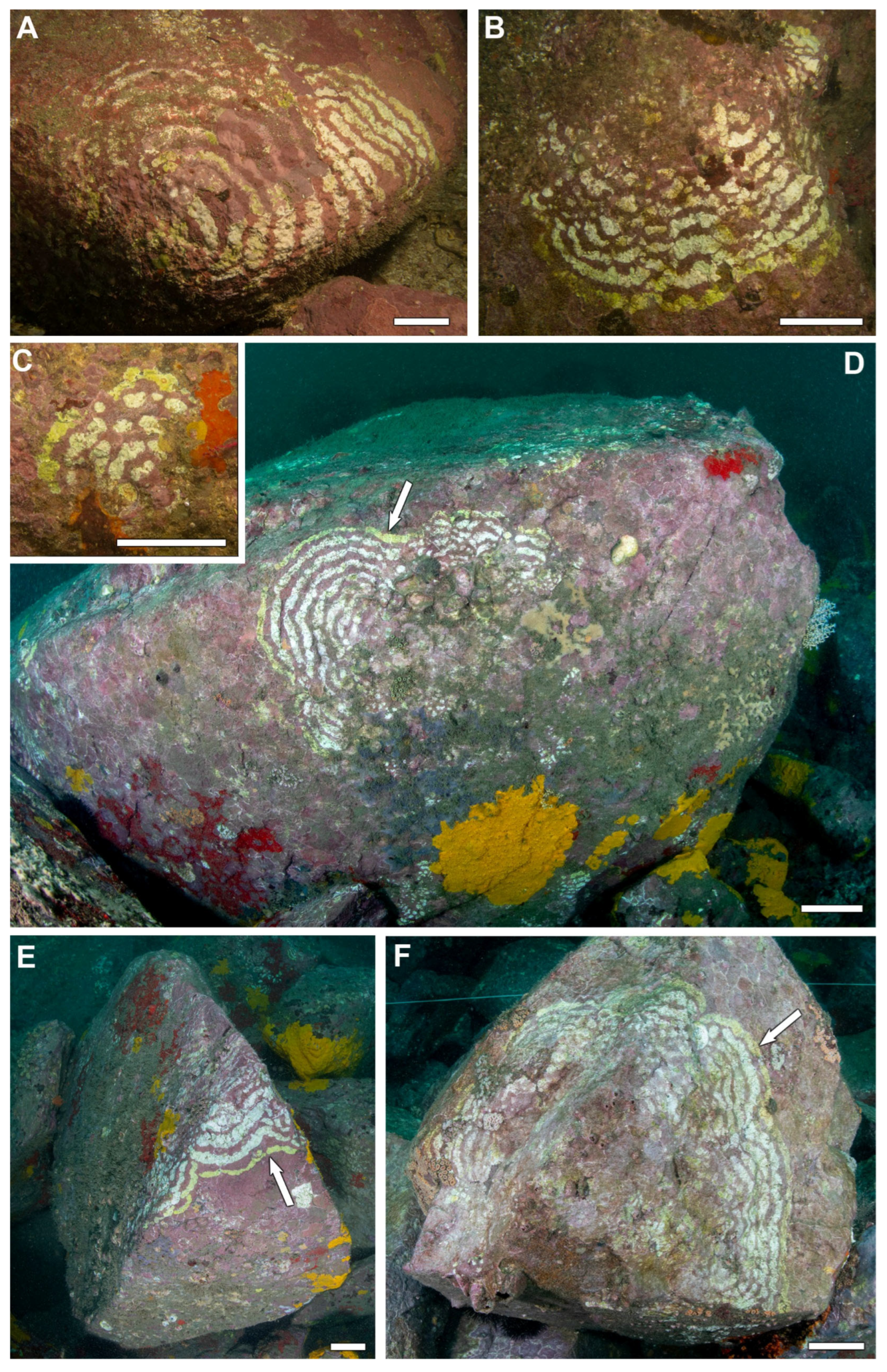
The examination of photographic records, together with field observations recalled by the image authors, revealed multiple CCA thalli exhibiting the characteristic concentric banding pattern of CTP (Figure 1A–F). The lesions consisted of sharply defined circular bands of depigmented tissue (0.6–3.7 cm in width) contrasting with adjacent intact pinkish areas. The whitened zones likely represent areas of tissue loss exposing the underlying carbonate skeleton. Lesion coverage ranged from 11.6% to 77.5% of the thallus surface (mean ± SD = 49.7 ± 21.3%, n = 15). In all localities, the affected substrate was dominated by CCA visually assigned to the genus Lithophyllum Philippi, 1837, which commonly forms encrusting mats on rocky surfaces in shallow subtidal habitats of southeastern and southern Brazil [22].
Across the examined specimens, the outermost concentric band, interpreted as the putative advancing margin, frequently exhibited a greenish hue, whereas inner, older bands appeared fully bleached (Figure 1B–E). This consistent color transition suggests a sequential progression from an initial greenish stage to complete whitening as the lesion develops over time.
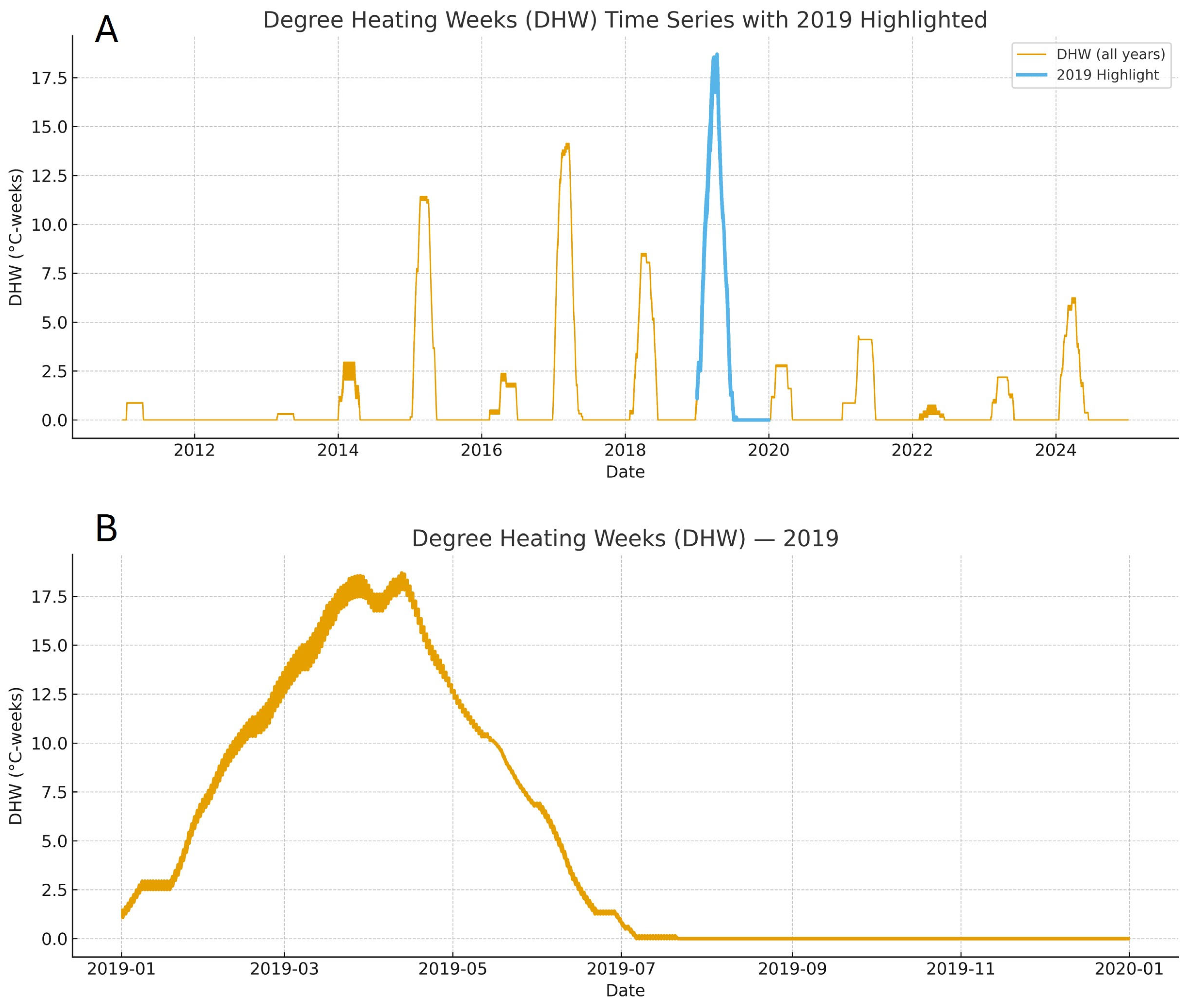
Analysis of the long-term thermal stress record based on Degree Heating Weeks (DHWs) for the Rio de Janeiro region (2011–2025) reveals that 2019 stands out as the only year to experience an extreme and sustained accumulation of heat stress (Figure 2A). While other years exhibited short-lived or low-intensity DHW peaks, 2019 reached values exceeding 18 °C-weeks—far surpassing the thresholds typically associated with severe and prolonged marine heatwave conditions [23]. The daily DHW trajectory for this year shows a rapid and uninterrupted accumulation from late austral summer through early winter, indicating that the warming was not only intense but also unusually persistent (Figure 2B).
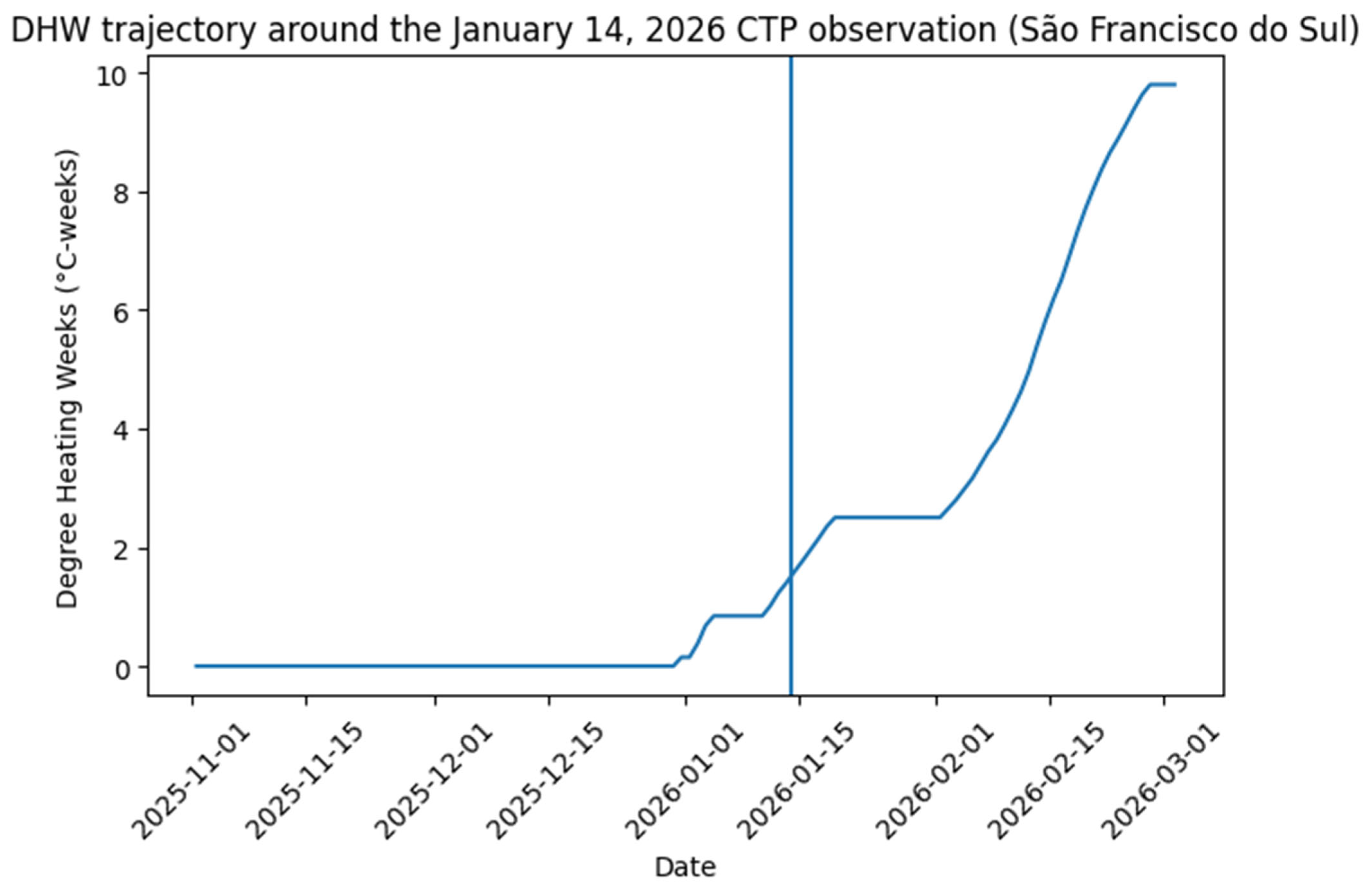
The São Francisco do Sul observation occurred during the early phase of a developing heat-stress event. At the time of the photographic record (14 January 2026), DHW values had already begun to accumulate (~1.5 °C-weeks) and continued to increase steadily in the following weeks, eventually reaching severe levels approaching 10 °C weeks by late austral summer (Figure 3).
Figure 1. (AF) Coralline Target Phenomena (CTP) observed on crustose coralline algae (CCA), visually assigned to Lithophyllum spp., on rocky reefs along the Brazilian coast. (A,B) Lesions recorded at Rio de Janeiro, southeastern Brazil, in May 2019, showing the characteristic concentric bands of depigmented tissue alternating with intact pinkish areas. (C) Additional record from Cotunduba Island, Rio de Janeiro, in June 2019. (DF) Records from São Francisco do Sul, southern Brazil, documented on January 2026. Arrows highlight the outer greenish band frequently observed at the apparent advancing margin of the lesion. Scale bars = 10 cm. Photographs: (AC) F.C. Moraes/PIR; (DF) A.A. Bertoncini.
Diversity 18 00344 g001
Figure 2. (A,B) Degree Heating Weeks (DHWs) patterns for the study region in Rio de Janeiro, southeastern Brazil. (A) Long-term DHW time series (2011–2024) showing that 2019 was the only year in the dataset to accumulate extreme heat stress, reaching values exceeding 18 °C-weeks. No other year exhibited comparable thermal accumulation, highlighting 2019 as an exceptional heat-stress event. (B) Daily DHW trajectory for 2019, illustrating a rapid and persistent accumulation of thermal stress from late austral summer to early winter. The sustained and elevated DHW values indicate prolonged marine heatwave conditions in the months preceding the detection of Coralline Target Phenomena (CTP), i.e., May and June 2019. Data source: NOAA Coral Reef Watch (5 km product), accessed via NASA GIOVANNI on 4 March 2026.
Diversity 18 00344 g002
Figure 3. Daily Degree Heating Weeks (DHWs) values for the São Francisco do Sul region during the months surrounding the January 2026 observation. The vertical line indicates the date when CTP-like lesions were photographed (14 January 2026). At the time of observation, DHW values had already begun to accumulate and continued increasing in the following weeks, indicating that the record occurred during the early phase of a developing marine heat-stress event. Data source: NOAA Coral Reef Watch (5 km product), accessed via NASA GIOVANNI on 4 March 2026.
Diversity 18 00344 g003

4. Discussion

This study provides the first documentation of CTP in CCA from the Atlantic. Previous reports of CTP have been restricted to tropical Indo-Pacific reef systems, with no published records from the Atlantic or from rocky shore habitats [7,12,13]. The morphology of the Brazilian lesions closely matches previous descriptions of CTP, particularly regarding the concentric banding pattern, color transitions, and band widths (0.6–3.7 cm), which largely overlap the 0.5–3 cm range reported for Indo-Pacific CTP lesions [7].
Across all observations, the outermost concentric band frequently exhibited a greenish hue preceding complete tissue whitening, suggesting a potential active lesion margin. This chromatic transition may represent early tissue degradation, microbial colonization, or proliferation of endolithic phototrophs within newly exposed carbonate skeleton [24]. Although no histological analyses were performed, the consistent presence of this feature across independent observations warrants further investigation.
CTP lesions have frequently been reported on vertically oriented substrates [7,12]. A similar pattern was observed in the Brazilian records and may reflect microenvironmental differences associated with substrate orientation, including variation in light exposure, sediment deposition, hydrodynamics, and potentially differential exposure to thermal gradients within the water column under stratified conditions.
Environmental stressors such as elevated seawater temperature, eutrophication, and pollution are known to increase the susceptibility of CCA to infections [25,26]. Disease prevalence in CCA has been associated with warmer conditions and shifts in microbial communities [7,27,28], as elevated temperatures may favor opportunistic microorganisms capable of colonizing weakened algal tissues. The marked and persistent thermal anomaly documented for Rio de Janeiro in 2019, together with the developing heat-stress event preceding the São Francisco do Sul observation in January 2026, therefore provides relevant environmental context. Although these observations do not establish causation, they are consistent with thermal stress acting as a potential contributing environmental factor.
The Tijucas Archipelago is located ~2 km from the heavily urbanized coast of Rio de Janeiro and is influenced by the Barra da Tijuca Channel, which connects the polluted Jacarepaguá Lagoon system to the sea [29]. Cotunduba Island, where additional lesions were recorded, lies at the entrance of Guanabara Bay, one of the most impacted coastal systems in Brazil, and is similarly exposed to variable water quality and inputs of nutrients, sediments, and organic pollutants [30]. The São Francisco do Sul record was obtained near the entrance of Babitonga Bay, a large estuarine system influenced by domestic, industrial, and agricultural inputs [31]. Across these environments, such conditions may increase physiological stress in benthic communities and favor opportunistic pathogens [32].
Before attributing these lesions pattern to a pathological process, alternative sources of tissue loss such as herbivory must also be considered. Herbivory on crustose coralline algae (CCA) is typically performed by a well-known functional guild including grazing molluscs (e.g., limpets and chitons), echinoids (sea urchins), and herbivorous fishes such as parrotfishes. These organisms remove tissue through scraping or excavation, producing irregular bite marks, linear rasping scars, or patchy denuded areas that expose the underlying carbonate substrate [33]. In contrast, the lesions documented here consist of discrete concentric depigmented bands with intact margins and no evidence of mechanical abrasion. Such morphology is inconsistent with grazing damage and supports the interpretation that the observed pattern is unlikely to result from herbivore activity and is more consistent with a biological syndrome. Although the ecological consequences of CTP are still unclear, lesions may compromise the structural and ecological roles of CCA as major carbonate producers and settlement substrates for invertebrates (e.g., corals; [34]).
To date, CCA diseases or lesion syndromes have not been reported in rhodolith beds, even though rhodolith nodules are constructed by coralline algae. Given that Brazil hosts some of the largest and most biodiverse rhodolith beds worldwide [35], the occurrence of lesions in CCA highlights the need to evaluate whether similar patterns may arise in other coralline algal-dominated habitats. Increased monitoring in regions exposed to stressors such as marine heatwaves, eutrophication, and coastal pollution could enable early detection of such lesions and improve understanding of how these habitats respond to interacting pressures. Such questions remain insufficiently explored [4], and conservation initiatives for rhodolith beds, particularly in Brazil, require further development [20].
As a rare and retrospectively detected anomaly extending the known distribution of CCA lesion syndromes to a new ocean basin and habitat type, this case may be interpreted as an early warning signal, indicating that subtropical benthic systems could be more vulnerable to emerging pathological conditions than previously recognized. This finding also raises the possibility that similar occurrences may have gone unnoticed in regions lacking sustained monitoring and the specialized expertise required to recognize CCA lesion patterns, or that their emergence may be associated with increasing environmental stress. Importantly, it highlights the need for Brazilian marine protected areas (MPAs) and coastal management agencies to incorporate disease surveillance of CCA and other benthic foundation species into long-term monitoring programs.
Further research integrating long-term monitoring, histopathological, ultrastructural and molecular analyses, and targeted experimental approaches will be necessary to clarify the occurrence, drivers, and potential etiology of CCA lesion syndromes. Such efforts are essential to better understand host–microbe interactions, recovery dynamics, and the resilience of these calcifying foundation species under increasing environmental stress, including marine heatwaves, coastal urbanization, eutrophication, pollution, and other anthropogenic disturbances that may act synergistically.
Determining the etiological agents of marine diseases is rarely straightforward and often depends on prior field preparedness and timely sampling. Without early communication of emerging lesion patterns, researchers may continue routine monitoring without appropriate preservation protocols, missing critical opportunities for etiological investigation. In this context, reporting well-documented observational records may be more scientifically valuable than delaying publication until experimental confirmation becomes feasible. This is particularly relevant in Brazil, where some of the world’s largest CCA-dominated reef formations occur. By formally documenting these observations, future field campaigns may be better prepared to apply minimal but essential protocols, such as rapid fixation for histopathology, ultrastructural analysis and preservation for molecular analyses, and targeted sampling of lesion margins and adjacent healthy tissue, thereby enabling etiological investigations if similar lesions are encountered. In this way, the present record not only adds evidence of a novel occurrence beyond the well-known Pacific records but also acts as a catalyst for preparedness, coordination, and methodological readiness within the scientific community, while raising a red flag for Marine Protected Areas to monitor this emerging threat within their boundaries.

Author Contributions

R.d.G.B.: Conceptualization, Investigation, Formal Analysis, Methodology, Validation, Writing—review and editing, Writing—original draft. L.T.S.: Project administration, Supervision, Writing—review and editing. R.T.d.C.: Conceptualization, Methodology, Validation, Writing—review and editing. G.H.P.-F.: Conceptualization, Validation, Writing—review and editing. R.C.P.: Conceptualization, Validation, Writing—review and editing. D.B.S.: Conceptualization, Validation, Writing—review and editing. C.S.K.: Conceptualization, Validation, Writing—review and editing. Á.B.: Data Acquisition, Writing—review and editing. F.C.d.M.: Project administration, Data Acquisition, Methodology, Writing—review and editing, Funding acquisition. All authors have read and agreed to the published version of the manuscript.

Funding

Projeto Ilhas do Rio was supported by Petrobras Socioambiental Program during the three first phases (2011 to 2019). Research conducted by RCP is supported by the Rio de Janeiro State Research Support Foundation (FAPERJ), through the “Scientist of the State” (Proc. E-26/201.141/2022). RCP and GHPF acknowledge the National Council for Scientific and Technological Development (CNPq) for Research Productivity Fellowships (Proc. 306417/2025-1 and 309676/2022-3, respectively).

Institutional Review Board Statement

Not applicable.

Data Availability Statement

The original contributions presented in this study are included in the article. Further inquiries can be directed to the corresponding author.

Acknowledgments

The authors express their gratitude to their institutions for providing the administrative and research support necessary to conduct this study, as well as to funding agencies. They also acknowledge ICMBio (SISBio) for granting the research permits. During the preparation of this study, the authors used ChatGPT (OpenAI, GPT-5.5) to assist with language editing and to support the generation of temperature plots based on data obtained from the NASA Giovanni system. The authors have reviewed and edited the output and take full responsibility for the content of this publication.

Conflicts of Interest

The authors declare no conflicts of interest. The funders had no role in the design of the study; in the collection, analyses, or interpretation of data; in the writing of the manuscript; or in the decision to publish the results.

Abbreviations

The following abbreviations are used in this manuscript:
CBFDCCA Black Fungal Disease
CCACrustose coralline algae
CLODCoralline Lethal Orange Disease
CTPCoralline Target Phenomena
CWBDCoralline White Band Disease
CWPDCoralline White Patch Disease
DHWDegree heating weeks
SSTSea surface temperature
NOAANational Oceanic and Atmospheric Administration
NIHNational Institutes of Health
MPAsMarine protected areas

References

  1. Nelson, W.A. Calcified macroalgae—Critical to coastal ecosystems and vulnerable to change: A review. Mar. Freshw. Res. 2009, 60, 787–801. [Google Scholar] [CrossRef]
  2. Amado-Filho, G.M.; Moura, R.L.; Bastos, A.C.; Salgado, L.T.; Sumida, P.Y.G.; Guth, A.Z.; Francini-Filho, R.B.; Pereira-Filho, G.H.; Abrantes, D.P.; Brasileiro, P.S.; et al. Rhodolith Beds are major CaCO3 bio-factories in the Tropical South West Atlantic. PLoS ONE 2012, 7, e35171. [Google Scholar] [CrossRef]
  3. Bulleri, F.; Schubert, N.; Hall-Spencer, J.M.; Basso, D.; Burdett, H.L.; Francini-Filho, R.B.; Grall, J.; Horta, P.A.; Kamenos, N.A.; Martin, S.; et al. Positive species interactions structure rhodolith bed communities at a global scale. Biol. Rev. 2025, 100, 428–444. [Google Scholar] [CrossRef]
  4. Tuya, F.; Schubert, N.; Aguirre, J.; Basso, D.; Bastos, E.O.; Berchez, F.; Bernardino, A.F.; Bosch, N.E.; Burdett, H.L.; Espino, F.; et al. Levelling-up rhodolith-bed science to address global-scale conservation challenges. Sci. Total Environ. 2023, 892, 164818. [Google Scholar] [CrossRef]
  5. Ward, J.R.; Lafferty, K.D. The elusive baseline of marine disease: Are diseases in ocean ecosystems increasing? PLoS Biol. 2004, 2, e120. [Google Scholar] [CrossRef]
  6. Francini-Filho, R.B.; Moura, R.L.; Thompson, F.L.; Reis, R.M.; Kaufman, L.; Kikuchi, R.K.; Leão, Z.M. Diseases leading to accelerated decline of reef corals in the largest South Atlantic reef complex (Abrolhos Bank, eastern Brazil). Mar. Pollut. Bull. 2008, 56, 1008–1014. [Google Scholar] [CrossRef]
  7. Vargas-Ángel, B. Crustose coralline algal diseases in the US-Affiliated Pacific Islands. Coral Reefs 2010, 29, 943–956. [Google Scholar] [CrossRef]
  8. Burge, C.A.; Mark Eakin, C.; Friedman, C.S.; Froelich, B.; Hershberger, P.K.; Hofmann, E.E.; Petes, L.E.; Prager, K.C.; Weil, E.; Willis, B.L. Climate change influences on marine infectious diseases: Implications for management and society. Ann. Rev. Mar. Sci. 2014, 6, 249–277. [Google Scholar] [CrossRef]
  9. Gattuso, J.P.; Magnan, A.; Billé, R.; Cheung, W.W.; Howes, E.L.; Joos, F.; Allemand, D.; Bopp, L.; Cooley, S.R.; Eakin, C.M. Contrasting futures for ocean and society from different anthropogenic CO2 emissions scenarios. Science 2015, 349, aac4722. [Google Scholar] [CrossRef]
  10. Littler, M.M.; Littler, D.S. Impact of CLOD pathogen on Pacific coral reefs. Science 1995, 267, 1356–1360. [Google Scholar] [CrossRef]
  11. Littler, M.M.; Littler, D.S. An undescribed fungal pathogen of reef-forming crustose coralline algae discovered in American Samoa. Coral Reefs 1998, 17, 144. [Google Scholar] [CrossRef]
  12. Littler, M.M.; Littler, D.S.; Brooks, B.L. Target phenomena on South Pacific reefs: Strip harvesting by prudent pathogens? Reef Encount. 2007, 34, 23–24. [Google Scholar]
  13. Littler, M.M.; Littler, D.S. The nature of crustose coralline algae and their interactions on reefs. Smithson. Contrib. Mar. Sci. 2013, 39, 199–212. [Google Scholar] [CrossRef]
  14. Ballantine, D.L.; Weil, E.; Ruiz, H. Coralline white band syndrome, a coralline algal affliction in the tropical Atlantic. Coral Reefs 2005, 24, 117. [Google Scholar] [CrossRef]
  15. Quéré, G.; Meistertzheim, A.L.; Steneck, R.S.; Nugues, M.M. Histopathology of crustose coralline algae affected by white band and white patch diseases. PeerJ 2015, 3, e1034. [Google Scholar] [CrossRef] [PubMed]
  16. Aeby, G.S.; Work, T.M.; Hughen, K.A. The first cyanobacterial infection of crustose coralline algae discovered on the reefs of Pohnpei, Micronesia. Bull. Mar. Sci. 2014, 90, 873–874. [Google Scholar] [CrossRef]
  17. Hereu, B.; Kersting, D.K. Diseases of coralline algae in the Mediterranean Sea. Coral Reefs 2016, 35, 713. [Google Scholar] [CrossRef]
  18. Quéré, G.; Intertaglia, L.; Payri, C.; Galand, P.E. Disease specific bacterial communities in a Coralline Algae of the Northwestern Mediterranean Sea: A combined culture dependent and -independent approach. Front. Microbiol. 2019, 10, 1850. [Google Scholar] [CrossRef]
  19. Sissini, M.N.; Koerich, G.; Barros-Barreto, M.B.; Coutinho, L.M.; Gomes, F.P.; Oliveira, W.; Costa, I.O.; Nunes, J.M.C.; Henriques, M.C.; Vieira-Pinto, T.; et al. Diversity, distribution, and environmental drivers of coralline red algae: The major reef builders in the Southwestern Atlantic. Coral Reefs 2022, 41, 711–725. [Google Scholar] [CrossRef]
  20. Schubert, N.; Magris, R.A.; Berchez, F.; Bernardino, A.F.; Ferreira, C.E.; Francini-Filho, R.B.; Gaspar, T.L.; Pereira-Filho, G.H.; Rossi, S.; Silva, J.; et al. Rhodolith beds in Brazil—A Natural Heritage in need of Conservation. Divers. Distrib. 2025, 31, e13960. [Google Scholar] [CrossRef]
  21. Longo, P.A.D.S.; Passos, F.D.; Gutierrez, J.L.; Laurino, I.R.A.; Pereira-Filho, G.H. Macroalgal foundation species blur latitudinal trends in prosobranch gastropod assemblages. Biodivers. Conserv. 2025, 34, 1709–1732. [Google Scholar] [CrossRef]
  22. Gomes, F.P.; Lyra, M.D.B.; Torrano-Silva, B.N.; Vieira-Pinto, T.; Jesionek, M.B.; Coutinho, L.M.; Henriques, M.C.M.D.O.; Bahia, R.G.; Salgado, L.T.; Oliveira, M.C.; et al. Survey of non-geniculate coralline red algae from Brazil and the identification of four new species of Lithophyllum (Corallinales, Corallinophycidae). Phycologia 2024, 63, 339–359. [Google Scholar] [CrossRef]
  23. Silva, G.L.X.; Kampel, M.; Nakamura, T. Thirty years of coral bleaching in the Southwestern Atlantic Ocean: A historical assessment based on degree heating week indices. Coral Reefs 2025, 44, 809–823. [Google Scholar] [CrossRef]
  24. Krayesky-Self, S.; Schmidt, W.E.; Phung, D.; Henry, C.; Sauvage, T.; Camacho, O.; Felgenhauer, B.E.; Fredericq, S. Eukaryotic life inhabits rhodolith-forming coralline algae (Hapalidiales, Rhodophyta), remarkable marine benthic microhabitats. Sci. Rep. 2017, 7, 45850. [Google Scholar] [CrossRef]
  25. Harvell, C.D.; Kim, K.; Burkholder, J.M.; Colwell, R.R.; Epstein, P.R.; Grimes, D.J.; Hofmann, E.E.; Lipp, E.K.; Osterhaus, A.D.M.E.; Overstreet, R.M.; et al. Emerging marine diseases--climate links and anthropogenic factors. Science 1999, 285, 1505–1510. [Google Scholar] [CrossRef]
  26. Williams, G.J.; Price, N.N.; Ushijima, B.; Aeby, G.S.; Callahan, S.; Davy, S.K.; Gove, J.M.; Johnson, M.D.; Knapp, I.S.; Shore-Maggio, A. Ocean warming and acidification have complex interactive effects on the dynamics of a marine fungal disease. Proc. R. Soc. B Biol. Sci. 2014, 281, 20133069. [Google Scholar] [CrossRef] [PubMed]
  27. Webster, N.S.; Soo, R.; Cobb, R.; Negri, A.P. Elevated seawater temperature causes a microbial shift on crustose coralline algae with implications for the recruitment of coral larvae. ISME J. 2011, 5, 759–770. [Google Scholar] [CrossRef] [PubMed]
  28. Meistertzheim, A.L.; Nugues, M.M.; Quéré, G.; Galand, P.E. Pathobiomes differ between two diseases affecting reef building coralline algae. Front. Microbiol. 2017, 8, 1686. [Google Scholar] [CrossRef] [PubMed]
  29. Macena, L.G.P.; Feitosa, R.C.; Vieira, C.B.; Araújo, I.T.; Taniuchi, M.; Miagostovich, M.P. Microbiological assessment of an urban lagoon system in the coastal zone of Rio de Janeiro, Brazil. Environ. Sci. Pollut. Res. 2021, 28, 1170–1180. [Google Scholar] [CrossRef]
  30. Senez-Mello, T.M.; Martins, M.V.A.; de Lima Ferreira, P.A.; Figueira, R.; Castelo, W.F.L.; Damasceno, F.L.; Hohenegger, J.; Pereira, E.; Duleba, W.; Gerardes, M.C. Assessment of anthropogenic pollution in Guanabara Bay (SE Brazil) through biogeochemical data and stable isotope mixing models. Environ. Sci. Pollut. Res. 2024, 31, 32972–32997. [Google Scholar] [CrossRef]
  31. Gerhardinger, L.C.; Freitas, R.R.; Carvalho, F.G.; Herbst, D.F.; Mergen, B.; Cunha, S.; Cremer, M.J.; Vila-nova, D.; Pfuetzenreuter, A.; Haak, L. Diagnóstico socioambiental do ecossistema Babitonga. Revista CEPSUL-Biodiversidade e Conservação Marinha 2017, 10, e2021002. [Google Scholar] [CrossRef]
  32. Freeman, L.A.; Corbett, D.R.; Fitzgerald, A.M.; Lemley, D.A.; Quigg, A.; Steppe, C.N. Impacts of urbanization and development on estuarine ecosystems and water quality. Estuar. Coast. 2019, 42, 1821–1838. [Google Scholar] [CrossRef]
  33. Steneck, R.S. Adaptations of crustose coralline algae to herbivory: Patterns in space and time. In Paleoalgology: Contemporary Research and Applications; Toomey, D.F., Nitecki, M.H., Eds.; Springer: Berlin/Heidelberg, Germany, 1985; pp. 352–366. [Google Scholar]
  34. Harrington, L.; Fabricius, K.; De’Ath, G.; Negri, A. Recognition and selection of settlement substrata determine post-settlement survival in corals. Ecology 2004, 85, 3428–3437. [Google Scholar] [CrossRef]
  35. Amado Filho, G.M.; Bahia, R.G.; Pereira-Filho, G.H.; Longo, L.L. South Atlantic Rhodolith Beds: Latitudinal Distribution, Species Composition, Structure and Ecosystem Functions, Threats and Conservation Status. In Rhodolith/Maerl Beds: A Global Perspective; Riosmena-Rodrigues, R., Nelson, W., Aguirre, J., Eds.; Coastal Research Library 15; Springer: New York, NY, USA, 2017; pp. 229–318. [Google Scholar]
Disclaimer/Publisher’s Note: The statements, opinions and data contained in all publications are solely those of the individual author(s) and contributor(s) and not of MDPI and/or the editor(s). MDPI and/or the editor(s) disclaim responsibility for any injury to people or property resulting from any ideas, methods, instructions or products referred to in the content.