Article

Two New Species of Scorpions (Scorpiones: Chactidae) from Northernmost Brazilian Amazon

by
André F. A. Lira
1,
Edmundo González-Santillán
2,
Andria P. Santos-da-Silva
3,
Antônio D. Brescovit
3,
Guilherme Melo-dos-Santos
4,
Anderson M. Rocha
5,
Gabriela Melo-dos-Santos
4,
Eduardo Frezarin-da-Silva
6,
Thallitta M. Leite
4,
Isabella C. S. Cardoso
4,
Karlos D. A. Santos
4 and
Manuela B. Pucca
5,6,*
1
Departamento de Biologia, Laboratório de Estudos Herpetológicos e Paleoherpetológicos, Universidade Federal Rural de Pernambuco, Recife 52171-900, Brazil
2
Departamento de Zoología, Instituto de Biología, Colección Nacional de Arácnidos, Universidad Nacional Autónoma de México, Ciudad de México 04510, Mexico
3
Laboratório de Coleções Zoológicas, Instituto Butantan, São Paulo 05503-900, Brazil
4
Medical School, Universidade Federal de Roraima, Boa Vista 69304-000, Brazil
5
Pós-Graduação em Medicina Tropical, Universidade Estadual do Amazonas, Manaus 69040-000, Brazil
6
Departamento de Análises Clínicas, Faculdade de Ciências Farmacêuticas, Universidade Estadual de São Paulo, São Paulo 05508-000, Brazil
*
Author to whom correspondence should be addressed.
Diversity 2026, 18(6), 345; https://doi.org/10.3390/d18060345
Submission received: 22 April 2026 / Revised: 24 May 2026 / Accepted: 3 June 2026 / Published: 6 June 2026
(This article belongs to the Section Animal Diversity)

Abstract

Amid an ongoing environmental crisis marked by high deforestation rates in the Brazilian Amazon, two new species of chactid scorpions are herein described. Cayooca puchus sp. n. is described from an inselberg in the municipality of Mucajaí, state of Roraima, northern Brazilian Amazon. The new species resembles Cayooca venezuelensis but differs by denser body granulation and strongly costate, scattered granular ventromedian and ventral prosubmedian carinae. Brotheas cernii sp. n., described from the same locality, resembles Brotheas granulatus and B. subgranulatus but differs by smaller body size, granular ventral carinae on metasomal segment I, strongly granular pedipalp chelae, and spinoid granules on ventral metasomal carinae of segments III–V. These findings reinforce the Amazon as a major center of biodiversity and highlight the likelihood that numerous species remain undescribed.

1. Introduction

The Amazon region comprises the largest continuous tropical rainforest in the world, spanning nine South American countries [1,2]. It harbors exceptional biological diversity, yet significant portions of its fauna remain taxonomically undocumented. In megadiverse environments such as the Amazon, new species across multiple taxa continue to be described annually [3,4,5], highlighting persistent gaps in our knowledge of regional biodiversity.
Scorpions represent an important component of Amazonian arthropod diversity. Many species exhibit restricted geographic distributions, particularly within forested environments [6,7,8], which may be associated not only with limited dispersal capacity [9], but also with ecological specialization and the patchy distribution of suitable habitats and resources. Despite taxonomic advances, several regions of the Brazilian Amazon remain insufficiently sampled, suggesting that current estimates of scorpion diversity are likely underestimated.
The scorpion fauna of the Brazilian Amazon comprises representatives of four families: Bothriuridae, Buthidae, Chactidae, and Hormuridae [10,11]. Among these, Chactidae is one of the most diverse groups, currently including 11 genera and 45 species recorded for the region [11,12]. Chactid scorpions are predominantly ground-dwelling, inhabiting leaf litter, soil burrows, and decaying wood in rainforest environments [13,14], and several species display narrow distribution ranges [7,8,9].
Notably, some scorpion species are associated with isolated geological formations such as tepuis and inselbergs [15,16]. Such geomorphological formations may function as ecological islands, promoting population isolation and potentially driving allopatric diversification. For example, the chactid genus Spinochactas Lourenço, 2016 was described from specimens collected in an inselberg formation of the Mitaraka Massif, French Guiana [15]. Similarly, two species of the chactid genus Hadrurochactas Pocock, 1893 were described from montane rainforests in northeastern Brazil [14,17].
During fieldwork conducted in an inselberg formation in the municipality of Mucajaí, state of Roraima, northern Brazil, we collected specimens representing two undescribed species of Chactidae. By formally describing these taxa, we contribute to reducing the Linnean shortfall and improving the understanding of Amazonian scorpion diversity.

2. Materials and Methods

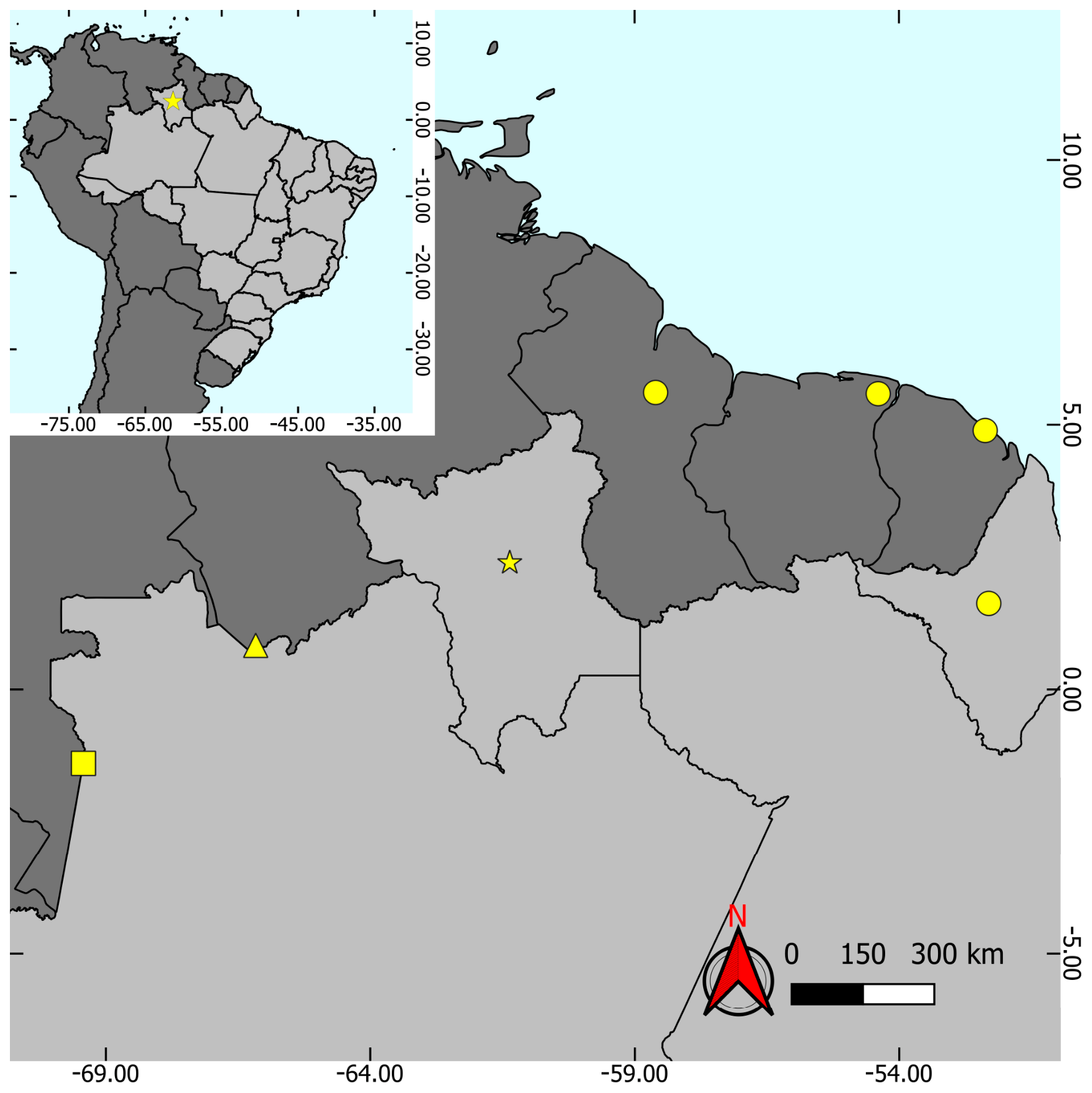
The present study’s fieldwork was conducted in October 2022 in an area of tropical rainforest, at an altitude of 130 m in an inselberg formation (2.3919° N, 61.3619° W) (Figure 1). This forest area is currently part of the touristic private zone ‘Cachoeira do Evandro’, within the limits of the municipality of Mucajaí, in the state of Roraima, Brazil. Specimens were collected through nocturnal (19:00–21:00) active searches using ultraviolet light. The specimens found were collected by help of metal tweezers (30 cm long) and preserved in ethanol at 70%. Field activities were authorized by the Brazilian Biodiversity Authorization and Information System (SISBIO), permit no. 88548-1.
Morphological terminology follows [18,19,20], except for carinae of pedipalp and metasomal segments and leg setation follows [21] and for trichobothria that follows [22]. The nomenclature of the lateral ocellus follows [23]. All measurements are in mm and were taken following [18,19]. Photographs were obtained with a digital camera SONY E3ISPM; Sony Corporation, Tokyo, Japan, mounted on a stereo microscope Zeiss Discovery V8; Carl Zeiss Microscopy GmBH, Jena, Germany, under white and ultraviolet lights. Photographs were automatically stacked using the built-in camera software. Images and plates were manipulated and prepared with the software Rising View 6.9 and edited with Photoshop CS5.1.
The female holotype of Cayooca venezuelensis González-Sponga, 1996 (MAGS-4607), was indirectly examined through high-resolution photographs kindly provided by Dr. José A. Ochoa. Comparisons with morphologically similar species of Brotheas were based on original descriptions and additional taxonomic literature.
Abbreviations of the repositories cited: CNAN—Colección Nacional de Arácnidos, Universidad Nacional Autónoma de México, Ciudad de México, México; MFCE—Coleção Entomológica do Museu de Fauna, Centro de Conservação e Manejo de Fauna da Caatinga, Universidade Federal do Vale do São Francisco, Petrolina, Pernambuco, Brazil; IBSP—Instituto Butantan, São Paulo, Brazil. Other abbreviations: V—ventral; e—external; i—internal; d—dorsal; eb, Eb—external basal; esb, Esb—external superior basal; em—external medial; est, Est—external subterminal; et, Et—external terminal; db, Db—dorsal basal; dt, Dt—dorsal terminal; ib—internal basal; it—internal terminal; PLMa—posterolateral major ocellus; MLMa—mediolateral major ocellus; PDMi—posterodorsal minor ocellus; ADMi—anterodorsal minor ocellus; L—length; AW—anterior width; PW—posterior width; Di—diameter; W—width; H—height; D—depth; dm—dorsal median; Dpl, dpl—dorsal prolateral; dps—dorsal prosubmedian; drsa—retrosubmedian accessory; drl—dorsal retrolateral; pld—prolateral dorsal; plm—prolateral median; Plvs, plvs—prolateral ventrosubmedian; rlm—retrolateral median; rlds –retrolateral dorsosubmedian, vrl—ventral retrolateral; vm—ventral median; vps—ventral prosubmedian; vpl—ventral prolateral.

3. Systematics

Family Chactidae Pocock, 1893.
Genus Cayooca González-Sponga, 1996.
Cayooca puchus Lira, González-Santillán, Santos-da-Silva, Brescovit, Pucca sp. n.
Type material. Holotype ♂ (MFCE), BRAZIL: Roraima state, Mucajaí municipality, Inselberg ‘Cachoeira do Evandro’, 2.3919° N, 61.3619° W, October 2022; G. Melo-dos-Santos, A.M. Rocha, G. Melo-dos-Santos, E. Frezarin, T.M. Leite, I.C.S. Cardoso & K.D.A. Santos col. Paratypes. 1♂ 1♀ (CNAN), 2♂ 1♀ (MFCE) and 1♂ (IBSP). Same data as the holotype.
Diagnosis. Distinguished from Cayooca venezuelensis González-Sponga 1996 by denser cuticular granulation overall. Metasomal segments II–III with ventrolateral and ventrosubmedian carinae granular (Figure 11); absent in C. venezuelensis. Ventromedian and ventral prosubmedian carinae strongly costate and scattered-granular; vestigial in C. venezuelensis.
Etymology. The specific epithet puchus is derived from the colloquial Spanish term pucheros, referring to a facial expression resembling a pout or childish sulking. The name alludes to the first author’s spontaneous reaction upon encountering this new species, a mixture of surprise and fascination expressed as a “pout.” The epithet thus commemorates the emotional moment associated with its discovery. The epithet is treated as a noun in apposition.
Description. The following description is based on the type series.
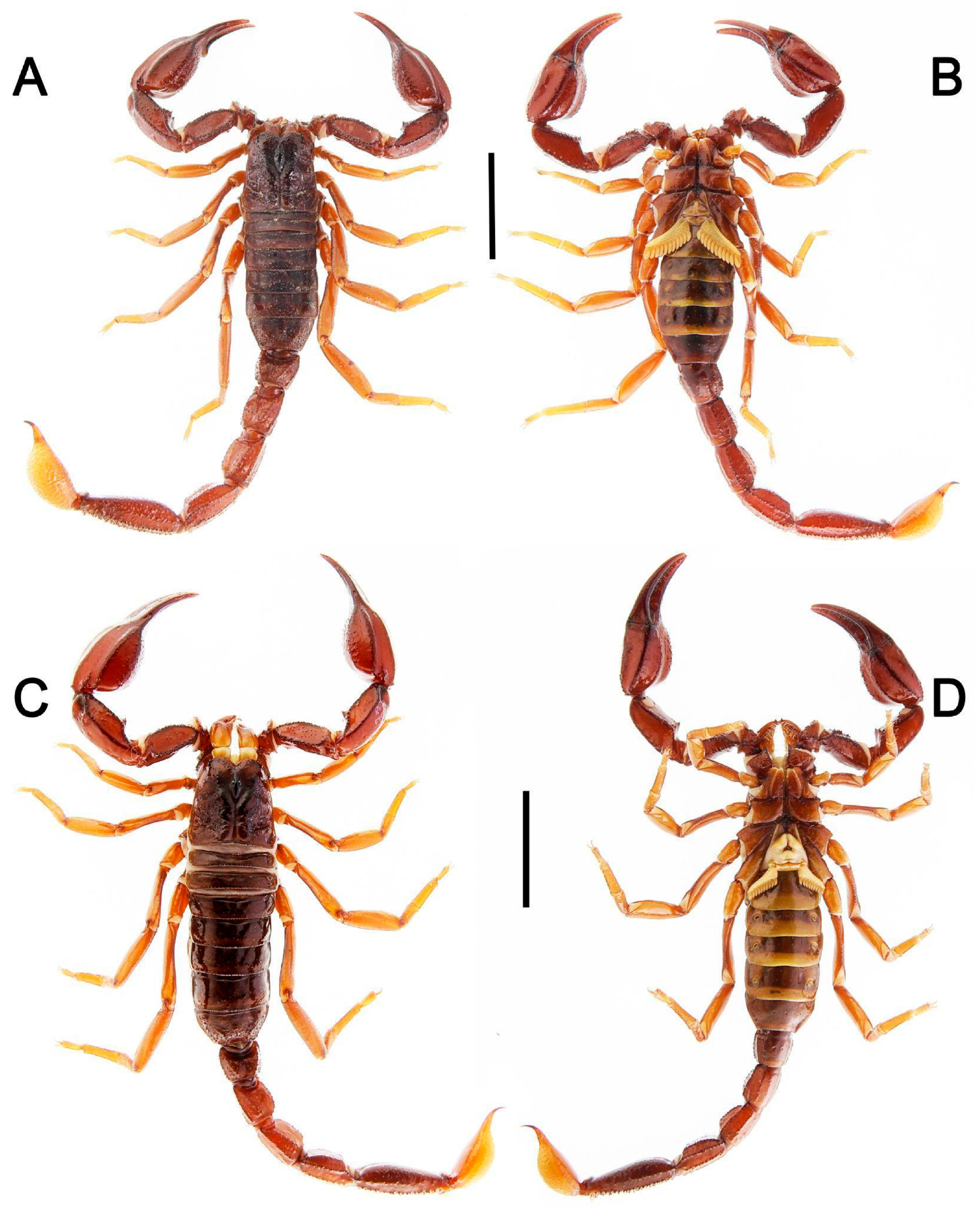
Coloration and infuscation (in ethanol) (Figure 2): Carapace. Tergites and sternites with dark, symmetrical infuscation patterns. General coloration ranging from reddish yellow to dark reddish-brown; body with moderate darker spots, except telson. Carapace dark reddish-brown, posterior region with diffuse darker spots; median ocular tubercle and posterior portions of lateral and median eyes with dark pigmentation; posterior margin, just after posterior marginal furrow, with distinct dark spot. Chelicerae. Coxa and manus reddish-brown; anterior margin of coxa immaculate; manus with light brown reticulated pigmentation on anterior margin, central and posterior regions reddish yellow; movable and fixed fingers and teeth reddish-brown. Pedipalps. Trochanter, femur, patella and chela reddish-brown; carinae outlined dark reddish-brown. Legs. I–IV orange-yellow to orange-reddish on prolateral and retrolateral surfaces; tarsi light yellow; dorsal and ventral carinae marked with infuscation. Coxosternal region. Coxae I–IV, sternum, genital operculum and basal pectinal piece reddish-brown; lateral surfaces of coxae with discrete yellow spots; pectines yellow to slightly brownish. Mesosoma. Tergites and sternites dark reddish-brown; middle-posterior portion of sternites III–VI yellowish. Metasoma: segments I–V reddish-brown; telson yellowish with reddish dorsal surface; aculeus reddish-brown. Pedipalp. femur with ventral retrosubmedian, ventral prolateral, dorsal retrolateral and dorsal prolateral carinae outlined brownish; patella with ventral prolateral, ventral retrolateral, dorsal retrolateral and dorsal prolateral carinae outlined brownish; chela with ventral retrolateral, ventral median, dorsal retrosubmedian, dorsal median, prolateral dorsal and dorsal retrolateral carinae outlined brownish.
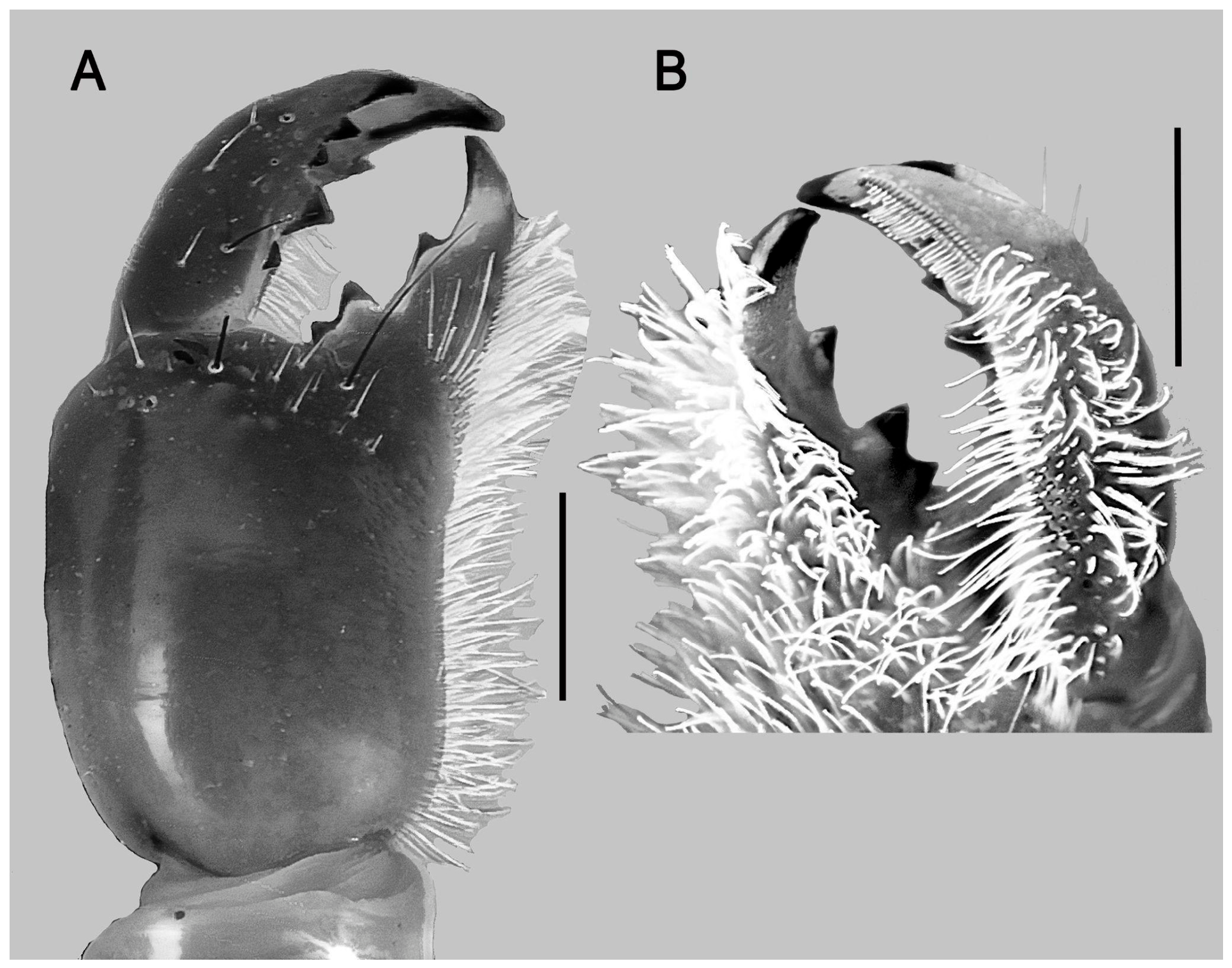
Chelicerae: Manus dorsal surface with two distal macrosetae; few granules surrounding setae. Fixed finger with basal and medial teeth forming bicuspid denticle; one subdistal tooth; one distal tooth larger than preceding. Movable finger retrolateral margin with one basal denticle, one larger median, two smaller subdistal, and one larger external distal denticle on dorsal surface (Figure 3A). Ventral surface of movable finger with internal distal denticle and serrula on distal third (Figure 3B). Prolateral and retrolateral distal denticles opposable.
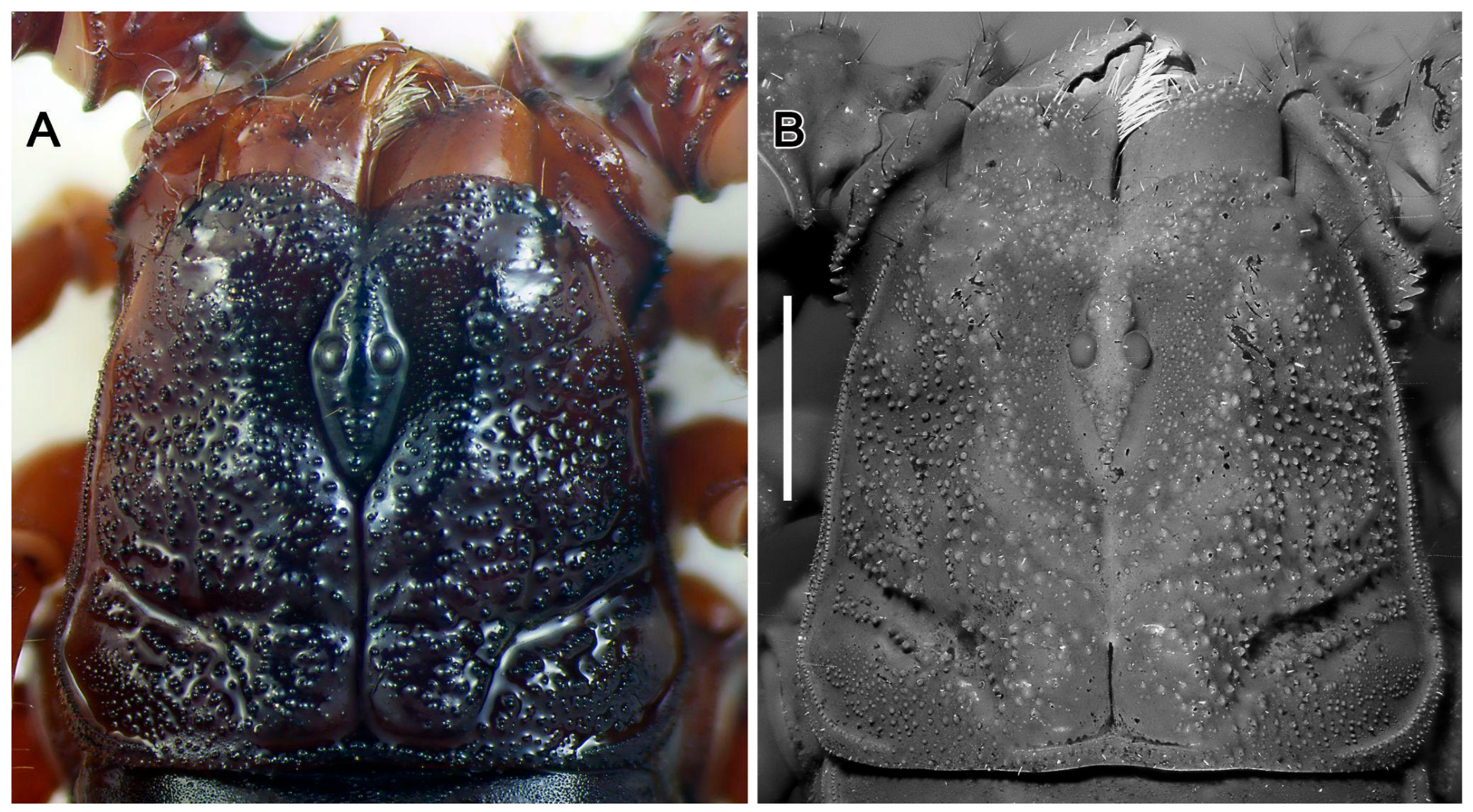
Carapace: Anterior margin with deep median notch, bilobed. Posterior margin sublinear, with shallow median notch. Surface predominantly granular; smoother in periocular area and less granular in lateroposterior region. Anterior median carinae conspicuous, granular; superciliary carinae granular; posterior median carinae obsolete; posterior lateral carina granular (Figure 4). Ocular tubercle well developed, situated on anterior half; median eyes well developed. Lateral ocelli conforming to type 4C: PLMa and MLMa similar in size; PDMi smaller [23]. Anterior lateral sulcus moderately deep; posterior median, posterior marginal, and posterior lateral sulci deep.
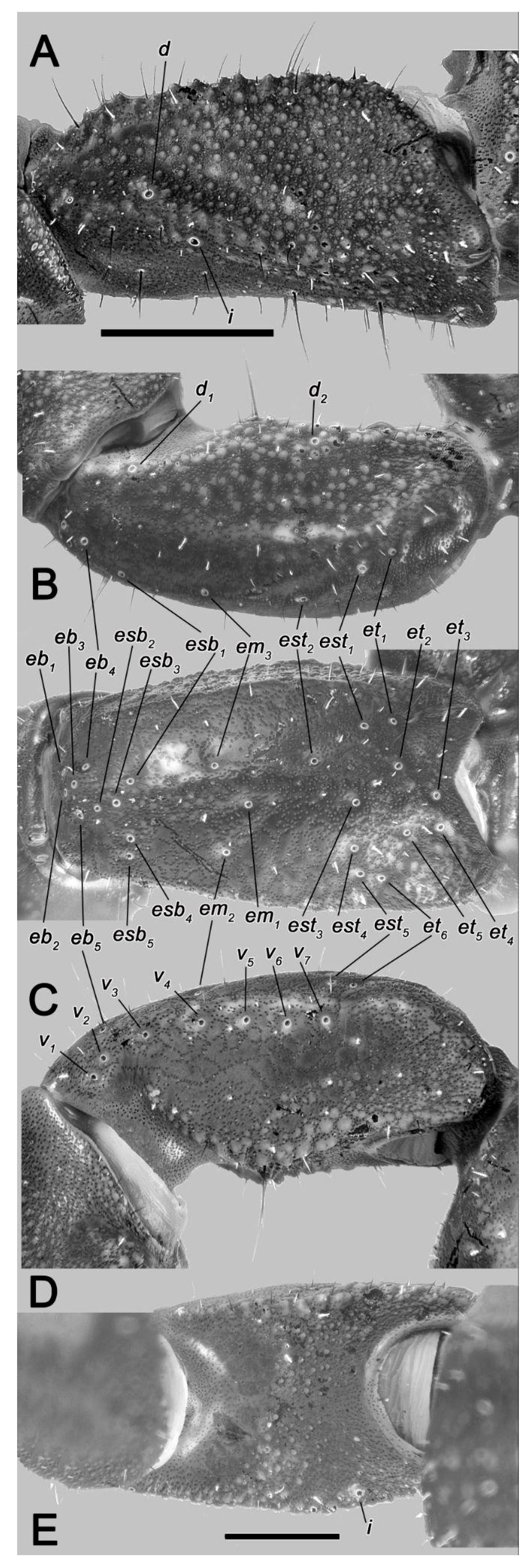
Femur: Length/width ratio ♂ 2.33–2.60 (mean = 2.46, n = 5), ♀ 1.86–2.75 (mean = 2.31, n = 2). Carinae conspicuous. Dorsal and prolateral intercarinal surfaces granular, more strongly in ♂; ventral and retrolateral surfaces mostly smooth. Dpl, drl, and vpl carinae strongly developed, comprising tapered conical granules (Figure 5). Plvs carina with sparse enlarged conical granules, bifurcating proximally, expressed on proximal two thirds of segment. Rlds carina costate (♀) or crenulate (♂) on distal third, expressed on distal two thirds of segment. Remaining carinae obsolete.
Patella: Length/width ratio ♂ 2.19–2.81 (mean = 2.46, n = 5), ♀ 2.31–2.50 (mean = 2.41, n = 2). Dpl and vpl carinae granular; drl and vrl carinae crenulate. Rlm and rlds carinae obsolete (♀) or finely granular (♂). Plm and plv carinae obsolete, represented by enlarged spinoid tubercle. Prolateral dorsal and ventrolateral projections (patellar spurs sensu [24] obsolete; dorsal slightly more pronounced than prolateral ventral. Dorsal intercarinal surface weakly granular; ventral and retrolateral surfaces mostly smooth; prolateral surface granular in ♂, less so in ♀.
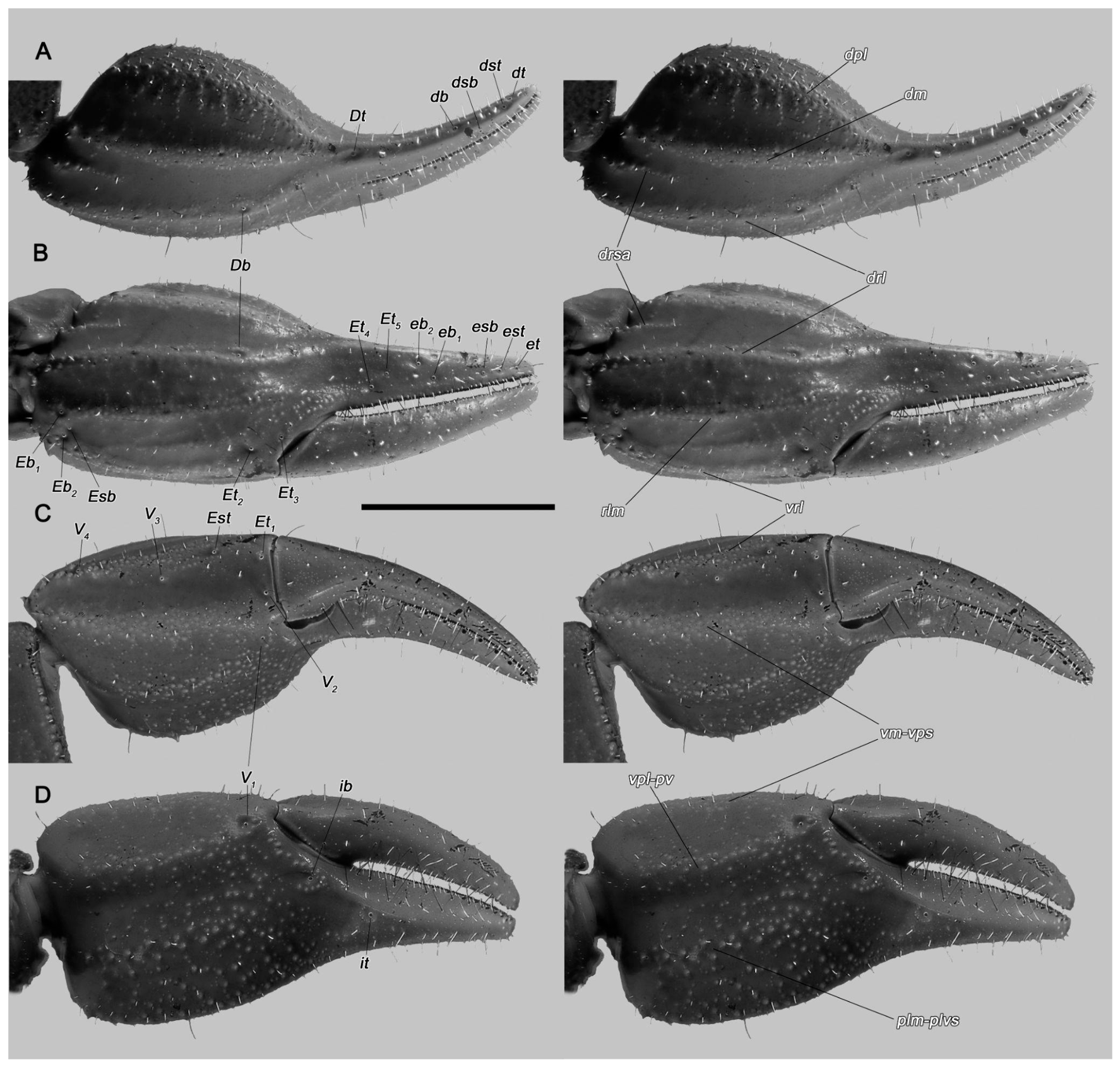
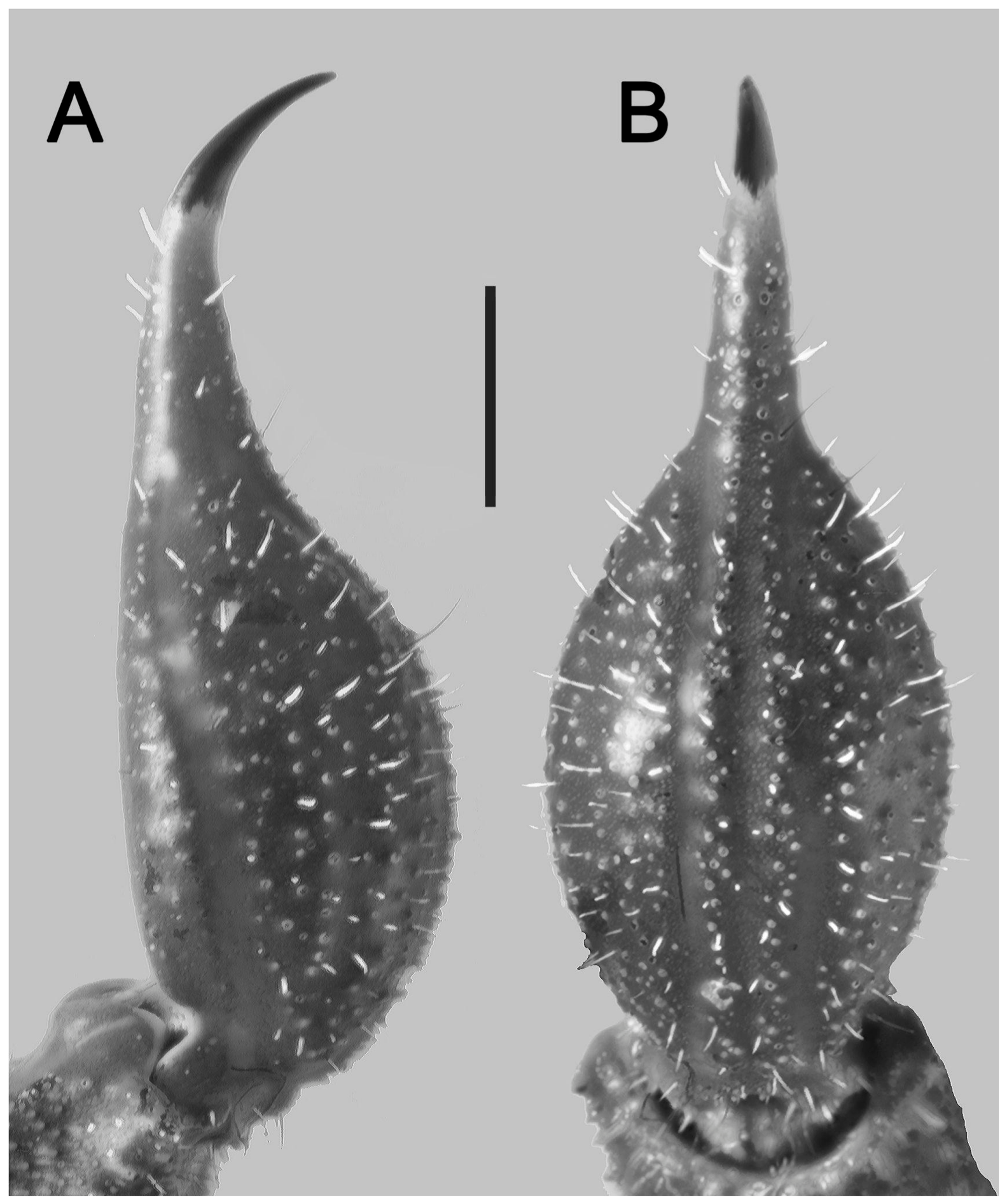
Chela. Manus incrassate; fingers relatively short. Chela length/width ratio ♂ 2.76–3.33 (mean = 2.92, n = 5), ♀ 2.06–2.89 (mean = 2.48, n = 2); length/height ratio ♂ 2.68–2.91 (mean = 2.80, n = 5), ♀ 3.10–3.54 (mean = 3.32, n = 2). Dm, drl, rlm, and vrl carinae strongly costate, with dense crenato-granular surface of variable breadth. Dpl and dps carinae fused, forming broad crenato-granular field, slightly reticulating on dorsal surface. Drsa carina vestigial, represented by proximal enlarged granule followed by short row of conical granules. Vm and vps carinae fused as broad crenato-granular field, slightly reticulating on prolateral and ventral surfaces (♂), less developed in ♀. Plm and vpl carinae, as well as plm and plvs carinae, each pair fused as broad field of sparse granules converging on prolateral surface (♂), less developed in ♀. Intercarinal surfaces smooth, except prolateral surface distinctly granular.
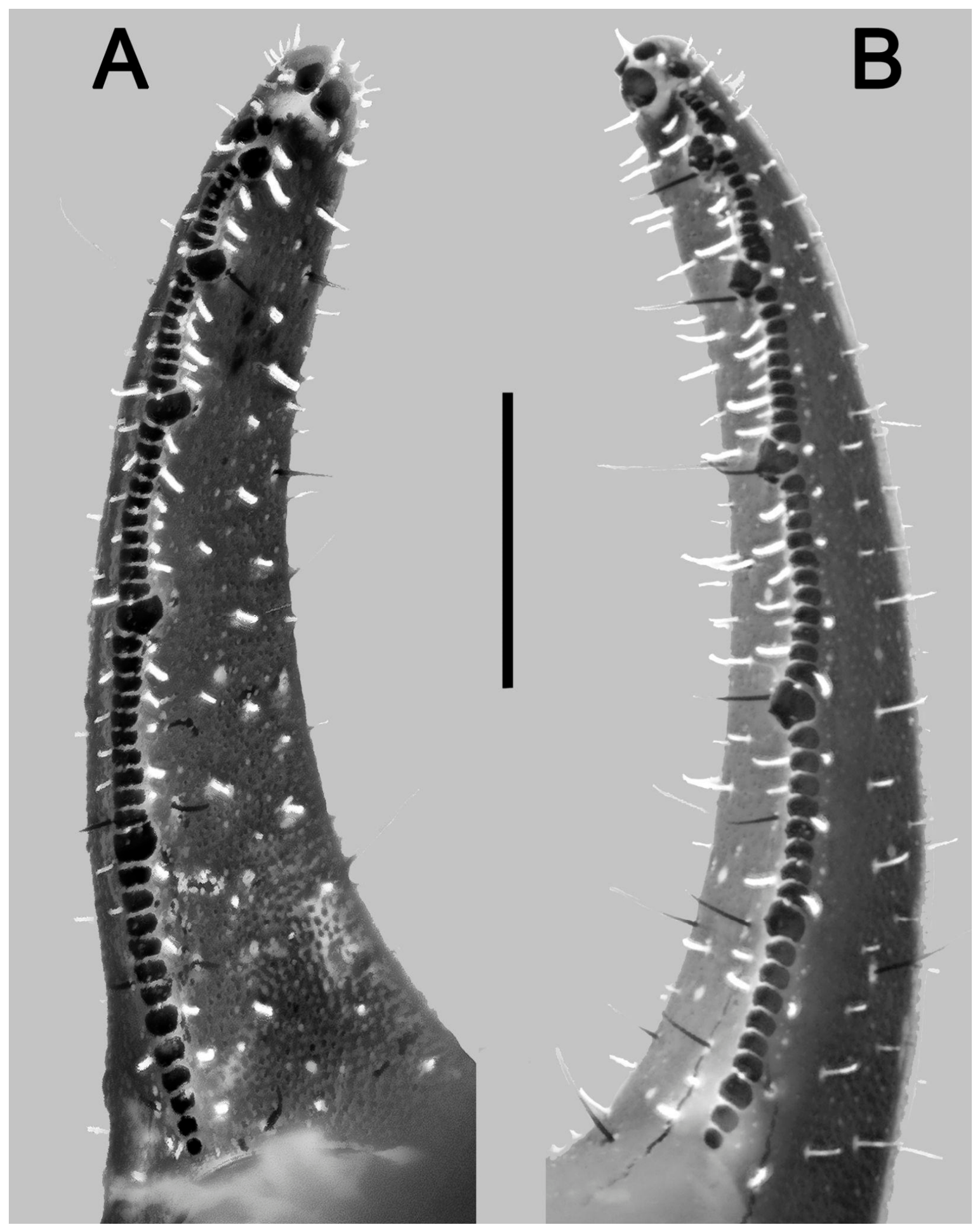
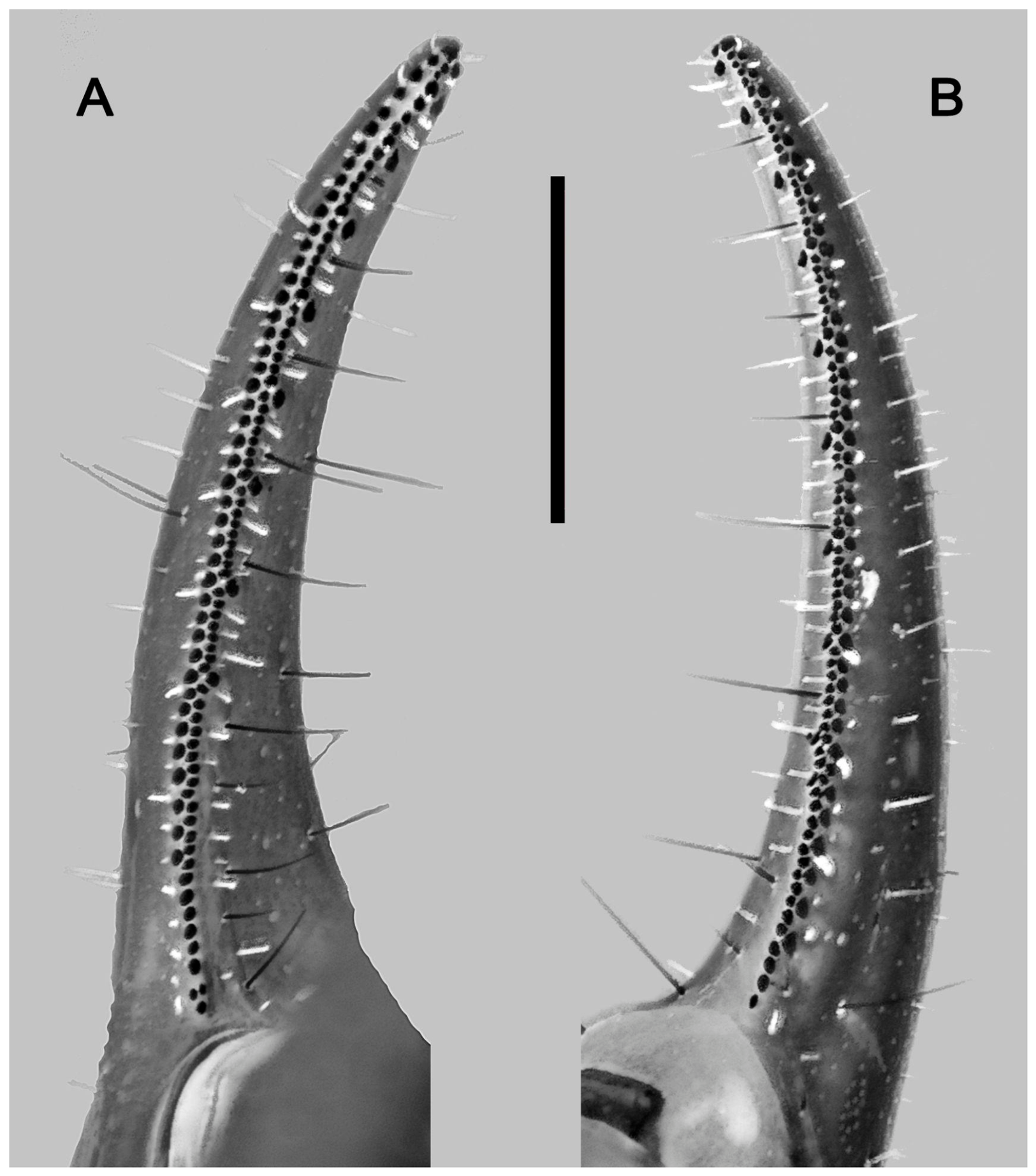
Fixed and movable fingers: Straight in profile; dorsal and ventral margins lacking lobes or notches. Nine primary rows of median denticles, separated by slightly enlarged median denticles; flanked by nine retrolateral and nine prolateral enlarged denticles; accessory retrolateral denticles present (Figure 6). Prolateral surface with rows of macrosetae; prolateral and retrolateral rows of microsetae bright under UV light.
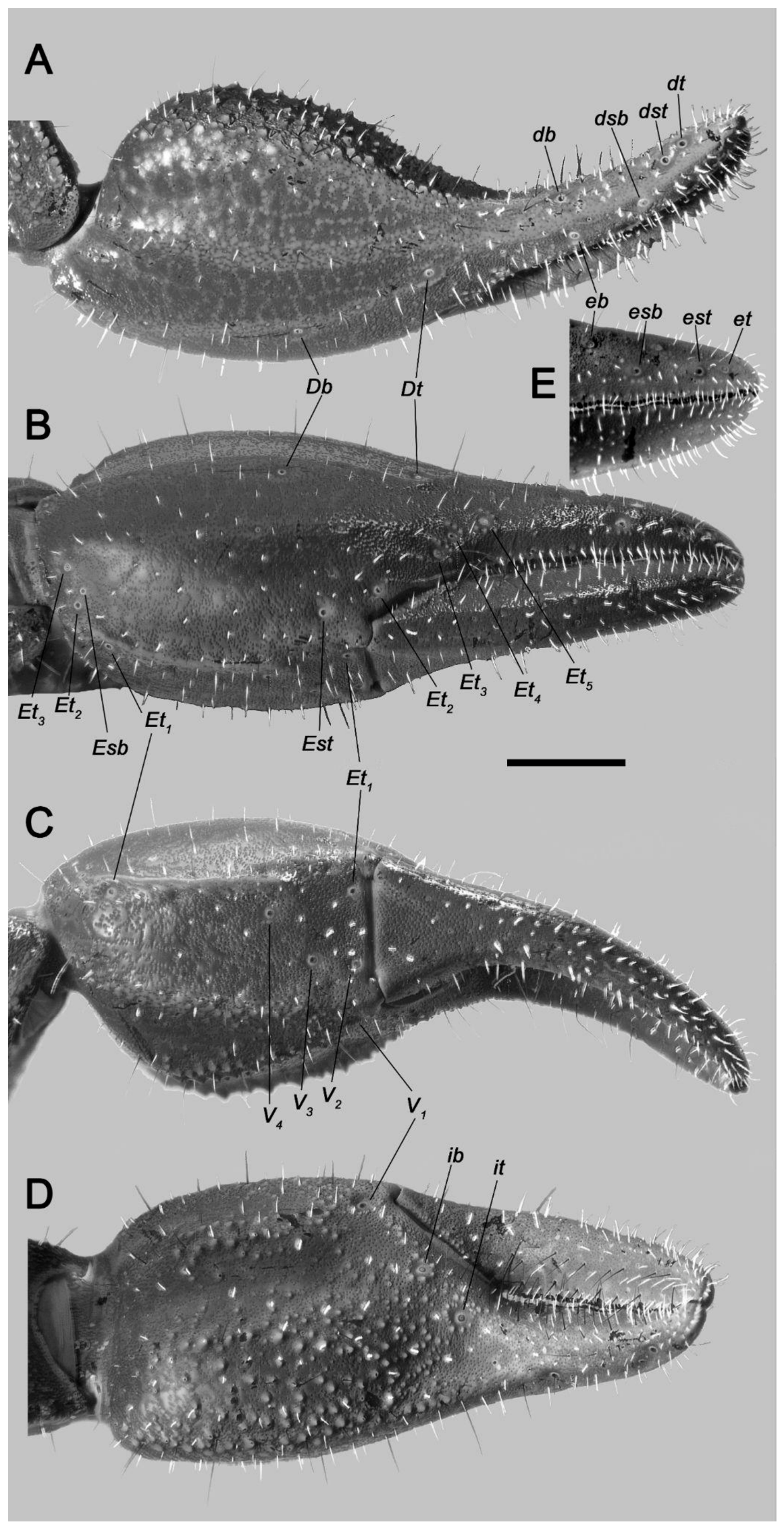
Trichobothrial pattern: Neobothriotaxy type C, major. Femur. Three trichobothria situated proximally; e and d closer to each other than to i (Figure 5). Patella. Two dorsal trichobothria. Twenty-three retrolateral trichobothria (10 accessory): eb1–5, esb1–5, em1–3, est1–5, et1–5. Eight ventral trichobothria arranged in longitudinal row on proximal two thirds, parallel and contiguous to vrl carina. One prolateral trichobothrium (Figure 5). Chela. Thirty-five trichobothria. Six dorsal: series dbdt complete (four trichobothria), plus Db and Dt located distally on manus and fixed finger, respectively. Nine retrolateral: series ebet complete (four trichobothria), plus accessory eb1; Et2–Et5 present, Et4–Et5 and eb1 situated on proximal third of fixed finger; Et4–Et5 distinctly separated from Et2–Et3. Five ventral: V2–V4, Et1, and Est. Three prolateral: V1 and pair ibit (Figure 7).
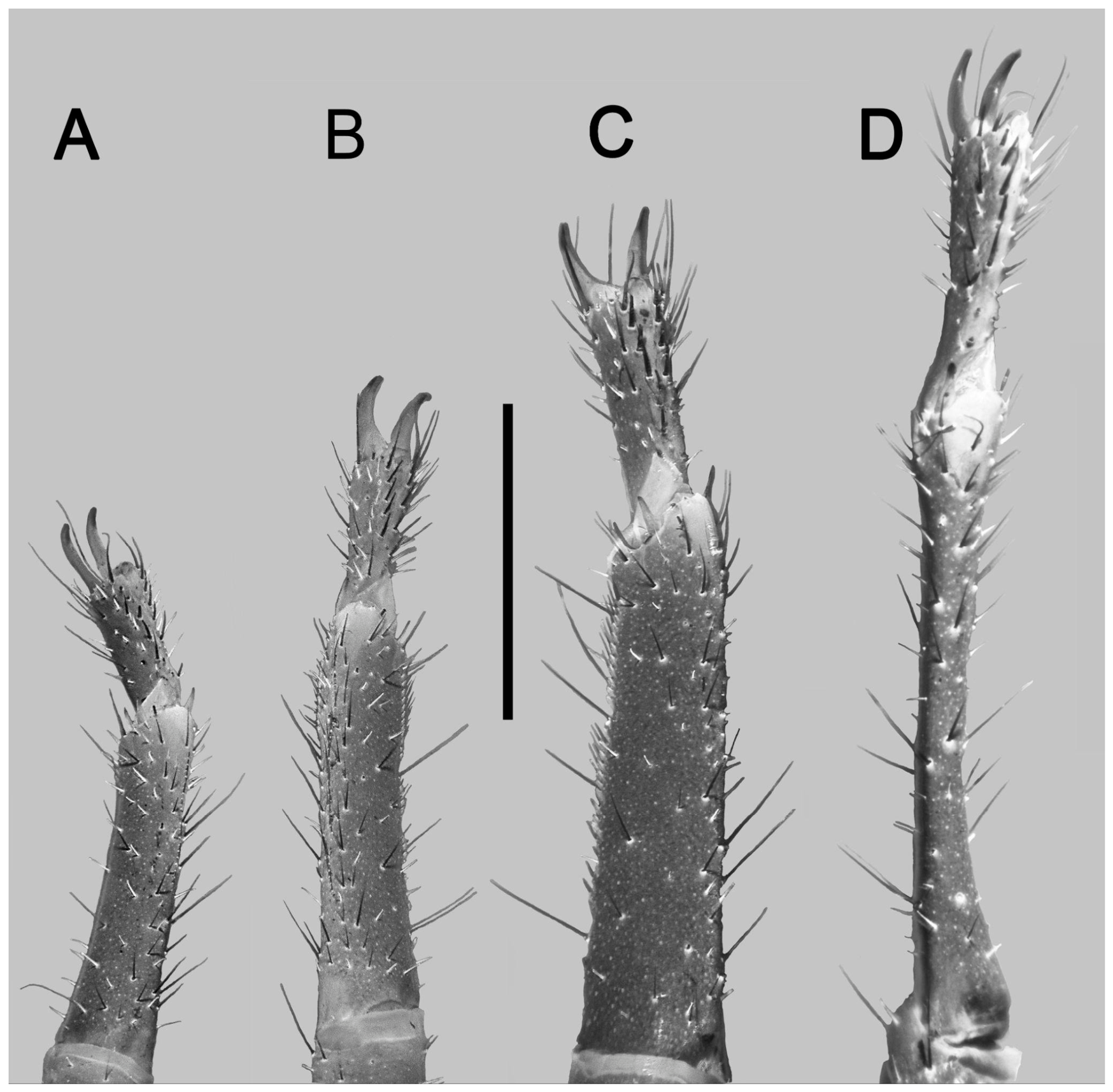
Legs: Coxa I ventral submedian margin with conspicuous depression bearing two knob-like sensilla on each side. Area between fused coxae I–II with four transverse slit-like structures; prolateral surface with abundant fine macrosetae, bright under UV light. Femur dorsal and ventral surfaces granular (♂) or smooth (♀); retrolateral surfaces weakly granulose (♂) or smooth (♀); remaining segments smooth. Tibial spurs absent. Prolateral and retrolateral pedal spurs present. Basitarsi. Proventral carina on legs I, III, IV with distal row of three to five spinules; on leg II with continuous row on distal third; retroventral carina on leg I with continuous row on distal third; on leg II with discontinuous row along entire length; absent on legs III–IV; retrodorsal carina on leg I lacking spinules; on legs II–IV with discontinuous row along entire length. Telotarsi with paired submedian rows of five to nine elongated spiniform macrosetae; additional prolateral and retrolateral rows of smaller macrosetae on each leg. Ungues elongated, curved, equal in length; dactyl short, broad (Figure 8).
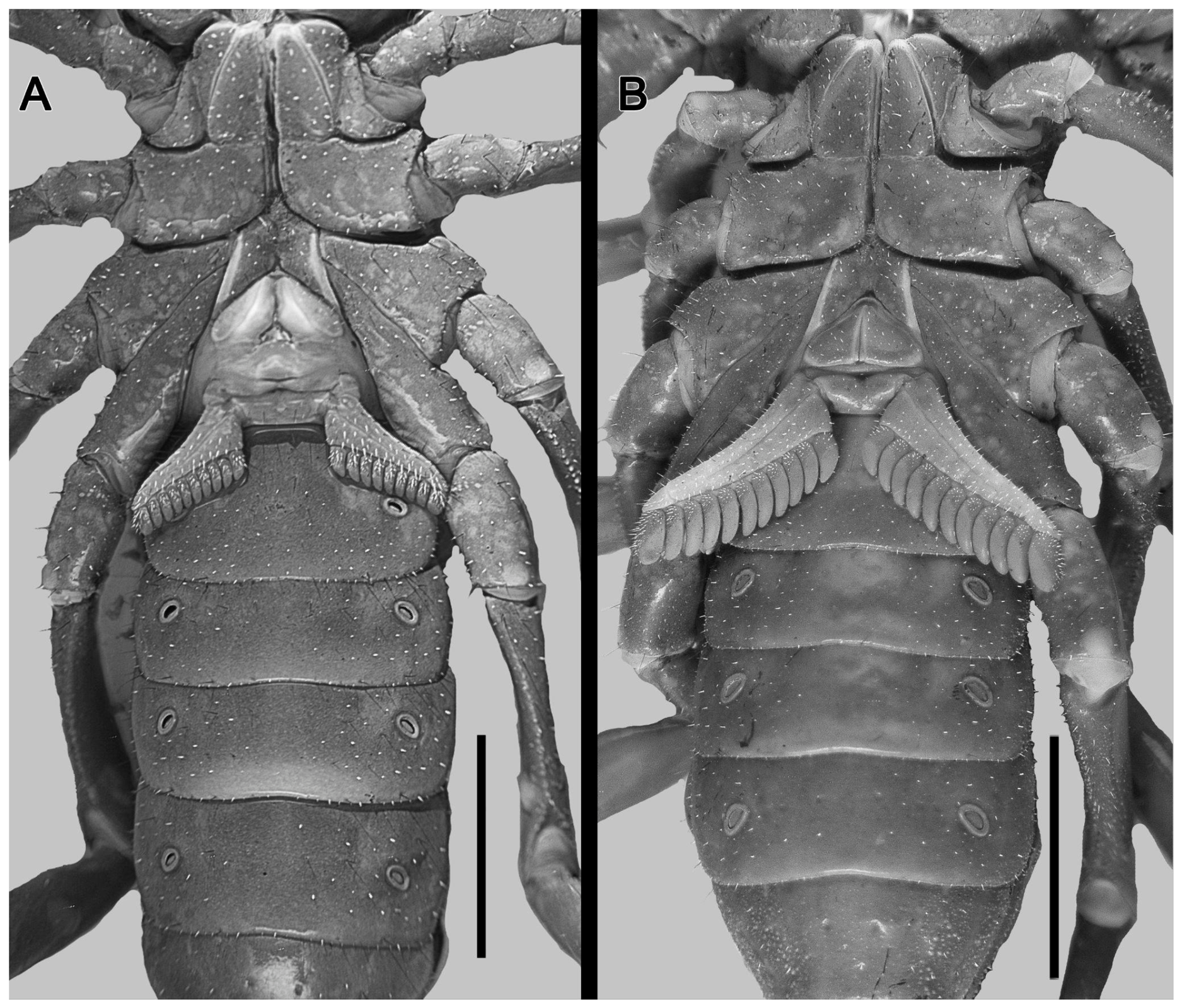
Sternum: Subpentagonal, longer than wide; two lateral lobes bearing two pairs of macrosetae. Lateral margins converging anteriorly into deep posteromedian notch. Anterior triangular portion with two short, parallel, granular carinae forming anterior accessory depression, each carina bearing one macroseta (♂); in ♀, two parallel broad costae forming anterior accessory depression plus short terminal median costa, each costa bearing one macroseta (Figure 9).
Genital operculum: Opercular plates subtriangular; mostly straight (♂) or medially rounded (♀). Surface smooth with scattered punctures; three posterior and one anterior macroseta; scattered bright microsetae (under UV light). Median margins completely separated; opercula movable independently.
Pectines. Marginal lamina linear, divided into three sclerites, decreasing in size distally; proximal sclerite longest. Median lamina fused into a single smooth plate. Fulcra absent. Tooth count 9–10 (♀), 11–12 (♂). Tooth bases strongly sclerotized, covered with microsetae; sensillar area with peg sensilla covering approximately 70% of pectinal surface (♂) or 50% (♀).
Sternites. Sternites III–VI each with a pair of small, oval spiracles situated laterally; surfaces smooth, with two transverse rows of six minor macrosetae. Sternite VII with lateral surfaces granular (♂) or smooth (♀); ventrolateral carinae granular (♂) or obsolete (♀).
Tergites. Tergites I–VI intensely granulose over entire surface (♂) or less so (♀), particularly on tergite I–II; dorsal median carina vestigial (♂) or absent (♀). Tergite VII intensely granulose (♂) or less so (♀); dorsosubmedian and dorsolateral carinae strongly costate, bearing enlarged conical granules (Figure 10).
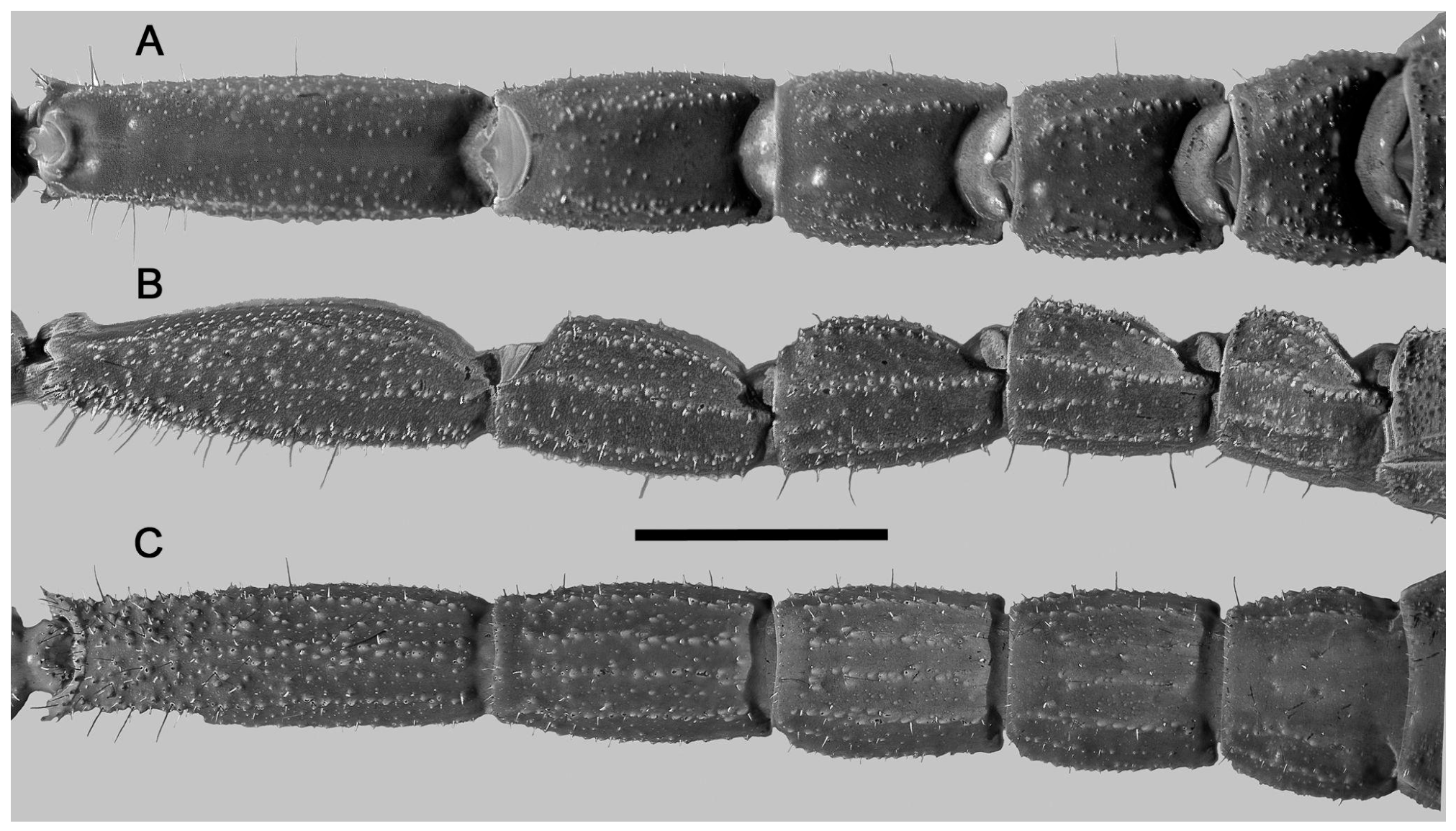
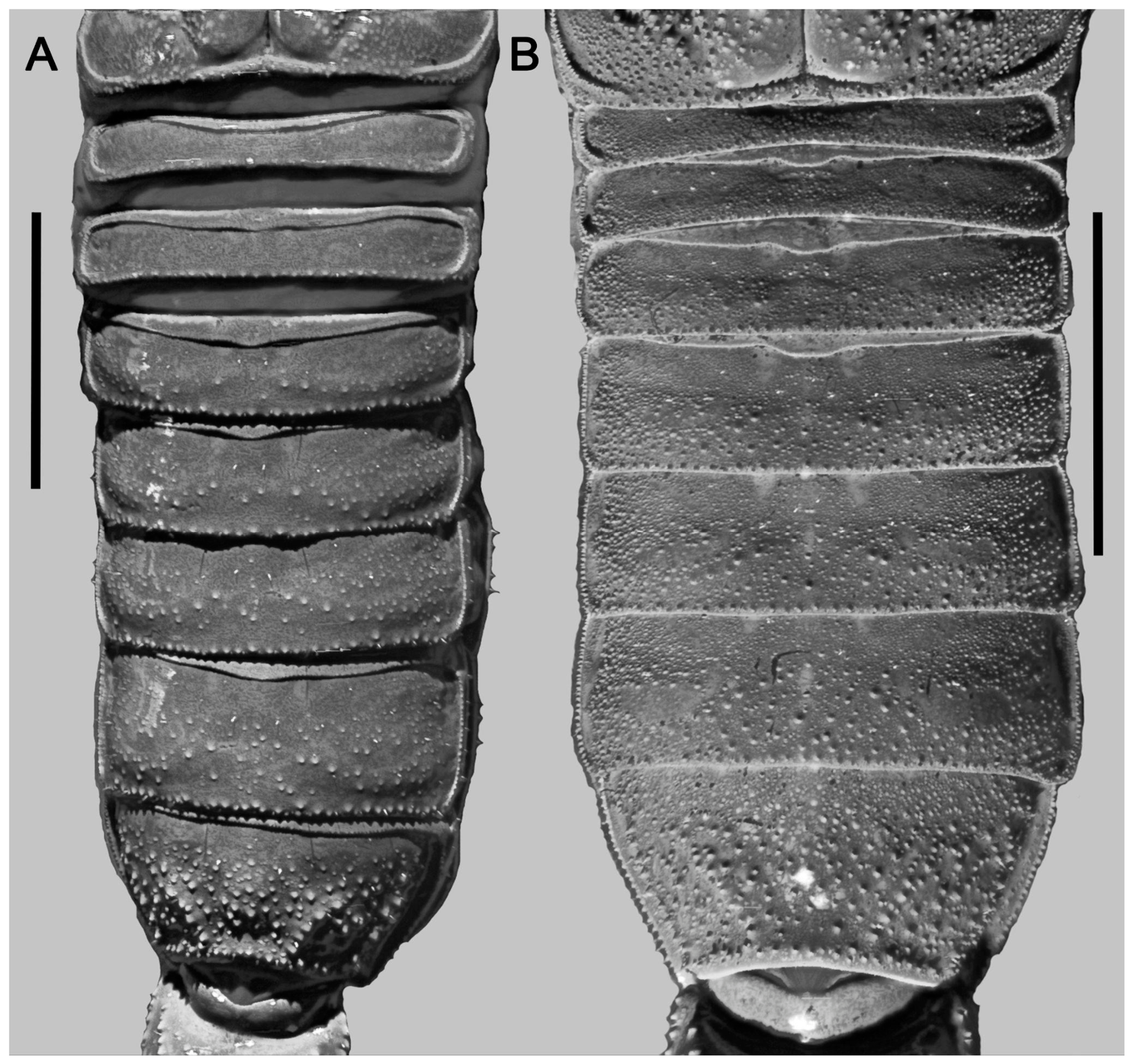
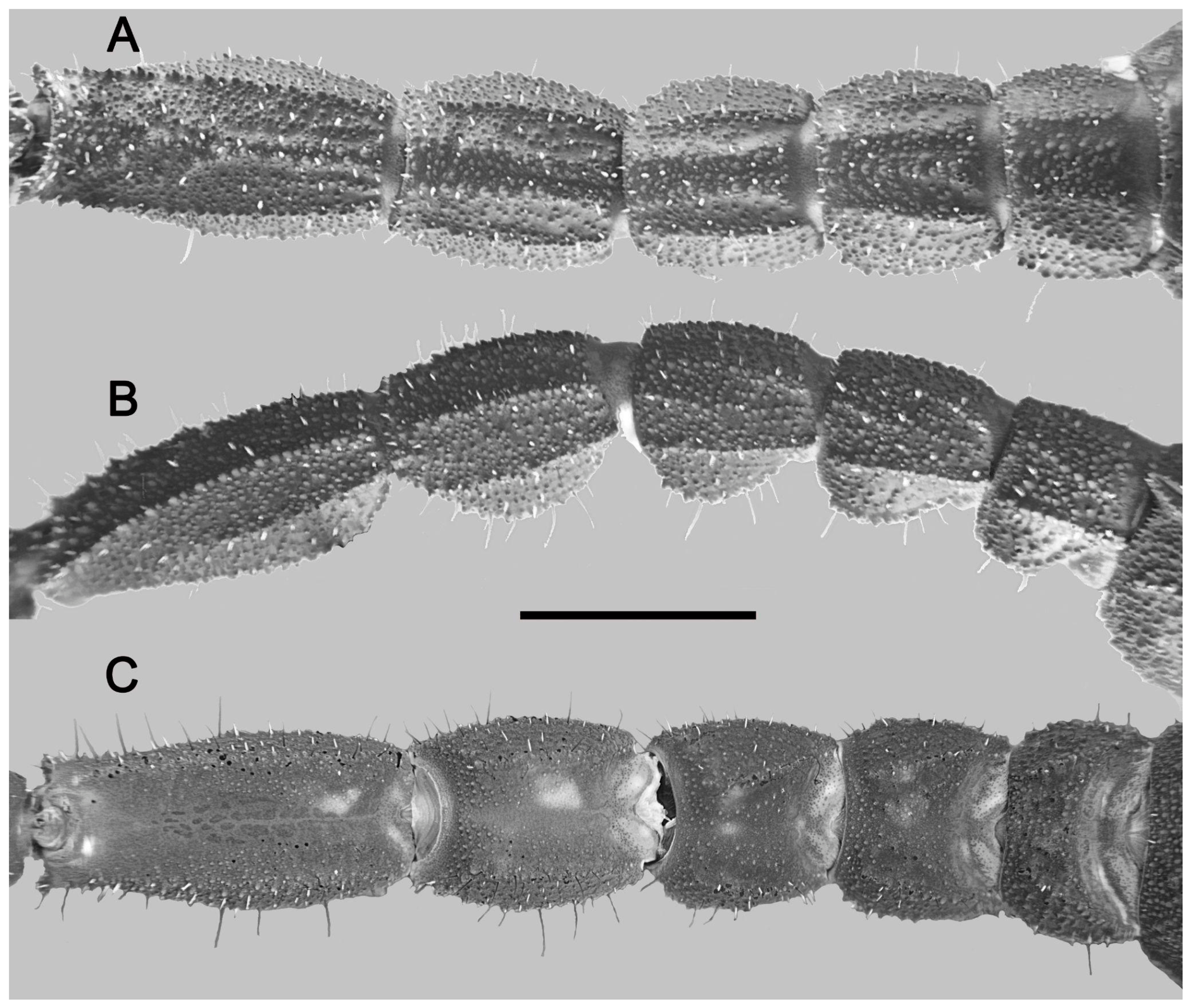
Metasoma (Figure 11): Segments progressively longer than wide. Dorsolateral and lateral median carinae on segments I–IV granulose, serrate in profile; intercarinal surfaces granulose (♂) or less so (♀). Segment V granular; lateral median carina incomplete, restricted to anterior two-thirds; intercarinal surfaces granulose (♂) or less so (♀); dorsal median surface with smooth longitudinal band. Lateral inframedian carinae complete and granular on segment I; incomplete, restricted to posterior half on segment II; vestigial, represented by distal granules on segments III–IV (♂); all less developed in ♀. Intercarinal surfaces smooth, except segment I with scattered fine granules and segment V with more numerous, enlarged granules. Ventrolateral carinae granular, serrate in profile on segments I–IV (♂) or less granular (♀); on segment V serrate with enlarged spiniform granules (♂) or less developed (♀). Ventral submedian carinae obsolete on segment I; costate with few sparse granules (♂) or smooth (♀) on segment II; granular, serrate in profile on segments III–IV (♂) or less granular (♀). Ventral median carina on segment V serrate, with enlarged spiniform granules (♂) or less developed (♀). Ventral intercarinal surfaces with few scattered granules on segments I–IV (♂) or smooth (♀); densely covered with enlarged spiniform granules on segment V (♂) or less granular (♀). All carinae bearing two or three minor macrosetae.
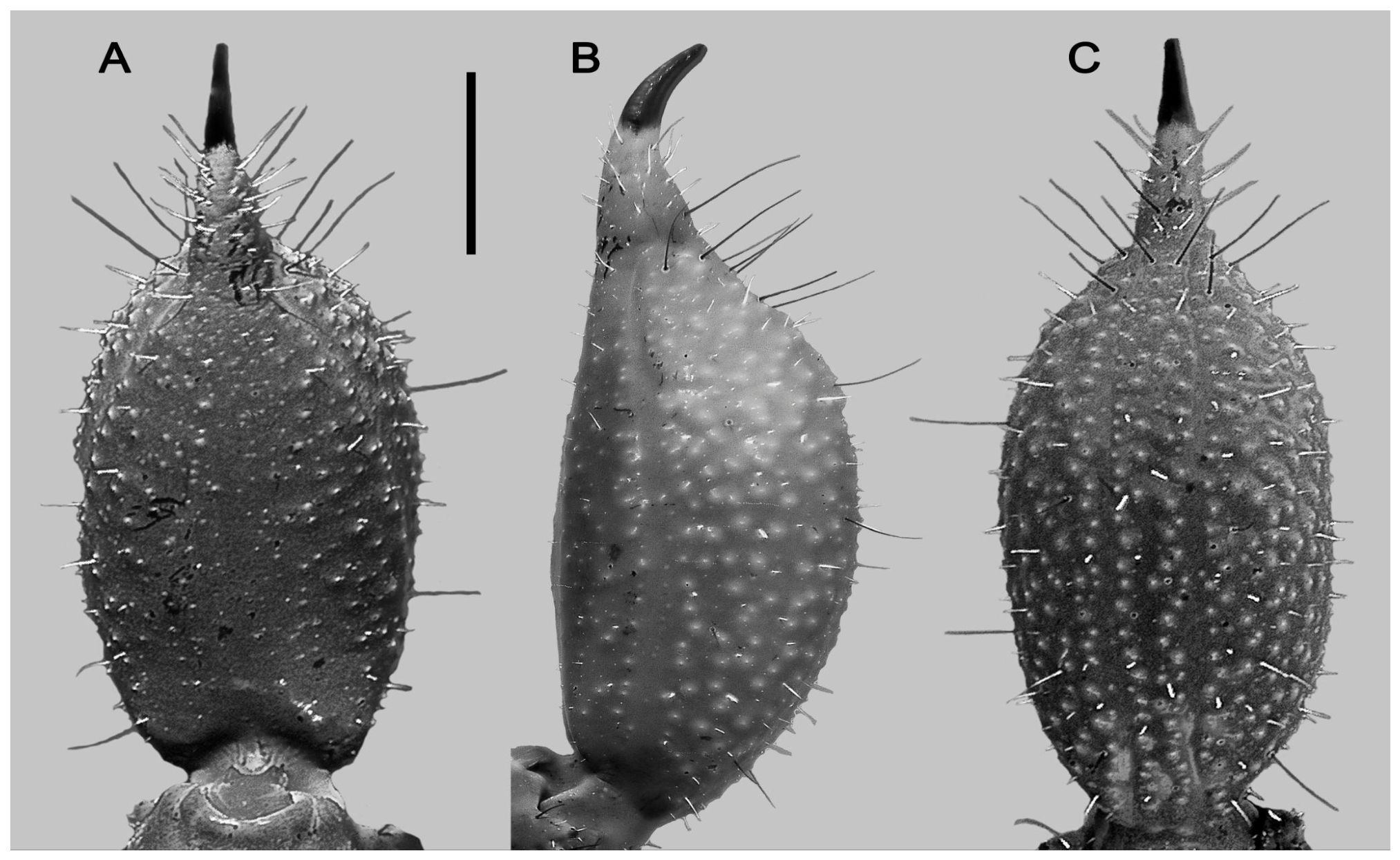
Telson: Vesicle globose (♂) or less so (♀); ventral and lateral intercarinal surfaces densely granulose; dorsal intercarinal surfaces less granulose (♂) or smooth (♀). Ventral carinae each with three evenly spaced macrosetae along vesicle. Aculeus smooth, short, gently curved; two pairs of elongated, tapered basal ventral macrosetae present (Figure 12).
Distribution. The species is known only from the type locality (Figure 1).
Biology notes. Cayooca puchus sp. n. inhabits a tropical rainforest associated with an inselberg surrounded by open forest formations. The species may be found in burrows excavated in soil or within rock crevices. Individuals were observed actively foraging during periods of rainfall.
Genus Brotheas C. L. Koch, 1837.
Brotheas cernii Lira, González-Santillán, Santos-da-Silva, Brescovit, Pucca sp. n.
Type material. Holotype ♂ (MFCE), BRAZIL: Roraima state, Mucajaí municipality, Inselberg ‘Cachoeira do Evandro’, 2.3919° N, 61.3619° W, October 2022; G. Melo-dos-Santos, A.M. Rocha, G. Melo-dos-Santos, E. Frezarin, T.M. Leite, I.C.S. Cardoso & K.D.A. Santos col. Paratypes. 1♂ 1♀ (CNAN), 2♂ 2♀ (MFCE) and 2♂ (IBSP). Same data as the holotype.
Diagnosis. Distinguished from other Brotheas species, except B. granulatus Simon, 1877 and B. subgranulatus Ythier and Lourenço, 2026, by a strongly granular carapace and tergites. Differs from B. granulatus by smaller body size (45–57 mm total length vs. 58–68 mm). Metasomal segment I with vsm and vl carinae distinctly granular; absent in B. granulatus. Metasomal segments III–V with vsm and vl carinae bearing spinoid granules; spinoid only on segments IV–V in B. granulatus. Mesosomal granulation strong only on segment VII; stronger on segments VI–VII in B. granulatus. Differs from B. subgranulatus by metasomal segment I with vsm and vl carinae granular; well-marked in B. subgranulatus. Metasomal segments III–V with vsm and vl carinae bearing spinoid granules; spinoid only on segments IV–V in B. subgranulatus. Chela prolateral surface strongly granular; weakly granular in B. subgranulatus. Mesosomal granulation strong only on segment VII; equally developed in B. subgranulatus.
Etymology. The specific epithet cernii is a patronym honoring the biologist Dr. Felipe Augusto Cerni, in recognition of his significant contributions to the study of scorpion venoms in Brazil. The name also acknowledges his longstanding academic support to the senior author (M.B. Pucca).
Description. The following description is based on the type series.
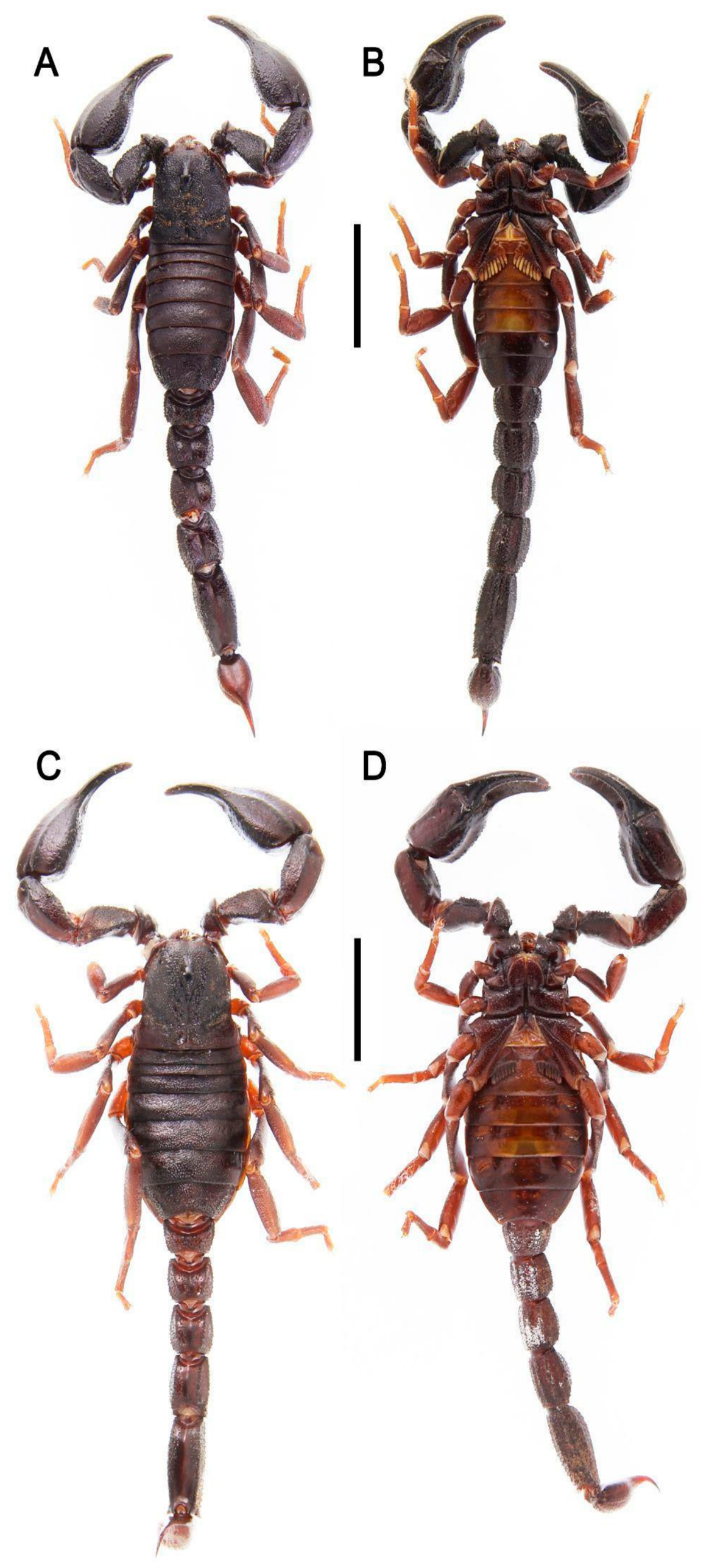
Coloration and infuscation (in ethanol): (Figure 13). Carapace and pedipalps dark brownish red. Tergites, metasoma, telson, and legs brownish red, contrasting with preceding structures. Sternites and sternum dark reddish. Genital operculum, basal piece, and pectinal marginal and median laminae orange. Pectines whitish to light greyish, partially surrounded by reddish dorsal and lateral cuticle. Sternites III–V with median glandular area pale yellowish, lateral areas amber to dark reddish. Sternites VI–VII uniformly dark reddish.
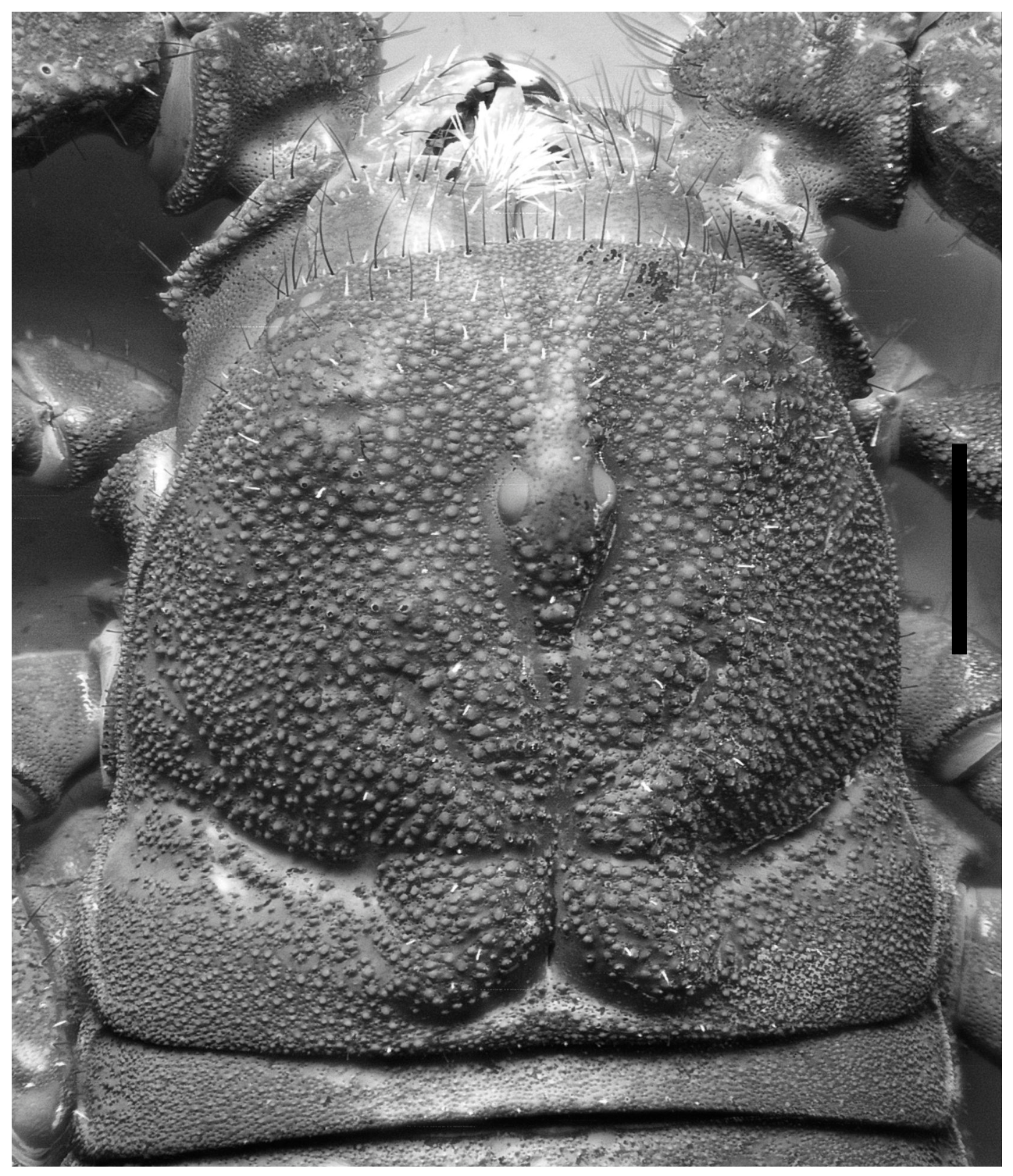
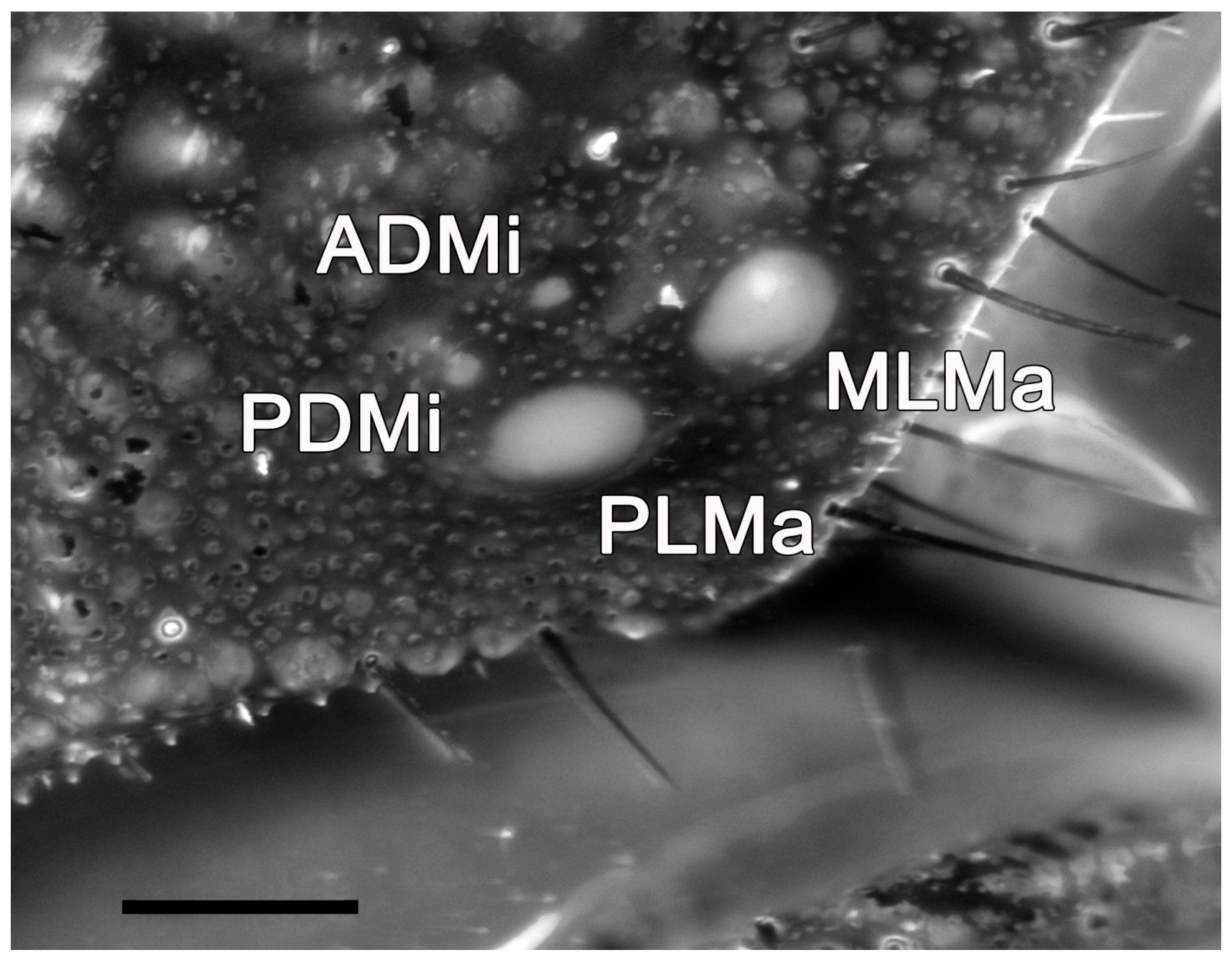
Carapace. Anterior margin gently rounded; posterior margin straight. Surface strongly convex, densely granulose and punctate, except lateroposterior regions with smaller granules (Figure 14). Lateral and superciliary carinae obsolete. Anteromedian carina incomplete, restricted to base of ocular tubercle. Ocular tubercle distinctly raised above carapace surface, situated slightly anteromedially. Four pairs of lateral ocelli, conforming to type 4C, with PLMa and MLMa of similar size, and PDMi and ADMi smaller, subequal (Figure 15). Posterior transverse and posterior median sulci deep, well developed. Anterior median sulcus absent.
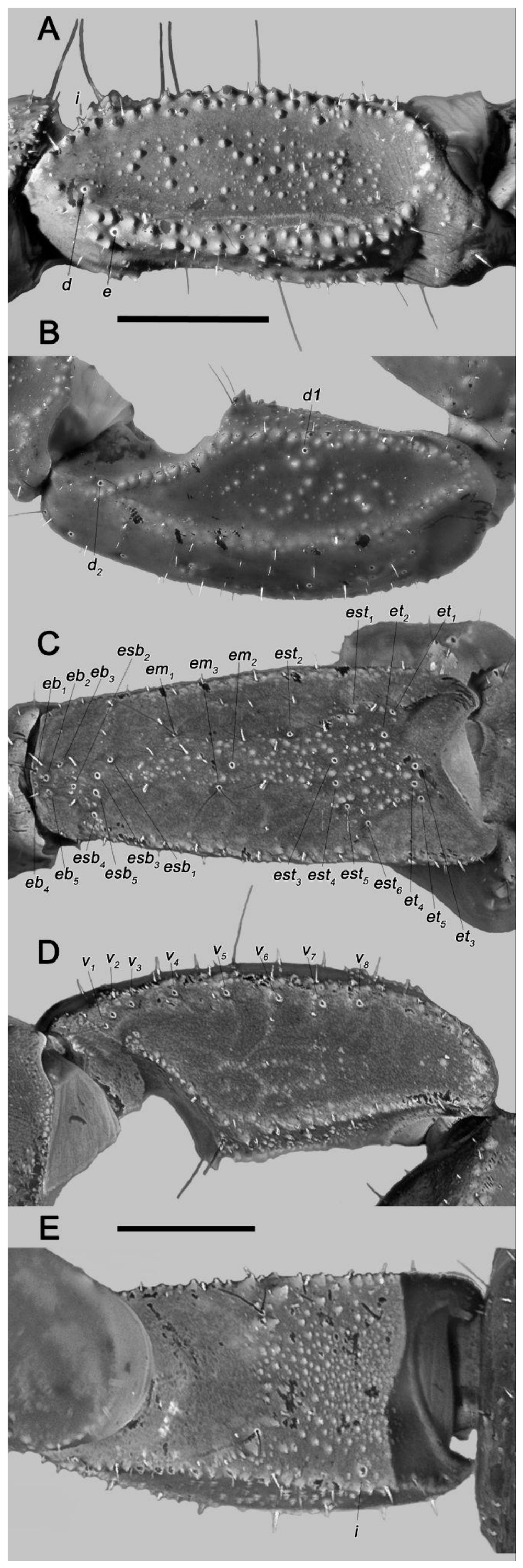
Pedipalp. Femur. Length/width ratio ♂ 1.92–2.45 (mean = 2.10, n = 4), ♀ 1.83–2.41 (mean = 2.20, n = 5). Dpl, drl, and vpl carinae granular, bearing enlarged conical granules (Figure 15). Plvs carina granular, with elongated granules and row of eight macrosetae. Rv carina incomplete, granular, with enlarged granules becoming weaker distally, bearing row of four macrosetae. Rlds carina vestigial, represented distally by short row of granules and four macrosetae. Intercarinal surfaces densely granulose and punctate, except retrolateral surface only punctate.
Patella. Length/width ratio ♂ 2.00–2.09 (mean = 2.03, n = 4), ♀ 2.21–2.96 (mean = 2.54, n = 5). Dpl and vpl carinae granular. Drl and vrsm carinae crenulate. Rlm carina smooth, costate. Plm carina vestigial, represented proximally by group of enlarged granules and one macroseta. Plv carina vestigial, represented by enlarged tuberculate granule bearing enlarged ventral macroseta. Prolateral dorsal and ventral processes (patellar spur) weakly developed. Dorsal intercarinal surface granulose and punctate; ventral and retrolateral surfaces punctate; prolateral surface granulose around prolateral processes, otherwise punctate.
Chela. Manus with fingers relatively shortened. Chela length/width ratio ♂ 2.38–3.18 (mean = 2.77, n = 4), ♀ 2.41–3.09 (mean = 2.69, n = 5); length/height ratio ♂ 2.26–2.89 (mean = 2.57, n = 4), ♀ 2.08–2.64 (mean = 2.42, n = 5). Pld, dps, and dpl carinae fused, forming field of enlarged granules, bearing row of six macrosetae. Dm carina crenulate, with row of six macrosetae. Drl and rlm carinae costate, smooth, each with row of four to five macrosetae. Vrl carina crenulate (♂) or smooth (♀), strongly costate, incomplete, restricted to level of trichobothrium V3. Vm and vps carinae fused, crenulate to granular (♂) or smooth (♀), restricted to level of trichobothrium V1. Vpl and plv carinae partially fused, expressed as two parallel rows of granules (Figure 17). Plm and plvs carinae fused, granular. Intercarinal surfaces moderately granulose, restricted to areas adjacent to carinae (♂) or smoother (♀), punctate.
Fixed and movable fingers. Ventral margins straight, lacking notch or lobe. Median dentition composed of six rows of denticles, intercalated by five slightly prolateral enlarged denticles, each accompanied by one macroseta. Distal row followed by four enlarged paired denticles, forming diastema with corresponding denticles of movable finger. Supernumerary denticles absent (Figure 18).
Trichobothrial pattern: Neobotriotaxy type C, major. Femur. Three trichobothria, d situated adjacent to dorsal retrolateral carina; i close to d, on retrolateral surface near dorsal retrolateral carina; e adjacent to dorsal prolateral carina. All positioned on proximal third of segment. Patella. Total 33 trichobothria (Figure 16): two dorsal, seven ventral, 23 external, one internal. d1–d2 on dorsal prolateral carina. V1–V7 aligned along ventral retrosubmedian carina, restricted to proximal two-thirds of segment. External series: eb1–eb5 without accessory trichobothria; esb1–esb6 with four accessory trichobothria; em1–em3 with one accessory trichobothrium; est1–est5 with four accessory trichobothria; et1–et6 with three accessory trichobothria. Chela. Total 26 trichobothria (Figure 17). Pair DbDt situated on distal half of manus, on dorsal retrolateral carina. Series Eb1–Eb3, Esb, Est, Et1–Et5, and dorsal series dbdt conform to typical type C pattern in number and position. Series V1–V4 and ibit consistent in number and position with pattern observed in Chactidae. Trichobothrium V1 located on ventral surface of manus; ibit on prolateral surface.
Legs. Coxa I ventrally with conspicuous submedian depression bearing two knob-like sensilla on each side. Ventroproximal area of coxa I and trochanters I–IV with longitudinal depression; fused area between coxae I–II and subproximal surfaces of coxae III–IV each with two to four transverse slit-like structures. All surfaces with scattered fluorescent microsetae (under UV light). Trochanter with prolateral and ventral surfaces granulose; remaining surfaces punctate. Femur and patella with prolateral, dorsal, and ventral surfaces densely granulose and punctate. Tibial spurs absent. Prolateral and retrolateral pedal spurs reduced, similar in length to adjacent macroseta. Basitarsi. proventral and retroventral carinae on legs I–II bearing row of spinules; absent on legs III–IV. Retrodorsal carina on legs I–IV bearing row of spinules, distal half fine, becoming broader and more robust proximally. Telotarsi with pair of submedian rows of five to six elongated spiniform macrosetae; prolateral and retrolateral distal margins each with three elongated spiniform macrosetae. Surfaces with one or two rows of two to three elongated macrosetae. Ungues relatively elongated, curved, subequal in length; dactyl short, broad.
Sternum: Subpentagonal, longer than wide; two lateral lobes bearing three pairs of macrosetae. Lateral margins converging anteriorly into deep posteromedian notch. Anterior triangular portion with two parallel low projections, each bearing four macrosetae, weakly granulose (♂); in ♀, projections larger, each costa bearing four macrosetae plus three additional minor macrosetae, densely granulose.
Genital operculum. Opercular plates subrectangular–triangular; mostly straight (♂) or medially rounded (♀). Surface smooth with few punctures. Covered with abundant macrosetae and scattered bright microsetae (under UV light). Median margins completely separated; opercula movable independently.
Pectines. Basal piece isosceles trapezoidal, with small median notch on anterior margin; surface punctate. Each pecten composed of three plates; marginal lamellae reduced to half length, distal margin straight; median lamella divided into two smaller plates; fulcra absent. Tooth count 7 (♀), 8 (♂). Tooth bases strongly sclerotized, covered with microsetae; sensillar area with peg sensilla covering approximately 50% of pectinal surface (♂) or 70% (♀).
Sternites. Medial surfaces smooth; lateral surfaces punctate. Sternite III densely covered with macrosetae and fluorescent microsetae (under UV light). Sternites IV–V with median hyaline triangular area, larger on V than IV (♂); in ♀, hyaline area present only on sternite V, oval. Sternites III–VI each with pair of slit-like spiracles situated mediolaterally. Sternite VII acarinate, densely punctate; lateral areas granulose, less so medially.
Tergites. Tergites I–VI densely and homogeneously granulose and punctate, acarinate. Tergite VII densely granulose, with granules larger than on preceding tergites; dorsolateral and dorsosubmedian carinae densely granular, bearing elongated granules.
Metasoma (Figure 19). Dorsolateral and lateral median carinae granulose on segments I–V; lateral median carina on segment V incomplete, restricted to proximal half. Intercarinal surfaces densely granulose. Lateral inframedian carinae complete and granular on segment I; on segments II–III complete, costate on distal third, granulation weakly aligned longitudinally; on segment IV vestigial, represented distally by few enlarged spiniform granules. Ventrolateral carinae on segments I–V and ventral submedian carinae on segments I–IV granular. Ventral median carina on segment V costate, bearing enlarged granules; bifurcating on distal third, with even larger granules bearing blackish apices. Ventral posterior marginal carina on segment V formed by row of enlarged conical granules with blackish apices, lateral granules largest. Intercarinal surfaces densely granulose, except median dorsal surfaces smooth and densely punctate.
Telson. Vesicle relatively globose. Ventral submedian carinae bearing enlarged conical granules with blackish apices. Ventral lateral surfaces separated from submedian carinae by two longitudinal smooth areas. Dorsolateral surfaces with morphosculpture similar to dorsal submedian carinae; lateral margins with two longitudinal smooth areas separating lateral from dorsal surfaces. Dorsal surface flat, smooth, punctate. Aculeus elongated, gently curved (Figure 20).
Distribution. The species is known only from the type locality (Figure 1).
Biology notes. Brotheas cerni inhabits a tropical rainforest from an inselberg surrounded by an open forest formation. This species may be found in leaf litter or inside fallen trunks. Individuals were observed actively foraging during periods of rainfall.

4. Discussion

In this study, we formally describe two new species of scorpions. The description of Cayooca puchus sp. n. and Brotheas cernii sp. n. increases the known diversity of Chactidae in the Brazilian Amazon and highlights the taxonomic complexity of scorpions associated with geological formations of the Guiana Shield.
Cayooca is a recently revalidated genus [25] that had previously been synonymized with Brotheochactas [24]. However, species of Cayooca can be readily distinguished from Brotheochactas by the presence of eight ventral trichobothria on the pedipalp patella, whereas species of Brotheochactas exhibit only 6–7 [26,27,28,29]. This character state is shared by the two known species of Cayooca: C. venezuelensis and C. puchus. In addition to this uncommon condition, the new species differs from C. venezuelensis by its denser body granulation and strongly costate, scattered granular ventromedian and ventral prosubmedian carinae. Furthermore, the pedipalp patella of C. puchus exhibits a trichobothrial count (n = 37) comparable to that reported for the genera Megachactops, Chactopsoides, and Chactopsis (n = 34), which are considered to form a monophyletic group within Chactidae [20]. Whether this similarity reflects shared ancestry or convergent morphological patterns remains uncertain. Broader comparative analyses incorporating additional taxa will be necessary to clarify relationships within family.
Brotheas cernii sp. n., in contrast, is characterized by a strongly granular carapace and tergites, smaller body size, granular ventral submedian and ventrolateral carinae on metasomal segment I, ventral metasomal carinae bearing spinoid granules on segments III–V, and strongly granular prolateral surface of the chela. Although it shares general morphological similarities with B. granulatus and B. subgranulatus, it can be readily distinguished by these characters. The morphological characters observed in B. cernii sp. n. agree with the current diagnosis of Brotheas and allow clear separation from related taxa [12,28,29,30].
From a biogeographic perspective, both new species occur in geological formations associated with the Guiana Shield. Such formations have been interpreted as Pleistocene refuges harboring endemic taxa [15,16]. Brotheas cernii sp. n. inhabits rainforest vegetation on an inselberg embedded within a savannah matrix, whereas B. granulatus and B. subgranulatus occur in continuous rainforest formations. Habitat discontinuities of this nature have been proposed as drivers of diversification in several Amazonian taxa during cycles of expansion and contraction in the Pleistocene [14,16,31]. Such processes may be particularly relevant for organisms with limited dispersal capacity and specialized habitat associations, including scorpions, as suggested for other chactid genera such as Hadrurochactas, Teuthraustes, and Spinochactas [9,14,15].
Although the internal relationships within Chactidae remain unresolved, the detailed morphological data presented here contribute essential information for future systematic and phylogenetic studies. Nevertheless, some limitations of the present study should be acknowledged. Molecular data were not available for the species described herein, and direct examination of some morphologically related taxa was not possible, with comparisons based on original descriptions, additional taxonomic literature, and photographic examination. Future integrative studies combining morphology and molecular evidence will be important to better resolve species boundaries and phylogenetic relationships within Chactidae. The discovery of these species also reinforces the importance of inselberg systems and poorly sampled areas of the Brazilian Amazon as reservoirs of previously undocumented scorpion diversity.

Author Contributions

Conceptualization, A.F.A.L. and E.G.-S.; methodology, E.G.-S., A.P.S.-d.-S. and A.D.B.; validation, E.G.-S. and A.F.A.L.; formal analysis, E.G.-S. and A.F.A.L.; investigation, G.M.-d.-S. (Guilherme Melo-dos-Santos), A.M.R., G.M.-d.-S. (Gabriela Melo-dos-Santos), E.F.-d.-S., T.M.L., I.C.S.C. and K.D.A.S.; resources, M.B.P.; data curation, G.M.-d.-S. (Guilherme Melo-dos-Santos), A.M.R., G.M.-d.-S. (Gabriela Melo-dos-Santos), E.F.-d.-S., T.M.L., I.C.S.C. and K.D.A.S.; writing—original draft preparation, All authors; visualization, E.G.-S.; supervision, M.B.P.; project administration, M.B.P.; funding acquisition, M.B.P. All authors have read and agreed to the published version of the manuscript.

Funding

This work was supported by the São Paulo Research Foundation (FAPESP, BIOTA Discovery Call—Young Investigador; grant n. 2025/01407-4) awarded to M.B.P. M.B.P. is also supported by the Brazilian National Council for Scientific and Technological Development (CNPq) through a research fellowship (grant no. 305778/2023-4). The funders had no role in study design, data collection and analysis, decision to publish, or preparation of the manuscript.

Data Availability Statement

All data generated or analyzed during this study are included in the published article.

Acknowledgments

We are grateful to José A. Ochoa from Facultad de Ciencias Biológicas, Universidad Nacional de San Antonio Abad del Cusco, Perú, for his help in providing photographic material of the holotype female of Cayooca venezuelensis. We are also grateful to Gabriel Celante for his help with the map. The authors also thank the Snakebite Roraima Research Group from Federal University of Roraima, Boa Vista, Brazil. Finally, we thank the three anonymous reviewers for their valuable comments on an earlier version of the manuscript.

Conflicts of Interest

The authors declare no conflicts of interest.

References

  1. Pitman, N.C.A.; Terborgh, J.W.; Silman, M.R.; Núñez, P.V.; Neill, D.A.; Cerón, C.E.; Palacios, W.A.; Aulestia, M. Dominance and distribution of tree species in upper Amazonian terra firme forests. Ecology 2001, 82, 2101–2117. [Google Scholar] [CrossRef]
  2. Walter, W.S.; Gorelik, S.R.; Baccini, A.; Aragon-Osejo, J.L.; Josse, C.; Meyer, C.; Macedo, M.N.; Augusto, C.; Rios, S.; Katan, T.; et al. The role of forest conversion, degradation, and disturbance in the carbon dynamics of Amazon indigenous territories and protected areas. Proc. Natl. Acad. Sci. USA 2020, 117, 3015–3025. [Google Scholar]
  3. Boubli, J.P.; Byrne, H.; da Siva, M.N.F.; Silva-Júnior, J.; Araújo, R.C.; Bertuol, F.; Gonçalves, J.; de Melo, F.R.; Rylands, A.B.; Mittermeier, R.A.; et al. On a new species of titi monkey (Primates: Plecturocebus Byrne et al., 2016), from Alta Floresta, southern Amazon, Brazil. Mol. Phylogenetics Evol. 2019, 132, 117–137. [Google Scholar] [CrossRef]
  4. Oliveira, E.A.; Silva, L.A.; Silva, E.A.P.; Guimarães, K.L.A.; Penhacek, M.; Martínez, J.G.; Rodrigues, L.R.R.; Santana, D.J.; Hernández-Ruz, E.J. Four new species of Pristimantis Jiménez de la Espada, 1870 (Anura: Craugastoridae) in the eastern Amazon. PLoS ONE 2020, 15, e0229971. [Google Scholar] [CrossRef]
  5. Almeida, J.F.; Picelli, A.M.; Ramires, A.C.; Belchior, H.C.M.; Marialva, E.F.; Lima, H.I.M.M.; Ríos-Velásquez, C.M.; Pessoa, F.A.C. Description of three new species of frog–biting midges (Diptera: Corethrellidae) from the Central Brazilian Amazon. Eur. J. Tax. 2021, 778, 148–166. [Google Scholar] [CrossRef]
  6. Lourenço, W.R. Diversité de la faune scorpionique de la région amazonienne; centre d’endémisme; nouvel appui à la théorie des refuges forestiers du Pléistocène. Amazoniana 1986, 9, 559–580. [Google Scholar]
  7. Lourenço, W.R.; Duhem, B. The genus Vachoniochactas González-Sponga (Scorpiones, Chactidae), a model of relictual distribution in past refugia of the Guayana region of South America. Compt. Rendus Biol. 2009, 332, 1085–1091. [Google Scholar] [CrossRef] [PubMed]
  8. Lourenço, W.R.; Ythier, E. The genus Teuthraustes Simon, 1878 (Scorpiones: Chactidae) in Brazil with description of a new species. Rev. Ibér. Aracnol. 2022, 40, 119–125. [Google Scholar]
  9. Bryson, R.W., Jr.; Riddle, B.R.; Graham, M.R.; Smith, B.T.; Prendini, L. As Old as the hills: Montane scorpions in southwestern north America reveal ancient associations between biotic diversification and landscape history. PLoS ONE 2013, 8, e52822. [Google Scholar] [CrossRef]
  10. Lourenço, W.R. Scorpions of Brazil; Les Editions de l’IF: Paris, France, 2002; p. 308. [Google Scholar]
  11. Bertani, R.; Giupponi, A.P.L.; Moreno-Gonzáles, J.A. Escorpiões do Brasil–Lista dos Gêneros E Espécies de Escorpiões Registrados Para o Brasil (Arachnida, Scorpiones). Versão 1.1, 2026. Available online: http://www.ecoevo.com.br (accessed on 7 January 2020).
  12. Ythier, E.; Lourenço, W.R. A new species of Brotheas C. L. Koch, 1838 from Brazilian Amazon (Scorpiones: Chactidae). Faunitaxys 2026, 14, 1–7. [Google Scholar]
  13. Hofer, H.; Wollscheid, E.; Gasnier, T. The relative abundance of Brotheas amazonicus (Chactidae, Scorpiones) in different habitat types of a central amazon rainforest. J. Arachnol. 1996, 24, 34–38. [Google Scholar]
  14. Lourenço, W.R. The disrupted pattern of distribution of the genus Hadrurochactas Pocock; evidence of past connections between Amazon and the Brazilian Atlantic forest. Compt Rendus Biol. 2010, 333, 41–47. [Google Scholar] [CrossRef] [PubMed]
  15. Lourenço, W.R. The scorpions from the Mitaraka Massif in French Guiana: Description of one new genus and species (Scorpiones: Chactidae). Compt. Rendus Biol. 2016, 339, 141–149. [Google Scholar] [CrossRef] [PubMed]
  16. Ochoa, J.A.; Rojas-Runjaic, F.J.M. Scorpions. In Biodiversity of Pantepui: The Pristine “Lost World” of the Neotropical Guiana Highlands; Rull, V., Vegas-Vilarrúbia, T., Huber, O., Señaris, C., Eds.; Elsevier: Amsterdam, The Netherlands, 2019; pp. 223–246. [Google Scholar]
  17. Lourenço, W.R. Premiere évidence de la présence d’une faune scorpionique amazonienne relictuelle dans les ‘Brejos’ de la Caatinga du nord-est du Brésil. Bull. Soc. Sci. Bretagne 1988, 59, 147–154. [Google Scholar]
  18. Stahnke, H.L. Scorpion nomenclature and mensuration. Entomol. News 1970, 81, 297–316. [Google Scholar]
  19. Sissom, W.D.; Polis, G.A.; Watt, D.D. Field and laboratory methods. In The Biology of Scorpions; Polis, G.A., Ed.; Stanford University Press: Stanford, CA, USA; pp. 215–221.
  20. Ochoa, J.A.; Rojas-Runjaic, F.J.M.; Pinto-da-Rocha, R.; Prendini, L. Systematic revision of the Neotropical scorpion genus Chactopsis (Chactoidea: Chactidae), with descritpions of two new genera and four new species. Bull. Am. Mus. Nat. Hist. 2013, 378, 1–121. [Google Scholar] [CrossRef]
  21. González-Santillán, E.; Prendini, L. Redefinition and generic revision of the North American vaejovid scorpion subfamily Syntropinae Kraepelin, 1905, with descriptions of six new genera. Bull. Am. Mus. Nat. Hist. 2013, 382, 1–71. [Google Scholar] [CrossRef]
  22. Vachon, M. Étude des caractères utilisés pour classer les familles et les genres de scorpions (arachnides). 1. La trichobothriotaxie en arachnologie. Sigles trichobothriaux et types de trichobothriotaxie chez les scorpions. Bull. Mus. Nat. Hist. Nat. 1974, 140, 857–958. [Google Scholar]
  23. Loria, S.F.; Prendini, L. Homology of the lateral eyes of scorpiones: A six-ocellus model. PLoS ONE 2014, 9, e112913. [Google Scholar] [CrossRef]
  24. Soleglad, M.E.; Fet, V. High-level systematics and phylogeny of the extant scorpions (Scorpiones: Orthosterni). Euscorpius 2003, 2003, 1–210. [Google Scholar] [CrossRef]
  25. Prendini, L. All genera of the world: Order Scorpiones (Animalia: Arthropoda: Arachnida). Megataxa 2026, 19, 270–378. [Google Scholar] [CrossRef]
  26. Pinto-da-Rocha, R.; Gasnier, T.R.; Brescovit, A.D.; Apolinário, F.B. Brotheochactas fei, a new scorpion species (Scorpiones, Chactidae) from Brazilian Amazonia, with notes on is abundance and association with termites. Rev. Ibér. Aracnol. 2002, 6, 195–202. [Google Scholar]
  27. Lourenço, W.R. Further additions to the scorpion fauna of the Guayana region of South America. Rev. Sui Zool. 2007, 114, 513–519. [Google Scholar] [CrossRef]
  28. Lourenço, W.R.; Araujo, J.; Franklin, E. Further additions to the chactid scorpions of Brazilian Amazonia (Arachnida: Scorpiones: Chactidae). Bol. Soc. Entomol. Arag 2010, 47, 135–138. [Google Scholar]
  29. Lourenço, W.R.; Giupponi, A.P.L.; Pedroso, D.R. New species of Chactidae (Scorpiones) from the upper Rio Negro in Brazilian Amazonia. Bol. Soc. Entomol. Arag. 2011, 49, 65–73. [Google Scholar]
  30. Lourenço, W.R.; Machado, A.M. A new species of Brotheas (Scorpiones, Chactidae) from the Rio Negro region in the state of Amazonas, Brazil. Rev. Ibér. Aracnol. 2004, 10, 65–68. [Google Scholar]
  31. Bonaccorso, E.; Koch, I.; Peterson, A.T. Pleistocene fragmentation of Amazon species’ ranges. Divers. Distrib. 2006, 12, 157–164. [Google Scholar] [CrossRef]
Figure 1. Map showing the type locality (star) of Cayooca puchus sp. n. and Brotheas cernii sp. n., as well as the distribution of their morphologically related species: Cayooca venezuelensis (triangle), Brotheas granulatus (circle), and Brotheas pseudogranulatus (square). South America is shown in dark gray, and Brazil is highlighted in light gray.
Diversity 18 00345 g001
Figure 2. Cayooca puchus sp. n. Habitus (A,C). Dorsal view; (B,D). Ventral view. (A,B). Adult male (CNAN paratype). (C,D). Adult female (CNAN paratype) both species from the type locality. Scale bars = 10 mm.
Diversity 18 00345 g002
Figure 3. Cayooca puchus sp. n. chelicera. (A). Dorsal surface showing denticle pattern. (B). Ventral surface showing tufts of fluorescent macroseta, denticles and serrula. Scale bars = 1 mm.
Diversity 18 00345 g003
Figure 4. Cayooca puchus sp. n. carapace. (A). Photography taken under white light. (B). Photography taken under ultraviolet light. Scale bar = 5 mm.
Diversity 18 00345 g004
Figure 5. Cayooca puchus sp. n. femur and patella taken under ultraviolet light. (A,B). Dorsal, (C). Retrolateral, (D). Ventral, (E). Prolateral. Trichobothrial pattern indicated per segment follows the interpretation presented here. Scale Bars = 2 mm.
Diversity 18 00345 g005
Figure 6. Cayooca puchus sp. n. (A). Fixed and (B). Movable fingers ventral and dorsal margins, respectively, taken under ultraviolet light showing dentition pattern. Scale bar = 2 mm.
Diversity 18 00345 g006
Figure 7. Cayooca puchus sp. n. pedipalp chela taken under ultraviolet light. (A). Dorsal, (B). Retrolateral, (C). Ventral, and (D). Prolateral surface. Trichobothrial pattern indicated per segment and surface follows our reinterpretation. Trichobothrial labels are shown in black, whereas carinal labels are shown in white. Scale bar = 5 mm.
Diversity 18 00345 g007
Figure 8. Cayooca puchus sp. n. basitarsi and telotarsi (AD) legs I–IV prolateral surfaces showing setal and spinule patterns. Scale bar = 2 mm.
Diversity 18 00345 g008
Figure 9. Cayooca puchus sp. n. mesosoma ventral surfaces showing coxosternal area, stigmata, pectines, sternum, and genital operculum. (A). Adult female. (B). Adult male. Scale bars = 5 mm.
Diversity 18 00345 g009
Figure 10. Cayooca puchus sp. n. mesosoma dorsal surface, showing the morphosculpture of tergites (A). Adult female, (B). Adult male. Scale bars = 5 mm.
Diversity 18 00345 g010
Figure 11. Cayooca puchus sp. n. metasomal segments I–V. (A). Dorsal surface, (B). Lateral surface, (C). Ventral surface. Scale bar = 5 mm.
Diversity 18 00345 g011
Figure 12. Cayooca puchus sp. n. telson taken under ultraviolet light. Views: (A). Dorsal, (B). Lateral. (C). Ventral. Scale bar = 2 mm.
Diversity 18 00345 g012
Figure 13. Brotheas cernii sp. n. habitus. (A,C). Dorsal; (B,D). Ventral surface; (A,B). Adult male; (C,D). Adult female. Scale bar = 10 mm.
Diversity 18 00345 g013
Figure 14. Brotheas cernii sp. n. carapace, dorsal view. Scale bar = 2 mm.
Diversity 18 00345 g014
Figure 15. Brotheas cernii sp. n. lateral ocelli displaying lateral ocelli type 4C. Scale bar = 1 mm.
Diversity 18 00345 g015
Figure 16. Brotheas cernii sp. n. pedipalp femur and patella taken under ultraviolet light. (A,B). Dorsal, (C). Retrolateral, (D). Ventral, (E). Prolateral. Trichobothrial pattern indicated per segment follows the interpretation presented here. Scale Bars = 2 mm.
Diversity 18 00345 g016
Figure 17. Brotheas cernii sp. n. pedipalp chela taken under ultraviolet light. (A). Dorsal, (B). Retrolateral, (C). Ventral, and (D). Prolateral surface. (E). Detail of retrolateral distal fingers showing distal trichobothria. Trichobothrial pattern indicated per surface follows the reinterpretation presented here. Scale bar = 2 mm.
Diversity 18 00345 g017
Figure 18. Brotheas cernii sp. n. (A). Fixed and (B). Movable fingers ventral and dorsal margins taken under ultraviolet light showing dentition pattern. Scale bar = 1 mm.
Diversity 18 00345 g018
Figure 19. Brotheas cernii sp. n. metasomal segments I–V. (A). Ventral surface, (B). Lateral surface, (C). Dorsal surface. Scale bar = 5 mm.
Diversity 18 00345 g019
Figure 20. Brotheas cernii sp. n. telson taken under ultraviolet light. (A). Lateral, (B). Ventral surface. Scale bar = 2 mm.
Diversity 18 00345 g020
Table 1. Measurements (in mm) of type material of Cayooca puchus sp. n.
Structure HolotypeParatypes
TotalL51.547.535.251.24850.132.1
CarapaceL7.55.95.17.17.46.95.5
AW5.43.73.44.44.54.74.8
PW7.665.17.16.47.35.4
EyeDi0.40.30.30.30.40.30.3
Interocular distance-0.40.20.20.40.40.30.2
MesosomaL2011.79.212.114.713.410.5
MetasomaL2422.315.724.225.922.016.1
Metasoma seg IL3.42.82.12.93.22.61.4
W3.63.22.74.13.53.63.6
D2.72.82.22.73.12.52.5
Metasoma seg IIL4.13.52.53.63.93.03.2
W32.92.53.53.13.12.4
D2.42.52.22.52.62.52.1
Metasoma seg IIIL3.73.92.64.04.23.63.8
W32.82.33.33.23.02.4
D2.72.52.22.52.92.52.2
Metasoma seg IVL4.74.63.15.35.54.82.7
W2.82.62.23.02.72.72.2
D2.52.522.52.52.52.1
Metasoma seg VL8.17.58.48.49.18.08.7
W2.42.32.22.82.72.53.2
D2.62.41.62.52.62.42.1
TelsonL6.67.66.27.86.17.86.6
VesicleW3.22.622.83.12.62.8
L5.16.35.96.44.56.55.1
AculeusL1.51.31.31.41.61.31.5
PedipalpL24.822.617.825.524.325.219.5
Pedipalp femurL5.65.24.25.96.15.54.1
W2.221.82.42.62.02.2
Pedipalp patellaL7.66.44.66.86.66.75.5
W2.72.42.13.02.82.92.2
Pedipalp chelaL11.611912.811.613.09.9
W4.13.92.74.54.24.54.8
D4.24.13.14.44.24.22.8
PectenL3.73.634.243.23.6
Table 2. Measurements (in mm) of type material of Brotheas cernii sp. n.
Structure HolotypeParatypes
TotalL5648.75256.652.35153.55745.1
CarapaceL87.27.58.58.67.18.798.7
AW64.25.85.05.25.55.25.45.3
PW87.67.98.49.298.97.99
EyeDi0.30.30.40.40.30.30.50.40.4
Interocular distance -0.40.50.60.50.50.40.50.50.4
MesosomaL1312.01313.813.313.414.116.415
MetasomaL2521.523.124.822.022.422.523.421.3
Metasoma seg IL32.62.93.02.72.52.72.52.6
W4.54.44.24.94.33.74.54.64.3
D3.53.03.53.43.033.33.53.3
Metasoma seg IIL3.53.43.53.73.33.23.43.53.3
W4.54.14.14.54.13.24.14.24.4
D3.52.83.13.52.83.13.43.23
Metasoma seg IIIL43.43.14.23.64.13.94.24.2
W4.14.144.43.8343.93.7
D42.83.13.22.83.33.433.1
Metasoma seg IVL54.64.15.74.84.44.45.24.3
W44.03.94.23.52.73.43.83.3
D3.53.43.13.02.83.33.33.13.1
Metasoma seg VL87.578.27.68.28.187.1
W3.93.73.23.93.52.63.43.53.2
D33.033.33.033.22.92.8
TelsonL98.089.58.48.18.28.28
VesicleW3.53.12.93.53.02.12.62.72.5
L65.256.25.65.14.74.65
AculeusL32.833.32.933.53.63
PedipalpL25.121.92424.724.927.426.827.327.2
Pedipalp femurL65.07.15.75.56.56.25.65.5
W32.62.92.83.02.72.72.52.5
Pedipalp patellaL7.35.55.66.06.27.477.47.2
W3.52.72.83.02.82.52.93.32.5
Pedipalp chelaL1211.412.113.013.213.513.614.314.5
W4.14.83.85.05.25.65.54.94.7
D5.34.254.55.06.55.55.85.9
PectenL2.82.733.42.82.52.632.5
Disclaimer/Publisher’s Note: The statements, opinions and data contained in all publications are solely those of the individual author(s) and contributor(s) and not of MDPI and/or the editor(s). MDPI and/or the editor(s) disclaim responsibility for any injury to people or property resulting from any ideas, methods, instructions or products referred to in the content.