Article

The Quantitative Classification, Ordination and Diversity Characteristics of Plant Communities in Southwestern Tibet

1
Institute of Plateau Ecology, Xizang Agricultural and Animal Husbandry University, Nyingchi 860000, China
2
Key Laboratory of Alpine Vegetation Ecological Security of Husbandry University, Nyingchi 860000, China
3
Key Laboratory of Tibet Plateau Forest Ecology of Ministry of Education & National, Nyingchi 860000, China
*
Author to whom correspondence should be addressed.
These authors contributed equally to this work.
Diversity 2026, 18(6), 343; https://doi.org/10.3390/d18060343
Submission received: 2 December 2025 / Revised: 8 May 2026 / Accepted: 18 May 2026 / Published: 5 June 2026
(This article belongs to the Section Plant Diversity)

Abstract

To explore the distribution patterns of plant communities in southwestern Xizang and their relationships to environmental factors, this study focused on providing a theoretical basis for the conservation of biodiversity and ecological restoration of plant communities in the study area. Based on survey data from 87 sample plots in southwestern Xizang, in this study, two-way indicator species analysis (TWINSPAN) and canonical correspondence analysis (CCA) were employed for quantitative classification and ordination purposes, respectively. Additionally, the diversity of the classified community types obtained was analyzed, along with the factors influencing them. The results indicated that: a total of 295 species of vascular plants belonging to 171 genera and 61 families were recorded in the 87 sample plots; according to TWINSPAN classification, the plants in southwestern Xizang were divided into 17 associations, with the vegetation types being dominated by tussock-forming grass alpine steppes and tussock-forming Kobresia alpine meadows; CCA ordination revealed that the annual average temperature, annual precipitation, and altitude exhibited significant explanatory power; both the α- and β-diversity indices of the coniferous forest community type were the highest, indicating notable community stability; and annual average temperature and annual precipitation significantly affected plant diversity, while the altitude was negatively correlated with the above diversity indices. In summary, the temperature and precipitation were the main environmental factors influencing the composition and distribution of plant communities in southwestern Xizang. The research results could provide a theoretical basis for further investigation and conservation of plant diversity as well as ecological restoration in southwestern Xizang.

1. Introduction

Plants, as the primary producers in terrestrial ecosystems, have evolved a series of unique adaptive characteristics and formed complex mutual interactions with each other and the surrounding environment over long-term evolutionary processes [1]. These interactions shape the structural and functional attributes of plant communities and govern material cycling, energy flow, and information transmission within ecosystems. The relationships among plant community characteristics, species diversity, and environmental factors constitute core research topics in community ecology, as they reveal the assembly rules of plant communities and the maintenance mechanisms of biodiversity in specific regions. A deep understanding of these relationships is fundamental to predicting how plant communities will respond to future global environmental changes and formulating effective biodiversity conservation strategies.
Quantitative classification and ordination are the most classic and widely used analytical frameworks in plant community ecology, having been continuously refined and improved since the mid-20th century. The primary quantitative classification methods include two-way indicator species analysis (TWINSPAN) [2] and multivariate regression trees [3]. TWINSPAN, a hierarchical divisive classification technique, simultaneously classifies both samples and species while identifying indicator species for each community type, making it particularly well-suited for analyzing large-scale plant community survey datasets. Multivariate regression trees, by contrast, directly link community composition to environmental variables, providing more intuitive interpretations of the environmental drivers underlying community differentiation. The mainstream ordination methods include detrended canonical correspondence analysis (DCCA), canonical correspondence analysis (CCA) [4], and redundancy analysis (RDA) [5]. CCA is a direct gradient analysis method that effectively extracts the main environmental gradients affecting community distribution and quantifies species–environment correlations, while RDA is more appropriate for analyzing linear relationships between species data and environmental variables. The combination of TWINSPAN classification and CCA ordination enables intuitive and effective differentiation of plant community types and quantification of community distribution and species composition responses to environmental gradients. This integrated approach has been extensively validated and applied in studies of plant community distribution across diverse habitats, including forests in Northern Thailand [6], the Sele-Nono forest in Southwestern Ethiopia [7], mountainous regions in southwestern China [8], and grasslands in Inner Mongolia [9], demonstrating its strong universality and reliability.
Plant diversity is a critical indicator reflecting the health and stability of plant community ecosystems [10]. Higher plant species diversity enhances and maintains multiple key ecological functions, including primary productivity, soil fertility maintenance, water conservation, and carbon sequestration. The spatial variation in plant diversity is tightly coupled with environmental factors, which act as ecological filters selecting species with specific adaptive traits and thereby shaping plant diversity patterns across different spatial scales. Investigating the relationships between community diversity and environmental factors reveals the underlying drivers of differences in community composition and structure, which is essential for regional biodiversity conservation, degraded vegetation restoration, and the establishment of stable plant communities [11,12]. Against the backdrop of accelerating global biodiversity loss, clarifying these drivers has become an urgent research priority for ecologists worldwide.
The southwestern region of Xizang, primarily comprising Shigatse City, is located in the southwestern part of the Qinghai–Tibet Plateau and covers approximately 182,000 square kilometers. The region features a complex landscape dominated by alpine mountains and lake basins, with high elevations in both the north and south. Altitudes range from about 3800 m in river valleys to over 8848 m at Mount Everest’s summit, creating pronounced vertical climatic gradients. This region harbors rich and unique alpine vegetation types—including alpine meadows, alpine steppes, alpine shrubs, and subalpine coniferous forests—that are integral components of the Qinghai–Tibet Plateau’s ecological security barrier. These vegetation types provide essential habitats for numerous rare and endangered species and play vital roles in maintaining regional water balance, preventing soil erosion, and regulating the global climate. However, in recent decades, the combined impacts of global climate change and local anthropogenic disturbances—particularly overgrazing by pastoralists—have caused significant vegetation degradation, resulting in an extremely fragile and unstable ecological environment [13]. This degradation has triggered a cascade of ecological problems, including reduced primary productivity, biodiversity loss, soil desertification, and diminished water conservation capacity, which seriously threaten regional ecological security and the sustainable development of local animal husbandry.
Therefore, systematic plant community surveys and targeted conservation efforts are urgently needed in southwestern Xizang. Previous studies in this region have been limited to small-scale surveys in restricted areas, including Yadong County [14], the Everest Nature Reserve [15], and Lhaze County [16]. While these studies have provided valuable baseline data for specific localities, they are insufficient to characterize overall plant community patterns across the entire region. Comprehensive and systematic research on plant community classification, distribution patterns, and diversity maintenance mechanisms remains lacking, severely constraining the development of local biodiversity conservation and vegetation restoration practices. Without a clear understanding of dominant community types, their distribution patterns, and the key environmental factors driving their differentiation, it is impossible to develop scientific and effective conservation and restoration strategies tailored to different community types.
To address this research gap, we conducted a systematic field survey of 87 plots across 15 counties and districts in Shigatse City, covering all major vegetation types and environmental gradients in the region. We employed classic TWINSPAN classification, CCA ordination, and RDA to comprehensively examine plant community characteristics and their relationships with environmental factors. It should be explicitly noted that this is an applied community ecology study focusing on alpine plant communities in the Qinghai–Tibet Plateau, not a methodological innovation study; the aforementioned classic methods are used solely as analytical tools to address the following core scientific questions: (1) What are the dominant plant community types in southwestern Xizang, and what are the differences in species composition and structural characteristics among these types? (2) What are the key environmental factors driving the spatial distribution and species composition differentiation of plant communities in this alpine region? (3) What are the differences in species diversity characteristics among different community types, and how do environmental factors regulate plant community species diversity in this region? This study aims to provide scientific guidance and data support for biodiversity conservation, degraded vegetation restoration, and sustainable grassland management in southwestern Xizang. The results will not only enrich basic plant community ecology data for the Qinghai–Tibet Plateau but also provide a scientific basis for the construction of the regional ecological security barrier and the realization of ecological civilization.

2. Materials and Methods

2.1. Overview of the Study Area

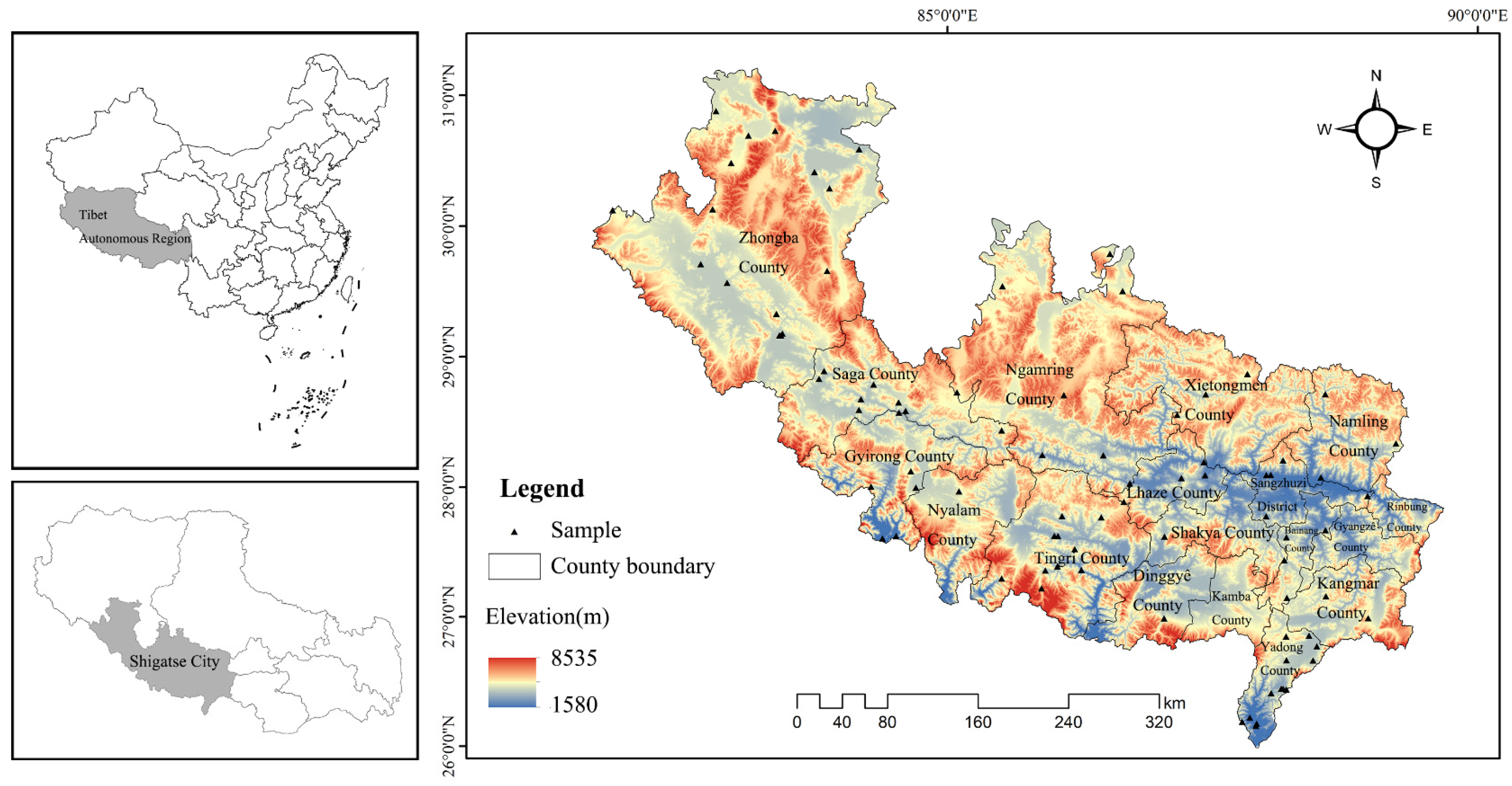
The study area is located in Shigatse city, with geographical locations ranging from 82°1′–90°20′ E and 27°13′–31°49′ N. It is bordered by the Ngari Prefecture to the west, Nagqu Prefecture to the north, Lhasa city and Shannan city to the east as well as Nepal, Bhutan, India to the south. The studied area is located in the middle section of the great mountain ranges of the Himalayas, Gangdise, and Nyainqentanglha, with an average altitude of over 4000 m (Figure 1). The average annual temperature in Shigatse is generally low. In the western region of the prefecture, which is in the sub-frigid zone, the average annual temperature is 0 °C; in the eastern region of the prefecture, which is in the temperate zone, the average annual temperature is 6.5 °C. The overall annual average temperature of Shigatse city is 6.3 °C. Of the warmest month, June, the average temperature ranges from 10 °C to 18 °C [17]. The spatial distribution of precipitation in Shigatse is uneven, with 200–430 mm of annual rainfall in the eastern region and less than 200 mm in the northwest region. The wet and dry seasons are distinct, and rainfall in July and August accounts for more than 70% of the total annual precipitation. The Shigatse region experiences intense solar radiation and long sunshine hours. The annual evaporation rate reaches 2249.6 mm, which is 6–7 times greater than the annual precipitation. The average annual relative humidity ranges from 35 to 40% [18].

2.2. Experimental Methods

2.2.1. Sample Plot Setup and Data Collection

From August to September 2023, we conducted a field survey of typical plant communities in Shigatse Prefecture using the quantitative nested quadrat method, a widely validated protocol for alpine vegetation on the Qinghai–Tibet Plateau. This method was selected for its excellent adaptability to the vertical structure of plateau plant communities, enabling accurate surveys of arbor, shrub and herb layers, and supporting subsequent community classification and ordination analysis. A total of 87 independent plots were established across the study area (Figure 1), divided into three types by the dominant vegetation layer: 4 tree-dominated, 18 shrub-dominated, and 65 herbaceous-dominated plots. Full surveys were carried out for all existing vegetation layers in each plot, rather than only the dominant layer. The nested quadrat design was as follows: tree-dominated plots: 3 replicate 20 m × 20 m arbor quadrats per plot, each with a central nested 5 m × 5 m shrub quadrat, which further contained a 1 m × 1 m herbaceous quadrat; shrub-dominated plots (no arbor layer): only shrub and herbaceous quadrats following the same nested design; herbaceous-dominated plots (no woody plants): 5 replicate 1 m × 1 m herbaceous quadrats per plot. This study focused on vascular plants, consistent with our objectives of community classification, ordination and vascular plant diversity analysis; bryophytes were excluded from the survey. For woody plants (trees and shrubs), a full census was conducted to record core metrics including species name, individual number, plant height, DBH (for trees)/basal diameter (for shrubs), and crown diameter. For herbaceous species, we recorded species name, plant height, individual number, and coverage. Given the growth characteristics of alpine herbaceous communities in the study area, we used direct individual counting instead of the Braun-Blanquet cover-abundance scale method to obtain more accurate species abundance data, providing a reliable basis for subsequent diversity analysis, TWINSPAN classification and CCA ordination. Geographic and topographic information of each plot was recorded using a handheld GPS. For species unidentifiable in the field, we collected voucher specimens with complete reproductive organs and took morphological photos; all specimens were numbered corresponding to their plots, and authoritatively identified by taxonomists at the Herbarium of the Institute of Plateau Ecology, Xizang Agricultural and Animal Husbandry University, with reference to Flora of China and Flora Xizangica.

2.2.2. Acquisition of Environmental Data

Meteorological data: Following the methodology outlined by Kermavnar et al. [19], meteorological data were downloaded from the WorldClim database (http://www.worldclim.org/ (accessed on 18 May 2024)) at a resolution of 1 km × 1 km. Interpolation methods were applied using ArcGIS 10.8 software to refine the obtained meteorological data [20]. Based on the longitude and latitude coordinates of each sample plot, corresponding annual average temperature and annual precipitation data were obtained. Terrain data: The altitude, slope gradient, and slope aspect of each sample plot were obtained through recordings made with a handheld GPS device. The slope aspect was classified into eight directions and represented by virtual numerical values: north slope 1; northeast slope, 2; northwest slope, 3; east slope, 4; west slope, 5: southeast slope, 6; southwest slope, 7; and south slope, 8. A lower numerical value indicates a greater slope aspect, poorer lighting conditions, and lower heat retention [21].

2.3. Data Processing and Analysis

2.3.1. Calculation of the Importance Value and Community Diversity Index

The importance value (IV) is a measure that quantifies the significance of each species within a given community. It can be calculated on a per-plot basis, separately for the tree, shrub, and herbaceous layers. The importance value can be calculated as follows [22]. The α-diversity index reflects the species diversity within a community and includes the Margalef richness index (M), Shannon–Wiener index (H), Simpson index (D), and Pielou index (J) [23]. The β-diversity index, represented by the Jaccard similarity index (Ja), can be used to reflect the similarity between different communities [24]. The differences in α-diversity indices among various communities were analyzed using one-way analysis of variance (ANOVA) in SPSS 26.0 software.

2.3.2. Community Classification and Ordination

Based on the calculated importance values of the species in each plot, a plot–species matrix (87 × 295) was constructed using Microsoft Excel 2016. Community classification was performed using PCORD 5.0 software, and the communities were named according to the nomenclature method for dominant species described in “Vegetation of China” [25]. Dominant species within the same layer were connected with a “+” sign, while different layers were separated by a “–” sign. By combining the plot–species matrix with the environmental factor matrix (87 × 6), CCA ordination was conducted using Canoco 5.0. Monte Carlo tests were then applied to perform significance analysis of the CCA results, aiming to further investigate the primary environmental factors that influence the community distribution. The six environmental factors are altitude, slope aspect, slope gradient, annual average temperature, annual precipitation, and community coverage.

2.3.3. Redundancy Analysis

RDA can reflect the relationships between environmental factors and plant diversity. Compared to principal component analysis (PCA), RDA allows us to observe the response of different diversity indices to various environmental factors [26]. In this study, RDA was conducted using Canoco 5.0.

3. Results and Analysis

3.1. Species Composition

Based on systematic field surveys of plant communities in southwestern Xizang, we recorded a total of 295 vascular plant species belonging to 61 families and 171 genera across the 87 survey plots (Table 1). Analysis of the floristic composition and taxonomic structure of these surveyed plants provides a fundamental basis for revealing the core characteristics of the regional flora, the ecological adaptation strategies of plants to alpine habitats, and the compositional background of dominant vegetation types in the study area. At the phylum level, floristic composition was analyzed following the phylogenetic order: Pteridophytes: 4 species in 4 genera and 4 families, accounting for 6.56%, 2.34% and 1.36% of the total families, genera and species, respectively.
Gymnosperms: 7 species in 6 genera and 3 families, accounting for 4.92%, 3.51% and 2.37% of the total families, genera and species, respectively; Angiosperms, the absolutely dominant group in the regional flora, were further divided into two classes: Dicotyledons: 227 species in 134 genera and 44 families, accounting for 72.13%, 78.36% and 76.95% of the total families, genera and species, respectively. The high proportion of dicotyledons indicates that the flora of the study area is dominated by temperate dicotyledons, which is consistent with the basic floristic characteristics of alpine vegetation on the Qinghai–Tibet Plateau [27]; Monocotyledons: 57 species in 27 genera and 10 families, accounting for 16.39%, 15.79% and 19.32% of the total families, genera and species, respectively. At the family level, Asteraceae, Poaceae, Rosaceae and Fabaceae were the top four families with the highest species richness. These four families are the core constructive and dominant families of alpine steppe and alpine meadow vegetation on the Qinghai–Tibet Plateau. Their high species richness directly confirms that the vegetation in the study area is dominated by alpine steppe and alpine meadow, which matches the zonal vegetation characteristics of southwestern Xizang. In terms of life form, the surveyed plants were divided into three functional groups: 8 tree species, 40 shrub species and 243 herbaceous species. Herbaceous species accounted for 82.37% of the total surveyed species, showing absolute dominance in species number. This distribution pattern is the result of long-term adaptive evolution of plants to the extreme alpine habitats in the study area (high altitude, low temperature, uneven precipitation distribution and intense solar radiation). Compared with woody plants (trees and shrubs), herbaceous plants have stronger stress resistance, shorter growth cycle and wider ecological niche in harsh alpine environments, thus forming higher species diversity and wider spatial distribution in the study area [28]. It should be emphasized that this pattern is not affected by sampling bias: the type and number of our survey plots are fully matched with the actual distribution pattern of vegetation types in the study area (see Section 2.2.1 for detailed sampling design rationale), and the survey results truly reflect the life form composition characteristics of plant communities in southwestern Xizang.

3.2. Community TWINSPAN Classification

Two-way indicator species analysis (TWINSPAN) is a hierarchical divisive clustering method based on correspondence analysis (CA), which adopts a top-down splitting strategy: starting from the full dataset of plots and species, it iteratively divides samples into two subgroups step by step, until the predefined termination criteria (maximum division level of 6, minimum group size of two samples in this study) are met. A core advantage of TWINSPAN over traditional single-object clustering methods is that it enables simultaneous classification of both sampling plots and species, and identifies diagnostic indicator species that drive the differentiation of each community type during the hierarchical division process. This feature allows us to not only classify plant communities objectively and rigorously, but also clarify the ecological roles of different species in shaping community structure and driving community differentiation (Appendix A).
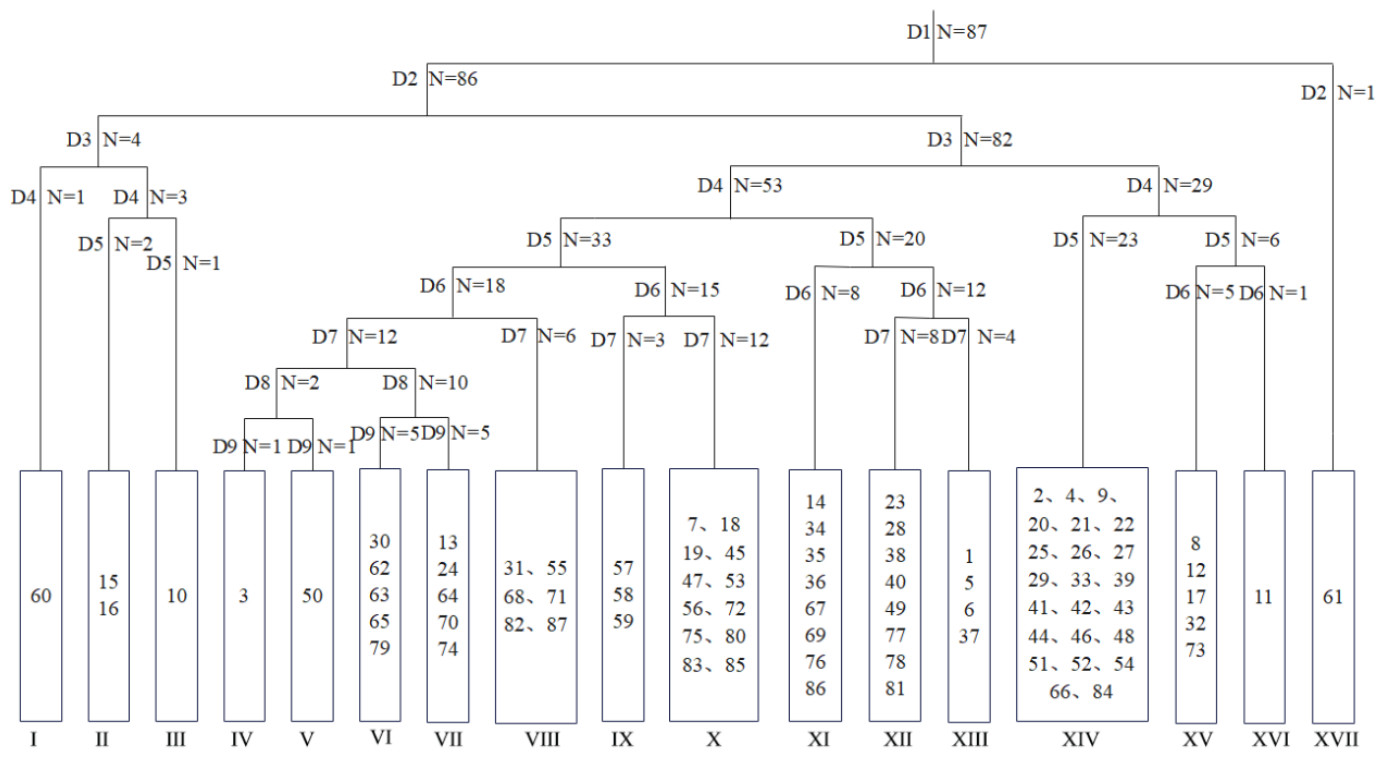
Based on the TWINSPAN classification results, combined with field survey data, community structural characteristics, and the dominant/indicator species identified by the classification model, the plant communities in the study area were ultimately divided into 17 distinct associations (Figure 2). The classification results were named following the dominant species nomenclature rules defined in Vegetation of China [25]: dominant species in the same vegetation layer were linked with a “+”, while different vegetation layers were separated by a “–”.
For each association described below, we explicitly distinguished the ecological roles of all listed species to clarify their functional significance in the community: (1) dominant species: species with the highest importance value (IV) in each vegetation layer, which determine the community physiognomy, vertical structure, and core habitat characteristics; (2) indicator species: diagnostic species identified by the TWINSPAN hierarchical division, which are specifically associated with the unique habitat of the association and act as key markers for community classification; (3) companion species: common accompanying species in the association, which reflect the overall species composition and species coexistence characteristics of the community.
The detailed descriptions of the 17 associations are as follows:
Association I: Ass. Pinus wallichianaIsodon pharicusDigitaria sanguinalis
Sample plot No. 60 occurs at an altitude of 2341 m, with an annual average temperature of 6.29 °C and an annual precipitation of 977.8 mm. The slope gradient ranges from 31° to 45°, and the slope is oriented southeast. The community coverage within this plot is 95%, indicating dense and well-developed vegetation. The dominant species in the tree layer is Pinus wallichiana, while that in the shrub layer is Isodon pharicus. The associated species in the shrub layer include Hylodesmum podocarpum, Daphne longilobata, and Vuhuangia flava. In the herb layer, the dominant species is Digitaria sanguinalis, with accompanying species such as Elsholtzia eriostachya and Sambucus williamsii.
Association II: Ass. Abies densaYushania yadongensisFragaria moupinensis
There are two sample plots, namely, 15 and 16, distributed at altitudes of 2728–3234 m, with an annual average temperature of 13.17–13.20 °C and an annual precipitation of 2100.9 mm. The slope gradient ranges from 3 to 5°, and the slopes face east and north. The community coverage reaches 81%. The dominant species in the tree layer is Abies densa, and the associated species include Acer campbellii, Pinus wallichiana and Larix griffithii. The dominant species in the shrub layer is Yushania yadongensis, and the associated species include Rosa macrophylla and Elsholtzia fruticosa. The dominant species in the herb layer is Fragaria moupinensis, and the associated species include Persicaria capitata and Pilea anisophylla.
Association III: Ass. Juniperus squamataBerberis hobsoniiNeotrinia splendens
Sample plot No. 10 is situated at an altitude of 3663 m, with an annual average temperature of 13.17 °C and an annual precipitation of 2100.9 mm. The slope gradient ranges from 6 to 15°, and the slope faces south. The community coverage is 84%. The dominant species in the tree layer is Juniperus squamata, with associated species including Abies densa and Vaccinium iteophyllum var. glandulosum. The dominant species in the shrub layer is Berberis hobsonii, with associated species such as Rosa omeiensis. The dominant species in the herb layer is Neotrinia splendens, with associated species including Anaphalis margaritacea, Halenia elliptica, etc.
Association IV: Ass. Ceratostigma ulicinumCarex kokanica
Sample plot No. 3 is located at an altitude of 4301 m, with an annual average temperature of 4.75 °C and an annual precipitation of 192.2 mm. The slope gradient ranges from 6°~15°, and the slope faces east. The community coverage is 51%. The dominant species in the shrub layer is Ceratostigma ulicinum, with associated species including Cotoneaster adpressus and Berberis hemsleyana. The dominant species in the herb layer is Carex kokanica, with associated species such as Astragalus strictus, Koenigia islandica, and Sibbaldianthe bifurca.
Association V: Ass. Juniperus pingii var. wilsoniiFestuca ovina
Sample plot No. 50 occurs at an altitude of 4631 m, with an annual average temperature of −2.08 °C and an annual precipitation of 283.7 mm. The slope gradient ranges from 6 to 15°, and the slope faces southwest. The community coverage is 48%. The dominant species in the shrub layer is Juniperus pingii var. wilsonii, with associated species including Cotoneaster adpressus and Lonicera spinosa. The dominant species in the herb layer is Festuca ovina, with associated species such as Allium fasciculatum, Euphorbia stracheyi, and Saussurea kingii.
Association VI: Ass. Carex kokanica
There are five sample plots, namely, 30, 62, 63, 65 and 79, distributed at altitudes ranging from 4484 to 4868 m, with an annual average temperature of −1.92–0.18 °C and an annual precipitation of 156.5–337.1 mm. The slope gradient varies between approximately 0° and 15°, and the slope aspect types include northeast and northwest slopes. The community coverage is 53%. There are only herbaceous plants, with Carex kokanica as the dominant species, and the accompanying species, include Carex moorcroftii, Orinus thoroldii and Festuca ovina.
Association VII: Ass. Carex sargentiana + Carex atrofusca subsp. minor + Carex alatauensis
There are five sample plots, namely, 13, 24, 64, 70, and 74, distributed at an altitude of 4309–4805 m, with an annual average temperature of −1.92–0.32 °C, and an annual precipitation of 201.5–416.6 mm. The slope gradient varies between 0° and 2°, and the slope aspect types include east, south, and north slopes. The community coverage is 70%. Only herbaceous plants occur, with Carex sargentiana as the dominant species. The second most common dominant species are Carex atrofusca subsp. minor and Carex alatauensis. The accompanying species include Carex tibetikobresia, Sibbaldianthe bifurca, Carex sagaensis, and Triglochin maritima.
Association VIII: Ass. Orinus thoroldii
There are six sample plots, namely, 31, 55, 68, 71, 82, and 87, distributed at altitudes ranging from 4310 to 4566 m, with an annual average temperature of −3.09–0.87 °C, and an annual precipitation of 170.2–244.8 mm. The slope gradient ranges from 0 to 8°, and the slope aspect types include east, south, west, and north slopes. The community coverage is 58%. The dominant species is Orinus thoroldii, with accompanying species including Dysphania schraderiana, Astragalus strictus, and Iris loczyi.
Dk: Division number; N: Total sample; I-XVII: Association types
Association IX: Ass. Caragana versicolorOrinus thoroldii + Stipa purpurea
There are three sample plots, namely, 57–59, distributed at altitudes of 4585–4840 m, with an annual average temperature of −1.31–1.30 °C, and an annual precipitation of 283.6–331.1 mm. The slope gradient ranges from 0 to 30°, and the slope faces southeast. The community coverage is 58%. In the shrub layer, the dominant species is Caragana versicolor, without any accompanying species. In the herb layer, the dominant species are Orinus thoroldii and Stipa purpurea, with accompanying species including Aster gouldii, Festuca ovina, and Carex esenbeckii.
Association X: Ass. Stipa purpurea
There are 12 sample plots, including 7, 18, 19, 45, 47, and 53, distributed at altitudes ranging of 4573–5098 m, with an annual average temperature of −3.49–0.32 °C and an annual precipitation of 201.5–416.6 mm. The slope gradient ranges from 0 to 30°, and the slope aspect types include east, south, southeast, southwest, west, and north slopes. The community coverage is 65%. The dominant species is Stipa purpurea, with accompanying species including Dasiphora dryadanthoides, Eremogone pulvinata, Artemisia wellbyi, and Leontopodium pusillum.
Association XI: Ass. Artemisia wellbyiPennisetum flaccidum
There are eight sample plots, namely, 14, 34–36, 67, 69, 76, and 86, distributed at altitudes of 3930–4957 m, with an annual average temperature of −3.49–3.99 °C and an annual precipitation of 155.6–416.6 mm. The slope gradient ranges from 0 to 20°, and the slope aspect types include north, east, northeast, south, and southeast slopes. The community coverage is 51%. In the shrub layer, the dominant species is Artemisia wellbyi, with accompanying species of only Oxytropis sericopetala. In the herb layer, the dominant species is Pennisetum flaccidum, with accompanying species including Carex kokanica, Oxytropis microphylla, and Taraxacum tibetanum.
Association XII: Ass. Pennisetum flaccidum
There are eight sample plots, namely, 23, 28, 38, 40, 49, 77, 78, and 81, distributed at altitudes ranging from 3965 to 4582 m, with an annual average temperature of −3.71–1.21 °C and an annual precipitation of 119.3–290.3 mm. The slope gradient varies between 0° and 30°, and the slope aspect types include north, east, south, southwest, and southeast slopes. The community coverage is 46%. The dominant species is Pennisetum flaccidum, with accompanying species including Youngia simulatrix, Sophora moorcroftiana, Dysphania schraderiana, and Carex moorcroftii.
Association XIII: Ass. Sophora moorcroftianaPennisetum flaccidum
There are four sample plots, namely, 1, 5, 6, and 37, distributed at altitudes of 3848–4095 m, with an annual average temperature of 1.21–4.97 °C and an annual precipitation of 138.3–192.2 mm. The slope gradient ranges from 0 to 20°, and the slope aspect types are south and west slopes. The community coverage is 75%. In the shrub layer, the dominant species is Sophora moorcroftiana, with the accompanying species of Artemisia wellbyi. In the herb layer, the dominant species is Pennisetum flaccidum, with accompanying species including Dysphania schraderiana, Salsola monoptera, and Aster gouldii.
Association XIV: Ass. Carex parvula
There are 23 sample plots, namely, 2, 4, 9, 20–22, 25–27, 29, 33, 39, and 41–44, distributed at altitudes ranging from 3930 to 5365 m, with an annual average temperature of −3.29–4.75 °C and an annual precipitation of 120.5–416.6 mm. The slope gradient ranges from 0 to 45°, and the slope aspect types include north, northeast, east, southeast, south, southwest, and northwest slopes. The community coverage is 68%. The dominant species is Carex parvula, with accompanying species including Festuca ovina, Carex tibetikobresia, Kobresia littledalei, and Potentilla saundersiana.
Association XV: Ass. Aster boweri + Elymus aristiglumis + Koenigia tortuosa + Argentina anserina
There are five sample plots, namely, 8, 12, 17, 32, and 73, distributed at altitudes of 4219–4953 m, with an annual average temperature of −4.73–0.32 °C and an annual precipitation of 205.7–416.6 mm. The slope gradient ranges from 0 to 15°, and the slope aspect types are north, northeast, south, and west slopes. The community coverage is 60%. The dominant species is Aster boweri, with secondary dominant species including Elymus aristiglumis, Koenigia tortuosa, and Argentina anserina. The accompanying species include Lepidium capitatum, Potentilla cuneata, Iris loczyi, and Potentilla multifida.
Association XVI: Ass. Rhododendron campanulatum + Rhododendron setosumArgentina anserina
Sample plot No. 11 occurs at an altitude of 4112 m, with an annual average temperature of 11.97 °C and an annual precipitation of 2100.9 mm. The slope ranges from 3 to 5°, and the slope aspect type is an east slope. The community coverage is 88%. The dominant shrub species are Rhododendron campanulatum and Rhododendron setosum, while the associated species include Rhododendron anthopogon, Rhododendron nivale, and Dasiphora fruticosa. The dominant herb species is Argentina anserina, and the associated species include Elsholtzia strobilifera, Festuca ovina, Cyananthus macrocalyx, and Carex nudicarpa.
Association XVII: Ass. Piptatherum munroi + Senecio biligulatus
Sample plot No. 61 is situated at an altitude of 2883 m, with an annual average temperature of 6.29 °C and an annual precipitation of 977.8 mm. The slope ranges from 0 to 2°, and the slope aspect type is a southwest slope. The community coverage is 88%. The dominant species are Piptatherum munroi and Senecio biligulatus, and the associated species include Galium hoffmeisteri, Anemone rivularis, and Viola biflora.

3.3. Relationships Between the Associations and Environmental Factors

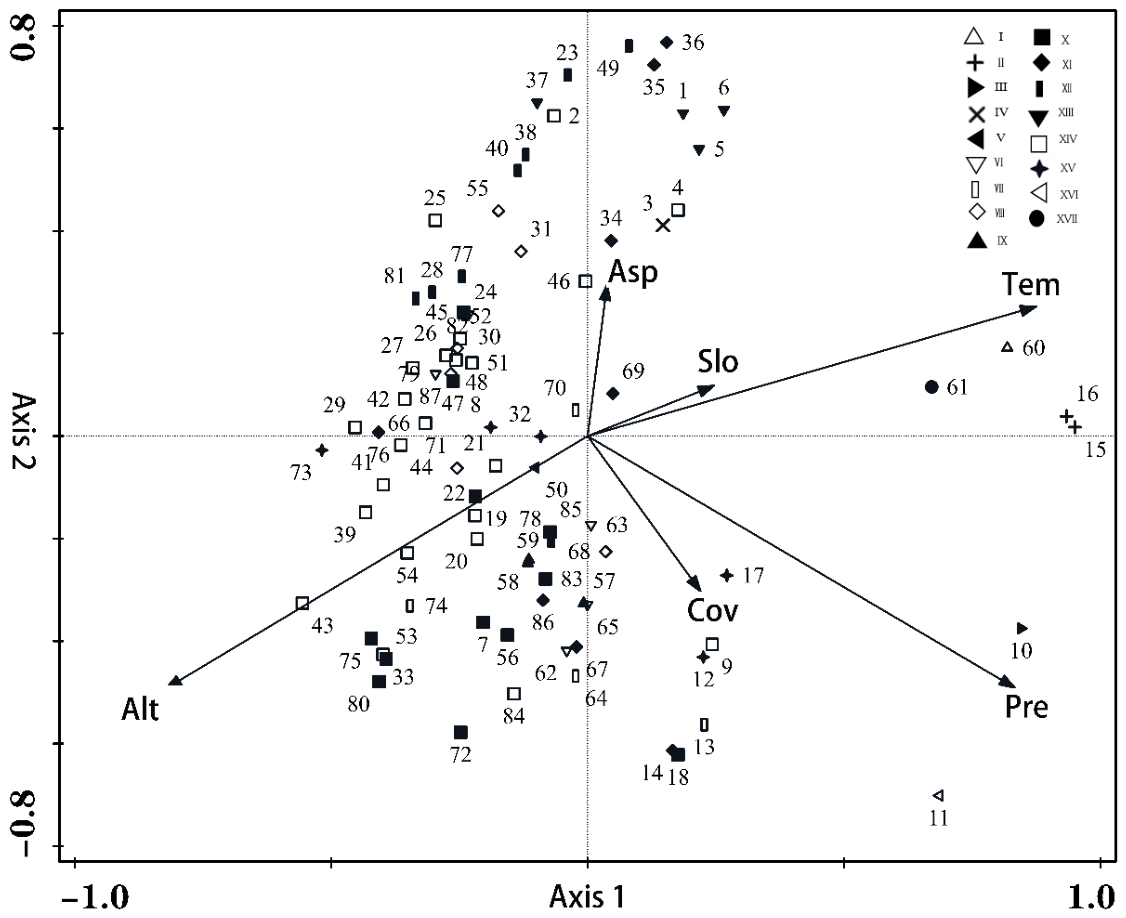
The CCA ordination results (Table 2) for the 87 sample plots showed that the eigenvalues of ordination axes 1 and 2 were 0.79 and 0.51, respectively, accounting for 59.46% of the total eigenvalues of the ordination axes, indicating that the first two axes of CCA could better reflect the relationships between the community distribution and environmental factors.
By combining Table 2 with Figure 3, the environmental factors determining the first ordination axis of CCA are the annual average temperature, altitude, and annual precipitation in sequence. The annual average temperature and annual precipitation exhibited extremely significant positive correlations with the first ordination axis, with correlation coefficients of 0.8258 and 0.7869, respectively; the altitude exhibited an extremely significant negative correlation with the first ordination axis, with a correlation coefficient of −0.78; and the slope aspect exhibited a significant positive correlation with the first ordination axis, with a correlation coefficient of 0.04. Both the slope gradient and community coverage also demonstrated positive correlations. This indicates that the first ordination axis is influenced mainly by the annual average temperature, altitude, and annual precipitation. In other words, as the altitude decreases from left to right on the first ordination axis of CCA, the annual mean temperature and annual precipitation gradually increase. The main environmental factors determining the second ordination axis of CCA are the altitude and annual precipitation. Notably, the altitude and annual precipitation exhibited significant negative correlations with the second axis, with correlation coefficients of −0.4334 and −0.43, respectively. The community coverage also showed a negative correlation, while the slope aspect, slope gradient, and annual average temperature exhibited positive correlations. This indicates that the second ordination axis mainly reflects changes in the altitude and annual precipitation. Specifically, moving upward along the second axis, the altitude decreases. Moreover, the annual precipitation gradually decreases. At the same time, the slope aspect transitions from shady to sunny slopes, and the slope steepness transitions from steep to gentle. A comprehensive analysis of the first and second axes revealed that the annual average temperature, altitude, and annual precipitation significantly impacted the distribution of plant communities in the study area. Furthermore, both the contribution and explanation rates of the annual average temperature were the highest, and they exhibited a weak relationship with the first ordination axis, followed by the annual precipitation. This indicates that climatic factors may be important environmental factors influencing the distribution of plant communities in study area.
The associations classified by TWINSPAN were basically clustered within the same range in the CCA ordination plot. By integrating the TWINSPAN and CCA results, we can reveal the distribution patterns of the 17 association types. Associations I–III, XVI, and XVII are distributed in areas with the lowest altitudes, highest annual average temperatures, and highest annual precipitation levels and are located on the far right side of the ordination plot. Associations IV, XI, and XIII are distributed in sunny slope regions at lower altitudes, occurring at the top of the ordination plot. Associations X and XIV are located in regions with higher altitudes, situated in the lower left corner of the ordination plot. The remaining seven associations occupy mid-altitude areas with lower annual precipitation and temperature levels and are located in the upper left corner of the ordination plot.

3.4. Characterization of the Plant Diversity Indices of the Different Plant Associations

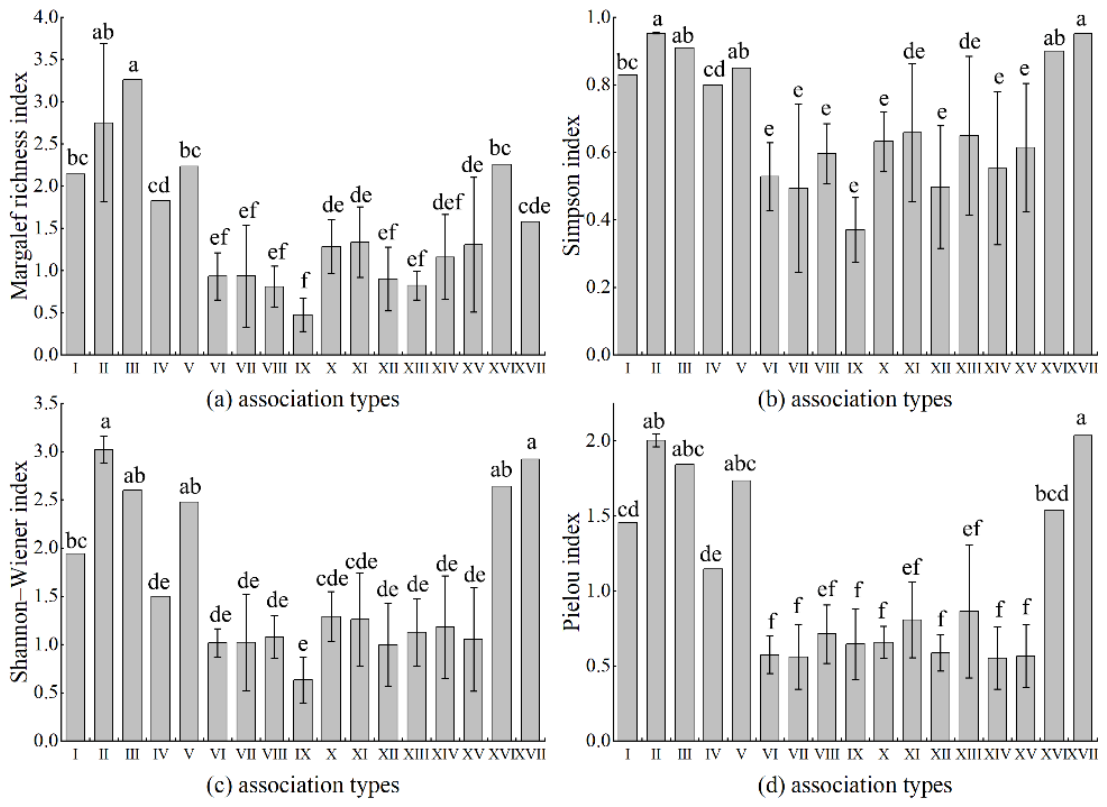
The α-plant diversity of the 17 plant associations classified by quantitative TWINSPAN classification was calculated, as shown in Figure 3. According to Figure 4, the change trends of the various α-plant diversities were basically the same. The Margalef richness index of association III was significantly greater than that of the other associations, association IX exhibited a relatively low index, and the Simpson and Shannon–Wiener indices of associations II and XVII were significantly greater than those of associations III, V, and XVI, while the other associations showed negligible variation in these indices. Association IX attained the lowest Simpson and Shannon–Wiener indices. Except for associations II, III, and V, the Pielou index of association XVII was significantly greater than that of the other associations. A comprehensive analysis of the α-plant diversity characteristics of the 17 community types revealed that the diversity of associations II and XVII was the greatest, followed by associations I, III, V, and XVI. Associations IV, VI–VIII, and X–XV could be categorized into the fourth tier, while association IX exhibited the lowest diversity.
The β-plant diversity calculation results for the 17 plant associations are provided in Table 3. Analysis of Table 3 reveals that the similarity indices between associations I and II and between associations IV and X were all 0. Additionally, except for associations I, II, and XVII, the similarity index between association III and all other associations was 0. This indicates that associations I–III encompassed distinct species compositions and habitats relative to the other associations. The two associations with the highest similarity were associations VI and VIII, with a Jaccard similarity index of 0.35. Among the associations with nonzero similarity indices, the associations with the lowest similarity are associations I and XIV, as well as associations II and XI, XIV, and XV. The Jaccard similarity indices for these pairs were all 0.01. Compared to that of the other associations, associations I–III exhibited the highest average β-diversity index, indicating that these three associations demonstrated relatively low interspecific competition with the other associations and remained relatively stable. In contrast, associations VIII and X attained the lowest average β-diversity indices, suggesting that these two associations exhibited greater interspecific competition with other associations and were less stable.

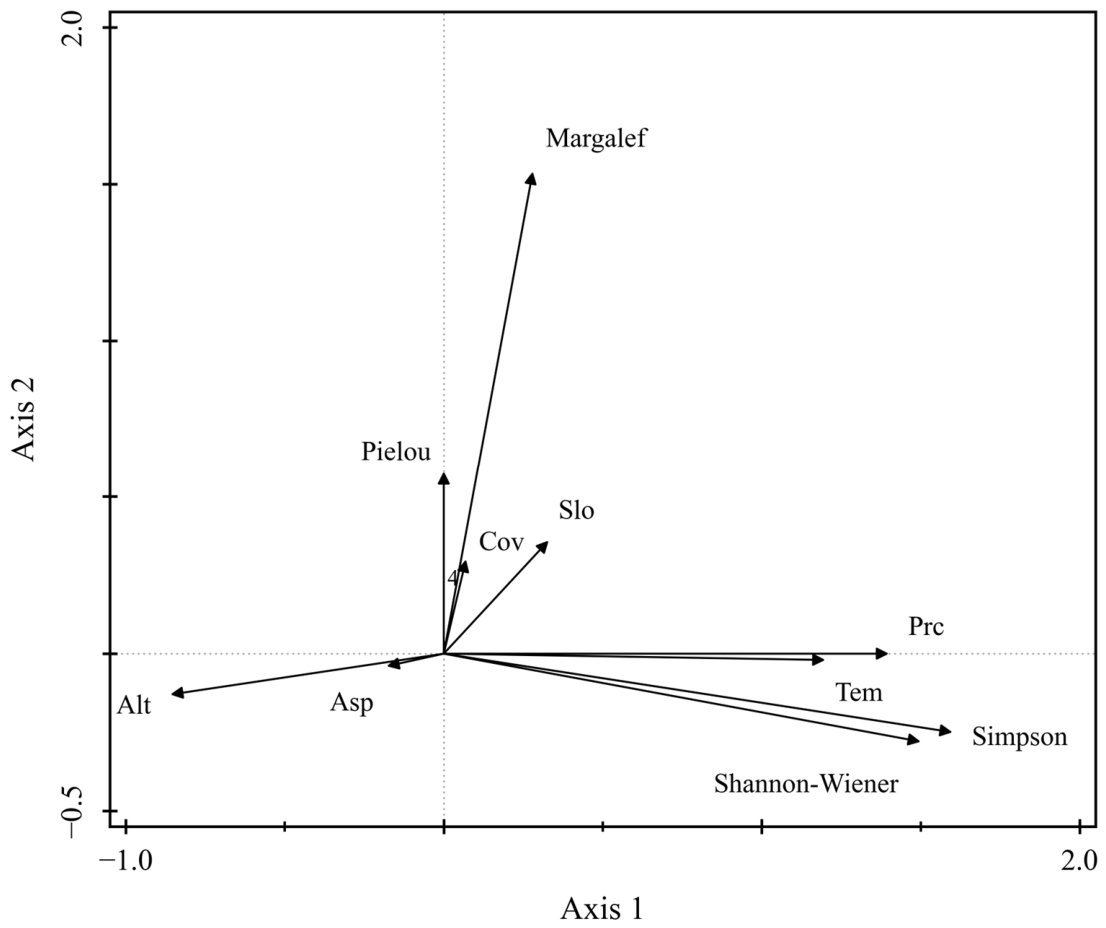
3.5. Analysis of the Factors Influencing Plant Diversity in the Different Plant Associations

To further explore the factors influencing plant diversity, an RDA was conducted between the α-plant diversity indices of each plot and the six environmental factors. The analysis results are provided in Table 4 and Figure 5. As indicated in Table 4, the annual precipitation and annual average temperature exerted highly significant impacts on the plant diversity indices, with p values of 0.002 and 0.016, respectively. Among these factors, the annual precipitation contributed more and imposed a greater influence on the plant diversity indices. The other environmental factors did not significantly impact plant diversity. The analysis results depicted in Figure 5 reveal that the Margalef richness index, Simpson index, and Shannon–Wiener index are all located on the right side of the ordination axes in the RDA results, and they exhibit relatively large projection lengths, indicating a notable positive correlation. Among the different environmental factors, the projection lengths of the slope aspect, slope gradient, and community coverage on the plant diversity indices were extremely small, indicating that they exhibited no correlation with plant diversity. Although the projection length of the altitude was relatively large, its relationships with the four plant diversity indices were not notable, and the projection lengths were relatively small, indicating a negative correlation with plant diversity. The annual precipitation and annual average temperature attained acute angles with three of the plant diversity indices, except for an angle close to 90° with the Pielou index. The projection lengths were relatively large, indicating a notable positive correlation between these two environmental factors and the three plant diversity indices.

4. Discussion

4.1. Classification Results and Floristic Composition Characteristics of Plant Communities in the Study Area

This study is the first systematic field survey and quantitative classification of plant communities covering the entire southwestern Xizang (15 counties and districts of Shigatse City). A total of 295 vascular plant species belonging to 61 families and 171 genera were recorded in the 87 survey plots, which fully clarified the basic floristic composition characteristics of the study area. At the family level, Asteraceae, Poaceae, Rosaceae and Fabaceae were the dominant families with the highest species richness, which is consistent with the core dominant family composition of vascular plants in the whole Xizang region revealed by Chen et al. [27]. This result confirms that the flora of southwestern Xizang is an important part of the Qinghai–Tibet Plateau alpine flora, and the zonal vegetation is dominated by alpine steppe and alpine meadow, which matches the vegetation zoning characteristics of the Qinghai–Tibet Plateau. In terms of life form, herbaceous species accounted for 82.37% of the total recorded species, showing absolute dominance. This pattern is the result of long-term adaptive evolution of plants to the extreme alpine habitats in the study area: compared with woody plants, herbaceous plants have shorter growth cycles, stronger low temperature and drought resistance, and wider ecological niches in high-altitude areas with intense solar radiation and uneven hydrothermal distribution, which is consistent with the adaptation law of alpine plants in the Himalayan region revealed by Sharma et al. [28].
Based on TWINSPAN quantitative classification, we divided the plant communities in the study area into 17 associations, which can be grouped into five major vegetation types: subtropical mountain coniferous forest, subalpine evergreen/deciduous shrubland, alpine steppe, alpine meadow, and valley mesophytic meadow. Previous studies in this region only focused on small-scale vegetation surveys in limited areas including Yadong County [14], Everest Nature Reserve [15] and Lhaze County [16], and failed to reveal the overall vegetation type system of the whole region. Our classification results systematically sorted out the full spectrum of plant community types in southwestern Xizang for the first time, and clarified the species composition, vertical structure and distribution range of each association, which directly responded to the first core scientific question of this study, and provided a fundamental classification basis for the subsequent study of community–environment relationship and diversity characteristics.

4.2. Key Environmental Factors Driving the Distribution Pattern of Plant Communities in the Study Area

Canonical correspondence analysis (CCA) ordination revealed that the first two axes explained 59.46% of the total variance in plant community distribution across southwestern Xizang. Mean annual temperature (MAT), mean annual precipitation (MAP), and elevation were identified as the key environmental factors structuring community spatial differentiation, with MAT exhibiting the highest explanatory power and relative contribution. These findings corroborate our first hypothesis: that plant community distribution patterns in southwestern Xizang are co-driven by climatic, topographic, and soil physicochemical factors, with hydrothermal-related climatic variables and elevation playing a dominant role in community assembly. These results align with prior findings from alpine ecosystems ([29,30,31,32,33,34,35]), which identified hydrothermal conditions—mediated by elevation and regional climate—as the core drivers of alpine plant community assembly. The 17 associations delineated via two-way indicator species analysis (TWINSPAN) exhibited clear spatial segregation along the hydrothermal gradient in the CCA ordination space. Specifically, coniferous forest and Rhododendron shrubland associations (I–III, XVI, XVII) clustered on the right side of the first axis, corresponding to low-elevation valleys with higher temperature and precipitation. In contrast, alpine steppe and meadow associations (X, XIV) aggregated on the left side of the first axis, associated with high-elevation, cold, and arid habitats. This divergent distribution pattern directly demonstrates the strong environmental filtering imposed by the hydrothermal gradient on community composition: high-elevation environments only permit the persistence of species with high cold and drought tolerance, resulting in species-poor communities dominated by constructive species of alpine steppe and meadow. Conversely, warm and humid low-elevation valleys support more structurally and compositionally complex forest and shrub communities.
Notably, previous studies in Mongolian rangelands [31], the upper and middle reaches of the Yarlung Zangbo River basin [36], and semi-arid regions of the Qinghai–Tibet Plateau [37] have documented significant effects of slope aspect, soil physicochemical properties, and anthropogenic disturbance on plant community structure. However, slope aspect and gradient had no significant effect on the overall community distribution pattern in our study. This discrepancy is most likely attributable to the divergence in spatial scale across studies: at the regional scale of southwestern Xizang, the macro hydrothermal gradient shaped by elevation and regional climate exerts a far stronger control on community assembly than local topographic factors. This finding clarifies the dominant role of macroclimatic factors in shaping regional vegetation patterns on the Qinghai–Tibet Plateau, directly addressing our second core scientific question.

4.3. Diversity Characteristics of Different Community Types and Their Environmental Driving Mechanisms

Diversity analyses revealed significant differences in α- and β-diversity across the 17 identified plant associations, which corroborates our second scientific hypothesis that southwestern Xizang exhibits pronounced heterogeneity in species diversity levels among distinct plant community types, with the key drivers of species diversity varying across community types. In terms of α-diversity, coniferous forest associations (I–III) and the valley mesophytic meadow association (XVII) had the highest Margalef richness, Shannon–Wiener, and Simpson index values, while the alpine shrub steppe association (IX) showed the lowest α-diversity, a pattern aligned with classical community ecology theory that communities in habitats with more favorable hydrothermal conditions support higher species diversity, along with stronger anti-interference capacity and ecosystem stability [38]; specifically, coniferous forest communities in warm, humid low-elevation valleys feature complete vertical structure and diverse microhabitats that facilitate the coexistence of more species, thus sustaining the highest diversity levels, whereas high-elevation alpine steppe communities are subject to strong environmental filtering imposed by low temperature and drought, where only a small number of stress-tolerant species can persist, resulting in depressed species diversity. For β-diversity, the Jaccard similarity index between coniferous forest associations (I–III) and other alpine associations was extremely low (most values were 0), indicating that these forest communities harbor unique species assemblages with high habitat specificity, representing critical biodiversity hotspots in the study area that require priority conservation, whereas the widely distributed alpine steppe and meadow associations (VI, VIII, X, XIV) exhibited high species similarity, reflecting strong spatial connectivity and broad ecological amplitude of these zonal communities across the region. Redundancy analysis (RDA) further identified mean annual precipitation (MAP) and mean annual temperature (MAT) as the core environmental factors significantly structuring plant diversity across the study area (p < 0.05), with elevation showing a consistent negative correlation with all diversity indices, a finding consistent with previous research in Himalayan alpine regions (Wani et al. [33]; Liu et al. [34]); these results directly address our third core scientific question, namely, that the species diversity of plant communities in southwestern Xizang is predominantly regulated by hydrothermal conditions shaped by elevation, temperature and precipitation, with higher diversity in warm and humid low-elevation valleys and reduced diversity in cold and arid high-elevation areas. Notably, our results also provide empirical support for the established finding that climate change-driven shrub encroachment is a key driver of species diversity loss in alpine grassland communities [39,40], as the semi-shrub desert steppe associations (XI, XII) in our study exhibited lower diversity than typical grassland associations, offering a foundational empirical dataset for the monitoring and management of shrub encroachment in the study region.

4.4. Limitations and Future Research Prospects

This study systematically revealed the plant community classification, distribution pattern, diversity characteristics and environmental driving mechanisms in southwestern Xizang for the first time, but there are still some limitations that need to be improved in future research. First, this study only considered climatic and topographic factors, and did not include soil physicochemical properties, grazing intensity and other anthropogenic disturbance factors, which have been proven to have important regulatory effects on alpine plant communities in previous studies. Second, this study is a snapshot field survey based on a single growing season, and lacks long-term dynamic monitoring of community changes under continuous climate change. In future research, we will carry out the following targeted work: (1) supplement the systematic survey of soil physicochemical properties and grazing intensity data, and quantitatively analyze the relative contribution of climate, topography, soil and anthropogenic disturbances to plant community variation; (2) establish long-term fixed monitoring plots in typical community types, to reveal the dynamic change law of plant communities under climate change; (3) carry out biodiversity conservation priority zoning based on the results of this study, to provide more precise and operable guidance for the biodiversity conservation and degraded vegetation restoration in southwestern Xizang.

5. Conclusions

The surveyed plots in the southwestern region of Xizang contain abundant plant species, encompassing a total of 295 species belonging to 171 genera and 61 families. Among them, Asteraceae, Poaceae, Rosaceae, and Fabaceae were the dominant families. In this study, the combination of TWINSPAN classification and CCA ordination was effectively applied to categorize plant communities into 17 association types, achieving satisfactory classification results. CCA ordination could be employed to effectively reflect the relationships between plant communities and environmental factors in the southwestern region of Xizang. The annual average temperature, annual precipitation, and altitude exhibited a high degree of explanatory power, serving as key environmental factors that significantly influence the distribution of plant communities in southwestern Xizang. RDA revealed a highly significant correlation between the annual precipitation and annual average temperature with species diversity and a negative correlation with the altitude. This further demonstrates that the temperature and precipitation are the primary environmental factors influencing the distribution of plant communities in the southwestern region of Xizang. However, this study lacked consideration of environmental factors such as soil factors, grazing intensity, and human activities. It is necessary to systematically select a wider range of environmental factors and comprehensively analyze the community species distribution and species diversity to better understand the composition, distribution characteristics, and development process of plant communities in southwestern Xizang.

Author Contributions

X.Q.: Field work, Data analysis, software, Writing—original draft. H.W.: Field work, Funding acquisition. D.L.: Field work, Writing—review and editing, Funding acquisition. All authors have read and agreed to the published version of the manuscript.

Funding

This work was supported by the Fund Program for the Second Comprehensive Scientific Expedition to the Qinghai–Tibet Plateau (2019QZKK1006) and Ecological ground monitoring of ecological quality sample sites in Lhasa and Shigatse, Xizang Autonomous Region, 2023 (603323087).

Institutional Review Board Statement

Not applicable.

Data Availability Statement

The data presented in this study are available on request from the corresponding author.

Acknowledgments

We thank Han Qi for his assistance with fieldwork/taxonomy.

Conflicts of Interest

The authors declare no conflicts of interest.

Appendix A

Association TypeAssociation NameDominant Species Plant NameImportant Value
(%)
Sub-Dominant Species Plant NameImportant Value
(%)
Associated Species Plant NameImportant Value
(%)
IAss. Pinus wallichiana–Isodon pharicus–Digitaria sanguinalisPinus wallichiana35.0Isodon pharicus, Digitaria sanguinalis45.0 (25.0 + 20.0)Hylodesmum podocarpum, Daphne longilobata, Vuhuangia flava, Elsholtzia eriostachya, Sambucus williamsii15.0
IIAss. Abies densa–Yushania yadongensis–Fragaria moupinensisAbies densa30.0Yushania yadongensis, Fragaria moupinensis40.0 (22.0 + 18.0)Acer campbellii, Pinus wallichiana, Larix griffithii, Rosa macrophylla, Elsholtzia fruticosa, Persicaria capitata, Pilea anisophylla11.0
IIIAss. Juniperus squamata–Berberis hobsonii–Neotrinia splendensJuniperus squamata32.0Berberis hobsonii, Neotrinia splendens44.0 (24.0 + 20.0)Abies densa, Vaccinium iteophyllum var. glandulosum, Rosa omeiensis, Anaphalis margaritacea, Halenia elliptica8.0
IVAss. Ceratostigma ulicinum–Carex kokanicaCeratostigma ulicinum22.0Carex kokanica18.0Cotoneaster adpressus, Berberis hemsleyana, Astragalus strictus, Koenigia islandica, Sibbaldianthe bifurca11.0
VAss. Juniperus pingii var. wilsonii–Festuca ovinaJuniperus pingii var. wilsonii20.0Festuca ovina16.0Cotoneaster adpressus, Lonicera spinosa, Allium fasciculatum, Euphorbia stracheyi, Saussurea kingii12.0
VIAss. Carex kokanicaCarex kokanica30.0-0.0Carex moorcroftii, Orinus thoroldii, Festuca ovina23.0
VIIAss. Carex sargentiana + Carex atrofusca subsp. minor + Carex alatauensisCarex sargentiana25.0Carex atrofusca subsp. minor, Carex alatauensis37.0 (22.0 + 15.0)Carex tibetikobresia, Sibbaldianthe bifurca, Carex sagaensis, Triglochin maritima8.0
VIIIAss. Orinus thoroldiiOrinus thoroldii35.0-0.0Dysphania schraderiana, Astragalus strictus, Iris loczyi23.0
IXAss. Caragana versicolor–Orinus thoroldii + Stipa purpureaCaragana versicolor20.0Orinus thoroldii, Stipa purpurea32.0 (18.0 + 14.0)Aster gouldii, Festuca ovina, Carex esenbeckii6.0
XAss. Stipa purpureaStipa purpurea38.0-0.0Dasiphora dryadanthoides, Eremogone pulvinata, Artemisia wellbyi, Leontopodium pusillum27.0
XIAss. Artemisia wellbyi–Pennisetum flaccidumArtemisia wellbyi22.0Pennisetum flaccidum18.0Oxytropis sericopetala, Carex kokanica, Oxytropis microphylla, Taraxacum tibetanum11.0
XIIAss. Pennisetum flaccidumPennisetum flaccidum25.0-0.0Youngia simulatrix, Sophora moorcroftiana, Dysphania schraderiana, Carex moorcroftii21.0
XIIIAss. Sophora moorcroftiana–Pennisetum flaccidumSophora moorcroftiana30.0Pennisetum flaccidum28.0Artemisia wellbyi, Dysphania schraderiana, Salsola monoptera, Aster gouldii17.0
XIVAss. Carex parvulaCarex parvula36.0-0.0Festuca ovina, Carex tibetikobresia, Kobresia littledalei, Potentilla saundersiana32.0
XVAss. Aster boweri + Elymus aristiglumis + Koenigia tortuosa + Argentina anserinaAster boweri18.0Elymus aristiglumis, Koenigia tortuosa, Argentina anserina38.0 (15.0 + 14.0 + 9.0)Lepidium capitatum, Potentilla cuneata, Iris loczyi, Potentilla multifida4.0
XVIAss. Rhododendron campanulatum + Rhododendron setosum–Argentina anserinaRhododendron campanulatum, Rhododendron setosum65.0 (35.0 + 30.0)Argentina anserina15.0Rhododendron anthopogon, Rhododendron nivale, Dasiphora fruticosa, Elsholtzia strobilifera, Festuca ovina, Cyananthus macrocalyx, Carex nudicarpa8.0
XVIIAss. Piptatherum munroi + Senecio biligulatusPiptatherum munroi, Senecio biligulatus80.0 (45.0 + 35.0)-0.0Galium hoffmeisteri, Anemone rivularis, Viola biflora8.0

References

  1. Fakhry, A.M.; Aljedaani, G.S. Impact of disturbance on species diversity and composition of Cyperus conglomeratus plant community in southern Jeddah, Saudi Arabia. J. King Saud Univ. Sci. 2020, 32, 600–605. [Google Scholar] [CrossRef]
  2. Faisal, S.; Haq, F.; Iqbal, Z. Statistical analysis for the classification and ordination of the vegetation of Chour valley. A multivariate approach. Acta Ecol. Sin. 2022, 42, 446–452. [Google Scholar] [CrossRef]
  3. Zhang, W.J.; Zhang, Q.D.; Wang, J.; Feng, F.; Bi, R.C. A comparison of multivariate regression tree and two-way indicator species analysis in plant community classification. Chin. J. Plant Ecol. 2015, 39, 586. [Google Scholar]
  4. Lee, J.S.; Son, D.H.; Lee, S.H.; Myeong, H.H.; Cho, J.S.; Lee, J.C.; Lee, J.Y.; Park, C.S.; Kim, J.W. Canonical correspondence analysis ordinations and competitor, stress tolerator, and ruderal strategies of coastal dune plants in South Korea. J. Coast. Res. 2020, 36, 528–535. [Google Scholar] [CrossRef]
  5. Zheng, J.; Arif, M.; Zhang, S.; Yuan, Z.; Zhang, L.; Li, J.; Ding, D.; Li, C. Dam inundation simplifies the plant community composition. Sci. Total Environ. 2021, 801, 149827. [Google Scholar] [CrossRef]
  6. Thammanu, S.; Marod, D.; Han, H.; Bhusal, N.; Asanok, L.; Ketdee, P.; Gaewsingha, N.; Lee, S.; Chung, J. The influence of environmental factors on species composition and distribution in a community forest in Northern Thailand. J. For. Res. 2021, 32, 649–662. [Google Scholar] [CrossRef]
  7. Kefalew, A.; Soromessa, T.; Demissew, S. Plant diversity and community analysis of Sele-Nono forest, Southwest Ethiopia: Implication for conservation planning. Bot. Stud. 2022, 63, 23. [Google Scholar] [CrossRef] [PubMed]
  8. Qian, S.; Qin, D.; Wu, X.; Hu, S.; Hu, L.; Lin, D.; Zhao, L.; Shang, K.; Song, K.; Yang, Y. Urban growth and topographical factors shape patterns of spontaneous plant community diversity in a mountainous city in southwest China. Urban For. Urban Green. 2020, 55, 126814. [Google Scholar] [CrossRef]
  9. Fu, Z.; Wang, F.; Lu, Z.; Zhang, M.; Zhang, L.; Hao, W.; Zhao, L.; Jiang, Y.; Gao, B.; Chen, R.; et al. Community differentiation and ecological influencing factors along environmental gradients: Evidence from 1200 km belt transect across Inner Mongolia grassland, China. Sustainability 2021, 14, 361. [Google Scholar] [CrossRef]
  10. Harrison, S.; Spasojevic, M.J.; Li, D. Climate and plant community diversity in space and time. Proc. Natl. Acad. Sci. USA 2020, 117, 4464–4470. [Google Scholar] [CrossRef] [PubMed]
  11. Eiserhardt, W.L.; Svenning, J.C.; Kissling, W.D.; Balsev, H. Geographical ecology of the palms (Arecaceae): Determinants of diversity and distributions across spatial scales. Ann. Bot. 2011, 108, 1391–1416. [Google Scholar] [CrossRef] [PubMed]
  12. Rahman, I.U.; Afzal, A.; Iqbal, Z.; Bussmann, R.W.; Alsamadany, H.; Calixto, E.S.; Shah, G.M.; Kausar, R.; Shah, M.; Ali, N.; et al. Ecological gradients hosting plant communities in Himalayan subalpine pastures: Application of multivariate approaches to identify indicator species. Ecol. Inform. 2020, 60, 101162. [Google Scholar] [CrossRef]
  13. Zhou, H.; Yang, X.; Zhou, C.; Shao, X.; Shi, Z.; Li, H.; Su, H.; Qin, R.; Chang, T.; Hu, X.; et al. Alpine grassland degradation and its restoration in the Qinghai–Tibet plateau. Grasses 2023, 2, 31–46. [Google Scholar] [CrossRef]
  14. Wang, X.D. Study on the Floristic Geography of Yadong Tibet Area; Chengdu University of Technology: Chengdu, China, 2015; p. 26. (In Chinese) [Google Scholar]
  15. Li, J.J. The Study on the Flora of Vascular Plants in Qomolangma Nature Reserve; Chengdu University of Technology: Chengdu, China, 2011; p. 31. (In Chinese) [Google Scholar]
  16. Li, H.T.; He, J.S.; Ni, Z.C.; Zhou, B.D.; Li, Q.Z.; Shen, W.Q. A study on TWINSPAN classification of meadow plants in Lazi county, Tibet. Acta. Agri. Uni. Jiangxiensis 2004, 26, 31–36. (In Chinese) [Google Scholar]
  17. Chinese Academy of Sciences Integrated Scientific Expedition to The Tibetan Plateau. Tibetan Geothermal Resources; Science Press: Beijing, China, 1981. (In Chinese) [Google Scholar]
  18. Cong, P.; Tan, H.; Shi, D.; Zhang, Y. Understanding the soil and plant water hydrological cycle in a typical wetland under harsh natural conditions in the Shigatse area of the Tibetan Plateau. Hydrol. Process. 2023, 37, e14921. [Google Scholar] [CrossRef]
  19. Kermavnar, J.; Kutnar, L.; Marinšek, A. Disentangling the ecological determinants of species and functional trait diversity in herb-layer plant communities in European temperate forests. Forests 2021, 12, 552. [Google Scholar] [CrossRef]
  20. Cerasoli, F.; D’alessandro, P.; Biondi, M. Worldclim 2.1 versus Worldclim 1.4: Climatic niche and grid resolution affect between-version mismatches in habitat suitability models predictions across Europe. Ecol. Evol. 2022, 12, e8430. [Google Scholar] [CrossRef]
  21. Qin, Y.; Adamowski, J.F.; Deo, R.C.; Hu, Z.; Cao, J.; Zhu, M.; Feng, Q. Controlling factors of plant community composition with respect to the slope aspect gradient in the Qilian Mountains. Ecosphere 2019, 10, e02851. [Google Scholar] [CrossRef]
  22. Zeng, Y.; Zhao, C.; Shi, F.; Schneider, M.; Lv, G.; Li, Y. Impact of groundwater depth and soil salinity on riparian plant diversity and distribution in an arid area of China. Sci. Rep. 2020, 10, 7272. [Google Scholar] [CrossRef]
  23. Zhang, Q.; Fang, R.Y.; Deng, C.Y.; Zhao, H.J.; Shen, M.H.; Wang, Q. Slope aspect effects on plant community characteristics and soil properties of alpine meadows on Eastern Qinghai-Tibetan plateau. Ecol. Indic. 2022, 143, 109400. [Google Scholar] [CrossRef]
  24. Oluyinka Christopher, A. Comparative analyses of diversity and similarity indices of west bank forest and block a forest of the International Institute of Tropical Agriculture (IITA) Ibadan, Oyo State, Nigeria. Int. J. For. Res. 2020, 2020, 4865845. [Google Scholar] [CrossRef]
  25. Wu, Z.Y. Vegetation of China; SCP: Beijing, China, 1995. (In Chinese) [Google Scholar]
  26. Dibaba, A.; Soromessa, T.; Warkineh, B. Plant community analysis along environmental gradients in moist afromontane forest of Gerba Dima, South-western Ethiopia. BMC Ecol. Evol. 2022, 22, 12. [Google Scholar]
  27. Chen, Y.S.; Song, Q.R.; Wei, R.; Luo, Y.; Chen, W.L.; Yang, F.S.; Gao, L.M.; Xu, Y.; Zhang, Z.X.; Fu, P.C.; et al. A dataset on inventory and geographical distribution of vascular plants in Xizang, China. Biodiver. Sci. 2023, 31, 23188. (In Chinese) [Google Scholar]
  28. Sharma, N.; Behera, M.D.; Das, A.P.; Panda, R.M. Plant richness pattern in an elevation gradient in the Eastern Himalaya. Biodivers. Conserv. 2019, 28, 2085–2104. [Google Scholar] [CrossRef]
  29. Wang, X.; Niu, B.; Zhang, X.; He, Y.; Shi, P.; Miao, Y.; Cao, Y.; Li, M.; Wang, Z. Seed germination in alpine meadow steppe plants from Central Tibet in response to experimental warming. Sustainability 2020, 12, 1884. [Google Scholar] [CrossRef]
  30. Neto, C.; Costa, J.C.; Figueiredo, A.; Capelo, J.; Gomes, I.; Vitória, S.; Semedo, J.M.; Lopes, A.; Dinis, H.; Correia, E.; et al. The role of climate and topography in shaping the diversity of plant communities in Cabo Verde Islands. Diversity 2020, 12, 80. [Google Scholar] [CrossRef]
  31. Suzuki, K.; Tungalag, R.; Narantsetseg, A.; Tsendeekhuu, T.; Shinoda, M.; Yamanaka, N.; Kamijo, T. Composition, distribution and environmental drivers of Mongolian rangeland plant communities. J. Plant Ecol. 2023, 16, rtac100. [Google Scholar]
  32. Waheed, M.; Haq, S.M.; Fatima, K.; Arshad, F.; Bussmann, R.W.; Masooa, F.R.; Alataway, A.Z.; Dewidar, A.F.; Alumutairi, K.; Elansary, H.O.; et al. Ecological distribution patterns and indicator species analysis of climber plants in Changa Manga Forest plantation. Diversity 2022, 14, 988. [Google Scholar] [CrossRef]
  33. Wani, Z.A.; Khan, S.; Bhat, J.A.; Malik, A.H.; Alyas, T.; Pant, S.; Siddiqui, S.; Moustafa, M.; Ahmad, A.E. Pattern of β-diversity and plant species richness along vertical gradient in Northwest Himalaya, India. Biology 2022, 11, 1064. [Google Scholar] [CrossRef]
  34. Liu, W.D.; Li, X.W.; Huang, W.G.; Ma, H.C.; Ma, H.Y.; Wang, W.X. Community diversity, patterns of productivity, and factors influencing them in Stipa in Ningxia grassland. Acta Prataculturae Sin. 2021, 30, 12–23. [Google Scholar]
  35. Sang, W.G. Plant diversity patterns and their relationships with soil and climatic factors along an altitudinal gradient in the middle Tianshan Mountain area, Xinjiang, China. Ecol. Res. 2009, 24, 303–314. [Google Scholar] [CrossRef]
  36. Wang, T.; Wang, J.S.; Ding, Y.K.; Liu, W.J.; Bao, X.T.; Li, C. Quantitative classification and ordination of plant communities in the upper and middle reaches of the Yarlung Zangbo river basin. J. Resour. Ecol. 2019, 10, 389–396. [Google Scholar] [CrossRef]
  37. Wang, Z.R.; Yang, G.J.; Yi, S.H.; Chen, S.Y.; Wu, Z.; Guan, J.Y.; Zhao, C.; Zhao, Q.D.; Ye, B.S. Effects of environmental factors on the distribution of plant communities in a semi-arid region of the Qinghai-Tibet Plateau. Ecol. Res. 2012, 27, 667–675. [Google Scholar] [CrossRef]
  38. Qiao, X.; Lamy, T.; Wang, S.; Hautier, Y.; Geng, Y.; White, H.J.; Zhang, N.; Zhang, Z.; Zhang, C.; Zhao, X.; et al. Latitudinal patterns of forest ecosystem stability across spatial scales as affected by biodiversity and environmental heterogeneity. Glob. Chang. Biol. 2023, 29, 2242–2255. [Google Scholar] [CrossRef]
  39. Deng, Y.; Li, X.; Shi, F.; Hu, X. Woody plant encroachment enhanced global vegetation greening and ecosystem water-use efficiency. Glob. Ecol. Biogeogr. 2021, 30, 2337–2353. [Google Scholar] [CrossRef]
  40. Zhang, Z.; Liu, Y.F.; Cui, Z.; Huang, Z.; Liu, Y.; Leite, P.A.; Zhao, J.; Wu, G.L. Shrub encroachment impaired the structure and functioning of alpine meadow communities on the Qinghai–Tibetan Plateau. Land Degrad. Dev. 2022, 33, 2454–2463. [Google Scholar] [CrossRef]
Figure 1. Schematic diagram of the study area.
Diversity 18 00343 g001
Figure 2. Dendrogram of TWINSPAN classification for 87 sample plots.
Diversity 18 00343 g002
Figure 3. Two-dimensional CCA ordination diagram for 87 sample plots. Alt: altitude; Asp: slope aspect; Slo: slope gradient; Tem: annual average temperature; Pre: annual precipitation; Cov: community coverage.
Diversity 18 00343 g003
Figure 4. Comparison of species diversity among different association types. Different lowercase letters indicate significant differences at p < 0.05.
Diversity 18 00343 g004
Figure 5. Results displayed in RDA diagram.
Diversity 18 00343 g005
Table 1. Statistics of vascular plants from field surveys in southwestern Xizang.
Plant PhylumNo. of FamiliesProportion of Total Families (%)No. of GenusProportion of Total Genus (%)No. of SpeciesProportion of Total Species (%)
Ferns46.5642.3441.36
gymnosperms34.9263.5172.37
Angiosperms
Dicotyledons4472.1313478.3622776.95
Monocotyledon1016.392715.795719.32
Total61100171100295100
Table 2. Correlation analysis of environmental factors with four sort axes.
Environmental FactorsAxis 1Axis 2Axis 3Axis 4Explains (%)Contribution (%)p Value
Altitude−0.77 **−0.43 *−0.120.132.017.10.002
Slope aspect0.04 *0.26−0.100.251.210.40.236
Slope gradient0.230.090.150.05 *1.311.40.130
Annual average temperature0.83 **0.22−0.32−0.123.026.10.002
Annual precipitation0.79 **−0.43 *0.160.112.320.10.002
Community coverage0.21−0.270.10−0.72 **1.714.90.002
Eigenvalues0.790.510.470.42---
Cumulative variance percentage of species data (%)3.375.547.539.32---
Species–environment correlations0.940.880.840.83---
Cumulative percentage variance of species–environment relation (%)28.8647.5164.5679.90---
** represents significant correlation at 0.01 level, * represents significant correlation at 0.05 level.
Table 3. Comparison of Jaccard similarity among 17 community associations.
Association TypesIIIIIIVVVIVIIVIIIIXXXIXIIXIIIXIVXVXVIXVII
I0.070.050.000.000.000.000.000.000.000.000.020.000.010.000.000.07
II 0.060.000.000.000.000.000.000.000.010.030.020.010.010.000.02
III 0.000.000.000.000.000.000.000.000.000.000.000.000.000.03
IV 0.040.090.100.140.040.070.080.170.100.100.070.000.00
V 0.120.040.110.090.100.080.080.030.040.090.080.00
VI 0.190.350.120.310.240.170.060.190.250.070.00
VII 0.240.080.170.160.240.070.220.180.050.02
VIII 0.150.290.210.240.130.140.200.020.00
IX 0.100.060.100.070.030.070.030.00
X 0.220.230.100.270.270.070.03
XI 0.230.110.230.190.090.02
XII 0.160.210.210.060.00
XIII 0.070.070.000.00
XIV 0.250.070.04
XV 0.060.02
XVI 0.03
Table 4. RDA results.
Environmental FactorsExplains (%)Contribution (%)F Valuep Value
Annual precipitation9.153.38.50.002
Annual average temperature3.922.63.70.016
Slope gradient211.61.90.126
Community coverage1.16.210.388
Slope aspect0.84.50.70.476
Altitude0.31.80.30.794
Disclaimer/Publisher’s Note: The statements, opinions and data contained in all publications are solely those of the individual author(s) and contributor(s) and not of MDPI and/or the editor(s). MDPI and/or the editor(s) disclaim responsibility for any injury to people or property resulting from any ideas, methods, instructions or products referred to in the content.