Article

Long-Term Effects of Plant Litter Accumulation and Small Mammal Disturbance on Diversity in Old-Field Succession


1
Institute of Ecology and Botany, HUN-REN Centre for Ecological Research, Alkotmány út 2–4., H-2163 Vácrátót, Hungary
2
Department of Nature Conservation Biology, Institute for Wildlife Management and Nature Conservation, Hungarian University of Agriculture and Life Sciences, Guba Sándor utca 40., H-7400 Kaposvár, Hungary
3
Department of Pharmacognosy, Faculty of Pharmacy, University of Pécs, Rókus utca 4., H-7624 Pécs, Hungary
4
Balaton-Felvidéki National Park Directorate, Kossuth utca 16., H-8229 Csopak, Hungary
5
Department of Nature Conservation and Landscape Management, Institute for Wildlife Management and Nature Conservation, Hungarian University of Agriculture and Life Sciences, Páter Károly utca 1., H-2100 Gödöllő, Hungary
6
Doctoral School of Natural Sciences, Hungarian University of Agriculture and Life Sciences, Páter Károly utca 1., H-2100 Gödöllő, Hungary
7
Independent Researcher, H-5830 Battonya, Hungary
8
Department of Botany, University of Veterinary Medicine Budapest, Rottenbiller utca 50., H-1077 Budapest, Hungary
*
Author to whom correspondence should be addressed.
Diversity 2026, 18(6), 326; https://doi.org/10.3390/d18060326
Submission received: 6 May 2026 / Revised: 23 May 2026 / Accepted: 26 May 2026 / Published: 29 May 2026

Abstract

Litter accumulation and small mammal disturbances create specific fine-scale microhabitats in grasslands. These microhabitats serve as safe sites and regeneration niches for subordinate plant species and are important in diversity maintenance. Previous experiments manipulating litter and disturbance and studying their effects on diversity revealed complex relationships. However, little is known about the realized net effects of these mechanisms in different types of grasslands. We conducted a long-term observational study exploring these patterns and their effects in successional and mature grasslands. We applied a specific mapping technique: the presences of litter, disturbance, and living plant species were recorded in 5 cm × 5 cm contiguous microquadrats along 52 m permanent transects. Sampling was repeated annually over 10 years. Spatial dynamics and associations with subordinate grassland specialists were evaluated using information theory models. Analyses were performed at increasing spatial and temporal scales. Varying associations were found across years. Negative associations dominated the relationships between litter and local diversity hotspots, while the relationships with disturbances were mainly neutral. When analyses were repeated at longer time scales, consistent negative associations were detected between litter and diversity hotspots. Long-term relationships between disturbance and diversity were negative in old-fields and positive in the natural grassland. To collect more representative and reliable data on the role of plant litter accumulation and small mammal disturbances, we recommend long-term annual monitoring and the application of temporal scaling based on cumulative diversity.

1. Introduction

Natural disturbances—such as herbivory, fire, and burrowing activity—play a key role in maintaining diversity in grassland ecosystems by suppressing dominant competitors and creating recruitment opportunities for subordinate species [1,2]. Disturbances also modulate the accumulation of plant litter, which is a critical component of nutrient cycling and community organization. Together, disturbance and litter influence regeneration niches by altering the physical, chemical, and biological properties of microsites [3,4,5,6,7].
Experimental studies manipulating disturbance regimes [8,9,10,11] and litter quantity or type [12,13,14,15] have revealed complex, context-dependent interactions. Such variability in underlying mechanisms limits the generalization of findings and the development of simple rules for practical applications [14,16,17].
Soil-disturbing mammals create nutrient-enriched mounds with specific microtopography that may trap seeds and enhance germination. It has therefore been hypothesized that disturbed sites can develop into biodiversity hotspots. However, global meta-analyses provide mixed evidence: some report no significant effect on species richness in disturbed sites compared to undisturbed sites [17], while others document both positive and negative relationships [18]. Other meta-analyses of litter effects on vegetation generally indicate negative effects on germination and species richness [16], although context-dependent positive and negative responses have also been reported [19]. Notably, these syntheses are largely based on experimental studies and provide limited insight into effect sizes under field conditions.
The need for comparative field data on disturbance regimes, litter dynamics, and their spatiotemporal relationships with community structure has long been recognized [1,5]. Yet only a few studies have quantified disturbance regimes at community or landscape scales, including their size, frequency, and persistence [20,21,22,23], and field-based studies on litter dynamics are similarly scarce [24,25]. To our knowledge, only two studies have examined spatial associations between litter and species richness at the community level [26,27], and only one long-term field study has simultaneously mapped small mammal disturbances and linked them to vegetation patterns [10].
Most experimental studies addressing disturbance and litter effects are short-term (1–3 years) and assess diversity at a single, fixed spatial scale. We suggest that such fixed and often arbitrary design parameters may contribute to the limited generalizability of results. The increase in species richness with sampling area is one of the most robust patterns in ecology [28,29], and the importance of spatial scaling is widely recognized in biodiversity research [30,31]. In contrast, although analogous relationships exist for temporal scaling [32], their application in field studies remains scarce. Hammond and Kolasa [33] highlighted that while short-term (alpha) diversity and temporal turnover (beta diversity) have been extensively studied, the third component, i.e., temporal gamma diversity, has received far less attention. They termed this component “long diversity” (or cumulative diversity) and proposed its use particularly in systems characterized by non-equilibrium dynamics, low local diversity, high temporal turnover, and strong legacy effects.
Litter accumulation is typically high during early succession due to slow decomposition [26,34,35], and population outbreaks of small mammals and associated disturbance pulses are also common at this stage [22,26,36]. The high spatial and temporal variability of both processes in successional old-fields makes them ideal systems for studying the roles of litter and disturbance in species establishment and community assembly. In this study, we present results from a 10-year-long field investigation of the associations between small mammal-linked disturbance regimes and plant litter accumulation in mid-successional old-fields and the adjacent loess meadow steppe. The old-fields were already dominated by grassland species characteristic of the surrounding steppe. A large population of the endemic Hungarian Blind Mole-rat (Nannospalax (superspecies leucodon) hungaricus hungaricus; [37]) occurred in both the natural grassland and the neighboring old-fields. These fossorial herbivorous rodents construct extensive underground tunnel systems and produce numerous soil mounds [38,39], thereby acting as ecosystem engineers generating distinct microhabitats with significant effects on vegetation structure [40].
Plant establishment typically occurs within small “safe sites” [4,8,41]; therefore, understanding the roles of disturbance and litter in regeneration requires a fine-scale perspective on community dynamics. To address this, we annually mapped the spatial patterns of plant litter accumulation and small mammal disturbances, together with species composition and fine-scale species richness. These data allowed the identification of safe sites, the analysis of fine-scale neighborhood interactions, and the assessment of spatial co-occurrence among litter, disturbance, and vegetation attributes. Baseline transect data were subsequently reanalyzed using computerized sampling with increasing sampling unit sizes, enabling both spatial and temporal scaling. This approach allowed the application of the cumulative diversity framework proposed by Hammond and Kolasa [33].
We addressed the following research questions: Q1: How do the abundance and spatial patterns of plant litter and small mammal disturbances vary over time and among sites? Q2: Are there spatial associations among litter, disturbances, local diversity hotspots, and other vegetation attributes? Q3: Are these relationships consistent across years and sites? Q4: Do patterns differ between short- and long-term temporal scales?

2. Materials and Methods

2.1. Study Sites

The study was conducted at Tompapuszta (46°360 N, 20°980 E, elevation 99 m; Körös-Maros National Park) near Battonya, Hungary (Figure S1). This natural grassland [42,43] is a highly valuable site and is the last remnant of the original zonal forest-steppe vegetation. The strictly protected area (“Tompapusztai-löszgyep”) is part of the Körös-Maros National Park, and it represents a climatically zonal, well-preserved loess meadow steppe on humus-rich chernozem soil developed over a loess substratum. It is surrounded by abandoned agricultural fields. For long-term monitoring, we selected three adjacent old-field sites that were abandoned in 2009. The dominant grass species in the natural grassland is Festuca valesiaca. The most important co-dominant and subordinate species include perennial grasses (Poa angustifolia, Alopecurus pratensis) and perennial forbs (Teucrium chamaedrys, Galium verum, Fragaria viridis, Thymus pannonicus, and Salvia nemorosa) [44]. The site has a warm temperate semi-arid climate with a sub-Mediterranean influence. The mean annual precipitation is 500–550 mm, while the mean annual temperature is 10–11 °C (based on 30 years of meteorological data, 1960–1990). The abandoned fields were quickly colonized by dominant grassland species due to good climatic and soil conditions and good propagulum sources. After 16 years (by the end of our study), ca. 50% of the grassland flora was already present in the old-fields [45]. Two of the old-field sites were left for spontaneous succession, while one field was sown in 2012 with target species of natural grassland, predominantly Festuca valesiaca. Our monitoring at two spontaneously developing old-fields (O1 and O2 sites), at a sown old-field (OS site) and at the reference natural grassland (N site) has been performed between 2016 and 2025. The abandoned fields were 7 years old at the start and became 16 years old by the end of this study. The ancient reference grassland was used as grazing land (occasionally, extensively grazed with cattle). Thirty years ago, the grazing had been converted to annual mowing. Each field (the old-fields and the natural grassland) was managed by mowing (once a year) within the study period, except one year (2022) when biomass was very low due to an extreme drought. The endemic Hungarian Blind Mole-rat (Nannospalax (leucodon) hungaricus; [37]) is abundant in each field, disturbing considerable areas.

2.2. Field Sampling

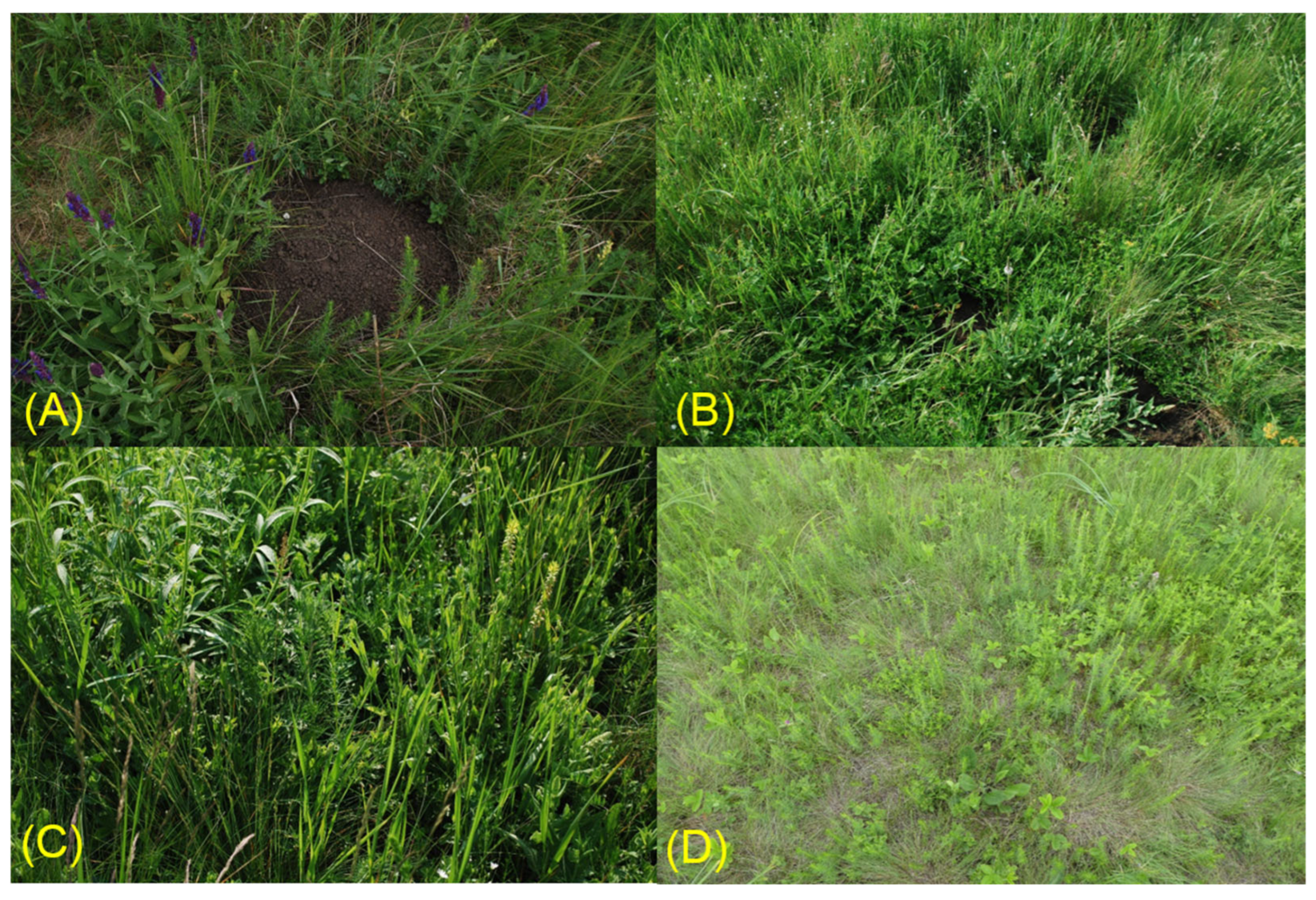
At each site, one 52 m long permanent belt transect was sampled annually in late May or early June, corresponding to the phenological optimum of the communities. The endpoints of the transects were permanently marked. The transects were topologically circular (arranged in rectangular form; see Figure S2). Presence of plant litter accumulation, soil disturbance, and the rooting plant species were recorded along transects in 5 cm × 5 cm sampling units. Litter was marked in a microquadrat when its cover was more than 80% with more than 1 cm thickness. Disturbed microsites were easily recognizable by the bare soil and changed microtopography (Figure A1). Our previous methodological studies proved that this high-resolution and high-extent sampling design is optimal for monitoring spatial variability and heterogeneity in successional grasslands [46].

2.3. Detecting Abundances and Temporal Persistence

When the presence of plant litter accumulation and small mammal disturbance is recorded in very small (in 5 cm × 5 cm) plots with a very high number of replicates (1040 replicates along the 52 m transects), these data represent the percentage area covered well and can be a good proxy for abundance [27,45]. Due to accurately fixing the permanent transects, temporal series of presences can also be detected [47], and these data were used to estimate persistence at the microquadrat scale. Since the transects were made of contiguous microquadrats, we could detect the size distribution of spatial aggregates and could analyze the temporal changes in patchworks.

2.4. Detecting Temporal Associations Using Information Theory Models and Spatial Scaling

We used a modified version of the Associatum function, derived from the information theory models of Pál Juhász-Nagy [48,49], to quantify the overall temporal dependence among the spatial patterns of a given variable across different years. For example, we can measure the overall temporal association of yearly patterns in the time series of litter patterns recorded over the 10-year study. It is not only pairwise associations that can be quantified in this way. This is the major advantage of the Associatum compared to alternative measures. For example, we considered the patterns of litter and estimated the temporal combinations of presence and absence that appeared in a given permanent microquadrat over the years. Based on this, Temporal Associatum represents the overall dependence among the spatial patterns of a given variable across different years, which can be expressed as the difference between two Shannon diversities (the diversity of expected temporal combinations and the diversity of observed temporal combinations.
T e m p o r a l   A s s o c i a t u m   t 1 , t 2 , t 3 t n = f = 1 f = z p f e x p × log p f e x p f = 1 f = z p f o b s × log p f o b s
where pf is the probability of a particular temporal combination f, and f ranges from 1 to z = 2n, where n is the number of years in the analysis. Temporal Associatum would have a maximum if the temporal persistence were maximal (10 presences over the 10 years) in half of the sampling units, while other microquadrats would be empty over the years. Temporal Associatum is minimal if presence data would appear randomly over time without autocorrelations between years. For a more detailed description of this method, see Bartha et al. [45].
Temporal Associatum is a scale-dependent variable. Therefore, Temporal Associatum was estimated across a range of scales (at changing sampling unit sizes) from 5 cm × 5 cm to 5 cm × 200 cm by merging two, three, four, etc., to a total of 200 consecutive microquadrats by subsequent computerized sampling [50,51]. The significance of associations was tested against a null model of the complete spatial randomness of presences along transects. The randomization was repeated 999 times for each test. Significance was expressed as a probability of the observed Temporal Associatum under the null model [52]. The model family of Juhász-Nagy is based on the analyses of species combinations (or combinations of variables in a general sense). Due to the complexity of multispecies patterns, these models are frequently used in vegetation science to evaluate restoration measures or the effects of conservation management [27,46,53,54,55].
JNP-model 2.0 software [56] was used to perform the computerized sampling and the related analyses, including randomization tests.

2.5. Detecting Pairwise Spatial Associations Using Information Theory Models and Spatial Scaling

Analyses of the spatial associations between two variables were also performed using the information theory models of Juhász-Nagy, based on their established methodology with spatial scaling [48]. We tested associations between various pairs of variables, including plant litter, small mammal disturbances, dominant species, and plant diversity patterns. For diversity patterns, we considered the number of subordinate target species in the microquadrats. In early successional old-fields, several pioneer and weed species were present. However, for nature conservation reasons, we focused on the immigration and establishment of true grassland species. First, we removed the dominant and co-dominant grassland species (Festuca valesiaca, Alopecurus pratensis, and Poa angustifolia, Figure S3) from the samples. These three species often develop high biomass in old-fields, and they suppress other grassland species [45,57]. We defined a species as a “target subordinate” if it was another typical component of the natural grassland.

2.6. Analyses Based on the Concepts of Short Versus Long Diversity

Recently, Hammond and Kolasa [33] proposed the temporal extension of the alpha-, beta-, and gamma-diversity concept originally developed over spatial scales [58]. Temporal alpha diversity is the mean diversity calculated from the replicates of yearly diversity estimates. Temporal gamma diversity can be calculated from the cumulative species richness over a period, while temporal beta diversity refers to the species turnovers over time and can be calculated as gamma–alpha diversity. In this paper, we will apply the gamma diversity (“long diversity”) concept from this framework to compare associations between litter, disturbances, and diversity hotspots assessed at short versus long temporal scales.

2.7. Other Statistical Analyses

We performed OLS regression analysis to examine how precipitation affects disturbance and litter abundance, and then how disturbance and litter abundance affect the ISC and SES indices. Scatterplots with linear fits and correlation coefficients between variables were produced using the Past v.5.3 software package [59]. Significance tests were considered at p < 0.05. Differences in categorical distributions of litter and disturbance abundances among different groups were evaluated using the chi-square (χ2) test of homogeneity. Statistical significance was assessed at p < 0.05. When significant differences were detected, standardized residuals were examined to identify the categories contributing most to the overall deviation. The chi-square test was also performed using the PAST v.5.3 software package. Figure S4 provides a generalized research design scheme summarizing the steps of data processing.

3. Results

3.1. Patterns of Plant Litter and Disturbances over Space and Time

The abundance of microquadrats containing local plant litter accumulations ranged from 17.3% (in 2024 in the natural grassland) to 100% (in 2016 and 2017 in the sown old-field). The maximum abundance of plant litter detected at the natural grassland site was 85.9% (in 2019). At the spontaneously regenerating old-field sites, litter abundance varied between 19.5% (in 2016) and 66.9% (in 2022). The highest abundance of microquadrats affected by small mammal disturbance was 22.9%, recorded in the sown old-field in 2024. At the natural grassland site, the maximum disturbance was 17.7% (in 2024). At the two spontaneously developing old-field sites, the corresponding maximum values were 15.5% (in 2017 at the O1 site) and 20.6% (in 2022 at the O2 site). There were a few years when small mammal disturbances could not be detected at some sites.
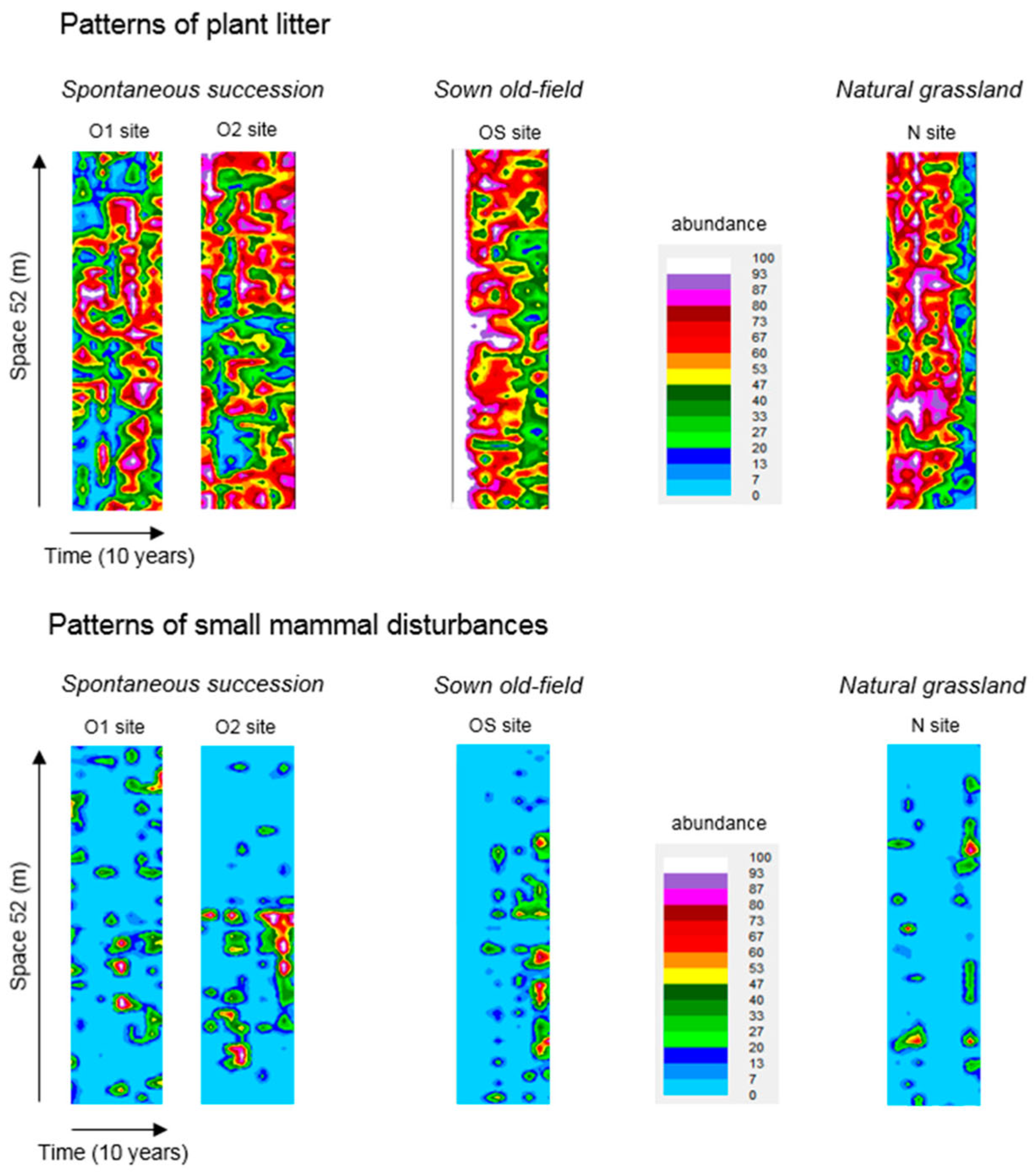
Fine-scale patterns of local plant litter accumulation and local animal disturbances exhibited high overall spatiotemporal variability and pronounced patchiness (due to similarities between neighboring micro-sites) (Figure 1). The variability of local abundances (calculated at 1 m resolution) varied between 0% and 100% for both variables.
The spatiotemporal patterns of the plant litter formed diffuse patchworks at all sites. Animal disturbances appeared as discrete patches, representing mounds and aggregates of mounds.
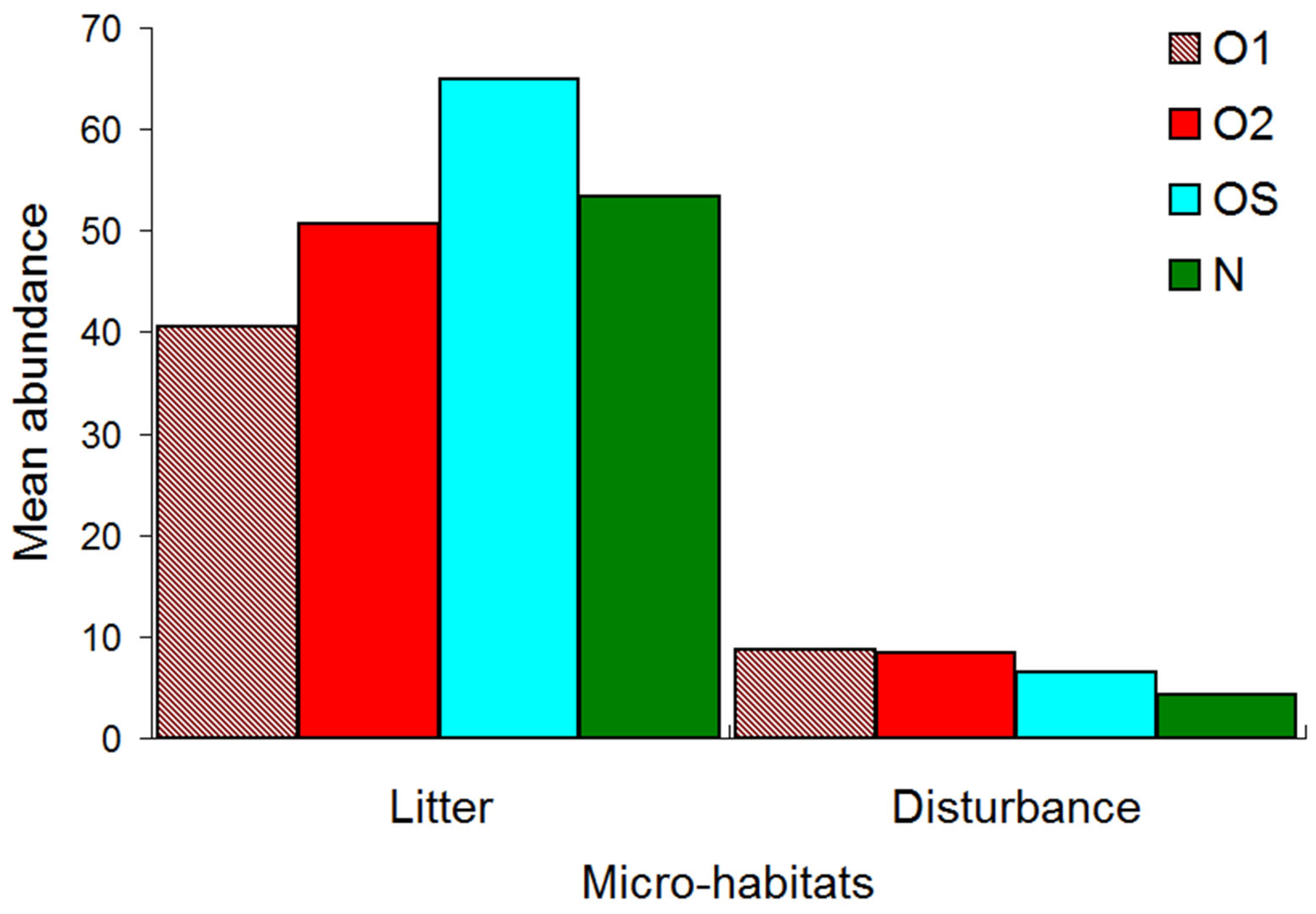
Overall, litter-related microsites were approximately five times more frequent than disturbance-related microsites (Figure 2).
The mean abundance of microquadrats with litter accumulations (summed over the 10 years) varied between 40.5% (O1 spontaneous old-field) and 64.9% (OS sown old-field), with an intermediate value of 53.4% in the natural grassland site. Local disturbances were less frequent. In the case of the two spontaneously developing old-fields, the mean frequencies were 8.7% and 8.4%. The mean abundance of disturbances was 4.3% in the natural grassland and 6.5% in the sown old-field. It is important to note that the disturbance regime was more intensive at the young recovering old-field sites.
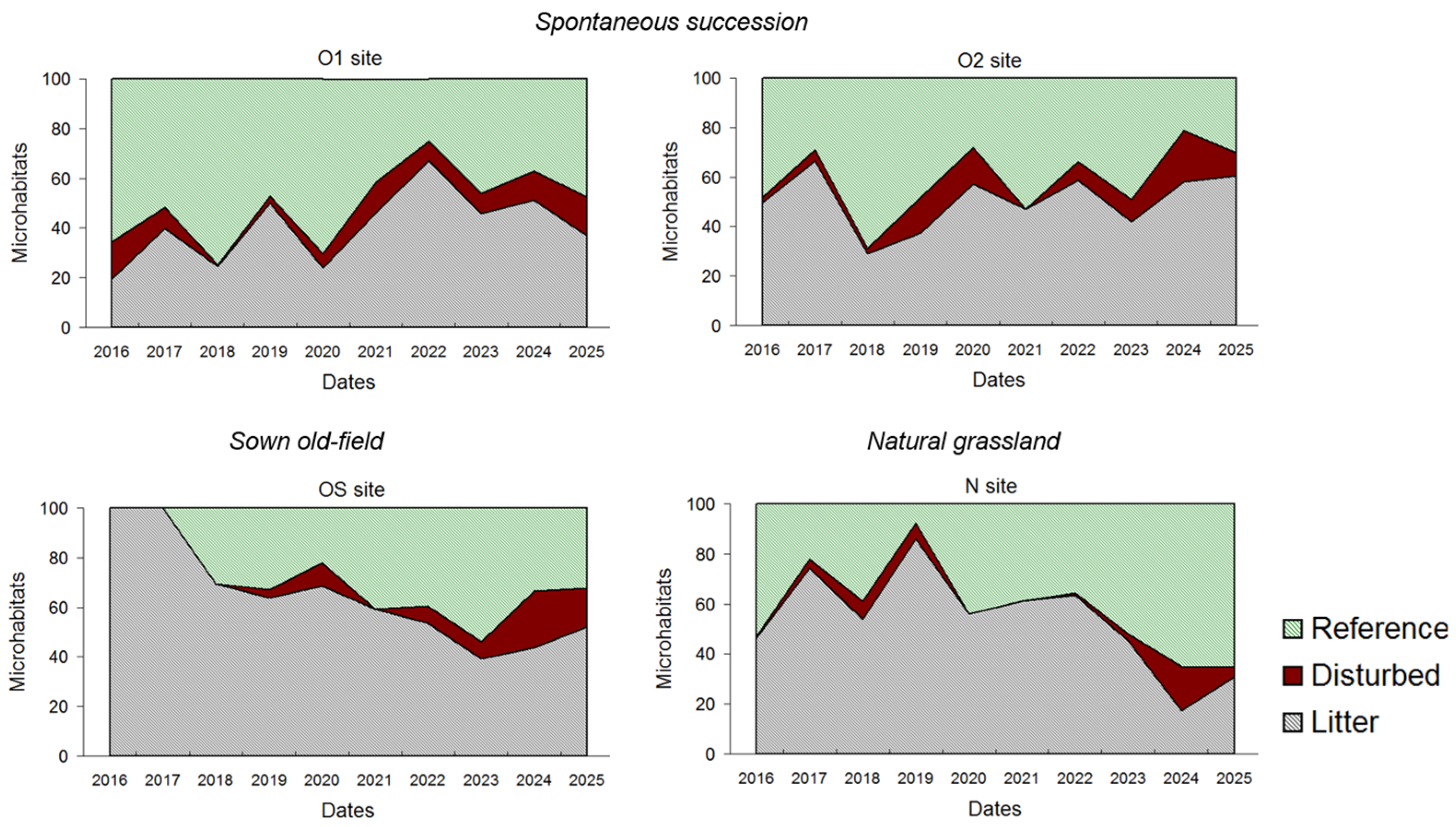
Considering the time series of abundances, the percentage area affected yearly by litter accumulation fluctuated around 50% at the two spontaneously developing old-fields (Figure 3).
At the sown old-field, litter cover exhibited a declining trend, whereas in the natural grassland it remained relatively stable at ~70% between 2016 and 2022 before decreasing in the final years. The annual extent of animal disturbances varied between 0% and 23%. When the spatial patterns of litter and disturbances were compared between different years, considerable temporal associations were found (Figure 4 and Figure 5).
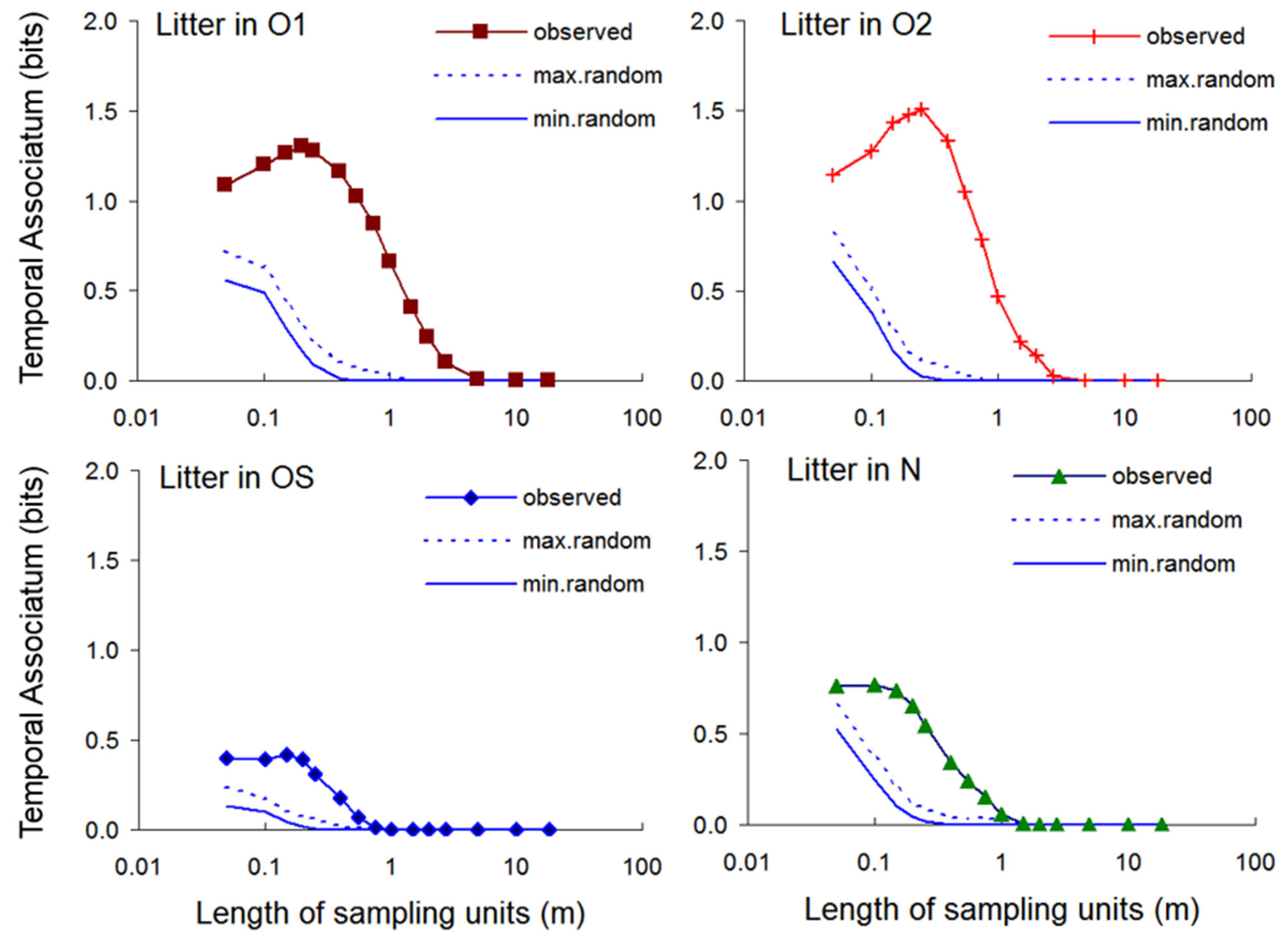
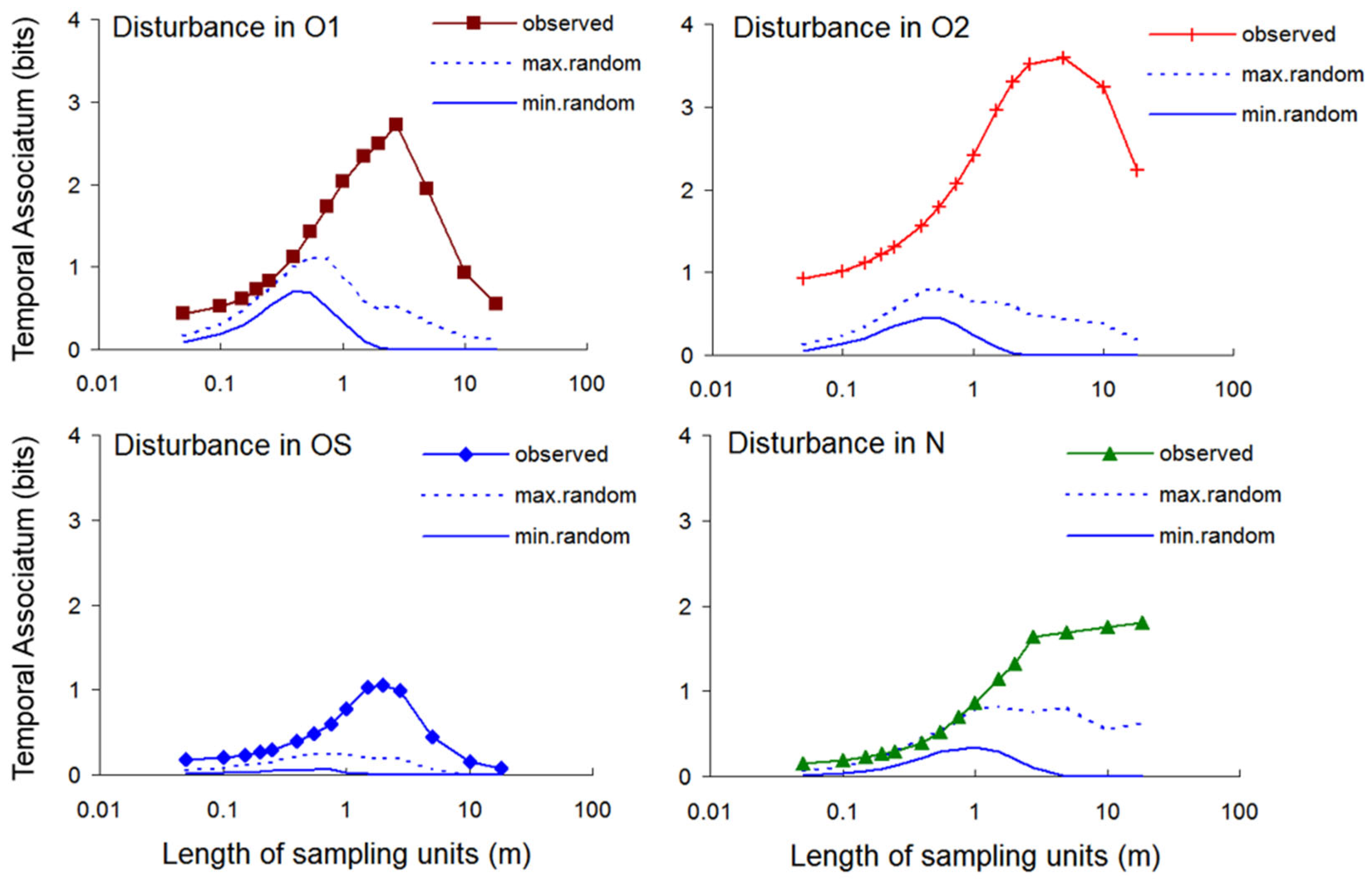
The associations were scale-dependent and consistently differed from random expectations across all sites and spatial scales. Maximum temporal associations for litter occurred at fine scales (0.05–0.5 m; Figure 4), whereas disturbance patterns showed stronger associations at coarser scales (5–10 m; Figure 5). Comparing the absolute values of the temporal associations of litter patterns and disturbance patterns at a given site, the detected associations were about two times larger among disturbance patterns.
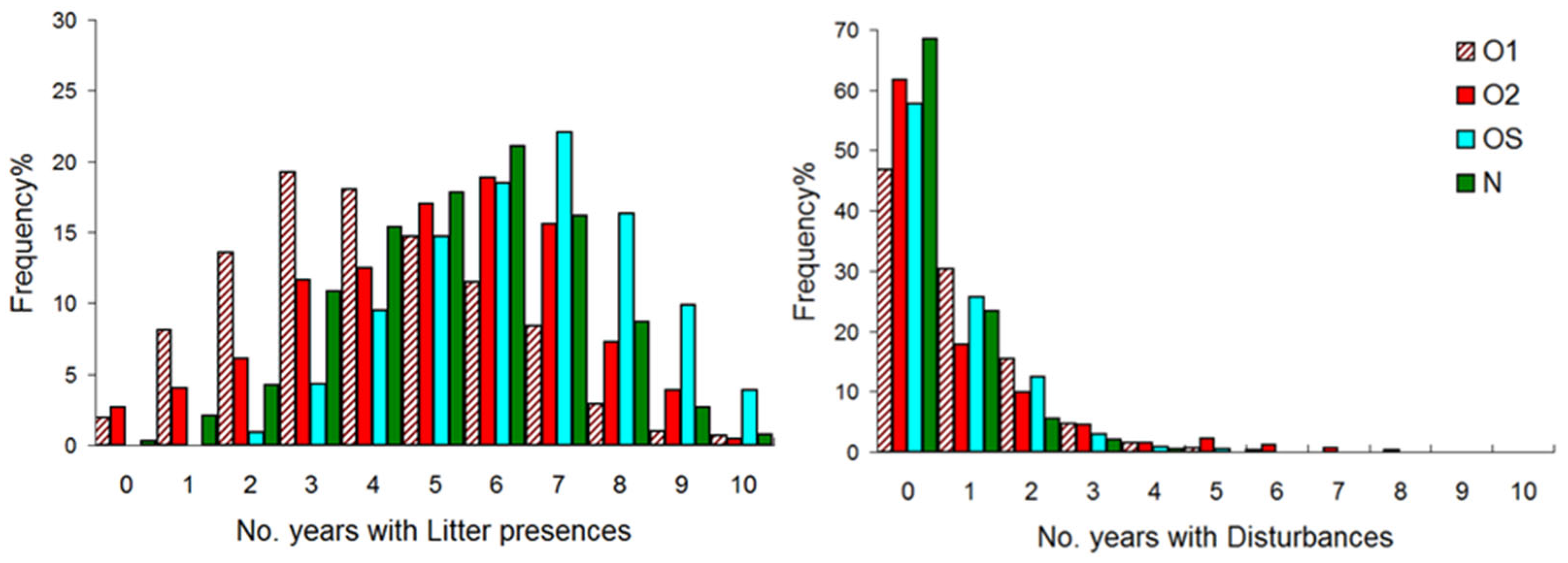
Significant temporal associations reflected similarities among yearly patterns, although spatial configurations were not identical. When microquadrats were considered over time, the cumulative occurrence of plant litter accumulation and small mammal disturbance found in individual microquadrats varied greatly along the permanent transects (Figure 6, Table S1a).
The cumulative presence calculated over the 10 years reflected the local persistence of litter or disturbance. The most frequent litter persistence category was 6 years, with peak frequencies in the natural grassland (21%) and in the O2 site (19%). However, some microquadrats showed litter presence over 10 years. At the sown old-field site, 70.6% of microquadrats had a cumulative litter presence of at least 6 years. This ≥6 years persistence category had 50% frequency at the grassland site and at the O2 old-field site, while this type of persistence category was less frequent at the O1 site (24.4%). Moreover, 8% of microquadrats experienced a short litter effect (i.e., occurrence in only one year) at the O1 site. Short-term litter effects were rare at the other sites (varied between zero and four percent at other old-fields, and it was 2.1% at the natural grassland).
In contrast, the persistence of local small mammal disturbances was low. Undisturbed microquadrats were the most common over the 10-year period (46.1–61.7% in old-fields; 68.4% in the natural grassland) (Figure 6). Among microsites experiencing disturbance over the ten years, the most frequent category was the single disturbance event (with frequencies varying between 17.8% and 30.4% at the old-field sites and 23.4% at the natural grassland). Frequency of microsites with two or more disturbance events over the 10 years varied between 16.7% and 22.8% at the old-field sites. This type of disturbance was rare at the natural grassland site (8%).
Table 1 shows the long-term dynamics of litter accumulations and the disturbance regime from a different aspect. It is important to characterize the total extent of area affected by these variables over a larger period. Litter accumulation practically influenced the entire area for 10 years. In contrast, small mammal disturbances were more localized, affecting 31.6–53.2% of the total area.
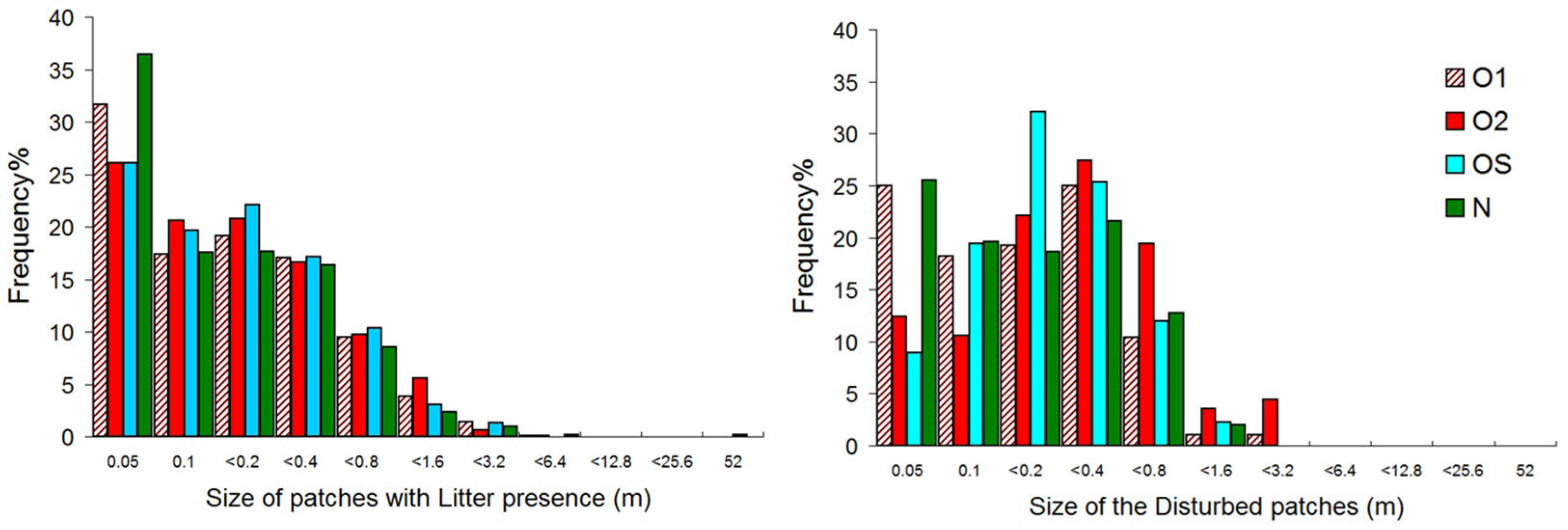
The frequency distribution of contiguous patch sizes derived from transect sampling does not reflect true patch diameters, as transects intersect patches at varying positions. However, these data confirm that both plant litter and small mammal disturbance microsites exhibit aggregated spatial patterns. Differences in distribution shapes indicate distinct spatial structures (Figure 7, Table S1b). Small-sized patches (between 5 and 10 cm) were the most frequent for litter microsites. Their frequency ranged from 45.7% to 48.9% at the old-field sites and was 54.0% in the natural grassland. Visual inspection of Figure 1 already suggested that plant litter microsites formed diffuse spatiotemporal networks. The frequency distribution of plant litter patch sizes provided quantitative support for this interpretation. For small mammal disturbance microsites, the intermediate size category (between 20 and 40 cm) was the most frequent. At the O2 old-field, 27.4% of microquadrats formed large aggregates (>80 cm), while the abundance of this large size category varied between 12.5% and 14.7% at the other sites. Transect sampling also allowed the quantification of mound abundance. Mean annual counts ranged from 11 to 19 mounds in the old-fields and averaged 10 in the natural grassland. Maximum counts varied between 25 and 52 in the old-fields and reached 33 in the natural grassland. Typically, one or two large mounds (>80 cm) were recorded per transect for each sampling year.

3.2. Spatial Associations Between Plant Litter Accumulations, Small Mammal Disturbances, and Local Diversity Hotspots

The number of subordinate target species detected at the scale of individual microquadrats (5 cm × 5 cm) ranged from zero to four species at the old-field sites (Table S2) and from zero to seven species at the natural grassland (Table S3). To assess spatial associations, only richness categories occurring in more than 1% of all microquadrats were included. Species richness ≥ 2 fulfilled this criterion at the old-field sites, and species richness ≥ 4 was selected in the natural grassland (Tables S2 and S3).
The majority of significant spatial associations between plant litter accumulation and local diversity hotspots were negative across sites and years (Table 2 and Table S4). However, neutral relationships were also common, and a few positive associations were detected.
In contrast, associations between animal disturbances and diversity hotspots were predominantly neutral (Table 3 and Table S5) with only occasional positive or negative relationships. In some years, local disturbances were too rare or absent to allow testing.
Fresh mounds created by small mammals are bare soil surfaces. Plant litter accumulation might reduce local species richness, and in some cases, it can be free of living biomass, resulting in an S = 0 microsite. Figure 8 shows the percentage of S = 0 microsites occurring together with local plant litter accumulation and with local small mammal disturbance in a given year.
In this case, all species (including dominant grasses and successional weeds) were counted when calculating local species richness. Empty microsites (S = 0) were more frequently associated with plant litter accumulation than with small mammal disturbance. It demonstrates that more open microsites were created by litter effects than by disturbances.
Fresh bare surfaces were soon colonized by different species. Table 4 shows the percentage of disturbance microsites that were still bare surfaces during the field sampling. Note that the majority of disturbance microsites had some vegetation. The lowest values appeared in natural grassland, indicating fast, powerful regeneration. In contrast, successional fields had larger open surfaces, probably due to dispersal limitation.
Two temporal scales (7 and 10 years) were used to analyze long-term relationships. Cumulative number of species per microquadrat ranged from zero to nine at the old-field sites and from zero to 15 species at the natural grassland (Table S6). To define local cumulative diversity hotspots, cumulative species richness ≥ 5 was chosen for old-fields, and cumulative species richness ≥ 10 was applied for the natural grassland. The temporal persistence data of local litter accumulations and local disturbances were used for selecting thresholds for litter and disturbance data (Tables S7 and S8). Cumulative presence thresholds ≥ 7 (at 7-year scale) and ≥9 (at 10-year scale) were selected for litter data. At the old-field sites, a cumulative disturbance threshold of ≥4 was identified as appropriate. For the natural grassland, two cumulative disturbance thresholds were applied: ≥2 at the 7-year scale and ≥4 at the 10-year scale.
All long-term spatial associations were significant (Table 5 and Table S9). This contrasts with the time-series analyses, where the proportion of significant associations ranged from 15% to 57.5%, whereas long-term cumulative analyses yielded 100% significant associations (Table 6).

3.3. Relationships with Alternative Variables

As diversity thresholds in the time-series analyses were arbitrarily defined and relatively low (S ≥ 2 and S ≥ 4), we repeated the analyses using different richness categories. First, spatial associations were recalculated using S ≥ 1, including all microsites with at least one subordinate target species. These analyses confirmed negative associations between plant litter accumulations and subordinate target species (Table S10), while relationships between small mammal disturbances and subordinate species remained varied (positive, negative, or non-significant; Table S11). Overall, changing the diversity threshold only had minor effects on the general patterns. Second, we examined the complementary relationships among plant litter, small mammal disturbance, and empty microsites lacking subordinate target species (i.e., S = 0 microsites). As these results can be strongly influenced by dispersal limitation in the successional fields, these analyses were performed only with data from the natural grassland. These results (Table S12) were consistent with the original analyses (cf. Table 2 and Table 3), showing opposite patterns (e.g., the negative associations of plant litter accumulations with diversity hotspots [S ≥ 4] in Table 2 corresponded to positive associations with S = 0 microsites in Table S12). Finally, plant litter and small mammal disturbance microsites were consistently spatially segregated, showing negative associations across all sites and years (Table S13).
It was expected that the major source of accumulated litter was the dead biomass of abundant grasses. Therefore, we tested whether positive associations appeared between the patterns of plant litter and the patterns of these grasses. In contrast to our expectation, the majority of these relationships were neutral, and some negative associations were also found (Table S14).
Small mammal activity was expected to remove or bury the existing perennial vegetation during mound formation. Consistent with this hypothesis, disturbances showed negative associations with Festuca valesiaca and Alopecurus pratensis (Table S15), although some positive associations were observed, particularly with Poa angustifolia.
Spatial patterns of local plant litter accumulations did not overlap with those of abundant grasses (Table S14). Therefore, we also tested the spatial associations between these grasses and the diversity hotspots of subordinate target species (Table S16). While plant litter accumulations showed consistently negative associations with local diversity hotspots (Table 2), relationships involving dominant and co-dominant grasses varied more, showing both positive and neutral outcomes. Notably, negative associations were more frequent for plant litter (52.5%) than for dominant and co-dominant grasses (22.5%).
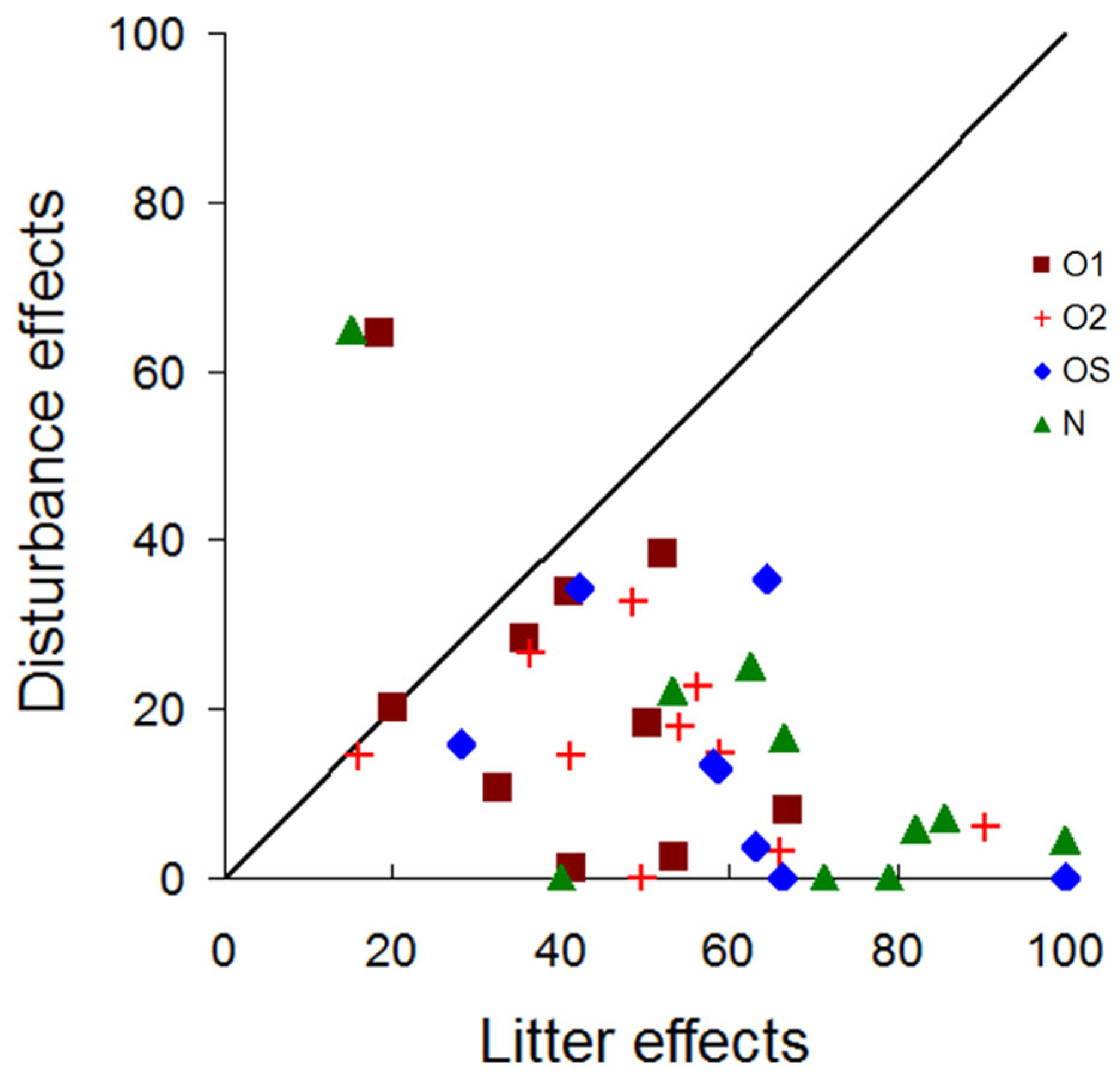
Changing abundances of the analyzed variables could potentially influence the detected size of the spatial associations between plant litter accumulations and diversity and between small mammal disturbances and diversity. Therefore, we tested whether the temporal variability of the litter and disturbance was related to the temporal variability of the absolute sizes of spatial associations and the effect sizes. However, these relationships were not significant (Figure S5).
Similarly, although annual precipitation varied considerably, including a severe drought in 2022 (Figure S6), it showed no significant relationship with plant litter or small mammal disturbance occurrence, nor with the magnitude of spatial associations (Figures S7 and S8).

4. Discussion

By analyzing the 10-year-long annual time series, we found negative short-term associations between the fine-scale spatial patterns of diversity hotspots and plant litter, while small mammal disturbances showed inconsistent (neutral, positive, and negative) relationships with diversity. When exploring the same relationships at larger temporal extents with cumulative diversity, all relationships became significant and consistent. Results were contrasting in the successional and the natural grasslands: negative associations were found between disturbance and diversity in the old-fields, and positive relationships in the natural grassland. In addition, the 10-year-long high-resolution mapping with permanent transects provided novel evidence on the spatial dynamics of litter and the disturbance regime of fossorial herbivores in both the primary and secondary grasslands.

4.1. Patterns of Microsites Created by Litter Accumulation

A recent study comparing abandoned and mown semi-arid grasslands [60] demonstrated that 30 years of moderate mowing reduced litter biomass, although approximately 50% of litter remained. Our study sites were also managed by annual mowing, yet considerable plant litter was present across all fields. The mean frequency of microsites with litter accumulation varied between 40% and 60% among sites. The sown old-field had an exceptionally high litter frequency, peaking at 100% in 2016 and 2017. At this site, Festuca valesiaca was sown in 2011 at high density and had reached its most developed state by 2016 and 2017 after 5–6 years of establishment [57]. The extremely high amount of litter can be explained by the high abundance of Festuca valesiaca and the slow decomposition rate in this young, abandoned field. Litter levels decreased gradually in subsequent years and converged to the level of other fields by 2022.
The spatial patterns of plant litter are rarely studied. Facelli and Carson [34] analyzed the spatial heterogeneity of litter in successional communities and reported high heterogeneity in mid-successional fields. Bartha [26] found a unimodal trend in the degree of spatial aggregation of plant litter along an old-field chronosequence, with maximum aggregation in the 6-year-old stage dominated by the litter of Elymus repens. In the present study, litter was very heterogeneous at the fine scale in all communities; local presence at 1 m resolution ranged between 0% and 100%. Litter decomposition takes several years in semiarid grasslands [35]; accordingly, we found that microsites with local litter accumulation persisted over several years, and the most frequent persistence category was 6 years (i.e., six presences of litter out of 10 years within individual microquadrats). The persistence and slow changes in the fine-grained litter patchwork were indicated by the strong associations between temporal replicates of litter patterns.

4.2. Disturbance Regimes Induced by Small Mammals

The mean area affected by small mammal disturbances during each year was 4.3% in the natural grassland and varied between 6.5% and 8.7% in the old-fields. Other studies reported a wide range of disturbance rates from 0.01% (badger disturbances in tallgrass prairie; [61]) to 30–70% (pocket gophers in natural annual Mediterranean grasslands; [62]). In general, the size and longevity of individual mounds and the total disturbed area in a community varied depending on the animal species, vegetation type, topography, soils, climate, and management [20,21,23,41]. In general, mounds became larger and regenerated at a slower rate with increasing aridity. At the same site, regeneration was faster in wet years [41]. In a review, Whitford and Kay [21] reported a wide range of longevities of small mammal disturbances, from a few months to more than 100 years, and they described a positive log-linear relationship between mound size and longevity. In our study, the mean disturbance size was 1600 cm2, and the observed longevity was less than 2 years, which is consistent with the relationship described by Whitford and Kay. This is also in line with the longevity estimates of 1–3 years reported in other studies [9,11,63]. Long-term permanent plot studies have estimated other characteristics, such as the total disturbed area over longer time periods, revealing the cumulative extent of disturbance impact. For example, monitoring an annual Mediterranean grassland over 11 years, Hobbs and Mooney [10] found that the complete grassland site (100% area) was disturbed over 5 years by pocket gophers. A similar result (100% of the area disturbed over 5 years) was reported by Rebollo et al. [22] in early successional abandoned fields in Spain during a population outbreak of a vole species.
In our study, 30% of the total area was disturbed over the 10 years in the natural grassland and 42–53% in the adjacent old-fields. The mounds often formed 5–10 m diameter aggregates. While individual mounds had high turnover, the positions of the aggregates were relatively stable over time. The extensive disturbances at the abandoned fields by Nannospalax (leucodon) hungaricus indicate that this species successfully colonized the newly abandoned areas, though without a population explosion. In contrast, a population outbreak occurred in 2023 in the Common Vole (Microtus arvalis), which feeds on above-ground vegetation. Increased herbivory by the Common Vole in 2023 and the serious drought in 2022 might explain the strong decline of litter observed after these events at certain sites (OS and N sites).

4.3. Effect of Plant Litter and Small Mammal Disturbances on Community Organization and Dynamics

In line with previous observations [24,25,26,27], the spatial associations found in this study indicated negative effects of litter on diversity. The meta-analysis of Xiong and Nilsson [16] reached similar conclusions after analyzing a large number of experiments. However, another meta-analysis by Loydi et al. [19] reported more complex, context-dependent results. Under water-limited conditions or at low to medium litter amounts (<500 g/m2), litter may have a positive effect on seedling recruitment in grasslands. The existence of a biomass threshold that separates positive and negative litter effects has also been recognized by other authors [64,65,66], although they suggested various other threshold values (from 200 to 900 g/m2). At our study sites, litter biomass ranged from 83 to 144 g/m2 [67], which is lower than the lowest suggested threshold (200 g/m2). Yet, we found that 91.3% of significant associations between litter and diversity were negative. One of the rare positive associations appeared in 2022 at the O2 old-field site during an extreme drought. However, the existence of temporal switches from negative to positive litter effects in dry years cannot be confirmed without additional field evidence.
Most of the associations between small mammal disturbances and local diversity hotspots were neutral. This is surprising because we found a large number of negative associations between two important matrix-forming grasses (Festuca valesiaca and Alopecurus pratensis) and small mammal disturbances. These associations indicated gaps opened by disturbances in the matrix of dominant species. Case studies have reported fast micro-succession in such gaps, i.e., the mounds created by small mammals [62,68,69,70]. Potentially, many subordinate species could colonize these gaps and eventually form local diversity hotspots. However, in this case, the typical successional sequence of life forms (annuals, short-lived perennials, subordinate perennial forbs, grasses, then finally dominant grasses, cf. Brown and Southwood, 1987 [71]) is rare. Due to the small size of the mounds, perennial forbs spreading vegetatively and dominant grasses can often establish first, and thus diversity remains low [69]. In the natural grassland, Teucrium chamaedrys and Thymus pannonicus were often the first colonizers (Figure A1), followed first by Poa angustifolia and then by Festuca valesiaca [70]. The regeneration process was fast, taking less than 3 years on average. The frequency of empty disturbed microsites was low in the natural grassland but higher in the successional grasslands, suggesting an important role of dispersal limitation in old-fields. The existence of empty and low-diversity vegetation states and the co-occurrence of different regeneration stages produced complex heterogeneous vegetation on mounds, and the net effect of this heterogeneity could result in neutral associations.
In a similar observational study, Bartha [26] found that dominant grasses were the main sources of plant litter accumulation in old-field succession, and that the positive associations between litter and dominant species changed as dominant species replaced each other. Aside from litter, dominant species also showed negative associations with subordinate species. In the present study, positive associations were found between Festuca valesiaca, Alopecurus pratensis, and plant litter, suggesting that these species were important contributors to plant litter. We also found several negative associations between dominant and co-dominant grass species and local diversity hotspots. However, the number of significant negative associations between these grasses and diversity was less compared to those detected between litter and diversity. Occasional positive associations between dominant grasses and diversity were also observed. These results suggest that litter exerts effects on diversity that are partly independent of, and stronger than, the competitive effects of dominant grasses. This interpretation is consistent with experimental evidence showing that living biomass and litter have separate and additive effects on species richness [12]. Using structural equation modeling, Lamb [72] compared the direct and indirect effects of belowground biomass, live aboveground biomass, and litter on species richness. He found that litter had the strongest effects, and it was the primary mechanism structuring grassland diversity. Due to slow decomposition processes [35], plant litter accumulates over a few years, and besides its direct effects on diversity, it also exerts a negative feedback on grass biomass [24].
Studying the same phenomenon, short- and long-term studies might achieve different results. Moreover, conclusions may change even within the same study after increasing the extent of investigation [57,73]. Unfortunately, studies investigating the role of litter and disturbance on community structure and dynamics have predominantly lasted less than 4 years and might not be representative of the time-scale of natural processes [16,17,19].
Our 10-year-long study enabled us to apply the concept of cumulative diversity [33] and compare results based on short- and long-term diversity. We found significant temporal associations between patterns of individual years, implying that local processes were autocorrelated. The existence of temporal autocorrelations together with the persistence of litter microsites suggests that cumulative patterns might provide more distinct results. The same was expected for disturbance microsites, where the turnover was short and short-term results were confounded by the co-occurrences of various microsuccessional stages. While each year might have low diversity, significant differences may still appear in the cumulative diversity between microsites with or without complex successional patterns.
Short-term analyses showed variable associations between plant litter accumulations and diversity and inconsistent relationships between small mammal disturbance and diversity. In contrast, all associations were significant and consistent in both the cumulative 7-year and cumulative 10-year datasets. The most interesting relationship was between disturbance and diversity in the natural grassland. Patterns depended strongly on temporal scale: short-term associations were neutral or negative, while long-term results showed positive relationships. This shift is consistent with other studies [74,75,76], which have shown that results change with increasing spatial scales from local to landscape levels. Accordingly, our study suggests that conclusions can similarly change with increasing temporal scale.

4.4. Limitations and Needs for Future Research

While the study provided strong insights, several limitations must be acknowledged. We compared different types of grasslands; however, the limited number of sites did not allow testing statistical differences between grassland types. The context-dependent variability found calls for specific analyses. However, the length of our monitoring was limited to ten years, which did not allow the application of standard time-series analyses. The increasing frequency of extreme weather events suggests specific analyses of aggregated drought effects. Continuing this study for a longer time will allow for these analyses. The reference grassland offered a unique opportunity for studying an ancient system that developed without strong anthropogenic influences. However, for practical reasons, other semi-natural grasslands should be included in the future to receive results for broad applications. Annual monitoring could not represent all details of the fast micro-succession on mounds disturbed by small mammals. Understanding details of recovery processes following small mammal disturbance would require seasonal sampling in permanent plots. However, the disturbances due to frequent sampling are challenging and may create artifact results. Extending monitoring to sites disturbed by different animal species and analyzing their interactions would further increase the value of these studies.

4.5. Implications for Theory and Practice—Short-Term Versus Long-Term Perspectives

Mortality patterns are essential components of the coexistence theory [77,78,79,80]. Fine-scale mortality patterns induced by litter accumulation and small animal disturbances contribute largely to the colonization competition trade-offs and play an important role in community organization [81,82,83]. Our long-term study provided previously missing field evidence on the dynamics of litter and disturbance in grasslands. The low number of monitored fields does not allow broad generalization regarding differences between primary and secondary grasslands or between spontaneously developing and sown old-fields. However, the magnitudes and ranges recorded and their relationships with diversity patterns provide baseline information for future theoretical studies and implications for conservation and restoration management. Our 10-year-long monitoring data on the disturbance regime and ecosystem engineering activity of the rare endemic fossorial mammal Nannospalax (leucodon) hungaricus constitute a more detailed and longer than usual record, documenting the successful colonization of this species from a natural grassland into the adjacent abandoned agricultural fields.
By mapping living and dead vegetation and patterns of disturbances at high spatial resolution over a large spatial extent over 10 years, we demonstrated the successful application of a specific field sampling technique. Our sampling design allowed the collection of representative data with high accuracy and minimum sampling disturbance. The computerized resampling of baseline data with increasing sampling unit sizes facilitated the exploration of relationships at various spatial and temporal scales. Spatial scaling is an essential part of the methodology for assessing spatial associations [84,85,86]. However, the analogous application of temporal scaling and the concept of cumulative diversity [33] have been suggested only recently. Our study applied this novel concept by combining temporal and spatial scaling. The contrasting results detected between disturbances and diversity at short versus long spatial scales highlighted the importance of temporal scaling.
Collecting spatially explicit field data at a high spatial resolution and a great extent in vegetation monitoring and analyzing them at various spatial and temporal scales carries further implications. Several studies have demonstrated the changes in characteristic spatial scales of vegetation patterns during succession [48,84,87]. As a consequence, the size of the sampling units should be continuously adjusted to these changes, which presents a serious methodological problem [88]. However, mapping in the field first and applying secondary scaling to these maps offers a practical solution.
Assessing the results of different restoration measures requires a relatively simple, robust, and net-effect-based methodology [89]. The methodology suggested by Hammond and Kolasa [33], combined with the spatial sampling design we developed, fulfills these criteria, and we recommend its application in practice.

5. Conclusions

This study demonstrated that both plant litter accumulation and small mammal disturbance constrain diversity in the studied grassland communities. Long-term and fine-scale monitoring revealed that plant litter accumulation and small mammal disturbance form spatially heterogeneous and dynamic patterns. Plant litter accumulations were more abundant and persistent than small mammal disturbances, and maximum heterogeneity of plant litter accumulation appeared at finer scales. When spatial associations were explored between these variables and the fine-scale diversity patterns, most proved negative, though their strength varied between years, and the direction of associations occasionally changed over time. These results suggest that microhabitats formed by plant litter accumulation and small mammal disturbance play an important role in plant community organization, albeit variable and context-dependent. Spatial associations were detected with spatial series analyses, which revealed that the spatial scale at which associations were strongest was variable and characteristic of the communities. Temporal scaling further allowed the calculation of cumulative diversity (temporal gamma diversity), showing that results based on net effects from longer time periods were more consistent.
These findings support modern coexistence theory by demonstrating that, besides interspecific competition, other factors are also important for maintaining diversity and shaping community structure. Our study has implications for nature conservation and restoration ecology alike, as annual mowing was not sufficient to remove the effects of plant litter. Furthermore, the endemic small mammal species (Nannospalax (leucodon) hungaricus) was able to colonize the young old-fields from the adjacent natural grassland, acting as an ecosystem engineer species in these grasslands. Together, these results highlight the value of long-term monitoring in permanent transects and the importance of analyzing data at multiple spatial and temporal scales. This protocol represents an advanced methodological approach that can be applied to other grassland communities.

Supplementary Materials

The following supporting information can be downloaded at https://www.mdpi.com/article/10.3390/d18060326/s1. Figure S1: Location of the study areas; Figure S2: sampling design; Figure S3: abundance of dominant and co-dominant matrix species; Figure S4: generalized research design scheme; Table S1a,b: testing homogeneity of frequency distributions of microquadrats with cumulative persistence and size distributions of plant litter accumulation and small mammal disturbance; Tables S2 and S3: number of subordinate target species at the old-fields and at the natural grassland; Tables S4 and S5: detailed results of the spatial association analyses; Tables S6–S8: frequency of microsites with different cumulative species richness and different cumulative presences of plant litter and local small mammal disturbances over the last 7 and last 10 years; Table S9: detailed results of the analyses of long-term (cumulative) spatial associations between plant litter accumulation, small mammal disturbances and local diversity hotspots; Table S10: spatial associations between plant litter accumulation and diversity of subordinate target species; Table S11: spatial associations between small mammal disturbances and diversity of subordinate target species; Table S12: spatial associations between microsites without subordinate species and microsites with plant litter accumulation or small mammal disturbances; Table S13: spatial associations between small mammal disturbances and plant litter accumulations; Table S14: spatial associations between plant litter accumulation and important matrix species; Table S15: spatial associations between small mammal disturbances and important matrix species; Table S16: spatial associations between local diversity hotspots of subordinate species and important matrix species; Figures S5–S8: regressions among the abundance of litter, frequency of disturbances, precipitation and the size of spatial associations.

Author Contributions

Conceptualization, S.B. and J.H.; methodology, S.B.; software, S.B. and S.C.; validation, A.I.C., J.H., and S.B.; formal analysis, S.C. and S.B.; investigation, D.P., J.H., Z.Z., Z.E.G., S.C., G.S., S.B., and A.I.C.; data curation, A.I.C.; writing—original draft preparation, S.B. and J.H.; writing—review and editing, all authors; visualization, S.B.; supervision, J.H. and A.I.C.; project administration, A.I.C. All authors have read and agreed to the published version of the manuscript.

Funding

This research was funded by the FLAGSHIP RESEARCH GROUPS PROGRAMME 2024 of the Hungarian University of Agriculture and Life Sciences.

Institutional Review Board Statement

Not applicable.

Data Availability Statement

The raw data supporting the conclusions of this article will be made available by the authors on request.

Acknowledgments

We would like to thank András János Csathó, Csaba Molnár, Melinda Juhász, Róbert Kun, Zsuzsanna Sutyinszki, Szilárd Szentes, Klára Virágh, and Cecília Komoly for their help in data collection. We thank the Körös–Maros National Park Directorate for their support.

Conflicts of Interest

The authors declare no conflicts of interest.

Appendix A

Figure A1. Typical states of the meadow steppe near Battonya in Hungary. Effects of small mammal disturbances: (A) fresh mound created by the Hungarian Blind Mole-rat with bare surface. (B) Old mound dominated by Thymus pannonicus and Salvia nemorosa. Small gaps with bare soil are still present. (C) Close view of a diversity hotspot. (D) Microsites with litter accumulation. Note that the litter is made from dead Festuca valesiaca. (Photos from S. Bartha).
Diversity 18 00326 g0a1

References

  1. Pickett, S.T.A.; White, P.S. (Eds.) The Ecology of Natural Disturbance and Patch Dynamics; Academic Press: Orlando, FL, USA, 1985. [Google Scholar]
  2. Collins, S.L.; Glenn, S.M. Disturbance and community structure in North American prairies. In Diversity and Pattern in Plant Communities; During, H.J., Werger, M.J.A., Willems, H.J., Eds.; SPB Academic Publishing bv: The Hague, The Netherlands, 1988; pp. 131–143. [Google Scholar]
  3. Grubb, P.J. The Maintenance of Species-Richness in Plant Communities: The Importance of the Regeneration Niche. Biol. Rev. 1977, 52, 107–145. [Google Scholar] [CrossRef]
  4. Fowler, N.L. Microsite requirements for germination and establishment of three grass species. Am. Midl. Nat. 1986, 115, 131–145. [Google Scholar] [CrossRef]
  5. Facelli, J.M.; Pickett, S.T.A. Plant litter: Its dynamics and effects on plant community structure. Bot. Rev. 1991, 57, 1–32. [Google Scholar] [CrossRef]
  6. Davidson, A.D.; Detling, J.K.; Brown, J.H. Ecological roles and conservation challenges of social, burrowing, herbivorous mammals in the world’s grasslands. Front. Ecol. Environ. 2012, 10, 477–486. [Google Scholar] [CrossRef]
  7. Beca, G.; Valentine, L.E.; Galetti, M.; Hobbs, R.J. Ecosystem roles and conservation status of bioturbator mammals. Mamm. Rev. 2022, 52, 192–207. [Google Scholar] [CrossRef]
  8. Goldberg, D.E.; Werner, P.A. The effects of size of opening in vegetation and litter cover on seedling establishment of goldenrods (Solidago spp.). Oecologia 1983, 60, 149–155. [Google Scholar] [CrossRef]
  9. Lavorel, S.; Lepart, J.; Debussche, M.; Lebreton, J.-D.; Beffy, J.-L. Small scale disturbances and the maintenance of species diversity in Mediterranean old Fields. Oikos 1994, 70, 455–473. [Google Scholar] [CrossRef]
  10. Hobbs, R.J.; Mooney, H.A. Spatial and temporal variability in California annual grassland: Results from a long-term study. J. Veg. Sci. 1995, 6, 43–56. [Google Scholar] [CrossRef]
  11. Kotanen, P.M. Effects of Experiemental Soil Disturbance on Revegetation by Natives and Exotics in Coastal California Meadows. J. Appl. Ecol. 1997, 34, 631–644. [Google Scholar] [CrossRef]
  12. Foster, B.L.; Gross, K.L. Species richness in a successional grassland: Effects of nitrogen enrichment and plant litter. Ecology 1998, 79, 2593–2602. [Google Scholar] [CrossRef]
  13. Rotundo, J.L.; Aguiar, M.R. Litter effects on plant regeneration in arid lands: A complex balance between seed retention, seed longevity and soil-seed contact. J. Ecol. 2005, 93, 829–838. [Google Scholar] [CrossRef]
  14. Ruprecht, E.; Józsa, J.; Ölvedi, T.B.; Simon, J. Differential effects of several “litter” types on the germination of dry grassland species. J. Veg. Sci. 2010, 21, 1069–1081. [Google Scholar] [CrossRef]
  15. Letts, B.; Lamb, E.G.; Mischkolz, J.M.; Romo, J.T. Litter accumulation drives grassland plant community composition and functional diversity via leaf traits. Plant Ecol. 2015, 216, 357–370. [Google Scholar] [CrossRef]
  16. Xiong, S.; Nilsson, C. The effects of plant litter on vegetation: A meta-analysis. J. Ecol. 1999, 87, 984–994. [Google Scholar] [CrossRef]
  17. Mallen-Cooper, M.; Nakagawa, S.; Eldridge, D.J. Global meta-analysis of soil-disturbing vertebrates reveals strong effects on ecosystem patterns and processes. Glob. Ecol. Biogeogr. 2019, 28, 661–679. [Google Scholar] [CrossRef]
  18. Root-Bernstein, M.; Ebensperger, L.A. Meta-analysis of the effects of small mammal disturbances on species diversity, richness and plant biomass. Austral Ecol. 2013, 38, 289–299. [Google Scholar] [CrossRef]
  19. Loydi, A.; Eckstein, R.L.; Otte, A.; Donath, T.W. Effects of litter on seedling establishment in natural and semi-natural grasslands: A meta-analysis. J. Ecol. 2013, 101, 454–464. [Google Scholar] [CrossRef]
  20. Coffin, D.P.; Lauenroth, W.K. The effects of disturbance size and frequency on a shortgrass plant community. Ecology 1988, 69, 1609–1617. [Google Scholar] [CrossRef]
  21. Whitford, W.G.; Kay, F.R. Biopedturbation by mammals in deserts: A review. J. Arid Environ. 1999, 41, 203–230. [Google Scholar] [CrossRef]
  22. Rebollo, S.; Pérez-Camacho, L.; Valencia, J.; Gómez-Sal, A. Vole mound effects and disturbance rate in a mediterranean plant community under different grazing and irrigation regimes. Plant Ecol. 2003, 169, 227–243. [Google Scholar] [CrossRef]
  23. Jackson, E.C.; Krogh, S.N.; Whitford, W.G. Desertification and biopedturbation in the northern Chihuahuan Desert. J. Arid Environ. 2003, 53, 1–14. [Google Scholar] [CrossRef]
  24. Knapp, A.K.; Briggs, J.M.; Hartnett, D.C.; Collins, S.L. (Eds.) Grassland Dynamics: Long-Term Ecological Research in Tallgrass Prairie; Oxford University Press: New York, NY, USA, 1998. [Google Scholar]
  25. Galvánek, D.; Lepš, J. The effect of management on productivity, litter accumulation and seedling recruitment in a Carpathian mountain grassland. Plant Ecol. 2011, 213, 523–533. [Google Scholar] [CrossRef]
  26. Bartha, S. Spatial relationships between plant litter, gopher disturbance and vegetation at different stages of old-field succession. Appl. Veg. Sci. 2001, 4, 53–62. [Google Scholar] [CrossRef]
  27. Szentes, S.; Sutyinszki, Z.; Szabó, G.; Zimmermann, Z.; Házi, J.; Wichmann, B.; Hufnágel, L.; Penksza, K.; Bartha, S. Grazed Pannonian grassland beta-diversity changes due to C4 yellow bluestem. Cent. Eur. J. Biol. 2012, 7, 1055–1065. [Google Scholar] [CrossRef]
  28. Arrhenius, O. Species and Area. J. Ecol. 1921, 9, 95–99. [Google Scholar] [CrossRef]
  29. Storch, D. The theory of the nested species–area relationship: Geometric foundations of biodiversity scaling. J. Veg. Sci. 2016, 27, 880–891. [Google Scholar] [CrossRef]
  30. Dengler, J.; Matthews, T.J.; Steinbauer, M.J.; Wolfrum, S.; Boch, S.; Chiarucci, A.; Conradi, T.; Dembicz, I.; Marcenò, C.; García-Mijangos, I.; et al. Species–area relationships in continuous vegetation: Evidence from Palaearctic grasslands. J. Biogeogr. 2020, 47, 72–86. [Google Scholar] [CrossRef]
  31. Biurrun, I.; Pielech, R.; Dembicz, I.; Gillet, F.; Kozub, Ł.; Marcenò, C.; Reitalu, T.; Van Meerbeek, K.; Guarino, R.; Chytrý, M.; et al. Benchmarking plant diversity of Palaearctic grasslands and other open habitats. J. Veg. Sci. 2021, 32, e13050. [Google Scholar] [CrossRef]
  32. Adler, P.B.; Lauenroth, W.K. The power of time: Spatiotemporal scaling of species diversity. Ecol. Lett. 2003, 6, 749–756. [Google Scholar] [CrossRef]
  33. Hammond, M.; Kolasa, J. The Long and Short of Biodiversity: Cumulative Diversity and Its Drivers. Diversity 2019, 11, 41. [Google Scholar] [CrossRef]
  34. Facelli, J.M.; Carson, W.P. Heterogeneity of plant litter accumulation in successional communities. Bull. Torrey Bot. Club 1991, 118, 62–66. [Google Scholar] [CrossRef]
  35. Li, Z.; Wang, F.; Wen, Y.; Ye, C.; Wang, P.; Bai, T.; Gu, X.; Guo, L.; Qiu, Y.; Zhang, Y.; et al. Temporal dynamics of climate sensitivity of litter decomposition in a semi-arid grassland. Geoderma 2025, 453, 117157. [Google Scholar] [CrossRef]
  36. Inouye, R.S.; Huntly, N.J.; Tilman, D.; Tester, J.R. Pocket gophers (Geomys bursarius), vegetation, and soil nitrogen along a successional sere in east central Minnesota. Oecologia 1987, 72, 178–184. [Google Scholar] [CrossRef]
  37. Németh, A.; Mizsei, E.; Laczkó, L.; Czabán, D.; Hegyeli, Z.; Lengyel, S.; Csorba, G.; Sramkó, G. Evolutionary history and systematics of European blind mole rats (Rodentia: Spalacidae: Nannospalax): Multilocus phylogeny and species delimitation in a puzzling group. Mol. Phylogenet. Evol. 2024, 190, 107958. [Google Scholar] [CrossRef] [PubMed]
  38. Csorba, G.; Moldován, O.; Schneider, V.; Németh, A. Conservation status of the blind mole rat populations in Hungary (Rodentia: Spalacinae: Nannospalax) revisited. Biol. Future 2024, 74, 475–487. [Google Scholar] [CrossRef]
  39. Moldován, O.; Schneider, V.; Lengyel, S.; Czabán, D.; Csorba, G.; Németh, A. Challenges and opportunities in the translocation of grassland-dwelling subterranean mammals: The case of blind mole rats. Glob. Ecol. Conserv. 2025, 62, e03756. [Google Scholar] [CrossRef]
  40. Zimmermann, Z.; Szabó, G.; Csathó, A.I.; Sallainé, K.J.; Szentes, S.; Juhász, M.; Házi, J.; Komoly, C.; Virágh, K.; Harkányiné, S.Z.; et al. The impact of the lesser blind mole rat [Nannospalax (superspecies leucodon)] on the species composition and diversity of a loess steppe in Hungary. Appl. Ecol. Environ. Res. 2014, 12, 577–588. [Google Scholar] [CrossRef]
  41. Goldberg, D.E.; Gross, K.L. Disturbance regimes of midsuccessional old fields. Ecology 1988, 69, 1677–1688. [Google Scholar] [CrossRef]
  42. Prach, K.; Török, P.; Bakker, J.D. Temperate Grasslands. In Routledge Handbook of Ecological and Environmental Restoration; Routledge: London, UK, 2017; pp. 126–141. [Google Scholar]
  43. Veldman, J.W.; Buisson, E.; Durigan, G.; Fernandes, G.W.; Le Stradic, S.; Mahy, G.; Negreiros, D.; Overbeck, G.E.; Veldman, R.G.; Zaloumis, N.P.; et al. Toward an old-growth concept for grasslands, savannas, and woodlands. Front. Ecol. Environ. 2015, 13, 154–162. [Google Scholar] [CrossRef]
  44. Csathó, A.J.; Csathó, A.I. A battonya-tompapusztai Külső-gulya flóralistája [The floralist of the Külső-gulya meadow of Battonya-Tompapuszta (SE Hungary)]. Crisicum 2009, 5, 51–70. [Google Scholar]
  45. Bartha, S.; Házi, J.; Purger, D.; Zimmermann, Z.; Szabó, G.; Guller, Z.E.; Csathó, A.I.; Csete, S. Fine-Scale Organization and Dynamics of Matrix-Forming Species in Primary and Secondary Grasslands. Land 2025, 14, 1736. [Google Scholar] [CrossRef]
  46. Bartha, S.; Campatella, G.; Canullo, R.; Bódis, J.; Mucina, L. On the importance of fine-scale spatial complexity in vegetation restoration studies. Int. J. Ecol. Environ. Sci. 2004, 30, 101–116. [Google Scholar]
  47. Kertész, M.; Lhotsky, B.; Hahn, I. Detection of fine-scale relationships between species composition and biomass in grassland. Community Ecol. 2001, 2, 221–230. [Google Scholar] [CrossRef]
  48. Juhász-Nagy, P.; Podani, J. Information theory methods for the study of spatial processes and succession. Vegetatio 1983, 51, 129–140. [Google Scholar] [CrossRef]
  49. Juhász-Nagy, P. Notes on compositional diversity. Hydrobiologia 1993, 249, 173–182. [Google Scholar] [CrossRef]
  50. Podani, J. Analysis of mapped and simulated vegetation patterns by means of computerized sampling techniques. Acta Bot. Hung. 1984, 30, 403–425. [Google Scholar]
  51. Podani, J. Computerized sampling in vegetation studies. Coenoses 1987, 2, 9–18. [Google Scholar]
  52. Tsakalos, J.L.; Chelli, S.; Campetella, G.; Canullo, R.; Simonetti, E.; Bartha, S. Comspat: An R package to analyze within-community spatial organization using species combinations. Ecography 2022, 2022, e06216. [Google Scholar] [CrossRef]
  53. Bakacsy, L. Invasion impact is conditioned by initial vegetation states. Community Ecol. 2019, 20, 11–19. [Google Scholar] [CrossRef]
  54. Nagy, K.N.; Bakacsy, L. Mowing and traditional grazing as a conservation strategy: Fine-spatial scale impacts on the invasion of false indigo bush (Amorpha fruticosa L.) in marsh meadows. Plant Species Biol. 2025, 40, 156–166. [Google Scholar] [CrossRef]
  55. Nagy, K.N.; Bartal, Z.P.; Károlyi, C.E.; Bakacsy, L. Evaluating Conservation Grazing Through Fine-Scale Vegetation Structure in Invaded Marsh Meadows. Diversity 2026, 18, 177. [Google Scholar] [CrossRef]
  56. Bartha, S.; Czárán, T.; Podani, J. Exploring plant community dynamics in abstract coenostate spaces. Abstr. Bot. 1998, 22, 49–66. [Google Scholar]
  57. Guller, Z.E.; Molnár, C.; Házi, J.; Purger, D.; Csete, S.; Szabó, G.; Zimmermann, Z.; Tölgyesi, C.; Bartha, S.; Csathó, A.I. What helps in the short term may hinder later: High grass abundance caused by the sowing of a competitive grass species limits meadow steppic grassland regeneration. Glob. Ecol. Conserv. 2026, 66, e04110. [Google Scholar] [CrossRef]
  58. Whittaker, R.H. Vegetation of the Siskiyou Mountains, Oregon and California. Ecol. Monogr. 1960, 30, 279–338. [Google Scholar] [CrossRef]
  59. Hammer, D.A.T.; Ryan, P.D.; Hammer, Ø.; Harper, D.A.T. Past: Paleontological Statistics Software Package for Education and Data Analysis. Palaeontol. Electron. 2001, 4, 1–9. [Google Scholar]
  60. Hassan, N.; Zhong, Z.; Wang, D.; Zhu, Y.; Naeen, I.; Ahungu, A.B.; Wan, H.Y.; Li, X. Effects of long-term mowing on species diversity, biomass and composition of plant community in a semi-arid grassland in northeastern China. Appl. Veg. Sci. 2023, 26, e12743. [Google Scholar] [CrossRef]
  61. Platt, W.J.; Weis, I.M. Resource Partitioning and Competition within a Guild of Fugitive Prairie Plants. Am. Nat. 1977, 111, 479–513. [Google Scholar] [CrossRef]
  62. Hobbs, R.J.; Mooney, H.A. Community and population dynamics of serpentine grassland annuals in relation to gopher disturbance. Oecologia 1985, 67, 342–351. [Google Scholar] [CrossRef]
  63. Rogers, W.E.; Hartnett, D.C.; Elder, B. Effects of Plains Pocket Gopher (Geomys bursarius) Disturbances on Tallgrass-prairie Plant Community Structure. Am. Midl. Nat. 2001, 145, 344–357. [Google Scholar] [CrossRef]
  64. Carson, W.P.; Peterson, C.J. The role of litter in an old-field community: Impact of litter quantity in different seasons on plant species richness and abundance. Oecologia 1990, 85, 8–13. [Google Scholar] [CrossRef] [PubMed]
  65. Kelemen, A.; Török, P.; Valkó, O.; Miglécz, T.; Tóthmérész, B. Mechanisms shaping plant biomass and species richness: Plant strategies and litter effect in alkali and loess grasslands. J. Veg. Sci. 2013, 24, 1195–1203. [Google Scholar] [CrossRef]
  66. Ma, Z.; Wu, J.; Li, L.; Zhou, Q.; Hou, F. Litter-Induced Reduction in Ecosystem Multifunctionality Is Mediated by Plant Diversity and Cover in an Alpine Meadow. Front. Plant Sci. 2021, 12, 773804. [Google Scholar] [CrossRef]
  67. Szabó, G. A fitomassza térbeli variációjának vizsgálata különböző gyeptípusokban [Comparative Analysis of Spatial Variability of Phytomass Production in Different Grassland Types]. Doctoral Thesis, Hungarian University of Agriculture and Life Sciences, Gödöllő, Hungary, 2023. [Google Scholar]
  68. Martinsen, G.D.; Cushman, J.H.; Whitham, T.G. Impact of pocket gopher disturbance on plant species diversity in a shortgrass prairie community. Oecologia 1990, 83, 132–138. [Google Scholar] [CrossRef]
  69. Jones, C.C.; Halpern, C.B.; Niederer, J. Plant Succession on Gopher Mounds in Western Cascade Meadows: Consequences for Species Diversity and Heterogeneity. Am. Midl. Nat. 2008, 159, 275–286. [Google Scholar] [CrossRef]
  70. Bartha, S.; Zimmermann, Z.; Szabó, G.; Szentes, S.; Virágh, K.; Csathó, A.I. A magyar földikutya (Nannospalax hungaricus) növényzetre gyakorolt hatásának mikrocönológiai monitorozása a Tompapusztai löszgyepben (2011–2014) [Microcoenological monitoring of loess steppe meadow vegetation disturbed by Hungarian blind mole rat [Nannospalax (leucodon) hungaricus] at Tompapuszta loess steppe meadow between 2011 and 2014]. Crisicum 2016, 9, 21–35. [Google Scholar]
  71. Brown, V.K.; Southwood, T.R.E. Secondary succession: Patterns and strategies. In Colonization, Succession, and Stability: The 26th Symposium of the British Ecological Society Held Jointly with the Linnean Society of London; Gray, A.J., Crawley, M.J., Edwards, P.J., Eds.; Blackwell Scientific Publications: Oxford, UK, 1987; pp. 315–338. [Google Scholar]
  72. Lamb, E.G. Direct and indirect control of grassland community structure by litter, resources, and biomass. Ecology 2008, 89, 216–225. [Google Scholar] [CrossRef] [PubMed]
  73. Herrick, J.E.; Schuman, G.E.; Rango, A. Monitoring ecological processes for restoration projects. J. Nat. Conserv. 2006, 14, 161–171. [Google Scholar] [CrossRef]
  74. Hagenah, N.; Bennett, N.C. Mole rats act as ecosystem engineers within a biodiversity hotspot, the Cape Fynbos. J. Zool. 2013, 289, 19–26. [Google Scholar] [CrossRef]
  75. Valkó, O.; Tölgyesi, C.; Kelemen, A.; Bátori, Z.; Gallé, R.; Rádai, Z.; Bragina, T.M.; Bragin, Y.A.; Deák, B. Steppe Marmot (Marmota bobak) as ecosystem engineer in arid steppes. J. Arid Environ. 2021, 184, 104244. [Google Scholar] [CrossRef]
  76. Valkó, O.; Kelemen, A.; Kiss, O.; Deák, B. Patch and matrix characteristics determine the outcome of ecosystem engineering by mole rats in dry grasslands. PeerJ 2022, 10, e14582. [Google Scholar] [CrossRef] [PubMed]
  77. Chesson, P. Mechanisms of maintenance of species diversity. Annu. Rev. Ecol. Evol. Syst. 2000, 31, 343–366. [Google Scholar] [CrossRef]
  78. Barabás, G.; D’Andrea, R.; Stump, S.M. Chesson’s coexistence theory. Ecol. Monogr. 2018, 88, 277–303. [Google Scholar] [CrossRef]
  79. Ellner, S.P.; Snyder, R.E.; Adler, P.B.; Hooker, G. Toward a “modern coexistence theory” for the discrete and spatial. Ecol. Monogr. 2022, 92, e1548. [Google Scholar] [CrossRef]
  80. Spaak, J.W.; Schreiber, S.J. Building modern coexistence theory from the ground up: The role of community assembly. Ecol. Lett. 2023, 26, 1840–1861. [Google Scholar] [CrossRef] [PubMed]
  81. Czárán, T. Spatiotemporal Models of Population and Community Dynamics, 1st ed.; Chapman & Hall: London, UK, 1998. [Google Scholar]
  82. Bolker, B.M.; Pacala, S.W.; Neuhauser, C. Spatial dynamics in model plant communities: What do we really know? Am. Nat. 2003, 162, 135–148. [Google Scholar] [CrossRef] [PubMed]
  83. Amarasekare, P. Competitive coexistence in spatially structured environments: A synthesis. Ecol. Lett. 2003, 6, 1109–1122. [Google Scholar] [CrossRef]
  84. Greig-Smith, P.L. Quantitative Plant Ecology, 3rd ed.; Blackwell Scientific Publications: Oxford, UK, 1983. [Google Scholar]
  85. Podani, J. SYN-TAX-5.0: Computer programs for multivariate data analysis in ecology and systematics. Abstr. Bot. 1993, 17, 289–302. [Google Scholar]
  86. Horváth, A. INFOTHEM program: New possibilities of spatial series analysis based on information theory methods. Tiscia 1998, 31, 71–84. [Google Scholar]
  87. Horváth, A. A Mezőföldi Löszvegetáció Términtázati Szerveződése [Organization of Spatial Pattern of Loess Vegetation in the Mezőföld Region]; Scientia Kiadó: Budapest, Hungary, 2002. [Google Scholar]
  88. Lindenmayer, D.B.; Likens, G.E. Adaptive monitoring: A new paradigm for long-term research and monitoring. Trends Ecol. Evol. 2009, 24, 482–486. [Google Scholar] [CrossRef]
  89. Prach, K.; Durigan, G.; Fennessy, S.; Overbeck, G.E.; Torezan, J.M.; Murphy, S.D. A primer on choosing goals and indicators to evaluate ecological restoration success. Restor. Ecol. 2019, 27, 917–923. [Google Scholar] [CrossRef]
Figure 1. Fine-scale spatiotemporal patterns of plant litter accumulations and small mammal disturbances at the study sites. Local abundances of plant litter accumulations and small mammal disturbances were assessed at 1 m resolution.
Diversity 18 00326 g001
Figure 2. The relative importance of plant litter accumulations and small mammal disturbances represented by the mean abundance of these variables at 5 cm resolution along 52 m permanent transects over 10 years. O1 and O2 are the two spontaneous old-field sites. OS is the sown old-field site, and N is the natural grassland.
Diversity 18 00326 g002
Figure 3. Distribution of three microhabitats (1, with plant litter accumulation; 2, with small mammal disturbances; and 3, reference microhabitats without litter or disturbance) over the study period at the four sites.
Diversity 18 00326 g003
Figure 4. Overall (10 years) association among the plant litter microsites. Note that analyses were performed at multiple spatial scales and the found associations were significantly different from the random expectations at all sites at all scales. O1 and O2 are the two spontaneous old-field sites. OS is the sown old-field site, and N is the natural grassland.
Diversity 18 00326 g004
Figure 5. Overall (10 years) association among the small mammal disturbance microsites. Note that analyses were performed at multiple spatial scales and the found associations were significantly different from the random expectations at all sites at all scales. O1 and O2 are the two spontaneous old-field sites. OS is the sown old-field site, and N is the natural grassland.
Diversity 18 00326 g005
Figure 6. Distribution of microquadrats by their cumulative plant litter presence and cumulative small mammal disturbance presence over time. O1 and O2 are the two spontaneous old-field sites. OS is the sown old-field site, and N is the natural grassland.
Diversity 18 00326 g006
Figure 7. Distribution of plant litter accumulation patch sizes and small mammal disturbance patch sizes, i.e., the numbers of contiguous microquadrats with litter or disturbance presence at the four study sites. O1 and O2 are the two spontaneous old-field sites. OS is the sown old-field site, and N is the natural grassland.
Diversity 18 00326 g007
Figure 8. Percentage of the empty (S = 0) microsites that co-occurred with plant litter accumulations or small mammal disturbances in different years. O1 and O2 are the two spontaneous old-field sites. OS is the sown old-field site, and N is the natural grassland. Note: When counting S = 0 microsites, all species were considered, including dominant grasses and successional weeds.
Diversity 18 00326 g008
Table 1. Percentage of microquadrats with a minimum of one occurrence of plant litter accumulation or small mammal disturbance presence over the 10 years.
Long-Term Cumulative Data
Plant LitterSmall Mammal
SitesAccumulationsDisturbances
Spontaneous old-field O198.153.2
Spontaneous old-field O297.338.3
Sown old-field OS100.042.3
Natural grassland N99.731.6
Table 2. Spatial associations between plant litter accumulations and local diversity hotspots in different years (0 independence, 1 positive, −1 negative, p < 0.05, empty cells = non-detectable relationships).
Sites/Dates2016201720182019202020212022202320242025
Spontaneous old-field O10−1−1−1−10−100−1
Spontaneous old-field O2 0−10−1010−10
Sown old-field OS −1−1−1−100−1−1
Natural grassland N−11−1−10−1−100−1
Table 3. Spatial associations between small mammal disturbances and local diversity hotspots in different years (0 independence, 1 positive, −1 negative, p < 0.05, empty cells = non-detectable relationships).
Sites/Dates2016201720182019202020212022202320242025
Spontaneous old-field O1−11 0000−100
Spontaneous old-field O2 0000 01 0
Sown old-field OS 00 00 0
Natural grassland N 000 −1−10
Table 4. Percentage of empty (S = 0) microsites within all disturbed microsites.
Sites/Dates2016201720182019202020212022202320242025
Spontaneous old-field O128.85 38.82 20.01 11.11 15.00 11.72 7.41 34.94 18.18 29.37
Spontaneous old-field O210.00 15.22 80.95 25.50 23.18 33.75 42.55 31.78 26.04
Sown old-field OS 18.18 25.00 20.55 30.00 21.43 13.75
Natural grassland N0.00 2.63 5.33 3.08 10.00 33.33 7.07 7.69
Note: When counting S = 0 microsites, all species were considered, including dominant grasses and successional weeds.
Table 5. Long-term (cumulative) spatial associations between plant litter accumulations, small mammal disturbances, and local diversity hotspots (0 independence, 1 positive, −1 negative, p < 0.05, empty cells = non-detectable relationships).
Litter/DiversityLitter/DiversityDisturbance/DiversityDisturbance/Diversity
Sites/Periods2016–2025 (10 Years)2019–2025 (7 Years)2016–2025 (10 Years)2019–2025 (7 Years)
Spontaneous old-field O1−1−1−1−1
Spontaneous old-field O2−1−1−1−1
Sown old-field OS−1−1−1−1
Natural grassland N−1−111
Table 6. Percentage distribution of association signs.
Short-Term (Time-Series) Data
Litter/Diversity HotspotsDisturbances/Diversity Hotspots
Positive5.05.0
Negative52.510.0
Neutral35.052.5
Non-detectable7.532.5
Significant all57.515.0
Long-Term Cumulative Data
Litter/Diversity HotspotsDisturbances/Diversity Hotspots
Positive0.025.0
Negative100.075.0
Neutral0.00.0
Non-detectable0.00.0
Significant all100.0100.0
Disclaimer/Publisher’s Note: The statements, opinions and data contained in all publications are solely those of the individual author(s) and contributor(s) and not of MDPI and/or the editor(s). MDPI and/or the editor(s) disclaim responsibility for any injury to people or property resulting from any ideas, methods, instructions or products referred to in the content.