
Article

Effects of Five Planting Cover Measures on Soil Crust Particle Size Distribution Characteristics in Ulan Buh Desert

1
State Key Laboratory of Water Engineering Ecology and Environment in Arid Area, Inner Mongolia Agricultural University, Hohhot 010018, China
2
College of Desert Control and Engineering, Inner Mongolia Agricultural University, Hohhot 010018, China
3
Institute of Water Resources for Pastoral Area Ministry of Water Resources, Hohhot 010020, China
*
Author to whom correspondence should be addressed.
Diversity 2026, 18(5), 275; https://doi.org/10.3390/d18050275
Submission received: 27 March 2026 / Revised: 26 April 2026 / Accepted: 28 April 2026 / Published: 1 May 2026

Abstract

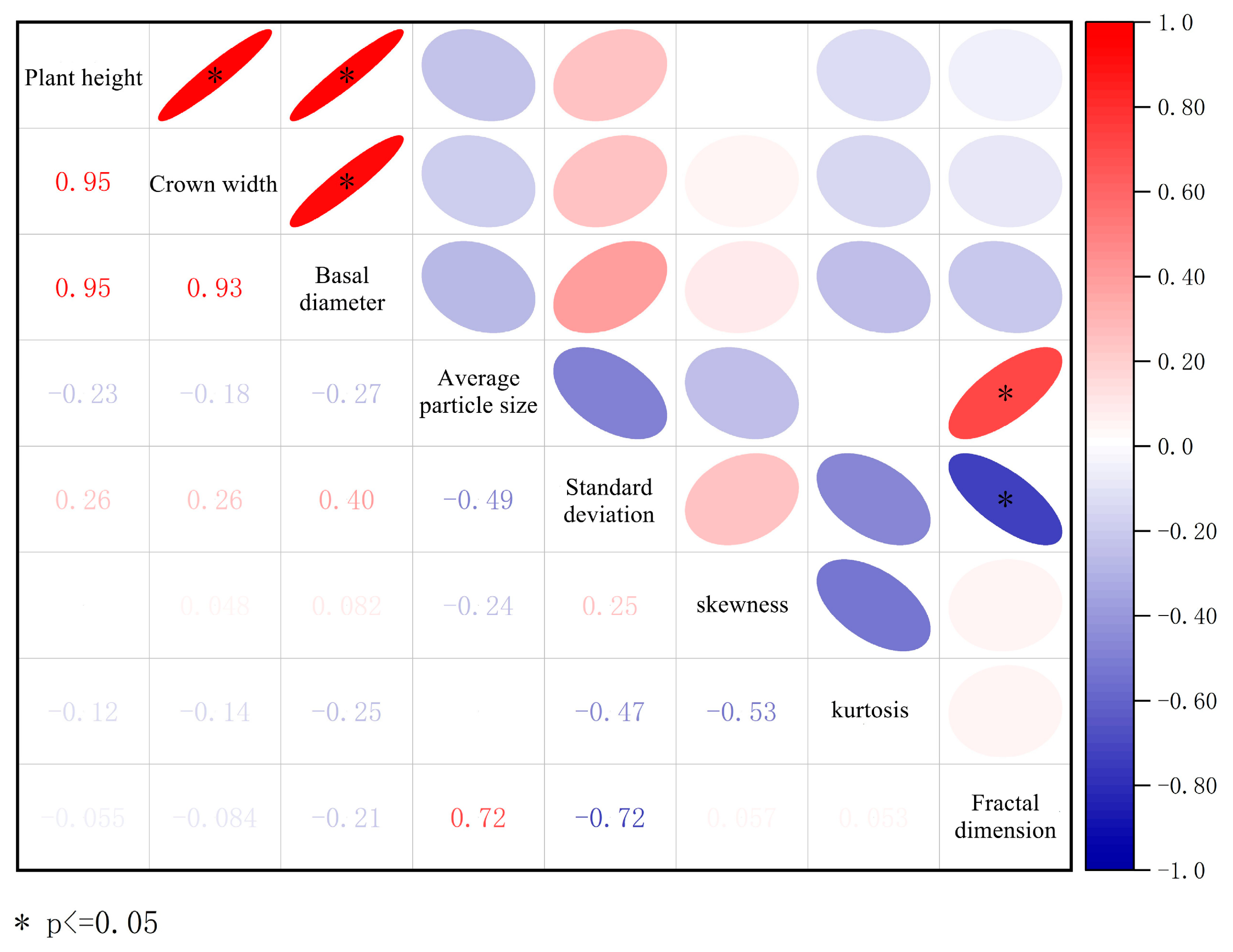
To explore the regulatory mechanisms of different vegetation types on soil crust grain-size characteristics in sandy lands, this study focused on five typical plant species (Haloxylon ammodendron, Artemisia ordosica, Nitraria tangutorum, Agriophyllum squarrosum, and Phragmites australis) in an artificial vegetation restoration area on the northeastern edge of the Ulan Buh Desert. Using laser granulometry and graphical methods, we systematically determined the soil particle size composition and parameters of the crust (Layer A) and sub-crust (Layer B) layers, and analyzed their correlations with plant morphological parameters (crown width, plant height, basal diameter). The results showed that (1) different vegetation types significantly increased the content of soil fine particulate matter (silt and clay), with fine sand accounting for 42.85% and silt accounting for 23.64%; (2) there are significant differences in the impact of different vegetation types on particle size parameters. The average particle size of soil crust under Phragmites australis is the smallest (1.91), and the sorting is the worst (standard deviation 2.01). Under the vegetation type of Nitraria tangutorum, the average particle size of the soil crust layer is the largest (5.25), and the fractal dimension is the highest (2.46). (3) The crown width, plant height, and basal diameter of vegetation are negatively correlated with mean particle size, kurtosis, and fractal dimension (r= −0.62 to −0.45), and positively correlated with standard deviation and skewness (r = 0.51 to 0.68). (4) The frequency curve indicates that vegetation types broaden the distribution range of soil particles, and Phragmites australis and Artemisia ordosica exhibit bimodal characteristics. This study reveals the impact of vegetation restoration on soil grain size parameters in arid regions. These findings provide actionable strategies for optimizing vegetation configuration in actual desert restoration projects, notably proposing a “herbs first, shrubs follow” approach that can be directly applied to enhance restoration efficiency.

1. Introduction

The Ulan Buh Desert, located on the eastern edge of the arid region in Northwest China, is a key ecological barrier in the transitional zone between North China and Northwest China. Its ecosystem is dominated by shrubs and herbaceous plants, characterized by high ecological fragility and sensitivity, and has long been threatened by wind erosion, salinization, and water scarcity [1]. Biological soil crusts, as an important surface cover in arid regions, are organic complexes formed by algae, lichens, mosses, and microorganisms through cementation. They play a core role in windbreak and sand fixation, regulation of water cycles, and promotion of nutrient accumulation [2]. Studies have shown that the coverage can reach up to 70% in some areas, but their formation and stability are significantly affected by vegetation restoration measures and human activities [3]. Therefore, it is crucial to study and protect biological soil crusts to maintain the stability and functionality of the Ulan Buh Desert ecosystem [4]. Through scientific vegetation restoration and rational human activities, the coverage and stability of biological soil crusts can be effectively enhanced, thereby strengthening the ecological barrier function of the region and promoting the sustainable development of the ecosystem.
In recent years, vegetation restoration has been widely used in the ecological management of sandy areas. It changes the migration process of surface materials through canopy interception of wind and sand, soil consolidation by root systems, and litter input, thereby regulating soil particle size composition [5,6]. Different vegetation types result in differences in canopy structure, root distribution, and litter properties, which directly affect the efficiency of wind and sand interception, soil consolidation strength, and organic matter input, thus having different impacts on soil particle size composition [7]. For example, shrub vegetation, with its dense canopy and well-developed root system, may more effectively intercept wind and sand and consolidate soil, while herbaceous plants promote soil organic matter accumulation through rapid litter decomposition [8,9]. Additionally, soil particle size parameters are important indicators reflecting soil structure and wind erosion sensitivity, and the particle size characteristics of biological soil crusts are closely related to their ecological functions. The increase in fine particles in the crust can enhance the soil’s water retention and wind erosion resistance [10,11]. However, current research lacks a systematic study on the mechanisms by which different vegetation types affect crust particle size parameters, especially in the quantitative relationship between particle size distribution characteristics and vegetation morphological parameters.
Previous studies have mainly focused on single vegetation types or short-term impacts, and little is known about the quantitative relationship between vegetation morphology parameters and soil particle size distribution, especially in the Ulan Buh Desert [12,13,14]. Moreover, traditional particle size parameters, although capable of reflecting the basic characteristics of soil particles, fail to fully capture the complexity and heterogeneity of soil particle distribution, especially in highly heterogeneous ecosystems such as biological soil crusts [15]. Therefore, it is necessary to combine non-linear indicators such as fractal dimension to further deepen the understanding of soil particle distribution characteristics and their ecological functions. This study takes five typical restored vegetation types on the northeast edge of the Ulan Buh Desert as the research objects. Through comprehensive analysis of particle size parameters and frequency curves, combined with non-linear indicators such as fractal dimension, the study systematically reveals the differential impacts of vegetation types on the mechanical composition of soil crusts. The five species were selected for this study due to their prevalence in artificial restoration projects and their representative ecological strategies: deep-rooted shrubs (Haloxylon ammodendron, Nitraria tangutorum) for long-term stabilization, fibrous-rooted herbs (Phragmites australis, Agriophyllum squarrosum) for rapid surface coverage, and the widely adapted semi-shrub Artemisia ordosica. This selection allows for a comparative assessment of how different plant functional types influence soil crust development [16].
This study aims to (1) quantify the impact of five typical vegetation types on soil crust particle characteristics, (2) establish the correlation between vegetation morphology and soil parameters, and (3) develop practical vegetation configuration strategies for ecological restoration in sandy areas, while also providing a basis for scientific decision-making in desertification control.

2. Materials and Methods

2.1. Overview of the Study Area

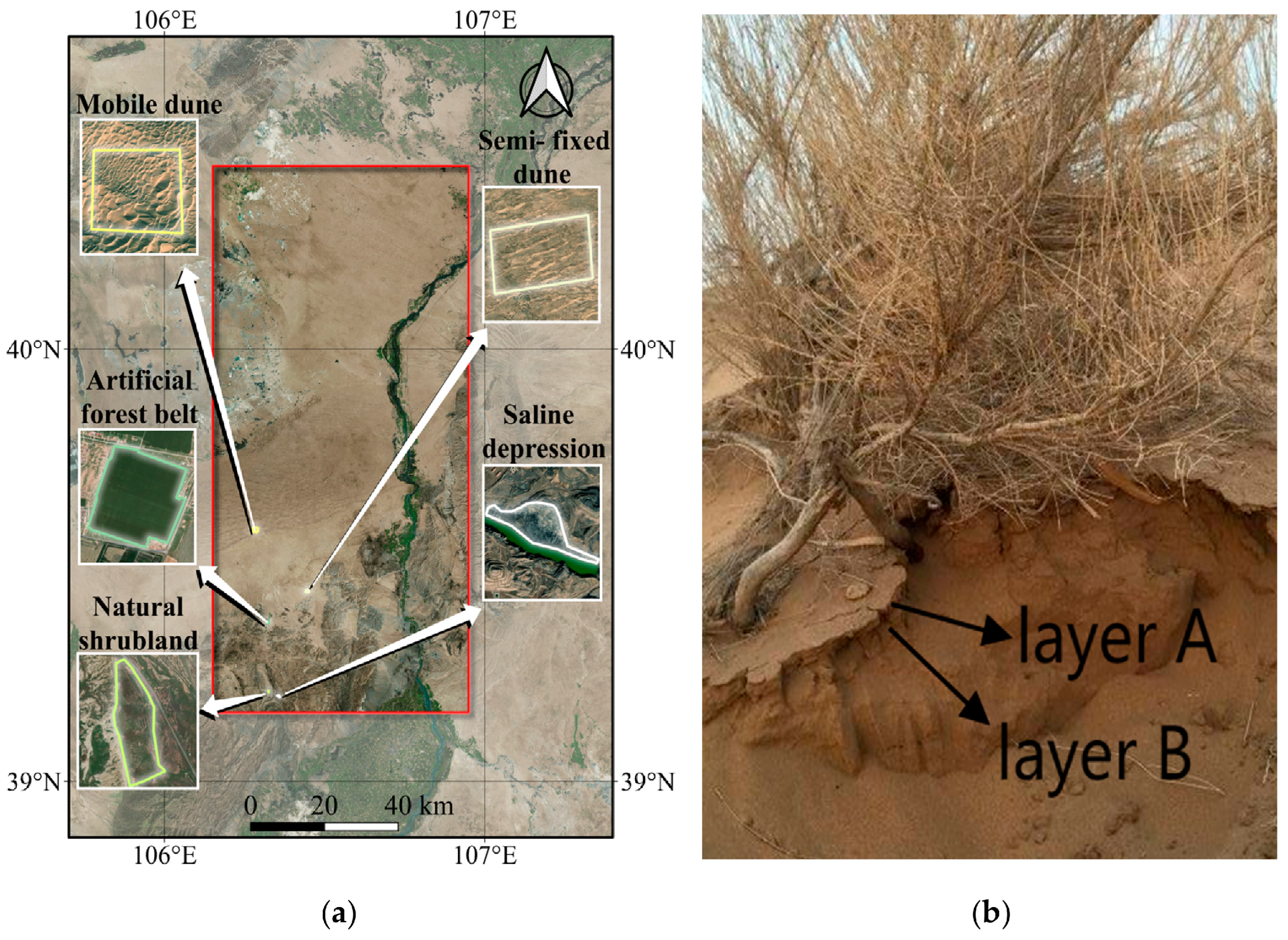
The study area is located in the southwestern part of Dengkou County, Bayannur City, Inner Mongolia, at the transitional zone on the edge of the Ulan Buh Desert, with geographical coordinates ranging from 106°09′ to 106°57′ east longitude and 39°16′ to 40°57′ north latitude (as shown in Figure 1). The region has an arid climate with scarce precipitation, with an average annual rainfall of 142.7 mm and an average annual temperature of 8.0 °C. Wind-blown sand activities are frequent, and surface wind erosion is severe, with an average annual wind speed of 3.7 m/s. It features a typical temperate continental arid monsoon climate. The soil type is predominantly aeolian sand soil, with depressions consisting of varying degrees of saline–alkali soil, providing a natural habitat for the growth of psammophytic and halophytic plants. The vegetation is dominated by shrubs and subshrubs, including Haloxylon ammodendron, Tamarix chinensis, Nitraria tangutorum, Caragana korshinskii, Glycyrrhiza uralensis, Elaeagnus angustifolia, Artemisia ordosica, and other drought-resistant plants.

2.2. Meteorological Data

During the study period (2023–2024), the total precipitation was 289 mm, and the dominant wind direction was northwest with an average speed of 3.8 m/s, consistent with long-term trends. The meteorological data were derived from the daily value data set (V3.0) of China’s surface climate data of the China Meteorological Data Network, including temperature, precipitation, wind speed, sunshine duration, and other data. The dataset is available from the China Meteorological Data Service Centre [17].

2.3. Sample Collection and Analysis

This study is based on geographic information system (GIS) spatial analysis [18], and identified five typical ecological units (mobile dunes, semi-fixed dunes, saline depressions, artificial forest belts, and natural shrubland) as sampling frameworks in the study area. Under this spatial framework, a strategy combining purposive sampling and stratified random sampling is adopted to ensure the collection of typical samples of five vegetation types (Haloxylon ammodendron, Artemisia ordosica, Nitraria tangutorum, Agriophyllum squarrosum, Phragmites australis) and bare sand dunes (CK).
For each of the five vegetation types, 15 independent individual plants were selected as spatial replicates. For the bare sand dune control (CK), 15 independent plots without vegetation were established. For each sampling point, soil crust (Layer A) and subsoil (Layer B) samples were collected directly below the plant canopy 10–20 cm away from the main stem (as shown in Figure 2b). We put the collected soil samples into plastic bags and brought them back to the laboratory for natural air drying, for the determination of soil particle size composition.

Sample Size Calculation

The sample size is calculated according to the Cohen effect size formula [19]:
n = Z α 2 + Z β 2 · σ 2 2
In this formula, Zα/2 and Zβ represent the critical values of the standard normal distribution. Specifically, /2 is the critical value for a two-tailed test at a significance level of α = 0.05 (Z0.025 = 1.96), and Zβ is the critical value for a one-tailed test at a statistical power of 1 − β = 0.8 (β = 0.2, Z0.2 = 0.84). The parameter Φ (phi) is the standard unit for sediment particle size, defined by the transformation Φ = −log2(D), where D is the particle diameter in millimeters [20]. This transformation normalizes the typically skewed distribution of particle sizes. Based on preliminary experimental data, the expected difference in mean particle size between groups was set at Δ = 1.2Φ, and the standard deviation was σ = 0.8Φ. Substituting these values into the equation yielded a minimum required sample size of n = 11 per group. In our actual field design, we established 90 independent spatial sampling points in total (6 treatments × 15 replicates). At each point, two soil layers (crust Layer A and sub-crust Layer B) were collected, giving 180 soil samples (n = 180). Each sample was measured in triplicate using a laser particle size analyzer, and the mean value was used for statistical analysis. For each vegetation type and each soil layer, the number of independent spatial replicates was 15, which substantially exceeds the minimum requirement of 11, ensuring adequate statistical power. The latitude and longitude coordinates of the sampling points are optimized through Kriging interpolation [21] to ensure spatial coverage > 85% (buffer radius of 500 m) and avoid road and grazing interference areas.

2.4. Determination of Indicators and Methods

2.4.1. Soil Particle Size Composition

The particle size composition of crust soil was measured using a laser particle size analyzer (Malvern Mastersizer 3000, Malvern Panalytical Ltd., Malvern, UK) based on volume fraction. According to the American soil particle size grading standard [22], the soil mechanical composition was classified into clay (<2 μm), silt (2–50 μm), very fine sand (50–100 μm), fine sand (100–250 μm), medium sand (250–500 μm), coarse sand (500–1000 μm), very coarse sand (1000–2000 μm), and gravel (>2000 μm). The instrument software automatically computed the particle diameters (in μm) corresponding to the cumulative volume percentages of 5%, 16%, 50%, 84%, and 95% (denoted D5, D16, D50, D84, D95) using linear interpolation. These diameters were then converted to Φ units for the calculation of particle size parameters (see Section 2.4.2). The volume percentage data for the eight size fractions are presented directly in Table 1.

2.4.2. Soil Particle Size Parameters

Based on the Udden–Wentworth particle size standard and the algorithm of Kumdein [23], the previously output particle diameters corresponding to each soil particle cumulative volume fraction were logarithmically transformed into Φ values for calculation. The transformation formula is as follows:
Φ =     l o g 2 D
D is the soil particle diameter (mm).
The particle size parameters, including mean particle size (d0), standard deviation (δ), skewness (SK), and kurtosis (Kg), were calculated using the graphical method of Folk and Ward [24]. The calculation formulas are as follows:
Mean   particle   size:   d 0 = 1 3 ( Φ 16   +   Φ 50   +   Φ 84 )
Standard   deviation:   σ 0 = ( Φ 84     Φ 16 ) 4 + ( Φ 95     Φ 5 ) 6.6
Skewness:   S K = Φ 16   +   Φ 84     2 Φ 50 2 ( Φ 84     Φ 16 ) + Φ 5   +   Φ 95     2 Φ 50 2 ( Φ 95     Φ 5 )
Kurtosis:   K g = Φ 95     Φ 5 2.44 ( Φ 75     Φ 25 )
In this study, the fractal dimension of soil was calculated based on the volume content of soil particles of different sizes measured by the Mastersizer 3000 laser particle size analyzer. The calculation method is as follows:
Fractal   dimension:   V ( r < R i ) V t = ( R i R max ) 3 D
D is the soil fractal dimension; r is the soil particle diameter (mm); Ri is the diameter of a certain particle size grade (mm); V(r < Ri) is the volume percentage of soil particles smaller than Ri (%); Vt is the total volume percentage of all particle size grades (%); and Rmax is the maximum particle diameter (mm).

2.4.3. Determination of Vegetation Morphological Parameters

Vegetation morphological parameters were measured using standard field ecological measurement protocols [25], including plant height, crown width, and basal diameter. Plant height was measured using a height gauge or measuring tape, from the ground to the natural height of the highest point of the plant, with three repeated measurements taken to ensure data accuracy. Crown width was determined by measuring the diameters of the plant canopy in the east–west and north–south directions, with the average value calculated as the crown width. Basal diameter was measured using a digital vernier caliper for the main stem diameter. All measurements were conducted on sunny, windless days to minimize environmental interference.

2.4.4. Data Processing and Analysis

Data were statistically analyzed and organized using Excel 2010. One-way ANOVA was performed using SPSS 26.0 to test the differences among various indices, with a significance level of p < 0.05. Pearson correlation analysis and graphing were conducted using Origin 2018 software. Prior to ANOVA, data normality was verified using Shapiro–Wilk tests (p > 0.05), and homogeneity of variance was confirmed with Levene’s test (p > 0.05). For multiple comparisons, Tukey’s HSD post hoc test was applied to control Type I error.

3. Results

3.1. Particle Size Composition of Soil Crusts Under Different Vegetation Restoration Types

As shown in Table 1, considering the five vegetated treatments across both soil layers (Layer A and Layer B), the particle size composition is dominated by fine sand (mean = 42.85%), followed by silt (23.64%) and medium sand (18.48%). Very fine sand averages 10.82%, while very coarse sand, coarse sand, gravel, and clay are all less than 1% on average. The data show that, compared to bare sand dunes, vegetated sites generally had higher contents of clay, silt, very fine sand, very coarse sand, and gravel, whereas the contents of fine sand and medium sand were more variable and, in most cases, lower.
Among the soil crusts under different plant covers, only the soil under Nitraria tangutorum and Agriophyllum squarrosum contains clay. The clay content in Layer A and Layer B of soil under Nitraria tangutorum is 0.64% and 0.88%, respectively, while that under Agriophyllum squarrosum is 1.55% and 0.16%, respectively. The highest silt content in Layer A is found under Agriophyllum squarrosum, at 75.28%. The highest gravel content in Layer A is found under Phragmites australis, at 6.58%.

3.2. Particle Size Parameters of Soil Crusts Under Different Vegetation Restoration Types

3.2.1. Average Particle Size

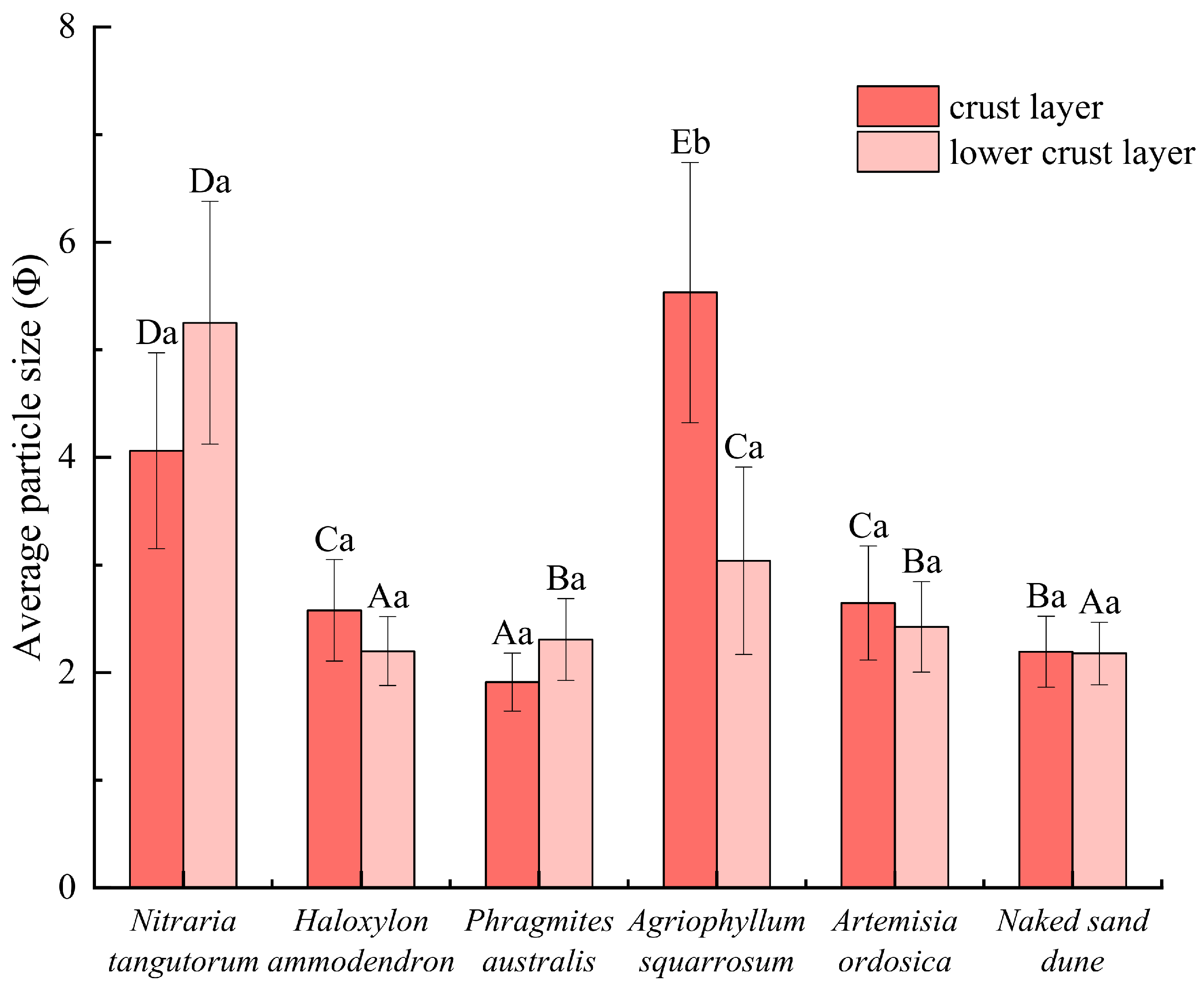
Average particle size indicates the average distribution of soil particles; a larger value suggests finer particles [26]. All particle size parameters are reported in Φ units. As shown in Figure 3, the average particle sizes of soil crusts under Agriophyllum squarrosum, Nitraria tangutorum, Artemisia ordosica, Haloxylon ammodendron, and Phragmites australis are 5.53, 4.06, 2.65, 2.58, and 1.91, respectively. Only the average particle size of the soil crust under Phragmites australis is smaller than that of the bare sand dunes surface (2.19) (i.e., the Phragmites australis crust consists of coarser particles than the bare dune surface). The average particle size of the lower crusts under plant cover is larger than that of the bare sand dunes. The largest average particle size (i.e., the finest particles) is found under Nitraria tangutorum (5.25), while the smallest (i.e., the coarsest particles) is under Haloxylon ammodendron (2.20). For the soil crusts under vegetation cover, the average particle sizes of the surface crusts are smaller than those of the lower crusts under Nitraria tangutorum and Phragmites australis, while the opposite is true for Haloxylon ammodendron, Agriophyllum squarrosum, and Artemisia ordosica. The average particle size of the surface crust of bare sand dunes is slightly larger than that of the lower crust (by 0.02).

3.2.2. Standard Deviation

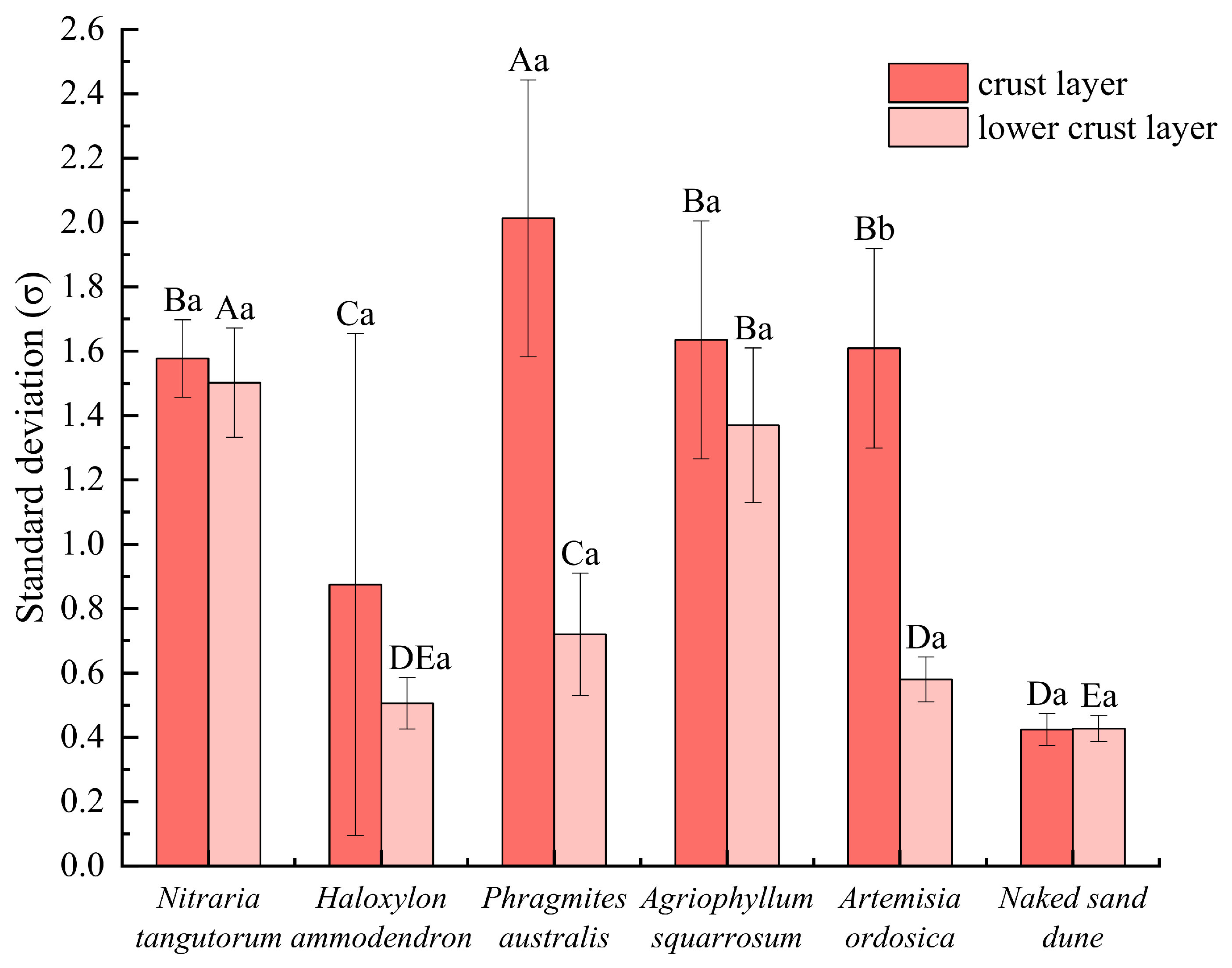
Standard deviation indicates the degree of soil particle distribution; a smaller value suggests more uniform particle distribution and better sorting [27]. As shown in Figure 4, the standard deviation values of the surface and lower crusts of bare sand dunes are similar, with good sorting. A one-way ANOVA revealed that vegetation type had a significant effect on the standard deviation of the soil crust (F (5, 84) = 9.67, p < 0.05). After inspection, it was found that the standard deviation values of soil crust under Haloxylon ammodendron, Artemisia ordosica, Nitraria tangutorum, Agriophyllum squarrosum, and Phragmites australis were significantly higher than those under bare sand dunes (p < 0.05), indicating poor sorting. Among them, the soil crust under Nitraria tangutorum has a more concentrated particle distribution, with values of 1.58 and 1.50 for the surface and lower crusts, respectively. According to the Folk sorting grade standard, the sorting is moderate. In contrast, the soil crust under Phragmites australis has the most dispersed particle distribution, with the largest standard deviation value for the surface crust (2.01), indicating poor sorting, while the lower crust has a value of 0.72, indicating better sorting. The poor sorting under Nitraria tangutorum and Phragmites australis primarily stems from their distinct canopy architectures—the sparse canopy of Nitraria tangutorum allows preferential deposition of coarse particles, while the dense stems of Phragmites australis create complex micro-eddies that trap both fine and coarse particles simultaneously [28]. Moreover, the sorting of the lower crusts under vegetation cover is generally better than that of the surface crusts.

3.2.3. Skewness

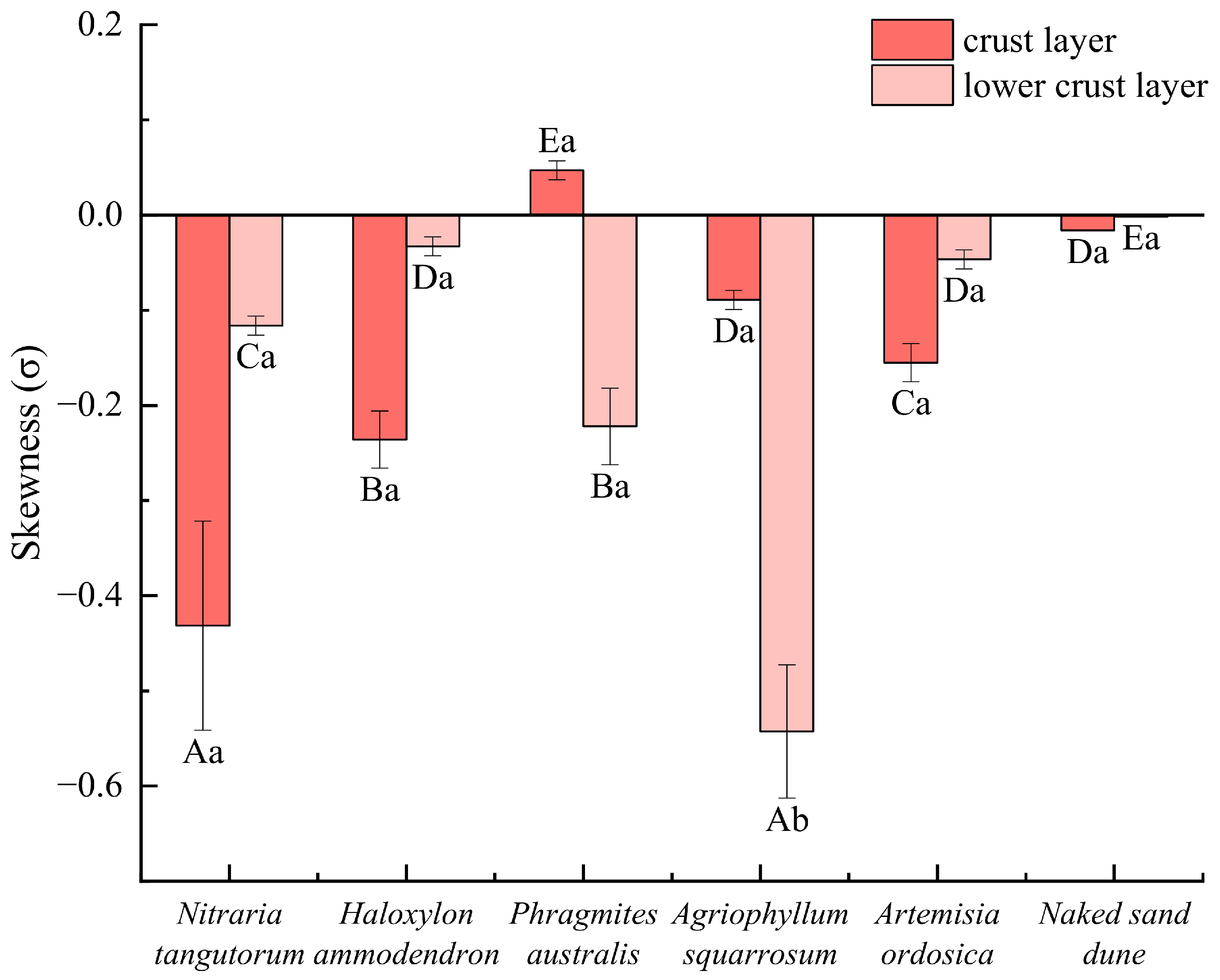
Skewness reflects the symmetry of soil particle size distribution [29]. As shown in Figure 5, the skewness values of soil crusts under Nitraria tangutorum, Haloxylon ammodendron, Phragmites australis, Agriophyllum squarrosum, and Artemisia ordosica are more dispersed but all larger than those of bare sand dunes, indicating poorer symmetry in particle size distribution. Among them, the surface crust under Nitraria tangutorum has a skewness value of −0.43, which is classified as extremely negative skewness according to the skewness grade standard, indicating the poorest symmetry in particle size distribution. The lower crust under Agriophyllum squarrosum has the worst symmetry, with a skewness value of −0.54. Additionally, the skewness values of the surface crusts are generally larger than those of the lower crusts in the study area, indicating poorer symmetry in particle size distribution in the surface crusts compared to the lower crusts.

3.2.4. Kurtosis

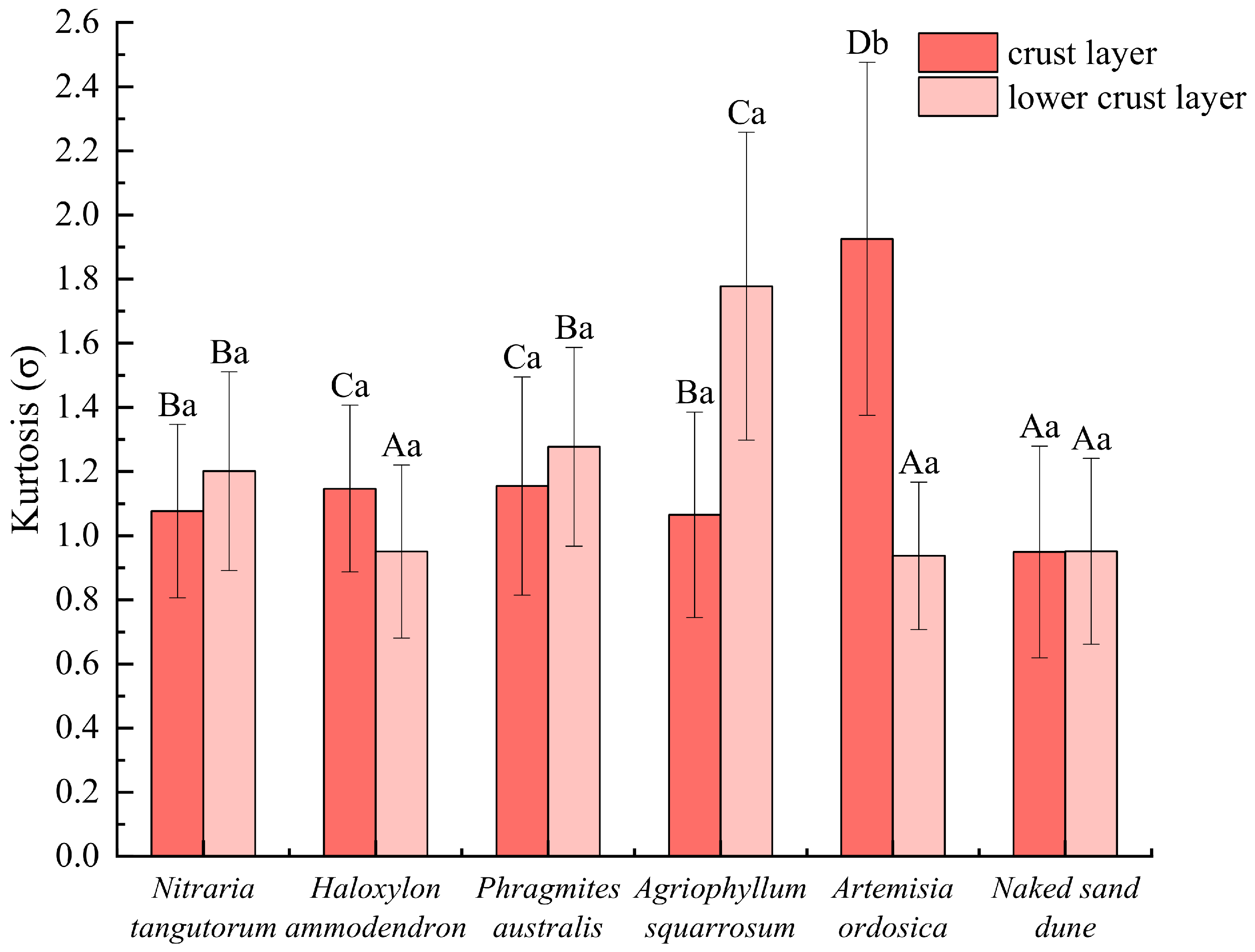
Kurtosis represents the degree of concentration of soil particle size distribution around the mean particle size, reflecting the ratio of the spread of the frequency curve tails to the spread in the middle [30]. As shown in Figure 6, the kurtosis values of soil crusts under vegetation cover are slightly larger or similar to those of bare sand dunes. The kurtosis values of the surface and lower crusts under Phragmites australis are similar, at 1.15 and 1.28, respectively, indicating a narrow and peaked distribution of soil particle sizes. In contrast, the kurtosis values of the surface and lower crusts of bare sand dunes are 0.95 and 0.95, respectively, indicating a medium distribution. Among the surface crusts, the soil crust under Artemisia ordosica has the largest kurtosis value (1.93), indicating a very narrow and peaked distribution. Among the lower crusts, the soil crust under Agriophyllum squarrosum has the largest kurtosis value (1.78), also indicating a very narrow and peaked distribution. The kurtosis values of the surface crusts under Artemisia ordosica and Haloxylon ammodendron are larger than those of the lower crusts, while the opposite is true for Nitraria tangutorum, Phragmites australis, and Agriophyllum squarrosum.

3.2.5. Fractal Dimension

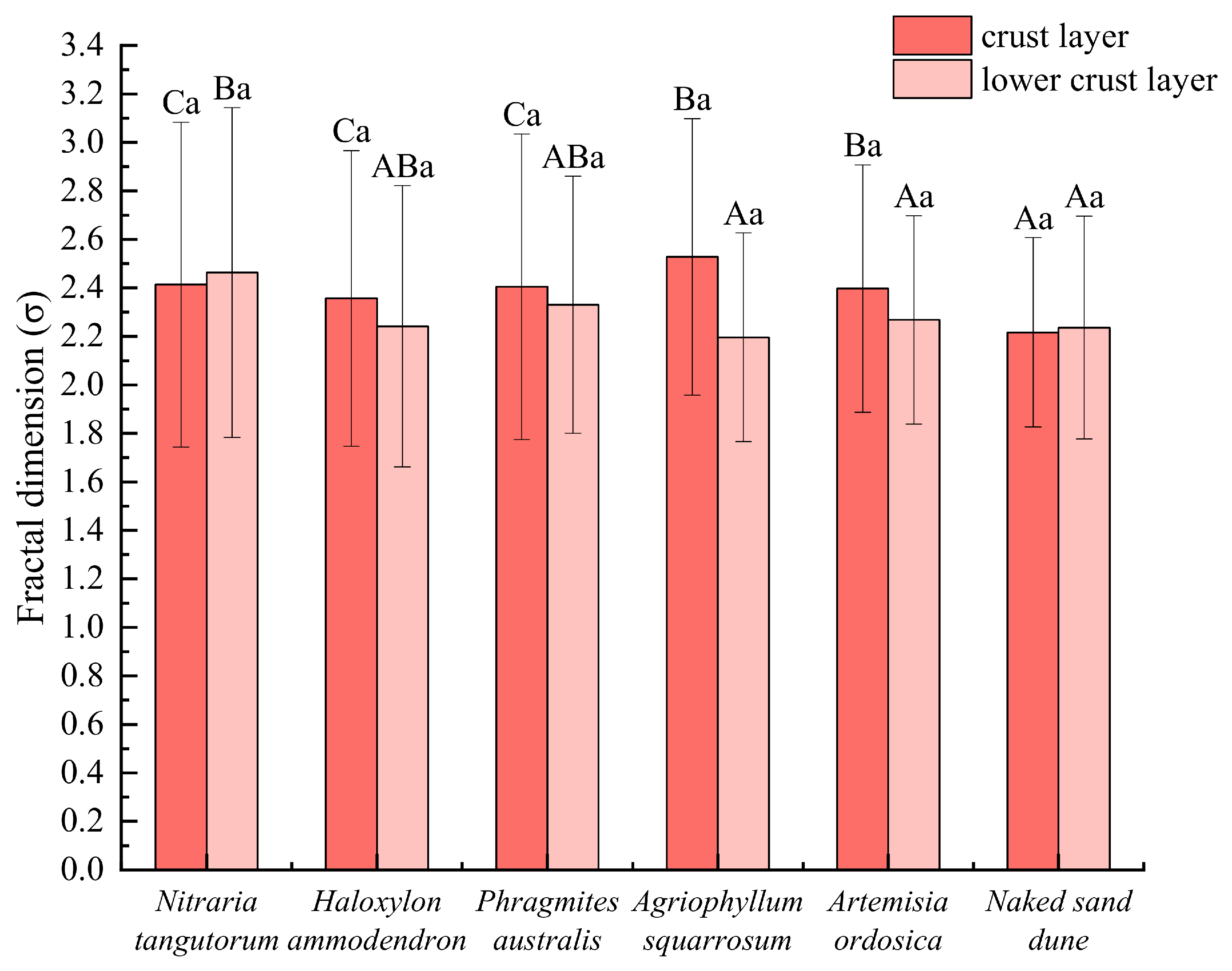
The fractal dimension is related to the cumulative content of soil particles and can therefore be used to represent soil structure [31]. As shown in Figure 7, the fractal dimensions of the crust layer and the lower crust layer of bare sand dunes are 2.22 and 2.24, respectively. Except for the lower crust under Agriophyllum squarrosum cover, which has a fractal dimension of 2.20 (lower than that of the lower crust of bare sand dunes), the fractal dimensions of soil crusts under other vegetation covers are all higher than those of bare sand dunes. Among the crust layers, the soil crust under Agriophyllum squarrosum cover has the highest fractal dimension, at 2.53. Among the lower crusts, the soil crust under Nitraria tangutorum cover has the highest fractal dimension value, at 2.46. Additionally, the fractal dimension of the lower crust under Nitraria tangutorum cover is higher than that of the crust layer (by 0.05), while the fractal dimensions of the lower crusts under Haloxylon ammodendron, Phragmites australis, Agriophyllum squarrosum, and Artemisia ordosica covers are all lower than those of the crust layers, with the largest difference (0.33) observed under Agriophyllum squarrosum cover.

3.3. Frequency Curves and Cumulative Probability Curves

3.3.1. Soil Particle Frequency Distribution Curves

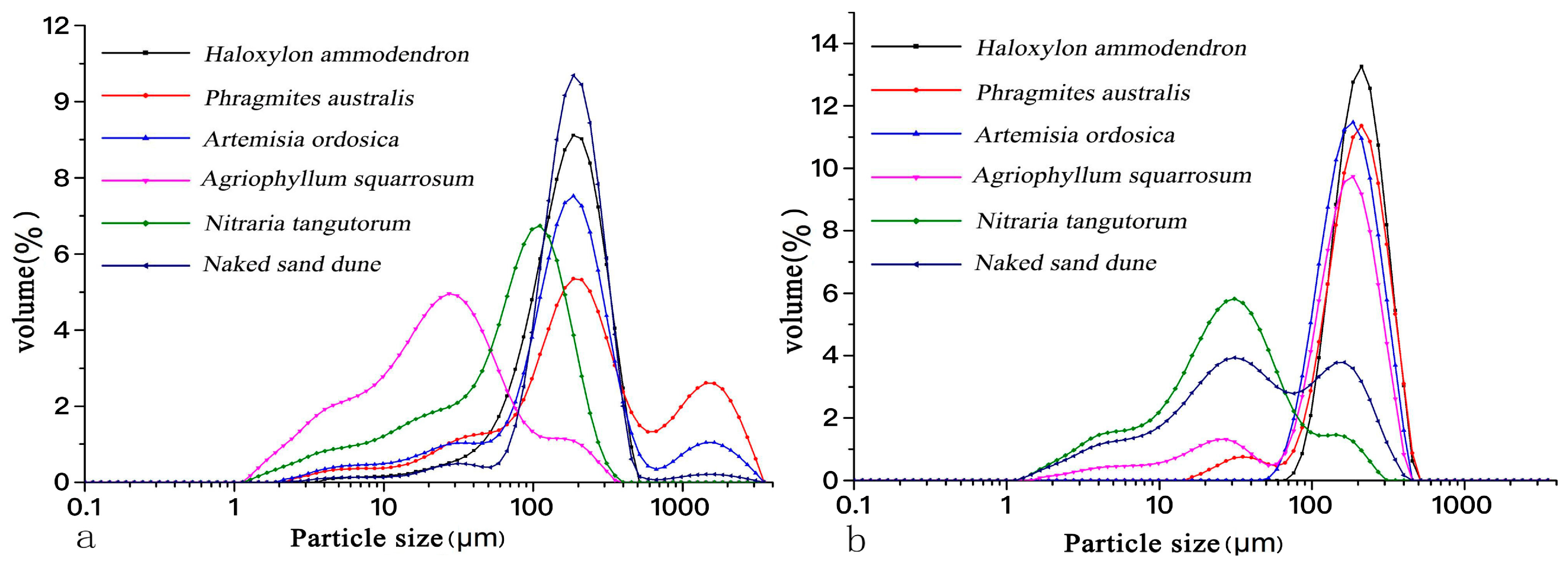
Soil particle frequency distribution curves are commonly used to analyze particle size distribution. They can not only provide qualitative information on skewness and kurtosis but also imply the sedimentary dynamics and sources of particles from the peak attributes of the curves [32]. Frequency distribution curves were created for the surface and lower crusts under Haloxylon ammodendron, Phragmites australis, Agriophyllum squarrosum, Artemisia ordosica, and Nitraria tangutorum (Figure 8). As shown in Figure 8, the particle size distribution of the surface crust under Agriophyllum squarrosum is significantly different from that of the other surface crusts. The surface crusts under Phragmites australis and Artemisia ordosica show relatively small differences and both exhibit bimodal characteristics. The frequency distribution curve of the surface crust under Agriophyllum squarrosum changes earlier, with a peak around 20–30 μm. The peak of the surface crust under Nitraria tangutorum is slightly delayed, around 100–110 μm, and a slight fluctuation appears in the particle size distribution of the surface crust under Agriophyllum squarrosum at this point. The curves of the surface crusts under bare sand dunes and Haloxylon ammodendron show a peak around 115 μm, and the first peak of the surface crusts under Phragmites australis and Artemisia ordosica also appears at this point. Their second peak is around 1100 μm. The frequency distribution curves of the lower crusts under Phragmites australis, bare sand dunes, Agriophyllum squarrosum, and Nitraria tangutorum are similar, with the first peak around 30 μm, a valley around 60 μm, and the second peak around 110 μm. The curves of the lower crusts under Haloxylon ammodendron and Artemisia ordosica are similar, both showing a single peak around 110–120 μm.

3.3.2. Cumulative Frequency Distribution Curves

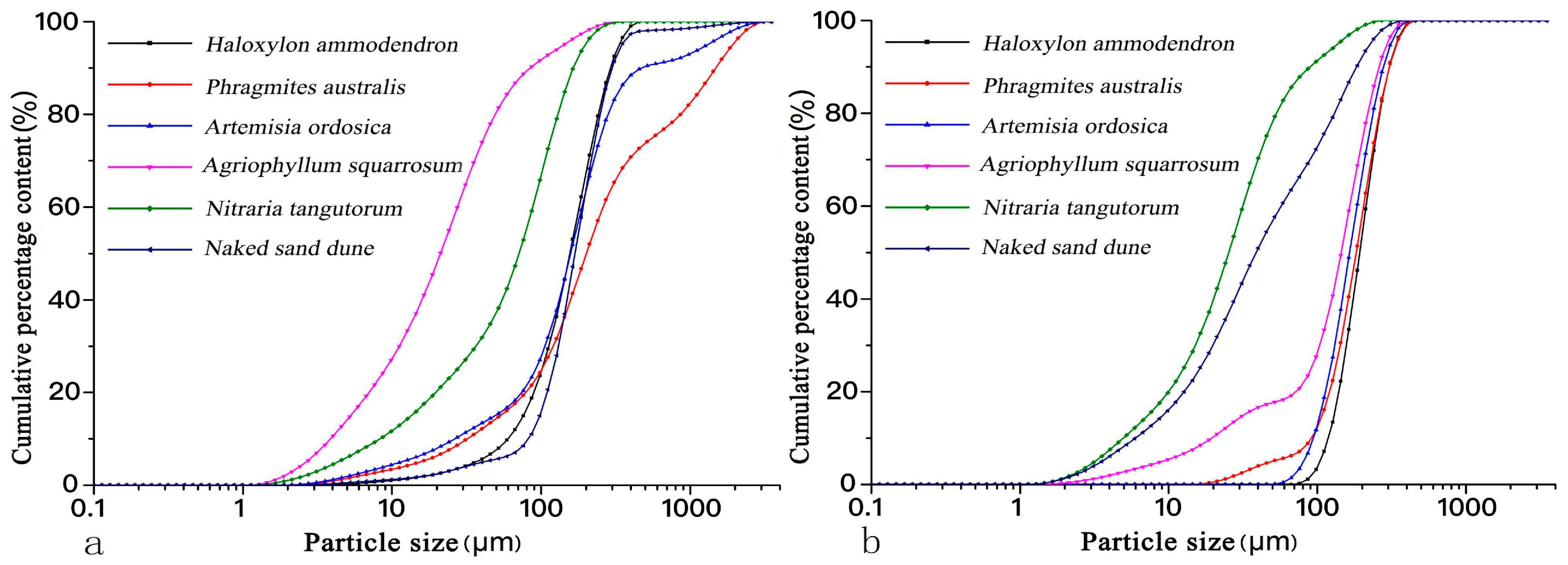
Cumulative frequency distribution curves reflect the distribution of soil particles. Generally, a steeper curve indicates more uniform particle distribution [33]. As shown in Figure 9, the curve of the surface crust under Agriophyllum squarrosum starts to change the earliest and becomes steep after 10 μm. The curves of Haloxylon ammodendron and bare sand dunes change more slowly at the beginning, but become steep and rise rapidly after 100 μm, reaching a maximum value at 300 μm, indicating that particles are mostly concentrated in the range of 100–300 μm. The curve of Phragmites australis changes the most slowly. In the lower crusts, the curves of Agriophyllum squarrosum and bare sand dunes change the earliest. The curves of Phragmites australis and Agriophyllum squarrosum start to change slowly at the beginning and become steep at 80 μm, while the curves of Haloxylon ammodendron and Artemisia ordosica become steep rapidly at 90 μm, indicating the most uniform particle distribution. All six types of curves reach a maximum value at 200 μm.

3.4. Correlation Between Vegetation Morphology and Soil Particle Size Parameters

As shown in Figure 10, the correlation between vegetation characteristics and soil crust particle size parameters indicates that the growth status of vegetation has an important feedback effect on soil physical properties [34]. The canopy width, plant height, and basal diameter of vegetation are negatively correlated with mean particle size, kurtosis, and fractal dimension, and positively correlated with skewness and standard deviation. Indicating that as vegetation grows more vigorously (with increased canopy width, plant height, and basal diameter), its improvement effect on soil particles is enhanced. This may be achieved through increasing surface cover, strengthening root soil fixation, and improving soil microclimate, among other ways, thereby further optimizing soil structure and promoting positive ecosystem succession [35].

4. Discussion

4.1. Vegetation Effects on Soil Particle Size Composition

In the Ulan Buh Desert, both the crust layer (A layer) and sub-crust layer (B layer) under different vegetation covers are dominated by fine sand, with vegetation significantly enhancing the content of fine particulate matter (silt and clay). Consistent with findings from the Tengger Desert [36,37,38], vegetation cover suppresses coarse particle migration by reducing near-surface wind speed, while root exudates promote organic matter accumulation and enhance fine particle aggregation [39]. However, compared to Artemisia ordosica communities in the Mu Us Sandy Land [2], Phragmites australis (reed) and Nitraria tangutorum (white thorn) in this study exhibit more pronounced silt enrichment (silt content: 23.64–72.9%), attributable to stronger wind erosion dynamics and distinct root architectures in the Ulan Buh Desert [6]. The clay enrichment under Agriophyllum squarrosum (sand rice) cover (1.55%) suggests that seed germination facilitates vertical clay transport through physical disturbance, aligning with the “Bioturbation Hypothesis” [30]. Notably, the negative correlation between vegetation crown width and fractal dimension (r = −0.62) contrasts with studies in the Horqin Sandy Land, indicating heterogeneous regulation of soil porosity by shrub versus herb root systems [8].

4.2. Heterogeneity in Grain Size Parameters and Linkage to Plant Functional Traits

In terms of particle size parameters, significant differences are observed in the mean particle size, standard deviation, skewness, kurtosis, and fractal dimension of soil crusts under different vegetation covers. This is similar to the view of Cui Xu Jia et al. [40] that vegetation cover increases surface roughness, hinders sand transport, and thus affects the particle size composition of soil crusts. The differences in mean particle size indicate different sorting and accumulation effects of different vegetation types on soil particles. The larger mean particle size under Nitraria tangutorum cover may be due to its canopy and root distribution characteristics, which relatively weakly intercept and fix coarse particles [41]. In contrast, the smaller mean particle size under Phragmites australis cover may be related to its growth environment and physiological and ecological characteristics. Its dense root system and stems can better capture and stabilize fine particles. The differences in standard deviation, which reflect the degree of soil particle distribution, show that the sorting of soil crusts under vegetation cover is generally poor [42,43]. This may be because root penetration, animal activity, and precipitation during vegetation growth interact to disrupt the original sedimentation patterns of soil particles, making the particle distribution more complex. The high standard deviation values (1.50–2.01) of Nitraria tangutorum and Phragmites australis indicate poor soil particle sorting, aligning with the “vegetation-crust feedback model” proposed by Rodríguez–Caballero et al. [8]: canopy structures alter microtopography, inducing spatial heterogeneity in aeolian sorting. The superior sorting in bare dunes (standard deviation: 0.72) corroborates vegetation-induced regulation of sedimentary processes [30]. Future studies should integrate 3D laser scanning to quantify coupling mechanisms between canopy morphology and wind–sand flow fields [14]. The results of skewness and kurtosis further illustrate the effects of vegetation on the symmetry and concentration of soil particle size distribution. The negative skewness and narrow or medium kurtosis in most vegetation-covered crusts indicate that vegetation changes the mechanical composition and sedimentation process of soil particles, making the particle size distribution more uneven and altering the concentration around the mean particle size [44,45].
From the frequency and cumulative frequency distribution curves, vegetation cover lowers the peaks of soil frequency distribution curves and broadens the particle size distribution range. The unique frequency distribution curve of the surface crust under Agriophyllum squarrosum may be related to its seed characteristics and the modification of the soil microenvironment during the early growth stage. Its small seeds may cause special disturbance and sorting effects on the surrounding soil particles during germination [46,47,48,49]. In the cumulative frequency distribution curves, the differences in curve changes reflect changes in the concentration and uniformity of soil particles in different particle size ranges, which are closely related to root distribution depth, density, and exudates of vegetation [50]. Vegetation with deeper and denser root systems can affect the arrangement and aggregation of soil particles over a larger depth range. The bimodal characteristics of frequency curves reveal the differential regulation mechanism of vegetation on wind–sand dynamics: the early peak at 20–30 μm in the Agriophyllum squarrosum crust layer originates from the bio-adsorption effect of seed microvilli [35], while the dual peaks in Phragmites australis and Artemisia ordosica (115 μm suspension settlement peak + 1100 μm saltation impact peak) reflect sorting differences between low-wind zones under canopies and intense wind events [22,33]. Compared to Artemisia ordosica communities in the Mu Us Sandy Land [2], the frequent strong winds in the Ulan Buh Desert (annual average wind speed: 3.7 m/s) necessitate vegetation with multi-scale sand interception capacity. This requires synergistic configurations of “herbs intercepting fine particles (e.g., Phragmites australis) + shrubs stabilizing coarse grains (e.g., Nitraria tangutorum)” to achieve efficient sand fixation [38].

4.3. Correlation Between Vegetation Morphology and Soil Texture

The correlation analysis revealed significant relationships between plant morphological parameters (crown width, plant height, basal diameter) and soil grain size parameters (Figure 10). The negative correlations with mean particle size, kurtosis, and fractal dimension, coupled with positive correlations with standard deviation and skewness, suggest that larger, more robust plants promote a broader and more heterogeneous soil particle size distribution. This is likely because vigorous plant growth enhances surface cover, root system development, and soil microclimate, which collectively modify aeolian deposition and sediment sorting processes [11]. These easily measurable morphological traits could therefore serve as useful proxies for rapidly assessing the effectiveness of vegetation restoration in improving soil physical structure in field applications.

4.4. Long-Term Implications for Ecosystem Management and Sustainability

The vegetation-induced shift towards finer soil particles has profound long-term implications for the ecosystem. In the short to medium term, this enhances soil water retention capacity, nutrient holding capacity, and overall resistance to wind erosion [51], creating a positive feedback loop for further plant establishment and growth.
However, potential long-term risks must be considered in management strategies. In areas with specific hydrological conditions, the accumulation of fine particles could eventually lead to surface crusting and reduced infiltration, potentially increasing surface runoff [30]. Therefore, the recommended vegetation configurations should not be static. Monitoring is essential, and adaptive management, such as the introduction of deeper-rooted shrubs to maintain soil permeability, may be necessary over time [7]. Our proposed “herbs first, shrubs follow” framework inherently addresses this, as shrubs like Haloxylon ammodendron can break up surface crusts with their deep taproots. Therefore, it is recommended to implement it on a large scale through the following methods: (1) establishing a preliminary herb layer (Artemisia ordosica) to quickly stabilize the surface, (2) introducing shrubs (Haloxylon ammodendron) 2–3 years later to achieve long-term ecosystem functions, and (3) government subsidies of 60% of the initial cost to encourage local communities to adopt it.

4.5. Practical Application and Configuration Strategies for Desert Restoration

The ultimate goal of this research is to inform practical restoration strategies. The differential capabilities of the studied species allow for targeted vegetation configuration based on specific restoration goals and site conditions.
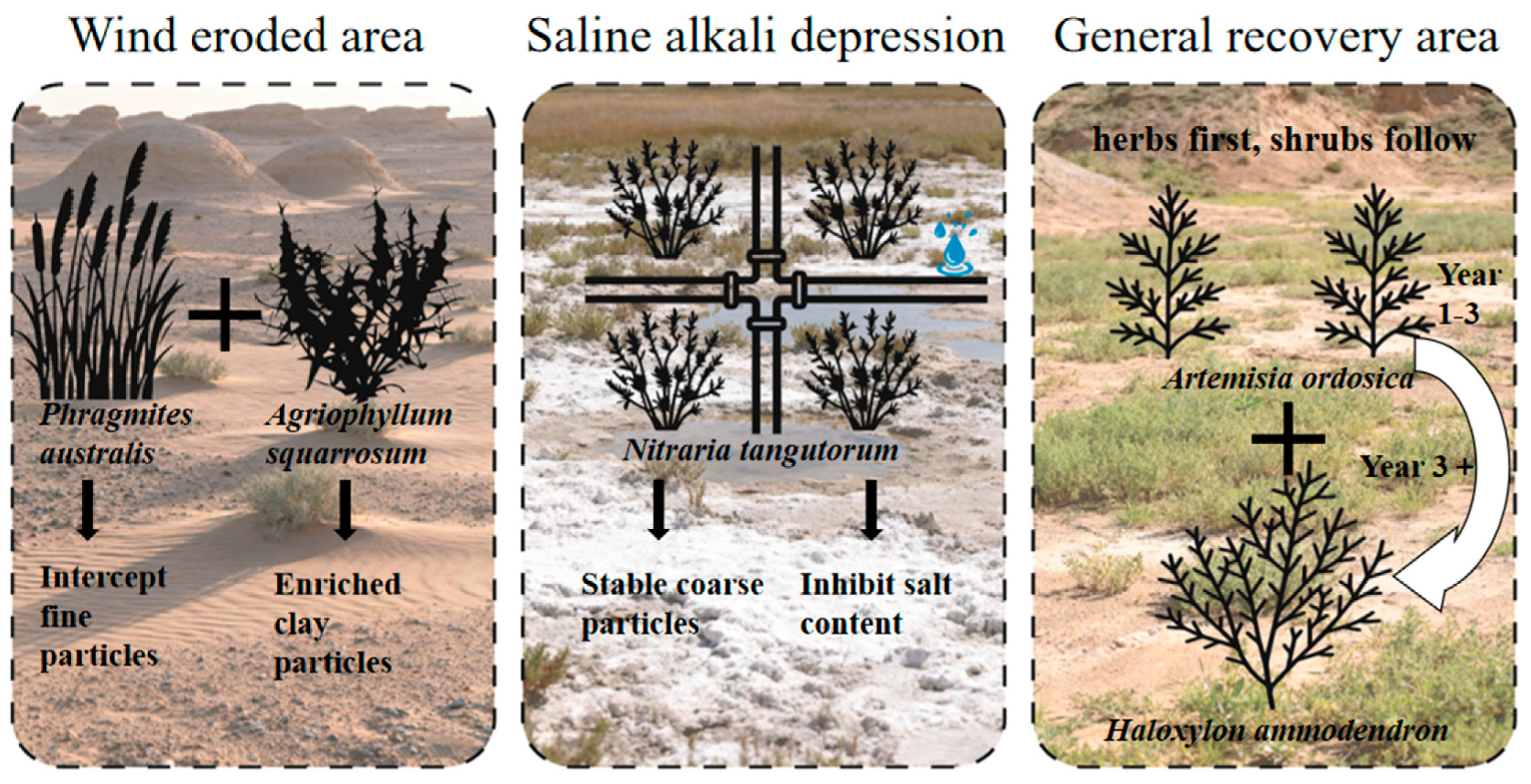
Priority Combination of Phragmites australis (Reed) and Agriophyllum squarrosum (Sand Rice) in Wind Erosion Zones: Phragmites australis efficiently intercepts fine particles (crust-layer particle size: 1.91Φ) to resist wind erosion, while Agriophyllum squarrosum enhances soil water retention through clay enrichment (1.55%). Their synergy reduces sand stabilization costs by 60–80% [32].
Medium-to-Long-Term Restoration with Nitraria tangutorum (White Thorn) in Saline–Alkali Depressions: Nitraria tangutorum stabilizes coarse particles (sub-crust-layer particle size: 5.25Φ) and suppresses surface salt accumulation. Drip irrigation is recommended to control initial costs (35,000 CNY/ha) [7].
Stepwise Configuration of “Herbs First, Shrubs Follow”: Herbaceous species (e.g., Artemisia ordosica) increase coverage by 40% within 3 years, while shrubs (e.g., Haloxylon ammodendron) achieve long-term carbon sequestration (2.8 t/ha·yr over 10 years), balancing short-term efficacy and long-term sustainability [1,47].
However, this study only focused on 3-year-old artificial Haloxylon ammodendron forests and some native vegetation. Future research needs to conduct long-term monitoring of the effects of vegetation with different growth ages on soil crusts and further explore the development patterns of soil crusts under different vegetation combinations and planting models to provide more comprehensive theoretical support for the precise restoration and sustainable management of the Ulan Buh Desert ecosystem.

5. Conclusions

This study systematically quantifies the effects of five key vegetation types on soil crust particle size characteristics in the Ulan Buh Desert, moving beyond descriptive studies to provide a mechanistic understanding and practical tools for restoration.
We conclusively demonstrated that vegetation transition is a primary driver of soil textural changes in arid ecosystems, significantly increasing fine particle content and altering grain size distribution parameters in species-specific ways. The correlation between easily measurable plant morphological traits (e.g., basal diameter) and soil parameters provides land managers with a potential proxy for indirectly assessing restoration success.
The core practical outcome of this research is a set of differentiated vegetation configuration strategies, as illustrated in Figure 11. This study proposes (1) a spatially explicit approach matching species combinations to specific land types (e.g., wind-eroded zones vs. saline depressions), and (2) a temporally dynamic approach using a “herbs first, shrubs follow” sequence to balance immediate erosion control with long-term ecosystem resilience. These strategies, supported by data on cost reduction (60–80%) and long-term carbon sequestration (2.8 t/ha·yr), offer a scientifically grounded and economically viable pathway for enhancing the sustainability of ecological restoration projects in the Ulan Buh Desert and similar arid regions. Future research integrating direct root architecture data and long-term monitoring will further refine these models.

Author Contributions

Conceptualization, L.L. and R.W.; methodology, R.W. and Y.G.; software, L.L.; validation, Y.S.; formal analysis, L.L.; investigation, L.L. and R.W.; resources, R.W.; data curation, L.L. and Y.S.; writing—original draft preparation, L.L.; writing—review and editing, R.W. and G.T.; visualization, L.L. and G.T.; supervision, Y.G.; project administration, R.W.; funding acquisition, R.W. and Y.G. All authors have read and agreed to the published version of the manuscript.

Funding

This research was funded by the Science and Technology Support Project of the Department of Science and Technology of Inner Mongolia (KJZC–2025), and Natural Science Foundation of Inner Mongolia Autonomous Region of China (2024MS04019).

Institutional Review Board Statement

Not applicable.

Data Availability Statement

The original contributions presented in this study are included in the article. Further inquiries can be directed to the corresponding author(s).

Conflicts of Interest

The authors declare no conflicts of interest.

References

  1. Bi, Y.L.; Guo, Y.; Liu, F.; Li, P.N.; Peng, S.P. Ecological restoration effects of biological soil crusts in western coal mining areas and their contribution to carbon neutrality. J. China Coal Soc. 2022, 47, 2883–2895. [Google Scholar]
  2. Zhou, H.; Wu, B.; Gao, Y.; Cheng, L.; Jia, X.H.; Pang, Y.J.; Zhao, H.J. Bacterial community composition of biological soil crusts in Sabina vulgaris communities and their influencing factors in the Mu Us Sandy Land. J. Desert Res. 2020, 40, 130–141. [Google Scholar]
  3. Ramsey, M.L.; Kollath, D.R.; Antoninka, A.J.; Barker, B.M. Proposed relationships between climate, biological soil crusts, human health, and in arid ecosystems. GeoHealth 2025, 9, e2024GH001217. [Google Scholar] [CrossRef] [PubMed]
  4. Liu, J.K. Characteristics and Mechanisms of Artemisia ordosica Community Degradation and Restoration by Enclosure in the Mu Us Sandy Land. Ph.D. Thesis, Beijing Forestry University, Beijing, China, 2019. [Google Scholar]
  5. Garcia-Pichel, F. The microbiology of biological soil crusts. Annu. Rev. Microbiol. 2023, 77, 149–171. [Google Scholar] [CrossRef] [PubMed]
  6. Li, B.W.; Zhang, Y.; Yao, Y.X.; Dang, P.; Farooq, T.H.; Wu, X.H.; Wang, J.; Yan, W.D. Effects of vegetation restoration on soil nitrogen fractions and enzyme activities in arable land on purple soil slopes. Plants 2023, 12, 4188. [Google Scholar] [CrossRef]
  7. Li, Y.L. Characteristics of Deep Seepage in Irrigated Farmland and Its Response to Irrigation Amount in Ulan Buh Desert. Ph.D. Thesis, Chinese Academy of Forestry, Beijing, China, 2018. [Google Scholar]
  8. Wang, F.; Pan, X.; Gerlein-Safdi, C.; Cao, X.M.; Wang, S.; Gu, L.H.; Wang, D.F.; Lu, Q. Vegetation restoration in Northern China: A contrasted picture. Land Degrad. Dev. 2020, 31, 669–676. [Google Scholar] [CrossRef]
  9. Rodríguez-Caballero, E.; Castro, A.J.; Chamizo, S.; Quintas-Soriano, C.; García-Llorente, M.; Cantón, Y.; Weber, B. Ecosystem services provided by biocrusts: From ecosystem functions to social values. J. Arid Environ. 2017, 159, 45–53. [Google Scholar] [CrossRef]
  10. Zhou, H.; Yu, K.; Deng, C.F.; Wu, B.; Gao, Y. Deterministic processes influence bacterial more than fungal community assembly during the development of biological soil crusts in the desert ecosystem. Front. Microbiol. 2024, 15, 1404602. [Google Scholar] [CrossRef]
  11. Jiang, S.; Qi, T.; Niu, Z. The soil and water conservation effects of different plant communities and biological soil crust symbiosis patterns in the ecologically fragile area of Central Ningxia. Land 2024, 13, 2069. [Google Scholar] [CrossRef]
  12. Gu, C.J.; Mu, X.; Gao, P.; Zhao, G.; Sun, W.; Tatarko, J.; Tan, X.J. Influence of vegetation restoration on soil physical properties in the Loess Plateau, China. J. Soils Sediments 2019, 19, 716–728. [Google Scholar] [CrossRef]
  13. Wu, G.L.; Jia, C.; Huang, Z.; López-Vicente, M.; Liu, Y. Plant litter crust appears as a promising measure to combat desertification in sandy land ecosystem. CATENA 2021, 206, 105573. [Google Scholar] [CrossRef]
  14. Faist, A.M.; Antoninka, A.J.; Belnap, J.; Bowker, M.A.; Duniway, M.C.; Garcia-Pichel, F.; Nelson, C.; Reed, S.C.; Giraldo-Silva, A.; Velasco-Ayuso, S.; et al. Inoculation and habitat amelioration efforts in biological soil crust recovery vary by desert and soil texture. Restor. Ecol. 2020, 28, S96–S105. [Google Scholar] [CrossRef]
  15. Xu, H.K.; Zhang, Y.J.; Shao, X.Q.; Liu, N. Soil nitrogen and climate drive the positive effect of biological soil crusts on soil organic carbon sequestration in drylands: A meta-analysis. Sci. Total Environ. 2022, 803, 150030. [Google Scholar] [CrossRef]
  16. Wang, M.; Song, B.; Yin, B.; Tao, Y.; Zhang, J.; Rong, X.; Li, Y.; Zhang, S.; Kan, Z.; Lu, Y.; et al. The development of biological soil crusts shifts the drivers of soil multifunctionality in drylands. CATENA 2025, 258, 109238. [Google Scholar] [CrossRef]
  17. China Meteorological Data Service Centre. Surface Climate Data Daily Value Dataset (V3.0) for China. Available online: https://data.cma.cn (accessed on 24 January 2025).
  18. Li, M.; Feng, Z.; Jiang, L. GIS-based spatial analysis for ecological restoration planning in desertified areas. Environ. Model. Softw. 2019, 112, 18. [Google Scholar]
  19. Cohen, J. Statistical Power Analysis for the Behavioral Sciences, 2nd ed.; Lawrence Erlbaum Associates: Hillsdale, NJ, USA, 1988. [Google Scholar]
  20. Krumbein, W.C. Size frequency distributions of sediments and the normal phi curve. J. Sediment. Res. 1938, 8, 84–90. [Google Scholar] [CrossRef]
  21. Goovaerts, P. Geostatistics for Natural Resources Evaluation; Oxford University Press: New York, NY, USA, 1997. [Google Scholar]
  22. Gao, G.L.; Ding, G.D.; Zhao, Y.Y.; Feng, W.; Bao, Y.F.; Liu, Z.W. Effects of biological crust development on soil particle size characteristics in Mu Us Sandy Land. Trans. Chin. Soc. Agric. Mach. 2014, 45, 115–120. [Google Scholar]
  23. Jia, J.J.; Gao, S.; Xue, Y.C. Comparison of sediment grain size parameters derived by graphic and moment methods. Oceanol. Limnol. Sin. 2002, 33, 577–582. [Google Scholar]
  24. Folk, R.L.; Ward, W.C. Brazos River bar: A study in the significance of grain size parameters. J. Sediment. Res. 1957, 27, 3–26. [Google Scholar] [CrossRef]
  25. Liu, C.C.; He, N.P.; Li, Y.; Zhang, J.H.; Yan, P.; Wang, R.M.; Wang, R.L. Plant functional traits in macroecology: History and development trends. Chin. J. Plant Ecol. 2024, 48, 21–40. [Google Scholar]
  26. Lu, C.; Ma, Z.J.T.; Li, J.H.; Zhang, K.D. Influencing factors of soil erosion resistance under freeze-thaw conditions. J. Soil Water Conserv. 2023, 37, 25–33. [Google Scholar]
  27. Yan, Z.H.; Fu, R.B.; Wu, Z.G. Numerical research and analysis on performance of integrated soil crushing-mixing equipment. Environ. Eng. 2023, 41, 131–136. [Google Scholar]
  28. Cheng, L.; Wu, B.; Pang, Y.; Jia, X. Shrub growth improves morphological features of nebkhas: A case study of Nitraria tangutorum in the Tengger Desert. Plants 2024, 13, 624. [Google Scholar] [CrossRef] [PubMed]
  29. Wang, Y.; Zhao, Y.G.; Yao, C.Z.; Zhang, P.P. Surface roughness characteristics and influencing factors of biological soil crusts in the Loess Hilly Region. Chin. J. Appl. Ecol. 2014, 25, 647–656. [Google Scholar]
  30. Ding, Y.L.; Gao, Y.; Meng, Z.J.; Na, R.G.R.L.; Huang, X.; Sun, X.R.; Wu, H.; Dang, X.H.; Wang, M. Particle size characteristics of wind-eroded surfaces in Xilamuren Desert Steppe. Soils 2016, 48, 803–812. [Google Scholar]
  31. Gui, H.J. Comparative Study on Grain Size and Element Characteristics of Four Major Deserts in the Ningxia-Inner Mongolia Reach of the Yellow River. Ph.D. Thesis, Lanzhou University, Lanzhou, China, 2013. [Google Scholar]
  32. Yang, L.; Liu, J.; Wong, C.K.; Lim, B.L. Movement of Lipid Droplets in the Arabidopsis Pollen Tube Is Dependent on the Actomyosin System. Plants 2023, 12, 2489. [Google Scholar] [CrossRef] [PubMed]
  33. Gao, L.; Bowker, M.A.; Xu, M.; Sun, H.; Tao, D.; Zhao, Y. Biological soil crusts decrease erodibility by modifying inherent soil properties on the Loess Plateau, China. Soil Biol. Biochem. 2017, 105, 49–58. [Google Scholar] [CrossRef]
  34. Hashim, Z.E.; Al-Madhhachi, A.S.T.; Alzubaidi, L.A. Behavior of soil erodibility parameters due to biological soil crusts using jet erosion tests. Ecol. Eng. 2020, 153, 105903. [Google Scholar] [CrossRef]
  35. Zhang, N.; Wang, S.X.; Wang, P.Y.; Yang, T.H. Effects of biological soil crust development on functional traits and biomass allocation of Echinops gmelinii. Ningxia J. Agric. For. Sci. Technol. 2024, 65, 19–27. [Google Scholar]
  36. Xiao, W.Q.; Dong, Z.B.; Chen, H.; Shao, T.J.; Cui, X.J.; Li, C.; Song, S.P.; Xiao, N.; Li, L.L. Effects of biological soil crusts on soil particle size characteristics in the northern margin of Kubuqi Desert. J. Desert Res. 2017, 37, 970–977. [Google Scholar]
  37. Kakeh, J.; Gorji, M.; Mohammadi, M.H.; Asadi, H.; Khormali, F.; Sohrabi, M.; Cerdà, A. Biological soil crusts determine soil properties and salt dynamics under arid climatic condition in Qara Qir, Iran. Sci. Total Environ. 2020, 732, 139168. [Google Scholar] [CrossRef]
  38. Song, G.; Li, X.R.; Hui, R. Biological soil crusts increase stability and invasion resistance of desert revegetation communities in northern China. Ecosphere 2020, 11, e03043. [Google Scholar] [CrossRef]
  39. Jia, B.Q.; Zhang, H.Q.; Zhang, Z.Q.; Ci, L.J. Study on physicochemical properties of soil crust in Minqin sandy area, Gansu Province. Acta Ecol. Sin. 2003, 23, 1442–1448. [Google Scholar]
  40. Cui, X.J. Analysis of Vegetation Characteristics and Sediment Features of Tall Dunes in Badain Jaran Desert. Master’s Thesis, Shaanxi Normal University, Xi’an, China, 2014. [Google Scholar]
  41. Du, H.Y.; Zhou, Z.B.; Liu, F.S.; Yan, B. Fractal characteristics of soil particle size distribution during the oasisization process in Alar Reclamation Area. Arid Zone Res. 2013, 30, 615–622. [Google Scholar]
  42. Meng, Z.J.; Ren, X.M.; Gao, Y. Effects of different vegetation restoration types on soil crusts in coal mining subsidence areas. J. Inn. Mong. For. 2014, 4, 10–11. [Google Scholar]
  43. Chamizo, S.; Cantón, Y.; Lázaro, R.; Solé-Benet, A.; Domingo, F. Crust composition and disturbance drive infiltration through biological soil crusts in semiarid ecosystems. Ecosystems 2012, 15, 148–161. [Google Scholar] [CrossRef]
  44. Williams, L.; Jung, P.; Zheng, L.J.; Maier, S.; Peer, T.; Grube, M.; Weber, B.; Büdel, B. Assessing recovery of biological soil crusts across a latitudinal gradient in Western Europe. Restor. Ecol. 2018, 26, 543–554. [Google Scholar] [CrossRef]
  45. Dong, Z.J. Spatial Distribution of Biological Soil Crusts and Their Soil Hydrological Processes in Hedong Sandy Land, Ningxia. Master’s Thesis, Ningxia University, Yinchuan, China, 2023. [Google Scholar]
  46. Zhao, Y.; Xu, W.W.; Wang, N. Effects of covering sand with different soil substrates on the formation and development of artificial biocrusts in a natural desert environment. Soil Tillage Res. 2021, 213, 105081. [Google Scholar] [CrossRef]
  47. Lyu, D.; Liu, Q.; Xie, T.; Yang, Y. Impacts of different types of vegetation restoration on the physicochemical properties of sandy soil. Forests 2023, 14, 1740. [Google Scholar] [CrossRef]
  48. Zhu, P.Z.; Zhang, G.H.; Wang, H.X.; Zhang, B.J.; Wang, X. Land surface roughness affected by vegetation restoration age and types on the Loess Plateau of China. Geoderma 2020, 366, 114240. [Google Scholar] [CrossRef]
  49. Guida, G.; Nicosia, A.; Settanni, L.; Ferro, V. A review on effects of biological soil crusts on hydrological processes. Earth-Sci. Rev. 2023, 243, 104516. [Google Scholar] [CrossRef]
  50. Jia, X.; Li, Y.; Wu, B.; Zhou, Y.; Li, X. Effects of plant restoration on soil microbial biomass in an arid desert in northern China. J. Arid Environ. 2017, 144, 192–200. [Google Scholar] [CrossRef]
  51. Liu, Y.; Qin, F.; Li, L.; Yang, Z.; Tang, P.; Yang, L.; Tian, T. Interplay of Environmental Shifts and Anthropogenic Factors with Vegetation Dynamics in the Ulan Buh Desert over the Past Three Decades. Forests 2024, 15, 1583. [Google Scholar] [CrossRef]
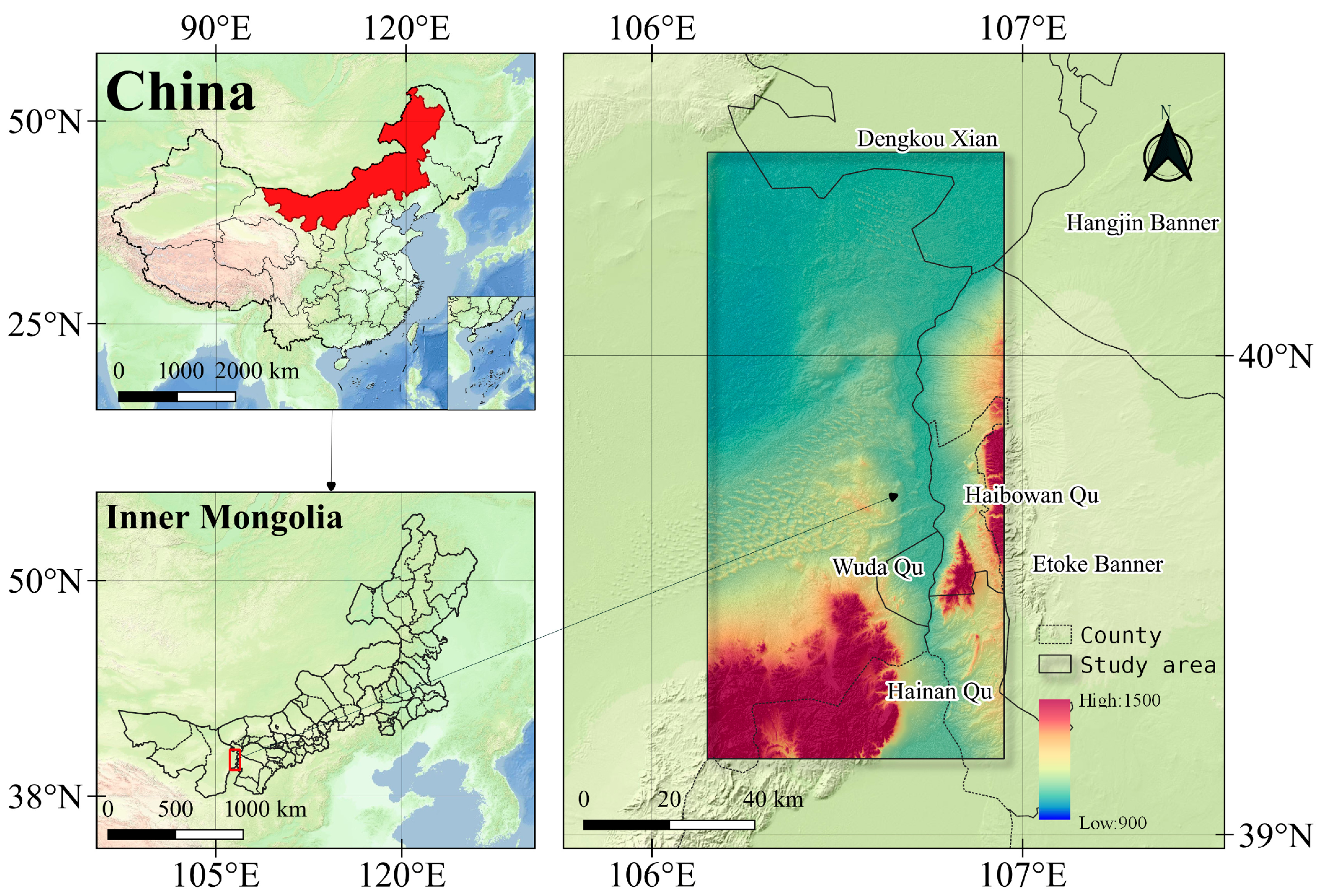
Figure 1. Overview map of the research area.
Diversity 18 00275 g001
Figure 2. Research area map showing ecological units and schematic diagram of soil sampling locations (taking Haloxylon ammodendron as an example). (a) Ecological unit research area map; (b) schematic diagram of soil sampling locations. The area within the red square is the geographical extent of the Ulan Buh Desert.
Diversity 18 00275 g002
Figure 3. The average particle size of soil covered by different plants. Data are presented as Mean ± Standard Deviation (n = 3). Different lowercase letters indicate significant differences (p < 0.05) among vegetation types within the same soil layer, while different uppercase letters indicate significant differences between soil layers (A and B) under the same vegetation type.
Diversity 18 00275 g003
Figure 4. Standard deviation of soil covered by different plants. Data are presented as Mean ± Standard Deviation (n = 3). Different lowercase letters indicate significant differences (p < 0.05) among vegetation types within the same soil layer, while different uppercase letters indicate significant differences between soil layers (A and B) under the same vegetation type.
Diversity 18 00275 g004
Figure 5. Skewness of soil covered by different plants. Data are presented as Mean ± Standard Deviation (n = 3). Different lowercase letters indicate significant differences (p < 0.05) among vegetation types within the same soil layer, while different uppercase letters indicate significant differences between soil layers (A and B) under the same vegetation type.
Diversity 18 00275 g005
Figure 6. Kurtosis of soil covered by different plants. Data are presented as Mean ± Standard Deviation (n = 3). Different lowercase letters indicate significant differences (p < 0.05) among vegetation types within the same soil layer, while different uppercase letters indicate significant differences between soil layers (A and B) under the same vegetation type.
Diversity 18 00275 g006
Figure 7. The fractal dimension of soil covered by different plants. Data are presented as Mean ± Standard Deviation (n = 3). Different lowercase letters indicate significant differences (p < 0.05) among vegetation types within the same soil layer, while different uppercase letters indicate significant differences between soil layers (A and B) under the same vegetation type.
Diversity 18 00275 g007
Figure 8. Frequency curves of soil crust layer (a) and subsoil layer (b) covered by different plants. The curves depict the volume percentage distribution of soil particles across different size classes. Each line represents the mean value derived from three replicate samples (n = 3) for each vegetation type.
Diversity 18 00275 g008
Figure 9. Probability accumulation curves of soil crust layer (a) and subsoil layer (b) covered by different plants. The curves represent the cumulative volume percentage of soil particles. A steeper curve indicates a more uniform particle size distribution. Each line is based on the mean of three replicate samples (n = 3).
Diversity 18 00275 g009
Figure 10. Correlation analysis between vegetation characteristics and grain size parameters of soil crusts. The color and size of the circles represent the Pearson correlation coefficient (r) value. Asterisks (*) indicate the significance level (p ≤ 0.05). The analysis is based on all collected samples (n = 180).
Diversity 18 00275 g010
Figure 11. Schematic diagram of vegetation configuration strategy for ecological restoration in Ulan Buh Desert.
Diversity 18 00275 g011
Table 1. Volume fraction of soil crust particles under different plant species (%). Data are presented as Mean ± Standard Deviation (n = 3). Different uppercase letters indicate significant differences (p < 0.05) among vegetation types within the same soil layer, while different lowercase letters indicate significant differences between soil layers (A and B) under the same vegetation type. The significance level was set at p< 0.05 for all statistical tests.
TypeSoil LayerClaySiltGritGravel
Very Fine SandFine SandMedium SandCoarse SandVery Coarse Sand
Nitraria tangutorumA0.64 ± 0.06 Aa33.34 ± 7.56 Ca26.19 ± 2.79 Db36.86 ± 7.78 BCb2.96 ± 0.43 Bb000
B0.88 ± 0.11 Ba72.9 ± 8.28 Bb16.06 ± 1.88 Ca9.48 ± 1.45 Aa0.68 ± 0.05 Aa000
Haloxylon ammodendronA06.37 ± 0.94 A13.11 ± 1.57 Cb54.48 ± 5.47 Da25.82 ± 2.45 Ea0.23 ± 0.03 Ba00
B001.39 ± 0.43 Aa62.13 ± 7.79 Cb36.33 ± 3.76 Db0.15 ± 0.02 Ba00
Phragmites australisA013.06 ± 2.01 Bb8.87 ± 0.99 Bb31.77 ± 4.36 Ba18.52 ± 2.85 CDa8.14 ± 1.21 Db13.06 ± 1.29 B6.58 ± 1.01 B
B04.43 ± 0.75 Aa4.77 ± 0.83 ABa57.1 ± 5.58 Bb33.48 ± 4.75 Db0.21 ± 0.03 Ba00
Agriophyllum squarrosumA1.55 ± 0.37 Bb75.28 ± 6.82 Db13.66 ± 1.76 Cb8.09 ± 1.03 Aa1.42 ± 0.24 Aa000
B0.16 ± 0.03 Aa16.95 ± 2.76 Aa6.95 ± 0.98 Ba56.46 ± 5.48 Bb19.49 ± 4.78 Bb000
Artemisia ordosicaA014.08 ± 2.24 B9.72 ± 1.31 Ba45.04 ± 4.29 Ca20.63 ± 5.03 DEa2.86 ± 0.56 C5.1 ± 0.81 A2.57 ± 0.51 A
B007.48 ± 1.28 Ba67.07 ± 7.43 Cb25.45 ± 2.39 Cb000
CKA000.31 ± 0.07 Aa65.73 ± 6.48 Ea33.94 ± 4.03 Fa0.02 ± 0.01 Aa00
B001.06 ± 0.21 Aa62.37 ± 5.32 Ca36.5 ± 4.29 Da0.07 ± 0.02 Aa00
Disclaimer/Publisher’s Note: The statements, opinions and data contained in all publications are solely those of the individual author(s) and contributor(s) and not of MDPI and/or the editor(s). MDPI and/or the editor(s) disclaim responsibility for any injury to people or property resulting from any ideas, methods, instructions or products referred to in the content.