


Abstract
Wetland conservation planning relies on the in situ distribution of both habitats and species and also on species preferences for these habitats. To study such distributions, ecologists frequently use multivariate methods, mainly correspondence analysis (CA) and hierarchical clustering, which are based on the raw or transformed abundances of species in habitats. These methods often suffer from the high dominance of abundant generalist species and obscure the role of species with low abundance, including some indicator taxa, which leads to an uncertain ecological interpretation of the results. In this study, we suggest mitigating this bias by weighting raw abundances by the degree of preference (DP) of the species. As this index varies between 0 and 1, the weighting operation reduces the influence of generalist taxa (with low DP) in favor of selective taxa (with high DP) and redistributes species contributions in the factorial axes. In parallel, K-medoids allows for the clustering of both species and habitats in ecologically coherent groups, whose composition shifts with data weighting. These changes were tested on a real dataset of 109 waterbird species counted in 166 wetland habitats, which was submitted to CA in combination with a hybrid K-medoids clustering method. In addition to its ecological foundation, in the sense that it improves the ecological relevance of wetland and assemblage typologies, this approach is intermediate between the use of raw abundance and presence–absence and avoids subjective data codification, offering a robust tool for conservation evaluation and decision-making.
1. Introduction
The conservation of biodiversity increasingly relies on rapid yet detailed diagnostics of species assemblages, using methods capable of identifying species’ habitat preferences and the underlying structure of these assemblages [1]. Simultaneously, habitats constitute major targets of conservation, as they hold and structure living assemblages while constituting another living compartment of ecosystems.
Consequently, habitat classification is essential for evaluating them and prioritizing their conservation, and different mesological and biological criteria are used for this classification, including their assemblages [2].
Our research is dedicated to numerical classification approaches of species and habitats, more precisely to correspondence analysis [3,4,5,6] and the K-medoids clustering method [7]. We explored the use of abundances in implementing such methods and the opportunity to increase their efficiency by correcting abundances. The proposed correction consists of weighting species raw abundances by their degree of preference, as defined by Dakki [8] and refined by Dakki et al. [9] and Ennakri et al. [10].
Indeed, multivariate methods have shown high efficiency in searching and interpreting similarities between assemblages from a ‘species × habitats’ contingency table. In this context, correspondence analysis (CA) has been used for a long time to highlight ordination and classification schemes, sometimes translated into ‘biotypologies’ [11]. However, the ecological groups identified by these methods are highly influenced by numerically dominant species, which are frequently generalists, in the sense that they cannot serve as habitat or assemblage indicators. In both the CA and M-medoids schemes, these species hide indicator taxa, which are frequently lower in abundances, while ecologists assign them a greater role in characterizing assemblages. In contrast, when CA is based on matrices where generalists are dominant, it can reveal significant ordinations, in which grouping can lead to heterogeneous ecological clusters, which are, despite all, adopted by ecologists.
In a biotypology study of riverine entomological assemblages [9,10], such heterogeneous groups were adopted, but it was suggested that each assemblage be analyzed using both abundance and the degree of preference (DP), the latter having been estimated by an index that allows for the identification of indicator species. This approach, based on the use of an abundance–preference diagram (APD), allowed for the downgrading of generalist taxa in favor of upgrading selective species [8,9,10]. We think that this reclassification pattern can be used to improve the CA results based on raw abundances. Specifically, we propose a DP-weighting process that consists of multiplying these abundances by the DP of species.
To assess the efficiency of DP-weighting, in terms of habitat similarity, the results of both CA and k-medoid treatments were compared using both statistical tools [11,12] and ecological interpretations.
Among the different assemblages that have been described in wetlands, waterbirds constitute an ideal material for our study, especially since they consist of a high rate of indicators of wetland conditions and constitute a preferential target in conservation while being efficient in testing ecological methods based on species abundance [13,14]. Similarly to other aquatic groups, waterbirds show strong numerical dominance of a few ubiquitous species, which hinders the implementation of some classification methods and management procedures [15].
2. Materials and Methods
2.1. Experimental Data Source
The experimental data used were obtained from the international winter census of waterbirds in Morocco. We selected the 2019–2023 results, presented in a contingency table of ‘109 species × 166 wetlands’, which generally corresponds to the average annual number of each species. The census, conforming to standard methods [16], covered a large range of wetland types (marine costs, bays, estuaries, lagoons, lakes, marshes and reservoirs). Therefore the 166 sites provide a near-census of the national habitat catalog rather than a stratified subsample, as well as a stringent test system for the DP-weighting approach. The 109-species pool was retained for its strong contrast between highly selective species and numerically dominant generalists (e.g., Larus fuscus, Anas platyrhynchos, etc.), the configuration in which DP-weighting is expected to have a measurable effect.
In addition to species abundances, this matrix contains two types of abiotic descriptors, the ‘wetland type’, split into five subtypes, and the ‘area’ of wetlands, the first criterion being qualitative and the second quantitative.
2.2. Ordination and Clustering Methods Used
2.2.1. Correspondence Analysis (CA)
As the main objective of this work is to increase the relevance of the correspondence analysis [17] in bioclassifications based on species abundances, this method constitutes our axial subject, from the data definition to the results and their ecological interpretation. Data are treated in their raw form and then in a weighted form, which consists of multiplying these data by the species DP.
2.2.2. K-Medoids Clustering (KMC)
The DP-weighting of abundances is supposed to induce changes in the classification of habitats based on the clustering method. To test this, we used the K-medoids approach (KMC), based on the Partitioning Around Medoid (PAM) algorithm [18], which we implemented using Python 3.12 [19]. For a given number of clusters k, PAM selects k-medoids and assigns each habitat to the nearest medoid using the hybrid dissimilarity matrix D_mix by minimizing within-cluster dissimilarities [20]:
denotes the set of medoids, and of habitats.
To calculate , we used a hybrid dissimilarity matrix that combines, in the same matrix, the biological components (species) and abiotic descriptors of habitats. The biological dissimilarities are computed from the species abundances, using the Bray–Curtis index [21], while the abiotic dissimilarities are computed with Gower and area distance, using quantitative and qualitative descriptors [22]. This latter allows for the use of heterogeneous information within a single dissimilarity framework.
where , , and are weighting coefficients satisfying .
The mixing coefficient value controls the reciprocal influence of the biological and abiotic descriptors: values closer to 1 give greater weight to species composition, whereas values closer to 0 emphasize the abiotic similarity of habitats.
Different values were tested (through their results) for different numbers of clusters (), by measuring the computed silhouette width [23,24], hereafter named sw.
To visualize the habitat clusters, we project them on the two first planes, F1 × F2 and F3 × F4, of a CA based on the same matrix as that in the clustering method.
2.2.3. DP-Weighting Process
Abundances were weighted by the species degree of preference (DP). For each species, its DP is calculated from its abundance distribution profile across habitats [25]. In the data matrix, for each species , the term is its abundance in the habitat , with being the number of considered habitats. To avoid undefined logarithms, for ‘zero’ values, all abundances were increased by 1, and the DP index is then calculated using the following formula [8,9,10]:
where , and .
, and the 0 value is theoretically obtained for species with the same abundances in all habitats () and its maximum (close to 1) for species that are highly concentrated in few habitats or are exclusive to one habitat. The DP-weighted abundances were computed follows:
3. Results
Let us be reminded that in the same data matrix submitted to CA and the K-medoids method, each habitat has two abundance values for each species, a raw value and DP-weighted value. Using this approach, CA provides two positions in both clusters and factorial planes for each habitat, thereby allowing for the measurement and visualization of the changes introduced by DP-weighting on the ordination and classification results [6,7,17].
On the other hand, the total ecological information provided by applying a CA to a ‘species × habitats’ matrix can generally be expressed by the four first axes, through the factorial planes F1 × F2 and F3 × F4 [5,11].
3.1. Impact of DP Data Weighting on CA Ordination of Species
3.1.1. Changes in Relative Positions of Species on CA Axes
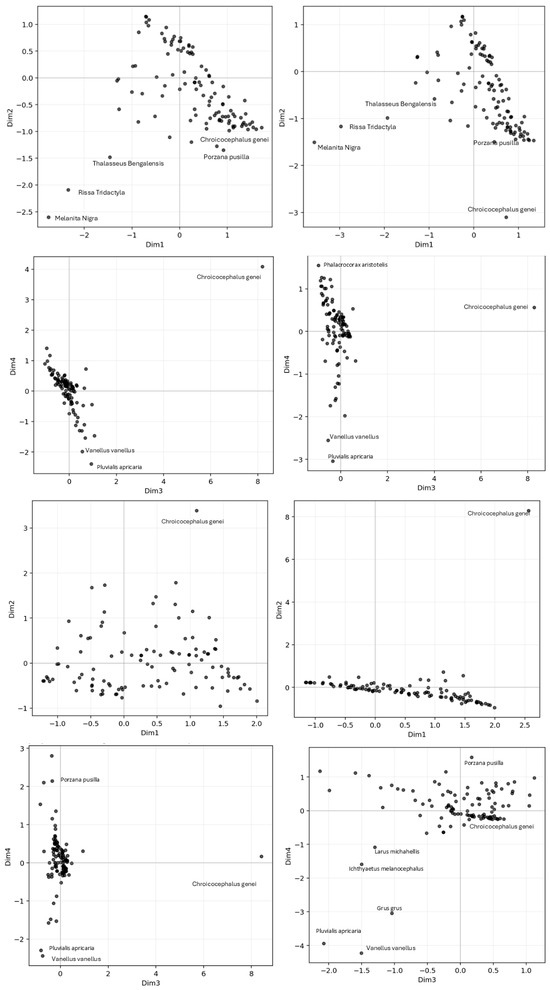
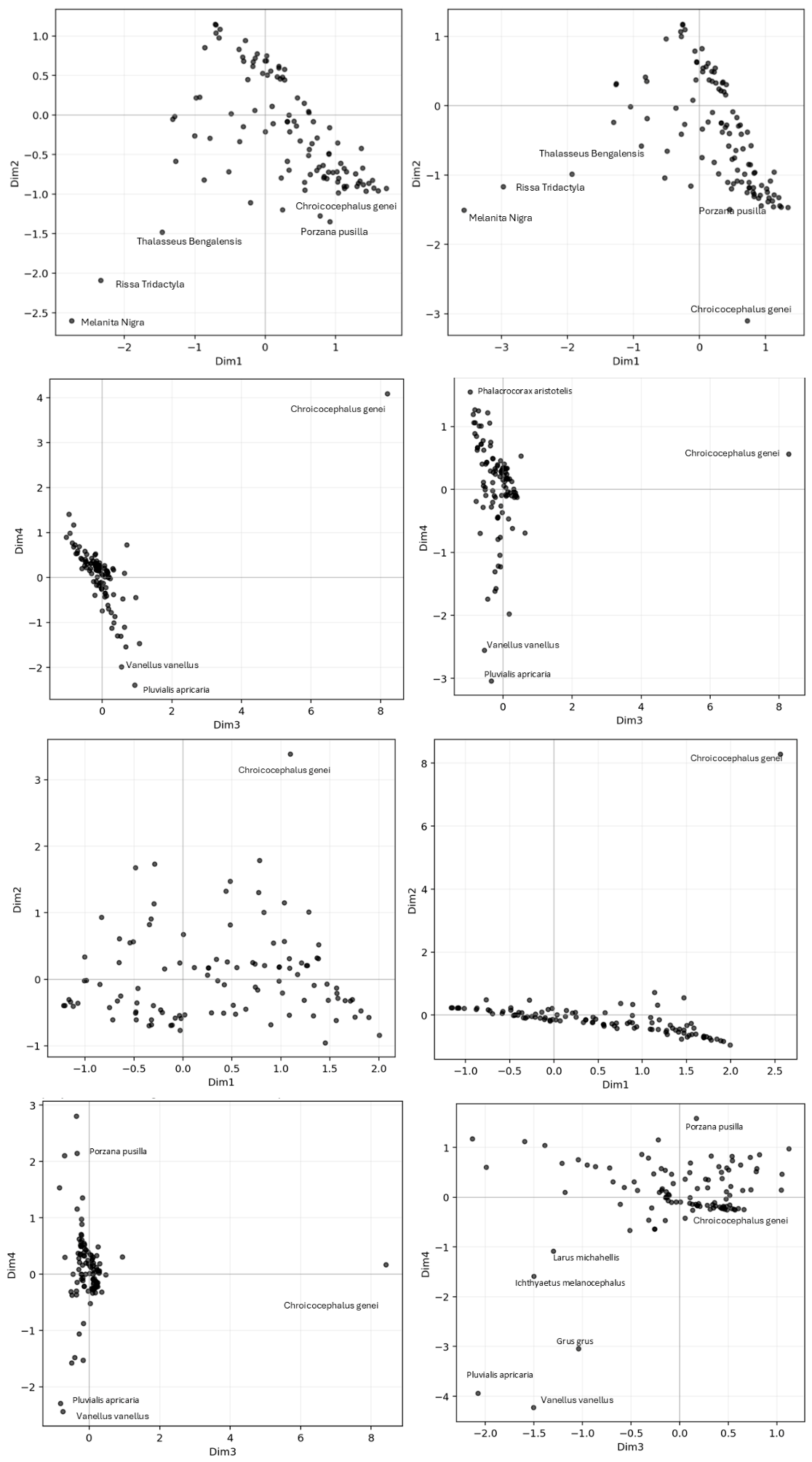
The first CA of raw data showed biased projections of species on planes F1 × F2 (Figure 1), as the strictly marine bird Melanita nigra (DP = 0.66) is isolated along the F1 and F2 axes, dragging two other selective species, Thalasseus bengalensis and Rissa tridactyla, behind, which cohabitate with it in some areas. With a CA applied to the DP-weighted data, these three species showed the same behavior on F1, while another selective species, Chroicocephalus genei (DP = 0.78), is isolated by F2. The F3 × F4 plane revealed additional species, more precisely Vanellus vanellus (DP = 0.57) and Pluvialis apricaria (DP = 0.62), both being projected on the negative part of F4, whereas Chroicocephalus genei remains distinctly isolated along F3.
Figure 1.
CA projections on the first four dimensions under three progressive configurations: all species active (first step), Melanitta nigra treated as a supplementary element (second step). Left panels, unweighted abundances; right panels, weighted abundances.
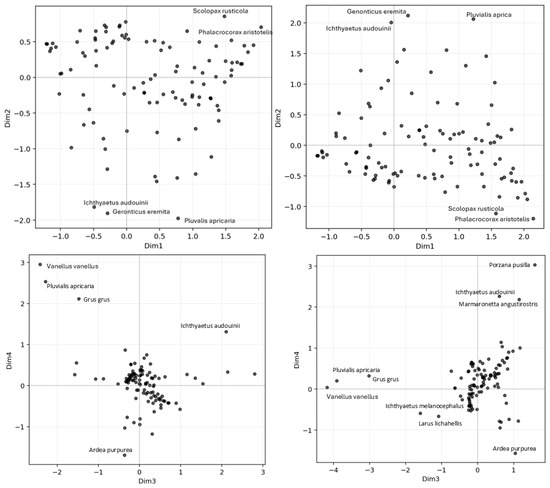
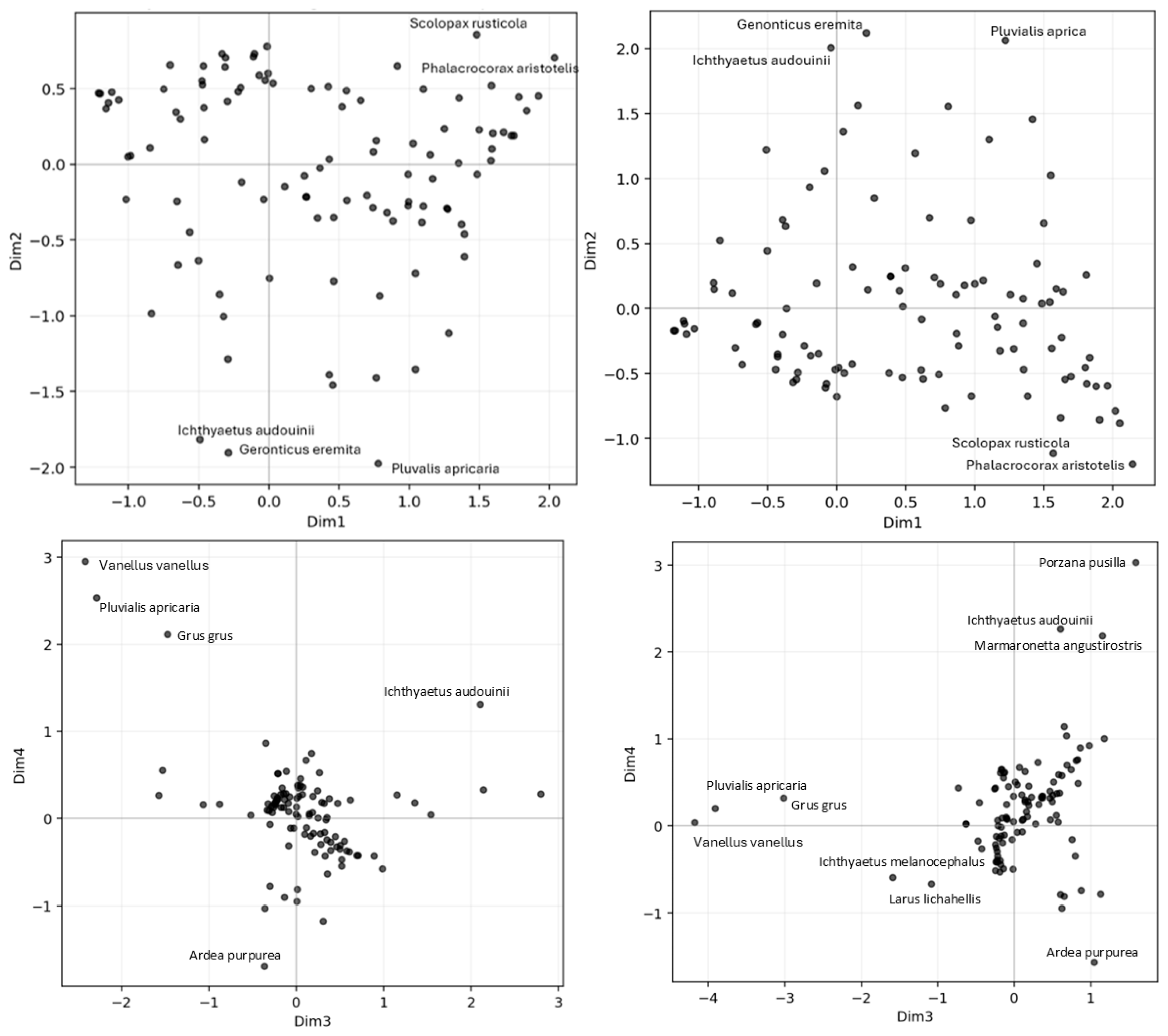
To remove the influence of these species in the CA, we first proceeded to a new treatment where M. nigra is considered a supplementary element (Figure 1). Then, C. genei appeared as a particular species in the F1 × F2 plane, imposing a third analysis (Figure 2). This provided a configuration of the species-specific cloud in the first factorial plane of both raw and weighted data that was quite similar, while in the F3 × F4 plane, additional species appear, with some of them having changed their relative position in these planes (Porzana pusilla, Vanellus vanellus, Pluvialis apricaria, Grus grus, Ichthyaetus audouinii, Marmaronetta angustirostris, and Ardea purpurea).
Figure 2.
CA projections on the first four dimensions with both M. nigra and C. genei treated as supplementary elements. Left graphics, raw abundances; right graphics, weighted abundances.
3.1.2. Changes Induced by DP-Weighting in Species Contributions to CA Inertia
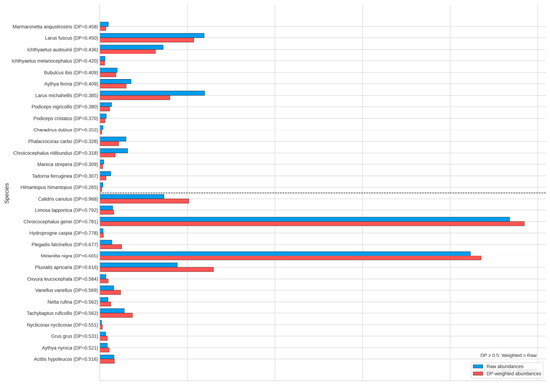
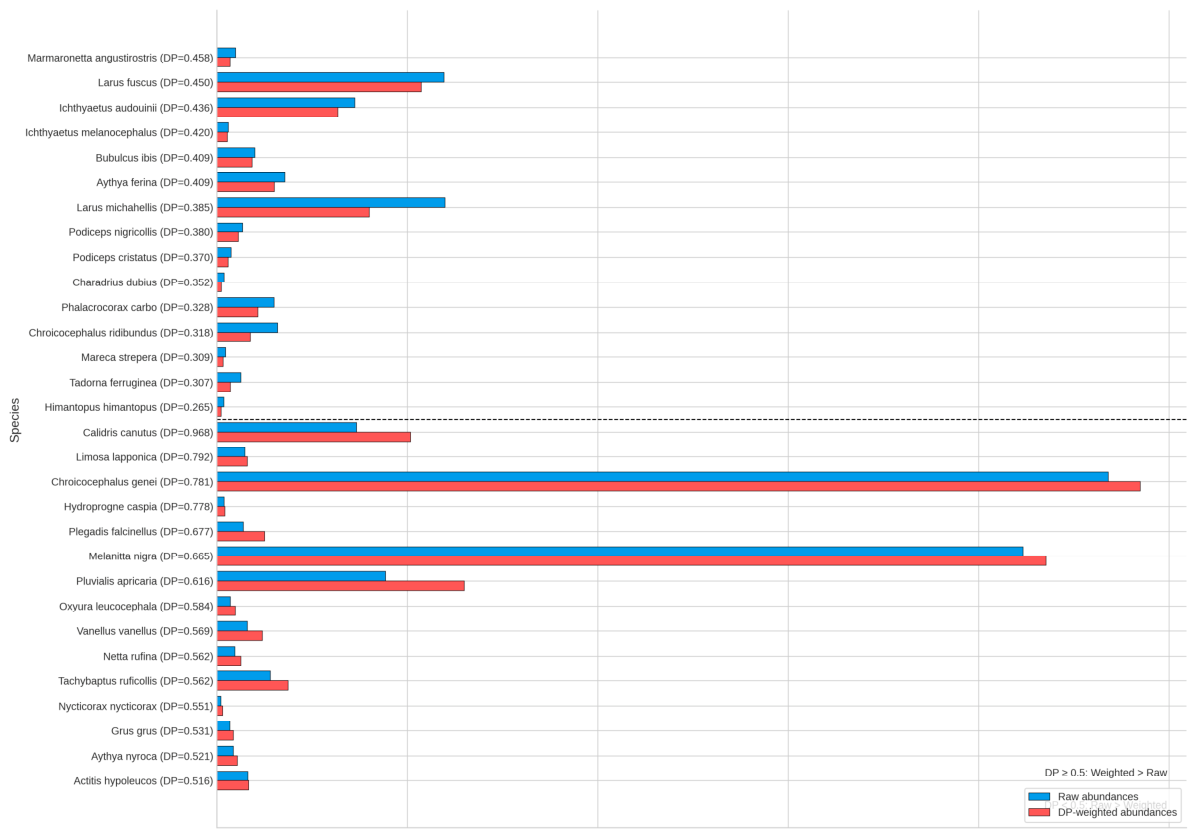
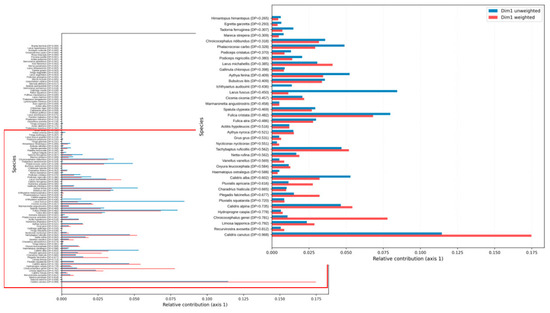
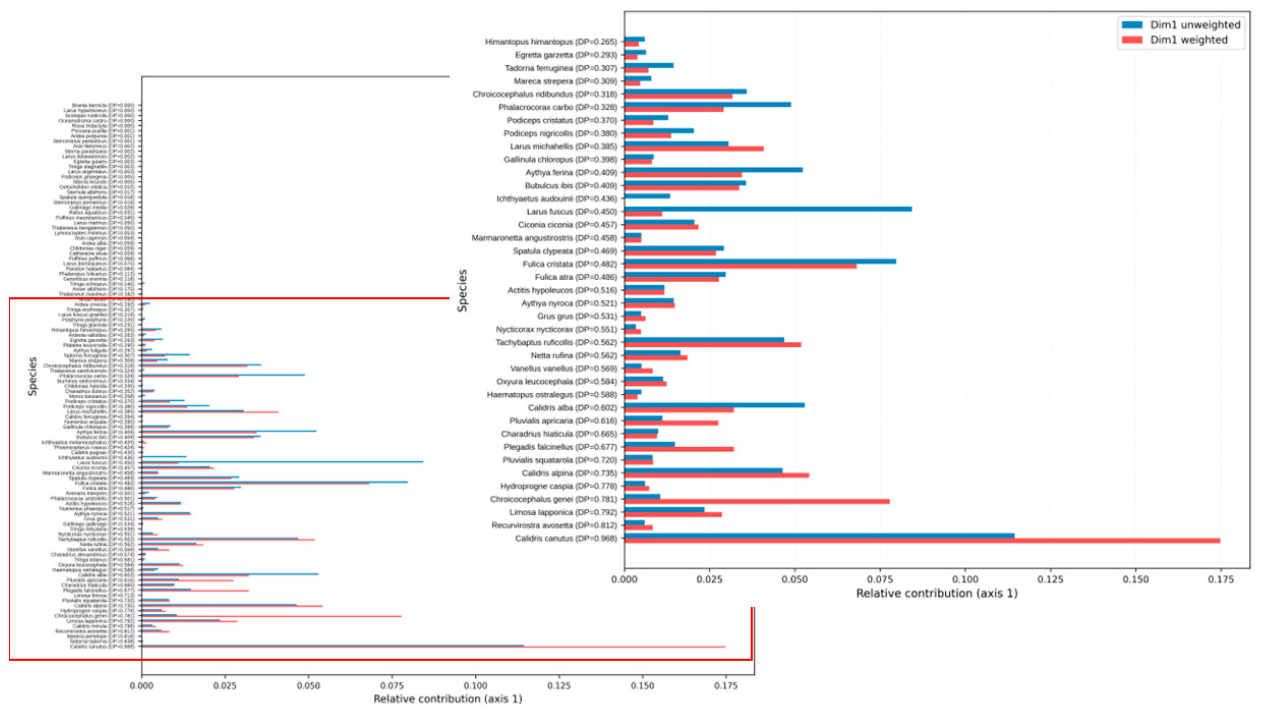
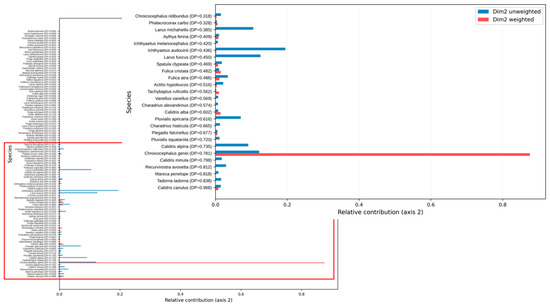
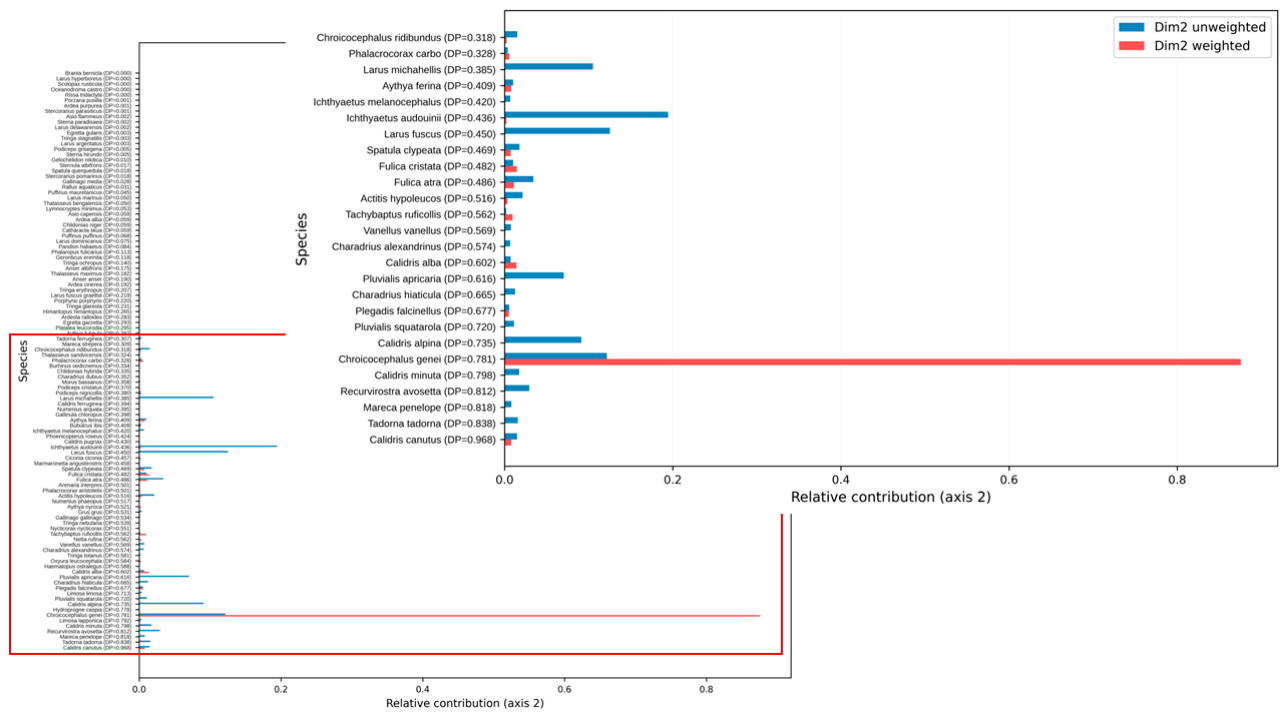
Our hypothesis suggests that the weighting of the raw abundances of species by their DP should lead to a significant reduction rate in the abundances of dominant species with low DP, while this reduction should be of a lower rate for species with high DP. With weighted abundances, these latter species are supposed to have a better relative contribution to the factorial axes. Indeed, the CA results (Figure 3, Figure 4 and Figure 5) show that almost all species with a DP greater than 0.5 (e.g., Melanitta nigra and Chroicocepahlus genei), which are treated here as supplementary elements, have a better mean contribution to axes 1–4 than those with a DP lower than 0.5 (e.g., Aythia ferina, Phalacrocorax carbo). However, Larus fuscus, which has a moderate DP but very high abundances, is an exception to this pattern, as its contribution to the first axis remains high at 5.964 with raw abundances and with weighted abundances at 5.365. DP-weighting does not nullify its influence on the analysis, preserving its preference for coastal habitats.
Figure 3.
Species mean contributions to inertia in axes 1–4 of a CA based on both raw abundances (blue) and DP-weighted abundances (red).
Figure 4.
Relative species contributions to CA axis 1 for raw and DP-weighted datasets, with M. nigra as supplementary element.
Figure 5.
Relative species contributions to CA axis 2 for raw (unweighted) and DP-weighted datasets with M. nigra as supplementary element.
3.2. Impact of DP-Weighting of Abundances on Habitat Clustering
Several clustering methods were tested (Table 1); their comparison proved that the K-medoids model provides the best overall clustering performance for both raw and DP-weighted data, as reflected by the highest silhouette values together with the most favorable Davies–Bouldin and Calinski–Harabasz indices. DP-weighting leads to a consistent improvement in cluster homogeneity, and the Davies–Bouldin index decreases when using the raw data, while we note an increase in the other indices.
Table 1.
Clustering pertinence of K-medoids model based on raw and DP-weighted data.
In the clustering scheme based on raw abundances, the silhouette width shows an optimal value () for and (Table 2). However, with DP-weighted abundances, sw increases to 0.781, suggesting a better cohesion of clusters.
Table 2.
Variation patterns of silhouette width (sw) for raw versus DP-weighted data: silhouette width variation with combined variation of and k in [2,20].
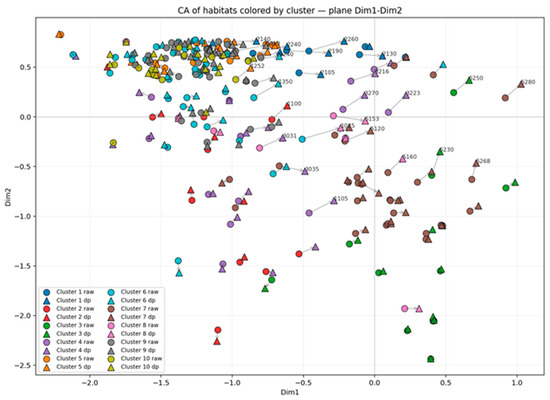
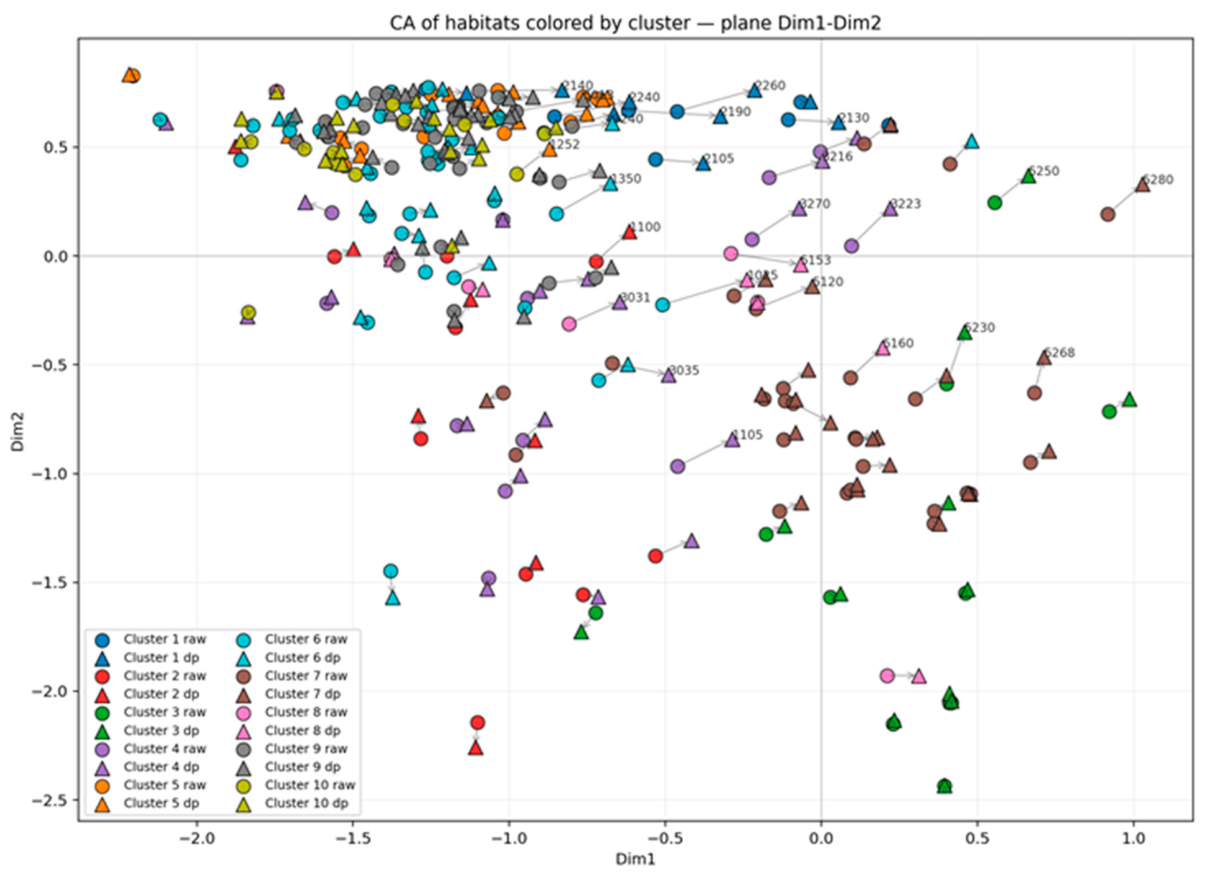
On another hand, for all values, with i in {1, 2, 3}, most silhouettes obtained with DP-weighted data are close to those obtained with the raw data; however, significant changes appeared in the cluster composition (Figure 6), in the sense that some habitats move from one cluster to another (e.g., habitats 2190, 3031, 5160, 3216) when the species abundances are DP-weighted. These changes are supposed to lead to a more ecologically coherent clustering scheme, in terms of the homogeneity of bird composition.
Figure 6.
Displacement of habitats between raw and DP-weighted clusters in CA plane F1 × F2.
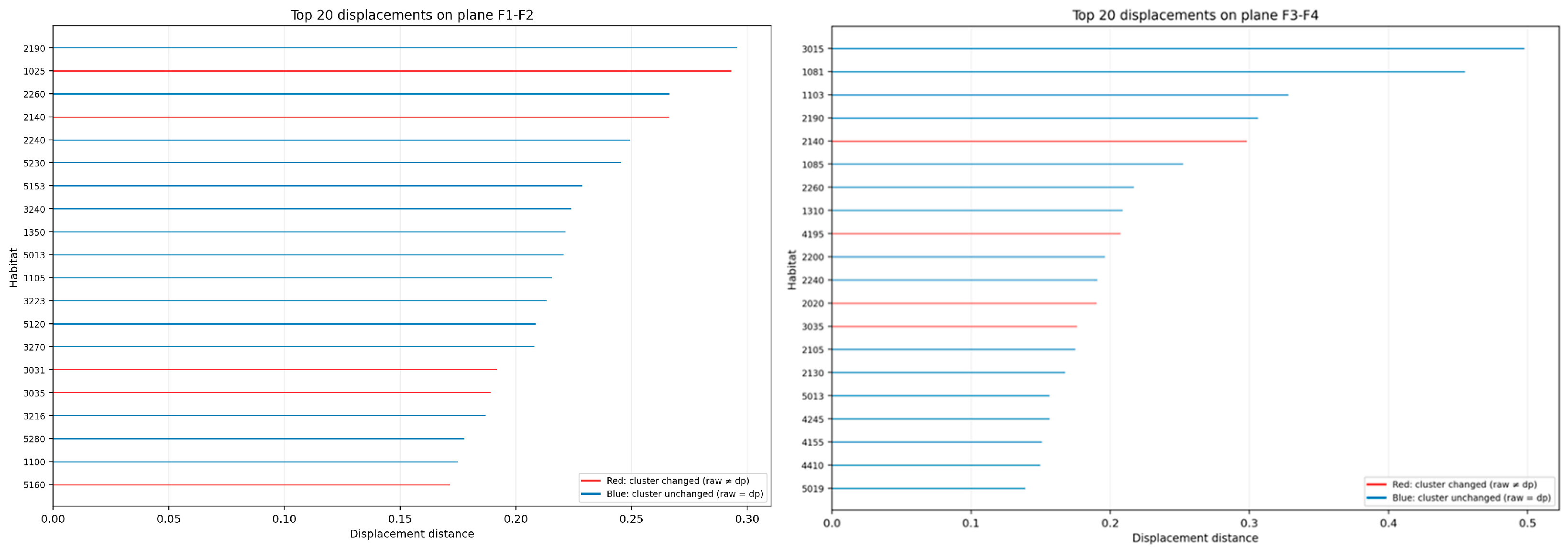
To interpret these changes, we should remember that DP-weighting increases the influence of selective species (with high DP) on habitat ordination via CA and clustering; then, these changes should consist of significant displacements of habitats in CA planes. Indeed, the average distance between habitats is 0.28 in the F1 × F2 plan (Figure 7) and 0.5 in the F3 × F4 plan, and it varies between 0.18 and 0.28 for the top 20 species that operate with high displacements (Figure 7). DP-weighting worked as a recalibration step that did not affect the overall ordination pattern of species and habitats, while it introduces significant changes in assemblage composition.
Figure 7.
Top 20 habitat displacements between raw and DP-weighted configurations in F1–F2 and F3–F4 planes.
To complement these descriptive indices, the stability of both partitions was further evaluated by a non-parametric bootstrap procedure (1000 resamples, following 7). This procedure measures how often each cluster is recovered when the dataset is randomly resampled. For each cluster, the Jaccard similarity index was computed between the original cluster and its best match in every replicate. According to Hennig (2007), values above 0.75 indicate reliable clusters, and values above 0.85 indicate highly stable ones. The DP-weighted partition obtained a mean Jaccard of 0.87 ± 0.04, against 0.76 ± 0.09 for the raw partition (Table 3). The DP-weighted partition therefore falls in the ‘highly stable’ category, while the raw partition only reaches the ‘reliable’ threshold. This demonstrates that the DP-weighting produces a structurally more robust classification, independently of the K-medoids optimization criterion.
Table 3.
Bootstrap-based comparison of mean Jaccard scores between raw and DP-weighted partitions.
4. Discussion
In the present work, we investigated the impact of the DP-weighting of species abundances on the results of multivariate treatments, more precisely on correspondence analysis [5,11,12] and K-medoids clustering [7,17,26]. This impact consists first of favoring the influence of selective species on generalist species. This impact is demonstrated through different results, mainly based on statistical tools but also on empiric ecological interpretations.
The main improvements in the results due to DP-weighting consist of the redistribution of species contributions in the first CA planes, reducing the weight of generalist species in favor of selective species. This is accompanied by a slight reorganization of both species and habitats (or assemblages) in the first analysis planes, in the sense that selective taxa have higher weight and higher influence in reconfiguring assemblage similarities and composition. Indeed, specialized species became more prominent in the structure, while several species moved from a cluster to another, making ordination gradients and clusters ecologically more coherent [27,28,29].
Despite these changes, the general organization of species and habitats in the first two CA planes remains slightly unchanged when using raw or weighted abundances. This confirms a certain stability of the CA method; however, we should point out that our choice was to preserve this stability and a certain influence of the raw abundances as they reflect the real situation, but in other studies, if the user decides to minimize the role of generalist taxa, they can only use a power form of the DP ), which amplifies the differences between low- and high-weighted values, proportionally to x.
In parallel, the hybrid K-medoids framework, which integrates both biological and abiotic data, provides an ecologically coherent habitat classification, in terms of gradient and cluster pertinence. This supports the idea that medoid-based partitioning is particularly well suited to ecological datasets, which are often heterogeneous and generally structured in gradients. Compared to alternatives such as Agglomerative Average, Agglomerative Complete, Spectral Clustering, and DBSCAN [26,30], K-medoids achieved higher silhouette values and more favorable Davies–Bouldin and Calinski–Harabasz indices [27,28,31], confirming its robustness for ecological applications.
In CA approaches based on ‘species × habitats’ tables, the DP-weighting of abundances differs from common data transformations (e.g., logarithmic or classes) that reduce high abundance–dominance values and from presence–absence approaches that discard quantitative information [32,33,34]. Instead, DP retains abundance data but modulates it according to the species degree of habitat selectivity, offering an intermediate solution between raw abundance and incidence-only analyses. This makes the approach particularly relevant in assemblages, where communities often mix ubiquitous and habitat-selective species [27,28].
Beyond waterbirds, the broader question of how to weight species abundances in multivariate biotypologies has been addressed for several decades, starting from the 1970s ([35,36], etc.). Most studies imposed logarithmic data correction in order to minimize the impact of very abundant species. In Morocco, Dakki [8] produced the first typologies of the High Sebou River, using benthic Insects; remarking that the AFC results are highly dependent on the ubiquitous species, he proposed a complementary analysis of the High Sebou assemblages, combining the DP index with the abundances. Across these studies, a common finding emerges: a multivariate analysis based on raw abundances over-weights ubiquitous taxa and produces typologies of low ecological value, and a species-level correction focused on selectivity is needed to recover ecologically meaningful classes. Our work extended multivariate approaches from a descriptive use to species and habitats conservation uses.
In this study, we chose a large dataset, hoping to benefit from the high diversity of both species and habitats. However, smaller demonstration datasets would likely produce more easily readable results.
5. Conclusions
We sought to rectify the analytical pre-eminence of generalist species in multivariate analyses of ‘species × habitats’ matrices and to evaluate whether weighting abundances by the species’ DP could produce more ecologically significant clusters of assemblages. We think that these goals were fully reached, as the results support our initial hypotheses. Indeed, using a large matrix of ‘waterbird × wetlands’, DP-weighting affected species contributions along the ordination axes of the correspondence analysis in a way that makes habitat-selective taxa more contributory and more visible in the analyses. On another hand, among several clustering methods, the hybrid K-medoids framework provided consistent and homogeneous habitat groupings, as confirmed by four independent validation criteria (ASW, DB, CH and bootstrap stability). In the studied example, DP-weighting produced a highly stable partition (mean Jaccard = 0.87) against a less robust raw partition (mean Jaccard = 0.76) and made several habitats move across boundaries of raw abundance clusters and settle into more homogeneous groups. This consistent improvement across all validation criteria confirms the operational value of the DP-weighting approach.
DP-weighting is therefore not just a statistical adjustment but an ecological operational correction, as it generates assemblage and habitat typologies that are both statistically sound and ecologically meaningful, and it confirms that the use of raw abundances can restrict the role of indicator species, which are under the dominance shadow of generalists. In addition to its ecological significance, this approach helps nature managers to objectively identify which habitats are preferred by which species and to decide between indicator-based assessments and conservation measures, as well as prior monitoring programs. These expectations are now feasible, as the DP computation is made easy thanks to the EcoAPD tool that is already available through the apd.biodiversity.ma platform.
The weighting method is straightforward enough to be added to most existing pipelines as a pre-processing step before any multivariate biotypology, while K-medoids is particularly useful when the dataset combines living taxa with abiotic descriptors of habitats. For widespread implementation, the proposed workflow can be summarized in four steps: (i) compute DP values for each species from regional abundance data; (ii) weight raw abundances by the corresponding DP values; (iii) apply correspondence analysis followed by K-medoids clustering; and (iv) interpret the resulting clusters for conservation decisions. However, we should keep in mind that the DP index is affected by how many habitats are looked at and how much effort is put into sampling, so its use depends on the sampling design, as indicated in [9]. Although the method was tested on Moroccan wetland fauna, the framework is fully transferable to other biogeographical regions and other taxonomic groups, provided that abundance data are available across multiple habitat types.
Subsequent research also ought to examine the amalgamation of DP-weighting with functional diversity metrics and investigate its incorporation into a formal conservation framework, such as Marxan Planning Platform, thereby facilitating the evidence-based management of ecosystems.
Supplementary Materials
The following supporting information can be downloaded at: https://www.mdpi.com/article/10.3390/d18060316/s1, Data S1: classification_data.
Author Contributions
M.E.: Conceptualization; Investigation; Visualization; Methodology; Writing—original draft; Formal analysis; Software; Writing—review & editing. M.D.: Conceptualization; Investigation; Visualization; Methodology; Validation; Supervision; Y.O.: Writing—review & editing. S.Z.: Validation, Supervision. All authors have read and agreed to the published version of the manuscript.
Funding
This research received no external funding.
Institutional Review Board Statement
Not applicable.
Data Availability Statement
The data supporting the findings of this study are derived from the International Waterbird Census (IWC), coordinated globally by Wetlands International and implemented in Morocco by GREPOM/BirdLife Maroc since 1983. For the present study, the analyses were based on data collected during the 2019–2023 period, including a matrix of 109 waterbird species recorded across 166 wetlands in Morocco, together with site surface area and ecosystem type descriptors based on Dakki (2021). The Excel file (Data S1) containing the data used in this study is attached with the revised submission.
Acknowledgments
The authors would like to express their sincere gratitude to the National Centre for Scientific and Technical Research (CNRST, Morocco) for providing facilities and resources to ensure a part of this research.
Conflicts of Interest
The authors declare no conflicts of interest.
References
- Margules, C.R.; Pressey, R.L. Systematic conservation planning. Nature 2000, 405, 243–253. [Google Scholar] [CrossRef] [Scilit]
- Gaston, K.J. Global patterns in biodiversity. Nature 2000, 405, 220–227. [Google Scholar] [CrossRef] [Scilit]
- Benzécri, J.P. L’Analyse des Données. II. L’analyse des Correspondances; Dunod: Paris, France, 1973. [Google Scholar]
- Hill, M.O. Correspondence Analysis: A Neglected Multivariate Method. J. R. Stat. Soc. Ser. C Appl. Stat. 1974, 23, 340–354. [Google Scholar] [CrossRef] [Scilit]
- ter Braak, C.J.F.; Verdonschot, P.F.M. Canonical correspondence analysis and related multivariate methods in aquatic ecology. Aquat. Sci. 1995, 57, 255–289. [Google Scholar] [CrossRef] [Scilit]
- van Dam, A.; Dekker, M.; Morales-Castilla, I.; Rodríguez, M.Á.; Wichmann, D.; Baudena, M. Correspondence analysis, spectral clustering and graph embedding: Applications to ecology and economic complexity. Sci. Rep. 2021, 11, 8926. [Google Scholar] [CrossRef] [Scilit]
- Tahiri, N.; Willems, M.; Makarenkov, V. A new fast method for inferring multiple consensus trees using k-medoids. BMC Evol. Biol. 2018, 18, 48. [Google Scholar] [CrossRef] [Scilit]
- Dakki, M. Ecosystèmes d’eau courante du haut Sebou (Moyen Atlas): études typologiques et analyses écologique et biogéographique des principaux peuplements entomologiques. Trav. l’Inst. Sci. Série Zool. 1987, 42, 1–100. [Google Scholar]
- Dakki, M.; Ennakri, M.; El Farouki, M.; Ziti, S.; Zoglat, A. A graphical method for analysing species assemblages combining habitat preference and abundance. Afr. J. Ecol. 2025, 63, e70013. [Google Scholar] [CrossRef] [Scilit]
- Ennakri, M.; Dakki, M.; El Farouki, M.; Ziti, S.; Zoglat, A. The abundance-preference method for assemblage analysis: A normalized diagram with algorithm implementing the method. Diversity 2025, 17, 598. [Google Scholar] [CrossRef] [Scilit]
- Greenacre, M. Correspondence Analysis in Practice, 3rd ed.; Chapman & Hall/CRC: Boca Raton, FL, USA, 2017. [Google Scholar] [CrossRef] [Scilit]
- Legendre, P.; Legendre, L. Numerical Ecology, 3rd ed.; Elsevier: Amsterdam, The Netherlands, 2012. [Google Scholar]
- Wetlands International. Waterbird Population Estimates Portal; Wetlands International: Wageningen, The Netherlands, 2025. [Google Scholar]
- de Mello, K.; Garcia, E.A.; Kopf, R.K.; Richards, A.E. Biodiversity indicators for wetland condition assessment and monitoring. In Urban Watershed Microbiology; Springer: Cham, Switzerland, 2025; Volume 2. [Google Scholar] [CrossRef] [Scilit]
- Sutherland, W.J. Ecological Census Techniques: A Handbook, 2nd ed.; Cambridge University Press: Cambridge, UK, 2006. [Google Scholar] [CrossRef] [Scilit]
- Kaufman, L.; Rousseeuw, P.J. Finding Groups in Data: An Introduction to Cluster Analysis; Wiley: New York, NY, USA, 1990. [Google Scholar]
- Van Rossum, G.; Drake, F.L. Python 3 Reference Manual; CreateSpace: Scotts Valley, CA, USA, 2009. [Google Scholar]
- Anderson, M.J.; Ellingsen, K.E.; McArdle, B.H. Multivariate dispersion as a measure of beta diversity. Ecol. Lett. 2006, 9, 683–693. [Google Scholar] [CrossRef] [Scilit]
- Bray, J.R.; Curtis, J.T. An ordination of the upland forest communities of southern Wisconsin. Ecol. Monogr. 1957, 27, 325–349. [Google Scholar] [CrossRef] [Scilit] [PubMed]
- Gower, J.C. A general coefficient of similarity and some of its properties. Biometrics 1971, 27, 857–871. [Google Scholar] [CrossRef] [Scilit]
- Bhat Kapu, S.; Kiruthika. Some density-based silhouette diagnostics for soft clustering algorithms. Commun. Stat. Case Stud. Data Anal. Appl. 2024, 10, 221–238. [Google Scholar] [CrossRef] [Scilit]
- Sträng, H.; Dinh, T. An upper bound on the silhouette evaluation metric for clustering. Pattern Recognit. 2026, 178, 113402. [Google Scholar] [CrossRef] [Scilit]
- Halkidi, M.; Batistakis, Y.; Vazirgiannis, M. On Clustering Validation Techniques. J. Intell. Inf. Syst. 2001, 17, 107–145. [Google Scholar] [CrossRef] [Scilit]
- Arbelaitz, O.; Gurrutxaga, I.; Muguerza, J.; Pérez, J.M.; Perona, I. An extensive comparative study of cluster validity indices. Pattern Recognit. 2013, 46, 243–256. [Google Scholar] [CrossRef] [Scilit]
- Devictor, V.; Clavel, J.; Julliard, R.; Lavergne, S.; Mouillot, D.; Thuiller, W.; Venail, P.; Villéger, S.; Mouquet, N. Defining and measuring ecological specialization. J. Appl. Ecol. 2010, 47, 15–25. [Google Scholar] [CrossRef] [Scilit]
- Mouillot, D.; Graham, N.A.J.; Villéger, S.; Mason, N.W.H.; Bellwood, D.R. A functional approach reveals community responses to disturbances. Trends Ecol. Evol. 2013, 28, 167–177. [Google Scholar] [CrossRef] [Scilit] [PubMed]
- Anderson, M.J. A new method for non-parametric multivariate analysis of variance. Austral Ecol. 2001, 26, 32–46. [Google Scholar] [CrossRef] [Scilit]
- Clarke, K.R. Non-parametric multivariate analyses of changes in community structure. Austral Ecol. 1993, 18, 117–143. [Google Scholar] [CrossRef] [Scilit]
- Faith, D.P.; Minchin, P.R.; Belbin, L. Compositional dissimilarity as a robust measure of ecological distance. Vegetatio 1987, 69, 57–68. [Google Scholar] [CrossRef] [Scilit]
- Podani, J. Multivariate Analysis in Ecology and Systematics: A Methodological Introduction; SPB Academic Publishing: The Hague, The Netherlands, 1994. [Google Scholar]
- Hennig, C. Cluster-wise assessment of cluster stability. Comput. Stat. Data Anal. 2007, 52, 258–271. [Google Scholar] [CrossRef] [Scilit]
- McCune, B.; Grace, J.B. Analysis of Ecological Communities; MjM Software Design: Gleneden Beach, OR, USA, 2002. [Google Scholar]
- Verneaux, J. Cours d’eau de Franche-Comté (Massif du Jura): Recherches Écologiques sur le Réseau Hydrographique du Doubs; Essai de Biotypologie. Ph.D. Thesis, Université de Besançon, Besançon, France, 1973. [Google Scholar]
- Verneaux, J. Biotypologie de l’écosystème “eau courante”. Comptes Rendus L’académie Sci. Paris 1976, 283D, 1791–1794. [Google Scholar]
- Wright, J.F.; Moss, D.; Armitage, P.D.; Furse, M.T. A preliminary classification of running-water sites in Great Britain based on macroinvertebrate species and the prediction of community type using environmental data. Freshw. Biol. 1984, 14, 221–256. [Google Scholar] [CrossRef] [Scilit]
- Hawkes, H.A. Origin and development of the Biological Monitoring Working Party score system. Water Res. 1998, 32, 964–968. [Google Scholar] [CrossRef] [Scilit]

Disclaimer/Publisher’s Note: The statements, opinions and data contained in all publications are solely those of the individual author(s) and contributor(s) and not of MDPI and/or the editor(s). MDPI and/or the editor(s) disclaim responsibility for any injury to people or property resulting from any ideas, methods, instructions or products referred to in the content. |
© 2026 by the authors. Licensee MDPI, Basel, Switzerland. This article is an open access article distributed under the terms and conditions of the Creative Commons Attribution (CC BY) license.