
Untapped Diversity of Termite-Associated Ophiocordyceps and a New Species from China

 ,
,
Abstract
1. Introduction
2. Materials and Methods
2.1. Specimen Collection
2.2. Morphological Characterization
2.3. Extraction of DNA, Polymerase Chain Reaction (PCR), and Molecular Sequencing
2.4. Phylogenetic Analyses
3. Results
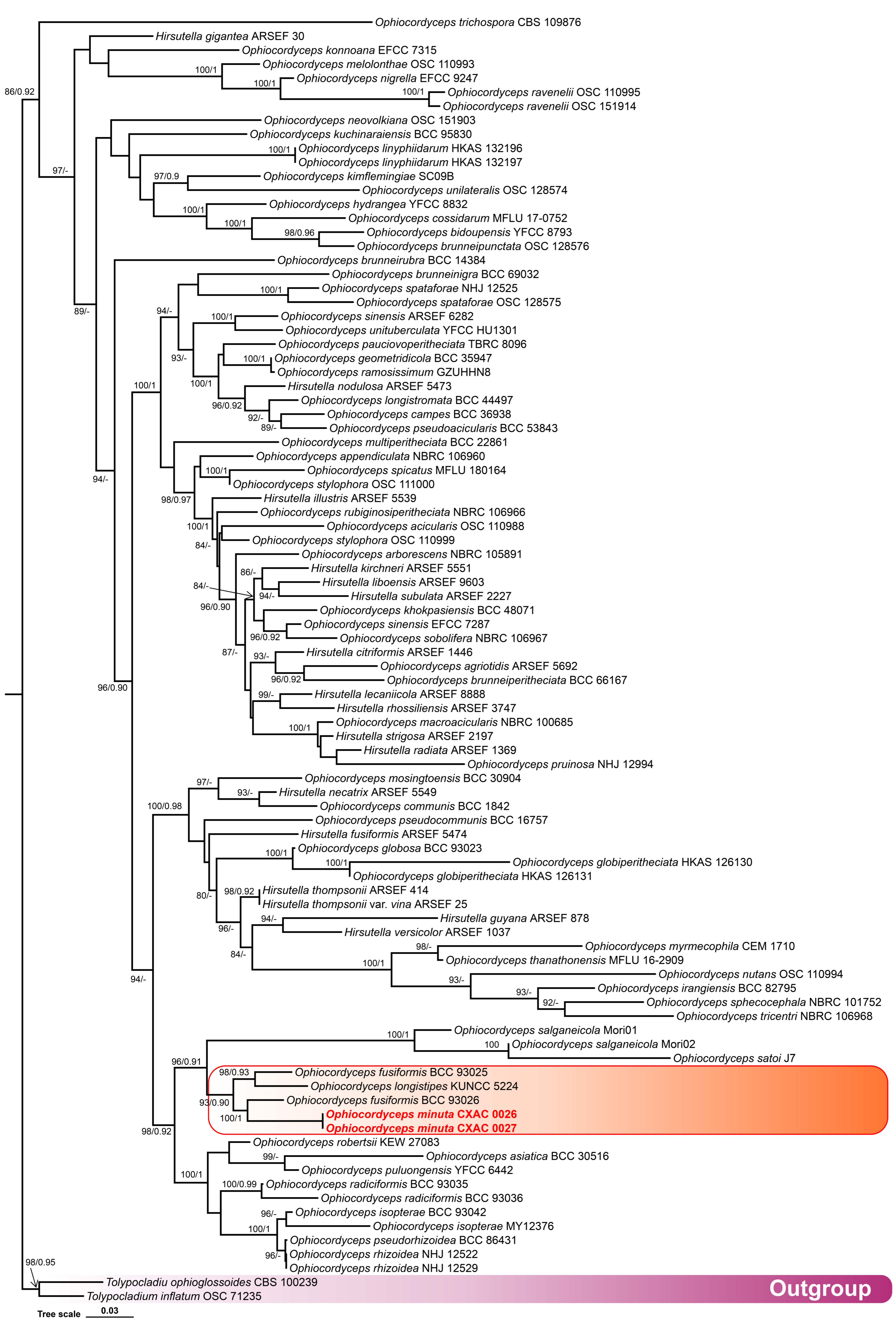
3.1. Phylogenetic Analyses
3.2. Taxonomy
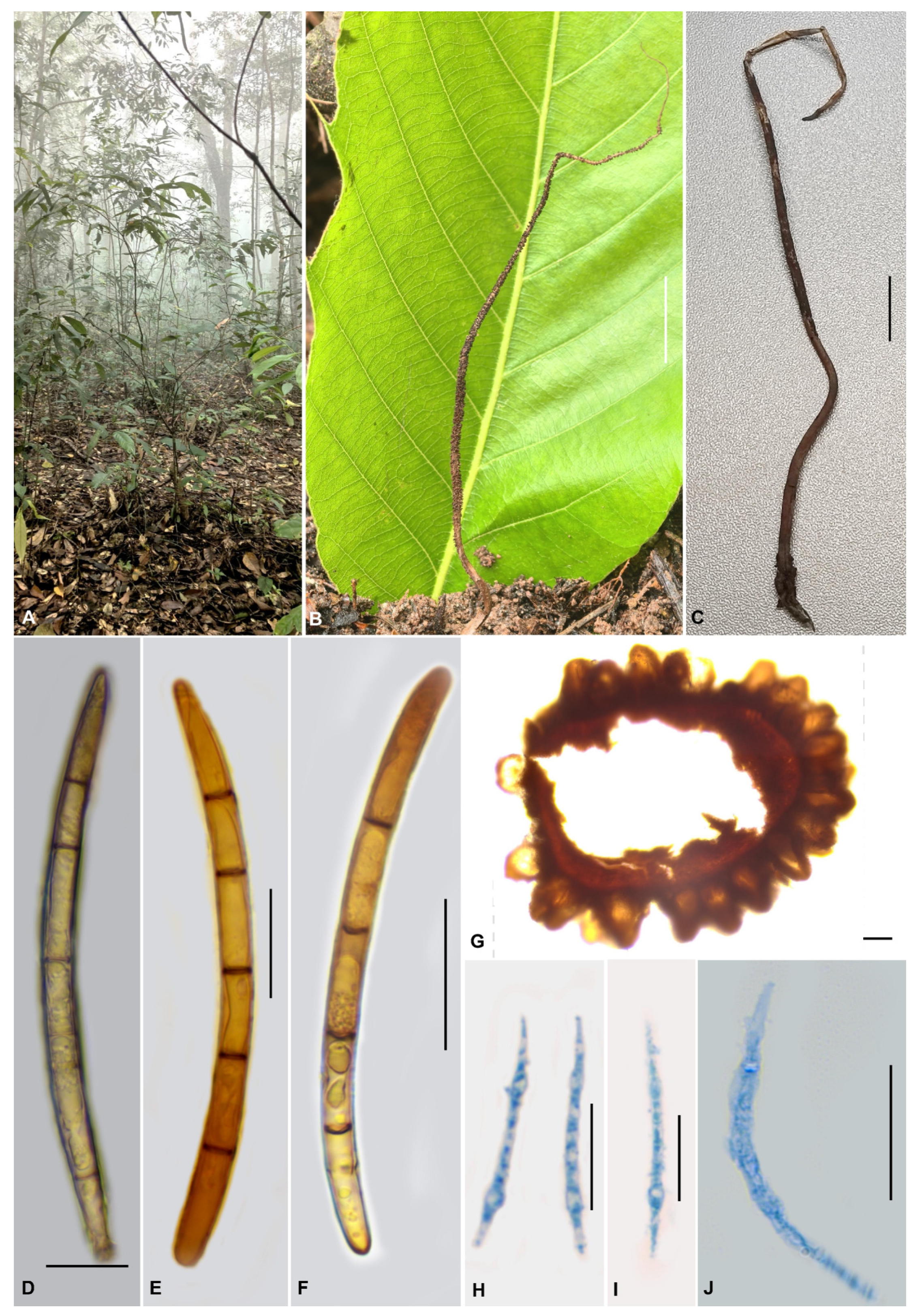
3.3. Morphological Characters and Their Taxonomic Significance in Termite-Associated Ophiocordyceps Species
4. Discussion
Author Contributions
Funding
Institutional Review Board Statement
Data Availability Statement
Conflicts of Interest
References
- Dong, Q.Y.; Wang, Y.; Wang, Z.Q.; Tang, D.X.; Zhao, Z.Y.; Wu, H.J.; Yu, H. Morphology and phylogeny reveal five novel species in the genus Cordyceps (Cordycipitaceae, Hypocreales) from Yunnan, China. Front. Microbiol. 2022, 13, 846909. [Google Scholar] [CrossRef] [PubMed]
- Sung, G.H.; Hywel-Jones, N.L.; Sung, J.M.; Luangsa-ard, J.J.; Shrestha, B.; Spatafora, J.W. Phylogenetic classification of Cordyceps and the clavicipitaceous fungi. Stud. Mycol. 2007, 57, 5–59. [Google Scholar] [CrossRef]
- Araújo, J.P.M.; Evans, H.C.; Kepler, R.M.; Hughes, D.P. Zombie-ant fungi across continents: 15 new species and new combinations within Ophiocordyceps. I. Myrmecophilous hirsutelloid species. Stud. Mycol. 2018, 90, 119–160. [Google Scholar] [CrossRef]
- Thanakitpipattana, D.; Tasanathai, K.; Lamlertthon, S.; Luangsa-ard, J.J.; Mongkolsamrit, S.; Khonsanit, A. Fungal pathogens occurring on Orthopterida in Thailand. Persoonia 2020, 44, 140–160. [Google Scholar] [CrossRef]
- Zhang, X.; Peng, X.C.; Wei, D.P.; Wang, Y.; Norphanphoun, C.; Hongsanan, S.; Xie, N.; Liu, Z.L.; Mapook, A.; Kang, J.C.; et al. Reappraisal of the phylogenetic relationships of hirsutella-like fungi across Ophiocordycipitaceae and Polycephalomycetaceae (Hypocreales, Sordariomycetes), and the description of seven new species. IMA Fungus 2026, 17, 171084. [Google Scholar] [CrossRef]
- Dai, Y.D.; Guan, Y.H.; Wu, S.M.; Bibi, S.; Chen, H.; Loinheuang, C.; Liang, J.D.; Wang, Y. Taxonomic and phylogenetic insights into dipteran-parasitizing Ophiocordyceps: Descriptions of two new species and a new record from China and Laos. MycoKeys 2026, 127, 217–238. [Google Scholar] [CrossRef]
- Wang, Y.B.; Nguyen, T.T.; Dai, Y.D.; Yu, H.; Zeng, W.B.; Wu, C.K. Molecular phylogeny and morphology of Ophiocordyceps unituberculata sp. nov. (Ophiocordycipitaceae), a pathogen of caterpillars (Noctuidae, Lepidoptera) from Yunnan, China. Mycol. Prog. 2018, 17, 745–753. [Google Scholar] [CrossRef]
- Tasanathai, K.; Noisripoom, W.; Chaitika, T.; Khonsanit, A.; Hasin, S.; Luangsa-ard, J.J. Phylogenetic and morphological classification of Ophiocordyceps species on termites from Thailand. MycoKeys 2019, 56, 101–129. [Google Scholar] [CrossRef]
- Araujo, J.P.M.; Moriguchi, M.G.; Uchiyama, S.; Kinjo, N.; Matsuura, Y. Ophiocordyceps salganeicola, a parasite of social cockroaches in Japan and insights into the evolution of other closely-related Blattodea-associated lineages. IMA Fungus 2021, 12, 3. [Google Scholar] [CrossRef] [PubMed]
- Petch, T. Notes on entomogenous fungi. Trans. Br. Mycol. Soc. 1931, 16, 55–75. [Google Scholar] [CrossRef]
- Yang, Y.; Xiao, Y.P.; Jayawardena, R.S.; Hyde, K.D.; Nilthong, S.; Mapook, A.; Lu, Y.Z.; Xie, S.Q.; Al-Otibi, F.; Wang, X.; et al. Three new species of Ophiocordyceps (Hypocreales, Ophiocordycipitaceae) and a new host record for Hirsutella vermicola from China. MycoKeys 2025, 117, 289–313. [Google Scholar] [CrossRef]
- Xie, S.W.; Wei, D.P.; Qiu, J.Z.; Peng, X.C.; Kang, J.C.; He, Z.J.; Li, Z.Z.; Li, C.R.; Huang, S.K.; Zhang, X.; et al. Overview of hirsutella-like anamorphs in Ophiocordyceps (Sordariomycetes, Ophiocordycipitaceae): Introducing two new species and one new record from China. MycoKeys 2025, 119, 95–121. [Google Scholar] [CrossRef] [PubMed]
- Zou, W.Q.; Tang, D.X.; Xu, Z.H.; Huang, O.; Wang, Y.B.; Tran, N.-L.; Yu, H. Multigene phylogeny and morphology reveal Ophiocordyceps hydrangea sp. nov. and Ophiocordyceps bidoupensis sp. nov. (Ophiocordycipitaceae). MycoKeys 2022, 92, 109–130. [Google Scholar] [CrossRef]
- Sun, T.; Zou, W.Q.; Dong, Q.Y.; Huang, O.; Tang, D.X.; Yu, H. Morphology, phylogeny, mitogenomics and metagenomics reveal a new entomopathogenic fungus Ophiocordyceps nujiangensis (Hypocreales, Ophiocordycipitaceae) from Southwestern China. MycoKeys 2022, 94, 91–108. [Google Scholar] [CrossRef]
- Tang, D.X.; Huang, O.; Zou, W.Q.; Wang, Y.; Dong, Q.Y.; Sun, T.; Yang, G.; Yu, H. Six new species of zombie-ant fungi from Yunnan in China. IMA Fungus 2023, 14, 9. [Google Scholar] [CrossRef]
- Araujo, J.P.M.; Evans, H.C.; Fernandes, I.O.; Ishler, M.J.; Hughes, D.P. Zombie-ant fungi cross continents: II. Myrmecophilous hymenostilboid species and a novel zombie lineage. Mycologia 2020, 112, 1138–1170. [Google Scholar] [CrossRef]
- Inward, D.; Beccaloni, G.; Eggleton, P. Death of an order: A comprehensive molecular phylogenetic study confirms that termites are eusocial cockroaches. Biol. Lett. 2007, 3, 331–335. [Google Scholar] [CrossRef]
- Hellemans, S.; Rocha, M.M.; Wang, M.; Romero Arias, J.; Aanen, D.K.; Bagnères, A.-G.; Buček, A.; Carrijo, T.F.; Chouvenc, T.; Cuezzo, C.; et al. Genomic data provide insights into the classification of extant termites. Nat. Commun. 2024, 15, 6724. [Google Scholar] [CrossRef] [PubMed]
- Krishna, K.; Grimaldi, D.A.; Krishna, V.; Engel, M.S. Treatise on the Isoptera of the World. Bull. Am. Mus. Nat. Hist. 2013, 377, 1–200. [Google Scholar] [CrossRef]
- Wu, D.H.; Du, E.; Eisenhauer, N.; Mathieu, J.; Chu, C.J. Global engineering effects of soil invertebrates on ecosystem functions. Nature 2025, 640, 120–129. [Google Scholar] [CrossRef] [PubMed]
- Fan, Q.; Yang, T.; Li, H.; Wang, X.M.; Liao, H.F.; Shen, P.H.; Yang, Z.L.; Zeng, W.B.; Wang, Y.B. Molecular phylogeny and morphology reveal two new entomopathogenic species of Ophiocordyceps (Ophiocordycipitaceae, Hypocreales) parasitic on termites from China. MycoKeys 2024, 103, 1–24. [Google Scholar] [CrossRef]
- Xu, Z.H.; Tran, N.L.; Wang, Y.; Zhang, G.D.; Dao, V.M.; Nguyen, T.T.; Wang, Y.B.; Yu, H. Phylogeny and morphology of Ophiocordyceps puluongensis sp. nov. (Ophiocordycipitaceae, Hypocreales), a new fungal pathogen on termites from Vietnam. J. Invertebr. Pathol. 2022, 192, 107771. [Google Scholar] [CrossRef] [PubMed]
- Samarakoon, M.C.; Hsu, K.C.; Chiu, C.I.; Chen, C.Y.; Li, H.F.; Haituk, S. Ophiocordyceps taiwanensis sp. nov. (Ophiocordycipitaceae, Hypocreales) on Odontotermes formosanus (Termitidae, Blattodea). Phytotaxa 2024, 660, 97–111. [Google Scholar] [CrossRef]
- Stifler, C.B. A new genus of Hypocreales. Mycologia 1941, 33, 82–86. [Google Scholar] [CrossRef]
- Penzig, O.; Saccardo, P.A. Icones Fungorum Javanicorum; Buchhandlung and Druckerei EJ Brill: Leide, The Netherlands, 1904; pp. 55–57. [Google Scholar] [CrossRef][Green Version]
- Blackwell, M.; Gilbertson, R.L. New information on Cordycepioideus bisporus and Cordycepioideus octosporus. Mycologia 1984, 76, 763–765. [Google Scholar] [CrossRef]
- Tasanathai, K.; Khonsanit, A.; Noisripoom, W.; Kobmoo, N.; Luangsa-ard, J.J. Hidden species behind Ophiocordyceps (Ophiocordycipitaceae, Hypocreales) on termites: Four new species from Thailand. Mycol. Prog. 2022, 21, 86–102. [Google Scholar] [CrossRef]
- Tang, D.X.; Zhu, J.Y.; Luo, L.J.; Hou, D.H.; Wang, Z.Q.; Yang, S.D.; Yu, H. Ophiocordyceps ovatospora sp. nov. (Ophiocordycipitaceae, Hypocreales), pathogenic on termites from China. Phytotaxa 2022, 574, 105–117. [Google Scholar] [CrossRef]
- Ochiel, G.S.; Evans, H.C.; Eilenberg, J. Cordycepioideus, a pathogen of termites in Kenya. Mycologist 1997, 11, 7–9. [Google Scholar] [CrossRef]
- Dai, Y.D.; Wu, C.K.; Yuan, F.; Wang, Y.B.; Huang, L.D.; Chen, Z.H.; Zeng, W.B.; Wang, Y.; Yang, Z.L.; Zeng, P.S.; et al. Evolutionary biogeography on Ophiocordyceps sinensis: An indicator of molecular phylogeny to geochronological and ecological exchanges. Geosci. Front. 2020, 11, 807–820. [Google Scholar] [CrossRef]
- Dong, Q.Y.; Gao, S.Y.; Zhou, J.N.; Xu, C.D.; Wang, Z.J.; Zeng, N.K. Verticillium-like anamorphic fungi in Sordariomycetes from Southwestern China: Two new taxa and a new record. J. Fungi 2025, 11, 598. [Google Scholar] [CrossRef] [PubMed]
- Liao, Z.Y.; Yang, D.R.; Kong, D.B.; Guan, Y.F.; Zhang, Y.; Zeng, J.; Wang, X.B.; Yuan, Y.L.; Deng, Z.J.; Zhang, Y. Distribution patterns of insect diversity along elevation gradients in Southeastern margin of Qinghai-Tibetan plateau. Res. J. Environ. Sci. 2024, 37, 2138–2147. [Google Scholar] [CrossRef]
- Ashton, L.A.; Nakamura, A.; Burwell, C.J.; Tang, Y.; Cao, M.; Whitaker, T.; Sun, Z.; Huang, H.; Kitching, R.L. Elevational sensitivity in an Asian ‘hotspot’: Moth diversity across elevational gradients in tropical, sub-tropical and sub-alpine China. Sci. Rep. 2016, 6, 26513. [Google Scholar] [CrossRef] [PubMed]
- Rehner, S.A.; Samuels, G.J. Taxonomy and phylogeny of Gliocladium analysed from nuclear large subunit ribosomal DNA sequences. Mycol. Res. 1994, 98, 625–634. [Google Scholar] [CrossRef]
- Vilgalys, R.; Hester, M. Rapid genetic identification and mapping of enzymatically amplified ribosomal DNA from several Cryptococcus species. J. Bacteriol. 1990, 172, 4238–4246. [Google Scholar] [CrossRef]
- Bischoff, J.F.; Rehner, S.A.; Humber, R.A. Metarhizium frigidum sp. nov.: A cryptic species of M. anisopliae and a member of the M. flavoviride complex. Mycologia 2006, 98, 737–745. [Google Scholar] [CrossRef]
- Kück, P.; Longo, G.C. FASconCAT-G: Extensive functions for multiple sequence alignment preparations concerning phylogenetic studies. Front. Zool. 2014, 11, 81. [Google Scholar] [CrossRef] [PubMed]
- Lanfear, R.; Frandsen, P.B.; Wright, A.M.; Senfeld, T.; Calcott, B. PartitionFinder 2: New methods for selecting partitioned models of evolution for molecular and morphological phylogenetic analyses. Mol. Biol. Evol. 2016, 34, 772–773. [Google Scholar] [CrossRef]
- Nguyen, L.T.; Schmidt, H.A.; von Haeseler, A.; Minh, B.Q. IQ-TREE: A fast and effective stochastic algorithm for estimating maximum-likelihood phylogenies. Mol. Biol. Evol. 2015, 32, 268–274. [Google Scholar] [CrossRef]
- Nylander, J.A.A. MrModeltest Version 2. Program Distributed by the Author; Uppsala University: Uppsala, Sweden, 2004. [Google Scholar]
- Ronquist, F.; Huelsenbeck, J.P. MrBayes 3: Bayesian phylogenetic inference under mixed models. Bioinformatics 2003, 19, 1572–1574. [Google Scholar] [CrossRef]
- Rambaut, A.; Drummond, A.J.; Xie, D.; Baele, G.; Suchard, M.A. Posterior Summarization in Bayesian Phylogenetics Using Tracer 1.7. Syst. Biol. 2018, 67, 901–904. [Google Scholar] [CrossRef]
- Xie, J.M.; Chen, Y.R.; Cai, G.J.; Cai, R.L.; Hu, Z.; Wang, H. Tree visualization by one table (tvBOT): A web application for visualizing, modifying and annotating phylogenetic trees. Nucleic Acids Res. 2023, 51, 587–592. [Google Scholar] [CrossRef]
- Simmons, D.R.; Kepler, R.M.; Rehner, S.A.; Groden, E. Phylogeny of Hirsutella species (Ophiocordycipitaceae) from the USA: Remedying the paucity of Hirsutella sequence data. IMA Fungus 2015, 6, 345–356. [Google Scholar] [CrossRef]
- Spatafora, J.W.; Sung, G.H.; Sung, J.M.; Hywel-Jones, N.L.; White, J.F. Phylogenetic evidence for an animal pathogen origin of ergot and the grass endophytes. Mol. Ecol. 2007, 16, 1701–1711. [Google Scholar] [CrossRef]
- Schoch, C.L.; Seifert, K.A.; Huhndorf, S.; Robert, V.; Spouge, J.L.; Levesque, C.A.; Chen, W.; Fungal Barcoding, C.; Fungal Barcoding Consortium Author, L. Nuclear ribosomal internal transcribed spacer (ITS) region as a universal DNA barcode marker for Fungi. Proc. Natl. Acad. Sci. USA 2012, 109, 6241–6246. [Google Scholar] [CrossRef]
- Ban, S.; Sakane, T.; Nakagiri, A. Three new species of Ophiocordyceps and overview of anamorph types in the genus and the family Ophiocordyceptaceae. Mycol. Prog. 2015, 14, 1017. [Google Scholar] [CrossRef]
- Luangsa-Ard, J.; Tasanathai, K.; Thanakitpipattana, D.; Khonsanit, A.; Stadler, M. Novel and interesting Ophiocordyceps spp. (Ophiocordycipitaceae, Hypocreales) with superficial perithecia from Thailand. Stud. Mycol. 2018, 89, 125–142. [Google Scholar] [CrossRef]
- Tasanathai, K.; Thanakitpipattana, D.; Himaman, W.; Phommavong, K.; Dengkhhamounh, N.; Luangsa-ard, J. Three new Ophiocordyceps species in the Ophiocordyceps pseudoacicularis species complex on Lepidoptera larvae in Southeast Asia. Mycol. Prog. 2020, 19, 1043–1056. [Google Scholar] [CrossRef]
- Xiao, Y.P.; Hongsanan, S.; Hyde, K.D.; Brooks, S.; Xie, N.; Long, F.Y.; Wen, T.C. Two new entomopathogenic species of Ophiocordyceps in Thailand. MycoKeys 2019, 47, 53–74. [Google Scholar] [CrossRef]
- Yang, Y.U.; Jayawardena, R.S.; Hyde, K.D.; Lu, Y.Z.; Mapook, A.; Nilthong, S.; Xie, S.Q.; Xiao, Y.P. Ophiocordyceps linyphiidarum sp. nov., a newly discovered spider-pathogenic fungus from China. Phytotaxa 2025, 715, 32–46. [Google Scholar] [CrossRef]
- Mongkolsamrit, S.; Noisripoom, W.; Arnamnart, N.; Lamlertthon, S.; Himaman, W.; Jangsantear, P.; Samson, R.A.; Luangsa-ard, J.J. Resurrection of Paraisaria in the Ophiocordycipitaceae with three new species from Thailand. Mycol. Prog. 2019, 18, 1213–1230. [Google Scholar] [CrossRef]
- Quandt, C.A.; Kepler, R.M.; Gams, W.; Araujo, J.P.; Ban, S.; Evans, H.C.; Hughes, D.; Humber, R.; Hywel-Jones, N.; Li, Z.; et al. Phylogenetic-based nomenclatural proposals for Ophiocordycipitaceae (Hypocreales) with new combinations in Tolypocladium. IMA Fungus 2014, 5, 121–134. [Google Scholar] [CrossRef]
- Johnson, D.; Sung, G.H.; Hywel-Jones, N.L.; Luangsa-ard, J.J.; Bischoff, J.F.; Kepler, R.M.; Spatafora, J.W. Systematics and evolution of the genus Torrubiella (Hypocreales, Ascomycota). Mycol. Res. 2009, 113, 279–289. [Google Scholar] [CrossRef]
- Wen, T.C.; Xiao, Y.P.; Li, W.J.; Kang, J.C.; Hyde, K.D. Systematic analyses of Ophiocordyceps ramosissimum sp. nov., a new species from a larvae of Hepialidae in China. Phytotaxa 2014, 161, 227–234. [Google Scholar] [CrossRef][Green Version]
- Kepler, R.M.; Sung, G.H.; Ban, S.; Nakagiri, A.; Chen, M.J.; Huang, B.; Li, Z.; Spatafora, J.W. New teleomorph combinations in the entomopathogenic genus Metacordyceps. Mycologia 2012, 104, 182–197. [Google Scholar] [CrossRef]
- Zha, L.S.; Kryukov, V.Y.; Ding, J.H.; Jeewon, R.; Chomnunti, P. Novel taxa and species diversity of Cordyceps sensu lato (Hypocreales, Ascomycota) developing on wireworms (Elateroidea and Tenebrionoidea, Coleoptera). MycoKeys 2021, 78, 79–117. [Google Scholar] [CrossRef]
- Xiao, Y.P.; Wen, T.C.; Hongsanan, S.; Sun, J.Z.; Hyde, K.D. Introducing Ophiocordyceps thanathonensis, a new species of entomogenous fungi on ants, and a reference specimen for O. pseudolloydii. Phytotaxa 2017, 328, 115–126. [Google Scholar] [CrossRef]
- Sung, G.H.; Sung, J.M.; Hywel-Jones, N.L.; Spatafora, J.W. A multi-gene phylogeny of Clavicipitaceae (Ascomycota, Fungi); Identification of localized incongruence using a combinational bootstrap approach. Mol. Phylogen. Evol. 2007, 44, 1204–1223. [Google Scholar] [CrossRef]
- Dong, Q.Y.; Wang, Y.; Wang, Z.Q.; Liu, Y.F.; Yu, H. Phylogeny and systematics of the genus Tolypocladium (Ophiocordycipitaceae, Hypocreales). J. Fungi 2022, 8, 1158. [Google Scholar] [CrossRef]
- Cui, Y.Y.; Cai, Q.; Tang, L.P.; Liu, J.W.; Yang, Z.L. The family Amanitaceae: Molecular phylogeny, higher-rank taxonomy and the species in China. Fungal Divers. 2018, 91, 5–230. [Google Scholar] [CrossRef]


| The Programs | nrLSU/tef1-α | rpb2 |
|---|---|---|
| Initial denaturation | 95 °C 4 min | 95 °C 4 min |
| Phase 1 | 16 cycles | 17 cycles |
| 95 °C 50 s | 94 °C 50 s | |
| 60 °C 50 s −0.5 °C/cycle | 55 °C 50 s | |
| 72 °C 60 s | 72 °C 90 s | |
| Phase 2 | 22 cycles | 19 cycles |
| 94 °C 50 s | 94 °C 50 s | |
| 51 °C 50 s | 51 °C 50 s | |
| 72 °C 60 s | 72 °C 90 s | |
| Final extension | 72 °C 8 min | 72 °C 10 min |
| Current Name | Voucher | GenBank Accession Number | References | ||
|---|---|---|---|---|---|
| nrLSU | tef1-α | rpb2 | |||
| Hirsutella citriformis | ARSEF 1446 | KM652106 | KM651990 | – | [44] |
| H. fusiformis | ARSEF 5474 | KM652110 | KM651993 | – | [44] |
| H. gigantea | ARSEF 30 | JX566977 | JX566980 | – | [44] |
| H. guyana | ARSEF 878 | KM652111 | KM651994 | – | [44] |
| H. illustris | ARSEF 5539 | KM652112 | KM651996 | – | [44] |
| H. kirchneri | ARSEF 5551 | KM652113 | KM651997 | – | [44] |
| H. lecaniicola | ARSEF 8888 | KM652114 | KM651998 | – | [44] |
| H. liboensis | ARSEF 9603 | KM652115 | – | – | [44] |
| H. necatrix | ARSEF 5549 | KM652116 | KM651999 | – | [44] |
| H. nodulosa | ARSEF 5473 | KM652117 | KM652000 | – | [44] |
| H. radiata | ARSEF 1369 | KM652119 | KM652002 | – | [44] |
| H. rhossiliensis | ARSEF 3747 | KM652123 | KM652006 | – | [44] |
| H. strigosa | ARSEF 2197 | KM652129 | KM652012 | – | [44] |
| H. subulata | ARSEF 2227 | KM652130 | KM652013 | – | [44] |
| H. thompsonii | ARSEF 414 | KM652143 | KM652021 | – | [44] |
| H. thompsonii var. vina | ARSEF 254 | KM652149 | KM652028 | – | [44] |
| H. versicolor | ARSEF 1037 | KM652150 | KM652029 | – | [44] |
| Ophiocordyceps acicularis | OSC 110988 | EF468804 | EF468745 | – | [2] |
| O. agriotidis | ARSEF 5692 | DQ518754 | DQ522322 | DQ522418 | [45] |
| O. appendiculata | NBRC 106960 | JN941413 | AB968577 | AB968539 | [46] |
| O. arborescens | NBRC 105891 | AB968414 | AB968572 | AB968534 | [47] |
| O. asiatica | BCC 30516 | MH753675 | MK284263 | MK214091 | [8] |
| O. bidoupensis | YFCC 8793 | – | OK556894 | OK556900 | [13] |
| O. brunneinigra | BCC 69032 | MF614654 | MF614638 | MF614681 | [48] |
| O. brunneiperitheciata | BCC 66167 | MF614659 | MF614644 | MF614684 | [48] |
| O. brunneipunctata | OSC 128576 | DQ518756 | DQ522324 | DQ522420 | [45] |
| O. brunneirubra | BCC 14384 | MH753690 | GU797121 | MK751468 | [8] |
| O. campes | BCC 36938 | MT118175 | MT118167 | MT118188 | [49] |
| O. communis | BCC 1842 | MH753680 | MK284266 | MK214096 | [8] |
| O. cossidarum | MFLU 17-0752 | MF398187 | MF928403 | – | [50] |
| O. fusiformis | BCC 93025 | MZ675422 | MZ707849 | MZ707805 | [27] |
| O. fusiformis | BCC 93026 | MZ675423 | MZ707850 | MZ707806 | [27] |
| O. geometridicola | BCC 35947 | MF614647 | MF614631 | MF614678 | [48] |
| O. globiperitheciata | HKAS 126130 | OR015968 | OR030532 | – | [21] |
| O. globosa | BCC 93023 | MZ675419 | MZ707846 | – | [27] |
| O. hydrangea | YFCC 8832 | OM304640 | OM831277 | OM831283 | [13] |
| O. irangiensis | BCC 82795 | – | MH028186 | MH028174 | [8] |
| O. isopterae | MY12376 | MZ675420 | MZ707847 | MZ707803 | [27] |
| O. isopterae | BCC 93042 | MZ675421 | MZ707848 | MZ707804 | [27] |
| O. khokpasiensis | BCC 48071 | MH753682 | MK284269 | – | [8] |
| O. kimflemingiae | SC09B | KX713620 | KX713698 | – | [3] |
| O. konnoana | EFCC 7315 | – | EF468753 | EF468916 | [2] |
| O. kuchinaraiensis | BCC 95830 | OQ627397 | OQ625474 | OQ625475 | [8] |
| O. linyphiidarum | HKAS 132197 | PV139245 | PV156008 | PV155994 | [51] |
| O. linyphiidarum | HKAS 132196 | PV139246 | PV156009 | PV155995 | [51] |
| O. longistipes | KUNCC 5224 | OR015967 | OR030530 | OR113082 | [21] |
| O. longistromata | BCC 44497 | MT118178 | MT118170 | MT118191 | [49] |
| O. macroacicularis | NBRC 100685 | AB968416 | AB968574 | AB968536 | [47] |
| O. melolonthae | OSC 110993 | DQ518762 | DQ522331 | – | [52] |
| O. mosingtoensis | BCC 30904 | MH753686 | MK284273 | MK214100 | [8] |
| O. minuta | CXAC 0026 | PX973468 | PX984915 | PX984944 | This study |
| O. minuta | CXAC 0027 | PX973469 | PX984916 | PX984945 | This study |
| O. multiperitheciata | BCC 22861 | MF614656 | MF614640 | MF614683 | [48] |
| O. myrmecophila | CEM 1710 | KJ878894 | KJ878974 | – | [53] |
| O. neovolkiana | OSC 151903 | KJ878896 | KJ878976 | – | [53] |
| O. nigrella | EFCC 9247 | EF468818 | EF468758 | EF468920 | [2] |
| O. nutans | OSC 110994 | DQ518763 | DQ522333 | – | [45] |
| O. pauciovoperitheciata | TBRC 8096 | MF614649 | MF614636 | MF614672 | [48] |
| O. pruinosa | NHJ 12994 | EU369041 | EU369024 | EU369084 | [54] |
| O. pseudoacicularis | BCC 53843 | MF614646 | MF614630 | MF614677 | [48] |
| O. pseudocommunis | BCC 16757 | MH753687 | MK284274 | MK214101 | [8] |
| O. pseudorhizoidea | BCC 86431 | MH753674 | MK284262 | MK214090 | [8] |
| O. puluongensis | YFCC 6442 | MT270528 | MT270520 | MT270526 | [22] |
| O. radiciformis | BCC 93036 | MZ675425 | MZ707852 | MZ707808 | [27] |
| O. radiciformis | BCC 93035 | MZ675426 | MZ707853 | MZ707809 | [27] |
| O. ramosissimum | GZUHHN8 | – | KJ028014 | – | [55] |
| O. ravenelii | OSC 110995 | DQ518764 | DQ522334 | DQ522430 | [50] |
| O. ravenelii | OSC 151914 | – | KJ878978 | KJ878950 | [53] |
| O. rhizoidea | NHJ 12522 | EF468825 | EF468764 | EF468923 | [8] |
| O. rhizoidea | NHJ 12529 | EF468824 | EF468765 | EF468922 | [8] |
| O. robertsii | KEW 27083 | EF468826 | EF468766 | – | [2] |
| O. rubiginosiperitheciata | NBRC 106966 | JN941437 | AB968582 | AB968544 | [56] |
| O. salganeicola | Mori01 | MT741719 | MT759575 | MT759580 | [9] |
| O. satoi | J7 | KX713599 | KX713683 | – | [3] |
| O. sinensis | ARSEF 6282 | KM652126 | KM652009 | – | [44] |
| O. sinensis | EFCC 7287 | EF468827 | EF468767 | EF468924 | [56] |
| O. sobolifera | NBRC 106967 | AB968422 | AB968590 | – | [47] |
| O. spataforae | NHJ 12525 | EF469078 | EF469063 | EF469111 | [2] |
| O. spataforae | OSC 128575 | EF469079 | EF469064 | EF469110 | [2] |
| O. sphecocephala | NBRC 101752 | JN941445 | AB968591 | AB968552 | [51] |
| O. spicatus | MFLU 18-0164 | MK863054 | MK860192 | – | [57] |
| O. stylophora | OSC 111000 | DQ518766 | DQ522337 | DQ522433 | [55] |
| O. stylophora | OSC 110999 | EF468837 | – | EF468931 | [2] |
| O. thanathonensis | MFLU 16-2909 | MF850377 | MF872613 | – | [58] |
| O. tricentri | NBRC 106968 | AB968423 | AB968593 | AB968554 | [47] |
| O. trichospora | CBS 109876 | AF543790 | AF543779 | DQ522457 | [2] |
| O. unilateralis | OSC 128574 | DQ518768 | DQ522339 | DQ522436 | [50] |
| O. unituberculata | YFCC HU1301 | – | KY923216 | KY923220 | [7] |
| Tolypocladium inflatum | OSC 71235 | EF469077 | EF469061 | EF469108 | [59] |
| T. ophioglossoides | CBS 100239 | KJ878874 | KJ878958 | KJ878944 | [53] |
| Species | Distribution | Stromata (cm) | Perithecia (µm) | Asci (µm) | Ascospore (µm) | Asexual Morph | Conidiogenous Cells (µm) | Conidia (µm) | References |
|---|---|---|---|---|---|---|---|---|---|
| O. asiatica | Thailand | Solitary, simple, filiform, orange brown, up to 15 long | Superficial, globose to subglobose, 240–320 × 180–260 | Filiform, 92.5–175 × 5–6.3 | Filiform, septate, whole, 80–132.5 × 1–2 | Hirsutella-like | Monophialidic or rarely polyphialidic, 15–20 × 2–3 | Fusiform, 7–9 × 2–3 | [8] |
| O. bispora | Tanzania, Kenya | Multiple (20–30), simple or branched, clavate | Immersed, globose, 300–375 × 375 | Clavate, 162–163 × 58–61 | Elliptical closely appressed, septate, 95–105 × 34–35.4 | – | – | – | [24,29] |
| O. brunneirubra | Thailand | Solitary, simple or branched, narrowly clavate, orange brown to red brown, 9.5 long | Immersed, ovoid, 300–400 × 130–200 | Cylindrical, 155–225 × 4.5–8 | Filiform, septate, whole, 156.5–197.5 × 2–3 | – | Monophialidic, 32–50 × 2–3 | Fusiform, 12–17 × 2–4 | [8] |
| O. communis | Thailand | Solitary, simple, filiform, base whitish-grey, upper part yellow-brown, 5–13 long | Superficial, 285–675 × 195–390 | Filiform, 215–250 × 15 | Filiform, septate, whole, 100–180 × 5–6 | Hymenostilbe/Hirsutella-like | Monophialidic or rarely polyphialidic, 10–14 × 2.7–3.3 | Almond-shaped, 7–9 × 2.5–3 | [2] |
| O. fusiformis | Thailand | Solitary, simple, cylindrical, brown, up to 6 long | Superficial, ovoid, 300–360 × 180–270 | Cylindrical, 141–227 × 7–15 | Cylindrical, septate, whole, 36–78 × 5–6.5 | Hymenostilbe | Monophialidic, 9–24 × 2–4 | Fusiform, 6–18 × 2–4 | [27] |
| O. globosa | Thailand | Solitary, simple, cylindrical, brown, up to 8 long | Pseudo-immersed, ovoid, 190–245 × 120–190 | Filiform, 100–157 × 7–13 | Filiform, septate, whole, 58–118 × 2–3 | Hirsutella-like | Monophialidic or polyphialidic, 9–15 × 3–5 | Globose, 2–4 | [27] |
| O. globiperitheciata | China | Multiple (2–5), unbifurcated, clavate, base brown, tip gray, 8–15 long | Superficial, subglobose, 240–295 × 215–280 | Filiform, 135–170 × 8.5–13.5 | Filiform, septate, whole, 85–110 × 3.5–4.5 | – | – | – | [21] |
| O. isopterae | Thailand | Solitary, simple, cylindrical, brown, up to 10 long | Superficial, ovoid, 270–320 × 140–180 | Filiform, 81–137 × 5–9 | Filiform, septate, whole, 55–78 × 2–2.5 | Hirsutella-like | Monophialidic, 14–28 × 2–4 | Fusiform, 6–11 × 1.5–3 | [27] |
| O. khokpasiensis | Thailand | Solitary, simple, cylindrical, brown, 16 long | Pseudo-immersed, subglobose, 200–250 × 120–200 | Filiform, 62.5–125 × 4–5 | Filiform, whole, 46–90 × 2–3 | Hirsutella-like | Monophialidic or polyphialidic, 15–28 × 3–5 | Globose to oval, 4–6 × 2.5–4 | [8] |
| O. koningsbergeri | Jawa | Solitary, filiform, gray-white, 8–10 long | Immersed, 450 × 90 | Cylindrica, 180–200 × 4–5 | Filiform, whole, 150 × 1 | – | – | – | [25] |
| O. longistipes | China | Solitary, unbifurcated, cylindrical, grayish white to yellowish brown, 17–24 long | Superficial, pyramidal to oval, 390–420 × 295–350 | Filiform, 160–195 × 4.5–6.5 | Filiform, septate, whole, 70–85 × 3.5–4.5 | Hirsutella-like | Monophialidic or rarely polyphialidic, 29–60 × 4–4.5 | Citriform or oval, 7–10 × 4.5–7 | [21] |
| O. minuta | China | Solitary, simple, cylindrical, brown to yellowish brown, 6–14 long, | Superficial, ovoid to flask-shaped, 151.5–221 × 115–188 | – | Dimorphic: type I fusiform, septate, whole, 80–92.5 × 5.0–6.5; type II vermiform or lanceolate, 32.5–52.5 × 2.0–4.5 | – | – | – | This study |
| O. mosingtoensis | Thailand | Solitary, simple, cylindrical, brown to grey, 11 long | Pseudo-immersed, ovoid, 400–500 × 200–300 | Filiform, 187.5–287.5 × 4.5–7.5 | Filiform, septate, whole, 230–315 × 1.5–3 | Hirsutella-like | Monophialidic, 10–17 × 2–3 | Oval, 3–5 × 2–3 | [8] |
| O. octospora | Mexico | Multiple, clavate, white to pale tan, 0.2–0.3 long | Immersed, subglobose to ovoid, 180–220 × 200 | Clavate, about 250 × 60 | Cylindrical, septate, 40–70 × 15–30 | – | – | – | [26] |
| O. ovatospora | China | Solitary, simple, cylindrical or clavate, light-yellow, up to 13 long | Pseudo-immersed, ovoid to pyriform, 110–140 × 80–110 | Filiform, 110–125 × 5–7 | Filiform, septate, whole, 110–130 × 1–2 | Hirsutella-like | Monophialidic or rarely polyphialidic, 15–35 × 3–6 | Oval, 3–5 × 3–4 | [28] |
| O. pseudocommunis | Thailand | Solitary, simple, cylindrical, brown, 21 long | Superficial, Subglobose, 520–600 × 360–440 | Filiform, 160–165 × 14–17 | Filiform, septate, whole, 107.5–147.5 × 6–7.5 | Hymenostilbe | – | Fusiform, septate (2–3), 13–27 × 3–5 | [8] |
| O. pseudorhizoidea | Thailand | Solitary, simple, filiform, light brown, up to 21 long | Superficial, ovoid, 280–390 × 160–220 | Cylindrical, 120–150 × 5–7 | Filiform, whole, 65–82.5 × 2–3 | Hirsutella-like | Monophialidic, 9–21 × 2–4 | Fusiform, 5–10 × 1–2 | [8] |
| O. puluongensis | Vietnam | Solitary, simple or branched, filiform, pale orange to red brown, 7.1–13.3 long | Superficial, subglobose, 181.8–251.0 × 123.7–205.4 | Filiform, 74.3–138.5 × 4.6–6.5 | Filiform, septate, whole, 67.0–124.5 × 1.5–2.5 | Hirsutella-like | Monophialidic or rarely polyphialidic, 7.9–21.2 × 1.7–5.0 | Fusiform or citriform, 2.8–6.1 × 1.9–3.4 | [22] |
| O. radiciformis | Thailand | Solitary, simple, cylindrical, brown, up to 11 long | Superficial, ovoid, 330–460 × 200–320 | Cylindrical, 140–296 × 6–10 | Filiform septate, whole, 154–215 × 2–3 | Hirsutella-like | 6–15 × 2–5 | Fusiform, 5–7 × 2–3 | [27] |
| O. taiwanensis | China | Grayish light brown, clavate, simple, 0.4–2.6 × 0.5–0.7 mm | Immersed, subglobose to ovoid, 280–365 × 140–210 | Cylindrical to clavate, 87–100 × 21–37 | Ellipsoidal to ellipsoidal-fusiform, 78–95 × 20–27 | – | – | – | [23] |
| O. termiticola | Thailand | Solitary, simple, filiform, yellow brown, up to 14 long | Pseudo-immersed, globose to subglobose, 200–280 × 150–250 | Filiform 62.5–110 × 4–6 | Filiform, whole, 85 × 2 | Hymenostilbe-like | Monophialidic to polyphialidic, 7–11 × 2.5–4 | Globose, 2.5–3.5 | [8] |
Disclaimer/Publisher’s Note: The statements, opinions and data contained in all publications are solely those of the individual author(s) and contributor(s) and not of MDPI and/or the editor(s). MDPI and/or the editor(s) disclaim responsibility for any injury to people or property resulting from any ideas, methods, instructions or products referred to in the content. |
© 2026 by the authors. Licensee MDPI, Basel, Switzerland. This article is an open access article distributed under the terms and conditions of the Creative Commons Attribution (CC BY) license.
Share and Cite
Dong, Q.-Y.; Liu, J.-L.; Liu, C.-K.; Hu, C.; Yang, J.; Xu, W.-L.; Xu, C.-D. Untapped Diversity of Termite-Associated Ophiocordyceps and a New Species from China. Diversity 2026, 18, 313. https://doi.org/10.3390/d18060313
Dong Q-Y, Liu J-L, Liu C-K, Hu C, Yang J, Xu W-L, Xu C-D. Untapped Diversity of Termite-Associated Ophiocordyceps and a New Species from China. Diversity. 2026; 18(6):313. https://doi.org/10.3390/d18060313
Chicago/Turabian StyleDong, Quan-Ying, Jin-Lin Liu, Chang-Kun Liu, Chao Hu, Jun Yang, Wan-Li Xu, and Cheng-Dong Xu. 2026. "Untapped Diversity of Termite-Associated Ophiocordyceps and a New Species from China" Diversity 18, no. 6: 313. https://doi.org/10.3390/d18060313
APA StyleDong, Q.-Y., Liu, J.-L., Liu, C.-K., Hu, C., Yang, J., Xu, W.-L., & Xu, C.-D. (2026). Untapped Diversity of Termite-Associated Ophiocordyceps and a New Species from China. Diversity, 18(6), 313. https://doi.org/10.3390/d18060313