
Article

Spatio-Temporal Variability of Macrobenthic Assemblages and Ecological Status of a Tropical River-Estuarine System: A Multi-Model Approach


by
Mahbubur Rahman
1,
Md. Shafawat Hossain
1,
Mohammad Maruf Adnan Chowdhury
1,
M Akram Ullah
1,
Md. Maheen Mahmud Bappy
2,
Bilal Ahamad Paray
3,
Takaomi Arai
4,
Md. Abu Noman
5 and
M. Belal Hossain
1,*
1
Department of Fisheries and Marine Science, Noakhali Science and Technology University, Noakhali 3814, Bangladesh
2
Department of Biology, University of Saskatchewan, Science Pl, Saskatoon, SK S7N 5E2, Canada
3
Department of Zoology, College of Science, King Saud University, P.O. Box 2455, Riyadh 11451, Saudi Arabia
4
Environmental and Life Sciences Programme, Faculty of Science, Universiti Brunei Darussalam, Jalan Tungku Link, Gadong BE 1410, Brunei
5
Centre for Nature Positive Solution, STEM College, RMIT University, Melbourne, VIC 3000, Australia
*
Author to whom correspondence should be addressed.
Diversity 2026, 18(5), 310; https://doi.org/10.3390/d18050310
Submission received: 2 May 2026 / Revised: 14 May 2026 / Accepted: 15 May 2026 / Published: 21 May 2026

Abstract

Tropical estuaries are highly productive yet increasingly threatened by natural and anthropogenic pressures, necessitating robust ecological assessments for sustainable management. This study assesses the spatio-seasonal distribution of macrobenthic assemblages and evaluates the ecological health of the Sangu River estuary based on their bioindicator potential. Sediment samples for macrobenthos analysis were collected during three seasons (pre-monsoon, monsoon, and post-monsoon) from nine stations across three estuarine zones influenced by sedimentation, aquaculture, and terrestrial runoff. We employed microbenthic diversity indices, multivariate analyses, the AZTI’s Marine Biotic Index (AMBI), and multivariate-AMBI (M-AMBI) to evaluate the ecological health status of the study area. Our study recorded 13 taxa, dominated by Nereididae (40.90%), Mysidae (14.29%), and Capitellidae (10.20%). Macrobenthos diversity (Shannon diversity) ranged from 0.80 to 1.22, and abundance showed negative correlations with salinity (r = −0.29) and silt (r = −0.22), and a positive correlation with dissolved oxygen (r = 0.29). Analysis of Similarities (ANOSIM) indicated that seasonal variation was the primary driver of community structure (p < 0.001). AMBI classified most stations as having good to moderate ecological status, while M-AMBI indicated moderate disturbance across seasons, with elevated proportions of opportunistic taxa (EG V: 14.4–32%) reflecting persistent anthropogenic stress. This study provides the first empirical ecological baseline for the Sangu River estuary and highlights the applicability of family-level AMBI assessments in data-limited tropical estuarine systems.

1. Introduction

Estuaries are defined as transition zones between freshwater and marine water systems, often characterized as semi-enclosed water bodies that are among the most diverse, dynamic, and productive ecosystems on Earth [1,2]. They provide a wide range of ecosystem services, including but not limited to provisioning, supporting, regulating, cultural functions, and social benefits for the environment and humans, resulting in a high dependence on them [3,4]. Despite their importance, tropical estuaries in developing countries are increasingly subjected to anthropogenic pressures driven by rapid population growth, tourism, shipping activities, and inadequate management practices [5,6]. A major obstacle is distinguishing natural variability from anthropogenic pressures affecting life below water, due to the inherent complexity of estuarine ecosystems [7,8,9].
Macrobenthic organisms are significant contributors to estuarine functioning through detritus recycling, nutrient cycling, and facilitating energy flow to higher trophic levels [10,11]. Owing to their wide distribution, relatively low mobility, and sensitivity to environmental changes, they are widely recognized as reliable bioindicators of ecosystem health [12]. During the tropical monsoon (June–September), heavy rainfall greatly increases freshwater discharge, reducing salinity to near-oligohaline levels and elevating suspended sediment and organic loading; in the pre-monsoon (April–May) and post-monsoon (October–December) periods, reduced freshwater input allows marine influence to penetrate landward, increasing salinity and altering sediment dynamics. Additionally, anthropogenic activities such as embankment construction, polders, and channel dredging can substantially alter the sedimentological, physical, and chemical characteristics of estuarine environments, potentially impacting macrobenthic assemblages across seasons [13,14]. Variations in sediment properties, salinity, and hydrodynamics influence their distribution, diversity, and population structure [15,16]. As a result, disruptions in trophic interactions occur, leading to cascading effects on food webs and higher trophic levels [17]. Consequently, these changes may affect ecosystem resilience, stability, and overall biodiversity, increasing vulnerability to environmental stressors [18].
Conventional ecological assessment programs, including those using Shannon diversity and Margalef index-based indices, have traditionally relied on detailed identification of macrobenthic fauna at the species level, which is, in practice, both resource-intensive and time-consuming [19]. However, escalating anthropogenic disturbances have intensified the need for rapid and cost-effective monitoring techniques [20]. Within this framework, the concept of taxonomic sufficiency (TS) has re-emerged as a practical alternative [21]. TS promotes the use of higher taxonomic categories, such as genus or family, to extract ecologically relevant information adequate for monitoring purposes [22]. This method is based on the principle that increasing environmental stress induces detectable changes at progressively higher levels of taxonomic organization, a concept known as the “hierarchical response-to-stress” [23,24,25]. Furthermore, higher-level taxonomic studies may reduce noise from natural variability while improving the detection of anthropogenic influences, given the redundancy frequently observed in species-level data [25,26,27]. In this aspect, the AZTI Marine Biotic Index (AMBI) [28,29,30,31,32] and multivariate AMBI (M-AMBI) [33] are among the most established and widely used tools for ecological quality assessment. These indices are particularly valuable because they integrate species sensitivity, diversity, and community structure to translate macrobenthic assemblages into standardized and sensitive measures of environmental disturbance [28,29,30,31,32,33,34]. Additionally, they offer strong potential to generate comparable, economic, and policy-relevant ecological assessments in data-deficient tropical estuarine systems.
The Sangu River estuary, one of the largest estuarine systems in Bangladesh, forms a dynamic transitional zone between freshwater inflows from the Arakan Hills of Myanmar and the marine waters of the Bay of Bengal along the southeastern coast of Bangladesh. This estuary is influenced by strong seasonal hydrodynamics, sediment transport, and salinity gradients, making it ecologically complex and highly variable. Nationally, it supports high biodiversity, including 109 finfish species (of which four are critically endangered, 12 endangered, and nine vulnerable according to IUCN classification), three exotic fish, and 18 shellfish species [35], and it provides an important livelihood base for local communities [36]. However, this estuary is under continuous pressure from both natural and anthropogenic drivers, including sedimentation, monsoonal discharge, post-monsoon salinity intrusion, dredging, sand mining, agricultural runoff, and effluents from shrimp farming. In addition, upstream embankments and southeastern polders constructed to prevent saline intrusion into low-lying areas have significantly altered the natural hydrological regime.
Despite the ecological and socio-economic significance of the Sangu River estuary, its benthic ecological condition and seasonal macrobenthic dynamics remain poorly understood. Previous studies from Bangladesh and other tropical South Asian estuaries (e.g., Meghna estuary, Karnaphuli estuary, Hooghly Estuary, Matla Estuary, Mahaweli Estuary, etc.) have largely emphasized physicochemical characteristics and fisheries resources, whereas integrated assessments of benthic ecological quality remain limited. Moreover, although biotic indices such as the AZTI Marine Biotic Index (AMBI) [28,29,30,31,32] and multivariate AMBI (M-AMBI) [33] are widely applied in temperate coastal ecosystems, their application and ecological relevance in tropical estuarine environments remain insufficiently evaluated due to limited baseline ecological and species sensitivity data. Considering the above, Sangu River estuary represents an ideal case study for applying higher taxonomic-level macrobenthic approaches and AMBI/M-AMBI-based indices to assess ecological quality in resource-limited estuarine environments, while also generating baseline information for monitoring and management of similar data-deficient estuarine ecosystems globally. Thus, the aim of this study is to assess macrobenthic diversity and assemblages in the Sangu River estuary flowing into the northern Bay of Bengal, considering both spatio-temporal variability and stress–response relationships. Specifically, the objectives are: (i) to evaluate the spatio-seasonal distribution of macrobenthic assemblages across estuarine zones; (ii) to identify key environmental drivers influencing community structure; and (iii) to assess the ecological quality status of the estuary using multivariate analyses and biotic indices (AMBI and M-AMBI). We hypothesize that (i) macrobenthic community structure is primarily driven by seasonal hydrological dynamics (monsoon vs. pre- and post-monsoon), and (ii) land-based anthropogenic pressures, including industrial and port activities, aquaculture, domestic wastes and nutrient enrichment, may result in moderate ecological disturbance as well as promotion of opportunistic taxa.

2. Materials and Methods

2.1. Study Site

The Sangu River estuary is a transboundary system approximately 294 km in total length, draining a basin area of approximately 3600 km2, of which 173 km flows within Bangladesh [35]. The river is heavily sediment-laden, transporting approximately 7.5 × 10⁵ m3 of suspended sediment annually [35], with a mean annual runoff discharge of approximately 2167.77 million cubic meters [36]. Sediment texture grades from predominantly sandy at the estuarine mouth to muddy in the landward reaches [28]. The hydrological regime is characterized by frequent exposures to water-related hazards, including flash floods and low-to-medium drought proneness, which causes water scarcity during the dry season [29]. Previous studies have considered the morphometric characteristics, flood susceptibility, and pollution status of this estuary [28,30,31]. The estuary is governed by a semi-diurnal tidal regime, with a mean tidal range of approximately 2.0–3.5 m that may exceed 4.0 m during spring tides near the estuarine mouth. The system exhibits pronounced seasonal hydrological variability, with high freshwater discharge during the monsoon season (June–October) and markedly reduced dry-season flows, allowing saline water intrusion of approximately 5–25 ppt [28,30,31]. Channel depth generally ranges from 5 to 12 m along the main navigation fairway. From a sedimentological perspective, the estuary is characterized by high suspended sediment loads and a bed composition dominated by fine sand and silt–clay fractions, largely derived from erosion of the adjacent Arakan Hill catchments [30].
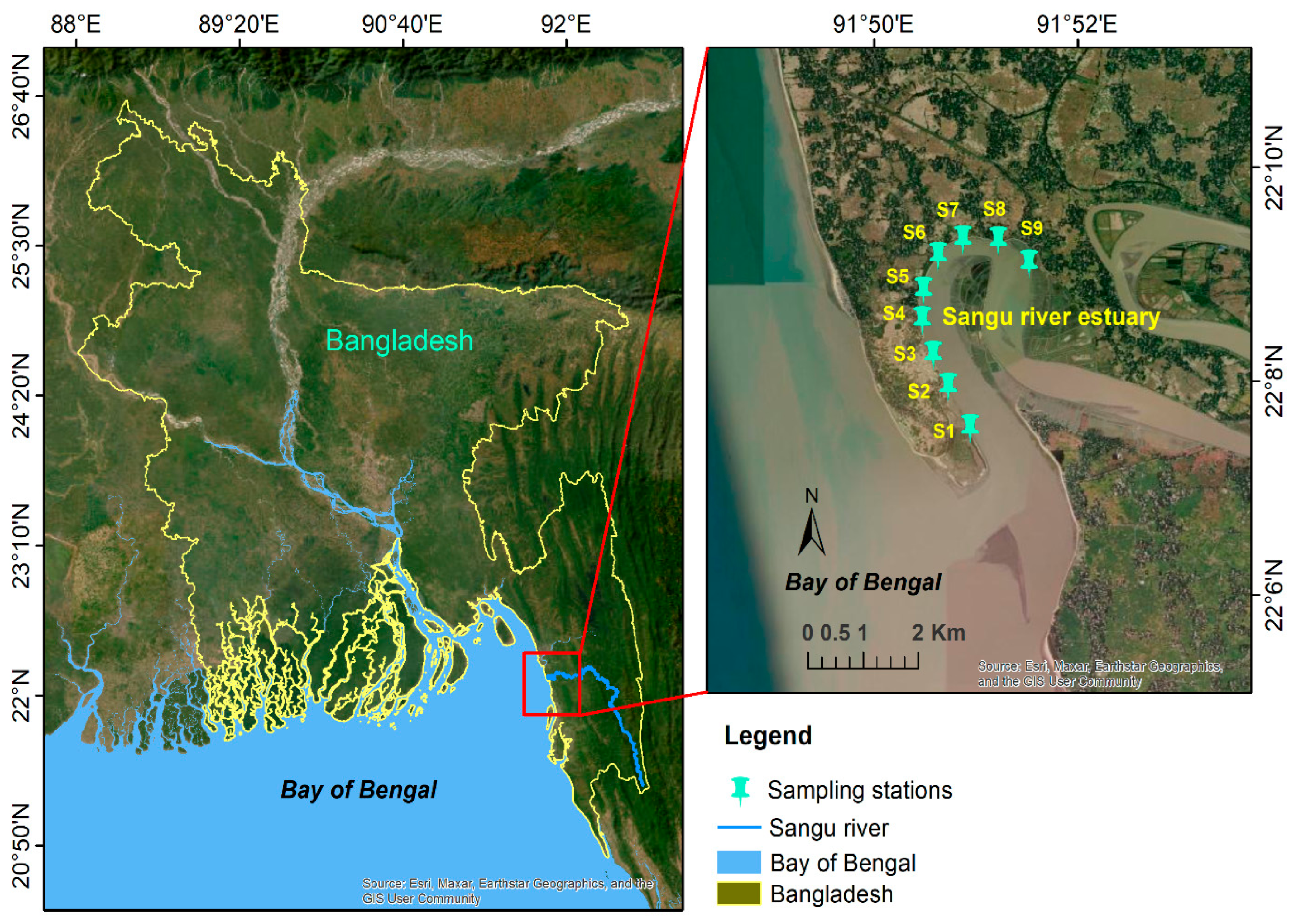
This study selected nine sampling stations randomly across three estuarine zones: S1, S2, S3 (lower), S4, S5, S6 (middle), and S7, S8, S9 (upper) (Supplementary Table S1). Stations (S1, S2, S3) were located in the transitional zone between the estuary and the Bay of Bengal (Figure 1). The selected stations encompassed the major environmental gradients of the estuary, including salinity, sediment, and hydrodynamic variability, thereby representing the dominant habitat conditions along the estuarine continuum. However, the sampling design was intended to characterize broad spatial patterns rather than fine-scale habitat variability; therefore, interpolated distributions should be interpreted cautiously.

2.2. Macrobenthos Collection and Laboratory Analyses

Both biotic (macrobenthos) and abiotic (water and sediment) samples were collected across three seasons: pre-monsoon (April–May), monsoon (June–September), and post-monsoon (October–December) during 2020, to understand the macrobenthic community response to various abiotic variables. A total of 81 samples (9 stations × 3 seasons × 3 replicates) were collected from the intertidal zone at each station during three seasons using a hand-held mud corer (sampling area 0.01 m2). Although this sampling area was suitable for standardized collection of small-bodied infaunal macrobenthos, it may have underrepresented larger or patchily distributed taxa, particularly certain bivalves and gastropods. A sub-sample of each core was retained for sediment texture analysis; the remainder was sieved through a 500-µm stainless steel mesh and gently washed with river water to isolate macrobenthic organisms. All retained specimens were fixed immediately in 10% formalin solution, with Rose Bengal dye added to enhance visibility. After 24 h of fixation, macrobenthos were sorted manually, transferred to labeled vials, and preserved in 70% ethanol [32]. Taxonomic identification was carried out to the family level/operational taxonomic unit, under a stereomicroscope (LEICA EZ4E, Germany; magnification: 8×–35×) at the Laboratory for Ecology, Environment and Biodiversity (LEEB), Department of Fisheries and Marine Science, Noakhali Science and Technology University. Within each family, organisms were further differentiated into distinct ‘morphospecies’ based on observable morphological characteristics. Scientific nomenclature was verified against the World Register of Marine Species [33]. Macrobenthic density was expressed as individuals per square meter (ind. m−2). Taxonomic identification to the family level is often adequate for detecting spatial patterns in routine environmental and pollution monitoring studies [27,34].

2.3. Measurement of Abiotic Variables

Physicochemical variables, including water temperature (°C), pH, dissolved oxygen (DO; mg L−1), and salinity (ppt) were measured in-situ at each station using a multiparameter probe (Model HI98194, Hanna Instruments Inc., Leighton Buzzard, UK). Calibrations were done after every field visit. Sediment texture was determined using the pipette method [37] and textural classes were assigned following the classification scheme of Shepard [38]. Sand, silt, and clay proportions were expressed as percentages.

2.4. Data Analysis

Prior to statistical analysis, normality of abiotic variables was assessed using the Shapiro–Wilk test. As variables significantly deviated from normality (p < 0.05), non-parametric Kruskal–Wallis tests were employed to assess differences among stations, and min–max normalisation was applied to standardize abiotic variables for subsequent analyses. Spearman rank correlation coefficients were calculated between macrobenthic abundance and normalized abiotic variables to identify the environmental drivers most strongly associated with distributional patterns among stations; this non-parametric approach is appropriate when variables do not conform to a bivariate normal distribution. Spatial interpolation of macrobenthic abundance across the nine stations was performed using inverse distance weighting (IDW), Spatial Analyst Tools, ArcGIS 10.5.
Macrobenthic abundance data were log (x + 1) transformed and Homogeneity of variances was confirmed using Bartlett’s test (p = 0.851). Although residuals deviated from normality (Shapiro-Wilk p < 0.05), ANOVA is robust to such deviations when variances are homogeneous. Therefore, two-way ANOVA was used to test for differences in macrobenthic assemblages across seasons and stations. Diversity indices, including mean abundance, species richness (S), Pielou’s evenness (J′), Margalef’s richness index (D), and Shannon diversity index (H′) [39,40,41], were computed for each station and season, and differences were evaluated using Bartlett’s test, the Shapiro–Wilk test, and two-way ANOVA.
Each family was assigned to a functional feeding group based on the established literature [42]. Trophic categories included carnivore (CAR), deposit feeder (DF), filter feeder (FF), herbivore (HER), omnivore (OMN), and surface deposit feeder (SDF). Families capable of employing multiple feeding modes were classified according to their predominant feeding mechanism.
Hierarchical cluster analysis of macrobenthic community was applied based on fourth-root transformed Bray–Curtis dissimilarity and group-average linkage (UPGMA).
Macrobenthic community composition across nine stations and three seasons was examined using non-metric multidimensional scaling (nMDS) ordination based on Bray–Curtis dissimilarity indices. Prior to ordination, abundance data were square-root transformed to reduce the disproportionate influence of dominant taxa. To investigate the functional dimension of community variation, feeding guild affiliations were projected onto the ordination space, where each guild represents the mean Pearson correlation between constituent family abundances and the two nMDS axes. Ordination plots were produced to visualize seasonal community clusters. All analyses were performed in R version 4.4.3 (R Core Team, 2025) using the ggplot2 v4.0.2 [43], ggforce v0.5.0 [44], ggrepel v0.9.8 [45], ggnewscale v0.5.2 [46], and vegan package v2.7-3 [47].
To statistically confirm the seasonal structuring observed in the ordination, a permutational multivariate analysis of variance (PERMANOVA) was performed with season as the explanatory variable. Additionally, a one-way ANOSIM permutation test was applied to evaluate differences in feeding guild composition among stations and seasons, and a Similarity Percentages Analysis (SIMPER) was used to identify the major guilds responsible for discriminating among groups. This method of analysis elucidates which species are responsible for any observed differences [48].

2.5. Assigning Organisms to the AMBI List

Benthic organisms were assigned to the five ecological groups (EG) defined by [49] (i.e., EG I (species sensitive to disturbance), EG II (species indifferent to disturbance), EG III (species tolerant to disturbance), EG IV (second-order opportunistic species), and EG V (first-order opportunistic species). Taxa absent from the original list were automatically assigned to the same ecological group as their family, using the open-source AMBI indexing software version 6.0, accessible at http://ambi.azti.es (accessed on 1 October 2024), and the supplementary guidelines [50]. Taxa for which enough information was unavailable to be assigned to a group were recorded as ‘not assigned’. Taxa with insufficient ecological information were recorded as ‘not assigned’ based on the latest species list available within the AMBI website (http://ambi.azti.es; accessed on 1 October 2024). AMBI values were calculated following the formula of [49], and ecological status was classified using the index-specific threshold values [51]: ‘high’ (AMBI < 1.2), ‘good’ (1.2–3.3), ‘moderate’ (3.3–4.3), and ‘poor’ (4.3–5.5).

2.6. M-AMBI Calculation

The M-AMBI was calculated by factor analysis (FA) of AMBI, species richness (as number of taxa) and Shannon’s diversity index values [52,53], using AMBI software. This method compares monitoring results with reference conditions by salinity stretch to derive an M-AMBI value that expresses the relationship between observed and reference condition values. At ‘high’ status, the reference condition may be regarded as an optimum where the M-AMBI approaches. At ‘bad’ status, the M-AMBI approaches 0. The threshold values for the M-AMBI classification are based on the European intercalibration [54]: ‘high’ quality, >0.77; ‘good’, 0.53–0.77; ‘moderate’, 0.38–0.53; ‘poor’, 0.20–0.38; and ‘bad’, <0.20.

3. Results

3.1. Characterization of the Abiotic Variables

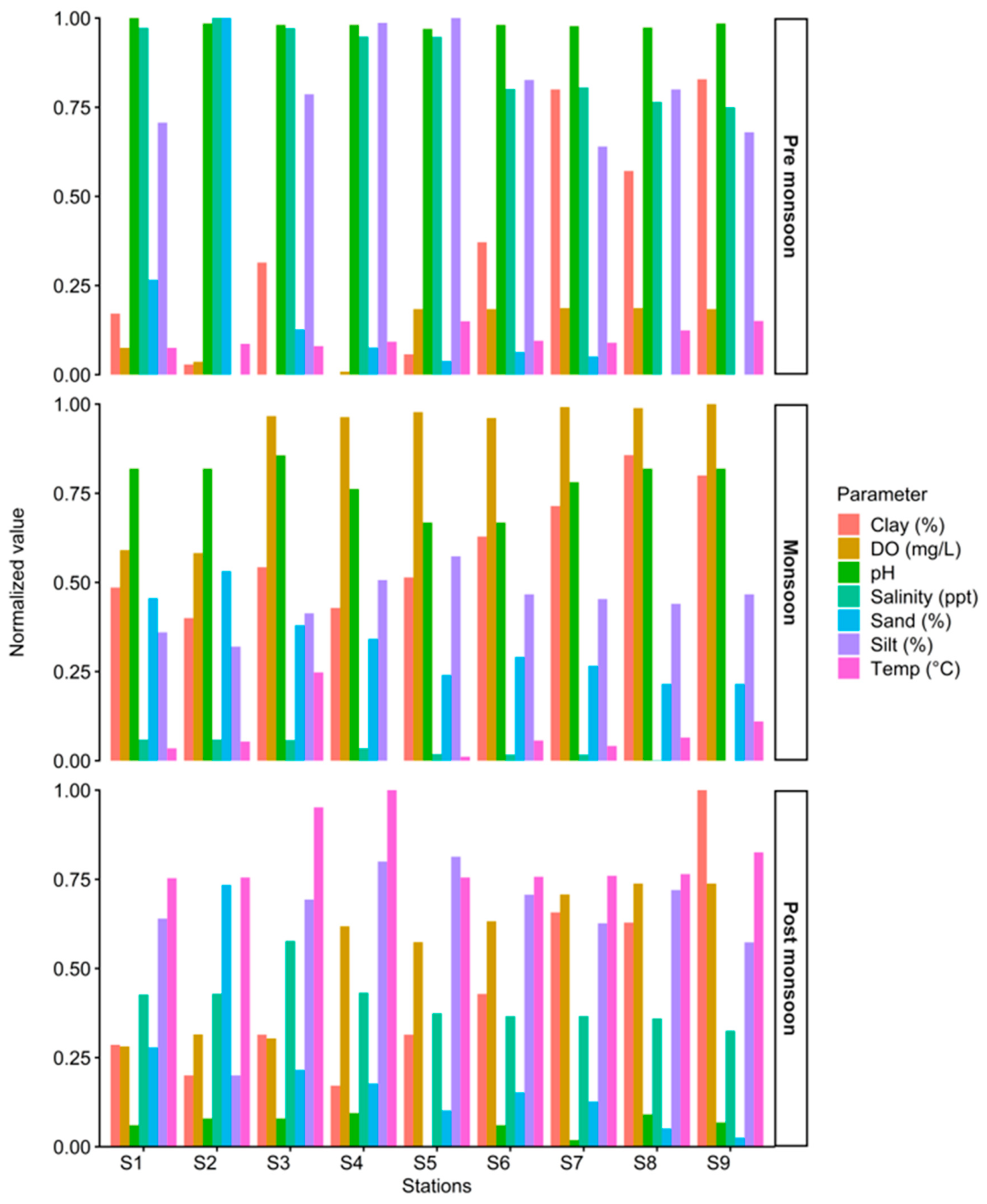
Seasonal variability among environmental variables was clearly observed, while spatial differences among stations were not statistically significant (Kruskal–Wallis, p > 0.05). Water temperature ranged from 23.43 °C to 34.05 °C, with the lowest at S1 (24.23 °C) and the highest at S9 (25.03 °C) during the pre-monsoon season. During the monsoon, the minimum (23.43 °C) and maximum (26.06 °C) temperatures were observed at S4 and S3, respectively. Temperature in the post-monsoon period ranged from 31.43 °C to 34.05 °C at S1 and S4, respectively. Salinity showed a wide spatio-temporal range, decreased in the monsoon to 3.00 ppt at S9 and increased up to 27.61 ppt at S2, pre-monsoon, reflecting the strong freshwater influence during the monsoon. Dissolved oxygen ranged from 1.35 mg/L to 4.94 mg/L, peaking at S9 during monsoon (4.94 mg/L) and decreasing at S3 during pre-monsoon (1.35 mg/L), due to higher freshwater discharge elevating oxygen levels. pH varied from slightly alkaline (8.08 at S1) in pre-monsoon to acidic conditions in post-monsoon 5.43 at S5, indicating lower water discharge and less diluting chemicals and other organic run-off. Normalised abiotic variables across all stations and seasons are depicted in Figure 2. Sediment composition displayed variability across the upper, middle, and lower estuary, with sand dominating seaward stations.

3.2. Abundance of Macrobenthos

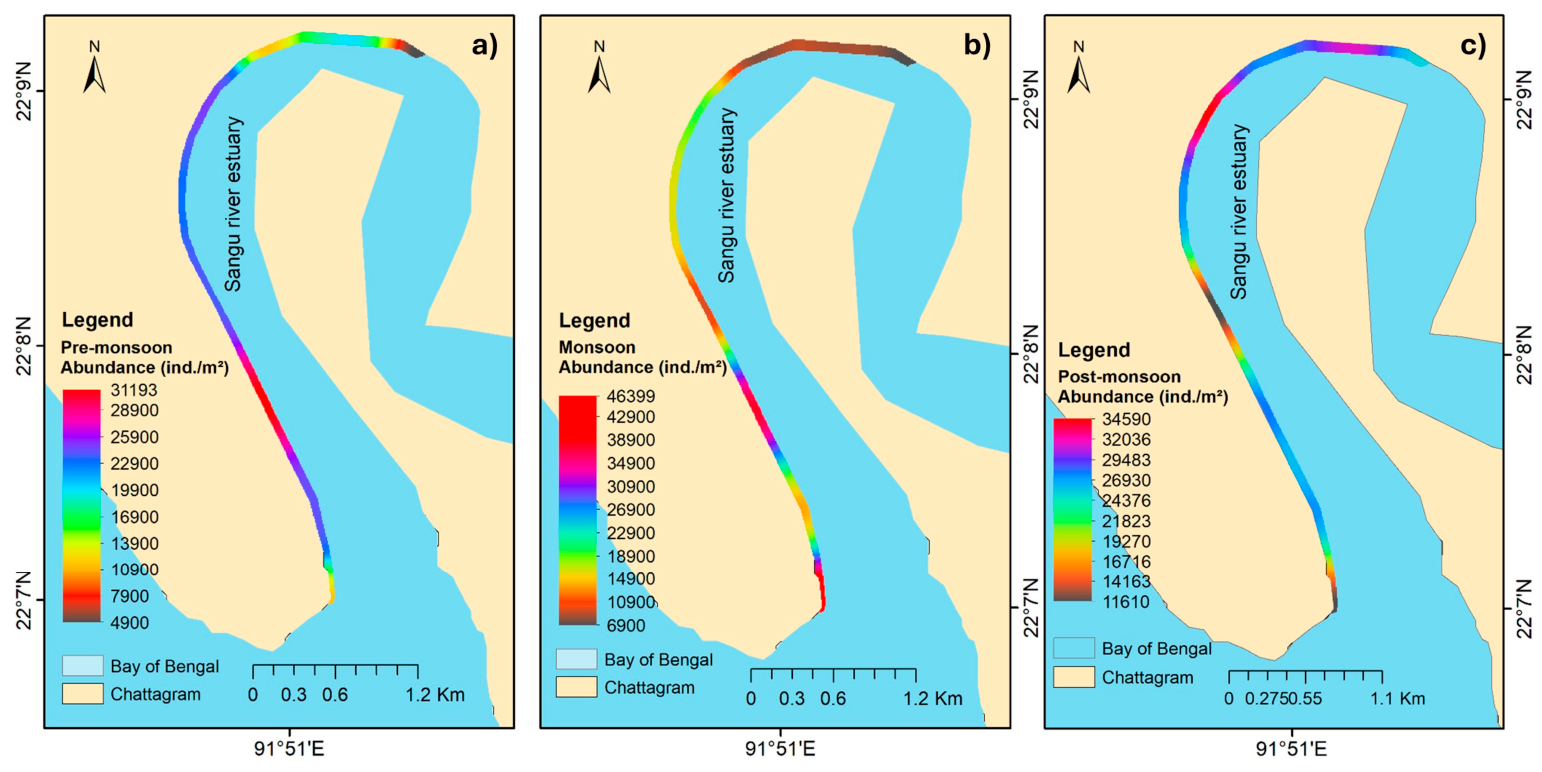
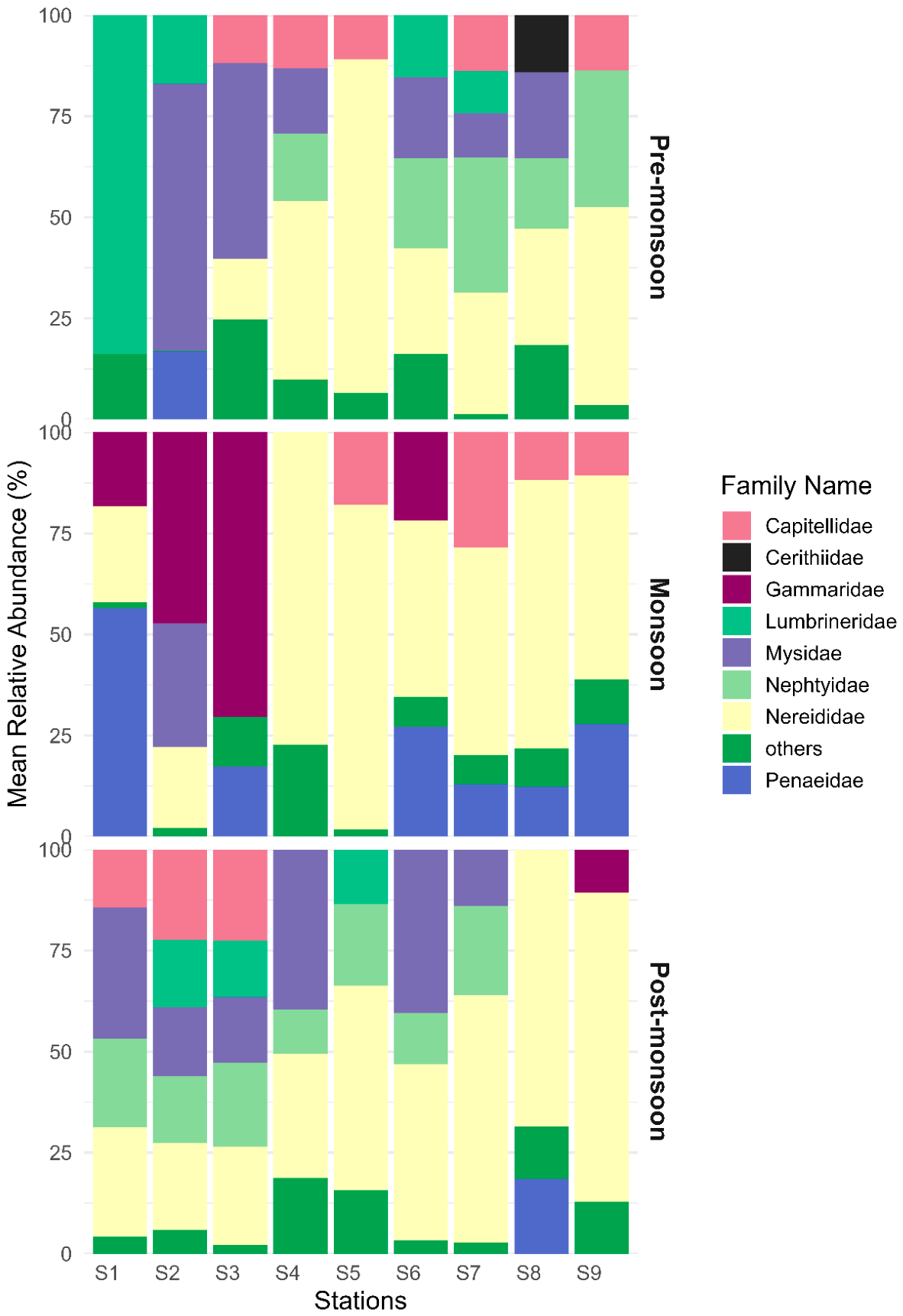
A total of 422,700 ind./m2 with a mean abundance of 401.42 ± 1303.17 ind./m2 was recorded across all samples (Figure 3). The macrobenthic assemblage comprised of 13 families dominated by Nereididae (40.90%), followed by Mysidae (14.29%), Capitellidae (10.20%), Nephtyidae (9.17%), Gammaridae (8.59%), Penaeidae (7.44%), Lumbrineridae (7.10%), Naididae (0.73%), Chironomidae (0.63%), Cerithiidae (0.35%), Varunidae (0.33%), Magelonidae (0.20%), and Ostreidae (0.07%) (Figure 4). Lumbrineridae was most abundant (2066.7 ind./m2) at S1 during pre-monsoon, whereas Nereididae dominated during monsoon and post-monsoon at (4300 ind./m2) S5 and (666.7 ind./m2) S4, respectively. Ostreidae was found rarely, contributing only 0.07% of total abundance and occurring exclusively at S6 during pre-monsoon. Two-way ANOVA revealed a statistically significant seasonal effect on macrobenthic abundance (p < 0.05), while spatial variation among stations was not significant. This pattern indicates that temporal (seasonal) dynamics exert a stronger influence on community abundance than localized spatial heterogeneity within the extent of the current sampling design.

3.3. Functional Feeding Guilds

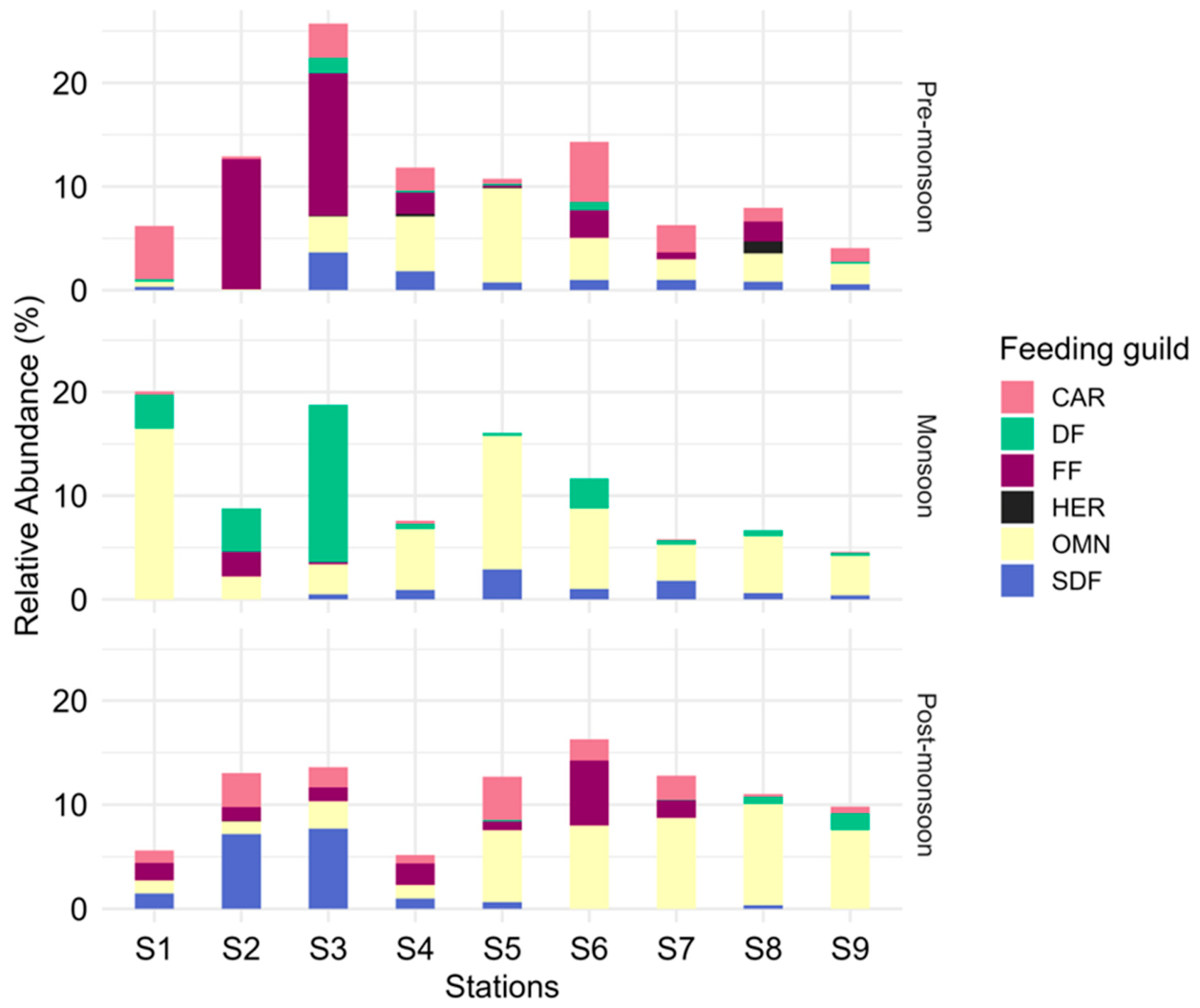
Six functional feeding guilds were identified, with omnivores (OMN) dominating across all seasons, along with filter feeders (FF), carnivores (CAR), deposit feeders (DF), surface deposit feeders (SDF), and herbivores (HER) (Figure 5). During the pre-monsoon season, omnivores (OMN) accounted for 45.30% of relative abundance, followed by filter feeders (FF) (17.53%) and carnivores (CAR) (14.55%). In the monsoon season, the abundance was dominated by omnivores (OMN) and deposit feeders (DF), and in the post-monsoon season, the abundance was dominated by omnivores (OMN), carnivores (CAR), and filter feeders (FF). Seasonal variation in feeding guild composition was statistically significant (two-way ANOVA, p < 0.05), whereas spatial variation remained limited.

3.4. Spatio-Seasonal Diversity Patterns

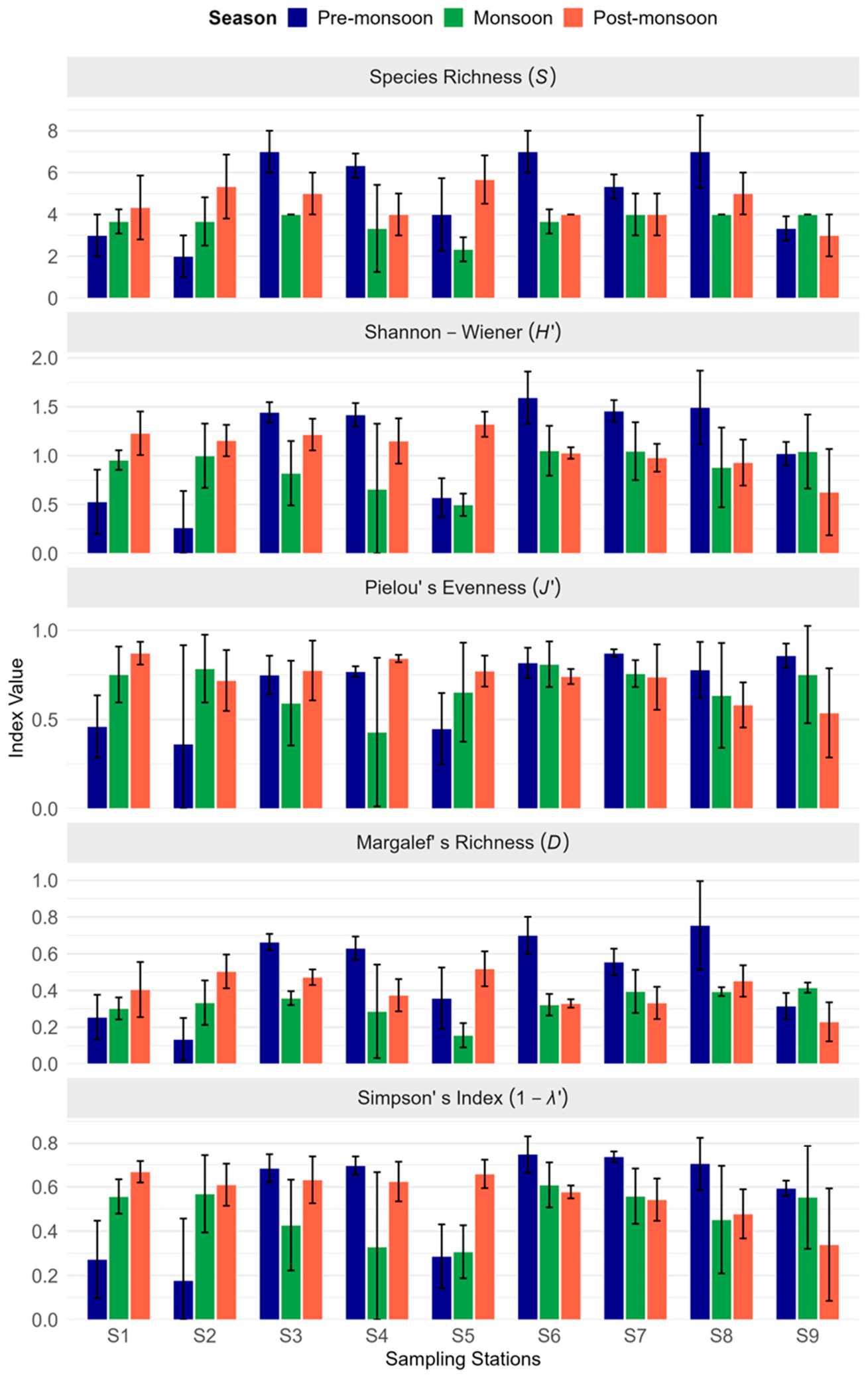
Taxa richness (S) peaked in pre-monsoon (5.00 ± 2.09), declined in monsoon (3.63 ± 0.93), and slightly increased in post-monsoon (4.48 ± 1.22). The Shannon–Wiener Diversity Index (H′) showed mean values of 1.09 ± 0.53 in pre-monsoon, 0.88 ± 0.35 in monsoon, and 1.07 ± 0.27 in post-monsoon. Margalef’s species richness (d) was 0.48 ± 0.24 in pre-monsoon, 0.33 ± 0.12 in monsoon, and 0.40 ± 0.12 in post-monsoon. Simpson’s diversity index (1 − λ′) recorded mean values of 0.55 ± 0.25 in pre-monsoon, 0.48 ± 0.20 in monsoon, and 0.57 ± 0.14 in post-monsoon (Figure 6).
Similar to seasonal distribution, moderate spatial variation was observed with the Shannon–Wiener Diversity Index (H′) ranging from 0.80 ± 0.42 at S5 to 1.22 ± 0.33 at S6. Pielou’s evenness (J′) ranged from 0.62 ± 0.23 at S5 to 0.79 ± 0.09 at S6, indicating relatively higher evenness at stations S6 and S7. Taxa richness (S) was lowest at S9 (3.44 ± 0.73) and highest at S3 and S8 (5.33 ± 1.50 and 5.33 ± 1.66, respectively) (Figure 6).

3.5. Hierarchical Cluster Analysis

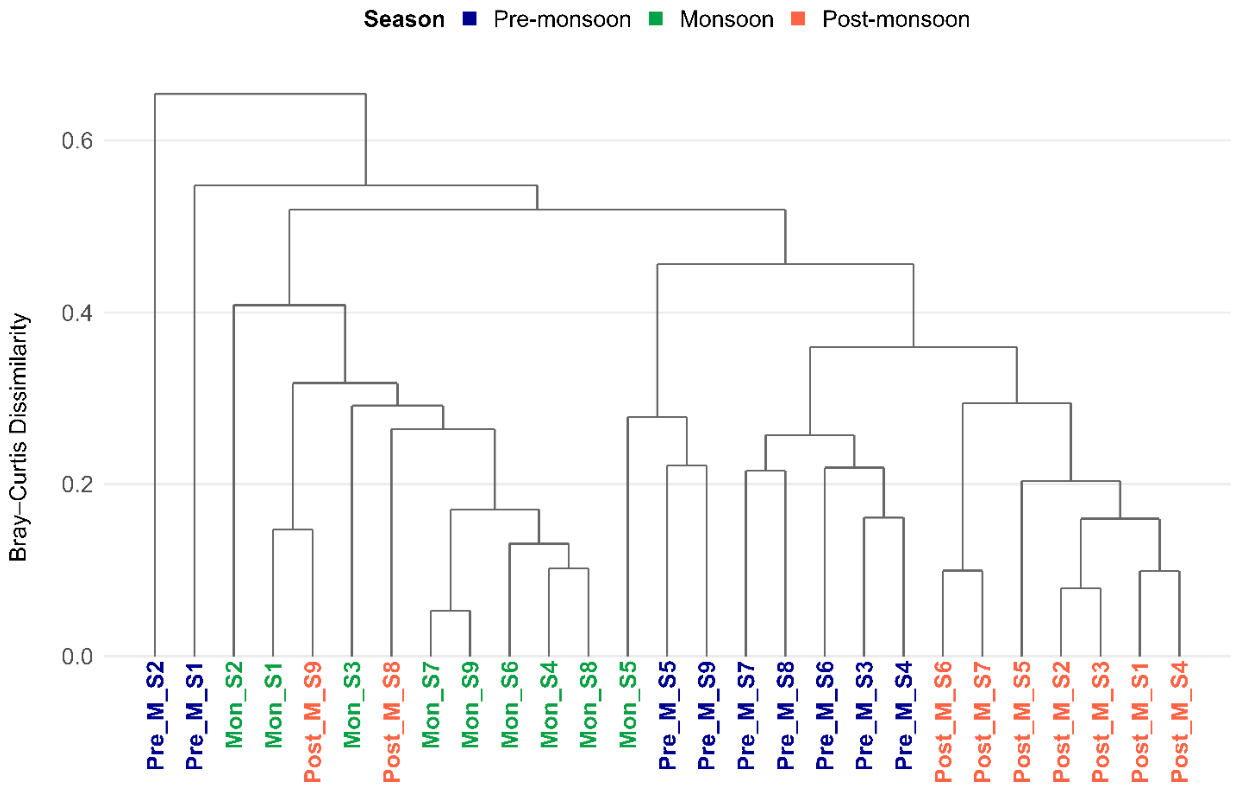
Hierarchical agglomerative cluster analysis (UPGMA) based on Bray–Curtis dissimilarity revealed heterogeneous macrobenthic assemblage composition across stations and seasons (Figure 7). The dendrogram shows dissimilarity values ranging from 0 to 0.65, where higher linkage heights indicate greater differences in species composition and relative abundance. Stations that are grouped at low dissimilarity levels (<0.2–0.3) indicate high similarity in assemblage composition (e.g., Mon_S4, Mon_S6, Mon_S8, Mon_S9 and Post_S1, Post_S2, Post_S3, Post_S4). In contrast, some stations (e.g., Pre_M_S1 and Pre_M_S2) separated at higher dissimilarity levels (>0.5), reflecting distinct community structures. A primary partition in the dendrogram separated monsoon samples from pre-monsoon and post-monsoon assemblages, with monsoon representing the most compositionally distinct community. Pre-monsoon and post-monsoon samples showed greater overlap, reflecting shared dominant taxa. No consistent station-level clustering was apparent within seasons.
ANOSIM confirmed significant (R = 0.485, p < 0.001) seasonal dynamics were the primary driver of macrobenthic community composition, while the station effect was negligible (R = −0.129, p = 0.902) in the Sangu river Estuary (Supplementary Table S2, Figure S1). These findings are further supported by PERMANOVA (F = 7.39, p < 0.001) for season.

3.6. SIMPER Analysis

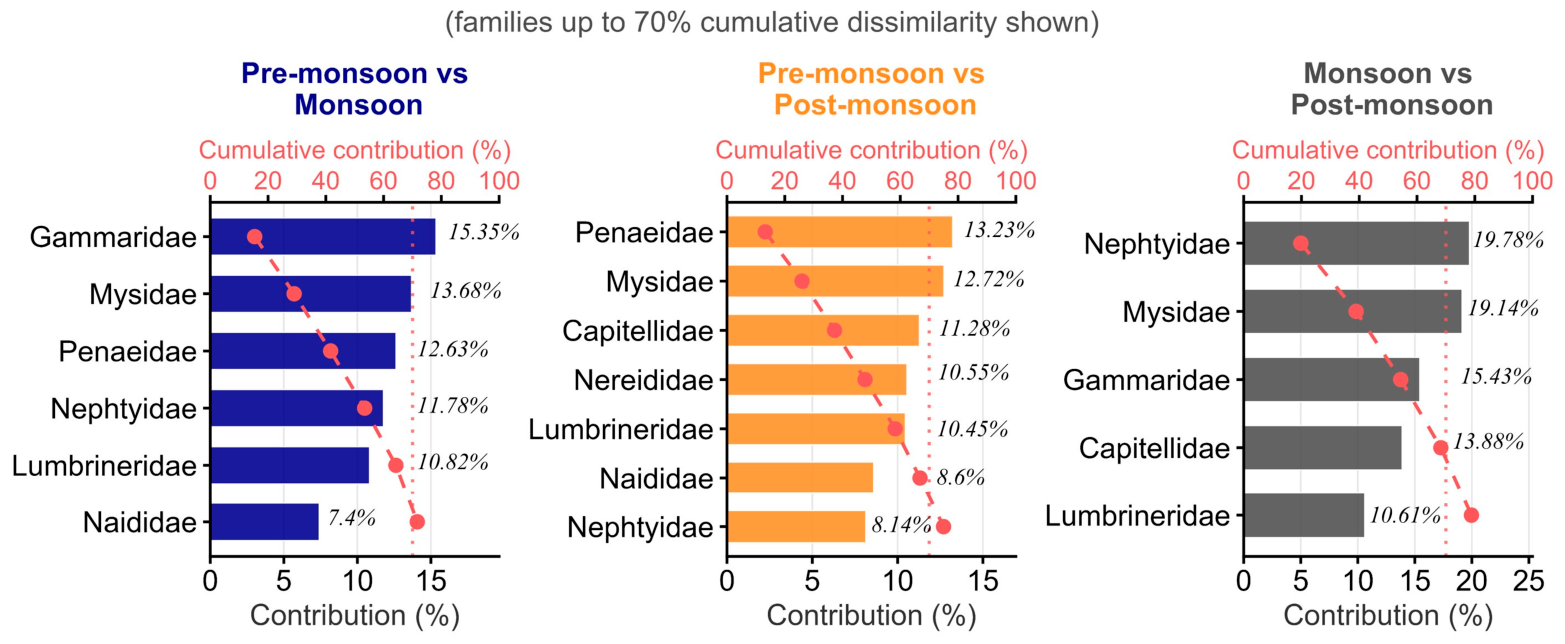
SIMPER analysis revealed 8 dominant families with the highest dissimilarity between pre-monsoon and monsoon assemblages (59.48%), intermediate dissimilarity between pre-monsoon and post-monsoon (45.13%), and the lowest dissimilarity between monsoon and post-monsoon (43.40%), indicating substantial seasonal turnover. Dominant taxa, including Nereididae, Mysidae, and Nephtyidae, contributed most to the observed dissimilarities (Figure 8).

3.7. Non-Metric Multidimensional Scaling (nMDS)

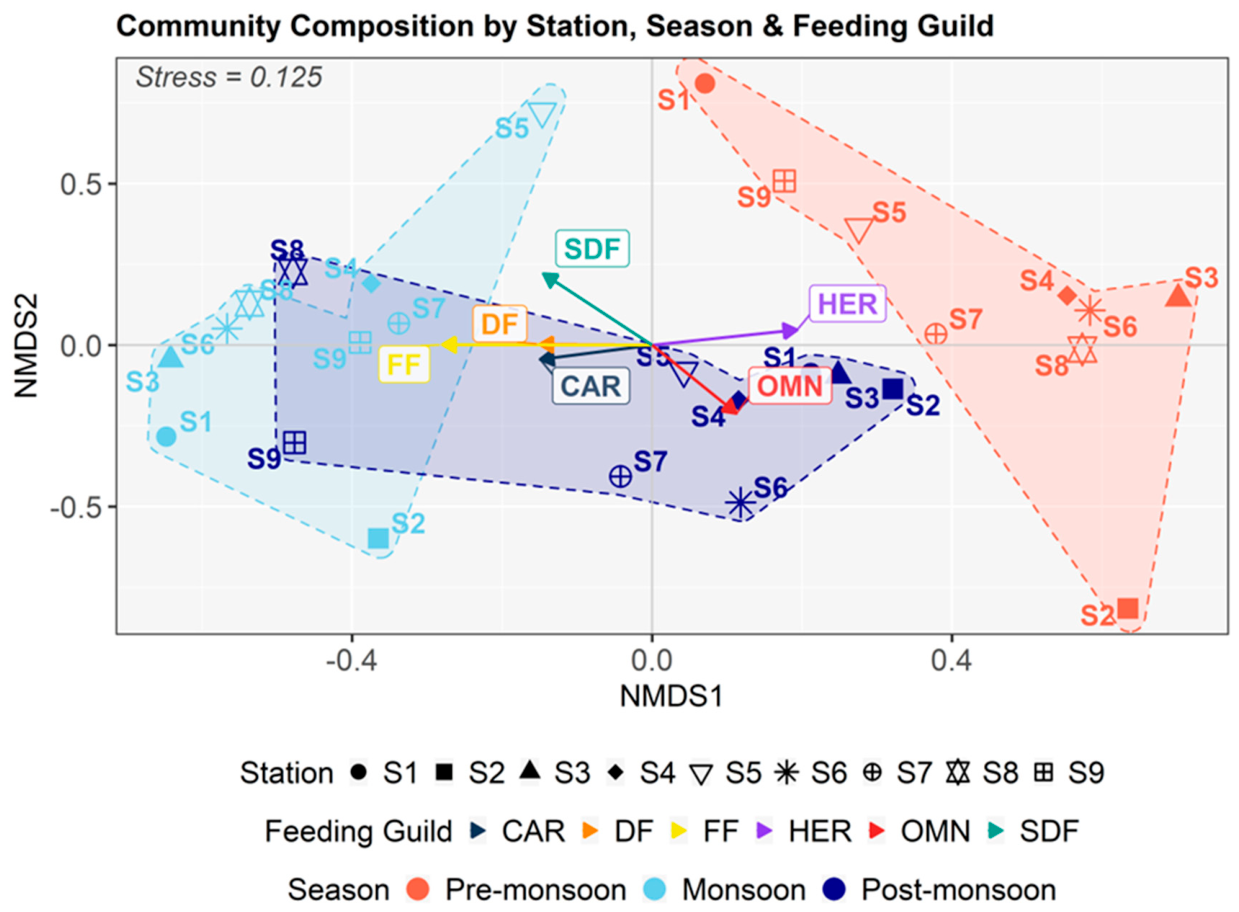
The nMDS ordination plot revealed distinct seasonal macrobenthic assemblages, with convex hulls for the three seasons occupying largely non-overlapping regions of the ordination space. PERMANOVA (F2,24 = 5.90, R2 = 0.33, p = 0.001), on square-root transformed data, highlighted season as a factor of 33% of the total variation in community composition (Figure 9). The ANOSIM statistics (R = 0.43, p = 0.001) further confirmed that between-season dissimilarities were substantially greater than within-season dissimilarities.
Together, these results demonstrate that the macrobenthic community of the Sangu Estuary undergoes significant temporal fluctuations across stations. The feeding guilds portrayed on the ordination provided functional ecological context for the observed seasonal patterns. Herbivores (HER) were oriented toward the pre-monsoon cluster, consistent with the proliferation of Cerithiidae, particularly at mid- and upper-estuary stations. Carnivores (CAR) and omnivores (OMN) were directed toward the post-monsoon region of the ordination, reflecting the comparatively higher abundance of Nephtyidae and Lumbrineridae. Filter feeders (FF), Surface deposit feeders (SDF) and deposit feeders (DF) projected toward monsoon season, driven primarily by Mysidae, Capitellidae, and Gammaridae, respectively, all of which attained their highest abundance during the season.

3.8. Spearman’s Rank Correlation

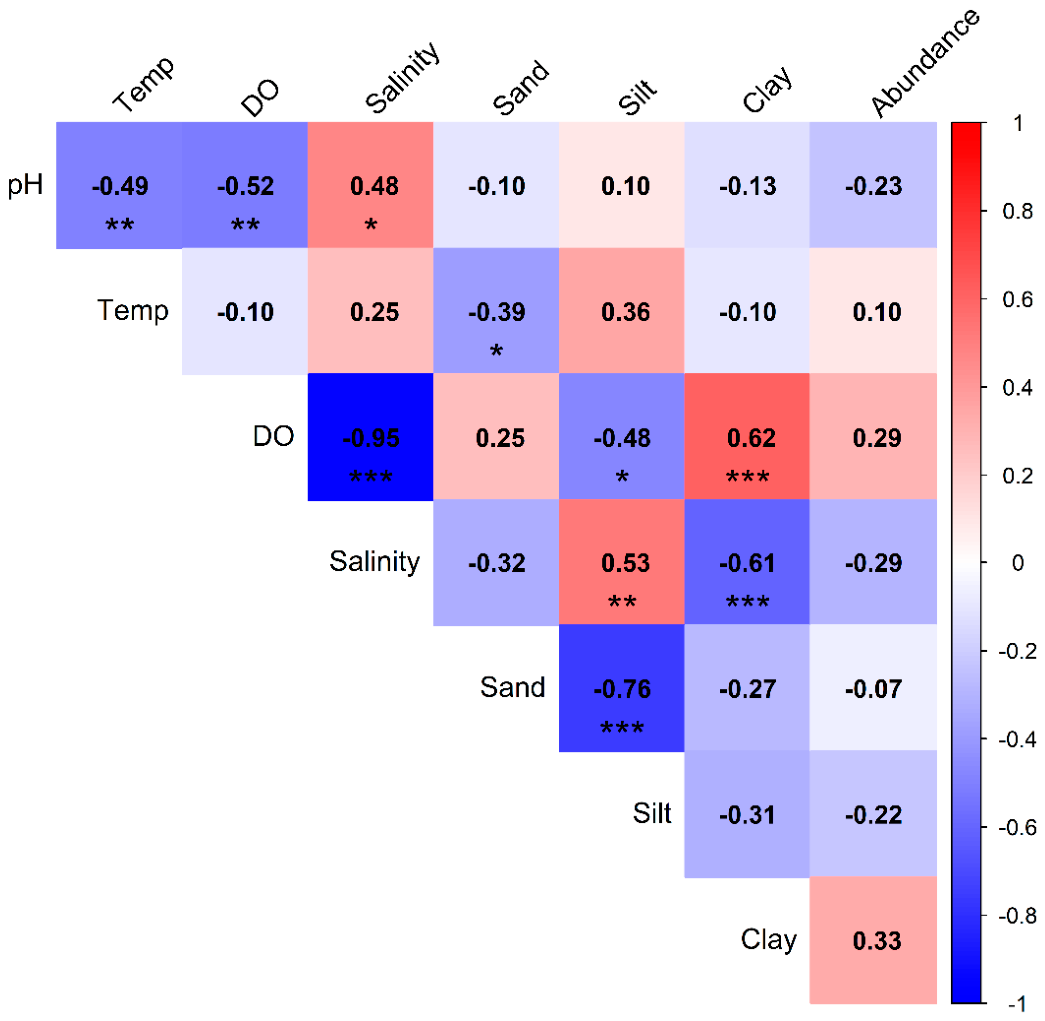
Spearman’s rank correlation analysis was conducted for total macrobenthic abundance and seven abiotic variables (pH, temperature, dissolved oxygen, salinity, and sediment texture) (Figure 10). The rank correlation factors between abundance and abiotic variables provide good insight into how the underlying processes of biotic/abiotic interactions influence macrobenthic diversity and distribution in the Sangu River estuary. Abundance showed negative correlations with salinity (r = −0.29) and silt (r = −0.22), and a weak positive correlation with DO (r = 0.29). A very strong negative correlation between dissolved oxygen and salinity (p < 0.001) and between sand and silt (p < 0.001) was observed, indicating that oxygen availability decreases markedly as salinity increases and sediment regimes contrast. Salinity showed a moderate positive relationship with silt (p <0.01) and a moderate negative relationship with clay (p < 0.001), indicating that saline environments tend to be associated with finer silty substrates rather than clay-dominated sediments. Since sediment grain size strongly controls benthic habitat suitability, these relationships likely influence community distribution in the study area. Dissolved oxygen displayed a moderate positive correlation with clay (r = 0.62, p < 0.001) and a weaker positive relationship with abundance (r = 0.29, p > 0.05), suggesting that oxygenated, fine-sediment environments could support greater macrobenthic abundance. Conversely, abundance showed negative correlations with salinity (r = −0.29, p > 0.05), silt (r = −0.22, p > 0.05), and pH (r = −0.23, p > 0.05), implying that increased salinity and siltation may reduce overall benthic abundance. Temperature generally showed weak relationships with most variables, although it showed a moderate positive correlation with silt (r = 0.36, p > 0.05) and a moderate negative correlation with sand (r = −0.39, p < 0.05), indicating seasonal sediment dynamics may indirectly affect benthic habitats. pH demonstrated moderate negative correlations with temperature (r = −0.49, p < 0.01) and dissolved oxygen (r = −0.52, p < 0.01), but had a moderate positive correlation with salinity (r = 0.48, p < 0.05), suggesting that alkaline conditions are associated with saline environments in the study area. Overall, the salinity, dissolved oxygen, and sediment composition are the dominant environmental gradients influencing benthic abundance, while temperature and pH play secondary roles. The weak-to-moderate correlations between abundance and individual variables suggest that the macrobenthic community is influenced by a combination of interacting abiotic variables rather than a single dominant driver.

3.9. Ecological Assessment Using AMBI and M-AMBI Indices

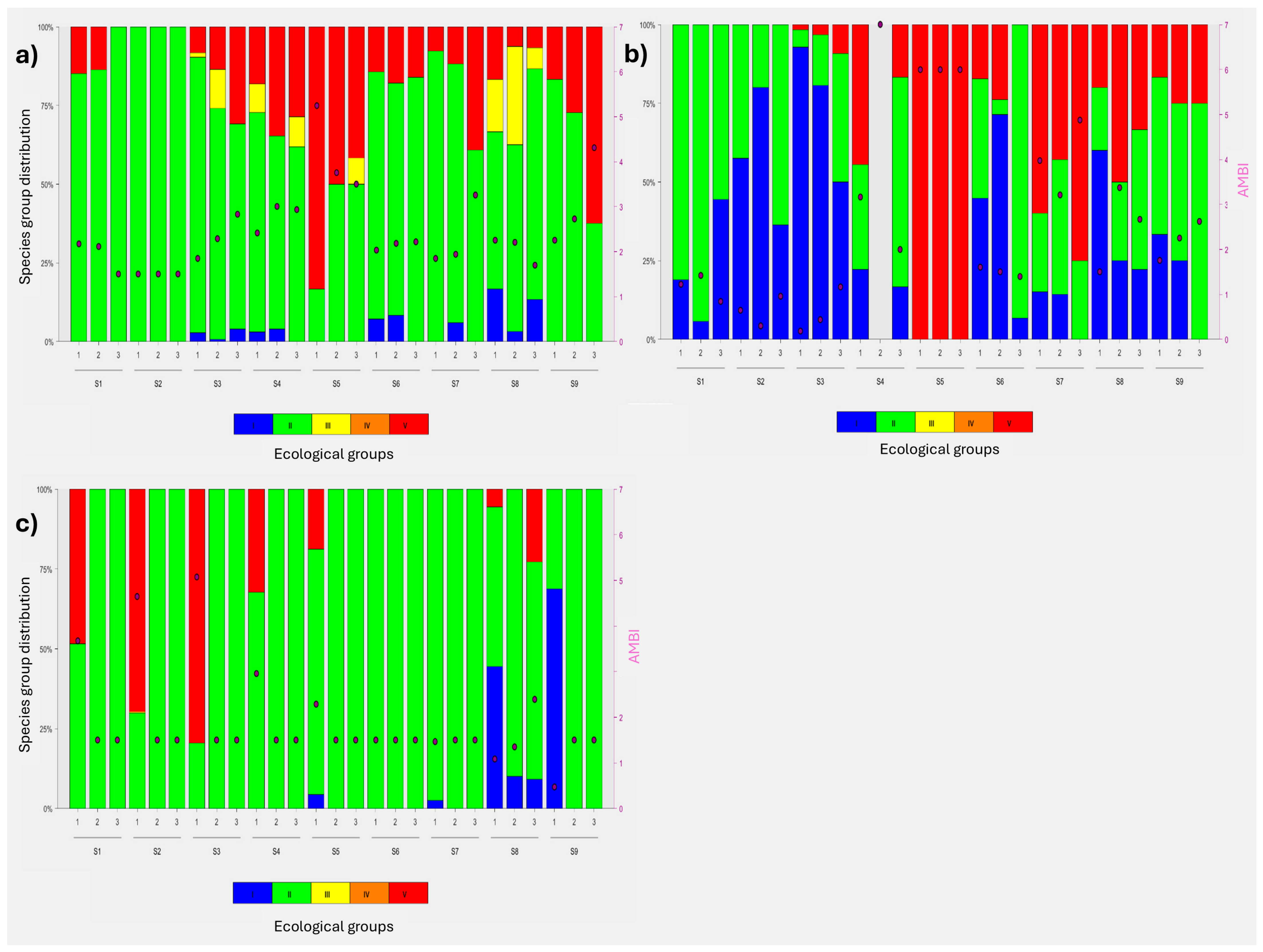
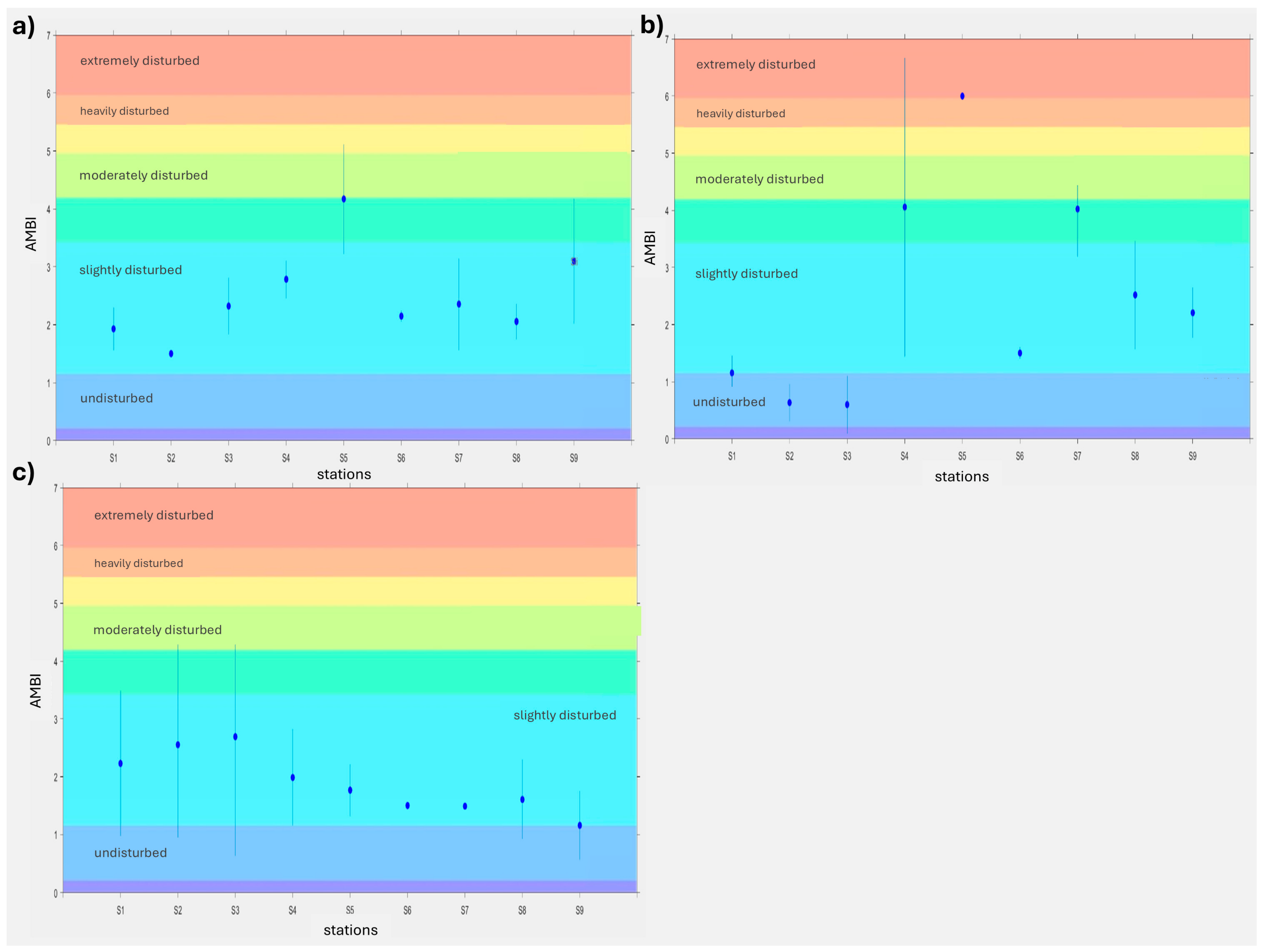
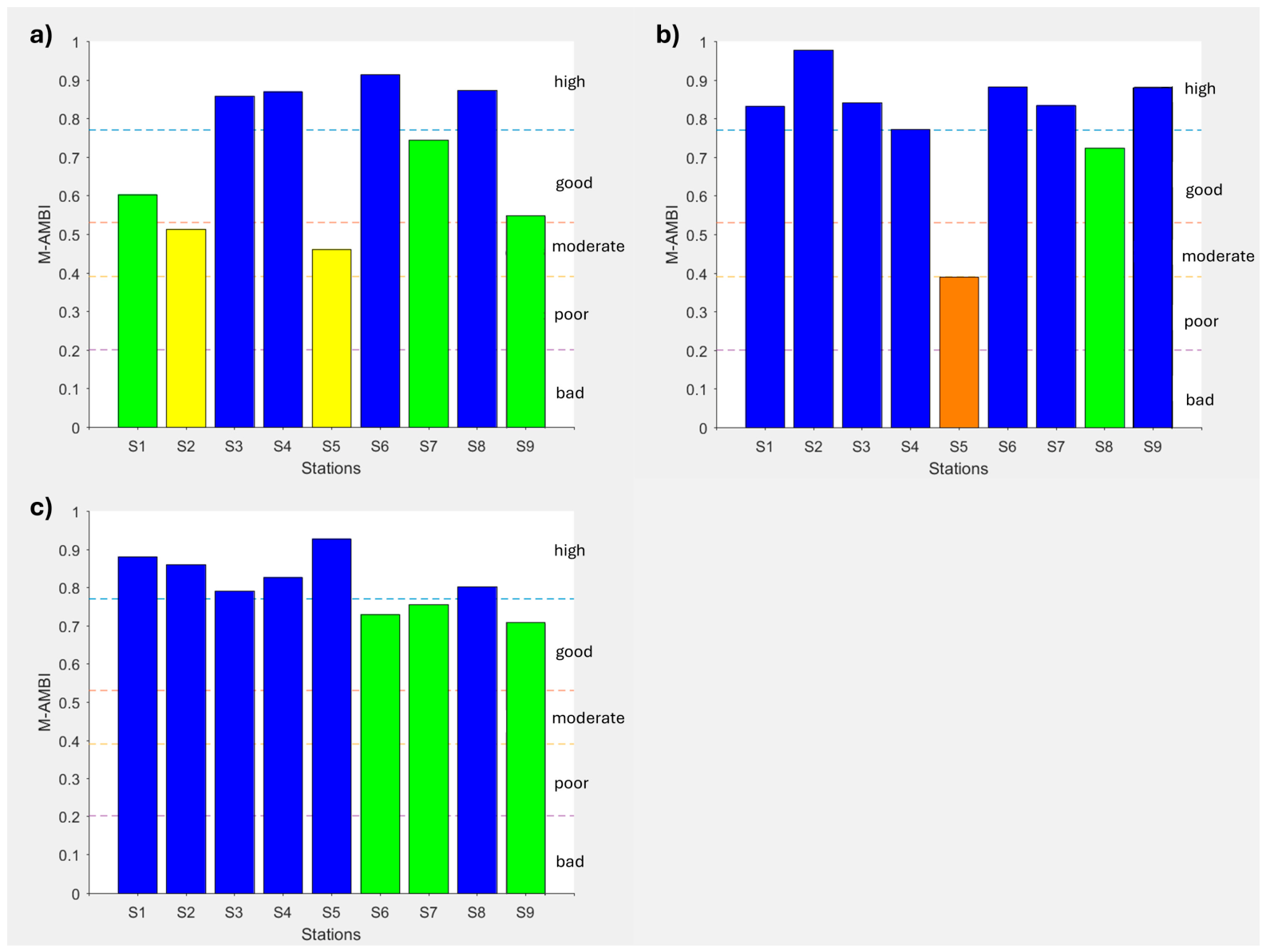
Of the 13 taxa identified, two families were automatically changed and assigned to ecological groups (EG), Mysidae changed by Mysida (II) and Cerithiidae changed by Cerithiaceae (III). After assignment, 2.4% of the total were in EG I, 78.4% in EG II, 4.9% in EG III and 14.4% in EG V in pre-monsoon (Figure 11a), 46.9% of the total were in EG I, 38.7% in EG II, and 14.3% in EG V in monsoon (Figure 11b), 4.8% of the total were in EG I, 63.1% in EG II, 0.1% in EG III and 32% in EG V in post-monsoon (Figure 11c). However, 28.5%, 41.5%, and 42.6% remained unassigned during pre-monsoon, monsoon, and post-monsoon, respectively, due to a lack of evaluation of regional species for this particular study area (Figure 12a–c). Based on the M-AMBI classification, during pre-monsoon, stations S3, S4, S6, and S8 exhibited a high ecological status, characterized by diversity values (2.23–2.61) and high M-AMBI scores ranging from 0.86 to 0.91. Among these, S6 showed the highest diversity (2.61) and the highest M-AMBI value (0.91), indicating comparatively better ecological conditions. Stations S1, S7, and S9 were classified as “Good” ecological status, with M-AMBI values ranging from 0.55 to 0.75. Station S1 recorded the lowest AMBI value (1.93), while S9 exhibited comparatively higher AMBI values (3.10), indicating lower to greater environmental stress. In contrast, stations S2 and S5 were categorized as having “Moderate” ecological status. Station S2 showed the lowest diversity value (0.21) despite a relatively low AMBI score (1.5), resulting in a moderate M-AMBI value (0.51). Station S5 exhibited the highest AMBI value (4.17) and a low diversity index (0.91), resulting in the lowest M-AMBI score among all stations (0.46), suggesting comparatively disturbed benthic environmental conditions.
During monsoon, most stations were classified as having “High” ecological status, with M-AMBI values ranging from 0.77 to 0.98. Station S2 exhibited the highest ecological quality (M-AMBI = 0.98), followed by S6 (0.88), S9 (0.88), S3 (0.84), S7 (0.83), S1 (0.83), and S4 (0.77), all corresponding to a “High” ecological status class. Station S8 recorded intermediate conditions, with an AMBI value of 2.51 and an M-AMBI value of 0.72, corresponding to a “Good” ecological status. In contrast, Station S5 showed the most degraded condition among all stations, characterized by the maximum AMBI value (6.0), low diversity (0.81), and the lowest M-AMBI value (0.39), resulting in a “Poor” ecological status classification. Overall, despite relatively elevated AMBI values at some locations (e.g., S4 and S7), the combined M-AMBI assessment indicated predominantly high ecological quality across the study area.
During post-monsoon, the ecological assessment of macrobenthic communities across the nine sampling stations indicated generally good environmental conditions, with most stations classified as having “High” ecological status according to the M-AMBI index. M-AMBI values ranged from 0.71 to 0.93, while AMBI values varied between 1.16 and 2.69. Station S5 exhibited the highest ecological quality, with an M-AMBI value of 0.92794, followed by S1 (0.88), S2 (0.86), S4 (0.83), S8 (0.80), and S3 (0.79), all corresponding to a “High” ecological status class. Three stations, S6, S7, and S9, were classified as having “Good” ecological status, with M-AMBI values of 0.73, 0.75, and 0.71, respectively. Although these stations showed relatively low AMBI values, their comparatively lower diversity and M-AMBI scores suggest slightly reduced ecological quality compared to the other stations. Overall, the results indicate that the study area was characterized predominantly by high ecological quality with limited signs of environmental disturbance. M-AMBI results showed spatial and seasonal variability, indicating moderate ecological disturbance across the estuary (Figure 13a–c).

4. Discussion

The present study demonstrated that variability in environmental variables and benthic indices among individual stations was highly dynamic, emphasizing the combined influence of natural processes and anthropogenic pressures on the Sangu River estuary benthic system. Such variability is common in South Asian estuaries, where monsoon-driven hydrological fluctuations, freshwater discharge, sedimentation, aquaculture activities, industrial inputs, and nutrient enrichment strongly influence estuarine ecological conditions and benthic community structure. Seasonal fluctuations were also evident in the present study, largely driven by dominant monsoonal processes known to affect the abiotic and biotic components of Indian estuaries [55]. The benthic indices indicated spatial and seasonal differences in ecological quality status, highlighting the influence of sediment characteristics, freshwater runoff, aquaculture activities, and hydrological variability. Multivariate analyses (HCA, nMDS, ANOSIM, PERMANOVA, and SIMPER) revealed distinct seasonal clustering of benthic communities, suggesting that environmental gradients and seasonal dynamics strongly shaped community composition and trophic structure. Variations in diversity indices and feeding guild distribution further indicated differences in habitat quality and levels of organic enrichment among stations. Despite localized signs of ecological stress at some stations, particularly those affected by sedimentation and anthropogenic inputs, AMBI and M-AMBI assessments indicated that the estuary generally maintained good to moderate ecological quality status throughout the study period.

4.1. Abiotic Variables and Macrobenthic Prevalence

The abiotic parameters exhibited pronounced seasonal variation, while spatial differences among stations were limited. During the post-monsoon season, lower freshwater input led to greater thermal stratification. A rise in temperatures disrupts the metabolic and biological activities of aquatic organisms, ultimately altering ecosystem productivity [56]. In contrast, heavy monsoon rainfall substantially increased freshwater inflow, elevating dissolved oxygen (DO) concentrations while simultaneously reducing salinity and shifting pH toward neutral-to-alkaline values relative to the pre-monsoon period. This dilution effect operates by reducing the concentrations of alkaline ions (e.g., Ca2+, Mg2+, HCO3) and diminishing buffering capacity. Such well-oxygenated, neutral-to-slightly-alkaline conditions are consistent with those identified as preferable for macrobenthic communities in the Heihe River Basin [57]. Conversely, pH fluctuations have been reported to create unfavorable conditions for macrobenthic organisms [58,59]. Similarly, broader salinity fluctuations within estuarine systems impose physiological stress on macrobenthos, potentially reducing species richness as observed in the present study [60]. Furthermore, increasing sand content negatively influences macrobenthic diversity and abundance relative to muddy or silty substrates, which provide richer organic matter and nutrient content that support more structurally diverse communities [18,61,62].

4.2. Macrobenthic Assemblage Composition and Abundance

Macrobenthic assemblages in the Sangu River estuary are primarily structured by statistically significant seasonal variation, while spatial differences across the nine sampling stations are statistically insignificant. Seasonal variation is predominantly driven by monsoon freshwater discharge, which drastically reduces salinity (down to 3.00 ppt), elevates dissolved oxygen concentrations (up to 4.94 mg/L), and substantially alters sediment dynamics. The assemblage is dominated by Nereididae, Mysidae, Lumbrineridae, Capitellidae, and Nephtyidae, and is broadly supported by findings from the North Sea, North-west Florida, Brazilian shores, and the Portuguese continental shelf [63,64,65,66]. Notably, Capitellidae, Nereididae, and Chironomidae taxa are well-established pollution-tolerant taxa that serve as bioindicators of environmental degradation [67,68,69,70] and their presence or absence is used to assess environmental quality [12,71].

4.3. Community Diversity

The Shannon diversity index (H′) ranged from an average of 0.80 to 1.22, values comparable to those previously reported for the Meghna River estuary [72]. Evenness exhibited moderate spatial variation (0.62–0.79), but remained relatively stable across seasons (0.68–0.73). In contrast, greater variation has been documented in the Feni river estuary [16] and the Sitakundu coast ship-breaking area [73], suggesting a stressed community. Margalef’s species richness (d) is a key indicator of habitat complexity and ecological health, with higher values indicating more diverse and stable communities. The diversity index (d) ranged from 0.32 to 0.53, similar to the Ethiopian Highland Streams (0.10–2.80), both systems being subject to considerable anthropogenic pressure [70]. By contrast, the Fauzderhat Saltmarsh habitat in Bangladesh documented substantially higher values (4.36–5.19), reflecting a comparatively healthy ecological state [74]. Simpson’s diversity index was relatively low in the present study (0.48–0.55), indicating dominance of certain taxa and reduced overall community diversity. That is comparable to South-western Australian Estuaries (0.73–0.88), having more balanced assemblages with lower dominance [75].

4.4. Feeding Guild Structure and Seasonal Dynamics

Across the Sangu River Estuary, the macrobenthic trophic structure was consistently dominated by omnivores (OMN) throughout the annual cycle, indicating a generalist feeding strategy under fluctuating environmental conditions. This persistent dominance is likely driven by high temporal variability in organic matter availability and habitat conditions, which favours opportunistic feeders capable of exploiting multiple food sources. During the pre-monsoon period, OMN accounted for 45.30% of total abundance, reflecting relatively stable resource conditions, whereas the monsoon season showed co-dominance of omnivores and deposit feeders, consistent with increased terrestrial organic input and enhanced sediment resuspension [32,56]. In contrast, the Meghna River Estuary was strongly dominated by deposit feeders (DF), comprising 66.44% of the community, indicating benthic conditions influenced by fine sediment accumulation and elevated organic enrichment. Similarly, the saltmarsh ecosystem of Noakhali was characterized by a predominance of surface/subsurface deposit feeders (SSDF) and omnivores, together accounting for 78.52% of total abundance, reflecting detritus-based trophic pathways typical of intertidal environments. In comparison, carnivores (CAR) and filter feeders (FF) showed comparatively higher abundance during the post-monsoon period, likely associated with improved water clarity and increased availability of benthic prey following hydrological stabilization.

4.5. Community Pattern and Relationship with Environmental Variables

Hierarchical Cluster Analysis (HCA) indicated that temporal variability, particularly seasonality, exerted a stronger structuring influence on macrobenthic assemblages than spatial differences among stations in the Sangu River estuary. The dendrogram exhibited a primary separation of monsoon samples from the other two seasons, while pre-monsoon and post-monsoon assemblages showed partial overlap, suggesting a degree of compositional continuity outside the peak monsoon period. This clustering pattern differs from several estuarine systems where spatial gradients or localized anthropogenic pressures dominate community separation [56,73,76], indicating that spatial heterogeneity within the present sampling framework may be relatively limited compared to seasonal forcing.
Rather than implying a single deterministic driver, the observed seasonal grouping is consistent with the combined influence of monsoon-associated hydro-sedimentological variability, including shifts in salinity regimes, suspended sediment load, dissolved oxygen dynamics, and organic matter flux. These factors operate concurrently and may jointly structure habitat suitability for different macrobenthic taxa, thereby producing seasonally distinct assemblages. However, the present analysis does not isolate the individual contribution of each factor, and the results should therefore be interpreted as reflecting an integrated environmental response rather than direct causality.
Correlation analysis further supports this multivariate control, with macrobenthic abundance showing weak-to-moderate associations with key environmental variables. It indicates that community distribution is controlled by multiple interacting gradients rather than a single dominant factor. Among all variables, clay content shows the strongest positive association with abundance (r = 0.33), suggesting a comparatively greater role in shaping benthic habitat conditions. This relationship can be explained by the fine particle structure of clay, which provides a large surface area for adsorbing and retaining organic matter and nutrients. Such conditions enhance food availability and habitat stability, thereby supporting higher benthic density in depositional zones.
Salinity shows a weak negative relationship with abundance (r = −0.29), indicating a limited but consistent reduction in benthic density under more saline conditions. This pattern is closely linked to the strong inverse coupling between salinity and dissolved oxygen (r = −0.95, p < 0.001). Increased ionic strength reduces oxygen solubility through the salting out effect, producing oxygen-limited conditions in more saline downstream areas. Dissolved oxygen shows a weak positive association with abundance (r = 0.29), reflecting its essential role in supporting aerobic metabolism in benthic fauna. However, this influence appears indirect and mediated through the broader salinity oxygen structure rather than acting as an independent driver.
Silt content is weakly negatively associated with abundance (r = −0.22), which may reflect reduced habitat suitability in more unstable or fine-suspended sediment environments, where sediment reworking can disturb benthic colonization. pH also shows a weak negative relationship with abundance (r = −0.23), likely linked to enhanced microbial respiration and organic matter decomposition under warmer, low-oxygen conditions. This interpretation is supported by significant negative relationships between pH and dissolved oxygen (r = −0.52, p < 0.01) and temperature (r = −0.49, p < 0.01), indicating that intensified metabolic activity contributes to carbon dioxide accumulation and associated acidification in certain estuarine zones.
Temperature (r = 0.10) and sand fraction (r = −0.07) show negligible associations with macrobenthic abundance, indicating minimal direct influence within the observed range. Overall, the results suggest that benthic distribution is not governed by any single environmental variable. Instead, it reflects the combined influence of sediment texture and coupled hydrochemical gradients, with clay content emerging as the most influential habitat-related factor and the salinity oxygen regime providing the broader physiological constraint.

4.6. Ecological Quality Assessment Using AMBI and M-AMBI Model

Application of the AZTI Marine Biotic Index (AMBI) and its multivariate extension M AMBI provided an integrated assessment of benthic ecological status across seasons [49,53]. During the pre-monsoon and post-monsoon periods, Ecological Group II taxa, which are indifferent to disturbance, clearly dominated the assemblage with contributions of 78.4% and 63.1%, respectively. This dominance indicates a community structure largely composed of tolerant species under sustained environmental pressure. In the same seasons, sensitive Ecological Group I taxa were very limited, accounting for only 2.4% and 4.8%, respectively, reflecting reduced representation of undisturbed habitat conditions. Ecological Group V taxa, representing first order opportunists, showed relatively high proportions in both pre-monsoon (14.4%) and post-monsoon (32.0%) seasons, which is typically associated with organic enrichment, sediment disturbance, and persistent anthropogenic influence [77,78,79].
In contrast, the monsoon season showed a clear shift in community composition, with Ecological Group I increasing to 46.9%. This pattern is consistent with improved environmental conditions during high freshwater discharge, increased flushing, and reduced salinity stress. However, this seasonal signal should be interpreted with caution, because short term hydrological changes can temporarily alter community structure without indicating long term recovery.
A comparison between AMBI and M AMBI shows overall agreement in classifying the Sangu River estuary as a system ranging from good to moderate ecological status across most stations. AMBI tends to show stronger seasonal contrasts because it is directly driven by changes in ecological group proportions, whereas M AMBI produces relatively moderated responses by integrating richness and diversity alongside ecological group composition. As a result, monsoon-related improvements appear more pronounced in AMBI, while M AMBI indicates a more stable overall condition. This difference highlights a key interpretative point where both indices are complementary rather than interchangeable, especially in dynamic estuarine systems.
A notable limitation of both indices in this study is the high proportion of unassigned taxa across seasons, with 28.5% in the pre-monsoon, 41.5% in the monsoon, and 42.6% in the post-monsoon [75]. This reflects incomplete ecological classification of several tropical benthic families and gaps in global reference databases. Such uncertainty can reduce the precision of ecological group allocation and may influence final index scores. In addition, reliance on family level identification, although widely used in soft bottom benthic assessments, may mask species level sensitivity to environmental stress, particularly in highly diverse tropical estuaries [19,22].
Despite these constraints, both AMBI and M AMBI results are consistent with known anthropogenic pressures in the Sangu River estuary. The system is influenced by urban expansion, industrial discharge, dredging activities, shrimp aquaculture effluents, and nutrient loading associated with the nearby industrial and port region. Most stations fall within good to moderate ecological conditions, with localized deterioration toward poor status in heavily impacted areas. Similar patterns have been reported in other estuarine systems under organic enrichment and mixed pollution stress, including the Cochin Estuary, where dominance of Ecological Groups IV and V reflected strong environmental degradation [79], and microtidal systems such as Broke Inlet where natural organic accumulation also influences index outputs [75].

4.7. Limitations and Directions for Future Research

The identification of macrobenthic taxa to the family level, while adequate for AMBI assessment and consistent with regional studies, necessarily forgoes the species-level diversity required to elucidate complex biotic-abiotic relationships within macrobenthic assemblages. In addition, the corer-based sampling approach used in this study primarily targeted small-bodied intertidal infaunal assemblages and may have underrepresented larger, mobile, or patchily distributed taxa, particularly certain molluscs and epifaunal groups. Furthermore, a higher number of replicates at each site, covering larger sampling areas, nutrient dynamics, and site selection based on a spatially structured pattern, is needed to provide more in-depth monitoring and assessment; however, this was beyond the scope of the current study. Furthermore, the sampling design was intended to characterize broad estuarine-scale spatial patterns rather than fine-scale habitat variability; therefore, interpolated spatial distributions should be interpreted cautiously. Future investigations should therefore prioritize species-level identification, integrate quantitative nutrient dynamics, and apply machine learning algorithms to improve the forecasting of benthic community responses under conditions of accelerating urbanization and climate change, while reducing costs and time. The high proportion of unassigned taxa in AMBI assessments (28.5–42.6%) underscores the urgent need to develop a region-specific biotic index or to systematically adapt existing AMBI taxonomic databases. In the absence of a robust, locally calibrated reference condition, ecological quality classifications carry considerable uncertainty, and their interpretation accordingly warrants appropriate caution.

5. Conclusions

The integrated application of AMBI, M-AMBI, and multivariate community analyses provided a comprehensive assessment of macrobenthic diversity, ecological drivers, and environmental health in a human-impacted tropical estuary of the northern Bay of Bengal. The assemblage was characterized by a limited number of dominant taxa (n = 8), with community structure strongly influenced by seasonal variability. Environmental gradients, particularly salinity, sediment composition, and dissolved oxygen, played key roles in regulating macrobenthic abundance and distribution patterns. Ecological evaluation using AMBI indicated generally good to moderate conditions across most stations, whereas M-AMBI revealed persistent moderate disturbance, reflected by the presence of opportunistic taxa, suggesting ongoing anthropogenic stress. These findings highlight the usefulness of macrobenthic assemblages as reliable bioindicators for monitoring estuarine ecosystem health and emphasize the importance of continuous ecological assessment to support sustainable management and conservation of the Sangu River estuary under increasing environmental pressure. Therefore, this study established the first ecological baseline for the Sangu River estuary and highlighted the effectiveness of family-level biotic indices for assessing benthic ecological quality in data-limited tropical estuarine systems.

Supplementary Materials

The following supporting information can be downloaded at: https://www.mdpi.com/article/10.3390/d18050310/s1, Table S1. Geographical location of the sampling stations. Table S2. ANOSIM and PERMANOVA results testing the effect of Season and Station on macrobenthic community composition (999 permutations; Bray–Curtis dissimilarity, fourth-root transformed). Figure S1. Bray–Curtis dissimilarity based ANOSIM on macrobenthic abundance (fourth-root transformed).

Author Contributions

M.R.: Investigation, Data curation, Writing—original draft; M.S.H.: Investigation, Formal analysis, Data curation; M.M.A.C.: Formal analysis, Data curation, Writing—original draft; M.A.U.: Supervision, Writing—review and editing; B.A.P.: Writing—review and editing, Resources; M.M.M.B.: Formal analysis, Data curation, Writing—original draft, M.A.N.: Writing—review and editing, T.A.: Writing—review and editing, M.B.H.: Conceptualization, Methodology, Writing—review and editing, Supervision, Project administration. All authors have read and agreed to the published version of the manuscript.

Funding

This work was supported by the Ongoing Research Funding Program (ORF-2026-144), King Saud University, Riyadh, Saudi Arabia.

Institutional Review Board Statement

No ethical clearance is required for this study.

Data Availability Statement

Data will be available upon request.

Acknowledgments

The authors gratefully acknowledge the LEEB Laboratory for providing the facilities necessary to conduct this research. The authors would like to extend their sincere appreciation to the Ongoing Research Funding Program, (ORF-2026-144), King Saud University, Riyadh, Saudi Arabia. AI generative tools (e.g., ChatGPT-5 and ChatGPT-5.5) were used to refine the English language. We sincerely thank the reviewer for their valuable time and constructive suggestions, which have helped improve the quality of the manuscript.

Conflicts of Interest

There are no known conflicts of interest.

References

  1. Potter, I.C.; Chuwen, B.M.; Hoeksema, S.D.; Elliott, M. The Concept of an Estuary: A Definition That Incorporates Systems Which Can Become Closed to the Ocean and Hypersaline. Estuar. Coast. Shelf Sci. 2010, 87, 497–500. [Google Scholar] [CrossRef]
  2. Barbier, E.B.; Hacker, S.D.; Kennedy, C.; Koch, E.W.; Stier, A.C.; Silliman, B.R. The Value of Estuarine and Coastal Ecosystem Services. Ecol. Monogr. 2011, 81, 169–193. [Google Scholar] [CrossRef]
  3. Van Niekerk, L.; Adams, J.B.; Bate, G.C.; Forbes, A.T.; Forbes, N.T.; Huizinga, P.; Lamberth, S.J.; MacKay, C.F.; Petersen, C.; Taljaard, S.; et al. Country-Wide Assessment of Estuary Health: An Approach for Integrating Pressures and Ecosystem Response in a Data Limited Environment. Estuar. Coast. Shelf Sci. 2013, 130, 239–251. [Google Scholar] [CrossRef]
  4. Wiethüchter, A. Assessment of Ecosystem Goods and Services Provided by the Coastal Zone; DTU Library: Lundtofte, Denmark, 2008. [Google Scholar]
  5. Lee, S.Y. Mangrove Macrobenthos: Assemblages, Services, and Linkages. J. Sea Res. 2008, 59, 16–29. [Google Scholar] [CrossRef]
  6. Lotze, H.K. Historical Reconstruction of Human-Induced Changes in U.S. Estuaries. In Oceanography and Marine Biology; Gibson, R.N., Atkinson, R.J.A., Gordon, J.D.M., Eds.; Chapman and Hall/CRC: Boca Raton, FL, USA, 2010; pp. 267–338. [Google Scholar] [CrossRef]
  7. Elliott, M.; Quintino, V. The Estuarine Quality Paradox, Environmental Homeostasis and the Difficulty of Detecting Anthropogenic Stress in Naturally Stressed Areas. Mar. Pollut. Bull. 2007, 54, 640–645. [Google Scholar] [CrossRef]
  8. Dauvin, J.-C.; Ruellet, T. The Estuarine Quality Paradox: Is It Possible to Define an Ecological Quality Status for Specific Modified and Naturally Stressed Estuarine Ecosystems? Mar. Pollut. Bull. 2009, 59, 38–47. [Google Scholar] [CrossRef]
  9. Chapman, P.M.; Wang, F.; Caeiro, S.S. Assessing and Managing Sediment Contamination in Transitional Waters. Environ. Int. 2013, 55, 71–91. [Google Scholar] [CrossRef]
  10. Carvalho, S.; Barata, M.; Gaspar, M.B.; Pousão-Ferreira, P.; Cancela Da Fonseca, L. Enrichment of Aquaculture Earthen Ponds with Hediste diversicolor: Consequences for Benthic Dynamics and Natural Productivity. Aquaculture 2007, 262, 227–236. [Google Scholar] [CrossRef]
  11. Wildsmith, M.D.; Rose, T.H.; Potter, I.C.; Warwick, R.M.; Clarke, K.R. Benthic Macroinvertebrates as Indicators of Environmental Deterioration in a Large Microtidal Estuary. Mar. Pollut. Bull. 2011, 62, 525–538. [Google Scholar] [CrossRef]
  12. Lukhabi, D.K.; Mensah, P.K.; Asare, N.K.; Akwetey, M.F.A.; Faseyi, C.A. Benthic Macroinvertebrates as Indicators of Water Quality: A Case Study of Estuarine Ecosystems along the Coast of Ghana. Heliyon 2024, 10, e28018. [Google Scholar] [CrossRef]
  13. Thrush, S.F.; Dayton, P.K. Disturbance to Marine Benthic Habitats by Trawling and Dredging: Implications for Marine Biodiversity. Annu. Rev. Ecol. Syst. 2002, 33, 449–473. [Google Scholar] [CrossRef]
  14. Beck, M.; Airoldi, L. Loss, Status and Trends for Coastal Marine Habitats of Europe. In Oceanography and Marine Biology—An Annual Review; Gibson, R., Atkinson, R., Gordon, J., Eds.; CRC Press: Boca Raton, FL, USA, 2007; Volume 20074975, pp. 345–405. [Google Scholar] [CrossRef]
  15. Hossain, M.B.; Amin, S.M.N.; Asadujjama, M.; Rahman, S. Analyses of Macrobenthos of Hatiya and Nijhum Dweep Islands at Higher Taxonomic Resolution. J. Fish. Aquat. Sci. 2013, 8, 526–534. [Google Scholar] [CrossRef][Green Version]
  16. Matin, A.; Hossain, B.; Iqbal, M.; Al-Asif, A.; Billah, M. Diversity and Abundance of Macrobenthos in a Subtropical Estuary, Bangladesh. Species 2018, 19, 140–150. [Google Scholar] [CrossRef]
  17. Fujii, T. Climate Change, Sea-Level Rise and Implications for Coastal and Estuarine Shoreline Management with Particular Reference to the Ecology of Intertidal Benthic Macrofauna in NW Europe. Biology 2012, 1, 597–616. [Google Scholar] [CrossRef] [PubMed]
  18. Ji, Y.; Song, B.; Xu, J.; Jiang, S.; Chen, L.; Li, B. Distribution and Influencing Factors of Macrobenthos on Three Seagrass Beds in the Intertidal Zone of Shandong Province, China. Front. Mar. Sci. 2024, 11, 1349131. [Google Scholar] [CrossRef]
  19. Trigal-Domínguez, C.; Fernández-Aláez, C.; García-Criado, F. Ecological Assessment of Highly Heterogeneous Systems: The Importance of Taxonomic Sufficiency. Limnol.—Ecol. Manag. Inland Waters 2010, 40, 208–214. [Google Scholar] [CrossRef]
  20. Dimitriou, P.D.; Apostolaki, E.T.; Papageorgiou, N.; Reizopoulou, S.; Simboura, N.; Arvanitidis, C.; Karakassis, I. Meta-Analysis of a Large Data Set with Water Framework Directive Indicators and Calibration of a Benthic Quality Index at the Family Level. Ecol. Indic. 2012, 20, 101–107. [Google Scholar] [CrossRef]
  21. Ellis, D. Taxonomic Sufficiency in Pollution Assessment. Mar. Pollut. Bull. 1985, 16, 459. [Google Scholar] [CrossRef]
  22. Forde, J.; Shin, P.K.; Somerfield, P.J.; Kennedy, R.M. M-AMBI Derived from Taxonomic Levels Higher than Species Allows Ecological Status Assessments of Benthic Habitats in New Geographical Areas. Ecol. Indic. 2013, 34, 411–419. [Google Scholar] [CrossRef]
  23. Warwick, R.M. The Level of Taxonomic Discrimination Required to Detect Pollution Effects on Marine Benthic Communities. Mar. Pollut. Bull. 1988, 19, 259–268. [Google Scholar] [CrossRef]
  24. Ferraro, S.; Cole, F. Taxonomic Level and Sample Size Sufficient for Assessing Pollution Impacts on the Southern California Bight Macro-Benthos. Mar. Ecol. Prog. Ser. 1990, 67, 251–262. [Google Scholar] [CrossRef]
  25. Dauvin, J.C.; Gomez Gesteira, J.L.; Salvande Fraga, M. Taxonomic Sufficiency: An Overview of Its Use in the Monitoring of Sublittoral Benthic Communities after Oil Spills. Mar. Pollut. Bull. 2003, 46, 552–555. [Google Scholar] [CrossRef]
  26. Clarke, K.R.; Warwick, R.M. Quantifying Structural Redundancy in Ecological Communities. Oecologia 1998, 113, 278–289. [Google Scholar] [CrossRef]
  27. Olsgard, F.; Somerfield, P.; Carr, M. Relationships between Taxonomic Resolution, Macrobenthic Community Patterns and Disturbance. Mar. Ecol. Prog. Ser. 1998, 172, 25–36. [Google Scholar] [CrossRef]
  28. Hossain, M.B.; Shanta, T.B.; Ahmed, A.S.S.; Hossain, M.K.; Semme, S.A. Baseline Study of Heavy Metal Contamination in the Sangu River Estuary, Chattogram, Bangladesh. Mar. Pollut. Bull. 2019, 140, 255–261. [Google Scholar] [CrossRef] [PubMed]
  29. Hasan, M.K.; Rasmy, M.; Koike, T.; Tamakawa, K. An Integrated Approach for the Climate Change Impact Assessment on the Water Resources in the Sangu River Basin, Bangladesh, under Coupled-Model Inter-Comparison Project Phase 5. Water 2024, 16, 745. [Google Scholar] [CrossRef]
  30. Adnan, M.S.G.; Dewan, A.; Zannat, K.E.; Abdullah, A.Y.M. The Use of Watershed Geomorphic Data in Flash Flood Susceptibility Zoning: A Case Study of the Karnaphuli and Sangu River Basins of Bangladesh. Nat. Hazards 2019, 99, 425–448. [Google Scholar] [CrossRef]
  31. Zzaman, R.U.; Nowreen, S.; Billah, M.; Islam, A.S. Flood Hazard Mapping of Sangu River Basin in Bangladesh Using MULTI-CRITERIA Analysis of HYDRO-GEOMORPHOLOGICAL Factors. J. Flood Risk Manag. 2021, 14, e12715. [Google Scholar] [CrossRef]
  32. Hossain, M.; Marshall, D.J. Benthic Infaunal Community Structuring in an Acidified Tropical Estuarine System. Aquat. Biosyst. 2014, 10, 11. [Google Scholar] [CrossRef]
  33. WoRMS Editorial Board. World Register of Marine Species. 2026. Available online: https://www.marinespecies.org (accessed on 5 February 2024).
  34. Warwick, R.M. Analysis of Community Attributes of the Macrobenthos of Frierfjord/Langesundfjord at Taxonomic Levels Higher than Species. Mar. Ecol. Prog. Ser. 1988, 46, 167–170. [Google Scholar] [CrossRef]
  35. Rahman, M.M.; Harada, D.; Egashira, S. Sediment Transport Processes in the Sangu River Basin Using a Rainfall-Sediment Runoff Model for Sustainable River Management. Proc. IAHS 2024, 386, 109–114. [Google Scholar] [CrossRef]
  36. Rudra, A.K.; Alam, A.K.M.R. Streamflow Characteristics of Sangu-Matamuhuri Watershed in the Southeastern Part of Bangladesh. Heliyon 2023, 9, e14559. [Google Scholar] [CrossRef]
  37. Krumbein, W.C.; Pettijohn, F.J. Manual of Sedimentary Petrography; D. Appleton Century: New York, NY, USA, 1938; 549p, Scientific Research Publishing; Available online: https://www.scirp.org/reference/referencespapers?referenceid=2238824 (accessed on 18 April 2026).
  38. Shepard. Nomenclature Based on Sand-Silt-Clay Ratios. SEPM J. Sediment. Res. 1954, 24, 151–158. [Google Scholar] [CrossRef]
  39. Shannon, C.E. A Mathematical Theory of Communication. Bell Syst. Tech. J. 1948, 27, 379–423. [Google Scholar] [CrossRef]
  40. Pielou, E.C. The Measurement of Diversity in Different Types of Biological Collections. J. Theor. Biol. 1966, 13, 131–144. [Google Scholar] [CrossRef]
  41. Margalef, R. Information Theory in Ecology. La Teoría De La Inf. En Ecol. 1973, 32, 373–436. [Google Scholar]
  42. Fauchald, K.; Jumar, P.A. The Diet of Worms: A Study of Polychaete Feeding Guilds; Aberdeen University Press: Aberdeen, UK, 1979. [Google Scholar]
  43. Wickham, H.; Chang, W.; Henry, L.; Pedersen, T.L.; Takahashi, K.; Wilke, C.; Woo, K.; Yutani, H.; Dunnington, D.; Van Den Brand, T. Ggplot2: Create Elegant Data Visualisations Using the Grammar of Graphics, version 4.0.2; CRAN: Vienna, Austria, 2007. [Google Scholar] [CrossRef]
  44. Pedersen, T.L. Ggforce: Accelerating “Ggplot2”, version 0.5.0. 2016. [CrossRef]
  45. Slowikowski, K. Ggrepel: Automatically Position Non-Overlapping Text Labels with “Ggplot2”, version 0.9.8. 2016. [CrossRef]
  46. Campitelli, E. Ggnewscale: Multiple Fill and Colour Scales in “Ggplot2”, version 0.5.2. 2019. [CrossRef]
  47. Oksanen, J.; Simpson, G.L.; Blanchet, F.G.; Kindt, R.; Legendre, P.; Minchin, P.R.; O’Hara, R.B.; Solymos, P.; Stevens, M.H.H.; Szoecs, E.; et al. Vegan: Community Ecology Package, version 2.7-3. 2001. [CrossRef]
  48. Zhou, H.; Zhang, Z. Rationale of the multivariate statistical software PRIMER and its application in benthic community ecolog. J. Ocean Univ. Qingdao 2003, 33, 58–64. [Google Scholar]
  49. Borja, A.; Franco, J.; Pérez, V. A Marine Biotic Index to Establish the Ecological Quality of Soft-Bottom Benthos Within European Estuarine and Coastal Environments. Mar. Pollut. Bull. 2000, 40, 1100–1114. [Google Scholar] [CrossRef]
  50. Borja, A.; Muxika, I. Guidelines for the Use of AMBI (AZTI’s Marine Biotic Index) in the Assessment of the Benthic Ecological Quality. Mar. Pollut. Bull. 2005, 50, 787–789. [Google Scholar] [CrossRef]
  51. Muxika, I.; Borja, A.; Bonne, W. The Suitability of the Marine Biotic Index (AMBI) to New Impact Sources along European Coasts. Ecol. Indic. 2005, 5, 19–31. [Google Scholar] [CrossRef]
  52. Borja, Á.; Franco, J.; Valencia, V.; Bald, J.; Muxika, I.; Jesús Belzunce, M.; Solaun, O. Implementation of the European Water Framework Directive from the Basque Country (Northern Spain): A Methodological Approach. Mar. Pollut. Bull. 2004, 48, 209–218. [Google Scholar] [CrossRef] [PubMed]
  53. Muxika, I.; Borja, Á.; Bald, J. Using Historical Data, Expert Judgement and Multivariate Analysis in Assessing Reference Conditions and Benthic Ecological Status, According to the European Water Framework Directive. Mar. Pollut. Bull. 2007, 55, 16–29. [Google Scholar] [CrossRef]
  54. Borja, A.; Josefson, A.B.; Miles, A.; Muxika, I.; Olsgard, F.; Phillips, G.; Rodríguez, J.G.; Rygg, B. An Approach to the Intercalibration of Benthic Ecological Status Assessment in the North Atlantic Ecoregion, According to the European Water Framework Directive. Mar. Pollut. Bull. 2007, 55, 42–52. [Google Scholar] [CrossRef] [PubMed]
  55. Sivadas, S.; Ingole, B.; Nanajkar, M. Temporal Variability of Macrofauna from a Disturbed Habitat in Zuari Estuary, West Coast of India. Environ. Monit. Assess. 2011, 173, 65–78. [Google Scholar] [CrossRef]
  56. Jannah, M.R.; Saha, D.; Bappy, M.M.M.; Nur, A.-A.U.; Banik, P.; Albeshr, M.F.; Arai, T.; Hossain, M.B. Macrobenthos Community Responses to Tidal Barrier in a Sub-Tropical River Estuary: Insights for Coastal Management. Reg. Stud. Mar. Sci. 2024, 79, 103842. [Google Scholar] [CrossRef]
  57. Wang, Y.; Liu, J.; Li, B.; Liu, W.; Zuo, Y.; Kong, D.; Zhu, J. Relationships between Characteristics of Macrobenthic Assemblages and Environmental Variables in the Heihe River Basin, China. J. Water Supply Res. Technol.-Aqua 2021, 70, 710–730. [Google Scholar] [CrossRef]
  58. Joseph, S.J.P.; Gunasekaran, P.D.; Subramani, N. Influence of Environmental Parameters on the Community Structure of Phytoplankton from River Confluence of Cuddalore, Tamil Nadu, India. Environ. Adv. 2022, 7, 100170. [Google Scholar] [CrossRef]
  59. Das Ghosh, B.; Debnath, S.; Sarkar, U.K.; Das, B.K.; Puthiyottil, M.; Johnson, C.; Karnatak, G. Ecological Assessment of a Subtropical Floodplain Wetland of the Ganga Basin in the Context of Changing Climate Using GIS Tools. J. Water Clim. Change 2023, 14, 4220–4235. [Google Scholar] [CrossRef]
  60. Mannino, A.; Montagna, P.A. Small-Scale Spatial Variation of Macrobenthic Community Structure. Estuaries 1997, 20, 159. [Google Scholar] [CrossRef] [PubMed]
  61. Dutertre, M.; Hamon, D.; Chevalier, C.; Ehrhold, A. The Use of the Relationships between Environmental Factors and Benthic Macrofaunal Distribution in the Establishment of a Baseline for Coastal Management. ICES J. Mar. Sci. 2013, 70, 294–308. [Google Scholar] [CrossRef]
  62. Shi, Y.; He, Y.; Shin, P.K.S.; Guo, Y.; Zhang, G.; Wen, Y.; Zhang, G.; Xu, W.; Sun, J. Responses of Biological Traits of Macrobenthic Fauna to a Eutrophication Gradient in a Semi-Enclosed Bay, China. Mar. Environ. Res. 2023, 189, 106072. [Google Scholar] [CrossRef]
  63. Rainer, F. Distribution, Growth and Production of Nephtys Hombergii and N. Assimilis (Polychaeta: Nephtyidae) in Benthic Communities of The North Sea. Bull. Mar. Sci. 1991, 48, 330–345. [Google Scholar]
  64. Ferrero-Vicente, L.M.; Martínez-García, E.; Cebrián, J.; Heck, K.L.; Christiaen, B.; Sánchez-Lizaso, J.L. Comparison of Macrobenthic Assemblages in Shallow Coastal Lagoons (Northwest Florida) with Different Level of Anthropogenic Effect. Gulf Mex. Sci. 2011, 29, 5. [Google Scholar] [CrossRef][Green Version]
  65. Martins, R.; Sampaio, L.; Rodrigues, A.M.; Quintino, V. Soft-Bottom Portuguese Continental Shelf Polychaetes: Diversity and Distribution. J. Mar. Syst. 2013, 123–124, 41–54. [Google Scholar] [CrossRef]
  66. Nascimento Corte, G.; Amaral, A.C.Z. Benthic Invertebrate Macrofauna. In Brazilian Sandy Beaches; Amaral, A.C.Z., Checon, H.H., Corte, G.N., Eds.; Brazilian Marine Biodiversity; Springer International Publishing: Cham, Switzerland, 2023; pp. 91–126. [Google Scholar] [CrossRef]
  67. Pocklington, P.; Wells, P.G. Polychaetes Key Taxa for Marine Environmental Quality Monitoring. Mar. Pollut. Bull. 1992, 24, 593–598. [Google Scholar] [CrossRef]
  68. Dean, H.K. The Use of Polychaetes (Annelida) as Indicator Species of Marine Pollution: A Review. Rev. Biol. Trop. 2008, 56, 11–38. [Google Scholar]
  69. Díaz-Jaramillo, M.; Ferreira, J.L.; Amado, L.L.; Ventura-Lima, J.; Martins, A.; Retamal, M.R.; Urrutia, R.; Bertrán, C.; Barra, R.; Monserrat, J.M. Biomonitoring of Antioxidant and Oxidative Stress Responses in Perinereis gualpensis (Polychaeta: Nereididae) in Chilean Estuarine Regions under Different Anthropogenic Pressure. Ecotoxicol. Environ. Saf. 2010, 73, 515–523. [Google Scholar] [CrossRef]
  70. Lakew, A. Assessing Anthropogenic Impacts Using Benthic Macroinvertebrate as Bio-Indicators in Central Highland Streams of Ethiopia. Ethiop. J. Environ. Stud. Manag. 2015, 8, 45. [Google Scholar] [CrossRef][Green Version]
  71. Tsutsumi, H. Population persistence of Capitella sp. (Polychaeta; Capitellidae) on a mud flat subject to environmental disturbance by organic enrichment. Mar. Ecol. Prog. Ser. 1990, 63, 147–156. [Google Scholar] [CrossRef]
  72. Rahman, M.K.; Hossain, M.B.; Majumdar, P.R.; Mustafa, M.G.; Noman, M.A.; Albeshr, M.F.; Bhat, E.A.; Arai, T. Macrobenthic Assemblages, Distribution and Functional Guilds from a Freshwater-Dominated Tropical Estuary. Diversity 2022, 14, 473. [Google Scholar] [CrossRef]
  73. Lipi, J.A.; Hossain, M.B.; Jolly, Y.N.; Paray, B.A.; Arai, T.; Yu, J. Response of Benthic Assemblages to Heavy Metal Contamination from Shipbreaking Operations in a Tropical Coastal Area. Reg. Stud. Mar. Sci. 2024, 78, 103766. [Google Scholar] [CrossRef]
  74. Islam, M.S.; Zamal, H.; Alam, M.S.; Bappy, M.M.M.; Kamal, A.H.M.; Hossain, M.B.; Arai, T. Biodiversity and Seasonal Succession of Macrobenthos in Saltmarsh Habitat Adjacent to a Ship-Breaking Area. Diversity 2025, 17, 231. [Google Scholar] [CrossRef]
  75. Tweedley, J.R.; Warwick, R.M.; Clarke, K.R.; Potter, I.C. Family-Level AMBI Is Valid for Use in the North-Eastern Atlantic but Not for Assessing the Health of Microtidal Australian Estuaries. Estuar. Coast. Shelf Sci. 2014, 141, 85–96. [Google Scholar] [CrossRef]
  76. Hossain, I.; Hossain, M.B. Community Structure of Macrobenthos in Homestead Ponds of Noakhali Coast, Bangladesh. Acta Ecol. Sin. 2021, 41, 611–619. [Google Scholar] [CrossRef]
  77. Borja, A.; Bricker, S.B.; Dauer, D.M.; Demetriades, N.T.; Ferreira, J.G.; Forbes, A.T.; Hutchings, P.; Jia, X.; Kenchington, R.; Marques, J.C.; et al. Overview of Integrative Tools and Methods in Assessing Ecological Integrity in Estuarine and Coastal Systems Worldwide. Mar. Pollut. Bull. 2008, 56, 1519–1537. [Google Scholar] [CrossRef]
  78. Borja, A.; Tunberg, B.G. Assessing Benthic Health in Stressed Subtropical Estuaries, Eastern Florida, USA Using AMBI and M-AMBI. Ecol. Indic. 2011, 11, 295–303. [Google Scholar] [CrossRef]
  79. Feebarani, J.; Joydas, T.V.; Damodaran, R.; Borja, A. Benthic Quality Assessment in a Naturally- and Human-Stressed Tropical Estuary. Ecol. Indic. 2016, 67, 380–390. [Google Scholar] [CrossRef]
Figure 1. Sampling stations in the Sangu River estuary in Bangladesh.
Diversity 18 00310 g001
Figure 2. The abiotic variables (DO, pH, temperature, salinity, clay (%), sand (%), silt (%)) across the nine stations in three seasons in Sangu River estuary.
Diversity 18 00310 g002
Figure 3. Spatio-temporal abundance (ind./m2) of macrobenthos across all stations during (a) pre-monsoon, (b) monsoon and (c) post-monsoon seasons in Sangu River estuary.
Diversity 18 00310 g003
Figure 4. Mean relative abundance of macrobenthic families across all stations during pre-monsoon, monsoon, and post-monsoon seasons in the Sangu River estuary.
Diversity 18 00310 g004
Figure 5. Relative abundance (%) of feeding guild across nine stations during pre-monsoon, monsoon, and post-monsoon seasons.
Diversity 18 00310 g005
Figure 6. Spatial and seasonal variation in macrobenthic diversity indices (Species richness (S), Shannon–Wiener diversity (H′), Evenness (J′), Margalef’s index (D), and Simpson diversity) across nine stations during three seasons in the Sangu Estuary, Bangladesh. Species richness (S) is used in the sense of taxa richness (S), representing the number of operational taxonomic units defined at the morphospecies or family level based on morphological identification.
Diversity 18 00310 g006
Figure 7. Dendrogram for the macrobenthic community analysed with average linkage method of agglomerative clustering, Bray-curties distance matrix in stations (Here, Pre = Pre-monsoon, M = Monsoon, Post = Post-monsoon, S = Station no.).
Diversity 18 00310 g007
Figure 8. SIMPER analysis identified that macrobenthic families contributed to the dissimilarities between seasons.
Diversity 18 00310 g008
Figure 9. Non-metric multidimensional scaling (nMDS) ordination of macrobenthic community composition across nine stations during three seasons in the Sangu Estuary, Bangladesh. Shapes represent stations (S1–S9), arrows indicate feeding guilds, and colours indicate seasons. Dashed convex hulls enclose station-season of each season. Abundance data were square-root transformed prior to analysis. Stress = 0.148.
Diversity 18 00310 g009
Figure 10. Spearman rank correlation coefficients were calculated for the full set of min-max transformed abiotic variables and macrobenthos abundance in the Sangu River estuary at nine stations during three seasons. (* p < 0.05, ** p < 0.01, and *** p < 0.001).
Diversity 18 00310 g010
Figure 11. Taxa-based AMBI-derived ecological grouping pattern during (a) pre-monsoon, (b) monsoon and (c) post-monsoon seasons.
Diversity 18 00310 g011
Figure 12. AMBI-derived ecological status (ES) in (a) pre-monsoon, (b) monsoon and (c) post-monsoon season.
Diversity 18 00310 g012
Figure 13. M-AMBI values across the nine stations during (a) pre-monsoon, (b) monsoon, and (c) post-monsoon seasons. Bar colors indicate ecological quality status categories: blue = high, green = good, yellow = moderate, orange = poor, and purple = bad.
Diversity 18 00310 g013
Disclaimer/Publisher’s Note: The statements, opinions and data contained in all publications are solely those of the individual author(s) and contributor(s) and not of MDPI and/or the editor(s). MDPI and/or the editor(s) disclaim responsibility for any injury to people or property resulting from any ideas, methods, instructions or products referred to in the content.