Article

Reproductive and Trophic Patterns Associated with Non-Native Fish Dominance in a Mexican Spring Ecosystem


by
Arely Ramírez-García
1,
Enid Michelle Escamilla-Espejo
1,
Fhernando Salvador Jacobo-Cabrera
1,
Paola Pedroza-Vargas
1,
Andrea Pérez-Pérez
1,
Alejandro Díaz-Flores
1,
Juan Francisco Cardenas-Menera
1,
Michael Köck
1,2 and
Omar Domínguez-Domínguez
1,*
1
Laboratorio de Biología Acuática, Facultad de Biología, Universidad Michoacana de San Nicolás de Hidalgo, Morelia 58030, Michoacán, Mexico
2
Haus des Meeres—Aqua Terra Zoo, Fritz Grünbaum-Platz 1, 1060 Vienna, Austria
*
Author to whom correspondence should be addressed.
Diversity 2026, 18(5), 311; https://doi.org/10.3390/d18050311
Submission received: 2 April 2026 / Revised: 18 May 2026 / Accepted: 20 May 2026 / Published: 21 May 2026
(This article belongs to the Special Issue Invasive Species in Freshwater Ecosystems in the Americas)

Abstract

Biological invasions are among the main threats to freshwater biodiversity, yet ecological patterns associated with assemblage structure and high relative abundances of non-native fishes in spring ecosystems remain insufficiently documented. We evaluated seasonal variation in community composition, reproductive traits, and trophic interactions in La Zarcita springs, part of the Natural Protected Area Laguna de Zacapu, central Mexico. Bimonthly sampling was conducted, including stomach content analysis and reproductive trait assessment. A total of 14 fish taxa were recorded (seven native and seven non-native), with the assemblage numerically dominated by Oreochromis niloticus (30%), Pseudoxiphophorus bimaculatus (24%), and Xiphophorus hellerii (14%). Overall diet composition did not differ significantly between taxa classified as native and non-native (PERMANOVA, p > 0.05), consistent with overlap in resource use within the assemblage. Exploratory assemblage-level analyses detected differences in omnivory index values among taxa grouped according to species origin (LMM, p < 0.05). Reproductive analyses detected variation in fertility values (GLMM, p < 0.05), reproductive activity (Wilcoxon test, p < 0.05), gonadosomatic index values, and Fulton’s condition factor values (LMM, p < 0.01) among taxa within the assemblage. Physicochemical variables varied seasonally but were not significantly associated with trophic composition, condition factor values, or reproductive traits in the statistical analyses performed. Overall, the results document variation in reproductive characteristics and trophic patterns among taxa within this urbanized spring system and highlight the value of assemblage-level ecological studies for understanding fish community structure in small freshwater habitats.

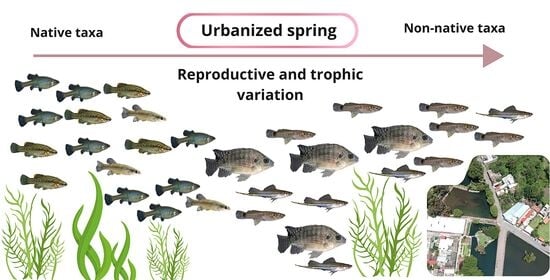
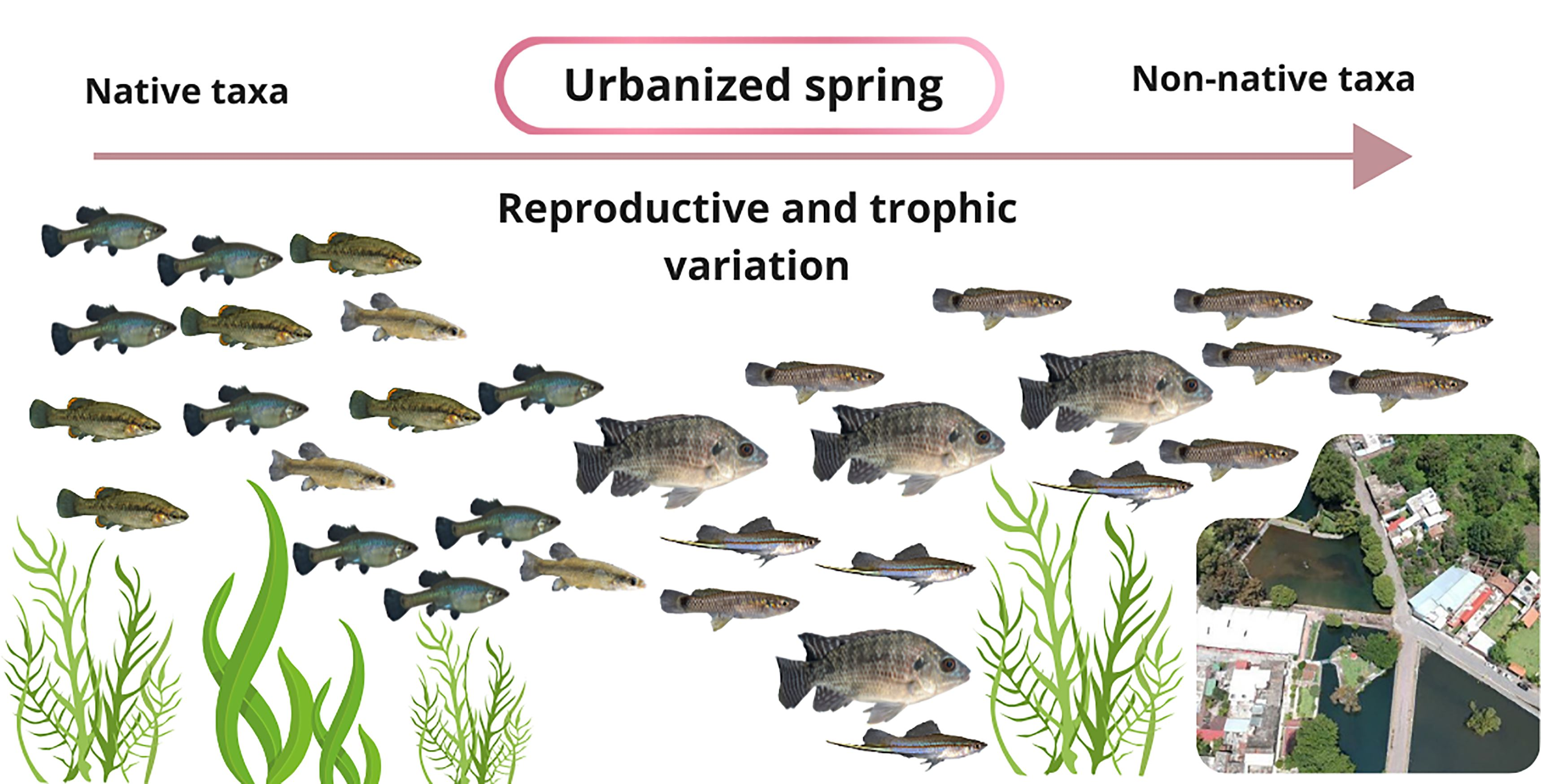
Graphical Abstract

1. Introduction

Biological invasions are considered the second greatest threat to global biodiversity after habitat loss [1,2,3,4,5]. Freshwater fishes are among the most frequently introduced vertebrates and often establish successfully in novel environments due to biological characteristics such as high fertility, rapid growth, environmental tolerance, phenotypic plasticity, and broad diets [6,7,8]. Introductions associated with aquaculture, recreational fishing, mosquito control and the ornamental trade have altered the structure and functioning of freshwater ecosystems worldwide [3,9]. In invaded systems, non-native fishes may modify patterns of resource use, trophic structure, and species interactions, particularly in anthropogenically altered environments where ecological conditions may favor species with opportunistic life-history traits [10,11,12,13,14]. Reproductive capacity, dietary flexibility, and ecological tolerance have frequently been proposed as traits associated with invasion success in freshwater fishes [15,16,17]. Studies conducted in disturbed or urbanized freshwater ecosystems have reported that species exhibiting prolonged reproductive freshwater activity, broad resource use, and high ecological tolerance often attain high abundances and persist under variable environmental conditions [18,19,20,21].
Freshwater ecosystems harbor a disproportionately high fraction of global biodiversity and provide essential ecosystem services, making them particularly vulnerable to the ecological consequences of biological invasions [22,23]. Mexico represents an important hotspot of freshwater fish diversity and endemism, where many endemic species are increasingly restricted to isolated habitats such as springs and small lentic systems [24]. These environments function as important refuges for endemic taxa but are also highly susceptible to habitat modification and species introductions.
An important example is Laguna de Zacapu and its associated spring system, designated a Natural Protected Area (ANP) in 2005 because of its high levels of endemism and ecological importance. The main lake supports a diverse fish assemblage composed primarily of native and endemic taxa [25,26,27]. Several species are endemic to the system, including Allotoca zacapuensis Meyer, Radda & Domínguez-Domínguez, 2001, and Notropis grandis Domínguez-Domínguez, Pérez-Rodríguez, Escalera-Vázquez & Doadrio, 2009, both classified as Endangered according to the International Union for Conservation of Nature (IUCN). Particularly noteworthy is Hubbsina turneri de Buen, 1940, also listed as Endangered, a relict species currently restricted to the Zacapu system. The site additionally harbors endemic amphibian fauna, further emphasizing its conservation importance relevance [28].
Despite the ecological importance of the Zacapu system, the spring zone known as La Zarcita remains poorly studied, despite being strongly influenced by urbanization and habitat modification, including bank alteration and the introduction of non-native fishes. In small spring systems, local ecological conditions, resource availability, and species interactions may influence assemblage structure and patterns of species persistence [29,30]. Evaluating reproductive and trophic characteristics within these assemblages may therefore provide useful ecological information regarding patterns associated with the persistence and numerical dominance of non-native taxa.
In this context, the purpose of this study is to evaluate reproductive and trophic patterns within the La Zarcita spring fish assemblage. Specifically, we aim to: (1) evaluate seasonal variation in fish community composition; (2) assess reproductive patterns among species within the assemblage; and (3) analyze trophic interactions and dietary overlap among coexisting taxa. We hypothesize that some non-native taxa would exhibit prolonged reproductive activity and trophic patterns differing from those observed in several native taxa within the assemblage. This study documents ecological patterns within a single urban spring system and provides information relevant to the conservation of freshwater ecosystems in central Mexico.

2. Materials and Methods

2.1. Study Area

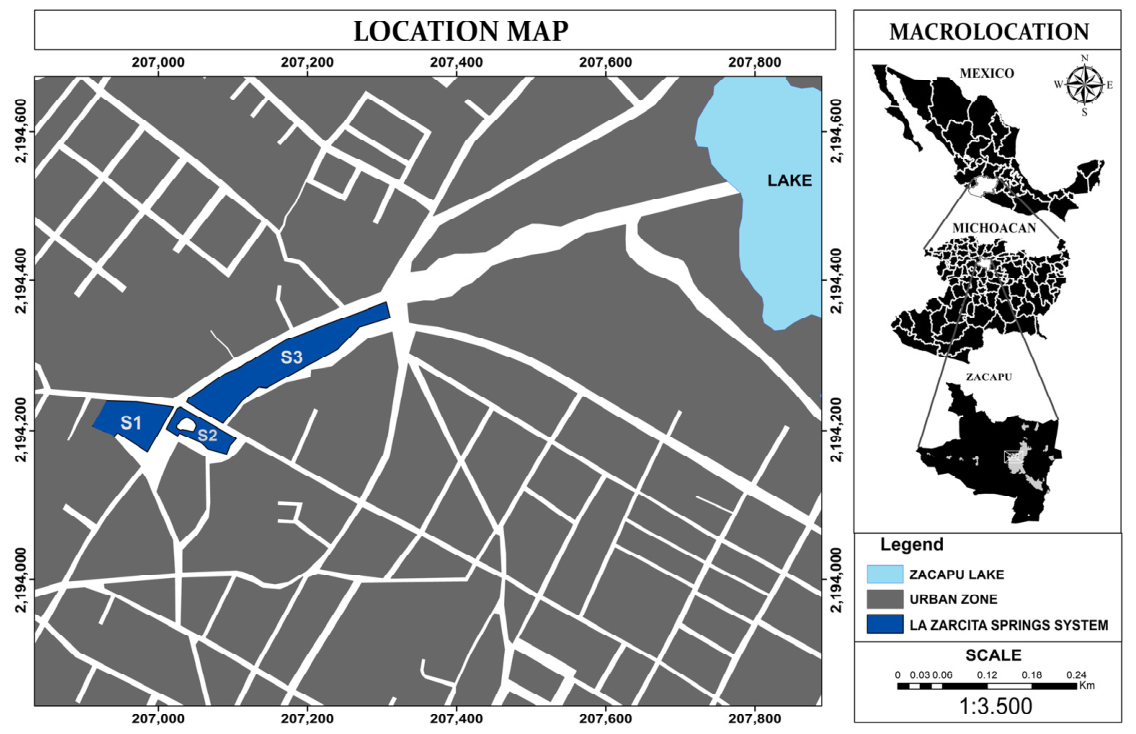
The Protected Natural Area known as “Laguna de Zacapu” is located in the state of Michoacán, in central-western Mexico, at an altitude of 1980 m above sea level [31]. It forms part of the Lerma–Chapala River basin, a region of significant hydrological and ecological importance. This natural reserve includes two main aquatic environments: a lake section and a spring system known as La Zarcita. The La Zarcita spring consists of three ponds with concrete and stone walls, hydrologically connected, all integrated into an urbanized environment (Figure 1).

2.2. Sampling

In each pond, temperature (°C), total dissolved solids (TDS, mg/L), pH, ammonia (NH3, mg/L), nitrate (NO3, mg/L), and Oxidation-Reduction Potential (ORP, mV) were measured using a multiparameter probe (YSI EXO2; YSI Inc., Yellow Springs, OH, USA).
Fish were sampled using cylindrical minnow traps (stainless steel, 42 cm in length, 19 cm in diameter, 0.5 cm mesh size, with two 2.5 cm inverted cone entrances), deployed for one hour at each site, and by seining with a net measuring 25 m in length, 1.8 m in height, and 5 mm mesh size, following standard ichthyological sampling procedures [32,33]. Each fish was identified to species using regional taxonomic keys for Mexican freshwater fishes [34], complemented with global taxonomic databases and specialized literature for non-native species following current accepted ichthyological classification systems [35]. All captured individuals were counted and used for community-level analyses. To evaluate whether the number of individuals analyzed was sufficient to accurately characterize the diet composition, a prey accumulation curve was constructed following the methodology described by [36]. Based on these curves, a standardized number of individuals per species was selected for trophic and reproductive analyses in each sampling event to ensure adequate and comparable sampling effort among taxa. Sampling was conducted bimonthly over six events, and a total of 1662 individuals were analyzed for trophic and reproductive assessments. The number of individuals per species per sampling event was as follows: Goodea atripinnis (Jordan, 1880) (n = 39), Skiffia lermae (Meek, 1902) (n = 15), Zoogoneticus quitzeoensis (Bean, 1898) (n = 19), Chirostoma humboldtianum (Valenciennes, 1835) (n = 32), Poeciliopsis infans (Woolman, 1894) (n = 19), Pseudoxiphophorus bimaculatus (Heckel, 1848) (n = 49), Xiphophorus hellerii (Heckel, 1848) (n = 22), Xenotoca variata (Bean, 1887) (n = 38), and Oreochromis niloticus (Linnaeus, 1758) (n = 44). Only individuals selected according to this standardized sampling design were sacrificed for trophic and reproductive analyses, while additional captured individuals were returned alive to the water with minimal handling.
Prior to preservation, individuals were euthanized using an overdose of benzocaine. Specimens were then fixed in 4% formaldehyde and transported to the Aquatic Biology Laboratory at the Universidad Michoacana de San Nicolás de Hidalgo for further analysis. Collection protocols were revised and approved by the Secretary of Environment and Natural Resources, Mexico, under permission SBRA/DGVS/02950/25.

2.3. Laboratory Analysis

Standard length and body weight were recorded for each individual. All specimens were subsequently dissected to extract the stomach and gonads for further analysis. Stomach contents were examined under a dissecting microscope at 10× magnification, and prey items were identified to the lowest possible taxonomic level using specialized identification keys [37,38]. Eggs and embryos, depending on the reproductive strategy of each species (oviparous, viviparous, ovoviviparous), were counted. Gonadal development stages were assessed using a stereomicroscope, following the classification criteria established for viviparous and ovoviviparous species [39] and for oviparous species [40]. Sex was determined either by direct examination of the gonads after dissection or, in species with external sexual dimorphism (e.g., Goodeidae, Poeciliidae), by morphological traits such as the presence of a gonopodium in males. In small individuals of species lacking external sexual dimorphism (e.g., Oreochromis niloticus), gonads were not sufficiently developed to allow reliable sex identification; therefore, these individuals were excluded from sex ratio and reproductive analyses. Specimens of Carassius auratus (Linnaeus, 1758), Ctenopharyngodon idella (Valenciennes, 1844), Cyprinus carpio (Linnaeus, 1758), Alloophorus robustus (Bean, 1892) and Pterygoplichthys disjunctivus (Weber, 1991) were not included in the dietary or reproductive analyses given the low number of organisms collected (n ≤ 10), reflecting their very low abundance in the system.

2.4. Data Analysis

2.4.1. Fish Community Analyses

The structure of the fish community was assessed using Hill numbers to estimate diversity at three orders: q = 0 (species richness), q = 1 (Shannon diversity), and q = 2 (inverse Simpson diversity) [41]. Confidence intervals were calculated using the bootstrap resampling method. Dominance within sampling events was evaluated using the prey-specific index of relative importance (PSIRI) [42].

2.4.2. Trophic Analyses

To assess prey dominance and feeding strategies, we calculated the prey-specific index of relative importance (%PSIRI; [43]) based on stomach content analysis. Trophic positions and feeding breadth were further quantified using TrophLab software (June 2000 version, which classifies species into discrete trophic levels ranging from decomposers (0–1) to tertiary consumers (>4) [44]. Feeding plasticity was assessed through the omnivory index (OI), where values close to 0 represent specialist feeders and values approaching 1 denote trophic generalists exploiting multiple trophic levels [43]. Variation in OI associated with species origin within the assemblage was explored using a linear mixed-effects model (LMM), with origin included as a fixed effect and species as a random intercept to account for the hierarchical structure of the data and non-independence among individuals. The omnivory index was calculated at the individual level as a measure of variation in trophic resource use among prey categories consumed. Dietary overlap among fish species was evaluated descriptively using Horn’s index, where values: <0.30 indicate low overlap, 0.30–0.65 indicate moderate overlap, and >0.66 indicates high overlap [45]. Patterns of overall diet composition associated with species origin were explored using permutational multivariate analysis of variance (PERMANOVA) based on Bray–Curtis dissimilarities with 999 permutations. Homogeneity of multivariate dispersion between groups was assessed using betadisper prior to PERMANOVA analyses. All trophic analyses were conducted at the individual level; interpretations were restricted to assemblage-level ecological patterns because the number of independent species-level replicates per origin category was limited.

2.4.3. Reproductive Analyses

Sex ratios were calculated by season following [46], with significance tested using the Chi-squared test (χ2, α = 0.05). Size at First Maturity (L50) was estimated using logistic regression models with parameters and confidence intervals obtained through Bayesian inference using the sizeMat package in R version 4.4.1 [47]. Fertility (F) was modeled following the established approaches [48,49], and its relationship with standard length was tested using Pearson’s correlation. Variation in fertility associated with species origin within the assemblage was explored using generalized linear mixed models (GLMMs) with a Poisson distribution, including origin as a fixed effect and species as a random intercept to account for the hierarchical structure of the data and non-independence among individuals. Body size was included as a covariate. Bimonthly size structure was analyzed using length classes determined according to Sturges’ rule for estimating the number of class intervals [50]. Gonadosomatic Index (GSI) and Fulton’s condition factor (K) were calculated following standard procedures [51,52]. The duration of the reproductive period was quantified as the number of months in which reproductive activity was detected for each species, based on the presence of reproductive individuals (GSI values), and patterns associated with species origin were evaluated using a Wilcoxon rank-sum test (α = 0.05). Variation in both K and GSI associated with species origin was explored using a linear mixed-effects models (LMMs), with origin, sex, and month included as fixed effects and species included as a random intercept. Models were fitted at the individual level using restricted maximum likelihood (REML). Complementary analyses using species mean values were additionally conducted using Wilcoxon test to evaluate whether observed assemblage-level patterns were consistent at the species level. Because Fulton’s K may be influenced by interspecific differences in body morphology and growth form, comparisons among taxa was interpreted as assemblage-level ecological patterns rather than direct physiological equivalence among species. Model assumptions were evaluated through residual diagnostics, including Shapiro–Wilk tests for normality and Levene’s tests for homogeneity of variance. Statistical significance was determined using Type III ANOVA with Satterthwaite’s approximation (α = 0.05). Analyses were conducted in R 4.4.1 [53] using the packages lme4 version 2.0.1 and lmerTest version 3.2.0.

2.4.4. Environmental Water Conditions and Statistical Analysis

Seasonal variation in physicochemical parameters (temperature, pH, NO3, TDS, ORP, and NH3) was evaluated using one-way ANOVA with month as a fixed factor. Normality was assessed with Shapiro–Wilk tests, and Tukey’s HSD was applied for post hoc comparisons when significant. Kruskal–Wallis tests were additionally used to confirm observed patterns. Significance was set at α = 0.05. Associations between environmental variation and trophic composition were explored using redundancy analysis (RDA) based on Hellinger-transformed diet data, with significance assessed through permutation tests (999 permutations). A complementary PERMANOVA based on Bray–Curtis dissimilarities were conducted to evaluate assemblage-level associations between physicochemical variables and trophic composition. Residual diagnostics and overdispersion for generalized linear mixed models were evaluated using simulation-based diagnostics implemented in the package DHARMa. Associations between physicochemical variables and reproductive or physiological traits were evaluated using mixed-effects models. Variation in K and GSI were analyzed using physicochemical variables as predictors, with origin and sex included as fixed effects, and species included as a random intercept to account for the hierarchical structure of the data. Female fertility was analyzed using generalized linear mixed models with a negative binomial distribution, including environmental variables and female size as predictors and species as a random effect. Because the study was conducted within a single spring assemblage, these analyses were interpreted as exploratory evaluations of environmental associations rather than direct tests of causal environmental effects. Model selection was based on likelihood ratio tests, and collinearity among predictors was assessed using variance inflation factors (VIFs). Model residuals and overdispersion were evaluated graphically and through diagnostic statistics to assess model fit and verify distributional assumptions. All analyses were conducted in R 4.4.1 [53] using the packages vegan version 2.7.3, lme4 version 2.0.1, lmerTest 3.2.0, glmmTMB version 1.1.14, and DHARMa version 0.4.7.

3. Results

3.1. Fish Community

A total of 5373 individuals were collected during the study period, representing a biomass of 326,720 g. Fourteen taxa distributed across six orders and five families were recorded, including seven native taxa and seven non-native taxa. The native taxa were primarily represented by members of the family Goodeidae, including X. variata, G. atripinnis, S. lermae, A. robustus, and Z. quitzeoensis. Additional native taxa included C. humboldtianum (Atherinopsidae) and P. infans (Poeciliidae) (Table 1).
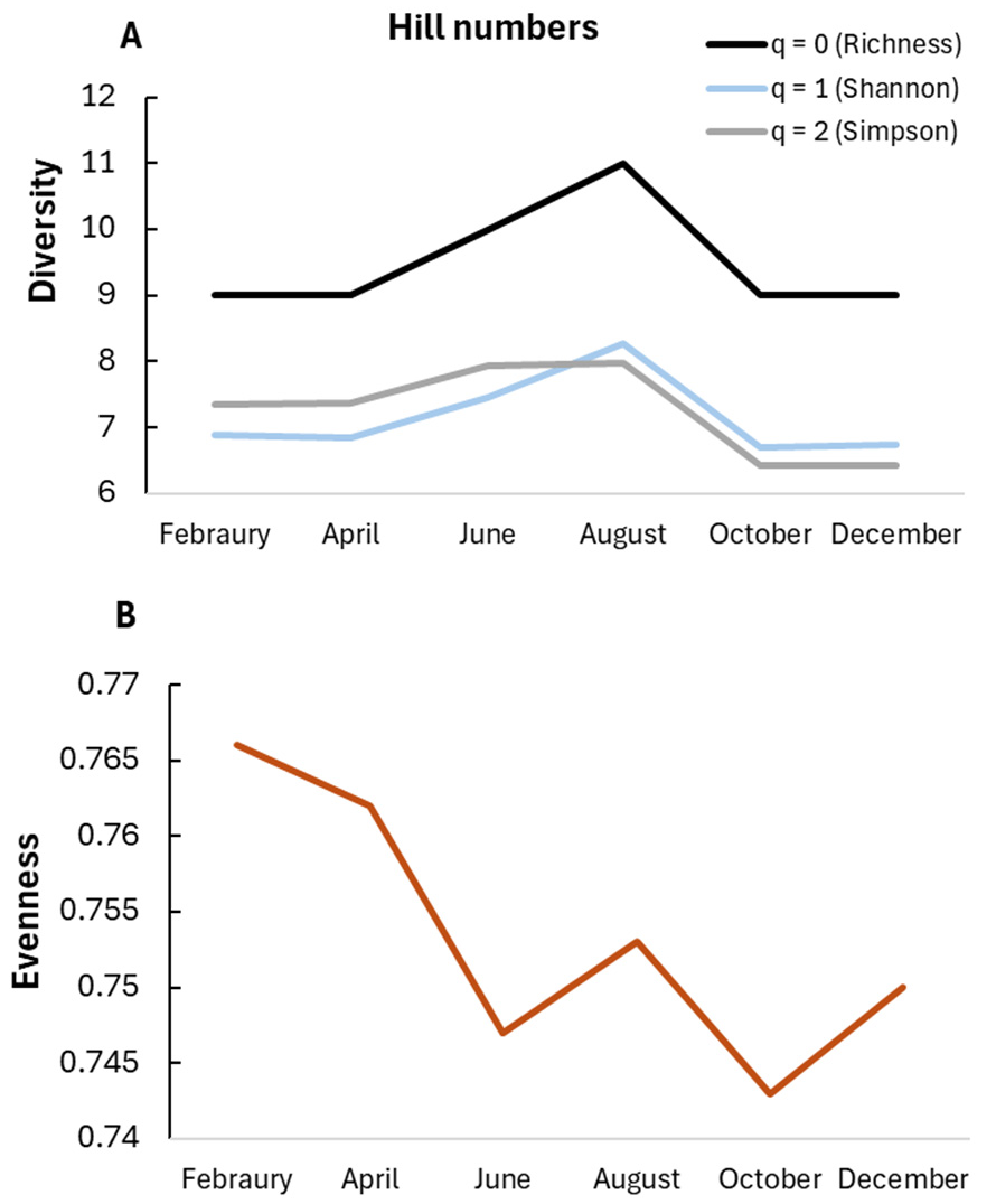
Patterns of relative dominance within native taxa indicated that G. atripinnis and X. variata represented the most dominance taxa (9% and 8% respectively), whereas S. lermae, Z. quitzeoensis and A. robustus each represented less than <3% of the dominance (Table 1). Non-native taxa represented a large proportion of the assemblage, particularly O. niloticus (30%), P. bimaculatus (24%), and X. hellerii (14%), whereas other introduced species such as C. auratus, C. idella, C. carpio, and P. disjunctivus each represented less than 1% of the total abundance. Species richness (q = 0) remained relatively stable throughout the study period, fluctuating between 9 and 11 taxa. Shannon diversity (q = 1) and Simpson diversity (q = 2), expressed as effective numbers of taxa, showed greater temporal variation, with the highest values recorded in August (q1 = 8.28; q2 = 7.98) and lowest in October (q1 = 6.69; q2 = 6.42) (Figure 2A). Evenness was highest in August, indicating a more homogeneous distribution of abundances among taxa, and lowest in October, reflecting lower evenness associated with the high relative abundance of few taxa (Figure 2B).

3.2. Trophic Patterns

Goodea atripinnis consumed primarily organic matter (PSIRI 56.2%), algae (PSIRI 42.24%), along with low contributions from other prey items such as Copepods (PSIRI 0.11%), and fish (PSIRI 0.04%). The native taxa as Z. quitzeoensis fed predominantly on aquatic insect (IR; PSIRI 94.3%), whereas S. lermae showed a strong predominance of copepods (PSIRI 97%), with minimal contributions from other prey categories. Xenotoca variata consumed aquatic insect (IR; PSIRI 48.08%) followed by organic matter (PSIRI 18.52%) and algae (PSIRI 11.74%). Chirostoma humboldtianum included several prey categories in its diet, particularly aquatic insect (IR; PSIRI 56.2%), together with lower contribution from plumatellids (PSIRI 1.9%) (Table 2). Among non-native taxa, P. bimaculatus fed predominantly on aquatic insects (IR; PSIRI 89%), with secondary consumption of cladocerans (PSIRI 9.18%). Xiphophorus hellerii consumed mainly algae (PSIRI 57.27%) and organic matter (PSIRI 36.37%), and O. niloticus showed high consumption of organic matter (Omni: PSIRI 66.04%) and plant material (PSIRI 26%) (Table 2).
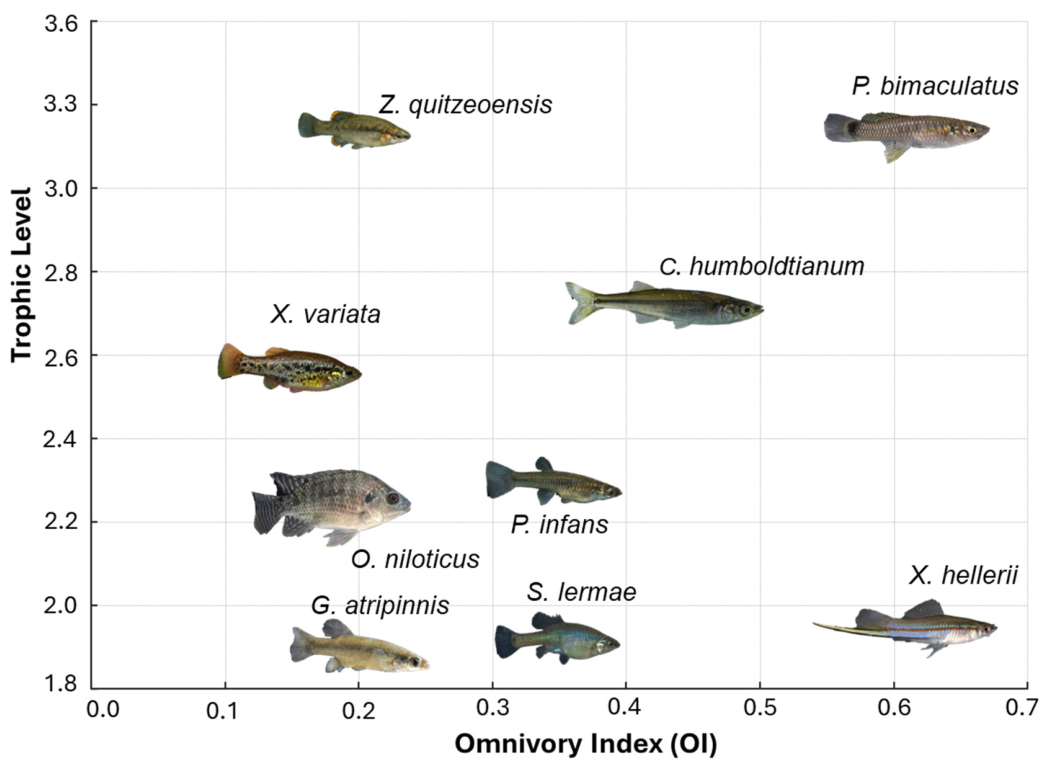
Assemblage-level analyses detected differences in omnivory index (OI) values among taxa grouped according to species origin (LMM, p < 0.05). Among native taxa, G. atripinnis showed a trophic position of 2.0 ± 0.21, and OI values of 0.15, whereas S. lermae showed trophic values of 2.02 ± 0.20 and OI of 0.3. Xenotoca variata showed a trophic position of 2.7 ± 0.29 and omnivory values of 0.12. Among the remaining native taxa, Z. quitzeoensis and C. humboldtianum exhibited trophic positions of 3.2 ± 0.10 and 2.8 ± 0.12, respectively (Figure 3). Among non-native taxa, P. bimaculatus and X. hellerii exhibited OI values of 0.6. The species P. bimaculatus also occupied a trophic position of 3.2 ± 0.19, whereas X. hellerii showed trophic values of 2.07 ± 0.15. Oreochromis niloticus exhibited a trophic position of 2.05 ± 0.11 and omnivory values of 0.2 (Figure 3).
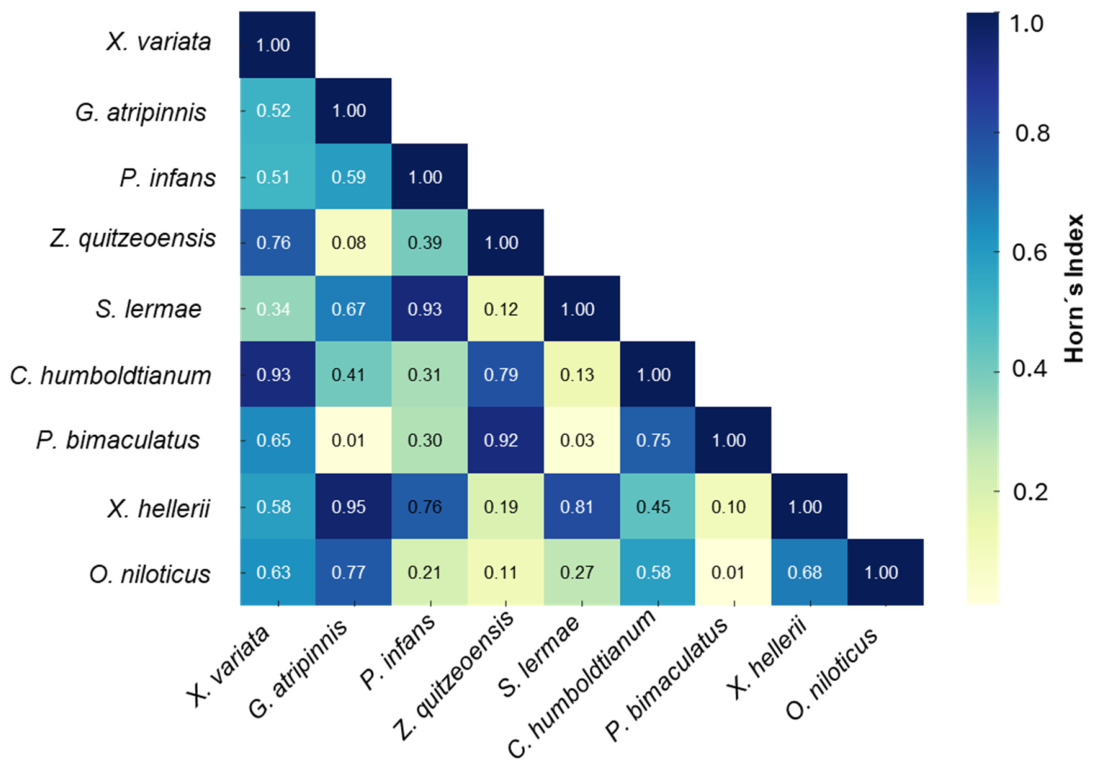
Overall diet composition did not differ significantly according to species origin (PERMANOVA, Bray–Curtis, p > 0.05), observed that several native and non-native taxa consumed similar resources categories within the assemblage. High dietary overlap values were observed between P. bimaculatus and Z. quitzeoensis (H′ = 0.923), both characterized by high consumption of aquatic insects (IRs). Similarly, X. hellerii and G. atripinnis exhibited high overlap values (H′ = 0.955) (Figure 4). Moderate overlap values were observed between X. variata and O. niloticus (H′ = 0.627), as well as between C. humboldtianum and O. niloticus (H′ = 0.581). Additional moderate overlaps occurred between X. variata and P. bimaculatus (H′ = 0.645), whereas low overlap values were observed between P. bimaculatus and O. niloticus (H′ = 0.010) (Figure 4).

3.3. Reproductive Patterns

Native taxa generally exhibited annual sex ratios close to 1:1, with the exception of X. variata, which showed a moderately female-biased ratio (2:1). Within the assemblage, several non-native taxa exhibited female-biased sex ratios, particularly P. bimaculatus (3:1) and X. hellerii (4:1) (Table 3).
Assemblage-level analyses detected differences in fertility values among taxa grouped according to species origin (GLMM, p < 0.05). Among native taxa, G. atripinnis exhibited fertility values of 38 ± 5, followed by X. variata (19 ± 7), whereas S. lermae and P. infans showed fertility values of 7 ± 1 and 13 ± 2, respectively (Table 3). Significant positive relationships between body size and fertility were observed in G. atripinnis (r2 = 0.95) and X. variata (r2 = 0.81). The only native oviparous taxon, C. humboldtianum, produced 31–725 eggs (mean = 204 ± 17) and exhibited a positive relationship between body size and fertility (r2 = 0.69) (Table 3). Among non-native taxa, P. bimaculatus produced between 6 and 95 embryos (mean = 43 ± 3), X. hellerii averaged 28 ± 5 embryos, and O. niloticus produced between 15 and 244 eggs (mean = 94 ± 4) (Table 3). Positive relationships between body size and fertility were observed in the evaluated non-native taxa (r2 = 0.70–0.87) (Table 3). Sexual maturity in native taxa such as X. variata and G. atripinnis was recorded at female body sizes between 54 and 58 mm SL and male body sizes between approximately 51 and 90 mm SL. In contrast, P. infans, Z. quitzeoensis, and S. lermae reached maturity at body sizes near 30 mm SL, while C. humboldtianum reached maturity at body sizes greater than 68 mm SL (Table 3). Among non-native taxa, maturity was recorded at body sizes below 35 mm SL in P. bimaculatus and X. hellerii, whereas O. niloticus reached maturity at body sizes greater than 140 mm SL (Table 3).
Native taxa within the assemblage exhibited variable body-size ranges, X. variata ranged from 21–75 mm SL in females and 25–70 mm in males, whereas G. atripinnis showed a range from 21–130 mm in females and 18–144 mm in males. Smaller-bodied natives taxa such as P. infans (♀ 26–33 mm; ♂ 25–30 mm), Z. quitzeoensis (♀ 23–50 mm; ♂ 25–55 mm), and S. lermae (♀ 22–36 mm; ♂ 30–35 mm) exhibited comparatively narrower size ranges. The only native oviparous taxon recorded, C. humboldtianum, ranged from 39–125 mm SL in females and 51–110 mm in males (Table 3). Size ranges among non-native taxa were also variable. The species P. bimaculatus ranged from 18–74 mm SL in females and 20–61 mm in males, whereas X. hellerii ranged from 16–64 mm in females and 29–51 mm in males, while O. niloticus ranged from 30–335 mm in females and 35–350 mm in males (Table 3).
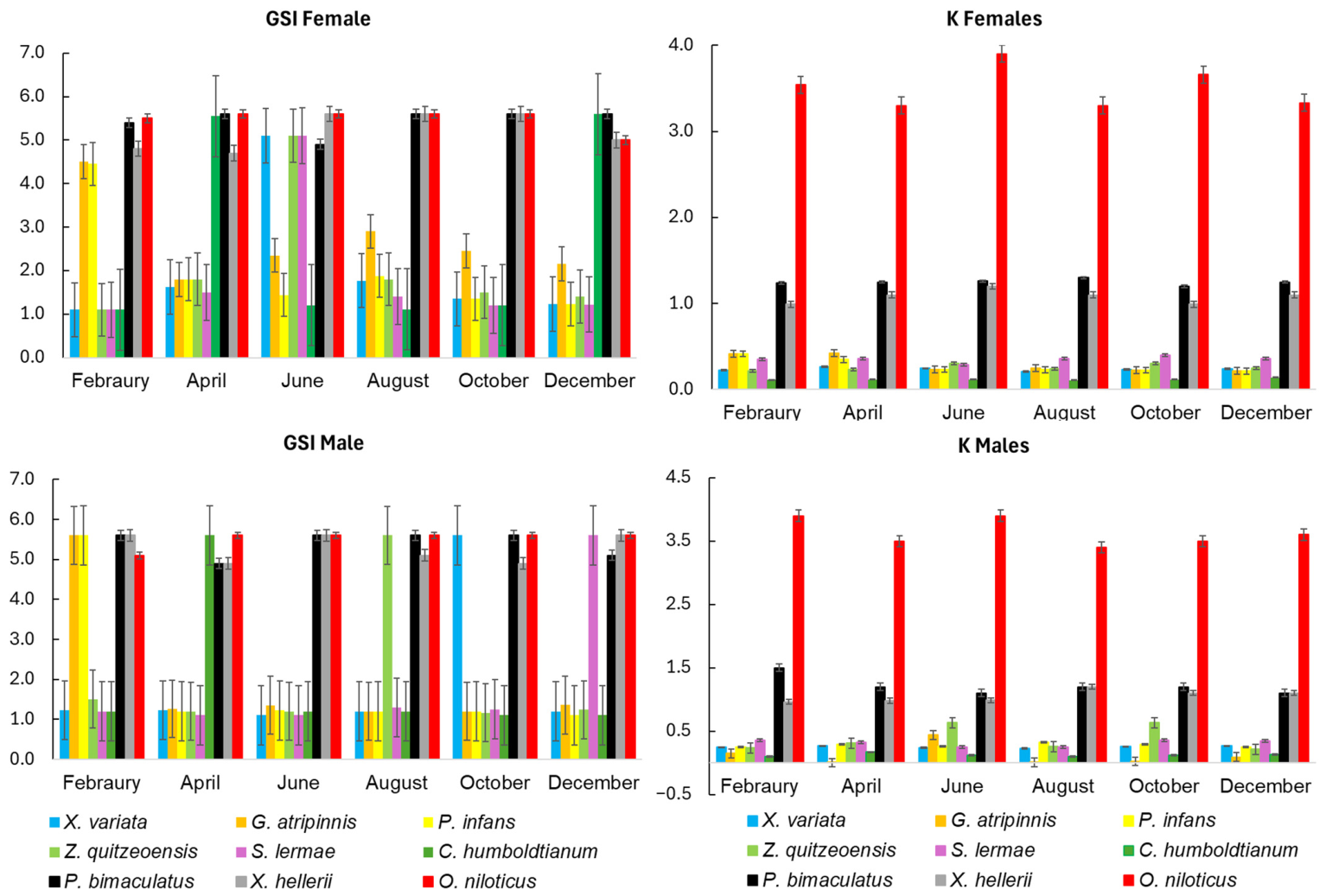
Native taxa exhibited reproductive activity concentrated between February and June. Chirostoma humboldtianum represented an exception, showing two peaks (April and December) (Figure 5). Several non-native taxa within the assemblage, including X. hellerii, P. bimaculatus, and O. niloticus exhibited reproductive activity extending across of the year (Figure 5). Exploratory assemblage-level comparisons detected differences in the number of reproductive months among taxa grouped according to species origin (Wilcoxon test, p < 0.05). Similarly, linear mixed-effects models detected differences in gonadosomatic index (GSI) values among taxa grouped according to species origin (β = 0.64 ± 0.06 SE, p < 0.001) after accounting for interspecific variation. Complementary species-level analyses showed similar variation in mean GSI values among taxa (Wilcoxon test, p = 0.028).
Patterns of Fulton’s condition factor (K) varied among taxa throughout the study period. Values ranged from approximately 0.10 to 0.42 in native taxa, whereas P. bimaculatus exhibited K values between 1.20 and 1.30, X. hellerii between 0.99 and 1.20, and O. niloticus between 3.30 and 3.90 (Figure 5). Assemblage-level linear mixed-effects model detected statistical differences in K values among assemblage components grouped according to species origin (F1,7 = 22.75, p = 0.002). Sex also showed a significant effect, with males exhibiting lower K values than females (F1,93 = 28.56, p < 0.001), whereas month had no significant effect (F5,93 = 0.05, p = 0.998). Complementary species-level analyses detected additional variation in mean K values among taxa (Wilcoxon test, p = 0.024).

3.4. Environmental Water Conditions

Water temperature varied markedly across months (ANOVA, F5,48 = 329.9, p < 0.001). The highest temperatures were recorded in June (mean = 21.33 °C), whereas the lowest occurred in October (14.30 °C) and February (15.24 °C). Tukey post hoc comparisons indicated that June differed significantly from all other months (p < 0.001), while April, August, and December did not differ significantly from one another. The pH also differed significantly among months (F5,48 = 1128, p < 0.001), although variation was relatively small (6.66–7.30). Nitrate concentrations varied significantly across months (F5,48 = 11.14, p < 0.001), whereas TDS showed moderate but significant differences (F5,48 = 2.65, p = 0.034). ORP varied strongly through time (F5,48 = 4478, p < 0.001), reaching peak values in August. Ammonia concentrations also differed statistically among months (p < 0.001), although absolute differences were minimal (0.07–0.08 mg/L). Physicochemical variables were not significantly associated with variation in diet composition (RDA and PERMANOVA, p = 1.00; R2 ≈ 0). Similarly, mixed-effects models indicated that physicochemical variables did not show significant values on K values (all p > 0.75), and their inclusion did not improve model performance (p = 0.98). Environmental variables were also not significant values of gonadosomatic index (GSI) (all p > 0.36) or fertility (all p ≥ 0.99) and sex was not significantly associated with reproductive investment (p = 0.69). In contrast, assemblage-level mixed-effects models detected statistical differences in GSI values among assemblage components grouped according to species origin (β = 0.64 ± 0.06 SE, p < 0.001) after accounting for interspecific variation.

4. Discussion

Urbanized spring systems are frequently characterized by shifts in assemblage structure and the presence of non-native species. The present study documents the ichthyofauna of the La Zarcita spring complex, a small spring system within a protected area currently influenced by urbanization and inhabited by several non-native taxa.

4.1. Fish Community Structure and Environmental Context

Community structure exhibited seasonal variation, with biodiversity, evenness, and species richness reaching their highest values in August. Hill-number diversity metrics indicated that species richness remained relatively stable across sampling periods, whereas evenness fluctuated through time, reflecting temporal changes in relative abundances within the assemblage. The mechanisms underlying these temporal shifts were not evaluated in the present study. Similar assemblage patterns have been described in other freshwater systems influenced by human disturbance [30,54,55]. Oreochromis niloticus represented 30% of the total abundance within the assemblage, followed by P. bimaculatus (24%) and X. hellerii (14%). In contrast, native taxa such as G. atripinnis (9%) and X. variata (8%) occurred at lower abundances, whereas other native goodeids—including S. lermae, Z. quitzeoensis, and A. robustus—each represented less than 3% of individuals. Similar assemblage patterns involving high relative abundances of non-native fishes have been documented in other freshwater systems in Mexico [56,57,58].
The physicochemical conditions recorded in La Zarcita suggest a system that, despite strong surrounding urban influence, does not currently exhibit signs of severe organic pollution or acute eutrophication. Values of pH, ammonium, and total dissolved solids remained within relatively moderate ranges throughout the study period, although nitrate concentrations consistently exceeded 6 mg/L and increased during late summer, consistent with possible nutrient inputs from nearby urban or agricultural areas [59]. The system also exhibited seasonal variation in temperature and oxidation–reduction potential throughout the study period. A useful regional contrast is provided by Lake Zacapu, located within the same protected natural area, where previous studies have documented more stable physicochemical conditions and fish assemblages composed primarily of native and endemic taxa, including A. zacapuensis, N. grandis, and H. turneri [25,26,27]. None of these endemic species were recorded in the La Zarcita springs. Although physicochemical variables were not significantly associated with trophic composition, reproductive traits, or condition factor values in the statistical analyses performed, the environmental variability observed in La Zarcita occurs within a small spring system strongly influenced by surrounding human-modified landscapes. Similar environmental contexts have been reported in freshwater systems exhibiting high relative abundances of non-native taxa [60], although these relationships were not directly evaluated in the present study.

4.2. Reproductive Variation Within the Assemblage

Within the assemblage, exploratory comparisons detected differences in fertility values, reproductive activity, body size at maturity, and gonadosomatic index values among taxa grouped according to species origin. Several taxa classified as non-native exhibited prolonged reproductive activity across multiple months, whereas variation in fertility values, body size at maturity, and gonadosomatic index values was also observed among taxa within the assemblage.
The most abundant non-native taxa (P. bimaculatus, X. hellerii, and O. niloticus) reproduced over extended periods (April–December), exhibited a reproductive activity during a greater number of months than native taxa (Wilcoxon test, p < 0.05) and showed positive relationships between body size and fertility (r2 = 0.70–0.87). Similar reproductive periods have been documented in non-native poeciliids including prolonged reproductive activity across multiple months of the year [56,61,62]. Several non-native taxa, particularly P. bimaculatus and X. hellerii, also reached maturity at relatively small body sizes (<35 mm SL), similar to previous reports for introduced populations of these species [58,61,62]. In contrast, several native taxa exhibited reproductive activity concentrated primarily between February and June, with a single annual reproductive peak. Previous studies conducted in Lake Zacapu reported two well-defined reproductive peaks for these same native taxa under comparatively more stable environmental conditions [25]. Additionally, native taxa from La Zarcita reached maturity at larger body sizes (>50 mm SL) than populations previously reported from Lake Zacapu, where smaller body sizes at maturity have been documented [25,26]. Similar seasonal reproductive periods have been documented in several native freshwater fishes, where reproductive activity is concentrated within specific periods of the annual cycle [25,54,63]. However, food availability, age at maturity, and growth rates were not directly evaluated in the present study, although these variables may represent important factors to consider in future investigations of reproductive variation among freshwater fish assemblages. Although physicochemical variables varied seasonally throughout the study period, they were not significantly associated with the reproductive metrics evaluated in the present analyses.
Female-biased sex ratios were observed in P. bimaculatus (3:1) and X. hellerii (4:1), whereas most native species exhibited sex ratios close to 1:1. In poeciliids, female-biased sex ratios have been reported frequently associated with sex-specific mortality patterns linked to behavioral characteristics particularly the greater exposure of males to predation due to courtship activity, territoriality, and conspicuous coloration [58,62,64]. In contrast, the native poecilid, P. infans exhibited a comparatively balanced sex ratio despite belonging to the same family. This pattern suggest that sex ratio variation may differ among poeciliids taxa and should not be interpreted as a uniform demographic characteristic across the family, for example, P. infans are generally less conspicuous and exhibit weaker sexual ornamentation than species such as X. hellerii [65]. Although the demographic consequences of these sex ratios were not evaluated in the present study, variation in sex-ratio structure may influence reproductive dynamics within assemblages. Balanced sex ratios, such as those observed in most native taxa, have frequently been reported in stable fish populations, although demographic structure may vary considerably among species and environmental contexts [66,67]. Assemblage-level analyses detected differences in condition factor (K) values among taxa grouped according to species origin, with comparatively higher values recorded in O. niloticus and P. bimaculatus (LMM, p < 0.01). Similar differences were also detected in complementary species level analyses (Wilcoxon test, p < 0.05). Because Fulton’s K is strongly influenced by species-specific body shape, allometric growth, and reproductive condition [68], interspecific comparisons should be interpreted cautiously and not as direct measures of physiological performance among taxa. Physicochemical variables were not significantly associated with K values in the statistical analyses performed, showing that the short-term environmental variation measured during the study period did not explain the observed K values. Previous studies conducted in Lake Zacapu, located within the same protected area, documented relatively stable seasonal patterns in Fulton’s K and high reproductive allocation in several native goodeid species under comparatively stable environmental conditions [25]. In contrast to La Zarcita, Lake Zacapu also lacks several of the abundant non-native taxa recorded in the present study [26]. These regional differences highlight the importance of future comparative studies evaluating reproductive and trophic variation among freshwater assemblages exposed to different environmental conditions and species compositions.

4.3. Trophic Interactions

Diet composition and Horn’s trophic overlap values indicate that O. niloticus, P. bimaculatus, and X. hellerii consumed multiple prey categories, including aquatic invertebrates, algae, and organic material. Several of these taxa showed moderate to high dietary overlap with native taxa. Overall diet composition did not differ significantly according to species origin (PERMANOVA, p > 0.05), showing overlap in resource use among several native and non-native taxa within the assemblage. Exploratory assemblage-level analyses detected differences in omnivory index (OI) values among taxa grouped according to species origin (LMM, p < 0.05). Taxa such as X. variata and G. atripinnis consumed higher proportions of aquatic invertebrates and plant material to other taxa within the assemblage. Together, these patterns indicate variation in resource use among taxa within the assemblage rather than complete trophic segregation. Previous studies conducted in Lake Zacapu, located within the same protected area, documented trophic overlap, generalist feeding patterns, and relatively low trophic positions among several native fish species [27]. In that system, trophic structure showed limited temporal and spatial variation despite differences in species composition and habitat characteristics. Similar assemblage patterns involving trophic overlap and consumption of shared prey categories have also been reported in other freshwater ecosystems containing both native and non-native fishes [69,70,71,72]. Although direct comparisons among systems were not evaluated in the present study, these regional observations highlight the importance of future comparative research examining trophic organization among freshwater assemblages exposed to species compositions. Importantly, Horn’s overlap values represent descriptive measures of shared resource use and should not be interpreted as direct evidence of competitive interactions.

5. Conclusions

This study documents reproductive and trophic variation among coexisting fish taxa within the La Zarcita spring system, where the assemblage included several abundant non-native taxa during the study period. Exploratory assemblage-level analyses detected variation in reproductive activity, fertility values, gonadosomatic index values, omnivory indices, and resource use among taxa within the assemblage, while overall diet composition showed substantial overlap among several native and non-native species. Physicochemical variables varied seasonally but were not significantly associated with trophic composition, reproductive metrics, or Fulton’s condition factor values in the statistical analyses performed. Consequently, environmental variation is interpreted here primarily as part of the ecological context of the system rather than as a demonstrated driver of the observed assemblage patterns. Continued ecological monitoring may also contribute to understanding long-term assemblage dynamics and support conservation efforts within this protected system.

Author Contributions

Conceptualization, A.R.-G. and O.D.-D.; methodology, A.R.-G. and O.D.-D.; software, A.R.-G. and O.D.-D.; validation, A.R.-G. and O.D.-D.; formal analysis, A.R.-G. and O.D.-D.; investigation, A.R.-G., O.D.-D., E.M.E.-E., F.S.J.-C., P.P.-V., A.P.-P., A.D.-F. and J.F.C.-M.; resources, A.R.-G., O.D.-D. and M.K.; data curation, A.R.-G., E.M.E.-E., F.S.J.-C., P.P.-V., A.P.-P., A.D.-F., J.F.C.-M. and M.K.; writing—original draft preparation, A.R.-G. and O.D.-D.; writing—review and editing, A.R.-G., O.D.-D., E.M.E.-E., F.S.J.-C., P.P.-V., A.P.-P., A.D.-F., J.F.C.-M. and M.K.; visualization, A.R.-G. and O.D.-D.; supervision, A.R.-G. and O.D.-D.; project administration, A.R.-G. and O.D.-D.; funding acquisition, A.R.-G., O.D.-D. and M.K. All authors have read and agreed to the published version of the manuscript.

Funding

This research was funded by Chester Zoo (UK), The Rufford Foundation (UK) (Grant No. 44133-2), and the North American Livebearer Association.

Institutional Review Board Statement

The study was conducted under official collection and handling permits issued by the Secretaría de Medio Ambiente y Recursos Naturales (SEMARNAT) [SBRA/DGVS/02850/25]. Ethical review and approval were waived because the procedures were part of an authorized conservation and reintroduction program and did not involve experimental manipulation beyond standard handling practices.

Data Availability Statement

The datasets generated and analyzed during the current study are available from the corresponding author upon reasonable request.

Acknowledgments

We sincerely thank the local fishermen’s association for their invaluable logistical and field support throughout this research, particularly Joel Pimentel. We are also grateful to the Zacapu municipal government (2021–2024) for granting access to the protected area and facilitating field activities. We additionally thank Nandini Sarma for her valuable support throughout the preparation and revision of this manuscript. During the preparation of this manuscript, the authors used ChatGPT (OpenAI, GPT-5 version) for language editing and text refinement. The authors have reviewed and edited the output and take full responsibility for the content of this publication.

Conflicts of Interest

The authors declare no conflicts of interest. The funders had no role in the design of the study; in the collection, analyses, or interpretation of data; in the writing of the manuscript; or in the decision to publish the results.

References

  1. Clavero, M.; García-Berthou, E. Invasive species are a leading cause of animal extinctions. Trends Ecol. Evol. 2005, 20, 110. [Google Scholar] [CrossRef]
  2. García-Berthou, E. The characteristics of invasive fishes: What has been learned so far? J. Fish Biol. 2007, 71, 33–55. [Google Scholar] [CrossRef]
  3. Simberloff, D.; Vitule, J.R.S. A call for an end to calls for the end of invasion biology. Oikos 2014, 123, 408–413. [Google Scholar] [CrossRef]
  4. Haubrock, P.J.; Novello, M.; Abreo, N.A.; Błońska, D.; Sampaio Franco, A.C.; Soto, I.; Castaldelli, G.; Katsanevakis, S.; Kouba, A.; Balzani, P.; et al. A global account of established non-native fish species. Glob. Change Biol. 2025, 31, e70451. [Google Scholar] [CrossRef]
  5. Erarto, F.; Getahun, A. Impacts and introductions of non-native freshwater fish species. Int. J. Fish. Aquat. Stud. 2020, 8, 207–216. [Google Scholar]
  6. Rodríguez, L.F. Can invasive species facilitate native species? Evidence of how, when, and why these impacts occur. Biol. Invasions 2006, 8, 927–939. [Google Scholar] [CrossRef]
  7. Cucherousset, J.; Olden, J.D. Ecological impacts of non-native freshwater fishes. Fisheries 2011, 36, 215–230. [Google Scholar] [CrossRef]
  8. Liu, C.; Comte, L.; Olden, J.D. Heads you win, tails you lose: Life-history traits predict invasion and extinction risk of the world’s freshwater fishes. Aquat. Conserv. Mar. Freshw. Ecosyst. 2017, 27, 773–779. [Google Scholar] [CrossRef]
  9. Ortega, J.C.G.; Júlio, H.F., Jr.; Gomes, L.C.; Agostinho, A.A. Fish farming as the main driver of fish introductions in Neotropical reservoirs. Hydrobiologia 2015, 746, 147–158. [Google Scholar] [CrossRef]
  10. Gozlan, R.E.; Britton, J.R.; Cowx, I.G.; Copp, G.H. Current knowledge on non-native freshwater fish introductions. J. Fish Biol. 2010, 76, 751–786. [Google Scholar] [CrossRef]
  11. Walsh, J.R.; Carpenter, S.R.; Vander Zanden, M.J. Invasive species triggers a massive loss of ecosystem services through a trophic cascade. Proc. Natl. Acad. Sci. USA 2016, 113, 4081–4085. [Google Scholar] [CrossRef]
  12. Ellender, B.R.; Weyl, O.L.F. A review of current knowledge, risk and ecological impacts associated with non-native freshwater fish introductions in South Africa. Aquat. Invasions 2014, 9, 117–132. [Google Scholar] [CrossRef]
  13. Toussaint, A.; Charpin, N.; Beauchard, O.; Grenouillet, G.; Oberdorff, T.; Tedesco, P.A.; Brosse, S.; Villéger, S. Non-native species led to marked shifts in functional diversity of the world freshwater fish faunas. Ecol. Lett. 2018, 21, 1649–1659. [Google Scholar] [CrossRef] [PubMed]
  14. Milardi, M.; Gavioli, A.; Soininen, J.; Castaldelli, G.; Benedetti-Cecchi, L. Exotic species invasions undermine regional functional diversity of freshwater fish. Sci. Rep. 2019, 9, 17921. [Google Scholar] [CrossRef]
  15. Marchetti, M.P.; Moyle, P.B.; Levine, R. Invasive species profiling? Exploring the characteristics of non-native fishes across invasion stages in California. Freshw. Biol. 2004, 49, 646–661. [Google Scholar] [CrossRef]
  16. Peoples, B.K.; Midway, S.R. Fishing pressure and species traits affect stream fish invasions both directly and indirectly. Divers. Distrib. 2018, 24, 1158–1168. [Google Scholar] [CrossRef]
  17. Catford, J.A.; Jansson, R.; Nilsson, C. Reducing redundancy in invasion ecology by integrating hypotheses into a single theoretical framework. Annu. Rev. Ecol. Evol. Syst. 2009, 15, 22–40. [Google Scholar] [CrossRef]
  18. Su, G.; Mertel, A.; Brosse, S.; Calabrese, J.M. Species invasiveness and community invasibility of North American freshwater fish fauna revealed via trait-based analysis. Nat. Commun. 2023, 14, 2332. [Google Scholar] [CrossRef] [PubMed]
  19. Zhou, T.; Liao, C.; Guo, C.; Liu, J. Trophic niche plasticity and differentiation facilitate non-native fish invasion and drive competition with native fish in Erhai, a plateau lake. Sustainability 2026, 18, 1996. [Google Scholar] [CrossRef]
  20. Levin, B.A.; Levina, M.A.; Artaev, O.N.; Bolotovskiy, A.A.; Gandlin, A.A.; Turbanov, I.S.; Komarova, A.S.; Mugue, N.S.; Pozdeev, I.V.; Ruchin, A.B.; et al. DNA barcoding reference dataset revealed overlooked diversity and clarified biogeography of fishes in the largest European river system—Volga River. Metabarcod. Metagenom. 2026, 10, 163–189. [Google Scholar] [CrossRef]
  21. Ruchin, A.B.; Osipov, V.A.; Fayzulin, A.I.; Bakin, O.G.; Tselishcheva, L.G.; Bayanov, N.G. Chinese sleeper (Perccottus glenii Dybowski, 1877) (Pisces, Odontobutidae) in the reserves and national parks of the middle and lower Volga (Russia): Mini-review. AACL Bioflux 2019, 12, 1114–1123. [Google Scholar]
  22. McGeoch, M.A.; Butchart, S.H.M.; Spear, D.; Marais, E.; Kleynhans, E.J.; Symes, A.; Chanson, J.; Hoffmann, M. Global indicators of biological invasion: Species numbers, biodiversity impact and policy responses. Divers. Distrib. 2010, 16, 95–108. [Google Scholar] [CrossRef]
  23. Valéry, L.; Fritz, H.; Lefeuvre, J.-C. Another call for the end of invasion biology. Oikos 2013, 122, 1143–1146. [Google Scholar] [CrossRef]
  24. Lyons, J.; Piller, K.P.; Artigas-Azas, J.M.; Domínguez-Domínguez, O.; Gesundheit, P.; Köck, M.; Medina-Nava, M.; Mercado-Silva, N.; Ramírez-García, A.; Findley, K.M. Distribution and current conservation status of the Mexican Goodeidae (Actinopterygii, Cyprinodontiformes). ZooKeys 2019, 885, 115–158. [Google Scholar] [CrossRef]
  25. Ramírez-García, A.; Moncayo-Estrada, R.; González-Cárdenas, J.J.; Domínguez-Domínguez, O. Reproductive cycle of native viviparous fish species (Actinopterygii: Cyprinodontiformes: Goodeidae) in a subtropical Mexican lake. Neotrop. Ichthyol. 2021, 19, e210105. [Google Scholar] [CrossRef]
  26. Ramírez-García, A.; Domínguez-Domínguez, O.; López-López, E.; Moncayo-Estrada, R.; De La Cruz-Agüero, J. Temporal changes in the fish community structure of a small subtropical spring lake: Decadal and seasonal analysis. Ecol. Freshw. Fish 2022, 32, 53–63. [Google Scholar] [CrossRef]
  27. Ramírez-García, A.; Jeppesen, E.; Moncayo-Estrada, R.; Mercado-Silva, N.; Domínguez-Domínguez, O. Diet and trophic structure of the fish community in a small sub-tropical lake in Central Mexico. Water 2023, 15, 1301. [Google Scholar] [CrossRef]
  28. Valencia-Vargas, R.; Escalera-Vázquez, L.H. Abundancia de la salamandra Ambystoma andersoni con relación a la dinámica estacional y heterogeneidad espacial en el lago de Zacapu, Michoacán, México. Rev. Mex. Biodivers. 2021, 92, e923283. [Google Scholar] [CrossRef]
  29. Matthews, W.J. Patterns in Freshwater Fish Ecology; Chapman & Hall: New York, NY, USA, 1998. [Google Scholar]
  30. Olden, J.D.; Poff, N.L.; Bestgen, K.R. Life-history strategies predict fish invasions and extirpations in the Colorado River Basin. Ecol. Monogr. 2006, 76, 25–40. [Google Scholar] [CrossRef]
  31. Zubieta-Rojas, T.; Alvarado-Villanueva, R.; Ortega-Murillo, M.R.; Medina-Nava, M.; Sánchez-Heredia, J.D. Plan de Manejo del Área Natural Protegida “Laguna de Zacapu y su Ribera”; Comisión Nacional de Áreas Naturales Protegidas (CONANP): Mexico City, Mexico, 2005. [Google Scholar]
  32. Hubert, W.A.; Pope, K.L.; Dettmers, J.M. Passive Capture Techniques. In Fisheries Techniques, 3rd ed.; Zale, A.V., Parrish, D.L., Sutton, T.M., Eds.; American Fisheries Society: Bethesda, MD, USA, 2012; pp. 223–265. [Google Scholar]
  33. Bonar, S.A.; Hubert, W.A.; Willis, D.W. Standard methods for sampling North American freshwater fishes. Fisheries 2015, 40, 573–628. [Google Scholar] [CrossRef]
  34. Miller, R.R.; Minckley, W.L.; Norris, S.M. Freshwater Fishes of Mexico; University of Chicago Press: Chicago, IL, USA, 2009. [Google Scholar]
  35. Froese, R.; Pauly, D. (Eds.) FishBase; World Wide Web Electronic Publication: Stockholm, Sweden, 2014; Available online: https://www.fishbase.org (accessed on 15 March 2025).
  36. Ferry, L.A.; Cailliet, G.M. Sample size and data analysis: Are we characterizing and comparing diet properly? In Feeding Ecology and Nutrition in Fish; MacKinlay, D., Shearer, K., Eds.; American Fisheries Society: San Francisco, CA, USA, 1996; pp. 71–80. [Google Scholar]
  37. Merritt, R.W.; Cummins, K.W.; Berg, M.B. An Introduction to the Aquatic Insects of North America, 5th ed.; Kendall Hunt Publishing: Dubuque, IA, USA, 2019; 1498p. [Google Scholar]
  38. Thorp, J.H.; Covich, A.P. Ecology and Classification of North American Freshwater Invertebrates, 3rd ed.; Academic Press: London, UK, 2010. [Google Scholar]
  39. Ramírez-Herrejón, J.P.; Medina-Nava, M.; Salazar-Tinoco, C.I.; Zubieta, T.L.E. Algunos aspectos reproductivos de Zoogoneticus quitzeoensis Hubbs y Turner (1939) (Osteichthyes: Goodeidae) en la represa La Mintzita, Morelia, Michoacán, México. Biológicas 2007, 9, 63–71. [Google Scholar]
  40. Rosas, A. Biología Acuática y Piscicultura en México; Dirección General de Ciencia y Tecnología del Mar, SEP: Mexico City, Mexico, 1981; 378p. [Google Scholar]
  41. Chao, A.; Gotelli, N.J.; Hsieh, T.C.; Sander, E.L.; Ma, K.H.; Colwell, R.K.; Ellison, A.M. Rarefaction and extrapolation with Hill numbers: A framework for sampling and estimation in species diversity studies. Ecol. Monogr. 2014, 84, 45–67. [Google Scholar] [CrossRef]
  42. Brown, S.C.; Bizzarro, J.J.; Cailliet, G.M.; Ebert, D.A. Breaking with tradition: Redefining measures for diet description with a case study of the Aleutian skate Bathyraja aleutica (Gilbert 1896). Environ. Biol. Fishes 2012, 95, 3–20. [Google Scholar] [CrossRef]
  43. Pauly, D.; Froese, R.; Sala, E.; Palomares, M.L.D.; Christensen, V.; Rius, J. TrophLab Manual; ICLARM: Manila, Philippines, 2000. [Google Scholar]
  44. Christensen, V.; Pauly, D. ECOPATH II—A software for balancing steady-state ecosystem models and calculating network characteristics. Ecol. Model. 1992, 61, 169–185. [Google Scholar] [CrossRef]
  45. Krebs, C.J. Ecological Methodology, 2nd ed.; Harper & Row: New York, NY, USA, 1989. [Google Scholar]
  46. Sparre, P.; Venema, S.C. Introducción a la Evaluación de Recursos Pesqueros Tropicales; FAO: Rome, Italy, 1997. [Google Scholar]
  47. Torrejón-Magallanes, J. R Package, version 1.1.2; sizeMat: Estimate Size at Sexual Maturity; CRAN: Vienna, Austria, 2020. Available online: https://CRAN.R-project.org/package=sizeMat (accessed on 1 May 2025).
  48. Holden, M.J.; Raitt, D.F.S. Parte 2: Métodos para Investigar los Recursos y su Aplicación. In Manual de Ciencia Pesquera; FAO: Rome, Italy, 1975. [Google Scholar]
  49. Schoenherr, A.A. Density-dependent and density-independent regulation of reproduction in the Gila topminnow, Poeciliopsis occidentalis (Baird and Girard). Ecology 1977, 58, 438–444. [Google Scholar] [CrossRef]
  50. Sturges, H.A. The choice of a class interval. J. Am. Stat. Assoc. 1926, 21, 65–66. [Google Scholar] [CrossRef]
  51. Zeyl, J.N.; Love, O.P.; Higgs, D.M. Evaluating gonadosomatic index as an estimator of reproductive condition in the invasive round goby, Neogobius melanostomus. J. Great Lakes Res. 2014, 40, 164–171. [Google Scholar] [CrossRef]
  52. Froese, R. Cube law, condition factor and weight–length relationships: History, meta-analysis and recommendations. J. Appl. Ichthyol. 2006, 22, 241–253. [Google Scholar] [CrossRef]
  53. R Core Team. R: A Language and Environment for Statistical Computing; R Foundation for Statistical Computing: Vienna, Austria, 2024. [Google Scholar]
  54. Winemiller, K.O.; Rose, K.A. Patterns of life-history diversification in North American fishes: Implications for population regulation. Can. J. Fish. Aquat. Sci. 1992, 49, 2196–2218. [Google Scholar] [CrossRef]
  55. Carpenter, S.R.; Caraco, N.F.; Correll, D.L.; Howarth, R.W.; Sharpley, A.N.; Smith, V.H. Nonpoint pollution of surface waters with phosphorus and nitrogen. Ecol. Appl. 1998, 8, 559–568. [Google Scholar] [CrossRef]
  56. Córdova-Tapia, F.; Palomera-Hernández, V.; Camacho-Cervantes, M. Invasive poeciliids dominate fish community in a highly altered river: Insights from a diversity study of riverbank fishes in Mexico. Neotrop. Ichthyol. 2024, 22, e230042. [Google Scholar] [CrossRef]
  57. Mar-Silva, V.; Herrerías-Diego, Y.; Medina-Nava, M.; Ramírez-Herrejón, J.P.; Mendoza-Cuenca, L.F.; Hernández-Morales, R.; Domínguez-Domínguez, O. Spatial and temporal variation of fish assemblage structure in a Neotropical Mexican river. Rev. Mex. Biodivers. 2021, 92, e923433. [Google Scholar] [CrossRef]
  58. Bermúdez-González, M.P.; Ramírez-García, A.; Velázquez-García, E.C.; Queijeiro-Bolaños, M.E.; Ramírez-Herrejón, J.P. Population structure of Poecilia mexicana (native) and Poeciliopsis gracilis (non-native) in a subtropical river. Lat. Am. J. Aquat. Res. 2020, 48, 357–369. Available online: https://openurl.ebsco.com/EPDB%3Agcd%3A9%3A36655049/detailv2?sid=ebsco%3Aplink%3Acrawler-gcd&id=ebsco%3Agcd%3A144794772&crl=c&jrnl=0718560X&link_origin=scholar.google.com.mx (accessed on 1 April 2026). [CrossRef]
  59. Ladrera, R.; Belmar, O.; Tomás, R.; Prat, N.; Cañedo-Argüelles, M. Agricultural impacts on streams near Nitrate Vulnerable Zones: A case study in the Ebro basin, Northern Spain. PLoS ONE 2019, 14, e0218582. [Google Scholar] [CrossRef] [PubMed]
  60. Clavel, J.; Julliard, R.; Devictor, V. Worldwide decline of specialist species: Toward a global functional homogenization? Front. Ecol. Environ. 2011, 9, 222–228. [Google Scholar] [CrossRef]
  61. Gómez-Márquez, J.L.; Peña-Mendoza, B.; Guzmán-Santiago, J.L. Reproductive biology of Poecilia sphenops Valenciennes, 1846 (Cyprinodontiformes: Poeciliidae) at the Emiliano Zapata Reservoir in Morelos, Mexico. Neotrop. Ichthyol. 2016, 14, e140127. [Google Scholar] [CrossRef]
  62. Ramírez-García, A.; Ramírez-Herrejón, J.P.; Medina-Nava, M.; Hernández-Morales, R.; Domínguez-Domínguez, O. Reproductive biology of the invasive species Pseudoxiphophorus bimaculatus and Poecilia sphenops in the Teuchitlán River, México. J. Appl. Ichthyol. 2018, 34, 81–90. [Google Scholar] [CrossRef]
  63. Steiner, U.K.; Tuljapurkar, S.; Coulson, T. Generation time, net reproductive rate, and growth in stage-age-structured populations. Am. Nat. 2014, 183, 771–783. [Google Scholar] [CrossRef]
  64. Grabowska, J.; Przybylski, M. Life-history traits of non-native freshwater fish invaders differentiate them from natives in the Central European bioregion. Rev. Fish Biol. Fish. 2015, 25, 165–178. [Google Scholar] [CrossRef]
  65. Wischnath, L. Atlas of Livebearers of the World; T.F.H. Publications: Neptune City, NJ, USA, 1993; 336p. [Google Scholar]
  66. Edwards, A.W.F. Natural selection and the sex ratio: Fisher’s sources. Am. Nat. 1998, 151, 564–569. [Google Scholar] [CrossRef]
  67. Conover, D.O.; Voorhees, D.A. Evolution of a balanced sex ratio by frequency-dependent selection in a fish. Science 1990, 250, 1556–1558. [Google Scholar] [CrossRef] [PubMed]
  68. Nash, R.D.M.; Valencia, A.H.; Geffen, A.J. The origin of Fulton’s condition factor—Setting the record straight. Fisheries 2006, 31, 236–238. [Google Scholar]
  69. Bernery, C.; Bellard, C.; Courchamp, F.; Brosse, S. Freshwater Fish Invasions: A Comprehensive Review. Annu. Rev. Ecol. Evol. Syst. 2022, 53, 427–456. [Google Scholar] [CrossRef]
  70. Wei, J.; Nie, Z.; Ji, F.; Qiu, L.; Shen, J. Trophic niche overlap between invasive and indigenous fish in a northwest reservoir of China. Water 2021, 13, 3459. [Google Scholar] [CrossRef]
  71. Shuai, F.; Li, J. Nile tilapia (Oreochromis niloticus Linnaeus, 1758) invasion caused trophic structure disruptions of fish communities in the South China River—Pearl River. Biology 2022, 11, 1665. [Google Scholar] [CrossRef]
  72. Cirillo, L.; Miyai, C.A.; Sanches, F.H.C.; Arvigo, A.L.; Costa, T.M. Eat first, fight later: Competitive advantage of an invasive cichlid over a native competitor for food resources. Fishes 2025, 10, 340. [Google Scholar] [CrossRef]
Figure 1. Geographic location of La Zarcita spring system in Zacapu, Michoacán, Mexico. The map shows the sampling sites included in this study, S1, S2 and S3. The white rectangle indicates the location of the study area.
Diversity 18 00311 g001
Figure 2. Temporal dynamics of fish taxa in the study area based on Hill numbers. (A) Monthly diversity profiles for species richness (q = 0), Shannon diversity (q = 1), and Simpson diversity (q = 2). (B) Evenness index (q1/q0) across months showing variation in species abundance distribution.
Diversity 18 00311 g002
Figure 3. Trophic level and omnivory index for fish taxa from La Zarcita Springs.
Diversity 18 00311 g003
Figure 4. Horn’s niche overlap index values among fish taxa from La Zarcita Springs. Lower overlap values are represented by yellow tones, intermediate overlap by green tones, and higher dietary overlap by dark blue tones.
Diversity 18 00311 g004
Figure 5. Gonadosomatic index (GSI%) and Fulton’s condition factor (K) for fish taxa recorded in La Zarcita Springs, Zacapu, Mexico. Values are presented as mean ± standard deviation (SD).
Diversity 18 00311 g005
Table 1. Taxonomic composition, conservation status, abundance (N), and relative dominance (%) of fish taxa recorded in La Zarcita Springs, Zacapu, Mexico. Dominance values represent the relative abundance of each species in relation to the total number of individuals collected. Conservation status follows the Mexican NOM-059 (A = threatened) and the IUCN Red List (LC = Least Concern; EN = Endangered; VU = Vulnerable). Species origin (native or non-native) is indicated for each taxon. N represents the total number of individuals captured per species across all sampling events and used for community-level analyses.
OrderFamilySpeciesOriginNom-059IUCNNDominance
CyprinodontiformesGoodeidaeXenotoca variataNative LC4378.1
Goodea atripinnisNative LC5039.3
Skiffia lermaeNativeAEN951.7
Alloophorus robustusNative VU80.1
Zoogoneticus quitzeoensisNativeAEN1142.1
AtheriniformesAtherinopsidaeChirostoma humboldtianumNative VU3777.0
CyprinodontiformesPoeciliidaePoeciliopsis infansNative LC1142.1
Pseudoxiphophorus bimaculatusExotic 131724.5
Xiphophorus helleriiExotic 75414.0
CichliformesCichilidaeOreochromis niloticusExotic 163430.4
CypriniformesCyprinidaeCarassius auratusExotic 40.7
Ctenopharyngodon idellaExotic 80.1
Cyprinus carpioExotic 70.1
SiluriformesLoricariidaePterygoplichthys disjunctivusExotic 10.02
Table 2. Diet of fish taxa from La Zarcita Springs, Zacapu, Mexico. The values for each item represent the percentage variation in the prey-specific index of relative importance (PSIRI%). Omni = organic matter not identified, PR = plant material; IR = aquatic insect (identified as remains in stomach contents); Alga = algae; Cope = Copepoda; Clad = Cladocera; Ostr = ostracods; Plum = Plumatellidae; Fish = fish remains; TerresIns = terrestrial insects (identified as remains).
SpeciesOmniPRIRAlgaCopeCladOstrPlumFishTerresIns
X. variata18.5216.9148.0811.74 4.75
G. atripinnis56.2 0.1142.240.11 0.31.00.04
P. infans 0.413.685.7 0.3
Z. quitzeoensis 2.594.32.7 0.5
S. lermae1.60.40.597 0.10.4
C. humboldtianum24.012.056.21.12.20.91.9 1.7
P. bimaculatus 890.039.180.020.09 0.681.0
X. hellerii36.370.772.957.27 2.00.550.14
O. niloticus.66.0426.00.087.6 0.030.080.17
Table 3. Reproductive characteristics of fish taxa recorded in La Zarcita Springs, Zacapu, Mexico. SL = standard length. SD = standard deviation. * Significant Pearson correlation (p < 0.05).
SpeciesSexSize Range (SL) mmSex RatioSize at First Maturity mmReproductive Peak (GSI)Fertility Range (Mean ± SD)SL vs. Fertility
X. variata21–752:154June9–35 (19 ± 7)0.81 *
25–7051October
G. atripinnis21–1301:158February17–50 (38 ± 5)0.95 *
18–14490February
P. infans26–331:129February10–15 (13 ± 2)0.49
25–3029February
Z. quitzeoensis23–501:130June2–24 (9 ± 4)0.60 *
25–5530August
S. lermae22–361:130June2–10 (7 ± 1)0.21
30–3529December
C. humboldtianum39–1251:173April and December31–725 (204 ± 17)0.69 *
51–11068April
P. bimaculatus18–743:135April and August to December6–95 (43 ± 3)0.87 *
20–6131February and June to August
X. hellerii16–644:125February and June to October6–65 (28 ± 5)0.80 *
29–5121February, June and December
O. niloticus30–3351:1140April to October15–244 (94 ± 4)0.70 *
35–350120April to December
Disclaimer/Publisher’s Note: The statements, opinions and data contained in all publications are solely those of the individual author(s) and contributor(s) and not of MDPI and/or the editor(s). MDPI and/or the editor(s) disclaim responsibility for any injury to people or property resulting from any ideas, methods, instructions or products referred to in the content.