
Article

Naturalization Without Extensive Invasion: Non-Native Tree Species in Lithuanian Forests Within a European Context

by
Lina Straigytė
1,* and
Gintautas Mozgeris
1,2
1
Department of Forest Sciences, Faculty of Forest Sciences and Ecology, Agriculture Academy, Vytautas Magnus University, Studentu Str. 11, LT-53361 Akademija, Kaunas Region, Lithuania
2
Public Institution Forest 4.0, Universiteto Str. 10, LT-53361 Akademija, Kaunas Region, Lithuania
*
Author to whom correspondence should be addressed.
Diversity 2026, 18(5), 307; https://doi.org/10.3390/d18050307
Submission received: 20 April 2026 / Revised: 15 May 2026 / Accepted: 17 May 2026 / Published: 20 May 2026
(This article belongs to the Special Issue Ecology, Distribution, Impacts, and Management of Invasive Plants)

Abstract

The use of non-native (alien) tree species in forestry involves trade-offs between ecological risks and potential economic benefits. This study assesses the distribution, naturalization, and invasion potential of non-native tree species in Lithuanian forests within a European context. The analysis integrates national forest inventory data with European datasets and applies a trait-based invasiveness assessment framework. Non-native tree species occupy only 0.6–0.7% of Lithuanian forest area, markedly lower than the European average (~4%). Only a small subset of species shows the capacity to transition from naturalization to invasion, with Acer negundo exhibiting the highest invasiveness potential. Most species remain confined to the naturalized stage and do not exhibit extensive spread under current conditions. The results demonstrate that invasiveness and silvicultural performance are not necessarily linked, as several species with high productivity exhibit limited invasion potential. These findings highlight the context-dependent role of non-native tree species in forest ecosystems and support the need for differentiated evidence-based approaches that integrate invasion risk, ecological characteristics, and management objective under changing environmental conditions.

1. Introduction

The role of non-native (alien) tree species in forest ecosystems has become an increasingly important topic in ecology, biodiversity conservation, and forest management. Their use remains controversial, reflecting a fundamental tension between potential ecological risks and socio-economic benefits. While biological invasions are widely perceived as a major threat to biodiversity and ecosystem functioning, empirical evidence indicates that only a small proportion of introduced species successfully establish and become invasive. Classical invasion theory suggests that approximately 10% of introduced species naturalize and only a fraction of these subsequently spread and exert ecological impacts—a pattern commonly referred to as the “tens rule” [1,2,3]. This highlights that invasion is not the typical outcome of species introductions, but rather the result of a series of ecological filters and constraints.
The capacity of non-native tree species to establish and spread depends on a combination of biological traits, including reproductive strategy, dispersal ability, growth dynamics, stress tolerance, and regeneration capacity [4,5,6]. These traits influence the ability of species to overcome ecological barriers associated with introduction, naturalization, and invasion, and ultimately determine whether species remain confined to managed stands or expand into semi-natural ecosystems [4,5]. Consequently, trait-based approaches have become increasingly important for evaluating invasion potential and supporting evidence-based forest management decisions [6].
Although terminology related to biological invasions varies among studies and policy frameworks, a widely accepted distinction exists between introduced, naturalized, and invasive species [4,7]. Importantly, only a subset of naturalized species develops invasive behavior, emphasizing that spread and ecological impact are not universal outcomes of species introduction [1,2,3]. Naturalized species are generally characterized by local persistence and limited dispersal, whereas invasive species constitute a subset capable of spreading more widely and potentially altering native community composition, ecosystem functioning, or biodiversity patterns [4,5].
Understanding the biological characteristics associated with establishment and spread is particularly important in the context of sustainable forest management and biodiversity conservation. Non-native tree species may alter species composition, nutrient cycling, regeneration dynamics, and habitat structure [8,9], but they may also contribute to forest resilience, productivity, and adaptation under changing climatic conditions [10,11,12,13]. Distinguishing species with high invasion potential from those that remain ecologically stable within managed systems is therefore essential for developing balanced conservation strategies and adaptive management approaches [13].
At the same time, global environmental change is expected to significantly alter forest ecosystems, influencing species distributions, disturbance regimes, and ecosystem resilience [14,15]. Climate change may reduce the suitability of native tree species in parts of their current ranges, increase the frequency of disturbances, and create novel environmental conditions [10]. Under such conditions, reliance solely on native species may limit the adaptive capacity of forest ecosystems. Non-native tree species, particularly those demonstrating high ecological tolerance and productivity, may therefore represent important components of climate-adaptive forest management [12,13]. However, their use must be carefully evaluated to avoid unintended impacts on biodiversity and ecosystem functioning [8,9].
Within the European Union, the use and distribution of non-native tree species vary widely, reflecting differences in climate, forest management traditions, and policy frameworks. Approximately 150 non-native tree species are currently cultivated in European forests and experimental plantations [16]. Many of these species have been introduced and managed for decades, supported by extensive provenance trials and breeding programs aimed at improving productivity, resilience, and wood quality under local environmental conditions [12,17]. Compared to many European countries, Lithuania represents a relatively conservative case, with a low proportion of forest area occupied by non-native species. This provides valuable context for examining both the constraints on species establishment and the opportunities for their controlled use.
In Lithuania, empirical evidence on the ecological impacts of non-native tree species remains limited and fragmented. Existing studies have primarily focused on distribution patterns and regeneration dynamics [18]. More detailed investigations have been conducted for selected species, such as Quercus rubra and Acer negundo [19]. For example, Q. rubra stands have been associated with changes in understory composition and increased shrub layer density [20,21], while A. negundo litter decomposes more rapidly, influencing microbial activity and nutrient cycling, with potential downstream effects on aquatic ecosystems [22,23,24,25]. However, such effects are often species-specific and reflect functional trait differences rather than origin alone [26]. In particular, insufficient attention has been given to distinguishing species that remain at the naturalized stage from those capable of extensive spread and ecological impact [20]. This limits the development of evidence-based conservation and forest management strategies.
Against this background, the present study aims to assess the distribution and invasion potential of non-native tree species in Lithuanian forests within a broader European context. Specifically, this study examines the distribution and extent of non-native tree species in Lithuanian forests in comparison with other European countries, evaluates their invasion potential using biological traits related to establishment, reproduction, and dispersal, and distinguishes species that remain at the naturalization stage and may be suitable for forestry applications.

2. Materials and Methods

2.1. Study Area and Data Sources

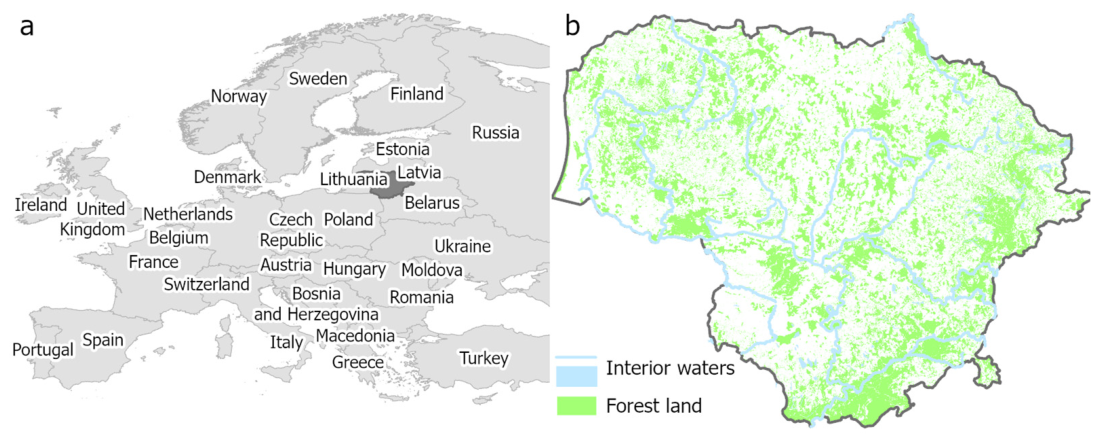
The study was conducted in Lithuania, located in Northern Europe within the Baltic sea region, as shown in Figure 1. The climate ranges from maritime conditions in the west to more continental conditions in the east, with a mean annual temperature of approximately 7.4 °C and annual precipitation between 624 and 675 mm along an east–west gradient [27]. The landscape is dominated by lowlands interspersed with uplands, with elevations reaching up to approximately 300 m above sea level.
Forest ecosystems in Lithuania occur at the transition between boreal coniferous, temperate deciduous, and thermophilic pine–oak biomes [28]. The northern distribution limit of Carpinus betulus lies in the southern part of the country, reflecting the transitional biogeographical position of Lithuanian forests.
This study integrates national and international datasets to characterize the distribution, abundance, and ecological and silvicultural attributes of non-native (alien) tree species. National data were derived from the Lithuanian National Forest Inventory (NFI) and stand-wise forest inventory (SFI), which provide detailed information on species composition, stand structure, growing stock, and site conditions [29]. These datasets were used to quantify the spatial distribution, extent, and productivity of non-native tree species at both national and stand scales.
For comparative analysis at the European level, data from the FAO Global Forest Resources Assessment [30] and the COST Action FP1403 NNEXT (Non-native tree species for European forests) were incorporated [17]. These sources provide harmonized information on the occurrence, extent, and management of non-native tree species across Europe. Additional country reports and peer-reviewed literature were used to supplement and cross-validate the dataset.

2.2. Analysis of Species Distribution

To map the distribution of non-native tree species in Lithuania, data from the Forest State Cadastre (FSC) were used. The FSC, based on nationwide stand-wise forest inventory data, provides spatial boundaries and detailed descriptive information for all forest stands in Lithuania regardless of ownership [29], including information on tree species composition in different canopy layers. Forest stands containing specific non-native tree species were selected from the database based on stand attribute information, and each identified stand was represented by a single point on the distribution maps.
At the European scale, a comparative analysis was conducted to evaluate differences in species richness, forest area occupied by non-native species, and their relative importance across countries. This approach enabled positioning Lithuania within the broader European context in terms of both diversity and extent of non-native tree species.

2.3. Assessment of Invasiveness

The invasiveness of selected non-native tree species was evaluated using a modified version of the Victorian Pest Plant Prioritisation Process (VPPP) [31], adapted to reflect the biological stages of naturalization and invasion described in Section 2.2.
Four groups of fifteen criteria representing key stages of the invasion process were considered:
Establishment potential: including germination requirements, establishment requirements, and disturbance requirements;
Growth/competitive ability: including life form, allelopathic properties, tolerance to herbivore pressure, growth rate, and stress tolerances;
Reproduction (population expansion potential): including reproductive system, propagule production, seed longevity, reproductive period, and time to reproductive maturity;
Dispersal potential: including number of mechanisms and maximum dispersal distance of propagules.
Each criterion was assigned a weight reflecting its relative importance in the invasion process. Each criterion was also assigned with an intensity rating of high (H), medium–high (MH), medium (M), medium–low (ML), and low (L) to score each species under evaluation. The following numerical values were associated with each intensity rating: H = 1, MH = 0.75, M = 0.5, ML = 0.25 and L = 0. The values of criteria weightings and the rules used for intensity rating are provided in Table A1 in Appendix A.
The overall weighted invasiveness index (I) for each species was calculated as a weighted sum of standardized scores across the all criteria:
I = ( T o t a l   c r i t e r i o n   w i g h t i n g × I n t e n s i t y   r a t i n g ) .
Data on the biology and distribution of the species were collected from scientific publications [18,19,20,21,22,23,24,25,26] and supplemented by personal experience and communications with forestry experts. Higher values of the final invasiveness score indicate greater invasiveness potential.

2.4. Productivity Assessment and Data Analysis

The productivity of non-native tree species was assessed using stand-wise forest inventory data, including growing stock volume (m3 ha−1), mean stand diameter, stand age, species composition, and forest site conditions. The analysis focused on selected non-native tree species for which sufficient inventory data were available. Productivity indicators were summarized by 10-year age classes in order to compare growth patterns among species and across stand development stages.
To evaluate the relative productivity of non-native tree species, selected species were compared with ecologically or silviculturally analogous native species. The comparisons were based on similarity in growth form, rotation length, site conditions, and potential use in forest management. For example, Populus sp. was compared with Populus tremula, Pinus banksiana with Pinus sylvestris, and Quercus rubra with Quercus robur. For native species, only age classes corresponding to those available for the comparable non-native species were included in the analysis. This approach was used to avoid biased comparisons caused by differences in stand age structure.
The comparative analysis was descriptive and was based on three main indicators: mean growing stock volume, mean stand diameter, and estimated potential revenue from timber assortments per hectare. For each species and age class, mean values were calculated from the available stand-wise inventory records. These indicators were then compared graphically and interpreted in relation to the performance of analogous native species. The aim of this comparison was not to provide a formal statistical test of productivity differences, but to evaluate whether selected non-native species showed higher, similar, or lower silvicultural performance under Lithuanian conditions.
The economic potential of selected non-native tree species was assessed by estimating the potential value of timber assortments. The assessment was restricted to commercial forests, where wood production is the primary management objective. Potential assortment structure was determined using conventional Lithuanian yield and assortment tables, taking into account mean stand diameter and age class. Potential revenues were calculated using standard timber assortment prices and adjusted by subtracting average harvesting costs [32]. It should be noted that this evaluation assumes that the demand and market prices for timber assortments derived from non-native species are comparable to those of analogous native species. This assumption allows standardized comparison among species, but it may not fully reflect market-specific variation in timber demand, quality, or price. Therefore, the economic assessment should be interpreted as an indicative comparison of potential timber value rather than as a complete financial analysis.
For the spatial and European-level comparison, national inventory data were integrated with information from FAO and COST Action FP1403 NNEXT datasets. At the Lithuanian level, the area occupied by each non-native tree species was calculated by summing the areas of forest stands in which the species was recorded. Species-level area was then expressed both in hectares and as a percentage of the total forest land area. At the European level, Lithuania was compared with other countries using two indicators: total forest area occupied by non-native tree species and the proportion of national forest area occupied by non-native tree species.
Differences in data collection methodologies among national and international datasets were considered during interpretation, particularly when comparing complete stand-wise inventory data with sample-based or country-reported estimates. Therefore, the European-level comparison was treated as descriptive rather than as a formal statistical comparison. To improve comparability, all area values were expressed in common units, and proportional indicators were calculated relative to the total forest area of each country whenever possible.

3. Results

3.1. Distribution of Non-Native Tree Species in the Europe and Lithuania

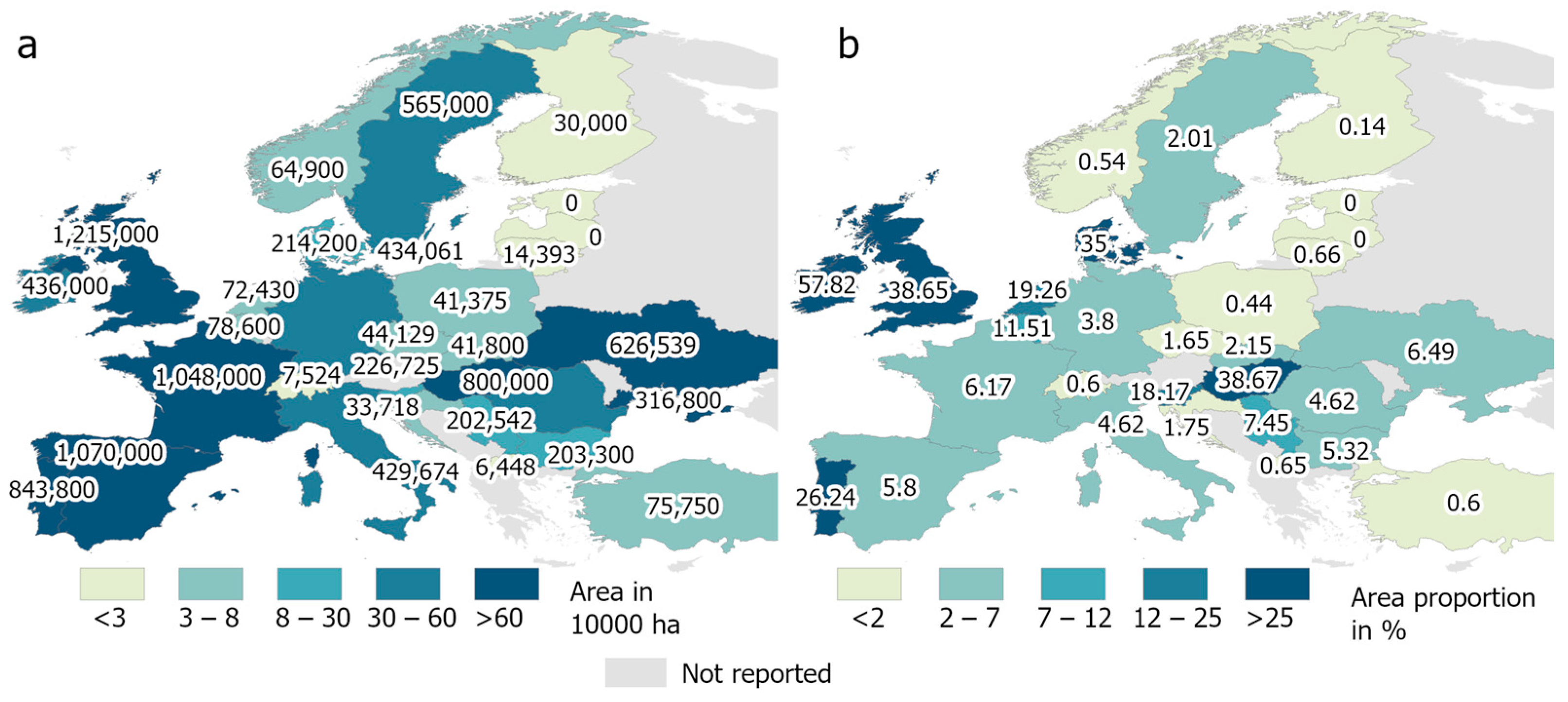
Substantial differences in both the extent and diversity of non-native tree species between Lithuania and other European countries were revealed. Across Europe, approximately 150 non-native tree species are cultivated in forests and experimental plantations, occupying an estimated 8.54 million ha, or about 4% of the total forest area [16]. However, their distribution is highly uneven, with southern and western European countries exhibiting greater species richness and a higher proportion of forest area occupied by non-native species, as shown in Figure 2.
By region of origin, most non-native tree species introduced into European forests originate from North America (71 species), followed by Asia (45) and Australia (20) [16].
In contrast, Lithuanian forests are characterized by a very low proportion of non-native species, which occupy only approximately 0.6–0.7% of the total forest area. Depending on the data source and classification criteria, between 10 (NFI) and 19 (SFI) non-native tree species have been recorded. This places Lithuania among the countries with the lowest prevalence of non-native tree species in Europe. Species of North American origin dominate, reflecting similarities in climatic conditions between the regions of origin and Lithuania, as presented in Table 1.
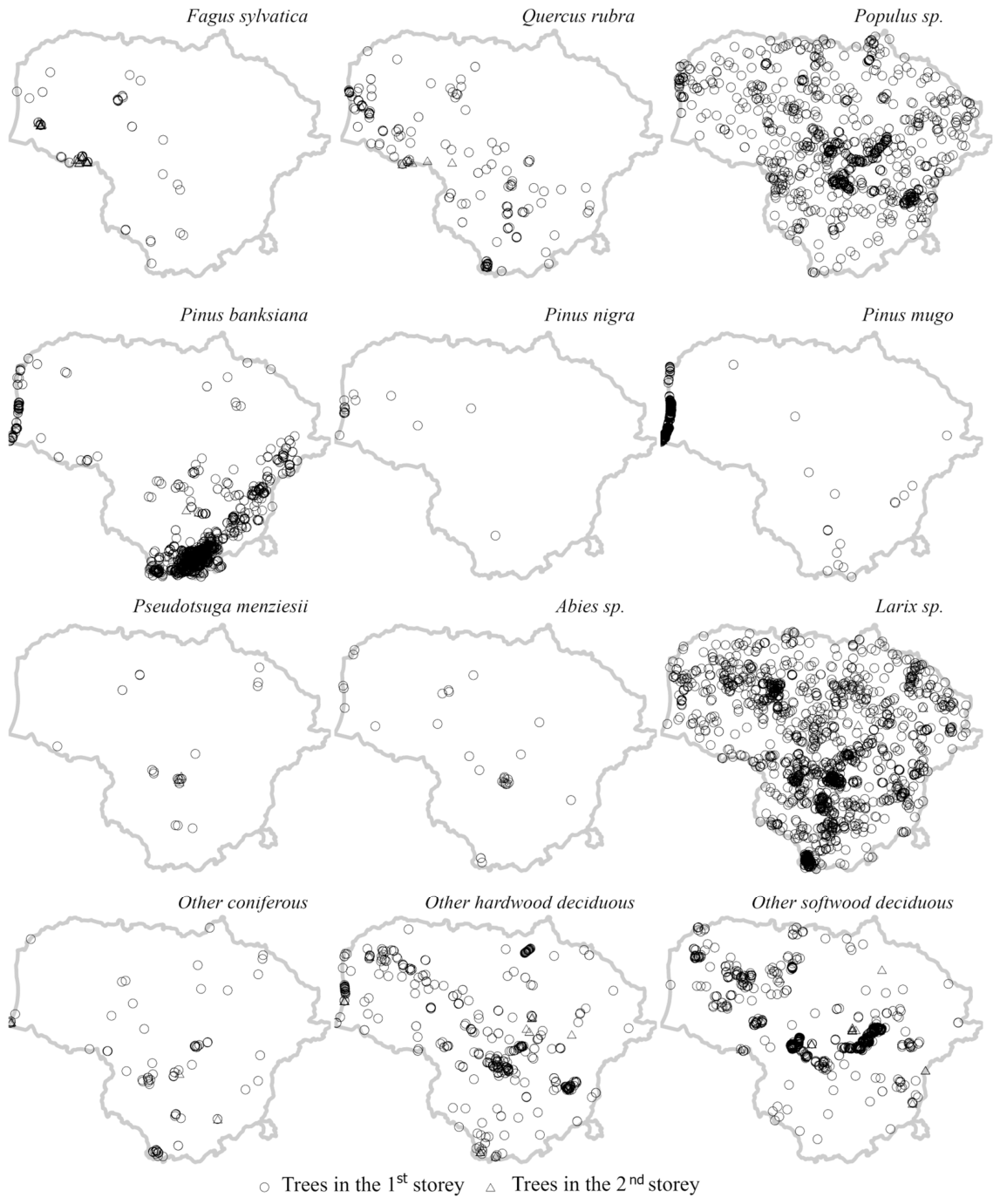
The spatial distribution of non-native tree species within Lithuania is heterogeneous and reflects both environmental conditions and historical forest management practices. Broadleaved non-native species are generally more concentrated in the southwestern and central regions, where climatic conditions are relatively milder, whereas several non-native coniferous species occur more frequently in southeastern and coastal regions characterized by poorer sandy soils and historical dune stabilization efforts, as shown in Figure 3. The most widely distributed non-native genera in Lithuanian forests include Pinus sp., Larix sp., Populus sp., and Quercus rubra.

3.2. Species Composition and Forest Area Coverage

Analysis of forest inventory data available from the FSC indicates that non-native tree species occupy relatively small. The total forest area containing non-native species exceeds 10,000 ha; however, species-specific distributions vary considerably, as presented in Table 2.
The largest areas are occupied by Larix sp. (larch), Pinus banksiana (jack pine), Populus sp. (poplars), and Pinus mugo (mountain pine). Among these, larch and jack pine dominate in terms of forest area, whereas poplar species contribute substantially to the total growing stock due to their high productivity.
Despite their presence, most non-native species occur in relatively small and fragmented stands. Only a limited number of species form dominant or monospecific stands, indicating that their role in Lithuanian forests remains supplementary rather than structural.

3.3. Invasiveness Assessment and Naturalization Status of Non-Native Tree Species

The assessment of invasiveness, based on the weighted invasiveness index described in Section 2.3, revealed clear interspecific differences in the ability to overcome naturalization barriers and transition to invasion. The results of the weighted invasiveness index assessment, presented in Table 3, indicate that only a small subset of non-native tree species currently present in Lithuania possesses the biological capacity to transition from naturalization to invasion. Higher index values reflect greater establishment and spread potential under Lithuanian conditions. The invasiveness index primarily reflects early-stage processes—namely establishment and spread—and does not directly quantify ecological impacts.
Among the evaluated species, Acer negundo exhibited the highest invasiveness index (I = 0.788), indicating a strong capacity for establishment, rapid growth, and long-distance dispersal. This high score is primarily associated with efficient germination, high tolerance to environmental stress, and effective seed dispersal, particularly via water.
Prunus serotina showed a moderate invasiveness index (I = 0.547), reflecting high reproductive capacity and efficient animal-mediated dispersal, although its establishment success appears to depend on specific site conditions.
In contrast, Robinia pseudoacacia exhibited a lower invasiveness index (I = 0.348), despite its ability to reproduce both generatively and vegetatively. Its relatively limited dispersal capacity reduces its ability to spread extensively beyond planted stands.
For comparison, Quercus rubra, although not classified as invasive in Lithuania, showed intermediate index values, largely due to animal-mediated seed dispersal (e.g., by birds), which facilitates local spread. However, its capacity to form self-sustaining populations beyond managed stands on fertile soils appears to remain limited under Lithuanian conditions.
A substantial proportion of non-native tree species in Lithuanian forests remain at the naturalized stage without progressing toward invasive behavior. Although these species reproduce successfully, they do not exhibit substantial long-distance dispersal or uncontrolled spread. Consequently, detailed invasiveness index assessment was restricted to species demonstrating greater establishment and spread potential. Species in this category include Fagus sylvatica, Larix sp., Populus sp., Pinus banksiana, Abies sp. and Pseudotsuga menziesii. These species typically form stable populations within managed stands and can be effectively controlled using conventional silvicultural practices. Their limited dispersal capacity restricts large-scale expansion into surrounding ecosystems.

3.4. Productivity and Economic Potential

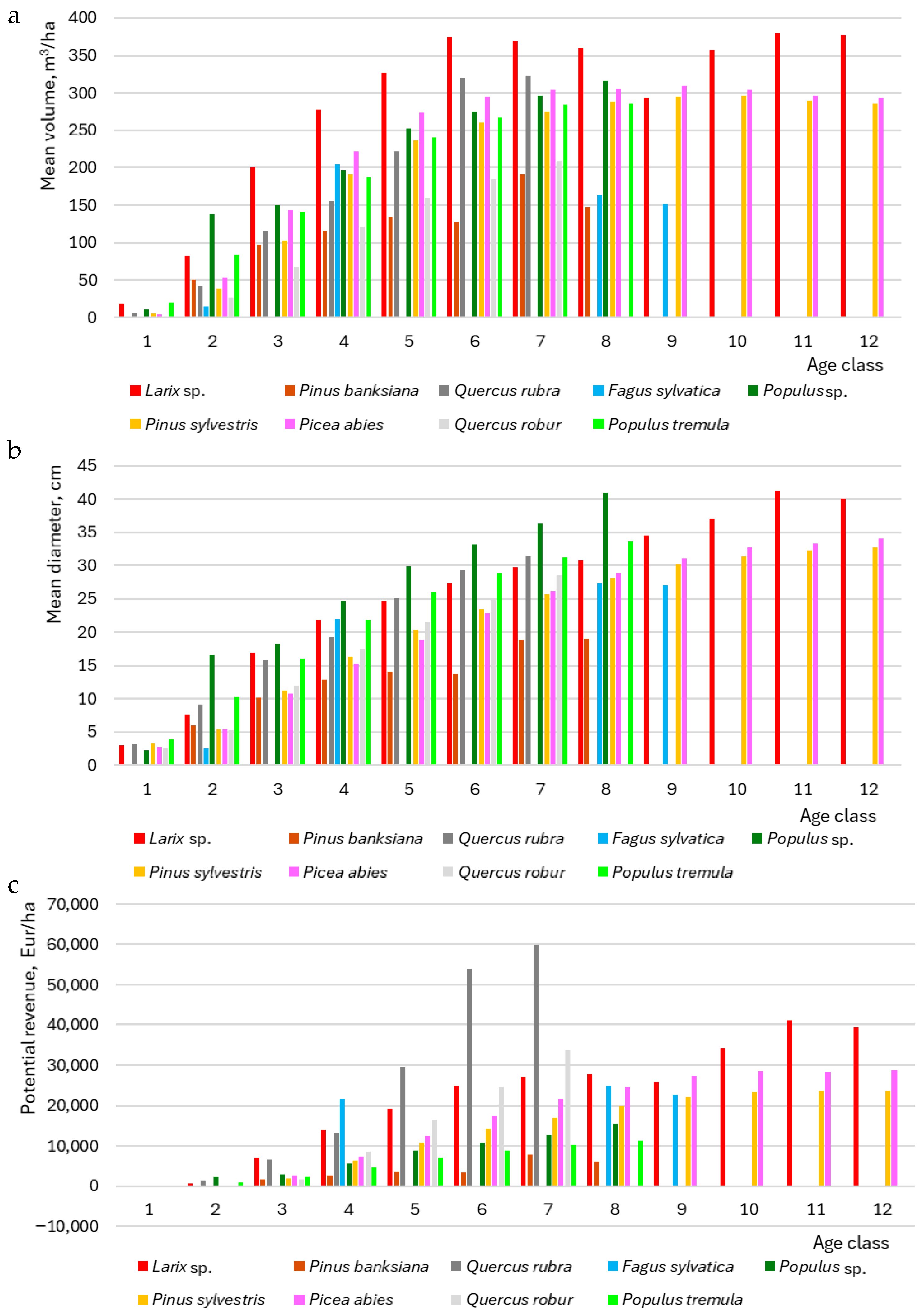
The comparative analysis of stand volume, mean diameter, and economic value across age classes reveals clear differences in growth dynamics and economic performance between non-native and native tree species, as illustrated in Figure 4. Among the non-native species, Larix sp. and Populus sp. exhibit the most rapid growth and highest productivity, with stand volumes exceeding those of comparable native species from mid-rotation stages onwards. This is reflected in larger mean diameters and substantially higher potential revenues, particularly in later age classes, where Larix sp. and Quercus rubra show markedly higher economic returns compared to native analogues such as Pinus sylvestris and Quercus robur. In contrast, Pinus banksiana demonstrates comparatively lower productivity and economic value, remaining below or similar to native species across most age classes. Native species such as Picea abies and Pinus sylvestris exhibit more stable but generally moderate growth and value accumulation over time. So, the results indicate that certain non-native species combine rapid growth with high economic returns, particularly under favorable site conditions, whereas others perform similarly to or below native species, highlighting substantial interspecific variability in both productivity and economic potential.
Potential revenue was not estimated for less abundant non-native tree species; therefore, only mean growing stock volume is presented for illustrative purposes. Among these species, mean stand volume was 44 m3 ha−1 for Pinus mugo, 144 m3 ha−1 for Pinus nigra, 129 m3 ha−1 for Pinus banksiana, 122 m3 ha−1 for Pseudotsuga menziesii, and 184 m3 ha−1 for Abies sp. Lower productivity was observed for Pinus banksiana and Pseudotsuga menziesii, which exhibit comparatively limited growth performance under Lithuanian conditions relative to other coniferous species. The relatively low volume of Pinus mugo is not directly comparable with other species, as it is primarily established on sandy dune sites and is not intended for timber production.
Comparisons with native species indicate that certain non-native species, particularly larch and poplar, can substantially exceed the productivity of native tree species under similar site conditions. This highlights their potential importance for timber production and forest management.

4. Discussion

The results of this study demonstrate that most non-native tree species currently present in Lithuanian forests remain confined to the naturalized stage, with only a limited subset showing the capacity to transition toward invasive behavior. This pattern is consistent with broader European evidence showing that only a small proportion of introduced tree species become invasive despite widespread use in forestry [4,33]. The findings therefore highlight the importance of distinguishing between naturalized and invasive species when evaluating ecological risks and management implications.
The limited transition from naturalization to invasion observed in Lithuania appears to result from interactions among species-specific biological traits, climatic constraints, soil fertility, and management practices. The results (Section 3.3) demonstrate that only a few species, notably Acer negundo, exhibit high invasiveness potential, while most species remain restricted in their ability to spread beyond planted stands. This supports the view that invasiveness is not an intrinsic species trait, but rather an outcome of interactions between species characteristics and environmental conditions [4,34].
The relatively low distribution and limited spread of non-native tree species in Lithuania are likely influenced by a combination of climatic, ecological, and management-related factors. Lithuania is located within the transition zone between boreal and temperate forest biomes, where relatively cool climatic conditions, shorter growing seasons, and periodic frost events may reduce establishment success, reproductive capacity, and propagule survival of many introduced species [10,14,15]. Such conditions may limit both propagule pressure and the long-term persistence of naturally regenerating populations, particularly for species originating from warmer regions.
In addition, current forest management practices in Lithuania may contribute to limiting the spread of non-native tree species. Forestry in Lithuania remains strongly oriented toward managed stand regeneration, relatively intensive silvicultural control, and the dominance of native commercial tree species in forest regeneration practices. Most non-native tree species occur in planted or experimentally established stands that are spatially limited and actively managed, reducing opportunities for uncontrolled spread into surrounding forest ecosystems. Compared with parts of Central and Southern Europe, where non-native species may occupy larger continuous areas and have longer management histories [12,16,17], the relatively low planting intensity and restricted distribution of non-native species in Lithuania likely contribute to the observed low invasion levels.
The biological characteristics of the introduced species themselves may also contribute to the observed pattern. Many of the non-native tree species historically introduced into Lithuanian forests were selected primarily for silvicultural performance and climatic suitability rather than for aggressive colonization ability [12,17]. Consequently, several widely planted species, such as Larix sp. and Populus sp., exhibit high productivity but limited long-distance dispersal or natural regeneration under Lithuanian conditions [35]. This supports the observed decoupling between invasiveness and silvicultural performance identified in the present study.
From a European perspective, Lithuania represents a relatively conservative case, characterized by both low diversity and limited spatial extent of non-native tree species. While non-native species occupy approximately 4% of forest area across Europe [31], their share in Lithuania remains below 1%. Nevertheless, the European comparison should be interpreted cautiously, as substantial differences exist among countries in climate, forest composition, introduction history, management intensity, and the pool of non-native tree species used in forestry [12,16,17]. The present study therefore uses the European context primarily as a comparative reference framework rather than as a direct quantitative benchmarking exercise. While the weighted invasiveness index was developed for species-level assessment under Lithuanian conditions, its broader applicability across Europe may depend on regional environmental and management conditions that were beyond the scope of the present study.
Climate change may alter the balance between risks and benefits associated with non-native tree species by influencing establishment success, disturbance regimes, and species suitability under future conditions [10,14,15]. Under such conditions, some non-native species may contribute to adaptive forest management and forest resilience, although their long-term ecological impacts remain uncertain [8,9,13].
The results demonstrate that most species currently present in Lithuania do not exhibit invasive behavior and remain confined to managed systems. Nevertheless, even non-invasive species may influence ecosystem processes, for example through differences in litter decomposition, nutrient cycling, or habitat structure [22,23,24,25,26], emphasizing the importance of functional trait differences rather than species origin per se.
The findings suggest that classification of non-native species should consider not only species spread but also ecological impact, invasion dynamics, and management context [8,9]. Species exhibiting limited spread and substantial silvicultural value may require different management approaches than species demonstrating high establishment and dispersal capacity.
The economic assessment presented in this study should be interpreted cautiously, as it assumes comparable market demand and timber prices between non-native and analogous native tree species. In practice, market acceptance, wood quality preferences, long-term management costs, and potential expenses associated with monitoring or controlling species spread may substantially influence the overall economic viability of non-native species. Future assessments would therefore benefit from more integrated evaluation frameworks combining invasion risk, ecological impacts, silvicultural performance, and long-term economic costs and benefits [13].
From a practical management perspective, the results support the need for differentiated decision-making approaches rather than generalized restrictions on non-native tree species. Species characterized by low invasion potential, but high silvicultural value may require management strategies different from those applied to species exhibiting strong establishment and dispersal capacity. Future frameworks could integrate invasion risk and economic or ecological benefits within multi-criteria assessment systems to better support adaptive forest management and biodiversity conservation objectives [12,13].
Despite these insights, several limitations should be acknowledged. First, the assessment of invasiveness is based primarily on indicators of establishment and spread, and does not directly quantify ecological impacts on biodiversity or ecosystem functioning. Second, the European comparison remains descriptive due to differences in inventory methodologies, management histories, and species pools among countries. Third, the economic assessment is based on simplified assumptions regarding market comparability between non-native and analogous native species and does not include long-term monitoring or control costs. Finally, although the weighting scheme applied in the invasiveness index follows the established VPPP framework, future studies could further evaluate the sensitivity of species rankings under alternative weighting scenarios and environmental conditions.

5. Conclusions

Non-native tree species currently occupy only a limited proportion of Lithuanian forest area compared with the broader European context. The results indicate that most species remain at the naturalized stage and exhibit limited capacity for uncontrolled spread under current Lithuanian environmental and management conditions. Only a small subset of species demonstrates higher invasiveness potential, highlighting the importance of distinguishing between naturalized and invasive species in forest ecosystems.
The findings suggest that invasion potential is shaped by interactions among species-specific biological traits, climatic conditions, propagule pressure, and forest management practices. In Lithuania, relatively cool climatic conditions, restricted planting intensity, and active silvicultural management likely contribute to limiting the transition from naturalization to invasion for many non-native tree species.
The study also demonstrates that invasiveness and silvicultural performance are not necessarily directly related. Several non-native species showed management-relevant productivity while maintaining relatively limited invasion potential. Consequently, generalized assumptions regarding the ecological risk associated with non-native species may oversimplify their functional role in forest ecosystems.
In conclusion, the results support the need for differentiated and evidence-based approaches to the management of non-native tree species, integrating invasion risk assessment with ecological characteristics, silvicultural performance, and long-term biodiversity conservation objectives under changing environmental conditions.

Author Contributions

Conceptualization, L.S.; methodology, L.S.; software, L.S.; formal analysis, L.S.; writing—original draft preparation, L.S. and G.M.; visualization, G.M. All authors have read and agreed to the published version of the manuscript.

Funding

This research paper has received funding from the European Union’s Framework Programme HORIZON, called Teaming for Excellence (HORIZON-WIDERA-2022-ACCESS-01-two-stage)—Creation of the Centre of excellence in smart forestry “Forest 4.0” No. 101059985. This research has been supplementarily funded by the European Union under the project “FOREST 4.0—Centre of Excellence for the development of a sustainable forest bioeconomy”, No. 10-042-P-0002.

Institutional Review Board Statement

Not applicable.

Data Availability Statement

The original contributions presented in this study are included in the article. Further inquiries can be directed to the corresponding author.

Conflicts of Interest

The authors declare no conflicts of interest.

Abbreviations

The following abbreviations are used in this manuscript:
FSCForest State Cadaster
NFINational Forest Inventory
SFIStand-wise Forest Inventory
FAOFood and Agriculture Organization
VPPPVictorian Pest Plant Prioritization Process
IWeighted Invasiveness index

Appendix A

Table A1. Invasiveness criteria, weightings and intensity ratings (according to the Victorian Pest Plant Prioritisation Process).
Criterion/WeightingsRating
Establishment
Germination requirements/0.0425L—Requires highly specific or artificial environmental conditions for germination.
ML—Requires unseasonal or uncommon natural events for germination.
MH—Requires natural seasonal disturbances, such as seasonal rainfall or suitable spring/summer temperatures, for germination, rooting, or establishment.
H—Opportunistic germinator capable of germinating, rooting, or establishing whenever water is available.
Establishment requirements/0.3355L—Requires additional and highly specific factors for establishment, such as deliberate nutrient or water addition, or highly eutrophic conditions.
ML—Requires relatively specific conditions for establishment, e.g., open space or bare ground with access to light and direct rainfall.
MH—Can establish under moderate canopy or litter cover.
H—Can establish without additional environmental requirements.
Disturbance requirements/0.122L—Requires major disturbance with little or no competition from other plant species.
ML—Establishes in highly disturbed ecosystems (e.g., roadsides, wildlife corridors, overgrazed pastures, poorly growing or patchy crops).
MH—Establishes in relatively intact or only slightly disturbed ecosystems (e.g., wetlands, riparian zones, grasslands, open woodlands), as well as in vigorous crops or well-established pastures.
H—Establishes in healthy and undisturbed natural ecosystems.
Growth/competitive ability
Life form/0.00576L—Trees.
ML—Climbers or creepers.
MH—Grasses or leguminous plants.
H—Aquatic or semi-aquatic plants.
Allelopathic properties/0.00864L—No allelopathic properties.
ML—Minor allelopathic properties.
MH—Allelopathic properties significantly affecting some plant species.
H—Strong allelopathic properties inhibiting most or all other plant species.
Tolerance to herbivory pressure/0.0456L—Preferred food source for herbivores; eliminated by moderate herbivory or reproduction entirely prevented.
ML—Consumed by herbivores and recovers slowly; reproduction strongly inhibited, although vegetative propagule production remains possible.
MH—Consumed but non-preferred, or capable of rapid recovery; able to flower and produce seeds under moderate herbivory pressure.
H—Favored by heavy grazing pressure due to low palatability to animals or insects.
Normal growth rate/0.018432L—Slow-growing and outcompeted by many other species.
ML—Maximum growth rate lower than that of many species with the same life form.
MH—Moderately rapid growth comparable to competitive species of the same life form.
H—Rapid growth exceeding that of most species with the same life form.
Stress tolerances/0.01776L—Tolerant of one stress factor and susceptible to at least two others.
ML—Tolerant of at least two stress factors and susceptible to at least two others.
MH—Highly tolerant of at least two stress factors (drought, frost, waterlogging, fire, salinity) and moderately tolerant of another; susceptible to at least one factor.
H—Highly resistant to at least two stress factors and susceptible to no more than one factor (excluding drought or waterlogging).
Reproduction
Reproductive system/0.005593L—Sexual reproduction through either cross- or self-pollination.
ML—Sexual reproduction through both self- and cross-pollination.
MH—Vegetative reproduction.
H—Both vegetative and sexual reproduction.
Propagules produced per season/0.05474L—Fewer than 50 propagules.
ML—50–1000 propagules.
MH—1000–2000 propagules.
H—More than 2000 propagules.
Seed longevity/0.030464L—Seeds survive less than 5 years in soil, or the species reproduces vegetatively only.
ML—More than 25% of seeds survive 5–10 years in soil, or lower viability persists for 10–20 years.
MH—More than 25% of seeds survive 10–20 years in soil, or lower viability persists for more than 20 years.
H—More than 25% of seeds survive longer than 20 years in soil.
Reproductive period/0.012019L—Mature plants produce viable propagules for only 1 year.
ML—Mature plants produce viable propagules for 1–2 years.
MH—Mature plants produce viable propagules for 3–10 years.
H—Mature plants produce viable propagules for more than 10 years, or form self-sustaining dense monocultures.
Time to maturity/0.016184L—Requires more than 5 years to reach sexual maturity.
ML—Reaches sexual maturity within 2–5 years.
MH—Produces propagules 1–2 years after germination.
H—Reaches maturity and produces viable propagules within the first year.
Dispersal
Number of dispersal mechanisms/0.094572L—Propagules dispersed mainly by gravity.
ML—Propagules additionally dispersed through attachment to humans or animals.
MH—Propagules dispersed by wind, water, animals (excluding birds), or light vehicular traffic.
H—Very light wind-dispersed seeds, bird-dispersed seeds, or edible fruits readily consumed by highly mobile animals.
Spread distance/0.189428L—Very unlikely to disperse more than 200 m; most propagules disperse less than 20 m.
ML—Few or no propagules disperse up to 1 km; most disperse 20–200 m.
MH—Some propagules disperse more than 1 km, but most disperse 200–1000 m.
H—High likelihood that some propagules disperse more than 1 km.

References

  1. Williamson, M.H.; Brown, K.C. The analysis and modelling of British invasions. Philos. Trans. R. Soc. Lond. B Biol. Sci. 1986, 314, 505–522. [Google Scholar] [CrossRef] [Scilit]
  2. Williamson, M. Biological Invasions; Chapman & Hall: London, UK, 1996; 244p. [Google Scholar]
  3. Jeschke, J.M.; Pyšek, P. Tens rule. In Invasion Biology: Hypotheses and Evidence; Jeschke, J.M., Heger, T., Eds.; CABI: Wallingford, UK, 2018; pp. 124–132. [Google Scholar] [CrossRef] [Scilit]
  4. Richardson, D.M.; Pyšek, P.; Rejmánek, M.; Barbour, M.G.; Panetta, F.D.; West, C.J. Naturalization and invasion of alien plants: Concepts and definitions. Divers. Distrib. 2000, 6, 93–107. [Google Scholar] [CrossRef] [Scilit]
  5. Richardson, D.M.; Williams, P.A.; Hobbs, R.J. Pine invasions in the Southern Hemisphere: Determinants of spread and invasibility. J. Biogeogr. 1994, 21, 511–527. [Google Scholar] [CrossRef] [Scilit]
  6. van Kleunen, M.; Weber, E.; Fischer, M. A meta-analysis of trait differences between invasive and non-invasive plant species. Ecol. Lett. 2010, 13, 235–245. [Google Scholar] [CrossRef] [Scilit] [PubMed]
  7. Pyšek, P.; Richardson, D.M.; Rejmánek, M.; Webster, G.L.; Williamson, M.; Kirschner, J. Alien plants in checklists and floras: Towards better communication between taxonomists and ecologists. Taxon 2004, 53, 131–143. [Google Scholar] [CrossRef] [Scilit]
  8. Vilà, M.; Espinar, J.L.; Hejda, M.; Hulme, P.E.; Jarošík, V.; Maron, J.L.; Pergl, J.; Schaffner, U.; Sun, Y.; Pyšek, P. Ecological impacts of invasive alien plants: A meta-analysis of their effects on species, communities and ecosystems. Ecol. Lett. 2011, 14, 702–708. [Google Scholar] [CrossRef] [Scilit]
  9. Pyšek, P.; Hulme, P.E.; Simberloff, D.; Bacher, S.; Blackburn, T.M.; Carlton, J.T.; Dawson, W.; Essl, F.; Foxcroft, L.C.; Genovesi, P.; et al. Scientists’ warning on invasive alien species. Biol. Rev. 2020, 95, 1511–1534. [Google Scholar] [CrossRef] [Scilit]
  10. Lindner, M.; Maroschek, M.; Netherer, S.; Kremer, A.; Barbati, A.; Garcia-Gonzalo, J.; Seidl, R.; Delzon, S.; Corona, P.; Kolström, M.; et al. Climate change impacts, adaptive capacity, and vulnerability of European forest ecosystems. For. Ecol. Manag. 2010, 259, 698–709. [Google Scholar] [CrossRef] [Scilit]
  11. Bauhus, J.; Forrester, D.I.; Pretzsch, H. Mixed-species forests: The development of a forest management paradigm. In Mixed-Species Forests; Springer: Berlin/Heidelberg, Germany, 2017; pp. 1–25. [Google Scholar] [CrossRef] [Scilit]
  12. Krumm, F.; Vitková, L. (Eds.) Introduced Tree Species in European Forests: Opportunities and Challenges; European Forest Institute: Joensuu, Finland, 2016. [Google Scholar]
  13. Pötzelsberger, E.; Spiecker, H.; Neophytou, C.; Mohren, F.; Gazda, A.; Hasenauer, H. Growing non-native trees in European forests brings benefits and opportunities but also has its risks. Curr. For. Rep. 2020, 6, 339–353. [Google Scholar] [CrossRef] [Scilit]
  14. Allen, C.D.; Macalady, A.K.; Chenchouni, H.; Bachelet, D.; McDowell, N.; Vennetier, M.; Kitzberger, T.; Rigling, A.; Breshears, D.D.; Hogg, E.H.; et al. A global overview of drought and heat-induced tree mortality reveals emerging climate change risks for forests. For. Ecol. Manag. 2010, 259, 660–684. [Google Scholar] [CrossRef] [Scilit]
  15. Seidl, R.; Thom, D.; Kautz, M.; Martin-Benito, D.; Peltoniemi, M.; Vacchiano, G.; Wild, J.; Ascoli, D.; Petr, M.; Honkaniemi, J.; et al. Forest disturbances under climate change. Nat. Clim. Change 2017, 7, 395–402. [Google Scholar] [CrossRef] [Scilit]
  16. Bruss, R.; Pötzelsberger, E.; Lapin, K.; Brundu, G.; Orazio, C.; Straigytė, L.; Hubert, H. Extent, distribution and origin of non-native forest tree species in Europe. Scand. J. For. Res. 2019, 34, 533–544. [Google Scholar] [CrossRef] [Scilit]
  17. Hasenauer, H.; Gazda, A.; Konnert, M.; Lapin, K.; Mohren, F.; Spiecker, H.; van Loo, M.; Potzelsberger, E. Non-native tree species in European forests: Opportunities and risks. In COST Action FP1403 NNEXT Country Reports; BOKU University: Vienna, Austria, 2017. [Google Scholar]
  18. Straigytė, L.; Cekstere, G.; Laivins, M.; Marozas, V. The spread, intensity and invasiveness of the Acer negundo in Riga and Kaunas. Dendrobiology 2015, 74, 157–168. [Google Scholar] [CrossRef] [Scilit]
  19. Marozas, V.; Cekstere, G.; Laivins, M.; Straigytė, L. Comparison of neophyte communities of Robinia pseudoacacia L. and Acer negundo L. in the eastern Baltic Sea region cities of Riga and Kaunas. Urban For. Urban Green. 2015, 14, 826–834. [Google Scholar] [CrossRef] [Scilit]
  20. Riepšas, E.; Straigytė, L. Invasion and ecological effects of red oak (Quercus rubra L.) in Lithuanian forests. Balt. For. 2008, 14, 122–130. [Google Scholar]
  21. Straigytė, L.; Marozas, V.; Žalkauskas, R. Morphological traits of Red oak (Quercus rubra L.) and ground vegetation in stands different sites and regions in Lithuania. Balt. For. 2012, 18, 91–99. [Google Scholar]
  22. Krevš, A.; Kučinskienė, A.; Manusadžianas, L. Ecotoxicological effects of leaf litter of invasive species on aquatic organisms. Ecotoxicol. Environ. Saf. 2013, 94, 145–152. [Google Scholar]
  23. Krevš, A.; Kučinskienė, A. Leaf litter decomposition and microbial activity of invasive species. Hydrobiologia 2017, 800, 115–128. [Google Scholar]
  24. Krevš, A.; Kučinskienė, A. Influence of invasive Acer negundo leaf litter on benthic microbial abundance and activity in the littoral zone of a temperate river in Lithuania. Knowl. Manag. Aquat. Ecosyst. 2017, 418, 26. [Google Scholar] [CrossRef] [Scilit]
  25. Manusadžianas, L.; Darginavičienė, J.A.; Gylytė, B.; Jurkonienė, S.; Krevš, A.; Kučinskienė, A.; Mačkinaitė, R.; Pakalnis, R.; Sadauskas, K.; Sendžikaitė, J.; et al. Ecotoxicity effects triggered in aquatic organisms by invasive Acer negundo and native Alnus glutinosa leaf leachates obtained in the process of aerobic decomposition. Sci. Total Environ. 2014, 496, 35–44. [Google Scholar] [CrossRef] [Scilit]
  26. Janušauskaitė, D.; Straigytė, L. Leaf Litter Decomposition Differences between Alien and Native Maple Species. Balt. For. 2011, 17, 189–196. [Google Scholar]
  27. Lithuanian Hydrometeorological Service (LHMS). Climate of Lithuania. Available online: https://www.meteo.lt (accessed on 18 April 2026).
  28. Natkevičaitė-Ivanauskienė, M. Botaninė geografija ir fitocenologijos pagrindai (Botanical Geography with Backgrounds of Phytocenology). Moksl. Vilnius Lith. 1983, 279, 152–154. (In Lithuanian) [Google Scholar]
  29. Papartė, M.; Bikuvienė, I.; Mozgeris, G. Evolution of forest inventory and management planning system in Lithuania. Balt. For. 2025, 31, id789. [Google Scholar] [CrossRef] [Scilit]
  30. FAO. Global Forest Resources Assessment; Food and Agriculture Organization of the United Nations: Rome, Italy, 2015. [Google Scholar]
  31. Weiss, J.; McLaren, D. Victoria’s Pest Plant Prioritisation Process. In Proceedings of the 13th Australian Weeds Conference; Spafford, H.J., Dodd, J., Moore, J.H., Eds.; Plant Protection Society of WA Inc.: Gooseberry Hill, Australia, 2002; pp. 509–512. [Google Scholar]
  32. Mozgeris, G.; Treinys, R.; Činga, G. Comprehension of conservation costs in the context of wood economy: A case study on lesser spotted eagle protection in special protection areas. Balt. For. 2015, 21, 28–37. [Google Scholar]
  33. Williamson, M.; Fitter, A. The varying success of invaders. Ecology 1996, 77, 1661–1666. [Google Scholar] [CrossRef] [Scilit]
  34. Essl, F.; Bacher, S.; Blackburn, T.M.; Booy, O.; Brundu, G.; Brunel, S.; Cardoso, A.C.; Eschen, R.; Gallardo, B.; Galil, B.; et al. Crossing frontiers in tackling pathways of biological invasions. Bioscience 2015, 65–68, 769–882. [Google Scholar] [CrossRef] [Scilit]
  35. Straigytė, L.; Činga, G. Possibilities and Restrictions for Growing Alien Tree Species in the Forests of Lithuania and the European Union Countries; Vytautas Magnus University: Kaunas, Lithuania, 2020. [Google Scholar]
Figure 1. Study area: (a) Location of the study area in Europe; (b) distribution of forest land in Lithuania.
Diversity 18 00307 g001
Figure 2. Non-native tree species in selected European countries: (a) total forest area occupied by non-native species; (b) proportion of non-native tree species in the total forest area.
Diversity 18 00307 g002
Figure 3. Spatial distribution of non-native tree species in Lithuanian forests; each point represents a forest compartment where non-native tree species are present. Different symbols indicate records of non-native tree species in the 1st storey (main canopy layer) and 2nd storey (secondary canopy layer) according to the stand-wise forest inventory classification.
Diversity 18 00307 g003
Figure 4. Key productivity and economic characteristics of non-native tree species compared with analogous native species: (a) mean growing stock volume, (b) mean stand diameter, and (c) potential revenue from timber assortments per hectare. Note: For native species, only age classes corresponding to those of the comparable non-native species are included.
Diversity 18 00307 g004
Table 1. Origin of non-native tree species grown in Lithuania forest.
Native AreaSpecies, NGymnospermsAngiosperms
East North America734
West North America44 
North America22 
Total from North America1394
Europe642
Total19136
Table 2. Area of relatively more abundant non-native tree species in Lithuania.
Non-Native Tree SpeciesForest Area, haArea Proportion to All Forest Land, %
Larix sp.24130.12
Pinus banksiana23130.11
Picea glauca2850.01
Pinus strobus4000.02
Pinus mugo11020.05
Aesculus hippocastanus4500.02
Acer negundo34440.17
Acer pseudoplatanus3000.01
Populus sp.20660.1
Quercus rubra15000.07
Total14,2730.69
Table 3. Assessment of non-native tree species using the weighted invasiveness index based on weighted evaluation criteria adapted from the Victorian Pest Plant Prioritisation Process. Higher index values indicate greater invasiveness potential.
SpeciesInvasiveness Index (I)Invasion Potential
Acer negundo0.788High potential
Prunus serotina0.547Moderate potential
Robinia pseudoacacia0.348Low potential
Quercus rubra0.519Limited spread
Disclaimer/Publisher’s Note: The statements, opinions and data contained in all publications are solely those of the individual author(s) and contributor(s) and not of MDPI and/or the editor(s). MDPI and/or the editor(s) disclaim responsibility for any injury to people or property resulting from any ideas, methods, instructions or products referred to in the content.