Article

A Study on Bird-Migration Patterns Based on Weather Radar and the Effect of Weather Factors on Migration Altitude: A Case Study of Qingdao, China


1
School of Environmental Science and Engineering, Tianjin University, Tianjin 300350, China
2
College of Management and Economics, Tianjin University, Tianjin 300072, China
3
Schools of Geography and Environmental Science, Tianjin Normal University, Tianjin 300387, China
4
Meteorological Observation Center, China Meteorological Administration, Beijing 100081, China
*
Authors to whom correspondence should be addressed.
Diversity 2026, 18(5), 299; https://doi.org/10.3390/d18050299
Submission received: 14 April 2026 / Revised: 13 May 2026 / Accepted: 13 May 2026 / Published: 16 May 2026
(This article belongs to the Section Animal Diversity)

Abstract

Bird migration is the regular, long-distance movement of birds between breeding and wintering grounds, influenced by climate change and human activities. The East Asia–Australasia Flyway (EAAF) is one of the largest migratory routes in the world, covering various species such as waders and waterfowl, with the eastern coastal areas of China serving as important stopover and wintering grounds. This paper selects the Qingdao area as the research object, and based on weather radar and meteorological data, explores the spatiotemporal characteristics of bird migration patterns in this region, discusses changes in regional bird activity and their causes, and investigates the influence of weather factors on migration altitude. By analyzing weather radar data from spring 2023, the peak migration period was found to occur mainly from mid-April to mid-May, with multiple large-scale migrations in late April exhibiting alternating peaks and troughs. Migration activity peaked between 8 p.m. and midnight, with altitudes below 600 m serving as the primary migration height range. Using correlation analysis, linear regression, and generalized additive models, the study further analyzed the contribution of various weather factors to birds’ altitude selection. Results showed that wind conditions, temperature, and humidity had significant effects on migration altitude.

1. Introduction

Bird migration is a kind of survival instinctive response of birds to follow the natural environment, which generally refers to the periodic, group and long-distance migratory activities carried out annually by birds in their lifecycle [1]. In the Northern Hemisphere, bird migration mainly occurs between wintering and breeding sites, with north and south as the main direction, that is, north for breeding and south for wintering. The peak of spring bird activity in China is mainly concentrated in the period from March to May, in which the Bohai Sea and Yellow Sea and their coastal cities are located on the East Asia–Australia Flyway (EAAF), where a large number of migratory birds migrate every year. Weather radar is primarily used for meteorological monitoring, but it can also capture distinct echo signals produced by bird flight. Its extensive coverage capacity makes it an effective tool for monitoring large-scale bird migration. By analyzing the ‘biological echoes’ in radar reflection signals, information on bird activity can be extracted, providing data support for the study of bird population dynamics and migration patterns [2]. In this paper, data from the spring of 2023 from radar station in Qingdao area along the Yellow Sea were selected to analyze bird migration in the detected area, and the results provide a theoretical basis for the subsequent study on the analysis of the impact of environmental factors on bird migration, and provide support for the collection and management of migration data, migration protection, and habitat management in the research area.
Advances in methods and technologies constitute the core foundation for the successful development of radar aeroecology research, enabling pioneering ornithological studies based on weather radar. Weather radar scans provide extensive fine-scale information on bird density across the airspace above landscapes. Nebuloni et al. developed an algorithm for the detection and quantification of avian targets using S-band Doppler weather radar. Based on a Poisson spatial distribution model of birds, the algorithm converts radar echoes into bird numbers, revealing the temporal profile of cumulative nocturnal autumn migration density south of the Alps and common patterns relative to sunset timing [3]. Dokter et al. developed a fully automated method for detecting and quantifying bird migration using C-band weather radar. This approach converts radar reflectivity factors into linear reflectivity (η), generating quantities proportional to bird density, thereby enabling the quantification of bird density, speed, and direction as functions of altitude [4]. The results were validated using high-precision bird surveillance radar data. Vertical profile analysis algorithms have been widely applied in recent aeroecological weather radar studies. Hu. C et al. established a biological observation model based on weather radar and proposed a regularization-based method for identifying vertical profiles of reflectivity (VPRs). By explicitly accounting for radar beam geometry during profile estimation, this approach significantly enhances the ability to identify potential sub-resolution vertical structural features [5]. As algorithms for bird identification have matured, increasing attention has been paid to the separation of biological and non-biological echoes, as well as the accurate removal of clutter such as insects within biological signals. Kilambi et al. proposed a combined threshold discrimination method using depolarization ratios and polarimetric moment parameters, increasing the bird classification accuracy to nearly 99% [6]. Dokter et al. distinguished migratory birds from precipitation and insects by exploiting their relatively high radial velocities and comparatively low reflectivity values, while additionally filtering precipitation signals using a fixed correlation coefficient threshold (typically ≤ 0.95) [4]. Lin et al. applied machine learning techniques to dual-polarization radar data and trained a deep convolutional neural network (CNN), termed “MistNet”, using a semi-supervised approach. The network demonstrated superior performance on both single- and dual-polarization radar data compared with traditional correlation coefficient threshold-based methods [7]. Weather radar has now been extensively applied in ecological research, with aeroecology gaining widespread use across multiple domains. Owing to its broad spatial coverage, real-time monitoring capability, and multifunctionality, weather radar provides critical support for bird detection and forecasting in military operations, mitigating bird strike risks, and supporting airspace management. The German Armed Forces integrate meteorological forecast information, current bird migration intensity, and expert ornithological knowledge to assess bird strike risk using a decision tree-based predictive model. Risk levels are evaluated on 1° latitude–longitude grid cells defined by the World Geodetic System and updated every six hours [8]. The Israeli Air Force developed a bird activity data extraction algorithm in 2010 that retrieves multiple bird activity parameters every 10–15 min within a 60 km radar radius. These parameters were statistically evaluated through extensive experiments to support optimal flight route planning [9]. Beyond military applications, aeroecology has been widely employed in other fields. By analyzing the intensity and spatial extent of radar echoes, researchers can estimate the population size of migratory birds, particularly those migrating nocturnally. Farnsworth et al. used data from 13 weather radars to estimate that more than four billion birds migrate across North America annually, filling a major knowledge gap in the assessment of avian annual cycles and contributing to the monitoring of long-term population trends, thereby providing critical data for conservation and management [10]. Weather radar also captures the spatiotemporal dynamics of large-scale migratory routes. Horton et al. utilized the North American radar network to track migratory bird movements in real time and map their geographic distributions. Their findings indicate that migration routes of North American birds commonly follow the Mississippi River basin and are influenced by seasonal wind patterns and geographic features, providing important insights into the spatiotemporal organization of avian migration [11]. Although extracting individual-level flight behavior directly from weather radar data remains challenging, weather radar plays a crucial role in studying collective flight behavior patterns, particularly during migration seasons and other large-scale, directional movement events. La Sorte et al. analyzed Level II WSR-88D radar data to investigate variations in flight altitude among different bird species during autumn nocturnal migration in the northeastern United States, providing a foundation for assessing the impacts of evolving mid-latitude atmospheric conditions under global climate change on migratory bird populations [12]. Rosenberg et al. using long-term weather radar data across North America, identified widespread declines in bird populations over the past half-century, resulting in cumulative losses of billions of breeding individuals across diverse species and habitats. Their findings underscore the urgent need to address ongoing threats to prevent future avian collapses and associated losses in ecosystem integrity, functionality, and services [13]. Nilsson et al. presented a case study using radar data from 11 different meteorological agencies to map migratory routes of birds in Western Europe. The study successfully reconstructed migration pathways and further elucidated the influence of wind on the number of birds aloft, concluding that migration events are more likely to occur under favorable tailwind conditions [14].
Bird migration is influenced by multiple factors, among which meteorological variables play a crucial role [15]. Weather conditions directly affect flight behavior, route selection, and overall migration success. Wind speed and wind direction are among the most important meteorological factors influencing bird migration. Tailwinds can increase flight speed and reduce energy expenditure, whereas headwinds slow flight speed and may force birds to make stopovers or adjust their migration strategies due to excessive energy consumption. Schmaljohann et al. investigated seasonal differences in the effects of wind on migration altitude in some Oenanthe species during spring and autumn. Their results showed that migration altitude in autumn was more strongly dependent on wind conditions than in spring; migration speed in spring was approximately 1.4 times faster than in autumn, and stopover duration was shorter during spring migration [16]. Butler et al. evaluated the energetic requirements of migration under calm and wind-assisted flight conditions using flight energy cost models combined with recent phenological data. Their findings indicated that migratory decisions are largely determined by the frequency and duration of favorable high-altitude winds [17]. Weber and Hedenström derived expressions for bird migration speed using a minimization migration model and Markov process-based predictions, concluding that birds are unlikely to initiate migration in the absence of wind assistance [18]. Temperature is another critical factor influencing the timing and routes of bird migration. The onset of cold weather poses challenges related to food scarcity and harsh climatic conditions, often serving as a key trigger for migration. Newton suggested that cold temperatures can disrupt food availability and exert strong selective pressure on the seasonal timing of bird migration [19]. Lamers et al. demonstrated that long-term temperature regimes drive highly heritable variation among bird populations, and that gene flow facilitates adaptive evolutionary responses associated with temperature-driven migration [20]. Liang et al. using a Maximum Entropy Model (MEM), showed that climate change alters the timing and distance of migratory journeys, posing potential threats to migratory bird survival [21]. Precipitation is also an important factor affecting bird migration. High humidity or persistent rainfall can adversely influence flight behavior by increasing flight load and mortality risk. Kumar et al. systematically evaluated the impacts of altered precipitation patterns on migration timing, food resource availability, and flight routes. They found that environmental stressors associated with precipitation changes elevate corticosterone levels in birds, affecting migratory decision-making, leading to population declines and increasing extinction vulnerability in migratory species [22]. Humidity influences bird flight primarily through its effects on feather function, air density, energy expenditure, flight strategies, and habitat suitability [23]. At broader spatial scales, the effects of climate variability on bird migration constitute a complex process involving changes in the global climate system, including shifts in temperature and precipitation patterns, as well as the direct and indirect impacts of extreme weather events (EWEs), such as heatwaves, heavy rainfall, and storms. Prosser et al. found that long-term climate change increases the frequency of short-term extreme weather events, both of which can trigger immediate behavioral and physiological responses in individual birds. These responses may alter host–pathogen distributions, survival, and evolutionary trajectories, thereby increasing disease risk and influencing migratory behavior [24]. Xu et al. used linear regression models to examine the effects of the El Niño–Southern Oscillation (ENSO) over a ten-year period on the arrival and departure timing of nine waterbird species wintering at Poyang Lake, China. Their results indicated that most species departed earlier during El Niño years and delayed departure during La Niña events, providing quantitative evidence of the potential impacts of global warming on waterbird migration [25]. Stenseth et al. reviewed the effects of two major climate oscillations—the North Atlantic Oscillation (NAO) and ENSO—on avian breeding phenology and migration dynamics [26].

2. Materials and Methods

2.1. Research Area

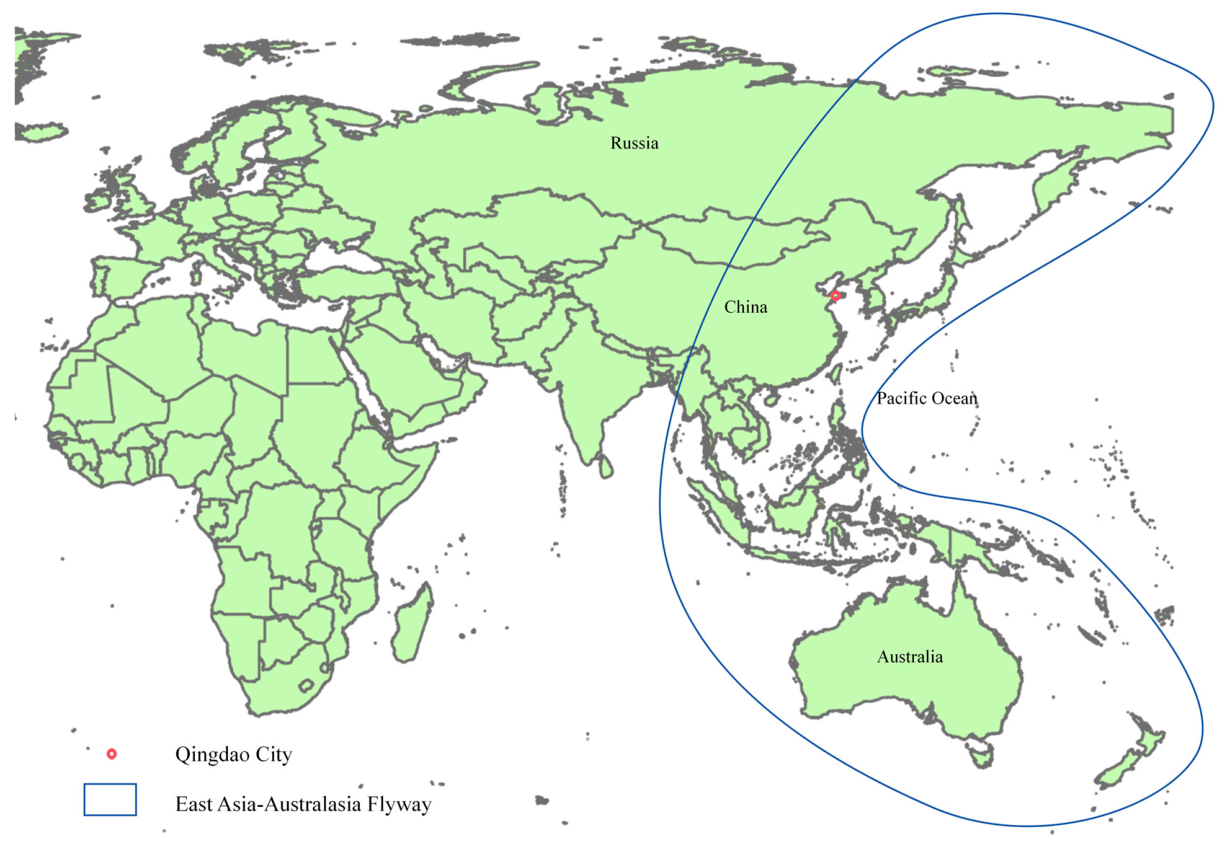
Qingdao is situated on the southern coast of the Shandong Peninsula in eastern China and lies along the EAAF, one of the nine major migratory flyways in the world. The EAAF extends from the Arctic regions of Russia and Alaska in the north to Australia and New Zealand in the south, spanning 22 countries and supporting the annual migration of over 50 million waterbirds encompassing more than 250 species (Figure 1). Owing to its unique geographical position at the junction of the Yellow Sea coast and the Shandong Peninsula, Qingdao serves as a critical stopover and staging site for long-distance migratory birds traversing the western Pacific coast and the inland migration corridors of Northeast Asia.
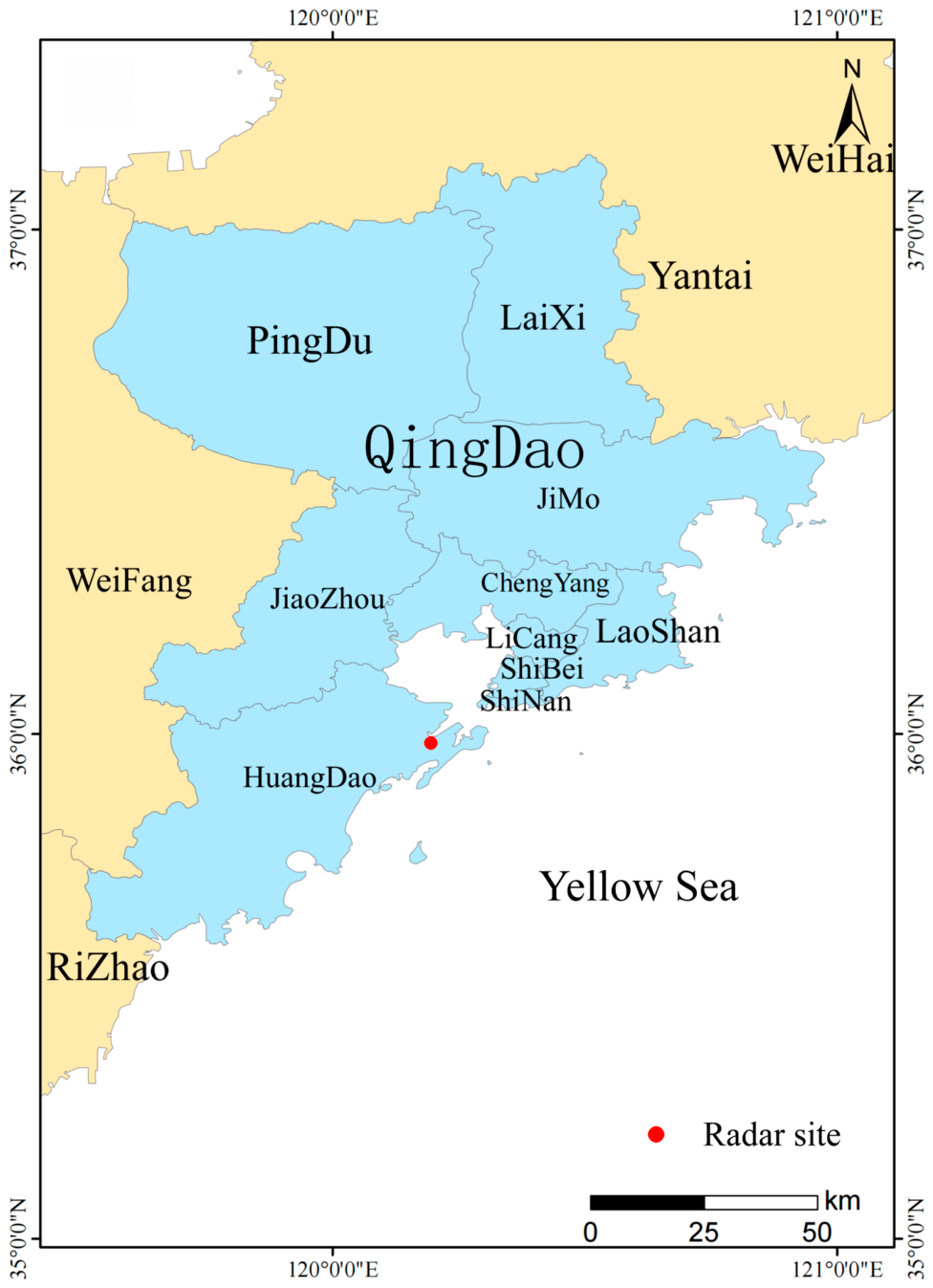
Qingdao is a prefecture-level city under the jurisdiction of Shandong Province, located between latitude 35°35′~37°09′ N and longitude 119°30′~121°00′ E. Qingdao is bordered by the Yellow Sea in the east, Weifang in the west, Yantai in the north, and south of the Yellow Sea. In this paper, Qingdao National Weather Radar Station (Z9532) is selected as the radar station to analyze the migration in Qingdao. The study area covers a 35 km radius around the station, as shown in Figure 2.
The area within 35 km of the Qingdao radar station is mainly coastal plain with low elevation, mostly coastal mudflats and flat farmland, while there are also low hills, such as part of the Laoshan District hilly area. Qingdao’s major rivers include the Dagu River, Jiao Lai River and Shi Lao River, most of which flow into the Yellow Sea from north to south or from west to east. The region has important wetland parks and mudflat resources including Jiaozhou Bay Wetland, Laoshan Bay Wetland and Tangdao Bay Wetland, which provide vital habitats and foraging grounds for migratory birds, and through effective conservation and management measures, ensure smooth bird migration and healthy development of the wetland ecosystem. In this section, the area within 35 km of the meteorological radar station was used for the study of bird activity patterns, and for convenience, the following sections use “Qingdao area” to denote the range of the research area.

2.2. Methods

2.2.1. Radar Data Processing

CINRAD is a new generation weather radar system developed by China Meteorological Administration (CMA). CINRAD system is based on the US WSR-88D technology, which is similar to the NEXRAD system. Considering the data volume and quality, radar data with a 30 min time resolution in S-band dual-polarization (SAD) format was selected for subsequent processing and analysis. This section uses the process of CINRAD data processing, firstly, the single scanning data is unpacked, it is parsed to get the radar parameter information and radar detection information, and it is processed into the scanning data under each elevation angle, then extracted to get the bird related information, and then integrated and written into a csv file.
The bioRad package (0.8.1), developed by the Radar Migration Ecology Team at Cornell University’s Ornithology Lab, is capable of extracting and visualizing biological signals from standardized weather radar data. It processes this data into biological information, including bird flight altitude, speed, and direction [27]. The vol2bird algorithm, based on the existing wind profiler algorithm of Doppler weather radar, uses the Volume Velocity Profiling (VVP) technique to identify bird scattering echoes [28,29]. VVP technology has been successfully applied in research on bird migration profiling analysis [30]. For regions within 0–6 km altitude with a 200 m vertical interval, the vol2bird algorithm approximates the local velocity field using the Spatially Constant Model (SCM). The radial velocity V r is calculated by Formula (1), where the local velocity field components in the x-, y-, and z-directions are represented by constants u 0 , v 0 , and w 0 , respectively.
V r ( θ , ϕ ) = s i n ϕ c o s θ u 0 + c o s ϕ c o s θ v 0 + s i n θ w 0
In Formula (1), θ and ϕ represent the elevation angle (the pitch angle during radar scanning) and azimuth angle (the horizontal angle during radar scanning), respectively. u 0 and v 0 represent the ground speed components in the Cartesian coordinate system, while   w 0 represents the vertical speed component [29].
After the first least-squares model fitting equation (Formula (1)), points with a deviation greater than 10 m/s from the model are considered outliers caused by de-aliasing errors and are removed [28]. The final velocity parameters are determined by the second model fitting (Formula (2)). The radial velocity standard deviation σ r is obtained from the fitting residuals for each resolution volume i of the radial velocity data.
σ r = 1 N M i N [ V r , i V r ( ϕ i , θ i ) ] 2
In Formula (2), V r , i represents the observed radial velocity, and N is the number of data points. These data points correspond to all resolution volumes with reflectivity higher than the noise level (including those assigned to precipitation), excluding those identified as clutter. M denotes the number of estimated parameters in the radial velocity model of Formula (2) (M = 3). The parameter σ r is a key indicator in weather radar data analysis, mainly used to assess the consistency of target motion, characterize wind field properties, and distinguish bird migration motion signals. It effectively differentiates high-quality wind data from bird-contaminated wind profiles [31]. In addition to σ r , the vol2bird algorithm removes non-avian echoes through multiple feature analyses. It uses the intensity of target echoes (reflectivity, dBZ) to distinguish birds from other targets. Bird echo reflectivity typically ranges from −10 to 10 dBZ [32], while precipitation produces higher reflectivity values (greater than 20 dBZ). In C-band weather radar, a reflectivity of 20 dBZ corresponds to a bird density of approximately 3500 individuals per km3 for Passeriformes species—an extremely rare occurrence in practice. Therefore, vol2bird sets 20 dBZ as a threshold, filtering out reflectivity factors exceeding this value. By leveraging such physical characteristics, the algorithm effectively eliminates most non-avian echoes, significantly improving the accuracy of bird target detection.
Bird density information can be obtained from reflectivity measurements, similar to quantitative precipitation estimation. For S-band weather radar, Formula (3) provides an empirical relationship between reflectivity and bird volume density [2,33], but it is only applicable in the absence of non-avian scatterers, such as precipitation. This formula combines the radar’s physical parameters with the biological characteristics of the target, offering a quantitative analysis method. It is not only suitable for bird monitoring but can also be extended to other biological targets (such as insects and bats) as well as meteorological targets (such as precipitation).
η = 10 3 π 5 λ 4 | K m | 2 Z e = ρ b i r d σ b i r d ¯
In Formula (3),   η has units of cm2/km3,   Z e has units of mm6/m3,   K m   =   m 2 1 m 2 + 2 , where m represents the complex refractive index of the scatterer, λ represents the radar wavelength, in units of cm,   ρ b i r d has units of birds per km3, σ b i r d represents the radar cross section of birds, in units of cm2,   ρ b i r d σ b i r d ¯ represents the strict average value for different bird species.
MistNet is based on a Convolutional Neural Network (CNN) core that can automatically extract multi-scale and multi-dimensional features from radar data to separate and retain bird signals. MistNet is trained using results obtained from the S-band dual-polarization data of the NEXRAD network, with the goal of filtering out precipitation areas from weather radar data. Unlike previous machine learning methods, MistNet can make precise predictions and collect biological and precipitation information from radar scans. It is based on an image neural network, incorporating several architecture components specifically tailored to the unique features of radar data to accurately distinguish between precipitation and bird echoes. MistNet takes three parameters as input from five specific elevation angles (0.5°, 1.5°, 2.5°, 3.5°, and 4.5°): DBZH, VRADH, and spectral width (WRADH). Using this data, MistNet estimates a segmentation mask that identifies pixels containing weather. When set to retain only biological data, these pixels are removed. MistNet is fully automated and utilizes a deep learning framework, enabling it to process large volumes of radar data in batches, automatically performing signal classification and separation. MistNet is applied to datasets of millions of radar scans, generating fine-grained predictions that allow for analysis ranging from continent-scale mapping to airspace utilization.
The radar’s detection coverage is semi-ellipsoidal, and scanning generally adopts a conical Doppler volume scanning strategy. To minimize ground clutter while ensuring the accuracy of bird echo extraction, the horizontal detection range selected for this study is 5–35 km. The maximum range of 35 km ensures coverage of approximately 4 km in vertical distance, which is the altitude range where most bird migrations occur [34]. Regarding vertical resolution, the height is automatically generated from the altitude data obtained from the radar, combined with the average altitude, and the vertical resolution is set to 200 m. The Radar Cross Section (RCS) characterizes the physical quantity of the echo intensity generated by the target under radar scanning. Dokter et al. determined in calibration experiments that the average RCS of bird migration under C-band radar scans in Western Europe is 11 cm2. This value reflects the situation of all birds passing through radar stations during the entire migration cycle, as Passeriformes species can account for over 90% of the bird population during migration [4]. Since Passeriformes migration is still notably high in the study area, in order to convert reflectivity measurements into bird density, this study sets the RCS value to 11 cm2. This represents the species group with the highest proportion in radar signals.
Based on the research requirements, this study extracts the following variables: Coordinated Universal Time (UTC), bird density (BD), migration traffic rate (MTR), vertically integrated density (VID), migration traffic (MT), eastward bird ground speed (u), northward bird ground speed (v), and the times of sunrise and sunset (date of sunrise/sunset). These variables are written into a comma-separated text file (.csv file) for subsequent analysis.
BD is a variable that intuitively reflects the number of birds passing through a given area, expressed in units of individuals per square kilometer (birds/km2). In the bioRad built-in algorithm, BD is derived from the radar reflectivity factor ( η ), according to the following formula:
B D = η R C S
MTR is defined as the number of birds passing through a 1 km virtual sample strip perpendicular to the migration direction within one hour. It is used to intuitively reflect the bird traffic flux in a given area per hour. The unit for MTR is individuals/(km·h). The formula for MTR is:
M T R ( t , h 1 , h 2 ) = h 1 h 2 d e n s ( t , h ) f f ( t , h ) d h
In this context, h 1 is the minimum altitude (0 km), h 2 is the maximum altitude (5 km), d e n s ( t , h ) and f f ( t , h ) represent the bird density and ground speed at a specific altitude h and time t, respectively [27].
VID refers to the number of birds migrating through the airspace above each square kilometer of ground, expressed in units of individuals per square kilometer (birds/km2). It reflects the overall bird density within the entire vertical column of the atmosphere. The formula is as follows:
V I D = h 1 h 2 d e n s ρ ( h ) d h
where d e n s ρ ( h ) is the bird density at altitude h, h 1 and h 2 are the minimum and maximum altitudes covered by the radar (0 km and 5 km, respectively), and each altitude bin is 200 m. The value of VID is also equal to the total sum of the integrals for each 200 m altitude bin.
MT refers to the number of birds passing through a virtual sample strip of 1 km along a direction perpendicular to the migration direction, within a certain altitude range. The unit for MT is individuals per kilometer (birds/km). The value of MT is the time integral of MTR. The formula for MT is:
M T ( t 1 , t 2 , h 1 , h 2 ) = t 1 t 2 M T R ( t , h 1 , h 2 ) d t

2.2.2. Weather Factors

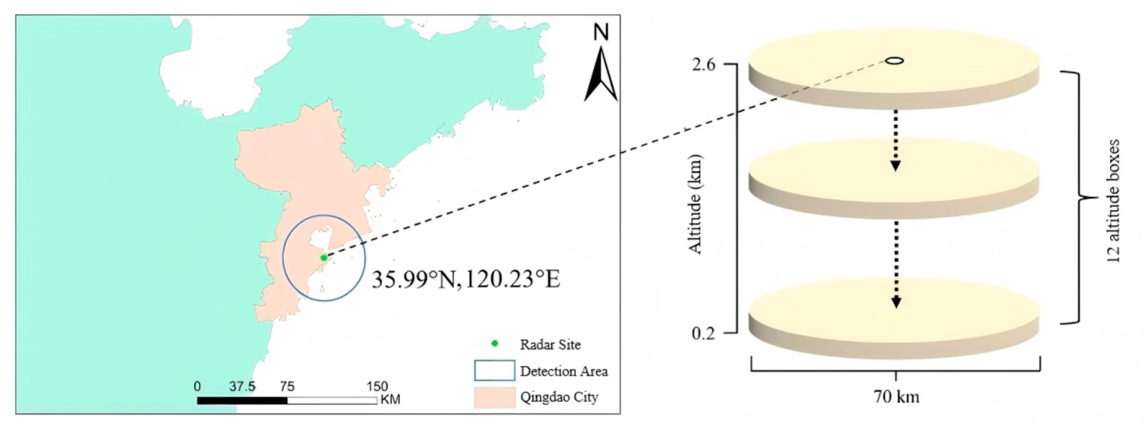
The radar at the Qingdao National Meteorological Station was processed to obtain hourly bird density (BD) and mean ground speed (u (positive eastward), v (positive northward), m/s) data for a 35 km radius of the radar station for the spring of 2023 (1 March to 31 May). The study covered altitudes from 200 m to 2600 m above sea level, with one altitude box per 200 m, and for each altitude box, BD, u, and v were extracted. Thus, each moment in time consisted of twelve measurements, each calculated within a circular measurement range extending laterally 35 km from the radar’s center (Figure 3). It is worth emphasizing that the altitudes discussed below in this section all represent altitude rather than the flight altitude of the birds.
In this paper, we use the fifth generation of the European Centre for Medium-Range Weather Forecasts Reanalysis v5 (ERA5). ERA5 was developed by the European Centre for Medium-Range Weather Forecasts (ECMWF), and provides atmospheric parameters with a temporal resolution of 1 h and a horizontal resolution of 0.25° × 0.25° for 37 pressure classes between 1000 hPa and 1 hPa that include a wide range of data such as temperature, precipitation, wind, and radiation. It has been shown that the ERA5 reanalysis data have a smaller gap and higher accuracy with the measured meteorological data in the Chinese region [35,36]. In this paper, the official website provided by ECMWF extracts the wind conditions (m/s), temperature (T; K), relative humidity (RH; %), and cloudiness (Cp; dimensionless) for 700–1000 hPa at the location of the ECMWF (35.99° N, 120.23° E), with a 1 h time resolution. In addition, for each measurement, the specific humidity (SH; g/kg) at that location, i.e., the mass of water vapor per kilogram of atmosphere, is calculated in this paper using the formula:
SH   =   w 1 + w
In Formula (8), the mixing ratio (w) is defined as:
w   =   0.622 e A p e
Ap in Equation (9) indicates atmospheric pressure in hundreds of Pascal (hPa); e indicates vapor pressure, is the pressure of vapor at a certain temperature, liquid (or solid) and its vapor phase in equilibrium when the vapor pressure is expressed as:
e   =   e s · RH 100
The   e s in Formula (10) denotes the saturated vapor pressure, the formula for which is given by Buck, A.L et al. [37], and for temperatures above 0 °C use Eq:
e s   =   ( 1.0007 + 3.46 × 10 6 · A p ) · 6.1121 · exp ( 17.502 · T 273 240.97 + ( T 273 ) )
And for temperatures below 0 °C the formula is used:
e s   =   ( 1.0003 + 4.18 × 10 6 · A p ) · 6.1115 · exp ( 22.452 · T 273 272.55 + ( T 273 ) )
The Bd were converted to proportional bird density (pBd) by dividing the Bd in each height bin by the sum of Bd across all height bins for the given night. For the purposes of analysis, an additive log-ratio (ALR) transformation was applied to the pBd values. The ALR transformation was performed for each of the 12 height bins on every night, expressed relative to the first (i.e., lowest) height bin—hereafter referred to as the reference bin—according to the following formula:
t B d a i = log ( p B d a i p B d 1 i )
However, this transformation yields invalid solutions whenever pBd equals zero, and such data points were therefore manually excluded. In addition, the transformation returns a value of zero for the reference height bin (a = 1), which does not reflect the actual conditions. Accordingly, an inverse transformation was applied to all values of t B d a i in this study; for all bins other than the reference bin, the formula is given by:
p B d a i = exp ( tB d a i ) 1 + a = 2 12 exp ( tB d a i )  
The formula for the reference height bin is given by:
p B d 1 i = 1 a = 2 12 p B d a i
Wind speed and direction are described using two components, u and v, where u represents the east–west component (positive eastward) and v represents the north–south component (positive northward). Several variables used in this study to predict bird flight altitude are derived from u and v. Based on the geographical location of the study area along the East Asian–Australasian Flyway, the preferred migration direction of birds transiting the region is assumed to be 15°. Following the method proposed by Shamoun-Baranes [38], tailwind ( T w ; m/s) is calculated as:
T w = W s p c o s ( α w i n d θ )
where W s p denotes wind speed, α w i n d denotes wind direction angle, and θ denotes the bird migration direction. α w i n d can be expressed in terms of the wind velocity direction ( τ ),
α w i n d = τ + 180
where τ is derived from u and v ,
τ = ( 180 π ) × a t a n 2 ( u , v )
Wind profit ( W P ; m/s) is calculated from T w as a function of W s p and the angular difference between α w i n d and θ . Prior to calculation, a mean migration peed for birds must be specified. In this study, the flight speed of Passeriformes, which constitute the highest proportion of migrants, is adopted as the representative value and set at z = 12 m/s [39,40]. W P is computed as follows:
W P = W s p cos θ + z 2 ( W s p sin θ ) 2 z
To more precisely characterize the wind conditions most favorable for bird flight at each altitude and to normalize wind conditions across nights for improved inter-night comparability, relative wind profit ( r W P ) is calculated, defined as the W P at a given altitude minus the optimal W P for that night; thus, 0 represents the maximum value of r W P . Additionally, the W P relative to the surface wind profit ( W P s f c ) is calculated, denoted as r W P s f c , defined as the wind profit at a given altitude minus the wind profit at the surface. For computational convenience, W P s f c is expressed using a binary term ( b W P s f c ): b W P s f c equals 1 if W P s f c is negative, and 0 if W P s f c is non-negative. Thus:
r W P s f c = b W P s f c ( W P W P s f c )
Following the same rationale and computational approach, two additional variables are derived: relative tailwind ( r T W ) and relative surface tailwind (r T W s f c ).

2.2.3. Correlation Analysis

The Pearson correlation coefficient is a statistical method used to measure the linear relationship between two continuous variables. Its result is a value between −1 and 1, reflecting the degree of positive correlation, negative correlation, or no correlation between the variables. This method is widely used in many fields, such as data analysis, machine learning, and ecology. In this study, the Pearson correlation coefficient is used to explore the relationships between weather factors, altitude, and bird density, providing an initial investigation into how different weather factors affect bird migration height selection strategies. The equation for the Pearson correlation coefficient p is:
p = i = 1 n ( x i x ¯ ) ( y i y ¯ ) i = 1 n ( x i x ¯ ) 2 i = 1 n ( y i y ¯ ) 2
In Formula (21), p is the Pearson correlation coefficient, x i and y i are the i-th observation values of the two variables, x ¯ and y ¯ are the means of x and y, respectively, and n is the total number of observations. The closer the value of p is to 1, the stronger the positive correlation between the two variables; the closer p is to −1, the stronger the negative correlation between the two variables; if p = 0, there is no linear relationship between the two variables.
The Spearman correlation coefficient is a non-parametric statistical method used to measure the monotonic relationship between two variables. It is suitable for cases where the variables do not need to follow a normal distribution or have a non-linear relationship. In this study, the Spearman correlation coefficient is used to test the performance of adding subsequent predictor variables to the generalized additive model. The equation for the Spearman correlation coefficient is:
q = 1 6 d i 2 n ( n 2 1 )
In Formula (22) q is the Spearman correlation coefficient, n is the sample size, and d i   = R ( x i )−R ( y i ) is the difference in ranks of the two variables for each data pair, where R ( x i ) and R ( y i ) are the ranks of variables x and y, respectively. The closer q is to 1, the stronger the positive correlation between the two variables; the closer q is to −1, the stronger the negative correlation between the two variables; if q   = 0, there is no monotonic relationship between the two variables.

2.2.4. Linear Regression Model

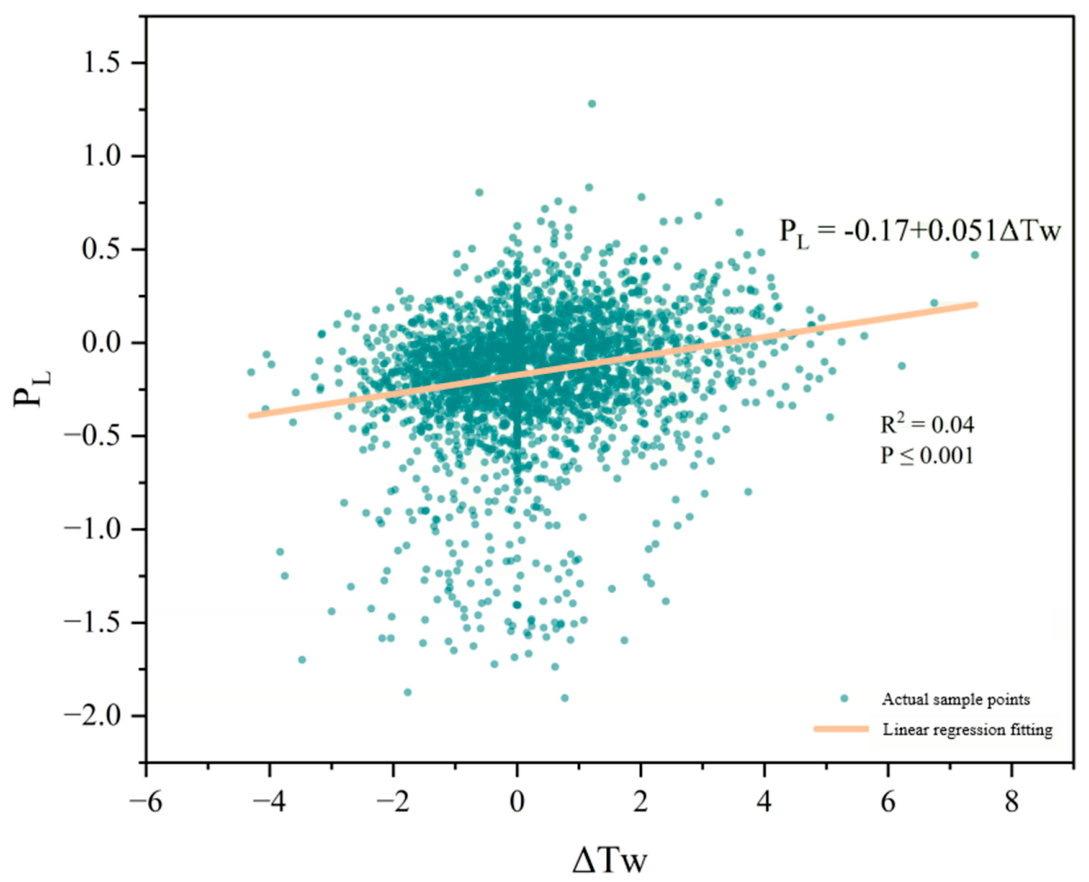
Bruderer et al. assumed that the probability of nocturnally migrating birds altering their flight altitude is a function of the difference in tailwind strength (∆Tw) between adjacent altitude bins [41]. To quantify the probability of altitude change as a function of ∆Tw, a linear regression was first calibrated. For this purpose, we assumed that differences in pBd between adjacent altitude bins reflect birds’ preference between the two bins. For each observation, we defined P as the pBd in the altitude bin immediately above the current bin divided by the sum of the pBd values in both bins. Accordingly, P > 0.5 indicates that more birds prefer the conditions in the upper bin, whereas P < 0.5 indicates a stronger preference for the conditions in the current bin. P was then logit-transformed (hereafter p L ) and used as the response variable in the regression:
L o g i t ( P ) = log P 1 P
Accordingly, ∆Tw was calculated as the Tw in the altitude bin immediately above minus the Tw in the current bin, such that positive values of ∆Tw indicate increasingly favourable tailwind support in the bin above. The linear regression was fitted assuming a normal distribution (i.e.,   p L = a + b∆Tw, where a and b are coefficients calibrated from the data), with each observation weighted by the square root of the sum of Bd across the two altitude bins used to compute P . Based on the resulting regression, the distribution of pBd was simulated for each night of the study. Each nightly simulation was initialised from a probability distribution in which all migrating birds were assumed to start in the lowest altitude bin, and this distribution was then iteratively adjusted according to the P predicted from ∆Tw in each bin until convergence was reached (i.e., the root-mean-square error (RMSE < 0.0001). The formula for RMSE is given by:
R M S E = 1 n i = 1 n ( y i y i ^ )
In Formula (24) y i is the observed value, y i ^ is the predicted value, and n is the sample size.

2.2.5. Generalized Additive Model

The Generalized Additive Model (GAM) is a statistical modeling approach that combines the flexibility of Generalized Linear Models (GLM) with the capability of nonlinear modeling, widely applied in fields such as ecology, medicine, and social sciences. GAM represents the response variable as the sum of nonlinear smooth functions of explanatory variables [42,43], thereby capturing complex nonlinear relationships. This model offers strong interpretability and visualization capabilities. In bird migration studies, GAM can help reveal the intricate relationships between migration behavior and environmental factors (such as wind speed, temperature, humidity, etc.), providing essential support for ecological conservation and biological research. The general form of GAM is:
g ( E [ Y ] ) = β 0 + f 1 ( X 1 ) + f 2 ( X 2 ) + + f P ( X P )
In Formula (25), Y is the response variable; X 1 , X 2 , X p are the explanatory variables; E [ Y ] is the expected value of the response variable; g ( · ) is the link function, which is used to connect the expected value of the response variable to the linear predictor; β 0 is the intercept term of the model; f 1 ,   f 2 ,   f p are the nonlinear smooth functions of the explanatory variables; and p is the number of explanatory variables.
A GAM is composed of three core components: a link function g ( · ) , smooth functions f (X), and a penalty term. The formulation of the smooth functions enables the GAM to effectively capture nonlinear relationships while mitigating overfitting, thereby affording substantial flexibility. Moreover, the GAM yields clear model interpretability, as the effect of each covariate on the response variable can be examined individually. In addition, the GAM retains the advantages of the GLM framework, accommodating a variety of distribution families—such as the Gaussian, binomial, and Poisson distributions—together with their corresponding link functions, which renders it applicable to a wide range of scenarios.

3. Results and Discussion

3.1. Patterns of Bird Activity in Spring

3.1.1. Daily Variation Patterns

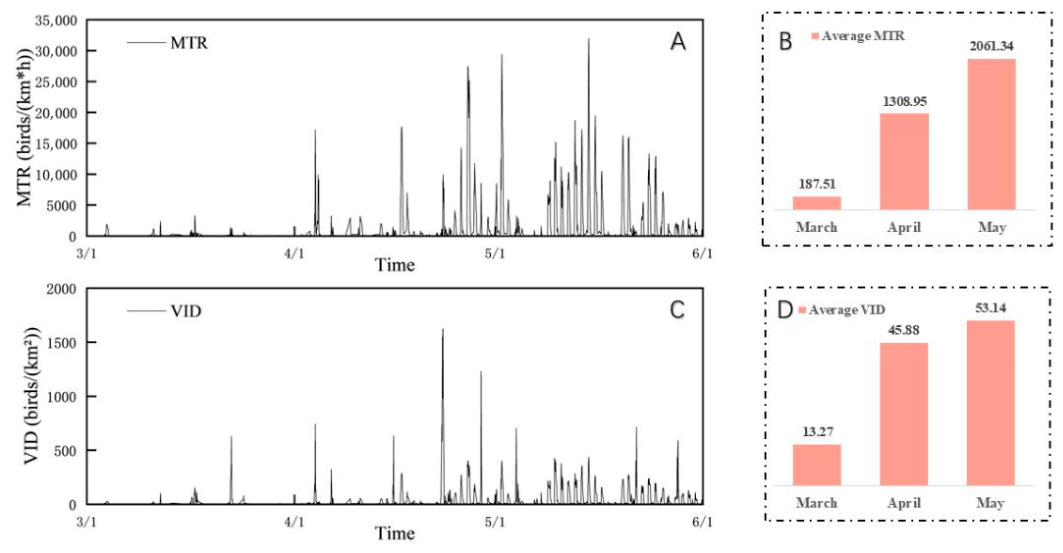
As shown in Figure 4A,C, the MTR and VID in the Qingdao region exhibited a generally good overall correspondence. Bird migration activity in March was minimal, with mean MTR and mean VID values of only 187.51 birds/(km·h) and 13.27 birds/km2, respectively (Figure 4B,D). Migration commenced during the night of 3–4 March, followed by small-scale migration events on 11–12 March, 16–17 March, and 22 March. Entering April, both the frequency and intensity of migration increased progressively. A concentrated migration event occurred in early April, during which MTR values rose substantially. Following several minor migration pulses, the first large-scale migration event was recorded on 15 April, with VID reaching 1339.64 birds/km2 and MTR approaching 20,000 birds/(km·h). After a subsequent trough period of approximately five days, the Qingdao region entered the first sustained large-scale migration phase of the 2023 spring migration season (23 April–4 May). During this period, the second and third-highest MTR values of the entire spring migration season were recorded at 23:00 on 1 May (29,394.95 birds/(km·h)) and at 22:00 on 26 April (27,480.22 birds/(km·h)), respectively. The highest and third-highest VID values of the season were also observed during this phase, at 04:00 on 23 April (1622.35 birds/km2) and at 01:00 on 28 April (1229.94 birds/km2), respectively. Following a subsequent trough period of approximately four days, migration entered another large-scale phase, during which the seasonal peak MTR value of 31,966.97 birds/(km·h) was recorded at 23:00 on 14 May. After this final large-scale migration event, bird migration activity in the Qingdao region gradually declined toward the end of the season.
In summary, bird migration in the Qingdao region commenced in early March or possibly earlier. Migration flux in March was relatively low. Although migration intensity and the number of transiting birds in April were both lower than in May, the difference in the number of transiting individuals between the two months was relatively modest (mean VID: 45.88 birds/km2 in April vs. 53.14 birds/km2 in May). Migration peaked in May, with both frequency and intensity showing marked increases compared to April. Distinct trough periods were observed between successive large-scale migration events, with the duration of these troughs displaying a progressive shortening trend. Peaks and troughs accompanied each large-scale migration, so that bird migration in Qingdao as a whole was characterized by alternating periods of high and low activity.

3.1.2. Bird Activity Altitude Analysis

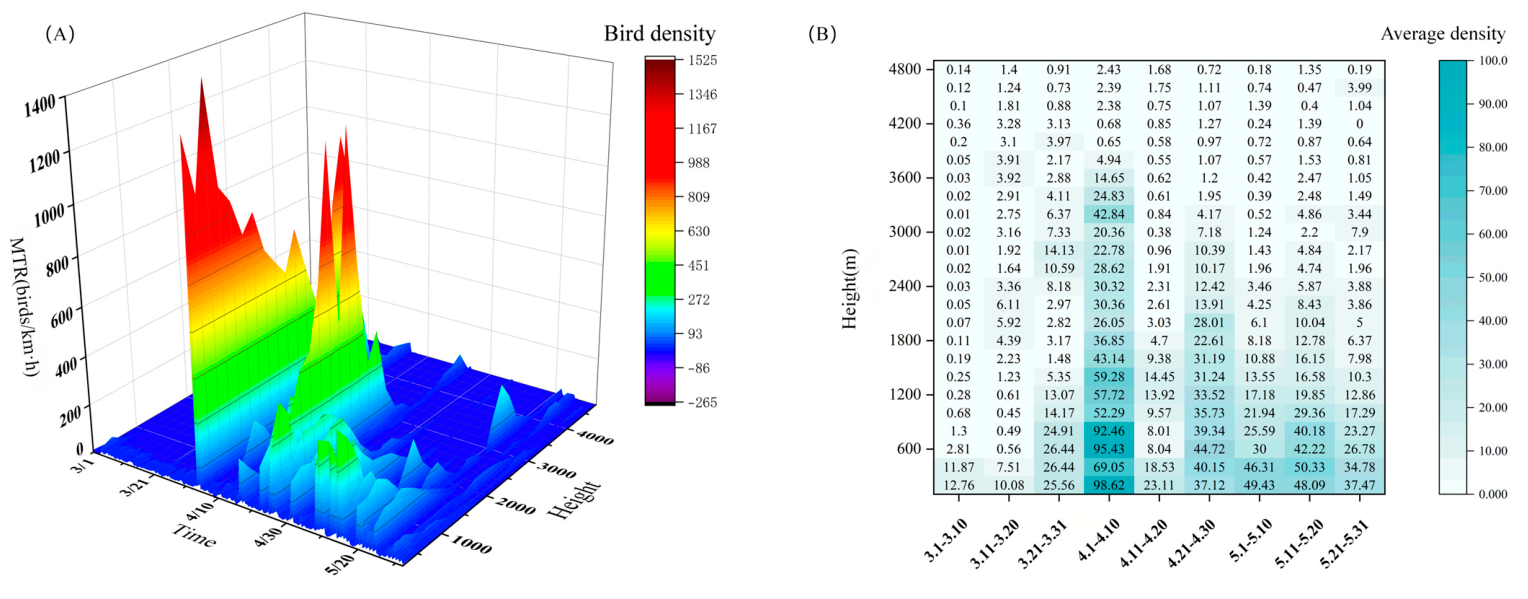
From Figure 5A, it can be seen that there was a concentrated transit of birds in Qingdao at the end of March, with birds distributed at all heights from 0–3000 m. The highest density of birds was found at all heights between 1000 m and 3500 m. During this large-scale bird migration in early April, the number of birds in transit was huge, and the density of birds in all altitude bins between 0–4000 m was high, with the highest occurring around 1000 m and 3500 m, both exceeding 1500 birds/km3. In mid-April, the birds were mainly concentrated in the altitude of 1000–2500 m, but also in the rest of the altitude range. Toward the end of April, the density of birds in the range of 1000–2000 m decreased, and they were mainly distributed in the altitude range above 2000 m, followed by the altitude range below 1000 m. In May, the number of days on which migration occurred increased significantly, while low-altitude migration was the trend of bird migration in Qingdao in May. In the first half of May, the density of birds above 1500 m was low. Migration at 200–1000 m was more concentrated during the first and second half of the month, while in the second half of the month, the density of birds in the altitude band of 2500–3200 m was higher on 22 May. Subsequently, during the tail end of migration at the end of May, 200–1000 m, 2600–3400 m and above 4400 m were the three altitude bands with the highest bird densities during this phase.
Throughout the spring migration in Qingdao area in 2023, it can be seen from Figure 5B that the low altitude area below 600 m was the main concentration altitude band for bird activities and migration. Starting from late March, the density of birds in the altitude below 1400 m increased rapidly, and reached a peak during the first half of April, especially in the ranges of 200–400 m and 600–1000 m. The average density was above 90 birds/km3 in both ranges. In May, bird activities were still dominated by the altitude range below 600 m. In the second half of May, bird densities at all altitudes decreased, and the migration gradually came to an end.

3.2. Weather Factors Significantly Influence Bird Migration

3.2.1. Nighttime Bird Altitude Distribution

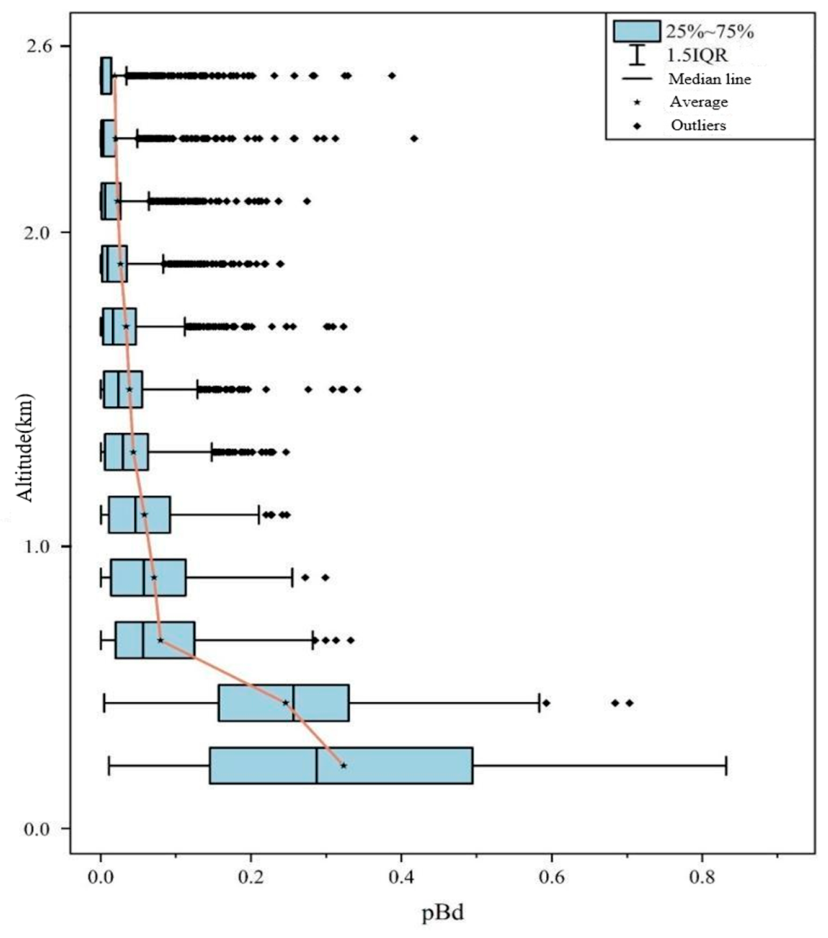
Figure 6 shows the nocturnal pBd plotted according to Section 2.2.2. A straight line indicates the height distribution of pBd means in 2023, a box plot shows the range of deviation from pBd mean for each height box, boxes indicate the upper and lower quartile ranges (25–75%), vertical lines within the boxes indicate the median, and “whiskers” indicate the range of deviation beyond the quartile but less than 1.5 times the IQR (the difference between the upper and lower quartiles) range of values, a pentagram indicates the mean value, and a diamond point indicates an outlier. It shows that pBd values were higher at lower altitudes and decreased with increasing altitude, with both the median and mean exhibiting a consistent declining trend along the altitudinal gradient. As indicated by the line connecting the mean values across altitude bins, pBd increased rapidly below 600 m, suggesting that birds tend to concentrate at low altitudes during nocturnal migration. Meanwhile, the pBd data at lower altitudes showed considerable dispersion, indicating substantial variability within these altitude ranges, which may reflect greater species diversity and larger fluctuations in bird abundance at low altitudes. Conversely, a greater number of high-value outliers were observed at higher altitudes, suggesting that only a small proportion of birds selected high-altitude flight paths during migration. The preliminary conclusions drawn are consistent with the observation and radar validation results of Gauthreaux, S.A., Jr. [44], and with the results of Dokter et al. [45], as well as with the bird migration altitude patterns in Section 3.1 of this paper.

3.2.2. Bird Density Correlation Analysis

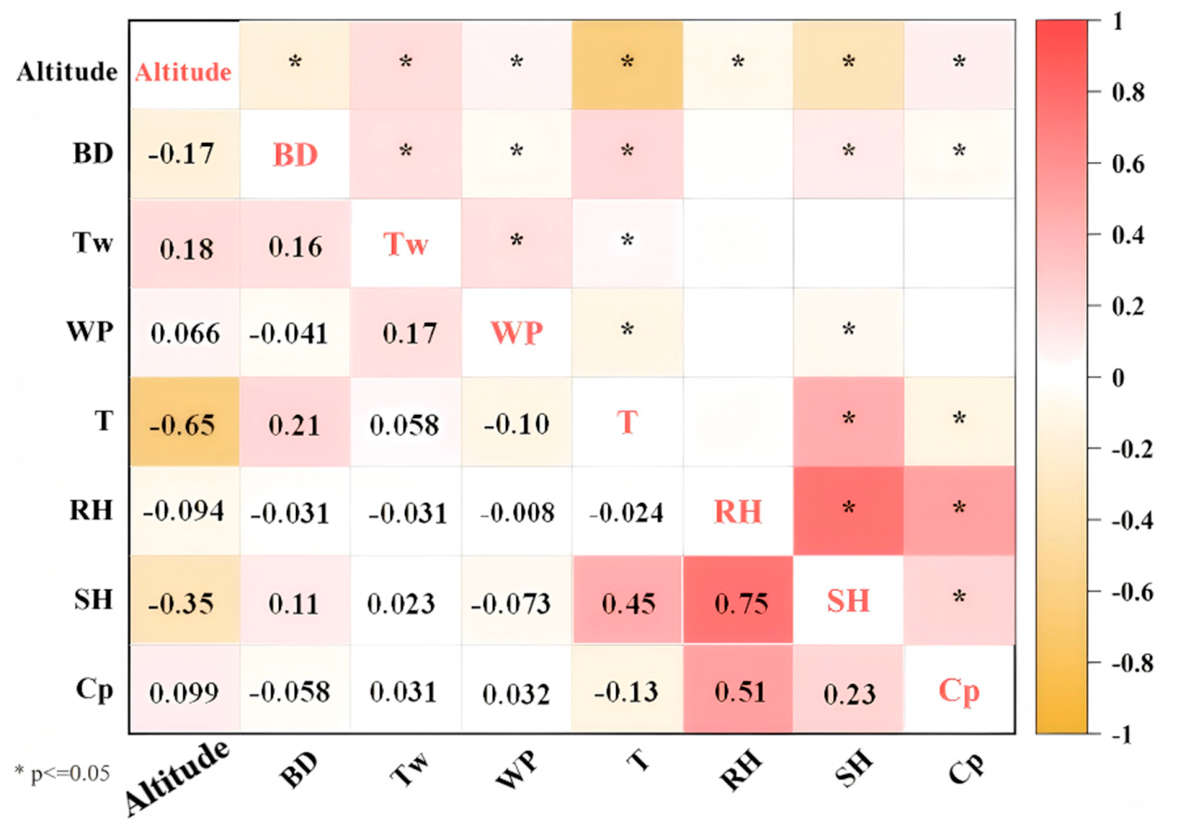
Following the detection and treatment of missing values and outliers, all variables with different units of measurement were normalized. Pearson correlation coefficients were then calculated to quantify the relationships among individual meteorological variables, altitude, and bird density. As shown in Figure 7, among the meteorological variables, RH and SH exhibited a strong positive correlation (0.75), which is attributable to the fact that SH is derived from RH. A strong negative correlation was observed between altitude and temperature (T), indicating that temperature decreases with increasing altitude. SH showed a moderate negative correlation with altitude and a moderate positive correlation with T. Additionally, Cp demonstrated a strong positive correlation with RH.BD exhibited a weak negative correlation with altitude, suggesting a gradual decline in bird abundance with increasing altitude. A statistically significant positive correlation was found between BD and tailwind component Tw (0.16), indicating that birds preferentially select tailwind conditions for migration. BD also showed a significant positive correlation with T, suggesting that birds tend to migrate under more favorable temperature conditions, and that lower temperatures impose certain constraints on migratory activity.
Overall, the individual correlations between bird density and the meteorological variables examined were relatively weak, indicating that no single factor exerts a dominant influence on bird density within a given altitude layer. This finding indirectly supports the notion that bird migration is a complex process governed by the combined effects of multiple factors. These meteorological variables collectively shape avian migratory strategies, as birds respond to changes in various atmospheric conditions by selecting appropriate flight altitudes to complete their migration. To further elucidate how meteorological factors jointly influence migratory altitude selection, the subsequent analysis considered the combined effects of multiple meteorological variables on bird migration altitude.

3.2.3. The Effect of Tailwind Speed on Bird Migration Altitude

(a) Figure 8 shows that the linear regression model indicates a statistically significant but very weak correlation between ΔTw and PL, expressed as PL = −0.17 + 0.051ΔTw, n = 2975, R2 = 0.04, p ≤ 0.001, which suggests that ΔTw has a minimal overall effect on PL. Bruderer et al. in their multiple regression model for a desert region in southern Israel found that the difference in tailwind speed between altitude zones (i.e., ΔTw) was the only variable that significantly influenced the flight altitude distribution of nocturnal migrating birds [41]. This could be because their study region, located in the Negev Desert, is strongly influenced by trade winds, with relatively stable wind directions and speeds, making the effect of tailwinds on bird migration more significant. In contrast, Qingdao is located in the East Asian Monsoon Region, where the climate is complex and subject to frequent and unstable changes in wind direction and speed due to land–sea circulation and monsoon variations. As a result, migrating birds in Qingdao may face more complex meteorological conditions, and the influence of tailwind speed may be offset or weakened by other factors. Therefore, the selection of migration altitude by birds is more likely to be influenced by a combination of factors. Additionally, in monsoon regions, wind speed and direction are greatly influenced by factors such as temperature and humidity, and changes in these factors may alter the relative importance of tailwinds in affecting birds’ migration altitude selection.
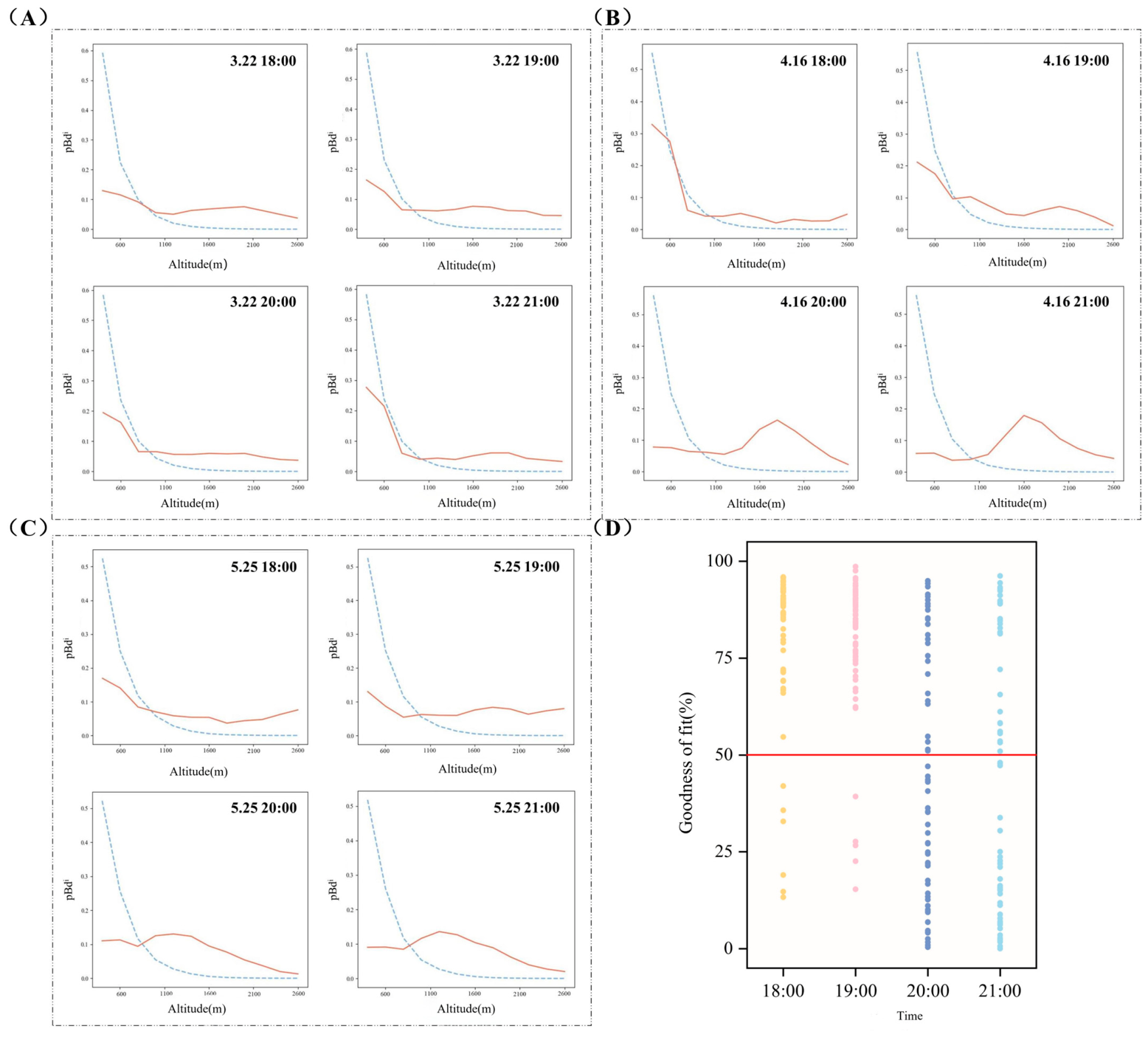
(b) The average Spearman’s q between actual and simulated values of pBdi in Qingdao region in spring was 0.70, and the average RMSE between actual and simulated values of pBdi in spring was 0.119. Figure 9A–C show one sample night per month selected separately, and the simulation results show how well the model explains the time point Tw for that sample night, the extent to which it explains the high variability in bird migration. Overall, the simulated distribution of pBdi did not vary greatly, showing an exponential decrease with altitude most of the time. This indicates that, when considering the influence of Tw alone, birds tend to concentrate their migration at lower altitudes, even when wind conditions are more favorable at higher elevations. This suggests that wind conditions alone cannot fully account for the altitudinal variation in bird migration, and that other factors may act in concert to shape migratory flight altitude.
The results from the three selected nights can, to a limited extent, reflect the following patterns: migration activity in March was not pronounced; migration intensity in April increased markedly compared to March, with high-altitude migration between 1500 and 2200 m dominating after 20:00; by May, migration intensity continued to increase, while low-altitude migration at or below 1500 m gradually became predominant. As shown in Figure 9D, model goodness-of-fit was relatively high during the evening hours (18:00 and 19:00), with most values at or above 50%, whereas during the nighttime hours (20:00 and 21:00), instances of goodness-of-fit falling below 50% increased substantially. This may be attributed to the fact that migration typically commences around 20:00, variations in tailwind intensity may influence the preferred altitude at which birds initiate migratory flight under favorable wind conditions. However, once migratory flight is initiated, birds are less likely to adjust their flight altitude in response to wind conditions.

3.2.4. Multivariate Analysis Based on GAM

In general, migrating birds prefer lower flight altitudes, as these allow them to use ground reference points for navigation. Flight altitude both influences migratory behaviour and reflects the outcome of birds’ responses to a range of other factors. We therefore began with a baseline model that included flight altitude (Alt) as the sole predictor, in order to account for the effect of altitude itself. Building on this baseline, additional candidate predictors were incorporated through forward stepwise regression, with repeated random subsampling employed as the cross-validation procedure, in order to identify the optimal combination of predictors of bird migration altitude during spring in the Qingdao region. Each time a new variable was added, the resulting model was evaluated by repeatedly (50 iterations) drawing a random 80% of the available nights as the training set and using the remaining 20% as the test set.
The variable yielding the lowest mean RMSE was then retained. Using the same repeated random subsampling procedure, the performance of the model with each subsequently added variable was assessed in terms of RMSE, Spearman’s q and R2. A variable was added to the model if it produced the lowest cross-validated RMSE, was significant in the model (p ≤ 0.05), and did not render any previously selected variable non-significant. In addition, a chi-squared test was performed to confirm that each newly added variable significantly (p ≤ 0.01) improved the overall goodness-of-fit of the model. Owing to the stochasticity introduced by repeated random subsampling and the flexibility of the GAM, this stepwise procedure could yield different final models if run an unrestricted number of times. The forward stepwise analysis was therefore repeated 50 times in total, and the most frequently retained set of predictors was kept; the performance of the model containing these predictors is reported below.
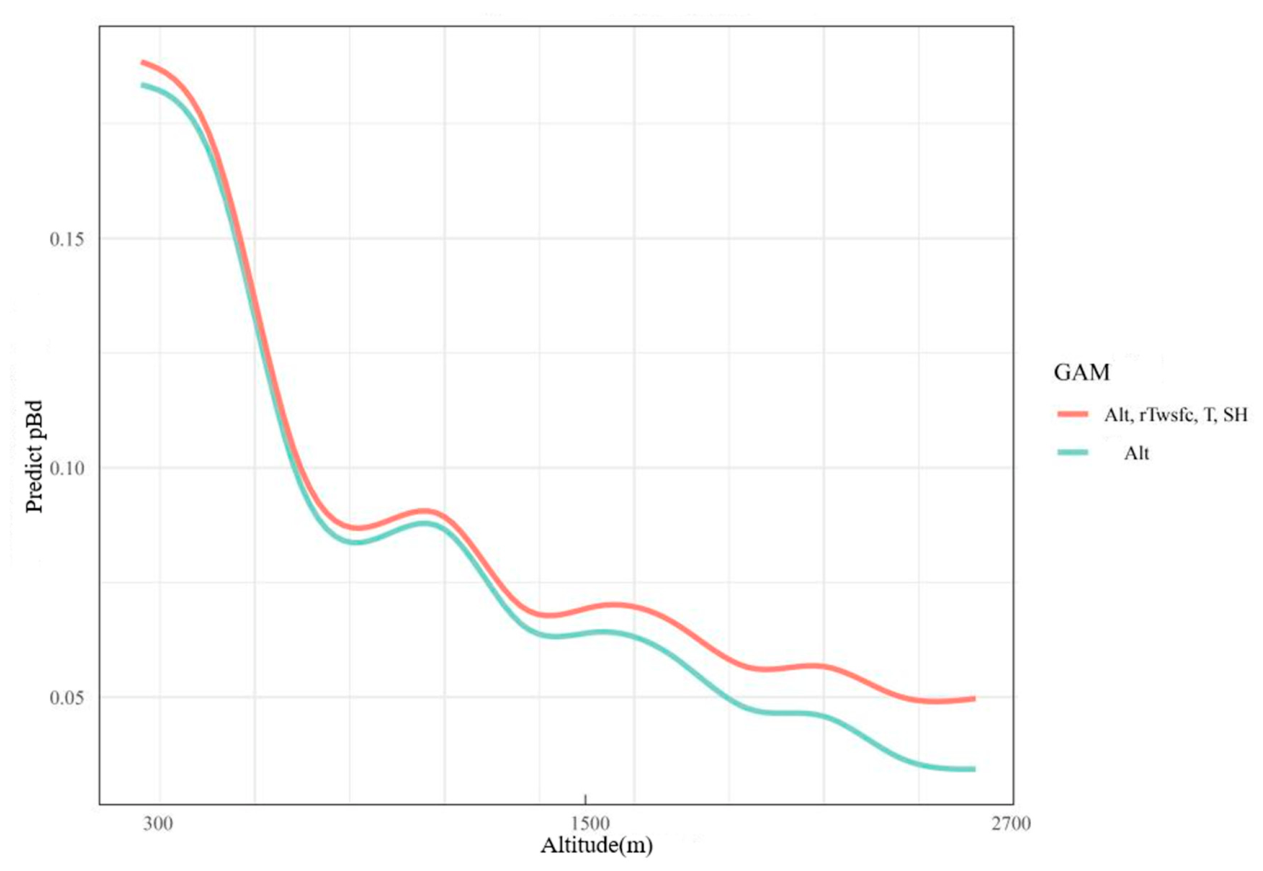
In this paper, 50 forward stepwise regression analyses were conducted to derive stable combinations of predictor variables that best explained changes in the elevational distribution of spring bird migration in the Qingdao area. These models were selected and calibrated using tBd back-transformed pBdi as the response variable, and model performance is discussed in terms of pBd as a scale whenever possible (pBd is used instead of bird density in the following discussion). Table 1 gives the number of times each potential predictor variable was selected in these 50 stepwise model selection iterations. The variable Alt was included in these models by default in its entirety and separately explained 52.9% of the pBd variability in the spring (Table 2). Wind aids associated with surface wind conditions (rWPsfc and rTwsfc) were selected more often than wind aids for all wind conditions on the night (rWP and rTw), with rTwsfc being selected significantly more often than rWPsfc. In addition, among the remaining predictor variables, T and SH were often selected in the final model, while RH and Cp were hardly ever selected.
Based on repeated random sampling cross-validation, the prediction variables other than altitude were selected. In the final GAM model, rTwsfc was prioritized, followed by T, SH, and rTw, with the remaining prediction variables being selected less frequently. As more frequently selected predictors were incorporated into the final GAM model, the model performance showed some improvement, as evidenced by a decrease in RMSE, an increase in Spearman’s q, and an increase in explained variability (Table 2).
Figure 10 compares the prediction results of the GAM model that includes only the Alt variable with the GAM model that includes four variables: Alt, rTwsfc, T, and SH. By extracting the range of Alt values from the data, 100 altitude points were generated to predict bird density under the model that only includes the Alt variable. Then, by fixing the values of rTwsfc, T, and SH at their median values, another set of 100 prediction altitude points was generated to predict bird density under the model that includes all four variables. From the figure, it can be seen that the influence trend of Alt on bird density remains similar regardless of whether the other three variables (rTwsfc, T, and SH) are included. As altitude increases, pBd gradually decreases, indicating that Alt is one of the primary driving factors and plays a dominant role in bird density variation. After adding the variables rTwsfc, T, and SH, pBd shows an overall increase. In low-altitude areas, the change in pBd is not significant, suggesting that the impact of these meteorological conditions is weaker at lower altitudes. In contrast, the increase in pBd values was more pronounced at higher altitudes, suggesting that meteorological conditions in the Qingdao region enable birds to better adapt to high-altitude environments, thereby sustaining higher densities.

3.3. Energy Consumption-Based Migration Strategy Selection

During avian migration, energy consumption directly influences migration speed, flight strategy, resting and foraging patterns, and may even determine whether the migration succeeds. The Minimum Energy Hypothesis (MEH) postulates that birds select flight speeds and strategies that minimize energy expenditure during migration. With respect to the variables selected in Section 3.2, birds reduce in-flight energy consumption by selecting favorable meteorological conditions.
Under tailwind conditions, birds can exploit wind-assisted propulsion, reducing wingbeat frequency to conserve energy, and may even stop over en route to await the arrival of favorable tailwinds. Birds also adjust their flight altitude to exploit the most favorable airflow conditions, flying at altitudes where air resistance is minimized and wind support is optimal. At higher altitudes, airflow is more stable, allowing birds to further reduce energy consumption through gliding. In some cases, however, birds fly at lower altitudes to avoid headwinds or other unfavorable conditions. These strategic choices are all aimed at optimizing energy expenditure.
Temperature directly affects both the energy consumption and the thermoregulatory demands of birds during flight. In low-temperature environments, birds must elevate their metabolic rate to maintain body temperature and counteract the cold. During flight, the elevated body surface temperature increases the thermal gradient with the surrounding air, leading to greater heat dissipation and heightened thermoregulatory demands. These factors inevitably increase the total energy expenditure during migration. Conversely, under high-temperature conditions, birds may face difficulties in heat dissipation, as evaporative cooling becomes less efficient, making thermoregulation more challenging and further elevating energy consumption. Accordingly, in line with the MEH, birds typically avoid migrating under extreme cold or heat, or adjust their flight altitude to seek more thermally favorable air strata.
Humidity primarily influences avian water balance and the efficiency of evaporative cooling; both excessively low and excessively high humidity levels affect energy expenditure. Under low-humidity conditions, birds lose more water through respiration and cutaneous evaporation, requiring additional energy not only to maintain body temperature but also to sustain water balance, thereby intensifying energy consumption. Conversely, high humidity reduces the efficiency of evaporative heat loss, making it more difficult for birds to dissipate heat in warm environments and consequently increasing energy expenditure.

4. Conclusions

4.1. Conclusions

Analysis of spring bird migration patterns in Qingdao during 2023 revealed three distinct waves of large-scale migratory activity, characterized by an alternating pattern of high- and low-activity periods. Migratory lulls occurred between successive waves of mass migration, with their duration progressively shortening. Spring migration commenced in early March or earlier and persisted through the end of May. Migration activity was relatively sparse in March, with both frequency and intensity gradually increasing throughout April. A concentrated episode of large-scale migration occurred in early April, while migration intensity continued to increase substantially into May. Overall, migration was more prominent at lower altitudes, with areas below 600 m serving as the primary zone of bird activity and migratory movement. Regarding diel variation, nocturnal migration intensity was significantly higher than that observed during daytime. Nocturnal activity commenced between 19:00 and 20:00, peaked at 23:00, and remained elevated from 22:00 to 00:00, with migratory activity persisting until after 04:00 before gradually subsiding.
Through correlation analysis, linear regression, and GAMs, the relationship between meteorological factors and bird migration altitude in the Qingdao region was examined. The results indicate that wind conditions exert influence on flight altitude during migration, but are not the sole determinant, wind speed, temperature, and humidity each affect migratory flight altitude to varying degrees. Birds in the Qingdao region predominantly migrate at lower altitudes and exhibit greater tolerance to wind variability, accommodating a broader range of wind conditions. In certain cases, birds tend to select altitudes where wind conditions are more consistent with those at the surface, rather than invariably ascending to higher altitudes with more favorable winds. Based on the migration energy height (MEH) analysis, spring migrants in the Qingdao region tend to avoid altitudes with low temperatures while selecting high-humidity environments for migration, a behavioral strategy that is critical for balancing thermoregulatory costs against the aerodynamic advantages of higher-altitude winds. However, low temperatures do not entirely inhibit migratory activity. The Qingdao region is situated along the EAAF, and migratory species include a substantial proportion of large-bodied birds which are less constrained by low temperatures and thus maintain relatively high levels of migratory activity under cold conditions. Furthermore, the humid maritime climate of coastal Qingdao provides a favorable meteorological environment for passage migrants, contributing to reduced energy expenditure and enabling birds to complete their migratory journeys more efficiently.

4.2. Suggestions

According to the research findings, the following recommendations can be proposed for ecological conservation and management in Qingdao and the broader Yellow Sea region:
(a) In view of the peak periods of bird migration and their nocturnal activity patterns, nighttime lighting control measures should be established. During the migration peak from late April to mid-May, light intensity restrictions should be implemented in areas with high migratory bird flux, particularly between 22:00 and 04:00, when high-intensity coastal lighting and decorative lighting on large buildings should be turned off or dimmed.
(b) The protection of migratory corridors and the integrity of those corridors should be optimized. In the Yellow Sea region, cross-regional ecological corridors for migratory birds should be established to reduce obstruction caused by habitat fragmentation. By integrating urban greening with ecological projects around wetlands, buffer zones should be created to prevent direct encroachment of urbanization on wetland habitats.
(c) The establishment of a weather-bird migration joint early-warning mechanism should be explored by integrating meteorological factors such as wind speed, wind direction, and temperature to predict migration peaks and potential risks. Early warnings of migration peaks should be provided to industries such as fisheries, civil aviation, and wind farms to reduce conflicts with bird activity. Low-altitude protection zones should be designated to avoid interference from large-scale wind power installations, wind farm layout should be optimized, and the risk of interactions between wind turbines and migratory birds should be reduced.

4.3. Limitations

This study investigated bird activity patterns and migration behavior in the Qingdao area based on weather radar and meteorological data, yielding several meaningful findings. Nevertheless, the following limitations should be acknowledged.
(a) Weather radar data can provide rich information on bird migration; however, inherent detection biases may compromise the accuracy of monitoring. First, current radar technology is unable to discriminate between different bird species, as the detected signals represent a composite of returns from multiple species. This limitation means that only overall migration patterns can be examined, while species-specific differences in migration behavior remain unresolved. Second, ground clutter can contaminate radar echoes and may be misidentified as biological targets, thereby introducing noise into the dataset. Third, adverse weather conditions such as heavy precipitation, strong winds, and atmospheric anomalies can degrade radar signal quality, potentially leading to either overestimation or underestimation of bird densities during certain observation periods. Furthermore, although ERA5 is a widely used and reliable atmospheric dataset, it possesses inherent uncertainties, particularly at fine spatial and temporal scales. The spatial resolution of ERA5 may not fully capture local-scale meteorological variations that influence bird flight behavior and altitude selection. These uncertainties inevitably affect the accuracy of the established relationships between meteorological variables and bird migration patterns.
(b) The spatial coverage of this study was limited to the Qingdao area and its surrounding region, constrained by the detection range of the local weather radar network. As a result, the findings may not be fully representative of broader regional or continental migration patterns. Furthermore, the temporal resolution of radar observations may introduce gaps in the continuous monitoring of migration events, particularly during periods of rapid changes in migration intensity.
(c) This study was based on observational data collected during the migration season of 2023. Consequently, the findings reflect migration patterns for a single season only and may not fully capture interannual variability driven by long-term climatic fluctuations, population dynamics, or other ecological factors. Year-to-year differences in weather conditions, habitat availability along migration routes, and breeding success in previous seasons can all influence migration timing, altitude, and density. Future studies incorporating multi-year datasets would be necessary to validate the generalizability of the patterns identified in this study and to better understand long-term trends in bird migration behavior.

Author Contributions

Methodology, H.F.; Software, H.Q. and Y.Y.; Validation, X.M.; Resources, D.W. and F.H.; Data curation, H.Q.; Writing—original draft, H.Q. and H.F.; Writing—review & editing, Y.J., L.W., K.Z. and C.W.; Visualization, H.F. and Y.Y.; Supervision, C.W. and G.M.; Project administration, C.W. and G.M.; Funding acquisition, G.M. All authors have read and agreed to the published version of the manuscript.

Funding

This research received no external funding.

Institutional Review Board Statement

Not applicable.

Data Availability Statement

The original contributions presented in this study are included in the article. Further inquiries can be directed to the corresponding author.

Conflicts of Interest

The authors declare no conflicts of interest.

References

  1. Joseph, L.; Lessa, E.P.; Christidis, L. Phylogeny and biogeography in the evolution of migration: Shorebirds of the Charadrius complex. J. Biogeogr. 1999, 26, 329–342. [Google Scholar] [CrossRef]
  2. Diehl, R.; Larkin, R.; Black, J. Radar observations of bird migration over the Great Lakes. Auk 2003, 120, 278–290. [Google Scholar] [CrossRef]
  3. Nebuloni, R.; Capsoni, C.; Vigorita, V. Quantifying bird migration by a high-resolution weather radar. IEEE Trans. Geosci. Remote Sens. 2008, 46, 1867–1875. [Google Scholar] [CrossRef]
  4. Dokter, A.M.; Liechti, F.; Stark, H.; Delobbe, L.; Tabary, P.; Holleman, I. Bird migration flight altitudes studied by a network of operational weather radars. J. R. Soc. Interface 2011, 8, 30–43. [Google Scholar] [CrossRef]
  5. Hu, C.; Cui, K.; Wang, R.; Long, T.; Ma, S.; Wu, K. A retrieval method of vertical profiles of reflectivity for migratory animals using weather radar. IEEE Trans. Geosci. Remote Sens. 2020, 58, 1030–1040. [Google Scholar] [CrossRef]
  6. Kilambi, A.; Fabry, F.; Meunier, V. A simple and effective method for separating meteorological from nonmeteorological targets using dual-polarization data. J. Atmos. Ocean. Technol. 2018, 35, 1415–1424. [Google Scholar] [CrossRef]
  7. Lin, T.-Y.; Winner, K.; Bernstein, G.; Mittal, A.; Dokter, A.M.; Horton, K.G.; Nilsson, C.; Van Doren, B.M.; Farnsworth, A.; La Sorte, F.A.; et al. MistNet: Measuring historical bird migration in the US using archived weather radar data and convolutional neural networks. Methods Ecol. Evol. 2019, 10, 1908–1922. [Google Scholar] [CrossRef]
  8. Ruhe, W. Bird hazard management in the German Armed Forces. In Proceedings of the 28th International Bird Strike Committee (IBSC) Conference, Brasilia, Brazil, 24–28 November 2008; pp. 3–10. [Google Scholar]
  9. Dinevich, L.; Leshem, Y. Radar monitoring of seasonal bird migration over central Israel. Ring 2010, 32, 31–53. [Google Scholar] [CrossRef]
  10. Farnsworth, A.; Van Doren, B.M.; Hochachka, W.M.; Sheldon, D.; Winner, K.; Irvine, J.; Geevarghese, J.; Kelling, S. A characterization of autumn nocturnal migration detected by weather surveillance radars in the northeastern USA. Ecol. Appl. 2016, 26, 752–770. [Google Scholar] [CrossRef] [PubMed]
  11. Horton, K.G.; Van Doren, B.M.; Stepanian, P.M.; Farnsworth, A.; Kelly, J.F. Seasonal differences in landbird migration strategies. Auk 2016, 133, 761–769. [Google Scholar] [CrossRef]
  12. La Sorte, F.A.; Hochachka, W.M.; Farnsworth, A.; Sheldon, D.; Van Doren, B.M.; Fink, D.; Kelling, S. Seasonal changes in the altitudinal distribution of nocturnally migrating birds during autumn migration. R. Soc. Open Sci. 2015, 2, 150347. [Google Scholar] [CrossRef]
  13. Rosenberg, K.V.; Dokter, A.M.; Blancher, P.J.; Sauer, J.R.; Smith, A.C.; Smith, P.A.; Stanton, J.C.; Panjabi, A.; Helft, L.; Parr, M.; et al. Decline of the North American avifauna. Science 2019, 366, 120–124. [Google Scholar] [CrossRef]
  14. Nilsson, C.; Dokter, A.M.; Verlinden, L.; Shamoun-Baranes, J.; Schmid, B.; Desmet, P.; Bauer, S.; Chapman, J.; Alves, J.A.; Stepanian, P.M.; et al. Revealing patterns of nocturnal migration using the European weather radar network. Ecography 2019, 42, 876–886. [Google Scholar] [CrossRef]
  15. Newson, S.E.; Moran, N.J.; Musgrove, A.J.; Pearce-Higgins, J.W.; Gillings, S.; Atkinson, P.W.; Miller, R.; Grantham, M.J.; Baillie, S.R. Long-term changes in the migration phenology of UK breeding birds detected by large-scale citizen science recording schemes. Ibis 2016, 158, 481–495. [Google Scholar] [CrossRef]
  16. Schmaljohann, H.; Fox, J.W.; Bairlein, F. Phenotypic response to environmental cues, orientation and migration costs in songbirds flying halfway around the world. Anim. Behav. 2012, 84, 623–640. [Google Scholar] [CrossRef]
  17. Butler, R.W.; Williams, T.D.; Warnock, N.; Bishop, M.A. Wind assistance: A requirement for migration of shorebirds? Auk 1997, 114, 456–466. [Google Scholar] [CrossRef]
  18. Weber, T.P.; Hedenström, A. Optimal stopover decisions under wind influence: The effects of correlated winds. J. Theor. Biol. 2000, 205, 95–104. [Google Scholar] [CrossRef]
  19. Newton, I. Weather-related mass-mortality events in migrants. Ibis 2007, 149, 453–467. [Google Scholar] [CrossRef]
  20. Lamers, K.P.; Nilsson, J.-Å.; Nicolaus, M.; Both, C. Adaptation to climate change through dispersal and inherited timing in an avian migrant. Nat. Ecol. Evol. 2023, 7, 1869–1877. [Google Scholar] [CrossRef] [PubMed]
  21. Liang, J.; Peng, Y.; Zhu, Z.; Li, X.; Xing, W.; Li, X.; Yan, M.; Yuan, Y. Impacts of changing climate on the distribution of migratory birds in China: Habitat change and population centroid shift. Ecol. Indic. 2021, 127, 107729. [Google Scholar] [CrossRef]
  22. Kumar, S.; Kler, T.K.; Sekhon, G.S.; Sahni, T. Impacts on avian migratory patterns due to climate change and hormonal disruption: A review. Mitig. Adapt. Strateg. Glob. Change 2024, 29, 69. [Google Scholar] [CrossRef]
  23. Brooker, R.W.; Travis, J.M.J.; Clark, E.J.; Dytham, C. Modelling species’ range shifts in a changing climate: The impacts of biotic interactions, dispersal distance and the rate of climate change. J. Theor. Biol. 2007, 245, 59–65. [Google Scholar] [CrossRef] [PubMed]
  24. Prosser, D.J.; Teitelbaum, C.S.; Yin, S.; Hill, N.J.; Xiao, X. Climate change impacts on bird migration and highly pathogenic avian influenza. Nat. Microbiol. 2023, 8, 2223–2225. [Google Scholar] [CrossRef]
  25. Xu, F.; Liu, G.; Si, Y. Local temperature and El Niño Southern Oscillation influence migration phenology of East Asian migratory waterbirds wintering in Poyang, China. Integr. Zool. 2017, 12, 303–317. [Google Scholar] [CrossRef]
  26. Stenseth, N.; Mysterud, A.; Ottersen, G.; Hurrell, J.; Chan, K.; Lima, M. Ecological effects of climate fluctuations. Science 2002, 297, 1292–1296. [Google Scholar] [CrossRef]
  27. Dokter, A.M.; Desmet, P.; Spaaks, J.H.; van Hoey, S.; Veen, L.; Verlinden, L.; Nilsson, C.; Haase, G.; Leijnse, H.; Farnsworth, A.; et al. BioRad: Biological analysis and visualization of weather radar data. Ecography 2019, 42, 852–860. [Google Scholar] [CrossRef]
  28. Holleman, I. Quality control and verification of weather radar wind profiles. J. Atmos. Ocean. Technol. 2005, 22, 1541–1550. [Google Scholar] [CrossRef]
  29. Waldteufel, P.; Corbin, H. On the analysis of single-Doppler radar data. J. Appl. Meteorol. Climatol. 1979, 18, 532–542. [Google Scholar] [CrossRef]
  30. Van Gasteren, H.; Holleman, I.; Bouten, W.; Van Loon, E.; Shamoun-Baranes, J. Extracting bird migration information from C-band Doppler weather radars. Ibis 2008, 150, 674–686. [Google Scholar] [CrossRef]
  31. Holleman, I.; Van Gasteren, H.; Bouten, W. Quality Assessment of Weather Radar Wind Profiles during Bird Migration. J. Atmos. Ocean. Technol. 2008, 25, 2188–2198. [Google Scholar] [CrossRef]
  32. Gauthreaux, S.A., Jr.; Livingston, J.W. Monitoring bird migration with a fixed-beam radar and a thermal-imaging camera. J. Field Ornithol. 2006, 77, 319–328. [Google Scholar] [CrossRef]
  33. Gauthreaux, S.; Belser, C. Displays of bird movements on the WSR-88D: Patterns and quantification. Weather Forecast. 1998, 13, 453–464. [Google Scholar] [CrossRef]
  34. Bruderer, B.; Peter, D.; Korner-Nievergelt, F. Vertical distribution of bird migration between the Baltic Sea and the Sahara. J. Ornithol. 2018, 159, 315–336. [Google Scholar] [CrossRef]
  35. Jiang, Q.; Li, W.; Fan, Z.; He, X.; Sun, W.; Chen, S.; Wen, J.; Gao, J.; Wang, J. Evaluation of the ERA5 reanalysis precipitation dataset over Chinese Mainland. J. Hydrol. 2021, 595, 125660. [Google Scholar] [CrossRef]
  36. Wang, Z.; Chen, P.; Wang, R.; An, Z.; Yang, X. Performance of ERA5 data in retrieving precipitable water vapor over Hong Kong. Adv. Space Res. 2023, 71, 4055–4071. [Google Scholar] [CrossRef]
  37. Buck, A.L. New equations for computing vapor pressure and enhancement factor. J. Appl. Meteorol. 1981, 20, 1527–1532. [Google Scholar] [CrossRef]
  38. Shamoun-Baranes, J.; Van Loon, E.; Liechti, F.; Bouten, W. Analyzing the Effect of Wind on Flight: Pitfalls and Solutions. J. Exp. Biol. 2007, 210, 82–90. [Google Scholar] [CrossRef]
  39. Bruderer, B.; Boldt, A. Flight Characteristics of Birds: I. Radar Measurements of Speeds. Ibis 2001, 143, 178–204. [Google Scholar] [CrossRef]
  40. Bloch, R.; Bruderer, B. The Air Speed of Migrating Birds and Its Relationship to the Wind. Behav. Ecol. Sociobiol. 1982, 11, 19–24. [Google Scholar] [CrossRef]
  41. Bruderer, B.; Underhill, L.G.; Liechti, F. Altitude choice by night migrants in a desert area predicted by meteorological factors. Ibis 1995, 137, 44–55. [Google Scholar] [CrossRef]
  42. Hastie, T.; Tibshirani, R. Generalized additive models: Some applications. J. Am. Stat. Assoc. 1987, 82, 371–386. [Google Scholar] [CrossRef]
  43. Hastie, T.J. Generalized additive models. In Statistical Models in S; Routledge: London, UK, 2017; pp. 249–307. [Google Scholar]
  44. Gauthreaux, S.A., Jr. The flight behavior of migrating birds in changing wind fields: Radar and visual analyses. Am. Zool. 1991, 31, 187–204. [Google Scholar] [CrossRef]
  45. Dokter, A.M.; Shamoun-Baranes, J.; Kemp, M.U.; Tijm, S.; Holleman, I. High altitude bird migration at temperate latitudes: A synoptic perspective on wind assistance. PLoS ONE 2013, 8, e68356. [Google Scholar] [CrossRef] [PubMed]
Figure 1. Location of Qingdao City in the EAAF.
Diversity 18 00299 g001
Figure 2. Location map of the city where the radar site located.
Diversity 18 00299 g002
Figure 3. Diagram of the study area and altitude bins (200 m per bin).
Diversity 18 00299 g003
Figure 4. Spring migration in the Qingdao, 2023. (A) MTR-temporal distribution plot; (B) monthly mean MTR plot; (C) VID-temporal distribution plot; (D) monthly mean VID plot.
Diversity 18 00299 g004
Figure 5. Bird migration altitude distribution in Qingdao, 2023. (A). 3D map of bird density distribution at different altitudes. The x-axis represents height, the y-axis represents time, and the z-axis represents the MTR value. (B). Heat map of average bird density distribution at different altitudes every 10 days from March to May.
Diversity 18 00299 g005
Figure 6. Distribution of pBd at different altitudes.
Diversity 18 00299 g006
Figure 7. Correlation analysis between weather factors and with bird density at different altitudes. Values approaching 1 indicate a stronger positive correlation, values approaching −1 indicate a stronger negative correlation, and values approaching 0 indicate a weaker correlation between the two variables. Asterisks (*) denote statistically significant correlations between the two variables (p ≤ 0.05).
Diversity 18 00299 g007
Figure 8. Linear regression model of ΔTw on nocturnal birds changing migration altitude.
Diversity 18 00299 g008
Figure 9. Simulation results and fit distribution for some nights. In panels (AC), the blue dashed lines denote the theoretical fitted curves and the orange solid lines denote the observed values, with altitude (m) on the x-axis and the pBdi on the y-axis. Panel (D) shows the scatter distribution of sample goodness-of-fit values across time periods, with the red horizontal line marking the 50% reference threshold.
Diversity 18 00299 g009
Figure 10. Comparison of the predictive model with “Alt” only versus adding the rest of the variables.
Diversity 18 00299 g010
Table 1. Number of times each potential predictor variable was selected in the 50 final models.
VariablesAbbreviationNumber of Times Selected
AltitudeAlt50
Relative Wind ProfitrWP5
Land-based wind power profitrWPsfc7
Relative downwind airflowrTw26
Downwind airflowrTwsfc48
TemperatureT41
Relative humidityRH0
Specific humiditySH39
CloudinessCp1
Table 2. Performance indicators related to GAM models with most often selected variables.
GAMRMSESpearman’s qExplained Variance
1Alt0.04340.70952.9%
2Alt + rTwsfc0.04280.73054.2%
3Alt + rTwsfc + SH0.04250.73654.9%
3Alt + rTwsfc + T0.04250.74455.1%
4Alt + rTwsfc + T + SH0.04210.74955.9%
Disclaimer/Publisher’s Note: The statements, opinions and data contained in all publications are solely those of the individual author(s) and contributor(s) and not of MDPI and/or the editor(s). MDPI and/or the editor(s) disclaim responsibility for any injury to people or property resulting from any ideas, methods, instructions or products referred to in the content.