Article

Aquatic Macroinvertebrate Diversity in a Travertine-Fed Saline Stream of the Tropical Andes

by
Shaira Cabrera
1,
Wilson Zúñiga-Sarango
2 and
Carlos Iñiguez-Armijos
2,*
1
Carrera de Biología, Facultad de Ciencias Exactas y Naturales, Universidad Técnica Particular de Loja, Loja 1101508, Ecuador
2
Laboratorio de Ecología Tropical y Servicios Ecosistémicos, Departamento de Ciencias Biológicas y Agropecuarias, Universidad Técnica Particular de Loja, Loja 1101508, Ecuador
*
Author to whom correspondence should be addressed.
Diversity 2026, 18(5), 288; https://doi.org/10.3390/d18050288
Submission received: 17 April 2026 / Revised: 7 May 2026 / Accepted: 9 May 2026 / Published: 11 May 2026
(This article belongs to the Section Freshwater Biodiversity)

Abstract

Aquatic macroinvertebrates inhabit virtually all freshwater ecosystems, yet communities in extreme saline environments remain largely undescribed, particularly in the Tropical Andes. This study characterizes the taxonomic diversity of aquatic macroinvertebrates in a travertine-fed saline stream (salinity: 12.5 ± 0.2 g/L; 2520 m a.s.l., southern Ecuador) and compares it with an adjacent freshwater stream. Macroinvertebrates were sampled on four occasions (n = 4 events per stream) using a multi-habitat D-net technique; physicochemical variables were compared with Mann–Whitney U exact tests, and diversity metrics with exact permutation tests (C(8,4) = 70 permutations) supplemented with Cliff’s delta as effect-size estimator. Community composition was assessed with ANOSIM and non-metric multidimensional scaling (NMDS). A total of 919 individuals were collected. The freshwater stream harbored significantly greater richness (49 genera, 28 families), abundance, and Shannon diversity than the saline stream (14 genera, 8 families; all p = 0.029, Cliff’s δ = 1.00), while Pielou’s evenness did not differ between stream types. Community composition was fully separated (ANOSIM R = 1.00, p = 0.028), with salinity (R2 = 0.95, p < 0.01) and water temperature (R2 = 0.79, p = 0.03) as the primary environmental drivers. The saline stream was dominated by halotolerant Diptera (Ceratopogonidae, Stratiomyidae) and water mites (Hydrachnidae), with virtually no EPT (Ephemeroptera–Plecoptera–Trichoptera) representation. These findings establish the first macroinvertebrate diversity baseline for a travertine-associated saline stream in the Tropical Andes, highlighting salinity and temperature as key environmental filters of aquatic biodiversity in extreme Andean lotic ecosystems.

1. Introduction

Aquatic macroinvertebrates (invertebrates retained on a 500 µm mesh sieve) constitute the most taxonomically diverse component of benthic communities in lotic ecosystems, encompassing hundreds of species across phyla Arthropoda, Mollusca, Annelida, Nematoda, and Platyhelminthes, with insects representing the dominant taxon [1]. The ecological importance of macroinvertebrates extends beyond biodiversity metrics. As processors of organic matter, prey for higher trophic levels and bioindicators of water quality, they are integral to ecosystem functioning and health assessment [2,3].
Globally, macroinvertebrate diversity is well characterized in freshwater systems, but communities inhabiting extreme aquatic environments remain poorly understood. Saline streams, defined as those with salinity >0.5 g/L, represent one such extreme, where elevated ionic concentrations impose severe osmotic stress on aquatic organisms, constraining colonization to a limited number of halotolerant or halophilic taxa [4,5]. In Mediterranean and arid regions, research has demonstrated that macroinvertebrate richness and abundance decline sharply along salinity gradients, with community shifts toward salt-tolerant dipterans, water mites, and gastropods [4,6]. However, analogous studies in the Tropical Andes are virtually absent, representing a significant gap in our understanding of biodiversity patterns in this globally important mountain range.
Travertine-forming springs represent a geologically distinctive source of saline streams [7]. These systems arise when groundwater enriched with calcium carbonate, dissolving from limestone or dolomite substrates, emerges at the surface and deposits calcium carbonate precipitates in cascading terrace and pool formations [8,9]. In the Andes, such travertine systems can generate cold saline streams with ferrous odors and flavors, flowing alongside freshwater tributaries [10,11,12], offering a natural paired comparison at fine spatial scales (<2 km). Despite their scientific interest and touristic value [13], their biodiversity remains undocumented.
The Tropical Andes constitute a global biodiversity hotspot [14,15], yet the extreme end of their aquatic spectrum, i.e., saline, geothermal, or travertine-associated streams, is essentially unknown from a macroinvertebrate perspective. Understanding which taxa tolerate or exploit these conditions, and which physicochemical variables govern community assembly, is critical for establishing conservation baselines and predicting responses to climate-driven changes in water chemistry.
The objective of this study was to characterize the taxonomic diversity and community composition of aquatic macroinvertebrates in a travertine-fed saline stream in the southern Andes of Ecuador, and to compare these with an adjacent freshwater stream. We hypothesized that (i) the saline stream would support lower richness, abundance, and diversity than the freshwater stream, owing to osmotic constraints; and (ii) salinity and associated physicochemical variables would be the primary drivers of community differentiation between stream types.

2. Materials and Methods

2.1. Study Site

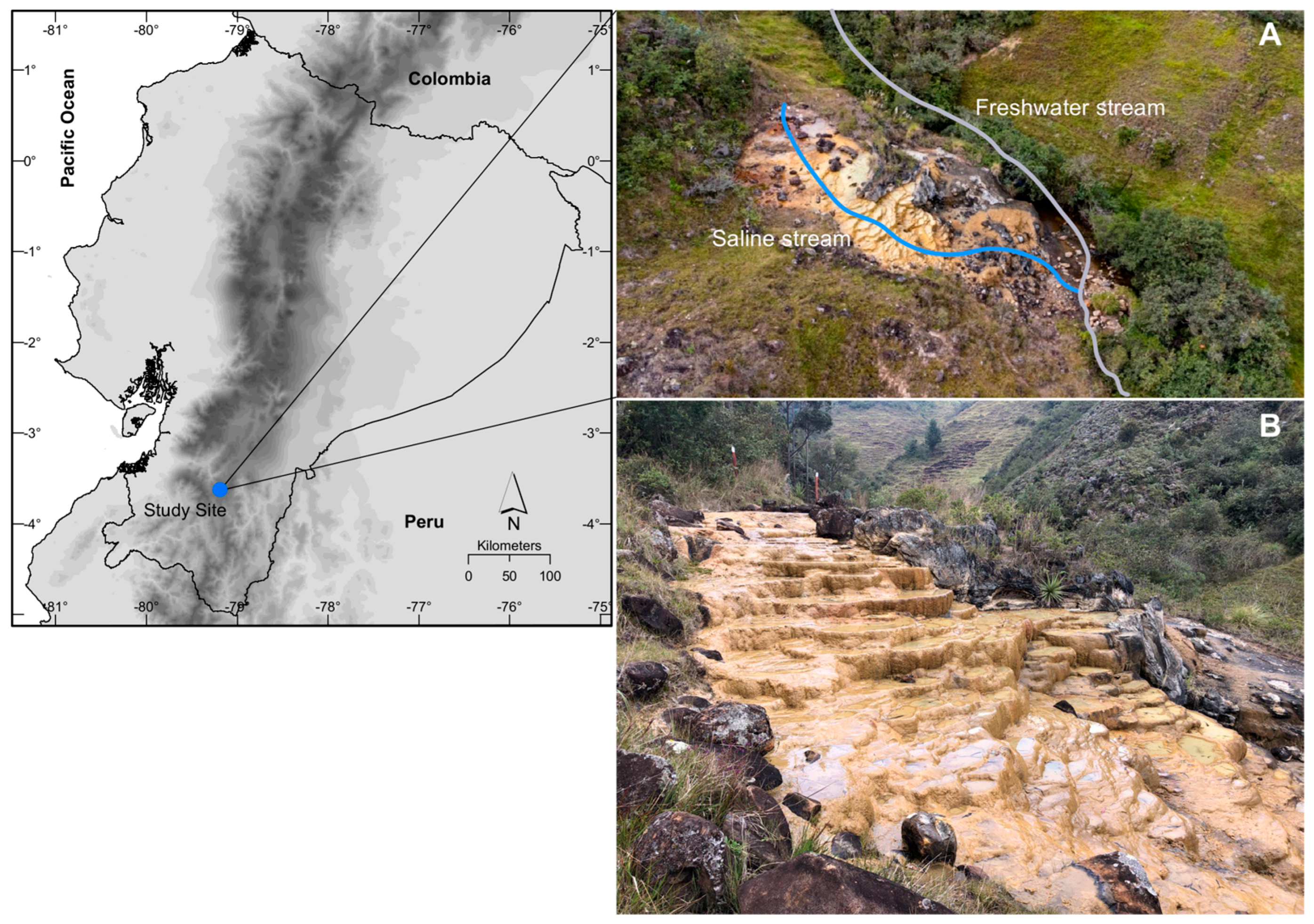
The study was conducted in the El Salado sector (3°37′27″ S, 79°10′42″ W; 2520 m a.s.l.), located approximately 1.7 km from Urdaneta Parish, Saraguro Canton, Loja Province, southern Ecuador (Figure 1). This site features an active travertine formation over which flows a cold saline stream with a distinctive ferrous odor and taste. The saline stream converges with an adjacent freshwater stream characteristic of Andean highland environments. During the dry season, the saline stream forms shallow pools on the travertine surface, and the site functions as a popular recreational destination.

2.2. Sampling Design and Macroinvertebrate Collection

Macroinvertebrates were sampled in both the saline and freshwater streams on four occasions, i.e., two during the rainy season (May–June 2023) and two during the dry season (July–August 2023), to account for seasonal hydrological variability characteristic of Andean streams [16,17]. At each sampling date, macroinvertebrates were collected using a D-frame kick-net (500 µm mesh) following a multi-habitat protocol that proportionally samples all available microhabitats (leaf packs, mineral substrate, macrophytes, submerged roots, and fine sediments) [1,18]. Collected individuals were preserved in 90% ethanol and identified to genus level in the laboratory using neotropical keys [19] and the digital reference collection of the Ecuadorian aquatic invertebrates of the UTPL Museum of Zoology.

2.3. Physicochemical Measurements

At each sampling event, the following physicochemical parameters were measured in situ in both streams using a YSI ProQuatro multiparameter sonde (Yellow Springs Instruments Inc., Yellow Springs, OH, USA): water temperature (°C), pH, electrical conductivity (mS/cm), dissolved oxygen (mg/L and % saturation), total dissolved solids (g/L), and salinity (g/L).

2.4. Data Analysis

All analyses were performed in R environment [20]. Given the small number of independent sampling events (n = 4 per stream type), we used distribution-free methods throughout, and the minimum achievable p-value with n = 4 per group is 1/C(8,4) = 1/70 ≈ 0.014.
Physicochemical variables were compared between stream types with two-sided Mann–Whitney U exact tests (package ‘coin’; [21]). Welch’s independent-samples t-tests were additionally run as a sensitivity analysis; prior to interpretation, normality was assessed with Shapiro–Wilk tests. Both parametric and non-parametric results are reported in Table S1.
Alpha-diversity metrics: genus richness, total abundance, Shannon diversity (H’), Pielou’s evenness (J’), and Simpson’s diversity (1 − D) were calculated with the package ‘vegan’ [22]. All five metrics were compared between stream types using exact permutation tests on the observed difference in means across all C(8,4) = 70 possible group assignments. Cliff’s delta (δ) was computed as a non-parametric effect-size estimator, with |δ|  ≥  0.638 indicating a large effect (package ‘effsize’; [23]). Hurlbert’s PIE was evaluated but not reported because the finite-sample correction N/(N − 1) produced values exceeding 1.0 for saline-stream samples with N < 15, rendering it unreliable at those sample sizes.
Differences in community composition were assessed with two complementary tests, both using Bray–Curtis dissimilarity (package ‘vegan’; [22]). ANOSIM (999 permutations) and PERMANOVA (exact C(8,4) = 70 permutations), with PERMANOVA R2 reported as an effect-size estimate. Prior to PERMANOVA, homogeneity of multivariate dispersion was verified by comparing mean distances to group centroids between stream types.
Community composition was ordinated using non-metric multidimensional scaling (NMDS). Prior to ordination, environmental variables were standardized and screened for multicollinearity using the variance inflation factor (VIF threshold  ≥  7; package ‘usdm’; [24]). These results are reported in Table S2. The environmental fit function (envfit) then quantified the correlation of retained physicochemical variables with the ordination (p ≤ 0.05). To assess whether the effects of temperature and salinity on community composition could be separated, partial RDA was evaluated. However, this approach was found infeasible because salinity had zero within-group variance in the freshwater stream samples, precluding the required statistical conditioning (package ‘vegan’; [22]).

3. Results

3.1. Physicochemical Characteristics

Mann–Whitney U exact tests showed that conductivity, total dissolved solids, salinity, and water temperature were all significantly higher in the saline stream (Table 1). pH did not differ significantly between streams. Dissolved oxygen and its percentage saturation also did not differ significantly, a result influenced by high variance in the saline stream’s %OD measurements (90.7 ± 40.3%) that warrants verification against the original field records.

3.2. Macroinvertebrate Diversity

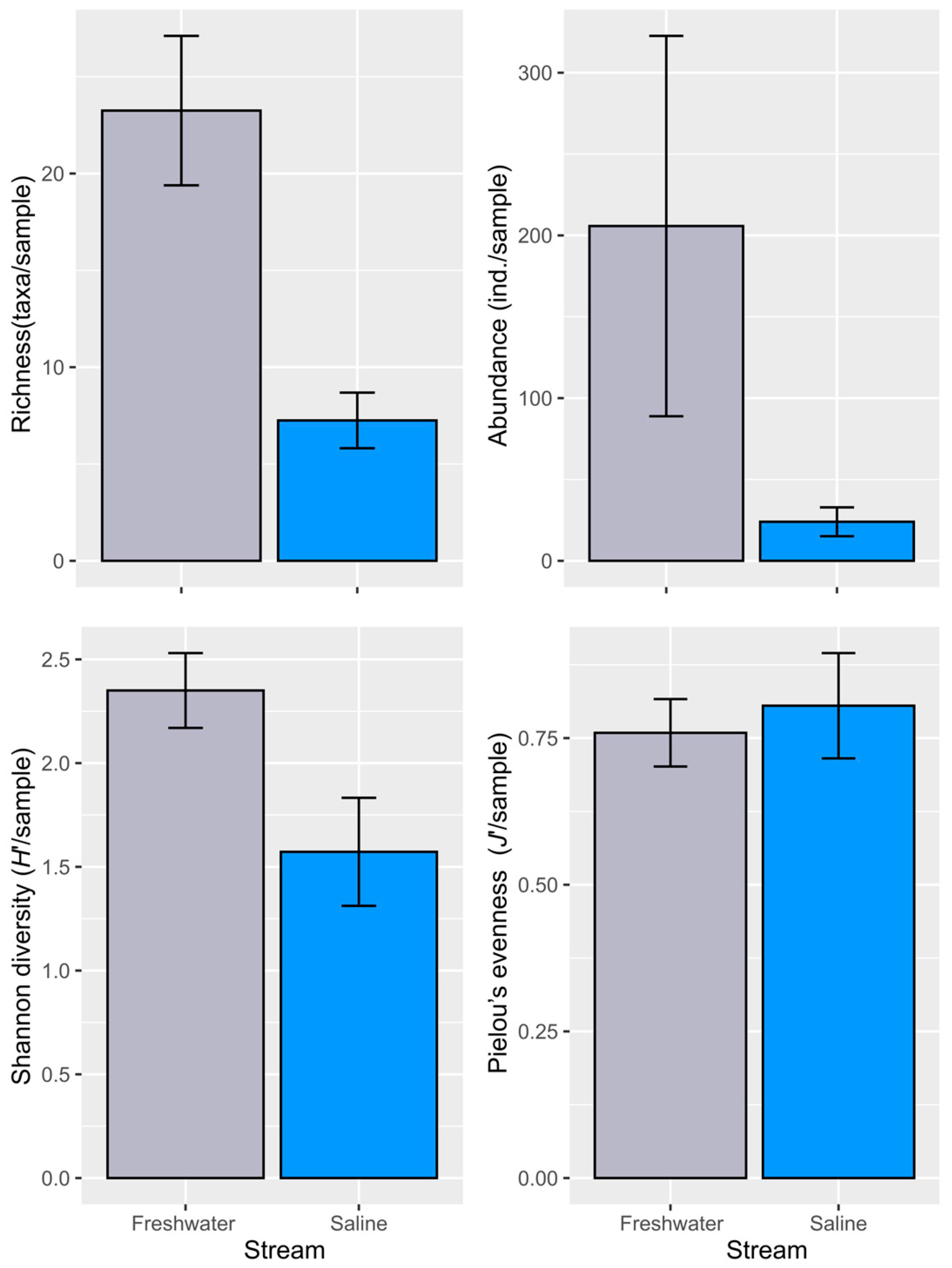
A total of 919 individuals were collected across both streams. The freshwater stream harbored substantially greater diversity, with 49 genera belonging to 29 families and 8 orders across 5 classes, totaling 823 individuals. The saline stream yielded 14 genera, 8 families, and 3 orders across 3 classes, totaling 96 individuals. Exact permutation tests confirmed that richness, total abundance, and Shannon diversity (H’) were all significantly lower in the saline stream (p = 0.029 for all three metrics; Figure 2), with maximum effect sizes (Cliff’s δ = 1.00; i.e., every freshwater sample exceeded every saline sample for all three metrics). Pielou’s evenness (J’) did not differ significantly (p = 0.686, Cliff’s δ = −0.25; Figure 2), indicating that, while the saline community was species-poor, the individuals present were relatively evenly distributed among taxa. With n = 4 per group, the minimum achievable p-value is 1/70 ≈ 0.014. The reported p = 0.029 is therefore the second-smallest achievable value and is supported by the maximum Cliff’s δ. Simpson’s diversity index (1 − D) did not differ significantly between stream types (freshwater: 0.83 ± 0.08; saline: 0.70 ± 0.21; p = 0.314, Cliff’s δ = +0.50; Table S1); therefore, it is not included in Figure 2.
In the freshwater stream, the dominant orders were Ephemeroptera (Baetidae: Baetodes [220 ind.], Andesiops [84 ind.]; Leptohyphidae: Leptohyphes [53 ind.], Haplohyphes [52 ind.]), followed by Diptera (Chironomidae: Chironomus [49 ind.]) and Trichoptera (Hydroptilidae: Ochrotrichia [26 ind.]). In the saline stream, Diptera dominated: Ceratopogonidae (Stilobezzia, 29 ind.) and Stratiomyidae (Caloparyphus, 16 ind.) were the most abundant taxa, alongside a single family of water mites (Hydrachnidae mf 9, 15 ind.) and Gastropoda (Lymnaeidae: Pseudosuccinea, 5 ind.; Table 2). Community turnover between stream types was nearly complete: only 2 of 63 genera recorded (Gyraulus and Hydrachnidae mf 10) were shared between streams (3.2% of the total).

3.3. Community Composition and Environmental Drivers

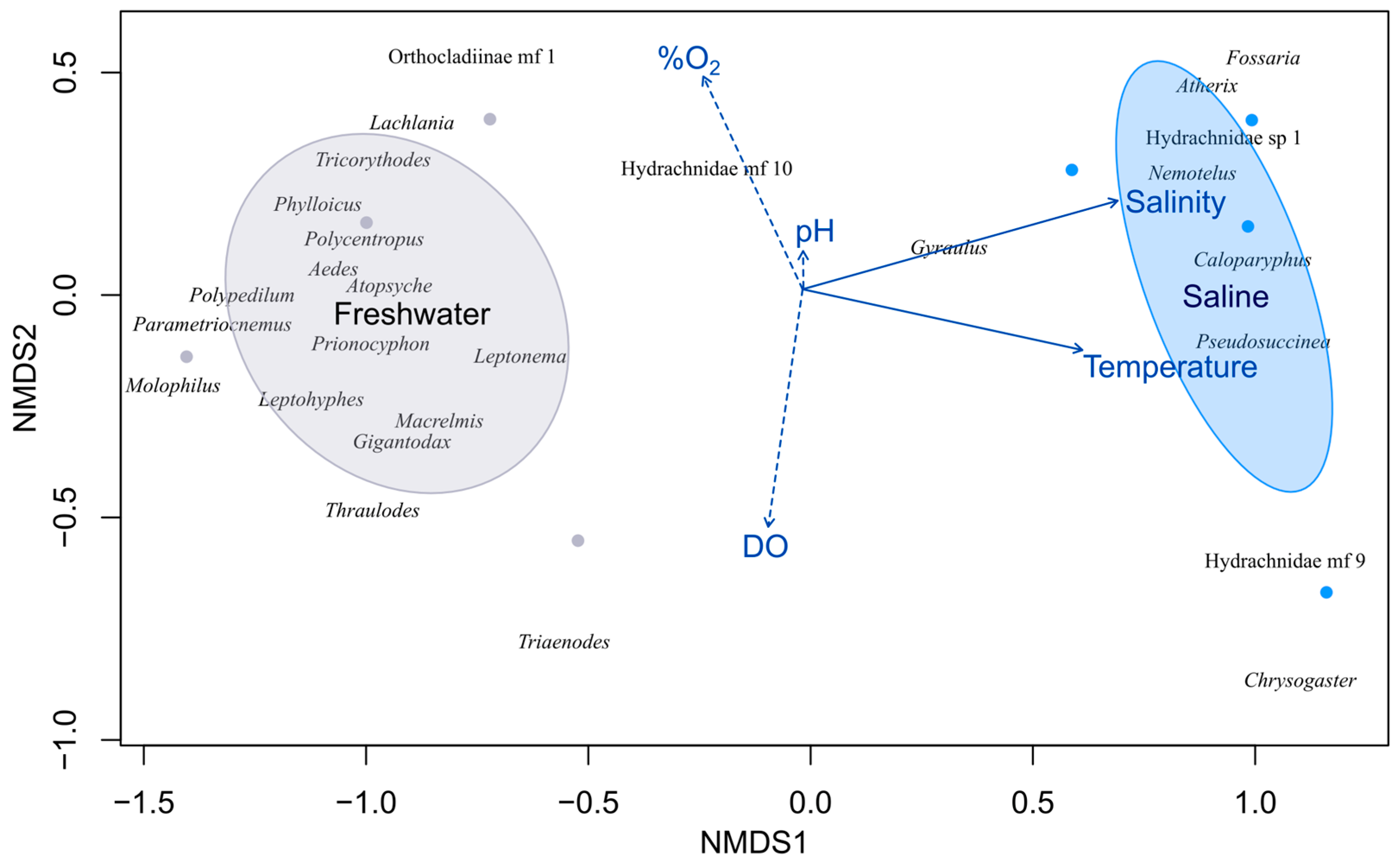
ANOSIM revealed complete separation between macroinvertebrate communities of the saline and freshwater streams (R = 1.00, p =  0.028). All 16 between-stream pairwise Bray–Curtis dissimilarities (minimum = 0.985) exceeded all 12 within-stream dissimilarities (maximum = 0.936). PERMANOVA on the same Bray–Curtis matrix yielded pseudo-F = 4.67, R2 = 0.44, p = 0.029, confirming that stream type explained 44% of the variation in community composition. Multivariate dispersion was comparable between stream types (mean distance to centroid: 0.44 for both groups; variance ratio ≈ 0.87), satisfying the homogeneity assumption of PERMANOVA. Both tests share the same permutation space; the reported p = 0.029 represents the second-smallest achievable value given n = 4 per group (minimum p ≈ 0.014) and should be interpreted alongside the large effect sizes.
NMDS ordination (Figure 3) clearly visualized this separation, with salinity (R2 = 0.95, p < 0.01) and water temperature (R2 = 0.79, p = 0.03) as the physicochemical variables most strongly associated with community differentiation. pH was not a significant covariate (p > 0.05). The saline stream cluster was characterized by Diptera (Ceratopogonidae, Stratiomyidae) and Hydrachnidae, while the freshwater cluster was dominated by Ephemeroptera (especially Baetidae), Trichoptera, and Coleoptera (Elmidae). The 12 genera exclusive to the saline stream were dominated by Diptera (Stilobezzia, n = 29; Caloparyphus, n = 16; Tabanus, n = 11; Atherix, n = 4) and water mites (Hydrachnidae mf 9, n = 15), while the 47 freshwater-exclusive genera were dominated by Ephemeroptera (Baetodes, n = 220; Andesiops, n = 84; Haplohyphes, n = 52; Leptohyphes, n = 53).

4. Discussion

This study provides the first account of aquatic macroinvertebrate diversity in a travertine-associated saline stream in the Tropical Andes, filling a notable gap in the biogeography of extreme lotic ecosystems in this region. Our results corroborate the central hypothesis that salinity acts as a key environmental filter that substantially reduces macroinvertebrate richness, abundance, and diversity in the saline stream relative to the adjacent freshwater system.
The inverse relationship between salinity and macroinvertebrate diversity, as documented here, is consistent with findings from a wide range of geographical contexts. For example, in Europe, a study along a salinity gradient in the Meurthe River in France (0.21–2.60 g/L) found that taxonomic richness declined by around 30% beyond 1.4 g/L and that the composition of the communities shifted markedly at the highest salinity sites. Here, exotic crustaceans replaced native EPT taxa [25]. In the Mediterranean region, comparable reductions in richness and shifts towards dipteran and gastropod dominance have been documented in hypersaline streams in south-east Spain at salinity levels similar to those in our study (>10 g/L) [4,5]. In Australia, a large-scale survey of 230 wetlands in the Western Australian wheat belt found that total species richness remained stable up to around 4.1 g/L, after which it declined sharply at higher salinities. Halophilic species partially compensated for the loss of freshwater taxa [26]. In North Africa, a recent study of saline–freshwater confluences in the Draa River in Morocco recorded lower macroinvertebrate abundance and a shift towards generalist and halotolerant taxa at saline sites, mirroring the community structure observed here [27]. Cañedo-Argüelles et al. [28], identified salinity as one of the most urgent threats to freshwater biodiversity, documenting declines in species richness across multiple continents and taxonomic groups. EPT taxa were consistently among the most sensitive orders. These findings converge across temperate Europe, arid Australia, the Mediterranean region and now the high-altitude tropical Andes, confirming that the osmotic stress mechanism operates as a universal environmental filter, regardless of biogeographic context. However, the specific taxa that colonize saline environments differ regionally, which highlights the scientific value of documenting the saline fauna of previously unstudied extreme systems, such as the travertine-fed stream reported here.
The saline stream (12.5 g/L) supported only 14 genera across eight families, which is roughly 28% of the taxonomic richness recorded in the freshwater stream. This is a pattern that is consistent with findings from Mediterranean saline rivers, where comparable salinity levels (>10 g/L) are associated with a collapse in biodiversity towards a few halotolerant specialists [4,5,6]. High ionic concentrations disrupt osmoregulation in most freshwater invertebrates, which must expend increasing energetic resources to maintain ionic homeostasis or are simply excluded beyond their physiological tolerance thresholds [29]. The persistence of Pielou’s evenness across stream types suggests that, although few species tolerate saline conditions, those that do are distributed relatively equitably. This indicates a community structure that is functionally compressed but internally balanced, rather than a structure dominated by a single dominant opportunistic taxon.
The dominance of Diptera in the saline stream, particularly the families Ceratopogonidae (Stilobezzia) and Stratiomyidae (Caloparyphus and Nemotelus), reflects the well-documented salt tolerance of dipterans. Stratiomyid larvae are known for their ability to inhabit alkaline and saline environments owing to specialized integumental ion-transport mechanisms and resistance to desiccation [30]. Similarly, ceratopogonid larvae exhibit broad physiological tolerances and have been reported from brackish and hypersaline waters in South American lowlands [31]. The high abundance of water mites (Hydrachnidae) in the saline stream is noteworthy. These water mites are generally sensitive to pollution in freshwater systems [32], but certain taxa exhibit halotolerance and can reach high densities in the absence of competitive freshwater invertebrates [33].
An important question that cannot be answered with the present data is whether the taxa recorded in the saline stream are merely halotolerant, i.e., capable of surviving at elevated salinity, or halobiontic/halophilic, meaning they prefer or require saline conditions. This distinction has significant implications for conservation: halobiontic taxa that are confined to rare, travertine-associated saline streams may be micro-endemic specialists with no viable alternative habitat. At the genus level, Nemotelus (Stratiomyidae) is the most plausible candidate for halobiontic status, given that several European congeners are obligate inhabitants of saline environments [5,34,35]. The multiple Hydrachnidae morphotypes recorded here are also candidates for salt-specialized endemics. All other genera are more likely to be halotolerant, given their broad ecological distributions. Resolving this question requires species-level identification, which was not achievable in the present study. No species-level taxonomic keys exist for most Neotropical macroinvertebrate groups, and this taxonomic gap is a recognized priority for Andean aquatic biology [15,19]. Furthermore, this travertine-fed stream is likely dominated by Ca2+–HCO3 or Ca2+–SO42− ions rather than NaCl (Díaz E, pers. comm.), which is characteristic of the ionic regime of Mediterranean and arid-region saline rivers [6], where halobiontic faunas are best documented. This geochemical distinction may select for a taxonomically distinct community of saline specialists [4], highlighting the importance of conducting full ionic water chemistry analyses alongside future species-level faunal surveys.
The near-complete absence of the Ephemeroptera, Plecoptera, and Trichoptera (EPT) taxa in the saline stream, despite these orders constituting over 60% of the total macroinvertebrate abundance in the freshwater stream, highlights their sensitivity to ionic stress and supports their use as bioindicators of water quality [2]. EPT taxa lack robust osmoregulatory organs compared with dipteran larvae and are physiologically excluded at the salinity levels recorded here. The presence of pulmonated gastropods (Lymnaeidae, Planorbidae) in the saline stream is consistent with the relatively broad ionic tolerance of this group compared with other freshwater invertebrate orders [36]. Freshwater gastropods are known to hyperregulate in dilute media but shift toward osmoconformity as ambient salinity increases [37].
NMDS ordination identified salinity and temperature as the principal axes associated with community differentiation in this system. The slightly elevated water temperature of the saline stream (+3.8 °C on average) likely reflects the geothermal origin of the travertine-fed groundwater. An elevated temperature may compound osmotic stress by increasing metabolic demands and, theoretically, reducing oxygen solubility [38,39]. However, dissolved oxygen did not differ significantly between streams in our statistical tests, and this mechanism remains an untested hypothesis in our dataset. Salinity and temperature were significantly correlated across all measurements in this study because they co-vary between stream types. Their individual contributions to community composition cannot be fully disentangled with this paired design, and a partial RDA was not feasible given zero within-stream salinity variance in the freshwater group. Despite this limitation, the salinity difference (0.0 vs. 12.5 g/L) is a more parsimonious primary driver than the temperature difference (13.7 vs. 17.5 °C). Combined with the well-established global evidence for ionic stress as the principal osmotic filter on aquatic macroinvertebrates [28,40], supports salinity as the dominant mechanism structuring the observed community difference.
Our study has several limitations. First, the analysis relies on n = 4 independent sampling events per stream type, meaning that statistical tests operate at the boundary of their permutation space and results should be interpreted alongside effect sizes rather than p-values alone. The large Cliff’s delta values and the perfect ANOSIM separation provide biological confidence that the observed differences are real despite the small sample size. Second, the paired comparison involved only one freshwater and one saline stream, which limits the scope for generalization. Future studies should replicate the sampling across multiple travertine systems. Third, the physicochemical characterization of the saline stream was limited to standard field parameters (temperature, pH, conductivity, DO, TDS, salinity). A full ionic analysis, including major cations (Na+, Ca2+, Mg2+, K+) and anions (Cl, SO42−, HCO3), would provide a more complete understanding of the geochemical origin of the water and the specific ionic stressors experienced by the macroinvertebrate community. Such data would also allow comparison with other saline stream systems worldwide and better interpretation of the osmoregulatory mechanisms underlying the observed community patterns. Fourthly, the physicochemical measurements were not fully synchronized with the sampling of macroinvertebrates, and salinity and temperature co-vary between stream types. This means that their individual effects on community composition cannot be formally disentangled using the current paired design. This would require sampling across a continuous salinity gradient. Fithty, identifications were performed at the genus level, which is the standard resolution achievable in Andean aquatic entomology given the absence of regional species-level keys. However, species-level identification would be required to distinguish halotolerant from halobiotic taxa, assess potential endemism and improve the sensitivity of community–environment relationships.
From a conservation perspective, travertine-fed saline streams represent micro-endemic extreme habitats, harboring a small but potentially specialized community not found in adjacent freshwater systems. The site’s popularity as a tourist destination (bathing in travertine pools) may pose disturbance risks to the macroinvertebrate community, and baseline data such as those presented here are essential for impact assessment and management.

5. Conclusions

This study demonstrates that a travertine-fed saline stream in the Tropical Andes harbors significantly lower macroinvertebrate diversity than an adjacent freshwater stream, with salinity and water temperature as the primary environmental filters structuring community composition. The saline macroinvertebrate fauna is dominated by halotolerant Diptera (Ceratopogonidae, Stratiomyidae) and water mites (Hydrachnidae), with virtually no EPT representation, in sharp contrast to the Ephemeroptera-dominated freshwater community. Pielou’s evenness did not differ between streams, indicating that the salt-tolerant community, though depauperate, maintains internal evenness. These findings establish the first biodiversity baseline for a travertine-associated saline lotic ecosystem in the Tropical Andes. We emphasize that this study constitutes a case study at a single paired site, and its findings should be regarded as exploratory baselines pending replication across multiple travertine-fed saline systems. Although the sampling design (n = 4 events per stream) limits statistical power, the maximum effect sizes and perfect community separation provide preliminary but consistent empirical evidence for future biomonitoring and conservation planning in extreme Andean fluvial ecosystems.

Supplementary Materials

The following supporting information can be downloaded at: https://www.mdpi.com/article/10.3390/d18050288/s1, Table S1. Comparison of Welch’s independent-samples t-test and exact permutation test results for alpha diversity metrics. Normality assessed by Shapiro-Wilk test. For physicochemical variables, both methods yielded identical significance conclusions (see main text Table 1). FW: freshwater stream. SAL: saline stream. Table S2. Panel A—Variance Inflation Factor (VIF) analysis for physicochemical variables prior to NMDS ordination (n = 14 measurements). Variables with VIF ≥ 7 were excluded from ordination to manage multicollinearity [24]. Panel B—Spearman rank correlation matrix for all physicochemical variables (n = 14). Significant correlations: * p < 0.05, ** p < 0.01.

Author Contributions

Conceptualization, C.I.-A.; Methodology, S.C. and C.I.-A.; formal analysis, W.Z.-S. and C.I.-A.; writing—original draft preparation, S.C. and W.Z.-S.; writing—review and editing, C.I.-A. All authors have read and agreed to the published version of the manuscript.

Funding

This research was funded by the Universidad Técnica Particular de Loja.

Institutional Review Board Statement

The study was conducted in accordance with the Ministry of the Environment of Ecuador, which granted us access to the field sites and the necessary collecting permits (MAE-DNB-CM-2015-0016).

Data Availability Statement

The raw data supporting the conclusions of this article will be made available by the authors on request.

Acknowledgments

We would like to thank the Saraguro community for providing free access to the sampling site and for their help with logistics. We would also like to thank Jorge Danilo Patiño for capturing panoramic photos of the study site using a drone.

Conflicts of Interest

The authors declare no conflicts of interest. The funders had no role in the design of the study; in the collection, analyses, or interpretation of data; in the writing of the manuscript; or in the decision to publish the results.

References

  1. Hauer, F.R.; Resh, V.H. Macroinvertebrates. In Methods in Stream Ecology, Volume 1: Ecosystem Structure; Hauer, F.R., Lamberti, G.A., Eds.; Academic Press: London, UK, 2017; pp. 297–319. [Google Scholar]
  2. Buss, D.F.; Carlisle, D.M.; Chon, T.-S.; Culp, J.; Harding, J.S.; Keizer-Vlek, H.E.; Robinson, W.A.; Strachan, S.; Thirion, C.; Hughes, R.M. Stream Biomonitoring Using Macroinvertebrates around the Globe: A Comparison of Large-Scale Programs. Environ. Monit. Assess. 2015, 187, 4132. [Google Scholar] [CrossRef]
  3. Ramírez, A.; Gutiérrez-Fonseca, P.E. Functional Feeding Groups of Aquatic Insect Families in Latin America: A Critical Analysis and Review of Existing Literature. Rev. Biol. Trop. 2014, 62, 155–167. [Google Scholar] [CrossRef] [PubMed]
  4. Millán, A.; Velasco, J.; Gutiérrez-Cánovas, C.; Arribas, P.; Picazo, F.; Sánchez-Fernández, D.; Abellán, P. Mediterranean Saline Streams in Southeast Spain: What Do We Know? J. Arid. Environ. 2011, 75, 1352–1359. [Google Scholar] [CrossRef]
  5. Velasco, J.; Millán, A.; Hernández, J.; Gutiérrez, C.; Abellán, P.; Sánchez, D.; Ruiz, M. Response of Biotic Communities to Salinity Changes in a Mediterranean Hypersaline Stream. Saline Syst. 2006, 2, 12. [Google Scholar] [CrossRef][Green Version]
  6. Arribas, P.; Gutiérrez-Cánovas, C.; Abellán, P.; Sánchez-Fernández, D.; Picazo, F.; Velasco, J.; Millán, A. Tipificación de Los Ríos Salinos Ibéricos. Ecosistemas 2009, 18, 1–13. [Google Scholar]
  7. Gandin, A.; Capezzuoli, E. Travertine: Distinctive Depositional Fabrics of Carbonates from Thermal Spring Systems. Sedimentology 2014, 61, 264–290. [Google Scholar] [CrossRef]
  8. Pentecost, A. Travertine; Springer: Berlin, Germany, 2005. [Google Scholar]
  9. Minissale, A.; Kerrick, D.M.; Magro, G.; Murrell, M.T.; Paladini, M.; Rihs, S.; Sturchio, N.C.; Tassi, F.; Vaselli, O. Geochemistry of Quaternary Travertines in the Region North of Rome (Italy): Structural, Hydrologic and Paleoclimatic Implications. Earth Planet. Sci. Lett. 2002, 203, 709–728. [Google Scholar] [CrossRef]
  10. Leiva-Tafur, D.; Manco Perez, H.G.; Rascón, J.; Culqui, L.; Gamarra-Torres, O.A.; Oliva-Cruz, M. Hydrogeochemical Characterization of Mineral Springs in Peruvian Tropical Highlands. Water 2025, 17, 2539. [Google Scholar] [CrossRef]
  11. De Grys, A.; Vera, J.; Goossens, P. A Note on the Hot Springs of Ecuador. Geothermics 1970, 2, 1400–1404. [Google Scholar] [CrossRef]
  12. Quezada, P.; Fadel Cury, L.; Calderón, M.; Henríquez, C.; Mancini, L.; Micheletto, J.; Barbosa Athayde, G.; Bahniuk Rumbelsperger, A. Similar Sources but Distinct Δ13C Signatures in Adjacent Low-Temperature Travertines from Laguna Amarga (Southern Patagonian Andes). Sediment. Geol. 2024, 473, 106758. [Google Scholar] [CrossRef]
  13. Chrobak, A.; Ugolini, F.; Pearlmutter, D.; Raschi, A. Thermal Tourism and Geoheritage: Examining Visitor Motivations and Perceptions. Resources 2020, 9, 58. [Google Scholar] [CrossRef]
  14. Myers, N.; Mittermeier, R.A.; Mittermeier, C.G.; da Fonseca, G.A.; Kent, J. Biodiversity Hotspots for Conservation Priorities. Nature 2000, 403, 853–858. [Google Scholar] [CrossRef]
  15. Encalada, A.C.; Flecker, A.S.; Poff, N.L.R.; Suárez, E.; Herrera-R, G.A.; Ríos-Touma, B.; Jumani, S.; Larson, E.I.; Anderson, E.P. A Global Perspective on Tropical Montane Rivers. Science 2019, 365, 1124–1129. [Google Scholar] [CrossRef]
  16. Jacobsen, D.; Schultz, R.; Encalada, A.C. Structure and Diversity of Stream Invertebrate Assemblages: The Influence of Temperature with Altitude and Latitud. Freshw. Biol. 1997, 38, 247–261. [Google Scholar] [CrossRef]
  17. Ríos-Touma, B.; Encalada, A.C.; Prat Fornells, N. Macroinvertebrate Assemblages of an Andean High-Altitude Tropical Stream: The Importance of Season and Flow. Int. Rev. Hydrobiol. 2011, 96, 667–685. [Google Scholar] [CrossRef]
  18. Barbour, M.T.; Gerritsen, J.; Snyder, B.D.; Stribling, J.B. Rapid Bioassessment Protocols for Use in Streams and Wadeable Rivers: Periphyton, Benthic Macroinvertebrates, and Fish; Second; US Environmental Protection Agency, Office of Water: Washington, DC, USA, 1999.
  19. Domínguez, E.; Fernández, H.R. Macroinvertebrados Bentónicos Sudamericanos. Sistemática y Biología; Fundación Miguel Lillo: Tucumán, Argentina, 2009. [Google Scholar]
  20. R Development Core Team. R: A Language and Environment for Statistical Computing; The R Core Team: Vienna, Austria, 2025. [Google Scholar]
  21. Hothorn, T.; Horni, K.; van de Wiel, M.A.; Zeileis, A. Implementing a Class of Permutation Tests: The Coin Package. J. Stat. Softw. 2008, 28, 1–23. [Google Scholar] [CrossRef]
  22. Oksanen, J.; Blanchet, F.G.; Kindt, R.; Legendre, P.; Minchin, P.R.; O’Hara, R.B.; Simpson, G.L.; Solymos, P.; Stevens, H.H.; Wagner, H. R Package, version 2.6-4; Vegan: Community Ecology Package; The R Core Team: Vienna, Austria, 2022. [Google Scholar]
  23. Torchiano, M. R Package, version 0.8.1; Effsize: Efficient Effect Size Computation; The R Core Team: Vienna, Austria, 2020. [Google Scholar]
  24. Naimi, B. R Package, version 1.1-18; Usdm: Uncertainty Analysis for Species Distribution Models; The R Core Team: Vienna, Austria, 2020. [Google Scholar]
  25. Piscart, C.; Moreteau, J.C.; Beisel, J.N. Biodiversity and Structure of Macroinvertebrate Communities along a Small Permanent Salinity Gradient (Meurthe River, France). Hydrobiologia 2005, 551, 227–236. [Google Scholar] [CrossRef]
  26. Pinder, A.M.; Halse, S.A.; McRae, J.M.; Shiel, R.J. Occurrence of Aquatic Invertebrates of the Wheatbelt Region of Western Australia in Relation to Salinity. Hydrobiologia 2005, 543, 1–24. [Google Scholar] [CrossRef]
  27. Kaczmarek, N.; Benlasri, M.; Schäfer, R.B.; Aabid, A.; Nothof, M.; Lazrak, K.; Ghamizi, M.; Berger, E. Macroinvertebrate Community Responses to Salinity around Non-Saline–Saline Confluences in the Draa River Basin, Morocco. Hydrobiologia 2024, 851, 2189–2204. [Google Scholar] [CrossRef]
  28. Cañedo-Argüelles, M.; Kefford, B.J.; Piscart, C.; Prat, N.; Schäfer, R.B.; Schulz, C.J. Salinisation of Rivers: An Urgent Ecological Issue. Environ. Pollut. 2013, 173, 157–167. [Google Scholar] [CrossRef]
  29. Kefford, B.J.; Buchwalter, D.; Cañedo-Argüelles, M.; Davis, J.; Duncan, R.P.; Hoffmann, A.; Thompson, R. Salinized Rivers: Degraded Systems or New Habitats for Salt-Tolerant Faunas? Biol. Lett. 2016, 12, 20151072. [Google Scholar] [CrossRef]
  30. Washko, S.; Bogan, M. Ability of Aquatic Stratiomyidae (Diptera) Larvae to Survive Stream Drying Using Dormancy. Aquat. Insects 2024, 45, 402–415. [Google Scholar] [CrossRef]
  31. Golovatyuk, L.V.; Zinchenko, T.D.; Sushchik, N.N.; Kalachova, G.S.; Gladyshev, M.I. Biological Aspects of the Associations of Biting Midges (Diptera: Ceratopogonidae) in Two Saline Rivers of the Elton Lake Basin, Russia. Mar. Freshw. Res. 2018, 69, 906–916. [Google Scholar] [CrossRef]
  32. Goldschmidt, T. Water Mites (Acari, Hydrachnidia): Powerful but Widely Neglected Bioindicators—A Review. Neotrop. Biodivers. 2016, 2, 12–25. [Google Scholar] [CrossRef]
  33. Smith, I.M.; Cook, D.R.; Smith, B.P. Water Mites (Hydrachnidiae) and Other Arachnids. In Ecology and Classification of North American Freshwater Invertebrates; Thorp, J.H., Covich, A.P., Eds.; Academic Press: New York, NY, USA, 2010; pp. 485–586. [Google Scholar]
  34. Kahanpää, J. Finnish Species of Nemotelus (Diptera: Stratiomyidae), with Description of a New Species. Zootaxa 2010, 2401, 30–40. [Google Scholar] [CrossRef]
  35. Rozkosný, R. A Biosystematic Study of the European Stratiomyidae (Diptera); Springer: Dordrecht, The Netherlands, 1983. [Google Scholar]
  36. Costil, K.; Dussart, G.B.J.; Daguzan, J. Biodiversity of Aquatic Gastropods in the Mont St-Michel Basin (France) in Relation to Salinity and Drying of Habitats. Biodivers. Conserv. 2001, 10, 1–18. [Google Scholar] [CrossRef]
  37. Griffith, M.B. Toxicological Perspective on the Osmoregulation and Ionoregulation Physiology of Major Ions by Freshwater Animals: Teleost Fish, Crustacea, Aquatic Insects, and Mollusca. Environ. Toxicol. Chem. 2017, 36, 576–600. [Google Scholar] [CrossRef]
  38. Verberk, W.C.E.P.; Bilton, D.T. Respiratory Control in Aquatic Insects Dictates Their Vulnerability to Global Warming. Biol. Lett. 2013, 9, 5–8. [Google Scholar] [CrossRef]
  39. Bonacina, L.; Fasano, F.; Mezzanotte, V.; Fornaroli, R. Effects of Water Temperature on Freshwater Macroinvertebrates: A Systematic Review. Biol. Rev. 2023, 98, 191–221. [Google Scholar] [CrossRef] [PubMed]
  40. Kefford, B.J.; Hickey, G.L.; Gasith, A.; Ben-David, E.; Dunlop, J.E.; Palmer, C.G.; Allan, K.; Choy, S.C.; Piscart, C. Global Scale Variation in the Salinity Sensitivity of Riverine Macroinvertebrates: Eastern Australia, France, Israel and South Africa. PLoS ONE 2012, 7, e35224. [Google Scholar] [CrossRef] [PubMed]
Figure 1. Geographical location of the study site in the southern Andes of Ecuador. (A) Aerial view of the travertine formation showing the saline stream (blue line) originating from the active travertine deposit and converging with the adjacent freshwater stream (gray line). (B) Close-up view of the travertine terraces over which the saline stream flows; shallow pools formed during the dry season are visible on the deposit surface.
Diversity 18 00288 g001
Figure 2. Mean (±SE) alpha diversity metrics of aquatic macroinvertebrate communities sampled in the freshwater and saline streams in the southern Andes of Ecuador.
Diversity 18 00288 g002
Figure 3. Non-metric multidimensional scaling (NMDS) ordination of aquatic macroinvertebrate communities sampled in the freshwater and saline streams in the southern Andes of Ecuador. Each point represents a genus; shaded ellipses delimit the two stream types. Solid arrows indicate physicochemical variables significantly correlated with community composition (envfit; p ≤ 0.05): salinity (R2 = 0.95, p < 0.01) and water temperature (R2 = 0.79, p = 0.03). Dashed arrows indicate non-significant variables. Community composition differed significantly between stream types (ANOSIM R = 1.00, p = 0.028).
Diversity 18 00288 g003
Table 1. Mean values (±SD) of physicochemical parameters measured in a saline and a freshwater stream in the southern Andes of Ecuador (n = 7 measurements per stream across 2–3 independent sampling dates). Significant differences (Mann–Whitney U exact test; p ≤ 0.05) are shown in bold.
ParameterUnitFreshwater StreamSaline Streamp-Value
Temperature°C13.7 ± 0.917.5 ± 3.30.028
pH 7.4 ± 0.77.4 ± 0.90.532
ConductivitymS/cm0.1 ± 0.020.9 ± 0.4<0.001
Dissolved oxygenMg/L7.7 ± 0.46.5 ± 4.00.901
O2 saturation%102.2 ± 3.490.7 ± 37.50.805
Total dissolved solidsg/L0.1 ± 0.021.0 ± 0.3<0.001
Salinityg/L0.0 ± 0.012.5 ± 0.2<0.001
VIF analysis confirmed extreme multicollinearity among ionic variables: conductivity (VIF = 33,213), TDS (VIF = 160,408), and salinity (VIF = 51,871) were nearly perfectly inter-correlated (Spearman r > 0.85; Table S2), reflecting that all three measure the same ionic property in different units. Consequently, only salinity was retained as the representative ionic variable in the NMDS ordination, and conductivity and TDS were excluded. Temperature showed moderate collinearity with the ionic variables (VIF = 3.32; r = 0.703–0.745 with ionic variables, p < 0.01; Table S2).
Table 2. Taxonomic list and abundance of aquatic macroinvertebrates collected in the freshwater and saline streams in the southern Ecuadorian Andes.
StreamClassOrderFamilyGenusInd.
FreshwaterMalacostracaAmphipodaHyalellidaeHyallela17
IsopodaIsopodaIsopoda mf 11
OligochaetaArhynchobdellidaCylicobdellidaeCylicobdellidae mf 147
GastropodaGastropodaGastropodaGastropoda mf 11
PulmonataPlanorbidaeGyraulus1
InsectaColeopteraElmidaeAustrolimnius1
Heterelmis25
Hexacylloepus1
Macrelmis4
Neoelmis8
Onychelmis1
PsephenidaePheneps1
ScirtidaePrionocyphon31
DipteraBlephariceridaePaltostoma2
ChironomidaeAechnida3
Chironomus49
Diamesa3
Larsia23
Metriocnemus4
Orthocladiinae mf 11
Parametriocnemus15
Polypedilum3
CulicidaeAedes7
LimoniidaeMolophilus1
Polymera2
SimuliidaeGigantodax38
TipulidaeHexatoma1
EphemeropteraBaetidaeAndesiops84
Baetodes220
HydrobiosidaeAtopsyche20
LeptohyphidaeHaplohyphes52
Leptohyphes53
Thraulodes8
Tricorythodes12
OligoneuriidaeLachlania6
TrichopteraAnomalopsycheContulma4
BrachycentridaeBrachycentrus1
CalamoceratidaeHeteropletron1
Phylloicus1
HydropsychidaeLeptonema12
Macronema2
HydroptilidaeOchrotrichia26
LeptoceridaeTriaenodes1
LimnephilidaeIronoquia1
PolycentropodidaePolycentropus10
PlecopteraPerlidaeAnacroneuria13
OdonataAeshnidaeAllopetalia1
ArachnidaTrombidiformesHydrachnidaeHydrachnidae mf 103
Hydrachnidae mf 141
SalineGastropodaPulmonataLymnaeidaeFossaria1
Pseudosuccinea5
PlanorbidaeGyraulus1
InsectaDipteraAthericidaeAtherix4
CeratopogonidaeStilobezzia29
TabanidaeTabanus11
StratiomyidaeCaloparyphus16
Nemotelus2
SyrphidaeChrysogaster1
ArachnidaTrombidiformesHydrachnidaeHydrachnidae mf 102
Hydrachnidae mf 204
Hydrachnidae mf 221
Hydrachnidae mf 915
Hydrachnidae mf 14
Disclaimer/Publisher’s Note: The statements, opinions and data contained in all publications are solely those of the individual author(s) and contributor(s) and not of MDPI and/or the editor(s). MDPI and/or the editor(s) disclaim responsibility for any injury to people or property resulting from any ideas, methods, instructions or products referred to in the content.