

Forecasting Habitat Shifts in Euro-Mediterranean Orchids Protected Under Directive 92/43/EEC




Abstract
1. Introduction
- (i)
- Identify areas of optimal potential habitat where conservation efforts might be prioritized;
- (ii)
- Detect regions projected to experience significant habitat contraction, where management interventions may become necessary;
- (iii)
- Highlight locations where conservation actions may be required, including the maintenance or reintroduction of pollinators and, where appropriate, assisted translocation to climatically suitable regions [47].
2. Materials and Methods
2.1. Regional Setting
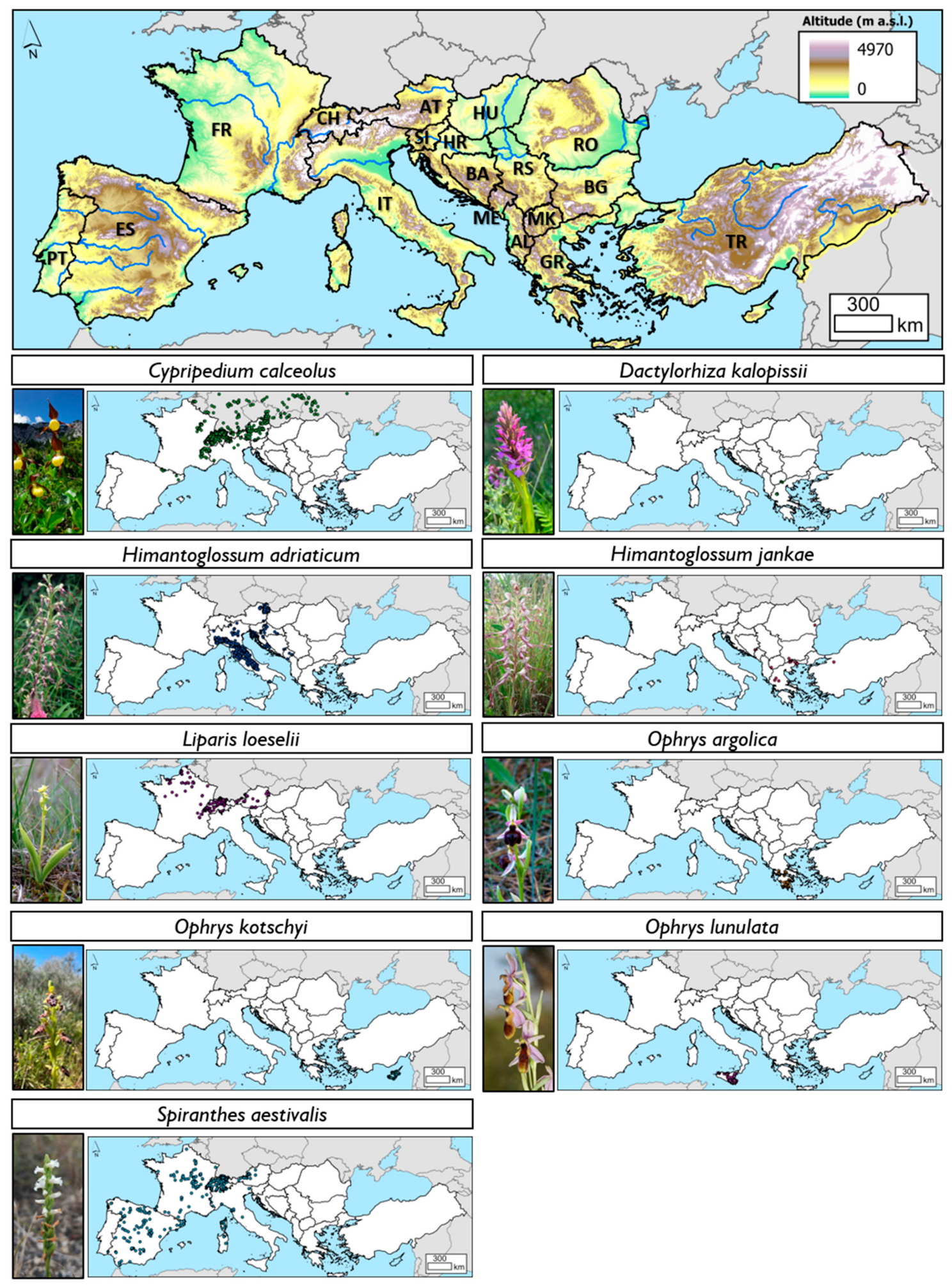
2.2. Study Species
2.3. Presence–Absence Dataset

2.4. Ecological Prediction: Variables
2.4.1. Dynamic Variables
2.4.2. Static Variables
- Edaphic indicators: Bulk density (BDOD), cation exchange capacity (CEC), volumetric coarse fragments content (CFVO), organic carbon stock (OCS), pH in water (pH) and content of clay (CLC), nitrogen (NC), sand (SAC), silt (SIC), organic carbon (SOC) and volumetric water content (WV0033) values were retrieved from SoilGrids 2.0 [67].
- Topography: Elevation, aspect and slope were derived from the Digital Elevation Model offered by WorldClim [63].
2.5. Ecological Prediction: Distribution Modelling
2.6. Vulnerability Assessment
- VI < 0.00: Not at risk (“climate change winner”).
- 0.00 < VI < 0.40: Least Concern (LC).
- 0.40 < VI < 0.70: Near Threatened (NT).
- 0.70 < VI < 0.85: Vulnerable (VU).
- 0.85 < VI < 0.95: Endangered (EN).
- VI > 0.95: Critically endangered (CR).
3. Results
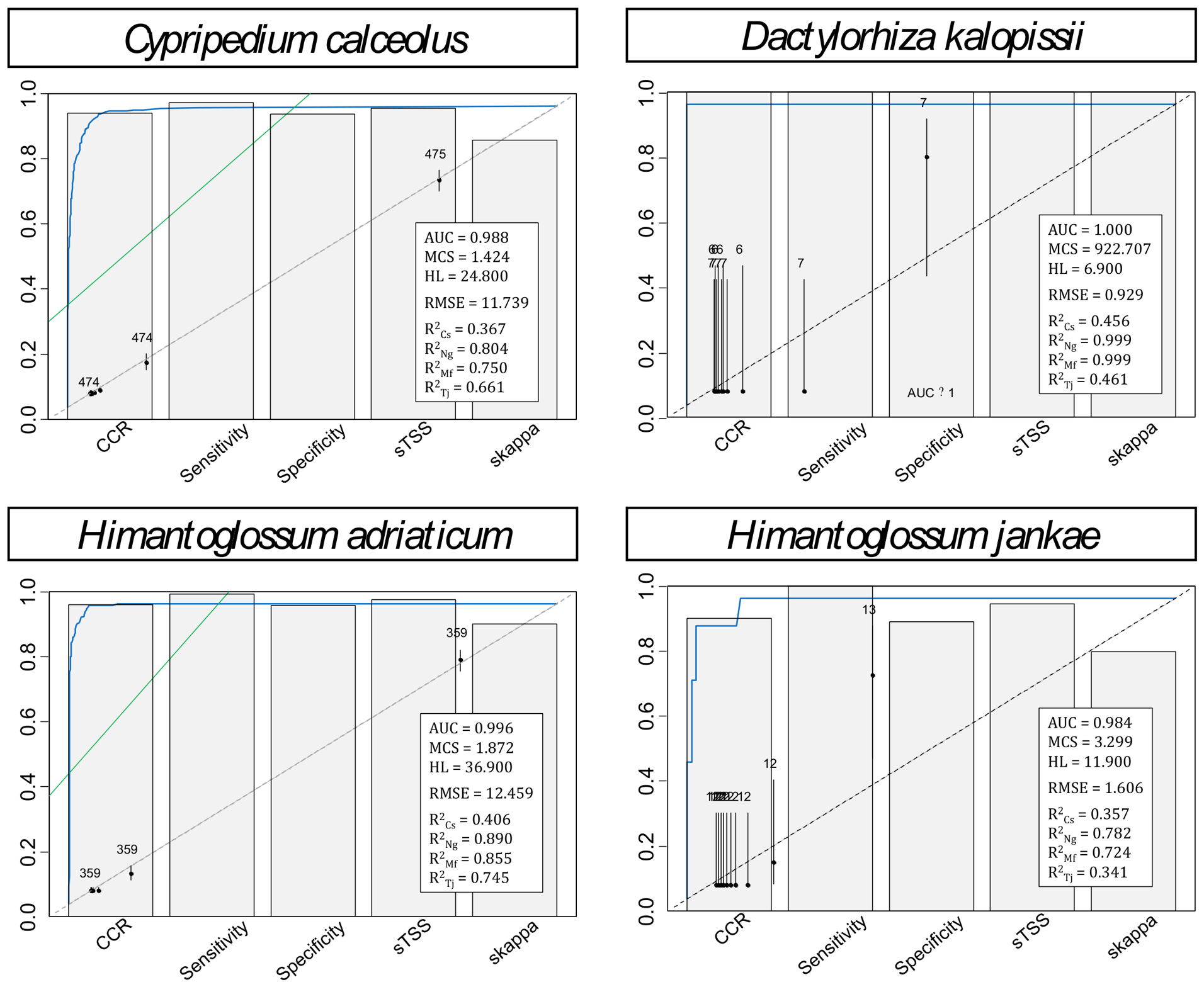
3.1. BART Model Assessment
3.2. Environmental Predictors of Distribution
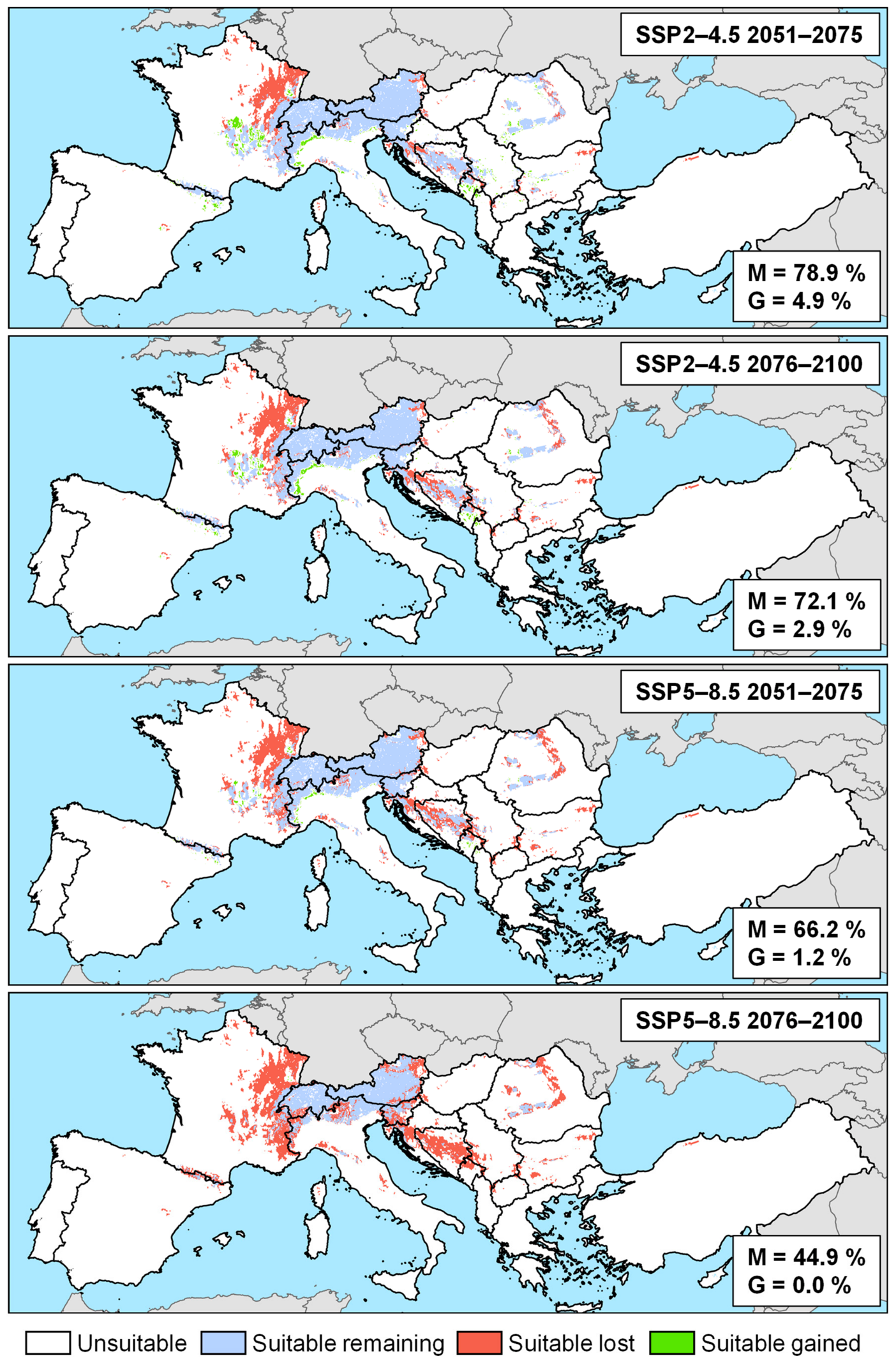
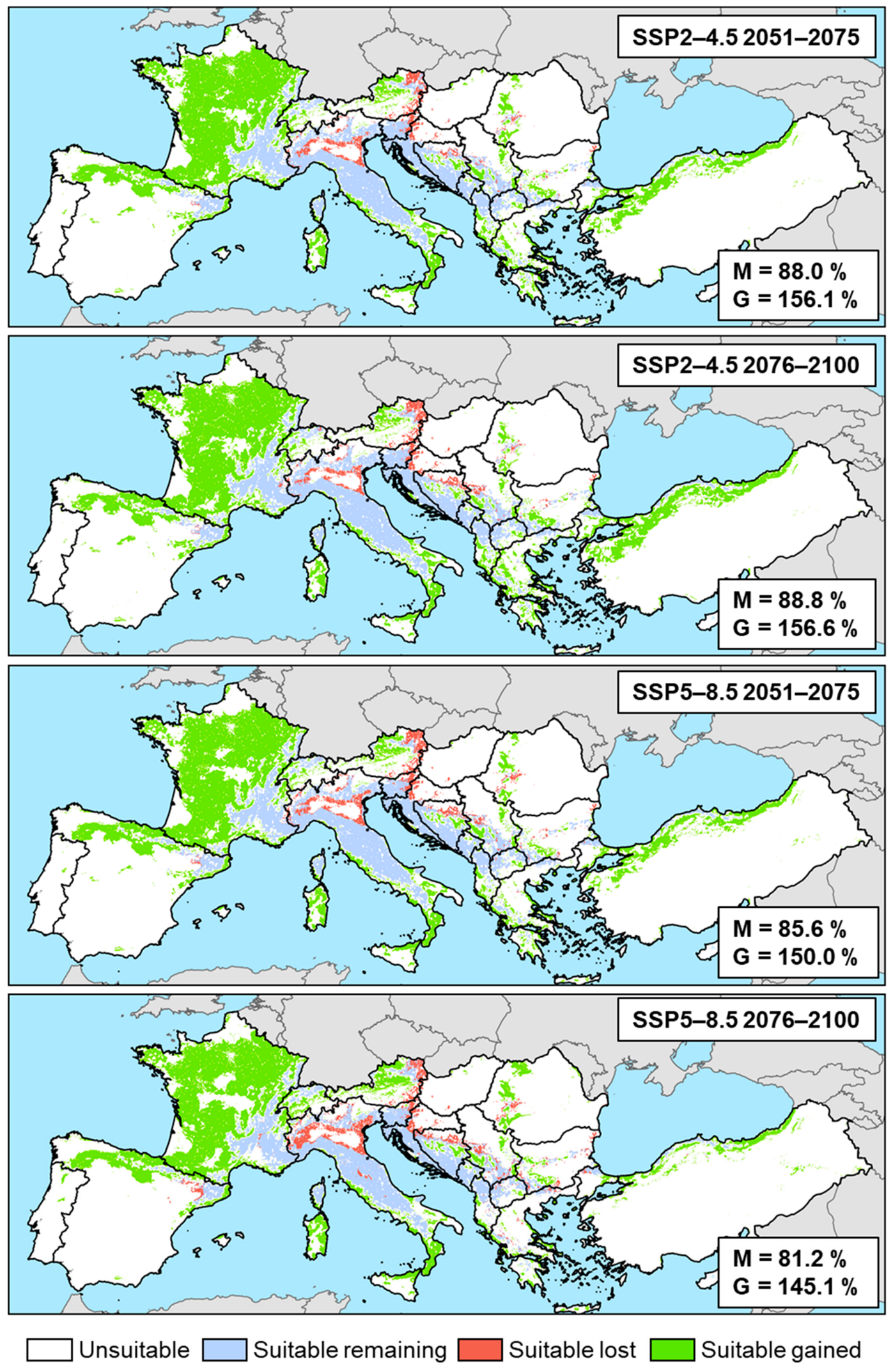
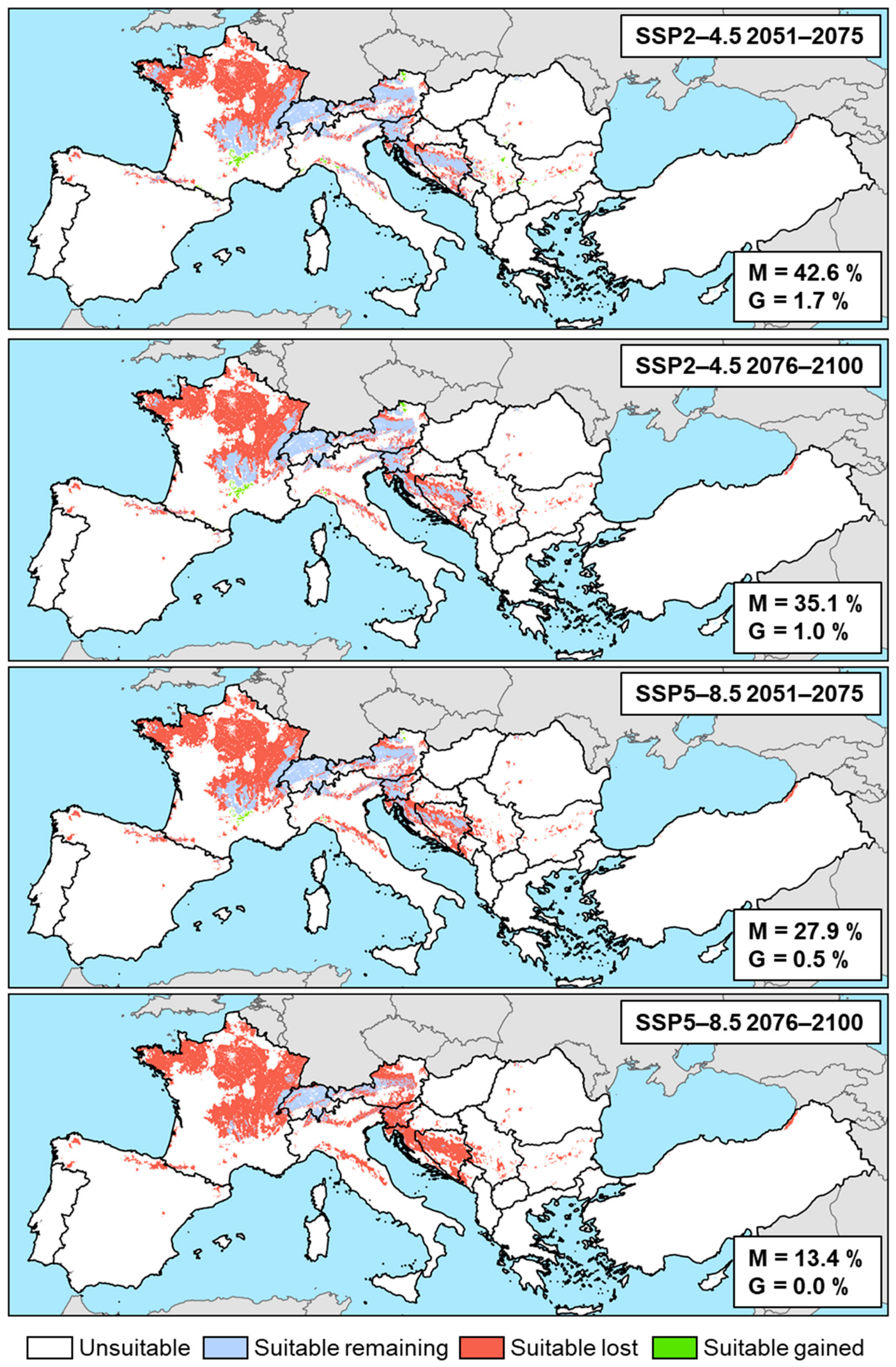
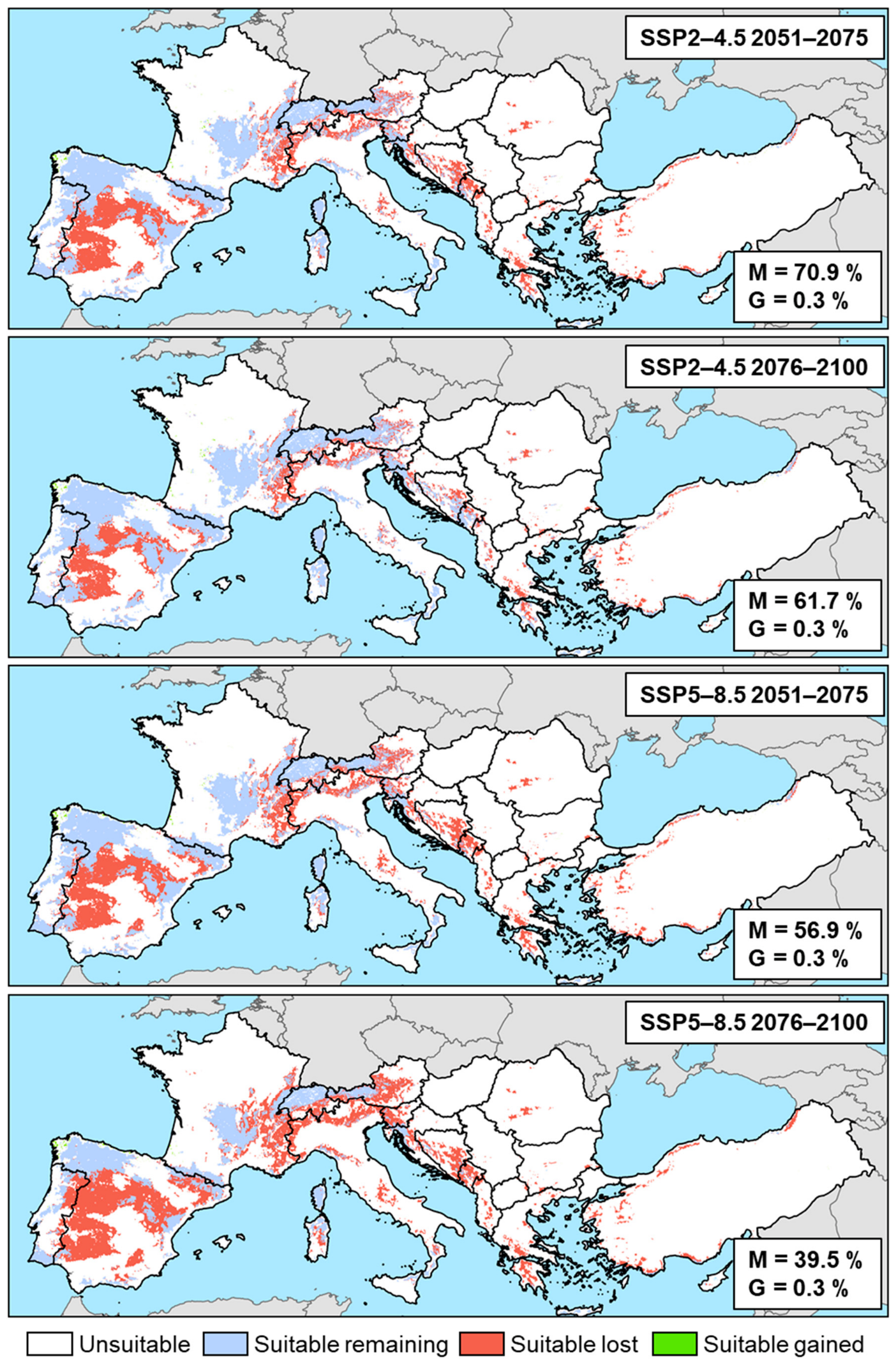
3.3. Forecasting Habitat Potential Shifts
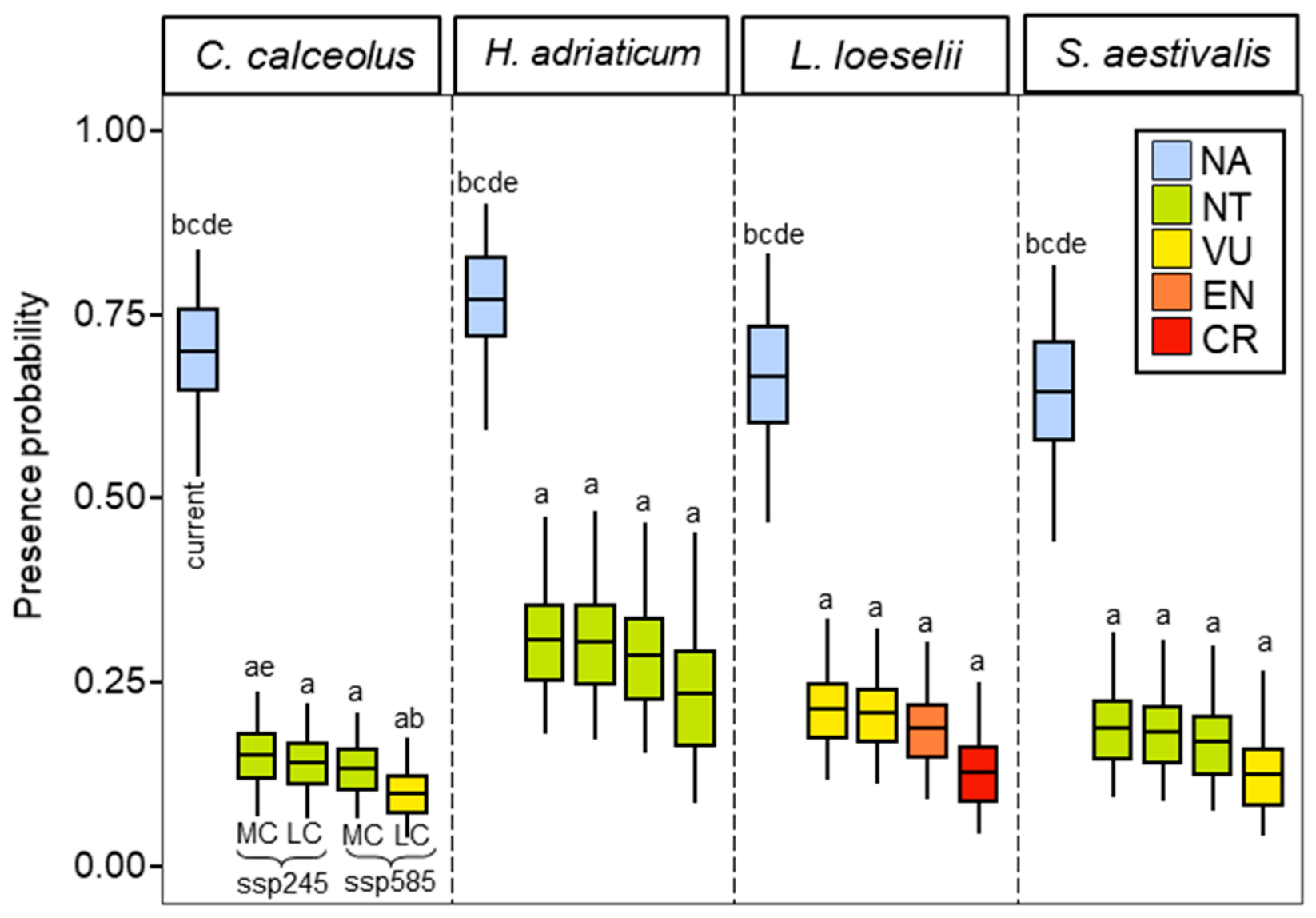
3.4. Climate Change Vulnerability
4. Discussion
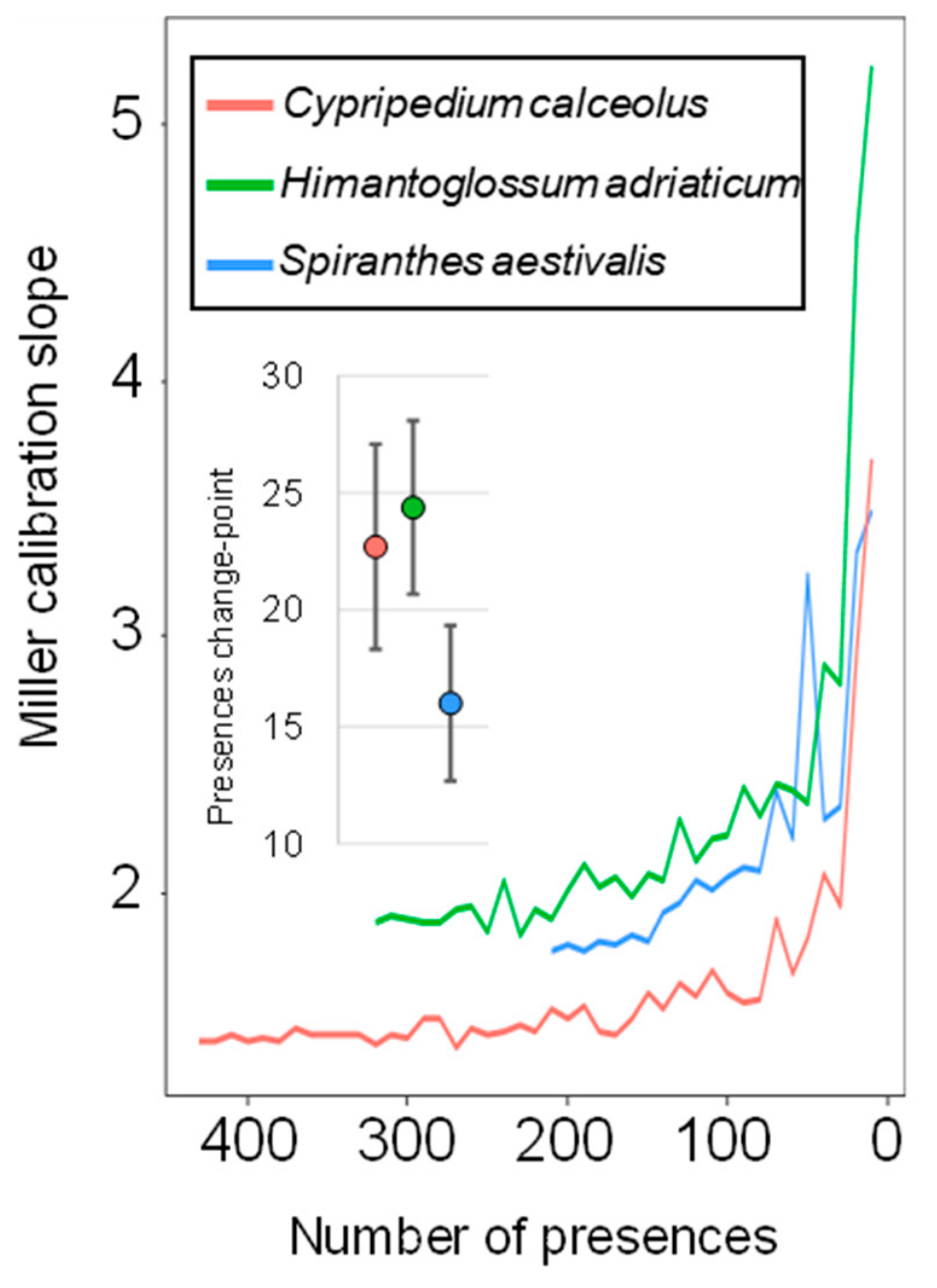
4.1. Sample Size and Other Limitations on Model Performance
4.2. Environmental Drivers of Euro-Mediterranean Orchid Distribution
4.3. Projected Distribution Shifts and Conservation Implications
5. Conclusions
Author Contributions
Funding
Data Availability Statement
Acknowledgments
Conflicts of Interest
Abbreviations
| BARTs | Bayesian additive regression trees |
| BDOD | Bulk density |
| CEC | Cation exchange capacity |
| CFVO | Coarse fragments volumetric content |
| CHELSA | Climatologies at high resolution for the Earth’s land surface areas |
| CLC | Clay content |
| CMIP6 | Phase 6 of the Coupled Model Intercomparison Project |
| DNI | Direct normal irradiation |
| GBIFs | Global biodiversity information facilities |
| GCMs | General circulation models |
| Ic | Continentality index |
| Io | Annual ombrothermic index (Pp*10/Tp) |
| IosX | Summer (x = number of summer months) ombrothermic indices |
| It/Itc | Thermicity index/compensated thermicity index |
| NC | Nitrogen content |
| OCD | Organic carbon density |
| OCS | Organic carbon stock |
| Pp | Positive precipitation |
| RSDS | Surface downward solar radiation |
| SAC | Sand content |
| SDMs | Species distribution models |
| SIC | Silt content |
| SOC | Soil organic carbon |
| SSP | Shared socioeconomic pathway |
| Tp | Positive temperature |
| WBCS | Worldwide Bioclimatic Classification System |
| WV0033 | Volumetric water content at 33 kPa |
Appendix A



References
- Christenhusz, M.; Byng, J.W. The Number of Known Plant Species in the World and Its Annual Increase. Phytotaxa 2016, 261, 201–217. [Google Scholar] [CrossRef]
- Givnish, T.J.; Spalink, D.; Ames, M.; Lyon, S.P.; Hunter, S.J.; Zuluaga, A.; Doucette, A.; Caro, G.G.; McDaniel, J.; Clements, M.A.; et al. Orchid Historical Biogeography, Diversification, Antarctica and the Paradox of Orchid Dispersal. J. Biogeogr. 2016, 43, 1905–1916. [Google Scholar] [CrossRef]
- Pérez-Escobar, O.A.; Bogarín, D.; Przelomska, N.A.S.; Ackerman, J.D.; Balbuena, J.A.; Bellot, S.; Bühlmann, R.P.; Cabrera, B.; Cano, J.A.; Charitonidou, M.; et al. The Origin and Speciation of Orchids. New Phytol. 2024, 242, 700–716. [Google Scholar] [CrossRef]
- Euro+Med. Euro+Med PlantBase—The Information Resource for Euro-Mediterranean Plant Diversity. Available online: https://europlusmed.org/ (accessed on 21 November 2025).
- Mediterranean Conservation Society Anatolian Orchids Project. Available online: https://akdenizkoruma.org.tr/en/projects/projects/b/anatolian-orchids-project?utm_source=chatgpt.com (accessed on 21 November 2025).
- Turco, A.; Albano, A.; Medagli, P.; D’Emerico, S.; Wagensommer, R.P. Orchidaceae in Puglia (Italy): Consistency, Distribution, and Conservation. Plants 2023, 12, 2223. [Google Scholar] [CrossRef] [PubMed]
- Bernardos, S.; García-Barriuso, M.; Ángeles Sánchez-Anta, M.; Amich, F. Composition, Geographical Affinities and Endemism of the Iberian Peninsula Orchid Flora. Nord. J. Bot. 2007, 25, 227–237. [Google Scholar] [CrossRef]
- Penas, A.; Alonso-Redondo, R.; González-Pérez, A.; Álvarez-Santacoloma, A.; Ochoa-Ramos, N.Y.; Ferreiro-Lera, G.-B.; del Río, S. Detailed Biogeographical Mapping as a Useful Novel Tool for the Conservation of Endemic Taxa: A Case of Study for Iberian Orchids. Open Res. Eur. 2024, 4, 210. [Google Scholar] [CrossRef]
- Guo, Y.-Y.; Luo, Y.-B.; Liu, Z.-J.; Wang, X.-Q. Evolution and Biogeography of the Slipper Orchids: Eocene Vicariance of the Conduplicate Genera in the Old and New World Tropics. PLoS ONE 2012, 7, e38788. [Google Scholar] [CrossRef]
- Tsiftsis, S.; Antonopoulos, Z. ATLAS of the Greek Orchids; Mediterraneo Editions: Rethymno, Greece, 2017; Volume I. [Google Scholar]
- Georghiou, K.; Delipetrou, P. Patterns and Traits of the Endemic Plants of Greece. Bot. J. Linn. Soc. 2010, 162, 130–153. [Google Scholar] [CrossRef]
- Djordjević, V.; Aćić, S.; Kabaš, E.; Lazarević, P.; Tsiftsis, S.; Lakušić, D. The Orchids of Wetland Vegetation in the Central Balkans. Diversity 2023, 15, 26. [Google Scholar] [CrossRef]
- Balding, M.; Williams, K.J.H. Plant Blindness and the Implications for Plant Conservation. Conserv. Biol. 2016, 30, 1192–1199. [Google Scholar] [CrossRef]
- González-García, V.; Longo, Á.A.; Ruiz, L.C. Orchids of the Principality of Asturias (Northwestern Spain). Mediterr. Bot. 2025, 46, e100745. [Google Scholar] [CrossRef]
- Hernández-Mejía, J.A.; de la Rosa-Manzano, E.; Delgado-Sánchez, P. Ecosystem Services Provided by Orchids: A Global Analysis. Bot. Sci. 2024, 102, 671–685. [Google Scholar] [CrossRef]
- Chauhan, P.; LK Attri, A. Mycorrhizal Associations in Orchids: A Review. Asian J. Biol. Life Sci. 2024, 13, 278–286. [Google Scholar] [CrossRef]
- Pellegrino, G.; Luca, A.; Bellusci, F. Relationships between Orchid and Fungal Biodiversity: Mycorrhizal Preferences in Mediterranean Orchids. Plant Biosyst. 2016, 150, 180–189. [Google Scholar] [CrossRef]
- Timsina, B.; Münzbergová, Z.; Kindlmann, P.; Bhattarai, B.P.; Shrestha, B.; Raskoti, B.B.; Rokaya, M.B. Associations between Epiphytic Orchids and Their Hosts and Future Perspectives of These in the Context of Global Warming. Diversity 2024, 16, 252. [Google Scholar] [CrossRef]
- Kolanowska, M. Loss of Fungal Symbionts and Changes in Pollinator Availability Caused by Climate Change Will Affect the Distribution and Survival Chances of Myco-Heterotrophic Orchid Species. Sci. Rep. 2023, 13, 6848. [Google Scholar] [CrossRef]
- Janousek, W.M.; Douglas, M.R.; Cannings, S.; Clément, M.A.; Delphia, C.M.; Everett, J.G.; Hatfield, R.G.; Keinath, D.A.; Uhuad Koch, J.B.; McCabe, L.M.; et al. Recent and Future Declines of a Historically Widespread Pollinator Linked to Climate, Land Cover, and Pesticides. Proc. Natl. Acad. Sci. USA 2023, 120, e2211223120. [Google Scholar] [CrossRef]
- Cornelisse, T.; Inouye, D.W.; Irwin, R.E.; Jepsen, S.; Mawdsley, J.R.; Ormes, M.; Daniels, J.; Debinski, D.M.; Griswold, T.; Klymko, J.; et al. Elevated Extinction Risk in over One-Fifth of Native North American Pollinators. Proc. Natl. Acad. Sci. USA 2025, 122, e2418742122. [Google Scholar] [CrossRef]
- Ghisbain, G.; Thiery, W.; Massonnet, F.; Erazo, D.; Rasmont, P.; Michez, D.; Dellicour, S. Projected Decline in European Bumblebee Populations in the Twenty-First Century. Nature 2023, 628, 337–341. [Google Scholar] [CrossRef] [PubMed]
- Haris, A.; Józan, Z.; Roller, L.; Šima, P.; Tóth, S. Changes in Population Densities and Species Richness of Pollinators in the Carpathian Basin during the Last 50 Years (Hymenoptera, Diptera, Lepidoptera). Diversity 2024, 16, 328. [Google Scholar] [CrossRef]
- Bellgard, S.E.; Williams, S.E. Response of Mycorrhizal Diversity to Current Climatic Changes. Diversity 2011, 3, 8–90. [Google Scholar] [CrossRef]
- Li, T.; Wu, S.; Yang, W.; Selosse, M.A.; Gao, J. How Mycorrhizal Associations Influence Orchid Distribution and Population Dynamics. Front. Plant Sci. 2021, 12, 647114. [Google Scholar] [CrossRef] [PubMed]
- McCormick, M.K.; Whigham, D.F.; Canchani-Viruet, A. Mycorrhizal Fungi Affect Orchid Distribution and Population Dynamics. New Phytol. 2018, 219, 1207–1215. [Google Scholar] [CrossRef]
- Fay, M.F.; Andriamahefarivo, L.; Bachman, S.P.; Brown, M.J.M.; Calevo, J.; Campbell, T.; Charitonidou, M.; Dixon, K.W.; Droissart, V.; Forest, F.; et al. How Threatened Are Orchids? A Review of the State of Play and Identification of Gaps and Priorities. Biodivers. Conserv. 2025, 34, 5075–5115. [Google Scholar] [CrossRef]
- IUCN (International Union for Conservation of Nature). The IUCN Red List of Threatened Species. Version 2025-2. Available online: https://www.iucnredlist.org (accessed on 26 November 2025).
- Tsiftsis, S. The Role of Natura 2000 Network in Protecting the Orchid Flora of East Macedonia (NE Greece). Eur. J. Environ. Sci. 2021, 11, 71–78. [Google Scholar] [CrossRef]
- Tsiftsis, S.; Tsiripidis, I.; Trigas, P. Identifying Important Areas for Orchid Conservation in Crete. Eur. J. Environ. Sci. 2011, 1, 28–37. [Google Scholar] [CrossRef]
- Lussu, M.; Ancillotto, L.; Labadessa, R.; Di Musciano, M.; Zannini, P.; Testolin, R.; Santi, F.; Dolci, D.; Conti, M.; Marignani, M.; et al. Prioritizing Conservation of Terrestrial Orchids: A Gap Analysis for Italy. Biol. Conserv. 2024, 289, 110385. [Google Scholar] [CrossRef]
- Wraith, J.; Pickering, C. A Continental Scale Analysis of Threats to Orchids. Biol. Conserv. 2019, 234, 7–17. [Google Scholar] [CrossRef]
- Cramer, W.; Guiot, J.; Marini, K. (Eds.) Climate and Environmental Change in the Mediterranean Basin—Current Situation and Risks for the Future; First Mediterranean Assessment Report; Mediterranean Experts on Climate and environmental Change (MedECC): Marseille, France, 2020. [Google Scholar]
- Ferreiro-Lera, G.B.; Penas, Á.; del Río, S. Unveiling Deviations from IPCC Temperature Projections through Bayesian Downscaling and Assessment of CMIP6 General Circulation Models in a Climate-Vulnerable Region. Remote Sens. 2024, 16, 1831. [Google Scholar] [CrossRef]
- Ferreiro-Lera, G.-B.; Penas, Á.; del Río, S. Obtaining Refined Euro-Mediterranean Rainfall Projections through Regional Assessment of CMIP6 General Circulation Models. Glob. Planet. Change 2025, 246, 104725. [Google Scholar] [CrossRef]
- Cos, J.; Doblas-Reyes, F.; Jury, M.; Marcos, R.; Bretonnière, P.A.; Samsó, M. The Mediterranean Climate Change Hotspot in the CMIP5 and CMIP6 Projections. Earth Syst. Dyn. 2022, 13, 321–340. [Google Scholar] [CrossRef]
- Schiestl, F.P.; Wartmann, B.A.; Bänziger, R.; Györög-Kobi, B.; Hess, K.; Luder, J.; Merz, E.; Peter, B.; Reutlinger, M.; Richter, T.; et al. The Late Orchid Catches the Bee: Frost Damage and Pollination Success in the Face of Global Warming in a European Terrestrial Orchid. Ecol. Evol. 2025, 15, e70729. [Google Scholar] [CrossRef]
- Charitonidou, M.; Kougioumoutzis, K.; Halley, J.M. An Orchid in Retrograde: Climate-Driven Range Shift Patterns of Ophrys Helenae in Greece. Plants 2021, 10, 470. [Google Scholar] [CrossRef]
- Tsiftsis, S.; Štípková, Z.; Kindlmann, P. Role of Way of Life, Latitude, Elevation and Climate on the Richness and Distribution of Orchid Species. Biodivers. Conserv. 2018, 28, 75–96. [Google Scholar] [CrossRef]
- Tsiftsis, S.; Tsiripidis, I.; Karagiannakidou, V.; Alifragis, D. Niche Analysis and Conservation of the Orchids of East Macedonia (NE Greece). Acta Oecol. 2008, 33, 27–35. [Google Scholar] [CrossRef]
- Tsiftsis, S.; Tsiripidis, I. Temporal and Spatial Patterns of Orchid Species Distribution in Greece: Implications for Conservation. Biodivers. Conserv. 2020, 29, 3461–3489. [Google Scholar] [CrossRef]
- Štípková, Z.; Kindlmann, P. Factors Determining the Distribution of Orchids—A Review with Examples from the Czech Republic. Eur. J. Environ. Sci. 2021, 11, 21–30. [Google Scholar] [CrossRef]
- Gaskett, A.C.; Gallagher, R.V. Orchid Diversity: Spatial and Climatic Patterns from Herbarium Records. Ecol. Evol. 2018, 8, 11235–11245. [Google Scholar] [CrossRef]
- Smallwood, P.A.; Trapnell, D.W. Species Distribution Modeling Reveals Recent Shifts in Suitable Habitat for Six North American Cypripedium Spp. (Orchidaceae). Diversity 2022, 14, 694. [Google Scholar] [CrossRef]
- Mccormick, M.K.; Jacquemyn, H. What Constrains the Distribution of Orchid Populations? New Phytol. 2014, 202, 392–400. [Google Scholar] [CrossRef]
- Pica, A.; Vela, D.; Magrini, S. Forest Orchids under Future Climate Scenarios: Habitat Suitability Modelling to Inform Conservation Strategies. Plants 2024, 13, 1810. [Google Scholar] [CrossRef] [PubMed]
- Phillips, R.D.; Reiter, N.; Peakall, R. Orchid Conservation: From Theory to Practice. Ann. Bot. 2020, 126, 345–362. [Google Scholar] [CrossRef] [PubMed]
- Eyring, V.; Bony, S.; Meehl, G.A.; Senior, C.A.; Stevens, B.; Stouffer, R.J.; Taylor, K.E. Overview of the Coupled Model Intercomparison Project Phase 6 (CMIP6) Experimental Design and Organization. Geosci. Model Dev. 2016, 9, 1937–1958. [Google Scholar] [CrossRef]
- O’Neill, B.C.; Tebaldi, C.; Van Vuuren, D.P.; Eyring, V.; Friedlingstein, P.; Hurtt, G.; Knutti, R.; Kriegler, E.; Lamarque, J.F.; Lowe, J.; et al. The Scenario Model Intercomparison Project (ScenarioMIP) for CMIP6. Geosci. Model Dev. 2016, 9, 3461–3482. [Google Scholar] [CrossRef]
- Ferreiro-Lera, G.B.; Penas, Á.; del Río, S. δ-MedBioclim: A New Dataset Bridging Current and Projected Bioclimatic Variables for the Euro-Mediterranean Region. Data 2025, 10, 78. [Google Scholar] [CrossRef]
- del Río, S.; Canas, R.; Cano, E.; Cano-Ortiz, A.; Musarella, C.; Pinto-Gomes, C.; Penas, A. Modelling the Impacts of Climate Change on Habitat Suitability and Vulnerability in Deciduous Forests in Spain. Ecol. Indic. 2021, 131, 108202. [Google Scholar] [CrossRef]
- Arranz, I.; Batllori, E.; Linares, C.; Ripple, W.J.; Bonada, N. Integrative Research of Mediterranean Climate Regions: A Global Call to Action. Environ. Conserv. 2024, 51, 71–78. [Google Scholar] [CrossRef]
- Chipman, H.A.; George, E.I.; McCulloch, R.E. BART: Bayesian Additive Regression Trees. Ann. Appl. Stat. 2010, 4, 266–298. [Google Scholar] [CrossRef]
- Carlson, C.J. Embarcadero: Species Distribution Modelling with Bayesian Additive Regression Trees in r. Methods Ecol. Evol. 2020, 11, 850–858. [Google Scholar] [CrossRef]
- Conservation International Critical Ecosystem Partnership Found. Explore the Biodiversity Hotspots. Available online: https://www.cepf.net/our-work/biodiversity-hotspots (accessed on 7 March 2022).
- Council of Europe. Council Directive 92/43/EEC of 21 May 1992 on the Conservation of Natural Habitats and of Wild Fauna and Flora; European Union: Brussels, Belgium, 1992. [Google Scholar]
- GBIF. GBIF Occurrence Download. Available online: https://www.gbif.org/es/ (accessed on 12 November 2025).
- Anselmetto, N.; Morresi, D.; Barbarino, S.; Loglisci, N.; Betts, M.G.; Garbarino, M. Species Distribution Models Built with Local Species Data Perform Better for Current Time, but Suffer from Niche Truncation. Agric. For. Meteorol. 2025, 362, 110361. [Google Scholar] [CrossRef]
- Zizka, A.; Silvestro, D.; Andermann, T.; Azevedo, J.; Duarte Ritter, C.; Edler, D.; Farooq, H.; Herdean, A.; Ariza, M.; Scharn, R.; et al. CoordinateCleaner: Standardized Cleaning of Occurrence Records from Biological Collection Databases. Methods Ecol. Evol. 2019, 10, 744–751. [Google Scholar] [CrossRef]
- ESRI. ArcGIS Pro 3.2. Available online: https://www.esri.com/en-us/arcgis/products/arcgis-pro (accessed on 11 July 2024).
- Barbosa, A.M. FuzzySim: Applying Fuzzy Logic to Binary Similarity Indices in Ecology. Methods Ecol. Evol. 2015, 6, 853–858. [Google Scholar] [CrossRef]
- International Organization for Standardization Codes for the Representation of Names of Countries and Their Subdivisions — Part 1: Country Code (ISO 3166-1:2020). Available online: https://www.iso.org/home.html (accessed on 7 May 2026).
- Fick, S.E.; Hijmans, R.J. WorldClim 2: New 1-Km Spatial Resolution Climate Surfaces for Global Land Areas. Int. J. Climatol. 2017, 37, 4302–4315. [Google Scholar] [CrossRef]
- Rivas-Martínez, S.; Rivas-Sáenz, S.; Penas, Á. Worldwide Bioclimatic Classification System. Glob. Geobot. 2011, 1, 1–634. [Google Scholar]
- Karger, D.N.; Conrad, O.; Böhner, J.; Kawohl, T.; Kreft, H.; Soria-Auza, R.W.; Zimmermann, N.E.; Linder, H.P.; Kessler, M. Climatologies at High Resolution for the Earth’s Land Surface Areas. Sci. Data 2017, 4, 170122. [Google Scholar] [CrossRef]
- Hijmans, R.J. Spatial Data Analysis, R Package Terra Version 1.6-53; Comprehensive R Archive Network (CRAN): Vienna, Austria, 2023. [Google Scholar]
- Poggio, L.; De Sousa, L.M.; Batjes, N.H.; Heuvelink, G.B.M.; Kempen, B.; Ribeiro, E.; Rossiter, D. SoilGrids 2.0: Producing Soil Information for the Globe with Quantified Spatial Uncertainty. SOIL 2021, 7, 217–240. [Google Scholar] [CrossRef]
- ESMAP. Global Solar Atlas 2.0 Interactive Web Site, Solar Potential Data and Maps; World Bank: Washington, DC, USA, 2019. [Google Scholar]
- Baquero, R.A.; Barbosa, A.M.; Ayllón, D.; Guerra, C.; Sánchez, E.; Araújo, M.B.; Nicola, G.G. Potential Distributions of Invasive Vertebrates in the Iberian Peninsula under Projected Changes in Climate Extreme Events. Divers. Distrib. 2021, 27, 2262–2276. [Google Scholar] [CrossRef]
- Konowalik, K.; Nosol, A. Evaluation Metrics and Validation of Presence-Only Species Distribution Models Based on Distributional Maps with Varying Coverage. Sci. Rep. 2021, 11, 1482. [Google Scholar] [CrossRef]
- Fuster-Alonso, A.; Mestre-Tomás, J.; Baez, J.C.; Pennino, M.G.; Barber, X.; Bellido, J.M.; Conesa, D.; López-Quílez, A.; Steenbeek, J.; Christensen, V.; et al. Machine Learning Applied to Global Scale Species Distribution Models. Sci. Rep. 2025, 15, 37534. [Google Scholar] [CrossRef] [PubMed]
- Lazagabaster, I.A.; Thomas, C.D.; Spedding, J.V.; Ikram, S.; Solano-Regadera, I.; Snape, S.; Bro-Jørgensen, J. Evaluating Species Distribution Model Predictions through Time against Paleozoological Records. Ecol. Evol. 2024, 14, e70288. [Google Scholar] [CrossRef] [PubMed]
- Felicísimo, M.; Muñoz, J.; Mateo, R.G.; Villalba, C.J. Vulnerabilidad de La Flora y Vegetación Españolas Ante El Cambio Climático. Ecosistemas 2012, 21, 1–6. [Google Scholar] [CrossRef]
- Wisz, M.S.; Hijmans, R.J.; Li, J.; Peterson, A.T.; Graham, C.H.; Guisan, A.; Elith, J.; Dudík, M.; Ferrier, S.; Huettmann, F.; et al. Effects of Sample Size on the Performance of Species Distribution Models. Divers. Distrib. 2008, 14, 763–773. [Google Scholar] [CrossRef]
- van Proosdij, A.S.J.; Sosef, M.S.M.; Wieringa, J.J.; Raes, N. Minimum Required Number of Specimen Records to Develop Accurate Species Distribution Models. Ecography 2016, 39, 542–552. [Google Scholar] [CrossRef]
- Moudrý, V.; Bazzichetto, M.; Remelgado, R.; Devillers, R.; Lenoir, J.; Mateo, R.G.; Lembrechts, J.J.; Sillero, N.; Lecours, V.; Cord, A.F.; et al. Optimising Occurrence Data in Species Distribution Models: Sample Size, Positional Uncertainty, and Sampling Bias Matter. Ecography 2024, 2024, e07294. [Google Scholar] [CrossRef]
- Steinke, D.; Gemeinholzer, B.; Martínez-Meyer, E.; Noesgaard, D.; Young, A.; Schigel, D. Globally Aggregated Biodiversity Data Impact Predictive and Descriptive Research. Proc. Natl. Acad. Sci. USA 2025, 122, e2519119122. [Google Scholar] [CrossRef]
- Enríquez-de-Salamanca, Á. Botanical Databases in EIA: Opportunities and Challenges. Impact Assess. Proj. Apprais. 2025, 43, 302–312. [Google Scholar] [CrossRef]
- Lipiński, S. Spatial Bias in Open Biodiversity Data: How GBIF Record Quality Shapes Conservation Analyses. Conservation 2026, 6, 40. [Google Scholar] [CrossRef]
- Akbulut, M.K.; Süngü Şeker, Ş.; Everest, T.; Şenel, G. Suitable Habitat Modelling Using GIS for Orchids in the Black Sea Region (North of Turkey). Environ. Monit. Assess. 2021, 193, 853. [Google Scholar] [CrossRef]
- Freestone, M.W.; Swarts, N.D.; Reiter, N.; Tomlinson, S.; Sussmilch, F.C.; Wright, M.M.; Holmes, G.D.; Phillips, R.D.; Linde, C.C. Continental-Scale Distribution and Diversity of Ceratobasidium Orchid Mycorrhizal Fungi in Australia. Ann. Bot. 2021, 128, 329–343. [Google Scholar] [CrossRef] [PubMed]
- Hemrová, L.; Kotilínek, M.; Konečná, M.; Paulič, R.; Jersáková, J.; Těšitelová, T.; Knappová, J.; Münzbergová, Z. Identification of Drivers of Landscape Distribution of Forest Orchids Using Germination Experiment and Species Distribution Models. Oecologia 2019, 190, 411–423. [Google Scholar] [CrossRef] [PubMed]
- Dulić, J.; Ljubojević, M.; Ognjanov, V.; Barać, G.; Dulić, T. In Vitro Germination and Seedling Development of Two European Orchid Species, Himantoglossum Jankae Somlyay, Kreutz & Óvári and Spiranthes spiralis (L.) Chevall. In Vitro Cell. Dev. Biol.-Plant 2019, 55, 380–391. [Google Scholar] [CrossRef]
- Molnár, A.; Kreutz, K.C.A.J.; Óvári, M.; Sennikov, A.N.; Bateman, R.M.; Takács, A.; Somlyay, L.; Sramkó, G. Himantoglossum Jankae (Orchidaceae: Orchideae), a New Name for a Long-Misnamed Lizard Orchid. Phytotaxa 2012, 73, 8–12. [Google Scholar] [CrossRef][Green Version]
- Jacquemyn, H.; De Coensel, B.; Evans, A.; Wang, D.; Merckx, V.S.F.T. The Relationship between Phylogeny, Range Size, Niche Breadth and Niche Overlap in European Orchids (Orchidaceae). J. Biogeogr. 2024, 51, 409–421. [Google Scholar] [CrossRef]
- Meynard, C.N.; Piou, C.; Kaplan, D.M. A Theoretical Framework for Upscaling Species Distribution Models. Methods Ecol. Evol. 2023, 14, 2888–2899. [Google Scholar] [CrossRef]
- Gábor, L.; Jetz, W.; Lu, M.; Rocchini, D.; Cord, A.; Malavasi, M.; Zarzo-Arias, A.; Barták, V.; Moudrý, V. Positional Errors in Species Distribution Modelling Are Not Overcome by the Coarser Grains of Analysis. Methods Ecol. Evol. 2022, 13, 2289–2302. [Google Scholar] [CrossRef]
- Pradervand, J.N.; Dubuis, A.; Pellissier, L.; Guisan, A.; Randin, C. Very High Resolution Environmental Predictors in Species Distribution Models: Moving beyond Topography? Prog. Phys. Geogr. 2014, 38, 79–96. [Google Scholar] [CrossRef]
- Soley-Guardia, M.; Alvarado-Serrano, D.F.; Anderson, R.P. Top Ten Hazards to Avoid When Modeling Species Distributions: A Didactic Guide of Assumptions, Problems, and Recommendations. Ecography 2024, 2024, e06852. [Google Scholar] [CrossRef]
- Abdel Moniem, H.E.; Mallon, C.; Allen, B.; Littlefair, C.; Leston, L.; Azeria, E.; Petty, A.; Pendlebury, D. Thresholding Species Distribution Models: Simple Approaches for Land-Use Planning in Multifunctional Landscapes. Methods Ecol. Evol. 2025, 17, 1462–1479. [Google Scholar] [CrossRef]
- Kothandaraman, S.; Dar, J.A.; Sundarapandian, S.; Khan, M.L.; Behera, M.D. Species Distribution Modeling as a Forest Management Tool: Prospects and Constraints. For. Incl. Sustain. Econ. Growth 2025, 2025, 215–223. [Google Scholar] [CrossRef]
- Wang, H.-H.; Wonkka, C.L.; Treglia, M.L.; Grant, W.E.; Smeins, F.E.; Rogers, W.E. Species Distribution Modelling for Conservation of an Endangered Endemic Orchid. AoB Plants 2015, 7, plv039. [Google Scholar] [CrossRef]
- Kolanowska, M.; Jakubska-Busse, A. Is the Lady’s-Slipper Orchid (Cypripedium calceolus) Likely to Shortly Become Extinct in Europe?—Insights Based on Ecological Niche Modelling. PLoS ONE 2020, 15, e0228420. [Google Scholar] [CrossRef]
- Ferreiro-Lera, G.B.; Penas, Á.; del Río, S. Projected Reorganization of Euro-Mediterranean Bioclimates under Climate Change: Evidence from CMIP6 Multi-Model Ensemble. Earth Syst. Environ. 2026, 2026, 1–27. [Google Scholar] [CrossRef]
- Bodis, J.; Biró, É.; Nagy, T.; Takács, A.; Molnár, A.; Lukács, B.A. Habitat Preferences of the Rare Lizard-Orchid Himantoglossum Adriaticum H. Baumann. Tuexenia 2018, 38, 329–345. [Google Scholar]
- Bódis, J.; Biró, É.; Nagy, T.; Takács, A.; Sramkó, G.; Bateman, R.M.; Gilián, L.; Illyés, Z.; Tökölyi, J.; Lukács, B.A.; et al. Biological Flora of Central Europe Himantoglossum Adriaticum H. Baumann. Perspect. Plant Ecol. Evol. Syst. 2019, 40, 125461. [Google Scholar] [CrossRef]
- Tsiftsis, S.; Djordjević, V. Modelling Sexually Deceptive Orchid Species Distributions under Future Climates: The Importance of Plant–Pollinator Interactions. Sci. Rep. 2020, 10, 10623. [Google Scholar] [CrossRef]
- Acedo, C.; Alfaro, E.; Garmendia, J.; Guardiola, M.; Salazar, C.; Llamas, F. Spiranthes Aestivalis. In Atlas y Libro Rojo de la Flora Vascular Amenazada de España-Adenda 2017; Iriondo Alegría, J.M., Moreno Saiz, J.C., Martínez García, F., Salazar Medías, C., Eds.; Ministerio para la Transición Ecológica: Madrid, Spain, 2017; pp. 146–147. [Google Scholar]
- Nielsen, M.; Cook, B.I.; Marvel, K.; Ting, M.; Smerdon, J.E. The Changing Influence of Precipitation on Soil Moisture Drought With Warming in the Mediterranean and Western North America. Earths Future 2024, 12, e2023EF003987. [Google Scholar] [CrossRef]
- Andersen, D.K.; Ejrnæs, R.; Minter, M.; Riis, T.; Vinther, E.; Bruun, H.H.K. Environmental Drivers of the Decline of the Fen Orchid Liparis Loeselii. Nord. J. Bot. 2025, 2025, e04419. [Google Scholar] [CrossRef]
- Grootjans, A.; Shahrudin, R.; van de Craats, A.; Kooijman, A.; Oostermeijer, G.; Petersen, J.; Amatirsat, D.; Bland, C.; Stuyfzand, P. Window of Opportunity of Liparis Loeselii Populations during Vegetation Succession on the Wadden Sea Islands. J. Coast. Conserv. 2016, 21, 631–641. [Google Scholar] [CrossRef]
- Swarts, N.D.; Dixon, K.W. Terrestrial Orchid Conservation in the Age of Extinction. Ann. Bot. 2009, 104, 543–556. [Google Scholar] [CrossRef]
- Vitt, P.; Taylor, A.; Rakosy, D.; Kreft, H.; Meyer, A.; Weigelt, P.; Knight, T.M. Global Conservation Prioritization for the Orchidaceae. Sci. Rep. 2023, 13, 6718. [Google Scholar] [CrossRef] [PubMed]
- Wraith, J.; Norman, P.; Pickering, C. Orchid Conservation and Research: An Analysis of Gaps and Priorities for Globally Red Listed Species. Ambio 2020, 49, 1601–1611. [Google Scholar] [CrossRef] [PubMed]



| Scientific Name | Directive 92/43/EEC | IUCN Status | doi |
|---|---|---|---|
| Cypripedium calceolus L. | Annex II and IV | NT | 10.15468/dl.hav69t |
| Dactylorhiza kalopissii E.Nelson | Annex II and IV | EN | 10.15468/dl.hznax8 |
| Himantoglossum adriaticum H.Baumann | Annex II and IV | LC | 10.15468/dl.xpxax4 |
| Himantoglossum jankae Somlyay, Kreutz & Óvári | Annex II and IV | Not assessed | 10.15468/dl.eqtyxx |
| Liparis loeselii (L.) Rich. | Annex II and IV | NT | 10.15468/dl.5nrggr |
| Ophrys argolica H.Fleischm. ex Vierh. | Annex IV | VU | 10.15468/dl.sdy92w |
| Ophrys kotschyi H.Fleischm. & Soó | Annex II and IV | NT | 10.15468/dl.xjk8wu |
| Ophrys lunulata Parl. | Annex II and IV | LC | 10.15468/dl.ud3yc2 |
| Spiranthes aestivalis (Poir.) Rich. | Annex IV | DD | 10.15468/dl.55tg9w |
| Cy.ca. | Da.ka. | Hi.ad. | Hi.ja. | Li.lo. | Op.ar. | Op.ko. | Op.lu. | Sp.ae. | |
| BIO1 | - | - | - | - | 9.53 | - | - | - | - |
| BIO4 | 8.36 | - | 9.18 (3) | - | 9.84 (4) | - | - | - | 10.52 (2) |
| BIO8 | - | - | - | - | - | - | - | 20.29 (3) | - |
| BIO9 | 9.14 (2) | - | 8.45 (5) | - | 9.73 | - | - | - | - |
| BIO11 | - | - | 8.38 | - | - | - | 17.46 (1) | - | 9.08 |
| BIO13 | 8.20 | - | - | - | - | 11.97 | 16.43 (5) | - | - |
| BIO15 | - | - | 8.82 (4) | - | - | - | 14.88 | - | - |
| BIO16 | 7.90 | - | - | - | - | 12.64 (3) | 16.72 (4) | - | - |
| BIORM1 | 7.60 | 34.28 (1) | 7.96 | - | 10.16 (3) | - | - | 20.45 (2) | - |
| BIORM3 | - | - | - | - | 9.65 | - | - | - | - |
| BIORM4 | - | - | - | - | - | 12.88 (1) | - | - | - |
| BIORM6 | - | - | - | - | 9.61 | - | - | - | 10.15 (4) |
| BIORM7 | 7.92 | - | - | - | - | - | - | 18.53 (5) | - |
| BDOD | - | - | 8.17 | - | - | - | - | - | - |
| CEC | - | - | - | - | 12.34 | - | - | - | |
| CFVO | 8.38 (5) | - | - | - | 10.69 (2) | - | 17.32 (2) | - | 10.30 (3) |
| CLC | 8.40 (4) | - | - | - | - | - | - | - | 10.06 (5) |
| OCD | 7.96 | - | 7.58 | - | 9.78 (5) | - | - | - | 9.38 |
| NC | - | - | - | 26.17 (1) | - | - | - | - | - |
| pH | - | - | 7.32 | - | - | - | - | - | 9.46 |
| SAC | - | - | 7.94 | 25.76 (2) | - | - | - | - | - |
| SIC | 7.74 | - | - | - | - | - | - | - | - |
| WV | - | - | - | - | - | 12.39 (5) | - | - | - |
| DNI | - | - | 9.32 (1) | 24.70 (3) | - | 12.59 (4) | - | 19.19 (4) | 9.93 |
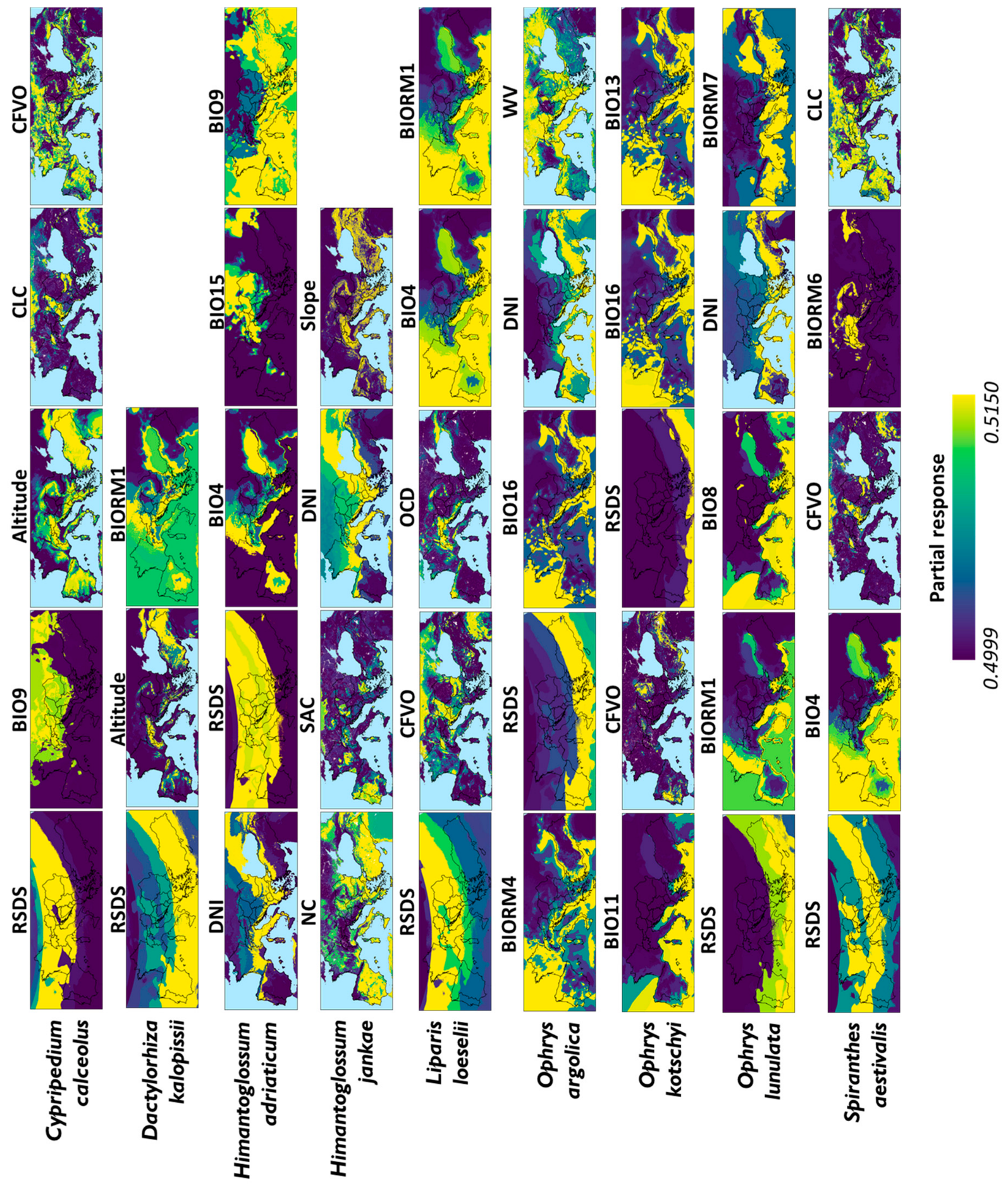
| RSDS | 9.86 (1) | 33.31 (2) | 9.26 (2) | - | 10.99 (1) | 12.84 (2) | 17.19 (3) | 21.54 (1) | 11.42 (1) |
| Altitude | 8.56 (3) | 32.42 (3) | - | - | - | - | - | - | 9.71 |
| Slope | - | - | 7.63 | 24.38 (4) | - | 12.34 | - | - | - |
Disclaimer/Publisher’s Note: The statements, opinions and data contained in all publications are solely those of the individual author(s) and contributor(s) and not of MDPI and/or the editor(s). MDPI and/or the editor(s) disclaim responsibility for any injury to people or property resulting from any ideas, methods, instructions or products referred to in the content. |
© 2026 by the authors. Licensee MDPI, Basel, Switzerland. This article is an open access article distributed under the terms and conditions of the Creative Commons Attribution (CC BY) license.
Share and Cite
Ferreiro-Lera, G.-B.; Penas, Á.; del Río, S. Forecasting Habitat Shifts in Euro-Mediterranean Orchids Protected Under Directive 92/43/EEC. Diversity 2026, 18, 287. https://doi.org/10.3390/d18050287
Ferreiro-Lera G-B, Penas Á, del Río S. Forecasting Habitat Shifts in Euro-Mediterranean Orchids Protected Under Directive 92/43/EEC. Diversity. 2026; 18(5):287. https://doi.org/10.3390/d18050287
Chicago/Turabian StyleFerreiro-Lera, Giovanni-Breogán, Ángel Penas, and Sara del Río. 2026. "Forecasting Habitat Shifts in Euro-Mediterranean Orchids Protected Under Directive 92/43/EEC" Diversity 18, no. 5: 287. https://doi.org/10.3390/d18050287
APA StyleFerreiro-Lera, G.-B., Penas, Á., & del Río, S. (2026). Forecasting Habitat Shifts in Euro-Mediterranean Orchids Protected Under Directive 92/43/EEC. Diversity, 18(5), 287. https://doi.org/10.3390/d18050287