Article

Integrative Reassessment of Drepanosira gisini Nosek, 1964 (Collembola, Entomobryomorpha) Based on Morphology and Mitochondrial Genomes, with Comments on the Phylogeny of the Entomobryinae


by
Nerivania Nunes Godeiro
1,* and
Bruno Cavalcante Bellini
2,*
1
Natural History Research Center, Shanghai Natural History Museum, Shanghai Science & Technology Museum, Shanghai 200041, China
2
Department of Botany and Zoology, Biosciences Center, Federal University of Rio Grande do Norte (UFRN), Highway BR-101, Lagoa Nova, Campus Universitario, Natal 59072-970, RN, Brazil
*
Authors to whom correspondence should be addressed.
Diversity 2026, 18(5), 247; https://doi.org/10.3390/d18050247
Submission received: 30 March 2026 / Revised: 13 April 2026 / Accepted: 20 April 2026 / Published: 23 April 2026
(This article belongs to the Section Animal Diversity)

Abstract

Drepanosira Bonet is a small genus of Entomobryidae mostly found in Asiatic high-elevation habitats. Drepanosira gisini Nosek was described from a mountainous region of Tajikistan, but its identity is currently delimited by generic features, especially color pattern. Here, we study the detailed morphology and systematics of the species to test the hypothesis that it belongs to Entomobryinae and is closely related to Willowsia. To test the phylogenetic placement of D. gisini, we assembled for the first time its mitogenome and used 30 more sequences of Entomobryidae species and two Orchesellidae taxa as outgroups. We performed both maximum likelihood and Bayesian inference phylogenetic analyses. Our data support that D. gisini belongs to Entomobryinae and is closely related to Willowsia species bearing scales of “the long basal rib type”. The dorsal chaetotaxy of D. gisini is remarkably complex, initially suggesting a more basal position of the species within Entomobryoidea. Even so, our phylogenetic analyses and other morphological features, like the presence of lanceolate ribbed scales, tergal sens and ms formulae, and tenaculum chaetotaxy, support the species placement among Entomobryinae in a more derived position within the subfamily phylogeny.

1. Introduction

Drepanosira Bonet, 1942 is a small genus of entomobryid springtails holding 17 valid species mostly found in Asia, including high-elevation habitats [1,2,3,4]. Its species share the presence of eyes, a body covered by lanceolated scales with interrupted medium-sized ribs, dens without such scales, and mucro falcate with a basal spine [4,5]. The genus was regarded as closely related to Willowsia Shoebotham, 1917 by [6], based on the shared presence of pointed ribbed scales over the body, and was included as a member of Willowsiini by the authors of [6,7]. This tribe was posteriorly considered as a full subfamily (Willowsiinae) by [4]. In a seminal study by [8] on the systematics of Entomobryidae based on molecular and morphological evidence, it was noted that Willowsiini does not represent a natural group, as its internal lineages are intermixed with unscaled Entomobryini. In this context, the authors concluded that the subfamily Entomobryinae should include genera both with and without scales, being primarily defined by a distinctive S-chaetotaxic pattern on the dorsal trunk. Such results were endorsed by many other posterior studies, such as [9,10,11,12,13,14].
Drepanosira gisini Nosek, 1964 was described from a mountainous region of Tajikistan, Pyanjsky District, based on specimens sampled from a nest of the gerbil Meriones erythrourus (Gray, 1842). The few details on the morphology of the species presented by Nosek are only sufficient to support its placement within Drepanosira and to differentiate it from other congeners mainly by color pattern [2]. In this scenario, many features of the species remain unclear, especially its dorsal chaetotaxy, a relevant feature to separate species of Entomobryinae and to understand the systematics and evolution of its internal taxa [8,9,14,15,16].
Despite the many recent advances in understanding the internal evolution of Entomobryoidea, mostly based on molecular data, several questions remain unresolved. For instance, the placement of Drepanosira within Entomobryidae has never been tested using modern tools, like molecular evidence. Here, we address this issue by including Drepanosira gisini in an ongoing phylogenetic study of Entomobryidae based on mitogenomes to test the hypothesis that it belongs to Entomobryinae and is closely related to Willowsia. We also examine the overall morphology of our specimens, providing the first detailed description of its dorsal chaetotaxy, along with additional morphological features. Finally, we discuss our findings in light of current knowledge of Entomobryoidea and Entomobryinae systematics.

2. Materials and Methods

2.1. Samples Collection

Drepanosira gisini samples were collected in Tibet (or Xizang), an autonomous region of China, during the summer season. Sample 24XZ53, with multiple individuals, was collected in 24.07.2024 at the Bank of Qiaguicuo Lake, Xainza County, Nagqu City, 31°51′1.692′′ N, 88°19′30.324′′ E. Sample 24XZ38, also with numerous specimens, was collected in 20.07.2024, Jiacuola Mountain, Lhatse County, Shigatse City, 29°4′25.212′′ N, 87°58′53.328′′ E. Both sites are located at 4500 m a.s.l. Daoyuan Yu, Chunyan Qin, Yating Zhang, and Jingxiang Cheng were in charge of the collection fieldwork and kindly donated the samples for the present study. Individuals were sampled by beating the grass and then collected using entomological aspirators. Specimens were further preserved in absolute ethanol and stored at −20 °C until use for taxonomic identification and molecular analyses.

2.2. Morphological Analyses and Geographic Distribution of Drepanosira gisini

A stereomicroscope Teelen XTL-207 (Shanghai Dilun Optical Instrument Co., Ltd., Shanghai, China) was used to prepare glass slides for morphological observation. To diaphanize the specimens, they were first submerged in 5% KOH and then in 10% lactophenol for five to ten minutes each. Specimens were mounted on slides using Hoyer’s solution and dried in an oven at 50 °C. Morphological details were observed under a phase contrast microscope (Leica DM 2500 Leica Microsystems, Wetzlar, Germany). Photographs were taken with a digital camera installed on the microscope (Leica DMC 4500 Leica Microsystems, Wetzlar, Germany). All specimens are deposited at the collection of the Shanghai Natural History Museum (SNHM), Shanghai, China.
The terminology used in this study follows mainly: Ref. [17] for the labial palp papilla E; Ref. [18] for the basal labial chaetotaxy, with additions by [19]; Ref. [20] for the labral chaetotaxy; Ref. [21] for the dorsal head chaetotaxy, with additions by [22,23,24]; Refs. [8,25] for the S-chaetotaxy; and [15] for the body dorsal chaetotaxy, with additions by [12,24]. A list of abbreviations for the morphological depiction of D. gisini is presented at the end of the paper.
The map illustrating the known distribution of Drepanosira gisini was downloaded from the d-maps repository (https://www.d-maps.com/m/asia/asie/asie10.svg (accessed on 10 April 2026). Previous records were checked from the species original description [2] and the Checklist of the Collembola of the World [4].

2.3. DNA Extraction, Sequencing, and Mitogenome Annotation

DNA was extracted from one specimen belonging to sample 24XZ38 using a TIANamp MicroDNA Extraction Kit (4992287—Tiangen Co., Ltd., Beijing, China), and a KAPA Hyper Prep Kit (07962355001—Roche, Basel, Switzerland) was used to construct the DNA library following the manufacturer’s recommendations. The Illumina NovaSeq 6000 (Illumina Inc., San Diego, CA, USA) platform sequenced approximately 10 Gb of paired-end reads with 150 bp length. All molecular procedures were performed by Shanghai Yaoen Biotechnology Co., Ltd., China (Shanghai, China). The raw sequencing data was filtered using the BBTools (www.sourceforge.net/projects/bbmap/ accessed on 10 February 2026) pipeline “bbduk.sh”. Low-quality bases (Q < 20) from both ends were removed, reads shorter than 15 bp were filtered, reads with more than five ambiguous bases were discarded, and homopolymeric tails (poly-A, -G, and -C ≥ 10 bp) were trimmed. The MitoZ v. 3.6 [26] toolkit was used to assemble, annotate, and visualize the mitogenome of Drepanosira gisini. The following modules were evoked by MitoZ: Fastp v. 0.23.4 [27] for filtering; MEGAHIT v. 1.2.9 [28] for assembly; HMMER v. 3.4 [29] for searching homologous sequences and making alignments; BLAST+ v. 2.16.0 [30], GeneWise v. 2.2.0 [31], Infernal v. 1.1.5 [32], and MiTFi v. 0.1 [33] for annotation; and Circos v. 0.69 [34], BWA v. 0.7.18 [35], SAMtools v. 1.15.1 [36], and ETE3 toolkit v. 3.1.3 [37] to visualize the mitogenomes and draw the sequencing coverage distribution track. The raw sequencing data and the assembled mitogenome were submitted to NCBI, and the accession numbers are listed at the end of this manuscript.

2.4. Phylogenetic Analyses

To check the correct phylogenetic placement of Drepanosira gisini, we included the new assembled mitogenome in a dataset containing 30 species of Entomobryidae and two outgroups belonging to Orchesellidae. Our dataset comprises 19 terminal taxa of Entomobryinae, including D. gisini, representing the major lineages and genera of the subfamily, along with three representatives of Lepidocyrtinae and nine Seirinae. Taxonomic details and NCBI accession numbers of all species used in the analyses are listed in Table 1. MAFFT v. 7.470 [38] with the “L-INS-I” algorithm was used to align the amino acids of the 13 protein-coding genes (PCGs) independently. This is the most suitable algorithm for a divergent dataset, since Entomobryinae is one of most complex internal lineages of Entomobryoidea in terms of phylogenetic resolution [9,10,11,12,13,14]. Following alignment, we applied the automated trimming function (-gappyout) in trimAL v.1.4.1 [39] to eliminate positions with gaps or ambiguous data. Subsequently, codon-based nucleotide alignments for the 13 PCGs were generated using trimAL v.1.4 with the -backtrans and -gappyout option, which was applied to the trimmed amino acid sequences and unaligned nucleotide sequences for each gene. FASconCAT-G v.1.04 [40] concatenated the final sequences into one matrix with 10,101 nucleotide sites (6,114 parsimony informative sites). IQ-TREE v.2 [41] was used to perform maximum likelihood (ML) analyses, with a codon partitioned dataset (codons 1–3 were treated as separate partitions). ModelFinder in IQ-TREE v.2 [42] was invoked to choose the best substitution model for each partition; the details of the models used are presented in the Appendix A (Table A1). Nodal support for ML analysis was calculated with 1000 SH- aLRT [43] and 1000 UFBoot2 [44] bootstrap replicates. Bayesian inference (BI) analyses were performed using MrBayes 3.2.7 [45], applying the GTR model (inferred by ModelFinder), with the following options: ngen = 10,000,000; lset nst = 6; lset rates = gamma; nrun = 1; nchain = 4; checkfreq = 100,000; samplefreq = 1000; printfreq = 1000; and burninfrac = 25%. A consensus tree was created from the remaining trees. FigTree v. 1.4.2 (https://tree.bio.ed.ac.uk/software/figtree/, accessed on 25 February 2026) was used to visualize and edit the combined phylogenetic tree.

3. Results

3.1. Mitogenome Structure and Organization

The complete mitochondrial genome of Drepanosira gisini is a circular DNA molecule of 15,036 bp and contains a typical set of 37 mitochondrial genes, including 13 protein-coding genes (PCGs), 22 transfer RNA genes (tRNAs), and two ribosomal RNA genes (rrnL and rrnS) (Table 2, Figure 1, Appendix A Table A2). The sequencing depth of the assembled mitogenome varied considerably, ranging from approximately 4× to over 1300×, with lower coverage observed at the terminal regions (AT rich) and higher coverage in PCGs regions. Gene order is consistent with the ancestral pancrustacean (AGO). The 13 PCGs span a total of 10,989 bp, with individual gene lengths ranging from 166 bp (ATP8) to 1,704 bp (ND5). Most genes are encoded on the majority (J or +) strand, whereas ND5, ND4, ND4L, ND1, and several tRNAs are located on the minority (N or -) strand. The two ribosomal RNA genes measure 1286 bp (rrnL) and 777 bp (rrnS), respectively. The 22 tRNA genes range from 61 to 72 bp, with an average length of approximately 66 bp, and are distributed throughout the genome in several conserved clusters. The putative control region occupies the short non-coding interval between rrnS and the beginning of the genome, with a length of 547 bp. Small gene overlaps (1–8 bp) were observed between most of the genes, with the largest (57 bp) located between trnL and the rrnL genes, a typical pattern for Collembola. An intergenic space of 69 bp between ND4 and ND4L is present. The overall nucleotide composition of the concatenated PCGs is strongly biased toward A + T, reaching 66.9%, which is typical for hexapod mitochondrial genomes [59,60]. Protein-coding genes initiate predominantly with standard ATN codons, including ATT in ND2, COX2, ND5, and ND4L; ATG in ATP6, COX3, and CYTB; ATC in COX1 and ATP8; and ATA in ND3 and ND6, while alternative start codons occur in ND4 (TTG) and ND1 (GTG). Most PCGs terminate with the complete stop codon TAA, whereas ND3 ends with TAG and COX3, ND5, and ND4 possess incomplete stop codons that are presumed to be completed by post-transcriptional polyadenylation. Overall, the mitogenome organization of D. gisini is highly conserved and consistent with other published Entomobryinae mitogenomes. Mitogenome sequences and raw sequencing data will be available in NCBI at (https://www.ncbi.nlm.nih.gov/ accessed on 27 February 2026) under the accession numbers PZ065976 and SRR37442562, respectively, linked to bioproject PRJNA1125622.

3.2. Entomobryinae Phylogeny and Drepanosira gisini Position

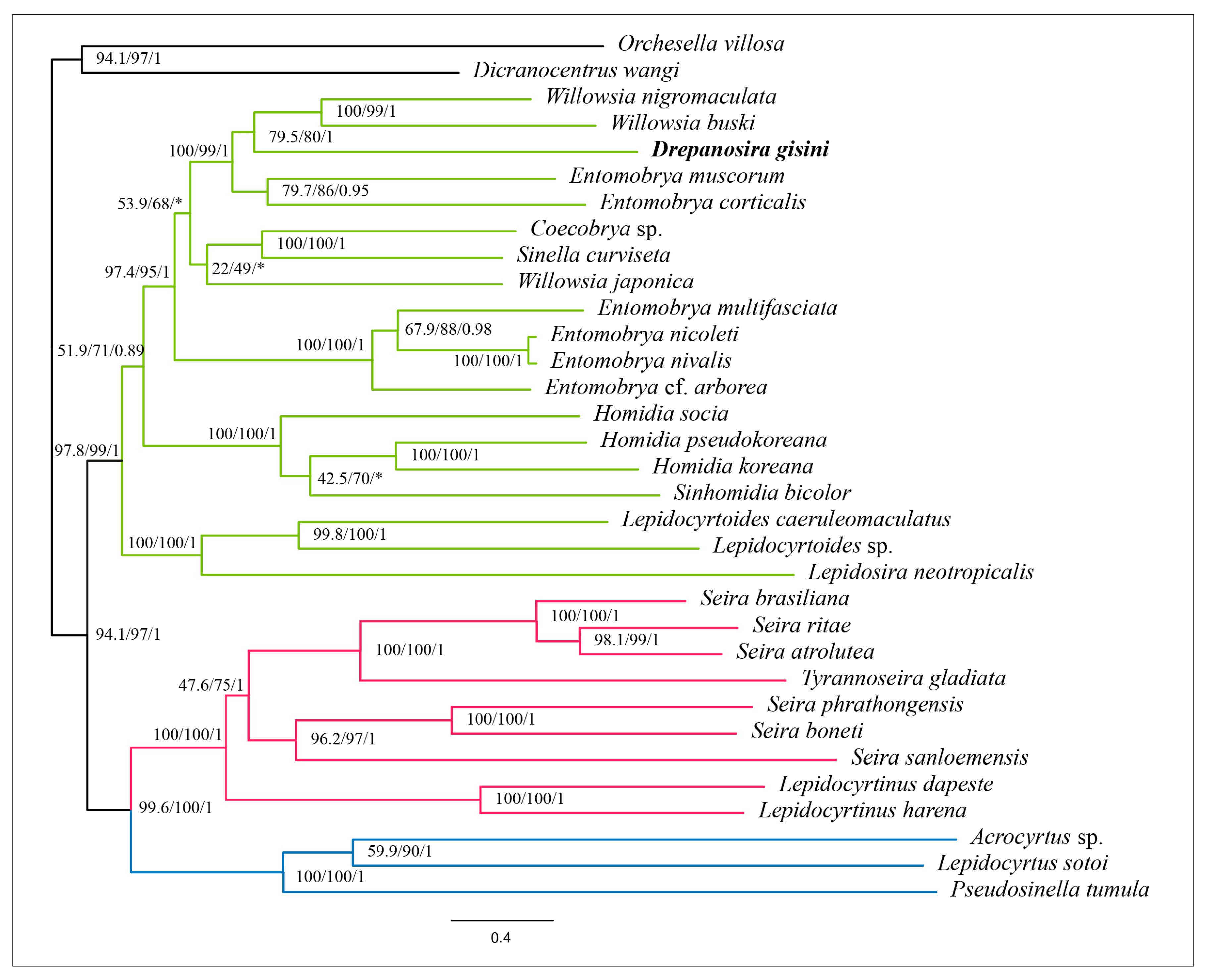
Our ML and BI analyses achieved similar topologies, with the exception of three branches with lower support inside Entomobryinae. Such results and the main ML tree are illustrated in Figure 2. Our analyses retrieved the sampled Orchesellidae and Entomobryidae as independent families, with high ML and absolute BI node support, respectively. Within Entomobryidae, we found the following topology for the sampled subfamilies with high (ML) to absolute (BI) node support: Entomobryinae + (Seirinae + Lepidocyrtinae). Within Entomobryinae, our data support both Willowsia and Entomobrya Rondani, 1961 as polyphyletic taxa, and Homidia Börner, 1906 as a paraphyletic taxon. Also, a few nodes were retrieved with low support, suggesting our dataset and/or sampled genes could not resolve entirely the internal phylogeny of the subfamily. Even so, branches representing more basal Entomobryinae (one gathering Lepidocyrtoides Schött, 1917 and Lepidosira Schött, 1925 and another gathering Homidia Börner, 1906 and Sinhomidia Zhang, 2009 taxa) were found with absolute ML and BI node support. The same occurs to the branch gathering part of Willowsia, Drepanosira gisini and part of Entomobrya taxa. In this sense, BI analysis put Drepanosira gisini as the sister group of part of Willowsia with absolute node support (but with low SH-aLRT and bootstrap values for ML analyses). Scaled and scaleless Entomobryinae were found mixed in the analyses, supporting independent origins for scales within the subfamily. Further results are presented in Figure 2.

3.3. Taxonomic Summary and Morphology of Drepanosira gisini

  • Superfamily Entomobryoidea Womersley, 1934 sensu Godeiro et al. 2023 [14]
  • Family Entomobryidae Tömösvary, 1882 sensu Godeiro et al. 2023 [14]
  • Subfamily Entomobryinae Schäffer, 1896 sensu Zhang & Deharveng 2015 [8]
  • Genus Drepanosira Bonet, 1942 [5]
  • Species Drepanosira gisini Nosek, 1964 [2]
Analyzed specimens: CHINA, Tibet (Xizang), 24.vii.2024 (sample 24XZ53), Bank of Qiaguicuo Lake, Xainza County, Nagqu City, 31°51’1.692’’ N, 88°19′30.324′′ E, 4500 m a.s.l, Yu, D., Qin, C., Zhang, Y. and Cheng, J. coll., entomological aspirators, two males; 20.vii.2024 (sample 24XZ38), Jiacuola Mountain, Lhatse County, Shigatse City, 29°4′25.212′′ N, 87°58′53.328′′ E, 4500 m a.s.l, Yu, D., Qin, C., Zhang, Y. and Cheng, J. coll. entomological aspirators, two males and one female.
Species diagnosis. Dark blue to blackish stripes covering anterior head, lateral Th. II–Abd. III, with central spots on Th. III, Abd. II–Abd. V, and dark patches on coxae; trochanters, femora and tibiotarsi laterally weakly pigmented. Labral papillae hook-like, labral chaetae a2 smaller than a1. Dorsal head with four A, five M and nine S mac. Labial papilla E with two ciliate guards, l.p. surpassing papilla basis; labial basal chaetae formula a15, MREL1L2. Dorsal trunk with plurimacrochaetosis, Abd. I–III with 9–11, 10 and five central mac, respectively. Trochanteral organ with up to 15 spine-like chaetae, unguiculi distally serrated. Manubrial plate with 4–5 chaetae and three pseudopores, ventro-distal manubrium with about 11 chaetae.
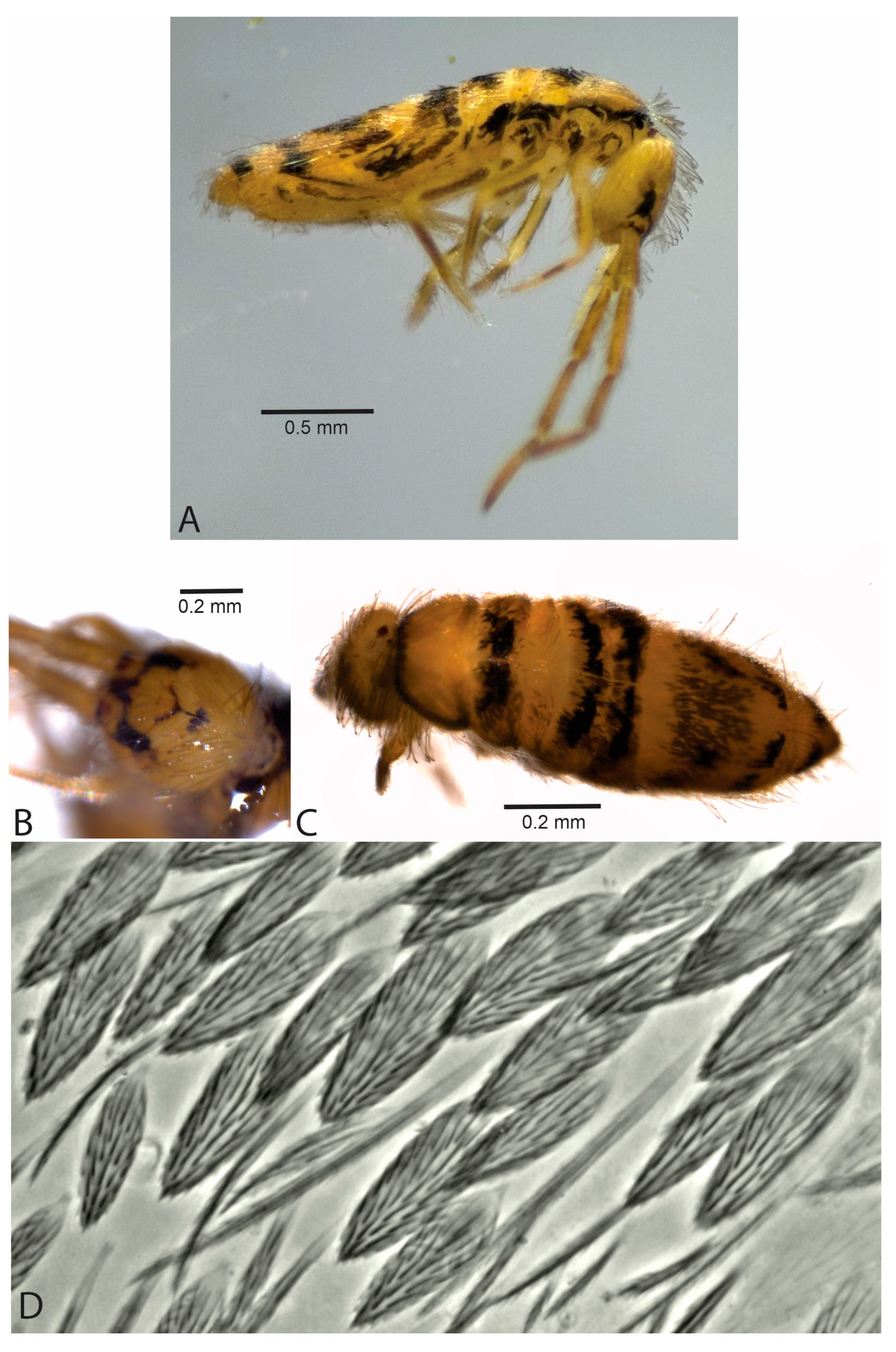
Additions to the original description (based on analyzed specimens). Specimens size (head + trunk) 3.6–5 mm (n = 5). Dark blue to blackish stripes covering anterior head, lateral Th. II–Abd. III, with central spots on Th. III, Abd. II–Abd. V, and dark patches on coxae; Ant. I–IV (proximally and distally), trochanters, femora and tibiotarsi, and manubrium weakly pigmented; dorsal head central region with two transverse pigmented arcs connected by a longitudinal line (Figure 3A–C). Lanceolated scales with medium-sized to elongate basal ribs (Figure 3D) covering dorsal head and trunk; antennae, ventral head, legs, manubrium (dorsally and ventrally) and dens scaleless.
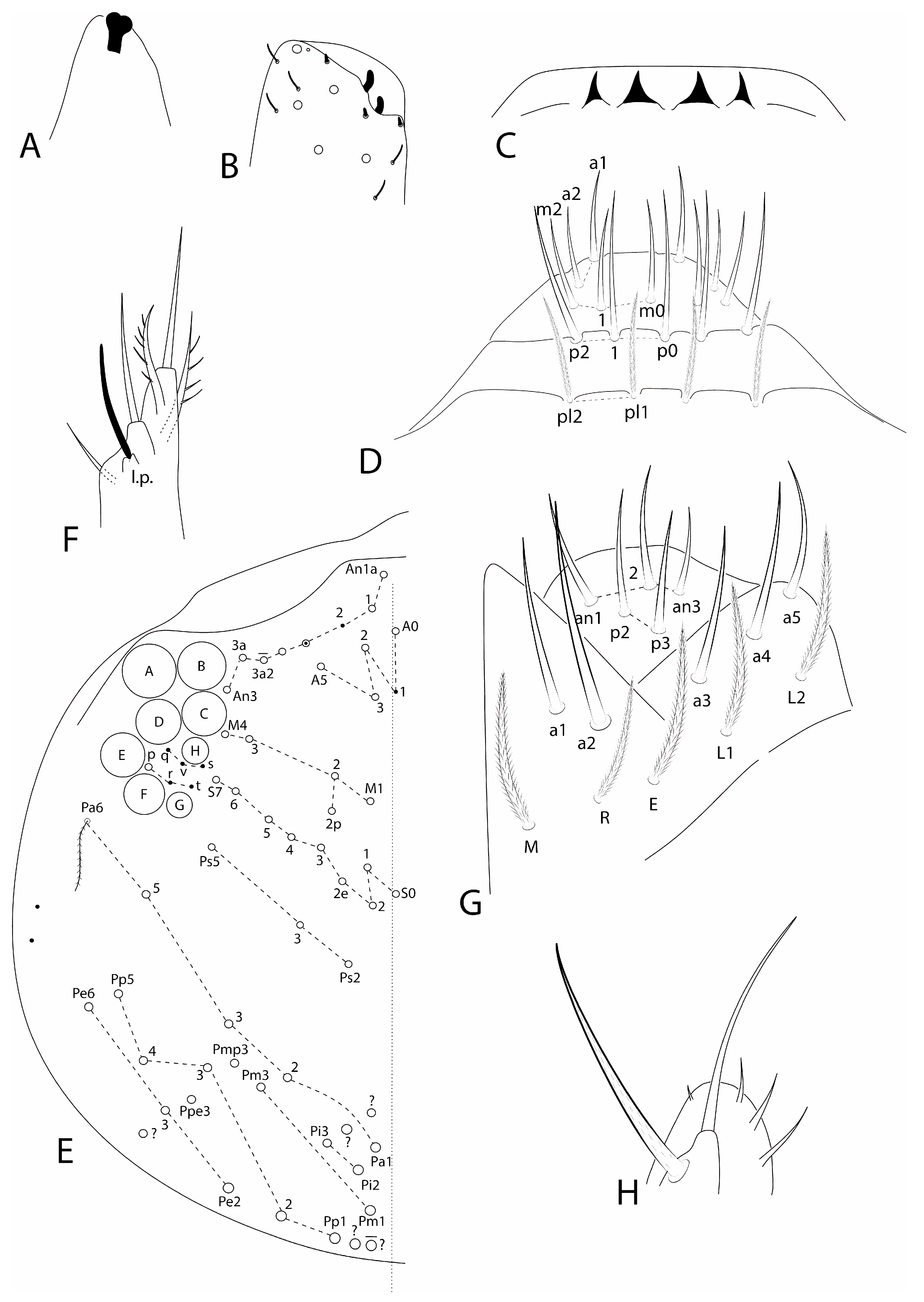
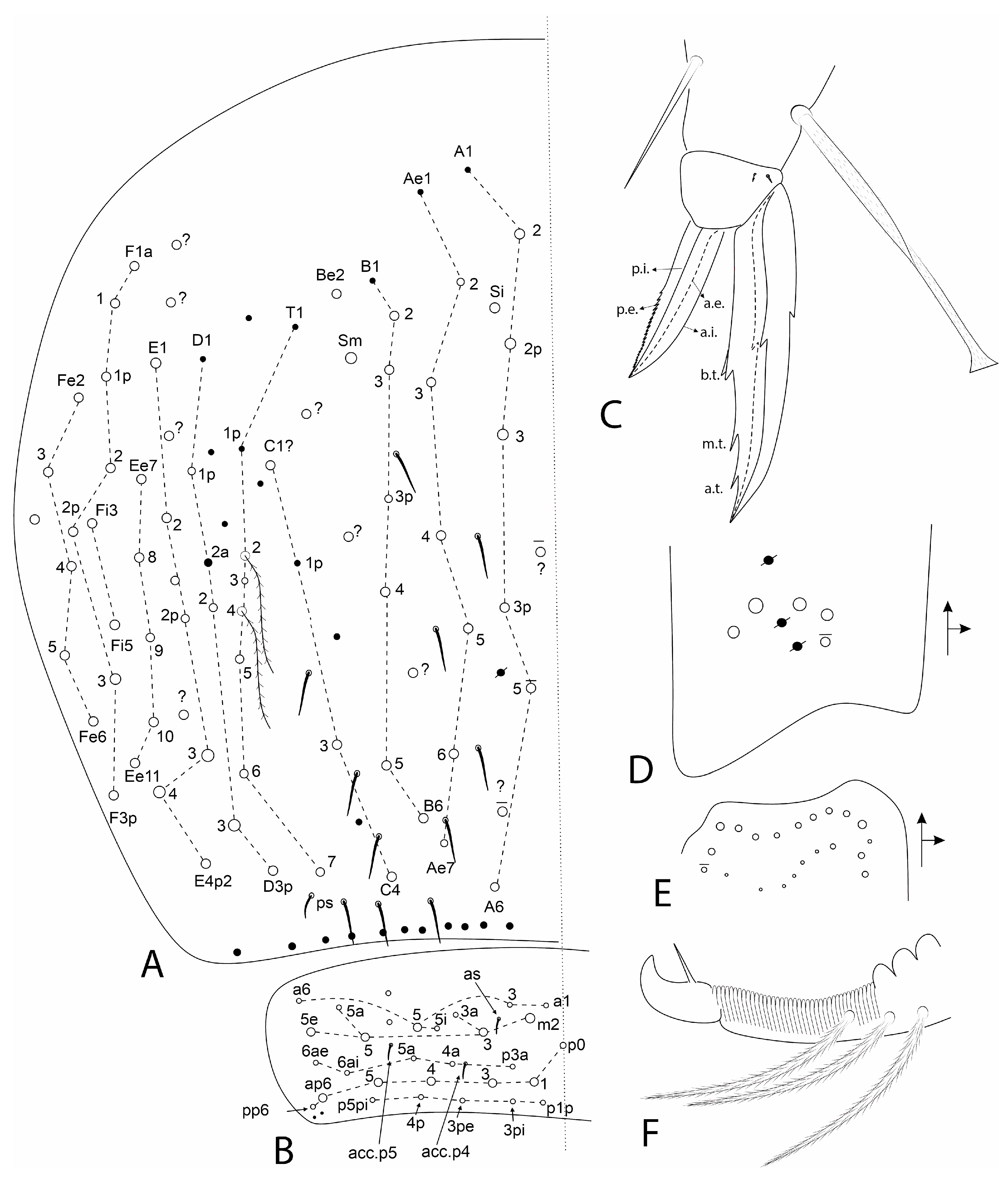
Head (Figure 4 and Figure 5). Antennae shorter than trunk, Ant. I–IV ratio (n = 2) as 1: 1.17–1.59: 1.17–1.62: 1.26–1.68. Ant IV with apically bilobed apical bulb (Figure 5A); Ant. III apical organ with two slightly swollen rod-like sens surrounded by three short blunt guard sens, plus at least five thin sens (Figure 5B). Labral papillae hook-like, inner papillae larger than lateral ones (Figure 5C); pre-labral (pl) chaetae ciliate and short, labral chaetae formula as five p, four m and four a smooth chaetae, p series longer than others, a2 shorter than a1 (Figure 5D). Clypeal chaetotaxy unclear. Eyes 8 + 8, A lens larger than others, G and H smaller than others, with six interocular chaetae (p as mac) (Figure 5E). Dorsal head macrochaetotaxy with 5–7 An (An1a3), four A (A03, A5), five M (M1M4), nine S (S07), three Ps (Ps23, Ps5), four Pa (Pa13, Pa5), two Pi (Pi23), two Pm1 (Pm1, Pm3), one Pmp (Pmp3), five Pp (Pp15) and three Pe (Pe23, Pe6) mac, plus 4–5 mac without clear homologies (?) (Figure 4 and Figure 5E). Labial papilla E with four guards, two apical unilaterally ciliate (with long cilia), two basal ones smooth, l.p. finger-shaped surpassing base of papilla (Figure 5F); labium with five proximal chaetae (an13, p23; an3 smaller than others); labial basomedial and basolateral fields chaetae formula as a15, MREL1L2, R slightly smaller than E, a2 larger than other a chaetae (Figure 5G). Maxillary outer lobe basal chaeta stronger and slightly longer than apical one, sublobal plate with four chaeta-like appendages (Figure 5H). Post-labial region with intense plurichaetosis, lacking smooth chaetae, cephalic groove with 8 + 8 surrounding ciliate chaetae.
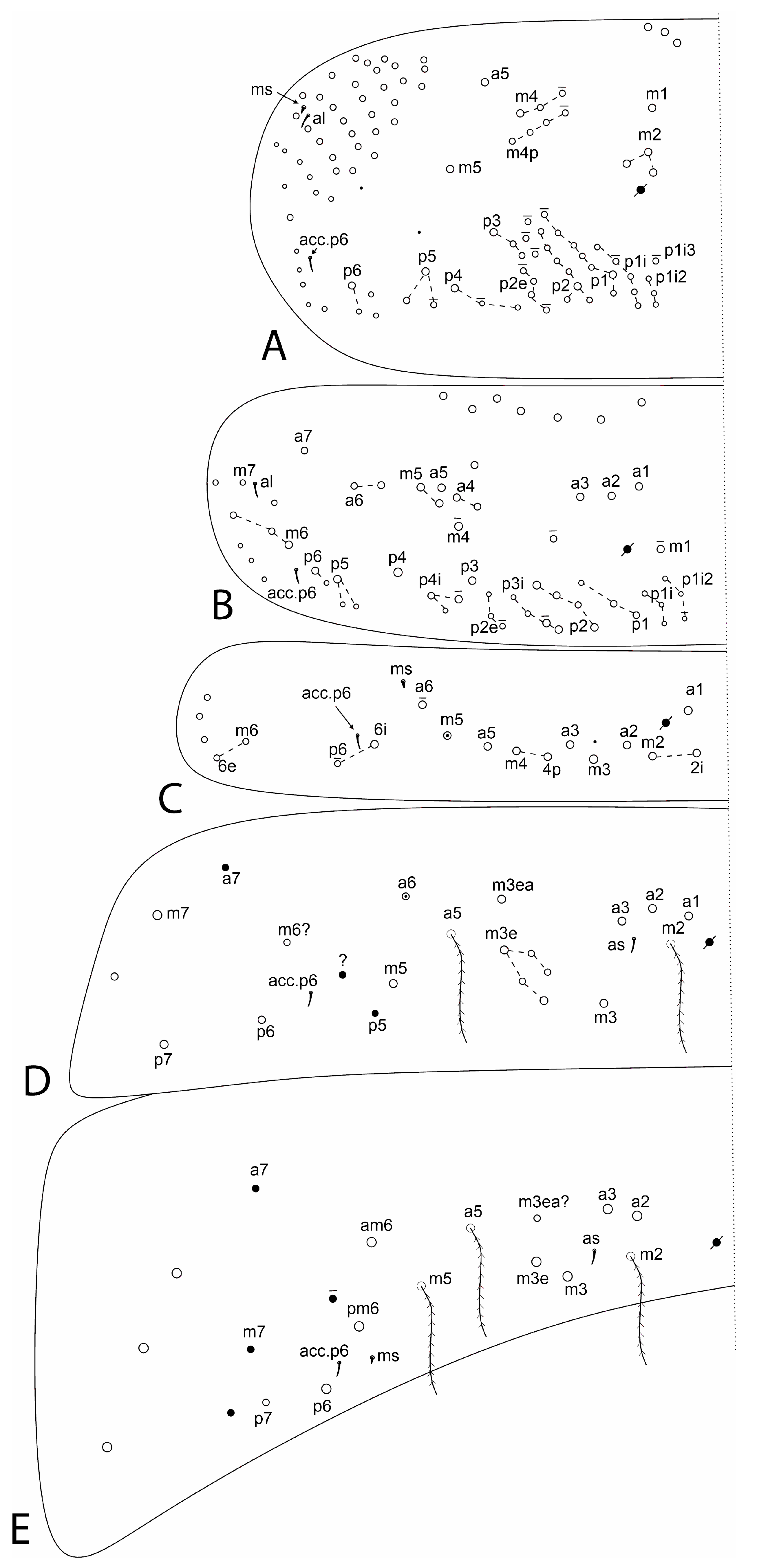
Trunk morphology and chaetotaxy (Figure 3A, Figure 4, Figure 6 and Figure 7A,B). Mesonotum regular-shaped, not projecting over head (Figure 3A). Th. II–Abd. V sens and ms formulae as 2,2|1,2,2,+,3 and 0,0|1,0,1,0,0 respectively (Figure 4, Figure 6 and Figure 7A,B). Th. II–III with intense plurimacrochaetosis, main mac series and variations marked in Figure 6A,B. Abd. I with 9–11 central mac (a13, a56, m2im5; m5 as mac or mic, a6 present or absent), other chaetae as in Figure 6C. Abd. II with 10 central mac (a13, m3m3ea); m5 as mac, a6 as mac or mic, other chaetae as in Figure 6D. Abd. III with five central mac (a23, m3m3ea?); am6, pm6 and p6 as mac, other chaetae as in Figure 6E. Abd. IV with intense plurimacrochaetosis, with 26–29 central mac (A23p, A56, Si, Ae27, B26, Sm, C1, C34, plus up to five mac with unclear homologies (?)), with 11 posterior mes, accessory chaetae of bothriotrichal complex not modified (not represented in the figure), other chaetae as in Figure 7A. Abd. V mac and mes differences unclear, main mac as m23, m55e, p1ap6, other chaetae as in Figure 7B. Ratio Abd. III–IV (n = 2) in the midline as 1: 3.85–4.26.
Trunk appendages (Figure 7C–F). Tibiotarsi undivided. Trochanteral organ with up to 15 spine-like chaetae. Pretarsus with two minute chaetae. Unguis b.t. subequal, on distal ½, m.t. slightly longer and thinner than b.t., on distal ¼, a.t. slightly smaller than m.t., on distal ⅛; lateral teeth underdeveloped, dorsal teeth present (Figure 7E). Unguiculus ai, ae and pi lamellae acuminate and smooth, pe distal half slightly serrated (Figure 7E). Tenaculum corpus with one rough chaeta, each ramus with four teeth. Ventral tube unclear. Manubrium without scales; manubrial plate with 4–5 regular ciliate chaetae and three pseudopores (Figure 7D), ventro-apical manubrium with about 11 ciliate chaetae, subapical region with 9–10 ciliate chaetae (Figure 7E). Dens without spines or other clearly modified chaetae, mucro typically falcate, mucronal spine slightly surpassing the mucro tooth (Figure 7F).
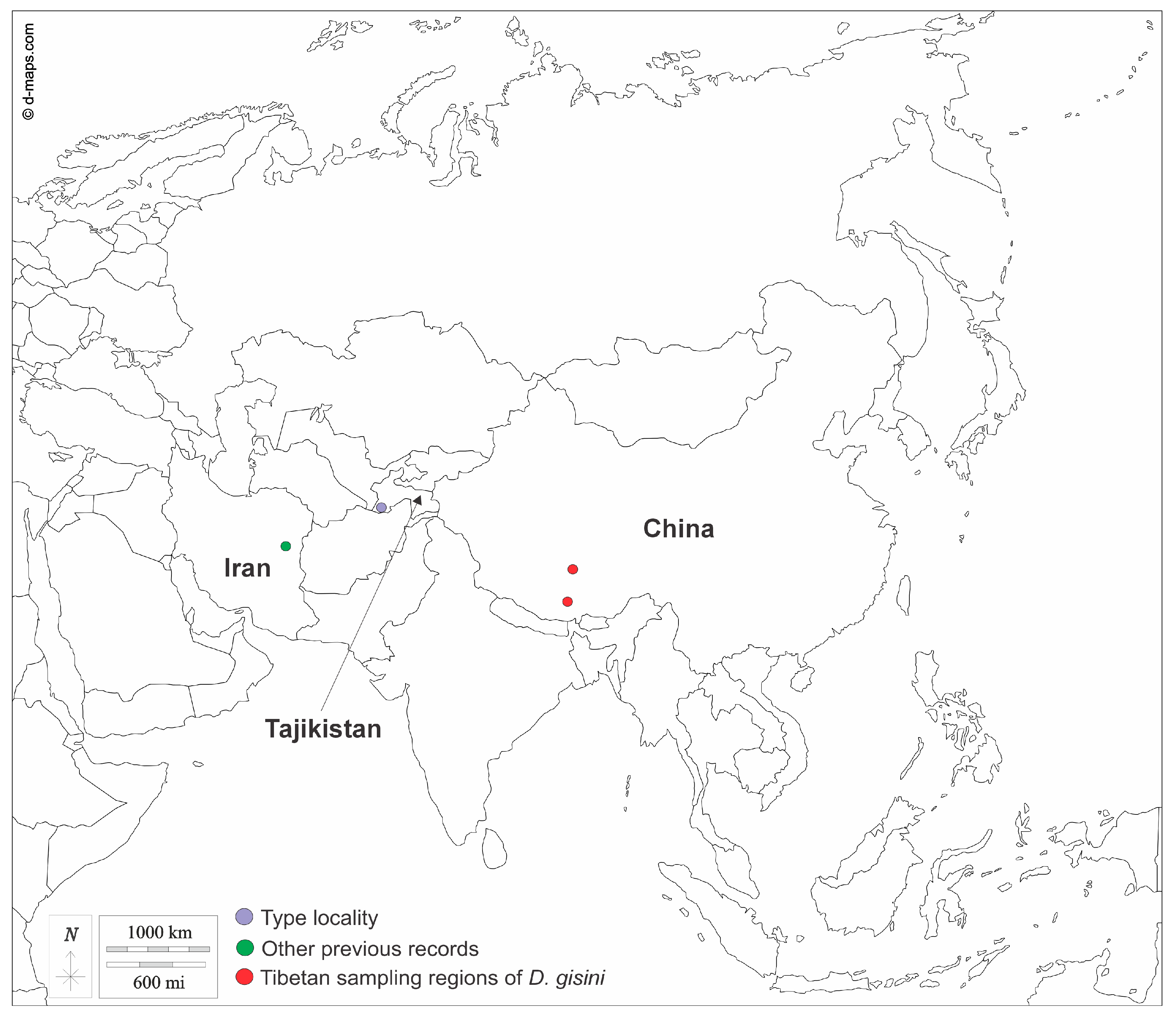
Remarks. Although our specimens were collected from Tibet, approximately 2,400 km from the species’ type locality (Figure 8), the topographic connection between Tajikistan and this region, together with their overall morphology, support their identification as Drepanosira gisini. The Pamir Mountains of Tajikistan are partially connected with the Himalayan mountain range of Tibet by the Pamir Knot [61]. Records from Iran further support a widespread distribution of the species across Asia [62]. The overall morphology depicted by Nosek to D. gisini matches our specimens, except for the antennal pigmentation, which is slightly different between both populations [2]. Even though the populations were found far apart, in the absence of further features able to confidently separate them into different entities, we chose to consider them as belonging to the same species.

4. Discussion

4.1. Mitogenome of Drepanosira gisini

Here, we report the first characterization of the mitochondrial genome for a species of the genus Drepanosira. Gene arrangement largely conforms to the conserved pattern observed in Entomobryinae mitogenomes [52,57,62,63]. Drepanosira gisini represents the 12th mitochondrial genome of Entomobryinae publicly available in NCBI as of 27 March 2026. This highlights the still limited representation of mitogenomic data within this diverse group [4]. We stress the importance of submitting accurate and well-curated mitochondrial sequences to public databases. Even when the primary objective of a study is broader—such as whole-genome assembly—the inclusion and proper annotation of mitochondrial genomes can provide valuable resources for future research.
Integrative taxonomy has proven to be a powerful approach for studying soil invertebrates, particularly minute organisms such as Collembola [51,52]. However, assembling mitochondrial genomes from raw whole-genome sequencing data remains technically challenging and is not accessible to all researchers. Therefore, it is crucial to continuously enrich publicly available databases at all levels, from DNA barcode repositories to complete genomic datasets. Expanding these resources will facilitate taxonomic, phylogenetic, and evolutionary studies, ultimately advancing our understanding of soil biodiversity.

4.2. Phylogeny of Entomobryinae and Drepanosira

Our results endorse previous studies which also found Entomobryinae holding scaled and unscaled genera mixed in the analyses, like in [8,9,10,11,12,13,63,64,65]. Our tree, together with the cited studies, supports not only that Entomobryoidea as a whole has independent origins of body scales but also that Entomobryinae underwent the same process. Scales, overall plurichaetosis and body pigmentation are some of the main adaptations of springtails to epiedaphic environments, providing some level of protection against UV radiation and dehydration [66]. In this sense, scales represent an important ecological trait within Entomobryoidea, enabling different lineages to colonize topsoil and atmobiotic habitats, which likely drive the acquisition and maintenance of body scales in different internal branches of the superfamily.
Our tree found three Entomobryinae genera as polyphyletic taxa: the scaled Willowsia and the scaleless Entomobrya. Such results were also obtained by recent studies, like in [8,9,10,11,13,63,65]. Both genera hold species with widely different dorsal chaetotaxies [16,67], somewhat supporting their polyphyletic status. In the case of Willowsia, even the scale morphology varies, a condition which was used, combined with other features, to separate the species of the genus into different groups [67,68]. We also found Homidia as a paraphyletic taxon, with Sinhomidia Zhang, 2009 as an ingroup of this lineage. The low support values of this branch, combined with the incongruence between the ML and BI topologies, prevent us from drawing further conclusions regarding the paraphyly of Homidia. Nevertheless, similar results were also obtained by [63], suggesting that further investigation is required to resolve the relationships between these genera. Similarly, Coecobrya Yosii, 1956 and Sinella Brook, 1882 may constitute a single genus, with the former nested within the latter, as partially observed in [63]. Nevertheless, our dataset, limited to a single species of each genus, could not properly test this hypothesis. The few incongruences observed in the deeper nodes of our trees may also be explained by the exclusive use of mitochondrial markers. When analyzed independently, mitochondrial genes generally perform less reliably (in terms of support values) than nuclear markers; however, they can still resolve certain branches that remain unresolved in nuclear datasets [69]. Notably, previous studies have shown that combining mitochondrial and nuclear sequences can yield more robust phylogenetic inferences, reducing artifacts in cases where the two data types produce conflicting topologies [69,70].
We found Drepanosira gisini within Entomobryinae and closely related to Willowsia nigromaculata (Lubbock, 1873) and W. buski (Lubbock, 1870) based on mitogenomes (see Figure 2). The latter two species were regarded as holding scales of “the long basal rib type” by [67], one of the groups of the Willowsia complex. This scale morphology is somewhat consistent with that we observed in D. gisini specimens (see Figure 3D) and, together with the unmodified accessory chaetae of the Abd. IV bothriotrichal complex, supports a close morphological affinity of Drepanosira with W. nigromaculata and W. buski. However, it is worth noting that the dorsal macrochaetotaxy of these Willowsia species is remarkably less complex than the one seen in D. gisini, a feature which suggests a more basal position of Drepanosira compared with Willowsia species with scales of “the long basal rib type” [15]. This hypothesis is also supported by our tree (see Figure 2).

4.3. Drepanosira gisini Morphology

Our morphological description of the dorsal chaetotaxy of D. gisini resembles that of Drepanosira ornata (Bonet, 1930), depicted by [15]. Both species share intense plurimacrochaetosis, but can be separated especially by: Th. II without a5i group mac in D. gisini (with four mac in this group in D. ornata); anterior border of Th. III with extra mac, a5 complex without multiplets in D. gisini (without extra mac on the anterior border, a5 complex with two multiplets in D. ornata); Abd. I without a5i (with it in D. ornata); Abd. II m3e group with five mac in D. gisini (3–4 in D. ornata); and Abd. IV with 26–29 central mac in D. gisini (vs. 18–19 in D. ornata) [15].
Compared with more recent descriptions and redescriptions of Drepanosira taxa, like the ones provided by [3], Drepanosira gisini also shows an overall more complex macrochaetotaxy. For instance, the species hold on anterior head M4, M2i and Ps3 mac (M2i and Ps3 absent in D. ravi Baquero & Jordana, 2015 and D. shimlai Baquero & Jordana, 2015, M4 absent in D. hussi Neuhertz, 1976); Th. II m12 group with four mac (2–3 D. ravi, three in D. shimlai and D. hussi); Abd. II with 10 central mac (six in D. ravi, 5–6 in D. shimlai, five in D. hussi); Abd. III with five central mac (three in D. ravi and D. hussi, two in D. shimlai); and Abd. IV with 26–29 central mac (12 in D. ravi, up to eight in D. shimlai) [3].
The complex dorsal macrochaetotaxy combined with hook-like labral papillae of D. gisini resembles more basal Entomobryoidea, especially some scaleless Orchesellidae [12]. Such traits are likely plesiomorphies within Entomobryoidea, as they somewhat resemble the morphology of Isotominae and are shared by some genera of Orchesellidae [12,15]. Even so, these traits are also observed in some Entomobryinae other than Drepanosira [16], suggesting that they may represent either retained plesiomorphies or reversals (homoplasy), depending on the lineage. On the other hand, the presence of lanceolate ribbed scales, tergal sens formula of 2,2|1,2,2,+,3 and ms formula of 0,0|1,0,1,0,0 from Th. II to Abd. V, tenaculum with a single chaeta, together with molecular signals strongly support the placement of Drepanosira within Entomobryinae [8,12], a result consistent with our molecular analyses (Figure 2).

5. Conclusions

In this study, we investigated the phylogenetics, systematics, and morphology of Drepanosira gisini in detail for the first time. Our main findings, based on both molecular and morphological analyses, indicate that this species and, consequently, at least part of the genus, belong to Entomobryinae and is closely related to Willowsia species bearing scales of “the long basal rib type”. The detailed mitogenome and dorsal chaetotaxy of D. gisini are on par with other previously studied Entomobryoidea. However, the complexity of the latter, together with the presence of well-developed hook-like labral papillae, may initially suggest a more basal position of the species within the superfamily. Nevertheless, molecular data, along with the presence of lanceolate ribbed scales, tergal sens and ms formulae, and tenaculum chaetotaxy, not only confirm that the species belongs to Entomobryinae but also indicate that it occupies a more derived position within the phylogeny of the group.

Author Contributions

Conceptualization, N.N.G. and B.C.B.; methodology, N.N.G. and B.C.B.; software, N.N.G. and B.C.B.; validation, N.N.G. and B.C.B.; formal analysis, N.N.G. and B.C.B.; investigation, N.N.G. and B.C.B.; resources, N.N.G.; data curation, N.N.G. and B.C.B.; writing—original draft preparation, N.N.G. and B.C.B.; writing—review and editing, N.N.G. and B.C.B.; visualization, N.N.G. and B.C.B.; supervision, N.N.G. and B.C.B.; project administration, N.N.G.; funding acquisition, N.N.G. All authors have read and agreed to the published version of the manuscript.

Funding

This research was funded by the National Natural Science Foundation of China research fund for international young scientists, grant number 32350410418 (N.N.G. project); and by the National Council for Scientific and Technological Development (CNPq), grant number 309114/2021-7 (B.C.B. project).

Institutional Review Board Statement

Ethical review and approval were not required for this study under Chinese law, which does not mandate institutional ethics committee permission for taxonomical/systematics studies involving microarthropods.

Data Availability Statement

All data are contained within the article. The mitogenome and the raw sequencing data of D. gisini will be available in the NCBI repository under A.N. PZ065976 and SRR37442562, respectively.

Acknowledgments

We would like to thank Daoyuan Yu, Chunyan Qin, Yating Zhang, and Jingxiang Cheng for collecting the studied specimens of D. gisini.

Conflicts of Interest

The authors declare no conflicts of interest.

Abbreviations

The abbreviations used in the morphological depiction of D. gisini are: Abd. —abdominal segment(s); Ant.—antennal segment(s); l.p.—lateral process of labial papilla E; mac—macrochaeta(e); mes—mesochaeta(e); mic—microchaeta(e); ms—S-microchaeta(e); sens—ordinary S-chaeta(e); and Th.—thoracic segment(s). For the empodial complex morphology, other abbreviations used are: b.t.—ungual basal teeth; m.t.—ungual medial tooth; a.t.—ungual apical tooth; a.e.—unguiculus antero-external lamella; a.i.—unguiculus antero-internal lamella; p.e.—unguiculus postero-external lamella; p.i.—unguiculus postero-internal lamella. Chaetae labels and other relevant morphological features are marked in bold in the text. Morphological depiction in figures and text represents half body, except for pre-labral and labral structures.

Appendix A

Table A1. Best substitution model for each partition by codon suggested by Model Finder for the maximum likelihood analyses.
GTR+F+R4ATP6_pos1_ATP8_pos1_ND2_pos1_ND3_pos1_ND6_pos1
GTR+F+I+G4ATP6_pos2_ATP8_pos2_ND2_pos2_ND3_pos2_ND6_pos2
GTR+F+I+R4ATP6_pos3_COX1_pos3
GTR+F+R3ATP8_pos3_ND2_pos3_ND3_pos3_ND6_pos3
GTR+F+R4COX1_pos1_COX2_pos1_COX3_pos1_CYTB_pos1
GTR+F+R3COX1_pos2_COX2_pos2_COX3_pos2_CYTB_pos2
GTR+F+I+R5COX2_pos3_COX3_pos3_CYTB_pos3
GTR+F+I+G4ND1_pos1_ND4_pos1_ND4L_pos1_ND5_pos1
GTR+F+I+G4ND1_pos2_ND4_pos2_ND4L_pos2_ND5_pos2
GTR+F+R4ND1_pos3_ND4_pos3_ND4L_pos3_ND5_pos3
Table A2. Complete annotation table of Drepanosira gisini mitogenome.
StartEndLength (bp)StrandGene Name
49756165+trnI(gau)
55862669trnQ(uug)
62369169+trnM(cau)
6971684988+ND2
1682174766+trnW(uca)
1746180863trnC(gca)
1808187164trnY(gua)
187434131540+COX1
3408347164+trnL(uaa)
34714155685+COX2
4153422472+trnK(cuu)
4223429371+trnD(guc)
42934458166+ATP8
44515132682+ATP6
51315918788+COX3
5918598164+trnG(ucc)
59816326346+ND3
6324638461+trnA(ugc)
6384644764+trnR(ucg)
6447651468+trnN(guu)
6514658168+trnS(gcu)
6581664565+trnE(uuc)
6644670663trnF(gaa)
670584081704ND5
8408847366trnH(gug)
847297521281ND4
982010,096277ND4L
10,10410,16764+trnT(ugu)
10,16710,23165trnP(ugg)
10,23310,713481+ND6
10,71611,8501135+CYTB
11,84811,91972+trnS(uga)
11,94412,859916ND1
12,88312,94866trnL(uag)
12,89214,1771286l-rRNA
14,14614,21368trnV(uac)
14,20914,985777s-rRNA
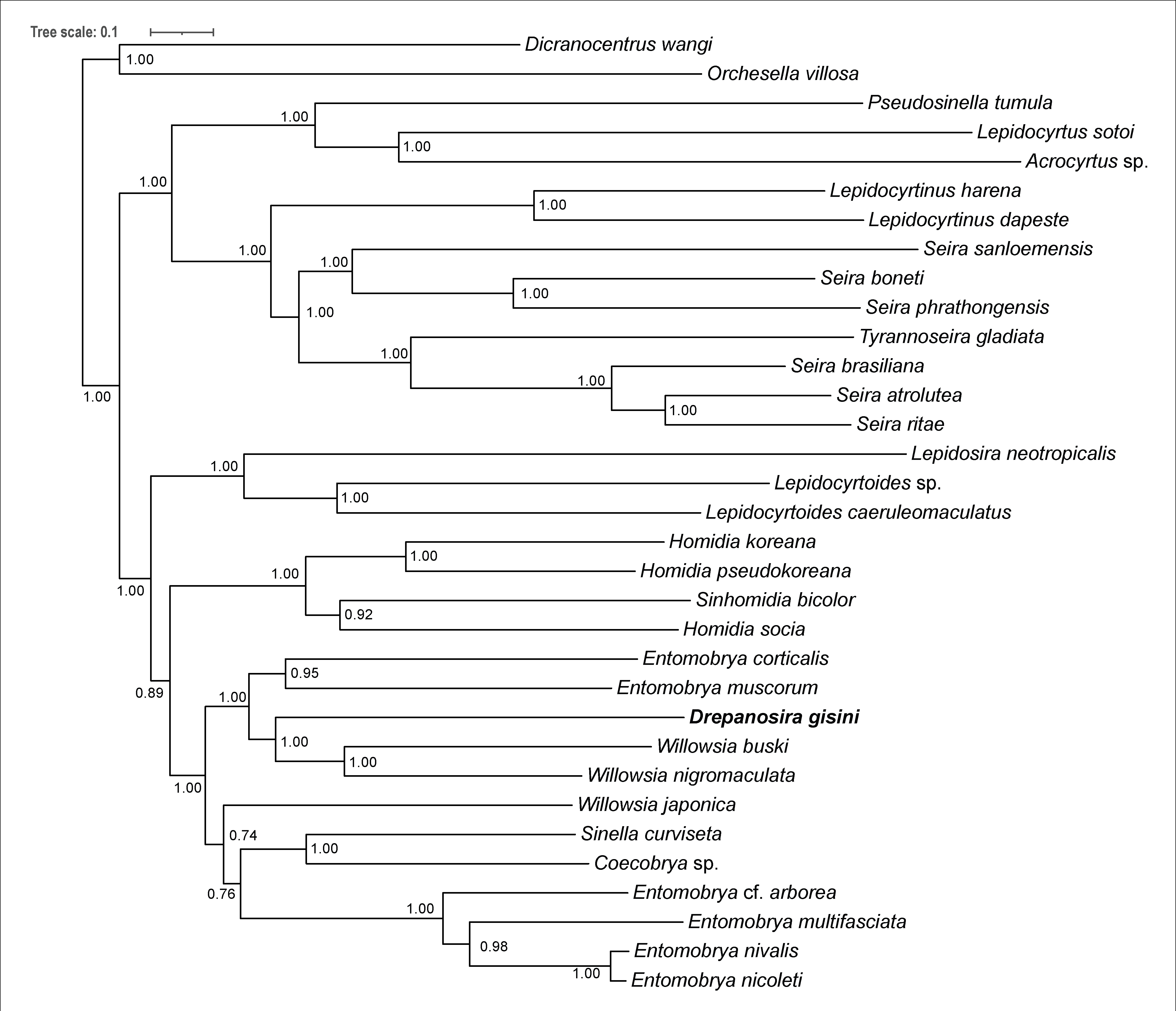
Figure A1. Phylogenetic placement of Drepanosira gisini (in bold) within Entomobryidae using Bayesian inference. Numbers at the nodes represent posterior probabilities.
Diversity 18 00247 g0a1

References

  1. Stach, J. Contribution à l’étude de la faune d’Afghanistan. Acta Zool. Cracov. 1963, 8, 337–349. [Google Scholar]
  2. Nosek, J. Einige neue Collembolenarten aus Tadschikistan. Zool. Anz. 1964, 172, 140–146. [Google Scholar]
  3. Baquero, E.; Mandal, G.; Jordana, R. Entomobryoidea (Collembola) from Himachal Pradesh (India) in the Himalayas. Zootaxa 2015, 4027, 1–41. [Google Scholar] [CrossRef] [PubMed]
  4. Bellinger, P.F.; Christiansen, K.A.; Janssens, F. Checklist of the Collembola of the World. 1996–2024. Available online: http://www.collembola.org (accessed on 15 February 2026).
  5. Bonet, F. Notas sinonimicas sobre el ordem colembolos. Ciencia 1942, 3, 56–59. [Google Scholar]
  6. Yoshii, R.; Suhardjono, Y.R. Notes on the Collembolan Fauna of Indonesia and its vicinities I. Miscellaneous notes, with special references to Seirini and Lepidocyrtini. Acta Zool. Asiae Orient. 1989, 1, 23–90. [Google Scholar]
  7. Soto-Adames, F.N.; Barra, J.-A.; Christiansen, K.A.; Jordana, R. Suprageneric Classification of Collembola Entomobryomorpha. Ann. Entomol. Soc. Am. 2008, 101, 501–513. [Google Scholar] [CrossRef]
  8. Zhang, F.; Deharveng, L. Systematic revision of Entomobryidae (Collembola) by integrating molecular and new morphological evidence. Zool. Scr. 2015, 44, 298–311. [Google Scholar] [CrossRef]
  9. Zhang, F.; Sun, D.D.; Yu, D.Y.; Wang, B.X. Molecular phylogeny supports S-chaetae as a key character better than jumping organs and body scales in classification of Entomobryoidea (Collembola). Sci. Rep. 2015, 5, 12471. [Google Scholar] [CrossRef]
  10. Zhang, F.; Pan, Z.; Wu, J.; Ding, Y.; Yu, D.; Wang, B. Dental scales could occur in all scaled subfamilies of Entomobryidae (Collembola): New definition of Entomobryinae with description of a new genus and three new species. Invertebr. Syst. 2016, 30, 598–615. [Google Scholar] [CrossRef]
  11. Zhang, F.; Ma, Y.; Greenslade, P. New Australian Paronellidae (Collembola) reveal anomalies in existing tribal diagnoses. Invertebr. Syst. 2017, 31, 375–393. [Google Scholar] [CrossRef]
  12. Zhang, F.; Bellini, B.C.; Soto-Adames, F.N. New insights into the systematics of Entomobryoidea (Collembola: Entomobryomorpha): First instar chaetotaxy, homology and classification. Zool. Syst. 2019, 44, 249–278. [Google Scholar] [CrossRef]
  13. Godeiro, N.N.; Bellini, B.C.; Ding, N.; Xu, C.; Ding, Y.; Zhang, F. A mitogenomic phylogeny of the Entomobryoidea (Collembola): A comparative perspective. Zool. Scr. 2021, 50, 658–666. [Google Scholar] [CrossRef]
  14. Godeiro, N.N.; Ding, Y.; Cipola, N.G.; Jantarit, S.; Bellini, B.C.; Zhang, F. Phylogenomics and systematics of Entomobryoidea (Collembola): Marker design, phylogeny and classification. Cladistics 2023, 38, 101–115. [Google Scholar] [CrossRef]
  15. Szeptycki, A. Chaetotaxy of the Entomobryidae and Its Phylogenetical Significance. Morpho-Systematic Studies of Collembola. IV; Institute of Systematics and Evolution of Animals, Polish Academy of Sciences: Krakow, Poland, 1979; 219p. [Google Scholar]
  16. Jordana, R. Synopses of Palaearctic Collembola: Capbryinae & Entomobryini. Soil Org. 2012, 84, 1–390. [Google Scholar]
  17. Fjellberg, A. The Labial Palp in Collembola. Zool. Anz. 1999, 237, 309–330. [Google Scholar]
  18. Gisin, H. Espèces nouvelles et lignées évolutives de Pseudosinella endogés. Mem. Estud. Mus. Zool. Univ. Coimbra 1967, 301, 5–25. [Google Scholar]
  19. Zhang, F.; Pan, Z. Homology of labial chaetae in Entomobryoidea (Collembola). Zootaxa 2020, 4766, 498–500. [Google Scholar] [CrossRef]
  20. Yosii, R. Structure and chaetotaxy of labrum as the taxonomic character of Collembola. Rev. Écol. Biol. Sol. 1976, 13, 233–239. [Google Scholar]
  21. Mari Mutt, J.A. A revision of the genus Dicranocentrus Schött (Insecta: Collembola: Entomobryidae). Agric. Exp. Stn. Bull. 1979, 259, 1–79. [Google Scholar]
  22. Jordana, R.; Baquero, E. A proposal of characters for taxonomic identification of Entomobrya species (Collembola, Entomobryomorpha), with description of a new species. Abh. Ber. Naturkundemus. Görlitz 2005, 76, 117–134. [Google Scholar]
  23. Bellini, B.C.; Greenslade, P.; Baquero, E.; Jordana, R.; Souza, P.G.C. A synthesis of the current knowledge on the Australian Orchesellidae (Collembola, Entomobryoidea). Zootaxa 2022, 5115, 221–257. [Google Scholar] [CrossRef]
  24. Viana, S.S.; Morais, J.W.; Cipola, N.G. Taxonomic revision of Entomobrya Rondani, 1861 species (Collembola: Entomobryidae: Entomobryinae) from Brazilian Amazon. Zootaxa 2024, 5452, 1–110. [Google Scholar] [CrossRef]
  25. Szeptycki, A. Morpho-systematic studies on Collembola III. Body chaetotaxy in the first instars of several genera of the Entomobryomorpha. Acta Zool. Cracov. 1972, 17, 341–372. [Google Scholar]
  26. Meng, G.; Li, Y.; Yang, C.; Liu, S. MitoZ: A toolkit for animal mitochondrial genome assembly, annotation and visualization. Nucleic Acids Res. 2019, 47, W451–W455. [Google Scholar] [CrossRef]
  27. Chen, S.; Zhou, Y.; Chen, Y.; Gu, J. Fastp: An ultra-fast all-in-one FASTQ preprocessor. Bioinformatics 2018, 34, i884–i890. [Google Scholar] [CrossRef]
  28. Li, D.; Liu, C.M.; Luo, R.; Sadakane, K.; Lam, T.W. MEGAHIT: An ultra-fast single-node solution for large and complex metagenomics assembly via succinct de Bruijn graph. Bioinformatics 2015, 31, 1674–1676. [Google Scholar] [CrossRef]
  29. Wheeler, T.J.; Eddy, S.R. Nhmmer: DNA homology search with profile HMMs. Bioinformatics 2013, 29, 2487–2489. [Google Scholar] [CrossRef]
  30. Gertz, E.M.; Yu, Y.K.; Agarwala, R.; Schäffer, A.A.; Altschul, S.F. Composition-based statistics and translated nucleotide searches: Improving the TBLASTN module of BLAST. BMC Biol. 2006, 4, 41. [Google Scholar] [CrossRef] [PubMed]
  31. Birney, E.; Clamp, M.; Durbin, R. GeneWise and Genomewise. Genome Res. 2004, 14, 988–995. [Google Scholar] [CrossRef] [PubMed]
  32. Nawrocki, E.P.; Eddy, S.R. Infernal 1.1:100-fold faster RNA homology searches. Bioinformatics 2013, 29, 2933–2935. [Google Scholar] [CrossRef] [PubMed]
  33. Jühling, F.; Putz, J.; Bernt, M.; Donath, A.; Middendorf, M.; Florentz, C.; Stadler, P.F. Improved systematic tRNA gene annotation allows new insights into the evolution of mitochondrial tRNA structures and into the mechanisms of mitochondrial genome rearrangements. Nucleic Acids Res. 2012, 40, 2833–2845. [Google Scholar] [CrossRef]
  34. Krzywinski, M.; Schein, J.; Birol, I.; Connors, J.; Gascoyne, R.; Horsman, D.; Jones, S.J.; Marra, M.A. Circos: An information aesthetic for comparative genomics. Genome Res. 2009, 19, 1639–1645. [Google Scholar] [CrossRef] [PubMed]
  35. Li, H.; Durbin, R. Fast and accurate short read alignment with Burrows-Wheeler transform. Bioinformatics 2009, 25, 1754–1760. [Google Scholar] [CrossRef]
  36. Li, H.; Handsaker, B.; Wysoker, A.; Fennell, T.; Ruan, J.; Homer, N.; Marth, G.; Abecasis, G.; Durbin, R. The sequence alignment/map format and SAMtools. Bioinformatics 2009, 25, 2078–2079. [Google Scholar] [CrossRef] [PubMed]
  37. Huerta-Cepas, J.; Serra, F.; Bork, P. ETE 3: Reconstruction, analysis and visualization of phylogenomic data. Mol. Biol. Evol. 2016, 33, 1635–1638. [Google Scholar] [CrossRef]
  38. Katoh, K.; Standley, D.M. MAFFT multiple sequence alignment software version 7: Improvements in performance and usability. Mol. Biol. Evol. 2013, 30, 772–780. [Google Scholar] [CrossRef]
  39. Capella-Gutiérrez, S.; Silla-Martínez, J.M.; Gabaldón, T. trimAl: A tool for automated alignment trimming in large-scale phylogenetic analyses. Bioinformatics 2009, 25, 1972–1973. [Google Scholar] [CrossRef] [PubMed]
  40. Kück, P.; Longo, G.C. FASconCAT-G: Extensive functions for multiple sequence alignment preparations concerning phylogenetic studies. Front. Zool. 2014, 11, 81. [Google Scholar] [CrossRef]
  41. Minh, B.Q.; Schmidt, H.A.; Chernomor, O.; Schrempf, D.; Woodhams, M.D.; von Haeseler, A.; Lanfear, R. IQ-TREE 2: New Models and Efficient Methods for Phylogenetic Inference in the Genomic Era. Mol. Biol. Evol. 2020, 37, 1530–1534. [Google Scholar] [CrossRef]
  42. Kalyaanamoorthy, S.; Minh, B.Q.; Wong, T.K.; von Haeseler, A.; Jermiin, L.S. ModelFinder: Fast model selection for accurate phylogenetic estimates. Nat. Methods 2017, 14, 587–589. [Google Scholar] [CrossRef]
  43. Guindon, S.; Dufayard, J.F.; Lefort, V.; Anisimova, M.; Hordijk, W.; Gascuel, O. New algorithms and methods to estimate maximum-likelihood phylogenies: Assessing the performance of PhyML 3.0. Syst. Biol. 2010, 59, 307–321. [Google Scholar] [CrossRef] [PubMed]
  44. Hoang, D.T.; Chernomor, O.; von Haeseler, A.; Minh, B.Q.; Vinh, L.S. UFBoot2: Improving the Ultrafast Bootstrap Approximation. Mol. Biol. Evol. 2018, 35, 518–522. [Google Scholar] [CrossRef] [PubMed]
  45. Ronquist, F.; Teslenko, M.; van der Mark, P.; Ayres, D.L.; Darling, A.; Höhna, S.; Larget, B.; Liu, L.; Suchard, M.A.; Huelsenbeck, J.P. MrBayes 3.2: Efficient Bayesian phylogenetic inference and model choice across a large model space. Syst. Biol. 2012, 61, 539–542. [Google Scholar] [CrossRef]
  46. Sun, X.; Yu, D.; Xie, Z.; Dong, J.; Ding, Y.; Yao, H.; Greenslade, P. Phylomitogenomic analyses on collembolan higher taxa with enhanced taxon sampling and discussion on method selection. PLoS ONE 2020, 15, e0230827. [Google Scholar] [CrossRef]
  47. Carapelli, A.; Liò, P.; Nardi, F.; van der Wath, E.; Frati, F. Phylogenetic analysis of mitochondrial protein coding genes confirms the reciprocal paraphyly of Hexapoda and Crustacea. BMC Evol. Biol. 2007, 7, S8. [Google Scholar] [CrossRef]
  48. Godeiro, N.N.; Pacheco, G.; Liu, S.; Cipola, N.G.; Berbel-Filho, W.M.; Zhang, F.; Gilbert, M.T.; Bellini, B.C. Phylogeny of Neotropical Seirinae (Collembola, Entomobryidae) based on mitochondrial genomes. Zool. Scr. 2020, 49, 329–339. [Google Scholar] [CrossRef]
  49. Godeiro, N.N.; Bu, Y.; Nilsai, A.; Deharveng, L.; Cipola, N.G. Systematics of Lepidocyrtinus boneti Denis, 1948 (Collembola, Seirinae) reveals a new position for the species within Seirinae. ZooKeys 2023, 1152, 97–118. [Google Scholar] [CrossRef]
  50. Bellini, B.C.; Cipola, N.G.; Jantarit, S.; da Cunha Santos, N.M.; Nilsai, A.; Cheng, H.; Godeiro, N.N. Exploring mitogenomic data to enhance the understanding of Seirinae (Collembola: Entomobryidae) evolution, distribution and taxonomy. Front. Zool. 2024, 21, 31. [Google Scholar] [CrossRef]
  51. Godeiro, N.N.; Zhang, F.; Cipola, N.G. First partial mitogenome of a new Seira Lubbock species (Collembola, Entomobryidae, Seirinae) from Cambodia reveals a possible separate lineage from the Neotropical Seirinae. Zootaxa 2020, 4890, 451–472. [Google Scholar] [CrossRef] [PubMed]
  52. Godeiro, N.N.; Xu, C.; Zhang, G.; Zhang, F. Mitogenomic features of three species of Entomobryoidea (Collembola) from China. Zootaxa 2022, 5120, 283–288. [Google Scholar] [CrossRef]
  53. Collins, G.; Schneider, C.; Boštjančić, L.L.; Burkhardt, U.; Christian, A.; Decker, P.; Ebersberger, I.; Hohberg, K.; Lecompte, O.; Merges, D. The MetaInvert soil invertebrate genome resource. Commun. Biol. 2023, 6, 1241. [Google Scholar] [CrossRef]
  54. Lee, I.; Koo, J.; Park, K.H. Complete mitochondrial genome of Homidia koreana. Mitochondrial DNA B 2022, 7, 135–137. [Google Scholar] [CrossRef] [PubMed]
  55. Lee, I.; Park, K.H. A new species of Homidia from Korea. Zootaxa 2024, 5463, 262–272. [Google Scholar] [CrossRef] [PubMed]
  56. Wu, J.; Chen, K. Complete mitochondrial genome of Homidia socia. Mitochondrial DNA B 2019, 4, 3941–3942. [Google Scholar] [CrossRef] [PubMed]
  57. Nunes, R.C.; Godeiro, N.N.; Pacheco, G.; Liu, S.; Gilbert, M.T.P.; Valin, F.A.; Zhang, F.; Bellini, B.C. The discovery of Neotropical Lepidosira (Collembola, Entomobryidae) and its systematic position. Zool. Scr. 2019, 48, 783–800. [Google Scholar] [CrossRef]
  58. Zhang, F.; Ding, Y.; Zhou, Q.-S.; Wu, J.; Luo, A.; Zhu, C.-D. A High-quality Draft Genome Assembly of Sinella curviseta: A soil model Organism (Collembola). Genome Biol. Evol. 2019, 11, 521–530. [Google Scholar] [CrossRef]
  59. Li, N.; Hu, G.; Hua, B. Complete mitochondrial genomes of Bittacus strigosus and Panorpa debilis and genomic comparisons of Mecoptera. Int. J. Biol. Macromol. 2019, 140, 672–681. [Google Scholar] [CrossRef]
  60. Zhang, D.; He, F.; Li, X.; Aishan, Z.; Lin, X. New Mitogenomes of the Polypedilum Generic Complex (Diptera: Chironomidae): Characterization and Phylogenetic Implications. Insects 2023, 14, 238. [Google Scholar] [CrossRef]
  61. Mętrak, M.; Sulwinski, M.; Chachulski, L.; Wilk, M.; Suska-Malawska, M. Creeping Environmental Problems in the Pamir Mountains: Landscape Conditions, Climate Change, Wise Use and Threats. In Climate Change Impacts on High-Altitude Ecosystems; Öztürk, M., Hakeem, K.R., Faridah-Hanum, I., Efe, R., Eds.; Springer: Cham, Switzerland, 2015; pp. 665–694. [Google Scholar] [CrossRef]
  62. Rabieh, M.M.; Shayanmehr, M.; Yoosefi-Lafooraki, E.; Noei, J. Three new records of Collembola (Hexapoda) from Birjand (South Khorasan, Iran). J. Insect Biodivers. Syst. 2023, 9, 527–533. [Google Scholar] [CrossRef]
  63. Bellini, B.C.; Zhang, F.; De Souza, P.G.C.; Santos-Costa, R.C.; Medeiros, G.S.; Godeiro, N.N. The evolution of Collembola higher taxa (Arthropoda, Hexapoda) based on mitogenome data. Diversity 2023, 15, 7. [Google Scholar] [CrossRef]
  64. Viana, S.; Godeiro, N.N.; Morais, J.W.D.; Cipola, N.G. Phylogenomic Insights of Mesentotoma Salmon, 1942 (Collembola: Entomobryidae: Entomobryinae): First Mitogenome and Phylogenetic Hypothesis, Taxonomic Notes, and Description of Two New Brazilian Species. Diversity 2026, 18, 89. [Google Scholar] [CrossRef]
  65. Zhang, F.; Chen, Z.; Dong, R.-R.; Deharveng, L.; Stevens, M.I.; Huang, Y.-H.; Zhu, C.-D. Molecular phylogeny reveals independent origins of body scales in Entomobryidae (Hexapoda: Collembola). Mol. Phylogenet. Evol. 2014, 70, 231–239. [Google Scholar] [CrossRef]
  66. Winck, B.R.; Sá, E.L.S.; Rigotti, V.M.; Chauvat, M. Relationship between land-use types and functional diversity of epigeic Collembola in Southern Brazil. Appl. Soil Ecol. 2017, 109, 49–59. [Google Scholar] [CrossRef]
  67. Zhang, F.; Chen, J.X.; Deharveng, L. New insight into the systematics of the Willowsia complex (Collembola: Entomobryidae). Ann. Soc. Entomol. Fr. 2011, 47, 1–20. [Google Scholar] [CrossRef]
  68. Pan, Z.; Zhang, F. Contribution to the Willowsia species having body scales of the long basal rib type: Four new species and a redescription of W. qui (Collembola: Entomobryidae). Eur. J. Taxon. 2016, 245, 1–25. [Google Scholar] [CrossRef]
  69. Caravas, J.; Friedrich, M. Shaking the Diptera tree of life: Performance analysis of nuclear and mitochondrial sequence data partitions. Syst. Entomol. 2013, 38, 93–103. [Google Scholar] [CrossRef]
  70. Creedy, T.J.; Ding, Y.; Gregory, K.M.; Swaby, L.; Zhang, F.; Vogler, A.P. Bioinformatics of combined nuclear and mitochondrial phylogenomics to define key nodes for the classification of Coleoptera. Syst. Biol. 2025, 75, 445–467. [Google Scholar] [CrossRef] [PubMed]
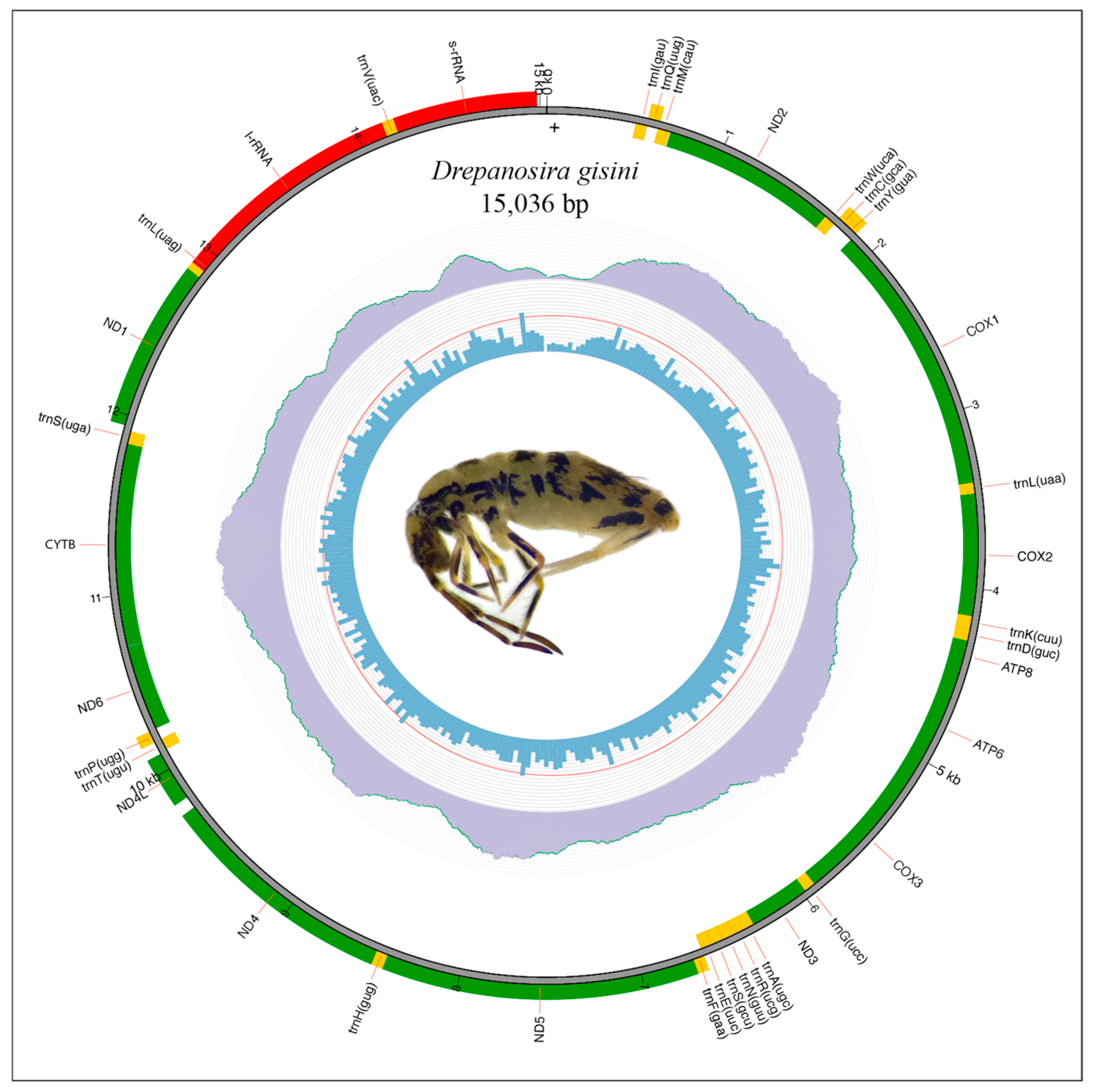
Figure 1. Circular representation of the mitogenome of Drepanosira gisini. The innermost circle shows the GC content (the red line marks 50%), the middle circle shows the reads coverage, and the outermost circle shows the gene order: rRNAs (red), tRNAs (yellow), and PCGs (green). Plus (+) indicates the side of the major J-strand.
Diversity 18 00247 g001
Figure 2. Phylogenetic placement of Drepanosira gisini among three subfamilies of Entomobryidae and two outgroup taxa of Orchesellidae. Entomobryinae is highlighted in green, Seirinae in pink, and Lepidocyrtinae in blue. Phylogenetic inference using the 13 mitochondrial protein-coding genes combined into a nucleotide matrix. Numbers at the nodes represent the SH-aLRT support and bootstrap values (both for ML) and the posterior probability (BI support), respectively; ‘*’ represents a divergence between the ML and BI topologies (ML analysis topology is shown in the figure; BI tree is presented in Appendix A Figure A1).
Diversity 18 00247 g002
Figure 3. Drepanosira gisini general morphology: (A) habitus of a fixed specimen (lateral view); (B) dorsal head color pattern; (C) dorsal trunk color pattern; (D) trunk scales.
Diversity 18 00247 g003
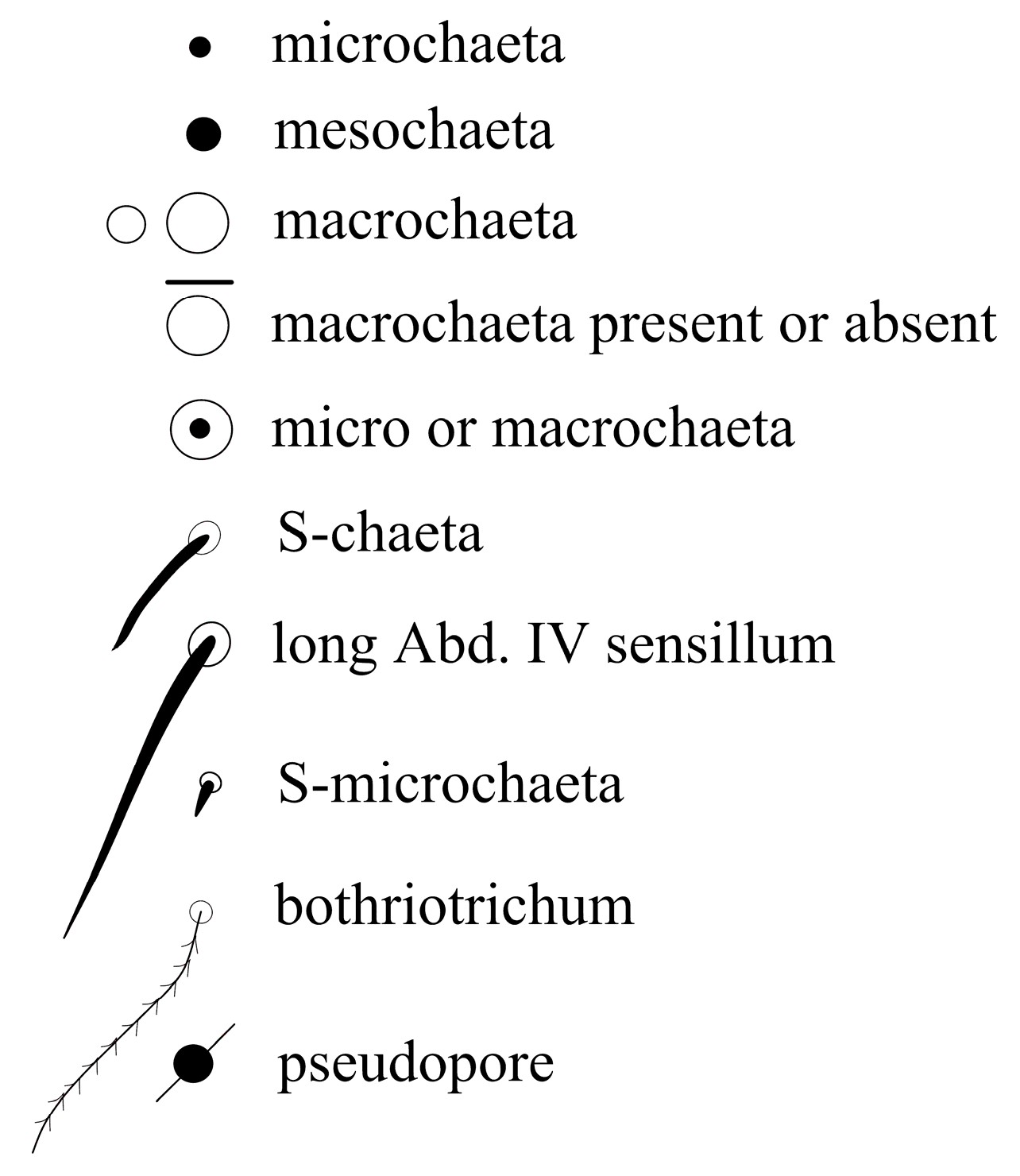
Figure 4. Symbols used to depict the detailed dorsal chaetotaxy of Drepanosira gisini.
Diversity 18 00247 g004
Figure 5. Drepanosira gisini head morphology: (A) Ant. IV apex (left antenna), showing the apical bulb; (B) Ant. III apical organ and surrounding sens (right antenna); (C) labral papillae; (D) labral chaetotaxy; (E) dorsal head chaetotaxy and eyes (right side); (F) labial papilla E (left side); (G) labial basomedial and basolateral fields, and proximal chaetae; (H) maxillary outer lobe and sublobal plate (left side).
Diversity 18 00247 g005
Figure 6. Drepanosira gisini trunk dorsal chaetotaxy (left side): (A) Th. II; (B) Th. III; (C) Abd. I; (D) Abd. II; (E) Abd. III.
Diversity 18 00247 g006
Figure 7. Drepanosira gisini trunk dorsal chaetotaxy (left side) and appendages: (A) Abd. IV; (B) Abd. V; (C) empodial complex III (anterior view); (D) manubrial plate (dorsal right side); (E) ventral manubrial; (F) distal dens and mucro.
Diversity 18 00247 g007
Figure 8. Asia map marking Drepanosira gisini known distribution, including its type locality (purple circle), other previous records (green circle) and the sampling regions of the material used in this study (red circles).
Diversity 18 00247 g008
Table 1. Taxonomical information and NCBI accession numbers (A.N.) of the species used in the phylogenetic analyses. The newly assembled mitogenome is represented in bold. 1 Scaleless species, 2 scaled species.
SpeciesFamilySubfamilyCountryA.N.Source
1Dicranocentrus wangi Ma & Chen, 2007OrchesellidaeHeteromurinaeChinaNC046887.1Sun et al. [46]
2Orchesella villosa (Linné, 1767)OrchesellidaeOrchesellinaeItalyEU016195.1Carapelli et al. [47]
3Acrocyrtus sp.EntomobryidaeLepidocyrtinaeThailandMT914190.1Godeiro et al. [13]
4Lepidocyrtus sotoi Bellini & Godeiro, 2015EntomobryidaeLepidocyrtinaeBrazilMT928545.1Godeiro et al. [48]
5Pseudosinella tumula Wang, Chen & Christiansen, 2002EntomobryidaeLepidocyrtinaeChinaMT611221.1Godeiro et al. [13]
6Seira atrolutea (Arlé, 1939)EntomobryidaeSeirinaeBrazilMF716602.1Godeiro et al. [48]
7Lepidocyrtinus dapeste Santos & Bellini, 2018EntomobryidaeSeirinaeBrazilMF716609.1Godeiro et al. [48]
8Lepidocyrtinus harena Godeiro & Bellini, 2014EntomobryidaeSeirinaeBrazilMF716617Godeiro et al. [48]
9Seira brasiliana Arlé, 1939EntomobryidaeSeirinaeBrazilMF716619.1Godeiro et al. [48]
10Seira boneti (Denis, 1948)EntomobryidaeSeirinaeChinaOP181099.1Godeiro et al. [49]
11Seira phrathongensis Bellini, Godeiro, Cipola & Santos 2024EntomobryidaeSeirinaeThailandPP191133.1Bellini et al. [50]
12Seira ritae Bellini & Zeppelini, 2011EntomobryidaeSeirinaeBrazilMF716605.1Godeiro et al. [48]
13Seira sanloemensis Godeiro & Cipola, 2020EntomobryidaeSeirinaeCambodiaMT997754.1Godeiro et al. [51]
14Tyrannoseira gladiata Zeppelini & Lima, 2012EntomobryidaeSeirinaeBrazilMT914185-9Godeiro et al. [48]
15Coecobrya sp.1EntomobryidaeEntomobryinaeChinaOK037064.1Godeiro et al. [52]
16Drepanosira gisini Nosek, 1964 1EntomobryidaeEntomobryinaeChinaPZ065976This study
17Entomobrya cf. arborea 1EntomobryidaeEntomobryinaeGermanySRR22681213Collins et al. [53]
18Entomobrya corticalis (Nicolet, 1842) 1EntomobryidaeEntomobryinaeGermanySRR17308025Collins et al. [53]
19Entomobrya multifasciata (Tullberg, 1871) 1EntomobryidaeEntomobryinaeGermanySRR17308065Collins et al. [53]
20Entomobrya muscorum (Nicolet, 1842) 1EntomobryidaeEntomobryinaeGermanySRR22586361Collins et al. [53]
21Entomobrya nicoleti (Lubbock, 1870) 1EntomobryidaeEntomobryinaeGermanySRR22681196Collins et al. [53]
22Entomobrya nivalis (Linnæus, 1758) 1EntomobryidaeEntomobryinaeGermanySRR21208386Collins et al. [53]
23Homidia koreana Lee & Lee, 1981 1EntomobryidaeEntomobryinaeSouth KoreaMZ934725.1Lee et al. [54]
24Homidia pseudokoreana Lee & Park, 2024 1EntomobryidaeEntomobryinaeSouth KoreaOQ852481.1Lee & Park [55]
25Homidia socia Denis, 1924 1EntomobryidaeEntomobryinaeChinaMN480464.1Wu & Chen [56]
26Lepidocyrtoides caeruleomaculatus Cipola & Bellini, 2017 2EntomobryidaeEntomobryinaeBrazilMF716618.1Godeiro et al. [48]
27Lepidocyrtoides sp.2EntomobryidaeEntomobryinaeBrazilMF716598.1Godeiro et al. [48]
28Lepidosira neotropicalis Nunes & Bellini, 2019 2EntomobryidaeEntomobryinaeBrazilMF716603.1Nunes et al. [57]
29Sinella curviseta Brook, 1882 1EntomobryidaeEntomobryinaeChinaNC042755.1Zhang et al. [58]
30Sinhomidia bicolor Yosii, 1965 2EntomobryidaeEntomobryinaeChinaOK037065.1Godeiro et al. [52]
31Willowsia buski (Lubbock, 1870) 2EntomobryidaeEntomobryinaeGermanySRR22681191Collins et al. [53]
32Willowsia japonica (Folsom, 1898) 2EntomobryidaeEntomobryinaeChinaMT906654.1Godeiro et al. [13]
33Willowsia nigromaculata (Lubbock, 1873) 2EntomobryidaeEntomobryinaeGermanySRR22681218Collins et al. [53]
Table 2. Organization of the protein-coding genes of the Drepanosira gisini mitochondrial genome.
StartEndLength (bp)StrandGene NameGene Product
6971684988+ND2NADH dehydrogenase subunit 2
187434131540+COX1Cytochrome c oxidase subunit I
34714155685+COX2Cytochrome c oxidase subunit II
42934458166+ATP8ATP synthase F0 subunit 8
44515132682+ATP6ATP synthase F0 subunit 6
51315918788+COX3Cytochrome c oxidase subunit III
59816326346+ND3NADH dehydrogenase subunit 3
670584081704ND5NADH dehydrogenase subunit 5
847297521281ND4NADH dehydrogenase subunit 4
982010,096277ND4LNADH dehydrogenase subunit 4L
10,23310,713481+ND6NADH dehydrogenase subunit 6
10,71611,8501135+CYTBCytochrome b
11,94412,859916ND1NADH dehydrogenase subunit 1
Disclaimer/Publisher’s Note: The statements, opinions and data contained in all publications are solely those of the individual author(s) and contributor(s) and not of MDPI and/or the editor(s). MDPI and/or the editor(s) disclaim responsibility for any injury to people or property resulting from any ideas, methods, instructions or products referred to in the content.