
Morphology and Molecular Characterizations of Two New Myxidium Species (Bivalvulida: Myxidiidae) Infecting the Gallbladder of Sarcocheilichthys spp. (Cypriniformes: Cyprinidae) from the East Dongting Lake, China †


Abstract
1. Introduction
2. Materials and Methods
2.1. Collection of Fish Specimens and Morphological Examination
2.2. Genomic DNA Extraction, SSU rDNA Amplification, Cloning, and Sequencing
2.3. Phylogenetic Analyses
3. Results
3.1. Species Descriptions
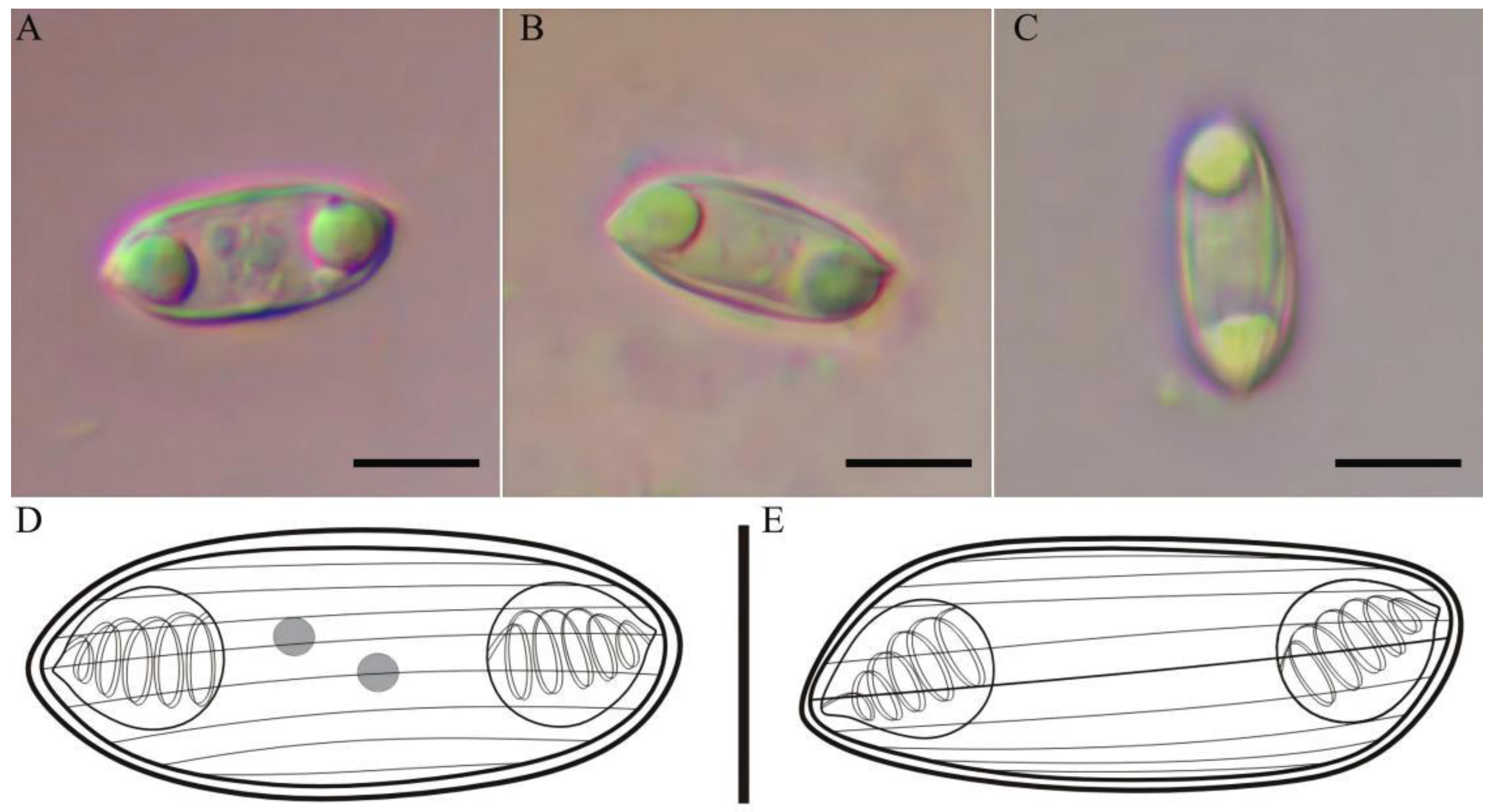
3.1.1. Myxidium kiangsiensis n. sp. (Figure 1A–E)

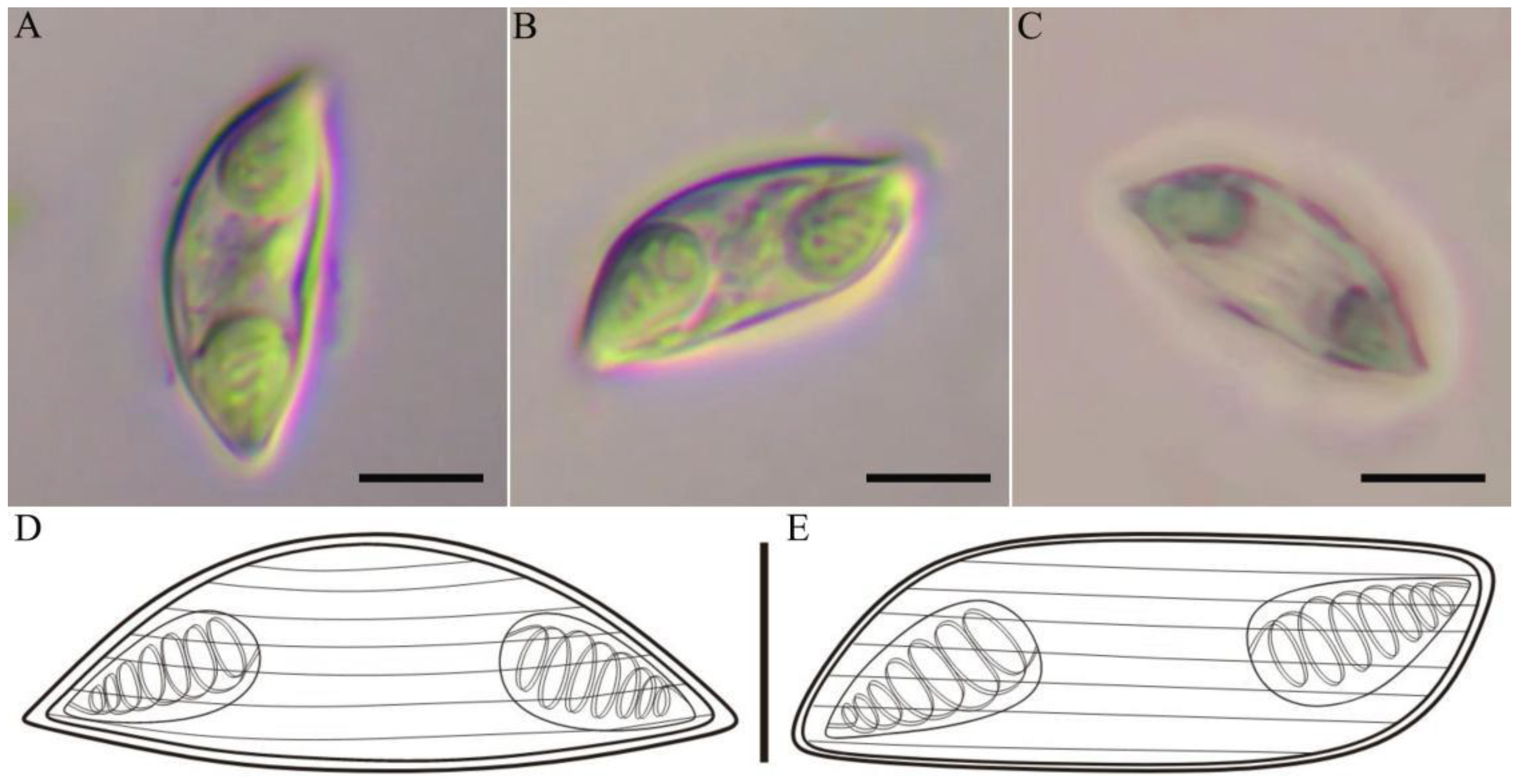
3.1.2. Myxidium parvusis n. sp (Figure 2A–E)

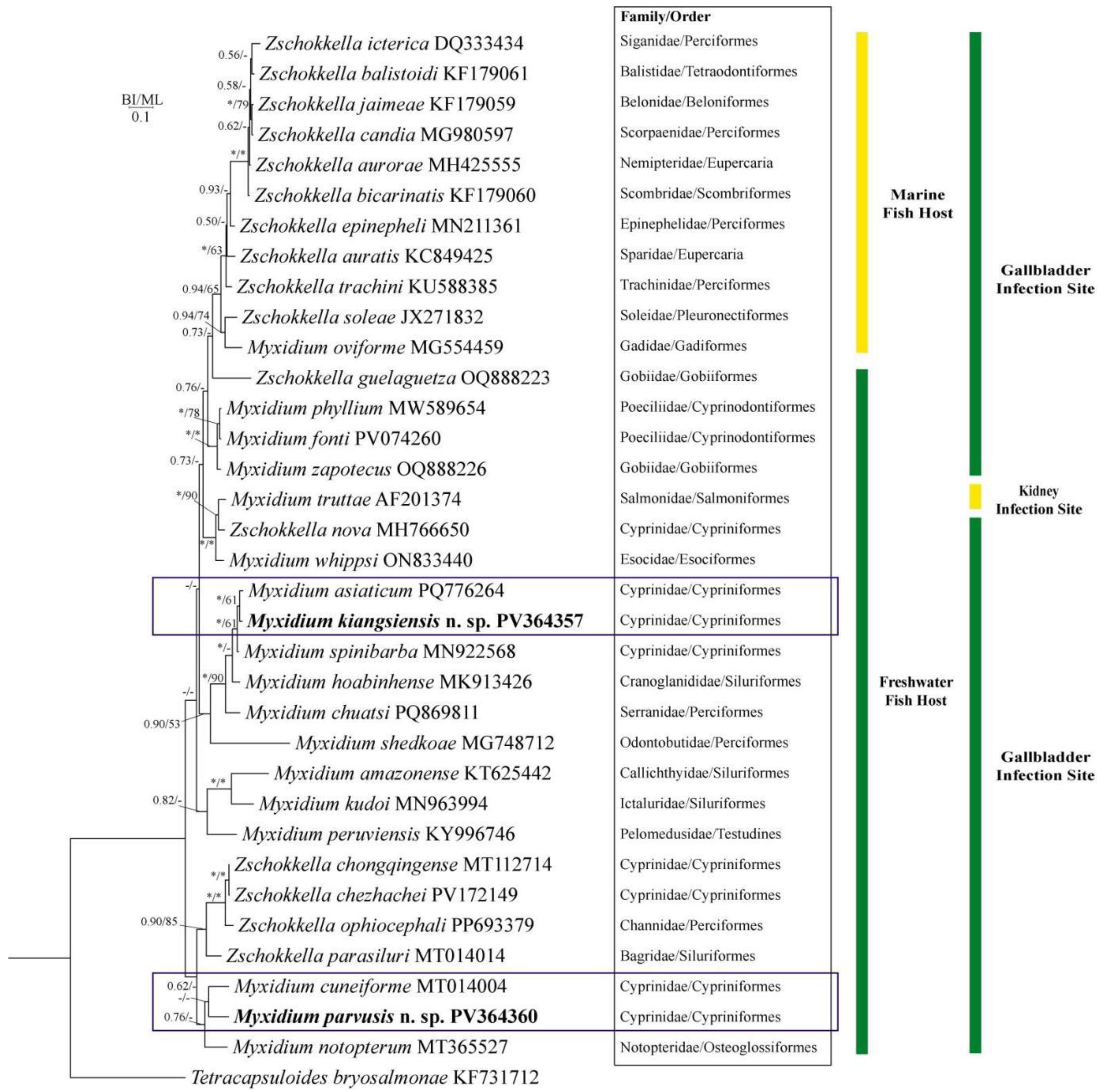
3.2. Distance Estimation and Phylogenetic Analysis
4. Discussion
5. Conclusions
Author Contributions
Funding
Institutional Review Board Statement
Informed Consent Statement
Data Availability Statement
Acknowledgments
Conflicts of Interest
References
- Atkinson, S.D.; Bartholomew, J.L.; Lotan, T. Myxozoans: Ancient metazoan parasites find a home in phylum Cnidaria. Zoology 2018, 129, 66–68. [Google Scholar] [CrossRef] [Scilit] [PubMed]
- Lom, J.; Dyková, I. Myxozoan genera: Definition and notes on taxonomy, life-cycle terminology and pathogenic species. Folia Parasitol. 2006, 53, 1–36. [Google Scholar] [CrossRef] [Scilit] [PubMed]
- Kent, M.L.; Andree, K.B.; Bartholomew, J.L.; El-Matbouli, M.; Desser, S.S.; Devlin, R.H.; Feist, S.W.; Hedrick, R.P.; Hoffmann, R.W.; Khattra, J.; et al. Recent advances in our knowledge of the Myxozoa. J. Eukaryot. Microbiol. 2001, 48, 395–413. [Google Scholar] [CrossRef] [Scilit] [PubMed]
- Eiras, J.C.; Saraiva, A.; Cruz, C.F.; Santos, M.J.; Fiala, I. Synopsis of the species of Myxidium Bütschli, 1882 (Myxozoa: Myxosporea: Bivalvulida). Syst. Parasitol. 2011, 80, 81–116. [Google Scholar] [CrossRef] [Scilit]
- Fariya, N.; Kaur, H.; Abidi, R. Myxidium tictoi n. sp., a myxozoan parasite infecting kidney of fresh water barb Puntius ticto (Hamilton, 1822) from river Gomti, Lucknow (U.P). J. Parasit. Dis. 2020, 44, 126–130. [Google Scholar] [CrossRef] [Scilit]
- Sanil, N.K.; Chandran, A.; Shamal, P.; Binesh, C.P. Molecular and morphological descriptions of Ceratomyxa collarae n. sp. and Ceratomyxa leucosternoni n. sp. from marine ornamental fishes of Indian waters. Parasitol. Res. 2017, 116, 529–537. [Google Scholar] [CrossRef] [Scilit]
- Thabet, A.; Mansour, L.; Al Omar, S.Y.; Tlig-Zouari, S. Ceratomyxa tunisiensis n. sp. (Myxosporea: Bivalvulida) from the Gallbladders of Two Carangid Fish Caught Off the Coast of Tunisia. J. Eukaryot. Microbiol. 2016, 63, 86–92. [Google Scholar] [CrossRef] [Scilit]
- Batueva, M.D.; Pan, X.; Zhang, J.; Liu, X.; Wei, W.; Liu, Y. Morphological, histological and molecular characterization of Myxidium cf. rhodei infecting the kidney of Rutilus rutilus. Dis. Aquat. Organ. 2020, 141, 39–46. [Google Scholar] [CrossRef] [Scilit]
- Baiko, D.; Lisnerová, M.; Bartošová-Sojková, P.; Holzer, A.S.; Blabolil, P.; Schabuss, M.; Fiala, I. Solving the Myxidium rhodei (Myxozoa) puzzle: Insights into its phylogeny and host specificity in Cypriniformes. Parasite 2024, 31, 35. [Google Scholar] [CrossRef] [Scilit]
- Fiala, I. The phylogeny of Myxosporea (Myxozoa) based on small subunit ribosomal RNA gene analysis. Int. J. Parasitol. 2006, 36, 1521–1534. [Google Scholar] [CrossRef] [Scilit]
- Atkinson, S.D.; Bartošová-Sojková, P.; Whipps, C.M.; Bartholomew, J.L. Approaches for Characterising Myxozoan Species. In Myxozoan Evolution, Ecology and Development; Okumura, B., Gruhl, A., Bartholomew, J.L., Eds.; Springer: Cham, Germany, 2015; pp. 111–123. [Google Scholar] [CrossRef] [Scilit]
- Heiniger, H.; Adlard, R.D. Relatedness of novel species of Myxidium Bütschli, 1882, Zschokkella Auerbach, 1910 and Ellipsomyxa Køie, 2003 (Myxosporea: Bivalvulida) from the gall bladders of marine fishes (Teleostei) from Australian waters. Syst. Parasitol. 2014, 87, 47–72. [Google Scholar] [CrossRef] [Scilit]
- Elloumi, A.; Rangel, L.F.; Santos, M.J.; Bahri, S. Myxidium tunisiensis n. sp. (Myxosporea: Myxidiidae) infecting the rough skate Raja radula Delaroche, 1908 (Rajiformes: Rajidae) from North East Tunisia. Parasitol. Res. 2023, 122, 19–33. [Google Scholar] [CrossRef] [Scilit] [PubMed]
- Chen, Q.L.; Ma, C.L. Fauna Sinica, Myxozoa: Myxosporea, 1st ed.; Science Press: Beijing, China, 1998. (In Chinese) [Google Scholar]
- Wei, Q. A preliminary Survey of Myxosporean Infection of Fish from the Hunan Section of the Xiang River. Master’s Dissertation, Hunan Agricultural University, Changsha, China, 2024. (In Chinese) [Google Scholar] [CrossRef]
- Chen, W. Taxonomy and Systematics of the Myxidiid Myxosporean in China. Ph.D. Dissertation, Southwest University, Chongqing, China, 2021; pp. 17–96. (In Chinese) [Google Scholar]
- Zhai, Y.; Whipps, C.M.; Gu, Z.; Guo, Q.; Wu, Z.; Wang, H.; Liu, Y. Intraspecific morphometric variation in myxosporeans. Folia Parasitol. 2016, 63, 011. [Google Scholar] [CrossRef] [Scilit] [PubMed]
- Liu, K.J. Study on the Distribution Patterns and Genetic Diversity of Crucian Carp Populations in Hunan Province. Master’s Dissertation, Hunan Agricultural University, Changsha, China, 2020. (In Chinese) [Google Scholar] [CrossRef]
- Wu, Y.A.; Li, H.; Liao, F.C.; Yang, X.; Xie, Z.G. Fishes of Hunan, 1st ed.; Science Press: Beijing, China, 2021. (In Chinese) [Google Scholar]
- Jin, X.L.; Dai, Z.Y.; Liu, X.Y.; Zeng, G.C.; Zhang, B.K.; He, S.L.; Xiang, J.G. Investigation and studies of fish parasites and pathogen flora in Hunan province. J. Hunan Agric. Coll. 1993, 4, 297–389. (In Chinese) [Google Scholar] [CrossRef]
- Yin, Q.; Yang, Y.J.; Liu, Y.L.; Xiang, J.G.; Li, D.L.; Liu, X.H.; Yu, J.B. Identification and phylogenetic analysis of Myxidium chuatsis n. sp. (Myxozoa: Myxidiidae) from the gallbladder of Siniperca chuatsi in China. Acta Hydrobiol. Sin. 2025, 49, 24–31. (In Chinese) [Google Scholar] [CrossRef] [Scilit]
- Lom, J.; Arthur, J.R. A guideline for the preparation of species descriptions in Myxosporea. J. Fish Dis. 1989, 12, 151–156. [Google Scholar] [CrossRef] [Scilit]
- Whipps, C.M.; Adlard, R.D.; Bryant, M.S.; Lester, R.J.; Findlay, V.; Kent, M.L. First report of three Kudoa species from eastern Australia: Kudoa thyrsites from mahi mahi (Coryphaena hippurus), Kudoa amamiensis and Kudoa minithyrsites n. sp. from sweeper (Pempheris ypsilychnus). J. Eukaryot. Microbiol. 2003, 50, 215–219. [Google Scholar] [CrossRef] [Scilit]
- Zhao, X.; Yin, Q.; Cai, J.; Wei, Q.; Li, D.; Yu, J.; Xiang, J.; Zhang, J.; Liu, X. Myxobolus dabryi n. sp. (Myxozoa: Myxobolidae) infecting the gills of Chanodichthys dabryi, Bleeker, 1871 (Cypriniformes: Cyprinidae) in Hunan Province, China. Animals 2024, 14, 2487. [Google Scholar] [CrossRef] [Scilit]
- Zhang, D.; Gao, F.; Jakovlić, I.; Zou, H.; Zhang, J.; Li, W.X.; Wang, G.T. PhyloSuite: An integrated and scalable desktop platform for streamlined molecular sequence data management and evolutionary phylogenetics studies. Mol. Ecol. Resour. 2020, 20, 348–355. [Google Scholar] [CrossRef] [Scilit]
- Katoh, K.; Standley, D.M. MAFFT multiple sequence alignment software version 7: Improvements in performance and usability. Mol. Biol. Evol. 2013, 30, 772–780. [Google Scholar] [CrossRef] [Scilit]
- Kalyaanamoorthy, S.; Minh, B.Q.; Wong, T.K.F.; von Haeseler, A.; Jermiin, L.S. ModelFinder: Fast model selection for accurate phylogenetic estimates. Nat. Methods 2017, 14, 587–589. [Google Scholar] [CrossRef] [Scilit] [PubMed]
- Nguyen, L.T.; Schmidt, H.A.; von Haeseler, A.; Minh, B.Q. IQ-TREE: A fast and effective stochastic algorithm for estimating maximum-likelihood phylogenies. Mol. Biol. Evol. 2015, 32, 268–274. [Google Scholar] [CrossRef] [Scilit]
- Ronquist, F.; Teslenko, M.; van der Mark, P.; Ayres, D.L.; Darling, A.; Höhna, S.; Larget, B.; Liu, L.; Suchard, M.A.; Huelsenbeck, J.P. MrBayes 3.2: Efficient Bayesian phylogenetic inference and model choice across a large model space. Syst. Biol. 2012, 61, 539–542. [Google Scholar] [CrossRef] [Scilit] [PubMed]
- Tamura, K.; Stecher, G.; Kumar, S. MEGA11: Molecular Evolutionary Genetics Analysis Version 11. Mol. Biol. Evol. 2021, 38, 3022–3027. [Google Scholar] [CrossRef] [Scilit] [PubMed]
- Dai, W.J.; Yin, Q.; Liu, Y.L.; Liu, Y.C.; Yu, J.B.; Liu, X.H. New host records and molecular phylogeny of Myxidium asiaticum Chen, 2020 (Myxozoa: Myxidiidae Thélohan). Freshw. Fish. 2025, 55, 48–55. (In Chinese) [Google Scholar] [CrossRef]
- Li, C.; Suo, D.; Yang, C.Z.; Zhao, Y.J. Redescription of Myxidium cuneiforme Fujita, 1924 (Myxosporea: Bivalvulida) and molecular phylogeny with its relative species. Sichuan J. Zool. 2016, 35, 384–390. (In Chinese) [Google Scholar]
- Chen, W.; Zhang, D.D.; Whipps, C.M.; Yang, C.Z.; Zhao, Y.J. Description of Myxidium pseudocuneiforme n. sp. (Myxosporea: Myxidiidae) from Cyprinus carpio in China, with the resolution on a taxonomic dilemma of Myxidium cuneiforme. J. Eukaryot. Microbiol. 2021, 68, e12859. [Google Scholar] [CrossRef] [Scilit]
- Kudo, R.R. Studies on Myxosporidia: A synopsis of genera and species of Myxosporidia, 1st ed.; Illinois Biological Monographs: Urbana, IL, USA, 1920. [Google Scholar]
- Fiala, I.; Bartošová-Sojková, P.; Whipps, C.M. Classification and Phylogenetics of Myxozoa. In Myxozoan Evolution, Ecology and Development; Okumura, B., Gruhl, A., Bartholomew, J.L., Eds.; Springer: Cham, Germany, 2015; pp. 85–105. [Google Scholar] [CrossRef] [Scilit]
- Liu, Y.; Whipps, C.M.; Liu, W.S.; Zeng, L.B.; Gu, Z.M. Supplemental diagnosis of a myxozoan parasite from common carp Cyprinus carpio: Synonymy of Thelohanellus xinyangensis with Thelohanellus kitauei. Vet. Parasitol. 2011, 178, 355–359. [Google Scholar] [CrossRef] [Scilit]
- Gunter, N.L.; Adlard, R.D. Bivalvulidan (Myxozoa: Myxosporea) parasites of damselfishes with description of twelve novel species from Australia’s Great Barrier Reef. Parasitology 2008, 135, 1165–1178. [Google Scholar] [CrossRef] [Scilit]
- Bartosová, P.; Fiala, I.; Hypsa, V. Concatenated SSU and LSU rDNA data confirm the main evolutionary trends within myxosporeans (Myxozoa: Myxosporea) and provide an effective tool for their molecular phylogenetics. Mol. Phylogenet Evol. 2009, 53, 81–93. [Google Scholar] [CrossRef] [Scilit]
- Liu, X.H.; Weng, M.Q.; Song, R.; Zhao, Y.L.; Li, A.H.; Zhang, J.Y. Redescription and phylogenetic analysis of Myxobolus tricostatus (Myxozoa: Myxobolidae). J. Fish. China 2021, 45, 1340–1349. (In Chinese) [Google Scholar] [CrossRef]
- Zhao, Y.J.; Li, N.N.; Tang, F.H.; Dong, J.L. Remarks on the validity of Myxobolus ampullicapsulatus and Myxobolus honghuensis (Myxozoa: Myxosporea) based on SSU rDNA sequences. Parasitol. Res. 2013, 112, 3817–3823. [Google Scholar] [CrossRef] [Scilit]
- Azizi, R.; Rangel, L.F.; Castro, R.; Santos, M.J.; Bahri, S. Morphology, seasonality and phylogeny of Zschokkella trachini n. sp. (Myxozoa, Myxosporea) infecting the gallbladder of greater weever Trachinus draco (L.) from Tunisian waters. Parasitol. Res. 2016, 115, 4129–4138. [Google Scholar] [CrossRef] [Scilit]
- Ye, C.; Zhang, L.; Tang, L.; Duan, Y.; Liu, J.; Zhou, H. Host genetic backgrounds: The key to determining parasite-host adaptation. Front. Cell Infect. Microbiol. 2023, 13, 1228206. [Google Scholar] [CrossRef] [Scilit]
- Gandon, S.; Nuismer, S.L. Interactions between genetic drift, gene flow, and selection mosaics drive parasite local adaptation. Am. Nat. 2009, 173, 212–224. [Google Scholar] [CrossRef] [Scilit]
- Guo, Q.; Atkinson, S.D.; Xiao, B.; Zhai, Y.; Bartholomew, J.L.; Gu, Z. A myxozoan genome reveals mosaic evolution in a parasitic cnidarian. BMC Biol. 2022, 20, 51. [Google Scholar] [CrossRef] [Scilit]
- Nazarizadeh, M.; Nováková, M.; Vlček, J.; Štefka, J. Host-Associated Genetic Differentiation in the Face of Ongoing Gene Flow: Ecological Speciation in a Pathogenic Parasite of Freshwater Fish. Mol. Biol. Evol. 2025, 42, msaf163. [Google Scholar] [CrossRef] [Scilit]

| Species Name | Host | Site of Infection | Myxospore Shape | Myxospore Size (µm) | Polar Capsule Size (µm) | Number of Polar Tubule Coils | No. of Striations | References |
|---|---|---|---|---|---|---|---|---|
| M. kiangsiensis n. sp. | Sarcocheilichthys kiangsiensis | Gallbladder | Fusiform | 11.7 ± 0.5 (10.9–12.7) × 5.2 ± 0.4 (4.5–6.6) × 4.8 ± 0.2 (4.3–5.7) | 3.1 ± 0.2 (2.6–3.5) × 2.8 ± 0.2 (2.4–3.3) | 4–5 | 6–9 | This work |
| M. chuatsis | Siniperca chuatsi | Gallbladder | Fusiform | 10.7 ± 0.4 (10.0–11.4) × 5.7 ± 0.3 (5.4–6.1) × 5.8 ± 0.3 (5.4–6.1) | 3.2 ± 0.2 (2.9–3.7) × 2.8 ± 0.1 (2.6–3.2) | 4–5 | 6–8 | Yin et al., 2025 [21] |
| M. asiaticum | Culter alburnus | Gallbladder | Fusiform | 13.9 ± 0.5 (12.9–15.1) × 7.1 ± 0.5 (5.7–8.5) | 4.0 ± 0.2 (2.8–4.0) × 3.4 ± 0.2 (2.8–4.0) | 4–5 | - | Dai et al., 2025 [31] |
| M. onychostomatis | Varicorhinus simus | Gallbladder | Oval | 13.9 (13.6–14.4) × 6.5 (6.0–7.2) × 5.7 (5.6–6.0) | 4.0 (3.9–4.0) × 2.4 (2.3–2.4) | - | 6–7 | Chen et al., 1998 [14] |
| M. spinibarba | Spinibarbus sinensis | Gallbladder | Fusiform | 11.8 ± 0.5 (10.6–12.4) × 6.1 ± 0.5 (5.5–7.2) × 5.7 ± 0.3 (5.0–6.0) | 3.6 ± 0.4 (3.0–4.4) × 3.0 ± 0.2 (2.7–3.2) | 4–5 | 8–10 | Chen 2021 [16] |
| Species Name | Host | Site of Infection | Myxospore Shape | Myxospore Size (µm) | Polar Capsule Size(µm) | Number of Polar Tubule Coils | No. of Striations | References |
|---|---|---|---|---|---|---|---|---|
| M. parvusis n. sp. | Sarcocheilichthys parvus | Gallbladder | Crescentic | 16.2 ± 0.7 (15.1–17.8) × 6.0 ± 0.2 (5.7–6.3) × 5.8 ± 0.4 (4.9–6.3) | 6.2 ± 0.3 (5.3–7.0) × 3.7 ± 0.2 (3.5–4.0) | 6–7 | 6–7 | This work |
| M. cuneiforme | Cyprinus carpio | Gallbladder | Elongated | 12.5 ± 0.3 (12.0–13.1) × 5.4 ± 0.3 (4.8–6.1) | 4.3 ± 0.2 (4.0–4.6) × 3.1 ± 0.2 (2.6–3.4) | 5–6 | 6–8 | Li et al., 2016 [32] |
| M. sarcocheilichthysi | Sarcocheilichthys nigripinnis | Gallbladder | Arc-shaped | 17.2 (16.0–18.5) × 5.8 (5.1–6.0) | 5.0 (4.0–6.0) × 3.6 (3.2–4.0) | 4–5 | 9–10 | Chen et al., 1998 [14] |
| M. pseudocuneiforme | Cyprinus carpio | Gallbladder | Ellipsoidal | 12.5 ± 0.3 (12.0–13.1) × 5.4 ± 0.3 (4.8–6.1) × 5.4 ± 0.3 (4.8–6.1) | 3.9 ± 0.2 (3.5–4.2) × 2.6 ± 0.1 (2.5–2.8) | 5–6 | 6–8 | Chen et al., 2021 [33] |
| M. kagayamai | Misgurnus anguillicaudatu | Gallbladder | Fusiform | 15–18 × 6–7 | Length of polar capsules 7–8 | - | - | Kudo, 1920 [34] |
| Species (GenBank Accession Number) | 1 | 2 | 3 | 4 | 5 | 6 | 7 | 8 | 9 | 10 | 11 | 12 | 13 | 14 |
|---|---|---|---|---|---|---|---|---|---|---|---|---|---|---|
| 1. M. kiangsiensisn. sp. (PV364357) | 98.54% | 98.45% | 97.67% | 93.11% | 91.70% | 91.08% | 89.43% | 90.63% | 89.82% | 88.45% | 89.68% | 90.46% | 88.92% | |
| 2. M. asiaticum (PQ776264) | 0.0106 | 98.45% | 97.55% | 93.06% | 92.10% | 91.24% | 90.56% | 91.78% | 90.44% | 88.94% | 90.09% | 91.52% | 89.21% | |
| 3. M. spinibarba (MN922568) | 0.0156 | 0.0150 | 97.74% | 93.09% | 91.51% | 90.86% | 91.05% | 91.66% | 89.86% | 88.79% | 90.35% | 90.38% | 89.05% | |
| 4. M. hoabinhense (MK913426) | 0.0252 | 0.0258 | 0.0202 | 93.42% | 91.61% | 91.54% | 90.33% | 91.04% | 89.51% | 88.34% | 89.53% | 90.28% | 88.96% | |
| 5. M. chuatsi (PQ869811) | 0.0646 | 0.0635 | 0.0629 | 0.0618 | 91.19% | 91.19% | 89.70% | 90.71% | 89.53% | 88.66% | 89.67% | 90.63% | 89.42% | |
| 6. Zschokkella epinepheli (MN211361) | 0.1047 | 0.0993 | 0.1054 | 0.1081 | 0.1037 | 92.71% | 90.71% | 92.69% | 90.78% | 90.20% | 90.92% | 90.28% | 90.56% | |
| 7. M. whippsi (ON833440) | 0.0883 | 0.0853 | 0.0940 | 0.0856 | 0.0849 | 0.0896 | 90.83% | 92.97% | 90.06% | 89.82% | 90.52% | 91.20% | 89.74% | |
| 8. M. parvusisn. sp. (PV364360) | 0.0943 | 0.0924 | 0.0918 | 0.0962 | 0.1016 | 0.0995 | 0.0918 | 93.06% | 92.95% | 92.64% | 92.63% | 92.40% | 92.22% | |
| 9. Z. guelaguetza (OQ888223) | 0.1148 | 0.1086 | 0.1212 | 0.1154 | 0.1075 | 0.1173 | 0.1082 | 0.0873 | 93.63% | 93.73% | 93.23% | 92.45% | 92.98% | |
| 10. M. sharmai (OP174299) | 0.1075 | 0.1044 | 0.1105 | 0.1098 | 0.1101 | 0.1150 | 0.1057 | 0.0862 | 0.1210 | 92.06% | 95.63% | 91.66% | 91.78% | |
| 11. M. notopterum (MT365527) | 0.1165 | 0.1170 | 0.1183 | 0.1187 | 0.1151 | 0.1326 | 0.1146 | 0.1000 | 0.1353 | 0.0800 | 92.25% | 90.62% | 91.07% | |
| 12. M. grauri (OP174300) | 0.1073 | 0.1059 | 0.1124 | 0.1077 | 0.1068 | 0.1183 | 0.1014 | 0.0825 | 0.1206 | 0.0424 | 0.0757 | 92.28% | 91.88% | |
| 13. Z. parasiluri (MT014014) | 0.0980 | 0.0972 | 0.1045 | 0.0994 | 0.0993 | 0.1103 | 0.0952 | 0.0871 | 0.1241 | 0.0870 | 0.0948 | 0.0813 | 91.46% | |
| 14. M. cuneiforme (MT014004) | 0.1104 | 0.1084 | 0.1086 | 0.1128 | 0.1111 | 0.1204 | 0.1092 | 0.0800 | 0.1254 | 0.0804 | 0.0855 | 0.0839 | 0.0897 |
Disclaimer/Publisher’s Note: The statements, opinions and data contained in all publications are solely those of the individual author(s) and contributor(s) and not of MDPI and/or the editor(s). MDPI and/or the editor(s) disclaim responsibility for any injury to people or property resulting from any ideas, methods, instructions or products referred to in the content. |
© 2026 by the authors. Licensee MDPI, Basel, Switzerland. This article is an open access article distributed under the terms and conditions of the Creative Commons Attribution (CC BY) license.
Share and Cite
Dai, W.; Yin, Q.; Liu, Y.; Zhao, X.; Liu, X.; Ren, S. Morphology and Molecular Characterizations of Two New Myxidium Species (Bivalvulida: Myxidiidae) Infecting the Gallbladder of Sarcocheilichthys spp. (Cypriniformes: Cyprinidae) from the East Dongting Lake, China. Diversity 2026, 18, 233. https://doi.org/10.3390/d18040233
Dai W, Yin Q, Liu Y, Zhao X, Liu X, Ren S. Morphology and Molecular Characterizations of Two New Myxidium Species (Bivalvulida: Myxidiidae) Infecting the Gallbladder of Sarcocheilichthys spp. (Cypriniformes: Cyprinidae) from the East Dongting Lake, China. Diversity. 2026; 18(4):233. https://doi.org/10.3390/d18040233
Chicago/Turabian StyleDai, Wenjing, Qi Yin, Yuechuan Liu, Xiaojing Zhao, Xinhua Liu, and Shisi Ren. 2026. "Morphology and Molecular Characterizations of Two New Myxidium Species (Bivalvulida: Myxidiidae) Infecting the Gallbladder of Sarcocheilichthys spp. (Cypriniformes: Cyprinidae) from the East Dongting Lake, China" Diversity 18, no. 4: 233. https://doi.org/10.3390/d18040233
APA StyleDai, W., Yin, Q., Liu, Y., Zhao, X., Liu, X., & Ren, S. (2026). Morphology and Molecular Characterizations of Two New Myxidium Species (Bivalvulida: Myxidiidae) Infecting the Gallbladder of Sarcocheilichthys spp. (Cypriniformes: Cyprinidae) from the East Dongting Lake, China. Diversity, 18(4), 233. https://doi.org/10.3390/d18040233