Article

Amphibians and Reptiles of the Veracruzan Biogeographic Province of Mexico: Patterns of Diversity, Similarity, and Conservation


by
Julio A. Lemos-Espinal
1,*,
Geoffrey R. Smith
2,
Erik Joaquín Torres-Romero
3,4 and
Guillermo A. Woolrich-Piña
4
1
Laboratorio de Ecología-UBIPRO, Facultad de Estudios Superiores Iztacala Universidad Nacional Autónoma de México, Avenida los Barrios 1, Los Reyes Iztacala, Tlalnepantla 54090, Mexico
2
Department of Biology, Denison University, Granville, OH 43023, USA
3
Ingeniería en Biotecnología, Universidad Politécnica de Puebla, Puebla 72640, Mexico
4
División de Biología, Subdirección de Estudios de Posgrado e Investigación, Tecnológico Nacional de México Campus Zacapoaxtla, Puebla 73680, Mexico
*
Author to whom correspondence should be addressed.
Diversity 2026, 18(4), 209; https://doi.org/10.3390/d18040209
Submission received: 7 March 2026 / Revised: 28 March 2026 / Accepted: 29 March 2026 / Published: 2 April 2026
(This article belongs to the Section Biodiversity Conservation)

Abstract

The Veracruzan biogeographic province is a central part of the Gulf of Mexico slope and serves as an interface between the Neotropical Region, the Mexican Transition Zone, and the Nearctic Region. We provide an overview of amphibian and reptile diversity in the province, focusing on species richness, endemism, conservation status, and faunal similarity to neighboring biogeographic provinces. In the Veracruzan biogeographic province there are 343 native species of amphibians and reptiles, encompassing nearly one quarter of the Mexican herpetofauna, with over 85% of the families and over 90% of the genera found in Mexico represented. The province therefore possesses exceptional taxonomic richness. It has the fifth highest richness among Mexican biogeographic provinces. The herpetofauna comprises several Neotropical taxa and locally endemic species found among amphibians of montane and cloud forest fauna. Richness of amphibians and reptiles generally increases with province area. Regions of the Mexican Transition Zone exhibit a relatively higher species richness than their Neotropical neighbors. Analyses of faunal similarities between the Veracruzan province and its neighboring provinces and highlight the importance of geographic proximity, environmental continuity, and historical processes for assemblage composition. Amphibians are more threatened than reptiles, with high levels of endemism and vulnerability to habitat loss and emerging diseases, whereas reptiles are more threatened by habitat degradation, exploitation, and invasive species. Our findings show that the Veracruzan biogeographic province is an important reservoir of herpetofaunal diversity and a priority region for conservation in Mexico.

1. Introduction

Mexico is one of the world’s megadiverse countries, which corresponds with its complex geological history, its geographical position at the intersection of the Nearctic and Neotropical regions and its extensive environmental heterogeneity [1,2]. To describe how these factors influence the biota of Mexico, several biogeographic provinces have been described reflecting roughly homogeneous biotic affinities; among these, the Veracruzan biogeographic province has been highlighted for its spatial extent, environmental diversity, and high herpetofaunal richness [3].
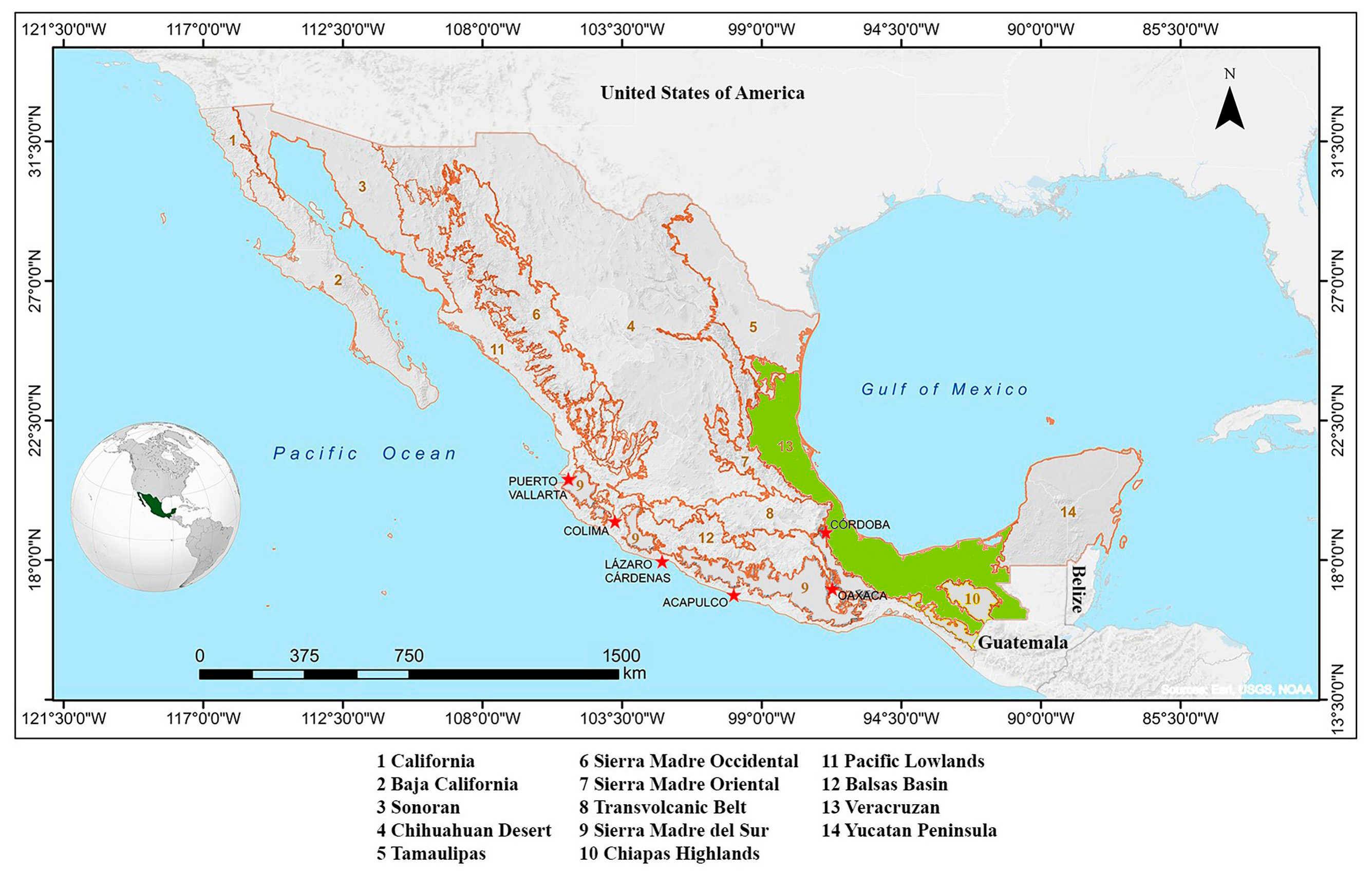
The Veracruzan province covers a region of more than nine degrees of latitude along the Gulf of Mexico slope that includes parts of the state’s regions of Tamaulipas, San Luis Potosí, Hidalgo, Veracruz, Puebla, Oaxaca, Tabasco, Campeche, and Chiapas [4] (Figure 1). This province, therefore, encompasses an extraordinary range of environments from coastal plains and wetlands to montane foothills and steep altitudinal gradients typical of the Sierra Madre Oriental and southern Mexican highlands [5]. This heterogeneity leads to diverse climatic conditions and biodiversity [5,6,7]. As a result, the biological diversity of the Veracruzan province is quite extensive, especially for amphibians and reptiles that are highly sensitive to environmental changes and whose distribution is correlated to climate and geological history [8,9]. The Veracruzan province is part of the Neotropical assemblage of Mexican biogeographic provinces that also include the Balsas Basin, Yucatán Peninsula, and Pacific Lowlands [3]. This collection of provinces shares a high prevalence of many taxa, particularly those with Central and South American affinities, and a high degree of regional endemism, particularly of anuran amphibians and squamate reptiles [2,10]. In addition, the geographic location of the Veracruzan province facilitates biotic interchange with neighboring Neotropical and transitional provinces, making it an important place to study faunal turnover and historical network connectivity across Mexico, as well as large-scale diversity gradients.
The Veracruzan biogeographic province is an especially valuable system for the analysis of how spatial scale and environmental heterogeneity shape patterns of species richness and composition [11]. Biogeographic provinces with broad latitudinal extent and pronounced elevational gradients, such as the Veracruzan province, typically exhibit high beta diversity due to substantial variation in species assemblages across environmental gradients. Consequently, estimates of regional diversity may differ depending on whether the analytical framework emphasizes total species richness or compositional turnover [11]. Thus, an analytical assessment of richness, endemism, and species composition at the provincial level, and in particular its comparison to neighboring provinces, will provide insight into the processes shaping herpetofaunal diversity in the Mexican neotropics and between transitional zones [12,13,14].
Patterns of similarity in species composition and richness–area relationships may suggest overlapping historical and ecological drivers, and sharp discrepancies may reflect barriers to dispersal, divergence of evolutionary history, or divergence of environmental responses to gradients [15,16]. For amphibians and reptiles, comparative assessment is especially useful, as they have reduced dispersal potential and a strong dependence on climate and habitat [17]. Through a combination of biogeographic comparisons with conservation assessment, studies of regions such as the Veracruzan province have the potential not only to deepen regional biogeographic hypotheses but also to inform conservation planning in a milieu with high richness of biogeology combined with intense anthropogenic pressures [18,19].
The herpetofauna of the Veracruzan province is endangered by several threats, such as habitat degradation and fragmentation, land-use conversion, pollution, and, in the case of amphibians, emerging infectious diseases such as chytridiomycosis [20,21]. These pressures are indicated by the numerous species listed under national and international risk categories [22,23]. In this context, updated inventories, conservation status assessments, and comparative biogeographic analyses are important tools for identifying conservation priorities and deepening our understanding of herpetofaunal diversity in eastern-southeastern Mexico [24].
Figure 1. Overview of Mexico’s fourteen biogeographic provinces, with the Veracruzan province highlighted in green. The map also shows portions of the southern United States and northern Central America (Guatemala and Belize) for geographic context [25].
Diversity 18 00209 g001
We enumerate the species richness, endemism, and conservation status of amphibians and reptiles in the Veracruzan biogeographic province and compare it with its neighboring biogeographic provinces. By evaluating similarities in species composition and richness–area relationships among Neotropical and transitional provinces, we identify consistent biogeographic groupings and contrasting diversity gradients. This synthesis presents a unified blueprint for how one may understand the regional and spatial factors in herpetofaunal diversity, and for the conservation of one of the most diverse and threatened faunal assemblages in Mexico.

2. Methods

2.1. Study Area

2.1.1. Geographic Extent and Boundaries

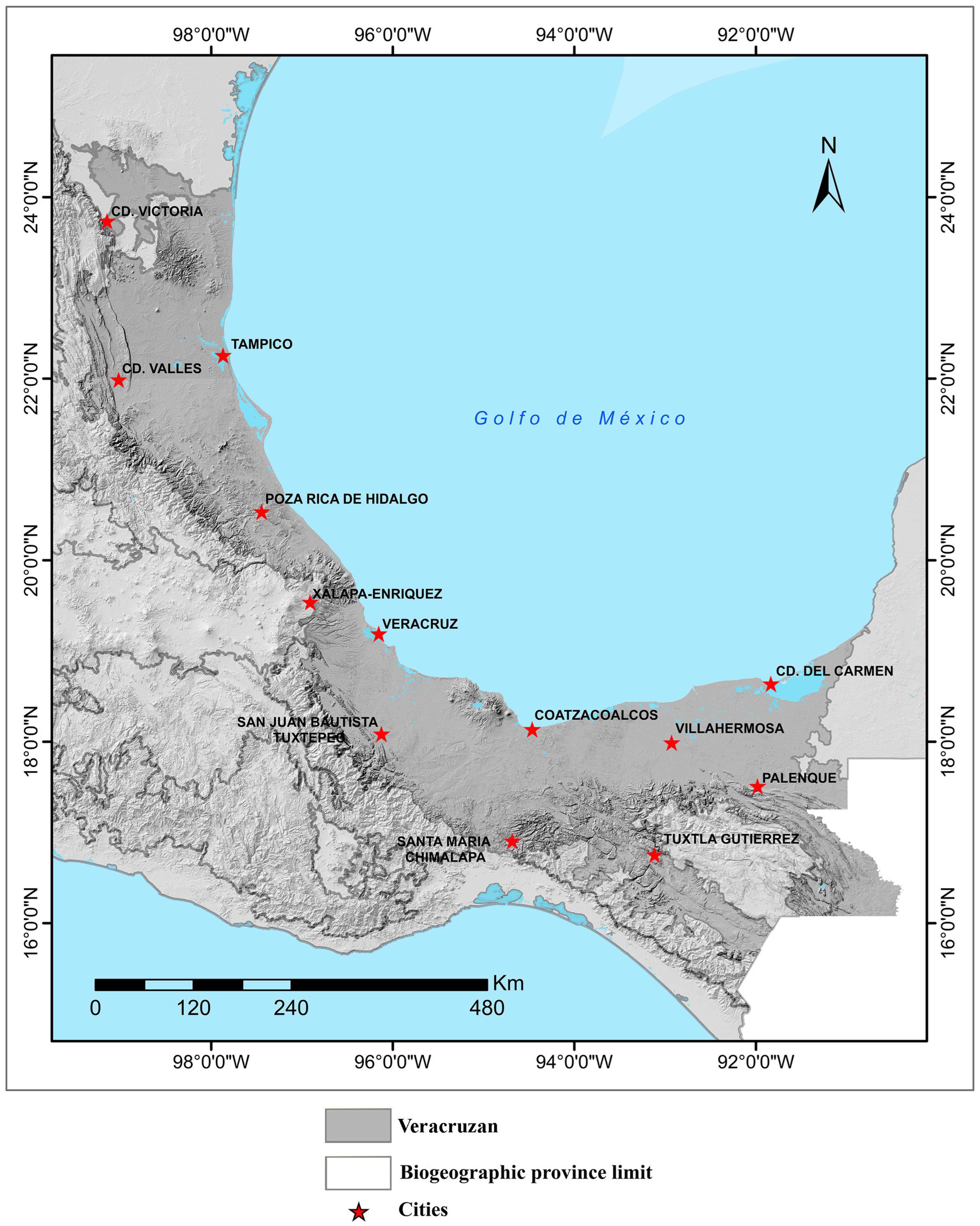
The Veracruzan biogeographic province stretches from Mexico’s southern border with Guatemala northwestward along much of the Gulf of Mexico coastal plain, reaching approximately the central portion of the state of Tamaulipas, and eastward into southwestern Campeche [5] (Figure 2). It covers parts of the Mexican states of Chiapas, Campeche, Tabasco, Oaxaca, Veracruz, Puebla, Hidalgo, San Luis Potosí, and Tamaulipas, and a total area of 191,451 km2 [4,5]. The province is situated between 15.57° and 24.61° N latitude and between 90.37° and 99.53° W longitude, with a total perimeter of 9826 km. It shares borders with seven biogeographic provinces: Chiapas Highlands, Sierra Madre del Sur, Transvolcanic Belt, Sierra Madre Oriental, Tamaulipas, Yucatán Peninsula, and Pacific Lowlands [4,5].
The western margin of the Veracruzan biogeographic province is primarily demarcated by major mountainous systems, including the Sierra Madre Oriental (1271 km), the Transvolcanic Belt (281 km), the Sierra Madre del Sur (677 km), and the Chiapas Highlands (2136 km). To the north is the 1343 km bordering the Tamaulipas province [4]. To the south and southeast, it meets the Yucatán Peninsula (521 km long) and Guatemala, and a small section (83 km) also meets the Pacific Lowlands. Eastwards, the province is greatly enclosed by the Gulf of Mexico [4,5].

2.1.2. Topography and Elevation

Based on the shapefile presented by Morrone et al. [4], the province ranges in elevation from sea level to approximately 2200 m above sea level along its western boundary that borders mountainous transitional provinces. The province is characterized by great stretches of lowland territory, with the bulk of it lying between 0 and 200 m above sea level (Figure 2); however, there are limited, isolated areas with elevations between 500 and 1000 m above sea level, particularly within the Chiapas Depression, the Los Tuxtlas volcanic zone, and the northernmost region in Tamaulipas.

2.1.3. Climate

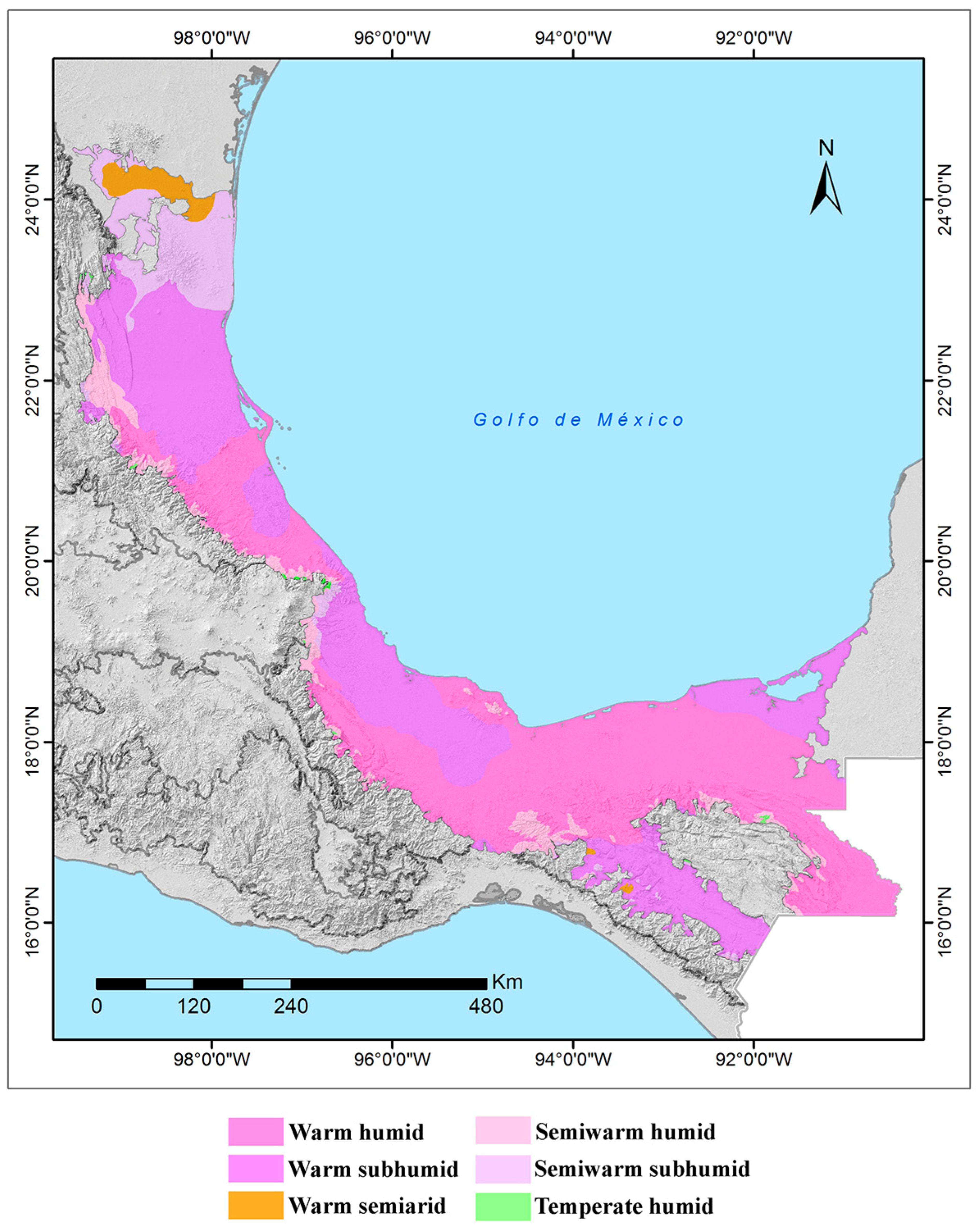
Warm humid and warm subhumid climates—classified following García’s modification of the Köppen system [26], in which “warm” (A) climates have mean annual temperatures above 22 °C and “semiwarm” (A(C)) climates range from 18 to 22 °C, generally at higher elevations—dominate throughout most of the Veracruzan biogeographic province [26,27]. Warm subhumid conditions prevail throughout the northern half of Veracruz, except in areas bordering Hidalgo and San Luis Potosí, where warm humid climates are more common. Warm humid climates dominate the southern region of Veracruz, extending from the Coatzacoalcos district eastward into Tabasco and southward across Central America’s Chiapas Highlands to the northwestern corner of Guatemala [26,27] (Figure 3). Humid subtropical climates occur in small and scattered regions along the western edges of the province, most closely associated with the foothills of the Sierra Madre Oriental and Sierra Madre del Sur (Figure 3). A broader zone of subhumid subtropical climate is found in the northernmost portion of the province along the border with Tamaulipas. Localized areas of hot semi-arid climate occur near this northern boundary and in two small portions of the Chiapas Depression. There is also a very small area of temperate climate close to Pico de Orizaba, at altitudes of up to 2200 m [26,27] (Figure 3).

2.1.4. Vegetation and Land-Use

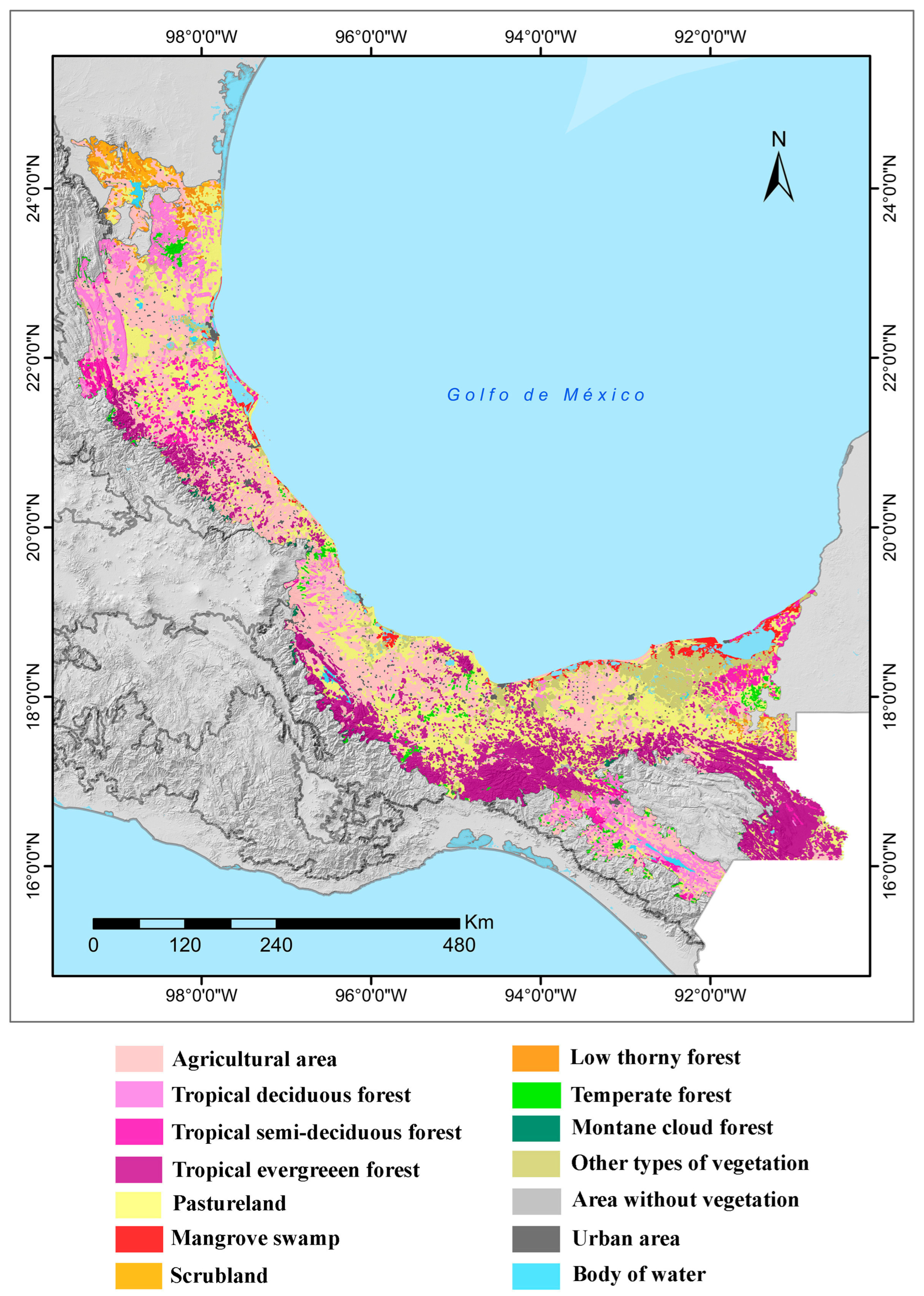
Human activities have greatly changed vegetation in the Veracruzan province. Over 80% of the surface area of Veracruz state is currently cultivated or used as livestock pastureland, resulting in massive transformation and fragmentation of virgin vegetation that is now mainly found in remnant patches [28]. Indigenous vegetation persists as discontinuous stretches of tropical evergreen and semi-deciduous forests. These forests reach from the southern border with Guatemala east of the Chiapas Highlands to the north, to the foothills and lower slopes of the Chiapas Highlands, the Sierra Madre del Sur, and the Sierra Madre Oriental, and on to the south [28] (Figure 4).
The tropical evergreen forest belt of the Veracruzan province is isolated by areas dominated by tropical semi-deciduous forest, especially those that form the Chiapas Depression and southern Tamaulipas’ bordering areas. A remnant of tropical deciduous forest is situated along the northern edge of the province in central Tamaulipas. Coastal regions with mangrove forests occur along the south coast of southwestern Campeche, eastern Tabasco, and central Veracruz. Areas of scrub and thorny lowland forest are found along Veracruz’s northern border [27,28] (Figure 4). There is a patchwork of temperate forest distributed at higher elevations throughout the province. Montane cloud forest is restricted to one small area along its western border, especially along the boundary with the Sierra Madre Oriental in San Luis Potosí and Hidalgo, and in the center of the province near the contact zone with the Transvolcanic Belt [28] (Figure 4).

2.2. Data Compilation and Analytical Methods

2.2.1. Species Data Compilation

We compiled species lists of amphibians and reptiles for all Mexican states that contain the Veracruzan biogeographic province (Chiapas, Campeche, Tabasco, Oaxaca, Veracruz, Puebla, Hidalgo, San Luis Potosí, and Tamaulipas) using the latest state-level syntheses from Lemos-Espinal and Smith [29,30]. These lists were created by regional specialists, peer reviewed, and use verified records up to 2023–2024 from VertNet, GBIF, museum collections, published literature, and specific fieldwork. We confirmed records using VertNet, GBIF, and other sources. We encountered no inconsistencies between these other sources and the data reported in the published state lists.

2.2.2. Taxonomic Standardization

Species lists were updated using recent taxonomic and distributional literature [31,32,33,34,35]. For amphibian names, we used [36] or [37]. We decided to consult both sources to ensure a comprehensive approach to taxonomy. Though we mostly followed [36], we used [37] in some examples where naming conventions differ (e.g., [36] adopts Lithobates, while we adopt Rana, following [37]) to be consistent with historical naming conventions. We used [38] for reptile names.

2.2.3. Delimitation of Biogeographic Provinces

We defined the extent of the Veracruzan biogeographic province based on [4,5,39,40]. The state-level species lists were refined using these boundaries to produce province level species lists for the Veracruzan province (Supplementary Table S1) and neighboring provinces: Chiapas Highlands, Sierra Madre del Sur, Transvolcanic Belt, Sierra Madre Oriental, Pacific Lowlands, Yucatán Peninsula, and Tamaulipas. The same literature-driven procedure was employed to create species lists for all neighboring provinces [16,24,41,42].

2.2.4. Biogeographic Classification Scheme

For further analyses, provinces were categorized into three biogeographic contexts: Mexican Transition Zone (Chiapas Highlands, Sierra Madre del Sur, Sierra Madre Oriental, Transvolcanic Belt), Neotropical Region (Veracruzan, Pacific Lowlands, Yucatán Peninsula), and Nearctic (Tamaulipas). For a balanced comparison in regional data, Tamaulipas was classified under the Neotropical group in line with its geographical position and faunal affinities.

2.2.5. Conservation Status Assessment

We also recorded the conservation status and population trends of each species using the International Union for Conservation of Nature (IUCN) Red List 2025-2 [23], the Secretaría del Medio Ambiente y Recursos Naturales [22], and Environmental Vulnerability Scores (EVS) from [43,44].

2.2.6. Spatial and Statistical Analyses

We used ArcGIS 10.8.1 (ESRI, Redlands, CA, USA) for spatial analyses, with the biogeographic province map [4], projected in Lambert Conformal Conic (WGS84). For each province, we calculated: (1) total area and perimeter (Calculate Geometry tool); (2) elevational range (difference between minimum and maximum contour values); (3) length of shared borders between provinces (Polygon Neighbors tool); and (4) straight-line distance between province centroids (Feature to Point and Point Distance tools) (Table 1).
Faunal similarity among provinces was estimated using the Jaccard’s similarity coefficient using presence–absence data for amphibians and reptiles separately. Single linkage (nearest neighbor) hierarchical cluster analyses were executed to visualize clustering patterns among Veracruzan and neighboring provinces. Cluster structure was interpreted by comparing shared nodes and relative Jaccard distances. We also calculated pairwise Jaccard distances. The clustering analysis was conducted using Systat 13.2 (Systat Software Inc., San Jose, CA, USA).
Because Jaccard similarity values and geographic variables did not meet assumptions of normality, correlations between faunal similarity and geographic characteristics (i.e., border length, centroid distance, area, perimeter, and elevational range) were analyzed by Spearman’s rank correlation coefficient (ρ).
We examined amphibian and reptile richness and biogeographic province area in the Mexican Transition Zone and in Neotropical provinces (including Tamaulipas). Richness–area relationships were examined using individual linear regressions for each region. Next, we fitted linear models with province surface area (continuous predictor) and biogeographic region (categorical factor: Transition vs. Neotropical) as main effects and their interaction to test if richness increased with area differentially between regions. Amphibians and reptiles were examined separately. These models are equivalent to an analysis of covariance (ANCOVA), enabling simultaneous comparison of intercepts and slopes across regions.
To test spatial correlations between species richness and latitude and longitude of province centroids in each region, we used Spearman’s rank correlations to examine whether large geographic gradients affected species richness independently for each area and region. Statistical analyses, excluding clustering, were performed under JMP 19 (SAS Institute, Cary, NC, USA). Statistical significance was checked at α = 0.05.

3. Results

3.1. Species Richness

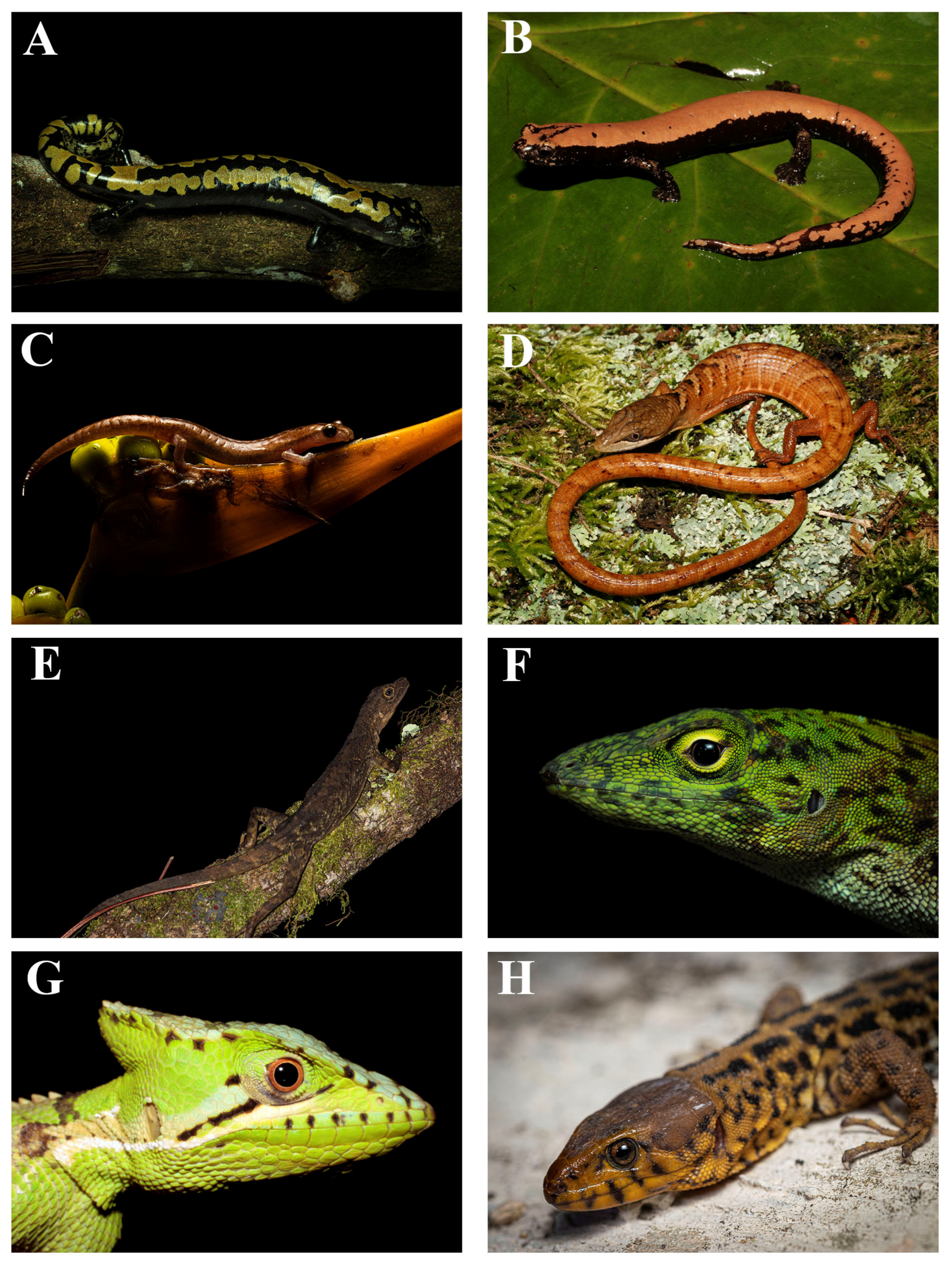
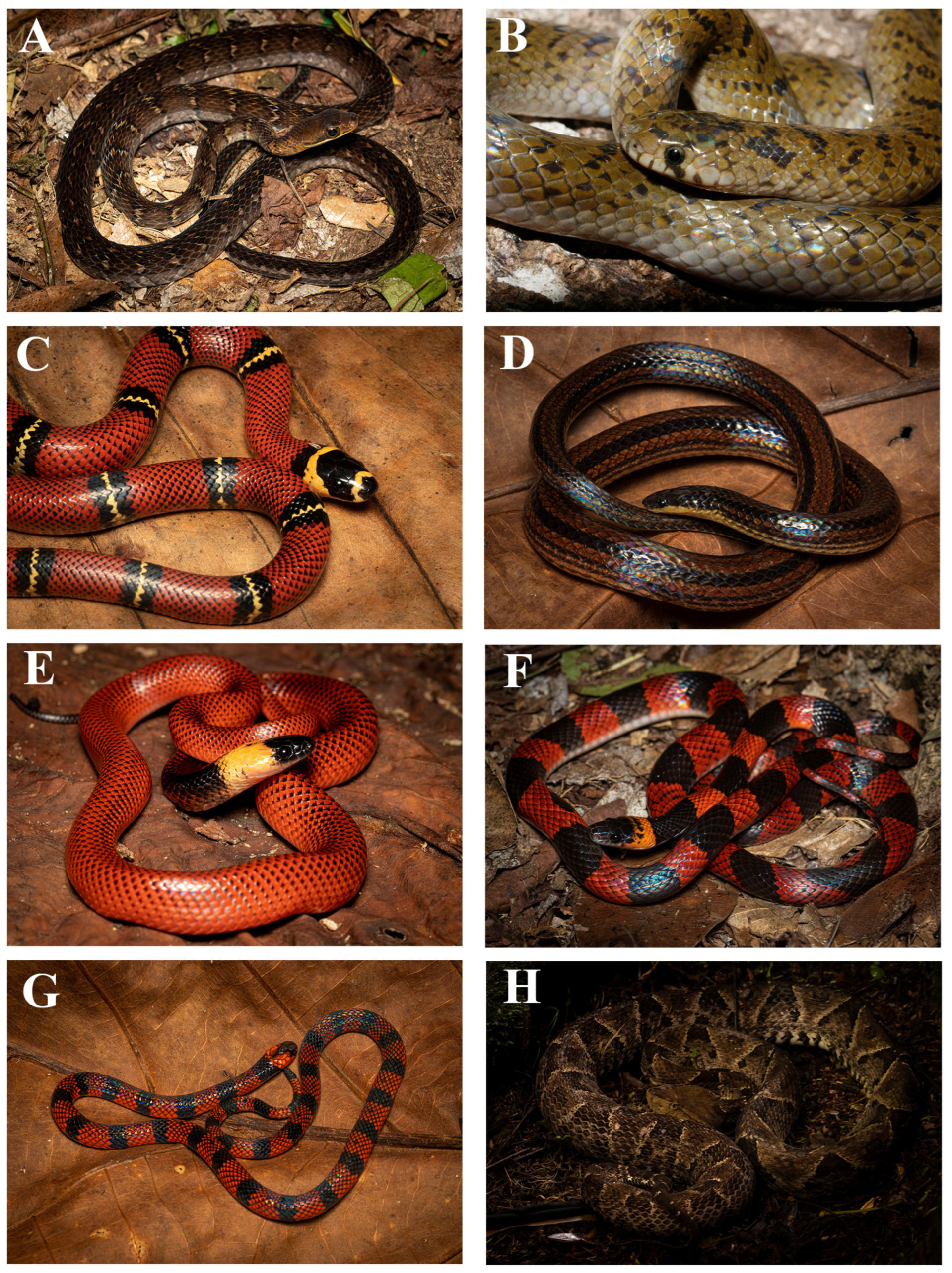
The Veracruzan biogeographic province of Mexico harbors a total of 343 native species of amphibians and reptiles, including 95 amphibians and 248 reptiles, distributed among 47 families (Figure 5, Figure 6 and Figure 7). The amphibians are represented by 15 families (11 anuran, six salamander, and one caecilian), and 32 families of reptiles (one crocodilian, 14 lizard, nine snake, and eight turtle). In total, the province’s herpetofauna includes 144 genera (39 amphibian and 105 reptile) (Supplementary Table S1; Table 2 and Table 3).
At the national level, Mexico has 1399 native amphibians and reptiles (435 amphibians and 964 reptiles), distributed among 55 families (16 amphibian and 39 reptile families) and 210 genera (55 amphibian and 155 reptile genera) [30], similar to the figures reported by [45]. The Veracruzan biogeographic province, therefore, contains 85.5% of the families (47/55), 92.9% of the genera (144/155), and 24.5% of the species (343/1,399) of the Mexican herpetofauna. The province houses 93.8% of families (15/16), 70.9% of genera (39/55), and 21.8% of species (95/435) of amphibians recorded in Mexico. For reptiles, it contains 82.1% of families (32/39), 67.7% of genera (105/155), and 25.7% of species (248/964).
The Veracruzan biogeographic province ranks fifth among the 14 biogeographic provinces of Mexico in overall amphibian and reptile species richness, after the Sierra Madre del Sur (517 species), the Transvolcanic Belt (427 species), the Sierra Madre Oriental (382), and the Chiapas Highlands (354) [30]. For amphibians, the Veracruzan province ranks fifth after the Sierra Madre del Sur (186 species), Transvolcanic Belt (154), Sierra Madre Oriental (123), and Chiapas Highlands (112). For reptiles, the province also comes in fifth, after the Sierra Madre del Sur (331 species), Transvolcanic Belt (271), Sierra Madre Oriental (259), and Pacific Lowlands (249) [30].
The herpetofauna of the Veracruzan province includes six endemic amphibian species and ten endemic reptile species. Seven species have been introduced: Cuban flat-headed frog (Eleutherodactylus planirostris), Cuban brown anole (Anolis sagrei), common house gecko (Hemidactylus frenatus), tropical house gecko (Hemidactylus mabouia), Mediterranean house gecko (Hemidactylus turcicus), Brahminy blindsnake (Indotyphlops braminus), and pond slider (Trachemys scripta). Such species were likely introduced through human-mediated transport related to trade, including the movement of nursery plants and cargo; urbanization; and the exotic animal market [46,47,48,49,50,51].

3.2. Distribution

Amphibian species in the Veracruzan biogeographic province exhibit a wide range of global distributions, reflecting the province’s location at the interface of the Neotropical, Nearctic, and Mexican Transition regions. Of the amphibian fauna reported in the province, 38 species are endemic to Mexico, including six species endemic to the Veracruzan province itself: Incilius cavifrons, Ecnomiohyla valancifer, Craugastor megalotympanum, Craugastor vulcani, Pseudoeurycea orchimelas, and Thorius narismagnus (Supplementary Table S1). The remaining 32 Mexican endemic amphibians present in the Veracruzan province are shared with other biogeographic provinces within the Neotropical and Mexican Transition regions. Of these, six species also occur in Nearctic provinces such as Eleutherodactylus cystignathoides and E. longipes in the Tamaulipas biogeographic province and Eleutherodactylus verrucipes, Dryophytes eximius, Rheohyla miotympanum, and Rana montezumae in the Chihuahuan Desert province.
There are 13 amphibian species shared between Mexico and the United States, indicative of greater Nearctic–Neotropical connectivity. These include widespread taxa such as Anaxyrus punctatus, Incilius nebulifer, Rana berlandieri, Rana catesbeiana, Scaphiopus couchii, Spea multiplicata, Notophthalmus meridionalis, and Siren intermedia, which are found north and south of the international border with the United States.
The amphibians of the Veracruzan province are largely Neotropical, with distributions from Mexico to Central America and, in some cases, South America. This group includes several species of Craugastor (e.g., C. laticeps, C. loki, C. pygmaeus), hylid and phyllomedusid frogs (e.g., Smilisca cyanosticta, Trachycephalus vermiculatus, Triprion petasatus, Agalychnis callidryas), and some leptodactylids (e.g., Engystomops pustulosus, Leptodactylus melanonotus). Multiple salamanders and caecilians, such as Bolitoglossa mexicana, Oedipina elongata, Dermophis mexicanus, and Gymnopis syntrema, also display widespread distributions in Central America beyond Mexico. Lastly, four amphibian species have extensive ranges from the southeastern United States into Central or northern South America. Rhinella horribilis, Smilisca baudinii, Leptodactylus fragilis, and Hypopachus variolosus are ubiquitous and broadly distributed in different biological regions.
Reptiles in the Veracruzan biogeographic province have geographical distributions that range from narrowly restricted endemics to continental and oceanic taxa. Of the 248 species described in the province, 78 are endemic to Mexico, including ten species (Abronia reidi, Abronia chiszari, Ophisaurus ceroni, Anolis duellmani, Siderolamprus ingridae, Xenosaurus sanmartinensis, Ficimia variegata, Tantilla slavensi, Sibon linearis, Micrurus limbatus) endemic specifically to the Veracruzan province. Among the remaining 68 Mexican endemic reptile species, most of them are found in the other provinces of the Mexican Transition Zone. There is only one species, Terrapene yucatana, that is found in the Veracruzan and Yucatan Peninsula, both of which are Neotropical provinces. Twenty-five Mexican endemic species extend into Nearctic provinces, including Abronia taeniata, Sceloporus cyanogenys, Plestiodon lynxe, Lampropeltis polyzona, Thamnophis sumichrasti, Agkistrodon taylori, Crotalus totonacus, Terrapene mexicana, and Kinosternon integrum.
The other 170 reptile species of the Veracruzan province have distributions that extend beyond Mexico. Of these, 28 also occur in the United States, including Cophosaurus texanus, Phrynosoma cornutum, Sceloporus variabilis, Aspidoscelis gularis, Pantherophis emoryi, Crotalus atrox, Kinosternon flavescens, and Gopherus berlandieri. A large proportion of the reptile fauna (124 species; 50% of the total) has distributions that extend from Mexico into Central or South America. Within this region, 101 species also live in other Mexican biogeographic provinces of the Transition Zone, outside of the Neotropical region. Thirteen species have especially large distributions, distributed in Nearctic, Neotropical, and Transitional provinces of Mexico and in Central or South America. Examples include Crocodylus moreletii, Iguana iguana, Boa imperator, Leptophis mexicanus, Pseudelaphe flavirufa, Micrurus browni, Trachemys venusta, and Kinosternon scorpioides. Ten more reptile species are also found in Central or South America, but within Mexico are restricted to the Veracruzan biogeographic province (Adelphicos visoninus) or the Veracruzan and Yucatan Peninsula provinces. These include Anolis ustus, Cachryx defensor, Mesoscincus schwartzei, Aspidoscelis angusticeps, Holcosus gaigeae, Imantodes tenuissimus, and Crotalus tzabcan. Another 13 non-endemic species occur from the United States through Mexico and into Central or South America, including Crocodylus acutus, Coluber constrictor, Drymarchon melanurus, Drymobius margaritiferus, Senticolis triaspis, Leptodeira septentrionalis, Nerodia rhombifer, and several species of Thamnophis.
The five marine turtle species recorded in the Veracruzan province: Caretta caretta, Chelonia mydas, Eretmochelys imbricata, Lepidochelys kempii, and Dermochelys coriacea, exhibit circumglobal oceanic distributions, occurring well beyond the limits of terrestrial biogeographic provinces. The province appears to be a hotspot for marine turtles [52] and an important contributor to juvenile feeding aggregations in the Gulf of Mexico [53].

3.3. Comparison with Neighboring Provinces

The Veracruzan biogeographic province shows a clear pattern in the species shared with adjacent provinces that reflects both biogeographic affinity and regional context. Overall, the Veracruzan province shares a larger proportion of its amphibian and reptile fauna with provinces of the Mexican Transition Zone than with provinces of the Neotropical or Nearctic regions (Table 2). The highest levels of shared richness occur with the Sierra Madre Oriental, Chiapas Highlands, and Transvolcanic Belt provinces, with each sharing close to 60% of the total herpetofauna of the Veracruzan province. In contrast, the proportion of shared species declines markedly with the provinces of the Neotropical lowlands, including the Yucatan Peninsula and Pacific Lowlands, and reaches its lowest value with Tamaulipas, the only neighboring province of the Nearctic region (Table 2).
This same pattern is seen for amphibians and reptiles when they are analyzed separately, although reptiles tend to show slightly higher levels of overlap than amphibians across most neighboring provinces. Anurans share a particularly high number of species with the Transition Zone provinces, whereas caudates show limited overlap except for with the Sierra Madre Oriental and Chiapas Highlands. Reptiles, especially lizards and snakes, exhibit broader overlap across multiple provinces, contributing to the relatively higher percentages of shared reptile richness overall (Table 2).
The Veracruzan biogeographic province contributes slightly less than one-third of the total species richness of the regional species pool (Table 2). Its contribution is slightly greater for reptiles than for amphibians, reflecting the predominance of widespread lowland reptile taxa. Notably, the Veracruzan province makes a disproportionate contribution to the regional pool in a few taxonomic groups, including anuran families such as Rhinophrynidae and Scaphiopodidae, and reptile families associated with aquatic or coastal environments, such as Crocodylidae, Chelydridae, Dermatemydidae, and Dermochelyidae (Table 2). These families underscore the role of the Veracruzan province as a key lowland and coastal component within the broader herpetofaunal assemblage of southeastern Mexico.

3.4. Similarities

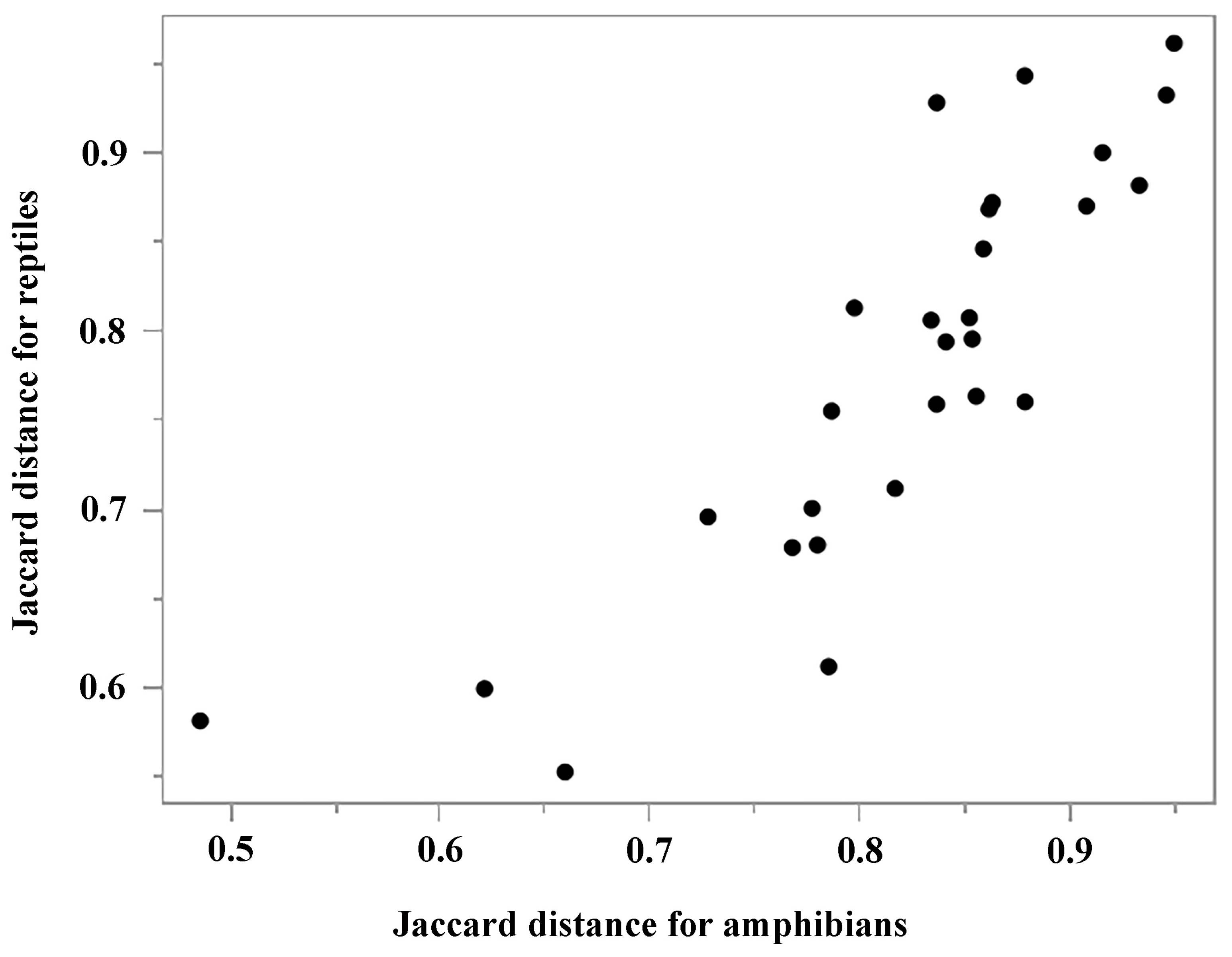
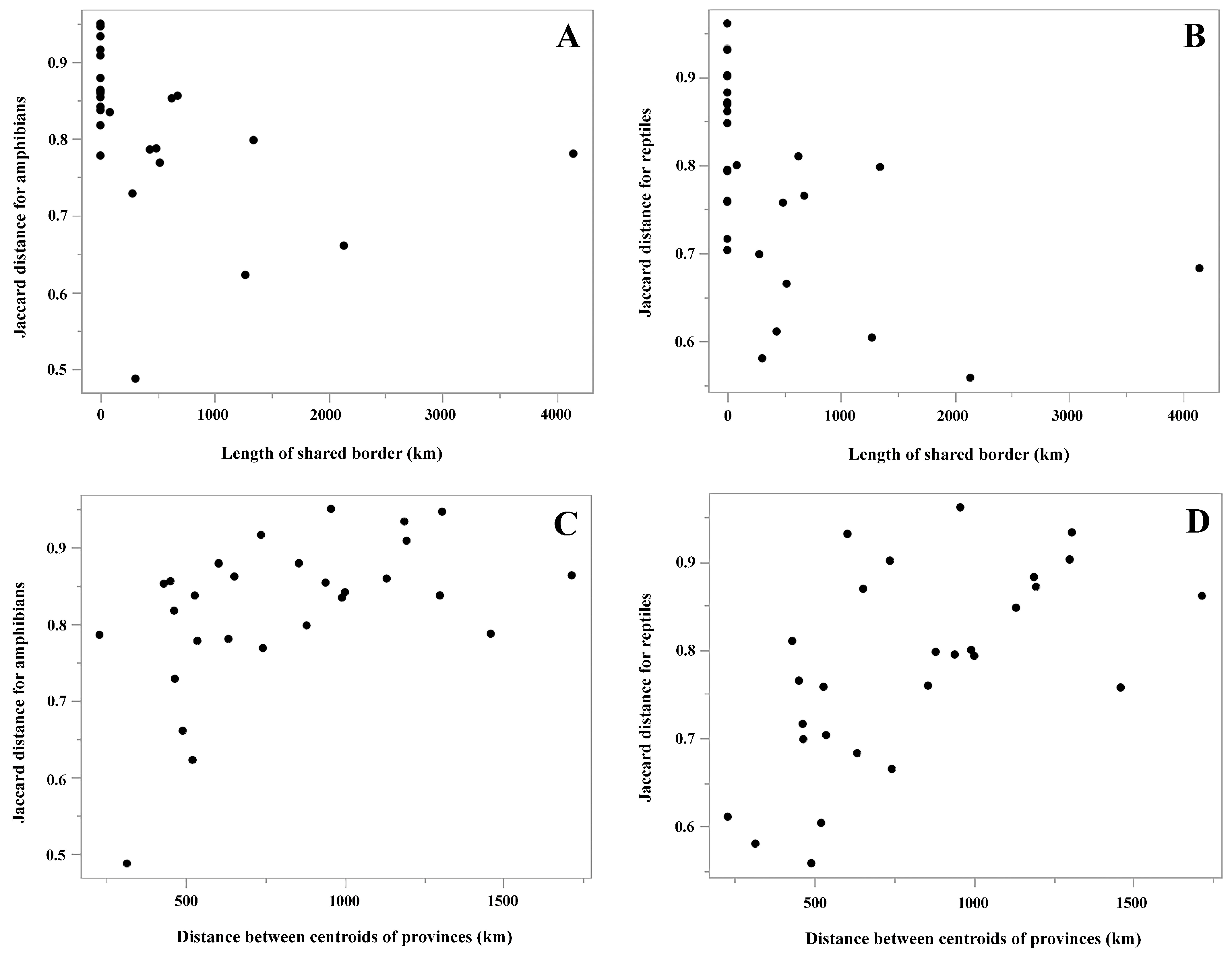
Jaccard distances between pairs of biogeographic provinces for amphibians and reptiles were highly and positively correlated (Figure 8; n = 28, Spearman’s ρ = 0.88, p < 0.0001), indicating a strong concordance in patterns of faunal turnover between both groups. For amphibians, Jaccard distances were negatively correlated with the length of the shared border between provinces (Figure 9A; ρ = −0.67, p < 0.0001) and positively correlated with the distance between their geographic centroids (Figure 9C; ρ = 0.52, p = 0.0044). A similar pattern was observed for reptiles, with Jaccard distances showing negative correlations with shared border length (Figure 9B; ρ = −0.62, p = 0.0004) and positive correlations with centroid distance (Figure 9D; ρ = 0.61, p = 0.0006). These results suggest that geographic proximity contributes to similarities in herpetofaunal composition among Mexican biogeographic provinces. However, the moderate strength of these correlations indicates that spatial adjacency and distance alone do not fully account for the observed patterns, pointing to an additional role of historical, environmental, or ecological factors in shaping provincial assemblages.
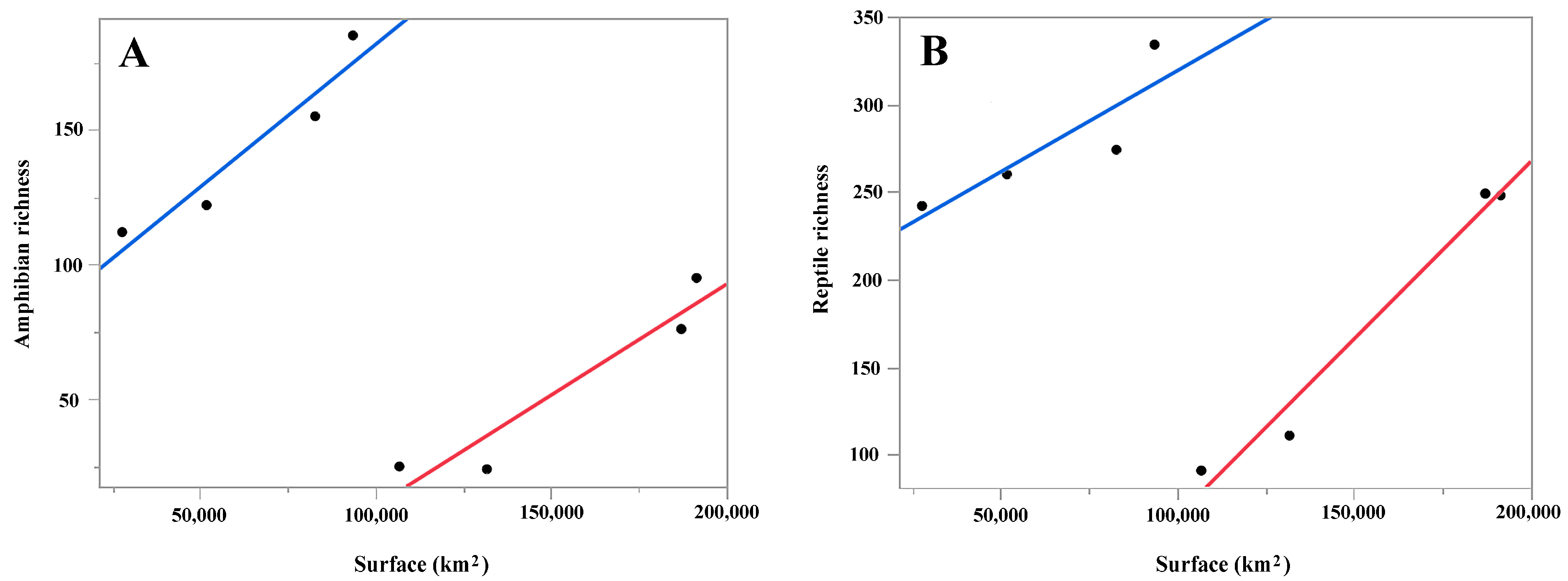
Species richness of both amphibians and reptiles increased with the area of the biogeographic province in the Transition and Neotropical (including Tamaulipas) regions. Separate linear regressions showed positive relationships between surface area and richness for amphibians and reptiles in both regions, although the strength of the relationship varied among taxa and regions (Figure 10). When amphibians and reptiles were analyzed separately using linear models that included province area and biogeographic region, both factors had significant effects on richness (amphibians: area p = 0.0035, region p = 0.00046; reptiles: area p = 0.0030, region p = 0.00077). In contrast, the interaction between area and region was not significant for either group (amphibians: p = 0.48; reptiles: p = 0.15), indicating that richness increases with area at a similar rate across regions. Despite this shared scaling pattern, the Transition Zone provinces consistently supported higher species richness than Neotropical provinces of comparable size for both amphibians and reptiles.
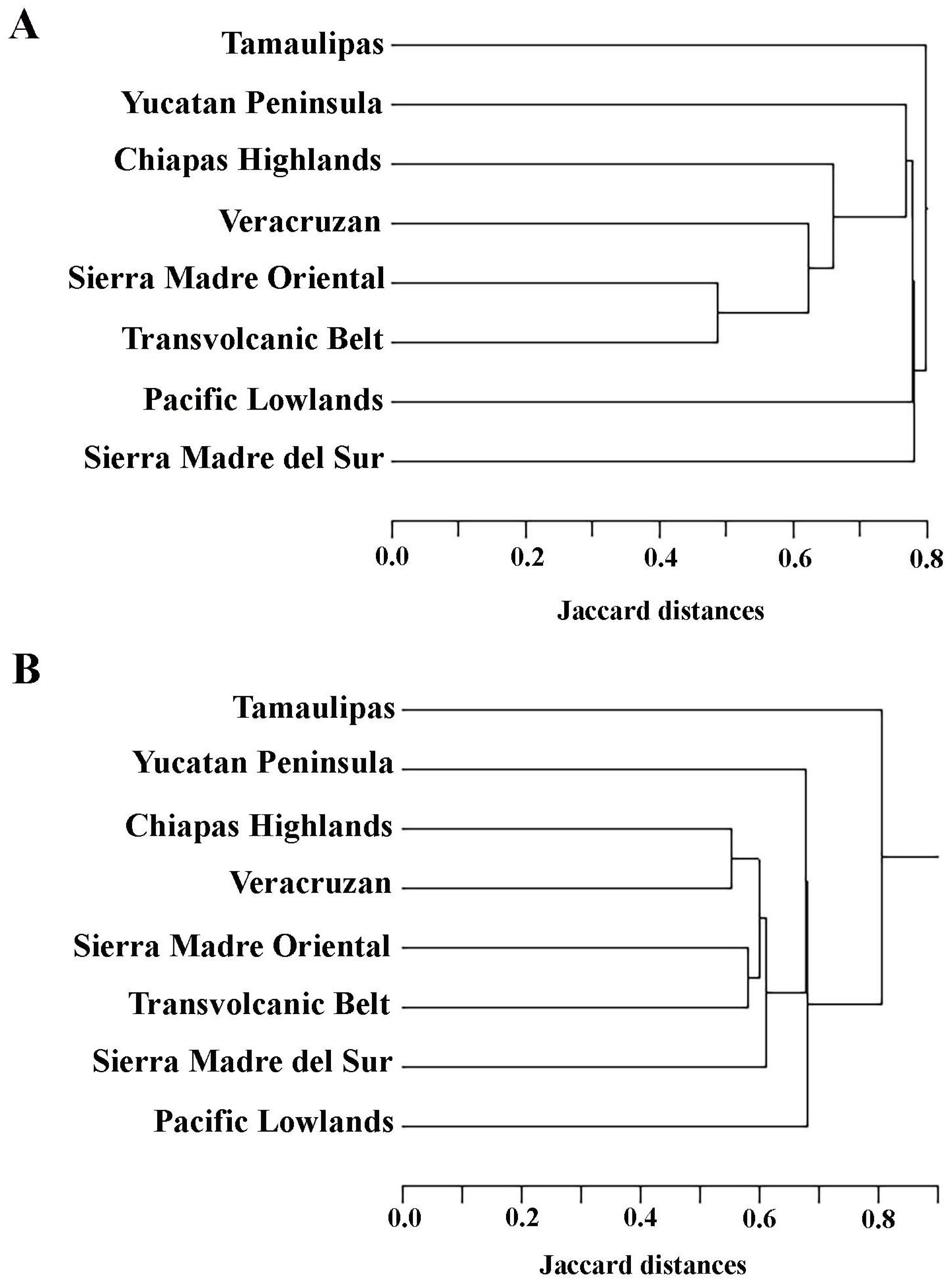
The amphibian dendrogram exhibits a hierarchical structure in which the earliest clusterings occur among geographically proximate provinces with similar environmental affinities (Figure 11). The lowest Jaccard distance is observed between the Transvolcanic Belt and the Sierra Madre Oriental (0.486), indicating a high degree of similarity in amphibian species composition between these provinces. This cluster subsequently joins the Veracruzan province at a moderate distance (0.622), reflecting the climatic and altitudinal continuity among these regions, particularly associated with humid and montane environments. These three provinces are geographically close and converge in central–eastern Mexico, suggesting the presence of a regional continuum of environmental conditions. Subsequent clustering incorporates the Chiapas Highlands (0.660), reinforcing the affinity among montane and humid provinces extending from central to southeastern Mexico. In contrast, both the Yucatan Peninsula and the Pacific Lowlands are incorporated at substantially higher distances (0.768–0.780), indicating lower faunal similarity with the montane and Gulf provinces. Finally, Tamaulipas joins the dendrogram at the highest distance (0.798), suggesting that its amphibian assemblage is the most distinct relative to the remaining provinces. The Sierra Madre del Sur is incorporated relatively late in the dendrogram (0.780), indicating comparatively low similarity with other provinces despite sharing a considerable number of species. This pattern suggests that its exceptionally high species richness and large number of endemic taxa strongly influence similarity metrics, reducing proportional overlap with other regions.
The reptile dendrogram shows a broadly similar overall structure to that of the amphibians, although notable differences are evident in the sequence and distances of cluster formation. The first clustering occurs between the Veracruzan province and the Chiapas Highlands (0.552), followed by the union of the Transvolcanic Belt and the Sierra Madre Oriental (0.581). As in amphibians, the clustering of these four provinces indicates moderate to high faunal affinity among regions characterized by warm–humid climates and complex altitudinal gradients. These clusters subsequently merge into a broader group at a distance of 0.599, to which the Sierra Madre del Sur is incorporated at a relatively low distance (0.611). In contrast to amphibians, the Sierra Madre del Sur exhibits greater similarity with other provinces for reptiles, particularly with the Veracruzan province and the Yucatán Peninsula (0.678). The Pacific Lowlands are incorporated at intermediate distances (0.680), whereas Tamaulipas again joins the dendrogram at the highest distance (0.807), indicating a relatively distinct reptile assemblage compared to the other provinces.

3.5. Conservation Status

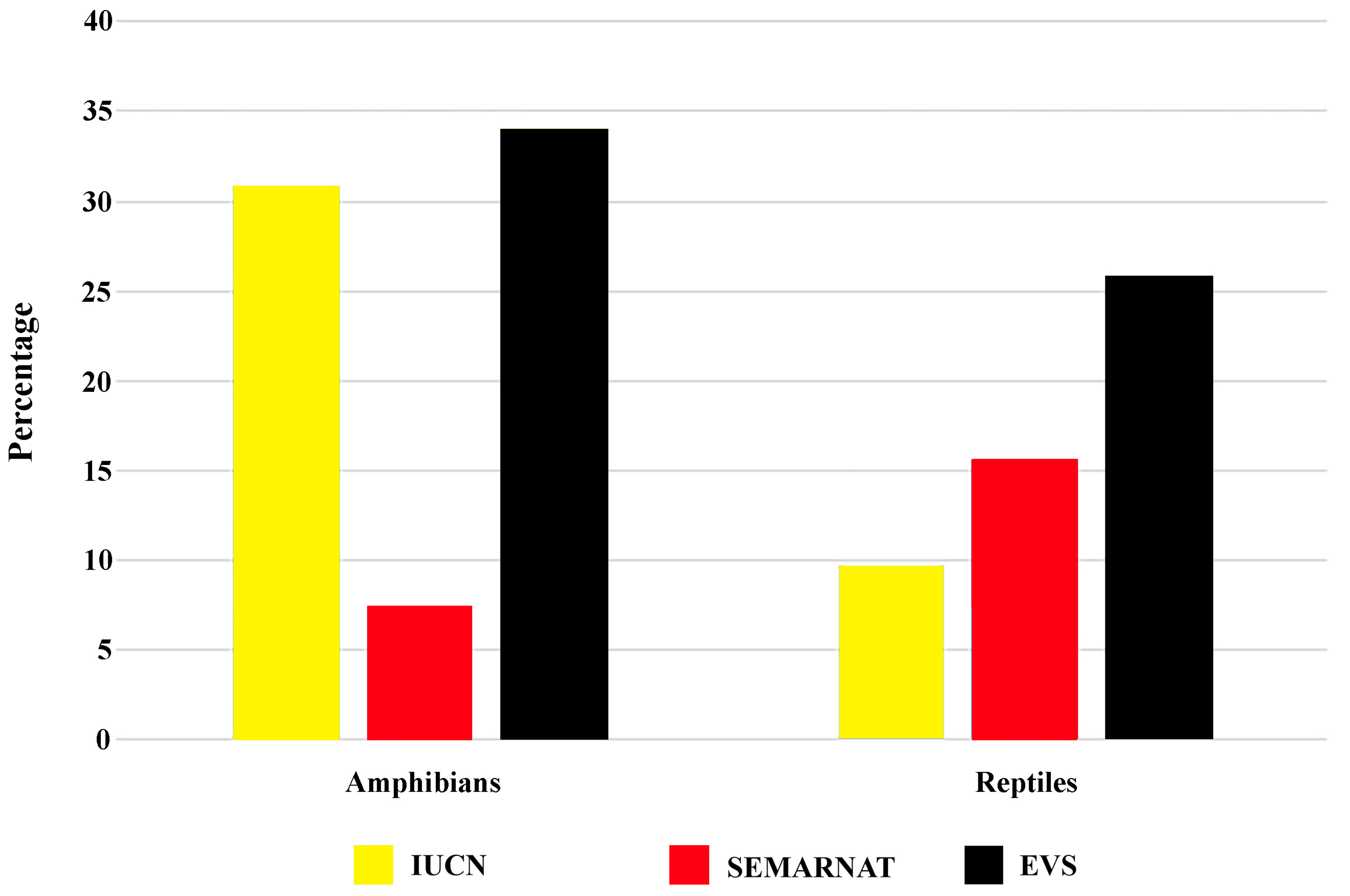
The herpetofauna of the Veracruzan biogeographic province includes a substantial number of species facing conservation challenges. Out of the 343 amphibian and reptile species recorded for the region, 310 were evaluated by the IUCN Red List, and 49 of these evaluated species (15.8%) are currently classified as being of conservation concern (Vulnerable, Endangered, or Critically Endangered). Within Mexico, 46 species are placed in categories of risk by the Secretaría del Medio Ambiente y Recursos Naturales [22]. In addition, 91 species are classified as high risk according to their Environmental Vulnerability Scores (EVS) [43,44], underscoring the conservation relevance of the province (Table 3, Figure 12).
Amphibians represent a disproportionately high fraction of the threatened herpetofauna in the Veracruzan biogeographic province. Of the 95 amphibian species recorded, 94 have been assessed by the IUCN, and nearly one-third of them (29 species; 30.9%) are included in a threatened category. Ten species are listed as Vulnerable, including frogs and salamanders associated with forested and riparian habitats such as Craugastor pelorus, Charadrahyla taeniopus, Ptychohyla macrotympanum, and Bolitoglossa alberchi. Seventeen species are classified as Endangered, spanning a wide range of taxonomic groups, from bufonids (Incilius cavifrons, I. cristatus) to plethodontid salamanders (Bolitoglossa veracrucis, Pseudoeurycea lineola, P. nigromaculata, P. orchimelas, P. werleri, Thorius pennatulus). Two species, Ecnomiohyla valancifer and Thorius narismagnus, are considered Critically Endangered, reflecting their extremely restricted distributions and ongoing population declines.
Endemism is a defining feature of the threatened amphibian assemblage. Most of the listed species (23) are endemic to Mexico, and six are restricted to the Veracruzan biogeographic province (Incilius cavifrons, Craugastor megalotympanum, C. vulcani, Ecnomiohyla valancifer, Pseudoeurycea orchimelas, and Thorius narismagnus). In contrast, only one threatened species extends into the United States (Notophthalmus meridionalis), while the remaining non-endemic taxa are shared between Mexico and Central America. This high level of endemism highlights the global importance of the region for amphibian conservation, as local habitat degradation can rapidly translate into species-level extinction risk.
Habitat loss and degradation are reported as major threats affecting amphibian species in the Veracruzan biogeographic province [23]. According to available assessments, factors such as agricultural expansion, livestock grazing, extraction of wood and non-timber forest products, urban development, and the expansion of human settlements are associated with population declines [23]. Climate-related changes in vegetation distribution have also been identified as potential factors influencing habitat conditions [54]. These threats are frequently documented in cloud forest environments, which harbor a high proportion of range-restricted amphibian species [55]. Species such as Incilius cristatus, Charadrahyla nephila, Duellmanohyla chamulae, and Megastomatohyla mixomaculata are among those reported from these habitats
In addition to habitat-related threats, disease has been documented as a factor affecting amphibian populations in the Veracruzan biogeographic province. The chytrid fungus Batrachochytrium dendrobatidis has been recorded in this province by Murrieta-Galindo et al. [56] and Soto-Pozos et al. [57], and population declines in species such as Thorius pennatulus have been associated with this pathogen [23]. Several salamander species occurring in the province (e.g., Bolitoglossa alberchi, Pseudoeurycea lineola, P. nigromaculata, and Notophthalmus meridionalis) are considered vulnerable to Batrachochytrium salamandrivorans (Bsal) based on existing assessments [23]. Although Bsal has not been detected in the Americas, climatic suitability models have identified areas within the Veracruzan province as potentially suitable for its establishment [58,59], while other models indicate more limited suitability [60].
Reptiles show a lower proportion of threatened species compared to amphibians, but still exhibit significant conservation concerns. Of the 248 reptile species recorded for the Veracruzan biogeographic province, 216 have been evaluated by the [23], and 20 of these evaluated species (9.3%) are included in a threatened category. At the national level, 39 reptile species are listed by SEMARNAT under the categories of Threatened or In Danger of Extinction [22], and 59 species are classified as high risk according to the EVS [43] (Figure 12).
Among the 20 reptile species listed by the IUCN, 13 are categorized as Vulnerable, including taxa affected by habitat loss and human exploitation such as Crocodylus acutus, Abronia taeniata, Anolis barkeri, Cachryx defensor, Xenosaurus grandis, and Trachemys ornata. Four species are listed as Endangered (Abronia chiszari, Ophisaurus ceroni, Chersodromus rubriventris, and Rhadinaea marcellae), while three species are considered Critically Endangered: Eretmochelys imbricata, Lepidochelys kempii, and Dermatemys mawii [23] (Table 3).
An additional conservation consideration is the number of reptile species classified as Data Deficient (18 species) or not yet evaluated by the IUCN (32 species). These classifications indicate that available information is insufficient to assess their conservation status. Previous studies have shown that some data-deficient amphibians in Mexico have declining populations [61]. This suggests that current estimates of threatened species richness in the province may be incomplete, highlighting the need for additional data on species distributions and population trends [62,63,64].
The primary threats affecting reptiles in the Veracruzan biogeographic province are closely linked to habitat loss and human exploitation [23]. Terrestrial and freshwater reptiles are mainly impacted by the conversion of natural vegetation to agricultural fields and pastureland, urban expansion, and infrastructure development (e.g., [65,66]). Several species are additionally threatened by illegal collection for the pet trade (Abronia taeniata, Cachryx defensor, Xenosaurus grandis) and by direct exploitation for human consumption (Chelydra rossignonii, Dermatemys mawii). Crocodylus acutus is particularly affected by illegal hunting, while freshwater turtles face compounded pressures from habitat degradation and harvest [23].
Marine turtles represent a special case, as their conservation status is influenced by threats operating at both local and global scales. Species such as Caretta caretta, Eretmochelys imbricata, Lepidochelys kempii, and Dermochelys coriacea are affected by egg harvesting, fisheries bycatch, coastal development, pollution, disease, and climate change. Increasing sand temperatures on nesting beaches, sea-level rise, and changes in storm frequency further exacerbate these threats, potentially altering hatchling sex ratios and reducing nesting success [67].
The overall percentage of amphibian and reptile species classified in threatened categories in the Veracruzan biogeographic province is relatively low (49 of 310 evaluated species; 15.8%). Across taxa, amphibians account for a higher proportion of threatened species than reptiles. In addition, a considerable number of species are classified as Data Deficient or have not yet been evaluated, particularly among reptiles. According to IUCN assessments and Environmental Vulnerability Scores, many species in the province are associated with threats related to habitat modification, including land-use change, agricultural expansion, and urban development. These patterns indicate that, despite the relatively low proportion of species currently categorized as threatened, multiple species are exposed to documented risk factors within the province.

4. Discussion

The Veracruzan biogeographic province emerges from our analyses as one of the most important lowland regions for amphibian and reptile diversity in Mexico. Harboring nearly one quarter of the national herpetofauna, including representatives of >85% of families and >90% of genera, the Veracruzan province represents a major reservoir of taxonomic diversity despite ranking only fifth in total species richness among Mexican provinces. This apparent discrepancy underscores the role of the province as a biogeographic crossroads rather than a center of extreme species accumulation, reflecting its position at the interface of the Neotropical Region, the Mexican Transition Zone, and, to a lesser extent, the Nearctic Region [2,3,68].
The exceptionally high representation of families and genera indicates that the Veracruzan province captures a broad spectrum of evolutionary lineages, including taxa associated with humid tropical lowlands, montane forests, freshwater systems, and coastal environments. This pattern is consistent with the long-recognized role of the Gulf of Mexico lowlands as a major dispersal corridor linking Central America with eastern Mexico [2,69,70]. In this sense, the Veracruzan province functions as a biotic bridge, facilitating faunal interchange while simultaneously promoting diversification through environmental heterogeneity and topographic complexity.
Species richness of both amphibians and reptiles increased with biogeographic province area across both the Mexican Transition Zone and the Neotropical provinces, consistent with classic species–area relationships [71,72]. The significant effects of both province area and biogeographic region, coupled with the absence of a significant interaction, indicate that richness scales similarly with area across regions but that Transition Zone provinces consistently support higher richness than Neotropical provinces of comparable size.
This pattern likely reflects the unique evolutionary and ecological characteristics of the Mexican Transition Zone, which combines lineages of Nearctic and Neotropical origin and encompasses steep environmental gradients over relatively short geographic distances [2,68]. These conditions promote lineage overlap, ecological diversification, and high beta diversity, particularly in amphibians, which are strongly constrained by moisture, temperature, and microhabitat availability [8,73]. The lower richness observed in Neotropical lowland provinces of similar size may result from greater environmental homogeneity and a dominance of widespread taxa with broad ecological tolerances.
In contrast, the absence of significant relationships between species richness and the latitude or longitude of province centroids suggests that broad geographic gradients alone do not explain richness patterns at the scale of Mexican biogeographic provinces. Instead, area, environmental heterogeneity, and historical processes appear to play a more prominent role, consistent with previous studies of Mexican vertebrate diversity [74,75].
The distributional composition of the Veracruzan province herpetofauna reflects its transitional nature. Amphibians show particularly strong signals of endemism and regional restriction, with a substantial proportion of species endemic to Mexico and several restricted entirely to the Veracruzan province. These provincially endemic amphibians are primarily associated with montane and cloud forest habitats, ecosystems characterized by high climatic stability and isolation that promote speciation but also increase vulnerability to disturbance [76,77,78].
Reptiles, by contrast, exhibit broader geographic ranges on average, with a large proportion of species extending into Central America, South America, or the United States. This difference is consistent with the generally higher dispersal ability and broader physiological tolerances of reptiles relative to amphibians [79]. Nevertheless, the presence of ten reptile species endemic to the Veracruzan province highlights that this region has also served as a center of reptile diversification, particularly for taxa associated with structurally complex habitats such as cloud forests and karstic landscapes. Indeed, the Veracruzan province has been identified as an area of high endemism for lizards [80]. This combination of narrowly endemic species and widespread taxa underscores the dual role of the Veracruzan province as both a center of persistence for ancient lineages and a conduit for dispersal across Mesoamerica, a hallmark of regions located within biogeographic transition zones [3,68].
Patterns of faunal similarity among provinces further emphasize the importance of geographic proximity and regional context. The strong positive correlation between amphibian and reptile Jaccard distances indicates that both groups respond to similar large-scale geographic and historical drivers. Negative correlations between Jaccard distance and shared border length, coupled with positive correlations with centroid distance, support the expectation that adjacent provinces tend to share more species than distant ones [81,82]. Indeed, similar patterns were observed at the national level for Mexican states [29,30] and biogeographic provinces [30]. However, the moderate strength of these correlations suggests that spatial adjacency alone does not fully explain patterns of faunal similarity. Historical factors, such as mountain uplift, climatic oscillations, and lineage-specific dispersal constraints, likely play a substantial role in shaping provincial assemblages [2,83]. Environmental discontinuities between lowland tropical forests, montane systems, and seasonally dry regions further contribute to faunal turnover, particularly for amphibians.
Although the amphibian and reptile dendrograms display a broadly similar hierarchical structure, differences in clustering distances and the sequence of provincial integration reveal important contrasts in the biogeographical patterns of these two vertebrate groups. In both amphibians and reptiles, the Sierra Madre Oriental, Transvolcanic Belt, Veracruzan province, and Chiapas Highlands consistently form an early and cohesive group. The close geographic proximity of these provinces and their shared environmental characteristics suggest the existence of a regional continuum of broadly similar climatic and ecological conditions, facilitating species turnover and faunal similarity across central and eastern Mexico [2,68]. In contrast, Tamaulipas and the Pacific Lowlands consistently appear at higher Jaccard distances, reflecting their more isolated environmental conditions and distinct biotic affinities.
For amphibians, similarity patterns among provinces are strongly influenced by total species richness and endemism, particularly in the Sierra Madre del Sur, which harbors the highest richness of amphibians and reptiles among the provinces analyzed [16]. Although this province shares a substantial number of species with other regions, these shared taxa represent a relatively small proportion of its total fauna due to the large number of endemic species restricted to this area [9,16,78]. As a result, Jaccard distances involving the Sierra Madre del Sur tend to be higher, and the province is incorporated later in the dendrogram, highlighting its distinctive faunal composition.
In contrast, reptiles exhibit a more homogeneous clustering pattern, with the Sierra Madre del Sur joining other provinces at lower distances. This pattern is consistent with the generally broader ecological tolerances and greater dispersal capabilities of reptiles compared to amphibians [79,84], which facilitate species sharing across topographic and climatic barriers [85]. Consequently, reptile assemblages appear to be less strongly structured by extreme endemism and more influenced by environmental continuity among regions.
More broadly, the observed differences between amphibian and reptile dendrograms suggest that, although both groups respond to a shared biogeographical framework, amphibians are more strongly shaped by local evolutionary history, ecological specialization, and physiological constraints, particularly those related to moisture and temperature requirements [8,73]. These factors promote higher regional differentiation, especially in topographically complex and species-rich provinces such as the Sierra Madre del Sur.
Overall, the similarity in the general structure of the dendrograms reflects shared geographic gradients and regional connectivity, whereas differences in Jaccard distances and cluster composition highlight distinct ecological and evolutionary processes underlying amphibian and reptile diversification. These results underscore the importance of jointly considering species richness, endemism, and proportional species overlap when interpreting patterns of biogeographical similarity.
The presence of multiple introduced amphibian and reptile species in the Veracruzan province reflects its high level of human activity and connectivity through trade, urbanization, and transportation corridors. Introduced species could threaten native herpetofauna. The Caribbean frog E. planirostris, the Cuban anole A. sagrei, and the introduced geckos of the genus Hemidactylus can reach high population densities in human-modified habitats and compete with native insectivorous species resulting in the displacement of the native species [23,86,87]. While the ecological effects of the parthenogenetic blindsnake Indotyphlops braminus are not well characterized, its presence is thought to influence native amphibians and reptiles indirectly by feeding on invertebrates or by changing soil invertebrate ecosystems [88]. The introduction of the freshwater turtle Trachemys scripta through the pet trade might result in increased competition with native turtles for basking and feeding sites, and the species has managed to achieve extratropical population expansion globally [89,90]. Although exotic and native Trachemys lineages generally remain genetically differentiated, ecological niche overlap may facilitate establishment and interaction with native species, such as Trachemys venusta [90]. Moreover, the presence of T. s. elegans has been shown to alter environmental conditions in freshwater ponds, potentially affecting ecosystem processes; reductions in native turtle abundance may therefore have cascading effects on aquatic ecosystem functioning [91]. In addition, T. scripta may also cause parasite and pathogenic outbreaks (e.g., Neopolystoma orbiculare, Polystomoides multiflex, and Entamoeba terrapina) that are detrimental to native turtles [49,92]. It is also known as a carrier of Salmonella, which threatens the health of humans and other turtles by ocular, respiratory, and intestinal infection [49,92].
The widespread introduction of Trachemys scripta represents a particularly serious concern, given its documented impacts on native turtle populations, aquatic ecosystems, and disease dynamics [89,90]. The establishment of non-native populations within the Veracruzan province could exacerbate pressures on native freshwater turtles, many of which are already threatened by habitat loss and exploitation.
Although only 15.8% of evaluated species are currently classified in threatened categories, the Veracruzan biogeographic province is subject to intense and widespread anthropogenic pressures [93,94]. Extensive deforestation, agricultural expansion, livestock grazing, and urban development have dramatically reduced and fragmented natural habitats, particularly lowland tropical forests and cloud forests [55,95]. Much of the original native vegetation has been replaced by agricultural land and pasture, resulting in reduced connectivity among remaining natural areas [96]. These landscape-level changes, combined with ongoing habitat degradation, illegal wildlife collection, and the anticipated effects of climate change, pose significant long-term risks to the herpetofauna of the province [23]. However, some agroforestry systems, such as coffee or cocoa plantations, may provide partial habitat for herpetofaunal communities, although they do not fully replace native ecosystems [95,97,98] (but see [99]). Consequently, even species currently categorized as non-threatened may become increasingly vulnerable in the absence of effective habitat protection and management strategies [62,63,64]. Protected areas in the province may provide some refuge for its herpetofauna [68,69].
Amphibians are especially vulnerable, with nearly one-third of species classified as threatened and a strong association between threat status and endemism. The concentration of threatened amphibians in cloud forests is particularly alarming, given that these ecosystems are among the most endangered in Mexico and are highly sensitive to climate change [55,100] and land-use change [101]. On a positive note, cloud forest restoration can provide recovery of amphibian populations, especially of anurans [102,103]. The potential introduction of Batrachochytrium salamandrivorans represents an additional, severe risk to salamander populations in the region [58,59]; however, much of the Veracruzan province may not be suitable for B. salamandrivorans [60].
Reptiles show lower overall threat levels, but several taxa face severe pressures from habitat loss, illegal trade, and direct exploitation. Efforts to manage the exploitation of reptiles as food may provide a sustainable solution for some species [104]. In addition, reptiles in the Veracruzan province may be affected by the extraction of natural resources [105,106]. Marine turtles exemplify the multi-scale nature of conservation challenges in the region, as their persistence depends on effective management of both terrestrial nesting habitats and marine ecosystems [107].
Given the high levels of endemism, habitat specialization, and ongoing environmental change, the Veracruzan biogeographic province should be considered a priority region for herpetofaunal conservation. Protection of remaining natural habitats, maintenance of landscape connectivity, regulation of wildlife trade, and proactive disease surveillance are essential to safeguard the unique amphibian and reptile assemblages of this region.

5. Conclusions

The Veracruzan biogeographic province is a critical region for amphibian and reptile diversity in Mexico, not only for its species richness but also for its taxonomic breadth, biogeographic affinities, and high conservation value. Although it ranks fifth nationally in herpetofaunal richness, the province hosts a remarkably high proportion of Mexican families and genera, highlighting its role as a major repository of evolutionary lineages and a key interface between the Neotropical Region, the Mexican Transition Zone, and the Nearctic Region.
Species richness patterns reflect both regional endemism and faunal interchange. Amphibians show strong endemism and habitat specialization, particularly in montane and cloud forests, whereas reptiles generally have wider distributions and higher continuity across neighboring provinces. Comparisons with adjacent provinces indicate that environmental continuity, topography, and historical processes shape species similarity and turnover. Species–area analyses further confirm that province size and biogeographic context are strong predictors of richness.
From a conservation perspective, amphibians are particularly vulnerable, with nearly one-third of species classified in threatened categories and strong links between threat status and endemism. Habitat loss, disease, and climate change pose significant challenges. Reptiles face lower overall extinction risk but are increasingly affected by habitat degradation, overexploitation, and invasive species. The presence of introduced taxa further exacerbates pressures in human-modified landscapes.
To safeguard the unique herpetofauna of the Veracruzan province, we recommend:
  • Effective protection and restoration of remaining natural habitats, especially cloud forests and montane systems.
  • Improved management of anthropogenic pressures through sustainable land-use planning and mitigation of habitat fragmentation.
  • Targeted research and monitoring of poorly known and data-deficient species.
  • Control and prevention of invasive species and emerging pathogens.
  • Environmental education and stakeholder engagement to foster local participation in conservation efforts.
Implementing these strategies is essential to maintain the ecological, evolutionary, and cultural value of the Veracruzan biogeographic province and ensure the long-term persistence of its amphibians and reptiles.

Supplementary Materials

The following supporting information can be downloaded at: https://www.mdpi.com/article/10.3390/d18040209/s1, Supplementary Table S1: Amphibians and reptiles of the Veracruzan biogeographic province.

Author Contributions

J.A.L.-E. and G.R.S. contributed to the study conception and design, as well as to material preparation, data collection, and analysis. The first draft of the manuscript was written by J.A.L.-E. and G.R.S. The contribution of E.J.T.-R. and G.A.W.-P. included writing, reviewing, and editing the manuscript. All authors have read and agreed to the published version of the manuscript.

Funding

Support for this study was possible through the generous support provided by the Dirección General de Asuntos del Personal Académico, Programa de Apoyo a Proyectos de Investigación e Innovación Tecnológica (DGAPA-PAPIIT), through the Project IN200225. EJT-R was supported by a postdoctoral fellowship from SECIHTI-Mexico.

Institutional Review Board Statement

Not applicable.

Data Availability Statement

All of the data that support the findings of this study are available in the main text or the Supplementary Material.

Acknowledgments

We are grateful to Alejandra Núñez Merchand from the National Commission for the Understanding and Use of Biodiversity (CONABIO) for kindly creating and providing the biogeographic province maps used in this publication. We appreciate the opportunity to feature photographs by Eric Centenero Alcalá, which help illustrate some of the amphibian and reptile species of the Veracruzan province. JAL-E is grateful to the director of FES Iztacala, UNAM, María del Coro Arizmendi Arriaga, and to the Consejo Técnico of this institution for their support in facilitating the fieldwork in southeastern Mexico.

Conflicts of Interest

The authors declare no conflicts of interest. The funders had no role in the design of the study; in the collection, analyses, or interpretation of data; in the writing of the manuscript; or in the decision to publish the results.

References

  1. Mittermeier, R.A.; Robles-Gil, P.; Mittermeier, C.G. (Eds.) Megadiversity. Earth’s Biologically Wealthiest Nations; CEMEX/Agrupación Sierra Madre: Mexico City, Mexico, 1997; 501p. [Google Scholar]
  2. Morrone, J.J. Biogeographical regionalization of the Neotropical region. Zootaxa 2014, 3782, 1–110. [Google Scholar] [CrossRef] [Scilit]
  3. Morrone, J.J. Neotropical Biogeography: Regionalization and Evolution; CRC Press: Boca Raton, FL, USA, 2017. [Google Scholar]
  4. Morrone, J.J.; Escalante, T.; Rodríguez-Tapia, G. Mexican biogeographic provinces: Map and shapefiles. Zootaxa 2017, 4277, 277–279. [Google Scholar] [CrossRef] [Scilit]
  5. Morrone, J.J. Regionalización biogeográfica y evolución biótica de México: Encrucijada de la biodiversidad del Nuevo Mundo. Rev. Mex. Biodivers. 2019, 90, e902980. [Google Scholar] [CrossRef] [Scilit]
  6. Rzedowski, J. Vegetación de México. Comisión Nacional para el Conocimiento y Uso de la Biodiversidad; Publisher: Ciudad de México, Mexico, 2006; 504p. [Google Scholar]
  7. Comisión Nacional para el Conocimiento y Uso de la Biodiversidad (CONABIO). México Megadiverso. Available online: https://www.biodiversidad.gob.mx/pais/quees (accessed on 10 January 2026).
  8. Duellman, W.E.; Trueb, L. Biology of Amphibians; Johns Hopkins University Press: Baltimore, MD, USA, 1994; 670p. [Google Scholar]
  9. Flores-Villela, O.; García-Vázquez, U.O. Biodiversidad de reptiles en México. Rev. Mex. Biodivers. 2014, 85, S467–S475. [Google Scholar]
  10. Savage, J.M. The Amphibians and Reptiles of Costa Rica: A Herpetofauna Between Two Continents, Between Two Seas; University of Chicago Press: Chicago, IL, USA, 2002; 934p. [Google Scholar]
  11. Salas-Morales, S.H.; Williams-Linera, G. Patterns of vegetation along contrasting elevation gradients in Oaxaca and Veracruz, Mexico. Rev. Mex. Biodivers. 2019, 90, e903059. [Google Scholar] [CrossRef] [Scilit]
  12. Andrle, R.F. A Biogeographical Investigation of the Sierra de Tuxtla in Veracruz, Mexico. Ph.D. Dissertation, Louisiana State University and Agricultural and Mechanical College, Baton Rouge, LA, USA, 1964. [Google Scholar]
  13. Peterson, A.T.; Egbert, S.L.; Sánchez-Cordero, V.; Price, K.P. Geographic analysis of conservation priority: Endemic birds and mammals in Veracruz, Mexico. Biol. Conserv. 2000, 93, 85–94. [Google Scholar] [CrossRef] [Scilit]
  14. Morrone, J.J. Fundamental biogeographic patterns across the Mexican Transition Zone: An evolutionary approach. Ecography 2010, 33, 355–361. [Google Scholar] [CrossRef] [Scilit]
  15. Paniagua, L.L.; Morrone, J.J. Do the Oaxacan Highlands represent a natural biotic unit? A cladistic biogeographical test based on vertebrate taxa. J. Biogeogr. 2009, 36, 1939–1944. [Google Scholar] [CrossRef] [Scilit]
  16. Lemos-Espinal, J.A.; Smith, G.R. The diversity and conservation status of amphibians and reptiles from the Mexican biogeographic province of Sierra Madre del Sur. Nat. Conserv. 2025, 58, 101. [Google Scholar] [CrossRef] [Scilit]
  17. Duellman, W.E. (Ed.) Patterns of Distribution of Amphibians: A Global Perspective; Johns Hopkins University Press: Baltimore, MD, USA, 1999; 633p. [Google Scholar]
  18. Whittaker, R.J.; Araújo, M.B.; Jepson, P.; Ladle, R.J.; Watson, J.E.; Willis, K.J. Conservation biogeography: Assessment and prospect. Divers. Distrib. 2005, 11, 3–23. [Google Scholar] [CrossRef] [Scilit]
  19. Morrone, J.J. Evolutionary Biogeography: An Integrative Approach with Case Studies; Columbia University Press: New York, NY, USA, 2009; 304p. [Google Scholar]
  20. Stuart, S.N.; Chanson, J.S.; Cox, N.A.; Young, B.E.; Rodrigues, A.S.; Fischman, D.L.; Waller, R.W. Status and trends of amphibian declines and extinctions worldwide. Science 2004, 306, 1783–1786. [Google Scholar] [CrossRef] [Scilit]
  21. Lips, K.R.; Brem, F.; Brenes, R.; Reeve, J.D.; Alford, R.A.; Voyles, J.; Carey, C.; Livo, L.; Pessier, A.P.; Collins, J.P. Emerging infectious disease and the loss of biodiversity in a Neotropical amphibian community. Proc. Natl. Acad. Sci. USA 2006, 103, 3165–3170. [Google Scholar] [CrossRef] [Scilit] [PubMed]
  22. Secretaría de Medio Ambiente y Recursos Naturales (SEMARNAT). Modificación al Anexo Normativo III, Lista de Especies en Riesgo de la Norma Oficial Mexicana NOM-059-Ecol-(2010) Protección Ambiental-Especies Nativas de México de Flora y Fauna Silvestres-Categorías de Riesgo y Especificaciones Para su Inclusión, Exclusión o Cambio-Lista de Especies en Riesgo, Publicado el 30 de Diciembre del 2010. Available online: https://www.dof.gob.mx/nota_detalle.php?codigo=5578808&fecha=14/11/2019 (accessed on 10 January 2026).
  23. International Union for Conservation of Nature’s (IUCN). The IUCN Red List of Threatened Species. Version 2025-2. Available online: https://www.iucnredlist.org/ (accessed on 10 January 2026).
  24. Lemos-Espinal, J.A.; Smith, G.R. Amphibians and reptiles of the Transvolcanic Belt biogeographic province of Mexico: Diversity, similarities, and conservation. Nat. Conserv. 2024, 56, 37–76. [Google Scholar] [CrossRef] [Scilit]
  25. Aster, G. Advanced Spaceborne Thermal Emission and Reflection Radiometer Global Digital Elevation Model Version 2 (ASTER GDEM2)—Modelo Digital de Elevación Global ASTER Versión 2. 1:50,000. 2010. Available online: https://asterweb.jpl.nasa.gov/ (accessed on 10 January 2026).
  26. García, E. Climas (Clasificación de Köppen, Modificado por García). Escala 1:1,000,000; Comisión Nacional para el Conocimiento y Uso de la Biodiversidad (CONABIO): Ciudad de México, Mexico, 1998. [Google Scholar]
  27. Instituto Nacional de Estadística y Geografía (INEGI). Anuario Estadístico y Geográfico de Veracruz de Ignacio de la Llave; Instituto Nacional de Estadística y Geografía: Aguascalientes, Mexico, 2017; 1225p. [Google Scholar]
  28. Instituto Nacional de Estadística y Geografía (INEGI). Conjunto de Datos Vectoriales de Uso de Suelo y Vegetación, 1st ed.; Escala 1:250,000. Serie VI (Capa Unión), Escala: 1:250,000; Instituto Nacional de Estadística y Geografía: Aguascalientes, Mexico, 2016. [Google Scholar]
  29. Lemos-Espinal, J.A.; Smith, G.R. An analysis of the inter-state similarity of the herpetofaunas of Mexican states. Nat. Conserv. 2023, 53, 223–256. [Google Scholar] [CrossRef] [Scilit]
  30. Lemos-Espinal, J.A.; Smith, G.R. The distribution, diversity and conservation of the Mexican herpetofauna among its biogeographic provinces. J. Nat. Conserv. 2024, 82, 126714. [Google Scholar] [CrossRef] [Scilit]
  31. Grünwald, C.I.; María del Carmen, G.; Grünwald, A.J.; Montaño-Ruvalcaba, C.; Franz-Chávez, H.; García-Vázquez, U.O.; Reyes-Velasco, J. A new species of Thamnophis (Serpentes, Colubridae) from Jalisco, Mexico, with a discussion on the phylogeny, taxonomy, and distribution of snakes related to Thamnophis scalaris. Herpetozoa 2024, 37, 157–179. [Google Scholar] [CrossRef] [Scilit]
  32. Chambers, A.E.; Lara-Tufiño, J.D.; Campillo-García, G.; Cisneros- Bernal, A.Y.; Dudek, D.J.; León-Règagnon, V.; Townsend, J.H.; Flores-Villela, O.; Hillis, D.M. Distinguishing species boundaries from geographic variation. Proc. Natl. Acad. Sci. USA 2025, 122, e2423688122. [Google Scholar] [PubMed]
  33. Charran, T.; Loc-Barragán, J.A.; Calzada-Arciniega, R.A.; Alfaro-Juantorena, L.A.; Cueva Del Castillo, R.; Blair, C.; Jiménez-Arcos, V.H. Phylogenetic relationships and species delimitation of bunchgrass lizards of the genus Sceloporus from Mexico with the description of a new species. J. Hered. 2025, esaf020. [Google Scholar] [CrossRef] [Scilit]
  34. Valdenegro-Brito, A.E.; García-Vázquez, U.O. Taxonomic status and sexual dimorphism of the brown forest skink, Scincella cherriei stuarti (Smith 1941) (Squamata: Scincidae). Zootaxa 2025, 5601, 109–126. [Google Scholar] [CrossRef] [Scilit]
  35. Valdenegro-Brito, A.E.; Díaz De La Vega-Pérez, A.H.; García-Vázquez, U.O. A New Species of Scincella Mittleman, 1950 (Squamata: Scincidae) from the Sierra Madre del Sur, Mexico. Herpetologica 2025, 81, 171–182. [Google Scholar] [CrossRef] [Scilit]
  36. Frost, D.R. Amphibian Species of the World: An Online Reference; Version 6.2. Electronic Database; American Museum of Natural History: New York, NY, USA, 2025; Available online: https://amphibiansoftheworld.amnh.org/index.php (accessed on 10 January 2026).
  37. AmphibiaWeb. University of California, Berkeley, CA, USA. Available online: https://amphibiaweb.org (accessed on 10 January 2026).
  38. Uetz, P.; Freed, P.; Aguilar, R.; Reyes, F.; Kudera, J.; Hošek, J. (Eds.) The Reptile Database. 2025; Available online: http://reptile-database.org/ (accessed on 10 January 2026).
  39. Morrone, J.J. Hacia una síntesis biogeográfica de México. Rev. Mex. Biodivers. 2005, 76, 207–252. [Google Scholar] [CrossRef] [Scilit]
  40. Morrone, J.J. Biogeographic areas and transition zones of Latin America and the Caribbean Islands based on panbiogeographic and cladistic analyses of the entomofauna. Annu. Rev. Entomol. 2006, 51, 467–494. [Google Scholar] [CrossRef] [Scilit] [PubMed]
  41. Lemos-Espinal, J.A.; Smith, G.R. Amphibians and Reptiles of the Pacific Lowlands Biogeographic Province of Mexico: Diversity, Similarities, and Conservation. Diversity 2024, 16, 735. [Google Scholar] [CrossRef] [Scilit]
  42. Lemos-Espinal, J.A.; Smith, G.R. Amphibians and Reptiles of the Sierra Madre Oriental Biogeographic Province of Mexico: Diversity, Conservation, and Similarity to Neighboring Biogeographic Provinces. Herpetol. Conserv. Biol. 2025, 20, 131–149. [Google Scholar]
  43. Wilson, L.D.; Johnson, J.D.; Mata-Silva, V. A conservation reassessment of the amphibians of Mexico based on the EVS measure. Amphib. Reptile Conserv. 2013, 7, 97–127. [Google Scholar]
  44. Wilson, L.D.; Mata-Silva, V.; Johnson, J.D. A conservation reassessment of the reptiles of Mexico based on the EVS measure. Amphib. Reptile Conserv. 2013, 7, 1–47. [Google Scholar]
  45. Ramírez-Bautista, A.; Torres-Hernández, L.A.; Cruz-Elizalde, R.; Berriozabal-Islas, C.; Hernández-Salinas, U.; Wilson, L.D.; Johnson, J.D.; Porras, L.W.; Balderas-Valdivia, C.J.; González-Hernández, A.J.; et al. An updated list of the Mexican herpetofauna: With a summary of historical and contemporary studies. ZooKeys 2023, 1166, 287–306. [Google Scholar] [CrossRef] [Scilit]
  46. Kraus, F.; Campbell, E.W.; Allison, A.; Pratt, T. Eleutherodactylus frog introduction to Hawaii. Herpetol. Rev. 1999, 30, 21–25. [Google Scholar]
  47. Heinicke, M.P.; Greenbaum, E.; Jackman, T.R.; Bauer, A.M. Phylogeny of a trans-Wallacean radiation (Squamata, Gekkonidae, Gehyra) supports a single early colonization of Australia. Zool. Scr. 2011, 40, 584–602. [Google Scholar] [CrossRef] [Scilit]
  48. Olson, C.A.; Beard, K.H.; Koons, D.N.; Pitt, W.C. Detection probabilities of two introduced frogs in Hawaii: Implications for assessing non-native species distributions. Biol. Invasions 2012, 14, 889–900. [Google Scholar] [CrossRef] [Scilit]
  49. Yáñez-Arenas, C.; Díaz-Gamboa, L.; Rodríguez-Pérez, A.; Salmerón-Flores, A.; Patrón-Rivero, C.; López-Reyes, K.; Rodríguez-Silva, E.; Buenfil-Ávila, A. Análisis de Riesgo de Tortugas con Potencial Invasor en México; Informe Final Entregado a la CONABIO y al PNUD en el marco del Proyecto GEF. Aumentar las Capacidades Nacionales para el Manejo de Especies Exóticas Invasoras (EEI) a través de la Implementación de la Estrategia Nacional de EEI; 55p. + 5 Anexos; Unidad Académica de Yucatán-UNAM: Mérida, Mexico, 2016. [Google Scholar]
  50. Vásquez-Cruz, V.; Reynoso-Martínez, A.; Fuentes-Moreno, A.; Pérez-Gámez, E.M.; Kelly-Hernández, A.; Rovito, S.M.; Castillo-Juárez, J.L. New records of the introduced snake Indotyphlops braminus (Squamata: Typhlopidae) in the state of Veracruz, Mexico. Rev. Latinoam. Herpetol. 2021, 4, 192–196. [Google Scholar]
  51. Vásquez-Cruz, V.; Reynoso-Martínez, A.; González-Galindo, L.; Cid-Mora, O. Nuevos registros de la lagartija introducida Anolis sagrei (Squamata: Dactyloidae) en el Estado de Veracruz, México. Rev. Latinoam. Herpetol. 2021, 4, 211–214. [Google Scholar]
  52. Cuevas, E.; Liceaga-Correa, M.D.L.A.; Uribe-Martínez, A.; Gallegos-Fernández, S.A.; Moncada-Gavilar, F.; González-Díaz-Mirón, R.J.; López-Castro, M.C.; Guzmán-Hernández, V.; López, M. Marine turtle hotspots in the Gulf of Mexico and Mesoamerican reef: Strengthening management and preparedness. Front. Mar. Sci. 2022, 9, 1059678. [Google Scholar] [CrossRef] [Scilit]
  53. Shamblin, B.M.; Hart, K.M.; Lamont, M.M.; Shaver, D.J.; Dutton, P.H.; LaCasella, E.L.; Nairn, C.J. United States Gulf of Mexico waters provide important nursery habitat for Mexico’s green turtle nesting populations. Front. Mar. Sci. 2023, 9, 1035834. [Google Scholar] [CrossRef] [Scilit]
  54. Estrada-Contreras, I.; Equihua, M.; Castillo-Campos, G.; Rojas-Soto, O. Climate change and effects on vegetation in Veracruz, Mexico: An approach using ecological niche modelling. Acta Bot. Mex. 2015, 112, 73–93. [Google Scholar] [CrossRef] [Scilit]
  55. Ochoa-Ochoa, L.M.; Mejía-Domínguez, N.R.; Bezaury-Creel, J. Prioritization for Cloud Forest conservation in Mexico. Ecosistemas 2017, 26, 27–37. [Google Scholar] [CrossRef] [Scilit]
  56. Murrieta-Galindo, R.; Parra-Olea, G.; González-Romero, A.; López-Barrera, F.; Vredenburg, V.T. Detetion of Batrachochytrium dendrobatidis in amphibians inhabiting cloud forests and coffee agroecosystems in central Veracruz, Mexico. Eur. J. Wildl. Res. 2014, 60, 431–439. [Google Scholar] [CrossRef] [Scilit]
  57. Soto-Pozos, Á.F.; Pineda, E.; Rovito, S.M.; Rebollar, E.A.; Parra-Olea, G. The long-term impact of the pathogenic fungus Batrachochytrium dendrobatidis on a neotropical salamander community in Mexico. Amphib. Rept. Conserv. 2025, 19, 11–27. [Google Scholar]
  58. Feldmeier, S.; Schefczyk, L.; Wagner, N.; Heinemann, G.; Veith, M.; Lötters, S. Exploring the distribution of the spreading lethal salamander chytrid fungus in its invasive range in Europe–a macroecological approach. PLoS ONE 2016, 11, e0165682. [Google Scholar] [CrossRef] [Scilit]
  59. Basanta, M.D.; Rebollar, E.A.; Parra-Olea, G. Potential risk of Batrachochytrium salamandrivorans in Mexico. PLoS ONE 2019, 14, e0211960. [Google Scholar] [CrossRef] [Scilit] [PubMed]
  60. García-Rodríguez, A.; Basanta, M.D.; García-Castillo, M.G.; Zumbado-Ulate, H.; Neam, K.; Rovito, S.; Searle, C.L.; Parra-Olea, G. Anticipating the potential impacts of Batrachochytrium salamandrivorans on Neotrpical salamander diversity. Biotropica 2022, 54, 157–169. [Google Scholar] [CrossRef] [Scilit]
  61. Quintero, E.; Thessen, A.E.; Arias-Caballero, P.; Ayala-Orozco, B. A statistical assessment of population trends for data deficient Mexican amphibians. PeerJ 2014, 2, e703. [Google Scholar] [CrossRef] [Scilit] [PubMed]
  62. Morais, A.R.; Siqueira, M.N.; Lemes, P.; Maciel, N.M.; De Marco, P., Jr.; Brito, D. Unraveling the conservation status of Data Deficient species. Biol. Conserv. 2013, 166, 98–102. [Google Scholar] [CrossRef] [Scilit]
  63. Borgelt, J.; Dorber, M.; Høiberg, M.A.; Verones, F. More than half of data deficient species predicted to be threatened by extinction. Commun. Biol. 2022, 5, 679. [Google Scholar] [CrossRef] [Scilit]
  64. Cazalis, V.; Santini, L.; Lucas, P.M.; González-Suárez, M.; Hoffmann, M.; Benítez-López, A.; Pacifici, M.; Schipper, A.M.; Böhm, M.; Zizka, A.; et al. Prioritizing the reassessment of data-deficient species on the IUCN Red List. Conserv. Biol. 2023, 37, e14139. [Google Scholar] [CrossRef] [Scilit]
  65. González-Trujillo, R.; Méndez-Alonzo, R.; Arroyo-Rodríguez, V.; Vega, E.; González-Romero, A.; Reynoso, V.H. Vegetation cover and road density as indicators of habitat suitability for the Morelet’s crocodile. J. Herpetol. 2014, 48, 188–194. [Google Scholar] [CrossRef] [Scilit]
  66. Benítez-Badillo, G.; Lascurain-Rangel, M.; Álvarez-Palacios, J.L.; Gómez-Díaz, J.A.; Avendaño-Reyes, S.; Dávalos-Sotelo, R.; López-Acosta, J.C. Influence of land-use changes (1993 and 2013) in the distribution of wild edible fruits from Veracruz (Mexico). Trop. Conserv. Sci. 2018, 11, 1940082918758662. [Google Scholar] [CrossRef] [Scilit]
  67. Wallace, B.P.; Kot, C.Y.; DiMatteo, A.D.; Lee, T.; Crowder, L.B.; Lewison, R.L. Impacts of fisheries bycatch on marine turtle populations worldwide: Toward conservation and research priorities. Ecosphere 2013, 4, 1–19. [Google Scholar] [CrossRef] [Scilit]
  68. Halffter, G. Biogeography of the montane entomofauna of Mexico and Central America. Annu. Rev. Entomol. 1987, 32, 95–114. [Google Scholar]
  69. Savage, J.M. The enigma of the Central American herpetofauna: Dispersals or vicariance? Ann. Missouri Bot. Gard. 1982, 69, 464–547. [Google Scholar]
  70. Duellman, W.E. The Hylid Frogs of Middle America; University of Kansas: Lawrence, KS, USA, 2001; 448p. [Google Scholar]
  71. Arrhenius, O. Species and area. J. Ecol. 1921, 9, 95–99. [Google Scholar] [CrossRef] [Scilit]
  72. Rosenzweig, M.L. Species Diversity in Space and Time; Cambridge University Press: Cambridge, UK, 1995; 436p. [Google Scholar]
  73. Wells, K.D. The Ecology and Behavior of Amphibians; University of Chicago Press: Chicago, IL, USA, 2007; 1400p. [Google Scholar]
  74. Ochoa-Ochoa, L.M.; Campbell, J.A.; Flores-Villela, O.A. Patterns of richness and endemism of the Mexican herpetofauna, a matter of spatial scale? Biol. J. Linn. Soc. 2014, 111, 305–316. [Google Scholar] [CrossRef] [Scilit]
  75. Smith, G.R.; Lemos-Espinal, J.A. Factors related to species richness, endemism, and conservation status of the herpetofauna (Amphibia and Reptilia) of Mexican states. ZooKeys 2022, 1097, 85. [Google Scholar] [CrossRef] [Scilit] [PubMed]
  76. Wake, D.B.; Lynch, J.F. The distribution, ecology and evolutionary history of plethodontid salamanders in tropical America. Sci. Bull. Nhmla 1976, 25, 1–65. [Google Scholar]
  77. Ochoa-Ochoa, L.M.; Rodríguez, P.; Mora, F.; Flores-Villela, O.; Whittaker, R.J. Climate change and amphibian diversity patterns in Mexico. Biol. Conserv. 2012, 150, 94–102. [Google Scholar] [CrossRef] [Scilit]
  78. Parra-Olea, G.; Flores-Villela, O.; Mendoza-Almeralla, C. Biodiversidad de anfibios en México. Rev. Mex. Biodivers. 2014, 85, S460–S466. [Google Scholar] [CrossRef] [Scilit]
  79. Vitt, L.J.; Caldwell, J.P. Herpetology: An Introductory Biology of Amphibians and Reptiles; Academic Press: Cambridge, MA, USA, 2014; 776p. [Google Scholar]
  80. Montiel-Canales, G.; Castillo-Cerón, J.M.; Goyenechea, I. Conserving endemic lizards in Mexico through areas of endemism and temporal strata. South Am. J. Herpetol. 2019, 14, 177–187. [Google Scholar] [CrossRef] [Scilit]
  81. Nekola, J.C.; White, P.S. The distance decay of similarity in biogeography and ecology. J. Biogeogr. 1999, 26, 867–878. [Google Scholar] [CrossRef] [Scilit]
  82. Qian, H.; Ricklefs, R.E. Disentangling the effects of geographic distance and environmental dissimilarity on global patterns of species turnover. Glob. Ecol. Biogeogr. 2012, 21, 341–351. [Google Scholar] [CrossRef] [Scilit]
  83. Riddle, B.R.; Dawson, M.N.; Hadly, E.A.; Hafner, D.J.; Hickerson, M.J.; Mantooth, S.J.; Yoder, A.D. The role of molecular genetics in sculpting the future of integrative biogeography. Prog. Phys. Geogr. 2008, 32, 173–202. [Google Scholar] [CrossRef] [Scilit]
  84. Pianka, E.R.; Vitt, L.J. Lizards: Windows to the Evolution of Diversity; University of California Press: Berkeley Bay, CA, USA, 2003; 333p. [Google Scholar]
  85. Guisan, A.; Hofer, U. Predicting reptile distributions at the mesoscale: Relation to climate and topography. J. Biogeogr. 2003, 30, 1233–1243. [Google Scholar] [CrossRef] [Scilit]
  86. Kraus, F. (Ed.) Background to Invasive Reptiles and Amphibians. In Alien Reptiles and Amphibians;Invading Nature—Springer Series; Springer: Dordrecht, The Netherlands, 2009; pp. 1–26. [Google Scholar]
  87. Kraus, F.; Campbell, E.W. Human-mediated escalation of a formerly eradicable problem: The invasion of Caribbean frogs in the Hawaiian Islands. Biol. Invasions 2002, 4, 327–332. [Google Scholar] [CrossRef] [Scilit]
  88. Vella, A.; Vella, N.; Mifsud, C.M.; Magro, D. First records of the Brahminy blindsnake, Indotyphlops braminus (Daudin, 1803)(Squamata: Typhlopidae) from Malta with genetic and morphological evidence. NESciences 2020, 5, 122–135. [Google Scholar] [CrossRef] [Scilit]
  89. Lambert, M.R.; McKenzie, J.M.; Screen, R.M.; Clause, A.G.; Johnson, B.B.; Mount, G.G.; Shaffer, H.B.; Pauly, G.B. Experimental removal of introduced slider turtles offers new insight into competition with a native, threatened turtle. PeerJ 2019, 7, e7444. [Google Scholar] [CrossRef] [Scilit]
  90. Espindola, S.; Vázquez-Domínguez, E.; Nakamura, M.; Osorio-Olvera, L.; Martínez-Meyer, E.; Myers, E.A.; Overcast, I.; Reid, B.N.; Burbrink, F.T. Complex genetic patterns and distribution limits mediated by native congeners of the worldwide invasive red-eared slider turtle. Mol. Ecol. 2022, 31, 1766–1782. [Google Scholar] [CrossRef] [Scilit]
  91. Lindsay, M.K.; Zhang, Y.; Forstner, M.R.; Hahn, D. Effects of the freshwater turtle Trachemys scripta elegans on ecosystem functioning: An approach in experimental ponds. Amphibia-Reptilia 2013, 34, 75–84. [Google Scholar] [CrossRef] [Scilit]
  92. García, L.M.G.; Iñigo, I.L. Catálogo Español de Especies Exóticas Invasoras: 10 respuestas a 10 dudas. Quercus 2014, 345, 40–47. [Google Scholar]
  93. Challenger, A.; Soberón, J. Los ecosistemas terrestres. In Capital Natural de México, Vol. I: Conocimiento Actual de la Biodiversidad; Comisión Nacional para el Conocimiento y Uso de la Biodiversidad (CONABIO): Ciudad de México, Mexico, 2008; pp. 87–108. [Google Scholar]
  94. Sierra, C.L.J.; Ramírez, J.S.; Cortés-Calva, P.; Cámara, A.B.S.; Dávalos, L.I.Í.; Ortega-Rubio, A. México país megadiverso y la relevancia de las áreas naturales protegidas. Invest. Cienc. 2014, 22, 16–22. [Google Scholar]
  95. Murrieta-Galindo, R.; López-Barrera, F.; González-Romero, A.; Parra-Olea, G. Matrix and habitat quality in a montane cloud-forest landscape: Amphibians in coffee plantations in central Veracruz, Mexico. Wildl. Res. 2013, 40, 25–35. [Google Scholar] [CrossRef] [Scilit]
  96. López-Barrera, F.; Manson, R.H.; Landgrave, R. Identifying deforestation attractors and patterns of fragmentation for seasonally dry tropical forest in central Veracruz, Mexico. Land Use Policy 2014, 41, 274–283. [Google Scholar] [CrossRef] [Scilit]
  97. Murrieta-Galindo, R.; González-Romero, A.; López-Barrera, F.; Parra-Olea, G. Coffee agrosystems: An important refuge for amphibians in central Veracruz, Mexico. Agrofor. Syst. 2013, 87, 767–779. [Google Scholar]
  98. Cervantes-López, M.J.; Andresen, E.; Hernández-Ordóñez, O.; Mora, F.; Reynoso, V.H.; Arroyo-Rodríguez, V. Lightly-harvested rustic cocoa is a valuable land cover for amphibian and reptile conservation in human-modified rainforest landscapes. J. Trop. Ecol. 2022, 38, 312–321. [Google Scholar] [CrossRef] [Scilit]
  99. Pineda, E.; Moreno, C.; Escobar, F.; Halffter, G. Frog, bat, and dung beetle diversity in the cloud forest and coffee agroecosystems of Veracruz, Mexico. Conserv. Biol. 2005, 19, 400–410. [Google Scholar] [CrossRef] [Scilit]
  100. Ponce-Reyes, R.; Reynoso-Rosales, V.H.; Watson, J.E.; VanDerWal, J.; Fuller, R.A.; Pressey, R.L.; Possingham, H.P. Vulnerability of cloud forest reserves in Mexico to climate change. Nat. Clim. Change 2012, 2, 448–452. [Google Scholar] [CrossRef] [Scilit]
  101. Lara-Tufiño, J.D.; Badillo-Saldaña, L.M.; Hernández-Austria, R.; Ramírez-Bautista, A. Effects of traditional agroecosystems and grazing areas on amphibian diversity in a region of central Mexico. PeerJ 2019, 7, e6390. [Google Scholar] [CrossRef] [Scilit] [PubMed]
  102. Díaz-García, J.M.; Pineda, E.; López-Barrera, F.; Moreno, C.E. Amphibian species and functional diversity as indicators of restriction success in tropical montane forest. Biodiv. Conserv. 2017, 26, 2569–2589. [Google Scholar] [CrossRef] [Scilit]
  103. Díaz-García, J.M.; López-Barrera, F.; Toledo-Aceves, T.; Andresen, E.; Pineda, E. Does forest restoration assist the recovery of threatened species? A study of cloud forest amphibian communities. Biol. Conserv. 2020, 242, 107400. [Google Scholar] [CrossRef] [Scilit]
  104. Aguirre-Hidalgo, V.; Clark-Tapia, R. Mexican black spiny-tailed iguana Ctenosaura pectinata (Squamata: Iguanidae): Female reproductive traits and hatchling phenotypic variability in a harvested population. South. Am. J. Herpetol. 2024, 31, 73–81. [Google Scholar]
  105. Cerón de Luz, N.M.; Lemos-Espinal, J.A.; Smith, G.R. A diversity and conservation inventory of the herpetofauna of the Cuautlapan Valley, Veracruz, Mexico. Zootaxa 2016, 4205, 127–142. [Google Scholar] [CrossRef] [Scilit]
  106. Santiago-Romero, H.; García-Mello, A.E.; Arcos-García, J.L.; Ruiz-García, N. Impacto de la extracción de materiales aluviales en la diversidad de reptiles del Río Tehuantepec, Oaxaca, México. Rev. Biol. Trop. 2023, 71, e52471. [Google Scholar]
  107. Wallace, B.P.; DiMatteo, A.D.; Bolten, A.B.; Chaloupka, M.Y.; Hutchinson, B.J.; Abreu-Grobois, F.A.; Mortimer, J.A.; Seminoff, J.A.; Amorocho, D.; Bjorndal, K.A.; et al. Global conservation priorities for marine turtles. PLoS ONE 2011, 6, e24510. [Google Scholar] [CrossRef] [Scilit] [PubMed]
Figure 2. Topographic map of the Veracruzan biogeographic province and surrounding provinces, illustrating regional topography and adjacent areas [25].
Diversity 18 00209 g002
Figure 3. Map showing the climatic regions found in the Veracruzan biogeographic province [26].
Diversity 18 00209 g003
Figure 4. Map showing the vegetation and land cover types in the Veracruzan biogeographic province, based on the classification provided by Instituto Nacional de Estadística y Geografía (INEGI) [28].
Diversity 18 00209 g004
Figure 5. Representative anuran species from the Veracruzan biogeographic province of Mexico: (A) Incilius cavifrons, San Andrés Tuxtla; (B) Craugastor decoratus, Los Tuxtlas; (C) Craugastor vulcani, San Andrés Tuxtla; (D) Eleutherodactylus cystignathoides, Misantla; (E) Charadrahyla taniopus, Misantla; (F) Dendropsophus microcephalus, Piedras Negras; (G) Rheohyla miotympanum, Misantla; (H) Ecnomiohyla valancifer, San Andrés Tuxtla. All localities are in the state of Veracruz, Mexico. Photographs by Eric Centenero Alcalá.
Diversity 18 00209 g005
Figure 6. Representative salamander and lizard species from the Veracruzan biogeographic province of Mexico: (A) Bolitoglossa alberchi, San Andrés Tuxtla; (B) Bolitoglossa platydactyla, Misantla; (C) Bolitoglossa rufescens, Los Tuxtlas; (D) Gerrhonotus ophiurus, Misantla; (E) Anolis barkeri, Los Tuxtlas; (F) Anolis biporcatus, San Andrés Tuxtla; (G) Laemanctus serratus, Misantla; (H) Lepidophyma pajapanensis, Los Tuxtlas. All localities are in the state of Veracruz, Mexico. Photographs by Eric Centenero Alcalá.
Diversity 18 00209 g006
Figure 7. Representative snake species from the Veracruzan biogeographic province of Mexico: (A) Dendrophidion vinitor, Los Tuxtlas; (B) Ficimia streckeri, Misantla; (C) Lampropeltis polyzona, San Andrés Tuxtla; (D) Adelphicos visoninus, San Andrés Tuxtla; (E) Clelia scytalina, San Andrés Tuxtla; (F) Oxyrhopus petolarius, Los Tuxtlas; (G) Micrurus limbatus, San Andrés Tuxtla; (H) Bothrops asper, Los Tuxtlas. All localities are in the state of Veracruz, Mexico. Photographs by Eric Centenero Alcalá.
Diversity 18 00209 g007
Figure 8. The correlation between the Jaccard distance of amphibians and reptiles among the Veracruzan province and its neighboring biogeographic provinces.
Diversity 18 00209 g008
Figure 9. The correlation between the length of shared border between neighboring biogeographic provinces and the Veracruzan province and the Jaccard distance of (A) amphibians and (B) reptiles and the correlation between the distance between centroids of the Veracruzan province and its neighboring biogeographic provinces and the Jaccard distance of (C) amphibians and (D) reptiles.
Diversity 18 00209 g009
Figure 10. The relationship between the surface area of biogeographic provinces in the Transition Region (blue line) and the Neotropical group including Tamaulipas (red line) and the species richness of both (A) amphibians and (B) reptiles.
Diversity 18 00209 g010
Figure 11. Dendrograms for (A) amphibians and (B) reptiles visualizing the similarity in the herpetofaunas of the Veracruzan province and its seven neighboring biogeographic provinces.
Diversity 18 00209 g011
Figure 12. Percentage of amphibian and reptile species from the Veracruzan biogeographic province that are in a category of conservation concern. Species are categorized as Vulnerable, Endangered, or Critically Endangered according to the IUCN Red List [23], as Threatened (A) or in Danger of Extinction (P) by the Mexican government [22], or as high-risk based on the Environmental Vulnerability Score (EVS) [43,44].
Diversity 18 00209 g012
Table 1. Surface area (km2), contact area (shared border length, km), perimeter (km), elevational range (m), centroid coordinates (longitude and latitude, °), distance between centroids (km), number of shared species, and total species richness for the Veracruzan biogeographic province and its seven neighboring provinces. Abbreviations: surface (surface area, km2); contact (length of shared border, km); longitude (centroid longitude); latitude (centroid latitude); distance (distance between centroids, km); shared species (number of shared species); S (number of amphibian and reptile species).
Biogeographic ProvinceSurface (km2)Contact (km)Perimeter (km)Elevation Range (m)Longitude (°)Latitude (°)Distance (km)Shared SpeciesS
Veracruzan191,451-98262200−96.16990719.052988--343
Sierra Madre Oriental 51,897127156003400−99.6488622.460583521204382
Chiapas Highlands27,879213627483600−92.22519816.738299490202354
Transvolcanic Belt 82,84028157505200−100.55145819.736884465175427
Sierra Madre del Sur 93,60767792233400−100.20610517.702664451146517
Yucatan Peninsula 131,7455213171200−89.11438519.686147742112135
Pacific Lowlands187,1138326,5172200−105.55823320.355024991108325
Tamaulipas106,830134358482400−99.62437426.36576288078117
Table 2. Number of native amphibian and reptile species shared between the Veracruzan and the adjacent biogeographic provinces of Sierra Madre Oriental (SMO), Chiapas Highlands (Ch-H), Transvolcanic Belt (TVB), Sierra Madre del Sur (SMS), Yucatan Peninsula (Y-P), and Pacific Lowlands (P-L). Pool refers to the Regional Pool representing the total number of unique species recorded across all eight provinces. Values in parentheses represent the percentage of species in each family that are shared between the Veracruzan province and the adjacent provinces. A dash “-” indicates that no species from that family are shared between provinces, either because the family is absent in the Veracruzan province or because no species overlap with the others. For example, the family Ambystomatidae is present in Sierra Madre Oriental and Transvolcanic Belt (with thirteen species in total), but since it is absent from the Veracruzan province, there are no shared species between provinces, even though the family contributes to the Regional Pool. Families without any shared species are thus only represented in the Regional Pool column.
VerSMOCh-HTVBSMSY-PP-LTamPool
Class Amphibia         
Order Anura7753 (68.8)44 (57.1)47 (61)34 (44.2)20 (26)22 (28.6)19 (24.7)250 (30.8)
Bufonidae118 (72.7)4 (36.4)6 (54.5)3 (27.3)2 (18.2)4 (36.4)5 (45.5)28 (39.3)
Centrolenidae11 (100)1 (100)1 (100)1 (100)-1 (100)-1 (100)
Craugastoridae148 (57.1)9 (64.3)8 (57.1)5 (35.7)1 (7.1)3 (21.4)1 (7.1)44 (31.8)
Eleutherodactylidae55 (100)1 (20)5 (100)2 (40)--2 (40)38 (13.2)
Hylidae2616 (61.5)16 (61.5)15 (57.7)15 (57.7)8 (30.8)3 (11.5)3 (11.5)95 (27.4)
Leptodactylidae32 (66.7)3 (100)2 (66.7)2 (66.7)3 (100)3 (100)1 (33.3)3 (100)
Microhylidae44 (100)3 (75)2 (50)2 (50)2 (50)2 (50)2 (50)6 (66.7)
Phyllomedusidae32 (66.7)3 (100)2 (66.7)1 (33.3)1 (33.3)1 (33.3) -4 (75)
Ranidae74 (57.1)3 (42.9)4 (57.1)1 (14.3)2 (28.6)3 (42.9)2 (28.6)27 (25.9)
Rhinophrynidae11 (100)1 (100)-1 (100)1 (100)1 (100)1 (100)1 (100)
Scaphiopodidae22 (100) 2 (100)1 (50)-1 (50)2 (100)3 (66.7)
Order Caudata167 (43.8)7 (43.8)6 (37.5)1 (6.3)2 (12.5)1 (6.3)2 (12.5)151 (10.6)
Ambystomatidae------- -13 (0)
Plethodontidae146 (42.9)7 (50)6 (42.9)1 (7.1)2 (14.3)1 (7.1) -135 (10.4)
Salamandridae11 (100) ----1 (100)1 (100)
Sirenidae1------1 (100)2 (50)
Order Gymnophiona2-1 (50)1 (50)--1 (50)-3 (66.7)
Dermophiidae2 -1 (50)1 (50) - -1 (50)-3 (66.7)
Subtotal9560 (63.2)52 (54.7)54 (56.8)35 (36.8)22 (23.2)24 (25.3)21 (22.1)404 (23.5)
Class Reptilia
Order Crocodilia21 (50)2 (100)--2 (100)1 (50)1 (50)3 (66.7)
Alligatoridae --------1 (0)
Crocodylidae21 (50)2 (100)--2 (100)1 (50)1 (50)2 (100)
Order Squamata224136 (60.7)137 (61.2)116 (51.8)106 (47.3)74 (33)75 (33.5)45 (20.1)720 (31.1)
Suborder Lacertilia9448 (51.1)56 (59.6)40 (42.6)37 (39.4)31 (33)19 (20.2)14 (14.9)343 (27.4)
Anguidae74 (57.1)1 (14.3)4 (57.1)1 (14.3)-1 (14.3)-43 (16.3)
Anolidae187 (38.9)15 (83.3)5 (27.8)7 (38.9)6 (33.3)1 (5.6)1 (5.6)54 (33.3)
Bipedidae--------2 (0)
Corytophanidae53 (60)5 (100)3 (60)3 (60)5 (100)2 (40)-6 (83.3)
Crotaphytidae--------2 (0)
Dibamidae11 (100)-1 (100)----1 (100)
Diploglossidae31 (33.3)2 (66.7)1 (33.3)1 (33.3)1 (33.3)--4 (75)
Eublepharidae11 (100)1 (100)1 (100)1 (100)1 (100)1 (100)-4 (25)
Gymnophthalmidae  --------1 (0)
Helodermatidae--------4 (0)
Iguanidae42 (50)3 (75)2 (50)3 (75)3 (75)2 (50)2 (50)10 (40)
Phrynosomatidae139 (69.2)6 (46.2)6 (46.2)5 (38.5)3 (23.1)-7 (53.8)99 (13.1)
Phyllodactylidae2-2 (100)-1 (50)1 (50)1 (50) -12 (16.7)
Scincidae128 (66.7)5 (41.7)8 (66.7)6 (50)3 (25)5 (41.7)2 (16.7)31 (38.7)
Sphaerodactylidae31 (33.3)3 (100)1 (33.3)2 (66.7)2 (66.7)3 (100) -4 (75)
Teiidae133 (23.1)8 (61.5)4 (30.8)3 (23.1)5 (38.5)2 (15.4)2 (15.4)30 (43.3)
Xantusidae97 (7.8)4 (44.4)3 (33.3)2 (22.2)1 (11.1)- -22 (40.9)
Xenosauridae31 (33.3)1 (33.3)1 (33.3)2 (66.7)-1 (33.3) -14 (21.4)
Suborder Serpentes13088 (67.7)81 (62.3)76 (58.5)69 (53.1)43 (33.1)56 (43.1)31 (23.8)377 (34.5)
Boidae11 (100)1 (100)1 (100)1 (100)1 (100)1 (100)1 (100)4 (25)
Colubridae4936 (73.5)29 (59.2)28 (57.1)27 (55.1)18 (36.7)26 (53.1)16 (32.7)123 (39.8)
Dipsadidae4730 (63.8)32 (68.1)26 (55.3)29 (61.7)18 (38.3)19 (40.4)5 (10.6)137 (34.3)
Elapidae53 (60)3 (60)4 (80)3 (60)1 (20)1 (20)1 (20)15 (33.3)
Leptotyphlopidae44 (100)1 (25)1 (25)1 (25)1 (25)1 (25)1 (25)13 (30.8)
Loxocemidae1-1 (100)1 (100)1 (100)-1 (100)-1 (100)
Natricidae77 (100)5 (71.4)7 (100)2 (28.6)2 (28.6)2 (28.6)4 (57.1)26 (26.9)
Typhlopidae11 (100)1 (100)1 (100) -- -2 (50)
Viperidae156 (40)8 (53.3)7 (46.7)5 (33.3)2 (13.3)5 (33.3)3 (20)56 (26.8)
Order Testudines227 (31.8)11 (50)5 (22.7)5 (22.7)14 (63.6)8 (36.4)11 (50)40 (55)
Cheloniidae4----4 (100)3 (75)4 (100)5 (80)
Chelydridae 1-1 (100)-1 (100)---1 (100)
Dermatemydidae 1-1 (100)--1 (100)--1 (100)
Dermochelyidae1----1 (100)1 (100)1 (100)1 (100)
Emydidae42 (50)2 (50)1 (25)-2 (50)1 (25)2 (50)10 (40)
Geoemydidae2-2 (100)1 (50)1 (50)1 (50)1 (50)--3 (66.7)
Kinosternidae84 (50)5 (62.5)3 (37.5)3 (37.5)5 (62.5)2 (25)3 (37.5)16 (50)
Testudinidae11 (100)-----1 (100)2 (50)
Trionychidae-------1 (0)
Subtotal248144 (58.1)150 (60.5)121 (48.8)111 (44.8)90 (36.3)84 (33.9)57 (23)763 (32.5)
Total343204 (59.5)202 (58.9)175 (51)146 (42.6)112 (32.7)108 (31.5)78 (22.7)1167 (29.4)
Table 3. Summary of native species present in the Veracruzan biogeographic province by family, order or suborder, and class. Status summary indicates the number of species found in each IUCN conservation status in the order DD (Data Deficient), LC (Least Concern), VU (Vulnerable), NT (Near Threatened), EN (Endangered), CR (Critically Endangered) [23]. In some cases, species have not been assigned a status by the IUCN, and therefore these may not add up to the total number of species in a taxon. Mean EVS is the mean environmental vulnerability score; scores ≥ 14 are considered high vulnerability [43,44] and conservation status in Mexico according to Secretaría de Medio Ambiente y Recursos Naturales (SEMARNAT) [22] in the order NL (Not Listed), Pr (Subject to Special Protection), A (Threatened), P (In Danger of Extinction).
Scientific Name Genera Species IUCN x ¯ EVSSEMARNAT
DD, LC, NT, VU, EN, CR NL, Pr, A, P
Class Amphibia
Order Anura31770, 54, 3, 8, 10, 110.656, 16, 4, 1
Bufonidae3110, 8, 1, 0, 2, 09.28, 3, 0, 0
Centrolenidae110, 1, 0, 0, 0, 0101, 0, 0, 0
Craugastoridae 1140, 9, 0, 3, 2, 013.411, 3, 0, 0
Eleutherodactylidae150, 5, 0, 0, 0, 013.24, 1, 0, 0
Hylidae16260, 14, 2, 3, 6, 111.119, 3, 4, 0
Leptodactylidae230, 3, 0, 0, 0, 04.73, 0, 0, 0
Microhylidae240, 4, 0, 0, 0, 071, 3, 0, 0
Phyllomedusidae130, 2, 0, 0, 0, 010.33, 0, 0, 0
Ranidae170, 5, 0, 2, 0, 0104, 2, 0, 1
Rhinophrynidae110, 1, 0, 0, 0, 080, 1, 0, 0
Scaphiopodidae220, 2, 0, 0, 0, 04.52, 0, 0, 0
Order Caudata6160, 6, 0, 2, 7, 114.45, 9, 1, 1
Plethodontidae4140, 5, 0, 2, 6, 114.75, 9, 0, 0
Salamandridae110, 0, 0, 0, 1, 0120, 0, 0, 1
Sirenidae110, 1, 0, 0, 0, 0120, 0, 1, 0
Order Gymnophiona220, 1, 1, 0, 0, 013.51, 1, 0, 0
Dermophiidae220, 1, 1, 0, 0, 013.51, 1, 0, 0
Subtotal39950, 61, 4, 10, 17, 211.362, 26, 5, 2
Class Reptilia
Order Crocodilia120, 1, 0, 1, 0, 013.50, 2, 0, 0
Crocodylidae120, 1, 0, 1, 0, 013.50, 2, 0, 0
Order Squamata9022418, 165, 2, 8, 4, 011.1144, 51, 25, 4
Suborder Lacertilia28949, 59, 1, 7, 2, 011.855, 26, 9, 4
Anguidae 372, 2, 0, 1, 2, 013.91, 2, 1, 3
Anolidae1182, 11, 1, 2, 0, 011.414, 4, 0, 0
Corytophanidae350, 5, 0, 0, 0, 09.62, 3, 0, 0
Dibamidae110, 1, 0, 0, 0, 0100, 0, 1, 0
Diploglossidae131, 2, 0, 0, 0, 014.71, 2, 0, 0
Eublepharidae 110, 1, 0, 0, 0, 090, 0, 1, 0
Iguanidae340, 3, 0, 1, 0, 011.80, 2, 1, 1
Phrynosomatidae 4131, 11, 0, 0, 0, 011.910, 1, 2, 0
Phyllodactylidae120, 1, 0, 0, 0, 0101, 1, 0, 0
Scincidae 4120, 9, 0, 0, 0, 011.18, 3, 1, 0
Sphaerodactylidae230, 2, 0, 0, 0, 0111, 2, 0, 0
Teiidae 2131, 7, 0, 0, 0, 012.213, 0, 0, 0
Xantusidae192, 4, 0, 2, 0, 012.62, 5, 2, 0
Xenosauridae130, 0, 0, 1, 0, 0102, 1, 0, 0
Suborder Serpentes621309, 106, 1, 1, 2, 010.689, 25, 16, 0
Boidae110, 1, 0, 0, 0, 0101, 0, 0, 0
Colubridae 26494, 42, 0, 0, 0, 01037, 4, 8, 0
Dipsadidae 21475, 36, 0, 1, 2, 010.434, 13, 0, 0
Elapidae 150, 5, 0, 0, 0, 011.41, 4, 0, 0
Leptotyphlopidae 240, 1, 0, 0, 0, 08.54, 0, 0, 0
Loxocemidae110, 1, 0, 0, 0, 0100, 1, 0, 0
Natricidae 370, 7, 0, 0, 0, 010.13, 0, 4, 0
Typhlopidae110, 1, 0, 0, 0, 0111, 0, 0, 0
Viperidae 6150, 12, 1, 0, 0, 013.38, 3, 4, 0
Order Testudines14220, 4, 6, 4, 0, 314.56, 6, 3, 7
Chelonidae440, 1, 0, 1, 0, 2 -0, 0, 0, 4
Chelydridae110, 0, 0, 1, 0, 0171, 0, 0, 0
Dermatemydidae110, 0, 0, 0, 0, 1170, 0, 0, 1
Dermochelyidae110, 0, 0, 1, 0, 0 -0, 0, 0, 1
Emydidae240, 0, 0, 1, 0, 017.34, 0, 0, 0
Geoemydidae120, 0, 2, 0, 0, 013.50, 1, 1, 0
Kinosternidae380, 2, 4, 0, 0, 012.41, 5, 1, 1
Testudinidae110, 1, 0, 0, 0, 0180, 0, 1, 0
Subtotal10524818, 170, 8, 13, 4, 311.3150, 59, 28, 11
Total14434318, 231, 12, 23, 21, 511.3212, 85, 33, 13
Disclaimer/Publisher’s Note: The statements, opinions and data contained in all publications are solely those of the individual author(s) and contributor(s) and not of MDPI and/or the editor(s). MDPI and/or the editor(s) disclaim responsibility for any injury to people or property resulting from any ideas, methods, instructions or products referred to in the content.