Review

Genomic Tools for Assessing Plant Diversity in the 2020s: From PCR-Based Markers to High-Throughput Sequencing and eDNA


by
Mario A. Pagnotta
Dipartimento di Scienze Agrarie e Forestali (DAFNE), Tuscia University, Via S. C. de Lellis, snc, 01100 Viterbo, Italy
Diversity 2026, 18(4), 208; https://doi.org/10.3390/d18040208
Submission received: 12 February 2026 / Revised: 22 March 2026 / Accepted: 30 March 2026 / Published: 31 March 2026
(This article belongs to the Special Issue Diversity in 2026)

Abstract

A comprehensive understanding of plant diversity is essential for ecological research, conservation planning, and sustainable resource management. Advances in genetic technologies have transformed the assessment of plant biodiversity, enabling more precise and efficient characterization of genetic variation. Early molecular markers, widely used in the late 2000s, have largely been replaced by polymerase chain reaction (PCR)-based tools that require less DNA, are easier to use, and are supported by accessible commercial kits. The 2020s have seen the emergence of new, more accessible tools driven by cost reduction and efficiency improvements. High-throughput sequencing (HTS) technologies have further revolutionized the field by providing genome-wide insights into allelic diversity, structural polymorphisms, and epigenetic modifications. These innovations enhance the detection of adaptive variation, improve understanding of spatial genetic structure, and support the evaluation of environmental impacts on plant populations. Marker-assisted selection, now common in modern breeding, leverages genomic data to develop cultivars with enhanced resistance and desirable agronomic traits. Emerging tools such as environmental DNA (eDNA) analysis, high-throughput phenotyping, and advanced bioinformatics workflows expand the capacity to monitor species, assess population viability, and identify key traits linked to adaptation. The present review aims to highlight these technological advancements and the more recent and useful tools available from Next-Generation Sequencing to genotyping-by-sequencing, discussing their role for conserving plant genetic resources, improving breeding programs, and deepening knowledge of plant biodiversity within changing ecosystems.

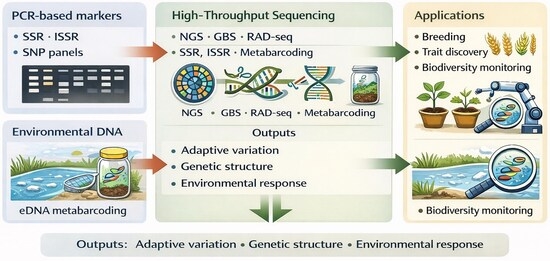
Graphical Abstract

1. Overview

A comprehensive understanding of plant diversity is vital for ecological studies, conservation strategies, and sustainable resource management. Recent progress in genetic technologies has revolutionized the assessment of plant diversity, providing researchers with more precise and efficient tools. This review highlights advanced genetic tools that enhance the evaluation of plants’ biological diversity. The literature for this review was acquired from previous personal literature collection and also through comprehensive searches using different single keywords or sentences in accordance with the different topics treated herein on several scientific electronic databases, including Google Scholar (https://scholar.google.com/), PubMed (https://pubmed.ncbi.nlm.nih.gov/), Research Gate (https://www.researchgate.net/), SpringerLink (https://link.springer.com/), and Web of Science (https://mjl.clarivate.com/).
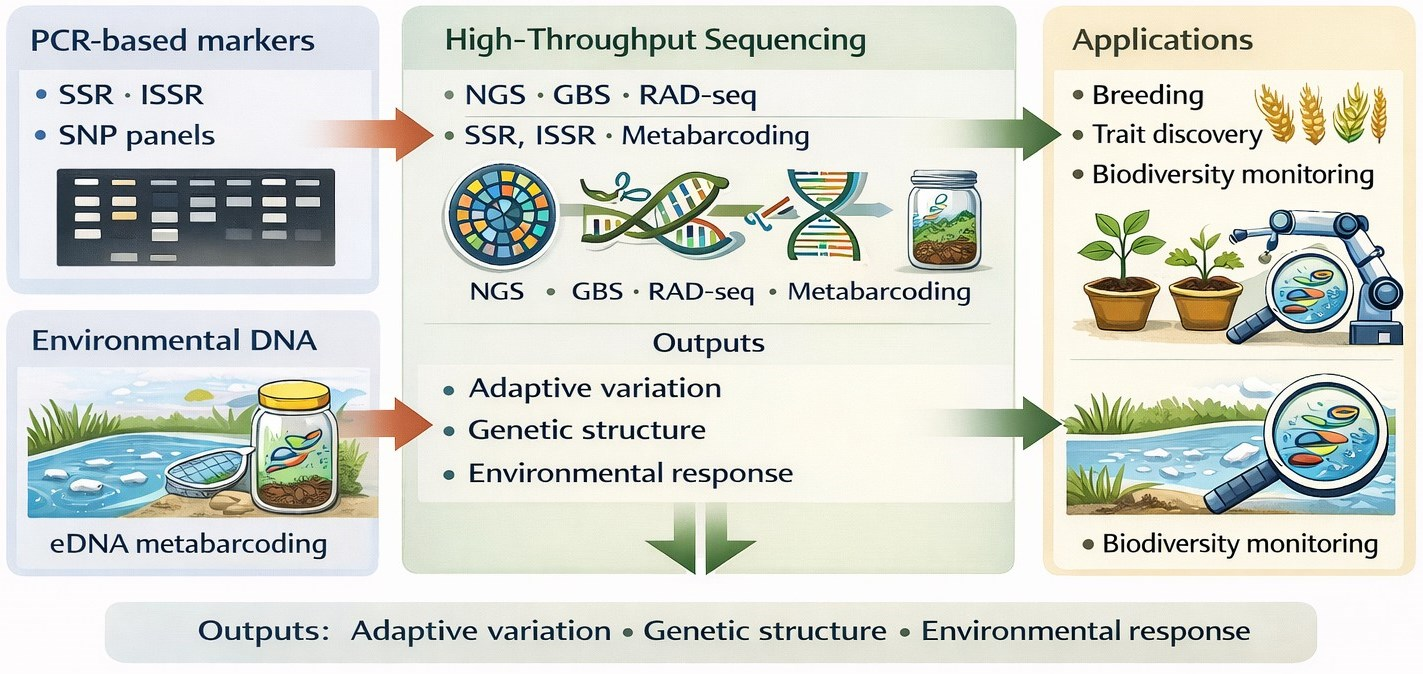
Molecular tools in general are the most important for assessing genetic diversity; older tools were thoroughly reviewed in a previous contribution [1]. There, we reported a series of useful molecular tools to assess plant genetic diversity. Since then, marker development has shifted to more rapid and less DNA-consuming methods (i.e., based on PCR techniques), which are easier to use thanks to the availability of useful and inexpensive kits (i.e., for extracting DNA). Therefore, molecular markers based on polymerase chain reaction have largely supplanted hybridization-based markers due to their simplicity and efficiency in determining genetic relationships between closely related plant species [2]. In addition, the 2020s have seen several new and more accessible tools emerge, making plant genetic diversity assessments more effective and providing crucial information for biodiversity conservation and resource management (Figure 1). These technological advancements provide high-resolution insights into the genetic architecture of populations, unveiling the intricate tapestry of allelic variations, structural polymorphisms, and epigenetic modifications that underlie phenotypic diversity [3]. The transition from conventional marker-based methods to high-throughput sequencing technologies represents a paradigm shift, enabling researchers to scrutinize entire genomes with unprecedented precision and efficiency [4]. These developments have significantly augmented our comprehension of the spatial distribution of genetic variation, the identification of adaptive genetic elements, and the evaluation of the effects of environmental change on genetic diversity [5].
Genomic technologies offer a critical means to monitor and manage genetic diversity, particularly when facing environmental challenges and demographic pressures on endangered species, enabling the characterization of genetic diversity through emerging tools [6]. The integration of genomic data into conservation strategies refines our ability to delineate and safeguard populations that are indispensable for the survival of species, marking a substantial improvement over traditional methods that often rely on limited genetic markers or morphological traits [6].
The combination of genomic data with phenotypic traits (observable characteristics such as leaf size, flower color, etc.) helps in assessing plant diversity more comprehensively. This integration facilitates the identification of traits associated with adaptation and survival in diverse environments. Marker-assisted selection (MAS) represents a significant stride forward in plant breeding, offering a pathway to produce cultivars with enhanced disease resistance and other desirable traits, which were previously unattainable through conventional breeding methods. It has become a common practice in modern plant breeding [7]. Environmental DNA (eDNA) methods allow the collection and analysis of genetic material shed into the environment (e.g., from soil or water). This non-invasive technique enables the detection of plant species present in an area without the need for physical sampling, providing a broader understanding of biodiversity. Advances in high-throughput screening technologies facilitate the rapid assessment of genetic and phenotypic traits across large plant populations. This is particularly useful for conservation programs that need a quick evaluation of the viability and health of various species. The huge amounts of data generated by these tools need the parallel development of sophisticated bioinformatics pipelines, allowing researchers to analyze complex genetic data effectively. Tools, such as AI and machine learning, help in managing large datasets, enabling efficient identification of genetic markers associated with diversity, adaptation, and resilience. These advanced tools are transforming the field of plant diversity assessment by providing researchers with more accurate data and innovative analysis methods. By embracing these technologies, scientists can better comprehend the intricate relationships within ecosystems and develop effective strategies for the conservation and management of plant diversity.

2. Introduction

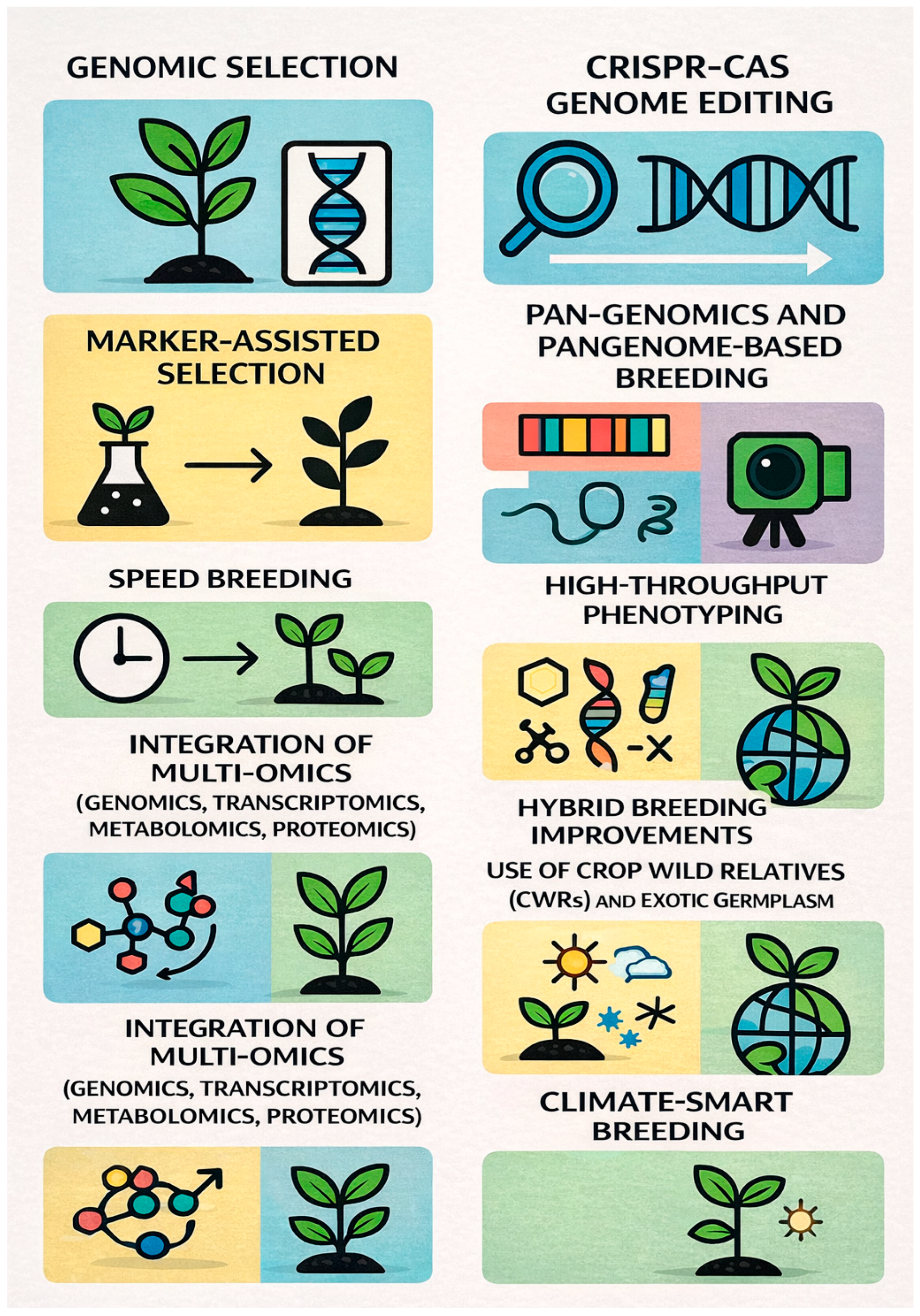
The conservation of plant genetic resources has become increasingly critical due to the substantial loss of plant species and the detrimental consequences for environmental and socioeconomic stability, which require precise methods for collecting, identifying, and characterizing plant taxa (Figure 2) [8]. The application of molecular markers in plant breeding programs has shown significant benefits for decades, enabling the detection of associations with traits of interest and increasing the practicality of marker-assisted selection (MAS) [9]. Recent advances in molecular tools have revolutionized the assessment of plant genetic diversity and conservation efforts, especially with the advent of next-generation sequencing (NGS) technologies, genotyping by sequencing, and genome-wide association studies (GWAS) [10]. These advanced tools provide unprecedented resolution for dissecting the genetic architecture of plant populations, informing conservation strategies, and guiding breeding programs aimed at enhancing crop improvement. Molecular markers are invaluable in conservation efforts, as they can reveal population genetic variation and evolutionary history, providing critical information for developing effective conservation strategies and restoration practices [11]. The integration of molecular ecology and systematic conservation planning offers a powerful approach for conserving biodiversity, as molecular data provides insights into evolutionary processes that are essential for preserving multiple levels of biodiversity [12,13,14]. This sophisticated approach moves beyond traditional morphological assessments, offering a more robust and granular understanding of genetic variability within and among species, which is crucial for mitigating biodiversity loss [15,16]. Furthermore, these advanced molecular approaches facilitate the identification of key genomic regions linked with important traits, thereby enhancing the accuracy and efficiency of breeding programs and informing targeted conservation interventions [17]. The analysis of plant genetic diversity is paramount for plant breeding, hereditary studies, conservation initiatives, and understanding evolutionary trajectories [1,18]. Massive efforts over the past five decades have led to the establishment of germplasm repositories, which serve as crucial reservoirs of genetic diversity for thousands of plant species, enabling both ex situ and in situ preservation and plant propagation [19].
DNA markers, including single-nucleotide polymorphisms (SNPs) and diversity arrays technology (DArT), are now indispensable tools for genetically characterizing plants, allowing for precise line selection and the revelation of genetic diversity and phylogeny [15,20]. The general decreasing cost and increasing accessibility of the molecular tools, including next-generation sequencing technologies, have further democratized the generation of high-density, genome-wide SNP data, offering unprecedented opportunities for genetic resource management and enhancement of gene bank operations [21,22]. In addition, reducing costs and increasing accessibility make it possible to use advanced molecular tools also for non-model species or species with no previous knowledge [23,24,25]. The shift from traditional molecular markers to high-throughput genotyping platforms, such as those utilized in genotyping by sequencing, has significantly improved the efficiency and comprehensiveness of genetic resource characterization [26].

Comparative Genome and Conservation

Comparative genomics appears as a powerful strategy in biodiversity conservation, offering a framework to understand the genetic underpinnings of species divergence and adaptation [27]. This approach facilitates the identification of genes and regulatory elements that contribute to the distinctive traits of species, enabling a more informed approach to conservation management [28]. A granular understanding of the genetic mechanisms driving local adaptation is crucial for devising effective conservation strategies, enabling the targeted preservation of specific genetic variants that enhance a population’s ability to withstand environmental stressors and evolve in response to ecological shifts [29,30,31].
Advances in genomic data sharing and databases, such as the 1000 Genomes Project (https://www.internationalgenome.org/, view 7 February 2026) for human data and the Earth BioGenome Project (https://www.earthbiogenome.org, view 7 February 2026) for all known eukaryotic species (animals, plants, fungi, protists) on Earth, have facilitated the assessment of genetic diversity across different populations and species, aiming to enhance our understanding of genetic variation on a global scale through genomic donor programs [32,33]. Population genomics tools allow researchers to investigate evolutionary processes, migration patterns, and adaptive traits across populations by studying population-level diversity and assessing the correlation between genetic diversity and environmental factors. Moreover, the judicious use of genomic data in conservation transcends the mere cataloging of genetic diversity; it provides actionable insights into the demographic history, gene flow patterns, and adaptive potential of populations. By leveraging sophisticated analytical tools and computational algorithms, conservationists can reconstruct historical population trajectories, identify genetic bottlenecks indicative of past demographic constrictions, and evaluate the extent of genetic connectivity among populations inhabiting fragmented habitats [34]. By elucidating these factors, conservation efforts can be strategically tailored to promote genetic rescue, augment gene flow, and mitigate the detrimental impacts of inbreeding depression. Integrating genetic information into conservation planning necessitates a collaborative approach, uniting scientists and practitioners to ensure that research findings are effectively translated into conservation action [35]. The burgeoning field of conservation genomics represents a transformative leap in our capacity to safeguard species, furnishing resource managers with unprecedented tools to mitigate biodiversity loss in an era defined by accelerated environmental change [36]. The fast progress of genomic technologies is poised to revolutionize conservation genetics, with the expectation of complete genome sequences for a multitude of species and individuals [37]. The wealth of genomic data holds the potential to catalyze a deeper understanding of the genetic determinants of adaptation, resilience, and species-specific traits, thereby ushering in an era of precision conservation breeding [38]. This precision approach will utilize advanced genomic tools to guide conservation efforts, ensuring the preservation of genetic diversity and adaptive potential within managed populations.
The synergistic integration of assisted reproductive technologies with comprehensive genomic data offers a powerful strategy for enhancing conservation outcomes, especially for species facing reproductive challenges within managed care environments [39]. As we continue to deepen our understanding of wildlife reproductive biology and harness emerging technologies such as stem cell-based gamete production and advanced germplasm storage, the prospect of preserving and propagating endangered species becomes increasingly attainable. This integrated approach promises not only to augment genetic diversity but also to bolster the resilience of populations in the face of ongoing environmental changes [40].
While technologies initially designed for agricultural or biomedical applications present valuable tools for species conservation, their utility is maximized when conservation efforts prioritize the holistic support of entire populations rather than focusing solely on breeding a limited number of individuals. The need to preserve heterozygosity to sustain genetic vigor limits the practical utility of certain procedures, including nuclear transfer [41]. The integration of genomic tools in wildlife management requires addressing several challenges, including the standardization of workflows and the effective communication of scientific information to conservation practitioners [42]. Overcoming these challenges is crucial for leveraging genomic data effectively to monitor and manage genetic diversity, assess the impact of environmental changes, and inform conservation strategies for endangered species.

3. Theoretical Frameworks for Assessing Plant Genetic Diversity

3.1. Assessing Genetic Diversity General Aspect

To develop effective plant conservation strategies, it is imperative to understand the theoretical underpinnings of population genetics and evolutionary biology. This understanding facilitates the interpretation of molecular data and informs decisions regarding the management and preservation of plant genetic resources. The different theories of population genetics, including the Hardy–Weinberg principle, genetic drift, gene flow, and natural selection, provide the framework for understanding how genetic variation is distributed and maintained within and among populations. The genetic indicators are useful in correlating with other traits to monitor diverse biological materials and generate potential tools for plant germplasm analysis [43]. The Hardy–Weinberg principle describes the conditions under which allele and genotype frequencies remain constant from one generation to another, in the absence of evolutionary influences. Genetic drift, the random fluctuation of allele frequencies due to chance events, can lead to the loss of genetic diversity, especially in small populations. Conversely, gene flow (the movement of genes between populations) can introduce new genetic variation and counteract the effects of genetic drift; natural selection, operating as a potent evolutionary force, dictates the differential survival and reproductive success of individuals based on their underlying genetic constitutions [44], thereby facilitating the adaptation of populations to their ecological niches [44,45] and preserving adaptive genetic polymorphisms, ultimately shaping the trajectory of evolutionary change [46,47].
In tandem with theoretical population genetics, concepts from evolutionary biology, such as phylogenetic relationships, adaptive evolution, and the maintenance of genetic variation, are vital for conservation efforts. Phylogenetic analyses, which reconstruct the evolutionary history of plant species, offer valuable insights into their relationships with other taxa and are fundamental for guiding conservation priorities efforts and managing genetic resources. Adaptive evolution allows populations to respond to environmental challenges through genetic changes. Understanding the processes that maintain genetic diversity, such as balancing selection and heterozygote advantage, is essential for safeguarding the evolutionary potential of plant populations. Conservation genetics, therefore, directly applies these theoretical frameworks to assess genetic diversity, population structure, and evolutionary processes within species, which are critical for developing effective strategies to prevent biodiversity loss and ensure long-term survival [48,49]. These genetic insights allow more nuanced conservation management practices, particularly in identifying populations facing significant evolutionary pressures such as genetic drift and inbreeding, which can lead to reduced genetic diversity [50]. Understanding the dynamics of gene flow is also critical, as it can enhance genetic diversity by introducing novel alleles or, conversely, impede local adaptation by homogenizing genetic variation across populations [51,52].

3.2. Assessing Genetic Diversity in Autogamous Versus Allogamous Species

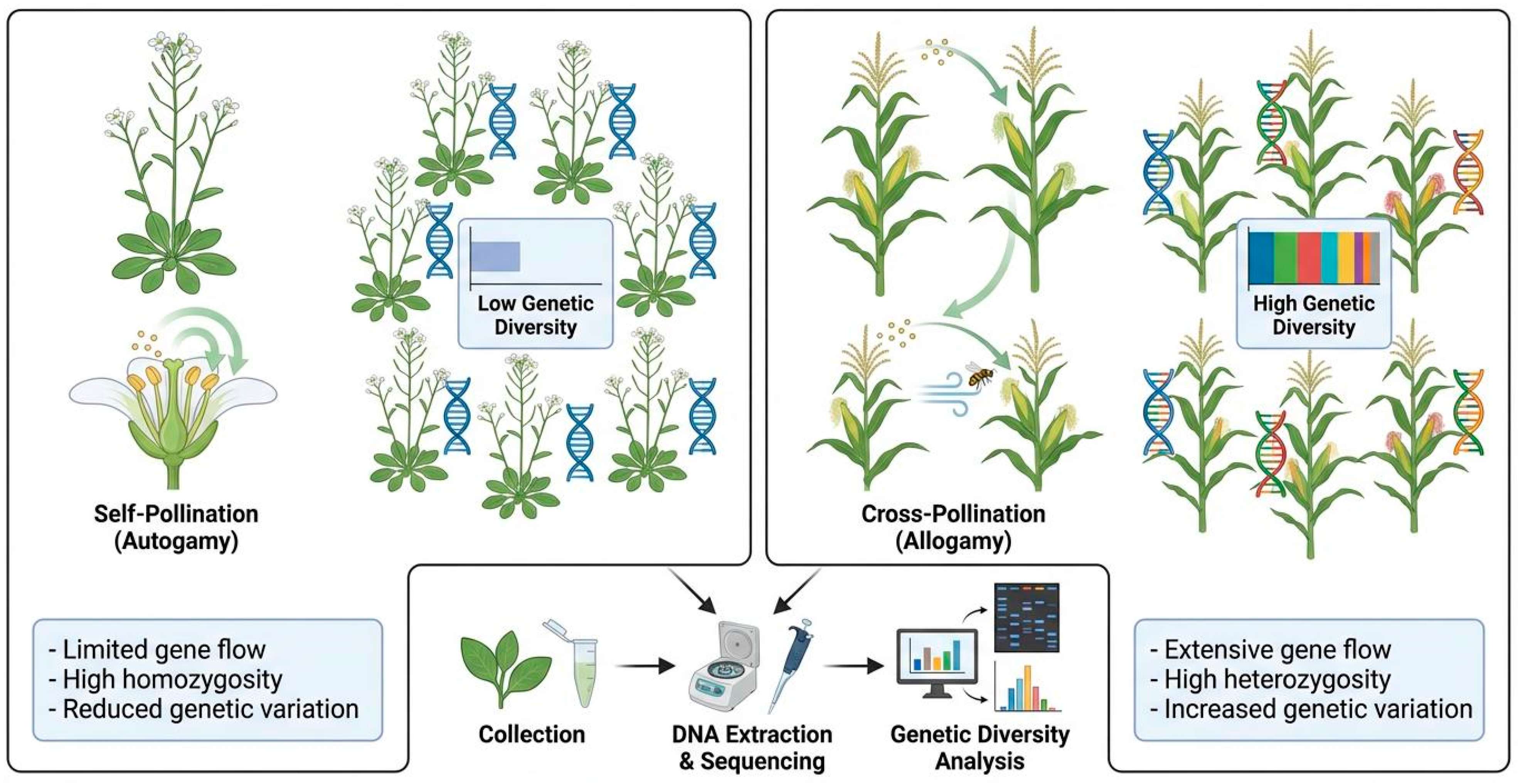
When researchers assess genetic diversity, they should consider the breeding system of the species they deal with (Figure 3). In fact, the genetic structure and the patterns of genetic variation within and among populations are quite different: the autogamous (self-pollinating) plants exhibit lower intrapopulation genetic diversity but higher interpopulation differentiation due to reduced heterozygosity and increased homozygosity [53,54]. While the allogamous (cross-pollinating) species exhibit higher levels of heterozygosity and diversity, complex gene genealogies maintain genetic diversity within populations, leading to reduced differentiation between populations [55]. While the former features genes shared among common ancestry, which require focusing on rare alleles or deleterious mutations, the latter demands broader sampling to capture overall variation, linkage disequilibrium, and population structure. This divergence in genetic architecture necessitates tailored methodological approaches for accurate diversity assessment, as traditional markers may not fully capture the nuances introduced by varying reproductive strategies [56]. This is further complicated by the fact that the efficacy of molecular markers and sampling strategies can be considerably different between these reproductive systems, influencing the reliability of genetic parameter estimates [57]. Consequently, the interpretation of FST (Fixation Index, measurement of genetic differentiation between populations) values, for instance, must consider the breeding system, as autogamous perennials can exhibit substantial genetic differentiation (up to 70%) between populations, a pattern quite different from that of outcrossing species [58,59]. This distinction is crucial for effective conservation, as misinterpretations could lead to inadequate decision-making regarding genetic material collection strategies [60]. For instance, highly autogamous species often require sampling individuals from numerous populations to capture the full spectrum of genetic diversity, whereas allogamous species benefit from intensive sampling within fewer populations [61]. This is because outcrossing maintains high genetic diversity within populations, while selfing promotes the fixation of alleles and reduces within-population variability [62].

4. Current Genomic Approaches in Plant Conservation: Integrating Molecular Data for Conservation Insight

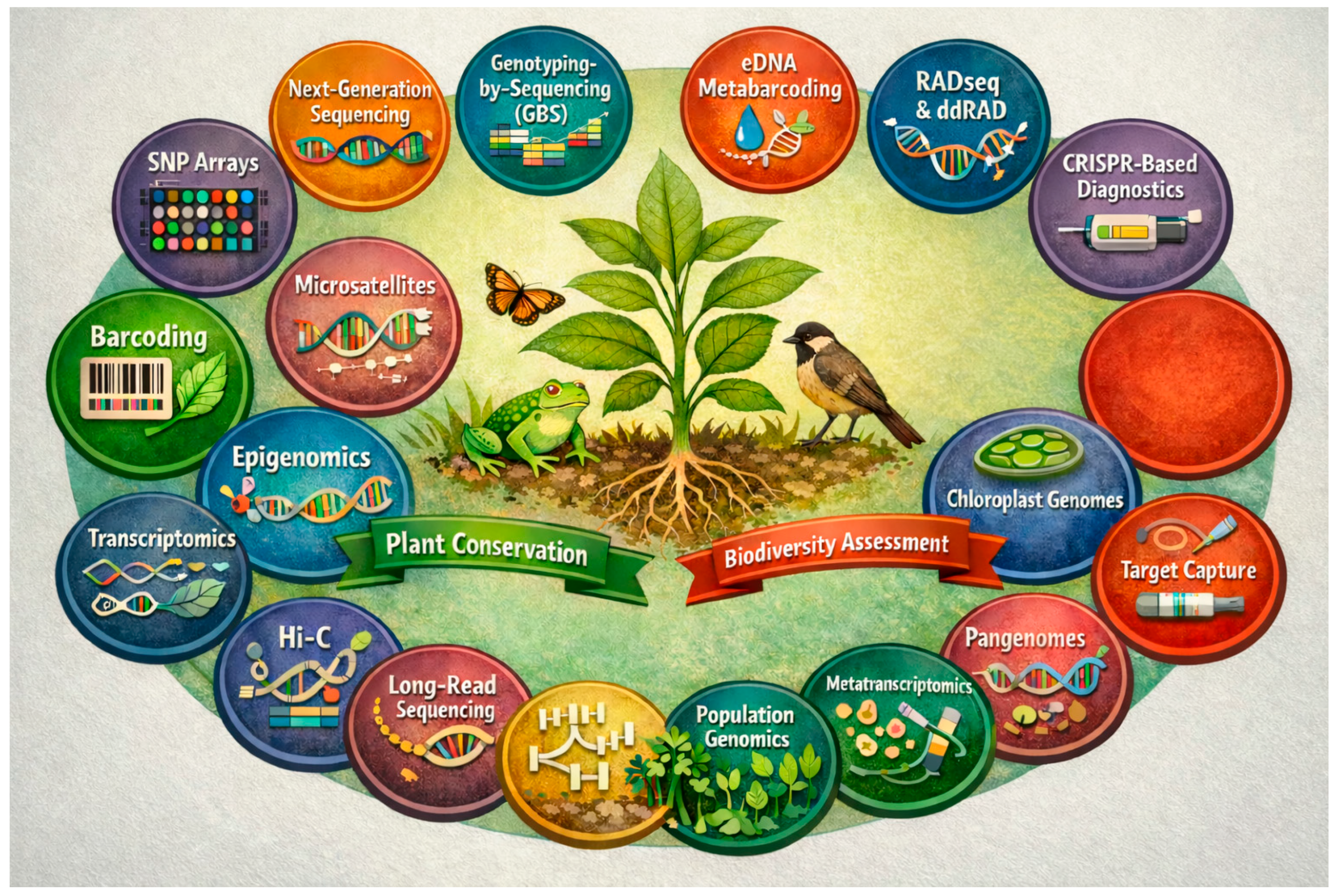
The continuous advancement of molecular tools provides new opportunities for plant conservation biology, enabling researchers to address previously intractable questions regarding genetic diversity, population structure, and evolutionary processes (Figure 4). The integration of molecular data with ecological and environmental information provides a more comprehensive approach to plant conservation, enabling the identification of critical habitats, the development of effective conservation strategies, and the monitoring of conservation outcomes [34]. Next-generation sequencing (NGS) technologies have played a pivotal role in this transformation by providing rapid and cost-effective methods for generating large-scale genomic data [5]. Whole-genome sequencing, transcriptome sequencing, and reduced-representation sequencing approaches, such as genotyping by sequencing, enable the characterization of genetic variation at an unprecedented scale. These approaches support the assessment of genetic diversity, the identification of adaptive genes, and the reconstruction of population history [63,64].
Genome-wide association studies (GWAS) have emerged as a powerful tool for identifying genetic variants associated with adaptive traits, such as drought tolerance, disease resistance, and flowering time (see Section 5.6). By correlating genotype and phenotype variation, GWAS provides insights into the genetic basis of adaptation and the evolutionary potential of plant populations [65,66,67,68,69,70]. These approaches are increasingly applied not only in crop improvement but also in conservation genetics to investigate local adaptation, genotype–environment interactions, and resilience to environmental change [71,72].
Bulked Segregant Analysis (BSA-seq) is an efficient approach for identifying genomic regions associated with target traits; its resolution depends on population size, recombination, and sequencing depth [73,74,75]. The method involves pooling DNA from individuals (sometimes two parent pools) with extreme phenotypes in a segregating population and comparing allele frequencies across the genome using NGS. For each locus, the SNP index is calculated, and differences between bulks (ΔSNP index) are used to detect candidate quantitative trait loci (QTLs). Regions with significant deviations in ΔSNP index are considered linked to the trait of interest [76,77].
Advances in bioinformatics and statistical genetics have been essential in translating large-scale genomic data into biologically meaningful and actionable information. Analytical tools now enable the inference of population structure, detecting signatures of natural selection, and modeling of evolutionary and demographic processes. Such approaches are critical for predicting the effects of climate change on plant populations and for guiding conservation planning [78,79,80,81].
In parallel, non-invasive molecular approaches such as environmental DNA (eDNA) metabarcoding have significantly expanded biodiversity monitoring capabilities. By analyzing DNA extracted from soil, water, or air samples, researchers can identify the plant species present in a given area. Even rare or cryptic species, which are difficult to detect through traditional field surveys, can be identified [82,83,84]. These approaches are particularly useful for monitoring biodiversity in remote or inaccessible areas, and for assessing the impacts of habitat disturbance on plant communities.
The integration of molecular markers with genomic approaches has further enhanced the resolution of conservation genetics. Molecular markers, widely distributed across the genome and largely independent from environmental influences, provide a stable and accessible means of assessing genetic variation across developmental stages [85]. The integration of molecular methodologies significantly refines the precision and clarity of species delineation, providing an essential foundation for devising and executing robust conservation strategies, particularly when combined with morphological and ecological data [86].
Overall, the convergence of genomics, molecular markers, bioinformatics, and ecological data represents a paradigm shift in plant conservation biology. These integrated approaches move beyond descriptive analyses of genetic diversity toward predictive, data-driven frameworks that support the effective management and preservation of plant genetic resources in the face of ongoing environmental change [87].

5. Molecular and Genomic Tools for Plant Conservation: Methods and Applications

5.1. Molecular Markers

Molecular markers are characterized by their stability, cost-effectiveness, and ease of use, and serve as an increasingly popular tool for diverse applications, including genome mapping, gene tagging, genetic diversity assessment, phylogenetic analysis, and forensic investigations [88]. These markers can be broadly categorized into hybridization-based and PCR-based (Polymerase Chain Reaction) systems, each offering unique advantages and limitations depending on the research objectives [1]. Those based on PCR are becoming more popular due to their ease of automation, reduced DNA requirements, and lower costs. Molecular markers can be differentiated by several parameters reported in Supplementary Table S1 and are broadly identifiable as DNA, RNA, protein, or epigenetic features that vary between individuals, cells, or conditions and can be reliably detected and measured. Provide valuable insights into genetic diversity that can be utilized in conservation genetics to assess genetic variability and structure both within and between populations. Here, I will not treat each of the ones reported in Supplementary Table S1, which should be utilized as a general reference, but rather consider the principal markers divided into categories based on their need for prior sequence information.

5.1.1. Without Prior Sequence Information

Some markers could be used without prior sequence information, such as ISSR (inter-simple sequence repeat) [89,90], AP-PCR (arbitrarily primed PCR), and DAF (DNA amplification fingerprinting). These rely on arbitrary primers to amplify DNA regions without prior knowledge of the target sequence, are less informative since they are dominant markers, but are very useful in non-model or poorly characterized species.
Amplified Fragment Length Polymorphism (AFLP) markers represent a powerful molecular tool for genetic analysis, characterized by their capacity to detect numerous polymorphic loci simultaneously [91,92].
ISSR (inter-simple sequence repeat) amplifies DNA segments located between two identical microsatellite repeat regions that face each other at an amplifiable distance. The microsatellite primers for ISSRs can consist of di-, tri-, tetra-, or penta-nucleotide repeats. These primers (15–30 mers) are usually anchored at either the 3′ or 5′ end with one to four degenerate bases extending into the adjacent flanking sequences. They are easy to use, quick, and highly polymorphic [89].

5.1.2. With Prior Sequence Information

Markers developed with detailed knowledge of the species and its entire or partial genome sequence are already available.
Microsatellites, Short Tandem Repeats (STRs) or Single Sequence Repeat (SSRs) [93] are widely spread in plant genomes and are codominant and highly polymorphic. They consist of the repetition of short DNA motifs (e.g., CACACA). SSR primers are identified using a complex process, which includes cloning DNA fragments from a species, replicating them into bacteria, and screening for microsatellite repeats. Positive clones are sequenced to design PCR primers targeting specific loci, though not all primers show useful variation. PCR conditions are then optimized to ensure strong, specific amplification and allow multiplexing. SSRs are widely favored in molecular genetics because they detect high polymorphism even among related lines, require little DNA, can be automated for large-scale screening, multiplexing, and transfer well between different laboratories and populations. However, they could suffer from PCR slippage (creating stutter), and it is harder to standardize across platforms.
Single Nucleotide Polymorphisms (SNPs) are the most abundant, widely dispersed molecular markers in the genome, effectively facilitating population genetics, structure, and diversity studies, including rapid identification of crop cultivars and construction of ultra-high-density genetic maps [94]. SNP genotyping analyses are based on allele-specific hybridization, oligonucleotide ligation, primer extension, or invasive cleavage [95]. They are extremely abundant (millions per genome), usually biallelic, have high resolution, and can be easily automated, but each SNP has a small effect size.

5.2. Next-Generation Sequencing (NGS)

Next-generation sequencing (NGS) technologies are a suite of advanced methods that allow rapid, high-throughput sequencing of DNA or RNA. Unlike traditional Sanger sequencing, NGS can sequence millions of fragments simultaneously, significantly increasing throughput and reducing costs, making it a powerful tool for genomics, transcriptomics, and other molecular biology fields [96,97]. NGS methods typically involve fragmenting DNA, attaching adapters, and amplifying the fragments on a flow cell or bead surface. Sequencing is performed through various approaches, including sequencing-by-synthesis (Illumina), semiconductor sequencing (Ion Torrent), single-molecule real-time sequencing (PacBio), and nanopore sequencing (Oxford Nanopore) [98,99]. NGS has revolutionized plant conservation by enabling genome-wide assessments of genetic diversity, phylogenetic relationships, and population structure [100,101,102,103,104]. In addition, through NGS, several markers can be identified, especially single-nucleotide polymorphisms (SNPs) and other genetic markers for assessing diversity, streamlining genomic-scale analysis, and easing variation assessment across large populations.
The cost of sequencing has dramatically decreased over time, dropping from millions of USD for a human genome in the early 2000s to a few hundred dollars, making it accessible for routine research. As sequencing got cheaper, the cost burden shifted from generating data to analyzing and storing the massive amounts of data produced. Data Management & Bioinformatics now represent major bottlenecks in genomic research [105].

5.3. Genotyping-by-Sequencing (GBS)

Genotyping-by-Sequencing (GBS) is a high-throughput, cost-effective method that provides high-resolution genetic data from multiple individuals simultaneously, allowing for comprehensive assessments of genetic variation [106,107]. The initial step involves digesting the genomic DNA from various individuals or pooled populations using specific restriction enzymes [108]. This enzymatic digestion creates DNA fragments of varying lengths, which are then ligated with unique barcoded adapters, enabling the multiplexing of samples for simultaneous sequencing [109,110]. These adapter-ligated fragments are subsequently amplified via polymerase chain reaction, with a bias towards amplifying smaller DNA fragments, which are then pooled and sequenced on high-throughput platforms like Illumina [111].
By targeting a subset of the genome, GBS reduces sequencing costs while maintaining high marker density, making it particularly suitable for studies involving large populations or species without reference genomes [110,112]. It is widely used in population genetics, phylogeography, and conservation studies.

5.4. DNA Barcoding

DNA barcoding is a molecular technique that utilizes a standardized short genetic sequence to identify and catalogue species, assessing biodiversity, species identification, and classification, addressing critical needs across diverse biological disciplines [113,114]. It is particularly useful in ecological studies that require species cataloging and understanding of the relationships [115]. The accuracy of this method, often exceeding 97.9%, provides a rapid and convenient strategy for assessing genetic diversity across animal species [116]. In plants, barcode regions include chloroplast genome sequencing, such as matK and rbcL, which can discriminate species in about 72% of the cases, meaning about 28% of the species were not uniquely resolved and instead matched a congeneric “species group” [117,118]. While 16S rRNA is used for prokaryotes and the ITS region for fungi, highlighting the need for kingdom-specific markers to achieve optimal discriminatory power [119]. These diverse marker genes, while effective within their respective domains, collectively contribute to the growing challenge of establishing a truly universal genetic marker for all life forms, necessitating a multi-locus approach for comprehensive biodiversity assessment [120].
This method has gained widespread recognition as a powerful tool, particularly given its ability to differentiate even closely related taxa [121]. This approach offers significant advancement over traditional morphological identification, especially for organisms exhibiting high phenotypic plasticity or microscopic size, where distinguishing features are often ambiguous or non-existent [113,122]. Despite these challenges, the continuous development of reference libraries and online workbenches, such as the Barcode of Life Data System (https://www.boldsystems.org/, see on the 20 March 2026) has significantly enhanced the efficacy of DNA barcoding by providing comprehensive databases for sequence comparison and species authentication [123].

5.5. Environmental DNA

Genetic analyses can be performed not only by collecting DNA from single individuals of a species. Environmental DNA (eDNA) analysis relies on DNA collected directly from environmental matrices, including water, soil, air, snow, and sediments, providing a cultivation-independent snapshot of community diversity and enabling a deeper understanding of biodiversity across habitats without direct observation or sampling [124].
Environmental DNA (eDNA) has emerged as a transformative tool for biodiversity monitoring and ecological research, allowing the detection of rare, elusive, or cryptic species and providing insights into community composition and ecosystem dynamics [82,83,84]. By integrating molecular biology, genetics, ecology, and bioinformatics, eDNA-based approaches provide comprehensive insights into species presence, distribution, and interactions [125]. Their applications extend from historical community reconstructions to ecosystem restoration and even human health studies, making eDNA an increasingly valuable resource for future conservation, ecological, and taxonomic research [126].
However, eDNA detection is biased by heterogeneous shedding and spatial distribution, downstream transport/resuspension, primer mismatch, and PCR inhibition, all of which can generate false negatives or misassign the source location, whereas contamination can generate false positives [127,128]. Moreover, eDNA degrades rapidly after release, with decay generally accelerating as temperature increases [129], and it is also affected by UV-B exposure, pH, and other environmental conditions, thereby constraining temporal inference from positive detections [130].

5.6. Genome-Wide Association Studies (GWAS)

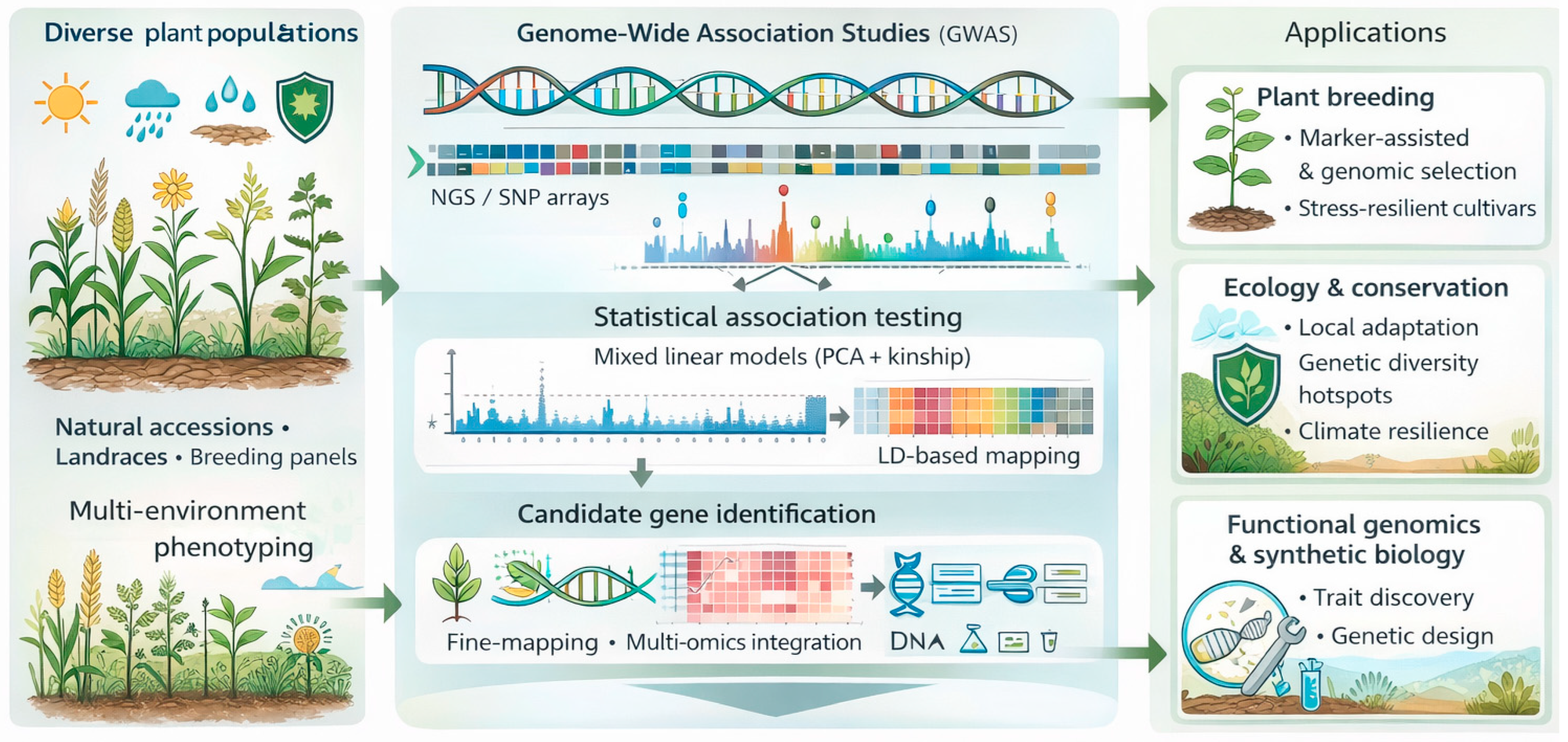
Genome-Wide Association Studies (GWASs) represent a powerful and widely used approach to dissect the genetic architecture of complex traits by identifying statistical associations between genetic variants, primarily single-nucleotide polymorphisms (SNPs), and phenotypic variation across genomes [65,66,67,68]. Initially developed and successfully applied in human disease genetics to investigate disorders such as cardiovascular disease, type 2 diabetes, and psychiatric conditions [131,132]. GWAS has expanded considerably to plant systems, with advances in high-throughput genotyping and phenotyping technologies, it has become a cornerstone of plant genetics, breeding, and ecological research [133,134].
In plants, GWASs exploit the natural genetic variation in populations such as landraces, breeding panels, and natural accessions to identify genomic regions and allelic variants associated with agronomic, ecological, and evolutionary traits. These include yield, flowering time, tolerance to abiotic and biotic stresses, nutrient use efficiency, disease resistance, and phenological adaptation [69,70]. By leveraging linkage disequilibrium (LD), GWAS enables high-resolution mapping of quantitative trait loci (QTLs) and candidate genes [135,136]. GWAS results can be biased by population stratification and cryptic relatedness, which can produce spurious associations if ancestry is incompletely modeled [137,138].
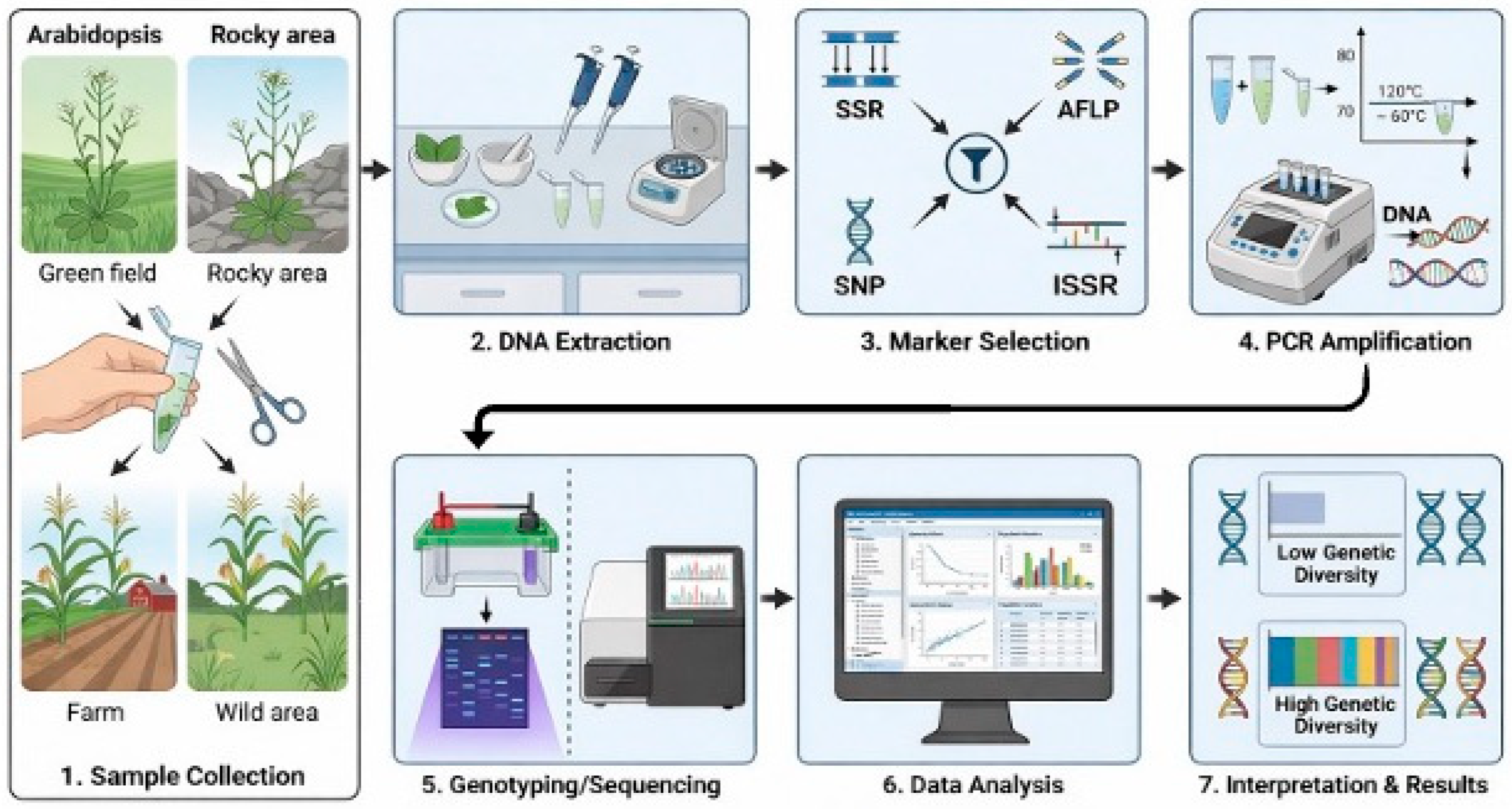
Methodologically, plant GWASs rely on genotyping large and genetically diverse panels using SNP arrays or sequencing platforms, combined with phenotypic data collected across environments or years to capture trait variability and reduce environmental noise (Figure 5). Statistical associations between markers and traits are tested using linear or mixed models that account for population structure and relatedness, commonly through principal component analysis (PCA) and kinship matrices [78,79]. Stringent multiple-testing corrections are applied to control false-positive associations.
The power and resolution of GWAS depend on LD within the genome, which is shaped by evolutionary forces such as recombination, selection, and demographic history [80]. Consequently, mapping resolution varies among species and genomic regions, often leading to the identification of associated loci rather than causal variants [81]. Therefore, GWAS findings are often complemented with fine-mapping, haplotype analysis, candidate gene identification, and functional annotation, as well as integration with omics data to strengthen causal inference [139,140]. However, sizes of genome-wide significant loci can also be inflated by the ‘winner’s curse’ [141].
GWAS has become a fundamental tool in crop improvement, facilitating marker-assisted selection and genomic selection, accelerating the development of improved cultivars adapted to changing environmental conditions [69,70]. But much of the ‘missing heritability’ remains unexplained because standard GWASs capture mainly common additive variants (Manolio et al., 2009), whereas rare variants, structural variation, gene–gene/gene–environment interactions and imperfect linkage disequilibrium with causal alleles are often only partially tagged [142]. Compared with traditional bi-parental mapping, GWAS offers a robust alternative for dissecting quantitative traits by leveraging widespread polymorphisms and non-random marker associations [143].
Beyond breeding, GWAS are increasingly applied in plant ecology, evolutionary biology, and conservation genetics to study local adaptation, genotype–environment interactions, and fitness-related traits. These applications aid in identifying genetic diversity hotspots and informing conservation strategies, including restoration and management of endangered species [71,72]. Moreover, public involvement in genetic monitoring through citizen science initiatives enhances biodiversity assessments and broadens the scope of data collection.
Finally, GWAS, in combination with synthetic biology, facilitates the functional exploration and manipulation of novel genetic constructs to explore functional diversity in both natural and engineered systems, with applications spanning agriculture, conservation, and biomedical research.

5.7. CRISPR-Cas9 Technology

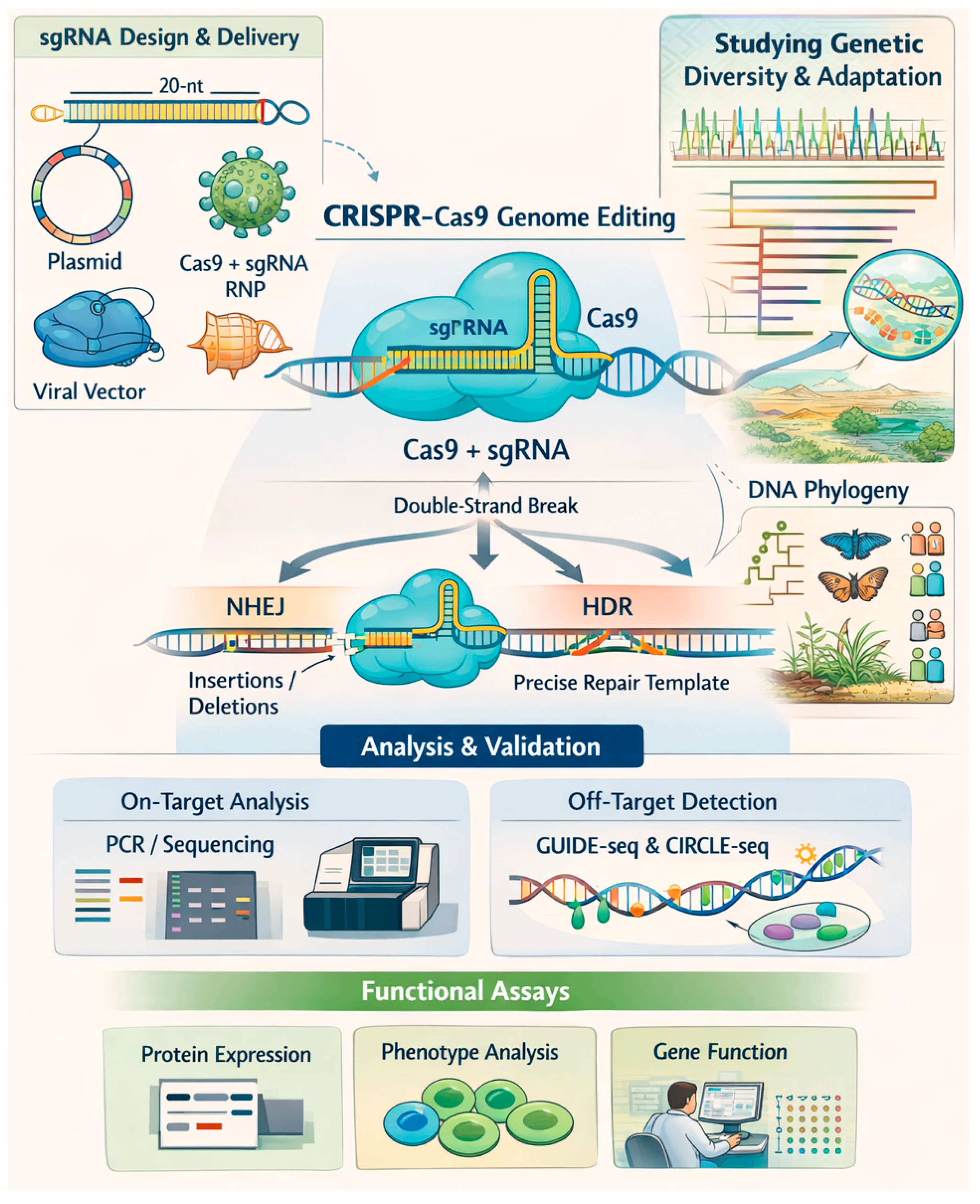
CRISPR–Cas9 (clustered regularly interspaced short palindromic repeats and the CRISPR-associated protein 9) is a revolutionary genome-editing technology that enables precise, efficient, and programmable modification of DNA sequences through an RNA-guided nuclease system (Figure 6). A single-guide RNA (sgRNA), composed of a programmable ~20-nucleotide sequence complementary to a target genomic locus, which directs the Streptococcus pyogenes Cas9 nuclease to DNA sequences located immediately upstream of a protospacer adjacent motif (PAM), most commonly NGG. Cas9 introduces a site-specific double-strand DNA break (DSB), which is subsequently repaired by endogenous cellular DNA repair pathways [144,145,146,147].
Genome-editing outcomes depend on the DNA repair pathway engaged. Non-homologous end joining (NHEJ) frequently generates small insertions or deletions that disrupt gene function, making it particularly useful for gene knockout applications. In contrast, homology-directed repair (HDR) enables the precise incorporation of defined sequence changes when a homologous donor template is provided, allowing targeted gene correction or insertion [145,146]. These mechanisms underpin the versatility of CRISPR–Cas9 across diverse biological systems.
For genome-editing experiments, target loci are selected using established computational tools that predict sgRNA efficiency and minimize sequence similarity to other genomic regions, thereby reducing the likelihood of off-target cleavage [148]. Guides are typically designed near canonical NGG PAM sites, and multiple independent sgRNAs are often used to ensure phenotypic validation. Delivery strategies (including plasmid-based systems, Cas9–sgRNA ribonucleoprotein complexes, or co-delivery formats) are chosen according to experimental requirements. Appropriate experimental controls, such as non-targeting sgRNAs and validated positive controls, are essential to ensure the interpretability and robustness of genome-editing results [146,148].
Genome-editing efficiency and outcomes are commonly assessed by amplifying the target locus, followed by Sanger or next-generation sequencing to quantify insertion-deletion frequencies and confirm precise edits [148]. Because off-target activity remains a critical consideration, specificity is evaluated through computational prediction and unbiased genome-wide assays such as GUIDE-seq and CIRCLE-seq, with validation by targeted sequencing [149,150].
In addition to SpCas9, alternative CRISPR systems such as CRISPR/Cpf1 (Cas12a) have expanded the gene-editing toolkit. These systems offer distinct advantages, including smaller proteins and alternative DNA cleavage patterns, which increase flexibility across species and experimental contexts [151,152]. Advances in sgRNA design, cloning strategies, and engineered Cas variants have further improved editing efficiency and specificity [153].
Beyond its foundational role in genome engineering, CRISPR–Cas9 has become a powerful tool for exploring genetic diversity and functional variation, particularly in plant systems. It enables targeted, heritable modifications that facilitate gene function analysis, and thereby accelerate the development of traits such as stress tolerance, yield, and nutritional quality, surpassing the pace of conventional breeding approaches [154,155,156,157,158,159].
Moreover, CRISPR-based approaches support the detection and characterization of plant genetic diversity by enabling fine-scale manipulation and comparison of genomic sequences within and between species. CRISPR–Cas9–mediated targeted enrichment combined with long-read sequencing has been demonstrated to isolate and resolve single-nucleotide variants and structural variants at the haplotype level in plant genomes, such as an ~8 kb locus in apple, where targeted cleavage followed by Oxford Nanopore sequencing yielded high on-target variant coverage enabling fine-mapping of allelic diversity across cultivars [160]. For example, in common bean (Phaseolus vulgaris), a CRISPR–Cas9 tiling enrichment strategy coupled with nanopore sequencing was used to reconstruct a 250 kb genomic region, revealing numerous single-nucleotide variants and structural variants among cultivars and thereby capturing locus-level diversity that is difficult to resolve with short-read whole-genome approaches [160].
Collectively, CRISPR–Cas9 represents a cornerstone technology in modern genome editing, offering unparalleled precision and flexibility for both fundamental research and applied biotechnology. Its application in plant systems has not only accelerated trait improvement but also enhanced the capacity to explore genetic diversity, functional variation, and evolutionary processes [161].

5.8. Genomic Database

The integration of high-throughput genomic and phenomic data has fundamentally transformed the characterization of genetic diversity in plant populations, creating an urgent need for robust digital information management systems capable of handling large, complex datasets [162]. Global data-sharing initiatives, such as the mentioned 1000 Genomes Project and the Earth BioGenome Project, illustrate how coordinated genomic donor programs facilitate comprehensive assessments of genetic diversity and evolutionary processes at global scales [163].
In plant science, population genomics provides a powerful framework to investigate evolutionary history, migration patterns, and adaptive variation, linking genetic diversity with environmental factors, thereby supporting biodiversity conservation and sustainable management [164]. These advances underpin internationally proposed concepts such as “Breeding 4.0” and “5G Breeding,” which rely on multi-omics integration and advanced computational approaches [165]. Major bioinformatics institutions, including the National Center for Biotechnology Information and the European Bioinformatics Institute, have established dedicated infrastructures for the storage, sharing, and management of plant-related genomic data [165]. The analysis of such datasets requires advanced bioinformatics pipelines and computational methods to identify markers associated with diversity, adaptation, and resilience. Analytical tools such as phylogenetic reconstruction, network analysis, and clustering algorithms are essential for resolving genetic structure and evolutionary relationships within and among populations.
Examples include platforms developed by the National Genomics Data Center (e.g., GVM, CGIR, PlantPan, GenBase, MethBank), as well as functional and species-specific databases such as GWAS Atlas, IC4R, and SoyOmics, which collectively enable data-driven research and applications [165,166].
Despite substantial infrastructural progress, significant challenges remain in data governance, standardization of experimental protocols, and the technical integration of heterogeneous databases across national and international networks [167,168]. To address these limitations, public research initiatives increasingly focus on developing integrated and interoperable databases that combine multi-omics, agronomic, and environmental data to support breeding and conservation applications [166,169]. Examples include platforms developed by the National Genomics Data Center (e.g., GVM, CGIR, PlantPan, GenBase, MethBank) [165], as well as functional and species-specific databases such as the GWAS Atlas, IC4R, and SoyOmics, which collectively provide the infrastructure necessary for data-driven breeding and biodiversity research [165,166]. Overall, the effective integration of diverse datasets is essential for achieving a comprehensive understanding of the biological processes underlying plant traits and their interactions with environmental factors [170].

6. Gaps in Knowledge and Future Directions

Among all, genome-wide association studies (GWASs) constitute a powerful approach for identifying genetic variants underlying traits of interest in plants, thereby providing valuable insights for conservation strategies. Nevertheless, the combined use of multiple genotyping techniques may be necessary to overcome methodological constraints [171]. Limitations persist not only at the statistical level but also in biological interpretation. Although intraspecific genetic variation can explain a substantial proportion of phenotypic diversity, a significant component of phenotypic plasticity arises from environmentally driven transcriptional, post-transcriptional, translational, and post-translational, epigenetic, and metabolic regulation [172]. Despite these challenges, GWAS provide a robust framework for dissecting the genetic architecture of complex traits relevant to plant conservation. By identifying genomic regions associated with adaptive traits, these studies can support targeted conservation efforts, including the prioritization of plant populations with enhanced resilience to environmental change. Moreover, integrating GWAS results with ecological and environmental data can refine conservation strategies by elucidating the environmental drivers of adaptive evolution in plants [173]. To fully exploit the potential of GWAS in this context, however, it is essential to address existing limitations, particularly the need for larger sample sizes and more diverse germplasm collections to capture the breadth of genetic variation.
Enhancing the affordability and accessibility of genomic technologies is paramount to enable comprehensive profiling across a wider range of genotypes and environments, particularly for crop plants and non-model species [174,175]. This includes developing more sophisticated analytical frameworks that can account for genotype-by-environment interactions and phenotypic plasticity, which are critical for understanding how plants respond to varying environmental conditions [176,177]. An integrated framework incorporating environmental dimensions is highly desirable for dissecting complex traits and making predictions, necessitating the identification of biologically relevant and measurable environmental indices for novel environments [178]. Beyond these analytical enhancements, the integration of genotype-environment association with genotype-phenotype association analyses holds significant promise for uncovering the genetic underpinnings of environmental responses and local adaptation, as demonstrated in studies that detect drought-tolerance variants in species such as Pinus ponderosa [179].

7. Conclusions

Genomics, transcriptomics, and phenomics, in conjunction with efficient study designs and analytical pipelines, are therefore extremely helpful to investigate the molecular mechanisms underlying complex traits and to assess the impact of environmental stressors on plant health and productivity. Integrating multi-omics data with advanced analytical techniques, such as machine learning, allows for a more holistic understanding of plant phenotypic variation and its underlying genetic and environmental determinants [156]. Such extensive molecular profiling allows breeders to better interpret phenotypic diversity and to design more informed and effective crop improvement strategies [180].
By combining multiple omics layers, researchers can adopt a holistic approach to gene discovery and crop improvement, leading to deeper insights into complex biological processes such as stress tolerance and specialized metabolite accumulation [181]. The application of multi-omics and AI technologies in horticulture enables in-depth exploration and understanding of complex molecular pathways integral to plant growth, disease resistance, and stress responses [182]. The integration of omics approaches with systems biology can enhance our understanding of the molecular regulator networks for crop improvement [183].
There is remarkable interest in enhancing the stress tolerance of crops through biotechnology and increasing the knowledge of how plants respond to drought stress [184]. The data obtained from omics studies, particularly when integrated with machine learning techniques, can facilitate the identification of key genes and regulatory elements involved in plant adaptation to environmental stress [185,186,187,188]. These identified genetic components can then be used as targets for genetic engineering or marker-assisted selection to develop climate-resilient crops that can withstand the challenges of a changing climate [189]. By integrating diverse omics datasets and employing machine learning algorithms, it becomes possible to construct predictive models that accurately forecast plant performance under different environmental scenarios [190]. These models can assist breeders in selecting superior genotypes with enhanced adaptation to specific environmental conditions [182,191,192,193].
As reported in the present review, although some traditional tools, such as molecular markers, remain in use, the approach reviewed in 2009 [1] has drastically changed. Advances in technology, together with a significant reduction in costs, have transformed multi-omics approaches, making them accessible to a much broader range of laboratories, thereby accelerating progress in plant breeding and crop improvement research.

Supplementary Materials

The following supporting information can be downloaded at: https://www.mdpi.com/article/10.3390/d18040208/s1.

Funding

This research was funded by the European Union Next-Generation EU (Piano Nazionale di Ripresa e Resilienza (PNRR)—missione 4 componente 2, investimento 1.4—D.D. 1032 17/06/2022, CN00000022).

Data Availability Statement

The original contributions presented in this study are included in the article/Supplementary Materials. Further inquiries can be directed to the corresponding author.

Acknowledgments

During the preparation of this manuscript, the author used Chat-GPT 5.2, and chat.figurelabs.ai, to generate manuscript figures. The authors have reviewed and edited the output and take full responsibility for the content of this publication.

Conflicts of Interest

The author declares no conflicts of interest.

Abbreviations

The following abbreviations are used in this manuscript:
AFLPamplified fragment length polymorphism
AP-PCRarbitrarily primed PCR
BSABulked Segregant Analysis
DAFDNA amplification fingerprinting
DArTdiversity arrays technology
DSBDNA break
eDNAEnvironmental DNA
FSTFixation Index
GBSGenotyping-by-Sequencing
GWASgenome-wide association studies
HDRhomology-directed repair
ISSRinter-simple sequence repeat
LDlinkage disequilibrium
MASMarker-assisted selection
NGSnext-generation sequencing
NHEJnon-homologous end joining
PAM o NGGprotospacer adjacent motif
PCAprincipal component analysis
PCRPolymerase Chain Reaction
RAPDrandom amplified polymorphic DNA
RFLPrestriction fragment length polymorphism
sgRNAsingle-guide RNA
SNPsingle-nucleotide polymorphisms
SSRsimple sequence repeat
QTLsquantitative trait loci

References

  1. Mondini, L.; Noorani, A.; Pagnotta, M.A. Assessing Plant Genetic Diversity by Molecular Tools. Diversity 2009, 1, 19–35. [Google Scholar] [CrossRef] [Scilit]
  2. Hasnain, H.; Mehvish, N. Assessment of plant genetic variations using molecular markers: A review. J. Appl. Biol. Biotechnol. 2020, 8, 99–109. [Google Scholar] [CrossRef] [Scilit]
  3. Moraa, O.L. Assessment of genetic diversity of niger plant (Guizotia abyssinica L.) in Moiben Sub County, Kenya, using inter simple sequence repeat markers. Int. J. Res. Appl. Sci. Biotechnol. 2021, 8, 126–131. [Google Scholar] [CrossRef] [Scilit]
  4. Hohenlohe, P.A.; Funk, W.C.; Rajora, O.P. Population genomics for wildlife conservation and management. Mol. Ecol. 2021, 30, 62–82. [Google Scholar] [CrossRef] [Scilit]
  5. Hoban, S.; Bruford, M.W.; Funk, W.C.; Galbusera, P.; Griffith, M.P.; Grueber, C.E.; Heuertz, M.; Hunter, M.E.; Hvilsom, C.; Stroil, B.K.; et al. Global Commitments to Conserving and Monitoring Genetic Diversity Are Now Necessary and Feasible. BioScience 2021, 71, 964–976. [Google Scholar] [CrossRef] [Scilit] [PubMed]
  6. Theissinger, K.; Fernandes, C.; Formenti, G.; Bista, I.; Berg, P.R.; Bleidorn, C.; Bombarely, A.; Crottini, A.; Gallo, G.R.; Godoy, J.A.; et al. How genomics can help biodiversity conservation. Trends Genet. 2023, 39, 545–559. [Google Scholar] [CrossRef] [Scilit]
  7. Lema, M. Marker Assisted Selection in Comparison to Conventional Plant Breeding: Review Article. Agric. Res. Technol. Open Access J. 2018, 14, 555914. [Google Scholar] [CrossRef] [Scilit]
  8. Arif, I.A.; Bakir, M.A.; Khan, H.A.; Al Farhan, A.H.; Al Homaidan, A.A.; Bahkali, A.H.; Al Sadoon, M.; Shobrak, M. A Brief Review of Molecular Techniques to Assess Plant Diversity. Int. J. Mol. Sci. 2010, 11, 2079–2096. [Google Scholar] [CrossRef] [Scilit]
  9. Devi, E.L.; Devi, C.P.; Kumar, S.; Sharma, S.K.; Beemrote, A.; Chongtham, S.; Singh, C.H.; Tania, C.; Singh, T.B.; Ningombam, A.; et al. Marker assisted selection (MAS) towards generating stress tolerant crop plants. Plant Gene 2017, 11, 205–218. [Google Scholar] [CrossRef] [Scilit]
  10. Pérez-de-Castro, A.M.; Vilanova, S.; Cañizares, J.; Pascual, L.; Blanca, J.M.; Díez, M.J.; Prohens, J.; Picó, B. Application of genomic tools in plant breeding. Curr. Genom. 2012, 13, 179–195. [Google Scholar] [CrossRef] [Scilit]
  11. Li, Y.Y.; Liu, C.N.; Wang, R.; Luo, S.X.; Nong, S.Q.; Wang, J.W.; Chen, X.Y. Applications of molecular markers in conserving endangered species. Biodivers. Sci. 2020, 28, 367–375. [Google Scholar] [CrossRef] [Scilit]
  12. Nielsen, E.S.; Hanson, J.O.; Carvalho, S.B.; Beger, M.; Henriques, R.; Kershaw, F.; von der Heyden, S. Molecular ecology meets systematic conservation planning. Trends Ecol. Evol. 2023, 38, 143–155. [Google Scholar] [CrossRef] [Scilit] [PubMed]
  13. Amiteye, S. Basic concepts and methodologies of DNA marker systems in plant molecular breeding. Heliyon 2021, 7, e08093. [Google Scholar] [CrossRef] [Scilit]
  14. Onda, Y.; Mochida, K. Exploring genetic diversity in plants using high-throughput sequencing techniques. Curr. Genom. 2016, 17, 358–367. [Google Scholar] [CrossRef] [Scilit]
  15. Manzoor, I.; Samantara, K.; Bhat, M.S.; Farooq, I.; Bhat, K.M.; Mir, M.A.; Wani, S.H. Advances in genomics for diversity studies and trait improvement in temperate fruit and nut crops under changing climatic scenarios. Front. Plant Sci. 2023, 13, 1048217. [Google Scholar] [CrossRef] [Scilit]
  16. Poggioni, L.; Cantini, C.; Binelli, G.; Cai, G.; Conti, V.; Mareri, L.; Romi, M.; Piccini, C. Molecular Analysis by Microsatellite Markers of Goji Plants (Lycium barbarum L.) Grown in Central Italy Reveal Genetic Distinction from Both L. barbarum and L. chinense Species. Plants 2025, 14, 1182. [Google Scholar] [CrossRef] [Scilit]
  17. Kumar, R.; Das, S.P.; Choudhury, B.U.; Kumar, A.; Prakash, N.R.; Verma, R.; Chakraborti, M.; Devi, A.G.; Bhattacharjee, B.; Das, R.; et al. Advances in genomic tools for plant breeding: Harnessing DNA molecular markers, genomic selection, and genome editing. Biol. Res. 2024, 57, 80. [Google Scholar] [CrossRef] [Scilit]
  18. Yang, X.; Tan, B.; Liu, H.; Zhu, W.; Xu, L.; Wang, Y.; Fan, X.; Sha, L.; Zhang, H.; Zeng, J.; et al. Genetic Diversity and Population Structure of Asian and European Common Wheat Accessions Based on Genotyping-By-Sequencing. Front. Genet. 2020, 11, 580782. [Google Scholar] [CrossRef] [Scilit]
  19. Tripodi, P.; Cocozza, A. Harnessing Crop Diversity through Genetics, Genomics and Phenomics Approaches. Plants 2023, 12, 1685. [Google Scholar] [CrossRef] [Scilit]
  20. Hussain, S.; Habib, M.; Ahmed, Z.; Sadia, B.; Bernardo, A.; Amand, P.S.; Bai, G.; Ghori, N.; Khan, A.I.; Awan, F.S.; et al. Genotyping-by-Sequencing Based Molecular Genetic Diversity of Pakistani Bread Wheat (Triticum aestivum L.) Accessions. Front. Genet. 2022, 13, 772517. [Google Scholar] [CrossRef] [Scilit] [PubMed]
  21. Gouda, A.C.; Ndjiondjop, M.N.; Djedatin, G.L.; Warburton, M.L.; Goungoulou, A.; Kpeki, S.B.; N’dIaye, A.; Semagn, K. Comparisons of sampling methods for assessing intra- and inter-accession genetic diversity in three rice species using genotyping by sequencing. Sci. Rep. 2020, 10, 13995. [Google Scholar] [CrossRef] [Scilit]
  22. Fu, Y.-B.; Cober, E.R.; Morrison, M.J.; Marsolais, F.; Peterson, G.W.; Horbach, C. Patterns of Genetic Variation in a Soybean Germplasm Collection as Characterized with Genotyping-by-Sequencing. Plants 2021, 10, 1611. [Google Scholar] [CrossRef] [Scilit]
  23. Ekblom, R.; Galindo, J. Applications of next generation sequencing in molecular ecology of non-model organisms. Heredity 2011, 107, 1–15. [Google Scholar] [CrossRef] [Scilit]
  24. Garvin, M.R.; Saitoh, K.; Gharrett, A.J. Application of single nucleotide polymorphisms to non-model species: A technical review. Mol. Ecol. Resour. 2010, 10, 915–934. [Google Scholar] [CrossRef] [Scilit] [PubMed]
  25. Ayub, J.; Bibi, S.; Jabbir, F.; Ullah, M.; Ahmad, H.I. Current Trends, Challenges, and Optimization Strategies in Bioinformatic Pipelines for Whole Genome Sequencing of Non-Model Species: Bioinformatic pipelines for whole genome resequencing in non-model species. SciNex J. Adv. Sci. 2026, 1, 202510060006. [Google Scholar]
  26. Soriano, J.M. Molecular Marker Technology for Crop Improvement. Agronomy 2020, 10, 1462. [Google Scholar] [CrossRef] [Scilit]
  27. Grueber, C.E. Comparative genomics for biodiversity conservation. Comput. Struct. Biotechnol. J. 2015, 13, 370–375. [Google Scholar] [CrossRef] [Scilit] [PubMed]
  28. Stanton, D.W.G.; Frandsen, P.; Waples, R.K.; Heller, R.; Russo, I.-R.M.; Orozco-Terwengel, P.A.; Pedersen, C.-E.T.; Siegismund, H.R.; Bruford, M.W. More grist for the mill? Species delimitation in the genomic era and its implications for conservation. Conserv. Genet. 2019, 20, 101–113. [Google Scholar] [CrossRef] [Scilit]
  29. Barrett, R.; Schluter, D. Adaptation from standing genetic variation. Trends Ecol. Evol. 2008, 23, 38–44. [Google Scholar] [CrossRef] [Scilit]
  30. Exposito-Alonso, M.; Vasseur, F.; Ding, W.; Wang, G.; Burbano, H.A.; Weigel, D. Genomic basis and evolutionary potential for extreme drought adaptation in Arabidopsis thaliana. Nat. Ecol. Evol. 2018, 2, 352–358. [Google Scholar] [CrossRef] [Scilit]
  31. Wang, B.; Mojica, J.P.; Perera, N.; Lee, C.-R.; Lovell, J.T.; Sharma, A.; Adam, C.; Lipzen, A.; Barry, K.; Rokhsar, D.S.; et al. Ancient polymorphisms contribute to genome-wide variation by long-term balancing selection and divergent sorting in Boechera stricta. Genome Biol. 2019, 20, 126. [Google Scholar] [CrossRef] [Scilit] [PubMed]
  32. Logsdon, G.A.; Ebert, P.; Audano, P.A.; Loftus, M.; Porubsky, D.; Ebler, J.; Yilmaz, F.; Hallast, P.; Prodanov, T.; Yoo, D.; et al. Complex genetic variation in nearly complete human genomes. Nature 2025, 644, 430–441. [Google Scholar] [CrossRef] [Scilit] [PubMed]
  33. Lewin, H.A.; Robinson, G.E.; Kress, W.J.; Baker, W.J.; Coddington, J.; Crandall, K.A.; Durbin, R.; Edwards, S.V.; Forest, F.; Gilbert, M.T.P.; et al. Earth BioGenome Project: Sequencing life for the future of life. Proc. Natl. Acad. Sci. USA 2018, 115, 4325–4333. [Google Scholar] [CrossRef] [Scilit]
  34. Angeloni, F.; Wagemaker, N.; Vergeer, P.; Ouborg, J. Genomic toolboxes for conservation biologists. Evol. Appl. 2012, 5, 130–143. [Google Scholar] [CrossRef] [Scilit] [PubMed]
  35. Hoban, S.M.; Hauffe, H.C.; Pérez-Espona, S.; Arntzen, J.W.; Bertorelle, G.; Bryja, J.; Frith, K.; Gaggiotti, O.E.; Galbusera, P.; Godoy, J.A.; et al. Bringing genetic diversity to the forefront of conservation policy and management. Conserv. Genet. Resour. 2013, 5, 593–598. [Google Scholar] [CrossRef] [Scilit]
  36. Supple, M.A.; Shapiro, B. Conservation of biodiversity in the genomics era. Genome Biol. 2018, 19, 131. [Google Scholar] [CrossRef] [Scilit]
  37. Allendorf, F.W.; Hohenlohe, P.A.; Luikart, G. Genomics and the future of conservation genetics. Nat. Rev. Genet. 2010, 11, 697–709. [Google Scholar] [CrossRef] [Scilit]
  38. Comizzoli, P.; Holt, W.V. Breakthroughs and new horizons in reproductive biology of rare and endangered animal species. Biol. Reprod. 2019, 101, 514–525. [Google Scholar] [CrossRef] [Scilit]
  39. Martínez, M.; Corredoira, E. Recent Advances in Plant Somatic Embryogenesis: Where We Stand and Where to Go? Int. J. Mol. Sci. 2024, 25, 8912. [Google Scholar] [CrossRef] [Scilit]
  40. Mastromonaco, G.F.; Songsasen, N. Reproductive technologies for the conservation of wildlife and endangered species. In Reproductive Technologies in Animals; Academic Press: Cambridge, MA, USA, 2020; pp. 99–117. [Google Scholar] [CrossRef] [Scilit]
  41. Pukazhenthi, B.; Comizzoli, P.; Travis, A.J.; Wildt, D.E. Applications of emerging technologies to the study and conservation of threatened and endangered species. Reprod. Fertil. Dev. 2005, 18, 77–90. [Google Scholar] [CrossRef] [Scilit]
  42. Holderegger, R.; Balkenhol, N.; Bolliger, J.; Engler, J.O.; Gugerli, F.; Hochkirch, A.; Nowak, C.; Segelbacher, G.; Widmer, A.; Zachos, F.E. Conservation genetics: Linking science with practice. Mol. Ecol. 2019, 28, 3848–3856. [Google Scholar] [CrossRef] [Scilit] [PubMed]
  43. Al-Hadeithi, Z.S.M.; Jasim, S.A. Study of Plant Genetic Variation through Molecular Markers: An Overview. J. Pharm. Res. Int. 2021, 33, 464–473. [Google Scholar] [CrossRef] [Scilit]
  44. Leimu, R.; Fischer, M. A meta-analysis of local adaptation in plants. PLoS ONE 2008, 3, e4010. [Google Scholar] [CrossRef] [Scilit]
  45. Lowry, D.B.; Willis, J.H. A widespread chromosomal inversion polymorphism contributes to a major life-history transition, local adaptation, and reproductive isolation. PLoS Biol. 2010, 8, e1000500. [Google Scholar] [CrossRef] [Scilit]
  46. Tian, D.; Traw, M.B.; Chen, J.Q.; Kreitman, M.B.; Bergelson, J. Fitness costs of R-gene-mediated resistance in Arabidopsis thaliana. Nat. Cell Biol. 2003, 423, 74–77. [Google Scholar] [CrossRef] [Scilit]
  47. Rose, L.; Atwell, S.; Grant, M.; Holub, E.B. Parallel Loss-of-Function at the RPM1 Bacterial Resistance Locus in Arabidopsis thaliana. Front. Plant Sci. 2012, 3, 287. [Google Scholar] [CrossRef] [Scilit]
  48. Scarpa, F.; Casu, M.; Sanna, D. Evolutionary and Conservation Genetics. Life 2021, 11, 1160. [Google Scholar] [CrossRef] [Scilit] [PubMed]
  49. López-Cortegano, E.; Pouso, R.; Labrador, A.; Pérez-Figueroa, A.; Fernández, J.; Caballero, A. Optimal Management of Genetic Diversity in Subdivided Populations. Front. Genet. 2019, 10, 843. [Google Scholar] [CrossRef] [Scilit] [PubMed]
  50. Palangasinghe, P.C.; Ko, Y.-Z.; Hsu, T.-W.; Wickramasinghe, M.P.; Shih, H.-C.; Shiao, M.-S.; Chiang, Y.-C. Genetic Structure and Conservation Management of Endemic Salix kusanoi in Fragmented Habitats of Taiwan. Plants 2025, 14, 1080. [Google Scholar] [CrossRef] [Scilit]
  51. Ellstrand, N.C. Is gene flow the most important evolutionary force in plants? Am. J. Bot. 2014, 101, 737–753. [Google Scholar] [CrossRef] [Scilit]
  52. Li, Y.-S.; Shih, K.-M.; Chang, C.-T.; Chung, J.-D.; Hwang, S.-Y. Testing the Effect of Mountain Ranges as a Physical Barrier to Current Gene Flow and Environmentally Dependent Adaptive Divergence in Cunninghamia konishii (Cupressaceae). Front. Genet. 2019, 10, 742. [Google Scholar] [CrossRef] [Scilit]
  53. Moghadam, S.H.; Alebrahim, M.T.; Mohebodini, M.; MacGregor, D.R. Genetic variation of Amaranthus retroflexus L. and Chenopodium album L. (Amaranthaceae) suggests multiple independent introductions into Iran. Front. Plant Sci. 2023, 13, 1024555. [Google Scholar] [CrossRef] [Scilit]
  54. De Souza, P.C.A. Aspectos Ecológicos e Genéticos de uma População Natural de Euterpe Oleracea Mart. no Estuário Amazônico. Master’s Thesis, Escola Superior de Agricultura Luis de Queiroz, University of São Paulo, Oiracicaba, Brazil, 2002. Available online: https://web.archive.org/web/20200505103611id_/https://teses.usp.br/teses/disponiveis/11/11150/tde-20191218-180836/publico/SouzaPatriciaCristinaAmorim.pdf (accessed on 2 February 2026).
  55. Gigant, R.L.; Rakotomanga, N.; Goulié, C.; Da Silva, D.; Barre, N.; Citadelle, G.; Silvestre, D.; Grisoni, M.; Besse, P. Microsatellite markers confirm self-pollination and autogamy in wild populations of Vanilla mexicana Mill. (syn. V. inodora) (Orchidaceae) in the Island of Guadeloupe. In Microsatellite Markers; InTechOpen: London, UK, 2016. [Google Scholar] [CrossRef] [Scilit]
  56. Lu-Irving, P.; Bragg, J.G.; Rossetto, M.; King, K.; O’brien, M.; van der Merwe, M.M. Capturing Genetic Diversity in Seed Collections: An Empirical Study of Two Congeners with Contrasting Mating Systems. Plants 2023, 12, 522. [Google Scholar] [CrossRef] [Scilit]
  57. Rodríguez-Peña, R.A.; Johnson, R.L.; Johnson, L.A.; Anderson, C.D.; Ricks, N.J.; Farley, K.M.; Robbins, M.D.; Wolfe, A.D.; Stevens, M.R. Investigating the genetic diversity and differentiation patterns in the Penstemon scariosus species complex under different sample sizes using AFLPs and SSRs. Conserv. Genet. 2018, 19, 1335–1348. [Google Scholar] [CrossRef] [Scilit]
  58. Faida, R.; Nadya, W.; Aabdousse, J.; Khachtib, Y.; Boulli, A.; Haddioui, A.; Bouda, S. Genetic diversity and structure of natural populations of ‘Arbutus unedo’ across altitude, bioclimate and geographical origin as revealed by ISSR markers. Aust. J. Crop Sci. 2023, 17, 343–352. [Google Scholar] [CrossRef] [Scilit]
  59. Pagnotta, M.A.; Fernández, J.A.; Sonnante, G.; Egea-Gilabert, C. Genetic Diversity and Accession Structure in European Cynara cardunculus Collections. PLoS ONE 2017, 12, e0178770. [Google Scholar] [CrossRef] [Scilit] [PubMed]
  60. Canal, G.B.; Péres, M.Z.; de Almeida, F.A.N.; Araújo, M.d.S.; de Oliveira, J.T.; Santos, J.G.; de Souza, G.B.; Ferreira, M.F.d.S.; Alexandre, R.S.; Ferreira, A. Uncovering morphometric, germination, and genetic divergence patterns in Euterpe edulis for breeding and conservation applications. Sci. Rep. 2025, 15, 33038. [Google Scholar] [CrossRef] [Scilit]
  61. Imbert, E.; Ducrettet, J.; Maurice, S. Gestion de la Diversité Génétique Pour la Conservation in situ des Espèces Végétales-Synthèse des Principes Fondamentaux et Préconisations. Ph.D. Thesis, Institut des Sciences de l’Evolution de Montpellier, Université de Montpellier (UM), Montpellier, France, 2021. Available online: https://hal.science/hal-03205827v1 (accessed on 2 February 2026).
  62. Surina, B.; Balant, M.; Glasnović, P.; Radosavljević, I.; Fišer, Ž.; Fujs, N.; Castro, S. Population size as a major determinant of mating system and population genetic differentiation in a narrow endemic chasmophyte. BMC Plant Biol. 2023, 23, 383. [Google Scholar] [CrossRef] [Scilit]
  63. Dreisigacker, S.; Sukumaran, S.; Guzmán, C.; He, X.; Lan, C.; Bonnett, D.; Crossa, J. Molecular Marker-Based Selection Tools in Spring Bread Wheat Improvement: CIMMYT Experience and Prospects. In Molecular Breeding for Sustainable Crop Improvement; Sustainable Development and Biodiversity; Rajpal, V., Rao, S., Raina, S., Eds.; Springer: Cham, Switzerland, 2016; Volume 11. [Google Scholar] [CrossRef] [Scilit]
  64. Mammadov, J.; Aggarwal, R.; Buyyarapu, R.; Kumpatla, S. SNP markers and their impact on plant breeding. Int. J. Plant Genom. 2012, 2012, 728398. [Google Scholar] [CrossRef] [Scilit] [PubMed]
  65. Bush, W.S.; Moore, J.H. Chapter 11: Genome-Wide Association Studies. PLoS Comput. Biol. 2012, 8, e1002822. [Google Scholar] [CrossRef] [Scilit]
  66. Wang, W.Y.S.; Barratt, B.J.; Clayton, D.G.; Todd, J.A. Genome-wide association studies: Theoretical and practical concerns. Nat. Rev. Genet. 2005, 6, 109–118. [Google Scholar] [CrossRef] [Scilit]
  67. Tam, V.; Patel, N.; Turcotte, M.; Bossé, Y.; Paré, G.; Meyre, D. Benefits and limitations of genome-wide association studies. Nat. Rev. Genet. 2019, 20, 467–484. [Google Scholar] [CrossRef] [Scilit]
  68. Pagnotta, M.A. Molecular Breeding for Abiotic Stress Tolerance in Crops: Recent Developments and Future Prospectives. Int. J. Mol. Sci. 2025, 26, 9164. [Google Scholar] [CrossRef] [Scilit] [PubMed] [PubMed Central]
  69. Huang, X.; Wei, X.; Sang, T.; Zhao, Q.; Feng, Q.; Zhao, Y.; Li, C.; Zhu, C.; Lu, T.; Zhang, Z.; et al. Genome-wide association studies of 14 agronomic traits in rice landraces. Nat. Genet. 2010, 42, 961–967. [Google Scholar] [CrossRef] [Scilit] [PubMed]
  70. Morris, G.P.; Ramu, P.; Deshpande, S.P.; Hash, C.T.; Shah, T.; Upadhyaya, H.D.; Riera-Lizarazu, O.; Brown, P.J.; Acharya, C.B.; Mitchell, S.E.; et al. Population genomic and genome-wide association studies of agroclimatic traits in sorghum. Proc. Natl. Acad. Sci. USA 2013, 110, 453–458. [Google Scholar] [CrossRef] [Scilit]
  71. Atwell, S.; Huang, Y.S.; Vilhjálmsson, B.J.; Willems, G.; Horton, M.; Li, Y.; Meng, D.; Platt, A.; Tarone, A.M.; Hu, T.T.; et al. Genome-wide association study of 107 phenotypes in Arabidopsis thaliana inbred lines. Nature 2010, 465, 627–631. [Google Scholar] [CrossRef] [Scilit] [PubMed]
  72. Das, A.; Pal, S.; Hasanuzzaman, M.; Adak, M.K.; Sil, S.K. Mitigation of Aluminum Toxicity in Rice Seedlings Using Biofabricated Selenium Nanoparticles and Nitric Oxide: Synergistic Effects on Oxidative Stress Tolerance and Sulfur Metabolism. Chemosphere 2025, 370, 143940. [Google Scholar] [CrossRef] [Scilit]
  73. Schneeberger, K. Using next-generation sequencing to isolate mutant genes from forward genetic screens. Nat. Rev. Genet. 2014, 15, 662–676. [Google Scholar] [CrossRef] [Scilit]
  74. Zou, C.; Wang, P.; Xu, Y. Bulked sample analysis in genetics, genomics and crop improvement. Plant Biotechnol. J. 2016, 14, 1941–1955. [Google Scholar] [CrossRef] [Scilit]
  75. Liu, X.; Zhang, Y.; Sharif, R.; Mo, W.; Li, Z.; Yang, G.; Song, C.; Ye, T.; Chen, C. Mapping of the Pepper Purple Fruit Gene and Development of Molecular Markers Based on BSA-Seq. Phyton-Int. J. Exp. Bot. 2025, 94, 1695–1709. [Google Scholar] [CrossRef] [Scilit]
  76. Takagi, H.; Abe, A.; Yoshida, K.; Kosugi, S.; Natsume, S.; Mitsuoka, C.; Uemura, A.; Utsushi, H.; Tamiru, M.; Takuno, S.; et al. QTL-seq: Rapid mapping of quantitative trait loci in rice by whole genome resequencing of DNA from two bulked populations. Plant J. 2013, 74, 174–183. [Google Scholar] [CrossRef] [Scilit]
  77. Magwene, P.M.; Willis, J.H.; Kelly, J.K. The statistics of bulk segregant analysis using next generation sequencing. PLoS Comput. Biol. 2011, 7, e1002255. [Google Scholar] [CrossRef] [Scilit]
  78. Yu, J.; Pressoir, G.; Briggs, W.H.; Vroh Bi, I.; Yamasaki, M.; Doebley, J.F.; McMullen, M.D.; Gaut, B.S.; Nielsen, D.M.; Holland, J.B.; et al. A unified mixed-model method for association mapping that accounts for multiple levels of relatedness. Nat. Genet. 2006, 38, 203–208. [Google Scholar] [CrossRef] [Scilit]
  79. Zhang, Z.; Ersoz, E.; Lai, C.-Q.; Todhunter, R.J.; Tiwari, H.K.; Gore, M.A.; Bradbury, P.J.; Yu, J.; Arnett, D.K.; Ordovas, J.M.; et al. Mixed linear model approach adapted for genome-wide association studies. Nat. Genet. 2010, 42, 355–360. [Google Scholar] [CrossRef] [Scilit]
  80. Jain, P.; Dutta, B.; Sevanthi, A.M. Trait Based Association Mapping in Plants. In Genomics Data Analysis for Crop Improvement; Anjoy, P., Kumar, K., Chandra, G., Gaikwad, K., Eds.; Springer Protocols Handbooks; Springer: Singapore, 2024. [Google Scholar] [CrossRef] [Scilit]
  81. Chivatá-Peña, L.V.; Perilla-Henao, L.M.; Sedano, J.C.S. Unraveling the Genetic Architecture of Complex Traits in Plants. Acta Biol. Colomb. 2023, 28, 350–367. [Google Scholar] [CrossRef] [Scilit]
  82. Çevik, T.; Çevik, N. Environmental DNA (eDNA): A review of ecosystem biodiversity detection and applications. Biodivers. Conserv. 2025, 34, 2999–3035. [Google Scholar] [CrossRef] [Scilit]
  83. Sahu, A.; Kumar, N.; Singh, C.P.; Singh, M. Environmental DNA (eDNA): Powerful technique for biodiversity conservation. J. Nat. Conserv. 2023, 71, 126325. [Google Scholar] [CrossRef] [Scilit]
  84. Taberlet, P.; Coissac, E.; Hajibabaei, M.; Rieseberg, L.H. Environmental DNA. Mol. Ecol. 2012, 21, 1789–1793. [Google Scholar] [CrossRef] [Scilit]
  85. Yali, W. Molecular markers: Their importance, types, and applications in modern agriculture. Agric. For. Fish. 2022, 11, 8–14. [Google Scholar] [CrossRef] [Scilit]
  86. Bickford, D.; Lohman, D.J.; Sodhi, N.S.; Ng, P.K.; Meier, R.; Winker, K.; Ingram, K.K.; Das, I. Cryptic species as a window on diversity and conservation. Trends Ecol. Evol. 2007, 22, 148–155. [Google Scholar] [CrossRef] [Scilit]
  87. Danilevicz, M.F.; Gill, M.; Anderson, R.; Batley, J.; Bennamoun, M.; Bayer, P.E.; Edwards, D. Plant Genotype to Phenotype Prediction Using Machine Learning. Front. Genet. 2022, 13, 822173. [Google Scholar] [CrossRef] [Scilit]
  88. Grover, A.; Sharma, P.C. Development and use of molecular markers: Past and present. Crit. Rev. Biotechnol. 2014, 36, 290–302. [Google Scholar] [CrossRef] [Scilit]
  89. Tsumura, Y.; Ohba, K.; Strauss, S.H. Diversity and inheritance of inter-simple sequence repeat polymorphisms in Douglas-fir (Pseudotsuga menziesii) and sugi (Cryptomeria japonica). Theor. Appl. Genet. 1996, 92, 40–45. [Google Scholar] [CrossRef] [Scilit]
  90. Zietkiewicz, E.; Rafalski, A.; Labuda, D. Genome fingerprinting by simple sequence repeat (SSR)-anchored polymerase chain reaction amplification. Genomics 1994, 20, 176–183. [Google Scholar] [CrossRef] [Scilit]
  91. Vos, P.; Hogers, R.; Bleeker, M.; Reijans, M.; Van De Lee, T.; Hornes, M.; Friters, A.; Pot, J.; Paleman, J.; Kuiper, M.; et al. AFLP: A new technique for DNA fingerprinting. Nucleic Acids Res. 1995, 23, 4407–4414. [Google Scholar] [CrossRef] [Scilit]
  92. Semagn, K.; Bjørnstad, Å.; Ndjiondjop, M.N. An overview of molecular marker methods for plants. Afr. J. Biotechnol. 2006, 5, 2540–2568. [Google Scholar]
  93. Tautz, D.; Trick, M.; Dover, G.A. Cryptic simplicity in DNA is a major source of genetic variation. Nature 1986, 322, 652–656. [Google Scholar] [CrossRef] [Scilit]
  94. Gupta, P.K.; Roy, J.K.; Prasad, M. Single nucleotide polymorphisms: A new paradigm for molecular marker technology and DNA polymorphism detection with emphasis on their use in plants. Curr. Sci. 2001, 80, 524–535. [Google Scholar]
  95. Sobrino, B.; Brión, M.; Carracedo, A. SNPs in forensic genetics: A review on SNP typing methodologies. Forensic Sci. Int. 2005, 154, 181–194. [Google Scholar] [CrossRef] [Scilit] [PubMed]
  96. Metzker, M.L. Sequencing technologies—the next generation. Nat. Rev. Genet. 2010, 11, 31–46. [Google Scholar] [CrossRef] [Scilit] [PubMed]
  97. Behjati, S.; Tarpey, P.S. What is next generation sequencing? Arch. Dis. Child.-Educ. Pract. 2013, 98, 236–238. [Google Scholar] [CrossRef] [Scilit]
  98. Mardis, E.R. Next-generation DNA sequencing methods. Annu. Rev. Genom. Hum. Genet. 2008, 9, 387–402. [Google Scholar] [CrossRef] [Scilit]
  99. Liu, L.; Li, Y.; Li, S.; Hu, N.; He, Y.; Pong, R.; Lin, D.; Lu, L.; Law, M. Comparison of next-generation sequencing systems. J. Biomed. Biotechnol. 2012, 2012, 251364. [Google Scholar] [CrossRef] [Scilit] [PubMed]
  100. Ahrendsen, D.L.; Aust, S.K.; Kellar, P.R. Biodiversity assessment using next-generation sequencing: Comparison of phylogenetic and functional diversity between Nebraska grasslands. Plant Syst. Evol. 2016, 302, 89–108. [Google Scholar] [CrossRef] [Scilit]
  101. Fan, H.; Ives, A.R.; Surget-Groba, Y.; Cannon, C.H. An assembly and alignment-free method of phylogeny reconstruction from next-generation sequencing data. BMC Genom. 2015, 16, 522. [Google Scholar] [CrossRef] [Scilit] [PubMed]
  102. Chan, C.X.; Ragan, M.A. Next-generation phylogenomics. Biol. Direct 2013, 8, 3. [Google Scholar] [CrossRef] [Scilit]
  103. Henn, B.M.; Gravel, S.; Moreno-Estrada, A.; Acevedo-Acevedo, S.; Bustamante, C.D. Fine-scale population structure and the era of next-generation sequencing. Hum. Mol. Genet. 2010, 19, R221–R226. [Google Scholar] [CrossRef] [Scilit]
  104. Meisner, J.; Albrechtsen, A. Inferring population structure and admixture proportions in low-depth NGS data. Genetics 2018, 210, 719–731. [Google Scholar] [CrossRef] [Scilit]
  105. Li, W.; Liu, J.; Zhang, H.; Liu, Z.; Wang, Y.; Xing, L.; He, Q.; Du, H. Plant pan-genomics: Recent advances, new challenges, and roads ahead. J. Genet. Genom. 2022, 49, 833–846. [Google Scholar] [CrossRef] [Scilit]
  106. Jazayeri, S.M.; Torres, R.V. Enfoques genómicos y transcriptómicos hacia la selección de plantas. J. Sci. Res. 2017, 2, 54–64. [Google Scholar] [CrossRef] [Scilit]
  107. Lateef, D.D. DNA marker technologies in plants and applications for crop improvements. J. Biosci. Med. 2015, 3, 7–18. [Google Scholar] [CrossRef]
  108. Podbielska, A.; Piórkowska, K. Genotyping-by-sequencing (GBS) as a tool for interspecies hybrid detection. Ann. Anim. Sci. 2022, 22, 1185–1192. [Google Scholar] [CrossRef] [Scilit]
  109. Meena, V.K.; Shekhawat, H.V.S.; Chand, S.; Choudhary, K.; Sharma, J.K.; Lekha, L. Advances in molecular marker technology and their significance in plant improvement strategies. In Recent Trends in Plant Breeding and Genetic Improvement; InTechOpen: London, UK, 2023. [Google Scholar] [CrossRef] [Scilit]
  110. Ziarsolo, P.; Hasing, T.; Hilario, R.; Garcia-Carpintero, V.; Blanca, J.; Bombarely, A.; Cañizares, J. an affordable, reliable, and open Klenow NGS-based genotyping technology. Plant Methods 2021, 17, 30. [Google Scholar] [CrossRef] [Scilit]
  111. Kumar, S.; Banks, T.W.; Cloutier, S. SNP discovery through next-generation sequencing and its applications. In Crop Breeding; Apple Academic Press: Palm Bay, FL, USA, 2016; pp. 209–244. [Google Scholar] [CrossRef] [Scilit]
  112. Dida, G. Molecular markers in breeding of crops: Recent progress and advancements. J. Microbiol. Biotechnol. 2022, 7, 1–11. [Google Scholar] [CrossRef] [Scilit]
  113. Chac, L.D.; Thinh, B.B. Species Identification through DNA Barcoding and Its Applications: A Review. Biol. Bull. 2023, 50, 1143–1156. [Google Scholar] [CrossRef] [Scilit]
  114. Ahmed, H.A.; Ahmed, N.; Ahmed, S.S.; Saddozai, S.; Rais, A.; Sani, I.A.; Shahid, D.; Khan, S. DNA barcoding reveals arthropod diversity and unveils seasonal patterns of variation in Quetta region, Pakistan. Asian J. Agric. Biol. 2024, 2024, 1–13. [Google Scholar] [CrossRef] [Scilit]
  115. Valentini, A.; Pompanon, F.; Taberlet, P. DNA barcoding for ecologists. Trends Ecol. Evol. 2009, 24, 110–117. [Google Scholar] [CrossRef] [Scilit]
  116. Al-Samarai, F.R.; Al-Kazaz, A.A. Molecular markers: An introduction and applications. Eur. J. Mol. Biotechnol. 2015, 9, 118–130. [Google Scholar] [CrossRef] [Scilit]
  117. Li, X.; Yang, Y.; Henry, R.J.; Rossetto, M.; Wang, Y.; Chen, S. Plant DNA barcoding: From gene to genome. Biol. Rev. 2015, 90, 157–166. [Google Scholar] [CrossRef] [Scilit]
  118. CBOL Plant Working Group 1; Hollingsworth, P.M.; Forrest, L.L.; Spouge, J.L.; Hajibabaei, M.; Ratnasingham, S.; van der Bank, M.; Chase, M.W.; Cowan, R.S.; Erickson, D.L.; et al. A DNA barcode for land plants. Proc. Natl. Acad. Sci. USA 2009, 106, 12794–12797. [Google Scholar] [CrossRef] [Scilit]
  119. Kaur, S. DNA barcoding and its applications. Int. J. Eng. Res. Gen. Sci. 2015, 3, 602–604. [Google Scholar]
  120. Antil, S.; Abraham, J.S.; Sripoorna, S.; Maurya, S.; Dagar, J.; Makhija, S.; Bhagat, P.; Gupta, R.; Sood, U.; Lal, R.; et al. DNA barcoding, an effective tool for species identification: A review. Mol. Biol. Rep. 2023, 50, 761–775. [Google Scholar] [CrossRef] [Scilit]
  121. García-Luque, E.; del Pino-Pérez, A.; Viguera, E. Molecular Techniques for Analysis of Biodiversity by Agarose Gel Electrophoresis. In Electrophoresis Recent Advances, New Perspectives and Applications; InTechOpen: London, UK, 2023. [Google Scholar] [CrossRef] [Scilit]
  122. Yang, W.; Kang, X.; Yang, Q.; Lin, Y.; Fang, M. Review on the development of genotyping methods for assessing farm animal diversity. J. Anim. Sci. Biotechnol. 2013, 4, 2. [Google Scholar] [CrossRef] [Scilit]
  123. Guo, M.; Yuan, C.; Tao, L.; Cai, Y.; Zhang, W. Life barcoded by DNA barcodes. Conserv. Genet. Resour. 2022, 14, 351–365. [Google Scholar] [CrossRef] [Scilit]
  124. Thomas, T.; Gilbert, J.; Meyer, F. Metagenomics-a guide from sampling to data analysis. Microb. Informatics Exp. 2012, 2, 3. [Google Scholar] [CrossRef] [Scilit] [PubMed]
  125. Nagaraju. Modern, innovative multi-disciplinary approaches in biodiversity and ecological assessment studies: Its impact on future perspective of biodiversity. Int. J. Sci. Res. Sci. Eng. Technol. 2025, 12, 295–303. [Google Scholar] [CrossRef] [Scilit]
  126. Padilla-García, C.Y.; Camacho-Sánchez, F.Y.; Reyes-López, M.Á. Environmental DNA metabarcoding: An approach for biodiversity monitoring. CienciaUAT 2021, 16, 136–149. [Google Scholar] [CrossRef] [Scilit]
  127. Barnes, M.A.; Turner, C.R. The ecology of environmental DNA and implications for conservation genetics. Conserv. Genet. 2016, 17, 1–17. [Google Scholar] [CrossRef] [Scilit]
  128. Buxton, A.; Matechou, E.; Griffin, J.; Diana, A.; Griffiths, R.A. Optimising sampling and analysis protocols in environmental DNA studies. Sci. Rep. 2021, 11, 11637. [Google Scholar] [CrossRef] [Scilit] [PubMed]
  129. Tsuji, S.; Ushio, M.; Sakurai, S.; Minamoto, T.; Yamanaka, H. Water temperature-dependent degradation of environmental DNA and its relation to bacterial abundance. PLoS ONE 2017, 12, e0176608. [Google Scholar] [CrossRef] [Scilit]
  130. Strickler, K.M.; Fremier, A.K.; Goldberg, C.S. Quantifying effects of UV-B, temperature, and pH on eDNA degradation in aquatic microcosms. Biol. Conserv. 2015, 183, 85–92. [Google Scholar] [CrossRef] [Scilit]
  131. Chang, M.; He, L.; Cai, L. An Overview of Genome-Wide Association Studies. In Computational Systems Biology; Methods in Molecular Biology; Huang, T., Ed.; Humana Press: New York, NY, USA, 2018; Volume 1754. [Google Scholar] [CrossRef] [Scilit]
  132. Peng, Z. A brief overview of GWAS: Discover genetic variations of diseases and phenotypes. In E3S Web of Conferences; EDP Sciences: Les Ulis, France, 2020; Volume 185, p. 03014. [Google Scholar] [CrossRef] [Scilit]
  133. Alseekh, S.; Kostova, D.; Bulut, M.; Fernie, A.R. Genome-wide association studies: Assessing trait characteristics in model and crop plants. Cell. Mol. Life Sci. 2021, 78, 5743–5754. [Google Scholar] [CrossRef] [Scilit] [PubMed]
  134. Thakur, N.; Ingle, K.P.; Barmukh, R.; Gnanapragasam, N.; Jadhav, Y.; Sargar, P.; Baraskar, S. The Application of Genome-Wide Association Studies in Plant Breeding. In Plant Molecular Breeding in Genomics Era; Al-Khayri, J.M., Ingle, K.P., Jain, S.M., Penna, S., Eds.; Advances in Plant Breeding Strategies; Springer: Cham, Switzerland, 2024; Volume 3. [Google Scholar] [CrossRef] [Scilit]
  135. Sahu, T.K.; Singh, M.; Kalia, S.; Singh, A.K. Genome-Wide Association Study (GWAS): Concept and Methodology for Gene Mapping in Plants. In Advanced Crop Improvement; Raina, A., Wani, M.R., Laskar, R.A., Tomlekova, N., Khan, S., Eds.; Springer: Cham, Switzerland, 2023; Volume 2. [Google Scholar] [CrossRef] [Scilit]
  136. Luqman, T.; Hussain, M.; Ahmed, S.R.; Ijaz, I.; Maryum, Z.; Nadeem, S.; Khan, Z.; Khan, S.M.U.D.; Aslam, M.; Liu, Y.; et al. Cotton under heat stress: A comprehensive review of molecular breeding, genomics, and multi-omics strategies. Front. Genet. 2025, 16, 1553406. [Google Scholar] [CrossRef] [Scilit]
  137. Price, A.L.; Zaitlen, N.A.; Reich, D.; Patterson, N. New approaches to population stratification in genome-wide association studies. Nat. Rev. Genet. 2010, 11, 459–463. [Google Scholar] [CrossRef] [Scilit]
  138. Sul, J.H.; Martin, L.S.; Eskin, E. Population structure in genetic studies: Confounding factors and mixed models. PLoS Genet. 2018, 14, e1007309. [Google Scholar] [CrossRef] [Scilit]
  139. Brachi, B.; Morris, G.P.; Borevitz, J.O. Genome-wide association studies in plants: The missing heritability is in the field. Genome Biol. 2011, 12, 232. [Google Scholar] [CrossRef] [Scilit]
  140. Korte, A.; Farlow, A. The advantages and limitations of trait analysis with GWAS: A review. Plant Methods 2013, 9, 29. [Google Scholar] [CrossRef] [Scilit]
  141. Forde, A.; Hemani, G.; Ferguson, J. Review and further developments in statistical corrections for Winner’s Curse in genetic association studies. PLoS Genet. 2023, 19, e1010546. [Google Scholar] [CrossRef] [Scilit]
  142. Manolio, T.A.; Collins, F.S.; Cox, N.J.; Goldstein, D.B.; Hindorff, L.A.; Hunter, D.J.; McCarthy, M.I.; Ramos, E.M.; Cardon, L.R.; Chakravarti, A.; et al. Finding the missing heritability of complex diseases. Nature 2009, 461, 747–753. [Google Scholar] [CrossRef] [Scilit] [PubMed]
  143. Martina, M.; De Rosa, V.; Magon, G.; Acquadro, A.; Barchi, L.; Barcaccia, G.; De Paoli, E.; Vannozzi, A.; Portis, E. Revitalizing agriculture: Next-generation genotyping and -omics technologies enabling molecular prediction of resilient traits in the Solanaceae family. Front. Plant Sci. 2024, 15, 1278760. [Google Scholar] [CrossRef] [Scilit] [PubMed]
  144. Jinek, M.; Chylinski, K.; Fonfara, I.; Hauer, M.; Doudna, J.A.; Charpentier, E. A Programmable dual-RNA-guided DNA endonuclease in adaptive bacterial immunity. Science 2012, 337, 816–821. [Google Scholar] [CrossRef] [Scilit]
  145. Cong, L.; Ran, F.A.; Cox, D.; Lin, S.; Barretto, R.; Habib, N.; Hsu, P.D.; Wu, X.; Jiang, W.; Marraffini, L.A.; et al. Multiplex genome engineering using CRISPR/Cas systems. Science 2013, 339, 819–823. [Google Scholar] [CrossRef] [Scilit]
  146. Mali, P.; Yang, L.; Esvelt, K.M.; Aach, J.; Guell, M.; DiCarlo, J.E.; Norville, J.E.; Church, G.M. RNA-guided human genome engineering via Cas9. Science 2013, 339, 823–826. [Google Scholar] [CrossRef] [Scilit] [PubMed]
  147. Doudna, J.A.; Charpentier, E. The new frontier of genome engineering with CRISPR-Cas9. Science 2014, 346, 1258096. [Google Scholar] [CrossRef] [Scilit]
  148. Ran, F.A.; Hsu, P.D.; Wright, J.; Agarwala, V.; Scott, D.A.; Zhang, F. Genome engineering using the CRISPR-Cas9 system. Nat. Protoc. 2013, 8, 2281–2308. [Google Scholar] [CrossRef] [Scilit]
  149. Tsai, S.Q.; Zheng, Z.; Nguyen, N.T.; Liebers, M.; Topkar, V.V.; Thapar, V.; Wyvekens, N.; Khayter, C.; Iafrate, A.J.; Le, L.P.; et al. GUIDE-seq enables genome-wide profiling of off-target cleavage by CRISPR-Cas nucleases. Nat. Biotechnol. 2015, 33, 187–197. [Google Scholar] [CrossRef] [Scilit] [PubMed]
  150. Tsai, S.Q.; Nguyen, N.T.; Malagon-Lopez, J.; Topkar, V.V.; Aryee, M.J.; Joung, J.K. CIRCLE-seq: A highly sensitive in vitro screen for genome-wide CRISPR–Cas9 nuclease off-targets. Nat. Methods 2017, 14, 607–614. [Google Scholar] [CrossRef] [Scilit]
  151. Tahakik, R.R.; Deshmukh, A.G.; Moharil, M.P.; Jadhav, P.V.; Kogade, V.T.; More, K.D.; Shinde, V.P. Transitioning from the Green Revolution to the Gene Revolution: Strengthening nutritional security using climate resilient traditional crops. Bull. Natl. Res. Cent. 2024, 48, 123. [Google Scholar] [CrossRef] [Scilit]
  152. Ahmad, M. Plant breeding advancements with “CRISPR-Cas” genome editing technologies will assist future food security. Front. Plant Sci. 2023, 14, 1133036. [Google Scholar] [CrossRef] [Scilit] [PubMed]
  153. Naeem, M.; Zaman, W.; Saqib, S.; Shahzad, A.; Rahman, S.U.; Ahmad, N. CRISPR/Cas-mediated genome editing for efficient tomato breeding: Past achievements and future directions. S. Afr. J. Bot. 2024, 172, 277–288. [Google Scholar] [CrossRef] [Scilit]
  154. Kababji, A.M.; Butt, H.; Mahfouz, M. Synthetic directed evolution for targeted engineering of plant traits. Front. Plant Sci. 2024, 15, 1449579. [Google Scholar] [CrossRef] [Scilit]
  155. Mukhtiar, A.; Mahmood, A.; Khan, M.A.; Ameen, M.; Al-Khayri, J.M.; Qari, S.H. H Transforming field crops with CRISPR/Cas: A new era in genome editing. Rend. Lince Sci. Fis. Nat. 2025, 36, 195–208. [Google Scholar] [CrossRef] [Scilit]
  156. Semenzato, G.; Fani, R. Endophytic bacteria: A sustainable strategy for enhancing medicinal plant cultivation and preserving microbial diversity. Front. Microbiol. 2024, 15, 1477465. [Google Scholar] [CrossRef] [Scilit]
  157. Ahmad, A.; Jamil, A.; Munawar, N. GMOs or non-GMOs? The CRISPR Conundrum. Front. Plant Sci. 2023, 14, 1232938. [Google Scholar] [CrossRef] [Scilit] [PubMed]
  158. Kawall, K. New Possibilities on the Horizon: Genome Editing Makes the Whole Genome Accessible for Changes. Front. Plant Sci. 2019, 10, 525. [Google Scholar] [CrossRef] [Scilit] [PubMed]
  159. Hamdan, M.F.; Tan, B.C. Genetic modification techniques in plant breeding: A comparative review of CRISPR/Cas and GM technologies. Hortic. Plant J. 2024, 11, 1807–1829. [Google Scholar] [CrossRef] [Scilit]
  160. López-Girona, E.; Davy, M.W.; Albert, N.W.; Hilario, E.; Smart, M.E.M.; Kirk, C.; Thomson, S.J.; Chagné, D. CRISPR-Cas9 enrichment and long read sequencing for fine mapping in plants. Plant Methods 2020, 16, 121. [Google Scholar] [CrossRef] [Scilit]
  161. Lopatriello, G.; Maestri, S.; Alfano, M.; Papa, R.; Di Vittori, V.; De Antoni, L.; Bellucci, E.; Pieri, A.; Bitocchi, E.; Delledonne, M.; et al. CRISPR/Cas9-Mediated Enrichment Coupled to Nanopore Sequencing Provides a Valuable Tool for the Precise Reconstruction of Large Genomic Target Regions. Int. J. Mol. Sci. 2023, 24, 1076. [Google Scholar] [CrossRef] [Scilit]
  162. Gilpatrick, T.; Lee, I.; Graham, J.E.; Raimondeau, E.; Bowen, R.; Heron, A.; Downs, B.; Sukumar, S.; Sedlazeck, F.J.; Timp, W. Targeted nanopore sequencing with Cas9-guided adapter ligation. Nat. Biotechnol. 2020, 38, 433–438. [Google Scholar] [CrossRef] [Scilit]
  163. Volk, G.M.; Byrne, P.F.; Coyne, C.J.; Flint-Garcia, S.; Reeves, P.A.; Richards, C. Integrating Genomic and Phenomic Approaches to Support Plant Genetic Resources Conservation and Use. Plants 2021, 10, 2260. [Google Scholar] [CrossRef] [Scilit]
  164. Luikart, G.; Kardos, M.; Hand, B.K.; Rajora, O.P.; Aitken, S.N.; Hohenlohe, P.A. Population genomics: Advancing understanding of nature. In Population Genomics: Concepts, Approaches and Applications; Rajora, O., Ed.; Springer International Publishing: Cham, Switzerland, 2018; pp. 3–79. [Google Scholar] [CrossRef] [Scilit]
  165. Tian, D.; Xu, T.; Kang, H.; Luo, H.; Wang, Y.; Chen, M.; Li, R.; Ma, L.; Wang, Z.; Hao, L.; et al. Plant genomic resources at National Genomics Data Center: Assisting in data-driven breeding applications. aBIOTECH 2024, 5, 94–106. [Google Scholar] [CrossRef] [Scilit] [PubMed]
  166. Dwivedi, S.L.; Scheben, A.; Edwards, D.; Spillane, C.; Ortiz, R. Assessing and Exploiting Functional Diversity in Germplasm Pools to Enhance Abiotic Stress Adaptation and Yield in Cereals and Food Legumes. Front. Plant Sci. 2017, 8, 1461. [Google Scholar] [CrossRef] [Scilit]
  167. Aubry, S. Genebanking plant genetic resources in the postgenomic era. Agric. Hum. Values 2023, 40, 961–971. [Google Scholar] [CrossRef] [Scilit]
  168. Civan, P.; Rincent, R.; Danguy-Des-Deserts, A.; Elsen, J.-M.; Bouchet, S. Population genomics along with quantitative genetics provides a more efficient valorization of crop plant genetic diversity in breeding and pre-breeding programs. In Population Genomics: Crop Plants; Springer International Publishing: Cham, Switzerland, 2021; pp. 225–288. [Google Scholar] [CrossRef] [Scilit]
  169. Kwon, J.-S.; Shilpha, J.; Lee, J.; Yeom, S.-I. Beyond NGS data sharing for plant ecological resilience and improvement of agronomic traits. Sci. Data 2024, 11, 466. [Google Scholar] [CrossRef] [Scilit] [PubMed]
  170. Chao, H.; Zhang, S.; Hu, Y.; Ni, Q.; Xin, S.; Zhao, L.; Ivanisenko, V.A.; Orlov, Y.L.; Chen, M. Integrating omics databases for enhanced crop breeding. J. Integr. Bioinform. 2023, 20, 20230012. [Google Scholar] [CrossRef] [Scilit]
  171. Wang, H.; Xu, C.; Liu, X.; Guo, Z.; Xu, X.; Wang, S.; Xie, C.; Li, W.-X.; Zou, C.; Xu, Y. Development of a multiple-hybrid population for genome-wide association studies: Theoretical consideration and genetic mapping of flowering traits in maize. Sci. Rep. 2017, 7, 40239. [Google Scholar] [CrossRef] [Scilit]
  172. Weckwerth, W.; Ghatak, A.; Bellaire, A.; Chaturvedi, P.; Varshney, R.K. PANOMICS meets germplasm. Plant Biotechnol. J. 2020, 18, 1507–1525. [Google Scholar] [CrossRef] [Scilit]
  173. Harfouche, A.L.J.; Jacobson, D.A.; Kainer, D.; Romero, J.C.; Harfouche, A.H.; Mugnozza, G.S.; Moshelion, M.; Tuskan, G.A.; Keurentjes, J.J.B.; Altman, A. Accelerating climate resilient plant breeding by applying next-generation artificial intelligence. Trends Biotechnol. 2019, 37, 1217–1235. [Google Scholar] [CrossRef] [Scilit]
  174. Wallace, J.G.; Rodgers-Melnick, E.; Buckler, E.S. On the road to breeding 4.0: Unraveling the good, the bad, and the boring of crop quantitative genomics. Annu. Rev. Genet. 2018, 52, 421–444. [Google Scholar] [CrossRef] [Scilit]
  175. Naqvi, R.Z.; Siddiqui, H.A.; Mahmood, M.A.; Najeebullah, S.; Ehsan, A.; Azhar, M.; Farooq, M.; Amin, I.; Asad, S.; Mukhtar, Z.; et al. Smart breeding approaches in post-genomics era for developing climate-resilient food crops. Front. Plant Sci. 2022, 13, 972164. [Google Scholar] [CrossRef] [Scilit] [PubMed]
  176. Marais, D.L.D.; Hernandez, K.M.; Juenger, T.E. Genotype-by-environment interaction and plasticity: Exploring genomic responses of plants to the abiotic environment. Annu. Rev. Ecol. Evol. Syst. 2013, 44, 5–29. [Google Scholar] [CrossRef] [Scilit]
  177. Li, X.; Guo, T.; Mu, Q.; Li, X.; Yu, J. Genomic and environmental determinants and their interplay underlying phenotypic plasticity. Proc. Natl. Acad. Sci. USA 2018, 115, 6679–6684. [Google Scholar] [CrossRef] [Scilit] [PubMed]
  178. Li, X.; Guo, T.; Wang, J.; Bekele, W.A.; Sukumaran, S.; Vanous, A.E.; McNellie, J.P.; Tibbs-Cortes, L.E.; Lopes, M.S.; Lamkey, K.R.; et al. An integrated framework reinstating the environmental dimension for GWAS and genomic selection in crops. Mol. Plant 2021, 14, 874–887. [Google Scholar] [CrossRef] [Scilit]
  179. Shu, M.; Moran, E.V. Identifying genetic variation associated with environmental gradients and drought-tolerance phenotypes in ponderosa pine. Ecol. Evol. 2023, 13, e10620. [Google Scholar] [CrossRef] [Scilit]
  180. Scossa, F.; Alseekh, S.; Fernie, A.R. Integrating multi-omics data for crop improvement. J. Plant Physiol. 2021, 257, 153352. [Google Scholar] [CrossRef] [Scilit]
  181. Mishra, S.; Srivastava, A.K.; Khan, A.W.; Tran, L.-S.P.; Nguyen, H.T. The era of panomics-driven gene discovery in plants. Trends Plant Sci. 2024, 29, 995–1005. [Google Scholar] [CrossRef] [Scilit] [PubMed]
  182. Cembrowska-Lech, D.; Krzemińska, A.; Miller, T.; Nowakowska, A.; Adamski, C.; Radaczyńska, M.; Mikiciuk, G.; Mikiciuk, M. An Integrated Multi-Omics and Artificial Intelligence Framework for Advance Plant Phenotyping in Horticulture. Biology 2023, 12, 1298. [Google Scholar] [CrossRef] [Scilit]
  183. Yang, Y.; Saand, M.A.; Huang, L.; Abdelaal, W.B.; Zhang, J.; Wu, Y.; Li, J.; Sirohi, M.H.; Wang, F. Applications of Multi-Omics Technologies for Crop Improvement. Front. Plant Sci. 2021, 12, 563953. [Google Scholar] [CrossRef] [Scilit]
  184. Wang, H.; Qin, F. Genome-Wide Association Study Reveals Natural Variations Contributing to Drought Resistance in Crops. Front. Plant Sci. 2017, 8, 1110. [Google Scholar] [CrossRef] [Scilit] [PubMed]
  185. Khan, M.H.U.; Wang, S.; Wang, J.; Ahmar, S.; Saeed, S.; Khan, S.U.; Xu, X.; Chen, H.; Bhat, J.A.; Feng, X. Applications of Artificial Intelligence in Climate-Resilient Smart-Crop Breeding. Int. J. Mol. Sci. 2022, 23, 11156. [Google Scholar] [CrossRef] [Scilit] [PubMed]
  186. Pazhamala, L.T.; Kudapa, H.; Weckwerth, W.; Millar, A.H.; Varshney, R.K. Systems biology for crop improvement. Plant Genome 2021, 14, e20098. [Google Scholar] [CrossRef] [Scilit]
  187. Yan, J.; Wang, X. Machine learning bridges omics sciences and plant breeding. Trends Plant Sci. 2023, 28, 199–210. [Google Scholar] [CrossRef] [Scilit]
  188. Zemlyanskaya, E.V.; Dolgikh, V.A.; Levitsky, V.G.; Mironova, V. Transcriptional regulation in plants: Using omics data to crack the cis-regulatory code. Curr. Opin. Plant Biol. 2021, 63, 102058. [Google Scholar] [CrossRef] [Scilit] [PubMed]
  189. Zenda, T.; Liu, S.; Dong, A.; Li, J.; Wang, Y.; Liu, X.; Wang, N.; Duan, H. Omics-Facilitated Crop Improvement for Climate Resilience and Superior Nutritive Value. Front. Plant Sci. 2021, 12, 774994. [Google Scholar] [CrossRef] [Scilit] [PubMed]
  190. Raza, A.; Bashir, S.; Khare, T.; Karikari, B.; Copeland, R.G.R.; Jamla, M.; Abbas, S.; Charagh, S.; Nayak, S.N.; Djalovic, I.; et al. Temperature-smart plants: A new horizon with omics-driven plant breeding. Physiol. Plant. 2024, 176, e14188. [Google Scholar] [CrossRef] [Scilit]
  191. Hesami, M.; Alizadeh, M.; Jones, A.M.P.; Torkamaneh, D. Machine learning: Its challenges and opportunities in plant system biology. Appl. Microbiol. Biotechnol. 2022, 106, 3507–3530. [Google Scholar] [CrossRef] [Scilit] [PubMed]
  192. Koh, S.S.; Dev, K.; Tan, J.J.; Teo, V.X.; Zhang, S.; US, D.; Olivo, M.; Urano, D. Classification of plant endogenous states using machine learning-derived agricultural indices. Plant Phenomics 2023, 5, 0060. [Google Scholar] [CrossRef] [Scilit]
  193. Eftekhari, M.; Ma, C.; Orlov, Y.L. Editorial: Applications of artificial intelligence, machine learning, and deep learning in plant breeding. Front. Plant Sci. 2024, 15, 1420938. [Google Scholar] [CrossRef] [Scilit]
Figure 1. Some of the genetic tools for detecting and utilizing plant diversity.
Diversity 18 00208 g001
Figure 2. Procedures to assess genetic diversity.
Diversity 18 00208 g002
Figure 3. Population genetic structure in Self (left) vs. Cross (right) pollination.
Diversity 18 00208 g003
Figure 4. Molecular Tools for Plant Conservation.
Diversity 18 00208 g004
Figure 5. GWAS links genotype and phenotype by leveraging natural variation and linkage disequilibrium.
Diversity 18 00208 g005
Figure 6. CRISPR-Cas9 technology.
Diversity 18 00208 g006
Disclaimer/Publisher’s Note: The statements, opinions and data contained in all publications are solely those of the individual author(s) and contributor(s) and not of MDPI and/or the editor(s). MDPI and/or the editor(s) disclaim responsibility for any injury to people or property resulting from any ideas, methods, instructions or products referred to in the content.