
Impact of Surface Water Pollution on Biodiversity and Photosynthetic Activity of Phytoplankton in the Kalmius River

 ,
,  ,
,  ,
,
Abstract
1. Introduction
2. Materials and Methods
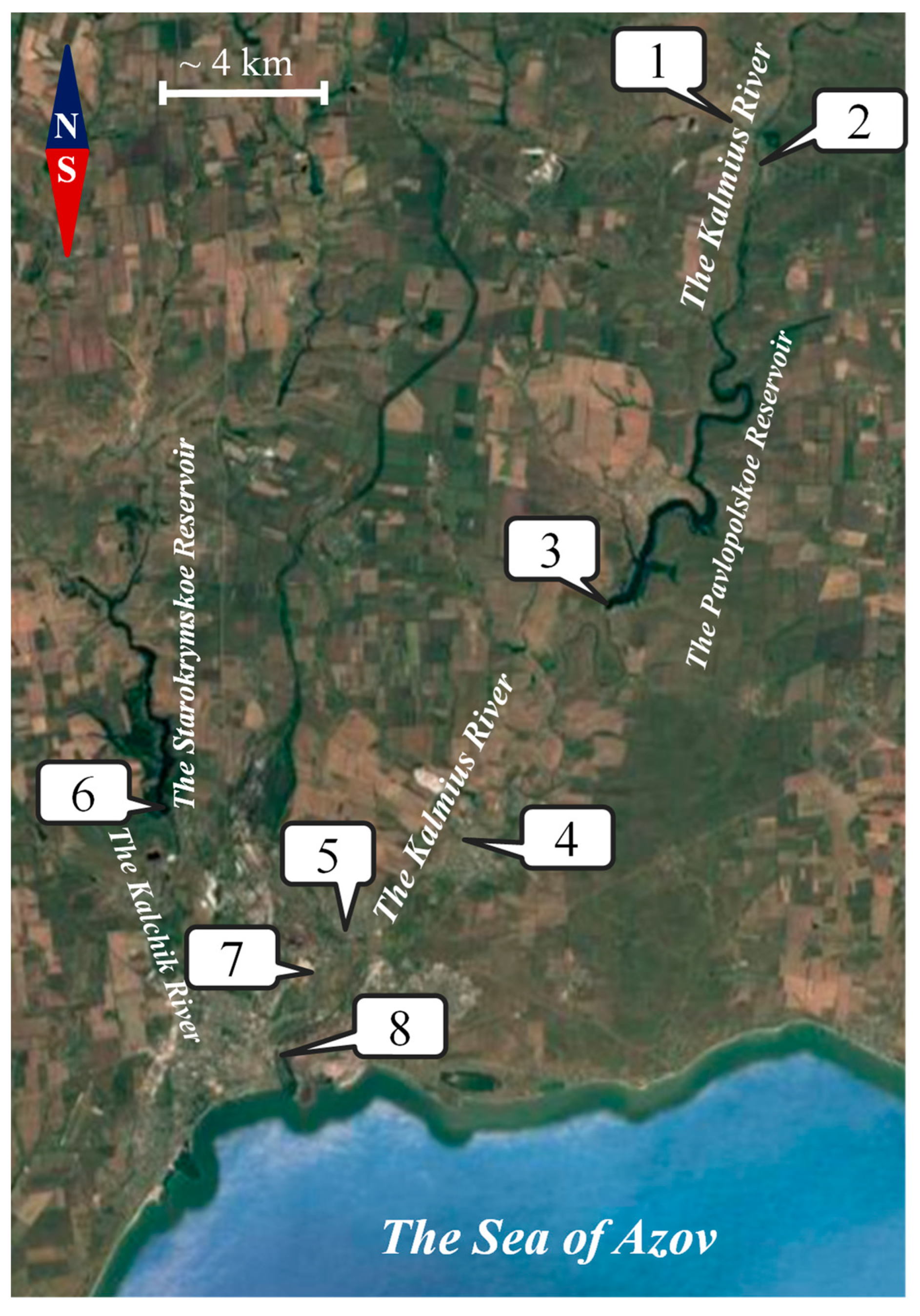
2.1. Study Area and Water Sampling
2.2. Determination of the Physical and Chemical Composition of Water Samples
2.3. Phytoplankton Diversity Determination
2.4. Determination of Photopigment Content
2.5. Fluorimetric Assessment of Phytoplankton Photosynthetic Activity
2.6. Methods of Data Analysis
3. Results
3.1. Chemical Composition of Water Samples
3.2. Species Composition of Phytoplankton of the Kalmius River
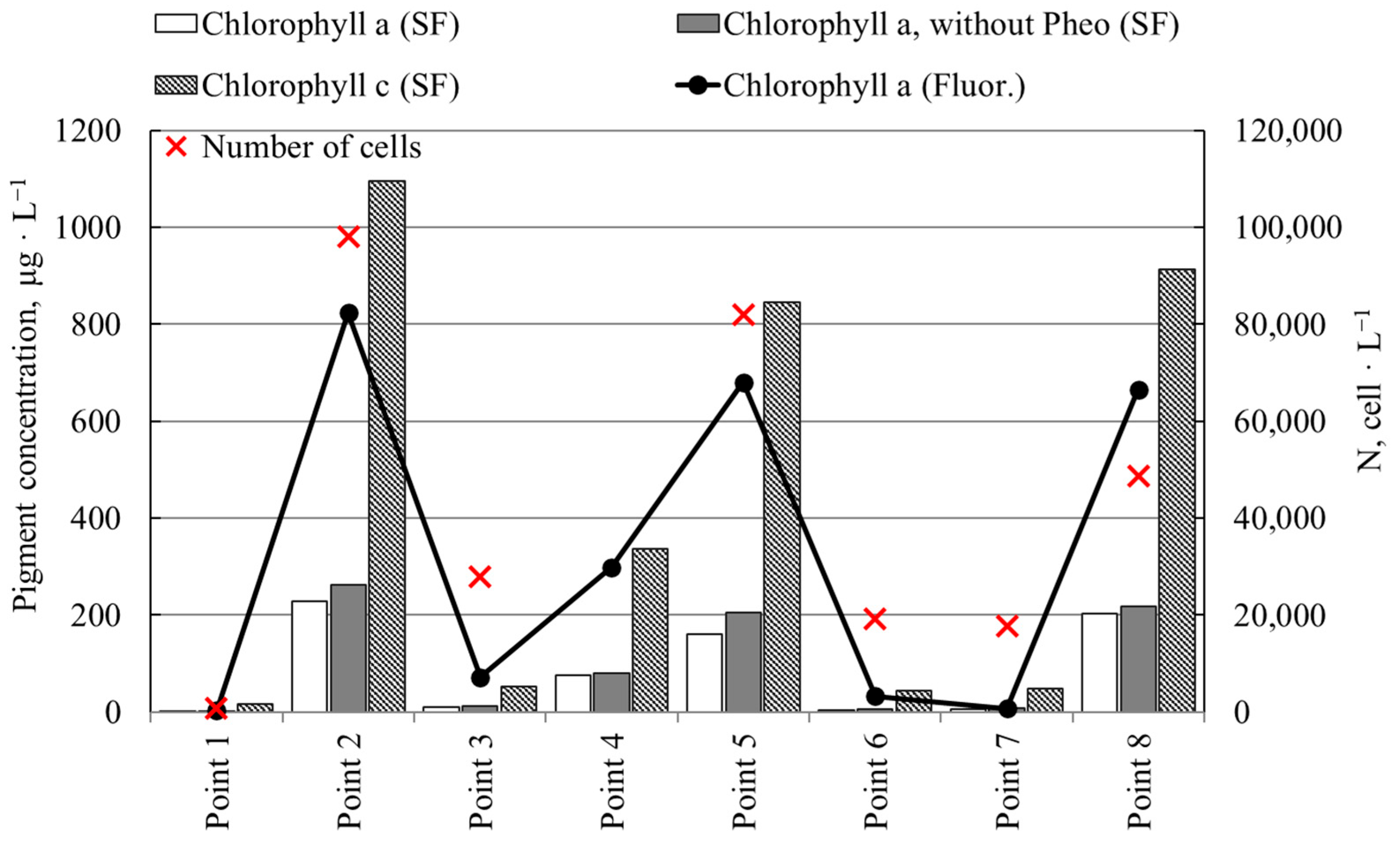
3.3. Spectrophotometric Determination of Photopigment Composition in Water Samples
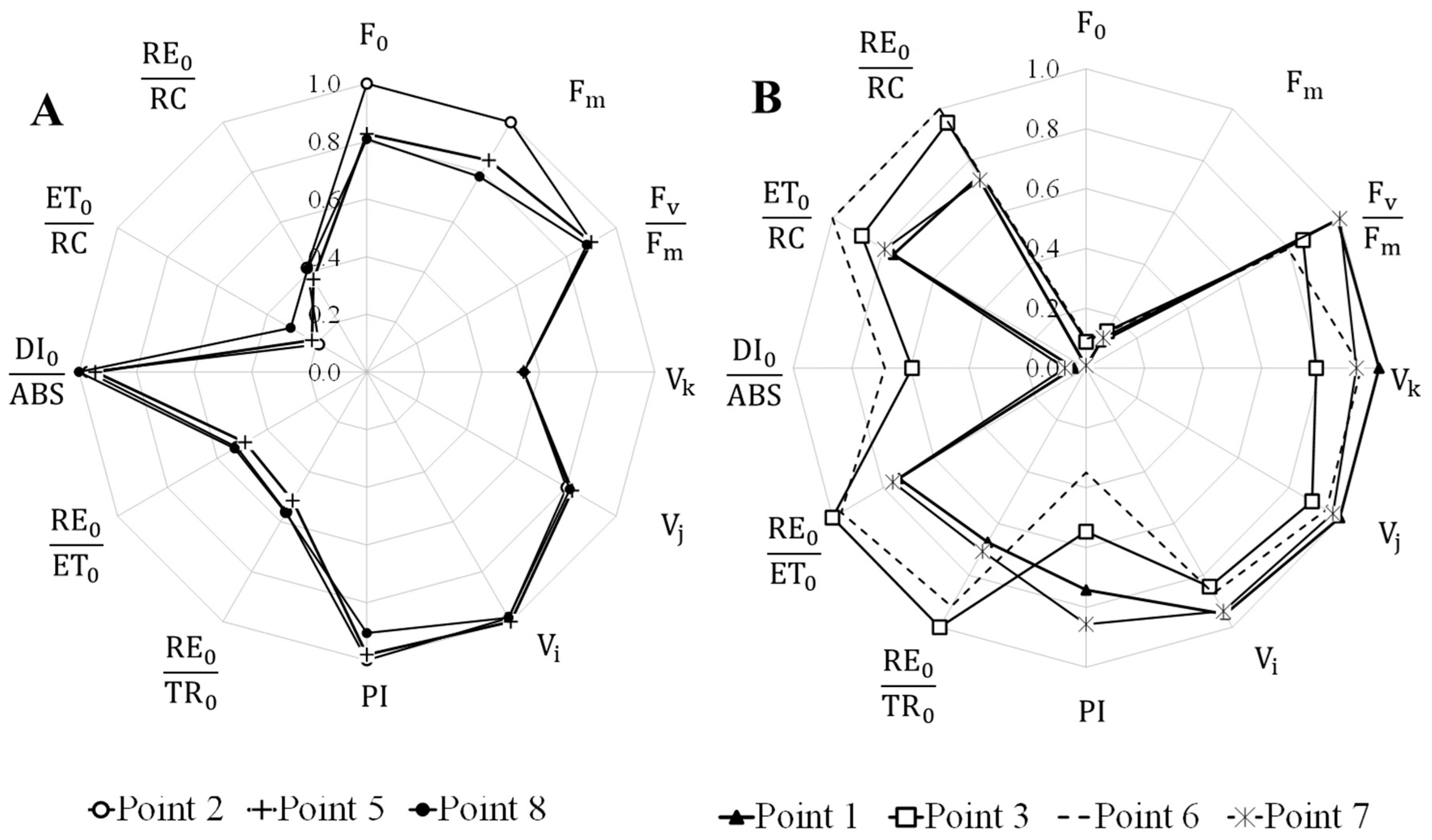
3.4. Photosynthetic Activity of Phytoplankton
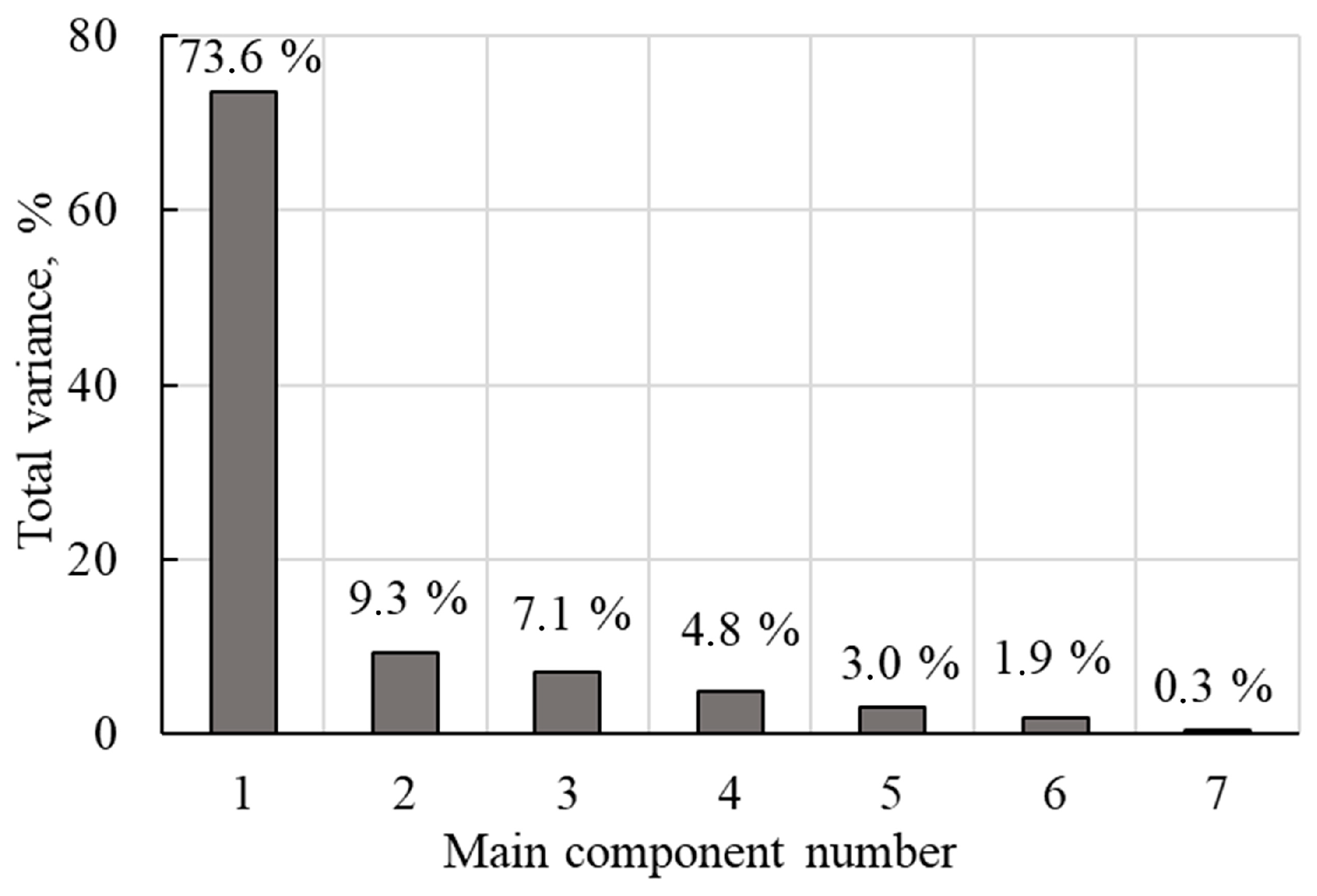
3.5. Data Analysis
4. Discussion
5. Conclusions
Author Contributions
Funding
Institutional Review Board Statement
Data Availability Statement
Conflicts of Interest
References
- Vorovka, V.P. Anthropogenic aqua landscapes of the Sea of Azov. Sci. Bull. Kherson State Univ. Ser. Geogr. Sci. 2021, 30–38. [Google Scholar] [CrossRef]
- Selifonova, J.P. Functioning of the Sea of Azov ecosystem. Inland Water Biol. 2008, 1, 199–203. [Google Scholar] [CrossRef]
- Chichaeva, M.A.; Lychagin, M.Y.; Syroeshkin, A.V.; Chernitsova, O.V. Heavy metals in marine aerosols of the Azov Sea. Geogr. Environ. Sustain. 2020, 13, 127–134. [Google Scholar] [CrossRef]
- Mikhailenko, A.; Fedorov, Y.; Dotsenko, I.; Solodko, D. Water quality formation factors in the Azov Sea. In Proceedings of the 20th International Multidisciplinary Scientific GeoConference SGEM 2020, Albena, Bulgaria, 18–24 August 2020; Volume 5, pp. 871–878. [Google Scholar]
- Neverova-Dziopak, E.; Dan, O. Assessment of a metallurgical plant impact on the Sea of Azov. Geomat. Environ. Eng. 2022, 16, 5–29. [Google Scholar] [CrossRef]
- Udod, V.M.; Zhukova, E.G. Regional-ecological approach to the assessment of possible aftermath of pollution of water basin of the Kalmius River. J. Water Chem. Technol. 2015, 37, 48–50. [Google Scholar] [CrossRef]
- Nazarenko, O.V. Hydrochemical features of rivers in coal mining areas (a study of East Donbass). In Proceedings of the 17th International Multidisciplinary Scientific Geoconference SGEM 2017, Albena, Bulgaria, 29 June–5 July 2017; Volume 17, pp. 371–378. [Google Scholar]
- Dougan, A.; Timchenko, O.; Touros, E. Atmospheric air contamination and demographic process in the cities of Ukraine. Mutat. Res. Fundam. Mol. Mech. Mutagen. 1997, 379, 106. [Google Scholar]
- Zhukov, M.; Stakhiv, I.; Kurajeva, I. Quantitative assessment of soil contamination using factor analysis. In Proceedings of the 14th EAGE International Conference on Geoinformatics—Theoretical and Applied Aspects, Geoinformatics, Kiev, Ukraine, 11–14 May 2015; Volume 56, pp. 1043–1064. [Google Scholar]
- Jeleńska, M.; Hasso-Agopsowicz, A.; Kadzialko-Hofmokl, M. Magnetic structure of polluted soil profiles from Eastern Ukraine. Acta Geophys. 2008, 56, 1043–1064. [Google Scholar] [CrossRef]
- Yakymchuk, R.A.; Valyuk, V.F. Cytogenetic activity of pollutants by heavy metal caused by emissions of industrial enterprises. Int. Sci. Pract. Conf. World Sci. 2018, 7, 34–41. [Google Scholar]
- Barnett, M.L.; Kemp, A.E.; Hickman, A.E.; Purdie, D.A. Environmental controls on the interannual variability in chlorophyll and phytoplankton community structure within the seasonal sub surface chlorophyll maximum in the western English channel. Cont. Shelf Res. 2024, 277, 105253. [Google Scholar] [CrossRef]
- Harding, L.W.; Adolf, J.; Mallonee, M.; Miller, W.; Gallegos, C.; Perry, E.; Johnson, J.; Sellner, K.; Paerl, H. Climate effects on phytoplankton floral composition in Chesapeake Bay, Estuarine. Coast. Shelf Sci. 2015, 162, 53–68. [Google Scholar]
- Choi, C.J.; Berges, J.A.; Young, E.B. Rapid effects of diverse toxic water pollutants on chlorophyll a fluorescence: Variable responses among freshwater microalgae. Water Res. 2012, 46, 2615–2626. [Google Scholar] [CrossRef]
- Park, S.Y.; Lee, J.; Kwon, I.; Song, H.; Kim, B.; Kim, T.; Lee, C.; Yoon, S.J.; Noh, J.; Hong, S.; et al. Ecotoxicological effects of suspended sediments on marine microalgae using flow cytometry and pulse-amplitude modulation (PAM) fluorometry. Mar. Pollut. Bull. 2024, 208, 116968. [Google Scholar] [CrossRef]
- Timofieieva, O.; Vlaschenko, A.; Laskowski, R. Could a city-dwelling bat (Pipistrellus kuhlii) serve as a bioindicator species for trace metals pollution? Sci. Total Environ. 2023, 857, 159556. [Google Scholar] [CrossRef]
- Mirnenko, E.I. Taxonomic diversity of phytoplankton of the Kalmius River and its reservoirs. Ecosyst. Transform. 2022, 5, 3–13. [Google Scholar] [CrossRef]
- Gan, T.; Yin, G.; Zhao, N.; Tan, X.; Wang, Y. A Sensitive response index selection for rapid assessment of heavy metals toxicity to the photosynthesis of Chlorella pyrenoidosa based on rapid chlorophyll fluorescence induction kinetics. Toxics 2023, 11, 3731–3747. [Google Scholar] [CrossRef]
- Kaiblinger, C.; Dokulil, M.T. Application of fast repetition rate fluorometry to phytoplankton photosynthetic parameters in freshwaters. Photosynth. Res. 2006, 88, 19–30. [Google Scholar] [CrossRef]
- Oxborough, K. Direct estimation of functional PSII reaction center concentration and PSII electron flux on a volume basis: A new approach to the analysis of Fast Repetition Rate fluorometry (FRRf) data. Limnol. Oceanogr. Methods 2012, 10, 142–154. [Google Scholar] [CrossRef]
- Mama, C. A Comparative evaluation of the water quality standards of different countries. Asian J. Water Environ. Pollut. 2016, 13, 15–28. [Google Scholar] [CrossRef]
- Lumb, A.; Halliwell, D.; Sharma, T. Application of CCME water quality index to monitor water quality: A case study of the Mackenzie River Basin, Canada. Environ. Monit. Assess. 2006, 113, 411–429. [Google Scholar] [CrossRef]
- Teshome, F.B. Seasonal water quality index and suitability of the water body to designated uses at the eastern catchment of Lake Hawassa. Environ. Sci. Pollut. Res. Int. 2020, 27, 279–290. [Google Scholar] [CrossRef]
- Hossain, M.; Patra, P.K. Water pollution index—A new integrated approach to rank water quality. Ecol. Indic. 2020, 117, 106668. [Google Scholar] [CrossRef]
- WHO. Guidelines for Drinking-Water Quality, 4th ed.; World Health Organization: Geneva, Switzerland, 2011. [Google Scholar]
- SanPin 2.1.4.1074-01; Drinking Water Hygienic Requirements for Water Quality of Centralized Drinking Water Supply Systems. Quality Control (Instead SanPin 2.1.4.559-96), September 26 2001 № 24, 44p; Chief State Sanitary Physician of the Russian Federation: Moscow, Russia, 2001.
- Key to Freshwater Algae of the USSR; Moshkova, N.A., Hollerbach, M.M., Eds.; Nauka: Leningrad, Russia, 1986. [Google Scholar]
- Sadchikov, A.P. Methods of Studying Freshwater Phytoplankton, 1st ed.; Publishing House “University and School”: Moscow, Russia, 2003; pp. 67–79. [Google Scholar]
- Kiselev, I.A. Plankton of the Sea and Continental Reservoirs, 1st ed.; Nauka: Leningrad, Russia, 1969; 658p. [Google Scholar]
- Guiry, M.D.; Guiry, G.M. AlgaeBase World-Wide Electronic Publication. National University of Ireland, Galway. Available online: http://www.algaebase.org (accessed on 24 June 2022).
- Medvedeva, L.A.; Nikulina, T.V. Catalogue of Freshwater Algae of the Southern Part of the Russian Far East; Dalnauka: Vladivostok, Russia, 2014; 271p. [Google Scholar]
- Jeffrey, S.W.; Humphrey, G.F. New spectrophotometric equations for determining chlorophyll a, b, c1 and c2 in higher plants, algae and natural phytoplankton. Plant Physiol. Biochem. 1975, 167, 191–194. [Google Scholar] [CrossRef]
- Ritchie, R.J. Universal chlorophyll equations for estimating chlorophylls a, b, c, and d and total chlorophylls in natural assemblages of photosynthetic organisms using acetone, methanol, or ethanol solvents. Photosynthetica 2008, 46, 115–126. [Google Scholar] [CrossRef]
- Vieira, N.; Amat, F. Variation in chlorophyll a concentrations and Margalef’s index of pigment diversity in two solar salt ponds, Aveiro, Portugal. Int. J. Salt Lake Res. 1993, 2, 41–45. [Google Scholar] [CrossRef]
- Antal, T.; Konyukhov, I.; Volgusheva, A.; Plyusnina, T.; Khruschev, S.; Kukarskikh, G.; Goryachev, S.; Rubin, A. Chlorophyll fluorescence induction and relaxation system for the continuous monitoring of photosynthetic capacity in photobioreactors. Physiol. Plant. 2018, 165, 476–486. [Google Scholar] [CrossRef]
- Stirbet, A.; Govindjee. On the relation between the Kautsky effect (chlorophyll a fluorescence induction), Photosystem II: Basics applications of the OJIPfluorescence transient. J. Photochem. Photobiol. 2011, 104, 236–257. [Google Scholar] [CrossRef]
- Vredenberg, W.; Durchan, M.; Prášil, O. The analysis of PS II photochemical activity using single and multi-turnover excitations. J. Photochem. Photobiol. 2012, 107, 45–54. [Google Scholar] [CrossRef] [PubMed]
- Strasser, R.J.; Srivastava, A.; Govindjee, G. Polyphasic chlorophyll a fluorescent transient in plants and cyanobacteria. Photochem. Photobiol. 1999, 61, 32–42. [Google Scholar] [CrossRef]
- Stirbet, A.; Lazar, D.; Kromdijk, J.; Govindjee, G. Chlorophyll a fluorescence induction: Can just a one-second measurement be used to quantify abiotic stress responses? Photosynthetica 2018, 56, 86–104. [Google Scholar] [CrossRef]
- Sarmento, R.; Costa, V. Factor Analysis. Comparative Approaches to Using R and Python for Statistical Data Analysis; IGI Global Scientific Publishing: Hershey, PA, USA, 2017; pp. 148–178. [Google Scholar]
- Cullis, B.R.; Jefferson, P.; Thompson, R.; Smith, A.B. Factor analytic and reduced animal models for the investigation of additive genotype-by-environment interaction in outcrossing plant species with application to a Pinus radiata breeding programme. Theor. Appl. Genet. 2014, 127, 2193–2210. [Google Scholar] [CrossRef]
- Rao, A.R.; Burke, T.T. Principal component znalysis of hydrologic data. In Integrated Approach to Environmental Data Management Systems; Harmancioglu, N.B., Alpaslan, M.N., Ozkul, S.D., Singh, V.P., Eds.; NATO ASI Series; Springer: Dordrecht, The Netherlandsm, 1997; Volume 31. [Google Scholar]
- Benkov, I.; Varbanov, M.; Venelinov, T.; Tsakovski, S. Principal component analysis and the water quality index—A powerful tool for surface water quality assessment: A case study on struma river catchment, Bulgaria. Water 2023, 15, 1961. [Google Scholar] [CrossRef]
- Maji, K.J.; Chaudhary, R. Principal component analysis for water quality assessment of the Ganga River in Uttar Pradesh, India. Water Resour. 2019, 46, 789–806. [Google Scholar] [CrossRef]
- Pedregosa, F.; Varoquaux, G.; Gramfort, A.; Michel, V.; Thirion, B.; Grisel, O.; Blondel, M.; Prettenhofer, P.; Weiss, R.; Dubourg, V.; et al. Scikit-learn: Machine learning in Python. J. Mach. Learn. Res. 2011, 12, 2825–2830. [Google Scholar]
- Harris, C.R.; Millman, K.J.; van der Walt, S.J.; Gommers, R.; Virtanen, P.; Cournapeau, D. Array programming with NumPy. Nature 2020, 585, 357–362. [Google Scholar] [CrossRef]
- Matorin, D.N.; Plekhanov, S.E.; Bratkovskaya, L.B.; Yakovleva, O.V.; Alekseev, A.A. The effect of phenols on the parameters of chlorophyll fluorescence and reactions of P700 in green algae Scenedesmus quadricauda. Biophysics 2014, 59, 374–379. [Google Scholar] [CrossRef]
- Van Rensen, J.J.S. Herbicides interaction with photosystem II. In Herbicides and Plant Metabolism; Cambridge University Press: Cambridge, UK, 1989; pp. 21–36. [Google Scholar]
- Ventrella, A.; Catucci, L.; Agostiano, A. Herbicides affect fluorescence and electron transfer activity of spinach chloroplasts, thylakoid membranes and isolated Photosystem II. Bioelectrochemistry 2010, 79, 43–49. [Google Scholar] [CrossRef] [PubMed]
- Browning, T.J.; Achterberg, E.P.; Engel, A.; Mawji, E. Manganese co-limitation of phytoplankton growth and major nutrient drawdown in the Southern Ocean. Nat. Commun. 2021, 12, 884. [Google Scholar] [CrossRef] [PubMed]
- Balaguer, J.; Koch, F.; Hassler, C.; Trimborn, S. Iron and manganese co-limit the growth of two phytoplankton groups dominant at two locations of the Drake Passage. Commun. Biol. 2022, 5, 207. [Google Scholar] [CrossRef]
- Bestawy, E. X-Ray Microanalytical study on Cyclotella meneghiniana (Bacillariophyceae) as a bio-indicator for metal pollution in marine and fresh water environments. Pak. J. Biol. Sci. 2000, 3, 1500–1505. [Google Scholar] [CrossRef][Green Version]
- Juhas, M.; Büchel, C. Properties of photosystem I antenna protein complexes of the diatom Cyclotella meneghiniana. J. Exp. Bot. 2012, 10, 3673–3681. [Google Scholar] [CrossRef]
- Cserháti, T.; Forgács, E.; Oros, G. Biological activity and environmental impact of anionic surfactants. Environ. Int. 2002, 28, 337–348. [Google Scholar] [CrossRef] [PubMed]
- Dereszewska, A.; Cytawa, S.; Tomczak-Wandzel, R.; Medrzycka, K. The effect of anionic surfactant concentration on activated sludge condition and phosphate release in biological treatment plant. Pol. J. Environ. Stud. 2015, 24, 83–91. [Google Scholar] [CrossRef] [PubMed]
- Bespalova, S.V.; Romanchuk, S.M.; Chufitskiy, S.V.; Perebeinos, V.V.; Gotin, B.A. Fluorimetric Analysis of the Impact of Coal Sludge Pollution on Phytoplankton. Biophysics 2020, 65, 850–857. [Google Scholar] [CrossRef]
- Lowe, R.L. Environmental Requirements and Pollution Tolerance of Freshwater Diatoms; Environmental Monitoring Series; EPA: Washington, DC, USA, 1974; 340p.





| F0 | minimal level of chlorophyll fluorescence; |
| Fm | maximum level of chlorophyll fluorescence; |
| Fv Fm−1 | chlorophyll fluorescence quantum yield; |
| Vj | relative variable chlorophyll fluorescence level after 2 ms of saturation (J-phase), reflects the number of closed reaction centers in photosystem II in relation to the total number of reaction centers; |
| Vi | relative variable chlorophyll fluorescence level after 30 ms of saturation (I-phase), reflects the ability of photosystem I acceptors to oxidize a plastoquinone pool; |
| Vk | relative variable chlorophyll fluorescence level at 0.3 ms; |
| PI | performance index for energy conservation from photons absorbed by photosystem II antenna (total photosynthetic activity performance index); |
| RE0 ET0−1 | efficiency of electron transport from plastoquinone pool to photosystem I; |
| ET0 ABS−1 | quantum yield of electron transport between photosystem II acceptors and plastoquinone pool; |
| RE0 ABS−1 | quantum yield of electron transport between photosystem II and to photosystem I acceptors; |
| DI0 ABS−1 | quantum yield of energy heat dissipation in photosystem II antennae; |
| RE0 RC−1 | the flux of electrons transferred between photosystem II and photosystem I acceptors; |
| ET0 RC−1 | the flux of electrons transferred between photosystem II acceptors and plastoquinone pool; |
| TR0 RC−1 | maximum trapped exciton flux per active photosystem II; |
| DI0 RC−1 | the flux of dissipated energy. |
| Indicator | Unit | Norm | Point 1 | Point 2 | Point 3 | Point 4 | Point 5 | Point 6 | Point 7 | Point 8 |
|---|---|---|---|---|---|---|---|---|---|---|
| pH | pH units | 6.0–8.5 | 7.68 | 7.91 | 8.35 | 8.19 | 7.75 | 7.97 | 8.3 | 8.04 |
| Suspended matter | mg·L−1 | 30 | 142 | 131 | 70 | 82.5 | 124 | 152 | 82 | 160 |
| Phenol | mg·L−1 | 0.1 | 0.002 | 0.002 | 0.001 | 0.001 | 0.002 | 0.003 | 0.003 | 0.003 |
| General hardness | mmol·L−1 | 10 | 21 | 20.2 | 21.7 | 27.8 | 23.8 | 22.7 | 28.8 | 25.3 |
| Total Iron | mg·L−1 | 0.3 | 0.43 | 0.59 | 0.22 | 0.2 | 0.54 | 0.56 | 0.57 | 0.81 |
| Sulfates | mg·L−1 | 500 | 1080 | 1134 | 1036 | 1613 | 1320 | 1525 | 1704 | 1673 |
| Dry residue | mg·L−1 | 1500 | 2656 | 2838 | 2746 | 3307 | 2975 | 3160 | 3478 | 3429 |
| Chlorides | mg·L−1 | 350 | 416.7 | 442.1 | 411.6 | 371 | 452.3 | 503.1 | 401.5 | 640.3 |
| Magnesium | mg·L−1 | 50 | 121.5 | 111.8 | 124 | 164.1 | 141 | 133.7 | 172.6 | 149.5 |
| Manganese | mg·L−1 | 0.1 | 0.023 | 0.068 | 0.038 | 0.02 | 0.087 | 0.057 | 0.04 | 0.056 |
| Anionic surfactants | mg·L−1 | 0.5 | 0.03 | 0.04 | 0.03 | 0.02 | 0.04 | 0.05 | 0.05 | 0.07 |
| Water pollution index | >0.5 | 0.81 | 0.84 | 0.66 | 0.90 | 0.96 | 0.81 | 0.92 | 1.09 | |
| Division | Class | Order | Family | Genus | Species | Identified to Genus |
|---|---|---|---|---|---|---|
| Bacillariophyta | 4 | 6 | 8 | 11 | 9 | 9 |
| Chlorophyta | 2 | 5 | 8 | 16 | 19 | 5 |
| Cyanobacteria | 1 | 3 | 4 | 4 | 6 | 3 |
| Dinoflagellata | 1 | 1 | 1 | 1 | – | 1 |
| Euglenozoa | 1 | 1 | 2 | 3 | 1 | 3 |
| Streptophyta | 2 | 2 | 2 | 2 | 2 | 2 |
| Total | 11 | 18 | 25 | 37 | 37 | 23 |
| Chl a (Fluor) | Number of Cells | Chl a (SF) | Fm | Vk | Vi | PI | RE0/TR0 | RE0/ET0 | ET0/RC | RE0/RC | |
|---|---|---|---|---|---|---|---|---|---|---|---|
| Susp. matter | 0.286 | 0.071 | 0.286 | 0.286 | −0.357 | 0.500 | 0.357 | −0.500 | −0.643 | −0.429 | −0.571 |
| Phenol | 0.286 | 0.071 | 0.429 | 0.286 | −0.500 | 0.357 | 0.643 | −0.357 | −0.500 | −0.429 | −0.714 |
| Fe | 0.429 | 0.214 | 0.571 | 0.429 | −0.500 | 0.357 | 0.786 | −0.357 | −0.500 | −0.571 | −0.714 |
| Cl | 0.429 | 0.357 | 0.571 | 0.429 | −0.643 | 0.643 | 0.500 | −0.643 | −0.643 | −0.571 | −0.714 |
| Mn | 0.571 | 0.786 | 0.571 | 0.571 | −0.500 | 0.643 | 0.643 | −0.643 | −0.500 | −0.714 | −0.571 |
| Anionic surfactants | 0.340 | 0.189 | 0.491 | 0.340 | −0.567 | 0.416 | 0.643 | −0.416 | −0.491 | −0.416 | −0.718 |
Disclaimer/Publisher’s Note: The statements, opinions and data contained in all publications are solely those of the individual author(s) and contributor(s) and not of MDPI and/or the editor(s). MDPI and/or the editor(s) disclaim responsibility for any injury to people or property resulting from any ideas, methods, instructions or products referred to in the content. |
© 2026 by the authors. Licensee MDPI, Basel, Switzerland. This article is an open access article distributed under the terms and conditions of the Creative Commons Attribution (CC BY) license.
Share and Cite
Chufitskiy, S.; Meskhi, B.; Olshevskaya, A.; Shevchenko, V.; Odabashyan, M.; Kozyrev, D.; Mirzoyan, A.; Vershinina, A.; Gukasyan, L. Impact of Surface Water Pollution on Biodiversity and Photosynthetic Activity of Phytoplankton in the Kalmius River. Diversity 2026, 18, 188. https://doi.org/10.3390/d18030188
Chufitskiy S, Meskhi B, Olshevskaya A, Shevchenko V, Odabashyan M, Kozyrev D, Mirzoyan A, Vershinina A, Gukasyan L. Impact of Surface Water Pollution on Biodiversity and Photosynthetic Activity of Phytoplankton in the Kalmius River. Diversity. 2026; 18(3):188. https://doi.org/10.3390/d18030188
Chicago/Turabian StyleChufitskiy, Sergey, Besarion Meskhi, Anastasiya Olshevskaya, Victoria Shevchenko, Mary Odabashyan, Denis Kozyrev, Arkady Mirzoyan, Anna Vershinina, and Lusine Gukasyan. 2026. "Impact of Surface Water Pollution on Biodiversity and Photosynthetic Activity of Phytoplankton in the Kalmius River" Diversity 18, no. 3: 188. https://doi.org/10.3390/d18030188
APA StyleChufitskiy, S., Meskhi, B., Olshevskaya, A., Shevchenko, V., Odabashyan, M., Kozyrev, D., Mirzoyan, A., Vershinina, A., & Gukasyan, L. (2026). Impact of Surface Water Pollution on Biodiversity and Photosynthetic Activity of Phytoplankton in the Kalmius River. Diversity, 18(3), 188. https://doi.org/10.3390/d18030188