Article

Impact of Surface Water Pollution on Biodiversity and Photosynthetic Activity of Phytoplankton in the Kalmius River


1
Faculty of Biology, Donetsk State University, 24 Universitetskaya Str., Donetsk 83001, Russia
2
Agribusiness Faculty, Don State Technical University, Rostov-on-Don 344000, Russia
3
Faculty of Computer Science and Engineering, Don State Technical University, Rostov-on-Don 344000, Russia
*
Authors to whom correspondence should be addressed.
Diversity 2026, 18(3), 188; https://doi.org/10.3390/d18030188
Submission received: 12 February 2026 / Revised: 12 March 2026 / Accepted: 16 March 2026 / Published: 20 March 2026
(This article belongs to the Section Freshwater Biodiversity)

Abstract

In order to determine the condition of drinking water sources in Donetsk Region and assess potential threats related to water pollution from mining and industrial wastewater, it is extremely important to monitor surface waters, which should include an assessment of the condition of gydrobionts. Additionally, declining surface water quality in the region contributes to pollution in the coastal waters of the Sea of Azov. This study presents the monitoring results for the southern part of the Kalmius River basin. Analysis of water samples revealed contamination by phenol, sulfates, chlorides, anionic surfactants, iron, elevated water hardness, and significant exceedances of suspended solids and total dissolved solids. The iron concentration at the Kalmius River estuary reached 0.81 mg∙L−1, exceeding the permissible limit by 2.5-fold. Sulfate and total dissolved solids concentrations attained 1673 and 160 mg∙L−1, respectively. Changes in the species composition of phytoplankton were observed in response to variations in iron, manganese, and phenol concentrations in the water. Specifically, elevated iron levels led to increased abundance of the metal-sensitive species Cyclotella meneghiniana Kützing. Principal component analysis of the data revealed a relationship between increased phenol concentrations in the aquatic environment and a mean 20% reduction in phytoplankton cell photosynthetic activity, as well as the influence of manganese ions on cell abundance and photopigment content. Thus, phytoplankton cell fluorescence, alongside shifts in species composition and photosynthetic pigment content, can serve as an additional indicator of surface water pollution by iron and phenol.

1. Introduction

The mouth of the Kalmius River, as well as the coastal waters of the Sea of Azov, have been under intense anthropogenic pressure for decades [1,2]. The activities of numerous industrial enterprises in the city of Mariupol lead to intense pollution of the soil, atmosphere and water resources [3,4,5]. The processes of pollution of the coastal waters of the Sea of Azov are associated not only with the discharge of wastewater directly into the sea but also the entry of pollutants through runoff from medium-sized rivers in the region, in particular the Kalmius River [6,7]. The Pavlopol Reservoir is located in the bed of the Kalmius River, which, together with the Starokrymskoye Reservoir, plays an important role in the water supply of the southern cities of the republic. The Starokrymskoye Reservoir is also part of the Kalmius River basin, since it is located in the bed of the Kalchik River, a right tributary of the Kalmius River. In the southern part of the Kalmius River bed, there are a large number of small tributaries fed mainly by spring waters. The tributary near the settlement of Granitnoye was chosen as an example. In addition, it should be taken into account that the northern part of the Kalmius River bed is subject to significant pollution due to the discharge of mine and industrial waters [6]. The study areas are characterized by air pollution [8], soil contamination [9,10], and surface water pollution [11]. Heavy metals (Zn, Cu, Pb, Fe, Cd) frequently exceed permissible concentrations, with river concentrations in the region surpassing limits by 5–10 times. Additionally, elevated phenol and petroleum product levels have been noted in the Kalmius and Kalchik Rivers, as well as in the coastal waters of the Sea of Azov [1,2,3,11]. The primary pollution sources for the Kalchik and Kalmius rivers are the mining and metallurgical enterprises. A significant number of tributaries, a high degree of anthropogenic load and the presence of two reservoirs in the southern part of the Kalmius River basin make it an important object of study both for assessing the degree of pollution of water resources in the region and for identifying the negative impact of river runoff on the coastal waters of the Sea of Azov.
Reservoirs regulated in the beds of the Kalchik and Kalmius rivers, as well as tributaries with a high degree of water mineralization, create special conditions for the development of the phytoplankton community. Determination of changes in the species composition of algal flora and assessment of the pigment composition of water samples, as well as the photosynthetic activity of microalgae cells, are powerful tools for environmental monitoring of aquatic ecosystems, expanding the capabilities of classical physicochemical studies [12,13,14,15]. Biomonitoring methods are rarely applied during environmental monitoring of the study areas [16,17]. Assessment of surface water pollution based on changes in phytoplankton state has been conducted only for the northern section of the Kalmius River [17]. The southern section of the Kalmius River bed is of particular interest [6], as pollution from upstream industrial facilities is compounded by the adverse impact of Mariupol city enterprises. Moreover, processes occurring in this area affect the coastal waters of the Sea of Azov. The importance of studying the degree of river pollution is heightened by the presence of drinking water reservoirs supplying nearby settlements.
Phytoplankton status assessments must encompass not only shifts in species composition but also quantification of cellular photosynthetic activity. The phytoplankton photosynthetic apparatus exhibits sensitivity to perturbations in environmental parameters and pollutant ingress into surface waters [18,19]. Fluorimetry represents the optimal methodology for such investigations, characterized by rapid acquisition and high informational yield [19,20]. Fluorescence signal acquisition requires mere seconds, facilitating in situ application within natural environments [19,20].
This work is devoted to assessing the state of the southern part of the Kalmius River basin, including the Pavlopol and Starokrymskoye reservoirs, as well as its left tributary, the Kalchik River, and studying the state of phytoplankton using spectrophotometry and fluorimetry. The research examined changes in phytoplankton state due to water pollution, alterations in the river hydroregime, and tributary inflows along the southern section of the Kalmius River bed over a short timeframe. It is expected that there will be close relationships between the intensity of surface water pollution and the species composition of phytoplankton, the content of photosynthetic pigments, and the photosynthetic activity of phytoplankton. While this approach does not capture long-term processes such as seasonal phytoplankton structure dynamics, it enables evaluation of changes occurring due to riverbed pollution.

2. Materials and Methods

2.1. Study Area and Water Sampling

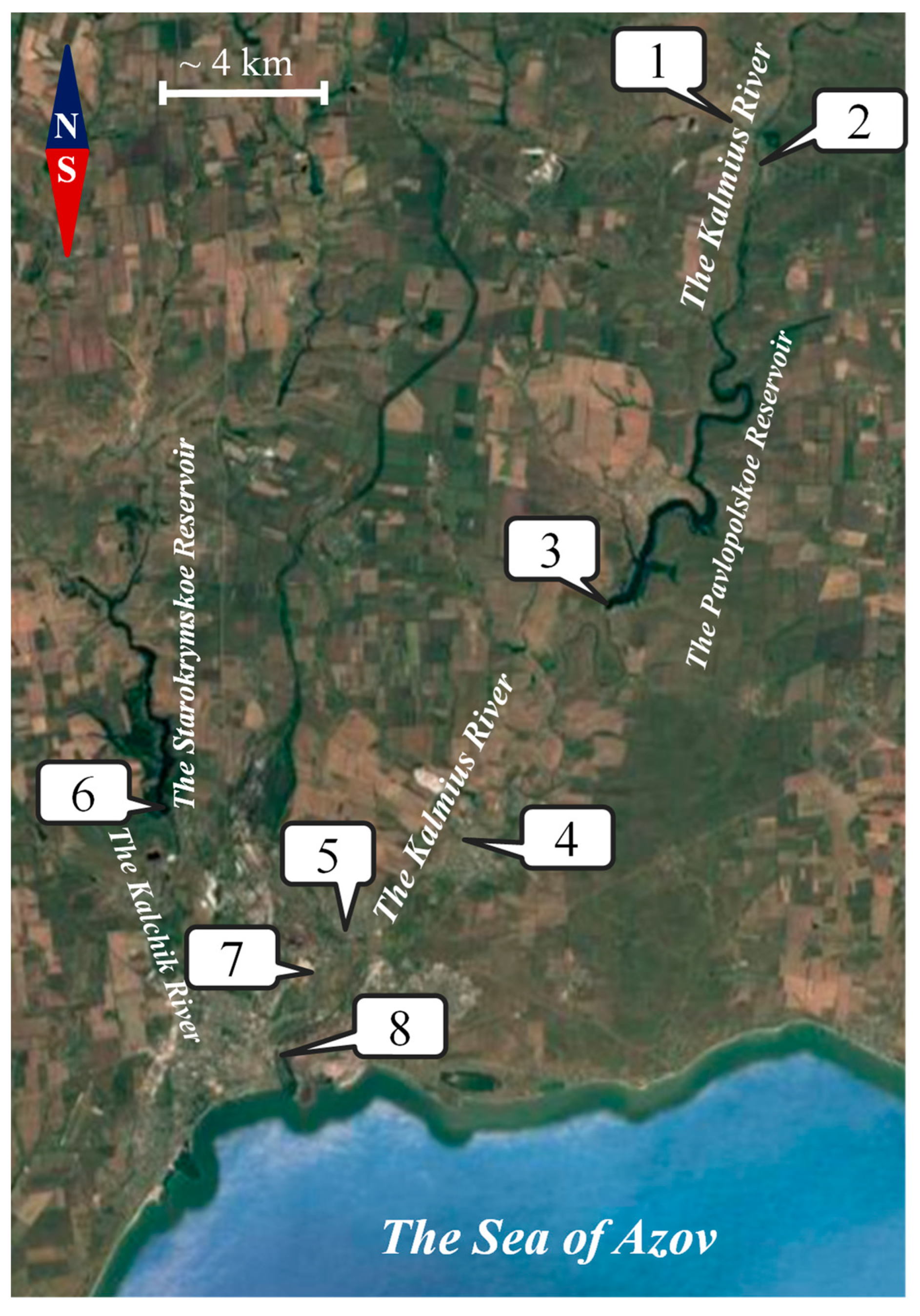
Samples were collected in June 2023. Eight monitoring points were selected to assess the condition of the southern part of the Kalmius River (Figure 1).
Monitoring points 1 and 2 are located near the settlement of Granitnoye. Point 2 (47°27′07.5″ N 37°51′33.9″ E) is located in the Kalmius River bed; point 1 (47°26′47.1″ N 37°51′57.5″ E) corresponds to the inflow of spring waters. Spring tributaries of the Kalmius River are characterized by a high degree of mineralization. Since maintaining the water level in the Kalmius River largely depends on such tributaries, as well as mine waters, this leads to increased mineralization and changes in the chemical composition of the river water. Water samples in the reservoirs were taken only near the dams, at the water intake points, in the downstream area. Monitoring points 3 (47°16′07.5″ N 37°46′35.0″ E) and 6 (47°11′27.2″ N 37°30′08.7″ E) belong to the Pavlopolskoye and Starokrymskoye reservoirs, respectively. Point 4 (47°09′36.0″ N 37°40′51.6″ E) is located in the vicinity of the settlement of Sartana and is intermediate between the Pavlopolskoye Reservoir and the points of the Kalmius River bed on the territory of the city of Mariupol. In the city, samples were taken before the confluence of the Kalchik River and the Kalmius River (point 5 (47°07′40.5″ N 37°36′09.6″ E)), in the tributary itself (point 7 (47°07′15.2″ N 37°35′45.4″ E)) and at the mouth of the river. Another point is located in the Kalmius, after the confluence of the right tributary (point 8 (47°06′04.8″ N 37°34′19.9″ E)).
Sampling was carried out in the morning and during the daytime in plastic or glass containers with a volume of 1.5 dm3. Water samples for chemical analysis were collected exclusively in glass containers. For heavy metal analysis, separate water samples were collected and pre-preserved with a 2% nitric acid solution to prevent the transition of metal ions into sparingly soluble complex compounds. For biological studies, water samples were also collected in separate 1.5 L containers. Thus, three water samples were simultaneously collected at each monitoring point: one for general chemical analysis, one for heavy metal content analysis, and one for biological studies.

2.2. Determination of the Physical and Chemical Composition of Water Samples

The physicochemical parameters of the collected water samples were analyzed. The measurements were performed at the branch of the Central Control and Research Design and Survey Water Laboratory of the State Unitary Enterprise «Voda Donbassa», as well as at the Department of Analytical Chemistry of Donetsk State University.
Water quality was assessed by determining the water pollution index (WPI), based on accounting for the integral impact of all studied chemical parameters of the aquatic environment [21,22,23,24]. WPI is calculated using the formula
P L = 1 + C i S i S i ; W P I = 1 n i = 1 n P L i ,
where Ci—content of i-th chemical component in sample; S i —maximum permissible content of i-th chemical component; n—the number of evaluated chemical components; and P L i —pollution load of the i-th chemical component’s content in the water sample.
The maximum permissible content ( S i ) was determined in concordance with the WHO [25] and also in comparison to SanPin 2.1.4.1074-01 [26].
The WPI values were used to determine the water pollution categories. If the WPI value was lower than 0.5, it corresponded to excellent water quality; if it was equal to values from 0.5 to 0.75, it indicated good water quality; values from 0.75 to 1.0 meant moderately polluted water; and more than 1.0 meant highly polluted water.

2.3. Phytoplankton Diversity Determination

To determine the species diversity of phytoplankton, cells were concentrated by filtering through MFAS-OS-4 membrane filters (Vladipor, Vladimir, Russia). The pore diameter of the filters was 0.6 μm. The species composition of the samples was determined in a bright field using a light microscope (Micmed-6 (LOMO, St. Petersburg, Russia)) with a Plan 60× objective and total magnification of 600.
Phytoplankton abundance was determined using a Goryaev chamber (with volume 0.9 mm3). The total number of phytoplankton cells was calculated according to the formula:
N = k · n · A a · v · 1000 V ,
where N—total number of phytoplankton cells in a 1 L of water sample; k—a coefficient that indicates how many times the volume of the counting chamber is below 1 cm3; n—number of phytoplankton cells found in the Goryaev chamber; A—number of the squares in the chamber (for the Goryaev chamber, this parameter is equal to 25); a—number of squares in which algae were counted (at least five squares for each measurement); v—volume of filtered water (cm3); and V—initial volume of the water sample (cm3).
The species composition of phytoplankton was determined according to modern classifiers [27,28,29,30,31].

2.4. Determination of Photopigment Content

The content of photopigments (chlorophyll-a (Chl-a), chlorophyll-b (Chl-b), chlorophyll-c Chl-c) in water samples was determined by spectrophotometric metod, according to the expressions as presented in [32,33]. Before extraction, 500 mL of water sample was filtered through acetylcellulose filters with a pore diameter of 0.65 μm to concentrate phytoplankton cells. Filters with deposited cells were dissolved in a 90% acetone solution by grinding in a porcelain mortar to achieve a homogeneous solution. The acetone solution was pre-cooled to 3–4 °C to minimize extract pheophytinization. The resulting extract was centrifuged at 4000× g for 15 min. Extract purity was controlled by optical density at 750 nm; if optical density exceeded 0.005 AU, centrifugation was repeated. Optical densities of the extract for photopigment concentration determination were measured at 664, 647, 630, and 750 nm. Photopigment concentrations were calculated according to [32,34]. Estimation of Chl-a content could be complicated by the presence of pheophytin and pheophorbide. To exclude the influence of pheophytin and pheophorbide, hydrochloric acid (3–5 mmol/L) was added to the extract.
To assess the relationship between the content of photopigments and the species composition of phytoplankton in water samples, the Margalef pigment index [34] was determined. The pigment index was calculated as the ratio of the extract optical densities at 430 and 664 nm.

2.5. Fluorimetric Assessment of Phytoplankton Photosynthetic Activity

Fluorimetric assessment of phytoplankton photosynthetic activity was determined from the chlorophyll fluorescence induction curves parameters using an FS-2 fluorimeter (Donetsk State University, Donetsk, Russia). Fluorescence induction curves are also called OJIP curves with three subsequent peaks (denoted as J, I, P). The form and parameters of OJIP curves reflect the photosynthetic processes in photosystem II during light saturation. All samples were dark-adapted for 20 min before the measurement to exclude the light saturation of phytoplankton cells. To induce the chlorophyll fluorescence, a 450 nm diode was used. The saturating pulse intensity was 3000 μmol. quanta m−2 s−1, with a pulse duration of 1 s. A Hamamatsu H10721-01 photomultiplier tube (Hamamatsu Photonics, Hamamatsu, Japan) was used as the detector. For every water sample, at least 10 OJIP curves were measured. A single measurement required 3 mL of water sample to be taken.
The PyPhotoSyn program (version 1.0) [35] was used to analyze the fluorescence induction curves. All parameters of OJIP curves were calculated and interpreted as proposed in [36,37,38,39] and Table 1. Minimal fluorescence intensity (parameter F0) was used to determine Chl-a concentration.

2.6. Methods of Data Analysis

Non-parametric Wilcoxon W-criteria were used to determine the reliability of differences in mean values for all obtained measurement results. The Kendall rank correlation coefficient was applied to assess the degree of correlation between samples.
To identify the relationship between changes in the physical and chemical parameters of the aquatic environment, the photosynthetic activity of phytoplankton cells, and the pigment composition of samples, factor analysis was used [40,41], since this method allows us to identify hidden factors affecting environmental parameters. To reduce the dimensionality of multidimensional data, the PCA (principal component analysis) algorithm was used [42,43,44]. Based on PCA analysis, the data can be interpreted using fewer principal components than the number of original variables, which allows extraction of valuable information about hidden relationships between original variables and identification of the influence of latent factors on various sampling points. The data were analyzed using Python 3.6 with the Scikit-learn [45] and NumPy [46] libraries.

3. Results

3.1. Chemical Composition of Water Samples

Water samples in the studied area of the Kalmius River basin were characterized by a high degree of hardness, suspended solids and dry residue content (Table 2).
In Table 2, cases of excess of permissible concentrations are highlighted in bold; the “–” sign indicates that no measurements were taken. As with other medium-sized rivers in the region, the Kalmius River is characterized by exceeding the MAC for sulfates, chlorides and magnesium. No excesses in the content of heavy metals in the water samples were found, with the exception of iron concentrations. The total iron content was within the normal range only in the Pavlopol Reservoir and the Kalmius River at point 4.
Water pollution index (WPI) values for most monitoring points ranged from 0.81 to 0.96, corresponding to moderately polluted water. For water samples from the Pavlopolskoye Reservoir, WPI values did not exceed 0.66, corresponding to good water quality. The most contaminated water was from monitoring point 8 (WPI = 1.09).

3.2. Species Composition of Phytoplankton of the Kalmius River

Phytoplankton species composition was analyzed for all monitoring points. A total of 37 phytoplankton species were identified. The richest species diversity was observed at monitoring points 2 and 6, with 14 species each, and 6 identified at the genus level. Compared to point 2, euglenophytes, the genera Pediastrum and Kirchneriella and the species of Scenedesmus were absent near the river estuary. The species of Oocystis, Synedra, and Navicula and cyanobacteria of the genus Microcystis became more prevalent.
Species found in nearly all monitoring points include Chlorella vulgaris Beij., Scenedesmus quadricauda Brébisson, and representatives of the genus Cyclotella, particularly Cyclotella meneghiniana Kützing—the dominant species across monitoring points. Other dominant species in specific points included Chlorella vulgaris, Melosira varians C.Agardh, Microcystis aeruginosa Kützing, Scenedesmus quadricauda, Oscillatoria agardhii M.A.Gomont, and Actinastrum hantzschii Lagerh. (exclusive to point 2). Rare species included Closterium parvulum Nägeli, Oocystis lacustris Chodat, Oscillatoria formosa Bory ex Gomont, Tribonema viride Pascher, and the genus Bacillaria.
The most diversely represented divisions were Chlorophyta and Bacillariophyta. Green algae were represented by 5 orders, 8 families and 19 species (Table 3). The division Bacillariophyta included 6 orders and 8 families, which were represented by 11 genera and 9 species. Cyanobacteria included 3 orders, 4 families, 4 genera and 6 species. The divisions Streptophyta, Dinoflagellata and Euglenozoa were represented by several genera.
Only Cyclotella meneghiniana cells were found in the tributary of the Kalmius River (point 1). As noted earlier, this tributary is fed by spring waters and the algal flora in it are characterized by a poor species composition. The dominant species at monitoring point 2 were the species Cyclotella meneghiniana and Melosira varians (68% of the total number of phytoplankton). Chlorophyta was represented by species of the genera Scenedesmus and Actinastrum (28.8% of the total number of cells). Cyanobacteria accounted for about 3% of the phytoplankton population, and Euglenozoa accounted for about 0.5%.
In the Pavlopol Reservoir, there was a redistribution of dominant species, with Chlorophyta and Cyanobacteria predominating—40% and 33%, respectively. The dominant species can be called Scenedesmus quadricauda; additionally, high numbers were noted for Microcystis aeruginosa. Bacillariophyta accounted for 13% of the population and was represented by the genera Cyclotella and Navicula. Charophytes were also found—Cosmarium meneghinii Bréb. ex Ralfs (~0.7% of the population)—as well as streptophyte algae—Closterium parvulum (~0.7% of the population). The species Closterium parvulum was found only in the waters of the Pavlopol Reservoir.
Downstream of the reservoirs (points 4 and 5): Diatoms constituted 92–96% of the total abundance, dominated by Cyclotella meneghiniana. Green algae accounted for 2.8–5.4%, while Euglenozoa (Euglena, Phacus) reached 1–2.5%. These shifts reflect hydrological changes between reservoirs and the river channel.
Starokrymskoye Reservoir (point 6): Chlorophyta (45.2%) and Cyanobacteria (43.5%) dominated. Key species included Chlorella vulgaris, Dictyosphaerium pulchellum H.C.Wood, Scenedesmus quadricauda, Oscillatoria agardnii, and Microcystis aeruginosa. Diatoms (8.6%) were led by Cyclotella meneghiniana, with minor contributions from Dinoflagellata (1.4%) and Charophyta (1.3%).
Kalchik River: Diatoms (92.4%) dominated, primarily Cyclotella meneghiniana and Melosira varians. Green algae (2–3%), cyanobacteria (2–3%), and Euglenozoa (Euglena, Phacus, Trachelomonas) were minor components.
Kalmius River Estuary (point 8): Diatoms (94%) remained dominant (Cyclotella sp.), with green algae (4.7%) and combined cyanobacteria/euglenozoans (≤2%). Golenkinia radiata Chodat and Lagerheimia genevensis Chod. proliferated between points 5 and 8.

3.3. Spectrophotometric Determination of Photopigment Composition in Water Samples

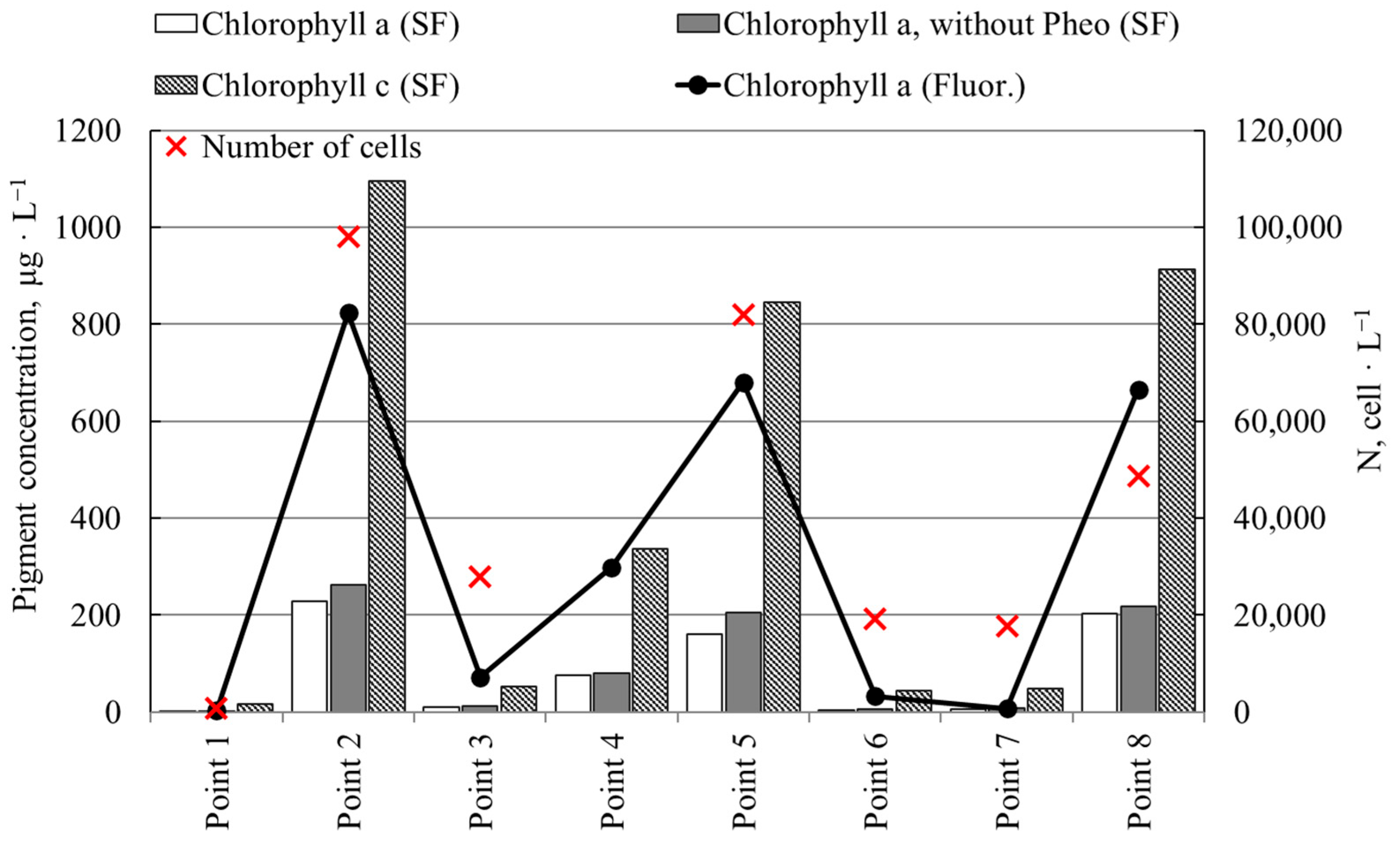
The results of fluorometric and spectrophotometric methods for determining chlorophyll content in water samples were similar. In Figure 2, the results of the spectrophotometric method are shown as diagram columns (designated as “SF”). The results of fluorometric determination of the Chl-a content in water samples in Figure 2 are shown as a line (designated as “Fluor”). The number of phytoplankton cells is shown as individual points (marker ✕).
In the mouth of the Kalmius River, all the studied monitoring points were characterized by the predominance of Chl-a and Chl-c (Figure 2). The lowest content of photopigments was characteristic of the tributary of the Kalmius River (point 1). A significant amount of Chl-c was manifested, which is associated with the presence of a large number of cells of Cyclotella meneghiniana. The pigment composition of the samples from the reservoirs was similar, with a predominance of Chl-c, reflecting the dominance of green algae. In the Pavlopol reservoir, the content of Chl-a was higher, which is associated with a higher number of phytoplankton cells. In the Kalchik River, the photopigment composition is qualitatively and quantitatively similar to that of samples from the Starokrymskoe reservoir.
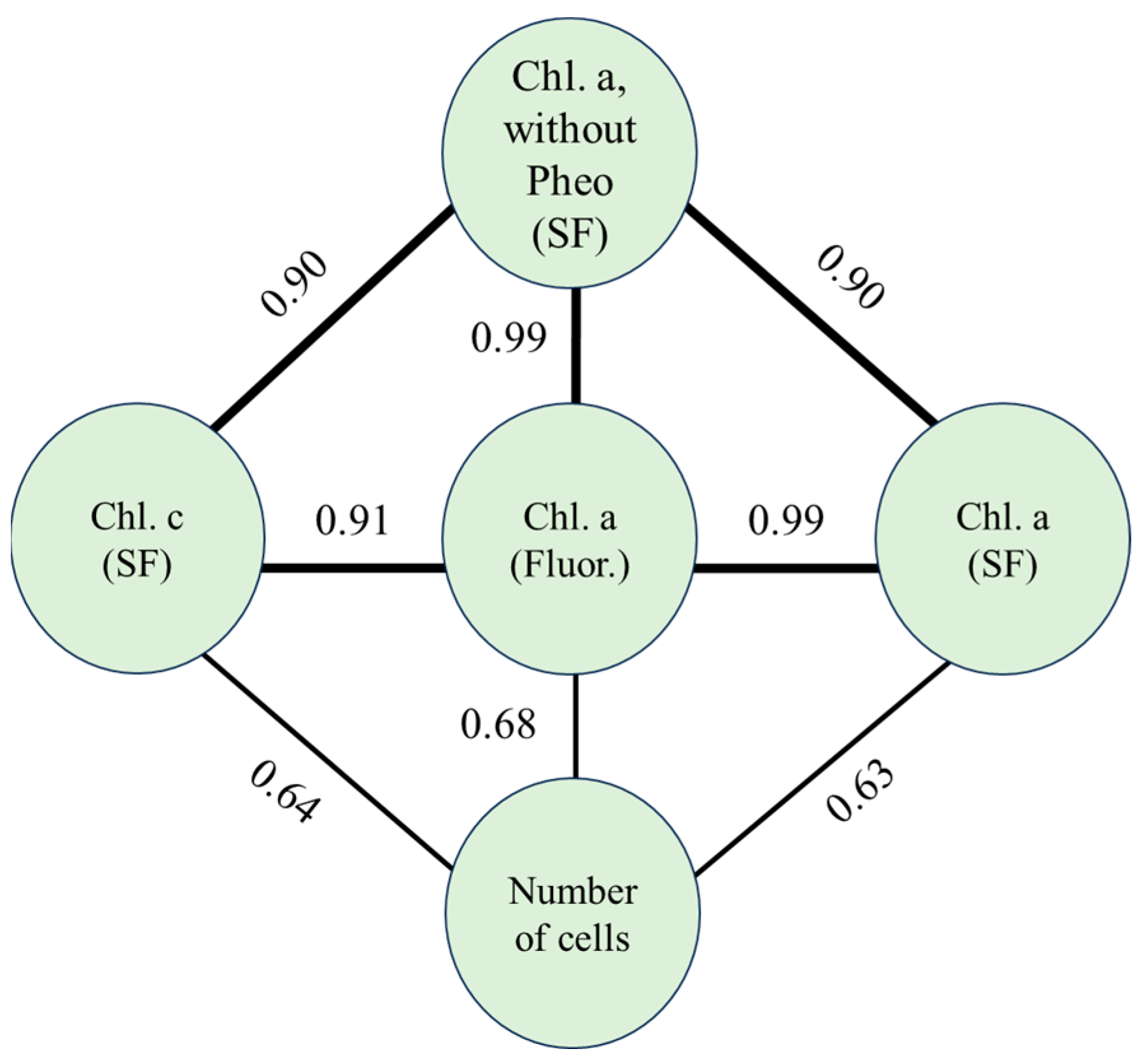
Figure 3 presents the values of the Kendall rank correlation coefficients between the main quantitative indicators of phytoplankton. Strong positive correlations are observed between the cell counts and the photopigment content measured by spectrophotometry and fluorimetry. The discrepancies between the counts and concentrations of photopigments are due to differences in the results at monitoring points 4 and 8.
The highest concentrations of photopigments were found in the Kalmius River bed (points 2, 5 and 8). The structure of the pigment composition for these points is similar, but at the river mouth, the data on the species and pigment composition are inconsistent. Points 2 and 5 showed the highest content of cyanobacterial pigments, which is consistent with the results of the species composition analysis. The Chl-c content at some points reached 1 mg·L−1, which was accompanied by high concentrations of diatom carotenoids—up to 0.2 mg·L−1.
Margalef pigment indices for monitoring points in the Kalmius River bed and the Pavlopol Reservoir fluctuated within 2.0–2.2. Pigment indices for the Starokrymskoe Reservoir and tributary (point 1) were significantly higher and amounted to about 4.0, indicating a deterioration in the physiological state of phytoplankton and an increase in their pigment diversity.

3.4. Photosynthetic Activity of Phytoplankton

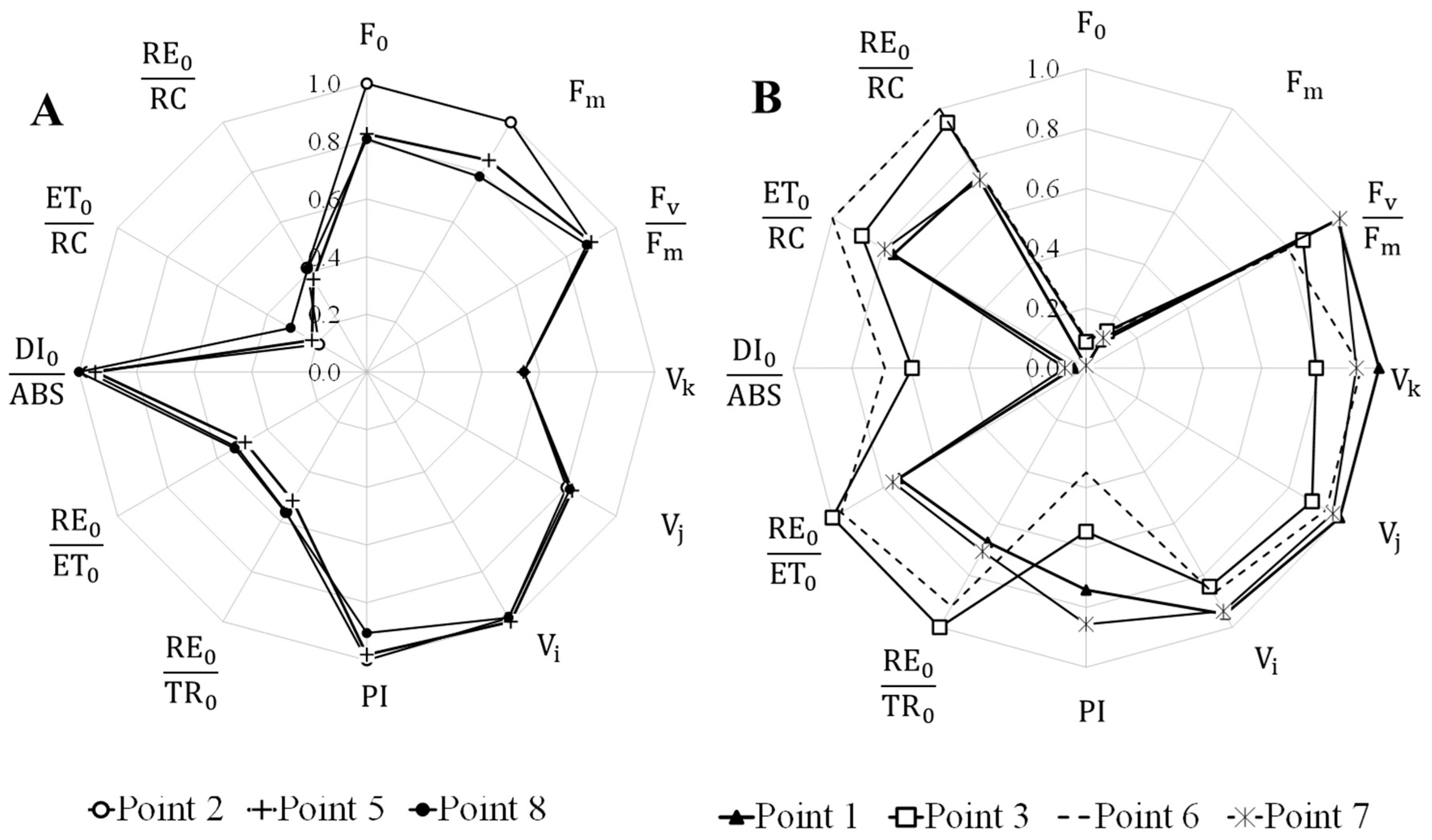
Figure 4 shows the petal diagrams of the OJIP test parameters for which reliable differences were found between individual monitoring points. Samples from the Kalmius River bed were characterized by similar fluorescence indices, so for clarity, these points are shown in Figure 4A. Tributaries (points 1 and 7) and reservoirs (points 3 and 6) are shown separately in Figure 4B, since the spectrophotometric results and species composition for these samples differed significantly from those for the Kalmius River bed.
Phytoplankton from the Kalmius River tributary near Granitnoye (point 1) was characterized by low fluorescence intensity, which reflected the low cell content in the sample. The proportion of closed PS II reaction centers for this sample was the highest in comparison with other monitoring points. In addition, a very low quantum yield of thermal dissipation energy in the antenna complexes of PS II was noted. The general index of photosynthetic activity (PI) in the tributary was significantly lower than in the Kalmius River.
The highest intensity of chlorophyll fluorescence was recorded in the Kalmius River (point 2), which reflects the amount of phytoplankton in this sample. This is consistent with the spectrophotometric data and the number of phytoplankton cells (Figure 2). It should be noted that the fluorescence parameters of phytoplankton from different monitoring points of the Kalmius River did not differ from each other, but had significant differences from samples from tributaries and reservoirs (Figure 4A,B).
Phytoplankton from the Kalmius River (points 2, 4, 5 and 8) were characterized by high values of the total photosynthetic activity performance index (PI), as well as a low number of closed reaction centers. At the same time, a decrease in the electron flow inside PS II and towards PS I R E 0 T R 0   and   E T 0 T R 0 was observed, as well as a decrease in the probability of electron transfer from the primary quinone to PS I E T 0 R C   and   R E 0 R C , which occurred against the background of an increase in the dissipation of light energy in the form of heat in the antenna complexes of PS II D I 0 A B S . This indicates a negative impact on phytoplankton and a deterioration in the functional state of the photosynthetic apparatus of phytoplankton cells.
In comparison with points 2, 5 and 8, at monitoring point 4, there was an additional decrease in the PI. Phytoplankton cells from Starokrymskoye and Pavlopol reservoirs exhibited the highest electron transport efficiency from primary quinone to PSI E T 0 R C   and   R E 0 R C and the highest electron flux within PSII and toward PSI R E 0 T R 0   and   E T 0 T R 0 However, the performance indices (PIs) for these samples were lower than in the river.

3.5. Data Analysis

To search for correlations between concentrations of pollutants (Table 2), as well as quantitative indicators and the photosynthetic activity of phytoplankton cells, we began by determining the degree of correlation. Table 4 shows the Kendall correlation coefficients, with coefficients reflecting strong connections highlighted in bold (at p < 0.05). The table shows the results only for those parameters that had a high degree of correlation with at least one of the studied parameters of the aquatic environment.
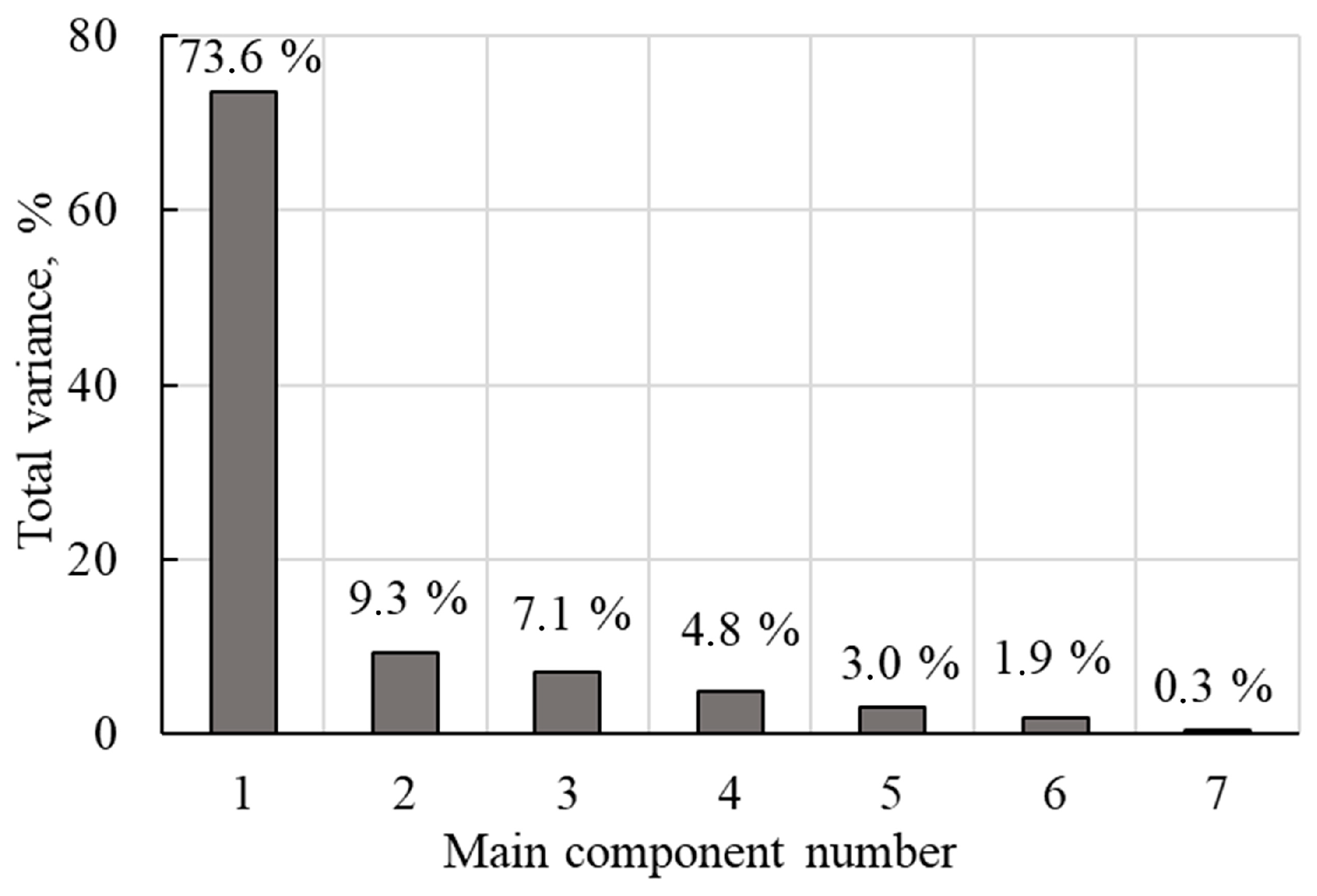
Determining only correlations does not give a correct idea of the effect of pollutants on the state of phytoplankton, since the content of phenol, iron, and anionic surface-active agents (ASAA) positively correlated with the overall photosynthetic PI. A similar result was obtained for the content of Chl-a and chlorine ions. This clearly contradicts the results of the fluorometry and also does not correspond to reality, since an increase in the content of these pollutants leads to a deterioration in the condition of aquatic organisms. To eliminate such errors when comparing measurement results, the main factors combining individual indicators of the state of the phytoplankton and parameters of the aquatic environment were identified using the method of main component and factor analysis. Figure 5 shows the results of dividing the obtained data into the main components by the PCA method. Seven main components were identified; however, 82.9% of the total data variance is determined by the first two components, and the first component describes 73.6% of the variance. Thus, it is sufficient to take into account only the first two main components to correctly describe the general changes in the condition of the studied objects.
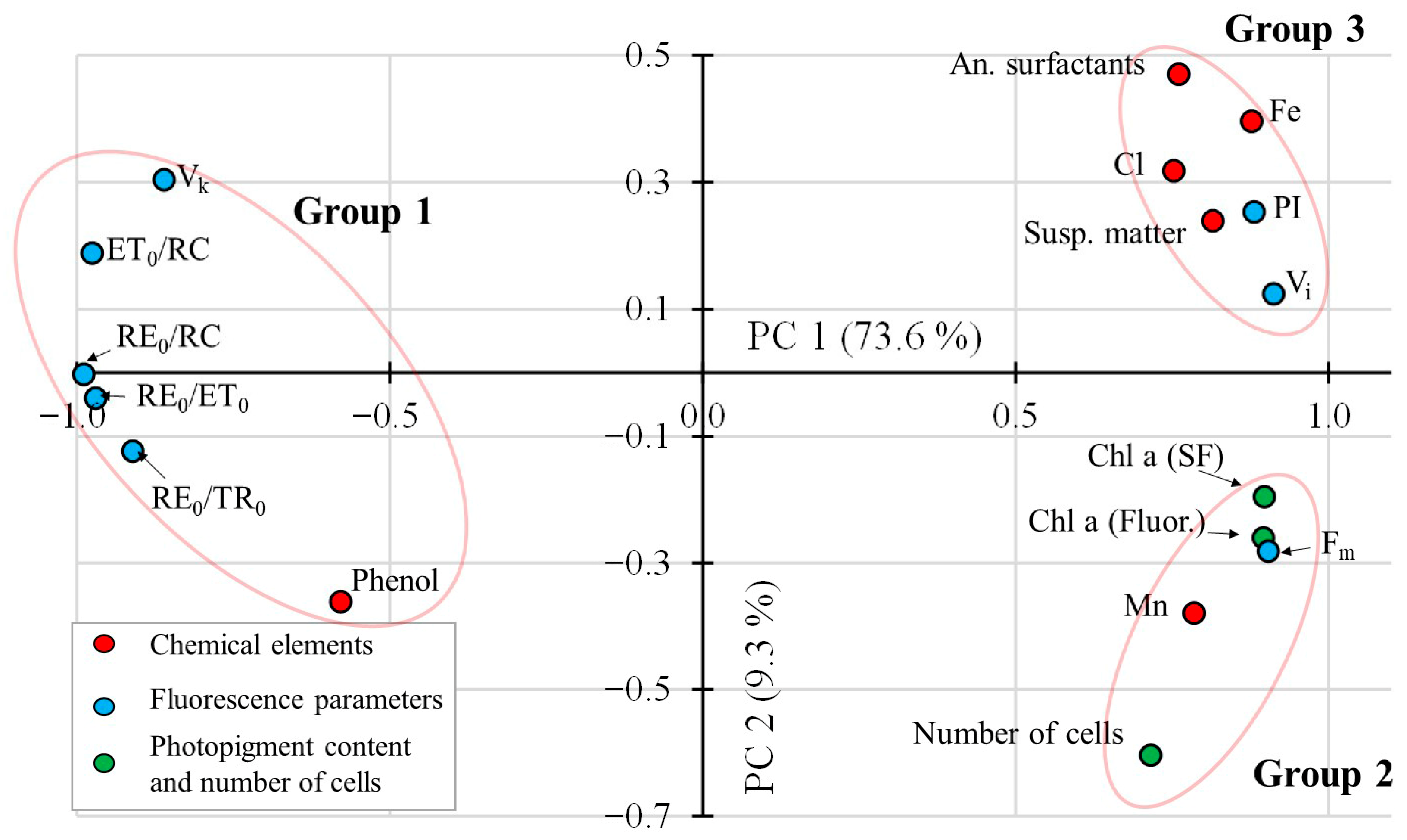
According to the results of the multifactorial analysis, a total of four active factors were identified (Figure 5). However, only the first two took into account the largest number of factor loads exerted by the measured parameters; the other factors were not insignificant and could not be taken into account for further consideration. To visualize the relationship between the chemical components of the aquatic environment and the biological parameters of phytoplankton, a graph of factor loadings for the first and second factors was drawn up (Figure 6). In the figure, all chemical components are highlighted in red, the number of phytoplankton cells and concentrations of photopigments are green, and the parameters of chlorophyll fluorescence are blue.
In Figure 6, three groups of components are highlighted with red lines, which can be interpreted as separate processes depending on the selected components of the environment. The first factor unites most of the considered fluorescence parameters of the phytoplankton cells and phenol concentration. The second group is determined by changes in the number of phytoplankton cells, chlorophyll content and manganese concentration. The third group of parameters includes four pollutants, iron, chloride ions, anionic surfactants and suspended matter, the change in the content of which is associated with the fluorescence parameters PI and Vi.

4. Discussion

Based on PCA results (Figure 6, Group 1) and a strong negative correlation between fluorescence parameters and phenol concentration, the adverse effect of this pollutant on phytoplankton cell photosynthetic activity can be inferred. A decrease was observed in fluorescence parameters ET0/RC, RE0/RC, RE0/ET0, RE0/TR0, which reflect the flow and efficiency of electron transfer from photosystem II to the plastoquinone pool and photosystem I acceptors, concurrent with changes in phenol concentration in the aquatic environment. Thus, phenol has a negative effect on the primary electron acceptors in photosystem II. In addition, there is a negative impact on the donor side of photosystem II, because parameter Vi, reflecting the efficiency of the oxygen-releasing complex, also falls into the first group. The data obtained are consistent with the literature data on the toxic effects of phenol and phenol-containing herbicides, which cause changes in the quantum yield of fluorescence, increase the level of nonphotochemical fluorescence, and also have a negative effect on the primary quinone transporters of photosystem II [47,48,49].
The change in the parameters of the second group depends on the concentration of manganese in the aquatic environment. Quantitative indicators of phytoplankton depended on the manganese content: the total number of cells and the content of Chl-a, determined by fluorimetric and spectrophotometric methods. Among the parameters of photosynthetic activity, this group included only the maximum level of fluorescence (Fm), which also strongly depends on the number of phytoplankton cells in the water. Strong positive correlations were also obtained between all the listed parameters and the manganese content (Table 4). Thus, it can be assumed that among all the chemical components of the aquatic environment under consideration, manganese is the limiting factor limiting the growth of phytoplankton abundance. Browning T.J. et al. [50] have shown the limiting effect of manganese on the growth of phytoplankton in the ocean, but no similar results have been obtained for rivers. In addition, the researchers note that the restriction of growth in the manganese content is typical for diatom algae [50,51], which was also observed in the Kalmius riverbed, where Cyclotella meneghiniana was one of the dominant species. It is important to note that limiting phytoplankton growth in terms of manganese content in the aquatic environment is also associated with changes in iron concentration [52,53]. This is important, first of all, because the Cyclotella meneghiniana species is sensitive to changes in nitrogen content, as evidenced by studies [52,53].
The results for the third group of parameters are difficult to interpret unambiguously. The suspended matter indicator is a fairly general parameter and it is difficult to consider it as a separate active pollutant. Chloride ions are most likely the accompanying anions for calcium, potassium, sodium, and manganese, which are found in large quantities in mine waters. Changes in the iron content correlate well with changes in the state of Cyclotella meneghiniana. In [52], this species is considered as a bioindicator sensitive to changes in heavy metal concentrations in aquatic environments. Study [53] demonstrated that varying iron concentrations in the nutrient medium for Cyclotella meneghiniana led to structural changes in Photosystem I (PSI) antenna complexes, which also affect the photosynthetic activity of cells. A strong positive correlation was identified between the total photosynthetic index (PI) and iron concentration in the aquatic environment. Surface water pollution by iron ions likely exerted a negative effect on most phytoplankton species in the Kalmius River bed upstream of the Pavlopol Reservoir, leading to the intensive proliferation of Cyclotella meneghiniana, a species sensitive to this metal. This explains the low species diversity in this river section and the dominance of Cyclotella. The toxic effect of various types of ASAA has been reflected in a number of studies [54,55]; however, based on the data obtained, it was not possible to establish a clear relationship between the state of phytoplankton cells and changes in the pollutant content.
All dominant phytoplankton species in the Kalmius River and reservoirs belong to mesosaprobic species and reflect the degree of surface water pollution. Phytoplankton species diversity in the studied river section can be considered low. Data in the literature indicate the possible presence of over 200 species in the Kalmius River [17]. However, these represent annual averages. Earlier studies also focused on different river sections: the Lower Kalmius and Starobeshevo reservoirs. The most frequently encountered phytoplankton species in the Kalmius River noted in the literature [17,56] align with the current study results; however, Oscillatoria agardhii and Cyclotella meneghiniana were not previously recorded as dominant. Changes in the Kalmius River algal flora structure result from surface water pollution by phenol and iron. Elevated water hardness, high suspended solids, and dry residue content indicate a high degree of aquatic environment mineralization, which may also act as a factor contributing to algal flora impoverishment and the emergence of new dominant forms. Cyclotella meneghiniana is a halophilic species with optimal growth at pH 8–8.5 [57], explaining its proliferation in the Kalmius River bed at points 1 and 2. Consequently, phytoplankton species composition shifted in the reservoirs. Surface water pollution and the disappearance of primary dominant phytoplankton forms led to increased cyanobacterial abundance, particularly Microcystis aeruginosa and Oscillatoria agardhii, indicating aquatic ecosystem eutrophication.
Dominant species in both reservoirs included Microcystis aeruginosa and Scenedesmus quadricauda. Oscillatoria agardhii also dominated in Starokrymske Reservoir but was absent in Pavlopil Reservoir. Combined, Microcystis aeruginosa and Scenedesmus quadricauda accounted for ~50% of total cell abundance in each reservoir. Thus, the fluorimetry results can be attributed to these species. The reduced PI is associated with low temperatures, which decreased photosynthetic efficiency in green algae and cyanobacteria. In the Kalmius River channel, diatoms dominated, which remain active at lower temperatures. Higher photosynthetic activity in reservoirs is linked to the high functional activity of green and cyanobacterial cells, which is atypical for the Kalmius River channel.
In the Kalmius River and a tributary near the settlement of Granitnoye, Cyclotella meneghiniana was also dominant (~50% abundance). However, fluorescence responses comparable to the Kalmius River channel were not observed. This is due to the influence of other diatom species on the integrated fluorescence response. Species such as Amphiphora palugosa, Amphora ovalis, Melosira varians, and the genus Bacillaria collectively accounted for ~25% of total abundance, which likely significantly altered the shape of fluorescence induction curves. Furthermore, the total abundance of Cyclotella meneghiniana in the Kalmius River channel ranged from 2 to 6 million cells L−1, while in tributaries, it did not exceed 1 million cells L−1. The significant dominance of diatoms in tributaries led to higher PI indices compared to reservoirs, confirming the link between PI changes and the taxonomic identity of dominant species.

5. Conclusions

The study revealed surface water pollution in the Kalmius River by phenol, iron, and manganese, classifying the river water as polluted. High mineralization and water pollution caused low species diversity of phytoplankton and led to the emergence of uncharacteristic dominant species for this water body, particularly Cyclotella meneghiniana and Oscillatoria agardhii. Phytoplankton fluorescence analysis demonstrated the negative impact of pollutants on cell photosynthetic activity. A decrease occurred in the overall efficiency of electron transport from photosystem II to the plastoquinone pool. Thus, Kalmius River bed pollution not only altered the species composition of phytoplankton but also affected the photosynthetic activity of dominant species. Furthermore, processes occurring in the Kalmius River estuary may also adversely impact the coastal waters of the Sea of Azov.
Identification of algae fluorescence reflects changes in the content of specific pollutants in the aquatic environment, which creates prospects for continuous monitoring of the state of the mouth of the Kalmius River, including the use of fluorimetric methods for determining the photosynthetic activity of microalgae.

Author Contributions

Conceptualization, S.C. and B.M.; methodology, S.C., V.S. and M.O.; software A.O.; formal analysis, S.C.; investigation, S.C., V.S., M.O., D.K., A.V. and A.M.; data curation, B.M., S.C., A.O. and V.S.; writing—original draft preparation, S.C., V.S., A.V., D.K. and L.G.; writing—review and editing, S.C. and V.S.; visualization, M.O. and A.M.; supervision, A.O.; project administration, B.M.; funding acquisition, B.M. All authors have read and agreed to the published version of the manuscript.

Funding

This research received no external funding.

Institutional Review Board Statement

Not applicable.

Data Availability Statement

The original contributions presented in this study are included in the article. Further inquiries can be directed to the corresponding authors.

Conflicts of Interest

The authors declare no conflicts of interest.

References

  1. Vorovka, V.P. Anthropogenic aqua landscapes of the Sea of Azov. Sci. Bull. Kherson State Univ. Ser. Geogr. Sci. 2021, 30–38. [Google Scholar] [CrossRef]
  2. Selifonova, J.P. Functioning of the Sea of Azov ecosystem. Inland Water Biol. 2008, 1, 199–203. [Google Scholar] [CrossRef]
  3. Chichaeva, M.A.; Lychagin, M.Y.; Syroeshkin, A.V.; Chernitsova, O.V. Heavy metals in marine aerosols of the Azov Sea. Geogr. Environ. Sustain. 2020, 13, 127–134. [Google Scholar] [CrossRef]
  4. Mikhailenko, A.; Fedorov, Y.; Dotsenko, I.; Solodko, D. Water quality formation factors in the Azov Sea. In Proceedings of the 20th International Multidisciplinary Scientific GeoConference SGEM 2020, Albena, Bulgaria, 18–24 August 2020; Volume 5, pp. 871–878. [Google Scholar]
  5. Neverova-Dziopak, E.; Dan, O. Assessment of a metallurgical plant impact on the Sea of Azov. Geomat. Environ. Eng. 2022, 16, 5–29. [Google Scholar] [CrossRef]
  6. Udod, V.M.; Zhukova, E.G. Regional-ecological approach to the assessment of possible aftermath of pollution of water basin of the Kalmius River. J. Water Chem. Technol. 2015, 37, 48–50. [Google Scholar] [CrossRef]
  7. Nazarenko, O.V. Hydrochemical features of rivers in coal mining areas (a study of East Donbass). In Proceedings of the 17th International Multidisciplinary Scientific Geoconference SGEM 2017, Albena, Bulgaria, 29 June–5 July 2017; Volume 17, pp. 371–378. [Google Scholar]
  8. Dougan, A.; Timchenko, O.; Touros, E. Atmospheric air contamination and demographic process in the cities of Ukraine. Mutat. Res. Fundam. Mol. Mech. Mutagen. 1997, 379, 106. [Google Scholar]
  9. Zhukov, M.; Stakhiv, I.; Kurajeva, I. Quantitative assessment of soil contamination using factor analysis. In Proceedings of the 14th EAGE International Conference on Geoinformatics—Theoretical and Applied Aspects, Geoinformatics, Kiev, Ukraine, 11–14 May 2015; Volume 56, pp. 1043–1064. [Google Scholar]
  10. Jeleńska, M.; Hasso-Agopsowicz, A.; Kadzialko-Hofmokl, M. Magnetic structure of polluted soil profiles from Eastern Ukraine. Acta Geophys. 2008, 56, 1043–1064. [Google Scholar] [CrossRef]
  11. Yakymchuk, R.A.; Valyuk, V.F. Cytogenetic activity of pollutants by heavy metal caused by emissions of industrial enterprises. Int. Sci. Pract. Conf. World Sci. 2018, 7, 34–41. [Google Scholar]
  12. Barnett, M.L.; Kemp, A.E.; Hickman, A.E.; Purdie, D.A. Environmental controls on the interannual variability in chlorophyll and phytoplankton community structure within the seasonal sub surface chlorophyll maximum in the western English channel. Cont. Shelf Res. 2024, 277, 105253. [Google Scholar] [CrossRef]
  13. Harding, L.W.; Adolf, J.; Mallonee, M.; Miller, W.; Gallegos, C.; Perry, E.; Johnson, J.; Sellner, K.; Paerl, H. Climate effects on phytoplankton floral composition in Chesapeake Bay, Estuarine. Coast. Shelf Sci. 2015, 162, 53–68. [Google Scholar]
  14. Choi, C.J.; Berges, J.A.; Young, E.B. Rapid effects of diverse toxic water pollutants on chlorophyll a fluorescence: Variable responses among freshwater microalgae. Water Res. 2012, 46, 2615–2626. [Google Scholar] [CrossRef]
  15. Park, S.Y.; Lee, J.; Kwon, I.; Song, H.; Kim, B.; Kim, T.; Lee, C.; Yoon, S.J.; Noh, J.; Hong, S.; et al. Ecotoxicological effects of suspended sediments on marine microalgae using flow cytometry and pulse-amplitude modulation (PAM) fluorometry. Mar. Pollut. Bull. 2024, 208, 116968. [Google Scholar] [CrossRef]
  16. Timofieieva, O.; Vlaschenko, A.; Laskowski, R. Could a city-dwelling bat (Pipistrellus kuhlii) serve as a bioindicator species for trace metals pollution? Sci. Total Environ. 2023, 857, 159556. [Google Scholar] [CrossRef]
  17. Mirnenko, E.I. Taxonomic diversity of phytoplankton of the Kalmius River and its reservoirs. Ecosyst. Transform. 2022, 5, 3–13. [Google Scholar] [CrossRef]
  18. Gan, T.; Yin, G.; Zhao, N.; Tan, X.; Wang, Y. A Sensitive response index selection for rapid assessment of heavy metals toxicity to the photosynthesis of Chlorella pyrenoidosa based on rapid chlorophyll fluorescence induction kinetics. Toxics 2023, 11, 3731–3747. [Google Scholar] [CrossRef]
  19. Kaiblinger, C.; Dokulil, M.T. Application of fast repetition rate fluorometry to phytoplankton photosynthetic parameters in freshwaters. Photosynth. Res. 2006, 88, 19–30. [Google Scholar] [CrossRef]
  20. Oxborough, K. Direct estimation of functional PSII reaction center concentration and PSII electron flux on a volume basis: A new approach to the analysis of Fast Repetition Rate fluorometry (FRRf) data. Limnol. Oceanogr. Methods 2012, 10, 142–154. [Google Scholar] [CrossRef]
  21. Mama, C. A Comparative evaluation of the water quality standards of different countries. Asian J. Water Environ. Pollut. 2016, 13, 15–28. [Google Scholar] [CrossRef]
  22. Lumb, A.; Halliwell, D.; Sharma, T. Application of CCME water quality index to monitor water quality: A case study of the Mackenzie River Basin, Canada. Environ. Monit. Assess. 2006, 113, 411–429. [Google Scholar] [CrossRef]
  23. Teshome, F.B. Seasonal water quality index and suitability of the water body to designated uses at the eastern catchment of Lake Hawassa. Environ. Sci. Pollut. Res. Int. 2020, 27, 279–290. [Google Scholar] [CrossRef]
  24. Hossain, M.; Patra, P.K. Water pollution index—A new integrated approach to rank water quality. Ecol. Indic. 2020, 117, 106668. [Google Scholar] [CrossRef]
  25. WHO. Guidelines for Drinking-Water Quality, 4th ed.; World Health Organization: Geneva, Switzerland, 2011. [Google Scholar]
  26. SanPin 2.1.4.1074-01; Drinking Water Hygienic Requirements for Water Quality of Centralized Drinking Water Supply Systems. Quality Control (Instead SanPin 2.1.4.559-96), September 26 2001 № 24, 44p; Chief State Sanitary Physician of the Russian Federation: Moscow, Russia, 2001.
  27. Key to Freshwater Algae of the USSR; Moshkova, N.A., Hollerbach, M.M., Eds.; Nauka: Leningrad, Russia, 1986. [Google Scholar]
  28. Sadchikov, A.P. Methods of Studying Freshwater Phytoplankton, 1st ed.; Publishing House “University and School”: Moscow, Russia, 2003; pp. 67–79. [Google Scholar]
  29. Kiselev, I.A. Plankton of the Sea and Continental Reservoirs, 1st ed.; Nauka: Leningrad, Russia, 1969; 658p. [Google Scholar]
  30. Guiry, M.D.; Guiry, G.M. AlgaeBase World-Wide Electronic Publication. National University of Ireland, Galway. Available online: http://www.algaebase.org (accessed on 24 June 2022).
  31. Medvedeva, L.A.; Nikulina, T.V. Catalogue of Freshwater Algae of the Southern Part of the Russian Far East; Dalnauka: Vladivostok, Russia, 2014; 271p. [Google Scholar]
  32. Jeffrey, S.W.; Humphrey, G.F. New spectrophotometric equations for determining chlorophyll a, b, c1 and c2 in higher plants, algae and natural phytoplankton. Plant Physiol. Biochem. 1975, 167, 191–194. [Google Scholar] [CrossRef]
  33. Ritchie, R.J. Universal chlorophyll equations for estimating chlorophylls a, b, c, and d and total chlorophylls in natural assemblages of photosynthetic organisms using acetone, methanol, or ethanol solvents. Photosynthetica 2008, 46, 115–126. [Google Scholar] [CrossRef]
  34. Vieira, N.; Amat, F. Variation in chlorophyll a concentrations and Margalef’s index of pigment diversity in two solar salt ponds, Aveiro, Portugal. Int. J. Salt Lake Res. 1993, 2, 41–45. [Google Scholar] [CrossRef]
  35. Antal, T.; Konyukhov, I.; Volgusheva, A.; Plyusnina, T.; Khruschev, S.; Kukarskikh, G.; Goryachev, S.; Rubin, A. Chlorophyll fluorescence induction and relaxation system for the continuous monitoring of photosynthetic capacity in photobioreactors. Physiol. Plant. 2018, 165, 476–486. [Google Scholar] [CrossRef]
  36. Stirbet, A.; Govindjee. On the relation between the Kautsky effect (chlorophyll a fluorescence induction), Photosystem II: Basics applications of the OJIPfluorescence transient. J. Photochem. Photobiol. 2011, 104, 236–257. [Google Scholar] [CrossRef]
  37. Vredenberg, W.; Durchan, M.; Prášil, O. The analysis of PS II photochemical activity using single and multi-turnover excitations. J. Photochem. Photobiol. 2012, 107, 45–54. [Google Scholar] [CrossRef] [PubMed]
  38. Strasser, R.J.; Srivastava, A.; Govindjee, G. Polyphasic chlorophyll a fluorescent transient in plants and cyanobacteria. Photochem. Photobiol. 1999, 61, 32–42. [Google Scholar] [CrossRef]
  39. Stirbet, A.; Lazar, D.; Kromdijk, J.; Govindjee, G. Chlorophyll a fluorescence induction: Can just a one-second measurement be used to quantify abiotic stress responses? Photosynthetica 2018, 56, 86–104. [Google Scholar] [CrossRef]
  40. Sarmento, R.; Costa, V. Factor Analysis. Comparative Approaches to Using R and Python for Statistical Data Analysis; IGI Global Scientific Publishing: Hershey, PA, USA, 2017; pp. 148–178. [Google Scholar]
  41. Cullis, B.R.; Jefferson, P.; Thompson, R.; Smith, A.B. Factor analytic and reduced animal models for the investigation of additive genotype-by-environment interaction in outcrossing plant species with application to a Pinus radiata breeding programme. Theor. Appl. Genet. 2014, 127, 2193–2210. [Google Scholar] [CrossRef]
  42. Rao, A.R.; Burke, T.T. Principal component znalysis of hydrologic data. In Integrated Approach to Environmental Data Management Systems; Harmancioglu, N.B., Alpaslan, M.N., Ozkul, S.D., Singh, V.P., Eds.; NATO ASI Series; Springer: Dordrecht, The Netherlandsm, 1997; Volume 31. [Google Scholar]
  43. Benkov, I.; Varbanov, M.; Venelinov, T.; Tsakovski, S. Principal component analysis and the water quality index—A powerful tool for surface water quality assessment: A case study on struma river catchment, Bulgaria. Water 2023, 15, 1961. [Google Scholar] [CrossRef]
  44. Maji, K.J.; Chaudhary, R. Principal component analysis for water quality assessment of the Ganga River in Uttar Pradesh, India. Water Resour. 2019, 46, 789–806. [Google Scholar] [CrossRef]
  45. Pedregosa, F.; Varoquaux, G.; Gramfort, A.; Michel, V.; Thirion, B.; Grisel, O.; Blondel, M.; Prettenhofer, P.; Weiss, R.; Dubourg, V.; et al. Scikit-learn: Machine learning in Python. J. Mach. Learn. Res. 2011, 12, 2825–2830. [Google Scholar]
  46. Harris, C.R.; Millman, K.J.; van der Walt, S.J.; Gommers, R.; Virtanen, P.; Cournapeau, D. Array programming with NumPy. Nature 2020, 585, 357–362. [Google Scholar] [CrossRef]
  47. Matorin, D.N.; Plekhanov, S.E.; Bratkovskaya, L.B.; Yakovleva, O.V.; Alekseev, A.A. The effect of phenols on the parameters of chlorophyll fluorescence and reactions of P700 in green algae Scenedesmus quadricauda. Biophysics 2014, 59, 374–379. [Google Scholar] [CrossRef]
  48. Van Rensen, J.J.S. Herbicides interaction with photosystem II. In Herbicides and Plant Metabolism; Cambridge University Press: Cambridge, UK, 1989; pp. 21–36. [Google Scholar]
  49. Ventrella, A.; Catucci, L.; Agostiano, A. Herbicides affect fluorescence and electron transfer activity of spinach chloroplasts, thylakoid membranes and isolated Photosystem II. Bioelectrochemistry 2010, 79, 43–49. [Google Scholar] [CrossRef] [PubMed]
  50. Browning, T.J.; Achterberg, E.P.; Engel, A.; Mawji, E. Manganese co-limitation of phytoplankton growth and major nutrient drawdown in the Southern Ocean. Nat. Commun. 2021, 12, 884. [Google Scholar] [CrossRef] [PubMed]
  51. Balaguer, J.; Koch, F.; Hassler, C.; Trimborn, S. Iron and manganese co-limit the growth of two phytoplankton groups dominant at two locations of the Drake Passage. Commun. Biol. 2022, 5, 207. [Google Scholar] [CrossRef]
  52. Bestawy, E. X-Ray Microanalytical study on Cyclotella meneghiniana (Bacillariophyceae) as a bio-indicator for metal pollution in marine and fresh water environments. Pak. J. Biol. Sci. 2000, 3, 1500–1505. [Google Scholar] [CrossRef][Green Version]
  53. Juhas, M.; Büchel, C. Properties of photosystem I antenna protein complexes of the diatom Cyclotella meneghiniana. J. Exp. Bot. 2012, 10, 3673–3681. [Google Scholar] [CrossRef]
  54. Cserháti, T.; Forgács, E.; Oros, G. Biological activity and environmental impact of anionic surfactants. Environ. Int. 2002, 28, 337–348. [Google Scholar] [CrossRef] [PubMed]
  55. Dereszewska, A.; Cytawa, S.; Tomczak-Wandzel, R.; Medrzycka, K. The effect of anionic surfactant concentration on activated sludge condition and phosphate release in biological treatment plant. Pol. J. Environ. Stud. 2015, 24, 83–91. [Google Scholar] [CrossRef] [PubMed]
  56. Bespalova, S.V.; Romanchuk, S.M.; Chufitskiy, S.V.; Perebeinos, V.V.; Gotin, B.A. Fluorimetric Analysis of the Impact of Coal Sludge Pollution on Phytoplankton. Biophysics 2020, 65, 850–857. [Google Scholar] [CrossRef]
  57. Lowe, R.L. Environmental Requirements and Pollution Tolerance of Freshwater Diatoms; Environmental Monitoring Series; EPA: Washington, DC, USA, 1974; 340p.
Figure 1. Monitoring points of the southern section of the Kalmius River in the vicinity of Mariupol and the Pavlopol Reservoir.
Diversity 18 00188 g001
Figure 2. Concentrations of photopigments, determined by fluorimetric (Fluor.) and spectrophotometric (SF) methods, and the number of phytoplankton cells (N) at the studied monitoring points of the Kalmius River.
Diversity 18 00188 g002
Figure 3. Values of the Kendall correlation coefficients ( p < 0.05 ) between the content of photopigments, determined by fluorimetric (Fluor.) and spectrophotometric (SF) methods, and the number of phytoplankton cells in the Kalmius River.
Diversity 18 00188 g003
Figure 4. Parameters of the phytoplankton OJIP-curves: (A) points in the Kalmius River bed; (B) samples from tributaries (point 1 and the Kalchik River) and reservoirs.
Diversity 18 00188 g004
Figure 5. The percentage of the total variance for all measured parameters (chemical composition of water, concentrations of photopigments, dominant phytoplankton species, fluorescence parameters of phytoplankton), explained by each main component identified during the PCA analysis.
Diversity 18 00188 g005
Figure 6. Relationships between the content of photosynthetic pigments, the number of phytoplankton cells, their photosynthetic activity and chemical components of the aquatic environment, grouped based on factor analysis.
Diversity 18 00188 g006
Table 1. Parameters of the phytoplankton fluorescence induction curves (OJIP test parameters) [39].
F0minimal level of chlorophyll fluorescence;
Fmmaximum level of chlorophyll fluorescence;
Fv Fm−1chlorophyll fluorescence quantum yield;
Vjrelative variable chlorophyll fluorescence level after 2 ms of saturation (J-phase), reflects the number of closed reaction centers in photosystem II in relation to the total number of reaction centers;
Virelative variable chlorophyll fluorescence level after 30 ms of saturation (I-phase), reflects the ability of photosystem I acceptors to oxidize a plastoquinone pool;
Vkrelative variable chlorophyll fluorescence level at 0.3 ms;
PIperformance index for energy conservation from photons absorbed by photosystem II antenna (total photosynthetic activity performance index);
RE0 ET0−1efficiency of electron transport from plastoquinone pool to photosystem I;
ET0 ABS−1quantum yield of electron transport between photosystem II acceptors and plastoquinone pool;
RE0 ABS−1quantum yield of electron transport between photosystem II and to photosystem I acceptors;
DI0 ABS−1quantum yield of energy heat dissipation in photosystem II antennae; 
RE0 RC−1the flux of electrons transferred between photosystem II and photosystem I acceptors;
ET0 RC−1the flux of electrons transferred between photosystem II acceptors and plastoquinone pool;
TR0 RC−1maximum trapped exciton flux per active photosystem II;
DI0 RC−1the flux of dissipated energy.
Table 2. Chemical composition, cases of excess of permissible concentrations (highlighted in bold) and water pollution index (WPI) of water samples.
IndicatorUnitNormPoint 1Point 2Point 3Point 4Point 5Point 6Point 7Point 8
pHpH units6.0–8.57.687.918.358.197.757.978.38.04
Suspended mattermg·L−1301421317082.512415282160
Phenolmg·L−10.10.0020.0020.0010.0010.0020.0030.0030.003
General hardnessmmol·L−1102120.221.727.823.822.728.825.3
Total Ironmg·L−10.30.430.590.220.20.540.560.570.81
Sulfatesmg·L−150010801134103616131320152517041673
Dry residuemg·L−1150026562838274633072975316034783429
Chloridesmg·L−1350416.7442.1411.6371452.3503.1401.5640.3
Magnesiummg·L−150121.5111.8124164.1141133.7172.6149.5
Manganesemg·L−10.10.0230.0680.0380.020.0870.0570.040.056
Anionic surfactantsmg·L−10.50.030.040.030.020.040.050.050.07
Water pollution index>0.50.810.840.660.900.960.810.921.09
Table 3. Systematic structure of phytoplankton in the southern part of the Kalmius River and its tributaries.
DivisionClassOrderFamilyGenusSpeciesIdentified
to Genus
Bacillariophyta4681199
Chlorophyta25816195
Cyanobacteria134463
Dinoflagellata11111
Euglenozoa112313
Streptophyta222222
Total 111825373723
Table 4. Values of the Kendall rank correlation coefficient ( p < 0.05 ) between physical and chemical composition of water samples, the content of photopigments, photosynthetic activity and the number of phytoplankton cells in the Kalmius River.
Chl a (Fluor)Number of CellsChl a (SF)FmVkViPIRE0/TR0RE0/ET0ET0/RCRE0/RC
Susp. matter0.2860.0710.2860.286−0.3570.5000.357−0.500−0.643−0.429−0.571
Phenol0.2860.0710.4290.286−0.5000.3570.643−0.357−0.500−0.429−0.714
Fe0.4290.2140.5710.429−0.5000.3570.786−0.357−0.500−0.571−0.714
Cl0.4290.3570.5710.429−0.6430.6430.500−0.643−0.643−0.571−0.714
Mn0.5710.7860.5710.571−0.5000.6430.643−0.643−0.500−0.714−0.571
Anionic
surfactants
0.3400.1890.4910.340−0.5670.4160.643−0.416−0.491−0.416−0.718
Disclaimer/Publisher’s Note: The statements, opinions and data contained in all publications are solely those of the individual author(s) and contributor(s) and not of MDPI and/or the editor(s). MDPI and/or the editor(s) disclaim responsibility for any injury to people or property resulting from any ideas, methods, instructions or products referred to in the content.