1. Introduction
Intraspecific phenotypic diversity constitutes the primary substrate for evolutionary responses and for the sustainable use of plant genetic resources. In crop species, this diversity is frequently reduced during domestication and subsequent selection, particularly when cultivation relies on a narrow founder base and extensive clonal propagation. Under these conditions, phenotypic uniformity may facilitate standardised production, yet it can also constrain adaptive potential under environmental heterogeneity and changing biotic pressures. Accordingly, characterising how phenotypic diversity is structured within cultivated populations is central to both agrobiodiversity management and applied crop improvement [
1,
2].
Stevia rebaudiana Bertoni provides a relevant model system because its agronomic and industrial value is primarily determined by the accumulation of steviol glycosides in leaves—diterpenoid compounds with high sweetening power, broad regulatory acceptance, and major commercial relevance [
3,
4]. The global expansion of stevia has often relied on a limited set of elite cultivars selected mainly for glycoside profiles and processing performance, while agronomic deployment has increasingly concentrated on a small number of commercial standards [
5,
6,
7].
Clonal propagation is the dominant commercial propagation method in stevia because seed-derived progenies frequently exhibit high phenotypic segregation. Owing to the outcrossing behavior and high heterozygosity of
S. rebaudiana, seedlings may vary substantially in architecture, phenology, and biomass-related traits, reducing crop uniformity and complicating management and harvest standardization. For this reason, clonal multiplication is commonly used to preserve elite phenotypes and ensure more consistent agronomic performance [
8,
9,
10]. In stevia, molecular assessments of cultivated populations shaped by artificial selection have reported reduced diversity patterns, supporting concerns about genetic bottlenecks and constrained adaptive capacity in commercial germplasm [
1,
2]. Nevertheless,
S. rebaudiana exhibits biological features—high heterozygosity and an outcrossing tendency—that can generate segregating progenies with exploitable phenotypic variation, even within elite-derived backgrounds [
11]. In this setting, segregating populations derived from widely used cultivars may retain meaningful intraspecific phenotypic diversity that warrants systematic characterisation and structuring. This production context makes the identification and structuring of phenotypic diversity within clonally maintained materials especially relevant for germplasm management and selection pipelines.
Despite the growing literature on stevia cultivation and improvement, most research has focused on cultivar-level comparisons or trait-specific evaluations rather than on the multivariate organisation of phenotypic diversity within segregating populations into coherent patterns. From a diversity-oriented perspective, identifying recurrent combinations of traits (ideotypes) is useful because ideotypes summarise intraspecific variation and may reflect alternative functional strategies within a population [
2,
12,
13]. Multivariate phenotyping provides an analytical bridge between descriptive variability and interpretable diversity patterns by integrating multiple agromorphological descriptors to identify the traits that contribute most strongly to population differentiation and to define phenotypic clusters in a data-driven and interpretable manner [
14,
15].
S. rebaudiana is a warm-season species that performs best under mild-to-warm temperatures and is sensitive to frost. Its developmental progression, particularly floral transition, is strongly influenced by photoperiod, and plant architecture and biomass allocation can respond markedly to the light environment (e.g., open-field versus shade-net systems). Accordingly, although stevia can thrive in tropical regions, tropical conditions can amplify genotype-by-environment interactions affecting architecture, growth rate, and phenology, thereby altering the relative importance of traits targeted in selection. For this reason, structured phenotyping under regional tropical production systems is particularly valuable for organising phenotypic diversity and for identifying preliminary ideotype candidates adapted to local conditions.
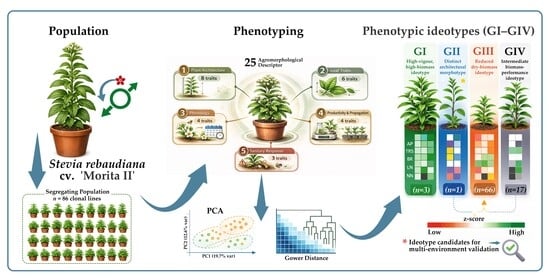
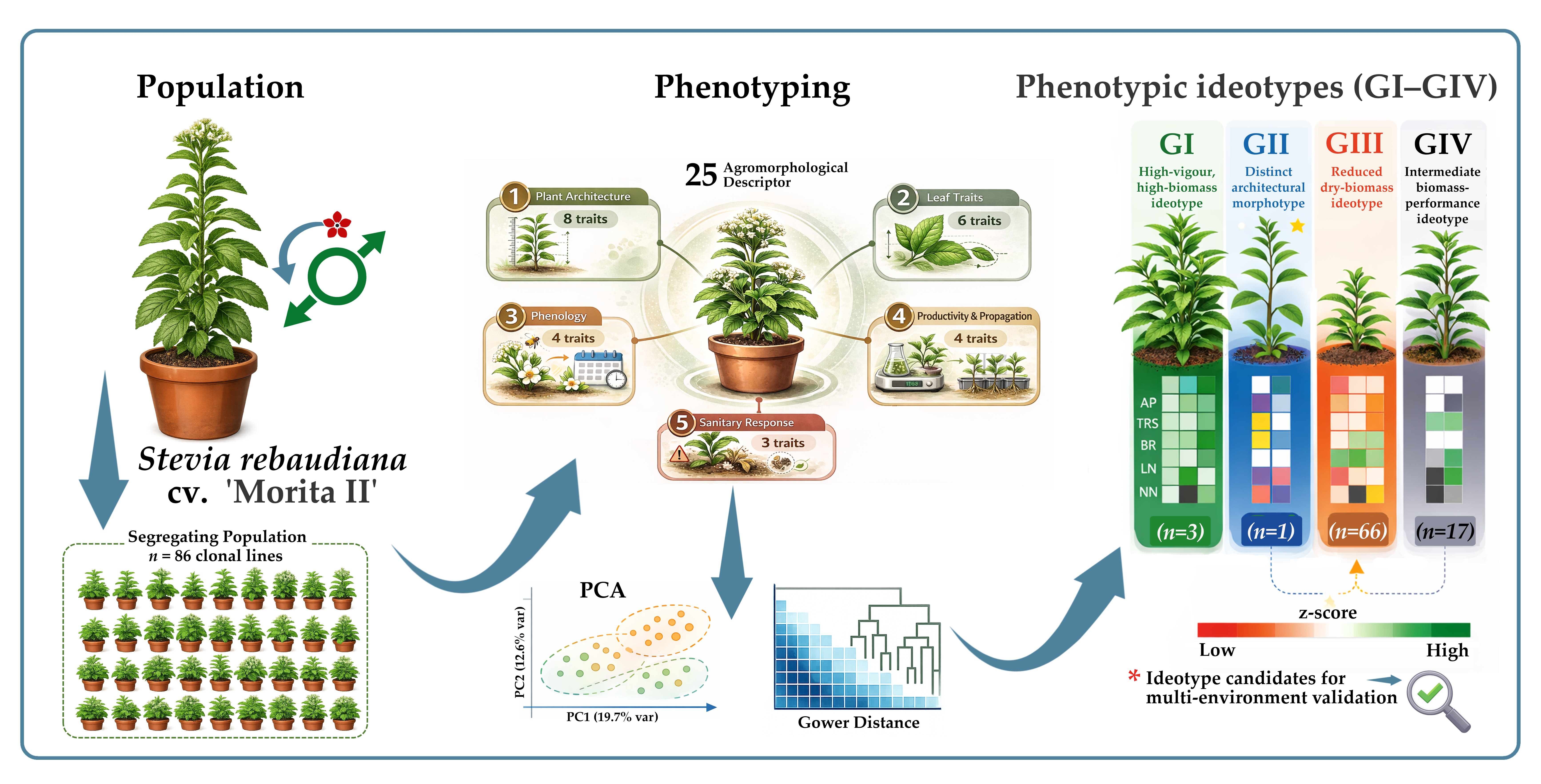
The objectives of this study were to: (i) quantify phenotypic variation among progeny-derived clonal genotypes of S. rebaudiana derived from cv. ‘Morita II’ under a tropical shade-net field system using standardised qualitative and quantitative agromorphological descriptors; (ii) summarise the main multivariate gradients structuring this variation using principal component analysis; (iii) organise genotypes into phenotypically coherent groups using clustering based on mixed-trait dissimilarities; and (iv) describe these groups as preliminary ideotype candidates to support subsequent selection and multi-environment validation.
2. Materials and Methods
2.1. Plant Material and Experimental Design
The study was conducted at the experimental field facilities of the Universidad de Córdoba, Montería, Colombia (8°47′31″ N, 75°51′36″ W; 18 m a.s.l.), between January 2020 and September 2022. The site is characterised by a tropical dry forest climate (bs-T), with a mean annual temperature of approximately 28 °C, average relative humidity of 84%, annual precipitation of 1274 mm, and cumulative solar radiation of about 2108 h year−1.
Plant material consisted of a seed-derived segregating population generated through controlled intercrossing among heterozygous mother plants of the commercial cultivar ‘Morita II’ (i.e., controlled cross-pollinations rather than inbred line development). The base population comprised 115 progenies, from which 86 progeny-derived genotypes were retained and vegetatively propagated for field evaluation. No additional recombination cycles were conducted prior to clonal multiplication; selected individuals were clonally captured directly from the segregating progeny set to enable replicated phenotyping. The evaluated progeny-derived clonal genotypes corresponded to those progenies that could be successfully clonally propagated and established under the experimental conditions, while also providing sufficient plant material for replicated field evaluation. Accordingly, the evaluated set represents an operationally defined clonal subset of the original progeny population rather than a random representation of all 115 progenies. Therefore, the diversity patterns described in this study refer to the evaluated clonal subset plus the commercial control and should not be interpreted as an unbiased estimate of the total phenotypic diversity present in the original segregating population. The commercial cultivar ‘Morita II’, propagated clonally, was included as a reference control. All plant material was derived from healthy mother plants maintained under greenhouse conditions and kept in the vegetative phase to ensure uniformity.
Vegetative propagation was carried out using stem cuttings approximately 10 cm in length. Cuttings were rooted in trays containing a 1:1:1 (v/v/v) substrate mixture of sand, alluvial soil, and coconut fibre, and maintained under greenhouse conditions until establishment. Subsequently, plants were transferred to larger containers and acclimatised prior to field transplantation. A total of 783 plants were established in the field.
The field experiment was arranged in a randomised complete block design with 87 treatments (86 progeny-derived genotypes (clonally propagated) plus the ‘Morita II’ control) and three replicates. Each experimental unit consisted of three plants arranged within a 1.2 m row segment, with 0.30 m spacing between plants and 0.40 m between rows. In total, nine plants per genotype were evaluated across replicates. The trial was conducted under a shade-net structure to mitigate extreme climatic conditions and promote uniform establishment. Standard agronomic management practices were applied uniformly across the experiment. No chemical quality traits were included in the present descriptor set. In particular, the study did not measure stevioside, rebaudioside A, total steviol glycosides, or related compositional variables. Accordingly, the present analysis is restricted to agromorphological, phenological, and field sanitary response traits.
2.2. Agromorphological Descriptors and Data Collection
Agromorphological characterisation was performed to quantify and structure intraspecific phenotypic diversity within the segregating population. A total of 25 descriptors, including qualitative and quantitative traits, were recorded for all genotypes following the descriptor guidelines proposed by the International Union for the Protection of New Varieties of Plants [
16]. Traits were selected to capture variation in plant architecture, vegetative growth, phenology and sanitary response, which are relevant dimensions for diversity analyses in
Stevia rebaudiana.
Qualitative descriptors were assessed by direct visual scoring at the plant level, using the categorical states and intensity scales defined by UPOV (e.g., plant type, stem anthocyanin presence, pubescence, leaf shape, leaf colour, margin incision, flower colour, branching habit, and disease reaction scores). Quantitative descriptors were measured using standardised procedures and expressed in their corresponding units (e.g., plant height, number of primary branches, stem thickness, and number of nodes). Phenological traits were recorded as the timing of floral developmental stages, based on field observations of each experimental unit. When applicable, disease response was evaluated visually according to the infection intensity scale defined in the descriptor set. The disease-associated symptoms recorded in the field were linked to southern blight caused by
Athelia rolfsii, whose identity had been confirmed molecularly using ITS sequence data (GenBank accession OM345235.1) [
17]. However, these disease-related observations were recorded under field conditions and should be interpreted as descriptive sanitary response scores rather than as a fully controlled resistance assay, since no standardized inoculum or uniform disease pressure was imposed across the experiment.
Data collection was carried out under field conditions using the experimental unit as the primary observational level, and plant-level records were used to compute replicate means per genotype to support downstream univariate and multivariate analyses. Qualitative data were tabulated as frequency distributions, and modal classes were used to summarise categorical tendencies within genotypes. Quantitative variables were summarised by replicate and genotype means prior to statistical analyses. All data were recorded in a digital spreadsheet using Microsoft Excel 2019 (Microsoft Corporation, Redmond, WA, USA) to ensure traceability and facilitate subsequent quality control procedures.
2.3. Statistical Analysis
Agromorphological data were organised and curated in a spreadsheet prior to statistical analyses. Qualitative descriptors were summarised using frequency distributions and modal classes, whereas quantitative variables were averaged per experimental unit and genotype. Before inferential analyses, quantitative data were tested for residual normality using the Shapiro–Wilk test and for homogeneity of variances among genotypes using Levene’s test (α = 0.05). Quantitative traits were analysed using plot means (genotype × block) under the RCBD; therefore, plant-to-plant variation within plots (i.e., within-genotype microenvironmental variability among identical clones) is captured in the residual error term (mean square error).
Differences among genotypes for quantitative traits were assessed by analysis of variance (ANOVA) under a randomised complete block design. When significant effects were detected (
p < 0.05), mean comparisons were performed using Tukey’s honestly significant difference test. All univariate analyses were conducted using the GENES software, version 2013 (Universidade Federal de Viçosa, Viçosa, MG, Brazil) [
18], which is widely applied in plant breeding and diversity studies.
To structure intraspecific phenotypic diversity, multivariate analyses were performed using the full set of qualitative and quantitative descriptors. Principal component analysis (PCA) was carried out in R software, version 4.5.2 (R Foundation for Statistical Computing, Vienna, Austria) to identify the traits contributing most strongly to phenotypic variation and to reduce data dimensionality while preserving the main sources of variation. The relative contribution of each descriptor to the principal components was examined to support biological interpretation of the multivariate patterns.
Phenotypic relationships among genotypes were further explored using hierarchical cluster analysis based on a Gower distance matrix, which is suitable for mixed datasets containing both quantitative and qualitative variables [
19,
20,
21,
22]. The Gower distance matrix and UPGMA clustering were generated in R software, version 4.5.2 (R Foundation for Statistical Computing, Vienna, Austria). Clustering was performed using the unweighted pair group method with arithmetic mean (UPGMA), and the consistency of the grouping structure was evaluated to support the identification of coherent phenotypic clusters or ideotypes [
12]. Multivariate analyses were used descriptively to organise phenotypic diversity and did not involve inferential testing.
3. Results
3.1. Extent of Phenotypic Variation
Substantial phenotypic variation was observed among the progeny-derived genotypes (clonally propagated) of Stevia rebaudiana derived from cv. ‘Morita II’ across the evaluated agromorphological descriptors. Because stevia is clonally propagated, the evaluated entries represent clonally fixed genotypes (often highly heterozygous) whose multilocus configuration is preserved by vegetative propagation, rather than genetically uniform inbred “lines”. Both qualitative and quantitative traits exhibited wide ranges of expression, indicating the presence of marked intraspecific diversity within the population under tropical field conditions.
Qualitative descriptors revealed clear differentiation among genotypes in traits related to plant architecture and vegetative morphology, including plant type, branching habit, leaf shape, leaf colour intensity, pubescence, and stem anthocyanin presence. Variation was also detected in phenological descriptors, particularly in the timing of floral initiation, which ranged from early to late among genotypes. Disease-related descriptors also varied among genotypes, reflecting heterogeneous field sanitary responses associated with southern blight under natural exposure conditions. Because these observations were recorded in the field rather than under controlled inoculation, they should be interpreted as descriptive differences in field response rather than as validated measures of pathogen-specific resistance.
Quantitative traits showed pronounced variability among genotypes (
Table 1), whereas the complete summary of all 25 agromorphological descriptors, including both qualitative and quantitative variables, is provided in
Supplementary Table S1. Analysis of variance confirmed significant genotype effects for plant height, number of primary branches, stem thickness, number of nodes, leaf size, vegetative propagation capacity, and dry yield rate, with explicit F and
p values reported in
Table 2. Several progeny-derived genotypes (clonally propagated) exhibited values that exceeded those of the commercial control ‘Morita II’ for specific traits, whereas others showed reduced or intermediate expressions, contributing to the overall phenotypic dispersion of the population.
Measures of dispersion highlighted the heterogeneous nature of the segregating population, with coefficients of variation differing among traits and reflecting distinct levels of phenotypic plasticity (
Table 1). Traits associated with plant architecture and branching generally showed higher variability than those related to stem thickness or nodal number. The distribution of trait values across genotypes was continuous rather than discrete, consistent with segregation patterns expected from heterozygous parental material.
Overall, the results demonstrate that a broad spectrum of phenotypic variation persists within a population derived from a widely used commercial cultivar. This variation provides a robust basis for subsequent multivariate analyses aimed at structuring phenotypic diversity and identifying coherent phenotypic groups within the population.
3.2. Trait Contribution and Principal Component Analysis
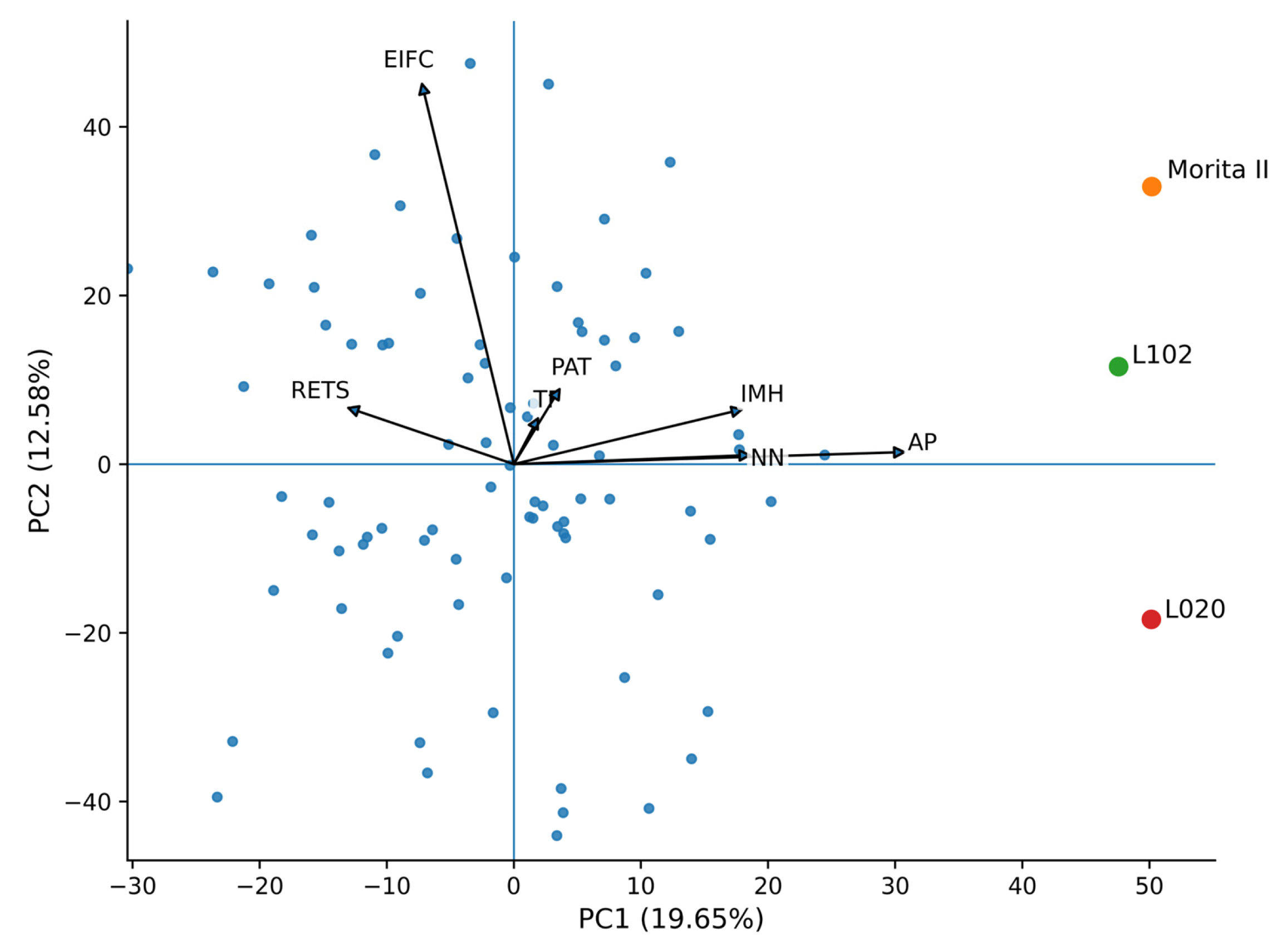
Principal component analysis (PCA) was applied to the complete set of agromorphological descriptors to identify the traits contributing most strongly to phenotypic differentiation within the segregating population derived from cv. Morita II. The first two principal components explained 19.65% (PC1) and 12.58% (PC2) of the total phenotypic variance, respectively (32.23% cumulative), and were therefore retained as an exploratory low-dimensional representation of the main multivariate gradients structuring phenotypic diversity (
Figure 1). Because the cumulative variance explained by PC1 and PC2 was modest, the biplot should be interpreted cautiously as a visualization of dominant trends rather than as a complete summary of the multivariate structure.
Trait loadings indicated that PC1 was predominantly driven by architectural and vegetative growth descriptors, including plant height (AP), number of nodes (NN), branching intensity, and overall plant vigour (
Table 3). These traits collectively describe variation in plant size and structural development, which emerged as the dominant axis of phenotypic differentiation within the population. By contrast, PC2 was more strongly influenced by phenological and morphological attributes, particularly descriptors related to the onset of flowering and leaf characteristics, capturing a secondary but biologically meaningful dimension of variation linked to developmental timing rather than plant size alone.
The dispersion of genotypes across the PCA space revealed continuous but structured variation, with no sharp discontinuities among progeny-derived genotypes (clonally propagated). Importantly, the commercial cultivar ‘Morita II’ was located towards the positive extreme of PC1, clearly separated from the densest region of the progeny-derived genotypes in the PC1–PC2 projection. This indicates that, under the evaluated conditions, the reference cultivar expresses a distinct architectural–biomass profile relative to much of the segregating material. Because PC1 and PC2 together capture only ~32% of the total variance, this separation should be interpreted as an exploratory pattern in a low-dimensional projection; nevertheless, its consistency with hierarchical clustering supports the interpretation that ‘Morita II’ represents a phenotypically distinct reference within this dataset. Overall, the PCA results indicate that phenotypic diversity within the population is structured along architectural and phenological gradients visible in the first two axes; however, these axes capture only part of the total multivariate variation. Accordingly, the PCA biplot should be interpreted as an exploratory representation of dominant phenotypic trends, whereas subsequent clustering and ideotype definition were supported by the full mixed-trait dissimilarity structure.
3.3. Phenotypic Clustering and Ideotype Identification
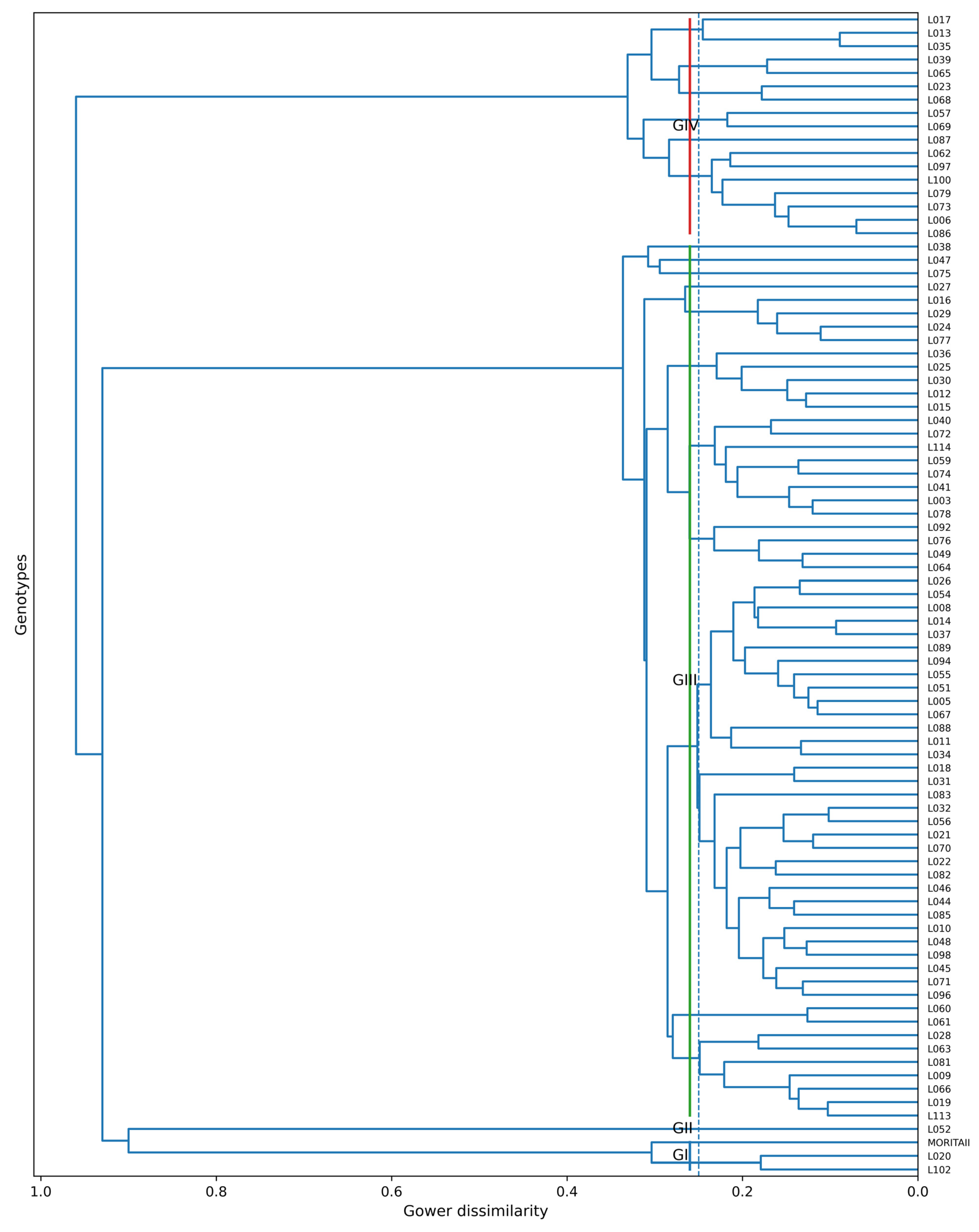
To complement the low-dimensional PCA visualization, hierarchical clustering was conducted on the full mixed-trait dissimilarity matrix based on Gower distance. This approach further structured phenotypic diversity within the segregating population and resolved four coherent phenotypic groups (GI–GIV) at the selected dissimilarity cut-off (
Figure 2). The dissimilarity cut-off of 0.25 was selected as an operational threshold based on the dendrogram structure, specifically at the level where major branches became clearly separated while preserving biologically interpretable group composition. This cut-off was therefore used descriptively to define phenotypic groups, rather than as an inferentially optimized or uniquely fixed threshold. These groups were broadly consistent with the dominant multivariate patterns identified by PCA and reflected recurrent combinations of architectural, vegetative, and phenological traits rather than isolated single-trait differences.
Group-level quantitative profiles are summarised in
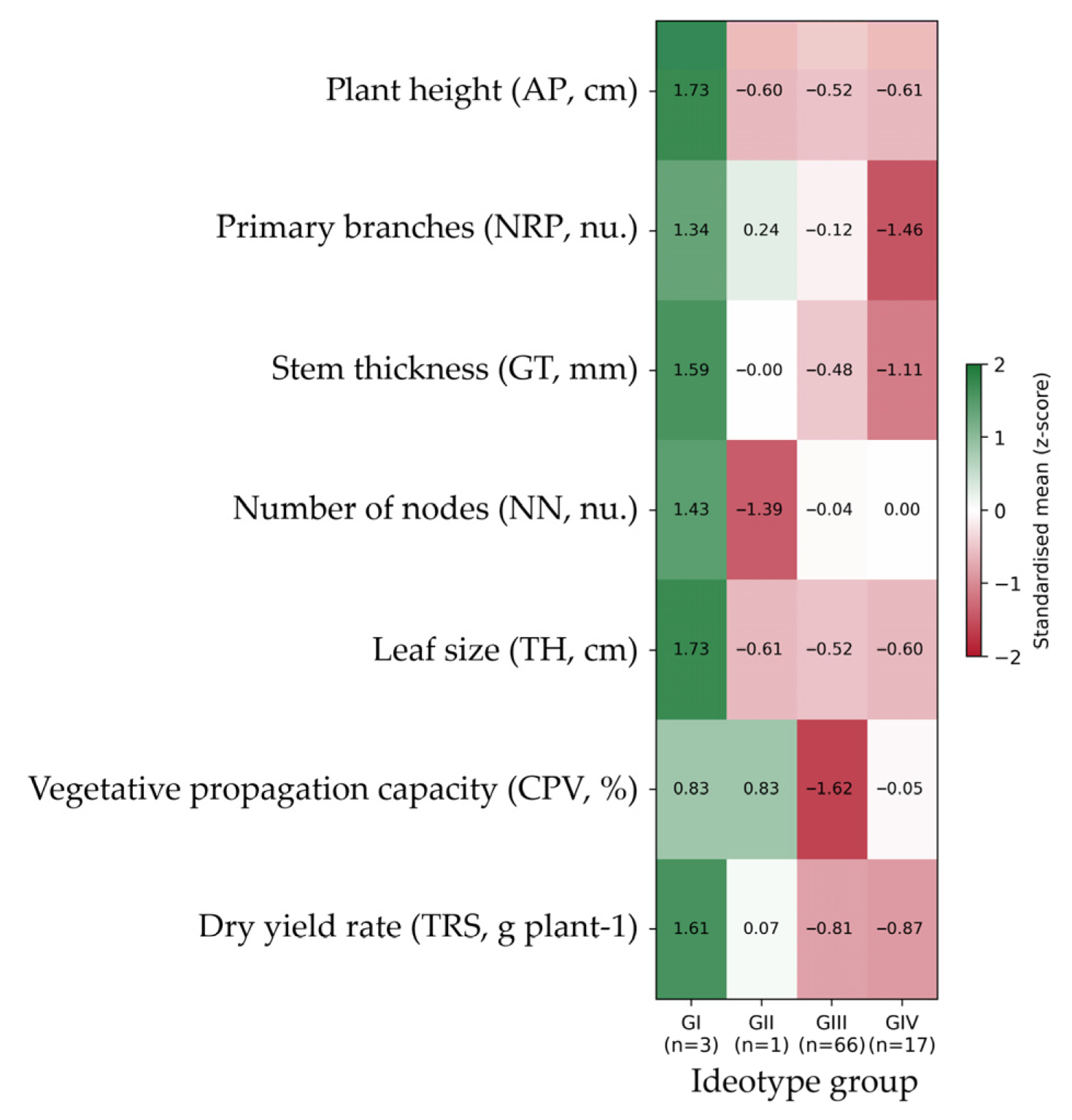
Table 4, which reports mean ± standard deviation values for key agromorphological traits within each ideotype. To integrate these numerical profiles into a synthetic and comparative framework, an ideotype fingerprint heatmap was constructed using standardised trait means (z-scores) (
Figure 3). This representation enables direct visual comparison of trait syndromes across ideotypes while preserving the underlying quantitative information.
Ideotype GI, which includes the commercial cultivar ‘Morita II’ together with two closely related genotypes, exhibited consistently positive z-scores for plant height, stem thickness, number of nodes, and dry yield rate, defining a high-vigour, high-biomass phenotypic configuration. In contrast, GII, represented by a single genotype, displayed a distinct and internally consistent trait profile that diverged from the main gradients observed in the remaining groups, supporting its interpretation as a phenotypic outlier rather than a transitional form.
The largest group, GIII, was characterised by predominantly negative z-scores for productivity-related traits, particularly dry yield rate, combined with moderate architectural development, corresponding to an early-flowering, low-yield ideotype. GIV showed intermediate trait values overall but was distinguished by reduced stem thickness and moderate vegetative propagation capacity, suggesting structural constraints that may limit biomass accumulation despite otherwise balanced growth traits (
Table 4;
Figure 3). Because cluster size was uneven and one group (GII) was represented by a single genotype, the resulting group structure should be interpreted cautiously. In particular, the singleton cluster is best understood as a candidate phenotypic outlier within the evaluated materials and should not be treated as a stable ideotype without confirmation through repeated phenotyping and validation across environments.
The concordance among PCA, hierarchical clustering, and the ideotype fingerprint heatmap demonstrates that phenotypic diversity within this elite-derived population is not randomly distributed but organised into biologically interpretable phenotypic groups that can be treated as preliminary ideotype candidates. By integrating numerical summaries (
Table 4) with multivariate visualisation (
Figure 3), this ideotype-based structuring provides a functional framework for interpreting intraspecific phenotypic diversity beyond single-trait comparisons.
4. Discussion
4.1. Phenotypic Diversity Beyond the Morita II Paradigm
The dominance of cv. ‘Morita II’ in commercial
Stevia rebaudiana production has been repeatedly associated with a progressive narrowing of the phenotypic base, particularly under clonal propagation schemes [
9,
23]. Accordingly, Morita II has often been described in the literature as a relatively uniform commercial ideotype associated with favourable agronomic performance under specific management conditions [
24].
Because no chemical quality traits were measured in the present study, no inference can be made regarding steviol glycoside yield, composition, or overall sweetener quality.
However, our results show that substantial phenotypic diversity persists within a Morita II-derived population when recombination and segregation are allowed. This agrees with earlier morpho-agronomic evaluations reporting wide variation among stevia clones and accessions, even within restricted genetic backgrounds [
25,
26]. Importantly, the present study extends these observations by demonstrating that the diversity expressed in an elite-derived background is not merely anecdotal: it is structured, continuous, and detectable across a broad set of qualitative and quantitative descriptors.
The persistence of phenotypic variability within an elite-derived population supports the hypothesis that Morita II retains appreciable heterozygosity that can be expressed through segregation. This interpretation is consistent with previous evidence of moderate to high heritability for key traits in stevia, including yield-related attributes and leaf morphology [
23]. Collectively, these findings reinforce the view that elite cultivars should not be regarded solely as phenotypic endpoints, but also as dynamic reservoirs from which structured diversity can be recovered and organised.
4.2. Multivariate Structuring of Morphoagronomic Variation
Morphological characterisation of S. rebaudiana has often relied on univariate comparisons or reduced descriptor sets, which can mask the multidimensional nature of phenotypic diversity [
27]. In the present study, the combined use of PCA and hierarchical clustering enabled the organisation of mixed morphoagronomic descriptors into interpretable gradients of variation and distinct phenotypic groupings. The predominance of architectural and vegetative traits along the main multivariate axes is consistent with previous stevia studies in which plant height, branching pattern, and related structural attributes explained a large proportion of phenotypic variation [
7,
25,
28,
29]. Phenological variation, particularly flowering behaviour, emerged as an additional axis of differentiation with clear biological relevance, since delayed reproductive transition can extend vegetative growth and influence biomass accumulation [
25,
30]. Rather than reflecting isolated trait effects, the structure observed here captures coordinated phenotypic syndromes integrating plant size, structural development, and productivity-related expression [
31,
32,
33].
The broad agreement between PCA patterns and clustering results supports the biological relevance of the inferred structure and is consistent with recommended approaches for analysing mixed qualitative–quantitative datasets [
18,
34,
35,
36,
37]. In particular, the commercial cultivar ‘Morita II’ appeared towards the positive extreme of PC1 and was grouped with a small set of closely related genotypes (GI), which is consistent with a distinct high-vigour, high-biomass phenotype within the evaluated material. This has practical implications: segregation within an elite background can generate structured phenotypic diversity that spans beyond the commercial reference, and multivariate stratification can help identify coherent trait syndromes for targeted follow-up. At the same time, because the PCA biplot captures a modest proportion of total variance, interpretations based on the two-axis projection should be made cautiously and considered alongside clustering derived from the full mixed-trait dissimilarity matrix.
The main dimensions identified here also highlight traits of direct biological interest for subsequent work. Architectural attributes such as plant height, branching intensity, node number, and stem thickness reflect integrated outcomes of developmental regulation and resource allocation [
38,
39]. Architectural traits (height, branching intensity, node number, and stem thickness) represent integrative outcomes of developmental regulation and resource allocation [
40,
41], whereas phenological timing captures transitions often linked to environmental responsiveness [
42,
43]. In this sense, the phenotypic structure described here provides a useful basis for subsequent physiological and molecular analyses, with ideotype candidates serving as practical units for hypothesis-driven evaluation [
38,
39].
4.3. Ideotypes as Functional Expressions of Intraspecific Diversity
The delineation of four phenotypic groups (GI–GIV) supports an ideotype-based interpretation of diversity within this elite-derived population. Ideotypes remain a powerful conceptual tool because they capture coordinated trait syndromes rather than isolated attributes [
34,
44], a particularly relevant approach in stevia where architecture, phenology, and biomass accumulation are strongly interdependent [
45,
46,
47,
48]. In this study, ideotype definition is explicitly supported by quantitative group profiles (
Table 4) and by a standardised trait fingerprint (
Figure 3), which jointly demonstrate that group differentiation reflects coherent multi-trait configurations. Ideotype GI, which includes ‘Morita II’ and closely related genotypes, displays a consistently high-vigour profile characterised by greater plant height, stem thickness, nodal development, and higher dry yield rate. This pattern indicates that the Morita II-associated phenotype is not an endpoint of uniformity but rather one expression within a broader structured phenotypic spectrum generated through segregation.
By contrast, ideotype GII is represented by a single genotype with a distinct trait configuration that diverges from the main trends expressed by the remaining groups, supporting its interpretation as a phenotypic outlier rather than a transitional form. Ideotype GIII, encompassing most progeny-derived genotypes (clonally propagated), exhibits generally reduced productivity—especially dry yield rate—relative to GI, consistent with a low-yield ideotype despite moderate architectural development. Finally, GIV presents intermediate trait expression but is distinguished by reduced stem thickness and moderate propagation capacity, suggesting structural constraints that may limit biomass accumulation even when other traits appear balanced (
Table 4;
Figure 3). Similar trade-offs between vegetative growth, reproductive transition, and biomass accumulation have been reported in stevia clones evaluated across environments [
49,
50,
51,
52]. However, these interpretations remain strictly phenotypic and agronomic in scope. Because no chemical quality traits were measured in the present study, the identified ideotype candidates should not be interpreted as proxies for steviol glycoside yield, composition, or overall sweetener quality. Their current value lies in structuring agromorphological diversity and prioritizing materials for subsequent multi-trait validation.
Importantly, GI–GIV should not be interpreted as a simple ranking of superiority. Their value lies in helping to organise diversity within an elite-derived background and in making biologically meaningful contrasts easier to detect, such as high-vigour versus low-yield configurations or structurally robust versus constrained phenotypes. This, in turn, can improve the design of follow-up experiments. In practical terms, ideotype membership can guide targeted genotyping (e.g., SSR-based differentiation) and focused physiological phenotyping, allowing future studies to test whether phenotypic clustering is associated with underlying genetic structure or distinct functional strategies under tropical field conditions [
2,
53,
54,
55,
56]. In this sense, the ideotype candidates identified here provide an intermediate step between the agromorphological patterns documented in this study and the molecular and physiological analyses required in subsequent work. Importantly, the phenotypic groups identified in this study should be interpreted as preliminary, environment-specific ideotype candidates rather than stable ideotypes. Because phenotyping was conducted under a single tropical field environment, the present dataset does not allow inference about the consistency of group membership or trait combinations across contrasting environments or production conditions. Accordingly, the current grouping framework is best understood as a data-driven basis for prioritizing materials for subsequent validation, including multi-environment trials and repeated phenotyping cycles.
4.4. Implications for Agrobiodiversity Management and Future Integration
This study provides a structured phenotypic baseline for S. rebaudiana derived from a dominant commercial cultivar, with direct relevance for agrobiodiversity management and follow-up evaluation. The four phenotypic groups identified here, including a Morita II-associated group (GI) and more divergent configurations such as GIII and GIV, offer a practical basis for targeted genotype–phenotype analyses and marker-informed assessment. Subsequent SSR studies can test whether the phenotypic structure detected here corresponds to measurable genetic stratification within the segregating population, while also quantifying within- and between-group diversity for germplasm management and core collection design. Even if population structure proves weak, as may occur in elite-derived materials, SSR profiling remains valuable for identity verification, redundancy detection, and monitoring clonal integrity across multiplication cycles. Together, these approaches can strengthen ideotype-based prioritization for follow-up validation.
An additional limitation that should be considered is that the trial was conducted under a shade-net production system, which modifies the incident light environment relative to open-field conditions. In stevia, traits related to plant architecture, vegetative growth, and phenology may respond plastically to light availability and microclimatic conditions. Consequently, the phenotypic structure and ideotype candidates identified here should be interpreted within the evaluated shade-modified environment and should not be directly extrapolated to contrasting production systems without validation.
Beyond genetic validation, the multivariate axes underlying ideotype differentiation are directly compatible with physiological interpretation [
57]. In stevia, architecture and phenology are expected to interact with biomass accumulation through canopy development, light interception, and resource-use patterns [
52,
57,
58]. Targeted physiological follow-up within and across ideotypes can therefore move the programme from structured description to functional explanation by testing whether ideotypes represent distinct strategies of growth duration, vigour, and allocation under tropical conditions [
12,
59,
60,
61]. Integrating physiological traits with ideotype membership also offers a principled route to identify which components of the phenotype are most tightly linked to productivity, and which reflect plastic responses to local environments [
61,
62,
63,
64,
65].
Importantly, the ideotype candidates identified here provide a useful unit for future assessment of environmental stability, but such stability was not tested in the present study. Because phenotypes were characterised under tropical field conditions at a single locality (Montería, Colombia), the current results should be interpreted as a baseline for subsequent stability-oriented evaluation rather than as evidence of cross-environment consistency. Building on this baseline, representative genotypes from each ideotype candidate can be assessed across contrasting environments and production cycles to quantify genotype-by-environment interaction (G × E) and to determine whether the observed trait combinations remain stable or reflect environmentally sensitive phenotypic configurations.
The structured diversity documented here also supports propagation and deployment strategies. Micropropagation and clonal multiplication can be applied not only to scale promising materials but also to maintain genetic fidelity and phenotype reliability of selected ideotype representatives [
9,
66,
67,
68]. In practical terms, ideotype reference genotypes can serve as standards for in vitro multiplication protocols, acclimatisation procedures, and multi-environment stability testing, providing a direct bridge from diversity assessment to applied multiplication and dissemination [
69,
70,
71]. Taken together, SSR-based genotyping, targeted physiological characterisation, and stability-oriented evaluation across environments constitute complementary components of an integrated framework in which agromorphological diversity is first organised (this study) and subsequently translated into genetic verification, functional understanding, and robust deployment. Overall, the present results demonstrate that meaningful phenotypic diversity persists within an elite-derived background and can be objectively structured into data-driven phenotypic groups or preliminary ideotype candidates. These groupings provide a useful basis for downstream molecular, physiological, and stability-oriented evaluation in tropical agricultural systems, but their broader consistency remains to be validated across environments.
5. Conclusions
This study demonstrates that substantial and structured phenotypic diversity persists within a segregating population of Stevia rebaudiana derived from the widely adopted commercial cultivar ‘Morita II’. Under tropical field conditions, the evaluated genotypes expressed continuous and multidimensional variation across agromorphological descriptors related to plant architecture, vegetative vigour, and phenology.
Multivariate analyses, particularly principal component analysis and UPGMA clustering based on Gower distance, effectively captured this complexity and organised it into four data-driven phenotypic groups (GI–GIV) at a defined cluster cut-off. Differentiation within the population was primarily driven by architectural and phenological traits, supporting their value as key dimensions for interpreting intraspecific phenotypic structure in stevia. The placement of ‘Morita II’ within Group I, together with closely related genotypes, indicates that the commercial ideotype represents only a subset of the phenotypic space expressed by its segregating derivatives, whereas Groups III and IV capture broader divergence within the same elite-derived background.
By interpreting GI–GIV as preliminary ideotype candidates, the study provides a practical basis for describing and managing intraspecific diversity beyond single-trait comparisons, highlighting recurrent and biologically meaningful trait combinations. These findings challenge the view of elite clonal cultivars as phenotypically uniform endpoints and instead suggest that elite material can retain exploitable heterozygosity that, through segregation, yields organised and interpretable diversity.
The structured baseline established here offers a practical foundation for germplasm prioritisation, comparative evaluation, and the management of clonal collections in tropical stevia production systems, where environment–trait interactions strongly influence performance. Future integration of this phenotypic framework with physiological and molecular data, together with propagation strategies for ideotype representatives, will further enhance its value for comparative assessment and selection-oriented validation.
The phenotypic groups identified here should be considered preliminary ideotype candidates derived under the evaluated tropical field conditions. Although they provide a structured and biologically interpretable framework for organizing intraspecific phenotypic variation, their stability and practical selection value remain to be tested across environments, production systems, and crop cycles. This limitation also extends to chemical quality, since no steviol glycoside traits were measured in the present study. This caution is especially relevant because the present phenotypic structure was derived under a shade-net production system, and trait expression may shift under contrasting light environments. Therefore, these results should be interpreted as a baseline for prioritization and follow-up validation rather than as evidence of broadly stable ideotypes.
Future work should evaluate these ideotype candidates across multiple environments and integrate agronomic, chemical, and molecular data to determine their stability and breeding relevance.
Supplementary Materials
The following supporting information can be downloaded at:
https://www.mdpi.com/article/10.3390/d18030175/s1. Supplementary Table S1: Summary of the 25 agromorphological descriptors recorded in 87
Stevia rebaudiana genotypes (86 progeny-derived genotypes (clonally propagated) derived from cv. ‘Morita II’ plus the commercial control), including frequency distributions for qualitative traits and descriptive statistics for quantitative variables.
Author Contributions
Conceptualization, L.A.R.-P., A.M.J.-R., N.V.R. and M.I.O.-O.; methodology, L.A.R.-P., A.M.J.-R., J.R.H.M., Y.Y.P.-R., A.J.-O. and H.A.-T.; validation, L.A.R.-P., N.V.R., M.I.O.-O., A.J.-O. and H.A.-T.; formal analysis, A.M.J.-R., J.R.H.M. and Y.Y.P.-R.; investigation, L.A.R.-P., A.M.J.-R., J.R.H.M., Y.Y.P.-R., N.V.R. and M.I.O.-O.; resources, L.A.R.-P., A.J.-O., H.A.-T., J.d.D.J.-N. and E.C.-C.; data curation, A.M.J.-R., J.R.H.M. and Y.Y.P.-R.; writing—original draft preparation, L.A.R.-P., A.M.J.-R., J.R.H.M. and Y.Y.P.-R.; writing—review and editing, N.V.R., M.I.O.-O., A.J.-O., H.A.-T., J.d.D.J.-N. and E.C.-C.; visualization, J.d.D.J.-N. and E.C.-C.; supervision, L.A.R.-P., N.V.R. and M.I.O.-O.; project administration, L.A.R.-P.; funding acquisition, L.A.R.-P. All authors have read and agreed to the published version of the manuscript.
Funding
This research was part of the project “CONTRIBUCIÓN AL FITOMEJORAMIENTO DE Stevia rebaudiana (Bert.) CON LA INTEGRACIÓN DE TÉCNICAS CONVENCIONALES Y BIOTECNOLÓGICAS EN COLOMBIA,” presented as a dissertation for the degree of Doctor en Ciencias Agrícolas. It was funded by the Facultad de Ciencias Agrícolas of the Universidad de Córdoba (Colombia), under the program “Production Systems and Food Security” (Research line: Agri-food Production Systems and Hydrobiological Resources), through grant FCA-04-19.
Institutional Review Board Statement
Not applicable.
Data Availability Statement
Data are contained within the article. Additional data can be obtained by contacting the corresponding author of the article.
Acknowledgments
The authors thank Facultad de Ciencias Agrícolas, Universidad de Córdoba, CO, Colombia, and Instituto de Biotecnología de las Plantas, Universidad Central “Marta Abreu” de Las Villas, Cuba, for assistance with the conditions necessary for this study.
Conflicts of Interest
The authors declare no conflicts of interest.
References
- Codignole Luz, G.; Strioto, D.K.; Mangolin, C.A.; Machado, M.d.F.P.S. ISSR Markers to Assess Genetic Diversity of Cultivated Populations from Artificial Selection of Stevia rebaudiana (Bert.) Bertoni. Breed. Sci. 2020, 70, 508–514. [Google Scholar] [CrossRef] [PubMed]
- Cosson, P.; Hastoy, C.; Errazzu, L.E.; Budeguer, C.J.; Boutié, P.; Rolin, D.; Schurdi-Levraud, V. Genetic Diversity and Population Structure of the Sweet Leaf Herb, Stevia rebaudiana B., Cultivated and Landraces Germplasm Assessed by EST-SSRs Genotyping and Steviol Glycosides Phenotyping. BMC Plant Biol. 2019, 19, 436. [Google Scholar] [CrossRef] [PubMed]
- Ceunen, S.; Geuns, J.M.C. Steviol Glycosides: Chemical Diversity, Metabolism, and Function. J. Nat. Prod. 2013, 76, 1201–1228. [Google Scholar] [CrossRef]
- Rodriguez-Paez, L.A.; Jimenez-Ramirez, A.M.; Pompelli, M.F.; Pineda-Rodriguez, Y.Y.; Jarma-Orozco, A.; Jaraba-Navas, J.d.D.; Aramendiz-Tatis, H.; Combatt-Caballero, E.; Oloriz-Ortega, M.I.; Rodríguez, N.V. Physiological and Enzymatic Evaluation of Selected Genotypes of Stevia rebaudiana Bertoni. Agronomy 2023, 13, 403. [Google Scholar] [CrossRef]
- Angelini, L.G.; Martini, A.; Passera, B.; Tavarini, S. Cultivation of Stevia rebaudiana Bertoni and Associated Challenges. In Sweeteners; Mérillon, J.-M., Ramawat, K.G., Eds.; Springer International Publishing: Cham, Switzerland, 2018; pp. 35–85. ISBN 978-3-319-27026-5. [Google Scholar]
- Hossain, F.; Islam, M.T.; Islam, M.A.; Akhta, S. Cultivation and Uses of Stevia (Stevia rebaudiana Bertoni): A Review. Afr. J. Food Agric. Nutr. Dev. 2017, 17, 12745–12757. [Google Scholar] [CrossRef]
- Othman, H.S.; Osman, M.; Zainuddin, Z. Genetic Variabilities of Stevia rebaudiana Bertoni Cultivated in Malaysia as Revealed by Morphological, Chemical and Molecular Characterisations. Agrivita J. Agric. Sci. 2018, 40, 267–283. [Google Scholar] [CrossRef]
- Kashiani, P.; Wong, H.L. Assessment of Genetic Variability among Stevia rebaudiana Bertoni Accessions Cultivated in Malaysia Using Microsatellites. Asia-Pac. J. Mol. Biol. Biotechnol. 2025, 33, 87–95. [Google Scholar] [CrossRef]
- Rodriguéz-Páez, L.A.; Pineda-Rodriguez, Y.Y.; Pompelli, M.F.; Jimenez-Ramirez, A.M.; Genes-Avilez, O.J.; Jaraba-Navas, J.D.D.; Jarma-Orozco, A.; Combatt-Caballero, E.; Oviedo Zumaqué, L.E.; Suarez-Padron, I.E.; et al. Micropropagation Protocols for Three Elite Genotypes of Stevia rebaudiana Bertoni. Horticulturae 2024, 10, 404. [Google Scholar] [CrossRef]
- Sanabria-Velazquez, A.D.; Achon, I.; Talavera-Stefani, L.N.; Enciso-Maldonado, G.A. Beyond Sweetness: Rethinking the Use and Conservation of Stevia rebaudiana’s Plant Genetic Resources for Breeding. Plant Genet. Resour. 2025, 23, 410–419. [Google Scholar] [CrossRef]
- Yadav, A.K.; Singh, S.; Dhyani, D.; Ahuja, P.S. A Review on the Improvement of Stevia [Stevia rebaudiana (Bertoni)]. Can. J. Plant Sci. 2011, 91, 1–27. [Google Scholar] [CrossRef]
- Carbajal-Friedrich, A.A.J.; Burgess, A.J. The Role of the Ideotype in Future Agricultural Production. Front. Plant Physiol. 2024, 2, 1341617. [Google Scholar] [CrossRef]
- Niu, J.; Jia, D.; Zhou, Z.; Cao, M.; Liu, C.; Huang, Q.; Li, J. Selection for Low-Nitrogen Tolerance Using Multi-Trait Genotype Ideotype Distance Index (MGIDI) in Poplar Varieties. Agronomy 2025, 15, 1754. [Google Scholar] [CrossRef]
- Pico-González, A.I.; Aramendiz-Tatis, H.; Pérez-Polo, D.J. Caracterización Morfoagronómica de 25 Clones de Estevia (Stevia rebaudiana Bertoni.), En Condiciones Del Valle Del Sinú Medio. Temas Agrar. 2020, 25, 106–116. [Google Scholar] [CrossRef]
- Barbet-Massin, C.; Giuliano, S.; Alletto, L.; Daydé, J.; Berger, M. Nitrogen Limitation Alters Biomass Production but Enhances Steviol Glycoside Concentration in Stevia rebaudiana Bertoni. PLoS ONE 2015, 10, e0133067. [Google Scholar] [CrossRef]
- UPOV Plant Variety Protection. Available online: https://www.hinshu2.maff.go.jp/info/sinsakijun/botanical_taxon_e.html (accessed on 23 January 2024).
- Rodriguez-Paez, L.A.; Pineda-Rodriguez, Y.Y.; Jaraba Navas, J.D.D.; Jarma-Orozco, A.d.J.; Combatt Caballero, E.M.; Jimenez Ramirez, A.M.; Oloriz-Ortega, M.I.; Veitía Rodriguez, N. Athelia Rolfsii Isolate UCLV-IBP 5.8S Ribosomal RNA Gene, Partial Sequence; Internal Transcribed Spacer 2, Complete Sequence; and Large Subunit Ribosomal RNA Gene, Partial Sequence, 2022. Available online: https://www.ncbi.nlm.nih.gov/nuccore/OM345235 (accessed on 10 February 2026).
- Cruz, C.D. GENES: A Software Package for Analysis in Experimental Statistics and Quantitative Genetics. Acta Sci. Agron. 2013, 35, 271–276. [Google Scholar] [CrossRef]
- Distefano, V.; Mannone, M.; Poli, I. Exploring Heterogeneity with Category and Cluster Analyses for Mixed Data. Stats 2023, 6, 747–762. [Google Scholar] [CrossRef]
- Mbuga, F.; Tortora, C. Spectral Clustering of Mixed-Type Data. Stats 2021, 5, 1–11. [Google Scholar] [CrossRef]
- Zafeiriou, I.; Sakellariou, M.; Mylona, P.V. Seed Phenotyping and Genetic Diversity Assessment of Cowpea (V. unguiculata) Germplasm Collection. Agronomy 2023, 13, 274. [Google Scholar] [CrossRef]
- Gower, J.C. A General Coefficient of Similarity and Some of Its Properties. Biometrics 1971, 27, 857. [Google Scholar] [CrossRef]
- Brandle, J.E.; Rosa, N. Heritability for Yield, Leaf:Stem Ratio and Stevioside Content Estimated from a Landrace Cultivar of Stevia rebaudiana. Can. J. Plant Sci. 1992, 72, 1263–1266. [Google Scholar] [CrossRef]
- González, M.; Daquinta, M.; Pina, D.; Portal, N.; Mosqueda, O.; Andújar, I.; González, L.; González, S.; Pérez, L.; Lezcano, Y.; et al. Efecto de La Poda En La Producción de Biomasa y Contenido de Esteviolglicósidos de Stevia rebaudiana Bertoni Var. Morita II. Biotecnol. Veg. 2019, 19, 155–164. [Google Scholar]
- Guerrero, A.B.; Emeterio, L.S.; Domeño, I.; Irigoyen, I.; Muro, J. Steviol Glycoside Content Dynamics during the Growth Cycle of Stevia rebaudiana Bert. Am. J. Plant Sci. 2018, 09, 892–901. [Google Scholar] [CrossRef][Green Version]
- Francisco, F.; Pinto Pereira, G.; Machado Pereira, M.; Kanis, L.A.; Deschamps, C. Characterization of Stevia rebaudiana Bertoni Accessions Cultived in Southern Brazil. J. Agric. Sci. 2018, 10, 353–363. [Google Scholar] [CrossRef][Green Version]
- Hernández Villareal, A. Caracterización Morfológica de Recursos Fitogenéticos. Rev. Bio. Cienc. 2013, 2, 113–118. [Google Scholar] [CrossRef]
- Abdulameer, D.A.; Osman, M.B.; Sulaiman, Z.; Yusop, M.R.; Abdullah, S.; Azizi, P.; Muttaleb, Q.A. Assessment of Stevia rebaudiana Bertoni Genotypes via Morpho-Agronomic Traits under Two Light Conditions. Am. J. Plant Sci. 2018, 9, 1403–1413. [Google Scholar] [CrossRef][Green Version]
- Hernández, J.; Combatt Caballero, E.; Alfredo Jarma, O.; Polo Santos, J.; Rodríguez Paez, L. Rendimiento y Calidad de Hojas de Stevia rebaudiana Bert. Bajo La Oferta Edafológica y Dos Niveles de Radiación En Cinco Regiones de Colombia. Rev. UDCA Actual. Divulg. Cient. 2016, 19, 77–85. [Google Scholar] [CrossRef]
- Gomes, E.N.; Moterle, D.; Biasi, L.A.; Koehler, H.S.; Kanis, L.A.; Deschamps, C. Plant Densities and Harvesting Times on Productive and Physiological Aspects of Stevia rebaudiana Bertoni Grown in Southern Brazil. An. Acad. Bras. Ciênc. 2018, 90, 3249–3264. [Google Scholar] [CrossRef]
- Lemoine, T.; Violle, C.; Montazeaud, G.; Isaac, M.E.; Rocher, A.; Fréville, H.; Fort, F. Plant Trait Relationships Are Maintained within a Major Crop Species: Lack of Artificial Selection Signal and Potential for Improved Agronomic Performance. New Phytol. 2023, 240, 2227–2238. [Google Scholar] [CrossRef]
- Sanchez-Martinez, P.; Ackerly, D.D.; Martínez-Vilalta, J.; Mencuccini, M.; Dexter, K.G.; Dawson, T.E. A Framework to Study and Predict Functional Trait Syndromes Using Phylogenetic and Environmental Data. Methods Ecol. Evol. 2024, 15, 666–681. [Google Scholar] [CrossRef]
- Wang, Y.; Zhu, S.; Wang, H.; Cao, K.; Wang, H. Size-Related Variation in Tree Leaf Traits and Its Effects on Trait-Growth Relationships in a Subtropical Cloud Forest. Ecol. Evol. 2025, 15, e72169. [Google Scholar] [CrossRef]
- Franco, T.L.; Hidalgo, R. (Eds.) Análisis Estadístico de Datos de Caracterización Morfológica de Recursos Fitogenéticos; Instituto Internacional de Recursos Fitogenéticos (IPGRI): Cali, Colombia, 2003; ISBN 92-9043-543-7. [Google Scholar]
- Hair, J.F.; Anderson, R.E.; Tatham, R.L.; Black, W.C. Análisis Multivariante, 5th ed.; Prentice Hall Iberia: Madrid, Spain, 1999; ISBN 84-8322-035-0. [Google Scholar]
- Fall, S.T.; Kena, A.; Rice, B.R.; Kanfany, G.; Diatta, C.; Kane, N.A.; Fritz, A.K.; Morris, G.P. Genomic Approaches to Build de Novo Elite Breeding Gene Pools from Locally Adapted Landraces. Theor. Appl. Genet. 2026, 139, 28. [Google Scholar] [CrossRef] [PubMed]
- Knapp, S.J.; Cole, G.S.; Pincot, D.D.A.; Dilla-Ermita, C.J.; Bjornson, M.; Famula, R.A.; Gordon, T.R.; Harshman, J.M.; Henry, P.M.; Feldmann, M.J. Transgressive Segregation, Hopeful Monsters, and Phenotypic Selection Drove Rapid Genetic Gains and Breakthroughs in Predictive Breeding for Quantitative Resistance to Macrophomina in Strawberry. Hortic. Res. 2024, 11, uhad289. [Google Scholar] [CrossRef] [PubMed]
- Li, X.; Xie, C.; Cheng, L.; Tong, H.; Bock, R.; Qian, Q.; Zhou, W. The next Green Revolution: Integrating Crop Architectype and Physiotype. Trends Biotechnol. 2025, 43, 2479–2493. [Google Scholar] [CrossRef]
- Pan, Q.; Bauters, M.; Peaucelle, M.; Ellsworth, D.; Kattge, J.; Verbeeck, H. Network-Informed Analysis of a Multivariate Trait-Space Reveals Optimal Trait Selection. Commun. Biol. 2025, 8, 569. [Google Scholar] [CrossRef] [PubMed]
- Liu, X.; Chen, J.; Zhang, X. Genetic Regulation of Shoot Architecture in Cucumber. Hortic. Res. 2021, 8, 143. [Google Scholar] [CrossRef]
- Miao, L.; Wang, X.; Yu, C.; Ye, C.; Yan, Y.; Wang, H. What Factors Control Plant Height? J. Integr. Agric. 2024, 23, 1803–1824. [Google Scholar] [CrossRef]
- Prohaska, A.; Petit, A.; Lesemann, S.; Rey-Serra, P.; Mazzoni, L.; Masny, A.; Sánchez-Sevilla, J.F.; Potier, A.; Gaston, A.; Klamkowski, K.; et al. Strawberry Phenotypic Plasticity in Flowering Time Is Driven by the Interaction between Genetic Loci and Temperature. J. Exp. Bot. 2024, 75, 5923–5939. [Google Scholar] [CrossRef]
- Tarascio, M.; Brancaleoni, L.; Cazzavillan, A.; Cutini, M.; Gerdol, R.; Abeli, T. Photoperiod–Temperature Interactions in a Changing Climate: A Review of Plant Phenological Responses. J. Biogeogr. 2026, 53, e70113. [Google Scholar] [CrossRef]
- Donald, C.M. The Breeding of Crop Ideotypes. Euphytica 1968, 17, 385–403. [Google Scholar] [CrossRef]
- Chou, C.-T.; Christabel, V.; Le, M.A.; Tsai, M.-L.; Wang, S.-T. Effects of Light Conditions on the Leaf Growth and Steviol Glycoside Yields of Hydroponically Cultivated Stevia Across Growth Stages. Horticulturae 2025, 11, 316. [Google Scholar] [CrossRef]
- De Andrade, M.V.S.; Lucho, S.R.; Do Amaral, M.N.; Braga, E.J.B.; Ribeiro, P.R.; De Castro, R.D. Long-Day Photoperiodic Requirements for Steviol Glycosides and Gibberellins Biosynthesis and Bio-Sweetener Levels Optimization in Stevia rebaudiana Bertoni. Ind. Crops Prod. 2023, 204, 117363. [Google Scholar] [CrossRef]
- De Andrade, M.V.S.; De Castro, R.D.; Da Silva Cunha, D.; Gomes Neto, V.; Aparecida Carosio, M.G.; Ferreira, A.G.; De Souza-Neta, L.C.; Fernandez, L.G.; Ribeiro, P.R. Stevia rebaudiana (Bert.) Bertoni Cultivated under Different Photoperiod Conditions: Improving Physiological and Biochemical Traits for Industrial Applications. Ind. Crops Prod. 2021, 168, 113595. [Google Scholar] [CrossRef]
- Rengasamy, N.; Othman, R.Y.; Che, H.S.; Harikrishna, J.A. Artificial Lighting Photoperiod Manipulation Approach to Improve Productivity and Energy Use Efficacies of Plant Factory Cultivated Stevia rebaudiana. Agronomy 2022, 12, 1787. [Google Scholar] [CrossRef]
- Clemente, C.; Angelini, L.G.; Ascrizzi, R.; Tavarini, S. Stevia rebaudiana (Bertoni) as a Multifunctional and Sustainable Crop for the Mediterranean Climate. Agriculture 2021, 11, 123. [Google Scholar] [CrossRef]
- Hastoy, C.; Cosson, P.; Cavaignac, S.; Boutié, P.; Waffo-Teguo, P.; Rolin, D.; Schurdi-Levraud, V. Deciphering Performances of Fifteen Genotypes of Stevia rebaudiana in Southwestern France through Dry Biomass and Steviol Glycoside Evaluation. Ind. Crops Prod. 2019, 128, 607–619. [Google Scholar] [CrossRef]
- Khiraoui, A.; Bakha, M.; Boulli, A.; Hasib, A.; Al Faiz, C. The Productivity of Stevia rebaudiana (Bertoni) on Dry Leaves and Steviol Glycosides of Four Varieties Grown in Six Regions of Morocco. Biocatal. Agric. Biotechnol. 2021, 37, 102151. [Google Scholar] [CrossRef]
- Rivera-Avilez, J.A.; Jarma-Orozco, A.; Pompelli, M.F. Stevia rebaudiana Bertoni: The Interaction of Night Interruption on Gas Exchange, Flowering Delay, and Steviol Glycosides Synthesis. Horticulturae 2021, 7, 543. [Google Scholar] [CrossRef]
- Ahmed, S.F.; Ahmed, J.U.; Hasan, M.; Mohi-Ud-Din, M. Assessment of Genetic Variation among Wheat Genotypes for Drought Tolerance Utilizing Microsatellite Markers and Morpho-Physiological Characteristics. Heliyon 2023, 9, e21629. [Google Scholar] [CrossRef]
- Sanghamitra, P.; Nanda, N.; Barik, S.R.; Sahoo, S.; Pandit, E.; Bastia, R.; Bagchi, T.B.; Pradhan, S.K. Genetic Structure and Molecular Markers-Trait Association for Physiological Traits Related to Seed Vigour in Rice. Plant Gene 2021, 28, 100338. [Google Scholar] [CrossRef]
- Vallejo, V.A.; Warner, R.M. Identifying Quantitative Trait Loci for Steviol Glycoside Production in Stevia rebaudiana Using Transcriptome-Derived SSRs. Ind. Crops Prod. 2021, 161, 113176. [Google Scholar] [CrossRef]
- Hu, J.; Mei, M.; Jin, F.; Xu, J.; Duan, S.; Bian, C.; Li, G.; Wang, X.; Jin, L. Phenotypic Variability and Genetic Diversity Analysis of Cultivated Potatoes in China. Front. Plant Sci. 2022, 13, 954162. [Google Scholar] [CrossRef] [PubMed]
- Murchie, E.H.; Burgess, A.J. Casting Light on the Architecture of Crop Yield. Crop Environ. 2022, 1, 74–85. [Google Scholar] [CrossRef]
- Munz, S.; Präger, A.; Merkt, N.; Claupein, W.; Graeff-Hönninger, S. Leaf Area Index, Light Interception, Growth and Steviol Glycoside Formation of Stevia rebaudiana Bertoni under Field Conditions in Southwestern Germany. Ind. Crops Prod. 2018, 111, 520–528. [Google Scholar] [CrossRef]
- Nelsen, T.S.; Hegarty, J.; Tamagno, S.; Lundy, M.E. NDVI-Based Ideotypes as a Cost-Effective Tool to Support Wheat Yield Stability Selection under Heterogeneous Environments. Field Crops Res. 2025, 322, 109727. [Google Scholar] [CrossRef]
- Roth, L.; Barendregt, C.; Bétrix, C.-A.; Hund, A.; Walter, A. High-Throughput Field Phenotyping of Soybean: Spotting an Ideotype. Remote Sens. Environ. 2022, 269, 112797. [Google Scholar] [CrossRef]
- Dayer, S.; Lamarque, L.J.; Burlett, R.; Bortolami, G.; Delzon, S.; Herrera, J.C.; Cochard, H.; Gambetta, G.A. Model-Assisted Ideotyping Reveals Trait Syndromes to Adapt Viticulture to a Drier Climate. Plant Physiol. 2022, 190, 1673–1686. [Google Scholar] [CrossRef]
- Gracia-Romero, A.; Vatter, T.; Kefauver, S.C.; Rezzouk, F.Z.; Segarra, J.; Nieto-Taladriz, M.T.; Aparicio, N.; Araus, J.L. Defining Durum Wheat Ideotypes Adapted to Mediterranean Environments through Remote Sensing Traits. Front. Plant Sci. 2023, 14, 1254301. [Google Scholar] [CrossRef]
- Zhao, D.; De Voil, P.; Sadras, V.O.; Palta, J.A.; Rodriguez, D. The Plasticity of Root Traits and Their Effects on Crop Yield and Yield Stability. Plant Soil 2025, 513, 367–382. [Google Scholar] [CrossRef]
- Alseekh, S.; Klemmer, A.; Yan, J.; Guo, T.; Fernie, A.R. Embracing Plant Plasticity or Robustness as a Means of Ensuring Food Security. Nat. Commun. 2025, 16, 461. [Google Scholar] [CrossRef]
- Drouault, J.; Palaffre, C.; Millet, E.J.; Rodriguez, J.; Martre, P.; Johnson, K.; Parent, B.; Welcker, C.; Wisser, R.J. A Reaction Norm for Flowering Time Plasticity Reveals Physiological Footprints of Maize Adaptation. G3 Genes Genomes Genet. 2025, 15, jkaf095. [Google Scholar] [CrossRef]
- Suárez, I.; Quintero, I.R. Micropropagaión de Stevia rebaudiana Bertoni, Un Endulzante Natural a Través de Explantes Con Meristemos Pre-Existentes. Rev. Colomb. Biotecnol. 2014, 16, 29–33. [Google Scholar] [CrossRef]
- Vives, K.; Andújar, I.; Lorenzo, J.C.; Concepción, O.; Hernández, M.; Escalona, M. Comparison of Different In Vitro Micropropagation Methods of Stevia rebaudiana B. Including Temporary Immersion Bioreactor (BIT®). Plant Cell Tissue Organ Cult. 2017, 131, 195–199. [Google Scholar] [CrossRef]
- Sivaram, L.; Mukundan, U. In Vitro Culture Studies on Stevia rebaudiana. Vitr. Cell. Dev. Biol. Plant 2003, 39, 520–523. [Google Scholar] [CrossRef]
- Aguilar Marín, S.B.; Laitón Jiménez, L.A.; Mejía García, F.E.; Felipe Barrera Sánchez, C.F. Desarrollo de Un Protocolo Para El Establecimiento in Vitro de Stevia rebaudiana Variedad Bertoni Morita II. Rev. Investig. Agrar. Ambient. 2016, 7, 99. [Google Scholar] [CrossRef][Green Version]
- Das, A.; Gantait, S.; Mandal, N. Micropropagation of an Elite Medicinal Plant: Stevia rebaudiana Bert. Int. J. Agric. Res. 2010, 6, 40–48. [Google Scholar] [CrossRef]
- Martínez Rivillas, D.; Urrea, A.; Jiménez, E.; Atehortua, L. Estrategia Para La Propagación in Vitro de Stevia rebaudiana Bertoni. Biot. Veg. 2016, 15, 12. Available online: https://biblat.unam.mx/hevila/Biotecnologiavegetal/2016/vol16/no3/1.pdf (accessed on 10 February 2026).
| Disclaimer/Publisher’s Note: The statements, opinions and data contained in all publications are solely those of the individual author(s) and contributor(s) and not of MDPI and/or the editor(s). MDPI and/or the editor(s) disclaim responsibility for any injury to people or property resulting from any ideas, methods, instructions or products referred to in the content. |





 ,
,