

Rotifer Diversity in Botswana with an Analysis of Functional–Morphological Traits Along a Latitudinal Gradient in Africa and Europe
 , ,
, , 
Abstract
1. Introduction
1.1. Known Biogeography of Rotifers in Europe, Africa and Botswana
1.2. Environmental Gradients and Functional–Morphological Traits in Botswana
1.3. Biogeographical Thermal Classes Along a Latitudinal Gradient in Africa and Europe
1.4. Functional–Morphological Traits Along a Latitudinal Gradient in Africa and Europe
2. Materials and Methods

2.1. Study Area in Botswana
2.2. Field Sampling in Botswana and Laboratory Identification
2.3. Linking Environmental Gradients with Rotifer Functional Traits: In Botswana (RDA)
2.4. Construction and Optimization of Source Datasets for Africa and Europe
2.5. Biogeographical Thermal Classes Along a Latitudinal Gradient in Africa and Europe
2.6. Functional–Morphological Traits Along a Latitudinal Gradient in Africa and Europe
3. Results
3.1. Species Richness in Botswana
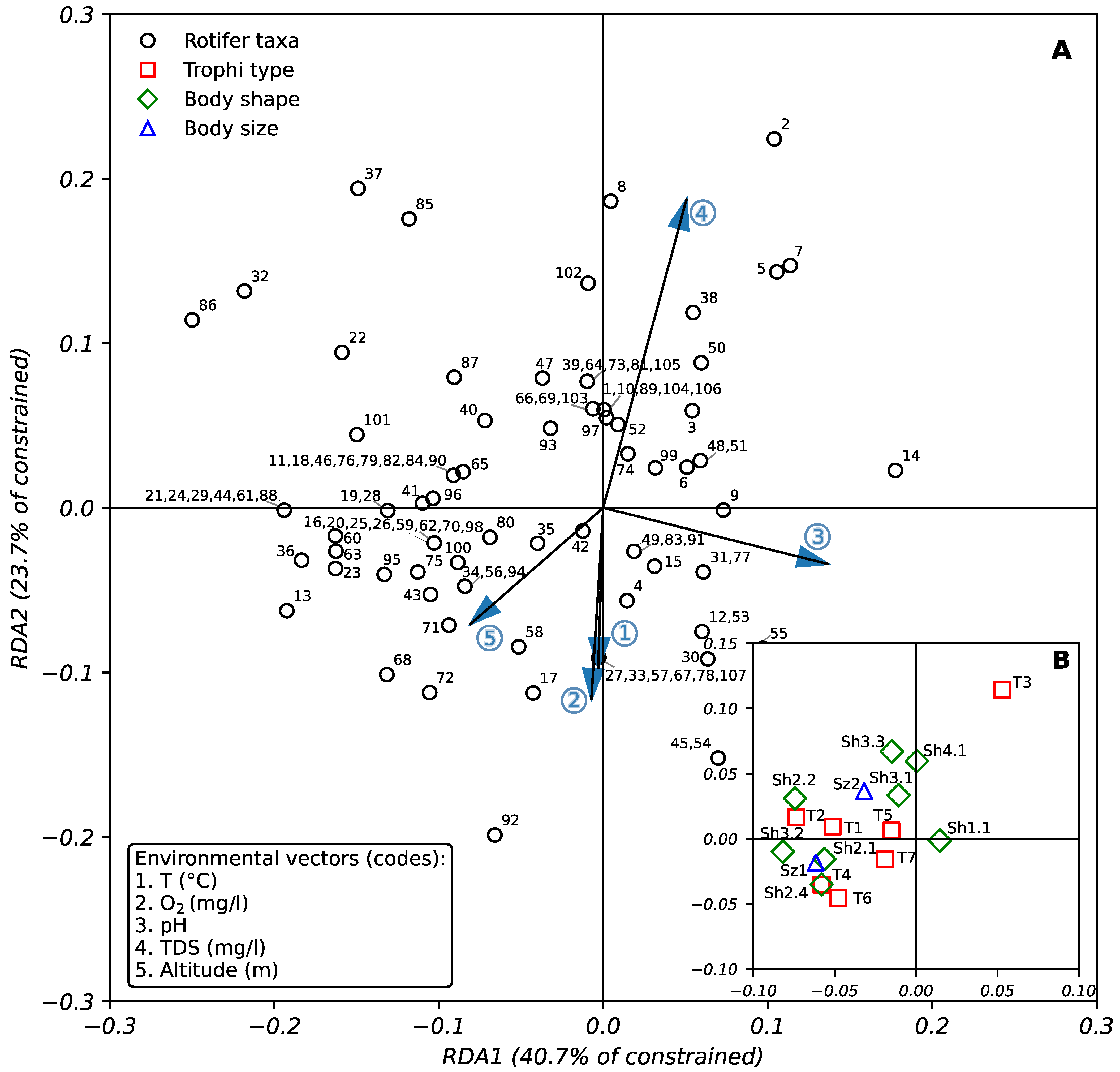
3.2. Linking Environmental Gradients with Rotifer Functional Traits in Botswana (RDA)

3.3. Biogeographical Thermal Classes Along a Latitudinal Gradient in Africa and Europe
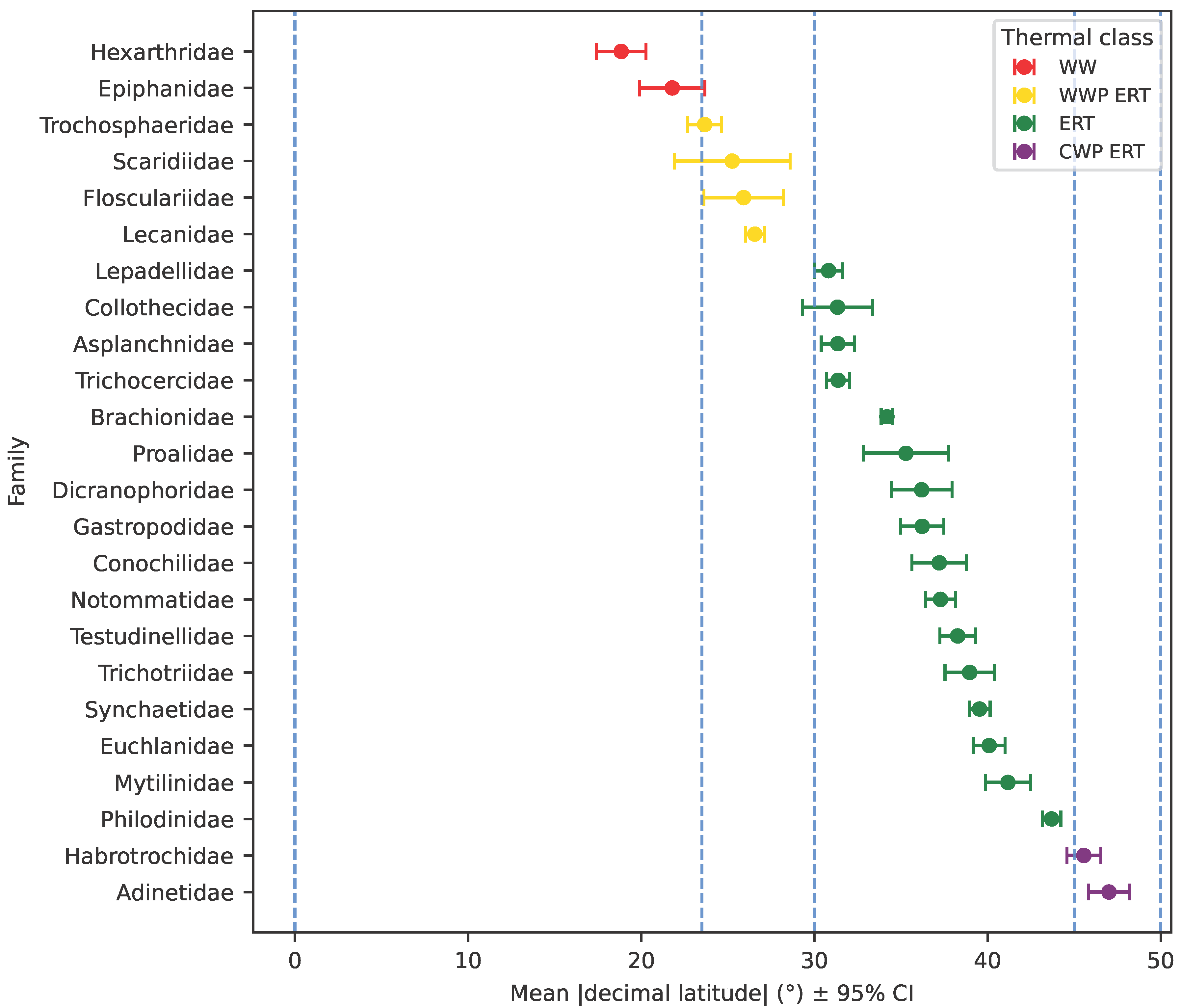
3.3.1. Family-Level Latitudinal Positioning and Thermal Classes
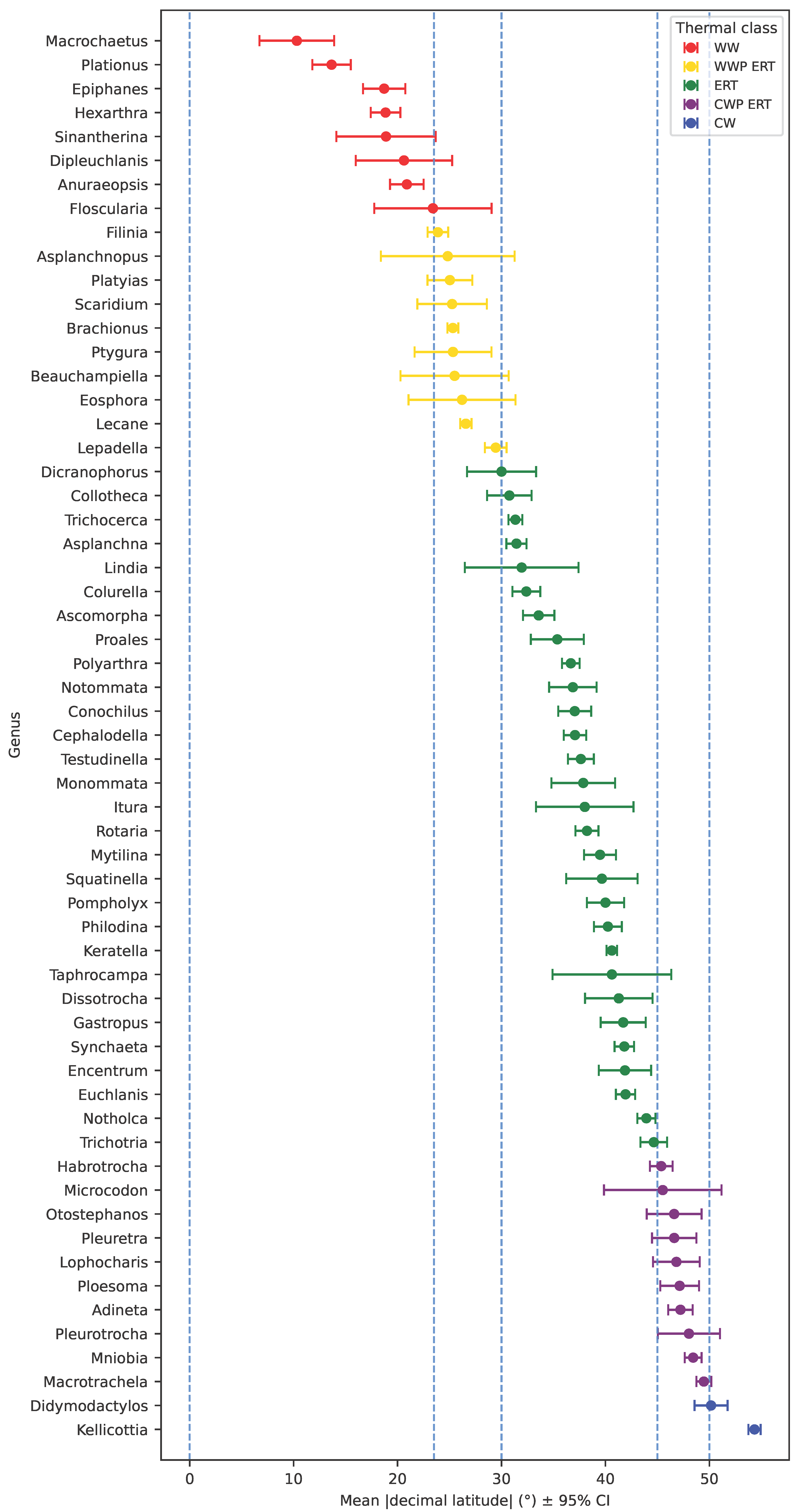
3.3.2. Genus-Level Latitudinal Positioning and Thermal Classes
3.4. Functional–Morphological Traits Along a Latitudinal Gradient in Africa and Europe
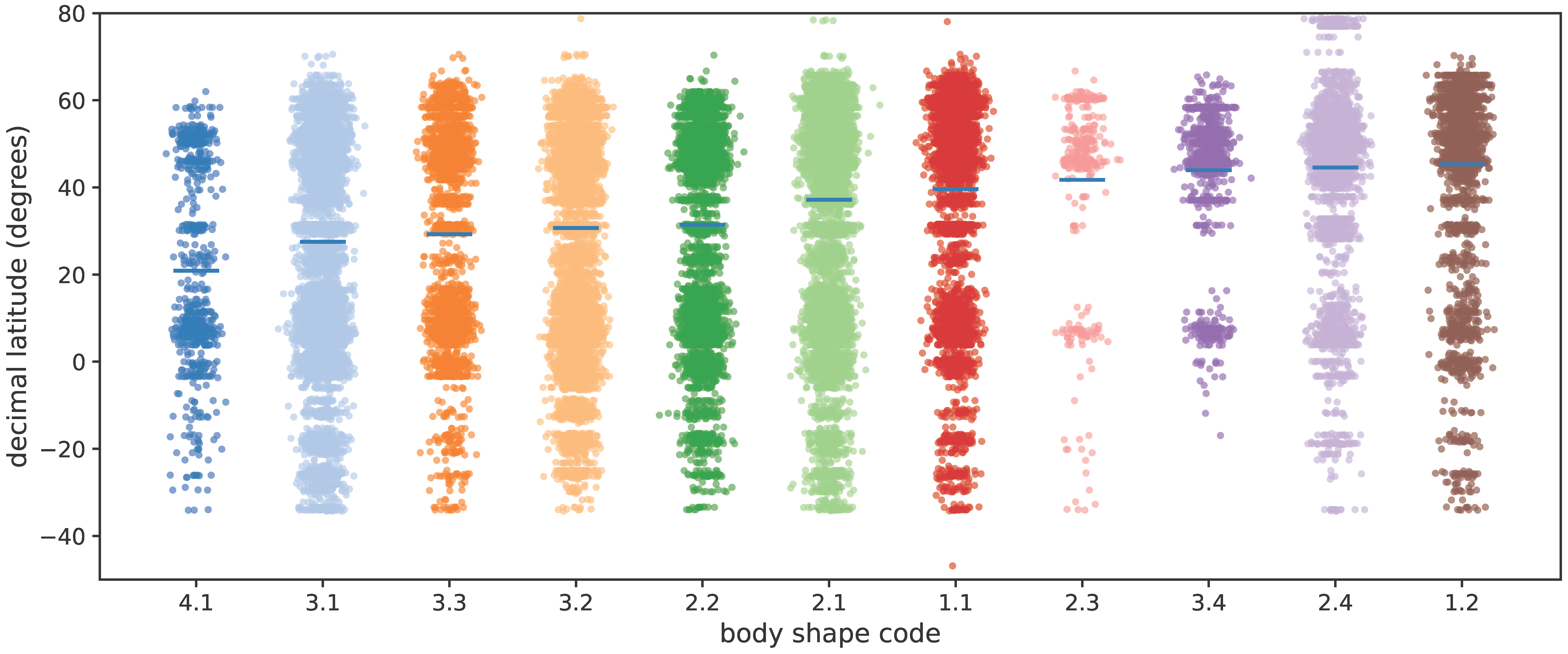
3.4.1. Geometric Body Shapes

| Shape Code | Body Shape Category | N | Mean Lat | Median Lat | SD |
|---|---|---|---|---|---|
| 4.1 | trilateral truncated pyramid | 766 | 20.89 | 11.37 | 22.82 |
| 3.1 | general ellipsoid | 14,041 | 26.85 | 30.46 | 24.64 |
| 3.3 | ellipsoid of revolution | 3039 | 29.34 | 37.02 | 23.93 |
| 3.2 | half ellipsoid | 12,570 | 30.65 | 40.84 | 24.08 |
| 2.2 | conical cylinder | 6065 | 31.37 | 44.30 | 23.16 |
| 2.1 | general cylinder | 12,970 | 37.18 | 46.26 | 23.76 |
| 3.4 | segment of ellipsoid | 1216 | 43.94 | 46.60 | 15.45 |
| 2.3 | elliptic cylinder | 380 | 41.71 | 46.67 | 21.59 |
| 1.1 | cone | 6183 | 39.54 | 48.70 | 23.89 |
| 2.4 | elliptic cylinder (tapered ends) | 5872 | 44.54 | 49.28 | 17.08 |
| 1.2 | half cone | 3274 | 45.29 | 51.56 | 20.60 |
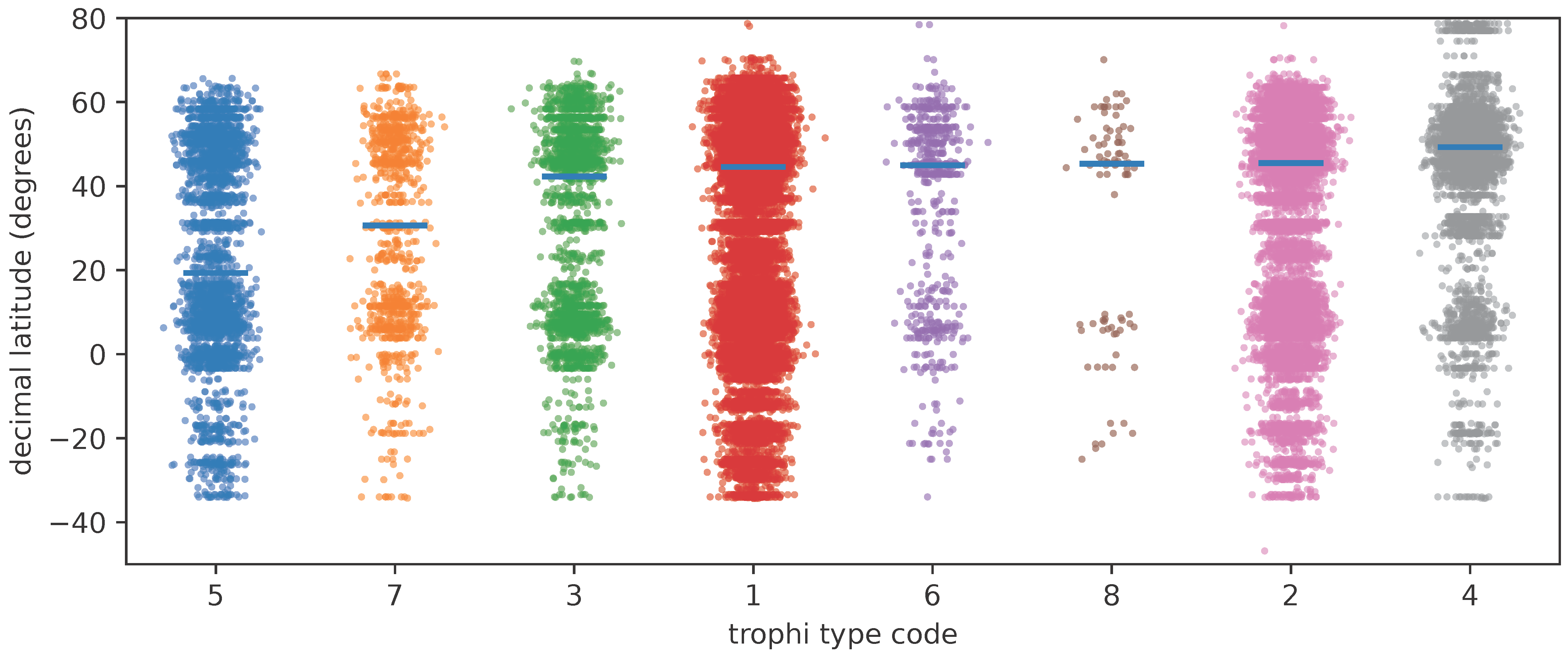
3.4.2. Trophi Types
| Trophi Code | Trophi Type | N | Mean Lat | Median Lat | SD |
|---|---|---|---|---|---|
| 5 | Malleoramate | 3879 | 24.50 | 19.16 | 24.55 |
| 7 | Uncinate | 897 | 28.19 | 30.06 | 23.80 |
| 3 | Incudate | 2333 | 31.07 | 42.32 | 23.52 |
| 1 | Malleate | 36,758 | 32.99 | 44.57 | 24.73 |
| 6 | Forcipate | 622 | 36.08 | 44.98 | 22.74 |
| 8 | Cardate | 90 | 31.94 | 45.32 | 26.48 |
| 2 | Virgate | 15,854 | 35.79 | 45.50 | 22.99 |
| 4 | Ramate | 5943 | 44.60 | 49.28 | 17.01 |
4. Discussion
4.1. Species Richness in Botswana
4.2. Linking Environmental Gradients with Rotifer Functional Traits in Botswana
4.3. Biogeographical Thermal Classes Along a Latitudinal Gradient in Africa and Europe
4.4. Functional–Morphological Traits Along a Latitudinal Gradient in Africa and Europe
Supplementary Materials
Author Contributions
Funding
Institutional Review Board Statement
Data Availability Statement
Acknowledgments
Conflicts of Interest
References
- Wallace, R.L.; Snell, T.W.; Ricci, C.; Nogrady, T. Rotifera. Volume 1: Biology, Ecology and Systematics (2nd edition). In Guides to the Identification of the Microinvertebrates of the Continental Waters of the World, 23; Segers, H., Ed.; Backhuys Publishers: Leiden, The Netherlands, 2006; ISBN 9789057821783. [Google Scholar]
- Segers, H. Global Diversity of Rotifers (Rotifera) in Freshwater. Hydrobiologia 2008, 595, 49–59. [Google Scholar] [CrossRef]
- Fontaneto, D.; De Smet, W.H. Rotifera. In Handbook of Zoology: Gastrotricha, Cycloneuralia and Gnathifera Volume 3: Gastrotricha and Gnathifera; Schmidt-Rhaesa, A., Ed.; De Gruyter: Berlin, Germany, 2015; pp. 217–300. ISBN 9783110273816. [Google Scholar]
- Fontaneto, D.; Barbosa, A.M.; Segers, H.; Pautasso, M. The ‘Rotiferologist’ Effect and Other Global Correlates of Species Richness in Monogonont Rotifers. Ecography 2012, 35, 174–182. [Google Scholar] [CrossRef]
- Pautasso, M.; McKinney, M.L. The Botanist Effect Revisited: Plant Species Richness, County Area, and Human Population Size in the United States. Conserv. Biol. 2007, 21, 1333–1340. [Google Scholar] [CrossRef]
- Segers, H.; De Smet, W.H. Diversity and Endemism in Rotifera: A Review, and Keratella Bory de St Vincent. In Protist Diversity and Geographical Distribution; Springer: Dordrecht, The Netherlands, 2007; pp. 69–82. ISBN 9789048128006. [Google Scholar]
- Jersabek, C.D.; Segers, H.; Leitner, M. Rotifer World Catalog (RWC). Available online: https://rotifera.aphia.org (accessed on 5 December 2025).
- Fresno Lopez, Z.; Cancellario, T.; Fontaneto, D.; Kamburska, L.; Karimullah, K.; Wallace, R.L.; Walsh, E.J.; Smolak, R. A Georeferenced Dataset for Occurrence Records of the Phylum Rotifera in Africa. J. Limnol. 2023, 82, 2116. [Google Scholar] [CrossRef]
- Smolak, R.; Walsh, E.J.; Brown, P.D.; Wallace, R.L. A Synthesis of the Biogeographical Distribution of Rotifera in Africa. J. Plankton Res. 2023, 45, 65–81. [Google Scholar] [CrossRef]
- Green, J. Associations of Planktonic and Periphytic Rotifers in a Tropical Swamp, the Okavango Delta, Southern Africa. Hydrobiologia 2003, 490, 197–209. [Google Scholar] [CrossRef]
- West, D.T.; van As, L.L. Zooplankton Composition of Temporary Pools within the Lower Nata River Channel, Botswana, during Dry Season. Afr. J. Aquat. Sci. 2021, 46, 241–245. [Google Scholar] [CrossRef]
- West, D.T. Zooplankton of the Okavango Delta and Associated Basins in Botswana. Ph.D. Thesis, University of the Free State, Bloemfontein, South Africa, 2016. [Google Scholar]
- Le Roux, J.C. An Ecological Study of a Constructed Treatment Wetland on a Commercial Crocodile Farm next to the Okavango Delta, Botswana; University of the Free State: Bloemfontein, South Africa, 2020. [Google Scholar]
- Hart, R.C. A Limnological Profile of the Upper Okavango Delta at Low Water Level. South. Afr. J. Aquat. Sci. 1997, 23, 21–33. [Google Scholar] [CrossRef]
- Segers, H. Annotated Checklist of the Rotifers (Phylum Rotifera), with Notes on Nomenclature, Taxonomy and Distribution. Zootaxa 2007, 1564, 1–104. [Google Scholar] [CrossRef]
- Dumont, H.J. Biogeography of Rotifers. Hydrobiologia 1983, 104, 19–30. [Google Scholar] [CrossRef]
- Bērzinš, B.; Pejler, B. Rotifer Occurrence in Relation to Temperature. Hydrobiologia 1989, 175, 223–231. [Google Scholar] [CrossRef]
- May, L. Rotifer Occurrence in Relation to Water Temperature in Loch Leven, Scotland. Hydrobiologia 1983, 104, 311–315. [Google Scholar] [CrossRef]
- Fontaneto, D.; Melone, G.; Ricci, C. Connectivity and nestedness of the meta-community structure of moss dwelling bdelloid rotifers along a stream. Hydrobiologia 2005, 542, 131–136. [Google Scholar] [CrossRef]
- Snell, T.W.; Janssen, C.R. Rotifers in Ecotoxicology: A Review. Hydrobiologia 1995, 313, 231–247. [Google Scholar] [CrossRef]
- Stemberger, R.S.; Gilbert, J.J. Defenses of Planktonic Rotifers against Predators. In Predation: Direct and Indirect Impacts on Aquatic Communities; Kerfoot, W.C., Sih, A., Eds.; University Press of New England: Hanover, MH, USA, 1987; pp. 227–239. ISBN 9780874513769. [Google Scholar]
- Nogrady, T.; Segers, H. Rotifera. Volume 6: Asplanchnidae, Gastropodidae, Lindiidae, Microcodidae, Synchaetidae, Trochosphaeridae and Filinia. In Guides to the Identification of the Microinvertebrates of the Continental Waters of the World, 18; Dumont, H.J., Ed.; SPB Academic Publishing: The Hague, The Netherlands, 2002; ISBN 9789057821110. [Google Scholar]
- Lampert, W.; Sommer, U. Ecology Lakes Streams; Oxford University Press: Oxford, UK, 2007; ISBN 9780199213931. [Google Scholar]
- Sommer, U.; Gliwicz, Z.M.; Lampert, W.; Duncan, A. The PEG-Model of Seasonal Succession of Planktonic Events in Fresh Waters. Arch. Hydrobiol. 1986, 106, 433–471. [Google Scholar] [CrossRef]
- Brooks, J.L.; Dodson, S.I. Predation, Body Size, and Composition of Plankton: The Effect of a Marine Planktivore on Lake Plankton Illustrates Theory of Size, Competition, and Predation. Science 1965, 150, 28–35. [Google Scholar] [CrossRef]
- Nielsen, D.L.; Brock, M.A.; Crosslé, K.; Harris, K.; Healey, M.; Jarosinski, I. The Effects of Salinity on Aquatic Plant Germination and Zooplankton Hatching from Two Wetland Sediments. Freshw. Biol. 2003, 48, 2214–2223. [Google Scholar] [CrossRef]
- Williams, W.D. Salinity as a Determinant of the Structure of Biological Communities in Salt Lakes. Hydrobiologia 1998, 381, 191–201. [Google Scholar] [CrossRef]
- Cañedo-Argüelles, M.; Kefford, B.; Schäfer, R. Salt in Freshwaters: Causes, Effects and Prospects—Introduction to the Theme Issue. Philos. Trans. R. Soc. Lond. B Biol. Sci. 2018, 374, 20180002. [Google Scholar] [CrossRef]
- Tockner, K.; Malard, F.; Ward, J.V. An Extension of the Flood Pulse Concept. Hydrol. Process. 2000, 14, 2861–2883. [Google Scholar] [CrossRef]
- Willig, M.R.; Kaufman, D.M.; Stevens, R.D. Latitudinal Gradients of Biodiversity: Pattern, Process, Scale, and Synthesis. Annu. Rev. Ecol. Evol. Syst. 2003, 34, 273–309. [Google Scholar] [CrossRef]
- Hawkins, B.A.; Field, R.; Cornell, H.V.; Currie, D.J.; Guégan, J.-F.; Kaufman, D.M.; Kerr, J.T.; Mittelbach, G.G.; Oberdorff, T.; O’Brien, E.M.; et al. Energy, Water, and Broad-Scale Geographic Patterns of Species Richness. Ecology 2003, 84, 3105–3117. [Google Scholar] [CrossRef]
- Gaston, K.J. Global Patterns in Biodiversity. Nature 2000, 4, 220–227. [Google Scholar] [CrossRef]
- Kearney, M.; Porter, W. Mechanistic Niche Modelling: Combining Physiological and Spatial Data to Predict Species’ Ranges. Ecol. Lett. 2009, 12, 334–350. [Google Scholar] [CrossRef]
- Janzen, D.H. Why Mountain Passes Are Higher in the Tropics. Am. Nat. 1967, 101, 233–249. [Google Scholar] [CrossRef]
- Stevens, G.C. The Latitudinal Gradient in Geographical Range: How so Many Species Coexist in the Tropics. Am. Nat. 1989, 133, 240–256. [Google Scholar] [CrossRef]
- Sunday, J.M.; Bates, A.E.; Dulvy, N.K. Thermal Tolerance and the Global Redistribution of Animals. Nat. Clim. Chang. 2012, 2, 686–690. [Google Scholar] [CrossRef]
- Wetzel, R.G. Limnology: Lake and River Ecosystems; Gulf Professional Publishing: Houston, TX, USA, 2001; ISBN 9780127447605. [Google Scholar]
- Sommer, U.; Adrian, R.; De Senerpont Domis, L.; Elser, J.J.; Gaedke, U.; Ibelings, B.; Jeppesen, E.; Lürling, M.; Molinero, J.C.; Mooij, W.M.; et al. Beyond the Plankton Ecology Group (PEG) Model: Mechanisms Driving Plankton Succession. Annu. Rev. Ecol. Evol. Syst. 2012, 43, 429–448. [Google Scholar] [CrossRef]
- Ricci, C.; Fontaneto, D. The Importance of Being a Bdelloid: Ecological and Evolutionary Consequences of Dormancy. Ital. J. Zool. 2009, 76, 240–249. [Google Scholar] [CrossRef]
- Pourriot, R.; Snell, T.W. Resting Eggs in Rotifers. Hydrobiologia 1983, 104, 213–224. [Google Scholar] [CrossRef]
- Gilbert, J.J. Endogenous Regulation of Environmentally Induced Sexuality in a Rotifer: A Multigenerational Parental Effect Induced by Fertilisation. Freshw. Biol. 2002, 47, 1633–1641. [Google Scholar] [CrossRef]
- May, L. On the Ecology of Notholca squamula Müller in Loch Leven, Kinross, Scotland. Hydrobiologia 1980, 73, 177–180. [Google Scholar] [CrossRef]
- Halbach, U. Influence of temperature on the population dynamics of the rotifer Brachionus calyciflorus pallas. Oecologia 1970, 4, 176–207. [Google Scholar] [CrossRef] [PubMed]
- Rico-Martínez, R.; Dodson, S.I. Culture of the Rotifer Brachionus calyciflorus Pallas. Aquaculture 1992, 105, 191–199. [Google Scholar] [CrossRef]
- Sládeček, V. Rotifers as Indicators of Water Quality. Hydrobiologia 1983, 100, 169–201. [Google Scholar] [CrossRef]
- Duggan, I.C.; Green, J.D.; Shiel, R.J. Distribution of Rotifers in North Island, New Zealand, and Their Potential Use as Bioindicators of Lake Trophic State. Hydrobiologia 2001, 446, 155–164. [Google Scholar] [CrossRef]
- Root, T. Environmental Factors Associated with Avian Distributional Boundaries. J. Biogeogr. 1988, 15, 489. [Google Scholar] [CrossRef]
- Heino, J. Regional Gradient Analysis of Freshwater Biota: Do Similar Biogeographic Patterns Exist among Multiple Taxonomic Groups? J. Biogeogr. 2001, 28, 69–76. [Google Scholar] [CrossRef]
- Hillebrand, H. On the Generality of the Latitudinal Diversity Gradient. Am. Nat. 2004, 163, 192–211. [Google Scholar] [CrossRef] [PubMed]
- Parmesan, C. Ecological and Evolutionary Responses to Recent Climate Change. Annu. Rev. Ecol. Evol. Syst. 2006, 37, 637–669. [Google Scholar] [CrossRef]
- Angilletta, M.J. Thermal Adaptation: Theoretical Empirical Synthesis; Oxford University Press: Oxford, UK, 2009; ISBN 9780198570882. [Google Scholar]
- Serra, M.; García-Roger, E.M.; Ortells, R.; Carmona, M.J. Cyclically Parthenogenetic Rotifers and the Theories of Population and Evolutionary Ecology. Limnetica 2019, 38, 67–93. [Google Scholar] [CrossRef]
- Nogrady, T.; Wallace, R.L.; Snell, T.W. Rotifera. Volume 1: Biology, Ecology and Systematics. In Guides to the Identification of the Microinvertebrates of the Continental Waters of the World, 4; Dumont, H.J., Ed.; SPB Academic Publishing: The Hague, The Netherlands, 1993; ISBN 9789051030808. [Google Scholar]
- Koste, W. Rotatoria. Die Radertiere Mitteleuropas I; Borntraeger, Gebruder: Berlin/Stuttgart, Germany, 1978; Volume 1, p. 673. ISBN 9783443390761. [Google Scholar]
- Reynolds, C.S. The Ecology of Phytoplankton; Cambridge University Press: Cambridge, UK, 2006; ISBN 9780521605199. [Google Scholar]
- Huey, R.B.; Kingsolver, J.G. Evolution of Thermal Sensitivity of Ectotherm Performance. Trends Ecol. Evol. 1989, 4, 131–135. [Google Scholar] [CrossRef] [PubMed]
- Dell, A.I.; Pawar, S.; Savage, V.M. Temperature Dependence of Trophic Interactions Are Driven by Asymmetry of Species Responses and Foraging Strategy. J. Anim. Ecol. 2014, 83, 70–84. [Google Scholar] [CrossRef]
- Gilbert, J.J. Morphological and Behavioral Responses of a Rotifer to the Predator Asplanchna. J. Plankton Res. 2014, 36, 1576–1584. [Google Scholar] [CrossRef]
- Gilbert, J.J. Predator-Specific Inducible Defenses in the Rotifer Keratella tropica. Freshw. Biol. 2009, 54, 1933–1946. [Google Scholar] [CrossRef]
- Gilbert, J.J. The Cost of Predator-Induced Morphological Defense in Rotifers: Experimental Studies and Synthesis. J. Plankton Res. 2013, 35, 461–472. [Google Scholar] [CrossRef]
- Meyer, C.; Weigelt, P.; Kreft, H. Multidimensional Biases, Gaps and Uncertainties in Global Plant Occurrence Information. Ecol. Lett. 2016, 19, 992–1006. [Google Scholar] [CrossRef]
- Violle, C.; Navas, M.-L.; Vile, D.; Kazakou, E.; Fortunel, C.; Hummel, I.; Garnier, E. Let the Concept of Trait Be Functional! Oikos 2007, 116, 882–892. [Google Scholar] [CrossRef]
- Cadotte, M.W.; Carscadden, K.; Mirotchnick, N. Beyond Species: Functional Diversity and the Maintenance of Ecological Processes and Services: Functional Diversity in Ecology and Conservation. J. Appl. Ecol. 2011, 48, 1079–1087. [Google Scholar] [CrossRef]
- Shipley, B. From Plant Traits Vegetation Structure: Chance Selection Assembly Ecological Communities; Cambridge University Press: Cambridge, UK, 2010; ISBN 9780521133555. [Google Scholar]
- Yin, X.; Jin, W.; Zhou, Y.; Wang, P.; Zhao, W. Hidden Defensive Morphology in Rotifers: Benefits, Costs, and Fitness Consequences. Sci. Rep. 2017, 7, 4488. [Google Scholar] [CrossRef] [PubMed]
- Van Der Stap, I.; Vos, M.; Mooij, W.M. Inducible Defenses Dynamics Planktonic Food Chains. Hydrobiologia 2007, 593, 127–136. [Google Scholar] [CrossRef]
- Obertegger, U.; Wallace, R.L. Trait-Based Research on Rotifera: The Holy Grail or Just Messy? Water 2023, 15, 1459. [Google Scholar] [CrossRef]
- Obertegger, U.; Flaim, G. Community Assembly of Rotifers Based on Morphological Traits. Hydrobiologia 2015, 753, 31–45. [Google Scholar] [CrossRef]
- Obertegger, U.; Manca, M. Response of Rotifer Functional Groups to Changing Trophic State and Crustacean Community. J. Limnol. 2011, 70, 231. [Google Scholar] [CrossRef]
- Arcifa, M.S.; de Souza, B.B.; de Morais-Junior, C.S.; Bruno, C.G.C. Functional Groups of Rotifers and an Exotic Species in a Tropical Shallow Lake. Sci. Rep. 2020, 10, 14698. [Google Scholar] [CrossRef]
- Ricci, C.; Melone, G. Key to the Identification of the Genera of Bdelloid Rotifers. Hydrobiologia 2000, 418, 73–80. [Google Scholar] [CrossRef]
- Mialet, B.; Majdi, N.; Tackx, M.; Azémar, F.; Buffan-Dubau, E. Selective Feeding of Bdelloid Rotifers in River Biofilms. PLoS ONE 2013, 8, e75352. [Google Scholar] [CrossRef]
- Botta-Dukát, Z. Rao’s Quadratic Entropy as a Measure of Functional Diversity Based on Multiple Traits. J. Veg. Sci. 2005, 16, 533–540. [Google Scholar] [CrossRef]
- Ruttner-Kolisko, A. Suggestions for Biomass Calculation of Plankton Rotifers. Arch. Hydrobiol. Beih. 1977, 8, 71–76. [Google Scholar]
- Rocha, M.A.; Ribeiro, S.M.M.S.; De Melo, M., Jr.; Da Silva, M.B.; De Castro Melo, P.A.M. Has Rotifera Richness, Abundance, and Biomass Been Underestimated in a Tropical Watershed Basins? Limnetica 2021, 40, 295–307. [Google Scholar] [CrossRef]
- Walz, N.; Sarma, S.S.S.; Benker, U. Egg Size in Relation to Body Size in Rotifers: An Indication of Reproductive Strategy? Hydrobiologia 1995, 313/314, 165–170. [Google Scholar] [CrossRef]
- Ejsmont-Karabin, J. Empirical Equations for Biomass Calculation of Planktonic Rotifers. Pol. Arch. Hydrobiol. 1998, 45, 513–522. [Google Scholar]
- Qian, F.-P.; Wen, X.-L.; Xi, Y.-L. Temporal Variation of Rotifer Community in Three Climatic Zones and Their Relationship with Environmental Factors. J. Freshw. Ecol. 2021, 36, 217–234. [Google Scholar] [CrossRef]
- Oh, H.-J.; Jeong, H.-G.; Nam, G.-S.; Oda, Y.; Dai, W.; Lee, E.-H.; Kong, D.; Hwang, S.-J.; Chang, K.-H. Comparison of Taxon-Based and Trophi-Based Response Patterns of Rotifer Community to Water Quality: Applicability of the Rotifer Functional Group as an Indicator of Water Quality. Animal Cells Syst. 2017, 21, 133–140. [Google Scholar] [CrossRef]
- Horppila, J. Rotifer Communities under Variable Predation-Turbulence Regimes: Links between Traits Environment. Hydrobiologia 2019, 827, 51–65. [Google Scholar]
- Obertegger, U.; Flaim, G. Taxonomic and Functional Diversity of Rotifers, What Do They Tell Us about Community Assembly? Hydrobiologia 2018, 823, 79–91. [Google Scholar] [CrossRef]
- QGIS Development Team. QGIS Geographic Information System, version 3.30.2 (‘s-Hertogenbosch’); Open Source Geospatial Foundation Project: Chicago, IL, USA, 2023. Available online: https://qgis.org/project/visual-changelogs/visualchangelog330/ (accessed on 25 May 2023).
- Zeng, L.; He, F.; Zhang, Y.; Liu, B.; Dai, Z.; Zhou, Q.; Wu, Z. Size-Dependent Responses of Zooplankton to Submerged Macrophyte Restoration in a Subtropical Shallow Lake. J. Oceanol. Limnol. 2018, 36, 376–384. [Google Scholar] [CrossRef]
- Segers, H. Rotifera. Volume 2: The Lecanidae (Monogononta). In Guides to the Identification of the Microinvertebrates of the Continental Waters of the World, 6; Nogrady, T., Ed.; SPB Academic Publishing: The Hague, The Netherlands, 1995; ISBN 9789051030914. [Google Scholar]
- Nogrady, T.; Pourriot, R.; Segers, H. Rotifera. Volume 3: The Notommatidae (Monogononta) and the Scaridiidae (Monogononta). In Guides to the Identification of the Microinvertebrates of the Continental Waters of the World, 8; Nogrady, T., Ed.; SPB Academic Publishing: The Hague, The Netherlands, 1995; ISBN 9789051031034. [Google Scholar]
- De Smet, W.H.; Pourriot, R. Rotifera. Volume 5: The Dicranophoridae (Monogononta) and: The Ituridae (Monogononta). In Guides to the Identification of the Microinvertebrates of the Continental Waters of the World, 12; Dumont, H.J.F., Nogrady, T., Eds.; SPB Academic Publishing: The Hague, The Netherlands, 1997; ISBN 9789051031355. [Google Scholar]
- De Smet, W.H. Rotifera. Volume 4: The Proalidae (Monogononta). In Guides to the Identification of the Microinvertebrates of the Continental Waters of the World, 9; Nogrady, T., Ed.; SPB Academic Publishing bv: Amsterdam, The Netherlands, 1996; ISBN 9789051031195. [Google Scholar]
- Ruttner-Kolisko, A. Plankton Rotifers: Biology and Taxonomy; Stuttgart E. Schweizerbart’sche Verlagsbuchhandlung: Stuttgart, Germany, 1974; Volume 26, p. 146. ISBN 9783510407354. [Google Scholar]
- Jersabek, C.D.; De Smet, W.H.; Hinz, C.; Fontaneto, D.; Hussey, C.G.; Michaloudi, E.; Wallace, R.L.; Segers, H. List of Available Names in Zoology, Candidate Part Phylum Rotifera, Species-Group Names Established before 1 January 2000. Available online: https://archive.org/details/LANCandidatePartSpeciesRotifera (accessed on 22 September 2021).
- R Core Team. R: A Language and Environment for Statistical Computing, version 4.5.2; R Foundation for Statistical Computing: Vienna, Austria, 2025. Available online: https://www.R-project.org/ (accessed on 1 December 2025).
- Oksanen, J.; Simpson, G.L.; Blanchet, F.G.; Kindt, R.; Legendre, P.; Minchin, P.R.; O’Hara, R.B.; Solymos, P.; Stevens, M.H.H.; Szoecs, E.; et al. Vegan: Community Ecology Package. R Package version 2.7-2. Available online: https://CRAN.R-project.org/package=vegan (accessed on 1 December 2025).
- Stemberger, R.S.; Gilbert, J.J. Body Size, Food Concentration, and Population Growth in Planktonic Rotifers. Ecology 1985, 66, 1151–1159. [Google Scholar] [CrossRef]
- Stelzer, C.P. Phenotypic Plasticity of Body Size at Different Temperatures in a Planktonic Rotifer: Mechanisms and Adaptive Significance: Temperature and Body Size in a Rotifer. Funct. Ecol. 2002, 16, 835–841. [Google Scholar] [CrossRef]
- Gbif.org. Occurrence Download: Europe Rotifers. Global Biodiversity Information (GBIF): Copenhagen, Denmark, 2025. Available online: https://www.gbif.org/occurrence/download/0022035-251120083545085 (accessed on 2 December 2025).
- Python Software Foundation. Python Language Reference, version 3.12. Available online: https://www.python.org/ (accessed on 5 December 2025).
- WoRMS Editorial Board. Available online: https://www.marinespecies.org/aphia.php (accessed on 5 December 2025).
- The Pandas Development Team Pandas, version 2.3.3. Available online: https://zenodo.org/records/17229934 (accessed on 5 December 2025).
- Hunter, J.D. Matplotlib: A 2D Graphics Environment. Comput. Sci. Eng. 2007, 9, 90–95. [Google Scholar] [CrossRef]
- Hoffmann, A.A.; Sgrò, C.M. Climate Change and Evolutionary Adaptation. Nature 2011, 470, 479–485. [Google Scholar] [CrossRef] [PubMed]
- Parmesan, C.; Yohe, G. A Globally Coherent Fingerprint of Climate Change Impacts across Natural Systems. Nature 2003, 421, 37–42. [Google Scholar] [CrossRef]
- Brown, J.H.; Maurer, B.A. Macroecology: The Division of Food and Space among Species on Continents. Science 1989, 243, 1145–1150. [Google Scholar] [CrossRef]
- Baselga, A.; Gómez-Rodríguez, C.; Lobo, J.M. Historical Legacies in World Amphibian Diversity Revealed by the Turnover and Nestedness Components of Beta Diversity. PLoS ONE 2012, 7, e32341. [Google Scholar] [CrossRef]
- Smolak, R.; Brown, P.D.; Walsmith, R.N.; Ríos-Arana, J.V.; Sanful, P.; Kalous, L.; Walsh, E.J. Improving Aquatic Biodiversity Estimates in Africa: Rotifers of Angola and Ghana. Diversity 2024, 16, 269. [Google Scholar] [CrossRef]
- Dumont, H.J.; Coussement, M. Rotifers from Rio de Oro (North-Western Sahara). Hydrobiologia 1976, 51, 109–112. [Google Scholar] [CrossRef]
- De Smet, W.H.; Bafort, J.M. Rotifers from the Kilimanjaro. Biol. Jaarb. Dodonaea 1990, 58, 120–130. [Google Scholar]
- De Smet, W.H.; Bafort, J.M. Additions to the Rotifer Fauna of Lake Kivu (Zaïre), with description of Wulfertia kindensis kivuensis subsp. n. and Ascomorpha dumonti sp. n. Biol. Jaarb. Dodonaea 1992, 60, 110–117. [Google Scholar]
- Segers, H. On Four New Tropical and Subtropical Lecane (Lecanidae, Monogononta, Rotifera). Hydrobiologia 1994, 287, 243–249. [Google Scholar] [CrossRef]
- Kirkman, T. IV.—List of Some of the Rotifera of Natal. J. R. Microsc. Soc. 1901, 21, 229–241. [Google Scholar] [CrossRef]
- Rousselet, C.F. IX.—Contribution to Our Knowledge of the Rotifera of South Africa. J. R. Microsc. Soc. 1906, 26, 393–414. [Google Scholar] [CrossRef]
- Segers, H. The Biogeography of Littoral Lecane (Rotifera). Hydrobiologia 1996, 323, 169–197. [Google Scholar] [CrossRef]
- Donner, J. Zwei Neue Schlamm-Rotatorien Aus Dem Neusiedler See, Paradicranophorus sudzukii und Paradicranophorus sordidus. Anz. Österr. Akad. Wiss. Math.-Naturwiss. Kl. 1968, 105, 224–232. [Google Scholar]
- Bekleyen, A.; Gokot, B.; Varol, M. Thirty-Four New Records and the Diversity of the Rotifera in the Turkish Part of the Tigris River Watershed, with Remarks on Biogeographically Interesting Taxa. Sci. Res. Essays 2011, 6, 6270–6284. [Google Scholar] [CrossRef]
- De Ridder, M. Some Considerations Ecology Rotifers Brackish Saline Waters. Hydrobiologia 1981, 81, 125–134. [Google Scholar]
- Fontaneto, D.; De Smet, W.H.; Ricci, C. Rotifers in Saltwater Environments, Re-Evaluation of an Inconspicuous Taxon. J. Mar. Syst. 2006, 62, 63–70. [Google Scholar] [CrossRef]
- Walsh, E.J.; Schröder, T.; Wallace, R.L.; Ríos-Arana, J.V.; Rico-Martínez, R. Rotifers from Selected Inland Saline Waters in the Chihuahuan Desert of México. Aquat. Biosyst. 2008, 4, 1–11. [Google Scholar] [CrossRef]
- Duggan, I.C.; Green, J.D.; Shiel, R.J. Distribution Rotifer Assemblages Relation Environmental Gradients. Freshw. Biol. 2012, 57, 123–136. [Google Scholar]
- Segers, H.; De Smet, W.H. Diversity Endemism Rotifers: Review. Hydrobiologia 2008, 593, 65–83. [Google Scholar]
- Barnett, A.J.; Finlay, K.; Beisner, B.E. Functional Diversity of Crustacean Zooplankton Communities: Towards a Trait-Based Classification. Freshw. Biol. 2007, 52, 796–813. [Google Scholar] [CrossRef]
- Litchman, E.; Ohman, M.D.; Kiørboe, T. Trait-Based Approaches to Zooplankton Communities. J. Plankton Res. 2013, 35, 473–484. [Google Scholar] [CrossRef]
- Pourriot, R. Food Feeding Habits Rotifera. Arch. Für Hydrobiol. Beih. 1977, 8, 243–260. [Google Scholar]
- May, L. Seasonal Changes Rotifer Populations Loch Leven. Hydrobiologia 1983, 104, 133–142. [Google Scholar]
- Walczyńska, A.; Serra, M. Inter- and Intraspecific Relationships between Performance and Temperature in a Cryptic Species Complex of the Rotifer Brachionus plicatilis. Hydrobiologia 2014, 734, 17–26. [Google Scholar] [CrossRef]
- Stelzer, C.P. Phenotypic Plasticity Life History Traits Rotifers. Freshw. Biol. 2002, 47, 1133–1144. [Google Scholar]
- Ricci, C. Dormancy Patterns in Rotifers. Hydrobiologia 2001, 446, 1–11. [Google Scholar] [CrossRef]
- García-Roger, E.M. Resting Egg Banks Rotifer Persistence. Freshw. Biol. 2006, 51, 2215–2227. [Google Scholar]
- Schröder, T. Diapause in Monogonont Rotifers. Hydrobiologia 2005, 546, 291–306. [Google Scholar] [CrossRef]
- Adrian, R.; O’Reilly, C.M.; Zagarese, H.; Baines, S.B.; Hessen, D.O.; Keller, W.; Livingstone, D.M.; Sommaruga, R.; Straile, D.; Van Donk, E.; et al. Lakes as Sentinels of Climate Change. Limnol. Oceanogr. 2009, 54, 2283–2297. [Google Scholar] [CrossRef]
- Winder, M.; Sommer, U. Phytoplankton Response Climate Warming. Freshw. Biol. 2012, 57, 210–225. [Google Scholar]
- Hampton, S.E.; Galloway, A.W.E.; Powers, S.M.; Ozersky, T.; Woo, K.H.; Batt, R.D.; Labou, S.G.; O’Reilly, C.M.; Sharma, S.; Lottig, N.R.; et al. Ecology under Lake Ice. Ecol. Lett. 2017, 20, 98–111. [Google Scholar] [CrossRef] [PubMed]
- Angilletta, M.J., Jr.; Wilson, R.S.; Navas, C.A.; James, R.S. Tradeoffs and the Evolution of Thermal Reaction Norms. Trends Ecol. Evol. 2003, 18, 234–240. [Google Scholar] [CrossRef]
- Stillman, J.H. Acclimation Capacity Underlies Susceptibility to Climate Change. Science 2003, 301, 65. [Google Scholar] [CrossRef]
- Seebacher, F. Plasticity Thermal Performance Curves. Nat. Clim. Chang. 2015, 5, 61–66. [Google Scholar] [CrossRef]
- Williams, C.M.; Chick, W.D.; Sinclair, B.J. A Cross-Seasonal Perspective on Local Adaptation: Metabolic Plasticity Mediates Responses to Winter in a Thermal-Generalist Moth. Funct. Ecol. 2015, 29, 549–561. [Google Scholar] [CrossRef]
- Bonan, G.B. Forests and Climate Change: Forcings, Feedbacks, and the Climate Benefits of Forests. Science 2008, 320, 1444–1449. [Google Scholar] [CrossRef]
- Green, J. Latitudinal Variation in Associations of Planktonic Rotifera. J. Zool. 1972, 167, 31–39. [Google Scholar] [CrossRef]
- Ejsmont-Karabin, J. Does the World Need Faunists? Based on Rotifer (Rotifera) Occurrence Reflections on the Role of Faunistic Research in Ecology. Int. Rev. Hydrobiol. 2019, 104, 49–56. [Google Scholar] [CrossRef]
- Körner, C. The Use of “Altitude” in Ecological Research. Trends Ecol. Evol. 2007, 22, 569–574. [Google Scholar] [CrossRef]
- Gillooly, J.F.; Brown, J.H.; West, G.B.; Savage, V.M.; Charnov, E.L. Effects of Size and Temperature on Metabolic Rate. Science 2001, 293, 2248–2251. [Google Scholar] [CrossRef] [PubMed]
- Kainz, M. Seasonality of Thermal Regimes in Freshwater Food Webs. Freshw. Biol. 2017, 62, 1291–1306. [Google Scholar]
- Beck, J.; Böller, M.; Erhardt, A.; Schwanghart, W. Spatial Bias in the GBIF Database and Its Effect on Modeling Species’ Geographic Distributions. Ecol. Inform. 2014, 19, 10–15. [Google Scholar] [CrossRef]
- Zizka, A.; Antonelli, A.; Silvestro, D. Sampbias: A Method for Quantifying Geographic Sampling Biases in Species Distribution Data. Ecography 2021, 44, 25–32. [Google Scholar] [CrossRef]
- Merow, C.; Smith, M.J.; Silander, J.A. A Practical Guide to MaxEnt for Modeling Species’ Distributions: What It Does, and Why Inputs and Settings Matter. Ecography 2013, 36, 1058–1069. [Google Scholar] [CrossRef]
- Troudet, J.; Grandcolas, P.; Blin, A.; Vignes-Lebbe, R.; Legendre, F. Taxonomic Bias in Biodiversity Data and Societal Preferences. Sci. Rep. 2017, 7, 9132. [Google Scholar] [CrossRef]
- Brown, P.D.; Schröder, T.; Ríos-Arana, J.V.; Rico-Martinez, R.; Silva-Briano, M.; Wallace, R.L.; Walsh, E.J. Patterns of Rotifer Diversity in the Chihuahuan Desert. Diversity 2020, 12, 393. [Google Scholar] [CrossRef]
- McGill, B.J.; Enquist, B.J.; Weiher, E.; Westoby, M. Rebuilding Community Ecology from Functional Traits. Trends Ecol. Evol. 2006, 21, 178–185. [Google Scholar] [CrossRef]
- Sørensen, M.V. On the Evolution and Morphology of the Rotiferan Trophi, with a Cladistic Analysis of Rotifera. J. Zoolog. Syst. Evol. Res. 2002, 40, 129–154. [Google Scholar] [CrossRef]
- Segers, H. The Nomenclature of the Rotifera: Annotated Checklist of Valid Family and Genus-Group Names. J. Nat. Hist. 2002, 36, 631–640. [Google Scholar] [CrossRef]
- OSM (OpenStreetMap, ODbL 1.0). Available online: https://www.openstreetmap.org/#map=4/50.18/-1.41 (accessed on 5 December 2025).



| S# | L# | Locality Name | Date | Habitat | T (°C) | O2 (mg L−1) | O2 (%) | pH | Cond. (µS cm−1) | TDS (mg L−1) | Sal. (ppm) | Altitude (m a.s.l.) | Latitude | Longitude |
|---|---|---|---|---|---|---|---|---|---|---|---|---|---|---|
| 1 | 1 | Gaborone Dam pond | 3–March | W | 27.8 | 3.83 | 45.7 | 7.45 | 344 | 172 | 111 | 980 | 24°41′44″ S | 25°55′28″ E |
| 2, 3 | 2 | Phakalane lagoons | 3–March | P | 29.8 | 3.87 | 46.3 | 8.41 | 938 | 679 | 377 | 863 | 24°34′56″ S | 25°58′49″ E |
| 4 | 3 | Ngotwane (Taung river) | 4–March | Ri | 27.9 | 5.36 | 72.4 | 8.71 | 266 | 183 | 130 | 1011 | 24°45′25″ S | 25°50′54″ E |
| 5 | 4 | Ngotwane (Crocodile pools) | 4–March | Re | 27.5 | 4.33 | 46.8 | 8.09 | 285 | 207 | 127 | 1001 | 24°46′06″ S | 25°50′55″ E |
| 7, 8 | 5 | University of Botswana #1 | 7–March | AP | 29.3 | 9.84 | 142.8 | 9.23 | 377 | 271 | 173 | 991 | 24°39′48″ S | 25°55′48″ E |
| 6, 9, 10 | 6 | University of Botswana #2 | 9–March | AP | 22.5 | 1.63 | 18.8 | 7.74 | 363 | 255 | 174 | 985 | 24°39′42″ S | 25°55′48″ E |
| 11–14 | 7 | Bokaa Dam | 10–March | Re | 28.8 | 11.43 | 157.4 | 9.05 | 224 | 156 | 101 | 955 | 24°26′47″ S | 26°01′05″ E |
| 15–16 | 8 | Mogoditshane wetland | 11–March | W | 27.4 | 8.53 | 107.5 | 7.95 | 335 | 232 | 149 | 1017 | 24°37′53″ S | 25°52′11″ E |
| 17, 18, 22 | 9 | Grand Palm Hotel #1 | 11–March | RP | 31.2 | 3.36 | 42.1 | 7.85 | 41 | 29 | 18 | 1011 | 24°38′29″ S | 25°52′41″ E |
| 19–21 | 10 | Grand Palm Hotel #2 | 11–March | W | 27.7 | 1.77 | 24.7 | 6.77 | 282 | 196 | 131 | 1011 | 24°38′31″ S | 25°52′39″ E |
| 23–25 | 11 | Gaborone Game Reserve | 12–March | W | 30.4 | 4.54 | 71.5 | 7.91 | 307 | 205 | 134 | 981 | 24°37′48″ S | 25°57′47″ E |
| 26–28 | 12 | Phakalane Golf Course #1 | 16–March | P | 25.0 | 5.33 | 72.3 | 9.01 | 842 | 590 | 408 | 986 | 24°34′26″ S | 25°59′06″ E |
| 29–31 | 13 | Phakalane Golf Course #2 | 16–March | P | 24.1 | 3.93 | 25.3 | 8.32 | 935 | 655 | 453 | 987 | 24°34′35″ S | 25°59′10″ E |
| 32–33 | 14 | Kgatleng District #1 | 18–March | FP | 23.6 | 2.68 | 29.5 | 7.98 | 918 | 646 | 37 | 975 | 24°24′16″ S | 26°03′10″ E |
| 34–37 | 15 | Kgatleng District #2 | 18–March | QP | 23.5 | 4.82 | 42.3 | 8.48 | 1121 | 784 | 548 | 974 | 24°23′24″ S | 26°03′02″ E |
| T# | Taxon | New Record | Sites Found | Occurrence [%] |
|---|---|---|---|---|
| Asplanchnidae | ||||
| 1 | Asplanchna brightwellii Gosse, 1850 | 2, 12, 13, 15 | 26.7 | |
| 2 | Asplanchna sieboldii (Leydig, 1854) | 2 | 6.7 | |
| Bdelloidea | ||||
| 3 | bdelloid (unidentified) | 1–10, 12, 13, 15 | 86.7 | |
| Brachionidae | ||||
| 4 | Anuraeopsis sp. | B | 13 | 6.7 |
| 5 | Brachionus angularis Gosse, 1851 | 2, 11–13 | 26.7 | |
| 6 | Brachionus bidentatus Anderson, 1889 | B | 11, 12 | 13.3 |
| 7 | Brachionus budapestinensis Daday, 1885 | 2, 12, 13 | 20 | |
| 8 | Brachionus calyciflorus Pallas, 1766 | 2, 8, 12–14 | 33.3 | |
| 9 | Brachionus caudatus Barrois & Daday, 1894 | 3, 4, 13 | 20 | |
| 10 | Brachionus dimidiatus Bryce, 1931 | B | 13 | 6.7 |
| 11 | Brachionus diversicornis (Daday, 1883) | B | 10 | 6.7 |
| 12 | Brachionus falcatus Zacharias, 1898 | 3, 4, 7, 15 | 26.7 | |
| 13 | Brachionus quadridentatus Hermann, 1783 | 7–11, 14 | 40 | |
| 14 | Brachionus urceolaris Müller, 1773 | B | 2, 3, 4, 11, 12 | 33.3 |
| 15 | Keratella cochlearis (Gosse, 1851) | B | 3, 4, 7, 15 | 26.7 |
| 16 | Keratella tecta (Gosse, 1851) | 3, 4, 7 | 20 | |
| 17 | Keratella tropica (Apstein, 1907) | 3, 4, 6, 7, 9, 14, 15 | 46.7 | |
| 18 | Plationus patulus (Müller, 1786) | 1, 2, 8–10, 12, 14, 15 | 53.3 | |
| Dicranophoridae | ||||
| 19 | Dicranophoroides caudatus (Ehrenberg, 1834) | B | 1, 10 | 13.3 |
| 20 | Dicranophoroides claviger (Hauer, 1965) | B | 8, 10 | 13.3 |
| 21 | Dicranophorus epicharis Harring & Myers, 1928 | B | 3, 4, 7, 14 | 26.7 |
| 22 | Dicranophorus forcipatus (Müller, 1786) | B | 3 | 6.7 |
| 23 | Encentrum sp. | B | 9 | 6.7 |
| Epiphanidae | ||||
| 24 | Epiphanes brachionus (Ehrenberg, 1837) | B | 8–11 | 26.7 |
| 25 | Epiphanes clavulata (Ehrenberg, 1831) | B | 2, 8, 10, 13, 15 | 33.3 |
| 26 | Epiphanes macroura (Barrois & Daday, 1894) | 2, 13 | 13.3 | |
| 27 | Epiphanes senta (Müller, 1773) | 9, 10, 13 | 20 | |
| Euchlanidae | ||||
| 28 | Dipleuchlanis propatula (Gosse, 1886) | B | 8, 10, 11, 14, 15 | 33.3 |
| 29 | Euchlanis dilatata Ehrenberg, 1830 | 4, 7, 8, 14, 15 | 33.3 | |
| 30 | Euchlanis sp. | 7, 15 | 13.3 | |
| 31 | Tripleuchlanis plicata (Levander, 1894) | B | 15 | 6.7 |
| Filinidae | ||||
| 32 | Filinia longiseta (Ehrenberg, 1834) | 7, 8, 13 | 20 | |
| 33 | Filinia novaezealandiae Shiel & Sanoamuang, 1993 | B | 8, 10 | 13.3 |
| 34 | Filinia opoliensis (Zacharias, 1898) | 3, 4, 7 | 20 | |
| 35 | Filinia passa (Müller, 1786) | B | 10 | 6.7 |
| 36 | Filinia terminalis (Plate, 1886) | B | 2, 10 | 13.3 |
| 37 | Filinia sp. | 12 | 6.7 | |
| Floscularidae | ||||
| 38 | Limnias sp. Schrank, 1803 (tube) | B | 3 | 6.7 |
| 39 | Sinantherina ariprepes Edmondson, 1939 | B | 4, 15 | 13.3 |
| 40 | Sinantherina semibullata (Thorpe, 1889) | B | 8 | 6.7 |
| 41 | Sinantherina sp. (colony) | 5, 13 | 13.3 | |
| Hexarthridae | ||||
| 42 | Hexarthra fennica (Levander, 1892) | B | 9 | 6.7 |
| 43 | Hexarthra intermedia (Wiszniewski, 1929) | B | 12, 13 | 13.3 |
| 44 | Hexarthra jenkinae (de Beauchamp, 1932) | B | 12 | 6.7 |
| 45 | Hexarthra sp. | 9, 15 | 13.3 | |
| Lecanidae | ||||
| 46 | Lecane abanica Segers, 1994 | B | 8, 9 | 13.3 |
| 47 | Lecane agilis (Bryce, 1892) | B | 7 | 6.7 |
| 48 | Lecane bulla (Gosse, 1851) | 1–10, 14, 15 | 80 | |
| 49 | Lecane closterocerca (Schmarda, 1859) | B | 8 | 6.7 |
| 50 | Lecane curvicornis (Murray, 1913) | 5, 7–10, 14, 15 | 46.7 | |
| 51 | Lecane elsa Hauer, 1931 | B | 8, 10 | 13.3 |
| 52 | Lecane furcata (Murray, 1913) | 8 | 6.7 | |
| 53 | Lecane hamata (Stokes, 1896) | B | 6–10, 13, 15 | 46.7 |
| 54 | Lecane leontina (Turner, 1892) | 15 | 6.7 | |
| 55 | Lecane luna (Müller, 1776) | 6, 7, 10, 14, 15 | 33.3 | |
| 56 | Lecane lunaris (Ehrenberg, 1832) | 14 | 6.7 | |
| 57 | Lecane nana (Murray, 1913) | B | 7 | 6.7 |
| 58 | Lecane papuana (Murray, 1913) | 3, 7–11, 14 | 46.7 | |
| 59 | Lecane punctata (Murray, 1913) | B | 14 | 6.7 |
| 60 | Lecane pusilla Harring, 1914 | B | 8 | 6.7 |
| 61 | Lecane ungulata (Gosse, 1887) | B | 7, 10 | 13.3 |
| 62 | Lecane sp. | 7, 8 | 13.3 | |
| Lepadellidae | ||||
| 63 | Colurella adriatica Ehrenberg, 1831 | B | 1, 8, 14, 15 | 26.7 |
| 64 | Colurella colurus (Ehrenberg, 1830) | B | 5, 8, 10 | 20 |
| 65 | Colurella obtusa (Gosse, 1886) | B | 8, 10 | 13.3 |
| 66 | Colurella uncinata bicuspidata (Ehrenberg, 1832) | B | 8 | 6.7 |
| 67 | Lepadella latusinus (Hilgendorf, 1899) | B | 15 | 6.7 |
| 68 | Lepadella ovalis (Müller, 1786) | B | 6, 15 | 13.3 |
| 69 | Lepadella patella (Müller, 1773) | B | 5, 7, 8, 10, 12, 14 | 40 |
| 70 | Lepadella rhomboides (Gosse, 1886) | 10 | 6.7 | |
| 71 | Lophocharis gracilis Dvořáková, 1960 | B | 7 | 6.7 |
| Mytilinidae | ||||
| 72 | Mytilina acanthophora Hauer, 1938 | B | 10 | 6.7 |
| 73 | Mytilina ventralis (Ehrenberg, 1830) | B | 3, 7, 8, 11, 14, 15 | 40 |
| Notommatidae | ||||
| 74 | Cephalodella boettgeri Koste, 1988 | B | 5 | 6.7 |
| 75 | Cephalodella catellina (Müller, 1786) | B | 8 | 6.7 |
| 76 | Cephalodella forficula (Ehrenberg, 1838) | B | 1, 7 | 13.3 |
| 77 | Cephalodella gibba (Ehrenberg, 1830) | B | 10 | 6.7 |
| 78 | Cephalodella hollowdayi Koste, 1986 | B | 1, 10 | 13.3 |
| 79 | Cephalodella sterea (Gosse, 1887) | B | 8 | 6.7 |
| 80 | Cephalodella sp. Bory de St. Vincent, 1826 | B | 8, 10 | 13.3 |
| 81 | Donneria sudzukii (Donner, 1968) | A, B | 7 | 6.7 |
| 82 | Eosphora anthadis Harring & Myers, 1922 | B | 1 | 6.7 |
| 83 | Notommata cerberus (Gosse, 1886) | B | 15 | 6.7 |
| 84 | Notommata sp. | 15 | 6.7 | |
| Philodinavidae | ||||
| 85 | Philodinavus paradoxus (Murray, 1905) | B | 10 | 6.7 |
| Philodinidae | ||||
| 86 | Philodina citrina Ehrenberg, 1830 | B | 10 | 6.7 |
| 87 | Philodina sp. | B | 9 | 6.7 |
| 88 | Rotaria neptunia (Ehrenberg, 1830) | 1, 3, 7–9 | 33.3 | |
| 89 | Rotaria rotatoria (Pallas, 1766) | B | 10, 12 | 13.3 |
| 90 | Rotaria tardigrada (Ehrenberg, 1830) | B | 8, 9 | 13.3 |
| 91 | Rotaria sp. | 3, 8, 10 | 20 | |
| Proalidae | ||||
| 92 | Proalinopsis caudata (Collins, 1872) | B | 9 | 6.7 |
| Scaridiidae | ||||
| 93 | Scaridium longicaudum (Müller, 1786) | B | 7, 10, 15 | 20 |
| Synchaetidae | ||||
| 94 | Polyarthra dolichoptera Idelson, 1925 | B | 1, 8, 10, 14, 15 | 33.3 |
| 95 | Polyarthra indica Segers & Babu, 1999 | B | 10, 13 | 13.3 |
| 96 | Polyarthra remata Skorikov, 1896 | 8, 10 | 13.3 | |
| 97 | Polyarthra vulgaris Carlin, 1943 | 13 | 6.7 | |
| 98 | Polyarthra sp. | 10 | 6.7 | |
| Testudinellidae | ||||
| 99 | Testudinella patina (Hermann, 1783) | 4, 7, 10, 14 | 26.7 | |
| Trichocercidae | ||||
| 100 | Trichocerca braziliensis (Murray, 1913) | B | 1, 7, 10, 14, 15 | 33.3 |
| 101 | Trichocerca cylindrica (Imhof, 1891) | B | 13, 15 | 13.3 |
| 102 | Trichocerca similis grandis Hauer, 1965 | B | 14 | 6.7 |
| 103 | Trichocerca sp. Lamarck, 1801 | 13 | 6.7 | |
| Trichotriidae | ||||
| 104 | Wulfertia kivuensis De Smet, 1992 | B | 7 | 6.7 |
| Conochilidae | ||||
| 105 | Conochilus hippocrepis (Schrank, 1803) | B | 8 | 6.7 |
| 106 | Conochilus natans (Seligo, 1900) | B | 7 | 6.7 |
| Trochosphaeridae | ||||
| 107 | Trochosphaera aequatorialis Semper, 1872 | B | 13 | 6.7 |
| Environmental Variables | RDA1 | RDA2 | r2 | p (Perm) |
|---|---|---|---|---|
| Temperature (°C) | −0.144 | 0.104 | 0.032 | 0.820 |
| O2 (mg L−1) | −0.172 | 0.348 | 0.151 | 0.376 |
| pH | 0.415 | 0.568 | 0.495 | 0.017 |
| TDS (mg L−1) | 0.688 | −0.302 | 0.565 | 0.009 |
| Altitude (m a.s.l.) | −0.563 | 0.139 | 0.337 | 0.053 |
| Thermal Class | Families (n) | Genera (n) |
|---|---|---|
| WW | 2 | 8 |
| WWP ERT | 4 | 10 |
| ERT | 16 | 29 |
| CWP ERT | 2 | 10 |
| CW | 0 | 2 |
Disclaimer/Publisher’s Note: The statements, opinions and data contained in all publications are solely those of the individual author(s) and contributor(s) and not of MDPI and/or the editor(s). MDPI and/or the editor(s) disclaim responsibility for any injury to people or property resulting from any ideas, methods, instructions or products referred to in the content. |
© 2026 by the authors. Licensee MDPI, Basel, Switzerland. This article is an open access article distributed under the terms and conditions of the Creative Commons Attribution (CC BY) license.
Share and Cite
Smolak, R.; Brown, P.D.; Ríos-Arana, J.V.; Masundire, H.; Walsh, E.J. Rotifer Diversity in Botswana with an Analysis of Functional–Morphological Traits Along a Latitudinal Gradient in Africa and Europe. Diversity 2026, 18, 173. https://doi.org/10.3390/d18030173
Smolak R, Brown PD, Ríos-Arana JV, Masundire H, Walsh EJ. Rotifer Diversity in Botswana with an Analysis of Functional–Morphological Traits Along a Latitudinal Gradient in Africa and Europe. Diversity. 2026; 18(3):173. https://doi.org/10.3390/d18030173
Chicago/Turabian StyleSmolak, Radoslav, Patrick D. Brown, Judith V. Ríos-Arana, Hillary Masundire, and Elizabeth J. Walsh. 2026. "Rotifer Diversity in Botswana with an Analysis of Functional–Morphological Traits Along a Latitudinal Gradient in Africa and Europe" Diversity 18, no. 3: 173. https://doi.org/10.3390/d18030173
APA StyleSmolak, R., Brown, P. D., Ríos-Arana, J. V., Masundire, H., & Walsh, E. J. (2026). Rotifer Diversity in Botswana with an Analysis of Functional–Morphological Traits Along a Latitudinal Gradient in Africa and Europe. Diversity, 18(3), 173. https://doi.org/10.3390/d18030173