

Diatom Diversity and Its Environmental Drivers in Lakes of King George (62° S) and Horseshoe Islands (67° S) in the Maritime Antarctic

Abstract
1. Introduction
2. Materials and Methods
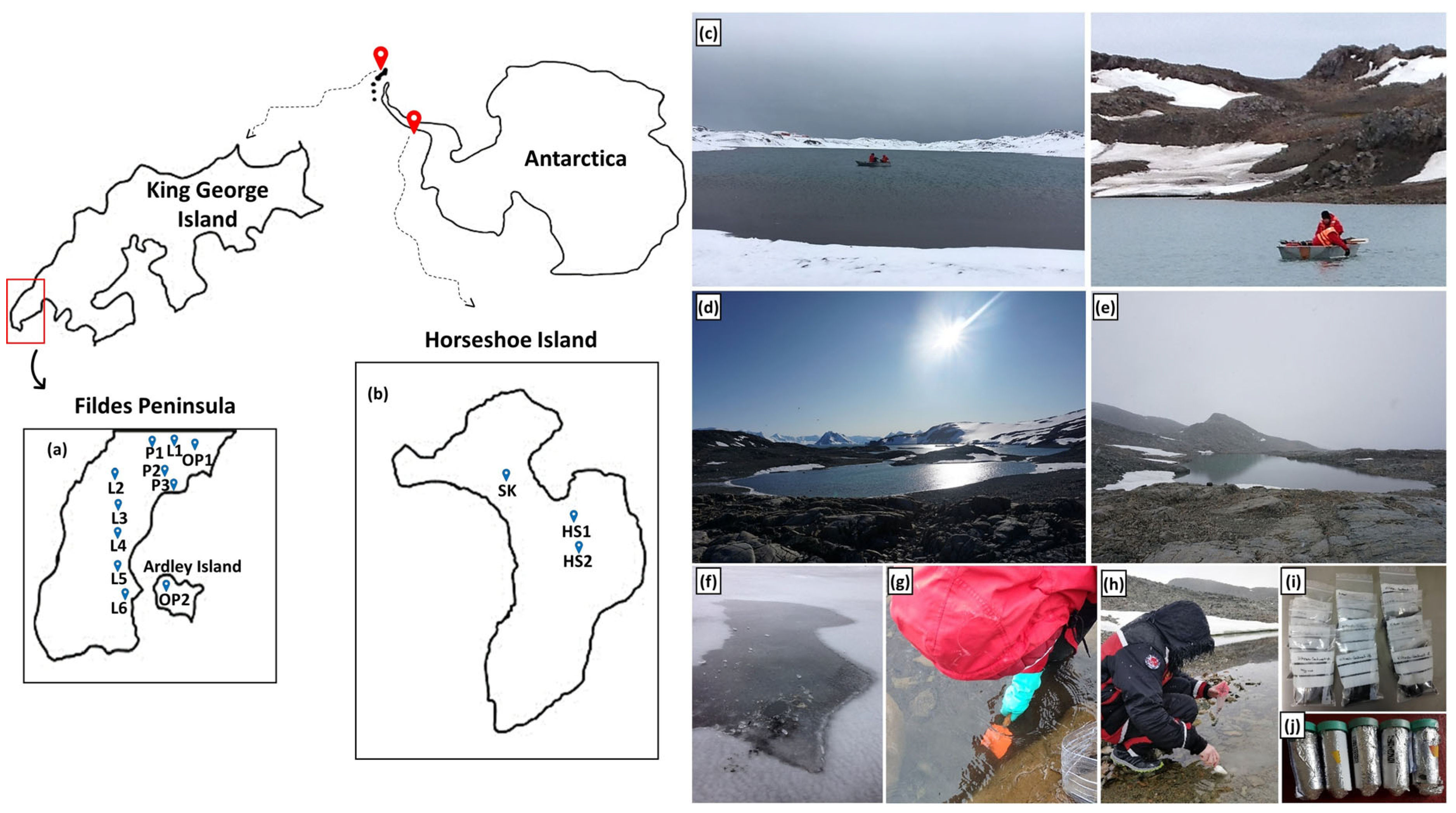
2.1. Study Site
2.2. Sampling
2.3. Morphological Analyses with LM and SEM
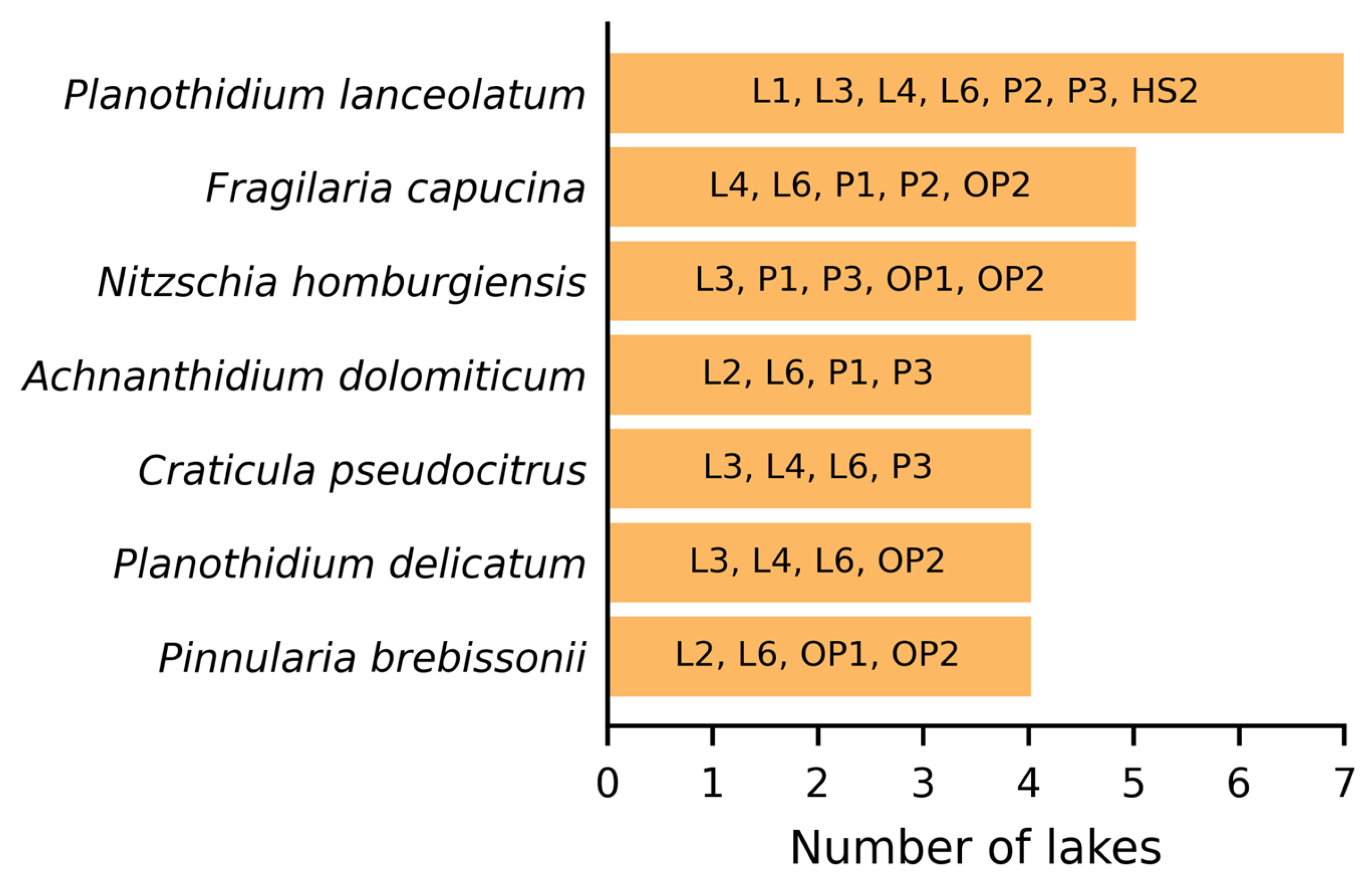
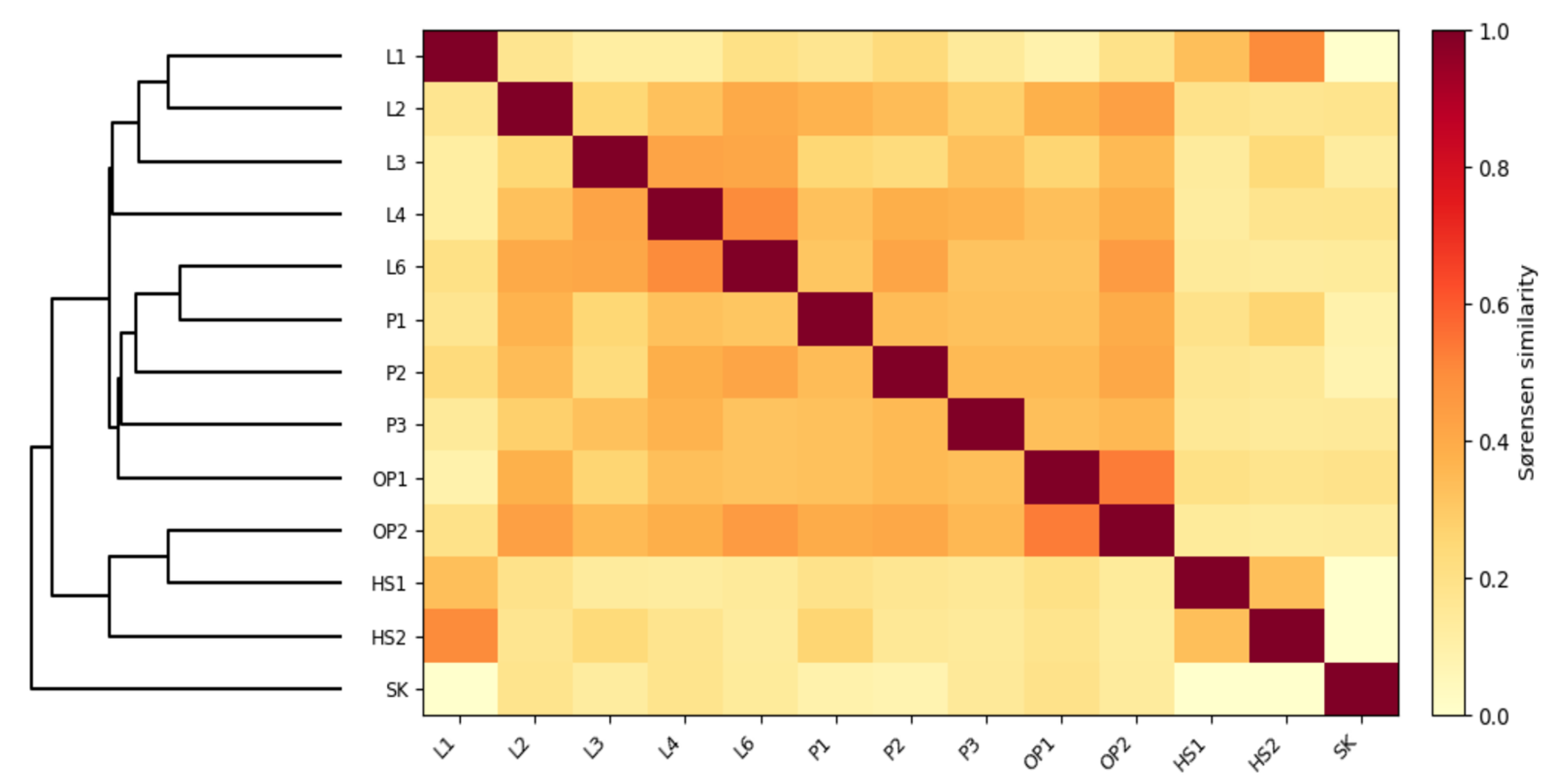
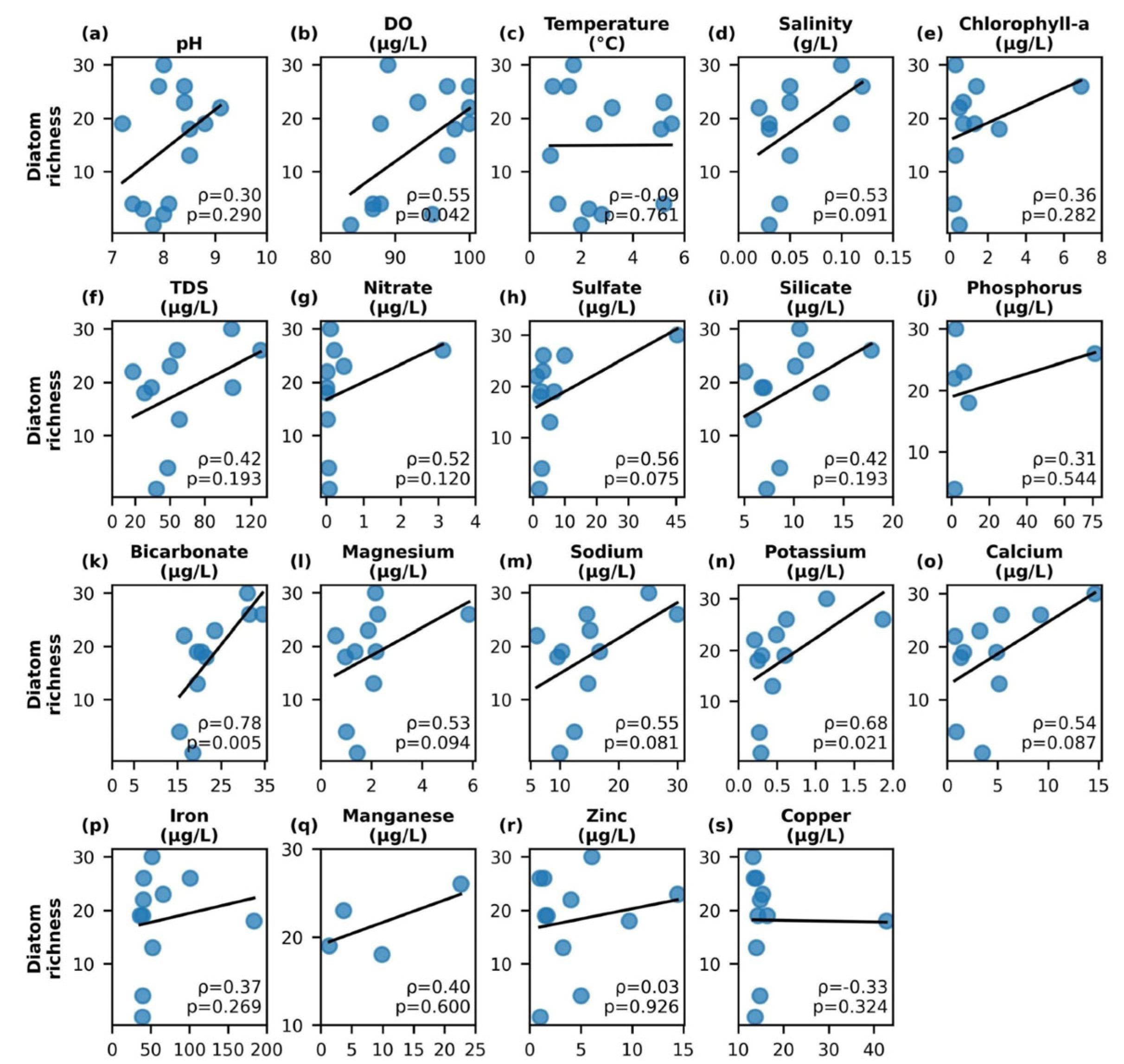
3. Results
4. Discussion
5. Conclusions
Supplementary Materials
Author Contributions
Funding
Data Availability Statement
Acknowledgments
Conflicts of Interest
Abbreviations
| Mn | Manganese |
| Fe | Iron |
| Mo | Molybdenum |
| Co | Cobalt |
| Cu | Copper |
| Zn2+ | Zinc |
| N | Nitrogen |
| Na | Sodium |
| Mg2+ | Magnesium |
| Si | Silica |
| P | Phosphorus |
| Ca2+ | Calcium |
| K+ | Potassium |
| HCO3− | Bicarbonate |
| NO3− | Nitrate |
| NH4+ | Ammonium |
| Chl-a | Chlorophyll-a |
| HNLC | High-nutrient low-chlorophyll |
| OP1, OP2 | Organic Pond |
| P1, P2, P3 | Ponds |
| HS1, HS2 | Horseshoe-1, Horseshoe-2 |
| SK | Skua Lake |
| TAE | Turkish Antarctic Expedition |
| PC | Polycarbonate |
| DO | Dissolved oxygen |
| TDS | Total dissolved solids |
| ORP | Oxidation-reduction potentials |
| Tem. | Temperature |
| Salin. | Salinity |
| Con. | Conductivity |
| ICP-MS | Inductively coupled plasma mass spectrometer |
| LM | Light microscopy |
| SEM | Scanning electron microscope |
| UV-Vis | Ultraviolet–visible |
| DNA | Deoxyribonucleic acid |
| RNA | Ribonucleic acid |
| NA | Not available |
| cf. | Compare with |
| sp. | Unspecified species, genus level |
| UPGMA | Unweighted Pair Group Method with Arithmetic Mean |
References
- Field, C.B.; Behrenfeld, M.J.; Randerson, J.T.; Falkowski, P. Primary Production of the Biosphere: Integrating Terrestrial and Oceanic Components. Science 1998, 281, 237–240. [Google Scholar] [CrossRef] [PubMed]
- Mann, D.G. The Species Concept in Diatoms. Phycologia 1999, 38, 437–495. [Google Scholar] [CrossRef]
- Pinseel, E.; Van De Vijver, B.; Wolfe, A.P.; Harper, M.; Antoniades, D.; Ashworth, A.C.; Ector, L.; Lewis, A.R.; Perren, B.; Hodgson, D.A.; et al. Extinction of Austral Diatoms in Response to Large-Scale Climate Dynamics in Antarctica. Sci. Adv. 2021, 7, eabh3233. [Google Scholar] [CrossRef] [PubMed]
- Thalasso, F.; Sepulveda-Jauregui, A.; Cabrol, L.; Lavergne, C.; Olgun, N.; Martinez-Cruz, K.; Aguilar-Muñoz, P.; Calle, N.; Mansilla, A.; Astorga-España, M.S. Methane and Carbon Dioxide Cycles in Lakes of the King George Island, Maritime Antarctica. Sci. Total Environ. 2022, 848, 157485. [Google Scholar] [CrossRef]
- Ahumada, D.; Schwob, G.; Osorio, M.; Astorga, M.S.; Lavergne, C.; Olgun, N.; Thalasso, F.; Poulin, E.; Orlando, J.; Cabrol, L. Higher Variability of Bacterial Communities across Space than over Time in Antarctic Lakes, and Contrasting Assembly Processes. Appl. Environ. Microbiol. 2025, 91, e01079-25. [Google Scholar] [CrossRef]
- Prelle, L.R.; Schmidt, I.; Schimani, K.; Zimmermann, J.; Abarca, N.; Skibbe, O.; Juchem, D.; Karsten, U. Photosynthetic, Respirational, and Growth Responses of Six Benthic Diatoms from the Antarctic Peninsula as Functions of Salinity and Temperature Variations. Genes 2022, 13, 1264. [Google Scholar] [CrossRef]
- Giri, T.; Goutam, U.; Arya, A.; Gautam, S. Effect of Nutrients on Diatom Growth: A Review. Trends Sci. 2022, 19, 1752. [Google Scholar] [CrossRef]
- Torstensson, A.; Jiménez, C.; Nilsson, A.K.; Wulff, A. Elevated Temperature and Decreased Salinity Both Affect the Biochemical Composition of the Antarctic Sea-Ice Diatom Nitzschia Lecointei, but Not Increased pCO2. Polar Biol. 2019, 42, 2149–2164. [Google Scholar] [CrossRef]
- Olgun, N.; Tarı, U.; Balcı, N.; Altunkaynak, Ş.; Gürarslan, I.; Yakan, S.D.; Thalasso, F.; Astorga-España, M.S.; Cabrol, L.; Lavergne, C.; et al. Lithological Controls on Lake Water Biogeochemistry in Maritime Antarctica. Sci. Total Environ. 2024, 912, 168562. [Google Scholar] [CrossRef]
- Yücel, M.; Alımlı, N.; Demir, N.Y.; Cura, H. Plume Particle Ejecta Can Trace Habitat-Forming Gradients in Ocean Worlds: Insights from Planet Earth Geochemistry. Planet. Sci. J. 2025, 6, 104. [Google Scholar] [CrossRef]
- Osterholz, H.; Simon, H.; Beck, M.; Maerz, J.; Rackebrandt, S.; Brumsack, H.-J.; Feudel, U.; Simon, M. Impact of Diatom Growth on Trace Metal Dynamics (Mn, Mo, V, U). J. Sea Res. 2014, 87, 35–45. [Google Scholar] [CrossRef]
- Pankowski, A.; McMinn, A. Iron Availability Regulates Growth, Photosynthesis, and Production of Ferredoxin and Flavodoxin in Antarctic Sea Ice Diatoms. Aquat. Biol. 2009, 4, 273–288. [Google Scholar] [CrossRef]
- Wolfe-Simon, F.; Starovoytov, V.; Reinfelder, J.R.; Schofield, O.; Falkowski, P.G. Localization and Role of Manganese Superoxide Dismutase in a Marine Diatom. Plant Physiol. 2006, 142, 1701–1709. [Google Scholar] [CrossRef] [PubMed]
- Rosko, J.J.; Rachlin, J.W. The Effect of Copper, Zinc, Cobalt and Manganese on the Growth of the Marine Diatom Nitzschia Closterium. Bull. Torrey Bot. Club 1975, 102, 100. [Google Scholar] [CrossRef]
- Glibert, P.M. Iron and the Anemic High-Nutrient-Low-Chlorophyll Oceanic Regions. In Phytoplankton Whispering: An Introduction to the Physiology and Ecology of Microalgae; Springer International Publishing: Cham, Switzerland, 2024; pp. 359–381. ISBN 978-3-031-53896-4. [Google Scholar]
- Kejna, M.; Araźny, A.; Sobota, I. Climatic Change on King George Island in the Years 1948–2011. Pol. Polar Res. 2013, 34, 213–235. [Google Scholar] [CrossRef]
- Simões, J.C.; Bremer, U.F.; Aquino, F.E.; Ferron, F.A. Morphology and Variations of Glacial Drainage Basins in the King George Island Ice Field, Antarctica. Ann. Glaciol. 1999, 29, 220–224. [Google Scholar] [CrossRef]
- Al-Handal, A.; Sullivan, M.J.; Frankovich, T.A.; Wulf, A.K. Two New Species of Pseudogomphonema (Bacillariophyceae: Naviculales) from King George Island, Antarctica. Bull. Mar. Sci. 2025, 101, 1865–1876. [Google Scholar] [CrossRef]
- Schimani, K.; Abarca, N.; Skibbe, O.; Mohamad, H.; Jahn, R.; Kusber, W.-H.; Campana, G.L.; Zimmermann, J. Exploring Benthic Diatom Diversity in the West Antarctic Peninsula: Insights from a Morphological and Molecular Approach. Metabarcoding Metagenomics 2023, 7, 339–384. [Google Scholar] [CrossRef]
- Kopalová, K.; Kociolek, J.P.; Lowe, R.L.; Zidarova, R.; Van De Vijver, B. Five New Species of the Genus Humidophila (Bacillariophyta) from the Maritime Antarctic Region. Diatom Res. 2015, 30, 117–131. [Google Scholar] [CrossRef]
- Kopalová, K.; Zidarova, R.; Van De Vijver, B. Four New Monoraphid Diatom Species (Bacillariophyta, Achnanthaceae) from the Maritime Antarctic Region. Eur. J. Taxon. 2016, 217, 1–27. [Google Scholar] [CrossRef]
- Zimmermann, J.; Glöckner, G.; Jahn, R.; Enke, N.; Gemeinholzer, B. Metabarcoding vs. Morphological Identification to Assess Diatom Diversity in Environmental Studies. Mol. Ecol. Resour. 2015, 15, 526–542. [Google Scholar] [CrossRef] [PubMed]
- Bailet, B.; Bouchez, A.; Franc, A.; Frigerio, J.-M.; Keck, F.; Karjalainen, S.-M.; Rimet, F.; Schneider, S.; Kahlert, M. Molecular versus Morphological Data for Benthic Diatoms Biomonitoring in Northern Europe Freshwater and Consequences for Ecological Status. Metabarcoding Metagenomics 2019, 3, e34002. [Google Scholar] [CrossRef]
- Schmid, T.; López-Martínez, J.; Guillaso, S.; Serrano, E.; D’Hondt, O.; Koch, M.; Nieto, A.; O’Neill, T.; Mink, S.; Durán, J.J.; et al. Geomorphological Mapping of Ice-Free Areas Using Polarimetric RADARSAT-2 Data on Fildes Peninsula and Ardley Island, Antarctica. Geomorphology 2017, 293, 448–459. [Google Scholar] [CrossRef]
- Yogui, G.T.; Sericano, J.L. Polybrominated Diphenyl Ether Flame Retardants in Lichens and Mosses from King George Island, Maritime Antarctica. Chemosphere 2008, 73, 1589–1593. [Google Scholar] [CrossRef]
- Lupachev, A.V.; Abakumov, E.V.; Goryachkin, S.V.; Veremeeva, A.A. Soil Cover of the Fildes Peninsula (King George Island, West Antarctica). Catena 2020, 193, 104613. [Google Scholar] [CrossRef]
- Dziembowski, M.; Bialik, R.J. The Remotely and Directly Obtained Results of Glaciological Studies on King George Island: A Review. Remote Sens. 2022, 14, 2736. [Google Scholar] [CrossRef]
- Gunes, Y.; Balci, N. Sediment and Water Geochemistry Record of Water-Rock Interactions in King George Island, Antarctic Peninsula. Antarct. Sci. 2022, 34, 58–78. [Google Scholar] [CrossRef]
- Yıldırım, C. Geomorphology of Horseshoe Island, Marguerite Bay, Antarctica. J. Maps 2020, 16, 56–67. [Google Scholar] [CrossRef]
- Oliva, M.; Navarro, F.; Hrbáček, F.; Hernández, A.; Nývlt, D.; Pereira, P.; Ruiz-Fernández, J.; Trigo, R. Recent Regional Climate Cooling on the Antarctic Peninsula and Associated Impacts on the Cryosphere. Sci. Total Environ. 2017, 580, 210–223. [Google Scholar] [CrossRef]
- Matthews, D.W. The Geology of Horseshoe and Lagotellerie Islands, Marguerite Bay, Graham Land. Br. Antarct. Surv. Bull. 1983, 52, 125–154. [Google Scholar]
- Cristóbal, G.; Blanco, S.; Bueno, G. Diatom Taxonomy and Identification Keys. In Modern Trends in Diatom Identification; Springer International Publishing: Cham, Switzerland, 2020; pp. 25–38. ISBN 978-3-030-39211-6. [Google Scholar]
- Krammer, K.; Lange-Bertalot, H. Bacillariophyceae. 5: English and French Translation of the Keys. Engl. Transl. by Nina Bate; French Transl. by Jeanne Bukowska. In Süßwasserflora von Mitteleuropa/Begr. von A. Pascher. Hrsg. von E. Ettl; Spektrum Akad. Verl: Heidelberg, Berlin, Germany, 2000; ISBN 978-3-8274-1030-6. [Google Scholar]
- Round, F.E.; Crawford, R.M.; Mann, D.G. The Diatoms: Biology and Morphology of the Genera; Cambridge University Press: Cambridge, UK; New York, NY, USA; Melbourne, Australia, 1992; ISBN 978-0-521-36318-1. [Google Scholar]
- Cantonati, M.; Kelly, M.; Lange-Bertalot, H.; Hofmann, G.; Werum, M. Bund/Länder-Arbeitsgemeinschaft Wasser. In Freshwater Benthic Diatoms of Central Europe: Over 800 Common Species Used in Ecological Assessment; English edition with updated taxonomy and added species; Koeltz Botanical Books: Schmitten-Oberreifenberg, Germany, 2017; ISBN 978-3-946583-06-6. [Google Scholar]
- Wasell, A.; Håkansson, H. Diatom Stratigraphy in a Lake on Horseshoe Island, Antarctica: A Marine-Brackish-Fresh Water Transition with Comments on the Systematics and Ecology of the Most Common Diatoms. Diatom Res. 1992, 7, 157–194. [Google Scholar] [CrossRef]
- Ferreira Da Silva, J.; Oliveira, M.A.; Paidano Alves, R.; Vestena Cassol, A.P.; Ribeiro Da Anunciação, R.; Pereira Da Silva, E.; Schünemann, A.L.; Batista Pereira, A. Geographic Distribution of Epilithic Diatoms (Bacillariophyceae) In Antarctic Lakes, South Shetland Islands, Maritime Antarctica Region. CheckList 2019, 15, 797–809. [Google Scholar] [CrossRef]
- Vinocur, A.; Maidana, N.I. Spatial and Temporal Variations in Moss-Inhabiting Summer Diatom Communities from Potter Peninsula (King George Island, Antarctica). Polar Biol. 2010, 33, 443–455. [Google Scholar] [CrossRef]
- Al-Handal, A.Y.; Wulff, A. Marine Benthic Diatoms from Potter Cove, King George Island, Antarctica. Bot. Mar. 2008, 51, 51–68. [Google Scholar] [CrossRef]
- Van De Vijver, B.; Zidarova, R.; Sterken, M.; Verleyen, E.; De Haan, M.; Vyverman, W.; Hinz, F.; Sabbe, K. Revision of the Genus Navicula s.s. (Bacillariophyceae) in Inland Waters of the Sub-Antarctic and Antarctic with the Description of Five New Species. Phycologia 2011, 50, 281–297. [Google Scholar] [CrossRef]
- Al-Handal, A.Y.; Torstensson, A.; Wulff, A. Revisiting Potter Cove, King George Island, Antarctica, 12 Years Later: New Observations of Marine Benthic Diatoms. Bot. Mar. 2022, 65, 81–103. [Google Scholar] [CrossRef]
- Guiry, M.D.; Guiry, G.M. AlgaeBase. World-Wide Electronic Publication, University of Galway. 2026. Available online: https://www.algaebase.org (accessed on 8 February 2026).
- Spaulding, S.A.; Esposito, R.; Lubinski, D.J.; Horn, S.; Cox, M.; McKnight, D.M.; Alger, A.S.; Hall, B.; Mayernick, M.; Whittaker, T.; et al. Antarctic Freshwater Diatoms Web Site, McMurdo Dry Valleys LTER. Last Visit. August 2008, 20, 2015. [Google Scholar]
- Contreras, M.; Cabrera, S.; Montecino, V.; Pizarro, G. Dinámica abiótica del lago Kitiesh. Ser. Cient. Ina. 1991, 41, 9–32. [Google Scholar]
- Young, J.; Geisen, M.; Cros, L.; Kleijne, A.; Sprengel, C.; Probert, I.; Østergaard, J. A Guide to Extant Coccolithophore Taxonomy. J. Nannoplankton Res. Spec. Issue 2003, 1, 1–132. [Google Scholar] [CrossRef]
- Verleyen, E.; Hodgson, D.A.; Gibson, J.; Imura, S.; Kaup, E.; Kudoh, S.; De Wever, A.; Hoshino, T.; McMinn, A.; Obbels, D.; et al. Chemical Limnology in Coastal East Antarctic Lakes: Monitoring Future Climate Change in Centres of Endemism and Biodiversity. Antarct. Sci. 2012, 24, 23–33. [Google Scholar] [CrossRef]
- Jones, V.J.; Hodgson, D.A.; Chepstow-Lusty, A. Palaeolimnological Evidence for Marked Holocene Environmental Changes on Signy Island, Antarctica. Holocene 2000, 10, 43–60. [Google Scholar] [CrossRef]
- Beauger, A.; Voldoire, O.; Allain, E.; Gosseaume, P.; Blavignac, C.; Baker, L.-A.; Wetzel, C.E. Biodiversity and Environmental Factors Structuring Diatom Assemblages of Mineral Saline Springs in the French Massif Central. Diversity 2023, 15, 283. [Google Scholar] [CrossRef]
- Stumm, W.; Morgan, J.J. Aquatic Chemistry: Chemical Equilibria and Rates in Natural Waters. In Environmental Science and Technology, 3rd ed.; John Wiley & Sons, Inc.: New York, NY, USA; Chichester, UK; Brisbane, Australia; Toronto, Canada, 1996; ISBN 978-0-471-51185-4. [Google Scholar]
- Drever, J.I. The Geochemistry of Natural Waters: Surface and Groundwater Environments, 3rd ed.; Prentice-Hall: Upper Saddle River, NJ, USA, 1997; ISBN 978-0-13-272790-7. [Google Scholar]


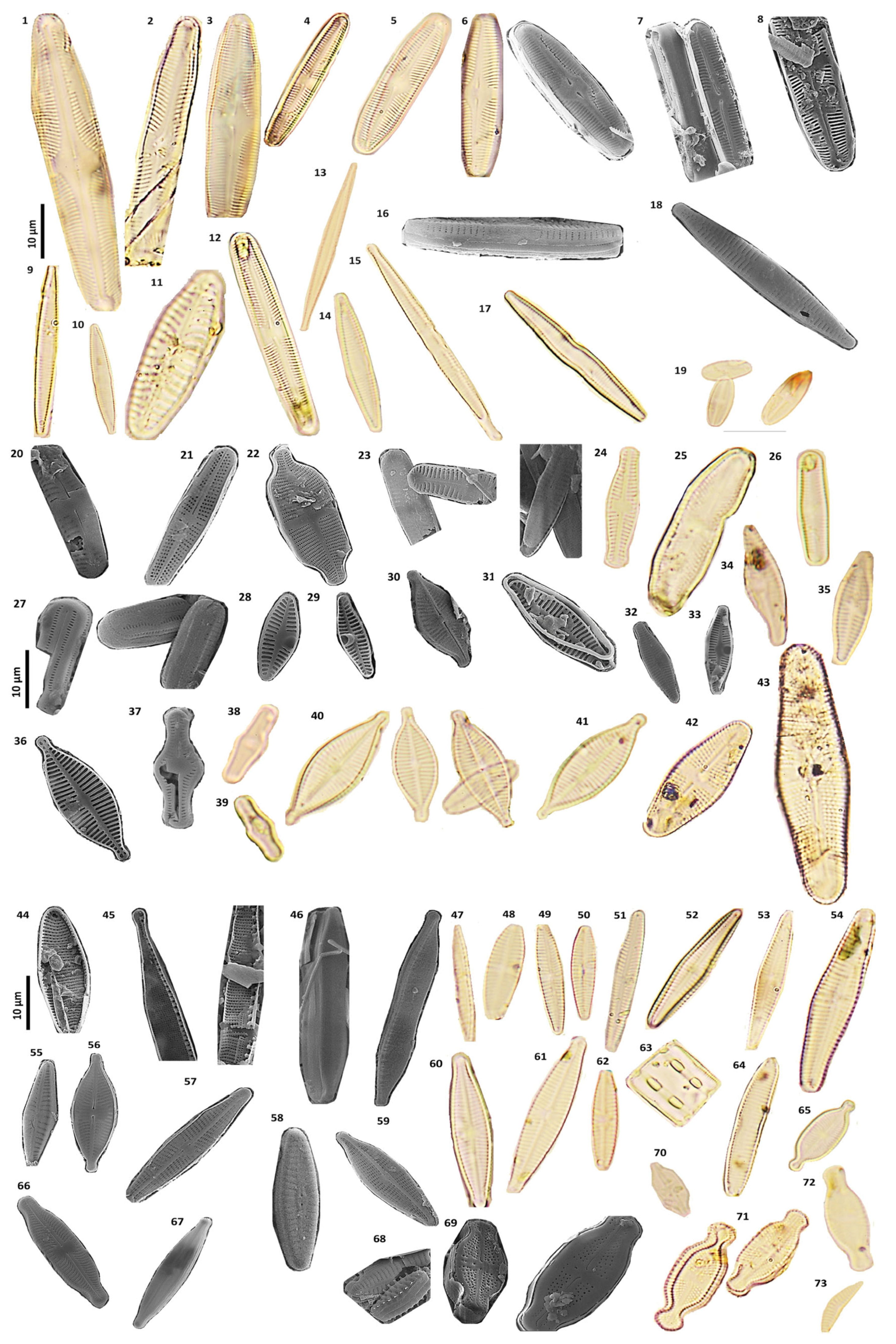
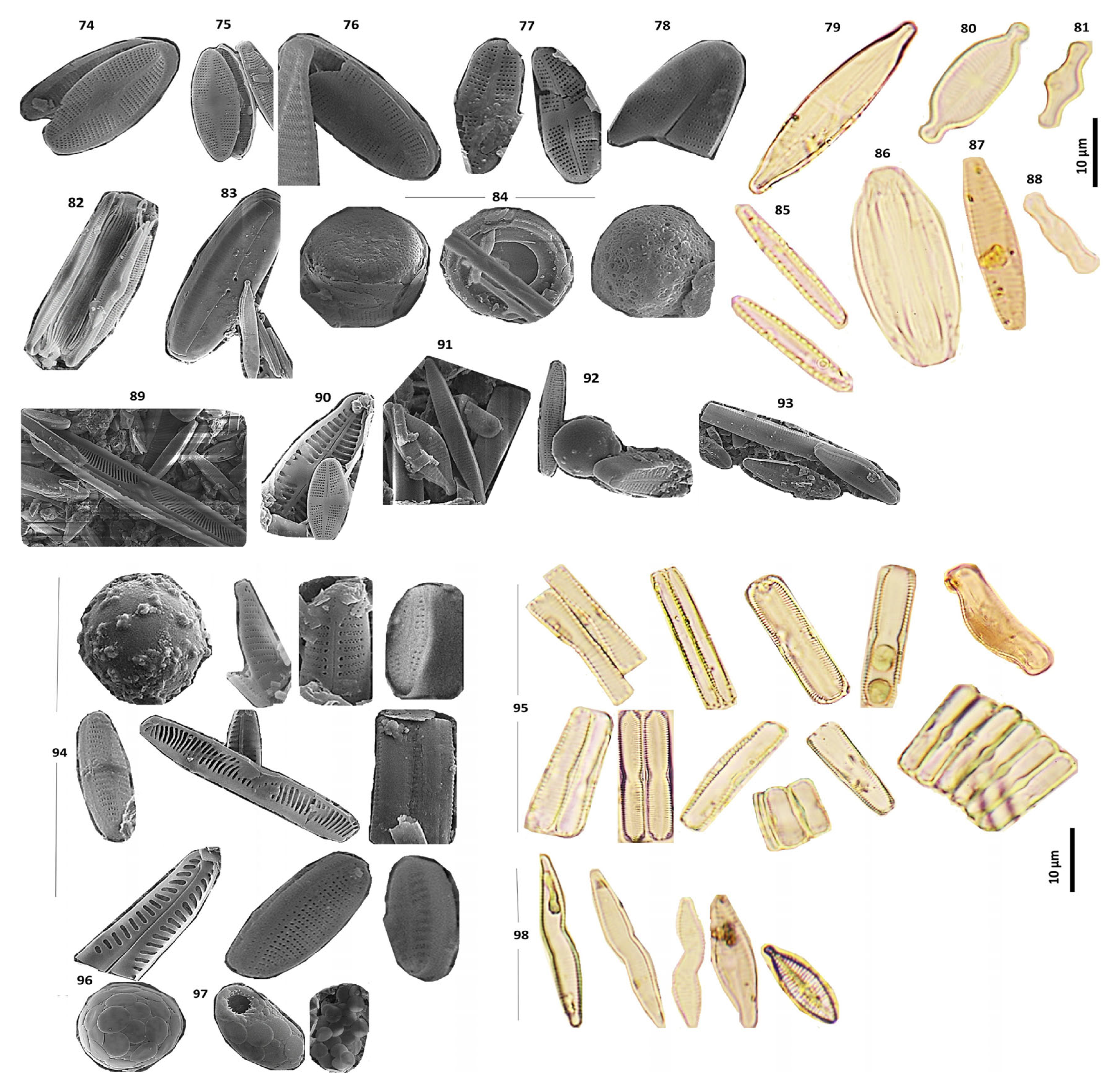


| Sites | Other Name | Short Name | Latitude | Longitude | Sampling Date | Sample Type |
|---|---|---|---|---|---|---|
| King George Island—Fildes Peninsula | ||||||
| Lake 1 | Uruguay | L1 | −62.1853 | −58.9118 | 25 February 2017 | Water, filter |
| 14 January 2019 | ||||||
| Lake 2 | Kitiesh | L2 | −62.1936 | −58.9664 | 19 February 2017 | Water, sediment, filter |
| 17 January 2019 | ||||||
| Lake 3 | - | L3 | −62.2010 | −58.9729 | 2 March 2017 | Water, sediment |
| Lake 4 | Langer | L4 | −62.2050 | −58.9665 | 2 March 2017 | Water, sediment |
| 9 January 2019 | ||||||
| Lake 5 | West | L5 | −62.2172 | −58.9660 | 2 March 2017 | Water, sediment |
| Lake 6 | - | L6 | −62.2210 | −58.9590 | 2 March 2017 | Water, sediment |
| Pond 1 | - | P1 | −62.1893 | −58.9295 | 25 February 2017 | Water, sediment |
| Pond 2 | - | P2 | −62.1920 | −58.9417 | 25 February 2017 | Water, sediment |
| - | −62.2210 | −58.9590 | 9 January 2019 | |||
| Pond 3 | - | P3 | −62.1944 | −58.9486 | 25 February 2017 | Water, sediment |
| Organic Pond 1 | - | OP1 | −62.1887 | −58.9242 | 25 February 2017 | Water, sediment |
| King George Island—Ardley Island | ||||||
| Organic Pond 2 | - | OP2 | −62.2104 | −58.9410 | 2 March 2017 | Water, sediment, filter |
| −62.2104 | −58.9410 | 16 January 2019 | ||||
| Horseshoe Island | ||||||
| Horseshoe 1 | - | HS1 | −67.22486 | −67.82847 | 21 February 2020 | Water, sediment, filter |
| Horseshoe 2 | - | HS2 | −67.22252 | −67.82569 | 21 February 2020 | Water, sediment, filter |
| Skua Lake | - | SK | −67.18066 | −67.48444 | 27 February 2020 | Water, sediment, filter |
| Sites | pH | DO (%) | Tem. (°C) | Con. (μS cm−1) | Salin. (g/L) | TDS (mg L−1) | Chl-a (µg L−1) | ORP (mV) | Key Nutrients (µg/L) | Key Ions (µg/L) | Key Metals (µg/L) | Diatom Species Richness |
|---|---|---|---|---|---|---|---|---|---|---|---|---|
| L1 (2017) (2019) | 7.4 | 87 | 5.2 | 95 | 0.04 | 48 | 0.2 | NA | NO3−: 0.06 PO43−: <0.001 SO42−: 2.77 Si: 8.57 P: 1.53 | HCO3−: 15.50 Mg: 1.00 Na: 12.44 K: 0.27 Ca: 0.90 | Fe: 39.54 Mn: <1 Zn: 5.02 Cu: 14.76 Ni: <1 | 4 |
| 9.2 | 100 | 4.8 | 122 | 0.06 | 61 | NA | 121 | NA | NA | NA | ||
| L2 (2017) (2019) | 7.2 | 88 | 2.5 | 208 | 0.10 | 104 | 1.3 | NA | NO3−: 0.01 PO43−: <0.001 SO42−: 6.61 Si: 6.76 P: <1 | HCO3−: 20.50 Mg: 2.17 Na: 16.73 K: 0.60 Ca: 4.88 | Fe: 36.20 Mn: <1 Zn: 1.71 Cu: 14.31 Ni: <1 | 19 |
| 11.6 | 101 | 5.1 | 176 | 0.08 | NA | NA | NA | NA | NA | NA | ||
| L3 | 8.5 | 97 | 0.8 | 115 | 0.05 | 58 | 0.3 | NA | NO3−: 0.03 PO43−: <0.001 SO42−: 5.27 Si: 5.93 P: <1 | HCO3−: 19.50 Mg: 2.08 Na: 14.78 K: 0.44 Ca: 5.15 | Fe: 52.50 Mn: <1 Zn: 3.24 Cu: 13.98 Ni: <1 | 13 |
| L4 (2017) (2019) | 8.0 | 89 | 1.7 | 206 | 0.10 | 103 | 0.3 | NA | NO3−: 0.11 PO43−: <0.001 SO42−: 45.35 Si: 10.56 P: 2.21 | HCO3−: 31.00 Mg: 2.15 Na: 25.12 K: 1.14 Ca: 14.61 | Fe: 51.62 Mn: <1 Zn: 6.06 Cu: 13.27 Ni: 1.85 | 30 |
| 9.4 | 112 | 8.9 | 313 | 0.15 | 156 | NA | 141 | NA | NA | NA | ||
| L5 | 7.8 | 84 | 2.0 | 75 | 0.03 | 38 | 0.5 | NA | NO3−: 0.08 PO43−: <0.001 SO42−: 2.03 Si: 7.25 P: <1 | HCO3−: 18.50 Mg: 1.43 Na: 9.97 K: 0.29 Ca: 3.47 | Fe: 39.23 Mn: <1 Zn: 1.02 Cu: 13.72 Ni: <1 | 0 |
| L6 | 7.9 | 97 | 1.5 | 111 | 0.05 | 56 | 1.4 | NA | NO3−: 0.21 PO43−: <0.001 SO42−: 3.19 Si: 11.21 P: <1 | HCO3−: 31.50 Mg: 2.25 Na: 14.55 K: 0.62 Ca: 5.36 | Fe: 40.82 Mn: <1 Zn: 0.99 Cu: 13.52 Ni: <1 | 26 |
| P1 | 8.8 | 100 | 5.5 | 68 | 0.03 | 34 | 0.7 | NA | NO3−: <0.001 PO43−: <0.001 SO42−: 2.58 Si: 7.00 P: <1 | HCO3−: 19.50 Mg: 1.34 Na: 10.33 K: 0.30 Ca: 1.62 | Fe: 39.39 Mn: 1.33 Zn: 1.52 Cu: 16.37 Ni: <1 | 19 |
| P2 (2017) (2019) | 9.1 | 100 | 3.2 | 37 | 0.02 | 18 | 0.5 | NA | NO3−: 0.02 PO43−: <0.001 SO42−: 1.16 Si: 5.05 P: 1.38 | HCO3−: 16.50 Mg: 0.57 Na: 6.04 K: 0.21 Ca: 0.75 | Fe: 40.22 Mn: <1 Zn: 4.02 Cu: 14.86 Ni: <1 | 22 |
| 9.1 | 99 | 7.1 | 103 | 0.05 | 51 | NA | 145 | NA | NA | NA | ||
| P3 | 8.4 | 93 | 5.2 | 100 | 0.05 | 50 | 0.7 | NA | NO3−: 0.47 PO43−: <0.001 SO42−: 3.11 Si: 10.15 P: 6.34 | HCO3−: 23.50 Mg: 1.86 Na: 15.11 K: 0.49 Ca: 3.22 | Fe: 65.96 Mn: 3.69 Zn: 14.41 Cu: 15.34 Ni: <1 | 25 |
| OP1 | 8.5 | 98 | 5.1 | 57 | 0.03 | 28 | 2.6 | NA | NO3−: 0.01 PO43−: <0.001 SO42−: 2.27 Si: 12.76 P: 9.08 | HCO3−: 21.50 Mg: 0.97 Na: 9.62 K: 0.25 Ca: 1.36 | Fe: 183.60 Mn: 9.88 Zn: 9.70 Cu: 42.74 Ni: <1 | 18 |
| OP2 (2017) (2019) | 8.4 | 100 | 0.9 | 256 | 0.12 | 128 | 6.9 | NA | NO3−: 3.12 PO43−: <0.001 SO42−: 9.86 Si: 17.80 P: 76.15 | HCO3−: 34.50 Mg: 5.84 Na: 29.97 K: 1.87 Ca: 9.25 | Fe: 100.88 Mn: 22.62 Zn: 1.37 Cu: 13.96 Ni: 1.29 | 27 |
| 9.3 | 108 | 9.2 | 112 | 0.05 | 56 | NA | 103 | NA | NA | NA | ||
| HS1 | 8.0 | 95 | 2.8 | 108 | NA | NA | NA | NA | NA | NA | NA | 2 |
| HS2 | 8.1 | 88 | 1.1 | 122 | NA | NA | NA | NA | NA | NA | NA | 4 |
| SK | 7.6 | 87 | 2.3 | 158 | NA | NA | NA | NA | NA | NA | NA | 3 |
Disclaimer/Publisher’s Note: The statements, opinions and data contained in all publications are solely those of the individual author(s) and contributor(s) and not of MDPI and/or the editor(s). MDPI and/or the editor(s) disclaim responsibility for any injury to people or property resulting from any ideas, methods, instructions or products referred to in the content. |
© 2026 by the authors. Licensee MDPI, Basel, Switzerland. This article is an open access article distributed under the terms and conditions of the Creative Commons Attribution (CC BY) license.
Share and Cite
Cura, H.; Olgun, N. Diatom Diversity and Its Environmental Drivers in Lakes of King George (62° S) and Horseshoe Islands (67° S) in the Maritime Antarctic. Diversity 2026, 18, 114. https://doi.org/10.3390/d18020114
Cura H, Olgun N. Diatom Diversity and Its Environmental Drivers in Lakes of King George (62° S) and Horseshoe Islands (67° S) in the Maritime Antarctic. Diversity. 2026; 18(2):114. https://doi.org/10.3390/d18020114
Chicago/Turabian StyleCura, Hilal, and Nazlı Olgun. 2026. "Diatom Diversity and Its Environmental Drivers in Lakes of King George (62° S) and Horseshoe Islands (67° S) in the Maritime Antarctic" Diversity 18, no. 2: 114. https://doi.org/10.3390/d18020114
APA StyleCura, H., & Olgun, N. (2026). Diatom Diversity and Its Environmental Drivers in Lakes of King George (62° S) and Horseshoe Islands (67° S) in the Maritime Antarctic. Diversity, 18(2), 114. https://doi.org/10.3390/d18020114