Review

Up-to-Date Biodiversity Changes in the Benthic Communities from the English Channel Under Climatic and Anthropogenic Pressures


by
Jean-Claude Dauvin
Laboratoire Morphodynamique Continentale et Côtière, Université de Caen Normandie, CNRS, UMR 6143 M2C, 24 Rue des Tilleuls, 14000 Caen, France
Diversity 2026, 18(3), 163; https://doi.org/10.3390/d18030163
Submission received: 27 January 2026 / Revised: 26 February 2026 / Accepted: 5 March 2026 / Published: 7 March 2026
(This article belongs to the Special Issue Ecology and Biogeography of Marine Benthos—2nd Edition)

Abstract

Like most of the North Atlantic marine coastal area, the seawater temperature in the English Channel (EC) is showing an increase that began in the middle of the 1980s. Similarly, during the same period, there has been an increase in human activities (extraction of aggregates, harbour sediment dredging and spoil disposal, Offshore Wind Farms). This point of view examines and analyses the changes in biodiversity of benthic species and communities from the EC under climatic and anthropogenic pressures during the four last decades. Four main changes have been recorded: (1) additions to the checklist of benthic species, due to new prospections; (2) changes in the structure of benthic communities, due to human activities; (3) an increase in diversity due to the arrival of non-indigenous species, some of which have effects on the structure of benthic communities; and (4) eastward progression of temperate species, while some boreal species tend to disappear. Situated in temperate mid-latitudes bordering the North-eastern Atlantic, the EC is an excellent open laboratory to observe and understand the impact of climatic change and human activities on marine coastal ecosystems. Today, the increase in seawater temperature and the introduction of non-native species appear to be the main factors that explain the changes in benthic diversity in the EC.

1. Introduction

The English Channel (EC) is a temperate epicontinental sea of the North-eastern Atlantic Ocean, bordered to the north by the United Kingdom and to the south by France (Figure 1). Its maximum depth is 174 m in the Hurd Deep (Fosse de la Hague) and it is characterised by a megatidal regime which creates very large tidal ranges and strong currents along the French coast, while smaller tidal ranges occur along the English coast [1]. As a result of this hydrodynamic regime, the deposition of fine sediments is limited to areas with weak currents, mainly along the bays on the English side of the EC. On the French side, these fine sediments are limited in front of the Seine estuary in the eastern part of the Bay of Seine [2]. Conversely, coarse sediments dominate the superficial cover of the EC, accounting for 80% of its area of 77,000 km2. In this way, the EC offers very diverse benthic habitats, ranging from extensive intertidal zones to offshore areas at greater depths, and from muddy sediment to pebbles and rocky substratum. Located between 48°30′ N and 51°10′ N, the EC is a biogeographical transition zone between the Lusitanian and Boreal provinces and is affected by the balance between the appearance of boreal species during cooling periods and warm temperate species during warming periods [1]. Due to its shallow depth and more enclosed configuration, the eastern part of the EC has a higher temperature amplitude (>10 °C) than the western part, which is largely influenced by the Atlantic waters (<6 °C). Apart from waters off the southern coast of Cornwall, where there is a summer thermocline, the water column in the rest of the EC is vertically homogeneous. The seawater temperature ranges from 5–6 °C to 20 °C in the eastern EC, and from 7–8 °C to 15–16 °C in the western EC. This climatic pattern generates a west-to-east impoverishment of the benthic fauna, due to the disappearance of stenotherm species when the annual temperature amplitude increases from the west to the east [3].
Moreover, the EC is one of the most anthropogenically affected seas worldwide [4,5]. Adding to traditional human activities such as fisheries and maritime traffic, more recent activities are being developed, such as the extraction of aggregates, harbour sediment dredging and spoil disposal, as well as the installation of Offshore Wind Farms (OFW) on both the French and English sides [1,6,7]. The macrobenthos is known to be among the biological compartments most affected by the degradation of the benthic marine environment and is also a good proxy to assess the temporal changes in marine coastal environments [6,7]. Along with most of the North Atlantic marine coastal area, the seawater temperature in the EC shows an increase that began in the mid-1980s, while no important changes in salinity are observed. Similarly, there has been an increase in human activities (extraction of aggregates, harbour sediment dredging and spoil disposal, OFW development) [6]. The aim of this paper is to examine and analyse the changes in biodiversity of the benthic species and communities of the EC under climatic and anthropogenic pressures over the last four decades. This point of view is based on the present knowledge of the impact of climatic changes on benthic species and communities (including some studies on macroalgae) and the impact of anthropogenic activities on macrofauna.

2. General Characteristics of the Benthic Ecosystem Diversity of the EC

2.1. General Pattern

The benthic ecosystems of the EC are subject to three main forcings:
  • Tidal currents and hydrodynamics, distribution of subtidal and intertidal superficial sediments, coastal morphology, alternation of dunes and cliffs, igneous rocks forming cliffs along the coasts of Brittany, North Cotentin and Cornwall (western basin), and chalk cliffs on both sides of the eastern basin [1,2].
  • Human pressures and cumulative effects: fishing, aggregate extraction, maritime traffic, dredge spoil disposal, shellfish farming, and the reef effect of wind turbines [1,4,5,8,9,10,11,12,13].
  • Climate change [14,15,16,17,18,19,20,21,22,23,24,25,26,27]. A tropicalization of the fish communities’ link with a decline in cold-water fish species has been highlighted by [28] in the eastern basin of the EC.

2.2. Faunal Inventories

2.2.1. Zoobenthos

In the EC, there are detailed historical inventories of fauna and flora, due to the research efforts of marine stations since the end of the 19th century. For example, the Roscoff Biological Station, the Plymouth Maritime Laboratory and the Wimereux Marine Station have accumulated numerous qualitative observations on benthic fauna and flora for more than 150 years [29,30,31,32]. More recently, ref. [33] has published the Atlas of the Invertebrates of the Normand–Breton Gulf, listing 2 226 species, the first records of which date back to 1829. This atlas supplements the inventory of species drawn up by Retière at the scale of the Normand–Breton Gulf [34] and by [35] for the invertebrates of the Chausey Islands, which include 769 species. The Catalogue of Invertebrates for the Seine estuary and the eastern part of the Bay of Seine lists 1 425 taxa [36].
Targeted studies on benthic communities in the Bay of Morlaix in northern Brittany, along the coast of Cornwall and in the Bay of Seine have made it possible to detect stability or long-term changes in their faunal composition [18,37,38,39]. Additional information [23,40] is provided by comparisons between the state of benthic communities during campaigns in the years 2000 and 2010 and their description in the 1960s and 1970s [3,41], as well as within the framework of a PhD carried out by [22,42]. The work carried out within the framework of the Interreg CHARM programme forms part of this new type of prospection, which is mainly carried out in the central basin of the EC [43,44].

2.2.2. High Heritage Habitats

In addition to research on extended spatial and temporal scales, targeted studies on habitats of high heritage value have also been carried out over the last few years. Pezy et al. [45] have studied the fauna associated with the Zostera marina Linnaeus, 1753 seagrass beds on the western coast of the Cotentin and have identified 150 taxa. The honeycomb reef structures bio-constructed by the polychaete Sabellaria alveolata (Linnaeus, 1767) represent a highly biodiverse habitat, with about one hundred taxa recorded on the west coast of the Cotentin [46,47,48]. Raoux et al. [49] have studied the spring vagile fauna around the Cotentin coast associated with the introduced algae Sargassum muticum (Yendo) Fensholt, 1955. Leclerc [50] has identified 462 faunal taxa in the North Brittany kelp forests, including 108 arthropods, 98 annelids, 73 molluscs and 56 bryozoans. Salland et al. [51] have investigated the structure and diversity of macroinvertebrate assemblages associated with the little-studied pseudo-kelp Saccorhiza polyschides (Lightfoot) Batters, 1902, of Plymouth Bay in the Western EC. The rich and abundant macroinvertebrate fauna comprises nine phyla, 28 broad taxonomic groups and 57 species of molluscs, which consistently dominate the assemblages. Maerl beds formed by the accumulation of red calcareous algae are present in shallow subtidal areas and are well developed along the coasts of northern Brittany, Cornwall and the Normand–Breton Gulf [52]. This benthic habitat is known to host a very rich fauna, with [53] reporting a total of 600 taxa of invertebrates for the Brittany maerl beds alone.

2.2.3. Soft-Bottom Communities and Suprabenthos

Based on dredge sampling of 14 sediment enclave stations in the Raz Blanchard area, [54] identified a diverse mobile fauna in this highly hydrodynamic environment, listing 140 taxa, including amphipod crustaceans and polychaetes, which dominate the assemblages in terms of the number of taxa. Baux et al. [55] list 123 invertebrate taxa in Cherbourg Harbour, while [56] note that 336 taxa are recorded from the sediment enclaves of the north Cotentin coast. The [57] update of the amphipod checklist for the EC provides new data on the distribution of this group of benthic invertebrates. Navarro-Barranco et al. [58] have studied the long-term dynamics in a soft-bottom amphipod community off Plymouth Bay.
Many target studies have been carried out on the suprabenthos, leading to an increase in our knowledge of the distribution of peracarid and decapod vagile species [59,60,61,62] on the scale of the EC. This biological compartment corresponds to the swimming fauna occurring on the benthic boundary layer at the interface between the benthos and the pelagos.

2.2.4. Hard-Bottom Communities

Hard-bottom communities have recently been studied along the French coast of the EC, mainly in harbours or on artificial structures, such as for the identification of fouling communities in Brittany harbours [63], as well as on Ficopomatus enigmaticus (Fauvel, 1923) reefs in Normandy harbours [64] and on artificial blocks in the intertidal zone at Luc-sur-Mer (Calvados) [65,66]. The diversity and structure of epibenthic communities have been studied across a range of subtidal natural and artificial hard habitats in the Bay of Cherbourg [67]. Long-term changes in the geographic distribution and population structures of hard-bottom species off the coast of Cornwall (UK) had been studied by [19,20,21].

2.2.5. Non-Indigenous Species

For two decades, numerous studies have been carried out on the census of non-indigenous species (NIS) on both sides of the EC: [68,69] for the English side and [70,71,72,73,74] for the French side.

2.2.6. Impact of Aggregate Extraction

Studies on the impact of aggregate extraction on benthic communities have also increased our knowledge of offshore coarse-sediment habitats [75,76,77], while other studies on the impact of dredge spoil disposal in the eastern Bay of Seine have improved our understanding of colonisation processes and the resilience of soft-bottom benthic communities in this part of the EC [6,7,78,79,80], in spite of changes in sediment supply with an increase in fine particles due to inputs from the Seine [81].

2.2.7. Microfauna Studies

With regard to the microfauna, Ostracoda and Foraminifera have also been the subject of research in recent decades. Ostracoda have been studied in the downstream part of the Seine estuary and the eastern Bay of Seine [82]. Benthic foraminifera were the subject of a synoptic study in the 1960s and 1970s by [83,84], and have attracted renewed interest in connection with their ability to respond to anthropogenic pressures: in particular, enrichment of organic matter, either in connection with salmon farming [85] or in harbour and estuarine environments [86,87].
For the EC as a whole, the biodiversity of benthic marine invertebrates would be around 3000 species. Documented changes in the spatial distribution and arrivals of NIS, even though they make up a low percentage of the total number of species (about 5%), tend to increase the biodiversity of the benthic communities from the EC.

2.3. Sea Water Temperature Changes in the English Channel

Cornes et al. [88] have analysed the impacts of climate change on sea temperature around the UK and Ireland and in regional areas included within the limits of the EC. The sea surface temperature (SST) around the UK shows a significant warming trend of around 0.3 °C per decade over the last 40 years, i.e., 1.2 °C since the end of the 1980s. The Western EC is mainly influenced by the inflow of North Atlantic water from the west. The strength of tidal currents governs stratification in the spring and summer off the southern coast of Cornwall, with deep mixing occurring in the autumn and winter. However, in the rest of the EC basin, there is a permanent mixing of water. One station of the Western Channel Observatory has been sampled since 1903, and records taken at a depth of 75 m show evidence of enhanced warming at the end of the 1980s [88]. Average or below average temperatures in the early 1980s were replaced by warmer than average waters upon resumption of sampling. However, it is noteworthy that the coldest anomaly of the series occurred in 2006 (−2.09 °C relative to the 1991 to 2020 average). SST values in more recent years have been slightly higher than average. Sea surface temperatures in the Eastern EC displayed no significant trend until the mid-1990s, after which the temperatures began to increase. The ten warmest years were all recorded after 1989, with the peak being recorded in 2015 when the temperature was 1.9 °C above the 1991 to 2015 average. A similarly high annual mean temperature anomaly of 1.8 °C was recorded in 2007.

3. Results and Discussion

3.1. Addition of Species Due to Recent Studies

3.1.1. Microfauna

Contrary to the macrofauna [40,89,90,91,92], our knowledge of the microfauna has remained insufficient. The first inventory of ostracods from the eastern part of the Bay of Seine was published by [82]. A total of 116 species has been identified, showing that this part of the EC is rich in comparison to areas located further north, such as the North Sea, or further south, in the Bay of Biscay. The species are considered as epineritic and most of them are known from the southern coast of England. From a biogeographical point of view, the ostracods of the Bay of Seine can be divided into two main groups: firstly, boreal species, which are not recorded south of the EC, and secondly, species with a large biogeographical range, which are known from the Norwegian coast of the North Sea to the Bay of Biscay, as well as to the Mediterranean Sea and the coast of Morocco. The fossil species Semicytherura arcachonensis Yassini, 1969 is mentioned for the first time in the EC, while the species Bairdia subcircinata (Brady & Norman, 1889) (Neonesidea subcircinata (Brady & Norman, 1889) is the first Bairdia to be found alive at these shallow depths in the EC.
Similarly, the geographical distribution of Foraminifera at the scale of the EC has been explored by [83,84], who has summarised data collected from sampling stations first used by L. Cabioch and his team between 1972 and 1976 during an exploratory phase for studying the benthic communities of the EC [92]. Rosset-Moulinier [83,84] shows that the distribution of Foraminifera is linked to sediment types ranging from sand to gravel, as well as being related to bathymetry and the annual amplitude of temperature. No new species for the EC have been mentioned by this latter author.
More recently, ref. [93] studied the living foraminifera from seasonal sampling carried out from 2008 to 2011 in the eastern Bay of Seine in the same area covered by [82] that has been sampled regularly from 1986 onwards (see [39]). A relatively low-diversity assemblage of benthic foraminifera was recovered as a response to the variable habitat conditions within the estuary and seasonal events. A total of 33 species were found alive, with maximum diversity never exceeding 19 species at any one site. Diversity tends to increase with the distance to the river mouth and, in particular, at positions off the estuary axis; moreover, no new Foraminifera species were noted in this study.
Bouchet et al. [85] have studied the impact of salmon fish farming on the diversity of benthic foraminifera living in the Rade de Cherbourg, based on collections from 13 stations within and outside the farm. More than 20 species have been identified, with two main assemblages being identified in relation to the increase in organic matter, due to the fish farming activity. Again, no new species were reported for the EC. Bouchet et al. [86] and Pavard et al. [87] have studied the Foraminifera populations of the harbours of the eastern part of the EC.

3.1.2. Suprabenthic Fauna

The suprabenthos corresponds to the fauna having swimming capacity at the interface between the benthic and pelagic habitats; the use of a Macer-Giroq Station Biologique de Roscoff sledge constructed at Saint-Pol-de-Léon France by CSM Quéméner, is required to sample organisms from 0.10 to 1.45 m above the sea bed [61]. This type of sledge was deployed at five circalittoral sites during spring 1993 and autumn 1994, allowing for the collection of about 300 species or taxa. Among them, 64 species (40 amphipods, 9 mysids, 6 decapods, 5 cumaceans, 3 pyconogonids and one isopod) are added to the lists of Marine Fauna from Roscoff (9 species), Plymouth (17 species), Wimereux (52 species), and the Bay of Seine (7 species). It is clear that new sampling techniques can be used to improve our knowledge of the geographic distribution of benthic species in the EC.

3.2. Changes in Diversity Due to Anthropogenic Activities

3.2.1. Impact of Trawling

Foveau et al. [94] have compared the outputs of a process-driven benthic habitat sensitivity model to the structure, composition and distribution of benthic invertebrates in the eastern EC and southern part of the North Sea. Trawl disturbance indicators have been computed from species’ biological traits and the benthic community composition was assessed from samples collected with a bottom trawl. The trawl disturbance indicator was found to be highly correlated to the process-driven sensitivity, which was found to reflect an environmental potential that may no longer be fully observable in the field. The difference in in situ biological observations could be partially explained by the spatial distribution of fishery pressure on the seafloor. The risk map combined the process-driven sensitivity of benthic habitats and associated communities to trawling damage. Low risk was found in the coastal sandy habitat of the Bay of Seine, while the offshore coarse sediment covering a major part of the EC can be considered to be associated with medium to high risks.
The EC has been subject to high fishing intensity for many decades. The IPREM project aimed to provide a state of knowledge on the impact of trawl dragging on benthic habitats [95]. Its effects are expressed at the physical level by morphological modifications of the seabed caused by the remobilisation of sediments, such as the digging of furrows and their homogenisation. The effects of trawling depend on the penetration of the gear into the sediment and the extent of the surface swept per hour of fishing, and also on the repetition of the passage of the gear and the very nature of the seabed. It seems that the highly hydrodynamic nature of the EC confers good resistance to the benthic communities present. This could explain why, over the years and with the pressure of trawler fishing, there have not been any major changes in benthic and fishery habitats. The habitats are constantly subject to natural physical disturbances: strong tidal currents and strong meteorological disturbances. However, it must be taken into consideration that the EC is a highly anthropogenic sea, and it has been affected by a high intensity of multiple human activities, including fishing, for several centuries. The benthic communities could adapt themselves to this situation, or could even be renewed, and so would therefore become resistant. Thus, it remains a real scientific challenge to disentangle the effects of natural disturbances from anthropogenic disturbances.

3.2.2. Harbour Construction

The development of infrastructure (2000–2005) along the Seine estuary during the “Port 2000” programme has led to the extension of the Le Havre Harbour. Nevertheless, the study by [96] concludes that the abundances of benthic and suprabenthic assemblages in the studied area are within the normal range of spatial and/or temporal variability encountered in the Bay of Seine. This is in contrast to the expected results, given the surface area under consideration. But, as underlined by [97], although estuaries are exploited and often destroyed by human activities, estuarine habitats remain among the most resilient habitats on Earth, maintaining their attractiveness for wildlife, despite industrialisation and land reclamation.
The suprabenthos of the North Channel of the Seine Estuary has been studied from 2001 to 2015. This long-term study shows an increase in biodiversity due to marine influence associated with the penetration of marine species in the upstream part of the channel, along with a major reduction in abundance and biomass [98]. Again, in estuarine environments, it is difficult to separate natural and anthropogenic effects in such complex ecosystems, leading to the concept known as the ‘Estuarine Quality Paradox’ [99].

3.2.3. Dredging and Harbour Sediment Disposal as a Factor Promoting Expansion and Settlement of Macrobenthic Species

Sternapis scutata (Ranzani, 1817) is a polychaete worm living in sandy and muddy infralittoral habitats at 10 to 40 m depth. It geographical range covers the Mediterranean Sea and the temperate North-eastern Atlantic Ocean, extending as far as the mud community in the northern Bay of Biscay. Its first record in the EC at Portland harbour dates to 1997. Then, in 2004–2005, the species was observed by [100] at three other sites on the English coast: in South Devon from Plymouth Sound to Otterton Point, and in Dorset at Portland Harbour. These authors did not determine whether these new records were the result of a natural westward movement in contrast to the residual drift of currents or linked to human activities such as port dredging or spoil disposal. Indeed, dredgers move from harbour to harbour and can keep sediment in their hold that is later discharged in another harbour.
Similarly, human transport can be suggested for the colonisation of the tube-like muddy polychaete Melinna palmata Grube, 1870, in the eastern Bay of Seine [101]. M. palmata was first recorded in 2002 in the eastern Bay of Seine, where there have been regular benthic sampling campaigns since 1986 [39,98,99] which allow us to constrain this first record at this precise year. Known along the Brittany coast from the Bay of Morlaix to the Rance river, the species is also present in the Rade de Cherbourg [55]. This arrival could be due to the activities of a trailing suction hopper dredger moving from western harbours to the Bay of Seine. Since 2002, M. palmata has rapidly extended its population to reach densities of 277 ind. m−2 in March 2006 and between 625 and 2500 ind.m−2 in September 2008 and September 2009, in parallel with the increased silting-up of the bay; 32% of the stations were colonised with a mean abundance of 800 ind.m−2 in 2008 and 450 ind.m−2 in 2009 [81,98,100]. In the inner basin of the Le Havre Harbour, M. palmata is present at the five sampling stations and shows a maximum abundance of 1470 ind.m−2 at station H4 in September 2009 and 1360 ind.m−2 in H4 in April 2021 (unpublished data). These values are higher than those found by [38] in the muddy-fine sand of the Bay of Morlaix (from 190 to 725 ind.m2) but remain lower than the abundances found at two stations in the maritime basin of the Rance (maximum of 2227 and 3500 ind.m2 [55]). Since 2011, M. palmata is ranked amongst the 10 most abundant taxa but has not significantly altered the community structure nor its spatial organisation over the last three decades, according to a recent description of benthic habitats in the Bay of Seine. Moreover, Baffreau et al. [102] have described a “Melinna palmata sandy mud community” as very muddy facies (fine particles > 25%) of the Abra alba muddy fine sand community. This subtidal community belongs to A5.334 of the EUNIS habitat classification and extends northward to Antifer harbour and eastward to Ouistreham and is now dominated by the polychaete M. palmata in association with the polychaetes Magelona spp., Euclymene oerstedii (Claparède, 1863) and Nephtys hombergii Savigny in Lamark, 1818 ([102]; unpublished data). In the inner basins of Le Havre Harbour; it is associated with the NIS polychaeta Euchone limicola Reish, 1959 and other polychaetes that are characteristic of this mud habitat.
A BACI approach has been adopted to assess the bio-sedimentary changes at two experimental MACHU dumping sites (MASED and MABIO) on the Bank of Seine at depths of 12–20 m in the eastern part of the Bay of Seine on fine-to-medium sands [6]. Sampling was carried out before, during and after the one-year experiment (2012–2013). For both the MASED and MABIO sites, the results show that, after the cessation of a perturbation (dredge spoil disposal) on a benthic habitat, the ecosystem recovers rapidly over two years to the state observed before the disturbance, thus illustrating the high resilience of benthic communities in this part of the EC [6,7].
Similarly, contrary to results obtained in many coastal areas, the long-term study of benthic communities of the eastern Bay of Seine shows the long-term persistence of species composition and structure in spite of the accumulation of several human activities in this part of the EC (dredge sediment disposal, aggregate extraction, Le Havre Harbour extension), although a general shift towards muddy sediment has resulted in an increased colonisation by species associated with muddy habitats [39,81,103,104].

3.2.4. Marine Aggregate Extraction

Despite the abundance of this resource, marine aggregate extraction remains of minor importance on the French side of the EC, while, on the English side, this activity is more developed [1]. The effects of marine aggregate extraction on the benthic communities of the EC are well documented—see [75,76,77] for reviews. Extraction impacts the physical environment with the formation of more or less extensive dredge furrows, which are typically filled with finer sediments compared to the surrounding areas. The significance of the impact on the ecology of the seabed is variable, depending on the extraction intensity and site-specific characteristics. Studies of benthic recovery following aggregate extraction show that, once the disturbance on the seafloor has ceased, benthic fauna will colonise the substrate according to a classic dynamic succession model. The duration of this recovery will vary between two and seven years, depending on the location of the extraction site and the volume of aggregate extraction [76]. Most of the studies have been carried out using high-intensity granulate extraction, while [77] have assessed the ecological effects of low-intensity marine aggregate extraction based on two winter sampling campaigns in 2018 and 2023 in a coarse sediment high-energy hydrodynamic environment in the central part of the eastern basin of the EC [76]. The impacted stations showed significantly lower values of Shannon H’ diversity in 2018 and 2023, compared to the unimpacted and secondary impact stations. Thus, it is clear that aggregate extraction has impacted the gravel-coarse sand community, mainly due to the absence of the large bivalve Glycymeris glycymeris (Linnaeus, 1758) at the aggregate extraction stations. However, the affected area is very limited in extent, showing a very localised impact of this human activity on offshore benthic communities.

3.2.5. Offshore Wind Farms

Nowadays, at the beginning of 2026, three OFWs are operational in the EC: the first is Rampion on the English side and two others (Saint-Brieuc and Fécamp) on the French side, while four are under construction and about ten are planned for future decades. At the scale of the French coast, the EC will produce 50% of French offshore wind energy (objective 40 GW in 2050). Before the OFW implementation, the modelling of trophic fluxes based on the ECOPATH model on scenarios for the evolution of the Seine Bay ecosystem, including the reserve effect (absence of fishing inside the farm) and the reef effect (colonisation of foundations by biofouling) was studied by [105] for Courseulles-sur-Mer wind farm. Pezy [106] has studied the structure of the benthic and pelagic compartments of the Dieppe-Le Tréport wind farm ecosystem before its construction. The roles of OWF on the larval dispersal of benthic species in the Bay of Seine and the eastern EC has been studied by [107]. Ajmi et al. [107] simulated connectivity between both parks of Courseulles-sur-Mer and Fécamp. At this regional scale, the simulations highlighted the potential role of OFWs as relay points for biofouling species. The dispersal of larvae released from wind farms has also shown connectivity between the farms themselves and the coasts of the Bay of Seine. Foundation turbine structures can serve as refuges and habitats for different marine organisms, potentially leading to an increase in biodiversity in the surrounding area. Such effects of OWFs on benthic species and habitats from the EC could be identified in the future, during the production phase of marine renewable energy.

3.3. Introduced Species

For three decades, there has been considerable scientific effort to report the NIS present in European waters, mainly in the Mediterranean Sea, but also for northern seas such as the EC (see [70,71,72,73]). Most of the NIS identified in the EC are invertebrates, including sessile and mobile species. The introduction of NIS is mainly due to maritime traffic and aquaculture [70,71,72,73]. The Arthropoda are dominant among the NIS, with three main zoological taxa, including sessile fauna such as barnacles and mobile fauna such as amphipods and decapods [72]. Most of these invertebrate species have a bentho-pelagic development, sometimes with a long larval planktonic phase, which ensures their survival in ballast waters and their dispersal due to strong tidal currents such as those that occur in the EC. But some species, for example amphipods and isopods, have direct development and represent about 10% of the NIS reported in Normandy (13 species, [70]); for these species, hull fouling is probably the major vector of introduction. The main pathways involved in the introduction of NIS in the EC are maritime traffic and aquaculture. For Normandy, Le Havre Harbour is the main site of NIS introduction [72]. Numerous NIS have a Pacific or Indo-Pacific origin (56%) [71]. Fewer originate from the Atlantic, and these are mostly from the north-western Atlantic. Only a few species come from the Mediterranean Sea.
Bouchet et al. [86] recorded the presence of the invasive benthic foraminifera Trochammina hadai Uchio, 1962, for the first time in Europe, in the harbours of Le Havre and Caen-Ouistreham. The native range of distribution of this species is in Asia (Japan and Korea), and it has also been introduced along the coasts of western North America, Brazil and Australia. Then, ref. [87] noted the high abundance of the species Ammonia confertitesta Zheng 1978 in international commercial harbours of the EC (Le Havre and Dunkerque), thus confirming its NIS status in Europe.
Some NIS were introduced at the end of the 19th century, but most of the new NIS reported in the EC were recorded between 1950 and 1999. Moreover, more than 60 NIS have been reported in EC waters since the beginning of the 21st century (Appendix A); while the benthic diversity shows a permanent increase rather than a decrease, no disappearance of species has been documented over the same period [31].
The razor clam Ensis lei M. Huber, 2015 was first recorded in the French waters of the southern part of the North Sea at Gravelines adjacent to the Dover Strait, then it was observed along the Opal coast in the eastern part of the EC and in the eastern Bay of Seine in 1998 [101]. The progression of this NIS in the EC illustrates a particular case linking physical factors and ecology. In fact, the colonisation occurs in the opposite direction of the residual tidal transport from the EC to the North Sea. This is due to the presence of pelagic larvae in the spring during a northerly and north-easterly wind regime, which inverses the residual circulation in this part of the EC. The abundance of E. lei remains low in this part of the EC (<100 ind.m2), while it can reach >1000 ind.m2 in the southern part of the North Sea [39,101].

3.4. Changes in Benthic Habitats Due to Introduced Invasive Species

Some of the NIS are invasive and these invasions have effects on the benthic communities where they are established. In addition, for some of them, these invasive NIS represent consequences and risks for coastal and marine socio-economic activities. In this section, eight NIS are detailed, showing an invasive development, including four socio-economic impacts.

3.4.1. Crepidula fornicata (Linnaeus, 1758)

Along the Normandy coasts, the slipper limpet Crepidula fornicata was first observed at Hermanville-sur-Mer in the department of Calvados and in the Port of Cherbourg soon after the D-day landings in Normandy in 1944 [70]. Since then, there has been a secondary dispersal progression of the species in the EC [108,109]. At present, C. fornicata is widely dispersed along the North-eastern Atlantic coasts from Portugal to Norway and is also present in the Mediterranean Sea [108]. The species prefers the silty mixed substrates present in shallow water, including the lower part of the intertidal zone [110]. One of the major impacts of C. fornicata concerns the structure of the seabed, with shell accumulations covering all the sediment and forming hard substrates that favour certain sessile species, to the detriment of organisms adapted to soft-bottom habitats [110]. Furthermore, the pseudo-faeces produced by C. fornicata increase fine sedimentation and silting, forming black, anoxic, and cohesive sediment that is unsuitable for the other benthic macrofauna. This modification leads to the disappearance of pre-existing local habitats and associated benthic communities. As a filter-feeding species, the proliferation of C. fornicata has been demonstrated to exert a significant influence on the water quality by modifying suspended matter fluxes [104]. Conversely, in soft-bottom environments, its expansion leads to habitat homogenisation and the disappearance of species that are characteristic of fine sediments, such as certain bivalves and echinoderms [104]. Currently, research focuses on modelling benthic invasion and its interaction with the king scallop Pecten maximus (Linnaeus, 1758) [111,112], as well as competition with other suspension feeders. Such changes in the makeup of the local population also have an impact on the ecological balance and cause competition for food with other suspension-feeders such as the naturally occurring king scallop or the warty venus clam Venus verrucosa Linnaeus, 1758 or with cultivated species such as the Japanese oyster Magallana gigas (Thunberg 1793), the manila clam Ruditapes philippinarum philippinarum (Adams and Reeve, 1850) or the blue mussel Mytilus edulis Linnaeus, 1758 [113].
Moreover, the slipper limpet has led to economic and ecological impacts when its densities are high [114]. The costs of the damage caused by this NIS are estimated for Saint-Brieuc Bay [114]. The damage caused by the slipper limpet invasion includes a loss of value of the commercial shellfishery for king scallop P. maximus; a similar phenomenon could occur in the future in the Bay of Seine, where the production of P. maximus is very important for local fisheries.

3.4.2. Euchone limnicola Reish, 1959

Euchone limnicola was reported for the first time from the North Sea coast of France in 2015 inside Dunkirk harbour, then in 2016 in the port of Le Havre [115,116]. E. limnicola is a polychaete that is native to the North Pacific and was introduced to Australia, New Zealand, Tasmania and Europe (UK and France) [115,116]. In the basins of Le Havre Harbour, abundances reached 1910 ind. per m2 in March 1996 and were lower in September with only 600 ind.m2. Later, in the same basins of Le Havre, the maximum abundances were 300 ind. m2 in September 2019 and reached 4500 ind.m2 in April 2021 (personal observations). Abundances therefore show seasonal variations, with the maximum in spring, and show an increase over the five years since the first sampling in 1996. The port environment is a favourable habitat for mud species such as Melinna palmata and E. limnicola in the harbour sands, and this latter NIS has changed the benthic structure of this subtidal muddy community. The species has not been sampled in the EC outside the port of Le Havre.

3.4.3. Ficopomatus enigmaticus (Fauvel, 1923)

This species was described from a specimen found in the ‘Canal de Caen à la Mer’ in Normandy, but its presence is recorded from the north coast of Spain, around the British Isles and as far as Denmark [70]. F. enigmaticus forms very dense populations in sheltered estuarine and lagoon environments where there is a low salinity (<18 psu), such as in the marina of the Port of Ouistreham and along the ‘Canal de Caen à la Mer’, and in other harbours along the southern coast of the Bay of Seine, such as at Courseulles-sur-Mer and Honfleur [64]. In these highly colonised harbours, the organism forms large reefs that can measure several tens of cm in height but which are very fragile and easily damaged by shipping. These reefs are colonised by low numbers of macrofauna, including several NIS [64]. Amongst them, the crab Rhithropanopeus harrisi (Gould, 1941) is the most abundant, with a density higher than >300 individuals per m2.
Like other species that attach to hard substrates such as the zebra mussel, F. enigmaticus can plug pipes, stick to the hulls of boats and cover harbour structures (docks and marinas) requiring their frequent cleaning. However, being a suspension feeder, F. enigmaticus has also a beneficial effect on water quality by reducing the amount of particulate matter in suspension in harbours and brackish waters.

3.4.4. Hemigrapsus sanguineus (De Haan, 1835) and H. takanoi Asakura and Watanabe, 2005

The Asian shore crab Hemigrapsus sanguineus was observed for the first time in 1992, in waters around the harbour at Le Havre. It is now present in the EC, extending from the west coast of the Cotentin Peninsula (Granville) along the Opal coast and up to Dunkerque [117]. Some individuals were also observed around the Channel Islands; it is yet to be found along the southern coast of England. On the other hand, it has been observed at locations ranging from France to the north of Denmark [110]. This shore crab is observed in rocky environments under blocks and stones, along with the presence of blue mussels Mytilus edulis, mainly in the upper mediolittoral zone. High densities of M. edulis adults (>150 individuals per m2) were observed at three sites on the Normandy seashore, while densities of juveniles (1–3 mm) that settle in the intertidal mussel beds can reach 560 per m2 [118].
H. sanguineus is both omnivorous and a cannibal predator that is able to feed on the young green crab Carcinus maenas (Linnaeus, 1758) and amphipods along the Calvados coast (unpublished data). It has been reported as being capable of opening small mussels and oysters. Moreover, some crabs were observed in oyster colonies at the Saint-Vaast-la-Hougue oyster farm in 2017, which could affect oyster cultivation in the future (personal observations).
The species Hemigrapsus takanoi Asakura and Watanabe, 2005, was observed in France for the first time in 1994, along the French Atlantic coast at La Rochelle, and in 1999 at Le Havre. It is now present under blocks in the mediolittoral zone in harbours and estuarine muddy habitats along the French coast of the EC from the Normand–Breton Gulf to the Belgian frontier; its presence is less extensive than H. sanguineus, with maximum densities reaching 60 individuals per m2 [119].
Populations of both species are now established in the intertidal zone on both sides of the EC and play the same role as the native species Carcinus maenas (Linnaeus, 1758) in these poorly diversified mediolittoral upper rocky shore habitats.

3.4.5. Magallena gigas (Thunberg 1793)

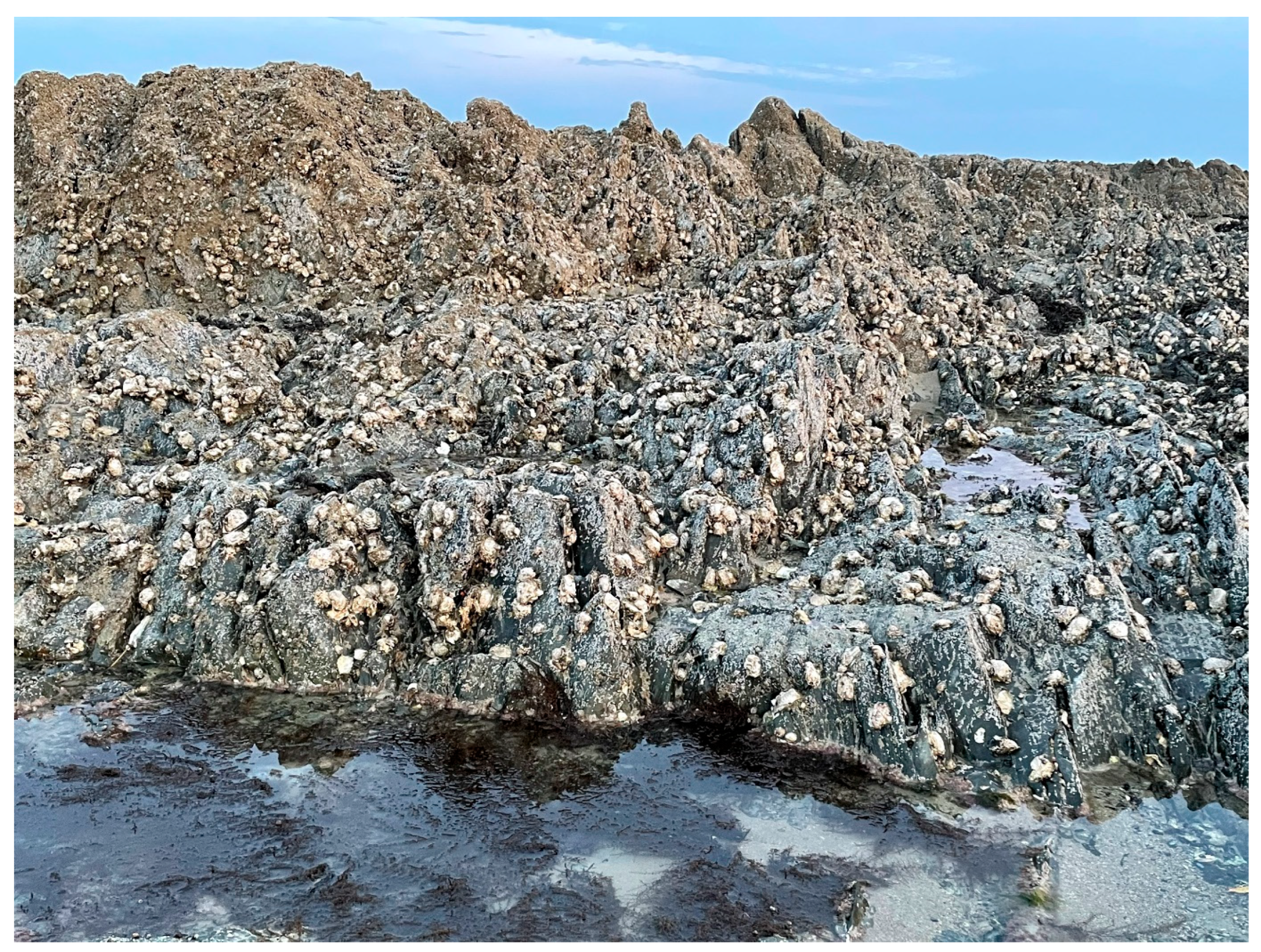
The oyster Magallena gigas was introduced on the Atlantic coast of France in the 1970s to replace the Portuguese oyster Magallena angulata (Lamark 1819), which completely disappeared due to a disease by the end of the 1960s. The risks of reproduction and dispersal through French and European waters was not evaluated at the time of its introduction. Over the last 30 years, principally in relation to the increased inflow of seawaters, which permit the reproduction of the species during the spring–summer period, natural wild M. gigas reefs have developed in the upper mediolittoral zone along the French coast of the EC from Brittany to the Opal coast [110]. The species is able to form reefs not only on hard rock substrata but also on soft-bottom sediments if shell debris is present (personal observations).
In Normandy, oyster reefs are common along the western coast of the Cotentin Peninsula from Granville in the south to Blainville-sur-Mer in the north (Figure 2), as well as along the Opal coast from the Aa estuary to Dunkerque harbour. Some isolated individuals have also been found, mostly in harbour docks and dykes along the coastline of the Manche and Seine-Maritime departments. As generally observed in the formation of reefs, those formed by M. gigas increase the biodiversity of the colonised soft-bottom substratum, offering a wide mixture of ecological niches, but lead to a decrease in the biodiversity of hard-bottom substratum, as M. gigas comes to occupy all of the habitat.
Wild M. gigas populations are characterised by high biomass and are in competition for food with other naturally occurring suspension-filter molluscs such as the warty venus clam Venus verrucosa Linnaeus, 1758, the pink clam Polititapes rhomboides (Pennant, 1777), the cultivated bivalves Magallena gigas, Mytilus edulis and Ruditapes philippinarum, as well as other wild invasive species, R. philippinarum and Crepidula fornicata [110]. Both for people walking on the foreshore and private individuals harvesting seafood, these oysters have sharp shells that represent a danger of cutting and damage to equipment. Nevertheless, recreational fishers are focused on M. gigas; for the Manche Department, the harvesting of shellfish is only permitted from 1 September to 30 April and is limited to 72 oysters per day per person (for oysters measuring more than 5 cm) [70].

3.4.6. Ruditapes philippinarum (Adams and Reeve 1850)

The Manila clam Ruditapes philippinarum was introduced into France in the 1970s and now dominates the native European clam Ruditapes decusattus (Linnaeus, 1758) over most of the intertidal zone of the EC [116]. The Manila clam has suffered several episodes of significant mortality but, despite the fragility of the species following several outbreaks of infectious disease, R. philippinarum continues to support local professional and private fishers in many French regions, including the wide intertidal zones in Brittany and Normandy, especially along the western coast of the Cotentin Peninsula [120]. Whilst it has successfully colonised a large variety of sediment habitats, ranging from muddy sand to gravel, the densities remain low at <20 ind.m−2.
A variety of fishing gear is used to harvest this species. The use of rake harvesting appears to have a limited effect on the macrofauna present [120]. However, there is intensive pressure on the species, with 1 200 to 1 500 harvesters present per day during the spring tides from April to October, with a maximum of 6 500 harvesters during the August spring tide [121]. It is clear that the introduction of R. philippinarum has changed the functioning of the soft-bottom communities of the intertidal zone, due to the intense activity of fishers who remove the surficial sediments. To ensure sustainable pressure on the shellfish stock, less destructive harvesting equipment should be required in the future, so as to maintain this important recreational activity for the Brittany and Normandy tourist economy.

3.4.7. Styela clava Herdman, 1881

The ascidian Styela clava is very tolerant to environmental conditions and can form dense colonies up to 1000 individuals per m2 in sheltered areas, creating a high biomass that results in strong competition with other filter-feeding species for food resources and space in addition to predation on wild or cultivated invertebrate larvae [70]. This NNS was found for the first time in Normandy waters in 1971 and formed an abundant population in and around the harbour of Le Havre in the 1970s [70]. Its expanding presence has led to the colonisation of most European waters [122]. Owing to its great capacity for colonisation, the presence of S. clava damages aquaculture facilities and structures such as marina pontoons, boat hulls and mooring lines, requiring an increase in the frequency of cleaning and hence the associated cost of these recurring operations. The organism is very abundant around the Cotentin Peninsula and in the areas with oyster farms.

3.4.8. Sargassum muticum (Yendo) Fensholt, 1955

The macroalgae Sargassum muticum, commonly known as Japanese wireweed, is a large brown seaweed that is now present throughout the intertidal and shallow subtidal waters of the EC, especially in areas of shellfish farming. It is known to occur on much of the western coasts of Europe, from the south of Spain to the southern Norwegian coast, although it seems to be absent from the eastern coasts of the United Kingdom [123]. It occupies the foreshore zone, in particular rock pools where there is always some water at low tide, as well as the coastal fringe, to a depth of 10 m, where it can form very dense growths from June to August. The fronds can measure up to 10 m in length. As primary producers of vegetable matter, S. muticum is in competition for space, light and the nutriments with the other seaweeds and also with the seagrass Zostera (Zostera) marina Linnaeus, 1753, which is well established in the Bay of Mont St Michel, including the Chausey and Channel Islands. Nevertheless, dense populations of S. muticum can also act as protection for many vagile species, such as some fish, shrimp Palaemon serratus (Pennant, 1777), amphipods, isopods and cephalopods, such as those found in Laminaria forests [49].
In the EC, the motile fauna associated with S. muticum is dominated by amphipods and isopods [49]. This enhanced abundance of amphipods and isopods could be explained by the fact that the Sargassum can act as a habitat or as refuge from predators for several species. In addition, some grazer’s species feed on Sargassum. Indeed, amphipods and isopods are known as grazers that commonly feed on the macroalgae that they inhabit. Thus, in the EC, the NIS S. muticum acts both as a source of food and an additional habitat for several motile species.
The main negative effects from the dense growth of such seaweed relate to navigation, oyster cultivation, fishing with traps and pots, and tourism activities when large quantities of such seaweed become deposited on the beach [124].

3.5. Modifications of Geographic Distribution Due to Climate Change

3.5.1. Extension of Geographical Range Boundaries

The changes in the distribution and occupancy of 65 subtidal macrobenthic invertebrate species were analysed by comparing data collected throughout the EC at more than 200 stations sampled during a cool period in the 1960s–1970s and during the warmest period during 2012–2014 [23]. Despite shifts in both minimum and maximum sea bottom isotherms (2.5 and 3.2 km. year−1, respectively), the shift in the distribution centroid of most species remains low at <1.0 km. year−1. Conversely, decreases were observed in the occurrence of most cold-water species, while increases were found in the occurrence of most warm-water species. A similar absence of change has been observed in the broad-scale distribution of sublittoral macrobenthic species along the southern coast of England [18].
The Marine Biological Association of the UK at Plymouth is situated on the Western entrance to the EC and has a long history of long-term studies of intertidal rocky shores [19,20,21]. Over the past 60 years, this association has analysed the climate changes which have modified the distribution and abundance of many seashore species [19,20,21]. It has provided evidence of changes in the abundance, range and population structures of intertidal species, relating these changes to recent rapid climatic warming. In particular, quantitative counts of barnacles, limpets and trochids have been carried out, as well as semi-quantitative surveys of up to 56 intertidal taxa. Since the mid-1980s, the ranges of some typically southern warm water species have extended towards the EC at the northern and eastern limits of their geographical distribution. These species include the gastropods Phorcus lineatus (da Costa, 1778), Steromphala umbilicalis (da Costa, 1778), Patella aspera Röding, 1798, Patella depressa Pennant, 1777, Melarhaphe neritoides (Linnaeus, 1758), the barnacles Chthamalus montagui Southward, 1976, Chthamalus stellatus (Poli, 1791) and Balanus perforatus Bruguière, 1789 and the anemone Actinia fragacea Tugwell, 1856. The northern Laminariales species Alaria esculenta (Linnaeus) Greville, 1830 and the gastropod Testudinalia testudinalis (O. F. Müller, 1776) have shown a slight retreat at the southernmost limits of their distribution and a decline in abundances. Fluctuations of the northern barnacle Semibalanus balanoides (Linnaeus, 1767) and the southern Chthamalus spp. have been related to climate change, using historical data collected by Southward and Crisp. These data show that warm springs have a direct negative effect on the survival of S. balanoides, thus causing a release from competition, which has an indirect positive effect on Chthamalus spp. [19,20,21].
Among the polychaetes, members of the Syllidae family remain difficult to identify due to their small size and high diversity, especially in the coarse sediments that are dominant in the EC. A two-year survey (winter and summer sampling periods) covering 19 stations associated with the Branchiostoma lanceolatum (Pallas, 1774) coarse sand community offshore Dieppe-Le Tréport has led to the identification of 6537 individuals from 29 taxa, including 27 species [125]. Among these species, seven are new for the EC polychaete fauna:
-
Prosphaerosyllis xarifae (Hartmann-Schröder, 1960), Sphaerosyllis pirifera Claparède, 1868, Streptodonta pterochaeta (Southern, 1914), Syllis columbretensis (Campoy, 1982), Syllis mauretanica (Licher, 1999), Syllis parapari (San Martin & Lopez, 2000), and Syllis pulvinata (Langerhans, 1881).
-
Palposyllis prosostoma (Hartmann-Schröder, 1977), Parexogone hebes (Webster & Benedict, 1884), Sphaerosyllis taylori Perkins, 1981, Syllis garciai (Campoy, 1982), Syllis hyalina (Grube, 1863), and Xenosyllis scabra (Ehlers, 1864) are observed for the first time in the eastern basin of the EC.
All these new species for the EC are warm temperate species that were previously only known south of the Bay of Biscay.
Among the 269 amphipod species recorded with confidence in the EC in 2022 [57], 24 are newly reported for the EC, including ten NIS added since the last checklist of 1999 (see Appendix A for NIS amphipods) and 14 North-eastern Atlantic species: Ampelisca toulemonti (Dauvin & Bellan-Santini, 1982); Amphilochoides boeckii (G.O. Sars, 1895); Amphilochoides serratipes (Norman, 1869); Aora spinicornis (Afonso, 1976); Caprella septentrionalis Krøyer, 1838; Echinogammarus berilloni (Catta, 1878); Elasmopus thalyae (Gouillieux & Sorbe, 2015); Jassa slatteryi (Conlan, 1990); Maera loveni (Bruzelius, 1859); Medicorophium runicorne (Della Valle, 1893); Metopa bruzelii (Goes, 1866); Paramphilochoides intermedius (Scott, 1896); Parvipalpus capillaceus (Chevreux, 1888) and Photis pollex (Walker, 1895). Most of these species were present in the Bay of Biscay or the Mediterranean Sea and these new records in the EC reflect a northward progression.
The decapod Asthenognathus atlanticus Monod, 1932, is a tropical-temperate crab that is known to live in various types of sediment, from muddy fine sand to mud, ranging from the intertidal zone to a depth of 210 m. It is found sporadically during benthic sampling on muddy sediment habitats along the French coast of the EC. Since 1921, the species has been recorded in waters off Roscoff in the western basin of the EC. Several individuals of A. atlanticus have been reported in the Bay of Seine in the eastern basin of the EC [126]. It was reported by [127] in the area around Dieppe-Le Tréport (Normandy coast in the eastern basin of the EC), where a total of 26 specimens were collected in 2015–2016 from fine and coarse sands at water depths between 12 and 25 m. Two specimens were also found in the stomach of two thornback rays, Raja clavata, Linnaeus, 1758. Later, Faasse et al. [128] reported the presence of one A. atlanticus male on the Brown Bank in the southern part of the North Sea at 32 m depth. The eastward progression of A. atlanticus is consistent with tidal residual currents in the EC and the southern part of the North Sea. The present period of global warming is likely favourable for the eastward progression of this subtidal species.
Another decapod shows a similar eastward progression. A unique specimen of the decapod Pachygrapsus marmoratus (Fabricius, 1787), the marbled crab, was reported for the first time in August 2014 from the intertidal zone on the Calvados coast (western part of the Bay of Seine, Eastern EC) [129]. The species is a common decapod living on European intertidal rocky shores. It originates from the Mediterranean Sea and has been reported as ranging from the western coast of the Cotentin in the western basin of EC to the South coast of England [130,131,132].
The tanaidacean crustacean Zeuxo holdichi was first described from Arcachon Bay, France, by Bamber in 1990. Since then, this species has been recorded several times in Europe, from the Iberian Peninsula to Germany. Moreover, Foveau et al. [133] reports new records of this species along the northern coasts of France bordering the EC. It is hypothesised that Z. holdichi is spreading because of aquaculture activities, but its presence in the EC could also reflect a north-eastward progression due to the increase in seawater temperature. The species is established along the Calvados coast, where the abundances exceed 21,000 individuals per m2 in November on artificial reefs located in the intertidal zone [134]. Ovigerous females are present from the middle of June to February, with a high occurrence in August–October. Considering the traits of life, Z. hodichi possesses a high ability to rapidly colonise virgin hard substrates on numerous sites of the EC.
Along with several species which suffered high mortalities during the very cold 1962–1963 winter, Octopus vulgaris Cuvier, 1797, has disappeared from EC waters over the last six decades. However, since 2022, a new generation of common Octopus has developed on the coasts of northern France and south-west England. In May 2025, a trawler operating out of Newlyn, Cornwall, landed almost 20 t of Octopus worth a record-breaking £158,000 (https://mymba.mba.ac.uk/resource/an-octopus-bloom-in-the-english-channel.html; accessed on 14 January 2026). Populations of common Octopus have bloomed before in the Western EC, in 1900 and in 1950. The common Octopus is found worldwide in temperate and tropical seas, and it is sensitive to climatic change; its development is promoted with an increasing seawater temperature [135].

3.5.2. Decline, Attested or Predicable Disappearances

Conversely to the progression of numerous species in the EC, not only at its entrance but also in both the western and eastern basins, some data show the disappearance or rarefaction of certain species in the EC. During a long-term study of the fine sand community of the Bay of Morlaix, which started in 1977, the boreal polychaete Apistobranchus tullbergi (Théel, 1879) was collected during a cold period from May 1979 to December 1980 (28 individuals), but was not observed later ([37], Dauvin personal data).
The horse mussel Modiolus modiolus (Linnaeus, 1758) was reported in some parts of the Raz Blanchard during the investigations carried out at the beginning of the 1970s by [34]; these mussel beds occur in an area which corresponds to the southern limit of M. modiolus in this part of the EC. However, this species is not recorded after 2015–2016 [54] from sampling carried out at the same Retière station, and its persistence in this area needs to be confirmed, as in other parts of the EC. Some small individuals of M. modiolus had been sampled in early 2000 in the Dover Strait (personal observation), so, in the absence of more supporting evidence, the records are considered as scattered individuals, not beds. This provides evidence of the disappearance of this species in the EC.
Sturbois et al. [136] studied the spatio-temporal changes in intertidal benthic communities from the Bay of Saint-Brieuc in the Western EC from 42 stations sampled in 1987, 2001 and 2019. These authors suggest that the decline in the boreal species Macoma balthica (Linnaeus, 1758) is potentially attributable to a temperature increase, since the Bay of Saint-Brieuc is located within the southernmost part of its distribution.
The common whelk Buccinum undatum (Linnaeus, 1758) is a benthic neogastropod that is a major commercial species in northern Europe, primarily exploited in the UK and France, which is mainly concentrated in the EC [137]. Whelk populations in the EC live near the southern edge of the species distribution range. In the context of climate change, these populations are faced with gradual increases in water temperature, as well as marine heatwaves. The whelk is a eurythermal species that is able to tolerate temperatures ranging from 0 and 22 °C, but it remains sensitive to rapid thermal variations, which can disrupt its growth, reproduction or distribution. A temperature threshold of around 9–10 °C has been estimated to trigger reproduction [137]. In summer, high temperatures (around 18 °C) can induce a ‘biological pause’, marked by reduced activity and feeding, increased mortality and reduced catchability. Between 1973 and 1991, landings in the Western EC gradually increased from less than 2500 t to around 7000 t, reaching a peak of around 14,000 t in 2004. Then, there was an initial decline between 2005 and 2011, followed by a period of relative stability, with landings fluctuating between 9000 and 11,000 t until 2017, and again, a period of decline, falling to only 3000 t in 2023 [137]. Since 1983, a gradual increase of approximately 1.5 °C in the sea surface temperature has been observed in the whelk’s habitat in the Western EC [133]. Rising temperatures are correlated with reduced egg production per spawn in B. undatum, leading to lower hatching success and accelerated intracapsular larval development. Since the whelk is a boreal ectothermic species located at the southern edge of its distribution range, we can assume that it is exposed to increases in sea temperature, principally during its reproduction period. It is questionable as to whether the common whelk will still be present in the EC in the future.
To address this question, Rombouts et al. [138] have applied ecological niche models to determine the potential distributions of species, based on information on the environmental niche of a species in relation to climate changes. The niches of two commercially exploited benthic species, Pecten maximus and Glycymeris glycymeris, and two ecologically important species, Abra alba (W. Wood, 1802) and Ophelia borealis Quatrefages, 1866, were derived using four hydrographic variables: sea surface temperature, sea surface salinity, water depth and sediment type. The non-parametric probabilistic ecological niche model was applied to calculate the contemporary probabilities of occurrence for each species in the Northeast Atlantic and predict potential re-distributions under the climate change scenario A2 for two time periods: 2050–2059 and 2090–2099. The results show a general northward displacement of the four benthic species from the EC into the North Sea and southern Norwegian coast. The projections mostly indicate a reduction in suitable habitats for benthic species, with a notable disappearance of their distributions in the EC, except for A. alba.
Regarding the macroalgae, environmental factors and commercial harvesting in northern Brittany can explain the decline of the kelp Laminaria digitata J.V. Lamouroux, 1913. The sea temperature seems to have the largest effect (negative when it increases), although this is partly masked by harvesting during the last few years of the study period: 1988–2004 [139]. Similarly, modelling by Pecquet et al. [140] has revealed that kelp would follow a northward shift in their southernmost limit, due to local extinctions by 2041–2050, according to the Representative Concentration Pathways scenarios 2.6 and 8.5. In particular, the latter authors predict a substantial decrease in kelp and alginate extraction activities in 2041–2050, which agrees with the decrease in extractions observed in Brittany for several decades [140].
Most of the mentioned examples show that the benthic species are particularly sensitive to the increase in sea water temperature and, in the future, there will be a shift between cold temperate species which migrate to the north and warm temperate species which penetrate the EC, from its western basin to its eastern basin.

4. Conclusions and Future Directions

There is evidence that the rise in seawater temperature and human activities cause changes in the diversity, structure and functioning of benthic communities in the EC. The introduction of NIS, mainly due to maritime traffic and aquaculture (for example, deliberate introduction of the oyster Magallena gigas and the Manila clam Ruditapes philippinarum, or accidental introduction, such as the gastropod Crepidula fornicata or the macroalgae Sargassum muticum), currently have more impact on benthic habitats than climate change. Most of these NIS have a temperate Northern Pacific origin, while others come from the northern temperate Atlantic and the Mediterranean Sea (Appendix A). This is probably due to the introduction of exotic species, such as C. fornicata, which has spread throughout the EC at depths of less than 20 m and modified the structure and functioning of heavily colonised areas [108,109,110]. The main changes in the distribution of intertidal species are more recent and are linked to the evident increases in sea temperature since the early 1990s; these changes are mainly recorded at the entrance to the EC, especially on the shores of Cornwall (UK) [19,20,21]. Distribution changes in subtidal macrobenthic species appear to be more moderate than intertidal species, and more mobile species such as fish show a tropicalization of assemblages in the eastern EC [28,141].
This compilation of observations on benthic species for the EC shows similar patterns as those detected in the North Sea. Birchenough et al. [142,143] highlight those climatic processes that influence species abundance and community composition in soft-sediment habitats of the North Sea. The responses to changes in seawater temperature concern mainly biogeographic shifts and phenology.
Two other factors will have significant consequences on benthic communities in the future: the development of offshore wind farms (OFW) and summer heat waves.
The implementation of OFWs in the EC is recent and their long-term impacts remain speculative. Some of the effects are transposable from the OWFs of the southern North Sea, where there have been many studies (see for example [12] and [144]). Dannheim et al. [144] have demonstrated that the secondary production of fouling communities (reef effect) is on average 80 times higher than for soft-substrate communities, and that 71% of the fouling products on turbines are released to the surrounding sediment. Boutin et al. [145] have explored the trait of life of potential biofouling colonisers of the Dunkerque OWF and hard substrates of the EC. The functional profile reveals that OWF colonisers correspond to sessile, carnivorous or suspension feeding species ranging from 10 to 100 mm in size; with gonochoric reproduction, pelagic and planktotrophic larvae have a lifespan of less than 2 years or 5–20 years, respectively. Moreover, Dauvin [146] has shown that no relationship has yet been clearly established between the implementation of OFWs and the colonisation of NIS on turbine foundations and scour protections. Evidence for such an effect needs to be documented and confirmed in the future.
The establishment of OWFs and their long-term monitoring (30 years) in the EC is a real opportunity for research, introducing hard intertidal and subtidal substrates into an offshore sedimentary environment. The multiplication of OFWs will also make it possible to analyse the “stepping stone” role of these infrastructures as regards hard substrate species, including NIS.
For the intertidal and shallow habitats, the increase in summer heatwaves and probably the increase in storms will have ecological effects on benthic ecosystems [147].
As highlighted by Birchenough et al. [142,143], most of the observations have been made at the species level and rarely at community levels. The assessments will have limited validity to predict the responses of entire ecosystems to climate change and human activities. Climate-induced effects on key species in food webs may have cascading effects that could propagate through the entire food web, including the pelagic components.
It is clear that future studies should have two main objectives: to anticipate the arrival of southern species in the EC and to take into account an ecosystem approach to improve our understanding of the combined effects of climate change and human activities on the functioning of benthic communities. In situ observations must be continued around Plymouth, Roscoff and the eastern Bay of Seine, but modelling studies should also be promoted at the scale of the EC and the southern part of the North Sea, since these two systems are linked by the same environmental pressures.

Funding

This research received no external funding.

Institutional Review Board Statement

Not applicable.

Data Availability Statement

No new data were created or analyzed in this study.

Acknowledgments

I thank Caen Normandy University and the Centre National de la Recherche Scientifique (UMR 6143 M2C CNRS) for welcoming me as at the M2C laboratory. I thank Michael Carpenter for editing the English spelling and grammar of this paper. I also thank the four reviewers for their very useful comments on the first version of this paper, and Renato Mamede for his invitation to contribute to the Special Issue, ‘Ecology and Biogeography of Marine Benthos,’ of the journal Diversity.

Conflicts of Interest

The author declares no conflicts of interest.

Appendix A

Table A1. List of the non-indigenous benthic species (NIS) (Animalia) recorded in the English Channel since the census of [57,70,71,72,73].
Species with AuthorityTaxonomic GroupOrigin
Symphyocladiella dendroidea (Montagne) Bustamante, Won, Lindstrom & Cho, 2019MacroalgaeWestern Mediterranean Sea
Xiphosiphonia pinnulata (Kützing) Savoie & G.W.Saunders, 2016MacroalgaeTemperate Northern Pacific
Ammonia confertitesta Zheng 1978ForaminiferaTemperate Northern Pacific
Trochammina hadai Uchio, 1962ForaminiferaJapan and Korea
Celtodoryx ciocalyptoides (Burton, 1935)SpongeTemperate Northern Pacific
Fenestrulina delicia Winston, Hayward & Craig, 2000BryozoaTemperate Northern Atlantic
Schizoporella japonica Ortmann, 1890BryozoaTemperate Northern Pacific
Tricellaria inopinata d’Hondt & Occhipinti Ambrogi, 1985BryozoaTemperate Northern Pacific
Watersipora subatra (Ortmann, 1890)BryozoaTemperate Northern Pacific
Bispira polyomma Giangrande & Faasse, 2012PolychaetaCryptogenic
Boccardia proboscidea Hartman, 1940PolychaetaTemperate Northern Pacific
Boccardia polybranchia (Haswell, 1885)PolychaetaCryptogenic
Boccardia pseudonatrix Day, 1961 PolychaetaTemperate Southern Africa
Boccardia semibranchiata Guérin, 1990PolychaetaMediterranean Sea
Boccardiella hamata (Webster, 1879)PolychaetaTemperate Northern Atlantic
Boccardiella ligerica (Ferronnières, 1898),PolychaetaTemperate Northern Atlantic
Chaetozona corona Berkeley & BerkeleyPolychaetaTemperate Northern Pacific
Euchone limicola Reish, 1959PolychaetaTemperate Northern Pacific
Goniadella gracilis (Verrill, 1873)PolychaetaTemperate Northern Atlantic
Mazenzelleria viridis (Verrill, 1873) PolychaetaTemperate Northern Atlantic
Polydora colonia Moore, 1907 PolychaetaTemperate Northern Atlantic
Polydora onagawaensis Teramoto, Sato-Okoshi, Abe, Nishitani & Endo, 2013PolychaetaTemperate Northern Pacific
Polydora websteri Hartman in Loosanoff & Engle, 1943PolychaetaTemperate Northern Pacific
Pseudopolydora paucibranchiata (Okuda, 1937)PolychaetaTemperate Northern Pacific
Streblospio benedicti Webster, 1879PolychaetaTemperate Northern Atlantic
Thelepus japonicus MarenzellerPolychaetaTemperate Northern Pacific
Gibbula ardens (Salis Marschlins, 1793)GastropodMediterranean Sea
Haloa japonica (Pilsbry, 1895)GastropodTemperate Northern Pacific
Hexaplex trunculus (Linnaeus, 1758)GastropodMediterranean Sea
Ocinebrellus inornatus (Récluz, 1851)GastropodTemperate Northern Pacific
Pseudofusus rostratus (Olivi, 1792), GastropodGastropodMediterranean Sea
Stramonita haemastoma (Linnaeus, 1767)GastropodMediterranean Sea
Rangia cuneata (G. B. Sowerby I, 1832)BivalviaTropical Atlantic
Ampithoe valida S.I. Smith, 1873Amphipoda Temperate Northern Atlantic
Aoroides longimerus Ren & Zheng, 1996AmphipodaTemperate Northern Pacific
Aoroides semicurvatus Ariyama, 2004AmphipodaTemperate Northern Pacific
Caprella mutica Schurin, 1935AmphipodaTemperate Northern Pacific
Chelicorophium curvispinum (G.O. Sars, 1895)AmphipodaBlack & Caspian Seas
Dikerogammarus villosus (Sowinsky, 1894)AmphipodaBlack Sea
Grandidierella japonica Stephensen 1938AmphipodaTemperate Northern Pacific
Ptilohyale littoralis (Stimpson, 1853)AmphipodaTemperate Northern Atlantic
Platorchestia platensis (Krøyer, 1845)AmphipodaMediterranean Sea
Ianiropsis serricaudis Gurjanova, 1936IsopodaTemperate Northern Pacific
Incisocalliope aestuarius (Watling & Maurer, 1973)IsopodaTemperate Northern Atlantic
Paranthura japonica Richardson, 1909 IsopodaTemperate Northern Pacific
Neomysis americana (S.I. Smith, 1873)MysidTemperate Northern Atlantic
Guinearma alberti (Rathbun, 1921), Crustacea DecapodaTropical Atlantic
Hemigrapsus sanguineus (De Haan, 1835), Crustacea DecapodaTemperate Northern Pacific
Marsupenaeus japonicus (Spence Bate, 1888), Crustacea DecapodaTemperate Northern Pacific
Palaemon macrodactylus Rathbun, 1902, Crustacea DecapodaTemperate Northern Pacific
Penaeus semisulcatus De Haan, 1844 [in the De Haan, 1833–1850]DecapodaCentral Indo-Pacific
Megabalanus tintinnabulum (Linnaeus, 1758)BarnaclesCryptogenic
Lovenella assimilis (Browne, 1905)CnidariaCentral Indo-Pacific
Aplidium antillense (Gravier, 1955) TunicateTropical Atlantic
Aplidium glabrum (Verrill, 1871)TunicateTemperate Northern Atlantic
Asterocarpa humilis (Heller, 1878) TunicateCentral Indo-Pacific
Botrylloides violaceus Oka, 1927 TunicateTemperate Northern Pacific
Ciona robusta Hoshino & Tokioka, 1967TunicateTemperate Northern Pacific
Corella eumyota Traustedt, 1882TunicateCryptogenic
Didemnum pseudovexillum Turon & Viard, 2020TunicateCryptogenic

References

  1. Dauvin, J.C. English Channel: La Manche. In World of the Seas: An Environmental Evaluation, 2nd ed.; Sheppard, C., Ed.; Volume I: Europe, The Americas and West Africa; Academic Press: Cambridge, MA, USA, 2019; pp. 153–188. [Google Scholar]
  2. Larsonneur, C.; Bouysse, P.; Auffret, J.P. The superficial sediments of the English Channel and its western approaches. Sedimentology 1982, 29, 851–864. [Google Scholar] [CrossRef] [Scilit]
  3. Cabioch, L.; Gentil, F.; Glaçon, R.; Retière, C. Le macrobenthos des fonds meubles de la Manche, distribution générale et écologie. In Biology of Benthic Organisms; Keegan, B., O’Ceidigh, P., Boaden, P.P., Eds.; Pergamon Press: Oxford, UK, 1977; pp. 115–128. [Google Scholar]
  4. Halpern, B.S.; Walbridge, S.; Selkoe, K.A.; Kappel, C.V.; Micheli, F.; D’Agrosa, C.; Bruno, J.F.; Casey, K.S.; Ebert, C.; Fox, H.E.; et al. A global map of human impact on marine ecosystems. Science 2008, 319, 948–952. [Google Scholar] [CrossRef] [Scilit] [PubMed]
  5. Halpern, B.S.; Frazier, M.; Potapenko, J.; Casey, K.S.; Koenig, K.; Longo, C.; Lowndes, J.S.; Rockwood, R.C.; Selig, E.R.; Selkoe, K.A.; et al. Spatial and temporal changes in cumulative human impacts on the world’s Ocean. Nat. Commun. 2015, 6, 7615. [Google Scholar] [CrossRef] [Scilit] [PubMed]
  6. Dauvin, J.C. How resilient are coastal marine soft-bottom communities with high diversity? Mar. Pollut. Bull. 2025, 215, 117850. [Google Scholar] [CrossRef] [Scilit] [PubMed]
  7. Dauvin, J.C. Resilience of marine benthic communities in an area highly impacted by human activities: The case of the English Channel. In Constraints and Adaptations to Global Change at the Land-Sea Interface: For a Shared Ecological and Energy Transition; Proceedings of the 19th French—Japanese Oceanography Symposium; Bennis, A.C., Dauvin, J.C., Feunten, E., Komatsu, T., Mutsuda, O., Prouzet, P., Eds.; Springer: Berlin/Heidelberg, Germany, 2025; pp. 121–133. [Google Scholar]
  8. Amara, R. Impact de l’Anthropisation sur la Biodiversité et le Fonctionnement des Écosystèmes Marins. Exemple de la Manche-Mer du Nord. VertigO. 2010. [En Ligne], Hors-Série 8|Octobre 2010, Mis en Ligne le 04 Octobre 2010. Available online: http://journals.openedition.org/vertigo/10129 (accessed on 26 January 2026).
  9. Dauvin, J.C.; Lozachmeur, O. Mer côtière à forte pression anthropique propice au développement d’une gestion intégrée: Exemple du bassin oriental de la Manche (Atlantique Nord-Est). VertigO 2006, 7, 3. [Google Scholar]
  10. Kerckhof, F.; Rumes, B.; Degraer, S. About “Mytilisation” and “Slimeification”: A decade of succession of the fouling assemblages on wind turbines off the Belgian coast. In Environmental Impacts of Offshore Wind Farms in Chapter 5. Comparison Epifaunal Biodiversity of Shipwrecks with Offshore Wind Farms the Belgian Part of the North Sea: Making a Decade of Monitoring, Research and Innovation; Degraer, S., Brabant, R., Rumes, B., Vigin, L., Eds.; Royal Belgian Institute of Natural Sciences, OD Natural Environment, Marine Ecology and Management: Brussels, Belgium, 2019; pp. 73–84. [Google Scholar]
  11. Dannheim, J.; Bergström, L.; Birchenough, S.N.R.; Brzana, R.; Boon, A.R.; Coolen, J.W.P.; Dauvin, J.C.; de Mesel, I.; Derweduwen, J.; Gill, A.B.; et al. Benthic effects of offshore renewables: Identification of knowledge gaps and urgently needed research. ICES J. Mar. Sci. 2020, 77, 1092–1108. [Google Scholar] [CrossRef] [Scilit]
  12. Degraer, S.; Carey, D.A.; Coolen, J.W.; Hutchinson, Z.L.; Kerckhof, F.; Rumes, B.; Vanaverbeke, J. Offshore wind farm artificial reefs affect ecosystem structure and functioning: A Synthesis. Special issue on understanding the effects of offshore wind energy development on fisheries. Oceanography 2020, 33, 48–57. [Google Scholar] [CrossRef] [Scilit]
  13. Coolen, J.W.P.; Vanaverbeke, J.; Dannheim, J.; Garcia, C.; Birchenough, S.N.R.; Krone, R.; Beermann, J. Generalized changes of benthic communities after construction of wind farms in the southern North Sea. J. Environ. Manag. 2022, 315, 115173. [Google Scholar] [CrossRef] [Scilit]
  14. Hawkins, S.J.; Gibbs, P.E.; Pope, N.D.; Burt, G.R.; Chesman, B.S.; Bray, S.; Proud, S.V.; Spence, S.K.; Southward, A.J.; Langston, W.J. Recovery of polluted ecosystems: The case for long-term studies. Mar. Environ. Res. 2002, 54, 215–222. [Google Scholar] [CrossRef] [Scilit]
  15. Hawkins, S.J.; Southward, A.J.; Genner, M.J. Detection of environmental change in a marine ecosystem—Evidence from the western English Channel. Sci. Total Environ. 2003, 310, 245–256. [Google Scholar] [CrossRef] [Scilit]
  16. Hawkins, S.J.; Sugden, H.E.; Mieszkowska, N.; Moore, P.J.; Poloczanska, E.; Leaper, R.; Herbert, R.J.H.; Genner, M.J.; Moschella, P.S.; Thompson, R.C.; et al. Consequences of climate-driven biodiversity changes for ecosystem functioning of North European rocky shores. Mar. Ecol. Progr. Ser. 2009, 396, 245–259. [Google Scholar] [CrossRef] [Scilit]
  17. Southward, A.J.; Langmead, O.; Hardman-Mountford, N.J.; Aiken, J.; Boalch, G.T.; Dando, P.R.; Genner, M.J.; Joint, I.; Kendall, M.A.; Halliday, N.C.; et al. Long-term oceanographic and ecological research in the western English Channel. Adv. Mar. Biol. 2005, 47, 1–105. [Google Scholar] [PubMed]
  18. Hinz, H.; Capasso, E.; Lilley, M.; Frost, M.; Jenkins, S.R. Temporal differences across a bio-geographical boundary reveal slow response of sub-littoral benthos to climate change. Mar. Ecol. Prog. Ser. 2011, 423, 69–82. [Google Scholar] [CrossRef] [Scilit]
  19. Mieszkowska, N.; Leaper, R.; Moore, P.; Kendall, M.A.; Burrows, M.T.; Lear, D.; Poloczanska, E.; Hiscock, K.; Moschella, P.S.; Thompson, R.C.; et al. Marine Biodiversity and Climate Change Assessing and Predicting the Influence of Climatic Change Using Intertidal Rocky Shore Biota; Marine Biological Association Occasional Publications; Marine Biological Association of the United Kingdom: Plymouth, UK, 2005; Volume 20, pp. 1–53. [Google Scholar]
  20. Mieszkowska, N.; Hawkins, S.J.; Burrows, M.T.; Kendall, M.A. Long-term changes in the geographic distribution and population structures of Osilinus lineatus (Gastropoda: Trochidae) in Britain and Ireland. J. Mar. Biol. Assoc. UK 2007, 87, 537–545. [Google Scholar] [CrossRef] [Scilit]
  21. Mieszkowska, N.; Burrows, M.T.; Pannacciulli, F.G.; Hawkins, S.J. Multidecadal signals within co-occurring intertidal barnacles Semibalanus balanoides and Chthamalus spp. linked to the Atlantic Multidecadal Oscillation. J. Mar. Syst. 2014, 133, 70–76. [Google Scholar] [CrossRef] [Scilit]
  22. Gaudin, F. Effets du Changement Climatique sur la Distribution de la Macrofaune Benthique en Manche. Ph.D. Thesis, Université Pierre et Marie Curie-Paris VI, Paris, France, 2017; 327p. [Google Scholar]
  23. Gaudin, F.; Desroy, N.; Dubois, F.; Broudin, C.; Cabioch, L.; Fournier, J.; Gentil, F.; Gral, J.; Houbin, C.; Le Mao, P.; et al. Marine sublittoral benthos fails to track temperature in response to climate change in a biogeographical transition zone. ICES J. Mar. Sci. 2018, 75, 1894–1907. [Google Scholar] [CrossRef] [Scilit]
  24. Costa, S.; Leymarie, R.; Lacoste, J.P.; Deloffre, J. Littoral normand et changement climatique: Entre conséquences et solutions possibles. Etudes Normandes 2021, 20, 32–39. [Google Scholar]
  25. Dauvin, J.C.; Niquil, N. Biodiversité marine et changement climatique. Etudes Normandes 2021, 20, 47–52. [Google Scholar]
  26. McLean, M.; Mouillot, D.; Maureaud, A.A.; Hattab, T.; MacNeil, M.A.; Goberville, E.; Lindegren, M.; Engelhard, G.; Pinsky, M.; Auber, A. Disentangling tropicalization and deborealization in marine ecosystems under climate change. Curr. Biol. 2021, 31, 4817–4823. [Google Scholar] [CrossRef] [Scilit] [PubMed]
  27. Simeoni, C.; Furlan, E.; Vuong Pham, H.; Critto, A.; de Juan, S.; Trégarot, E.; Cornet, C.C.; Meesters, E.; Fonseca, C.; Botelho, A.Z.; et al. Evaluating the combined effect of climate and anthropogenic stressors on marine coastal ecosystems: Insights from a systematic review of cumulative impact assessment approaches. Sci. Total Environ. 2023, 861, 160687. [Google Scholar] [CrossRef] [Scilit] [PubMed]
  28. Auber, A.; Travers-Trolet, M.; Villanueva, M.C.; Ernande, B. Regime shift in an exploited fish community related to natural climate oscillations. PLoS ONE 2015, 10, e0129883. [Google Scholar] [CrossRef] [Scilit]
  29. Marine Biological Association. Plymouth Marina Fauna, 3rd ed.; Marine Biological Association: Plymouth, UK, 1957; 457p. [Google Scholar]
  30. Dauvin, J.C. Espèces animales nouvelles décrites de la région de Roscoff entre 1970 et 1990. Cah. Biol. Mar. 1990, 31, 501–512. [Google Scholar]
  31. Dauvin, J.C. Érosion de la biodiversité marine, méprise ou réalité: Le cas des invertébrés marins benthiques en Manche (Atlantique Nord-Est). VertigO 2023, 23, 1–33. [Google Scholar]
  32. Dauvin, J.C.; Dewarumez, J.M. Patrimoine naturel de la Manche Orientale et du sud de la mer du Nord: Invertébrés benthiques et peuplements macrobenthiques sublittoraux. In Actes du Colloque ‘Qualité des Eaux: Objectifs Atteints, Wimille 7 Décembre 2000, Publication Agence de l’Eau Artois-Picardie; Publisher Agence de l’Eau Artois-Picardie: Arras, France, 2002; pp. 9–27. [Google Scholar]
  33. Le Mao, P.; Godet, L.; Fournier, J.; Desroy, N.; Gentil, F.; Thiébaut, E.; Pourinet, L. Atlas de la Faune Marine Invertébrée du Golfe Normano-Breton; 7 Volumes en Coffret; Editions de la Station Biologique de Roscoff: Roscoff, France, 2019; 1200p. [Google Scholar]
  34. Retière, C. Contribution à L’étude des Peuplements Benthiques du Golfe Normano-Breton. Ph.D. Thesis, Université Rennes, Rennes, France, 1979; 370p. [Google Scholar]
  35. Godet, L.; Le Mao, P.; Grant, C.; Olivier, F. Marine invertebrate fauna of the Chausey archipelago: An annotated checklist of historical data from 1828 to 2008. Cah. Biol. Mar. 2010, 51, 147–165. [Google Scholar]
  36. Ruellet, T.; Dauvin, J.C. Invertébrés aquatiques de la partie orientale de la baie et de l’estuaire de Seine: Deux siècles d’observations. C. R. Biol. 2008, 331, 481–488. [Google Scholar] [CrossRef] [Scilit] [PubMed]
  37. Dauvin, J.C. The fine sand Abra alba community in the Bay of Morlaix twenty years after the Amoco Cadiz oil spill. Mar. Pollut. Bull. 1998, 36, 669–676. [Google Scholar] [CrossRef] [Scilit]
  38. Dauvin, J.C. The muddy fine sand Abra alba-Melinna palmata community of the Bay of Morlaix twenty years after the Amoco Cadiz oil spill. Mar. Pollut. Bull. 2000, 40, 528–536. [Google Scholar] [CrossRef] [Scilit]
  39. Bacouillard, L.; Baux, N.; Dauvin, J.C.; Desroy, N.; Geiger, K.J.; Gentil, F.; Thiébaut, E. Long-term spatio-temporal changes in the species diversity of the fine sand benthic community of the Bay of Seine (eastern English Channel). Mar. Environ. Res. 2020, 161, 105062. [Google Scholar] [CrossRef] [Scilit] [PubMed]
  40. Foveau, A.; Desroy, N.; Dauvin, J.C.; Dewarumez, J.M. Distribution pattern of benthic diversity in the eastern English Channel. Mar. Ecol. Progr. Ser. 2013, 479, 115–126. [Google Scholar] [CrossRef] [Scilit]
  41. Cabioch, L. Contribution à la connaissance des peuplements benthiques de la Manche occidentale. Cah. Biol. Mar. 1968, 9, 488–720. [Google Scholar]
  42. Foveau, A. Habitats et Communautés Benthiques du Bassin Oriental de la Manche: État des Lieux au Début du XXIème Siècle. Ph.D. Thesis, Université Lille 1, Lille, France, 2009; 308p. [Google Scholar]
  43. Carpentier, A.; Martin, C.S.; Vaz, S. (Eds.) Channel Habitat Atlas for Marine Resource Management, Final Report (CHARM Phase II); INTERREG IIIa Programme, Publisher IFREMER: Boulogne-sur-Mer, France, 2009; 626p. [Google Scholar]
  44. Dauvin, J.C.; Pezy, J.P.; Poizot, E.; Lozach, S.; Trentesaux, A. A Multidisciplinary approach for a better knowledge of benthic habitat and community distribution in the central and western English Channel. J. Mar. Syst. Eng. 2022, 10, 1112. [Google Scholar] [CrossRef] [Scilit]
  45. Pezy, J.P.; Delecrin, C.; Baffreau, A.; Basuyaux, O.; Dauvin, J.C. Anthropogenic impact of oyster farming on macrofauna biodiversity in an eelgrass (Zostera marina) ecosystem of the English Channel. Ecol. Ind. 2019, 106, 105–114. [Google Scholar] [CrossRef] [Scilit]
  46. Dubois, S.; Retière, C.; Olivier, F. Biodiversity associated with Sabellaria alveolata (Polychaeta: Sabellariidae) reefs: Effects of human disturbances. J. Mar. Biol. Assoc. UK 2002, 82, 817–826. [Google Scholar] [CrossRef] [Scilit]
  47. Lecornu, B.; Schlund, E.; Basuyaux, O.; Dauvin, J.C. Dynamics (from 2010–2011 to 2014) of Sabellaria alveolata reefs on the western coast of Cotentin (English Channel, France). Reg. Stud. Mar. Sci. 2016, 8, 157–169. [Google Scholar] [CrossRef] [Scilit]
  48. Schlund, E.; Basuyaux, O.; Lecornu, B.; Dauvin, J.C. Macrofaunal biodiversity associated with Sabellaria alveolata reefs on the west coast of Cotentin (France). SpringerPlus 2017, 5, 1260. [Google Scholar] [CrossRef] [Scilit] [PubMed]
  49. Raoux, A.; Pezy, J.P.; Sporniak, T.; Dauvin, J.C. Does the invasive macro-algae Sargassum muticum (Yendo) Fensholt, 1955 offer an appropriate habitat for Non-Indigenous-Species? Ecol. Ind. 2021, 16, 107624. [Google Scholar] [CrossRef] [Scilit]
  50. Leclerc, J.C. Biodiversité, Structure et Fonctionnement Trophique des Communautés à Laminaria hyperborea, en Conditions Naturelles et Exploitées, en Bretagne. Ph.D. Thesis, Université Pierre & Marie Curie, Paris, France, 2013; 274p. [Google Scholar]
  51. Salland, N.; Jensen, A.; Smale, D.A. The structure and diversity of macroinvertebrate assemblages associated with the understudied pseudo-kelp Saccorhiza polyschides in the Western English Channel (UK). Mar. Environ. Res. 2024, 198, 106519. [Google Scholar] [CrossRef] [Scilit]
  52. Dauvin, J.C. (Coordinator). Les biocénoses marines et littorales françaises des côtes Atlantique, Manche et mer du Nord. Synthèse, menaces et perspectives. Patrim. Nat. 1997, 28, 1–359. [Google Scholar]
  53. Bajjouk, T.; Duchene, J.; Guillaumont, B.; Bernard, M.; Blanchard, M.; Derrien-Courtel, S.; Dubois, S.; Grall, J.; Hamon, D.; Hily, C.; et al. Les Fonds Marins de Bretagne, un Patrimoine Remarquable: Connaître pour Mieux Agir; Edition Ifremer-DREAL Bretagne: Plouzané, France; Rennes, France, 2015; 152p. [CrossRef] [Scilit]
  54. Foveau, A.; Dauvin, J.C. Surprisingly diversified macrofauna in mobile gravels and pebbles from high-energy hydrodynamic environment of the ‘Raz Blanchard’ (English Channel). Reg. Stud. Mar. Sci. 2017, 16, 188–197. [Google Scholar] [CrossRef] [Scilit]
  55. Baux, N.; Bachelet, Q.; Baffreau, A.; Pezy, J.P.; Méar, Y.; Poizot, E.; Guyonnet, B.; Dauvin, J.C. An exceptional rich soft-bottom macrobenthic habitats in a semi-enclosed Bay of the English Channel: The Rade of Cherbourg. Reg. Stud. Mar. Sci. 2017, 9, 106–116. [Google Scholar]
  56. Andres, S.; Pezy, J.P.; Martinez, M.; Baux, N.; Baffreau, A.; Mear, Y.; Dauvin, J.C. Soft bottom macrobenthic communities of the North Cotentin (central English Channel). Part 2. The case of the North Cotentin Peninsula. J. Mar. Biol. Oceanogr. 2020, 9, 1000278. [Google Scholar]
  57. Dauvin, J.C. An update of Amphipoda checklist for the English Channel. Diversity 2022, 14, 783. [Google Scholar] [CrossRef] [Scilit]
  58. Navarro-Barranco, C.; McNeill, C.L.; Widdicombe, C.E.; Guerra-García, J.M.; Widdicombe, S.S. Long-term dynamics in a soft-bottom amphipod community and the influence of the pelagic environment. Mar. Environ. Res. 2017, 129, 133–146. [Google Scholar] [CrossRef] [Scilit]
  59. Vallet, C.; Dauvin, J.C. Qualitative et quantitative composition of the suprabenthic amphipods from the English Channel. Pol. Arch. Hydrobiol. 1995, 42, 461–481. [Google Scholar]
  60. Vallet, C.; Dauvin, J.C.; Hamon, D.; Dupuy, C. Effect of the introduced common slipper shell Crepidula fornicata on the suprabenthic biodiversity of the subtidal communities in the Bay of Saint-Brieuc (western English Channel). Conserv. Biol. 2001, 15, 1686–1690. [Google Scholar] [CrossRef] [Scilit]
  61. Dauvin, J.C.; Vallet, C. Apports d’échantillonnages suprabenthiques à la faunistique de la Manche et à la biogéographie du plateau continental nord-ouest européen. Crustacés et Pycnogonides. Cah. Biol. Mar. 1997, 38, 251–266. [Google Scholar]
  62. Zouhiri, S.; Vallet, C.; Mouny, P.; Dauvin, J.C. Spatial distribution and biological rhythms of suprabenthic mysids from the English Channel. J. Mar. Biol. Assoc. UK 1998, 78, 1181–1202. [Google Scholar] [CrossRef] [Scilit]
  63. Leclerc, J.C.; Viard, F. Habitat formation prevails over predation in influencing fouling communities. Ecol. Evol. 2018, 8, 477–492. [Google Scholar] [CrossRef] [Scilit]
  64. Charles, M.; Faillettaz, R.; Desroy, N.; Fournier, J.; Costil, K. Distribution, associated species and extent of biofouling “reefs” formed by the alien species Ficopomatus enigmaticus (Annelida, Polychaeta) in marinas. Estuar. Coast. Shelf Sci. 2018, 212, 164–175. [Google Scholar] [CrossRef] [Scilit]
  65. Dauvin, J.C.; Foveau, A. One-Year colonization by zoobenthic species on an eco-friendly artificial reef in the English Channel intertidal zone. In Oceanography Challenges to Future Earth; Komatsu, T., Ceccaldi, H.J., Yoshida, J., Prouzet, P., Henocque, Y., Eds.; Springer: Cham, Switzerland, 2019; pp. 285–294. [Google Scholar]
  66. Dauvin, J.C.; Deloor, M.; Pezy, J.P.; Raoux, A.; Claquin, P.; Foveau, A. Four years-temporal survey of an intertidal Artificial Reef in the English Channel. J. Mar. Sci. Eng. 2021, 9, 1174. [Google Scholar] [CrossRef] [Scilit]
  67. Taormina, B.; Leclerc, J.C.; Rusig, A.M.; Navon, M.; Deloor, M.; Claquin, P.; Dauvin, J.C. Diversity and structure of epibenthic communities across subtidal artificial hard habitats in the Bay of Cherbourg (English Channel). Biofouling 2024, 40, 847–861. [Google Scholar] [CrossRef] [Scilit]
  68. Bishop, J.D.D.; Wood, C.A.; Lévêque, L.; Yunnie, A.L.E.; Viard, F. Repeated rapid assessment surveys reveal contrasting trends in occupancy of marinas by non-indigenous species on opposite sides of the western English Channel. Mar. Pollut. Bull. 2014, 95, 699–706. [Google Scholar] [CrossRef] [Scilit]
  69. Bishop, J.D.D.; Wood, C.A.; Yunnie, A.L.E.; Griffiths, C.A. Unheralded arrivals: Non-native sessile invertebrates in marinas on the English coast. Aquat. Invasions 2015, 10, 249–264. [Google Scholar] [CrossRef] [Scilit]
  70. Baffreau, A.; Pezy, J.P.; Rusig, A.M.; Mussio, I.; Dauvin, J.C. Les Espèces marines et Animales et Végétales Introduites en Normandie; Imprimerie Moderne de Bayeux: Bayeux, France, 2018; 350p. [Google Scholar]
  71. Dauvin, J.C.; Pezy, J.P.; Baffreau, A. The English Channel: Becoming like the seas around Japan. In Oceanography Challenges to Future Earth; Komatsu, T., Ceccaldi, H.J., Yoshida, J., Prouzet, P., Henocque, Y., Eds.; Springer: Cham, Switzerland, 2019; pp. 105–120. [Google Scholar]
  72. Pezy, J.P.; Baffreau, A.; Rusig, A.M.; Mussio, I.; Raoux, A.; Dauvin, J.C. Non-Indigenous species in marine and brackish waters along the Normandy coast. BioInvasions Rec. 2021, 10, 755–774. [Google Scholar] [CrossRef] [Scilit]
  73. Massé, C.; Viard, F.; Humbert, S.; Antajan, E.; Auby, I.; Bachelet, G.; Bernard, G.; Bouchet, V.; Burel, T.; Dauvin, J.C.; et al. Overview of marine non-indigenous species in the three contrasted biogeographic regions characterising the French metropolitan coast. Diversity 2023, 5, 161. [Google Scholar] [CrossRef] [Scilit]
  74. Sato-Okoshi, W.; Okoshi, K.; Abe, H.; Dauvin, J.C. Polydorid species (Annelida: Spionidae) associated with commercially important oyster shells and their shell infestation along the coast of Normandy, in the English Channel, France. Aquacult. Intern. 2022, 31, 195–230. [Google Scholar] [CrossRef] [Scilit]
  75. Lozach, S. Habitats Benthiques Marins du Bassin Oriental de la Manche: Enjeux Écologiques dans le Contexte D’extraction de Granulats Marins. Ph.D. Thesis, University of Lille 1, Lille, France, 2011; 308p. [Google Scholar]
  76. Lozach, S.; Dauvin, J.C. Temporal stability of a coarse sediment community from the central eastern English Channel palleovalleys. J. Sea Res. 2012, 71, 14–24. [Google Scholar] [CrossRef] [Scilit]
  77. Chauvel, N.; Raoux, A.; Weill, P.; Dezilleau, L.; Pezy, J.P. Assessing the ecological effects of low-intensity marine aggregate extraction in a strong-hydrodynamic, coarse environment context: A case study of the GIE GMO site (English Channel). Mar. Environ. Res. 2024, 199, 106614. [Google Scholar] [CrossRef] [Scilit] [PubMed]
  78. Marmin, S. Impacts Biosédimentaires des Expérimentations de Clapages en Baie de Seine sur la Communauté des Sables Moyens Propres à Nephtys Cirrosa. Ph.D. Theis, Caen Normandy University, Caen, France, 2013; 249p. [Google Scholar]
  79. Dauvin, J.C.; Raoux, A.; Pezy, J.P.; Baux, N.; Niquil, N. The Bay of Seine: A resilient socio ecosystem under cumulative pressures. In Evolution of Marine Coastal Ecosystems Under the Pressure of Global Changes; Ceccaldi, H.J., Hénocque, Y., Komatsu, T., Prouzet, P., Sautour, B., Yoshida, J., Eds.; Springer Nature: Cham, Switzerland, 2021; pp. 95–109. [Google Scholar]
  80. Dauvin, J.C.; Baux, N.; Lesourd, S. Benthic impact assessment of a dredge spoil disposal in a dynamic resilient environment. Mar. Pollut. Bull. 2022, 179, 113668. [Google Scholar] [CrossRef] [Scilit] [PubMed]
  81. Lesourd, S.; Lesueur, P.; Fisson, C.; Dauvin, J.C. Sediment evolution in the mouth of the Seine estuary (France): A long-term monitoring during the last 150 years. C. R. Géosci. 2016, 348, 442–450. [Google Scholar] [CrossRef] [Scilit]
  82. Chait, R.; Dauvin, J.C.; Guernet, C. Les ostracodes de la baie de Seine (Manche orientale). Géobios 1998, 31, 791–807. [Google Scholar] [CrossRef] [Scilit]
  83. Rosset-Moulinier, M. Répartition des foraminifères benthiques dans le golfe Norman-Breton et la Baie de Seine. Ann. Inst. Océanogr. 1978, 54, 107–126. [Google Scholar]
  84. Rosset-Moulinier, M. Les populations de Foraminifères benthiques de la Manche. Cah. Biol. Mar. 1986, 27, 387–440. [Google Scholar]
  85. Bouchet, V.; Deldicq, N.; Baux, N.; Dauvin, J.C.; Pezy, J.P.; Seuront, L.; Méar, Y. Benthic foraminifera as a methodology to assess ecological quality statuses: The case of salmon fish farming. Ecol. Ind. 2020, 117, 106607. [Google Scholar] [CrossRef] [Scilit]
  86. Bouchet, V.M.P.; Pavard, J.C.; Holzmann, M.; Mcgann, M.; Armynot Du Chatelet, E.; Courleux, A.; Pezy, J.P.; Dauvin, J.C.; Seuront, L. The invasive Asian benthic foraminifera Trochammina hadai Uchio, 1962 now settled in Europe. Aquat. Invasions 2023, 18, 23–38. [Google Scholar] [CrossRef] [Scilit]
  87. Pavard, J.C.; Bouchet, V.M.P.; Richirt, J.; Holzmann, M.; Courleux, A.; Armynot Du Chatelet, E.; Duong, G.; Abraham, R.; Mcgann, M.; Pezy, J.P.; et al. Preferential presence in harbours confirm the non-indigenous species status of Ammonia confertitesta (Foraminifera) in the English Channel. Aquat. Invasions 2023, 18, 351–369. [Google Scholar] [CrossRef] [Scilit]
  88. Cornes, R.C.; Tinker, J.; Hermanson, L.; Oltmanns, M.; Hunter, W.R.; Lloyd-Hartley, H.; Kent, E.C.; Rabe, B.; Renshaw, R. Climate change impacts on temperature around the UK and Ireland. In MCCIP Science Review; MCCIP: Aberdeen, UK, 2023; 18p. [Google Scholar]
  89. Holme, N.A. The bottom fauna of the English Channel. J. Mar. Biol. Assoc. UK 1961, 41, 97–461. [Google Scholar] [CrossRef] [Scilit]
  90. Holme, N.A. The bottom fauna of the English Channel. Part II. J. Mar. Biol. Assoc. UK 1966, 46, 397–461. [Google Scholar] [CrossRef] [Scilit]
  91. Dauvin, J.C. Are the eastern and western basins of the English Channel two separate Ecosystems? Mar. Pollut. Bull. 2012, 54, 463–471. [Google Scholar] [CrossRef] [Scilit]
  92. Dauvin, J.C. History of benthic research in the English Channel: From general patterns of communities to habitat mosaic description. J. Sea Res. 2015, 100, 32–45. [Google Scholar] [CrossRef] [Scilit]
  93. Haller, C. Foraminifera as Bio-Indicators of Anthropogenic Impact in the Bay of Seine, France. Master’s Thesis, Rheinische Friedrich-Wilhelms-Universität Bonn, Bonn, Germany, 2011; 138p. [Google Scholar]
  94. Foveau, A.; Vaz, S.; Desroy, N.; Kostylev, V.E. Process-driven and biological characterisation and mapping of seabed habitats sensitive to trawling. PLoS ONE 2018, 12, e0184486. [Google Scholar] [CrossRef] [Scilit] [PubMed]
  95. Liefmann, S.; Cos, I.; Dauvin, J.C.; Delahaye, M.; Domingo, C.; Evrard, M.; Guyet, V.; Manner, A.; Mouillard, R.; Prevalet, S.; et al. Effets des Engins de pêche sur les Fonds Marins de Manche-Est et du Golfe Normand-Breton, Rapport du Projet IPREM (2021–2022). Rapport du Projet IPREM (2021–2022), Etude de L’impact des Engins de pêche sur les Fonds Marins et la Résilience Écologique du Milieu 2022, 93p. Available online: https://archimer.ifremer.fr/doc/00784/89603/96190.pdf (accessed on 1 January 2026).
  96. Dauvin, J.C.; Desroy, N.; Janson, A.L.; Vallet, C.; Duhamel, S. Recent changes of estuarine benthic and suprabenthic communities in response to harbour infrastructural development. Mar. Pollut. Bull. 2006, 53, 80–90. [Google Scholar] [CrossRef] [Scilit]
  97. Elliott, M.; McLusky, D.S. The need for definitions in understanding estuaries. Estuar. Coast. Shelf Sci. 2002, 55, 815–827. [Google Scholar] [CrossRef] [Scilit]
  98. Pezy, J.P.; Baffreau, A.; Dauvin, J.C. What are the factors driving long-term changes of the suprabenthos in the Seine estuary? Mar. Pollut. Bull. 2017, 118, 307–318. [Google Scholar] [CrossRef] [Scilit]
  99. Dauvin, J.C. Paradox of estuarine quality: Benthic indicators and indices in estuarine environments, consensus or debate for the future. Mar. Pollut. Bull. 2007, 55, 271–281. [Google Scholar] [CrossRef] [Scilit]
  100. Townsend, M.; Worsfold, T.M.; Smith, P.R.J.; Martina, L.J.; McNeill, C.L.; Kenkall, A. Occurrence of Sternaspis scutata (Polychaeta: Sternaspidae) in the English Channel. Cah. Biol. Mar. 2006, 47, 281–285. [Google Scholar]
  101. Dauvin, J.C.; Ruellet, T.; Thiébaut, E.; Gentil, F.; Desroy, N.; Janson, A.L.; Duhamel, S.; Jourde, J.; Simon, S. The presence of Melinna palmata (Annelida: Polychaeta) and Ensis directus (Mollusca: Bivalvia) related to sedimentary changes in the Bay of Seine (English Channel, France). Cah. Biol. Mar. 2007, 48, 391–401. [Google Scholar]
  102. Baffreau, A.; Chouquet, B.; Dancié, C.; Duhamel, S.; Foveau, F.; Hacquebart, P.; Navon, M.; Pezy, J.P.; Poisson, A.; Marmin, S.; et al. Mapping benthic communities: An indispensable tool for the preservation and the management of the Bay of Seine eco-socio-system. Reg. Stud. Mar. Sci. 2017, 9, 162–173. [Google Scholar] [CrossRef] [Scilit]
  103. Thiébaut, E.; Cabioch, L.; Dauvin, J.C.; Retière, C.; Gentil, F. Spatio-temporal stability of the Abra alba-Pectinaria koreni muddy fine sand community from the eastern part of the bay of Seine (English Channel). J. Mar. Biol. Assoc. UK 1977, 77, 1165–1185. [Google Scholar] [CrossRef] [Scilit]
  104. Dauvin, J.C.; Lucas, S.; Navon, M.; Lesourd, S.; Mear, Y.; Poizot, E.; Alizier, S. Does the hydrodynamic, morphometric and sedimentary environment explain the structure of the soft-bottom benthic assemblages in the Eastern Bay of Seine (English Channel)? Estuar. Coast. Shelf Sci. 2017, 189, 156–172. [Google Scholar] [CrossRef] [Scilit]
  105. Raoux, A. Approche Écosystémique des Energies Marines Renouvelables: Étude des Effets sur le Réseau Trophique de la Construction du parc Éolien au Large de Courseulles-sur-mer et du Cumul D’impacts. Ph.D. Thesis, Université de Caen Normandie, Caen, France, 2017; 278p. [Google Scholar]
  106. Pezy, J.P. Approche Ecosystémique d’un Futur parc Eolien en Manche Orientale: Exemple du Site de Dieppe-Le Tréport. Ph.D. Thesis, Université Caen Normandie, Caen, France, 2017; 374p. [Google Scholar]
  107. Ajmi, S.; Boutet, M.; Bennis, A.C.; Dauvin, J.C. Assessment of the impact of offshore wind farm foundations in the English Channel on larval dispersal and connectivity using numerical modeling. Ocean Dyn. 2025, 7, 22. [Google Scholar] [CrossRef] [Scilit]
  108. Blanchard, M. Spread of the slipper-limpet (Crepidula fornicata) in Europe. Current state and consequences. Sci. Mar. 1997, 61, 109–118. [Google Scholar]
  109. Blanchard, M. Recent Expansion of the Slipper Limpet Population (Crepidula fornicata) in the Bay of Mont Saint-Michel (Western Channel, France). Aquat. Living Resour. 2009, 22, 11–19. [Google Scholar] [CrossRef] [Scilit]
  110. Stiger-Pouvreau, V.; Thouzeau, G. Marine species introduced on the French Channel-Atlantic Coasts: A review of main biological invasions and impacts. Open J. Ecol. 2015, 5, 227–257. [Google Scholar] [CrossRef]
  111. Ménesguen, A.; Grégoris, T. Modelling benthic invasion by the colonial gastropod Crepidula fornicata and its competition with the bivalve Pecten maximus. 1. A new 0D model for population dynamics of colony-forming. Ecol. Model. 2018, 368, 277–287. [Google Scholar] [CrossRef] [Scilit]
  112. Ménesguen, A.; Hachet, A.; Grégoris, T. Modelling benthic invasion by the colonial gastropod Crepidula fornicata and its competition with the bivalve Pecten maximus. 2. Coupling the 0D model of colony-forming species to a connectivity matrix for a realistic distributed simulation of benthic invasion. Ecol. Model. 2018, 375, 30–44. [Google Scholar] [CrossRef] [Scilit]
  113. Cugier, P.; Struski, C.; Blanchard, M.; Mazurie, J.; Pouvreau, S.; Olivier, O.; Trigui, J.R.; Thiébaut, E. Assessing the role of benthic filter feeders on phytoplankton production in a shellfish farming site: Mont Saint Michel Bay, France. J. Mar. Syst. 2010, 82, 21–34. [Google Scholar] [CrossRef] [Scilit]
  114. Frésard, M.; Boncoeur, J. Costs and benefits of stock enhancement and biological invasion control: The case of the Bay of Brest scallop fishery. Aquat. Living Resour. 2006, 19, 299–305. [Google Scholar] [CrossRef] [Scilit]
  115. Guyonnet, B.; Borg, D. Premier signalement de l’espèce introduite Euchone limnicola Reish, 1959 (Polychaeta: Sabellidae) sur les côtes françaises de la Mer du Nord (Grand Port Maritime de Dunkerque). An Aod 2015, 4, 15–23. [Google Scholar]
  116. Guyonnet, B. Présence de l’espèce introduite Euchone limnicola Reish, 1959 (Polychaeta: Sabellidae) en Manche orientale: Premier signalement dans le Grand Port Maritime du Havre (France, Normandie). An Aod 2017, 5, 13–19. [Google Scholar]
  117. Gothland, M.; Dauvin, J.C.; Denis, L.; Jobert, S.; Ovaert, J.; Pezy, J.P.; Spilmont, N. Additional records and current distribution (2012) of Hemigrapsus sanguineus (De Haan, 1835) along the French Coast of the English Channel. Manag. Biol. Invasions 2013, 4, 305–315. [Google Scholar] [CrossRef] [Scilit]
  118. Pezy, J.P.; Dauvin, J.C. Are mussel beds a favourable habitat for settlement of Hemigrapsus sanguineus? Aquat. Invasions 2015, 10, 51–56. [Google Scholar] [CrossRef] [Scilit]
  119. Gothland, M.; Dauvin, J.C.; Denis, L.; Dufossé, F.; Jobert, S.; Ovaert, J.; Pezy, J.P.; Tous Rius, A.; Spilmont, N. Habitat preference and population characteristics explain the distribution and colonisation ability of the invasive shore crab Hemigrapsus takanoi. Estuar. Coast. Shelf Sci. 2014, 142, 41–49. [Google Scholar] [CrossRef] [Scilit]
  120. Beck, F.; Baffreau, A.; Pezy, J.P.; Dauvin, J.C. Effects of clam rake harvesting on the intertidal Ruditapes habitat of the English Channel. ICES J. Mar. Sci. 2015, 72, 1663–1673. [Google Scholar] [CrossRef] [Scilit]
  121. Basuyaux, O.; Beck, F.; Pezy, J.P.; Baffreau, B.; Joncourt, Y.; Tétard, X.; Dauvin, J.C. Evaluation of Ruditapes spp. clam stock on the western coast of Cotentin (English Channel). J. Mar. Biol. Oceanogr. 2018, 7, 1–10. [Google Scholar] [CrossRef]
  122. Davis, M.; Lützen, J.; Davis, M. The spread of Styela clava Herdman, 1882 (Tunicata, Ascidiacea) in European waters. Aquat. Invasions 2007, 2, 378–390. [Google Scholar] [CrossRef] [Scilit]
  123. Belsher, T.; Pommellec, S. Expansion de l’algue d’origine japonaise Sargassum muticum (Yendo) Fensholt, sur les côtes françaises, de 1983 à 1987. Cah. Biol. Mar. 1988, 29, 221–231. [Google Scholar]
  124. Givernaud, T.; Cosson, J.; Givernaud-Mouradi, A. Etude des populations de Sargassum muticum (Yendo) Fensholt sur les côtes de Basse-Normandie (France). In Estuaries and Coasts: Spatial and Temporal Intercomparisons. ECSA 19 Symposium, Caen, September 1989; Elliott, M., Ducrotoy, J.P., Eds.; Fredensborg, Olsen & Olsen, for Estuarine and Coastal Sciences Association (International Symposium Series No. 19); Olsen & Olsen: Fredensborg, Denmark, 1991; pp. 129–132. [Google Scholar]
  125. Pezy, J.P.; Baffreau, A.; Dauvin, J.C. Revisited Syllidae of the English Channel coarse sand communities. J. Biol. Assoc. UK 2017, 97, 1051–1058. [Google Scholar] [CrossRef] [Scilit]
  126. Jourde, J.; Alizier, S.; Dancie, C.; Dauvin, J.C.; Desroy, N.; Dubut, S.; Gentil, F.; Grall, J.; Hanin, C.; Lanshere, J.; et al. First and repeated records of the tropical-temperate crab Asthenognathus atlanticus Monod, 1932 (Decapoda: Brachyura) in the eastern part of the Bay of Seine (eastern English Channel, France). Cah. Biol. Mar. 2012, 53, 525–532. [Google Scholar]
  127. Pezy, J.P.; Dauvin, J.C. Extension of the geographical distribution of the crab Asthenognathus atlanticus Monod, 1932 in the eastern English Channel through its commensal relationship with the polychaete Chaetopterus variopedatus (Renier, 1804). Mar. Biod. 2018, 48, 987–993. [Google Scholar] [CrossRef] [Scilit]
  128. Faasse, M.; Gheerardyn, H.; Witbaard, R.; Cuperus, J. First record of the rare crab Asthenognathus atlanticus Monod, 1933 (Crustacea: Brachyura: Varunidae) in the North Sea. Oceano. Hydrobiol. Stud. 2021, 50, 352–358. [Google Scholar] [CrossRef] [Scilit]
  129. Pezy, J.P.; Dauvin, J.C. First record of the marbled crab Pachygrapsus marmoratus (Fabricius, 1787) on the coast of Calvados (Bay of Seine, English Channel). Cah. Biol. Mar. 2015, 56, 151–154. [Google Scholar]
  130. Dauvin, J.C. New record of the marbled crab Pachygrapsus marmoratus (Crustacea: Brachyura: Grapsoidea) on the coast of northern Cotentin, Normandy, western English Channel. Mar. Biod. Rec. 2008, 2, e92. [Google Scholar] [CrossRef] [Scilit]
  131. Dauvin, J.C. Installation of a Marbled Crab Population Pachygrapsus marmoratus (Crustacea: Brachyura: Grapsoidea) on the Coast of Northern Cotentin, Normandy on the Western English Channel. Mar. Biod. Rec. 2012, 5, e56. [Google Scholar]
  132. Ingle, R.W.; Clark, P. First reported occurrences of the marbled crab, Pachygrapsus marmoratus (Crustacea: Brachyura: Grapsoidea) in southern coastal waters of the British Isles. Mar. Biod. Rec. 2006, 1, e26. [Google Scholar] [CrossRef] [Scilit]
  133. Foveau, A.; Pezy, J.P.; Baux, N.; Baffreau, A.; Bachelet, Q.; Chouquet, B.; Dancie, C.; Ruellet, T.; Dauvin, J.C. Range extension of the tanaidid Zeuxo holdich (Bamber, 1990) along the northern coasts of France. Cah. Biol. Mar. 2018, 59, 329–333. [Google Scholar]
  134. Dauvin, J.C.; Foveau, A.; Jean, M. First results on the life cycle and dynamics of the invasive tanaid Zeuxo holdichi Bamber, 1990 in the Bay of Seine (eastern part of the English Channel). La Mer 2024, 61, 245–257. [Google Scholar]
  135. Schickele, A.; Francour, P.; Raybaud, V. European cephalopods distribution under climate-change scenarios. Sci. Rep. 2021, 11, 3930. [Google Scholar] [CrossRef] [Scilit] [PubMed]
  136. Sturbois, A.; Cormy, G.; Schaal, G.; Gauthier, O.; Ponsero, A.; Le Mao, P.; Riera, P.; Desroy, N. Characterizing spatio-temporal changes in benthic communities: Taxonomic and functional trajectories of intertidal assemblages in the bay of Saint-Brieuc (English Channel). Estuar. Coast. Shelf Sci. 2021, 262, 107603. [Google Scholar] [CrossRef] [Scilit]
  137. Ansel, Y. Climate Change Context of a Data-Limited Stock: The Case of Whelk (Buccinum undatum) in the Western English Channel. Master’s Thesis, Institut Agro Rennes-Angers, Rennes, France, 2025; 64p. [Google Scholar]
  138. Rombouts, I.; Beaugrand, G.; Dauvin, J.C. Potential changes in distribution of macro-benthic fauna from the English Channel simulated under climate change scenarios. Estuar. Coast. Shelf Sci. 2012, 99, 153–161. [Google Scholar] [CrossRef] [Scilit]
  139. Davoult, D.; Engel, C.R.; Arzel, P.; Knoch, D.; Laurans, M. Environmental factors and commercial harvesting: Exploring possible links behind the decline of the kelp Laminaria digitata in Brittany, France. Cah. Biol. Mar. 2011, 52, 429–435. [Google Scholar]
  140. Pecquet, J.; Mouchet, M.; Campagne, S.; Raybaud, V.; Baulaz, Y.; Gevaert, F.; Ben Rais Lasram, F. Combining Ecological Niche Models and ecosystem services indicators to assess impacts of climate change on kelp: Application to French coasts. Ecosyst. People 2022, 18, 358–377. [Google Scholar] [CrossRef] [Scilit]
  141. Auber, A.; Gohin, F.; Goascoz, N.; Schlaich, I. Decline of cold-water fish species in the Bay of Somme (English Channel, France) in response to ocean warming. Estuar. Coast. Shelf Sci. 2017, 189, 189–202. [Google Scholar] [CrossRef] [Scilit]
  142. Birchenough, S.N.R.; Bremner, J.; Henderson, P.; Hinz, H.; Jenkins, S.; Mieszkowska, N.; Murray Roberts, J.; Kamenos, N.; Plenty, S. Impacts of climate change on shallow and shelf subtidal habitats. In MCCIP: Science Review; MCCIP: Aberdeen, UK, 2013; pp. 193–203. [Google Scholar]
  143. Birchenough, S.N.R.; Reiss, H.; Degraer, S.; Mieszkowska, N.; Borja, A.; Buhl-Mortensen, L.; Braeckman, U.; Craeymeersch, J.; De Mesel, I.; Kerckhof, K.; et al. Climate change and marine benthos: A review of existing research and future directions in the North Atlantic. WIREs Clim. Change 2015, 6, 203–223. [Google Scholar] [CrossRef] [Scilit]
  144. Dannheim, J.; Jan Beermann, J.; Coolen, J.W.P.; Jan Vanaverbeke, J.; Degraer, S.; Birchenough, S.N.R.; Garcia, G.; Lacroix, G.; Fiorentino, D.; Lindeboom, H.; et al. Offshore wind turbines constitute benthic secondary production hotspots on and around constructions. J. Environ. Manag. 2025, 393, 126922. [Google Scholar] [CrossRef] [Scilit] [PubMed]
  145. Boutin, K.; Gaudron, S.M.; Denis, J.; Ben Rais Lasram, F. Potential marine benthic colonisers of offshore wind farms in the English Channel: A functional trait-based approach. Mar. Environ. Res. 2023, 190, 106061. [Google Scholar] [CrossRef] [Scilit] [PubMed]
  146. Dauvin, J.C. Do offshore wind farms promote the expansion and proliferation of non-indigenous invertebrate species? Mar. Pollut. Bull. 2024, 206, 116802. [Google Scholar] [CrossRef] [Scilit] [PubMed]
  147. Hobday, A.J.; Oliver, E.C.; Gupta, A.S.; Benthuysen, J.A.; Burrows, M.T.; Donat, M.G.; Holbrook, N.J.; Moore, P.J.; Thomsen, M.S.; Wernberg, T.; et al. Categorizing and naming marine heatwaves. Oceanography 2018, 31, 162–173. [Google Scholar] [CrossRef] [Scilit]
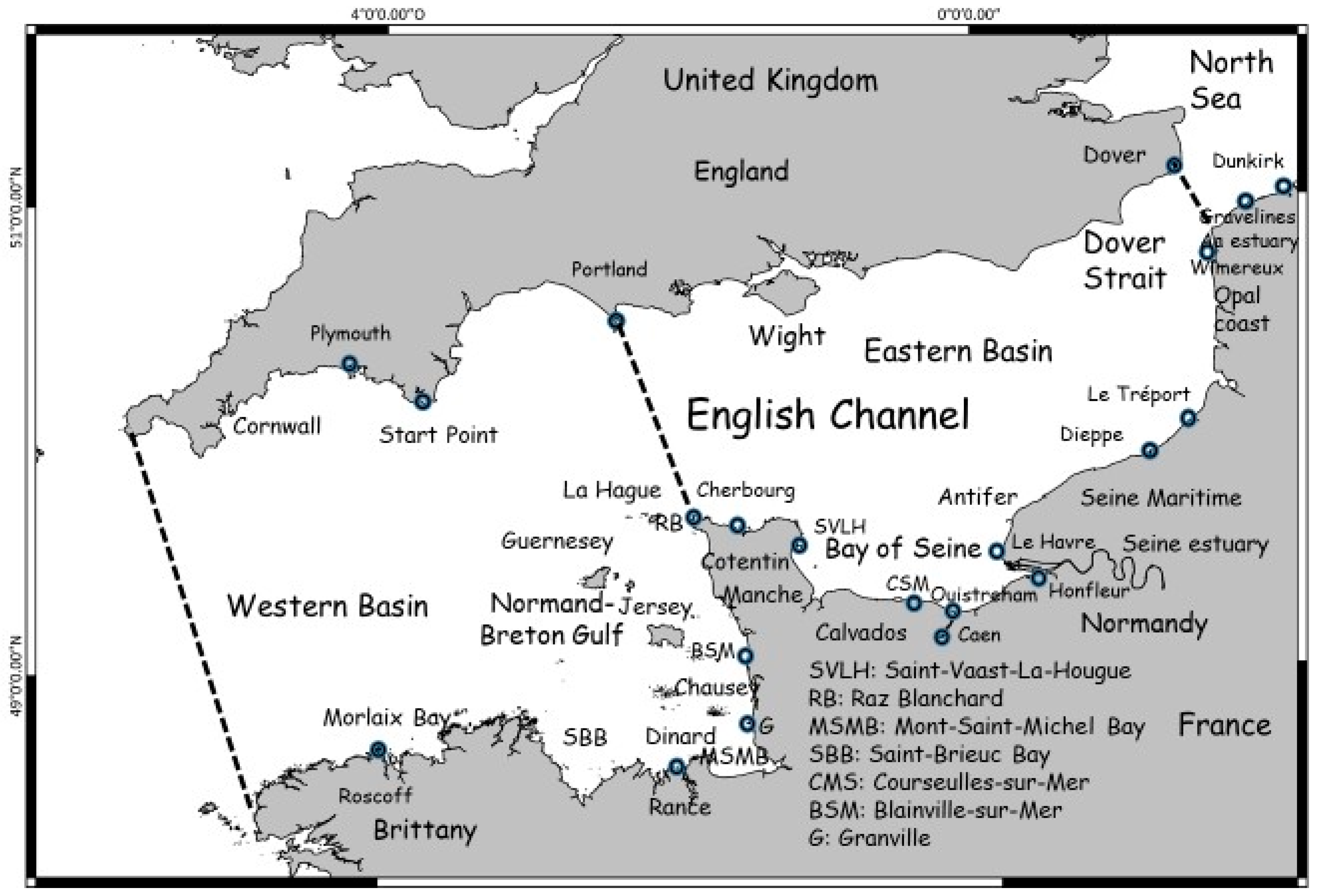
Figure 1. English Channel, map of localities (bule circles) and areas mentioned in the text. Dash line, limits of the basins.
Diversity 18 00163 g001
Figure 2. Rocky shore at Blainville-sur-Mer, colonised by the invasive oyster Magallena gigas.
Diversity 18 00163 g002
Disclaimer/Publisher’s Note: The statements, opinions and data contained in all publications are solely those of the individual author(s) and contributor(s) and not of MDPI and/or the editor(s). MDPI and/or the editor(s) disclaim responsibility for any injury to people or property resulting from any ideas, methods, instructions or products referred to in the content.