Article

Sedimentary Phytopigments in the St. Anna Trough and Adjacent Waters: Spatial Patterns and Environmental Drivers

by
Lyudmila V. Pavlova
,
Veronika V. Vodopyanova
,
Alexander G. Dvoretsky
* and
Denis V. Moiseev
Murmansk Marine Biological Institute of the Russian Academy of Sciences (MMBI RAS), Murmansk 183038, Russia
*
Author to whom correspondence should be addressed.
Diversity 2026, 18(6), 355; https://doi.org/10.3390/d18060355
Submission received: 19 May 2026 / Revised: 9 June 2026 / Accepted: 9 June 2026 / Published: 11 June 2026
(This article belongs to the Special Issue Ecology and Biogeography of Marine Benthos—2nd Edition)

Abstract

Rapid Atlantification is altering primary productivity and benthic-pelagic coupling in the Eurasian Arctic. This study assessed sedimentary pigments as indicators of exported production in the poorly studied St. Anna Trough, a critical conduit between the Barents and Kara seas. Sediment samples were collected at 20 stations in autumn 2023, and phytopigment concentrations were analyzed spectrophotometrically alongside hydrological data. Multivariate analysis revealed two distinct benthic regimes separated by the Marginal Ice Frontal Zone. The southern sector, influenced by thick seasonal warm water masses (WWM) in the subsurface layer, exhibited mesotrophic conditions with mean chlorophyll-a + pheophytin-a concentrations of 30.28 ± 6.51 µg g−1. The northern sector, dominated by Arctic-origin water masses, was oligotrophic (4.45 ± 0.54 µg g−1). Redundancy analysis identified WWM thickness as the primary driver, explaining 60.5% of the total variance in pigment contents, followed by ice-cover duration (9.8% negative effect). Pigment indices and high pheophytin proportions indicated predominantly detrital organic matter, though stations near the Barents Sea inflow showed fresher material. The prevalence of chlorophyll-b in the north suggested ice-associated green algae, while chlorophyll-c dominated the diatom-rich southern inflow. These findings establish a crucial baseline for monitoring climate-driven shifts in pelagic-benthic coupling as sea ice retreat continues.

1. Introduction

Photosynthetic pigments of planktonic and benthic algae, as well as their diverse degradation products, are widespread and ubiquitous components of the marine environment [1,2,3]. Beyond capturing solar energy to fuel cellular growth, these compounds are established indicators of the overall physiological state of microalgal communities [4,5,6,7,8,9]. The concentration of chlorophyll a is widely used by researchers to closely monitor the ecological state of water bodies of various sizes and critically assess their sustainable development over time [10,11,12,13,14,15,16,17,18,19,20,21,22]. Furthermore, it serves as an invaluable indirect indicator of primary production, effectively representing the total biomass of microalgae [16,19,23,24,25,26].
Organic matter created by phytoplankton within the euphotic layer progressively accumulates in bottom sediments in the form of plant pigments, the various products of their biochemical degradation, and occasionally living cells [16,27]. Sediment pigments are generally considered a valuable indirect indicator of the total productivity of the water column successfully exported to benthic communities [28]. The quantitative determination of these pigments, particularly chlorophyll-a (Chl-a), in marine sediments began to be regularly performed at the beginning of the 20th century [29]. The main plant pigment, Chl-a, and its associated breakdown products are continuously used as a marker of fresh organic matter reaching the ocean bottom from overlying plankton [29,30,31]. Features of the pigment complex structurally characterize the taxonomy of plankton and serve as highly sensitive markers of environmental conditions in both the water column and sediments. Specifically, they help scientists evaluate zooplankton and bottom biota grazing, the downward supply of fresh microalgae, local oxygen saturation levels, benthic microbial activity, and prevailing sedimentation conditions [7,21,26,32,33,34,35,36,37,38,39,40]. Consequently, comprehensive information detailing the spatiotemporal distribution of these specific pigments is frequently used to assess the cumulative influence of natural and anthropogenic factors on the ecological state of diverse water bodies [16,32].
In dark, aphotic marine sediments, living pelagic or ice-associated diatoms and haptophytes are the main source of Chl-a [11,41]. These organisms are known for rapid sedimentation rates, reaching up to 100 to 150 m per day or more, especially during the physical formation of cell aggregates or when packaged as zooplankton fecal pellets [42,43,44]. In high-latitude Arctic regions covered with permanent ice, the peak flow of diatom microalgae typically occurs in July and August during the period of maximum solar radiation [45,46,47]. Conversely, in regions characterized by seasonal ice cover, this essential flux peaks in May and June, corresponding with the time of subglacial blooms and the period immediately after ice melting [14,48,49,50]. Diatoms play a highly important role in total primary production even at the very end of the growing season [51,52,53]. Over time, the localized population of diatoms within the sediment gradually decreases due to the inevitable collapse of vegetative cells and spores [41,54,55,56]. However, at continuously low temperatures, diatom cells can impressively remain viable for months, and their dormant resting stages can survive for years [57,58]. Biogeochemically, the peak concentration of chlorophyll in the water column usually precedes the peak observed in the form of breakdown products (pheopigments) in bottom sediments by an average of two to three months [25,50]. Upon reaching the sediment surface, the structural half-life of both Chl-a and its resulting pheopigments generally ranges from three to eight weeks [25,59,60].
In both the relatively shallow shelf and the expansive deep-sea regions of the Arctic Ocean, sea ice algae and pelagic phytoplankton originating from the water column constitute the primary source of organic carbon for marine benthic communities distributed across sea basins located far below the euphotic layer [61,62]. At these extreme high latitudes, the total downward supply of organic carbon to the sea bottom varies greatly and depends on seasonal ice cover, total surface primary production, the intensity of grazing by intervening zooplankton, and the rate of microbial degradation [46,63,64,65]. Spatial and temporal patterns dictating the flow of this settling, newly synthesized organic matter are of decisive importance for the sustained development and ecological success of the benthos, especially at high latitudes [66,67,68,69].
We studied the pigments of bottom sediments located within the geographic area of the St. Anna Trough. Situated between the Novaya Zemlya and Franz Josef Land archipelagos on the boundary dividing the Barents and Kara Seas, this distinct area belongs to historically oligotrophic marine areas characterized by oxidized brown silt, a classification which also includes the entire northern part of the Barents Sea and the wider Kara Sea [70,71,72]. Through this deep trench, vital water exchange continuously occurs between the shallower Barents Sea and Kara Sea shelf regions and the expansive deep-water part of the Arctic Ocean, commonly known as the Polar Basin. Despite its immense hydrographic importance, this area is relatively poorly studied due to its geographical remoteness and historically severe ice conditions; throughout the 20th century, the trench often remained fully covered with thick sea ice even during the summer months [73,74,75]. The Arctic marine environment, however, is currently undergoing rapid transformations [76,77]. In the last two to three decades, profoundly large negative anomalies regarding sea ice cover have been consistently observed across the Barents Sea [63,78,79], a climatic shift that has fundamentally made the St. Anna Trough more accessible for modern research. This observed retreat and the distinct decrease in overall ice thickness are primarily caused by a marked increase in the volumetric transport of warmer Atlantic waters into the region, an oceanic phenomenon that has become stable since the year 2000 [38,39,50,63,80]. The combined effects of a stark reduction in total ice area and an increased volume of warmer and saltier Atlantic waters carrying essential nutrients into the Barents and Kara Seas led to a localized but significant increase in primary production [81,82,83,84]. These ongoing, large-scale oceanographic processes heavily affect the crucial bentho-pelagic connections in this specific area, upon which the entire functioning and resilience of Arctic ecosystems depend [85,86]. Consequently, pigments in bottom sediments can provide indispensable insight into the shifting characteristics of primary productivity and allow for an accurate assessment of the vertical flow of organic matter, acting as highly sensitive potential indicators of broader climate change.
Despite the critical importance of monitoring these ongoing climatic shifts, there is a profound lack of comprehensive data in this specific geographical region. Currently, there is absolutely no modern published literature concerning the contemporary content and spatial dynamics of Chl-a and its crucial auxiliary photosynthetic pigments within the bottom sediments of the St. Anna Trough. Remarkably, the only documented scientific study evaluating the chlorophyll content in the upper layer of sediment specifically located west of the trough was carried out nearly a century ago, in 1931 [87]. This scarcity of contemporary information contrasts sharply with other regional zones; for example, the western and southern shelves of the wider Barents Sea [88,89,90,91] and the directly adjacent waters surrounding the Svalbard archipelago can currently be considered relatively well studied by comparison [40,92].
The purpose of this work was to assess the pelagic products exported to the deep benthic communities in the St. Anna Trough during the modern oceanographic period, which is distinctly characterized by drastically reduced sea ice cover and the increased overall productivity of Arctic surface waters. To achieve this comprehensive goal, the following specific tasks were formulated for this study: (1) analyze the spatial variability of sediment pigments across the trench system, (2) establish the current trophic status of the study area based specifically on the composition and concentration of sediment pigments, (3) reveal the main driving factors responsible for phytopigment contents, and (4) evaluate the possibility of using these sedimentary pigments as robust markers of water column productivity, benthic environmental health, and climate-driven changes in productivity or ice cover.

2. Materials and Methods

2.1. Study Area

The St. Anna Trough represents the largest trough on the Eurasian continental margin, extending approximately 550 km in length and 170 km in width, with depths ranging from 400 m in its flat central portion near Novaya Zemlya to 600 m in the northern sector adjacent to the shelf break [93]. The trough connects southward with the shallow central Kara Sea and the northeastern Barents Sea, while northward it opens into the deep Nansen Basin of the Arctic Ocean. The hydrological regime of this region is shaped by the interaction of water masses originating from the Polar Basin, the Barents Sea, and the Kara Sea, governed by a complex system of wind-driven and geostrophic currents [94].
Water column stratification in the study area results from the convergence of two Atlantic water branches: the Fram Strait branch and the Barents Sea branch. Fram Atlantic waters (hereafter referred to as Atlantic waters), characterized by core temperatures exceeding 2 °C, enter the trench from the north along its western flank as a deep current. The majority of this warm flow circulates within the northern portion of the St. Anna Trough, while a smaller fraction penetrates southward along the western side into the Barents Sea [95,96,97,98,99]. These Atlantic waters are overlain by cold, desalinated Arctic or mixed surface waters. Colder Barents Sea waters (temperatures of −0.25 to −0.5 °C; salinities of 34.86–34.88 psu) enter the trough along the northwestern slope of Novaya Zemlya. This Barents Sea flow turns northward east of the Kara Sea and subsequently flows toward the open ocean along the eastern slope of the St. Anna Trough within intermediate and deep layers, with velocities ranging from 5 to 10 cm/s to 10–30 cm/s [95,98,100,101]. This current transports warm surface waters from the Kara and Barents Seas adjacent to Novaya Zemlya [98]. A seasonal marginal front crosses the trench at approximately 78–79° N latitude during the warm period, forming between cold desalinated surface Arctic waters to the north and warmer Atlantic-origin surface waters to the south [102].
Bottom sediments throughout most of the study area consist predominantly of silty and pelitic silts, with the pelite fraction comprising 42–65% of sediment composition [103,104]. Oxidizing conditions prevail across most of the trough surface, whereas reducing conditions dominate in the southern sector, accompanied by sediment color transitions from brown to gray and substantial degradation of the oxidized layer [105]. Sedimentation rates remain generally low, with elevated accumulation observed in the southern portion of the trench [104,105]. Extended periods of ice cover coupled with abbreviated phytoplankton growing seasons [54] contribute to carbon flux limitation within benthic communities [63]. Sedimentary material is primarily composed of aggregates and individual diatom cells originating from under-ice blooms [106]. Organic matter content in sediments ranges from 0.6% to 1.5% [93,107].
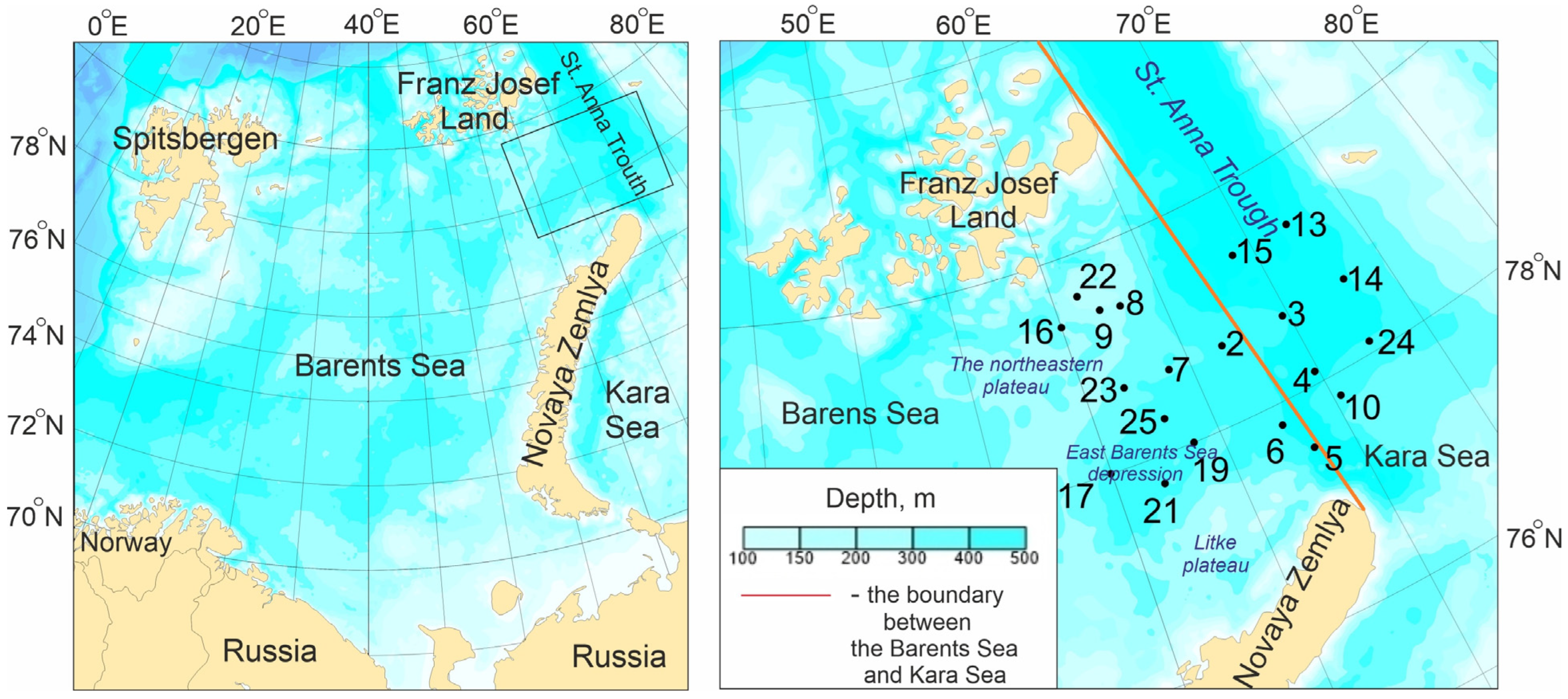
The investigation encompassed the southern portion of the St. Anna Trough south of 80° N, the East Barents Sea Trough (Northeast Trough), and the Northeast Plateau. Bottom sediment samples were collected at 20 stations between 27 October and 4 November 2023, during a research cruise aboard the R/V ‘Dalnie Zelentsy’. Station locations are presented in Figure 1, with station numbers corresponding to the cruise logbook.

2.2. Environmental Data

Hydrological measurements were performed at all stations using a SEACAT SBE 19 plus V2 STD profiler (Sea-Bird Scientific, Bellevue, WA, USA). The conductivity sensor exhibited an accuracy of 0.0005 S m−1 with a resolution of 0.00005 S m−1, the temperature sensor demonstrated an accuracy of 0.005 °C with a resolution of 0.0001 °C, and the pressure transducer provided an accuracy of 0.1% of full scale with a resolution of 0.002% of full scale. Given that primary production within the St. Anna Trough region is strongly modulated by hydrophysical conditions, particularly current interactions, frontal zone presence, and their effects on water stratification and nutrient availability [108], the vertical structure of the water column was examined in detail. The spatial distribution of prevailing water masses (Barents Sea and deep Atlantic waters) within the trench is largely determined by bottom topography and exhibits considerable stability [109,110], as corroborated by long-term observational records [95,96,97,98,100,111]. This stability permits the utilization of proportional contributions of principal water masses as meaningful environmental variables. The proportional contribution of each predominant water mass was calculated as a percentage of the total thickness of all seasonal and main water layers, identified within the water column at the station. Thin temporal stratifications and relict layers in the water column were excluded from the analysis.
Water masses were classified in accordance with methodologies established by Loeng [112] and Lind and Ingvaldsen [113]. We refer to Barents Sea water masses (BW) as encompassing both shelf Barents Sea waters and their resultant mixing with Fram waters, whose thermohaline characteristics align with those of the Barents Sea, as well as incorporating cold deep waters. The presence of thin stratifications and relict layers within the water columns impeded the application of classical temperature-salinity (T,S) analysis at numerous stations. The number of predominant water layers within each station’s water column was determined through the examination of vertical profiles. The boundaries of the Atlantic water masses were delineated using the 0 °C isotherm, as outlined by Pfirman et al. [114], Walsh et al. [115], and Osadchiev et al. [98]. The interface between the surface desalinated layer and the subsurface halocline was characterized by sharp fluctuations in temperature and/or salinity. Classical T,S analysis, as described by Mamaev [116], was employed to discern the boundaries of shelf and Barents Sea waters at stations exhibiting a relatively straightforward vertical water structure, particularly in proximity to the Franz Josef Land archipelago.
Ice conditions for the year preceding sample collection were obtained from the Arctic and Antarctic Research Institute archive (https://data.aari.ru/odata/_d0004.php, accessed on 18 June 2025). The source data consisted of satellite imagery and data from ships and polar stations, gathered over a period of 2–5 days. The boundaries of homogeneous ice zones were encoded with a precision of 1 arcminute. An ice zone is defined as an area with an ice concentration greater than 10%. For each station, ice-cover duration was calculated as the number of days with ice present, serving as an indirect indicator of wind forcing effects on water stratification. Additionally, the number of ice-covered days following polar night termination was computed as an estimate of the sympagic microalgal growing season duration, enabling assessment of the potential for rapidly sinking diatoms to reach the benthos at locations of mass development. Polar night termination was designated as February 26 for southern stations and March 4 for northern stations. The growing season duration for slowly sinking planktonic microalgae was not estimated, given that pigment deposition from these organisms may occur outside the study area due to the considerable water depths.
Sediment characteristics were assessed visually during sampling following standard protocols [117]. Substrates were classified according to particle size categories: clay (<0.005 mm), silt (0.005–0.05 mm), sandy silt (0.05–0.1 mm), sand (0.1–1.0 mm), gravel (1–10 mm), pebble (10–100 mm), stone (>100 mm), and shell (fragments of bivalve shells). Surface sediment coloration, oxidized layer thickness, and the presence of foraminiferal sand composed of dead agglutinated tests of Reophax pilulifer were employed as qualitative indicators of organic matter sedimentation rates [93,105,118,119]. Surface layer color, determined from dried samples under electric illumination, ranged from brown (oxidized sediments) to gray (reduced sediments). Four qualitative sedimentation categories were established: (1) brown sediment with abundant foraminiferal sand; (2) brown sediment with sparse foraminiferal sand; (3) thin gray-brown sediment layer lacking foraminiferal sand; and (4) thin gray or gray-green sediment layer lacking foraminiferal sand. Sediment moisture content in the upper centimeter layer was determined gravimetrically by measuring mass difference before and after drying at 60 °C for 24 h.
Dissolved oxygen (O2, mg L−1) in bottom waters, which influences chlorophyll preservation [59,87,88], was determined using the Winkler titration method with a semi-automatic continuous burette (Vitalab Grossostheim, Germany). Water samples were collected from the bottom layer using a 10 L Niskin bottle.

2.3. Phytopigment Analysis

Sediment sampling was conducted using a Van Veen bottom grab with a 0.1 m2 sampling area [119]. Pigment analysis followed established protocols [16,120,121], building upon foundational work by Rauser-Chernousova [29]. Following removal of overlying water, two sediment subsamples were collected from the upper centimeter layer using the quartering method. Sediment samples were placed in plastic zip bags, frozen at −20 °C, and stored for a maximum of one month prior to analysis. Immediately before analysis, each sediment sample was thoroughly homogenized and divided into two portions for pigment determination and moisture content assessment.
One gram of sediment was transferred to a test tube, combined with 10 mL of 90% acetone, thoroughly mixed, and refrigerated for 24 h. Acetone extract was subsequently separated by centrifuging the suspension at 8000 rpm for 20 min. To efficiently extract the maximum amount of pigment complex components that were not available in the first extraction, the extraction was repeated with fresh 90% acetone for one hour in the refrigerator. During the second extraction step, complete decolorization of the precipitate and supernatant was visually observed. The concentrations of pigments were measured in the combined extract (the aggregate extract from the first and second extraction steps). Spectrophotometric measurements were performed using a Nicolet Evolution 500 (Spectronic Unicam, Cambridge, UK) spectrophotometer, which is calibrated annually against commercially purified Chl-a standards (Sigma-Aldrich, Taufkirchen, Germany) to control accuracy [122]. Each analytical batch included a reagent blank (90% acetone) and a reference sediment sample of known pigment content (previously analyzed in triplicate) to monitor inter-batch consistency. Duplicate extractions of randomly selected samples yielded a low standard deviation for all pigments, indicating acceptable analytical precision. Spectrophotometry was performed twice: before and after acidification of the extract with 2–3 drops of a prepared solution of hydrochloric acid in acetone (for a 5 mL cuvette). To prepare this, 0.5 mL of concentrated HCl was dissolved in 10 mL of acetone. After acidification, the extract was stirred for 2–3 min. The solution was stored for no more than one day. All manipulations were performed in a darkened room. Pigment concentrations in sediment samples were calculated using phytoplankton pigment formulae [122,123], substituting dry sediment mass for filtered water volume in the calculations. Pigment content was expressed as micrograms per gram of dry sediment (μg g−1 d.w.).
Concentrations of Chl-a were determined both without correction for pheophytin-a (Chl′-a) and with correction (Chl-a), together with pheophytin-a (Phe-a), the inactive form of Chl-a lacking the Mg2+ ion. Pheophytinization, associated with low light or dark conditions, occurs when phytoplankton cells descend below the euphotic zone and remain there for extended periods exceeding 70 h. This process can be reversible [124,125]; cells experiencing pigment degradation in darkness may restore chlorophyll content upon re-exposure to light through photo-oxidation of pheopigments and magnesium ion reinsertion into the porphyrin ring. Additional determinations included chlorophyll-b (Chl-b), chlorophylls c1 and c2 (Chl-c1,2), and total carotenoid concentration (Car).
Chl-a concentration without Phe-a correction (Chl′-a) was calculated using the formula:
Chl′-a = (11.85 × D664 − 1.54 × D647 − 0.08 × D630) × (Ve/(Md × L)),
where D664, D647, and D630 represent extract optical densities at wavelengths 664, 647, and 630 nm, respectively; L denotes cuvette path length in centimeters; Ve represents extraction volume in milliliters; Md indicates dry sediment mass; concentrations are expressed in μg g−1 d.w.
Chl-a concentration with Phe-a correction (Chl-a) was calculated as:
Chl-a = 2.44 × ((D664 − Dk664)/D664) × Chl′-a,
where D664 and Dk664 represent extract optical densities at 664 nm before and after acidification with concentrated hydrochloric acid.
Concentrations of other pigments (Phe-a, Chl-b, Chl-c1,2, and Car) were calculated using the following formulae:
Phe-a = 2.44 × ((1.77 × D664 − Dk664)/D664) × Chl′-a
Chl-b = (21.03 × D647 − 5.43 × D664 − 2.66 × D620) × (Ve/(Md × L))
Chl-c1,2 = (24.52 × D630 − 1.67 × D664 − 7.6 × D647) × (Ve/(Md × L))
Car = 10 × D480 × (Ve/(Md × L))
The pigment index (I430/664) was calculated as:
I430/664 = D430/D664,
where D430 and D664 represent extract optical densities at wavelengths 430 and 664 nm.
All optical densities incorporated in these formulae were corrected by subtracting the optical density measured at 750 nm [123]. A single determination per sample was considered the analytical result.
The percentage contribution of Chl′-a, Chl-b, and Chl-c1,2 to their sum (Chl′-a + Chl-b + Chl-c1,2) and the percentage contribution of Phe-a to the sum of pure chlorophyll and pheophytin (Chl-a + Phe-a) were calculated as indicators of detrital versus freshly deposited pigment origin. The pigment index I430/664, representing the ratio of acetone extract optical density at λ = 430 nm to that at λ = 664 nm [126], together with the carotenoid to Chl-a with pheophytin ratio (Car/Chl′-a) [127,128], served as indicators of algal functional activity and the ratio of heterotrophic to autotrophic metabolism within the community [129]. I430/664 values ranging from 1 to 2 characterize young planktonic communities, whereas values from 3 to 5 indicate senescent communities [130]. Car/Chl′-a ratios exceeding unity denote conditions unfavorable for algal development [128]. The ratios Chl-c1,2/Chl′-a and Chl-b/Chl′-a were employed to assess changes in algal composition and abundance, as Chl-c occurs in dinoflagellates, diatoms, chrysophytes, and prymnesiophytes, while Chl-b characterizes green algae, euglenophytes, and prasinophytes [21,33,36,131,132,133]. Strong predominance of Chl′-a over Chl-b and Chl-c1,2 was interpreted as indicating cyanobacterial dominance [5,134,135,136,137]. Benthic trophic status was assessed based on Chl-a + Phe-a concentration per gram of dry sediment following established criteria: oligotrophic, <13 μg g−1; mesotrophic, 13–60 μg g−1; eutrophic, 60–120 μg g−1; hypertrophic, >120 μg g−1 [6]. Although this classification scheme was originally developed for lacustrine sediments, this scheme has been applied previously in marine studies [16] and provides a consistent, comparative framework.

2.4. Statistical Analysis

Non-metric multidimensional scaling (nMDS) employing Euclidean distance as the distance matrix was utilized to identify areas exhibiting similar vertical water column structure. The variables incorporated comprised the percentage contribution of each principal water mass to total water column height, logarithmically transformed to minimize extreme value influence. The seasonally determined thin surface layer of cold desalinated water, together with minor intrusions of water masses of different origin, were excluded from analysis. Stress values below 0.1 were considered indicative of satisfactory solution fit [138].
Cluster analysis was employed to compare stations based on sedimentary pigment distribution patterns. The unweighted pair group method with arithmetic mean (UPGMA) was applied, with similarity matrices calculated using the Bray–Curtis coefficient [139]. Similarities among station groups identified through cluster hierarchies or multidimensional scaling were statistically assessed using analysis of similarities (ANOSIM). Variations in environmental characteristics and pigment content among identified clusters were tested using either ANOVA or Kruskal–Wallis test. Preliminary assessment of data distribution normality for appropriate test selection was conducted using the Shapiro–Wilk test, while homogeneity of variances was evaluated using Levene’s test. The potential differences in the average proportions of chlorophylls a, b, and c between the identified areas were assessed using chi-square tests.
Associations between environmental variables and phytopigment contents were quantified using redundancy analysis (RDA), a direct gradient ordination method [140,141,142]. Linear ordination was selected over unimodal alternatives following preliminary detrended correspondence analysis (DCA), which indicated that the primary gradient length on the first axis was less than 3.0 standard deviation units [142]. Prior to model construction, environmental predictors were evaluated for multicollinearity using variance inflation factors (VIF) [143]. Variables exhibiting high inflation factors were removed from subsequent analysis, including depth, bottom temperature and bottom salinity (both strongly positively correlated with the thickness of warm water masses), and sympagic algal vegetation period (strongly positively correlated with ice-cover duration). The exclusion of these variables was conducted sequentially to maximize the inclusion of potential predictors in the final model. The final RDA model retained nine environmental variables with VIF values below 10: sedimentation rate, sediment moisture, oxygen content, ice-cover duration, thickness of warm water masses (WWM), thickness of Atlantic waters (AW), thickness of Franz Josef Land shelf waters (FJLSW), and thickness of Barents Sea waters (BW). Response variables consisted of log(x + 1)-transformed contents of Chl-a, Chl-a adjusted for pheophytin, Phe-a, Chl-b, Chl-c1,2, and carotenoids. This transformation effectively reduced data skewness and yielded the highest proportion of explained variation relative to models fitted to untransformed or square-root-transformed data. Statistical significance of the overall RDA model, individual canonical axes, and each explanatory variable was evaluated using Monte Carlo permutation tests [143]. Subsequently, relationships between significant environmental variables identified through RDA and log(x + 1)-transformed contents of individual phytopigments were further analyzed using generalized linear models (GLMs) with normal error structure and identity link function. To evaluate the sensitivity of our analyses given the modest sample size (n = 20), we performed post hoc power calculations. For GLMs, we used Cohen’s method to compute the achieved power for detecting the effect of warm water mass thickness, which was the strongest predictor. The analysis was based on the observed effect size (Cohen’s f2), α = 0.05, and n = 20. We also calculated the minimum sample size that would have been required to reach the conventional power of 0.80 under the same effect size. For the RDA, we designed a Monte Carlo simulation that directly mimics our sampling design and a predictor correlation structure (compound-symmetric correlation = 0.3). We set the true marginal variance explained by each predictor to match the values obtained from our marginal permutation tests. For each simulation replicate (N = 1000), a new dataset was generated under a multivariate normal model for the responses (total variance fixed to 1) and a multivariate normal distribution for the predictors, an RDA was fitted, and the significance of individual terms was assessed with a permutation test (999 permutations, α = 0.05). Power was estimated as the proportion of replicates in which the term was declared significant. We evaluated power in two scenarios: the full model with all nine predictors and (ii) a reduced model containing only significant predictors. To gain a more nuanced understanding of the associations between phytopigment contents and all environmental variables, including those that were removed from the RDA due to multicollinearity, we additionally calculated Spearman correlations.
Mean values are presented with standard errors. All statistical analyses were performed using the PAST 4, Primer 5, and Canoco 4.5 software packages.

3. Results

3.1. Environmental Conditions

The water masses identified from the vertical water-column structure at the sampling stations are summarized in Table 1.
Note that the uppermost (0…8–15 м) temporary layers are not included in the table. These waters were presented by a well-mixed cold upper layer (salinity 32.00…34.69 psu, temperature −1.79…−0.04 °C) at stations 2, 3, 4, 7, 8, 9, 16, 17, 22, 23, and 25 as well as an extremely freshened layer (26.67…33.80 psu, −1.70…−0.1 °C) at stations 5, 10, 13, 14, 15, and 24. In October, the upper 50–80 m of the water column, and in some areas the surface layer itself, were occupied by either cold or warm water masses with lower salinity than the underlying layers. In general, these water masses were characterized by a pronounced vertical salinity gradient. The main exceptions were the upper seasonal layers, namely the well-mixed cold surface layer and the strongly freshened layer. This pattern of stratification reflected the presence of a cold halocline at all northern stations, a warm halocline at the southern and southeastern stations, and a thick warm mixed layer at the southwestern stations 19 and 21 (Table 1), all of which developed during the warm season. At the time of sampling, warm halocline waters in the southeast were warmer and less saline (31.60–34.67 psu, 0.25–3.04 °C) than the warm surface and subsurface water masses in the south and southwest (34.00–34.69 psu, 0.10–1.28 °C).
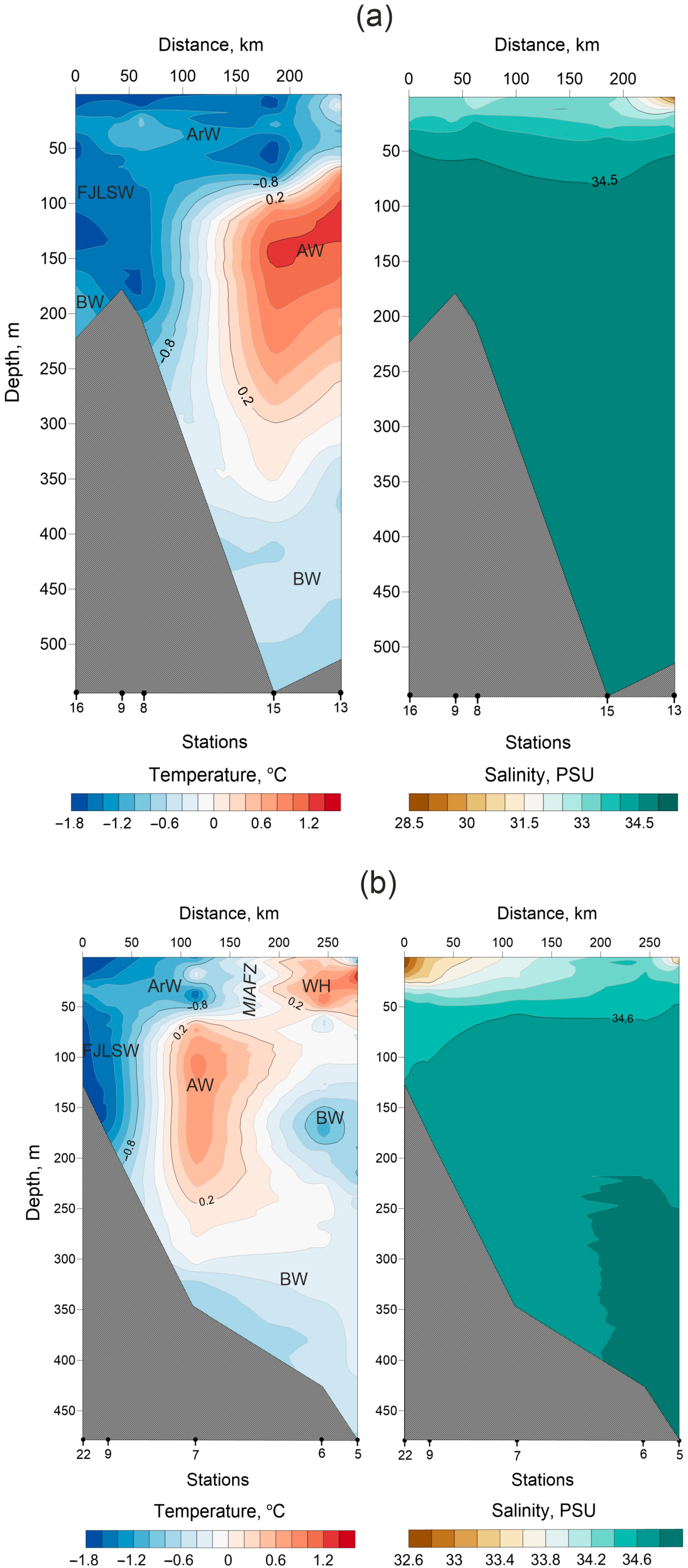
Intermediate Atlantic Water (AW) was absent in the vicinity of the Franz Josef Land archipelago and at stations 4, 5, and 6 (Figure 2a). Where present, AW had a lower core temperature and higher salinity than the warm halocline waters (Figure 2b). AW predominated at stations 2, 3, 7, 13, and 15, but was only weakly represented at stations 17, 19, and 21. Barents Sea Water (BW) occupied the intermediate and near-bottom layers at all stations except those located near the Franz Josef Land archipelago, specifically stations 8, 9, and 22. Its salinity was similar to that of AW. BW was dominant at the southern and southeastern stations (4, 5, 6, 14, 17, and 24), whereas it was only weakly represented in the near-bottom layer at stations where AW predominated.
Two water masses were identified in the near-bottom layer. The first was BW, with temperatures ranging from −0.74 to −0.17 °C and salinity from 34.73 to 34.82 psu, recorded at stations 2, 3, 4, 5, 6, 7, 10, 13, 14, 15, 16, 17, 19, 21, 23, 24, and 25. The second was Arctic-origin shelf water associated with the Franz Josef Land archipelago (FJLSW), with temperatures from −1.65 to −1.06 °C and salinity from 34.60 to 34.67 psu, observed at stations 8, 9, and 22. Strong horizontal temperature gradients and weaker salinity gradients were evident in the near-bottom layer. Overall, bottom-water temperature and salinity increased from north to south and from west to east.
Mesoscale water-column stratification, expressed as horizontal layer displacements accompanied by density instability, was clearly observed at stations 4, 6, 17, 19, and 21 within the 40–70 m and 280–300 m depth intervals. This pattern suggests the proximity of a front separating water masses of different origin, namely between deep-water BW and waters associated with the slope of the Novaya Zemlya archipelago and the Kara Sea shelf.
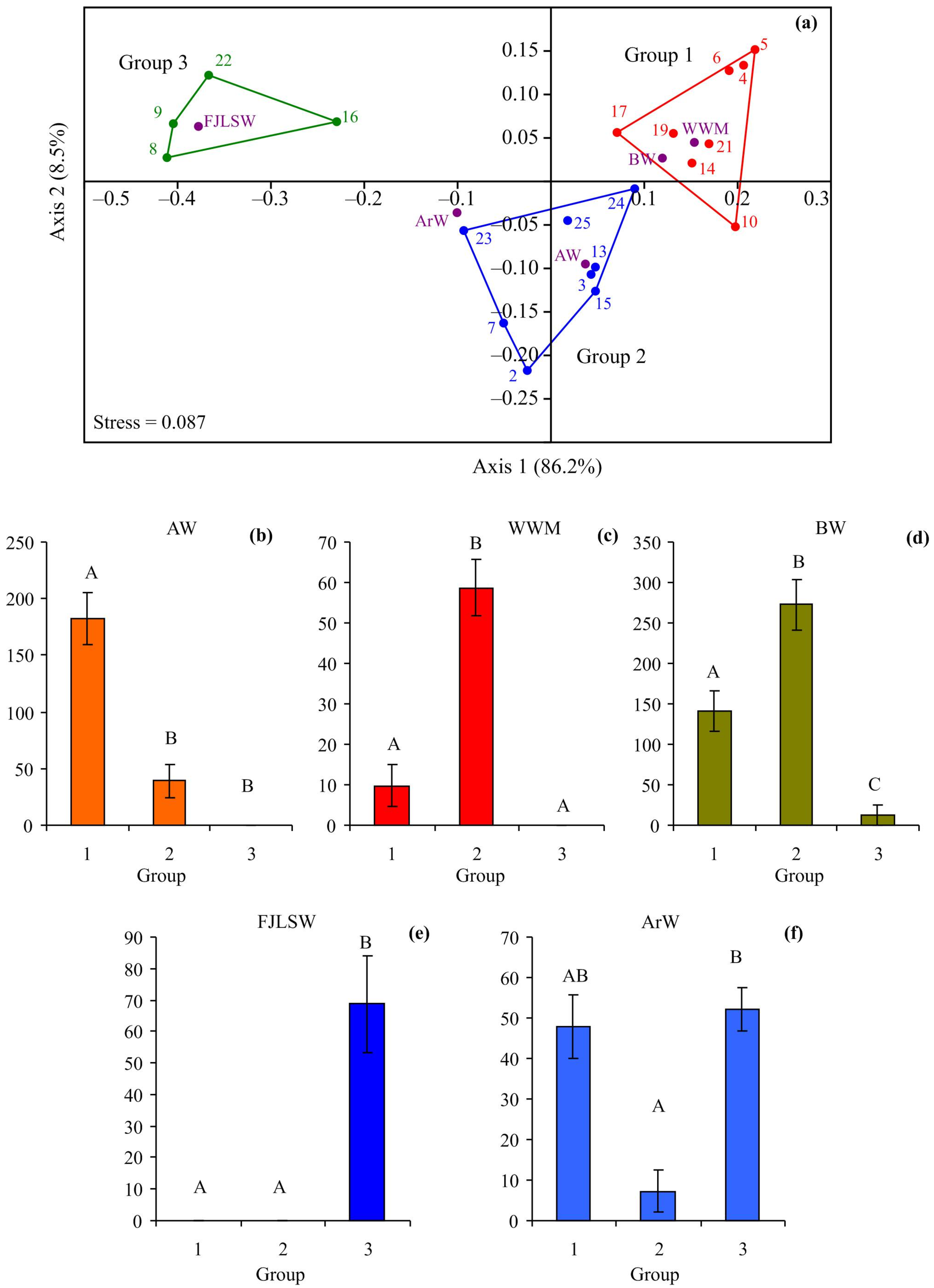
NMDS analysis identified three station groups (Figure 3a) with significantly different types of vertical structure of the water column (ANOSIM: R = 0.874, p = 0.0001; all pairwise comparisons were also highly significant, p < 0.0024 in all cases). Group 1 included 8 stations where AW was dominating (Figure 3b). Group 2 included 8 stations with the greatest thickness of warm water masses and BW (Figure 3c,d). Group 3 comprised 4 stations occupied by FJLSW (Figure 3e). ArW was present in similar proportions in groups 1 and 3 and was thicker than in group 2 (Figure 3f).
Satellite observations for 2022–2023 revealed repeated and substantial shifts in ice-edge position, as well as delayed ice retreat across the study area. In autumn 2022, stations 8, 9, 16, and 22, located in the shelf waters of the Franz Josef Land archipelago, became ice-covered earlier than the other stations (from 25 October 2022 onward) and cleared of ice later, only by mid-August. At most other stations, ice formation occurred 1–4 weeks later. The densest ice cover occupied the largest area of the study region, as well as adjacent southern waters, from late March to late April. The southern part of the study area became ice-free in early June, whereas the northwestern sector did not clear until early August. Most of the study area, with the exception of stations 13 and 15, experienced repeated ice advance and retreat throughout winter, spring, and summer. Beginning in May 2023, the ice edge crossed the areas of stations 2, 7, 23, and 25 between five and seven times, potentially promoting prolonged marginal-ice-zone blooms. The strongest wind forcing, likely to enhance vertical mixing, was characteristic of the entire southwestern sector (stations 17, 19, 21, 23, and 25), where the sea surface remained ice-free for more than 200 days (Figure S1); a similarly long ice-free period was also recorded in the southeast (stations 4, 5, 6, and 10). In contrast, stations 8, 9, 13, and 22 had the shortest open-water period.
The concentration of dissolved oxygen (O2) in the near-bottom layer varied among stations (Table S1). At most stations, oxygen saturation ranged from 88% to 107%. The highest oxygen concentration was recorded on the southeastern slope of the Saint Anna Trough (station 10), whereas the lowest value occurred in Arctic waters over the shallow shelf near the Franz Josef Land archipelago (station 22).
Bottom sediments consisted of silts and silty sands. The moisture content of the surface sediment layer ranged from 53% to 74% (Table S1). The brown coloration of the upper sediment layer, several centimeters thick, together with the presence of foraminiferal sand in the samples, indicated well-developed oxidizing conditions over most of the seafloor. Evidence of reduction processes, expressed as a grey tint beneath or within the oxidized sediment layer, was observed at stations 5, 6, 10, 14, 19, and 24 (Table S1). A reduction in the thickness of the upper oxidized layer to 1–2 cm was observed at nearly all southern and southeastern stations (Table S1).

3.2. Sedimentary Pigments

In all samples, the sedimentary pigment complex comprised Chl-a, Chl-b (a marker of green algae), Chl-c1,c2 (markers of diatoms), carotenoids, and Phe-a, the main degradation product of Chl-a. Among these variables, Chl-a concentration per gram of dry sediment showed the greatest spatial variability, spanning approximately three orders of magnitude.
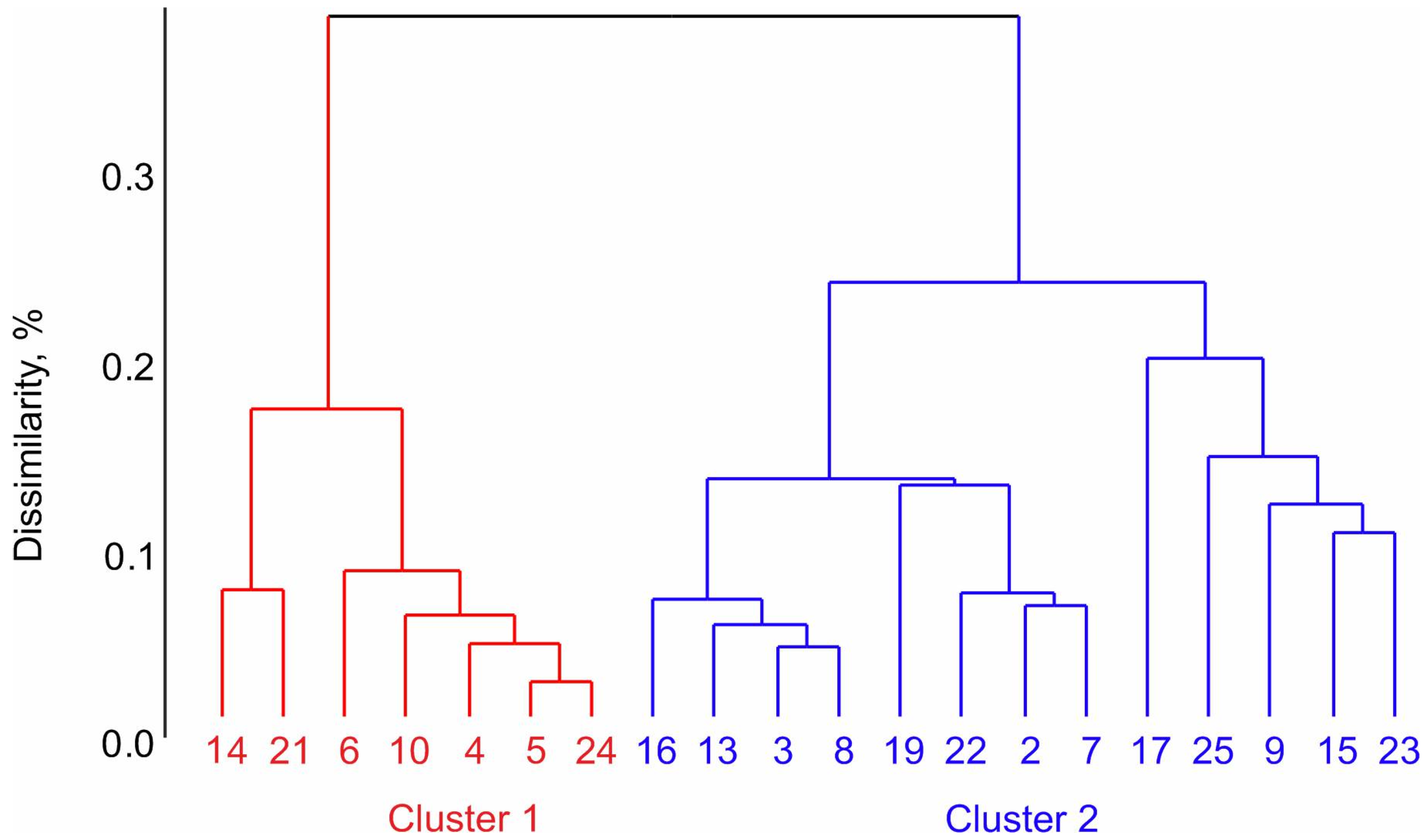
Cluster analysis separated the sampling stations into two groups at a dissimilarity level of 37.1% (equivalent to 62.9% similarity) (Figure 4).
The first cluster comprised 7 stations with high phytopigment contents, including 1 station from NMDS Group 1 and 6 stations from NMDS Group 2. The second cluster included the remaining 13 stations with low phytopigment concentrations, specifically seven stations from Group 1, two stations from Group 2, and all stations from Group 3. The difference between these clusters was highly significant (ANOSIM: R = 0.955, p = 0.0001). This separation was further supported by univariate analyses showing that phytopigment concentrations were significantly higher at stations in Cluster 1 than at stations in Cluster 2 (Table 2). Depth, dissolved oxygen concentration, and sea-ice duration did not differ significantly between the two clusters. In contrast, temperature, salinity, sediment moisture content, sedimentation rate, and the thickness of the WWM and BW layers were all higher in Cluster 1. Conversely, the thickness of the ArW layer was greater in Cluster 2 (Table 2).
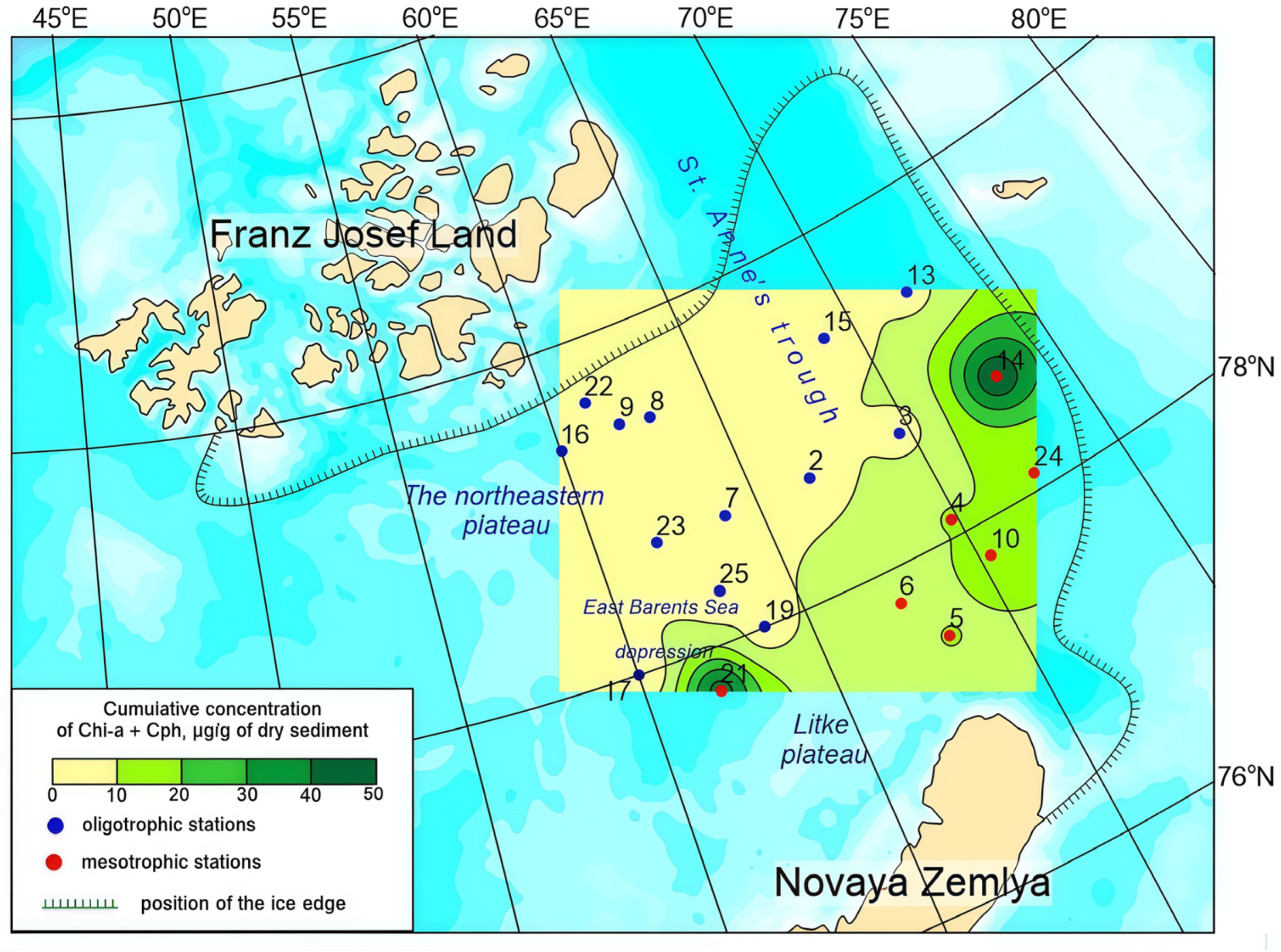
The two station groups also differed significantly, by approximately sevenfold, in the total concentration of Chl-a plus Phe-a, a proxy commonly used to assess trophic status (Figure 5; Table 2 and Table S2). Based on the mean concentration of these pigments, the seafloor area represented by the second cluster, with an average value of 4.45 ± 0.54 µg g−1 is oligotrophic, whereas the first cluster, with an average of 30.28 ± 6.51 µg g−1 can considered mesotrophic. Within the mesotrophic zone, two areas of elevated Chl-a + Phe-a were distinguished: one extending from the Kara Sea toward the eastern side of the trough, and the other associated with inflow from the Barents Sea (Figure 5).
Concentrations of Chl′-a, Phe-a, and carotenoids were approximately seven times higher in the mesotrophic area than in the oligotrophic area. In contrast, differences in Chl-a and Chl-c1,2 were less pronounced, amounting to approximately fourfold and 4.5-fold, respectively. For Chl-b, the difference between the two areas was about twofold (Table 2 and Table S2). A comparison of the two mesotrophic stations with the highest combined concentrations of Chl-a and Phe-a revealed a clear difference in Chl-a content between stations 14 and 21 (Table S2). The higher Chl-a content at station 21 indicates the input of relatively fresh organic matter. This may point to a second pulse of phytoplankton sedimentation at station 21, assuming that the first pulse corresponded to sedimentation following ice-edge blooms.
Phe-a predominated over Chl-a at most stations, suggesting that sedimentary pigments were largely of detrital origin. The presence of freshly sedimented phytoplankton cells may, however, be inferred at station 15, where the proportion of pheophytin was low and Chl-a concentration was relatively high (Tables S2 and S3). The two station groups did not differ significantly in the mean percentage contribution of Phe-a (Table 2). The highest proportion was recorded at stations 14 and 24, whereas the lowest occurred at station 15.
By the end of the growing season, Chl′-a clearly predominated over Chl-b and Chl-c1,2 in terms of percentage contribution in the sediments (Table S3). Particularly high proportions of Chl′-a were observed at one station in the oligotrophic zone (station 19) and at two stations in the mesotrophic zone (stations 14 and 21). In contrast, low proportions of Chl′-a were found at stations 8, 9, and 17 in the oligotrophic area, which may indicate older deposition of fresh organic material. As a rule, Chl-c1,2 slightly exceeded Chl-b (Table S3). However, a higher proportion of Chl-b was recorded at several stations within the oligotrophic zone. This pattern suggests spatial differences in the composition of planktonic phytocenoses in the Saint Anna Trough and adjacent waters. Nevertheless, the oligotrophic and mesotrophic areas did not differ significantly in the mean ratio of chlorophyll groups (χ2 = 3.42, p = 0.180, df = 2).
In the oligotrophic area, the mean values of the ratios Chl-c1,2/Chl′-a and Chl-b/Chl′-a were similar (Table S3). In the mesotrophic area, however, the mean Chl-c1,2/Chl′-a ratio exceeded the Chl-b/Chl′-a ratio. This further supports regional differences in plankton composition and abundance, specifically a greater quantitative dominance of diatoms in the plankton of the mesotrophic area and a relatively greater contribution of green algae in the oligotrophic area. Within the oligotrophic area, bottom sediments at seven northern and northwestern stations indicated either the predominance of green algae or an approximately equal contribution of green algae and diatoms, whereas diatoms dominated at the remaining six stations.
Carotenoid concentrations in the bottom sediments were comparable to those of Phe-a (Table S3). Both the pigment index I430/664 and the Car/Chl′-a ratio were relatively high (Table S3), indicating substantial pigment degradation in the sediments. Particularly high index values were recorded at station 9. The pigment index was significantly higher in the oligotrophic area than in the mesotrophic area (Table S3), whereas the Car/Chl′-a ratio did not differ significantly between the two areas (Table S3).

3.3. Environmental Drivers of Phytopigment Content

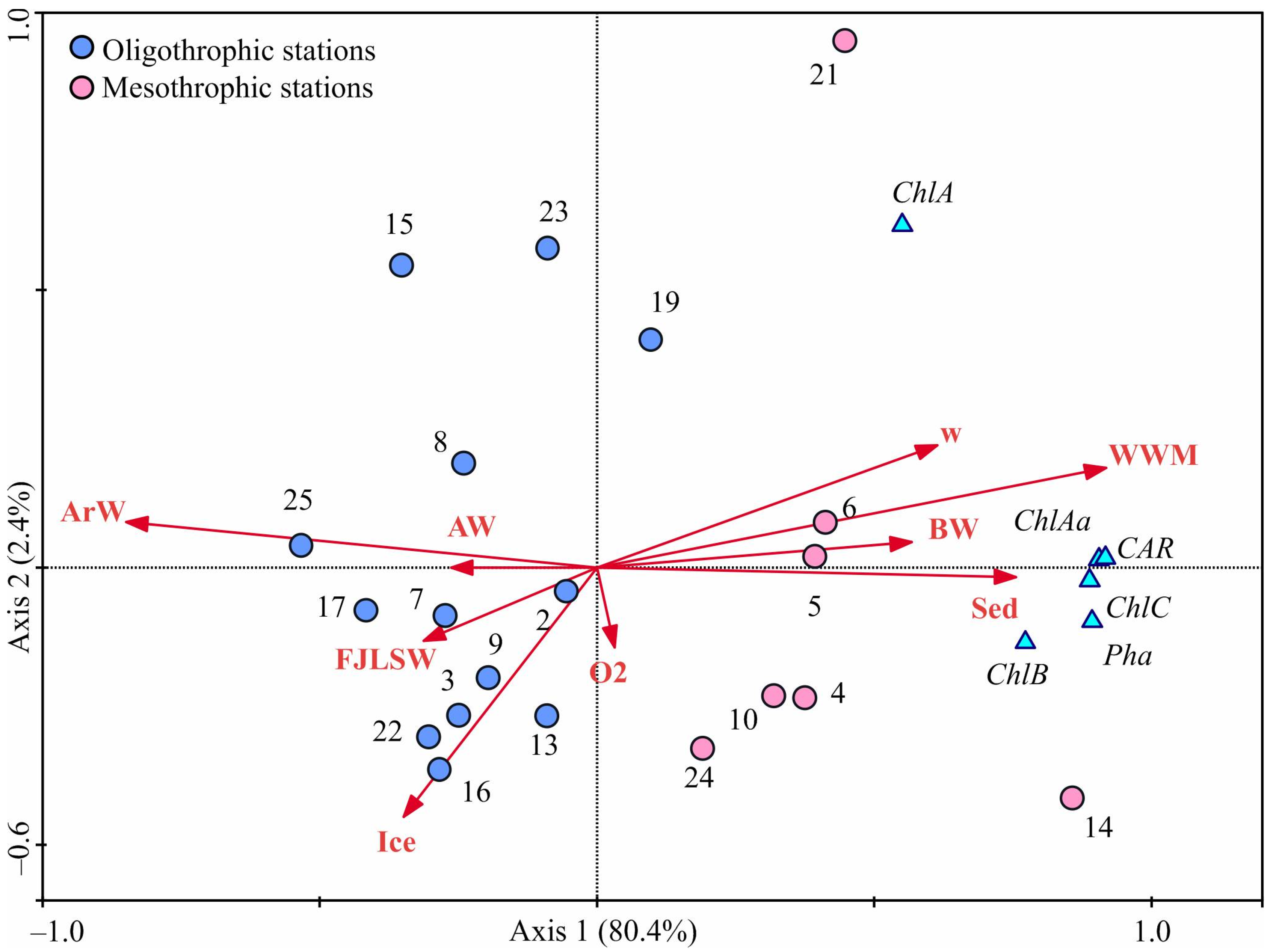
The RDA based on transformed phytopigment contents was highly significant and accounted for 84.6% of the total variation (F = 45.11, p = 0.003). The first canonical axis was positively related to five factors, with the strongest loadings observed for the thickness of warm water masses (WWM) and sedimentation rate (Figure 6). This axis explained 80.4% of the total variation (F = 69.98, p = 0.002) and effectively distinguished stations with low phytopigment contents (left side of the ordination space) from those with high contents (right side). In other words, axis 1 effectively delineated the two distinct sectors influenced by the Marginal Ice Arctic frontal zone, each characterized by differing surface water properties and sedimentation levels in October.
The second axis was mainly associated with the duration of the ice-cover period, separating stations with shorter (upper part of the plot) and longer (lower part) ice-cover periods. However, this axis explained only 2.4% of the total variation and was not statistically significant (F = 2.06, p = 0.961). Monte Carlo permutation tests identified two environmental variables as significantly influencing phytopigment contents: the thickness of WWM, explaining 60.5% of the total variation, and the duration of the ice-cover period, explaining 9.8% (Table 3). For the multivariate RDA, simulations showed that when all nine predictors were included, the power to detect the dominant predictor (WWM thickness, marginal R2 = 60.5%) was 1.0, while the power for the second-most important variable (ice-cover duration, marginal R2 = 9.8%) was 0.65. After eliminating non-significant predictors and retaining only WWM thickness and ice-cover duration, the simulation-based power reached 1.0 for both terms. These results confirm that our design had ample power to detect the primary oceanographic gradient and that the probability of missing a true effect of the secondary predictor, if it existed at the observed magnitude, was approximately 35% in the full model, an acceptable level given the overwhelming dominance of the first gradient.
GLM results corroborated the RDA findings, showing that stations with higher thickness of WWM had higher contents of all measured phytopigments (Table 4).
For the thickness of WWM, the strongest effect was found for carotenoid contents and Chl′-a. The duration of the ice-cover period was found to be significant negative factor for Chl-a (Table 4). The post hoc power analysis for the univariate GLM indicated that, with n = 20 and the observed effect size of warm water mass thickness, the achieved power was 0.71. Reaching the conventional threshold of 0.80 would have required a sample of 25 stations.
All components of the sediment pigment complex were positively correlated with near-bottom temperature and salinity, as well as with the thickness of WWM originating from the shelf seas, and negatively correlated with the thickness of the ArW (Table 5), in agreement with the results of the RDA where ArW had high collinearity with WWM (negative association). With increasing sedimentation intensity, the concentrations of all pigments except Chl-a increased. Likewise, with increasing sediment moisture content, the concentrations of all pigment components except carotenoids increased. No significant correlations were found with water depth, dissolved oxygen concentration, the presumed duration of sympagic algal growth, or the proportion of AW and BW in the water column.

4. Discussion

4.1. Environmental Conditions

The study area was characterized by a highly complex physical and hydrological setting. In autumn 2023, three types of vertical water-column structure were distinguished, reflecting differing contributions of the cold and warm haloclines and of deep water masses of different origin. The cold halocline was formed by cold, low-salinity waters derived from the Arctic Basin, whereas the warm halocline consisted of seasonally warmed, relatively freshened surface and subsurface waters originating from the Barents and Kara seas. The boundary between these two hydrographic regimes corresponded to the Marginal Ice Arctic Frontal Zone (MIAFZ). Its position appears to be largely controlled by the circulation of AW and BW, which influence the transport pathways of the overlying water masses [98]. Satellite observations of sea-surface temperature in the Kara Sea [144] showed that, in July 2023, the frontal position corresponded closely to that observed during our survey in late October, whereas in August and September the front shifted partly northward along the eastern flank of the trough.
Areas located south of the MIAFZ, where BW and WWM dominated the water column, were characterized by a shorter ice season, weaker stratification, and higher sedimentation rates. In contrast, areas north of the MIAFZ, where surface Arctic waters and deep shelf waters from the Franz Josef Land region or intermediate Atlantic-derived waters predominated, were associated with longer ice cover, stronger stratification, especially near Franz Josef Land, and lower sedimentation intensity. The weaker stratification and enhanced sedimentation observed in the southern part of the Saint Anna Trough may be related not only to increased wind-driven mixing under conditions of reduced ice cover but also to the influence of slope frontal zones, which are widespread along the shelf margins of the Barents and Kara seas and off the Novaya Zemlya archipelago [53,108,145,146,147]. The fine-scale vertical layering visible in the hydrographic profiles is consistent with the proximity of such frontal features. Enhanced vertical advection in the southern part of the study area may sustain phytoplankton growth over an extended period by supplying nutrients from deeper layers to the euphotic zone [53,108]. In the northern part of the study area, by contrast, strong stratification likely restricts vertical exchange in both directions. In addition, the deep Atlantic inflow, which occupies a large part of the seabed in this region, may further inhibit the upward transport of nutrients from near-bottom layers and the downward export of organic matter throughout the year.
During summer and early autumn, two types of upper-layer water masses are formed in the study area, each associated with a different productivity regime. During the warm season, cold ArW in the St. Anna Trough and the northern Kara Sea are characterized by low and highly variable phytoplankton productivity, generally estimated at <1 to 20 g C m−2 yr−1 [148,149,150]. In these waters, summer phytoplankton growth is strongly limited by rapid nutrient depletion following the spring bloom under conditions of pronounced stratification [46,151,152]. By contrast, the warm surface-water layer formed during the warm season on the shelves of the Barents and Kara seas [98] is potentially more productive, with reported values ranging from 1 to 15 g C m−2 yr−1 in the northern Kara Sea to 20–90 g C m−2 yr−1 in the northeastern Barents Sea [46,148,153]. Taken together, these hydrographic and biological features suggest that conditions north of the MIAFZ can be regarded as typically Arctic, whereas those to the south are more appropriately described as sub-Arctic.
Another important feature of the study area that may explain the pronounced contrast in sedimentary pigment concentrations between the oligotrophic and mesotrophic regions is the presence of strong lateral transport. In both the Arctic and Antarctic, lateral advection plays a major role in transferring primary production from upstream source regions, particularly in areas influenced by persistent currents and seasonal or perennial ice cover [154,155]. This process is also known to weaken or obscure direct relationships between phytoplankton biomass in the water column and pigment concentrations in bottom sediments [25]. In the present study area, lateral transport from the Barents Sea likely follows the pathways of BW. From the Kara Sea, transport probably occurs northward along the eastern flank of the trough, in the same general direction as the water-mass flow. An additional east-to-west pathway, from the Central Kara Plateau toward the eastern trough flank, has also been proposed [156] and may explain the formation of the second maximum in sedimentary pigment concentration at station 14. At greater depths, however, the transport of suspended organic matter toward the trough axis may be restricted by the hydrographic boundary between oppositely directed flows of BW and AW. This may explain the strong differences in pigment concentrations observed between adjacent stations of similar depth separated by only 50–60 km, such as stations 21 and 17 or stations 14 and 3 (Table S2).
A further potential mechanism enhancing productivity in the southern part of the St. Anna Trough is methane release into the water column [157]. Marine methane seepage may be widespread both in the study area and in the northeastern Barents Sea [158,159]. Elevated methane fluxes have been suggested to stimulate anomalous phytoplankton development [160], thereby increasing the export of organic matter to the benthos. However, such a response would still require an adequate nutrient supply to support algal growth. Accordingly, anomalous blooms are unlikely to develop in the nutrient-limited, low-productivity Arctic Basin waters occupying the northern part of the trough, but may be more plausible in the southern sector, where frontal dynamics and coastal runoff can relax nutrient limitation. Overall, the occurrence of large-scale methane release in the St. Anna Trough and its effect on phytoplankton production remain open questions requiring further investigation.

4.2. Phytopigment Variations in Bottom Sediments

The most prominent feature of sedimentary pigment distribution in the St. Anna Trough region is the marked quantitative contrast between the oligotrophic and mesotrophic areas, reflecting different levels of primary production export to the benthic environment. For example, by the end of the 2023 growing season, the combined concentration of Chl-a and Phe-a differed by a factor of seven between these two areas.
The pigment composition, together with elevated concentrations of Phe-a and carotenoids and high values of the pigment index I430/664, close to those typical of senescent plankton communities, indicates prolonged deposition of organic matter over much of the seabed and supports a predominantly detrital origin of sedimentary pigments. This interpretation is consistent with the great depths of the study area and with the autumn sampling period [5,10,15,16,128,130]. Spatial variability in the pigment index further suggests that the pigment complex was generally more degraded at stations within the oligotrophic region. Most likely, in the northern part of the study area the main depositional pulse occurred during the under-ice phytoplankton bloom, whereas in the southern part of the trough pigment accumulation probably extended over a longer period owing to more sustained sedimentation of plankton-derived material.
The presence of Chl-a in the sediment samples (Table S2) indicates the occurrence of recently deposited microalgal cells on the seabed. At station 15 (555 m depth), the lowest proportion of Phe-a (40%) combined with a relatively high Chl-a content suggests recent deposition of phytoplankton cells in this deep-water setting. This observation is not easy to explain, given the expected weak coupling between production in the upper water column and the benthos at such depths. One possible explanation is the influence of the nearby ice edge, which persisted in the northern and northwestern Saint Anna Trough during the 2023 summer growing season. At the southern stations, particularly 19 and 21, elevated Chl-a concentrations combined with a high proportion of Phe-a may indicate recent deposition of already senescent summer pelagic phytoplankton.
Our results also point to spatial differences in microalgal composition and abundance between the northern and southern parts of the study area. Throughout the southern and eastern sectors, the sedimentary pigment complex was dominated by pigments associated with diatoms and dinoflagellates, which is consistent with the known quantitative dominance of these phytoplankton groups in summer surface waters of the Barents and Kara seas (up to 80–100% of the total phytoplankton cell count and up to 70–90% of the total biomass) [11,147,161,162]. In the northwestern and north-central parts of the study area, by contrast, the contribution of green algae to the sedimentary organic-matter pool increased. Green microalgae are closely associated with sea ice and adjacent low-salinity waters and are widely distributed in the Arctic [46,163]. In the northern Kara Sea, Chlorophyta, particularly members of the class Mamiellophyceae, are known to dominate the picoplankton community (up to 51% protists reads per sample) [164]. Earlier studies in the northern St. Anna Trough also reported large numbers of unidentified flagellated microalgae [151], which may have included green algae. The relative importance of this group in the northwestern and north-central parts of the study area may therefore be linked to the persistence of sea ice in these areas during much of summer 2023.
On the western Barents Sea shelf, Chl-b has similarly been detected at stations influenced by Arctic waters [62]. In other Arctic regions, increased proportions of Chl-b have been reported from coastal environments, including the inner Hornsund Fjord in Svalbard and areas near the Mackenzie River in the southeastern Beaufort Sea, where they were interpreted as reflecting the influence of glacial or river runoff and littoral vegetation [40,89]. In our material, the predominance of Chl-a together with low concentrations of Chl-b and Chl-c1,2 at station 21 may indicate an increased contribution of cyanobacteria [5,16].
By the end of October, the concentration of Chl-a + Phe-a in the oligotrophic part of the study area fell within the range previously reported for the central Barents Sea shelf, was slightly lower than values reported for Aniva Bay, and exceeded those recorded from the oligotrophic shelf of northeastern Greenland and the northwestern Barents Sea (Table 6). In contrast, the values obtained for the southeastern St. Anna Trough rank among the highest reported, both in published and unpublished datasets, for Arctic and temperate shelf seas (Table 6). They are comparable to values from the shallow and highly productive Chukchi and Pechora seas, as well as from the southern Barents Sea coast. Compared with the Chukchi Sea [165], the sediments of the St. Anna Trough contain substantially higher concentrations of the accessory chlorophylls b and c, which may reflect regional differences in phytoplankton community composition.
The marked spatial differences in pigment concentrations between the oligotrophic and mesotrophic areas were probably not unique to the present study period, but rather represent a persistent feature of the St. Anna Trough and adjacent waters to the west. Historical data from 1931 [87] indicate that pigment accumulation also differed between the northern and southern parts of the region nearly a century ago. The low pigment concentrations reported at that time may be explained by the early stage of the growing season, when the main pool of fresh pigments produced after the ice-edge bloom had not yet reached the seabed. This interpretation is consistent with the late sea-ice retreat observed in 1931. It is well established that, before the onset of the growing season, sedimentary pigments may become analytically undetectable because of winter degradation processes [60].

4.3. Influence of Environmental Factors on the Spatial Distribution of Sedimentary Pigments

Relationships between sedimentary pigments and environmental drivers are frequently ambiguous in the literature. In the St. Anna Trough, pigment distributions were more tightly coupled to water-mass distributions and sedimentation regimes than to depth, variable ice cover, or the near-bottom gas regime.
The RDA and GLM results indicate that the thickness of warm surface waters and the duration of sea-ice cover are the two principal environmental drivers shaping sedimentary phytopigment concentrations in the St. Anna Trough. The thickness of WWM, which explained 60.5% of the total variation, likely enhances phytoplankton growth through two interconnected mechanisms. First, a thicker warm surface layer promotes thermal stratification, retaining phytoplankton within the euphotic zone and thereby prolonging their exposure to light, a critical factor in Arctic systems where seasonal irradiance is severely constrained [50,167]. Second, this stratification reduces vertical mixing, which concentrates nutrients in the upper water column and further stimulates primary production [168,169]. The subsequent vertical export of phytopigments to the seafloor is then facilitated both by direct sinking of senescent phytoplankton cells and by the fecal pellets of grazing zooplankton or zooplankton carcasses, reflecting a tightly coupled pelagic-benthic linkage [77,170]. However, lateral advection of suspended organic matter from adjacent productive shelves cannot be excluded and may contribute to the high pigment concentrations observed in the southern sector. Additional studies are required to study the possible role of lateral transport in shaping phytopigment concentrations in the region.
The duration of sea-ice cover, though explaining a smaller fraction of the variance (9.8%), emerges as a significant negative predictor for sedimentary Chl-a. Shorter ice-covered periods extend the open-water season, thereby increasing the cumulative annual light dose available for photosynthesis [171,172]. This extended growing season supports greater phytoplankton biomass in the surface layer and, consequently, a larger vertical flux of phytopigments to the underlying sediments. The negative relationship aligns with the expectation that earlier ice retreat and later freeze-up amplify the magnitude of the biological carbon pump in this region. These findings are consistent with broader pan-Arctic trends. In the Barents Sea, satellite-derived primary productivity has exhibited the strongest positive trend of any Arctic region over the 2003–2021 period, a pattern attributed to pronounced sea-ice loss and increased light availability [50,173]. Similarly, shallower mixed-layer depths in the Barents Sea, driven by enhanced freshwater input and reduced wind forcing, have been linked to earlier spring blooms and higher peak biomass [174]. Direct sedimentary evidence further corroborates this coupling: during the anomalously ice-free year of 2018, concentrations of chlorophyll and carotenoid pigments in Barents Sea surface sediments increased markedly in the northern sector, reflecting enhanced pelagic production and rapid deposition [175]. This finding aligns with other regional observations showing that ice-edge and marginal-ice processes can produce strong but spatially heterogeneous effects on export to the seabed [165,176,177].
All components of the sedimentary pigment suite showed significant correlations with hydrological parameters of the near-bottom layer and the upper 50–80 m of the water column. Positive correlations with near-bottom temperature and salinity reflect the regional transition from cold, low-salinity shelf waters in the northwest to warmer, saltier Barents Sea waters in the southeast and the consequent influence of these water masses on both near-bottom and surface layers. Likewise, pigments correlated positively with indicators of warm-surface-water influence and negatively with indicators of Arctic-surface-water influence, consistent with the greater primary-production potential of warm shelf waters relative to Arctic Basin waters [62,91,178].
Sediment properties and sedimentation dynamics further modulated pigment accumulation. Most pigment classes (predominantly chlorophyll derivatives) correlated positively with sediment moisture content, which increased in concert with higher sedimentation rates in the southern and southeastern trough. Enhanced organic-matter delivery degraded the upper oxidized sediment layer and increased sediment hydrophilicity [105], reinforcing the association between moisture and pigment content. With the exception of intact Chl-a, most pigments also increased with estimated sedimentation rate; this pattern echoes observations from other shelf regions where vertical flux exerts a primary control on benthic pigment inventories [90], although such relationships may disappear in deep basins with uniformly silty bottoms [32].
We found no relationship between pigment concentration and water depth in the St. Anna Trough. While many studies report depth-related trends, both in shallow seas and in abyssal zones [179], examples also exist of no depth dependence [25,62]. Depth effects typically operate through changes in substrate type, hydrodynamic energy, and trophic transfer (shorter food chains in shallow systems), or via longer settling times and greater degradation in deeper systems; in our study the interplay of currents, lateral transport, and variable water-mass influence likely obscures simple depth trends. Dissolved oxygen in the near-bottom layer did not show a clear effect on pigment preservation in our dataset, although methodological uncertainties in bottom-near sampling cannot be excluded. Oxygen is known to accelerate pigment degradation in oxygenated sediments and has been invoked to explain spatial pigment patterns in several regions [59,180].
We did not assess coupling between phytopigment concentrations in the productive layer and sedimentary pigments because, at great depth and in the presence of lateral transport, such correlations are frequently disrupted. Likewise, we did not evaluate the role of zooplankton grazing in shaping sedimentary pigment composition because pheophorbides, diagnostic markers of grazing, were not quantified. In seasonally ice-covered Arctic waters, grazing pressure on phytoplankton is often temporally mismatched with primary-production peaks, reducing the extent to which zooplankton consumption prevents export to the benthos and thereby making newly produced organic matter more available to benthic communities [65,181,182]. The result of our power analysis showed that, in the multivariate RDA, simulation-based power for the primary predictor (WWM thickness, explaining 60.5% of the variance) was 1.0, even when all nine predictors were included. The power for the secondary predictor (ice-cover duration, 9.8%) was 0.65 in the full model, suggesting a moderate risk of a Type II error for this weaker gradient; nevertheless, ice-cover duration was still significant in marginal permutation tests and contributed a small but meaningful amount of explained variance. For univariate GLMs, the achieved power to detect the observed effect of warm water mass thickness was 0.71, slightly below the conventional 0.80 threshold, but all pigment-specific models yielded highly significant relationships, indicating that the effect was strong enough to be reliably detected. Adding further stations under these extreme Arctic conditions would have been logistically prohibitive and is unlikely to alter the qualitative interpretation of the frontal gradient. Thus, our study represents a pragmatic compromise: the statistical power was more than adequate for the primary driver, and the remaining uncertainty concerns only a secondary variable whose ecological influence is clear but weak. We are confident that the conclusions regarding the overriding role of the Marginal Ice Arctic frontal zone are robust, even with a sample size that falls short of the ideal.

4.4. Sedimentary Pigments as Indicators of Environmental Change

The present study documents a pronounced spatial contrast in export of primary production to the seabed across a seasonal frontal system that separates Arctic and sub-Arctic hydrographic regimes. This heterogeneous export is consistent with observed benthic-community responses in the same region, where two station groups differ by a factor of ~4 in benthic abundance [119]. Because sedimentary pigments integrate recent depositional history, most pigment metrics measured here (notably the sum of Chl-a + Phe-a and most degradation products) reliably delineate areas of enhanced biogenic sedimentation during the autumn period.
The conditional boundary separating seabed sectors with contrasting pigment inventories appears to coincide with the average position of the MIAFZ in the 2023 summer season: the transition between surface Arctic and warm summer waters in October 2023 largely matched the boundary between oligotrophic and mesotrophic seabed sectors. Chl-b also emerges as a useful tracer of waters influenced by prolonged ice cover in this region, consistent with observations from other Arctic shelves [46,183].
Sedimentary pigments have the potential to constitute sensitive indicators of changes in sea-ice dynamics and pelagic productivity, subject to validation through multi-year observations. Given the increase in ice-free duration in the St. Anna Trough since the early 2000s (currently ~3–4 months in the north and ~6–7 months in the south [119]), primary production, and thus benthic export, might be expected to increase with further lengthening of the growing season, particularly in the southern sector. Our autumn 2023 data provide a baseline against which future changes can be assessed, but a single cruise does not allow us to confirm a temporal trend. The St. Anna Trough thus represents a useful natural laboratory for hypothesis generation regarding the effects of sea-ice retreat and changing hydrography on biogenic export. Our results are consistent with expectations from longer-term pan-Arctic trends, but direct attribution to climate change would require repeated surveys over multiple years.

5. Conclusions

This investigation provides the first modern quantitative assessment of sedimentary phytopigments in the St. Anna Trough, addressing a critical data gap regarding carbon export in a rapidly transforming Arctic gateway. The results demonstrate a pronounced spatial dichotomy in benthic trophic status, driven by the interplay of hydrography and ice dynamics. The study area is effectively partitioned by the Marginal Ice Arctic Frontal Zone into a southern, mesotrophic sector (mean Chl-a + Phe-a: 30.28 µg g−1) sustained by advection of productive Barents and Kara Sea shelf waters and a northern, oligotrophic sector (mean 4.45 µg g−1) influenced by less productive Arctic Basin waters. The dominance of the thickness of warm water masses as an environmental driver underscores the pivotal role of seasonal warming in enhancing vertical export to the benthos. While the pigment complex was predominantly detrital, consistent with deep-water deposition and late-season sampling, the detection of fresh chlorophyll-a and spatial patterns in accessory pigments (Chl-b vs. Chl-c) confirmed the imprint of distinct phytoplankton communities, namely ice-associated green algae in the north versus pelagic diatoms in the south. The negative correlation between ice-cover duration and pigment content aligns with pan-Arctic trends of increasing productivity following sea-ice loss.

Supplementary Materials

The following supporting information can be downloaded at https://www.mdpi.com/article/10.3390/d18060355/s1, Table S1: Environmental and sediment characteristics at sampling stations in St. Anna Trough; Table S2: Sedimentaty pigment content (µg g−1 d.w.); Table S3: Indicators of taxonomical composioin and physiological status of microalgae; Figure S1: Isolines showing the duration of the open water period within the St. Anna Trough area in 2022–2023. Red circles: mesotrophic zone stations; blue circles: oligotrophic zone stations. Data from the Arctic and Antarctic Research Institute website (https://data.aari.ru/odata/_d0004.php, accessed 18 June 2025).

Author Contributions

Conceptualization, L.V.P.; data curation, L.V.P., V.V.V., D.V.M. and A.G.D.; validation, L.V.P., V.V.V. and D.V.M.; formal analysis, L.V.P., V.V.V., D.V.M. and A.G.D.; methodology, L.V.P. and V.V.V.; software, L.V.P., V.V.V. and A.G.D.; visualization, L.V.P., V.V.V., D.V.M. and A.G.D.; project administration, L.V.P. and A.G.D.; writing—original draft, L.V.P.; writing—review and editing, V.V.V., D.V.M. and A.G.D. All authors have read and agreed to the published version of the manuscript.

Funding

This study was funded by the Ministry of Science and Higher Education of the Russian Federation.

Institutional Review Board Statement

Not applicable.

Data Availability Statement

The data presented in this study are available on request from the corresponding authors (the data are not publicly available due to privacy restrictions).

Acknowledgments

We thank Bulavina A. for providing the vertical profiles of oceanographic data.

Conflicts of Interest

The authors declare no conflicts of interest.

References

  1. MacIntyre, H.L.; Geider, R.J.; Miller, D.C. Microphytobenthos: The ecological role of the “secret garden” of unvegetated, shallow-water marine habitats. I. Distribution, abundance and primary production. Estuaries Coasts 1996, 19, 186–201. [Google Scholar] [CrossRef] [PubMed]
  2. Louda, J.W.; Li, J.; Liu, L.; Winfree, M.N.; Baker, E.W. Chlorophyll-a degradation during cellular senescence and death. Org. Geochem. 1998, 29, 1233–1251. [Google Scholar] [CrossRef]
  3. Louda, J.W.; Liu, L.; Baker, E.W. Senescence- and death-related alternation of chlorophylls and carotenoids in marine phytoplankton. Org. Geochem. 2002, 33, 1635–1653. [Google Scholar] [CrossRef]
  4. Margalef, R. Valeur indicatrice de la composition des pigments du phytoplankton sur la productivité, composition taxonomique et propriétés dynamiques des populations. Comm. Int. Explor. Sci. Mer Medit. Rapp. Proc. Verb. 1960, 15, 277–281. [Google Scholar]
  5. Sirenko, L.A. Information value of chlorophyll index. Hydrobiol. J. 1988, 24, 49–53. (In Russian) [Google Scholar]
  6. Möller, W.A.A.; Scharf, B.W. The content of chlorophyll in the sediment of the volcanic maar lakes in the Eifel region (Germany) as an indicator of eutrophication. Hydrobiologia 1986, 143, 327–329. [Google Scholar] [CrossRef]
  7. Jeffrey, S.W.; Vesk, M. Introduction to marine phytoplankton and their pigment signatures. In Phytoplankton Pigments in Oceanography; Jeffrey, S.W., Mantoura, R.F.C., Wright, S.W., Eds.; SCOR UNESCO Publishing: Paris, France, 1997; pp. 37–84. [Google Scholar]
  8. Leavitt, P.R.; Vinebrooke, R.D.; Donald, D.B.; Smol, J.P.; Schindler, D.W. Past ultraviolet radiation environments in lakes derived from fossil pigments. Nature 1997, 388, 457–459. [Google Scholar] [CrossRef]
  9. Pirtle-Levy, R.; Grebmeier, J.M.; Cooper, L.W.; Larsen, I.L. Chlorophyll a in Arctic sediments implies long persistence of algal pigments. Deep Sea Res. Part II Top. Stud. Oceanogr. 2009, 56, 1326–1338. [Google Scholar] [CrossRef]
  10. Makarevich, P.R.; Vodopyanova, V.V.; Oleinik, A.A. Floral communities in the pelagic zone of Kola Bay. In Structure and Functional Characteristics; Dzhenyuk, S.L., Ed.; SSC RAS Publishers: Rostov-on-Don, Russia, 2015; 192p. [Google Scholar]
  11. Makarevich, P.R.; Larionov, V.V.; Vodopyanova, V.V.; Bulavina, A.S.; Ishkulova, T.G.; Venger, M.P.; Pastukhov, I.A.; Vashchenko, A.V. Phytoplankton of the Barents Sea at the Polar Front in Spring. Oceanology 2021, 61, 930–943. [Google Scholar] [CrossRef]
  12. Makarevich, P.R.; Vodopyanova, V.V.; Bulavina, A.S. Dynamics of the spatial chlorophyll-a distribution at the polar front in the marginal ice zone of the Barents Sea during spring. Water 2022, 14, 101. [Google Scholar] [CrossRef]
  13. Makarevich, P.R.; Vodopyanova, V.V.; Bulavina, A.S.; Vashchenko, P.S.; Namyatov, A.A.; Pastukhov, I.A. Localization of early spring phytoplankton “bloom” centers in the Barents Sea pelagic zone. Mar. Biol. J. 2024, 9, 51–69. [Google Scholar] [CrossRef]
  14. Vodopyanova, V.V.; Dvoretsky, V.G.; Bulavina, A.S. Spatial and seasonal variability of the chlorophyll a concentration in the Barents Sea. Biol. Bull. Russ. Acad. Sci. 2024, 51, 410–420. [Google Scholar] [CrossRef]
  15. Vodopyanova, V.V.; Bulavina, A.S.; Druzhkova, E.I.; Pastukhov, I.A.; Berchenko, I.V.; Vashchenko, A.V.; Venger, M.P. Vertical distribution of some components of the Barents Sea plankton communities under seasonal pycnocline conditions. Biol. Bull. Russ. Acad. Sci. 2025, 52, 10. [Google Scholar] [CrossRef]
  16. Koreneva, T.G.; Sigareva, L.E. Pigments in the bottom sediments of Aniva Bay (Sea of Okhotsk). Geosyst. Transit. Zones 2022, 6, 60–73. (In Russian) [Google Scholar] [CrossRef]
  17. Paerl, H.W.; Valdes, L.M.; Pinckney, J.L.; Piehler, M.F.; Dyble, J.; Moisander, P.H. Phytoplankton photopigments as indicators of estuarine and coastal eutrophication. BioScience 2003, 53, 953–964. [Google Scholar] [CrossRef]
  18. Reuss, N.; Conley, D.J.; Bianchi, T.S. Preservation conditions and the use of sediment pigments as a tool for recent ecological reconstruction in four Northern European estuaries. Mar. Chem. 2005, 95, 283–302. [Google Scholar] [CrossRef]
  19. Chen, J.; Oseji, O.; Mitra, M.; Waguespack, Y.; Chen, N. Phytoplankton pigments in Maryland coastal bay sediments as biomarkers of sources of organic matter to benthic community. J. Coast. Res. 2016, 732, 68–775. [Google Scholar] [CrossRef]
  20. Itoh, N.; Tani, Y.; Soma, M. Sedimentary photosynthetic pigments of algae and phototrophic bacteria in Lake Hamana, Japan: Temporal changes of anoxia in its five basins. Limnology 2003, 4, 139–148. [Google Scholar] [CrossRef]
  21. Leavitt, P.R.; Hodgson, D.A. Sedimentary pigments. In Tracking Environmental Change Using Lake Sediments; Smol, J.P., Birks, H.J., Last, W.M., Eds.; Kluwer Academic Publisher: Dordrecht, The Netherlands, 2001; Volume 3, pp. 295–325. [Google Scholar]
  22. Kowalewska, G. Algal pigments in sediments as a measure of eutrophication in the Baltic environment. Quat. Int. 2005, 130, 141–151. [Google Scholar] [CrossRef]
  23. Vinberg, G.G. The current state and tasks of studying the primary production of reservoirs. In Primary Production of the Seas and Inland Waters; Publishing House of Higher, Secondary and Professional Education: Minsk, Belarus, 1961; pp. 11–24. (In Russian) [Google Scholar]
  24. Welshmeyer, N.A.; Lorenzen, C.J. Chlorophyll budgets: Zooplankton grazing and phytoplankton growth in a temperate fjord and the Central Pacific Gyres. Limnol. Oceanogr. 1985, 30, 1–21. [Google Scholar] [CrossRef]
  25. Sun, M.Y.; Aller, R.C.; Lee, C. Spatial and temporal distributions of sedimentary chloropigments as indicators of benthic processes in Long Island Sound. J. Mar. Res. 1994, 52, 149–176. [Google Scholar] [CrossRef]
  26. Zhou, H.; Zeng, R.; Cong, B.; Jiang, Q.; Zhang, Z. Spatiotemporal distribution of sedimentary chloropigments and organic carbon in a shelf sea ecosystem, with a focus on the cold water mass. Mar. Dev. 2024, 2, 25. [Google Scholar] [CrossRef]
  27. Meyers, P.A. Organic geochemical proxies of paleoceanographic, paleolimnologic, and paleoclimatic processes. Org. Geochem. 1997, 27, 213–250. [Google Scholar] [CrossRef]
  28. Miller, D.C.; Geider, H.L.; MacIntyre, H.L. The ecological role of the “secret garden” of unvegetated, shallow-water marine habitats. II. Role in sediment stability and shallow-water food webs. Estuaries 1996, 19, 202–212. [Google Scholar] [CrossRef]
  29. Rauser-Chernousova, D.M. On the quantitative determination of chlorophyll in modern and fossil marine sediments. Bull. MOIP Geol. 1930, 3, 285–300. (In Russian) [Google Scholar]
  30. Sun, M.Y.; Aller, R.C. Early diagenesis of chlorophyll-a in Long Island Sound: A measure of carbon flux and particle reworking. J. Mar. Res. 1991, 49, 379–401. [Google Scholar] [CrossRef]
  31. Bianchi, T.S.; Findlay, S.; Dawson, R. Organic matter sources in the water column and sediments of the Hudson River Estuary: The use of plant pigments as tracers. Estuar. Coast. Shelf Sci. 1993, 36, 359–376. [Google Scholar] [CrossRef]
  32. Ambrose, W.G.; Renaud, P.E. Benthic response to water column productivity patterns: Evidence for benthic-pelagic coupling in the northeast water polynya. J. Geophys. Res. Ocean. 1995, 100, 4411–4421. [Google Scholar] [CrossRef]
  33. Kowalewska, G.; Witkowski, A.; Toma, B. Chlorophylls c in bottom sediments as markers of diatom biomass in the southern Baltic Sea. Oceanologia 1996, 38, 227–249. [Google Scholar]
  34. Kowalewska, G.; Winterhalter, B.; Talbot, H.M.; Maxwell, J.R.; Konat, J. Chlorins in sediments of the Gotland Deep (Baltic Sea). Oceanologia 1999, 41, 81–97. [Google Scholar]
  35. Kowalewska, G. Chlorophyll a and its derivatives in recent sediments of the southern Baltic Sea collected in the years 1992–1996. Oceanologia 1997, 39, 413–432. [Google Scholar]
  36. Zapata, M.; Jeffrey, S.W.; Wright, S.W.; Rodriguez, F.; Garrido, J.L.; Clemenston, L. Photosynthetic pigments in 37 species (65 strains) of Haptophyta: Implications for oceanography and chemotaxonomy. Mar. Ecol. Prog. Ser. 2004, 270, 83–102. [Google Scholar] [CrossRef]
  37. Szymczak-Żyła, M.; Kowalewska, G.; Louda, J.W. Chlorophyll-a and derivatives in recent sediments as indicators of productivity and depositional conditions. Mar. Chem. 2011, 125, 39–48. [Google Scholar] [CrossRef]
  38. Dvoretsky, V.G.; Dvoretsky, A.G. Epiplankton in the Barents Sea: Summer variations of mesozooplankton biomass, community structure and diversity. Cont. Shelf Res. 2013, 52, 1–11. [Google Scholar] [CrossRef]
  39. Dvoretsky, V.G.; Dvoretsky, A.G. Structure of mesozooplankton community in the Barents Sea and adjacent waters in August 2009. J. Nat. Hist. 2013, 47, 2095–2114. [Google Scholar] [CrossRef]
  40. Krajewska, M.; Rajewska, M.; Szymczak-Żyła, M.; Kowalewska, G. Algal pigments in Hornsund (Svalbard) sediments as biomarkers of Arctic productivity and environmental conditions. Polar Res. 2017, 38, 423–443. [Google Scholar] [CrossRef][Green Version]
  41. Hansen, J.L.S.; Josefson, A.B. Accumulation of algal pigments and live planktonic diatoms in aphotic sediments during the spring bloom in the transition zone of the North and Baltic Seas. Mar. Ecol. Prog. Ser. 2003, 248, 41–54. [Google Scholar] [CrossRef]
  42. Smayda, T.J. Normal and accelerated sinking of phytoplankton in the sea. Mar. Geol. 1971, 11, 105–122. [Google Scholar] [CrossRef]
  43. Billett, D.S.M.; Lampitt, R.S.; Rice, A.L.; Mantoura, R.C.F. Seasonal sedimentation of phytoplankton to the deep-sea benthos. Nature 1983, 302, 520–522. [Google Scholar] [CrossRef]
  44. Alldredge, A.L.; Gotschalk, G.C. Direct observation of mass flocculation of diatom blooms: Characteristics, settling velocities and formation of diatom aggregates. Deep Sea Res. Part A. Oceanogr. Res. Pap. 1989, 26, 159–171. [Google Scholar] [CrossRef]
  45. Zernova, V.V.; Nöthig, E.M.; Shevchenko, V.P. Vertical microalgae fluxes at the mooring station LOMO-2 over the Lomonosov Ridge in the period from September 15, 1995, till August 16, 1996. Oceanology 2000, 40, 801–808. [Google Scholar] [CrossRef]
  46. Sakshaug, E. Primary and secondary production in the Arctic Seas. In The Organic Carbon Cycle in the Arctic Ocean; Stein, R., Macdonald, R.W., Eds.; Springer: Berlin/Heidelberg, Germany, 2004; pp. 57–81. [Google Scholar]
  47. Boles, E.; Provost, C.; Garcon, V.; Bertosio, C.; Athanase, M.; Koenig, Z.; Sennéchael, N. Under-ice phytoplankton blooms in the central Arctic Ocean: Insights from the first biogeochemical IAOOS platform drift in 2017. J. Geophys. Res. Ocean. 2020, 125, e2019JC015608. [Google Scholar] [CrossRef]
  48. Assmy, P.; Fernández-Méndez, M.; Duarte, P.; Meyer, A.; Randelhoff, A.; Mundy, C.J.; Olsen, L.M.; Kauko, H.M.; Bailey, A.; Chierici, M.; et al. Leads in Arctic pack ice enable early phytoplankton blooms below snow-covered sea ice. Sci. Rep. 2017, 7, 40850. [Google Scholar] [CrossRef] [PubMed]
  49. Dvoretsky, V.G.; Vodopianova, V.V.; Bulavina, A.S. Effects of climate change on chlorophyll a in the Barents Sea: A long-term assessment. Biology 2023, 12, 119. [Google Scholar] [CrossRef] [PubMed]
  50. Dvoretsky, A.G.; Dvoretsky, V.G. Fluctuations of net primary production along a standard transect in the Barents Sea and their relationships with environmental factors. Environ. Res. 2026, 288, 123177. [Google Scholar] [CrossRef]
  51. Round, F.E.; Crawford, R.M.; Mann, D.G. The Diatoms: Biology and Morphology of the Genera; Cambridge University Press: Cambridge, UK, 1990; 747p. [Google Scholar]
  52. Mosharov, S.A.; Demidov, A.B.; Simakova, U.V. Peculiarities of the primary production process in the Kara Sea at the end of the vegetation season. Oceanology 2016, 56, 84–94. [Google Scholar] [CrossRef]
  53. Mosharov, S.A.; Sergeeva, V.M.; Kremenetskiy, V.V.; Sazhin, A.F.; Stepanova, S.V. Assessment of phytoplankton photosynthetic efficiency based on measurement of fluorescence parameters and radiocarbon uptake in the Kara Sea. Estuar. Coast. Shelf Sci. 2019, 218, 59–69. [Google Scholar] [CrossRef]
  54. Shevchenko, V.P.; Ivanov, G.I.; Zernova, V.V. Vertical particle fluxes in the St. Anna Trough and in the eastern Barents Sea in August–September 1994. Ber. Polarforsch. 1999, 342, 46–54. [Google Scholar]
  55. Witkowski, A.; Lange-Bertalot, H.; Metzeltin, D. Diatom Flora of Marine Coasts I; A.R.G. Gantner Verlag: Ruggell, Liechtenstein, 2000; 925p. [Google Scholar]
  56. Ryabushko, L.I.; Balicheva, D.S.; Strijak, A.V. Diatom epiphyton of some green algae and periphyton of anthropogenic substrates of Crimean coastal the Black Sea. Algologia 2013, 23, 419–437. (In Russian) [Google Scholar] [CrossRef]
  57. Itakura, S.; Imai, I.; Itoh, K. “Seed bank” of coastal planktonic diatoms in bottom sediments of Hiroshima Bay, Seto Inland Sea, Japan. Mar. Biol. 1997, 128, 497–508. [Google Scholar] [CrossRef]
  58. Lewis, J.; Harris, A.S.D.; Jones, K.J.; Edmonds, R.L. Long-term survival of marine planktonic diatoms and dinoflagellates in stored sediment samples. J. Plankton Res. 1999, 21, 343–354. [Google Scholar] [CrossRef]
  59. Sun, M.Y.; Lee, C.; Aller, R.C. Laboratory studies of oxic and anoxic degradation of chlorophyll-a in Long Island Sound sediments. Geochim. Cosmochim. Acta 1993, 57, 147–157. [Google Scholar] [CrossRef]
  60. Graf, G.; Gerlach, S.A.; Linke, P.; Queisser, W.; Ritzrau, W.; Scheltz, A.; Thomsen, L.; Witte, U. Benthic-pelagic coupling in the Greenland-Norwegian Sea and its effect on the geological record. Geol. Rundsch. 1995, 84, 49–58. [Google Scholar] [CrossRef]
  61. Hansen, J.L.S.; Josefson, A.B. Pools of chlorophyll and live planktonic diatoms in aphotic marine sediments. Mar. Biol. 2001, 139, 289–299. [Google Scholar] [CrossRef]
  62. Morata, N.; Renaud, P.E. Sedimentary pigments in the western Barents Sea: A reflection of pelagic-benthic coupling? Deep Sea Res. Part II Top. Stud. Oceanogr. 2008, 55, 2381–2389. [Google Scholar] [CrossRef]
  63. Dvoretsky, A.G.; Dvoretsky, V.G. Filling knowledge gaps in Arctic marine biodiversity: Environment, plankton, and benthos of Franz Josef Land, Barents Sea. Ocean Coast. Manag. 2024, 249, 106987. [Google Scholar] [CrossRef]
  64. Dvoretsky, V.G.; Dvoretsky, A.G. Local variability of Arctic mesozooplankton biomass and production: A case summer study. Environ. Res. 2024, 241, 117416. [Google Scholar] [CrossRef]
  65. Dvoretsky, V.G.; Dvoretsky, A.G. Spatial pattern of spring mesozooplankton in the Marginal Ice Zone (northern Barents Sea). Animals 2026, 16, 1213. [Google Scholar] [CrossRef]
  66. Evseeva, O.Y.; Dvoretsky, A.G. Littoral bryozoan communities in the high Arctic: A latitudinal comparison. Sci. Nat. 2026, 113, 4. [Google Scholar] [CrossRef]
  67. Frolova, E.A.; Lyubina, O.S.; Dikayeva, D.R.; Ahmetchina, O.Y.; Frolov, A.A. Effect of climatic changes on the zoobenthos of the Barents Sea (on the example of several abundant species). Dokl. Biol. Sci. 2007, 416, 349–351. [Google Scholar] [CrossRef]
  68. Noskovich, A.E.; Dvoretsky, A.G. Bivalves as indicators of interannual temperature variability in the Kola Transect (Barents Sea). Mar. Pollut. Bull. 2026, 227, 119419. [Google Scholar] [CrossRef]
  69. Noskovich, A.E.; Dvoretsky, A.G. Spatial and temporal variations in functional diversity of bivalve molluscs in the southern Barents Sea. Aquat. Conserv. Mar. Freshw. Ecosyst. 2026, 36, e70385. [Google Scholar] [CrossRef]
  70. Klenova, M.V. Geology of the Barents Sea; Academy of Sciences Publishers: Moscow, USSR, 1960; 368p. (In Russian) [Google Scholar]
  71. Zenkevitch, L. Biology of the Seas of the USSR; Wiley-InterScience: New York, NY, USA, 1963; 955p. [Google Scholar]
  72. Kubryakov, A.; Stanichny, S.; Zatsepin, A. River plume dynamics in the Kara Sea from altimetry-based lagrangian model, satellite salinity and chlorophyll data. Remote Sens. Environ. 2016, 176, 177–187. [Google Scholar] [CrossRef]
  73. Gloersen, P.; Campbell, W.; Cavalieri, D.; Comiso, J.C.; Parkinson, C.L.; Zwally, H.J. Arctic and Antarctic Sea Ice 1978–1987: Satellite Passive-Microwave Observations and Analysis; NASA SP-511; National Aeronautics and Space Administration: Washington, DC, USA, 1992. [Google Scholar]
  74. Matishov, G.G.; Dzhenyuk, S.L.; Denisov, V.V.; Zhichkin, A.P.; Moiseev, D.V. Taking into account of the Barents Sea climate secular dynamics in course of marine activity planning. Trans. Kola Sci. Cent. 2013, 1, 56–71. (In Russian) [Google Scholar]
  75. Matishov, G.G.; Berdnikov, S.V.; Zhichkin, A.P. Atlas of Climatic Changes in Large Marine Ecosystems of the Northern Hemisphere (1873–2013); Region 1. The Eastern Arctic Seas; Region 2. The Black Sea, the Sea of Azov, and the Caspian Sea; SSC RAS: Rostov, Russia, 2014. (In Russian) [Google Scholar]
  76. Dvoretsky, V.G.; Dvoretsky, A.G. Effects of water temperature on zooplankton abundance and biomass in the southwestern Barents Sea: Implications for Arctic monitoring and management. Ocean Coast. Manag. 2025, 261, 107506. [Google Scholar] [CrossRef]
  77. Dvoretsky, V.G.; Dvoretsky, A.G. Summer zooplankton assemblages in the Barents Sea: Spatial variations and effects of environmental conditions as revealed from in situ and satellite data. Prog. Oceanogr. 2025, 231, 103417. [Google Scholar] [CrossRef]
  78. Polyakov, I.V.; Alkire, M.B.; Bluhm, B.A.; Brown, K.A.; Carmack, E.C.; Chierici, M.; Danielson, S.L.; Ellingsen, I.; Ershova, E.A.; Gårdfeldt, K.; et al. Borealization of the Arctic Ocean in Response to Anomalous Advection From Sub-Arctic Seas. Front. Mar. Sci. 2020, 7, 491. [Google Scholar] [CrossRef]
  79. Lis, N.A.; Egorova, E.S. Climatic variability of the ice extent of the Barents Sea and its individual area. Arct. Antarct. Res. 2022, 68, 234–247. (In Russian) [Google Scholar] [CrossRef]
  80. Trofimov, A.G.; Karsakov, A.L.; Ivshin, V.A. Climate changes in the Barents Sea over the last half century. Tr. VNIRO 2018, 173, 79–91. (In Russian) [Google Scholar] [CrossRef]
  81. Lim, S.M.; Payne, C.M.; van Dijken, G.L.; Arrigo, K.R. Increases in Arctic sea ice algal habitat, 1985–2018. Elem. Sci. Anth. 2022, 10, 1. [Google Scholar] [CrossRef]
  82. Frolova, A.V.; Morozov, E.A.; Pozdnyakov, D.V. The Arctic Ocean Primary Production in Response to Amplification of Climate Change: Insights from 2003–2022 Satellite Data. Izv. Atmos. Ocean. Phys. 2023, 59, 1450–1458. [Google Scholar] [CrossRef]
  83. Lewis, K.M.; van Dijken, G.L.; Arrigo, K.R. Changes in phytoplankton concentration now drive increased Arctic Ocean primary production. Science 2020, 369, 198–202. [Google Scholar] [CrossRef]
  84. Kudryavtseva, E.A.; Kravchishina, M.D.; Pautova, L.A.; Rusanov, I.I.; Silkin, V.A.; Glukhovets, D.I.; Torgunova, N.I.; Netsvetaeva, O.P.; Politova, N.V.; Klyuvitkin, A.A.; et al. Size structure of primary producers in the marginal ice zone of the European Arctic in summer. Dokl. Earth Sci. 2022, 507, S313–S318. [Google Scholar] [CrossRef]
  85. Zhulay, I.; Iken, K.; Renaud, P.E.; Kosobokova, K.; Bluhm, B.A. Reduced efficiency of pelagic–benthic coupling in the Arctic deep sea during lower ice cover. Sci. Rep. 2023, 13, 6739. [Google Scholar] [CrossRef]
  86. Bienhold, C.; Schourup-Kristensen, V.; Krumpen, T.; Nöthig, E.M.; Wenzhöfer, F.; Korhonen, M.; Vredenborg, M.; Hehemann, L.; Boetius, A. Effects of sea ice retreat and ocean warming on the Laptev Sea continental slope ecosystem (1993 vs 2012). Front. Mar. Sci. 2022, 9, 1004959. [Google Scholar] [CrossRef]
  87. Yastrebova, L.A. Chlorophyll in marine sediments. In Works on the Geology of the Sea: Proceedings of VNIRO; United Scientific and Technical Publishing House of NKTP USSR: Moscow/Leningrad, USSR, 1938; Volume 5, pp. 189–224. (In Russian) [Google Scholar]
  88. Klenova, M.V.; Yastrebova, L.A. Chlorophyll in sediments as an indicator of the gas regime of the basin. In Works on the Geology of the Sea: Proceedings of VNIRO; United Scientific and Technical Publishing House of NKTP USSR: Moscow/Leningrad, USSR, 1938; Volume 5, pp. 65–70. (In Russian) [Google Scholar]
  89. Morata, N.; Renaud, P.E.; Brugel, S.; Hobson, K.A.; Johnson, B.J. Spatial and seasonal variations in the pelagic–benthic coupling of the southeastern Beaufort Sea revealed by sedimentary biomarkers. Mar. Ecol. Prog. Ser. 2008, 371, 47–63. [Google Scholar] [CrossRef]
  90. Renaud, P.E.; Morata, N.; Carroll, M.; Denisenko, S.G.; Reigstad, M. Pelagic–benthic coupling in the western Barents Sea: Processes and time scales. Deep Sea Res. Part II Top. Stud. Oceanogr. 2008, 55, 2372–2380. [Google Scholar] [CrossRef]
  91. Cochrane, S.K.J.; Denisenko, S.G.; Renaud, P.E.; Emblow, C.S.; Ambrose, W.G.; Ellingsen, I.H.; Skarðhamar, J. Benthic macrofauna and productivity regimes in the Barents Sea: Ecological implications in a changing Arctic. J. Sea Res. 2009, 61, 222–233. [Google Scholar] [CrossRef]
  92. Pfannkuche, O.; Thiel, H. Meiobenthic stocks and benthic activity on the NE-Svalbard shelf and in the Nansen Basin. Polar Biol. 1987, 7, 253–266. [Google Scholar] [CrossRef]
  93. Korsun, S.; Hald, M.; Panteleeva, N.; Tarasov, G. Biomass of foraminifera in the St. Anna Trough, Russian arctic continental margin. Sarsia 1998, 83, 419–431. [Google Scholar] [CrossRef]
  94. Kirillov, S.A.; Dmitrenko, I.A.; Ivanov, V.V.; Aksenov, E.O.; Makhotin, M.S.; de Quevas, B.A. The influence of atmospheric circulation on the dynamics of the intermediate water layer in the eastern part of the St. Anna Trough. Dokl. Earth Sci. 2012, 444, 630–633. [Google Scholar] [CrossRef]
  95. Schauer, U.; Loeng, H.; Rudels, B.; Ozhigin, V.K.; Dieck, W. Atlantic Water flow through the Barents and Kara Seas. Deep Sea Res. Part I Oceanogr. Res. Pap. 2002, 49, 2281–2298. [Google Scholar] [CrossRef]
  96. Lien, V.S.; Trofimov, A.G. Formation of Barents Sea branch water in the northeastern Barents Sea. Polar Res. 2013, 32, 18905. [Google Scholar] [CrossRef]
  97. Makhotin, M.; Ivanov, V. Circulation of the Atlantic water in the Barents Sea based on hydrological survey data and numerical simulation. Proc. Hydrometcent. Russ. 2016, 361, 169–191. (In Russian) [Google Scholar]
  98. Osadchiev, A.; Viting, K.; Frey, D.; Demeshko, D.; Dzhamalova, A.; Nurlibaeva, A.; Gordey, A.; Krechik, V.; Spivak, E.; Semiletov, I.; et al. Structure and circulation of Atlantic Water masses in the St. Anna Trough in the Kara Sea. Front. Mar. Sci. 2022, 9, 915674. [Google Scholar] [CrossRef]
  99. Zabudkina, Z.; Osadchiev, A.; Ivanov, V.; Makhotin, M.; Merkulov, V. Interannual variability of the Barents Sea branch water in the northeastern part of the Barents Sea and the St. Anna Trough. Front. Mar. Sci. 2025, 12, 1569186. [Google Scholar] [CrossRef]
  100. Dmitrenko, I.A.; Rudels, B.; Kirillov, S.A.; Aksenov, Y.O.; Lien, V.S.; Ivanov, V.V.; Schauer, U.; Polyakov, I.V.; Coward, A.; Barber, D.G. Atlantic water flow into the Arctic Ocean through the St. Anna Trough in the northern Kara Sea. J. Geophys. Res. Ocean. 2015, 120, 5158–5178. [Google Scholar] [CrossRef]
  101. Ivanov, V.V.; Frolov, I.E.; Filchuk, K.V. Transformation of Atlantic water in the north-eastern Barents Sea in winter. Probl. Arkt. Antarkt. 2020, 66, 246–264. [Google Scholar] [CrossRef]
  102. Konik, A.A.; Zimin, A.V.; Atadzhanova, O.A. Quantitative estimations of the variability of characteristics of the temperature of the sea surface in the front of the frontal zone of the Kara Sea. Fundam. Appl. Hydrophys. 2019, 12, 54–61. (In Russian) [Google Scholar] [CrossRef]
  103. Tarasov, G.A.; Ivanov, G.; Kukina, N.A.; Matishov, G.G. Granulometrical structure of surface sediments in the St. Anna Trough area. Ber. Polarforsch. 1999, 342, 124–133. [Google Scholar]
  104. Krylov, A.A.; Ivanov, G.I.; Sergeeva, E.I. Recent sedimentation in the St. Anna Trough (Kara Sea). Oceanology 2005, 45, 107–115. (In Russian) [Google Scholar]
  105. Ivanov, G.I.; Svertilov, A.A.; Kholmyanskii, M.A. Physicomechanical properties of the water-sediment barrier zone. Oceanology 2012, 52, 810–816. [Google Scholar] [CrossRef]
  106. Shevchenko, V.P.; Ivanov, G.I.; Shanin, S.S.; Romankevich, E.A. Distribution of total suspended matter and particulate organic carbon in the St. Anna Trough and in the Barents Sea. Ber. Polarforsch. 1999, 342, 55–67. [Google Scholar]
  107. Glyaznetsova, Y.S.; Nemirovskaya, I.A. Features of bitumoid distribution in bottom sediments of the Barents Sea. Oceanology 2020, 60, 831–839. [Google Scholar] [CrossRef]
  108. Sukhanova, I.N.; Flint, M.V.; Druzhkova, E.I.; Sazhin, A.F.; Sergeeva, V.M. Phytoplankton in the Northwestern Kara Sea. Oceanology 2015, 55, 547–560. [Google Scholar] [CrossRef]
  109. Loeng, H.; Ozhigin, V.; Ådlandsvik, B.; Sagen, H. Current measurements in the northeastern Barents Sea. ICES J. Mar. Sci. 1993, 40, 22. [Google Scholar]
  110. Loeng, H.; Ozhigin, V.; Ådlandsvik, B. Water fluxes through the Barents Sea. ICES J. Mar. Sci. 1997, 54, 310–317. [Google Scholar] [CrossRef]
  111. Maksimovskaya, T.M.; Ilyin, G.V. Hydrological studies in the north-eastern part of the Barents Sea in 2019 and 2020. Trans. Kola Sci. Cent. 2021, 9, 75–81. (In Russian) [Google Scholar] [CrossRef]
  112. Loeng, H. Features of the physical oceanographic conditions in the Barents Sea. Polar Res. 1991, 10, 5–18. [Google Scholar] [CrossRef]
  113. Lind, S.; Ingvaldsen, R.B. Variability and impacts of Atlantic Water entering the Barents Sea from the north. Deep Sea Res. Part I Oceanogr. Res. Pap. 2012, 62, 70–88. [Google Scholar] [CrossRef]
  114. Pfirman, S.L.; Bauch, D.; Gammelsrød, T. The northern Barents Sea: Water mass distribution and modification. In The Polar Oceans and Their Role in Shaping the Global Environment; Geophysical Monograph 85; American Geophysical Union: Hoboken, NJ, USA, 1994; pp. 77–94. [Google Scholar] [CrossRef]
  115. Walsh, D.; Polyakov, I.; Timokhov, L.; Carmack, E. Thermohaline structure and variability in the eastern Nansen Basin as seen from historical data. J. Mar. Res. 2007, 65, 685–714. [Google Scholar] [CrossRef]
  116. Mamaev, O.I. Thermohaline Analysis of the World Ocean Waters; Hydrometeoizdat: Leningrad, USSR, 1987; 296p. (In Russian) [Google Scholar]
  117. Istoshin, Y.V. Marine Hydrometry; Hydrometeorological Publishing House: Leningrad, USSR, 1967; 407p. (In Russian) [Google Scholar]
  118. Murdmaa, I.O. Oceanic facies. In Ocean Geology: Sedimentation and Magmatism of the Ocean; Monin, A.S., Lisitsyn, A.P., Eds.; Nauka: Moscow, Russia, 1976; pp. 269–306. (In Russian) [Google Scholar]
  119. Pavlova, L.V.; Dvoretsky, A.G.; Frolov, A.A.; Zimina, O.L.; Evseeva, O.Y.; Dikaeva, D.R.; Rumyantseva, Z.Y.; Panteleeva, N.N. Impact of sea ice loss on benthic communities of the Makarov Strait (northeastern Barents Sea). Animals 2023, 13, 2320. [Google Scholar] [CrossRef]
  120. Vohra, D.F. Determination of Photosynthetic Pigments in Sea-Water. In Monographs on Oceanographic Methodology; UNESCO: Paris, France, 1966; Volume 1. [Google Scholar]
  121. Bykova, E.A.; Labunskaya, E.A.; Krasnova, E.D.; Voronov, D.A.; Kapatcinskaya, A.A.; Shushkevich, U.I.; Tyurina, T.M.; Chergintcev, D.A.; Podolyan, A.O. The thin layer chromatography method in analyses of pigment composition in planktonic algae, forming colored layers in meromictic lakes of the White Sea aquatory. In Geology of Seas and Oceans: Proceedings of XXII International Conference on Marine Geology; IO RAS: Moscow, Russia, 2017; Volume III, pp. 175–178. (In Russian) [Google Scholar]
  122. Aminot, A.; Rey, F. Standard Procedure for the Determination of Chlorophyll a by Spectroscopic Methods; ICES Techniques in Marine Environmental Sciences; International Council for the Exploration of the Sea: Copenhagen, Denmark, 2000. [Google Scholar]
  123. GOST 17.1.4.02-90; Water: Methodology for Spectrophotometric Determination of Chlorophyll a; State Water Quality Control. IPK Izd. Standartov: Moscow, Russia, 2001; pp. 551–563.
  124. Elizarova, V.A. Content of photosynthetic pigments in a unit of phytoplankton biomass. Proc. Inst. Biol. Inland Waters 1974, 28, 46–64. [Google Scholar]
  125. Raymont, J. Plankton and Productivity in the Oceans; Volume 1: Phytoplankton; Light and Food Industry: Moscow, Russia, 1983; 568p. (In Russian) [Google Scholar]
  126. Margalef, R. Correlations entre certains caractères synthétiques des populations de phytoplankton. Hydrobiologia 1961, 18, 155–164. [Google Scholar] [CrossRef]
  127. Boulion, V.V. The content of pheopigments in plankton (review). Hydrobiol. J. 1978, 14, 62–69. [Google Scholar]
  128. Boulion, V.V. Primary Production of Plankton in Inland Water Bodies; Nauka: Leningrad, USSR, 1983; 150p. (In Russian) [Google Scholar]
  129. Dmitrovich, N.P.; Kozlova, T.V. Influence of physiological state of microalgae on the ratio of different pigments in their cells. Bull. Poles. State Univ. Ser. Nat. Sci. 2015, 1, 40–43. (In Russian) [Google Scholar]
  130. Odum, E.P. Fundamentals of Ecology, 2nd ed.; Saunders: Philadelphia, PA, USA, 1959; Available online: https://archive.org/details/fundamentalsofec00odum/page/n9/mode/2up?view=theater (accessed on 11 January 2024).
  131. Jeffrey, S.W. A report on green algal pigments in the central North Pacific Ocean. Mar. Biol. 1976, 37, 33–37. [Google Scholar] [CrossRef]
  132. Jeffrey, S.W.; Mantoura, R.F.C.; Wright, S.W. (Eds.) Phytoplankton Pigments in Oceanography: Guidelines to Modern Methods; UNESCO Publishing: Paris, France, 1997. [Google Scholar]
  133. Hoagland, K.D.; Rosowski, J.R.; Gretz, M.R.; Roemer, S.C. Diatom extracellular polymeric substances: Function, fine structure, chemistry, and physiology. J. Phycol. 1993, 29, 537–566. [Google Scholar] [CrossRef]
  134. Pfennig, N. Photosynthetic bacteria. Annu. Rev. Microbiol. 1967, 21, 285–324. [Google Scholar] [CrossRef]
  135. Desphande, B.N.; Tremblay, R.; Pienitz, R.; Vincent, W.F. Sedimentary pigments as indicators of cyanobacterial dynamics in a hypereutrophic lake. J. Paleolimnol. 2014, 52, 171–184. [Google Scholar] [CrossRef]
  136. Andreeva, A.N. Monitoring of cyanobacteria composition in bottom sediments of the Black and Azov seas along the Crimean coast. Environ. Control Syst. 2021, 1, 107–117. Available online: https://search.crossref.org/?q=10.33075%2F2220-5861-2021-1-107-117&from_ui=yes (accessed on 20 February 2026). (In Russian)
  137. Andreeva, N.A.; Melnikov, V.V.; Snarskaya, D.D. The Role of Cyanobacteria in Marine Ecosystems. Russ. J. Mar. Biol. 2020, 46, 154–165. [Google Scholar] [CrossRef]
  138. Wickelmaier, F. An Introduction to Multidimensional Scaling. Adv. Multivar. Methods 2003, 46, 1–26. [Google Scholar]
  139. Bray, J.R.; Curtis, J.T. An ordination of the upland forest communities of southern Wisconsin. Ecol. Monogr. 1957, 27, 325–349. [Google Scholar] [CrossRef] [PubMed]
  140. Ter Braak, C.J.F. Canonical correspondence analysis: A new eigenvector technique for multivariate direct gradient analysis. Ecology 1986, 67, 1167–1179. [Google Scholar] [CrossRef]
  141. ter Braak, C.J.F.; Smilauer, P. CANOCO Reference Manual and CanoDraw for Windows User’s Guide: Software for Canonical Community Ordination, Version 4.5; Microcomputer Power: Ithaca, NY, USA, 2002.
  142. Legendre, P.; Legendre, L. Numerical Ecology, 2nd ed.; Elsevier: Amsterdam, The Netherlands, 1998; 854p. [Google Scholar]
  143. Lepš, J.; Šmilauer, P. Multivariate Analysis of Ecological Data Using CANOCO; Cambridge University Press: Cambridge, UK, 2003. [Google Scholar] [CrossRef]
  144. Sahling, I.V.; Vazyulya, S.V.; Glukhovets, D.I.; Sheberstov, S.V.; Burenkov, V. Atlas of Bio-Optical Characteristics of the Russian Seas According to Satellite Ocean Color Scanners; Ocean Optics Laboratory, SIO RAS: Moscow, Russia, 2024; Available online: https://optics.ocean.ru/Atlas_2023/Kara_Sea_2024.pdf (accessed on 16 February 2026).
  145. Dvoretsky, V.G.; Dvoretsky, A.G. Summer macrozooplankton assemblages of Arctic shelf: A latitudinal study. Cont. Shelf Res. 2019, 188, 103967. [Google Scholar] [CrossRef]
  146. Sergeeva, V.M.; Sukhanova, I.N.; Druzhkova, E.I.; Mosharov, S.A.; Kremenetskiy, V.V.; Polukhin, A.A. Structure and distribution of the phytoplankton community in the deep region of the Northern Kara Sea. Oceanology 2016, 56, 107–113. [Google Scholar] [CrossRef]
  147. Sergeeva, V.M.; Sukhanova, I.N.; Flint, M.V.; Polukhin, A.A.; Kremenetskiy, V.V.; Fedorov, A.V.; Sakharova, E.G.; Georgieva, E.U.; Lange, E.K.; Shchuka, S.A. Phytoplankton of the St. Anna Trough: Influence of abiotic factors. Oceanology 2020, 60, 458–472. [Google Scholar] [CrossRef]
  148. Reigstad, M.; Carroll, J.; Slagstad, D.; Ellingsen, I.; Wassmann, P. Intra-regional comparison of productivity, carbon flux and ecosystem composition within the northern Barents Sea. Prog. Oceanogr. 2011, 90, 33–46. [Google Scholar] [CrossRef]
  149. Demidov, A.B.; Sheberstov, S.V.; Gagarin, V.I.; Khlebopashev, P.V. Seasonal variation of the satellite-derived phytoplankton primary production in the Kara Sea. Oceanology 2017, 57, 91–104. [Google Scholar] [CrossRef]
  150. Demidov, A.B.; Sheberstov, S.V.; Gagarin, V.I. Estimation of annual Kara Sea primary production. Oceanology 2018, 58, 369–380. [Google Scholar] [CrossRef]
  151. Druzhkov, N.V.; Druzhkova, E.I. The composition and distribution of the microplankton community in the St. Anna Trough area. Ber. Polarforsch. 1999, 342, 68–76. [Google Scholar]
  152. Dvoretsky, V.G.; Venger, M.P.; Vashchenko, A.V.; Maksimovskaya, T.M.; Ishkulova, T.G.; Vodopianova, V.V. Pelagic bacteria and viruses in a high Arctic region: Environmental control in the autumn period. Biology 2022, 11, 845. [Google Scholar] [CrossRef] [PubMed]
  153. Namyatov, A.; Makarevich, P.; Pastukhov, I.A.; Vodopyanova, V.V. Evaluation of the abiotic components of the nutrient balance in the Barents Sea and its influence on primary production. Water 2025, 17, 3358. [Google Scholar] [CrossRef]
  154. Grebmeier, J.M.; Barry, J.P. The influence of oceanographic processes on pelagic-benthic coupling in polar regions: A benthic perspective. J. Mar. Syst. 1991, 2, 495–518. [Google Scholar] [CrossRef]
  155. Grebmeier, J.M.; Bluhm, B.A.; Cooper, L.W.; Danielson, S.L.; Arrigo, K.R.; Blanchard, A.L.; Clarke, J.T.; Day, R.H.; Frey, K.E.; Gradinger, R.R.; et al. Ecosystem characteristics and processes facilitating persistent macrobenthic biomass hotspots and associated benthivory in the Pacific Arctic. Prog. Oceanogr. 2015, 136, 92–114. [Google Scholar] [CrossRef]
  156. Vetrov, A.A.; Romankevich, E.A. Distribution, fluxes and balance of particulate organic carbon in the Arctic ocean. Oceanology 2019, 59, 491–499. [Google Scholar] [CrossRef]
  157. Bulavina, A.S.; Vodopianova, V.V.; Zakharenko, V.S.; Makarevich, P.R. Methane migration, sea ice melting and spatial distribution of chlorophyll-a in the Barents Sea. IOP Conf. Ser. Earth Environ. Sci. 2022, 1112, 012019. [Google Scholar] [CrossRef]
  158. Ginsburg, G.D.; Gramberg, I.S.; Soloviev, V.A. Geology of submarine gas hydrates. Sov. Geol. 1990, 11, 12–19. (In Russian) [Google Scholar]
  159. Smirnov, Y.Y.; Matveeva, T.V.; Chazov, A.O. Cryogenic gas hydrates on the Arctic shelves: Forecast features and resource assessments. Georesources 2025, 27, 64–76. [Google Scholar] [CrossRef]
  160. Bondur, V.G.; Kuznetsova, T.V. Detecting gas seeps in Arctic water areas using remote sensing data. Izv. Atmos. Ocean. Phys. 2015, 51, 1060–1072. [Google Scholar] [CrossRef]
  161. Makarevich, P.; Druzhkova, E.; Larionov, V. Primary producers of the Barents Sea. In Diversity of Ecosystems; Mahamane, A., Ed.; InTech: Rijeka, Croatia, 2012; pp. 367–392. [Google Scholar] [CrossRef]
  162. Demidov, A.B.; Sergeeva, V.M.; Gagarin, V.I.; Eremeeva, E.V.; Vorobieva, O.V.; Belevich, T.A.; Artemiev, V.A.; Polukhin, A.A.; Grigoriev, A.V.; Khrapko, A.N.; et al. Size-fractionated primary production and chlorophyll in the Kara Sea during the first-year ice retreat. Oceanology 2022, 62, 346–357. [Google Scholar] [CrossRef]
  163. Lovejoy, C.; Vincent, W.F.; Bonilla, S.; Roy, S.; Martineau, M.J.; Terrado, R. Distribution, phylogeny and growth of cold-adapted picoprasinophytes in arctic seas. J. Phycol. 2007, 43, 78–89. [Google Scholar] [CrossRef]
  164. Belevich, T.A.; Milyutina, I.A.; Troitsky, A.V. Seasonal variability of photosynthetic microbial eukaryotes (<3 μm) in the Kara Sea revealed by 18S rDNA metabarcoding of sediment trap fluxes. Plants 2021, 10, 2394. [Google Scholar] [CrossRef] [PubMed]
  165. McTigue, N.D.; Bucolo, P.; Liu, Z.; Dunton, K.H. Pelagic-benthic coupling, food webs, and organic matter degradation in the Chukchi Sea: Insights from sedimentary pigments and stable carbon isotopes. Limnol. Oceanogr. 2015, 60, 429–445. [Google Scholar] [CrossRef]
  166. Bodur, Y.V.; Renaud, P.E.; Lins, L.; Da Costa Monteiro, L.; Ambrose, W.G.; Felden, J.; Krumpen, T.; Wenzhöfer, F.; Włodarska-Kowalczuk, M.; Braeckman, U. Weakened pelagic-benthic coupling on an Arctic outflow shelf (Northeast Greenland) suggested by benthic ecosystem changes. Elem. Sci. Anth. 2024, 12, 1. [Google Scholar] [CrossRef]
  167. Sakshaug, E.; Slagstad, D. Light and productivity of phytoplankton in polar marine ecosystems: A physiological view. Polar Res. 1991, 10, 69–86. [Google Scholar] [CrossRef]
  168. Rudels, B.; Larsson, A.M.; Sehlstedt, P.I. Stratification and water mass formation in the Arctic Ocean: Some implications for the nutrient distribution. Polar Res. 1991, 10, 19–32. [Google Scholar] [CrossRef]
  169. Randelhoff, A.; Sundfjord, A. Short commentary on marine productivity at Arctic shelf breaks: Upwelling, advection, and vertical mixing. Ocean Sci. 2018, 14, 293–300. [Google Scholar] [CrossRef]
  170. Dvoretsky, V.G.; Dvoretsky, A.G. Life-history traits of a small cosmopolitan copepod (Oithona similis) in the Barents Sea: A review. Biology 2026, 15, 27. [Google Scholar] [CrossRef]
  171. Hegseth, E.N. Primary production of the northern Barents Sea. Polar Res. 1998, 17, 113–123. [Google Scholar] [CrossRef][Green Version]
  172. Sandven, H.; Granskog, M.A.; Opdal, A.F.; Connan-McGinty, S.; Hamre, B.; McKee, D. Increased light availability in the Northern Barents Sea driven by sea ice loss. J. Geophys. Res. Ocean. 2025, 130, e2025JC022370. [Google Scholar] [CrossRef]
  173. Frey, K.E.; Comiso, J.C.; Cooper, L.W.; Grebmeier, J.M.; Stock, L.V. Arctic Ocean primary productivity: The response of marine algae to climate warming and sea ice decline. Arct. Rep. Card NOAA 2021. [Google Scholar] [CrossRef]
  174. Silva, E.; Counillon, F.; Brajard, J.; Korosov, A.; Pettersson, L.H.; Samuelsen, A.; Keenlyside, N. Twenty-one years of phytoplankton bloom phenology in the Barents, Norwegian, and North Seas. Front. Mar. Sci. 2021, 8, 746327. [Google Scholar] [CrossRef]
  175. Stevenson, M.A.; Airs, R.L.; Abbott, G.D. Unprecedented sea-ice minima enhances algal production deposited at the Arctic seafloor. Environ. Res. Lett. 2023, 18, 114046. [Google Scholar] [CrossRef]
  176. Grahl, C.; Boetius, A.; Nöthig, E.M. Pelagic-benthic coupling in the Laptev Sea affected by ice cover. In Land-Ocean Systems in the Siberian Arctic: Dynamics and History; Kassens, H., Bauch, H.A., Dmitrenko, I., Eicken, H., Hubberten, H.W., Melles, M., Thiede, J., Timokhov, L.A., Eds.; Lecture Notes in Earth Science; Springer: Berlin/Heidelberg, Germany, 1999; pp. 143–152. [Google Scholar]
  177. Schewe, I.; Soltwedel, T. Benthic response to ice-edge-induced particle flux in the Arctic Ocean. Polar Biol. 2003, 26, 610–620. [Google Scholar] [CrossRef]
  178. Kanneworff, E.; Christensen, H. Benthic community respiration in relation to sedimentation of phytoplankton in the Øresund. Ophelia 1986, 26, 269–284. [Google Scholar] [CrossRef]
  179. Clough, L.M.; Renaud, P.E.; Ambrose, W.G. Impacts of water depth, sediment pigment concentration, and benthic macrofaunal biomass on sediment oxygen demand in the western Arctic Ocean. Can. J. Fish. Aquat. Sci. 2005, 62, 1756–1765. [Google Scholar] [CrossRef]
  180. Koreneva, T.G.; Sigareva, L.E. The distribution of chlorophyll a in the bottom sediments of Aniva Bay (Sea of Okhotsk). Russ. J. Mar. Biol. 2019, 45, 341–349. [Google Scholar] [CrossRef]
  181. Wassmann, P.; Reigstad, M.; Haug, T.; Rudels, B.; Carroll, M.L.; Hop, H.; Gabrielsen, G.W.; Falk-Petersen, S.; Denisenko, S.G.; Arashkevich, E.; et al. Food webs and carbon flux in the Barents Sea. Prog. Oceanogr. 2006, 71, 232–287. [Google Scholar] [CrossRef]
  182. Dvoretsky, V.G.; Venger, M.P.; Vashchenko, A.V.; Vodopianova, V.V.; Pastukhov, I.A.; Maksimovskaya, T.M. Marine plankton during the polar night: Environmental predictors of spatial variability. Biology 2023, 12, 368. [Google Scholar] [CrossRef]
  183. Not, F.; Massana, R.; Latasa, M.; Marie, D.; Colson, C.; Eikrem, W.; Pedros-Alio, C.; Vaulot, D.; Simon, N. Late summer community composition and abundance of photosynthetic picoeukaryotes in Norwegian and Barents Sea. Limnol. Oceanogr. 2005, 50, 1677–1686. [Google Scholar] [CrossRef]
Figure 1. Location of sampling stations in the St. Anna Trough and adjacent areas in October–November 2023.
Diversity 18 00355 g001
Figure 2. Vertical temperature/salinity structure along transects in the St. Anna Trough (a) and in the mouth of the Northeast Trough (b). Seasonal and main water masses: ArW—Arctic Waters, WH—Warm halocline, AW—Intermediate Atlantic waters, BW—Barents Sea waters, FJLSW—Franz Josef Land shelf waters, MIAFZ—Marginal Ice Arctic frontal zone.
Diversity 18 00355 g002
Figure 3. Comparison of the vertical structure in the water column at sampling stations in the study area. OY axes show the thickness in meters. (a) NMDS plot, (b) AW—Atlantic water, (c) WWM—warm water masses, (d) BW—Barents Sea water, (e) FJLSW—shelf water mass, (f) ArW—Arctic water. Vertical bars show standard errors. Different capital letters show significant differences between water masses (p < 0.05).
Diversity 18 00355 g003
Figure 4. Dendrogram depicting clustering groups of sampling stations based on transformed phytopigment contents in the study area.
Diversity 18 00355 g004
Figure 5. Spatial distribution of Chl-a + Phe-a content in benthic sediments of the St. Anna Trough. The ice edge position was obtained from the Arctic and Antarctic Research Institute website (https://data.aari.ru/odata/_d0004.php, accessed on 18 June 2025).
Diversity 18 00355 g005
Figure 6. Redundancy Analysis (RDA) biplot depicting relationships between environmental variables and log-transformed phytopigment contents in the study area. The percentages of the total variance explained by the first two axes are indicated. Biological variables: ChlA—chlorophyll-a, ChlAa—chlorophyll-a adjusted for pheophytin, Pha—pheophytin-a, ChlB—chlorophyll-b, ChlC—chlorophyll-c1,2, CAR—carotenoids. Environmental variables: w—sediment moisture, Sed—sedimentation rate, O2—oxygen content, Ice—duration of the ice-cover period, WWM—thickness of warm water masses, AW—thickness of Atlantic water, BW—thickness of Barents Sea water, FJLSW—thickness of FJL shelf water, ArW—thickness of Arctic water.
Diversity 18 00355 g006
Table 1. Water masses in the St. Anna Trough water column (October–November 2023).
Water MassT, °CS, psuDepth in Water
Column, m
Stations
Seasonal water masses
Warm water masses (WWM)Warm mixed surface layer (WMSW)0.7…1.2734.51…34.650…60–7019, 21
Warm halocline (WH)/Subsurface Summer Warm waters (SSWW)0.10…3.04 31.6…34.690…556
10…30–502, 24
10–17…70–804, 5, 10, 14
30–40…45–507, 17
Cold halocline (CH)/Arctic Water (ArW)−1.40…−0.233.04…34.68–15…40–603, 7, 8, 16, 23, 25
20–30…60–802, 9, 13, 15, 22
53–60…70–8017, 19, 24
Main water masses
Intermediate Atlantic water (AW)0.01…1.44 34.70…34.8660…200/2702, 3, 7, 13, 14, 15, 23, 25
80/100…120/18010, 23, 24
75/95…120/13017, 19, 21
Barents Sea water including cold dense waters (BW)−1.30…0.09 34.60…34.9070…bottom4, 5, 6, 21
165…bottom16
120…bottom17
160/170…bottom7, 10, 15, 18, 24
200…bottom14, 23, 25
240…bottom2
300…bottom3, 13
Franz Josef Land shelf waters (FJLSW)−1.68…−1.0634.48…34.7740–60…bottom8, 9, 22
55…16516
Note: T—water temperature (°C), S—water salinity.
Table 2. Variations in phytopigment contents and environmental variables between clusters in the study area. X—mean, SE—standard error, Min—minimum, Max—maximum, KWT—Kruskal–Wallis test, ANOVA—one-way analysis of variance, F—F-ratio for ANOVA, H—chi-square for KWT, df—degrees of freedom, p—probability level. Phytopigments (µg g−1 d.w.): ChlA—chlorophyll-a, ChlAa—chlorophyll-a adjusted for pheophytin, Pha—pheophytin-a, ChlB—chlorophyll-b, ChlC—chlorophyll-c1,2, CAR—carotenoids. Environmental variables: w—sediment moisture (%), Sed—sedimentation rate, O2—oxygen content (mg L−1), Ice—duration of the ice-cover period (d), Thickness of eater masses (m): WWM—warm water masses, AW—Atlantic water, BW—Barents Sea water, FJLSW—shelf water, ArW—Arctic water, H—depth (m), T—temperature (°C), S—salinity, Dia—vegetation period (d).
VariableX ± SE (Min–Max)X ± SE (Min–Max)TestdfF(H)p
Cluster 1Cluster 2
ChlA2.1 ± 1.11 (0.36–8.64)0.47 ± 0.1 (0.03–1.39)KWT15.460.0194
ChlAa18.59 ± 4.08 (10.21–34.97)2.8 ± 0.32 (0.88–4.92)KWT113.000.0003
Pha28.19 ± 5.96 (14.43–55.98)3.98 ± 0.53 (1.42–7.25)KWT113.000.0003
ChlB3.15 ± 0.28 (2.16–3.98)1.11 ± 0.18 (0.36–2.02)KWT113.000.0003
ChlC4.88 ± 0.82 (3.16–8.71)1.13 ± 0.16 (0.53–2.39)KWT113.000.0003
CAR29.63 ± 6.16 (14.16–54.57)4.34 ± 0.41 (2.13–6.97)KWT113.000.0003
H410 ± 27 (296–500)337 ± 37 (125–555)ANOVA1, 181.850.1904
T−0.4 ± 0.1 (−0.6…−0.2)−0.9 ± 0.1 (−1.7…−0.5)KWT110.690.0011
S34.81 ± 0 (34.81–34.82)34.75 ± 0.02 (34.6–34.81)KWT112.430.0004
w66 ± 2.3 (58.8–74.7)60.1 ± 1.3 (52.7–67.3)ANOVA1, 186.140.0233
Ice186 ± 16 (126–252)231 ± 14 (133–280)ANOVA1, 184.250.0539
O27.96 ± 0.41 (6.74–10.06)7.79 ± 0.22 (6.23–8.78)ANOVA1, 180.160.6955
Dia88 ± 9 (56–133)119 ± 7 (77–147)ANOVA1, 186.620.0191
ArW2.9 ± 2.9 (0–20)48.5 ± 5.1 (18–94)KWT112.780.000
WWM62.1 ± 4.7 (39–75)8.7 ± 4.8 (0–60)KWT112.480.0011
FJLSW0 ± 0 (0–0)21.2 ± 10.1 (0–97)KWT12.520.1132
AW46.3 ± 19.1 (0–116)111.6 ± 28.8 (0–260)KWT11.680.1954
BW270.1 ± 37.3 (125–410)113 ± 26.8 (0–253)ANOVA1. 1811.890.0032
Sed3.3 ± 0.2 (3–4)1.5 ± 0.3 (1–4)KWT110.150.0014
Table 3. List of environmental variables contributed to the RDA model based on log-transformed phytopigment contents in the study area. W—sediment moisture, Sed—sedimentation rate, w—sediment moisture, O2—oxygen content, Ice—duration of the ice-cover period, WWM—thickness of Warm water masses, AW—thickness of Atlantic water, BW—thickness of Barents Sea water, FJLSW—thickness of shelf water, ArW—thickness of Arctic water. EV—explained variation, %, F—pseudo F-ratio, p—probability level.
VariableEVFp
WWM60.534.650.001
Ice9.85.280.038
w2.91.550.221
ArW1.80.990.343
Sed1.10.580.516
FJLSW0.50.260.678
O20.30.130.793
AW0.30.160.775
BW0.20.090.868
Table 4. Summary of Generalized Linear Model (GLM) results describing relationships between significant environmental variables identified by Redundancy Analysis and log-transformed phytopigment contents in the study area. Abbreviations: ChlA—chlorophyll-a, ChlAa—chlorophyll-a adjusted for pheophytin, Pha—pheophytin-a, ChlB—chlorophyll-b, ChlC—chlorophyll-c1,2, CAR—carotenoids; B—slope, SE—standard error, t—t-value, EV—explained variation, p—probability level.
Thickness of Warm Water Masses (WWM)Duration of the Sea-Ice Period
VariableBSEtEVpBSEtEVp
ChlA85.8426.843.2036.20.005−107.5549.69−2.1620.60.044
ChlAa67.5310.636.3569.10.000−42.0930.18−1.399.70.180
Pha59.5310.105.8965.90.000−36.0627.41−1.328.80.205
ChlB97.0730.553.1835.90.005−18.1163.21−0.290.50.778
ChlC94.7719.064.9757.90.000−43.7947.64−0.924.50.370
CAR68.468.937.6676.50.000−47.9828.45−1.6913.60.109
Table 5. Correlation matrix between environmental parameters and phytopigment contents from benthic sediments in the St. Anna Trough; statistically significant correlations are highlighted in bold (Spearman correlation). Franz Josef Land shelf waters are not included in the analysis.
Chl-aChl′-aPhe-aChl-bChl-c1,2Car
Depth0.3650.3040.2020.2530.2840.165
T0.5990.7670.6760.5380.6460.728
S0.6090.7770.6870.6140.6780.710
O2−0.045−0.170−0.1160.125−0.039−0.171
w0.5040.4450.4450.5710.6570.417
Sed0.4280.6480.5940.4570.5030.672
Sim −0.427−0.336−0.270−0.197−0.230−0.345
WWM0.5530.6620.5860.4860.5800.714
AW−0.085−0.140−0.163−0.217−0.158−0.252
BW0.2860.2880.2180.2240.2170.247
ArW−0.455−0.590−0.521−0.478−0.501−0.549
Note: T–water temperature, S—water salinity, O2—dissolved oxygen, w—water content in sediment, sed—sedimentation rate (qualitative assessment), Ice—duration of the ice period, Sim—duration of sympagic algae growing season, WWM—% of the thickness of warm surface/subsurface water in the water column, AW—% of the thickness of Atlantic water, BW—% of the thickness of Barents Sea water, ArW—% of the thickness of the Arctic water.
Table 6. Chl-a + Phe-a content in benthic sediments of Arctic and temperate seas.
AreaYear, SeasonDepth, mChl-a + Phe-a, μg g−1 d.w.Source
Central and southern parts of the Barents SeaAugust 200379–4590.18–10.15 *[91]
Northwestern part and continental slope of the Barents SeaJuly 2003198–3520.8–4.3 **[62]
August 2004195–5030.3–2.2 **
May 2005206–3400.8–3.0 **
Northeast GreenlandSeptember-October 2017140–6450.3–4.3 ****[166]
Chukchi SeaJuly August 201022–530.6–89.5 **[165]
Aniva Bay (Sea of Okhotsk)October-November 201316–1004.4–19.5 ****[16]
Kola Bay (southern Barents Sea)Summer months of 19333–883.0–39.5 ***[87]
Motovsky Bay (southern Barents Sea)June 193118–2712.7–37.4[88]
Eastern shelf of the Barents SeaAugust-September 1931103–3192.7–6.3 **[87]
Southeastern Barents Sea (Pechora Sea)June 202337–875.39–39.96 *Our unpublished data
St. Anna Trough (northwestern part)August 1931195–3750–0 **[87]
St. Anna Trough (southwestern part)1972.3 **
St. Anna Trough (northern part)October-November 2023125–5151.48–7.93 *Present study
St. Anna Trough (southern part)296–50014.43–55.98 *
Note. *—the sediment layer depth sampled 1 cm, **—2 cm, ***—3 cm, ****—5 cm.
Disclaimer/Publisher’s Note: The statements, opinions and data contained in all publications are solely those of the individual author(s) and contributor(s) and not of MDPI and/or the editor(s). MDPI and/or the editor(s) disclaim responsibility for any injury to people or property resulting from any ideas, methods, instructions or products referred to in the content.