Article

Pollen Morphology of Eriobotrya and Rhaphiolepis (Rosaceae): Implications for Generic Delimitation and Systematics


1
College of Life Science, Neijiang Normal University, Neijiang 641000, China
2
Co-Innovation Center for Sustainable Forestry in Southern China, College of Biology and the Environment, Nanjing Forestry University, Nanjing 210037, China
3
Cultivated Plant Diversity, Royal Horticultural Society, Wisely, Woking, Surrey, London GU23 6QB, UK
4
Department of Plant Science, Quaid-i-Azam University, Islamabad 45320, Pakistan
*
Authors to whom correspondence should be addressed.
Diversity 2026, 18(3), 137; https://doi.org/10.3390/d18030137
Submission received: 21 January 2026 / Revised: 23 February 2026 / Accepted: 25 February 2026 / Published: 26 February 2026
(This article belongs to the Section Plant Diversity)

Abstract

The generic delimitation of the two closely related Rosaceae genera, Eriobotrya and Rhaphiolepis, has not yet been investigated by a detailed study of their pollen morphology using scanning electron microscopy. To provide novel diagnostic features and insights into their relationships, we examined the pollen grains of thirty-one species of Eriobotrya and Rhaphiolepis, analyzing five quantitative and two qualitative morphological variables. The findings revealed that Eriobotrya and Rhaphiolepis pollen grains are tricolpate monads that are small to medium in size and vary in shape from prolate to perprolate, predominantly featuring striate ornamentation. Notably, striate-perforate and psilate exine sculptures were found only in Eriobotrya species, while scabrate ornamentation was unique to Rhaphiolepis. The rugulate pattern appeared in both genera. Eriobotrya (E. malipoensis K.C.Kuan) had the smallest pollen grains and the shortest distance between the apices of two ectocolpi, while Rhaphiolepis (R. integerrima Hook. & Arn.) had the largest. Multivariate cluster analysis separated all species from both genera into two distinct clusters. Cluster I contained all Eriobotrya species, whereas Cluster II included all Rhaphiolepis species, demonstrating their morphological distinctness and alignment with recent micro-morphological and molecular evidence. Furthermore, the pollen profile of E. seguinii Cardot ex Guillaumin affirms its taxonomic placement within Eriobotrya. We conclude that pollen morphology offers diagnostic information for delimiting these genera. The observed ornamentation pattern of a shared striate background, with distinct derived ornamentation in each genus, provides a clear morphological foundation for evolutionary investigations within the Maleae tribe. To further clarify generic boundaries and evolutionary processes, future research should integrate these palynological data with micromorphological analyses of other plant parts and genomic information.

1. Introduction

Eriobotrya Lindley [1] and Rhaphiolepis Lindley [2] are closely related genera in the Maleae tribe of the Rosaceae family [3]. The genus Eriobotrya has approximately 36 species [4], which are widely distributed in East and Southeast Asia, the East and West Himalayas, and in China (19 spp.), the latter being the main diversity hotspot [5,6,7]. In contrast, Rhaphiolepis comprises 12 species, eight of which have been documented in China [4,8], while the remaining species are distributed in Eastern and Southeastern Asia [9,10,11]. Morphological evidence distinctly distinguished the genera Eriobotrya from Rhaphiolepis, affirming their status as separate. Eriobotrya species are small- to medium-sized trees with persistent stipules and apical fruit sepals, petioles with a smooth surface and parallel ridges, leaves with excurrent veins, paniculate inflorescence, small stomata, three to five carpels, and fruit flesh with few or no sclereids. In contrast, the Rhaphiolepis species comprises shrubs or small trees with caducous stipules and fruit apical sepals, petioles with an irregularly polygonal surface and rounded ridges, leaves with curved veins, typically racemose inflorescences, larger stomata, two (rarely three) carpels, and fruit with abundant sclereids. Furthermore, Eriobotrya has laminar hydathodes, colleters, and stomata near the leaf margin, whereas Rhaphiolepis has larger stomata but no laminar hydathodes and typically lacks or has few colleters with stomata near the leaf margin [5,8,11,12,13,14,15,16,17]. Conflicting evolutionary signals complicate the taxonomy of the Maleae tribe, which includes Eriobotrya and Rhaphiolepis: internal transcribed spacer (ITS) and complete nuclear ribosomal DNA (nrDNA) support the monophyly of each genus [16,18,19,20,21,22,23], whereas organelle data (cpDNA and mtDNA) indicates a more complex evolutionary history, involving hybridization, introgression, whole genome duplication or gene rearrangement, and a chloroplast/mitochondrial capture event [24,25,26,27]. The genera of the Maleae tribe have traditionally been difficult to classify due to rapid radiations, polyploidy occurrences, inter or intrageneric hybridization, gene copy loss post-duplication, and ancient divergences among specific clades [28,29,30]. Consequently, genera in the Maleae tribe require integrative analyses of palynological, micromorphological, and biological data to accurately delimit and tell their evolutionary story.
The scanning electron microscope (SEM) had a profound impact on palynological research, and biological studies in general, because it allowed the observation of the detailed surface ultrastructure of plant organs to occur at a far higher resolution than standard light microscopy (LM). Hence, it aids in the classification of plants at both the generic and species levels as well as improving taxonomies [31,32,33]. Pollen morphology is a genetically regulated characteristic that remains generally stable (unaffected by environmental changes) and plays a significant role in phylogenetic studies [34,35]. Recent research suggests that temperature and sun radiation affect pollen formation, with thermal stress resulting in larger pollen size and elevated ultraviolet B radiation favoring thicker corpus walls [36]. Furthermore, numerous fundamental pollen types emerged in the Early Cretaceous, shortly after the advent of angiosperms [37]. This period corresponds with the warm Eocene, when most Maleae taxa initially emerged [38]. Several studies have investigated the divergence periods among the principal clades and genera of the Rosaceae family [39]. Genera of the subfamilies Maloideae, Spiraeoideae, and Prunoideae possess tricolpate striate macroperforate pollen grains characterized by substantial holes in the valleys between the ridges [40]. Palynological studies of Rosaceae genera (Crataegus L., Prunus L., Rosa L., Rubus L., Sorbus L., Spiraea L., and Geum L.) have reported significant diversity in pollen morphology, such as polar length (P), equatorial diameter (E), ectoaperture dimensions, pollen class, and exine surface sculpture, which often distinguish not only species but also genera and can resolve relationships in several lineages of Rosaceae [41,42,43,44,45].
Previous palynological studies have focused on certain Eriobotrya and Rhaphiolepis species [46,47,48,49], but the taxonomic significance of their qualitative and quantitative pollen data remains largely unknown. Existing descriptions are limited and often focus on basic morphological features (polar length, equatorial diameter, and exine ornamentation) or are limited to one or two species [46,47]. Consequently, a thorough understanding of pollen morphology within these genera is lacking or poorly understood. Furthermore, no study has used pollen data to analyze the evolutionary relationship between Eriobotrya and Rhaphiolepis species. To fill this gap, we conducted a comparative morphometric study of pollen disparity in China with extensive taxon sampling, including 22 Eriobotrya and 9 Rhaphiolepis species. This study aims to investigate both quantitative and qualitative pollen variables to identify the most useful features and to clarify the species relationship as well as generic delimitation of the two genera.

2. Materials and Methods

2.1. Plant Materials

Thirty-one species from the genera Rhaphiolepis and Eriobotrya were collected in China, including 9 Rhaphiolepis species and 22 Eriobotrya species (including varieties and forms) (Table S1). The plant materials were sourced either from the author’s own collections or gathered from various herbaria in China. The plant specimens were deposited at the University Herbarium (NJTC).

2.2. Palynological Evaluation

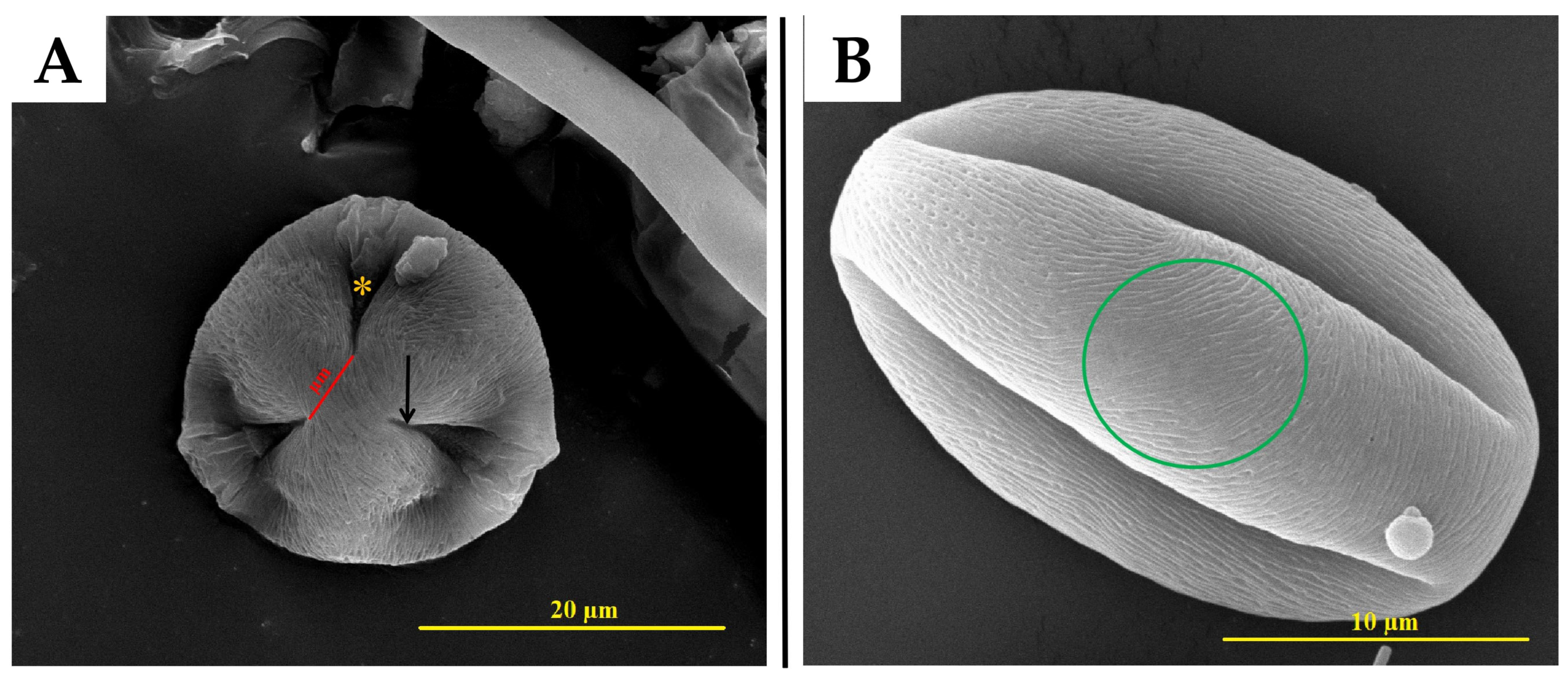
The pollen grains from Eriobotrya and Rhaphiolepis species were examined under a scanning electron microscope (Thermo Scientific, Prisma, Shanghai, China) at Nanjing Forestry University. To prepare pollen grains, anthers were carefully dissected and treated in a 2.5% glutaraldehyde solution under a vacuum, then kept in a refrigerator at 0–4 °C for 20 days. The samples were then dehydrated using a graded ethanol series of 50%, 70%, 90% (twice), and 100% (thrice). Following dehydration, the anther walls were smashed using fine tweezers under a stereomicroscope. The pollen grains were collected with a cotton swab and evenly placed on specimen stubs using double-sided conductive adhesive tape. Excess pollen was gently removed with a rubber bulb. To ensure surface conductivity, the specimens were sputter-coated with gold (Au) to a nominal thickness of 8–12 nm. With working distances of 8–15 mm, SEM imaging of pollen grains was performed at different magnifications for one to three minutes using a 15 kV accelerating voltage. To ensure consistency in morphological features, ten mature, fully developed pollen grains were randomly chosen and measured from each taxon, resulting in the examination of 310 grains in total. The qualitative and quantitative variables of pollen grains were determined using digital SEM images that were processed using IMAGEJ v1.54p software. The quantitative variables included the pollen axis length (P), equatorial diameter (E), the distance between the apices of the two ectocolpi (d) (Figure 1), P/E, and apocolpium index (PAI–d/E) ratios. Pollen shape types and exine ornamentations were also examined. All metric data in this study (P, E, d, and derived ratios) were obtained exclusively from SEM observations of non-acetolyzed grains. Pollen was deemed perprolate if its pollen shape index (mean P/E) was more than 2. Prolate pollen was defined as 1.35 < P/E ≤ 2. The pollen was classified as subprolate if 1.14 < P/E ≤ 1.35. The exine ornamentation was divided into five categories: striate, striate-perforate, rugulate, psilate, and scabrate (Table 1).

2.3. Multivariate Analysis

Data from quantitative variables were evaluated to ascertain the minimum, maximum, average, and standard deviation using Excel. Furthermore, the ratios of polar axis length to equatorial axis length (P/E) and the distance between the apices of the two ectocolpi to equatorial diameter (d) were calculated using Excel. The descriptive palynological terminology generally followed that of Punt et al. [50], Halbritter et al. [51], Hesse et al. [52], and Wrońska-Pilarek et al. [53]. Hesse et al. [52] and Halbritter et al. [51] were used to identify the pollen shape class based on the P/E ratio, while Punt et al. [50] used terminology for exine ornamentation. The numerical data achieved Z-score normalization using SPSS v26 software, whereas the qualitative data were encoded (Table 1). Subsequently, both quantitative and qualitative variables were used for multivariate analyses, specifically clustering with the Gower’s distance and UPGMA algorithms [17], and were followed by principal component analysis (PCA) based on continuous variables [54], which were performed using PAST v5 software [55].

3. Results

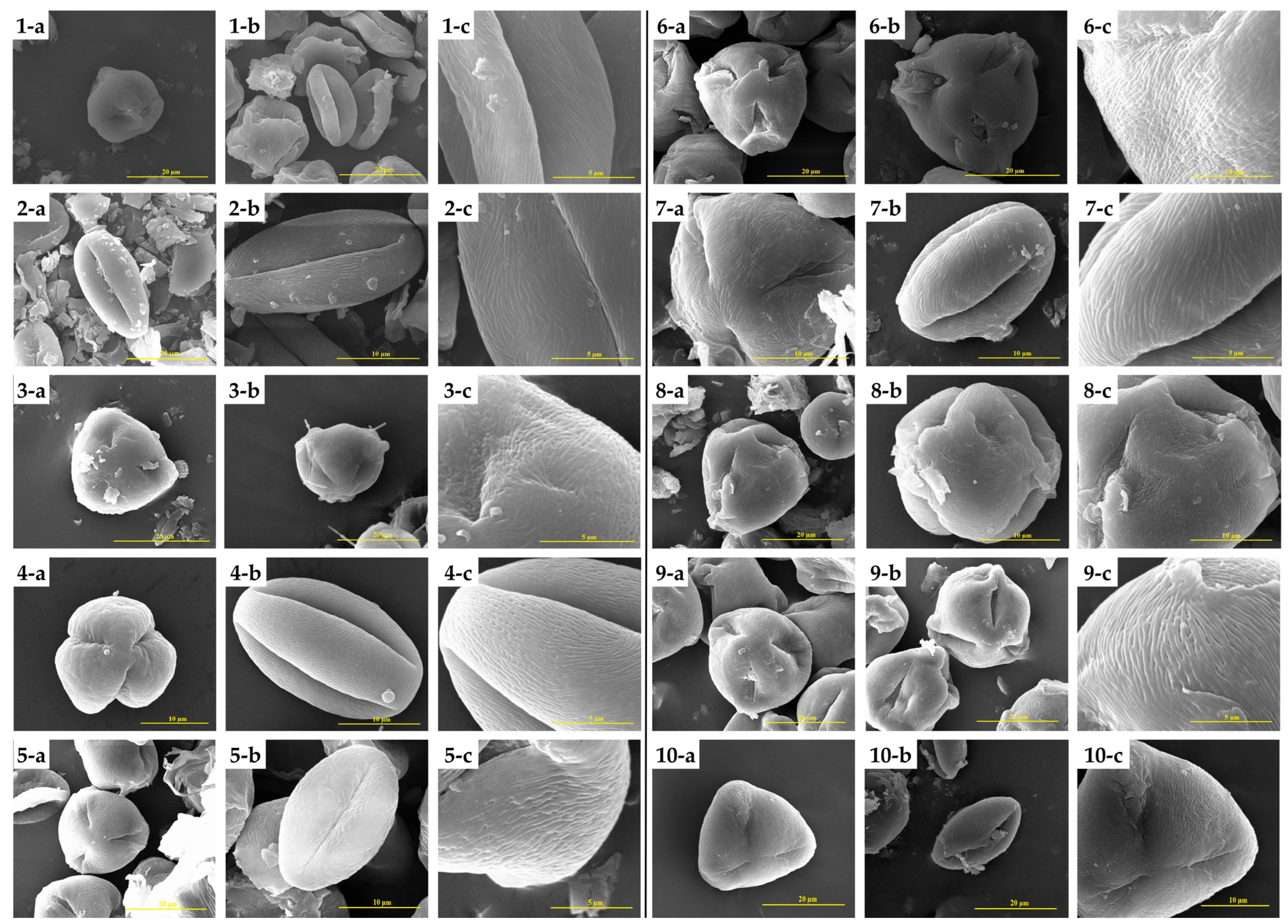
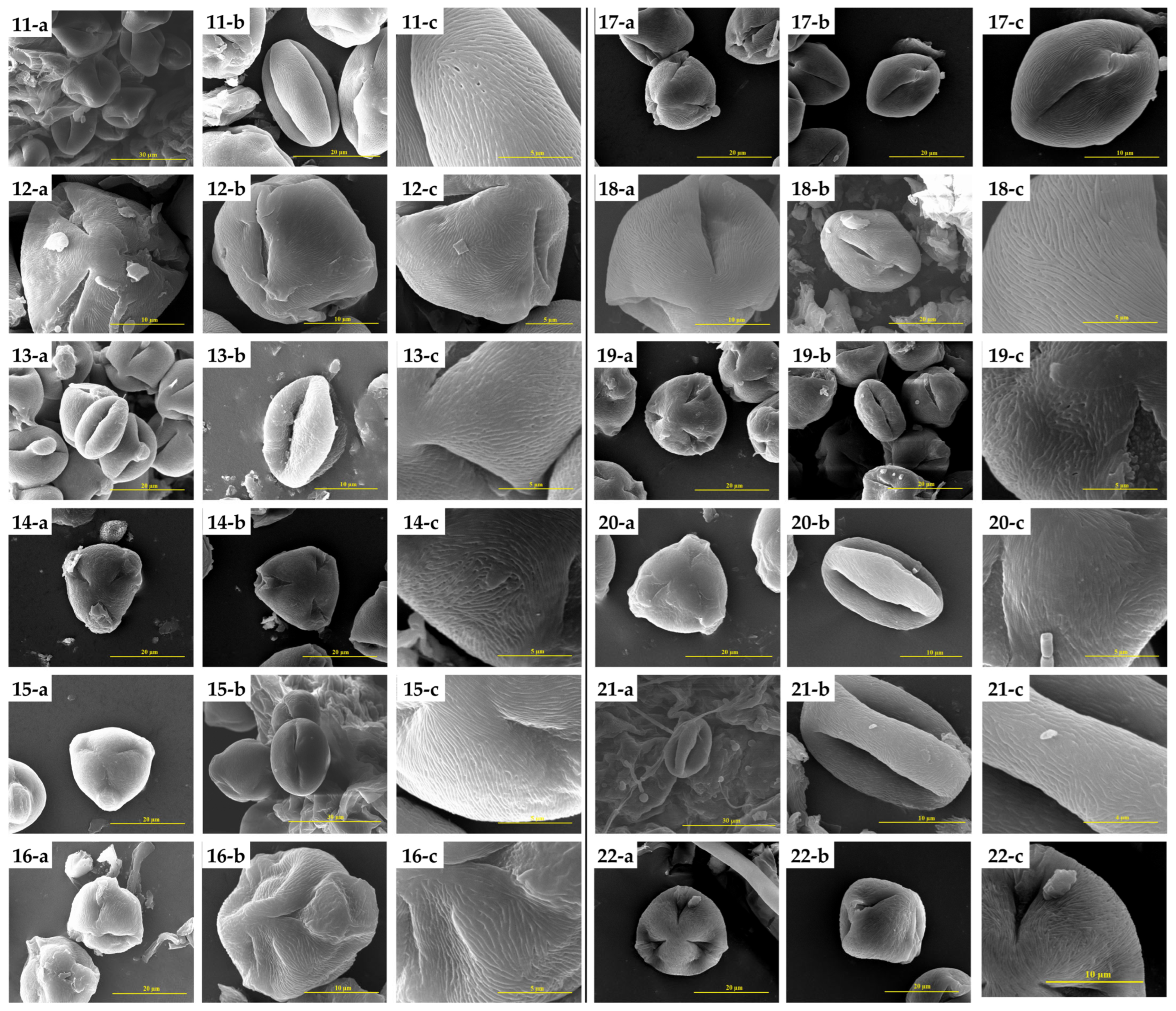
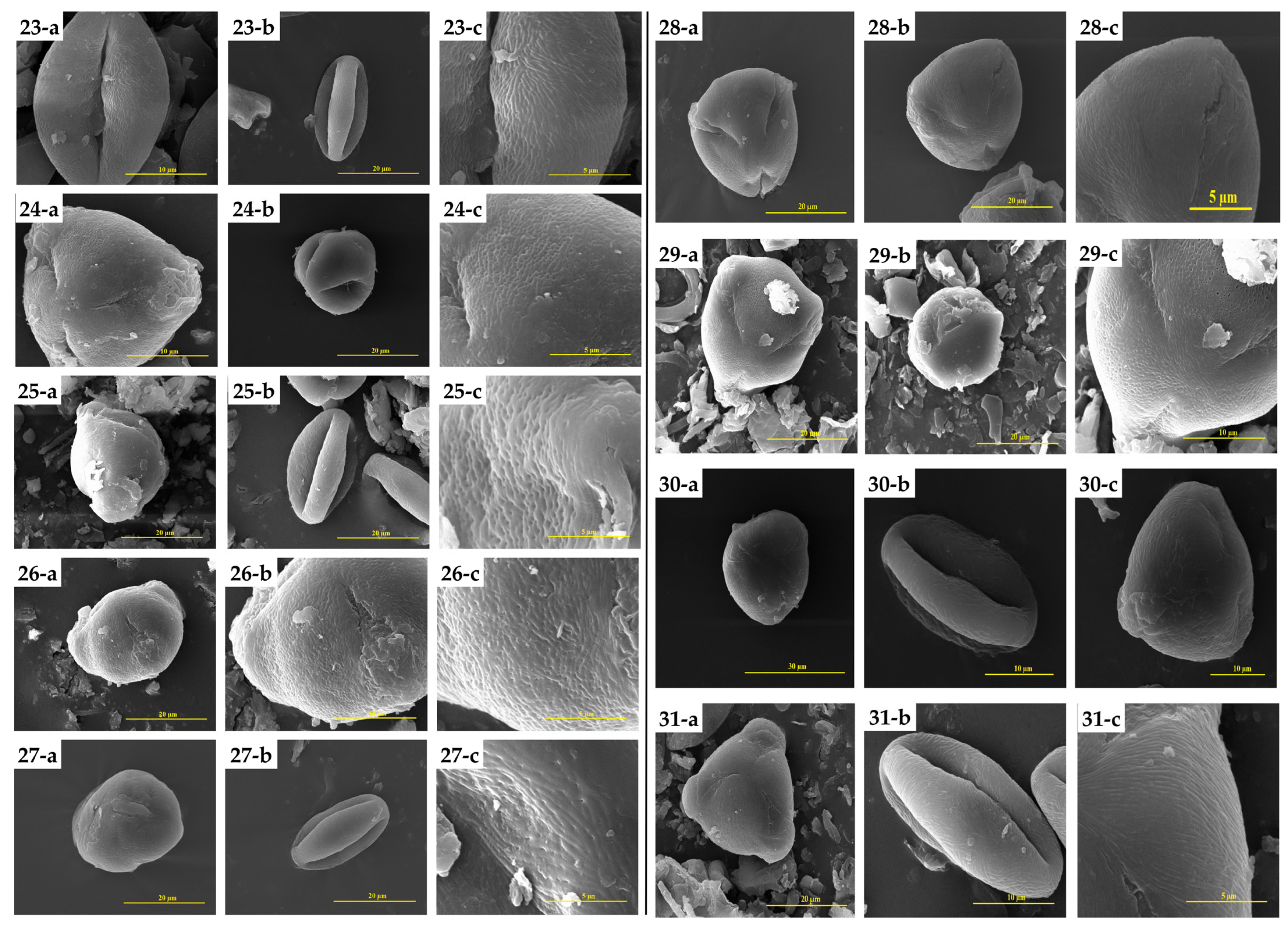
Pollen grains from 31 species of the genera Eriobotrya (22 species) and Rhaphiolepis (9 species) were examined using scanning electron microscopy (SEM). Figure 2, Figure 3 and Figure 4 illustrate the variability in pollen diversity between the two genera. Overall, the pollen grains of the examined Eriobotrya and Rhaphiolepis species were identified as tricolpate monads, ranging from small (10–25 µm) to medium in size (25–30 µm), according to Hesse et al. [52], and exhibited prolate to perprolate shapes. The observations in polar view revealed pollen grains with two ectocolpi terminating in acute apices and a granular membrane of the colpus, while grains exhibited angular or semi-angular shapes, predominantly elliptic, round-elliptic, or wide-elliptic in polar view.

3.1. Pollen Size

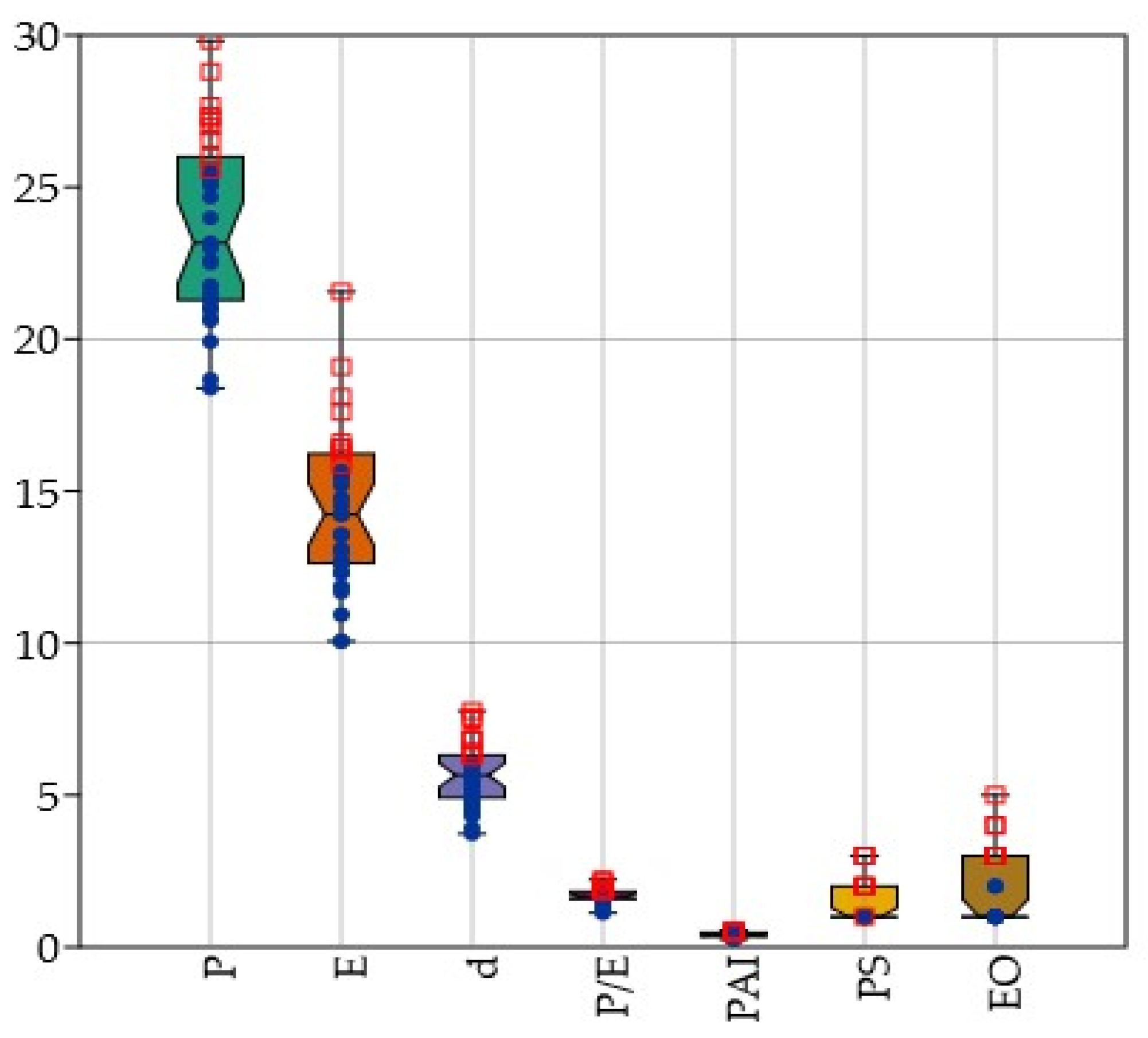
The average lengths of the polar axis (P) and equatorial diameter (E) varied from 18.37 to 29.80 µm and from 10.06 to 21.55 µm, respectively (Table 2). The smallest pollen grains were observed in E. malipoensis K.C.Kuan (P = 18.38 µm and E = 10.06 µm), while the largest were observed in R. integerrima Hook. & Arn. (P = 29.80 µm and E = 17.60 µm) (Table S2). The minimum distance between the apices of the two ectocolpi was observed in E. bengalensis (Roxb.) Kurz (d = 3.73 µm), whereas the maximum was observed in R. impressivena Masam. (d = 6.30 µm). The apocolpium index (PAI) ratios varied between 0.25 µm to 0.55 µm. Comparative variations between quantitative variables are shown in Figure 5.

3.2. Pollen Shape

The mean P/E ratio was 1.68, with a range from 1.12 in E. fragrans Champ. ex Benth. to 2.22 in R. wuzhishanensis W.B.Liao, R.H.Miau & Q.Fan (Table S2). The predominant pollen shape of the analyzed species was prolate (Eriobotrya = 77% and Rhaphiolepis = 67%, respectively), followed by subprolate (Eriobotrya = 18% and Rhaphiolepis = 11%, respectively), and infrequently perprolate (Eriobotrya = 5% and Rhaphiolepis = 22%, respectively). The highest quantities of prolate pollen grains were seen in Eriobotrya and Rhaphiolepis species. The majority of perprolate pollen grains were identified in Rhaphiolepis (R. wuzhishanensis W.B.Liao, R.H.Miau & Q.Fan and R. umbellata var. liukiuensis Koidz.), with a solitary instance observed in Eriobotrya (E. grandiflora Rehder & E.H.Wilson). Subprolate pollen grains were identified in Eriobotrya (E. dubia (Lindl.) Decne., E. fragrans, E. petiolata Hook.f., and E. salwinensis Hand.-Mazz.) and Rhaphiolepis (R. ferruginea var. serrata F.P.Metcalf) as presented in Table 2.

3.3. Exine Ornamentation

Based on variations in surface sculpture, we categorized pollen ornamentation into five kinds (Table 2): I—striate, II—striate-perforate, III—rugulate, IV—psilate, and V—scabrate. Type I striate pollen is distinguished by thick, elongated, or low parallel ridges; consistent linear ridges; or thin to medium parallel furrows. The majority of species exhibited a striate surface sculpture, comprising 14 Eriobotrya species (E. bengalensis (Roxb.) Kurz and E. bengalensis f. angustifolia (Cardot) J.E.Vidal; E. cavaleriei (H.Lév.) Rehder; E. × daduheensis H.Z.Zhang ex W.B.Liao, Q.Fan & M.Y.Ding; E. salwinensis Hand.-Mazz.; E. serrata J.E.Vidal; E. tengyuehensis W.W.Sm.; E. obovata W.W.Sm.; E. tsiangii Idrees & J.M.H.Shaw; E. dubia (Lindl.) Decne.; E. fulvicoma Chun ex W.B.Liao, F.F.Li, and D.F.Cui (synonym of E. kwangsiensis Chun ex X.H.Yang & S.Q.Lin); E. fusca K.C.Kuan ex X.F.Gao & Idrees; E. malipoensis K.C.Kuan; E. deflexa (Hemsl.) Nakai) (63.64%); and six Rhaphiolepis species (R. lanceolata Hu, R. major Cardot, R. × delacourii André, R. wuzhishanensis W.B.Liao, R.H.Miau & Q.Fan, R. integerrima Hook. & Arn., and R. umbellata var. liukiuensis Koidz.) (67%) that displayed this ornamental characteristic. Type II is distinguished by notable striae and perforations. E. petiolata Hook.f. and E. bengalensis f. intermedia (B.B.Liu & J.Wen) Idrees & J.M.H.Shaw are classified under this category of ornamentation (9.09%) but are absent in Rhaphiolepis species (0%). Type III rugulate pollen exhibits uneven coarse ridges and prominent wrinkled folds. Four Eriobotrya species, E. crassifolia Q.Fan, S.F.Chen & K.K.Meng; E. grandiflora Rehder & E.H.Wilson; E. prinoides Rehder & E.H.Wilson; and E. seguinii Cardot ex Guillaumin (18.18%), and two Rhaphiolepis species, R. ferruginea var. serrata F.P.Metcalf and R. salicifolia Lindl., exhibit type III ornamentation (22%). Type IV is distinguished by a smooth, glossy wall. Two species of Eriobotrya (E. bengalensis f. contracta (B.B.Liu & J.Wen) Idrees & J.M.H.Shaw and E. fragrans Champ. ex Benth.) exhibit this sort of ornamentation (9.09%), while Rhaphiolepis species lack it (0%). Type V scabrate pollen is distinguished by its irregular granular texture. It is exclusively observed in R. impressivena Masam. (11%) but is absent in the Eriobotrya species (0%).

3.4. Cluster Analysis

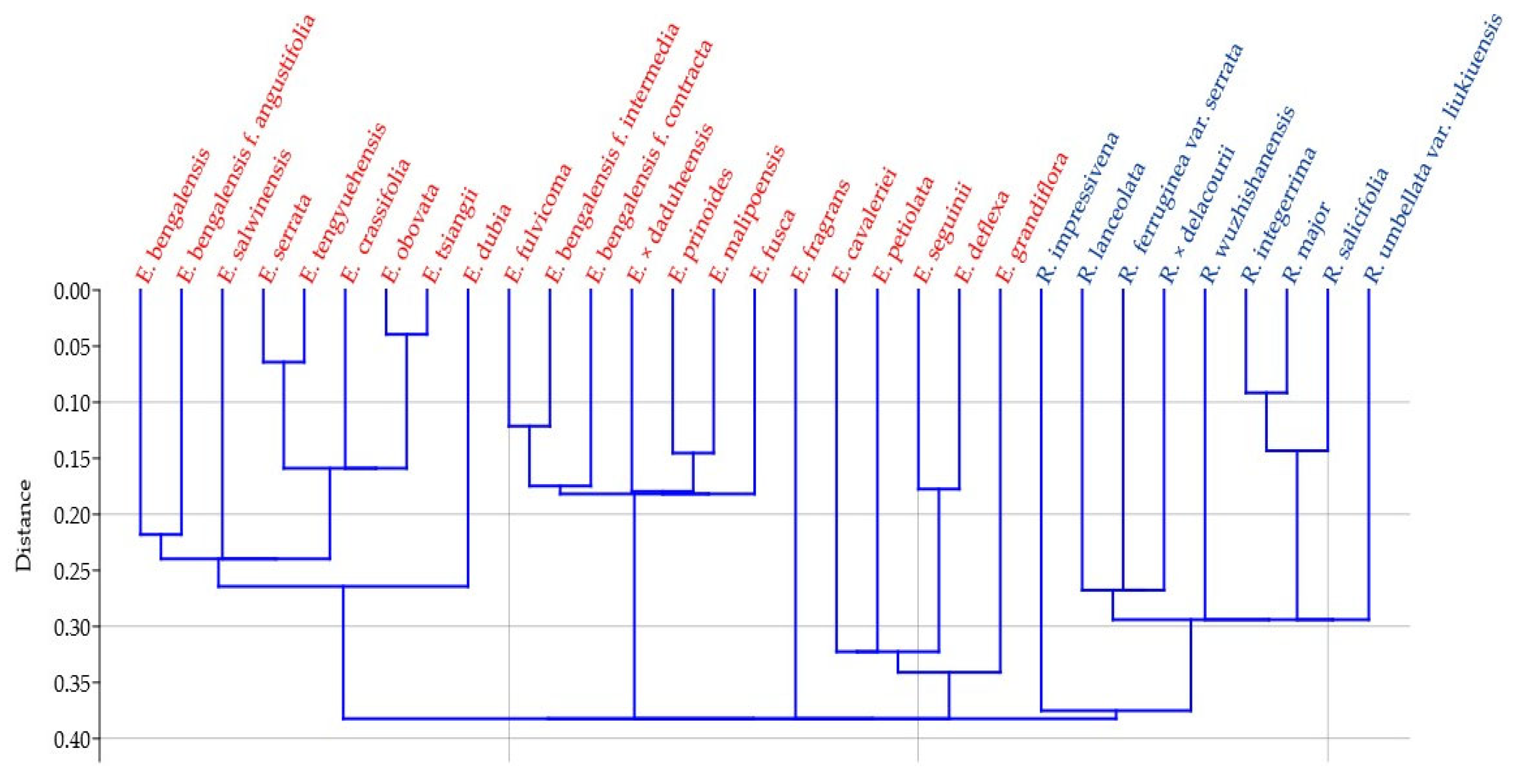
The cluster analysis was employed to investigate the pollen’s morphological relationships between two closely related genera, resulting in the separation of the 31 taxa from the two genera into two clusters, designated as cluster I and II (Figure 6). Cluster I: The major cluster encompassed all Eriobotrya species and was subsequently subdivided into four subclusters; subcluster I constitutes a clade that includes E. bengalensis (Roxb.) Kurz, E. bengalensis f. angustifolia (Cardot) J.E.Vidal; E. salwinensis Hand.-Mazz.; E. serrata J.E.Vidal; E. tengyuehensis W.W.Sm.; E. obovata W.W.Sm.; E. tsiangii Idrees & J.M.H.Shaw; E. dubia (Lindl.) Decne.; and E. crassifolia Q.Fan, S.F.Chen, & K.K.Meng. Subcluster II comprises 7 species, including E. fulvicoma Chun ex W.B.Liao F.F.Li & D.F.Cui (synonyms of E. kwangsiensis Chun ex X.H.Yang & S.Q.Lin); E. bengalensis f. intermedia (B.B.Liu & J.Wen) Idrees & J.M.H.Shaw; E. bengalensis f. contracta (B.B.Liu & J.Wen) Idrees & J.M.H.Shaw; E. × daduheensis H.Z.Zhang ex W.B.Liao, Q.Fan & M.Y.Ding; E. prinoides Rehder & E.H.Wilson; E. malipoensis K.C.Kuan; and E. fusca K.C.Kuan ex X.F.Gao & Idrees. Subcluster III only included E. fragrans Champ. ex Benth., whereas subcluster IV contained five species: E. cavaleriei (H.Lév.) Rehder, E. petiolata Hook.f., E. seguinii Cardot ex Guillaumin, E. grandiflora Rehder & E.H.Wilson, and E. deflexa (Hemsl.) Nakai. Two species E. dubia (Lindl.) Decne. and E. fragrans constitute a sister clade with other Eriobotrya species. Cluster II encompassed all Rhaphiolepis species and was further subdivided into two subgroups: I and II. Subgroup I only contained R. impressivena Masam. Subgroup II included R. ferruginea var. serrata F.P.Metcalf; R. lanceolata Hu; R. × delacourii André, R. integerrima Hook. & Arn.; R. major Cardot; R. salicifolia Lindl.; R. wuzhishanensis W.B.Liao, R.H.Miau & Q.Fan; and R. umbellata var. liukiuensis Koidz.

3.5. Principal Component Analysis (PCA)

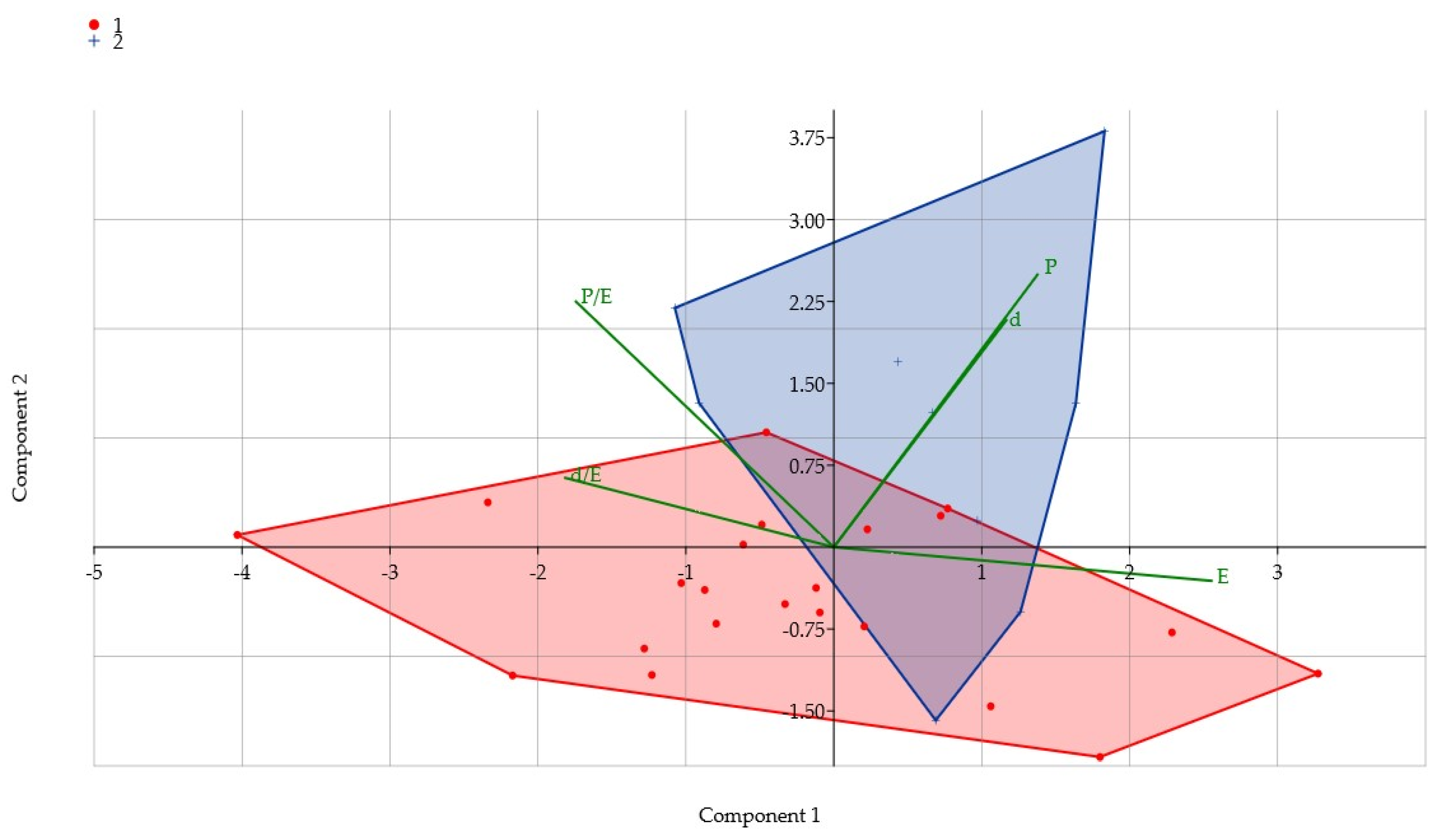
The principal component analysis plot revealed the separation of two genera into two distinct clusters (Figure 7), with minimal overlapping and predominantly explained by principal components one (PC1) and two (PC2) (Table 3). The initial two components from the PCA together explained 74.191% of the variation. The initial principal component accounted for 44.113% of the variation, with polar length, equatorial diameter, and the distance between the apices of the two ectocolpi as the most important variables. The second major component accounted for 30.078% of the variance. With polar length and the distance between the apices of the two ectocolpi, P/E and PAI ratios were identified as the most important variables. Species from the genus Eriobotrya, such as E. salwinensis Hand.-Mazz.; E. dubia (Lindl.) Decne.; E. fulvicoma Chun ex W.B.Liao, F.F.Li & D.F.Cui; E. × daduhensis H.Z.Zhang ex W.B.Liao, Q.Fan & M.Y.Ding; E. bengalensis (Roxb.) Kurz; E. fusca K.C.Kuan ex X.F.Gao & Idrees; E. fragrans Champ. ex Benth.; E. petiolata Hook.f.; and all of the Rhaphiolepis species, exhibited positive values on the first axis. Conversely, the remaining species in Eriobotrya and R. wuzhishanensis W.B.Liao, R.H.Miau & Q.Fan and R. umbellata var. liukiuensis Koidz. in Rhaphiolepis species displayed negative values.

4. Discussion

Pollen types from the Rosaceae family, which comprises about 100 genera [4], are frequently detected in sediments. Hebda and Chinnappa [41] suggested reclassifying certain genera and noted the taxonomic significance of pollen morphology in Rosaceae. In order to assess the suggested subfamily classifications, Hebda and Chinnappa [40] investigated the pollen morphology of representative species from each Rosaceae tribe. They found that the systematic placement of some species within tribes and subfamilies might need to regroup some of the genera, and they further explained the pollen evolutionary trends in Rosaceae. Some genera in the Rosaceae family have been the subject of continuous reports for the past 20 years [31,33,35,43,44,45,46,47,48,49,56,57,58,59,60,61,62,63,64,65,66,67,68,69].
The pollen grains of the examined Eriobotrya and Rhaphiolepis species have yet to be documented in the palynological literature. The generic delimitation and species identification of species within the two closest genera was thoroughly examined through both qualitative and quantitative variables (Table 1). The pollen grains of the thirty-one Eriobotrya and Rhaphiolepis species exhibit the pollen type characteristic of the Maleae tribe: isopolar, radially symmetric, tricolpate monads, small- to medium-sized, confirming the general characteristics of the Rosaceae [40,41,46,63,70,71]. The diagnostic relevance of palynological features in Rosaceae is being debated: some authors emphasize pollen size and shape [32], others emphasize exine sculpture [72], and some argue that their diagnostic significance is uncertain at some taxonomic levels [73,74]. The two genera in this study exhibit variations in size and shape, but the exine ornamentation was found to be the most diagnostic feature.
Palynological characteristics are conserved across numerous plant species, making them frequently utilized for taxonomic classification. Pollen sizes in Eriobotrya and Rhaphiolepis species ranged from small (E. malipoensis K.C.Kuan: P = 18.38 µm and E = 10.06 µm) to medium (R. integerrima, Hook. & Arn.: P = 29.80 µm and E = 17.60 µm) (Table S2). This aligns with previous findings of predominantly small pollen in Eriobotrya and medium pollen in Rhaphiolepis [46,47], as well as broader patterns described in other Rosaceae genera [33,40,41,46,56,57,69,75]. However, our findings differ from those of Chakas et al. [76] and Chen et al. [49] who observed medium-sized pollen for E. japonica cultivars. Notably, three Eriobotrya species: E. fusca K.C.Kuan ex X.F.Gao & Idrees; E. petiolata Hook.f.; and E. crassifolia Q.Fan, S.F.Chen & K.K.Meng, had medium-sized grains, and one Rhaphiolepis species (R. ferrugenia var. serrata F.P.Metcalf) had small grains. This demonstrates that the pollen size can show general trends, as it is a less reliable characteristic for generic delimitation. Prior research has shown that more primitive angiosperms tend to produce relatively large pollen grains, and that decreasing pollen volume is associated with a higher evolutionary level, as reported by Deng et al. [77] and Ding et al. [78]. Our findings correspond with earlier research on these genera [27,46,49,57], with preserved pollen dimensions (P: 18.37 µm to 29.8 µm and E: 10.06 µm to 21.55 µm) and minor discrepancies [46] that are likely related to methodological or intraspecific variation. The pollen preparation technique, such as critical-point drying [79] and acetolysis [80], have been shown to affect the apparent size and shape of the grains [81,82,83], emphasizing the importance of procedural consistency. Wang et al. [57] suggested that appropriate artificial drying methods should be employed to fix and study the natural pollen state.
Concerning pollen shape, the majority of the examined Eriobotrya and Rhaphiolepis species exhibited prolate pollen shapes (17 spp., 77% and 6 spp., 67%, respectively), with a minority having suboblate or perprolate morphologies (Table 2). These findings are consistent with Pathak et al. [47], Zhou et al. [46], and Ghosh and Saha [84] but differ from those reported by Lu et al. [48] and Chen et al. [49] regarding Eriobotrya species; however, subspheroidal was reported in Rhaphiolepis species [46] due to sampling discrepancies. Furthermore, the prolate shape appears to be a shared feature of these genera and the Rosaceae genera [46,47,84,85], supporting morphological consistency but offering limited diagnostic value in distinguishing these two genera.
Pollen exine ornamentation, despite the vagueness of many phrases [50] and the difficulty in description, is recognized as the most significant differentiating feature in Rosaceae [32,55,72]. We identified five types of ornamentation in this study (Table 2), with striate being the most common type (Eriobotrya = 63.64% and Rhaphiolepis 67%, respectively) and remaining consistent with the findings of Peng and Zhang [86] and Wang et al. [87]. Wrońska-Pilarek et al. [88] discovered a striate exine sculpture in the endemic Rubus species, whereas Li [43] found it in Micromeles Decne. and Zhou et al. [46] found it in Cydonia Mill. and Malus Mill. According to Reitsma [89], six Rosaceae genera (Alchemilla L., Crataegus L., Geum L., Potentilla L., Rosa L., and Sanguisorba L.) exhibit striate ornamentation, except Mespilus L. (perforate type and Rubus L. (echinate or verrucate type). Striate-perforate and psilate sculptures were unique to Eriobotrya species, while scabrate ornamentation was found only in Rhaphiolepis. Ullah [90] reported psilate ornamentation for Rubus vestitus Weihe; Fahir et al. [91] identified psiliate and microechinate for Alchemilla L.; and Chung [35] reported rugulate, verrucate and perforate for Sanguisorbineae, as well as striate for Agrimoniineae (Rosaceae). Striate-foveolated patterns, which have previously been documented in Eriobotrya species [46], were not detected in this investigation. Our methodological findings, based on high resolution SEM imaging of non-acetolyzed pollen, support this diversity as a biological signal.
Comparing these patterns with closely related sister genera within Maleae [27,28], such as the Photinia Lindl. [40,47] and Cotoneaster L. [67] study, which exhibit striate-perforate and rugulate-perforate pollen, elucidates their initial evolutionary interpretation. According to Hebda and Chinnappa [40], this type of striate-perforate ornamentation is widespread and is found in fifty-five Rosaceae genera. The common ancestor of this group most likely possessed perforated exine ornamentation. Within this lineage, Eriobotrya and Rhaphiolepis are distinguished by a change to non-perforate, predominantly striate pollen. This shared lack of perforations indicates that these two genera have a common phylogenetic background and distinguishes them from their close, perforate-bearing sister genera. This type of evolutionary event has been observed in other families, such as Ericaceae and Calyceraceae [92,93]. Subsequent to their divergence, each genus developed distinct, diagnostic derived states: Eriobotrya evolved a psilate surface, while Rhaphiolepis evolved a scabrate texture. The striate-perforate patterns in a few Eriobotrya species, as well as the rugulate pattern in both genera, demonstrate widespread homoplasy in angiosperm pollen [94].
This study provides the palynological data supporting the classification of Eriobotrya and Rhaphiolepis as distinct genera. Cluster analysis separated these two genera into two distinct clusters, Cluster I and Cluster II (Figure 6). Cluster I had 22 Eriobotrya species, whereas Cluster II had nine Rhaphiolepis species. This palynological evidence corroborates classifications based on morphology [1,2,5,8,9,10,11,12,13,14,15,16], micromorphology [17], and nuclear phylogenies [17,21,22,23]. The congruence of conserved, genus specific pollen features with earlier data sheds lights on the phylogenetic discordance reported with organelle genomes (mtDNA and cpDNA) [17,24,25]. Such inconsistencies are better explained by ancient hybridization, or organelle capture events. Furthermore, the interspecies relationships within the genus Eriobotrya align with recent molecular studies [21,23]. Prior research indicated that E. prinoides Rehder & E.H.Wilson shared a close relationship with E. elliptica Lindl., and E. serrata J.E.Vidal [22]. Our findings indicated that E. prinoides and E. serrata had prolate pollen morphology but were distinguished by pollen size and ornamentation sculpture. In the cluster tree, E. × daduheensis H.Z.Zhang ex W.B.Liao, Q.Fan & M.Y.Ding; E. prinoides; and E. malipoensis K.C.Kuan formed a clade inside subcluster II, which was consistent with earlier research on Eriobotrya [95,96,97]. Subcluster I included E. bengalensis (Roxb.) Kurz, E. bengalensis f. angustifolia (Cardot) J.E.Vidal, E. salwinensis Hand.-Mazz., E. serrata, and E. tengyuehensis W.W.Sm., which aligns with recent nuclear studies [21]. These species have comparably small pollen sizes, with polar lengths and equatorial diameters ranging from 20.66 µm to 25.21 µm. Morphological and molecular data indicates a close relationship between E. cavaleriei (H.Lév.) Rehder and E. fragrans Champ. ex Benth. [21,22,23,95,96,98]. Nonetheless, the two species were verified to be distinct [26,97,99,100]. Li et al. [101] conducted a karyotype investigation revealing that Eriobotrya species have three types of chromosomes: m, sm, and st. The st chromosome was exclusively identified in E. cavaleriei (H.Lév.) Rehder (2n = 2x = 34 = 16m + 16sm + 2st), while E. fragrans exhibited a karyotype of 2n = 2x = 34 = 18m + 16sm. The pollen morphology in the present study indicated that E. fragrans constitutes a clade sister with E. cavaleriei and E. petiolata Hook.f. in subcluster III. E. fragrans differs from E. cavaleriei by having subprolate pollen morphology, larger polar and equatorial diameters (P = 23.98 and E = 21.55 µm), and subprolate and psilate ornamentation. In contrast, E. cavaleriei has smaller polar and equatorial diameters (P = 21.038 µm and E = 12.655 µm) and prolate and striate ornamentation (Table 2 and Table S2). Prior phylogenetic investigations indicated significant discrepancies using molecular data on the classification of both genera, leading to the conclusion that E. henryi Nakai and E. seguinii Cardot ex Guillaumin formed a sister clade within Rhaphiolepis [25]. Our findings showed that E. seguinii, depicted as an early-divergent species within Eriobotrya, constituted a sister clade to E. deflexa (Hemsl.) Nakai and E. grandiflora Rehder & E.H.Wilson within the monophyletic genus Eriobotrya. The relationship of basal lineage E. seguinii has previously been confirmed [27] and is consistent with this study. E. grandiflora is distinguished by perprolate pollen grains and rugulate exine surface ornamentation, but the morphological tree showed that it formed a clade with E. deflexa, which was recently reclassified as a distinct species, and differentiated from E. cavaleriei and E. deflexa [6,21,22].
The interspecies relationships within the genus Rhaphiolepis are consistent with recent molecular studies [21,22,25] (Figure 6). R. major Cardot and R. salicifolia Lindl. constituted a clade within subgroup II (Cluster II), with similar pollen morphology but different exine ornamentation surfaces (striate vs. rugulate) (Table 2 and Table S2). Liu et al. [25] molecular data revealed that R. impressivena Masam. formed a sister group to R. ferruginea F.P.Metcalf, R. lanceolata Hu and R. indica (L.) Lindl. Our findings indicated that R. impressivena and R. lanceolata constituted a subgroup I (cluster II) and was consistent with prior research [17,21]. We reported the first confirmed evidence of the relationships for three Rhaphiolepis species (R. integerrima Hook. & Arn.; R. × delacourii André; and R. wuzhishanensis W.B.Liao, R.H.Miau & Q.Fan) and two distinct varieties (R. ferruginea var. serrata F.P.Metcalf and R. umbellata var. liukiuensis Koidz.) and clarified their placement within Rhaphiolepis.
This study utilized scanning electron microscopy for pollen analysis, which largely captures surface morphology. Future research would benefit from sophisticated methods such as cryogenic transmission electron microscopy (cryo-TEM) to better understand pollen ultra-structure and its evolutionary significance [102]. Furthermore, in order to improve our understanding of the evolution history and character evolution within these genera, it is required to integrate detailed palynological data with micromorphological, biochemical, and genomic information and expand sampling to include all Eriobotrya and Rhaphiolepis species.

5. Conclusions

The first detailed palynological descriptions for Eriobotrya and Rhaphiolepis species are provided herein: the pollen grains are small- to medium-sized, prolate to subprolate to perprolate, with striate ornamentation being the most prevalent in both genera. Notably, the pollen of the two genera was diagnostically distinct, primarily in terms of polar length, equatorial diameter, the distance between the apices of the two ectocopi, and P/E ratios. Eriobotrya species are distinguished by small grains, with striate-perforate and psilate exine sculptures. Rhaphiolepis species are distinguished by larger grains, with scabrate ornamentation. The rugulate pattern appeared in both genera. The pollen size and shape are variables but have a limited diagnostic value for generic delimitation in this group. In contrast, exine ornamentation provides both diagnostic and evolutionary signals: the common striate pattern indicates shared ancestry, while the unique derived changes serve as the diagnostic features for distinguishing genera and understanding infrageneric evolution. Furthermore, this study provides palynological evidence for the basal lineage E. seguinii Cardot ex Guillaumin and confirms its placement within Eriobotrya. Our findings demonstrate that employing SEM to scan the pollen grain can aid in the delimitation of these genera and highlight the taxonomic importance of pollen morphology. Additional micro-morphological research on other plant parts using cryo-TEM and DNA data could provide valuable information for understanding the evolutionary history of these two Rosaceae genera.

Supplementary Materials

The following supporting information can be downloaded at: https://www.mdpi.com/article/10.3390/d18030137/s1, Table S1: Taxon, and locality information of Eriobotrya, and Rhaphiolepis species examined in this study. Table S2: Pollen morphological variables in Eriobotrya and Rhaphiolepis species (Minimal, maximal, mean values, and standard deviation for P, E, d, P/E and PAI).

Author Contributions

Conceptualization, M.I. and Z.Z.; methodology, M.I. and M.L.; software, M.I.; validation, M.I., Z.Z. and J.M.H.S.; formal analysis, M.I., M.L. and M.A.; investigation, M.I. and Z.Z.; resources, M.I. and M.L.; data curation, M.I., M.L. and Z.Z.; writing—original draft preparation, M.I.; writing—review and editing, M.A. and J.M.H.S.; visualization, M.I., M.L. and Z.Z.; supervision, M.I. and Z.Z.; project administration, M.I.; funding acquisition, M.I. All authors have read and agreed to the published version of the manuscript.

Funding

This research was funded by the National Natural Science Foundation of China (Grant No. 32350410399).

Institutional Review Board Statement

Not applicable.

Data Availability Statement

The original contributions presented in this study are included in the article/Supplementary Material. Further inquiries can be directed to the corresponding author.

Acknowledgments

We are grateful to the directors of the herbaria PE, IBSC, CDBI, SZ, NAS, KUN, HITBC, AU, and IBK for permitting us to examine the specimens and would like to give special thanks to Hui Wang (Neijiang Normal University) and Jianing (Nanjing Forestry University) for their help with plant materials and pollen photos.

Conflicts of Interest

The authors declare no conflicts of interest.

Abbreviations

The following abbreviations are used in this manuscript:
SEMScanning Electron Microscopy
EEriobotrya
RRhaphiolepis
PCAPrincipal Component Analysis
vs.Versus
µmMicrometer

References

  1. Lindley, J. Observation on the natural group of plants called Pomaceae. Trans. Linn. Soc. Lond. 1821, 8, 102. [Google Scholar] [CrossRef]
  2. Lindley, J. Rhaphiolepia indica. In The Botanical Register: Consisting of Coloured Figures of Exotic Plants Cultivated in British Gardens with Their History and Mode of Treatment; Lindley, J., Edwards, S.T., Eds.; James Ridgway: London, UK, 1820; Volume 6, pp. 436–520. [Google Scholar]
  3. de Jussieu, A.L. Genera Plantarum; Apud viduam Herissant et Theophilum Barrois: Paris, France, 1789; 498p. [Google Scholar]
  4. POWO. The Plants of the World Online Database. Facilitated by the Royal Botanic Gardens, Kew. 2025. Available online: http://www.plantsoftheworldonline.org/ (accessed on 13 July 2025).
  5. Gu, C.Z.; Spongberg, S.A. Eriobotrya Lindley. In Flora of China; Wu, Z.Y., Raven, P.H., Hong, D.Y., Eds.; Science Press: Beijing, China; Missouri Botanical Garden Press: St. Louis, MO, USA, 2003; Volume 9, pp. 138–141. [Google Scholar]
  6. Vidal, J.E. Notes sur quelques Rosacees asiatiques (III). Revision du genre Eriobotrya (Pomoideae). Adansonia 1965, 5, 537–580. [Google Scholar] [CrossRef]
  7. Pham, H.H. Rosaceae. In An Illustrated Flora of Vietnam; Pham, H.H., Ed.; Young Publishing House: Ho Chi Minh City, Vietnam, 2000; Volume 1, pp. 776–779. [Google Scholar]
  8. Gu, C.Z.; Spongberg, S.A. Rhaphiolepis Lindley. In Flora of China; Wu, Z.Y., Raven, P.H., Hong, D.Y., Eds.; Science Press: Beijing, China; Missouri Botanical Garden Press: St. Louis, MO, USA, 2003; Volume 9, pp. 141–144. [Google Scholar]
  9. Robertson, K.R.; Phipps, J.B.; Rohrer, J.R.; Smith, P.G. A Synopsis of Genera in Maloideae (Rosaceae). Syst. Bot. 1991, 16, 376–394. [Google Scholar] [CrossRef]
  10. Kalkman, C. Rosaceae. In Flora Malesiana Series I-Spermatophyta Flowering Plants; de Wilde, W.J.J., Nooteboom, H.P., Kalkman, C., Eds.; Rijksherbarium: Leiden, The Netherlands, 1993; pp. 227–351. [Google Scholar]
  11. Kalkman, C. Rosaceae. In The Families and Genera of Vascular Plants. VI Flowering Plants-Dicotyledons Celastrales, Oxalidales, Rosales, Cornales, Ericales; Kubitzki, K., Ed.; Springer: Berlin, Germany, 2004; pp. 338–343. [Google Scholar]
  12. Hooker, J.D. Eriobotrya Lindl. In The Flora of British India; Hooker, J.D., Ed.; Reeve: London, UK, 1878; pp. 370–372. [Google Scholar]
  13. Vidal, J.E. Eriobotrya Lindl. In Flore du Cambodge du Laos et du Vietnam Fascicule: ROSACEAE I (excl. RUBUS); Vidal, J.E., Ed.; Mémoires du Muséum national d’Histoire naturelle, Laboratoire de phanérogamie: Paris, France, 1968; Volume 6, pp. 60–82. [Google Scholar]
  14. Vidal, J.E. Rosaceae. In Flora of Thailand; Smith, T., Larsen, K., Eds.; Applied Scientific Research Corporation of Thailand: Bangkok, Thailand, 1970; Volume 2, pp. 31–74. [Google Scholar]
  15. Phipps, J.B.; Robertson, K.R.; Smith, P.G.; Rohrer, J.R. A checklist of subfamily Maloideae (Rosaceae). Can. J. Bot. 1990, 68, 2209–2269. [Google Scholar] [CrossRef]
  16. Dash, S.S.; Pramanick, D.D.; Krishna, G.; Mao, A.A. Rosaceae to Neuradaceae. In Flora of India; Botanical Survey of India: Kolkata, India, 2025; Volume 8. [Google Scholar]
  17. Idrees, M.; Zhang, Z.; Lv, Y.; Li, M.; Wang, H.; Zhang, N.; Chen, F.; Shaw, J.M.H. Reassessing the Evolutionary Relationships of Eriobotrya and Rhaphiolepis (Rosaceae): Evidence from Micromorphology, Complete Nuclear Ribosomal DNA and Mitochondrial Genomic Data. Biology 2025, 14, 1740. [Google Scholar] [CrossRef]
  18. Aldasoro, J.J.; Aedo, C.; Navarro, C. Phylogenetic and Phytogeographical Relationships in Maloideae (Rosaceae) Based on Morphological and Anatomical Characters. Blumea 2005, 50, 3–32. [Google Scholar] [CrossRef]
  19. Campbell, C.S.; Evans, R.C.; Morgan, D.R.; Dickinson, T.A.; Arsenault, M.P. Phylogeny of Subtribe Pyrinae (Formerly the Maloideae, Rosaceae): Limited Resolution of a Complex Evolutionary History. Plant Syst. Evol. 2007, 266, 119–145. [Google Scholar] [CrossRef]
  20. Campbell, C.S.; Donoghue, M.J.; Baldwin, B.G.; Wojciechowski, M.F. Phylogenetic Relationships in Maloideae (Rosaceae): Evidence from Sequences of the Internal Transcribed Spacers of Nuclear Ribosomal DNA and its Congruence with Morphology. Am. J. Bot. 1995, 82, 903–918. [Google Scholar] [CrossRef]
  21. Idrees, M.; Li, M.; Shaw, J.M.H.; Zhang, Z.Y.; Ahmad, M. New species, combinations and synonyms in Eriobotrya (Rosaceae). Phytotaxa 2025, 712, 31–46. [Google Scholar] [CrossRef]
  22. Dong, Z.; Qu, S.; Landrein, S.; Yu, W.B.; Xin, J.; Zhao, W.; Song, Y.; Tan, Y.; Xin, P. Increasing taxa sampling provides new insights on the phylogenetic relationship between Eriobotrya and Rhaphiolepis. Front. Genet. 2022, 13, 831206. [Google Scholar] [CrossRef]
  23. Kang, D.-H.; Ong, H.G.; Lee, J.-H.; Jung, E.-K.; Kyaw, N.-O.; Fan, Q.; Kim, Y.-D. A new broad-leaved species of loquat from Eastern Myanmar and its phylogenetic affinity in the genus Eriobotrya (Rosaceae). Phytotaxa 2021, 482, 279–290. [Google Scholar] [CrossRef]
  24. Jin, L.; Qu, S.; Zhu, W.; Li, Q.; Tan, Y.; Cao, Z.; Xin, P.; Song, Y. Chloroplast-genome-based insights into the systematic relationship of Eriobotrya (Rhaphiolepis). iScience 2025, 28, 113855. [Google Scholar] [CrossRef] [PubMed]
  25. Liu, B.B.; Liu, G.N.; Hong, D.Y.; Wen, J. Eriobotrya belongs to Rhaphiolepis (Maleae, Rosaceae): Evidence from chloroplast genome and nuclear Ribosomal DNA Data. Front. Plant Sci. 2020, 10, 1731. [Google Scholar] [CrossRef] [PubMed]
  26. Chen, S.; Milne, R.; Zhou, R.; Meng, K.; Yin, Q.; Guo, W.; Ma, Y.; Mao, K.; Xu, K.; Kim, Y.D.; et al. When tropical and subtropical congeners met: Multiple ancient hybridization events within Eriobotrya in the Yunnan-Guizhou Plateau, a tropical-subtropical transition area in China. Mol. Ecol. 2021, 31, 1543–1561. [Google Scholar] [CrossRef]
  27. Idrees, M.; Azam, F.M.S.; Li, M.; Zhang, Z.; Hui, W.; Lv, Y. Assembly, characterization, and comparative analysis of the complete mitogenome of small-leaved Eriobotrya seguinii (Maleae, Rosaceae). Genes 2026, 17, 107. [Google Scholar] [CrossRef]
  28. Zhang, S.D.; Jin, J.J.; Chen, S.Y.; Chase, M.W.; Soltis, D.E.; Li, H.T.; Yang, J.B.; Li, D.Z.; Yi, T.S. Diversification of Rosaceae since the Late Cretaceous based on plastid phylogenomics. New Phytol. 2017, 214, 1355–1367. [Google Scholar] [CrossRef]
  29. Potter, D.; Eriksson, T.; Evans, R.C.; Oh, S.; Smedmark, J.E.E.; Morgan, D.R.; Kerr, M.; Robertson, K.R.; Arsenault, M.; Dickinson, T.A.; et al. Phylogeny and classification of Rosaceae. Plant Syst. Evol. 2007, 266, 5–43. [Google Scholar] [CrossRef]
  30. Sun, J.; Shi, S.; Li, J.; Yu, J.; Yu, J.; Wang, L.; Yang, X.; Guo, L.; Zhou, S. Phylogeny of Maleae (Rosaceae) based on Multiple Chloroplast Regions: Implications to Genera Circumscription. Biomed. Res. Int. 2018, 2018, 7627191. [Google Scholar] [CrossRef]
  31. Perveen, A.; Qaiser, M. Pollen Flora of Pakistan—LXXI. Rosaceae. Pakistan J. Bot. 2014, 46, 1027–1037. [Google Scholar]
  32. Eide, F.Y. Key for northwest European Rosaceae pollen. Grana 1981, 20, 101–118. [Google Scholar] [CrossRef]
  33. Song, J.H.; Oak, M.K.; Roh, H.S.; Hong, S.P. Morphology of pollen and orbicules in the tribe Spiraeeae (Rosaceae) and its systematic implications. Grana 2017, 56, 351–367. [Google Scholar] [CrossRef]
  34. Heslop-Harrison, J. Pollen wall development. Science 1968, 161, 203–237. [Google Scholar] [CrossRef]
  35. Chung, K.S.; Elisens, W.J.; Skvarla, J.J. Pollen morphology and its phylogenetic significance in tribe Sanguisorbeae (Rosaceae). Plant Syst. Evol. 2010, 285, 139–148. [Google Scholar] [CrossRef]
  36. Adaimé, M.-É.; Urban, M.A.; Kong, S.; Jaramillo, C.; Punyasena, S.W. Pollen morphology, deep learning, phylogenetics, and the evolution of environmental adaptations in Podocarpus. New Phytol. 2025, 247, 1460–1473. [Google Scholar] [CrossRef] [PubMed]
  37. Crepet, W.L.; Nixon, K.C.; Gandolfo, M.A. Fossil evidence and phylogeny: The age of major angiosperm clades based on mesofossil and macrofossil evidence from Cretaceous deposits. Am. J. Bot. 2004, 91, 1666–1682. [Google Scholar] [CrossRef] [PubMed]
  38. Zhang, S.D.; Morales-Briones, D.F.; Li, Y.; Zhang, G.; Zhang, T.; Huang, C.H.; Guo, P.; Zhang, K.; Wang, Y.; Wang, H.; et al. Phylogenomics insights into gene evolution, rapid species diversification, and morphological innovation of the apple tribe (Maleae, Rosaceae). New Phytol. 2023, 240, 2102–2120. [Google Scholar] [CrossRef]
  39. Lo, E.Y.Y.; Donoghue, M.J. Expanded Phylogenetic and Dating Analyses of the Apples and Their Relatives (Pyreae, Rosaceae). Mol. Phyl. Evol. 2012, 63, 230–243. [Google Scholar] [CrossRef]
  40. Hebda, R.J.; Chinnappa, C.C. Studies on pollen morphology of Rosaceae. Acta Bot. Gall. 1994, 141, 183–193. [Google Scholar] [CrossRef]
  41. Hebda, R.J.; Chinnappa, C.C. Studies on pollen morphology of Rosaceae in Canada. Rev. Palaeobot. Palynol. 1990, 64, 103–108. [Google Scholar] [CrossRef]
  42. Abdullah, M.; Ahmad, M.; Ullah, Z.; Khan, A.; Ahmad, S.; Shah, H.; Ullah, A.; Farah, M.A.; Emmanuel, O.; Iqbal, R.; et al. Palynological diversity in the Rosaceae flora of Northern Khyber Pakhtunkhwa, Pakistan. Genet. Resour. Crop Evol. 2025, 72, 4361–4379. [Google Scholar] [CrossRef]
  43. Li, M.; Tian, C.-F.; Idrees, M.; Pathak, M.L.; Xiong, X.-H.; Gao, X.F.; Wang, X.R. Pollen Morphology in Sorbus L. (Rosaceae) and Its Taxonomic Implications. Plants 2023, 12, 3318. [Google Scholar] [CrossRef]
  44. Ullah, F.; Gao, Y.; Sari, I.; Jiao, R.F.; Saqib, S.; Gao, X.F. Macro-Morphological and Ecological Variation in Rosa sericea Complex. Agronomy 2022, 12, 1078. [Google Scholar] [CrossRef]
  45. Xiong, X.H.; Zhou, X.M.; Li, M.; Xu, B.; Deng, H.N.; Yu, Q.; Gao, X.F. Pollen morphology in Rubus (Rosaceae) and its taxonomic implications. Plant Syst. Evol. 2019, 305, 705–716. [Google Scholar] [CrossRef]
  46. Zhou, L.H.; Wei, Z.X.; Wu, Z.Y. Pollen morphology of Maloideae of China (Rosaceae). Acta Bot. Yunnanica 2000, 22, 47–52. [Google Scholar]
  47. Pathak, M.L.; Idrees, M.; Xu, B.; Gao, X.F. Pollen morphology of subfamily Maloideae (Rosaceae) with special focus on the genus Photinia. Phytotaxa 2019, 404, 171–189. [Google Scholar] [CrossRef]
  48. Lu, X.; Chen, J.; Zhang, L.; Zheng, S.; Yu, D.; Liao, R. Comparison of the pollen morphology of the new loquat hybrid germplasm resources ‘Zaozhong No.6’ and its parents. Acta Horti. Sin. 2002, 29, 271–273. [Google Scholar]
  49. Chen, J.Y.; Zhang, L.M.; Chen, Y.T.; Xu, X.D.; Zhang, Z.H.; Lu, X.M. Loquat Pollen Morphology. Acta Horti. 2007, 750, 187–192. [Google Scholar] [CrossRef]
  50. Punt, W.; Hoen, P.; Blackmore, S.; Nilsson, S.; Thomas, L.A. Glossary of pollen and spore terminology. Rev. Palaeobot. Palynol. 2007, 143, 1–81. [Google Scholar] [CrossRef]
  51. Halbritter, H.; Ulrich, S.; Grímsson, F.; Weber, M.; Zetter, R.; Hesse, M.; Frosch-Radivo, A. Illustrated Pollen Terminology; Springer: Berlin/Heidelberg, Germany, 2018. [Google Scholar]
  52. Hesse, M.; Halbritter, H.; Zetter, R.; Weber, M.; Buchner, R.; Frosch–Radivo, A.; Ulrich, S. Pollen Terminology: An Illustrated Handbook; Springer: Cham, Vienna, 2009; p. 483. [Google Scholar]
  53. Wrońska-Pilarek, D.; Wiatrowska, B.; Bocianowski, J. Pollen morphology and variability of invasive Spiraea tomentosa L. (Rosaceae) from populations in Poland. PLoS ONE 2009, 14, e0218276. [Google Scholar] [CrossRef]
  54. Bro, R.; Smilde, A.K. Principal component analysis. Anal. Methods 2014, 6, 2812–2831. [Google Scholar] [CrossRef]
  55. Hammer, O.; Harper, D.A.T.; Ryan, P.D. PAST: Paleontological Statistics Software Package for education and data analysis. Palaeontol. Electron. 2001, 4, 1–9. [Google Scholar]
  56. Song, J.H.; Moon, H.K.; Hong, S.P. Pollen morphology of the tribe Sorbarieae (Rosaceae). Plant Syst. Evol. 2016, 302, 853–869. [Google Scholar] [CrossRef]
  57. Wang, Y.; Huang, Z.; Ma, W.; Liu, J.; Tian, L.; Zhou, Y.; Shang, F.; Guo, P. Comparative Pollen Morphology of the Genus Chaenomeles Lindl. (Rosaceae): Diagnostic Features and Implications for Taxonomy. Diversity 2023, 15, 960. [Google Scholar] [CrossRef]
  58. Lechowicz, K.; Wrońska-Pilarek, D.; Bocianowski, J.; Maliński, T. Pollen morphology of Polish species from the genus Rubus L. (Rosaceae) and its systematic importance. PLoS ONE 2020, 15, e0221607, Erratum in PLoS ONE 2020, 15, e0237625. [Google Scholar]
  59. Qiu, Z.; Zhao, Y.; Qian, Y.; Tan, C.; Tang, C.; Chen, X. Seed and pollen morphology in nine native Chinese species of Sorbus (Rosaceae). Int. J. Fruit Sci. 2023, 23, 87–101. [Google Scholar] [CrossRef]
  60. Wrońska-Pilarek, D.; Jagodzinski, A.M. Systematic important of pollen morphological features of selected species from the genus Rosa (Rosacace). Plant Syst. Evol. 2011, 295, 55–72. [Google Scholar] [CrossRef]
  61. Habibi, M.; Attar, F.; Falahati Anbaran, M. Taxonomic importance of pollen micromorphology in Prunus L. subgenus Cerasus pers (Rosaceae) from Iran. Iran. J. Bot. 2022, 28, 96–112. [Google Scholar]
  62. Shi, W.; Wen, J.; Lutz, S. Pollen morphology of the Maddenia clade of Prunus and its taxonomic and phylogenetic implications. J. Syst. Evol. 2013, 51, 164–183. [Google Scholar] [CrossRef]
  63. Rakonjac, V.; Nikolić, D.; Čolić, S.; Glišić, I.; Đorđević, M.; Popovska, M.; Radičević, S. Investigation of pollen morphology and viability of sweet and sour cherry genotypes by multivariate analysis. Microsc. Res. Tech. 2025, 88, 42–52. [Google Scholar] [CrossRef]
  64. Lee, S.; Heo, K.; Cho, J.; Lee, C.; Chen, W.; Kim, S.C. New insights into pollen morphology and its implications in the phylogeny of Sanguisorba L. (Rosaceae; Sanguisorbeae). Plant Syst. Evol. 2011, 291, 227–242. [Google Scholar] [CrossRef]
  65. Wrońska-Pilarek, D.; Bocianowski, J.; Jagodzinski, A.M. Comparison of pollen grain morphological features of selected species of the genus Crataegus (Rosaceae) and their spontaneous hybrids. Bot. J. Linn. Soc. 2013, 172, 555–571. [Google Scholar] [CrossRef]
  66. Jafarzadeh, S.; Iskandar, E. Comparative study of pollen morphology and fertility in Pyrus L. species under in situ and ex situ conditions in Greater Caucasus, Azerbaijan. Bio. Web. Conf. 2024, 100, 03006. [Google Scholar] [CrossRef]
  67. Seylan, S.I.; Aydin, Z.U.; Donmez, A.A. Pollen Morphology of Cotoneaster (Rosaceae) Species in Türkiye and Its Systematic Significance. Acta Biol. Crac. Ser. Bot. 2024, 66, 6612. [Google Scholar] [CrossRef]
  68. Hanchana, K.; Saensouk, S.; Saesouk, P. Pollen morphology and anatomy of Rubus L. (Rosaceae) in Thailand. Not. Bot. Horti. Agrobot. Cluj-Napoca 2023, 51, 13070. [Google Scholar] [CrossRef]
  69. Faghir, M.B.; Attar, F.; Ertter, B.; Eriksen, B. Pollen morphology of the genus Potentilla (Rosaceae) in Iran. Acta Bot. Hung. 2012, 54, 1–16. [Google Scholar] [CrossRef]
  70. Hebda, R.J.; Chinnappa, C.C.; Smith, B.M. Pollen morphology of the Rosaceae of western Canada. II. Dryas, Fragaria, Holodiscus. Can. J. Bot. 1988, 66, 595–612. [Google Scholar] [CrossRef]
  71. Hebda, R.J.; Chinnappa, C.C.; Smith, B.M. Pollen morphology of the Rosaceae of western Canada. IV. Luetkea, Oemleria, Physocarpus, Prunus. Can. J. Bot. 1991, 69, 2583–2596. [Google Scholar] [CrossRef]
  72. Gonzalez-Romano, M.L.; Candau, P.A. Contribution to palynological studies in the Rosaceae. Acta Bot. Malacit. 1989, 14, 105–116. [Google Scholar] [CrossRef]
  73. Tomlik-Wyremblewska, A. Pollen morphology of genus Rubus L. Part I. Introductory studies of the Euro pean representatives of the subgenus Rubus L. Acta Soc. Bot. Pol. 1995, 64, 187–203. [Google Scholar] [CrossRef]
  74. Tomlik-Wyremblewska, A.; Van-der Ham, R.W.J.M.; Kosiński, P. Pollen morphology of genus Rubus L. Part III. Studies on the Malesian species of subgenera Chamaebatus L. and Idaeobatus L. Acta Soc. Bot. Pol. 2004, 73, 207–227. [Google Scholar] [CrossRef]
  75. Zhou, L.; Wei, Z.X.; Wu, Z.Y. Pollen Morphology of Spiraeoideae in China (Rosaceae). Acta Bot. Yunnanica 1999, 21, 303–308, (In Chinese with English Abstract). [Google Scholar]
  76. Chakass, M.A.; Verhille, A.-M.; d’Amico, N.; Boussioud-Corbières, F. Palynologie de deux variétés d’une espèce utile du Liban: Le néfl ier du Japon (Eriobotrya japonica). Adansonia 2008, 30, 171–175. [Google Scholar]
  77. Deng, X.Y.; Zhou, S.D.; He, X.J. Pollen morphology of 13 Chinese species of Polygonatum and its systematic significations. Plant Sci. J. 2007, 25, 11–18. (In Chinese) [Google Scholar]
  78. Ding, M.; Xie, Q.; Jiang, L.; Liu, L.; Luo, W.; Su, H.; Chen, Q. Pollen Morphological Characteristics of 46 Germplasm Resources of Polygonatum and Its Taxonomic Implications. Plants 2024, 13, 3509. [Google Scholar] [CrossRef]
  79. Bray, D. Critical Point Drying of Biological Specimens for Scanning Electron Microscopy. In Supercritical Fluid Methods and Protocols; Methods in Biotechnology; Williams, J.R., Clifford, A.A., Eds.; Springer Protocols; Humana Press: Totowa, NJ, USA, 2000; Volume 13, pp. 235–243. [Google Scholar]
  80. Erdtman, G. An Introduction to Pollen Analysis; Chronica Botanica Company: Waltham, MA, USA, 1943. [Google Scholar]
  81. Moon, H.K.; Vinckier, S.; Smets, E.; Huysmans, S. Comparative pollen morphology and ultrastructure of Mentheae subtribe Nepetinae (Lamiaceae). Rev. Palaeobot. Palynol. 2008, 149, 174–186. [Google Scholar] [CrossRef]
  82. Demissew, S.; Harley, M.M. Trichome, seed surface and pollen characters in Stachys (Labiatae) in Tropical Asia. In Advance in Labiatae Science; Harley, R.M., Reynolds, T., Eds.; Royal Botanical Garden: Kew, London, 1992; pp. 149–166. [Google Scholar]
  83. Harley, R.M.; Atkins, S.; Budantsev, A.L.; Cantino, P.D.; Con, B.J.; Grayer, R.; Harley, M.M.; de Kok, R.; Krestovskaja, T.; Morales, R.; et al. Labiatae. In Flowering Plants Dicotyledons; The Families and Genera of Vascular Plants; Kadereit, J.W., Ed.; Springer: Berlin/Heidelberg, Germany, 2004; Volume 7, pp. 167–275. [Google Scholar]
  84. Ghosh, A.; Saha, I. Pollen morphological study of some selected Indian taxa of Rosaceae. Indian J. Appl. Pure Biol. 2017, 32, 121–130. [Google Scholar]
  85. Zhou, L.H.; Weu, Z.X.; Wu, Z.Y. Pollen morphology and systematic position of the Chinese Endemic genus Dischotomanthes (Rosaceae). Acta Bot. Yunnanica 2000, 22, 143–147. [Google Scholar]
  86. Peng, S.; Zhang, S. Observation on exine structure and surface characteristics of pollen of loquat. J. Huazhong Agri. Uni. 1987, 6, 170–174. [Google Scholar]
  87. Wang, F.; Qian, N.; Zhang, Y.; Yang, H. Pollen Morphology of Plants in China; Science Press: Beijing, China, 1995. [Google Scholar]
  88. Wrońska-Pilarek, D.; Jagodzinski, A.M.; Malinski, T. Morphological studies of pollen grains of the Polish endemic species of the genus Rubus (Rosaceae). Biologia 2012, 67, 87–96. [Google Scholar] [CrossRef]
  89. Reitsma, T.J. Pollen morphology of some European Rosaceae. Acta Bot. Neerl. 1966, 15, 290–307. [Google Scholar] [CrossRef]
  90. Ullah, T.; Zafar, M.; Ahmad, M.; Shah, H.; Ahmad, S.; Aljawdah, H.M.; Rizwana, H.; Iqbal, R.; Aizaz, M.; Abadulah, M. Pollen micromorphology and its taxonomic significance in the selected melliferous taxa of Upper Dir, Khyber Pakhtunkhwa: Insights for honeybee-plant interactions. Genet. Resour. Crop Evol. 2025, 72, 6457–6469. [Google Scholar] [CrossRef]
  91. Faghir, M.B.; Attar, F.; Shavvon, R.S.; Mehrmanesh, A. Pollen morphology of the genus Alchemilla L. (Rosaceae) in Iran. Turk. J. Bot. 2015, 39, 267–279. [Google Scholar] [CrossRef]
  92. Gillespie, E.L.; Kron, K.A. Molecular Phylogenetic Relationships and Morphological Evolution within the Tribe Phyllodoceae (Ericoideae, Ericaceae). Syst. Bot. 2013, 38, 752–763. [Google Scholar] [CrossRef][Green Version]
  93. Martin, J.A.B.S.; Johnson, L.A.; Denham, S.S.; Pozner, P. Evolution of pollen morphology in Calyceraceae and insights into its early evolutionary differentiation. Bot. J. Linn. Soc. 2024, 208, 430–451. [Google Scholar] [CrossRef]
  94. Baczyński, J.; Spalik, K.; Burke, J.M.; Banasiak, Ł. Climate adaptation and functional constraints drive pollen evolution in Apiales. New Phytol. 2026, 249, 2574–2587. [Google Scholar] [CrossRef]
  95. Li, P.; Lin, S.; Yang, X.H.; Hu, G.B.; Jiang, Y.M. Molecular phylogeny of Eriobotrya Lindl. (loquat) inferred from internal transcribed spacer sequences of nuclear ribosome. Pakistan J. Bot. 2009, 41, 185–193. [Google Scholar]
  96. Yang, X.; Najafabadi, S.K.; Shahid, M.Q.; Zhang, Z.; Jing, Y.; Wei, W.; Wu, J.; Gao, Y.; Lin, S. Genetic relationships among Eriobotrya species revealed by genome-wide RAD sequence data. Ecol. Evol. 2017, 7, 2861–2867. [Google Scholar] [CrossRef] [PubMed]
  97. Idrees, M.; Tariq, A.; Pathak, M.L.; Gao, X.-F.; Sadia, S.; Zhang, Z.Y.; Zeng, F.J. Phylogenetic relationships of the genus Eriobotrya Lindl. (Rosaceae) based on ITS sequence. Pak. J. Bot. 2020, 52, 1679–1684. [Google Scholar] [CrossRef] [PubMed]
  98. Yang, X.H.; Li, P.; Zhang, Z.K. A priliminarily phylogeny sudy of the Eriobtorya based on the nrDNA adh sequences. Not. Bot. Horti Agrobot. Cluj-Napoca 2012, 40, 233–237. [Google Scholar]
  99. Idrees, M.; Pathak, M.L.; Memon, N.H.; Khan, S.; Zhang, Z.Y.; Gao, X.-F. Morphological and morphometric analysis of the genus Eriobotrya Lindl. (Rosaceae). J. Anim. Plant Sci. 2021, 31, 1087–1100. [Google Scholar]
  100. Idrees, M.; Li, M.; Pathak, M.L.; Qaiser, M.; Zhang, Z.Y.; Gao, X.-F. A taxonomic revision of the genus Eriobotrya Lindl. (Rosaceae). Pak. J. Bot. 2022, 54, 985–1017. [Google Scholar] [CrossRef]
  101. Li, G.F.; Liang, G.L.; Lin, S.Q. A study on Karotype analysis of genus Eriobotrya and its application to systematic taxonomy. Acta Horti. Sin. 2013, 40, 1465–1474. [Google Scholar]
  102. Wightman, R. An Overview of Cryo-Scanning Electron Microscopy Techniques for Plant Imaging. Plants 2022, 11, 1113. [Google Scholar] [CrossRef] [PubMed]
Figure 1. Polar and equatorial views of pollen grains. Designation: (A) A red line indicates the distance (d) between the apices of the two ectocolpi; a black arrow indicates acute apices in polar view; and a yellow asterisk indicates granular surface for aperture region. (B) a green circle indicates exine ornamentation sculpting.
Diversity 18 00137 g001
Figure 2. Scanning electron microscope (SEM) micrographs of Eriobotrya species (polar, equatorial, and ornamentation surface sculpture (1-a–10-c). The species are numbered according to Table S1. Scale bars: 5–30 µm).
Diversity 18 00137 g002
Figure 3. Scanning electron microscope (SEM) micrographs of Eriobotrya species (polar, equatorial, and ornamentation surface sculpture (11-a–22-c). The species are numbered according to Table S1. Scale bars: 5–30 µm).
Diversity 18 00137 g003
Figure 4. Scanning electron microscope (SEM) micrographs of Rhaphiolepis species (polar, equatorial views, and ornamentation surface sculpture (23-a–31-c). The species are numbered according to Table S1. Scale bars: 5—50 µm).
Diversity 18 00137 g004
Figure 5. Box plot showing comparative quantitative and qualitative variables of polymorphism between both genera. Designation: A red dot indicates Eriobotrya species; a blue + indicates Rhaphiolepis species; the X axis indicates pollen variables; and the Y axis indicates data values (µm).
Diversity 18 00137 g005
Figure 6. A cladogram using seven pollen morphological variables and 31 Eriobotrya and Rhaphiolepis species.
Diversity 18 00137 g006
Figure 7. The principal components analysis graph shows the five attributes analyzed that contributed to pollen grain variance in Eriobotrya and Rhaphiolepis species. Designation: A red dot and color indicates Eriobotrya species, whereas a blue + and color indicates Rhaphiolepis species.
Diversity 18 00137 g007
Table 1. Pollen morphological variables tested in both genera.
No.VariablesType of TraitsCode
1Polar length (P)Quantitativeµm
2Equatorial diameter (E)Quantitativeµm
3Distance between the apices of the two ectocolpi (d)Quantitativeµm
4P/E Quantitativeratio
5Apocolpium index (PAI–d/E)Quantitativeratio
6Pollen shapes (PS)QualitativeProlate = 1; Subprolate = 2; Perprolate = 3
7Exine ornamentations (EO)QualitativeStriate = 1; Striate-perforate = 2;
Rugulate = 3; Psilate = 4; Scabrate = 5
Table 2. Distribution of Eriobotrya and Rhaphiolepis species by pollen class shape and ornamentation type.
VariablesEriobotryaRhaphiolepis
Prolate17 (77%)6 (67%)
Subprolate4 (18%)1 (11%)
Perprolate1 (5%)2 (22%)
Type I Ornamentation14 (63.64%)6 (67%)
Type II Ornamentation2 (9.09%)0
Type III Ornamentation4 (18.18%)2 (22%)
Type IV Ornamentation2 (9.09%)0
Type V Ornamentation01 (11%)
Table 3. Eigenvalues and cumulative variances for two major factors derived from PCA, with five variables for each factor within the Eriobotrya and Rhaphiolepis species.
No.CodeVariables (µm)PC1PC2
% variances44.11330.078
Eigenvalues2.205671.50391
1 *PPolar length0.343030.62181
2 *EEquatorial diameter0.63613−0.076949
3 *dDistance between the apices of the two ectocolpi0.290550.51813
4 *P/EP/E−0.434380.56035
5 *PAIApocolpium index (d/E)−0.45230.15806
* Number indicates pollen morphological variables.
Disclaimer/Publisher’s Note: The statements, opinions and data contained in all publications are solely those of the individual author(s) and contributor(s) and not of MDPI and/or the editor(s). MDPI and/or the editor(s) disclaim responsibility for any injury to people or property resulting from any ideas, methods, instructions or products referred to in the content.