
Article

Epifaunal Communities Associated with Macroalgae: The Case of the Cap-Vert Peninsula (Senegal, Northwest Africa)


by
Ibrahima Ndiaye
1,2,3,*,
Mamie Souadou Diop
2,3,4,5,
Ismaïla Ndour
2,
Youssouph Diatta
1,
Waly Ndianco Ndiaye
2 and
Patrice Brehmer
3
1
UCAD, Fundamental Institute of Black Africa Cheikh Anta Diop, IFAN, Dakar P.O. Box 206, Senegal
2
ISRA, Centre de Recherches Océanographiques de Dakar-Thiaroye, CRODT, Dakar P.O. Box 2241, Senegal
3
IRD, University Brest, CNRS, Ifremer, CSRP, SRFC, Lemar, Dakar P.O. Box 1386, Senegal
4
GEOMAR, Helmholtz Centre for Ocean Research Kiel, 24148 Kiel, Germany
5
Laboratory of Botany and Biodiversity, LBB, UCAD, Dakar P.O. Box 5005, Senegal
*
Author to whom correspondence should be addressed.
Diversity 2026, 18(3), 133; https://doi.org/10.3390/d18030133
Submission received: 14 August 2025 / Revised: 5 October 2025 / Accepted: 6 October 2025 / Published: 25 February 2026
(This article belongs to the Special Issue Aquatic Biodiversity and Habitat Restoration)

Abstract

This study, conducted on the Cap-Vert peninsula (Dakar, Senegal), examines the epifaunal communities associated with macroalgae, revealing significant variations depending on the species of algae. In 2023 (in situ samples), amphipods dominated most macroalgae, particularly Coralina officinalis (29.40%) (Rhodophyceae), Chlorophyceae (30.38%), and Codium sp. (29.38%) (Chlorophyceae). In 2022, copepods (76–92%) were most abundant on Sargassum spp. and Ulva spp., which had washed up on the beach. A significant link between epifaunal abundance and macroalgae species highlighted their ecological interdependence. These findings are of relevant interest for West Africa’s blue economy, where the growing exploitation of wild macroalgae could disrupt these ecosystems. Sustainable management must take into account epifaunal species, particularly those found on structurally important macroalgae (e.g., Corallina sp., Codium sp.). The study recommends including macroalgae-epifauna associations in biodiversity inventories, particularly in marine protected areas, and continuing research on influencing factors (e.g., algal morphology, environmental conditions). Mass strandings of Sargassum spp. and Ulva spp. can cause mortality in marine larvae and eggs, leading to a local reduction in recruitment. Future research integrating these conclusions could allow a more detailed analysis of the epifauna on macroalgae. Ecosystem approach is essential to strike a balance between economic development and biodiversity conservation.

1. Introduction

Macroalgal ecosystems represent a largely underexplored resource in many rocky coastal areas, exhibiting a notable proliferation of macroalgal communities that serve as sustenance, refuge, and protection for numerous marine species. On the peninsula of Cap-Vert, which marks the most extreme triangular point of the West African zone, the months from May to July (the warm season) are characterized by a proliferation of macroalgal in the natural environment and the stranding of the macroalgae species Sargassum spp. on the beach.
Macroalgae are multicellular algae that are visible to the naked eye. They comprise more than 25,000 species (45% Rhodophyceae, 30% Phaeophyceae, and 25% Chlorophyceae) [1]. These organisms contribute to ecosystem services through their role in biogeochemical cycles, their relationship with the biofilm they harbor, the capture of carbon dioxide, and their role as breeding and nursery grounds for various fish larvae [2,3,4]. Despite their ecological significance, substantial species losses in coastal habitats worldwide have been documented [5], attributable to the confluence of climate change and anthropogenic disturbances. In this context, it is imperative to examine the biodiversity associated with marine macroalgae [2,3,4,6,7,8,9]. This study aims to enhance our comprehension of the relational functions of fauna and flora that characterize coastal marine ecosystems.
A number of structural or morphological characteristics of macroalgae have been demonstrated to be directly or indirectly associated with the colonization and utilization of macroalgae by epifaunal organisms [10,11]. Morphological characteristics, taxonomic classification of the algae, and the available surface area of the algae are considered structural elements that influence the abundance and biomass of the epifaunal community [12,13,14]. Invertebrates inhabiting the macroalgae are classified as epifauna, which functions as a food source for diverse fish species [9,15] and, indirectly, for aquatic birds [7,8,16]. The grazing of epifauna on algal spores contributes to the distribution of spores [17], and the consumption of diatoms and epiphytic algae on the host alga improves the photosynthesis and growth of macroalgae [18,19]. Moreover, macroalgae offer epifauna a haven from predation and wave action. These organisms serve as a food source [20] and act as sites for fish larvae settlement [21]. This macroalgal flora is also utilized as a material for bird nest construction [22]. The composition of the epifaunal community exhibits variation among different species of macroalgae, although epifauna is rarely linked to a single species of macroalgae [5,13,14,23].
A notable presence of epifauna accompanies this proliferation of macroalgae. These epifaunal organisms have a symbiotic relationship with the macroalgae, utilising the macroalgae as a source of sustenance and a refuge to evade predation. Despite their presence in macroalgae ecosystems, no relationship has been demonstrated between macroalgae and epifauna in West African ecosystems. This study, conducted on the peninsula of Cap-Vert (Dakar, Senegal), aims to demonstrate the potential relationship between macroalgae and epifauna.
A plethora of studies have been conducted worldwide on macroalgae ecosystems [24,25,26,27,28]. These studies have demonstrated the significance of the association between the epifaunal community and the macroalgae that have been deposited on beaches worldwide [6,24,25]. In New Zealand, researchers [26,27] conducted studies on the colonising species Durvillaea antarctica. The results indicate that amphipods exhibit the highest abundance compared to staphylinidae and other species of beetles and dipterans. It has been determined that these species of colonizers comprise 99.9% of the total abundance and biomass of the macrofauna within macroalgae ecosystems.
In the Netherlands, [28] demonstrated a high diversity of epifaunal species on the macroalgae Ulva sp. [29], conducted a study of epifaunal species along the Australian coast. These species were identified as macrofaunal species that colonise kelps, which are defined as algal colonies that invade beaches. The study demonstrated the significant impact of kelps on the growth of epifaunal species.
In recent decades, several studies on the Mediterranean Sea have explored the relationship between molluscs and different types of algae. For example, studies have been conducted on calcareous algae [28], photophilous algae [25,29,30], Halopteris scoparia (Linnaeus) Sauvageau [31], Cystoseira [32], and the malacofauna of Posidonia oceanica meadows [24], among others. The aforementioned studies were based on experiments involving the study of macroalgae species on the beach to observe the composition of the epifauna and its reaction to sea waves. In this study, the methodology involves collecting six species of macroalgae in an in situ area (in their natural state) and observing the colonising epifaunal community. This approach enables direct interaction with the macroalgae species, thereby preventing potential bias and facilitating the observation of the epifaunal species’ composition and abundance.
The study of epifauna associated with macroalgae is of critical importance for understanding coastal marine ecosystems and their evolution. This study is the inaugural investigation of its kind in West Africa, focusing on the association between epifauna and macroalgae. In this study, we conducted a comparative analysis of the epifaunal communities associated with diverse species of macroalgae on the Cap-Vert Peninsula. The objective of this study is to examine the specific composition of the epifaunal community in relation to macroalgae species, based on their density and abundance. The objective of this study is to investigate the specific relationships that may exist between macroalgae types and the epifaunal assemblages they support.

2. Materials and Methods

1.
Study Site
The study was conducted on the Senegalese coastline, around the Cap-Vert Peninsula (Senegal), from May to July 2022 and from July 2022 to July 2023, during the hot season [33]. The Cap-Vert Peninsula, located at the western end of the West African coast, covers an area of approximately 550 km2 [34], and is located between 17°10′ and 17°30′ W and 14°53′ and 14°35′ N. It is part of the productive upwelling system of the Canary Current and is subject to both intense ecological productivity [35] and strong anthropogenic pressures [36].
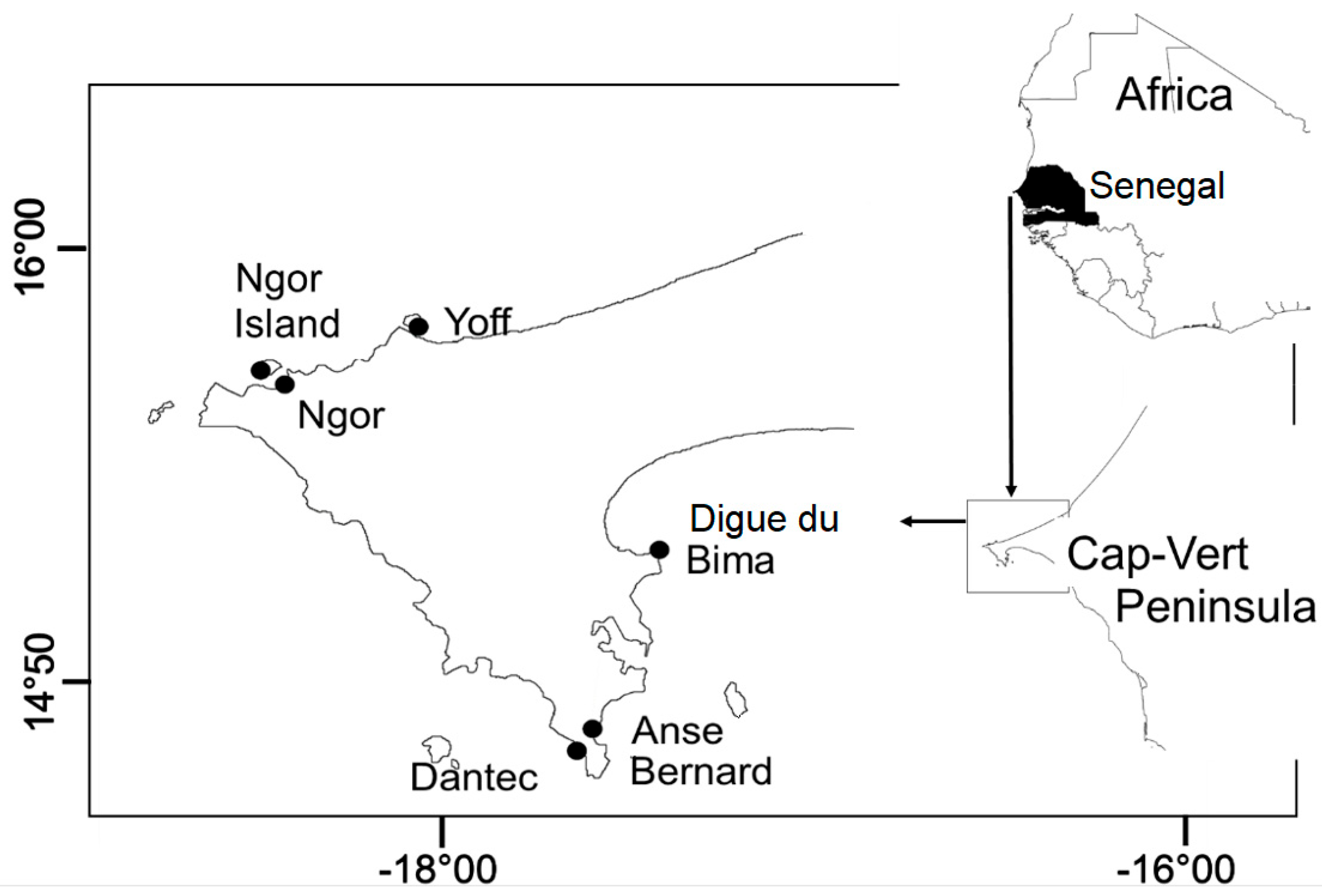
Sampling was conducted at six sites: Yoff, Ngor Island, Ngor, Bima Digue, Anse Bernard, and Dantec (Figure 1). These locations were selected to represent a gradient of environmental conditions: Bima Digue (Bay of Hann) is strongly affected by marine pollution and pollutant accumulation due to restricted current circulation [37]. Yoff, while relatively less impacted, is under growing pressure from coastal sand extraction and domestic waste associated with Dakar’s urban sprawl [38,39]. Anse Bernard is a socially important recreational beach threatened by demographic pressure and erosion. It is ecologically significant for coastal biodiversity [40]. Dantec suffers from medical waste pollution and erosion, but is near the Madeleine Islands National Park, an important marine biodiversity hotspot [37]. This environmental heterogeneity allowed for robust comparison of macroalgal-epifaunal associations across varying levels of exposure, pollution, and substrate types.
2.
Data collection
The sampling design aimed to assess how epifaunal assemblages vary according to macroalgal identity, morphology, and site conditions. Macroalgal species were selected based on in situ availability and their relevance across major taxonomic groups (Chlorophyceae, Rhodophyceae, and Phaeophyceae), as well as structural diversity. The taxa sampled included Ulva sp., Codium sp., Corallina officinalis, Meristotheca senegalensis, Sargassum spp., and two additional morphotypes of Chlorophyceae (a green alga named AV and a mixture of Chlorophyceae and Rhodophyceae). This morphological diversity has been demonstrated to influence epifaunal colonisation and habitat value [5,12].
Two distinct collection methods were used. The first method involved collecting samples during the 2022 campaign in the intertidal zone at low tide, where stranded holopelagic macroalgae (Sargassum spp.) and Ulva spp. were collected opportunistically using a 200-micron sieve. The second method, used during the 2023 campaign, involved applying a structured protocol focused on benthic species. Divers were used as the sampling method at an average depth of 3.2 m. In this second method, the entire thallus of the macroalgae was covered with a waterproof sheet before being completely removed by the diver to avoid a considerable loss of epifaunal species. This hybrid approach made it possible to capture both permanent and transient macroalgal habitats, which were relevant for the analysis of epifauna.
During sampling, large masses of macro-algae were collected at each site. At Anse Bernard, the species Codium sp. and an unidentified green alga were collected with masses of 271 g and 149 g, respectively. At Dantec, only the species Meristotheca senegalensis was collected, weighing 21 g. In Digue du Bima (Hann of Bay), the species Codium sp. was collected with a mass of 107 g. At the Yoff site, the species Meristotheca senegalensis, Corallina officinalis, Ulva sp., and a combination of red and green algae were collected with respective masses of 119 g, 104 g, 14 g, and 67 g. All the macro-algae were collected opportunistically.
The macroalgae thalli were manually harvested at low tide, rinsed with distilled water in a basin on board the vessel, and then stored in plastic bags placed in coolers maintained at approximately 5 °C. The water used for rinsing the macroalgae was transferred into 400 mL jars, and 5% formalin (Valdafrique Laboratoire Canonne SA, Dakar, Senegal) was added to ensure its preservation. In the laboratory, the macroalgae were weighed and identified at the family or species level. The epifauna were sorted and identified using a stereomicroscope in accordance with regional identification keys, and subsampled using a Motoda separator when necessary. A pre-calibrated multiparameter probe (Hanna 9829, Hanna Instruments, Săcueni, Romania) was utilized to assess the water temperature, salinity, pH, and dissolved oxygen levels at the surface of each site. It is worth noting that pH and dissolved oxygen levels are not considered in the present study. The representation is limited to temperature and salinity.

2.1. Sample Processing

The macroalgae were weighed using a precision balance (±1 g) and identified to the family or species level in the laboratory. The separation of the epifauna from the formalin solution was conducted under a ventilated hood. The samples were then rinsed with distilled water and weighed with a precision to the thousandth of a gram. The epifaunal specimens were identified under a stereomicroscope equipped with a digital camera (Bresser, MikroCam SP 5.0, Bresser GmbH, Rhede, Germany). Taxonomic keys were used to identify specimens [41,42,43], and the Tara Ocean Foundation provided species identification guides for zooplankton for the West African zone. The subjects were identified according to the order, genus, or species level. A complete count of the associated epifaunal species was conducted for each macroalgae species. When the numbers were too high, a Motoda box [44] was used to create aliquot partitions (i.e., 1/2, 1/4, 1/8) according to the formula 1/2n (n: number of partitions). The sample was meticulously introduced into the Motoda box, followed by rigorous agitation to ensure a uniform and equitable distribution of volume. Consequently, a specific portion of the volume was transferred into a numbered 50 mL tube, thereby constituting the aliquot portion of the initial partition. The operation was repeated up to 1/4096, corresponding to the last partition. The number of individuals found after counting the previous partition was multiplied by 4096 to obtain the total number of individuals in the initial sample [45].
The analysis of the size spectra of the epifauna individuals was carried out using four types of sieves (mesh sizes: 2000, 1000, 500, and 200 µm). The epifaunal samples were classified into two categories, each with two classes: the meiofauna category, which included samples measuring less than 1000 µm (200–500 and 500–1000) [46], and the macrofauna category, which included samples measuring at least 1000 µm (1000–2000 and >2000) [47]. For the 2022 samples, two classes were considered: [200–500] and [>500].

2.2. Calculation of Epifauna Density

The density of individuals was calculated for each species of macroalgae collected [48]. The density was calculated only for the macroalgae collected in 2023. This density is given by the number of individuals found on the algae relative to the mass of the collected macroalgae:
D = N/M
N: number of individuals of the epifauna present on the surface of the macroalgae. M: mass of the collected macroalgae; D = density of individuals of the epifauna.
3.
Data analysis
We conducted univariate statistical analyses to explore differences in epifaunal community characteristics across macroalgal species, sites, and other categorical factors. Species density (individuals per gram of algal biomass), Shannon diversity index (H′), and Pielou’s evenness index (J′) were calculated for each sample.
H = i = 0 S   p i     log 2     p i
H’: Shannon diversity index. S: total number or cardinality of the species list. Pi: percentage of the abundance of a present species (ni/N). ni: number of individuals counted for a present species. N: total number of individuals counted, all species combined.
To compare means between two groups, we used Student’s t-test; for comparisons involving more than two groups, one-way ANOVA was initially tested but replaced by non-parametric equivalents where assumptions of normality or homogeneity of variance were violated (Shapiro–Wilk test). Categorical comparisons were assessed using Fisher’s exact test, supplemented by Monte Carlo simulations (10,000 permutations) to ensure robustness with small or uneven sample sizes [49]. Doing so we tested the relationship between (i) relative abundance and the mass of the epifauna, (ii) relative abundance and the mass of the algae, (iii) relative abundance and the size of the individuals of the epifauna, (iv) their mass and the mass of the associated algae, and (v) absolute abundance (number of individuals of a species) of the epifauna and the species of macroalgae.
These methods were chosen to focus on specific hypothesis-driven comparisons involving discrete ecological indicators. Given the modest sample sizes and the targeted scope of our analyses, univariate tests with permutation support provided interpretable and statistically sound results. Multivariate analyses were not employed, as our objective was not to model the entire community structure but to test explicit relationships between macroalgal traits and epifaunal descriptors. All statistical analyses were performed in R (version 4.3.2), using the “tidyverse” for data handling [50] and vegan for diversity indices [51]. The QGIS software (version 3.30) was used for creating the map.

3. Results

The results are presented separately for the two sampling campaigns, as the protocols and ecological contexts differed fundamentally. Section 3.1 reports the structured in situ sampling conducted in 2023, which provides the basis for all statistical analyses and diversity indices. Section 3.2 reports descriptive observations from the 2022 opportunistic collections of stranded Sargassum sp. and Ulva sp. These latter data are not directly comparable with the 2023 dataset but are included for contextual insight. Student’s t-test (Table S1) showed no statistically significant difference between algae types and epifauna species (p = 0.64). The temperature and salinity of the surface water measured show homogeneity across the four stations (Table S2), with an average salinity of 24.5 ± 0.9 and an average surface water temperature of 28.9 °C ± 0.2.

3.1. Relative Abundance of Epifauna Associated with Macroalgae

3.1.1. In Situ Epifaunal Communities

The relative abundance of the epifaunal composition of the macroalgal size spectra shows almost total dominance of the [200–500 µm] spectrum, with respective rates of 47% for M. senegalensis, 86% for Ulva spp., 41% for Mixte, 52% for Codium sp. and 63% for Chlorophyceae. Only the macroalgal species Corallina officinalis predominates in relative abundance in the size spectrum [500–1000 µm] with a rate of 95% (Figure S2).
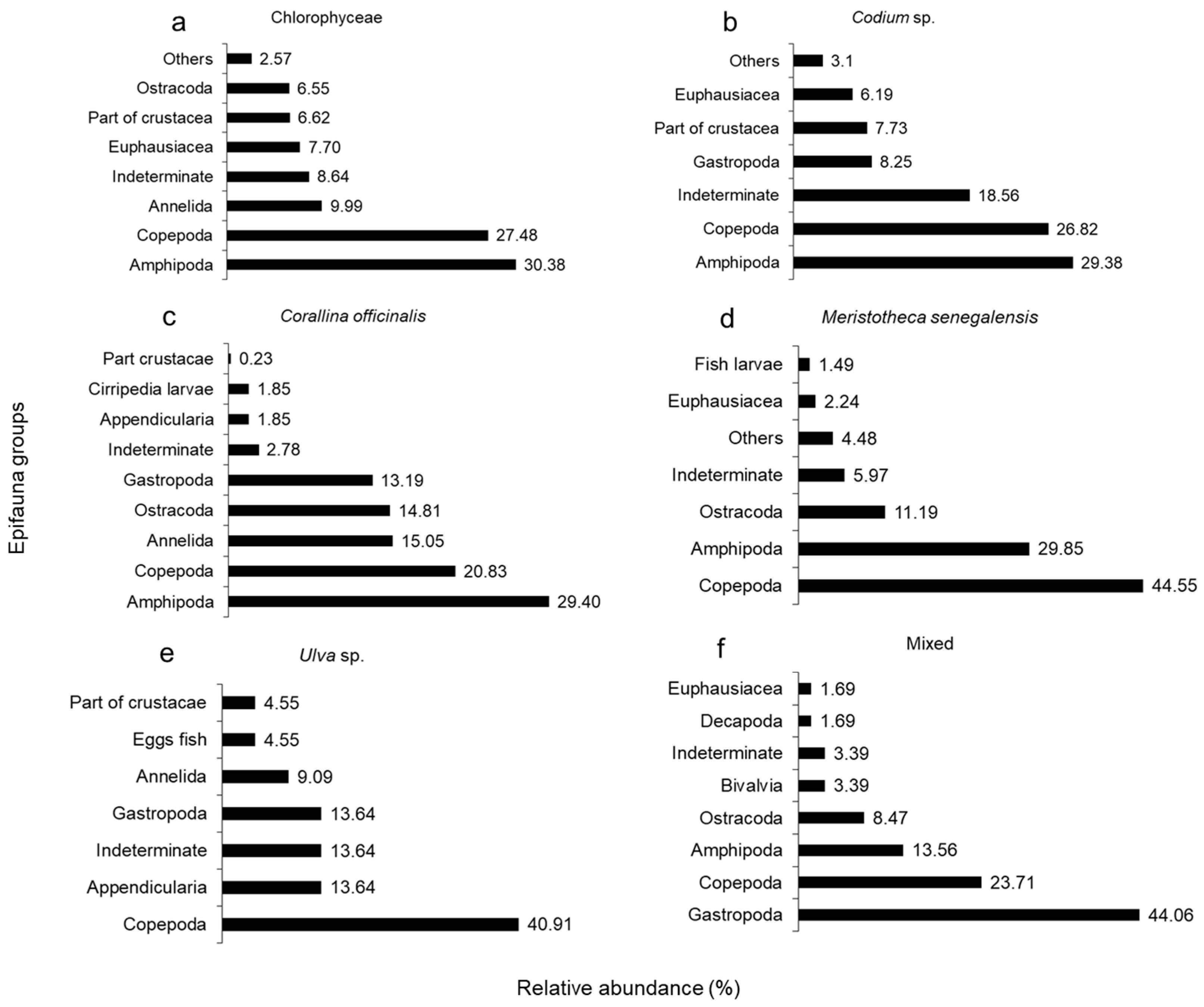
The identification of epifauna suggests a predominance of amphipods on the majority of the macroalgae examined in 2023. The study’s results demonstrated remarkable consistency in the rates of C. officinalis, Codium sp., and the Chlorophyceae, which were found to be 29.40%, 29.38%, and 30.38%, respectively. For Ulva sp. and M. senegalensis, the copepod class dominates 40.91% and 44.55%, respectively. For the macroalgae referred to as ‘Mixed,’ the class of Gastropoda (44.06%) was predominant. A considerable proportion (min.: 2.78%; max.: 18.56%) of unidentified individuals was observed across all macroalgae species. Eleven subgroups of epifauna were identified at lower rates, including Annelida, Ostracoda, Gastropoda, Copepoda, Cirripedia, Ctenophora, Cumacea, Decapoda, fish larvae, Bivalvia, and Euphausiacea (Figure 2).

3.1.2. Opportunistic Observations on Stranded Macroalgae

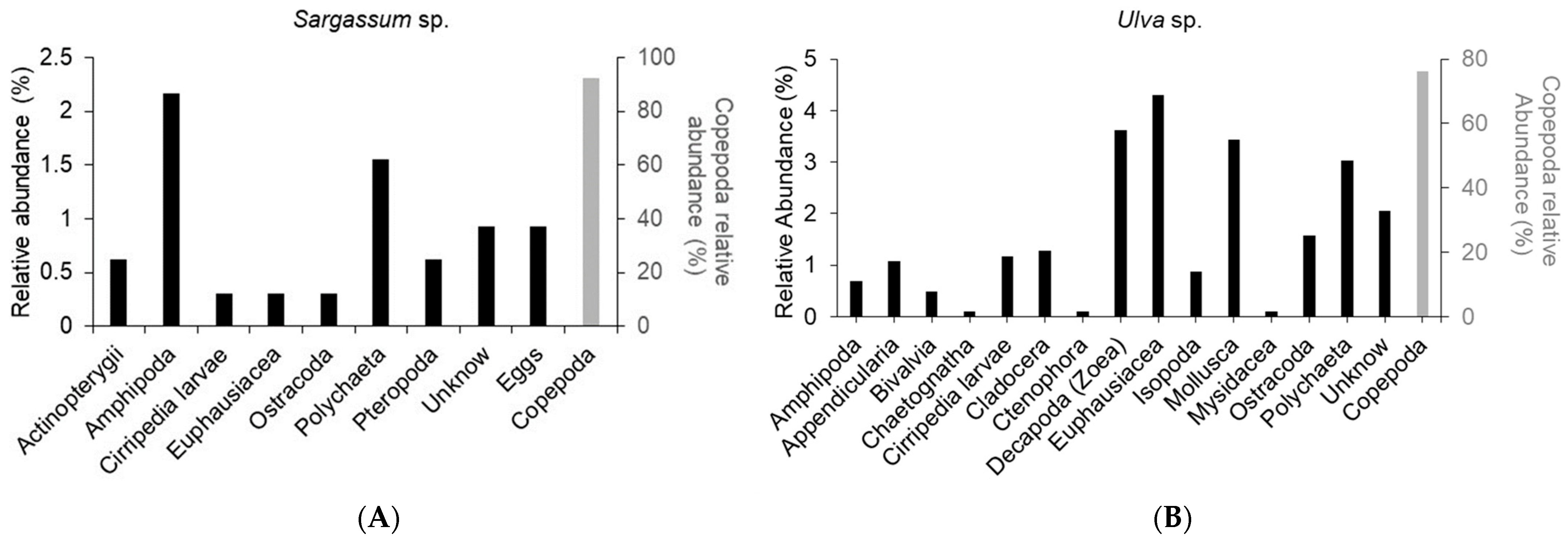
The identification of the composition of the epifauna collected on Sargassum spp. and on Ulva spp. in 2022 shows dominance of Copepods at 92 and 76%, respectively (Figure 3). The presence of Amphipoda, Cirripedia larvae, Euphausiacea, Ostracoda, Polychaeta, Pteropoda, Eggs, and Actinopterygii (the group of fish larvae) was noted but at a very low rate (min.: 0.3% and max.: 2.2%). The relative abundance on the size spectra of the epifaunal composition shows a dominance of species with sizes between [200–500 µm] at 90% and 83% respectively on Sargassum spp. and Ulva spp. Unlike the size spectra [500–1000 µm] where relative abundance is very low 10% on Sargassum spp. and 17% on Ulva spp. (Figure S1).

3.2. Density and Abundance of Epifauna Associated with Macroalgae

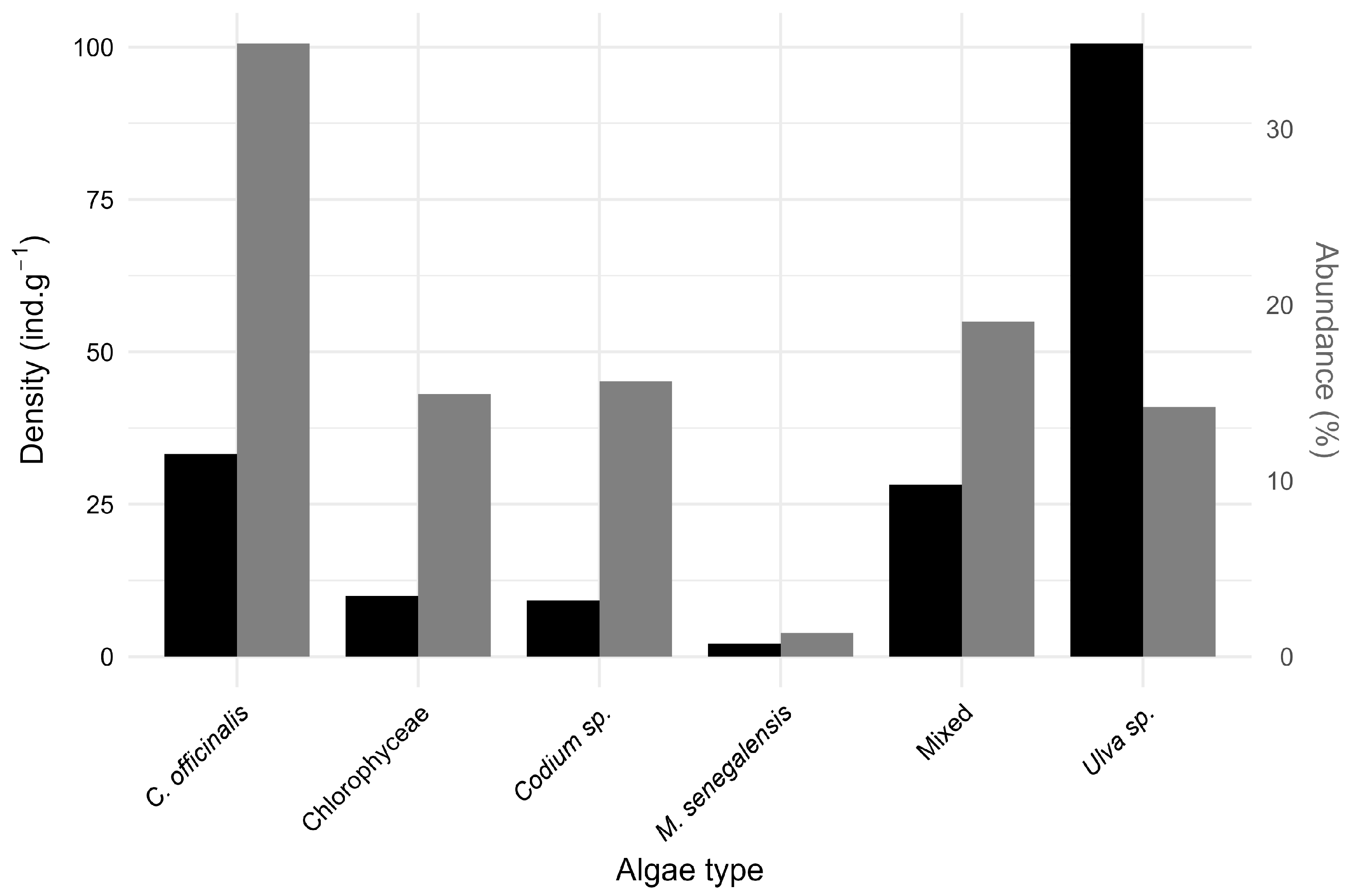
The density (ind. g−1) of epifauna individuals associated with macroalgae showed a high density on Ulva sp. of 100.6 (ind. g−1), on C. officinalis of 33.2 (ind. g−1), and on ‘Mixed’ of 28.2 (ind. g−1) (Figure 4). The algal species Codium sp., M. senegalensis, and the Chlorophyceae algae had significantly lower epifaunal densities of 9.2, 2.1, and 9.9 (ind. g−1), respectively. The highest abundance was noted on C. officinalis (35%), followed by ‘Mixed’ (19%), then Codium sp. (16%), Chlorophyceae (15%), Ulva sp. (14%), and finally M. senegalensis (1.4%), where the abundance was particularly low.

3.3. Epifauna-Macroalgae Relationship

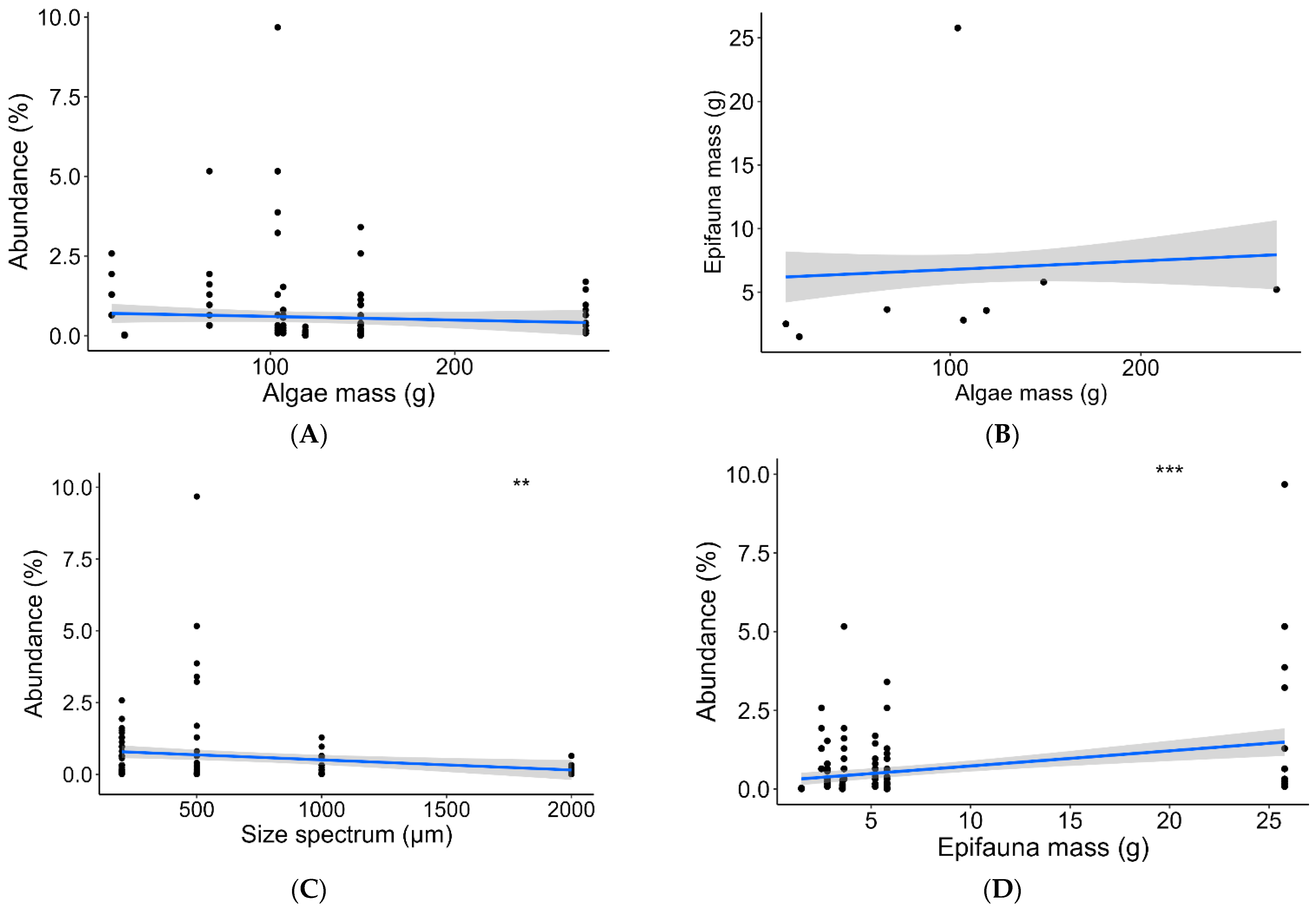
No significant relationship (p-value: 0.40) was observed between the mass of the epifauna and that of the associated algae or between the relative abundance of the epifauna and the mass of the associated algae (p-value: 0.35) (Figure 5). In contrast, a significant relationship was observed between the absolute abundance of the epifauna and its mass (p-value: 1.7 × 10⁻⁵) and between the absolute abundance of the epifauna and their size (p-value: 0.0056). A significant relationship was observed (p-value overall: 4.98 × 10⁻⁶) between the absolute abundance of the epifauna and that of the associated macroalgae (Table S3).

3.4. Spatial and Phycological Diversity of Epifauna

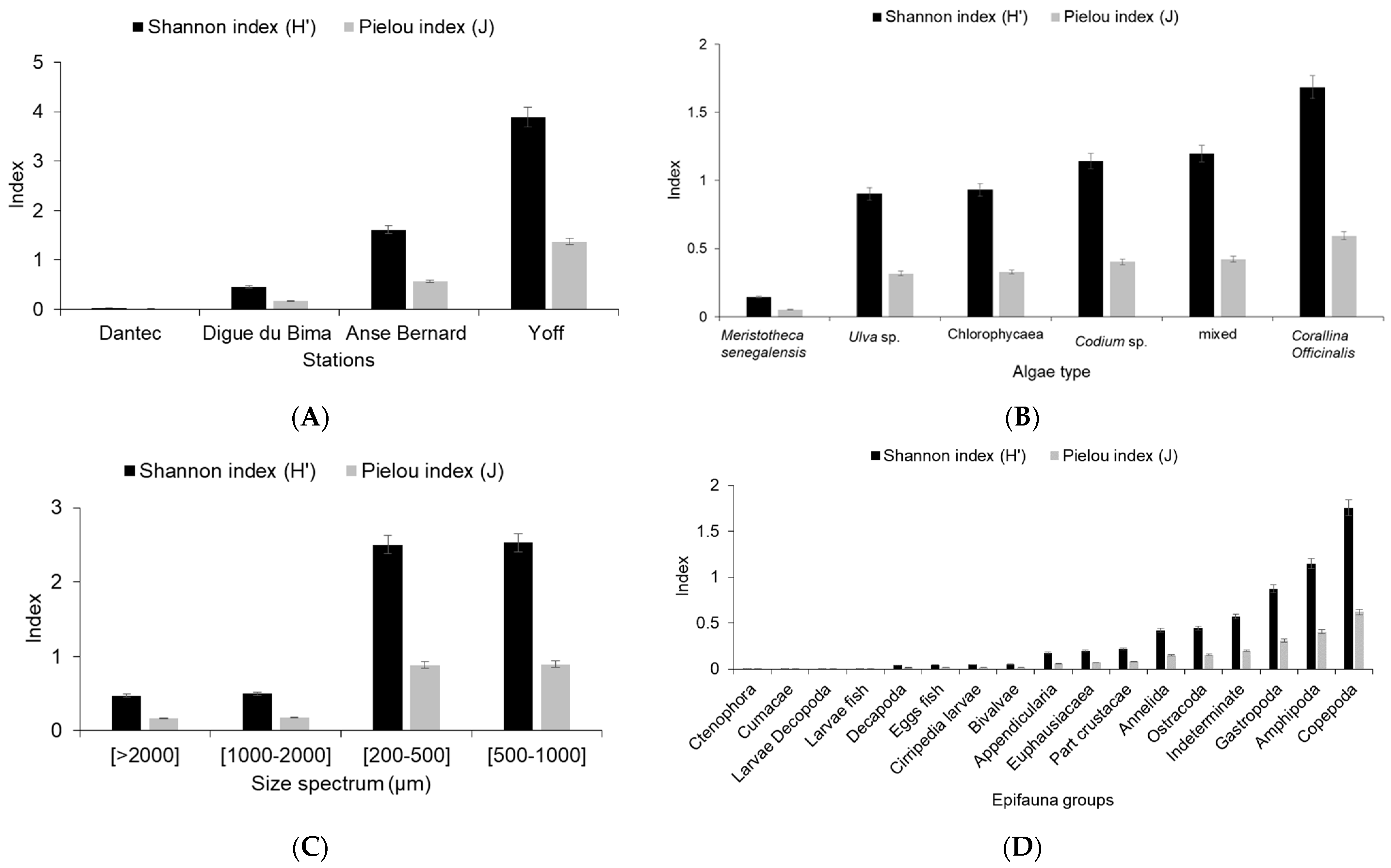
The Shannon and Pielou indices for epifauna groups showed greater diversity at Yoff (Shannon 3.8; Pielou 1.37) and Anse Bernard (Shannon 1.6; Pielou 0.6). They were lower at Dantec (Shannon 0.03; Pielou 0.01) and at Digue du Bima (Shannon 0.4; Pielou 0.16) (Figure 6A).
The diversity of epifauna on algae is higher on C. officinalis (Shannon 1.6; Pielou 0.6) than on other macroalgae, for example, Mixed (Shannon 1.2; Pielou 0.4), Codium sp. (Shannon 1.14; Pielou 0.4), Chlorophycaea (Shannon 0.93; Pielou 0.33), Ulva sp. (Shannon 0.9; Pielou 0.31) and M. senegalensis (Shannon 0.14; Pielou 0.05) (Figure 6B).
The strongest diversity was observed in the size range [500–1000] (Shannon 2.52; Pielou 0.89), followed by the range [200–500] (Shannon 2.5; Pielou 0.88), then by the ranges [1000–2000] and [>2000] with a diversity equal to 0.4 for the Shannon index and 0.16 for the Pielou index (Figure 6C).
The diversity indices studied on epifaunal groups showed greater diversity among Copepoda (Shannon 1.7; Pielou 0.62), Amphipoda (Shannon 1.15; Pielou 0.41), Gastropoda (Shannon 0.87; Pielou 0.31), the undetermined group (Shannon 0.56; Pielou 0.21), Ostracoda (Shannon 0.44; Pielou 0.15), Annelida (Shannon 0.42; Pielou 0.15), Part crustacae (Shannon 0.22; Pielou 0.07), Euphausiacaea and Appendicularia with a Shannon index of 0.19 and a Pielou index of 0.06. The other epifauna groups are poorly represented (Figure 6D).

4. Discussion

To reflect the methodological differences between the two campaigns, the discussion is organized into two parts. Section 4.1 interprets the structured 2023 dataset, which forms the analytical core of the study. Section 4.2 presents the opportunistic 2022 observations descriptively, highlighting their indicative value while also acknowledging their limitations. Section 4.3 addresses broader methodological considerations and outlines priorities for future research.
It is essential to note that the analytical results of this study are derived exclusively from the structured in situ sampling conducted in 2023. The 2022 stranded algae dataset is presented solely for descriptive and exploratory purposes, and should not be interpreted as directly comparable. Future research should build on the 2023 framework with consistent protocols and higher-resolution taxonomic identification. Although this study provides interesting preliminary data on the subject, its limitations, particularly in terms of sampling protocols and taxonomic resolution, necessitate validation. Future research should implement a sampling protocol tailored to the benthos, accompanied by a well-documented replication plan for all species. In addition, collaboration with expert taxonomists is essential to achieve a consistent level of identification to species level, which is the cornerstone of any solid analysis of the diversity and structuring of benthic communities. Future research integrating these conclusions could enable a more detailed analysis of the epifauna and macroalgae community associations on the Cap-Vert peninsula. Nevertheless, interesting results have already appeared for our poorly studied data area.

4.1. Epifaunal Composition of the Macroalgae

Our results show a high abundance of Amphipods on the macroalgae species collected in July 2023. This significant dominance of Amphipods over macroalgae species is explained by their abundance during the warm season, driven by reproductive activity and daily migration to escape predation. These observations are consistent with those of [52], who also noted a significant increase in the genus Gammarus spp. at 20 °C for neonatal Amphipods. Similarly, the results of [53] show a high abundance of amphipods associated with the species Durvillaea antarctica on the coasts of New Zealand. However, they differ from the results obtained in the Pacific described by [54]. The use of the plankton net type may have underestimated the presence of some small-sized species. Moreover, the nature of the rock structure varied between different areas. These results suggest the importance of faunistic monitoring of macroalgae communities in the inventory processes of Marine Protected Areas [55,56] and the census of macroalgal biodiversity of the West African zone. As is the case in the Great Australian Bight (GAB), species composition models are used to assess the effectiveness of the GAB Marine Park’s benthic protection zone (BPZ) in representing regional biodiversity [57]. In other words, epifaunal species could be an important indicator for assessing environmental impact [58].
A study of the epifaunal species present on macroalgae (Sargassum spp. and Ulva spp.) harvested between May and July of 2022 revealed that copepods were the most abundant. This pronounced predominance of copepods over Sargassum spp. and Ulva spp. can be attributed to their substantial presence in oceanic environments, accounting for over 80% of zooplankton. A similar finding was reported by [59], who estimated copepod biomass in the Northwest African upwelling system using a bi-frequency acoustic approach [58] in their study on copepods from the Cap-Vert peninsula. Their research indicated that the diverse species of copepods within the Senegalese continental shelf are predominantly dominant, a phenomenon attributable to their substantial population sizes. Furthermore, the holopelagic character of Sargassum spp. may contribute to their increased abundance. Furthermore, our findings diverge from those reported by [60], which documented a substantial population of amphipods along the western Atlantic coast during the period of the massive stranding of Sargassum spp. However, the study’s findings are limited by the small number of Sargassum spp. observed. These results suggest that holopelagic macroalgae are colonized by local wildlife. It is imperative to conduct regular monitoring to substantiate these trends.

4.2. Epifauna Diversity of Macroalgae

The Shannon and Pielou indices observed for copepods, amphipods, gastropods, and unidentified species indicate a more diverse community, possibly linked to the adaptability of these epifauna subgroups in relation to the study area. These results are consistent with those of [59], which show amphipod diversity on the species S. muticum. However, our study remains limited by the small number of sampling campaigns. Seasonal monitoring would be necessary to confirm these trends. In addition, a high diversity of amphipods is observed at night, whereas it is low during the day, as revealed by [58] in Pacific waters. This shows that the sampling period can influence the diversity of epifaunal species. Similarly, copepods increase in abundance and richness in coarse-grained sediments and hard substrates (e.g., large macroalgae) [60]. This could explain their high diversity in macroalgae groups during this study. Another factor is that the nature of the substrate could influence the diversity of epifauna species present on macroalgae. These results also suggest that diel variations and the nature of the substrate should be considered when sampling epifauna species in macroalgal ecosystems.
The diversity of epifaunal species associated with macroalgae such as C. officinalis and Codium sp. can be attributed to their structural complexity and high biomass, particularly during the warm season on the Senegalese coast. This structural nature provides a favourable habitat for various invertebrates, thereby enhancing biodiversity. C. officinalis and Codium sp. have complex morphologies that support diverse invertebrate communities, as shown by studies highlighting the relationship between algal morphology and epi-faunal diversity [60,61]. The high biomass of these species during the warmer months correlates with an increase in invertebrate density, as demonstrated by seasonal studies showing high invertebrate populations in C. officinalis [62]. In addition, research indicates that C. frageli also favours high epifaunal diversity throughout the year, reinforcing the idea that certain macroalgae are more conducive to biodiversity [60]. Conversely, studies have shown that Corallina sp. can also harbour significant epifaunal diversity, suggesting variability in species interactions and habitat preferences [63]. Although the results highlight the importance of certain macroalgae in maintaining diverse epifaunal communities, it is essential to consider that other species, such as Corallina sp., may also play a significant role in maintaining biodiversity. This indicates a complex interaction between different macroalgal species. Further research is needed to clarify these relationships and the factors that influence them.

4.3. Epifaunal Community Associated with Macroalgae

A significant relationship is observed between the absolute abundance of epifaunal communities and macroalgae species. This phenomenon can be attributed to the color of the macroalgae species present. Furthermore, the structural characteristics of the macroalgae thallus may significantly influence the colonization process by epifaunal species. The present findings are consistent with the work of [60], which demonstrated that epifaunal species, particularly amphipods, exhibit a preference for Phaeophyceae. Furthermore, the chromatic properties of macroalgae have been shown to influence the dynamics of their relationship with epifaunal species significantly. However, the findings of this study are constrained by the paucity of data concerning the structural intricacies of the thallus of macroalgae. These results highlight the importance of examining the relationship between macroalgae species and the epifaunal community. Future studies could be conducted to further develop this methodological approach, thereby facilitating a more comprehensive understanding of the macroalgae ecosystem. It could also be relevant to consider potential variability in community composition according to the type of substrate (whether natural (e.g., rocky bottoms) or anthropogenic (e.g., artificial reefs [61], mussel longlines [62]) as these differences may influence the structure of epifaunal assemblages.

4.4. Density and Relative Abundance in Association with Macroalgae

Epifaunal densities varied considerably according to algal species: Ulva sp. provided the highest density (100.6 ind. g−1), while Codium sp. and M. senegalensis presented much lower densities (≈9.2 and 2.1 ind. g−1, respectively). This variation can likely be attributed to a combination of thallal morphology (available surface area per unit weight) and the ecological properties of the algae. Filamentous Ulva thallus offers more micro-niches and retains more food particles, while compact Corallina sp. tufts create refuges for amphipods and other benthic organisms. These mechanisms are consistent with the literature showing that the identity and structural complexity of macroalgae govern the composition and abundance of the epifauna, although other factors (tissue chemistry, predation, seasonality and sampling methods) also contribute to the phenomena observed [60,64,65].

5. Conclusions

The primary objective of our study was to investigate the potential relationship between epifaunal species and macroalgal species. Our results have shown a dependency relationship between the species of epifauna and macroalgae. Macroalgae serve as a refuge for escaping predation, providing food and facilitating the development of particular species of epifauna. These results suggest that Amphipod species have the highest abundance. This further confirms that the macroalgae species Codium sp. and the C. officinalis group harbour the most remarkable diversity of epifaunal species on the Cap-Vert peninsula. These results provide new insights into the macroalgae ecosystem of the Cap Vert peninsula, contributing to the inventory and estimation of biodiversity processes. However, some limitations should be taken into account, including the limited sampling of macroalgae species, the period of sampling, and the need for regular monitoring of macroalgae ecosystems to refine these conclusions. Further in situ studies should be encouraged to better understand the associations of epifaunal species with macroalgae. The nature of the substrate, the thallus structure, the color and the physico-chemical composition of macroalgae are likely to play a role in the epifaunal composition associated with them. Macroalgae serve as habitats, places of refuge, and food sources for many marine organisms, including fish, cephalopod eggs, and larvae, thereby promoting their survival and growth. Mass strandings of algae, such as Sargassum spp. and Ulva spp., can reduce the availability of these habitats and cause mortality in larvae and eggs, leading to a local reduction in recruitment and alteration of marine community structure.

Supplementary Materials

The following supporting information can be downloaded at: https://www.mdpi.com/article/10.3390/d18030133/s1, Figure S1: Relative abundance of the epifaunal composition of the size spectra of (a) Sargassum sp. and (b) Ulva sp. from the Cap-Vert peninsula. Samples were collected on Ngor Beach and Ngor Island in 2022. (c) Total relative abundance (in %) of the associated epifauna of both species (Ulva spp. and Sargassum spp.); Figure S2: Relative abundance of the epifaunal composition of the size spectra of (a) Meristhoteca senegalensis, (b) Corallina officinalis, (c) Ulva sp., (d) Mixed, (e) Codium sp., and (f) Chlorophyceae from the Cap-Vert peninsula (Dakar, Sénégal). Samples were collected in situ in 2023; Table S1: Significance of the relationship between the different biological parameters of the epifauna and the macroalgae. * significant at <0.05; Table S2: Hydrological parameters (surface water temperature and salinity) were collected at the four study sites; Table S3: Significant relationship between the absolute abundance of the epifaunal composition and their associated macroalgae; p-value: 4.98 × 10⁻⁶ *. Mixed: a blend of two macroalgae, one Chlorophyceae and one Rhodophyceae.

Author Contributions

Drafting manuscript: I.N. (Ibrahima Ndiaye) Conception/Design: I.N. (Ibrahima Ndiaye) and P.B. Collection of Data: I.N. (Ibrahima Ndiaye), P.B., W.N.N. Data analysis/interpretation: I.N. (Ibrahima Ndiaye) and P.B., I.N. (Ismaïla Ndour) Intellectual contribution on text/revisions: I.N. (Ibrahima Ndiaye), M.S.D., P.B., Y.D., I.N. (Ismaïla Ndour) and W.N.N. Fund acquisition: P.B. and W.N.N. Coordination: P.B. All authors have read and agreed to the published version of the manuscript.

Funding

Author I.N., P.B., W.N., M.S.D. have received research support from GIZ (Germany) within the Meerwissen initiative, project ClimAlg-SN. Authors I.N., P.B., W.N., have received research support from IRD (France). Author I.N. (Ismaïla Ndour), W.N., have received research support from ISRA (Sénégal). M.S.D. have received funding from DAD and GEOMAR (Germany). Authors I.N., Y.D., have received research support from UCAD (Sénégal).

Institutional Review Board Statement

Not applicable.

Data Availability Statement

Metadata are confidential for this study.

Acknowledgments

We thank Fulgence Diedhiou (ISRA/CRODT), Hanane Aroui (IRD, EAR Imago), Ndeye Coumba Bousso (UCAD/ISRA/IRD), Florian Weinberger (Geomar, Kiel), and Miguette Allegre (IRD, EAR Imago) for their assistance during the field mission at sea. We thank Birgit Quack (GEOMAR, Kiel) for coordinating the ClimAlg-SN project. We also appreciated the support of the “Art Sunu Gueej” facilities at the ISRA-IRD Campus in Bel Air (Hann, Senegal).

Conflicts of Interest

The authors declare no conflicts of interest.

References

  1. Robinson, N.; Winberg, P.; Kirkendale, L. Genetic Improvement of Macroalgae: Status to Date and Needs for the Future. J. Appl. Phycol. 2013, 25, 703–716. [Google Scholar] [CrossRef]
  2. Costanza, R.; d’Arge, R.; de Groot, R.; Farber, S.; Grasso, M.; Hannon, B.; Limburg, K.; Naeem, S.; O’Neill, R.V.; Paruelo, J.; et al. The Value of the World’s Ecosystem Services and Natural Capital. Nature 1997, 387, 253–260. [Google Scholar] [CrossRef]
  3. Rönnbäck, P.; Kautsky, N.; Pihl, L.; Troell, M.; Söderqvist, T.; Wennhage, H. Ecosystem Goods and Services from Swedish Coastal Habitats: Identification, Valuation, and Implications of Ecosystem Shifts. AMBIO J. Hum. Environ. 2007, 36, 534–544. [Google Scholar] [CrossRef]
  4. Thajuddin, N.; Dhanasekaran, D. (Eds.) Algae: Organisms for Imminent Biotechnology; InTech Open: Rijeka, Croatia, 2016. [Google Scholar]
  5. Bates, C.R.; DeWreede, R.E. Do Changes in Seaweed Biodiversity Influence Associated Invertebrate Epifauna? J. Exp. Mar. Biol. Ecol. 2007, 344, 206–214. [Google Scholar] [CrossRef]
  6. Gallardo, D.; Oliva, F.; Ballesteros, M. Marine Invertebrate Epibionts on Photophilic Seaweeds: Importance of Algal Architecture. Mar. Biodivers. 2021, 51, 16. [Google Scholar] [CrossRef]
  7. Jormalainen, V.; Honkanen, T.; Heikkilä, N. Feeding Preferences and Performance of a Marine Isopod on Seaweed Hosts: Cost of Habitat Specialization. Mar. Ecol. Prog. Ser. 2001, 220, 219–230. [Google Scholar] [CrossRef]
  8. Macneil, C.; Dick, J.T.; Elwood, R.W. The Dynamics of Predation on Gammarus spp. (Crustacea: Amphipoda). Biol. Rev. 1999, 74, 375–395. [Google Scholar] [CrossRef]
  9. Norderhaug, K.M.; Christie, H.; Fosså, J.H.; Fredriksen, S. Fish-Macrofauna Interactions in a Kelp (Laminaria Hyperborea) Forest. J. Mar. Biol. Assoc. U. K. 2005, 85, 1279. [Google Scholar] [CrossRef]
  10. Duarte, R.C.d.S.; Mota, E.L.S.; Dias, T.L.P. Algal Complexity Positively Affects the Abundance, Richness and Diversity of Molluscan Assemblages of a Semiarid Hypersaline Mangrove. Aquat. Ecol. 2020, 54, 1001–1013. [Google Scholar] [CrossRef]
  11. Fraser, K.M.; Stuart-Smith, R.D.; Ling, S.D.; Heather, F.J.; Edgar, G.J. Taxonomic Composition of Mobile Epifaunal Invertebrate Assemblages on Diverse Benthic Microhabitats from Temperate to Tropical Reefs. Mar. Ecol. Prog. Ser. 2020, 640, 31–43. [Google Scholar] [CrossRef]
  12. Christie, H.; Norderhaug, K.M.; Fredriksen, S. Macrophytes as Habitat for Fauna. Mar. Ecol. Prog. Ser. 2009, 396, 221–233. [Google Scholar] [CrossRef]
  13. Lippert, H.; Iken, K.; Rachor, E.; Wiencke, C. Macrofauna Associated with Macroalgae in the Kongsfjord (Spitsbergen). Polar Biol. 2001, 24, 512–522. [Google Scholar] [CrossRef]
  14. Parker, J.D.; Duffy, J.E.; Orth, R.J. Radiocarbon Distributions in Southern Ocean Dissolved and Particulate Organic Matter. Mar. Ecol. Prog. Ser. 2001, 224, 55. [Google Scholar] [CrossRef]
  15. Wiklund, A.-K.E.; Malm, T.; Honkakangas, J.; Eklund, B. Spring Development of Hydrolittoral Rock Shore Communities on Wave-Exposed and Sheltered Sites in the Northern Baltic Proper. Oceanologia 2012, 54, 75–107. [Google Scholar] [CrossRef]
  16. Norderhaug, K.M.; Fredriksen, S.; Nygaard, K. Trophic Importance of Laminaria Hyperborea to Kelp Forest Consumers and the Importance of Bacterial Degradation to Food Quality. Mar. Ecol. Prog. Ser. 2003, 255, 135–144. [Google Scholar] [CrossRef]
  17. Buschmann, A.H. Intertidal Macroalgae as Refuge and Food for Amphipoda in Central Chile. Aquat. Bot. 1990, 36, 237–245. [Google Scholar] [CrossRef]
  18. Brönmark, C. Interactions between Macrophytes, Epiphytes and Herbivores: An Experimental Approach. Oikos 1985, 45, 26–30. [Google Scholar] [CrossRef]
  19. Karez, R.; Engelbert, S.; Sommer, U. Co-Consumption and Protective Coating: Two New Proposed Effects of Epiphytes on Their Macroalgal Hosts in Mesograzer-Epiphyte-Host Interactions. Mar. Ecol. Prog. Ser. 2000, 205, 85–93. [Google Scholar] [CrossRef]
  20. Orav-Kottaa’b, H.; Kottaa, J. Oceanicus, Idotea Baltica, and Palaemon Adspersus. In Proceedings of the Estonian Academy of Sciences, Biology and Ecology; Estonian Academy Publishers: Tallinn, Estonia, 2003; Volume 52, pp. 141–148. [Google Scholar]
  21. Nightingale, B.; Simenstad, C.A. Overwater Structures: Marine Issues; Washington State Transportation Commission, Planning and Capital Program: Olympia, WA, USA, 2001. [Google Scholar]
  22. Wernberg, T.; Thomsen, M.S.; Kotta, J. Complex Plant–Herbivore–Predator Interactions in a Brackish Water Seaweed Habitat. J. Exp. Mar. Biol. Ecol. 2013, 449, 51–56. [Google Scholar] [CrossRef]
  23. Taylor, R.B.; Cole, R.G. Mobile Epifauna on Subtidal Brown Sea-Weeds in Northeastern New Zealand. Mar. Ecol.-Prog. Ser. 1994, 115, 271. [Google Scholar] [CrossRef]
  24. Ballesteros, M.; Silva, A.S.; Villamizar, Ó.F.; Pontes, M.; Oliva, F. Biodiversity of Marine Mollusk Assemblages from Two Contrasted Algal Habitats in the Mediterranean Sea (Tossa de Mar, Costa Brava, NE Spain). Diversity 2025, 17, 9. [Google Scholar] [CrossRef]
  25. Urra, J.; Rueda, J.L.; Mateo Ramírez, Á.; Marina, P.; Tirado, C.; Salas, C.; Gofas, S. Seasonal Variation of Molluscan Assemblages in Different Strata of Photophilous Algae in the Alboran Sea (Western Mediterranean). J. Sea Res. 2013, 83, 83–93. [Google Scholar] [CrossRef]
  26. Rossi, F. Small-Scale Burial of Macroalgal Detritus in Marine Sediments: Effects of Ulva Spp. on the Spatial Distribution of Macrofauna Assemblages. J. Exp. Mar. Biol. Ecol. 2006, 332, 84–95. [Google Scholar] [CrossRef]
  27. Ince, R.; Hyndes, G.A.; Lavery, P.S.; Vanderklift, M.A. Marine Macrophytes Directly Enhance Abundances of Sandy Beach Fauna through Provision of Food and Habitat. Estuar. Coast. Shelf Sci. 2007, 74, 77–86. [Google Scholar] [CrossRef]
  28. Martin, D.; L, D.; Ballesteros, M. Moluscos de Las Concreciones de Algas Calcáreas Del Litoral Catalán (NE España). Lav. Della Soc. Ital. Malacol. 1990, 23, 445–456. [Google Scholar]
  29. Chemello, R.; Milazzo, M. Effect of Algal Architecture on Associated Fauna: Some Evidence from Phytal Molluscs. Mar. Biol. 2002, 140, 981–990. [Google Scholar] [CrossRef]
  30. Milazzo, M.; Chemello, R.; Badalamenti, F.; Riggio, S. Molluscan Assemblages Associated with Photophilic Algae in the Marine Reserve of Ustica Island (Lower Tyrrhenian Sea, Italy). Ital. J. Zool. 2000, 67, 287–295. [Google Scholar] [CrossRef]
  31. Sánchez-Moyano, J. The Molluscan Epifauna of the Alga Halopteris Scoparia in Southern Spain as a Bioindicator of Coastal Environmental Conditions. J. Molluscan Stud. 2000, 66, 431–448. [Google Scholar] [CrossRef]
  32. Pitacco, V.; Orlando-Bonaca, M.; Mavrič, B.; Popovic, A.; Lipej, L. Mollusc Fauna Associated with the Cystoseira Algal Associations in the Gulf of Trieste (Northern Adriatic Sea). Mediterr. Mar. Sci. 2014, 15, 225. [Google Scholar] [CrossRef]
  33. Diankha, O.; Thiaw, M.; Sow, B.A.; Brochier, T.; GAyE, A.T.; Brehmer, P. Round Sardinella (Sardinella Aurita) and Anchovy (Engraulis Encrasicolus) Abundance as Related to Temperature in the Senegalese Waters. Thalassas 2015, 31, 9–17. [Google Scholar]
  34. Sawadogo, M.; Sarr, D. Physical and Mechanical Features of the Quaternary Basanites of the Cap-Vert Peninsula of Dakar (Senegal, West Africa). Geomaterials 2023, 13, 124–138. [Google Scholar] [CrossRef]
  35. Diogoul, N.; Brehmer, P.; Demarcq, H.; El Ayoubi, S.; Thiam, A.; Sarre, A.; Mouget, A.; Perrot, Y. Author Correction: On the Robustness of an Eastern Boundary Upwelling Ecosystem Exposed to Multiple Stressors. Sci. Rep. 2021, 11, 1908. [Google Scholar] [CrossRef]
  36. Sarre, A.; Demarcq, H.; Keenlyside, N.; Krakstad, J.-O.; El Ayoubi, S.; Jeyid, A.M.; Faye, S.; Mbaye, A.; Sidibeh, M.; Brehmer, P. Climate Change Impacts on Small Pelagic Fish Distribution in Northwest Africa: Trends, Shifts, and Risk for Food Security. Sci. Rep. 2024, 14, 12684. [Google Scholar] [CrossRef]
  37. Sonko, A.; Brehmer, P.; Constantin de Magny, G.; Pennec, G.L.; Ba, B.S.; Diankha, O.; Fall, M.; Linossier, I.; Henry, M.; N’Diaye, I.; et al. Pollution Assessment around a Big City in West Africa Reveals High Concentrations of Microplastics and Microbiologic Contamination. Reg. Stud. Mar. Sci. 2023, 59, 102755. [Google Scholar] [CrossRef]
  38. Diaw, T. A peninsula in coastal erosion? Dakar, the Senegalese capital city facing the sea level rise in the context of climate change. Environ. Water Sci. Public Heath Territ. Intell. 2018, 1, 18. [Google Scholar]
  39. Sane, M.; Yamagishi, H. Coastal Erosion in Dakar, Western Senegal. J. Jpn. Soc. Eng. Geol. 2004, 44, 360–366. [Google Scholar] [CrossRef]
  40. Petit, J.; Prudent, G. Changement Climatique et Biodiversité Dans L’outre-mer Européen; uicn; IUCN: Gland, Switzerland, 2010; ISBN 978-2-8317-1322-9. [Google Scholar]
  41. Boltovskoy, D. South Atlantic Zooplankton; Backhuys Pulishers: Leiden, The Netherlands, 1999. [Google Scholar]
  42. Boltovskoy, D. Zooplankton of the South-Western Atlantic. S. Afr. J. Sci. 1979, 75, 541–544. [Google Scholar]
  43. Rose, M. Copépodes pélagiques. In Faune de France; Fédération Française des Sociétés de Sciences Naturelles: Paris, France, 1933; Volume 26, p. 377. [Google Scholar]
  44. Motoda, S. Devices of Simple Plankton Apparatus. Mem. Fac. Fish. Hokkaido Univ. 1959, 7, 73–94. [Google Scholar]
  45. Harris, R.; Wiebe, P.; Lenz, J.; Skjoldal, H.-R.; Huntley, M. ICES Zooplankton Methodology Manual; Elsevier: Amsterdam, The Netherlands, 2000; ISBN 0-08-049533-8. [Google Scholar]
  46. Meiofauna Taxa: A Systematic Account. In Meiobenthology: The Microscopic Motile Fauna of Aquatic Sediments; Giere, O., Ed.; Springer: Berlin/Heidelberg, Germany, 2009; pp. 103–234. ISBN 978-3-540-68661-3. [Google Scholar]
  47. Eleftheriou, A.; Moore, D.C. Macrofauna Techniques. In Methods for the Study of Marine Benthos; John Wiley & Sons, Ltd.: Hoboken, NJ, USA, 2013; pp. 175–251. ISBN 978-1-118-54239-2. [Google Scholar]
  48. Saarinen, A.; Salovius-Laurén, S.; Mattila, J. Epifaunal Community Composition in Five Macroalgal Species—What Are the Consequences If Some Algal Species Are Lost? Estuar. Coast. Shelf Sci. 2018, 207, 402–413. [Google Scholar] [CrossRef]
  49. Dufour, J.-M. Monte Carlo Tests with Nuisance Parameters: A General Approach to Finite-Sample Inference and Nonstandard Asymptotics. J. Econom. 2006, 133, 443–477. [Google Scholar] [CrossRef]
  50. Wickham, H.; Averick, M.; Bryan, J.; Chang, W.; McGowan, L.; François, R.; Grolemund, G.; Hayes, A.; Henry, L.; Hester, J.; et al. Welcome to the Tidyverse. J. Open Source Softw. 2019, 4, 1686. [Google Scholar] [CrossRef]
  51. Vegan: Community Ecology Package; R Fundation: Vienna, Austria, 2012.
  52. Sutcliffe, D.W.; Carrick, T.R.; Willoughby, L.G. Effects of Diet, Body Size, Age and Temperature on Growth Rates in the Amphipod Gammarus Pulex. Freshw. Biol. 1981, 11, 183–214. [Google Scholar] [CrossRef]
  53. Dufour, C.; Probert, P.K.; Savage, C. Macrofaunal Colonisation of Stranded Durvillaea Antarctica on a Southern New Zealand Exposed Sandy Beach. N. Z. J. Mar. Freshw. Res. 2012, 46, 369–383. [Google Scholar] [CrossRef]
  54. Repelin, R. Observations Sur La Distribution Des Phronimidae (Crustacés Amphipodes) Dans Le Pacifique Occidental de 5° N à 20° S. Cah ORSTOM Ser Ocean. 1972, 10, 189–201. [Google Scholar]
  55. Ba, A.; Chaboud, C.; Schmidt, J.; Diouf, M.; Fall, M.; Dème, M.; Brehmer, P. The Potential Impact of Marine Protected Areas on the Senegalese Sardinella Fishery. Ocean Coast. Manag. 2019, 169, 239–246. [Google Scholar] [CrossRef]
  56. Brochier, T.; Brehmer, P.; Mbaye, A.; Diop, M.; Watanuki, N.; Terashima, H.; Kaplan, D.; Auger, P. Successful Artificial Reefs Depend on Getting the Context Right Due to Complex Socio-Bio-Economic Interactions. Sci. Rep. 2021, 11, 16698. [Google Scholar]
  57. Ndour, I.; Ndiaye, I.; Clotilde-Bâ, F.-L.; Diadhiou, H.D. Copepod Communities’ Structure in an Upwelling Tropical Marine Ecosystem in West Africa. Aquac. Aquar. Conserv. Legis. 2019, 12, 1216–1226. [Google Scholar]
  58. Diogoul, N.; Brehmer, P.; Kiko, R.; Perrot, Y.; Lebourges-Dhaussy, A.; Rodrigues, E.; Thiam, A.; Mouget, A.; Ayoubi, S.E.; Sarré, A. Estimating the Copepod Biomass in the North West African Upwelling System Using a Bi-Frequency Acoustic Approach. PLoS ONE 2024, 19, e0308083. [Google Scholar] [CrossRef]
  59. Norton, T.A.; Benson, M.R. Ecological Interactions between the Brown Seaweed Sargassum Muticum and Its Associated Fauna. Mar. Biol. 1983, 75, 169–177. [Google Scholar] [CrossRef]
  60. Hacker, S.D.; Madin, L.P. Why Habitat Architecture and Color Are Important to Shrimps Living in Pelagic Sargassum: Use of Camouflage and Plant-Part Mimicry. Mar. Ecol. Prog. Ser. Oldendorf 1991, 70, 143–155. [Google Scholar] [CrossRef]
  61. Brochier, T.; Auger, P.; Thiam, N.; Sow, M.; Diouf, S.; Sloterdijk, H.; Brehmer, P. Implementation of Artificial Habitats: Inside or Outside the Marine Protected Areas? Insights from a Mathematical Approach. Ecol. Model. 2015, 297, 98–106. [Google Scholar] [CrossRef]
  62. Brehmer, P.; Vercelli, C.; Gerlotto, F.; Sanguinède, F.; Pichot, Y.; Guennégan, Y.; Buestel, D. Multibeam Sonar Detection of Suspended Mussel Culture Grounds in the Open Sea: Direct Observation Methods for Management Purposes. Aquaculture 2006, 252, 234–241. [Google Scholar] [CrossRef]
  63. Gueye, M.F.; Mbaye, M.S.; Samb, A.; Diop, D.; Salam, M.A.A.; Diop, R.D.; Noba, K. La Variation Spatiotemporelle Des Macroalgues Dans La Grande Côte Du Sénégal (Afrique de l’Ouest). Hal Open Sci. 2021; preprint. [Google Scholar]
  64. Drouin, A.; McKindsey, C.W.; Johnson, L.E. Higher Abundance and Diversity in Faunal Assemblages with the Invasion of Codium Fragile Ssp. Fragile in Eelgrass Meadows. Mar. Ecol. Prog. Ser. 2011, 424, 105–117. [Google Scholar] [CrossRef]
  65. Davenport, J.; Butler, A.; Cheshire, A. Epifaunal Composition and Fractal Dimensions of Marine Plants in Relation to Emersion. J. Mar. Biol. Assoc. U. K. 1999, 79, 351–355. [Google Scholar] [CrossRef]
Figure 1. Maps of the six sampled sites along the Cap-Vert Peninsula (Dakar, Senegal, West Africa), North Tropical Atlantic Ocean.
Diversity 18 00133 g001
Figure 2. Relative abundance (in %) of the specific composition of epifauna on macroalgae collected in 2023 at four sites of the Cap-Vert peninsula on (a) an undetermined Chlorophyceae, (b) Codium sp., (c) Corallina officinalis, (d) Meristotheca senegalensis, (e) Ulva sp. and (f) Mixed, i.e., association of Chlorophyceae and Rhodophyceae. Epifaunal organisms were initially identified to the finest possible rank (species, family, or order, depending on the group). For consistency in diversity analyses, all taxa were subsequently aggregated to the order level. The category ‘others’ represents the sum of taxa with an abundance of 1% or less. Others are the Cumacea, fish larvae, Decapoda, and Ctenophora.
Diversity 18 00133 g002
Figure 3. Relative abundance (in %) of the in situ epifaunal composition of two species of macroalgae: (A) Sargassum sp., a holopelagic species, and (B) Ulva sp., benthic, in 2022 at Ngor on the Cap-Vert peninsula (Senegal).
Diversity 18 00133 g003
Figure 4. Density and abundance of epifaunal species according to the associated species or type of macroalgae. In black, the density (ind. g−1) and the abundance (%) in grey. Mixed: association of Chlorophyceae and Rhodophyceae.
Diversity 18 00133 g004
Figure 5. (A) Relative abundance of epifaunal species as a function of the mass of their associated macroalgae; (B) the mass of epifauna as a function of the mass of the macroalgae; (C) relative abundance of epifaunal species as a function of the size spectrum of epifaunal individuals; (D) relative abundance of epifaunal species as a function of the mass of the epifauna. p-value < 0.01: **; p < 0.001: ***. The blue line represents the regression line. The grey shading represents the 95% confidence interval.
Diversity 18 00133 g005
Figure 6. The Shannon and Pielou diversity indices (A) by site, (B) by algae type, (C) by size spectrum, and (D) by epifaunal groups are represented by vertical bars. The Shannon index is represented in black, and the Pielou index is represented in grey. The vertical lines above the bars represent standard deviations. Crustaceans represent a part of a specimen, which may be the head or the thorax.
Diversity 18 00133 g006
Disclaimer/Publisher’s Note: The statements, opinions and data contained in all publications are solely those of the individual author(s) and contributor(s) and not of MDPI and/or the editor(s). MDPI and/or the editor(s) disclaim responsibility for any injury to people or property resulting from any ideas, methods, instructions or products referred to in the content.