

Global Evolution and Methodological Trends in River and Lake Health Research (1991–2024): A Bibliometric and Systematic Review

Abstract
1. Introduction
2. Data Sources and Research Methods
2.1. Data Sources
2.2. Data Cleaning
2.3. Data Integrity Analysis
3. Descriptive Statistics
3.1. Bibliometric Analysis of the Author
3.2. Bibliometric Analysis of the Journal
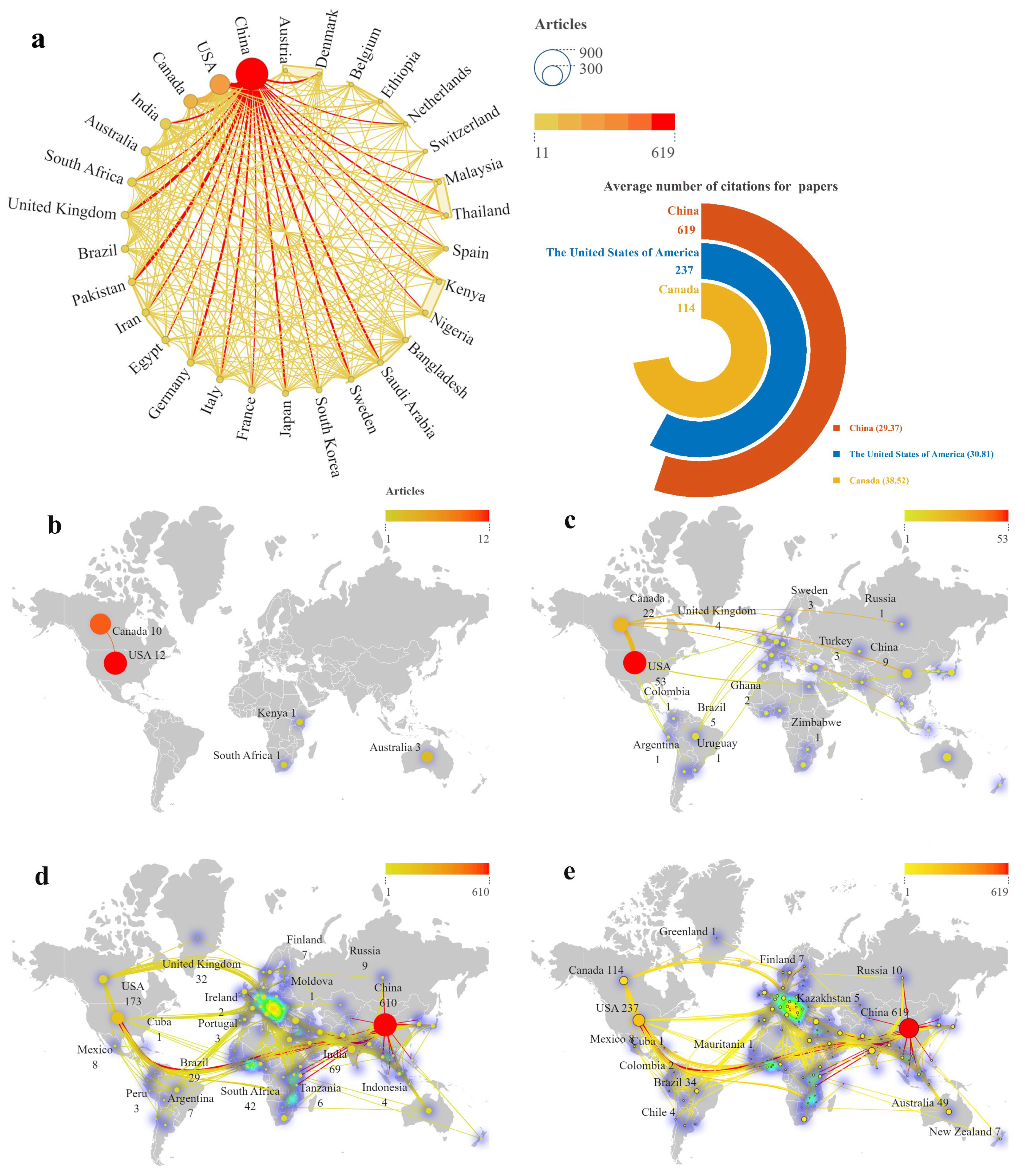
3.3. Bibliometric Analysis of the Country
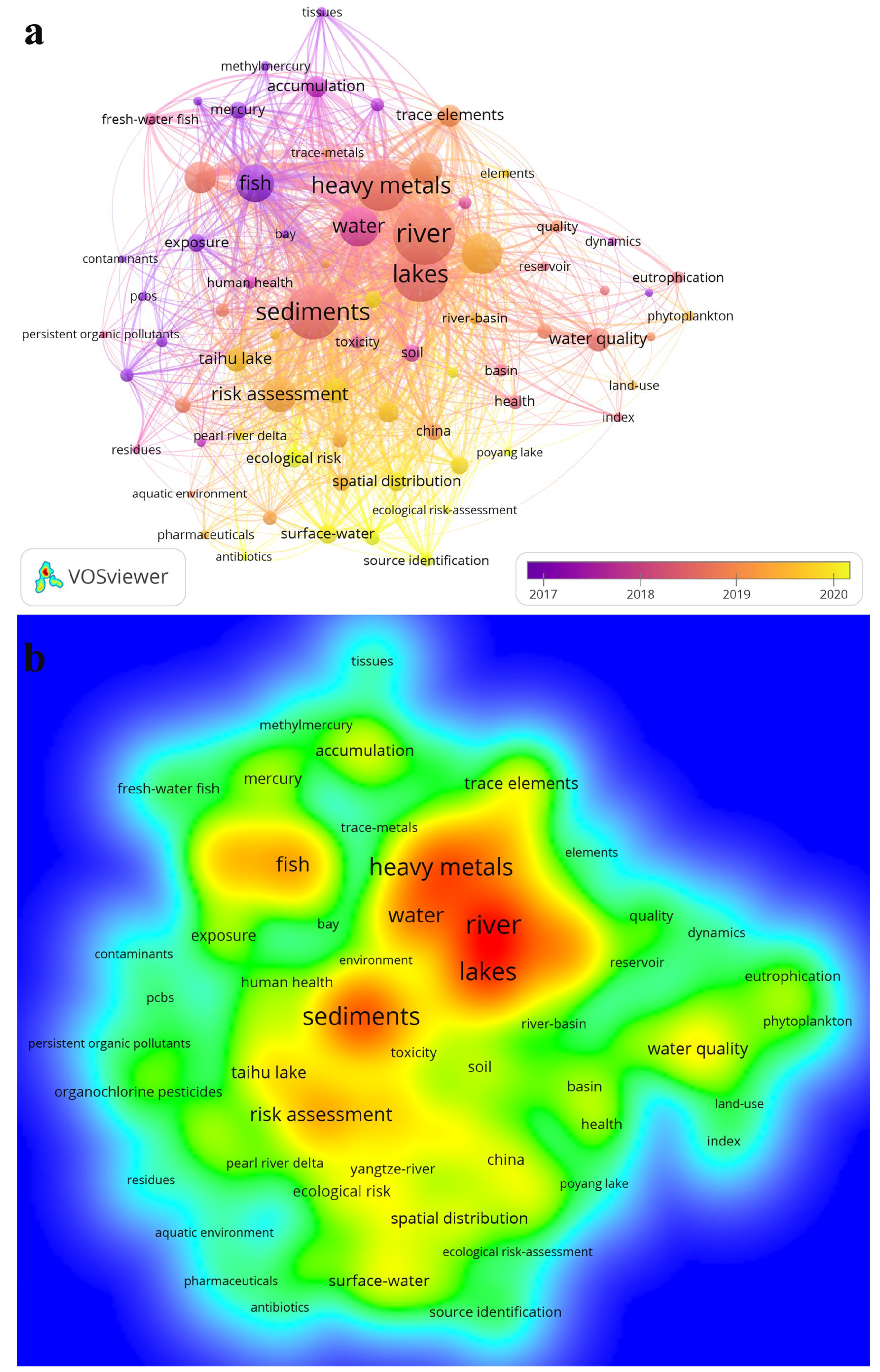
3.4. Keyword Analysis
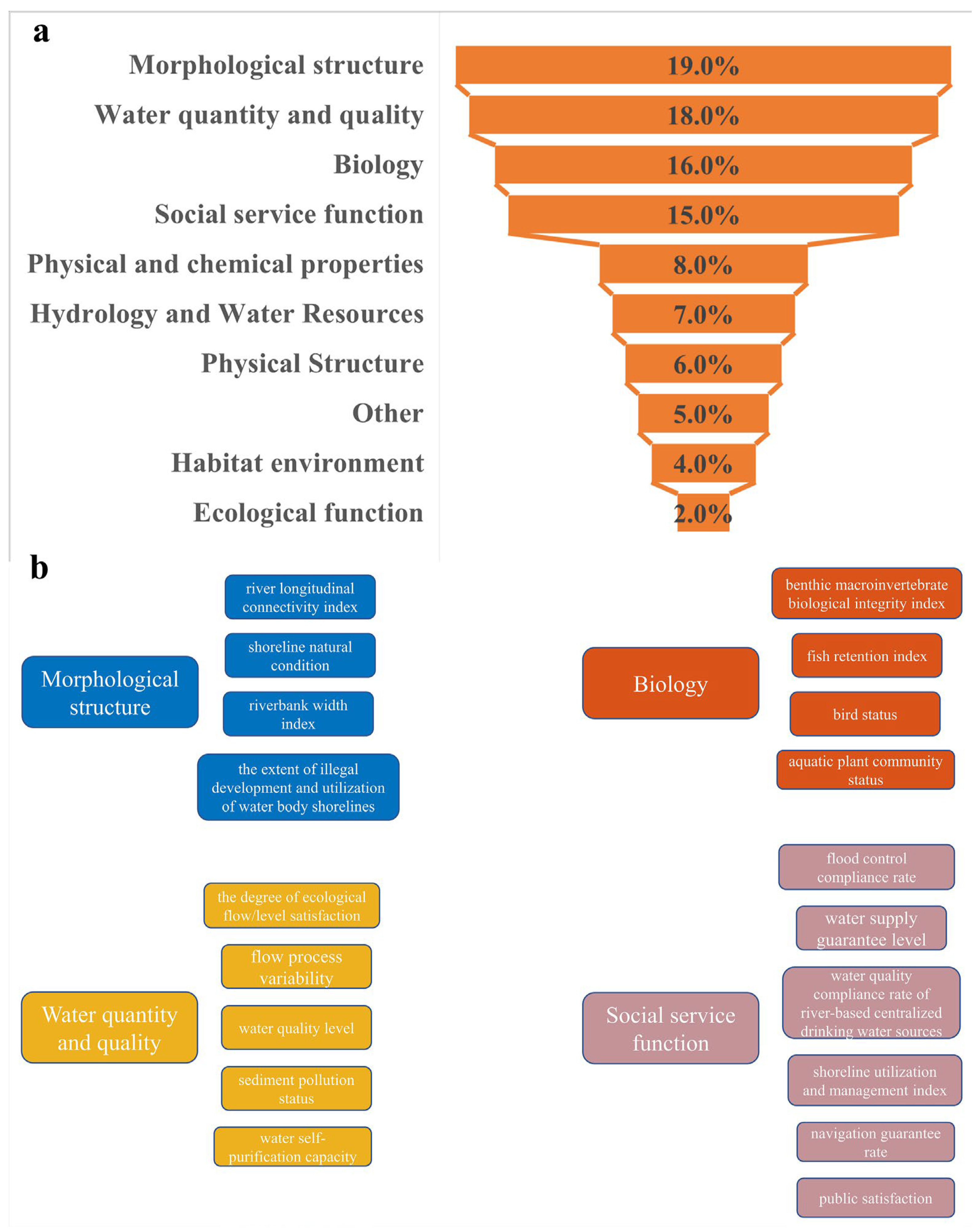
3.5. River Health Assessment Index System
4. Research Methods for River and Lake Health
4.1. Single Factor Evaluation Model
4.2. Prediction and Evaluation Model
4.3. Multi-Factor Comprehensive Evaluation Model
5. Critical Issues and Future Trends in Current Research
5.1. Critical Issues in Current Research
5.2. Future Trends
6. Conclusions
6.1. Advantages
6.2. Disadvantages
Supplementary Materials
Author Contributions
Funding
Institutional Review Board Statement
Informed Consent Statement
Data Availability Statement
Conflicts of Interest
References
- Meyer, J.L. Stream health: Incorporating the human dimension to advance stream ecology. J. N. Am. Benthol. Soc. 1997, 16, 439–447. [Google Scholar] [CrossRef]
- Norris, R.H.; Thoms, M.C. What is river health? Freshw. Biol. 1999, 41, 197–209. [Google Scholar] [CrossRef]
- Boulton, A.J. An overview of river health assessment: Philosophies, practice, problems and prognosis. Freshw. Biol. 1999, 41, 469–479. [Google Scholar] [CrossRef]
- Schofield, N.J.; Davies, P.E. Measuring the health of our rivers. Water 1996, 23, 39–43. [Google Scholar] [CrossRef]
- Fairweather, P.G. State of environment indicators of ‘river health’: Exploring the metaphor. Freshw. Biol. 1999, 41, 211–220. [Google Scholar] [CrossRef]
- Friberg, N.; Bonada, N.; Bradley, D.C.; Dunbar, M.J.; Edwards, F.K.; Grey, J.; Hayes, R.B.; Hildrew, A.G.; Lamouroux, N.; Trimmer, M. Biomonitoring of human impacts in freshwater ecosystems: The good, the bad and the ugly. Adv. Ecol. Res. 2011, 44, 1–68. [Google Scholar] [CrossRef]
- Leonard, S.; Parsons, M.; Olawsky, K.; Kofod, F. The role of culture and traditional knowledge in climate change adaptation: Insights from East Kimberley, Australia. Glob. Environ. Change 2013, 23, 623–632. [Google Scholar] [CrossRef]
- Wan, X.; Yang, T.; Zhang, Q.; Yan, X.; Hu, C.; Sun, L.; Zheng, Y. A novel comprehensive model of set pair analysis with extenics for river health evaluation and prediction of semi-arid basin-a case study of Wei River Basin, China. Sci. Total Environ. 2021, 775, 145845. [Google Scholar] [CrossRef]
- Zeng, P.; Sun, F.; Liu, Y.; Che, Y. Future river basin health assessment through reliability-resilience-vulnerability: Thresholds of multiple dryness conditions. Sci. Total Environ. 2020, 741, 140395. [Google Scholar] [CrossRef]
- Voulvoulis, N.; Arpon, K.D.; Giakoumis, T. The EU water framework directive: From great expectations to problems with implementation. Sci. Total Environ. 2017, 575, 358–366. [Google Scholar] [CrossRef]
- Sofi, M.S.; Bhat, S.U.; Rashid, I.; Kuniyal, J.C. The natural flow regime: A master variable for maintaining river ecosystem health. Ecohydrology 2020, 13, e2247. [Google Scholar] [CrossRef]
- Tang, T.; Cai, Q.; Liu, J. River ecosystem health and its assessment. Chin. J. Appl. Ecol. 2002, 13, 1191–1194. [Google Scholar]
- Zhao, Z.; Wei, F.; Wu, H.; Yang, M.; Jin, X.; Wang, P. A framework to comprehensively assess lake health from a perspective of ecosystem integrity and services. Ecol. Indic. 2025, 171, 113169. [Google Scholar] [CrossRef]
- Cao, J.; Zhang, Y.; Zhang, J.; Huang, Z.; Du, S.; Sun, F. Research progress of water ecological health assessment at home and abroad. J. Environ. Eng. Technol. 2022, 12, 1402–1410. [Google Scholar]
- Dong, F.; Huang, J.; Meng, L.; Li, L. Research on Jianghan plain water system dynamics and influences with multiple landsat satellites. Remote Sens. 2024, 16, 2770. [Google Scholar] [CrossRef]
- Su, Y.; Fan, Z.; Gan, L.; Li, Y.; Fei, G.; Liu, Y.; Xie, C.; Wu, J.; Sun, J.; Zhu, W.; et al. Assessing lake health in China: Challenges due to multiple coexisting standards. J. Hydrol. Reg. Stud. 2023, 46, 101351. [Google Scholar] [CrossRef]
- Zhang, Z.; Li, Y.; Wang, X.; Li, H.; Zheng, F.; Liao, Y.; Tang, N.; Chen, G.; Yang, C. Assessment of river health based on a novel multidimensional similarity cloud model in the Lhasa River, Qinghai-Tibet Plateau. J. Hydrol. 2021, 603, 127100. [Google Scholar] [CrossRef]
- Hosseini, N.; Akomeah, E.; Davis, J.M.; Baulch, H.; Lindenschmidt, K.E. Water quality modeling of a prairie river-lake system. Environ. Sci. Pollut. Res. 2018, 25, 31190–31204. [Google Scholar] [CrossRef]
- Ren, Y.; Zhang, F.; Li, J.; Zhao, C.; Jiang, Q.; Cheng, Z. Ecosystem health assessment based on ahp-dpsr model and impacts of climate change and human disturbances: A case study of Liaohe River Basin in Jilin Province, China. Ecol. Indic. 2022, 142, 109171. [Google Scholar] [CrossRef]
- Wu, S.; Tian, C.; Li, B.; Wang, J.; Wang, Z. Ecological environment health assessment of lake water ecosystem system based on simulated annealing-projection pursuit: A case study of plateau lake. Sustain. Cities Soc. 2022, 86, 104131. [Google Scholar] [CrossRef]
- Liu, X.; Wang, Y.; Meng, X.; Zhang, C.; Chen, Z. Improved method for benthic ecosystem health assessment by integrating chemical indexes into multiple biological indicator species—A case study of the Baiyangdian Lake, China. J. Environ. Manage. 2023, 335, 117530. [Google Scholar] [CrossRef] [PubMed]
- Madgwick, F.J. Strategies for conservation management of lakes. Hydrobiologia 1999, 395, 309–323. [Google Scholar] [CrossRef]
- Lin, H.; Ueta, K. Lake watershed management: Services, monitoring, funding and governance. Lakes Reserv. Res. Manag. 2012, 17, 207–223. [Google Scholar] [CrossRef]
- Wiegand, A.N.; Walker, C.; Duncan, P.F.; Roiko, A.; Tindale, N. A systematic approach for modelling quantitative lake ecosystem data to facilitate proactive urban lake management. Environ. Syst. Res. 2013, 2, 3. [Google Scholar] [CrossRef]
- Vaughan, I.P.; Diamond, M.; Gurnell, A.M.; Hall, K.A.; Jenkins, A.; Milner, N.J.; Naylor, L.A.; Sear, D.A.; Woodward, G.; Ormerod, S.J. Integrating ecology with hydromorphology: A priority for river science and management. Aquat. Conserv. Mar. Freshw. Ecosyst. 2009, 19, 113–125. [Google Scholar] [CrossRef]
- Goldberg, S.; Price, D. On Laws that Govern the Growth of Science: Little Science, Big Science; Columbia University Press: New York, NY, USA, 1963. [Google Scholar]
- Gong, X.; Xiong, L.; Xing, J.; Deng, Y.; Qihui, S.; Sun, J.; Qin, Y.; Zhao, Z.; Zhang, L. Implications on freshwater lake-river ecosystem protection suggested by organic micropollutant (omp) priority list. J. Hazard. Mater. 2024, 461, 132580. [Google Scholar] [CrossRef]
- Zhao, Z.; Zhang, L.; Cai, Y.; Chen, Y. Distribution of polycyclic aromatic hydrocarbon (pah) residues in several tissues of edible fishes from the largest freshwater lake in China, Poyang Lake, and associated human health risk assessment. Ecotoxicol. Environ. Saf. 2014, 104, 323–331. [Google Scholar] [CrossRef]
- Zhang, L.; Qin, S.; Shen, L.; Li, S.; Cui, J.; Liu, Y. Bioaccumulation, trophic transfer, and human health risk of quinolones antibiotics in the benthic food web from a macrophyte-dominated shallow lake, North China. Sci. Total Environ. 2020, 712, 136557. [Google Scholar] [CrossRef]
- Islam, A.; Varol, M.; Habib, M.A.; Khan, R. Risk assessment and source apportionment for metals in sediments of Kaptai Lake in Bangladesh using individual and synergistic indices and a receptor model. Mar. Pollut. Bull. 2023, 190, 114845. [Google Scholar] [CrossRef]
- Varol, M. Environmental, ecological and health risks of trace metals in sediments of a large reservoir on the euphrates river (Turkey). Environ. Res. 2020, 187, 109664. [Google Scholar] [CrossRef]
- Li, D.; Pan, B.; Chen, L.; Wang, Y.; Wang, T.; Wang, J.; Wang, H. Bioaccumulation and human health risk assessment of trace metals in the freshwater mussel Cristaria plicata in Dongting Lake, China. J. Environ. Sci. 2021, 104, 335–350. [Google Scholar] [CrossRef] [PubMed]
- Zhao, Z.; Gong, X.; Ding, Q.; Jin, M.; Wang, Z.; Lu, S.; Zhang, L. Environmental implications from the priority pollutants screening in impoundment reservoir along the eastern route of China’s south-to-north water diversion project. Sci. Total Environ. 2021, 794, 148700. [Google Scholar] [CrossRef] [PubMed]
- Li, Y.; Zhou, Q.; Ren, B.; Luo, J.; Yuan, J.; Ding, X.; Bian, H.; Yao, X. Trends and health risks of dissolved heavy metal pollution in global river and lake water from 1970 to 2017. Rev. Environ. Contam. Toxicol. 2020, 251, 1–24. [Google Scholar] [CrossRef] [PubMed]
- Farkas, A.; Salanki, J.; Specziar, A.; Varanka, I. Metal pollution as health indicator of lake ecosystems. Int. J. Occup. Med. Environ. Health. 2001, 14, 163–170. [Google Scholar]
- Jin, Y.; Li, X. Visualizing the hotspots and emerging trends of multimedia big data through scientometrics. Multimed. Tools Appl. 2019, 78, 1289–1313. [Google Scholar] [CrossRef]
- Koops, M.A.; Munawar, M.; Rudstam, L.G. The lake Ontario ecosystem: An overview of current status and future directions. Aquat. Ecosyst. Heal. Manag. 2015, 18, 101–104. [Google Scholar] [CrossRef]
- Huot, Y.; Brown, C.A.; Potvin, G.; Antoniades, D.; Baulch, H.M.; Beisner, B.E.; Bélanger, S.; Brazeau, S.; Cabana, H.; Cardille, J.A.; et al. The nserc canadian lake pulse network: A national assessment of lake health providing science for water management in a changing climate. Sci. Total Environ. 2019, 695, 133668. [Google Scholar] [CrossRef]
- Hartig, J.H.; Francoeur, S.N.; Ciborowski, J.J.; Gannon, J.E.; Sanders, C.E.; Galvao-Ferreira, P.; Knauss, C.R.; Gell, G.; Berk, K. Checkup: Assessing ecosystem health of the Detroit River and western Lake Erie. J. Great Lakes Res. 2020, 47, 1241–1256. [Google Scholar] [CrossRef]
- Gopal, C.M.; Bhat, K.; Ramaswamy, B.R.; Kumar, V.; Singhal, R.K.; Basu, H.; Udayashankar, H.N.; Vasantharaju, S.G.; Praveenkumarreddy, Y.; Lino, Y. Seasonal occurrence and risk assessment of pharmaceutical and personal care products in Bengaluru rivers and lakes, India. J. Environ. Chem. Eng. 2021, 9, 105610. [Google Scholar] [CrossRef]
- Ebele, A.J.; Abdallah, M.A.E.; Harrad, S. Pharmaceuticals and personal care products (PPCPs) in the freshwater aquatic environment. Emerg. Contam. 2017, 3, 1–16. [Google Scholar] [CrossRef]
- Dai, S.; Zhang, W.; Zong, J.; Wang, Y.; Wang, G. How effective is the green development policy of China’s Yangtze River economic belt? A quantitative evaluation based on the PMC-index model. Int. J. Environ. Res. Public Health 2021, 18, 7676. [Google Scholar] [CrossRef] [PubMed]
- Singh, P.K.; Saxena, S.J. Towards developing a river health index. Ecol. Indic. 2018, 85, 999–1011. [Google Scholar] [CrossRef]
- Lemm, J.U.; Venohr, M.; Globevnik, L.; Stefanidis, K.; Panagopoulos, Y.; van Gils, J.; Posthuma, L.; Kristensen, P.; Feld, C.K.; Mahnkopf, J.; et al. Multiple stressors determine river ecological status at the european scale: Towards an integrated understanding of river status deterioration. Glob. Change Biol. 2021, 27, 1962–1975. [Google Scholar] [CrossRef] [PubMed]
- Shan, C.; Yang, J.; Dong, Z.; Huang, D.; Wang, H. Study on river health assessment weight calculation. Pol. J. Environ. Stud. 2020, 29, 1839–1848. [Google Scholar] [CrossRef]
- Kong, Q.; Xin, Z.; Zhao, Y.; Ran, L.; Xia, X. Health assessment for mountainous rivers based on dominant functions in the Huaijiu River, Beijing, China. Environ. Manag. 2022, 70, 164–177. [Google Scholar] [CrossRef]
- Su, Y.; Li, W.; Liu, L.; Hu, W.; Li, J.; Sun, X.; Li, Y. Health assessment of small-to-medium sized rivers: Comparison between comprehensive indicator method and biological monitoring method. Ecol. Indic. 2021, 126, 107686. [Google Scholar] [CrossRef]
- Zhang, Z.; Li, Y.; Wang, X.; Liu, Y.; Tang, W.; Ding, W.; Han, Q.; Shang, G.; Wang, Z.; Chen, K.; et al. Investigating river health across mountain to urban transitions using pythagorean fuzzy cloud technique under uncertain environment. J. Hydrol. 2023, 620, 129426. [Google Scholar] [CrossRef]
- Wu, Z.; Wang, X.; Chen, Y.; Cai, Y.; Deng, J. Assessing river water quality using water quality index in Lake Taihu Basin, China. Sci. Total Environ. 2018, 612, 914–922. [Google Scholar] [CrossRef]
- Pan, G.; Xu, Y.; Yu, Z.; Song, S.; Zhang, Y. Analysis of river health variation under the background of urbanization based on entropy weight and matter-element model: A case study in Huzhou city in the Yangtze River Delta, China. Environ. Res. 2015, 139, 31–35. [Google Scholar] [CrossRef]
- Li, T.; Huang, X.; Jiang, X.; Wang, X. Assessment of ecosystem health of the yellow river with fish index of biotic integrity. Hydrobiologia 2018, 814, 31–43. [Google Scholar] [CrossRef]
- Ustaoğlu, F.; Tepe, Y.; Taş, B. Assessment of stream quality and health risk in a subtropical turkey river system: A combined approach using statistical analysis and water quality index. Ecol. Indic. 2020, 113, 105815. [Google Scholar] [CrossRef]
- Karunanidhi, D.; Aravinthasamy, P.; Subramani, T.; Muthusankar, G. Revealing drinking water quality issues and possible health risks based on water quality index (WQI) method in the Shanmuganadhi River Basin of South India. Environ. Geochem. Health 2021, 43, 931–948. [Google Scholar] [CrossRef] [PubMed]
- Arman, N.Z.; Salmiati, S.; Said, M.I.M.; Aris, A. Development of macroinvertebrate-based multimetric index and establishment of biocriteria for river health assessment in Malaysia. Ecol. Indic. 2019, 104, 449–458. [Google Scholar] [CrossRef]
- Clarke, R.T.; Wright, J.F.; Furse, M.T. Rivpacs models for predicting the expected macroinvertebrate fauna and assessing the ecological quality of rivers. Ecol. Model. 2003, 160, 219–233. [Google Scholar] [CrossRef]
- Sims, A.; Zhang, Y.; Gajaraj, S.; Brown, P.B.; Hu, Z. Toward the development of microbial indicators for wetland assessment. Water Res. 2013, 47, 1711–1725. [Google Scholar] [CrossRef]
- Lin, L.; Wang, F.; Chen, H.; Fang, H.; Zhang, T.; Cao, W. Ecological health assessments of rivers with multiple dams based on the biological integrity of phytoplankton: A case study of North Creek of Jiulong River. Ecol. Indic. 2021, 121, 106998. [Google Scholar] [CrossRef]
- Sadat, M.A.; Guan, Y.; Zhang, D.; Shao, G.; Cheng, X.; Yang, Y. The associations between river health and water resources management lead to the assessment of river state. Ecol. Indic. 2020, 109, 105814. [Google Scholar] [CrossRef]
- Jiang, S.; Zhou, L.; Ren, L.; Wang, M.; Xu, C.-Y.; Yuan, F.; Liu, Y.; Yang, X.; Ding, Y. Development of a comprehensive framework for quantifying the impacts of climate change and human activities on river hydrological health variation. J. Hydrol. 2021, 600, 126566. [Google Scholar] [CrossRef]
- Bhattacharya, R.K.; Das Chatterjee, N.; Das, K. Multifunctional resilience of river health to human service demand in an alluvial quarried reach: A comparison amongst fuzzy logic, entropy, and ahp-based mcdm models. Environ. Sci. Pollut. Res. 2022, 29, 84137–84165. [Google Scholar] [CrossRef]
- Zhao, C.; Pan, T.; Dou, T.; Liu, J.; Liu, C.; Ge, Y.; Zhang, Y.; Yu, X.; Mitrovic, S.; Lim, R. Making global river ecosystem health assessments objective, quantitative and comparable. Sci. Total Environ. 2019, 667, 500–510. [Google Scholar] [CrossRef]
- Borja, A.; Basset, A.; Bricker, S.; Dauvin, J.-C.; Elliott, M.; Harrison, T.; Marques, J.-C.; Weisberg, S.; West, R. Classifying ecological quality and integrity of estuaries. Treatise Estuar. Coast. Sci. 2011, 125–162. [Google Scholar] [CrossRef]
- Boon, P.J.; Wilkinson, J.; Martin, J. The application of sercon (system for evaluating rivers for conservation) to a selection of rivers in Britain. Aquat. Conserv. Mar. Freshw. Ecosyst. 1998, 8, 597–616. [Google Scholar] [CrossRef]
- Roux, D. Strategies used to guide the design and implementation of a national river monitoring programme in South Africa. Environ. Monit. Assess. 2001, 69, 131–158. [Google Scholar] [CrossRef]
- Roux, D. Design of a National Programme for Monitoring and Assessing the Health of Aquatic Ecosystems, with Specific Reference to the South African River Health Programme. Environ. Sci. Forum 1999, 96, 13–32. [Google Scholar]
- Cooper, J.G.; Ramm, A.E.; Harrison, T.D. The estuarine health index: A new approach to scientific information transfer. Ocean Coast. Manag. 1994, 25, 103–141. [Google Scholar] [CrossRef]
- Gordon, N.D.; McMahon, T.A.; Finlayson, B.L.; Gippel, C.J.; Nathan, R.J. Stream Hydrology: An Introduction for Ecologists; John Wiley and Sons: Hoboken, NJ, USA, 2004. [Google Scholar]
- Mo, M.; Wang, X.; Wu, H.; Cai, S.; Zhang, X.; Wang, H. Ecosystem health assessment of Honghu Lake wetland of china using artificial neural network approach. Chin. Geogr. Sci. 2009, 19, 349–356. [Google Scholar] [CrossRef]
- Deng, X.; Xu, Y.; Han, L.; Yu, Z.; Yang, M.; Pan, G. Assessment of river health based on an improved entropy-based fuzzy matter-element model in the Taihu Plain, China. Ecol. Indic. 2015, 57, 85–95. [Google Scholar] [CrossRef]
- Zhang, X.; Meng, Y.; Xia, J.; Wu, B.; She, D. A combined model for river health evaluation based upon the physical, chemical, and biological elements. Ecol. Indic. 2018, 84, 416–424. [Google Scholar] [CrossRef]
- Wang, S.; Zhang, Q.; Yang, T.; Zhang, L.; Li, X.; Chen, J. River health assessment: Proposing a comprehensive model based on physical habitat, chemical condition and biotic structure. Ecol. Indic. 2019, 103, 446–460. [Google Scholar] [CrossRef]
- Xu, W.; Dong, Z.; Ren, L.; Ren, J.; Guan, X.; Zhong, D. Using an improved interval technique for order preference by similarity to ideal solution to assess river ecosystem health. J. Hydroinformatics 2019, 21, 624–637. [Google Scholar] [CrossRef]
- Yang, T.; Zhang, Q.; Wan, X.; Li, X.; Wang, Y.; Wang, W. Comprehensive ecological risk assessment for semi-arid basin based on conceptual model of risk response and improved topsis model-a case study of Wei River Basin, China. Sci. Total Environ. 2020, 719, 137502. [Google Scholar] [CrossRef] [PubMed]
- Zhao, Y.; Zhou, L.; Dong, B.; Dai, C. Health assessment for urban rivers based on the pressure, state and response framework—A case study of the Shiwuli River. Ecol. Indic. 2019, 99, 324–331. [Google Scholar] [CrossRef]
- Zhang, Z.; Li, Y.; Wang, X.; Zhu, L.; Li, H.; Liu, Y.; Tang, N.; Xu, Y.; Hu, Q. Investigating river health and potential risks using a novel hybrid decision-making framework with multi-source data fusion in the Qinghai-Tibet Plateau. Environ. Impact Assess. Rev. 2022, 96, 106849. [Google Scholar] [CrossRef]
- Nguyen, H.; Nguyen, T.; Tran, T.; Nguyen, T.; Nguyen, X.; Nguyen, T. Present status of inland fisheries and its linkage to ecosystem health and human wellbeing in north central of Vietnam. Ecosyst. Serv. 2023, 59, 101505. [Google Scholar] [CrossRef]
- Atazadeh, E.; Gell, P.; Mills, K.; Barton, A.; Newall, P. Community structure and ecological responses to hydrological changes in benthic algal assemblages in a regulated river: Application of algal metrics and multivariate techniques in river management. Environ. Sci. Pollut. Res. 2021, 28, 39805–39825. [Google Scholar] [CrossRef]
- Ho, S.; Hashim, A.G.B.M.; Idris, M.A.M. Applicability of sirim green 5-s model for productivity & business growth in Malaysia. TQM J. 2015, 27, 185–196. [Google Scholar] [CrossRef]
- Tyagi, S.; Sharma, B.; Singh, P.; Dobhal, R. Water quality assessment in terms of water quality index. Am. J. Water Resour. 2013, 1, 34–38. [Google Scholar] [CrossRef]
- Ding, M.; Liu, W.; Xiao, L.; Zhong, F.; Lu, N.; Zhang, J.; Zhang, Z.; Xu, X.; Wang, K. Construction and optimization strategy of ecological security pattern in a rapidly urbanizing region: A case study in central-south China. Ecol. Indic. 2022, 136, 108604. [Google Scholar] [CrossRef]
- Fischer, J.; Lindenmayer, D.B. Landscape modification and habitat fragmentation: A synthesis. Global Ecol. Biogeogr. 2007, 16, 265–280. [Google Scholar] [CrossRef]
- Jorgensen, S.E.; Loffler, H.; Rast, W.; Straskraba, M. Lake and Reservoir Management; Elsevier: Amsterdam, The Netherlands, 2005. [Google Scholar]
- Mei, Y.; Chang, C.; Dong, Z.; Wei, L. Stream, lake, and reservoir management. Water Environ. Res. 2016, 88, 1533–1563. [Google Scholar] [CrossRef]
- Cochrane, K.L.; Fisheries, J.F. Reconciling sustainability, economic efficiency and equity in marine fisheries: Has there been progress in the last 20 years? Fish Fish. 2021, 22, 298–323. [Google Scholar] [CrossRef]
- Davies, P.E.; Harris, J.H.; Hillman, T.J.; Walker, K.F. The sustainable rivers audit: Assessing river ecosystem health in the Murray–Darling Basin, Australia. Mar. Freshw. Res. 2010, 61, 764–777. [Google Scholar] [CrossRef]
- Pritchard, A. Statistical bibliography or bibliometrics. J. Doc. 1969, 25, 348. [Google Scholar] [CrossRef]
- Diem, A.; Wolter, S.C. The use of bibliometrics to measure research performance in education sciences. Res. High. Educ. 2013, 54, 86–114. [Google Scholar] [CrossRef]
- Mayr, P.; Scharnhorst, A. Scientometrics and information retrieval: Weak-links revitalized. Scientometrics 2015, 102, 2193–2199. [Google Scholar] [CrossRef]
- Abramo, G.; D’Angelo, C.A.; Viel, F. The field-standardized average impact of national research systems compared to world average: The case of Italy. Scientometrics 2011, 88, 599–615. [Google Scholar] [CrossRef]
- Ma, F.; Xi, M. Status and trends of bibliometric. J. Inf. Sci. 1992, 13, 7–17. [Google Scholar]
- Chen, C. Citespace II: Detecting and visualizing emerging trends and transient patterns in scientific literature. J Am. Soc. Inf. Sci. Tec. 2006, 57, 359–377. [Google Scholar] [CrossRef]
- Eck, N.J.P.V.; Waltman, L.R. Vosviewer: A computer program for bibliometric mapping. ERIM Rep. Ser. Res. Manag. 2009, 84, 523–538. [Google Scholar] [CrossRef]
- Rejwan, C.; Collins, N.C.; Brunner, L.J.; Shuter, B.J.; Ridgway, M.S. Tree regression analysis on the nesting habitat of smallmouth bass. Ecology 1999, 80, 341–348. [Google Scholar] [CrossRef]
- Liu, Z. Domestic and international research on river and lake health in the past thirty-five years. Figshare 2025. [Google Scholar] [CrossRef]



| Keywords | Year | Strength | Begin | End | 1991–2024 |
|---|---|---|---|---|---|
| Lake Ontario | 1994 | 5.72 | 1994 | 2016 | ▂▂▂▃▃▃▃▃▃▃▃▃▃▃▃▃▃▃▃▃▃▃▃▃▃▃▂▂▂▂▂▂▂▂ |
| Lake Erie | 1996 | 4.58 | 1996 | 2006 | ▂▂▂▂▂▃▃▃▃▃▃▃▃▃▃▃▂▂▂▂▂▂▂▂▂▂▂▂▂▂▂▂▂▂ |
| Bay | 1999 | 4.61 | 1999 | 2013 | ▂▂▂▂▂▂▂▂▃▃▃▃▃▃▃▃▃▃▃▃▃▃▃▂▂▂▂▂▂▂▂▂▂▂ |
| Exposure | 2000 | 6.53 | 2000 | 2007 | ▂▂▂▂▂▂▂▂▂▃▃▃▃▃▃▃▃▂▂▂▂▂▂▂▂▂▂▂▂▂▂▂▂▂ |
| Fish | 1993 | 6.63 | 2007 | 2013 | ▂▂▂▂▂▂▂▂▂▂▂▂▂▂▂▂▃▃▃▃▃▃▃▂▂▂▂▂▂▂▂▂▂▂ |
| Accumulation | 2001 | 4.62 | 2008 | 2014 | ▂▂▂▂▂▂▂▂▂▂▂▂▂▂▂▂▂▃▃▃▃▃▃▃▂▂▂▂▂▂▂▂▂▂ |
| Polychlorinated Biphenyls | 1992 | 5.67 | 2010 | 2015 | ▂▂▂▂▂▂▂▂▂▂▂▂▂▂▂▂▂▂▂▃▃▃▃▃▃▂▂▂▂▂▂▂▂▂ |
| Organochlorine Pesticides | 2011 | 8.75 | 2011 | 2016 | ▂▂▂▂▂▂▂▂▂▂▂▂▂▂▂▂▂▂▂▂▃▃▃▃▃▃▂▂▂▂▂▂▂▂ |
| Polybrominated Diphenyl Ethers | 2013 | 5.47 | 2013 | 2019 | ▂▂▂▂▂▂▂▂▂▂▂▂▂▂▂▂▂▂▂▂▂▂▃▃▃▃▃▃▃▂▂▂▂▂ |
| Residues | 2013 | 4.66 | 2013 | 2016 | ▂▂▂▂▂▂▂▂▂▂▂▂▂▂▂▂▂▂▂▂▂▂▃▃▃▃▂▂▂▂▂▂▂▂ |
| Copper | 1998 | 4.70 | 2014 | 2016 | ▂▂▂▂▂▂▂▂▂▂▂▂▂▂▂▂▂▂▂▂▂▂▂▃▃▃▂▂▂▂▂▂▂▂ |
| Personal Care Products | 2017 | 5.65 | 2017 | 2020 | ▂▂▂▂▂▂▂▂▂▂▂▂▂▂▂▂▂▂▂▂▂▂▂▂▂▂▃▃▃▃▂▂▂▂ |
| Three Gorges Reservoir | 2018 | 5.18 | 2018 | 2020 | ▂▂▂▂▂▂▂▂▂▂▂▂▂▂▂▂▂▂▂▂▂▂▂▂▂▂▂▃▃▃▂▂▂▂ |
| Groundwater | 2019 | 6.12 | 2019 | 2021 | ▂▂▂▂▂▂▂▂▂▂▂▂▂▂▂▂▂▂▂▂▂▂▂▂▂▂▂▂▃▃▃▂▂▂ |
| Diversity | 2000 | 4.97 | 2022 | 2024 | ▂▂▂▂▂▂▂▂▂▂▂▂▂▂▂▂▂▂▂▂▂▂▂▂▂▂▂▂▂▂▂▃▃▃ |
| Research Method | Main Content | Method Description | Advantages | Disadvantages | References |
|---|---|---|---|---|---|
| Single Factor Evaluation Model | Water quality index method: Includes single water quality indicators and comprehensive water quality indices. | Using water quality indicators to analyze pollution levels in the river. | Reflects the degree of pollution through observed water quality conditions. | Only reflects pollution levels and cannot reveal ecological issues. | [79] |
| Water quantity index evaluation: Investigates water quantity and flow conditions. | Monitoring flow rate and water volume indicators to assess river health status. | Direct and easy to understand, low implementation costs. | Limited scope and lack of universality; subjective evaluation may cause bias. | [50] | |
| Biological index method: Calculates fish indices and evaluates aquatic organisms like plankton and benthic animals. | Using biological integrity indices to reflect aquatic organism population status to assess river health. | Reflects the relationship between aquatic organisms and the water environment. | Time-consuming and costly; sensitive to environmental interference. | [51] | |
| Predictive Evaluation Model | Predicts river health using data from benthic organisms. | Using data from benthic organisms to construct predictive models to assess river health. | Strong theoretical and mathematical foundations; results are objective and reliable. | Predictive models tend to neglect benthic organism dynamics, resulting in uncertainty. | [55,56,58] |
| Multi-Factor Comprehensive Evaluation Model | Combines single evaluation results to obtain a comprehensive assessment of river health. | Integrating multiple indicators to obtain a comprehensive evaluation of river health status. | Comprehensive evaluation that fully reflects river health conditions. | Multi-index integration may overlook certain river health issues. | [48,60] |
Disclaimer/Publisher’s Note: The statements, opinions and data contained in all publications are solely those of the individual author(s) and contributor(s) and not of MDPI and/or the editor(s). MDPI and/or the editor(s) disclaim responsibility for any injury to people or property resulting from any ideas, methods, instructions or products referred to in the content. |
© 2026 by the authors. Licensee MDPI, Basel, Switzerland. This article is an open access article distributed under the terms and conditions of the Creative Commons Attribution (CC BY) license.
Share and Cite
Liu, Z.; Li, Y.; Wang, X. Global Evolution and Methodological Trends in River and Lake Health Research (1991–2024): A Bibliometric and Systematic Review. Diversity 2026, 18, 71. https://doi.org/10.3390/d18020071
Liu Z, Li Y, Wang X. Global Evolution and Methodological Trends in River and Lake Health Research (1991–2024): A Bibliometric and Systematic Review. Diversity. 2026; 18(2):71. https://doi.org/10.3390/d18020071
Chicago/Turabian StyleLiu, Zhenhai, Yun Li, and Xiaogang Wang. 2026. "Global Evolution and Methodological Trends in River and Lake Health Research (1991–2024): A Bibliometric and Systematic Review" Diversity 18, no. 2: 71. https://doi.org/10.3390/d18020071
APA StyleLiu, Z., Li, Y., & Wang, X. (2026). Global Evolution and Methodological Trends in River and Lake Health Research (1991–2024): A Bibliometric and Systematic Review. Diversity, 18(2), 71. https://doi.org/10.3390/d18020071