Article

Inconsistency in the Existence of Personality in Ground Beetles (Coleoptera: Carabidae)

1
Department of Ecology, Faculty of Science and Technology, University of Debrecen, Egyetem Sq. 1, H-4032 Debrecen, Hungary
2
HUN-REN–UD Anthropocene Ecology Research Group, Egyetem Sq. 1, H-4032 Debrecen, Hungary
3
Count István Tisza Foundation for the University of Debrecen, Egyetem Sq. 1, H-4032 Debrecen, Hungary
4
Department of Agroecology, Flakkebjerg Research Centre, Aarhus University, DK-4200 Slagelse, Denmark
*
Author to whom correspondence should be addressed.
Diversity 2026, 18(2), 67; https://doi.org/10.3390/d18020067
Submission received: 30 December 2025 / Revised: 22 January 2026 / Accepted: 24 January 2026 / Published: 27 January 2026
(This article belongs to the Section Animal Diversity)

Abstract

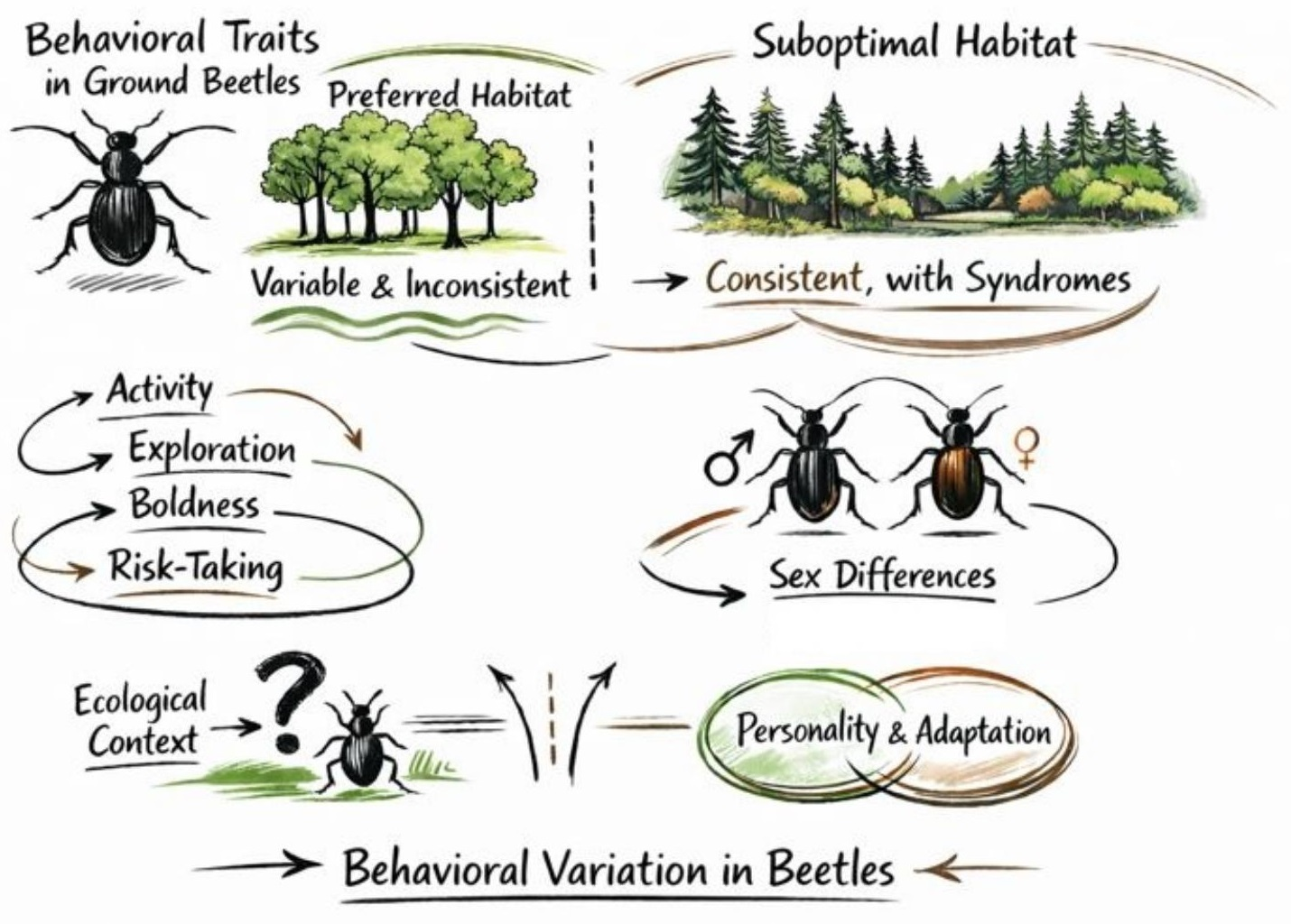
Trait-based approaches, particularly those focusing on behavioral traits, have become increasingly important in ecology. However, empirical studies addressing behavioral trait variation in insects remain comparatively scarce. To address this knowledge gap, we investigated the behavior of six wild-living ground beetle species for which no behavioral data have previously been reported. Using standardized behavioral measures, we found that in species occurring in their preferred forest habitats, behavioral traits related to activity, exploration, boldness, and risk-taking showed weak or limited temporal consistency. In contrast, in species inhabiting modified forest habitats, behavioral traits exhibited pronounced and repeatable individual differences, were intercorrelated, and formed behavioral syndromes. Moreover, half of the studied species showed sex-specific differences in personality, reflecting drivers related to reproductive roles and investment. Overall, our findings emphasize that animal personality and behavioral syndromes in ground beetles are not universal species-level properties but emerge from the interaction between intrinsic traits, and sex-specific strategies, underscoring the importance of considering ecological context when interpreting individual-level behavioral variation.

Graphical Abstract

1. Introduction

Trait-based approaches that emphasize variability in characteristics measurable at the individual level have become increasingly important in insect ecology, as they provide a mechanistic link between organismal properties and population-, community-, and ecosystem-level patterns and processes [1,2]. Rather than interpreting as random noise around a species-specific mean, individual-level trait variability, including morphological, physiological, life history, and behavioral traits, is an important parameter related to fitness, and helps to understand population dynamics and community organization [3,4,5]. Consequently, trait-based frameworks enhance our understanding of the impacts of environmental change (e.g., climate change, habitat fragmentation, and novel selective pressures) by explicitly linking traits to individual-level performance, thereby clarifying species’ responses to altered conditions and their effects on ecosystem processes [1,6].
Morphological diversity among individuals influences resource acquisition, locomotor performance, predator avoidance, and competitive interactions, thereby shaping individual fitness [4,7]. Variation in body size or shape can mediate access to different microhabitats and resources, facilitating niche partitioning within populations. Variation in physiological traits, including differences in metabolic rate, thermal tolerance, stress resistance, and energy use, determines individual survival, reproductive output, and dispersal ability, thereby influencing population persistence, spatial spread, and demographic stability [8]. Such physiological diversity among individuals enables insect populations to cope with environmental heterogeneity and rapid environmental change, enhancing resilience and adaptive capacity across habitats [8,9]. Diversity in life-history traits can reduce the risk of synchronized failure under unfavorable circumstances [10]. Such “bet-hedging” strategies increase the likelihood that at least a subset of individuals successfully reproduces, dampening population size fluctuations over time [11].
Although behavioral differences among individuals have long been studied in vertebrates, the existence of similar differences in insects has only been recognized in the past two decades [12,13,14]. Such variation exists in foraging strategies, mating systems, and predator avoidance [13,15]. Collectively, the population presents a tolerance spectrum to various environmental challenges, which increases population resilience and persistence [16,17]. Overall, behavioral diversity within a species contributes to ecological success by enhancing individual fitness, enabling adaptive responses to environmental challenges. Accordingly, understanding the role of behavioral variation is important for species conservation, particularly under ongoing climate change and habitat loss that threaten population and ecosystem stability [18,19].
Despite growing recognition of its importance, empirical studies addressing behavioral trait variation in insects remain comparatively scarce [13]. Personality studies on ground beetles (Coleoptera: Carabidae), one of the most diverse beetle families [20], are very limited [21,22,23,24,25]. To address this knowledge gap, we investigated the behavior of six wild-living ground beetle species for which no behavioral data have previously been reported. Based on findings from earlier studies [21,22,23,24], we hypothesized that (1) carabid species would exhibit consistent behavior across repeated tests, indicating the presence of personality [26], and that (2) behavioral traits would differ between sexes.
In the present study, we found that the presence of personality was not universal among the species examined, and only three species displayed consistent behavioral differences between the sexes.

2. Materials and Methods

2.1. Study Area and Sampling Design

The Hungarian site of the international GLOBENET program [27] was established in 2001. As required by the protocol, stands of an extensive old-growth lowland forest (>120 years old, so called Great Forest of Debrecen), dominated by English oak (Quercus robur), was chosen in and around Hungary’s second-largest city, Debrecen (201,704 inhabitants in 2024). The Great Forest lies north of the city, but several patches of the original forest remain within the city as urban expansion has encroached upon it. This situation provides an excellent opportunity to select sites with the same soil type and land-use history that represent the two endpoints of an urbanization gradient. From 2020 onward, intensive live-trapping sampling was performed at the two endpoints of the rural–urban gradient to study urbanization-driven changes in arthropod populations [7,28,29,30,31].
During sampling, we sampled four rural forest stands (3.71 ha, 3.75 ha, 3.94 ha, and 3.04 ha, located 2.5 km from the border of the city) and four urban ones (3.21 ha, 3.86 ha, 3.98 ha, and 3.33 ha). In both areas, sites were at least 250 m apart. This is generally accepted to ensure independent samples [32], also because carabids usually only move a few m/day [33,34]. Ground-dwelling arthropods were collected using 15 live-capture traps at every site, arranged randomly but placed at least 10 m apart from each other and at least 50 m from the nearest forest edge [23]. Traps consisted of square plastic boxes (length: 17 cm, width: 11 cm, depth: 10.5 cm) containing shredded leaves to reduce intra-guild predation. The traps were covered with fiberboard roofs (20 cm × 20 cm) to protect them from litter and rain. Sampling was conducted during April–June and September–October 2020, corresponding to the spring and autumn activity peaks of ground beetles in the northern temperate region but excluding the summer aestivation period [20]. Traps were checked twice weekly, and captured beetles were transported to the laboratory. Only a single species (Carabus convexus Fabricius, 1775) was collected in sufficient numbers to allow a direct comparison of the behavior of individuals originating from rural and urban sites [23]. However, six other species (a total of 346 individuals) were collected from either the rural or the urban sites in numbers sufficient for the analysis of behavior.

2.2. Evaluating Behavioral Measures

In the laboratory, beetles were maintained under controlled environmental conditions (24 °C, 40% relative humidity, natural light–dark cycle). Following a 2 h acclimation and resting period, individuals were subjected to two consecutive behavioral tests. First, activity, exploratory behavior, and boldness were quantified [23,24,35]. Subsequently, antipredator responses were assessed by measuring escape behavior [21,23].
The novel environment consisted of an open, white plastic container (36.4 cm × 23 cm) with its floor subdivided into 35 equal squares [23,24]. At the start of each trial, a randomly chosen beetle was placed in the central square and covered with a Petri dish (55 mm diameter). Once the individual became motionless, the cover was carefully removed without contacting the beetle, and its behavior was video-recorded for 90 s using a GoPro HERO6 camera (CHDHX-601-FW). Video footage was analyzed with the BugTracker software (version 0.2 [36]) and the Windows Movie Maker software (version 8.0.7.5), and the following behavioral measures were extracted: (1) the total number of squares visited, an indicator of exploratory activity [21,24]; (2) the number of non-edge squares entered, reflecting exploration [21]; (3) the time needed to first reach the arena wall, associated with boldness [37]; and (4) the proportion of time spent in squares adjacent to the wall (“edge preference”). Edge preference (thigmotaxis or centrophobism) is inversely related to boldness, as remaining near the perimeter is safer [21,38]. Escape responses to a simulated threat were evaluated in a circular arena [21]. This ring-shaped arena (a 55 mm diameter Petri dish glued in the middle of a 90 mm diameter one) had 8 segments. The tested individual was placed into the arena and allowed to habituate. Once motionless, the beetle was gently hit on its back with a forceps. This simulated an attack, and the beetle started running to escape. We recorded (5) escape duration and (6) escape distance. We limited testing to two repetitions (24 h between the two trials) to avoid potential habituation effects [39].

2.3. Statistical Analyses

All statistical analyses were conducted in the R program environment [40]. Because body mass can affect arthropod behavior [37], we first examined sex-related differences in body mass for each ground beetle species. These comparisons were performed using generalized linear mixed models (GLMMs), with sex (female vs. male) included as a fixed factor and site treated as a random effect, with the help of the lme4 package (version 1.1-38 [41]). Body mass differed significantly between sexes in all investigated species, with the exception of Platyderus rufus (Duftschmid, 1812), for which the effect was near-significant (p = 0.0526). Consequently, sex was retained as a fixed effect in all subsequent analyses.
The influence of sex on behavioral measures was also evaluated using GLMMs. Prior to model fitting, the most appropriate error distribution for each response variable was determined using the car (version 3.1-3 [42]) and MASS (version 7.3-65 [43]) packages. Behavioral variables expressed as counts (no. squares visited, no. inner squares visited, and escape distance) were analyzed assuming a Poisson distribution with a log link function, whereas continuous variables (body mass, time to wall, edge preference, and escape duration) were used for lognormal error distribution [44]. Repeated trials were accounted for by treating measurements as repeated observations, and both site and observer identity were included as random effects. Given the limited number of random factors, model parameters were estimated using the Laplace approximation [44]. To test whether the behavior of individuals was consistent across contexts, Kendall’s coefficient of concordance including all behavioral measures (mean values of the two trials) was calculated using the DescTools package (version 0.99.60 [45]). Temporal consistency in individual behavior across trials was assessed in two ways: first, by calculating Spearman rank correlation coefficients with the RVAideMemoire package (version 0.9-83-12 [46]), and second, by estimating repeatability from GLMMs that included individual identity as a random effect, using the rptR package (version 0.9.23 [47]). To detect correlations between temporally consistent behavioral measures, agglomerative cluster analysis was performed [14,21] with the Ward fusion method using the cluster package (version 2.1.8.1 [48]). Dissimilarity matrix for the temporally consistent behavioral measures (mean values of the two trials) was calculated using Spearman’s rank correlations (one minus the absolute value of the correlation coefficients). The number of clusters of correlated temporally consistent behavioral measures was identified by examining the average overall silhouette width values for the given number of clusters [49].

3. Results

During spring, we collected 32 adults of Platyderus rufus (12 females and 20 males) from rural sites, as well as 126 Pterostichus strenuus (Panzer, 1796) (53 females and 73 males) from urban ones. During autumn, 51 Calathus fuscipes (Goeze, 1777) (21 females and 30 males), 37 Pseudoophonus rufipes (DeGeer, 1774) (14 females and 23 males), 69 Pterostichus melas (Creutzer, 1799) (16 females and 53 males), and 31 Pterostichus niger (Schaller, 1783) adults (5 females and 26 males) were captured, all at our rural sites.
Significant differences in body mass were found between females and males in all studied species, except marginally significant ones for P. rufus (Table 1).
The Kendall’s coefficient of concordance was significant for all six species (C. fuscipes: W = 0.49, χ2 = 125.41, df = 5, p < 0.05, P. rufus: W = 0.57, χ2 = 90.92, df = 5, p < 0.05, P. rufipes: W = 0.58, χ2 = 106.59, df = 5, p < 0.05, P. melas: W = 0.52, χ2 = 178.66, df = 5, p < 0.05, P. niger: W = 0.33, χ2 = 50.45, df = 5, p < 0.05, P. strenuus: W = 0.49, χ2 = 306.17, df = 5, p < 0.05), indicating that individuals were similarly ranked by all behavioral measures and showed consistency in behavior.
C. fuscipes and P. rufipes demonstrated behavioral consistency in most parameters tested, P. rufus and P. niger only in some parameters, while P. melas and P. strenuus did not show behavioral consistency (Table 2).
Table 1. Summary of generalized linear mixed models on body mass and behavioral measures of female and male individuals from rural and urban forest sites (p values in bold denote significant (p < 0.05), while p values in italics marginally significant (p < 0.1) effects of the sex; d.f. = 1 in all cases).
Response VariableEstimate ± SEχ2p
Calathus fuscipes
Body mass (g) 0.46 ± 0.0662.57<0.05
No. squares visited0.38 ± 0.262.180.14
No. inner squares visited0.00 ± 0.150.000.99
Time to wall (s)−0.73 ± 0.393.540.06
Edge preference (%)0.28 ± 0.410.450.50
Escape duration (s)0.44 ± 0.186.120.01
Escape distance (no. segments)0.39 ± 0.148.080.01
Platyderus rufus
Body mass (g)0.14 ± 0.083.760.05
No. squares visited−0.54 ± 0.216.760.01
No. inner squares visited−0.22 ± 0.152.160.14
Time to wall (s)1.23 ± 0.3710.86<0.05
Edge preference (%)−0.26 ± 0.450.350.55
Escape duration (s)0.50 ± 0.322.350.13
Escape distance (no. segments)0.18 ± 0.190.930.33
Pseudoophonus rufipes
Body mass (g)0.36 ± 0.0641.61<0.05
No. squares visited0.79 ± 0.374.510.03
No. inner squares visited0.31 ± 0.221.910.17
Time to wall (s)−0.29 ± 0.340.720.40
Edge preference (%)2.40 ± 0.7310.73<0.05
Escape duration (s)0.48 ± 0.243.96<0.05
Escape distance (no. segments)0.11 ± 0.190.360.55
Pterostichus melas
Body mass (g)0.39 ± 0.04115.88<0.05
No. squares visited−0.86 ± 0.356.030.01
No. inner squares visited−0.37 ± 0.213.100.08
Time to wall (s)0.68 ± 0.393.150.08
Edge preference (%)−1.99 ± 0.964.250.04
Escape duration (s)0.22 ± 0.211.110.29
Escape distance (no. segments)0.08 ± 0.180.220.64
Pterostichus niger
Body mass (g)0.45 ± 0.0580.70<0.05
No. squares visited0.36 ± 0.650.300.58
No. inner squares visited−0.02 ± 0.280.000.96
Time to wall (s)−0.54 ± 0.730.550.46
Edge preference (%)0.10 ± 1.900.000.96
Escape duration (s)0.09 ± 0.380.060.81
Escape distance (no. segments)−0.04 ± 0.290.020.90
Pterostichus strenuus
Body mass (g)0.21 ± 0.0341.35<0.05
No. squares visited−0.12 ± 0.160.550.46
No. inner squares visited0.02 ± 0.110.020.88
Time to wall (s)0.16 ± 0.180.720.40
Edge preference (%)−1.01 ± 0.702.070.15
Escape duration (s)−0.23 ± 0.171.900.17
Escape distance (no. segments)−0.15 ± 0.102.230.14
Table 2. Consistency of ground beetles’ behavioral measures between the two consecutive trials by Spearman rank-correlation (RS) and (adjusted) repeatability (r). Values in bold denote significant (p < 0.05), while values in italics denote marginally significant (p < 0.1) consistencies.
Behavioral MeasureSpearman Rank-Correlation
RS [95% CI] *
Repeatability
r [95% CI] *
Calathus fuscipes
No. squares visited0.53 [0.27; 0.73]0.56 [0.27; 0.75]
No. inner squares visited0.30 [0.03; 0.55]0.18 [0; 0.43]
Time to wall (s)0.44 [0.16; 0.67]0.46 [0.19; 0.64]
Edge preference (%)0.46 [0.20; 0.68]0.47 [0.23; 0.66]
Escape duration (s)0.33 [0.06; 0.57]0.21 [0.01; 0.44]
Escape distance (no. segments)0.08 [−0.18; 0.34]0 [0; 0.19]
Platyderus rufus
No. squares visited0.56 [0.22; 0.78]0.29 [0; 0.59]
No. inner squares visited0.24 [−0.10; 0.56]0.14 [0; 0.43]
Time to wall (s)0.35 [−0.01; 0.61]0.05 [0; 0.28]
Edge preference (%)0.02 [−0.37; 0.40]0.10 [0, 0.41]
Escape duration (s)−0.13 [−0.48; 0.22]0 [0; 0.34]
Escape distance (no. segments)−0.12 [−0.45; 0.21]0 [0; 0.32]
Pseudoophonus rufipes
No. squares visited0.53 [0.22; 0.75]0.47 [0.13; 0.70]
No. inner squares visited0.42 [0.13; 0.67]0.43 [0; 0.66]
Time to wall (s)0.37 [0.06; 0.61]0.43 [0.12; 0.65]
Edge preference (%)0.30 [−0.03; 0.55]0.39 [0.08; 0.64]
Escape duration (s)0.10 [−0.24; 0.42]0.02 [0; 0.30]
Escape distance (no. segments)0.19 [−0.18; 0.49]0.14 [0; 0.40]
Pterostichus melas
No. squares visited0.20 [−0.06; 0.43]0.02 [0; 0.23]
No. inner squares visited0.11 [−0.13; 0.35]0.03 [0; 0.28]
Time to wall (s)−0.03 [−0.28; 0.22]0 [0; 0.20]
Edge preference (%)−0.03 [−0.29; 0.21]0 [0; 0.22]
Escape duration (s)−0.12 [−0.36; 0.13]0.05 [0; 0.25]
Escape distance (no. segments)−0.04 [−0.28; 0.18]0.09 [0; 0.32]
Pterostichus niger
No. squares visited0.15 [−0.23; 0.52]0.09 [0; 0.43]
No. inner squares visited0.22 [−0.16; 0.55]0.08 [0; 0.36]
Time to wall (s)0.28 [−0.08; 0.63]0.38 [0.02; 0.64]
Edge preference (%)0.34 [−0.01; 0.67]0.40 [0; 0.62]
Escape duration (s)0.11 [−0.28; 0.45]0 [0; 0.29]
Escape distance (no. segments)0.05 [−0.33; 0.41]0 [0; 0.32]
Pterostichus strenuus
No. squares visited0.08 [−0.10; 0.26]0.06 [0; 0.25]
No. inner squares visited−0.01 [−0.19; 0.18]0 [0; 0.18]
Time to wall (s)0.01 [−0.18; 0.19]0.01 [0; 0.18]
Edge preference (%)0.01 [−0.18; 0.18]0.01 [0; 0.18]
Escape duration (s)−0.05 [−0.24; 0.12]0.09 [0; 0.24]
Escape distance (no. segments)0.01 [−0.18; 0.20]0.07 [0, 0.22]
* Confidence intervals (CI) were calculated using 1000 bootstraps.
Among the six ground beetle species studied, only two showed temporal consistency in at least three behavioral measures (Table 2); therefore, it was only meaningful to perform an agglomerative cluster analysis for these. For C. fuscipes, the temporally consistent behavioral measures could be divided into two groups (Figure 1a). This clustering was confirmed by the evaluation of the average overall silhouette widths, as it was the highest (0.5898) for two clusters. The number of squares visited, the number of inner squares visited, the time to wall, and the edge preference were clustered into the first group, while the escape duration formed the second group (Figure 1a). Pairwise correlations between the number of squares visited, the number of inner squares visited, and the edge preference were positive and consistently significant, while the relationship between these measures and the time to wall were also always significant, but negative (Table S1). For P. rufipes, the number of squares visited, the number of inner squares visited, the time to wall, and the edge preference were also clustered together (Figure 1b) and there was a similar significant pairwise correlation between them as in the case of C. fuscipes. (Table S1).
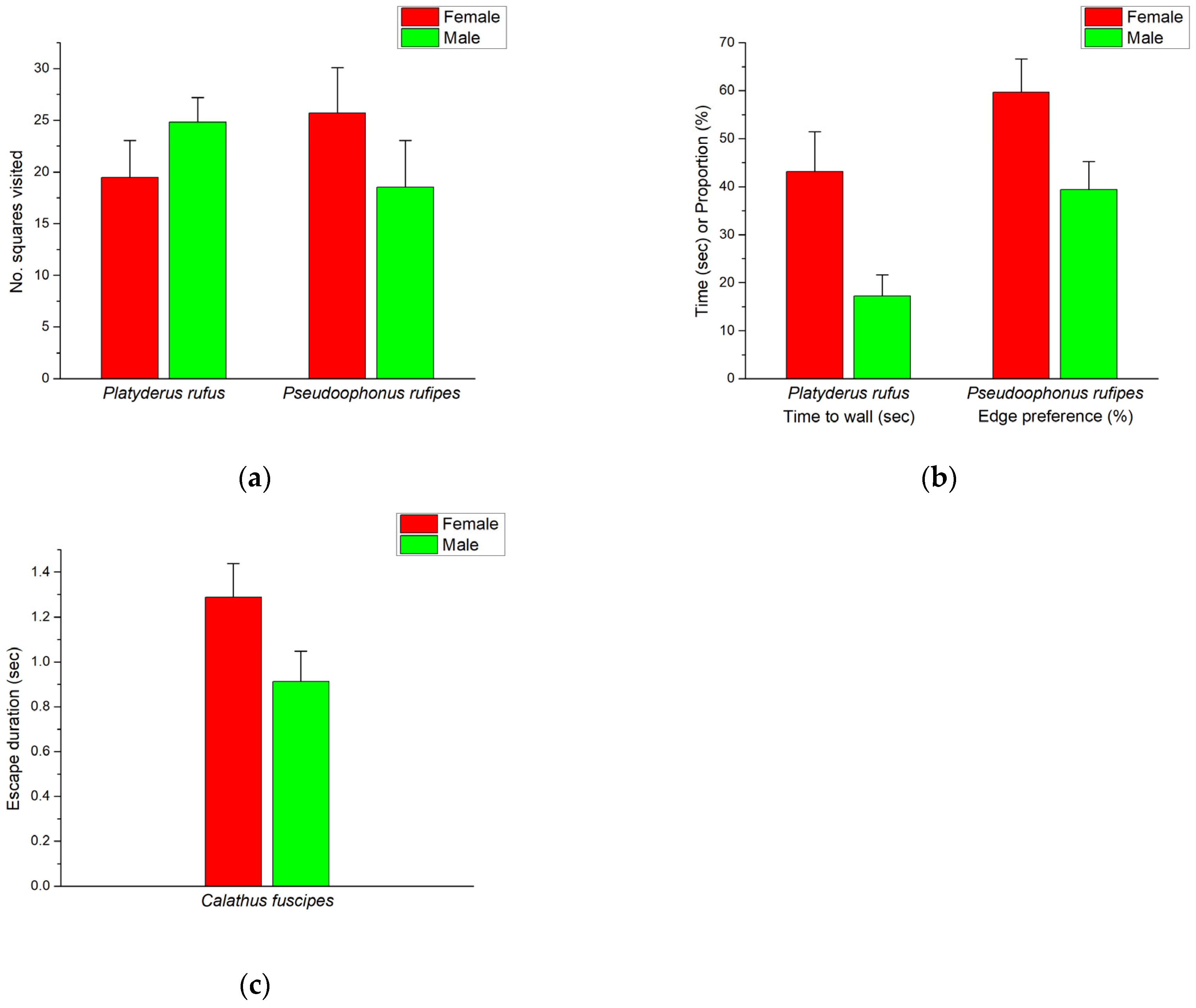
P. rufus males and P. rufipes females were significantly more active and exploratory than individuals of the opposite sex (Table S2, Figure 2a). P. rufus males reached the arena wall significantly faster than females, suggesting higher activity levels and greater boldness (Figure 2b). P. rufipes males spent significantly less time in squares adjacent to the arena wall than females, indicating increased exploratory behavior or boldness (Figure 2b). Finally, C. fuscipes males exhibited greater risk-taking behavior than females (significantly shorter escape duration Figure 2c).

4. Discussion

4.1. Behavioral Traits and Syndromes

In behavioral ecology, behavioral traits represent quantifiable aspects of behavior, such as activity, boldness, exploration, risk-taking, or aggression. These traits can vary substantially and are usually quantified using standardized behavioral measures under standardized laboratory or field conditions [50]. When individual differences in a behavioral trait are consistent over time and/or across different situations it indicates the existence of personality [13,50,51]. Personality traits are often intercorrelated, forming behavioral syndromes. For example, bold individuals are also more exploratory, and this bold–exploratory behavioral syndrome is observed both in predator-exposure and foraging contexts [50,51].
The significant Kendall’s coefficient of concordance in our study indicated that individuals were ranked consistently across multiple behavioral measures, including activity, exploration and boldness in a novel environment, and escape responses to a simulated attack. Such concordance among functionally different behavioral traits is consistent with the concept of behavioral syndromes [50,52]. The observed concordance across activity/exploratory/boldness- and escape-related behavior measures suggested the presence of a common latent behavioral axis, rather than methodological redundancy [53]. Most previous behavioral studies on ground beetles have focused on only one [22,24] or two [25] behavioral measures. Of the two earlier studies that examined several behavioral measures assessed in different contexts [21,23], only one tested and confirmed that individuals were ranked consistently [23], thereby demonstrating the existence of behavioral syndromes [50,52]. Overall, our findings, together with the previous study demonstrating consistent individual ranking [23] support the suitability of the chosen behavioral measures and highlight the importance of considering multivariate behavioral structure when characterizing inter-individual variation.
Behavioral syndromes are commonly discussed in relation to temporal consistency or repeatability underlying stable, consistent individual differences [52,53,54]. In the studied ground beetle species, only temporally consistent behavioral measures were evaluated. Agglomerative cluster analysis revealed two behavioral syndromes, the activity–exploratory–boldness and the risk-taking syndrome for C. fuscipes, while the activity–exploratory–boldness syndrome for P. rufipes. Previous studies demonstrated exactly the same behavioral syndromes both on the ground beetles Nebria brevicollis (Fabricius, 1792) [21] and Carabus convexus Fabricius, 1775 [23]) as well as on several rove beetles [31], suggesting that these syndromes may be uniform among beetles, regardless of the species studied.

4.2. Animal Personality

The concordance among functionally distinct behavioral traits and the existence of behavioral syndromes do not by themselves provide evidence for animal personality in the strict sense, which requires temporal or contextual consistency (repeatability) of individual differences [15,26,53]. Contrary to our hypothesis, we did not find temporally consistent and/or repeatable behavioral traits that would represent personality in all studied ground beetle species. Earlier studies on ground beetle Carabus hortensis Linnaeus, 1758 [22], C. convexus [23] and N. brevicollis [21,24,25] prove the presence of personality in these species. In our study some personality traits related to exploratory, and boldness were demonstrated for C. fuscipes, P. rufus, P. rufipes, and P. niger, while for traits representing risk-taking behavior, personality was revealed only for C. fuscipes.
Of the six ground beetle species examined, one species (P. strenuus) was collected from urban forest fragments. Based on previous studies, we would therefore have expected this species to exhibit personality traits typically associated with species inhabiting urban environments, such as higher activity, greater exploratory behavior, increased boldness, and elevated risk-taking [23,24,55]. Contrary to this assumption, animal personality could not be detected in P. strenuus. This pattern may be explained by the very small body size of this species (6–7 mm [56]), which makes it potential prey for a wide range of generalist predators. Consequently, a trade-off may exist between increased activity, exploration, boldness, and risk-taking on the one hand, and predation risk on the other [57].
Behavioral traits and the existence of personality may differ among species occupying different ecological niches [58]; therefore, it can be assumed that behavioral traits representing personality may also differ among habitat specialist vs. habitat generalist species. However, all the studied species were habitat generalists [59], occurring in both open (e.g., grasslands, meadows, clearings, etc.) and closed, forest-covered habitats [20]. Nonetheless, a previous study conducted in the Great Forest along a sylvicultural cycle clearly found significant differences in their habitat affinities [60]. Three species (P. rufus, P. melas, and P. niger) prefer closed-canopy forest stands, whereas C. fuscipes and P. rufipes are associated with still open, young (5-year-old) forest plantations [60].
In our study, P. rufus, P. melas, and P. niger occurred in their preferred closed-canopy forest stands. In P. melas, we did not detect temporally consistent behavioral traits, while in P. rufus and P. niger, temporal consistency was observed only in a limited number of the assessed behavioral traits. Contrarily, C. fuscipes and P. rufipes occurred outside their preferred open-canopy forest stands, and both showed the presence of personality in activity, exploratory behavior, and boldness, while C. fuscipes showed behavioral consistency also for risk-taking. In environments with stable abiotic and biotic conditions, individuals of a given species often do not exhibit pronounced differences in behavioral traits, as such variation does not contribute to increased fitness [37,50,61]. A key question in behavioral ecology is whether habitat selection is driven by personality, or whether personality changes in response to the environmental conditions [62,63]. Therefore, further research could establish whether individuals occurring outside their preferred habitats exhibit greater behavioral consistency than individuals living within their preferred habitats.

4.3. Sex-Specific Differences in Personality

Several species of beetles show no significant differences in behavior between sexes [37,64,65,66], while others do [23,24,31]. Similarly, in the present study, we confirmed sex-related behavioral differences only in some species. Therefore, our hypothesis that sex-dependent behavioral differences are common among ground beetles was only partially confirmed.
We proved higher activity and exploration, as well as greater boldness in P. rufus males than females. This pattern is consistent with previous studies on ground-dwelling beetles [24,31] and may be due to males generally being more active than females, particularly during the breeding season, when they actively search for mating partners [20,24]. Higher trapping rates of male than female P. rufus during its main reproductive period also support the greater mobility of males.
C. fuscipes males exhibited greater risk-taking behavior than females. In insects, sex-specific differences in risk-taking, anti-predator behavior are often linked to divergent reproductive roles and activity patterns. Males typically exhibit higher mobility associated with mate searching and may therefore adopt more risk-tolerance to simulated predator attacks, whereas females, facing higher reproductive investment and stronger selection on survival, tend to display more cautious behavior [67].
For P. rufipes, we obtained seemingly contradictory results. Females appeared to be significantly more active and exploratory than males. Considering edge preference, males appeared to be significantly more exploratory and bolder. This apparent contradiction arises from the significant relationship between the number of squares visited and the time spent in squares adjacent to the arena walls (see Table S1). Specifically, individuals exhibiting lower activity levels visited fewer squares overall, and consequently could spend less time in wall-adjacent squares. This indicated that time spent in squares adjacent to the arena walls may not be the most appropriate proxy for the activity and exploratory behavior. It is more appropriate to use the number of squares visited in a novel environment as a measure of activity and exploratory behavior [53,68]. Based on the above considerations, P. rufipes females were significantly more active and exploratory than males. Similarly, urban C. convexus females are more active and exploratory than males [23]. In ground beetles, sex-specific differences in reproductive strategies and reproductive investment arise as consequences of anisogamy. Females have to expend more energy into reproduction, as producing and ripening eggs is an energy intensive process, necessitating more active and exploratory behavior, especially in suboptimal habitats [20]. Furthermore, higher activity and exploration of P. rufipes females not caring for their eggs is essential to find favorable microsites for oviposition to ensure egg survival and successful hatching [20,69].

5. Conclusions

In conclusion, our study demonstrated that ground beetle behavior was structured along consistent multivariate axes, with activity, exploration, boldness, and risk-taking forming behavioral syndromes that are largely conserved across species. However, the presence and strength of animal personality varied among species and behavioral traits, highlighting the importance of ecological context. Moreover, sex-specific differences in behavior were species-dependent, reflecting contrasting reproductive investments. Overall, our findings emphasize that animal personality and behavioral syndromes in ground beetles are not fixed species properties but emerge from the interaction between intrinsic traits, and sex-specific strategies, underscoring the need to consider ecological context when interpreting behavioral variation.

Supplementary Materials

The following supporting information can be downloaded at https://www.mdpi.com/article/10.3390/d18020067/s1; Table S1: Spearman correlations between the temporally consistent behavioral measures (average of the two trials for each measure). Values in bold denote significant (p < 0.05) correlations; Table S2: Mean (±S.D.) values of the temporally consistent behavioral measures for all individuals, as well as for females, and males of the given ground beetle species.

Author Contributions

Conceptualization, T.M. and G.L.L.; methodology, T.M. and G.L.L.; formal analysis, T.M.; investigation, T.M., S.M., R.H. and M.T.; writing—original draft preparation, T.M. and G.L.L.; writing—review and editing, T.M., S.M., R.H., M.T. and G.L.L.; visualization, T.M. and G.L.L.; supervision, T.M.; funding acquisition, T.M. Authorship is by the “first-and-last-author-emphasis” (FLAE) principle. All authors have read and agreed to the published version of the manuscript.

Funding

This research was funded by the National Research, Development and Innovation Fund, grant number OTKA K-146628.

Institutional Review Board Statement

Ethical review and approval were waived for this study because its protocol did not involve invasive measurements in animals.

Data Availability Statement

Data used for analyses are available in the Mendeley repository (doi: 10.17632/g3bmkctpd3.1; https://data.mendeley.com/datasets/g3bmkctpd3/1, accessed on 19 January 2026).

Acknowledgments

We thank Réka Csicsek and Dávid D. Nagy for help during sampling, as well as the Department of Green Infrastructure of the Mayor’s Office of Debrecen, especially Orsolya Hamecz, for access to the study sites.

Conflicts of Interest

The authors declare no conflicts of interest.

References

  1. McGill, B.J.; Enquist, B.J.; Weiher, E.; Westoby, M. Rebuilding community ecology from functional traits. Trends Ecol. Evol. 2006, 21, 178–185. [Google Scholar] [CrossRef] [PubMed]
  2. Moretti, M.; Dias, A.T.C.; de Bello, F.; Altermatt, F.; Chown, S.L.; Azcárate, F.M.; Bell, J.R.; Fournier, B.; Hedde, M.; Hortal, J.; et al. Handbook of protocols for standardized measurement of terrestrial invertebrate functional traits. Funct. Ecol. 2017, 31, 558–567. [Google Scholar] [CrossRef]
  3. Violle, C.; Enquist, B.J.; McGill, B.J.; Jiang, L.; Albert, C.H.; Hulshof, C.; Jung, V.; Messier, J. The return of the variance: Intraspecific variability in community ecology. Trends Ecol. Evol. 2012, 27, 244–252. [Google Scholar] [CrossRef]
  4. Bolnick, D.I.; Amarasekare, P.; Araújo, M.S.; Bürger, R.; Levine, J.M.; Novak, M.; Rudolf, V.H.W.; Schreiber, S.J.; Urban, M.C.; Vasseur, D.A. Why intraspecific trait variation matters in community ecology. Trends Ecol. Evol. 2011, 26, 183–192. [Google Scholar] [CrossRef] [PubMed]
  5. Brousseau, P.-M.; Gravel, D.; Handa, I.T. On the development of a predictive functional trait approach for studying terrestrial arthropods. J. Anim. Ecol. 2018, 87, 1209–1220. [Google Scholar] [CrossRef]
  6. de Castro-Arrazola, I.; Andrew, N.R.; Berg, M.P.; Curtsdotter, A.; Lumaret, J.-P.; Menéndez, R.; Moretti, M.; Nervo, B.; Nichols, E.S.; Sánchez-Piñero, F.; et al. A trait-based framework for dung beetle functional ecology. J. Anim. Ecol. 2023, 92, 44–65. [Google Scholar] [CrossRef]
  7. Magura, T.; Horváth, R.; Mizser, S.; Tóth, M.; Lövei, G.L. Differences in morphology of rural vs. urban individuals of the flightless ground beetle, Carabus convexus. Insects 2025, 16, 430. [Google Scholar] [CrossRef]
  8. Chown, S.L.; Nicolson, S. Insect Physiological Ecology: Mechanisms and Patterns; Oxford University Press: Oxford, UK, 2004; ISBN 9780198515494. [Google Scholar]
  9. Hoffmann, A.A.; Sgrò, C.M. Climate change and evolutionary adaptation. Nature 2011, 470, 479–485. [Google Scholar] [CrossRef]
  10. Roff, D.A. Evolution of Life Histories: Theory and Analysis; Springer: New York, NY, USA, 1993; ISBN 978-0-412-02391-0. [Google Scholar]
  11. Simons, A.M. Modes of response to environmental change and the elusive empirical evidence for bet hedging. Proc. R. Soc. B Biol. Sci. 2011, 278, 1601–1609. [Google Scholar] [CrossRef]
  12. Sih, A.; Bell, A.M.; Johnson, J.C.; Ziemba, R.E. Behavioral syndromes: An integrative overview. Q. Rev. Biol. 2004, 79, 241–277. [Google Scholar] [CrossRef]
  13. Kralj-Fišer, S.; Schuett, W. Studying personality variation in invertebrates: Why bother? Anim. Behav. 2014, 91, 41–52. [Google Scholar] [CrossRef]
  14. Gyuris, E.; Feró, O.; Tartally, A.; Barta, Z. Individual behaviour in firebugs (Pyrrhocoris apterus). Proc. R. Soc. B Biol. Sci. 2011, 278, 628–633. [Google Scholar] [CrossRef] [PubMed]
  15. Wolf, M.; Weissing, F.J. Animal personalities: Consequences for ecology and evolution. Trends Ecol. Evol. 2012, 27, 452–461. [Google Scholar] [CrossRef] [PubMed]
  16. Modlmeier, A.P.; Liebmann, J.E.; Foitzik, S. Diverse societies are more productive: A lesson from ants. Proc. R. Soc. B Biol. Sci. 2012, 279, 2142–2150. [Google Scholar] [CrossRef] [PubMed]
  17. Pruitt, J.N.; Riechert, S.E. How within-group behavioural variation and task efficiency enhance fitness in a social group. Proc. R. Soc. B Biol. Sci. 2010, 278, 1209–1215. [Google Scholar] [CrossRef]
  18. Merckx, T.; Van Dyck, H. Habitat fragmentation affects habitat-finding ability of the speckled wood butterfly, Pararge aegeria L. Anim. Behav. 2007, 74, 1029–1037. [Google Scholar] [CrossRef]
  19. Wong, B.B.M.; Candolin, U. Behavioral responses to changing environments. Behav. Ecol. 2014, 26, 665–673. [Google Scholar] [CrossRef]
  20. Lövei, G.L.; Sunderland, K.D. Ecology and behavior of ground beetles (Coleoptera: Carabidae). Annu. Rev. Entomol. 1996, 41, 231–256. [Google Scholar] [CrossRef]
  21. Labaude, S.; O’Donnell, N.; Griffin, C.T. Description of a personality syndrome in a common and invasive ground beetle (Coleoptera: Carabidae). Sci. Rep. 2018, 8, 17479. [Google Scholar] [CrossRef]
  22. Yarwood, E.; Drees, C.; Niven, J.E.; Schuett, W. Sex-specific covariance between metabolic rate, behaviour and morphology in the ground beetle Carabus hortensis. PeerJ 2021, 9, e12455. [Google Scholar] [CrossRef]
  23. Magura, T.; Mizser, S.; Horváth, R.; Nagy, D.D.; Tóth, M.; Csicsek, R.; Lövei, G.L. Are there personality differences between rural vs. urban-living individuals of a specialist ground beetle, Carabus convexus? Insects 2021, 12, 646. [Google Scholar] [CrossRef]
  24. Schuett, W.; Delfs, B.; Haller, R.; Kruber, S.; Roolfs, S.; Timm, D.; Willmann, M.; Drees, C. Ground beetles in city forests: Does urbanization predict a personality trait? PeerJ 2018, 6, e4360. [Google Scholar] [CrossRef] [PubMed]
  25. Harris, C.; Liedtke, J.; Drees, C.; Schuett, W. Exploratory behaviour is not related to associative learning ability in the carabid beetle Nebria brevicollis. Behav. Process. 2020, 180, 104224. [Google Scholar] [CrossRef]
  26. Dall, S.R.X.; Houston, A.I.; McNamara, J.M. The behavioural ecology of personality: Consistent individual differences from an adaptive perspective. Ecol. Lett. 2004, 7, 734–739. [Google Scholar] [CrossRef]
  27. Niemelä, J.; Kotze, J.; Ashworth, A.; Brandmayr, P.; Desender, K.; New, T.; Penev, L.; Samways, M.; Spence, J. The search for common anthropogenic impacts on biodiversity: A global network. J. Insect Conserv. 2000, 4, 3–9. [Google Scholar] [CrossRef]
  28. Magura, T.; Mizser, S.; Horváth, R.; Tóth, M.; Likó, I.; Lövei, G.L. Urbanization reduces gut bacterial microbiome diversity in a specialist ground beetle, Carabus convexus. Mol. Ecol. 2024, 33, e17265. [Google Scholar] [CrossRef]
  29. Magura, T.; Mizser, S.; Horváth, R.; Tóth, M.; Kozma, F.S.; Kádas, J.; Lövei, G.L. Gut bacterial communities in the ground beetle Carabus convexus. Insects 2024, 15, 612. [Google Scholar] [CrossRef] [PubMed]
  30. Magura, T.; Mizser, S.; Horváth, R.; Nagy, D.D.; Tóth, M.; Csicsek, R.; Lövei, G.L. Differences in life history traits in rural vs. urban populations of a specialist ground beetle, Carabus convexus. Insects 2021, 12, 540. [Google Scholar] [CrossRef]
  31. Magura, T.; Horváth, R.; Mizser, S.; Tóth, M.; Nagy, D.D.; Csicsek, R.; Balla, E.; Lövei, G.L. Urban individuals of three rove beetle species are not more exploratory or risk-taking than rural conspecifics. Insects 2022, 13, 757. [Google Scholar] [CrossRef]
  32. Digweed, S.C.; Currie, C.R.; Cárcamo, H.A.; Spence, J.R. Digging out the digging-in effect of pitfall traps: Influences of depletion and disturbance on catches of ground beetles (Coleoptera: Carabidae). Pedobiologia 1995, 39, 561–576. [Google Scholar] [CrossRef]
  33. Leszek, G. Remarks on the differentiation in Carabidae mobility. Ekol. Pol. 1971, 19, 47–56. [Google Scholar]
  34. Elek, Z.; Růžičková, J.; Ódor, P. Individual decisions drive the changes in movement patterns of ground beetles between forestry management types. Biologia 2021, 76, 3287–3296. [Google Scholar] [CrossRef]
  35. Kortet, R.; Hedrick, A.N.N. A behavioural syndrome in the field cricket Gryllus integer: Intrasexual aggression is correlated with activity in a novel environment. Biol. J. Linn. Soc. 2007, 91, 475–482. [Google Scholar] [CrossRef]
  36. Málik-Roffa, H.; Tőzsér, D.; Tóthmérész, B.; Magura, T. BugTracker: Software for Tracking and Measuring Arthropod Activity. Diversity 2023, 15, 846. [Google Scholar] [CrossRef]
  37. Tremmel, M.; Müller, C. Insect personality depends on environmental conditions. Behav. Ecol. 2013, 24, 386–392. [Google Scholar] [CrossRef]
  38. Wexler, Y.; Subach, A.; Pruitt, J.N.; Scharf, I. Behavioral repeatability of flour beetles before and after metamorphosis and throughout aging. Behav. Ecol. Sociobiol. 2016, 70, 745–753. [Google Scholar] [CrossRef]
  39. Bell, A.M.; Hankison, S.J.; Laskowski, K.L. The repeatability of behaviour: A meta-analysis. Anim. Behav. 2009, 77, 771–783. [Google Scholar] [CrossRef]
  40. R Foundation for Statistical Computing. R Core Team R: A Language and Environment for Statistical Computing; R Foundation for Statistical Computing: Vienna, Austria, 2025. [Google Scholar]
  41. Bates, D.; Mächler, M.; Bolker, B.; Walker, S. Fitting linear mixed-effects models using lme4. J. Stat. Softw. 2015, 67, 1–48. [Google Scholar] [CrossRef]
  42. Fox, J.; Weisberg, S. An R Companion to Applied Regression; SAGE Publications: Thousand Oaks, CA, USA, 2018; ISBN 9781544336473. [Google Scholar]
  43. Venables, W.; Ripley, B. Modern Applied Statistics with S; Springer: New York, NY, USA, 2002; ISBN 0-387-95457-0. [Google Scholar]
  44. Zuur, A.; Ieno, E.N.; Walker, N.; Saveliev, A.A.; Smith, G.M. Mixed Effects Models and Extensions in Ecology with R; Springer: New York, NY, USA, 2009; ISBN 978-0-387-87457-9. [Google Scholar]
  45. Signorell, A.; Aho, K.; Alfons, A.; Anderegg, N.; Aragon, T.; Arachchige, C.; Arppe, A.; Baddeley, A.; Barton, K.; Bolker, B.; et al. DescTools: Tools for Descriptive Statistics 2021. Available online: https://cran.r-project.org/web/packages/DescTools/index.html (accessed on 21 December 2025).
  46. Hervé, M. RVAideMemoire: Testing and Plotting Procedures for Biostatistics 2021. Available online: https://cran.r-project.org/web/packages/RVAideMemoire/index.html (accessed on 21 December 2025).
  47. Stoffel, M.A.; Nakagawa, S.; Schielzeth, H. rptR: Repeatability estimation and variance decomposition by generalized linear mixed-effects models. Methods Ecol. Evol. 2017, 8, 1639–1644. [Google Scholar] [CrossRef]
  48. Maechler, M.; Rousseeuw, P.; Struyf, A.; Hubert, M.; Hornik, K. cluster: Cluster Analysis Basics and Extensions 2021. Available online: https://cran.r-project.org/web/packages/cluster/index.html (accessed on 21 December 2025).
  49. Rousseeuw, P.J. Silhouettes: A graphical aid to the interpretation and validation of cluster analysis. J. Comput. Appl. Math. 1987, 20, 53–65. [Google Scholar] [CrossRef]
  50. Sih, A.; Bell, A.; Johnson, J.C. Behavioral syndromes: An ecological and evolutionary overview. Trends Ecol. Evol. 2004, 19, 372–378. [Google Scholar] [CrossRef]
  51. Carere, C.; Maestripieri, D. Animal Personalities: Who Cares and Why? In Animal Personalities—Behavior, Physiology, and Evolution; Carere, C., Maestripieri, D., Eds.; University of Chicago Press: Chicago, IL, USA, 2013; pp. 1–10. ISBN 9780226922065. [Google Scholar]
  52. Bell, A.M. Future directions in behavioural syndromes research. Proc. R. Soc. B Biol. Sci. 2006, 274, 755–761. [Google Scholar] [CrossRef] [PubMed]
  53. Réale, D.; Reader, S.M.; Sol, D.; McDougall, P.T.; Dingemanse, N.J. Integrating animal temperament within ecology and evolution. Biol. Rev. 2007, 82, 291–318. [Google Scholar] [CrossRef] [PubMed]
  54. Carter, A.J.; Feeney, W.E.; Marshall, H.H.; Cowlishaw, G.; Heinsohn, R. Animal personality: What are behavioural ecologists measuring? Biol. Rev. 2013, 88, 465–475. [Google Scholar] [CrossRef]
  55. Kaiser, A.; Merckx, T.; Van Dyck, H. An experimental test of changed personality in butterflies from anthropogenic landscapes. Behav. Ecol. Sociobiol. 2020, 74, 86. [Google Scholar] [CrossRef]
  56. Ködöböcz, V. Ground Beetle Fauna of Hungary (Coleoptera: Carabidae); Rónaőrző Természetvédelmi Egyesület: Debrecen, Hungary, 2024; ISBN 978-615-02-2356-8. (In Hungarian) [Google Scholar]
  57. Amat, I.; Desouhant, E.; Gomes, E.; Moreau, J.; Monceau, K. Insect personality: What can we learn from metamorphosis? Curr. Opin. Insect Sci. 2018, 27, 46–51. [Google Scholar] [CrossRef] [PubMed]
  58. Katsis, A.C.; Colombelli-Négrel, D.; Akçay, Ç.; Common, L.K.; García-Loor, J.; Kleindorfer, S. Exploration behavior differs between Darwin’s finch species and predicts territory defense and hatching success. Behav. Ecol. Sociobiol. 2024, 78, 26. [Google Scholar] [CrossRef]
  59. Hůrka, K. Carabidae of the Czech and Slovak Republics; Kabourek: Zlin, Czech Republic, 1996; ISBN 978-80-901466-2-4. [Google Scholar]
  60. Magura, T.; Bogyó, D.; Mizser, S.; Nagy, D.D.; Tóthmérész, B. Recovery of ground-dwelling assemblages during reforestation with native oak depends on the mobility and feeding habits of the species. For. Ecol. Manag. 2015, 339, 117–126. [Google Scholar] [CrossRef]
  61. Dingemanse, N.J.; Both, C.; Drent, P.J.; Tinbergen, J.M. Fitness consequences of avian personalities in a fluctuating environment. Proc. R. Soc. B Biol. Sci. 2004, 271, 847–852. [Google Scholar] [CrossRef]
  62. Holtmann, B.; Santos, E.S.A.; Lara, C.E.; Nakagawa, S. Personality-matching habitat choice, rather than behavioural plasticity, is a likely driver of a phenotype–environment covariance. Proc. R. Soc. B Biol. Sci. 2017, 284, 20170943. [Google Scholar] [CrossRef]
  63. Bégué, L.; Peignier, M.; Ringler, E. The link between animal personality and habitat selection in males of the Neotropical poison frog Allobates femoralis. Behaviour 2023, 160, 257–274. [Google Scholar] [CrossRef] [PubMed]
  64. Nakayama, S.; Nishi, Y.; Miyatake, T. Genetic correlation between behavioural traits in relation to death-feigning behaviour. Popul. Ecol. 2010, 52, 329–335. [Google Scholar] [CrossRef]
  65. Monceau, K.; Moreau, J.; Richet, J.; Motreuil, S.; Moret, Y.; Dechaume-Moncharmont, F. Larval personality does not predict adult personality in a holometabolous insect. Biol. J. Linn. Soc. 2017, 120, 869–878. [Google Scholar] [CrossRef]
  66. Natta, G.; Laini, A.; Roggero, A.; Fabbriciani, F.; Rolando, A.; Palestrini, C. Behavioural repeatability and behavioural syndrome in the dung beetle Copris umbilicatus (Coleoptera, Scarabaeidae). Insects 2023, 14, 529. [Google Scholar] [CrossRef]
  67. Schuett, W.; Tregenza, T.; Dall, S.R.X. Sexual selection and animal personality. Biol. Rev. 2010, 85, 217–246. [Google Scholar] [CrossRef]
  68. Walsh, R.N.; Cummins, R.A. The open-field test: A critical review. Psychol. Bull. 1976, 83, 482–504. [Google Scholar] [CrossRef]
  69. Heessen, H.J.L. Egg Mortality in Pterostichus oblongopunctatus (Fabricius) (Col., Carabidae). Oecologia 1981, 50, 233–235. [Google Scholar] [CrossRef]
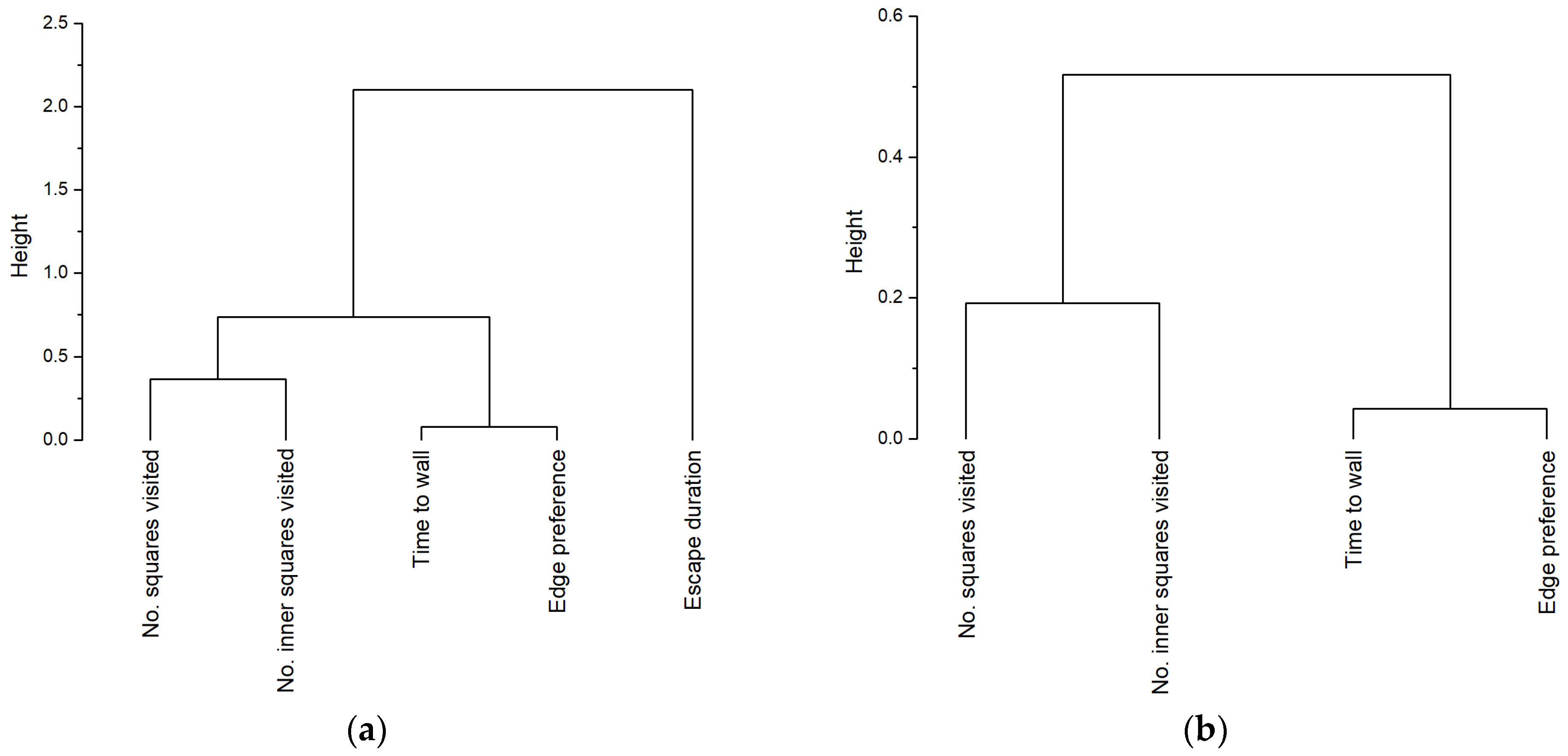
Figure 1. Grouping of the temporally consistent behavioral measures by agglomerative cluster analysis (agglomerative coefficient: 0.72, and 0.77, respectively) for Calathus fuscipes (a), and Pseudoophonus rufipes (b).
Diversity 18 00067 g001
Figure 2. Mean (±SE) values of behavioral measures that were significantly rank-consistent and/or repeatable: (a) Number of squares visited by individuals in the arena; (b) time taken by individuals to reach the arena wall and the proportion of time spent in squares adjacent to the wall; and (c) time spent running by individuals following a mechanical stimulus. All differences are statistically significant (p < 0.05; see Table 1 for exact values).
Diversity 18 00067 g002
Disclaimer/Publisher’s Note: The statements, opinions and data contained in all publications are solely those of the individual author(s) and contributor(s) and not of MDPI and/or the editor(s). MDPI and/or the editor(s) disclaim responsibility for any injury to people or property resulting from any ideas, methods, instructions or products referred to in the content.