Article

Impacts of Extreme Climatic Events on the Community Structure of Zooplankton in the Huayanghe Lakes


1
School of Resources and Environmental Engineering, Anhui University, Hefei 230601, China
2
Anhui Shengjin Lake Wetland Ecology National Long-Term Scientific Research Base, Chizhou 247230, China
3
School of Chemistry and Chemical Engineering, Anhui University, Hefei 230601, China
*
Author to whom correspondence should be addressed.
Diversity 2026, 18(2), 68; https://doi.org/10.3390/d18020068
Submission received: 4 January 2026 / Revised: 24 January 2026 / Accepted: 24 January 2026 / Published: 28 January 2026
(This article belongs to the Section Freshwater Biodiversity)

Abstract

Global climate change is intensifying extreme weather events such as floods and heatwaves, posing serious threats to lake ecosystems. The Huayanghe Lakes experienced a catastrophic flood in 2020 and a prolonged heatwave in 2022, providing an opportunity to compare zooplankton responses to contrasting extreme climate events. Based on summer water quality and zooplankton data collected from the Huayanghe Lakes during 2020–2023, this study used 2021 and 2023 as reference years to examine the summer zooplankton community state during the post-event period following extreme climate events. In 2020, 43 species belonging to 14 families and 25 genera were recorded, dominated by rotifers such as Polyarthra euryptera and Trichocerca spp., with a mean density of 239.26 ind./L. In contrast, 34 species from 12 families and 21 genera were identified in 2022, with dominant taxa including Diurella rousseoeti, Trichocerca cylindrica and Thermocyclops hyalinus, resulting in a lower mean density of 149.17 ind./L. Zooplankton density and species richness were higher during flood conditions but declined under prolonged heatwave conditions. Mantel correlation analysis identified water transparency as the primary environmental factor shaping zooplankton communities. Overall, zooplankton responded more strongly to flooding than to sustained heatwaves, indicating that different extreme climate events amplify the regulatory roles of distinct environmental drivers.

1. Introduction

Extreme climate events are defined as short-term (days to weeks) environmental disturbances that deviate markedly from long-term climatic baselines, leading to pronounced alterations in physicochemical conditions and disruptions of ecosystem functioning [1,2,3]. Against the backdrop of global climate change, the frequency, intensity, and duration of such events have increased markedly over recent decades [4,5,6]. Extreme climate phenomena, such as floods and prolonged heatwaves, profoundly affect the structure and functioning of lake ecosystems by modifying hydrological processes and nutrient regimes [7,8,9,10]. Flood events alter lake depth and water transparency through runoff scouring and increased water volume, while simultaneously delivering large inputs of terrestrial nutrients and particulate matter. These processes disrupt the balance of aquatic material cycles, resulting in abrupt, short-term fluctuations in water quality [11,12]. In contrast, persistent extreme heat elevates water temperature and reduces stratification stability, thereby accelerating biogeochemical processes and imposing sustained stress on aquatic organisms [9,13,14].
Zooplankton are a pivotal component of lake ecosystems, acting as primary consumers and forming a critical link in aquatic food webs [15,16,17]. Through top-down control, they regulate phytoplankton abundance and community structure [18], while also exerting bottom-up effects as prey that influence the population dynamics of higher trophic levels [19]. Their short life cycles, rapid growth rates, and high reproductive capacity render them highly sensitive to environmental fluctuations [20,21]. Consequently, zooplankton are widely regarded as ideal indicator organisms for assessing aquatic ecosystem health and responses to environmental stressors.
Flooding can induce pronounced alterations in hydrological conditions, including elevated water levels, reduced turbidity, and increased inputs of exogenous materials [22,23]. Rising water levels expand aquatic volume and enhance connectivity between lakes and river channels, thereby creating more complex habitats. These conditions provide suitable environments for zooplankton occupying diverse ecological niches and promote higher species diversity [24,25]. In contrast, reduced turbidity increases water transparency, substantially diminishing zooplankton concealment. As a result, predators such as fish and carnivorous invertebrates can more readily detect and prey upon zooplankton, leading to decreased survival rates and reduced population densities, particularly among visually exposed taxa such as cladocerans and copepods [26,27]. Moreover, terrestrial nutrients introduced during flood events can stimulate phytoplankton growth and increase primary productivity, which may, to some extent, provide additional food resources for zooplankton and thereby mitigate the negative effects of flood disturbances [28,29].
Persistent high temperatures primarily influence zooplankton communities by elevating water temperature and altering physicochemical conditions. Increased temperatures directly enhance zooplankton metabolic rates and affect growth and reproductive processes, thereby reshaping community composition [30,31]. High-temperature conditions typically favour small, thermotolerant species (e.g., certain rotifers) while disadvantaging larger cladocerans and copepods, resulting in community “miniaturisation” [32,33]. In addition, sustained heatwaves are often accompanied by reduced water levels and increased turbidity, which indirectly impose stress on zooplankton communities by compressing habitat space and diminishing environmental suitability [34,35].
The Huayanghe Lakes are located in a subtropical monsoon climate zone and are frequently affected by extreme weather events. Previous studies have shown that the restoration of aquatic vegetation in this system enhances zooplankton species diversity and density [36]. Zooplankton communities display pronounced seasonal dynamics, primarily regulated by key environmental factors such as water temperature and water transparency [37]. Recent research further indicates that flood events increase total nitrogen concentrations, promoting rotifer species richness while reducing the diversity of cladocerans and copepods [38]. However, existing studies have largely focused on conventional hydrological variability or single extreme events. Consequently, a comprehensive understanding of how different types of extreme climate events influence zooplankton community structure and the underlying mechanisms in connected shallow lakes remains limited.
Against this backdrop, we systematically compared the ecological effects of two distinct extreme events—the catastrophic flood in 2020 and the prolonged heatwave in 2022—using continuous summer monitoring data collected from the Huayanghe Lakes between 2020 and 2023. Differences between floods and heatwaves in hydrological processes, material inputs and physicochemical conditions are expected to drive distinct summer response trajectories in zooplankton community composition, density and diversity under contrasting climatic contexts. We hypothesise that distinct types of extreme events drive contrasting patterns of change in zooplankton communities by modifying combinations of key environmental factors and the intensity of their effects. Accordingly, this study addresses the following questions: (1) How do extreme climate events affect environmental factors? (2) How do zooplankton communities respond to floods and heatwaves? (3) Which environmental factors play dominant roles under different climatic events? This research aims to provide scientific evidence to support the adaptive management of wetland lake ecosystems under climate change and to offer a theoretical basis for the development of conservation and regulation strategies.

2. Materials and Methods

2.1. Study Area

This study focused on zooplankton communities in the Huayanghe Lakes. To minimise seasonal effects, zooplankton and water quality data were collected during the summer periods from 2020 to 2023. A total of 24 sampling sites were established along the Huayanghe Lakes (Figure 1). Sampling was conducted on four occasions: August 2020, July 2021, August 2022, and July 2023.
According to the Anhui Provincial Climate Bulletin (http://ah.cma.gov.cn), the average precipitation across Anhui Province during the summer of 2020 (June–August) reached 960 mm, substantially exceeding the long-term summer average of approximately 569 mm. The resulting rise in water levels caused the Huayanghe Lakes to exceed their warning levels, with the peak water level reaching 16.42 m [38]. Accordingly, 2020 was designated as the flood year in this study. During the summer of 2022 (June–August), the provincial mean air temperature was 29.1 °C, representing an anomaly of 2.2 °C above the long-term seasonal mean. In addition, Anhui Province experienced 43 high-temperature days during the summer, which was 26 days more than the long-term seasonal average and the highest number on record for this period. Therefore, 2022 was defined as the year of the prolonged heatwave event in this study.
Based on meteorological data from the Anhui Provincial Climate Bulletin, interannual variations in summer precipitation and the number of high-temperature days were evaluated relative to long-term climatological means. As shown in Figure S1, neither variable in 2021 nor 2023 deviated markedly from historical averages; therefore, these years were classified as climatically normal.

2.2. Sample Collection and Analysis

Qualitative samples of rotifers were collected utilising a plankton net with a pore size of 64 μm, dragged on the surface of the water in an ‘∞’ trajectory for 3 to 5 min. The drag speed was kept at 20~30 cm/s. Each net tow filtered approximately 1–3 m3 of water, and this towing approach was employed to increase spatial coverage. After the collection was completed, the piston at the bottom of the net was opened, and the samples were filtered into a 50 mL centrifugal tube; quantitative samples were collected using a 1 L sample bottle. After transport to the laboratory, water samples were transferred into sedimentation cylinders (1 L volume, 20 cm settling height) and allowed to settle undisturbed for 24 h. This settling period ensured complete sedimentation of zooplankton and complied with standard plankton analysis protocols. The supernatant was then siphoned off using a tube with an inner diameter of 3–5 mm, leaving approximately 100 mL of concentrated sediment, which was gently resuspended and transferred into sample bottles. A small volume of distilled water was subsequently added to the sedimentation cylinder to rinse residual material from the walls, which was combined with the sample. The samples were allowed to settle again and were finally adjusted to a volume of 30 mL. Qualitative and quantitative samples of rotifers were fixed by adding 1 mL and 10 mL of Lugol’s solution, respectively.
The qualitative samples of copepods were collected using a plankton net with a pore size of 112 μm, which was dragged in the water surface layer in an ‘∞’ trajectory for 3 to 5 min. A drag speed of 20–30 cm/s was maintained. After the sampling was completed, the net was slowly lifted, the zooplankton were gathered at the mouth of the net, and the piston was opened to collect them in a 50 mL quantitative bottle. Quantitative samples were accumulated in 10 L of water with a water collector, filtered through a 25# plankton net with a pore size of 64 μm into a 50 mL centrifuge tube, and then fixed to a volume of 30 mL after 24 h of resting; 1 mL of 4% formaldehyde solution was added to both qualitative and quantitative samples of crustacean zooplankton for fixation.
Species were identified under a light microscope (Olympus, BX 53) with reference to “Chinese Freshwater Rotifers” [39], “Annotated Checklist of Chinese Cladocera” [40], and “Fauna Sinica: Crustacea-Freshwater Copepoda” [41]. Additionally, we have designated this book as a comprehensive regional priority research project [42]. Zooplankton were identified to the lowest possible taxonomic level, preferably to species level, and otherwise to genus level.
Field measurements of water quality, including water temperature (WT), dissolved oxygen (DO), electrical conductivity (EC), and pH, were made in the Huayanghe Lakes with a HACH HQ40d portable water quality analyser. Turbidity (Turb) was measured with a Hach 2100Q portable turbidimeter. Transparency (SD) was measured by Secchi Disk and water depth (WD) was measured with a depth sounder. In the laboratory, water quality chemical indicators such as chlorophyll-a and nutrient concentrations were determined by ammonium molybdate spectrophotometry for total phosphorus (TP), alkaline potassium persulfate digestion for total nitrogen (TN), and acetone extraction spectrophotometry for chlorophyll.a (Chl.a).

2.3. Data Analysis

1.
Zooplankton dominance, diversity calculation [43,44,45]
Species   dominance   ( Y ) :   Y = n i N f i
Shannon Wiener   diversity   index   ( H ) :   H = i = 1 S n i N ln ( n i N )
Pielou   evenness   index   ( J ) :   J = H / ln S
Margalef   richness   index   ( D ) :   D = ( S 1 ) / ln N
where ni is the density of species i, N is the total density of species, fi is the frequency of occurrence of species i, and S is the total number of species at the sampling site. Y ≥ 0.02 indicates that the zooplankton is the dominant species [46].
2.
Statistical analysis of data
Non-metric multidimensional scaling (NMDS; “vegan” package [47]) was used to characterise differences in community composition among years, based on a Bray–Curtis dissimilarity matrix calculated from species abundance data and ordinated in two dimensions. Ordination stability was evaluated using stress values. Differences among groups were tested using PERMANOVA (adonis2, 999 permutations), and key taxa contributing to community dissimilarities were identified using SIMPER analysis. All analyses were performed in R, and statistical significance was set at p < 0.05. The calculation of alpha diversity indices was conducted using the R package “vegan” (version 2.6-8). To examine differences across years, the Kruskal–Wallis test was employed for overall comparisons. Where overall differences were significant (p < 0.05), Dunn’s post hoc multiple comparison test (Dunn’s test) was further applied for pairwise comparisons between years. The resulting p-values were corrected using the FDR (Benjamini–Hochberg) procedure to control the false discovery rate due to multiple testing. Visualization of diversity indices was performed with the “ggplot2” package [48], where significant differences among groups are indicated by lettering notation. All analyses were conducted in R version 4.4.2. Analysing the correlation between environmental factors using Spearman’s correlation coefficient method, we calculated the correlation between the density of zooplankton and the environmental factors with Mantel’s test. Prior to analysis, environmental variables were log-transformed using lg (x + 1). Redundancy analysis (RDA) was conducted in R using the vegan package. Zooplankton density data were subjected to Hellinger transformation to reduce the influence of rare taxa and zero values on community distance calculations. RDA models were constructed based on the transformed species matrix and the environmental variable matrix. Variables with variance inflation factors (VIFs) greater than 10 were excluded to minimise collinearity, and the significance of the overall RDA model was evaluated using Monte Carlo permutation tests with 999 permutations. The independent contributions of individual environmental variables to community variation were quantified using hierarchical partitioning implemented in the “rdacca.hp” package [49] and were expressed as relative percentage contributions. In addition, permutation tests for individual environmental variables were performed using the envfit function to assess the significance of their relationships with community structure.

3. Results

3.1. Water Environment Indicators

The results indicate that flood years exhibited the greatest water depth, reaching 5.96 ± 0.87 m, which was approximately 2–3 m higher than in the baseline years. In contrast, prolonged heatwave years recorded the highest water temperature (32.59 ± 0.68 °C), approximately 2–3 °C higher than in the baseline years, and were accompanied by a marked decrease in water depth. Moreover, flood years were characterised by the lowest turbidity and the highest water transparency, while total nitrogen and total phosphorus concentrations remained relatively elevated. Turbidity during prolonged heatwave years exceeded that observed in the other years (Table 1).

3.2. Zooplankton Community Composition

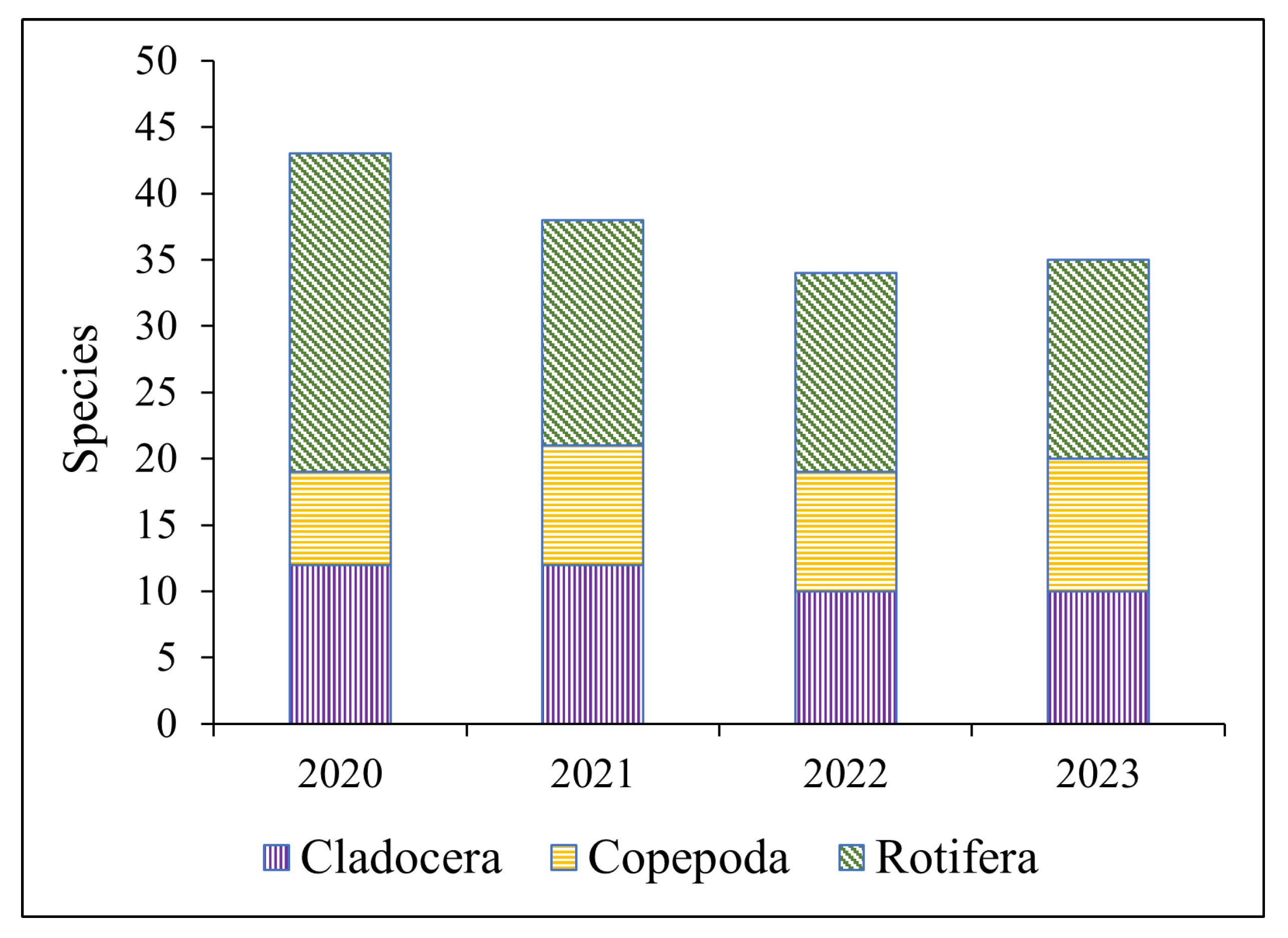
In this study, a total of 56 zooplankton species belonging to 28 genera and 14 families were identified. Among them, rotifers comprised 31 species across 12 genera and 6 families, accounting for 55.4% of the total species richness; cladocerans comprised 15 species across 10 genera and 5 families (26.8%); and copepods comprised 10 species across 9 genera and 5 families (17.8%) (Figure 2).
The highest zooplankton species richness, with 43 species, was recorded during the late flood period in August 2020, whereas the lowest richness (34 species) occurred during the prolonged heatwave in August 2022. Rotifers constituted the dominant taxonomic group in terms of species composition in each summer sampling period as well as across the entire study period.
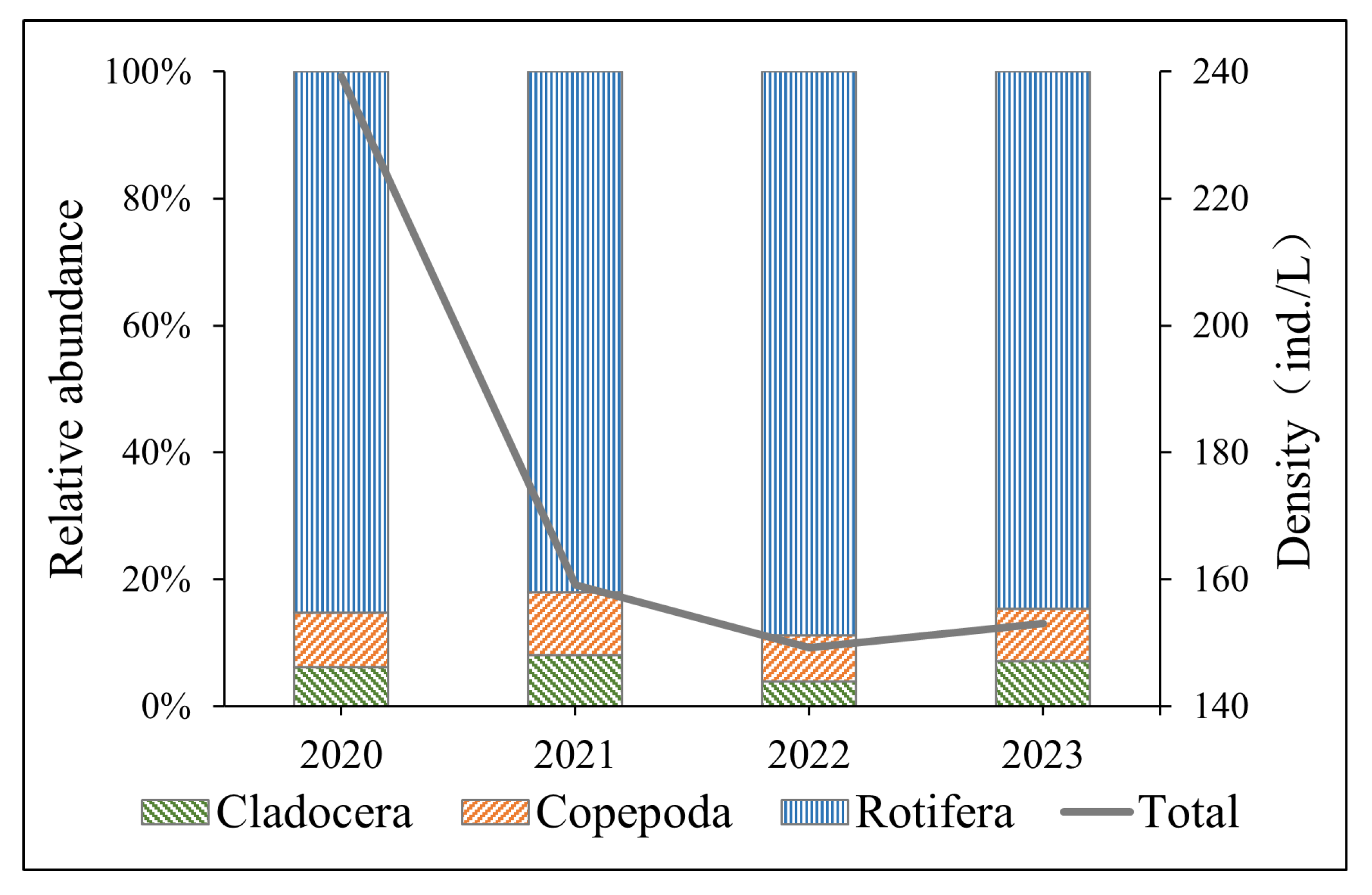
The lowest mean zooplankton density was recorded in the summer of 2022, at 149.17 ind./L, whereas the highest mean density occurred in the summer of 2020, reaching 239.26 ind./L (Figure 3).
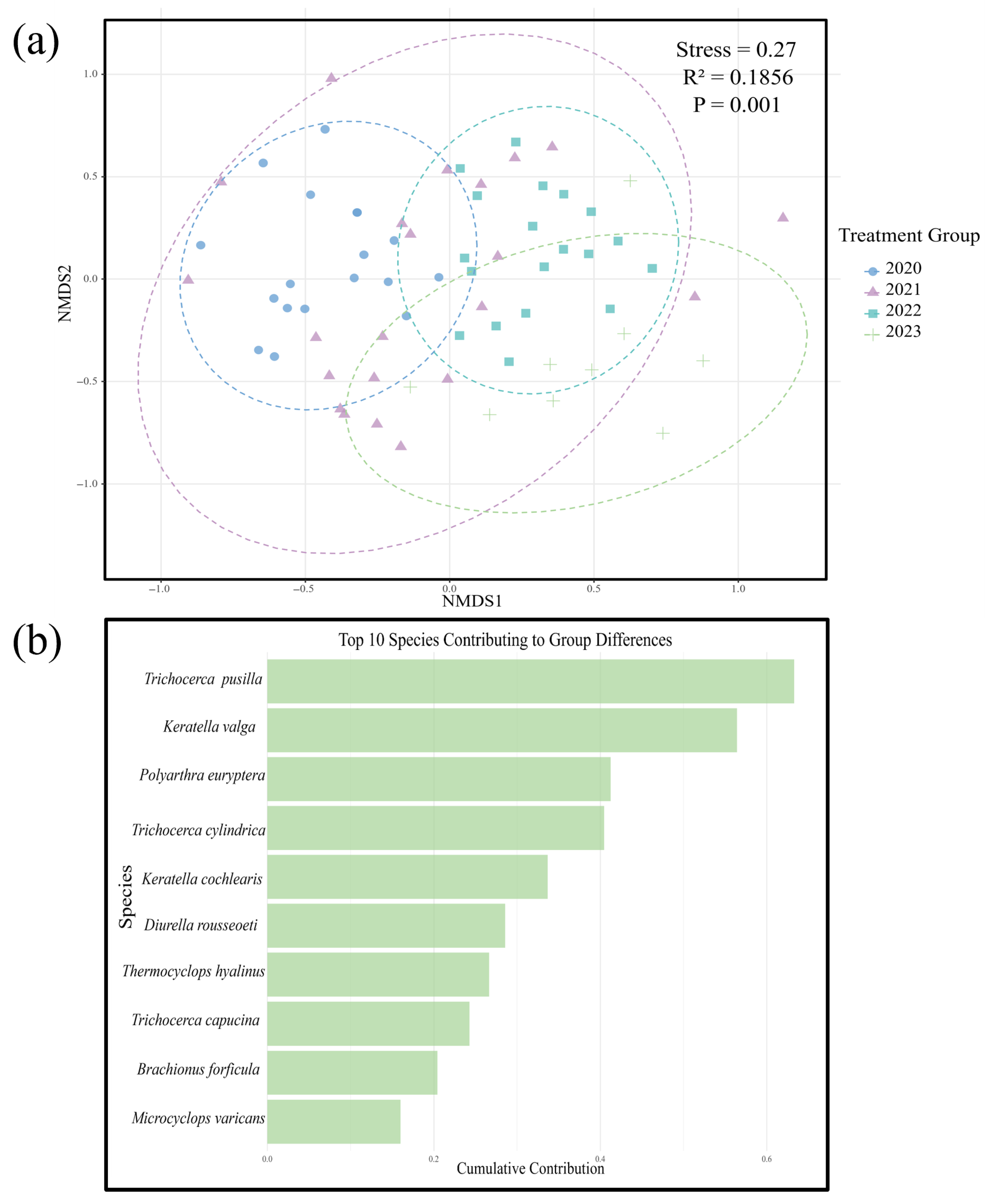
NMDS ordination combined with PERMANOVA indicated significant interannual differences in zooplankton community composition (R2 = 0.1856, p = 0.001). SIMPER analysis identified ten taxa contributing most to the observed dissimilarities among years, with Trichocerca pusilla, Keratella valga and Polyarthra euryptera showing the highest contributions. These key species may exhibit differential responses under varying climatic conditions across different years, thereby contributing to pronounced shifts in zooplankton community structure (Figure 4).
During the study period, a total of 15 dominant zooplankton species were identified, belonging to 11 genera and 6 families (Table 2).
The highest number of dominant species was recorded in 2020, with eight species, primarily Polyarthra euryptera and Trichocerca spp. In 2022, five dominant species were identified, including three rotifers (Trichocerca cylindrica, Diurella rousseoeti and Trichocerca capucina), Bosminopsis deitersi and Thermocyclops hyalinus. The dominant species in the summer of 2021 were Bosmina longirostris, Brachionus forficula, Keratella valga and Trichocerca pusilla, whereas those in the summer of 2023 were Mesocyclops leuckarti, Microcyclops varicans, Thermocyclops hyalinus and Trichocerca spp.

3.3. Zooplankton Diversity Index

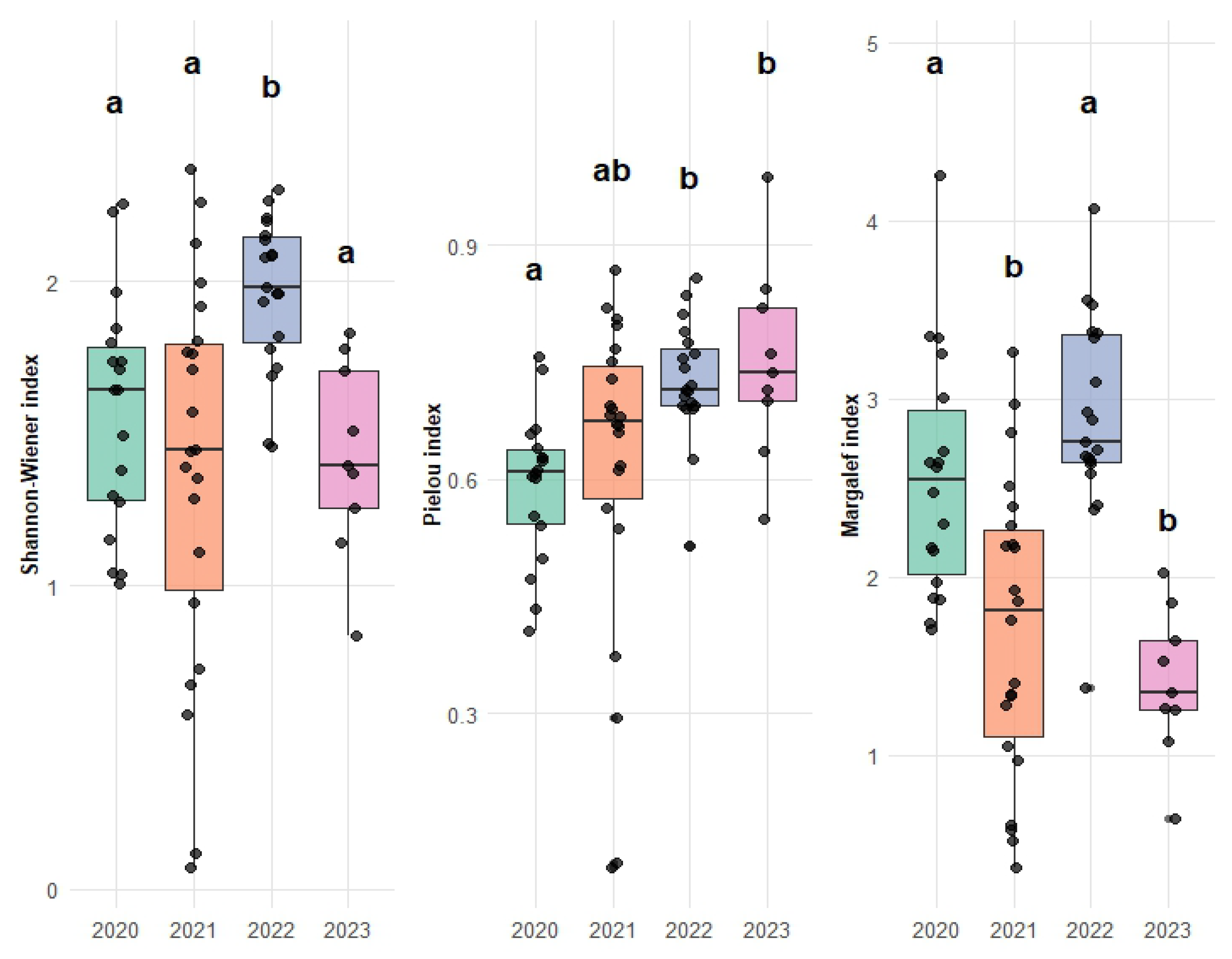
During the flood year, the Shannon–Wiener diversity index (H′) of zooplankton was 1.57 ± 0.38, the Pielou evenness index (J) was 0.59 ± 0.09, and the Margalef richness index (D) was 2.56 ± 0.66. Compared with the baseline years, H′ and D were higher, whereas J was the lowest. During the heatwave year, the Shannon–Wiener diversity index (H′) was 1.96 ± 0.24, the Pielou evenness index (J) was 0.73 ± 0.08, and the Margalef richness index (D) was 2.89 ± 0.57. Compared with the baseline years, H′ and D reached their highest values (Figure 5).

3.4. Relationship Between Community Structure and Environmental Factor

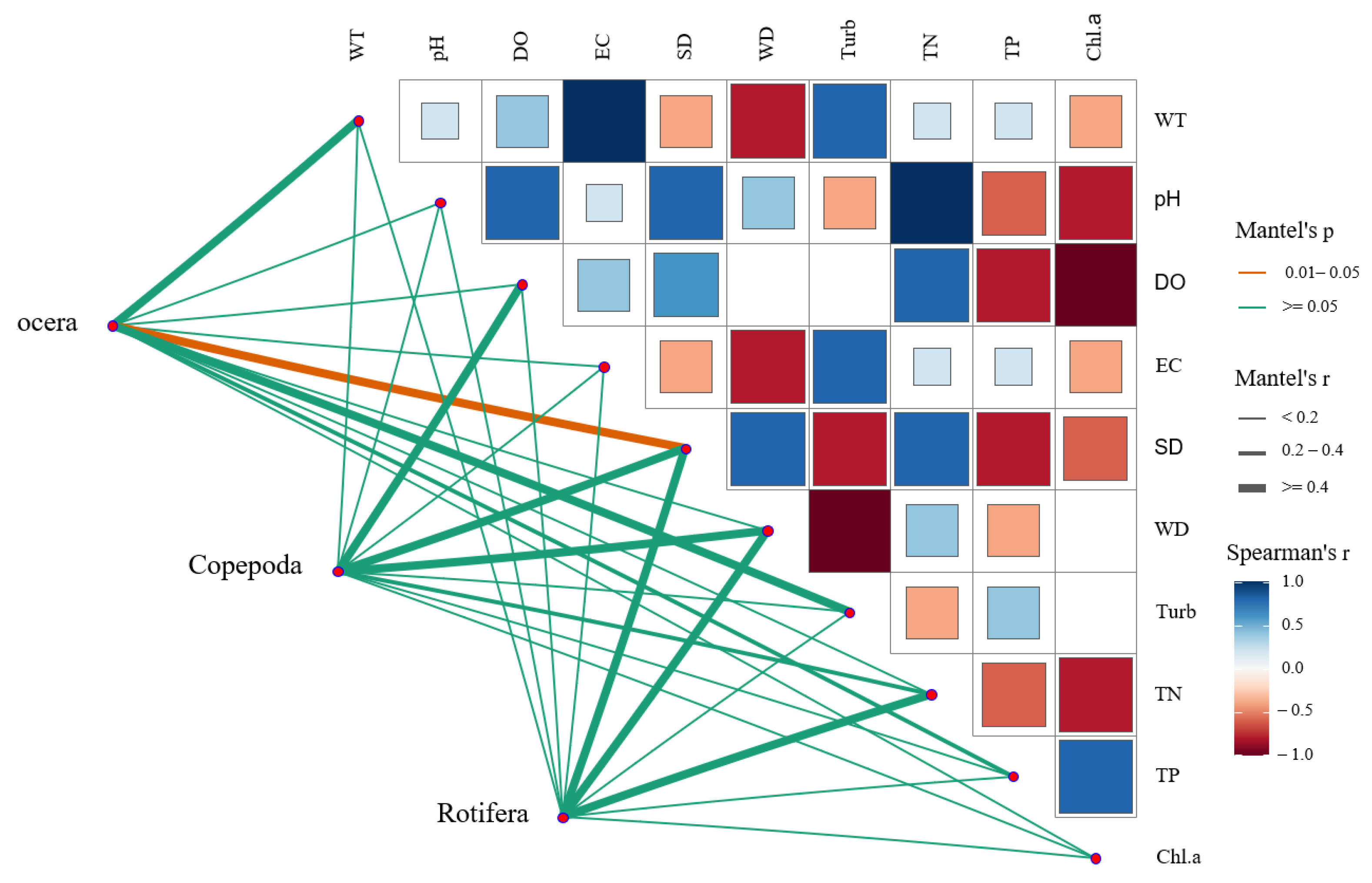
Mantel analysis was employed to examine the relationships between zooplankton densities (cladocerans, copepods, and rotifers) and environmental variables in the Huayanghe Lakes from 2020 to 2023. The Mantel test combined with correlation heatmap analysis indicated that water transparency was the primary environmental factor influencing zooplankton community structure. Cladocerans exhibited a significant positive correlation with transparency (r = 0.922, p < 0.05). Water temperature and turbidity exerted stronger effects on cladoceran density, whereas dissolved oxygen, transparency, and water depth significantly influenced copepod density. In addition, dissolved oxygen, transparency, and total nitrogen were identified as key factors affecting rotifer density (Figure 6). Detailed statistical parameters are provided in Table S1.
Spearman’s correlation analysis is used to illustrate the correlation between environmental factors, which is presented in a heat map. In the heat map, the darkness of the colours and the size of the squares are closely related to the strength of the correlation; the darker the colour and the larger the square, the stronger the correlation between the environmental factors. The analysis revealed a negative correlation between chlorophyll.a and dissolved oxygen, a negative correlation between turbidity and water depth, a positive correlation between electrical conductivity and dissolved oxygen, and a positive correlation between total nitrogen and pH.
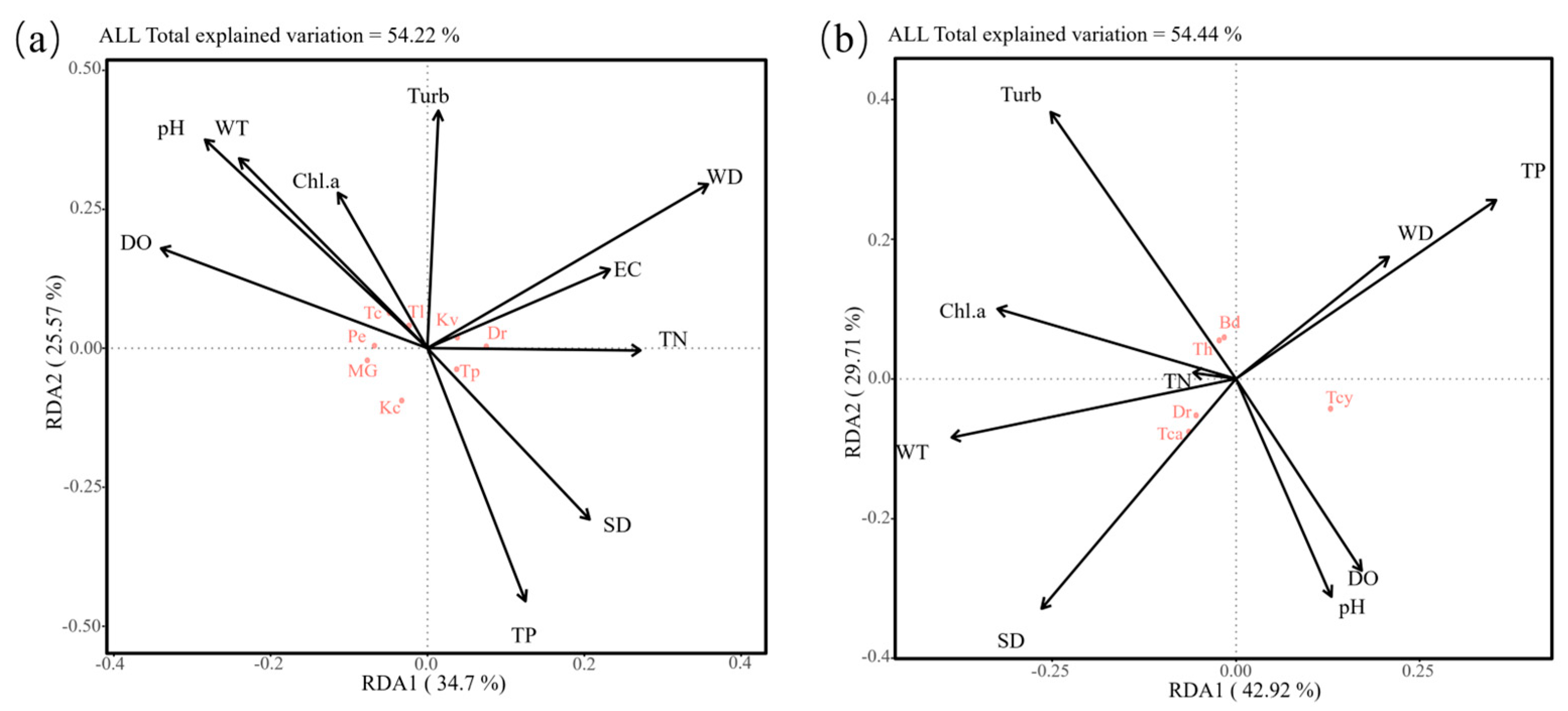
Given the occurrence of an extreme flood event in summer 2020 and a prolonged heatwave in summer 2022, redundancy analysis (RDA) was conducted using the densities of dominant zooplankton species and environmental variables to explore the effects of these extreme climatic events on community structure. In 2020, pH, chlorophyll.a, water temperature and dissolved oxygen were positively associated with Trichocerca lophoessa, Trichocerca capucina and Polyarthra euryptera, whereas total phosphorus and transparency were positively associated with Trichocerca pusilla. Total nitrogen, electrical conductivity, and water depth were positively associated with Diurella rousseoeti and Keratella valga, while turbidity showed a negative association with Monostyla bulla Gosse. Among all environmental variables, water temperature explained the largest proportion of variation in zooplankton community structure (15.87%; Figure S2). In 2022, water temperature and transparency were positively associated with Trichocerca capucina and Diurella rousseoeti, but negatively associated with Trichocerca cylindric, whereas pH and dissolved oxygen showed positive associations with Trichocerca cylindric. Total phosphorus and turbidity emerged as the most influential explanatory variables, accounting for 20.59% and 19.08% of the explained variation, respectively. In both 2020 and 2022, the RDA models explained more than 54% of the variation in zooplankton community structure. Several environmental variables exhibited similar directions and small angles in the ordination space, indicating strong intercorrelations among these factors. Consequently, variation in community structure was largely characterised by the shared explanatory effects of multiple environmental drivers (Figure 7).

4. Discussion

4.1. Response of Zooplankton to Flooding

The findings of this study indicate that water depth during flood years was significantly greater than in other years, accompanied by elevated concentrations of total nitrogen and total phosphorus. High-intensity, rainfall-driven runoff rapidly entered the lake over a short period, leading to a sharp rise in water level and the formation of a typical flood event. The increased water level inundated surrounding farmland, mobilising nutrients such as fertilisers and thereby increasing nitrogen and phosphorus concentrations in the water body [50,51]. Moreover, the initial stage of flooding typically results in a marked increase in water turbidity due to the transport of large amounts of suspended sediments and enhanced hydrodynamic disturbance. However, the August 2020 sampling was conducted during a period of relative hydrological stability following the flood event [52]. At this stage, elevated water levels reduced the influence of wind-driven waves on bottom-water circulation, thereby weakening sediment resuspension. This facilitated the settling of suspended particles, leading to improved underwater light conditions and increased water transparency [12,53]. In clear-water conditions, zooplankton experience intensified predation pressure [54], often leading to a shift in community composition toward smaller-bodied, short-generation taxa with greater tolerance to predation risk [55]. In contrast, rising water levels increase water volume and inundate shoals and riparian zones, rapidly expanding available habitat space and enhancing ecological heterogeneity [56].
In this study, zooplankton density increased during flood years compared with the baseline years. Typically, the initial stage of flooding disrupts zooplankton populations and leads to a temporary decline in density. However, by August, when hydrological conditions had become relatively stable, the zooplankton community had already begun to recover. The expansion of water volume during floods provides a spatial foundation for zooplankton [57,58]. In addition, nutrient inputs, particularly nitrogen and phosphorus, delivered by floodwaters provide the material basis for phytoplankton growth, indirectly enhancing food availability for zooplankton [59,60]. Furthermore, elevated water levels and increased water transparency favour more stable stratification and improved light conditions, thereby promoting primary productivity [61,62].
Similarly, zooplankton species richness increased during flood years. Flood events disrupted previously stable community structures, effectively resetting competitive dynamics. During this period, environmental filtering and interspecific interactions had not yet fully re-established, and dominant taxa had not formed stable dominance patterns, thereby allowing opportunistic species to rapidly increase in abundance. Moreover, enhanced hydrological connectivity during floods likely facilitated the introduction of allochthonous species, while sediment disturbance may have triggered the hatching of dormant eggs. Consistent with this interpretation, species such as Camptocercus rectirostris and Trichocerca rattus were recorded in 2020 but had not been observed prior to the flood event [63]. Some zooplankton taxa are characterized by inherently high population densities, short generation times, and strong environmental tolerance within the Huayanghe Lakes [64,65,66], enabling them to respond rapidly to flood-induced disturbances and maintain population persistence [21,67]. In contrast, cladocerans and copepods generally exhibit weaker resistance and resilience to environmental disturbances than rotifers [68,69]. Consequently, flood years were characterized by pronounced rotifer dominance in both species composition and relative abundance, resulting in a shift in community structure toward smaller-bodied taxa. Such community miniaturization represents a common zooplankton response to environmental disturbance [70].
It is noteworthy that although flooding generated short-term instability and increased species richness, the benefits of disturbance were unevenly distributed across taxonomic groups. As a result, a few opportunistic or tolerant taxa rapidly became dominant, with Polyarthra euryptera and Trichocerca spp. emerging as the primary dominant groups. In contrast, newly introduced species largely remained at low abundances during the colonisation phase, leading to a decline in community evenness.

4.2. Response of Zooplankton to Prolonged Heatwaves

Prolonged heatwaves are often accompanied by drought conditions and reduced precipitation. Insufficient inflow to lakes, combined with enhanced evaporation, leads to declining water levels. Lower water levels facilitate the disturbance and resuspension of bottom sediments, resulting in reduced water transparency and increased turbidity [71]. Prolonged heatwaves also directly drive increases in water temperature. Elevated temperatures accelerate algal growth and metabolic rates, enhancing the uptake and utilisation of nitrogen and phosphorus. This process disrupts the original distribution patterns and cycling equilibrium of nutrients within the water body. Following algal senescence and mortality, microbial decomposition releases substantial amounts of organic matter into the water. The resulting suspended material further reduces water transparency and increases turbidity [21,31].
Prolonged heatwaves substantially alter zooplankton community structure. On the one hand, prolonged heatwaves directly elevate water temperature in the Huayanghe Lakes (Table 1), accelerating zooplankton metabolic rates and shortening life cycles [34]. On the other hand, elevated temperatures lead to habitat contraction, increasing zooplankton exposure and intensifying predation pressure, with larger taxa being particularly affected [25,72]. Moreover, thermal stress induced by prolonged heatwaves can exceed the physiological tolerance thresholds of temperature-sensitive species, amplifying their competitive disadvantage and triggering population declines or even local extinctions among sensitive taxa. Certain thermotolerant cladocerans and copepods exhibit significantly increased nitrogen excretion rates with rising temperatures while maintaining high metabolic and physiological activity [73,74,75,76]. Consequently, zooplankton communities gradually become dominated by a few thermotolerant species, such as Bosminopsis deitersi and Thermocyclops hyalinus. Under thermal stress, both zooplankton density and species richness declined; however, total density decreased more sharply than species richness. As the Margalef richness index is calculated based on species richness and total density, this disproportionate reduction resulted in an apparent increase in the Margalef richness index. At the same time, thermal stress eliminated most sensitive species, leaving a subset of tolerant taxa coexisting at similarly low abundances. This led to a more even, albeit unstable, community structure. Consequently, despite the decline in species richness, the increase in Pielou’s evenness index may still produce an apparent rise in the Shannon–Wiener diversity index.
From an ecological threshold perspective, the prolonged heatwave did not induce abrupt responses in the zooplankton community [77,78]. Although water temperature increased concurrently with declining water levels and elevated turbidity, changes in community structure and diversity occurred gradually. No sudden species losses or significant functional group replacements were observed. The persistence of dominant groups suggests that the lake system possesses a certain degree of ecological resilience to high-temperature disturbances.

4.3. Integrated Impacts of Extreme Climate Events on Ecosystems

The combined ecological responses to flooding and prolonged heatwaves reveal pronounced differences in both the intensity and hierarchical levels at which distinct extreme climate events affect lake ecosystems. As an abrupt hydrological disturbance, flooding exerts strong influences on lake environmental conditions and zooplankton community structure, leading to significant short-term community reorganization [57,79,80]. In contrast, prolonged heatwaves primarily drive gradual adjustments in community structure without inducing abrupt shifts in ecosystem state [70,81].
From the perspective of overall response characteristics, both zooplankton community indices and environmental variables exhibited pronounced changes during flood years. In contrast, under prolonged heatwave conditions, although water temperatures increased and reductions in diversity and shifts in dominant species were observed, community structure followed a pattern of continuous adjustment, with dominant taxa persisting. This divergence suggests that zooplankton communities in the Huayanghe Lakes are more sensitive to hydrological extremes, while exhibiting a certain buffering capacity against thermal extremes. During the study period, flooding emerged as the primary extreme climatic driver of community shifts, whereas the ecological effects of prolonged heatwaves were expressed mainly through cumulative and structural adjustments [70,80].
Previous studies have similarly shown that extreme hydrological events can restructure zooplankton communities by modifying hydrological connectivity and strengthening environmental filtering [82]. Extreme drought–heatwave events, in turn, may drive community variation through elevated temperatures and altered carbon cycling [83], whereas dam failures can reshape zooplankton spatial patterns via nutrient pulses and reconfigured salinity gradients [84]. Collectively, these findings support our conclusion that different types of extreme events amplify the dominant regulatory roles of their associated drivers, thereby governing zooplankton community structure.
Based on these findings, we suggest that the Huayanghe Lakes and comparable shallow lake ecosystems adopt a rapid-response framework centred on water level and water transparency. For flood-type events, the establishment of diversion buffer zones and pre-rainfall nutrient input control may help mitigate fluctuations in suspended particles and nutrient loads. During heatwave events, maintaining a minimum ecological water level should be prioritised to reduce thermal stress. In addition, the relative dominance of rotifers versus crustacean zooplankton may serve as a practical biological indicator for assessing ecosystem condition.
Although this study compared the effects of two types of extreme climate events—floods and prolonged heatwaves—on zooplankton communities using interannual data and proposed relevant management implications, several limitations remain. Sampling was conducted exclusively during the summer months, which constrained our ability to characterise the dynamic responses of zooplankton communities during the onset, peak, and recovery phases of flood and heatwave events. Future studies should incorporate continuous or higher-frequency sampling throughout the full duration of extreme climate events to more comprehensively capture zooplankton community dynamics.

5. Conclusions

Based on summer water quality and zooplankton data collected from the Huayanghe Lakes during 2020–2023, this study examined zooplankton community responses during the post-event period following extreme climate events. The results indicate that, during flood years, zooplankton community density and species richness were generally higher than in the baseline years, whereas both declined during prolonged heatwave years. Rotifers maintained a dominant position under both types of extreme events. Transparency emerged as the key environmental factor explaining variations in community structure, with extreme climate events amplifying their regulatory roles. Overall, zooplankton communities exhibited a stronger response to flooding than to prolonged heatwaves. This study provides scientific evidence for ecological risk assessment and adaptive management of floodplain lake ecosystems under climate variability. Future research should further explore threshold responses to climatic disturbances and their long-term ecological consequences through continuous monitoring and process-oriented sampling during extreme climate events.

Supplementary Materials

The following supporting information can be downloaded at: https://www.mdpi.com/article/10.3390/d18020068/s1, Table S1: Mantel analysis p-values and r-values in graphs; Figure S1: Precipitation and high-temperature days in the Huayanghe Lakes during the summer seasons from 2020 to 2023; Figure S2: Contribution rates of different environmental factors to density variations in dominant zooplankton species.

Author Contributions

Conceptualization, Y.L.; methodology, Y.L.; validation, B.Z. and S.M.; formal analysis, Y.L.; investigation, Y.L.; resources, Z.Z.; data curation, Y.L.; writing—original draft preparation, L.J.; writing—review and editing, Y.W.; supervision, Y.W.; project administration, Y.W.; funding acquisition, Z.Z. and X.C. All authors have read and agreed to the published version of the manuscript.

Funding

This research was supported by National Natural Science Foundation of China (No. 32471657).

Institutional Review Board Statement

Not applicable.

Data Availability Statement

The data presented in this study are available on request from Yuqian Liu.

Acknowledgments

We would like to thank Su Mei, Lingli Jiang and Bohan Zhou for assistance with data collection. We also thank Marci Baun from the University of California, Los Angeles, for language editing.

Conflicts of Interest

The authors declare no conflicts of interest.

References

  1. Moreira, C.V.M.; Amaral da Costa, M.R.; Becker, V. Impacts of extreme precipitation events in water quality: A scientometric analysis in global scale. Acta Limnol. Bras. 2023, 24, e17. [Google Scholar] [CrossRef]
  2. Piccolo, M.C. Chapter 12—Effects of rainfall extreme events on coastal marine ecosystems. In Precipitation; Rodrigo-Comino, J., Ed.; Elsevier: Amsterdam, The Netherlands, 2021; pp. 261–285. [Google Scholar]
  3. Stockwell, J.D.; Doubek, J.P.; Adrian, R.; Anneville, O.; Carey, C.C.; Carvalho, L.; De Senerpont Domis, L.N.; Dur, G.; Frassl, M.A.; Grossart, H.P.; et al. Storm impacts on phytoplankton community dynamics in lakes. Glob. Change Biol. 2020, 26, 2756–2784. [Google Scholar] [CrossRef] [PubMed]
  4. Coumou, D.; Rahmstorf, S. A decade of weather extremes. Nat. Clim. Change 2012, 2, 491–496. [Google Scholar] [CrossRef]
  5. Perkins, S.E.; Alexander, L.V.; Nairn, J.R. Increasing frequency, intensity and duration of observed global heatwaves and warm spells. Geophys. Res. Lett. 2012, 39. [Google Scholar] [CrossRef]
  6. Meehl, G.A.; Tebaldi, C. More Intense, More Frequent, and Longer Lasting Heat Waves in the 21st Century. Science 2004, 305, 994–997. [Google Scholar] [CrossRef]
  7. Talbot, C.J.; Bennett, E.M.; Cassell, K.; Hanes, D.M.; Minor, E.C.; Paerl, H.; Raymond, P.A.; Vargas, R.; Vidon, P.G.; Wollheim, W.; et al. The impact of flooding on aquatic ecosystem services. Biogeochemistry 2018, 141, 439–461. [Google Scholar] [CrossRef]
  8. Jeppesen, E.; Pierson, D.; Jennings, E. Effect of Extreme Climate Events on Lake Ecosystems. Water 2021, 13, 282. [Google Scholar] [CrossRef]
  9. O’Reilly, C.M.; Sharma, S.; Gray, D.K.; Hampton, S.E.; Read, J.S.; Rowley, R.J.; Schneider, P.; Lenters, J.D.; McIntyre, P.B.; Kraemer, B.M.; et al. Rapid and highly variable warming of lake surface waters around the globe. Geophys. Res. Lett. 2015, 42, 10773–10781. [Google Scholar] [CrossRef]
  10. Jöhnk, K.D.; Huisman, J.; Sharples, J.; Sommeijer, B.; Visser, P.M.; Stroom, J.M. Summer heatwaves promote blooms of harmful cyanobacteria. Glob. Change Biol. 2008, 14, 495–512. [Google Scholar] [CrossRef]
  11. Meybeck, M. Global analysis of river systems: From Earth system controls to Anthropocene syndromes. Philos. Trans. R. Soc. B Biol. Sci. 2003, 358, 1935–1955. [Google Scholar] [CrossRef]
  12. Wetzel, R.G. Limnology: Lake and River Ecosystems; Gulf Professional Publishing: Houston, TX, USA, 2001. [Google Scholar]
  13. Adrian, R.; O’Reilly, C.M.; Zagarese, H.; Baines, S.B.; Hessen, D.O.; Keller, W.; Livingstone, D.M.; Sommaruga, R.; Straile, D.; Van Donk, E.J.L.; et al. Lakes as sentinels of climate change. Limnol. Oceanogr. 2009, 54, 2283–2297. [Google Scholar] [CrossRef] [PubMed]
  14. Woolway, R.I.; Merchant, C.J. Worldwide alteration of lake mixing regimes in response to climate change. Nat. Geosci. 2019, 12, 271–276. [Google Scholar] [CrossRef]
  15. Carpenter, S.R.; Kitchell, J.F.; Hodgson, J.R. Cascading trophic interactions and lake productivity. BioScience 1985, 35, 634–639. [Google Scholar] [CrossRef]
  16. Brooks, J.L.; Dodson, S.I. Predation, Body Size, and Composition of Plankton: The effect of a marine planktivore on lake plankton illustrates theory of size, competition, and predation. Science 1965, 150, 28–35. [Google Scholar] [CrossRef]
  17. Vanni, M.J. Systematics. Nutrient cycling by animals in freshwater ecosystems. Annu. Rev. Ecol. Syst. 2002, 33, 341–370. [Google Scholar] [CrossRef]
  18. Ye, L.; Chang, C.Y.; García-Comas, C.; Gong, G.C.; Hsieh, C. Increasing zooplankton size diversity enhances the strength of top-down control on phytoplankton through diet niche partitioning. J. Anim. Ecol. 2013, 82, 1052–1061. [Google Scholar] [CrossRef]
  19. Pintar, M.R.; Resetarits, W.J., Jr. Prey-driven control of predator assemblages: Zooplankton abundance drives aquatic beetle colonization. Ecology 2017, 98, 2201–2215. [Google Scholar] [CrossRef]
  20. Gownaris, N.J.; Rountos, K.J.; Kaufman, L.; Kolding, J.; Lwiza, K.M.M.; Pikitch, E.K. Water level fluctuations and the ecosystem functioning of lakes. J. Great Lakes Res. 2018, 44, 1154–1163. [Google Scholar] [CrossRef]
  21. Hu, B.; Hu, X.; Nie, X.; Zhang, X.; Wu, N.; Hong, Y.; Qin, H.M. Seasonal and inter-annual community structure characteristics of zooplankton driven by water environment factors in a sub-lake of Lake Poyang, China. PeerJ 2019, 7, e7590. [Google Scholar] [CrossRef]
  22. Kiedrzyńska, E.; Kiedrzyński, M.; Zalewski, M. Flood sediment deposition and phosphorus retention in a lowland river floodplain: Impact on water quality of a reservoir, Sulejów, Poland. Ecohydrol. Hydrobiol. 2008, 8, 281–289. [Google Scholar] [CrossRef]
  23. Zhang, Q.; Cai, Y.; Yuan, Q.; Yang, J.; Dong, R.; Gong, Z.; Datry, T.; Qin, B. Hydrological conditions determine the assembly processes of zooplankton in the largest Yangtze River-connected Lake in China. J. Hydrol. 2024, 645, 132252. [Google Scholar] [CrossRef]
  24. Albini, D.; Ransome, E.; Dumbrell, A.J.; Pawar, S.; O’Gorman, E.J.; Smith, T.P.; Bell, T.; Jackson, M.C.; Woodward, G. Warming alters plankton body-size distributions in a large field experiment. Commun. Biol. 2025, 8, 162. [Google Scholar] [CrossRef] [PubMed]
  25. Sun, M.; Jiang, L.; Yao, Y.; Zhou, B.; Zhou, Z. Response mechanism of the zooplankton community structure to high summer temperatures in Shengjin Lake. Ecol. Front. 2024, 44, 916–922. [Google Scholar] [CrossRef]
  26. Bargu, S.; White, J.R.; Li, C.; Czubakowski, J.; Fulweiler, R.W. Effects of freshwater input on nutrient loading, phytoplankton biomass, and cyanotoxin production in an oligohaline estuarine lake. Hydrobiologia 2011, 661, 377–389. [Google Scholar] [CrossRef]
  27. Vasilakou, K.; Nimmegeers, P.; Yao, Y.; Billen, P.; Van Passel, S. Global spatiotemporal characterization factors for freshwater eutrophication under climate change scenarios. Sci. Total Environ. 2025, 959, 178275. [Google Scholar] [CrossRef]
  28. Paidere, J. Influence of Flooding Frequency on Zooplankton in the Floodplains of the Daugava River (Latvia). Acta Zool. Litu. 2009, 19, 306–313. [Google Scholar] [CrossRef]
  29. Wang, L.; Meng, F.; Song, H.; An, J.; Wang, Y. Multi-scale analysis of nutrient and environmental dynamics in Hongfeng Lake Southwest China. Sci. Rep. 2024, 14, 25112. [Google Scholar] [CrossRef]
  30. Li, Y.; Xie, P.; Zhao, D.; Zhu, T.; Guo, L. Eutrophication strengthens the response of zooplankton to temperature changes in a high-altitude lake. Ecol. Evol. 2016, 6, 6690–6701. [Google Scholar] [CrossRef]
  31. Meerhoff, M.; Iglesias, C.; Mello, F.T.D.; Clemente, J.M.; Jensen, E.; Lauridsen, T.L.; Jeppesen, E. Effects of habitat complexity on community structure and predator avoidance behaviour of littoral zooplankton in temperate versus subtropical shallow lakes. Freshw. Biol. 2010, 52, 1009–1021. [Google Scholar] [CrossRef]
  32. Bakker, E.S.; Hilt, S. Impact of water-level fluctuations on cyanobacterial blooms: Options for management. Aquat. Ecol. 2016, 50, 485–498. [Google Scholar] [CrossRef]
  33. Chen, S.; Huang, J.; Huang, J.; Wang, P.; Sun, C.; Zhang, Z.; Jiang, S. Explainable deep learning identifies patterns and drivers of freshwater harmful algal blooms. Environ. Sci. Ecotechnol. 2025, 23, 100522. [Google Scholar] [CrossRef]
  34. Soulié, T.; Vidussi, F.; Courboulès, J.; Mas, S.; Mostajir, B. Metabolic responses of plankton to warming during different productive seasons in coastal Mediterranean waters revealed by in situ mesocosm experiments. Sci. Rep. 2022, 12, 9001. [Google Scholar] [CrossRef]
  35. Yilong, X.; Xiangfei, H. Temperature effect on the life history of three types ofBrachionus calyciflorus females. Chin. J. Oceanol. Limnol. 2004, 22, 192–197. [Google Scholar] [CrossRef]
  36. Zhang, Y.; Wang, Y.; Zhou, Z. The impact of withdrawing aquaculture facilities on metazooplankton communities in the lakes are connected to the Yangtze River, China. PLoS ONE 2021, 16, e0252100. [Google Scholar] [CrossRef] [PubMed]
  37. Zhang, K.; Jiang, F.; Chen, H.; Dibar, D.T.; Wu, Q.; Zhou, Z.J.E.P. Temporal and spatial variations in zooplankton communities in relation to environmental factors in four floodplain lakes located in the middle reach of the Yangtze River, China. Environ. Pollut. 2019, 251, 277–284. [Google Scholar] [CrossRef] [PubMed]
  38. Zhou, M.; Zhou, Z.; Chen, W. Effects of floods on zooplankton community structure in the huayanghe lake. Diversity 2023, 15, 250. [Google Scholar] [CrossRef]
  39. Wang, J.J. Freshwater Rotifers in China; Science Press of China: Bejing, China, 1961. [Google Scholar]
  40. Xiang, X.-F.; Ji, G.-H.; Chen, S.-Z.; Yu, G.-L.; Xu, L.; Han, B.-P.; Kotov, A.A.; Dumont, H.J. Annotated Checklist of Chinese Cladocera (Crustacea: Branchiopoda). Part I. Haplopoda, Ctenopoda, Onychopoda and Anomopoda (families Daphniidae, Moinidae, Bosminidae, Ilyocryptidae). Zootaxa 2015, 3904, 1–27. [Google Scholar] [CrossRef]
  41. Shen, J.R. Fauna of China Arthropoda Crustacea Freshwater Copepoda; Science Press: Beijing, China, 1979. [Google Scholar]
  42. Zhou, Z.; Li, J.; Zhou, L. Field Guide to the Plankton of Lakes Connected to the Yangtze River, Anhui Province; China Science Publishing & Media Ltd.: Bejing, China, 2020. [Google Scholar]
  43. Shannon, C.E. A mathematical theory of communication. Bell Syst. Tech. J. 1948, 27, 379–423. [Google Scholar] [CrossRef]
  44. Pielou, E.C. An Introduction to Mathematical Ecology; John Wiley & Sons: New York, NY, USA, 1969. [Google Scholar]
  45. Margalef, R. Information theory in ecology. Gen. Syst. 1958, 3, 36–71. [Google Scholar]
  46. Wang, D.; Lu, J.; Chen, P.; Ma, Y. Community characteristics and of zooplankton in Qinzhou Bay. Acta Ecol. Sin. 2014, 34, 141–147. [Google Scholar] [CrossRef]
  47. Oksanen, J.S.G.; Blanchet, F.; Kindt, R.; Legendre, P.; Minchin, P.; O’Hara, R.; Solymos, P.; Stevens, M.; Szoecs, E.; Wagner, H.; et al. vegan: Community Ecology Package, R package Version 2.8-0; 2025. Available online: https://vegandevs.github.io/vegan/ (accessed on 1 January 2026).
  48. Wickham, H. ggplot2. WIREs Comput. Stat. 2011, 3, 180–185. [Google Scholar] [CrossRef]
  49. Lai, J.; Zou, Y.; Zhang, J.; Peres-Neto, P.R. Generalizing hierarchical and variation partitioning in multiple regression and canonical analyses using the rdacca.hp R package. Methods Ecol. Evol. 2022, 13, 782–788. [Google Scholar] [CrossRef]
  50. Mitsch, W.J.; Zhang, L.; Stefanik, K.C.; Nahlik, A.M.; Anderson, C.J.; Bernal, B.; Hernandez, M.; Song, K.J.B. Creating wetlands: Primary succession, water quality changes, and self-design over 15 years. Bioscience 2012, 62, 237–250. [Google Scholar] [CrossRef]
  51. Venterink, H.O.; Wiegman, F.; Van der Lee, G.; Vermaat, J.E. Role of active floodplains for nutrient retention in the river Rhine. J. Environ. Qual. 2003, 32, 1430–1435. [Google Scholar] [CrossRef]
  52. Chen, J.; Zheng, X.; Guo, W.; Zhou, Z. Effects of Different Flood Stages on Metazooplankton Community Structure in Shengjin Lake. J. Hydroecol. 2023, 44, 61–69. [Google Scholar] [CrossRef]
  53. Jeppesen, E.; Jensen, J.P.; Søndergaard, M.; Lauridsen, T.; Pedersen, L.J.; Jensen, L.J.H. Top-down control in freshwater lakes: The role of nutrient state, submerged macrophytes and water depth. Hydrobiologia 1997, 342, 151–164. [Google Scholar] [CrossRef]
  54. Castro, B.B.; Marques, S.M.; Gonçalves, F. Habitat selection and diel distribution of the crustacean zooplankton from a shallow Mediterranean lake during the turbid and clear water phases. Freshw. Biol. 2007, 52, 421–433. [Google Scholar] [CrossRef]
  55. Gliwicz, Z.M. Predation and the evolution of zooplankton population. Limnol. Oceanogr. 1986, 24, 226–242. [Google Scholar]
  56. Chaparro, G.; Kandus, P.; O’Farrell, I.J.R.R. Applications. Effect of Spatial Heterogeneity on Zooplankton Diversity: A Multi-Scale Habitat Approximation in a Floodplain Lake. River Res. Appl. 2015, 31, 85–97. [Google Scholar] [CrossRef]
  57. Junk, W.J.; Bayley, P.B.; Sparks, R.E. The flood pulse concept in river-floodplain systems. Can. Spec. Publ. Fish. Aquat. Sci. 1989, 106, 110–127. [Google Scholar]
  58. Thorp, J.H.; Delong, M.D. The riverine productivity model: An heuristic view of carbon sources and organic processing in large river ecosystems. Oikos 1994, 1, 305–308. [Google Scholar] [CrossRef]
  59. Paerl, H.W.; Hall, N.S.; Calandrino, E.S. Controlling harmful cyanobacterial blooms in a world experiencing anthropogenic and climatic-induced change. Sci. Total Environ. 2011, 409, 1739–1745. [Google Scholar] [CrossRef] [PubMed]
  60. Jeppesen, E.; Kronvang, B.; Meerhoff, M.; Søndergaard, M.; Hansen, K.M.; Andersen, H.E.; Lauridsen, T.L.; Liboriussen, L.; Beklioglu, M.; Özen, A.; et al. Climate change effects on runoff, catchment phosphorus loading and lake ecological state, and potential adaptations. J. Environ. Qual. 2009, 38, 1930–1941. [Google Scholar] [CrossRef] [PubMed]
  61. Kirk, J.T. Light and Photosynthesis in Aquatic Ecosystems; Cambridge University Press: Cambridge, UK, 1994. [Google Scholar]
  62. Reynolds, C.S. The Ecology of Phytoplankton; Cambridge University Press: Cambridge, UK, 2006. [Google Scholar]
  63. Zhang, Y. The Effect of Removing the Fisher Purse Seine on Zooplankton Communities Structure in the Huayanghe Lakes. Master’s Thesis, Anhui University, Hefei, China, 2021. [Google Scholar]
  64. Schmid-Araya, J. Rotifera Volume 1 Biology, Ecology and Systematics (2nd edn). Freshw. Biol. 2007, 52, 1646. [Google Scholar] [CrossRef]
  65. Gliwicz, Z.M. Studies on the feeding of pelagic zooplankton in lakes with varying trophy. Ekol. Pol. 1969, 17, 663–707. [Google Scholar]
  66. Sládeček, V. Rotifers as indicators of water quality. Hydrobiologia 1983, 100, 169–201. [Google Scholar] [CrossRef]
  67. Nova, C.C.; Lopes, V.G.; Souza, L.C.E.; Kozlowsky-Suzuki, B.; Pereira, T.A.A.; Branco, C.W.C. The effect of seasonality on the structure of rotifers in a black-water shallow lake in Central Amazonia. An. Acad. Bras. Ciências 2014, 86, 1359–1372. [Google Scholar] [CrossRef][Green Version]
  68. Bedikoğlu, D.; Yilmaz, I.N.; Demirel, N. Reproductive strategies and population characteristics of key Cladocera species in the Sea of Marmara. Reg. Stud. Mar. Sci. 2022, 54, 102450. [Google Scholar] [CrossRef]
  69. Sommer, U.; Gliwicz, Z.M.; Lampert, W.; Duncan, A. The PEG-model of seasonal succession of planktonic events in fresh waters. Arch. Für Hydrobiol. 1986, 106, 433–471. [Google Scholar] [CrossRef]
  70. Rasconi, S.; Gall, A.; Winter, K.; Kainz, M.J. Increasing water temperature triggers dominance of small freshwater plankton. PLoS ONE 2015, 10, e0140449. [Google Scholar] [CrossRef]
  71. Roozen, F.C.J.M.; Geest, G.J.V.; Ibelings, B.W.; Roijackers, R.; Scheffer, M.; Buijse, A.D. Lake age and water level affect the turbidity of floodplain lakes along the lower Rhine. Freshw. Biol. 2010, 48, 519–531. [Google Scholar] [CrossRef]
  72. Schindler, D.E. Warmer climate squeezes aquatic predators out of their preferred habitat. Proc. Natl. Acad. Sci. USA 2017, 114, 9764–9765. [Google Scholar] [CrossRef] [PubMed]
  73. Moore, M.V.; Folt, C.L.; Stemberger, R.S. Consequences of elevated temperatures for zooplankton assemblages in temperate lakes. Proc. Natl. Acad. Sci. USA 1996, 135, 289–319. [Google Scholar] [CrossRef]
  74. Ikeda, T. Metabolic rates of epipelagic marine zooplankton as a function of body mass and temperature. Mar. Biol. 1985, 85, 1–11. [Google Scholar] [CrossRef]
  75. Andersen, T.; Hessen, D.O. Oceanography. Carbon, nitrogen, and phosphorus content of freshwater zooplankton. Limnol. Oceanogr. 1991, 36, 807–814. [Google Scholar] [CrossRef]
  76. Pearson, D.E.; McKelvey, K.S.; Ruggiero, L.F. Non-target effects of an introduced biological control agent on deer mouse ecology. Oecologia 2000, 122, 121–128. [Google Scholar] [CrossRef]
  77. Hegerl, G.; Zwiers, F. Use of models in detection and attribution of climate change. Wiley Interdiscip. Rev. Clim. Change 2011, 2, 570–591. [Google Scholar] [CrossRef]
  78. Winder, M.; Sommer, U. Phytoplankton response to a changing climate. Hydrobiologia 2012, 698, 5–16. [Google Scholar] [CrossRef]
  79. Tockner, K.; Malard, F.; Ward, J. An extension of the flood pulse concept. Hydrol. Process. 2000, 14, 2861–2883. [Google Scholar] [CrossRef]
  80. Havens, K.E.; East, T.L.; Beaver, J.R. Zooplankton response to extreme drought in a large subtropical lake. Hydrobiologia 2007, 589, 187–198. [Google Scholar] [CrossRef]
  81. Smale, D.A.; Wernberg, T.; Oliver, E.C.; Thomsen, M.; Harvey, B.P.; Straub, S.C.; Burrows, M.T.; Alexander, L.V.; Benthuysen, J.A.; Donat, M.G. Marine heatwaves threaten global biodiversity and the provision of ecosystem services. Nat. Clim. Change 2019, 9, 306–312. [Google Scholar] [CrossRef]
  82. Golec-Fialek, C.; Lansac-Tôha, F.M.; Bonecker, C.C. Response of the zooplankton community to extreme hydrological variations in a temporary lake in a neotropical floodplain system. Limnologica 2021, 86, 125834. [Google Scholar] [CrossRef]
  83. Lyu, J.; Shi, Y.; Liu, T.; Xu, X.; Liu, S.; Yang, G.; Peng, D.; Qu, Y.; Zhang, S.; Chen, C.; et al. Extreme drought-heatwave events threaten the biodiversity and stability of aquatic plankton communities in the Yangtze River ecosystems. Commun. Earth Environ. 2025, 6, 171. [Google Scholar] [CrossRef]
  84. Bisinicu, E.; Lazar, L. Assessing the Black Sea Mesozooplankton Community Following the Nova Kakhovka Dam Breach. J. Mar. Sci. Eng. 2025, 13, 67. [Google Scholar] [CrossRef]
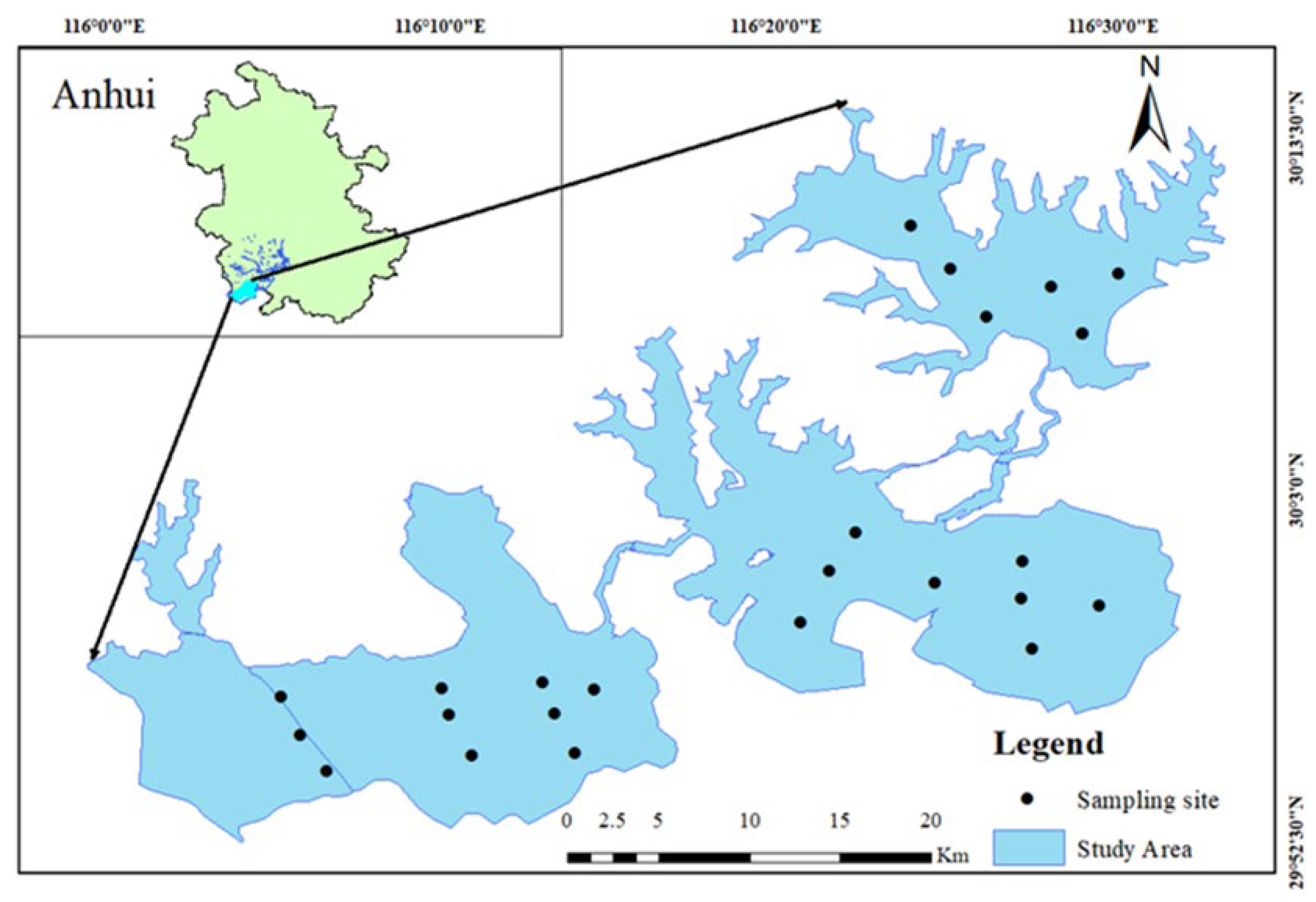
Figure 1. Map of the study area and sampling sites.
Diversity 18 00068 g001
Figure 2. Zooplankton species composition. Note: A total of 68 samples were collected.
Diversity 18 00068 g002
Figure 3. Temporal changes in zooplankton density. Note: A total of 68 samples were collected.
Diversity 18 00068 g003
Figure 4. Temporal variation in zooplankton community structure. (a) Interannual variation in zooplankton community (NMDS); (b) Key species contributing to dissimilarity (SIMPER). Note: A total of 68 samples were collected. Based on the vegan package, two-dimensional non-metric multidimensional scaling (NMDS) using Bray–Curtis dissimilarity was applied to visualise differences in community composition among treatment groups. Group differences were tested using distance-based permutational multivariate analysis of variance (PERMANOVA), and similarity percentage (SIMPER) analysis was used to quantify the relative contributions of individual species to community dissimilarities.
Diversity 18 00068 g004
Figure 5. Temporal changes in diversity indices. Note: A total of 68 samples were collected. Alpha diversity indices were calculated using the vegan package. Interannual differences were assessed using the Kruskal–Wallis test followed by Dunn’s post hoc comparisons with false discovery rate (FDR) correction. Results were visualised using ggplot2, and different letters indicate significant differences among years.
Diversity 18 00068 g005
Figure 6. Heat map of correlation between zooplankton species and environmental factors. Note: A total of 68 samples were collected. Spearman’s correlation was used to assess relationships among environmental variables, and Mantel tests were applied to evaluate correlations between zooplankton density and environmental factors. WT—water temperature; DO—dissolved oxygen; EC—electrical conductivity; SD—transparency; WD—water depth; Turb—turbidity; TN—total nitrogen; TP—total phosphorus; Chl.a—chlorophyll.a.
Diversity 18 00068 g006
Figure 7. RDA analysis ranking of the zooplankton dominant species density and environmental factors (a) 2020, (b) 2022. Tp: Trichocerca pusilla; Tca: Trichocerca capucina; Tl: Trichocerca lophoessa; Dr: Diurella rousseoeti; Kc: Keratella cochlearis; Kv: Keratella valga; MG: Monostyla bulla Gosse; Pe: Polyarthra euryptera; Tcy: Trichocerca cylindric; Bd: Bosminopsis deitersi; Th: Thermocyclops hyalinu. Note: A total of 18 samples were collected in summer 2020 and 19 samples in summer 2022. Redundancy analysis (RDA) was performed using the vegan package, with species data subjected to Hellinger transformation. The significance of the RDA model and environmental variables was evaluated using permutation tests, hierarchical partitioning implemented in the rdacca.hp package based on explained variation, and the envfit function. WT—water temperature; DO—dissolved oxygen; EC—electrical conductivity; SD—transparency; WD—water depth; Turb—turbidity; TN—total nitrogen; TP—total phosphorus; Chl.a—chlorophyll.a.
Diversity 18 00068 g007
Table 1. Environmental factors of the Huayanghe Lakes.
2020202120222023
WT/(°C)29.85 ± 1.67 a30.48 ± 1.2 b32.59 ± 0.68 b29.4 ± 0 a
pH9.07 ± 0.43 a9.01 ± 0.47 ab8.63 ± 0.39 b7.47 ± 0.19 c
DO/(mg/L)8.75 ± 1.57 ab8.83 ± 1.55 a7.81 ± 0.73 b7.53 ± 0.48 b
EC/(μs/cm)277.72 ± 34.56 a308.85 ± 36.78 b322.21 ± 40.27 b269.83 ± 22.5 a
SD/(m)0.94 ± 0.38 a0.78 ± 0.36 a0.45 ± 0.19 b0.71 ± 0.45 ab
WD/(m)5.96 ± 0.87 a3.05 ± 0.49 b2.91 ± 0.33 a4.06 ± 0.46 ab
Turb/(NTU)10.99 ± 6.83 a13.99 ± 11 a21.82 ± 10.41 b11.08 ± 8.46 a
TN/(mg/L)2.69 ± 1.45 a1.97 ± 0.05 b1.96 ± 0.65 ac1.4 ± 0.3 bc
TP/(mg/L)0.05 ± 0.02 a0.02 ± 0.09 a0.08 ± 0.02 b0.06 ± 0.02 a
Chl.a/(μg/L)3.25 ± 2.652.77 ± 3.024.65 ± 3.577.7 ± 5.54
Mean and standard deviation (±SD) represent data. Note: A total of 68 samples were collected. Interannual differences were evaluated using the Kruskal–Wallis test, followed by Dunn’s post hoc pairwise comparisons with false discovery rate (FDR; Benjamini–Hochberg) correction when significant. Different letters adjacent to environmental variables indicate significant differences among years (p < 0.05), whereas identical letters indicate no significant difference (p > 0.05). WT—water temperature; DO—dissolved oxygen; EC—electrical conductivity; SD—transparency; WD—water depth; Turb—turbidity; TN—total nitrogen; TP—total phosphorus; Chl.a—chlorophyll.a.
Table 2. Composition of dominant species densities.
Spieces2020202120222023
CladoceraBosmina longirostris-7.99--
Bosminopsis deitersi--5.84-
CopepodaThermocyclops hyalinus--18.5917.20
Microcyclops varicans---14.80
Mesocyclops leuckarti---6.27
RotiferaTrichocerca pusilla30.0061.15-21.67
Trichocerca capucina66.00-18.75-
Trichocerca lophoessa26.25---
Diurella rousseoeti42.86-27.86-
Keratella cochlearis49.58---
Keratella valga45.0053.33--
Monostyla bulla Gosse31.50---
Polyarthra euryptera93.33---
Brachionus forficula-33.75--
Trichocerca cylindrica--23.3338.33
Note: A total of 68 samples were collected.
Disclaimer/Publisher’s Note: The statements, opinions and data contained in all publications are solely those of the individual author(s) and contributor(s) and not of MDPI and/or the editor(s). MDPI and/or the editor(s) disclaim responsibility for any injury to people or property resulting from any ideas, methods, instructions or products referred to in the content.