Interesting Images

Technical Scheme for Early Warning of Spartina anglica Invasion Dynamics in High-Latitude Estuarine Areas of China Based on UAV Multispectral Remote Sensing


1
National Marine Environmental Monitoring Center, Dalian 116023, China
2
State Environmental Protection Key Laboratory of Coastal Ecosystem, Dalian 116023, China
3
Liaoning Dalian Ecology and Environment Monitoring Center, Dalian 116036, China
*
Author to whom correspondence should be addressed.
Diversity 2026, 18(2), 122; https://doi.org/10.3390/d18020122
Submission received: 26 January 2026 / Revised: 10 February 2026 / Accepted: 11 February 2026 / Published: 13 February 2026

Abstract

The estuaries in the northern Yellow Sea of China’s high-latitude regions have provided favorable conditions for the natural spread of Spartina anglica (S. anglica) with global warming. However, it is difficult to grasp the occurrence and development process of S. anglica by means of satellite remote sensing and manual on-site monitoring. The S. anglica of three typical river estuaries of Huli River, Yingna River and Zhuanghe River were monitored by unmanned aerial vehicle (UAV) multispectral remote sensing. This approach showed that the population area of S. anglica in the study areas increased year by year from 101,791 m2 in 2021 to 129,755 m2 in 2025, with an overall growth rate of 27.5%. The area proportion of S. anglica at the Huli River estuary has remained stably above 80%, while the Yingna River estuary has the fastest growth rate, with an increase of 90.9% over five years in terms of spatial distribution. It provides a new method for monitoring the dynamics of invasive plants in high-latitude coastal wetlands with UAV multispectral remote sensing in centimeter-level resolution, and accurately identifying early invasion points and their spread trends for early warning and precise control.

1. Introduction

Spartina anglica is characterized by its salt and waterlogging tolerance, strong reproductive capacity and well-developed root system. It is distributed in coastal salt marshes and estuaries and is recognized as a highly invasive plant in Europe and Asia [1,2]. Its invasion will alter the hydrodynamic conditions and sedimentary characteristics of the invasion area, leading to a decrease in coastal biodiversity and changing the biogeochemical and soil microbial features [3,4]. The S. anglica was widely distributed along China coast and was the most serious invasive plant before the 1990s [5]. The diffusion of S. anglica makes the living space of the native salt marsh plants Phragmites australis and Suaeda salsa gradually shrink, resulting in the failure of shellfish, algae, fish and waterbirds so on facing survival pressure, and reducing biodiversity and ecosystem degradation [6]. Since then, the S. anglica population has shown a severe decline due to the introduction of Spartina alterniflora to China.
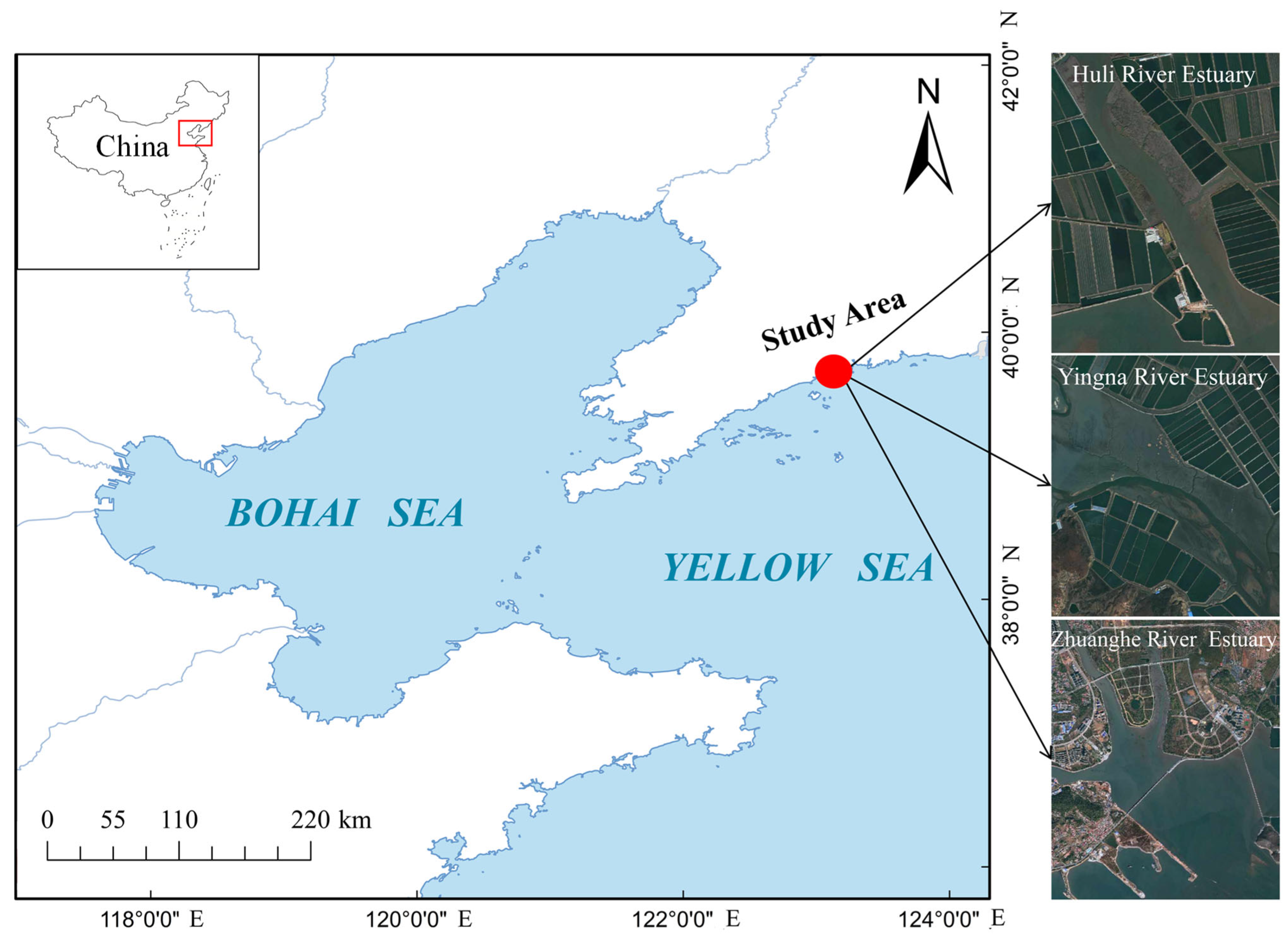
In recent years, against the global climate change and China’s efforts to remove S. alterniflora, the distribution of S. anglica in the northern coastal zone of the Yellow Sea has been expanding year by year (Figure 1), mainly distributed in the estuaries of three typical rivers of Huli River, Yingna River and Zhuanghe River, in a high-latitude area of northeast China in Liaoning. The above-mentioned estuary is one of the priority nature reserves for biodiversity conservation in China. It is the largest breeding ground for the Platalea minor in China and an important wintering ground for many migratory waterbirds. Therefore, effective monitoring methods for invasive plants are conducive to the protection of biodiversity in coastal wetland ecosystems.
Establishing effective monitoring and early warning of alien plants is a necessary means for the prevention and control of invasive species, and should be taken up in a timely manner to improve the efficiency of biological invasion prevention [7]. At present, large-scale invasive plants can be monitored through satellite remote sensing technology, but the monitoring of sporadic or sub-meter-scale invasive plants still mainly relies on manual field investigations [8]. Manual field investigation is not only time-consuming and labor-intensive, but also difficult to carry out monitoring work in some areas that are not open or inaccessible to humans. It is impossible to quantitatively assess the distribution and damage of invasive plants and effectively track their occurrence and development process. UAV remote sensing could identify ground centimeter-level objects at a low altitude of 200 m, with a resolution far exceeding that of satellite remote sensing [9]. It is a useful tool for monitoring and early warning of small patches of invasive alien plants, and is more conducive to discovering invasive alien plants in the early invasion or those that may cause secondary invasion [10].

2. Methods and Materials

Every September during the period from 2021 yr to 2025 yr, we used the DJI P4 Multispectral (DJI-Innovations, Shenzhen, China, RTK-enabled UAV with GNSS, horizontal positioning accuracy: 1 cm + 1 ppm, vertical accuracy: 1.5 cm + 1 ppm) equipped with 6-mirror array (1RGB + 5 monochromatic narrowband), with 62.7° FOV, 5.74 mm focal length (40 mm 35 mm equivalent), f/2.2 fixed aperture, and fixed focus at infinity to carry out the fine identification and information extraction of the S. anglica in the coastal wetlands of the northern Yellow Sea. In order to ensure the generation accuracy and reliability of orthophoto, the whole process of photo acquisition and subsequent data processing strictly follows the technical specifications of low-altitude photogrammetry, focusing on the technical links such as camera calibration, accurate recording of exterior orientation elements, matching generation of points, aerial triangulation adjustment, orthophoto correction generation, orthophoto correction generation, and error control. The acquisition method of image information of S. anglica in 2021 is taken as an example to illustrate this process. Before shooting, activate the safe return and obstacle avoidance functions of the drone, and select the relative flight altitude mode for the route planning. Based on the topographic features and coverage of the estuaries of Huli River, Yingna River and Zhuanghe River, the flight altitude of the UAV was set at 120 m (6.35 cm/pixel), with a course overlap of 80% and a side overlap of 70%. Approximately 2000 continuous and complete high-resolution images were collected. Combining the images obtained by UAV with machine learning models such as random forest, SVM and C5.0 decision tree, this method could identify species in complex habitats. The original high-resolution RGB true color images collected were processed by Agisoft PhotoScan (Agisoft LLC, St. Petersburg, Russia). Agisoft PhotoScan is a software that automatically generates high-quality 3D models from images. It requires no initial parameter configuration or camera calibration, and could process overlapping photographs using advanced multi-view image 3D reconstruction technology [11,12]. Aerial photographs captured by the DJI P4 Multispectral are embedded with POS (Position and Orientation System) data, enabling ground control point-free mapping. The absolute accuracy of the orthophotos and 3D models generated could reach the centimeter level, eliminating the need for extensive deployment of ground control points (GCPs) required in traditional aerial surveying. The images were processed following the default workflow of Agisoft PhotoScan in the following sequence. The workflow is to add photos, align photos (set the accuracy to high precision), establish dense point clouds (set the quality to medium), generate grids (surface model selection ‘arbitrary’, surface data selection ‘high’, source data selection ‘dense point cloud’), generate texture (mapping mode set to Orthophoto, blending mode set to Mosaic, texture size set to 4096), and generate orthophoto (format: TIFF, projection: WGS_1984_UTM_Zone_51N, resolution: 0.1 m).

3. Results

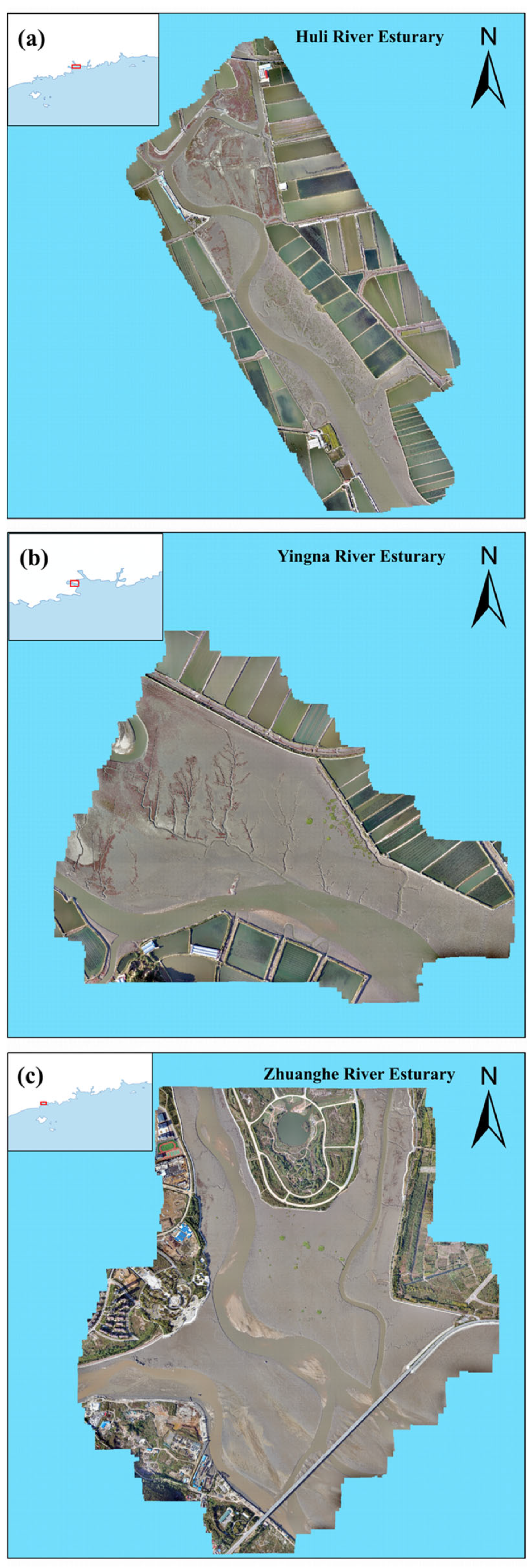
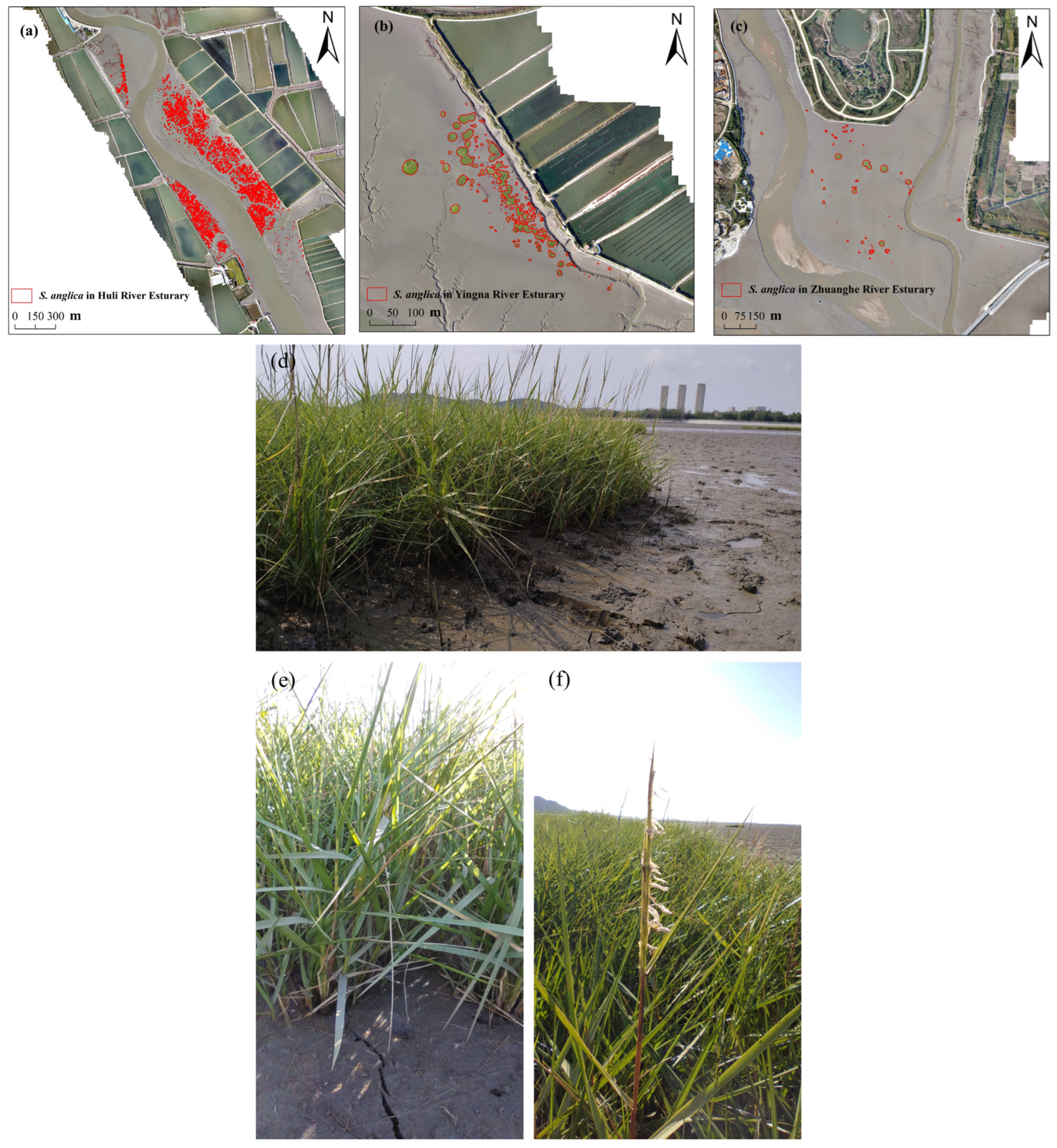
Three digital orthophotos of the estuaries of Huli River, Yingna River, and Zhuanghe River were obtained, respectively (Figure 2). Based on the texture, tone, shape, shadow and other symbols of the image, through human–computer interaction interpretation, the information of the S. anglica at the estuaries of Huli River, Yingna River and Zhuanghe River is extracted and identified (Figure 3).
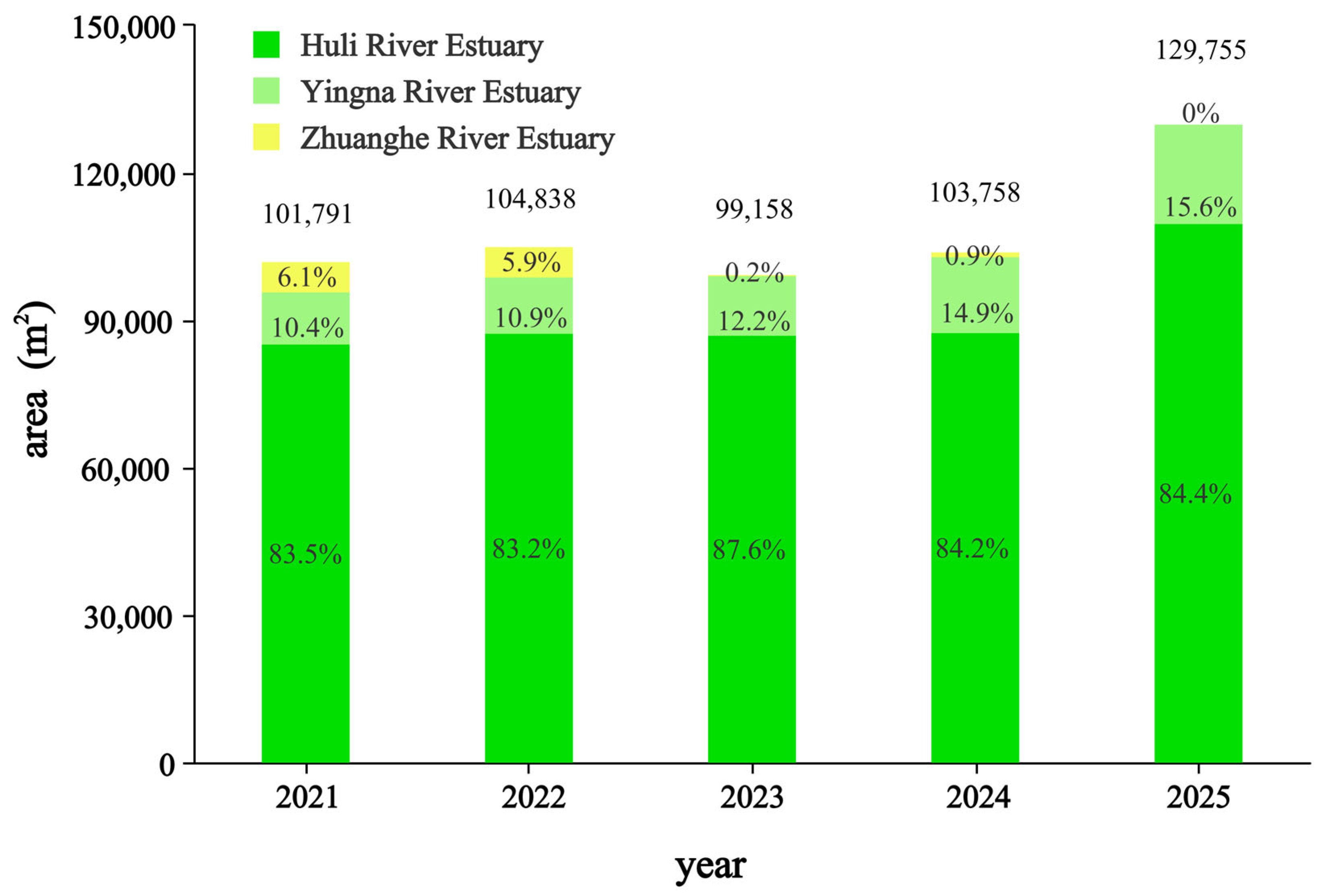
By analyzing the temporal and spatial variation of S. anglica from 2021 to 2025, the dynamic and diffusion characteristics of the secondary invasion of S. anglica in the coastal wetlands of the northern Yellow Sea can be grasped. The area of S. anglica in the coastal wetlands of the northern Yellow Sea has increased from 101,791 m2 in 2021 to 129,755 m2 in 2025. The population area has shown a slow growth trend year by year, with an increase of approximately 27.5%. And the area of S. anglica increased the most in 2024–2025 with 25,997 m2.
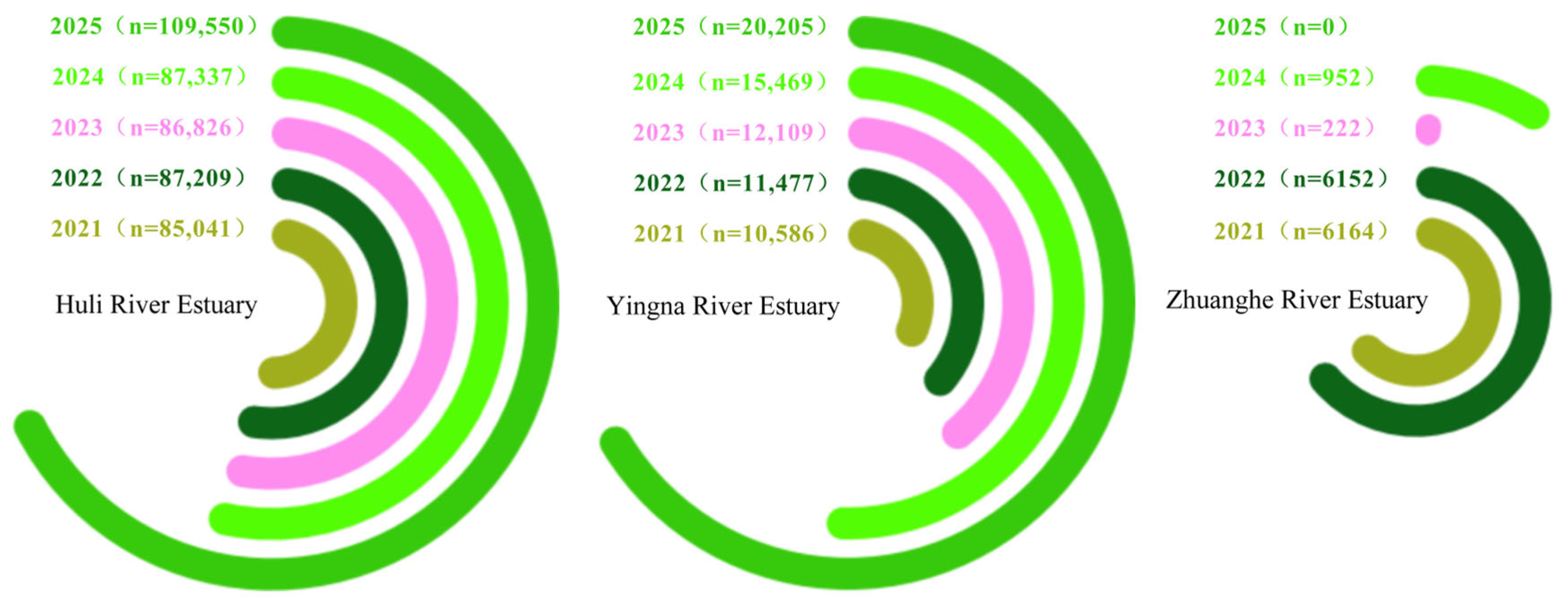
The spatial distribution of S. anglica in the coastal wetlands of the northern Yellow Sea shows obvious regional differentiation characteristics (Figure 4 and Figure 5). The S. anglica is mainly distributed at the estuary of Huli River, followed by that of Yingna River, and its distribution at the estuary of Zhuanghe River is the smallest.
Over the past five years, the proportion of the S. anglica area at the estuary of Huli River to the total area has remained stable at over 80%. The distribution area has increased from 85,041 m2 in 2021 to 109,550 m2 in 2025, with an increase of approximately 28.8%. The area of S. anglica at the estuary of the Yingna River has also been increasing from 2021 to 2025, with the fastest increase rate of approximately 90.9%. From 2023 to 2025, due to the marine ecological protection and restoration project and the S. anglica removal project implemented at the estuary of Zhuanghe River, the area of S. anglica at the estuary of Zhuanghe River decreased sharply, and the trend of change was not significant (Figure 4).

4. Discussion

The invasion of alien plants along the coast has currently become an urgent ecological and environmental problem to be solved all over the world [13]. The results showed that S. anglica is mainly distributed at the Huli River estuary, followed by that of the Yingna River, and its distribution at the Zhuanghe River estuary is the smallest. The Huli River estuary provides the optimal ecological niche, possibly characterized by a stable hydrodynamic environment and sedimentary conditions that facilitate rhizome anchorage and seed retention. In contrast, the Zhuanghe River estuary presents physical constraints, such as stronger tidal scouring or unsuitable elevation, which could limit seedling establishment [6]. In addition, the task of clearing 973.33 m2 of Spartina alterniflora in China has been completed by 2025yr, the invasive trend has been fundamentally curbed, and ecological restoration has gradually been carried out in most of the treated areas [14]. Low temperature restrictions in high latitudes are gradually being lifted due to the impact of global warming, and the significant extension of the growing season is conducive to the expansion of invasive plants such as the genus Spartina [15,16,17,18]. Their underground roots and stems are preserved in low temperatures and accumulate year by year. If not detected and eliminated in time, the invasion situation will further deteriorate, and the subsequent prevention and control costs will also increase exponentially [19]. Although satellite remote sensing can achieve large-scale and long-term monitoring, it has obvious limitations in high-latitude estuarine wetlands. Insufficient spatial resolution makes it difficult to capture sporadic patches during the seedling stage of S. anglica. Tidal flat water vapor and winter clouds and fog can easily interfere with image quality, and it cannot accurately depict the differences in vegetation distribution caused by the complex micro-landforms of estuaries [20,21]. Therefore, it is imperative to carry out early warnings and precise identification of the development trend of invasive species.
For example, taking the early warning and precise identification technology of the S. anglica at the estuaries of Huli River, Yingna River and Zhuanghe River as the implementation source, leveraging the advantages of UAV multispectral remote sensing with centimeter-level spatial resolution, flexible takeoff and landing, and low cost. Using UAV multispectral remote sensing to monitor S.anglica could capture multiband spectral information, accurately distinguish S.anglica from native species, and solve the problem of spectral confusion. It could obtain 6 cm high-resolution images, which realize the fine identification of small patches and tidal creek edge areas [22]. UAV survey could reach areas that cannot be touched by traditional manual field investigations, and the cost is much lower than centimeter-level satellite remote sensing [23]. This approach could accurately capture the early invasive plants in high-latitude coastal wetlands and achieve precise positioning of the coordinates and scope of the invasion points [24]. Based on the UAV multispectral remote sensing, through technical adaptation and scene optimization, the monitoring of the S. anglica in the northern Yellow Sea can obtain centimeter-level high-definition images and three-dimensional terrain data by using UAVs equipped with hyperspectral sensors [25]. The flexible flight mode for UAVs can adapt to the complex terrain of the intertidal zone of estuaries, and is not restricted by wild conditions such as severe cold and mud. By combining machine learning algorithms to analyze the multi-source data obtained by UAV, it is possible not only to predict the spread trend of S. anglica but also to provide coordinate guidance for precise control measures such as physical removal and ecological substitution, effectively curbing its occupation of wetland habitats [26]. This approach, combining precise monitoring by UAV with targeted prevention and control, not only protects the living space of benthic organisms and migratory birds, but also maintains the core ecological functions of high-latitude coastal wetlands such as carbon sequestration, wave prevention and bank protection [27]. UAV multispectral remote sensing has been widely used in alien invasive plant identification, distribution range and growth inversion, dynamic monitoring and so on [28]. In addition, parameters such as coverage and biomass were extracted from high-resolution images to achieve fine monitoring of small patches and tidal creek edge areas. Some research showed that using this technology could accurately locate the distribution range of S. alterniflora in a nature reserve and control its area of about 81 ha [29]. UAV multispectral remote sensing is an efficient, fast and low-cost way to obtain monitoring data, which is worthy of promotion in high-latitude coastal wetland ecosystems.

5. Conclusions

Against the background of global warming, S. anglica has expanded continuously in the high-latitude estuaries of China’s northern Yellow Sea, threatening local wetland biodiversity and ecological functions. Traditional satellite remote sensing and manual surveys are limited by low resolution, high costs and poor accessibility, failing to meet the demand for early and precise monitoring. This research used UAV multispectral remote sensing to monitor three typical estuaries from 2021 to 2025. Results showed that the total area of S. anglica increased from 101,791 m2 to 129,755 m2, with a 27.5% growth rate. The Huli River estuary maintained over 80% of the total area, while the Yingna River estuary saw the fastest growth at 90.9%. UAV multispectral remote sensing, with centimeter-level resolution, could accurately distinguish early S. anglica invasive patches. Combined with machine learning, it can predict spread trends and support precise control, providing a reliable technical solution for the monitoring and management of invasive plants in high-latitude coastal wetlands.

Author Contributions

Conceptualization, C.Y. and P.J.; methodology, C.Y. and Z.L.; software, P.J.; formal analysis, P.J.; investigation, C.Y.; data curation, P.J.; writing—original draft preparation, C.Y. and P.J.; writing—review and editing, P.J.; visu-alization, F.Z. and Y.L.; supervision, C.L.; project administration, C.Y.; funding acquisition, C.Y. All authors have read and agreed to the published version of the manuscript.

Funding

This research was funded by the National Key Laboratory for Environmental Protection of the Coastal Marine Ecological Environment Fund Project (20240105).

Data Availability Statement

The data presented in this study are available on request from the corresponding author.

Acknowledgments

We thank the Dalian Ecological Environment Monitoring Center of Liaoning Province for helping us conduct experiments in the field.

Conflicts of Interest

The authors declare no conflicts of interest.

References

  1. Park, T.; Chen, C.; Macias-Fauria, M.; Tømmervik, H.; Choi, S.; Winkler, A.; Bhatt, U.S.; Walker, D.A.; Piao, S.; Brovkin, V.; et al. Changes in timing of seasonal peak photosynthetic activity in northern ecosystems. Glob. Change Biol. 2019, 25, 2382–2395. [Google Scholar] [CrossRef]
  2. Shin, W.; Oh, M.; Hong, J.-S.; Byun, C.; Lee, E.J. Early invasion of common cordgrass (Spartina anglica) increases belowground biomass and decreases macrofaunal density and diversity in a tidal flat marsh. Biol. Invasions 2022, 24, 3615–3629. [Google Scholar] [CrossRef]
  3. Jiang, Y.; Yang, D.; Huang, J.; Wen, Y.; Tang, H.; Xu, J.; Lin, X.; Sun, D.; Gao, D. Invasive Spartina alterniflora alters sediment organic carbon mineralization dynamics in a coastal wetland of Southeastern China. Front. Mar. Sci. 2024, 11, 1400381. [Google Scholar] [CrossRef]
  4. Chen, Y.-J.; Leung, P.M.; Cook, P.L.M.; Wong, W.W.; Hutchinson, T.; Eate, V.; Kessler, A.J.; Greening, C. Hydrodynamic disturbance controls microbial community assembly and biogeochemical processes in coastal sediments. ISME J. 2022, 16, 750–763. [Google Scholar] [CrossRef]
  5. Zuo, P.; Zhao, S.; Liu, C.A.; Wang, C.; Liang, Y. Distribution of Spartina spp. along China’s coast. Ecol. Eng. 2012, 40, 160–166. [Google Scholar] [CrossRef]
  6. Yu, C.; Chen, Y.; Zhang, F.; Liu, C. Molecular identification and control suggestions of Spartina in Zhuanghe coastal zone of the Northern Yellow Sea. Mar. Environ. Sci. 2023, 42, 774–779. [Google Scholar] [CrossRef]
  7. Li, F.-F.; Hao, Q.; Cui, X.; Lin, R.-Z.; Luo, B.-S.; Ma, J.-S. Global invasive alien plant management lists: Assessing current practices and adapting to new demands. Plant Divers. 2025, 47, 666–680. [Google Scholar] [CrossRef]
  8. Ren, W.; Peng, J.; Shrestha, N.; Bian, Z.; Yang, Y.; Liu, J.; Liu, X.; Huang, P.; Wu, J. Potential distribution and future shifts of invasive alien plants in China under climate change. Glob. Ecol. Conserv. 2025, 60, e03601. [Google Scholar] [CrossRef]
  9. Zhou, Q.; Wu, J.; Cui, X.; Li, X.; Liu, Z.; Musa, A.; Ma, Q.; Yu, H.; Liang, W.; Jiang, S.; et al. Geographical distribution of the dispersal ability of alien plant species in China and its socio-climatic control factors. Sci. Rep. 2021, 11, 7187. [Google Scholar] [CrossRef]
  10. de Castro, A.I.; Shi, Y.; Maja, J.M.; Peña, J.M. UAVs for Vegetation Monitoring: Overview and Recent Scientific Contributions. Remote Sens. 2021, 13, 2139. [Google Scholar] [CrossRef]
  11. Cowley, D.C.; Moriarty, C.; Geddes, G.; Brown, G.L.; Wade, T.; Nichol, C.J. UAVs in Context: Archaeological Airborne Recording in a National Body of Survey and Record. Drones 2018, 2, 2. [Google Scholar] [CrossRef]
  12. Zhang, Z.; Zhu, L. A Review on Unmanned Aerial Vehicle Remote Sensing: Platforms, Sensors, Data Processing Methods, and Applications. Drones 2023, 7, 398. [Google Scholar] [CrossRef]
  13. Pyšek, P.; Hulme, P.E.; Simberloff, D.; Bacher, S.; Blackburn, T.M.; Carlton, J.T.; Dawson, W.; Essl, F.; Foxcroft, L.C.; Genovesi, P.; et al. Scientists’ warning on invasive alien species. Biol. Rev. 2020, 95, 1511–1534. [Google Scholar] [CrossRef]
  14. Wang, Q. The national Spartina alterniflora removal task of 1.46 million mu was completed. Afforestation 2025, 1, 6–7. [Google Scholar]
  15. Chen, Y.; Xiong, K.; Luo, L.; Zhang, S.; Chen, J. Promoting ecological conservation through multi-objective ecological early warning and network regulation in the Karst Plateau, China. J. Environ. Manag. 2025, 385, 125635. [Google Scholar] [CrossRef]
  16. Yang, J. Dealing with systemic environmental risks. Nat. Sustain. 2025, 8, 466. [Google Scholar] [CrossRef]
  17. Song, C.; He, H.S.; Chang, S.; Liu, K. Wetlands change in mid to high latitude region from the perspectives of patch and landscape scales. J. Hydrol. 2025, 661, 133777. [Google Scholar] [CrossRef]
  18. Zheng, X.; Javed, Z.; Liu, B.; Zhong, S.; Cheng, Z.; Rehman, A.; Du, D.; Li, J. Impact of Spartina alterniflora Invasion in Coastal Wetlands of China: Boon or Bane? Biology 2023, 12, 1057. [Google Scholar] [CrossRef]
  19. Ramachandran, P.; Ramirez, A.; Dinneny, J.R. Rooting for survival: How plants tackle a challenging environment through a diversity of root forms and functions. Plant Physiol. 2024, 197, kiae586. [Google Scholar] [CrossRef]
  20. Wu, F.; Chen, X.; Guo, Y.; Liu, W.; Zhang, Y. Warming altered the effect of cold stratification on the germination of Spartina alterniflora across climatic zones in its invasive range. Front. Plant Sci. 2024, 15, 1491275. [Google Scholar] [CrossRef] [PubMed]
  21. Zhang, C.; Zhang, Q.; Zhang, H.; Zheng, Y.; Yuan, L.; Zhong, Q. Climate warming increases the invasiveness of the exotic Spartina alterniflora in a coastal salt marsh: Implications for invasion management. J. Environ. Manag. 2025, 380, 124765. [Google Scholar] [CrossRef]
  22. Román, A.; Tovar-Sánchez, A.; Olivé, I.; Navarro, G. Using a UAV-Mounted Multispectral Camera for the Monitoring of Marine Macrophytes. Front. Mar. Sci. 2021, 8, 722698. [Google Scholar] [CrossRef]
  23. Deng, L.; Mao, Z.; Li, X.; Hu, Z.; Duan, F.; Yan, Y. UAV-based multispectral remote sensing for precision agriculture: A comparison between different cameras. ISPRS J. Photogramm. Remote Sens. 2018, 146, 124–136. [Google Scholar] [CrossRef]
  24. Yang, Y.; Bian, Z.; Ren, W.; Wu, J.; Liu, J.; Shrestha, N. Spatial patterns and hotspots of plant invasion in China. Glob. Ecol. Conserv. 2023, 43, e02424. [Google Scholar] [CrossRef]
  25. Bin, W.; Fan, L.; Xu, B.; Yang, J.; Zhao, R.; Wang, Q.; Ai, X.; Zhao, H.; Yang, Z. UAV-based LiDAR and multispectral sensors fusion for cotton yield estimation: Plant height and leaf chlorophyll content as a bridge linking remote sensing data to yield. Ind. Crops Prod. 2025, 230, 121110. [Google Scholar] [CrossRef]
  26. Xu, Z.; Wang, Z.; Liu, R.; Huang, C.; Shi, Y.; Wang, M.; Chen, H. Efficient multi-UAV path planning in dynamic and complex environments using hybrid polar lights optimization. J. King Saud Univ. Comput. Inf. Sci. 2025, 37, 125. [Google Scholar] [CrossRef]
  27. Yan, B.; Wei, Y.; Liu, S.; Huang, W.; Feng, R.; Chen, X. A review of current studies on the unmanned aerial vehicle-based moving target tracking methods. Def. Technol. 2025, 51, 201–219. [Google Scholar] [CrossRef]
  28. Zhang, S.; Wang, X.; Lin, H.; Dong, Y.; Qiang, Z. A review of the application of UAV multispectral remote sensing technology in precision agriculture. Smart Agric. Technol. 2025, 12, 101406. [Google Scholar] [CrossRef]
  29. Wang, R.; Cai, W.; Yu, L.; Li, W.; Zhu, L.; Cao, B.; Li, J.; Shen, J.; Zhang, S.; Nie, Y.; et al. A high spatial resolution dataset of China’s biomass resource potential. Sci. Data 2023, 10, 384. [Google Scholar] [CrossRef]
Figure 1. Location of the study area (red dot) in the Yellow Sea of China (the Huli River estuary, Yingna River estuary, and Zhuanghe estuary).
Diversity 18 00122 g001
Figure 2. UAV orthophotos of the Huli River estuary (a), Yingna River estuary (b), and Zhuanghe estuary (c).
Diversity 18 00122 g002
Figure 3. The spatial distribution of S. anglica in the Huli River (a), Yingna River (b), and Zhuanghe estuary (c), and the community structure (d), leaf (e), and spike (f) morphology of S. anglica by field manual investigation.
Diversity 18 00122 g003
Figure 4. Annual area changes in S. anglica in northern coastal zone of the Yellow Sea, China, and annual proportion of S. anglica area in Huli River estuary, Yingna River estuary, and Zhuanghe estuary from 2021 to 2025.
Diversity 18 00122 g004
Figure 5. Annual area changes of S. anglica in the Huli River estuary, Yingna River estuary, and Zhuanghe estuary.
Diversity 18 00122 g005
Disclaimer/Publisher’s Note: The statements, opinions and data contained in all publications are solely those of the individual author(s) and contributor(s) and not of MDPI and/or the editor(s). MDPI and/or the editor(s) disclaim responsibility for any injury to people or property resulting from any ideas, methods, instructions or products referred to in the content.