Porpita porpita (Linnaeus, 1758), also commonly known as the blue button jellyfish, is a tropical and sub-tropical pleustonic hydrozoan. This is not a single organism but a hydrozoan colony composed of specialized, functionally differentiated individuals called zooids. The feeding gastrozooid, the defensive and prey-capturing dactylozooids, and the reproductive gonozooids are each functionally specialized within a single floating colony that is supported by a gas-filled flat disc [
1]. Most reported strandings of
P. porpita occurred on the beach area in the Indian Ocean (see
Supplementary Table S1), where seasonal monsoon-driven current reversals may strongly influence their dispersal and stranding patterns [
2]. Beach stranding events are less common in the Pacific Ocean, but recently several have been documented (see
Supplementary Table S1), although their causes remain unclear. Despite its broad geographic distribution, the taxonomic diversity and life history of the genus
Porpita remain poorly characterized. Santiago-Valentín et al. (2024) documented previously underrecognized developmental stages, including planulae and immature colonies, revealing a greater diversity of morphological forms than previously recognized [
3]. However, these observations represent individual stages rather than a continuous sequence of development, and the transitions between successive stages remain unclear. A comprehensive understanding of the
Porpita life cycle therefore requires further integration of morphological, developmental, and molecular evidence, which may also help clarify taxonomic diversity within the genus.
In June 2025,
P. porpita colonies approximately 30 mm in diameter were widely stranded across multiple coastal areas on the Korean Peninsula and surrounding Jeju Island (
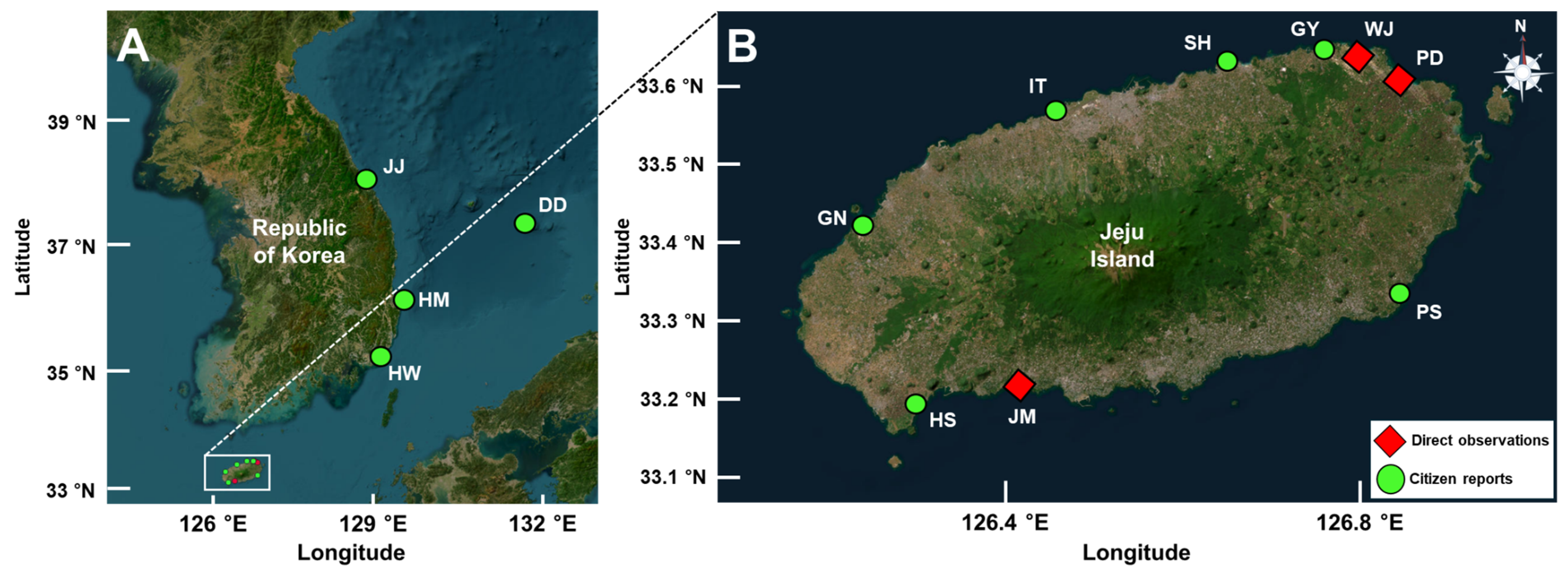
Figure 1), including sandy beaches and rocky intertidal shores. Stranding location data were obtained from citizen reports, social media, and direct observations (
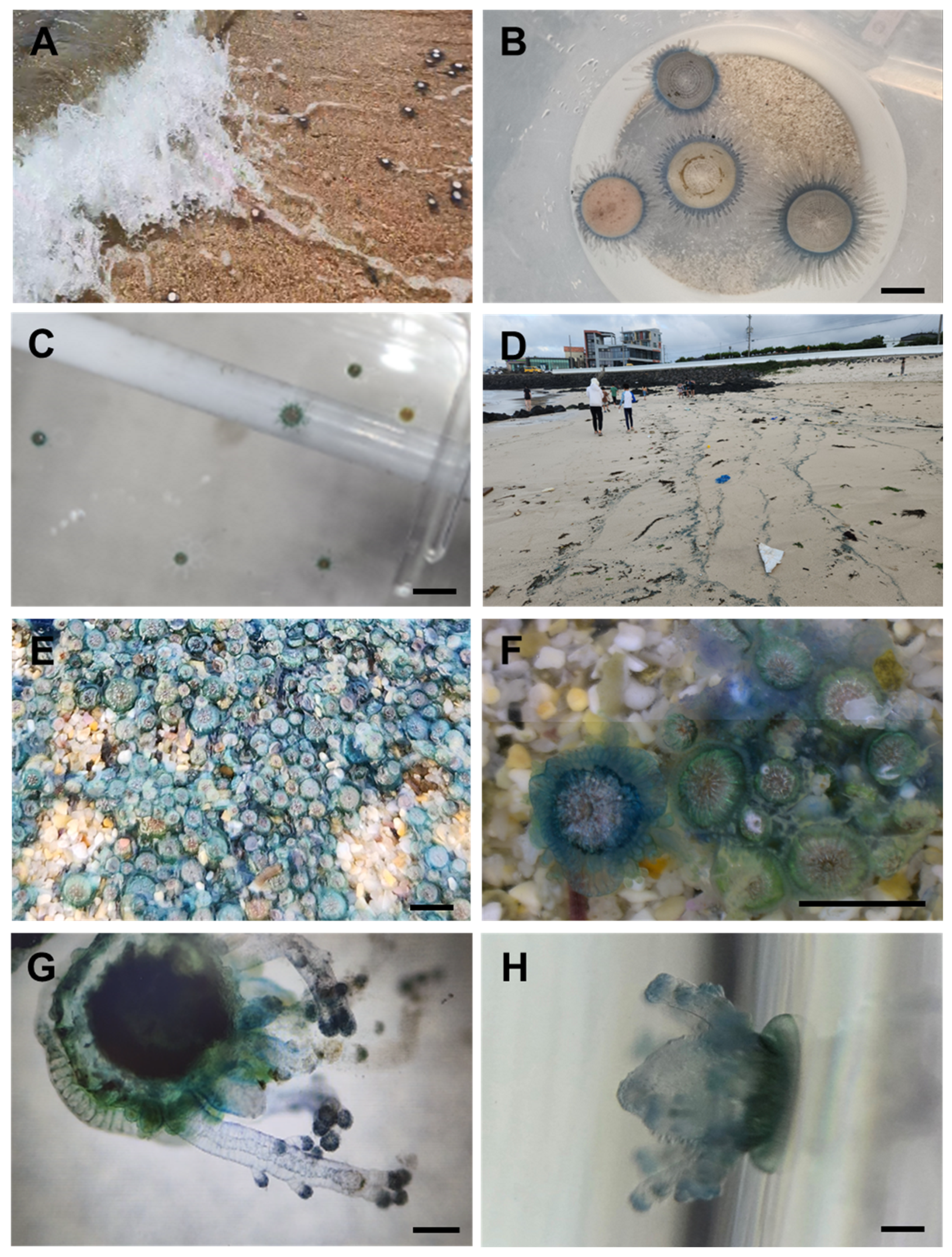
Figure 2A,B). Although widely distributed across multiple coastal sites, the density of stranded colonies declined rapidly following the initial observations in June. A second large-scale stranding of
P. porpita additionally occurred at Pyeongdae beach (PD) in October 2025, four months after the first stranding (
Figure 2C–F). All
P. porpita samples were collected using plastic zipper bags with sea water and sands on three sites. For observation, we used a light microscope (Eclipse Ni-U, Nikon Co., Tokyo, Japan). Photomicrographs were captured with a digital camera (Digital Sight DS-Fi2, Nikon Co., Tokyo, Japan) attached to the microscope, and the resulting images were subsequently analyzed for morphometric measurements. Size and length were quantified using an image analysis software (NIS-Elements BR 4.30.00, Nikon Co., Tokyo, Japan) by calibrating the scale bar and measuring key morphological parameters from the captured images.
Unlike a stranding event reported from Japan in September 2025 [
4], which occurred during a similar period and included colonies representing multiple sizes, the second stranding event on Jeju Island consisted almost entirely of colonies less than 5 mm in diameter on PD (
Figure 2C–F).
Figure 1.
P. porpita stranding records along the coasts of the Republic of Korea and Jeju Island. (A) The locations of occurrence records around the Korean Peninsula, including Jumunjin Beach (JJ), Homigot (HM), Haeundae Beach (HW), and Dokdo (DD). (B) A detailed view of stranding site of Jeju Island, showing records from Geumneung Beach (GN), Iho Tewoo Beach (IT), Sinhung Beach (SH), Gimnyeong Beach (GY), Woljeong Beach (WJ), Pyeongdae Beach (PD), Pyoseon Beach (PS), Jungmun Beach (JM), and Hwasun Geummorae Beach (HS). Red circles indicate direct field observations, whereas bright green circles represent citizen-reported records obtained through social media platforms. The white rectangle denotes the location of Jeju Island.
Figure 1.
P. porpita stranding records along the coasts of the Republic of Korea and Jeju Island. (A) The locations of occurrence records around the Korean Peninsula, including Jumunjin Beach (JJ), Homigot (HM), Haeundae Beach (HW), and Dokdo (DD). (B) A detailed view of stranding site of Jeju Island, showing records from Geumneung Beach (GN), Iho Tewoo Beach (IT), Sinhung Beach (SH), Gimnyeong Beach (GY), Woljeong Beach (WJ), Pyeongdae Beach (PD), Pyoseon Beach (PS), Jungmun Beach (JM), and Hwasun Geummorae Beach (HS). Red circles indicate direct field observations, whereas bright green circles represent citizen-reported records obtained through social media platforms. The white rectangle denotes the location of Jeju Island.
To our knowledge, this stranding event dominated almost entirely by colonies smaller than 5 mm has not previously been reported. When interpreted using the growth model of Wakita et al. [
4], the colony sizes observed during the October stranding are consistent with recently developed individuals. Microscopic observation of these small, less-developed colonies revealed green pigmentation in both the disc and mantle regions (
Figure 2G). The disc was found to be tightly attached to the substrate (
Figure 2H). To date, this disc has been primarily recognized for its role in maintaining buoyancy at the water surface. Additionally, no gonozooids for reproduction were observed in these small colonies. Furthermore, the gastrozooid remained expanded (
Figure 2H).
Figure 2.
Stranding events of P. porpita on Jeju Island. (A) JM beach where 30 mm diameter colonies were observed. (B) Four colonies from sampling at site PD. (C) Incubation images of six small-diameter (less than 5 mm) colonies from PD on a culture flask. (D) PD sampling site where a large-scale stranding composed of small-diameter (less than 5 mm) colonies occurred in October. (E) Close-up image of PD sampling site. (F) Light microscopy image of small-diameter colonies from PD. (G) Green pigmented disc and mantle on small diameter colony. (H) Small-diameter colony with no gosozooids using disc for attachment. (Scale bar: B, 20 mm; C, 15 mm; E, 5 mm; F, 5 mm; G, 200 μm; H, 400 μm).
Figure 2.
Stranding events of P. porpita on Jeju Island. (A) JM beach where 30 mm diameter colonies were observed. (B) Four colonies from sampling at site PD. (C) Incubation images of six small-diameter (less than 5 mm) colonies from PD on a culture flask. (D) PD sampling site where a large-scale stranding composed of small-diameter (less than 5 mm) colonies occurred in October. (E) Close-up image of PD sampling site. (F) Light microscopy image of small-diameter colonies from PD. (G) Green pigmented disc and mantle on small diameter colony. (H) Small-diameter colony with no gosozooids using disc for attachment. (Scale bar: B, 20 mm; C, 15 mm; E, 5 mm; F, 5 mm; G, 200 μm; H, 400 μm).
Taken together, these behavioural and morphological characteristics, including substrate attachment, are consistent with the possibility of local recruitment and growth in the coastal waters of Jeju Island. They further raise the possibility that colonies introduced during the June 2025 large-scale stranding event persisted and subsequently contributed to local recruitment in the coastal waters of Jeju Island. Although seawater temperatures around Jeju Island decreased after the summer thermal maximum, it remained consistently above the long-term average for a summer high water temperature period (
Supplementary Figure S1). Notably,
P. porpita reappeared in early spring of the following year, following the winter season. The two consecutive stranding events on Jeju Island in 2025, involving colonies of markedly different sizes and developmental stages, and the spring season stranding in 2026 suggest the potential for the local establishment of
P. porpita, broader climate-driven changes in regional marine ecosystems, and the continued northward expansion of this pleustonic colonial hydrozoan. Given the sub-tropicalization of the Jeju marine environment, we hypothesize that the progressively increasing winter minimum sea temperatures may similarly enhance the overwintering potential and year-round persistence of tropical and subtropical hydrozoans in Jeju waters. Several observations provide support for this hypothesis, including the northward expansion of subtropical marine species along Jeju Island. For example, the recent northward expansion of
Carybdea brevipedalia along the Korean Peninsula, with its northernmost record shifting from 36°15′ N in 2020 to 36°40′ N in 2025, provides a relevant example of the increasing occurrence of subtropical marine organisms in Korean waters [
5]. Puce et al. (2009) demonstrated that long-term warming in the Mediterranean was associated with an increase in southern-affinity hydroids and the extension of warm-water species into the winter season, suggesting that warming can facilitate the persistence of warm-affinity Hydrozoa beyond their previous seasonal limits [
5]. Similar processes may occur in the coastal waters of Jeju Island, where relatively warm seawater temperatures persist throughout the year.
Future studies combining ecological monitoring, life-history investigations, and molecular approaches are needed to better understand the life cycle of P. porpita, to evaluate population connectivity across the Pacific and Indian Oceans, identify the likely source populations of individuals occurring in Jeju waters, and assess how ongoing ocean warming may influence its future distribution.




 ,
,