1. Introduction
In the context of global climate change, understanding how forest communities respond to environmental variation has become a central topic in ecology and biogeography [
1,
2]. Climate change alters temperature and precipitation regimes and modifies the physical and chemical properties of soils, thereby exerting both direct and indirect effects on plant diversity, reproductive processes, and population stability [
3,
4]. Although considerable effort has been devoted to documenting climate-driven shifts in species distributions and community composition, much less attention has been paid to how key reproductive traits respond to climatic variation at large spatial scales.
Plant reproductive strategies play a fundamental role in population persistence and long-term community dynamics [
5]. Among these strategies, sexual systems constitute a core component of plant breeding systems, directly influencing mating patterns, offspring genetic structure, and levels of outcrossing or reproductive assurance [
6,
7]. At the community level, sexual system composition is closely linked to population adaptability and can shape population dynamics as well as community development and evolutionary trajectories [
8,
9]. Consequently, spatial variation in sexual system composition may reflect adaptive responses to long-term environmental conditions.
Climate change can influence plant sexual expression by regulating pollination processes, floral development, reproductive allocation, and male and female gamete performance [
10]. These mechanisms may generate geographic variation in sexual systems along environmental gradients, particularly where pollination environments differ markedly [
4,
11]. Therefore, examining the structure and coexistence of sexual systems in woody plant communities across climatic zones is essential for understanding forest community organization and dynamics under changing climatic conditions.
Climate zone classification is a widely used approach for assessing the influence of climate on ecosystem processes and biodiversity patterns [
12]. From tropical to temperate regions, climatic conditions differ substantially in thermal stability, precipitation regimes, and seasonality, potentially imposing contrasting selective pressures on plant reproductive strategies [
13]. Ecological theory suggests that environmental heterogeneity and resource availability drive niche differentiation, thereby facilitating species coexistence within communities [
14,
15]. Tropical forests, often regarded as both cradles and museums of biodiversity, harbor exceptionally high plant diversity [
16,
17] contrast, temperate forests experience stronger seasonality in light, temperature, and precipitation, which imposes distinct ecological constraints on plant reproduction [
16,
18]. Along the gradient from tropical through subtropical to temperate regions, vegetation therefore tends to exhibit divergent reproductive characteristics [
13]. In temperate forests, flowering and fruiting periods tend to be more synchronized, and wind pollination and monoecious systems are relatively common [
19]. In contrast, many tropics have a higher proportion of dioecious species, which has been attributed to high tree species richness and abundant animal and insect pollinators that facilitate long-distance pollen transfer between individuals [
6,
20].
Despite these general patterns, empirical evidence remains inconsistent, and the influence of climate zone on sexual system in woody plants is still unclear. Recent global syntheses have demonstrated broad-scale latitudinal and climatic gradients in plant sexual systems, including patterns documented for woody species [
3,
16]. However, most of these studies have treated climate as continuous gradients, with limited emphasis on explicitly comparing sexual system composition and its environmental drivers among discrete climatic zones [
21]. As a result, it remains unclear whether the relative importance of climatic, spatial, and topographic drivers of sexual system distribution is consistent across tropical, subtropical, and temperate forest ecosystems.
Previous studies have shown that the proportional representation of sexual systems in woody plants varies across regions and is closely associated with habitat conditions and community types [
22,
23]. The geographic distribution of angiosperm sexual systems likely reflects the coevolution of physiological and ecological adaptations in response to long-term environmental change [
24]. While these studies have advanced our understanding of spatial patterns and potential drivers of sexual systems [
25,
26], it remains uncertain whether dominant drivers operate similarly across climatic zones or whether their relative importance shifts along environmental gradients. Beyond climate, large-scale patterns of sexual system distribution are also related to plant growth form [
27]. Large-scale patterns indicate that dioecy is more frequent in trees than in shrubs, lianas, and herbs [
28]. This difference may have been attributed to dioecious species requiring long-living woody trees to facilitate mate finding [
26,
29]. Moreover, growth form influences the relationship between reproductive development and environmental conditions, potentially leading to different coexistence mechanisms of sexual systems in trees versus shrubs [
30].
Here, we synthesized sexual system data for 3595 woody plant species from 30 forest dynamics plots spanning tropical, subtropical, and temperate zones in the Northern Hemisphere within the ForestGEO network. The primary objective of this study was to quantify how sexual system composition varies among climatic zones and to identify the relative importance of climatic, spatial, and topographic drivers underlying these patterns. Specifically, we addressed three questions: (1) Do woody plant sexual systems exhibit consistent differences in composition among tropical, subtropical, and temperate forests? (2) Do climatic variables explain more variation in sexual system composition than spatial or topographic factors, and does their relative importance differ among climatic zones? (3) Does plant growth form (trees vs. shrubs) modulate the strength and nature of sexual system–environment relationships? To address these questions, we combined multivariate ordination, network analysis, and variance partitioning approaches [
31], each explicitly linked to one or more of the above questions. Based on ecological theory and previous empirical evidence, we tested the following hypotheses:
H1. The sexual system composition of woody plants differs significantly among climatic zones, with dioecious species being more prevalent in tropical forests, whereas monoecious species become increasingly dominant toward temperate regions.
H2. Climatic variables, particularly temperature and precipitation, explain a greater proportion of variation in sexual system composition than spatial or topographic factors, but their relative importance varies across climatic zones.
H3. Growth form modulates sexual system–environment relationships, such that sexual systems of trees are more strongly associated with broad-scale climatic gradients, whereas shrubs respond more strongly to spatial structure and local topographic heterogeneity.
To explicitly link analytical approaches to the research questions, each statistical method was selected to address a specific aspect of sexual system biogeography. Multivariate dispersion and ordination analyses were used to test differences in sexual system composition among climatic zones (Question 1). Bipartite network analysis was applied to assess climatic-zone specificity and non-random associations between sexual systems and climatic regimes (Question 1). NMDS and Mantel analyses were used to explore sexual system–environment relationships along climatic, spatial, and topographic gradients (Question 2). Finally, variance partitioning analysis was conducted to quantify the relative contributions of climatic, spatial, and topographic drivers, and to evaluate whether these contributions differed between trees and shrubs (Questions 2 and 3).
2. Materials and Methods
2.1. Forest Dynamics Plots
We used the data from 30 forest dynamics plots (
Table S1) that are part of the Center for Science–Forest Global Earth Observatory (Forest Global Earth Observatory, ForestGEO,
https://forestgeo.si.edu) and Chinese Forest Biodiversity Monitoring Networks (
Figure 1) [
32]. All forest dynamics plots were selected based on three criteria: (1) a minimum plot size exceeding 20 ha, (2) the availability of standardized long-term census data following ForestGEO protocols, and (3) complete species-level records of woody plants. These criteria ensured comparability among plots and minimized methodological heterogeneity across regions [
32,
33]. According to a standardized census protocol, tree species with diameter at the breast height ≥1 cm were recorded in each plot [
33]. These plots span a broad latitudinal gradient from 0.2918° N (Mpala, Kenya) to 52.2530° N (Speulderbos, Ermelo, The Netherlands). Forest plots were grouped into tropical, subtropical, and temperate climatic zones based on their latitudinal positions (0–23.5° N, 23.5–40° N, and 40–66.5° N, respectively). These boundaries broadly correspond to major climatic divisions recognized in standard climate classification systems, including the Köppen–Geiger classification, and are commonly used to represent large-scale differences in temperature regimes, seasonality, and precipitation patterns. This zonation was adopted as a pragmatic framework to compare sexual system patterns across contrasting climatic contexts rather than as fixed climatic boundaries. The 30 plots were divided by climatic zones: the 10 plots from Hong Kong, Huai Kha Khaeng, Heishiding, Jianfengling, Ngel Nyaki, Dinghushan, Sinharaja, Xishuangbanna, Mpala, and Mo Singto belong to the tropics; the 12 plots from Badagongshan, Baishanzu, Donglingshan, Qinling, Lilly Dickey Woods, Fushan, Smithsonian Conservation Biology Institute (SCBI), Lienhuachih, Yosemite, Tiantongshan, Gutianshan, and Tyson Research Center Site (TRCS) belong to the subtropical zone; and the 8 plots from Changbaishan, Speulderbos, Scotty Creek, Traunstein, Harvard, Zofin, Wabikon, and Wind River belong to the temperate zone. Multiple plots were included within each climatic zone to capture within-zone environmental heterogeneity while maintaining sufficient replication for cross-zone comparisons.
Although the plots span a broad latitudinal gradient across three climatic zones, their geographic distribution is uneven, with a strong concentration in East Asia, particularly China. Among them, East Asia (China, Japan) includes 15 plots (accounting for 50%), while Africa, Europe, and North America include 4, 3, and 8 plots, respectively. This spatial bias reflects the current global distribution of long-term forest dynamics plots with standardized census protocols, especially within the ForestGEO and Chinese Forest Biodiversity Monitoring Networks. Consequently, patterns identified in this study primarily represent Northern Hemisphere forests and should be interpreted with caution when extrapolating to underrepresented regions. Future studies need to supplement plots from other regions for further verification.
2.2. Species and Sexual Systems
In this study, the sexual reproductive systems of woody plants were divided into three categories: hermaphroditism, monoecy, and dioecy, following the classifications of Vamosi & Queenborough (2010) [
31] Wang (2021) [
7], among others. This classification captures the primary functional differences in mating systems and reproductive allocation, and has been widely adopted in comparative and macroecological analyses of plant sexual systems. Grouping sexual systems in this way also ensured sufficient sample sizes within each category for robust statistical analysis across forest plots. This trade-off between biological resolution and analytical robustness is commonly adopted in macroecological studies addressing large-scale comparative questions.
The core basis of this classification system lies in the sexual reproductive composition of flowers (bisexual/unisexual flowers) and the distribution pattern of unisexual flowers on plants [
19]. Hermaphroditism was defined as the presence of both stamens and pistils in the same flower; monoecy as the coexistence of separate male flowers (stamens only) and female flowers (pistils only) on the same plant; and dioecy as the occurrence of male and female flowers on separate plants, forming functionally specialized male and female individuals. The classification of sexual systems into hermaphroditism, monoecy, and dioecy was based on their fundamental differences in sexual specialization, mating partner dependence, and reproductive assurance. These three categories represent major functional strategies along a gradient from complete sexual integration (hermaphroditism) to complete sexual separation (dioecy), which is particularly relevant for macroecological analyses of reproductive traits across large climatic gradients.
We acknowledge that this simplification inevitably obscures biologically meaningful variation among intermediate or rare sexual system subtypes (e.g., gynodioecy or androdioecy). Such subtypes may differ in mating dynamics, demographic stability, or evolutionary trajectories. However, our objective was to identify broad-scale functional contrasts in mating strategies across large climatic gradients rather than to resolve fine-scale evolutionary transitions. Grouping sexual systems into hermaphroditism, monoecy, and dioecy emphasizes key differences in sexual specialization, mating partner dependence, and reproductive assurance, which are most relevant at macroecological scales. This approach has been widely adopted in previous large-scale comparative studies and ensures sufficient sample sizes for robust statistical analyses across forest plots. Consequently, our results should be interpreted as reflecting major functional differences among sexual systems rather than detailed variation among specific sexual system subtypes.
In our study’s statistical data, the sexual systems of 37 species may vary depending on local abiotic and biotic conditions and thus may not be identified at the species level. We excluded these few species from this study. These excluded species accounted for approximately 1% of the total species pool and were not concentrated within any single climatic zone, minimizing their potential influence on the observed large-scale patterns. We used the sexual systems of 3595 species in 30 forest communities, including 754 monoecious, 807 dioecious, and 2034 hermaphroditic systems (
Table S2). Accordingly, the results should be interpreted as reflecting broad functional contrasts among major sexual systems, rather than finer-scale ecological or evolutionary differences among specific sexual system subtypes. Although this classification inevitably simplifies biologically meaningful variation among finer sexual system subtypes, it captures the dominant functional contrasts in mating systems at a macroecological scale and is therefore appropriate for the cross-regional comparisons conducted in this study.
2.3. Environmental Variables
To quantify the effects of environmental heterogeneity on sexual system composition, spatial, topographic, and climatic variables were compiled for each plot [
7]. In the study, we used data on the spatial factors, topographical factors, climate factors of the plots. The spatial factors (longitude and latitude) were obtained from the positions of the forest dynamics monitoring plots. Topographical factors include mean elevation [ME, m], highest elevation [HA, m], and lowest elevation [LE, m]. And climate factors include mean annual precipitation [MAP, mm], precipitation of the wettest month [PWM, mm mo
−1], precipitation of the driest month [PDM, mm mo
−1], mean annual temperature [MAT, °C], and mean temperature of the warmest [MTWM, °C] and coldest months [MTCM, °C]. The topographical factors of the dynamic monitoring plot were obtained according to the topographic map in the Biodiversity Monitoring Network and ForestGEO; and calculation methods were based on the methods by Harms. Climate factors were obtained from the literature and ForestGEO [
32].
All climatic variables represented long-term mean conditions rather than short-term or single-year observations. These variables were derived from multi-year averages corresponding to the long-term monitoring periods of the forest plots (1985–2015), thereby characterizing the prevailing climatic regimes experienced by woody plant communities and reducing the influence of interannual climatic variability.
2.4. Statistical Analyses
An explicit analytical framework was adopted to link each statistical method to the corresponding research questions [
34]. Specifically, multivariate dispersion tests and ordination analyses were used to evaluate compositional differences among climatic zones; network analysis was used to quantify climatic-zone specificity of sexual systems; NMDS and Mantel tests were applied to examine relationships between sexual system composition and environmental gradients; and variance partitioning was used to quantify the independent and shared contributions of climatic, spatial, and topographic factors.
The proportions of species in woody plant systems in the 30 forest communities were calculated based on the sexual system data of tree species in the forest communities. Principal coordinate analysis was used to study the similarity of the sexual systems of the 30 communities. Afterward, the woody plant composition of the 30 communities in different climatic zones was examined using “betadisper.” Differences in multivariate dispersion among climatic zones were formally tested using analysis of variance (ANOVA) on the betadisper results. Test statistics, including F values, degrees of freedom, and associated
p values, were reported to quantify the strength and significance of dispersion differences among climatic zones [
35,
36]. Kruskal–Wallis method was used to test the differences in the species richness of the sexual systems of the 30 communities.
Correlation network analysis was used to analyze the specificity of the sexual systems of woody plants to different climatic zones (tropical, subtropical, and temperate zones). Bipartite networks were constructed to represent associations between woody plant species (nodes) and climatic zones, in which nodes represented species or climatic zones and edges indicated species occurrence and abundance within each zone. Edge weights were proportional to species abundance to reflect the relative contribution of different sexual systems to community composition. Network structure was quantified using the modularity index [
37,
38]. which was used to identify modules representing groups of species and sexual systems preferentially associated with particular climatic zones. Higher modularity values were interpreted as evidence of stronger ecological specialization or non-random associations between sexual systems and climatic regimes. Network visualization was performed using Gephi version 0.9.7.
To address potential multicollinearity among environmental predictors, pairwise Pearson correlation coefficients were first calculated for all climatic and topographic variables. When strong correlations were detected (|r| > 0.7), only one variable was retained based on ecological relevance and interpretability. Variance inflation factors (VIFs) were subsequently calculated for the retained variables to further assess multicollinearity. All predictors included in the final models had VIF values below 10 (
Table S3), indicating acceptable levels of collinearity. All retained variables were standardized using Z-score transformation prior to multivariate analyses.
Non-metric multidimensional scaling (NMDS) was used to analyze and visualize variation in woody plant sexual system composition and its relationships with environmental factors across climatic zones. Ordinations were based on Bray–Curtis dissimilarities calculated from species abundance data. A two-dimensional NMDS solution was selected to balance interpretability and ordination stress. The final configuration converged with a stress value of 0.12, indicating an acceptable representation of the multivariate dissimilarity structure. The final solution converged with a stress value of 0.12, indicating an acceptable representation of the multivariate structure. The statistical significance of NMDS ordinations was evaluated using permutation tests based on 999 random permutations.
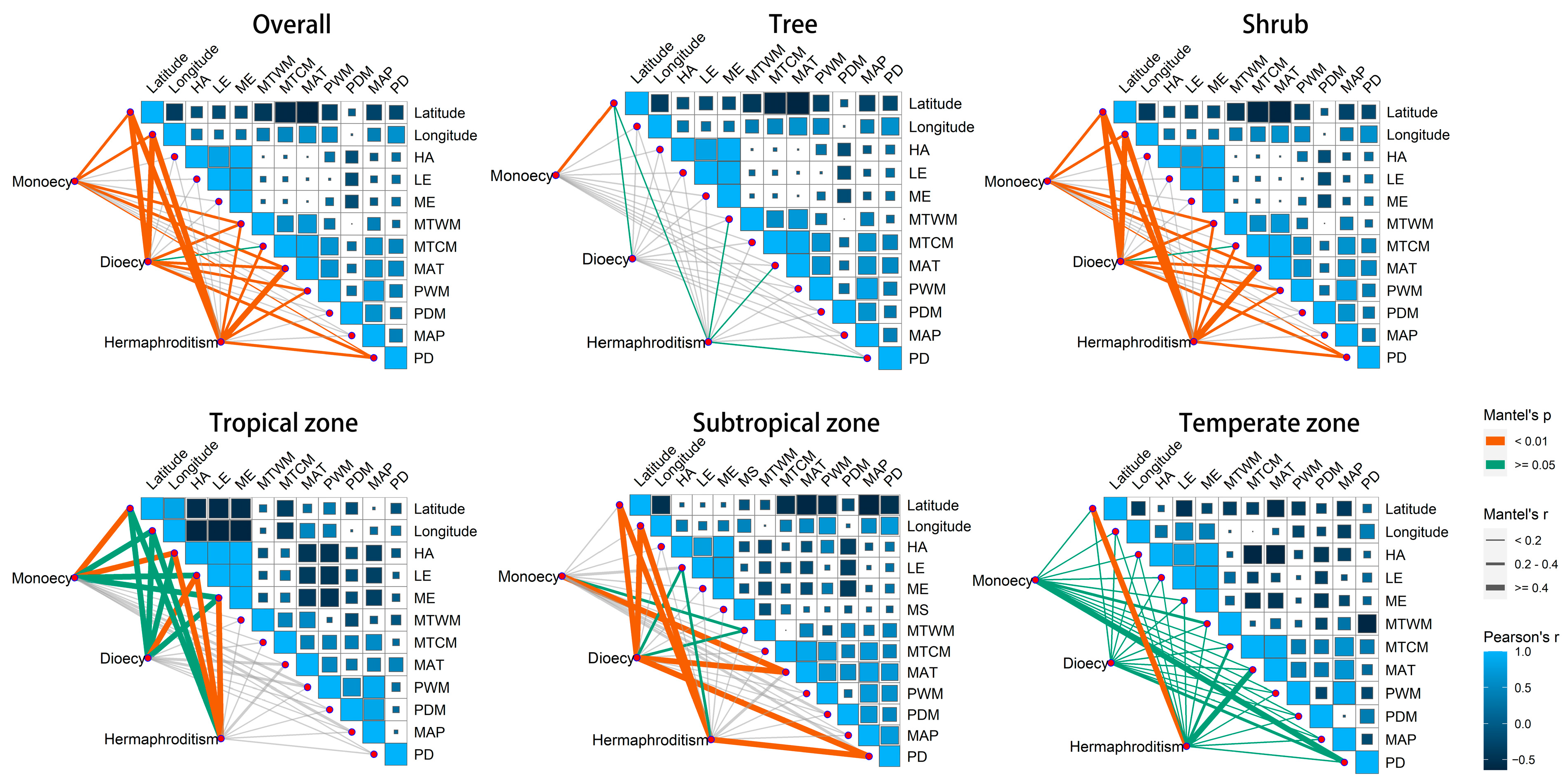
Mantel test was performed to examine the linkage between environmental variables (longitude, latitude, topographic variables, and climatic variables) and the species richness of the sexual systems with different sexual systems. Mantel correlation test was conducted using R version 4.0.3 with the “ggcor” package [
39].
Variation partitioning based on redundancy analysis was performed to decompose the variation in species distribution, thereby explaining the mechanism of sexual systems distribution. Variance partitioning analysis was conducted to assess the association of spatial variables (longitude and latitude), topographic variables (ME, HA, and LE), and climatic variables (MAP, PWM, PDM, MAT, MTWM, and MTCM) with the species abundance of woody plants with different sexual systems [
40,
41]. The variance partitioning analysis was performed with the “rdacca.hp” package in R 4.0.5 [
42]. The significance of individual and shared fractions in the variance partitioning analysis was assessed using permutation tests with 999 permutations.
Phylogenetic relationships among species were not explicitly incorporated into the statistical analyses. This decision was made because comprehensive, well-resolved phylogenies were unavailable for all species across the 30 plots. As a result, potential phylogenetic non-independence among species could not be accounted for and is acknowledged as a limitation of this study.
3. Results
3.1. Biogeographical Patterns in Sexual Systems
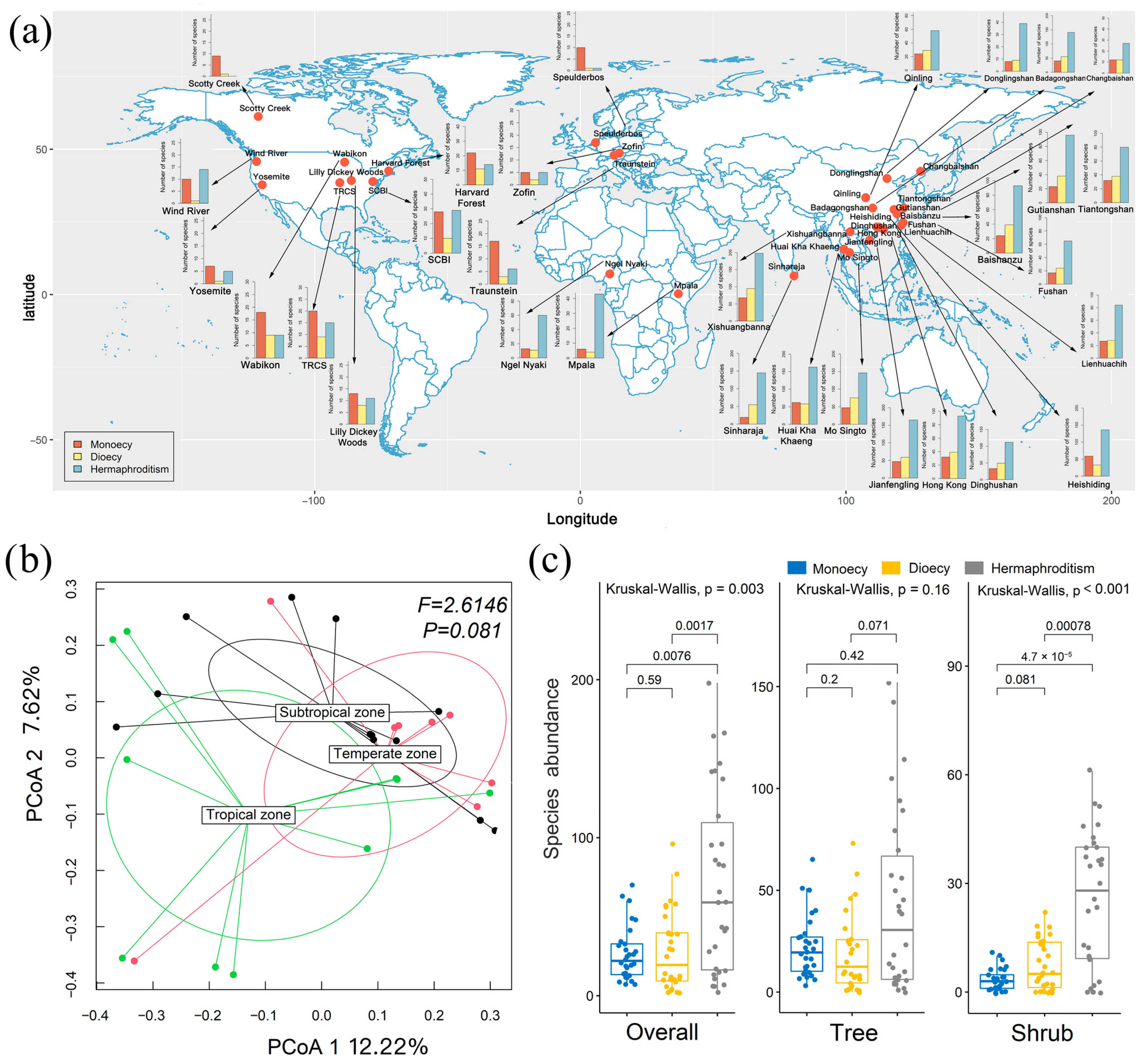
Woody plant species exhibited pronounced spatial heterogeneity in sexual system composition across the 30 forest communities (
Figure 1). Across all plots, hermaphroditism was the most species-rich sexual system, followed by monoecy and dioecy.
Sexual system composition differed significantly among climatic zones (
Figure 1a). Tropical (0–23.5° N) and subtropical (23.5–40° N) communities showed higher mean species richness for all three sexual systems than temperate communities (40–66.5° N). In tropical and subtropical forests, hermaphroditic species accounted for the highest proportion of woody plants, whereas monoecious species were relatively more abundant in temperate forests.
Betadisper analysis combined with permutational multivariate analysis of variance (PERMANOVA) showed that the species abundance of woody plant communities in the 30 communities in different climatic zones was different (F = 2.6146, df = 2, 27,
p = 0.018;
Figure 1b). Principal coordinate analysis (PCoA) revealed partial separation of tropical communities from subtropical and temperate communities; however, this pattern was not statistically significant (F = 2.61,
p = 0.081).
The Kruskal–Wallis test showed significant differences in species abundance among all woody plant sexual systems (df = 2,
p = 0.003,
Figure 1c). No significant difference was found among the sexual systems of trees (df = 2,
p = 0.16), but a significant difference was observed among the sexual systems of shrubs (df = 2,
p < 0.001), with hermaphroditic shrubs showing the highest median species abundance.
3.2. Species–Climatic Zone Associations in Sexual Systems
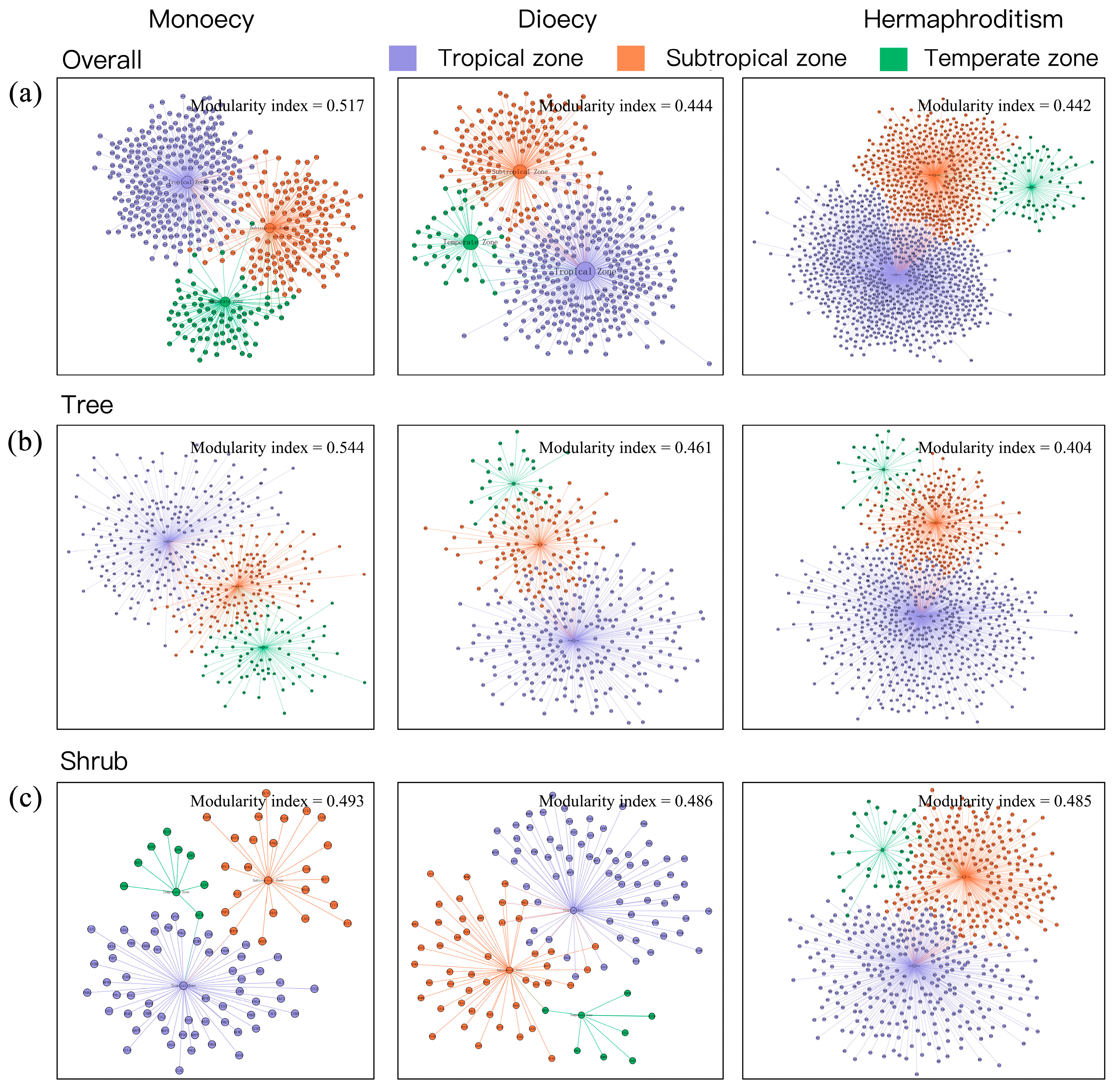
Network analyses revealed distinct patterns of species–climatic zone associations among sexual systems (
Figure 2). At the overall level, monoecious species exhibited the highest modularity index (Q = 0.517), indicating relatively well-separated clusters corresponding to tropical, subtropical, and temperate zones (
Figure 2a). In contrast, networks of dioecious (Q = 0.444) and hermaphroditic species (Q = 0.442) showed lower modularity, with greater overlap of species among climatic zones.
When considering life forms, modularity differences among sexual systems were more pronounced for trees. Monoecious trees showed the highest modularity (Q = 0.544), whereas dioecious (Q = 0.461) and hermaphroditic trees (Q = 0.404) displayed weaker climatic zone segregation (
Figure 2b).
For shrubs, modularity indices were generally higher than those of trees across all sexual systems. Monoecious shrubs showed the highest modularity (Q = 0.493), followed closely by dioecious (Q = 0.486) and hermaphroditic shrubs (Q = 0.485) (
Figure 2c). In dioecious and hermaphroditic shrub networks, tropical and subtropical species tended to form shared clusters, whereas temperate species were more distinctly separated.
All networks exhibited modular structures, with modularity values consistently exceeding those expected under random assembly based on comparisons with randomized networks. Higher modularity values indicated stronger climatic-zone specificity of sexual systems. Dioecious species showed the highest climatic modularity in tropical forests, whereas monoecious species were more strongly associated with temperate zones, indicating contrasting climatic affinities among sexual systems.
3.3. Sexual System–Environment Relations Among Different Climatic Zones
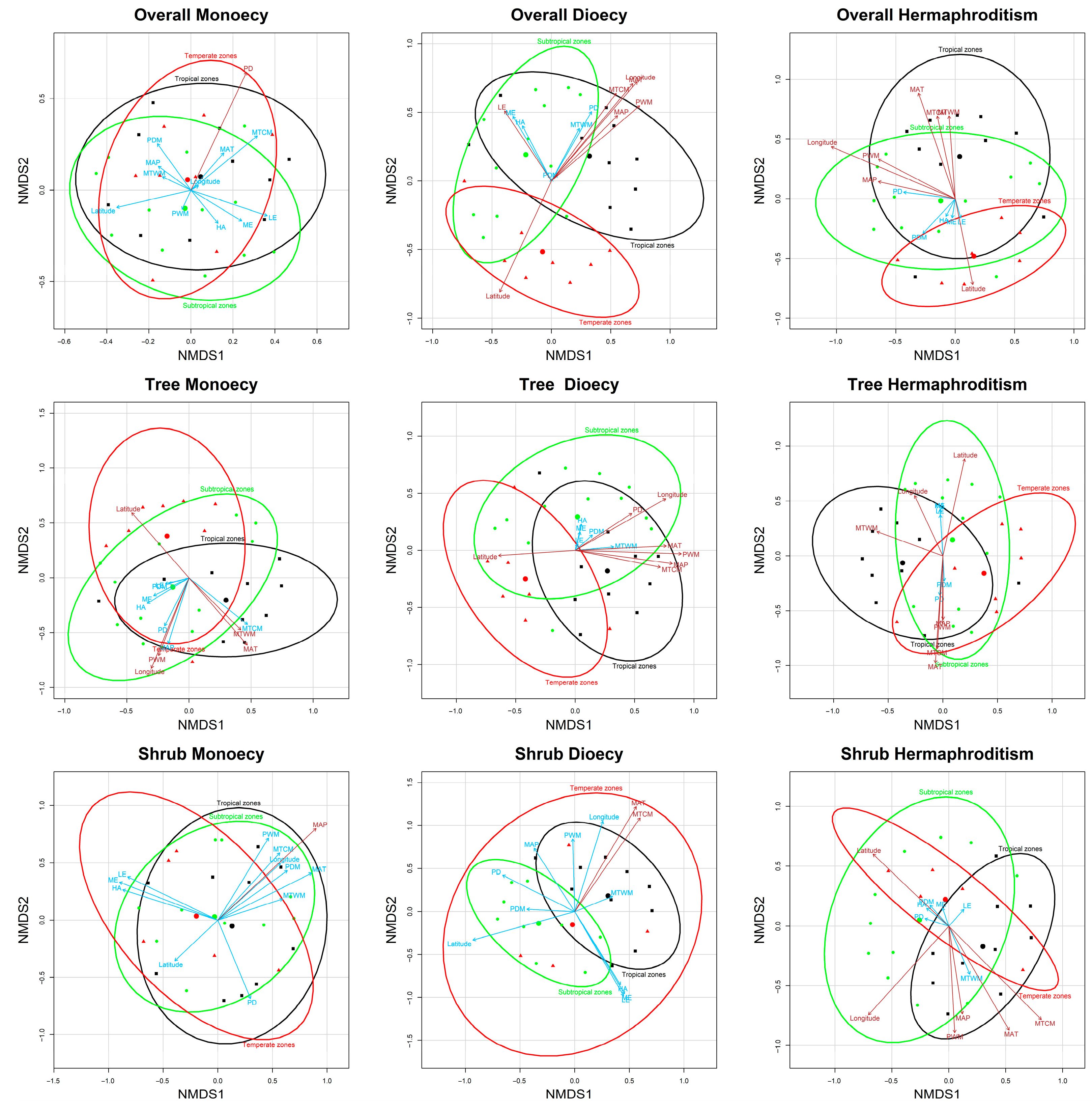
Nonmetric multidimensional scaling (NMDS) revealed clear differences in species composition among sexual systems along environmental gradients (
Figure 3). NMDS ordination was based on Bray–Curtis dissimilarities calculated from species abundance data. A two-dimensional solution was selected to balance interpretability and goodness of fit, and the final configuration converged after multiple random starts with a stress value of 0.12, indicating an acceptable representation of the multivariate structure. Environmental vectors were fitted using the envfit procedure with 999 permutations and a significance threshold of
p = 0.05. NMDS ordination revealed clear separation of communities along climatic gradients (stress = 0.12), with temperature- and precipitation-related variables showing the strongest correlations with ordination axes (envfit, r
2 = 0.21–0.38,
p < 0.05). Dioecious species were primarily associated with warmer and wetter conditions, whereas monoecious species aligned with cooler and drier environments. Hermaphroditic species occupied intermediate positions across climatic gradients.
At the overall level, monoecious species composition was primarily associated with precipitation variables (MAP, PWM, and PDM) and elevational factors (ME, HA, and LE), whereas dioecious species showed stronger associations with temperature-related variables (MAT, MTWM, and MTCM) and latitude. Hermaphroditic species were distributed along multiple environmental gradients, reflecting combined associations with both temperature and precipitation variables.
Patterns differed between life forms. For trees, monoecious species were mainly associated with precipitation and elevation gradients, while dioecious tree species varied predominantly along temperature gradients, with several temperature variables showing significant correlations (p = 0.05). Hermaphroditic trees displayed a more concentrated distribution in ordination space but remained associated with temperature and latitude.
For shrubs, monoecious species were primarily structured by precipitation and elevation, whereas dioecious shrubs showed significant associations with temperature and longitude. Hermaphroditic shrubs occupied a broader ordination space and exhibited directional relationships with multiple environmental factors. Faith’s phylogenetic diversity (PD) showed distinct projections across sexual systems and life forms, indicating differences in spatial phylogenetic structure.
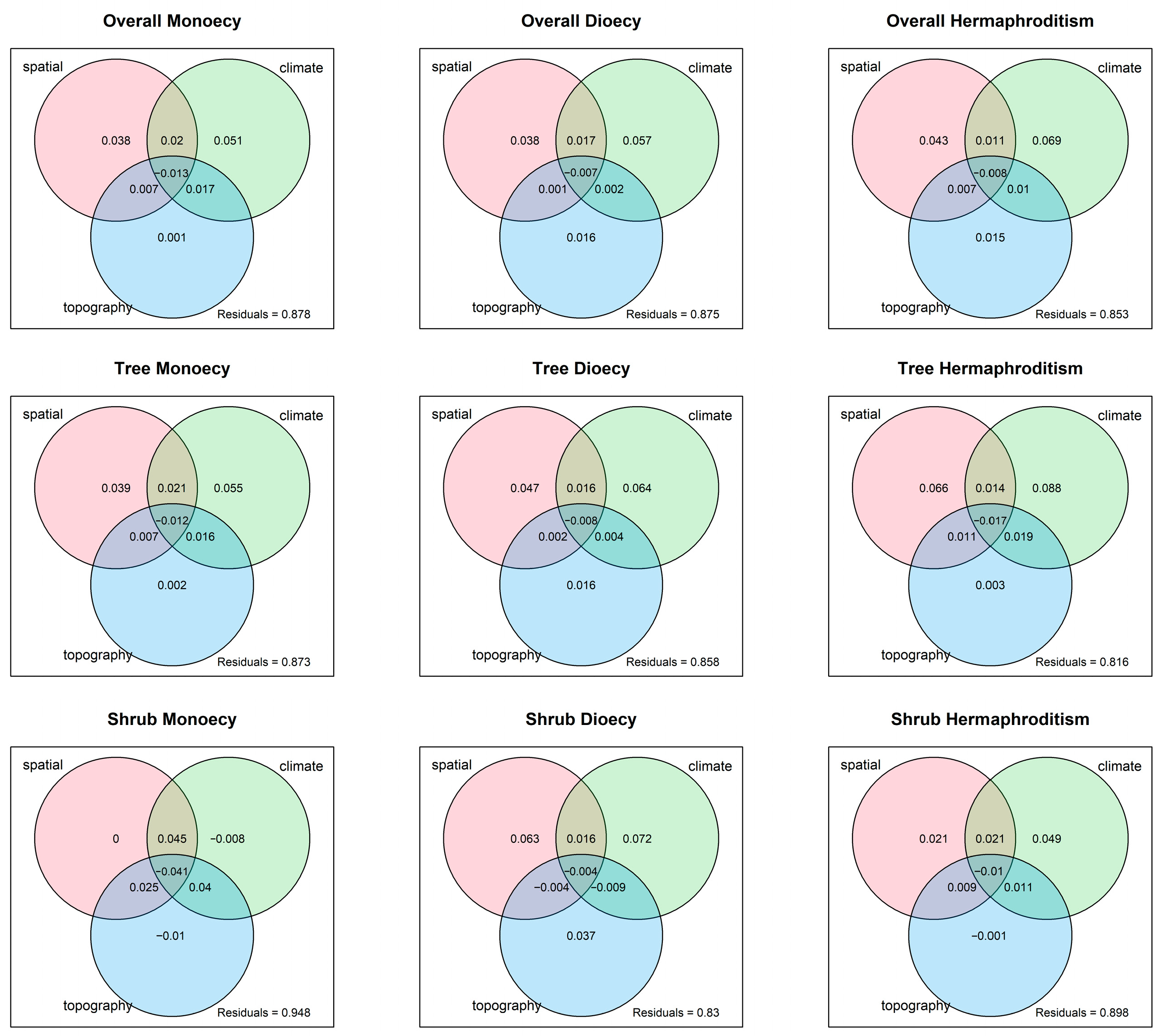
Variance partitioning based on redundancy analysis revealed significant overall models for all woody plants (F = 4.21, df = 3, 126,
p < 0.001), trees (F = 3.87, df = 3, 89,
p < 0.001), and shrubs (F = 3.52, df = 3, 67,
p = 0.002) (
Figure 4). Across sexual systems, unexplained variation accounted for the majority of total variance (>85%). Nevertheless, climatic variables consistently explained the largest independent fraction of variation (4.9–8.8%), exceeding the independent contributions of spatial and topographic factors. Independent climatic effects were highest for hermaphroditic species (6.9%), followed by dioecious (5.7%) and monoecious species (5.1%). Overall, climatic variables explained a larger proportion of variation in sexual system composition than spatial or topographic factors, although the total explained variation remained relatively low. The total explained variation was relatively low across all models.
For trees, climatic variables were the dominant contributors to variation in sexual system diversity, followed by spatial factors, whereas topographic effects were comparatively weak. For shrubs, patterns differed among sexual systems: dioecious shrubs showed relatively stronger responses to both climatic and spatial factors, whereas monoecious shrubs were characterized by a high proportion of unexplained variation.
Partial Mantel analyses further showed significant correlations between sexual system abundance and environmental variables across spatial scales (
Figure 5). At the overall level, all three sexual systems were significantly associated with geographic, climatic, and topographic variables, with stronger correlations observed for temperature- and precipitation-related factors than for topography. Among life forms, trees exhibited fewer and weaker significant correlations, whereas shrubs showed strong and consistent associations with spatial and climatic variables (Mantel’s
p < 0.01).
Across climatic zones, the strength and number of significant associations varied latitudinally. Tropical forests exhibited strong associations between sexual system abundance and precipitation and topographic variables, subtropical forests showed complex associations involving spatial, temperature, and precipitation gradients, and temperate forests displayed fewer significant correlations, primarily with latitude. Overall, climatic variables explained a larger proportion of variation in sexual system composition than spatial or topographic factors, with the relative contribution of spatial processes increasing toward subtropical and temperate zones.
4. Discussion
4.1. Climatic Zones and Sexual Systems Have a Strong Association
Our results demonstrate that sexual system assemblages of woody plants differ markedly among climatic zones (
Figure 1), with dioecious species being more prevalent in tropical regions and monoecious species more common in temperate regions. This pattern is broadly consistent with previous studies reporting higher frequencies of outcrossing in tropical environments and increased selfing or reproductive assurance toward temperate regions [
43]. Tropical regions, with warm and humid climates and higher pollinator activity, favor outcrossing systems such as dioecy, whereas temperate regions, with colder and drier winters, favor monoecious species that benefit from reproductive assurance [
42].
Network analyses further revealed non-random associations between sexual systems and climatic zones (
Figure 2). In our study, Monoecious species exhibited higher modularity than dioecious and hermaphroditic species, particularly in temperate forests, indicating stronger differentiation of sexual system assemblages among climatic zones. In contrast, lower modularity values for hermaphroditic species in some regions suggest broader climatic associations and greater compositional overlap. The moderate modularity observed across networks likely reflects the combined effects of climatic contrasts, regional species turnover, and environmental heterogeneity, allowing partial overlap among regions with distinct climatic conditions [
44].
From a biological perspective, network modularity describes the extent to which species with particular sexual systems are non-randomly associated with specific climatic zones. Higher modularity indicates stronger differentiation of sexual system assemblages among climatic zones and reduced compositional overlap, whereas lower modularity reflects broader climatic distributions and greater overlap among regions. These differences in modularity are consistent with the conclusion that sexual systems differ in their climatic affinities and degrees of environmental specialization. Although network modularity does not directly represent underlying mechanisms, it provides a complementary, system-level description of how sexual system composition is structured across climatic zones, beyond patterns revealed by species richness and ordination-based analyses.
4.2. Main Influencing Factors of Sexual Systems Differ Among Different Climatic Zones
At a broad scale, our results support previous findings that climatic factors, particularly temperature and precipitation, are important correlates of sexual system distributions in woody plants [
43]. However, we observed clear differences in the relative importance of climatic and spatial factors among sexual systems and climatic zones (
Figure 3 and
Figure 4), indicating that dominant drivers are context dependent.
The mechanisms that cause patterns of species diversity may differ among monoecious, dioecious, and hermaphroditic species in different climatic zones [
45]. In tropical forests, climatic variables explained a larger proportion of variation in dioecious and hermaphroditic species than spatial factors, likely due to stable climates, high species richness, and dense populations reducing the constraints of spatial distance on mating. In contrast, spatial factors played a more prominent role in temperate and subtropical regions. This pattern is consistent with stronger dispersal limitation in these regions, particularly for dioecious species, whose reproduction depends on the spatial proximity of male and female individuals. Greater environmental variability, habitat fragmentation, and lower population densities may amplify the influence of spatial structure on reproductive processes. Hermaphroditic species showed weaker spatial patterns, likely reflecting greater reproductive flexibility [
46,
47]. Thus, these results indicate that the balance between climatic and spatial processes varies among sexual systems and climatic zones, highlighting the context-dependent nature of the drivers shaping sexual system assemblages.
Despite significant climatic and spatial associations, the proportion of explained variance remained modest (
Figure 4), suggesting that sexual system distributions are shaped by multiple interacting processes. Specifically, the large unexplained fraction (approximately 85%) revealed by the variance partitioning analyses likely reflects the influence of fine-scale environmental conditions (e.g., soil nutrient availability and moisture), biotic interactions such as pollinator assemblages, ahistorical disturbance legacies, and phylogenetic constraints, which were not explicitly captured by the broad-scale predictors used in this study. Unmeasured factors, including phylogenetic constraints, biotic interactions, disturbance regimes, and fine-scale habitat heterogeneity, likely contribute to the large proportion of unexplained variation. Together, these results indicate that sexual system patterns reflect the combined effects of deterministic environmental filtering and stochastic spatial processes. Multicollinearity among climatic predictors was carefully assessed prior to analysis; Pearson correlations and variance inflation factors confirmed that all retained variables had VIF values below 10 (
Table S3), suggesting that the observed associations are robust rather than artifacts of collinearity.
Although the explained variance was relatively low, this result is consistent with previous macroecological studies of complex reproductive traits. Sexual system distributions are likely influenced by multiple interacting processes, including historical biogeography, lineage-specific constraints, dispersal limitation, pollinator availability, soil properties, and disturbance regimes, many of which were not explicitly measured in this study. Additionally, sexual systems integrate long-term evolutionary history, biotic interactions, and fine-scale habitat conditions that are not fully captured by broad-scale climatic, spatial, or topographic predictors. Therefore, the low explanatory power of individual predictor sets does not undermine the detected patterns, but rather highlights the multifactorial and scale-dependent nature of sexual system biogeography.
4.3. Sexual Systems of Trees Are More Associated with Climatic Regions than Those of Shrub
The sexual systems of plants are closely related to life-history and growth forms [
28]. Selfing strategies are more common in short-lived herbaceous plants, where reproductive assurance reduces the risk of reproductive failure [
48], whereas long-lived woody plants typically rely more on outcrossing to maintain genetic diversity across multiple reproductive events [
49]. Within woody plants, trees generally have longer lifespans than shrubs, a difference that may further modulate the relationships between sexual systems and environmental drivers [
50].
In this study, climate factors played important roles in shaping the distribution of sexual systems in both trees and shrubs (
Figure 3). However, the strength of these associations differed between life forms. The sexual systems of trees were more strongly associated with climatic variables than that of shrubs, and the sexual system of shrubs was more strongly associated with topographic heterogeneity than that of trees (
Figure 3 and
Figure 5) [
51]. This contrast suggests that growth form mediates how environmental drivers influence sexual system assemblages.
Differences between trees and shrubs likely reflect life-history and structural contrasts, with trees buffering climatic variability and shrubs being more influenced by local environmental heterogeneity. Additionally, differences in regeneration dynamics and population turnover rates between trees and shrubs may further mediate how sexual systems respond to climatic versus spatial heterogeneity. However, these interpretations remain inferential, as our analyses are correlative and do not explicitly test the underlying mechanisms linking growth form, environmental drivers, and sexual system composition. Future studies integrating demographic data and experimental approaches would be valuable for disentangling these processes.
One possible explanation is that the larger stature of trees allows their reproductive processes to integrate broader-scale climatic conditions. Tree canopies may experience microclimates that more closely reflect regional climate patterns, potentially strengthening associations between sexual systems and temperature or precipitation gradients. In contrast, shrubs are shorter and more strongly influenced by fine-scale environmental heterogeneity, such as local variation in slope, elevation, and soil moisture, which may amplify the role of topographic factors [
52,
53]. Canopy shading and belowground competition from trees may further weaken the direct association between shrubs and regional climate. Therefore, the sexual systems of trees tend to show stronger associations with broad-scale climatic regions than those of shrubs.
It is important to emphasize that these interpretations are inferential, as our analyses are correlative and do not explicitly test underlying mechanisms. Alternative explanations, including sampling effects, differences in rooting depth, or unmeasured biotic interactions, may also contribute to the observed patterns. Future studies integrating experimental approaches, demographic data, and phylogenetically informed analyses will be essential to disentangle these mechanisms.
4.4. Limitations and Future Directions
Sexual systems in angiosperms are often phylogenetically conserved, and closely related species tend to share similar reproductive strategies. Consequently, some observed associations between sexual systems and environmental gradients may reflect the non-random geographic distribution of major plant lineages rather than independent ecological responses. For example, families such as Fagaceae are predominantly monoecious, whereas Lauraceae and Euphorbiaceae contain many dioecious species [
50]. Due to the lack of comprehensive, well-resolved phylogenetic trees for all species, phylogenetic non-independence could not be fully incorporated in our analyses, and thus the observed associations may partly reflect shared evolutionary history. As a result, the reported associations should be interpreted as combined outcomes of ecological filtering and historical lineage effects rather than purely adaptive responses to contemporary climate.
In addition, interpretation of network modularity remains indirect, as detailed data on pollinator assemblages, flowering phenology, and mating interactions were unavailable. Although modularity provides insights into the structural organization of sexual system–climate associations, future studies integrating pollination networks, reproductive phenology, and phylogenetically informed approaches will be needed to directly test underlying mechanisms.
Our dataset is geographically biased toward the Northern Hemisphere, particularly East Asia, reflecting current availability of long-term forest dynamics plots rather than deliberate sampling design. This uneven coverage limits global generalization, especially for the Southern Hemisphere and high-latitude regions. Future studies integrating additional plots from these regions will be essential to test the generality of our findings and to assess whether similar climatic and life-form-dependent patterns emerge globally. In addition, unmeasured factors such as soil properties, disturbances, biotic interactions, and historical processes likely contribute to the low explained variance. Future studies could explicitly incorporate plot-level soil chemistry, pollinator community composition, and disturbance history into variance partitioning or joint species distribution frameworks to reduce unexplained variance and better resolve the relative contributions of biotic and abiotic drivers.
4.5. Ecological Implications Under Climate Change
Overall, our findings indicate that sexual system patterns in woody plants emerge from the combined influences of climate, spatial structure, and growth form. Climatic factors appear relatively more influential in tropical regions, whereas spatial processes become increasingly important toward temperate regions. Under ongoing climate change, these differential sensitivities suggest that shifts in temperature and precipitation may alter reproductive environments and dispersal processes, potentially influencing the relative prevalence of sexual systems.
However, our analyses are correlative and do not provide predictive forecasts. The observed patterns therefore highlight potential sensitivities rather than deterministic outcomes, underscoring the need for long-term monitoring, experimental studies, and trait-based or phylogenetically informed approaches.