


Abstract
To investigate the seasonal dynamics of phytoplankton community structure and its relationship with environmental factors in the coastal waters of the Leizhou Peninsula, China, surveys were conducted at 21 stations during four seasonal cruises: autumn (August 2022), winter (December 2022), spring (March 2023), and summer (June 2023). A total of 174 phytoplankton species from 7 phyla were identified. Species richness peaked in summer (93 species, 5 phyla), followed by winter (80 species, 3 phyla), spring (79 species, 5 phyla), and autumn (75 species, 5 phyla). Bacillariophyta dominated throughout the year, with Skeletonema costatum (Greville) Cleve 1878 and Chaetoceros lorenzianus Grunow 1863 being consistently dominant across all seasons. Phytoplankton cell density showed a distinct seasonal pattern, highest in autumn, followed by summer, and lower in spring and winter. Diversity indices (H, J, D) indicated moderately to heavily polluted waters. Redundancy analysis identified salinity, dissolved inorganic nitrogen, chlorophyll a (Chl a), pH, water temperature, chemical oxygen demand, and dissolved silicon as key environmental drivers, with their influence varying seasonally: salinity was strongest in summer, Chl a in winter, and multiple factors jointly shaped the community in spring and autumn. This study provides a comprehensive assessment of phytoplankton biodiversity and clarifies the environmental drivers of their distribution in the coastal waters of the Leizhou Peninsula, China.
1. Introduction
Phytoplankton, as primary producers in aquatic ecosystems [1], exhibit a close relationship between their community structure and the aquatic environment [2] and form the foundation of material cycling and energy flow within aquatic ecosystems [3]. Changes in water quality can significantly influence phytoplankton diversity and community structure. Due to their high sensitivity, phytoplankton respond rapidly to variations in nutrient levels, making them important indicators for assessing water body health and biodiversity [4,5]. Classic ecological research has demonstrated that ecosystem stability is closely linked to species diversity. For example, Tilman [6] proposed that species diversity enhances ecosystem redundancy and resource use efficiency, thereby strengthening the ability to cope with environmental changes. Based on long-term experiments, Tilman et al. [7] further showed that communities with higher species diversity generally exhibit greater interannual stability and productivity stability. These findings indicate that biodiversity not only promotes ecosystem productivity but also improves resistance to external disturbances such as nutrient inputs and temperature fluctuations. Additionally, Loreau and Hector [8] emphasized that diversity promotes resource complementarity, which enhances community productivity and stability. Within phytoplankton communities in particular, variations in species’ responses to environmental factors can buffer against environmental fluctuations and help maintain the long-term stability of ecosystem functioning. Thus, phytoplankton play an indispensable role in sustaining ecosystem balance [9]. Scholars worldwide have conducted extensive research on the relationship between phytoplankton community structure and environmental factors [10,11,12], as well as on the application of phytoplankton in water quality assessment [13,14,15].
Leizhou Peninsula, located at the southernmost tip of mainland China, is bordered by the South China Sea to the east and the Beibu Gulf to the west. To the south, it faces Hainan Island across the Qiongzhou Strait. With a total area of 13,225 km2 and surrounded by the sea on three sides, the peninsula hosts numerous ports and possesses rich marine resources due to its unique geographical location, making it a highly productive area abundant in fish, shellfish, and shrimp [16]. In recent years, as development intensity in this region has increased, various human activities—including coastal aquaculture, coastal industry, and tourism—have expanded rapidly. Containing high concentrations of chemical oxygen demand (COD), total nitrogen (TN), and total phosphorus (TP), these effluents frequently violate discharge standards, leading to environmental issues such as eutrophication [17]. Previous surveys have been limited either to a single season [18,19] or focused on specific local waters, such as Zhanjiang Port [20,21], Leizhou Bay [22,23], the Xuwen Coral Reef Area [24,25], Liusha Bay [26,27], and Anpu Port [28]. There is a lack of comprehensive research on seasonal community dynamics of phytoplankton and their correlation with environmental factors. Consequently, it remains difficult to gain a holistic understanding of the phytoplankton community structure and seasonal variations in the Leizhou Peninsula.
Therefore, from 2022 to 2023, this study carried out seasonal monitoring of the coastal waters of the Leizhou Peninsula, China to investigate phytoplankton assemblages and key water quality parameters. The aims were to clarify the current structure of the phytoplankton community, analyze its relationship with environmental factors, and assess the ecological status of the water quality. This research helps to predict trends in the structural dynamics of phytoplankton communities and provides a scientific basis for ecological management of the coastal area, which is of great significance for regional sustainable development.
2. Materials and Methods
2.1. Study Area
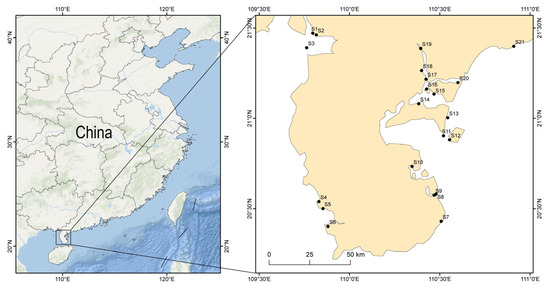
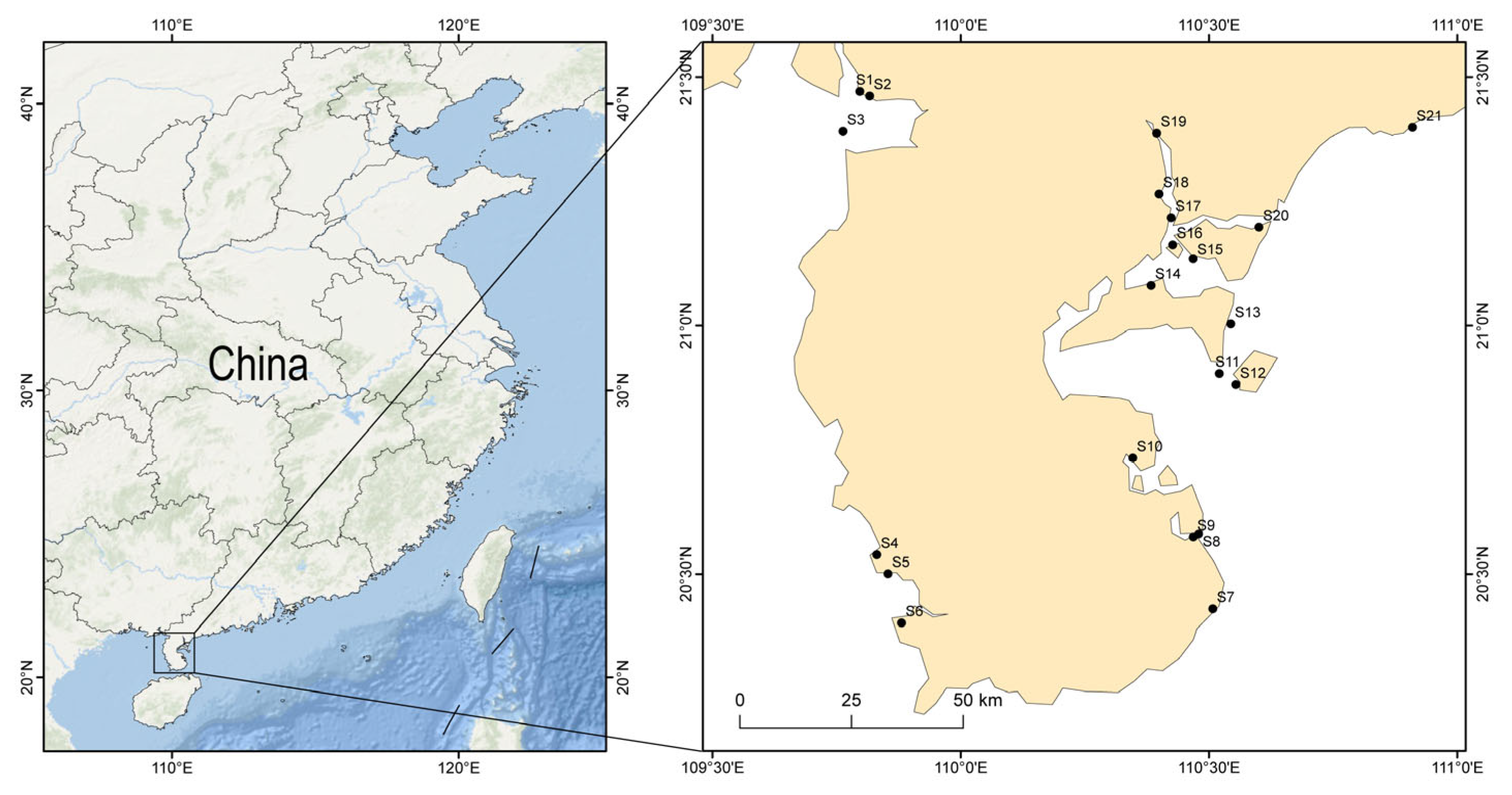
The study area, the Leizhou Peninsula, is located at the southernmost tip of the mainland of China (the northern part of South China Sea), which possesses a mainland coastline with a total length of 1243.7 km (Figure 1). To assess the impact of key anthropogenic activities, our sampling strategy targeted four types of functional coastal zones: aquaculture areas, coastal tourism zones, cooling water intake areas for nuclear power plants, and zones adjacent to a large-scale iron and steel industrial complex.
Figure 1.
Study area and sampling stations.
Four expeditions were carried out seasonally from August 2022 to June 2023. A total of 21 sampling stations were established along the Leizhou Peninsula coast to represent these functional zones (Figure 1; Table S1). The stations were S1 (Cheban), S2 (Yingzai), S3 (Caotan), S4 (Na’ao bay), S5 (Tianchengtai), S6 (Xujia port), S7 (Qianshan), S8 (Wailuo), S9 (Xinliao), S10 (Dongli), S11 (Southeast pier), S12 (Naozhou island), S13 (Longhaitian), S14 (Baogang), S15 (Nansan island), S16 (Techeng island), S17 (Fisherman’s harbor park), S18 (Jinsha bay), S19 (Guandu), S20 (Qiantang), and S21 (Dinglong bay).
2.2. Field Sampling and Process
Surface seawater (0–1 m) was collected at each sampling station using a 2.5 L water sampler (Leigu, Yancheng, China), and 4 L of sample was obtained per station for subsequent analyses. For phytoplankton cell counting, one liter sample was preserved with Lugol’s solution to a final concentration of 2%. For nutrient analyses ((NO3−-N, NO2−-N, NH4+-N, PO43−-P, and SiO32−), water samples were filtered through cellulose acetate membranes (50 mm diameter, 0.45 μm pore size; Shanghai Xinya Purification Equipment Co., Ltd., Shanghai, China) and stored frozen until laboratory analysis in triplicate. Similarly, for chlorophyll a determination, 500 mL aliquots of water were filtered in triplicate through the same type of cellulose acetate filters and stored at −20 °C until analysis. A total of 84 phytoplankton samples, 252 Chl a and nutrient samples were collected.
2.3. Analytical Methods
2.3.1. Nutrients and Chlorophyll a Analyses
Water temperature (T), pH, and salinity (Sal) were measured on-site using a portable multi-parameter water quality meter (Luheng, Hangzhou, China). Water depth was determined simultaneously with a Speedtech depth sounder (SM-5A, Speedtech, Shanghai, China). Chemical parameters were analyzed in accordance with the standard protocols outlined in the Methods for the Analysis of Water and Wastewater (4th Edition) [29]. The following determinants were assessed using the specified methods: Chlorophyll a (Chl a) by hot ethanol extraction and measured by spectrophotometer (UV-1900i, SHIMADZU (Suzhou) Instruments Manufacturing Co., Ltd., Suzhou, China); chemical oxygen demand (CODMn) by potassium permanganate titration. The concentrations of ammonium (NH4+-N), nitrite (NO2-N), nitrate (NO3-N), silicate (SiO3-Si), and phosphate (PO4-P) were measured using a Smart 200 automatic nutrient analyzer (ASM, Milano, Italy). All nutrient measurements were performed with calibration curves of R2 > 0.999 and triplicate analyses yielding relative standard deviation (RSD) < 5%.
2.3.2. Phytoplankton Analyses
Microscopic examination and taxonomic identification of phytoplankton were conducted using a compound light microscope (Olympus, Tokyo, Japan) at 200× or 400× magnification, with cells identified primarily to the species level, or genus level, and enumerated using a standard counting chamber (0.1 mL), performing a minimum of three counts per sample. Phytoplankton abundance was expressed as cells per liter (cells L−1). Species identification was conducted with reference to the following taxonomic reference books: Illustrated Guide to Common Marine Diatoms in China, Atlas of Marine Life in China, Aquatic Biology, Common Phytoplankton in Xiamen Waters, and Illustrated Guide to Common Freshwater Planktonic Algae in China [30,31,32,33,34].
2.4. Statistical Methods
The McNaughton dominance index (Y) [35] (Y, where Y ≥ 0.02 indicates a dominant species), the Shannon–Wiener diversity index (H) [36], the Pielou evenness index (J) [37], and the Margalef richness index (D) [38] were introduced to characterize the phytoplankton community. The formulas for calculating these indices are as follows:
In the formulas, Ni represents the number of individuals of the i-th species, N denotes the total number of individuals across all species, fi indicates the frequency of occurrence of the i-th species, S stands for the number of algal genera, and Pi refers to the ratio of the number of individuals of the i-th species (Ni) to the total number of individuals (N).
2.5. Water Quality Evaluation Standards
The water quality was assessed using the following indices and criteria [39,40,41]:
For the Shannon–Wiener Index (H), values of H < 1 indicate heavy pollution, 1 ≤ H ≤ 2 denotes α-moderate pollution, 2 < H ≤ 3 represents β-moderate pollution, and H > 3 corresponds to clean condition.
For Pielou’s Evenness Index (J), J < 0.3 indicates heavy pollution, 0.3 ≤ J < 0.5 implies moderate pollution, 0.5 ≤ J ≤ 0.8 suggests light pollution, and J > 0.8 reflects clean conditions.
For the Margalef richness Index (D), 0 < D ≤ 1 signifies heavy pollution, 1 < D ≤ 2 indicates α-moderate pollution, 2 < D ≤ 3 corresponds to β-moderate pollution, and D > 3 represents clean condition.
2.6. Data Processing
To examine the relationship between phytoplankton communities and environmental factors, we first performed a detrended correspondence analysis (DCA). The selection of an appropriate linear model was based on the gradient lengths from the DCA: canonical correspondence analysis (CCA) for lengths ≥ 4.0 and redundancy analysis (RDA) for lengths ≤ 3.0. The results showed that the maximum gradient length of all ordination axes was below 3. Therefore, redundancy analysis (RDA) was applied. All statistical analyses were performed using R version 4.3.1.
3. Results
3.1. Spatial and Temporal Distribution Characteristics of Phytoplankton Communities
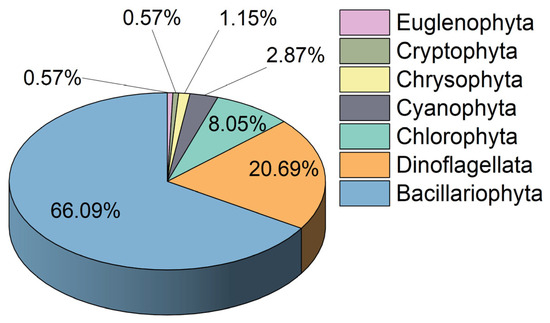
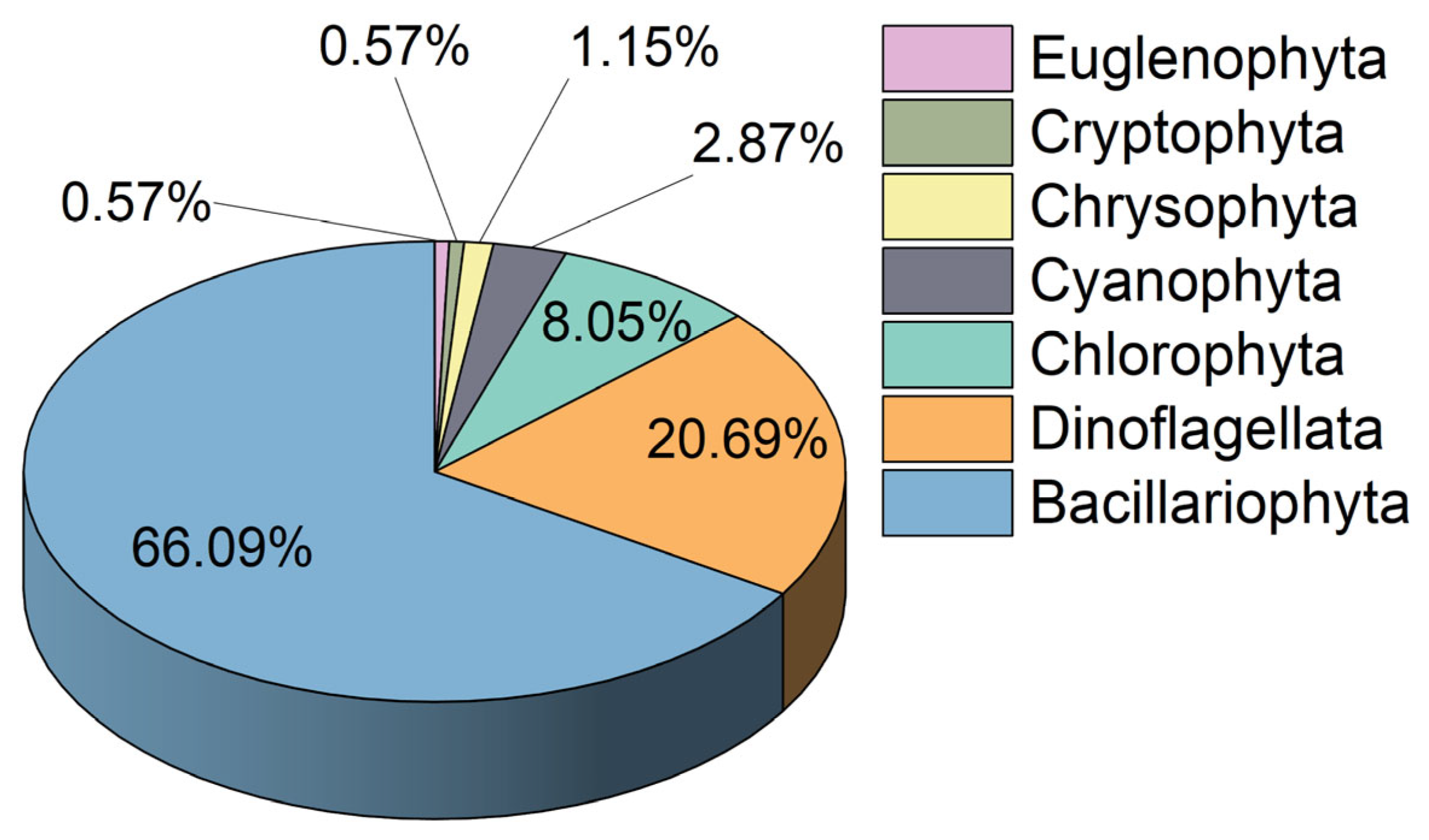
A total of 174 phytoplankton species (at species or genus level) belonging to seven phyla were identified (Figure 2). Bacillariophyta was the most diverse group, comprising 115 species and accounting for 66.09% of the total phytoplankton community (Figure 2). The next groups were Dinoflagellata with 36 species (20.69%), Chlorophyta with 14 species (8.05%), and Cyanophyta with 5 species (2.87%) (Figure 2). In addition, Chrysophyta was represented by 2 species, while both Cryptophyta and Euglenophyta were represented by a single species each. Together, these three groups accounted for 2.29% of the total species richness (Figure 2).
Figure 2.
Phytoplankton species composition in the Leizhou Peninsula, China.
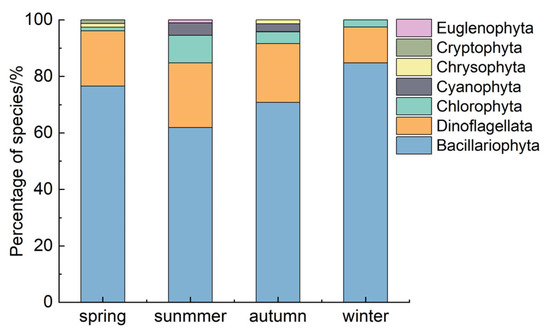
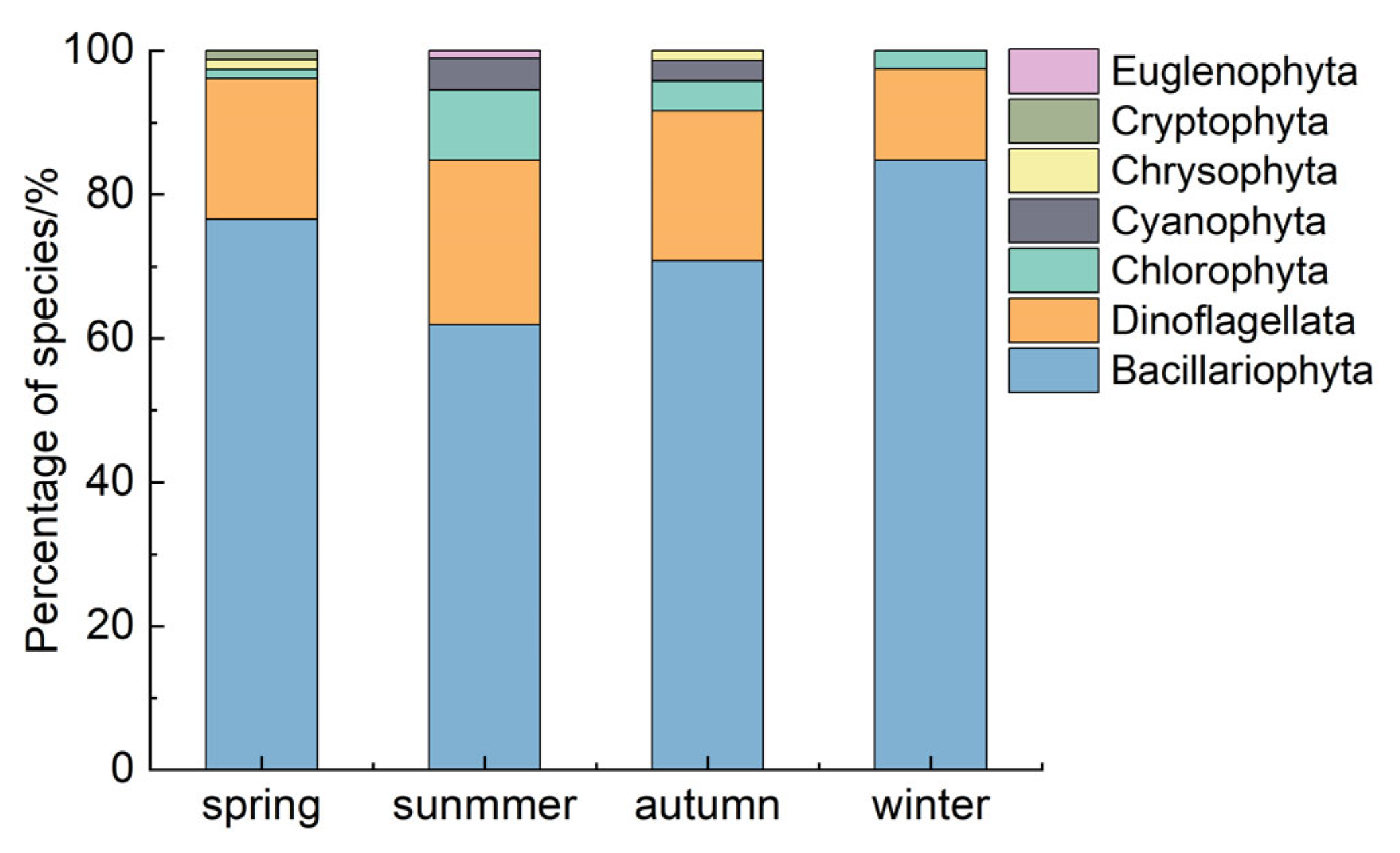
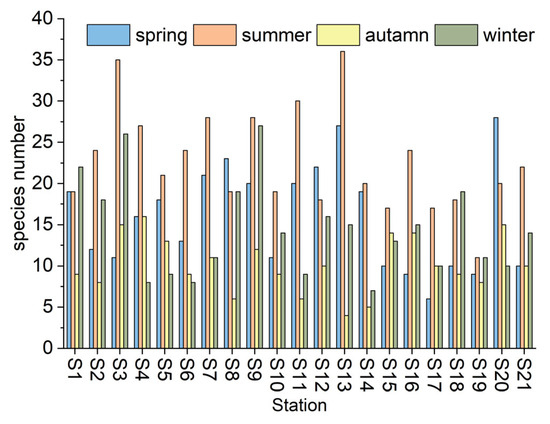
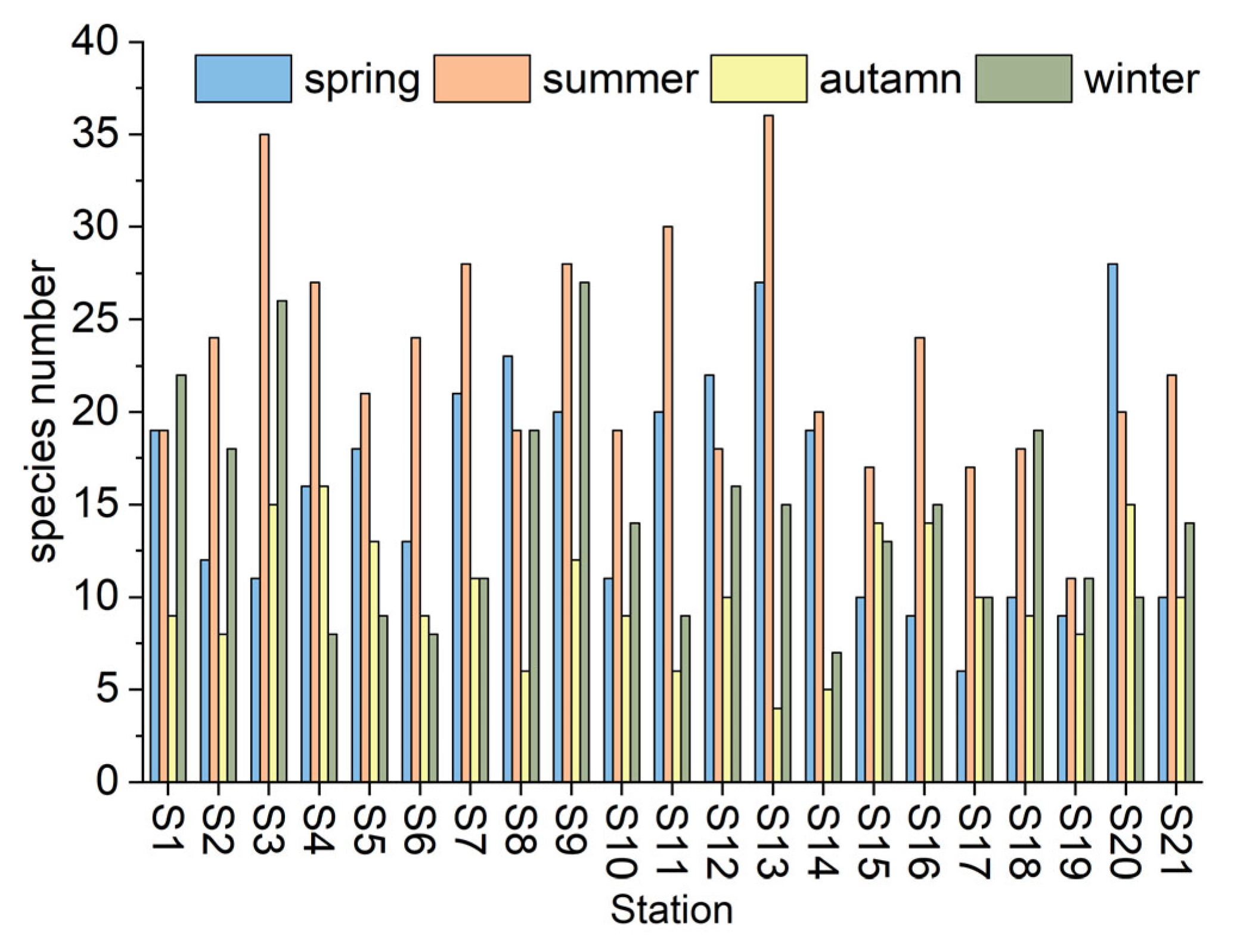
In terms of seasonal dynamics, a total of 79 phytoplankton species from 5 phyla were identified in March 2023 (spring time) (Figure 3). Among these, Bacillariophyta constituted 75.95%, Dinoflagellata 20.25%, and Chrysophyta, Chlorophyta, and Cryptophyta each accounted for 1.27% (Figure 3). In June of 2023 (summer time), 93 species from 5 phyla were recorded, with Bacillariophyta representing 62.37%, Dinoflagellata 22.58%, Chlorophyta 9.68%, Cyanophyta 4.30%, and Euglenophyta 1.08% (Figure 3). In August of 2022 (autumn time), 75 species from 5 phyla were observed; Bacillariophyta accounted for 70.67%, Dinoflagellata for 21.33%, Chlorophyta for 4.00%, Cyanophyta for 2.67%, and Chrysophyta for 1.33% (Figure 3). In December of 2022 (winter time), 80 species from 3 phyla were identified, of which Bacillariophyta comprised 83.75%, Dinoflagellata 13.75%, and Cyanophyta 2.50% (Figure 3). Regarding spatial distribution, the total number of phytoplankton species varied among sampling stations. Species richness was relatively high at stations S3, S4, S5, S7, S9, S11, and S13, but relatively low at stations S12, S14, and S17 (Figure 4).
Figure 3.
Seasonal distribution of phytoplankton taxa in the Leizhou Peninsula, China.
Figure 4.
Spatiotemporal distribution of phytoplankton species richness in the Leizhou Peninsula, China.
3.2. Dominant Species
Based on the dominance index criterion (Y ≥ 0.02), a total of 24 dominant phytoplankton species belonging to 2 phyla and 12 genera were identified in the coastal waters of Leizhou Peninsula, China (Table 1). Among these, 10 dominant species were identified in spring, followed by 5 in summer, 3 in autumn, and 4 in winter (Table 1). The dominant species primarily consisted of diatoms. Skeletonema costatum (Greville) Cleve 1878 and Chaetoceros lorenzianus Grunow 1863 were dominant throughout the year, while Thalassiosira pacifica Gran et Angst 1931 (Bacillariophyta) prevailed mainly in spring and winter (Table 1). Lauderia annulata Cleve 1873 (Bacillariophyta) prevailed mainly in winter (Table 1). Diatoms such as Rhizosolenia styliformis T.Brightwell 1858, Pseudo-nitzschia sp., Bacteriastrum hyalinum Lauder 1864, and Chaetoceros densus Cleve 1901, along with the dinoflagellate Glenodinium pulvisculus (Ehrenberg) Stein 1883, were primarily observed in spring. In addition, the diatoms Chaetoceros curvisetus Cleve 1889 and Asterionella japonica Cleve 1878 were common during both spring and summer, while Chaetoceros pseudocurvisetus Mangin 1910 was predominantly found in summer.
Table 1.
Dominant phytoplankton species and their dominance values across seasons.
3.3. Spatiotemporal Variation in Phytoplankton Cell Density and Diversity Indices
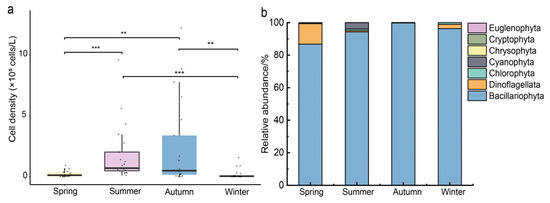
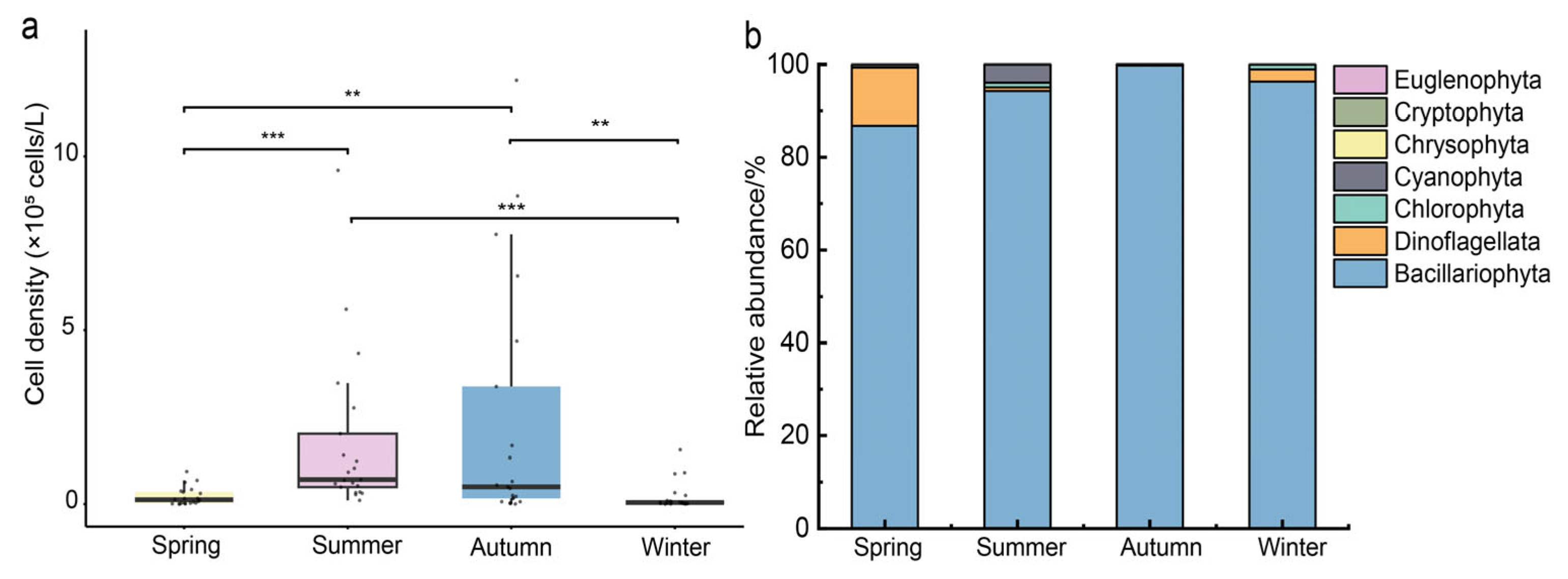
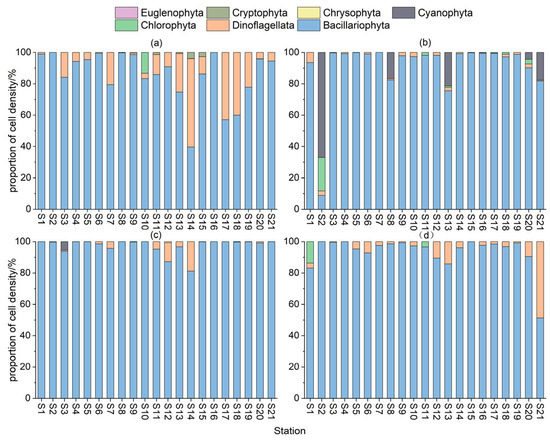
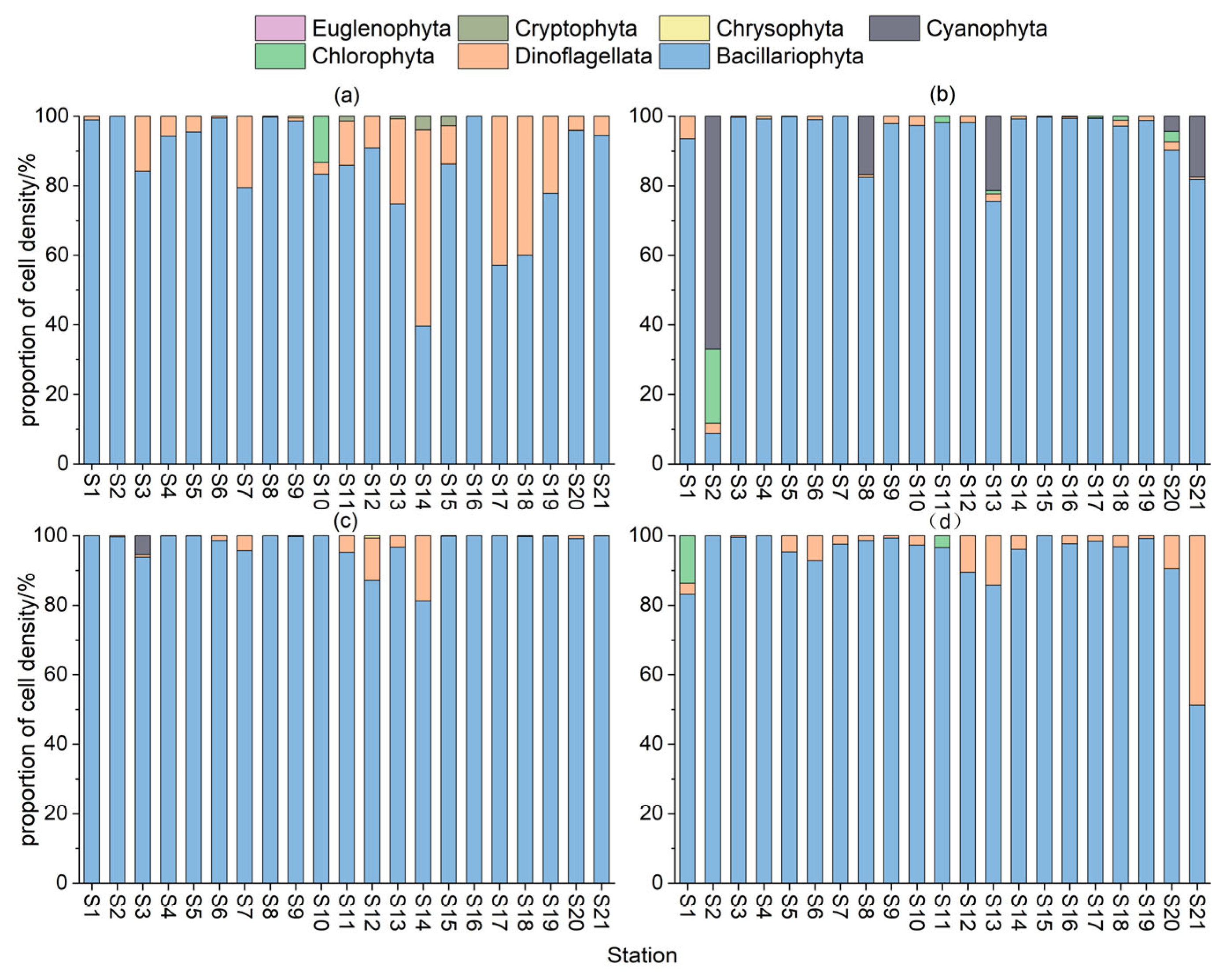
The phytoplankton cell density in the coastal waters of the Leizhou Peninsula exhibited notable seasonal variation, ranging from 4.45 × 10⁵ to 49.61 × 10⁵ cells L−1 (Figure 5a). The seasonal order of phytoplankton cell density, in descending order, was: autumn > summer > spring > winter (Figure 5a). Bacillariophyta represented the predominant group and showed significant increases during summer and autumn, with cell densities ranging from 3.96 × 10⁵ to 49.51 × 10⁵ cells L−1 accounting for 96.88% of the total cell density. This was followed by Cyanophyta and Dinoflagellata, which contributed 1.53% and 1.1%, respectively. Chlorophyta, Chrysophyta, Euglenophyta, and Cryptophyta collectively accounted for 0.46% (Figure 5). Across all seasons, Bacillariophyta consistently constituted the highest proportion of phytoplankton cell density (Figure 6). Dinoflagellata were predominantly observed in spring and summer, whereas Cyanophyta density was significantly higher in summer compared to other seasons. Chlorophyta occurred mainly in summer and winter (Figure 6). In terms of spatial distribution, the phytoplankton community composition at all sampling stations around the Leizhou Peninsula was dominated by Bacillariophyta (Figure 6).
Figure 5.
Seasonal variations in phytoplankton cell density off the Leizhou Peninsula, China. (a) total cell density of phytoplankton in different seasons; (b) relative abundance of phytoplankton in different seasons. ** means p < 0.01, *** means p < 0.001.
Figure 6.
Spatiotemporal distribution of phytoplankton cell density in the Leizhou Peninsula, China: (a) spring; (b) summer; (c) autumn; (d) winter.
The phytoplankton community structure indices for the coastal waters of the Leizhou Peninsula are presented in Table S2. The Shannon–Wiener diversity index (H) ranged from 0.07 to 2.69, with an annual average of 1.63. The highest value was recorded at Station S11 in summer, while the lowest occurred at Station S16 in autumn. Notably, the H value in autumn was significantly lower than that in other seasons (Table S3); water quality corresponding to these index values was mostly classified as moderately to heavily polluted. The Pielou evenness index (J) varied between 0.02 and 0.68, with an annual average of 0.42. The highest value was observed at Station S19 in spring, and the lowest at Station S17 in autumn. Statistical analysis indicated that the J-values in spring and winter were significantly higher than those in summer and autumn (Table S3). Based on these indexes, water quality was predominantly classified as lightly to moderately polluted. Margalef’s richness index (D) exhibited seasonal variation, decreasing in the order: summer > spring > winter > autumn. Similarly to the H value, the D value in autumn was significantly lower than that in other seasons (Table S3). The index values ranged from 1.26 to 4.45, with an annual average of 3.13. The highest value occurred at Station S2 in summer, and the lowest at Station S6 in winter, indicating water quality predominantly classified as moderately to heavily polluted.
3.4. Seasonal Variation in Physicochemical Parameters in the Water Body
Physicochemical parameters, based on four quarterly samplings across 21 stations, are presented in Table 2. Water depth ranged from 2.3 to 33.1 m, and water temperature varied between 20.16 and 30.41 °C, with both parameters exhibiting their highest values in summer (Table 2). The water was weakly alkaline, with pH values ranging from 7.82 to 8.44. CODMn reached its highest level in autumn, with a mean value of 1.58 mg L−1. DIN concentrations ranged from 0.14 to 0.31 mg L−1 and were significantly higher in autumn than that in summer and winter. In contrast, DSi concentrations (0.27–1.29 mg L−1) were significantly elevated in summer and winter compared to other seasons. DIP levels varied between 0.03 and 0.08 mg L−1, with significantly higher values in spring and winter than that in autumn (p < 0.05). Similarly, concentrations of Chl a (2.76–8.79 μg L−1) were significantly higher in autumn than that in spring and winter (p < 0.05).
Table 2.
Seasonal mean values and standard deviations of physicochemical. parameters in the waters of Leizhou Peninsula, China (Values represent mean ± SD).
3.5. Redundancy Analysis (RDA) of Phytoplankton and Environmental Factors
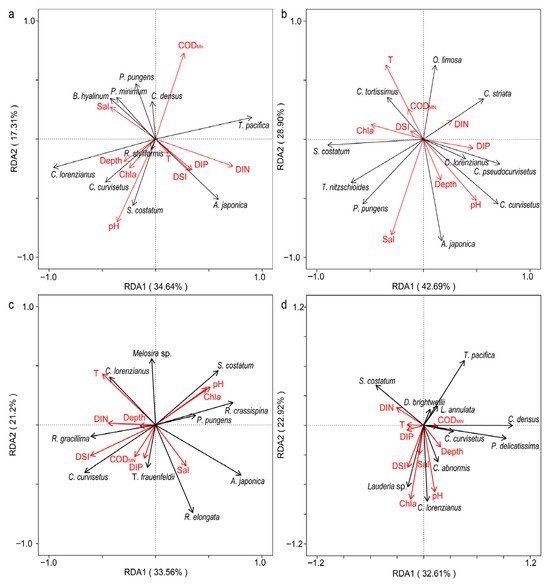
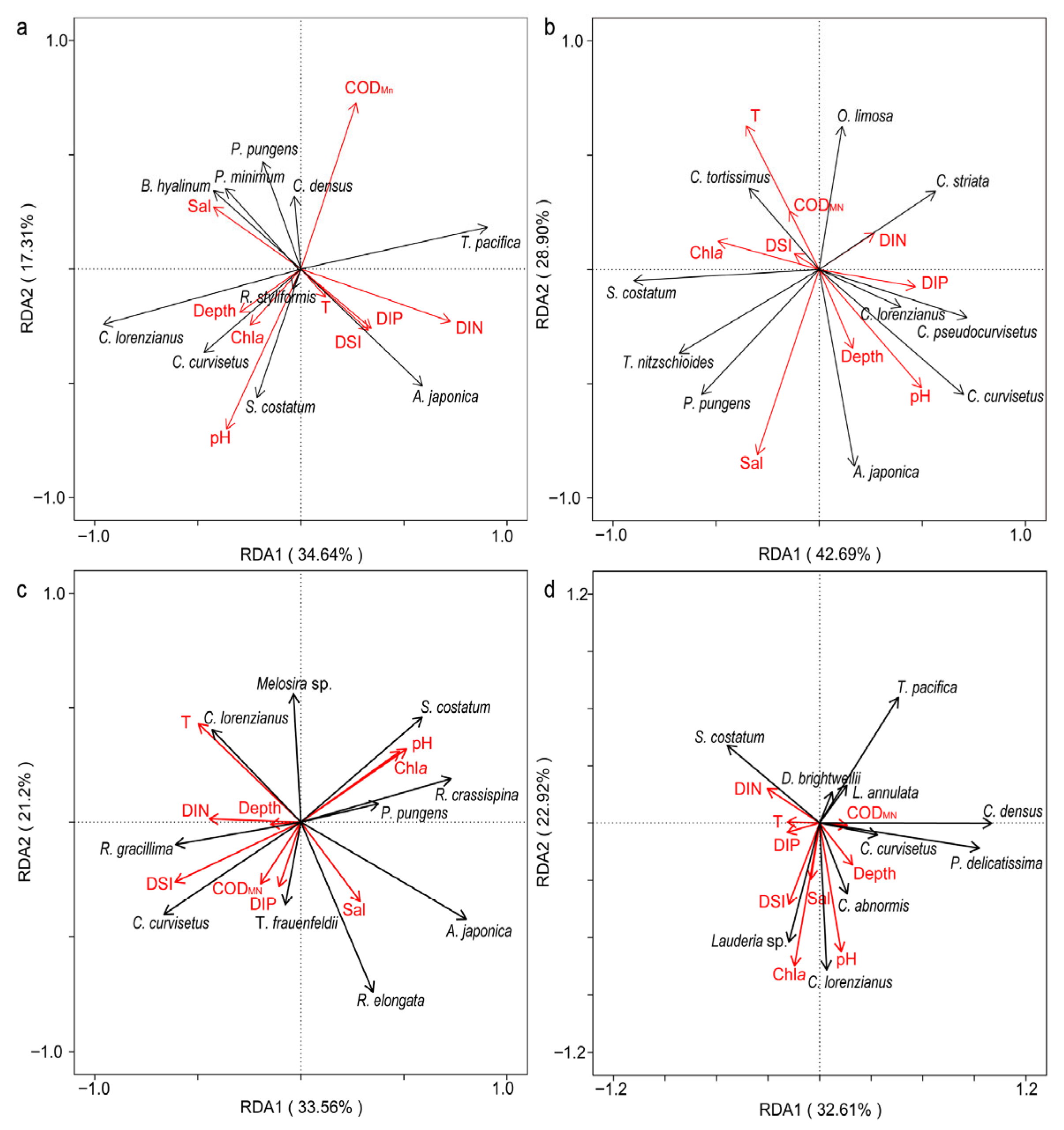
An RDA was performed using data from the top 10 dominant phytoplankton species by cell density in each season, along with environmental factors (Figure 7). In spring, the first two axes explained 51.95% of the variation in the phytoplankton community (Monte Carlo permutation test, p < 0.05). The key explanatory variables were DIN (p = 0.003), pH (p = 0.008), and CODMn (p = 0.015). Species-environment relationship analyses revealed that Pseudo-nitzschia sp., Bacteriastrum hyalinum, Chaetoceros densus (Bacillariophyta), and Glenodinium sp. (Dinoflagellata) were positively correlated with CODMn and Sal, but negatively correlated with most other environmental factors. In contrast, Skeletonema costatum was positively correlated with pH, and Asterionella japonica was positively correlated with T, DSi, and DIP (Figure 7).
Figure 7.
Redundancy analysis (RDA) of phytoplankton and environmental factors across seasons: (a) spring; (b) summer; (c) autumn; (d) winter. (T. Nitzschioides: Thalassionema nitzschioides Grunow 1885; T. frauenfeldii: Thalassiothrix frauenfeldii Grunow 1880; R. gracillima: Rhizosolenia gracillima Cleve 1878; L. danicus: Leptocylindrus danicus Cleve 1889; R. crassispina: Rhizosolenia crassispina Schröder 1906; L. annulata: Lauderia annulata Cleve 1873; C. abnormis: Chaetoceros abnormis Proshkina-Lavrenko 1953; D. brightwellii: Ditylum brightwellii (West) Grunow 1881).
In summer, the first two axes explained 71.59% of the variation. Sal (p = 0.001) was the dominant influencing factor, followed by T (p = 0.014) and pH (p = 0.015). Chaetoceros curvisetus Gran 1900 (Bacillariophyta) was positively correlated with T and CODMn, while Oscillatoria limosa C.Agardh ex Gomont 1892 (Cyanophyta) and Cyclotella striata (Kützing) Grunow 1880 (Bacillariophyta) were negatively correlated with Sal (Figure 7).
In autumn, the first two axes collectively explained 54.76% of the variation. The key explanatory variables were DSi (p = 0.021), T (p = 0.021), and pH (p = 0.049). Chaetoceros lorenzianus (Bacillariophyta) was positively correlated with T and negatively correlated with Sal. Chaetoceros curvisetus (Bacillariophyta) was positively correlated with DSi, and Skeletonema costatum (Bacillariophyta) was positively correlated with pH and Chl a (Figure 7).
In winter, the first two axes explained 55.53% of the variation. Chl a (p = 0.008) was identified as the key explanatory variable, followed by pH (p = 0.015). Lauderia sp. (Bacillariophyta) was positively correlated with multiple environmental factors. Pseudo-nitzschia delicatissima (Cleve) Heiden 1928 (Bacillariophyta) was positively correlated with CODMn but negatively correlated with T and DIP (Figure 7).
4. Discussion
4.1. Structural Characteristics of Phytoplankton Communities
A total of 174 phytoplankton species belonging to 7 phyla were identified in the coastal waters of Leizhou Peninsula during the investigation from August 2022 to June 2023. Significant differences in species number were observed among different phyla, with the community primarily composed of diatoms and dinoflagellates. Collectively, these two groups accounted for 86.78% of the total species identified, indicating a typical diatom-dominated community. Diatoms exhibited prominent dominance in both species richness and cell density, a finding consistent with studies conducted in other marine regions dominated by diatoms [42,43,44]. Compared with historical data, phytoplankton species richness and cell density showed a significant increase in this study. However, the total species number (174) was lower than a report of 211 species (including varieties and forms) in the same region in 2010 [18]. Notably, Cryptophyta was newly recorded in this survey. Regarding to the dominant species, beyond the previously documented eurythermal and euryhaline coastal diatoms, dinoflagellates emerged as a significant new component of the dominant species, which include several harmful algal blooms (HABs) species. Among them, diatoms such as S. costatum and several Chaetoceros species (C. lorenzianus, C. curvisetus, and C. pseudocurvisetus) are common HAB species [45,46,47,48], with their mass proliferation being closely linked to eutrophic conditions [45]. Of particular concern is the presence of Pseudo-nitzschia sp., a genus known to include multiple species capable of producing potent neurotoxins such as domoic acid, which pose serious threats to fisheries and public health [49]. Therefore, the dominance of these recognized HAB species may pose a heightened risk of algal bloom outbreaks in the region.
These shifts in community structure may be attributed to eutrophication and altered competitive dynamics within the marine ecosystem. Discrepancies in species composition between studies may also arise from spatial heterogeneity in sampling site distribution and inter-annual or seasonal variation in survey timing.
Skeletonema costatum has consistently been the dominant species in the waters off the Leizhou Peninsula, in accordance with a previous study [18]. Historical algal bloom records in this region further indicate that S. costatum most frequently occurs as the dominant diatom, with its dominance being particularly pronounced during summer [50]. As an eurythermal and euryhaline coastal diatom, S. costatum exhibits strong adaptability to subtropical inner-bay environments, ecological traits that have been widely confirmed in previous studies [51,52,53]. Even in estuary, such as stations from S15 to S19, S. costatum maintained a growth advantage, which can be attributed to its exceptional photoacclimation capacity and high light-use efficiency [54].
The stability of phytoplankton community structure is often assessed using species diversity indices [55,56]. Generally, higher diversity values indicate greater community complexity and higher ecological stability. Conversely, the findings of this study reveal that during the autumn survey, the number of dominant species decreased to five, while the dominance index of S. costatum increased significantly, reaching 0.77. Simultaneously, the diversity index declined to its lowest level, collectively indicating a trend toward structural simplification of the phytoplankton community. This shift suggests a deterioration in environmental quality and a persistently elevated risk of HABs.
Phytoplankton cell density in the coastal waters of the Leizhou Peninsula, China, exhibited a characteristic subtropical bimodal annual pattern, with the primary peak occurring in autumn and a secondary peak in summer. This pattern contrasts significantly with those observed in other regional waters, such as the spring unimodal pattern reported at Weizhou Island, China [57] and the autumn unimodal pattern documented in Daya Bay, China [58]. Such divergence primarily stems from disparities in regional hydrochemical conditions and nutrient inputs. For instance, Weizhou Island is minimally influenced by terrestrial runoff, whereas Daya Bay is characterized by restricted water exchange due to its semi-enclosed, deep-water setting. In comparison, the hydrographic environment of the Leizhou Peninsula is more complex: during the summer and autumn rainfall periods, the water masses are jointly influenced by continental runoff (e.g., from the Nandu River, China) and oceanic currents from the Gulf of Tonkin and the South China Sea offshore. As a result, seawater salinity was significantly lower in these seasons compared to spring and winter. This hydrological variation, coupled with enhanced terrestrial nutrient inputs, provides a substantial material basis supporting phytoplankton blooms.
4.2. Influence of Environmental Factors on Phytoplankton Community Structure Characteristics
Variations in phytoplankton community structure are influenced by multiple environmental factors, including temperature, salinity, and nutrient availability [59,60,61]. This study demonstrates that the phytoplankton community structure in the waters of the Leizhou Peninsula is collectively shaped by Sal, DIN, Chl a, pH, T, CODMn, and DSi. Although the dominant controlling factors varied significantly across seasons, pH emerged as a consistently significant factor influencing phytoplankton distribution throughout this marine region.
Nitrogen and phosphorus are essential nutrients for phytoplankton growth and reproduction, and elevated concentrations of these nutrients can significantly enhance the biomass of certain phytoplankton species [62]. The results of this study, however, reveal that the influence of dissolved inorganic nitrogen (DIN) on phytoplankton community structure varies markedly by season. Although DIN concentrations peaked in autumn (0.31 mg L−1), coinciding with the highest phytoplankton cell density, redundancy analysis identified DIN as a non-key driver during this season. In contrast, in spring, when DIN concentrations were relatively lower (0.23 mg L−1), DIN emerged as the most significant explanatory variable (p = 0.003). The pronounced effect of DIN in spring likely stems from its synergy with other contemporaneous environmental conditions; for instance, the relatively suitable temperature (24.36 °C) and higher pH (8.29) during this period may have enhanced nitrogen-use efficiency in certain diatom species. These findings align with the view that in nutrient-replete environments, phytoplankton community structure is often regulated more strongly by non-nutrient physicochemical factors such as temperature, salinity, and light [63].
Chl a serves as a key indicator of water eutrophication, and its concentration generally reflects the current phytoplankton biomass. In the present study, however, a significant negative correlation was found between Chl a concentration and phytoplankton community development in winter (p = 0.008)—a result consistent with earlier observations by Wang et al. (2023) [64]. This apparent paradox may be linked to the notably high Chl a levels recorded in autumn (8.79 μg L−1) and their subsequent ecological carry-over effects. The elevated autumn biomass, dominated by S. costatum (dominance index Y = 0.77), likely induced a strong self-shading effect, thereby reducing light penetration in the water column [65]. Such light-limited conditions probably persisted into winter, enhancing the role of Chl a—as a proxy for standing crop—in filtering species composition via differences in light adaptation strategies. Additionally, high autumn biomass may have stimulated zooplankton grazing [66], which could further modulate the structure of the winter phytoplankton assemblage. pH significantly influences phytoplankton distribution [67]. The observed positive correlation between pH and dominant diatom species such as S. costatum in our RDA aligns with experimental evidence showing that slightly alkaline conditions can enhance the growth and photosynthetic efficiency of coastal diatoms by facilitating more efficient carbon acquisition [68]. This physiological advantage under the prevailing pH conditions likely reinforces their competitive dominance in the Leizhou Peninsula ecosystem. The lower pH in summer (7.82 ± 0.25) coincided with increased contributions of Cyanophyta (4.30%) and Chlorophyta (9.68%), particularly species like O. limosa. This aligns with studies showing that some cyanobacteria and green algae possess efficient carbon-concentrating mechanisms (CCMs) that confer competitive advantage under lower pH conditions [69,70]. Increased T promotes the growth of most algal species [71,72] by enhancing metabolic and reproductive rates, significantly shaping community composition [73,74]. Temperature in the study area showed distinct seasonal variation, with mean water temperature reaching approximately 30 °C in summer and autumn. Such warm conditions promoted the growth of temperature-tolerant groups, including diatoms, cyanobacteria, and chlorophytes, leading to a significant increase in phytoplankton cell densities during these seasons. In contrast, lower temperatures in spring and winter were associated with an observable increase in the relative proportion of cold-adapted taxa, such as certain dinoflagellates. These seasonal shifts in taxonomic composition reflect differential thermal responses among algal groups. Specifically, cyanobacteria and chlorophytes exhibited a clear positive response to warming, aligning with their generally warmer-water affinities, whereas several dinoflagellate taxa appeared more prevalent under cooler conditions. Salinity is another crucial environmental factor regulating phytoplankton growth [75]. During the summer time, phytoplankton dynamics in this region are strongly modulated by freshwater discharge from adjacent rivers. Multiple watercourses, including the Jian River, Chengyue River, and Tongming River, flow along the coastline of the peninsula, delivering substantial continental runoff into coastal waters. The lowest salinity in summer corresponded with increased contributions of Cyanophyta (4.30%) and Chlorophyta (9.68%), suggesting that freshwater inflow may promote these groups. As a result, the diversity and abundance of freshwater-associated biota in the coastal zone are enhanced. Furthermore, CODMn is widely used as a comprehensive indicator of organic pollution. Higher CODMn values reflect more severe organic contamination, which in this study may be associated with terrestrial inputs—such as domestic sewage and aquaculture effluent from the Leizhou Peninsula—that supply substantial organic matter to coastal waters. These observations highlight the considerable impact of human activities on the aquatic ecosystem.
5. Conclusions
A total of 174 phytoplankton species, belonging to 7 phyla, were identified in the coastal waters of the Leizhou Peninsula, China from August 2022 to June 2023. Species richness exhibited distinct seasonal variation, being highest in summer, followed by winter and spring, and lowest in autumn, reflecting the overall predominance of diatoms in the study area. Using a dominance index (Y) threshold of ≥0.02, a total of 12 dominant phytoplankton species from 2 phyla were identified during the survey period. The dominant species primarily consisted of diatoms and dinoflagellates, among which Skeletonema costatum and Chaetoceros lorenzianus were consistently dominant across all four seasons. Phytoplankton cell density showed considerable seasonal variation, ranging from 4.45 × 10⁵ to 49.61 × 10⁵ cells L−1, with cell density following the order: autumn > summer > spring > winter. The Shannon–Wiener diversity index (H) ranged from 0.07 to 2.69, while the Pielou’s evenness index (J) and Margalef’s richness index (D) ranged from 0.02 to 0.67 and 0.37 to 3.03, respectively. Higher diversity values were observed in spring and winter, whereas significantly lower values occurred in summer and autumn. Based on these indices, the water body was classified as moderately to heavily polluted. RDA indicated that the influence of environmental factors on the phytoplankton community varied seasonally. The key factors driving phytoplankton dynamics in the Leizhou Peninsula were Sal, DIN, Chl a, pH, T, CODMn, and DSi.
Supplementary Materials
The following supporting information can be downloaded at https://www.mdpi.com/article/10.3390/d17120867/s1, Table S1: Study area and sampling stations; Table S2: Seasonal variations in diversity indices; Table S3: Significant differences in diversity indices across seasons.
Author Contributions
Conceptualization, Z.H.; methodology, J.L., M.G., B.L., N.Z. and Z.H.; software, J.L., M.G. and B.L.; validation, J.L., M.G., B.L. and Z.H.; formal analysis, J.L., M.G., B.L. and Z.H.; investigation, J.L., M.G., B.L., F.L. and Z.H.; resources, Z.H.; data curation, J.L., M.G. and B.L.; writing—original draft preparation, J.L. and M.G.; writing—review and editing, J.L., M.G., B.L., Y.F., J.W., Y.Z., F.L., N.Z. and Z.H.; visualization, J.L., M.G. and B.L.; supervision, N.Z. and Z.H.; project administration, Z.H.; funding acquisition, Z.H. All authors have read and agreed to the published version of the manuscript.
Funding
This research was funded by the Research on industrial innovation technology for Guangdong modern marine ranching, grant number 2024-MRI-001-12, Program for Scientific Research Start-up Funds of Guangdong Ocean University, grant number 060302022201, and the Undergraduate Innovation Team of Guangdong Ocean University, grant number CXTD2023002.
Institutional Review Board Statement
Not applicable.
Data Availability Statement
The original contributions presented in the study are included in the article/Supplementary Materials, further inquiries can be directed to the corresponding author.
Acknowledgments
The authors greatly appreciate the constructive advice of anonymous reviewers.
Conflicts of Interest
The authors declare no conflicts of interest. The funders had no role in the design of the study; in the collection, analyses, or interpretation of data; in the writing of the manuscript; or in the decision to publish the results.
References
- Walsh, J.J.; Dieterle, D.A.; Lenes, J. A Numerical Analysis of Carbon Dynamics of the Southern Ocean Phytoplankton Community: The Roles of Light and Grazing in Effecting Both Sequestration of Atmospheric CO2 and Food Availability to Larval Krill. Deep Sea Res. Part I 2001, 48, 1–48. [Google Scholar] [CrossRef] [Scilit]
- Wang, Y.; Qiu, G.; Chen, S.; Hu, S. Research on Plankton Community in Three Gorges Reservoir during Its Trial Impoundment. Yangtze River 2012, 43, 4–9. [Google Scholar]
- Field, C.B.; Behrenfeld, M.J.; Randerson, J.T.; Falkowski, P. Primary Production of the Biosphere: Integrating Terrestrial and Oceanic Components. Science 1998, 281, 237–240. [Google Scholar] [CrossRef] [Scilit] [PubMed]
- John, D.M. Use of Algae for Monitoring Rivers III, Edited by J. Prygiel, B.A. Whitton and J. Bukowska (Eds). J. Appl. Phycol. 1999, 11, 596–597. [Google Scholar]
- Whitton, B.A. Changing Approaches to Monitoring during the Period of the ‘Use of Algae for Monitoring Rivers’ Symposia. Hydrobiologia 2012, 695, 7–16. [Google Scholar] [CrossRef] [Scilit]
- Tilman, D. Biodiversity: Population Versus Ecosystem Stability. Ecology 1996, 77, 350–363. [Google Scholar] [CrossRef] [Scilit]
- Tilman, D.; Reich, P.B.; Knops, J.M.H. Biodiversity and Ecosystem Stability in a Decade-Long Grassland Experiment. Nature 2006, 441, 629–632. [Google Scholar] [CrossRef] [Scilit]
- Loreau, M.; Hector, A. Partitioning Selection and Complementarity in Biodiversity Experiments. Nature 2001, 412, 72–76. [Google Scholar] [CrossRef] [Scilit]
- Wu, D.; Mei, P.; Sun, R.; Zhang, Z. Community Characteristics of Phytoplankton in Yuqiao Reservoir and Relationships with Environmental Factors. Environ. Sci. Technol. 2015, 38, 103–109. [Google Scholar]
- Xu, S.; Xiao, Y.; Xu, Y.; Su, L.; Cai, Y.; Qi, Z.; Liu, Y.; Chen, Z.; Lakshmikandan, M. Effects of Seasonal Variations and Environmental Factors on Phytoplankton Community Structure and Abundance in Beibu Gulf, China. Ocean Coast. Manag. 2024, 248, 106982. [Google Scholar] [CrossRef] [Scilit]
- Suikkanen, S.; Laamanen, M.; Huttunen, M. Long-Term Changes in Summer Phytoplankton Communities of the Open Northern Baltic Sea. Estuar. Coast. Shelf Sci. 2007, 71, 580–592. [Google Scholar] [CrossRef] [Scilit]
- Ongun Sevindik, T.; Çetin, T.; Tekbaba, A.G.; Güzel, U. Impacts of Lake Surface Area on Phytoplankton Community Dynamics and Ecological Status Across 70 Lentic Systems in Türkiye. Ecohydrology 2025, 18, e70031. [Google Scholar] [CrossRef] [Scilit]
- Zaghloul, F.A.; Ghobrial, M.G.; Hussein, N.R.; Deghady, E.E.D.; Hussein, M.M.A. Long-Term Monitoring of Water Quality and Phytoplankton Community Structure of Lake Manzala, Mediterranean Coast of Egypt. Sci. Afr. 2024, 26, e02345. [Google Scholar] [CrossRef] [Scilit]
- Alprol, A.E.; Ashour, M.; Mansour, A.T.; Alzahrani, O.M.; Mahmoud, S.F.; Gharib, S.M. Assessment of Water Quality and Phytoplankton Structure of Eight Alexandria Beaches, Southeastern Mediterranean Sea, Egypt. J. Mar. Sci. Eng. 2021, 9, 1328. [Google Scholar] [CrossRef] [Scilit]
- Tekebayeva, Z.; Bazarkhankyzy, A.; Temirbekova, A.; Rakhymzhan, Z.; Kulzhanova, K.; Beisenova, R.; Kulagin, A.; Askarova, N.; Yevneyeva, D.; Temirkhanov, A.; et al. Ecological Assessment of Phytoplankton Diversity and Water Quality to Ensure the Sustainability of the Ecosystem in Lake Maybalyk, Astana, Kazakhstan. Sustainability 2024, 16, 9628. [Google Scholar] [CrossRef] [Scilit]
- Lei, J.; Liao, Y.; Tang, W.; Xie, D.; Wang, T.; Xiong, W.; Bowler, P.A. Fish Biodiversity in Zhanjiang Mangroves National Nature Reserve, China. Turk. J. Zool. 2022, 46, 74–77. [Google Scholar]
- Chen, Y.; Sun, Y.; Shi, H.; Zhao, H.; Gao, H.; Pan, G.; Tian, K. Environmental Capacity and Fluxes of Land-Sourced Pollutants around the Leizhou Peninsula in the Summer. Front. Mar. Sci. 2023, 10, 1280753. [Google Scholar] [CrossRef] [Scilit]
- Gong, Y.; Zhang, C.; Sun, S.; Zhang, Y.; Shi, Y.; Xie, Q. Community Characteristics of Phytoplankton in the Coastal Area of Leizhou Peninsula and Their Relationships with Primary Environmental Factors in the Summer of 2010. Acta Ecol. Sin. 2012, 32, 5972–5985. [Google Scholar] [CrossRef] [Scilit]
- Guo, K.; Zhang, Y.; Zhang, J.; Sun, S. Biomass Distribution of Phytoplankton and Bacterioplankton in Coastal Areas of Leizhou Peninsula in Summer and Related Affecting Factors. Chin. J. Ecol. 2012, 31, 8–15. [Google Scholar]
- Lv, S.; Qi, Y.; Qian, H.; Liang, S. A Preliminary Study on Phytoplankton and Red-Tide Organisms in Zhanjiang Harbor. Oceanol. Limnol. Sin. 1994, 25, 190–196. [Google Scholar]
- Zhang, C.; Gong, Y.; Sun, S. Study on the Ecological Characteristics of Phytoplankton Community in Zhanjiang Bay. Mar. Sci. Bull. 2012, 2012, 530–538. [Google Scholar]
- Chen, C.; Zhang, C. Community Structure of Phytoplankton in the Coastal Waters of Leizhou Bay with Its Relationships to Environmental Factors. J. Appl. Oceanogr. 2016, 35, 174–182. [Google Scholar]
- Lv, S.; Qi, Y.; Qian, H.; Liang, S. A Study on Phytoplankton and Red Tide Organisms in Leizhou Bay. J. Jinan Univ. (Nat. Sci.) 1994, 15, 146–150. [Google Scholar]
- Yin, J.; Huang, H.; Huang, L.; Lin, Y.; Li, K.; Lian, J. Phytoplankton of the Coral Reef at Dengloujiao, Leizhou Peninsula, Guangdong Province, China. Mar. Sci. Bull. 2006, 25, 8–14. [Google Scholar]
- Zhang, C.; Sun, S.; Xie, W.; Xie, S.; Zhan, D.; Zhang, Y.; Zhang, J.; Chen, C. Seasonal Variation of Phytoplankton in the Xuwen Coral Reef Region. Oceanol. Limnol. Sin. 2009, 40, 159–165. [Google Scholar]
- Su, J.; Zhu, C.; Li, J.; Li, T.; Chen, S.; Xiao, Y.; Zhang, B. Phytoplankton Community Characteristics in Different Seasons and Their Relationship with Aquaculture in Liusha Bay. Fish. Sci. 2018, 39, 11–23. [Google Scholar]
- Cheng, X.; Huang, L.; Tan, Y.; Huang, X.; Liu, H. Temporal and Spatial Variation of Phytoplankton Community Structure in Liusha Bay. Mar. Environ. Sci. 2011, 30, 13–18. [Google Scholar]
- Lv, S.; Qi, Y.; Qian, H.; Liang, S. Study on Phytoplankton and Red-Tide Organisms in a South China Sea Bay (Anpu Harbor). J. Jinan Univ. (Nat. Sci.) 1994, 15, 156–160. [Google Scholar]
- Wei, F. Water and Wastewater Monitoring Methods, 4th ed.; China Environmental Science Press: Beijing, China, 2002. [Google Scholar]
- Yang, S.M.; Dong, S.G. Illustrated Guide to Common Marine Diatoms in China; China Ocean University Press: Qingdao, China, 2006. [Google Scholar]
- Weng, J.Z. Illustrated Guide to Common Freshwater Planktonic Algae in China; Shanghai Scientific & Technical Publishers: Shanghai, China, 2010. [Google Scholar]
- Huang, Z.G.; Lin, M. Atlas of Marine Life in China; Ocean Press: Beijing, China, 2012. [Google Scholar]
- Zhao, W. Aquatic Biology; China Agriculture Press: Beijing, China, 2016. [Google Scholar]
- Gao, Y.H.; Chen, C.P.; Sun, L.; Liang, J.R. Common Phytoplankton in Xiamen Waters; Xiamen University Press: Xiamen, China, 2021. [Google Scholar]
- Fu, M.; Sun, P.; Sun, X.; Wei, Q.; Zhang, X.; Wang, Z. Phytoplankton Community Structure and Its Ecological Responses to Environmental Changes in Jinzhou Bay. Acta Ecol. Sin. 2014, 34, 3650–3660. [Google Scholar] [CrossRef] [Scilit]
- Wilhm, J.L. Use of Biomass Units in Shannon’s Formula. Ecology 1968, 49, 153–156. [Google Scholar] [CrossRef] [Scilit]
- Pielou, E.C. Species-Diversity and Pattern-Diversity in the Study of Ecological Succession. J. Theor. Biol. 1966, 10, 370–383. [Google Scholar] [CrossRef] [Scilit]
- Margalef, R. Information Theory in Ecology. Gen. Syst. 1958, 3, 36–71. [Google Scholar]
- Wu, H. Phytoplankton community structure and assessment of trophic state in important mariculture area of Dongshan Bay. J. Fish. Res. 2021, 43, 578–586. [Google Scholar]
- Zaghloul, F.A.; Hussein, N.R.; Taha, H.M.; Mikhail, S.K.; Shaltout, N.A.; Khairy, H.M. Monitoring of the Ecological Status of the Phytoplankton Dynamics, Water Quality, and Water Types in the Egyptian Mediterranean Coastal Estuary over Two-Decade Intervals. Egypt. J. Aquat. Biol. Fish. 2024, 28, 1137–1167. [Google Scholar] [CrossRef] [Scilit]
- Li, X.; Yu, H.; Wang, H.; Ma, C. Phytoplankton Community Structure in Relation to Environmental Factors and Ecological Assessment of Water Quality in the Upper Reaches of the Genhe River in the Greater Hinggan Mountains. Environ. Sci. Pollut. Res. 2019, 26, 17512–17519. [Google Scholar] [CrossRef] [Scilit]
- Liu, L.; Zhang, J.; Zhao, Y.; Luan, Q.; Zhao, X.; Wang, X. Net-Phytoplankton Communities and Influencing Factors in the Antarctic Peninsula Region in the Late Austral Summer 2019/2020. Front. Mar. Sci. 2023, 10, 1254043. [Google Scholar] [CrossRef] [Scilit]
- Chen, T.; Zhang, Y.; Song, S.; Liu, Y.; Sun, X.; Li, C. Diversity and Seasonal Variation of Marine Phytoplankton in Jiaozhou Bay, China Revealed by Morphological Observation and Metabarcoding. J. Ocean. Limnol. 2022, 40, 577–591. [Google Scholar] [CrossRef] [Scilit]
- Li, Y.; Li, R.; Wang, Z.; Zhu, M.; Sun, P.; Xia, B. A Preliminary Study on Phytoplankton Community Structure and Its Changes in the Jiaozhou Bay. Adv. Mar. Sci. 2005, 23, 328–334. [Google Scholar]
- Li, C.; Zhu, B.; Chen, H.; Liu, Z.; Cui, B.; Wu, J.; Li, B.; Yu, H.; Peng, M. The Relationship between the Skeletonema costatum Red Tide and Environmental Factors in Hongsha Bay of Sanya, South China Sea. J. Coast. Res. 2009, 253, 651–658. [Google Scholar] [CrossRef] [Scilit]
- Vargas-Montero, M.; Freer, E. Paralytic Shellfish Poisoning Outbreaks in Costa Rica. In Harmful Algae 2002; Steidinger, K.A., Landsberg, J.H., Tomas, C.R., Vargo, G.A., Eds.; Florida Fish and Wildlife Conservation Commission, Florida Institute of Oceanography, and Intergovernmental Oceanographic Commission of UNESCO: St. Petersburg, FL, USA, 2004; pp. 482–484. [Google Scholar]
- Guan, W.C.; Li, P.; Jian, J.B.; Wang, J.Y.; Lu, S.H. Effects of Solar Ultraviolet Radiation on Photochemical Efficiency of Chaetoceros curvisetus (Bacillariophyceae). Acta Physiol. Plant. 2011, 33, 979–986. [Google Scholar] [CrossRef] [Scilit]
- Woods, W.L. Hydrography, Suspended Sediments, Chlorophyll A, Chromophoric Dissolved Organic Matter and Optical Characteristics of the Pearl River (Zhujiang) Estuary During July and November, 1998. Doctoral Dissertation, University of Rhode Island, Kingston, RI, USA, 2005. [Google Scholar]
- Li, Q.; Chen, J.; Xu, Z.; Deng, L.; Fang, X.; Zhang, S.; Zhang, X.; Xu, H.; Lin, S.; Liu, H. Detoxification of Domoic Acid from Pseudo-nitzschia by Gut Microbiota in Acartia Erythraea. BMC Microbiol. 2025, 25, 659. [Google Scholar] [CrossRef] [Scilit]
- Tian, Y.; Li, T.; Hu, S.; Xie, X.; Liu, S. Temporal and Spatial Characteristics of Harmful Algal Blooms in Guangdong Coastal Area. Mar. Environ. Sci. 2020, 39, 1–8. [Google Scholar]
- Lin, G.; Yang, Q.; Lin, J. Relationship between Phytoplankton and Environmental Factors in the Waters around Xiamen Island. Mar. Sci. Bull. 1993, 12, 40–45. [Google Scholar]
- Justić, D.; Rabalais, N.N.; Turner, R.E. Stoichiometric Nutrient Balance and Origin of Coastal Eutrophication. Mar. Pollut. Bull. 1995, 30, 41–46. [Google Scholar] [CrossRef] [Scilit]
- Dortch, Q.; Whitledge, T.E. Does Nitrogen or Silicon Limit Phytoplankton Production in the Mississippi River Plume and Nearby Regions? Cont. Shelf Res. 1992, 12, 1293–1309. [Google Scholar] [CrossRef] [Scilit]
- Yamamoto, T.; Tsuchiya, H. Physiological responses of Si-limited Skeletonema costatum to silicate supply with salinity decrease. Bull. Plankton Soci. 1995, 42, 1–17. [Google Scholar]
- Chen, W.; Gao, J.; Xu, Z.; Yan, Y.; Yang, S. Phytoplankton Community Diversity and Its Environmental Driving Factors in the Northern South China Sea. Water 2022, 14, 3777. [Google Scholar] [CrossRef] [Scilit]
- Pitchaikani, J.S.; Lipton, A.P. Nutrients and Phytoplankton Dynamics in the Fishing Grounds off Tiruchendur Coastal Waters, Gulf of Mannar, India. SpringerPlus 2016, 5, 1405. [Google Scholar] [CrossRef] [Scilit] [PubMed]
- Lin, J.; Lin, H.; Luo, X.; Guo, M.; Li, M.; Pang, B.; Huang, X.; Wang, Z.; Lan, W. Seasonal Variation Characteristics of Phytoplankton Community Structure and Environmental Impact Factors in the Weizhou Island. Guangxi Sci. 2024, 31, 224–236. [Google Scholar]
- Sun, C.; Wang, Y.; Sun, S.; Zhang, F. Analysis Dynamics of Phytoplankton Community Characteristics in Daya Bay. Acta Ecol. Sin. 2006, 26, 3948–3958. [Google Scholar]
- Boyd, P.W. Environmental Factors Controlling Phytoplankton Processes in the Southern Ocean1. J. Phycol. 2002, 38, 844–861. [Google Scholar] [CrossRef] [Scilit]
- Carstensen, J.; Frohn, L.M.; Hasager, C.B.; Gustafsson, B.G. Summer Algal Blooms in a Coastal Ecosystem: The Role of Atmospheric Deposition versus Entrainment Fluxes. Estuar. Coast. Shelf Sci. 2005, 62, 595–608. [Google Scholar] [CrossRef] [Scilit]
- Winder, M.; Cloern, J.E. The Annual Cycles of Phytoplankton Biomass. Philos. Trans. R. Soc. B 2010, 365, 3215–3226. [Google Scholar] [CrossRef] [Scilit] [PubMed]
- Jankowiak, J.; Hattenrath-Lehmann, T.; Kramer, B.J.; Ladds, M.; Gobler, C.J. Deciphering the Effects of Nitrogen, Phosphorus, and Temperature on Cyanobacterial Bloom Intensification, Diversity, and Toxicity in Western Lake Erie. Limnol. Oceanogr. 2019, 64, 1347–1370. [Google Scholar] [CrossRef] [Scilit]
- Rabalais, N.N.; Turner, R.E.; Díaz, R.J.; Justić, D. Global Change and Eutrophication of Coastal Waters. ICES J. Mar. Sci. 2009, 66, 1528–1537. [Google Scholar] [CrossRef] [Scilit]
- Wang, D.; Chen, Y.; Zhou, Y.; Zhang, M.; Yu, Z. Succession Characteristics and Driving Factors of Phytoplankton Functional Groups in the Germplasm Resources Reserve of Middle Reaches of Huaihe River. Chin. J. Ecol. 2023, 42, 2646–2654. [Google Scholar]
- Thushara, V.; Vinayachandran, P.N.M.; Matthews, A.J.; Webber, B.G.M.; Queste, B.Y. Vertical Distribution of Chlorophyll in Dynamically Distinct Regions of the Southern Bay of Bengal. Biogeosciences 2019, 16, 1447–1468. [Google Scholar] [CrossRef] [Scilit]
- Tillmann, U. Interactions between Planktonic Microalgae and Protozoan Grazers. J. Eukaryot. Microbiol. 2004, 51, 156–168. [Google Scholar] [CrossRef] [Scilit]
- Kim, H.; Spivack, A.J.; Menden-Deuer, S. pH Alters the Swimming Behaviors of the Raphidophyte Heterosigma akashiwo: Implications for Bloom Formation in an Acidified Ocean. Harmful Algae 2013, 26, 1–11. [Google Scholar] [CrossRef] [Scilit]
- Chenl, C.Y.; Durbin, E.G. Effects of pH on the Growth and Carbon Uptake of Marine Phytoplankton. Mar. Ecol. Prog. Ser. 1994, 109, 83–94. [Google Scholar] [CrossRef] [Scilit]
- Beardall, J.; Raven, J.A. The Potential Effects of Global Climate Change on Microalgal Photosynthesis, Growth and Ecology. Phycologia 2004, 43, 26–40. [Google Scholar] [CrossRef] [Scilit]
- Verspagen, J.M.H.; Van De Waal, D.B.; Finke, J.F.; Visser, P.M.; Huisman, J. Contrasting Effects of Rising CO2 on Primary Production and Ecological Stoichiometry at Different Nutrient Levels. Ecol. Lett. 2014, 17, 951–960. [Google Scholar] [CrossRef] [Scilit]
- Richard, W. Temperature and Phytoplankton Growth in the Sea. Fish. Bull. 1971, 70, 1063. [Google Scholar]
- Boyd, P.W.; Rynearson, T.A.; Armstrong, E.A.; Fu, F.; Hayashi, K.; Hu, Z.; Hutchins, D.A.; Kudela, R.M.; Litchman, E.; Mulholland, M.R.; et al. Marine Phytoplankton Temperature versus Growth Responses from Polar to Tropical Waters—Outcome of a Scientific Community-Wide Study. PLoS One 2013, 8, e63091. [Google Scholar] [CrossRef] [Scilit]
- Blinn, D.W. Diatom Community Structure Along Physicochemical Gradients in Saline Lakes. Ecology 1993, 74, 1246–1263. [Google Scholar] [CrossRef] [Scilit]
- Hu, Z.; Mulholland, M.R.; Xu, N.; Duan, S. Effects of Temperature, Irradiance and pCO2 on the Growth and Nitrogen Utilization of Prorocentrum donghaiense. Aquat. Microb. Ecol. 2016, 77, 155–166. [Google Scholar] [CrossRef] [Scilit]
- McQuoid, M.R. Influence of Salinity on Seasonal Germination of Resting Stages and Composition of Microplankton on the Swedish West Coast. Mar. Ecol. Prog. Ser. 2005, 289, 151–163. [Google Scholar] [CrossRef] [Scilit]

Disclaimer/Publisher’s Note: The statements, opinions and data contained in all publications are solely those of the individual author(s) and contributor(s) and not of MDPI and/or the editor(s). MDPI and/or the editor(s) disclaim responsibility for any injury to people or property resulting from any ideas, methods, instructions or products referred to in the content. |
© 2025 by the authors. Licensee MDPI, Basel, Switzerland. This article is an open access article distributed under the terms and conditions of the Creative Commons Attribution (CC BY) license (https://creativecommons.org/licenses/by/4.0/).