Article

The Role of Pavona Coral Growth Strategies in the Maintenance of the Clipperton Atoll Reef

by
Ania Ochoa-Serena
1,
José de Jesús Adolfo Tortolero-Langarica
2,3,
Fabián Alejandro Rodríguez-Zaragoza
4,
Juan Pablo Carricart-Ganivet
3,
Eric Emile G. Clua
5 and
Alma Paola Rodríguez-Troncoso
1,*
1
Laboratorio de Ecología Marina, Centro de Investigaciones Costeras, Centro Universitario de la Costa, Universidad de Guadalajara, Puerto Vallarta 48280, Jalisco, Mexico
2
IT Bahía de Banderas, Tecnológico Nacional de México, Bahía de Banderas 63734, Nayarit, Mexico
3
Laboratorio de Esclerocronología de Corales Arrecifales, Unidad Académica de Sistemas Arrecifales, Instituto de Ciencias del Mar y Limnología, Universidad Nacional Autónoma de México, Puerto Morelos 77580, Quintana Roo, Mexico
4
Laboratorio de Ecosistemas Marinos y Acuicultura (LEMA), Departamento de Ecología, Centro Universitario de Ciencias Biológicas y Agropecuarias, Universidad de Guadalajara, Zapopan 45200, Jalisco, Mexico
5
École Pratique des Hautes Études, Paris Science et Lettres Research University, CRIOBE USR3278 EPHE-CNRS-UPVD, BP1013, Papetoai 98729, French Polynesia
*
Author to whom correspondence should be addressed.
Diversity 2025, 17(12), 854; https://doi.org/10.3390/d17120854
Submission received: 20 November 2025 / Revised: 9 December 2025 / Accepted: 10 December 2025 / Published: 12 December 2025

Abstract

The genus Pavona includes massive to submassive hermatypic corals and represents one of the main reef builders of the coral reefs in the Eastern Tropical Pacific (ETP). However, its development and specific ecological role, particularly on offshore reefs (e.g., oceanic Atolls), remain poorly understood. This study aims to determine the sclerochronological characteristics of the four Pavona species (Pavona duerdeni, Pavona clavus, Pavona maldivensis, and Pavona varians) in Clipperton Atoll, and their contributions to reef maintenance. Using the optical densitometry technique, Pavona annual growth parameters were obtained, showing that skeletal density (1.26 ± 0.23 g cm−3), extension rate (0.94 ± 0.31 cm year−1), and calcification rate (1.17 ± 0.36 g cm−2 year−1) were consistent with previous data from the ETP. However, differences at the species level showed that P. duerdeni, P. varians, and P. maldivensis invested their calcification resources into building denser skeletons, demonstrating the morphological plasticity of the genus, likely driven by local factors, such as strong hydrodynamics and depth, rather than regional conditions (e.g., El Niño-Southern Oscillation events). Pavona’s growth strategies contribute to the preservation potential on a geological timescale of Clipperton Atoll, highlighting their importance as one of the main reef builders at a massive coral-dominated reef.

1. Introduction

Coral reefs are highly diverse bioconstructions formed by benthic elements, including coralline algae, octocorals, sponges, rocks, and hermatypic corals, which are major contributors to habitat formation and the most abundant benthic sessile invertebrates [1,2]. Through the process of calcification, hermatypic corals deposit calcium carbonate skeletons, resulting in a diverse array of skeletal growth forms, ranging from branching corals to massive colonies [3]. As a result, their coverage shapes the heterogeneity and structural complexity of the community [1,4], sustaining reef accretion while creating refuge, breeding, and feeding areas for marine species [5,6]. Coral development is typically associated with oligotrophic conditions characterized by high irradiance [7] and low turbidity and nutrient concentrations [8,9]. Also, this includes optimal thermal conditions characterized usually by low annual fluctuations in sea surface temperature (SST), as this particular variable not only controls the physiological responses of organisms but also regulates the organism’s thermal threshold and shapes their morphological plasticity [10,11,12,13]. In addition, environmental conditions also determine the structure and composition of coral species along different gradients (e.g., depth and latitude) within coral reef zonation, as each species has different morphological properties that allow them to develop in a specific area [14].
Coral assemblages in the Eastern Tropical Pacific (ETP) are constructed by branching Pocillopora, massive Porites and Pavona species [15,16,17] distributed along a 30 m deep gradient [18,19] and classified into four biotopes: (1) isolated colonies or patches, (2) corals in rhodolith communities and other soft bottom habitats, (3) coral communities, and (4) coral reefs [20]. Along the ETP, the highest concentration of reef formations occurs in specific coastal areas (usually with rocky bottoms), as rocky environments play an important role as providers of substrate bases for settlement of calcifying organisms (corals and encrusting coralline algae) and contribute to the heterogeneity of the ocean floor [21]; continental islands, those that reside on the continental shelf and were once connected to the mainland [22], and on oceanic islands such as Clipperton [23]. Clipperton Atoll has a volcanic origin and is the only oceanic atoll in the ETP region [24]. It has developed a reef system that surrounds the entire atoll, featuring high live coral coverage (~50–60%) in a depth range of 8 to 60 m, with a major dominance of massive Pavona and Porites species [25,26].
The species of the genus Pavona, along the ETP, are distributed from the Gulf of California to the Galapagos Islands [26], in remote insular territories such as the Revillagigedo archipelago and Clipperton Atoll [27], where they build a high percentage of the coral reef [25], and therefore, the maintenance of the reef structure depends on their permanence and continuous growth. The genus Pavona is characterized by its species’ morphological plasticity (e.g., massive, sub-massive, laminar, and columnar), ability to build highly dense skeletons [28], compared to other massive reef builders such as Porites [29], and competition for space by investing resources into skeletal extension when growing offshore [28,30]. Additionally, previous records in coastal reefs have shown that is highly tolerant to stressful thermal conditions demonstrating their survival [22,31,32,33]; however, the synergic effect of low irradiance and abnormally high (+3 °C) or low sea surface temperatures (−4 °C), such as those recently recorded during La Niña or El Niño events, may inhibit their growth and calcification rates [31,34,35].
Despite the Pavona genus being considered a primary reef builder not only in Clipperton Atoll reef, but in the ETP, its development and specific ecological role in offshore reefs remain poorly understood, as most existing records stem from coastal areas where their major abundance and distribution are usually restricted to the deeper structural reef base [14,24,25,26,36]. Their proximity to the continent led the organisms to high exposure not only to local environmental conditions but also to anthropogenic stressors, such as terrestrial runoff, ship grounding, tourist activities, and overfishing [37]. Contrary to the aforementioned distribution, Clipperton Atoll is a site with higher exposure to global stressors rather than those of anthropogenic origin [24,25].
More importantly, Clipperton Atoll has been classified as a pristine reef with optimal conditions for coral growth, such as low fluctuations in SST and oligotrophic waters [26], which have become a suitable environment for the development of Pavona corals, as a notable increase in their coverage has been recorded over the last two decades at Clipperton Atoll reef [26]. Therefore, based on this context, Pavona species are expected to exhibit sustained annual growth rates that are at least comparable to, or potentially exceeding, those documented for coastal reef populations. The present study aimed to determine the ecological contribution of the genus to the formation and the maintenance of the physical reef structure, which, despite its distance from the mainland, is also vulnerable to regional and global stressor scenarios, including meteorological phenomena and large-scale climatic variability (e.g., more intense and frequent thermal stress events), which can significantly impact coral growth and the stability of the reef framework [11,24,25]. This study offers insights into the temporal growth patterns and ecological functions of Pavona, which are crucial for understanding the broader dynamics of reef ecosystems and their capacity to sustain net accretion under current climatic conditions.

2. Materials and Methods

2.1. Study Area

Clipperton Atoll is located in the Northeastern Tropical Pacific (10°20′09.4″ N-109°10′51.1″ W, 10°15′53.8″ N-109°10′41.0″ W, and 10°15′49.2″ N-109°15′15.3″ W, 10°20’06.2″ N-109°15’19.2″ W) (Figure 1) [24]. The site is oceanographically influenced by the northern edge of the eastbound surface current (North Equatorial Countercurrent, NECC) and presents an annual mean sea surface temperature of 27.9 ± 0.23 °C and an interannual SST variation of ±1.5 °C [24,38,39]. The area also experiences annual fluctuations in environmental conditions, primarily during the warm season, driven by tropical cyclones and hurricanes that affect the reef system from May to October [40]. Additionally, regional conditions, such as thermal anomalies associated with El Niño-Southern Oscillation (ENSO) events, including the warm phase of El Niño and the cold phase of La Niña, cause periods of abnormal increases or decreases in sea surface temperature [24]. The reef structure of ≈3.5 km2 is composed of hermatypic branching Pocillopora and massive Porites corals in the shallow terraces (1–10 m) and massive and encrusting corals (Pavona, Leptoseris, and Porites) at deeper depths (>10 m), forming a fringing reef [36]. In the area, after Porites (>60%), the Pavona genus is the second most abundant reef builder [25], represented by four species: Pavona duerdeni Vaughan, 1907, Pavona clavus (Dana, 1846), Pavona varians (Verrill, 1864), and Pavona maldivensis (Gardiner, 1905).

2.2. Sample Collection

Coral samples were selected from 18 adult Pavona colonies (>80 cm in height) with no apparent signs of bleaching, partial death, or disease, between 5–20 m depth at the forereef. For each colony, fragments of 100 cm2 were measured with a flexible plastic tape (with an accuracy of 0.5 cm) and collected using a hammer and chisel, following the maximum growth axis of each colony. All fragments were stored at 4 °C, transported to the laboratory, and classified by species based on previous morphological descriptions [41,42,43,44]. To estimate coral growth rates, the optical densitometry technique was used [13]. Coral samples were cut into slabs between 7–10 mm following the highest apical vertical growth of the coral with a diamond-edge saw blade (Qep®, Raton, FL, USA) while lubricated with fresh water to avoid breakage. Afterward, all coral slabs were washed with fresh water to remove the waste generated during cutting and then dried in a conventional oven at 70 °C for 4 h. To measure skeletal coral growth, the resulting slabs were X-rayed using conventional radiography equipment (GE Hungay Rt. Medical Systems®, Delhi, India) at 65 kV for 6.0 mAs at 1.80 m from the radiation source to the coral samples. For all radiographs, a wedge of Tridacna maxima was included as a standard of known density (2.82 g cm−3). The images obtained from the radiographs were corrected using the technique described by Duprey [45] to account for changes in radiation intensity and minimize errors in overestimating the results produced by heterogeneous irradiation.
Coral growth parameters (skeletal density and extension rate) were measured along the polyp growth axis, traced following the major growth line of skeletal corallites (three replicates per slab/colony), based on high- and low-density paired bands (annual representation) [46] identified in digital images using ImageJ software (version 1.46). Slabs that presented conditions, such as indistinguishable density bands, eroded sections, marks of partial death, or bleaching signature bands, were discarded from the growth analysis. Skeletal density (g cm−3) was measured by averaging the values between each pair of low-density bands. The skeletal extension (cm yr−1) was determined as the linear distance between every pair of low-density bands, and the calcification rate (g cm−2 yr−1) was calculated as the product of the extension rate and skeletal density of each year [13,46]. Annual mean values for each growth parameter were calculated at both the genus and species levels by pooling and averaging the data from all analyzed tracks. Seawater temperature was treated as an environmental response variable to assess its influence on coral growth [35,47,48]. Monthly sea surface temperature (SST) values (±SD) were obtained using a 4 × 4 km resolution Aquamodis® satellite imagery (https://oceancolor.gsfc.nasa.gov (accessed on 5 August 2024)) level 3 and analyzed using Statitist® ver. 6.33 Wimsoft. Data were pooled into mean annual values to determine their relationship with the coral growth parameters of the four Pavona species.

2.3. Data Analysis

The mean values of the growth parameters (skeletal density, extension rate, and calcification rate) at the genus level were calculated by pooling data from the tracks of each of the 18 coral slabs. A draftsman plot routine was performed to assess multicollinearity between parameters, considering an absolute value of Pearson correlation (r) of 0.7 as a threshold. As no collinearity was found between the skeletal density, extension rate, and calcification rate, all three were included simultaneously in the statistical analysis. Subsequently, growth parameters within species (n = 4) and between species over the years (n = 5 years, 2015–2019), were assessed using a two-way crossover model with fixed effect factors (species and year) and a covariable (temperature):
Y =   µ + C o i   +   S p e c i e s j   + Y e a r k   +   ( S p e c i e s j x Y e a r k )   +   ε i j k
where Y is the predictor variable, Co is the covariable, µ is the mean, and εijk is the cumulative error.
A permutational multivariate analysis of variance (PERMANOVA) was conducted to examine the differences in growth parameters among Pavona species over time (years) using the model described above, which integrates temperature as a continuous covariate. To perform the PERMANOVA, the growth parameters data were normalized (Z-values) and used to construct an Euclidean distance matrix, for which pairwise comparisons were performed with 10,000 permutations of residuals under a reduced model with a type-I sum of squares. Subsequently, a homogeneity of dispersions test (PERMDISP) between the studied species was calculated. To visualize changes in the growth parameters of the species (P. duerdeni, P. clavus, P. varians, and P. maldivensis), a principal coordinate analysis (PCO) was performed using a Euclidean distance matrix on normalized data (z-scores). The growth parameters were displayed as vectors in the PCO ordination using Pearson’s multiple correlation. PRIMER v.6 and PERMANOVA+ were used for all statistical and numerical analyses, and SigmaPlot software V. 11.0 was used for the graphics.

3. Results

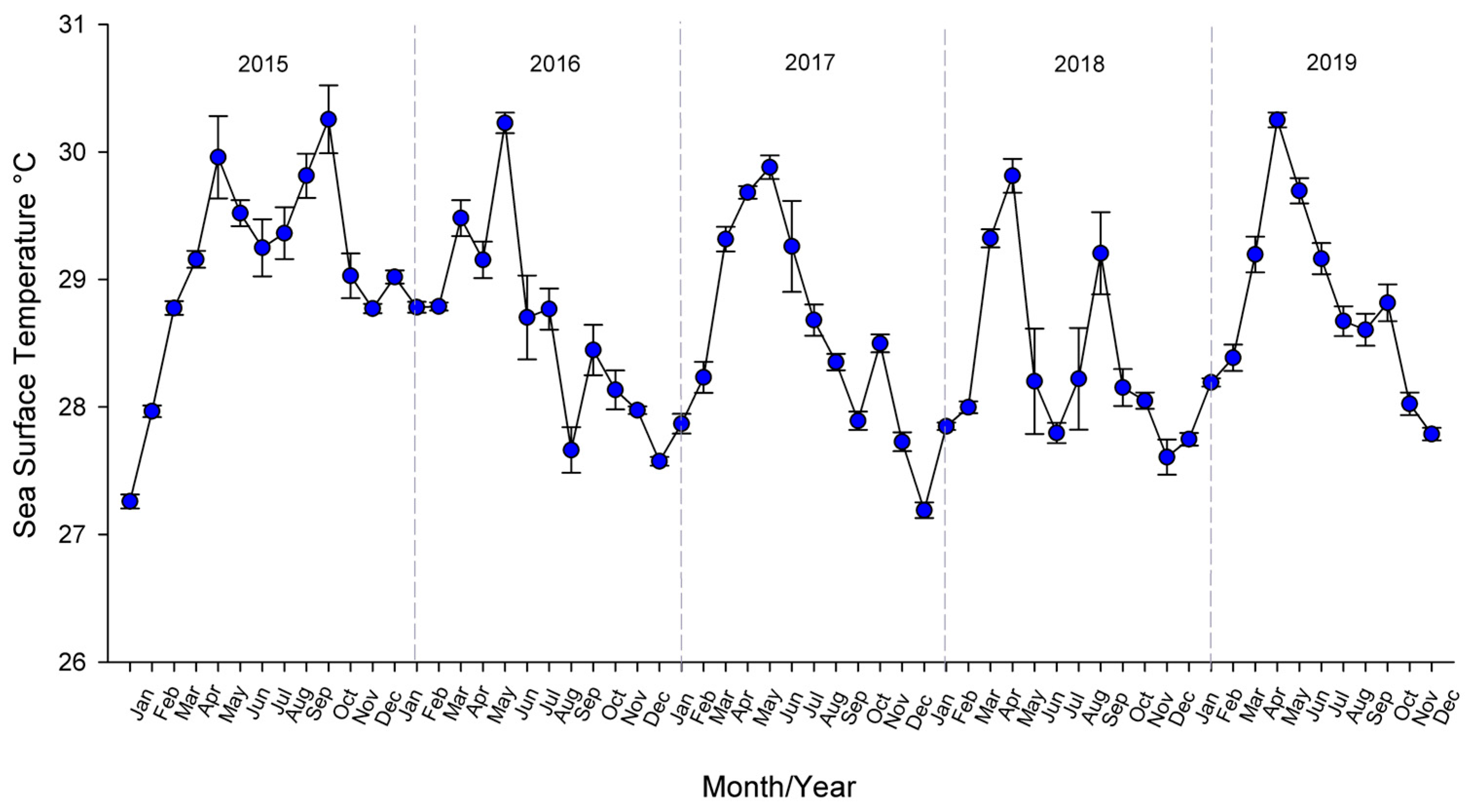
The growth parameters of Pavona corals were estimated from 41 tracks from all coral colony slabs. The growth parameters of Pavona corals were estimated from 41 tracks from all coral colony slabs. The number of tracks analyzed was initially 54; however, due to the physical characteristics of the slabs (e.g., internal bioerosion, partial death marks), 13 tracks were discarded as they did not clearly show the growth of the organisms. Therefore, only those that allowed a correct analysis of the growth were included in the research. At the genus level, the skeletal density was 1.26 ± 0.23 g cm−3 (Min 1.19 g cm−3; Max 1.86 g cm−3), skeletal extension was 0.94 ± 0.31 cm yr−1 (Min 0.56 cm yr−1; Max 1.30 cm yr−1) and calcification rate was 1.17 ± 0.36 g cm−2 yr−1 (Min 0.67 cm−2 yr−1; Max 1.69 cm−2 yr−1) (Table 1 and Table 2). The temperature showed little variation during the years studied, with 2015 being the year with the highest average temperature (29.0 ± 0.90), followed by 2016 (28.8 ± 0.70), while 2018 showed the lowest temperature (28.2 ± 0.80) (Figure 2).
Statistical analysis revealed no differences in temperature at the year level, nor between the interaction of species and year, and no relationship was found between growth parameters and temperature (p > 0.05, Table 3); however, differences were observed at the species level (p = 0.001). The PERMDISP analysis showed significant results at the species level and in the interaction between years and species (p < 0.05). In the case of the interaction between years and species, the significant result in the PERMDISP analysis, along with the non-significant result of the PERMANOVA analysis, suggests a dispersion effect, which is attributed to the high variation within the same sample (Table 3). In contrast, differences were observed at the species level (p = 0.001), where P. varians showed the highest skeletal density values (1.52 ± 0.11 g cm−3), and P. clavus showed the lowest values (1.19 ± 0.22 g cm−3). For skeletal extension, P. duerdeni and P. clavus presented the highest values of 0.95 ± 0.22 cm yr−1 and 0.98 ± 0.33 cm yr−1, respectively (Table 2). At the same time, P. maldivensis presented the lowest values for extension rate (0.67 ± 0.17 cm yr−1), but also for calcification rate (0.82 ± 0.21 g cm−2 yr−1), compared with P. clavus, P. varians, and P. duerdeni, which exhibited similar values (1.16 ± 0.38–1.22 ± 0.26 g cm−2 yr−1; Table 1 and Table 2).
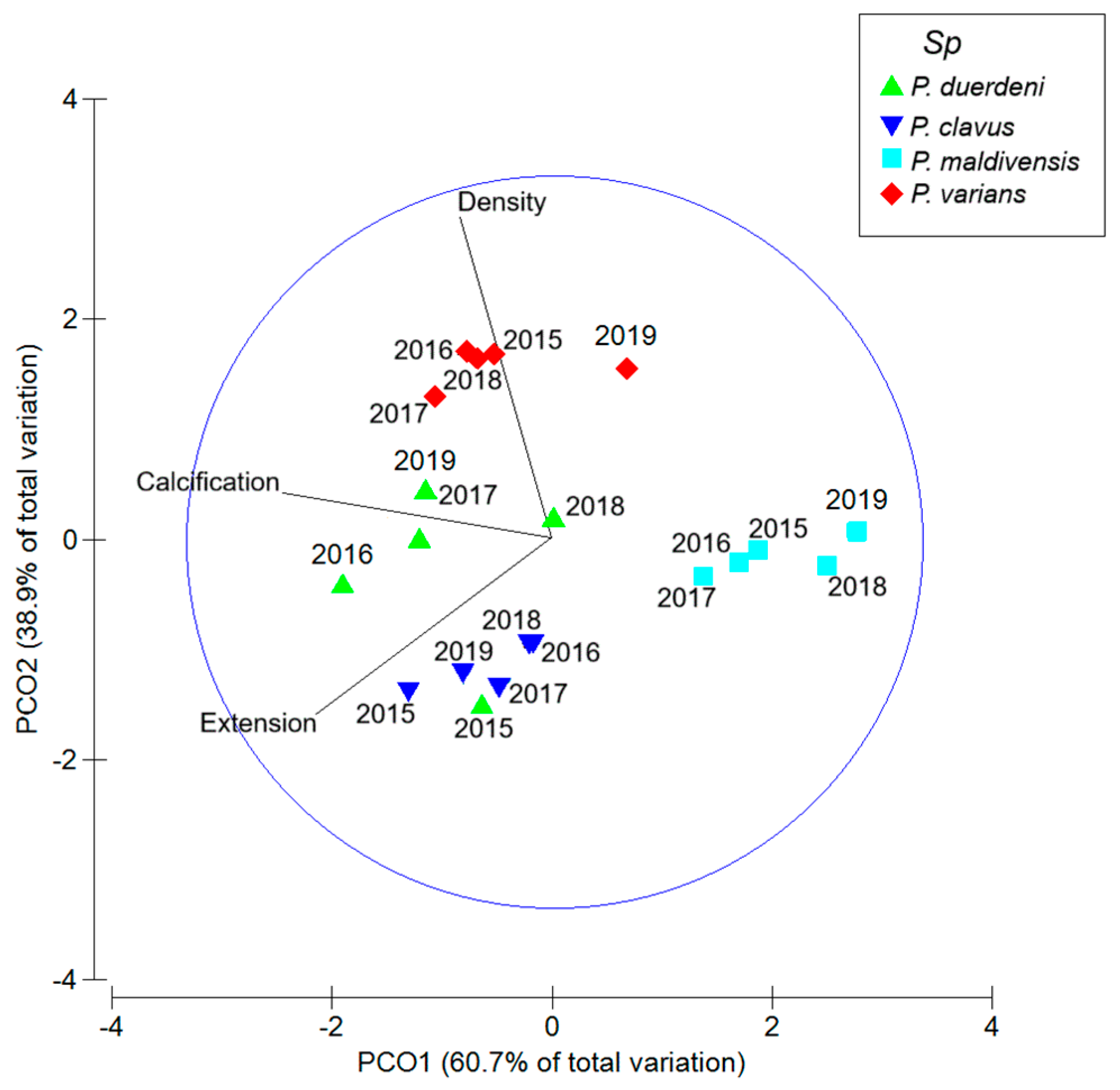
The PCO1 explained 60.7% of the total variation in coral growth, displaying data for each species. Notably, P. clavus and P. varians showed low variation over the years, in contrast to P. duerdeni, which exhibited the highest growth variation. The PCO2 explained 38.9% of the total variation grouping species data by growth parameter, separating P. maldivensis from the other three species (P. clavus, P. varians, and P. duerdeni), for having the lowest growth variation and no preponderance to skeletal extension or skeletal density; conversely, P. clavus showed a strong affinity for skeletal extension, unlike P. duerdeni and P. varians, whose growth parameters are driven mainly through skeletal density (Figure 2 and Figure 3).

4. Discussion

Seasonal and interannual fluctuations in environmental conditions act as synergistic drivers of coral growth [49,50,51]. In particular, the increase in sea temperature, along with ocean acidification, may threaten reef development by reducing the concentration of carbonate ions, affecting the calcification process, and reducing coral skeletal density [52]. The ETP is a particular region that amplifies this effect, as it has been characterized with sub-optimal environmental conditions [53,54,55], such as extreme ENSO and upwelling events, limiting reef development, resulting in patchy coral communities and 70% lower calcium carbonate deposition in comparison to central Indo-Pacific Ocean or southern Caribbean reefs [56,57,58,59,60].
Although the marine bioregionalization situates Clipperton Atoll within the ETP, the atoll is also a single oceanic ecoregion with particular environmental conditions [61], and its oceanic location reduces the influence of regional environmental characteristics compared to coastal areas, mainly the effects caused by direct anthropogenic pressures such as fisheries and tourism or even indirect ones such as sedimentation and nutrient input caused by urbanization [62]. Consequently, seasonal fluctuations in the oceanographic conditions in Clipperton are primarily associated with local conditions. Given the strong relationship between environmental conditions and coral growth, particularly with light and temperature [63], it would be expected that Pavona exhibits different growth parameters, especially extension rate [29], within the ETP region; however, the Pavonid species of the atoll exhibited growth rates for the three parameters similar to those previously reported for the genus in other coral communities and coral reefs of the ETP, such as Galapagos, Panama, Costa Rica, and coastal reefs of Southern Mexican Pacific, where the growth rates ranged between 1.04–1.96 g cm−3 for skeletal density, 0.35–0.98 cm yr−1 for skeletal extension, and 0.45–1.90 g cm−2 yr−1 for calcification rate (Table 1 and Table 2) [29,31,64,65], evidencing that the life history traits of Pavona at the genus level, in terms of their growth strategies, are stronger than their adaptive response, differing from corals from subtropical latitudes, which due to their lifetime history, have developed an acclimatization response to non-optimal conditions [66,67].
Clipperton exhibits an optimal range of key environmental conditions that promote coral growth, sea surface temperature fluctuations remain minimal (27.9 ± 0.23 °C) throughout the year [29], and oligotrophic waters that allow the vertical distribution of coral species (Table 3, Figure 2 and Figure 3) within a depth range of 3 to 70 m [24,25]. Thereby, given the minimal variation in environmental factors, the water column can be considered relatively homogeneous. However, due to their location, ocean atolls usually have high hydrodynamic flow and strong wave action, which can become a dominant forcing mechanism that promotes a pressure gradient across the reef [68]. Consequently, it can be considered that the factors of depth and hydrodynamic conditions could be important drivers of coral species growth. Therefore, differences in growth parameters would be responding to their location along the depth gradient, as species in shallow areas (≈10 m) exhibit high skeletal density but lower extension growth, a pattern observed in P. varians, which coincides with that of other massive species, such as Porites arnaudi and P. australiensis [29]. In contrast, species such as Pavona duerdeni and P. clavus have higher extension and lower skeletal density in deeper areas (≈20 m). Shallow-growing corals exposed to stronger currents and higher hydraulic energy waves require denser skeletons, which increase their stability and reduce the risk of breakage. Meanwhile, species growing at deeper depths, exposed to lower-flow environments, do not receive such a strong impact from the waves; hence, they build more extensive skeletons and maintain a steady growth rate [28,31,64,65].
Given this, and without detracting from the relevance of temperature and light, depth and hydrodynamics should also be considered, particularly for massive corals [69], as they may also influence the species distribution and abundance, thereby creating a distinct community structure [70,71]. Whereas water motion tends to have beneficial effects towards coral reefs through increasing the rates of nutrient uptake and photosynthetic production, high hydrodynamic flow, such as strong wave motion, exerts pressure on coral organisms [68]. Particularly in locations such as Clipperton, which is an oceanic atolls, the anthropogenic pressures and even the annual thermal fluctuations may not be an stressor for the coralline organisms, however, they are more vulnerable to meteorological phenomena, which may affect the area directly and indirectly, by generating high long-lasting waves (5 m, 16 s) as a consequence of distant swells caused by distant storms, tropical cyclones, or tsunamis [72], shaping the physical and ecological dynamics of the atolls.
In addition, the differences in growth capacity and morphological plasticity among Pavona species may also determine their long-term contribution to the reef framework, where, in the case of the studied species, the organisms play a crucial role in maintaining the reef structure over time. Reef-building coral species typically develop dense skeletons, offering a higher potential for preservation over geological time scales. Clipperton Atoll’s coral reef community has undergone a shift in species composition over the last two decades. The first reports in the early 90’s showed the area harbored high coral coverage along the reef gradient, where Pocilloporid species, Poritid species, and, to a lesser extent, Pavona species were distributed between 3 and 30 m [24]. However, recent reports highlighted significant changes in species composition, with homogenization of coral coverage along depth gradients, leading to a coral reef mainly formed of massive species (Porites and Pavona) [25], a change that has been observed in the last four decades in reefs around the world as a result of the increase in intensity, frequency and exposure of natural and anthropogenic stressors [33,65,73,74]. This can be considered a strategy shift, where a coral community responds to environmental stressors by shifting in taxonomic composition and size-frequency distribution to a reef dominated by thermally resistant genera [75,76], thereby coping with and surviving non-optimal conditions and contributing to the maintenance of the whole community.
This is particularly significant under current climatic conditions, as branching corals are experiencing a pronounced regional decline across the Eastern Tropical Pacific, particularly over the last five decades, where the effect of ENSO events combined with anthropogenic stressors (e.g., overfishing, declining water quality, coastal development) has caused four massive coral mortalities, resulting in a decrease of ≥90% of live coral coverage [75,77,78,79,80]. Previous records from coastal reefs have evidenced that each coral genus has different responses [48,81]; one example is the Pocillopora species, which, despite being the most affected during massive mortalities, has demonstrated resilience and the capacity to recover from thermal stress events [33,82,83,84,85]. However, due to their branching morphologies, they cannot increase their resistance to the rising frequency and intensity of hurricanes and storms, such as Pavona, which develops massive and sub-massive morphologies [86]. The loss of coral coverage often leads to temporary increases in coralline algae, and a trend towards the dominance of thermally tolerant, massive, and sub-massive coral forms, as observed in Clipperton [78,87,88]. However, even when coral cover is high, high-intensity hydrodynamic disturbances can reduce structural complexity and diversity, affecting and possibly declining the ecological functions of coral communities [89].
The results indicate that Pavona growth at Clipperton Atoll is presumably influenced by local factors, possibly including strong hydrodynamics and depth, whereas regional thermal anomalies, typically associated with events such as ENSO, exert no detectable association, at least within the 5-year window considered in the study. Given the actual scenario, it must also be considered that the increase in massive corals could benefit the reef, as these species appear to be more resistant to high-stress conditions, imparting a greater preservation potential on a geological timescale [65]. However, it should not be overlooked that current projections indicate that, due to climate change, hurricanes and storms will increase in frequency and intensity [90], which may increase their vulnerability even in areas where massive corals can thrive [89]. Therefore, although Pavona species have contributed to the maintenance of the reef, this is not a stable scenario, and future monitoring must holistically assess biogeocological properties (e.g., carbonate production and functional diversity), sclerochronological characteristics (growth patterns and inter-annual fluctuations) and community distribution along the reef gradient to accurately evaluate coral status, providing a broader understanding of both short- and long-term changes in the reef community’s structure and overall health.

Author Contributions

Conceptualization, J.d.J.A.T.-L., E.E.G.C. and A.P.R.-T.; Data curation, A.O.-S., J.d.J.A.T.-L. and F.A.R.-Z.; Formal analysis, A.O.-S., J.d.J.A.T.-L. and F.A.R.-Z.; Funding acquisition, J.d.J.A.T.-L.; Investigation, A.O.-S., J.d.J.A.T.-L., A.P.R.-T. and E.E.G.C.; Methodology, A.O.-S., J.d.J.A.T.-L., F.A.R.-Z. and J.P.C.-G.; Supervision, J.d.J.A.T.-L. and A.P.R.-T.; Validation, A.O.-S., J.d.J.A.T.-L., F.A.R.-Z. and A.P.R.-T.; Writing—original draft: A.O.-S., J.d.J.A.T.-L. and A.P.R.-T.; Writing—review and editing: A.O.-S., J.d.J.A.T.-L., A.P.R.-T., F.A.R.-Z., J.P.C.-G. and E.E.G.C. All authors have read and agreed to the published version of the manuscript.

Funding

A.O.-S. was funded by Secretaría de Ciencia, Humanidades, Tecnología e Innovación (Secihti) (CVU 1300408). The authors thank National Geographic, Pristine Seas, and their funders for the 2016 expedition.

Institutional Review Board Statement

Not applicable.

Data Availability Statement

The original contributions presented in this study are included in the article. Further inquiries can be directed to the corresponding author.

Acknowledgments

We thank the government of France, the Embassy of France in Mexico, Ministère Des Outre-Mer, the Mexican government, Centre de Recherches Insulaires et Observatoire de l’Environnemen (CRIOBE USR3278 EPHE-CNRS-UPVD(CRIOBE USR3278 EPHE-CNRS-UPVD), Instituto Nacional de Pesca y Acuacultura (INAPESCA), and the oceanographic research vessel Jorge Carranza Fraser from INAPESCA, and also thank the Haut Commissariat de la République en Polynésie française for permission to perform this research at Clipperton Atoll (CITES permit no. FR1998700218-E).

Conflicts of Interest

The authors declare no conflicts of interest.

References

  1. Norzagaray-López, C.O.; Calderon-Aguilera, L.E.; Hernández-Ayón, J.M.; Reyes-Bonilla, H.; Carricart-Ganivet, J.P.; Cabral-Tena, R.A.; Balart, E.F. Low calcification rates and calcium carbonate production in Porites panamensis at its northernmost geographic distribution. Mar. Ecol. 2015, 36, 1244–1255. [Google Scholar] [CrossRef]
  2. Siqueira, A.C.; Kiessling, W.; Bellwood, D.R. Fast-growing species shape the evolution of reef corals. Nat. Commun. 2022, 13, 2426. [Google Scholar] [CrossRef]
  3. Lough, J.M. Climate records from corals. Wiley Interdiscip. Rev. Clim. Change 2010, 1, 318–331. [Google Scholar] [CrossRef]
  4. Yanovski, R.; Nelson, P.A.; Abelson, A. Structural complexity in coral reefs: Examination of a novel evaluation tool on different spatial scales. Front. Ecol. Evol. 2017, 5, 27. [Google Scholar] [CrossRef]
  5. Ortiz, D.M.; Tissot, B.N. Evaluating ontogenetic patterns of habitat use by reef fish in relation to the effectiveness of marine protected areas in West Hawaii. J. Exp. Mar. Biol. Ecol. 2012, 432, 83–93. [Google Scholar] [CrossRef]
  6. Graham, N.A.; Nash, K.L. The importance of structural complexity in coral reef ecosystems. Coral Reefs 2013, 32, 315–326. [Google Scholar] [CrossRef]
  7. Buddemeier, R.W.; Maragos, J.E.; Knutson, D.W. Radiographic studies of reef coral exoskeletons: Rates and patterns of coral growth. J. Exp. Mar. Bio Ecol. 1974, 14, 179–199. [Google Scholar] [CrossRef]
  8. Barnes, D.J.; Lough, J.M. Porites growth characteristics in a changed environment: Misima Island, Papua New Guinea. Coral Reefs 1999, 18, 213–218. [Google Scholar] [CrossRef]
  9. Lough, J.M.; Barnes, D.J.; Devereux, M.J.; Tobin, B.J.; Tobin, S. Variability in Growth Characteristics of Massive Porites on the Great Barrier Reef; CRC Reef Research Centre Technical Report 1999 No 28; CRC Reef Research Centre: Townsville, Australia, 1999. [Google Scholar]
  10. Veron, J.E.N. Corals in Space and Time: The Biogeography and Evolution of the Scleractinia; Cornell University Press: New York, NY, USA, 1995. [Google Scholar]
  11. Lough, J.M.; Barnes, D.J. Environmental controls on growth of the massive coral Porites. J. Exp. Mar. Biology Ecol. 2000, 245, 225–243. [Google Scholar] [CrossRef] [PubMed]
  12. Carricart-Ganivet, J.P.; Cabanillas-Teran, N.; Cruz-Ortega, I.; Blanchon, P. Sensitivity of calcification to thermal stress varies among genera of massive reef-building corals. PLoS ONE 2012, 7, e32859. [Google Scholar] [CrossRef]
  13. Carricart-Ganivet, J.P.; Barnes, D.J. Densitometry from digitized images of X-radiographs: Methodology for measurement of coral skeletal density. J. Exp. Mar. Biology Ecol. 2007, 344, 67–72. [Google Scholar] [CrossRef]
  14. Maté, J.L. Corals and coral reefs of the Pacific coast of Panamá. In Latin American Coral Reefs; Elsevier Science: Amsterdam, The Netherlands, 2003; pp. 387–417. [Google Scholar]
  15. Guzmán, H.M.; Cortés, J. Coral reef community structure at Caño Island, Pacific Costa Rica. Mar. Ecol. 1989, 10, 23–41. [Google Scholar] [CrossRef]
  16. Guzman, H.M.; Cortes, J. Growth rates of eight species of scleractinian corals in the eastern Pacific (Costa Rica). Bull. Mar. Sci. 1989, 44, 1186–1194. [Google Scholar]
  17. Macintyre, I.G.; Glynn, P.W.; Cortés, J. Holocene reef history in the eastern Pacific: Mainland Costa Rica, Caño Island, Cocos Island, and Galápagos Islands. In Proceedings of the 7th International Coral Reef Symposium, Guam, Micronesia, 22–27 June 1993; Volume 2, pp. 1174–1184. [Google Scholar]
  18. Glynn, P.W.; Leyte Morales, G.E.L. Coral reefs of Huatulco, West Mexico: Reef development in upwelling Gulf of Tehuantepec. Rev. Biol. Trop. 1997, 45, 1033–1047. [Google Scholar]
  19. Pérez-Castro, M.Á.; Eyal, G.; Leyte-Morales, G.E.; Hinojosa-Arango, G.; Enríquez, S. Benthic characterization of mesophotic communities based on optical depths in the southern Mexican Pacific coast (Oaxaca). Diversity 2023, 15, 531. [Google Scholar] [CrossRef]
  20. Reyes-Bonilla, H.; López-Pérez, R.A. Corals and coral-reef communities in the Gulf of California. In Atlas of Coastal Ecosystems in the Western Gulf of California: Tracking Limestone Deposits on the Margin of a Young Sea; Johnson, M.E., Ledesma-Vázquez, J., Eds.; University of Arizona Press: Tucson, AZ, USA, 2009; pp. 43–55. [Google Scholar]
  21. Glynn, P.W.; Alvarado, J.J.; Banks, S.; Cortés, J.; Feingold, J.S.; Jiménez, C.; Zapata, F.A. Eastern Pacific coral reef provinces, coral community structure and composition: An overview. In Coral Reefs of the Eastern Tropical Pacific: Persistence and Loss in a Dynamic Environment; Springer: Dordrecht, The Netherlands, 2016; pp. 107–176. [Google Scholar]
  22. Helmus, M.R.; Behm, J.E. Anthropocene: Island Biogeography. In Encyclopedia of the Anthropocene; Elsevier: Amsterdam, The Netherlands, 2018; pp. 37–43. [Google Scholar] [CrossRef]
  23. Cortés, J.; Enochs, I.C.; Sibaja-Cordero, J.; Hernández, L.; Alvarado, J.J.; Breedy, O.; Cruz-Barraza, J.A.; Esquivel-Garrote, O.; Fernández-García, C.; Hermosillo, A.; et al. Marine biodiversity of Eastern Tropical Pacific coral reefs. In Coral Reefs of the Eastern Tropical Pacific: Persistence and Loss in a Dynamic Environment; Springer: Dordrecht, The Netherlands, 2016; pp. 203–250. [Google Scholar]
  24. Glynn, P.W.; Veron, J.E.N.; Wellington, G.M. Clipperton Atoll (eastern Pacific): Oceanography, geomorphology, reef-building coral ecology and biogeography. Coral Reefs 1996, 15, 71–99. [Google Scholar] [CrossRef]
  25. Tortolero Langarica, J.J.A.; Clua, E.; Rodríguez Zaragoza, F.A.; Caselle, J.E.; Rodríguez Troncoso, A.P.; Adjeroud, M.; Friedlander, A.M.; Cupul Magaña, A.L.; Ballesteros, E.; Carricart Ganivet, J.P.; et al. Spatial and temporal patterns in the coral assemblage at Clipperton Atoll: A sentinel reef in the Eastern Tropical Pacific. Coral Reefs 2022, 41, 1405–1415. [Google Scholar] [CrossRef]
  26. Glynn, P.J.; Glynn, P.W.; Riegl, B. El Niño, echinoid bioerosion and recovery potential of an isolated Galápagos coral reef: A modeling perspective. Mar. Biol. 2017, 164, 146. [Google Scholar] [CrossRef]
  27. Durham, J.W.; Barnard, J.L. Stony corals of the eastern Pacific collected by the Velero III and Velero IV. Allan Hancock Pac Exped. 1952, 16, 1–110. [Google Scholar]
  28. Medellín-Maldonado, F.; Cabral-Tena, R.A.; López-Pérez, A.; Calderón-Aguilera, L.E.; Norzagaray-López, C.O.; Chapa-Balcorta, C.; Zepeta-Vilchis, R.C.; Harris, C. Calcification of the main reef-building coral species on the Pacific coast of southern Mexico. Cienc. Mar. 2016, 42, 209–225. [Google Scholar] [CrossRef]
  29. Ochoa-Serena, A.; Tortolero-Langarica, J.A.; Rodríguez-Zaragoza, F.A.; Carricart-Ganivet, J.P.; Clua, E.; Rodríguez-Troncoso, A.P. Growth Patterns of Reef-Building Porites Species in the Remote Clipperton Atoll Reef. Diversity 2025, 17, 492. [Google Scholar] [CrossRef]
  30. Cabral-Tena, R.A.; Reyes-Bonilla, H.; Lluch-Cota, S.; Paz-García, D.A.; Calderón-Aguilera, L.E.; Norzagaray-López, O.; Balart, E.F. Different calcification rates in males and females of the coral Porites panamensis in the Gulf of California. Mar. Ecol. Prog. Ser. 2013, 476, 1–8. [Google Scholar] [CrossRef]
  31. Tortolero-Langarica, J.J.A.; Carricart-Ganivet, J.P.; Cupul-Magaña, A.L.; Rodríguez-Troncoso, A.P. Historical insights on growth rates of the reef-building corals Pavona gigantea and Porites panamensis from the Northeastern tropical Pacific. Mar Environ. Res. 2017, 132, 23–32. [Google Scholar] [CrossRef] [PubMed]
  32. Darling, E.S.; Alvarez-Filip, L.; Oliver, T.A.; McClanahan, T.R.; Côté, I.M. Evaluating life-history strategies of reef corals from species traits. Ecol. Lett. 2012, 15, 1378–1386. [Google Scholar] [CrossRef] [PubMed]
  33. Fox, M.D.; Cohen, A.L.; Rotjan, R.D.; Mangubhai, S.; Sandin, S.A.; Smith, J.E.; Thorrold, S.R.; Dissly, L.; Mollica, N.R.; Obura, D. Increasing coral reef resilience through successive marine heatwaves. Geophys. Res. Lett. 2021, 48, e2021GL094128. [Google Scholar] [CrossRef]
  34. Wellington, G.M.; Glynn, P.W. Environmental influences on skeletal banding in eastern Pacific (Panama) corals. Coral Reefs 1983, 1, 215–222. [Google Scholar] [CrossRef]
  35. Grottoli, A.; Wellington, G. Effect of light and zooplankton on skeletal δ13C values in the eastern Pacific corals Pavona clavus and Pavona gigantea. Coral Reefs 1999, 18, 29–41. [Google Scholar] [CrossRef]
  36. Carricart-Ganivet, J.P.; Reyes-Bonilla, H. New and previous records of scleractinian corals from Clipperton Atoll, eastern Pacific. Pac. Sci. 1999, 53, 370–375. [Google Scholar]
  37. Meissner, K.; Abram, N.; Armand, L.; Chase, Z.; De Deckker, P.; Ellwood, M.; Zinke, J. Dealing with climate change: Palaeoclimate research in Australia. Quat. Australas. 2015, 32, 19–24. [Google Scholar]
  38. Wang, C.; Fiedler, P.C. ENSO variability and the eastern tropical Pacific: A review. Prog Ocean. 2006, 69, 239–266. [Google Scholar] [CrossRef]
  39. Wu, H.C.; Moreau, M.; Linsley, B.K.; Schrag, D.P.; Corrège, T. Investigation of sea surface temperature changes from replicated coral Sr/Ca variations in the eastern equatorial Pacific (Clipperton Atoll) since 1874. Palaeogeogr. Palaeoclimatol. Palaeoecol. 2014, 412, 208–222. [Google Scholar] [CrossRef]
  40. Zhao, H.; Raga, G.B. On the distinct interannual variability of tropical cyclone activity over the eastern North Pacific. Atmósfera 2015, 28, 161–178. [Google Scholar] [CrossRef]
  41. Vaughan, T.W. Recent Madreporaria of the Hawaiian Islands and Laysan; US National Museum Bulletin; US National Museum: Washington, DC, USA, 1907; Volume 59, pp. 1–427. [Google Scholar]
  42. Dana, J.D. Zoophytes. In United States Exploring Expedition During the Years 1838–1842; Lea and Blanchard: Philadelphia, PA, USA, 1846; Volume 7, pp. 1–740. [Google Scholar]
  43. Verrill, A.E. List of the Polyps and Corals Sent by the Museum of Comparative Zoology to Other Institutions in Exchange, with Annotations; Bulletin of the Museum of Comparative Zoology; Museum of Comparative Zoology: Cambridge, MA, USA, 1864; Volume 1, pp. 29–60. [Google Scholar]
  44. Gardiner, J.S. Madreporaria III. Fungida IV. Turbinolidae. In Fauna and Geography of the Maldives and Laccadives Archipelagos; Cambridge: Cambridge, UK, 1905; Volume 2, pp. 933–957. [Google Scholar]
  45. Duprey, N.; Bouscher, H.; Jiménez, C. Digital correction of computed X radiographs for coral densitometry. J. Exp. Mar. Biology Ecol. 2012, 438, 84–92. [Google Scholar] [CrossRef]
  46. Lough, J.M.; Cooper, T.F. New insights from coral growth band studies in an era of rapid environmental change. Earth Sci. Rev. 2011, 108, 170–184. [Google Scholar] [CrossRef]
  47. Glynn, P.W.; Colley, S.B.; Ting, J.H.; Maté, J.L.; Guzman, H.M. Reef coral reproduction in the eastern Pacific: Costa Rica, Panamá and Galápagos Islands (Ecuador). IV. Agaricidae, recruitment and recovery of Pavona varians and Pavona sp.a. Mar. Biol. 2000, 136, 785–805. [Google Scholar] [CrossRef]
  48. Rodriguez, L.; García, J.J.; Tuya, F.; Martínez, B. Environmental factors driving the distribution of the tropical coral Pavona varians: Predictions under a climate change scenario. Mar. Ecol. 2020, 41, 1–12. [Google Scholar] [CrossRef]
  49. Knutson, D.W.; Buddemeier, R.W.; Smith, S.V. Coral chronometers: Seasonal growth bands in reef corals. Science 1972, 177, 270–272. [Google Scholar] [CrossRef]
  50. Robinson, J.P.; Williams, I.D.; Yeager, L.A.; McPherson, J.M.; Clark, J.; Oliver, T.A.; Baum, J.K. Environmental conditions and herbivore biomass determine coral reef benthic community composition: Implications for quantitative baselines. Coral Reefs 2018, 37, 1157–1168. [Google Scholar] [CrossRef] [PubMed]
  51. Pérez-Castro, M.Á.; Schubert, N.; De Oca, G.A.M.; Leyte-Morales, G.E.; Eyal, G.; Hinojosa-Arango, G. Mesophotic Coral Ecosystems in the Eastern Tropical Pacific: The current state of knowledge and the spatial variability of their depth boundaries. Sci. Total Environ. 2022, 806, 150576. [Google Scholar] [CrossRef]
  52. Mollica, N.R.; Guo, W.; Cohen, A.L.; Huang, K.F.; Foster, G.L.; Donald, H.K.; Solow, A.R. Ocean acidification affects coral growth by reducing skeletal density. Proc. Natl. Acad. Sci. USA 2018, 115, 1754–1759. [Google Scholar] [CrossRef] [PubMed]
  53. Glynn, P.W.; Ault, J.S. A biogeographic analysis and review of the far eastern Pacific coral reef region. Coral Reefs 2000, 19, 1–23. [Google Scholar] [CrossRef]
  54. Millero, F.J. The marine inorganic carbon cycle. Chem. Rev. 2007, 107, 308–341. [Google Scholar] [CrossRef]
  55. Manzello, D.P.; Kleypas, J.A.; Budd, D.A.; Eakin, C.M.; Glynn, P.W.; Langdon, C. Poorly cemented coral reefs of the eastern tropical Pacific: Possible insights into reef development in a high-CO2 world. Proc. Natl. Acad. Sci. USA 2008, 105, 10450–10455. [Google Scholar] [CrossRef]
  56. Rodríguez-Ramírez, A. Status of Coral Reefs of the World: 2008; Global Coral Reef Monitoring Network and Reef and Rainforest Research Center: Townsville, Australia, 2008; Volume 20, pp. 281–294. [Google Scholar]
  57. Glynn, P.W.; D’Croz, L. Experimental evidence for high temperature stress as the cause of El Niño-coincident coral mortality. Coral Reefs 1990, 8, 181–191. [Google Scholar] [CrossRef]
  58. Dana, T.F. Development of contemporary eastern Pacific coral reefs. Mar Biol. 1975, 33, 355–374. [Google Scholar] [CrossRef]
  59. Lange, I.D.; Perry, C.T. Bleaching impacts on carbonate production in the Chagos Archipelago: Influence of functional coral groups on carbonate budget trajectories. Coral Reefs 2019, 38, 619–624. [Google Scholar] [CrossRef]
  60. Perry, C.T.; Edinger, E.N.; Kench, P. Estimating rates of biologically driven coral reef framework production and erosion: A new census-based carbonate budget methodology and applications to the reefs of Bonaire. Coral Reefs 2012, 31, 853–868. [Google Scholar] [CrossRef]
  61. Spalding, M.D.; Fox, E.H.; Allen, R.G.; Davidson, N.; Ferdaña, Z.A.; Finlayson, M.; Halpern, B.S.; Jorge, M.A.; Lombana, A.; Lourie, S.A.; et al. Marine Ecoregions of the World: A Bioregionalization of Coastal and Shelf Areas. Biosci. 2007, 57, 573–583. [Google Scholar] [CrossRef]
  62. Hoegh-Guldberg, O. Coral reef ecosystems and anthropogenic climate change. Reg. Environ. Change 2011, 11, 215–227. [Google Scholar] [CrossRef]
  63. Ross, C.L.; Warnes, A.; Comeau, S.; Cornwall, C.E.; Cuttler, M.V.; Naugle, M.; Schoepf, V. Coral calcification mechanisms in a warming ocean and the interactive effects of temperature and light. Commun. Earth Environ. 2022, 3, 72. [Google Scholar] [CrossRef]
  64. Guzmán, H.M.; Cortés, J. Arrecifes coralinos del Pacífico oriental tropical: Revisión y perspectivas. Rev. Biol. Trop. 1993, 41, 535–557. [Google Scholar]
  65. Manzello, D.P. Coral growth with thermal stress and ocean acidification: Lessons from the eastern tropical Pacific. Coral Reefs 2010, 29, 749–758. [Google Scholar] [CrossRef]
  66. Oliver, T.A.; Palumbi, S.R. Do fluctuating temperature environments elevate coral thermal tolerance? Coral Reefs 2011, 30, 429–440. [Google Scholar] [CrossRef]
  67. Manzello, D.P.; Enochs, I.C.; Bruckner, A.; Renaud, P.G.; Kolodziej, G.; Budd, D.A.; Glynn, P.W. Galápagos coral reef persistence after ENSO warming across an acidification gradient. Geophys. Res. Lett. 2014, 41, 9001–9008. [Google Scholar] [CrossRef]
  68. Rogers, J.S.; Monismith, S.G.; Fringer, O.B.; Koweek, D.A.; Dunbar, R.B. A coupled wave-hydrodynamic model of an atoll with high friction: Mechanisms for flow, connectivity, and ecological implications. Ocean. Modelling 2017, 110, 66–82. [Google Scholar] [CrossRef]
  69. Kramer, N.; Tamir, R.; Eyal, G.; Loya, Y. Coral morphology portrays the spatial distribution and population size-structure along a 5–100 m depth gradient. Front. Mar. Sci. 2020, 7, 615. [Google Scholar] [CrossRef]
  70. Aronson, R.B.; MacIntyre, I.G.; Lewis, S.A.; Hilbun, N.L. Emergent zonation and geographic convergence of coral reefs. Ecology 2005, 86, 2586–2600. [Google Scholar] [CrossRef]
  71. Madin, J.S.; Connolly, S.R. Ecological consequences of major hydrodynamic disturbances on coral reefs. Nature 2006, 444, 477–480. [Google Scholar] [CrossRef]
  72. Andréfouët, S.; Bruyère, O.; Liao, V.; Le Gendre, R. Hydrodynamical impact of the July 2022 ‘Code Red’distant mega-swell on Apataki Atoll, Tuamotu Archipelago. Glob. Planet. Change 2023, 228, 104194. [Google Scholar] [CrossRef]
  73. Bruno, J.F.; Valdivia, A. Coral reef degradation is not correlated with local human population density. Sci. Rep. 2016, 6, 29778. [Google Scholar] [CrossRef]
  74. Hughes, T.P.; Kerry, J.T.; Álvarez-Noriega, M.; Álvarez-Romero, J.G.; Anderson, K.D.; Baird, A.H.; Wilson, S.K. Global warming and recurrent mass bleaching of corals. Nature 2017, 543, 373–377. [Google Scholar] [CrossRef]
  75. Aronson, R.B.; Precht, W.F. White-band disease and the changing face of Caribbean coral reefs. Hydrobiol 2001, 460, 25–38. [Google Scholar] [CrossRef]
  76. Tkachenko, K.S.; Hoang, D.T.; Dang, H.N. Ecological status of coral reefs in the Spratly Islands, South China Sea (East Sea) and its relation to thermal anomalies. Estuar. Coast. Shelf Sci. 2020, 238, 106722. [Google Scholar] [CrossRef]
  77. Reyes-Bonilla, H.; Carriquiry, J.; Leyte-Morales, G.; Cupul-Magaña, A. Effects of the El Niño-Southern Oscillation and the anti-El Niño event (1997–1999) on coral reefs of the western coast of México. Coral Reefs 2002, 21, 368–372. [Google Scholar] [CrossRef]
  78. Cruz-García, R.; Rodríguez-Troncoso, A.P.; Rodríguez-Zaragoza, F.A.; Mayfield, A.; Cupul-Magaña, A.L. Ephemeral effects of El Niño–Southern Oscillation events on an eastern tropical Pacific coral community. Mar. Freshw. Res. 2020, 71, 1259–1268. [Google Scholar] [CrossRef]
  79. Alvarado, J.J.; Sánchez-Noguera, C.; Arias-Godínez, G.; Araya, T.; Fernández-García, C.; Guzmán, A.G. Impact of El Niño 2015–2016 on the coral reefs of the Pacific of Costa Rica: The potential role of marine protection. Rev. Biol. Trop. 2020, 68, 271–282. [Google Scholar] [CrossRef]
  80. López-Pérez, A.; Granja-Fernández, R.; Ramírez-Chávez, E.; Valencia-Méndez, O.; Rodríguez-Zaragoza, F.A.; González-Mendoza, T.; Martínez-Castro, A. Widespread coral bleaching and mass mortality of reef-building corals in southern mexican Pacific reefs due to 2023 El Niño Warming. Oceans 2024, 5, 196–209. [Google Scholar] [CrossRef]
  81. Yu, Q.; He, C.; Wang, Y.; An, M.; Tang, K.; Liu, Z.; Zhou, Z. The differential physiological responses to heat stress in the scleractinian coral Pocillopora damicornis are affected by its energy reserve. Mar. Environ. Res. 2025, 204, 106966. [Google Scholar] [CrossRef]
  82. Glynn, P.W.; Maté, J.L.; Baker, A.C.; Calderón, M.O. Coral bleaching and mortality in Panama and Ecuador during the 1997–1998 El Niño-Southern Oscillation event: Spatial/temporal patterns and comparisons with the 1982–1983 event. Bull. Mar. Sci. 2001, 69, 79–109. [Google Scholar]
  83. Romero-Torres, M.; Treml, E.A.; Acosta, A.; Paz-García, D.A. The Eastern Tropical Pacific coral population connectivity and the role of the Eastern Pacific Barrier. Sci. Rep. 2018, 8, 9354. [Google Scholar] [CrossRef] [PubMed]
  84. Tkachenko, K.S.; Soong, K. Dongsha Atoll: A potential thermal refuge for reef-building corals in the South China Sea. Mar. Environ. Res. 2017, 127, 112–125. [Google Scholar] [CrossRef]
  85. D’Croz, L.; Maté, J.L. Experimental responses to elevated water temperature in genotypes of the reef coral Pocillopora damicornis from upwelling and non-upwelling environments in Panama. Coral Reefs 2004, 23, 473–483. [Google Scholar] [CrossRef]
  86. Reyes-Bonilla, H. Coral reefs of the Pacific coast of México. In Latin American Coral Reefs; Elsevier Science: Amsterdam, The Netherlands, 2003; pp. 331–349. [Google Scholar]
  87. Rachello-Dolmen, P.G.; Cleary, D.F.R. Relating coral species traits to environmental conditions in the Jakarta Bay/Pulau Seribu reef system, Indonesia. Estuar. Coast. Shelf Sci. 2007, 73, 816–826. [Google Scholar] [CrossRef]
  88. Van Woesik, R.; Sakai, K.; Ganase, A.; Loya, Y. Revisiting the winners and the losers a decade after coral bleaching. Mar. Ecol. Prog. Ser. 2011, 434, 67–76. [Google Scholar] [CrossRef]
  89. Brito-Millán, M.; Vermeij, M.J.; Alcantar, E.A.; Sandin, S.A. Coral reef assessments based solely on cover mask the active dynamics of coral communities. Mar. Ecol. Prog. Ser. 2019, 630, 55–68. [Google Scholar] [CrossRef]
  90. Knutson, T.R.; Chung, M.V.; Vecchi, G.; Sun, J.; Hsieh, T.; Smith, A.J.P. Climate change is probably increasing the intensity of tropical cyclones. In Critical Issues in Climate Change Science; Tyndall Centre for Climate Change Research: Norwich, UK, 2021. [Google Scholar]
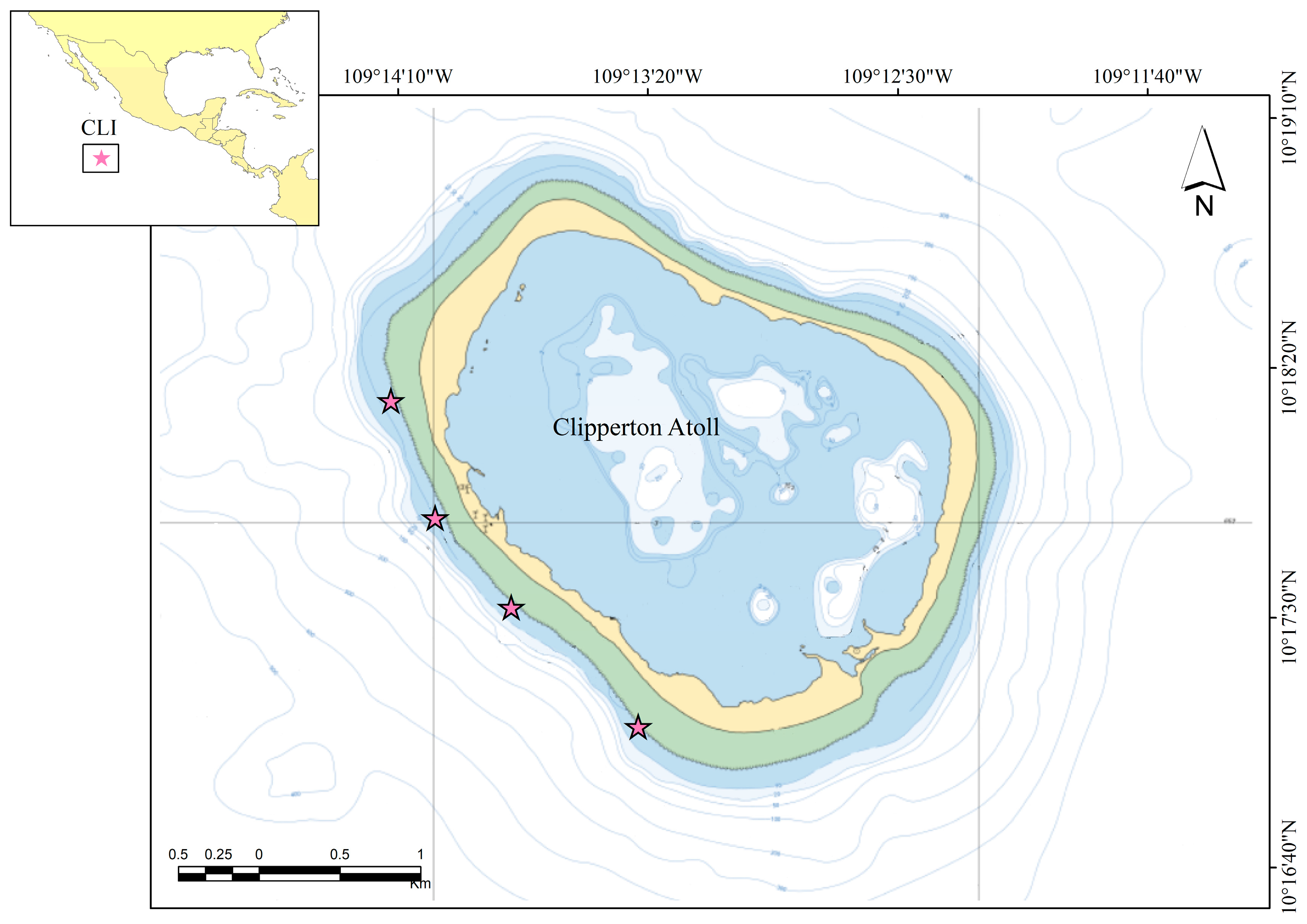
Figure 1. Study area: Clipperton Atoll, located in the Eastern Tropical Pacific. A red star indicates the geographical location of the sampling sites. The shallow reef zone (1–15 m) and deep reef zone (~20–30 m) are indicated with green and blue shading, respectively; yellow shading indicates the motu area.
Diversity 17 00854 g001
Figure 2. Monthly sea surface temperature fluctuation (x ± SD) at Clipperton Atoll from 2015 to 2019. The dashed lines are included to differentiate between years.
Diversity 17 00854 g002
Figure 3. Principal coordinate analysis (PCO) ordination shows changes in coral species growth parameters from 2015 to 2019. The color triangles represent changes in growth parameters by species over the years.
Diversity 17 00854 g003
Table 1. Mean annual growth parameters (x ± SD) of the skeletal density, extension rate, and calcification rate for Pavona duerdeni, Pavona clavus, Pavona varians, and Pavona maldivensis over a five-year period (2019–2015).
SpeciesYear (Yr)Density (g cm−3)Extension (cm yr−1)Calcification
(g cm−2 yr−1)
P. duerdeni20191.42 ± 0.190.86 ± 0.151.23 ± 0.25
20181.37 ± 0.120.91 ± 0.261.25 ± 0.34
20171.35 ± 0.141.20 ± 0.281.62 ± 0.34
20161.28 ± 0.241.30 ± 0.231.69 ± 0.50
20151.26 ± 0.291.06 ± 0.531.25 ± 0.48
P. clavus20191.28 ± 0.161.21 ± 0.271.53 ± 0.28
20181.31 ± 0.20 1.12 ± 0.381.42 ± 0.35
20171.28 ± 0.261.07 ± 0.281.32 ± 0.27
20161.31 ± 0.271.08 ± 0.291.40 ± 0.43
20151.25 ± 0.291.15 ± 0.401.35 ± 0.27
P. varians20191.86 ± 0.250.70 ± 0.291.28 ± 0.48
20181.81 ± 0.260.74 ± 0.271.31 ± 0.34
20171.72 ± 0.170.64 ± 0.461.05 ± 0.64
20161.74 ± 0.120.80 ± 0.591.35 ± 0.90
20151.58 ± 0.221.00 ± 0.291.45 ± 0.22
P. maldivensis20191.21 ± 0.110.59 ± 0.030.71 ± 0.06
20181.19 ± 0.100.56 ± 0.170.67 ± 0.23
20171.21 ± 0.050.76 ± 0.200.92 ± 0.27
20161.19 ± 0.100.69 ± 0.170.83 ± 0.23
20151.19 ± 0.100.70 ± 0.260.82 ± 0.27
Table 2. Mean growth parameters (x ± SD) of the skeletal density, extension rate, and calcification rate for Pavona duerdeni, Pavona clavus, Pavona variansi, and Pavona maldivensis over a five-year period.
SpeciesNo. ColoniesNo. TracksGrowth Parameters
Density (g cm−3)Extension (cm yr−1)Calcification (g cm−2 yr−1)
P. duerdeni481.3 ± 0.180.95 ± 0.221.22 ± 0.26
P. clavus5151.19 ± 0.220.98 ± 0.331.16 ± 0.38
P. varians5101.52 ± 0.110.79 ± 0.201.20 ± 0.28
P. maldivensis481.22 ± 0.090.67 ± 0.170.82 ± 0.212
N1841
Table 3. PERMANOVA, PAIR-WISE TEST, and PERMDISP outputs of the comparison of temperature, growth parameters per species, year, and the interaction. The species codes are: P. due = Pavona duerdeni, P. cla = Pavona clavus, P. var = Pavona varians, P. mal = Pavona maldivensis. Significant differences (p ≤ 0.05) are marked in bold. Note: The term related to temperature represents the covariate (Co) of the model, and CV% = coefficient of variation percentage.
PERMANOVA PERMDISP
Source of variationPseudo-FpCV% Fp
Temperature0.250.773.4Temperature 1.100.38
Species9.910.000126.0Species17.150.0001
Year0.320.957.7Year 0.410.81
Specie x Year0.290.9916.28Specie x Year3.790.0002
Residuals 46.5
PAIRWISE COMPARISONS PERMDISP
Groupstp GroupsFp
P. due vs. P. cla1.10.25 P. due vs. P. cla3.30.0015
P. due vs. P. mal4.30.0001 P. due vs. P. mal1.70.097
P. due vs. P. var2.60.0027 P. due vs. P. var0.50.5
P. cla vs. P. mal3.50.0001 P. cla vs. P. mal6.30.0001
P. cla vs. P. var3.50.0001 P. cla vs. P. var4.30.0001
P. mal vs. P. var5.30.0001 P. mal vs. P. var1.30.1
Disclaimer/Publisher’s Note: The statements, opinions and data contained in all publications are solely those of the individual author(s) and contributor(s) and not of MDPI and/or the editor(s). MDPI and/or the editor(s) disclaim responsibility for any injury to people or property resulting from any ideas, methods, instructions or products referred to in the content.