


Abstract
Freshwater mussels (Unionida) perform important functions that are integral to keeping streams, rivers, and lakes operating as holistic ecosystems. Some of these functions improve water quality for humans through their filtration activities such as nutrient cycling and feces and pseudofeces production. In this study, we estimated the magnitude of contaminant sequestration by mussel assemblages using data at polluted and relatively unpolluted sites from watersheds in the upper Mississippi River (Minnesota, Wisconsin, Iowa, and Illinois, USA), the Clinch River (Virginia and Tennessee, USA), and the upper Neuse River (North Carolina, USA). Data from these rivers represented a range of (1) spatial scales from wadable streams to large rivers, (2) population sizes from tens of thousands to hundreds of millions of mussels, (3) survey techniques from qualitative to quantitative, and (4) chemical classes from inorganic to organic contaminants. We estimated that mussels in two relatively unpolluted reaches of the upper Mississippi River sequestered 1.42 × 10¹³ µg of total metals, metalloids, and ions (i.e., 14.2 metric tons). Mussels in the relatively unpolluted upper Neuse River sequestered between 22.2 and 53.3 million ng of polycyclic aromatic hydrocarbons (PAHs; i.e., 22.2–53.3 mg). Mussels at a polluted site in the Clinch River (Pendleton Island) sequestered 168 million ng of PAHs, compared to 1.45 billion ng of PAHs sequestered at relatively unpolluted sites. Mussels at unpolluted sites in the Clinch River had a 10 times greater sequestration capacity despite having lower tissue concentrations. The accuracy (precision and bias) associated with estimating assemblage-level contaminant sequestration by mussels varied as a function of survey design, spatial scale, population size, and contaminant type. This preliminary assessment of sequestration of contaminants by mussels outlines a framework for understanding the contributions these organisms make in supporting water quality and highlights the need to protect and conserve mussels and the ecosystem functions and services they provide.
1. Introduction
Ecosystems provide humans with essential goods and services that include water, food, timber, and climate regulation [1]. Aquatic ecosystems and the organisms that reside within them can provide ecological services that benefit nature and society. For example, diverse assemblages of native freshwater mussels (Unionida) provide multiple ecological functions that benefit aquatic ecosystems and ultimately humans. Recent studies have summarized the foundational role that mussels play in aquatic ecosystems [2,3,4]. Briefly, mussels store and cycle nutrients [5,6,7,8] from landscapes where excess nutrients enter waterways through point and non-point runoff [9]. They sequester pathogens such as Escherichia coli and other fecal coliform bacteria [10,11,12]. Mussels create habitat for other biota by enhancing hydrodynamic habitat complexity and decreasing turbulent shear stresses [13,14]. They filter contaminants of emerging concern, including pharmaceuticals and personal care products [15,16].
Of the ecological roles that mussels perform in aquatic systems, their potential to improve water quality could have the most direct benefit for humans. Research into processes by which mussels could improve water quality largely concern nutrients, contaminants, and pathogens. For example, Kreeger et al. [17] summarized the current knowledge regarding the capacity of freshwater and marine bivalves in mid-Atlantic USA rivers to filter particles and improve water clarity and quality. This review concluded that a better understanding of the net water quality outcomes from restoring mussel assemblages could be facilitated by additional research on weight-specific clearance rates, mussel population sizes, and contaminant levels as a function of population biomass. Mussels ingest contaminants incidentally as they filter and deposit feed, and this process can be detrimental to their health [18,19,20]. Contaminant sequestration as an ecological function is especially important for people that use rivers and lakes for consumptive purposes such as drinking water, fishing, and irrigation [11,12,16,21]. The potential for contaminant sequestration to enhance water quality likely depends on the magnitude of the sequestration and the ultimate fate of the contaminants—whether removed from the system, buried in the sediments, or transformed into less harmful forms [22]. The link between contaminant sequestration by mussels and improvements in water quality may be system-specific; the conditions and limitations under which such benefits occur need additional research. While the number of studies researching the ecological functions of mussels has been increasing, studies assessing the magnitude of contaminant sequestration as a function of population size are limited.
We aimed to estimate the magnitude of contaminant sequestration by freshwater mussels using data from previously published studies, and to evaluate how these estimates vary with river size, mussel population density, survey method, and contaminant type. Recent research has established that environmental stressors such as dredging and droughts can substantially diminish the ecological functions that mussel provide [23,24,25]. Thus, there is an urgent need to assess the potential for mussels to improve water quality by sequestering contaminants. In addition to contributing to the academic importance of mussels in aquatic systems, this line of inquiry could also increase public awareness about the connections between aquatic communities and human well-being [26]. Research quantifying the ecological roles of mussels in aquatic systems could also help inform policy makers and the public about the importance of mussels to society by promoting aquatic stewardship and developing guidelines for restoration and conservation activities.
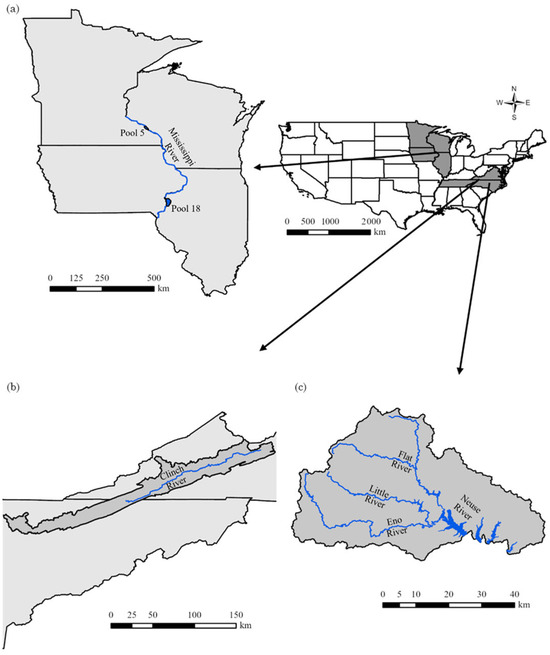
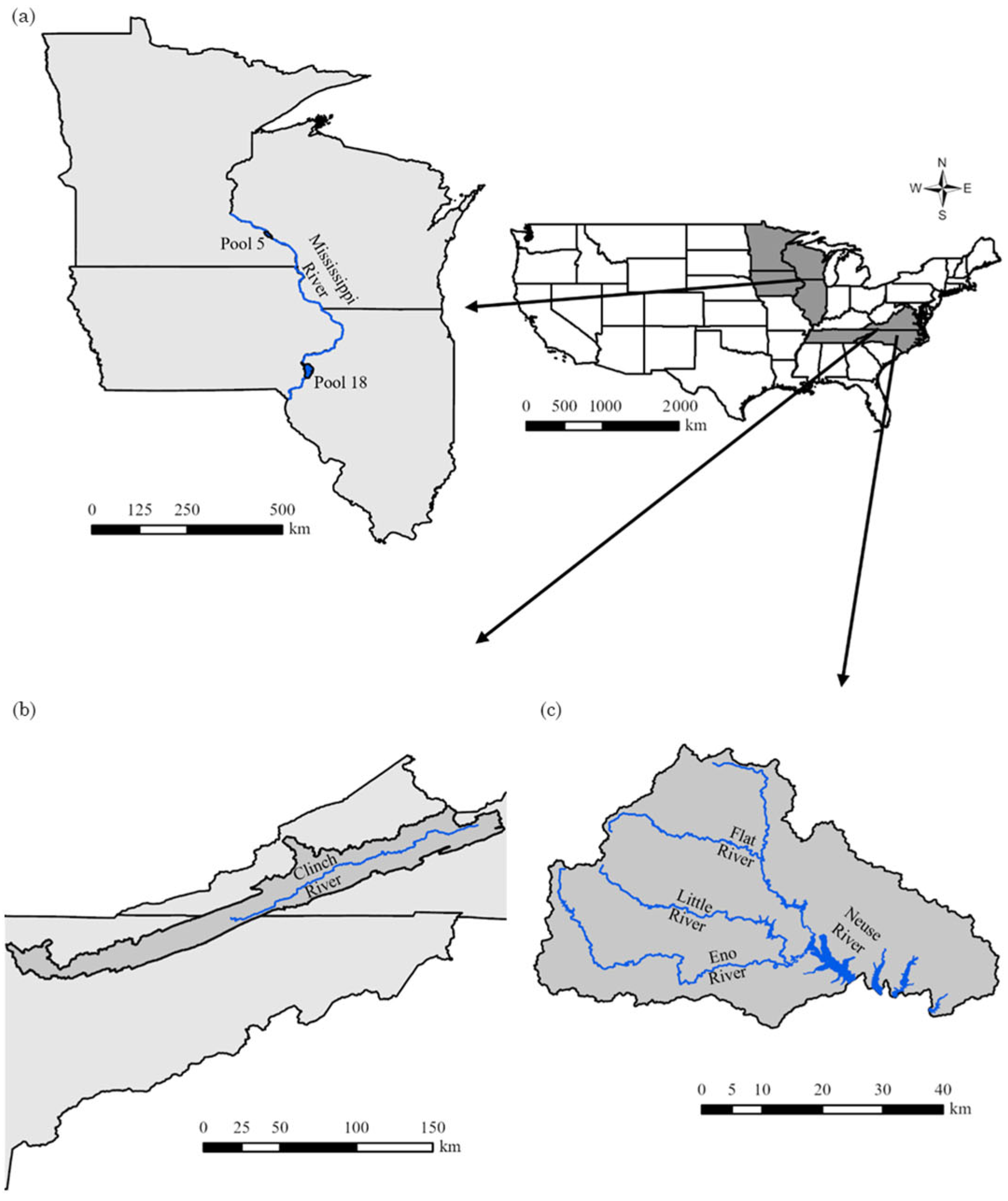
To estimate contaminant sequestration by mussels, we selected sites in the large (>500 m wide) upper Mississippi River in Minnesota, Wisconsin, Iowa, and Illinois, USA, in the medium-sized (50–70 m wide) Clinch River in Virginia and Tennessee, USA, and in small (<30 m wide) streams in the upper Neuse River basin in North Carolina, USA, and (Figure 1). These rivers principally varied in three aspects pertinent to this assessment. First, these rivers had estimated mussel population sizes that spanned orders of magnitude, from tens of thousands to hundreds of millions. Second, the rivers were sampled using varied survey designs, including systematic quantitative sampling, targeted quantitative sampling, and qualitative sampling. Third, the availability of existing contaminant data in soft tissues of mussels included metals, metalloids, ions, and organic contaminants.
Figure 1.
Study areas (shown in blue) in (a) upper Mississippi River Pools 5 through 18, (b) upper Clinch River, and (c) upper Neuse River including the Eno, Flat, and Little River tributaries.
2. Materials and Methods
2.1. Upper Mississippi River Mussel Survey and Contaminant Data
The upper Mississippi River was sampled for mussels using a systematic quantitative survey design. These data illustrate the extent of contaminant sequestration in a large river containing a diverse, dense, and actively recruiting mussel assemblage. Sampling was conducted in two relatively unpolluted navigation pools (defined as the reach between two consecutive locks and dams); Pool 5 (near Wisconsin and Minnesota, USA) has an aquatic area of 4420 ha and Pool 18 (near Illinois and Iowa, USA) has an aquatic area of 4713 ha (Figure 1a, [27]). Newton et al. [27] sampled mussels at ~350 systematically placed sites in each pool. They obtained two 0.25-m2 quadrats at each site and excavated sediments to a depth of 15 cm; any mussels retained on a 6 mm mesh were identified to species and measured for total length and external age [27]. This design facilitated estimates of species richness, population size, and density. Pool 5 contained 16 live species, a population estimate of 190 million mussels (95% confidence limits, 155–224 million), and a pool-wide density of 4.3 mussels/m2 (Table 1). The Pool 5 assemblage was dominated by Amblema plicata, which comprised 56% of the pool-wide population. Pool 18 contained 23 live species, a population estimate of 212 million mussels (169–256 million), and a pool-wide density of 4.5 mussels/m2 (Table 1). The Pool 18 assemblage was co-dominated by A. plicata, Obliquaria reflexa, and Quadrula quadrula, each of which comprised 18% of the pool-wide population [27].
Table 1.
Summary of data used to estimate population-level sequestration of contaminants by mussels (total metals, metalloids, and ions (i.e., elements) in the upper Mississippi River and total polycyclic aromatic hydrocarbons (PAHs) in the Clinch River and upper Neuse River.
We estimated soft tissue contaminant data from three species in each pool. In Pool 5, we sampled contaminants from A. plicata, Fusconaia flava, and Lampsilis cardium, which collectively made up 68% of the pool-wide assemblage. In Pool 18, we sampled contaminants from A. plicata, O. reflexa, and Q. quadrula, which collectively made up 54% of the pool-wide assemblage. The species average tissue masses in the upper Mississippi River ranged from <1 g to ~10 g dry weight, so an average tissue mass per pool should be a reasonable approximation representing all species. In both pools, we analyzed whole body soft tissue samples from mussels that were sampled from the river, held on ice during sampling, and then stored at −20 °C until they were processed and analyzed for a suite of metals, metalloids, ions (i.e., elements), and organic contaminants. In the upper Mississippi River, a total of 270 individuals (23–128 mm in total length) of the dominant species were obtained, and 27 composite tissue samples were analyzed from each navigation pool. The upper Mississippi River mussel samples were analyzed for a suite of 22 metals, metalloids, and ionic inorganic elements (Al, As, Ba, Be, Cd, Co, Cr, Cu, Fe, Hg, K, Mg, Mn, Mo, Ni, Pb, Sb, Se, Si, Sr, V, and Zn) at Research Triangle Institute International in Durham, NC, USA, using standard methods (U.S. Environmental Protection Agency methods 200.7 and 3050B). Note we opted to include certain elements analyzed in this suite that are not commonly regarded as problematic contaminants (e.g., K, Si, V) to err on the side of inclusion rather than omission. Rigorous quality assurance protocols were followed for all elemental analyses, and included reagent blanks, reagent blank spikes, duplicate samples, matrix spikes, and standard reference materials. The average recovery from standard reference material was 96% (range, 57–135%), relative percent difference (RPD) of duplicates averaged 7% (range, 0–39%), recovery of matrix spikes averaged 100% (range, 8–212%), reagent blanks were uncontaminated, and average recovery from reagent blanks spikes was 101% (range, 97–114%). The few standard reference material samples analyzed for the particular elements with the lowest recoveries were within 23% of the certified range. Several classes of organic contaminants were also analyzed in mussel samples from the upper Mississippi River including PAHs, PCBs, legacy organochlorine pesticides and current-use pesticides (78 individual organic compounds in total). Organic contaminant analyses were conducted at the North Carolina State University Chemical Exposure Assessment Laboratory in Raleigh, NC, USA, according to standard methods and approved protocols. All of the quality control data were within acceptable ranges and validated the data quality. For example, surrogate recoveries for mussel PAH analysis ranged from 71 to 104% with minimal differences among the four surrogates indicating equal recovery of all PAHs from the mussel samples. Duplicate analysis yielded RPD < 10% for all analytes. Matrix spikes yielded recoveries between 80 and 103%, with RPDs < 10%. Metals, metalloids, and ions were the prevalent constituents measured in mussel samples from the upper Mississippi River, and, therefore, were highlighted in this assessment. Given the systematic sampling design and robust population estimates, these data provided the greatest accuracy in estimating the mass of contaminants sequestered by mussels.
2.2. Clinch River Mussel Survey and Contaminant Data
The Clinch River data represents a medium-sized river with a well-studied mussel assemblage along a 164 km reach from southwestern Virginia to northeastern Tennessee (Figure 1b). Biologists have conducted long-term monitoring in this reach since the 1970s [28,29,30]. This river was sampled using a site-specific systematic quantitative design at sites with suitable habitat. These surveys documented a precipitous decline in mussel populations in an 88 km reach in Virginia and reported a faunal collapse at Pendleton Island within that reach, where the abundance of mussels had decreased by ~96% [28,29]. Results from multiple recent studies have implicated pollution from polycyclic aromatic hydrocarbons (PAHs), major ions, and metals as causative factors in mussel declines [31,32,33]. A negative correlation between mussel density and tissue PAH and manganese concentrations in mussels was recently reported [34,35].
We compared contaminant sequestration in mussel soft tissue from two contrasting sites: a site where mussels have been declining for decades (Pendleton Island) and an area of population stability > 100 km downstream (hereafter, relatively unpolluted site). Pendleton Island once supported the greatest mussel biodiversity and abundance in the Clinch River, with a density of 25 mussels/m2 in 1979 [29,30]. In 2014, this site contained 10 species at a density of ~1 mussel/m2, and a population of ~55,500 mussels (estimated by multiplying mussel density by the habitat area of 55,500 m2) [29,30]. In contrast, relatively stable mussel assemblages have persisted at downstream sites including Wallen Bend, Kyle’s Ford, and Frost Ford, which had a combined area of 58,765 m2, comparable to that of Pendleton Island [29]. The relatively unpolluted sites had 30 species, a density of 29 mussels/m2 (similar to the density that Pendleton Island formerly supported), and a population estimate of 1,704,185 mussels [29] (Table 1).
We had contaminant data and tissue mass (wet and dry weights) from Actinonaias pectorosa sampled from Pendleton Island and Wallen Bend in 2012 and 2013 [33,34]. Actinonaias pectorosa was the dominant species (by percent abundance and biomass) in the Virginia section of the Clinch River and, therefore, illustrative of the assemblage [28]. In the Clinch River, a total of 144 A. pectorosa (80–140 mm in total length) were obtained, and three composite samples were available from each of the two sites examined here [34]. Tissue concentrations of several classes of contaminants were available from Pendleton Island and Wallen Bend. Metals and PAHs were the prevalent contaminants measured in samples from the Clinch River, but we focused on PAHs because of their inverse relationship with mussel density [34], and because other contaminants (e.g., polychlorinated biphenyls (PCBs) and pesticides) were relatively low in tissue and other river compartments (i.e., surface water and sediments) [34]. All samples from the Clinch River were processed and analyzed according to published methods and quality assurance protocols [34]. The average tissue concentration of PAHs from mussels obtained at Pendleton Island was 852 ng/g dry weight, and the average from those obtained at Wallen Bend was 239 ng/g dry weight [34]. These data allowed comparison of contaminant sequestration at targeted sites of interest, where quantitative mussel data were available, and provided an opportunity to compare relative contaminant sequestration among sites or between historical and contemporary data. It represented an illustration of adapting data from long-term monitoring projects.
2.3. Upper Neuse River Mussel Survey and Contaminant Data
The upper Neuse River basin data represented contaminant sequestration in small, low-order streams at a spatial scale comparable to that of most mussel surveys. We used existing population and contaminant data from a 1686 km2 watershed in the upper Neuse River basin in North Carolina. The main rivers in the study area were the Eno, Little, and Flat Rivers, and their tributaries (Figure 1c). Mussel population data were available from qualitative surveys by Levine et al. [36,37]. They used three 1 m wide one-pass visual surveys (one pass in the center of the channel and one near each bank) in 44 stream reaches, each spanning a distance of 300 m upstream and downstream of road crossings, for a total of 600 m surveyed per site (total of 26.4 river kilometers surveyed). The mean width of surveyed reaches was 9.9 m (range, 3.4–26.5 m). Such qualitative methods are commonly used in mussel surveys as a rapid assessment of presence and relative abundance for population monitoring [38] and for assessing potential impacts from proposed development projects (e.g., bridge or utility pipeline) [36,39].
Sampling in the upper Neuse River detected 26,131 mussels at the substrate surface and 94% of those were Elliptio complanata and, therefore, this species was illustrative of the assemblage [36,37]. To improve the estimation of mussels in the surveyed area, investigators applied corrections to the raw data to account for mussels in un-surveyed stream areas (i.e., areas between the center and bank transects) and to account for mussels that were likely not detected in one pass. They used mussel data from the center transect multiplied by total wetted width of each reach, minus the 3 m that were surveyed. Their prior research indicated that ~75% of mussels on the surface were likely to be detected in one pass; thus, a 0.75 correction factor was applied (i.e., number of mussels detected ÷ 0.75) to estimate total mussels on the surface [40]. Applying these corrections yielded an estimate of 79,729 mussels on the surface in the surveyed reaches (Table 1).
Soft tissue contaminant data for these streams were available from Archambault et al. [41], who evaluated PAHs in E. complanata from 50 m upstream to 50 m downstream of road crossings during surveys at 20 of the 44 stream reaches [37]. PAHs were the only contaminant data available from the upper Neuse River [41]. In total, 100 E. complanta (27–100 mm in total length) were obtained and data from two composite samples were available for each of 20 sites [41]. All samples from the upper Neuse River were processed and analyzed according to published methods and quality assurance protocols [34,41]. To estimate PAH sequestration by mussels in the full area surveyed, we averaged the tissue PAH concentrations from mussels across all 20 sites (n = 40 concentrations, one each from the 50 m reaches upstream and downstream of each road crossing). We then scaled the average estimate of sequestered PAHs per individual (182 ng/g tissue dry weight; Table 1) to the estimated population size [37]. Finally, for the upper Neuse River, the use of the qualitative population data introduced sufficient uncertainty that adding a range of estimates seemed inappropriate. While visual qualitative sampling designs often result in less accurate population sizes (and ultimately contaminant sequestration) relative to quantitative designs, they are representative of data often available from population assessments [38,39,42].
2.4. Contaminant Data and Sequestration Calculations
In each river, tissue contaminant data were estimated from the most abundant mussel species. Therefore, our estimates of contaminant sequestration are likely representative of the mussel assemblage. In all rivers, composite samples consisted of three to five mussels at a given site. To scale up the mussel contaminant data to the assemblage level in these rivers, we multiplied the average soft tissue mass (e.g., g tissue) from each river or site by the mass-normalized tissue concentrations of prevalent contaminants (e.g., µg/g tissue) to derive an average whole mussel body burden (i.e., g/mussel). We then multiplied the average body burden by the population size to estimate contaminant sequestration at the assemblage level (i.e., ng per site). Because data on population sizes and contaminant concentrations were variable, we report ranges of contaminant sequestration wherever possible. The range of mass-normalized contaminant concentrations, the range of soft tissue masses for mussels at a given site, population size, or all three could be used to derive a range of estimates. All calculations of means, variance, and conversions used in the framework demonstration analysis were performed with Microsoft Excel version 2016.
3. Results
3.1. Upper Mississippi River
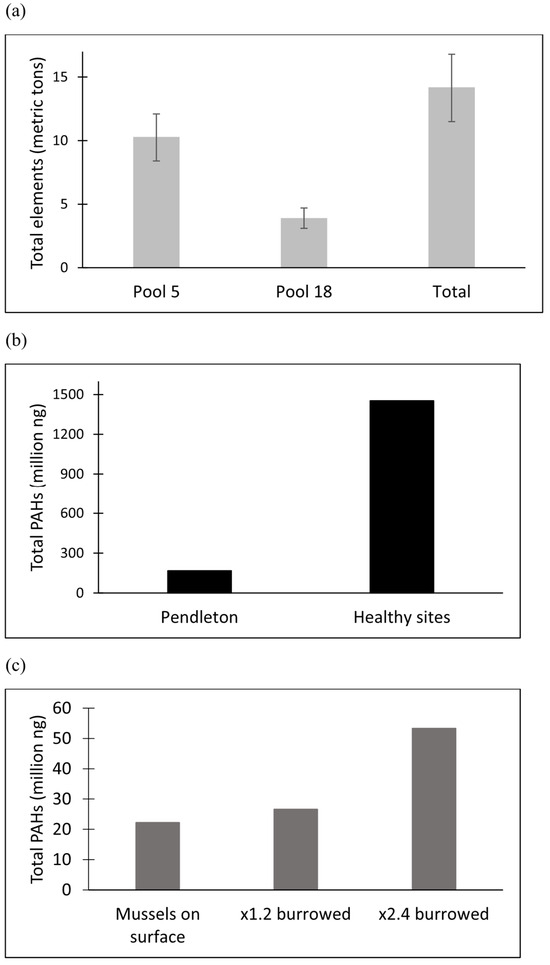
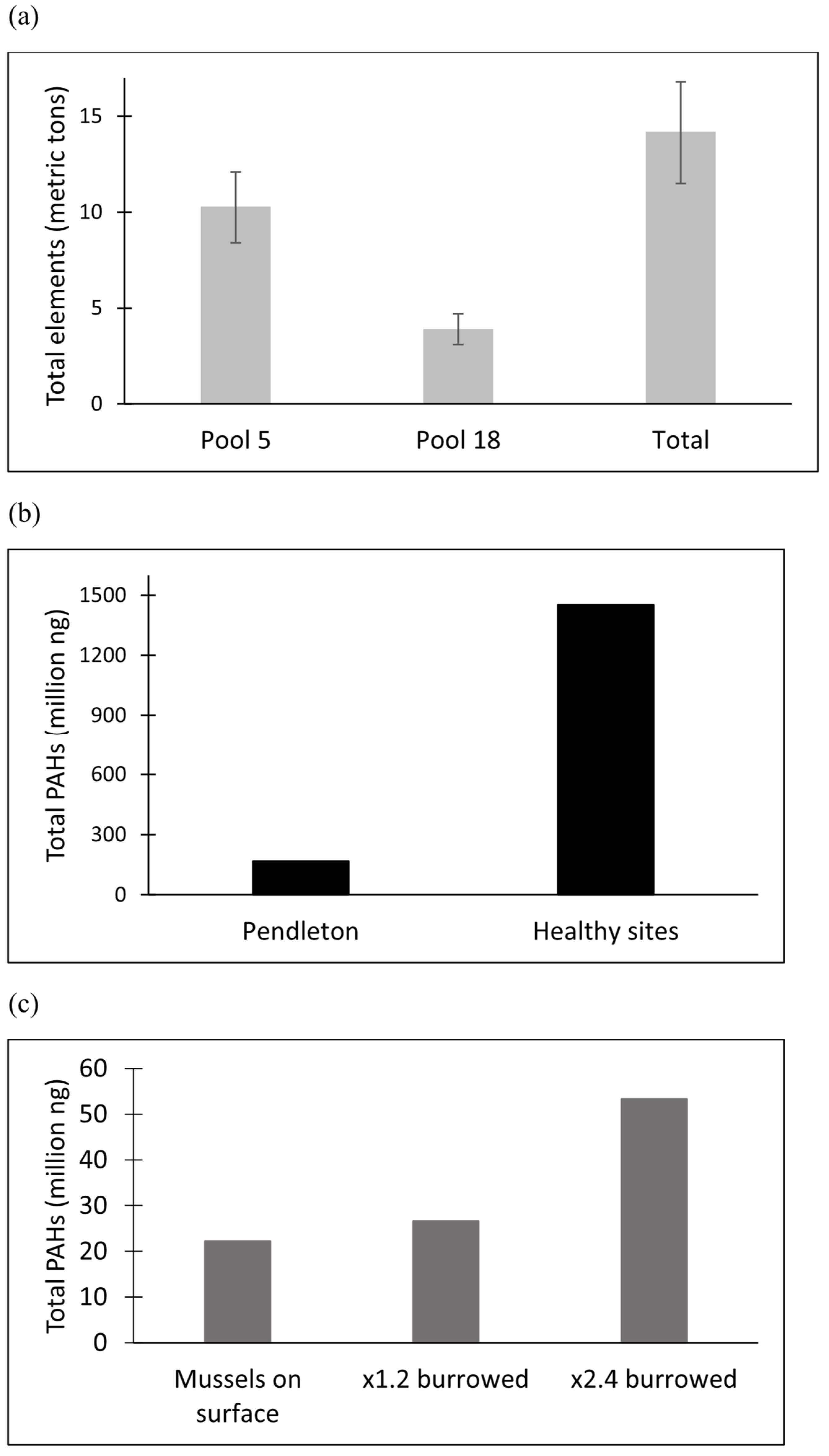
Estimating the ability of mussels to sequester contaminants in Pools 5 and 18 required no post hoc conversions because the systematic quantitative sampling was designed to provide robust population estimates at the scale of the navigation pool [27]. We summed the 22 metals, metalloids, and ions (elements) for each tissue sample (Table 2), and computed the mean total concentration and associated mean tissue dry weights for each species in each pool (Table 1). In Pool 5, the pool-wide average element concentration was 11,357 µg/g tissue and the average tissue mass was 4.77 g (Table 1). Thus, the estimated 190 million mussels in this pool contained 1.03 × 10¹³ µg (10.3 metric tons) of metals, metalloids, and ions in soft tissues (range, 8.40 × 10¹²–1.21 × 10¹³ µg or 8.4–12.1 metric tons, based on the upper and lower 95% confidence limits around the population estimate; Figure 2a). In Pool 18, with a pool-wide average element concentration of 8817 µg/g tissue and an average tissue mass of 2.04 g (Table 1), the estimated 212 million mussels sequestered 3.90 × 10¹² µg (3.9 metric tons) of metals, metalloids, and ions in soft tissues (3.11 × 10¹²–4.71 × 10¹² µg (3.1–4.7 tons), accounting for population 95% confidence limits; Figure 2a). Mussels in these two pools of the river alone (of 29 total pools in the upper Mississippi River), contained ~14.2 metric tons of metals, metalloids, and ions (range, 11.5–16.8 metric tons, based on lower and upper population confidence limits; Figure 2a).
Table 2.
Average concentration of individual metals, metalloids, and ions (elements in µg/g dry weight, standard error in parentheses) for each species of native freshwater mussel in Pools 5 and 18 of the upper Mississippi River. The sum of the individual metals equals the total reported in Table 1. Average dry weight (SE) was 2.5 g (0.2) for Amblema plicata, 1.9 g (0.1) for Fusconaia flava, and 9.9 g (0.6) for Lampsilis cardium in Pool 5 and 3.4 g (0.4) for Amblema plicata, 0.8 g (0.1) for Obliquaria reflexa, and 1.9 g (0.2) for Quadrula quadrula in Pool 18.
Figure 2.
Sequestration of total elements (metals, metalloids, and ions) in mussel assemblages in (a) Pools 5 and 18 of the upper Mississippi River, (b) total polycyclic aromatic hydrocarbons (PAHs) in mussels from the Pendleton site in the Clinch River (i.e., polluted and unhealthy site) and relatively unpolluted (i.e., healthy) sites, and (c) total PAHs in the population of mussels encountered at the sediment surface in the upper Neuse River, and estimates accounting for mussels that were likely burrowed using low and high corrections of 1.2–2.4 times higher abundance from literature values.
3.2. Clinch River
The site-specific quantitative sampling design—including population size data, estimates of site area, and wet tissue masses of mussels—facilitated estimation of contaminant sequestration with only one post hoc correction. This correction was the conversion of mean mussel wet weight to dry weight for scaling to body burden. To convert our average wet weight in A. pectorosa (i.e., 42.83 g wet) to dry weight, we multiplied by the average percent dry weight (8.31%) from tissue samples where both wet and dry weight were available (n = 15, including samples from sites other than Pendleton Island and relatively unpolluted sites). This conversion resulted in an average dry weight of 3.56 g in A. pectorosa (i.e., 42.83 × 0.0831). We estimated that the total mass of PAHs sequestered by mussels at Pendleton Island was ~168 million ng of PAHs, and mussels at the relatively unpolluted sites sequestered ~1.45 billion ng of PAHs (168 mg and 1.45 g, respectively; Figure 2b). Despite having a lower mean tissue PAH concentration (only 28% of that in mussels at Pendleton Island), the greater mussel abundances in the relatively unpolluted sites had nearly 10 times more capacity to sequester PAHs from the aquatic environment.
3.3. Upper Neuse River
The qualitative sampling design made it difficult to estimate contaminant sequestration from available data on mussel population sizes and tissue contaminants in the upper Neuse River. This design required several post hoc corrections to estimate contaminant sequestration. First, a correction was applied by Levine et al. [36,37] to the visual one-pass survey data to correct for unsampled areas. Second, a correction was applied for mussels that were burrowed beneath the sediment surface because the visual qualitative design did not capture those individuals [40]. In areas where E. complanata was the dominant species, the literature reports between 20 and 140% more mussels were burrowed than at the surface [43,44]. Because the range of burrowed mussels was variable, we applied correction factors that encompassed this variation (surface estimate × 1.2 and surface estimate × 2.4). Third, because wet and dry weight data on mussels were unavailable, we had to convert the contaminant data from dry to wet weight for scaling to body burden using a two-part correction. First, while the mean total (including shell) wet weight was known (43.85 g; Table 1), the soft tissue weight was unknown. We used measurements from 150 comparably sized E. complanata from Archambault [45] to estimate the soft tissue weight from the total wet weight. Soft tissue averaged 36.4% of the total wet weight; thus, we applied a correction factor of 0.364 to the total wet weight of the upper Neuse River mussels (i.e., 43.85 total wet weight × 0.364 = 15.96 g soft tissue wet weight). Second, the average percent dry weight was known (9.58%), enabling us to convert mean tissue wet weight to dry weight (i.e., 15.96 g wet weight × 0.0958 = 1.53 g dry weight). Using the calculated mean E. complanata dry weight and PAH tissue concentrations, we estimated PAH body burden (i.e., 182 ng/g dry weight × 1.53 g dry weight = body burden of 278 ng PAH/mussel).
The estimated PAH body burdens were then scaled to mussel population sizes ranging from 79,729 mussels on the surface to 191,350 mussels (including burrowed mussels). Scaling to the surface estimate of 79,729 mussels (a minimum estimate of PAH sequestration) indicates that mussels sequestered about 22.2 million ng (2.22 mg) of PAHs (Figure 2c). When we accounted for mussels that were likely burrowed in the surveyed reaches using the low (×1.2; n = 95,674) and high (×2.4; n = 191,350) corrections, we estimated that mussels sequestered between 26.6 and 53.3 million ng of PAHs (26.6–53.3 mg) in the upper Neuse River watershed (Figure 2c).
4. Discussion
4.1. Challenges of Using Existing Data to Estimate Contaminant Sequestration
We assessed a possible framework for estimating population and assemblage level contaminant sequestration by mussels using existing data from three rivers. This framework illustrated that existing data derived from studies with varied mussel survey designs and mussel contaminant data can be used to estimate the magnitude of contaminant sequestration by mussels. However, the accuracy of the contaminant sequestration estimate is a function of the robustness of the population size estimate and the contaminant body burden estimate. The framework also documents the relative ease or difficulty in deriving contaminant sequestration estimates. Our estimates of contaminant sequestration varied from straightforward (upper Mississippi River) to moderately easy (Clinch River) to difficult (upper Neuse River).
The rigorous, quantitative data on population sizes and contaminant concentrations from mussels in the upper Mississippi River were easily and accurately converted to sequestration estimates without post hoc corrections. Population size estimates derived from systematic quantitative survey data coupled with contaminant data from the dominant species provided the strongest foundation to estimate population-level ecosystem functions. A key element of this experimental design was that because sampling occurred systematically across all habitat types in a given navigation pool, there was no need to scale up the data as the sampling inference was already at the pool scale. In addition, because confidence limits around the population estimates were available, a range of contaminant sequestration could be quantified. Systematic quantitative survey designs and associated population estimates are limited in the peer-reviewed literature (but see [27,46,47]), yet they provide the foundational data needed to estimate contaminant sequestration and potentially other ecological functions provided by mussels.
In the Clinch River, population estimates derived from site-specific quantitative surveys allowed robust estimates of contaminant sequestration in the areas that were sampled. Because the sampling was designed at the site scale, and not the reach scale, these data could not be scaled up to the reach scale without understanding the resultant scale errors. Mussel biologists frequently target higher density areas for sampling, but this design’s exclusion of low-density areas will overestimate population size and contaminant sequestration. Existing data also required the post hoc correction of contaminant data from a dry-to wet-weight basis. This correction was relatively simple (and accurate) because robust data on tissue water content were available from the species of interest at the sites of interest. Site-specific quantitative survey designs are common in the literature because they provide detailed information on mussels at sites of interest to biologists and resource managers [30].
In the Neuse River, data from qualitative sampling presented the greatest challenges to estimating contaminant sequestration and required multiple post hoc corrections. Qualitative data are generally not recommended for deriving population estimates [48], but in many systems, they may be the only available data on mussels. These designs often exclude smaller individuals and mussels that are burrowed and, therefore, caution should be used in deriving population estimates. We were able to provide a surface to burrowed correction factor for the dominant species (E. complanata) because of published data from wadable southeastern USA streams [43,44]. However, the percent burrowed was highly variable (20–140%) and this variation will introduce errors into estimates of contaminant sequestration. Other potential limitations of the Neuse data were that Levine et al. [36] excluded all sites where mussels were not observed in a rapid survey, so there were likely more low-density sites in the basin than their survey included and their surveys oversampled the near-bank habitats, which had mussel densities almost twice as high as the mid-channel habitats. This would lead to population overestimates and greater bias in wider stream channels. Qualitative sampling is often used to accommodate resource constraints (e.g., staff availability, project timing, or fiscal resources) and has been used to estimate species richness, evenness, and diversity [49]. Data from qualitative surveys is not recommended for estimating contaminant sequestration unless quantitative data at a subset of sites are also available.
There are benefits and challenges in using existing data on mussel contaminant concentrations. Benefits include the elimination of the need to kill additional mussels for analysis and the cost savings of using existing data. The contaminant data generated in this study cost between $250 and $1400 US dollars (in 2020) per sample for an overall cost savings of ~$77,900. Repurposing these data to estimate contaminant sequestration can be a value-added use in future studies. The main challenge was the lack of data on tissue weights to scale concentrations to total body burdens. Contaminant data typically are reported on a mass-normalized basis (e.g., ng/g), but tissue wet and dry weights are rarely reported together. Reporting of total body tissue weights would facilitate estimates of contaminant sequestration. Future research could explore alternate methods to reduce issues with limited contaminant concentration data in mussel tissue. For example, Archambault et al. [41] showed a significant relationship between PAH concentrations in surface water and those in mussel tissue (p < 0.0001, r2 = 0.90); the pairing of such data with filtration rates of dominant species could provide reasonable estimates of contaminant sequestration without killing mussels for analysis.
4.2. Magnitude of Contaminant Sequestration
We estimated that mussels in Pools 5 and 18 of the upper Mississippi River sequestered 1.42 × 10¹³ µg of total metals, metalloids, and ions (~14.2 metric tons). Mussels in the upper Neuse River sequestered between 22.2 and 53.3 million ng of PAHs (i.e., 22.2–53.3 mg). Mussels at a relatively polluted site in the Clinch River sequestered 168 million ng (i.e., 168 mg) of PAHs compared to 1.45 billion ng of PAHs (1.45 g) sequestered by mussels at relatively unpolluted sites. This represented ~10 times greater sequestration capacity at relatively unpolluted sites despite having ~3.6 times lower tissue concentrations and is likely due to greater mussel abundances and, therefore, storage capacity at the relatively unpolluted sites compared to the reduced mussel abundances and storage capacity at the polluted sites. While 14 metric tons of metals and 1.5 g of PAHs sequestered by mussels in two river reaches seems substantial, these results need to be placed into context. The most accurate way to assess this would be to compare the amount of contaminants held by mussels relative to the flux moving downriver in dissolved and particulate forms. However, these data are not generally available. An alternative is to compare the amount held by mussels with the amount held in other ecosystem compartments (e.g., sediment, other biota), although all of these compartments could be small compared to fluxes.
Because we had contaminant data measured in sediments and mussels from the upper Mississippi and Neuse Rivers [45], we had an opportunity to compare contaminant sequestration between two environmental compartments. On a mass-normalized basis, the metal binding potential of mussels in Pool 5 of the upper Mississippi River was only 27% less than that of sediments (mussels: 11,357 µg/g; sediment: 15,576 µg/g). In the Neuse River, the PAH binding potential of mussels was ~50% less than that of sediments. Assuming that the mass of sediments in most rivers is substantially greater than the mass of mussels, even if only accounting for surficial sediments (usually defined as the top 5 cm in contaminant studies; [34]), these comparisons show that the potential contaminant sequestration performed by mussels is not trivial. Broadening this analysis to environmental compartments of other organisms shows a similar pattern. For example, mussels in Pool 5 of the upper Mississippi contain ~50% more Cd on a mass-normalized basis than burrowing Hexagenia mayflies [50] and 67–120% more Cd than fish [51]. While this simple exercise does not account for mixing, Cd speciation or complexation, flux, or seasonality, it nonetheless illustrates the magnitude of the potential sequestration by mussels.
4.3. Contaminant Sequestration as an Ecosystem Function
The sequestration of contaminants in mussel tissue by deposit and filter feeding represents an ecological function to aquatic ecosystems by removing contaminants that would otherwise be available to other biota and potentially humans—similar to their ecosystem function of storing nutrients [52]. Without mussels, this function would need to be performed by other means (e.g., wastewater filtration plants) or these contaminants would partition into other ecosystem compartments such as sediment or fish (which could ultimately be consumed by humans). If the magnitude of contaminant sequestration is large and permanent, mussels could improve (local) water quality. This hypothesis is the basis for “The Mussels for Clean Water Initiative” [53] that aims to improve water quality in the Delaware River by restoring native freshwater mussels. This program built a $7.9 million mussel hatchery at Bartram’s Garden (Pennsylvania, USA) with a goal to produce millions of juvenile mussels annually to promote clean water [54].
Even though we have shown that contaminant sequestration by mussels may be substantial relative to other biota, numerous uncertainties remain. First, although mussels are long-lived relative to other aquatic invertebrates, we do not know whether contaminant sequestration is temporary or permanent. Some contaminants, such as divalent metals that are processed similarly to calcium, can get sequestered for decades or centuries in calcified shell material [35]. Second, we know little about the fate of contaminants once mussels ingest them. Most prior bivalve studies have focused on estimating uptake and depuration rate constants or quantifying contaminant partitioning among tissue types [55]. Third, we know little about what happens to sequestered contaminants when a mussel dies. Generally, the fate of bound contaminants upon the death of an animal depends on environmental context [56]. We are unaware of studies that have measured the release of contaminants from dead mussels; however, a general hypothesis is that contaminants are released back into the water or sediment and are available for consumption by other organisms. If this is true, then contaminant sequestration by mussels could be a temporary phenomenon. However, because mussels can live decades longer than most other aquatic organisms, they may render many contaminants unavailable for uptake by other biota during their life span. Moreover, if a mussel population is stable and new recruits are replacing dead individuals, then the population should maintain the pool of sequestered contaminants over time. Although there are uncertainties in the magnitude, timing, and duration of contaminant sequestration by mussels, mussels can only sequester contaminants as long as aquatic ecosystems are healthy enough to support them. Thus, stable, healthy populations of long-lived mussels can provide a reservoir of pollutant sequestration capacity to aquatic ecosystems.
4.4. Ecosystem Functions in an Era of Faunal Decline
Extreme events, including floods and drought, could affect the ability of mussels to provide ecosystem functions. For example, Spooner and Vaughn [57] reported that mussels exhibit altered resource assimilation and excretion rates under different thermal regimes, and Vaughn et al. [23] and Dubose et al. [24] reported on drought-induced losses of ecosystem functions related to biofiltration, nutrient cycling, and nutrient storage. Changing climates, emerging contaminants, and cumulative stressors are among the most important challenges to conserving freshwater biodiversity [58]. Along with those challenges, mussel habitat is being lost and/or fragmented [59,60] with resulting effects on physiology [61]. The early life stages of unionid mussels (larvae and juveniles) are often characterized as being among the most sensitive organisms to acute exposures of several classes of contaminants [62,63], yet this assessment with adult mussels indicates that they can sequester substantial concentrations of contaminants (albeit with unknown chronic or sublethal effects). Future research could assess the magnitude by which varied mussel-associated ecosystem functions are diminished by persistent and emerging threats and reconcile the conditions under which adult mussels may be sensitive to contaminants. This body of research would add to the public narrative about the value of mussels and enhance the case for conservation action.
4.5. Balancing Uncertainty and Decision-Making
Precision in understanding population or ecosystem-level processes is rarely afforded to researchers; yet at societal scales and in socio-ecological focal areas such as water resources, decision-making timelines are often urgent, stakeholders have conflicting interests, and scientific data are incomplete–a combination characterized as post-normal science nearly three decades ago [64]. Ainscough et al. [65] indicated that post-normal science is a useful framework for identifying, quantifying, and valuing mussel ecosystem functions. We have shown that extrapolating available data to relevant spatial scales can be imprecise; yet pursuing this endeavor can cultivate awareness about mussel resources. Mussel biologists have an integral role to play in establishing a public narrative about the ecosystem functions that mussels provide. Although this field is in its relative infancy, sustained progress needs to be made if we wish to influence the public narrative on mussels and their associated functions [22,66]. Although our framework for quantifying contaminant sequestration at mussel assemblage levels across watersheds and spatial scales has uncertainty because of varied survey design types and associated correction factors, it illustrates the potential for contaminant sequestration as an ecosystem function provided by mussels and could be used to advance research on the potential for freshwater mussels to improve water quality. As mentioned previously, the construction of a multi-million-dollar hatchery in Pennsylvania was designed on the premise that restoring mussels in Chesapeake Bay could improve water quality [53,54]. Bakshi et al. [67] state that because the goal of protecting ecosystem functions is implicit in the Clean Water Act, incorporating mussel conservation into clean water goals could be a cost-effective strategy serving multiple conservation goals. Ecosystem functions can be a valuable tool for cultivating social awareness and providing context for management decisions, especially when social benefits are emphasized (e.g., water clarity, recreational fishing; [68,69,70]). Establishing the potential for mussels to maintain or improve water quality (e.g., through reduction in pathogens or contaminants) has shared societal impacts [71]. Incorporating ecosystem functions into decision-making has been practiced for more than a decade by federal agencies in the USA and elsewhere [72], but their application has not become standard despite concerted efforts to establish guidance [68]. Not accounting for the functions that mussels provide leaves open the risk that they will be discounted or left out of management and policy decisions that affect their conservation. Thus, research into the estimation of mussel-derived ecosystem functions, including uncertainty, assumptions, and environmental context, are urgently needed. Finally, armed with this knowledge, future research could begin the valuation of these functions as ecosystem services through the integrated expertise of interdisciplinary teams of scientists such as hydrologists, ecologists, toxicologists, and economists.
5. Conclusions
We paired existing data on population sizes with contaminant bioaccumulation data from tissue samples to derive estimates of contaminant sequestration by freshwater mussels. This framework illustrated that mussels perform contaminant sequestration in aquatic ecosystems ranging from small streams to large rivers and with several classes of contaminants. We acknowledge that uncertainties and variances associated with the original data on mussel abundances and pollutant concentrations may not fully characterize these systems, but our estimates provide a framework for future contaminant sequestration studies. We also showed that the magnitude of contaminant sequestration by mussels can exceed that of other aquatic biota; however, this concept needs to be explored in other systems and with other contaminants. Additional research is needed to understand the linkages between their ecosystem functions and socially desirable benefits [26,69,70], such as improved water quality resulting from mussel conservation [26,73]. While contaminant sequestration by mussels is of interest to humans for purifying water, mussels filter water (and associated contaminants) to fulfill their basic life history needs (e.g., acquire food, exchange gametes). Mussels’ ability to perform these basic life functions depends on suitable conditions to sustain their populations.
Author Contributions
Conceptualization, W.G.C., J.M.A. and T.J.N.; methodology, W.G.C. and J.M.A.; validation, J.M.A. and W.R.C.; formal analysis, J.M.A., T.J.N., C.B.E. and J.W.J.; investigation, J.M.A., T.J.N. and H.L.D.; resources, T.J.N., H.L.D. and J.W.J.; data curation, J.M.A.; writing—original draft preparation, J.M.A.; writing—review and editing, J.M.A., W.G.C., T.J.N., H.L.D., C.B.E., J.W.J. and W.R.C.; visualization, J.M.A. and W.R.C.; supervision, W.G.C.; project administration, W.G.C.; funding acquisition, W.G.C. All authors have read and agreed to the published version of the manuscript.
Funding
This research was funded by the National Fish and Wildlife Foundation (Grant Number 54141), the Duke Energy Water Resources Fund (Proposal Number (1121) 2019-0235, administered through the North Carolina Community Foundation), and the U.S. Geological Survey Ecosystems Mission Area Fisheries Program. Jennifer M. Archambault also received funding through the North Carolina Agromedicine Institute’s Foundation for Agromedicine and Toxicology Supplemental Scholarship Program, which supported travel and materials for the upper Mississippi River portion of the study. The participation of W. Gregory Cope in this study was made possible by the Research Capacity Fund (Hatch) project award no. 7007359 from the U.S. Department of Agriculture’s National Institute of Food and Agriculture.
Institutional Review Board Statement
Not applicable.
Data Availability Statement
The data presented in this study are available on request from the corresponding author. The data are not publicly available due to lack of mandate.
Acknowledgments
We thank Dan Scoggin (formerly EcoAnalysts, Inc.) and Patty Schrank (formerly U.S. Geological Survey) for field assistance on the upper Mississippi River; Clayton Lynch and Meredith Shehdan (NC State University) for laboratory assistance processing mussel tissue; Damian Shea, Xin-Rui Xia, and Xiang Qing Kong (NC State University), who supplied passive sampling devices and other equipment; Frank Weber (RTI, Inc.) for metals analyses; and staff at Shealy Environmental Services, Inc., and GEL Laboratories, LLC, for organic contaminant analyses. We thank Tom Kwak (U.S. Geological Survey) and Nick Haddad (Michigan State University), for conceptual input to the study and editorial review of an early manuscript draft. We thank Tom Augspurger (U.S. Fish and Wildlife Service), Peter Hazelton (University of Georgia), and David Strayer (Cary Institute of Ecosystem Studies) whose input greatly improved the manuscript. The views expressed in this article are those of the author(s) and do not necessarily represent the views or policies of the U.S. Fish and Wildlife Service. Any use of trade, firm, or product names is for descriptive purposes only and does not imply endorsement by the U.S. Government.
Conflicts of Interest
The authors declare no conflicts of interest.
References
- Mace, G.M.; Norris, K.; Fitter, A.H. Biodiversity and ecosystem services: A multilayered relationship. Trends Ecol. Evol. 2012, 27, 19–26. [Google Scholar] [CrossRef] [Scilit] [PubMed]
- Vaughn, C.C.; Hoellein, T.J. Bivalve impacts in freshwater and marine ecosystems. Annu. Rev. Ecol. Evol. Syst. 2018, 49, 183–208. [Google Scholar] [CrossRef] [Scilit]
- Zieritz, A.; Sousa, R.; Aldridge, D.C.; Douda, K.; Esteves, E.; Ferreira-Rodrıguez, N.; Mageroy, J.H.; Nizzoli, D.; Osterling, M.; Reis, J. A global synthesis of ecosystem services provided and disrupted by freshwater bivalve molluscs. Biol. Rev. 2022, 97, 1967–1998. [Google Scholar] [CrossRef] [Scilit] [PubMed]
- Atkinson, C.L.; Hopper, G.W.; Kreeger, D.A.; Lopez, J.W.; Maine, A.N.; Sansom, B.J.; Schwalb, A.; Vaughn, C.C. Gains and gaps in knowledge surrounding freshwater mollusk ecosystem services. Freshw. Mollusk Biol. Conserv. 2023, 26, 20–31. [Google Scholar] [CrossRef] [Scilit]
- Vaughn, C.C.; Hakenkamp, C.C. The functional role of burrowing bivalves in freshwater ecosystems. Freshw. Biol. 2001, 46, 1431–1446. [Google Scholar] [CrossRef] [Scilit]
- Vaughn, C.C.; Gido, K.B.; Spooner, D.E. Ecosystem processes performed by unionid mussels in stream mesocosms: Species roles and effects of abundance. Hydrobiologia 2004, 527, 35–47. [Google Scholar] [CrossRef] [Scilit]
- Howard, J.K.; Cuffey, K.M. The functional role of native freshwater mussels in the fluvial benthic environment. Freshw. Biol. 2006, 51, 460–474. [Google Scholar] [CrossRef] [Scilit]
- Vaughn, C.C.; Nichols, J.S.; Spooner, D.E. Community and food web ecology of freshwater mussels. J. N. Am. Benthol. Soc. 2008, 27, 409–423. [Google Scholar] [CrossRef] [Scilit]
- Hoellein, T.J.; Zarnoch, C.B.; Bruesewitz, D.A.; DeMartini, J. Contributions of freshwater mussels (Unionidae) to nutrient cycling in an urban river: Filtration, recycling, storage, and removal. Biogeochemistry 2017, 135, 307–324. [Google Scholar] [CrossRef] [Scilit]
- Turick, C.E.; Sexstone, A.J.; Bissonnette, G.K. Freshwater mussels as monitors of bacteriological water quality. Water Air Soil Pollut. 1988, 40, 449–460. [Google Scholar] [CrossRef] [Scilit]
- Ismail, N.S.; Dodd, H.; Sassoubre, L.M.; Horne, A.J.; Boehm, A.B.; Luthy, R.G. Improvement of urban lake water quality by removal of Escherichia coli through the action of the bivalve Anodonta californiensis. Environ. Sci. Technol. 2015, 49, 1664–1672. [Google Scholar] [CrossRef] [Scilit] [PubMed]
- Ismail, N.S.; Tommerdahl, J.P.; Boehm, A.B.; Luthy, R.G. Escherichia coli reduction by bivalves in an impaired river impacted by agricultural land use. Environ. Sci. Technol. 2016, 50, 11025–11033. [Google Scholar] [CrossRef] [Scilit]
- Morales, Y.; Weber, L.J.; Mynett, A.E.; Newton, T.J. Effects of substrate and hydrodynamic conditions on the formation of mussel beds in a large river. Freshw. Sci. 2006, 25, 664–676. [Google Scholar] [CrossRef] [Scilit]
- Sansom, B.J.; Bennett, S.J.; Atkinson, J.F.; Vaughn, C.C. Emergent hydrodynamics and skimming flow over mussel covered beds in rivers. Water Resour. Res. 2020, 56, e2019WR026252. [Google Scholar] [CrossRef] [Scilit]
- Bringolf, R.B.; Heltsley, R.M.; Newton, T.J.; Eads, C.B.; Fraley, S.J.; Shea, D.; Cope, W.G. Environmental occurrence and reproductive effects of the pharmaceutical fluoxetine in native freshwater mussels. Environ. Toxicol. Chem. 2010, 29, 1311–1318. [Google Scholar] [CrossRef] [Scilit]
- Ismail, N.S.; Muller, C.E.; Morgan, R.R.; Luthy, R.G. Uptake of contaminants of emerging concern by the bivalves Anodonta californiensis and Corbicula fluminea. Environ. Sci. Technol. 2014, 48, 9211–9219. [Google Scholar] [CrossRef] [Scilit] [PubMed]
- Kreeger, D.A.; Gatenby, C.M.; Bergstrom, P.W. Restoration potential of several native species of bivalve molluscs for water quality improvement in Mid-Atlantic watersheds. J. Shellfish Res. 2018, 37, 1121–1157. [Google Scholar] [CrossRef] [Scilit]
- Wang, N.; Ingersoll, C.G.; Greer, I.E.; Hardesty, D.K.; Ivey, C.D.; Kunz, J.L.; Brumbaugh, W.G.; Dwyer, F.J.; Roberts, A.D.; Augspurger, T.; et al. Chronic toxicity of copper and ammonia to juvenile freshwater mussels (Unionidae). Environ. Toxicol. Chem. 2007, 26, 2048–2056. [Google Scholar] [CrossRef] [Scilit]
- Cope, W.G.; Bringolf, R.B.; Buchwalter, D.B.; Newton, T.J.; Ingersoll, C.G.; Wang, N.; Augspurger, T.; Dwyer, F.J.; Barnhart, M.C.; Neves, R.J.; et al. Differential exposure, duration, and sensitivity of unionoidean bivalve life stages to environmental contaminants. J. N. Am. Benthol. Soc. 2008, 27, 451–462. [Google Scholar] [CrossRef] [Scilit]
- US EPA (U.S. Environmental Protection Agency). Aquatic Life Ambient Water Quality Criteria for Ammonia—Freshwater (EPA-822-R-13-001); Office of Water. Office of Science and Technology: Washington, DC, USA, 2013. Available online: https://www.epa.gov/wqc/aquatic-life-criteria-ammonia (accessed on 11 October 2025).
- Chaplin-Kramer, R.; Sharp, R.P.; Weil, C.; Bennett, E.M.; Pascual, U.; Arkema, K.K.; Brauman, K.A.; Bryant, B.P.; Guerry, A.D.; Haddad, N.M.; et al. Global modeling of nature’s contributions to people. Science 2019, 366, 255–258. [Google Scholar] [CrossRef] [Scilit]
- Strayer, D.L. What are freshwater mussels worth? Freshw. Mollusk Biol. Conserv. 2017, 20, 103–113. [Google Scholar] [CrossRef] [Scilit]
- Vaughn, C.C.; Atkinson, C.L.; Julian, J.P. Drought-induced changes in flow regimes lead to long-term losses in mussel-provided ecosystem services. Ecol. Evol. 2015, 5, 1291–1305. [Google Scholar] [CrossRef] [Scilit] [PubMed]
- Dubose, T.P.; Atkinson, C.L.; Vaughn, C.C.; Golladay, S.W. Drought-induced, punctuated loss of freshwater mussels alters ecosystem function across temporal scales. Front. Ecol. Evol. 2019, 7, 274. [Google Scholar] [CrossRef] [Scilit]
- Newton, T.J.; Mayer, D.A.; Rogala, J.T.; Madden, S.S.; Gray, B.R. Responses of native freshwater mussels to remediation to remove polychlorinated biphenyl-contaminated sediments in the upper Hudson River. Aquat. Conserv. Mar. Freshw. Ecosyst. 2023, 33, 1413–1430. [Google Scholar] [CrossRef] [Scilit]
- Keeler, B.L.; Polasky, S.; Brauman, K.A.; Johnson, K.A.; Finlay, J.C.; O’Neill, A. Linking water quality and well-being for improved assessment and valuation of ecosystem services. Proc. Natl. Acad. Sci. USA 2012, 109, 18619–18624. [Google Scholar] [CrossRef] [Scilit]
- Newton, T.J.; Zigler, S.J.; Rogala, J.T.; Gray, B.R.; Davis, M. Population assessment and potential functional roles of native mussels in the Upper Mississippi River. Aquat. Conserv. Mar. Freshw. Ecosyst. 2011, 21, 122–131. [Google Scholar] [CrossRef] [Scilit]
- Jones, J.; Ahlstedt, S.; Ostby, B.; Pinder, M.; Eckert, N.; Butler, R.; Hubbs, D.; Walker, C.; Hanlon, S.; Schmerfeld, J.; et al. Clinch River freshwater mussels upstream of Norris Reservoir, Tennessee and Virginia: A quantitative assessment from 2004–2009. J. Am. Water Resour. Assoc. 2014, 50, 820–836. [Google Scholar] [CrossRef] [Scilit]
- Jones, J.; Lane, T.; Ostby, B.; Beaty, B.; Ahlstedt, S.; Butler, R.; Hubbs, D.; Walker, C. Collapse of the Pendleton Island mussel fauna in the Clinch River, Virginia: Setting baseline conditions to guide recovery and restoration. Freshw. Mollusk Biol. Conserv. 2018, 21, 36–56. [Google Scholar] [CrossRef] [Scilit]
- Ahlstedt, S.A.; Fagg, M.T.; Butler, R.S.; Connell, J.F.; Jones, J.W. Quantitative monitoring of freshwater mussel populations from 1979–2004 in the Clinch and Powell Rivers of Tennessee and Virginia, with miscellaneous notes on the fauna. Freshw. Mollusk Biol. Conserv. 2016, 19, 1–18. [Google Scholar] [CrossRef] [Scilit]
- Johnson, G.C.; Krstolic, J.L.; Ostby, B.J.K. Influences of water and sediment quality and hydrologic processes on mussels in the Clinch River. J. Am. Water Resour. Assoc. 2014, 50, 878–897. [Google Scholar] [CrossRef] [Scilit]
- Price, J.E.; Zipper, C.E.; Jones, J.W.; Franck, C.T. Water and sediment quality in the Clinch River, Virginia and Tennessee, USA, over nearly five decades. J. Am. Water Resour. Assoc. 2014, 50, 837–858. [Google Scholar] [CrossRef] [Scilit]
- Archambault, J.M.; Bergeron, C.M.; Cope, W.G.; Lazaro, P.R.; Leonard, J.A.; Shea, D. Assessing toxicity of contaminants in riverine suspended sediments to freshwater mussels. Environ. Toxicol. Chem. 2017, 36, 395–407. [Google Scholar] [CrossRef] [Scilit]
- Cope, W.G.; Bergeron, C.M.; Archambault, J.M.; Jones, J.W.; Beaty, B.; Lazaro, P.R.; Shea, D.; Callihan, J.L.; Rogers, J.J. Understanding the influence of multiple pollutant stressors on the decline of freshwater mussels in a biodiversity hotspot. Sci. Total Environ. 2021, 773, 144757. [Google Scholar] [CrossRef] [Scilit] [PubMed]
- Wilson, W.A.; Bergeron, C.M.; Archambault, J.M.; Unrine, J.; Jones, J.W.; Beaty, B.; Shea, D.; Lazaro, P.R.; Callihan, J.L.; Rogers, J.J.; et al. A unionid mussel biodiversity hotspot experiencing unexplained declines: Evaluating the influence of chemical stressors with caged juveniles. Diversity 2025, 17, 503. [Google Scholar] [CrossRef] [Scilit]
- Levine, J.F.; Bogan, A.E.; Pollock, K.H.; Devine, H.A.; Gustufson, L.L.; Eads, C.B.; Russel, P.P.; Anderson, E.F. Distribution of Freshwater Mussel Populations in Relationship to Crossing Structures. Final Report Submitted to the North Carolina Department of Transportation (HWY-2003-02). 2003. Available online: https://connect.ncdot.gov/projects/research/RNAProjDocs/2001-10FinalReport.pdf (accessed on 12 October 2025).
- Levine, J.F.; Cope, W.G.; Bogan, A.E.; Stoskopf, M.; Gustafson, L.L.; Showers, B.; Shea, D.; Eads, C.B.; Lazaro, P.; Thorsen, W.; et al. Assessment of the Impact of Highway Runoff on Freshwater Mussels in North Carolina Streams. Final Report Submitted to the North Carolina Department of Transportation (2001-13. FHWA/NC/2004-03). 2005. Available online: https://connect.ncdot.gov/projects/research/RNAProjDocs/Final_Report_2001-13.pdf (accessed on 12 October 2025).
- Hastie, L.C.; Cooksley, S.L.; Scougall, F.; Young, M.R.; Boon, P.J.; Gaywood, M.J. Applications of extensive survey techniques to describe freshwater pearl mussel distribution and macrohabitat in the River Spey, Scotland. River Res. Appl. 2004, 20, 1001–1013. [Google Scholar] [CrossRef] [Scilit]
- USFWS (US Fish and Wildlife Service). Freshwater Mussel Survey Protocol for the Southeastern Atlantic Slope and Northeastern Gulf Drainages in Florida and Georgia; U.S. Fish and Wildlife Service, Ecological Services and Fisheries Resources Offices: Athens, GA, USA; Georgia Department of Transportation, Office of Environment and Location: Athens, GA, USA, 2008; 39p. Available online: https://www.fws.gov/sites/default/files/documents/Final-Mussel-Survey-Protocol-FL-GA-April-2008.pdf (accessed on 12 October 2025).
- Eads, C.B.; Levine, J.F. Vertical migration and reproductive patterns of a long-term brooding freshwater mussel, Villosa constricta (Bivalvia: Unionidae) in a small Piedmont stream. Walkerana J. Freshw. Mollusk Conserv. Soc. 2013, 16, 29–40. [Google Scholar] [CrossRef] [Scilit]
- Archambault, J.M.; Prochazka, S.T.; Cope, W.G.; Shea, D.; Lazaro, P.R. Polycyclic aromatic hydrocarbons in surface waters, sediments, and unionid mussels: Relation to road crossings and implications for chronic mussel exposure. Hydrobiologia 2018, 810, 465–476. [Google Scholar] [CrossRef] [Scilit]
- Smith, D.R. Survey design for detecting rare freshwater mussels. J. N. Am. Benthol. Soc. 2006, 25, 701–711. [Google Scholar] [CrossRef] [Scilit]
- Balfour, D.L.; Smock, L.A. Distribution, age structure, and movements of the freshwater mussel Elliptio complanata (Mollusca; Unionidae) in a headwater stream. J. Freshw. Ecol. 1995, 10, 255–268. [Google Scholar] [CrossRef] [Scilit]
- Heise, R.J.; Cope, W.G.; Kwak, T.J.; Eads, C.B. Short-term effects of small dam removal on a freshwater mussel assemblage. Walkerana J. Freshw. Mollusk Conserv. Soc. 2013, 16, 41–52. [Google Scholar] [CrossRef] [Scilit]
- Archambault, J.M. Contaminant-Related Ecosystem Functions and Services of Freshwater Mussels (Unionidae) and Public Views on Nature’s Contributions to Water Quality. Ph.D. Thesis, North Carolina State University, Raleigh, NC, USA, 2020. Available online: https://www.lib.ncsu.edu/resolver/1840.20/37311 (accessed on 12 October 2025).
- Strayer, D.L.; Malcom, H.M. Long-term responses of native bivalves (Unionidae and Sphaeriidae) to a Dreissena invasion. Freshw. Sci. 2018, 37, 697–711. [Google Scholar] [CrossRef] [Scilit]
- Ollard, I.; Aldridge, D.C. Declines in freshwater mussel density, size and productivity in the River Thames over the past half century. J. Anim. Ecol. 2022, 92, 112–123. [Google Scholar] [CrossRef] [Scilit]
- Strayer, D.L.; Smith, D.R. A Guide to Sampling Freshwater Mussel Populations; Monograph 8; American Fisheries Society: Bethesda, MD, USA, 2003. [Google Scholar]
- Hornbach, D.J.; Deneka, T. A comparison of a qualitative and a quantitative collection method for examining freshwater mussel assemblages. J. N. Am. Benthol. Soc. 1996, 15, 587–896. [Google Scholar] [CrossRef] [Scilit]
- Beauvais, S.L.; Wiener, J.G.; Atchison, G.J. Cadmium and mercury in sediment and burrowing mayfly nymphs (Hexagenia) in the upper Mississippi River, USA. Arch. Environ. Contam. Toxicol. 1995, 28, 178–183. [Google Scholar] [CrossRef] [Scilit]
- Wiener, J.G.; Jackson, G.A.; May, T.W.; Cole, B.P. Longitudinal distribution of trace elements (As, Cd, Cr, Hg, Pb, and Se) in fishes and sediments in the Upper Mississippi River. In Contaminants in the Upper Mississippi River; Wiener, J.G., Anderson, R.V., McConville, D.R., Eds.; Butterworth Publishers: Boston, MA, USA, 1984; pp. 139–170. [Google Scholar]
- Atkinson, C.L.; Sansom, B.J.; Vaughn, C.C.; Forshay, K.J. Consumer aggregations drive nutrient dynamics and ecosystem metabolism in nutrient-limited systems. Ecosystems 2018, 21, 521–535. [Google Scholar] [CrossRef] [Scilit]
- The Mussels for Clean Water Initiative; Partnership for the Delaware Estuary: Wilmington, DE, USA, 2017; Available online: https://delawareestuary.org/science-and-research/mussels-clean-water-initiative-mucwi-2/ (accessed on 12 October 2025).
- Philadelphia Today. Can Freshwater Mussels Help Solve Delaware River’s Pollution Problem? A Team at PWD Seeks Answers; Philadelphia Today, American Community Journals, LLC.: Philadelphia, PA, USA, 2024; Available online: https://philadelphia.today/2024/11/freshwater-mussels-delaware-river-pollution/ (accessed on 12 October 2025).
- Farris, J.L.; Van Hassel, J.H. Freshwater Bivalve Ecotoxicology; CRC Press: Boca Raton, FL, USA, 2007; p. 375. [Google Scholar]
- Beyer, W.N.; Meadow, J.P. Environmental Contaminants in Biota: Interpreting Tissue Concentrations, 2nd ed.; CRC Press: Boca Raton, FL, USA, 2011; p. 732. [Google Scholar]
- Spooner, D.E.; Vaughn, C.C. Context-dependent effects of freshwater mussels on stream benthic communities. Freshw. Biol. 2006, 51, 1016–1024. [Google Scholar] [CrossRef] [Scilit]
- Reid, A.J.; Carlson, A.K.; Creed, I.F.; Eliason, E.J.; Gell, P.A.; Johnson, P.T.J.; Kidd, K.A.; MacCormack, T.J.; Olden, J.D.; Ormerod, S.J.; et al. Emerging threats and persistent conservation challenges for freshwater biodiversity. Biol. Rev. 2018, 94, 849–873. [Google Scholar] [CrossRef] [Scilit] [PubMed]
- Markovic, D.; Carrizo, S.; Freyhof, J.; Cid, N.; Lengyel, S.; Scholz, M.; Darwall, W. Europe’s freshwater biodiversity under climate change: Distribution shifts and conservation needs. Divers. Distrib. 2014, 20, 1097–1107. [Google Scholar] [CrossRef] [Scilit]
- Inoue, K.; Berg, D.J. Predicting the effects of climate change on population connectivity and genetic diversity of an imperiled freshwater mussel, Cumberlandia monodonta (Bivalvia: Margaritiferidae) in riverine systems. Global Change Biol. 2017, 23, 94–107. [Google Scholar] [CrossRef] [Scilit]
- Galbraith, H.S.; Vaughn, C.C. Effects of reservoir management on abundance, condition, parasitism and reproductive traits of downstream mussels. River Res. Appl. 2011, 27, 193–201. [Google Scholar] [CrossRef] [Scilit]
- Augspurger, T.P.; Keller, A.E.; Black, M.C.; Cope, W.G.; Dwyer, F.J. Water quality guidance for the protection of freshwater mussels (Unionidae) from ammonia exposure. Environ. Toxicol. Chem. 2003, 22, 2569–2575. [Google Scholar] [CrossRef] [Scilit]
- Wang, N.; Kunz, J.L.; Cleveland, D.M.; Steevens, J.A.; Hammer, E.J.; Van Genderen, E.; Ryan, A.C.; Schlekat, C.E. Evaluation of acute and chronic toxicity of nickel and zinc to 2 sensitive freshwater benthic invertebrates using refined testing methods. Environ. Toxicol. Chem. 2020, 39, 2256–2268. [Google Scholar] [CrossRef] [Scilit]
- Funtowicz, S.O.; Ravetz, J.R. Uncertainty, complexity, and post-normal science. Environ. Toxicol. Chem. 1993, 13, 1881–1885. [Google Scholar] [CrossRef]
- Ainscough, J.; Wilson, M.; Kenter, J.O. Ecosystem services as a post-normal field of science. Ecosyst. Serv. 2018, 31, 93–101. [Google Scholar] [CrossRef] [Scilit]
- FMCS (Freshwater Mollusk Conservation Society). A national strategy for the conservation of freshwater mollusks. Freshw. Mollusk Biol. Conserv. 2016, 19, 1–21. [Google Scholar] [CrossRef] [Scilit]
- Bakshi, B.; Bouchard, R.W., Jr.; Dietz, R.; Hornbach, D.; Monson, P.; Sietman, B.; Wasley, D. Freshwater mussels, ecosystem services, and clean water regulation in Minnesota: Formulating an effective conservation strategy. Water 2023, 15, 2560. [Google Scholar] [CrossRef] [Scilit]
- Olander, L.; Johnston, R.J.; Tallis, H.; Kagan, J.; Maguire, L.; Polasky, S.; Urban, D.; Boyd, J.; Wainger, L.; Palmer, M. Best Practices for Integrating Ecosystem Services into Federal Decision Making. In National Ecosystem Services Partnership; Duke University: Durham, NC, USA, 2015; Available online: https://nicholasinstitute.duke.edu/sites/default/files/publications/es_best_practices_fullpdf_0.pdf (accessed on 13 October 2025).
- Olander, L.; Johnston, R.J.; Tallis, H.; Kagan, J.; Maguire, L.; Polasky, S.; Urban, D.; Boyd, J.; Wainger, L.; Palmer, M. Benefit relevant indicators: Ecosystem services measures that link ecological and social outcomes. Ecol. Indic. 2018, 85, 1262–1272. [Google Scholar] [CrossRef] [Scilit]
- Mushet, D.M.; van der Burg, M.P.; Anteau, M.J. Assessing conservation and management actions with ecosystem services better communicates conservation value to the public. J. Fish Wildl. Manag. 2022, 13, 306–318. [Google Scholar] [CrossRef] [Scilit]
- Small, N.; Munday, M.; Durance, I. The challenge of valuing ecosystem services that have no material benefits. Glob. Environ. Change 2017, 44, 57–67. [Google Scholar] [CrossRef] [Scilit]
- Olander, L.; Maltby, L. Mainstreaming ecosystem services into decision making. Front. Ecol. Environ. 2014, 12, 539. [Google Scholar] [CrossRef] [Scilit]
- Anderson, E.P.; Jackson, S.; Tharme, R.E.; Douglas, M.; Flotemersch, J.E.; Zwarteveen, M.; Lokgariwar, C.; Montoya, M.; Wali, A.; Tipa, G.T.; et al. Understanding rivers and their social relations: A critical step to advance environmental water management. WIREs Water 2019, 6, e1381. [Google Scholar] [CrossRef] [Scilit] [PubMed]

Disclaimer/Publisher’s Note: The statements, opinions and data contained in all publications are solely those of the individual author(s) and contributor(s) and not of MDPI and/or the editor(s). MDPI and/or the editor(s) disclaim responsibility for any injury to people or property resulting from any ideas, methods, instructions or products referred to in the content. |
© 2025 by the authors. Licensee MDPI, Basel, Switzerland. This article is an open access article distributed under the terms and conditions of the Creative Commons Attribution (CC BY) license (https://creativecommons.org/licenses/by/4.0/).