Article

Land-Cover Influences on the Distribution of Alien and Invasive Plants in Korea: Evidence from the 5th National Ecosystem Survey


1
Team of National Ecosystem Survey, National Institute of Ecology, Maseo-myeon, Seochon-gun 33657, Republic of Korea
2
Department of Microbiology, Pusan National University, Busan 46241, Republic of Korea
*
Author to whom correspondence should be addressed.
Diversity 2025, 17(12), 850; https://doi.org/10.3390/d17120850
Submission received: 25 September 2025 / Revised: 27 November 2025 / Accepted: 27 November 2025 / Published: 11 December 2025
(This article belongs to the Section Biodiversity Loss & Dynamics)

Abstract

This study analyzed the relationships between land-cover types and the distribution of alien and invasive plant species using data from the 5th National Ecosystem Survey of Korea (2019–2023). A total of 711,557 plant occurrence records were collected across 780 map sheets, resulting in the identification of 3842 vascular plant species, including both alien and invasive taxa. To evaluate spatial patterns and environmental drivers, multiple linear regression and spatial regression models—specifically the Spatial Lag Model (SLM) and Spatial Error Model (SEM)—were applied. The results revealed that alien and invasive species exhibited non-random, spatially clustered distributions influenced by habitat type and disturbance intensity. Alien species were more abundant in agricultural areas and wetlands, whereas forests and grasslands acted as resistant ecosystems. In contrast, invasive species were concentrated in bare lands and urbanized drylands, highlighting the importance of habitat openness and human disturbance in facilitating invasion. Spatial autocorrelation analyses (Moran’s I = 0.0777 for alien species; 0.1933 for invasive species) and the strong spatial dependence in the Spatial Error Model (λ = 0.7405 and 0.6428) confirmed that invasion patterns are shaped by spatial connectivity and environmental continuity. These findings demonstrate that invasion processes in Korea are driven by both anthropogenic disturbance and spatial dependency. Effective management therefore requires habitat-specific, spatially coordinated strategies, emphasizing early detection and rapid control in high-risk areas while reinforcing the ecological buffering capacity of forests to maintain biodiversity and ecosystem stability.

1. Introduction

Disturbance is defined as a natural or anthropogenic process that alters the structure and function of ecosystems, thereby changing resource availability and habitat conditions [1]. Such disturbances weaken the competitive ability of native species, create new physical spaces, and simultaneously enhance the potential for species dispersal through human activities, such as land-use change, road construction, and hydrological alterations [2,3,4]. These processes are recognized as key drivers facilitating the invasion by alien plants [5].
Importantly, disturbed areas are not merely temporary habitats but serve three critical functions in the expansion of alien species. First, they act as entry points that enable the initial introduction and establishment of alien species [6,7]. Second, they provide refuges where populations can survive by escaping competition and additional disturbances from surrounding environments [8,9]. Third, they function as soil seed banks that accumulate large numbers of alien seeds, which may germinate en masse and trigger secondary spread under favorable conditions [10,11]. Indeed, even sites classified as non-invaded often contain diverse alien species within their soil seed banks, substantially amplifying their potential for invasion.
Through mechanisms such as rapid growth, high reproductive capacity, and allelopathy, they replace native plants and disrupt ecosystem structures and functions [12]. Highly disturbed areas—including farmlands, urbanized lands, bare lands, and wetlands—are particularly vulnerable, serving both as major entry pathways and as hubs for the establishment and spread of alien plants [13]. In Korea, invasive species such as Sicyos angulatus, Ambrosia artemisiifolia, and Paspalum distichum var. indutum have already spread nationwide, causing ecological and socio-economic damage [14,15]. While only 17 invasive species are currently designated as ecosystem-disturbing organisms by the Ministry of Environment of Korea, more than 600 alien plant species have been recorded domestically, representing a substantial risk of further expansion.
The survey encompassed the entire Korean Peninsula using 1:25,000-scale topographic map sheets as the basic survey units, each approximately 12 km wide and 13 km high. Within this spatial framework, the National Survey of Natural Environment (NSNE) serves as a nationally representative long-term monitoring program designed to document ecological changes across Korea. By compiling spatially standardized datasets at the map-sheet scale, the NSNE provides an invaluable foundation for assessing temporal trends and identifying quantitative relationships between the distribution of alien and invasive species and various land-cover factors [16].
Accordingly, this study utilizes data from the 5th NSNE (2019–2023) to (i) compare the distributional characteristics of native, alien, and invasive species across different ecosystem types and (ii) examine their statistical relationships with land-cover variables. Through this approach, we aim to empirically demonstrate how disturbed habitats function as entry points, refuges, and seed banks for alien species. Ultimately, the findings are expected to provide a scientific basis for developing habitat-specific management strategies and advancing biodiversity conservation.

2. Materials and Methods

2.1. Survey Framework of the National Survey of Natural Environment

Korea covers a total area of 100,363 km2 and belongs to the temperate climate zone. From an ecological perspective, the country is primarily characterized by deciduous broad-leaved forests and mixed coniferous–broad-leaved forest zones. This study utilized vascular plant data collected during the 5th National Survey of Natural Environment (NSNE), conducted under the supervision of the Ministry of Environment of Korea between 2019 and 2023.
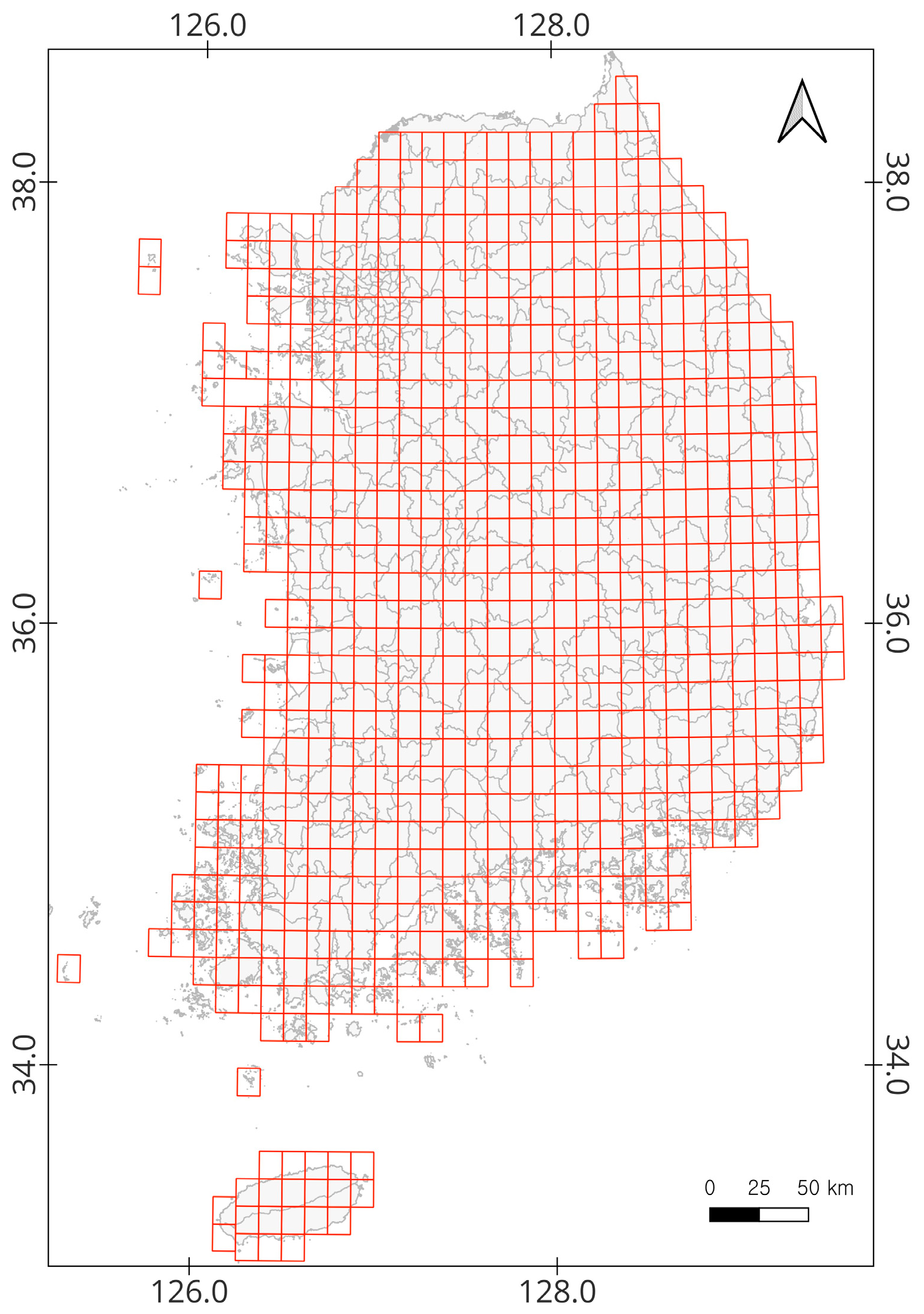
The NSNE employs 1:25,000-scale topographic map sheets as the basic spatial units, each covering approximately 12 km × 13 km (about 156 km2). A total of 780 map sheets, excluding urban areas, encompass the entire Korean Peninsula. The survey is conducted on a five-year cycle, ensuring uniform sampling intensity across all map sheets. Field investigations are performed three times a year (spring, summer, and autumn), with an equal number of survey days (6 days) allocated per sheet to maintain temporal and spatial consistency. For the present analysis, we extracted only the occurrence records of alien plant species and ecosystem-disturbing species designated by the Korean government.
In Korea, 4660 vascular plant species have been recorded, comprising 619 alien species, among which 17 are officially designated as invasive [17]. In the 5th NSNE, a total of 711,557 plant occurrence records across 780 map sheets (Figure 1) led to the identification of 3842 vascular plant species. These data were systematically organized and subjected to quantitative analysis to evaluate the national distribution patterns of both native and alien flora.
In this study, the term alien species refers to organisms that have been introduced—either intentionally or unintentionally or through natural dispersal—from foreign countries and have established themselves outside their original native range or habitat. In other words, alien species include those that originate from foreign regions as well as species that were once native to other parts of the same country but did not historically inhabit a particular ecosystem. These species have expanded beyond their natural distribution range and are capable of surviving, reproducing, and competing independently within new environments.
The term invasive species refers to organisms that have been legally designated and publicly announced by the Ministry of Environment of Korea, based on risk assessment results indicating that they pose significant threats to ecosystems or related environments. These species are recognized as requiring management due to their potential to disturb the ecological balance and are officially listed in the Official List of Invasive Species, following scientific evaluation and legal procedures. Among the 17 species currently designated as invasive, one is native to Korea, while the remaining 16 are classified as alien species. This designation system plays a crucial role in maintaining biodiversity and ensuring the stability of Korea’s natural ecosystems. Supplementary Tables S1 and S2 provide detailed summaries of alien and invasive plant species recorded in the 5th NSNE, organized by land-cover types.

2.2. Floristic Survey Protocol of the NSNE

Within each map sheet, surveys encompassed a wide range of habitat types, including rivers, wetlands, forests, grasslands, farmlands, and coastal areas. The line transect survey method was adopted as the primary sampling protocol, with survey points determined through random sampling by investigators. Survey points were recorded at locations where changes in ecosystem types were observed along the preliminary survey route. During fieldwork, all vascular plant species encountered along the transects were identified and recorded. The survey is conducted in spring, summer, and autumn—periods when plant diversity is most apparent. The average length of the survey route was 21 km. The survey method involves collecting specimens in the field, completing on-site survey forms, and obtaining photographic data to compile supporting evidence.
The survey targets all vascular plants native to Korea. Prior to fieldwork, survey routes are predetermined based on literature reviews and topographic/geographic features. Field investigations are conducted at least three times annually (spring, summer, and autumn), focusing on representative sites such as key mountains, riparian zones, and agricultural areas. Species checklists are compiled using voucher specimens and photographic records. For key taxa (e.g., endangered species), additional ecological information such as precise location, habitat characteristics, and population data are also recorded.
For each species, detailed information was documented, including scientific and vernacular names, geographic coordinates, elevation, survey date, and survey point. Taxonomic identification followed the National List of Species of Korea [18] and the official list of ecosystem-disturbing species designated by the Ministry of Environment.
To evaluate the influence of environmental drivers, we incorporated land-cover data published by the Ministry of Environment in 2013, enabling statistical analyses of relationships between land-cover types and the occurrence of alien and invasive plants.

2.3. Multiple Linear and Spatial Regression Models

To evaluate spatial autocorrelation in the distribution patterns of alien and invasive plant species, we first calculated two global spatial statistics: Moran’s I and Geary’s C. Moran’s I measures overall similarity among neighboring units, with positive values indicating clustering of similar values and negative values indicating spatial dispersion. In addition to Moran’s I, we calculated Geary’s C to capture local spatial autocorrelation. Geary’s C is defined as
C = n 1 i j w i j y i y j 2 2 W i y i y ¯ 2
where n is the number of observations, w i j are the elements of the spatial weights matrix W, and y i and y j are the values of the dependent variable. Values of Geary’s C close to 1 indicate spatial randomness; values less than 1 indicate positive local spatial autocorrelation; and values greater than 1 indicate negative local spatial autocorrelation.
To examine the spatial relationship between alien and invasive species distributions and environmental variables, three regression models were applied: the Ordinary Least Squares (OLS) model, the Spatial Lag Model (SLM), and the Spatial Error Model (SEM). These models were used sequentially to identify the presence of spatial dependence and to account for spatial autocorrelation in the data.
The Multiple Linear Regression (MLR) model was first employed as a baseline to estimate the relationships between the proportion of alien or invasive species and multiple explanatory environmental variables (e.g., land-cover types). The MLR assumes that all observations are independent and that residuals are normally distributed with constant variance and no multicollinearity among predictors. It is expressed as
yi = β0 + β1x1i + β2x2i + β3x3i + … + βkxki + εi
where yi represents the proportion of alien or invasive species in region i, x1i, x2i, …, xki are the explanatory environmental variables (e.g., forest area, wetland ratio, agricultural land), β0 is the intercept, β1βk are the regression coefficients, and εi is the random error term. The model provides a foundational understanding of how multiple environmental factors collectively influence the distribution of alien and invasive species under the assumption of spatial independence.
To account for potential spatial dependence among neighboring observations, the Spatial Lag Model incorporates a spatially lagged dependent variable. This model assumes that the value of the dependent variable in one region is influenced by values in nearby regions. The SLM is expressed as
y = ρWy + Xβ + ε
where W is the spatial weight matrix defining neighborhood relationships and ρ is the spatial autoregressive coefficient representing the strength of spatial dependence. A significant ρ value indicates that the dependent variable exhibits spatial autocorrelation, meaning that regions with high (or low) species ratios tend to be surrounded by regions with similar values. The SLM is suitable when spatial interaction directly influences the observed outcome, such as species dispersal between adjacent habitats.
The Spatial Error Model was applied to account for spatial dependence in the residuals that cannot be explained by the independent variables. This model assumes that the spatial autocorrelation arises from unobserved or omitted spatial processes. The SEM is defined as
y = Xβ + ε, ε = λWε + ξ
where λ is the spatial error coefficient capturing the degree of spatial correlation in the residuals and ξ represents the random error term. A significant λ value suggests that unmodeled spatial processes influence the dependent variable, justifying the use of a spatial error correction.
The SEM is particularly effective when spatial dependence is driven by environmental similarity or shared unobserved regional characteristics rather than direct spatial interaction.
All models were estimated using maximum likelihood estimation (MLE). Model performance was compared using coefficient of determination (R2), Akaike Information Criterion (AIC), Bayesian Information Criterion (BIC), and Log-Likelihood values. The presence of spatial autocorrelation was evaluated using Moran’s I, Geary’s C, and Lagrange Multiplier (LM) tests to determine whether the Spatial Lag or Spatial Error model provided a better fit than the OLS model.
All statistical analyses were performed using Python version 3.12.10 (Python Software Foundation, Wilmington, DE, USA). Spatial autocorrelation analysis, multiple regression analysis, and the estimation of spatial lag and spatial error models were conducted using the pandas, numpy, scipy.stats, and statsmodels packages. Moran’s I and Geary’s C were calculated using custom implementations that utilized NumPy for numerical computations, while spatial distance matrices and weighting schemes were derived using functions from scipy.stats and scipy.spatial. Spatial data processing and cartographic visualization were carried out using QGIS 3.44 (QGIS Development Team, Zürich, Switzerland).

3. Results

3.1. Status of Alien and Invasive Plant Species Recorded in the NSNE

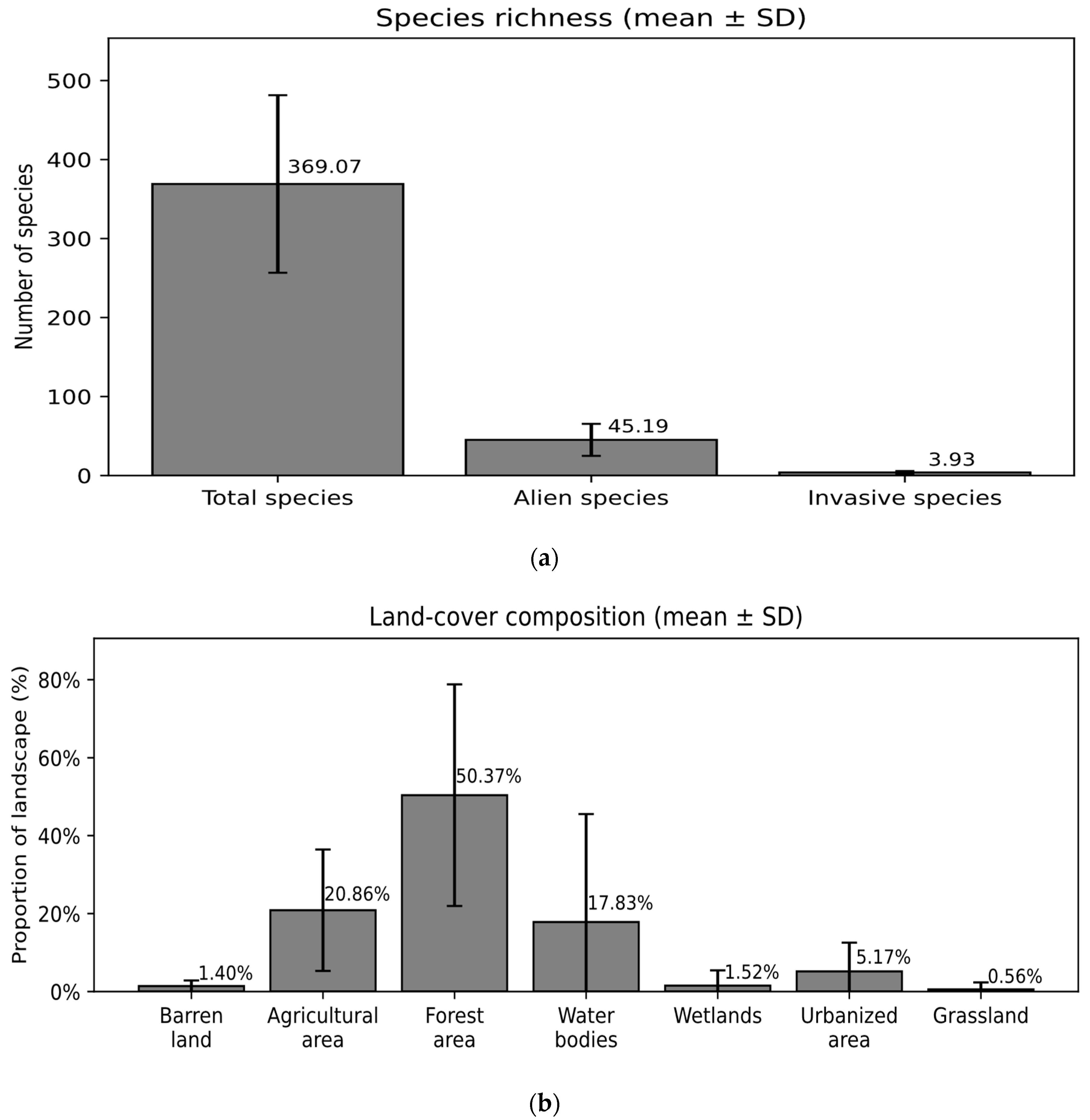
Figure 2a of the provided paper shows the average number of total species, alien species, and invasive species per map sheet. The data reveals that the average number of total species per map sheet is about 369.07, with alien species averaging 45.19 and invasive species averaging 3.93. In total, 404 alien plant species and 15 invasive species were recorded. Among the alien species, the most frequently occurring were Erigeron annuus, Robinia pseudoacacia, and Conyza canadensis, while the most common invasive species included Humulus japonicus, Ambrosia artemisiifolia, and Aster pilosus.
Figure 2b illustrates the proportional composition of ecosystem types across the surveyed areas. Forests represented the largest area at 50.37%, accounting for more than half of the surveyed landscape. Agricultural lands comprised 20.86%, underscoring the significant extent of cultivated areas, while water bodies accounted for 17.83%. In contrast, urbanized drylands (5.17%), wetlands (1.52%), bare lands (1.40%), and grasslands (0.56%) occupied relatively small proportions of the total surveyed area. Collectively, forests and agricultural lands made up more than 70% of the landscape, followed by aquatic ecosystems, whereas wetlands, bare lands, and grasslands were highly restricted in spatial distribution.
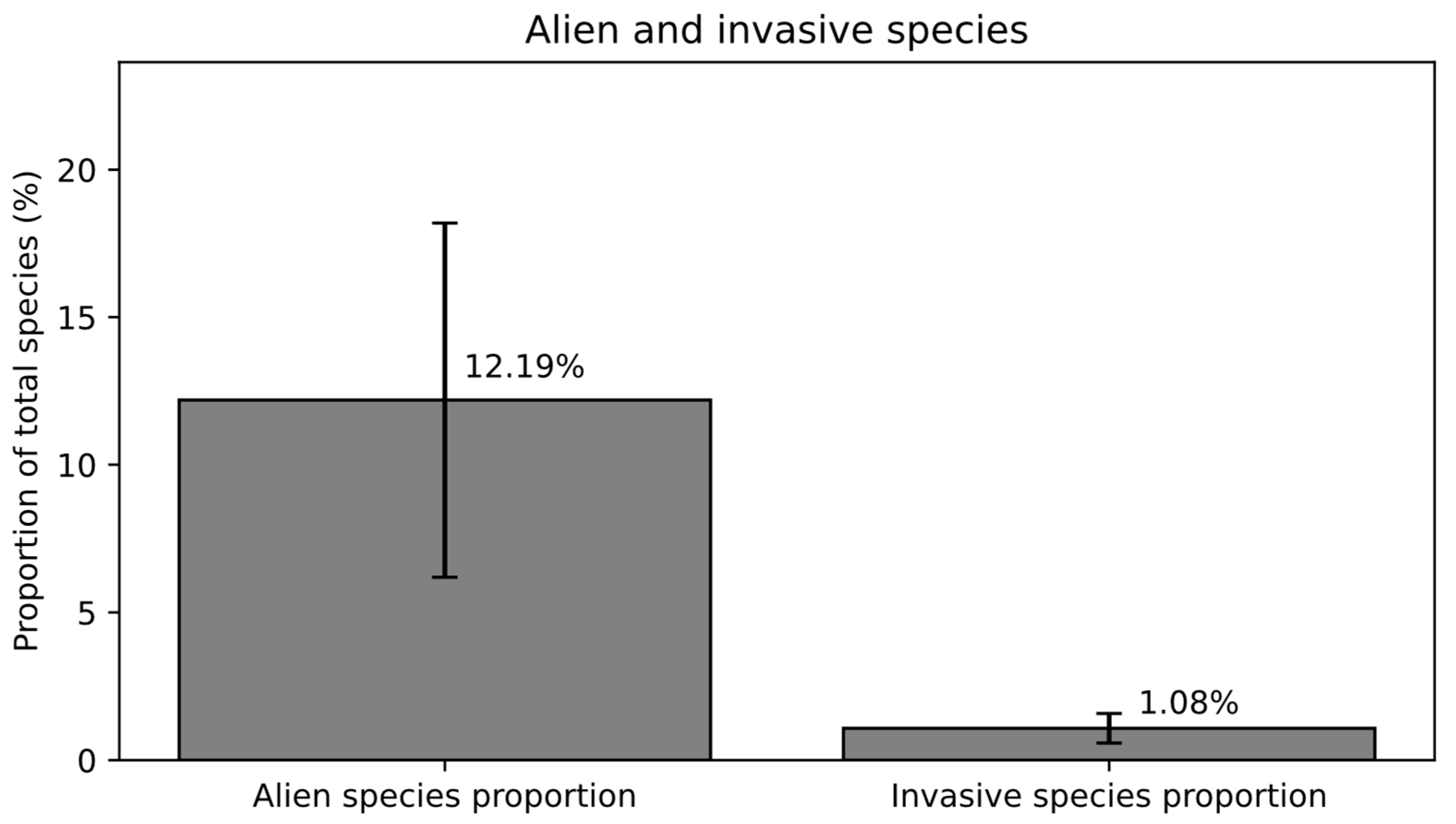
Figure 3 compares the mean proportions of alien and invasive species relative to total plant richness per map sheet. Alien species accounted for an average of 12.19% of the total flora, representing a substantial component of the surveyed plant community. By contrast, invasive species accounted for only 1.08%, a proportion markedly lower than that of alien species. These results collectively suggest that alien plants are already broadly established and widely dispersed across Korea’s flora.

3.2. Spatial Autocorrelation Analysis

Spatial autocorrelation analysis revealed differences in the spatial patterns of alien and invasive alien species (Table 1). For alien species, Moran’s I was found to be 0.0777, indicating a weak positive spatial autocorrelation. The Z-score = 32.5603 further confirms that this result is highly statistically significant (p < 0.001), suggesting that areas with higher alien species proportions tend to cluster spatially, although the correlation remains relatively weak. Geary’s C for alien species was 0.9301, which is slightly below 1, indicating weak but positive local spatial autocorrelation and suggesting that neighboring units share broadly similar alien species proportions.
For invasive alien species, Moran’s I was 0.1933, indicating a moderate positive spatial autocorrelation. The Z-score = 26.0452 also shows that this result is highly statistically significant (p < 0.001). This indicates that, compared to alien species, invasive alien species exhibit a stronger spatial clustering pattern, where areas with higher proportions of invasive species are more likely to occur in close proximity. The Geary’s C value for invasive species was 0.5170, substantially lower than that of alien species, indicating much stronger local spatial autocorrelation. This suggests that invasive species form distinct spatial clusters in which neighboring regions show highly similar invasion levels.
Based on the spatial autocorrelation analysis results, it was determined that the data exhibited spatial patterns, especially for invasive alien species, which suggested that spatial regression models (Spatial Lag Models (SLMs) and Spatial Error Models (SEMs)) might be appropriate to capture the spatial dependencies.

3.3. Model Comparison and Habitat Determinants of Alien Species Distribution

In this study, Ordinary Least Squares (OLS), Spatial Lag, and Spatial Error models were compared to analyze the spatial relationship between the proportion of alien species and ecosystem types while considering spatial autocorrelation (Table 2). The analysis revealed that the OLS model had the highest coefficient of determination (R2); however, when spatial autocorrelation was taken into account, the Spatial Error model demonstrated the lowest AIC and BIC values and the highest Log-Likelihood, indicating the best overall model fit. Furthermore, the spatial dependence parameter (λ = 0.7405) confirmed the presence of spatial autocorrelation in the distribution of alien species. Therefore, when spatial dependence is considered, the Spatial Error model provides a more reliable and accurate explanation of the spatial relationship between alien species distribution and ecosystem types than the OLS model.
The analysis showed that in the OLS model, agricultural areas (β = 0.0566, p = 0.0012) and wetlands (β = 0.0846, p = 0.0287) had a significant positive relationship with the proportion of alien species, indicating that regions with higher proportions of agricultural land and wetlands tended to have higher alien species ratios (Table 3).
In contrast, the Spatial Error Model revealed that forests (β = −0.0821, p < 0.001) and grasslands (β = −0.1422, p = 0.0160) had a significant negative relationship with the proportion of alien species, showing that areas with greater forest and grassland coverage exhibited lower alien species ratios. The spatial dependence parameter (λ = 0.7405) confirmed the presence of spatial autocorrelation in alien species distribution. Overall, these results indicate that the proportion of alien species was higher in agricultural and wetland areas, but lower in forest and grassland ecosystems, demonstrating spatial variation in alien species distribution according to ecosystem type.

3.4. Model Comparison and Habitat Determinants of Invasive Species Distribution

The model comparison results showed that both spatial regression models (Spatial Lag and Spatial Error) improved the model performance compared to the OLS model. The coefficient of determination (R2) was highest in the Spatial Lag model (0.1435), indicating slightly better explanatory power than the OLS model (0.1347). However, when considering overall model fit, the Spatial Error model exhibited the lowest AIC (−4886.16) and BIC (−4846.32) values, along with the highest Log-Likelihood (2452.08), demonstrating the best overall performance among the three models (Table 4).
In addition, the spatial dependence parameter (λ) was 0.6428 in the Spatial Error model, indicating the presence of spatial autocorrelation in the distribution of alien species. Considering that Moran’s I value (0.1933) represents a moderate positive spatial autocorrelation, the Spatial Error model was determined to most appropriately account for the spatial dependency structure of the data and thus best explain the spatial characteristics of alien species distribution.
Table 5 shows that bare lands had a statistically significant positive relationship with the proportion of invasive species across all three models. The coefficients were positive and significant in the OLS (β = 0.0592, p = 0.0016), Spatial Lag (β = 0.0564, p < 0.001), and Spatial Error (β = 0.0544, p = 0.0016) models. These consistent results indicate that invasive species are more likely to occur and spread in open areas with minimal vegetation cover, where environmental disturbances are frequent.
In contrast, forest areas consistently exhibited a significant negative relationship with the proportion of invasive species across all models. The coefficients were negative in the OLS (β = −0.0141, p = 0.0003), Spatial Lag (β = −0.0071, p = 0.0137), and Spatial Error (β = −0.0074, p = 0.0384) models. These results indicate that invasive species are less likely to occur in forested environments, suggesting that forest ecosystems possess relatively high resistance to invasion.
For water bodies and wetlands, the OLS model showed negative coefficients (water bodies: β = −0.0137, p = 0.0006; wetlands: β = −0.0107, p = 0.1253), and similar weak negative effects were found in the Spatial Lag model (water bodies: β = −0.0064, p = 0.0291; wetlands: β = −0.0107, p = 0.0155). However, in the Spatial Error model, both variables were statistically insignificant (water bodies: β = −0.0045, p = 0.2172; wetlands: β = −0.0081, p = 0.2446). This suggests that the influence of these habitat types may be partially explained by spatial interactions rather than direct ecological factors.
Finally, agricultural areas, grasslands, and urbanized drylands were not statistically significant in any of the models. For instance, agricultural areas were insignificant in OLS (β = −0.0073, p = 0.0702), Spatial Lag (β = −0.0021, p = 0.4579), and Spatial Error (β = 0.0071, p = 0.7712), while grasslands and urbanized drylands also showed p-values greater than 0.4.
Overall, these results indicate that disturbed species are more prevalent in open and frequently disturbed environments such as bare lands, while they tend to be less distributed in stable ecosystems like forests.

3.5. Analysis by Habitat Type

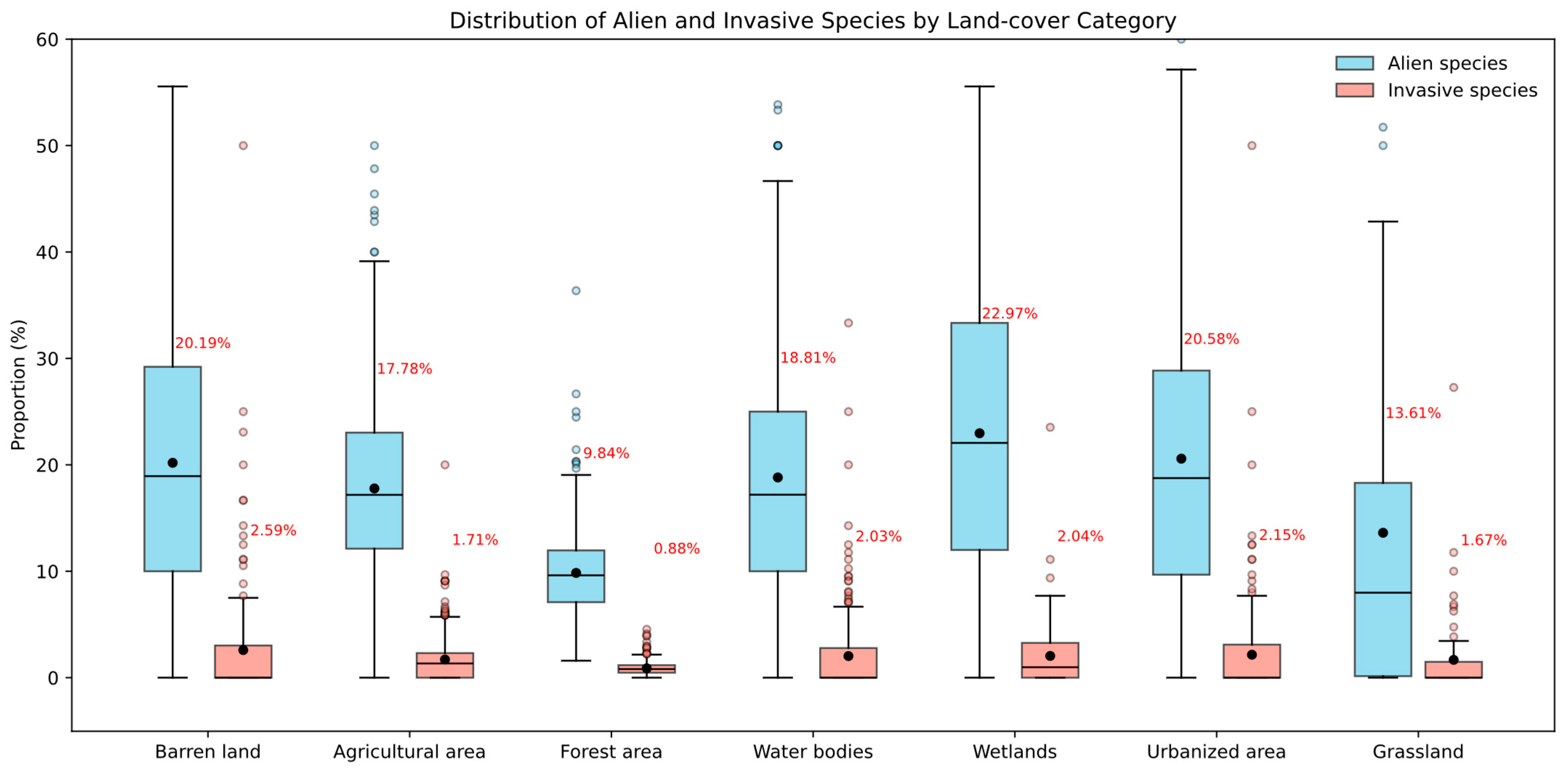
Figure 4 illustrates the proportions of alien and invasive species relative to total observed flora across different land-cover types. For each map sheet, the total number of observed species, alien species, and invasive species was calculated and converted into proportions, followed by averaging across sheets.
Alien species proportions were highest in wetlands (22.97%), urbanized drylands (20.58%), and bare lands (20.19%), while forests exhibited the lowest proportion (9.84%). This pattern highlights that human-impacted environments are particularly conducive to alien species establishment.
Invasive species proportions were highest in bare lands (2.58%), urbanized drylands (2.15%), and water bodies (2.08%), whereas forests (0.86%) and grasslands (0.67%) showed the lowest values. These results suggest that forests function as buffer habitats suppressing alien and invasive species spread, while disturbed environments substantially increase opportunities for invasion.

4. Discussion

This study analyzed the distribution patterns of alien and invasive species and the land-cover factors influencing them using data from the 5th National Survey of Natural Environment (NSNE). The results demonstrated that agricultural lands, forests, and wetlands were critical determinants shaping species distribution, indicating that plant invasions and disturbances become more pronounced under specific ecological conditions.

4.1. Spatial Structure and Regional Connectivity of Alien and Invasive Species

Both alien and invasive species showed clear habitat-dependent patterns, reflecting the strong influence of human disturbance and ecosystem stability on species establishment. Alien species were more prevalent in agricultural areas and wetlands, where frequent soil disturbance, nutrient enrichment, and hydrological accumulation create favorable conditions for colonization and growth [19,20]. In contrast, both alien and invasive species were less abundant in forests and grasslands, where dense canopy cover, stable microclimatic conditions, and low disturbance levels act as ecological filters, limiting invasion success [21,22]. The relatively weak local clustering of alien species, as indicated by their Geary’s C value close to 1, further supports the interpretation that alien species are more broadly distributed across heterogeneous landscapes rather than forming tightly localized invasion hotspots.
For invasive species, bare lands exhibited the highest invasion potential, consistently showing positive associations across all spatial models. These open and frequently disturbed environments promote rapid establishment and spread by reducing competition and increasing resource availability [23,24]. Conversely, forests displayed consistent negative relationships with invasive species abundance, underscoring their structural complexity and ecological resistance. This finding supports previous studies emphasizing that mature forest ecosystems act as biological barriers or “invasion filters” that limit propagule establishment and spread [25,26]. Furthermore, the markedly low Geary’s C value for invasive species demonstrates strong local spatial clustering, indicating that invasion processes are concentrated in specific high-risk areas where environmental or anthropogenic conditions facilitate rapid spread.
Overall, these results confirm that invasion risk is closely tied to habitat openness and anthropogenic disturbance, while stable and structurally complex forest ecosystems maintain high resilience against biological invasions. Similar patterns have been observed globally, where human-modified landscapes and frequently disturbed ecosystems serve as primary entry points for alien species expansion [27,28,29], emphasizing the importance of conserving intact habitats as a key strategy for invasion prevention and biodiversity protection.

4.2. Disturbance–Species Correlations and Theoretical Implications

These results are closely aligned with the Driver mechanism [30]. The Driver mechanism explains the process by which alien species, once established in a habitat, occupy resources such as light, space, and nutrients, thereby exerting strong competitive pressure on native plant communities. In this study, the clear positive correlations observed between alien/invasive species and the proportion of disturbed areas indicate not merely a by-product of disturbance, but rather demonstrate that these species function as primary drivers that reshape ecosystem structures after establishment.
The steep response slopes of invasive species in particular are consistent with previous reports. For example, Sicyos angulatus has been reported to dominate riparian vegetation by exhibiting rapid density changes depending on soil properties and flow conditions [31], while Paspalum distichum var. indutum forms dense mats in response to water-level fluctuations, thereby displacing native aquatic plants [15]. These findings highlight that invasive species are not simply the “outcomes” of disturbance but also the “causes” of ecological change.
In this context, future management strategies should be differentiated according to habitat characteristics. Forests require reinforcement of core conservation areas and connectivity, along with the establishment of edge buffers and maintenance of understory vegetation to sustain their defensive function. Wetlands should focus on stabilizing hydrology, creating buffer wetlands, and implementing early removal measures after flooding to suppress spread. High-risk areas such as bare land and roadsides demand targeted interventions, including equipment and soil quarantine, restoration planting, and disruption of linear dispersal pathways, to reduce propagule pressure.
In summary, this study empirically demonstrated a cyclical process of increasing disturbance, the spread of alien and invasive species, and the intensification of ecological pressures. These findings provide important evidence supporting both the Interactive model and the Driver mechanism, underscoring that invasive species are not merely the products of disturbance but also causal agents of ecosystem change. In other words, invasive species act as active drivers of ecological dynamics, and future management strategies must be developed on the premise of their bidirectional roles.

5. Conclusions

This study analyzed the spatial distribution of alien and invasive plant species in relation to land-cover types using data from the 5th National Survey of Natural Environment (NSNE). The results showed that species invasions are not random but spatially structured, reflecting strong associations with habitat type and disturbance intensity.
Alien species were more prevalent in agricultural areas and wetlands, where soil disturbance and nutrient accumulation promote establishment, while forests acted as resistant habitats limiting their spread. Invasive species, in contrast, were concentrated in bare lands and urbanized drylands, where open and frequently disturbed conditions favor colonization. Forests consistently showed negative relationships with invasion, reaffirming their function as ecological barriers.
Spatial autocorrelation analyses (Moran’s I = 0.0777 for alien species, 0.1933 for invasive species) confirmed positive clustering, and the superior fit of the Spatial Error Model (λ = 0.7405; 0.6428) highlighted the importance of spatial dependency in invasion processes. These results support the Driver mechanism, indicating that alien and invasive species are both products and catalysts of ecological disturbance.
Effective management should therefore prioritize habitat-specific and spatially coordinated strategies, strengthening forest conservation as ecological buffers while implementing early detection and rapid response measures in high-risk areas such as agricultural lands, wetlands, and bare soils. Addressing the disturbance–invasion feedback through integrated spatial planning will be essential to sustaining biodiversity and ecosystem stability.

Supplementary Materials

The following supporting information can be downloaded at: https://www.mdpi.com/article/10.3390/d17120850/s1, Table S1: Alien Species by Land Cover, Table S2: Invasive Species by Land Cover.

Author Contributions

Conceptualization, T.Y. and J.L.; methodology, T.Y. and T.G.K.; validation, T.Y. and J.L.; formal analysis, J.L.; investigation, T.Y. and S.S.C.; resources, T.Y. and J.L.; writing—original draft preparation, T.Y. and S.S.C.; writing—review and editing, J.L.; visualization, T.Y.; supervision, J.L.; project administration, J.L.; references, S.P. All authors have read and agreed to the published version of the manuscript.

Funding

This research was funded by the National Institute of Ecology (NIE), grant number NIE-A-2025-01. The APC was also funded by the same institute.

Institutional Review Board Statement

Not applicable.

Informed Consent Statement

Not applicable.

Data Availability Statement

The data used in this study were obtained from the 5th National Survey of Natural Environment (NSNE), conducted under the supervision of the Ministry of Environment of Korea and managed by the National Institute of Ecology (NIE). These data are not publicly available due to governmental data-sharing restrictions, but they can be accessed upon reasonable request from the Ministry of Environment or the National Institute of Ecology.

Conflicts of Interest

The authors declare no conflicts of interest.

Abbreviations

SEMSpatial Error Model
SLMSpatial Lag Model
OLSOrdinary Least Square
AICAkaike Information Criterion
BICBayesian Information Criterion
MLEMaximum Likelihood Estimation
NSNENational Survey of Natural Environment
NIENational Institute of Ecology
R2Coefficient of Determination

References

  1. White, P.S.; Jentsch, A. The search for generality in studies of disturbance and ecosystem dynamics. Prog. Bot. 2001, 62, 399–450. [Google Scholar]
  2. Hulme, P.E. Trade, transport and trouble: Managing invasive species pathways in an era of globalization. J. Appl. Ecol. 2009, 46, 10–18. [Google Scholar] [CrossRef]
  3. Pearson, D.E.; Ortega, Y.K.; Eren, Ö.; Villarreal, D.; Lekberg, Y.; Hierro, J. Exotic success following disturbance explained by weak native resilience and ruderal exotic bias. J. Ecol. 2023, 111, 2412–2423. [Google Scholar] [CrossRef]
  4. Waddell, E.H.; Banin, L.F.; Fleiss, S.; Hill, J.K.; Hughes, M.; Jelling, A.; Yeong, K.L.; Ola, B.B.; Sailim, A.B.; Tangah, J.; et al. Land use change and propagule pressure promote plant invasions in tropical rainforest remnants. Landsc. Ecol. 2020, 35, 1891–1906. [Google Scholar] [CrossRef]
  5. Balogh, M.B.; Tobak, Z.; Kaim, D.; Szilassi, P. Historical and recent land use/land cover changes as a driving force of biological invasion: A Hungarian case study. Biol. Invasions 2025, 27, 1–17. [Google Scholar] [CrossRef]
  6. Buckley, Y.M.; Bolker, B.M.; Rees, M. Disturbance, invasion and re invasion: Managing the weed shaped hole in disturbed ecosystems. Ecol. Lett. 2007, 10, 809–817. [Google Scholar] [CrossRef] [PubMed]
  7. Catford, J.A.; Jansson, R.; Nilsson, C. Reducing redundancy in invasion ecology by integrating hypotheses into a single theoretical framework. Divers. Distrib. 2009, 15, 22–40. [Google Scholar] [CrossRef]
  8. Selwood, K.E.; Zimmer, H.C. Refuges for biodiversity conservation: A review of the evidence. Biol. Conserv. 2020, 245, 108502. [Google Scholar] [CrossRef]
  9. Reside, A.E.; Briscoe, N.J.; Dickman, C.R.; Greenville, A.C.; Hradsky, B.A.; Kark, S.; Kearney, M.R.; Kutt, A.S.; Nimmo, D.G.; Pavey, C.R.; et al. Persistence through tough times: Fixed and shifting refuges in threatened species conservation. Biodivers. Conserv. 2019, 28, 1303–1330. [Google Scholar] [CrossRef]
  10. Lee, K.; Klinger, R.C.; Brooks, M.L. Homogenization of soil seed bank communities by fire and invasive species in the Mojave Desert. Front. Ecol. Evol. 2024, 12, 1271824. [Google Scholar] [CrossRef]
  11. Liu, X.; Zhang, Y.; Wang, H.; Chen, X. The influence of seed functional traits and anthropogenic disturbances on persistence of soil seed banks. For. Ecol. Manag. 2023, 546, 120174. [Google Scholar]
  12. Dalle Fratte, M.; Bolpagni, R.; Brusa, G.; Caccianiga, M.; Pierce, S.; Zanzzoterra, M.; Cerabolini, B.E.L. Alien plant species invade by occupying similar functional spaces to native species. Flora 2019, 257, 151419. [Google Scholar] [CrossRef]
  13. Adhikari, P.; Lee, Y.-H.; Park, Y.-S.; Hong, S.-H. Assessment of the spatial invasion risk of intentionally introduced alien plant species (IIAPS) under environmental change in South Korea. Biology 2021, 10, 1169. [Google Scholar] [CrossRef]
  14. Lee, C.W.; Kim, D.; Cho, H.; Lee, H. The riparian vegetation disturbed by two invasive alien plants, Sicyos angulatus and Paspalum distichum var. indutum in South Korea. Ecol. Resilient Infrastruct. 2015, 2, 255–263. [Google Scholar] [CrossRef]
  15. Lee, I.Y.; Kim, S.H.; Hong, S.H. Occurrence characteristics and management of invasive weeds, Ambrosia artemisiifolia, Ambrosia trifida and Humulus japonicus. Weed Turfgrass Sci. 2021, 10, 227–242. [Google Scholar]
  16. Liu, Y.; Ren, Y.; Zhang, H.; Qiu, D.; Zhu, Y. Characteristics of invasive alien plants in different urban areas: The case of Kunshan City, Jiangsu Province, China. Front. Plant Sci. 2025, 16, 1539457. [Google Scholar] [CrossRef] [PubMed]
  17. Kang, E.S.; Lee, S.-R.; Oh, S.H.; Kim, D.-K.; Jung, S.-Y.; Son, D.C. Comprehensive review about alien plants in Korea. Korean J. Plant Taxon. 2020, 50, 89–119. [Google Scholar] [CrossRef]
  18. National Institute of Biological Resources (NIBR). National List of Korea. National Institute of Biological Resources. Incheon, Korea. Available online: http://kbr.go.kr/ (accessed on 30 June 2025).
  19. Hobbs, R.J.; Huenneke, L.F. Disturbance, diversity, and invasion: Implications for conservation. Conserv. Biol. 1992, 6, 324–337. [Google Scholar] [CrossRef]
  20. Chytrý, M.; Jarošík, V.; Pyšek, P.; Hájek, O.; Knollová, I.; Tichý, L.; Danihelka, J. Separating habitat invasibility by alien plants from the actual level of invasion. Ecology 2008, 89, 1541–1553. [Google Scholar] [CrossRef]
  21. Martin, P.H.; Canham, C.D.; Marks, P.L. Why forests appear resistant to exotic plant invasions: Intentional introductions, stand dynamics, and disturbance regimes. Ecol. Lett. 2009, 12, 400–411. [Google Scholar]
  22. Woo, J.-H.; Lee, M.-K.; Lee, H.-I.; Lee, C.-B. Joint influence of forest strata attributes and abiotic factors on herbaceous plant abundance in South Korean forest restoration sites: Native versus alien species. Forests 2024, 15, 1924. [Google Scholar] [CrossRef]
  23. Lockwood, J.L.; Hoopes, M.F.; Marchetti, M.P. Invasion Ecology, 2nd ed.; Wiley-Blackwell: Hoboken, NJ, USA, 2013. [Google Scholar]
  24. Elton, C.S. The Ecology of Invasions by Animals and Plants; Methuen: London, UK, 1958. [Google Scholar]
  25. Richardson, D.M.; Pyšek, P. Plant invasions: Merging the concepts of species invasiveness and community invasibility. Ecology 2006, 87, 1617–1625. [Google Scholar] [CrossRef]
  26. Rejmánek, M.; Richardson, D.M.; Pyšek, P. Plant invasions and invasibility of plant communities. In Vegetation Ecology, 2nd ed.; van der Maarel, E., Franklin, J., Eds.; Wiley-Blackwell: Hoboken, NJ, USA, 2013; pp. 387–424. [Google Scholar]
  27. Vilà, M.; Espinar, J.L.; Hejda, M.; Hulme, P.E.; Jarošík, V.; Maron, J.L.; Pergl, J.; Schaffner, U.; Sun, Y.; Pyšek, P. Ecological impacts of invasive alien plants: A meta-analysis of their effects on species, communities, and ecosystems. Ecol. Lett. 2011, 14, 702–708. [Google Scholar] [CrossRef] [PubMed]
  28. Pyšek, P.; Hulme, P.E.; Simberloff, D.; Bacher, S.; Blackburn, T.M.; Carlton, J.T.; Dawson, W.; Essl, F.; Foxcroft, L.C.; Genovesi, P.; et al. Scientists’ warning on invasive alien species. Biol. Rev. 2020, 95, 1511–1534. [Google Scholar] [CrossRef]
  29. Aryal, P.C.; Aryal, C.; Bhusal, K.; Chapagain, D.; Dhamala, M.K.; Maharjan, S.R.; Chhetri, P.K. Forest structure and anthropogenic disturbances regulate plant invasion in urban forests. Urban Ecosyst. 2022, 25, 367–377. [Google Scholar] [CrossRef]
  30. Thompson, B.K.; Olden, J.D.; Converse, S.J. Mechanistic invasive species management models and their application in conservation. Conserv. Sci. Pract. 2021, 3, e533. [Google Scholar] [CrossRef]
  31. Lee, Y.; Kim, H.; Kim, L. Analysis of the influence of environmental factors on the density of ecosystem disturbing plant Sicyos angulatus—Centering on Miho Stream. J. Wetl. Res. 2020, 22, 295–301. [Google Scholar]
Figure 1. Survey grid of the 5th National Survey of Natural Environment used in this study. Korea was divided into 780 1:25,000-scale topographic map sheets, which served as the basic sampling units for the national vascular plant survey analyzed in this study.
Diversity 17 00850 g001
Figure 2. Overall patterns of species richness and ecosystem composition across map sheets. (a) Mean number of total species, alien species, and invasive species per map sheet; (b) Mean proportion of ecosystem types per map sheet.
Diversity 17 00850 g002
Figure 3. Mean proportions of alien and invasive species relative to total plant richness per map sheet.
Diversity 17 00850 g003
Figure 4. Proportions of alien and invasive species relative to total observed flora across different land-cover types.
Diversity 17 00850 g004
Table 1. Global spatial autocorrelation statistics for the proportion of alien and invasive plant species per 1:25,000 map sheet. Moran’s I and Geary’s C were computed using a first-order queen contiguity spatial weights matrix, with Z-scores and p-values assessing departures from spatial randomness. Geary’s C < 1 indicates positive local spatial autocorrelation, while values > 1 indicate negative autocorrelation.
Weighting MethodAlien SpeciesInvasive Species
Moran’s I0.07770.1933
Expected I−0.0016−0.0016
Z-score32.560326.0452
p-value<0.0010
Geary’s C0.93010.5170
Table 2. Comparison of Model Performance among OLS, Spatial Lag, and Spatial Error Models for Alien species.
ModelR2Log-LikelihoodAICBICλ
OLS0.25881279.10−2542.19−2506.75-
Spatial Lag0.17871374.22−2730.45−2690.580.6562
Spatial Error0.23931393.41−2768.81−2728.940.7405
Table 3. Regression analysis of environmental factors affecting alien species distribution.
VariableOLSSpatial LagSpatial Error
βp-Valueβp-Valueβp-Value
Intercept0.1134<0.0010.05830.00360.1461<0.001
Bare lands−0.02010.85590.02580.7817−0.059170.5336
Agricultural areas0.05660.00120.01430.48210.00890.6679
Forests−0.04890.0027−0.04400.0255−0.0821<0.001
Water bodies−0.00650.7009−0.01770.3746−0.02470.2189
Wetlands0.08460.02870.01370.69670.06310.1028
Urbanized drylands−0.01590.5323−0.02150.3987−0.02470.3832
Grassland−0.09040.1652−0.11030.0496−0.14220.0160
Table 4. Comparison of model performance among OLS, Spatial Lag, and Spatial Error Models for Invasive species.
ModelR2Log-LikelihoodAICBICλ
OLS0.13472387.92−4759.35−4727.44-
Spatial Lag0.14352451.61−4885.22−4845.380.5984
Spatial Error0.10022452.08−4886.16−4846.320.6428
Table 5. Regression analysis of environmental factors affecting invasive species distribution.
VariableOLSSpatial LagSpatial Error
βp-Valueβp-Valueβp-Value
Intercept0.0207<0.0010.00880.00200.0140<0.001
Bare lands0.05920.00160.0564<0.0010.05440.0016
Agricultural areas−0.00730.0702−0.00210.45790.00100.7712
Forests−0.01410.0003−0.00710.0137−0.00740.0384
Water bodies−0.01370.0006−0.00640.0291−0.00450.2172
Wetlands−0.01070.1253−0.01070.0155−0.00810.2446
Urbanized drylands−0.00390.4353−0.00490.1569−0.00590.2413
Grassland−0.00870.4364−0.00410.5309−0.00380.7225
Disclaimer/Publisher’s Note: The statements, opinions and data contained in all publications are solely those of the individual author(s) and contributor(s) and not of MDPI and/or the editor(s). MDPI and/or the editor(s) disclaim responsibility for any injury to people or property resulting from any ideas, methods, instructions or products referred to in the content.