Article

Modeling Habitat Suitability for Endemic Anthemis pedunculata subsp. pedunculata and Anthemis pedunculata subsp. atlantica in Mediterranean Region Using MaxEnt and GIS-Based Analysis


by
Kaouther Mechergui
1,
Wahbi Jaouadi
1,2,*,
Carlos Henrique Souto Azevedo
3,
Khadeijah Yahya Faqeih
4,
Somayah Moshrif Alamri
4,
Eman Rafi Alamery
4,
Maha Abdullah Aldubehi
4 and
Philipe Guilherme Corcino Souza
5
1
Laboratory of Forest Ecology, National Research Institute of Rural Engineering, Water and Forests, University of Carthage, Hedi Karray Street, BP 10, Ariana 2080, Tunisia
2
Laboratory of Silvo-Pastoral Resources, The Silvo-Pastoral Institute of Tabarka, University of Jendouba, Tabarka 8100, Tunisia
3
Department of Forest Engineering, Universidade Federal dos Vales do Jequitinhonha e Mucuri (UFVJM), Diamantina 39100-000, MG, Brazil
4
Department of Geography and Environmental Sustainability, College of Humanities and Social Sciences, Princess Nourah Bint Abdulrahman University, P.O. Box 84428, Riyadh 11671, Saudi Arabia
5
Department of Agronomy, Instituto Federal de Ciência e Tecnologia do Triângulo Mineiro (IFTM Campus Uberlândia), Uberlândia 38400-970, MG, Brazil
*
Author to whom correspondence should be addressed.
Diversity 2025, 17(12), 851; https://doi.org/10.3390/d17120851
Submission received: 26 September 2025 / Revised: 6 December 2025 / Accepted: 7 December 2025 / Published: 11 December 2025
(This article belongs to the Section Plant Diversity)

Abstract

Climate change accelerates biodiversity loss, threatening ecosystems worldwide. Using predictive models, such as the maximum entropy model (Maxent), allows us to identify changes in species distribution and guide conservation strategies. This study aims to model the current and future distribution of Anthemis pedunculata subsp. Atlantica and Anthemis pedunculata subsp. pedunculata in Mediterranean regions through MaxEnt modeling with bioclimatic predictors. Using the MaxEnt algorithm, we combine bioclimatic variables and 49 occurrence locations of Anthemis pedunculata subsp. pedunculata and 13 occurrence locations of Anthemis pedunculata subsp. atlantica. The future distribution of the species is projected using MIROC6 model simulations under emission scenario SSP5-8.5 for 2030 and 2050. The current model predicted approximately 99,330,066 ha as a suitable habitat for Anthemis pedunculata subsp. pedunculata. Projections for the future range exhibited a gradual increase in the suitable area in 2030 by 144,365,562 ha and 2050 by 147,335,265 ha. The current model predicted approximately 201,179,880 ha as a suitable habitat for Anthemis pedunculata subsp. atlantica. Projections for the future range exhibited a gradual enhancement of the suitable area in 2030 by 213,898,608 ha and 2050 by 229,357,062. Our results provide further evidence of the negative impact of climate change on these endemic species and emphasize the importance of their conservation. This study provides information that could strengthen the protection of these species and identify potential protection areas.

1. Introduction

Ecological Niche-Based Models (ENMs) are widely applied tools that predict distributions of species under the assumption that the climate is a primary driver of their range limits [1,2,3,4,5,6,7]. These models combine georeferenced occurrence records with climate variables to infer potential habitats, both retrospectively and prospectively [8,9]. The Mediterranean region is recognized as one of the most climate-sensitive areas globally [10]. Observed changes in rainfall and temperature suggest that warming here is nearly double the global mean [11,12]. Projections further indicate that this area will face more pronounced climatic shifts compared to many other parts of the world [13,14]. The IPCC report [15] highlights that the Mediterranean region will confront major climate-related risks, especially from extreme heat, long-lasting droughts, and advancing desertification. Expected consequences include substantial ecological and socioeconomic damage, such as biodiversity loss, recurrent wildfires, and ecosystem degradation [16]. In addition, human pressures coupled with climate change are accelerating extinction processes in Mediterranean forests [17]. North Africa, in particular, is frequently described as a “climate change hotspot” [18], attracting growing interest from both natural and social sciences. The region is projected to experience intense warming and severe drought risks in the coming decades [19]. Climate change has been driving shifts in analyzing the distribution patterns of medicinal plants, which in turn may affect the quality of herbal remedies [20]. Beyond altering plant habitats, global warming also impacts the biochemical composition of medicinal species [4,21,22] and influences both their migration patterns and range dynamics [23,24]. Such transformations pose a significant threat to the sustainable management of these resources. To evaluate these impacts, researchers increasingly rely on species distribution models (SDMs), which integrate climatic variables into predictive frameworks [4,22,23,25,26,27]. Among the available tools, Maxent (v.3.4.4, Columbia University, New York, NY, USA) is particularly prominent. It estimates species’ potential ranges and habitat suitability [28], while also assessing links between distribution patterns and environmental drivers such as temperature, precipitation, slope, humidity, and soil properties [4,6,22,27,29,30]. Based on maximum entropy principles, Maxent has become one of the most reliable approaches for forecasting species distributions. With the growing importance of conservation biology and ecology, its application has expanded to diverse taxa, regions, and temporal scales [6,22,27]. Environmental conditions also play a decisive role in shaping the accumulation of secondary metabolites in medicinal species [4,22]. Studies confirm that suitable habitats strongly influence metabolite production and content [31,32]. Climate-driven habitat expansion or contraction has been documented for many medicinal species [33,34,35,36,37,38,39,40]. Given the rising demand for herbal medicines, natural health products, and bioactive compounds [38], it is critical to assess how climate variables and soil characteristics shape medicinal plant distributions [23,24,41]. Projections indicate that future climate dynamics will continue to reshape these habitats [42]. This intricate relationship between plants and their environment underpins the rationale for constructing SDMs. The Asteraceae plant family is the largest in terms of described species, comprising between 1600 and 1700 genera worldwide [43]. Within this family, the genus Anthemis, commonly known as “chamomile”, includes around 210 species, with its main center of diversity located in the Mediterranean basin [44]. Members of Anthemis (subfamily Anthemideae, Asteraceae) are widely distributed in North Africa, Western and Southwestern Asia, Central Asia, and Europe [45]. Traditionally, Anthemis species have been used as flavoring agents, herbal infusions, and remedies, while they also hold considerable importance in cosmetics and pharmaceuticals [46]. In folk medicine, they are employed for treating gastrointestinal complaints, menstrual disorders, hemorrhoids, and stomach pain. Numerous investigations report diverse biological activities and antioxidant properties in this genus [46,47,48,49,50,51]. In Morocco, Anthemis pedunculata Desf., locally called “Nouar eljenna”, has long been used as a herbal treatment for colds, asthma, and digestive problems, with benefits attributed mainly to its phenolic profile [52]. It produces ascending or erect, branched, and pubescent stems. The persistent leaves are pinnate, hairy, and divided into narrow mucronate lobes. The capitula, borne on long peduncles, are heterogamous and may be radiate or discoid, with a hemispherical receptacle. The solitary inflorescences end in yellow central flowers surrounded by white ligules, which curve backward after blooming. Flowering occurs between May and June, followed by the production of achenes [53]. It is distributed in Algeria, Morocco, and Spain, typically in mountain grasslands, pastures, forest edges, and lawns [53]. Phytochemical studies highlight that A. pedunculata is particularly rich in flavonoids and polyphenols [54]. The anti-inflammatory activity of its flowers supports traditional uses of this plant as a natural alternative to synthetic drugs [54]. Ethnobotanical reports also describe the use of its aerial parts for colic and diabetes [55]. Anthemis pedunculata is used in traditional medicine, and its biological activities are widely recognized by local populations. This species is of significance in the food, cosmetics, and pharmaceutical industries and contributes to the creation of employment opportunities for local communities [56]. This endemic species is of great interest to local populations for its essential oil [57], and Laouer et al. [58] also highlighted the economic importance of Anthemis pedunculata due to its essential oil production. Despite its traditional importance, available scientific data on this taxon remain scarce, partly due to its rarity. Two subsp are currently recognized: Anthemis pedunculata subsp. atlantica (Pomel) Oberprieler, which is endemic to Algeria and Tunisia [59,60], and Anthemis pedunculata subsp. pedunculata, native to Spain [61], Morocco, and Algeria [62]. The studied subsp are rare endemics and are not currently listed in the IUCN Red List of Threatened Species. Despite this, as endemic taxa, they represent a unique component of the regional biodiversity and are considered part of the biological heritage. Conserving these subsp is essential, as their loss would result in an irreversible decline of local genetic diversity and ecosystem integrity. Therefore, targeted conservation measures and monitoring are recommended to ensure their long-term survival.
The aims of this study were (1) to describe the current ecological niches of Anthemis pedunculata subsp. atlantica and Anthemis pedunculata subsp. pedunculata and (2) to determine the effects of climatic variables on their current and future distribution according to two global warming scenarios.

2. Materials and Methods

2.1. Occurrence Points for the Distribution of Species

The relevant literature was collected from multiple scientific databases, including PubMed, Web of Science, Elsevier, ACS Publications, and Springer, as well as additional sources such as books and postgraduate theses (Ph.D. and MSc). The search strategy employed the keywords “Anthemis pedunculata” combined with terms like “genetic structure,” “botanical description,” “phytochemical compounds,” “traditional uses,” and “pharmacological activities,” with a geographic focus on Morocco. The same approach was extended to other Mediterranean countries, namely, Algeria, Tunisia, and Spain. Occurrence points were sourced from scientific publications that provide specific occurrence points within the species range. Additional information was sourced from the Global Biodiversity Information Facility (GBIF, https://www.gbif.org/, accessed on 25 March 2025) and the iNaturalist database (www.inaturalist.org). Distribution maps were obtained from the African Plant Database (https://africanplantdatabase.ch/) and cross-checked with GBIF and the Maghreb Eflora project (https://efloramaghreb.org/, accessed on 25 March 2025). Species data were also collected from Euro+Med PlantBase (https://europlusmed.org/, accessed on 25 March 2025). Scientific names and synonyms were verified using Kew’s Plants of the World Online (www.plantsoftheworldonline.org; https://powo.science.kew.org/), Euro+Med, World Flora Online (www.worldfloraonline.org), and The Plant List (http://www.theplantlist.org). A total of 62 points were collected: 13 points for the distribution of A. pedunculata subsp. atlantica and 49 records of A. pedunculata subsp. pedunculata. All records were carefully curated to remove duplicates; correct misidentifications; and address spatial, temporal, or other inconsistencies. To reduce spatial autocorrelation, occurrences were thinned by employing spatial filtering using spThin, an R package R 4.3.3 [63]. Spatial filtering allowed us to retain only one occurrence point in individual cells according to the spatial resolution of the climate data [64,65].
After the filtering and removal of spatially autocorrelated points, 11 remaining points of subsp. atlantica and 48 points of subsp. pedunculata were used to build the final model.
Although the number of recorded occurrences was limited, previous studies have demonstrated that MaxEnt performs robustly even with small datasets (5–25 records), ensuring spatial independence and taxonomic accuracy [66,67,68]. To minimize the spatial autocorrelation, we applied the spThin package in R to retain only independent records. Furthermore, the model performance was evaluated through a k-fold cross-validation (k = 10), following the procedure implemented in MaxEnt [8]. This approach, widely used in species distribution modeling, provides robust predictive ability estimates for datasets with limited sample sizes [67,69]. All occurrence data were taxonomically validated according to Plants of the World Online, World Flora Online, and The Plant List, and uncertain or duplicate records were excluded. Only “research-grade” records from iNaturalist were retained. These procedures ensured a high level of data accuracy and minimized uncertainty associated with heterogeneous data sources.

2.2. Obtainment and Pretreatment of Environmental Data Layers

In this study, we selected 19 bioclimatic variables along with elevation data from the WorldClim database (version 2.1) [70]. The current climate data represent the average conditions from 1970 to 2000. All variables were obtained at a high spatial resolution of 2.5 arc-minutes (approximately 5 km at the equator) [71]. Together with elevation data, these variables were used as potential predictors for the model (Table 1).
Given the correlation among the environmental factors, it is extremely important that ecological niche models are configured with the lowest possible number of correlated predictors to avoid multicollinearity [72]. To improve the model’s accuracy, the multicollinearity between environmental variables was minimized using SDMtoolbox in ArcGIS 10.4 by extracting values of each variable at the presence filtered locations of the two subsp. Pearson’s correlation coefficients for the environmental variables were calculated with the ArcGIS Pearson correlation analysis tool [73]. Then, Pearson’s correlation coefficients were calculated using SDMtools in ArcGIS [73]. In the first step, an initial Maxent model was built to evaluate the contribution of the 20 variables to the species. In the second step, pairs of variables with correlation coefficients exceeding 0.7 were identified, and one of each pair was removed to reduce multicollinearity, following common thresholds used in previous studies [74,75,76].
The variable with the greatest contribution in the initial model was retained, while its correlated counterpart was removed, and the remaining variables were retained for the final model. Additionally, variables contributing less than 1% to the model outputs were excluded. For constructing SDMs under future conditions, projected climate datasets for 2030 and 2050 were used [70]. The Intergovernmental Panel on Climate Change (IPCC) developed various Shared Socioeconomic Pathways (SSPs) based on different socioeconomic scenarios [41]. The data were downscaled from the MIROC Global Climate Model (GCM), developed by the Atmosphere and Ocean Research Institute at the University of Tokyo, the National Institute for Environmental Studies, and the Japan Agency for Marine–Earth Science and Technology [77]. MIROC, the sixth generation of Earth system models, was developed by the Canadian Centre for Climate Modelling and Analysis [78]. For this study, we used climate projections from MIROC6 under the SSP5-8.5 emission scenario for the years 2030 and 2050.

2.3. MaxEnt Calibration and Modeling Methodology

In this study, MaxEnt (version 3.4.4) [8] and ArcGIS (version 10.3) were used to model the population dynamics and develop separate distribution models for each Anthemis pedunculata subsp. The model parameter optimization and evaluation of the final model’s performance were conducted using the R package ENMeval v.2.0.4 [79].
Specifically, we tested combinations of regularization multiplier (RM) values ranging from 1 to 5 in increments of 1, along with six feature classes (FCs): linear (L), hinge (H), linear–quadratic (LQ), linear–quadratic–hinge (LQH), linear–quadratic–hinge–product (LQHP), and linear–quadratic–hinge–product–threshold (LQHPT). Finally, we included 30 (5 RM  ×  6 FC) model parameter combinations and used k-fold cross-validation to partition occurrences, with 75% of the occurrence records of subsp. atlantica and subsp. pedunculate used as test records, and the remaining 25% was used to validate the MaxEnt model. We selected a combination of parameters to produce the final model according to model complexity via AICc (Akaike’s Minimum Information Factor) and significance (partial ROC) [80,81].

2.4. Performance Assessment of Species Distribution Models

Model performance was evaluated using the area under the receiver operating characteristic (ROC) curve (AUC), one of the most widely used metrics across all thresholds, with a 10-fold cross-validation applied [82]. The AUC indicates the model’s ability to distinguish between suitable and unsuitable habitats [83]. Generally, an AUC of 0.5 reflects no discrimination, 0.7–0.8 is considered acceptable, 0.8–0.9 is good, and values above 0.9 indicate excellent performance [84]. To assess the relative contribution of each predictor variable for modeling the distributions of A. pedunculata subsp. atlantica and subsp. pedunculata, we employed the jackknife test [28].

2.5. Division of Potential Distribution Areas and Evaluation of Climate Change Impact

The MaxEnt output was imported into ArcGIS 10.3 and processed using the Reclassify tool in the Spatial Analyst toolbox to assess the effects of climate change on the potential distribution of the subsp. and to compare distributions under current and future climate scenarios. MaxEnt generates response curves and predicts the habitat suitability for each grid cell on a scale from 0 to 1. The Maximum Test Sensitivity Plus Specificity (MTSPS) threshold, a reliable and widely used method, was applied to distinguish suitable from unsuitable areas [75]. Pixels were reclassified into four suitability categories: p > 0.6 as highly suitable, 0.4 < p ≤ 0.6 as moderately suitable, MTSPS < p ≤ 0.4 as low suitability, and p ≤ MTSPS as unsuitable [42,85,86,87]. Response curves generated by MaxEnt were examined, and those demonstrating strong correlations between the predicted presence probability of each subsp and environmental variables were retained. Biological relevance was used to evaluate the curves, indicating that changes in environmental variables generally lead to smooth, predictable responses in subsp. probability without extreme fluctuations [75,88].

3. Results

3.1. Modeling Performance

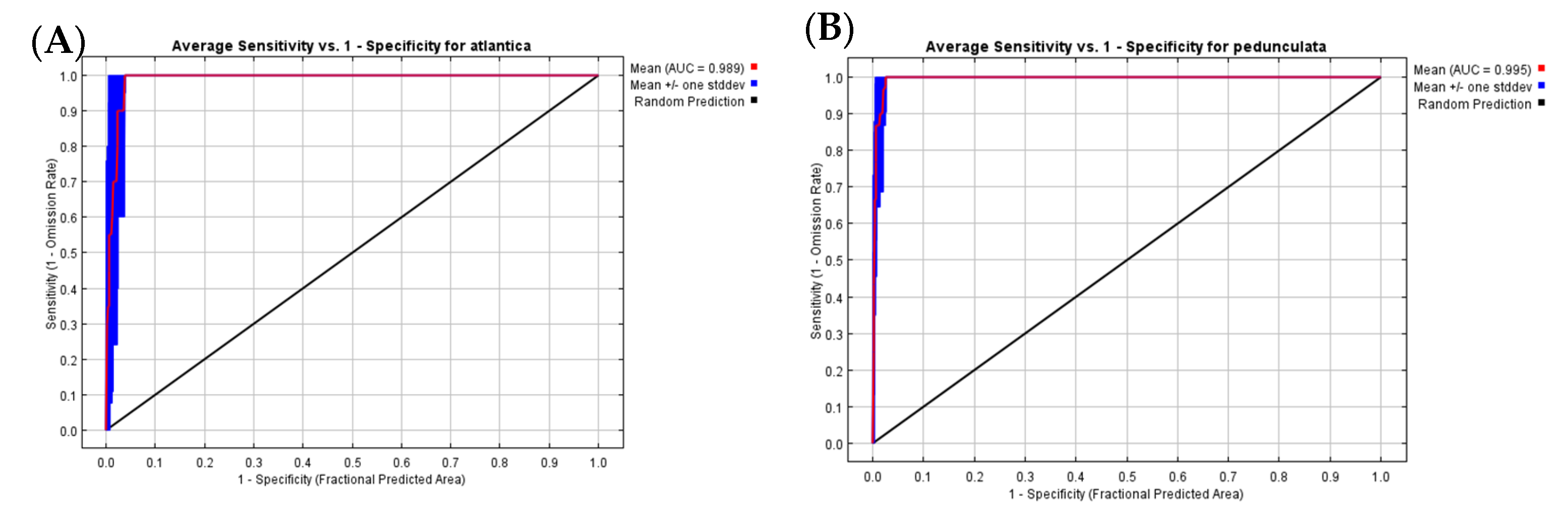
The final models yielded AUC values of 0.989. The standard deviation was 0.011 for Anthemis pedunculata subsp. atlantica (Figure 1A), and for the subsp. pedunculata, the AUC was 0.995 with a standard deviation of 0.004 (Figure 1B), indicating excellent model performance.
For subsp. atlantica, the most influential variables were the mean temperature of the driest quarter (BIO_9), minimum temperature of the coldest month (BIO_6), and mean temperature of the wettest quarter (BIO_8), which together accounted for 84% of the model variance (Table 2). In the case of the subsp. pedunculata, the precipitation of the warmest quarter (BIO_18), precipitation of the coldest quarter (BIO_19), and maximum temperature of the warmest month (BIO_5) were the main contributors, explaining 90% of the variance (Table 2).

3.2. Current Distribution of Anthemis pedunculata

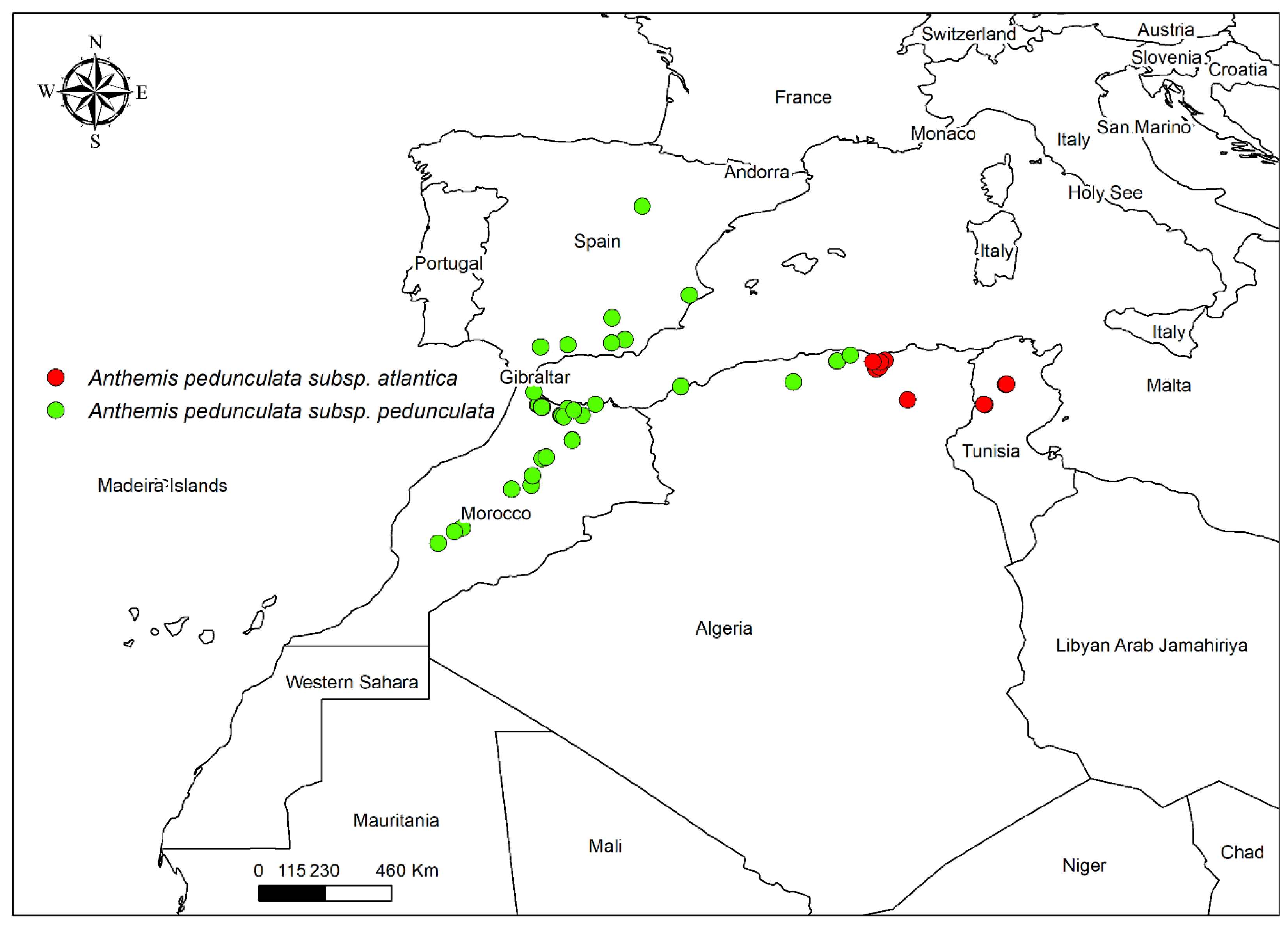
Figure 2 represents the distribution area of the endemic species of Tunisia and Algeria, Anthemis pedunculata subsp. atlantica, and Algeria, Morocco, and Spain, Anthemis pedunculata subsp. pedunculata.
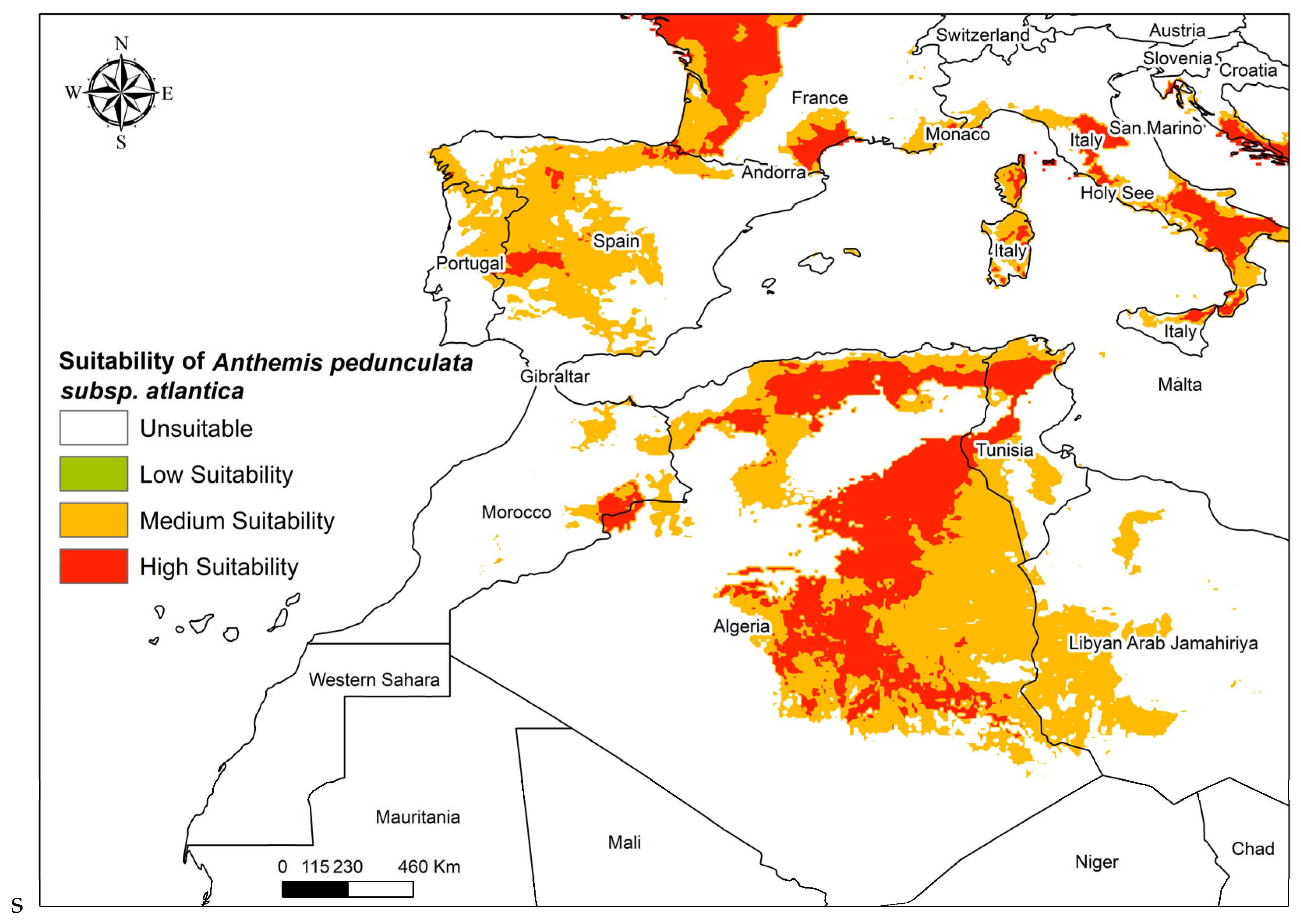
Figure 3 represents the potential distribution area of Anthemis pedunculata subsp. atlantica. Based on this figure, we can conclude that the potential range of this species, which is endemic to Tunisia and Algeria, may extend to other countries in the Mediterranean region, such as Morocco, Spain, France, and Italy. This indicates that these countries can multiply this species, reforest it, and use it as a medicinal plant.
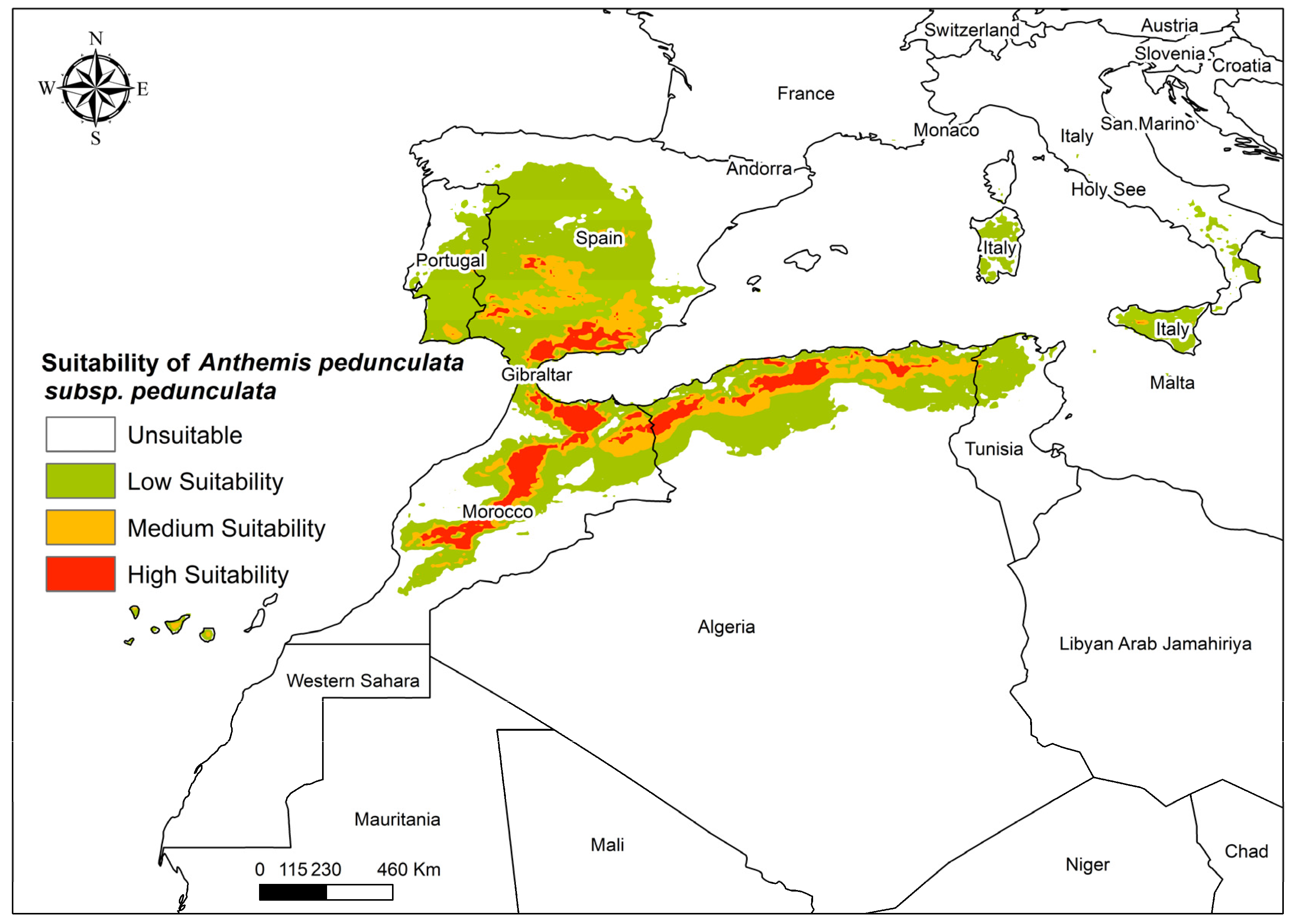
Figure 4 represents the potential distribution area of Anthemis pedunculata subsp. pedunculata. Based on this figure, we can conclude that the potential range of this species, which is endemic to Algeria, Morocco, and Spain, may extend to other countries in the Mediterranean region, such as, Spain, Portugal, and Italy. This indicates that these countries can multiply this species, reforest it, and use it as a medicinal plant.

3.3. Future Global Distribution of Anthemis pedunculata subsp. atlantica

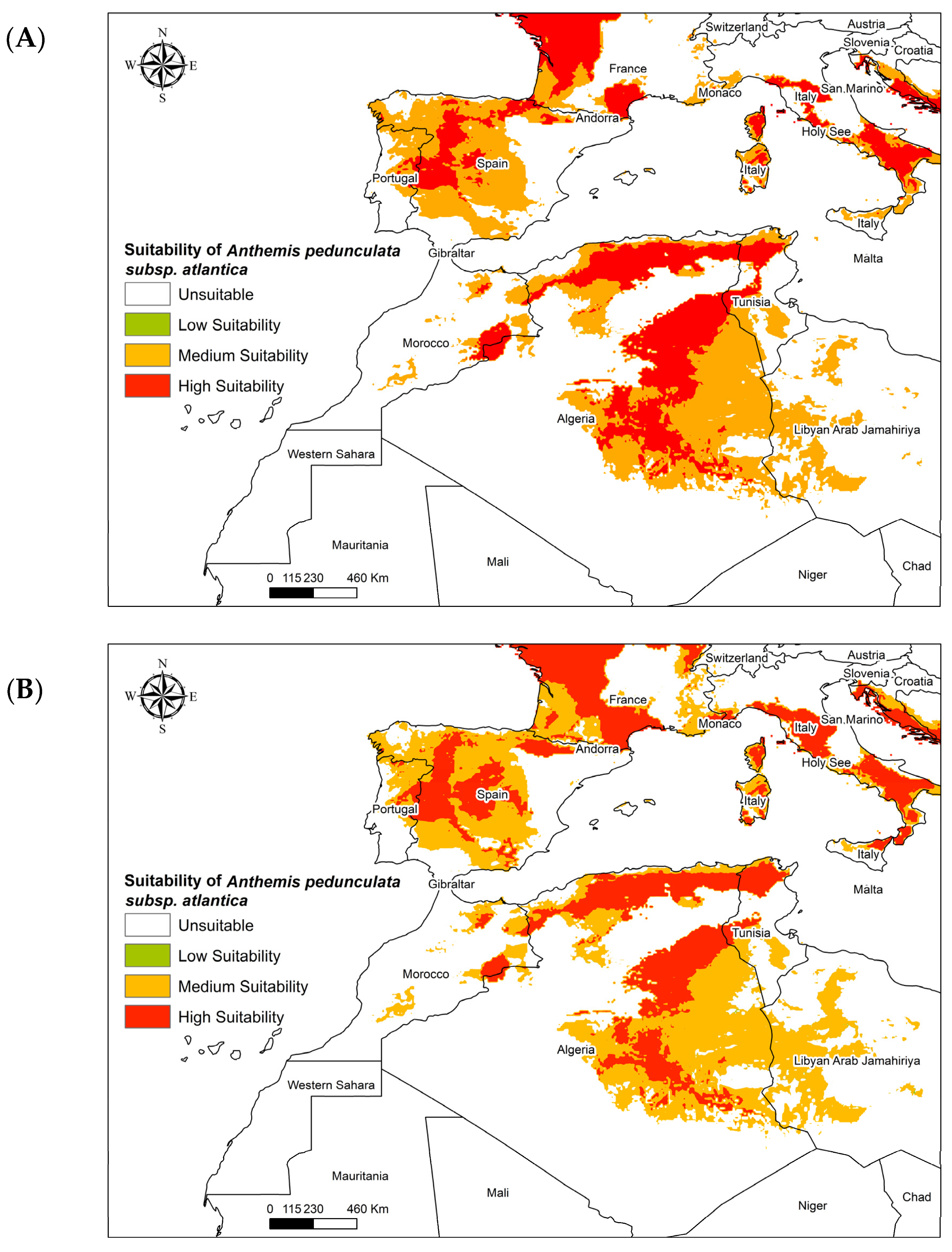
Figure 5 represents the suitability for Anthemis pedunculata subsp. atlantica under the SSP5-8.5 scenario in (A) 2030 and (B) 2050. These figures show that the distribution of the species will increase in terms of surface area under the influence of climate change, and this species will colonize other areas in the Mediterranean basin.
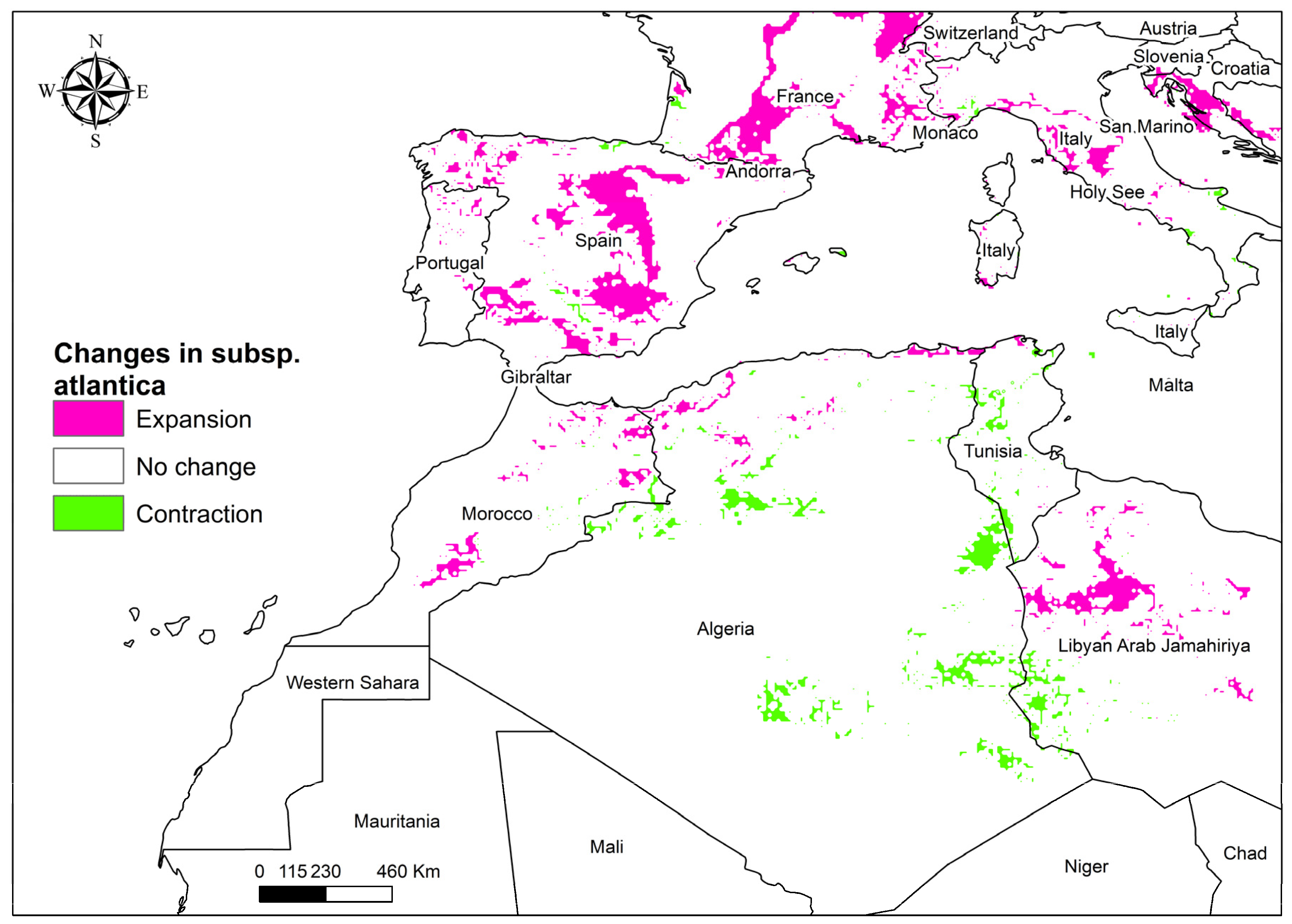
Figure 6 represents the changes in Anthemis pedunculata subsp. atlantica’s suitable areas from the present to 2050. This figure demonstrates that the expansion of the surface area of this species will be greater on the northern shores of the Mediterranean zone than on the southern shores of the Mediterranean, as shown in Figure 5 in Spain.
The area of Anthemis pedunculata subsp. atlantica, which is endemic to Tunisia and Algeria, under scenario SSP5-8.5 in 2030 and 2050 is shown in Table 3. The results demonstrate that the suitable area for this species will increase from 201,179,880 ha in 2024 to 213,898,608 ha in 2030 and 229,357,062 ha in 2050. Table 3 also illustrates that the unsuitable area for the species will decrease from 588,711,123 ha in 2024 to 575,992,395 ha in 2030 and 560,533,941 ha in 2030 under the SSP5-8.5 scenario.

3.4. Future Global Distribution of Anthemis pedunculata subsp. pedunculata

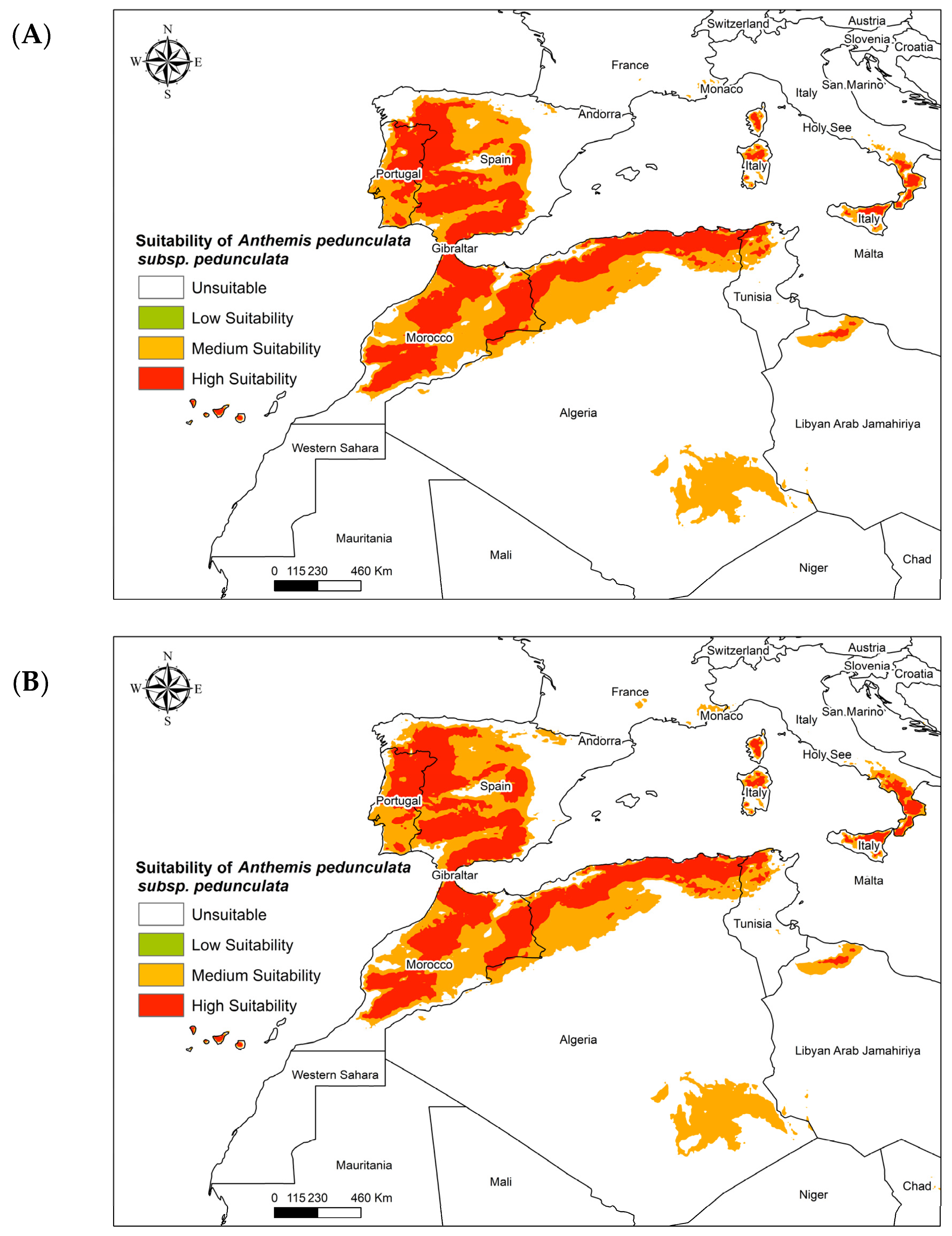
The area of Anthemis pedunculata subsp. peduculata, which is endemic to Algeria, Morocco, and Spain, in scenario SSP5-8.5 in 2030 and 2050 is shown in Table 4. The results demonstrate that the suitable area for this species will increase from 99,330,066 ha in 2024 to 144,365,562 ha in 2023 and 147,335,265 ha in 2050. Table 4 also illustrates that the unsuitable area for the species will decrease from 687,601,233 ha in 2024 to 642,565,737 ha in 2030 and 639,596,034 ha in 2050 under the SSP5-8.5 scenario. The spatial distribution of Anthemis pedunculata subsp. pedunculata under scenario SSP5-8.5 in 2030 and 2050 is illustrated in Figure 7.
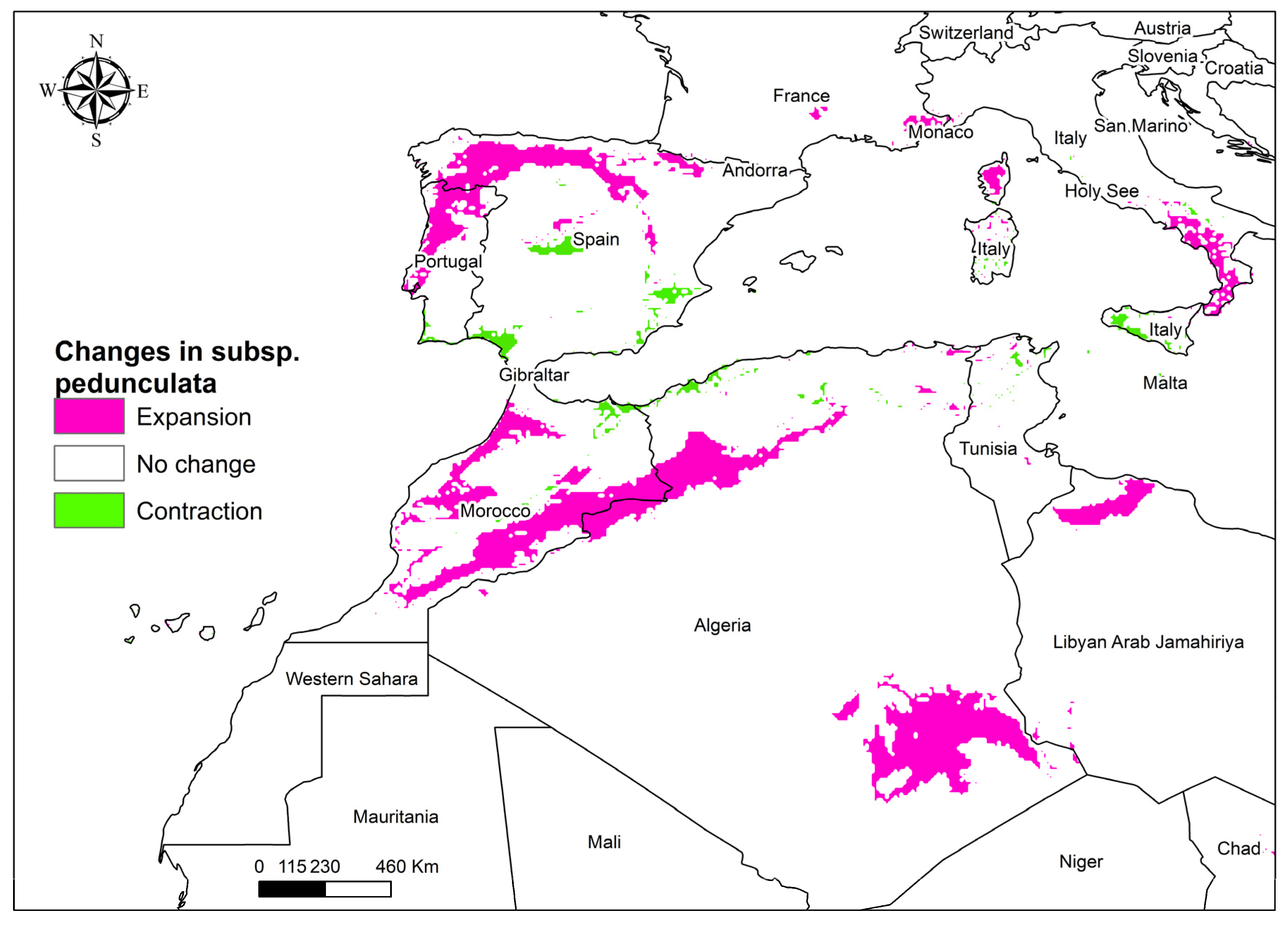
From this figure, it can be seen that the potential area of this species will increase in 2030 and 2050 and will spread to other countries such as Portugal, Tunisia, and Italy. Changes in Anthemis pedunculata subsp. pedunculata’s suitable areas from the present to 2050 are illustrated in Figure 8, which demonstrates that the potential expansion of this species under climate change will involve several countries, including Morocco, Spain, Portugal, Italy, Algeria, and Libya.
Anthemis pedunculata subsp. pedunculata and subsp. atlantica primarily grow in semi-arid habitats. These species tolerate moderate temperature variations and require high levels of sunlight for optimal growth. Annual precipitation strongly influences their density and local distribution, and they coexist with other Mediterranean plants adapted to similar conditions, forming specific plant communities. However, human disturbances, such as grazing and urbanization, limit the availability of these habitats and fragment their populations.

4. Discussion

4.1. Modeling Habitat Suitability for Endemic Anthemis pedunculata subsp. atlantica

For subsp. atlantica, which is endemic to Tunisia and Algeria, the key variables influencing the model were the mean temperature of the driest quarter (BIO_9), the minimum temperature of the coldest month (BIO_6), and the mean temperature of the wettest quarter (BIO_8), which together explained 84% of the model’s variance. Its potential range extends into Morocco, Italy, France, and Spain, where certain areas share similar climatic characteristics. Under the SSP5-8.5 scenario, the projected distribution of Anthemis pedunculata subsp. atlantica is 201,179,880 ha in 2024, increasing to 213,898,608 ha in 2030 and 229,357,062 ha in 2050. This slight expansion is expected to occur in cooler regions, particularly in Spain, Portugal, France, and Libya. Conversely, contractions in its suitable area are projected in Tunisia and Algeria, regions likely to experience significant temperature changes. For these medicinal plants, it is particularly important to encourage propagation, implement reforestation at new suitable sites, and, most importantly, establish protected zones for safeguarding rare and threatened taxa. This work provides a theoretical framework for conserving genetic resources and contributes to understanding vegetation dynamics and evolutionary trends in the study area. Species belonging to the Asteraceae family are noted for their diversity and ecological plasticity, making them crucial for maintaining ecosystem stability [89]. Nonetheless, increasing temperatures combined with reduced rainfall in some regions are likely to restrict habitat availability.
Similarly, in China the distribution of Ziziphus jujuba is predicted to migrate toward higher latitudes, with habitats in lower latitudes becoming increasingly unsuitable, demonstrating the species’ marked sensitivity to climate conditions [27]. Regarding Anthemis pedunculata subsp. atlantica, the current potential distribution is concentrated in Portugal and Spain. Expansion areas are projected mainly to the north of its present suitable zone, with contractions occurring in southern regions. Although certain representatives of the Asteraceae are sometimes regarded as invasive, many species in this family are in fact endangered due to restricted ranges and habitat degradation [43].

4.2. Modeling Habitat Suitability for Endemic Anthemis pedunculata subsp. pedunculata

For subsp. pedunculata, which is endemic to Algeria, Morocco, and Spain, the results showed that the precipitation of the warmest quarter (BIO_18), the precipitation of the coldest quarter (BIO_19), and the maximum temperature of the warmest month (BIO_5) were the main contributing factors, explaining 90% of the model variance. Beyond its current distribution, its potential range extends into Spain, Portugal, and Italy. Under the SSP5-8.5 climate change scenario, the projected distribution of the subsp is 99,330,066 ha in 2024, increasing to 144,365,562 ha in 2030 and 147,335,265 ha in 2050. Expansion is expected in Algeria, Morocco, Spain, Portugal, Italy, and Libya, while contraction is projected in Italy, Spain, Tunisia, Algeria, and Morocco. For these medicinal plants, it is particularly important to encourage propagation and implement reforestation at new suitable sites. Kurpis et al. [90] projected that under future warming scenarios, the distribution of Tagetes lucida would shrink and shift northward. Current habitats are also under strong anthropogenic pressure caused by agriculture, the destruction of vegetation cover, and overgrazing, which cause fragmentation and could obstruct natural dispersal. The optimized MaxEnt model proved reliable in simulating the potential distribution of wild Z. jujuba [27,91], offering a solid basis for evaluating the effects of extreme climate events [92].

4.3. Modeling Habitat for Endemic Anthemis pedunculata Under Climate Change

The predicted net increase in the suitable habitat is greater than the loss. These findings correspond to patterns observed for Choerospondias axillaris [93]. Under future warming scenarios, suitable habitats for A. pedunculata are projected to move toward higher latitudes, with migration distances becoming longer as climate forcing intensifies. This trend is consistent with broader evidence showing that warming pushes species distributions poleward [27,94,95,96]. Temperature and precipitation emerge as the important environmental variables shaping the distribution of A. pedunculata, in agreement with earlier studies [27]. In ecological terms, the main environmental predictors identified in our models closely correspond to the known biological and physiological traits of Anthemis pedunculata species adapted to Mediterranean climates. Protecting such plants is vital given their scientific and medicinal significance [27,97]. Moreover, elevation strongly influences vegetation ranges by altering temperature and solar radiation variables [98]. Overall, many studies highlight that ongoing and future climatic shifts are likely to profoundly reshape potential species distributions, biodiversity, and species richness [99,100,101].
Our species distribution modeling indicates that Anthemis pedunculata is likely to experience both a range contraction and an increase in fragmented suitable habitats under climate change [90]. The majority of projections suggest a northward migration of this Asteraceae species, a trend also observed in other taxa [90,102].
Beyond climate pressures, its dispersal and persistence are further constrained by anthropogenic disturbances such as fires and overgrazing. The spatial range of a species is shaped by ecological determinants (climate, dispersal, and competition), evolutionary history (speciation events), and human influences, such as land-use changes or species translocation [103,104]. Interactions between land-use transformations and climate change could substantially alter future suitable areas [105]. Earlier studies have projected that nearly 18% of global species may face extinction risks by 2050, even under low-emission scenarios [106]. Overall, warming climates are expected to drive species toward higher latitudes and altitudes [107,108,109]. Such variability in outcomes reflects the combined effects of anthropogenic activities, climate dynamics, and policy implementation on habitat suitability [110], while anthropogenic disturbances can significantly influence predictions of potential distributions [111]. Integrating biodiversity considerations into the planning and management of protected zones is crucial for achieving both species conservation and sustainable development goals. Species distribution models are effective tools for assessing biodiversity responses under different climate scenarios [112]. Modeling both present and projected ranges of the Anthemis species is thus critical for managing vulnerable habitats under climate change and guiding restoration planning [113]. The projections generated in this study offer essential guidance for shaping adaptive management approaches that enhance both conservation and sustainable use under global climate pressures. Numerous investigations have highlighted this approach’s effectiveness for predicting potential ranges of plant species at the national scale, with applications in countries such as Iran [114], Tunisia [115], and China [116] and across East Asia [117]. Plant performance traits, including essential oil concentrations, productivity, and morphological or physiological features, are shaped by a combination of environmental conditions, soil characteristics, and genetic backgrounds [118,119,120,121]. Consistent with our findings, Majd et al. [122] demonstrated that optimal habitats for the target species occur in foothill zones, with average minimum and maximum temperatures of 12 and 23 °C, respectively, while mountainous regions also provide suitable environments at slightly cooler ranges (9–24 °C). In Mediterranean ecosystems, precipitation has been identified as a decisive driver of medicinal plant distributions [123]. This variable in particular emerges as a determining factor for A. pedunculata, supporting the formulation of strategies that combine protection measures with sustainable harvesting practices under projected climate change. Since the climate strongly affects species growth, survival, and ecological interactions (e.g., competition and predation), climatic variables are commonly employed in distribution modeling. To refine predictions, incorporating information on dispersal abilities and biotic interactions would be valuable. Broader approaches that integrate ecological relationships and historical drivers of range dynamics, such as the modeling frameworks applied here, are frequently recommended for forecasting present and future habitat suitability [124,125,126]. According to our simulations, severe climate change scenarios are expected to substantially reduce the distribution of suitable habitats for A. pedunculata by 2050. This reduction will be further exacerbated by landscape fragmentation linked to agriculture, deforestation, and grazing pressures. Prolonged fragmentation can negatively affect plant populations by promoting inbreeding, reducing fertility, increasing seedling mortality, and enhancing the expression of deleterious alleles [127]. Widespread species may undergo genetic erosion due to isolation, as small populations often fail to restore lost alleles through gene flow or maintain mutation drift balance, ultimately increasing the extinction risk [128]. The diversity of genetic species is therefore a key element of resilience, allowing species to adapt to novel climatic and site conditions. For species with limited dispersal ability, such as many Mediterranean annuals, reduced genetic diversity poses a severe threat [127,128,129]. The present work represents a first attempt to investigate the ecological aspects of Anthemis pedunculata under the combined pressures of climate variability and human activity. The methodological framework applied here could also be transferred to the study of other endemic taxa within the genus. Previous studies have highlighted several bioactive compounds from A. pedunculata, with demonstrated therapeutic potential against both diseases and parasites. This points to promising future avenues of pharmacological and ecological research. Environmental factors, particularly the climate, play a decisive role in shaping the chemical profile of essential oils in medicinal flora. Many compounds tend to be synthesized at higher concentrations in warmer regions compared with temperate zones [130]. Hence, the projected shifts in the distribution of A. pedunculata under climate change may provide key insights for the sustainable utilization of its secondary metabolites. Given their wide ecological presence, members of Asteraceae are also considered reliable indicators of biodiversity across ecosystems [131].
The Mediterranean regions where these species are likely to expand present slightly wetter or cooler climatic conditions compared to their current habitats. The soils are predominantly calcareous or sandy–loamy, making them compatible with the ecological requirements of the species. However, increased levels of human disturbance in some areas could limit their expansion, despite the availability of favorable climatic conditions. Furthermore, interactions with other plant species and competition for resources will be key factors that influence the success of this expansion. These aspects help to better understand the constraints and opportunities for the conservation and proactive management of these endemic taxa.

4.4. Research Limitations

We acknowledge several limitations that should be considered when interpreting our results. The MaxEnt algorithm has demonstrated high effectiveness in estimating habitat suitability and predicting species distributions across different regions and taxa. Since it relies exclusively on presence records, it avoids many of the difficulties commonly linked with presence–absence methods. In fact, MaxEnt often yields better results than other presence-only techniques, shows limited sensitivity to spatial inaccuracies in occurrence data, and can provide reliable predictions even with very few records (as few as five sites). Nonetheless, the method still requires refinement, particularly in developing standardized procedures for selecting the most appropriate model and in designing protocols that assess habitat use through repeated observations of individuals [132]. Another restriction of this study is that the environmental variables used five for subsp. atlantica and four for subsp. pedunculata may not fully capture the wide range of ecological drivers shaping their distribution. Beyond these predictors, other factors such as interspecific interactions [133], anthropogenic pressures including overgrazing, land-use changes, and habitat fragmentation [134], as well as disturbances like grassland fires or proximity to watercourses [135], may substantially influence the spatial patterns of these taxa. Predicted area as suitable by the models do not necessarily overlap perfectly with the species’ actual habitats [136,137]. This mismatch reflects both inherent assumptions and uncertainties of distribution models, underlining the need for complementary studies and the integration of additional ecological variables to enhance prediction accuracy.

4.5. Conservation Implications and Study Limitations

A growing body of research emphasizes that species distribution models are indispensable tools in biodiversity conservation, as they help pinpoint areas that should be prioritized for protection [138,139,140]. In conservation and management planning, extensive fieldwork is often impractical; nevertheless, preliminary assessments conducted with scientific rigor can significantly improve the efficiency of planning efforts [141]. In particular, the MaxEnt algorithm is widely used because it can predict the potential area distribution of species and reveal ecological processes even when based on very limited occurrence data, sometimes with fewer than ten records [101]. These predictive outputs are valuable for setting conservation priorities and designing strategies aimed at biodiversity protection [142]. According to Hama et al. [143], combining species distribution models with spatial analysis to overlay suitable habitats for different taxa provides a more representative picture of regional biodiversity patterns. This integrative approach appears especially promising for selecting priority zones for conservation measures. However, MaxEnt-based predictions are not without shortcomings and cannot fully guide long-term conservation policies [110]. For sustainable biodiversity management, it is essential to integrate continuous monitoring and evaluation [144]. Modeling species distributions under projected climate scenarios is expected to become a central element of such monitoring systems [145]. Although, in this study, MaxEnt—supported by an extensive dataset of protected species distributions—produced reliable and conclusive results, further precision will depend on future field surveys to refine species occurrence data and thus improve model accuracy [146]. For Anthemis pedunculata, knowledge gaps remain considerable. Information on its ecological preferences and the interspecific relationships linked to its persistence is still scarce. Additional research on the ecology of this species will be essential to guide targeted conservation actions and ensure contributions to ecosystem functions.
Additional research on the ecology of this species will be essential to guide targeted and effective conservation measures. A deeper knowledge of its requirements for light, water, and nutrients, along with its habitat preferences, population dynamics, and interactions within the environment, is crucial. Such information will provide a solid basis for designing well-adapted management actions. Moreover, these studies will help clarify the ecological role the species plays in its natural ecosystem. In turn, this will support efforts to maintain its long-term viability. Ultimately, these insights will ensure that the species continues to contribute to the proper functioning and ecological balance of its environment.

5. Conclusions

In conclusion, the main climatic factors determining habitat suitability for Anthemis pedunculata subsp. atlantica (Tunisia and Algeria) were the mean temperature of the driest quarter, the minimum temperature of the coldest month, and the mean temperature of the wettest quarter, explaining 84% of the model variance. Its potential range may extend to Morocco, Italy, France, and Spain, with cooler areas in Spain, Portugal, France, and Libya identified as priority conservation zones. For A. pedunculata subsp. pedunculata (Algeria, Morocco, and Spain), precipitation during the warmest and coldest quarters and the maximum temperature of the warmest month were the main drivers (90% variance). Predicted range expansions and contractions highlight the need for targeted protection and adaptive management across the species’ distribution. Conservation efforts should prioritize areas where suitable habitats persist or expand and monitor regions at risk of decline. These findings suggest that conservation planning should focus on maintaining connectivity between current and future suitable habitats, particularly in transboundary areas. Future research should investigate species-specific responses to extreme climatic events, the role of microhabitats in buffering climate change, and the potential impacts of land-use changes on habitat suitability to guide adaptive management.

Author Contributions

Conceptualization, K.M., W.J. and K.Y.F.; Methodology, P.G.C.S. and C.H.S.A.; Validation, K.M., W.J., P.G.C.S., C.H.S.A. and K.Y.F.; Formal analysis, K.M., W.J. and M.A.A., P.G.C.S. and C.H.S.A.; Investigation, K.Y.F., K.M., W.J., P.G.C.S. and C.H.S.A.; Resources, K.Y.F., S.M.A., E.R.A. and M.A.A.; Data curation, K.M., W.J., M.A.A., P.G.C.S. and C.H.S.A.; Writing—original draft, K.M., W.J., P.G.C.S., C.H.S.A., K.Y.F., S.M.A., E.R.A. and M.A.A.; Writing—review and editing, K.M., W.J., K.Y.F., S.M.A., E.R.A., M.A.A., P.G.C.S. and C.H.S.A.; Visualization, P.G.C.S., K.Y.F., S.M.A., E.R.A. and M.A.A.; Supervision, P.G.C.S., C.H.S.A. and W.J.; Project administration, K.Y.F., S.M.A., E.R.A., M.A.A., K.M. and W.J.; Funding acquisition, K.Y.F. and S.M.A. and E.R.A. and M.A.A. All authors have read and agreed to the published version of the manuscript.

Funding

The authors gratefully acknowledge the support provided by the Princess Nourah bint Abdulrahman University Researchers Supporting Project (PNURSP2025R674), Princess Nourah bint Abdulrahman University, Riyadh, Saudi Arabia.

Institutional Review Board Statement

Not applicable.

Informed Consent Statement

Not applicable.

Data Availability Statement

All the data are available in the manuscript.

Acknowledgments

Princess Nourah bint Abdulrahman University Researchers Supporting Project number (PNURSP2025R674), Princess Nourah bint Abdulrahman University, Riyadh, Saudi Arabia.

Conflicts of Interest

The authors declare no conflicts of interest.

References

  1. Di Pasquale, G.; Saracino, A.; Bosso, L.; Russo, D.; Moroni, A.; Bonanomi, G.; Allevato, E. Coastal pine-oak glacial refugia in the Mediterranean basin: A biogeographic approach based on charcoal analysis and spatial modelling. Forests 2020, 11, 673. [Google Scholar] [CrossRef]
  2. Franklin, J.; Wejnert, K.E.; Hathaway, S.A.; Rochester, C.J.; Fisher, R.N. Effect of species rarity on the accuracy of species distribution models for reptiles and amphibians in southern California. Divers. Distrib. 2009, 15, 167–177. [Google Scholar] [CrossRef]
  3. Ishihama, F.; Takenaka, A.; Yokomizo, H.; Kadoya, T. Evaluation of the ecological niche model approach in spatial conservation prioritization. PLoS ONE 2019, 14, e0226971. [Google Scholar] [CrossRef] [PubMed]
  4. Li, J.; Fan, G.; He, Y. Predicting the current and future distribution of three Coptis herbs in China under climate change conditions, using the MaxEnt model and chemical analysis. Sci. Total Environ. 2020, 698, 134141. [Google Scholar] [CrossRef]
  5. Rodríguez-Sanchéz, F.; Arroyo, J. Reconstructing the demise of Tethyan plants: Climate-driven range dynamics of Laurus since the Pliocene. Glob. Ecol. Biogeogr. 2008, 17, 685–695. [Google Scholar] [CrossRef]
  6. Commander, C.J.C.; Barnett, L.A.K.; Ward, E.J.; Anderson, S.C.; Essington, T.E. The shadow model: How and why small choices in spatially explicit species distribution models affect predictions. PeerJ 2022, 10, e12783. [Google Scholar] [CrossRef]
  7. Walas, L.; Sobierajska, K.; Ok, T.; Dönmez, A.A.; Kanoğlu, S.S.; Dagher-Kharrat, M.B.; Douaihy, B.; Romo, A.; Stephan, J.; Jasińska, A.K.; et al. Past, present, and future geographic range of an oro-Mediterranean Tertiary relict: The Juniperus drupacea case study. Reg. Environ. Change 2019, 19, 1507–1520. [Google Scholar] [CrossRef]
  8. Phillips, S.J.; Anderson, R.P.; Schapire, R.E. Maximum entropy modeling of species geographic distributions. Ecol. Model. 2006, 190, 231–259. [Google Scholar] [CrossRef]
  9. Phillips, S.J.; Anderson, R.P.; Dudík, M.; Schapire, R.E.; Blair, M.E. Opening the black box: An open-source release of Maxent. Ecography 2017, 40, 887–893. [Google Scholar] [CrossRef]
  10. Tuel, A.; Eltahir, E.A.B. Why Is the Mediterranean a climate change hot spot? J. Clim. 2020, 33, 5829–5843. [Google Scholar] [CrossRef]
  11. Lionello, P.; Scarascia, L. The Relation between Climate Change in the Mediterranean Region and Global Warming. Reg. Environ. Change 2018, 18, 1481–1493. [Google Scholar] [CrossRef]
  12. MedECC. Summary for Policymakers. In Climate and Environmental Change in the Mediterranean Basin—Current Situation and Risks for the Future; First Mediterranean Assessment Report; MedECC Reports; MedECC Secretariat: Marseille, France, 2020; pp. 11–40. [Google Scholar] [CrossRef]
  13. Cramer, W.; Guiot, J.; Fader, M.; Garrabou, J.; Gattuso, J.-P.; Iglesias, A.; Lange, M.A.; Lionello, P.; Llasat, M.C.; Paz, S.; et al. Climate Change and Interconnected Risks to Sustainable Development in the Mediterranean. Nat. Clim. Change 2018, 8, 972–980. [Google Scholar] [CrossRef]
  14. Zittis, G.; Almazroui, M.; Alpert, P.; Ciais, P.; Cramer, W.; Dahdal, Y.; Fnais, M.; Francis, D.; Hadjinicolaou, P.; Howari, F.; et al. Climate Change and Weather Extremes in the Eastern Mediterranean and Middle East. Rev. Geophys. 2022, 60, e2021RG000762. [Google Scholar] [CrossRef]
  15. IPCC. Climate Change 2022: Impacts, Adaptation and Vulnerability; IPCC Sixth Assessment Report; IPCC: Geneva, Switzerland, 2022; Available online: https://www.ipcc.ch/report/ar6/wg2/ (accessed on 25 March 2025).
  16. Pietrapertosa, F.; Olazabal, M.; Simoes, S.G.; Salvia, M.; Fokaides, P.A.; Ioannou, B.I.; Viguié, V.; Spyridaki, N.-A.; Hurtado, S.G.; Geneletti, D.; et al. Adaptation to climate change in cities of Mediterranean Europe. Cities 2023, 140, 104452. [Google Scholar] [CrossRef]
  17. Salvà-Catarineu, M.; Romo, A.; Mazur, M.; Zielińska, M.; Minissale, P.; Dönmez, A.A.; Boratyńska, K.; Boratyński, A. Past, Present, and Future Geographic Range of the Relict Mediterranean and Macaronesian Juniperus phoenicea complex. Ecol. Evol. 2021, 11, 5075–5095. [Google Scholar] [CrossRef]
  18. Diffenbaugh, N.S.; Giorgi, F. Climate Change Hotspots in the CMIP5 Global Climate Model Ensemble. Clim. Change 2012, 114, 813–822. [Google Scholar] [CrossRef]
  19. Schilling, J.; Hertig, E.; Tramblay, Y.; Scheffran, J. Climate Change Vulnerability, Water Resources and Social Implications in North Africa. Reg. Environ. Change 2020, 20, 15. [Google Scholar] [CrossRef]
  20. Yang, Y.; He, J.; Liu, Y.; Zeng, J.; Zeng, L.; He, R.; Guiang, M.M.; Li, Y.; Wu, H. Assessment of Chinese Suitable Habitats of Zanthoxylum nitidum in Different Climatic Conditions by Maxent Model, HPLC, and Chemometric Methods. Ind. Crops Prod. 2023, 196, 116515. [Google Scholar] [CrossRef]
  21. Applequist, W.L.; Brinckmann, J.A.; Cunningham, A.B.; Hart, R.E.; Heinrich, M.; Katerere, D.R.; van Andel, T. Scientists’ Warning on Climate Change and Medicinal Plants. Planta Med. 2020, 86, 10–18. [Google Scholar] [CrossRef]
  22. Zhan, P.; Wang, F.; Xia, P.; Zhao, G.; Wei, M.; Wei, F.; Han, R. Assessment of Suitable Cultivation Region for Panax notoginseng under Different Climatic Conditions Using MaxEnt Model and High-Performance Liquid Chromatography in China. Ind. Crops Prod. 2022, 176, 114416. [Google Scholar] [CrossRef]
  23. Rana, S.K.; Rana, H.K.; Ranjitkar, S.; Ghimire, S.K.; Gurmachhan, C.M.; O’Neill, A.R.; Sun, H. Climate-Change Threats to Distribution, Habitats, Sustainability and Conservation of Highly Traded Medicinal and Aromatic Plants in Nepal. Ecol. Indic. 2020, 115, 106435. [Google Scholar] [CrossRef]
  24. Shen, T.; Yu, H.; Wang, Y.-Z. Assessing the Impacts of Climate Change and Habitat Suitability on the Distribution and Quality of Medicinal Plant Using Multiple Information Integration: Take Gentiana rigescens as an Example. Ecol. Indic. 2021, 123, 107376. [Google Scholar] [CrossRef]
  25. Zhang, K.; Zhang, Y.; Zhou, C.; Meng, J.; Sun, J.; Zhou, T.; Tao, J. Impact of Climate Factors on Future Distributions of Paeonia ostii Across China Estimated by MaxEnt. Ecol. Inform. 2019, 50, 62–67. [Google Scholar] [CrossRef]
  26. Zhang, J.; Jiang, F.; Li, G.; Qin, W.; Li, S.; Gao, H.; Cai, Z.; Lin, G.; Zhang, T. Maxent Modeling for Predicting the Spatial Distribution of Three Raptors in the Sanjiangyuan National Park, China. Ecol. Evol. 2019, 9, 6643–6654. [Google Scholar] [CrossRef] [PubMed]
  27. Zhao, G.; Cui, X.; Sun, J.; Li, T.; Wang, Q.; Ye, X.; Fan, B. Analysis of the Distribution Pattern of Chinese Ziziphus jujuba under Climate Change Based on Optimized Biomod2 and MaxEnt Models. Ecol. Indic. 2021, 132, 108256. [Google Scholar] [CrossRef]
  28. Elith, J.; Phillips, S.J.; Hastie, T.; Dudík, M.; Chee, Y.E.; Yates, C.J. A Statistical Explanation of MaxEnt for Ecologists. Divers. Distrib. 2011, 17, 43–57. [Google Scholar] [CrossRef]
  29. Koch, R.; Almeida-Cortez, J.S.; Kleinschmit, B. Revealing Areas of High Nature Conservation Importance in a Seasonally Dry Tropical Forest in Brazil: Combination of Modelled Plant Diversity Hot Spots and Threat Patterns. J. Nat. Conserv. 2017, 35, 24–39. [Google Scholar] [CrossRef]
  30. Liu, L.; Guan, L.; Zhao, H.; Huang, Y.; Mou, Q.; Liu, K.; Chen, T.; Wang, X.; Zhang, Y.; Wei, B.; et al. Modeling Habitat Suitability of Houttuynia cordata Thunb (Ceercao) Using MaxEnt under Climate Change in China. Ecol. Inform. 2021, 63, 101324. [Google Scholar] [CrossRef]
  31. Guo, Y.; Zhao, Z.; Li, X. Moderate Warming Will Expand the Suitable Habitat of Ophiocordyceps sinensis and Expand the Area of O. sinensis with High Adenosine Content. Sci. Total Environ. 2021, 787, 147605. [Google Scholar] [CrossRef]
  32. Li, Y.; Kong, D.; Fu, Y.; Sussman, M.R.; Wu, H. The Effect of Developmental and Environmental Factors on Secondary Metabolites in Medicinal Plants. Plant Physiol. Biochem. 2020, 148, 80–89. [Google Scholar] [CrossRef]
  33. Huang, Z.; Xie, L.; Wang, H.; Zhong, J.; Li, Y.; Liu, J.; Ou, Z.; Liang, X.; Li, Y.; Huang, H.; et al. Geographic Distribution and Impacts of Climate Change on the Suitable Habitats of Zingiber Species in China. Ind. Crops Prod. 2019, 138, 111429. [Google Scholar] [CrossRef]
  34. Shi, X.; Wang, C.; Zhao, J.; Wang, K.; Chen, F.; Chu, Q. Increasing Inconsistency between Climate Suitability and Production of Cotton (Gossypium hirsutum L.) in China. Ind. Crops Prod. 2021, 171, 113959. [Google Scholar] [CrossRef]
  35. Bai, R.; Wang, J.; Li, N. Climate Change Increases the Suitable Area and Suitability Degree of Rubber Tree Powdery Mildew in China. Ind. Crops Prod. 2022, 189, 115888. [Google Scholar] [CrossRef]
  36. Wen, J.; Zhou, L.; Liu, L.; He, Y. Analysis of the Impact of Climate Change on the Distribution and Active Compound Content of the Plateau Medicinal Plant Nardostachys jatamansi (D. Don) DC. Ind. Crops Prod. 2022, 187, 115438. [Google Scholar] [CrossRef]
  37. Singh, S.P.; Misra, A.; Kumar, B.; Adhikari, D.; Srivastava, S.; Barik, S.K. Identification of Potential Cultivation Areas for Centelloside-Specific Elite Chemotypes of Centella asiatica (L.) Using Ecological Niche Modeling. Ind. Crops Prod. 2022, 188, 115657. [Google Scholar] [CrossRef]
  38. Wang, Y.; Liu, H.; Xu, J.; Yu, S.; Huang, Y.; Zhang, Y.; He, X.; Chen, W. Prediction of Suitable Planting Areas of Rubia cordifolia in China Based on a Species Distribution Model and Analysis of Specific Secondary Metabolites. Ind. Crops Prod. 2023, 206, 117651. [Google Scholar] [CrossRef]
  39. Zou, H.; Zhang, B.; Chen, B.; Duan, D.; Zhou, X.; Chen, J.; Zhang, X. A Multi-Dimensional “Climate-Land-Quality” Approach to Conservation Planning for Medicinal Plants: Take Gentiana scabra Bunge in China as an Example. Ind. Crops Prod. 2024, 211, 118222. [Google Scholar] [CrossRef]
  40. Zhang, F.-G.; Liang, F.; Wu, K.; Xie, L.; Zhao, G.; Wang, Y. The Potential Habitat of Angelica dahurica in China under Climate Change Scenario Predicted by MaxEnt Model. Front. Plant Sci. 2024, 15, 1388099. [Google Scholar] [CrossRef]
  41. Chen, C.; Zhou, L.; Han, Y.; Wen, J.; Liu, L.; Liu, Q.; Peng, C.; He, Y. Comprehensive Analysis of the Effects of Climate Change on the Species Distribution and Active Components of Leonurus japonicus Houtt. Ind. Crops Prod. 2024, 218, 119017. [Google Scholar] [CrossRef]
  42. Zhang, K.; Yao, L.; Meng, J.; Tao, J. MaxEnt Modeling for Predicting the Potential Geographical Distribution of Two Peony Species under Climate Change. Sci. Total Environ. 2018, 634, 1326–1334. [Google Scholar] [CrossRef]
  43. Funk, V.A.; Susanna, A.; Stuessy, T.F.; Bayer, R.J. Systematics, Evolution, and Biogeography of Compositae; IAPT: Vienna, Austria, 2009. [Google Scholar]
  44. Bardaweel, S.K.; Tawaha, K.A.; Hudaib, M.M. Antioxidant, Antimicrobial and Antiproliferative Activities of Anthemis palestina Essential Oil. BMC Complement. Altern. Med. 2014, 14, 297. [Google Scholar] [CrossRef]
  45. Saroglou, V.; Dorizas, N.; Kypriotakis, Z.; Skaltsa, H.D. Analysis of the Essential Oil Composition of Eight Anthemis Species from Greece. J. Chromatogr. A 2006, 1104, 313–322. [Google Scholar] [CrossRef] [PubMed]
  46. Chemsa, A.E.; Zellagui, A.; Öztürk, M.; Erol, E.; Ceylan, O.; Duru, M.E.; Lahouel, M. Chemical Composition, Antioxidant, Anticholinesterase, Antimicrobial and Antibiofilm Activities of Essential Oil and Methanolic Extract of Anthemis stiparum subsp. sabulicola (Pomel) Oberpr. Microb. Pathog. 2018, 119, 233–240. [Google Scholar] [CrossRef] [PubMed]
  47. Riccobono, L.; Maggio, A.; Bruno, M.; Spadaro, V.; Raimondo, F.M. Chemical Composition and Antimicrobial Activity of the Essential Oils of Some Species of Anthemis sect. Anthemis (Asteraceae) from Sicily. Nat. Prod. Res. 2017, 31, 2759–2767. [Google Scholar] [CrossRef] [PubMed]
  48. Fernandes, R. Genus anthemis L. In Flora Europaea; Tutin, T.G., Heywood, V.H., Burges, N.A., Eds.; Cambridge University Press: Cambridge, UK, 1976; Volume 4, pp. 145–149. [Google Scholar]
  49. Bremer, K. Asteraceae, Cladistics and Classification; Timber Press: Portland, OR, USA, 1994. [Google Scholar]
  50. Saroglou, V.; Karioti, A.; Rancik, A.; Dimas, K.; Koukoulitsa, C.; Zervou, M. Sesquiterpene Lactones from Anthemis melanolepis and Their Antibacterial and Cytotoxic Activities: Prediction of Their Pharmacokinetic Profile. J. Nat. Prod. 2010, 73, 242–246. [Google Scholar] [CrossRef]
  51. Ghafoor, A. The genus Anthemis L. (Compositae-Anthemideae), Arabian Peninsula: A taxonomic study. Pak. J. Bot. 2010, 42, 79–98. [Google Scholar]
  52. Labiad, H.; Et-tahir, A.; Ghanmi, M.; Satrani, B.; Aljaiyash, A.; Chaouch, A.; Fadli, M. Ethnopharmacological survey of aromatic and medicinal plants of the pharmacopoeia of northern Morocco. Ethnobot. Res. Appl. 2020, 19, 1–16. [Google Scholar] [CrossRef]
  53. El Kolli, M. Contribution Chimique Et De L’activité Antimicrobienne Des Huiles Essentielles d’Anthemis pedunculata Desp. D’anthemis Punctata Vahl. Et Daucus crinitus Desf. Master’s Dissertation, Université Ferhat Abbas, Setif, Algeria, 2018. [Google Scholar]
  54. Belahcene, N.; Messouak, E. Étude Comparative Des Activités Antioxydante, Antibactérienne Et Anti-Inflammatoire Des Composés Phénoliques De l’Anthemis pedunculata Et Matricaria chamomilla. Master’s Dissertation, Université Mohammed El Bachir El Ibrahimi B.B.A., El Anceur, Algeria, 2022. [Google Scholar]
  55. Chermat, S.; Gharzouli, R. Ethnobotanical study of medicinal flora in the northeast of Algeria—An Empirical Knowledge in Djebel Zdimm (Setif). J. Mater. Sci. Eng. A 2015, 5, 50–59. [Google Scholar] [CrossRef]
  56. Alizadeh Behbahani, B.; Noshad, M.; Mehrnia, M.A. Investigating the Antioxidant Potential and Antimicrobial Effect of Roman (Anthemis nobilis) Chamomile Essential Oil: “In Vitro”. J. Food Sci. Technol. 2025, 22, 159. [Google Scholar] [CrossRef]
  57. Staneva, J.D.; Todorova, M.N.; Evstatieva, L.N. Sesquiterpene Lactones as Chemotaxonomic Markers in Anthemis Genus. Phytochemistry 2008, 69, 607–618. [Google Scholar] [CrossRef]
  58. Laouer, H.; Kolli, M.E.; Boulaacheb, N.; Akkal, S. Chemical composition and antibacterial activity of the essential oil of Anthemis pedunculata and Anthemis punctata. Yanbu J. Eng. Sci. 2014, 9, 81–88. [Google Scholar] [CrossRef]
  59. Le Floc’h, E.; Boulos, L. Vela E Flore de la Tunisie; Ministère de l’Environnement et du Développement Durable Banque de Genès: Tunis, Tunisia, 2010. [Google Scholar]
  60. Gaamoune, S.; Nouioua, W. In vitro Antioxidant and anti-inflammatory activities assessment of flavonoids crude extract of Anthemis pedunculata subsp. atlantica (Pomel) Oberpr., aerial parts. Alger. J. Biosci. 2023, 4, 96–101. [Google Scholar] [CrossRef]
  61. Cabezudo, B.; Solanas, F.C.S.; Pérez-Latorre, A.V. Vascular flora of the Sierra de las Nieves National Park and its surroundings (Andalusia, Spain). Phytotaxa 2022, 534, 1–111. [Google Scholar] [CrossRef]
  62. Sayf-eddine, B.; Bussmann, R.W.; Elachouri, M. Anthemis arvensis L. Anthemis cotula L. Anthemis pedunculata Desf. Anthemis pseudocotula Boiss. Anthemis rascheyana Boiss.: Asteraceae. In Ethnobotany of Northern Africa and Levant; Bussmann, R.W., Elachouri, M., Kikvidze, Z., Eds.; Springer: Cham, Switzerland, 2024; pp. 1–5. [Google Scholar] [CrossRef]
  63. Aiello-Lammens, M.E.; Boria, R.A.; Radosavljevic, A.; Vilela, B.; Anderson, R.P. spThin: An R package for spatial thinning of species occurrence records for use in ecological niche models. Ecography 2015, 38, 541–545. [Google Scholar] [CrossRef]
  64. Boria, R.A.; Olson, L.E.; Goodman, S.M.; Anderson, R.P. Spatial Filtering to Reduce Sampling Bias Can Improve the Performance of Ecological Niche Models. Ecol. Model. 2014, 275, 73–77. [Google Scholar] [CrossRef]
  65. Kramer-Schadt, S.; Niedballa, J.; Pilgrim, J.D.; Schröder, B.; Lindenborn, J.; Reinfelder, V.; Stillfried, M.; Heckmann, I.; Scharf, A.; Augeri, D.; et al. The Importance of Correcting for Sampling Bias in MaxEnt Species Distribution Models. Divers. Distrib. 2013, 19, 1366–1379. [Google Scholar] [CrossRef]
  66. Wisz, M.S.; Hijmans, R.J.; Li, J.; Peterson, A.T.; Graham, C.H.; Guisan, A. Effects of sample size on the performance of species distribution models. Divers. Distrib 2008, 14, 763–773. [Google Scholar] [CrossRef]
  67. Pearson, R.G.; Raxworthy, C.J.; Nakamura, M.; Peterson, A.T. Predicting species distributions from small numbers of occurrence records: A test case using cryptic geckos in Madagascar. J. Biogeogr. 2007, 34, 102–117. [Google Scholar] [CrossRef]
  68. Shcheglovitova, M.; Anderson, R.P. Estimating optimal complexity for ecological niche models: A jackknife approach for species with small sample sizes. Ecol. Model. 2013, 269, 9–17. [Google Scholar] [CrossRef]
  69. Peterson, A.T.; Papeş, M.; Soberón, J. Rethinking receiver operating characteristic analysis applications in ecological niche modeling. Ecol. Model. 2011, 222, 1333–1342. [Google Scholar] [CrossRef]
  70. Fick, S.E.; Hijmans, R.J. WorldClim 2: New 1-km Spatial Resolution Climate Surfaces for Global Land Areas. Int. J. Climatol. 2017, 37, 4302–4315. [Google Scholar] [CrossRef]
  71. Ramos, R.S.; Kumar, L.; Shabani, F.; Picanço, M.C. Mapping Global Risk Levels of Bemisia tabaci in Areas of Suitability for Open Field Tomato Cultivation under Current and Future Climates. PLoS ONE 2018, 13, e0198925. [Google Scholar] [CrossRef] [PubMed]
  72. Mellert, K.H.; Fensterer, V.; Küchenhoff, H.; Reger, B.; Kölling, C.; Klemmt, H.J.; Ewald, J. Hypothesis-Driven Species Distribution Models for Tree Species in the Bavarian Alps. J. Veg. Sci. 2011, 22, 635–646. [Google Scholar] [CrossRef]
  73. Brown, J.L.; Bennett, J.R.; French, C.M. SDMtoolbox 2.0: The Next Generation Python-Based GIS Toolkit for Landscape Genetic, Biogeographic and Species Distribution Model Analyses. PeerJ 2017, 5, e4095. [Google Scholar] [CrossRef]
  74. Barbosa, F.G.; Pillar, V.D.; Palmer, A.R.; Melo, A.S. Predicting the Current Distribution and Potential Spread of the Exotic Grass Eragrostis plana Nees in South America and Identifying a Bioclimatic Niche Shift during Invasion. Austral Ecol. 2013, 38, 260–267. [Google Scholar] [CrossRef]
  75. Ramos, R.S.; Kumar, L.; Shabani, F.; da Silva, R.S.; de Araújo, T.A.; Picanço, M.C. Climate Model for Seasonal Variation in Bemisia tabaci Using CLIMEX in Tomato Crops. Int. J. Biometeorol. 2019, 63, 281–291. [Google Scholar] [CrossRef]
  76. Tadesse, Z.; Nemomissa, S.; Lemessa, D. Predicting the Distributions of Pouteria adolfi-friederici and Prunus africana Tree Species under Current and Future Climate Change Scenarios in Ethiopia. Afr. J. Ecol. 2023, 61, 204–216. [Google Scholar] [CrossRef]
  77. Tatebe, H.; Ogura, T.; Nitta, T.; Komuro, Y.; Ogochi, K.; Takemura, T.; Sudo, K.; Sekiguchi, M.; Abe, M.; Saito, F.; et al. Description and Basic Evaluation of Simulated Mean State, Internal Variability, and Climate Sensitivity in MIROC6. Geosci. Model Dev. 2019, 12, 2727–2765. [Google Scholar] [CrossRef]
  78. Eyring, V.; Bony, S.; Meehl, G.A.; Senior, C.A.; Stevens, B.; Stouffer, R.J.; Taylor, K.E. Overview of the Coupled Model Intercomparison Project Phase 6 (CMIP6) experimental design and organization. Geosci. Model Dev. 2016, 9, 1937–1958. [Google Scholar] [CrossRef]
  79. Muscarella, R.; Galante, P.J.; Soley-Guardia, M.; A Boria, R.; Kass, J.M.; Uriarte, M.; Anderson, R.P. ENMeval: An R package for conducting spatially independent evaluations and estimating optimal model complexity for MAXENT ecological niche models. Methods Ecol. Evol. 2014, 5, 1198–1205. [Google Scholar] [CrossRef]
  80. Monier-Corbel, A.; Robert, A.; Hingrat, Y.; Benito, B.M.; Monnet, A.-C. Species Distribution Models predict abundance and its temporal variation in a steppe bird population. Glob. Ecol. Conserv. 2023, 43, e02442. [Google Scholar] [CrossRef]
  81. Vargas-Jaimes, J.; González-Fernández, A.; Torres-Romero, E.J.; Bolom-Huet, R.; Manjarrez, J.; Gopar-Merino, F.; Pacheco, X.P.; Garrido-Garduño, T.; Chávez, C.; Sunny, A. Impact of climate and land cover changes on the potential distribution of four endemic salamanders in Mexico. J. Nat. Conserv. 2021, 64, 126066. [Google Scholar] [CrossRef]
  82. Peterson, A.T.; Soberón, J.; Pearson, R.G.; Anderson, R.P.; Martínez-Meyer, E.; Nakamura, M.; Araújo, M.B. Ecological Niches and Geographic Distributions; Princeton University Press: Princeton, NJ, USA, 2011; 314p, ISBN 978-0-691-13686-8. [Google Scholar]
  83. Mandrekar, J.N. Receiver operating characteristic curve in diagnostic test assessment. J. Thorac. Oncol. 2010, 5, 1315–1316. [Google Scholar] [CrossRef] [PubMed]
  84. Hand, D.J.; Anagnostopoulos, C. When is the area under the receiver operating characteristic curve an appropriate measure of classifier performance? Pattern Recognit. Lett. 2013, 34, 492–495. [Google Scholar] [CrossRef]
  85. Aidoo, O.F.; Souza, P.G.; da Silva, R.S.; Santana, P.A.; Picanço, M.C.; Kyerematen, R.; Sètamou, M.; Ekesi, S.; Borgemeister, C. Climate-induced range shifts of invasive species (Diaphorina citri Kuwayama). Pest Manag. Sci. 2022, 78, 2534–2549. [Google Scholar] [CrossRef] [PubMed]
  86. Aidoo, O.F.; da Silva, R.S.; Junior, P.A.S.; Souza, P.G.C.; Kyerematen, R.; Owusu-Bremang, F.; Yankey, N.; Borgemeister, C. Model-based prediction of the potential geographical distribution of the invasive coconut mite, Aceria guerreronis Keifer (Acari: Eriophyidae) based on MaxEnt. Agric. For. Entomol. 2022, 24, 390–404. [Google Scholar] [CrossRef]
  87. Mahatara, D.; Acharya, A.K.; Dhakal, B.P.; Sharma, D.; Ulak, S.; Paudel, P. Maxent modelling for habitat suitability of vulnerable tree Dalbergia latifolia in Nepal. Silva Fenn. 2021, 55, 10441. [Google Scholar] [CrossRef]
  88. Rank, A.; Ramos, R.S.; da Silva, R.S.; Soares, J.R.S.; Picanço, M.C.; Fidelis, E.G. Risk of the introduction of Lobesia botrana in suitable areas for Vitis vinifera. J. Pest Sci. 2020, 93, 1167–1179. [Google Scholar] [CrossRef]
  89. Zhang, L.; Qi, S.; Zhao, T.; Li, P.; Wang, X. Applying Specific Habitat Indicators to Study Asteraceae Species Diversity Patterns in Mountainous Area of Beijing, China. Forests 2024, 15, 1348. [Google Scholar] [CrossRef]
  90. Kurpis, J.; Serrato-Cruz, A.M.; Arroyo, T.P.F. Modeling the Effects of Climate Change on the Distribution of Tagetes lucida Cav. (Asteraceae). Glob. Ecol. Conserv. 2019, 20, e00747. [Google Scholar] [CrossRef]
  91. Sheu, Y.; Zurano, J.P.; Ribeiro-Junior, M.A.; Avila-Pires, T.C.; Rodrigues, M.T.; Colli, G.R.; Werneck, F.P. The combined role of dispersal and niche evolution in the diversification of Neotropical lizards. Ecol. Evol. 2020, 10, 2608–2625. [Google Scholar] [CrossRef] [PubMed]
  92. Sharafati, A.; Pezeshki, E. A strategy to assess the uncertainty of a climate change impact on extreme hydrological events in the semi-arid Dehbar catchment in Iran. Theor. Appl. Climatol. 2020, 139, 389–402. [Google Scholar] [CrossRef]
  93. Ye, X.M.; Chen, F.S.; Sun, R.X.; Wu, N.S.; Liu, B.; Song, Y.L. Prediction of Potential Suitable Distribution Areas for Choerospondias axillaris besed on MaxEnt Model. Acta Agric. Univ. Jiangxiensis 2019, 41, 440–446. [Google Scholar] [CrossRef]
  94. Chen, I.C.; Hill, J.K.; Ohlemüller, R.; Roy, D.B.; Thomas, C.D. Rapid range shifts of species associated with high levels of climate warming. Science 2011, 333, 1024–1026. [Google Scholar] [CrossRef]
  95. Li, J.Y.; Chang, H.; Liu, T.; Zhang, C. The potential geographical distribution of Haloxylon across Central Asia under climate change in the 21st century. Agric. For. Meteorol. 2019, 275, 243–254. [Google Scholar] [CrossRef]
  96. Ye, X.Z.; Zhao, G.H.; Zhang, M.Z.; Cui, X.Y.; Fan, H.H.; Liu, B. Distribution Pattern of Endangered Plant Semiliquidambar cathayensis (Hamamelidaceae) in Response to Climate Change after the Last Interglacial Period. Forests 2020, 11, 434. [Google Scholar] [CrossRef]
  97. Zhang, L.; Cao, B.; Bai, C.; Li, G.; Mao, M. Predicting suitable cultivation regions of medicinal plants with Maxent modeling and fuzzy logics: A case study of Scutellaria baicalensis in China. Environ. Earth Sci. 2016, 75, 361. [Google Scholar] [CrossRef]
  98. Galvan-Cisneros, C.M.; Villa, P.M.; Coelho, A.J.P.; Campos, P.V.; Meira-Neto, J.A.A. Altitude as environmental filtering influencing phylogenetic diversity and species richness of plants in tropical mountains. J. Mt. Sci. 2023, 20, 285–298. [Google Scholar] [CrossRef]
  99. Akyol, A.; Orücü, O.K.; Arslan, E.S.; Sarıkaya, A.G. Predicting of the current and future geographical distribution of Laurus nobilis L. under the effects of climate change. Environ. Monit. Assess. 2023, 195, 459. [Google Scholar] [CrossRef]
  100. Shi, X.; Wang, J.; Zhang, L.; Chen, S.; Zhao, A.; Ning, X.; Fan, G.; Wu, N.; Zhang, L.; Wang, Z. Prediction of the potentially suitable areas of Litsea cubeba in China based on future climate change using the optimized MaxEnt model. Ecol. Indic. 2023, 148, 110093. [Google Scholar] [CrossRef]
  101. Xian, Y.; Lu, Y.; Liu, G. Is climate change threatening or beneficial to the habitat distribution of global pangolin species? Evidence from species distribution modeling. Sci. Total Environ. 2022, 811, 151385. [Google Scholar] [CrossRef]
  102. Parmesan, C.; Yohe, G. A globally coherent fingerprint of climate change impacts across natural systems. Nature 2003, 421, 37–42. [Google Scholar] [CrossRef] [PubMed]
  103. Pulliam, H. On the relationship between niche and distribution. Ecol. Lett. 2000, 3, 349–361. [Google Scholar] [CrossRef]
  104. Soberon, J.; Peterson, A.T. Interpretation of models of fundamental ecological niches and species’ distributional areas. Biodivers. Inform. 2005, 2, 1–10. [Google Scholar] [CrossRef]
  105. Manzoor, S.A.; Griffiths, G.; Lukac, M. Land use and climate change interaction triggers contrasting trajectories of biological invasion. Ecol. Indic. 2021, 120, 106936. [Google Scholar] [CrossRef]
  106. Thomas, C.D.; Cameron, A.; Green, R.E.; Bakkenes, M.; Beaumont, L.J.; Collingham, Y.C.; Erasmus, B.F.N.; de Siqueira, M.F.; Grainger, A.; Hannah, L.; et al. Extinction risk from climate change. Nature 2004, 427, 145–148. [Google Scholar] [CrossRef]
  107. Bellard, C.; Thuiller, W.; Leroy, B.; Genovesi, P.; Bakkenes, M.; Courchamp, F. Will climate change promote future invasions? Glob. Change Biol. 2013, 19, 3740–3748. [Google Scholar] [CrossRef]
  108. Khwarahm, N.R. Mapping current and potential future distributions of the oak tree (Quercus aegilops) in the Kurdistan Region, Iraq. Ecol. Process. 2020, 9, 56. [Google Scholar] [CrossRef]
  109. Shi, X.; Yin, Q.; Sang, Z.; Zhu, Z.; Jia, Z.; Ma, L. Prediction of potentially suitable areas for the introduction of Magnolia wufengensis under climate change. Ecol. Indic. 2021, 127, 107762. [Google Scholar] [CrossRef]
  110. Wang, F.; Yuan, X.; Sun, Y.; Liu, Y. Species distribution modeling based on MaxEnt to inform biodiversity conservation in the Central Urban Area of Chongqing Municipality. Ecol. Indic. 2024, 158, 111491. [Google Scholar] [CrossRef]
  111. Cadieux, P.; Boulanger, Y.; Cyr, D.; Taylor, A.R.; Price, D.T.; Sólymos, P.; Stralberg, D.; Chen, H.Y.; Brecka, A.; Tremblay, J.A. Projected effects of climate change on boreal bird community accentuated by anthropogenic disturbances in western boreal forest, Canada. Divers. Distrib. 2020, 26, 668–682. [Google Scholar] [CrossRef]
  112. Estrada, A.S.; Ortiz, E.; Villaseñor, J.L.; Espinosa-García, F.J. The distribution of cultivated species of Porophyllum (Asteraceae) and their wild relatives under climate change. Syst. Biodivers. 2016, 14, 572–582. [Google Scholar] [CrossRef]
  113. Sanjerehei, M.M.; Rundel, P.W. The Impact of Climate Change on Habitat Suitability for Artemisia sieberi and Artemisia aucheri (Asteraceae)—A Modeling Approach. Pol. J. Ecol. 2017, 65, 97–109. [Google Scholar] [CrossRef]
  114. Hosseini, N.; Mehrabian, A.; Mostafavi, H. The distribution patterns and priorities for conservation of monocots Crop Wild relatives (CWRs) of Iran. J. Wildl. Biodivers. 2021, 5, 28–43. [Google Scholar] [CrossRef]
  115. Soilhi, Z.; Sayari, N.; Benalouache, N.; Mekki, M. Predicting current and future distributions of Mentha pulegium L. in Tunisia under climate change conditions, using the MaxEnt model. Ecol. Inform. 2022, 68, 101533. [Google Scholar] [CrossRef]
  116. Gao, X.; Liu, J.; Huang, Z. The impact of climate change on the distribution of rare and endangered tree Firmiana kwangsiensis using the Maxent modeling. Ecol. Evol. 2022, 12, e9165. [Google Scholar] [CrossRef]
  117. Dong, P.-B.; Wang, L.-Y.; Wang, L.-J.; Jia, Y.; Li, Z.-H.; Bai, G.; Zhao, R.-M.; Liang, W.; Wang, H.-Y.; Guo, F.-X.; et al. Distributional response of the rare and endangered tree species Abies chensiensis to climate change in east Asia. Biology 2022, 11, 1659. [Google Scholar] [CrossRef]
  118. Yousefzadeh, S.; Abedi, R.; Mokhtassi-Bidgoli, A. Which environmental factors are more important for geographic distributions of Thymus species and their physio-morphological and phytochemical variations? Arab. J. Geosci. 2021, 14, 1864. [Google Scholar] [CrossRef]
  119. Tolyat, M.A.; Afshari, R.T.; Jahansoz, M.R.; Nadjafi, F.; Naghdibadi, H.A. Determination of cardinal germination temperatures of two ecotypes of Thymus daenensis subsp. daenensis. Seed Sci. Technol. 2014, 42, 28–35. [Google Scholar] [CrossRef]
  120. Tohidi, B.; Rahimmalek, M.; Arzani, A. Essential oil composition, total phenolic, flavonoid contents, and antioxidant activity of Thymus species collected from different regions of Iran. Food Chem. 2017, 220, 153–161. [Google Scholar] [CrossRef]
  121. Tohidi, B.; Rahimmalek, M.; Trindade, H. Review on essential oil, extracts composition, molecular and phytochemical properties of Thymus species in Iran. Ind. Crops Prod. 2019, 134, 89–99. [Google Scholar] [CrossRef]
  122. Majd, M.; Dastjerdi, J.K.; Sefidkon, F.; Lebasschi, M.; Baratian, A. Determination of the Effects of Climate on Growth and Phenological Stage of Thymus daenensis for Cultivation in Different Geographical Regions. Phys. Geogr. Res. 2021, 53, 195–211. [Google Scholar] [CrossRef]
  123. Yang, W.; Sun, S.; Wang, N.; Fan, P.; You, C.; Wang, R.; Zheng, P.; Wang, H. Dynamics of the distribution of invasive alien plants (Asteraceae) in China under climate change. Sci. Total Environ. 2023, 903, 166260. [Google Scholar] [CrossRef] [PubMed]
  124. Guisan, A.; Zimmermann, N.E. Predictive habitat distribution models in ecology. Ecol. Model. 2000, 135, 147–186. [Google Scholar] [CrossRef]
  125. Araújo, M.B.; Guisan, A. Five (or) so challenges for species distribution modelling. J. Biogeogr. 2006, 33, 1677–1688. [Google Scholar] [CrossRef]
  126. Kearney, M. Habitat, environment and niche: What are we modelling? Oikos 2006, 115, 186–191. [Google Scholar] [CrossRef]
  127. Aguilar, R.; Quesada, M.; Ashworth, L.; Herrerias-Diego, Y.; Lobo, J. Genetic consequences of habitat fragmentation in plant populations: Susceptible signals in plant traits and methodological approaches. Mol. Ecol. 2008, 17, 5177–5188. [Google Scholar] [CrossRef]
  128. Honnay, O.; Jacquemyn, H. Susceptibility of common and rare plant species to the genetic consequences of habitat fragmentation. Conserv. Biol. 2007, 21, 823–831. [Google Scholar] [CrossRef]
  129. Berg, M.P.; Kiers, E.T.; Driessen, G.; van der Heijden, M.; Kooi, B.W.; Kuenen, F.; Liefting, M.; Verhoef, H.A.; ELLERS, J. Adapt or disperse: Understanding species persistence in a changing world. Glob. Change Biol. 2010, 16, 587–598. [Google Scholar] [CrossRef]
  130. Zarate-Escobedo, J.; Castañeda-González, E.L.; Cuevas-Sánchez, J.A.; Carrillo-Fonseca, C.L.; Ortiz-Torres, C.; Ibarra-Estrada, E.; Serrato-Cruz, M.A. Essential oil of some populations of Tagetes lucida cav. from the northern and southern regions of the state of Mexico. Rev. Fitotec. Mex. 2018, 41, 199–209. [Google Scholar] [CrossRef]
  131. Villasenor, J.L.; Ibarra, G.; Ocana, D. Strategies for the conservation of Asteraceae in Mexico. Conserv. Biol. 1998, 12, 1066–1075. [Google Scholar] [CrossRef]
  132. Baldwin, R.A. Use of maximum entropy modeling in wildlife research. Entropy 2009, 11, 854–866. [Google Scholar] [CrossRef]
  133. Qin, A.; Liu, B.; Guo, Q.; Bussmann, R.W.; Ma, F.; Jian, Z.; Xu, G.; Pei, S. Maxent modeling for predicting impacts of climate change on the potential distribution of Thuja sutchuenensis Franch. an extremely endangered conifer from southwestern China. Glob. Ecol. Conserv. 2017, 10, 139–146. [Google Scholar] [CrossRef]
  134. Tucker, M.A.; Böhning-Gaese, K.; Fagan, W.F.; Fryxell, J.M.; Van Moorter, B.; Alberts, S.C.; Ali, A.H.; Allen, A.M.; Attias, N.; Avgar, T.; et al. Moving in the Anthropocene: Global reductions in terrestrial mammalian movements. Science 2018, 359, 466–469. [Google Scholar] [CrossRef] [PubMed]
  135. Damaneh, J.M.; Ahmadi, J.; Rahmanian, S.; Sadeghi, S.M.M.; Nasiri, V.; Borz, S.A. Prediction of wild pistachio ecological niche using machine learning models. Ecol. Inform. 2022, 72, 101907. [Google Scholar] [CrossRef]
  136. Li, G.Q.; Liu, C.C.; Liu, Y.G.; Yang, J.; Zhang, X.S.; Guo, K. Advances in theoretical issues of species distribution models. Acta Ecol. Sin. 2013, 33, 4827–4835. [Google Scholar] [CrossRef]
  137. Lissovsky, A.A.; Dudov, S.V. Species-distribution modeling: Advantages and limitations of its application. 1. General Approaches. Biol. Bull. Rev. 2021, 11, 254–264. [Google Scholar] [CrossRef]
  138. Hazarika, A.; Deka, J.R.; Nath, P.C.; Sileshi, G.W.; Nath, A.J.; Giri, K.; Das, A.K. Modelling habitat suitability of the critically endangered Agarwood (Aquilaria malaccensis) in the Indian East Himalayan region. Biodivers. Conserv. 2023, 32, 4787–4803. [Google Scholar] [CrossRef]
  139. Merchant, D.; Lathrop, R.G.; Santos, C.D.; Paludo, D.; Niles, L.; Smith, J.A.M.; Feigin, S.; Dey, A. Distribution modeling and gap analysis of shorebird conservation in Northern Brazil. Remote Sens. 2023, 15, 452. [Google Scholar] [CrossRef]
  140. Wu, B.; Zhou, L.; Qi, S.; Jin, M.; Hu, J.; Lu, J. Effect of habitat factors on the understory plant diversity of Platycladus orientalis plantations in Beijing mountainous areas based on MaxEnt model. Ecol. Indic. 2021, 129, 107917. [Google Scholar] [CrossRef]
  141. Wang, Z.; Zhang, B.; Zhang, X.; Tian, H. Using maxent model to guide marsh conservation in the Nenjiang River Basin. Northeast China. Chin. Geogr. Sci. 2019, 29, 962–973. [Google Scholar] [CrossRef]
  142. Radha, K.O.; Khwarahm, N.R. An integrated approach to map the impact of climate change on the distributions of Crataegus azarolus and Crataegus monogyna in Kurdistan Region, Iraq. Sustainability 2022, 14, 14621. [Google Scholar] [CrossRef]
  143. Hama, A.A.; Khwarahm, N.R. Predictive mapping of two endemic oak tree species under climate change scenarios in a semiarid region: Range overlap and implications for conservation. Ecol. Inform. 2023, 73, 101930. [Google Scholar] [CrossRef]
  144. Huang, Z.; Bai, Y.; Alatalo, J.M.; Yang, Z. Mapping biodiversity conservation priorities for protected areas: A case study in Xishuangbanna Tropical Area. China. Biol. Conserv. 2020, 249, 108741. [Google Scholar] [CrossRef]
  145. Mori, G.M.; Cotrina-Sanchez, A.; Bandopadhyay, S.; Rojas-Briceño, N.B.; Guzmán, C.T.; Castro, E.C.; Oliva, M. Does climate change impact the potential habitat suitability and conservation status of the national bird of Peru (Rupicola peruvianus)? Biodivers. Conserv. 2023, 32, 2323–2344. [Google Scholar] [CrossRef]
  146. Ma, B.; Zeng, W.; Xie, Y.; Wang, Z.; Hu, G.; Li, Q.; Cao, R.; Zhuo, Y.; Zhang, T. Boundary delineation and grading functional zoning of Sanjiangyuan National Park based on biodiversity importance evaluations. Sci. Total Environ. 2022, 825, 154068. [Google Scholar] [CrossRef]
Figure 1. Anthemis pedunculata subsp. atlantica (A) and Anthemis pedunculata subsp. pedunculata operating characteristic (ROC) curve (AUC) (B).
Diversity 17 00851 g001
Figure 2. Current distribution of Anthemis pedunculata subsp. atlantica and Anthemis pedunculata subsp. pedunculata.
Diversity 17 00851 g002
Figure 3. Current suitable areas modeled for Anthemis pedunculata subsp. atlantica.
Diversity 17 00851 g003
Figure 4. Current suitable areas modeled for Anthemis pedunculata subsp. pedunculata.
Diversity 17 00851 g004
Figure 5. Modeled suitability for Anthemis pedunculata subsp. atlantica under scenario SSP5-8.5 in (A) 2030 and (B) 2050.
Diversity 17 00851 g005
Figure 6. Changes in Anthemis pedunculata subsp. atlantica’s suitable areas from the present to 2050.
Diversity 17 00851 g006
Figure 7. Modeled suitability for Anthemis pedunculata subsp. pedunculata under scenario SSP5-8.5 in (A) 2030 and (B) 2050.
Diversity 17 00851 g007
Figure 8. Changes in Anthemis pedunculata subsp. pedunculata’s suitable areas from the present to 2050.
Diversity 17 00851 g008
Table 1. Environmental variables used for the initial model.
Code/UnitEnvironmental Variable
BIO_1 (°C)Annual Mean Temperature
BIO_2 (°C)Mean Diurnal Range (mean of monthly (max temp-min temp))
BIO_3 (%)Isothermality (BIO2/BIO7) (×100)
BIO_4 (°C)Temperature Seasonality (standard deviation × 100)
BIO_5 (°C)Max Temperature of Warmest Month
BIO_6 (°C)Min Temperature of Coldest Month
BIO_7 (°C)Annual Temperature Range (BIO5-BIO6)
BIO_8 (°C)Mean Temperature of Wettest Quarter
BIO_9 (°C)Mean Temperature of Driest Quarter
BIO_10 (°C)Mean Temperature of Warmest Quarter
BIO_11 (°C)Mean Temperature of Coldest Quarter
BIO_12 (mm)Annual Precipitation
BIO_13 (mm)Precipitation of Wettest Month
BIO_14 (mm)Precipitation of Driest Month
BIO_15 (mm)Precipitation Seasonality (coefficient of variation)
BIO_16 (mm)Precipitation of Wettest Quarter
BIO_17 (mm)Precipitation of Driest Quarter
BIO_18 (mm)Precipitation of Warmest Quarter
BIO_19 (mm)Precipitation of Coldest Quarter
BIO_20 (m)Elevation
Table 2. Contribution percentage of the environmental variables used in the final MaxEnt model: mean temperature of driest quarter (BIO_9), minimum temperature of coldest month (BIO_6), mean temperature of wettest quarter (BIO_8), isothermality (BIO_3), precipitation seasonality (BIO_15), precipitation of warmest quarter (BIO_18), precipitation of coldest quarter (BIO_19), maximum temperature of warmest month (BIO_5), and elevation (BIO_20).
Anthemis pedunculata subsp. atlanticaAnthemis pedunculata subsp. pedunculata
VariableContribution (%)VariableContribution (%)
BIO_930.2BIO_1839.3
BIO_627.7BIO_1930.8
BIO_826.1BIO_520.5
BIO_38.3BIO_209.4
BIO_157.7
Table 3. Distribution of Anthemis pedunculata subsp. atlantica under scenario SSP5-8.5 in 2030 and 2050.
Distribution of Anthemis pedunculata subsp. atlantica (%)
202420302050
Suitable25.4727.0829.04
Unsuitable74.5372.9270.96
Distribution of Anthemis pedunculata subsp. atlantica (ha)
202420302050
Suitable201,179,880213,898,608229,357,062
Unsuitable588,711,123575,992,395560,533,941
Table 4. Distribution of Anthemis pedunculata subsp. penduculata under scenario SSP5-8.5 in 2030 and 2050.
Distribution of Anthemis pedunculata subsp. penduculata (%)
202420302050
Suitable12.6218.3518.72
Unsuitable87.3881.6581.28
Distribution of Anthemis pedunculata subsp. penduculata (ha)
202420302050
Suitable99,330,066144,365,562147,335,265
Unsuitable687,601,233642,565,737639,596,034
Disclaimer/Publisher’s Note: The statements, opinions and data contained in all publications are solely those of the individual author(s) and contributor(s) and not of MDPI and/or the editor(s). MDPI and/or the editor(s) disclaim responsibility for any injury to people or property resulting from any ideas, methods, instructions or products referred to in the content.