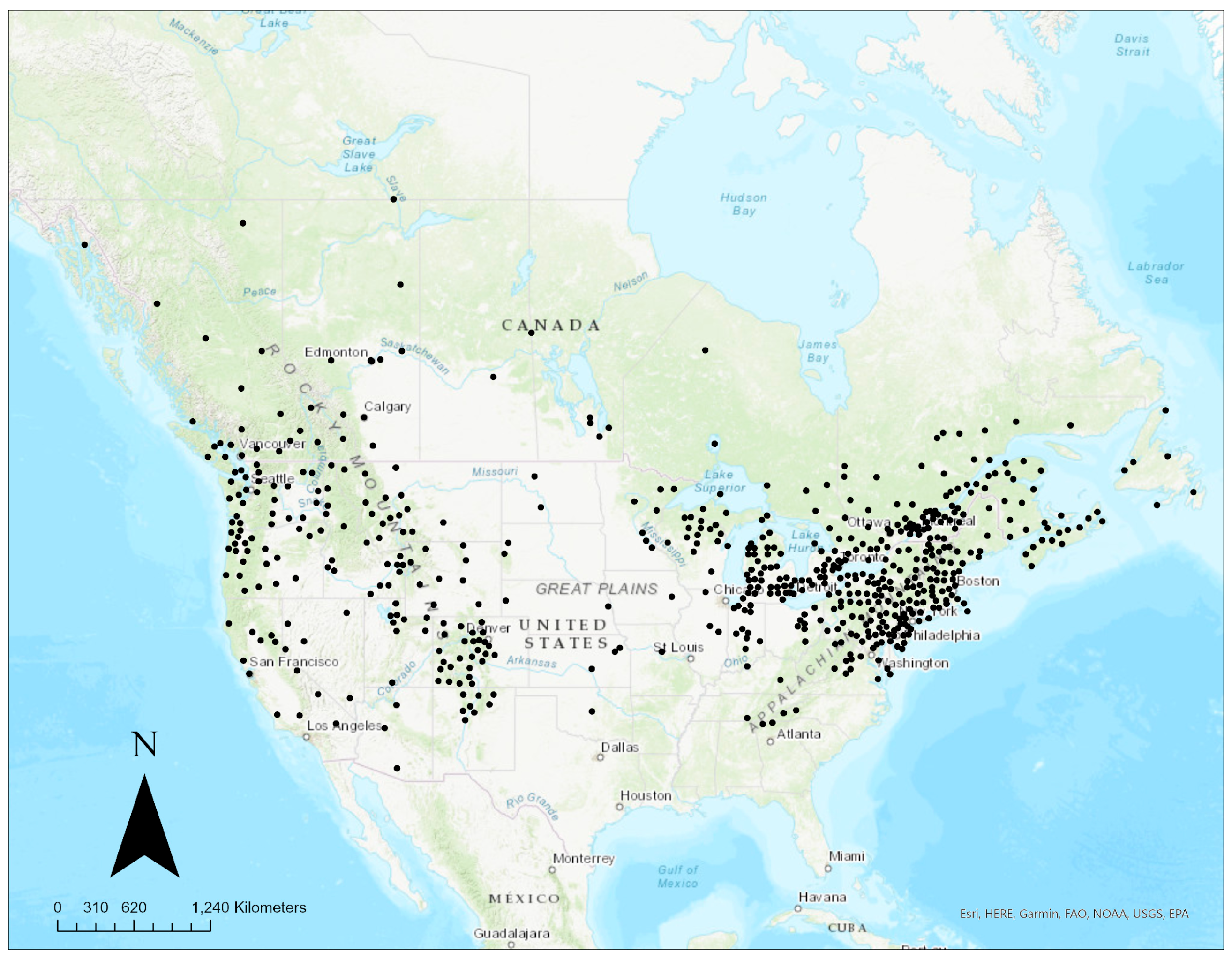

Web-Based Photography Documents the Evening Grosbeak’s (Hesperiphona vespertina) Highly Diverse Diet

 ,
, 
Abstract
1. Introduction
2. Materials and Methods
2.1. Image Review
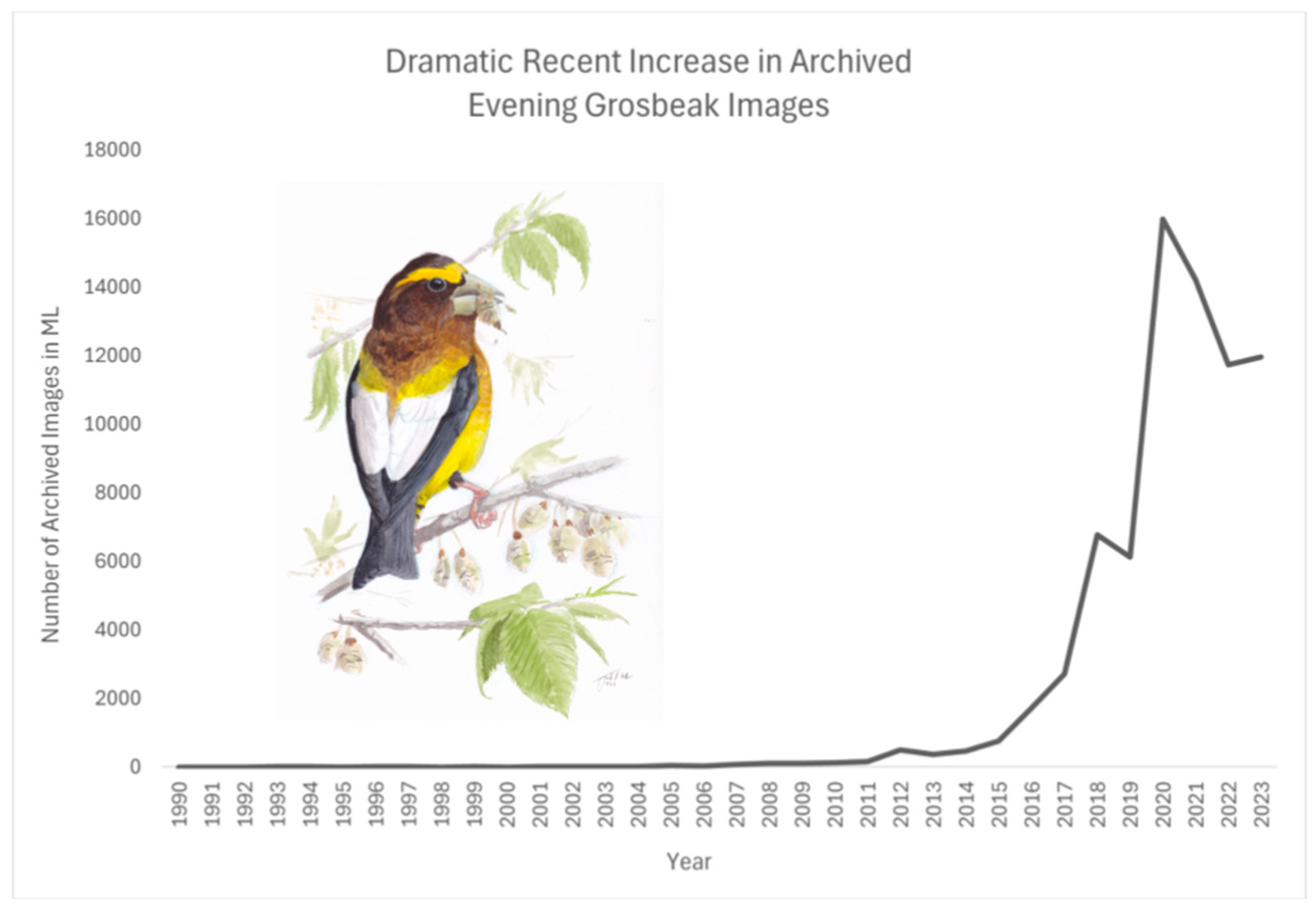
- January 1990 to September 2018: We reviewed all archived Evening Grosbeak images and recorded any identifiable food item visible in the bird’s bill. This included birds at feeders.
- October 2018 to October 2020: We used a subsampling protocol where we randomly selected one image for every 30 archived images for review. If the randomly selected image did not depict an Evening Grosbeak consuming a food item, we repeated the random selection process without replacement until a suitable image was found. This sampling includes feeders.
- November 2020 to December 2023: We reviewed every archived image but only recorded instances where natural food items were visible. Birds at feeders were excluded.
2.2. Characterizing Geographic and Seasonal Variation in Diet
2.3. Completeness of Dietary Richness
3. Results
3.1. Regional Patterns
3.2. Seasonal Patterns
3.3. Completeness of Dietary Richness Assessments
4. Discussion
4.1. What Does Such a Diverse Diet Tell Us About Irruptive and Annual Movement Behavior?
4.2. Limitations
5. Conclusions
Supplementary Materials
Author Contributions
Funding
Institutional Review Board Statement
Data Availability Statement
Acknowledgments
Conflicts of Interest
References
- Koenig, W.D.; Haydock, J. Oaks, Acorns, and the Geographical Ecology of Acorn Woodpeckers. J. Biogeogr. 1999, 26, 159–165. [Google Scholar] [CrossRef]
- Sherry, T.W.; Kent, C.M. Extensions and Limitations of MacArthur (1958): A Review of Ecological and Evolutionary Approaches to Competition and Diet in the New World Wood Warblers (Parulidae). Ornithology 2022, 139, ukac010. [Google Scholar] [CrossRef]
- Centanni, C.; Robinson, W.D.; Young, M.A. Is Resource Specialization the Key?: Some, but Not All Red Crossbill Call Types Associate with Their Key Conifers in a Diverse North American Landscape. Front. Bird Sci. 2024, 3, 1321583. [Google Scholar] [CrossRef]
- Kissling, W.D.; Sekercioglu, C.H.; Jetz, W. Bird Dietary Guild Richness across Latitudes, Environments and Biogeographic Regions. Glob. Ecol. Biogeogr. 2012, 21, 328–340. [Google Scholar] [CrossRef]
- Burin, G.; Kissling, W.D.; Guimarães, P.R.; Şekercioğlu, Ç.H.; Quental, T.B. Omnivory in Birds Is a Macroevolutionary Sink. Nat. Commun. 2016, 7, 11250. [Google Scholar] [CrossRef]
- Swetnam, T.W.; Lynch, A.M. Multicentury, Regional-Scale Patterns of Western Spruce Budworm Outbreaks. Ecol. Monogr. 1993, 63, 399–424. [Google Scholar] [CrossRef]
- Stringer, E.J.; Gruber, B.; Sarre, S.D.; Wardle, G.M.; Edwards, S.V.; Dickman, C.R.; Greenville, A.C.; Duncan, R.P. Boom-Bust Population Dynamics Drive Rapid Genetic Change. Proc. Natl. Acad. Sci. USA 2024, 121, e2320590121. [Google Scholar] [CrossRef]
- Gillihan, S.W.; Byers, B.E. Evening Grosbeak (Hesperiphona vespertina), Version 1.1. In Birds of the World; Cornell Lab of Ornithology: Ithaca, NY, USA, 2025. [Google Scholar] [CrossRef]
- Hoenig, B.D.; Snider, A.M.; Forsman, A.M.; Hobson, K.A.; Latta, S.C.; Miller, E.T.; Polito, M.J.; Powell, L.L.; Rogers, S.L.; Sherry, T.W.; et al. Current Methods and Future Directions in Avian Diet Analysis. Ornithology 2022, 139, ukab077. [Google Scholar] [CrossRef]
- Evening Grosbeak—Road to Recovery. Available online: https://r2rbirds.org/tipping-point-species/evening-grosbeak/ (accessed on 29 December 2024).
- Bonter, D.N.; Harvey, M.G. Winter Survey Data Reveal Rangewide Decline in Evening Grosbeak Populations. Condor 2008, 110, 376–381. [Google Scholar] [CrossRef]
- Robinson, W.D.; Greer, J.; Masseloux, J.; Hallman, T.A.; Curtis, J.R. Dramatic Declines of Evening Grosbeak Numbers at a Spring Migration Stop-Over Site. Diversity 2022, 14, 496. [Google Scholar] [CrossRef]
- Sewall, K.; Kelsey, R.; Hahn, T.P. Discrete Variants of Evening Grosbeak Flight Calls. Condor 2004, 106, 161–165. [Google Scholar] [CrossRef]
- Kirsch, W.M.; Centanni, C.T.; Ngo, S.H.; Young, M.A.; Hahn, T.P.; Robinson, W.D. Quantitative Analysis of the Flight Calls and Trills of Evening Grosbeaks (Coccothraustes Vespertinus). Front. Bird Sci. 2025, 4, 1613273. [Google Scholar] [CrossRef]
- Duman, K.W.; Hahn, T.P. Sympatric Breeding Occurrence of Two Call Types of Evening Grosbeak in Western Wyoming. Front. Bird Sci. 2024, 3, 1371155. [Google Scholar] [CrossRef]
- Gabrielson, I.N. Food Habits of Some Winter Bird Visitants; U.S. Department of Agriculture Bulletin: Washington, DC, USA, 1924; No. 1249; pp. 1–32. [Google Scholar]
- Speirs, D.H. Hesperiphona vespertina vespertina (Cooper): Eastern Evening Grosbeak; Hesperiphona vespertina brooksi (Grinnell): Western Evening Grosbeak; Hesperiphona vespertina montana (Ridgway): Mexican Evening Grosbeak. In Life Histories of North American Cardinals, Grosbeaks, Buntings, Towhees, Finches, Sparrows, and Their Allies; Austin, O.L., Ed.; Dover Publications Inc.: Mineola, NY, USA, 1968; pp. 206–256, U.S. National Museum Bulletin No. 237; Pt. 1. [Google Scholar]
- Naude, V.N.; Smyth, L.K.; Weideman, E.A.; Krochuk, B.A.; Amar, A. Using Web-Sourced Photography to Explore the Diet of a Declining African Raptor, the Martial Eagle (Polemaetus Bellicosus). Condor 2019, 121, duy015. [Google Scholar] [CrossRef]
- Berryman, A.J.; Kirwan, G.M. Is the Tiny Hawk (Accipiter superciliosus) Really a Specialized Predator on Hummingbirds? Using Citizen Science Data to Elucidate Dietary Preferences of a Little-Known Neotropical Raptor. J. Raptor Res. 2021, 55, 276–280. [Google Scholar] [CrossRef]
- Panter, C.T.; Naude, V.N.; Barbar, F.; Amar, A. Continental Scale Dietary Patterns in a New World Raptor Using Web-Sourced Photographs. PLoS ONE 2024, 19, e0304740. [Google Scholar] [CrossRef]
- Nupen, L.; Gardner, M.; Morin, J.; Ndou, T.; Dugmore, E.K. Web-Sourced Photographic Methods Reveal Dietary Composition and Shifts in Resident and Migrant Coracias Rollers in Southern Africa. Biodivers. Obs. 2023, 13, 61–94. [Google Scholar] [CrossRef]
- Sandvig, E.M.; Cerpa, P. Notes on the Diet of the Straight-billed Earthcreeper (Ochetorhynchus ruficaudus) and the Use of Citizen Science Image Repositories. Ornitol. Neotrop. 2022, 33, 154–157. [Google Scholar] [CrossRef]
- Sullivan, B.L.; Wood, C.L.; Iliff, M.J.; Bonney, R.E.; Fink, D.; Kelling, S. eBird: A Citizen-Based Bird Observation Network in the Biological Sciences. Biol. Conserv. 2009, 142, 2282–2292. [Google Scholar] [CrossRef]
- Colwell, R.K.; Coddington, J.A. Estimating Terrestrial Biodiversity through Extrapolation. Philos. Trans. Biol. Sci. 1994, 345, 101–118. [Google Scholar] [CrossRef]
- Koenig, W.D.; Knops, J.M.H. Seed-Crop Size and Eruptions of North American Boreal Seed-Eating Birds. J. Anim. Ecol. 2001, 70, 609–620. [Google Scholar] [CrossRef]
- Widick, I.V.; Strong, C.; LaMontagne, J.M.; Young, M.A.; Zuckerberg, B. Continent-Wide Patterns of Climate and Mast Seeding Entrain Boreal Bird Irruptions. Glob. Change Biol. 2025, 31, e70076. [Google Scholar] [CrossRef] [PubMed]
- Koenig, W.D. Synchrony and Periodicity of Eruptions by Boreal Birds. Condor 2001, 103, 725–735. [Google Scholar] [CrossRef]
- Körner, C. Mountain Biodiversity, Its Causes and Function. AMBIO J. Hum. Environ. 2004, 33, 11–17. [Google Scholar] [CrossRef]


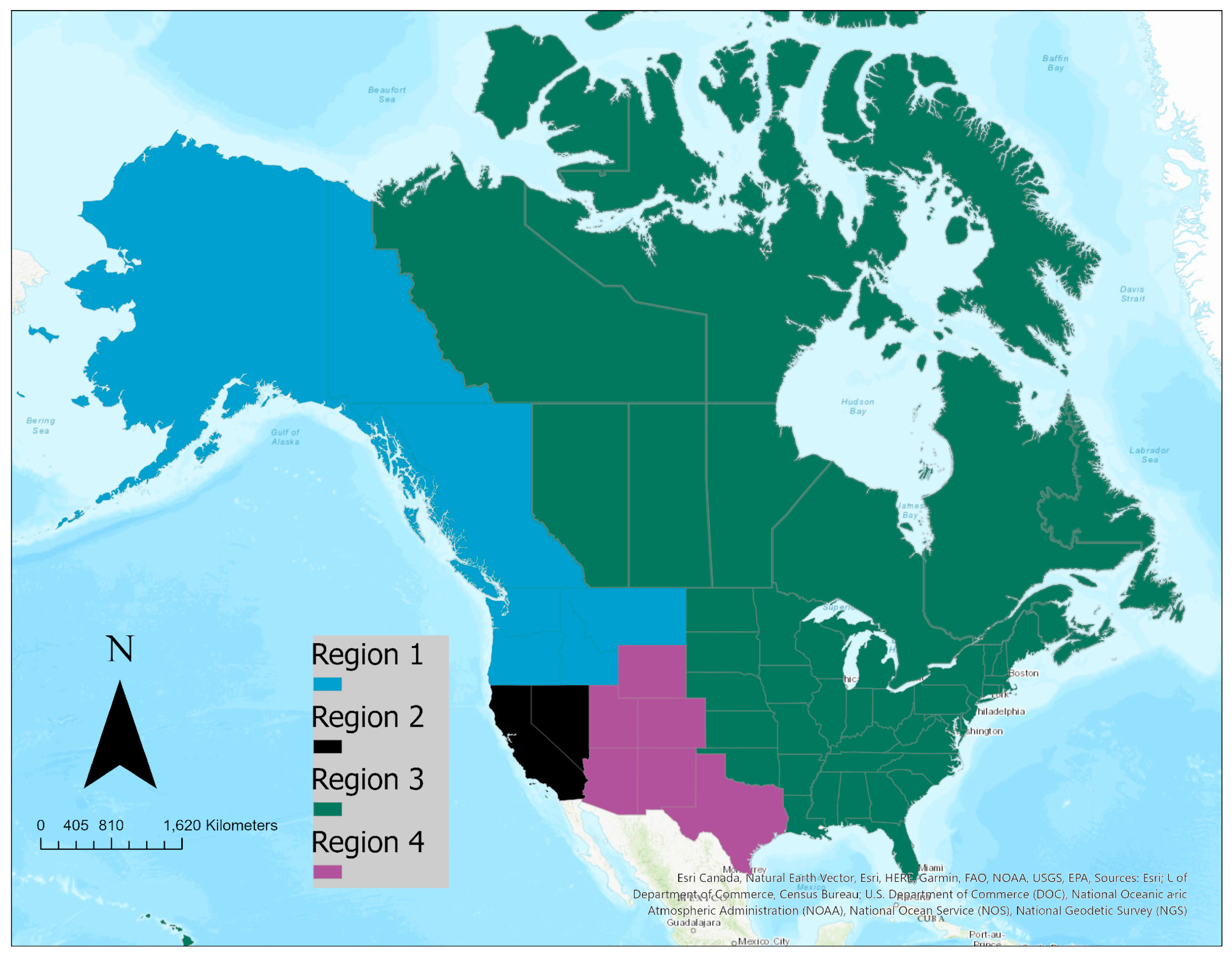



| Region | Season | N |
|---|---|---|
| 1 | ||
| Winter | 44 | |
| Spring | 45 | |
| Summer | 18 | |
| Fall | 35 | |
| 2 | ||
| Winter | 56 | |
| Spring | 13 | |
| Summer | 1 | |
| Fall | 4 | |
| 3 | ||
| Winter | 444 | |
| Spring | 52 | |
| Summer | 5 | |
| Fall | 143 | |
| 4 | ||
| Winter | 114 | |
| Spring | 32 | |
| Summer | 14 | |
| Fall | 55 |
| Rank | Plant Genus | Number of Records | % of Total |
|---|---|---|---|
| 1 | Acer | 250 | 23.6% |
| 2 | Malus | 108 | 10.2% |
| 3 | Prunus | 100 | 9.44% |
| 4 | Elaeagnus | 93 | 8.78% |
| 5 | Rhus | 90 | 8.50% |
| 6 | Ulmus | 69 | 6.52% |
| 7 | Juniperus | 42 | 3.97% |
| 8 | Pistachia | 40 | 3.78% |
| 9 | Sorbus | 34 | 3.21% |
| 10 | Fraxinus | 30 | 2.83% |
| 11 | Amelanchier | 19 | 1.79% |
| 12 | Populus | 16 | 1.51% |
| 12 | Frangula | 16 | 1.51% |
| 14 | Pinus | 15 | 1.42% |
| 14 | Rosa | 15 | 1.42% |
| 16 | Crataegus | 14 | 1.32% |
| 17 | Abies | 13 | 1.23% |
| 17 | Celtis | 13 | 1.23% |
| 19 | Robinia | 11 | 1.04% |
| Rank | Plant Genus | Number of Records | % of Total |
|---|---|---|---|
| Region 1 | |||
| 1 | Acer | 24 | 17.0% |
| 2 | Prunus | 22 | 15.6% |
| 3 | Ulmus | 19 | 13.5% |
| 4 | Elaeagnus | 10 | 7.09% |
| 4 | Frangula | 10 | 7.09% |
| Region 2 | |||
| 1 | Pistacia | 31 | 42.5% |
| 2 | Pinus | 10 | 13.7% |
| 3 | Ulmus | 7 | 9.59% |
| 4 | Frangula | 5 | 6.85% |
| 5 | Abies | 3 | 4.11% |
| Region 3 | |||
| 1 | Acer | 213 | 33.4% |
| 2 | Malus | 97 | 15.2% |
| 3 | Rhus | 89 | 14.0% |
| 4 | Prunus | 60 | 9.42% |
| 5 | Sorbus | 31 | 4.87% |
| Region 4 | |||
| 1 | Elaeagnus | 79 | 38.0% |
| 2 | Juniperus | 32 | 15.4% |
| 3 | Ulmus | 25 | 12.0% |
| 4 | Prunus | 18 | 8.65% |
| 5 | Amelanchier | 11 | 5.30% |
| Rank | Plant Genus | Number of Records | % of Total |
|---|---|---|---|
| Winter | |||
| 1 | Acer | 149 | 22.8% (149) |
| 2 | Malus | 87 | 13.3% (87) |
| 3 | Rhus | 82 | 12.6% (82) |
| 4 | Elaeagnus | 77 | 11.8% (77) |
| 5 | Prunus | 42 | 6.43% (42) |
| Spring | |||
| 1 | Ulmus | 66 | 46.5% (66) |
| 2 | Acer | 19 | 13.4% (19) |
| 3 | Populus | 13 | 9.15% (13) |
| 4 | Malus | 9 | 6.34% (9) |
| 5 | Quercus | 5 | 3.52% (5) |
| Summer | |||
| 1 | Prunus | 9 | 30.0% (9) |
| 2 | Amelanchier | 7 | 23.3% (7) |
| 3 | Frangula | 6 | 20.0% (6) |
| 4 | Abies | 3 | 10.0% (3) |
| 5 | Pseudotsuga | 2 | 6.66% (2) |
| Fall | |||
| 1 | Acer | 82 | 35.0% (82) |
| 2 | Prunus | 45 | 19.2% (45) |
| 3 | Elaeagnus | 15 | 6.41% (15) |
| 4 | Malus | 12 | 5.13% (12) |
| 4 | Fraxinus | 12 | 5.13% (12) |
| Region | Sobs | Q1 | Q2 | Chao | Completeness |
|---|---|---|---|---|---|
| 1 | 35 | 18 | 1 | 197 | 0.18 |
| 2 | 18 | 7 | 5 | 23 | 0.79 |
| 3 | 53 | 24 | 7 | 94 | 0.56 |
| 4 | 26 | 13 | 3 | 54 | 0.48 |
Disclaimer/Publisher’s Note: The statements, opinions and data contained in all publications are solely those of the individual author(s) and contributor(s) and not of MDPI and/or the editor(s). MDPI and/or the editor(s) disclaim responsibility for any injury to people or property resulting from any ideas, methods, instructions or products referred to in the content. |
© 2025 by the authors. Licensee MDPI, Basel, Switzerland. This article is an open access article distributed under the terms and conditions of the Creative Commons Attribution (CC BY) license (https://creativecommons.org/licenses/by/4.0/).
Share and Cite
Kirsch, W.M.; Centanni, C.T.; Young, M.A.; Hobe, J.; Veltkamp, C.R.; Robinson, W.D. Web-Based Photography Documents the Evening Grosbeak’s (Hesperiphona vespertina) Highly Diverse Diet. Diversity 2025, 17, 837. https://doi.org/10.3390/d17120837
Kirsch WM, Centanni CT, Young MA, Hobe J, Veltkamp CR, Robinson WD. Web-Based Photography Documents the Evening Grosbeak’s (Hesperiphona vespertina) Highly Diverse Diet. Diversity. 2025; 17(12):837. https://doi.org/10.3390/d17120837
Chicago/Turabian StyleKirsch, William M., Caleb T. Centanni, Matthew A. Young, Jack Hobe, Colton R. Veltkamp, and W. Douglas Robinson. 2025. "Web-Based Photography Documents the Evening Grosbeak’s (Hesperiphona vespertina) Highly Diverse Diet" Diversity 17, no. 12: 837. https://doi.org/10.3390/d17120837
APA StyleKirsch, W. M., Centanni, C. T., Young, M. A., Hobe, J., Veltkamp, C. R., & Robinson, W. D. (2025). Web-Based Photography Documents the Evening Grosbeak’s (Hesperiphona vespertina) Highly Diverse Diet. Diversity, 17(12), 837. https://doi.org/10.3390/d17120837