Article

Effects of Salinity on the Growth, Biochemical Components, and Epiphytic Bacterial Community of Desmodesmus intermedius


1
Guangdong Provincial Key Laboratory of Aquatic Animal Disease Control and Healthy Culture, College of Fisheries, Guangdong Ocean University, Zhanjiang 524088, China
2
Guangdong Laboratory of Marine Ecology Environment Monitoring and Warning, Guangdong Ocean University, Zhanjiang 524088, China
*
Authors to whom correspondence should be addressed.
Diversity 2025, 17(11), 751; https://doi.org/10.3390/d17110751
Submission received: 16 September 2025 / Revised: 20 October 2025 / Accepted: 23 October 2025 / Published: 27 October 2025

Abstract

Salinity is a key determinant governing microalgal growth, biochemical composition, and the structure of associated epiphytic bacterial communities. To investigate the effects of salinity on the structure and function of the epiphytic bacterial community in Desmodesmus intermedius, this study utilized 16S rRNA gene high-throughput sequencing to analyze the communities across the control (S0) and experimental groups (S5, S10, S15). The results demonstrated that salinity is a key environmental driver governing the structural and functional succession of the bacterial community. Alpha diversity analysis revealed that the control group exhibited the highest bacterial diversity and greater evenness. In contrast, the experimental groups showed a significant increase in the relative abundance of Thauera and a concurrent decrease in Roseococcus with increasing salinity. Beta diversity analysis revealed clear segregation of the epiphytic bacterial communities across the salinity groups. FAPROTAX functional prediction revealed that increasing salinity led to a reduction in chemoheterotrophy, photoheterotrophy, and aerobic chemoheterotrophy, while enhancing nitrogen respiration, nitrate reduction, and other denitrification processes. This shift indicates a substantial reconfiguration of carbon and nitrogen metabolic pathways. BugBase phenotype analysis further revealed that the experimental groups exhibited a higher proportion of Gram-positive bacteria and enhanced biofilm-forming capacity. Canonical correspondence analysis identified salinity as the predominant factor shaping bacterial community structure. This study comprehensively investigates the response mechanisms of the D. intermedius epiphytic bacterial community to salt stress, laying a foundation for understanding microbial functions within the phycosphere.

1. Introduction

Microalgae are crucial components of aquatic ecosystems. During growth, they continuously release various extracellular products into their surroundings. Within a certain distance extending outward from algal cells, numerous microorganisms, primarily bacteria, accumulate, forming the phycosphere. This community interacts with microalgae and possesses distinct structures and functions. The phycosphere refers to the microenvironment centered on microalgae [1]. Under the selective pressure of the phycosphere, microalgae and their associated microbial communities (bacterially dominated) undergo dynamic succession. Bacterial composition is influenced by multiple factors, including light, temperature, salinity, nutrients, pH, and microalgal species. Studies reveal that epiphytic bacterial communities undergo significant compositional changes under different salinity conditions: low salinity may promote the growth of certain bacteria, while high salinity selects for halotolerant bacteria [2]. These results demonstrate that salinity variations impact the composition and diversity of microalgal epiphytic communities. While some algal species can grow in both freshwater and seawater, most eukaryotic algae from freshwater and soil habitats are sensitive to high salt concentrations. A common survival strategy for planktonic unicellular organisms is the rapid formation of multicellular structures, primarily biofilms. Biofilms provide physical defense for most cells by isolating them from stressors through a secreted extracellular polymeric substance matrix, a strategy also employed by green algae [3]. Short-term stress responses vary among green algal species. For instance, salt stress induced lipid accumulation in Parachlorella kessleri [4]. Lipids may mediate the accumulation of compatible solutes and antioxidants, which serve as vital defenses against high salinity. Mannitol, another compatible solute with multiple functions (including osmoregulation, storage, redox regeneration, and reactive oxygen species scavenging), is primarily documented in red algae [5]. High-salinity stress can induce enhanced production of valuable algal metabolites. Examples include astaxanthin (a carotenoid) in Haematococcus pluvialis [6]; studies also show it boosts lipid content and yield in Chlorella protothecoides [7]. Thus, under salt stress, microalgae adapt through intrinsic regulatory mechanisms and interact with their epiphytic bacterial communities to elicit coordinated physiological responses.
D. intermedius is classified under the phylum Chlorophyta and order Sphaeropleales. As a common planktonic microalga in freshwater ecosystems, it exhibits a preference for nutrient-rich lentic habitats and demonstrates a cosmopolitan distribution in global freshwater systems. Studies demonstrate that environmental perturbation induces enhanced lipid accumulation in D. intermedius [8,9], with documented adaptive capacity to elevated temperature and high-light stress [10]. Current research on D. intermedius remains limited. However, studies within the genus Desmodesmus indicate that certain species exert strong growth inhibition on Microcystis [11], demonstrating potential for cyanobacterial bloom suppression. Notably, D. asymmetricus GEEL-05 tolerates salinities of 8–35‰ and efficiently remediates nitrogen/phosphorus from aquatic systems [12]. However, the adaptive processes and response mechanisms of D. intermedius to salinity fluctuations remain uncharacterized. Taxa within the genus Desmodesmus typically form coenobia comprising 2, 4, 8, or 16 cells arranged linearly in palisade-like structures with tightly appressed cells. The outer cells possess spine-like projections or hairs, a key characteristic distinguishing them from related genera (e.g., Scenedesmus). Salinity is one of the critical environmental factors influencing the growth and survival of algae and bacteria, where varying degrees of salt stress can induce changes in cellular morphology and physiological processes. This study will focus on the epiphytic bacterial communities of D. intermedius, utilizing high-throughput sequencing methods to identify changes in these communities under different salinity conditions, analyze and predict their functional profiles, and investigate the role of epiphytic bacteria in the salinity adaptation process of D. intermedius. The findings will provide an important foundation for the in-depth research on the salinity adaptation mechanisms of D. intermedius, the elucidation of phycosphere microbial community functions, and the targeted exploration of specific microbial resources.

2. Materials and Methods

2.1. Cultivation of D. intermedius and Salinity Experiments

D. intermedius was provided by the Aquaculture Environmental Regulation Laboratory, College of Fisheries, Guangdong Ocean University. BG-11 medium was prepared using sterilized distilled water [13], and the algal strain was inoculated into the medium and cultured until reaching the logarithmic growth phase for subsequent experiments. Cultures were maintained at 25 ± 1 °C under 12 h:12 h light-dark cycles with manual flask shaking thrice daily.
BG-11 basal medium was prepared using distilled water and sterilized to serve as the control group (S0). The basal medium was divided into three equal aliquots. NaCl was added to adjust the salinities to 5, 10, and 15, thereby obtaining the experimental media (S5, S10, and S15). Salinity was measured using an LH-Y28 portable refractometer (Lohand Biotech, China). D. intermedius cells in the logarithmic phase were concentrated via sedimentation and centrifugation (4000× g, 10 min), washed to remove residual medium, and resuspended in the experimental media at four salinities (S0, S5, S10, S15). Triplicate cultures for each salinity group were established in conical flasks under identical cultivation conditions.
On day 14, 200 mL aliquots from each salinity group were centrifuged (4000× g, 10 min). The resulting algal pellets were transferred to cryovials, flash-frozen in liquid nitrogen, and stored at −80 °C. Cell counting was performed on 1 mL aliquots of D. intermedius algal liquid from each salinity group using an Improved Neubauer hemocytometer (Qiu Jing, Shanghai, China). Additionally, 10 mL samples from each salinity treatment were collected for measuring chlorophyll a, protein, total carbohydrate, and total lipid. The actual salinity of the culture medium was verified using a salinity meter.

2.2. Determination of Chlorophyll a Content and Protein Content

Chlorophyll a concentration was measured according to the method described by Xiang [14]. A 6 mL aliquot of D. intermedius culture from each salinity group was centrifuged at 4000× g for 10 min, and the supernatant was discarded. The pellet was resuspended in 6 mL of 95% ethanol. After thorough mixing, the sample was incubated in the dark for 24 h. After centrifugation at 4000× g for 10 min, the absorbance of the supernatant was measured at 649 nm and 665 nm with a UV-1900i UV-VIS spectrophotometer (Shimadzu, Suzhou, China). Chl a content was calculated using the formula:
Chl   a   ( mg   L 1 )   =   ( 13.95   ×   A 665 )     ( 6.88   ×   A 669 )
where A649 and A665 represent absorbance values at 649 nm and 665 nm, respectively.
Protein concentration was quantified using the Bradford protein assay kit (AKPR015, Beijing Boxbio Science & Technology Co., Ltd., Beijing, China). A 20 μL aliquot of lysed algal sample was mixed with 200 μL of Coomassie Brilliant Blue G-250 dye reagent. After thorough vortexing, the mixture was incubated at room temperature for 3–5 min to allow full color development. The absorbance at 595 nm (A595) of each experimental group was measured with an EPOCH 2 microplate reader (BioTek, Winooski, VT, USA). Protein content was determined from the standard curve regression equation. Protein content was calculated based on the standard curve regression equation.

2.3. Determination of Total Carbohydrate Content and Total Lipid Content

Total carbohydrate content was measured according to Jain’s method [15]. A 1 mL aliquot of D. intermedius culture from each salinity group was centrifuged at 10,000× g for 10 min. After discarding the supernatant, the pellet was resuspended in 1 mL of PBS. Then, 200 μL of the resuspended algal suspension was mixed with 100 μL of 5% phenol solution. Following thorough mixing, 500 μL of 98% H2SO4 was added rapidly. The mixture was vortexed vigorously and incubated at room temperature for 5 min. Absorbance at 490 nm (A490) was measured using a spectrophotometer. Total carbohydrate concentration was calculated from a glucose standard curve.
Total lipid content was quantified according to Izard’s method [16]. A 1 mL aliquot of algal culture from each salinity group was centrifuged (10,000× g, 10 min), and the supernatant was discarded. The pellet was resuspended in 1 mL of distilled water (using distilled water as a reference). This suspension was transferred to a 10 mL glass-stoppered tube, mixed with 2 mL of 18 mol·L−1 H2SO4, and incubated in a boiling water bath for exactly 10 min. And a room temperature water bath for 10 min, 5 mL of phosphovanillin reagent was added. The sample was maintained at 37 °C for 15 min, followed by another 10 min incubation in a room-temperature water bath. Absorbance at 530 nm (A530) was measured against a reagent blank.

2.4. Sample Processing and Sequencing for Microbial Diversity Analysis

Total genomic DNA of epiphytic bacterial communities was extracted from algal pellets using the Soil DNA Kit (D3142, Magen Biotechnology Co., Ltd., Guangzhou, China), followed by amplification of the V5 + V7 regions of 16S rDNA with indexed primers 799F (5′-AACMGGATTAGATACCCKG-3′) and 1193R (5′-ACGTCATCCCCACCTTCC-3′). PCR amplicons were then gel-purified, quantified using a QuantiFluor™ fluorometer, pooled in equimolar ratios, ligated to Illumina adapters to construct libraries, and ultimately sequenced on the Illumina platform by Genedenovo Biotechnology (Guangzhou, China).

2.5. Data Analysis

Data are expressed as mean ± standard deviation. Statistical analysis was conducted by one-way ANOVA with post-hoc Duncan’s test for group comparisons using SPSS 27.0.1. Raw sequencing reads were generated on the Illumina NovaSeq 6000 platform with a 2 × 250 bp paired-end configuration. Following acquisition of raw sequencing data, reads underwent filtering and error-correction via DADA2 (version 1.14.1) to generate non-redundant reads with abundance profiles; these reads were assembled into tags, followed by chimeric tag removal to yield Amplicon Sequence Variants (ASVs) and their abundance data for downstream analysis. ASVs were taxonomically annotated using the Silva Database (version 138.2) via RDP classifier with a confidence threshold of 0.8, enabling comprehensive analyses including taxonomic composition profiling, α-diversity and β-diversity assessments, FAPROTAX functional prediction of microbial communities, BugBase phenotype prediction, and Canonical Correspondence Analysis (CCA) incorporating four environmental factors: salinity, cell density, chlorophyll a concentration, and pH.

3. Results

3.1. Variations in D. intermedius Cell Density, Chlorophyll a, Protein, Total Carbohydrate, and Total Lipid Under Different Salinity Conditions

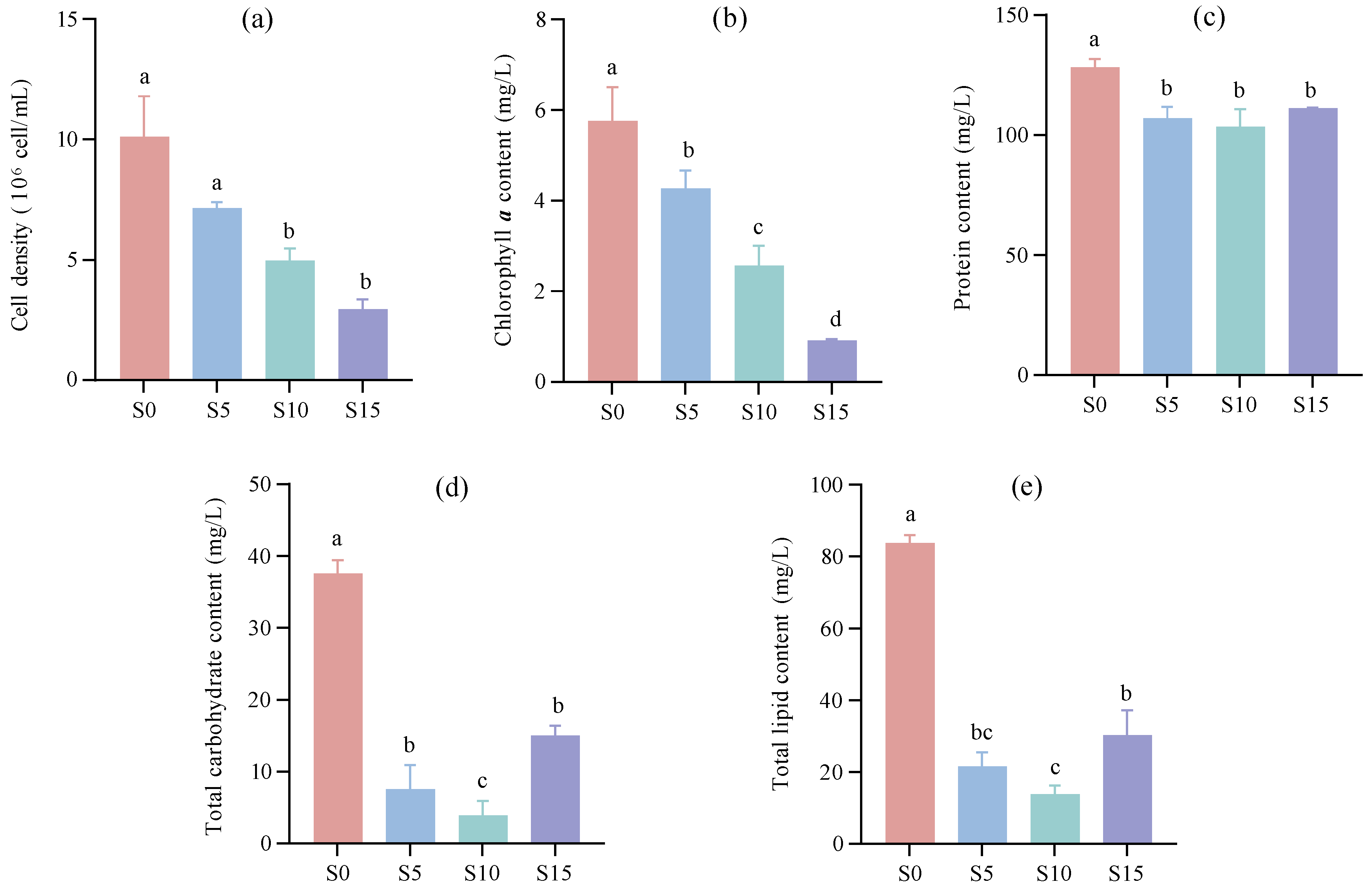
Within the salinity range of 0 to 15, both the cell density and chlorophyll a content of D. intermedius progressively decreased with increasing salinity (Figure 1a,b). The highest values were observed at salinity 0 (10.11 × 10⁶ cell·mL−1 and 5.76 mg·L−1, respectively), while the lowest occurred at salinity 15 (2.94 × 10⁶ cell·mL−1 and 0.91 mg·L−1). Statistical analysis confirmed a significant reduction in both parameters with rising salinity (p < 0.05), demonstrating salinity’s inhibitory effect on algal growth and photosynthetic pigment synthesis. For protein, total carbohydrate, and total lipid content, concentrations declined across the salinity range of 0 to 10 (Figure 1c–e), reaching minima at salinity 10 (103.49 mg·L−1, 3.87 mg·L−1, and 13.83 mg·L−1, respectively). Notably, all three biochemical parameters rebounded at salinity 15, exceeding levels recorded at salinity 5 and 10. Peak values occurred at salinity 0 (128.38 mg·L−1 protein, 37.60 mg·L−1 carbohydrate, 83.77 mg·L−1 lipid), indicating severe metabolic disruption at intermediate salinity followed by partial acclimation at the highest salinity.

3.2. ASV Analysis and Taxonomic Composition Profiling of Epiphytic Bacterial Communities Associated with D. intermedius

After sequencing the four salinity-level samples, 1,251,407 raw sequences were processed through stringent quality control, retaining 1,132,095 high-quality sequences. The sequences were denoised, merged, and filtered for chimeras using the DADA2 algorithm, yielding 2960 exact amplicon sequence variants (ASVs). All representative ASVs sequences were successfully annotated, confirming the high biological reliability of the generated dataset. Following taxonomic assignment, compositional variations in the epiphytic bacterial community of D. intermedius were assessed across salinity gradients.
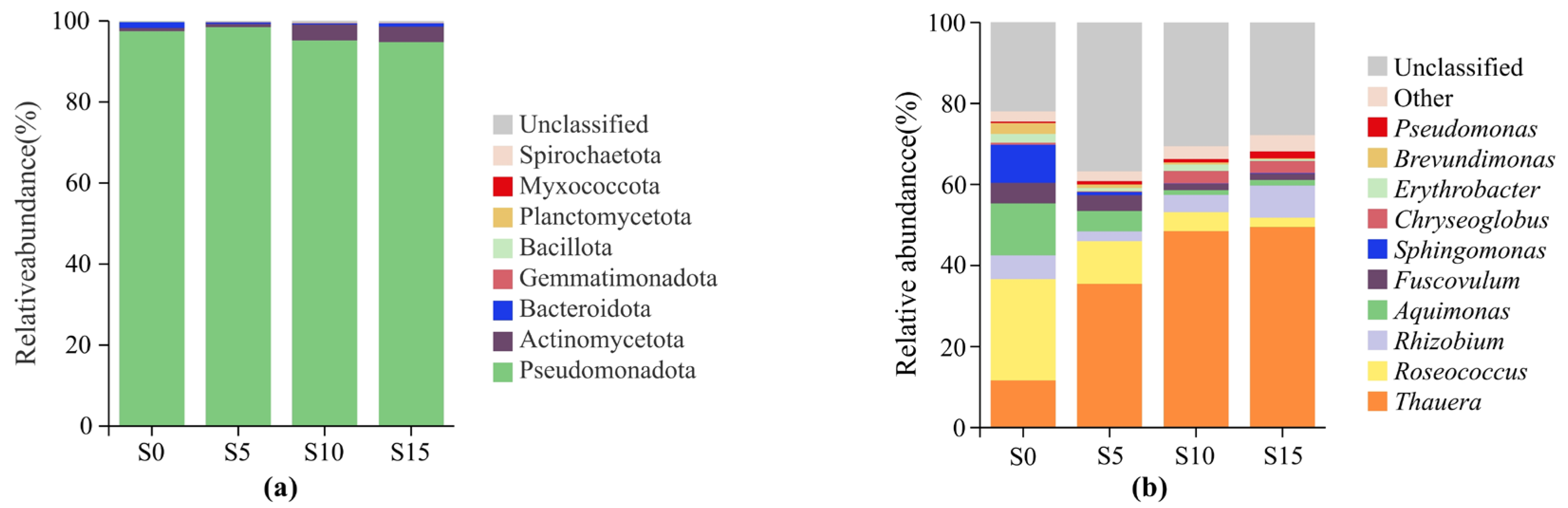
Taxonomic assignment of amplicon sequence variants (ASVs) was performed against the SILVA database using the RDP Classifier with a Naïve Bayesian algorithm at a 0.8 confidence threshold. The results revealed that all 2960 ASVs were classified into 8 phyla, 10 classes, 27 orders, 43 families, and 66 genera. The community structure at the phylum and genus levels as relative abundance is depicted in Figure 2 for each experimental group. Pseudomonadota constituted the dominant phylum in all four groups, comprising over 90% of the relative abundance (Figure 2a). Members of this phylum contribute to nitrogen cycling by converting algal-derived nitrogenous compounds into nitrite and nitrate. Under adverse conditions such as stress or senescence, certain strains can produce algicidal enzymes that mediate lysis of algal cells, consequently accelerating their demise. Furthermore, Actinomycetota are capable of establishing stable symbiotic associations with green algae, providing protective effects and fostering algal growth. At the genus level, Thauera, Roseococcus, and Aquimonas were the dominant genera (Figure 2b). The relative abundance of Thauera increased with salinity, constituting 11% of the community in the control group but rising to 40% under high salinity (S15), whereas both Roseococcus and Aquimonas declined with increasing salinity.
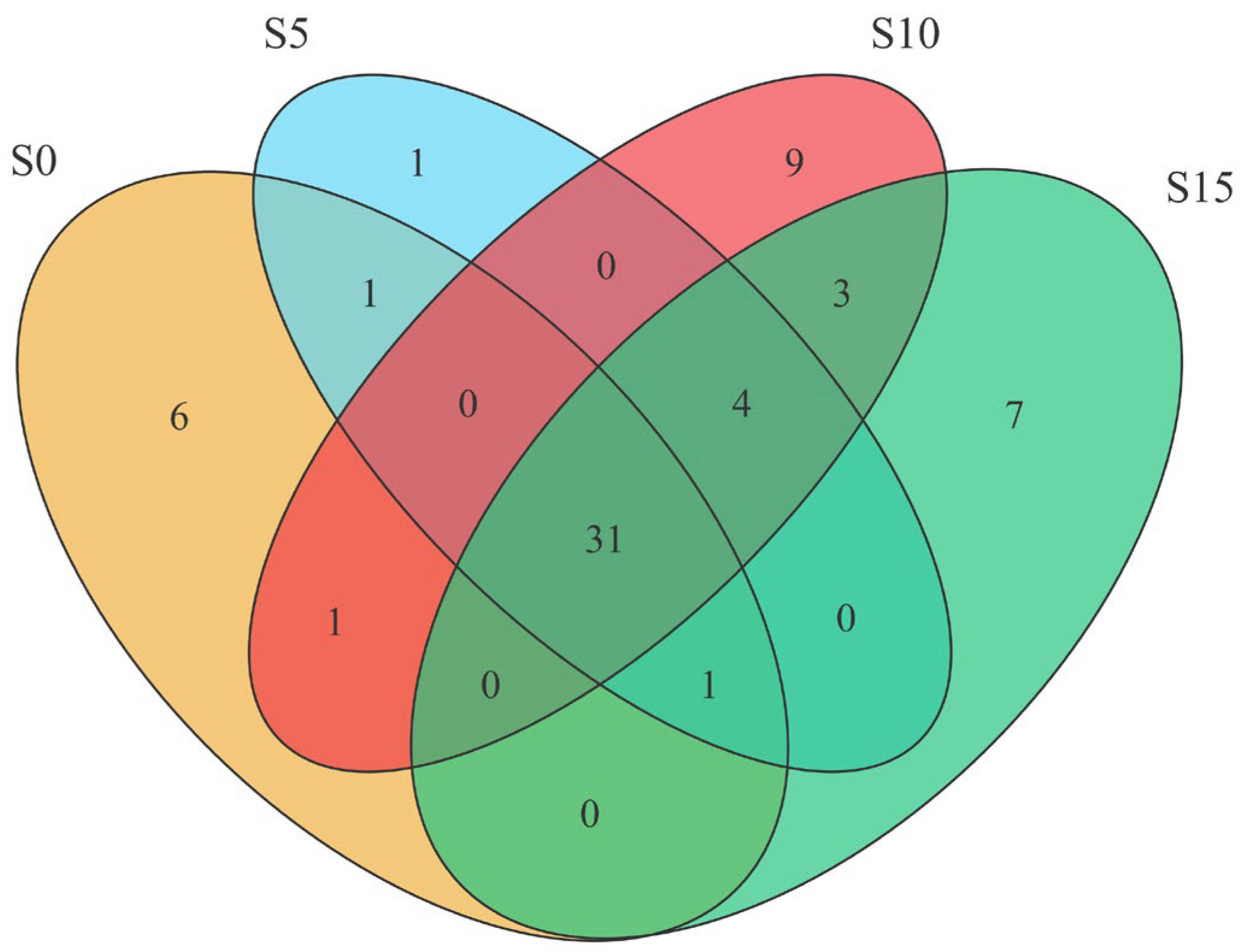
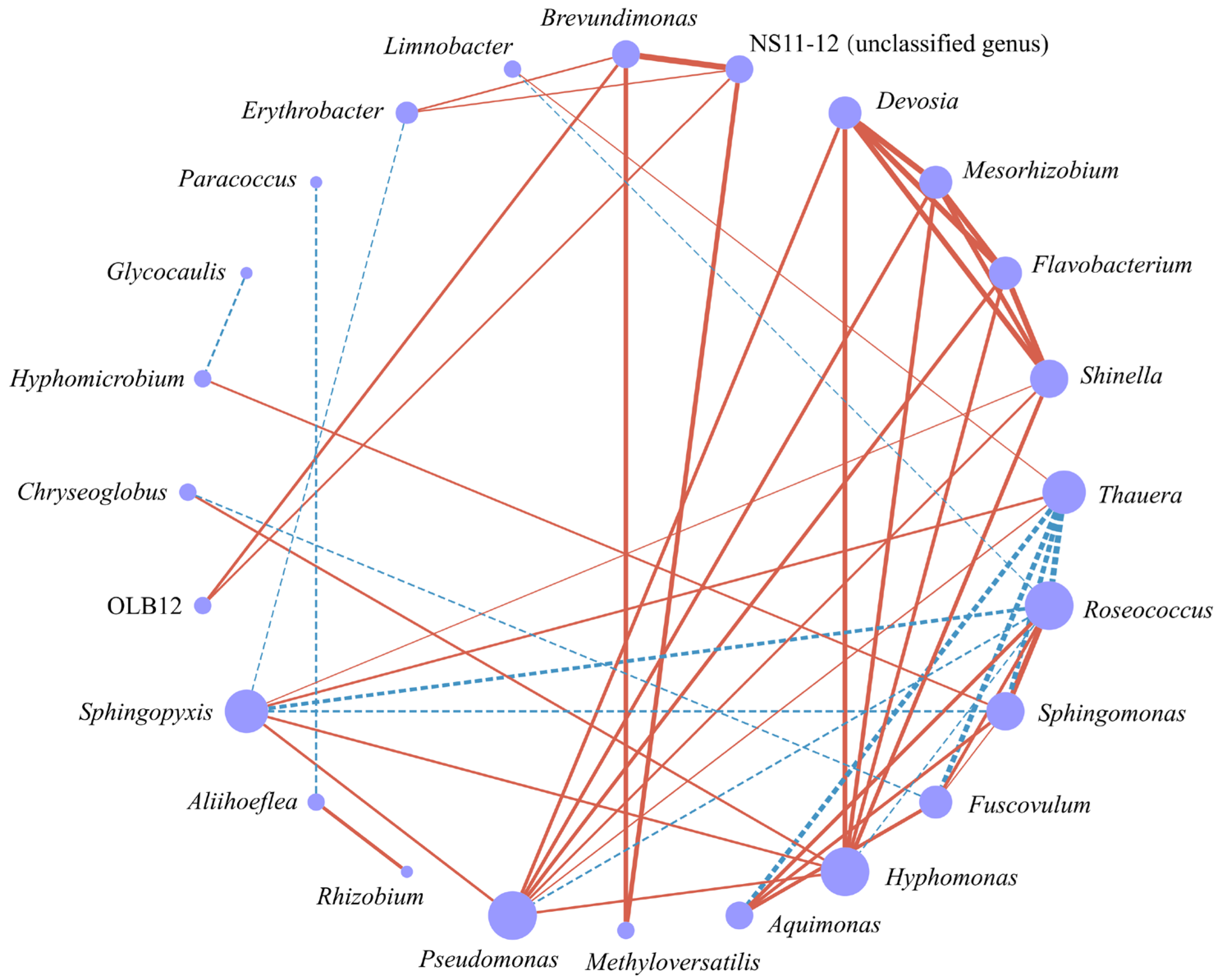
Using the taxonomic annotation results, we identified taxa showing significant inter-group abundance differences and high indicator values. Figure 3 shows that 31 genera were shared across all salinity groups, whereas unique genera were few in each group. Figure 4 illustrates inter-genus correlations within the epiphytic community, revealing significant negative correlations between Thauera and both Roseococcus and Aquimonas, but a positive correlation between Roseococcus and Aquimonas among the top five most abundant genera. These results demonstrate distinct co-occurrence patterns in the epiphytic bacteria of D. intermedius under non-saline versus saline conditions, indicating salinity substantially influences bacterial abundance dynamics.

3.3. Genus Diversity Analysis of the Epiphytic Bacterial Community in D. intermedius

Alpha diversity quantifies taxonomic richness within localized homogeneous ecosystems through indices reflecting species abundance and diversity. This study employed the Shannon-Wiener Diversity Index and Simpson’s Diversity Index to evaluate bacterial community structure. Both indices measure species richness and evenness, with the Shannon index emphasizing evenness sensitivity to uniform distribution of individuals across species, resulting in higher values when species abundances are more even. Conversely, the Simpson index focuses on the influence of dominant species, showing heightened sensitivity to increased proportions of dominant taxa and generating lower values when few dominant groups prevail.
Beta diversity compares taxonomic composition across distinct communities, encompassing differences in both taxon identity and relative abundance. UPGMA clustering, a hierarchical method, constructs dendrograms based on pairwise distances between samples or taxonomic groups to visualize community similarities. We employed Bray-Curtis distance, which accounts for taxon presence/absence and relative abundance, to accurately characterize β-diversity in community structure through reflecting compositional and quantitative disparities.
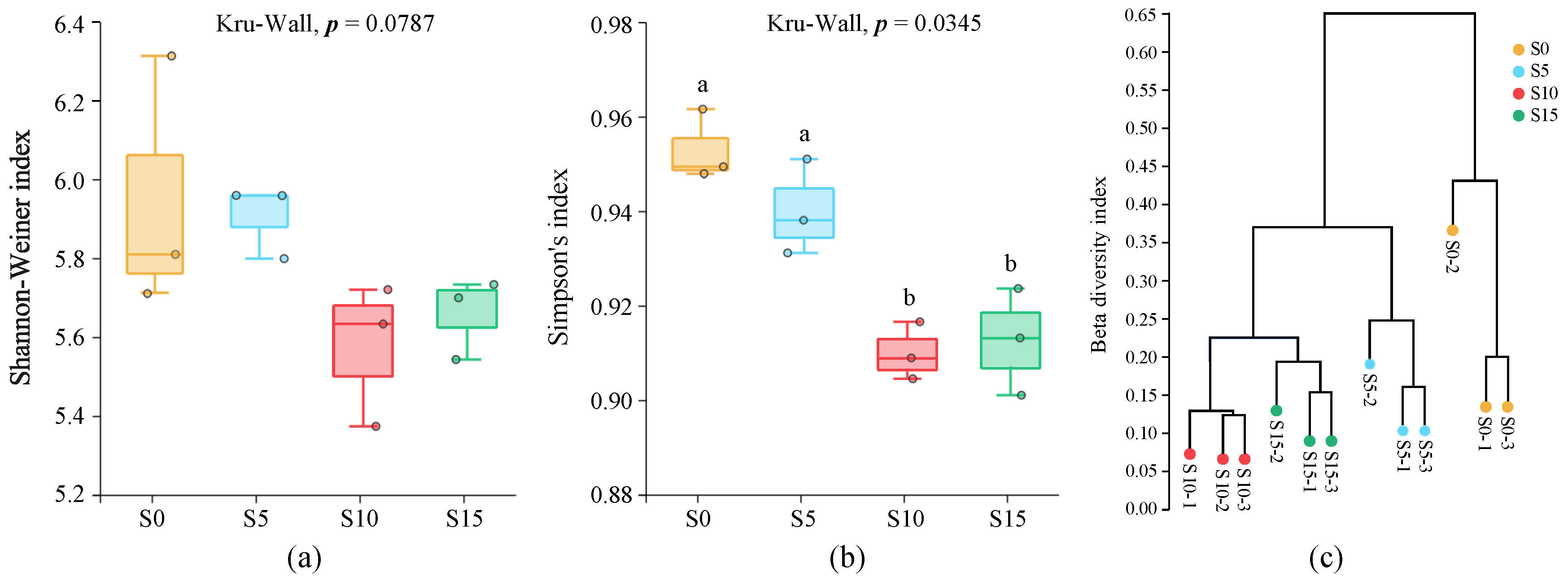
Among different salinity levels, no significant differences in Shannon Index were observed among the four groups (p > 0.05; Figure 5a), though S0 had the highest value, suggesting more even distribution of taxa. The Simpson Index was significantly higher in S0 than in S5, S10, and S15 (p < 0.05; Figure 5b), suggesting increased dominance of taxa in saline groups. UPGMA clustering (Figure 5c) revealed distinct branches for each salinity group, demonstrating significant inter-group divergence in epiphytic communities. In particular, S0 exhibited higher biodiversity with greater evenness, while all groups displayed marked dissimilarities.

3.4. Functional Prediction Analysis of the Epiphytic Bacterial Community in D. intermedius

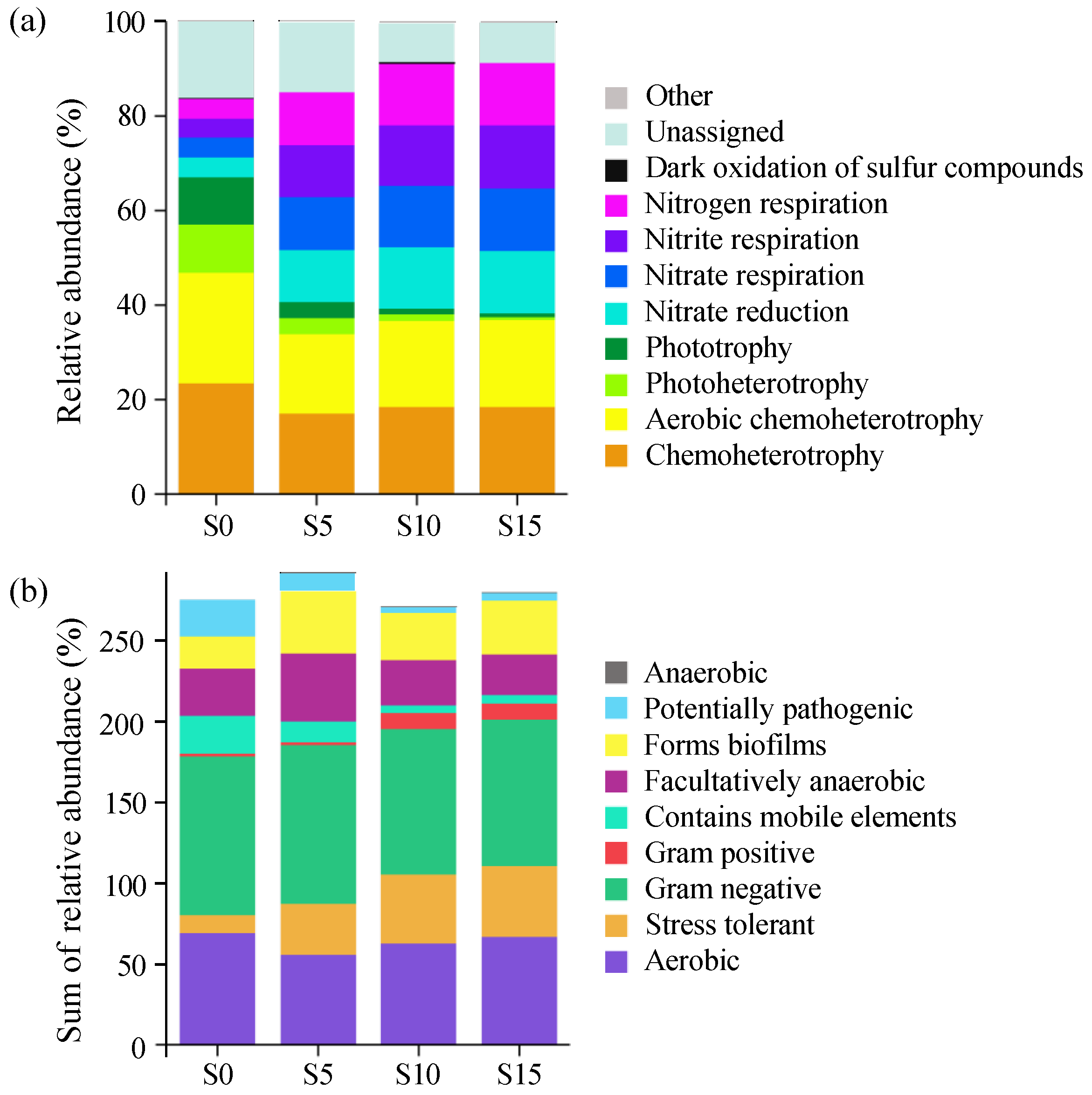
Functional annotation of all ASVs was conducted using the FAPROTAX database. The analysis focused on ASVs with taxonomic assignments at the genus level or higher that were also represented in the FAPROTAX database. FAPROTAX is specialized for predicting microbial metabolic processes in aquatic ecosystems including marine and lacustrine environments, and is routinely employed in biogeochemical cycling research. The results revealed that carbon and nitrogen metabolism represented central metabolic functions in the D. intermedius epiphytic bacterial community. As shown in Figure 6a, under different salinity conditions, carbon metabolism-related functions including chemoheterotrophy, photoheterotrophy, and aerobic chemoheterotrophy slightly decreased with increasing salinity. In contrast, nitrogen cycle-related functions such as nitrogen respiration, nitrite respiration, nitrate respiration, and nitrate reduction were consistently elevated compared to the control group S0.
The phenotypic profile of the microbial community was predicted through the BugBase online platform, leveraging all ASVs sequences along with their taxonomic assignments from the Greengenes database. The tool integrates functional gene annotations from the IMG, KEGG, and PATRIC databases to classify phenotypes into seven primary categories: Gram Positive, Gram Negative, Biofilm Forming, Pathogenic, Mobile Element Containing, and Oxygen Utilization with its subtypes Aerobic, Anaerobic, and Facultatively Anaerobic. As shown in Figure 6b, phenotypic profiling via BugBase indicated that the S0 epiphytic community displayed elevated prevalence of mobile genetic elements, aerobic metabolism, and pathogenic potential, along with reduced stress tolerance relative to other salinity groups. Additionally, whereas Gram-negative bacteria maintained consistent abundances across experimental groups, Gram-positive bacteria were less abundant in the S0 and S5 groups.

3.5. Environmental Factor Analysis of the Epiphytic Bacterial Community in D. intermedius

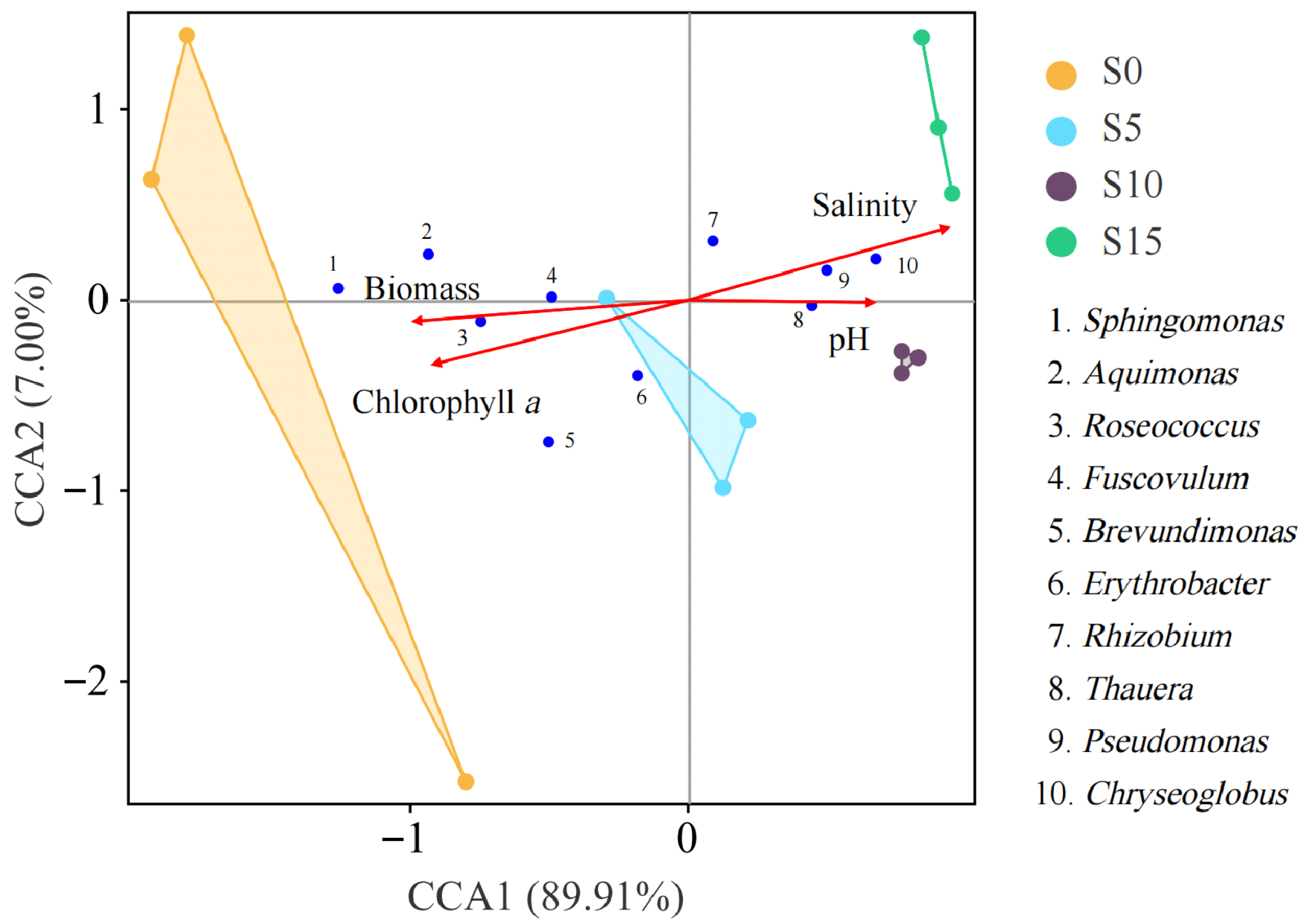
CCA elucidated the interrelationships among samples, environmental factors, and bacterial taxa in the D. intermedius epiphytic community. The magnitude of influence of each environmental variable is indicated by the length of its corresponding arrow, whereas the ecological niches and affinities of samples and taxa are interpreted from their orthogonal projections onto the ordination axes. Specifically, salinity demonstrated the strongest influence, as indicated by its arrow length and close alignment with the first ordination axis, which accounted for 96.91% of the variance. This identifies salinity as the primary determinant of community succession. Sample distribution further confirmed this, with clear separation along the salinity gradient reflecting structurally distinct bacterial communities under different salinity regimes. Based on the distribution patterns of dominant bacterial taxa identified in Section 3.2, Thauera was positioned distally along the salinity gradient vector in the ordination plot (Figure 7), consistent with its halotolerant nature. In contrast, Roseococcus occurred oppositely to the salinity axis and showed positive association with algal biomass parameters, indicating salt sensitivity and a close ecological relationship with the algal host.

4. Discussion

4.1. Effects of Salinity on Growth and Biochemical Composition

In this study, both cell density and chlorophyll a content of D. intermedius decreased progressively with increasing salinity, aligning with Delpy’s report of reduced chlorophyll a synthesis in Chlorella under elevated salinity. This suggests potential impairment of photosynthetic structures under high-salinity stress [17]. The content of protein, total carbohydrates, and total lipids declined initially followed by recovery. As noted by Wang [18], although salinity shifts alter algal physiological activity, collaborative bacterial interactions and upregulated synthesis of polysaccharides and proteins can effectively prevent cytoplasmic plasmolysis. Furthermore, Kaumeel demonstrated that salinity induces oxidative stress in Acutodesmus dimorphus, thereby enhancing lipid accumulation [19]. These findings collectively indicate that D. intermedius adapts to salinity variations through synergistic partnerships and homeostatic adjustments.

4.2. Effects of Salinity on Diversity, Abundance, and Function of Epiphytic Bacteria

Interactions within epiphytic algal-bacterial communities significantly influence algal growth [20,21,22], encompassing both mutualistic and competitive relationships between microalgae and bacteria. Aerobic and chemoheterotrophic bacteria compete with microalgae for oxygen and nutrients [23], while the Rhodobacteraceae bacteria play crucial roles in denitrification and nitrate reduction by utilizing nitrate nitrogen for metabolic activities. In this study, the increasing prevalence of denitrification and nitrate reduction under higher salinity indicates intensified competition for nitrogen sources between Rhodobacteraceae and microalgae. Additionally, synergistic relationships exist between D. intermedius and specific bacteria: Thauera, a genus, demonstrates macromolecular decomposition capabilities [24]. This study observed a positive correlation between salinity levels and the relative abundance of Thauera. Elevated salinity appeared to suppress other epiphytic bacteria, whereas Thauera, owing to its metabolic versatility especially demonstrated through diverse respiratory pathways, exhibited enhanced adaptation to saline stress and consequently achieved dominance within the community. Under salinity stress, microalgae undergo physiological changes that enhance the release of organic compounds and nitrogenous metabolites. The proliferation of Thauera promotes efficient elimination of these metabolites, establishing a dynamic, non-symbiotic partnership with microalgae that contributes to systemic resilience under stress conditions. The observed dominance of Thauera serves as an ecological indicator, reflecting superior nutrient competitiveness and elevated algicidal potential within this bacterial taxon. Under deteriorating algal conditions induced by nutrient deprivation or light limitation, Thauera can transition from metabolizing algal-derived organic matter to actively decomposing living algal cells, thereby accelerating population collapse and compromising system integrity.
Environmental factors also profoundly impact microalgal growth and epiphytic community composition [25,26]. Salinity is recognized as a primary driver of bacterial communities in lakes [27], coastal waters [28], estuaries [29], and marine environments [30]. Bacteria exhibit more complex and sensitive salinity responses than macroorganisms. High salinity elevates osmotic pressure, reduces metabolic enzyme activity, disrupts microbial enzyme structures, and inhibits growth [31]; conversely, bacteria develop physiological adaptations to mitigate these effects [32]. Salinity-dependent shifts in dominant epiphytic genera were observed: Zhang [33] reported Roseococcus (a bacteriochlorophyll-containing bacterium with potential photosynthetic advantages) as dominant in Ochromonas and Chlorella at zero salinity. Similarly, our study identified Roseococcus as accounting for 24.97% in freshwater-cultured D. intermedius. In saline wastewater treatment systems, Thauera abundance fluctuates substantially, reaching 19% in Aerobic Granular Sludge under salt stress-exceeding levels in non-saline conditions [34]. The findings indicate that Roseococcus, a representative photoheterotroph, forms a mutualistic association with microalgae under low-salinity conditions, mediated by the degradation of algal-derived organics and secretion of bioactive compounds. The marked reduction in Roseococcus abundance signifies that salinity stress induces a reorganization of the phycosphere microbiota, resulting in a functional transition from a photoheterotrophic metabolic state dominated by Roseococcus to a halotolerant chemoheterotrophic regime primarily represented by taxa such as Thauera. This functional succession could impair organic carbon transformation in the algal-bacterial system, potentially undermining the stability and functional equilibrium of their interactions.

4.3. Relationships Between Epiphytic Bacterial Communities and Environmental Factors

Environmental factors govern the assembly and spatial patterning of epiphytic bacterial communities. Zhang demonstrated that factors like tillage depth profoundly affect community structure in tobacco-planted soils [35]. Zhu investigaed pond water environmental factors and intestinal microbiota dynamics in Lateolabrax japonicus and found that increasing nitrogen and phosphorus concentrations during cultivation reduced the proportion of probiotics in gut bacterial communities [36]. This study investigated the influences of salinity, algal density, chlorophyll a, and pH on the epiphytic bacterial community as well as specific taxa. Salinity exhibited a strong negative correlation with the S0 group, a weak positive correlation with S5, and strong positive correlations with the S10 and S15 groups. The epiphytic bacterial communities exhibited a clear progression along the salinity gradient from S0 to S15, establishing salinity as the primary determinant of sample distribution. Algal density and chlorophyll a showed distinct correlation patterns across salinity groups: strongly positive with S0, weakly positive with S5, and negative with both S10 and S15. The two algal biomass indicators exhibited an inverse relationship with the salinity vector, indicating that salinity elevation substantially suppresses algal proliferation. In contrast, pH displayed its strongest positive correlation with the S5 and S10 groups, particularly S5, while maintaining weaker associations with S0 and S15. This distinct response pattern suggests pH exerts its primary influence under moderate salinity conditions within the phycosphere microenvironment. The pH vector was oriented orthogonally to the principal salinity gradient in the ordination space, suggesting that its influence operates independently of salinity, with maximal effects observed under intermediate salinity conditions. The CCA ordination revealed divergent niche partitioning between the relatively abundant taxa Thauera and Roseococcus. Thauera exhibited a clear association with high-salinity conditions, indicating halotolerant adaptation, whereas Roseococcus was closely linked to low-salinity environments with elevated algal biomass, suggesting both salt sensitivity and an obligate relationship with the algal host.

5. Conclusions

Salinity levels significantly influenced key physiological parameters of D. intermedius, including algal density, chlorophyll a content, and concentrations of protein, total carbohydrates, and total lipids. Regarding the epiphytic bacterial community, although taxonomic composition remained similar across salinity treatments, the community structure diverged substantially: the control group (S0) demonstrated significantly greater biodiversity and more even species distribution compared to experimental groups, which conversely showed selective enrichment of specific dominant taxa. Of particular note, the expansion of the halotolerant genus Thauera substantially augmented nitrogen-cycling processes, particularly denitrification, whereas the concurrent decline of the salt-sensitive Roseococcus diminished key carbon-processing pathways including photoheterotrophy and aerobic chemoheterotrophy. This metabolic transition reveals a fundamental reorientation of energy acquisition strategies, shifting from aerobic carbon metabolism toward anaerobic nitrogen-based respiration, illustrating a key mechanism of microbial environmental adaptation through niche differentiation.

Author Contributions

Conceptualization, Y.Z. and N.Z.; methodology, Y.Z.; investigation, X.C., J.L., F.Z., W.C., Y.W. and T.L.; data curation, T.L., X.C. and Y.Z.; writing—original draft preparation, T.L., X.C. and S.C.D.P.; writing—review and editing, N.Z. and Y.Z.; funding acquisition, N.Z. and Y.Z. All authors have read and agreed to the published version of the manuscript.

Funding

This research was supported by the Modern Seed Industry Park for Whiteleg Shrimp of Guangdong Province (No. K22226), the Science and Technology Program of Linzhi (LZZX2025-09), the Program for Scientific Research Start-up Funds of Guangdong Ocean University (Nos. 060302022102, 0603022022307).

Institutional Review Board Statement

Not applicable.

Data Availability Statement

The original contributions presented in this study are included in the article. Further inquiries can be directed to the corresponding authors.

Acknowledgments

We are grateful for the financial support from the Modern Seed Industry Park for Whiteleg Shrimp of Guangdong Province; and also greatly appreciate the constructive advice of anonymous reviewers.

Conflicts of Interest

The authors declare no conflicts of interest. The funders had no role in the design of the study; in the collection, analyses, or interpretation of data; in the writing of the manuscript; or in the decision to publish the results.

References

  1. Bell, W.; Mitchell, R. Chemotactic and Growth Responses of Marine Bacteria to Algal Extracellular Products. Biol. Bull. 1972, 143, 265–277. [Google Scholar] [CrossRef]
  2. Chen, H.; Yu, S.; Yu, Z.; Ma, M.; Liu, M.; Pei, H. Phycoremediation Potential of Salt-Tolerant Microalgal Species: Motion, Metabolic Characteristics, and Their Application for Saline–Alkali Soil Improvement in Eco-Farms. Microorganisms 2024, 12, 676. [Google Scholar] [CrossRef]
  3. Bafana, A. Characterization and Optimization of Production of Exopolysaccharide from Chlamydomonas reinhardtii. Carbohydr. Polym. 2013, 95, 746–752. [Google Scholar] [CrossRef] [PubMed]
  4. You, Z.; Zhang, Q.; Peng, Z.; Miao, X. Lipid Droplets Mediate Salt Stress Tolerance in Parachlorella kessleric. Plant Physiol. 2019, 181, 510–526. [Google Scholar] [CrossRef]
  5. Iwamoto, K.; Shiraiwa, Y. Salt-Regulated Mannitol Metabolism in Algae. Mar. Biotechnol. 2005, 7, 407–415. [Google Scholar] [CrossRef] [PubMed]
  6. Oslan, S.N.H.; Shoparwe, N.F.; Yusoff, A.H.; Rahim, A.A.; Chang, C.S.; Tan, J.S.; Oslan, S.N.; Arumugam, K.; Ariff, A.B.; Sulaiman, A.Z.; et al. A Review on Haematococcus pluvialis Bioprocess Optimization of Green and Red Stage Culture Conditions for the Production of Natural Astaxanthin. Biomolecules 2021, 11, 256. [Google Scholar] [CrossRef]
  7. Wang, T.; Ge, H.; Liu, T.; Tian, X.; Wang, Z.; Guo, M.; Chu, J.; Zhuang, Y. Salt Stress Induced Lipid Accumulation in Heterotrophic Culture Cells of Chlorella protothecoides: Mechanisms Based on the Multi-Level Analysis of Oxidative Response, Key Enzyme Activity and Biochemical Alteration. J. Biotechnol. 2016, 228, 18–27. [Google Scholar] [CrossRef] [PubMed]
  8. Li, Z.; Peng, S.; Li, Q.; Wei, S.; Zhang, Q.; An, X.; Li, H. Exploration of Two-Stage Cultivation Strategy Using Nitrogen Limited and Phosphorus Sufficient to Simultaneously Improve the Biomass and Lipid Productivity in Desmodesmus intermedius Z8. Fuel 2023, 338, 127306. [Google Scholar] [CrossRef]
  9. Li, Z.; Yang, S.; Zhou, Z.; Peng, S.; Zhang, Q.; Long, H.; Li, H. Enhancement of Lipid Production in Desmodesmus intermedius Z8 by Ultrasonic Stimulation Coupled with Nitrogen and Phosphorus Stress. Biochem. Eng. J. 2021, 172, 108061. [Google Scholar] [CrossRef]
  10. Samo, T.J.; Rolison, K.A.; Swink, C.J.; Kimbrel, J.A.; Yilmaz, S.; Mayali, X. The Algal Microbiome Protects Desmodesmus intermedius from High Light and Temperature Stress. Algal Res. 2023, 75, 103245. [Google Scholar] [CrossRef]
  11. Yang, B.; Li, Y.; Wang, Z.; Yue, Z.; Wen, J.; Zhao, X.; Zhang, H.; Wang, X.; Wang, X.; Zhang, M. Strong Inhibitory Effects of Desmodesmus sp. on Microcystis Blooms: Potential as a Biological Control Agent in Aquaculture. Aquac. Rep. 2025, 40, 102579. [Google Scholar] [CrossRef]
  12. Yang, Q.; Zhang, M.; Alwathnani, H.A.; Usman, M.; Mohamed, B.A.; Abomohra, A.E.-F.; Salama, E.-S. Cultivation of Freshwater Microalgae in Wastewater under High Salinity for Biomass, Nutrients Removal, and Fatty Acids/Biodiesel Production. Waste Biomass Valorization 2022, 13, 3245–3254. [Google Scholar] [CrossRef]
  13. Stanier, R.Y.; Kunisawa, R.; Mandel, M.; Cohen-Bazire, G. Purification and Properties of Unicellular Blue-Green Algae (Order Chroococcales). Bacteriol. Rev. 1971, 35, 171–205. [Google Scholar] [CrossRef]
  14. Xiang, B.-B.; Zhu, Y.-R.; Wang, W.-J.; Bai, Y.-L.; Wang, Y. Cell Line Screening of Catharanthus roseus for High Yield Production of Ajmalicine. J. Med. Plants Res. 2011, 3, 420–424. [Google Scholar]
  15. Jain, V.; Karibasappa, G.; Dodamani, A.; Mali, G. Estimating the Carbohydrate Content of Various Forms of Tobacco by Phenol-Sulfuric Acid Method. J. Educ. Health Promot. 2017, 6, 90. [Google Scholar] [CrossRef] [PubMed]
  16. Izard, J.; Limberger, R.J. Rapid Screening Method for Quantitation of Bacterial Cell Lipids from Whole Cells. J. Microbiol. Methods 2003, 55, 411–418. [Google Scholar] [CrossRef]
  17. Delpy, F.; Lucas, Y.; Merdy, P. Evaluation of Roundup® Effects on Chlorella vulgaris through Spectral Changes in Photosynthetic Pigments in Fresh and Marine Water. Environ. Adv. 2022, 8, 100240. [Google Scholar] [CrossRef]
  18. Wang, T.; Li, D.; Tian, X.; Huang, G.; He, M.; Wang, C.; Kumbhar, A.N.; Woldemicael, A.G. Mitigating Salinity Stress through Interactions between Microalgae and Different Forms (Free-Living & Alginate Gel-Encapsulated) of Bacteria Isolated from Estuarine Environments. Sci. Total Environ. 2024, 926, 171909. [Google Scholar] [CrossRef]
  19. Chokshi, K.; Pancha, I.; Ghosh, A.; Mishra, S. Salinity Induced Oxidative Stress Alters the Physiological Responses and Improves the Biofuel Potential of Green Microalgae Acutodesmus dimorphus. Bioresour. Technol. 2017, 244, 1376–1383. [Google Scholar] [CrossRef] [PubMed]
  20. Xia, P.; Yan, D.; Sun, R.; Song, X.; Lin, T.; Yi, Y. Community Composition and Correlations between Bacteria and Algae within Epiphytic Biofilms on Submerged Macrophytes in a Plateau Lake, Southwest China. Sci. Total Environ. 2020, 727, 138398. [Google Scholar] [CrossRef] [PubMed]
  21. Florez, J.Z.; Camus, C.; Hengst, M.B.; Buschmann, A.H. A Functional Perspective Analysis of Macroalgae and Epiphytic Bacterial Community Interaction. Front. Microbiol. 2017, 8, 2561. [Google Scholar] [CrossRef]
  22. Lian, J.; Wijffels, R.H.; Smidt, H.; Sipkema, D. The Effect of the Algal Microbiome on Industrial Production of Microalgae. Microb. Biotechnol. 2018, 11, 806–818. [Google Scholar] [CrossRef]
  23. González-Camejo, J.; Barat, R.; Pachés, M.; Murgui, M.; Seco, A.; Ferrer, J. Wastewater Nutrient Removal in a Mixed Microalgae–Bacteria Culture: Effect of Light and Temperature on the Microalgae–Bacteria Competition. Environ. Technol. 2018, 39, 503–515. [Google Scholar] [CrossRef]
  24. Tec-Campos, D.; Tibocha-Bonilla, J.D.; Jiang, C.; Passi, A.; Thiruppathy, D.; Zuñiga, C.; Posadas, C.; Zepeda, A.; Zengler, K. A Genome-Scale Metabolic Model for the Denitrifying Bacterium Thauera sp. MZ1T Accurately Predicts Degradation of Pollutants and Production of Polymers. PLoS Comput. Biol. 2025, 21, e1012736. [Google Scholar] [CrossRef]
  25. Voolstra, C.R.; Ziegler, M. Adapting with Microbial Help: Microbiome Flexibility Facilitates Rapid Responses to Environmental Change. BioEssays 2020, 42, 2000004. [Google Scholar] [CrossRef]
  26. Moreno-Garcia, L.; Gariépy, Y.; Barnabé, S.; Raghavan, G.S.V. Effect of Environmental Factors on the Biomass and Lipid Production of Microalgae Grown in Wastewaters. Algal Res. 2019, 41, 101521. [Google Scholar] [CrossRef]
  27. Li, Z.; Gao, Y.; Wang, S.; Lu, Y.; Sun, K.; Jia, J.; Wang, Y. Phytoplankton Community Response to Nutrients along Lake Salinity and Altitude Gradients on the Qinghai-Tibet Plateau. Ecol. Indic. 2021, 128, 107848. [Google Scholar] [CrossRef]
  28. Wang, N.; Xiong, J.; Wang, X.C.; Zhang, Y.; Liu, H.; Zhou, B.; Pan, P.; Liu, Y.; Ding, F. Relationship between Phytoplankton Community and Environmental Factors in Landscape Water with High Salinity in a Coastal City of China. Environ. Sci. Pollut. Res. 2018, 25, 28460–28470. [Google Scholar] [CrossRef] [PubMed]
  29. Zhang, G.; Bai, J.; Tebbe, C.C.; Zhao, Q.; Jia, J.; Wang, W.; Wang, X.; Yu, L. Salinity Controls Soil Microbial Community Structure and Function in Coastal Estuarine Wetlands. Environ. Microbiol. 2021, 23, 1020–1037. [Google Scholar] [CrossRef]
  30. Fortunato, C.S.; Crump, B.C. Microbial Gene Abundance and Expression Patterns across a River to Ocean Salinity Gradient. PLoS ONE 2015, 10, e0140578. [Google Scholar] [CrossRef] [PubMed]
  31. Hong, J.; Li, W.; Lin, B.; Zhan, M.; Liu, C.; Chen, B.-Y. Deciphering the Effect of Salinity on the Performance of Submerged Membrane Bioreactor for Aquaculture of Bacterial Community. Desalination 2013, 316, 23–30. [Google Scholar] [CrossRef]
  32. Remonsellez, F.; Castro-Severyn, J.; Pardo-Esté, C.; Aguilar, P.; Fortt, J.; Salinas, C.; Barahona, S.; León, J.; Fuentes, B.; Areche, C.; et al. Characterization and Salt Response in Recurrent Halotolerant Exiguobacterium sp. SH31 Isolated from Sediments of Salar de Huasco, Chilean Altiplano. Front. Microbiol. 2018, 9, 2228. [Google Scholar] [CrossRef]
  33. Zhang, B.; Chen, J.; Su, Y.; Sun, W.; Zhang, A. Utilization of Indole-3-Acetic Acid–Secreting Bacteria in Algal Environment to Increase Biomass Accumulation of Ochromonas and Chlorella. Bioenerg. Res. 2022, 15, 242–252. [Google Scholar] [CrossRef]
  34. Liu, Y. Environmental Protection by Aerobic Granular Sludge Process; MDPI: Basel, Switzerland, 2024; ISBN 978-3-7258-0302-6. [Google Scholar]
  35. Zhang, Y.; Bo, G.; Shen, M.; Shen, G.; Yang, J.; Dong, S.; Shu, Z.; Wang, Z. Differences in Microbial Diversity and Environmental Factors in Ploughing-Treated Tobacco Soil. Front. Microbiol. 2022, 13, 924137. [Google Scholar] [CrossRef] [PubMed]
  36. Zhu, Z.; Xu, Y.-M.; Liang, J.-H.; Huang, W.; Chen, J.-D.; Wu, S.-T.; Huang, X.-H.; Huang, Y.-H.; Zhang, X.-Y.; Sun, H.-Y.; et al. Relationship of Environmental Factors in Pond Water and Dynamic Changes of Gut Microbes of Sea Bass Lateolabrax japonicus. Front. Microbiol. 2023, 14, 1086471. [Google Scholar] [CrossRef] [PubMed]
Figure 1. Changes in cell density, chlorophyll a, protein, total carbohydrate, and total lipid content of D. intermedius at different salinity conditions: (a) cell density; (b) chlorophyll a content; (c) protein content; (d) total carbohydrate content; (e) total lipid content. (letters a, b, c, and d in the figure indicate significant differences between groups, p < 0.05; S0, S5, S10, and S15 denote experimental groups with salinity of 0, 5, 10, and 15 respectively).
Diversity 17 00751 g001
Figure 2. Stacked bar chart showing the relative abundance of the epiphytic bacterial community of D. intermedius at phylum (a) and genus levels (b).
Diversity 17 00751 g002
Figure 3. Venn diagram at the genus level of the epiphytic bacterial community of D. intermedius.
Diversity 17 00751 g003
Figure 4. Co-occurrence correlation network of the epiphytic bacterial community in D. intermedius at the genus level. The network depicts observed positive (solid red lines) and negative (dashed blue lines) correlations. Node size represents relative abundance, and connection thickness corresponds to the correlation strength.
Diversity 17 00751 g004
Figure 5. Analysis of Shannon Index (a), Simpson Index (b), and genus-level of Bray-curtis distance (c) in D. intermedius epiphytic bacterial communities under different salinity conditions: (a) Shannon-Weiner index; (b) Simpson Index; (c) genus-level of Bray-Curtis distance. (letters a and b denote significant intergroup differences, p < 0.05).
Diversity 17 00751 g005
Figure 6. FAPROTAX functional prediction (a) and BugBase phenotype analysis (b) of D. intermedius epiphytic bacterial communities at different salinity conditions.
Diversity 17 00751 g006
Figure 7. CCA of the D. intermedius epiphytic bacterial community.
Diversity 17 00751 g007
Disclaimer/Publisher’s Note: The statements, opinions and data contained in all publications are solely those of the individual author(s) and contributor(s) and not of MDPI and/or the editor(s). MDPI and/or the editor(s) disclaim responsibility for any injury to people or property resulting from any ideas, methods, instructions or products referred to in the content.