Article

Does Ungulate Herbivory Translate into Diversity of Woody Plants? A Long-Term Study in a Montane Forest Ecosystem in Austria


by
Ursula Nopp-Mayr
1,*,†,
Eva Maria Schöll
1,†,
Frederik Sachser
1,2,
Susanne Reimoser
3 and
Friedrich Reimoser
1,3
1
Institute of Wildlife Biology and Game Management, Department of Integrative Biology and Biodiversity Research, University of Natural Resources and Life Sciences, Vienna, Gregor-Mendel-Str. 33, 1180 Vienna, Austria
2
Federal Research and Training Centre for Forests, Natural Hazards and Landscape (BFW), Department Forest Biodiversity & Nature Conservation, Seckendorff-Gudent-Weg 8, 1131 Vienna, Austria
3
Research Institute of Wildlife Ecology, Department of Interdisciplinary Life Sciences, University of Veterinary Medicine Vienna, Savoyenstraße 1, 1160 Vienna, Austria
*
Author to whom correspondence should be addressed.
These authors contributed equally to this work.
Diversity 2023, 15(2), 165; https://doi.org/10.3390/d15020165
Submission received: 20 December 2022 / Revised: 20 January 2023 / Accepted: 21 January 2023 / Published: 25 January 2023
(This article belongs to the Special Issue Ecology, Diversity, Conservation and Management of Ungulates)

Abstract

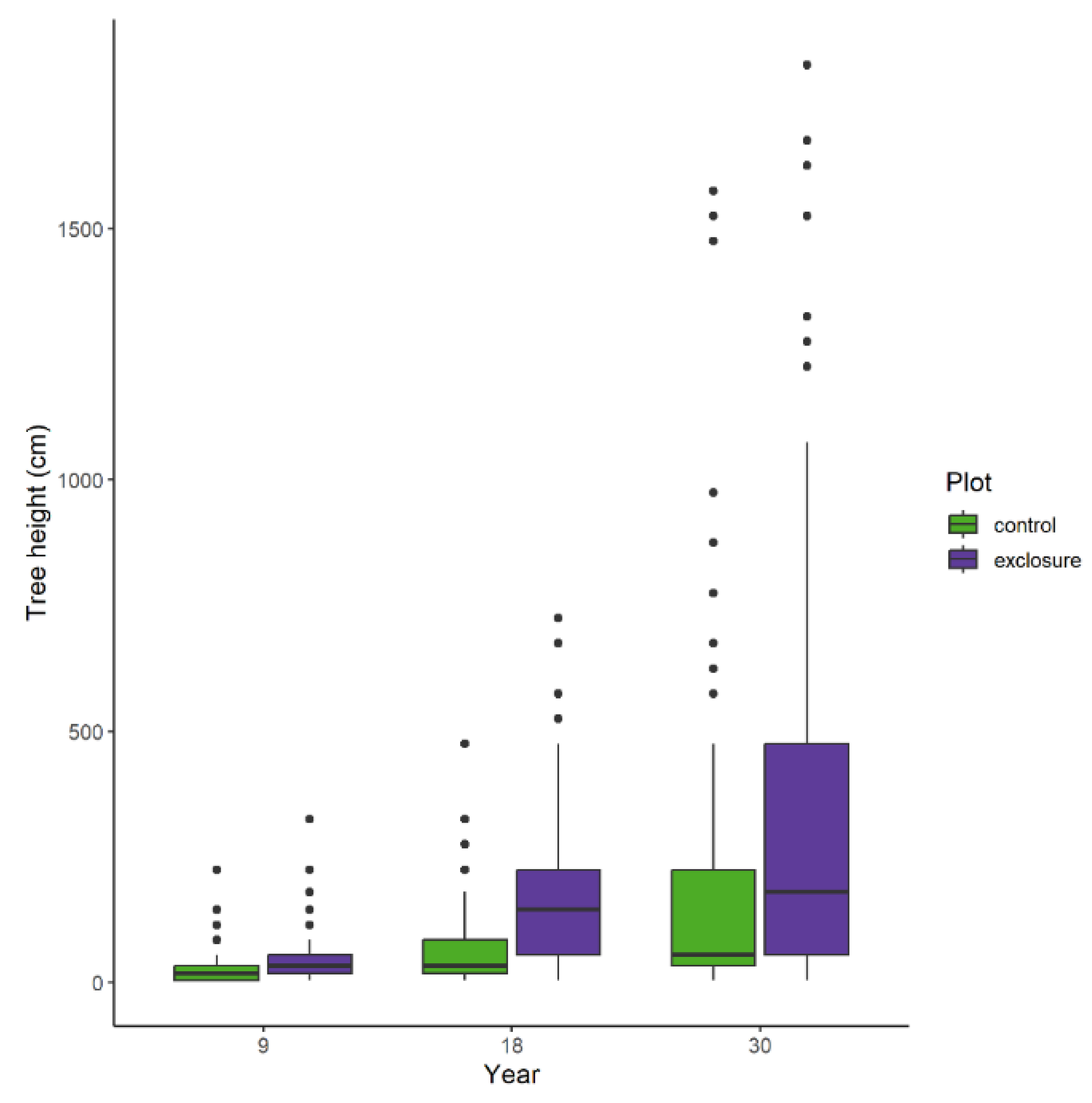
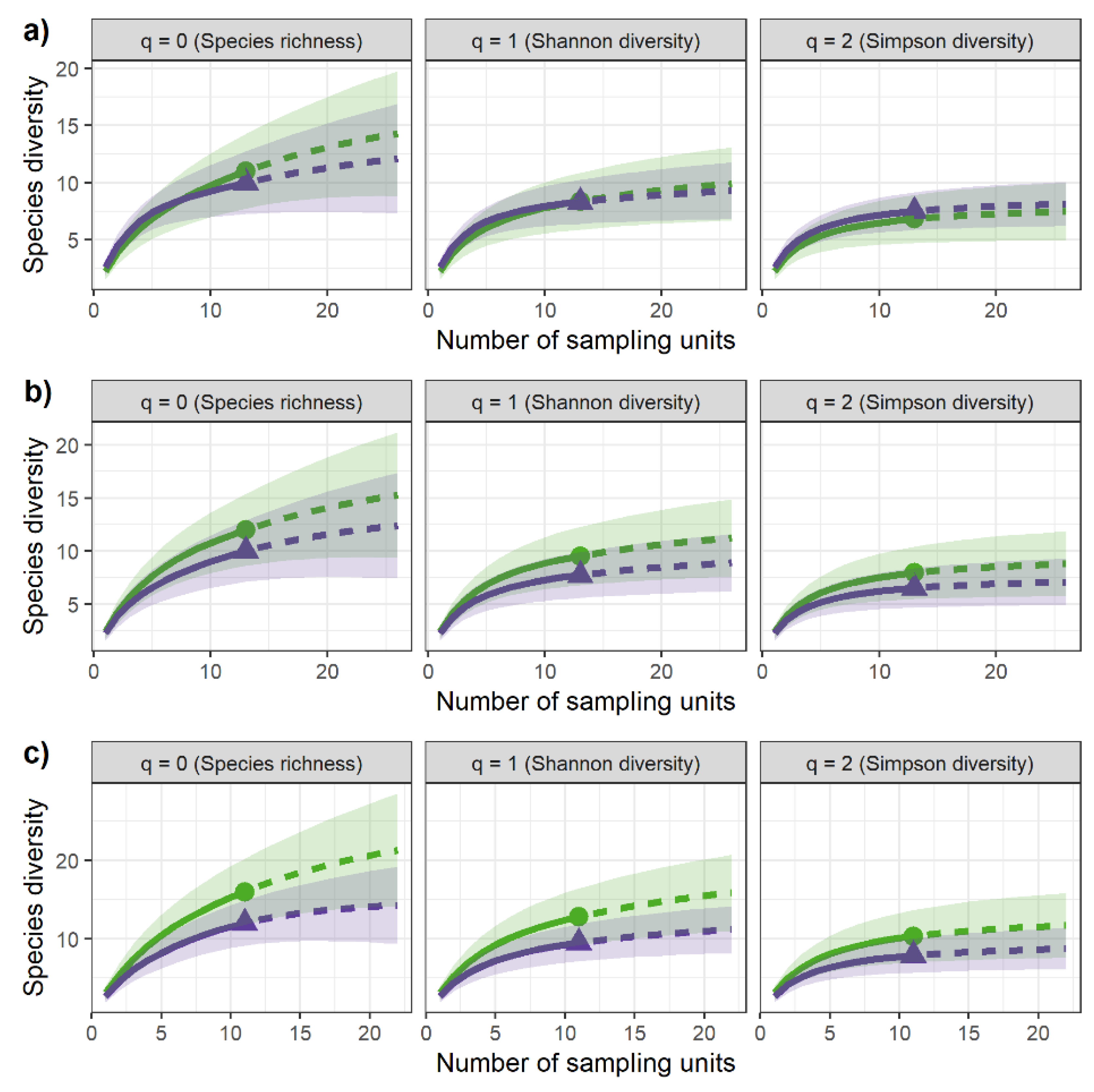
Different species-specific traits of woody plant species, feeding preferences of herbivores together with resulting effects on plant competition are expected to translate into different plant community structures and expressions of biodiversity. We studied the diversity of woody plant species (trees and shrubs) and structural diversity of forest trees, using a 30-year and an 18-year dataset of ungulate exclosure-control plot pairs in a mixed alpine forest community in Austria. We surveyed the tallest individuals per tree species and plot and analyzed the collective of top-height individuals per plot pair. Incidence data for exclosure and control plots were aggregated. Comparing species diversity and diversity of height classes on the plots throughout time, we calculated diversity profiles based on Hill numbers. Diversity of top height individuals and structural diversity, expressed by height classes, were two diversity aspects that differed between exclosures and control plots. Other diversity estimates of woody plant species showed huge variation without significant differences between plots. Height growth was significantly suppressed by ungulate herbivory. Effects of ungulate herbivores in forest ecosystems are highly complex and context-dependent and thus not reducible to simple top-down forces. Long-term surveys provide data that reflect “ultimate” effects of herbivory interacting with other drivers of community dynamics.
Keywords: exclosure-control pairs; hill numbers; shannon; shrubs; simpson; species diversity; species richness; structural diversity; trees; ungulate browsing exclosure-control pairs; hill numbers; shannon; shrubs; simpson; species diversity; species richness; structural diversity; trees; ungulate browsing